EP2878609A1 - Amine catalyst for curing polyisocyanate compound and polyisocyanate adhesive composition containing amine catalyst for curing polyisocyanate compound - Google Patents
Amine catalyst for curing polyisocyanate compound and polyisocyanate adhesive composition containing amine catalyst for curing polyisocyanate compound Download PDFInfo
- Publication number
- EP2878609A1 EP2878609A1 EP13822847.3A EP13822847A EP2878609A1 EP 2878609 A1 EP2878609 A1 EP 2878609A1 EP 13822847 A EP13822847 A EP 13822847A EP 2878609 A1 EP2878609 A1 EP 2878609A1
- Authority
- EP
- European Patent Office
- Prior art keywords
- group
- dimethyl
- hydroxypropyl
- methyl
- compound
- Prior art date
- Legal status (The legal status is an assumption and is not a legal conclusion. Google has not performed a legal analysis and makes no representation as to the accuracy of the status listed.)
- Granted
Links
- 0 C*(C)(N(C)*)N(*)* Chemical compound C*(C)(N(C)*)N(*)* 0.000 description 1
Classifications
-
- C—CHEMISTRY; METALLURGY
- C09—DYES; PAINTS; POLISHES; NATURAL RESINS; ADHESIVES; COMPOSITIONS NOT OTHERWISE PROVIDED FOR; APPLICATIONS OF MATERIALS NOT OTHERWISE PROVIDED FOR
- C09J—ADHESIVES; NON-MECHANICAL ASPECTS OF ADHESIVE PROCESSES IN GENERAL; ADHESIVE PROCESSES NOT PROVIDED FOR ELSEWHERE; USE OF MATERIALS AS ADHESIVES
- C09J175/00—Adhesives based on polyureas or polyurethanes; Adhesives based on derivatives of such polymers
- C09J175/02—Polyureas
-
- C—CHEMISTRY; METALLURGY
- C08—ORGANIC MACROMOLECULAR COMPOUNDS; THEIR PREPARATION OR CHEMICAL WORKING-UP; COMPOSITIONS BASED THEREON
- C08G—MACROMOLECULAR COMPOUNDS OBTAINED OTHERWISE THAN BY REACTIONS ONLY INVOLVING UNSATURATED CARBON-TO-CARBON BONDS
- C08G18/00—Polymeric products of isocyanates or isothiocyanates
- C08G18/06—Polymeric products of isocyanates or isothiocyanates with compounds having active hydrogen
- C08G18/08—Processes
- C08G18/16—Catalysts
- C08G18/18—Catalysts containing secondary or tertiary amines or salts thereof
-
- C—CHEMISTRY; METALLURGY
- C08—ORGANIC MACROMOLECULAR COMPOUNDS; THEIR PREPARATION OR CHEMICAL WORKING-UP; COMPOSITIONS BASED THEREON
- C08G—MACROMOLECULAR COMPOUNDS OBTAINED OTHERWISE THAN BY REACTIONS ONLY INVOLVING UNSATURATED CARBON-TO-CARBON BONDS
- C08G18/00—Polymeric products of isocyanates or isothiocyanates
- C08G18/06—Polymeric products of isocyanates or isothiocyanates with compounds having active hydrogen
- C08G18/08—Processes
- C08G18/16—Catalysts
- C08G18/18—Catalysts containing secondary or tertiary amines or salts thereof
- C08G18/1808—Catalysts containing secondary or tertiary amines or salts thereof having alkylene polyamine groups
-
- C—CHEMISTRY; METALLURGY
- C08—ORGANIC MACROMOLECULAR COMPOUNDS; THEIR PREPARATION OR CHEMICAL WORKING-UP; COMPOSITIONS BASED THEREON
- C08G—MACROMOLECULAR COMPOUNDS OBTAINED OTHERWISE THAN BY REACTIONS ONLY INVOLVING UNSATURATED CARBON-TO-CARBON BONDS
- C08G18/00—Polymeric products of isocyanates or isothiocyanates
- C08G18/06—Polymeric products of isocyanates or isothiocyanates with compounds having active hydrogen
- C08G18/08—Processes
- C08G18/16—Catalysts
- C08G18/18—Catalysts containing secondary or tertiary amines or salts thereof
- C08G18/1825—Catalysts containing secondary or tertiary amines or salts thereof having hydroxy or primary amino groups
-
- C—CHEMISTRY; METALLURGY
- C09—DYES; PAINTS; POLISHES; NATURAL RESINS; ADHESIVES; COMPOSITIONS NOT OTHERWISE PROVIDED FOR; APPLICATIONS OF MATERIALS NOT OTHERWISE PROVIDED FOR
- C09J—ADHESIVES; NON-MECHANICAL ASPECTS OF ADHESIVE PROCESSES IN GENERAL; ADHESIVE PROCESSES NOT PROVIDED FOR ELSEWHERE; USE OF MATERIALS AS ADHESIVES
- C09J175/00—Adhesives based on polyureas or polyurethanes; Adhesives based on derivatives of such polymers
-
- C—CHEMISTRY; METALLURGY
- C09—DYES; PAINTS; POLISHES; NATURAL RESINS; ADHESIVES; COMPOSITIONS NOT OTHERWISE PROVIDED FOR; APPLICATIONS OF MATERIALS NOT OTHERWISE PROVIDED FOR
- C09J—ADHESIVES; NON-MECHANICAL ASPECTS OF ADHESIVE PROCESSES IN GENERAL; ADHESIVE PROCESSES NOT PROVIDED FOR ELSEWHERE; USE OF MATERIALS AS ADHESIVES
- C09J175/00—Adhesives based on polyureas or polyurethanes; Adhesives based on derivatives of such polymers
- C09J175/04—Polyurethanes
Definitions
- the present invention relates to an amine catalyst for curing a polyisocyanate compound, and a polyisocyanate adhesive composition containing the amine catalyst. More particularly, it relates to an amine catalyst for curing a polyisocyanate compound which employs an amine compound having a specific structure as a catalyst for curing a polyisocyanate compound, and which can satisfy both initial moldability before a thermal compression step and high reactivity at the time of thermal compression molding in production of a synthetic board or in production of a ceiling material for an automobile, and a polyisocyanate adhesive composition comprising the amine catalyst.
- a synthetic board has been used for a building material to be used for a deck, a terrace, a fence, a handrail or a post of a building, a bench, etc., a core of a lining of a door or a core of a panel put on the floor of a luggage room, which is an interior part of a vehicle, etc.
- Such a synthetic board is made of a synthetic material obtained by mixing small chips of e.g.
- a wooden synthetic board such as an oriented strand board (OSB), a particle board or a medium density fiberboard (MDF), a synthetic board obtained by molding foam scraps, ground rubber, paper, cloth, rice hull or the like, a board obtained by molding plant fibers, and a synthetic board obtained by molding an inorganic lightweight aggregate have been known.
- OSB oriented strand board
- MDF medium density fiberboard
- a ceiling material for an automobile obtained by laminating a foamed polyurethane sheet, a glass chopped strand mat and a surface skin and the like, followed by thermo compression bonding has been known.
- a urea resin, a urea melamine resin or a phenol resin has been mainly used, however, from a synthetic board or a ceiling material for an automobile using such a general purpose adhesive, formaldehyde which is one of substances causing sick building syndrome is diffused, such being problematic.
- an adhesive composition containing an organic polyisocyanate compound and a tertiary amine compound as a catalyst for curing the organic polyisocyanate compound has been attempted.
- an organic polyisocyanate adhesive in general, the pot life of a mixture of the adhesive composition and small pieces of e.g. wood is relatively short, and accordingly workability at the time of production of a synthetic board tends to deteriorate.
- thermo compression bonding when a laminate is produced by thermo compression bonding, the workability is deteriorated by a short pot life, or the thermo compression bonding time is increased by a prolonged pot life, thus leading to a decrease of the productivity.
- Patent Documents 1 and 2 use of a catalyst (temperature sensitive catalyst) which has low catalytic activity at room temperature and exhibits catalytic activity at a specific temperature depending upon the molding temperature as a catalyst to be used for an organic polyisocyanate adhesive has been proposed (for example, Patent Documents 1 and 2).
- Patent Document 1 discloses as such a temperature sensitive catalyst an organic acid salt catalyst of a cyclic amine compound, however, the catalyst is inferior in the solubility in a polyisocyanate compound as compared with an amine compound and is hardly uniformly dispersed in the adhesive composition, whereby no uniform reactivity is obtained in some cases.
- Patent Document 2 discloses a catalyst comprising a complex of formic acid (and as the case requires, a C 2-20 aliphatic monocarboxylic acid) and an aliphatic tertiary amine, however, this catalyst has a problem of corrosion of an apparatus by formic acid, and its alternative has been desired.
- the object of the present invention is to provide an amine catalyst for curing a polyisocyanate compound, which can satisfy both initial moldability before a thermal compression step and high reactivity at the time of thermal compression molding in production of a synthetic board or in production of a ceiling material for an automobile, and a polyisocyanate adhesive composition containing it.
- the present inventors have conducted extensive studies to achieve the above object and as a result, found the amine catalyst and the polyisocyanate adhesive composition containing it of the present invention, and accomplished the present invention.
- the present invention provides the following amine catalyst for curing a polyisocyanate compound and polyisocyanate adhesive composition containing the amine catalyst.
- the amine catalyst for curing a polyisocyanate compound and the polyisocyanate adhesive composition containing it of the present invention have excellent effects such that both initial moldability before a thermal compression step and high reactivity at the time of thermal compression molding in production of a synthetic board or in production of a ceiling material for an automobile can be satisfied, and they are advantageous in view of the energy and improve the productivity, and accordingly they are advantageous in the cost reduction of a synthetic board and a ceiling material for an automobile and industrially very useful.
- the amine catalyst for curing a polyisocyanate compound is characterized by comprising an amine compound (1) represented by the above formula (1) and an amine compound (2) represented by the above formula (2).
- each of R 1 and R 2 which are independent of each other is a C 1-4 hydrocarbon group, its structure is not particularly limited, and it may, for example, be a methyl group, an ethyl group, a n-propyl group, an isopropyl group, a n-butyl group, an isobutyl group, a sec-butyl group or a tert-butyl group.
- R 3 is a C 1-4 hydrocarbon group having a hydroxy group or an amino group, its structure is not particularly limited, and it may, for example, be a hydroxymethyl group, a 2-hydroxyethyl group, a 3-hydroxypropyl group, a 2-hydroxypropyl group, a 4-hydroxybutyl group, a 3-hydroxybutyl group, a 2-hydroxybutyl group, a 2-methyl-3-hydroxypropyl group, a 2-methyl-2-hydroxypropyl group, a 1,1-dimethyl-2-hydroxyethyl group, an aminomethyl group, a 2-aminoethyl group, a 3-aminopropyl group, a 2-aminopropyl group, a 4-aminobutyl group, a 3-aminobutyl group, a 2-aminobutyl group, a 2-methyl-3-aminopropyl group, a 2-methyl-2-aminopropyl group or a 1,1-di
- R 3 is preferably a 2-hydroxyethyl group, a 3-hydroxypropyl group, a 2-hydroxypropyl group, a 2-aminoethyl group, a 3-aminopropyl group or a 2-aminopropyl group.
- each of R 4 and R 5 which are independent of each other is a C 1-4 hydrocarbon group, its structure is not particularly limited, and it may, for example, be a methyl group, an ethyl group, a n-propyl group, an isopropyl group, a n-butyl group, an isobutyl group, a sec-butyl group or a tert-butyl group.
- R 6 is a C 1-4 hydrocarbon group or a C 1-4 hydrocarbon group having a hydroxy group or an amino group, its structure is not particularly limited, and it may, for example, be a methyl group, an ethyl group, a n-propyl group, an isopropyl group, a n-butyl group, an isobutyl group, a sec-butyl group, a tert-butyl group, a hydroxymethyl group, a 2-hydroxyethyl group, a 3-hydroxypropyl group, a 2-hydroxypropyl group, a 4-hydroxybutyl group, a 3-hydroxybutyl group, a 2-hydroxybutyl group, a 2-methyl-3-hydroxypropyl group, a 2-methyl-2-hydroxypropyl group, a 1,1-dimethyl-2-hydroxyethyl group, an aminomethyl group, a 2-aminoethyl group, a 3-aminopropyl group, 2-a
- R 7 is a C 1-4 hydrocarbon group having a hydroxy group or an amino group, its structure is not particularly limited, and it may, for example, be a hydroxymethyl group, a 2-hydroxyethyl group, a 3-hydroxypropyl group, a 2-hydroxypropyl group, a 4-hydroxybutyl group, a 3-hydroxybutyl group, a 2-hydroxybutyl group, a 2-methyl-3-hydroxypropyl group, a 2-methyl-2-hydroxypropyl group, a 1,1-dimethyl-2-hydroxyethyl group, an aminomethyl group, a 2-aminoethyl group, a 3-aminopropyl group, a 2-aminopropyl group, a 4-aminobutyl group, a 3-aminobutyl group, a 2-aminobutyl group, a 2-methyl-3-aminopropyl group, a 2-methyl-2-aminopropyl group or a 1,1-dimethyl-2
- R 7 is preferably a 2-hydroxyethyl group, a 3-hydroxypropyl group, a 2-hydroxypropyl group, a 2-aminoethyl group, a 3-aminopropyl group or a 2-aminopropyl group.
- the above amine compound (1) may, for example, be specifically preferably dimethyl-2-hydroxyethylamine, diethyl-2-hydroxyethylamine, dimethyl-3-hydroxypropylamine, diethyl-3-hydroxypropylamine, dimethyl-2-hydroxypropylamine, diethyl-2-hydroxypropylamine, dimethyl-4-hydroxybutylamine, dimethyl-2-aminoethylamine, diethyl-2-aminoethylamine, dimethyl-3-aminopropylamine, diethyl-3-aminopropylamine, dimethyl-2-aminopropylamine, diethyl-2-aminopropylamine or dimethyl-4-aminobutylamine.
- the above amine compound (2) may, for example, be specifically preferably N,N,N'-trimethyl-2-hydroxyethylethylenediamine, N,N,N'-triethyl-2-hydroxyethylethylenediamine, N,N,N'-trimethyl-3-hydroxypropylethylenediamine, N,N,N'-trimethyl-2-hydroxypropylethylenediamine, N,N-diethyl-N'-methyl-2-hydroxyethylethylenediamine, N,N,N'-trimethyl-2-hydroxyethylpropylenediamine, N,N,N'-trimethyl-2-hydroxyethylbutylenediamine, N,N-dimethyl-N',N'-bis(2-hydroxyethyl)ethylenediamine, N,N-diethyl-N',N'-bis(2-hydroxyethyl)ethylenediamine, N,N-dimethyl-N',N'-bis(3-hydroxypropyl)ethylenedi
- the content ratio of the amine compound (1) to the amine compound (2) is within a range of from 10/90 to 90/10 by the weight ratio, and if it is out of such a mixing ratio, it may be difficult to satisfy both initial moldability before a thermal compression step and high reactivity at the time of thermal compression molding in production of a synthetic board or in production of a ceiling material for an automobile. It is preferably within a range of from 30/70 to 70/30, particularly preferably within a range of from 40/60 to 60/40.
- the amine catalyst for curing a polyisocyanate compound of the present invention contains the above amine compound (1) and the above amine compound (2), and may further contain another catalyst within a range not to depart from the scope of the present invention.
- a catalyst may, for example, be a conventional tertiary amine.
- the tertiary amine is not particularly limited and may, for example, be a tertiary amine compound such as N,N,N',N'-tetramethylethylenediamine, N,N,N',N'-tetramethylpropylenediamine, N,N,N',N",N"-pentamethyldiethylenetriamine, N,N,N',N",N"-pentamethyl-(3-aminopropyl)ethylenediamine, N,N,N',N",N"-pentamethyldipropylenetriamine, N,N,N',N'-tetramethylguanidine, 1,3,5-tris(N,N-dimethylaminopropyl)hexahydro-S-triazine, 1,8-diazabicyclo[5,4,0]undecene-7, N-methylmorpholine, N-ethylmorpholine, bis(2-dimethylaminoethyl)
- the amine catalyst for curing a polyisocyanate compound of the present invention is a mixture of the above amine compound (1) and the above amine compound (2) and may contain another catalyst within a range not to depart from the scope of the present invention as mentioned above.
- a solvent such as dipropylene glycol, ethylene glycol, 1,4-butanediol or water may be used.
- the amine compound (1) and the amine compound (2) may be prepared as mixed or may be prepared separately.
- the amount of the above solvent is not particularly limited, and the concentration is optional.
- the polyisocyanate adhesive composition of the present invention contains the amine catalyst for curing a polyisocyanate compound of the present invention and an organic polyisocyanate compound.
- the organic polyisocyanate compound is not particularly limited and may, for example, be an aromatic polyisocyanate such as toluene diisocyanate (TDI), diphenylmethane diisocyanate (MDI), naphthylene diisocyanate or xylylene diisocyanate, an alicyclic polyisocyanate such as cyclohexyl diisocyanate or isophorone diisocyanate, an aliphatic polyisocyanate such as hexamethylene diisocyanate, a free isocyanate-containing prepolymer obtained by reaction of such a polyisocyanate with a polyol, a modified polyisocyanate such as carbodiimide-modified isocyanate, or a mixture thereof.
- an aromatic polyisocyanate such as toluene diisocyanate (TDI), diphenylmethane diisocyanate (MDI), naphthylene diisocyanate or xy
- TDI and its derivative may, for example, be a mixture of 2,4-TDI and 2,6-TDI or a terminal isocyanate prepolymer derivative of TDI.
- MDI and its derivative may, for example, be both or either one of a mixture of MDI and its polymer polyphenyl polymethylene diisocyanate, and a diphenylmethane diisocyanate derivative having a terminal isocyanate group.
- Woodcure 300 (manufactured by NIPPON POLYURETHANE INDUSTRY CO., LTD.) which is a diphenylmethane iisocyanate derivative having a terminal isocyanate group may, for example, be mentioned.
- the polyisocyanate adhesive composition of the present invention may contain an active hydrogen group-containing compound.
- the active hydrogen group-containing compound means a compound having an active hydrogen-containing functional group such as a hydroxy group or an amino group and may, for example, be a polyol or water.
- the polyol may, for example, be a known polyether polyol, polyester polyol or polymer polyol, or a flame retardant polyol such as a phosphorus-containing polyol or a halogen-containing polyol or a phenol-based polyol such as a Mannich-based polyol.
- a flame retardant polyol such as a phosphorus-containing polyol or a halogen-containing polyol or a phenol-based polyol such as a Mannich-based polyol.
- Such an active hydrogen group-containing compound may be used alone or optionally in combination.
- the polyether polyol may, for example, be one produced by an addition reaction of an alkylene oxide (such as ethylene oxide or propylene oxide) to a compound having at least two active hydrogen groups as a starting material, for example, in accordance with a method disclosed in Gunter Oertel, "Polyurethane Handbook” (1985), Hanser Publishers (Germany), p. 42-53 .
- an alkylene oxide such as ethylene oxide or propylene oxide
- the compound having at least two active hydrogen groups may, for example, be a polyhydric alcohol such as ethylene glycol, propylene glycol, glycerin, trimethylolpropane or pentaerythritol, an aliphatic amine such as ethylenediamine, an aromatic amine such as toluenediamine, an alkanolamine such as ethanolamine or diethanolamine, sorbitol or sucrose.
- a polyhydric alcohol such as ethylene glycol, propylene glycol, glycerin, trimethylolpropane or pentaerythritol
- an aliphatic amine such as ethylenediamine
- an aromatic amine such as toluenediamine
- an alkanolamine such as ethanolamine or diethanolamine
- sorbitol or sucrose sorbitol or sucrose.
- the polyester polyol may, for example, be one obtained by reaction of a dibasic acid and glycol, a polyester polyol obtained from DMT residue or phthalic anhydride as a starting material, or a polyester polyol derived from waste at the time of production of nylon, TMP, waste of pentaerythritol, or waste or wastage of phthalic acid polyester, by treatment ( Keiji Iwata, "Polyurethane Resin Handbook" (first edition in 1987), NIKKAN KOGYO SHIMBUN, LTD., p. 116-117 ).
- the polymer polyol may, for example, be a polymerized polyol obtained by reaction of the above polyether polyol and an ethylenic unsaturated monomer (such as butadiene, acrylonitrile or styrene) in the presence of a radical polymerization catalyst.
- an ethylenic unsaturated monomer such as butadiene, acrylonitrile or styrene
- the flame retardant polyol may, for example, be a phosphorus-containing polyol obtained by adding an alkylene oxide to a phosphoric acid compound, a halogen-containing polyol obtained by subjecting epichlorohydrin or trichlorobutylene oxide to ring-opening polymerization, or a phenol polyol such as a Mannich-based polyol.
- water is preferred as the active hydrogen group-containing compound.
- the content of the amine catalyst for curing a polyisocyanate compound of the present invention is usually from 0.1 to 10 parts by weight, preferably from 0.1 to 8 parts by weight, more preferably from 0.3 to 8 parts by weight per 100 parts by weight of the total amount of the organic polyisocyanate compound used. If it is smaller than 0.1 part by weight, curing tends to be insufficient, and physical properties of the resulting synthetic board or ceiling material for an automobile will deteriorate. If it exceeds 10 parts by weight, the initial moldability may deteriorate in some cases due to pre-curing before a thermal compression step.
- the content of the amine catalyst for curing a polyisocyanate compound of the present invention is within the above range per 100 parts by weight of the total amount of the organic polyisocyanate compound and the active hydrogen group-containing compound.
- the weight ratio of the organic polyisocyanate compound to the active hydrogen group-containing compound in the polyisocyanate adhesive composition is not particularly limited, however, in a case where water is used as the active hydrogen group-containing compound, it is preferably within a range of from 30:70 to 90:10 from the viewpoint of the curing reactivity and the adhesive strength.
- N,N-dimethylethanolamine Dimethyl-3-aminopropylamine 4) N,N,N'-trimethyl-N'-(2-hydroxyethyl)ethylenediamine 5) N,N-dimethyl-N',N'-di(2-hydroxypropyl)propylenediamine 6) Dimethyl-2-(2'-hydroxyethoxy)ethylamine 7) N,N,N',N"-N"-(2-hydroxypropyl)diethyltriamine 8) Dimethyl-6-hydroxyhexylamine 9) Bis(2-dimethylaminoethyl) ether 10) N,N,N',N'-tetramethylhexamethylenediamine 11) Triethylenediamine 12) N-(2-dimethylaminoethyl)-N'-methylpiperazine
- the polyisocyanate adhesive composition containing the amine catalyst for curing a polyisocyanate compound of the present invention does not have excessive curing reactivity at room temperature conditions and is excellent in the curing reactivity at high temperature, and thus it is indicated that both initial moldability before a thermal compression step and high reactivity at the time of thermal compression molding in production of a synthetic board or a ceiling material for an automobile can be satisfied.
- the polyisocyanate adhesive composition is inferior in the curing reactivity at 80°C.
- thermal compression for a long time is required, or the time until curing tends to be long, whereby an obtainable product may be inferior in mechanical properties.
- the amine catalyst and the polyisocyanate adhesive composition containing it of the present invention are applicable to production of a synthetic board and a ceiling material for an automobile.
Landscapes
- Chemical & Material Sciences (AREA)
- Organic Chemistry (AREA)
- Health & Medical Sciences (AREA)
- Chemical Kinetics & Catalysis (AREA)
- Medicinal Chemistry (AREA)
- Polymers & Plastics (AREA)
- Polyurethanes Or Polyureas (AREA)
- Adhesives Or Adhesive Processes (AREA)
Abstract

Description
- The present invention relates to an amine catalyst for curing a polyisocyanate compound, and a polyisocyanate adhesive composition containing the amine catalyst. More particularly, it relates to an amine catalyst for curing a polyisocyanate compound which employs an amine compound having a specific structure as a catalyst for curing a polyisocyanate compound, and which can satisfy both initial moldability before a thermal compression step and high reactivity at the time of thermal compression molding in production of a synthetic board or in production of a ceiling material for an automobile, and a polyisocyanate adhesive composition comprising the amine catalyst.
- A synthetic board has been used for a building material to be used for a deck, a terrace, a fence, a handrail or a post of a building, a bench, etc., a core of a lining of a door or a core of a panel put on the floor of a luggage room, which is an interior part of a vehicle, etc. Such a synthetic board is made of a synthetic material obtained by mixing small chips of e.g. wood and an adhesive, followed by thermal compression molding, and for example, a wooden synthetic board such as an oriented strand board (OSB), a particle board or a medium density fiberboard (MDF), a synthetic board obtained by molding foam scraps, ground rubber, paper, cloth, rice hull or the like, a board obtained by molding plant fibers, and a synthetic board obtained by molding an inorganic lightweight aggregate have been known.
- Further, a ceiling material for an automobile obtained by laminating a foamed polyurethane sheet, a glass chopped strand mat and a surface skin and the like, followed by thermo compression bonding has been known.
- Heretofore, as a general purpose adhesive used for production of such a synthetic board or ceiling material for an automobile, a urea resin, a urea melamine resin or a phenol resin has been mainly used, however, from a synthetic board or a ceiling material for an automobile using such a general purpose adhesive, formaldehyde which is one of substances causing sick building syndrome is diffused, such being problematic.
- To take measures against such a problem, use of an adhesive composition containing an organic polyisocyanate compound and a tertiary amine compound as a catalyst for curing the organic polyisocyanate compound has been attempted. In a case where an organic polyisocyanate adhesive is used, in general, the pot life of a mixture of the adhesive composition and small pieces of e.g. wood is relatively short, and accordingly workability at the time of production of a synthetic board tends to deteriorate. Although it is possible to prolong the pot life by reducing the catalyst amount, such tends to lower physical properties of the resulting synthetic board or lower the productivity due to an increase of the thermal compression time. Further, also with respect to a ceiling material for an automobile, when a laminate is produced by thermo compression bonding, the workability is deteriorated by a short pot life, or the thermo compression bonding time is increased by a prolonged pot life, thus leading to a decrease of the productivity.
- In order to solve such problems, use of a catalyst (temperature sensitive catalyst) which has low catalytic activity at room temperature and exhibits catalytic activity at a specific temperature depending upon the molding temperature as a catalyst to be used for an organic polyisocyanate adhesive has been proposed (for example, Patent Documents 1 and 2).
- Patent Document 1 discloses as such a temperature sensitive catalyst an organic acid salt catalyst of a cyclic amine compound, however, the catalyst is inferior in the solubility in a polyisocyanate compound as compared with an amine compound and is hardly uniformly dispersed in the adhesive composition, whereby no uniform reactivity is obtained in some cases. Further, Patent Document 2 discloses a catalyst comprising a complex of formic acid (and as the case requires, a C2-20 aliphatic monocarboxylic acid) and an aliphatic tertiary amine, however, this catalyst has a problem of corrosion of an apparatus by formic acid, and its alternative has been desired.
-
- Patent Document 1:
JP-A-11-35918 - Patent Document 2:
JP-A-2002-69417 - Under these circumstances, the object of the present invention is to provide an amine catalyst for curing a polyisocyanate compound, which can satisfy both initial moldability before a thermal compression step and high reactivity at the time of thermal compression molding in production of a synthetic board or in production of a ceiling material for an automobile, and a polyisocyanate adhesive composition containing it.
- The present inventors have conducted extensive studies to achieve the above object and as a result, found the amine catalyst and the polyisocyanate adhesive composition containing it of the present invention, and accomplished the present invention.
- That is, the present invention provides the following amine catalyst for curing a polyisocyanate compound and polyisocyanate adhesive composition containing the amine catalyst.
- [1] An amine catalyst for curing a polyisocyanate compound, which comprises an amine compound (1) represented by the following formula (1):

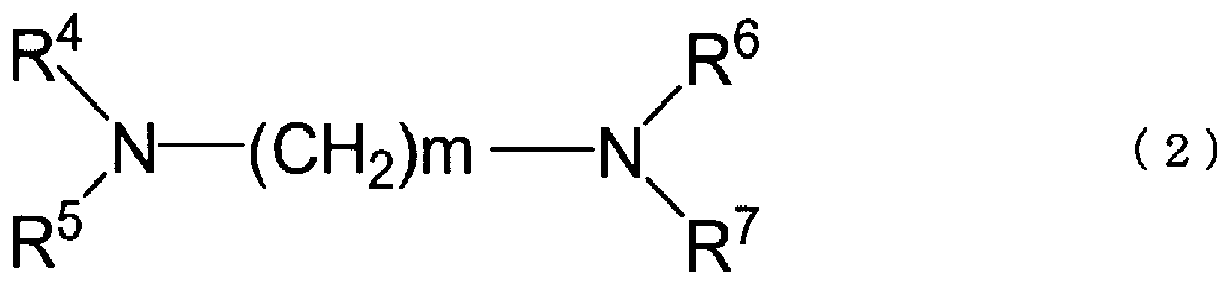
an amine compound (2) represented by the following formula (2):
- [2] The amine catalyst for curing a polyisocyanate compound according to the above [1], wherein the content ratio of the amine compound (1) to the amine compound (2) is within a range of from 10/90 to 90/10 by the weight ratio.
- [3] The amine catalyst for curing a polyisocyanate compound according to the above [1] or [2], wherein in the amine compound (1), each of R1 and R2 which are independent of each other, is a methyl group, an ethyl group, a propyl group, a butyl group, an isopropyl group, an isobutyl group, a sec-butyl group or a tert-butyl group, and R3 is a hydroxymethyl group, a 2-hydroxyethyl group, a 3-hydroxypropyl group, a 2-hydroxypropyl group, a 4-hydroxybutyl group, a 3-hydroxybutyl group, a 2-hydroxybutyl group, a 2-methyl-3-hydroxypropyl group, a 2-methyl-2-hydroxypropyl group, a 1,1-dimethyl-2-hydroxyethyl group, an aminomethyl group, a 2-aminoethyl group, a 3-aminopropyl group, a 2-aminopropyl group, a 4-aminobutyl group, a 3-aminobutyl group, a 2-aminobutyl group, a 2-methyl-3-aminopropyl group, a 2-methyl-2-aminopropyl group or a 1,1-dimethyl-2-aminoethyl group.
- [4] The amine catalyst for curing a polyisocyanate compound according to any one of the above [1] to [3], wherein in the amine compound (2), each of R4 and R5 which are independent of each other, is a methyl group, an ethyl group, a propyl group, a butyl group, an isopropyl group, an isobutyl group, a sec-butyl group or a tert-butyl group, R6 is a methyl group, an ethyl group, a propyl group, a butyl group, an isopropyl group, an isobutyl group, a sec-butyl group, a tert-butyl group, a hydroxymethyl group, a 2-hydroxyethyl group, a 3-hydroxypropyl group, a 2-hydroxypropyl group, a 4-hydroxybutyl group, a 3-hydroxybutyl group, a 2-hydroxybutyl group, a 2-methyl-3-hydroxypropyl group, a 2-methyl-2-hydroxypropyl group, a 1,1-dimethyl-2-hydroxyethyl group, an aminomethyl group, a 2-aminoethyl group, a 3-aminopropyl group, a 2-aminopropyl group, a 4-aminobutyl group, a 3-aminobutyl group, a 2-aminobutyl group, a 2-methyl-3-aminopropyl group, a 2-methyl-2-aminopropyl group or a 1,1-dimethyl-2-aminoethyl group, and R7 is a hydroxymethyl group, a 2-hydroxyethyl group, a 3-hydroxypropyl group, a 2-hydroxypropyl group, a 4-hydroxybutyl group, a 3-hydroxybutyl group, a 2-hydroxybutyl group, a 2-methyl-3-hydroxypropyl group, a 2-methyl-2-hydroxypropyl group, a 1,1-dimethyl-2-hydroxyethyl group, an aminomethyl group, a 2-aminoethyl group, a 3-aminopropyl group, a 2-aminopropyl group, a 4-aminobutyl group, a 3-aminobutyl group, a 2-aminobutyl group, a 2-methyl-3-aminopropyl group, a 2-methyl-2-aminopropyl group or a 1,1-dimethyl-2-aminoethyl group.
- [5] The amine catalyst for curing a polyisocyanate compound according to any one of the above [1] to [4], wherein the amine compound (1) is at least one compound selected from the group consisting of dimethyl-2-hydroxyethylamine, diethyl-2-hydroxyethylamine, dimethyl-3-hydroxypropylamine, diethyl-3-hydroxypropylamine, dimethyl-2-hydroxypropylamine, diethyl-2-hydroxypropylamine, dimethyl-4-hydroxybutylamine, dimethyl-2-aminoethylamine, diethyl-2-aminoethylamine, dimethyl-3-aminopropylamine, diethyl-3-aminopropylamine, dimethyl-2-aminopropylamine, diethyl-2-aminopropylamine and dimethyl-4-aminobutylamine.
- [6] The amine catalyst for curing a polyisocyanate compound according to any one of the above [1] to [5], wherein the amine compound (2) is at least one compound selected from the group consisting of N,N,N'-trimethyl-2-hydroxyethylethylenediamine, N,N,N'-triethyl-2-hydroxyethylethylenediamine, N,N,N'-trimethyl-3-hydroxypropylethylenediamine, N,N,N'-trimethyl-2-hydroxypropylethylenediamine, N,N-diethyl-N'-methyl-2-hydroxyethylethylenediamine, N,N,N'-trimethyl-2-hydroxyethylpropylenediamine, N,N,N'-trimethyl-2-hydroxyethylbutylenediamine, N,N-dimethyl-N',N'-bis(2-hydroxyethyl)ethylenediamine, N,N-diethyl-N',N'-bis(2-hydroxyethyl)ethylenediamine, N,N-dimethyl-N',N'-bis(3-hydroxypropyl)ethylenediamine, N,N-dimethyl-N',N'-bis(2-hydroxypropyl)ethylenediamine, N,N-dimethyl-N',N'-bis(3-hydroxypropyl)propylenediamine, N,N-dimethyl-N',N'-bis(2-hydroxypropyl)propylenediamine, N,N-diethyl-N',N'-bis(2-hydroxypropyl)ethylenediamine, N,N-diethyl-N',N'-bis(2-hydroxypropyl)propylenediamine, N,N,N'-trimethyl-2-aminoethylethylenediamine, N,N,N'-triethyl-2-aminoethylethylenediamine, N,N,N'-trimethyl-3-aminopropylethylenediamine, N,N,N'-trimethyl-2-aminopropylethylenediamine, N,N-diethyl-N'-methyl-2-aminoethylethylenediamine, N,N,N'-trimethyl-2-aminoethylpropylenediamine, N,N,N'-trimethyl-2-aminoethylbutylenediamine, N,N-dimethyl-N',N'-bis(2-aminoethyl)ethylenediamine and N,N-diethyl-N',N'-bis(2-aminoethyl)ethylenediamine.
- [7] A polyisocyanate adhesive composition comprising the amine catalyst for curing a polyisocyanate compound as defined in any one of the above [1] to [6], and an organic polyisocyanate compound.
- [8] The polyisocyanate adhesive composition according to the above [7], which contains the amine catalyst for curing a polyisocyanate compound as defined in any one of the above [1] to [6] in an amount within a range of from 0.1 to 10 parts by weight per 100 parts by weight of the total amount of the organic polyisocyanate compound.
- [9] A polyisocyanate adhesive composition comprising the amine catalyst for curing a polyisocyanate compound as defined in any one of the above [1] to [6], an organic polyisocyanate compound and an active hydrogen group-containing compound.
- [10] The polyisocyanate adhesive composition according to the above [9], which contains the amine catalyst for curing a polyisocyanate compound as defined in any one of the above [1] to [6] in an amount within a range of from 0.1 to 10 parts by weight per 100 parts by weight of the total amount of the organic polyisocyanate compound and the active hydrogen group-containing compound.
- [11] The polyisocyanate adhesive composition according to the above [9] or [10], wherein the active hydrogen group-containing compound is water.
- [12] The polyisocyanate adhesive composition according to the above [11], wherein the content ratio (organic polyisocyanate compound/water) of the organic polyisocyanate compound to water is within a range of from 30/70 to 90/10 by the weight ratio.
- The amine catalyst for curing a polyisocyanate compound and the polyisocyanate adhesive composition containing it of the present invention have excellent effects such that both initial moldability before a thermal compression step and high reactivity at the time of thermal compression molding in production of a synthetic board or in production of a ceiling material for an automobile can be satisfied, and they are advantageous in view of the energy and improve the productivity, and accordingly they are advantageous in the cost reduction of a synthetic board and a ceiling material for an automobile and industrially very useful.
- Now, the present invention will be described in further detail.
- In the present invention, the amine catalyst for curing a polyisocyanate compound is characterized by comprising an amine compound (1) represented by the above formula (1) and an amine compound (2) represented by the above formula (2).
- In the above formula (1), each of R1 and R2 which are independent of each other, is a C1-4 hydrocarbon group, its structure is not particularly limited, and it may, for example, be a methyl group, an ethyl group, a n-propyl group, an isopropyl group, a n-butyl group, an isobutyl group, a sec-butyl group or a tert-butyl group.
- Further, in the above formula (1), R3 is a C1-4 hydrocarbon group having a hydroxy group or an amino group, its structure is not particularly limited, and it may, for example, be a hydroxymethyl group, a 2-hydroxyethyl group, a 3-hydroxypropyl group, a 2-hydroxypropyl group, a 4-hydroxybutyl group, a 3-hydroxybutyl group, a 2-hydroxybutyl group, a 2-methyl-3-hydroxypropyl group, a 2-methyl-2-hydroxypropyl group, a 1,1-dimethyl-2-hydroxyethyl group, an aminomethyl group, a 2-aminoethyl group, a 3-aminopropyl group, a 2-aminopropyl group, a 4-aminobutyl group, a 3-aminobutyl group, a 2-aminobutyl group, a 2-methyl-3-aminopropyl group, a 2-methyl-2-aminopropyl group or a 1,1-dimethyl-2-aminoethyl group. Among them, R3 is preferably a 2-hydroxyethyl group, a 3-hydroxypropyl group, a 2-hydroxypropyl group, a 2-aminoethyl group, a 3-aminopropyl group or a 2-aminopropyl group.
- In the above formula (2), each of R4 and R5 which are independent of each other, is a C1-4 hydrocarbon group, its structure is not particularly limited, and it may, for example, be a methyl group, an ethyl group, a n-propyl group, an isopropyl group, a n-butyl group, an isobutyl group, a sec-butyl group or a tert-butyl group.
- In the above formula (2), R6 is a C1-4 hydrocarbon group or a C1-4 hydrocarbon group having a hydroxy group or an amino group, its structure is not particularly limited, and it may, for example, be a methyl group, an ethyl group, a n-propyl group, an isopropyl group, a n-butyl group, an isobutyl group, a sec-butyl group, a tert-butyl group, a hydroxymethyl group, a 2-hydroxyethyl group, a 3-hydroxypropyl group, a 2-hydroxypropyl group, a 4-hydroxybutyl group, a 3-hydroxybutyl group, a 2-hydroxybutyl group, a 2-methyl-3-hydroxypropyl group, a 2-methyl-2-hydroxypropyl group, a 1,1-dimethyl-2-hydroxyethyl group, an aminomethyl group, a 2-aminoethyl group, a 3-aminopropyl group, 2-aminopropyl group, a 4-aminobutyl group, a 3-aminobutyl group, a 2-aminobutyl group, a 2-methyl-3-aminopropyl group, a 2-methyl-2-aminopropyl group or a 1,1-dimethyl-2-aminoethyl group.
- In the above formula (2), R7 is a C1-4 hydrocarbon group having a hydroxy group or an amino group, its structure is not particularly limited, and it may, for example, be a hydroxymethyl group, a 2-hydroxyethyl group, a 3-hydroxypropyl group, a 2-hydroxypropyl group, a 4-hydroxybutyl group, a 3-hydroxybutyl group, a 2-hydroxybutyl group, a 2-methyl-3-hydroxypropyl group, a 2-methyl-2-hydroxypropyl group, a 1,1-dimethyl-2-hydroxyethyl group, an aminomethyl group, a 2-aminoethyl group, a 3-aminopropyl group, a 2-aminopropyl group, a 4-aminobutyl group, a 3-aminobutyl group, a 2-aminobutyl group, a 2-methyl-3-aminopropyl group, a 2-methyl-2-aminopropyl group or a 1,1-dimethyl-2-aminoethyl group. Among them, R7 is preferably a 2-hydroxyethyl group, a 3-hydroxypropyl group, a 2-hydroxypropyl group, a 2-aminoethyl group, a 3-aminopropyl group or a 2-aminopropyl group.
- The above amine compound (1) may, for example, be specifically preferably dimethyl-2-hydroxyethylamine, diethyl-2-hydroxyethylamine, dimethyl-3-hydroxypropylamine, diethyl-3-hydroxypropylamine, dimethyl-2-hydroxypropylamine, diethyl-2-hydroxypropylamine, dimethyl-4-hydroxybutylamine, dimethyl-2-aminoethylamine, diethyl-2-aminoethylamine, dimethyl-3-aminopropylamine, diethyl-3-aminopropylamine, dimethyl-2-aminopropylamine, diethyl-2-aminopropylamine or dimethyl-4-aminobutylamine.
- The above amine compound (2) may, for example, be specifically preferably N,N,N'-trimethyl-2-hydroxyethylethylenediamine, N,N,N'-triethyl-2-hydroxyethylethylenediamine, N,N,N'-trimethyl-3-hydroxypropylethylenediamine, N,N,N'-trimethyl-2-hydroxypropylethylenediamine, N,N-diethyl-N'-methyl-2-hydroxyethylethylenediamine, N,N,N'-trimethyl-2-hydroxyethylpropylenediamine, N,N,N'-trimethyl-2-hydroxyethylbutylenediamine, N,N-dimethyl-N',N'-bis(2-hydroxyethyl)ethylenediamine, N,N-diethyl-N',N'-bis(2-hydroxyethyl)ethylenediamine, N,N-dimethyl-N',N'-bis(3-hydroxypropyl)ethylenediamine, N,N-dimethyl-N',N'-bis(2-hydroxypropyl)ethylenediamine, N,N-dimethyl-N',N'-bis(3-hydroxypropyl)propylenediamine, N,N-dimethyl-N',N'-bis(2-hydroxypropyl)propylenediamine, N,N-diethyl-N',N'-bis(2-hydroxypropyl)ethylenediamine, N,N-diethyl-N',N'-bis(2-hydroxypropyl)propylenediamine, N,N,N'-trimethyl-2-aminoethylethylenediamine, N,N,N'-triethyl-2-aminoethylethylenediamine, N,N,N'-trimethyl-3-aminopropylethylenediamine, N,N,N'-trimethyl-2-aminopropylethylenediamine, N,N-diethyl-N'-methyl-2-aminoethylethylenediamine, N,N,N'-trimethyl-2-aminoethylpropylenediamine, N,N,N'-trimethyl-2-aminoethylbutylenediamine, N,N-dimethyl-N',N'-bis(2-aminoethyl)ethylenediamine or N,N-diethyl-N',N'-bis(2-aminoethyl)ethylenediamine.
- In the amine catalyst for curing a polyisocyanate compound of the present invention, the content ratio of the amine compound (1) to the amine compound (2) is within a range of from 10/90 to 90/10 by the weight ratio, and if it is out of such a mixing ratio, it may be difficult to satisfy both initial moldability before a thermal compression step and high reactivity at the time of thermal compression molding in production of a synthetic board or in production of a ceiling material for an automobile. It is preferably within a range of from 30/70 to 70/30, particularly preferably within a range of from 40/60 to 60/40.
- The amine catalyst for curing a polyisocyanate compound of the present invention contains the above amine compound (1) and the above amine compound (2), and may further contain another catalyst within a range not to depart from the scope of the present invention. Such a catalyst may, for example, be a conventional tertiary amine.
- The tertiary amine is not particularly limited and may, for example, be a tertiary amine compound such as N,N,N',N'-tetramethylethylenediamine, N,N,N',N'-tetramethylpropylenediamine, N,N,N',N",N"-pentamethyldiethylenetriamine, N,N,N',N",N"-pentamethyl-(3-aminopropyl)ethylenediamine, N,N,N',N",N"-pentamethyldipropylenetriamine, N,N,N',N'-tetramethylguanidine, 1,3,5-tris(N,N-dimethylaminopropyl)hexahydro-S-triazine, 1,8-diazabicyclo[5,4,0]undecene-7, N-methylmorpholine, N-ethylmorpholine, bis(2-dimethylaminoethyl) ether, 1-methylimidazole, 1,2-dimethylimidazole, 1-isobutyl-2-methylimidazole, 1-dimethylaminopropylimidazole, N,N-dimethylethanolamine or N,N-dimethylpropanolamine.
- The amine catalyst for curing a polyisocyanate compound of the present invention is a mixture of the above amine compound (1) and the above amine compound (2) and may contain another catalyst within a range not to depart from the scope of the present invention as mentioned above. To prepare the mixture, as the case requires, a solvent such as dipropylene glycol, ethylene glycol, 1,4-butanediol or water may be used. Further, the amine compound (1) and the amine compound (2) may be prepared as mixed or may be prepared separately. The amount of the above solvent is not particularly limited, and the concentration is optional.
- The polyisocyanate adhesive composition of the present invention contains the amine catalyst for curing a polyisocyanate compound of the present invention and an organic polyisocyanate compound.
- In the polyisocyanate adhesive composition of the present invention, the organic polyisocyanate compound is not particularly limited and may, for example, be an aromatic polyisocyanate such as toluene diisocyanate (TDI), diphenylmethane diisocyanate (MDI), naphthylene diisocyanate or xylylene diisocyanate, an alicyclic polyisocyanate such as cyclohexyl diisocyanate or isophorone diisocyanate, an aliphatic polyisocyanate such as hexamethylene diisocyanate, a free isocyanate-containing prepolymer obtained by reaction of such a polyisocyanate with a polyol, a modified polyisocyanate such as carbodiimide-modified isocyanate, or a mixture thereof.
- TDI and its derivative may, for example, be a mixture of 2,4-TDI and 2,6-TDI or a terminal isocyanate prepolymer derivative of TDI.
- MDI and its derivative may, for example, be both or either one of a mixture of MDI and its polymer polyphenyl polymethylene diisocyanate, and a diphenylmethane diisocyanate derivative having a terminal isocyanate group.
- Specifically, Woodcure 300 (manufactured by NIPPON POLYURETHANE INDUSTRY CO., LTD.) which is a diphenylmethane iisocyanate derivative having a terminal isocyanate group may, for example, be mentioned.
- The polyisocyanate adhesive composition of the present invention may contain an active hydrogen group-containing compound. In the present invention, the active hydrogen group-containing compound means a compound having an active hydrogen-containing functional group such as a hydroxy group or an amino group and may, for example, be a polyol or water.
- The polyol may, for example, be a known polyether polyol, polyester polyol or polymer polyol, or a flame retardant polyol such as a phosphorus-containing polyol or a halogen-containing polyol or a phenol-based polyol such as a Mannich-based polyol. Such an active hydrogen group-containing compound may be used alone or optionally in combination.
- The polyether polyol may, for example, be one produced by an addition reaction of an alkylene oxide (such as ethylene oxide or propylene oxide) to a compound having at least two active hydrogen groups as a starting material, for example, in accordance with a method disclosed in Gunter Oertel, "Polyurethane Handbook" (1985), Hanser Publishers (Germany), p. 42-53. Further, the compound having at least two active hydrogen groups may, for example, be a polyhydric alcohol such as ethylene glycol, propylene glycol, glycerin, trimethylolpropane or pentaerythritol, an aliphatic amine such as ethylenediamine, an aromatic amine such as toluenediamine, an alkanolamine such as ethanolamine or diethanolamine, sorbitol or sucrose.
- The polyester polyol may, for example, be one obtained by reaction of a dibasic acid and glycol, a polyester polyol obtained from DMT residue or phthalic anhydride as a starting material, or a polyester polyol derived from waste at the time of production of nylon, TMP, waste of pentaerythritol, or waste or wastage of phthalic acid polyester, by treatment (Keiji Iwata, "Polyurethane Resin Handbook" (first edition in 1987), NIKKAN KOGYO SHIMBUN, LTD., p. 116-117).
- The polymer polyol may, for example, be a polymerized polyol obtained by reaction of the above polyether polyol and an ethylenic unsaturated monomer (such as butadiene, acrylonitrile or styrene) in the presence of a radical polymerization catalyst.
- The flame retardant polyol may, for example, be a phosphorus-containing polyol obtained by adding an alkylene oxide to a phosphoric acid compound, a halogen-containing polyol obtained by subjecting epichlorohydrin or trichlorobutylene oxide to ring-opening polymerization, or a phenol polyol such as a Mannich-based polyol.
- From the viewpoint of the curing reactivity and the adhesive strength of the polyisocyanate adhesive composition, water is preferred as the active hydrogen group-containing compound.
- In the polyisocyanate adhesive composition of the present invention, the content of the amine catalyst for curing a polyisocyanate compound of the present invention is usually from 0.1 to 10 parts by weight, preferably from 0.1 to 8 parts by weight, more preferably from 0.3 to 8 parts by weight per 100 parts by weight of the total amount of the organic polyisocyanate compound used. If it is smaller than 0.1 part by weight, curing tends to be insufficient, and physical properties of the resulting synthetic board or ceiling material for an automobile will deteriorate. If it exceeds 10 parts by weight, the initial moldability may deteriorate in some cases due to pre-curing before a thermal compression step.
- Further, in a case where the polyisocyanate adhesive composition of the present invention contains an active hydrogen-containing compound, the content of the amine catalyst for curing a polyisocyanate compound of the present invention is within the above range per 100 parts by weight of the total amount of the organic polyisocyanate compound and the active hydrogen group-containing compound.
- The weight ratio of the organic polyisocyanate compound to the active hydrogen group-containing compound in the polyisocyanate adhesive composition is not particularly limited, however, in a case where water is used as the active hydrogen group-containing compound, it is preferably within a range of from 30:70 to 90:10 from the viewpoint of the curing reactivity and the adhesive strength.
- Now, the present invention will be described in further detail with reference to Examples and Comparative Examples. However, it should be understood that the present invention is by no means restricted to such specific Examples.
- In the following Examples and Comparative Examples, methods for evaluating the curing reactivity are as follows.
- 200 g of a mixture in a blend ratio as identified in Table 1 or 2 is put in a 500 ml polypropylene cup and adjusted to a liquid temperature of 20°C. Using LAB Mixer, the mixture was continuously stirred at 500 rpm, and a time until the viscosity of the mixture was increased and surface of the mixture became flattened was measured.
- 50 g of a mixture in a blend ratio as identified in Table 1 or 2 was put in a 500 ml polypropylene cup and adjusted to a liquid temperature of 20°C. The mixture was stirred by LAB Mixer at 2,000 rpm for 30 seconds. This mixture was continuously stirred using a stirring rod in a water bath at 80°C, and the time until the mixture started being solidified was measured.
- A mixture in a material blend ratio as identified in Table 1 was stirred at a liquid temperature of 20°C using LAB mixer at 6,000 rpm for 5 seconds, to evaluate curing reactivities at room temperature and at 80°C. The results are shown in Tables 1 and 2.
[Table 1] Ex. 1 Ex. 2 Ex. 3 Ex. 4 Ex. 5 Ex. 6 Ex. 7 Ex. 8 Ex. 9 [Composition] Isocyanate 1) (pbw) 100 100 100 100 100 100 100 100 100 Water (pbw) 150 150 150 150 150 150 150 150 150 Catalyst Catalyst A 2) (pbw) 0.25 Catalyst B 3) (pbw) 0.25 0.38 0.42 0.29 0.25 0.21 0.17 0.13 Catalyst C 4) (pbw) 0.25 0.25 0.13 0.15 0.20 0.25 0.30 0.35 Catalyst D 5) (pbw) 0.08 0.06 0.05 0.04 0.03 0.02 [Results of evaluation of curing reactivity] <Room temperature reaction> Time until the mixture started curing (min) 62 90 117 125 102 95 84 69 60 <80°C reaction> Time until the mixture started curing (sec) 179 175 195 160 206 187 167 136 120 1) Woodcure 300 manufactured by NIPPON POLYURETHANE INDUSTRY CO., LTD.
2) N,N-dimethylethanolamine
3) Dimethyl-3-aminopropylamine
4) N,N,N'-trimethyl-N'-(2-hydroxyethyl)ethylenediamine
5) N,N-dimethyl-N',N'-di(2-hydroxypropyl)propylenediamine[Table 2] Comp. Ex. 1 Comp. Ex. 2 Comp. Ex. 3 Comp. Ex. 4 Comp. Ex. 5 Comp. Ex. 6 Comp. Ex. 7 Comp. Ex. 8 Comp. Ex. 9 Comp. Ex. 10 Comp. Ex. 11 [Composition] Isocyanate 1) (pbw) 100 100 100 100 100 100 100 100 100 100 100 Water (pbw) 150 150 150 150 150 150 150 150 150 150 150 Catalyst Catalyst A 2) (pbw) 0.50 Catalyst B 3) (pbw) 0.50 Catalyst C 4) (pbw) 0.50 Catalyst D 5) (pbw) 0.50 Catalyst E 6) (pbw) 0.50 Catalyst F 7) (pbw) 0.50 Catalyst G 8) (pbw) 0.50 Catalyst H 9) (pbw) 0.50 Catalyst I 10) (pbw) 0.50 Catalyst J 11) (pbw) 0.50 Catalyst K 12) (pbw) 0.50 [Results of evaluation of curing reactivity] <Room temperature reaction> Time until the mixture started curing (min) 84 145 34 58 39 59 44 82 118 >180 >180 <80°C reaction> Time until the mixture started curing (sec) 370 >600 278 324 291 305 233 327 534 >600 382 1) Woodcure 300 manufactured by NIPPON POLYURETHANE INDUSTRY CO., LTD.
2) N,N-dimethylethanolamine
3) Dimethyl-3-aminopropylamine
4) N,N,N'-trimethyl-N'-(2-hydroxyethyl)ethylenediamine
5) N,N-dimethyl-N',N'-di(2-hydroxypropyl)propylenediamine
6) Dimethyl-2-(2'-hydroxyethoxy)ethylamine
7) N,N,N',N"-N"-(2-hydroxypropyl)diethyltriamine
8) Dimethyl-6-hydroxyhexylamine
9) Bis(2-dimethylaminoethyl) ether
10) N,N,N',N'-tetramethylhexamethylenediamine
11) Triethylenediamine
12) N-(2-dimethylaminoethyl)-N'-methylpiperazine - As evident from Examples 1 to 9 in Table 1, the polyisocyanate adhesive composition containing the amine catalyst for curing a polyisocyanate compound of the present invention does not have excessive curing reactivity at room temperature conditions and is excellent in the curing reactivity at high temperature, and thus it is indicated that both initial moldability before a thermal compression step and high reactivity at the time of thermal compression molding in production of a synthetic board or a ceiling material for an automobile can be satisfied.
- Whereas, in Comparative Examples 1 to 12 in Table 2, the polyisocyanate adhesive composition is inferior in the curing reactivity at 80°C. Thus, at the time of thermal compression molding in production of a synthetic board or a ceiling material for an automobile, thermal compression for a long time is required, or the time until curing tends to be long, whereby an obtainable product may be inferior in mechanical properties.
- The amine catalyst and the polyisocyanate adhesive composition containing it of the present invention are applicable to production of a synthetic board and a ceiling material for an automobile.
- The entire disclosure of Japanese Patent Application No.
2012-165665 filed on July 26, 2012
Claims (12)
- An amine catalyst for curing a polyisocyanate compound, which comprises an amine compound (1) represented by the following formula (1):

an amine compound (2) represented by the following formula (2):
- The amine catalyst for curing a polyisocyanate compound according to Claim 1, wherein the content ratio of the amine compound (1) to the amine compound (2) is within a range of from 10/90 to 90/10 by the weight ratio.
- The amine catalyst for curing a polyisocyanate compound according to Claim 1 or 2, wherein in the amine compound (1), each of R1 and R2 which are independent of each other, is a methyl group, an ethyl group, a propyl group, a butyl group, an isopropyl group, an isobutyl group, a sec-butyl group or a tert-butyl group, and R3 is a hydroxymethyl group, a 2-hydroxyethyl group, a 3-hydroxypropyl group, a 2-hydroxypropyl group, a 4-hydroxybutyl group, a 3-hydroxybutyl group, a 2-hydroxybutyl group, a 2-methyl-3-hydroxypropyl group, a 2-methyl-2-hydroxypropyl group, a 1,1-dimethyl-2-hydroxyethyl group, an aminomethyl group, a 2-aminoethyl group, a 3-aminopropyl group, a 2-aminopropyl group, a 4-aminobutyl group, a 3-aminobutyl group, a 2-aminobutyl group, a 2-methyl-3-aminopropyl group, a 2-methyl-2-aminopropyl group or a 1,1-dimethyl-2-aminoethyl group.
- The amine catalyst for curing a polyisocyanate compound according to any one of Claims 1 to 3, wherein in the amine compound (2), each of R4 and R5 which are independent of each other, is a methyl group, an ethyl group, a propyl group, a butyl group, an isopropyl group, an isobutyl group, a sec-butyl group or a tert-butyl group, R6 is a methyl group, an ethyl group, a propyl group, a butyl group, an isopropyl group, an isobutyl group, a sec-butyl group, a tert-butyl group, a hydroxymethyl group, a 2-hydroxyethyl group, a 3-hydroxypropyl group, a 2-hydroxypropyl group, a 4-hydroxybutyl group, a 3-hydroxybutyl group, a 2-hydroxybutyl group, a 2-methyl-3-hydroxypropyl group, a 2-methyl-2-hydroxypropyl group, a 1,1-dimethyl-2-hydroxyethyl group, an aminomethyl group, a 2-aminoethyl group, a 3-aminopropyl group, a 2-aminopropyl group, a 4-aminobutyl group, a 3-aminobutyl group, a 2-aminobutyl group, a 2-methyl-3-aminopropyl group, a 2-methyl-2-aminopropyl group or a 1,1-dimethyl-2-aminoethyl group, and R7 is a hydroxymethyl group, a 2-hydroxyethyl group, a 3-hydroxypropyl group, a 2-hydroxypropyl group, a 4-hydroxybutyl group, a 3-hydroxybutyl group, a 2-hydroxybutyl group, a 2-methyl-3-hydroxypropyl group, a 2-methyl-2-hydroxypropyl group, a 1,1-dimethyl-2-hydroxyethyl group, an aminomethyl group, a 2-aminoethyl group, a 3-aminopropyl group, a 2-aminopropyl group, a 4-aminobutyl group, a 3-aminobutyl group, a 2-aminobutyl group, a 2-methyl-3-aminopropyl group, a 2-methyl-2-aminopropyl group or a 1,1-dimethyl-2-aminoethyl group.
- The amine catalyst for curing a polyisocyanate compound according to any one of Claims 1 to 4, wherein the amine compound (1) is at least one compound selected from the group consisting of dimethyl-2-hydroxyethylamine, diethyl-2-hydroxyethylamine, dimethyl-3-hydroxypropylamine, diethyl-3-hydroxypropylamine, dimethyl-2-hydroxypropylamine, diethyl-2-hydroxypropylamine, dimethyl-4-hydroxybutylamine, dimethyl-2-aminoethylamine, diethyl-2-aminoethylamine, dimethyl-3-aminopropylamine, diethyl-3-aminopropylamine, dimethyl-2-aminopropylamine, diethyl-2-aminopropylamine and dimethyl-4-aminobutylamine.
- The amine catalyst for curing a polyisocyanate compound according to any one of Claims 1 to 5, wherein the amine compound (2) is at least one compound selected from the group consisting of N,N,N'-trimethyl-2-hydroxyethylethylenediamine, N,N,N'-triethyl-2-hydroxyethylethylenediamine, N,N,N'-trimethyl-3-hydroxypropylethylenediamine, N,N,N'-trimethyl-2-hydroxypropylethylenediamine, N,N-diethyl-N'-methyl-2-hydroxyethylethylenediamine, N,N,N'-trimethyl-2-hydroxyethylpropylenediamine, N,N,N'-trimethyl-2-hydroxyethylbutylenediamine, N,N-dimethyl-N',N'-bis(2-hydroxyethyl)ethylenediamine, N,N-diethyl-N',N'-bis(2-hydroxyethyl)ethylenediamine, N,N-dimethyl-N',N'-bis(3-hydroxypropyl)ethylenediamine, N,N-dimethyl-N',N'-bis(2-hydroxypropyl)ethylenediamine, N,N-dimethyl-N',N'-bis(3-hydroxypropyl)propylenediamine, N,N-dimethyl-N',N'-bis(2-hydroxypropyl)propylenediamine, N,N-diethyl-N',N'-bis(2-hydroxypropyl)ethylenediamine, N,N-diethyl-N',N'-bis(2-hydroxypropyl)propylenediamine, N,N,N'-trimethyl-2-aminoethylethylenediamine, N,N,N'-triethyl-2-aminoethylethylenediamine, N,N,N'-trimethyl-3-aminopropylethylenediamine, N,N,N'-trimethyl-2-aminopropylethylenediamine, N,N-diethyl-N'-methyl-2-aminoethylethylenediamine, N,N,N'-trimethyl-2-aminoethylpropylenediamine, N,N,N'-trimethyl-2-aminoethylbutylenediamine, N,N-dimethyl-N',N'-bis(2-aminoethyl)ethylenediamine and N,N-diethyl-N',N'-bis(2-aminoethyl)ethylenediamine.
- A polyisocyanate adhesive composition comprising the amine catalyst for curing a polyisocyanate compound as defined in any one of Claims 1 to 6, and an organic polyisocyanate compound.
- The polyisocyanate adhesive composition according to Claim 7, which contains the amine catalyst for curing a polyisocyanate compound as defined in any one of Claims 1 to 6 in an amount within a range of from 0.1 to 10 parts by weight per 100 parts by weight of the total amount of the organic polyisocyanate compound.
- A polyisocyanate adhesive composition comprising the amine catalyst for curing a polyisocyanate compound as defined in any one of Claims 1 to 6, an organic polyisocyanate compound and an active hydrogen group-containing compound.
- The polyisocyanate adhesive composition according to Claim 9, which contains the amine catalyst for curing a polyisocyanate compound as defined in any one of Claims 1 to 6 in an amount within a range of from 0.1 to 10 parts by weight per 100 parts by weight of the total amount of the organic polyisocyanate compound and the active hydrogen group-containing compound.
- The polyisocyanate adhesive composition according to Claim 9 or 10, wherein the active hydrogen group-containing compound is water.
- The polyisocyanate adhesive composition according to Claim 11, wherein the content ratio (organic polyisocyanate compound/water) of the organic polyisocyanate compound to water is within a range of from 30/70 to 90/10 by the weight ratio.
Applications Claiming Priority (2)
| Application Number | Priority Date | Filing Date | Title |
|---|---|---|---|
| JP2012165665 | 2012-07-26 | ||
| PCT/JP2013/070354 WO2014017641A1 (en) | 2012-07-26 | 2013-07-26 | Amine catalyst for curing polyisocyanate compound and polyisocyanate adhesive composition containing amine catalyst for curing polyisocyanate compound |
Publications (3)
| Publication Number | Publication Date |
|---|---|
| EP2878609A1 true EP2878609A1 (en) | 2015-06-03 |
| EP2878609A4 EP2878609A4 (en) | 2016-03-09 |
| EP2878609B1 EP2878609B1 (en) | 2019-06-05 |
Family
ID=49997445
Family Applications (1)
| Application Number | Title | Priority Date | Filing Date |
|---|---|---|---|
| EP13822847.3A Active EP2878609B1 (en) | 2012-07-26 | 2013-07-26 | Amine catalyst for curing polyisocyanate compound and polyisocyanate adhesive composition containing amine catalyst for curing polyisocyanate compound |
Country Status (6)
| Country | Link |
|---|---|
| US (1) | US9777199B2 (en) |
| EP (1) | EP2878609B1 (en) |
| JP (1) | JP6273710B2 (en) |
| KR (1) | KR102073439B1 (en) |
| CN (1) | CN104395367A (en) |
| WO (1) | WO2014017641A1 (en) |
Families Citing this family (5)
| Publication number | Priority date | Publication date | Assignee | Title |
|---|---|---|---|---|
| JP6471523B2 (en) * | 2014-04-16 | 2019-02-20 | 東ソー株式会社 | Curing agent for producing polyurea resin, and method for producing polyurea resin using the same |
| JP6657921B2 (en) * | 2015-12-21 | 2020-03-04 | Dic株式会社 | Urethane resin composition and synthetic leather |
| CN109906240B (en) * | 2016-10-31 | 2021-08-24 | 三井化学株式会社 | Polymerizable composition for optical material, optical material and method for producing the same |
| CN112409216B (en) * | 2020-11-17 | 2023-07-14 | 肇庆市名洋涂料有限公司 | Amine-modified monomer for ultraviolet curing and its preparation method and photocurable material |
| CN113150240B (en) * | 2021-03-24 | 2022-06-07 | 北京小鸡磕技文化创意有限公司 | Environment-friendly high-hardness high-transparency polyurethane resin and preparation method thereof |
Family Cites Families (11)
| Publication number | Priority date | Publication date | Assignee | Title |
|---|---|---|---|---|
| JPH0234994B2 (en) * | 1981-09-21 | 1990-08-07 | Sunstar Engineering Inc | TAKOSHITSUZAINOSEKISOSEIKEIKAKOHO |
| US5166223A (en) * | 1991-09-20 | 1992-11-24 | Air Products And Chemicals, Inc. | Hydroxyl group-containing amine-boron adducts are reduced odor catalyst compositions for the production of polyurethanes |
| DE19646879A1 (en) * | 1995-11-23 | 1997-05-28 | Henkel Kgaa | Reactive one-component polyurethane adhesive with good bonding time |
| JPH1135918A (en) | 1997-07-17 | 1999-02-09 | Nippon Polyurethane Ind Co Ltd | Thermosensitive adhesive composition for boards |
| JP2000302833A (en) * | 1999-04-19 | 2000-10-31 | Toagosei Co Ltd | Catalyst for moisture curing of urethane prepolymer and one-part moisture cure type urethane-based hot melt adhesive |
| JP4432241B2 (en) * | 1999-10-13 | 2010-03-17 | 東ソー株式会社 | Catalyst composition for producing polyurethane resin and method for producing polyurethane resin |
| DE19962911C2 (en) * | 1999-12-23 | 2002-11-21 | Bayer Ag | Flame-retardant HR cold molded foam with reduced flue gas intensity and toxicity |
| JP2002069417A (en) | 2000-08-24 | 2002-03-08 | Nippon Polyurethane Ind Co Ltd | Adhesive composition for hot-pressed body of lignocellulosic material, hot-pressed body using the same, and method for producing the same |
| DE102005041763A1 (en) * | 2005-09-01 | 2007-03-08 | Basf Ag | Polyisocyanurate rigid foam and process for the preparation |
| JP4948853B2 (en) * | 2006-03-06 | 2012-06-06 | 花王株式会社 | Manufacturing method of rigid polyurethane foam |
| JP5388460B2 (en) * | 2008-03-10 | 2014-01-15 | 花王株式会社 | Manufacturing method of rigid polyurethane foam |
-
2013
- 2013-07-26 JP JP2013155667A patent/JP6273710B2/en active Active
- 2013-07-26 US US14/416,914 patent/US9777199B2/en active Active
- 2013-07-26 KR KR1020147034478A patent/KR102073439B1/en active Active
- 2013-07-26 EP EP13822847.3A patent/EP2878609B1/en active Active
- 2013-07-26 WO PCT/JP2013/070354 patent/WO2014017641A1/en not_active Ceased
- 2013-07-26 CN CN201380033492.8A patent/CN104395367A/en active Pending
Also Published As
| Publication number | Publication date |
|---|---|
| EP2878609A4 (en) | 2016-03-09 |
| JP6273710B2 (en) | 2018-02-07 |
| US9777199B2 (en) | 2017-10-03 |
| US20150203727A1 (en) | 2015-07-23 |
| WO2014017641A1 (en) | 2014-01-30 |
| CN104395367A (en) | 2015-03-04 |
| KR102073439B1 (en) | 2020-02-04 |
| KR20150035690A (en) | 2015-04-07 |
| JP2014040587A (en) | 2014-03-06 |
| EP2878609B1 (en) | 2019-06-05 |
Similar Documents
| Publication | Publication Date | Title |
|---|---|---|
| EP2878609B1 (en) | Amine catalyst for curing polyisocyanate compound and polyisocyanate adhesive composition containing amine catalyst for curing polyisocyanate compound | |
| EP2483324B1 (en) | Method for lowering emissions of a polyurethane foam | |
| US20090326089A1 (en) | Process for lowering emissions of a polyurethane foam | |
| CN100528922C (en) | Co-catalysis of autocatalytic polyols for low density polyurethane foams with improved aging characteristics | |
| EP2868679B1 (en) | Catalyst composition for producing polyurethane resin, and method for producing polyurethane resin using said catalyst composition | |
| JP2010275551A (en) | Method for producing flexible polyurethane foam with low release | |
| CN101054432A (en) | Aromatic diacid ester diols and substituted carbamates thereof for minimizing deterioration of polyurethane foams | |
| US20190119460A1 (en) | Polyurethanes having a reduced aldehyde emission | |
| CN101031601A (en) | Molded flexible polyurethane foams with reduced flammability and superior durability | |
| US20210139634A1 (en) | Use of acrylic acid esters and amides for reducing emissions of a polyurethane foam | |
| US12391787B2 (en) | Polyurethane foams with reduced aromatic amine content | |
| CN104583287B (en) | The polyurethane polyureas acid amides rigid foam of plastically deformable | |
| EP1262500B1 (en) | Catalyst for production of a polyurethane resin and method for producing a polyurethane resin | |
| EP1092737B1 (en) | Catalyst composition for the production of a polyurethane resin, and method for producing a polyurethane resin | |
| JP6464632B2 (en) | Curing agent for producing polyurea resin, and method for producing polyurea resin using the same | |
| JP6471523B2 (en) | Curing agent for producing polyurea resin, and method for producing polyurea resin using the same | |
| CN1847281B (en) | Polyisocyanates for soft polyurethane foam board and producing method for soft polyurethane foam board using same | |
| JP3572422B2 (en) | Manufacturing method of rigid polyurethane foam with excellent curing speed | |
| JP2001181363A (en) | Catalyst composition for producing polyurethane resin and method for producing polyurethane resin | |
| JP5594070B2 (en) | Method for producing flexible polyurethane foam | |
| KR20220149698A (en) | Catalysts for use in binder compositions | |
| JP2013100380A (en) | Amine catalyst for curing polyisocyanate compound and polyisocyanate adhesive composition containing the same | |
| JP2003105052A (en) | Amine catalyst composition for producing polyurethane resin and method for producing polyurethane resin using the same | |
| US20230265233A1 (en) | Polyurethane foams with improved acoustic properties | |
| WO2001062815A1 (en) | Polyisocyanate reaction systems for application in wooden floor parts |
Legal Events
| Date | Code | Title | Description |
|---|---|---|---|
| PUAI | Public reference made under article 153(3) epc to a published international application that has entered the european phase |
Free format text: ORIGINAL CODE: 0009012 |
|
| 17P | Request for examination filed |
Effective date: 20150116 |
|
| AK | Designated contracting states |
Kind code of ref document: A1 Designated state(s): AL AT BE BG CH CY CZ DE DK EE ES FI FR GB GR HR HU IE IS IT LI LT LU LV MC MK MT NL NO PL PT RO RS SE SI SK SM TR |
|
| AX | Request for extension of the european patent |
Extension state: BA ME |
|
| DAX | Request for extension of the european patent (deleted) | ||
| RA4 | Supplementary search report drawn up and despatched (corrected) |
Effective date: 20160205 |
|
| RIC1 | Information provided on ipc code assigned before grant |
Ipc: C09J 11/06 20060101ALI20160201BHEP Ipc: C09J 175/00 20060101ALI20160201BHEP Ipc: C08G 18/18 20060101AFI20160201BHEP |
|
| STAA | Information on the status of an ep patent application or granted ep patent |
Free format text: STATUS: EXAMINATION IS IN PROGRESS |
|
| 17Q | First examination report despatched |
Effective date: 20171108 |
|
| GRAP | Despatch of communication of intention to grant a patent |
Free format text: ORIGINAL CODE: EPIDOSNIGR1 |
|
| STAA | Information on the status of an ep patent application or granted ep patent |
Free format text: STATUS: GRANT OF PATENT IS INTENDED |
|
| INTG | Intention to grant announced |
Effective date: 20190308 |
|
| GRAS | Grant fee paid |
Free format text: ORIGINAL CODE: EPIDOSNIGR3 |
|
| GRAA | (expected) grant |
Free format text: ORIGINAL CODE: 0009210 |
|
| STAA | Information on the status of an ep patent application or granted ep patent |
Free format text: STATUS: THE PATENT HAS BEEN GRANTED |
|
| AK | Designated contracting states |
Kind code of ref document: B1 Designated state(s): AL AT BE BG CH CY CZ DE DK EE ES FI FR GB GR HR HU IE IS IT LI LT LU LV MC MK MT NL NO PL PT RO RS SE SI SK SM TR |
|
| RAP1 | Party data changed (applicant data changed or rights of an application transferred) |
Owner name: TOSOH CORPORATION |
|
| REG | Reference to a national code |
Ref country code: GB Ref legal event code: FG4D |
|
| REG | Reference to a national code |
Ref country code: CH Ref legal event code: EP |
|
| REG | Reference to a national code |
Ref country code: AT Ref legal event code: REF Ref document number: 1139898 Country of ref document: AT Kind code of ref document: T Effective date: 20190615 |
|
| REG | Reference to a national code |
Ref country code: IE Ref legal event code: FG4D |
|
| REG | Reference to a national code |
Ref country code: DE Ref legal event code: R096 Ref document number: 602013056298 Country of ref document: DE |
|
| REG | Reference to a national code |
Ref country code: NL Ref legal event code: MP Effective date: 20190605 |
|
| REG | Reference to a national code |
Ref country code: LT Ref legal event code: MG4D |
|
| PG25 | Lapsed in a contracting state [announced via postgrant information from national office to epo] |
Ref country code: SE Free format text: LAPSE BECAUSE OF FAILURE TO SUBMIT A TRANSLATION OF THE DESCRIPTION OR TO PAY THE FEE WITHIN THE PRESCRIBED TIME-LIMIT Effective date: 20190605 Ref country code: HR Free format text: LAPSE BECAUSE OF FAILURE TO SUBMIT A TRANSLATION OF THE DESCRIPTION OR TO PAY THE FEE WITHIN THE PRESCRIBED TIME-LIMIT Effective date: 20190605 Ref country code: AL Free format text: LAPSE BECAUSE OF FAILURE TO SUBMIT A TRANSLATION OF THE DESCRIPTION OR TO PAY THE FEE WITHIN THE PRESCRIBED TIME-LIMIT Effective date: 20190605 Ref country code: FI Free format text: LAPSE BECAUSE OF FAILURE TO SUBMIT A TRANSLATION OF THE DESCRIPTION OR TO PAY THE FEE WITHIN THE PRESCRIBED TIME-LIMIT Effective date: 20190605 Ref country code: NO Free format text: LAPSE BECAUSE OF FAILURE TO SUBMIT A TRANSLATION OF THE DESCRIPTION OR TO PAY THE FEE WITHIN THE PRESCRIBED TIME-LIMIT Effective date: 20190905 Ref country code: LT Free format text: LAPSE BECAUSE OF FAILURE TO SUBMIT A TRANSLATION OF THE DESCRIPTION OR TO PAY THE FEE WITHIN THE PRESCRIBED TIME-LIMIT Effective date: 20190605 Ref country code: ES Free format text: LAPSE BECAUSE OF FAILURE TO SUBMIT A TRANSLATION OF THE DESCRIPTION OR TO PAY THE FEE WITHIN THE PRESCRIBED TIME-LIMIT Effective date: 20190605 |
|
| PG25 | Lapsed in a contracting state [announced via postgrant information from national office to epo] |
Ref country code: RS Free format text: LAPSE BECAUSE OF FAILURE TO SUBMIT A TRANSLATION OF THE DESCRIPTION OR TO PAY THE FEE WITHIN THE PRESCRIBED TIME-LIMIT Effective date: 20190605 Ref country code: BG Free format text: LAPSE BECAUSE OF FAILURE TO SUBMIT A TRANSLATION OF THE DESCRIPTION OR TO PAY THE FEE WITHIN THE PRESCRIBED TIME-LIMIT Effective date: 20190905 Ref country code: LV Free format text: LAPSE BECAUSE OF FAILURE TO SUBMIT A TRANSLATION OF THE DESCRIPTION OR TO PAY THE FEE WITHIN THE PRESCRIBED TIME-LIMIT Effective date: 20190605 Ref country code: GR Free format text: LAPSE BECAUSE OF FAILURE TO SUBMIT A TRANSLATION OF THE DESCRIPTION OR TO PAY THE FEE WITHIN THE PRESCRIBED TIME-LIMIT Effective date: 20190906 |
|
| REG | Reference to a national code |
Ref country code: AT Ref legal event code: MK05 Ref document number: 1139898 Country of ref document: AT Kind code of ref document: T Effective date: 20190605 |
|
| PG25 | Lapsed in a contracting state [announced via postgrant information from national office to epo] |
Ref country code: AT Free format text: LAPSE BECAUSE OF FAILURE TO SUBMIT A TRANSLATION OF THE DESCRIPTION OR TO PAY THE FEE WITHIN THE PRESCRIBED TIME-LIMIT Effective date: 20190605 Ref country code: NL Free format text: LAPSE BECAUSE OF FAILURE TO SUBMIT A TRANSLATION OF THE DESCRIPTION OR TO PAY THE FEE WITHIN THE PRESCRIBED TIME-LIMIT Effective date: 20190605 Ref country code: EE Free format text: LAPSE BECAUSE OF FAILURE TO SUBMIT A TRANSLATION OF THE DESCRIPTION OR TO PAY THE FEE WITHIN THE PRESCRIBED TIME-LIMIT Effective date: 20190605 Ref country code: SK Free format text: LAPSE BECAUSE OF FAILURE TO SUBMIT A TRANSLATION OF THE DESCRIPTION OR TO PAY THE FEE WITHIN THE PRESCRIBED TIME-LIMIT Effective date: 20190605 Ref country code: CZ Free format text: LAPSE BECAUSE OF FAILURE TO SUBMIT A TRANSLATION OF THE DESCRIPTION OR TO PAY THE FEE WITHIN THE PRESCRIBED TIME-LIMIT Effective date: 20190605 Ref country code: RO Free format text: LAPSE BECAUSE OF FAILURE TO SUBMIT A TRANSLATION OF THE DESCRIPTION OR TO PAY THE FEE WITHIN THE PRESCRIBED TIME-LIMIT Effective date: 20190605 Ref country code: PT Free format text: LAPSE BECAUSE OF FAILURE TO SUBMIT A TRANSLATION OF THE DESCRIPTION OR TO PAY THE FEE WITHIN THE PRESCRIBED TIME-LIMIT Effective date: 20191007 |
|
| PG25 | Lapsed in a contracting state [announced via postgrant information from national office to epo] |
Ref country code: IS Free format text: LAPSE BECAUSE OF FAILURE TO SUBMIT A TRANSLATION OF THE DESCRIPTION OR TO PAY THE FEE WITHIN THE PRESCRIBED TIME-LIMIT Effective date: 20191005 Ref country code: SM Free format text: LAPSE BECAUSE OF FAILURE TO SUBMIT A TRANSLATION OF THE DESCRIPTION OR TO PAY THE FEE WITHIN THE PRESCRIBED TIME-LIMIT Effective date: 20190605 Ref country code: IT Free format text: LAPSE BECAUSE OF FAILURE TO SUBMIT A TRANSLATION OF THE DESCRIPTION OR TO PAY THE FEE WITHIN THE PRESCRIBED TIME-LIMIT Effective date: 20190605 |
|
| REG | Reference to a national code |
Ref country code: CH Ref legal event code: PL |
|
| REG | Reference to a national code |
Ref country code: DE Ref legal event code: R097 Ref document number: 602013056298 Country of ref document: DE |
|
| PG25 | Lapsed in a contracting state [announced via postgrant information from national office to epo] |
Ref country code: TR Free format text: LAPSE BECAUSE OF FAILURE TO SUBMIT A TRANSLATION OF THE DESCRIPTION OR TO PAY THE FEE WITHIN THE PRESCRIBED TIME-LIMIT Effective date: 20190605 Ref country code: MC Free format text: LAPSE BECAUSE OF FAILURE TO SUBMIT A TRANSLATION OF THE DESCRIPTION OR TO PAY THE FEE WITHIN THE PRESCRIBED TIME-LIMIT Effective date: 20190605 |
|
| PLBE | No opposition filed within time limit |
Free format text: ORIGINAL CODE: 0009261 |
|
| STAA | Information on the status of an ep patent application or granted ep patent |
Free format text: STATUS: NO OPPOSITION FILED WITHIN TIME LIMIT |
|
| REG | Reference to a national code |
Ref country code: BE Ref legal event code: MM Effective date: 20190731 |
|
| PG25 | Lapsed in a contracting state [announced via postgrant information from national office to epo] |
Ref country code: DK Free format text: LAPSE BECAUSE OF FAILURE TO SUBMIT A TRANSLATION OF THE DESCRIPTION OR TO PAY THE FEE WITHIN THE PRESCRIBED TIME-LIMIT Effective date: 20190605 Ref country code: PL Free format text: LAPSE BECAUSE OF FAILURE TO SUBMIT A TRANSLATION OF THE DESCRIPTION OR TO PAY THE FEE WITHIN THE PRESCRIBED TIME-LIMIT Effective date: 20190605 |
|
| 26N | No opposition filed |
Effective date: 20200306 |
|
| PG25 | Lapsed in a contracting state [announced via postgrant information from national office to epo] |
Ref country code: LI Free format text: LAPSE BECAUSE OF NON-PAYMENT OF DUE FEES Effective date: 20190731 Ref country code: CH Free format text: LAPSE BECAUSE OF NON-PAYMENT OF DUE FEES Effective date: 20190731 Ref country code: SI Free format text: LAPSE BECAUSE OF FAILURE TO SUBMIT A TRANSLATION OF THE DESCRIPTION OR TO PAY THE FEE WITHIN THE PRESCRIBED TIME-LIMIT Effective date: 20190605 Ref country code: LU Free format text: LAPSE BECAUSE OF NON-PAYMENT OF DUE FEES Effective date: 20190726 Ref country code: BE Free format text: LAPSE BECAUSE OF NON-PAYMENT OF DUE FEES Effective date: 20190731 |
|
| PG25 | Lapsed in a contracting state [announced via postgrant information from national office to epo] |
Ref country code: IE Free format text: LAPSE BECAUSE OF NON-PAYMENT OF DUE FEES Effective date: 20190726 |
|
| GBPC | Gb: european patent ceased through non-payment of renewal fee |
Effective date: 20190905 |
|
| PG25 | Lapsed in a contracting state [announced via postgrant information from national office to epo] |
Ref country code: GB Free format text: LAPSE BECAUSE OF NON-PAYMENT OF DUE FEES Effective date: 20190905 |
|
| PG25 | Lapsed in a contracting state [announced via postgrant information from national office to epo] |
Ref country code: CY Free format text: LAPSE BECAUSE OF FAILURE TO SUBMIT A TRANSLATION OF THE DESCRIPTION OR TO PAY THE FEE WITHIN THE PRESCRIBED TIME-LIMIT Effective date: 20190605 |
|
| PG25 | Lapsed in a contracting state [announced via postgrant information from national office to epo] |
Ref country code: MT Free format text: LAPSE BECAUSE OF FAILURE TO SUBMIT A TRANSLATION OF THE DESCRIPTION OR TO PAY THE FEE WITHIN THE PRESCRIBED TIME-LIMIT Effective date: 20190605 Ref country code: HU Free format text: LAPSE BECAUSE OF FAILURE TO SUBMIT A TRANSLATION OF THE DESCRIPTION OR TO PAY THE FEE WITHIN THE PRESCRIBED TIME-LIMIT; INVALID AB INITIO Effective date: 20130726 |
|
| PG25 | Lapsed in a contracting state [announced via postgrant information from national office to epo] |
Ref country code: MK Free format text: LAPSE BECAUSE OF FAILURE TO SUBMIT A TRANSLATION OF THE DESCRIPTION OR TO PAY THE FEE WITHIN THE PRESCRIBED TIME-LIMIT Effective date: 20190605 |
|
| P01 | Opt-out of the competence of the unified patent court (upc) registered |
Effective date: 20230523 |
|
| PGFP | Annual fee paid to national office [announced via postgrant information from national office to epo] |
Ref country code: FR Payment date: 20250610 Year of fee payment: 13 |
|
| PGFP | Annual fee paid to national office [announced via postgrant information from national office to epo] |
Ref country code: DE Payment date: 20250604 Year of fee payment: 13 |