EP2875325B1 - Determining elongation of elastic bandage - Google Patents
Determining elongation of elastic bandage Download PDFInfo
- Publication number
- EP2875325B1 EP2875325B1 EP13820155.3A EP13820155A EP2875325B1 EP 2875325 B1 EP2875325 B1 EP 2875325B1 EP 13820155 A EP13820155 A EP 13820155A EP 2875325 B1 EP2875325 B1 EP 2875325B1
- Authority
- EP
- European Patent Office
- Prior art keywords
- bandage
- elastic bandage
- elongation
- indicia
- elastic
- Prior art date
- Legal status (The legal status is an assumption and is not a legal conclusion. Google has not performed a legal analysis and makes no representation as to the accuracy of the status listed.)
- Active
Links
Images



Classifications
-
- G—PHYSICS
- G06—COMPUTING OR CALCULATING; COUNTING
- G06V—IMAGE OR VIDEO RECOGNITION OR UNDERSTANDING
- G06V20/00—Scenes; Scene-specific elements
- G06V20/20—Scenes; Scene-specific elements in augmented reality scenes
-
- G—PHYSICS
- G01—MEASURING; TESTING
- G01B—MEASURING LENGTH, THICKNESS OR SIMILAR LINEAR DIMENSIONS; MEASURING ANGLES; MEASURING AREAS; MEASURING IRREGULARITIES OF SURFACES OR CONTOURS
- G01B11/00—Measuring arrangements characterised by the use of optical techniques
- G01B11/16—Measuring arrangements characterised by the use of optical techniques for measuring the deformation in a solid, e.g. optical strain gauge
- G01B11/165—Measuring arrangements characterised by the use of optical techniques for measuring the deformation in a solid, e.g. optical strain gauge by means of a grating deformed by the object
-
- G—PHYSICS
- G01—MEASURING; TESTING
- G01L—MEASURING FORCE, STRESS, TORQUE, WORK, MECHANICAL POWER, MECHANICAL EFFICIENCY, OR FLUID PRESSURE
- G01L1/00—Measuring force or stress, in general
- G01L1/24—Measuring force or stress, in general by measuring variations of optical properties of material when it is stressed, e.g. by photoelastic stress analysis using infrared, visible light, ultraviolet
-
- G—PHYSICS
- G01—MEASURING; TESTING
- G01L—MEASURING FORCE, STRESS, TORQUE, WORK, MECHANICAL POWER, MECHANICAL EFFICIENCY, OR FLUID PRESSURE
- G01L5/00—Apparatus for, or methods of, measuring force, work, mechanical power, or torque, specially adapted for specific purposes
- G01L5/04—Apparatus for, or methods of, measuring force, work, mechanical power, or torque, specially adapted for specific purposes for measuring tension in flexible members, e.g. ropes, cables, wires, threads, belts or bands
- G01L5/045—Apparatus for, or methods of, measuring force, work, mechanical power, or torque, specially adapted for specific purposes for measuring tension in flexible members, e.g. ropes, cables, wires, threads, belts or bands for measuring the tension across the width of a band-shaped flexible member
-
- G—PHYSICS
- G01—MEASURING; TESTING
- G01L—MEASURING FORCE, STRESS, TORQUE, WORK, MECHANICAL POWER, MECHANICAL EFFICIENCY, OR FLUID PRESSURE
- G01L5/00—Apparatus for, or methods of, measuring force, work, mechanical power, or torque, specially adapted for specific purposes
- G01L5/04—Apparatus for, or methods of, measuring force, work, mechanical power, or torque, specially adapted for specific purposes for measuring tension in flexible members, e.g. ropes, cables, wires, threads, belts or bands
- G01L5/047—Specific indicating or recording arrangements, e.g. for remote indication, for indicating overload or underload
-
- G—PHYSICS
- G06—COMPUTING OR CALCULATING; COUNTING
- G06T—IMAGE DATA PROCESSING OR GENERATION, IN GENERAL
- G06T7/00—Image analysis
- G06T7/0002—Inspection of images, e.g. flaw detection
- G06T7/0012—Biomedical image inspection
- G06T7/0014—Biomedical image inspection using an image reference approach
-
- G—PHYSICS
- G06—COMPUTING OR CALCULATING; COUNTING
- G06T—IMAGE DATA PROCESSING OR GENERATION, IN GENERAL
- G06T7/00—Image analysis
- G06T7/20—Analysis of motion
- G06T7/246—Analysis of motion using feature-based methods, e.g. the tracking of corners or segments
- G06T7/251—Analysis of motion using feature-based methods, e.g. the tracking of corners or segments involving models
-
- G—PHYSICS
- G06—COMPUTING OR CALCULATING; COUNTING
- G06T—IMAGE DATA PROCESSING OR GENERATION, IN GENERAL
- G06T7/00—Image analysis
- G06T7/60—Analysis of geometric attributes
-
- G—PHYSICS
- G06—COMPUTING OR CALCULATING; COUNTING
- G06V—IMAGE OR VIDEO RECOGNITION OR UNDERSTANDING
- G06V30/00—Character recognition; Recognising digital ink; Document-oriented image-based pattern recognition
- G06V30/10—Character recognition
- G06V30/14—Image acquisition
- G06V30/142—Image acquisition using hand-held instruments; Constructional details of the instruments
-
- A—HUMAN NECESSITIES
- A61—MEDICAL OR VETERINARY SCIENCE; HYGIENE
- A61F—FILTERS IMPLANTABLE INTO BLOOD VESSELS; PROSTHESES; DEVICES PROVIDING PATENCY TO, OR PREVENTING COLLAPSING OF, TUBULAR STRUCTURES OF THE BODY, e.g. STENTS; ORTHOPAEDIC, NURSING OR CONTRACEPTIVE DEVICES; FOMENTATION; TREATMENT OR PROTECTION OF EYES OR EARS; BANDAGES, DRESSINGS OR ABSORBENT PADS; FIRST-AID KITS
- A61F13/00—Bandages or dressings; Absorbent pads
- A61F13/06—Bandages or dressings; Absorbent pads specially adapted for feet or legs; Corn-pads; Corn-rings
- A61F13/08—Elastic stockings; for contracting aneurisms
-
- G—PHYSICS
- G06—COMPUTING OR CALCULATING; COUNTING
- G06T—IMAGE DATA PROCESSING OR GENERATION, IN GENERAL
- G06T2200/00—Indexing scheme for image data processing or generation, in general
- G06T2200/24—Indexing scheme for image data processing or generation, in general involving graphical user interfaces [GUIs]
-
- G—PHYSICS
- G06—COMPUTING OR CALCULATING; COUNTING
- G06T—IMAGE DATA PROCESSING OR GENERATION, IN GENERAL
- G06T2207/00—Indexing scheme for image analysis or image enhancement
- G06T2207/10—Image acquisition modality
- G06T2207/10004—Still image; Photographic image
-
- G—PHYSICS
- G06—COMPUTING OR CALCULATING; COUNTING
- G06T—IMAGE DATA PROCESSING OR GENERATION, IN GENERAL
- G06T2207/00—Indexing scheme for image analysis or image enhancement
- G06T2207/30—Subject of image; Context of image processing
- G06T2207/30004—Biomedical image processing
-
- G—PHYSICS
- G06—COMPUTING OR CALCULATING; COUNTING
- G06T—IMAGE DATA PROCESSING OR GENERATION, IN GENERAL
- G06T2207/00—Indexing scheme for image analysis or image enhancement
- G06T2207/30—Subject of image; Context of image processing
- G06T2207/30204—Marker
- G06T2207/30208—Marker matrix
Definitions
- Compression bandages are known for use in the treatment of oedema and other venous and lymphatic disorders, e.g., of the lower limbs.
- An area where compression bandages are considered particularly useful is in the management and treatment of chronic wounds, such as venous leg ulcers. Achieving optimum pressure when applying compression to (e.g. leg) ulcer patients creates challenges for the clinician.
- U.S. Patent No. 3,613,679 describes an elastic bandage with a tension indicator.
- a series of figures forming an overall pattern is applied to the surface of an elastic bandage.
- the contours of the figures and/or their position relative to each other are altered.
- the degree of such altercation is an indication of the amount of tension existing in the bandage and the pressure applied by the bandage.
- U.S. 7,956,233 refers to such tension indicator as a calibration means.
- This calibration means may be visual, such as for example a set of regularly spaced pictograms printed on the bandage, or produced using a calibration system, such as for example a stencil, by the care staff who are provided with information on the recommended stretch on application.
- This type of stencil or the explanations necessary to manufacture it may be incorporated in a kit that includes the two support bandages that form the compression system or a selection of support bandages that allow various suitable compression systems to be produced.
- the principle of calibration using a stencil is the following.
- the stencil is generally produced by means of a cardboard sheet in which an opening has been cut that may have, for example, an ellipsoidal or rectangular shape, allowing, as will be understood, a pictogram of the same shape to be produced on the bandage.
- the transformation of these pictograms into circles or squares under the effect of stretching the bandage thus allows the latter to be calibrated.
- This principle is described, for example, in U.S. Pat. No. 3,613,679 .
- the rectangular shape which is easiest to cut in a cardboard sheet, is preferably used.
- the length and the width of the rectangle are mathematically determined depending on the stretch at which the bandage is intended to be applied.
- the width L of the rectangle will be L/(1+E').
- E the stretch of the bandage on application
- L the length of the rectangle that will be parallel in the weft direction of the bandage (i.e. perpendicular to the length direction of the bandage)
- the width L of the rectangle will be L/(1+E').
- a rectangle having a length of 4 cm and a width of 4/(1+0.55) or 2.58 cm will be used.
- rectangles of 4 cm length and 2.58 cm width are cut into a cardboard stencil. This stencil is positioned on the flat, unstretched bandage and the outline of this rectangle is drawn on the bandage, for example using a felt-tip pen.”
- bandages with tension indicators are commercially available including for example ProGuide®, available from Smith & Nephew, Setopress®, available from Molylncke, Surepress®, available from Convatek, and K-Two®, available from Urgo Medical.
- ProGuide® available from Smith & Nephew
- Setopress® available from Molylncke
- Surepress® available from Convatek
- K-Two® available from Urgo Medical.
- compression bandages with visual indicators were applied more accurately than bandages without indicators.
- WO 2008/006227 A1 discloses a medical compression garment having means for measuring compression that comprises marks spaced at intervals and arranged on a surface line of the garment, wherein each of said marks consists of at least three elements, and a method for evaluating such a medical compression garment.
- US 2004/0036853 A1 discloses a compressed symbology strain gage that includes a target in the form of a symbolic strain rosette, the target being associated with a body for which strain is to be measured and being adapted to emit a detectable physical quantity, and a sensor compatible with and adapted to pre-process the detectable physical quantity emitted by the target.
- US 6 338 723 B1 discloses a therapeutic garment for applying compression to a part of the body and having a system for measuring compression.
- US 2007/0055537 A1 discloses a device for assistance in the selection of a compression orthesis and in adapting the same to the morphology of a limb.
- EP 0 475 811 A1 discloses that, for applying a medical bandage having an elasticity at least in the longitudinal direction, there is established a relationship between the traction exerted longitudinally on the bandage and a local geometric value of the part of the body receiving the bandage.
- EP 1 731 096 A1 discloses a device for characterizing a pressure exerted by a medical compression garment on a limb.
- the device comprises means for determining a local radius of a surface of said limb.
- US 2009/0316965 A1 discloses a method for preparing a clinical restraint for a subject, which comprises scanning the portion of the subject to be restrained to produce a 3D image data set, generating a three dimensional replica of the portion of the subject from the 3D image data set and preparing a clinical restraint using the three dimensional replica.
- the present invention is directed to new methods of determining elongation, tension and applied pressure of elastic bandages comprising tension indicators.
- unelongated tension indicator is described as an illustrative predetermined elongation state. Such methods can utilize any predetermined elongation state and are not limited to the use of an unelongated state as the predetermined elongation state.
- a tension indicator is generally a series of figures forming an overall repeating pattern applied to the (e.g. outer) surface of an elastic bandage.
- the figure or figures of the tension indicator may be of any shape including for examples rectangles, squares, circles or elipses. Regardless of the shape or arrangement, the tension indicator provides a visual indication of varying amounts of elongation. When the bandage is stretched, the shape or contours of the figures and/or their position relative to each other are altered. The change in shape and/or position of the tension indicator figures is an indication of the amount the bandage is elongated.
- Fig. 1 For example, one illustrative tension indicator of a compression bandage available from Convatek under the trade designation Surepress® is depicted in Fig. 1 .
- the bandage should be stretched such that the small boxes become square.
- the bandage should be stretched such that the large boxes become square.
- the tension indication may comprise a repeating pattern of a set of geometric tension indicator wherein the set comprises at least two, three or more distinct marking, each distinct marking associated with a different elongation of the bandage.
- the repeat interval of the repeating pattern is typically no greater than about half the circumference of the three-dimensional member to which the elastic bandage is intended to be applied. In some embodiments, the repeat interval is no greater than about 10 cm, 9 cm, 8 cm, 7 cm, 6 cm or 5 cm.
- the distinct markings can be distinguished from each other.
- the distinct markings may comprise the same or similar shaped figures, the figures being of different sizes.
- the tension indicator of Fig. 1 comprising two alternating rectangles of different sizes is illustrative of this embodiment.
- the distinct markings may comprise differently shaped figures, such as a combination of elipses and rectangles.
- the size of the figures of the tension indicator can vary. Typically the smallest dimension of the figures is at least 3 to 5 mm and typically no greater than about 20 mm.
- the distinct marking may also comprise similar or different shaped figures having different colors.
- Fig. 2 depicts an interval of a tension indicator comprising 4 rectangular bars having the same height (e.g. 15 mm) a different width.
- each bar of a different width also has a different color.
- bars 10, having a width of about 3 mm may be black;
- bar 20, having a width of 5 mm, may be red;
- bar 30, having a width of 7.5 mm, may be blue;
- bar 40 having a width of about 152 mm may be green.
- the tension indicator code of Fig. 2 may be about actual size for a 4 inch wide elastic bandage. Alternatively, such code may be reduced or enlarged in size provided the scale is maintained.
- the color of the tension indicator is preferably of sufficient contrast as compared to the elastic bandage material that it is readily discernible from the digital photograph thereof.
- Tension indicators having figures of filled color(s) rather than the outline of a figure can also be favored in order that the tension indicator is readily discernible.
- the elastic bandage comprises a continuous or intermittent marking in a central portion (relative to the width of the bandage) that is parallel to the length of the elastic bandage.
- This feature can serve as guide for the extent of overlap.
- such parallel line is in the middle.
- a longitudinal edge (parallel to the direction of stretch) of the overlapping layer of the bandage is positioned such that it is aligned with the middle marking and the layer is overlapped by 50%.
- Other target overlaps may be desired for other elastic bandages or certain end uses.
- such continuous or intermittent marking in the central portion of the elastic bandage may be positioned at other locations to serve as a guide for any amount of overlap generally ranging from about 25% to 30% to 50% overlap. It is appreciated that a 25% guide can also be used as a guide for 75% overlap.
- the overlap guide marking may be integrated with the tension indicator as in the case of the elastic bandage depicted in Fig. 1 , the overlap guide marking can be a separate marking than the tension indicator. Further the elastic bandage may comprise more than one overlap guide marking.
- a mobile computing device having a processor and a graphical user interface, commonly referred to as a "Smartphone".
- the Smartphone is typically utilized at least for the purpose of providing a digital photograph of an elongated tension indicator of an elastic bandage (applied to a three-dimensional member) to the computer program and for the purpose of receiving output indicia associated with the elongation or applied pressure of the elastic bandage calculated by the program.
- the tension indicator marking is not only used as a visual indicator by a clinician applying the elastic bandage, but also utilized by the computer program in the form of digital indicia.
- the processor of the Smartphone may also be utilized for the purpose of analyzing the image data to determine elongation and/or calculating the applied pressure.
- a remote serve may conduct the steps of analyzing the image data to determine elongation and/or calculating the applied pressure.
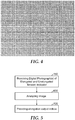
- the method generally comprises receiving image data that includes a digital photograph of an elongated tension indicator of an elastic bandage 100, analyzing the image data (with a processor of a mobile-computing device or remote server) to determine elongation of the elastic bandage 600 by comparing geometric features of the elongated tension indicator to model geometric features that define a predetermined elongation state, and providing output indicia associated with the determined elongation 700.
- the output indicia can be displayed by the graphical interface 701 or can be audio indicia 702.
- the output indicia may be pass/fail indicia.
- the output indicia may comprise a "green light" when the elongation or pressure is within a specified target range and a "red light” when outside the target range.
- the pass/fail indicia may also be different sounds.
- the output indicia may be a numerical value, calculated from the analysis.
- the output indicia may include displayed or audio instructions concerning the elastic bandage application technique.
- Fig. 4 depicts a digital photograph of an illustrative elongated tension indicator.
- the computer program of the Smartphone computer application or remote server compares the geometric features of the elongated tension indicator to model geometric features that define a predetermined elongation state.
- the term geometric refers to the ordinary meaning of the mathematics of the properties, measurement, and relationships of point, lines, angles, and surfaces.
- the term “feature” refers to any distinct part or the overall appearance of all the parts of the figure or figures of the tension indicator.
- the predetermined elongation state of the tension indicator is the unelongated state of the tension indicator. However, since there is typically a linear relationship between the change in shape and/or position of the tension indicator figures and the amount of stretch, the predetermined elongation state of the tension indicator can be any known elongation state.
- the predetermined (e.g. unelongated) elongation state is preloaded and stored in the computer program of the Smartphone or remote server.
- the computer program computes the difference between the elongated and predetermined (e.g. unelongated) elongation state.
- the predetermined elongation state is the unelongated tension indicator and the unelongated tension indicator is also received 150 by the computer application program as image date that includes a digital photograph of the elongated tension indicator, such as depicted in Fig. 4 .
- the digital photograph of the elongated tension indicator can be the same or a second (separate) digital photograph as the digital photograph that comprises the elongated tension indicator.
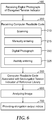
- the predetermined (e.g. unelongated) elongation state is associated with a computer readable code of a reference library 300.
- This embodiment is particularly useful when the computer program is intended to analyze the image date of a wide variety of elastic bandages from different manufacturers having different types of tension indicators.
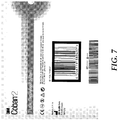
- This embodiment comprises receiving a computer readable code 200, such as a UPC code (See Fig. 7 ).
- the computer readable code may be present on the elastic bandage product packaging, product literature, or even printed on the elastic bandage.
- the computer readable code can be provided by various means including scanning 210 the code or taking a digital photograph 220 of the code concurrently or separately than the digital photograph of the elongated or unelongated tension indicator.
- the computer readable code can also be provided by manually entering 220 the code as well as by audio input 215 such as by reciting the code to an audio recognition program.
- the computer code is associated with the predetermined (e.g. unelongated) elongation state of the tension indicator from the reference library, which is then utilized to determine the elongation of the elastic bandage.
- the predetermined (e.g. unelongated) elongation state is stored by a remote server.
- the analysis may also be conducted by the remote server.
- the predetermined (e.g. unelongated) elongation state is downloaded from a remote server to the Smartphone computer application and the analysis is conducted by the Smartphone computer application.
- a computer-implemented method of detecting elongation of an elastic bandage can reduce or eliminate human error. For example, there is some subjectivity or a judgement call as to exactly when the figures of a tension indicator have been properly elongated, e.g. "when the large boxes of Fig. 1 become a square". If the boxes are less than a square, the tension may be too low. Likewise if the boxes are over extended, the tension can be too high. Another advantage is that such method can provide immediate verification as to whether the bandage has been applied correctly. Verification is particularly advantageous for in-home health care when the compression bandage may be self-applied or applied by a caregiver who is not a trained health care professional.
- the method further comprises analyzing the image to determine the elongation and determining the tensile of the applied bandage. Determining the tensile is also an intermediate step in utilizing the Laplace equation to calculate the applied pressure of the elastic bandage.
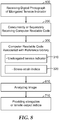
- the method generally comprises receiving image data that includes a digital photograph of an elongated tension indicator of an elastic bandage 100, analyzing the image data to determine elongation of the elastic bandage 200 by comparing geometric features of the elongated tension indicator to model geometric features that define a predetermined elongation state, utilizing the determined elongation of the elastic bandage and stress-strain indicia to determine the tensile of the applied bandage 610; and providing output indicia associated with the tensile of the applied bandage 710.
- the output indicia can be displayed by the graphical interface or can be audio indicia, as previously described.
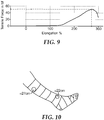
- Fig. 9 depicts an illustrative stress-strain curve of an elastic bandage.
- the x-axis strain is equivalent to elongation; whereas the y-axis is tensile force.
- the tensile force can be computed from a simple linear equation from the determined elongation, provided that the elastic bandage has been elongated in the linear range.
- the relationship may not be linear.
- most any function can be deduced to a mathematical equation.
- the tensile can be obtained directly from the stress-strain curve.
- both the predetermined elongation state and the stress-strain indicia are preloaded and stored in the computer program of the Smartphone application or remote server.
- the computer program determines (e.g. computes) the tensile of the applied elastic bandage from the elongation of the elastic bandage derived from analyzing the digital photograph of the elongated tension indicator and the stress-strain indicia.
- the predetermined elongation state 310 and stress-strain indicia 320 are associated with a computer readable code of a reference library 300, as previously described with respect to Fig. 6 .
- the Laplace equation concerns the relationship of various variables with regard to applied pressure.
- P ⁇ and P ⁇ are respectively the internal and external pressures at the surface, r is the radius of curvature, and ⁇ is the tension in the film.
- r is the radius of curvature
- ⁇ is the tension in the film.
- the circumference of a three-dimensional member can vary widely based on the particular location (e.g. ankle - 22 cm, calf- 27 cm, thigh - 33 cm (not shown).
- the following table are calculations of applied pressure at various circumferences when the tensile force (i.e. elongation of the bandage) and number of layers is maintained constant.
- Pressure (mmHg)
- Tensile Force (T) (kg.f) Layers
- N) Circumference (C) (cm) Width (W) (cm) 21 1.5 1 33 10 26 1.5 1 27 10 32 1.5 1 22 10
- the applied pressure at the ankle is 32 mm of mercury, yet the applied pressure at the thigh is 21 mm of mercury (Hg).
- a computer-implemented method of detecting applied pressure of an elastic bandage comprising receiving image data that includes a digital photograph of an elongated tension indicator 100 of an elastic bandage; utilizing the Laplace equation to determine the applied pressure 620; and providing indicia associated with applied pressure 720.
- the tension (T) is determined from the elongation and stress-strain indicia, as previously described with respect to Fig. 8 .
- the predetermined elongation state 310 and stress-strain indicia 320 can be associated with a computer readable code of a reference library 300.
- the width 330 of the elastic bandage may also be associated with the computer readable code.
- the circumference 400 of the three-dimensional member (to which the elastic bandage is applied) and the number of applied layers 500 may be separately received.
- the computer program will prompt the user to enter the number of layers applied and the percentage of overlap of each layer.
- the computer program may also prompt the user to also enter the circumference of the three-dimensional member (e.g. limb).
- the circumference the number of applied layer may also be concurrently received from analysis of the digital photograph. For example, the circumference at various locations can be approximated from the digital photograph assuming a cylindrical shaped member (having a small height).
- the number of layers can also be determined from analysis of a digital photograph.
- the digital photograph of the elongated tension indicator is typically a close-up such as depicted in Fig. 4 .
- a second photograph of the entire elastic bandage wrapped member may be received for the purpose of determining the number of layers applied.
- the methods described herein utilize a computer readable code for the purpose of accessing information associated with the elastic bandage such as the predetermined (e.g. unelongated) elongation state of the tension indicator, stress-strain indicia, or width of the bandage.
- the computer readable code may be present on the elastic bandage itself or a package thereof.
- the computer readable code can be applied with conventional printing processes such as offset printing, flexoprinting, or gravure printing, but also with laser printing, thermodirect, thermotransfer, or inkjet printing.
- the elastic bandages may be provided in a cart having bins of various elastic bandages with the code provided on the bin or on a (e.g. laminated) card accompanying the cart.
- the code is a one-dimensional code, commonly known as bar codes or UPC code, such as exemplified in Fig. 7 .
- the code may be a two-dimensional code such as a QR code. Both one-dimensional and two-dimensional codes can be read with optical reading devices, such as for example barcode reading devices (scanners) or (CCD) digital cameras of mobile computing devices such as Smartphones.
- Barcodes such as UPC codes are generally considered one-dimensional codes, i.e. a code applied in a single axis (e.g. x-axis).
- Two-dimensional codes such as QR codes are applied in two axes. These codes can consist of stacked one-dimensional codes, arranged in lines, or true aerial codes.
- so-called 3D-codes exist, with the tone of color, color saturation, or brightness representing the third dimension, for example.
- Two-dimensional codes typically encode information perpendicular to a first axis direction (e.g. x-axis and y-axis).
- the code can cover an area of a minimum of 0.5 cm 2 .
- a typical size of a UPC bar code or two dimensional code is about 20 to 25 cm 2 .
- the code may be larger if desired, ranging in size up to 50 or even 100 cm 2 .
- True aerial codes or matrix codes can be differentiated from stacked codes.
- matrix codes data is encoded evenly within a matrix of blocks. The direction is irrelevant, so that reading is possible omnidirectionally. This is advantageous as it simplifies reading by the scanner or digital camera.
- Two-dimensional matrix codes e.g. QR codes
- QR codes Two-dimensional matrix codes
- Data provided in a QR code is typically redundant. Depending on design, data can still be decoded even if up to 30% of the code is missing or destroyed.
- the code can encode a specific internet or web address automatically leading to the respective encoded internet site.
- the code may be also utilized to provide a link to the computer application or computer program of a remote server. Further, other relevant information for the elastic bandage can be obtained immediately from this internet site, while avoiding generally searching the internet or searching the homepage of the manufacturer.
- the tension indicator may comprise the computer readable code.
- a rectangular shaped unelongated tension indicator comprising a bar code or two-dimensional code that can be stretched to a square is an example of a tension indicator comprising a computer readable code.
- bar codes are recognizable as being the same code even when stretched.
- the elastic bandage can be associated with more than one computer readable code.
- one code may be associated with the predetermined (e.g. unelongated) elongation state and another code for may be associated with stress-strain indicia.
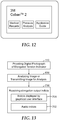
- a single code automatically leads to a single encoded internet site (See Fig. 12 ) that provides a menu of options including the elongation and/or applied pressure analysis option.
- This single menu can also provide other options or links such as an elastic bandage application guide, a link to a medical record, a link to an elastic bandage sales representative, a link to an elastic bandage supplier, or a direct connection to a consultation site or hotline for the elastic bandage.
- the internet site provides the information or data in the language of the country where the product was sold. This information can be added to the code as additional information so that the consumer will be directed immediately to the internet site in the respective language or the single menu can provide a language selection.
- the various methods of detecting elongation, tension, applied pressure etc. can be described with respect to the steps conducted by the user of such computer-implemented method, i.e. whereas the steps of receiving and providing are interchanged.
- the user may be a healthcare practitioner that is applying or verifying the application of a compression bandage.
- the user may also be a patient or caregiver that is not a healthcare professional.
- a computer-implemented method of detecting elongation of an elastic bandage comprising providing image data that includes a digital photograph of an elongated tension indicator 110 of an elastic bandage; analyzing the image data or transmitting (e.g.
- the output indicia may be displayed by the graphical interface 701 or may be audio indicia 703, as previously described.
- a computer-implemented method of detecting applied pressure of an elastic bandage comprising providing image data that includes a digital photograph of an elongated tension indicator 110 of an elastic bandage; utilizing the Laplace equation to determine the applied pressure 620; and receiving indicia associated with applied pressure 740.
- the tension (T) is determined from the elongation and stress-strain indicia, as previously described with respect to Fig. 8 .
- the predetermined elongation state 310 and stress-strain indicia 320 are associated with a computer readable code of a reference library 300.
- the width 330 of the elastic bandage may also be associated with the computer readable code.
- the circumference 410 of the three-dimensional member (to which the elastic bandage is applied) and the number of applied layers 510 may be separately received, as also previously described.
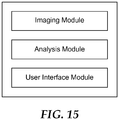
- a mobile-computing device may comprise such system or such system may reside on a remote server.
- the computer implemented system comprises an image module.
- the image module is capable of receiving indicia indicative of a digital photograph of an elongated tension indicator of an elastic bandage.
- the computer-implemented system further comprises an analysis module.
- the analysis module is capable comparing geometric features of the elongated tension indicator to model geometric features that define a predetermined elongation state.
- the analysis module is capable of determining the tension of the elongated bandage by use of the determined elongation and stress-strain indicia.
- the analysis module is further capable of calculating the applied pressure of the elongated bandage by utilizing the Laplace equation.
- the computer-implemented system is further comprises a user interface module capable of providing output graphical or audio indicia associated with the determined elongation, tension, and/or applied pressure.
- the user interface module may also prompt the input of various information for use by the analysis module such as the digital photograph, computer readable code, circumference of the three-dimensional member to which the elastic bandage is applied, the number of layers applied, etc.
- the article is non-transient computer readable medium comprising indicia indicative of a digital photograph of an elongated tension indicator of an elastic bandage and a computer readable code.
- the computer readable code is associated with the unelongated tension indicator, stress-strain indicia of the elastic bandage, width of the elastic bandage, an elastic bandage application guide, a link to a medical record, a link to an elastic bandage sales representative, a link to an elastic bandage supplier, or a direct connection to an elastic bandage consultation site; as well as any combination of such information.
- the computer readable code may be a bar code or a two-dimensional matrix code. Such code may be contained within or integrated with the tension indicator.
- a three-dimensional member e.g. limb
- the applied layer comprises an elongated tension indicator and a computer readable code.
- the computer readable code is associated with various information as just described.
- the present invention is applicable to a wide variety of elastic bandages.
- Each bandage is sufficiently elastic such that it is capable of being wound 2 or more turns (more suitably 5 or more turns) about a limb of a patient.
- suitable dimensions for the bandages depend in part on the particular limb being treated and/or the particular patient.
- suitable dimensions for the bandages may be about 70 to about 130 mm wide and about 2 to about 4.5 m long, while for use with upper limbs a width of about 70 to about 130 mm is suitable with a corresponding shorter length than that use for lower limbs.
- suitable dimensions may be larger (e.g., for equine bandaging) or smaller (e.g., for canine bandaging).
- Bandages are generally sufficiently porous to allow for transmission of air and moisture vapor through the bandage (e.g., a water vapor transmission rate (WVTR) of at least 240 g/m.sup.2/24 h, more suitably of at least 400 g/m.sup.2/24 h, e.g., as determined by ASTM E398-03 at 37.8.degree. C. and 100% relative humidity in the wet chamber and 37.8 degrees C. and 10% relative humidity in the dry chamber).
- WVTR water vapor transmission rate
- each bandage, in particular the inner skin-facing bandage may be sterilized, e.g., gamma sterilized.
- Elastic bandage generally provide a compressive force when extended ranging from about 1 to about 80 mm Hg (more suitably from about 20 to about 75 mmHg, most suitably from about 30 to about 70 mmHg) (e.g. at a position 8 cm above the medial malleolus, when wrapped about a human adult leg with an ankle circumference of 22 cm).
- Elastic bandage may be classified as "long-stretch” elastic bandages, intended to be elongated greater than 100-120%. In some embodiments, such elastic bandages may be elongated up to 150%, 200%, 250%, 300%, 350% or 400%.
- the elastic compression bandages may be classified as "short-stretch” elastic bandages, generally exhibiting a relatively low extensibility in its longitudinal direction, in particular having a stretch capability in the longitudinal direction of not more than 75%, or 65%, or 60% or 55%, e.g., as determined in accordance with the Stretch Testing Procedure described in US 7,852,716 ; incorporated herein by reference.
- the stretch capability is typically at least 20%, 25%, or 30% in the longitudinal direction. Further, the recovery-of-stretch capability is typically at least 85%, or 90%, or 95%.
- Outer-facing (as opposed to skin facing) surfaces of bandages do not adhere to clothing, hair or skin.
- Outer-facing surface of bandages are typically self-adhering elastomeric bandages. Examples of suitable types of self-adherent elastomeric bandages as well as methods of making such bandages are disclosed in U.S. Pat. Nos. 3,575,782 ; 4,984,584 ; US Published Application No. 2005/0025937A , and U.S. Pat. No. 6,156,424 .
- Commercially available self-adhering elastomeric bandage are available under the trade designations ROSIDAL HAFT (Lohman & Rauscher GmbH & Co. KG, Neuwied Germany) and ACTICO (Activa Health Care, Burton-upon-Trent, UK).
- Elastic bandages may suitably comprise a woven, knitted or nonwoven bandage comprising generally a plurality of generally longitudinally extending elastic yarns in the woven, knitted or nonwoven structure, the bandage being coated or impregnated with a polymer binder. More suitably outer bandages may comprise a plurality of generally longitudinally extending, (preferably partially extended) elastic yarns bound with a polymeric binder between two webs or bound with a polymeric binder on a web.
- the polymeric binder is cohesive, so that the bandage is self-adherent (i.e. in use the bandage will remain adhered to itself under elastic extension e.g., without the use of a fastening mechanism.
- Suitable polymeric binders may comprise natural rubber latex, a synthetic latex, such as homopolymer and copolymer latexes of acrylics, butadienes, styrene/butadiene rubbers, chloroprenes, ethylenes (e.g., vinyl acetate/ethylene), isoprenes, nitriles and urethanes, or mixtures thereof.
- outer bandages are free of natural rubber latex.
- Extent of compression is generally related to, inter alia, size of the elastic yarns and the number of yarns, whereby increased compression is typically a result of using greater number of larger elastic yarns in the bandage.
- the number of elastic yarns per inch (epi) of the bandage may range from about 8, 9, or 10 to about 20 or 25 epi, while the elastic yarns may have a denier ranging from about 300, 400, or 500 denier to about 1500 denier, and typically no greater than 650 or 600 denier.
- the bandage comprises an inner skin facing, elongated, elastic bandage 10 and an outer, elongated, self-adhering, elastic compression bandage 20.
- the number of elastic yarns per inch (epi) of the inner bandage is typically no greater than 15, 14, 13, 12, 11, or 10 epi or less. Within this range, an epi of 4, 6, or 6 can be favored.
- the elastic yarns of the inner bandage are typically no greater than 550, 450 or 350 denier or less and at least 100, 150, or 200 denier.
- the inner bandage comprises a foam layer affixed to the first face of the elastic substrate.
- a variety of means are suitable for affixing the foam layer onto the elastic substrate such as stitching, needle tacking, ultrasonic welding or bonding, e.g., mechanical, thermal, and chemical bonding as well as combinations thereof.
- Suitable means of chemical bonding include using an adhesive, for example in the form of a continuous or discontinuous layer (e.g., a pattern-coated adhesive layer), as further described in previously cited U.S. Patent No. 7,854,716 .
- Flexible, resilent, polymeric foams containing open cells are preferred.
- Suitable foams include, but are not limited to, polyurethane, carboxylated butadiene-sytrene rubber, polyester, polyacrylate, polyether, and polyolefin foams.
- Foams used for the foam layers are typically absorbent foams, e.g., absorbing greater than 250% aqueous saline solution when immersed for 30 minutes in phosphate saline containing 0.9 wt % NaCl at 37 degrees C.
- the average cell size (typically, the longest dimension of a cell, such as the diameter) of the foam is typically at least about 30 or 50 microns and no greater than about 800, 700, 600, or 500 microns, as measured by scanning electron microscopy (SEM) or light microscopy.
- Suitable foams may be either hydrophilic or hydrophobic, more suitably they may be hydrophobic and treated to render them more hydrophilic, e.g., with surfactants such as nonionic surfactants, such as oxypropylene-oxyethylene block copolymers.
- the compression bandage comprises: a) an inner skin facing, elongated, elastic bandage having inner and outer faces and comprising: (i) an elongated, elastic substrate having first and second faces, the second face comprising a self-adhering material, and (ii) an elongated layer of foam, said foam layer being affixed to the first face of said substrate and extending 33% or more across said first face of substrate in transverse direction and 67% or more across said first face of substrate in longitudinal direction.
- the foam layer having an exposed face is not affixed to the first face of said substrate and does not comprise a self-adhering material.
- the inner face of the inner bandage comprises the exposed face of the foam layer, and the outer face of the inner bandage comprises the second face of the elongated, elastic substrate/.
- the bandage further comprises an outer, elongated, self-adhering elastic bandage; having a compressive force when extended.
- the outer bandage overlies the inner bandage, and said inner face of the inner bandage faces the skin, and the outer face of the inner bandage faces said outer bandage.
- the inner and outer bandages are configured such that in use the bandages remain adhered to one another under elastic extension without the use of a fastening mechanism and is free of any additional elongated bandages.
- An elastic compression bandage having a width of about 4 inches may be printed with the previously described tension indicator of Fig. 2 .
- This tension indicator may be printed with conventional printing methods at regular intervals throughout the length of the wrap.
- the practitioner may utilize the colored bars of the tension indicator as a guide for stretching of the elastic bandage. In this case, 50% stretch is indicated when the green segment is observed as a square; 100% stretch when the blue segment is indicated a square; 200% stretch when the red segment is a square; 300% stretch when the black segments are observed as a square.
- the practitioner may first scan the UPC from the elastic bandage package (e.g. Fig. 7 ) which will automatically link the practitioner to an elongation or pressure analysis web link. Alternatively, the practitioner may download such computer application onto their Smartphone. The program will prompt the user to take a digital photograph of the elongated tension indicator.
- the program may also prompt the user to take a digital photograph of the unelongated tension indicator or such information is preprogrammed or associated with the scanned UPC code.
- the program mathematically calculate the difference in dimensions between the elongated an unelongated tension indicators and provides a positive or negative indication as to whether the elastic bandage has been elongated to within the proper range.
Landscapes
- Engineering & Computer Science (AREA)
- Physics & Mathematics (AREA)
- General Physics & Mathematics (AREA)
- Theoretical Computer Science (AREA)
- Computer Vision & Pattern Recognition (AREA)
- Multimedia (AREA)
- General Health & Medical Sciences (AREA)
- Health & Medical Sciences (AREA)
- Medical Informatics (AREA)
- Nuclear Medicine, Radiotherapy & Molecular Imaging (AREA)
- Radiology & Medical Imaging (AREA)
- Quality & Reliability (AREA)
- Geometry (AREA)
- Measurement Of The Respiration, Hearing Ability, Form, And Blood Characteristics Of Living Organisms (AREA)
- Force Measurement Appropriate To Specific Purposes (AREA)
- Length Measuring Devices By Optical Means (AREA)
Applications Claiming Priority (2)
| Application Number | Priority Date | Filing Date | Title |
|---|---|---|---|
| US201261673507P | 2012-07-19 | 2012-07-19 | |
| PCT/US2013/049220 WO2014014672A1 (en) | 2012-07-19 | 2013-07-03 | Determining elongation of elastic bandage |
Publications (3)
| Publication Number | Publication Date |
|---|---|
| EP2875325A1 EP2875325A1 (en) | 2015-05-27 |
| EP2875325A4 EP2875325A4 (en) | 2016-07-27 |
| EP2875325B1 true EP2875325B1 (en) | 2019-11-13 |
Family
ID=49949173
Family Applications (1)
| Application Number | Title | Priority Date | Filing Date |
|---|---|---|---|
| EP13820155.3A Active EP2875325B1 (en) | 2012-07-19 | 2013-07-03 | Determining elongation of elastic bandage |
Country Status (5)
| Country | Link |
|---|---|
| US (1) | US9798930B2 (enExample) |
| EP (1) | EP2875325B1 (enExample) |
| JP (1) | JP6139678B2 (enExample) |
| CN (1) | CN104620088B (enExample) |
| WO (1) | WO2014014672A1 (enExample) |
Families Citing this family (6)
| Publication number | Priority date | Publication date | Assignee | Title |
|---|---|---|---|---|
| EP2910224A1 (en) * | 2014-02-19 | 2015-08-26 | Swiss VX Venentherapie und Forschung GmbH | Adhesive film bandage for medical compression |
| US10285867B2 (en) * | 2015-02-24 | 2019-05-14 | Scott Rapp | Pressure-sensing compression bandage |
| JP6971653B2 (ja) * | 2017-06-21 | 2021-11-24 | オリンパス株式会社 | 顕微鏡装置、表示制御方法、プログラム |
| BR112020013953A2 (pt) * | 2018-01-09 | 2020-12-08 | Michael Gross | Aparelhos e sistemas para monitoramento de fechamento de ferida e administração de agentes de tratamento local |
| CN108904136A (zh) * | 2018-07-18 | 2018-11-30 | 宁波乂帮医疗器械有限公司 | 一种乳腺压力绷带及其检验方法 |
| FR3092244B1 (fr) * | 2019-02-05 | 2023-03-31 | Thuasne | Dispositif de détermination de la technique de pose d’une bande de compression |
Family Cites Families (38)
| Publication number | Priority date | Publication date | Assignee | Title |
|---|---|---|---|---|
| US3575782A (en) | 1967-05-19 | 1971-04-20 | Minnesota Mining & Mfg | Elastic shirred web product |
| US3613679A (en) | 1969-10-01 | 1971-10-19 | Patricia W Bijou | Elastic bandage with tension indicator |
| US5445604A (en) * | 1980-05-22 | 1995-08-29 | Smith & Nephew Associated Companies, Ltd. | Wound dressing with conformable elastomeric wound contact layer |
| US4984584A (en) | 1987-01-16 | 1991-01-15 | Riker Laboratories, Inc. | High elastic modulus bandage |
| JPH0340425A (ja) | 1989-07-07 | 1991-02-21 | Matsushita Electric Ind Co Ltd | 不純物拡散方法 |
| JP2833063B2 (ja) | 1989-10-31 | 1998-12-09 | 株式会社島津製作所 | 核酸の検出法 |
| JP3040425B2 (ja) | 1990-05-11 | 2000-05-15 | キヤノン株式会社 | 画像形成装置 |
| FR2666222B1 (fr) * | 1990-08-31 | 1998-06-26 | Thuasne & Cie | Procede et dispositif pour la pose de bandages medicaux elastiques. |
| JPH04194685A (ja) | 1990-11-27 | 1992-07-14 | Mitsubishi Electric Corp | 半導体集積回路装置 |
| JPH0875627A (ja) | 1994-09-07 | 1996-03-22 | Shinei Denshi Keisokki Kk | 引張り伸び量計測器 |
| JP3040425U (ja) * | 1997-01-20 | 1997-08-19 | 落合株式会社 | 包 帯 |
| JP3147797B2 (ja) | 1997-01-31 | 2001-03-19 | 株式会社島津製作所 | ビデオ式非接触伸び計 |
| AU740715B2 (en) * | 1997-05-08 | 2001-11-15 | Ethicon Inc. | Bandage compression indicator |
| US6432074B1 (en) * | 1997-05-10 | 2002-08-13 | Smith & Nephew Plc | Extension indicators |
| DE69812759D1 (de) | 1997-05-16 | 2003-05-08 | Ethicon Inc | Mehrschichtige Kompressionsbandage |
| US6156424A (en) | 1997-10-31 | 2000-12-05 | Andover Coated Products, Inc. | Cohesive products |
| WO2000015139A2 (en) | 1998-09-16 | 2000-03-23 | Circaid Medical Products, Inc. | Compression device with compression measuring system |
| GB0126554D0 (en) * | 2001-11-06 | 2002-01-02 | Univ Manchester | Pressure garment |
| US6934013B2 (en) | 2002-08-20 | 2005-08-23 | Reginald Vachon | Compressed symbology strain gage |
| FR2852421B1 (fr) * | 2003-04-22 | 2005-06-17 | Dispositif d'aide a la selection d'une orthese de contention et a son adaptation a la morphologie d'un membre | |
| US7135213B2 (en) | 2003-07-31 | 2006-11-14 | 3M Innovative Properties Company | Tearable elastic composite article and method of manufacture |
| JP4376100B2 (ja) | 2004-03-18 | 2009-12-02 | 信越化学工業株式会社 | 光ファイバ母材の延伸方法 |
| US7260999B2 (en) | 2004-12-23 | 2007-08-28 | 3M Innovative Properties Company | Force sensing membrane |
| US7477995B2 (en) * | 2005-02-03 | 2009-01-13 | Direct Measurements Inc. | Optical linear strain gage |
| GB0506308D0 (en) | 2005-03-29 | 2005-05-04 | Taylor Michael | Bandage pressure monitor |
| EP1709947A1 (en) | 2005-04-08 | 2006-10-11 | 3M Innovative Properties Company | Compression bandage system |
| EP1731096A1 (en) * | 2005-06-06 | 2006-12-13 | Ganzoni Management AG | Devices and methods for characterizing medical compression garments |
| GB2434541B (en) | 2006-01-30 | 2009-06-17 | Mailling Wright Products Ltd | Method of preparing a medical restraint |
| US7377181B2 (en) * | 2006-03-10 | 2008-05-27 | Northrop Grumman Corporation | In-situ large area optical strain measurement using an encoded dot pattern |
| FR2898806B1 (fr) | 2006-03-24 | 2008-07-04 | Urgo Soc Par Actions Simplifie | Nouveau systeme de contention pour le traitement et la prevention des pathologies des maladies veineuses |
| WO2008006227A1 (en) * | 2006-07-11 | 2008-01-17 | Ganzoni Management Ag | Medical compression garment and method for evaluating a medical compression garment |
| GB2445760A (en) | 2007-01-19 | 2008-07-23 | Wound Solutions Ltd | A flexible pressure sensor |
| ES2375763T3 (es) | 2008-10-08 | 2012-03-06 | Paul Hartmann Aktiengesellschaft | Producto médico. |
| AT507293B1 (de) | 2009-02-20 | 2010-04-15 | Ima Integrated Microsystems Au | Druckindikator für medizinische druckverbände |
| US8372024B1 (en) * | 2009-07-24 | 2013-02-12 | University Of South Florida | Stretchable band for limb hemoevacuation |
| CN201631447U (zh) * | 2010-03-17 | 2010-11-17 | 李春江 | 压力显示夹板 |
| US20120164615A1 (en) * | 2010-12-22 | 2012-06-28 | Convatec Technologies Inc. | Training system for applying a medical compression product, and a device and program for use therewith |
| US9125727B2 (en) * | 2011-11-23 | 2015-09-08 | Dvr Plus Llc | Smart bands elastic bandages |
-
2013
- 2013-07-03 WO PCT/US2013/049220 patent/WO2014014672A1/en not_active Ceased
- 2013-07-03 CN CN201380038425.5A patent/CN104620088B/zh not_active Expired - Fee Related
- 2013-07-03 EP EP13820155.3A patent/EP2875325B1/en active Active
- 2013-07-03 US US14/406,812 patent/US9798930B2/en not_active Expired - Fee Related
- 2013-07-03 JP JP2015523115A patent/JP6139678B2/ja not_active Expired - Fee Related
Non-Patent Citations (1)
| Title |
|---|
| None * |
Also Published As
| Publication number | Publication date |
|---|---|
| EP2875325A1 (en) | 2015-05-27 |
| US20150154451A1 (en) | 2015-06-04 |
| CN104620088A (zh) | 2015-05-13 |
| JP6139678B2 (ja) | 2017-05-31 |
| CN104620088B (zh) | 2016-10-19 |
| WO2014014672A1 (en) | 2014-01-23 |
| US9798930B2 (en) | 2017-10-24 |
| EP2875325A4 (en) | 2016-07-27 |
| JP2015534039A (ja) | 2015-11-26 |
Similar Documents
| Publication | Publication Date | Title |
|---|---|---|
| EP2875325B1 (en) | Determining elongation of elastic bandage | |
| US12178597B2 (en) | Device, apparatus and method of determining skin perfusion pressure | |
| US11344452B2 (en) | Compression gauge for therapeutic compression garments | |
| US20120165717A1 (en) | Medical compression product, system utilizing such product, and program for use therewith | |
| US20190021650A1 (en) | Systems and Methods for Monitoring a Patient | |
| US6415525B1 (en) | Measuring article and method for sizing compression garments | |
| WO2003079898A1 (en) | Bedsore main-factor measuring device | |
| Thomas | The production and measurement of sub-bandage pressure: Laplace's Law revisited | |
| JP2019516956A (ja) | 圧力センサー | |
| AU734219B2 (en) | Extension indicators | |
| EP1356764A3 (en) | Living subject monitoring apparatus | |
| US11058347B2 (en) | Device for the detection and prevention of pressure ulcers and methods of use | |
| US20140350433A1 (en) | Pressure measuring device and fixing device with pressure measuring function for affected part | |
| CN210541847U (zh) | 一种可视化手术器械的清点检查膜组件 | |
| US20120164615A1 (en) | Training system for applying a medical compression product, and a device and program for use therewith | |
| CN2236832Y (zh) | 可用x射线探测的医用手术敷料 | |
| JP2007248441A (ja) | 連続接触圧簡易計測法 | |
| CN213697076U (zh) | 骨科止血带 | |
| CN215017417U (zh) | 压力性损伤测量卡 | |
| CN211243974U (zh) | 一种骨科加压固定装置 | |
| US20140323912A1 (en) | System and method for identifying a condition of pelvic floor muscles | |
| CN208551917U (zh) | 一种动物术后止血装置 | |
| Nelson | A study of patient and nurse factors influencing sub-bandage pressure | |
| TR2024014486A2 (tr) | Akilli maske si̇stemi̇ | |
| Naqvi | Effect of Sphygmomanometric Inflatable Cuff Properties on Blood Pressure Measurement |
Legal Events
| Date | Code | Title | Description |
|---|---|---|---|
| PUAI | Public reference made under article 153(3) epc to a published international application that has entered the european phase |
Free format text: ORIGINAL CODE: 0009012 |
|
| 17P | Request for examination filed |
Effective date: 20150127 |
|
| AK | Designated contracting states |
Kind code of ref document: A1 Designated state(s): AL AT BE BG CH CY CZ DE DK EE ES FI FR GB GR HR HU IE IS IT LI LT LU LV MC MK MT NL NO PL PT RO RS SE SI SK SM TR |
|
| AX | Request for extension of the european patent |
Extension state: BA ME |
|
| DAX | Request for extension of the european patent (deleted) | ||
| RIC1 | Information provided on ipc code assigned before grant |
Ipc: G01L 1/24 20060101AFI20160211BHEP Ipc: G01L 5/04 20060101ALI20160211BHEP Ipc: A61F 13/08 20060101ALI20160211BHEP Ipc: G06T 7/00 20060101ALI20160211BHEP Ipc: G01B 11/16 20060101ALI20160211BHEP |
|
| RA4 | Supplementary search report drawn up and despatched (corrected) |
Effective date: 20160627 |
|
| RIC1 | Information provided on ipc code assigned before grant |
Ipc: G01B 11/16 20060101ALI20160621BHEP Ipc: G06T 7/00 20060101ALI20160621BHEP Ipc: G01L 1/24 20060101AFI20160621BHEP Ipc: G01L 5/04 20060101ALI20160621BHEP Ipc: A61F 13/08 20060101ALI20160621BHEP Ipc: G06T 7/20 20060101ALI20160621BHEP |
|
| GRAP | Despatch of communication of intention to grant a patent |
Free format text: ORIGINAL CODE: EPIDOSNIGR1 |
|
| STAA | Information on the status of an ep patent application or granted ep patent |
Free format text: STATUS: GRANT OF PATENT IS INTENDED |
|
| INTG | Intention to grant announced |
Effective date: 20190603 |
|
| GRAS | Grant fee paid |
Free format text: ORIGINAL CODE: EPIDOSNIGR3 |
|
| GRAA | (expected) grant |
Free format text: ORIGINAL CODE: 0009210 |
|
| STAA | Information on the status of an ep patent application or granted ep patent |
Free format text: STATUS: THE PATENT HAS BEEN GRANTED |
|
| AK | Designated contracting states |
Kind code of ref document: B1 Designated state(s): AL AT BE BG CH CY CZ DE DK EE ES FI FR GB GR HR HU IE IS IT LI LT LU LV MC MK MT NL NO PL PT RO RS SE SI SK SM TR |
|
| REG | Reference to a national code |
Ref country code: CH Ref legal event code: EP Ref country code: AT Ref legal event code: REF Ref document number: 1202164 Country of ref document: AT Kind code of ref document: T Effective date: 20191115 |
|
| REG | Reference to a national code |
Ref country code: DE Ref legal event code: R096 Ref document number: 602013062926 Country of ref document: DE |
|
| REG | Reference to a national code |
Ref country code: IE Ref legal event code: FG4D |
|
| REG | Reference to a national code |
Ref country code: NL Ref legal event code: MP Effective date: 20191113 |
|
| REG | Reference to a national code |
Ref country code: LT Ref legal event code: MG4D |
|
| PG25 | Lapsed in a contracting state [announced via postgrant information from national office to epo] |
Ref country code: LV Free format text: LAPSE BECAUSE OF FAILURE TO SUBMIT A TRANSLATION OF THE DESCRIPTION OR TO PAY THE FEE WITHIN THE PRESCRIBED TIME-LIMIT Effective date: 20191113 Ref country code: SE Free format text: LAPSE BECAUSE OF FAILURE TO SUBMIT A TRANSLATION OF THE DESCRIPTION OR TO PAY THE FEE WITHIN THE PRESCRIBED TIME-LIMIT Effective date: 20191113 Ref country code: NL Free format text: LAPSE BECAUSE OF FAILURE TO SUBMIT A TRANSLATION OF THE DESCRIPTION OR TO PAY THE FEE WITHIN THE PRESCRIBED TIME-LIMIT Effective date: 20191113 Ref country code: ES Free format text: LAPSE BECAUSE OF FAILURE TO SUBMIT A TRANSLATION OF THE DESCRIPTION OR TO PAY THE FEE WITHIN THE PRESCRIBED TIME-LIMIT Effective date: 20191113 Ref country code: LT Free format text: LAPSE BECAUSE OF FAILURE TO SUBMIT A TRANSLATION OF THE DESCRIPTION OR TO PAY THE FEE WITHIN THE PRESCRIBED TIME-LIMIT Effective date: 20191113 Ref country code: PL Free format text: LAPSE BECAUSE OF FAILURE TO SUBMIT A TRANSLATION OF THE DESCRIPTION OR TO PAY THE FEE WITHIN THE PRESCRIBED TIME-LIMIT Effective date: 20191113 Ref country code: GR Free format text: LAPSE BECAUSE OF FAILURE TO SUBMIT A TRANSLATION OF THE DESCRIPTION OR TO PAY THE FEE WITHIN THE PRESCRIBED TIME-LIMIT Effective date: 20200214 Ref country code: NO Free format text: LAPSE BECAUSE OF FAILURE TO SUBMIT A TRANSLATION OF THE DESCRIPTION OR TO PAY THE FEE WITHIN THE PRESCRIBED TIME-LIMIT Effective date: 20200213 Ref country code: PT Free format text: LAPSE BECAUSE OF FAILURE TO SUBMIT A TRANSLATION OF THE DESCRIPTION OR TO PAY THE FEE WITHIN THE PRESCRIBED TIME-LIMIT Effective date: 20200313 Ref country code: FI Free format text: LAPSE BECAUSE OF FAILURE TO SUBMIT A TRANSLATION OF THE DESCRIPTION OR TO PAY THE FEE WITHIN THE PRESCRIBED TIME-LIMIT Effective date: 20191113 Ref country code: BG Free format text: LAPSE BECAUSE OF FAILURE TO SUBMIT A TRANSLATION OF THE DESCRIPTION OR TO PAY THE FEE WITHIN THE PRESCRIBED TIME-LIMIT Effective date: 20200213 |
|
| PG25 | Lapsed in a contracting state [announced via postgrant information from national office to epo] |
Ref country code: RS Free format text: LAPSE BECAUSE OF FAILURE TO SUBMIT A TRANSLATION OF THE DESCRIPTION OR TO PAY THE FEE WITHIN THE PRESCRIBED TIME-LIMIT Effective date: 20191113 Ref country code: HR Free format text: LAPSE BECAUSE OF FAILURE TO SUBMIT A TRANSLATION OF THE DESCRIPTION OR TO PAY THE FEE WITHIN THE PRESCRIBED TIME-LIMIT Effective date: 20191113 Ref country code: IS Free format text: LAPSE BECAUSE OF FAILURE TO SUBMIT A TRANSLATION OF THE DESCRIPTION OR TO PAY THE FEE WITHIN THE PRESCRIBED TIME-LIMIT Effective date: 20200313 |
|
| PG25 | Lapsed in a contracting state [announced via postgrant information from national office to epo] |
Ref country code: AL Free format text: LAPSE BECAUSE OF FAILURE TO SUBMIT A TRANSLATION OF THE DESCRIPTION OR TO PAY THE FEE WITHIN THE PRESCRIBED TIME-LIMIT Effective date: 20191113 |
|
| PG25 | Lapsed in a contracting state [announced via postgrant information from national office to epo] |
Ref country code: RO Free format text: LAPSE BECAUSE OF FAILURE TO SUBMIT A TRANSLATION OF THE DESCRIPTION OR TO PAY THE FEE WITHIN THE PRESCRIBED TIME-LIMIT Effective date: 20191113 Ref country code: CZ Free format text: LAPSE BECAUSE OF FAILURE TO SUBMIT A TRANSLATION OF THE DESCRIPTION OR TO PAY THE FEE WITHIN THE PRESCRIBED TIME-LIMIT Effective date: 20191113 Ref country code: EE Free format text: LAPSE BECAUSE OF FAILURE TO SUBMIT A TRANSLATION OF THE DESCRIPTION OR TO PAY THE FEE WITHIN THE PRESCRIBED TIME-LIMIT Effective date: 20191113 Ref country code: DK Free format text: LAPSE BECAUSE OF FAILURE TO SUBMIT A TRANSLATION OF THE DESCRIPTION OR TO PAY THE FEE WITHIN THE PRESCRIBED TIME-LIMIT Effective date: 20191113 |
|
| REG | Reference to a national code |
Ref country code: DE Ref legal event code: R097 Ref document number: 602013062926 Country of ref document: DE |
|
| REG | Reference to a national code |
Ref country code: AT Ref legal event code: MK05 Ref document number: 1202164 Country of ref document: AT Kind code of ref document: T Effective date: 20191113 |
|
| PG25 | Lapsed in a contracting state [announced via postgrant information from national office to epo] |
Ref country code: SK Free format text: LAPSE BECAUSE OF FAILURE TO SUBMIT A TRANSLATION OF THE DESCRIPTION OR TO PAY THE FEE WITHIN THE PRESCRIBED TIME-LIMIT Effective date: 20191113 Ref country code: SM Free format text: LAPSE BECAUSE OF FAILURE TO SUBMIT A TRANSLATION OF THE DESCRIPTION OR TO PAY THE FEE WITHIN THE PRESCRIBED TIME-LIMIT Effective date: 20191113 |
|
| PLBE | No opposition filed within time limit |
Free format text: ORIGINAL CODE: 0009261 |
|
| STAA | Information on the status of an ep patent application or granted ep patent |
Free format text: STATUS: NO OPPOSITION FILED WITHIN TIME LIMIT |
|
| 26N | No opposition filed |
Effective date: 20200814 |
|
| PG25 | Lapsed in a contracting state [announced via postgrant information from national office to epo] |
Ref country code: AT Free format text: LAPSE BECAUSE OF FAILURE TO SUBMIT A TRANSLATION OF THE DESCRIPTION OR TO PAY THE FEE WITHIN THE PRESCRIBED TIME-LIMIT Effective date: 20191113 Ref country code: SI Free format text: LAPSE BECAUSE OF FAILURE TO SUBMIT A TRANSLATION OF THE DESCRIPTION OR TO PAY THE FEE WITHIN THE PRESCRIBED TIME-LIMIT Effective date: 20191113 |
|
| PG25 | Lapsed in a contracting state [announced via postgrant information from national office to epo] |
Ref country code: IT Free format text: LAPSE BECAUSE OF FAILURE TO SUBMIT A TRANSLATION OF THE DESCRIPTION OR TO PAY THE FEE WITHIN THE PRESCRIBED TIME-LIMIT Effective date: 20191113 |
|
| REG | Reference to a national code |
Ref country code: DE Ref legal event code: R119 Ref document number: 602013062926 Country of ref document: DE |
|
| PG25 | Lapsed in a contracting state [announced via postgrant information from national office to epo] |
Ref country code: MC Free format text: LAPSE BECAUSE OF FAILURE TO SUBMIT A TRANSLATION OF THE DESCRIPTION OR TO PAY THE FEE WITHIN THE PRESCRIBED TIME-LIMIT Effective date: 20191113 |
|
| REG | Reference to a national code |
Ref country code: CH Ref legal event code: PL |
|
| GBPC | Gb: european patent ceased through non-payment of renewal fee |
Effective date: 20200703 |
|
| REG | Reference to a national code |
Ref country code: BE Ref legal event code: MM Effective date: 20200731 |
|
| PG25 | Lapsed in a contracting state [announced via postgrant information from national office to epo] |
Ref country code: FR Free format text: LAPSE BECAUSE OF NON-PAYMENT OF DUE FEES Effective date: 20200731 Ref country code: LU Free format text: LAPSE BECAUSE OF NON-PAYMENT OF DUE FEES Effective date: 20200703 Ref country code: LI Free format text: LAPSE BECAUSE OF NON-PAYMENT OF DUE FEES Effective date: 20200731 Ref country code: IE Free format text: LAPSE BECAUSE OF NON-PAYMENT OF DUE FEES Effective date: 20200703 Ref country code: GB Free format text: LAPSE BECAUSE OF NON-PAYMENT OF DUE FEES Effective date: 20200703 Ref country code: CH Free format text: LAPSE BECAUSE OF NON-PAYMENT OF DUE FEES Effective date: 20200731 |
|
| PG25 | Lapsed in a contracting state [announced via postgrant information from national office to epo] |
Ref country code: BE Free format text: LAPSE BECAUSE OF NON-PAYMENT OF DUE FEES Effective date: 20200731 Ref country code: DE Free format text: LAPSE BECAUSE OF NON-PAYMENT OF DUE FEES Effective date: 20210202 |
|
| PG25 | Lapsed in a contracting state [announced via postgrant information from national office to epo] |
Ref country code: TR Free format text: LAPSE BECAUSE OF FAILURE TO SUBMIT A TRANSLATION OF THE DESCRIPTION OR TO PAY THE FEE WITHIN THE PRESCRIBED TIME-LIMIT Effective date: 20191113 Ref country code: MT Free format text: LAPSE BECAUSE OF FAILURE TO SUBMIT A TRANSLATION OF THE DESCRIPTION OR TO PAY THE FEE WITHIN THE PRESCRIBED TIME-LIMIT Effective date: 20191113 Ref country code: CY Free format text: LAPSE BECAUSE OF FAILURE TO SUBMIT A TRANSLATION OF THE DESCRIPTION OR TO PAY THE FEE WITHIN THE PRESCRIBED TIME-LIMIT Effective date: 20191113 |
|
| PG25 | Lapsed in a contracting state [announced via postgrant information from national office to epo] |
Ref country code: MK Free format text: LAPSE BECAUSE OF FAILURE TO SUBMIT A TRANSLATION OF THE DESCRIPTION OR TO PAY THE FEE WITHIN THE PRESCRIBED TIME-LIMIT Effective date: 20191113 |