EP2872618B1 - Verfahren zur kontrollierten bewegung von motilen zellen in flüssigen oder gasförmigen medien - Google Patents
Verfahren zur kontrollierten bewegung von motilen zellen in flüssigen oder gasförmigen medien Download PDFInfo
- Publication number
- EP2872618B1 EP2872618B1 EP13736529.2A EP13736529A EP2872618B1 EP 2872618 B1 EP2872618 B1 EP 2872618B1 EP 13736529 A EP13736529 A EP 13736529A EP 2872618 B1 EP2872618 B1 EP 2872618B1
- Authority
- EP
- European Patent Office
- Prior art keywords
- magnetic particles
- cells
- motile cells
- motile
- use according
- Prior art date
- Legal status (The legal status is an assumption and is not a legal conclusion. Google has not performed a legal analysis and makes no representation as to the accuracy of the status listed.)
- Active
Links
Images

Classifications
-
- A—HUMAN NECESSITIES
- A61—MEDICAL OR VETERINARY SCIENCE; HYGIENE
- A61B—DIAGNOSIS; SURGERY; IDENTIFICATION
- A61B17/00—Surgical instruments, devices or methods
- A61B17/42—Gynaecological or obstetrical instruments or methods
- A61B17/425—Gynaecological or obstetrical instruments or methods for reproduction or fertilisation
- A61B17/43—Gynaecological or obstetrical instruments or methods for reproduction or fertilisation for artificial insemination
-
- A—HUMAN NECESSITIES
- A61—MEDICAL OR VETERINARY SCIENCE; HYGIENE
- A61D—VETERINARY INSTRUMENTS, IMPLEMENTS, TOOLS, OR METHODS
- A61D19/00—Instruments or methods for reproduction or fertilisation
- A61D19/02—Instruments or methods for reproduction or fertilisation for artificial insemination
-
- C—CHEMISTRY; METALLURGY
- C12—BIOCHEMISTRY; BEER; SPIRITS; WINE; VINEGAR; MICROBIOLOGY; ENZYMOLOGY; MUTATION OR GENETIC ENGINEERING
- C12N—MICROORGANISMS OR ENZYMES; COMPOSITIONS THEREOF; PROPAGATING, PRESERVING, OR MAINTAINING MICROORGANISMS; MUTATION OR GENETIC ENGINEERING; CULTURE MEDIA
- C12N5/00—Undifferentiated human, animal or plant cells, e.g. cell lines; Tissues; Cultivation or maintenance thereof; Culture media therefor
- C12N5/06—Animal cells or tissues; Human cells or tissues
- C12N5/0602—Vertebrate cells
- C12N5/0608—Germ cells
- C12N5/0612—Germ cells sorting of gametes, e.g. according to sex or motility
-
- A—HUMAN NECESSITIES
- A61—MEDICAL OR VETERINARY SCIENCE; HYGIENE
- A61B—DIAGNOSIS; SURGERY; IDENTIFICATION
- A61B17/00—Surgical instruments, devices or methods
- A61B2017/00831—Material properties
- A61B2017/00876—Material properties magnetic
Definitions
- the invention relates to the fields of materials science, biology and medicine and relates to a non-therapeutic method for the controlled movement of motile cells in liquid or gaseous media and magnetic particles for therapeutic application to motile cells, such as those in the in-vivo or in vitro fertilization.
- a glass substrate is coated with a photoresist, this irradiated for 7 seconds with UV light, wherein by means of a stencil template square structures and the unwanted photoresist areas are removed with a solvent.
- the substrate with the photoresist structures is coated with magnetic materials and again placed in a solvent, whereby the photoresist structures are now removed (sacrificial layer), resulting in the rolling of the Ti / Fe layers into microtubes.
- Object of the present invention is to provide a non-therapeutic method for the controlled movement of motile cells in liquid or gaseous media and magnetic particles for therapeutic application to motile cells, which improves the activity and controlled mobility of motile cells and the inclusion of non-cell materials as possible is prevented.
- one or more motile cells are placed in or attached to one or more magnetic particles in the form of a tube, rod, irregularly shaped hollow body or network, and Subsequently, by applying an external magnetic field, the magnetic particles are directed with the motile cells introduced or attached in or on them.
- the liquid medium used is water, biological fluids and / or blood, and air is used as the gaseous medium.
- sperm cells are used as motile cells.
- magnetic particles of ferromagnetic or paramagnetic materials are used.
- magnetic particles of titanium, platinum iron, iron oxide, gold or glass or of alloys or compounds of these materials are used, non-magnetic particles are coated with magnetic materials used.
- magnetic particles which have functional groups on their inner and / or outer surface, such as mannosyl / carbohydrate groups or sperm-binding proteins.
- magnetic particles are used whose dimensions are adapted to the size of the mobile cell or cells or are formed only slightly larger or smaller, wherein advantageously also magnetic particles are used whose dimensions are from 200 nm to several micrometers.
- microtubes or rolled microtubes are used as magnetic particles.
- the motile cells are moved in a controlled manner with the magnetic particles in a liquid that is in vitro or in vivo.
- the non-therapeutic use of motile cells which are controlled by the method according to the invention, takes place in liquid or gaseous media in the body of a mammal or human.
- the use of controlled by the inventive method controlled sperm cells in the uterus and / or in the fallopian tube.
- the magnetic particles according to the invention in the form of a tube, a rod, an irregularly shaped hollow body or a network are used for therapeutic application to motile cells for the directed controlled movement of motile cells in liquid or gaseous media, wherein one or more motile cells in or on or a plurality of magnetic particles are introduced or attached, and subsequently, by applying an external magnetic field, the magnetic particles are moved in a directionally directed manner with the motile cells introduced into or onto them.
- the magnetic particles are applied to the motile cells in water, biological fluids and / or blood as liquid media, and applied to the motile cells in air as a gaseous medium.
- the application of the magnetic particles to sperm cells takes place as motile cells.
- the magnetic particles are used as ferromagnetic or paramagnetic particles.
- magnetic particles particles of titanium, platinum iron, iron oxide, gold or glass or of alloys or compounds of these materials are used, whereby non-magnetic particles are applied with a coating of magnetic materials.
- magnetic particles particles which have functional groups on their inner and / or outer surface, such as mannosyl / carbohydrate groups or sperm-binding proteins.
- particles are used as magnetic particles whose dimensions are adapted to the size of the mobile cell or cells or are only slightly larger or smaller, advantageously their dimensions amount to 200 nm to several micrometers.
- microtubes or rolled-up microtubes are used as magnetic particles.
- the magnetic particles are used on motile cells, wherein the motile cells are moved and controlled in liquid or gaseous media in the body of a mammal or human.
- the magnetic particles are used on sperm cells and their directed and controlled movement in the uterus and / or in the fallopian tube takes place.
- the activity and controlled mobility of motile cells can be improved for the first time without there being any foreign material that could be taken up by the cells.
- the interaction between the motile cells and the magnetic particles is realized in particular by the shape of the magnetic particle, which is used in the form of a tube, a rod, a sphere, a hollow sphere, an irregularly shaped body, an irregularly shaped hollow body or a network.
- magnetic particles are advantageously used with dimensions that are adapted to the size of the motile cell or cells and formed only slightly larger or slightly smaller, ie essentially dimensions in Micrometer range. Even more advantageously, microtubes rolled up as magnetic particles are used.
- the magnetic particles As materials of the magnetic particles, iron, iron oxide, cobalt, titanium, platinum, gold or glass, or alloys or compounds of these materials may be advantageously used. In case these materials themselves do not or insufficiently have magnetic properties, they are whole with magnetic materials or partially wrapped. It is furthermore advantageous if the magnetic particles have functional groups on their inner and / or outer surface. These functional groups can interact with and / or react with functional groups on the surface of the motile cells to produce a physical and / or chemical compound that promotes better adhesion of the motile cells to and within the magnetic particle and thus safe transport of the magnetic particle with the or the motile cells allows.
- the inner and / or outer surface of the magnetic particles is designed so that a mechanical connection between the magnetic particle and the motile cells is realized, for example by a rough surface of the magnetic particles.
- the magnetic particles may also be formed asymmetrically or conically, for example as a conically shaped microtube.
- the solution according to the invention makes it possible for the first time to control the movement of motile cells, that is, to control their movement in a desired direction.
- motile cells should be understood as meaning cells which themselves have the ability to move in liquid or gaseous media.
- an external magnetic field can be applied and transmitted through the magnetic field Movement of this field controls the direction of movement of the magnetic particles controlled by the motile cells.
- Such an external magnetic field may be generated by a permanent magnet or an electromagnet.
- the method according to the invention can be used to support natural in-vivo fertilization when sperm have reduced motility.
- an increased success rate in fertilization is achieved and an alternative reproduction technique is opened, as a removal of the oocyte from the uterus is not necessary.
- the magnetic particles with sperm cells can be introduced directly into the uterus and fallopian tubes. By using an external magnet, the sperm cell is directed to the egg and it comes to fertilization.
- the method according to the invention can also be used for in vitro fertilization with the transport of the cells to the egg cell outside the body.
- the advantage of the solution according to the invention is, in particular, that the magnetic particles can not be absorbed by the cells and therefore have no negative effects on the cells.
- microtubes 10 5 microtubes of an outer layer of 5nm titanium, a central 5nm thick layer of iron and an inner 1nm thick platinum layer, the microtubes each having an inner diameter of 5 microns and a length of 50 microns and were prepared by means of Aufrolltechnik. They are mixed together with 50 ⁇ l of sperm in 3 ml of Human Tubal Fluid (HTF) medium. The sperm cells interact with the microtubes, attach themselves to their outer surface and / or penetrate into them. After 5 minutes, the microtubes are connected to one or up to three sperm cells. By using magnets, desired combinations of sperm cells and microtubes can be selected under the microscope.
- HTF Human Tubal Fluid
- microtubes bound to sperm cells are targeted by the movement of the external magnet in a spatially separated region. This suspension is injected into the uterus. A permanent magnet is placed outside the body and the motion of the permanent magnet controls the movement of the microtubules to the fallopian tube and the oocytes. The successful transport of the sperm cell with the tube is monitored by ultrasound. Through the openings of the microtubes, the sperm can functionally interact with the oocytes and fertilize the oocytes. After the sperm cell has penetrated into the egg cell, moving the permanent magnet removes the microtubes from the body.
Landscapes
- Health & Medical Sciences (AREA)
- Life Sciences & Earth Sciences (AREA)
- Engineering & Computer Science (AREA)
- Biomedical Technology (AREA)
- Wood Science & Technology (AREA)
- Zoology (AREA)
- General Health & Medical Sciences (AREA)
- Genetics & Genomics (AREA)
- Bioinformatics & Cheminformatics (AREA)
- Chemical & Material Sciences (AREA)
- Biotechnology (AREA)
- Organic Chemistry (AREA)
- Veterinary Medicine (AREA)
- Reproductive Health (AREA)
- Animal Behavior & Ethology (AREA)
- Public Health (AREA)
- Surgery (AREA)
- General Engineering & Computer Science (AREA)
- Biochemistry (AREA)
- Microbiology (AREA)
- Cell Biology (AREA)
- Developmental Biology & Embryology (AREA)
- Gynecology & Obstetrics (AREA)
- Pregnancy & Childbirth (AREA)
- Nuclear Medicine, Radiotherapy & Molecular Imaging (AREA)
- Heart & Thoracic Surgery (AREA)
- Medical Informatics (AREA)
- Molecular Biology (AREA)
- Micro-Organisms Or Cultivation Processes Thereof (AREA)
- Apparatus Associated With Microorganisms And Enzymes (AREA)
Description
- Die Erfindung bezieht sich auf die Gebiete der Werkstoffwissenschaften, der Biologie und der Medizin und betrifft ein nichttherapeutisches Verfahren zur kontrollierten Bewegung von motilen Zellen in flüssigen oder gasförmigen Medien sowie magnetische Partikel zur therapeutischen Anwendung an motilen Zellen, wie sie beispielsweise bei der in-vivo- oder in-vitro-Fertilisation angewandt werden können.
- Es sind verschiedene Verfahren bekannt, im Falle von geringer Mobilität von Zellen, beispielsweise Spermien, die Fertilisation sowohl im Körper als auch außerhalb, zu erreichen und/oder ihre Erfolgsrate zu verbessern.
- Es ist ein Verfahren bekannt, bei dem ein Ei oder ein Embryo mit einer Schicht aus magnetischen Partikeln versehen wird und durch Anlegen eines magnetischen Feldes über einen Permanentmagneten oder einen Elektromagneten das Ei oder der Embryo in die Gebärmutter transportiert und dort stabilisiert wird (
US 6,695,766 B4 ). Dazu werden magnetische Partikel auf ihrer Oberfläche mit reaktiven Gruppen versehen. Die magnetischen Partikel können einen Durchmesser von 0,1µm bis 200 µm aufweisen. Diese magnetischen Partikel werden mit dem Ei oder dem Embryo zusammengebracht, so dass die reaktiven Gruppen der magnetischen Partikel mit den reaktiven Gruppen auf der Oberfläche des Ei's oder des Embryo's reagieren können. - Verfahren, bei denen magnetische Partikel in der Größenordnung von Nanometern verwendet werden, haben den Nachteil, dass die magnetischen Partikel von den Zellen aufgenommen werden können und so, insbesondere bei Spermienzellen, eine Toxizität verursachen (Subiai et al., Environ.Sci.Technol. 2011, Vol.45; Rojanathathanes, et al., Fertility and Sterility, 2007, Vol.91).
- Weiterhin sind Verfahren zur Herstellung von magnetischen Mikroröhrchen bekannt, die mittels Aufrollen von dünnen magnetischen Schichten hergestellt werden (Mei, Y.F., et al., Adv Mater., 2008, Vol.20). Dazu wird beispielsweise ein Glassubstrat mit einem Photolack beschichtet, dieser für 7 Sekunden mit UV-Licht bestrahlt, wobei mittels einer Schablone quadratische Strukturen erzeugt und die unerwünschten Photolackbereiche mit einem Lösungsmittel entfernt werden. Das Substrat mit den Photolackstrukturen wird mit magnetischen Materialien beschichtet und wiederum in ein Lösungsmittel gegeben, wodurch die Photolackstrukturen nun entfernt werden (Opferschicht), was zum Aufrollen der Ti/Fe-Schichten zu Mikroröhrchen führt.
- Ebenfalls ist aus Anslinger K. et al: Forensic Science International: Genetics Supplement Series, Elsevier Irland Ltd. Bd. 1, Nr. 1, 1. August 2009, S. 394-395 die Abtrennung von Spermien aus einer Zellmischung bekannt. Dies wird erreicht, indem magnetische Partikel in Form von "Dynabeads", die mit einer Schicht aus spermienspezifischen Antikörpern (Pan Mouse IgG) umgeben sind, in die Zellmischung eingebracht werden. Die Spermien koppeln sich an das Beschichtungsmaterial der Dynabeads. Nachfolgend wird die Zellmischung für 3 min an einen Magneten angelegt. Dadurch werden die magnetischen Partikel vom Magneten angezogen oder abgestoßen und reichern sich in einem Bereich der Zellmischung an, so dass sie dort abgetrennt werden können. Dynabeads, wie sie in D1 eingesetzt werden, sind superparamagnetische Polystyren-Kügelchen (beads).
- Weiter ist aus der Veröffentlichung Enver Kerem Dirican et al: J. of Assisted Reproduction and Genetics, Kluwer Academic Publishers-Plenum Publishers,NE, Bd. 25, Nr. 8, 23.September 2008, S. 375 - 381 ein Verfahren zur Sortierung von toten und nicht-toten Spermien bekannt, um den Prozentsatz an Spermien mit einer normalen Morphologie zu verbessern. Dabei werden die nicht-toten Spermien in einer Zellmischung abgetrennt, indem die nicht-toten Spermien an Antikörper gekoppelt werden, die sich als Schicht auf der Oberfläche von magnetischen Mikro- oder Nanopartikeln befinden. Durch das angelegte magnetische Feld werden die an die magnetischen Partikel über Antikörper gekoppelten nicht-toten Spermien von allen anderen Zellen abgetrennt.
- Weiter ist ein Verfahren zur Markierung und zum Auffinden von Krebszellen bekannt (Galanzha E. et al: Nature Nanotechnology, Nature Publishing Group, GB, Bd. 4, Nr. 12, 1. Dezember 2009, S. 855-860). Die Markierung erfolgt über magnetische Partikel, die an der Oberfläche mit PEG und Human-AFT beschichtet sind. Die Kopplung der magnetischen Partikel an die Krebszellen erfolgt über das PEG und das Human-AFT und die so gekoppelten Krebszellen sind dann über photoakustische Detektion auffindbar.
- Aufgabe der vorliegenden Erfindung ist es, ein nichttherapeutisches Verfahren zur kontrollierten Bewegung von motilen Zellen in flüssigen oder gasförmigen Medien und magnetische Partikel zur therapeutischen Anwendung an motilen Zellen anzugeben, mit denen die Aktivität und gesteuerte Mobilität von motilen Zellen verbessert und die Aufnahme von zellfremden Materialien möglichst verhindert wird.
- Die Aufgabe wird durch die in den Ansprüchen angegebene Erfindung gelöst. Vorteilhafte Ausgestaltungen sind Gegenstand der Unteransprüche.
- Bei dem erfindungsgemäßen nichttherapeutischen Verfahren zur kontrollierten Bewegung von motilen Zellen in flüssigen oder gasförmigen Medien werden eine oder mehrere motile Zellen in oder an ein oder mehrere magnetische Partikel in Form einer Röhre, eines Stabes, eines unregelmäßig geformten Hohlkörpers oder eines Netzwerkes eingebracht oder angebracht, und nachfolgend werden durch Anlegen eines externen Magnetfeldes die magnetischen Partikel mit den in oder an ihnen eingebrachten oder angebrachten motilen Zellen gerichtet bewegt.
- Vorteilhafterweise wird als flüssiges Medium Wasser, biologische Flüssigkeiten und/oder Blut, und als gasförmiges Medium Luft eingesetzt.
- Ebenfalls vorteilhafterweise werden als motile Zellen Spermazellen eingesetzt.
- Weiterhin vorteilhafterweise werden magnetische Partikel aus ferromagnetischen oder paramagnetischen Materialien eingesetzt.
- Und auch vorteilhafterweise werden magnetische Partikel aus Titan, Platin Eisen, Eisenoxid, Gold oder Glas oder aus Legierungen oder Verbindungen dieser Materialien eingesetzt, wobei nichtmagnetische Partikel mit magnetischen Materialien beschichtet eingesetzt werden.
- Vorteilhaft ist es auch, wenn magnetische Partikel eingesetzt werden, die auf ihrer inneren und/oder äußeren Oberfläche funktionelle Gruppen aufweisen, wie Mannosyl/Kohlenhydrat- Gruppen oder Sperma-bindende Proteine.
- Ebenfalls vorteilhaft ist es, wenn magnetische Partikel eingesetzt werden, deren Abmessungen an die Größe der motilen Zelle oder Zellen angepasst oder nur geringfügig größer oder kleiner ausgebildet ist, wobei noch vorteilhafterweise magnetische Partikel eingesetzt werden, deren Abmessungen 200 nm bis mehrere Mikrometer betragen.
- Und auch vorteilhaft ist es, wenn als magnetische Partikel Mikroröhrchen oder aufgerollte Mikroröhrchen eingesetzt werden.
- Von Vorteil ist es weiterhin, wenn ein externes Magnetfeld durch einen Permanentmagneten oder Elektromagneten realisiert wird.
- Und auch von Vorteil ist es, wenn die motilen Zellen mit den magnetischen Partikeln in einer Flüssigkeit kontrolliert bewegt werden, die sich in vitro oder in vivo befindet.
- Ebenfalls von Vorteil ist es, wenn magnetische Partikel mit motilen Zellen kontrolliert bewegt werden, bei denen die motilen Zellen chemisch oder mechanisch an die magnetischen Partikel gebunden sind.
- Erfindungsgemäß erfolgt die nichttherapeutische Verwendung der mit dem erfindungsgemäßen Verfahren kontrolliert bewegten motilen Zellen in flüssigen oder gasförmigen Medien im Körper eines Säugetiers oder Menschen.
- Vorteilhafterweise erfolgt die Verwendung von mit dem erfindungsgemäßen Verfahren kontrolliert bewegten Spermazellen in der Gebärmutter und/oder im Eileiter.
- Die erfindungsgemäßen magnetischen Partikel in Form einer Röhre, eines Stabes, eines unregelmäßig geformten Hohlkörpers oder eines Netzwerkes dienen zur therapeutischen Anwendung an motilen Zellen für die gerichtete kontrollierte Bewegung von motilen Zellen in flüssigen oder gasförmigen Medien, wobei eine oder mehrere motile Zellen in oder an ein oder mehrere magnetische Partikel eingebracht oder angebracht werden, und nachfolgend durch Anlegen eines externen Magnetfeldes die magnetischen Partikel mit den in oder an ihnen eingebrachten oder angebrachten motilen Zellen gerichtet bewegt werden.
- Vorteilhafterweise erfolgt die Anwendung der magnetischen Partikel an den motilen Zellen in Wasser, biologischen Flüssigkeiten und/oder Blut als flüssigem Medien, und die Anwendung an den motilen Zellen in Luft als gasförmigem Medium.
- Weiter vorteilhafterweise erfolgt die Anwendung der magnetischen Partikel an Spermazellen als motilen Zellen.
- Ebenso vorteilhafterweise werden die magnetischen Partikel als ferromagnetische oder paramagnetische Partikel angewandt.
- Und auch vorteilhafterweise werden als magnetische Partikel Partikel aus Titan, Platin Eisen, Eisenoxid, Gold oder Glas oder aus Legierungen oder Verbindungen dieser Materialien angewandt, wobei auch nichtmagnetische Partikel mit einer Beschichtung aus magnetischen Materialien angewandt werden.
- Vorteilhaft ist es auch, wenn als magnetische Partikel Partikel angewandt werden, die auf ihrer inneren und/oder äußeren Oberfläche funktionelle Gruppen aufweisen, wie Mannosyl/Kohlenhydrat- Gruppen oder Sperma-bindende Proteine.
- Weiterhin vorteilhaft ist es, wenn als magnetische Partikel Partikel angewandt werden, deren Abmessungen an die Größe der motilen Zelle oder Zellen angepasst oder nur geringfügig größer oder kleiner ausgebildet ist, vorteilhafterweise deren Abmessungen 200 nm bis mehrere Mikrometer betragen.
- Ebenso vorteilhaft ist es, wenn als magnetische Partikel Partikel in Form von Mikroröhrchen oder aufgerollten Mikroröhrchen angewandt werden.
- Und auch vorteilhaft ist es, wenn die Anwendung der magnetischen Partikel in einem externen Magnetfeld erfolgt, welches durch einen Permanentmagneten oder Elektromagneten realisiert ist.
- Von Vorteil ist es auch, wenn die Anwendung der magnetischen Partikel an den motilen Zellen in einer Flüssigkeit erfolgt, und diese kontrolliert bewegt werden, wobei sich die motilen Zellen in vitro oder in vivo befinden.
- Ebenso von Vorteil ist es, wenn die Anwendung der magnetischen Partikel an den motilen Zellen erfolgt, die chemisch oder mechanisch an die magnetischen Partikel gebunden sind.
- Weiterhin von Vorteil ist es, wenn die magnetischen Partikel an motilen Zellen verwendet werden, wobei die motilen Zellen in flüssigen oder gasförmigen Medien im Körper eines Säugetiers oder Menschen gerichtet und kontrolliert bewegt werden.
- Und auch von Vorteil ist es, wenn die magnetischen Partikel verwendet werden an Spermazellen und deren gerichtete und kontrollierte Bewegung in der Gebärmutter und/oder im Eileiter erfolgt.
- Mit dem erfindungsgemäßen nichttherapeutischen Verfahren zur kontrollierten Bewegung von motilen Zellen in flüssigen oder gasförmigen Medien kann erstmals die Aktivität und gesteuerte Mobilität von motilen Zellen verbessert werden, ohne dass zellfremde Materialien vorliegen, die von den Zellen aufgenommen werden könnten.
- Erreicht wird dies, indem die motile Zelle oder die motilen Zellen in oder an ein magnetisches Partikel eingebracht oder angebracht werden. Die Wechselwirkung zwischen den motilen Zellen und den magnetischen Partikeln wird insbesondere durch die Form des magnetischen Partikels realisiert, welches in Form einer Röhre, eines Stabes, einer Kugel, einer Hohlkugel, eines unregelmäßig geformten Körpers, eines unregelmäßig geformten Hohlkörpers oder eines Netzwerkes eingesetzt wird. Dabei werden vorteilhafterweise magnetische Partikel mit Abmessungen eingesetzt, die an die Größe der motilen Zelle oder Zellen angepasst und nur geringfügig größer oder geringfügig kleiner ausgebildet sind, also im Wesentlichen Abmessungen im Mikrometerbereich. Noch vorteilhafterweise werden als magnetische Partikel aufgerollte Mikroröhrchen eingesetzt.
- Als Materialien der magnetischen Partikel können vorteilhafterweise Eisen, Eisenoxid, Kobalt, Titan, Platin, Gold oder Glas oder Legierungen oder Verbindungen dieser Materialien eingesetzt werden, Im Falle, dass diese Materialien selbst nicht oder nicht ausreichend magnetische Eigenschaften aufweisen, sind sie mit magnetischen Materialien ganz oder teilweise umhüllt.
Es ist weiterhin vorteilhaft, wenn die magnetischen Partikel auf ihrer inneren und/oder äußeren Oberfläche funktionelle Gruppen aufweisen. Diese funktionellen Gruppen können mit funktionellen Gruppen auf der Oberfläche der motilen Zellen interagieren und/oder reagieren und so eine physikalische und/oder chemische Verbindung herstellen, die eine bessere Haftung der motilen Zellen am und im magnetischen Partikel hervorruft und damit einen sicheren Transport des magnetischen Partikels mit der oder den motilen Zellen ermöglicht.
Es ist aber ebenso möglich, dass die innere und/oder äußere Oberfläche der magnetischen Partikel so gestaltet ist, dass eine mechanische Verbindung zwischen dem magnetischen Partikel und den motilen Zellen realisiert wird, beispielsweise durch eine raue Oberfläche der magnetischen Partikel.
Weiterhin können die magnetischen Partikel auch asymmetrisch oder konisch, beispielsweise als konisch geformtes Mikroröhrchen, geformt sein. - Durch die erfindungsgemäße Lösung ist es erstmals möglich, die Bewegung von motilen Zellen zu kontrollieren, das heißt ihre Bewegung in eine gewünschte Richtung zu steuern.
- Unter motilen Zellen sollen im Rahmen dieser Erfindung Zellen verstanden werden, die selbst die Fähigkeit aufweisen sich in flüssigen oder gasförmigen Medien zu bewegen. Nachdem die motile Zelle oder die motilen Zellen in oder an ein oder mehrere magnetische(s) Partikel und in das flüssige oder gasförmige Medium eingebracht worden sind, kann ein externes magnetisches Feld angelegt werden und über die Bewegung dieses Feldes die Bewegungsrichtung der magnetischen Partikel mit den motilen Zellen kontrolliert gesteuert werden. Ein derartiges externes magnetisches Feld kann durch einen Permanentmagneten oder einen Elektromagneten erzeugt werden.
- Besonders vorteilhaft kann das erfindungsgemäße Verfahren zur Unterstützung der natürlichen in-vivo Fertilisation angewandt werden, wenn Spermien eine verringerte Motilität aufweisen. Dadurch wird eine erhöhte Erfolgsrate bei Befruchtungen erreicht und es wird eine alternative Reproduktionstechnik eröffnet, da eine Entnahme der Eizelle aus dem Uterus nicht notwendig ist. Die magnetischen Partikel mit Spermazellen können direkt in die Gebärmutter und die Eileiter eingebracht werden. Durch die Anwendung eines externen Magneten wird die Spermazelle damit gezielt zur Eizelle gelenkt und es kommt zur Befruchtung.
- Das erfindungsgemäße Verfahren ist aber auch einsetzbar für die in-vitro Fertilisation mit dem Transport der Zellen zur Eizelle außerhalb des Körpers.
- Der Vorteil der erfindungsgemäßen Lösung besteht insbesondere darin, dass die magnetischen Partikel nicht von den Zellen aufgenommen werden können und daher keine negativen Auswirkungen auf die Zellen haben.
- Nachfolgend wird die Erfindung an einem Ausführungsbeispiel näher erläutert.
- Dabei zeigt
- Fig. 1
- Möglichkeiten einer Anordnung einer Spermazelle an oder in einem magnetischen Partikel in schematischer Form
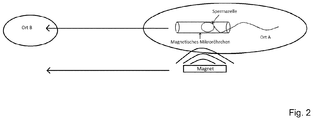
- Fig. 2
- die schematische Funktionsweise der kontrollierten Bewegung einer Spermazelle in einem Mikroröhrchen
- 105 Mikroröhrchen aus einer äußeren Schicht von 5nm Titan, einer mittleren 5nm dicken Schicht aus Eisen und einer inneren 1nm dicken Platinschicht, wobei die Mikroröhrchen jeweils einem inneren Durchmesser von 5 µm und einer Länge von 50 µm aufweisen und mittels Aufrolltechnik hergestellt worden sind. Sie werden gemeinsam mit 50 µll Sperma in 3 ml Human Tubal Fluid (HTF) Medium vermischt. Dabei interagieren die Spermazellen mit den Mikroröhrchen, heften sich an deren äußere Oberfläche und/oder dringen in sie ein. Nach 5 min sind die Mikroröhrchen mit einer oder bis zu drei Spermazellen verbunden. Durch die Anwendung von Magneten können gewünschte Kombinationen aus Spermazellen und Mikroröhrchen unter dem Mikroskop selektiert werden. Etwa 100 Mikroröhrchen die an Spermazellen gebunden sind, werden durch die Bewegung des externen Magneten gezielt in eine räumlich getrennte Region gebracht. Diese Suspension wird in die Gebärmutter eingespritzt. Ein Permanentmagnet wird außerhalb des Körpers aufgelegt und über die Bewegung des Permanentmagneten wird die Bewegung der Mikroröhrchen zum Eileiter und den Eizellen gesteuert. Der erfolgreiche Transport der Spermazelle mit dem Röhrchen wird über Ultraschall verfolgt. Durch die Öffnungen der Mikroröhrchen können die Spermien mit den Eizellen funktional interagieren und die Eizellen befruchten. Nachdem die Spermazelle in die Eizelle eingedrungen ist, werden durch Bewegung des Permanentmagneten die Mikroröhrchen wieder aus dem Körper entfernt.
Claims (26)
- Nichttherapeutisches Verfahren zur kontrollierten Bewegung von motilen Zellen in flüssigen oder gasförmigen Medien, bei dem eine oder mehrere motile Zellen in oder an ein oder mehrere magnetische Partikel in Form einer Röhre, eines Stabes, eines unregelmäßig geformten Hohlkörpers oder eines Netzwerkes eingebracht oder angebracht werden, und nachfolgend durch Anlegen eines externen Magnetfeldes die magnetischen Partikel mit den in oder an ihnen eingebrachten oder angebrachten motilen Zellen gerichtet bewegt werden.
- Verfahren nach Anspruch 1, bei dem als flüssiges Medium Wasser, biologische Flüssigkeiten und/oder Blut, und als gasförmiges Medium Luft eingesetzt wird.
- Verfahren nach Anspruch 1, bei dem als motile Zellen Spermazellen eingesetzt werden.
- Verfahren nach Anspruch 1, bei dem magnetische Partikel aus ferromagnetischen oder paramagnetischen Materialien eingesetzt werden.
- Verfahren nach Anspruch 1, bei dem magnetische Partikel aus Titan, Platin Eisen, Eisenoxid, Gold oder Glas oder aus Legierungen oder Verbindungen dieser Materialien eingesetzt werden, wobei nichtmagnetische Partikel mit magnetischen Materialien beschichtet eingesetzt werden.
- Verfahren nach Anspruch 1, bei dem magnetische Partikel eingesetzt werden, die auf ihrer inneren und/oder äußeren Oberfläche funktionelle Gruppen aufweisen, wie Mannosyl/Kohlenhydrat- Gruppen oder Sperma-bindende Proteine.
- Verfahren nach Anspruch 1, bei dem magnetische Partikel eingesetzt werden, deren Abmessungen an die Größe der motilen Zelle oder Zellen angepasst oder nur geringfügig größer oder kleiner ausgebildet ist, vorteilhafterweise deren Abmessungen 200 nm bis mehrere Mikrometer betragen.
- Verfahren nach Anspruch 1, bei dem als magnetische Partikel Mikroröhrchen oder aufgerollte Mikroröhrchen eingesetzt werden.
- Verfahren nach Anspruch 1, bei dem ein externes Magnetfeld durch einen Permanentmagneten oder Elektromagneten realisiert wird.
- Verfahren nach Anspruch 1, bei dem die motilen Zellen mit den magnetischen Partikeln in einer Flüssigkeit kontrolliert bewegt werden, die sich in vitro oder in vivo befindet.
- Verfahren nach Anspruch 1, bei dem magnetische Partikel mit motilen Zellen kontrolliert bewegt werden, bei denen die motilen Zellen chemisch oder mechanisch an die magnetischen Partikel gebunden sind.
- Nichttherapeutische Verwendung des Verfahrens nach Anspruch 1 zur kontrollierten Bewegung von motilen Zellen in flüssigen oder gasförmigen Medien im Körper eines Säugetiers oder Menschen.
- Verwendung nach Anspruch 12 zur kontrollierten Bewegung von Spermazellen in der Gebärmutter und/oder im Eileiter.
- Magnetische Partikel in Form einer Röhre, eines Stabes, eines unregelmäßig geformten Hohlkörpers oder eines Netzwerkes zur therapeutischen Anwendung an motilen Zellen für die gerichtete kontrollierte Bewegung von motilen Zellen in flüssigen oder gasförmigen Medien, wobei eine oder mehrere motile Zellen in oder an ein oder mehrere magnetische Partikel eingebracht oder angebracht werden, und nachfolgend durch Anlegen eines externen Magnetfeldes die magnetischen Partikel mit den in oder an ihnen eingebrachten oder angebrachten motilen Zellen gerichtet bewegt werden.
- Magnetische Partikel zur Anwendung nach Anspruch 14, wobei die Anwendung an den motilen Zellen in Wasser, biologischen Flüssigkeiten und/oder Blut als flüssigem Medien, und die Anwendung an den motilen Zellen in Luft als gasförmigem Medium erfolgt.
- Magnetische Partikel zur Anwendung nach Anspruch 14, deren die Anwendung an Spermazellen als motilen Zellen erfolgt.
- Magnetische Partikel zur Anwendung nach Anspruch 14, die als ferromagnetische oder paramagnetische Partikel angewandt werden.
- Magnetische Partikel zur Anwendung nach Anspruch 14, die als magnetische Partikel aus Titan, Platin Eisen, Eisenoxid, Gold oder Glas oder aus Legierungen oder Verbindungen dieser Materialien angewandt werden, wobei auch nichtmagnetische Partikel mit einer Beschichtung aus magnetischen Materialien angewandt werden.
- Magnetische Partikel zur Anwendung nach Anspruch 14, die als magnetische Partikel angewandte werden, die auf ihrer inneren und/oder äußeren Oberfläche funktionelle Gruppen aufweisen, wie Mannosyl/Kohlenhydrat- Gruppen oder Sperma-bindende Proteine.
- Magnetische Partikel zur Anwendung nach Anspruch 14, die als magnetische Partikel angewandt werden, deren Abmessungen an die Größe der motilen Zelle oder Zellen angepasst oder nur geringfügig größer oder kleiner ausgebildet ist, vorteilhafterweise deren Abmessungen 200 nm bis mehrere Mikrometer betragen.
- Magnetische Partikel zur Anwendung nach Anspruch 14, die als magnetische Partikel in Form von Mikroröhrchen oder aufgerollten Mikroröhrchen angewandt werden.
- Magnetische Partikel zur Anwendung nach Anspruch 14, deren Anwendung in einem externen Magnetfeld erfolgt, welches durch einen Permanentmagneten oder Elektromagneten realisiert ist.
- Magnetische Partikel zur Anwendung nach Anspruch 14, deren Anwendung an den motilen Zellen in einer Flüssigkeit erfolgt, und die kontrolliert bewegt werden, wobei sich die motilen Zellen in vitro oder in vivo befinden.
- Magnetische Partikel zur Anwendung nach Anspruch 14, deren Anwendung an den motilen Zellen erfolgt, die chemisch oder mechanisch an die magnetischen Partikel gebunden sind.
- Magnetische Partikel zur Verwendung nach Anspruch 14 an motilen Zellen, wobei die motilen Zellen in flüssigen oder gasförmigen Medien im Körper eines Säugetiers oder Menschen gerichtet und kontrolliert bewegt werden.
- Magnetische Partikel zur Verwendung nach Anspruch 25, wobei die motilen Zellen Spermazellen sind und deren gerichtete und kontrollierte Bewegung in der Gebärmutter und/oder im Eileiter erfolgt.
Applications Claiming Priority (2)
| Application Number | Priority Date | Filing Date | Title |
|---|---|---|---|
| DE102012212427.6A DE102012212427A1 (de) | 2012-07-16 | 2012-07-16 | Verfahren zur kontrollierten Bewegung von motilen Zellen in flüssigen oder gasförmigen Medien |
| PCT/EP2013/064222 WO2014012801A1 (de) | 2012-07-16 | 2013-07-05 | Verfahren zur kontrollierten bewegung von motilen zellen in flüssigen oder gasförmigen medien |
Publications (2)
| Publication Number | Publication Date |
|---|---|
| EP2872618A1 EP2872618A1 (de) | 2015-05-20 |
| EP2872618B1 true EP2872618B1 (de) | 2018-12-19 |
Family
ID=48783217
Family Applications (1)
| Application Number | Title | Priority Date | Filing Date |
|---|---|---|---|
| EP13736529.2A Active EP2872618B1 (de) | 2012-07-16 | 2013-07-05 | Verfahren zur kontrollierten bewegung von motilen zellen in flüssigen oder gasförmigen medien |
Country Status (4)
| Country | Link |
|---|---|
| US (1) | US9883889B2 (de) |
| EP (1) | EP2872618B1 (de) |
| DE (1) | DE102012212427A1 (de) |
| WO (1) | WO2014012801A1 (de) |
Families Citing this family (2)
| Publication number | Priority date | Publication date | Assignee | Title |
|---|---|---|---|---|
| DE102014201760A1 (de) * | 2014-01-31 | 2015-08-06 | Leibniz-Institut Für Festkörper- Und Werkstoffforschung Dresden E.V. | Verfahren zur herstellung der beweglichkeit von immobilen zellen |
| DE102022122900A1 (de) | 2022-09-09 | 2024-03-14 | Leibniz-Institut für Festkörper- und Werkstoffforschung Dresden e.V. (IFW Dresden e.V.) | Verfahren und Vorrichtung mindestens zur kontrollierten Bewegung von Gameten und/oder Zygoten und/oder Embryonen in Fluiden |
Family Cites Families (4)
| Publication number | Priority date | Publication date | Assignee | Title |
|---|---|---|---|---|
| US6695766B2 (en) | 2002-04-26 | 2004-02-24 | Olympia Womens Health | Magnetic embryo transfer |
| KR100799060B1 (ko) * | 2003-06-30 | 2008-01-29 | 에자이 가부시키가이샤 | 자성 세포 및 그의 사용 방법 |
| US20110177154A1 (en) * | 2008-09-15 | 2011-07-21 | Searete Llc, A Limited Liability Corporation Of The State Of Delaware | Tubular nanostructure targeted to cell membrane |
| JP2013542013A (ja) * | 2010-10-19 | 2013-11-21 | オゲノ ゲーエムベーハー | 治療用細胞のホーミング用の磁気器具、及び過剰の治療用細胞の除去 |
-
2012
- 2012-07-16 DE DE102012212427.6A patent/DE102012212427A1/de not_active Withdrawn
-
2013
- 2013-07-05 US US14/408,126 patent/US9883889B2/en active Active
- 2013-07-05 WO PCT/EP2013/064222 patent/WO2014012801A1/de not_active Ceased
- 2013-07-05 EP EP13736529.2A patent/EP2872618B1/de active Active
Non-Patent Citations (1)
| Title |
|---|
| VERONIKA MAGDANZ ET AL: "Development of a Sperm-Flagella Driven Micro-Bio-Robot", ADVANCED MATERIALS, vol. 25, no. 45, 1 December 2013 (2013-12-01), pages 6581 - 6588, XP055172822, ISSN: 0935-9648, DOI: 10.1002/adma.201302544 * |
Also Published As
| Publication number | Publication date |
|---|---|
| US9883889B2 (en) | 2018-02-06 |
| DE102012212427A1 (de) | 2014-01-16 |
| US20150164554A1 (en) | 2015-06-18 |
| WO2014012801A1 (de) | 2014-01-23 |
| EP2872618A1 (de) | 2015-05-20 |
Similar Documents
| Publication | Publication Date | Title |
|---|---|---|
| Chen et al. | Magneto-fluorescent core-shell supernanoparticles | |
| DE112016007640B4 (de) | Auf paramagnetischen Teilchen basierende Durchfluss-Zelltrennung und Entfernung paramagnetischer Teilchen | |
| Egawa et al. | A DNA hybridization system for labeling of neural stem cells with SPIO nanoparticles for MRI monitoring post-transplantation | |
| WO2012052486A1 (de) | Magnetisches instrument für das homing von therapeutischen zellen und die elimination überschüssiger therapeutischer zellen | |
| DE102015116391A1 (de) | Medizinische Vorrichtung für die selektive Separierung einer biologischen Probe | |
| DE3720844C2 (de) | ||
| EP3907007A1 (de) | Mikrofluidische vorrichtung | |
| US9109203B2 (en) | Method of extracting neural stem cells using nanoparticles | |
| DE69924728T2 (de) | Nicht-embryonale ependymale neuronale stammzellen und methoden zu ihrer isolierung | |
| DE102018115360A1 (de) | Verfahren und zusammensetzungen zum ablösen adhärenter zellen | |
| DE102012212427A1 (de) | Verfahren zur kontrollierten Bewegung von motilen Zellen in flüssigen oder gasförmigen Medien | |
| Arumuganathar et al. | Aerodynamically assisted bio-jets: the development of a novel and direct non-electric field-driven methodology for engineering living organisms | |
| DE102008040042A1 (de) | Mikropartikel enthaltend mindestens ein Aggregat aus superparamagnetischen Nanopartikeln | |
| WO2010076337A1 (de) | Elektromagnetisches mikrosystem zur manipulation magnetischer mikro- oder nanoperlen | |
| EP1683572A1 (de) | Magnetisch betätigtes absorptionsmittel und herstellungsverfahren dafür | |
| Rostami et al. | Iron oxide nanoparticles reduced retinoic acid induced-neuronal differentiation of mouse embryonic stem cells by ROS generation | |
| EP2322142B1 (de) | Biokompatible, magnetische Nanopartikel zur Behandlung von Glioblastomen | |
| EP2944686B1 (de) | Verfahren und vorrichtung zur abreicherung von zirkulierenden tumorzellen aus einer zellsuspension | |
| EP3099785B1 (de) | Verfahren zur herstellung der beweglichkeit von immobilen zellen | |
| WO2006119957A2 (de) | Verfahren zum öffnen von hohlstrukturen aus magnetischen nanopartikeln | |
| CH714874B1 (de) | Verfahren zur Herstellung einer Portionseinheit. | |
| DE102005015953A1 (de) | Verfahren zur Anreicherung und ex vivo Kultivierung von Brustprimärzellen | |
| Furer | Novel biomimetic membranes for nanoparticle transport studies at biological barriers | |
| DE102024111572A1 (de) | Verfahren zur Anreicherung einer intakte und geschädigte Zellen enthaltenden Zellpopulation in einem flüssigen Medium | |
| WO2009147081A1 (de) | Interventionsvorrichtung zur sammlung von biologischem material und verfahren zur ihrer herstellung |
Legal Events
| Date | Code | Title | Description |
|---|---|---|---|
| PUAI | Public reference made under article 153(3) epc to a published international application that has entered the european phase |
Free format text: ORIGINAL CODE: 0009012 |
|
| 17P | Request for examination filed |
Effective date: 20150216 |
|
| AK | Designated contracting states |
Kind code of ref document: A1 Designated state(s): AL AT BE BG CH CY CZ DE DK EE ES FI FR GB GR HR HU IE IS IT LI LT LU LV MC MK MT NL NO PL PT RO RS SE SI SK SM TR |
|
| AX | Request for extension of the european patent |
Extension state: BA ME |
|
| RIN1 | Information on inventor provided before grant (corrected) |
Inventor name: SANCHEZ, SAMUEL Inventor name: SCHMIDT, OLIVER, G. Inventor name: MAGDANZ, VERONIKA |
|
| DAX | Request for extension of the european patent (deleted) | ||
| 17Q | First examination report despatched |
Effective date: 20160613 |
|
| GRAJ | Information related to disapproval of communication of intention to grant by the applicant or resumption of examination proceedings by the epo deleted |
Free format text: ORIGINAL CODE: EPIDOSDIGR1 |
|
| GRAP | Despatch of communication of intention to grant a patent |
Free format text: ORIGINAL CODE: EPIDOSNIGR1 |
|
| STAA | Information on the status of an ep patent application or granted ep patent |
Free format text: STATUS: EXAMINATION IS IN PROGRESS |
|
| GRAP | Despatch of communication of intention to grant a patent |
Free format text: ORIGINAL CODE: EPIDOSNIGR1 |
|
| STAA | Information on the status of an ep patent application or granted ep patent |
Free format text: STATUS: GRANT OF PATENT IS INTENDED |
|
| INTG | Intention to grant announced |
Effective date: 20180725 |
|
| GRAS | Grant fee paid |
Free format text: ORIGINAL CODE: EPIDOSNIGR3 |
|
| GRAA | (expected) grant |
Free format text: ORIGINAL CODE: 0009210 |
|
| STAA | Information on the status of an ep patent application or granted ep patent |
Free format text: STATUS: THE PATENT HAS BEEN GRANTED |
|
| AK | Designated contracting states |
Kind code of ref document: B1 Designated state(s): AL AT BE BG CH CY CZ DE DK EE ES FI FR GB GR HR HU IE IS IT LI LT LU LV MC MK MT NL NO PL PT RO RS SE SI SK SM TR |
|
| REG | Reference to a national code |
Ref country code: GB Ref legal event code: FG4D Free format text: NOT ENGLISH |
|
| REG | Reference to a national code |
Ref country code: CH Ref legal event code: EP |
|
| REG | Reference to a national code |
Ref country code: IE Ref legal event code: FG4D Free format text: LANGUAGE OF EP DOCUMENT: GERMAN |
|
| REG | Reference to a national code |
Ref country code: DE Ref legal event code: R096 Ref document number: 502013011853 Country of ref document: DE |
|
| REG | Reference to a national code |
Ref country code: AT Ref legal event code: REF Ref document number: 1078714 Country of ref document: AT Kind code of ref document: T Effective date: 20190115 |
|
| REG | Reference to a national code |
Ref country code: NL Ref legal event code: MP Effective date: 20181219 |
|
| PG25 | Lapsed in a contracting state [announced via postgrant information from national office to epo] |
Ref country code: LT Free format text: LAPSE BECAUSE OF FAILURE TO SUBMIT A TRANSLATION OF THE DESCRIPTION OR TO PAY THE FEE WITHIN THE PRESCRIBED TIME-LIMIT Effective date: 20181219 Ref country code: NO Free format text: LAPSE BECAUSE OF FAILURE TO SUBMIT A TRANSLATION OF THE DESCRIPTION OR TO PAY THE FEE WITHIN THE PRESCRIBED TIME-LIMIT Effective date: 20190319 Ref country code: HR Free format text: LAPSE BECAUSE OF FAILURE TO SUBMIT A TRANSLATION OF THE DESCRIPTION OR TO PAY THE FEE WITHIN THE PRESCRIBED TIME-LIMIT Effective date: 20181219 Ref country code: BG Free format text: LAPSE BECAUSE OF FAILURE TO SUBMIT A TRANSLATION OF THE DESCRIPTION OR TO PAY THE FEE WITHIN THE PRESCRIBED TIME-LIMIT Effective date: 20190319 Ref country code: FI Free format text: LAPSE BECAUSE OF FAILURE TO SUBMIT A TRANSLATION OF THE DESCRIPTION OR TO PAY THE FEE WITHIN THE PRESCRIBED TIME-LIMIT Effective date: 20181219 Ref country code: LV Free format text: LAPSE BECAUSE OF FAILURE TO SUBMIT A TRANSLATION OF THE DESCRIPTION OR TO PAY THE FEE WITHIN THE PRESCRIBED TIME-LIMIT Effective date: 20181219 |
|
| REG | Reference to a national code |
Ref country code: LT Ref legal event code: MG4D |
|
| PG25 | Lapsed in a contracting state [announced via postgrant information from national office to epo] |
Ref country code: RS Free format text: LAPSE BECAUSE OF FAILURE TO SUBMIT A TRANSLATION OF THE DESCRIPTION OR TO PAY THE FEE WITHIN THE PRESCRIBED TIME-LIMIT Effective date: 20181219 Ref country code: GR Free format text: LAPSE BECAUSE OF FAILURE TO SUBMIT A TRANSLATION OF THE DESCRIPTION OR TO PAY THE FEE WITHIN THE PRESCRIBED TIME-LIMIT Effective date: 20190320 Ref country code: AL Free format text: LAPSE BECAUSE OF FAILURE TO SUBMIT A TRANSLATION OF THE DESCRIPTION OR TO PAY THE FEE WITHIN THE PRESCRIBED TIME-LIMIT Effective date: 20181219 Ref country code: SE Free format text: LAPSE BECAUSE OF FAILURE TO SUBMIT A TRANSLATION OF THE DESCRIPTION OR TO PAY THE FEE WITHIN THE PRESCRIBED TIME-LIMIT Effective date: 20181219 |
|
| PG25 | Lapsed in a contracting state [announced via postgrant information from national office to epo] |
Ref country code: NL Free format text: LAPSE BECAUSE OF FAILURE TO SUBMIT A TRANSLATION OF THE DESCRIPTION OR TO PAY THE FEE WITHIN THE PRESCRIBED TIME-LIMIT Effective date: 20181219 |
|
| PG25 | Lapsed in a contracting state [announced via postgrant information from national office to epo] |
Ref country code: PT Free format text: LAPSE BECAUSE OF FAILURE TO SUBMIT A TRANSLATION OF THE DESCRIPTION OR TO PAY THE FEE WITHIN THE PRESCRIBED TIME-LIMIT Effective date: 20190419 Ref country code: CZ Free format text: LAPSE BECAUSE OF FAILURE TO SUBMIT A TRANSLATION OF THE DESCRIPTION OR TO PAY THE FEE WITHIN THE PRESCRIBED TIME-LIMIT Effective date: 20181219 Ref country code: ES Free format text: LAPSE BECAUSE OF FAILURE TO SUBMIT A TRANSLATION OF THE DESCRIPTION OR TO PAY THE FEE WITHIN THE PRESCRIBED TIME-LIMIT Effective date: 20181219 Ref country code: PL Free format text: LAPSE BECAUSE OF FAILURE TO SUBMIT A TRANSLATION OF THE DESCRIPTION OR TO PAY THE FEE WITHIN THE PRESCRIBED TIME-LIMIT Effective date: 20181219 Ref country code: IT Free format text: LAPSE BECAUSE OF FAILURE TO SUBMIT A TRANSLATION OF THE DESCRIPTION OR TO PAY THE FEE WITHIN THE PRESCRIBED TIME-LIMIT Effective date: 20181219 |
|
| PG25 | Lapsed in a contracting state [announced via postgrant information from national office to epo] |
Ref country code: SM Free format text: LAPSE BECAUSE OF FAILURE TO SUBMIT A TRANSLATION OF THE DESCRIPTION OR TO PAY THE FEE WITHIN THE PRESCRIBED TIME-LIMIT Effective date: 20181219 Ref country code: EE Free format text: LAPSE BECAUSE OF FAILURE TO SUBMIT A TRANSLATION OF THE DESCRIPTION OR TO PAY THE FEE WITHIN THE PRESCRIBED TIME-LIMIT Effective date: 20181219 Ref country code: IS Free format text: LAPSE BECAUSE OF FAILURE TO SUBMIT A TRANSLATION OF THE DESCRIPTION OR TO PAY THE FEE WITHIN THE PRESCRIBED TIME-LIMIT Effective date: 20190419 Ref country code: RO Free format text: LAPSE BECAUSE OF FAILURE TO SUBMIT A TRANSLATION OF THE DESCRIPTION OR TO PAY THE FEE WITHIN THE PRESCRIBED TIME-LIMIT Effective date: 20181219 Ref country code: SK Free format text: LAPSE BECAUSE OF FAILURE TO SUBMIT A TRANSLATION OF THE DESCRIPTION OR TO PAY THE FEE WITHIN THE PRESCRIBED TIME-LIMIT Effective date: 20181219 |
|
| REG | Reference to a national code |
Ref country code: DE Ref legal event code: R097 Ref document number: 502013011853 Country of ref document: DE |
|
| PLBE | No opposition filed within time limit |
Free format text: ORIGINAL CODE: 0009261 |
|
| STAA | Information on the status of an ep patent application or granted ep patent |
Free format text: STATUS: NO OPPOSITION FILED WITHIN TIME LIMIT |
|
| PG25 | Lapsed in a contracting state [announced via postgrant information from national office to epo] |
Ref country code: DK Free format text: LAPSE BECAUSE OF FAILURE TO SUBMIT A TRANSLATION OF THE DESCRIPTION OR TO PAY THE FEE WITHIN THE PRESCRIBED TIME-LIMIT Effective date: 20181219 |
|
| 26N | No opposition filed |
Effective date: 20190920 |
|
| PG25 | Lapsed in a contracting state [announced via postgrant information from national office to epo] |
Ref country code: MC Free format text: LAPSE BECAUSE OF FAILURE TO SUBMIT A TRANSLATION OF THE DESCRIPTION OR TO PAY THE FEE WITHIN THE PRESCRIBED TIME-LIMIT Effective date: 20181219 Ref country code: SI Free format text: LAPSE BECAUSE OF FAILURE TO SUBMIT A TRANSLATION OF THE DESCRIPTION OR TO PAY THE FEE WITHIN THE PRESCRIBED TIME-LIMIT Effective date: 20181219 |
|
| REG | Reference to a national code |
Ref country code: CH Ref legal event code: PL |
|
| PG25 | Lapsed in a contracting state [announced via postgrant information from national office to epo] |
Ref country code: TR Free format text: LAPSE BECAUSE OF FAILURE TO SUBMIT A TRANSLATION OF THE DESCRIPTION OR TO PAY THE FEE WITHIN THE PRESCRIBED TIME-LIMIT Effective date: 20181219 |
|
| REG | Reference to a national code |
Ref country code: BE Ref legal event code: MM Effective date: 20190731 |
|
| PG25 | Lapsed in a contracting state [announced via postgrant information from national office to epo] |
Ref country code: CH Free format text: LAPSE BECAUSE OF NON-PAYMENT OF DUE FEES Effective date: 20190731 Ref country code: BE Free format text: LAPSE BECAUSE OF NON-PAYMENT OF DUE FEES Effective date: 20190731 Ref country code: LI Free format text: LAPSE BECAUSE OF NON-PAYMENT OF DUE FEES Effective date: 20190731 Ref country code: LU Free format text: LAPSE BECAUSE OF NON-PAYMENT OF DUE FEES Effective date: 20190705 |
|
| PG25 | Lapsed in a contracting state [announced via postgrant information from national office to epo] |
Ref country code: FR Free format text: LAPSE BECAUSE OF NON-PAYMENT OF DUE FEES Effective date: 20190731 |
|
| PG25 | Lapsed in a contracting state [announced via postgrant information from national office to epo] |
Ref country code: IE Free format text: LAPSE BECAUSE OF NON-PAYMENT OF DUE FEES Effective date: 20190705 |
|
| REG | Reference to a national code |
Ref country code: AT Ref legal event code: MM01 Ref document number: 1078714 Country of ref document: AT Kind code of ref document: T Effective date: 20190705 |
|
| PG25 | Lapsed in a contracting state [announced via postgrant information from national office to epo] |
Ref country code: AT Free format text: LAPSE BECAUSE OF NON-PAYMENT OF DUE FEES Effective date: 20190705 |
|
| PG25 | Lapsed in a contracting state [announced via postgrant information from national office to epo] |
Ref country code: CY Free format text: LAPSE BECAUSE OF FAILURE TO SUBMIT A TRANSLATION OF THE DESCRIPTION OR TO PAY THE FEE WITHIN THE PRESCRIBED TIME-LIMIT Effective date: 20181219 |
|
| PG25 | Lapsed in a contracting state [announced via postgrant information from national office to epo] |
Ref country code: MT Free format text: LAPSE BECAUSE OF FAILURE TO SUBMIT A TRANSLATION OF THE DESCRIPTION OR TO PAY THE FEE WITHIN THE PRESCRIBED TIME-LIMIT Effective date: 20181219 Ref country code: HU Free format text: LAPSE BECAUSE OF FAILURE TO SUBMIT A TRANSLATION OF THE DESCRIPTION OR TO PAY THE FEE WITHIN THE PRESCRIBED TIME-LIMIT; INVALID AB INITIO Effective date: 20130705 |
|
| PG25 | Lapsed in a contracting state [announced via postgrant information from national office to epo] |
Ref country code: MK Free format text: LAPSE BECAUSE OF FAILURE TO SUBMIT A TRANSLATION OF THE DESCRIPTION OR TO PAY THE FEE WITHIN THE PRESCRIBED TIME-LIMIT Effective date: 20181219 |
|
| REG | Reference to a national code |
Ref country code: DE Ref legal event code: R081 Ref document number: 502013011853 Country of ref document: DE Owner name: ASOCIACION CENTRO DE INVESTIGACION COOPERATIVA, ES Free format text: FORMER OWNER: LEIBNIZ-INSTITUT FUER FESTKOERPER- UND WERKSTOFFFORSCHUNG DRESDEN E.V., 01069 DRESDEN, DE |
|
| REG | Reference to a national code |
Ref country code: GB Ref legal event code: 732E Free format text: REGISTERED BETWEEN 20240919 AND 20240925 |
|
| PGFP | Annual fee paid to national office [announced via postgrant information from national office to epo] |
Ref country code: DE Payment date: 20250722 Year of fee payment: 13 |
|
| PGFP | Annual fee paid to national office [announced via postgrant information from national office to epo] |
Ref country code: GB Payment date: 20250724 Year of fee payment: 13 |