EP2871908B1 - Relaisvorrichtung und verfahren zur auswahl eines relaisknotens auf basis von lernen in einem drahtlosen netzwerk - Google Patents
Relaisvorrichtung und verfahren zur auswahl eines relaisknotens auf basis von lernen in einem drahtlosen netzwerk Download PDFInfo
- Publication number
- EP2871908B1 EP2871908B1 EP14181701.5A EP14181701A EP2871908B1 EP 2871908 B1 EP2871908 B1 EP 2871908B1 EP 14181701 A EP14181701 A EP 14181701A EP 2871908 B1 EP2871908 B1 EP 2871908B1
- Authority
- EP
- European Patent Office
- Prior art keywords
- relay
- rqi
- relay apparatus
- data packet
- packet
- Prior art date
- Legal status (The legal status is an assumption and is not a legal conclusion. Google has not performed a legal analysis and makes no representation as to the accuracy of the status listed.)
- Not-in-force
Links
Images



Classifications
-
- H—ELECTRICITY
- H04—ELECTRIC COMMUNICATION TECHNIQUE
- H04W—WIRELESS COMMUNICATION NETWORKS
- H04W40/00—Communication routing or communication path finding
- H04W40/02—Communication route or path selection, e.g. power-based or shortest path routing
- H04W40/12—Communication route or path selection, e.g. power-based or shortest path routing based on transmission quality or channel quality
-
- H—ELECTRICITY
- H04—ELECTRIC COMMUNICATION TECHNIQUE
- H04W—WIRELESS COMMUNICATION NETWORKS
- H04W40/00—Communication routing or communication path finding
- H04W40/02—Communication route or path selection, e.g. power-based or shortest path routing
- H04W40/12—Communication route or path selection, e.g. power-based or shortest path routing based on transmission quality or channel quality
- H04W40/14—Communication route or path selection, e.g. power-based or shortest path routing based on transmission quality or channel quality based on stability
-
- H—ELECTRICITY
- H04—ELECTRIC COMMUNICATION TECHNIQUE
- H04L—TRANSMISSION OF DIGITAL INFORMATION, e.g. TELEGRAPHIC COMMUNICATION
- H04L45/00—Routing or path finding of packets in data switching networks
- H04L45/30—Routing of multiclass traffic
-
- H—ELECTRICITY
- H04—ELECTRIC COMMUNICATION TECHNIQUE
- H04W—WIRELESS COMMUNICATION NETWORKS
- H04W40/00—Communication routing or communication path finding
- H04W40/24—Connectivity information management, e.g. connectivity discovery or connectivity update
- H04W40/246—Connectivity information discovery
-
- H—ELECTRICITY
- H04—ELECTRIC COMMUNICATION TECHNIQUE
- H04W—WIRELESS COMMUNICATION NETWORKS
- H04W88/00—Devices specially adapted for wireless communication networks, e.g. terminals, base stations or access point devices
- H04W88/02—Terminal devices
- H04W88/04—Terminal devices adapted for relaying to or from another terminal or user
Definitions
- the following description relates to an apparatus and method for relaying data in a wireless network.
- application technologies for sharing content among users using a whole network or a part of the network may employ a unicast-based terminal-to-terminal communication scheme. Because content is required to be transmitted sequentially in an one-to-one communication scheme, the communication efficiency of such a communication scheme may be reduced as a number of terminals sharing content increases.
- a broadcast-based communication scheme may be utilized in lieu of a unicast-based communication scheme.
- the broadcast-based communication scheme may require the use of a relay node configured to transfer or relay content from an owner of the content.
- a relay node may be configured to transfer or relay content from a source node, to a specific target node or nodes, or all nodes in the network.
- WO 2011/083389 A1 discloses a method for defining broadcast routers in a wireless multihop mesh network of nodes comprising a plurality of routing nodes potentially able to repeat a broadcast message, the method comprising: determining for each routing node the number of neighboring routing nodes and the quality of each link between the routing node and the neighboring routing nodes; selecting a subset of the plurality of routing nodes comprising a reduced number of routing nodes so that only routing nodes belonging to the subset are allowed to perform selected operations.
- WO 2005/062553 A1 discloses a method for efficient routing in a multiple hop wireless communication network.
- the routing method comprise the steps of providing link status information by acquiring link status quality between nodes in the network, updating a routing element with said link status information, determining an appropriate route according to said link status information with respect to traffic content, and routing traffic according to said determined appropriate route.
- Routing nodes implement a contention-based media access mechanism and self-allocate bandwidth within a wireless mesh network by dynamically modifying contention-based transmission control parameters.
- the routing nodes determine a hop count and adjust contention parameters based on the hop count.
- a method of selecting a relay node by a relay apparatus includes receiving packet information from a predecessor node and a successor node, and determining whether the relay apparatus is to be selected as a relay node to relay a data packet, based on relay quality indicator (RQI) information computed based on the packet information.
- RQI relay quality indicator
- the packet information may indicate whether a packet is received.
- the receiving may include receiving a packet associated with the predecessor node from the predecessor node, and reflecting packet information on the packet associated with the predecessor node on the computed RQI information, in response to the packet associated with the predecessor node corresponding to a data packet received first from the predecessor node in a current sequence.
- the receiving may include receiving a negative acknowledgement (NACK) packet from a successor node in which data loss occurs, and reflecting the NACK packet on the computed RQI information in response to the NACK packet corresponding to a data packet relayed by the relay apparatus in a previous sequence.
- NACK negative acknowledgement
- the reflecting of the NACK packet on the computed RQI information may include adding a weight to a NACK packet received during a last sequence of a predetermined range and reflecting the weighted NACK packet on the computed RQI information.
- the method may further include, in response to the relay apparatus determining to relay a packet, reflecting a number of packets to be relayed by the relay apparatus on the computed RQI information.
- the determining may include determining whether the relay apparatus is to relay a packet, by comparing the computed RQI information with RQI information included in the data packet.
- the determining may include determining whether the relay apparatus is to relay a packet, by comparing the computed RQI information with RQI history information comprising RQI information of a data packet received in a previous sequence.
- the determining may further include counting nodes that relay a packet in a current sequence, and updating RQI history information of the relay apparatus based on the counting.
- the RQI information may be determined based on at least one of a probability that a packet is received from the predecessor node and a probability that a packet is transmitted to the successor node.
- the method may further include in response to there being no node relaying a packet in a previous sequence, determining whether the relay apparatus is to relay a packet, by comparing the computed RQI information with RQI history information of the relay apparatus.
- the method may further include in response to there being no node relaying a packet in a previous sequence, adjusting RQI history information of the relay apparatus based on an adjustment value and the computed RQI information, the RQI history information being used to determine a node that is to relay a packet in a next sequence.
- a relay apparatus for relaying a packet includes a receiver configured to receive packet information from a predecessor node and a successor node, and a processor configured to determine whether the relay apparatus is to be selected as a relay node to relay a data packet, based on relay quality indicator (RQI) information computed based on the packet information.
- RQI relay quality indicator
- the packet information may indicate whether a packet is received.
- the receiver may receive a packet associated with the predecessor node from the predecessor node, and in response to the packet associated with the predecessor node corresponding to a data packet received first from the predecessor node in a current sequence, the processor may reflect packet information on the packet associated with the predecessor node on the computed RQI information.
- the packet information on the packet associated with the predecessor node may include at least one of a total number of packets transmitted by the predecessor node and a total number of packets received by the relay apparatus from the predecessor node.
- the receiver may receive a negative acknowledgement (NACK) packet from a successor node in which data loss occurs, and in response to the NACK packet corresponding to a data packet relayed by the relay apparatus in a previous sequence, the processor may reflect the NACK packet on the computed RQI information.
- NACK negative acknowledgement
- the processor may add a weight to a NACK packet received during a last sequence of a predetermined range, and may reflect the weighted NACK packet on the computed RQI information.
- the processor may reflect a number of packets to be relayed by the relay apparatus on the computed RQI information.
- the processor may determine whether the relay apparatus is to relay a packet, by comparing the computed RQI information with RQI information included in the data packet.
- the processor may determine whether the relay apparatus is to relay a packet, by comparing the computed RQI information with RQI history information including RQI information of a data packet received in a previous sequence.
- the processor may count nodes that relay a packet in a current sequence, and may update RQI history information of the relay apparatus based on the counting.
- the RQI information may be determined by the processor based on at least one of a probability that a packet is received from the predecessor node and a probability that a packet is transmitted to the successor node.
- the processor may determine whether the relay apparatus is to relay a packet, by comparing the computed RQI information with RQI history information of the relay apparatus.
- the processor may adjust RQI history information of the relay apparatus based on an adjustment value and the computed RQI information, the RQI history information being used to determine a node that is to relay a packet in a next sequence.
- a method of selecting a relay node by a relay apparatus includes determining whether the relay apparatus and at least one of a plurality of relay candidate nodes relay a data packet in a previous sequence, and determining whether the relay apparatus is to relay a data packet in a current sequence, based on a result of the determining and relay quality indicator (RQI) information of the relay apparatus.
- RQI relay quality indicator
- the determining whether the relay apparatus is to relay the data packet in the current sequence may include, when the relay apparatus successfully relays a data packet in the previous sequence, relaying a data packet in the current sequence.
- the method may further include, in response to the data packet being relayed in the previous sequence, updating RQI history information of the relay apparatus.
- the determining whether the relay apparatus is to relay the data packet in the current sequence may include, in response to the data packet not being relayed in the previous sequence, and in response to the RQI information of the relay apparatus being equal to or greater than RQI history information, relaying the data packet.
- the determining whether the relay apparatus is to relay the data packet in the current sequence may include adjusting RQI history information of the relay apparatus when the data packet is not relayed in the previous sequence, and determining whether the relay apparatus is to relay the data packet in the current sequence, based on the RQI information of the relay apparatus and the adjusted RQI history information.
- a method of calculating a relay quality indicator (RQI) for a relay node includes determining a receiving history of predecessors of the relay node, determining a receiving history of successors of the relay node when the node performs relaying, and calculating a RQI value based on the receiving history of predecessors of the relay node and receiving history of successors of the relay node when the node performs relaying.
- RQI relay quality indicator
- the calculating may include calculating the RQI value based on a weighted product of the receiving history of predecessors of the relay node and receiving history of successors of the relay node when the node performs relaying.
- the determining a receiving history of predecessors of the relay node may include dividing a total number of received packets by a total number of transmitted packets.
- the determining a receiving history of successors of the relay node when the node performs relaying may include dividing the difference of a total number of relayed packets and a total number of NACK packets by the total number of relayed packets
- wireless network As all or part of the network used to distribute such content.
- the wireless network is a wireless local area network (WLAN), a Wi-Fi Direct network, or a similar network.
- WLAN wireless local area network
- Wi-Fi Direct network or a similar network.
- Such a network allows easy configuration and management of the wireless network to facilitate content distribution.
- content sharing technologies is utilized in a business-to-business (B2B) field.
- B2B content sharing is used to facilitate an electronic meeting, a smart campus, and similar applications.
- a wireless ad hoc network enabling supporting multi-hop communication is one approach to provide sufficient network performance.
- topology information, and network connectivity information is collected.
- the topology information and network connectivity information includes information such as a two-hop neighboring node, a wireless link state, and similar information related to aspects of the network. Such information is used to select an optimum relay node to cover a whole network, based on such information, collected in advance.
- advance information for example the network connectivity information
- control packets are exchanged. Accordingly, additional traffic and time are required for such information acquisition.
- network connectivity information for example a wireless link state, and similar aspects of network connectivity, changes over time. Because of such changes, advance information may be periodically collected and updated so that a network employing the above scheme adapts dynamically to any environmental changes, such as changes to the network configuration.
- a relay apparatus denotes an apparatus configured to perform a scheme of selecting a relay node.
- Such a relay apparatus is a piece of hardware with a corresponding structure that allows it to perform a scheme of selecting a relay node.
- a relay candidate node denotes a node included in a relay region.
- a relay node denotes a node determined to perform relaying in a current sequence among relay candidate nodes.
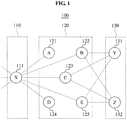
- FIG. 1 illustrates an example of a wireless network topology.
- a packet transmitted by a predetermined source is potentially propagated over the whole network through a multi-hop broadcast approach. For example, a portion of nodes receiving the packet may iterate relaying of a packet. By iterating relaying of the packet, the packet is relayed from node to node until all of the nodes in the network have received the packet.
- a predecessor node X 111 is included in a predecessor region 110
- relay candidate nodes A 121, B 122, C 123, D 124, and E 125 are included in a relay region 120
- successor nodes Y 131 and Z 132 are included in a successor region 130.
- the relay region 120 potentially includes a plurality of constituent relay regions.
- such constituent relay regions include a first relay region, a second region, and an n th relay region.
- the successor nodes Y 131 and Z 132 relay a data packet received from a relay candidate node included in the first relay region
- the successor nodes Y 131 and Z 132 potentially function as relay candidate nodes
- the successor region 130 including the successor nodes Y 131 and Z 132 correspond to the second relay region.
- the successor nodes Y 131 and Z 132 receive a data packet directly from the predecessor node X 111.
- Y 131 and Z 132 relay the received data packet, thereby functioning as relay candidate nodes.
- Each of the predecessor region 110, the relay region 120, and the successor region 130 may be appropriately determined, based on a communication scheme, a distribution of nodes, a number of nodes, a communication environment of a wireless network, and other parameters of the network that indicate how to allocate the nodes to each of the predecessor region 110, the relay region 120, and the successor region 130.
- the above-described multi-hop broadcast techniques are potentially applied to the example wireless network topology of FIG. 1 .
- a data packet is received from the predecessor node X 111 located in the predecessor region 110
- one or more of the relay candidate nodes A 121, B 122, C 123, D 124, and E 125, that are included in the relay region 120 relays a packet, so that the packet is propagated to the successor nodes Y 131 and Z 132, that are included in the successor region 130. Because the relay candidate nodes A 121 and D 124 are not linked in the example of FIG.
- the successor nodes Y 131 and Z 132 do not receive packets from the relay candidate nodes A 121 and D 124, despite the relay candidate nodes A 121 and D 124 relaying the received packets receive from X 111.
- the packet is propagated to the successor nodes Y 131 and Z 132.
- the network in order for a packet to be relayed from the predecessor region 110 to the successor region 130, the network should be configured so that in the relay region, there is at least one node that has network connectivity that is sufficient to receive the packet from the predecessor region 110 and deliver it to the successor region 130.
- content is broadcast from a single content owner, for example a source node, to a whole network or a plurality of users in a wireless network environment.
- a single content owner for example a source node
- Such broadcasting allows efficient, quick and reliable transfer of the content to terminals located at a distance from the source node.
- the method is applicable to transmission of a large file, or real-time streaming to transmit a single content divided into at least one packet using the consecutive transmission of the at least one packet.
- Each relay candidate node is able to learn its own performance state as a relay node every time a packet is transmitted, adapting its performance state at runtime by a learning process.
- each relay candidate node performs such learning in order to have an optimum performance state, each relay candidate node is selected as a relay node, as appropriate. Because acquisition of advance information is not a part of this approach, it is possible to remove an overhead caused by acquiring the advance information. Hence, this approach makes it possible to quickly cope with a dynamic environmental change by using a learning approach to determine how to broadcast content rather that requiring the overhead involved with the advance information.
- the relay apparatus supports multi-hop broadcasting with a high reliability, while also operating at a high speed, in a wireless ad hoc network.
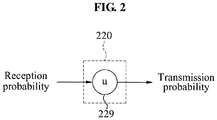
- FIG. 2 illustrates a relay quality indicator of a node u 229.
- the relay quality indicator is referred to as an "RQI.”
- the RQI is used to select an optimum relay node to relay a packet from among relay candidate nodes that receive packets from a predecessor node, for example, the relay candidate nodes A 121, B 122, C 123, D 124, and E 125 of FIG. 1 .
- a value of RQI(u) indicating the RQI of the node u 229 is obtained, for example, by Equation 1 below.
- Equation 1 is only one example of a way to calculate the RQI(u) value, and other techniques and approaches for calculating the RQI metric are used in other examples.
- the node u 229 may be, for example, one of relay candidate nodes included in a relay region 220, or another relay candidate node included in relay apparatus that is configured to relay a packet and to perform a method of selecting a relay node.
- Equation 1 ⁇ denotes a setting value corresponding to a receiving history of the node u 229 from a predecessor node, and ⁇ denotes a setting value corresponding to a receiving history of a successor node when the node u 229 performs relaying.
- ⁇ and ⁇ are set by a user.
- other examples use automatic processes to suggest values of ⁇ and ⁇ or to otherwise derive values of ⁇ and ⁇ .
- various heuristics are potentially used to derive or suggest possible values of ⁇ and ⁇ .
- a metric corresponding to performance of the node u 229 as a relay node is potentially quantified by a probability that the node u 229 receives a packet from a predecessor node, and a probability that the successor node receives a packet when the node u 229 relays the packet.
- a metric of a performance of the node u as a relay node is represented as an RQI, which is based on Equation 1, as an example.
- RQI information includes, for example, an RQI value based on Equation 1 as a metric of the node's performance as a relay node.
- the node u 229 uses information related to a receiving history of the node u 229 from a predecessor node, and information related to a receiving history of a successor node when the node u 229 performs relaying.
- the information on the receiving history of the node u 229 from the predecessor node is acquired, for example, by storing a history of a number of packets received by the node u 229 and a total number of packets transmitted by a source node to a current sequence of transmitted packets, based on sequence number information in the packet or packets being transmitted.
- the information on the receiving history is represented by way of example as packet information.
- a total number of packets relayed by the node u 229, and a number of negative acknowledgement (NACK) packets indicating that the successor node fails to receive a packet are part of the information used to derive the receiving history.
- the total number of packets relayed by the node u 229 is acquired by recording in a history every sequence in which the node u 229 relays a packet.
- a tally of relaying events is available that corresponds to the total number of packets relayed by the node u 229.
- the successor node When at least one of the successor nodes recognizes a data loss in a previous sequence, for example, when a packet is transmitted in the previous sequence, but a successor node fails to receive the packet, the successor node provides, as a feedback, a NACK packet and packet loss information to the node u 229. By recording the NACK packets and packet loss information received as feedback, the node u 229 is also able to learn NACK packet information, by gathering information received from the successor node.
- a total size of a buffer used to analyze each receiving history in the node u 229 is restricted by designating a total number of packets used in a history based on a sequence number that is finally received from the predecessor node.
- an item of predetermined content is transmitted through 1,000 packets, and in which the node u 229 receives a packet corresponding to a 900 th sequence
- a buffer is designed to store a packet history corresponding to 100 sequences
- a packet history from a 800 th sequence to the 900 th sequence is stored in the buffer.
- FIG. 3 illustrates a structure of a data packet 300.
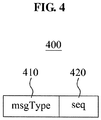
- FIG. 4 illustrates a structure of a NACK packet 400.
- an RQI value is updated.
- a packet used to perform a method of selecting a relay node potentially includes, for example, the data packet 300 and the NACK packet 400.
- a type of a packet is determined based on msgType fields 310 and 410 of the packet, indicating whether a packet corresponds to the structure of a data packet 300 or the structure of a NACK packet 400.
- the data packet 300 and the NACK packet 400 may include seq fields 320 and 420 used to manage a history of a packet that is transmitted and received, respectively. That is, a data packet 300 stores information for a transmitted packet, while a NACK packet 400 stores information about a received packet. For example, predetermined content may be transferred for each packet to each node in a wireless network, and each packet may include a unique sequence number based on a transmission order, in order to facilitate reassembling the transmitted packets into the predetermined content after they are all received.
- the seq fields 320 and 420 include, for example, a unique sequence number of each packet.
- the data packet 300 includes a srcAddr field 330, a relayAddr field 340, and an RQI field 350, as illustrated in FIG. 3 .
- the srcAddr field 330 includes an address of a source node that starts transmission of the data packet 300.
- the relayAddr field 340 includes an address of a node that relays a packet. For example, when the data packet 300 is received, the relay apparatus determines whether the data packet 300 is received first or has the same sequence number as an already received data packet, based on considering a combination of the srcAddr field 330 and the seq field 320. Similarly, whether a received data packet corresponds to a packet received first in a current sequence is determined in 701 of FIG. 7A , which is discussed further, below.
- An RQI value included in the RQI field 350 may be represented by "RQI(p)."
- a node u changes the RQI value RQI(p) of the data packet 300 to an RQI value RQI(u) in order to update the RQI value, and relays the data packet 300.
- the RQI value RQI(p) includes, in this example, an RQI value of a node that relays the data packet 300 of the current sequence.
- the RQI field 350 is used by a relay apparatus to individually learn an RQI of that relay apparatus in the wireless network environment. For example, the RQI field is used to determine whether the relay apparatus is used as an optimal relay node in the wireless network environment.
- each relay candidate node determines whether each relay candidate node is potentially used as a better relay node, by comparing RQI fields of data packets relayed by the other relay candidate nodes. Such comparison of learned RQI fields helps the network determine optimal relaying paths.
- FIG. 5 illustrates an example of a method of selecting a relay node.
- the method of FIG. 5 is applicable to any application technologies employing a one-to-many content distribution technique in a wireless ad hoc network environment.
- Such application technologies include, for example, real-time streaming of audio and/or video, propagation and sharing of images, moving images, or files, and the like.
- these types are not meant to be limiting, and the method of FIG. 5 is applicable for any types of content or other data that are to be shared through a wireless ad hoc network environment.
- the method receives packet information from a predecessor node and a successor node.
- a receiver of a relay apparatus receives packet information from a predecessor node and a successor node.
- Packet information received from the predecessor node includes, for example, a data packet, a total number of packets transmitted by the predecessor node, and a total number of packets received by the relay apparatus from the predecessor node.
- packet information received from the successor node includes, for example, a NACK packet transmitted when the successor node fails to receive a packet.
- the method determines whether the relay apparatus is to be selected as a relay node to relay a data packet, based on RQI information. For example, a processor of the relay apparatus determines whether the relay apparatus is to be selected as a relay node to relay a data packet, based on RQI information.
- the processor computes RQI information, for example an RQI value, based on the packet information. For example, the processor uses Equation 1 that is described above.
- the processor determines whether the relay apparatus is suitable to relay the data packet. For example, when an RQI value of the relay apparatus is greater than an RQI value of each of at least one of relay candidate nodes in a wireless network, the processor selects the relay apparatus as a relay node to relay the data packet.
- the method determines whether a data packet of a next sequence exists. For example, the relay apparatus determines whether a data packet of a next sequence exists. In an example in which the data packet of the next sequence exists, operations 510 and 520 are repeatedly performed. In another example in which the data packet of the next sequence does not exist, a data transmission procedure is finished, because all data packets are transmitted. As a result, no further data transmission operations are necessary for transmitting the current piece of content or other data.
- FIG. 6 illustrates a relay apparatus 620 configured to relay a packet.
- the relay apparatus 620 of FIG. 6 includes a receiver 621, a processor 622, and a transmitter 623.
- the receiver 621, the processor 622, and the transmitter 623 are components of the relay apparatus 620 that are structurally configured to receive, process, and transmit data relayed by the relay apparatus 620.
- the relay apparatus 620 receives a data packet from a predecessor node 610, for example a node X as shown in FIG. 6 , and relays the data packet to a successor node 630, for example a node Y as shown in FIG.
- the relay apparatus 620 relays a data packet, as illustrated in FIGS. 5 , and 7A through 9 .
- the RQI information is determined by the processor 622, based on at least one of a probability that a packet is received from the predecessor node 610, and a probability that a packet is transferred to the successor node 630.
- Equation 1 provides one way to calculate such RQI information.
- the receiver 621 potentially receives packet information from the predecessor node 610 and the successor node 630. For example, the receiver 621 receives packet information associated with the predecessor node 610 from the predecessor node 610.
- the packet information associated with the predecessor node 610 includes, for example, a total number of packets transmitted by the predecessor node 610, and a total number of packets received by the relay apparatus 620 from the predecessor node 610.
- the receiver 621 also potentially receives a NACK packet from the successor node 630 in a situation in which data loss occurs.
- the NACK packet includes, for example, a sequence number corresponding to the relayed data packet.
- the processor 622 determines whether the relay apparatus 620 is suitable to be selected as a relay node to relay a data packet, based on RQI information, computed based on the packet information. For example, based on a result obtained by comparing the computed RQI information with RQI information included in a data packet, the processor 622 determines whether the relay apparatus 620 is to relay a packet.
- the processor 622 determines whether the relay apparatus 620 is to relay a packet, by comparing the computed RQI information with RQI history information.
- the RQI history information includes RQI information of a data packet received in a previous sequence.
- the relay apparatus determines not to relay a packet of a current sequence. Because the RQI information of the relay apparatus is less than the RQI history information, it indicates that relaying the packet of the current sequence would not be aided by using the relay apparatus to relay the packet.
- the relay apparatus maintains the original RQI history information.
- the processor 622 when a packet is received that has the same sequence number as a packet that has already been received, the processor 622 counts nodes that relay a packet in the current sequence, and updates RQI history information of the relay apparatus 620 appropriately. Additionally, when a node that relays a packet in the previous sequence does not exist, the processor 622 determines whether the relay apparatus 620 is to relay a packet, by comparing the computed RQI information for the relay apparatus 620 with the RQI history information. For example, when a node relaying a packet in the previous sequence does not exist, the processor 622 adjusts the RQI history information, based on an adjustment value and the computed RQI information.
- the RQI history information is adjusted based on the changes to the terms in Equation 1 according to the determination that a packet in the previous sequence does not exist.
- the RQI history information is used, for example, to determine a node that relay a packet next in a sequence.
- the processor 622 In an example in which a packet is received first from the predecessor node 610, the processor 622 reflects the packet information associated with the predecessor node 610 on the computed RQI information in real time. In this example, when the relay apparatus 620 determines that it is to relay a packet, the processor 622 reflects a number of packets to be relayed by the relay apparatus 620 on the computed RQI information in real time.
- the processor 622 considers the NACK packet along with the computed RQI information.
- the relay apparatus 620 copes with a change in a link environment and a change in a topology, by updating the RQI information based on packet information every time the relay apparatus 620 participates in receiving and relaying of a packet. For example, when receiving a packet from the predecessor node 610 fails, and when a NACK packet corresponding to a packet relayed by the relay apparatus 620 is received from the successor node 630, the relay apparatus 620 reduces an RQI value of the relay apparatus 620 to indicate that its relaying ability is questionable. When a node with a higher RQI value than the RQI value of the relay apparatus 620 appears, the relay apparatus 620 replaces the relay node by the node with the higher RQI value to facilitate the relaying.
- the processor 622 adds a weight v to a NACK packet received during a final sequence of a predetermined range of packets, and reflects the received NACK packet on the computed RQI information in real time.
- the relay apparatus 620 is selected as a relay node and successfully performs relaying, an RQI value of the relay apparatus 620 is continuously increased as a result. Accordingly, a network environment is rapidly changed. Accordingly, even when it is difficult to use the relay apparatus 620 as a relay node from a predetermined initial point in time, due to a rapid changes and adaptation in the network environment, the relay apparatus 620 continuously attempts to relay a data packet until a node with a higher RQI value appears.
- the relay apparatus 620 continues to relay the packet until it has RQI data that indicates that it is acceptable to stop relaying the data packet.
- RQI u ⁇ Total number of packets received from predecessors T ⁇ otal umber of packets transmitted by predecessors ⁇ ⁇ X Total number of packets relayed by u
- X Total number of packets relayed by u ⁇ Total number of NACK packets received by u ⁇ v ⁇ Total number of NACK packets received by u during last k times
- a number of times that relaying fails during a last sequence of a predetermined range, for example, the last "k" sequences are measured as shown in Equation 2.
- the number of times that relaying fails during the last sequence may be, for example, a number of times a NACK packet is received during the last sequence.
- a weight v may be applied to the NACK packet received during the last sequence, and the information related to the NACK packet may be incorporated into RQI information.
- the weight v may be randomly set by a user, or chosen by a user based on a heuristic. In an example in which a network environment is only slightly changed, a weight may not be applied. Accordingly, it is possible to prevent a relay node from being frequently replaced. In another example in which the network environment is dynamically changed, a weight is applied and accordingly, a relay node is quickly replaced by using the weight.
- the transmitter 623 relays a data packet, until the relay apparatus 620 fails to relay the data packet as discussed above, when the relay apparatus 620 is selected as a relay node. For example, when RQI information of the relay apparatus 620 is equal to or greater than RQI information of a relay candidate node 640 that relays a data packet, the relay apparatus 620 continues to perform relaying because the RQI information indicates that it is an appropriate candidate for the relaying.
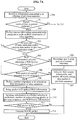
- FIGS. 7A and 7B illustrate an example of a method of selecting a relay node based on RQI information.
- a node u for example a relay apparatus
- learns an RQI and a process of determining whether the relay apparatus is to perform relaying are described.
- the determining whether the relay apparatus is to perform relaying is based, for example, on the RQI information.
- the relay apparatus stores and accesses RQI information, and stores and accesses other information associated with relaying.
- the RQI information includes, for example, an RQI value obtained by using Equation 1, as presented above.
- the information associated with relaying is stored in a numPrevRelay field, a lastHighestRQI field, a relayNext field, a numCurRelay field, a curHighestRQI field, and other similar fields of a data structure used to manage and organize the relaying information.
- the numPrevRelay field indicates a number of nodes that relay a data packet in a previous sequence.
- the lastHighesRQI field indicates a highest RQI value among RQI values of nodes that relay a packet in the previous sequence.
- the numCurRelay field indicates a number of nodes that relay a data packet in a current sequence.
- the curHighestRQI field indicates a highest RQI value among RQI values of nodes that relay a packet in the current sequence.
- the relayNext field indicates whether a relay apparatus is to relay a packet in the current sequence.
- the relayNext field is determined in the previous sequence through comparison of RQI history information.
- these fields are presented as examples only, and additional fields may be used in addition to these fields or instead of these fields to manage relaying.
- the relay apparatus determines whether the relay apparatus is to relay a packet that it receives, based on a value of the relayNext field.
- the relayNext field is set to "true" in a situation in which the relay apparatus is determined to have a highest RQI value among RQI values of neighboring nodes.
- the relayNext field is determined, for example, by comparing an RQI field value of a data packet p relayed by at least one of a plurality of relay candidate nodes, for example, RQI(p), with RQI information of the relay apparatus itself. By making this comparison, the relay apparatus determines whether it is appropriate for it to relay the packet.
- FIG. 7A and 7B is further described.
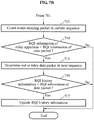
- the method initializes information associated with relaying of the previous sequence.
- the relay apparatus initializes information associated with relaying of the previous sequence.
- the relay apparatus changes a value of the numPrevRelay field to the same value as that of the numCurRelay field, and changes a value of the lastHighestRQI field to the same value as that of the curHighestRQI field.
- the method determines whether a received data packet corresponds to a packet received first in the current sequence .
- the relay apparatus determines whether a received data packet corresponds to a packet received first in the current sequence.
- the relay apparatus determines whether the data packet is received from a predecessor node.
- a packet corresponding to each sequence is transmitted with a delay of at least a predetermined period of time
- a data packet received at a point in time in which the current sequence begins is determined to be a first received packet.
- the first received data packet is transmitted in this example by the predecessor node.
- the relay apparatus determines whether the data packet is received for the first time, or if a data packet with the same sequence number as an already received data packet is received.
- the relay apparatus receives a packet relayed by at least one of a plurality of relay candidate nodes, but not by the predecessor node, in the current sequence. For example, when a data packet is received from the predecessor node, the relay apparatus can identify that this is the case because it receives a data packet with the same sequence number as the received data packet, or receives a data packet when a predetermined period of time elapses after the predecessor node transmits the data packet.
- the method reflects the packet information associated with the predecessor node on RQI information of the relay apparatus in real time.
- the relay apparatus reflects the packet information associated with the predecessor node on RQI information of the relay apparatus in real time in 702.
- the packet information associated with the predecessor node includes, for example, a total number of packets transmitted by the predecessor node, and a total number of packets received by the relay apparatus from the predecessor node.
- the total number of packets transmitted by the predecessor node corresponds, in an example, to a sequence number recorded in a seq field of a data packet.
- the total number of packets received by the relay apparatus from the predecessor node is acquired, in an example, every time the relay apparatus successfully receives a data packet from the predecessor node.
- the method determines whether at least one of a plurality of relay candidate nodes relaying a data packet in the previous sequence exists. For example, the relay apparatus determines whether at least one of a plurality of relay candidate nodes relaying a data packet in the previous sequence exists. In this example, the at least one of the plurality of relay candidate nodes is counted every time that a data packet is received from the at least one of the plurality of relay candidate nodes in the previous sequence.
- the method compares the RQI information of the relay apparatus with RQI history information in 704.
- the relay apparatus compares the RQI information of the relay apparatus with RQI history information in 704.
- the RQI history information includes, for example, a highest RQI value among RQI values of a data packet received in the previous sequence.
- the method determines not to relay a packet of the current sequence in 705. For example, the relay apparatus determines not to relay a packet of the current sequence in 705. In this example, when an RQI value RQI(u) is less than a value of the lastHighestRQI field, the relay apparatus sets a relayNext field to "false.”
- the method determines whether a data packet of the current sequence is to be relayed.
- the relay apparatus determines whether a data packet of the current sequence is to be relayed.
- the relay apparatus determines, using a processor of the relay apparatus, whether the relayNext field is set to "true."
- Situations in which the relayNext field is set to "true" include, for example, a situation in which the relay apparatus has an RQI value that is equal to or greater than a predetermined value, although no node relays a data packet in the previous sequence, a situation in which there is no relay candidate node with an RQI value greater than an RQI value of the relay apparatus in the previous sequence, and other similar situations in which the RQI values associated with the relay apparatus and other candidate nodes have characteristics indicating that it is appropriate for the relay apparatus to participate in the relaying .
- the relay apparatus sets a value that is equal to or greater than a value of the lastHighestRQI field
- a relay candidate node scheduled to relay a data packet in the previous sequence does not relay the data packet, due to a failure of reception of a packet.
- the relay apparatus based on RQI history information of the previous sequence, for example the value of the lastHighestRQI field, the relay apparatus maintains a "true" value of the relayNext field, but only when the RQI value RQI(u) of the relay apparatus, for example a node u, is equal to or greater than the value of the lastHighestRQI field.
- the method determines whether a data packet is to be relayed in the current sequence. For example, the relay apparatus determines whether a data packet is to be relayed in the current sequence. When the relayNext field is set to "true," the relay apparatus relays the data packet. For example, when the RQI values of relay candidate nodes in a relay region are compared in 713 through 717 of the previous sequence that are described further below, and when the relay apparatus is determined as a relay candidate node with a highest RQI value, a data packet is determined to be relayed in the current sequence.
- the relay apparatus sets the relayNext field to "false.”
- the method initializes RQI history information, and a number of nodes that relay a data packet in the previous sequence.
- the relay apparatus initializes RQI history information, and a number of nodes that relay a data packet in the previous sequence in 707.
- the relay apparatus initializes the numCurRelay field to "0,” and initializes the curHighestRQI field that indicates the RQI history information to the greater value of the RQI value of the relay apparatus and RQI history information to which an adjustment value is applied.
- the method reflects a number of packets to be relayed on the RQI information of the relay apparatus in real time.
- the relay apparatus reflects a number of packets to be relayed on the RQI information of the relay apparatus in real time.
- the relay apparatus computes RQI information, based on a value obtained by incrementing a number of transmitted packets of the relay apparatus by "1," compared to the previous sequence.
- the relay apparatus may compute RQI information corresponding to a quantity of the at least one transmitted packet.
- the method relays a packet with updated RQI information.
- the relay apparatus relays a packet with updated RQI information in 709.
- the relay apparatus updates a relayAddr field and an RQI field of a data packet p with a network address and RQI(u) corresponding to the relay apparatus, and relays the updated data packet P.
- the method initializes information on whether relaying is performed, the number of nodes that relay a packet in the previous sequence, and the RQI history information.
- relay apparatus initializes information on whether relaying is performed, the number of nodes that relay a packet in the previous sequence, and the RQI history information.
- the relayNext field and the numCurRelay field are initialized to "true" and "0,” respectively.
- the curHighestRQI field has a greater value selected between the RQI value RQI(u) and a value obtained by "lastHighestRQI* ⁇ ," in preparation for a situation in which the relay apparatus fails to receive a continuously relayed packet.
- ⁇ denotes an adjustment value applied to the lastHighestRQI field. Additionally, ⁇ may have a value less than "1," and accordingly is usable as an adjustment amount of an RQI value set based on a situation in which a relay node determined as an optimum node by the previous node fails to receive a packet from a predecessor node.
- the method determines whether a data packet is lost. For example, the relay apparatus determines whether a data packet is lost. In such an example, when whether a packet is to be relayed is determined, the relay apparatus determines whether a data packet of the previous sequence is lost, based on considering sequence number information associated with a currently received data packet. In this example, the sequence number information is based on a seq field.
- the method transmits a NACK packet.
- the relay apparatus transmits a NACK packet in 712.
- the relay apparatus requests the predecessor node to transmit NACK information, informs the predecessor node of a loss of the data packet, and additionally restores the lost data packet.
- the method counts nodes that relay a packet in the current sequence. This part of the method is illustrated by FIG. 7B .
- the relay apparatus counts nodes that relay a packet in the current sequence in 713.
- the relay apparatus receives a relayed data packet from at least one of a plurality of relay nodes, after a point in time in which the data packet is transmitted by the predecessor node.
- the relay apparatus counts such nodes that relay a packet in the current sequence, by incrementing a value of the numCurRelay field by "1" every time a data packet of the current sequence is received from the at least one of the plurality of relay candidate nodes.
- the method compares the RQI information of the relay apparatus with RQI information of a data packet.
- the relay apparatus compares the RQI information of the relay apparatus with RQI information of a data packet.
- the relay apparatus compares the RQI information of the relay apparatus, for example RQI(u), with an RQI value RQI(p) of a data packet p relayed by the at least one of the plurality of relay candidate nodes.
- the relay apparatus maintains a "true" value of the relayNext field.
- the method determines not to relay the data packet in a next sequence. For example, the relay apparatus determines not to relay the data packet in a next sequence in 715.
- the relay apparatus may set the relayNext field to "false.” Because the RQI value of a packet that is relayed in advance is greater, it potentially indicates that the relay apparatus is not an appropriate candidate to relay the packet.
- the method compares RQI history information with the RQI information of the data packet.
- the relay apparatus compares RQI history information with the RQI information of the data packet.
- the RQI history information remains unchanged.
- a value of the curHighestRQI field is maintained to be a value selected in 710.
- the method updates the RQI history information.
- the relay apparatus updates the RQI history information in 717.
- the relay apparatus stores a highest RQI value in the current sequence as RQI history information.
- the relay apparatus stores a highest RQI value to update the RQI history information that considers RQI information of the received data packet.
- the value of the curHighestRQI field may be changed to the RQI value of the data packet. As described above, by repeating updating of the RQI history information every time a data packet is received, the value of the curHighestRQI field may be changed to a highest RQI value in the current sequence.
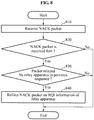
- FIG. 8 illustrates an example of an operation of reflecting a NACK packet.
- the method receives a NACK packet from a successor node in which data loss occurs.
- a relay apparatus receives a NACK packet from a successor node in which data loss occurs.
- the NACK packet includes, for example, a packet transmitted by the at least one of the plurality of relay candidate nodes in 712 of FIG. 7A , or a packet transmitted by a successor node.
- the method determines whether the NACK packet is received first, such as with respect to other NACK packets. For example, relay apparatus determines whether the NACK packet is received first. For example, when NACK packets corresponding to at least two predetermined sequences are received from at least two successor nodes, a NACK packet that is received second is potentially not considered.
- the method determines whether the received NACK packet corresponds to a packet that is relayed by the relay apparatus in the previous sequence. For example, the relay apparatus determines whether the received NACK packet corresponds to a packet that is relayed by the relay apparatus in the previous sequence. In such an example, relay apparatuses receiving NACK packets participate in determining whether the relay apparatuses relay a data packet with a corresponding sequence number. In this example, the relay apparatus records a sequence number of a packet relayed by the relay apparatus, and compares the recorded sequence number with a sequence number of the received NACK packet.
- the method reflects the NACK packet on RQI information of the relay apparatus in real time.
- the relay apparatus reflects the NACK packet on RQI information of the relay apparatus in real time.
- the relay apparatus updates a total number of NACK packets received by a node u, in information on a receiving history recorded when the node u performs relaying among RQI information.
- NACK packets with the same sequence numbers are received from a plurality of nodes.
- the NACK packet is potentially not updated based on a sequence number of operation 820, as operation 820 is potentially not relevant.
- each of relay candidate nodes updates the RQI value RQI(u) every time a data packet is received from a predecessor node, every time a received data packet is relayed, and every time a NACK packet corresponding to a packet relayed by the node u is received from a successor node.
- Techniques for updating the RQI value have been presented above. For example, Equation 1 and Equation 2 provide ways in which the RQI value may be updated.
- the relay apparatus potentially maintains RQI information in a dispersion form as illustrated in FIGS. 7A through 8 . In response to an RQI value of the relay apparatus being greater than an RQI value RQI(p) of a relayed data packet p, the relay apparatus relays a data packet of a next sequence.
- each of the relay candidate nodes repeats determining whether each of the relay candidate nodes is to be used as an optimum relay node, and selecting and reselecting each of the relay candidate nodes as being an optimum relay node.
- a relay apparatus selected as a relay node fails to receive a data packet of an x th sequence from a predecessor node
- the relay apparatus fails to relay the data packet.
- neighboring nodes determine, as relay nodes, to relay a data packet of a next sequence, for example an (x+1) th sequence, in lieu of the relay apparatus that fails to relay the data packet.
- problems in relaying for example disorder and collision between packets, and other conflicts, potentially occur.
- RQI history information for example a value of the lastHighestRQI field
- relaying is enabled only when an RQI value of each of the neighboring nodes is greater than the value of the lastHighestRQI field. Accordingly, only a subset of the neighboring nodes participate in the relaying in the (x+1) th sequence.
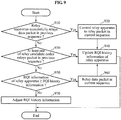
- FIG. 9 illustrates another example of a method of selecting a relay node.
- a relay apparatus includes RQI information, and information associated with relaying.
- the RQI information includes, for example, an RQI value obtained by using Equation 1.
- the information associated with relaying is stored in a numPrevRelay field, a lastHighestRQI field, a relayNext field, a numCurRelay field, a curHighestRQI field, and other related fields that store information about the network structure and the relationship between nodes.
- the numPrevRelay field indicates a number of nodes that relay a data packet in a previous sequence.
- the lastHighestRQI field indicates a highest RQI value among RQI values of nodes that relay a packet in the previous sequence.
- the numCurRelay field indicates a number of nodes that relay a data packet in a current sequence.
- the curHighestRQI field indicates a highest RQI value among RQI values of nodes that relay a packet in the current sequence.
- the relayNext field indicates whether a relay apparatus is to relay a packet in the current sequence, and is determined in the previous sequence by comparison of RQI information.
- the relay apparatus determines whether the relay apparatus and at least one of a plurality of relay candidate nodes relay a data packet in a previous sequence, and determines whether the relay apparatus is to relay a data packet in a current sequence, based on RQI information of the relay apparatus and a result of determining whether the data packet is relayed in the previous sequence.
- the method determines whether the relay apparatus successfully relays a data packet in the previous sequence .
- a processor of the relay apparatus determines whether the relay apparatus successfully relays a data packet in the previous sequence.
- the processor determines whether the relay apparatus successfully relays a data packet in the previous sequence.
- a packet is continuously relayed.
- the processor determines whether a data packet is to be relayed in the current sequence.
- a successor node fails to receive the data packet from the relay apparatus in the previous sequence as a result of the data packet not being relayed.
- the successor node transmits a NACK packet to nodes in a wireless network, to notify the nodes of a failure of receiving of the data packet by the successor node.
- the relay apparatus is determined to fail to relay the data packet, due to the relationship between these RQI values.
- the relayNext field of the relay apparatus has a value of "false.”
- the relayNext field is determined through comparison of an RQI field value of a data packet p, for example RQI(p), relayed by the at least one of the plurality of relay candidate nodes and RQI information of the relay apparatus. For example, when the relay apparatus is determined to have a highest RQI value among RQI values of neighboring relay candidate nodes, the relayNext field may be set to "true.”
- the method controls the relay apparatus to relay a packet in the current sequence using a transmitter of the relay apparatus.
- the processor controls the relay apparatus to relay a packet in the current sequence using a transmitter of the relay apparatus in 920.
- the relay apparatus continues to perform relaying until an RQI value is less than an RQI value of each of the at least one of the plurality of relay candidate nodes, due to a failure of relaying of a data packet.
- the method updates RQI history information of the relay apparatus .
- the relay apparatus updates RQI history information of the relay apparatus in 940.
- the method determines whether the at least one of the plurality of relay candidate nodes relays the data packet in the previous sequence. For example, the processor determines whether the at least one of the plurality of relay candidate nodes relays the data packet in the previous sequence in 930. In such an example, when a packet relayed by the at least one of the plurality of relay candidate nodes is received through a receiver of the relay apparatus, the relay apparatus determines that the at least one of the plurality of relay candidate nodes relays the packet in the previous sequence.
- the method updates RQI history information of the relay apparatus.
- the relay apparatus updates RQI history information of the relay apparatus in 940.
- the RQI history information is changed to RQI information included in a data packet that is received in the current sequence and that is transmitted by the at least one of the plurality of relay candidate nodes.
- the method compares the RQI information of the relay apparatus with the RQI history information, to determine whether relaying is to be performed.
- the processor compares the RQI information of the relay apparatus with the RQI history information, to determine whether relaying is to be performed.
- the RQI history information includes, for example, a highest RQI value among RQI values in RQI information received from a relay candidate node in a relay region in the wireless network in the previous sequence.
- the method relays a data packet in the current sequence.
- the relay apparatus relays a data packet in the current sequence in 960.
- the method updates the RQI history information of the relay apparatus.
- the relay apparatus updates the RQI history information of the relay apparatus in 940.
- the method adjusts the RQI history information.
- the relay apparatus adjusts the RQI history information in 970.
- a higher value between the RQI information of the relay apparatus and the RQI history information to which an adjustment value is applied is reflected on the RQI history information.
- a node with a highest RQI value is designed to participate in relaying data through the wireless network.
- all nodes in a network have the same initial values.
- data packets with the same sequence numbers are transmitted, and accordingly a successor node potentially fail to receive a data packet.
- a number of packets relayed by a relay apparatus for example a node u
- a number of NACK packets received by the relay apparatus from a successor node and related information are initialized within a predetermined probability range. Accordingly, examples make it possible to prevent most of nodes from participating in relaying at the same time.
- an RQI value of each relay candidate node is updated every time a packet is received, despite a possibility that a node with a low performance as a relay node is selected, and accordingly it is possible to enter a stable state by replacing the node with a low performance by a node with a higher RQI value as a relay node.
- a number of appropriate relay nodes are designated by a user based on a system environment. As described above with reference to FIGS. 5 through 8 , by storing a ranking of RQI values received by each relay candidate node, in an example, the same number of relay nodes as the designated number are selected. Typically, as a number of relay nodes that transmit a data packet without a collision increases, a corresponding reception performance of a successor node increases. Such collisions include, for example, a confusion caused by transmission of data packets with the same sequence numbers. When relay nodes collide with each other, the reception performance of the successor node is reduced because resolving collisions consumes resources.
- a number of relay nodes suitable for relaying is potentially set by a user, based on a time allowed for relaying, a probability that transmission is enabled without a collision between relay nodes, and other factors that indicate a number of relay nodes that optimizes performance and uses an appropriate amount of resources.
- a relay apparatus to share content based on a multi-hop broadcast or a multicast of content or other in a wireless ad hoc network, enhances a throughput, and a packet transmission reliability.
- a relay apparatus utilize a multi-hop broadcasting technology without a delay time prior to broadcasting, because acquiring of advance information is not a part of examples, which use a dynamically configured wireless network.
- the apparatuses and units described herein may be implemented using hardware components.
- the hardware components may include, for example, controllers, sensors, processors, generators, drivers, and other equivalent electronic components.
- the hardware components may be implemented using one or more general-purpose or special purpose computers, such as, for example, a processor, a controller and an arithmetic logic unit, a digital signal processor, a microcomputer, a field programmable array, a programmable logic unit, a microprocessor or any other device capable of responding to and executing instructions in a defined manner.
- the hardware components may run an operating system (OS) and one or more software applications that run on the OS.
- the hardware components also may access, store, manipulate, process, and create data in response to execution of the software.
- OS operating system
- a processing device may include multiple processing elements and multiple types of processing elements.
- a hardware component may include multiple processors or a processor and a controller.
- different processing configurations are possible, such as parallel processors.
- the methods described above can be written as a computer program, a piece of code, an instruction, or some combination thereof, for independently or collectively instructing or configuring the processing device to operate as desired.
- Software and data may be embodied permanently or temporarily in any type of machine, component, physical or virtual equipment, computer storage medium or device that is capable of providing instructions or data to or being interpreted by the processing device.
- the software also may be distributed over network coupled computer systems so that the software is stored and executed in a distributed fashion.
- the software and data may be stored by one or more non-transitory computer readable recording mediums.
- the media may also include, alone or in combination with the software program instructions, data files, data structures, and the like.
- the non-transitory computer readable recording medium may include any data storage device that can store data that can be thereafter read by a computer system or processing device.
- Examples of the non-transitory computer readable recording medium include read-only memory (ROM), random-access memory (RAM), Compact Disc Read-only Memory (CD-ROMs), magnetic tapes, USBs, floppy disks, hard disks, optical recording media (e.g., CD-ROMs, or DVDs), and PC interfaces (e.g., PCI, PCI-express, WiFi, etc.).
- ROM read-only memory
- RAM random-access memory
- CD-ROMs Compact Disc Read-only Memory
- CD-ROMs Compact Disc Read-only Memory
- magnetic tapes e.g., USBs, floppy disks, hard disks
- optical recording media e.g., CD-ROMs, or DVDs
- PC interfaces e.g., PCI, PCI-express, WiFi, etc.
- a terminal/device/unit described herein may refer to mobile devices such as, for example, a cellular phone, a smart phone, a wearable smart device (such as, for example, a ring, a watch, a pair of glasses, a bracelet, an ankle bracket, a belt, a necklace, an earring, a headband, a helmet, a device embedded in the cloths or the like), a personal computer (PC), a tablet personal computer (tablet), a phablet, a personal digital assistant (PDA), a digital camera, a portable game console, an MP3 player, a portable/personal multimedia player (PMP), a handheld e-book, an ultra mobile personal computer (UMPC), a portable lab-top PC, a global positioning system (GPS) navigation, and devices such as a high definition television (HDTV), an optical disc player, a DVD player, a Blu-ray player, a setup box, or any other device capable of wireless communication or network communication
- a personal computer PC
- the wearable device may be self-mountable on the body of the user, such as, for example, the glasses or the bracelet.
- the wearable device may be mounted on the body of the user through an attaching device, such as, for example, attaching a smart phone or a tablet to the arm of a user using an armband, or hanging the wearable device around the neck of a user using a lanyard.
Landscapes
- Engineering & Computer Science (AREA)
- Computer Networks & Wireless Communication (AREA)
- Signal Processing (AREA)
- Mobile Radio Communication Systems (AREA)
- Data Exchanges In Wide-Area Networks (AREA)
- Radio Relay Systems (AREA)
Claims (6)
- Verfahren zum Wählen, ob eine Weitergabevorrichtung (620) eine Weitergabe zwischen einer Vielzahl von Weitergabekandidaten-Knoten (121-125) durchführen soll, wobei das Verfahren von der Weitergabevorrichtung durchgeführt wird, wobei das Verfahren umfasst:Empfangen eines weitergegebenen Datenpakets einer aktuellen Sequenz von Datenpaketen von einem Weitergabekandidaten-Knoten der Vielzahl von Weitergabekandidaten-Knoten, wobei das weitergegebene Datenpaket einen Relay-Quality-Indicator-(RQI-)Wert des Weitergabekandidaten-Knoten umfasst, der das weitergegebene Datenpaket weitergegeben hat;Bestimmen, ob die Weitergabevorrichtung zum Weitergeben des weitergegebenen Datenpakets geeignet ist, durch Vergleichen des RQI-Werts des Weitergabekandidaten-Knoten mit einem RQI-Wert der Weitergabevorrichtung,wobei, wenn der RQI-Wert der Weitergabevorrichtung größer gleich dem RQI-Wert des Weitergabekandidaten-Knoten ist, die Weitergabevorrichtung zum Weitergeben des weitergegebenen Datenpakets geeignet ist, undwobei, wenn der RQI-Wert der Weitergabevorrichtung kleiner ist als der RQI-Wert des Weitergabekandidaten-Knoten ist, die Weitergabevorrichtung kein geeigneter Kandidat zum Weitergeben des weitergegebenen Datenpakets ist.
- Verfahren nach Anspruch 1, wobei das Bestimmen ferner das Zählen (713) von Knoten, die ein Paket in einer aktuellen Sequenz weitergeben, durch Hochzählen eines Werts eines Felds, das eine Zahl von Knoten angibt, die ein Datenpaket in der aktuellen weitergeben, um 1 jedes Mal, wenn das Datenpaket der aktuellen Sequenz von wenigstens einem der Vielzahl von Weitergabekandidaten-Knoten empfangen wird, umfasst.
- Verfahren nach Anspruch 1 oder 2, ferner umfassend:
als Reaktion auf einen Wert eines Felds, das eine Zahl von Knoten angibt, die ein Datenpaket in einer vorhergehenden Sequenz weitergeben, gleich 0 Bestimmen, ob die Weitergabevorrichtung ein Datenpaket weitergeben soll, durch Vergleichen des RQI-Werts der Weitergabevorrichtung mit einem Feld zur Angabe des höchsten RQI-Werts von RQI-Werten von Knoten, die ein Datenpaket in der vorhergehenden Sequenz weitergeben, wobei die Weitergabevorrichtung zum Weitergeben geeignet ist, wenn bestimmt wird, dass die Weitergabevorrichtung den höchsten RQI-Wert aufweist. - Verfahren nach einem der Ansprüche 1 bis 3, ferner umfassend:
als Reaktion auf einen Wert eines Felds, das eine Zahl von Knoten angibt, die ein Datenpaket in einer vorhergehenden Sequenz weitergeben, gleich 0 Anpassen eines Felds zur Angabe eines höchsten RQI-Werts von RQI-Werten von Knoten, die ein Datenpaket in einer aktuellen Sequenz von Datenpaketen weitergeben, auf der Basis eines Anpassungswerts und des RQI-Werts der Weitergabevorrichtung. - Weitergabevorrichtung (620) zum Wählen, ob eine Weitergabe zwischen einer Vielzahl von Weitergabekandidaten-Knoten erfolgen soll, wobei die Weitergabevorrichtung umfasst:einen zum Empfangen eines weitergegebenen Datenpakets einer aktuellen Sequenz von Datenpaketen von einem Weitergabekandidaten-Knoten der Vielzahl von Weitergabekandidaten-Knoten, wobei das weitergegebene Datenpaket einen Relay-Quality-Indicator-(RQI-)Wert des Weitergabekandidaten-Knoten umfasst, der das weitergegebene Datenpaket weitergegeben hat, ausgebildeten Empfänger (621); undeinen zum Bestimmen, ob die Weitergabevorrichtung zum Weitergeben des weitergegebenen Datenpakets geeignet ist, durch Vergleichen des RQI-Werts des Weitergabekandidaten-Knoten mit einem RQI-Wert der Weitergabevorrichtung, ausgebildeten Prozessor (622), wobei, wenn der RQI-Wert der Weitergabevorrichtung größer gleich dem RQI-Wert des Weitergabekandidaten-Knoten ist, die Weitergabevorrichtung zum Weitergeben des weitergegebenen Datenpakets geeignet ist, undwobei, wenn der RQI-Wert der Weitergabevorrichtung kleiner ist als der RQI-Wert des Weitergabekandidaten-Knoten ist, die Weitergabevorrichtung kein geeigneter Kandidat zum Weitergeben des weitergegebenen Datenpakets ist.
- Computerlesbares Medium mit einer Anweisung zum Wählen, ob eine Weitergabevorrichtung eine Weitergabe zwischen einer Vielzahl von Weitergabekandidaten-Knoten durchführen soll, die bei Ausführen durch einen Prozessor (622) der Weitergabevorrichtung den Prozessor zum Ausführen der Schritte veranlasst zum:Empfangen eines weitergegebenen Datenpakets einer aktuellen Sequenz von Datenpaketen von einem Weitergabekandidaten-Knoten der Vielzahl von Weitergabekandidaten-Knoten, wobei das weitergegebene Datenpaket einen Relay-Quality-Indicator-(RQI-)Wert des Weitergabekandidaten-Knoten umfasst, der das weitergegebene Datenpaket weitergegeben hat;Bestimmen, ob die Weitergabevorrichtung zum Weitergeben des weitergegebenen Datenpakets geeignet ist, durch Vergleichen des RQI-Werts des Weitergabekandidaten-Knoten mit einem RQI-Wert der Weitergabevorrichtung,wobei, wenn der RQI-Wert der Weitergabevorrichtung größer gleich dem RQI-Wert des Weitergabekandidaten-Knoten ist, die Weitergabevorrichtung zum Weitergeben des weitergegebenen Datenpakets geeignet ist, undwobei, wenn der RQI-Wert der Weitergabevorrichtung kleiner ist als der RQI-Wert des Weitergabekandidaten-Knoten ist, die Weitergabevorrichtung kein geeigneter Kandidat zum Weitergeben des weitergegebenen Datenpakets ist.
Applications Claiming Priority (1)
| Application Number | Priority Date | Filing Date | Title |
|---|---|---|---|
| KR1020130114301A KR102094718B1 (ko) | 2013-09-26 | 2013-09-26 | 무선 네트워크에서 학습에 기반한 중계 노드 선택 방법 및 중계 장치 |
Publications (3)
| Publication Number | Publication Date |
|---|---|
| EP2871908A2 EP2871908A2 (de) | 2015-05-13 |
| EP2871908A3 EP2871908A3 (de) | 2015-09-30 |
| EP2871908B1 true EP2871908B1 (de) | 2019-06-19 |
Family
ID=51392098
Family Applications (1)
| Application Number | Title | Priority Date | Filing Date |
|---|---|---|---|
| EP14181701.5A Not-in-force EP2871908B1 (de) | 2013-09-26 | 2014-08-21 | Relaisvorrichtung und verfahren zur auswahl eines relaisknotens auf basis von lernen in einem drahtlosen netzwerk |
Country Status (5)
| Country | Link |
|---|---|
| US (1) | US20150085738A1 (de) |
| EP (1) | EP2871908B1 (de) |
| JP (1) | JP2015070614A (de) |
| KR (1) | KR102094718B1 (de) |
| CN (1) | CN104519545A (de) |
Families Citing this family (14)
| Publication number | Priority date | Publication date | Assignee | Title |
|---|---|---|---|---|
| KR102233371B1 (ko) | 2014-06-24 | 2021-03-29 | 삼성전자주식회사 | 멀티캐스트 네트워크에서의 릴레이 방법 및 장치 |
| US10021621B2 (en) * | 2015-04-03 | 2018-07-10 | Qualcomm Incorporated | UE-to-UE relay list and determination of floor arbitrator |
| US20180176851A1 (en) * | 2015-04-30 | 2018-06-21 | Lg Electronics Inc. | Method and device for transmitting/receiving data in mesh network using bluetooth |
| EP3311535B1 (de) * | 2015-06-17 | 2019-10-02 | Telefonaktiebolaget LM Ericsson (PUBL) | Reduzierung der latenzzeit in einem mesh-netzwerk |
| JP6395085B2 (ja) * | 2015-06-30 | 2018-09-26 | 日本電信電話株式会社 | ネットワーク最適化方法及びネットワーク最適化装置 |
| TWM520823U (zh) * | 2016-01-06 | 2016-05-01 | Jarvish Inc | 安全帽無線通訊系統 |
| CN105873167B (zh) * | 2016-05-17 | 2019-05-21 | 中国人民解放军海军航空大学 | 导航传感器网络中基于协作mac协议的中继通信方法 |
| US11032749B2 (en) * | 2017-02-16 | 2021-06-08 | Nec Corporation | Communication terminal in wireless ad-hoc network, communication method, and communication program |
| KR102324201B1 (ko) * | 2017-06-27 | 2021-11-08 | 주식회사 케이티 | 사용자 경험 데이터 기반의 전송망 회선 경로 생성 장치 및 방법 |
| JP6974587B2 (ja) * | 2017-08-09 | 2021-12-01 | 中興通訊股▲ふん▼有限公司Zte Corporation | ユーザプレーンを分離するためのサービス実装の品質 |
| CN107689921B (zh) * | 2017-09-15 | 2020-11-13 | 深圳市盛路物联通讯技术有限公司 | 一种转发节点的选择方法及系统 |
| WO2019136607A1 (zh) | 2018-01-09 | 2019-07-18 | Oppo广东移动通信有限公司 | 中继的路由方法和通信节点 |
| CN110769506B (zh) * | 2018-07-27 | 2022-06-03 | 成都鼎桥通信技术有限公司 | 一种多跳带内中继系统的资源分配方法 |
| KR20230095936A (ko) * | 2020-11-05 | 2023-06-29 | 엘지전자 주식회사 | 무선 통신 시스템에서 단말 및 기지국의 피드백 수행 방법 및 장치 |
Family Cites Families (20)
| Publication number | Priority date | Publication date | Assignee | Title |
|---|---|---|---|---|
| WO2005062553A1 (en) * | 2003-12-23 | 2005-07-07 | Telefonaktiebolaget Lm Ericsson (Publ) | Method and system for routing traffic in ad hoc networks |
| JP4734323B2 (ja) * | 2005-03-29 | 2011-07-27 | パナソニック株式会社 | 通信中継装置、受信装置、通信中継方法及び受信方法 |
| JP2007129542A (ja) * | 2005-11-04 | 2007-05-24 | Sony Corp | 無線通信システム、無線通信装置及び無線通信方法、並びにコンピュータ・プログラム |
| US20090059958A1 (en) * | 2006-01-23 | 2009-03-05 | Nec Corporation | Communication method, communication system, nodes and program |
| US7978725B2 (en) * | 2006-03-06 | 2011-07-12 | Cisco Technology, Inc. | Dynamic modification of contention-based transmission control parameters achieving load balancing scheme in wireless mesh networks |
| JP4384151B2 (ja) * | 2006-08-28 | 2009-12-16 | 株式会社エヌ・ティ・ティ・ドコモ | 中継ノード、及び中継方法 |
| EP2066063A1 (de) * | 2007-11-30 | 2009-06-03 | Nokia Siemens Networks Oy | Verfahren und System zur Datenübertragung in einem Datennetzwerk |
| JP4983979B2 (ja) * | 2008-03-26 | 2012-07-25 | 富士通株式会社 | 無線中継方法、基地局装置、および中継局装置 |
| JP5169388B2 (ja) * | 2008-03-31 | 2013-03-27 | 日本電気通信システム株式会社 | 無線端末、無線システム、パケット転送制御方法及びその制御プログラム |
| US8351417B2 (en) * | 2008-05-14 | 2013-01-08 | Telcordia Technologies, Inc. | Methods for efficient organization of vehicle peer groups and efficient V2R communications |
| US8780875B2 (en) * | 2008-06-05 | 2014-07-15 | Qualcomm Incorporated | Method and apparatus for controlling discontinuous transmissions |
| JP2010206613A (ja) * | 2009-03-04 | 2010-09-16 | Nec Corp | データ配信方法とデータ配信システムと通信装置とプログラム |
| US8750195B2 (en) * | 2009-06-10 | 2014-06-10 | Futurewei Technologies, Inc. | System and method for multiple relay node operation in a communications system |
| CN101925110B (zh) * | 2009-06-16 | 2013-08-07 | 中兴通讯股份有限公司 | 中继链路上行反馈信息的传输方法、中继站及基站 |
| JP5540592B2 (ja) * | 2009-07-23 | 2014-07-02 | ソニー株式会社 | 通信システム、通信制御方法、移動端末、および中継装置 |
| WO2011083389A1 (en) * | 2010-01-06 | 2011-07-14 | Koninklijke Philips Electronics N.V. | Election of broadcast routers in a multihop network |
| JP5494110B2 (ja) * | 2010-03-29 | 2014-05-14 | 富士通株式会社 | ネットワークの通信経路推定方法、通信経路推定プログラム及び監視装置 |
| JP2011217141A (ja) * | 2010-03-31 | 2011-10-27 | Fujitsu Ltd | 無線通信装置及びデータ中継方法 |
| KR101153970B1 (ko) * | 2010-11-26 | 2012-06-08 | 서울대학교산학협력단 | 무선 메쉬 네트워크의 경로 설정 방법 및 시스템 |
| KR101901188B1 (ko) * | 2012-01-06 | 2018-09-27 | 삼성전자주식회사 | 무선 신체 영역 네트워크(wban)에서 노드의 활동 구간을 재설정하기 위한 허브, 중계 노드, 노드 및 그 통신 방법 |
-
2013
- 2013-09-26 KR KR1020130114301A patent/KR102094718B1/ko not_active Expired - Fee Related
-
2014
- 2014-07-08 US US14/325,544 patent/US20150085738A1/en not_active Abandoned
- 2014-07-29 CN CN201410367304.1A patent/CN104519545A/zh active Pending
- 2014-08-21 EP EP14181701.5A patent/EP2871908B1/de not_active Not-in-force
- 2014-09-26 JP JP2014196475A patent/JP2015070614A/ja active Pending
Non-Patent Citations (1)
| Title |
|---|
| None * |
Also Published As
| Publication number | Publication date |
|---|---|
| EP2871908A3 (de) | 2015-09-30 |
| KR20150034350A (ko) | 2015-04-03 |
| JP2015070614A (ja) | 2015-04-13 |
| EP2871908A2 (de) | 2015-05-13 |
| US20150085738A1 (en) | 2015-03-26 |
| KR102094718B1 (ko) | 2020-05-27 |
| CN104519545A (zh) | 2015-04-15 |
Similar Documents
| Publication | Publication Date | Title |
|---|---|---|
| EP2871908A2 (de) | Relaisvorrichtung und verfahren zur auswahl eines relaisknotens auf basis von lernen in einem drahtlosen netzwerk | |
| JP6938601B2 (ja) | ビーコンネイバー報告を使用する受動測位 | |
| ES2539366T3 (es) | Procedimiento y red para compartir datos de sensor entre terminales móviles | |
| Kim et al. | Energy-efficient data collection for IoT networks via cooperative multi-hop UAV networks | |
| US20150009989A1 (en) | Communication method for access point and terminal for retransmission of multicast packet in network including access point and plurality of terminals | |
| US20150092530A1 (en) | Mesh Network Defragmentation | |
| EP2712227B1 (de) | Netzwerkverkehr-steuerverfahren, knoten und system auf basis von token-ringen | |
| EP2925047B1 (de) | Verfahren zum senden und empfangen von daten | |
| US10182455B2 (en) | Device to-device wireless communication | |
| CN102077673A (zh) | 用于在对等网络中提供服务质量的方法和装置 | |
| WO2005060604A2 (en) | Wireless network with improved sharing of high power consumption tasks | |
| Khanna et al. | Local mutual exclusion algorithm using fuzzy logic for flying ad hoc networks | |
| EP3029971A1 (de) | Verfahren und Vorrichtung zur Verwaltung der Verifizierungsverarbeitung von Kommunikationsnachrichten in einem Kommunikationssystem mit einer Vielzahl von Knoten | |
| Khanna et al. | A mutual exclusion algorithm for flying Ad Hoc networks | |
| WO2018150514A1 (ja) | 無線アドホックネットワークにおける通信端末、通信方法及び通信プログラム | |
| KR100926896B1 (ko) | 네트워크에서의 분배된 콘텍스트 인식 스케줄링된 액세스 | |
| EP4305823A1 (de) | Vorrichtungen und verfahren zum kollaborativen lernen einer übertragungsrichtlinie in drahtlosen netzwerken | |
| JP5826410B2 (ja) | 無線通信システム、シンクノードおよび無線通信方法 | |
| JP2019505128A (ja) | 同期方法及び装置 | |
| Sudheera et al. | Cooperative data routing & scheduling in software defined vehicular networks | |
| US9374849B2 (en) | Node and link formation method | |
| JP5896080B2 (ja) | 通信システム | |
| Dheenathayalan et al. | Optimized TDMA framework for channel interference mitigation in IWSN based on self-adaptive affinity propagation clustering | |
| Guesmia et al. | A new delay-based broadcast suppression mechanism for efficient emergency messages dissemination in CAVs environment | |
| US20250247801A1 (en) | Ultra-wideband cluster scheduling optimizer |
Legal Events
| Date | Code | Title | Description |
|---|---|---|---|
| PUAI | Public reference made under article 153(3) epc to a published international application that has entered the european phase |
Free format text: ORIGINAL CODE: 0009012 |
|
| 17P | Request for examination filed |
Effective date: 20140821 |
|
| AK | Designated contracting states |
Kind code of ref document: A2 Designated state(s): AL AT BE BG CH CY CZ DE DK EE ES FI FR GB GR HR HU IE IS IT LI LT LU LV MC MK MT NL NO PL PT RO RS SE SI SK SM TR |
|
| AX | Request for extension of the european patent |
Extension state: BA ME |
|
| PUAL | Search report despatched |
Free format text: ORIGINAL CODE: 0009013 |
|
| AK | Designated contracting states |
Kind code of ref document: A3 Designated state(s): AL AT BE BG CH CY CZ DE DK EE ES FI FR GB GR HR HU IE IS IT LI LT LU LV MC MK MT NL NO PL PT RO RS SE SI SK SM TR |
|
| AX | Request for extension of the european patent |
Extension state: BA ME |
|
| RIC1 | Information provided on ipc code assigned before grant |
Ipc: H04W 40/24 20090101ALI20150826BHEP Ipc: H04W 84/18 20090101AFI20150826BHEP Ipc: H04W 40/12 20090101ALI20150826BHEP |
|
| R17P | Request for examination filed (corrected) |
Effective date: 20160330 |
|
| RBV | Designated contracting states (corrected) |
Designated state(s): AL AT BE BG CH CY CZ DE DK EE ES FI FR GB GR HR HU IE IS IT LI LT LU LV MC MK MT NL NO PL PT RO RS SE SI SK SM TR |
|
| STAA | Information on the status of an ep patent application or granted ep patent |
Free format text: STATUS: EXAMINATION IS IN PROGRESS |
|
| 17Q | First examination report despatched |
Effective date: 20171205 |
|
| GRAP | Despatch of communication of intention to grant a patent |
Free format text: ORIGINAL CODE: EPIDOSNIGR1 |
|
| STAA | Information on the status of an ep patent application or granted ep patent |
Free format text: STATUS: GRANT OF PATENT IS INTENDED |
|
| INTG | Intention to grant announced |
Effective date: 20190115 |
|
| GRAS | Grant fee paid |
Free format text: ORIGINAL CODE: EPIDOSNIGR3 |
|
| GRAA | (expected) grant |
Free format text: ORIGINAL CODE: 0009210 |
|
| STAA | Information on the status of an ep patent application or granted ep patent |
Free format text: STATUS: THE PATENT HAS BEEN GRANTED |
|
| AK | Designated contracting states |
Kind code of ref document: B1 Designated state(s): AL AT BE BG CH CY CZ DE DK EE ES FI FR GB GR HR HU IE IS IT LI LT LU LV MC MK MT NL NO PL PT RO RS SE SI SK SM TR |
|
| REG | Reference to a national code |
Ref country code: GB Ref legal event code: FG4D |
|
| REG | Reference to a national code |
Ref country code: CH Ref legal event code: EP |
|
| REG | Reference to a national code |
Ref country code: IE Ref legal event code: FG4D |
|
| REG | Reference to a national code |
Ref country code: AT Ref legal event code: REF Ref document number: 1147168 Country of ref document: AT Kind code of ref document: T Effective date: 20190715 |
|
| REG | Reference to a national code |
Ref country code: DE Ref legal event code: R096 Ref document number: 602014048521 Country of ref document: DE |
|
| REG | Reference to a national code |
Ref country code: NL Ref legal event code: MP Effective date: 20190619 |
|
| PG25 | Lapsed in a contracting state [announced via postgrant information from national office to epo] |
Ref country code: SE Free format text: LAPSE BECAUSE OF FAILURE TO SUBMIT A TRANSLATION OF THE DESCRIPTION OR TO PAY THE FEE WITHIN THE PRESCRIBED TIME-LIMIT Effective date: 20190619 Ref country code: HR Free format text: LAPSE BECAUSE OF FAILURE TO SUBMIT A TRANSLATION OF THE DESCRIPTION OR TO PAY THE FEE WITHIN THE PRESCRIBED TIME-LIMIT Effective date: 20190619 Ref country code: LT Free format text: LAPSE BECAUSE OF FAILURE TO SUBMIT A TRANSLATION OF THE DESCRIPTION OR TO PAY THE FEE WITHIN THE PRESCRIBED TIME-LIMIT Effective date: 20190619 Ref country code: NO Free format text: LAPSE BECAUSE OF FAILURE TO SUBMIT A TRANSLATION OF THE DESCRIPTION OR TO PAY THE FEE WITHIN THE PRESCRIBED TIME-LIMIT Effective date: 20190919 Ref country code: FI Free format text: LAPSE BECAUSE OF FAILURE TO SUBMIT A TRANSLATION OF THE DESCRIPTION OR TO PAY THE FEE WITHIN THE PRESCRIBED TIME-LIMIT Effective date: 20190619 Ref country code: AL Free format text: LAPSE BECAUSE OF FAILURE TO SUBMIT A TRANSLATION OF THE DESCRIPTION OR TO PAY THE FEE WITHIN THE PRESCRIBED TIME-LIMIT Effective date: 20190619 |
|
| REG | Reference to a national code |
Ref country code: LT Ref legal event code: MG4D |
|
| PG25 | Lapsed in a contracting state [announced via postgrant information from national office to epo] |
Ref country code: BG Free format text: LAPSE BECAUSE OF FAILURE TO SUBMIT A TRANSLATION OF THE DESCRIPTION OR TO PAY THE FEE WITHIN THE PRESCRIBED TIME-LIMIT Effective date: 20190919 Ref country code: LV Free format text: LAPSE BECAUSE OF FAILURE TO SUBMIT A TRANSLATION OF THE DESCRIPTION OR TO PAY THE FEE WITHIN THE PRESCRIBED TIME-LIMIT Effective date: 20190619 Ref country code: RS Free format text: LAPSE BECAUSE OF FAILURE TO SUBMIT A TRANSLATION OF THE DESCRIPTION OR TO PAY THE FEE WITHIN THE PRESCRIBED TIME-LIMIT Effective date: 20190619 Ref country code: GR Free format text: LAPSE BECAUSE OF FAILURE TO SUBMIT A TRANSLATION OF THE DESCRIPTION OR TO PAY THE FEE WITHIN THE PRESCRIBED TIME-LIMIT Effective date: 20190920 |
|
| REG | Reference to a national code |
Ref country code: AT Ref legal event code: MK05 Ref document number: 1147168 Country of ref document: AT Kind code of ref document: T Effective date: 20190619 |
|
| PG25 | Lapsed in a contracting state [announced via postgrant information from national office to epo] |
Ref country code: NL Free format text: LAPSE BECAUSE OF FAILURE TO SUBMIT A TRANSLATION OF THE DESCRIPTION OR TO PAY THE FEE WITHIN THE PRESCRIBED TIME-LIMIT Effective date: 20190619 Ref country code: AT Free format text: LAPSE BECAUSE OF FAILURE TO SUBMIT A TRANSLATION OF THE DESCRIPTION OR TO PAY THE FEE WITHIN THE PRESCRIBED TIME-LIMIT Effective date: 20190619 Ref country code: EE Free format text: LAPSE BECAUSE OF FAILURE TO SUBMIT A TRANSLATION OF THE DESCRIPTION OR TO PAY THE FEE WITHIN THE PRESCRIBED TIME-LIMIT Effective date: 20190619 Ref country code: CZ Free format text: LAPSE BECAUSE OF FAILURE TO SUBMIT A TRANSLATION OF THE DESCRIPTION OR TO PAY THE FEE WITHIN THE PRESCRIBED TIME-LIMIT Effective date: 20190619 Ref country code: RO Free format text: LAPSE BECAUSE OF FAILURE TO SUBMIT A TRANSLATION OF THE DESCRIPTION OR TO PAY THE FEE WITHIN THE PRESCRIBED TIME-LIMIT Effective date: 20190619 Ref country code: SK Free format text: LAPSE BECAUSE OF FAILURE TO SUBMIT A TRANSLATION OF THE DESCRIPTION OR TO PAY THE FEE WITHIN THE PRESCRIBED TIME-LIMIT Effective date: 20190619 Ref country code: PT Free format text: LAPSE BECAUSE OF FAILURE TO SUBMIT A TRANSLATION OF THE DESCRIPTION OR TO PAY THE FEE WITHIN THE PRESCRIBED TIME-LIMIT Effective date: 20191021 |
|
| PG25 | Lapsed in a contracting state [announced via postgrant information from national office to epo] |
Ref country code: SM Free format text: LAPSE BECAUSE OF FAILURE TO SUBMIT A TRANSLATION OF THE DESCRIPTION OR TO PAY THE FEE WITHIN THE PRESCRIBED TIME-LIMIT Effective date: 20190619 Ref country code: IS Free format text: LAPSE BECAUSE OF FAILURE TO SUBMIT A TRANSLATION OF THE DESCRIPTION OR TO PAY THE FEE WITHIN THE PRESCRIBED TIME-LIMIT Effective date: 20191019 Ref country code: ES Free format text: LAPSE BECAUSE OF FAILURE TO SUBMIT A TRANSLATION OF THE DESCRIPTION OR TO PAY THE FEE WITHIN THE PRESCRIBED TIME-LIMIT Effective date: 20190619 Ref country code: IT Free format text: LAPSE BECAUSE OF FAILURE TO SUBMIT A TRANSLATION OF THE DESCRIPTION OR TO PAY THE FEE WITHIN THE PRESCRIBED TIME-LIMIT Effective date: 20190619 |
|
| REG | Reference to a national code |
Ref country code: DE Ref legal event code: R119 Ref document number: 602014048521 Country of ref document: DE |
|
| PG25 | Lapsed in a contracting state [announced via postgrant information from national office to epo] |
Ref country code: TR Free format text: LAPSE BECAUSE OF FAILURE TO SUBMIT A TRANSLATION OF THE DESCRIPTION OR TO PAY THE FEE WITHIN THE PRESCRIBED TIME-LIMIT Effective date: 20190619 |
|
| PG25 | Lapsed in a contracting state [announced via postgrant information from national office to epo] |
Ref country code: DK Free format text: LAPSE BECAUSE OF FAILURE TO SUBMIT A TRANSLATION OF THE DESCRIPTION OR TO PAY THE FEE WITHIN THE PRESCRIBED TIME-LIMIT Effective date: 20190619 Ref country code: PL Free format text: LAPSE BECAUSE OF FAILURE TO SUBMIT A TRANSLATION OF THE DESCRIPTION OR TO PAY THE FEE WITHIN THE PRESCRIBED TIME-LIMIT Effective date: 20190619 |
|
| PG25 | Lapsed in a contracting state [announced via postgrant information from national office to epo] |
Ref country code: LI Free format text: LAPSE BECAUSE OF NON-PAYMENT OF DUE FEES Effective date: 20190831 Ref country code: IS Free format text: LAPSE BECAUSE OF FAILURE TO SUBMIT A TRANSLATION OF THE DESCRIPTION OR TO PAY THE FEE WITHIN THE PRESCRIBED TIME-LIMIT Effective date: 20200224 Ref country code: MC Free format text: LAPSE BECAUSE OF FAILURE TO SUBMIT A TRANSLATION OF THE DESCRIPTION OR TO PAY THE FEE WITHIN THE PRESCRIBED TIME-LIMIT Effective date: 20190619 Ref country code: CH Free format text: LAPSE BECAUSE OF NON-PAYMENT OF DUE FEES Effective date: 20190831 Ref country code: LU Free format text: LAPSE BECAUSE OF NON-PAYMENT OF DUE FEES Effective date: 20190821 |
|
| REG | Reference to a national code |
Ref country code: BE Ref legal event code: MM Effective date: 20190831 |
|
| PLBE | No opposition filed within time limit |
Free format text: ORIGINAL CODE: 0009261 |
|
| STAA | Information on the status of an ep patent application or granted ep patent |
Free format text: STATUS: NO OPPOSITION FILED WITHIN TIME LIMIT |
|
| PG2D | Information on lapse in contracting state deleted |
Ref country code: IS |
|
| PG25 | Lapsed in a contracting state [announced via postgrant information from national office to epo] |
Ref country code: FR Free format text: LAPSE BECAUSE OF NON-PAYMENT OF DUE FEES Effective date: 20190831 Ref country code: IE Free format text: LAPSE BECAUSE OF NON-PAYMENT OF DUE FEES Effective date: 20190821 Ref country code: DE Free format text: LAPSE BECAUSE OF NON-PAYMENT OF DUE FEES Effective date: 20200303 |
|
| 26N | No opposition filed |
Effective date: 20200603 |
|
| PG25 | Lapsed in a contracting state [announced via postgrant information from national office to epo] |
Ref country code: SI Free format text: LAPSE BECAUSE OF FAILURE TO SUBMIT A TRANSLATION OF THE DESCRIPTION OR TO PAY THE FEE WITHIN THE PRESCRIBED TIME-LIMIT Effective date: 20190619 Ref country code: BE Free format text: LAPSE BECAUSE OF NON-PAYMENT OF DUE FEES Effective date: 20190831 |
|
| PG25 | Lapsed in a contracting state [announced via postgrant information from national office to epo] |
Ref country code: CY Free format text: LAPSE BECAUSE OF FAILURE TO SUBMIT A TRANSLATION OF THE DESCRIPTION OR TO PAY THE FEE WITHIN THE PRESCRIBED TIME-LIMIT Effective date: 20190619 |
|
| PG25 | Lapsed in a contracting state [announced via postgrant information from national office to epo] |
Ref country code: MT Free format text: LAPSE BECAUSE OF FAILURE TO SUBMIT A TRANSLATION OF THE DESCRIPTION OR TO PAY THE FEE WITHIN THE PRESCRIBED TIME-LIMIT Effective date: 20190619 Ref country code: HU Free format text: LAPSE BECAUSE OF FAILURE TO SUBMIT A TRANSLATION OF THE DESCRIPTION OR TO PAY THE FEE WITHIN THE PRESCRIBED TIME-LIMIT; INVALID AB INITIO Effective date: 20140821 |
|
| PGFP | Annual fee paid to national office [announced via postgrant information from national office to epo] |
Ref country code: GB Payment date: 20210726 Year of fee payment: 8 |
|
| PG25 | Lapsed in a contracting state [announced via postgrant information from national office to epo] |
Ref country code: MK Free format text: LAPSE BECAUSE OF FAILURE TO SUBMIT A TRANSLATION OF THE DESCRIPTION OR TO PAY THE FEE WITHIN THE PRESCRIBED TIME-LIMIT Effective date: 20190619 |
|
| GBPC | Gb: european patent ceased through non-payment of renewal fee |
Effective date: 20220821 |
|
| PG25 | Lapsed in a contracting state [announced via postgrant information from national office to epo] |
Ref country code: GB Free format text: LAPSE BECAUSE OF NON-PAYMENT OF DUE FEES Effective date: 20220821 |