EP2865682B1 - Verfahren zur Herstellung von 4-Borono-l-Phenylalanin - Google Patents
Verfahren zur Herstellung von 4-Borono-l-Phenylalanin Download PDFInfo
- Publication number
- EP2865682B1 EP2865682B1 EP13190413.8A EP13190413A EP2865682B1 EP 2865682 B1 EP2865682 B1 EP 2865682B1 EP 13190413 A EP13190413 A EP 13190413A EP 2865682 B1 EP2865682 B1 EP 2865682B1
- Authority
- EP
- European Patent Office
- Prior art keywords
- protected
- boronophenylalanine
- halophenylalanine
- group
- organolithium
- Prior art date
- Legal status (The legal status is an assumption and is not a legal conclusion. Google has not performed a legal analysis and makes no representation as to the accuracy of the status listed.)
- Active
Links
- JZLZDBGQWRBTHN-NSHDSACASA-N CC(C)(C)OC(N[C@@H](Cc(cc1)ccc1I)C(O)=O)=O Chemical compound CC(C)(C)OC(N[C@@H](Cc(cc1)ccc1I)C(O)=O)=O JZLZDBGQWRBTHN-NSHDSACASA-N 0.000 description 1
- SGRRXMOSJYUMBY-NSHDSACASA-N CC(C)(C)OC(N[C@@H](Cc1ccc(B(O)O)cc1)C(O)=O)=O Chemical compound CC(C)(C)OC(N[C@@H](Cc1ccc(B(O)O)cc1)C(O)=O)=O SGRRXMOSJYUMBY-NSHDSACASA-N 0.000 description 1
Images
Classifications
-
- C—CHEMISTRY; METALLURGY
- C07—ORGANIC CHEMISTRY
- C07F—ACYCLIC, CARBOCYCLIC OR HETEROCYCLIC COMPOUNDS CONTAINING ELEMENTS OTHER THAN CARBON, HYDROGEN, HALOGEN, OXYGEN, NITROGEN, SULFUR, SELENIUM OR TELLURIUM
- C07F5/00—Compounds containing elements of Groups 3 or 13 of the Periodic Table
- C07F5/02—Boron compounds
- C07F5/025—Boronic and borinic acid compounds
Definitions
- the present invention relates to a process for preparing a boronated compound useful for treating cancer, particularly to a process for preparing 4-borono-L-phenylalanine (L-BPA).
- L-BPA 4-borono-L-phenylalanine
- BNCT boron neutron capture therapy
- L-BPA is then obtained after removal of the protection group of amine and boronic acid of the phenylalanine.
- an additional pre-process is further required for preparing the boronating agent, resulting in more time consumption and complicacy of the process, and thereby failing to prepare L-BPA in high yield.
- the prior art discloses that the carboxylic acid of (S)-N-Boc-4-iodophenylalanine reactant is protected into benzyl ester to improve the yield of the obtained protected L-BPA up to 88%.
- an additional step of removing the benzyl ester protection group of the carboxylic acid of the protected L-BPA is further needed, which complicates the synthetic process.
- the drawbacks of this method also include the additional pre-process for preparing the boronating agent as mentioned above, and further include the time-consuming and multi-step synthesis involving the protection step of the carboxylic acid and the deprotection step of the carboxylic acid afterwards.
- 10 B contained in L-BPA is known as the critical factor accumulated in tumor cells and subsequently irradiated with thermal neutron.
- 10 B renders L-BPA a treatment of cancer through boron neutron capture therapy (BNCT).
- BNCT boron neutron capture therapy
- natural boron exists as 19.9% of 10 B isotope and 80.1% of 11 B isotope. Therefore, many researchers have been developing synthetic processes suitable for producing L-BPA, and preferably suitable for producing 10 B-enriched L-BPA.
- the conventional methods comprise multi-step syntheses of the boronating agents, which reduce a large amount of 10 B-enriched materials during the process. As a result, the methods are not suitable for producing 10 B-enriched L-BPA.
- an optically pure L-BPA is not obtained until the enzymatic resolution step; furthermore, multi-step syntheses for preparing the boronating agent render the transformations of the 10 B-enriched materials during the process.
- the conventional method is not suitable for producing 10 B-enriched L-BPA as well.
- Bull.Chem.Soc.Jpn.2000, 73, 231-235 discloses a method based on coupling 4-iodo-L-phenylalanine and pinacolborane in the presence of palladium catalyst.
- the method is not suitable for producing 10 B-enriched L-BPA, either.
- Synlett. 1996 ,167 discloses a method by coupling iodophenylborate and L-serine zinc derivatives.
- the method involves indispensable pre-preparation of the L-serine zinc derivatives and the pre-preparation of the iodophenylborate, thereby giving a low yield of L-BPA.
- the method is still not suitable for producing 10 B-enriched L-BPA, for both 10 B-enriched BI 3 and 1,3-diphenylpropane-1,3-diol adopted in the method are not commercially available.
- t- BuLi used in the prior art is too inflammable and highly chemically active to be controlled, and the boronating agent used in the prior art is currently not commercially available. Accordingly, the method as disclosed in the prior art still has the drawbacks of low safety, low total yield, large time consumption, and failure of producing 10 B-enriched L-BPA.
- the present invention provides a process for preparing L-BPA to mitigate or obviate the aforementioned problems.
- the main object of the present invention is to develop a timesaving, efficient, cost effective, and environmentally friendly process for preparing L-BPA without tedious purification. Accordingly, L-BPA prepared by the process of the present invention has high chemical purity and high optical purity.
- Another main objective of the present invention is to develop a process for preparing L- 10 BPA, particularly, a process for preparing L- 10 BPA that is timesaving, efficient, cost effective, environmentally friendly, convenient and without tedious purification.
- the process in accordance with the present invention is effective in producing L- 10 BPA with high chemical purity, high optical purity and high isotopic purity.
- Another main objective of the present invention is to develop a process suitable for preparing both L-BPA and L- 10 BPA; particularly, a process for preparing both L-BPA and L- 10 BPA that is timesaving, efficient, cost effective, environmentally friendly, convenient and without tedious purification.
- the process in accordance with the present invention comprises steps of:
- the boronating agent has any isotopes of boron, such as 11 B, 10 B or a mixture of 11 B and 10 B.
- the boronating agent having the mixture of 11 B and 10 B has, but not limited to, a 19.9 % of 10 B purity.
- the present invention provides a process for preparing 4-borono-L-phenylalanine with several advantages.
- the present invention is a shortened process comprising a step of reacting N-protected (S)-4-halophenylalanine, a boronating agent and an organolithium to obtain the N-protected (S)-4-boronophenylalanine without protection the carboxylic acid group of N-protected (S)-4-halophenylalanine in advance, and thus deprotection of the carboxylic acid afterwards is no longer necessary.
- the process in accordance with the present invention uses a boronating agent directly, and thus no additional pre-process is required for preparing the boronating agent.
- L-BPA prepared by the process of the present invention has high chemical purity and high optical purity and an excellent overall yield. Hence, the process of the present invention is timesaving, efficient and cost effective.
- the X group of N-protected (S)-4-halophenylalanine of formula (I) is iodide.
- the R group of N-protected (S)-4-halophenylalanine of formula (I) and of the N-protected (S)-4-boronophenylalanine of formula (II) is selected from the group consisting of: tert -butoxycarbonyl ( t -Boc) group, trityl (Trt) group, 3,5-dimethoxyphenylisopropoxycarbonyl (Ddz) group, 2-(4-Biphenyl)isopropoxycarbonyl (Bpoc) group and 2-nitrophenylsulfenyl (Nps) group.
- Said R groups can be easily removed from N-protected (S)-4-halophenylalanine of formula (I) and the N-protected (S)-4-boronophenylalanine of formula (II) by acid.
- the R group of N-protected (S)-4-halophenylalanine of formula (I) and of the N-protected (S)-4-boronophenylalanine of formula (II) is tert- butoxycarbonyl group ( t -Boc).
- the step of reacting N-protected (S)-4-halophenylalanine, a boronating agent and an organolithium to obtain a reaction mixture comprises reacting N-protected (S)-4-halophenylalanine, the boronating agent and the organolithium at a temperature ranging from -50°C to -100°C; and more preferably, at a temperature ranging from -70°C to -100°C.
- the equivalent ratio of the boronating agent to N-protected (S)-4-halophenylalanine ranges from 2 to 5.
- the equivalent ratio of the organolithium to N-protected (S)-4-halophenylalanine is at least 3. More preferably, the equivalent ratio of the organolithium to N-protected (S)-4-halophenylalanine ranges from 3 to 10. More preferably, the equivalent ratio of the organolithium to N-protected (S)-4-halophenylalanine ranges from 3 to 5.
- the step of reacting N-protected (S)-4-halophenylalanine of formula (I), the boronating agent and the organolithium to obtain the reaction mixture comprises steps of:
- the concentration of the organolithium comprised in the inert organic solution ranges from, but is not limited to, 1M to 3 M. More preferably, the concentration of the organolithium comprised in the inert organic solution ranges from, but is not limited to, 1M to 2 M.
- the step of adding the inert organic solution comprising the organolithium into the mixed solution, so as to obtain the reaction mixture comprises adding the inert organic solution into the mixed solution comprising the organolithium at a temperature ranging from -50°C to -100°C. More preferably, the temperature ranges from -70°C to -100°C. Even more preferably, the temperature ranges from -70°C to -85°C.
- the step of adding the inert organic solution comprising the organolithium into the mixed solution comprises adding the inert organic solution comprising the organolithium dropwise into the mixed solution.
- the time of adding the inert organic solution comprising the organolithium dropwise into the mixed solution depends on, but not limited to, the amount of the inert organic solution comprising the organolithium, the concentration of the organolithium comprised in the inert organic solution, and the amount of the mixed solution.
- the time of adding the organolithium in the inert organic solution dropwise to the mixed solution is within 2 to 3 hours.
- the step of mixing N-protected (S)-4-halophenylalanine of formula (I), the reaction solvent and the boronating agent to obtain the mixed solution comprises mixing N-protected (S)-4-halophenylalanine, the reaction solvent and the boronating agent under nitrogen to obtain a mixed solution and the step of adding the inert organic solution comprising the organolithium solvent into the mixed solution comprises adding the inert organic solution comprising the organolithium solvent into the mixed solution under nitrogen, so as to obtain the reaction mixture.
- the step of isolating the N-protected (S)-4-boronophenylalanine from the reaction mixture comprises steps of:
- the step of adjusting the pH value of the second aqueous layer to less than 4 to crystallize the N-protected (S)-4-boronophenylalanine comprises a step of adjusting the pH value of the second aqueous layer to less than 4 by adding an acidic solution into the second aqueous layer to crystallize the N-protected (S)-4-boronophenylalanine, and more preferably, to adjust the pH value of the second aqueous layer to a range between 3 and 4.
- pure N-protected (S)-4-boronophenylalanine can be isolated from the reaction mixture and successfully obtained without any tedious purification. Therefore, the process of the present invention generates less amount of wasted solvent and no wasted silica gel, and thereby is more friendly to the environment.
- the step of deprotecting the R group of the N-protected (S)-4-boronophenylalanine to obtain L-BPA comprises steps of:
- the step of acidifying a first organic solution comprising the N-protected (S)-4-boronophenylalanine to deprotect the R group of N-protected (S)-4-boronophenylalanine comprises steps of acidifying a first organic solution comprising the N-protected (S)-4-boronophenylalanine by adding an acidifying solution to deprotect the R group of N-protected (S)-4-boronophenylalanine, so as to obtain L-BPA.
- the step of acidifying a first organic solution comprising the N-protected (S)-4-boronophenylalanine to deprotect the R group of the N-protected (S)-4-boronophenylalanine to obtain L-BPA comprises steps of acidifying a first organic solution comprising the N-protected (S)-4-boronophenylalanine to a pH value lower than pH 3, more preferably, to a pH value lower than 1, to deprotect the R group of the N-protected (S)-4-boronophenylalanine, so as to obtain L-BPA.
- the step of deprotecting the R group of the N-protected (S)-4-boronophenylalanine to obtain L-BPA comprises steps of acidifying a first organic solution comprising the N-protected (S)-4-boronophenylalanine to deprotect the R group of the N-protected (S)-4-boronophenylalanine to obtain an acidic mixture; adjusting the pH value of the acidic mixture above 1 to crystallize L-BPA ; and filtering the crystals of L-BPA and then drying the crystals of L-BPA, so as to obtain L-BPA from the acidic mixture.
- the step of adjusting the pH value of the acidic mixture above 1 to crystallize L-BPA comprises adjusting the pH value of the acidic mixture within a range from pH 1 to 3; and continuously increasing the pH value of the acidic mixture till within a range from pH 5 to 7.4 to crystallize L-BPA.
- the step of adjusting the pH value of the acidic mixture to above 1 to crystallize L-BPA comprises adjusting the pH value of the acidic mixture within a range from pH 1 to 3; allowing the acidic mixture to stand for a period of time; and continuously increasing the pH value of the acidic mixture till within a range from pH 5 to 7.4 to crystallize L-BPA.
- the step of adjusting the pH value of the acidic mixture to above pH 1 to crystallize L-BPA comprises adjusting the pH value of the acidic mixture within a range starting from pH 1.5; allowing the acidic mixture to stand for a period of time; and continuously increasing the pH value of the acidic mixture till to pH 6.2 to crystallize L-BPA.
- the period of time includes, but is not limited to, 0.5 hour and 1 hour, which is for growing more solids of L-BPA.
- the step of deprotecting the R group of the N-protected (S)-4-boronophenylalanine to obtain L-BPA is simplified and without tedious purification, and the obtained L-BPA is with high chemical purity and high optical purity. Therefore, the present invention provides a simplified process without tedious purification, thereby avoiding a waste of solvent and silica gel. Thus, the present invention is environmentally friendly.
- the boronating agent has a 10 B purity not less than 98%.
- the 4-borono-L-phenylalanine is 4-( 10 B)borono-L-phenylalanine.
- the N-protected (S)-4-boronophenylalanine of formula (II) is N-protected(S)- 4-( 10 B)boronophenylalanine.
- the boronating agent includes trialkyl 10 B borate and any other suitable agent containing a 99 % of 10 B purity.
- Trialkyl 10 B borate includes, but is not limited to 10 B(OBu) 3 and 10 B(OMe) 3 . More preferably, the 10 B boronating agent is commercially available.
- the process according to the present invention is also suitable for preparing 4-( 10 B)borono-L-phenylalanine without additional pre-process for preparing the boronating agent.
- the present invention provides 4-( 10 B)borono-L-phenylalanine with high chemical purity, with high optical purity, with high isotopic purity and an excellent overall yield due to the shortened and simplified process, and the present invention has the same advantages of being timesaving, efficient, cost effective, without tedious purification, and environmental friendly as mentioned above.
- the reaction solvent includes, but is not limited to, ether-type solvent and any other suitable organic solvent.
- the ether-type solvent applicable in the present invention includes, but is not limited to, tetrahydrofuran, 2-methyltetrahydrofuran, ethyl ether, and any other suitable ether-type solvent. More preferably, the reaction solvent is an ether-type solvent. More preferably, the reaction solvent is tetrahydrofuran or 2-methyltetrahydrofuran.
- the inert organic solvent refers to organic material in which the organolithium is at least partially soluble and which is chemically inert to the organolithium, N-protected (S)-4-halophenylalanine of formula (I), and the boronating agent.
- the inert organic solvent includes, but is not limited to, alkanes, ether-type solvents and any other suitable organic solvent.
- the alkanes include, but are not limited to, hexanes, heptane, cyclohexane, pentane, and any other suitable alkanes.
- the ether-type solvents include, but are not limited to, tetrahydrofuran, diethyl ether, diethoxymethane, dibutyl ether, 2-methyltetrahydrofuran and any other suitable ether-type solvents.
- the extractive solvent refers to any solvent substantially immiscible with water or slightly immiscible with water.
- the extractive solvent includes, but is not limited to, isobutyl alcohol, toluene, n-butyl alcohol, isopropyl acetate, ethyl acetate, and any other suitable extractive solvent.
- the acidic solution includes, but is not limited to, hydrochloric acid solution and any other suitable acidic solution.
- the first organic solvent includes, but is not limited to, acetone, tetrahydrofuran, dioxane, and any other suitable organic solvent. More preferably, the first organic solvent is acetone.
- the acidifying solution includes, but is not limited to, hydrochloric acid in dichloromethane, trifluoroacetic acid in dichloromethane, methanesulfonic acid in dioxane, trimethylsilyl chloride in dichloromethane. More preferably, the acidifying solution is a solution comprising hydrochloric acid.
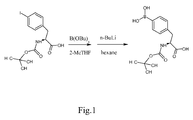
- Fig.1 is a chemical equation illustrating an embodiment of the invention.
- the present invention provides solutions to solve the problems of the conventional processes for preparing L-BPA.
- a process for preparing L-BPA from (S)-N-Boc-4-iodophenylalanine is provided as a preferred embodiment of (S)-N-Boc-4-halophenylalanine for illustrating but not limiting the scope of the present invention.
- the organolithium is n-butyl lithium.
- the inert organic solvent is hexanes.
- the concentration of the organolithium comprised in hexanes is 1.6 M.
- the extractive solvent is isobutyl alcohol.
- the acidic solution is hydrochloric acid.
- the equivalent ratio of the boronating agent to (S)-N-Boc-4-halophenylalanine is 3.5.
- the equivalent ratio of the organolithium to (S)-N-Boc-4-halophenylalanine is 4.25.
- the first organic solvent is acetone.
- the acidifying solution is a solution comprising hydrochloric acid.
- the present invention is environmentally friendly and reduces cost remarkably since 2-methyltetrahydrofuran, isobutyl alcohol and acetone are nontoxic and are environmentally friendly solvent and since 2-methyltetrahydrofuran can be recycled after use.
- a 1-L, three-necked flask equipped with a mechanical stirrer, a thermometer, and a nitrogen inlet adaptor capped with a rubber septum was charged with 2-methyltetrahydrofuran(150 mL), and followed by (S)-N-Boc-4-iodophenylalanine (10.0 g, 96.8 %, 24.7 mmol), stirred to form a solution, and added tributyl borate (21 mL, 17.9g, 77.8 mmol) to form a mixed solution.
- the mixed solution was cooled to a temperature ranging from -76°C to - 85°C, and n-butyl lithium (1.6 M in hexanes, 68 mL, 109 mmol) was added dropwise to the mixed solution over 2.5 h to form a reaction mixture.
- n-butyl lithium 1.6 M in hexanes, 68 mL, 109 mmol
- a quenched sample of the reaction mixture was analyzed by HPLC and the starting (S)-N-Boc-4-iodophenylalanine was found less than 0.5 %.
- the reaction was quenched slowly with 180 mL of cold water over a 30 min period, then allowed to warm to a temperature ranging from 5°C to 10°C.
- the resulted mixture was stirred for 10 to 20 minutes, and then was filtered to remove the insoluble material, washed with 20 mL of water, combined with the water wash to the filtrate and transferred to a separating funnel.
- the basic lower aqueous layer was separated to obtain a first aqueous layer.
- the first aqueous layer was extracted with isobutyl alcohol, and was separated from the isobutyl alcohol to obtain a second aqueous layer.
- the temperature of the second aqueous layer was adjusted to 20°C to 25 °C, and the pH value of the second aqueous layer was adjusted to pH 3 to pH 4 by using 37 % of hydrochloric acid.
- the product (S)-N-Boc-4-boronophenylalanine started to precipitate during this period.
- the second aqueous layer mixture was stirred for 30 min, the pH value of the second aqueous layer mixture was readjusted to pH 3.0 and the second aqueous layer mixture was stirred for another 2 hours at a temperature ranging from 20 to 25°C.
- the second aqueous layer mixture was filtered to obtain solid (S)-N-Boc-4-boronophenylalanine, which was washed twice with 20 mL of water and dried in a vacuum oven at 50°C for a minimum of 5 hours to a loss on drying(LOD) of less than 0.5 % to afford 5.1 g of (S)-N-Boc-4-boronophenylalanine as white solid, which was 98.8 % pure determined by HPLC. The yield was 66 %.
- the acidic mixture was stirred for 30 min, and the product 4-borono-L-phenylalanine started to precipitate during this period.
- the pH value of the acidic mixture was readjusted to pH 6.2 by using sodium hydroxide aqueous solution, and the acidic mixture was stirred overnight at room temperature.
- the acidic mixture was filtered to obtain solid 4-borono-L-phenylalanine.
- the solid 4-borono-L-phenylalanine was washed with water, then with 50 % aqueous acetone, and dried in a vacuum oven at 80°C for a minimum of 6 hours to constant weight to afford 3.51 g (93.2% yield) of 4-borono-L-phenylalanine with 99.6 % pure as white crystals.
- the obtained 4-borono-L-phenylalanine was analyzed by chiral HPLC, indicating the ratio of L to D isomers to be 100 to 0 (100 % enantiometric excess).
- the melting point, specific rotation, 1H NMR data, 13C NMR data, IR data and MS data of the obtained L-BPA are as follows.
- the mixed solution was cooled to a temperature ranging from -76°C to -85°C, and n-butyl lithium (1.6 M in hexanes, 375 ml, 600 mmol) was added dropwise to the mixed solution over 3 h to form a reaction mixture.
- reaction mixture was stirred for an additional 0.5 h at - 80 °C.
- HPLC analysis of a quenched sample of the reaction mixture showed the starting material (S)-N-Boc-4-iodophenylalanine was less than 0.5 %.
- the reaction mixture was quenched slowly with 900 mL of cold water over 15 to 20 minutes, then allowed to warm to a temperature ranging from 5°C to 10 °C.
- the resulted mixture was filtered to remove insoluble solid, and 100 mL of water was adopted for transfer and rinse.
- the obtained filtrate was transferred to a separating funnel to separate the layers, the basic lower aqueous layer was separated to obtain a first aqueous layer.
- the first aqueous layer was extracted with isobutyl alcohol and then separated from the isobutyl alcohol to obtain a second aqueous layer.
- the pH value of the second aqueous layer was adjusted to pH 3 to pH 4 by using 37 % hydrochloric acid at a temperature ranging from 20°C to 25 C, the product (S)-N-Boc-4-( 10 B) boronophenylalanine started to precipitate during this period.
- the second aqueous layer mixture was stirred for 30 minutes, then the pH value of the second aqueous layer mixture was further adjusted to 3.0 and then the second aqueous layer mixture was stirred for another 2 hours.
- the second aqueous layer mixture was filtered to obtain solid (S)-N-Boc-4-( 10 B) boronophenylalanine, which was then washed twice with water and dried in a vacuum oven at 50°C for a minimum of 4 hours to an LOD of less than 0.5 % to afford 25.8 g of (S)-N-Boc-4-( 10 B) boronophenylalanine as white solid, which was 99.6 % pure determined by HPLC. The yield was 65.1 %.
- the temperature of the acidic mixture was cooled to room temperature, and the pH value of the acidic mixture was adjusted to pH 1.5 by using sodium hydroxide aqueous solution, 4-( 10 B)borono-L-phenylalanine started to precipitate during this period, and the acidic mixture was stirred for 50 min.
- the pH value of the acidic mixture was readjusted to pH 6.2 by using sodium hydroxide aqueous solution, and the mixture was stirred for a minimum of 25 minutes at room temperature.
- the acidic mixture was filtered to obtain solid 4-( 10 B)borono-L-phenylalanine.
- the melting point, specific rotation, 1 H NMR data, 13 C NMR data, IR data, ICP-MS data and HRMS data of the obtained L-( 10 B) BPA are as follows.
Landscapes
- Chemical & Material Sciences (AREA)
- Organic Chemistry (AREA)
- Organic Low-Molecular-Weight Compounds And Preparation Thereof (AREA)
Claims (18)
- Verfahren für die Herstellung eines 4-Bor-L-phenylalanins, dadurch gekennzeichnet, dass das Verfahren die Schritte umfasst des:Reagierens von N-geschütztem (S)-4-Halophenylalanin der Formel (I), einem Boronierungsmittel und einem Organolithium, um eine Reaktionsmischung zu erhalten, wobei die Reaktionsmischung N-geschütztes (S)-4-Borphenylalanin der Formel (II) umfasst und die R-Gruppe eine Schutzgruppe darstellt;
 Isolierens des N-geschützten (S)-4-Borphenylalanins von der Reaktionsmischung; undEntschützens der R-Gruppe des N-geschützten(S)-4-Borphenylalanins, um 4-Bor-L-phenylalanin (L-BPA) zu erhalten,wobei die X-Gruppe von N-geschütztem (S)-4-Halophenylalanin der Formel (I) Iodid oder Bromid ist, das Boronierungsmittel Tributylborat, Triethylborat, Trimethylborat, Triisopropylborat, Tripropylborat oder Tri-tert-butylborat umfasst und das Organolithium n-Butyllithium, Methyllithium oder sec-Butyllithium ist.
 - Verfahren nach Anspruch 1, wobei die R-Gruppe des N-geschützten (S)-4-Halophenylalanins der Formel (I) und das N-geschützte (S)-4-Borphenylalanin der Formel (II) aus der Gruppe ausgewählt sind bestehend aus: einer tert.-Butoxycarbonyl- (t-Boc) Gruppe, Trityl- (Trt) Gruppe, 3,5-Dimethoxyphenylisopropoxycarbonyl- (Ddz) Gruppe, 2-(4-Bipenyl)isopropoxycarbonyl- (Bpoc) Gruppe und 2-Nitrophenylsulfenyl- (Nps) Gruppe.
- Verfahren nach Anspruch 1, wobei der Schritt des Reagierens von N-geschütztem (S)-4-Halophenylalanin der Formel (I), des Boronierungsmittels und des Organolithiums, um die Reaktionsmischung zu erhalten, das Reagieren von N-geschütztem(S)-4-Halophenylalanin der Formel (I), des Boronierungsmittels und des Organolithiums in einem Temperaturbereich von -50 °C bis -100 °C umfasst, um die Reaktionsmischung zu erhalten:
- Verfahren nach Anspruch 1, wobei der Schritt des Reagierens von N-geschütztem (S)-4-Halophenylalanin der Formel (I), des Boronierungsmittels und des Organolithiums, um die Reaktionsmischung zu erhalten, Folgendes umfasst:das Reagieren von N-geschütztem (S)-4-Halophenylalanin der Formel (I), des Boronierungsmittels und des Organolithiums mit einem äquivalenten Verhältnis des Boronierungsmittels zum N-geschützten (S)-4-Halophenylalanin im Bereich von 2 bis 5, um die Reaktionsmischung zu erhalten.
- Verfahren nach Anspruch 1, wobei der Schritt des Reagierens von N-geschütztem (S)-4-Halophenylalanin der Formel (I), des Boronierungsmittels und des Organolithiums, um die Reaktionsmischung zu erhalten, Folgendes umfasst:das Reagieren von N-geschütztem (S)-4-Halophenylalanin der Formel (I) des Boronierungsmittels und des Organolithiums mit einem äquivalenten Verhältnis des Organolithiums zum N-geschützten (S)-4-Halophenylalanin, das mindestens 3 beträgt.
- Verfahren nach Anspruch 1, wobei der Schritt des Reagieren von N-geschütztem (S)-4-Halophenylalanin der Formel (I), des Boronierungsmittels und des Organolithiums, und die Reaktionsmischung zu erhalten, die Schritte umfasst des:Mischens von N-geschütztem (S)-4-Halophenylalanin, einem Reaktionslösungsmittel und des Boronierungsmittels, um eine gemischte Lösung zu erhalten; undZugebens einer inerten organischen Lösung umfassend das Organolithium zu der gemischten Lösung bei einer Temperatur im Bereich von -50 °C bis -100 °C, um die Reaktionsmischung zu erhalten.
- Verfahren nach Anspruch 1, wobei der Schritt des Isolierens des N-geschützten (S)-4-Borphenylalanins von der Reaktionsmischung die Schritte umfasst des:Zugebens einer wässrigen Lösung zu der Reaktionsmischung, um eine erste wässrige Schicht zu erhalten,Extrahierens der ersten wässrigen Schicht mit einem extraktiven Lösungsmittel, um eine zweite wässrige Schicht zu erhalten, undEinstellens des pH-Werts der zweiten wässrigen Schicht auf weniger als 4, um das N-geschützte (S)-4-Borphenylalanin zu kristallisieren, um das N-geschützte (S)-4-Borphenylalanin aus der zweiten wässrigen Schicht zu erhalten.
- Verfahren nach Anspruch 1, wobei der Schritt des Entschützens der R-Gruppe des N-geschützten (S)-4-Borphenylalanins, um L-BPA zu erhalten, einen Schritt umfasst des: Ansäuerns einer ersten organischen Lösung umfassend das N-geschützte (S)-4-Borphenylalanin, um die R-Gruppe des N-geschützten (S)-4-Borphenylalanins zu entschützen, um L-BPA zu erhalten.
- Verfahren nach Anspruch 1, wobei der Schritt des Entschützens der R-Gruppe des N-geschützten (S)-4-Borphenylalanins, um L-BPA zu erhalten, die Schritte umfasst des:Ansäuerns einer ersten organischen Lösung umfassend das N-geschützte (S)-4-Borphenylalanin, um die R-Gruppe des N-geschützten (S)-4-Borphenylalanins zu entschützen, um eine saure Mischung zu erhalten; undEinstellens des pH-Werts der sauren Mischung auf über 1, um L-BPA zu kristallisieren, um L-BPA aus der sauren Mischung zu erhalten.
- Verfahren nach Anspruch 1, wobei das Boronierungsmittel eine 10BReinheit von nicht weniger als 98 % aufweist und das 4-Bor-L-phenylalanin 4-(10B)Bor-L-phenylalanin ist und das N-geschützte (S)-4-Borphenylalanin der Formel (II) N-geschütztes (S)-4-(10B)Borphenylalanin ist.
- Verfahren nach Anspruch 10, wobei die R-Gruppe des N-geschützten (S)-4-Halophenylalanins der Formel (I) und das N-geschützte 4-(10B)Bor-L-phenylalanin der Formel (II) aus der Gruppe ausgewählt sind bestehend aus einer tert.-Butoxycarbonylgruppe, Tritylgruppe, 3,5-Dimethoxyphenylisopropoxycarbonylgruppe, 2-(4-Bipenyl)isopropoxycarbonylgruppe und 2-Nitrophenylsulfenylgruppe.
- Verfahren nach Anspruch 10, wobei der Schritt des Reagierens von N-geschütztem (S)-4-Halophenylalanin, des Boronierungsmittels und des Organolithiums, um eine Reaktionsmischung zu erhalten, das Reagieren umfasst des N-geschützten (S)-4-Halophenylalanins, des Boronierungsmittels und des Organolithiums bei einer Temperatur im Bereich von -50 °C bis -100 °C, um die Reaktionsmischung zu erhalten.
- Verfahren nach Anspruch 10, wobei der Schritt des Reagierens von N-geschütztem (S)-4-Halophenylalanin der Formel (I), des Boronierungsmittels und des Organolithiums, um die Reaktionsmischung zu erhalten, Folgendes umfasst:das Reagieren von N-geschütztem (S)-4-Halophenylalanin mit einem äquivalenten Verhältnis des Boronierungsmittels zu N-geschütztem (S)-4-Halophenylalanin im Bereich von 2 bis 5 liegt, um die Reaktionsmischung zu erhalten.
- Verfahren nach Anspruch 10, wobei der Schritt des Reagierens von N-geschütztem (S)-4-Halophenylalanin der Formel (I), des Boronierungsmittels und des Organolithiums um die Reaktionsmischung zu erhalten, Folgendes umfasst:das Reagieren von N-geschütztem (S)-4-Halophenylalanin der Formel (I) des Boronierungsmittels und des Organolithiums mit einem äquivalenten Verhältnis des Organolithiums zu N-geschütztem (S)-4-Halophenylalanin der Formel (I), das mindestens 3 beträgt.
- Verfahren nach Anspruch 10, wobei der Schritt des Reagierens von N-geschütztem (S)-4-Halophenylalanin, des Boronierungsmittels und des Organolithiums, um die Reaktionsmischung zu erhalten, die Schritte umfasst des:Mischens von N-geschütztem (S)-4-Halophenylalanin, einem Reaktionslösungsmittel und dem Boronierungsmittel, um eine gemischte Lösung zu erhalten; undZugebens einer inerten organischen Lösung umfassend das Organolithium zu der gemischten Lösung bei einer Temperatur im Bereich von -50 °C bis -100 °C, um die Reaktionsmischung zu erhalten.
- Verfahren nach Anspruch 10, wobei der Schritt des Isolierens des N-geschützten (S)-4-(10B)Borphenylalanins von der Reaktionsmischung die Schritte umfasst des:Zugebens einer wässrigen Lösung zu der Reaktionsmischung, um eine erste wässrige Schicht zu erhalten,Extrahierens der ersten wässrigen Schicht mit einem extraktiven Lösungsmittel, um eine zweite wässrige Schicht zu erhalten, undEinstellens des pH-Werts der zweiten wässrigen Schicht auf weniger als 4, um das N-geschützte (S)-4-(10B)Borphenylalanin zu kristallisieren, um das N-geschützte (S)-4-(10B)Borphenylalanin aus der zweiten Schicht zu erhalten.
- Verfahren nach Anspruch 10, wobei der Schritt des Entschützens der R-Gruppe des N-geschützten (S)-4-(10B)Borphenylalanins, um 4-(10B)Bor-L-phenylalanin zu erhalten, einen Schritt des Ansäuerns einer ersten organischen Lösung umfasst, die das N-geschützte (S)-4-(10B)Borphenylalanin umfasst, um die R-Gruppe des N-geschützten (S)-4-(10B)Borphenylalanins zu entschützen, um 4-(10B)Bor-L-phenylalanin zu erhalten.
- Verfahren nach Anspruch 10, wobei der Schritt des Entschützens der R-Gruppe des N-geschützten(S)-4-(10B)Borphenylalanins, um 4-(10B)Bor-L-phenylalanin zu erhalten, die Schritte umfasst des:Ansäuerns einer ersten organischen Lösung, die das N-geschützte (S)-4-(10B)Borphenylalanin umfasst, um die R-Gruppe des N-geschützten (S)-4-(10B)Borphenylalanins zu entschützen, um eine saure Mischung zu erhalten; undEinstellens des pH-Werts der sauren Mischung auf über 1, um das 4-(10B)Bor-L-phenylalanin zu kristallisieren, um 4-(10B)Bor-L-phenylalanin aus der sauren Mischung zu erhalten.
Priority Applications (2)
| Application Number | Priority Date | Filing Date | Title |
|---|---|---|---|
| EP13190413.8A EP2865682B1 (de) | 2013-10-28 | 2013-10-28 | Verfahren zur Herstellung von 4-Borono-l-Phenylalanin |
| ES13190413.8T ES2609396T3 (es) | 2013-10-28 | 2013-10-28 | Procedimiento para preparar 4-borono-L-fenilalanina |
Applications Claiming Priority (1)
| Application Number | Priority Date | Filing Date | Title |
|---|---|---|---|
| EP13190413.8A EP2865682B1 (de) | 2013-10-28 | 2013-10-28 | Verfahren zur Herstellung von 4-Borono-l-Phenylalanin |
Publications (2)
| Publication Number | Publication Date |
|---|---|
| EP2865682A1 EP2865682A1 (de) | 2015-04-29 |
| EP2865682B1 true EP2865682B1 (de) | 2016-10-26 |
Family
ID=49486363
Family Applications (1)
| Application Number | Title | Priority Date | Filing Date |
|---|---|---|---|
| EP13190413.8A Active EP2865682B1 (de) | 2013-10-28 | 2013-10-28 | Verfahren zur Herstellung von 4-Borono-l-Phenylalanin |
Country Status (2)
| Country | Link |
|---|---|
| EP (1) | EP2865682B1 (de) |
| ES (1) | ES2609396T3 (de) |
Families Citing this family (5)
| Publication number | Priority date | Publication date | Assignee | Title |
|---|---|---|---|---|
| EP3321272B1 (de) * | 2015-08-14 | 2019-11-27 | Neuboron Medtech Ltd. | Verfahren zur herstellung von l-bpa |
| EP3755681B1 (de) | 2018-02-20 | 2022-09-07 | Otsuka Pharmaceutical Co., Ltd. | Verfahren zur herstellung von 4-boronophenylalanin |
| CA3130297A1 (en) | 2019-03-04 | 2020-09-10 | TAE Life Sciences | Borylated amino acid compositions for use in boron neutron capture therapy and methods thereof |
| JPWO2022102565A1 (de) * | 2020-11-13 | 2022-05-19 | ||
| US11884688B2 (en) | 2021-07-30 | 2024-01-30 | Tae Life Sciences, Llc | Borylated amino acid compositions comprising BTS and BTS(OMe) for use in boron neutron capture therapy and methods thereof |
-
2013
- 2013-10-28 EP EP13190413.8A patent/EP2865682B1/de active Active
- 2013-10-28 ES ES13190413.8T patent/ES2609396T3/es active Active
Also Published As
| Publication number | Publication date |
|---|---|
| ES2609396T3 (es) | 2017-04-20 |
| EP2865682A1 (de) | 2015-04-29 |
Similar Documents
| Publication | Publication Date | Title |
|---|---|---|
| US10323046B2 (en) | Method for preparing L-BPA | |
| US8765997B2 (en) | Process for preparing 4-borono-L-phenylalanine | |
| EP2865682B1 (de) | Verfahren zur Herstellung von 4-Borono-l-Phenylalanin | |
| GB1595337A (en) | Synthesis of methotrexate | |
| KR102635698B1 (ko) | 4-보로노페닐알라닌 제조 방법 | |
| CN120230133A (zh) | 一种3-硼-l-苯丙氨酸或其衍生物的制备方法 | |
| CN104447823A (zh) | 4-二羟基硼基-l型苯丙氨酸的制备方法 | |
| US8513465B2 (en) | Potassium organotrifluoroborate derivative and a production method therefor | |
| CN104788480B (zh) | 一种合成氨基苯硼酸频那醇酯的方法 | |
| US20120289733A1 (en) | Novel borate derivatives and their applications | |
| KR20230107791A (ko) | 4-보로노-l-페닐알라닌 및 그 중간체의 제조 방법 | |
| TWI480283B (zh) | 4-二羥基硼基-l型苯丙胺酸之製備方法 | |
| CN118994222B (zh) | 一种4-硼-10酸-l-苯丙氨酸的中间体的制备方法及应用 | |
| CN114057782A (zh) | 一种合成4-巯基苯硼酸的工艺方法 | |
| EP2865683B1 (de) | Verbindung zur herstellung von 4-(10b)borono-l-phenylalanin | |
| CN119978005A (zh) | 一种14c标记的4-二羟硼基苯丙氨酸的制备方法及应用 | |
| EA040362B1 (ru) | Способ производства 4-боронфенилаланина | |
| CN109678812A (zh) | 一种5-乙烯基-2-硫代恶唑烷的制备方法 |
Legal Events
| Date | Code | Title | Description |
|---|---|---|---|
| PUAI | Public reference made under article 153(3) epc to a published international application that has entered the european phase |
Free format text: ORIGINAL CODE: 0009012 |
|
| 17P | Request for examination filed |
Effective date: 20141015 |
|
| AK | Designated contracting states |
Kind code of ref document: A1 Designated state(s): AL AT BE BG CH CY CZ DE DK EE ES FI FR GB GR HR HU IE IS IT LI LT LU LV MC MK MT NL NO PL PT RO RS SE SI SK SM TR |
|
| AX | Request for extension of the european patent |
Extension state: BA ME |
|
| 17Q | First examination report despatched |
Effective date: 20150401 |
|
| GRAP | Despatch of communication of intention to grant a patent |
Free format text: ORIGINAL CODE: EPIDOSNIGR1 |
|
| RAP1 | Party data changed (applicant data changed or rights of an application transferred) |
Owner name: TAIWAN BIOTECH CO., LTD. |
|
| INTG | Intention to grant announced |
Effective date: 20160222 |
|
| GRAP | Despatch of communication of intention to grant a patent |
Free format text: ORIGINAL CODE: EPIDOSNIGR1 |
|
| INTG | Intention to grant announced |
Effective date: 20160504 |
|
| GRAS | Grant fee paid |
Free format text: ORIGINAL CODE: EPIDOSNIGR3 |
|
| GRAA | (expected) grant |
Free format text: ORIGINAL CODE: 0009210 |
|
| AK | Designated contracting states |
Kind code of ref document: B1 Designated state(s): AL AT BE BG CH CY CZ DE DK EE ES FI FR GB GR HR HU IE IS IT LI LT LU LV MC MK MT NL NO PL PT RO RS SE SI SK SM TR |
|
| REG | Reference to a national code |
Ref country code: GB Ref legal event code: FG4D |
|
| REG | Reference to a national code |
Ref country code: FR Ref legal event code: PLFP Year of fee payment: 4 |
|
| REG | Reference to a national code |
Ref country code: CH Ref legal event code: EP |
|
| REG | Reference to a national code |
Ref country code: AT Ref legal event code: REF Ref document number: 839949 Country of ref document: AT Kind code of ref document: T Effective date: 20161115 |
|
| REG | Reference to a national code |
Ref country code: IE Ref legal event code: FG4D |
|
| REG | Reference to a national code |
Ref country code: DE Ref legal event code: R096 Ref document number: 602013013165 Country of ref document: DE |
|
| REG | Reference to a national code |
Ref country code: NL Ref legal event code: FP |
|
| REG | Reference to a national code |
Ref country code: LT Ref legal event code: MG4D |
|
| PG25 | Lapsed in a contracting state [announced via postgrant information from national office to epo] |
Ref country code: LV Free format text: LAPSE BECAUSE OF FAILURE TO SUBMIT A TRANSLATION OF THE DESCRIPTION OR TO PAY THE FEE WITHIN THE PRESCRIBED TIME-LIMIT Effective date: 20161026 Ref country code: BE Free format text: LAPSE BECAUSE OF NON-PAYMENT OF DUE FEES Effective date: 20161031 |
|
| REG | Reference to a national code |
Ref country code: AT Ref legal event code: MK05 Ref document number: 839949 Country of ref document: AT Kind code of ref document: T Effective date: 20161026 |
|
| REG | Reference to a national code |
Ref country code: ES Ref legal event code: FG2A Ref document number: 2609396 Country of ref document: ES Kind code of ref document: T3 Effective date: 20170420 |
|
| PG25 | Lapsed in a contracting state [announced via postgrant information from national office to epo] |
Ref country code: NO Free format text: LAPSE BECAUSE OF FAILURE TO SUBMIT A TRANSLATION OF THE DESCRIPTION OR TO PAY THE FEE WITHIN THE PRESCRIBED TIME-LIMIT Effective date: 20170126 Ref country code: GR Free format text: LAPSE BECAUSE OF FAILURE TO SUBMIT A TRANSLATION OF THE DESCRIPTION OR TO PAY THE FEE WITHIN THE PRESCRIBED TIME-LIMIT Effective date: 20170127 Ref country code: SE Free format text: LAPSE BECAUSE OF FAILURE TO SUBMIT A TRANSLATION OF THE DESCRIPTION OR TO PAY THE FEE WITHIN THE PRESCRIBED TIME-LIMIT Effective date: 20161026 Ref country code: LT Free format text: LAPSE BECAUSE OF FAILURE TO SUBMIT A TRANSLATION OF THE DESCRIPTION OR TO PAY THE FEE WITHIN THE PRESCRIBED TIME-LIMIT Effective date: 20161026 |
|
| PG25 | Lapsed in a contracting state [announced via postgrant information from national office to epo] |
Ref country code: PL Free format text: LAPSE BECAUSE OF FAILURE TO SUBMIT A TRANSLATION OF THE DESCRIPTION OR TO PAY THE FEE WITHIN THE PRESCRIBED TIME-LIMIT Effective date: 20161026 Ref country code: BE Free format text: LAPSE BECAUSE OF FAILURE TO SUBMIT A TRANSLATION OF THE DESCRIPTION OR TO PAY THE FEE WITHIN THE PRESCRIBED TIME-LIMIT Effective date: 20161026 Ref country code: AT Free format text: LAPSE BECAUSE OF FAILURE TO SUBMIT A TRANSLATION OF THE DESCRIPTION OR TO PAY THE FEE WITHIN THE PRESCRIBED TIME-LIMIT Effective date: 20161026 Ref country code: PT Free format text: LAPSE BECAUSE OF FAILURE TO SUBMIT A TRANSLATION OF THE DESCRIPTION OR TO PAY THE FEE WITHIN THE PRESCRIBED TIME-LIMIT Effective date: 20170227 Ref country code: RS Free format text: LAPSE BECAUSE OF FAILURE TO SUBMIT A TRANSLATION OF THE DESCRIPTION OR TO PAY THE FEE WITHIN THE PRESCRIBED TIME-LIMIT Effective date: 20161026 Ref country code: HR Free format text: LAPSE BECAUSE OF FAILURE TO SUBMIT A TRANSLATION OF THE DESCRIPTION OR TO PAY THE FEE WITHIN THE PRESCRIBED TIME-LIMIT Effective date: 20161026 Ref country code: FI Free format text: LAPSE BECAUSE OF FAILURE TO SUBMIT A TRANSLATION OF THE DESCRIPTION OR TO PAY THE FEE WITHIN THE PRESCRIBED TIME-LIMIT Effective date: 20161026 Ref country code: IS Free format text: LAPSE BECAUSE OF FAILURE TO SUBMIT A TRANSLATION OF THE DESCRIPTION OR TO PAY THE FEE WITHIN THE PRESCRIBED TIME-LIMIT Effective date: 20170226 |
|
| REG | Reference to a national code |
Ref country code: IE Ref legal event code: MM4A |
|
| REG | Reference to a national code |
Ref country code: DE Ref legal event code: R097 Ref document number: 602013013165 Country of ref document: DE |
|
| PG25 | Lapsed in a contracting state [announced via postgrant information from national office to epo] |
Ref country code: CZ Free format text: LAPSE BECAUSE OF FAILURE TO SUBMIT A TRANSLATION OF THE DESCRIPTION OR TO PAY THE FEE WITHIN THE PRESCRIBED TIME-LIMIT Effective date: 20161026 Ref country code: RO Free format text: LAPSE BECAUSE OF FAILURE TO SUBMIT A TRANSLATION OF THE DESCRIPTION OR TO PAY THE FEE WITHIN THE PRESCRIBED TIME-LIMIT Effective date: 20161026 Ref country code: EE Free format text: LAPSE BECAUSE OF FAILURE TO SUBMIT A TRANSLATION OF THE DESCRIPTION OR TO PAY THE FEE WITHIN THE PRESCRIBED TIME-LIMIT Effective date: 20161026 Ref country code: DK Free format text: LAPSE BECAUSE OF FAILURE TO SUBMIT A TRANSLATION OF THE DESCRIPTION OR TO PAY THE FEE WITHIN THE PRESCRIBED TIME-LIMIT Effective date: 20161026 Ref country code: SK Free format text: LAPSE BECAUSE OF FAILURE TO SUBMIT A TRANSLATION OF THE DESCRIPTION OR TO PAY THE FEE WITHIN THE PRESCRIBED TIME-LIMIT Effective date: 20161026 Ref country code: MC Free format text: LAPSE BECAUSE OF FAILURE TO SUBMIT A TRANSLATION OF THE DESCRIPTION OR TO PAY THE FEE WITHIN THE PRESCRIBED TIME-LIMIT Effective date: 20161026 |
|
| PG25 | Lapsed in a contracting state [announced via postgrant information from national office to epo] |
Ref country code: SM Free format text: LAPSE BECAUSE OF FAILURE TO SUBMIT A TRANSLATION OF THE DESCRIPTION OR TO PAY THE FEE WITHIN THE PRESCRIBED TIME-LIMIT Effective date: 20161026 Ref country code: BG Free format text: LAPSE BECAUSE OF FAILURE TO SUBMIT A TRANSLATION OF THE DESCRIPTION OR TO PAY THE FEE WITHIN THE PRESCRIBED TIME-LIMIT Effective date: 20170126 Ref country code: LU Free format text: LAPSE BECAUSE OF NON-PAYMENT OF DUE FEES Effective date: 20161028 |
|
| PLBE | No opposition filed within time limit |
Free format text: ORIGINAL CODE: 0009261 |
|
| STAA | Information on the status of an ep patent application or granted ep patent |
Free format text: STATUS: NO OPPOSITION FILED WITHIN TIME LIMIT |
|
| REG | Reference to a national code |
Ref country code: FR Ref legal event code: PLFP Year of fee payment: 5 |
|
| 26N | No opposition filed |
Effective date: 20170727 |
|
| PG25 | Lapsed in a contracting state [announced via postgrant information from national office to epo] |
Ref country code: IE Free format text: LAPSE BECAUSE OF NON-PAYMENT OF DUE FEES Effective date: 20161028 Ref country code: SI Free format text: LAPSE BECAUSE OF FAILURE TO SUBMIT A TRANSLATION OF THE DESCRIPTION OR TO PAY THE FEE WITHIN THE PRESCRIBED TIME-LIMIT Effective date: 20161026 |
|
| PG25 | Lapsed in a contracting state [announced via postgrant information from national office to epo] |
Ref country code: HU Free format text: LAPSE BECAUSE OF FAILURE TO SUBMIT A TRANSLATION OF THE DESCRIPTION OR TO PAY THE FEE WITHIN THE PRESCRIBED TIME-LIMIT; INVALID AB INITIO Effective date: 20131028 |
|
| PG25 | Lapsed in a contracting state [announced via postgrant information from national office to epo] |
Ref country code: MK Free format text: LAPSE BECAUSE OF FAILURE TO SUBMIT A TRANSLATION OF THE DESCRIPTION OR TO PAY THE FEE WITHIN THE PRESCRIBED TIME-LIMIT Effective date: 20161026 Ref country code: CY Free format text: LAPSE BECAUSE OF FAILURE TO SUBMIT A TRANSLATION OF THE DESCRIPTION OR TO PAY THE FEE WITHIN THE PRESCRIBED TIME-LIMIT Effective date: 20161026 Ref country code: MT Free format text: LAPSE BECAUSE OF NON-PAYMENT OF DUE FEES Effective date: 20161031 |
|
| REG | Reference to a national code |
Ref country code: FR Ref legal event code: PLFP Year of fee payment: 6 |
|
| PG25 | Lapsed in a contracting state [announced via postgrant information from national office to epo] |
Ref country code: TR Free format text: LAPSE BECAUSE OF FAILURE TO SUBMIT A TRANSLATION OF THE DESCRIPTION OR TO PAY THE FEE WITHIN THE PRESCRIBED TIME-LIMIT Effective date: 20161026 |
|
| PG25 | Lapsed in a contracting state [announced via postgrant information from national office to epo] |
Ref country code: AL Free format text: LAPSE BECAUSE OF FAILURE TO SUBMIT A TRANSLATION OF THE DESCRIPTION OR TO PAY THE FEE WITHIN THE PRESCRIBED TIME-LIMIT Effective date: 20161026 |
|
| PGFP | Annual fee paid to national office [announced via postgrant information from national office to epo] |
Ref country code: IT Payment date: 20250826 Year of fee payment: 13 |
|
| PGFP | Annual fee paid to national office [announced via postgrant information from national office to epo] |
Ref country code: GB Payment date: 20250806 Year of fee payment: 13 |
|
| PGFP | Annual fee paid to national office [announced via postgrant information from national office to epo] |
Ref country code: FR Payment date: 20250808 Year of fee payment: 13 |
|
| REG | Reference to a national code |
Ref country code: CH Ref legal event code: U11 Free format text: ST27 STATUS EVENT CODE: U-0-0-U10-U11 (AS PROVIDED BY THE NATIONAL OFFICE) Effective date: 20251101 |
|
| PGFP | Annual fee paid to national office [announced via postgrant information from national office to epo] |
Ref country code: NL Payment date: 20251021 Year of fee payment: 13 |
|
| PGFP | Annual fee paid to national office [announced via postgrant information from national office to epo] |
Ref country code: DE Payment date: 20250813 Year of fee payment: 13 |
|
| PGFP | Annual fee paid to national office [announced via postgrant information from national office to epo] |
Ref country code: CH Payment date: 20251101 Year of fee payment: 13 |
|
| PGFP | Annual fee paid to national office [announced via postgrant information from national office to epo] |
Ref country code: ES Payment date: 20251107 Year of fee payment: 13 |