EP3321272B1 - Verfahren zur herstellung von l-bpa - Google Patents
Verfahren zur herstellung von l-bpa Download PDFInfo
- Publication number
- EP3321272B1 EP3321272B1 EP16836615.1A EP16836615A EP3321272B1 EP 3321272 B1 EP3321272 B1 EP 3321272B1 EP 16836615 A EP16836615 A EP 16836615A EP 3321272 B1 EP3321272 B1 EP 3321272B1
- Authority
- EP
- European Patent Office
- Prior art keywords
- protected
- bpa
- reaction
- formula
- boronophenylalanine
- Prior art date
- Legal status (The legal status is an assumption and is not a legal conclusion. Google has not performed a legal analysis and makes no representation as to the accuracy of the status listed.)
- Active
Links
Classifications
-
- C—CHEMISTRY; METALLURGY
- C07—ORGANIC CHEMISTRY
- C07F—ACYCLIC, CARBOCYCLIC OR HETEROCYCLIC COMPOUNDS CONTAINING ELEMENTS OTHER THAN CARBON, HYDROGEN, HALOGEN, OXYGEN, NITROGEN, SULFUR, SELENIUM OR TELLURIUM
- C07F5/00—Compounds containing elements of Groups 3 or 13 of the Periodic Table
- C07F5/02—Boron compounds
- C07F5/025—Boronic and borinic acid compounds
-
- C—CHEMISTRY; METALLURGY
- C07—ORGANIC CHEMISTRY
- C07F—ACYCLIC, CARBOCYCLIC OR HETEROCYCLIC COMPOUNDS CONTAINING ELEMENTS OTHER THAN CARBON, HYDROGEN, HALOGEN, OXYGEN, NITROGEN, SULFUR, SELENIUM OR TELLURIUM
- C07F5/00—Compounds containing elements of Groups 3 or 13 of the Periodic Table
- C07F5/02—Boron compounds
-
- C—CHEMISTRY; METALLURGY
- C07—ORGANIC CHEMISTRY
- C07B—GENERAL METHODS OF ORGANIC CHEMISTRY; APPARATUS THEREFOR
- C07B41/00—Formation or introduction of functional groups containing oxygen
- C07B41/08—Formation or introduction of functional groups containing oxygen of carboxyl groups or salts, halides or anhydrides thereof
-
- C—CHEMISTRY; METALLURGY
- C07—ORGANIC CHEMISTRY
- C07B—GENERAL METHODS OF ORGANIC CHEMISTRY; APPARATUS THEREFOR
- C07B47/00—Formation or introduction of functional groups not provided for in groups C07B39/00 - C07B45/00
-
- C—CHEMISTRY; METALLURGY
- C07—ORGANIC CHEMISTRY
- C07B—GENERAL METHODS OF ORGANIC CHEMISTRY; APPARATUS THEREFOR
- C07B63/00—Purification; Separation; Stabilisation; Use of additives
-
- C—CHEMISTRY; METALLURGY
- C07—ORGANIC CHEMISTRY
- C07F—ACYCLIC, CARBOCYCLIC OR HETEROCYCLIC COMPOUNDS CONTAINING ELEMENTS OTHER THAN CARBON, HYDROGEN, HALOGEN, OXYGEN, NITROGEN, SULFUR, SELENIUM OR TELLURIUM
- C07F3/00—Compounds containing elements of Groups 2 or 12 of the Periodic Table
- C07F3/02—Magnesium compounds
-
- Y—GENERAL TAGGING OF NEW TECHNOLOGICAL DEVELOPMENTS; GENERAL TAGGING OF CROSS-SECTIONAL TECHNOLOGIES SPANNING OVER SEVERAL SECTIONS OF THE IPC; TECHNICAL SUBJECTS COVERED BY FORMER USPC CROSS-REFERENCE ART COLLECTIONS [XRACs] AND DIGESTS
- Y02—TECHNOLOGIES OR APPLICATIONS FOR MITIGATION OR ADAPTATION AGAINST CLIMATE CHANGE
- Y02P—CLIMATE CHANGE MITIGATION TECHNOLOGIES IN THE PRODUCTION OR PROCESSING OF GOODS
- Y02P20/00—Technologies relating to chemical industry
- Y02P20/50—Improvements relating to the production of bulk chemicals
- Y02P20/55—Design of synthesis routes, e.g. reducing the use of auxiliary or protecting groups
Definitions
- the present disclosure relates generally to a method for preparing boron containing drug for boron neutron capture therapy, and, more particularly, to a method for preparing L-BPA.
- radiotherapy As atomics moves ahead, such radiotherapy as Cobalt-60, linear accelerators and electron beams has been one of major means to cancer therapy.
- conventional photon or electron therapy has been undergone physical restrictions of radioactive rays; for Embodiment, many normal tissues on a beam path will be damaged as tumor cells are destroyed.
- sensitivity of tumor cells to the radioactive rays differs greatly, so in most cases, conventional radiotherapy falls short of treatment effectiveness on radioresistant malignant tumors (such as glioblastoma multiforme and melanoma).
- BNCT boron neutron capture therapy
- BNCT takes advantage that the boron ( 10 B)-containing pharmaceuticals have high neutron capture cross section and produces 4 He and 7 Li heavy charged particles through 10 B(n, ⁇ ) 7 Li neutron capture and nuclear fission reaction.
- the two charged particles with average energy at about 2.33MeV, are of linear energy transfer (LET) and short-range characteristics.
- LET and range of the alpha particle are 150 keV/micrometer and 8 micrometers respectively while those of the heavy charged particle 7 Li are 175 keV/micrometer and 5 micrometers respectively, and the total range of the two particles approximately amounts to a cell size. Therefore, radiation damage to living organisms may be restricted at the cells' level.
- the boronated pharmaceuticals are gathered in the tumor cells selectively, only the tumor cells will be destroyed locally with a proper neutron source on the premise of having no major normal tissue damage.
- BNCT is also well known for binary cancer therapy, for its effectiveness depending on the concentration of the boronated pharmaceuticals and the number of the thermal neutrons at the tumor site.
- concentration of the boronated pharmaceuticals and the number of the thermal neutrons at the tumor site.
- the development of the boronated pharmaceuticals plays a significant role in BNCT researches.
- L- 10 BPA 4-( 10 B)borono-L-phenylalanine
- J. Org. Chem. 1998, 63, 8019 discloses a method undergoing palladium-catalyzed cross-coupling between an amine-protected L-4-iodophenylalanine, such as (S)-N-Boc-4-iodophenylalanine, and a diboron compound, such as bis-(pinacolato)diboron.
- L-BPA is then obtained after removal of the protecting group of amine and boronic acid of the phenylalanine.
- the drawbacks of this method also include the additional pre-method for preparing the boronating agent as mentioned above, and further include the time-consuming and multi-step synthesis involving the protection step of the carboxylic acid and the deprotection step of the carboxylic acid afterwards.
- Biosci. Biotech. Biochem. 1996, 60, 683 discloses an enantioselective synthesis of L-BPA by coupling cyclic ethers of boronic acid and a chiral derivative from L-valine, wherein the cyclic ethers of boronic acid are prepared from 4-boronobenzylbromide in advance.
- the last synthetic step of the method readily results in undesired racemization of the amino acid.
- an enzymatic resolution step which typically reduces the production yield, is required to obtain optically-pure L-BPA.
- the drawbacks of this method still include the additional pre-method for preparing the boronating agent, resulting in more time consumption and complicacy of the method, and thereby failing to prepare L-BPA in high yield.
- 10 B contained in L-BPA is known as the critical factor accumulated in tumor cells and subsequently irradiated with thermal neutron.
- 10 B renders L-BPA a treatment of cancer through boron neutron capture therapy (BNCT).
- BNCT boron neutron capture therapy
- the conventional methods comprise multi-step syntheses of the boronating agents, which reduce a large amount of 10 B-enriched materials during the method. As a result, the methods are not suitable for producing 10 B-enriched L-BPA.
- Synlett. 1996, 167 discloses a method by coupling iodophenylborate and L-serine zinc derivatives.
- the method involves indispensable pre-preparation of the L-serine zinc derivatives and the pre-preparation of the iodophenylborate, thereby giving a low yield of L-BPA.
- the method is still not suitable for producing 10 B-enriched L-BPA, for both 10 B-enriched BI 3 and 1,3-diphenylpropane-1,3-diol adopted in the method are not commercially available.
- EP 2 865 682 A1 discloses a process for preparing 4-borono-L-phenylalanine, which has steps of: reacting N-protected (S)-4-halophenylalanine of formula (I), a boronating agent and an organolithium to obtain a reaction mixture, wherein the reaction mixture comprises the N-protected (S)-4-boronophenylalanine of formula (II) and the R group represents a protection group; isolating the N-protected (S)-4-boronophenylalanine from the reaction mixture; deprotecting the R group of the N-protected (S)-4-boronophenylalanine to obtain L-BPA.
- the newly formed reactive Grignard reagents were allowed to react with electrophiles such as trimethylborate to afford arylboronic acids in good to excellent yields ( Organic Letters 2006, 8, 305-307 ).
- CN 104 447 823 A discloses a 4 - dihydroxy boryl - L-phenylalanine preparation method which is as follows: reacting amino terminal-protected (S) - 4 -halogeno phenylalanine shown as the formula (I) with a boriding agent and an organic lithium compound to obtain a reaction mixture containing amino terminal-protected (S) - 4 - dihydroxy boryl phenylalanine shown as the formula (II) with R being a protective group; separating the reaction mixture to obtain the amino terminal-protected (S) - 4 - dihydroxy boryl phenylalanine; and de-protecting the amino terminal-protected (S) - 4 - dihydroxy boryl phenylalanine to obtain 4 - dihydroxy boryl - L-phenylalanine.
- CN 104 447 822 A discloses a compound for preparation of 4 - (10 B) dihydroxy boryl- L - phenylalanine, the compound has the structure as shown in formula (I), wherein R represents a protective group, the protective group is selected from a group consisting of t-butyloxycarboryl, triphenylmethyl, 3, 5 - dimethoxy phenyl isopropyloxy carbonyl, 2 - (4 - biphenylyl) isopropyloxy carbonyl and 2-nitro phenyl sulfinyl, the compound 10 boron purity is greater than or equal to 98%, and the enantiomeric excess is greater than or equal to 99%.
- R represents a protective group
- the protective group is selected from a group consisting of t-butyloxycarboryl, triphenylmethyl, 3, 5 - dimethoxy phenyl isopropyloxy carbonyl, 2 - (4 - biphenylyl)
- Chemical Reagents 2014, 36, 481-486 focuses on the updated progress of the Grignard reagent.
- CN 104 961 756 A discloses a preparation method of (S)-Boc-4-dihydroxyborylphenylalanine.
- the preparation method comprises the following steps of using L-phenylalanine as a starting material and replacing protium on a benzene ring by using iodine to obtain 4-iodine-phenylalanine; performing amino protection reaction on the obtained 4-iodine-phynylalanine to obtain Boc-4-iodine-phynylalanine; exchanging the Boc-4-iodine-phynylalanine and isopropyl Grignard reagent; and functioning the Boc-4-iodine-phynylalanine and B(OMe) 3 to finally obtain the (S)-Boc-4-dihydroxyborylphenylalanine.
- an aspect of the present disclosure is to develop a timesaving, efficient, cost effective, and environmentally friendly method for preparing L-BPA without tedious purification. Accordingly, L-BPA prepared by the method of the disclosure has high chemical purity and high optical purity.
- Another aspect of the present disclosure is to develop a method for preparing L- 10 BPA, particularly, a method for preparing L- 10 BPA that is timesaving, efficient, cost effective, environmentally friendly, convenient and without tedious purification.
- the method in accordance with the present invention is effective in producing L- 10 BPA with high chemical purity, high optical purity and high isotopic purity.
- Another aspect of the present disclosure is to develop a method both suitable for preparing L-BPA and L- 10 BPA; particularly, a method for preparing both L-BPA and L- 10 BPA that is timesaving, efficient, cost effective, environmentally friendly, convenient and without tedious purification.
- the method in accordance with the present invention includes steps of: reacting N-protected (S)-4-halophenylalanine of Formula I, a boronating agent, Grignard reagent and bis(2-dimethylaminoethyl)ether to obtain a reaction mixture, wherein the Grignard reagent is tert-butylmagnesium chloride, wherein the reaction mixture includes N-protected (S)-4-boronophenylalanine of Formula II and the R 2 group represents a protecting group; isolating the N-protected (S)-4-boronophenylalanine from the reaction mixture; and deprotecting the R 2 group of the N-protected (S)-4-boronophenylalanine to obtain L-BPA, wherein the L-BPA has a structure of Formula III.
- the method for preparing L-BPA in accordance with the present disclosure includes steps of:
- the so-called "boronating agent” refers to any reagent that may replace the R 1 substituent of the N-protected (S)-4-halophenylalanine (i.e., the R 1 shown in Formula I) with boron-containing substituent (todihydroxylboryl group), after the step of reacting N-protected (S)-4-halophenylalanine with boronating agent, Grignard reagent and bis(2-dimethylaminoethyl)ether.
- the boron element of the boronating agent may be the boron atom in any form, such as 11 B, 10 B or a combination thereof (for Embodiment, the boron element in nature: the content of 10 B in the total of boron element is about 19.9%). As well known by one skilled in the art, the content of 10 B may also be other numbers of content, for Embodiment, the content of 10 B ⁇ 95%.
- the boronating agent may include trialkyl borate.
- the trialkyl borate may include: tributyl borate, triethyl borate, trimethyl borate, triisopropyl borate, tripropyl borate, tri-tert-butyl borate, or any suitable trialkyl borate.
- the boronating agent is tributyl borate.
- the method for preparing L-BPA or L- 10 BPA may have a lot of advantages:
- the method for preparing L-BPA further includes a step of: protecting the amine terminal of (S)-4-halophenylatermilanine of Formula VI to obtain N-protected (S)-4-halophenylalanine of Formula I.
- the step of protecting the amine terminal of (S)-4-halophenylalanine of Formula VI to obtain N-protected (S)-4-halophenylalanine of Formula I includes:
- the method of preparing L-BPA further includes a step of reacting the boronic acid with sulfuric acid and butan-1-ol in a first organic solvent, to prepare the trialkyl borate.
- the R 1 group of N-protected (S)-4-halophenylalanine of Formula I is iodide or bromide.
- the R 1 group of N-protected (S)-4-halophenylalanine of Formula I is iodide.
- the R 2 group of N-protected (S)-4-halophenylalanine of Formula I and N-protected (S)-4-boronophenylalanine of Formula II is selected from the group consisting of: tert-butoxycarbonyl (t-Boc) group, trityl (Trt) group, 3,5-dimethoxyphenylisopropoxycarbonyl (Ddz) group, 2-(4-Biphenyl)isopropoxycarbonyl (Bpoc) group, and 2-nitrophenylsulfenyl (Nps) group.
- the R 2 group is t-Boc.
- the so-called "Grignard reagent” refers to any reagent that may replace the R 1 substituent of the N-protected(S)-4-halophenylalanine (i.e., the R 1 shown in Formula I) with boron-containing substituent (for example, todihydroxylboryl group), after the step of reacting N-protected (S)-4-halophenylalanine with boronating agent, Grignard reagent and bis(2-dimethylaminoethyl)ether.
- the Grignard reagent may be alkylmagnesium chloride or alkylmagnesium bromide or arylmagnesium chloride or arylmagnesium bromide.
- the Grignard reagent may also be tert-butylmagnesium chloride or cyclohexylmagnesium chloride or tert-pentylmagnesium chloride. According to the present invention, the Grignard reagent is tert-butylmagnesium chloride.
- tert-butylmagnesium chloride or cyclohexylmagnesium chloride or tert-pentylmagnesium chloride may have the following advantages:
- tert-butoxycarbonyl group as the protecting group may have the following advantages:
- the step of reacting N-protected (S)-4-halophenylalanine of Formula I, a boronating agent, Grignard reagent, wherein the Grignard reagent is tert-butylmagnesium chloride, and bis(2-dimethylaminoethyl)ether to obtain a reaction mixture includes reacting N-protected (S)-4-halophenylalanine of Formula I, a boronating agent, Grignard reagent and bis(2-dimethylaminoethyl)ether at a temperature ranging from 0°C to 60°C to obtain the reaction mixture.
- the related reaction of present disclosure may be performed at a temperature above 0°C, so the low temperature environment is not necessary.
- the reaction conditions are not strict, thus more cost may be saved for the investments in equipment and personnel.
- the step of isolating the N-protected (S)-4-boronophenylalanine from the reaction mixture includes:
- the method of the present invention avoids the complicated purification steps, and may successfully separate the N-protected(S)-4-borono-L-phenylalanine from the reaction mixture, through simple and easy preparation method scheme. Therefore, the method of the present invention may avoid the production of a large amount of waste solvents and silica gel, thus it also has the advantage of being friendly to the environment.
- the step of deprotecting the R 2 group of the N-protected (S)-4-boronophenylalanine to obtain L-BPA includes deprotecting the R 2 group of the N-protected (S)-4-boronophenylalanine at a temperature ranging from 30°C to 60°C to obtain L-BPA.
- the method according to the present invention avoids the complicated purification steps, and may complete the step of deprotecting the protecting group of N-protected (S)-4-borono-L-phenylalanine, just through simple and easy preparation process scheme, and obtains L-BPA with high chemical purity and high optical purity from that. Therefore, the preparation method of the present disclosure may avoid the production of a large amount of waste solvents and silica gel, thus it also has the advantage of being friendly to the environment.
- the boronating agent has a 10 B purity not less than 95%
- the N-protected (S)-4-boronophenylalanine is N-protected (S)-4-( 10 B)boronophenylalanine.
- the boronating agent may include trialkyl 10 B borate or any other suitable reagent with ⁇ 98% 10 boron purity.
- the trialkyl 10 B borate includes tributyl 10 B borate ( 10 B(OBu) 3 ), trimethyl 10 B borate ( 10 B(OCH 3 ) 3 ) or any other suitable trialkyl borate with above 98% 10 B purity.
- the boronating agent with ⁇ 98% 10 B purity is a commercially available reagent, such as tributyl 10 B borate.
- the boronating agent has a 10 B purity not less than 95%
- the N-protected (S)-4-boronophenylalanine is N-protected (S)-4-( 10 B)boronophenylalanine of Formula IV
- the L-BPA is L- 10 BPA of Formula V.
- the present disclosure avoids the complicated purification steps, and may complete the step of deprotecting the protecting group of N-protected (S)-4-borono-L-phenylalanine, just through simple and easy preparation method scheme, and obtains L- 10 BPA with high chemical purity and high optical purity from that. Therefore, the preparation method of the present disclosure may avoid the production of a large amount of waste solvents and silica gel, thus it also has the advantage of being friendly to the environment.
- the reaction solvents may include ether-type solvents, or any other suitable organic solvent.
- the selectable ether-type solvents of the present disclosure may include tetrahydrofuran, 2-methyltetrahydrofuran, diethyl ether, or any other suitable ether-type solvent.
- those organic solvents refer to organic materials in which the reactants are at least partially soluble, those organic solvent such as: alkanes, ether-type solvents, or any other suitable organic solvent, such as toluene and acetone.
- the alkanes may include: hexanes, heptane, cyclohexane, pentane, or any other suitable alkane.
- the ether-type solvents may include: methyl tert-butyl ether (MTBE), tetrahydrofuran (THF), diethyl ether, diethoxymethane, dibutyl ether, 2-methyltetrahydrofuran (2-MeTHF), or any other suitable organic solvent.
- the first organic solvent is toluene
- the second organic solvent is methyl tert-butyl ether
- the third organic solvent is acetone.
- the extractive solvent refers to any solvent that is materially insoluble in water or is only slightly soluble in water.
- the extractive solvent may include: isobutyl alcohol, toluene, butan-1-ol (n-butyl alcohol), isopropyl acetate, ethyl acetate, or any other suitable extractive solvent.
- the first extractive solvent is ethyl acetate
- the second extractive solvent is butan-1-ol.
- the acid solution may include hydrochloric acid solution, or any other suitable acid solution.
- the acid solution is 37% HCl.
- the alkaline solution may include sodium hydroxide solution, or any other suitable alkaline solution.
- the alkaline solution is sodium hydroxide aqueous solution.
- the method for preparing L-BPA is basically the same as the method for preparing L- 10 BPA.
- the difference lies in the use of boronating agent as the raw material, which has different contents of 10 boron and 11 boron.
- the boron content in the boronating agent as the raw material using for the preparation of L-BPA may be the content of boron element existed in nature, which is about 19.9% 10 boron and about 80.1% 11 boron.
- the L- 10 BPA with ⁇ 95% 10 boron content i.e., element 10 boron enriched L-BPA, normally called L- 10 BPA may also be used.
- the method for preparing L- 10 BPA disclosed by the embodiments of the present invention is also applicable to the method for preparing L-BPA.
- the Embodiment 1 of the present invention shows an Embodiment, in which boronating agent with ⁇ 95% 10 boron content, bis(2-dimethylaminoethyl)ether, and tert-butylmagnesium chloride as the Grignard reagent are used as the raw material for the preparation of L- 10 BPA.
- the one with another ratio of 10 boron content may also be prepared by the same preparation method;
- the Embodiment 2 of the present invention discloses the steps of preparing (S)-N-Boc-4-borono-L-phenylalanine from (S)-N-Boc-4-iodophenylalanine, and the steps of deprotecting the amine terminal of (S)-N-Boc-4-borono-L-phenylalanine to prepare L-BPA, using boronating agent with common 10 boron content, bis(2-dimethylaminoethyl)ether and tert-butylmagnesium chloride as the Grignard reagent as the raw material;
- the Embodiment 3 of the present invention discloses the steps of preparing (S)-N-Boc-4-borono-L-phenylalanine from (S)-N-Boc-4-iodophenylalanine, using boronating agent with common 10 boro
- the prior steps of the preparation of L-BPA are basically the same as those described in Embodiment 1, except the difference of 10 boron content, therefore those steps will not be repeated in detail in those Embodiments.
- the steps of amine terminal deprotection of the preparation of L-BPA are basically the same as those described in Embodiment 2, therefore those steps will not be repeated in detail in those Embodiments.
- Reaction Formula I it is the chemical reaction formula of reaction between (S)-4-iodophenylalanine and sodium hydroxide (NaOH) and di-t-butyl dicarbonate (Boc 2 O) in the solvents of 1,4-dioxane and water (H 2 O) to prepare (S)-N-Boc-4-iodophenylalanine.
- reaction vessels were selected to perform the reaction.
- the specific operation method is as follows: A reaction was set up, using 3L three-necked flask. (S)-4-iodo-L-phenylalanine (200.00 g, 687.10 mmol, 1.00 eq ), 1,4-dioxane (1.00 L) and water (1.00 L) were separately added into the reaction system, followed by sodium hydroxide (68.71 g, 1.72 mol, 2.50 eq ), then the solution gradually became clear, and the temperature rose slightly to 19°C.
- reaction mixture was quenched with 100mL water after the temperature of reaction system was cooled down to room temperature (about 25°C), and the pH was adjusted to 1.8-2 by hydrochloric acid (2M (i.e., molarity(M))).
- the result reaction mixture was extracted three times with ethyl acetate (2L).
- the obtained organic phases were combined, and washed twice with saturated salt water (1L), dried by sodium sulfate (200 g) and rotary evaporating, to give a crude product as a yellowish solid.
- Reaction Formula II it is the chemical reaction formula of reaction between 10 Boronic acid and sulfuric acid (H 2 SO 4 ) in the solvents of butan-1-ol and toluene to prepare tributyl 10 B borate ( 10 B(OBu) 3 ).
- the specific operation method is as follows: The reaction device R1 was set up, using 3L three-necked flask, equipped with a water segregator. 10 Boronic acid (150.00 g, 2.46 mol, 1.00 eq ), butan-1-ol (1.00 L) was added into the reaction R1 and stirred, and most of boronic acid cannot be dissolved. Then toluene (1.00 L) was added into the reaction R1 and stirred at room temperature (about 25°C). Concentrated sulfuric acid (4.82 g, 49.16 mmol, 2.62 mL, 0.02 eq ) was dropwise added into the reaction at room temperature (about 25°C), a large number of solids were still remained undissolved.
- Reaction Formula III it is the chemical reaction formula of reaction between (S)-N-Boc-4-iodophenylalanine, tributyl 10 B borate, tert-butylmagnesium chloride (t-BuMgCl) and bis(2-dimethylaminoethyl)ether (BDMAEE) to prepare (S)-N-Boc-4-( 10 B)borono-L-phenylalanine.
- t-BuMgCl tert-butylmagnesium chloride
- BDMAEE bis(2-dimethylaminoethyl)ether
- reaction vessels were selected to perform the reaction.
- the specific operation method is as follows: A reaction was set up, using 3L three-necked flask. Tributyl 10 B borate (187.60 g, 817.98 mmol, 3.20 eq ), sodium hydride (20.45 g, 511.24 mmol, 60% purity, 2.00 eq ) was added all at once into the reaction system, at that time, the reaction liquid was a suspension, which was stirred for 5 minutes at room temperature (about 22°C).
- reaction system naturally rose to room temperature (20 ⁇ 30°C), continue stirred under this temperature for 12 hours.
- High performance liquid chromatography (HPLC) was used for detection, and the remaining of raw material was about 9.00%.
- HPLC high performance liquid chromatography
- the temperature of reaction system was cooled down to -5-0°C, the reaction was quenched by dropwise addition of 500mL water. Methyl tert-butyl ether(500mL) was added into the reaction system at 0-5°C, and the pH was adjusted to 2.9-3.1 (by pH meter) by 37% HCl (about 500mL). During the pH adjusting process, the system temperature was controlled to be 0 -15°C.
- the resulting aqueous phase from liquid separating was extracted once with methyl tert-butyl ether (500mL), the resulting organic phases were combined, to give about 1.1 L organic phases.
- Sodium hydroxide aqueous solution (1M, 400mL) was dropwise added into the resulting organic phase slowly.
- the system temperature was controlled to be 0-15°C.
- the pH value of the system was about 10, then adjusted the pH value to 12.1-12.6 (determined by pH meter) by sodium hydroxide aqueous solution (4M).
- the resulting aqueous phase 1 was obtained by separating the mixture, the extracted once with butan-1-ol (500ml) to give the aqueous phase 2.
- Reaction Formula IV it is the chemical reaction formula of deprotecting the amine terminal of (S)-N-Boc-4-( 10 B)borono-L-phenylalanine to prepare L- 10 BPA.
- the specific operation method is as follows: A reaction was set up, using 1L three-necked flask. (S)-N-Boc-4- ( 10 B) borono-L-phenylalanine (67.00 g, 217.31 mmol,1.00 eq), water (23.75 mL) and acetone (420.00 mL) was added into the reaction system and stirred at room temperature (20-30°C). Then concentrated hydrochloric acid (23.93 g, 656.28 mmol, 23.46 mL, 3.02 eq) was dropwise added into the reaction system. After the dropwise addition was completed, the temperature of reaction system was risen to 55-60°C, and the reaction system was stirred for 4.5 hours.
- Reaction Formula III' it is the chemical reaction formula of reaction between (S)-N-Boc-4-iodophenylalanine, tributyl borate, tert-butylmagnesium chloride (t-BuMgCl) and bis(2-dimethylaminoethyl)ether (BDMAEE) to prepare (S)-N-Boc-4-borono-L-phenylalanine.
- t-BuMgCl tert-butylmagnesium chloride
- BDMAEE bis(2-dimethylaminoethyl)ether
- the specific operation method is as follows: A reaction device was set up, using 100mL three-necked flask. At the temperature of 20 ⁇ 30°C, tributyl borate(5.65 g, 24.54 mmol, 3.20 eq ), sodium hydride (613.50mg, 15.34 mmol, 2.00 eq ), bis(2-dimethylaminoethyl)ether (9.83 g, 61.35 mol, 8.00 eq ) and (S)-N-Boc-4-iodophenylalanine (3.00 g, 7.67 mmol, 1.00 eq ) was added into the 100 mL flask.
- reaction system Under nitrogen atmosphere, the temperature of reaction system was cooled down to 0°C, tert-butylmagnesium chloride (1.7 M in tetrahydrofuran, 36mL, 8.00 eq) was dropwise added into the reaction, the dropping time was about 30 minutes, and the temperature was controlled to be 0°C-10°C. Then the reaction system was stirred for 16 hours at 20 ⁇ 30°C. Detected by HPLC, the reaction of the raw material was not completed, and the remaining of raw material was about 13%. At the temperature of 0°C, 1.5 mL water was dropwise added into the reaction for quenching. After the quenching was completed, the stirring continued for 10 minutes.
- tert-butylmagnesium chloride 1.7 M in tetrahydrofuran, 36mL, 8.00 eq
- Methyl tert-butyl ether (15 mL) was added into the reaction at 0°C, and the pH value was adjusted to 3 (detected by pH meter) by 37% HCl (about 15 mL). During the pH adjusting process, the temperature was controlled to be 0 °C -15°C. The resulting aqueous phase from liquid separating was extracted once with methyl tert-butyl ether (15 mL). The two organic phases were combined. NaOH solution (1M, 17 mL) was dropwise added into the resulting organic phase, and the pH value was adjusted to 12.1-12.6. During this process, the temperature was controlled to be 0°C-15°C.
- the liquids were separated, and the resulting aqueous phase was extracted once with butan-1-ol (15 ml), to remove most of the impurities by extraction.
- the white solid was collected by filtration and drip washed once with methylene chloride (15 mL).
- the precipitated solid was slurred with 8 mL methylene chloride, and stirred for 10 minutes at 25°C.
- the white solid(S)-N-Boc-4-borono-L-phenylalanine was obtained by filtration (1.80 g, 5.82 mmol, analyzed by HPLC, 75.92% yield, 100% purity).
- Reaction Formula IV' it is the chemical reaction formula of deprotecting the amine terminal of (S)-N-Boc-4-borono-L-phenylalanine to prepare L-BPA.
- reaction device was set up, using 100mL three-necked flask. At the temperature of 20 ⁇ 30°C, (S)-N-Boc-4-borono-L-phenylalanine (1.80 g, 5.82 mmol,1.00 eq), water (0.63 mL) and acetone (11.30 mL) were separately added into the flask. Then HCl (17.46 mmol, 1.46 mL, 3.00eq) was dropwise added into the reaction. After the dropwise addition was completed, the temperature of reaction was risen to 60°C, and the reaction was stirred for 4 hours. HPLC detection indicated that the reaction was already completed.
- the reaction liquid was concentrated under reduced pressure at 40°C with most of acetone was rotary evaporated.
- the temperature was cooled down to 0 ⁇ 15°C, and the pH value was adjusted to 1.5 by NaOH solution (4M), and the solids started precipitated.
- the pH value was adjusted continuously to 6.2, and a large amount of white solids were precipitated, stirred for 15 minutes.
- the white solid was collected by filtration and drip washed with acetone (6 mL), then transferred and dried by rotary evaporating.
- the resulting white solid L-BPA was obtained (0.85 g, 4.07 mmol, analyzed by HPLC, 70.18% yield, 98% purity).
- reaction device was set up, using 1 L three-necked flask. At 20 ⁇ 30°C, tributyl borate (56.48 g, 245.40 mmol, 3.20 eq ), sodium hydride (6.13 g, 153.37 mmol, 2.00 eq ), bis(2-dimethylaminoethyl)ether (98.32 g, 613.50 mol, 8.00 eq ) and (S)-N-Boc-4-iodophenylalanine (30.00 g, 76.69 mmol, 1.00 eq ) was added into the 1 L flask.
- tributyl borate 56.48 g, 245.40 mmol, 3.20 eq
- sodium hydride 6.13 g, 153.37 mmol, 2.00 eq
- bis(2-dimethylaminoethyl)ether 98.32 g, 613.50 mol, 8.00 eq
- reaction system Under nitrogen atmosphere, the temperature of reaction system was cooled down to 0°C, tert-butylmagnesium chloride (1.7 M in tetrahydrofuran, 360mL, 8.00 eq ) was dropwise added into the reaction, the dropping time was about 1 hour, and the temperature was controlled to be 0°C-10°C. Then the reaction system was stirred for 16 hours at 20 ⁇ 30°C. Detected by HPLC, the reaction of the raw material was not completed, and the remaining of raw material was about 8%. 15 mL water was dropwise added into the reaction for quenching at the temperature of 0°C. After the quenching completely, the stirring continued for 10 minutes.
- tert-butylmagnesium chloride 1.7 M in tetrahydrofuran, 360mL, 8.00 eq
- Methyl tert-butyl ether(150mL) was added into the reaction at 0°C, and the pH was adjusted to 3 (detected by pH meter) by 37% HCl (about 160mL). During the pH adjusting process, the temperature was controlled to be 0 °C -15°C. The resulting aqueous phase from liquid separating was extracted once with methyl tert-butyl ether (150mL), and the two organic phases were combined. After that, NaOH solution (1 M, 190mL) was dropwise added into the resulting organic phase, and the pH value was adjusted to 12.1-12.6. During this process, the temperature was controlled to be 0°C-15°C.
- the white solid was collected by filtration and drip washed once with methylene chloride (150mL). Then, the precipitated solid was slurred with 80mL methylene chloride, and stirred for 10 minutes at 25°C.
- the resulting white solid (S)-N-Boc-4-borono-L-phenylalanine was obtained by filtration (15.00 g, 48.52mmol, analyzed by HPLC, 63.27% yield, 100% purity).
- Reaction Formula V it is the chemical reaction formula of reaction between (S)-N-Boc-4-iodophenylalanine, tributyl borate, cyclohexylmagnesium chloride (c-HexMgCl) and bis(2-dimethylaminoethyl)ether (BDMAEE) to prepare (S)-N-Boc-4-borono-L-phenylalanine.
- reaction device was set up, using 100 mL three-necked flask. At 20 ⁇ 30°C, tributyl borate (2.82 g, 12.27 mmol, 3.20 eq ), bis(2-dimethylaminoethyl)ether (4.92 g, 30.67 mol, 8.00 eq ), (S)-N-Boc-4-iodo-L-phenylalanine (1.50 g, 3.83 mmol, 1.00 eq ) was added into the 100 mL flask.
- reaction system Under nitrogen atmosphere, the temperature of reaction system was cooled down to 0°C, cyclohexylmagnesium chloride (2 M in diethyl ether, 15mL, 8.00 eq) was dropwise added into the reaction, the dropping time was about 20 minutes, and the temperature was controlled to be 0°C-10°C. After addition, the reaction system was stirred for 24 hours at 20 ⁇ 30°C, then stirred for 24 hours at 60 ⁇ 5°C. Detected by HPLC, the reaction of the raw material was not completed, and the remaining of raw material was about 83%. 0.75mL water was dropwise added into the reaction for quenching at 0°C. After the quenching was completed, the stirring continued for 10 minutes.
- methyl tert-butyl ether (7.5 mL) was added into the reaction at 0°C, and the pH value was adjusted to 3 (detected by pH meter) by 37% HCl (about 7.5 mL). Heat was released. During the pH adjusting process, the temperature was controlled to be 0 °C -15°C. The resulting aqueous phase from liquid separating was extracted once with methyl tert-butyl ether (7.5 mL). The two organic phases were combined. NaOH solution (1M, 8.5 mL) was dropwise added into the resulting organic phase, and the pH was adjusted to 12.1-12.6. Heat was released. During this process, the temperature was controlled to be 0°C-15°C.
- Reaction Formula VI it is the chemical reaction formula of reaction between (S)-N-Boc-4-iodophenylalanine, tributyl borate, tert-pentylmagnesium chloride (t-PenMgCl) and bis(2-dimethylaminoethyl)ether (BDMAEE) to prepare (S)-N-Boc-4-borono-L-phenylalanine.
- reaction device was set up, using 100mL three-necked flask. At 20 ⁇ 30°C, tributyl borate (2.82 g, 12.27 mmol, 3.20 eq ), bis(2-dimethylaminoethyl)ether (4.92 g, 30.67 mol, 8.00 eq ), (S)-N-Boc-4-iodo-L-phenylalanine (1.50 g, 3.83 mmol, 1.00 eq ) was added in batches into the 100 mL flask.
- reaction system Under nitrogen atmosphere, the temperature of reaction system was cooled down to 0°C, tert-pentylmagnesium chloride (1.0 M in 2-MeTHF, 31 mL, 8.00 eq ) was dropwise added into the reaction, the dropping time was about 20 minutes, and the temperature was controlled to be 0°C-10°C. After addition, the reaction system was stirred for 24 hours at 20 ⁇ 30°C, and stirred for 24 hours at 60 ⁇ 5°C. Then detected by HPLC, the reaction of the raw material was not completed, and the remaining of raw material was about 47%. 0.75mL water was dropwise added into the reaction for quenching at 0°C. After the quenching was completed, the stirring continued for 10 minutes.
- tert-pentylmagnesium chloride 1.0 M in 2-MeTHF, 31 mL, 8.00 eq
- Methyl tert-butyl ether (7.5 mL) was added into the reaction at 0°C, and the pH value was adjusted to 3 (detected by pH meter) by 37%HCl (about 7.5 mL). Heat was released during the pH adjusting process, and the temperature was controlled to be 0 °C -15°C.
- the resulting aqueous phase from liquid separating was extracted once with methyl tert-butyl ether (7.5 mL). The two organic phases were combined. NaOH solution (1M, 8.5 mL) was dropwise added into the resulting organic phase, and the pH value was adjusted to 12.1-12.6. Heat was released during this process, and the temperature was controlled to be 0°C-15°C.
- the white solid was precipitated, collected by filtration and drip washed once with methylene chloride (7.5 mL).
- the precipitated solid was slurred with 4 mL methylene chloride, and stirred for 10 minutes at 25°C.
- the white solid (S)-N-Boc-4-borono-L-phenylalanine was obtained by filtration (0.5 g, analyzed by HPLC, 46.25% yield, 98% purity).
- Reaction Formula VII it is the chemical reaction formula of reaction between (S)-N-Boc-4-iodophenylalanine, tributyl borate and tert-butylmagnesium chloride (t-BuMgCl) to prepare (S)-N-Boc-4-borono-L-phenylalanine.
- reaction device was set up, using 250mL three-necked flask. At 20 ⁇ 30°C, tributyl borate (17.65 g, 76.68 mmol, 3.00 eq ), sodium hydride (1.02 g, 25.56 mmol, 1.00 eq ), (S)-N-Boc-4-iodo-L-phenylalanine (10.00 g, 25.56 mmol, 1.00 eq ) was added into the flask.
- reaction system Under nitrogen atmosphere, the temperature of reaction system was cooled down to 0°C, tert-butylmagnesium chloride (1.7 M in THF, 120mL, 8.00 eq ) was dropwise added into the reaction slowly, the dropping time was about 30 minutes, and the temperature was controlled to be 0°C-10°C. Then the reaction system was stirred for 20 hours at 20 ⁇ 30°C. Detected by HPLC, the reaction of the raw material was almost completed, and the remaining of raw material was only about 0.7%. 5mL water was dropwise added into the reaction for quenching at 0°C. After the quenching was completed, the stirring continued for 10 minutes.
- tert-butylmagnesium chloride 1.7 M in THF, 120mL, 8.00 eq
- Methyl tert-butyl ether (50mL) was added into the reaction at 0°C, and the pH value was adjusted to 3 (detected by pH meter) by 37% HCl (about 50 mL). Heat was released during the pH adjusting process, and the temperature was controlled to be 0°C-15°C. The resulting aqueous phase from liquid separating was extracted once with methyl tert-butyl ether (50 mL). The two organic phases were combined. NaOH solution (1M, 55mL) was dropwise added into the resulting organic phase, and the pH value was adjusted to 12.1-12.6. Heat was released during this process, and the temperature was controlled to be 0°C-15°C.
- reaction device was set up, using 250mL three-necked flask. At 20 ⁇ 30°C, tributyl borate (8.82 g, 38.34 mmol, 3.00 eq ), sodium hydride (511.25 mg, 12.78 mmol, 1.00 eq ), (S)-N-Boc-4-iodo-L-phenylalanine (5.00 g, 12.78 mmol, 1.00 eq ) was added into the 250 mL flask.
- reaction system Under nitrogen atmosphere, the temperature of reaction system was cooled down to 0°C, tert-butylmagnesium chloride (1.7 M in THF, 60mL, 8.00 eq ) was dropwise added into the reaction, the dropping time was about 30 minutes, and the temperature was controlled to be 0°C-10°C. Then the reaction system was stirred for 22 hours at 20 ⁇ 30°C. Detected by HPLC, the reaction of the raw material was completed. 2.5mL water was dropwise added into the reaction for quenching at 0°C. After the quenching was completed, the stirring continued for 10 minutes.
- tert-butylmagnesium chloride 1.7 M in THF, 60mL, 8.00 eq
- Methyl tert-butyl ether (25mL) was added into the reaction at 0°C, and the pH value was adjusted to 3 (detected by pH meter) by 37% HCl (about 25 mL). Heat was released during the pH adjusting process, and the temperature was controlled to be 0 °C -15°C. The resulting aqueous phase from liquid separating was extracted once with methyl tert-butyl ether (25mL). The two organic phases were combined. NaOH solution (1 M, 30mL) was dropwise added into the resulting organic phase, and the pH value was adjusted to 12.1-12.6. Heat was released during this process, and the temperature was controlled to be 0°C-15°C.
- the bis(2-dimethylaminoethyl)ether is the complexing agent of Mg, which may reduce the occurrence of side reaction in the reaction.
- Embodiments 6 and 7 may also carry out the reactions smoothly, without the addition of bis(2-dimethylaminoethyl)ether.
- the iodine-dropped impurity is about 17%
- the iodine-dropped impurity is about 28%. Therefore, it is laterally demonstrated that, the addition of bis(2-dimethylaminoethyl)ether to the reaction may protect the reaction and reduce the drop of iodine.
- the obtained BPA or 10 BPA in the above Embodiments was analyzed by chiral HPLC, indicating the ratio of L to D isomers to be 100 to 0 (100% enantiomeric excess).
Landscapes
- Chemical & Material Sciences (AREA)
- Organic Chemistry (AREA)
- Organic Low-Molecular-Weight Compounds And Preparation Thereof (AREA)
- Medicines That Contain Protein Lipid Enzymes And Other Medicines (AREA)
- Pharmaceuticals Containing Other Organic And Inorganic Compounds (AREA)
Claims (10)
- Verfahren für die Herstellung von L-BPA, umfassend die Schritte des:
Reagierens von N-geschütztem (S)-4-Halophenylalanin der Formel I, eines Boronierungsmittels, Grignard-Reagens und Bis(2-dimethylaminoethyl)ether, um eine Reaktionsmischung zu erhalten, wobei das Grignard-Reagens tert.-Butylmagnesiumchlorid ist, wobei die Reaktionsmischung N-geschütztes (S)-4-Boronophenylalanin der Formel II umfasst und die R2-Gruppe eine Schutzgruppe darstellt;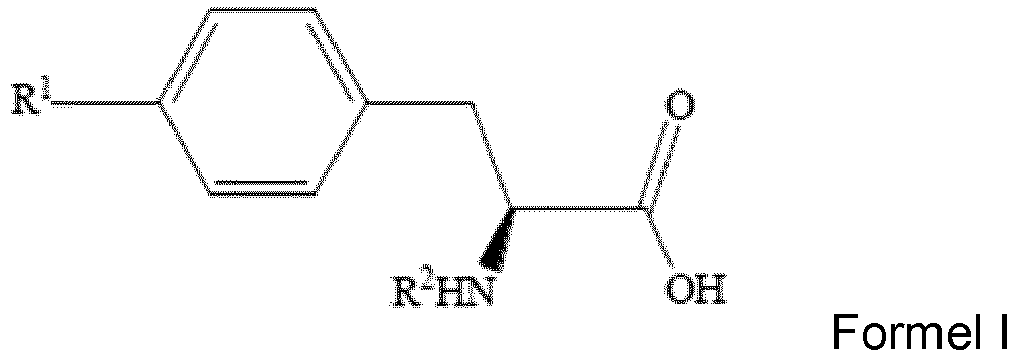
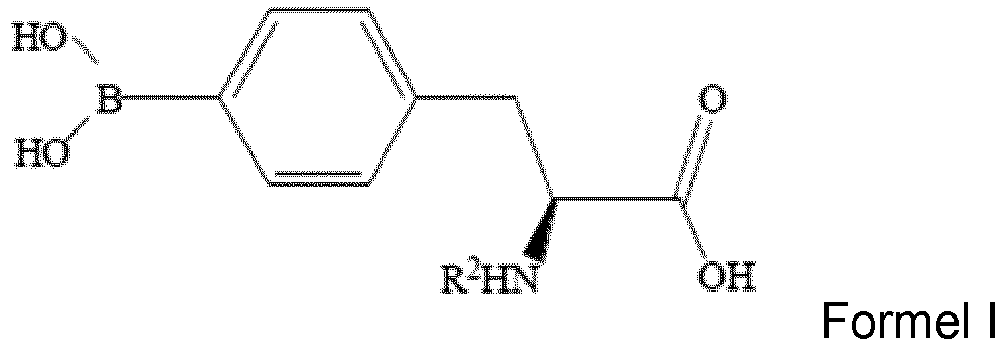
 Isolierens des N-geschützten (S)-4-Boronophenylalanins von der Reaktionsmischung; undEntschützens der R2-Gruppe des N-geschützten (S)-4-Boronophenylalanins, um L-BPA zu erhalten, wobei das L-BPA eine Struktur der Formel III aufweist.
 - Verfahren nach Anspruch 1, wobei der Schritt des Reagierens von N-geschütztem (S)-4-Halophenylalanin der Formel I, eines Boronierungsmittels, Grignard-Reagens und Bis(2-dimethylaminoethyl)ethers, um eine Reaktionsmischung zu erhalten, das Reagieren von N-geschütztem (S)-4-Halophenylalanin der Formel I, eines Boronierungsmittels, Grignard-Reagens und Bis(2-dimethylaminoethyl)ethers bei einer Temperatur im Bereich von 0 °C bis 60 °C umfasst, um die Reaktionsmischung zu erhalten.
- Verfahren nach Anspruch 1 oder 2, wobei der Schritt des Entschützens der R2-Gruppe des N-geschützten (S)-4-Boronophenylalanins, um L-BPA zu erhalten, das Entschützen der R2-Gruppe des N-geschützten (S)-4-Boronophenylalanins bei einer Temperatur im Bereich von 30 °C bis 60 °C, um L-BPA zu erhalten, umfasst.
- Verfahren nach Anspruch 1 oder 2, wobei das Boronierungsmittel eine 10B-Reinheit von nicht weniger als 95 % aufweist, wobei das N-geschützte (S)-4-Boronophenylalanin N-geschütztes (S)-4-Boronophenylalanin der Formel IV ist und das L-BPA L-10BPA der Formel V ist.


- Verfahren nach Anspruch 1 oder 2, wobei das Verfahren für die Herstellung von L-BPA ferner den Schritt umfasst des:

- Verfahren nach Anspruch 5, wobei der Schritt des Schützens des Aminterminals von (S)-4-Halophenylalanin der Formel VI, um N-geschütztes (S)-4-Halophenylalanin der Formel I zu erhalten, Folgendes umfasst
Eingeben des (S)-4-Halophenylalanis, von 1,4-Dioxan, Natriumhydroxid und Di-t-butyldicarbonat in ein Reaktionsgefäß, um die Reaktion auszuführen;
Einstellen des pH-Werts auf weniger als 2, um das N-geschützte (S)-4-Boronophenylalanin zu kristallisieren;
Zugeben eines ersten Extraktionslösungsmittels, um N-geschütztes (S)-4-Boronophenylalanin zu erhalten. - Verfahren nach Anspruch 2, wobei das Verfahren des Herstellens von L-BPA ferner einen Schritt des Reagierens der Boronsäure mit Schwefelsäure und Butan-1-ol in einem ersten organischen Lösungsmittel umfasst, um das Trialkylborat herzustellen.
- Verfahren nach Anspruch 1 oder 2, wobei der Schritt des Isolierens des N-geschützten (S)-4-Boronophenylalanins von der Reaktionsmischung Folgendes umfasst:Zugeben eines zweiten organischen Lösungsmittels und einer Säurelösung zu der Reaktionsmischung, Einstellen des pH-Werts auf weniger als 5 und Extrahieren, um eine organische Phase zu erhalten;Zugeben alkalischer Lösung zu der organischen Phase, Einstellen des pH-Werts auf 7,1-14;Zugeben eines zweiten Extraktionslösungsmittels, um das N-geschützte (S)-4-Boronphenylalanin zu erhalten.
- Verfahren nach Anspruch 1 oder 2, wobei der Schritt des Entschützens der R2-Gruppe des N-geschützten (S)-4-Boronphenylalanins, um L-BPA zu erhalten, umfasst:Eingeben des N-geschützten (S)-4-Boronophenylalanins, von Wasser, Säurelösung und einem dritten organischen Lösungsmittel in ein Reaktionsgefäß;Einstellen des pH-Werts auf 6,15-6,25, um L-BPA zu erhalten.
- Verfahren nach Anspruch 1, wobei der Schritt des Reagierens von N-geschütztem (S)-4-Halophenylalanin der Formel I, eines Boronierungsmittels und Grignard-Reagens, um eine Reaktionsmischung zu erhalten, das Reagieren von N-geschütztem (S)-4-Halophenylalanin der Formel I, eines Boronierungsmittels und Grignard-Reagens bei einer Temperatur im Bereich von 0 °C bis 30 °C umfasst, um die Reaktionsmischung zu erhalten.
Applications Claiming Priority (2)
| Application Number | Priority Date | Filing Date | Title |
|---|---|---|---|
| CN201510498779 | 2015-08-14 | ||
| PCT/CN2016/094881 WO2017028751A1 (zh) | 2015-08-14 | 2016-08-12 | L-bpa的制备方法 |
Publications (3)
| Publication Number | Publication Date |
|---|---|
| EP3321272A1 EP3321272A1 (de) | 2018-05-16 |
| EP3321272A4 EP3321272A4 (de) | 2018-08-01 |
| EP3321272B1 true EP3321272B1 (de) | 2019-11-27 |
Family
ID=58050775
Family Applications (1)
| Application Number | Title | Priority Date | Filing Date |
|---|---|---|---|
| EP16836615.1A Active EP3321272B1 (de) | 2015-08-14 | 2016-08-12 | Verfahren zur herstellung von l-bpa |
Country Status (6)
| Country | Link |
|---|---|
| US (1) | US10323046B2 (de) |
| EP (1) | EP3321272B1 (de) |
| JP (1) | JP6831834B2 (de) |
| CN (4) | CN108373479B (de) |
| RU (1) | RU2688676C1 (de) |
| WO (1) | WO2017028751A1 (de) |
Families Citing this family (15)
| Publication number | Priority date | Publication date | Assignee | Title |
|---|---|---|---|---|
| WO2016179381A1 (en) | 2015-05-06 | 2016-11-10 | Neutron Therapeuutics Inc. | Neutron target for boron neutron capture therapy |
| US10582754B2 (en) | 2017-03-08 | 2020-03-10 | Toly Management Ltd. | Cosmetic container |
| US10462893B2 (en) | 2017-06-05 | 2019-10-29 | Neutron Therapeutics, Inc. | Method and system for surface modification of substrate for ion beam target |
| EP3755681B1 (de) * | 2018-02-20 | 2022-09-07 | Otsuka Pharmaceutical Co., Ltd. | Verfahren zur herstellung von 4-boronophenylalanin |
| CN110498810B (zh) * | 2018-05-17 | 2022-11-18 | 东莞东阳光医疗智能器件研发有限公司 | 一种l-bpa的制备方法 |
| CA3130297A1 (en) | 2019-03-04 | 2020-09-10 | TAE Life Sciences | Borylated amino acid compositions for use in boron neutron capture therapy and methods thereof |
| CN110964046B (zh) * | 2019-12-17 | 2023-05-05 | 安徽英特美科技有限公司 | 一种2-硝基苯硼酸频哪醇酯的合成方法 |
| JPWO2022102565A1 (de) * | 2020-11-13 | 2022-05-19 | ||
| CN112574245A (zh) * | 2020-12-31 | 2021-03-30 | 四川瑶天纳米科技有限责任公司 | 一种4-10硼酸基-l-苯丙氨酸的制备方法 |
| US11884688B2 (en) | 2021-07-30 | 2024-01-30 | Tae Life Sciences, Llc | Borylated amino acid compositions comprising BTS and BTS(OMe) for use in boron neutron capture therapy and methods thereof |
| JP2025500822A (ja) | 2021-12-16 | 2025-01-15 | ティーエーイー ライフ サイエンシーズ | ホウ素中性子捕捉療法に使用するためのボリル化されたジペプチドアミノ酸組成物およびその方法 |
| CN116925119A (zh) * | 2022-03-30 | 2023-10-24 | 海南普利制药股份有限公司 | 一种4-10硼酸-l-苯丙氨酸中间体的制备方法 |
| CN115010739A (zh) * | 2022-06-30 | 2022-09-06 | 中国原子能科学研究院 | 合成f-bpa的方法 |
| CN119039332A (zh) * | 2024-08-26 | 2024-11-29 | 西安交通大学 | 多硼酸取代苯丙氨酸化合物及其制备方法和应用 |
| CN118994222B (zh) * | 2024-10-24 | 2025-06-13 | 华硼中子科技(杭州)有限公司 | 一种4-硼-10酸-l-苯丙氨酸的中间体的制备方法及应用 |
Family Cites Families (10)
| Publication number | Priority date | Publication date | Assignee | Title |
|---|---|---|---|---|
| US5157149A (en) * | 1991-06-04 | 1992-10-20 | The United States Of America As Represented By The United States Department Of Energy | Enantioselective synthesis of L-(-)-4- boronophenylalanine (L-BPA) |
| EP1555265B1 (de) * | 2002-10-22 | 2009-03-25 | Eisai R&D Management Co., Ltd. | 7-phenylpyrazolopyridinverbindungen |
| JP2012126868A (ja) * | 2010-12-17 | 2012-07-05 | Kuraray Co Ltd | π共役系重合体の製造方法 |
| US20130331599A1 (en) | 2012-06-08 | 2013-12-12 | Taiwan Biotech Co., Ltd. | Compound for preparing 4-(10b)borono-l-phenylalanine |
| TWI480283B (zh) * | 2013-07-31 | 2015-04-11 | Taiwan Biotech Co Ltd | 4-二羥基硼基-l型苯丙胺酸之製備方法 |
| CN104447822A (zh) * | 2013-09-12 | 2015-03-25 | 信东生技股份有限公司 | 用于制备4-(10b)二羟基硼基-l-苯丙氨酸的化合物 |
| CN104447823A (zh) * | 2013-09-12 | 2015-03-25 | 信东生技股份有限公司 | 4-二羟基硼基-l型苯丙氨酸的制备方法 |
| EP2851362B1 (de) * | 2013-09-18 | 2019-11-27 | Ulusal Bor Arastirma Enstitusu | Verfahren zur Herstellung von Sulfat oder Sulfonatestern |
| EP2865682B1 (de) * | 2013-10-28 | 2016-10-26 | Taiwan Biotech Co., Ltd. | Verfahren zur Herstellung von 4-Borono-l-Phenylalanin |
| CN104961756A (zh) * | 2015-06-16 | 2015-10-07 | 上海应用技术学院 | 一种(S)-Boc-4-二羟基硼酰苯丙氨酸的制备方法 |
-
2016
- 2016-08-12 EP EP16836615.1A patent/EP3321272B1/de active Active
- 2016-08-12 CN CN201810262791.3A patent/CN108373479B/zh active Active
- 2016-08-12 JP JP2018507612A patent/JP6831834B2/ja active Active
- 2016-08-12 WO PCT/CN2016/094881 patent/WO2017028751A1/zh not_active Ceased
- 2016-08-12 RU RU2018108882A patent/RU2688676C1/ru active
- 2016-08-12 CN CN201810233944.1A patent/CN108484652A/zh active Pending
- 2016-08-12 CN CN201810262836.7A patent/CN108218903B/zh active Active
- 2016-08-12 CN CN201610665056.8A patent/CN106467556B/zh active Active
-
2018
- 2018-02-01 US US15/886,221 patent/US10323046B2/en active Active
Non-Patent Citations (1)
| Title |
|---|
| None * |
Also Published As
| Publication number | Publication date |
|---|---|
| JP6831834B2 (ja) | 2021-02-17 |
| CN108373479A (zh) | 2018-08-07 |
| WO2017028751A1 (zh) | 2017-02-23 |
| EP3321272A4 (de) | 2018-08-01 |
| EP3321272A1 (de) | 2018-05-16 |
| CN108218903B (zh) | 2020-12-08 |
| CN106467556A (zh) | 2017-03-01 |
| CN108373479B (zh) | 2020-06-12 |
| US20180155368A1 (en) | 2018-06-07 |
| JP2018525398A (ja) | 2018-09-06 |
| CN106467556B (zh) | 2018-05-15 |
| CN108218903A (zh) | 2018-06-29 |
| CN108484652A (zh) | 2018-09-04 |
| RU2688676C1 (ru) | 2019-05-22 |
| US10323046B2 (en) | 2019-06-18 |
Similar Documents
| Publication | Publication Date | Title |
|---|---|---|
| EP3321272B1 (de) | Verfahren zur herstellung von l-bpa | |
| EP3112340B1 (de) | Verfahren zur herstellung von 4-borono-l-phenylalanin mit darin eingeführtem 18f-atom und vorläufer von 4-borono-l-phenylalanin mit darin eingeführtem 18f-atom | |
| JP7232527B2 (ja) | 放射標識されたアリール化合物の製造方法 | |
| US8765997B2 (en) | Process for preparing 4-borono-L-phenylalanine | |
| EP2865682B1 (de) | Verfahren zur Herstellung von 4-Borono-l-Phenylalanin | |
| EP3755681B1 (de) | Verfahren zur herstellung von 4-boronophenylalanin | |
| WO1994026751A1 (en) | Enantioselective oxazaborolidine catalysts | |
| Rahman et al. | Synthesis of [11 C]/(13 C) amines via carbonylation followed by reductive amination | |
| US8513465B2 (en) | Potassium organotrifluoroborate derivative and a production method therefor | |
| AU2021377857A1 (en) | Method for producing 4-borono-l-phenylalanine and intermediate thereof | |
| US5186868A (en) | Methods for tritium labeling | |
| Liu et al. | Syntheses of bifunctional 2, 3-diamino propionic acid-based chelators as small and strong tripod ligands for the labelling of biomolecules with 99mTc | |
| CN118994222B (zh) | 一种4-硼-10酸-l-苯丙氨酸的中间体的制备方法及应用 | |
| CN112915217B (zh) | 一类前列腺癌靶向的药物前体及其合成方法 | |
| CN113045564B (zh) | 一种阿培利司的制备方法 | |
| Keyes | Synthesis and Antimicrobial Properties of Oxazaborolidine Derivatives Using the Suzuki-Miyaura Reaction | |
| CN119978005A (zh) | 一种14c标记的4-二羟硼基苯丙氨酸的制备方法及应用 | |
| Slattery et al. | Telescoped approach to aryl hydroxymethylation in the synthesis | |
| EP2865683A1 (de) | Verbindung zur Herstellung von 4-(10B) Borono-l-Phenylalanin |
Legal Events
| Date | Code | Title | Description |
|---|---|---|---|
| STAA | Information on the status of an ep patent application or granted ep patent |
Free format text: STATUS: THE INTERNATIONAL PUBLICATION HAS BEEN MADE |
|
| PUAI | Public reference made under article 153(3) epc to a published international application that has entered the european phase |
Free format text: ORIGINAL CODE: 0009012 |
|
| STAA | Information on the status of an ep patent application or granted ep patent |
Free format text: STATUS: REQUEST FOR EXAMINATION WAS MADE |
|
| 17P | Request for examination filed |
Effective date: 20180209 |
|
| AK | Designated contracting states |
Kind code of ref document: A1 Designated state(s): AL AT BE BG CH CY CZ DE DK EE ES FI FR GB GR HR HU IE IS IT LI LT LU LV MC MK MT NL NO PL PT RO RS SE SI SK SM TR |
|
| AX | Request for extension of the european patent |
Extension state: BA ME |
|
| A4 | Supplementary search report drawn up and despatched |
Effective date: 20180703 |
|
| RIC1 | Information provided on ipc code assigned before grant |
Ipc: C07F 5/02 20060101AFI20180626BHEP Ipc: C07B 63/00 20060101ALI20180626BHEP Ipc: C07B 47/00 20060101ALI20180626BHEP Ipc: C07B 41/08 20060101ALI20180626BHEP Ipc: C07F 3/02 20060101ALI20180626BHEP |
|
| DAV | Request for validation of the european patent (deleted) | ||
| DAX | Request for extension of the european patent (deleted) | ||
| STAA | Information on the status of an ep patent application or granted ep patent |
Free format text: STATUS: EXAMINATION IS IN PROGRESS |
|
| 17Q | First examination report despatched |
Effective date: 20190123 |
|
| GRAP | Despatch of communication of intention to grant a patent |
Free format text: ORIGINAL CODE: EPIDOSNIGR1 |
|
| STAA | Information on the status of an ep patent application or granted ep patent |
Free format text: STATUS: GRANT OF PATENT IS INTENDED |
|
| INTG | Intention to grant announced |
Effective date: 20190701 |
|
| GRAS | Grant fee paid |
Free format text: ORIGINAL CODE: EPIDOSNIGR3 |
|
| GRAA | (expected) grant |
Free format text: ORIGINAL CODE: 0009210 |
|
| STAA | Information on the status of an ep patent application or granted ep patent |
Free format text: STATUS: THE PATENT HAS BEEN GRANTED |
|
| AK | Designated contracting states |
Kind code of ref document: B1 Designated state(s): AL AT BE BG CH CY CZ DE DK EE ES FI FR GB GR HR HU IE IS IT LI LT LU LV MC MK MT NL NO PL PT RO RS SE SI SK SM TR |
|
| REG | Reference to a national code |
Ref country code: GB Ref legal event code: FG4D |
|
| REG | Reference to a national code |
Ref country code: CH Ref legal event code: EP |
|
| REG | Reference to a national code |
Ref country code: AT Ref legal event code: REF Ref document number: 1206565 Country of ref document: AT Kind code of ref document: T Effective date: 20191215 |
|
| REG | Reference to a national code |
Ref country code: DE Ref legal event code: R096 Ref document number: 602016025282 Country of ref document: DE |
|
| REG | Reference to a national code |
Ref country code: IE Ref legal event code: FG4D |
|
| REG | Reference to a national code |
Ref country code: NL Ref legal event code: MP Effective date: 20191127 |
|
| REG | Reference to a national code |
Ref country code: LT Ref legal event code: MG4D |
|
| PG25 | Lapsed in a contracting state [announced via postgrant information from national office to epo] |
Ref country code: LV Free format text: LAPSE BECAUSE OF FAILURE TO SUBMIT A TRANSLATION OF THE DESCRIPTION OR TO PAY THE FEE WITHIN THE PRESCRIBED TIME-LIMIT Effective date: 20191127 Ref country code: SE Free format text: LAPSE BECAUSE OF FAILURE TO SUBMIT A TRANSLATION OF THE DESCRIPTION OR TO PAY THE FEE WITHIN THE PRESCRIBED TIME-LIMIT Effective date: 20191127 Ref country code: GR Free format text: LAPSE BECAUSE OF FAILURE TO SUBMIT A TRANSLATION OF THE DESCRIPTION OR TO PAY THE FEE WITHIN THE PRESCRIBED TIME-LIMIT Effective date: 20200228 Ref country code: NO Free format text: LAPSE BECAUSE OF FAILURE TO SUBMIT A TRANSLATION OF THE DESCRIPTION OR TO PAY THE FEE WITHIN THE PRESCRIBED TIME-LIMIT Effective date: 20200227 Ref country code: LT Free format text: LAPSE BECAUSE OF FAILURE TO SUBMIT A TRANSLATION OF THE DESCRIPTION OR TO PAY THE FEE WITHIN THE PRESCRIBED TIME-LIMIT Effective date: 20191127 Ref country code: BG Free format text: LAPSE BECAUSE OF FAILURE TO SUBMIT A TRANSLATION OF THE DESCRIPTION OR TO PAY THE FEE WITHIN THE PRESCRIBED TIME-LIMIT Effective date: 20200227 Ref country code: FI Free format text: LAPSE BECAUSE OF FAILURE TO SUBMIT A TRANSLATION OF THE DESCRIPTION OR TO PAY THE FEE WITHIN THE PRESCRIBED TIME-LIMIT Effective date: 20191127 Ref country code: NL Free format text: LAPSE BECAUSE OF FAILURE TO SUBMIT A TRANSLATION OF THE DESCRIPTION OR TO PAY THE FEE WITHIN THE PRESCRIBED TIME-LIMIT Effective date: 20191127 |
|
| PG25 | Lapsed in a contracting state [announced via postgrant information from national office to epo] |
Ref country code: RS Free format text: LAPSE BECAUSE OF FAILURE TO SUBMIT A TRANSLATION OF THE DESCRIPTION OR TO PAY THE FEE WITHIN THE PRESCRIBED TIME-LIMIT Effective date: 20191127 Ref country code: HR Free format text: LAPSE BECAUSE OF FAILURE TO SUBMIT A TRANSLATION OF THE DESCRIPTION OR TO PAY THE FEE WITHIN THE PRESCRIBED TIME-LIMIT Effective date: 20191127 Ref country code: IS Free format text: LAPSE BECAUSE OF FAILURE TO SUBMIT A TRANSLATION OF THE DESCRIPTION OR TO PAY THE FEE WITHIN THE PRESCRIBED TIME-LIMIT Effective date: 20200327 |
|
| PG25 | Lapsed in a contracting state [announced via postgrant information from national office to epo] |
Ref country code: AL Free format text: LAPSE BECAUSE OF FAILURE TO SUBMIT A TRANSLATION OF THE DESCRIPTION OR TO PAY THE FEE WITHIN THE PRESCRIBED TIME-LIMIT Effective date: 20191127 |
|
| PG25 | Lapsed in a contracting state [announced via postgrant information from national office to epo] |
Ref country code: PT Free format text: LAPSE BECAUSE OF FAILURE TO SUBMIT A TRANSLATION OF THE DESCRIPTION OR TO PAY THE FEE WITHIN THE PRESCRIBED TIME-LIMIT Effective date: 20200419 Ref country code: EE Free format text: LAPSE BECAUSE OF FAILURE TO SUBMIT A TRANSLATION OF THE DESCRIPTION OR TO PAY THE FEE WITHIN THE PRESCRIBED TIME-LIMIT Effective date: 20191127 Ref country code: DK Free format text: LAPSE BECAUSE OF FAILURE TO SUBMIT A TRANSLATION OF THE DESCRIPTION OR TO PAY THE FEE WITHIN THE PRESCRIBED TIME-LIMIT Effective date: 20191127 Ref country code: RO Free format text: LAPSE BECAUSE OF FAILURE TO SUBMIT A TRANSLATION OF THE DESCRIPTION OR TO PAY THE FEE WITHIN THE PRESCRIBED TIME-LIMIT Effective date: 20191127 Ref country code: CZ Free format text: LAPSE BECAUSE OF FAILURE TO SUBMIT A TRANSLATION OF THE DESCRIPTION OR TO PAY THE FEE WITHIN THE PRESCRIBED TIME-LIMIT Effective date: 20191127 Ref country code: ES Free format text: LAPSE BECAUSE OF FAILURE TO SUBMIT A TRANSLATION OF THE DESCRIPTION OR TO PAY THE FEE WITHIN THE PRESCRIBED TIME-LIMIT Effective date: 20191127 |
|
| REG | Reference to a national code |
Ref country code: DE Ref legal event code: R097 Ref document number: 602016025282 Country of ref document: DE |
|
| PG25 | Lapsed in a contracting state [announced via postgrant information from national office to epo] |
Ref country code: SM Free format text: LAPSE BECAUSE OF FAILURE TO SUBMIT A TRANSLATION OF THE DESCRIPTION OR TO PAY THE FEE WITHIN THE PRESCRIBED TIME-LIMIT Effective date: 20191127 Ref country code: SK Free format text: LAPSE BECAUSE OF FAILURE TO SUBMIT A TRANSLATION OF THE DESCRIPTION OR TO PAY THE FEE WITHIN THE PRESCRIBED TIME-LIMIT Effective date: 20191127 |
|
| REG | Reference to a national code |
Ref country code: AT Ref legal event code: MK05 Ref document number: 1206565 Country of ref document: AT Kind code of ref document: T Effective date: 20191127 |
|
| PLBE | No opposition filed within time limit |
Free format text: ORIGINAL CODE: 0009261 |
|
| STAA | Information on the status of an ep patent application or granted ep patent |
Free format text: STATUS: NO OPPOSITION FILED WITHIN TIME LIMIT |
|
| 26N | No opposition filed |
Effective date: 20200828 |
|
| PG25 | Lapsed in a contracting state [announced via postgrant information from national office to epo] |
Ref country code: SI Free format text: LAPSE BECAUSE OF FAILURE TO SUBMIT A TRANSLATION OF THE DESCRIPTION OR TO PAY THE FEE WITHIN THE PRESCRIBED TIME-LIMIT Effective date: 20191127 Ref country code: AT Free format text: LAPSE BECAUSE OF FAILURE TO SUBMIT A TRANSLATION OF THE DESCRIPTION OR TO PAY THE FEE WITHIN THE PRESCRIBED TIME-LIMIT Effective date: 20191127 Ref country code: PL Free format text: LAPSE BECAUSE OF FAILURE TO SUBMIT A TRANSLATION OF THE DESCRIPTION OR TO PAY THE FEE WITHIN THE PRESCRIBED TIME-LIMIT Effective date: 20191127 |
|
| PG25 | Lapsed in a contracting state [announced via postgrant information from national office to epo] |
Ref country code: MC Free format text: LAPSE BECAUSE OF FAILURE TO SUBMIT A TRANSLATION OF THE DESCRIPTION OR TO PAY THE FEE WITHIN THE PRESCRIBED TIME-LIMIT Effective date: 20191127 |
|
| REG | Reference to a national code |
Ref country code: CH Ref legal event code: PL |
|
| PG25 | Lapsed in a contracting state [announced via postgrant information from national office to epo] |
Ref country code: CH Free format text: LAPSE BECAUSE OF NON-PAYMENT OF DUE FEES Effective date: 20200831 Ref country code: LI Free format text: LAPSE BECAUSE OF NON-PAYMENT OF DUE FEES Effective date: 20200831 Ref country code: LU Free format text: LAPSE BECAUSE OF NON-PAYMENT OF DUE FEES Effective date: 20200812 |
|
| REG | Reference to a national code |
Ref country code: BE Ref legal event code: MM Effective date: 20200831 |
|
| PG25 | Lapsed in a contracting state [announced via postgrant information from national office to epo] |
Ref country code: BE Free format text: LAPSE BECAUSE OF NON-PAYMENT OF DUE FEES Effective date: 20200831 Ref country code: IE Free format text: LAPSE BECAUSE OF NON-PAYMENT OF DUE FEES Effective date: 20200812 |
|
| PG25 | Lapsed in a contracting state [announced via postgrant information from national office to epo] |
Ref country code: TR Free format text: LAPSE BECAUSE OF FAILURE TO SUBMIT A TRANSLATION OF THE DESCRIPTION OR TO PAY THE FEE WITHIN THE PRESCRIBED TIME-LIMIT Effective date: 20191127 Ref country code: MT Free format text: LAPSE BECAUSE OF FAILURE TO SUBMIT A TRANSLATION OF THE DESCRIPTION OR TO PAY THE FEE WITHIN THE PRESCRIBED TIME-LIMIT Effective date: 20191127 Ref country code: CY Free format text: LAPSE BECAUSE OF FAILURE TO SUBMIT A TRANSLATION OF THE DESCRIPTION OR TO PAY THE FEE WITHIN THE PRESCRIBED TIME-LIMIT Effective date: 20191127 |
|
| PG25 | Lapsed in a contracting state [announced via postgrant information from national office to epo] |
Ref country code: MK Free format text: LAPSE BECAUSE OF FAILURE TO SUBMIT A TRANSLATION OF THE DESCRIPTION OR TO PAY THE FEE WITHIN THE PRESCRIBED TIME-LIMIT Effective date: 20191127 |
|
| REG | Reference to a national code |
Ref country code: DE Ref legal event code: R082 Ref document number: 602016025282 Country of ref document: DE Representative=s name: SUN, YIMING, M.SC. DIPL. SC. POL. UNIV., DE |
|
| PGFP | Annual fee paid to national office [announced via postgrant information from national office to epo] |
Ref country code: DE Payment date: 20250819 Year of fee payment: 10 |
|
| PGFP | Annual fee paid to national office [announced via postgrant information from national office to epo] |
Ref country code: IT Payment date: 20250829 Year of fee payment: 10 |
|
| PGFP | Annual fee paid to national office [announced via postgrant information from national office to epo] |
Ref country code: GB Payment date: 20250818 Year of fee payment: 10 |
|
| PGFP | Annual fee paid to national office [announced via postgrant information from national office to epo] |
Ref country code: FR Payment date: 20250820 Year of fee payment: 10 |