EP2858775B1 - Cutting insert and tool having an anti-slip arrangement - Google Patents
Cutting insert and tool having an anti-slip arrangement Download PDFInfo
- Publication number
- EP2858775B1 EP2858775B1 EP13737668.7A EP13737668A EP2858775B1 EP 2858775 B1 EP2858775 B1 EP 2858775B1 EP 13737668 A EP13737668 A EP 13737668A EP 2858775 B1 EP2858775 B1 EP 2858775B1
- Authority
- EP
- European Patent Office
- Prior art keywords
- tool
- insert
- cutting
- actuator
- base surface
- Prior art date
- Legal status (The legal status is an assumption and is not a legal conclusion. Google has not performed a legal analysis and makes no representation as to the accuracy of the status listed.)
- Active
Links
Images


Classifications
-
- B—PERFORMING OPERATIONS; TRANSPORTING
- B23—MACHINE TOOLS; METAL-WORKING NOT OTHERWISE PROVIDED FOR
- B23C—MILLING
- B23C5/00—Milling-cutters
- B23C5/16—Milling-cutters characterised by physical features other than shape
- B23C5/20—Milling-cutters characterised by physical features other than shape with removable cutter bits or teeth or cutting inserts
- B23C5/22—Securing arrangements for bits or teeth or cutting inserts
- B23C5/2265—Securing arrangements for bits or teeth or cutting inserts by means of a wedge
- B23C5/2269—Securing arrangements for bits or teeth or cutting inserts by means of a wedge for plate-like cutting inserts
- B23C5/2273—Securing arrangements for bits or teeth or cutting inserts by means of a wedge for plate-like cutting inserts having a special shape
-
- B—PERFORMING OPERATIONS; TRANSPORTING
- B23—MACHINE TOOLS; METAL-WORKING NOT OTHERWISE PROVIDED FOR
- B23C—MILLING
- B23C5/00—Milling-cutters
- B23C5/16—Milling-cutters characterised by physical features other than shape
- B23C5/20—Milling-cutters characterised by physical features other than shape with removable cutter bits or teeth or cutting inserts
- B23C5/22—Securing arrangements for bits or teeth or cutting inserts
- B23C5/2204—Securing arrangements for bits or teeth or cutting inserts with cutting inserts clamped against the walls of the recess in the cutter body by a clamping member acting upon the wall of a hole in the insert
- B23C5/2208—Securing arrangements for bits or teeth or cutting inserts with cutting inserts clamped against the walls of the recess in the cutter body by a clamping member acting upon the wall of a hole in the insert for plate-like cutting inserts
- B23C5/2213—Securing arrangements for bits or teeth or cutting inserts with cutting inserts clamped against the walls of the recess in the cutter body by a clamping member acting upon the wall of a hole in the insert for plate-like cutting inserts having a special shape
-
- B—PERFORMING OPERATIONS; TRANSPORTING
- B23—MACHINE TOOLS; METAL-WORKING NOT OTHERWISE PROVIDED FOR
- B23B—TURNING; BORING
- B23B2200/00—Details of cutting inserts
- B23B2200/16—Supporting or bottom surfaces
- B23B2200/161—Supporting or bottom surfaces with projections
-
- B—PERFORMING OPERATIONS; TRANSPORTING
- B23—MACHINE TOOLS; METAL-WORKING NOT OTHERWISE PROVIDED FOR
- B23C—MILLING
- B23C2200/00—Details of milling cutting inserts
- B23C2200/16—Supporting or bottom surfaces
- B23C2200/161—Supporting or bottom surfaces with projections
-
- B—PERFORMING OPERATIONS; TRANSPORTING
- B23—MACHINE TOOLS; METAL-WORKING NOT OTHERWISE PROVIDED FOR
- B23C—MILLING
- B23C2210/00—Details of milling cutters
- B23C2210/16—Fixation of inserts or cutting bits in the tool
- B23C2210/168—Seats for cutting inserts, supports for replacable cutting bits
-
- B—PERFORMING OPERATIONS; TRANSPORTING
- B23—MACHINE TOOLS; METAL-WORKING NOT OTHERWISE PROVIDED FOR
- B23C—MILLING
- B23C2270/00—Details of milling machines, milling processes or milling tools not otherwise provided for
- B23C2270/08—Clamping mechanisms or provision for clamping
-
- B—PERFORMING OPERATIONS; TRANSPORTING
- B23—MACHINE TOOLS; METAL-WORKING NOT OTHERWISE PROVIDED FOR
- B23C—MILLING
- B23C5/00—Milling-cutters
- B23C5/16—Milling-cutters characterised by physical features other than shape
- B23C5/20—Milling-cutters characterised by physical features other than shape with removable cutter bits or teeth or cutting inserts
- B23C5/22—Securing arrangements for bits or teeth or cutting inserts
- B23C5/24—Securing arrangements for bits or teeth or cutting inserts adjustable
- B23C5/2465—Securing arrangements for bits or teeth or cutting inserts adjustable the adjusting means being notches
-
- B—PERFORMING OPERATIONS; TRANSPORTING
- B23—MACHINE TOOLS; METAL-WORKING NOT OTHERWISE PROVIDED FOR
- B23C—MILLING
- B23C5/00—Milling-cutters
- B23C5/16—Milling-cutters characterised by physical features other than shape
- B23C5/20—Milling-cutters characterised by physical features other than shape with removable cutter bits or teeth or cutting inserts
- B23C5/22—Securing arrangements for bits or teeth or cutting inserts
- B23C5/24—Securing arrangements for bits or teeth or cutting inserts adjustable
- B23C5/2468—Securing arrangements for bits or teeth or cutting inserts adjustable the adjusting means being serrations
-
- Y—GENERAL TAGGING OF NEW TECHNOLOGICAL DEVELOPMENTS; GENERAL TAGGING OF CROSS-SECTIONAL TECHNOLOGIES SPANNING OVER SEVERAL SECTIONS OF THE IPC; TECHNICAL SUBJECTS COVERED BY FORMER USPC CROSS-REFERENCE ART COLLECTIONS [XRACs] AND DIGESTS
- Y10—TECHNICAL SUBJECTS COVERED BY FORMER USPC
- Y10T—TECHNICAL SUBJECTS COVERED BY FORMER US CLASSIFICATION
- Y10T407/00—Cutters, for shaping
- Y10T407/19—Rotary cutting tool
- Y10T407/1906—Rotary cutting tool including holder [i.e., head] having seat for inserted tool
-
- Y—GENERAL TAGGING OF NEW TECHNOLOGICAL DEVELOPMENTS; GENERAL TAGGING OF CROSS-SECTIONAL TECHNOLOGIES SPANNING OVER SEVERAL SECTIONS OF THE IPC; TECHNICAL SUBJECTS COVERED BY FORMER USPC CROSS-REFERENCE ART COLLECTIONS [XRACs] AND DIGESTS
- Y10—TECHNICAL SUBJECTS COVERED BY FORMER USPC
- Y10T—TECHNICAL SUBJECTS COVERED BY FORMER US CLASSIFICATION
- Y10T407/00—Cutters, for shaping
- Y10T407/19—Rotary cutting tool
- Y10T407/1906—Rotary cutting tool including holder [i.e., head] having seat for inserted tool
- Y10T407/1908—Face or end mill
- Y10T407/192—Face or end mill with separate means to fasten tool to holder
-
- Y—GENERAL TAGGING OF NEW TECHNOLOGICAL DEVELOPMENTS; GENERAL TAGGING OF CROSS-SECTIONAL TECHNOLOGIES SPANNING OVER SEVERAL SECTIONS OF THE IPC; TECHNICAL SUBJECTS COVERED BY FORMER USPC CROSS-REFERENCE ART COLLECTIONS [XRACs] AND DIGESTS
- Y10—TECHNICAL SUBJECTS COVERED BY FORMER USPC
- Y10T—TECHNICAL SUBJECTS COVERED BY FORMER US CLASSIFICATION
- Y10T407/00—Cutters, for shaping
- Y10T407/19—Rotary cutting tool
- Y10T407/1906—Rotary cutting tool including holder [i.e., head] having seat for inserted tool
- Y10T407/1934—Rotary cutting tool including holder [i.e., head] having seat for inserted tool with separate means to fasten tool to holder
-
- Y—GENERAL TAGGING OF NEW TECHNOLOGICAL DEVELOPMENTS; GENERAL TAGGING OF CROSS-SECTIONAL TECHNOLOGIES SPANNING OVER SEVERAL SECTIONS OF THE IPC; TECHNICAL SUBJECTS COVERED BY FORMER USPC CROSS-REFERENCE ART COLLECTIONS [XRACs] AND DIGESTS
- Y10—TECHNICAL SUBJECTS COVERED BY FORMER USPC
- Y10T—TECHNICAL SUBJECTS COVERED BY FORMER US CLASSIFICATION
- Y10T407/00—Cutters, for shaping
- Y10T407/22—Cutters, for shaping including holder having seat for inserted tool
-
- Y—GENERAL TAGGING OF NEW TECHNOLOGICAL DEVELOPMENTS; GENERAL TAGGING OF CROSS-SECTIONAL TECHNOLOGIES SPANNING OVER SEVERAL SECTIONS OF THE IPC; TECHNICAL SUBJECTS COVERED BY FORMER USPC CROSS-REFERENCE ART COLLECTIONS [XRACs] AND DIGESTS
- Y10—TECHNICAL SUBJECTS COVERED BY FORMER USPC
- Y10T—TECHNICAL SUBJECTS COVERED BY FORMER US CLASSIFICATION
- Y10T407/00—Cutters, for shaping
- Y10T407/22—Cutters, for shaping including holder having seat for inserted tool
- Y10T407/2272—Cutters, for shaping including holder having seat for inserted tool with separate means to fasten tool to holder
- Y10T407/228—Rotatable cam clamp element
-
- Y—GENERAL TAGGING OF NEW TECHNOLOGICAL DEVELOPMENTS; GENERAL TAGGING OF CROSS-SECTIONAL TECHNOLOGIES SPANNING OVER SEVERAL SECTIONS OF THE IPC; TECHNICAL SUBJECTS COVERED BY FORMER USPC CROSS-REFERENCE ART COLLECTIONS [XRACs] AND DIGESTS
- Y10—TECHNICAL SUBJECTS COVERED BY FORMER USPC
- Y10T—TECHNICAL SUBJECTS COVERED BY FORMER US CLASSIFICATION
- Y10T407/00—Cutters, for shaping
- Y10T407/23—Cutters, for shaping including tool having plural alternatively usable cutting edges
Definitions
- the subject matter of the present application relates to a milling tool assembly.
- Precise positioning of a cutting insert on a tool can allow for high precision cutting.
- cutting inserts are often subjected to high forces during cutting operations which can cause displacement or change of orientation of the cutting insert on a tool which holds them.
- Maintaining a desired position may be assisted by biasing the cutting insert in a cutting direction.
- One such example is disclosed in US 4,335,983 .
- the side surfaces of the cutting insert constitute the abutment surfaces thereof.
- US 6,536,996 discloses a cutting insert formed with non-parallel abutment surfaces adjacent to an insert base surface thereof.
- WO 98/30349 discloses a milling tool assembly comprising in combination a tool and a cutting insert mounted to the tool, the tool having a cutting direction and comprising: an insert seating region comprising a tool base surface, tool inner and peripheral regions located on opposing sides of the insert seating region, the cutting direction being defined as extending from the tool inner region towards the tool peripheral region, and a tool anti-slip arrangement; the tool anti-slip arrangement comprising first and second tool abutment surfaces formed adjacent to the tool base surface and being non-parallel to each other and to the tool base surface, and a clamp comprising a tool actuator surface; wherein pairs of closest points of the first and second tool abutment surfaces lie within respective common tool abutment surface planes, and are a predetermined distance apart; at least one of the predetermined distances has a greater magnitude than another predetermined distance which is associated with a pair of points further spaced from the tool actuator surface; wherein each pair of points of the first and second tool abutment surfaces which are closer to the tool actuator
- WO 95/26846 discloses another tool assembly.
- the subject matter of the present application relates to a milling tool assembly comprising, inter alia, an anti-slip arrangement for maintaining a precise mounted operative position of a cutting insert in a tool. More precisely, the anti-slip arrangement is formed with non-parallel abutment surfaces adjacent to base surfaces of the cutting insert and the tool.
- an anti-slip arrangement formed adjacent a base surface of a cutting insert.
- the upper portion of the cutting insert can be independent of the anti-slip arrangement, there is no restriction as to the design thereof.
- a single tool with a corresponding anti-slip arrangement could hold cutting inserts with very different upper portions (indexable or non-indexable, different shaped e.g. circular, rhombic etc., different sized).
- a milling tool assembly for biasing a cutting insert anti-slip arrangement formed adjacent to an insert base surface.
- Such arrangement in particular when non-parallel abutment surfaces are closer to a tool peripheral region than a tool inner region, may be particularly beneficial for rotating tools and in particular high-speed rotating tools, which are subjected to high cutting forces.
- High-speed tools can be defined as those which are configured for operation in which a friction lock is insufficient to withstand centrifugal forces during rotation. Further elaboration can be found in ISO 15641.
- Such tools may be particularly advantageous for machining materials such as soft metals, especially aluminium.
- Such arrangement could also be particularly beneficial for lateral cutting operations (including, for example, ramp-down operations), even at lower speeds, in which cutting inserts can tend to be subjected to high displacement forces.
- Abutment of the base surfaces and abutment surfaces are configured to prevent slippage of the cutting insert along the tool base surface.
- slippage of the cutting insert along the tool base surface can include rotational and/or translational motion.
- the slippage could be visible slippage, i.e. there could be sufficient constructional tolerance of the tool and/or cutting insert to allow visible relative motion thereof, which could allow the clamp to suitably position the cutting insert.
- the slippage could also be non-visible slippage, i.e. extremely small, such that it is not visible without magnification, but which can occur during cutting operations.
- the cutting insert and the tool are configured such that the insert base surface contacts the tool base surface and the clamp is configured to bias the tool actuator surface against the insert actuator surface. Such biasing can consequently bias the first and second insert abutment surfaces against the first and second tool abutment surfaces. This arrangement can prevent slippage of the cutting insert along the tool base surface.
- the milling tool assembly is according to claim 1.
- the tool actuator surface and the first and second tool abutment surfaces can be portions of a single continuous shape.
- FIGs. 1A to 1D which illustrate an example tool assembly 10 comprising a tool 12 and at least one cutting insert 14 clamped thereto.
- the tool 12 exemplified is a milling toolhead.
- the tool assembly 10 in this non-limiting example, is configured to mill a workpiece (not shown) by rotating about a tool axis A T in a rotation direction D R , which in this non-limiting example can be, in the view shown in Fig. 1B , counterclockwise.
- the tool 12 comprises an insert seating region 16 comprising a tool base surface 18, tool inner and peripheral regions 20, 22 located on opposing sides of the insert seating region 16, and a tool anti-slip arrangement 24.
- the tool anti-slip arrangement 24 comprises first and second tool abutment surfaces 26A, 26B formed adjacent to the tool base surface 18, and a clamp 28 comprising a tool actuator surface 30.
- the clamp 28 is located at the tool inner region 20.
- the tool actuator surface 30 is oriented transverse to the tool base surface 18. More precisely, the tool actuator surface 30 can be oriented perpendicular to the tool base surface 18. Such orientation can assist in preventing bending forces being applied to the clamp 28, which could in turn change the position of the cutting insert 14.
- the cutting insert 14 comprises opposing insert top and base surfaces 32, 34 which are connected by an insert peripheral surface 36, at least one cutting edge 38, and an insert anti-slip arrangement 40 formed adjacent to the insert base surface 34. More precisely, the insert anti-slip arrangement 40 extends from the insert base surface 34 in a direction away from the insert top surface 32.
- the insert anti-slip arrangement 40 comprises first and second insert abutment surfaces 42A, 42B and an insert actuator surface 44 which is oriented transverse to the insert base surface 34.
- the periphery 45 of the cutting insert 14 may be considered to include not only the insert peripheral surface 36, but also the insert actuator surface 44 and first and second insert abutment surfaces 42A, 42B, which are oriented transverse to the insert base surface 34.
- first and second tool abutment surfaces 26A, 26B ( Fig. 1D ) and first and second insert abutment surfaces 42A, 42B ( Fig. 3D ) are configured for engaging each other.
- the abutment surfaces 26A, 26B, 42A, 42B can have corresponding shapes (in this example following straight lines) and orientations and can extend at a cutting insert abutment or tool abutment angle ⁇ CA , ⁇ TA of less than 180° to each other.
- the value in this example is about 40°.
- each pair of abutment surfaces can respectively form a wedge-shaped arrangement.
- the cutting insert 14 is mounted on the tool 12 in a position in which the insert base surface 34 contacts the tool base surface 18. Stated differently, the cutting insert 14 can be seated on the tool 12, via the tool and insert base surfaces 18, 34 thereof. Subsequently, the clamp's tool actuator surface 30 can biased against the insert actuator surface 44 resulting in the first and second insert abutment surfaces 42A, 42B being respectively biased against the first and second tool abutment surfaces 26A, 26B.
- the only contact surfaces of the tool 12 and cutting insert 14 are the tool and insert base surfaces 18, 34, the clamp tool and the insert actuator surfaces 30, 44, and the first and second insert and tool abutment surfaces 42A, 42B, 26A and 26B.
- clamping can be advantageous for preventing slippage of a cutting insert along a tool base surface since a cutting insert can be simultaneously clamped on three surfaces thereof, namely an insert actuator surface, and first and second insert abutment surfaces thereof. It will be understood that in cases of non-parallel abutment surfaces, simultaneous three-point contact can be achieved, the three points (or three surfaces) being located in a non-linear arrangement and hence can constitute a triangular arrangement. In particular, such arrangement of the abutment surfaces and actuator surfaces is suitable for preventing translation and rotation, of a cutting insert relative to a tool, along a base plane P B ( Figs. 1B and 2 ) which is parallel with the tool base surface 18 and insert base surface 34.
- a further advantage may be possibly achieved by biasing the tool actuator surface 30 in a cutting direction D C ( Fig. 2 ). It will be understood that a tendency of the cutting insert 14 to slide or be moved out of a desired position, can be greatest at an active first cutting end 46 thereof ( Fig. 1C ) when it is in contact with a workpiece (not shown). By securing the active first cutting end 46 of the cutting insert, through applying clamping force outward from the tool, maintenance of a precise location of the cutting insert or active first cutting end 46 is achievable.
- the cutting direction D C is defined as extending from the tool inner region 20 towards the tool peripheral region 22. More precisely, a cutting insert is normally mounted at a peripheral part of a tool, and normally protrudes from the tool to ensure that only the cutting insert, and not the tool contacts a workpiece (not shown). Therefore, such tool peripheral region 22 can be considered as comprising a peripheral edge 48 ( Fig. 1D ) proximate to a protruding cutting edge 38 of the cutting insert 14, when mounted to the tool 12, or, when the cutting insert 14 is not mounted to the tool 12, the tool peripheral region 22 can be considered as a peripheral edge 48 surrounding the insert seating region 16. Stated alternatively, i.e. in relation to the cutting insert 14, the cutting direction can be considered to extend from a non-cutting end 46' thereof ( Fig. 1C ) in towards an active first cutting end 46 thereof.
- the cutting insert 14 and/or the tool 12 can be configured so that the only surfaces of the tool 12 which contact a periphery 45 of the cutting insert 14 are the tool actuator surface 30 and the first and second tool abutment surfaces 26A, 26B.
- the tool 12 can be suitable to hold cutting inserts of different shapes.
- the above-construction can configure a tool for holding different shaped cutting inserts (albeit which have a correspondingly shaped anti-slip arrangement). Accordingly it can be an advantageous for a cutting insert or tool to have spaced-apart anti-slip arrangements and cutting edges or tool wall surfaces, respectively.
- the cutting edge 38 in this example here extends along the entire intersection of the insert top surface 32 and insert peripheral surface 36.
- the active first cutting end 46 in this non-limiting example, comprises only a portion of the edge including first and second lateral cutting edge portions 54A, 54B and an end cutting edge portion 54C extending therebetween.
- the insert top surface 32 at least a portion thereof (36A; Fig. 1C ) adjacent to the active first cutting end 46, can be configured as a rake surface over which chips (not shown) pass, and at least a portion of the insert peripheral surface 36 adjacent thereto can be configured as a relief surface.
- the cutting insert 14 can comprise an insert cutting plane P IC which extends perpendicular to the insert base surface 34 and an insert longitudinal plane P IL .
- the insert longitudinal plane P IL extends longitudinally through the cutting insert 14, connects opposing first and second cutting ends 46, 46' and is perpendicular to the insert base surface 34.
- the insert cutting plane P IC theoretically divides the cutting insert 14 into imaginary first and second insert halves 56A, 56B.
- the first and second insert abutment surfaces 42A, 42B can be at least partially located at the first insert half 56A and the insert actuator surface 44 can be located at the second insert half 56B. In the present non-limiting example an entirety of the second abutment surface 42B is located at the first insert half 56A.
- insert actuator surface 44 and/or tool actuator surface 30 can be more suitable for stable engagement if at least one, and preferably both, of the two has a blunt shape.
- the insert actuator plane P IA can be oriented transverse to the insert base surface 34, can extend in a direction away from the insert top surface 32, and can follow a straight line. More precisely, the insert actuator plane P IA can be oriented perpendicular to the insert base surface 34.
- the tool actuator surface 30 can extend perpendicular to the tool base surface 18.
- Perpendicular orientation of the insert actuator surface 44 and/or the tool actuator surface 30, relative to the insert base surface 34 can assist in avoiding destabilization of the cutting insert 14.
- the first and second insert abutment surfaces 42A, 42B and the insert actuator surface 44 constitute a first set of engagement surfaces which are associated with the first cutting end 46.
- the insert actuator surface 44 of this first set can extend between two other surfaces, which in the present example (showing an indexable insert) can be additional first and second insert abutment surfaces 42A', 42B' belonging to a second, additional set of engagement surfaces and are associated with the second cutting end 46'.
- the additional first and second insert abutment surfaces 42A', 42B' can comprise end points 58A, 58B which can be connection points with the insert actuator surface 44.
- a blunt actuator surface i.e. the insert actuator surface 44 and/or the tool actuator surface 30
- a cutting insert can be directed in a precise direction to best achieve a precise, stable mounting arrangement.
- an actuator surface which is not blunt i.e. having a small radius of curvature, such as shown by the imaginary line designated by the numeral 60 in Fig. 3E , or a V-shape in a plan view
- an actuator surface which is not blunt is likely to be more prone to allowing an applied force to be directed in inconsistent or uncontrolled directions, especially during application of cutting forces on a cutting insert or associated tool.
- the example insert actuator surface 44 shown in Fig. 3D appears flat/straight in a plan view from afar, it shows a slight convex curvature if magnified.
- the most preferred configuration is a very slightly curved, preferably convexly-curved, (e.g. as schematically exemplified in Fig. 3E ) insert actuator surface which can allow precise, consistent contact on a single point thereof.
- the most preferable configuration is one in which the alternate actuator surface (i.e. the actuator surface which is not convexly-curved, which in this example the tool actuator surface 30) is flat (i.e. without curvature).
- a blunt actuator surface in this example being the insert actuator surface 44, can be more precisely defined as having a curvature which does not extend along, or is free of, portions which are tangential to the additional first and second insert abutment surfaces 42A', 42B' (or other surfaces connected to the insert actuator surface 44).
- the imaginary surface 60 which has a smaller radius of curvature than the exemplified, and exaggeratedly curved for the purpose of understanding, insert actuator surface 44.
- the imaginary surface 60 has portions 61A, 61B between end points 58A, 58B and a middle section thereof, which are tangential to imaginary tangent lines 62A, 62B.
- the imaginary surface 60 is not considered blunt due to the small radius of curvature thereof. Rather, an actuator surface having a greater curvature, or being flat, and approaching a straight reference line L R which extends between the end points 58A, 58B is considered blunt.
- the insert actuator surface 44 in Fig. 3E is exaggeratedly curved and a more realistic view thereof is shown in Fig. 3D .
- the insert actuator surface 44 of the tool assembly 10 approach or tend towards being flat, without being perfectly flat.
- the actuator surface 30, 44 should be flatter than an imaginary surface 60 having a curvature extending along tangent lines.
- such actuator surface 30, 44 should be far flatter than such imaginary surface 60.
- the outermost point 44A of the actuator surface 44 should preferably extend a second distance D 2 which is 25% of, or less than, the first distance D 1 , and, even more preferably, 10% of, or less than, the first distance D 1 .
- an actuator surface may still be considered blunt in a case where there is a mere intermediary change of radius at the end points 58A, 58B. This is because the purpose of the bluntness is most relevant at the outermost point 44A, or contact point, or, least a central portion of the actuator surface 44, which is configured to engage another associated actuator surface.
- first and second insert abutment surfaces 42A, 42B and the insert actuator surface 44 face outward from the cutting insert 14 (exemplified by outwardly directed arrows designated 62A, 62B and 62C).
- the first and second insert abutment surfaces 42A, 42B and the insert actuator surface 44 can extend in a direction away from the insert top surface 32 (exemplified by a downwardly directed arrow designated as 64).
- all of the first and second insert abutment surfaces 42A, 42B, and the insert actuator surface 44 are formed on a single protuberance 70 which has a non-contacting lower protuberance surface 71 ( Fig. 3B ).
- the insert actuator surface 44 and the first and second insert abutment surfaces 42A, 42B can be formed on a single protuberance 70 which itself may be formed in a central area of the insert base surface 34 and spaced apart on all sides from the insert peripheral surface 36 by the insert base surface 34.
- the exemplary cutting insert 14 shown is indexable, and can have 180° rotational symmetry around an insert central axis A IC ( Fig. 3D ) extending perpendicular to, and through the center of, the insert base surface 34. Accordingly, the cutting insert 14 can be configured with a second insert anti-slip arrangement 40'.
- the second insert anti-slip arrangement 40' can comprise the additional first and second insert abutment surfaces 42A', 42B' mentioned above, and an additional insert actuator surface 44'.
- the surfaces 42A, 42B, 44, 42A', 42B', 44' of the first and second insert anti-slip arrangements 40, 40' form all sides of or enclose the single protuberance 70.
- the single protuberance 70 of the non-limiting example cutting insert 14 shown can be considered to have two sets of engagement surfaces, a first set including surfaces 42A, 42B and 44 and a second set including surfaces 42A', 42B' and 44'.
- first and second tool abutment surfaces 26A, 26B and the tool actuator surface 30 can face inwardly (i.e., toward the center of the insert seating region 16, as exemplified by inwardly directed arrows designated 72A, 72B and 72C).
- the first and second tool abutment surfaces 26A, 26B and the tool actuator surface 30 can be recessed into the insert seating region 16. Stated differently, the first and second tool abutment surfaces 26A, 26B and the tool actuator surface 30 can be side surfaces of a recess 74 formed in the insert seating region 16.
- exemplary tool actuator surface 30 and the first and second tool abutment surfaces 26A, 26B shown are perpendicular to the tool base surface 18, they could also be at least partially slanted in a upward-inward direction (for example, as shown in Fig. 4B , the tool actuator surface 30 could be slanted in the upward-inward direction shown by the arrow designated as 76).
- the exemplary insert actuator surface 44 and the first and second insert abutment surfaces 42A, 42B shown are perpendicular to the insert base surface 34, they could also be at least partially slanted in a downward-outward direction (for example the insert actuator surface 44 could be slanted in the downward-outward direction shown by the arrow designated as 66; for comparison, the arrow designated as 68 is directed a downward-inward direction).
- first and second insert abutment surface planes P 1 , P 2 each of which are parallel to the insert actuator surface plane P IA .
- first insert abutment surface plane P 1 is closer to the insert actuator surface plane P IA and that a pair of points 78A, 78B of the first and second insert abutment surfaces 42A, 42B which lie on the first insert abutment surface plane P 1 are spaced apart from each other a greater magnitude of distance than a pair of points 80A, 80B which lie on the second insert abutment surface plane P 2 .
- the first and second insert abutment surfaces 42A, 42B belonging to the first set of engagement surfaces converge in a direction toward the additional insert actuator surface 44' belonging to the second set of engagement surfaces and also toward the associated first cutting end 46.
- the additional first and second insert abutment surfaces 42A', 42B' belonging to the second set of engagement surfaces converge in a direction toward the insert actuator surface 44 belonging to the first set of engagement surfaces and also toward the associated second cutting end 46'.
- tool anti-slip arrangement 24 can also be possible for the tool anti-slip arrangement 24, mutatis mutandis (For example see Fig. 5A , wherein the tool actuator surface plane P TA corresponds to the insert actuator surface plane P IA ; first and second tool abutment surface planes P 3 and P 4 correspond to first and second insert abutment surface planes P 1 , P 2 ; points 78C, 78D correspond to points 78A, 78B; and points 80C, 80D correspond to points 80A, 80B). Accordingly, tool abutment surfaces 26A, 26B converge as they tend toward the tool peripheral region 22.
- the protuberance 70 on which the insert first and second abutment surfaces 42A, 42B are formed can be entirely spaced apart from the insert peripheral surface 36.
- the insert base surface 34 can extend continuously along the entire insert peripheral surface 36 and can completely surround the insert first and second abutment surfaces 42A, 42B and the insert actuator surface 44.
- the base surface 34 can be flat.
- any of the above features e.g. a continuous insert base surface 34, a base surface which extends along a periphery of a cutting insert, a flat base surface, etc., can provide stable mounting of a cutting insert on a tool.
- the tool base surface 18 can, for example, extend along the entire insert peripheral surface except for a portion completed by the clamp 28.
- the tool base surface 18 connects the first and second tool abutment surfaces 26A, 26B, i.e. providing a continuous wall from the first abutment surface 26A to the second abutments surface 26B.
- Such connection can provide additional constructional strength against deflection of the first and second tool abutment surfaces 26A, 26B during a cutting operation (particularly notable at high speeds).
- a first portion 80 of the tool base surface 18 adjacent to the first tool abutment surface 26A has less material thereunder than a second portion 82 of the tool base surface 18 which is closer to the tool axis A T ( Fig. 1C ).
- forming the first portion 80 of the tool base surface 18 to be larger than the second portion 82 of the tool base surface 18 can possibly provide advantageous constructional strength, especially in such cylindrical tools.
- Such enlargement can be achieved by widening the first portion 80.
- a first tool base width W T1 of the first portion 80 of the tool base surface 18 which extends from, and perpendicular to, the first tool abutment surface 26A can be greater than a second tool base width W T2 which extends from, and perpendicular to, the second tool abutment surface 26B.
- the insert base surface 34 can be configured to correspond to the tool base surface 18.
- a first insert base width W I1 of the insert base surface 34 which extends from, and perpendicular to, the first insert abutment surface 42A can be greater than a second insert base width W I2 which extends from, and perpendicular to, the second insert abutment surface 42B.
- the tool and insert base surfaces 18, 34 can be clamped against each other by a biasing arrangement 84 ( Fig. 1D ).
- This biasing arrangement 84 or a different one can, in any case, be configured to prevent movement of a cutting insert in a direction away from a tool base surface.
- the biasing arrangement 84 can comprise a biasing arrangement screw 86 configured to extend through a through hole 88 of the cutting insert 14, and a threaded bore 90 formed in the tool 12 to which the biasing arrangement screw 86 is securable.
- the clamp 28 can be configured to receive a clamp screw 97 via a clamp bore 95 ( Fig. 4D ) formed in the clamp 28.
- the clamp 28 can comprise a slanted clamp surface 92 located between the tool actuator surface 30 and the clamp bore which is comprised to be abutted by the clamp screw 97.
- the slanted clamp surface 92 can be formed on an upwardly projecting clamp projection 102 (i.e. projecting upwardly from the remainder of the substantially planar shaped clamp 28).
- a clamp could conceivably comprise a bendable portion which could cause a change of position, or orientation, of a tool actuator surface
- the non-limiting example shown is one where the entire clamp 28 is movable upon engagement by the clamp screw 97.
- biasing arrangement 84 can be configured to allow slippage of the cutting insert 14 along the tool base surface 18, as the biasing arrangement screw 86 will normally allow limited slippage along the base plane P B .
- clamping of the cutting insert 14 to the tool 12 can comprise sliding motion of the cutting insert's insert base surface 34 along the tool base surface 18.
- the tool actuator surface 30 is formed at the end of an elongated and plate-shaped clamp protrusion 104.
- the clamp projection 104 extends from the upwardly projecting clamp projection 102 to the tool actuator surface 30.
- the elongated shape allows the tool actuator surface 30 to reach the insert actuator surface 44.
- the clamp 28 can be moved a motion direction D M which is transverse to the cutting direction D C .
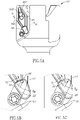
- Fig. 5B shows a first position wherein there is a gap 98 between the tool actuator surface 30 and insert actuator surface 44
- Fig. 5C shows a position at which contact of the tool actuator surface 30 and insert actuator surface 44 would occur.
- the tool 12 can be formed with a track 94 bounded by an inner wall 96. Said wedging can occur between the insert actuator surface 44 and the inner wall 96.
- An internal direction angle A D formed between the cutting direction D C and the motion direction D M can be an acute angle.
- the direction angle A D can be between 30°and 80°.
- an internal clamp angle ⁇ of a clamp wall surface 100 with the tool actuator surface 30 can be an acute.
- the clamp angle ⁇ can fulfill the condition 30° ⁇ ⁇ ⁇ 80°.
Landscapes
- Engineering & Computer Science (AREA)
- Mechanical Engineering (AREA)
- Milling Processes (AREA)
- Cutting Tools, Boring Holders, And Turrets (AREA)
Applications Claiming Priority (2)
| Application Number | Priority Date | Filing Date | Title |
|---|---|---|---|
| US13/490,197 US20130330136A1 (en) | 2012-06-06 | 2012-06-06 | Cutting Insert and Tool Having an Anti-Slip Arrangement |
| PCT/IL2013/050473 WO2013183045A1 (en) | 2012-06-06 | 2013-06-03 | Cutting insert and tool having an anti-slip arrangement |
Publications (2)
| Publication Number | Publication Date |
|---|---|
| EP2858775A1 EP2858775A1 (en) | 2015-04-15 |
| EP2858775B1 true EP2858775B1 (en) | 2022-10-26 |
Family
ID=48794147
Family Applications (1)
| Application Number | Title | Priority Date | Filing Date |
|---|---|---|---|
| EP13737668.7A Active EP2858775B1 (en) | 2012-06-06 | 2013-06-03 | Cutting insert and tool having an anti-slip arrangement |
Country Status (9)
| Country | Link |
|---|---|
| US (2) | US20130330136A1 (enExample) |
| EP (1) | EP2858775B1 (enExample) |
| JP (1) | JP2015522433A (enExample) |
| KR (1) | KR20150020286A (enExample) |
| CN (1) | CN104334302B (enExample) |
| BR (1) | BR112014027164A2 (enExample) |
| CA (1) | CA2870797C (enExample) |
| RU (1) | RU2014153153A (enExample) |
| WO (1) | WO2013183045A1 (enExample) |
Families Citing this family (16)
| Publication number | Priority date | Publication date | Assignee | Title |
|---|---|---|---|---|
| KR101452073B1 (ko) * | 2012-12-24 | 2014-10-16 | 대구텍 유한회사 | 절삭 인서트 및 이를 구비한 밀링 커터 |
| US9120154B2 (en) * | 2013-02-14 | 2015-09-01 | Iscar, Ltd. | Single-sided square-shaped indexable cutting insert and cutting tool |
| US9475136B2 (en) * | 2013-07-30 | 2016-10-25 | Kennametal Inc. | High-speed milling cutter and cutting insert therefor |
| USD712444S1 (en) * | 2013-12-03 | 2014-09-02 | Hard Metal Advantage, L.L.C. | Multi-sided cutting chip |
| US9481038B2 (en) * | 2013-12-11 | 2016-11-01 | Iscar, Ltd. | Cutting insert having a dovetail anti-slip arrangement |
| EP3000549B1 (en) * | 2014-09-24 | 2022-11-09 | Sandvik Intellectual Property AB | A cutting tool and a cutting insert for a chip-removing tool |
| EP3299102B1 (en) * | 2015-05-19 | 2024-09-18 | Tungaloy Corporation | Tool body in combination with a first cutting insert and a second cutting insert |
| EP3153261B1 (en) * | 2015-10-09 | 2018-04-04 | Sandvik Intellectual Property AB | Turning insert and method |
| CN106270699B (zh) * | 2016-08-31 | 2018-02-06 | 嘉兴市海拓环宇机械有限公司 | 数控铣床专用铣刀 |
| US10144071B2 (en) * | 2017-03-16 | 2018-12-04 | Iscar, Ltd. | Tool holder having position adjustment arrangement and cutting tool |
| KR102011329B1 (ko) | 2017-12-29 | 2019-08-14 | 한국야금 주식회사 | 절삭 인서트 및 이를 장착한 절삭 공구 |
| US11090740B2 (en) | 2019-02-12 | 2021-08-17 | Iscar, Ltd. | Rotary cutting body having insert pocket with seat surface provided with a plurality of abutment elements and rotary cutting tool |
| WO2020179538A1 (ja) * | 2019-03-05 | 2020-09-10 | 京セラ株式会社 | 旋削工具及び切削加工物の製造方法 |
| US11097362B2 (en) | 2019-12-10 | 2021-08-24 | Iscar, Ltd. | Cutting insert having two upper cutting edges and a lower central protuberance with four abutment walls defining an imaginary quadrilateral, and rotary cutting tool |
| US11491560B1 (en) * | 2021-07-13 | 2022-11-08 | Taegutec Ltd. | Cutting insert and rotary cutting tool including same |
| DE102023108122A1 (de) * | 2023-03-30 | 2024-10-02 | Hartmetall-Werkzeugfabrik Paul Horn Gmbh | Werkzeug zur spanenden Bearbeitung eines Werkstücks |
Citations (1)
| Publication number | Priority date | Publication date | Assignee | Title |
|---|---|---|---|---|
| WO1995026846A1 (en) * | 1994-03-31 | 1995-10-12 | Kennametal Inc. | Cutting tool assembly and cutting tool bit |
Family Cites Families (19)
| Publication number | Priority date | Publication date | Assignee | Title |
|---|---|---|---|---|
| GB271208A (en) * | 1926-03-25 | 1927-05-26 | John Henry Barker | Improvements in and relating to turning, boring, and the like cutting tools and holders for the same |
| DE2948544A1 (de) | 1979-12-03 | 1981-06-11 | Sandvik GmbH, 4000 Düsseldorf | Messerkopf zum hochgeschwindigkeitswalzenfraesen |
| US5167473A (en) * | 1991-06-24 | 1992-12-01 | Allied-Signal Inc. | Unidirectional insert lock |
| SE508387C2 (sv) * | 1993-05-26 | 1998-10-05 | Sandvik Ab | Rundskär |
| DE4334852C2 (de) * | 1993-10-13 | 1996-10-02 | Karl Zinner | Sicherungen für in Ausnehmungen eines hochtourig rotierenden Werkzeug-Trägerkörpers eingesetzte Schneidmesser |
| SE510851C2 (sv) * | 1996-12-23 | 1999-06-28 | Sandvik Ab | Skär samt hållare för skärande metallbearbetning |
| JPH1119808A (ja) * | 1997-06-30 | 1999-01-26 | Ngk Spark Plug Co Ltd | 切削用チップおよびこれを用いた切削工具 |
| IL139957A0 (en) | 2000-11-28 | 2002-02-10 | Iscar Ltd | Cutting tool |
| JP2001328012A (ja) * | 2000-05-19 | 2001-11-27 | Daishowa Seiki Co Ltd | 切削工具 |
| SE516612C2 (sv) * | 2000-06-27 | 2002-02-05 | Sandvik Ab | Ställmekanism för ett skär samt verktyg för spånavskiljande bearbetning |
| SE522490C2 (sv) * | 2001-01-30 | 2004-02-10 | Sandvik Ab | Verktygshållare för skär för spånavskiljande bearbetning med flexibel sidoyta i skärläget |
| SE526539C2 (sv) | 2002-05-28 | 2005-10-04 | Sandvik Intellectual Property | Verktyg för spånavskiljande bearbetning där skärläget uppvisar flexibla partier. |
| SE526586C2 (sv) * | 2003-11-25 | 2005-10-11 | Sandvik Intellectual Property | Verktyg för spånavskiljande bearbetning innefattande en han/hon-koppling mellan skärdel och hållardel |
| SE529330C2 (sv) | 2005-11-21 | 2007-07-10 | Sandvik Intellectual Property | Verktyg och skärkropp för spånavskiljande bearbetning med elastisk koppling mellan skärkropp och hållare |
| JP5076438B2 (ja) * | 2006-01-30 | 2012-11-21 | 三菱マテリアル株式会社 | インサート式切削工具及びインサート式切削工具におけるインサートの固定方法 |
| SE0600876L (sv) * | 2006-04-20 | 2007-10-21 | Sandvik Intellectual Property | Verktyg och skär för spånavskiljande bearbetning med primära och sekundära ingreppsmedel med rotationssymmetrisk form |
| SE530631C2 (sv) * | 2006-12-12 | 2008-07-22 | Sandvik Intellectual Property | Verktyg och skär för spånavskiljande bearbetning |
| SE531502C2 (sv) * | 2007-06-05 | 2009-04-28 | Sandvik Intellectual Property | Verktyg för spånavskiljande bearbetning samt grundkropp och indexerbart skär härför |
| US7566192B2 (en) * | 2007-10-19 | 2009-07-28 | Kennametal Inc. | Axial seating pin |
-
2012
- 2012-06-06 US US13/490,197 patent/US20130330136A1/en not_active Abandoned
-
2013
- 2013-06-03 US US14/398,888 patent/US9573204B2/en active Active
- 2013-06-03 EP EP13737668.7A patent/EP2858775B1/en active Active
- 2013-06-03 CA CA2870797A patent/CA2870797C/en not_active Expired - Fee Related
- 2013-06-03 KR KR1020147033550A patent/KR20150020286A/ko not_active Ceased
- 2013-06-03 JP JP2015515645A patent/JP2015522433A/ja active Pending
- 2013-06-03 WO PCT/IL2013/050473 patent/WO2013183045A1/en not_active Ceased
- 2013-06-03 BR BR112014027164A patent/BR112014027164A2/pt not_active IP Right Cessation
- 2013-06-03 CN CN201380029723.8A patent/CN104334302B/zh active Active
- 2013-06-03 RU RU2014153153A patent/RU2014153153A/ru not_active Application Discontinuation
Patent Citations (1)
| Publication number | Priority date | Publication date | Assignee | Title |
|---|---|---|---|---|
| WO1995026846A1 (en) * | 1994-03-31 | 1995-10-12 | Kennametal Inc. | Cutting tool assembly and cutting tool bit |
Also Published As
| Publication number | Publication date |
|---|---|
| US20150125225A1 (en) | 2015-05-07 |
| CA2870797C (en) | 2018-03-20 |
| US9573204B2 (en) | 2017-02-21 |
| CN104334302B (zh) | 2017-08-25 |
| WO2013183045A1 (en) | 2013-12-12 |
| US20130330136A1 (en) | 2013-12-12 |
| RU2014153153A (ru) | 2016-07-27 |
| EP2858775A1 (en) | 2015-04-15 |
| KR20150020286A (ko) | 2015-02-25 |
| CN104334302A (zh) | 2015-02-04 |
| CA2870797A1 (en) | 2013-12-12 |
| BR112014027164A2 (pt) | 2017-06-27 |
| JP2015522433A (ja) | 2015-08-06 |
Similar Documents
| Publication | Publication Date | Title |
|---|---|---|
| US9573204B2 (en) | Cutting tool having an anti-slip arrangement | |
| EP3079849B1 (en) | Cutting insert having a dovetail anti-slip arrangement | |
| EP2507003B1 (en) | Cutting insert and shim for heavy machining operations | |
| EP2035176B1 (en) | A cutting insert and a tool where the insert has improved support surfaces. | |
| US7819610B2 (en) | Tool for chip removing machining, as well as a cutting insert and a basic body therefor | |
| US8465233B2 (en) | Slot-milling tool and slot-milling insert for a slot-milling tool | |
| US20130129432A1 (en) | Cutting insert and a milling tool | |
| US9375793B2 (en) | Cutting insert for heavy machining operations | |
| US20150117969A1 (en) | Cutting insert and shim for heavy machining operations | |
| US9796032B2 (en) | Cutting insert and indexable rotary cutting tool | |
| IL168546A (en) | Cutting insert and cutting tool | |
| US9227246B2 (en) | Cutting tool for grooving and parting operations | |
| US7410331B2 (en) | Tool | |
| IL165854A (en) | Cutting insert having two opposite cutting heads | |
| US20130309027A1 (en) | Cutting Insert and Tool for Chip Removal | |
| EP2035175B1 (en) | A replaceable cutting insert and a milling tool | |
| CA3211642A1 (en) | Cutting insert and cutting tool |
Legal Events
| Date | Code | Title | Description |
|---|---|---|---|
| PUAI | Public reference made under article 153(3) epc to a published international application that has entered the european phase |
Free format text: ORIGINAL CODE: 0009012 |
|
| 17P | Request for examination filed |
Effective date: 20141201 |
|
| AK | Designated contracting states |
Kind code of ref document: A1 Designated state(s): AL AT BE BG CH CY CZ DE DK EE ES FI FR GB GR HR HU IE IS IT LI LT LU LV MC MK MT NL NO PL PT RO RS SE SI SK SM TR |
|
| AX | Request for extension of the european patent |
Extension state: BA ME |
|
| DAX | Request for extension of the european patent (deleted) | ||
| STAA | Information on the status of an ep patent application or granted ep patent |
Free format text: STATUS: EXAMINATION IS IN PROGRESS |
|
| 17Q | First examination report despatched |
Effective date: 20170310 |
|
| GRAP | Despatch of communication of intention to grant a patent |
Free format text: ORIGINAL CODE: EPIDOSNIGR1 |
|
| STAA | Information on the status of an ep patent application or granted ep patent |
Free format text: STATUS: GRANT OF PATENT IS INTENDED |
|
| INTG | Intention to grant announced |
Effective date: 20220510 |
|
| GRAS | Grant fee paid |
Free format text: ORIGINAL CODE: EPIDOSNIGR3 |
|
| GRAA | (expected) grant |
Free format text: ORIGINAL CODE: 0009210 |
|
| STAA | Information on the status of an ep patent application or granted ep patent |
Free format text: STATUS: THE PATENT HAS BEEN GRANTED |
|
| AK | Designated contracting states |
Kind code of ref document: B1 Designated state(s): AL AT BE BG CH CY CZ DE DK EE ES FI FR GB GR HR HU IE IS IT LI LT LU LV MC MK MT NL NO PL PT RO RS SE SI SK SM TR |
|
| REG | Reference to a national code |
Ref country code: GB Ref legal event code: FG4D |
|
| REG | Reference to a national code |
Ref country code: CH Ref legal event code: EP |
|
| REG | Reference to a national code |
Ref country code: DE Ref legal event code: R096 Ref document number: 602013082741 Country of ref document: DE |
|
| REG | Reference to a national code |
Ref country code: AT Ref legal event code: REF Ref document number: 1526697 Country of ref document: AT Kind code of ref document: T Effective date: 20221115 |
|
| REG | Reference to a national code |
Ref country code: IE Ref legal event code: FG4D |
|
| REG | Reference to a national code |
Ref country code: LT Ref legal event code: MG9D |
|
| REG | Reference to a national code |
Ref country code: NL Ref legal event code: MP Effective date: 20221026 |
|
| REG | Reference to a national code |
Ref country code: AT Ref legal event code: MK05 Ref document number: 1526697 Country of ref document: AT Kind code of ref document: T Effective date: 20221026 |
|
| PG25 | Lapsed in a contracting state [announced via postgrant information from national office to epo] |
Ref country code: NL Free format text: LAPSE BECAUSE OF FAILURE TO SUBMIT A TRANSLATION OF THE DESCRIPTION OR TO PAY THE FEE WITHIN THE PRESCRIBED TIME-LIMIT Effective date: 20221026 |
|
| PG25 | Lapsed in a contracting state [announced via postgrant information from national office to epo] |
Ref country code: SE Free format text: LAPSE BECAUSE OF FAILURE TO SUBMIT A TRANSLATION OF THE DESCRIPTION OR TO PAY THE FEE WITHIN THE PRESCRIBED TIME-LIMIT Effective date: 20221026 Ref country code: PT Free format text: LAPSE BECAUSE OF FAILURE TO SUBMIT A TRANSLATION OF THE DESCRIPTION OR TO PAY THE FEE WITHIN THE PRESCRIBED TIME-LIMIT Effective date: 20230227 Ref country code: NO Free format text: LAPSE BECAUSE OF FAILURE TO SUBMIT A TRANSLATION OF THE DESCRIPTION OR TO PAY THE FEE WITHIN THE PRESCRIBED TIME-LIMIT Effective date: 20230126 Ref country code: LT Free format text: LAPSE BECAUSE OF FAILURE TO SUBMIT A TRANSLATION OF THE DESCRIPTION OR TO PAY THE FEE WITHIN THE PRESCRIBED TIME-LIMIT Effective date: 20221026 Ref country code: FI Free format text: LAPSE BECAUSE OF FAILURE TO SUBMIT A TRANSLATION OF THE DESCRIPTION OR TO PAY THE FEE WITHIN THE PRESCRIBED TIME-LIMIT Effective date: 20221026 Ref country code: ES Free format text: LAPSE BECAUSE OF FAILURE TO SUBMIT A TRANSLATION OF THE DESCRIPTION OR TO PAY THE FEE WITHIN THE PRESCRIBED TIME-LIMIT Effective date: 20221026 Ref country code: AT Free format text: LAPSE BECAUSE OF FAILURE TO SUBMIT A TRANSLATION OF THE DESCRIPTION OR TO PAY THE FEE WITHIN THE PRESCRIBED TIME-LIMIT Effective date: 20221026 |
|
| PG25 | Lapsed in a contracting state [announced via postgrant information from national office to epo] |
Ref country code: RS Free format text: LAPSE BECAUSE OF FAILURE TO SUBMIT A TRANSLATION OF THE DESCRIPTION OR TO PAY THE FEE WITHIN THE PRESCRIBED TIME-LIMIT Effective date: 20221026 Ref country code: PL Free format text: LAPSE BECAUSE OF FAILURE TO SUBMIT A TRANSLATION OF THE DESCRIPTION OR TO PAY THE FEE WITHIN THE PRESCRIBED TIME-LIMIT Effective date: 20221026 Ref country code: LV Free format text: LAPSE BECAUSE OF FAILURE TO SUBMIT A TRANSLATION OF THE DESCRIPTION OR TO PAY THE FEE WITHIN THE PRESCRIBED TIME-LIMIT Effective date: 20221026 Ref country code: IS Free format text: LAPSE BECAUSE OF FAILURE TO SUBMIT A TRANSLATION OF THE DESCRIPTION OR TO PAY THE FEE WITHIN THE PRESCRIBED TIME-LIMIT Effective date: 20230226 Ref country code: HR Free format text: LAPSE BECAUSE OF FAILURE TO SUBMIT A TRANSLATION OF THE DESCRIPTION OR TO PAY THE FEE WITHIN THE PRESCRIBED TIME-LIMIT Effective date: 20221026 Ref country code: GR Free format text: LAPSE BECAUSE OF FAILURE TO SUBMIT A TRANSLATION OF THE DESCRIPTION OR TO PAY THE FEE WITHIN THE PRESCRIBED TIME-LIMIT Effective date: 20230127 |
|
| P01 | Opt-out of the competence of the unified patent court (upc) registered |
Effective date: 20230426 |
|
| REG | Reference to a national code |
Ref country code: DE Ref legal event code: R097 Ref document number: 602013082741 Country of ref document: DE |
|
| PG25 | Lapsed in a contracting state [announced via postgrant information from national office to epo] |
Ref country code: SM Free format text: LAPSE BECAUSE OF FAILURE TO SUBMIT A TRANSLATION OF THE DESCRIPTION OR TO PAY THE FEE WITHIN THE PRESCRIBED TIME-LIMIT Effective date: 20221026 Ref country code: RO Free format text: LAPSE BECAUSE OF FAILURE TO SUBMIT A TRANSLATION OF THE DESCRIPTION OR TO PAY THE FEE WITHIN THE PRESCRIBED TIME-LIMIT Effective date: 20221026 Ref country code: EE Free format text: LAPSE BECAUSE OF FAILURE TO SUBMIT A TRANSLATION OF THE DESCRIPTION OR TO PAY THE FEE WITHIN THE PRESCRIBED TIME-LIMIT Effective date: 20221026 Ref country code: DK Free format text: LAPSE BECAUSE OF FAILURE TO SUBMIT A TRANSLATION OF THE DESCRIPTION OR TO PAY THE FEE WITHIN THE PRESCRIBED TIME-LIMIT Effective date: 20221026 Ref country code: CZ Free format text: LAPSE BECAUSE OF FAILURE TO SUBMIT A TRANSLATION OF THE DESCRIPTION OR TO PAY THE FEE WITHIN THE PRESCRIBED TIME-LIMIT Effective date: 20221026 |
|
| PG25 | Lapsed in a contracting state [announced via postgrant information from national office to epo] |
Ref country code: SK Free format text: LAPSE BECAUSE OF FAILURE TO SUBMIT A TRANSLATION OF THE DESCRIPTION OR TO PAY THE FEE WITHIN THE PRESCRIBED TIME-LIMIT Effective date: 20221026 Ref country code: AL Free format text: LAPSE BECAUSE OF FAILURE TO SUBMIT A TRANSLATION OF THE DESCRIPTION OR TO PAY THE FEE WITHIN THE PRESCRIBED TIME-LIMIT Effective date: 20221026 |
|
| PLBE | No opposition filed within time limit |
Free format text: ORIGINAL CODE: 0009261 |
|
| STAA | Information on the status of an ep patent application or granted ep patent |
Free format text: STATUS: NO OPPOSITION FILED WITHIN TIME LIMIT |
|
| 26N | No opposition filed |
Effective date: 20230727 |
|
| PG25 | Lapsed in a contracting state [announced via postgrant information from national office to epo] |
Ref country code: SI Free format text: LAPSE BECAUSE OF FAILURE TO SUBMIT A TRANSLATION OF THE DESCRIPTION OR TO PAY THE FEE WITHIN THE PRESCRIBED TIME-LIMIT Effective date: 20221026 |
|
| PG25 | Lapsed in a contracting state [announced via postgrant information from national office to epo] |
Ref country code: MC Free format text: LAPSE BECAUSE OF FAILURE TO SUBMIT A TRANSLATION OF THE DESCRIPTION OR TO PAY THE FEE WITHIN THE PRESCRIBED TIME-LIMIT Effective date: 20221026 |
|
| PG25 | Lapsed in a contracting state [announced via postgrant information from national office to epo] |
Ref country code: MC Free format text: LAPSE BECAUSE OF FAILURE TO SUBMIT A TRANSLATION OF THE DESCRIPTION OR TO PAY THE FEE WITHIN THE PRESCRIBED TIME-LIMIT Effective date: 20221026 |
|
| REG | Reference to a national code |
Ref country code: CH Ref legal event code: PL |
|
| REG | Reference to a national code |
Ref country code: BE Ref legal event code: MM Effective date: 20230630 |
|
| GBPC | Gb: european patent ceased through non-payment of renewal fee |
Effective date: 20230603 |
|
| PG25 | Lapsed in a contracting state [announced via postgrant information from national office to epo] |
Ref country code: LU Free format text: LAPSE BECAUSE OF NON-PAYMENT OF DUE FEES Effective date: 20230603 |
|
| REG | Reference to a national code |
Ref country code: IE Ref legal event code: MM4A |
|
| PG25 | Lapsed in a contracting state [announced via postgrant information from national office to epo] |
Ref country code: LU Free format text: LAPSE BECAUSE OF NON-PAYMENT OF DUE FEES Effective date: 20230603 |
|
| PG25 | Lapsed in a contracting state [announced via postgrant information from national office to epo] |
Ref country code: IE Free format text: LAPSE BECAUSE OF NON-PAYMENT OF DUE FEES Effective date: 20230603 |
|
| PG25 | Lapsed in a contracting state [announced via postgrant information from national office to epo] |
Ref country code: IE Free format text: LAPSE BECAUSE OF NON-PAYMENT OF DUE FEES Effective date: 20230603 Ref country code: CH Free format text: LAPSE BECAUSE OF NON-PAYMENT OF DUE FEES Effective date: 20230630 Ref country code: GB Free format text: LAPSE BECAUSE OF NON-PAYMENT OF DUE FEES Effective date: 20230603 |
|
| PG25 | Lapsed in a contracting state [announced via postgrant information from national office to epo] |
Ref country code: IT Free format text: LAPSE BECAUSE OF FAILURE TO SUBMIT A TRANSLATION OF THE DESCRIPTION OR TO PAY THE FEE WITHIN THE PRESCRIBED TIME-LIMIT Effective date: 20221026 Ref country code: FR Free format text: LAPSE BECAUSE OF NON-PAYMENT OF DUE FEES Effective date: 20230630 Ref country code: BE Free format text: LAPSE BECAUSE OF NON-PAYMENT OF DUE FEES Effective date: 20230630 |
|
| PG25 | Lapsed in a contracting state [announced via postgrant information from national office to epo] |
Ref country code: BG Free format text: LAPSE BECAUSE OF FAILURE TO SUBMIT A TRANSLATION OF THE DESCRIPTION OR TO PAY THE FEE WITHIN THE PRESCRIBED TIME-LIMIT Effective date: 20221026 |
|
| PG25 | Lapsed in a contracting state [announced via postgrant information from national office to epo] |
Ref country code: BG Free format text: LAPSE BECAUSE OF FAILURE TO SUBMIT A TRANSLATION OF THE DESCRIPTION OR TO PAY THE FEE WITHIN THE PRESCRIBED TIME-LIMIT Effective date: 20221026 |
|
| PGFP | Annual fee paid to national office [announced via postgrant information from national office to epo] |
Ref country code: DE Payment date: 20250512 Year of fee payment: 13 |
|
| PG25 | Lapsed in a contracting state [announced via postgrant information from national office to epo] |
Ref country code: CY Free format text: LAPSE BECAUSE OF FAILURE TO SUBMIT A TRANSLATION OF THE DESCRIPTION OR TO PAY THE FEE WITHIN THE PRESCRIBED TIME-LIMIT; INVALID AB INITIO Effective date: 20130603 |
|
| PG25 | Lapsed in a contracting state [announced via postgrant information from national office to epo] |
Ref country code: HU Free format text: LAPSE BECAUSE OF FAILURE TO SUBMIT A TRANSLATION OF THE DESCRIPTION OR TO PAY THE FEE WITHIN THE PRESCRIBED TIME-LIMIT; INVALID AB INITIO Effective date: 20130603 |
|
| PG25 | Lapsed in a contracting state [announced via postgrant information from national office to epo] |
Ref country code: TR Free format text: LAPSE BECAUSE OF FAILURE TO SUBMIT A TRANSLATION OF THE DESCRIPTION OR TO PAY THE FEE WITHIN THE PRESCRIBED TIME-LIMIT Effective date: 20221026 |