EP2855143B1 - Einlegematte für kraftfahrzeuge zum auflegen auf eine bodenteppichstruktur des kraftfahrzeuges - Google Patents
Einlegematte für kraftfahrzeuge zum auflegen auf eine bodenteppichstruktur des kraftfahrzeuges Download PDFInfo
- Publication number
- EP2855143B1 EP2855143B1 EP13727564.0A EP13727564A EP2855143B1 EP 2855143 B1 EP2855143 B1 EP 2855143B1 EP 13727564 A EP13727564 A EP 13727564A EP 2855143 B1 EP2855143 B1 EP 2855143B1
- Authority
- EP
- European Patent Office
- Prior art keywords
- layer
- adhesive
- insert mat
- gripping
- mat according
- Prior art date
- Legal status (The legal status is an assumption and is not a legal conclusion. Google has not performed a legal analysis and makes no representation as to the accuracy of the status listed.)
- Active
Links
Images



Classifications
-
- B—PERFORMING OPERATIONS; TRANSPORTING
- B60—VEHICLES IN GENERAL
- B60N—SEATS SPECIALLY ADAPTED FOR VEHICLES; VEHICLE PASSENGER ACCOMMODATION NOT OTHERWISE PROVIDED FOR
- B60N3/00—Arrangements or adaptations of other passenger fittings, not otherwise provided for
- B60N3/04—Arrangements or adaptations of other passenger fittings, not otherwise provided for of floor mats or carpets
- B60N3/046—Arrangements or adaptations of other passenger fittings, not otherwise provided for of floor mats or carpets characterised by the fixing means
-
- B—PERFORMING OPERATIONS; TRANSPORTING
- B32—LAYERED PRODUCTS
- B32B—LAYERED PRODUCTS, i.e. PRODUCTS BUILT-UP OF STRATA OF FLAT OR NON-FLAT, e.g. CELLULAR OR HONEYCOMB, FORM
- B32B5/00—Layered products characterised by the non- homogeneity or physical structure, i.e. comprising a fibrous, filamentary, particulate or foam layer; Layered products characterised by having a layer differing constitutionally or physically in different parts
- B32B5/22—Layered products characterised by the non- homogeneity or physical structure, i.e. comprising a fibrous, filamentary, particulate or foam layer; Layered products characterised by having a layer differing constitutionally or physically in different parts characterised by the presence of two or more layers which are next to each other and are fibrous, filamentary, formed of particles or foamed
- B32B5/24—Layered products characterised by the non- homogeneity or physical structure, i.e. comprising a fibrous, filamentary, particulate or foam layer; Layered products characterised by having a layer differing constitutionally or physically in different parts characterised by the presence of two or more layers which are next to each other and are fibrous, filamentary, formed of particles or foamed one layer being a fibrous or filamentary layer
- B32B5/26—Layered products characterised by the non- homogeneity or physical structure, i.e. comprising a fibrous, filamentary, particulate or foam layer; Layered products characterised by having a layer differing constitutionally or physically in different parts characterised by the presence of two or more layers which are next to each other and are fibrous, filamentary, formed of particles or foamed one layer being a fibrous or filamentary layer another layer next to it also being fibrous or filamentary
-
- B—PERFORMING OPERATIONS; TRANSPORTING
- B32—LAYERED PRODUCTS
- B32B—LAYERED PRODUCTS, i.e. PRODUCTS BUILT-UP OF STRATA OF FLAT OR NON-FLAT, e.g. CELLULAR OR HONEYCOMB, FORM
- B32B5/00—Layered products characterised by the non- homogeneity or physical structure, i.e. comprising a fibrous, filamentary, particulate or foam layer; Layered products characterised by having a layer differing constitutionally or physically in different parts
- B32B5/02—Layered products characterised by the non- homogeneity or physical structure, i.e. comprising a fibrous, filamentary, particulate or foam layer; Layered products characterised by having a layer differing constitutionally or physically in different parts characterised by structural features of a fibrous or filamentary layer
- B32B5/022—Non-woven fabric
-
- B—PERFORMING OPERATIONS; TRANSPORTING
- B32—LAYERED PRODUCTS
- B32B—LAYERED PRODUCTS, i.e. PRODUCTS BUILT-UP OF STRATA OF FLAT OR NON-FLAT, e.g. CELLULAR OR HONEYCOMB, FORM
- B32B7/00—Layered products characterised by the relation between layers; Layered products characterised by the relative orientation of features between layers, or by the relative values of a measurable parameter between layers, i.e. products comprising layers having different physical, chemical or physicochemical properties; Layered products characterised by the interconnection of layers
- B32B7/04—Interconnection of layers
- B32B7/12—Interconnection of layers using interposed adhesives or interposed materials with bonding properties
-
- B—PERFORMING OPERATIONS; TRANSPORTING
- B60—VEHICLES IN GENERAL
- B60N—SEATS SPECIALLY ADAPTED FOR VEHICLES; VEHICLE PASSENGER ACCOMMODATION NOT OTHERWISE PROVIDED FOR
- B60N3/00—Arrangements or adaptations of other passenger fittings, not otherwise provided for
- B60N3/04—Arrangements or adaptations of other passenger fittings, not otherwise provided for of floor mats or carpets
- B60N3/042—Arrangements or adaptations of other passenger fittings, not otherwise provided for of floor mats or carpets of carpets
-
- B—PERFORMING OPERATIONS; TRANSPORTING
- B60—VEHICLES IN GENERAL
- B60N—SEATS SPECIALLY ADAPTED FOR VEHICLES; VEHICLE PASSENGER ACCOMMODATION NOT OTHERWISE PROVIDED FOR
- B60N3/00—Arrangements or adaptations of other passenger fittings, not otherwise provided for
- B60N3/04—Arrangements or adaptations of other passenger fittings, not otherwise provided for of floor mats or carpets
- B60N3/044—Arrangements or adaptations of other passenger fittings, not otherwise provided for of floor mats or carpets of removable mats
-
- B—PERFORMING OPERATIONS; TRANSPORTING
- B32—LAYERED PRODUCTS
- B32B—LAYERED PRODUCTS, i.e. PRODUCTS BUILT-UP OF STRATA OF FLAT OR NON-FLAT, e.g. CELLULAR OR HONEYCOMB, FORM
- B32B2262/00—Composition or structural features of fibres which form a fibrous or filamentary layer or are present as additives
- B32B2262/02—Synthetic macromolecular fibres
- B32B2262/0276—Polyester fibres
- B32B2262/0284—Polyethylene terephthalate [PET] or polybutylene terephthalate [PBT]
-
- B—PERFORMING OPERATIONS; TRANSPORTING
- B32—LAYERED PRODUCTS
- B32B—LAYERED PRODUCTS, i.e. PRODUCTS BUILT-UP OF STRATA OF FLAT OR NON-FLAT, e.g. CELLULAR OR HONEYCOMB, FORM
- B32B2262/00—Composition or structural features of fibres which form a fibrous or filamentary layer or are present as additives
- B32B2262/06—Vegetal fibres
-
- B—PERFORMING OPERATIONS; TRANSPORTING
- B32—LAYERED PRODUCTS
- B32B—LAYERED PRODUCTS, i.e. PRODUCTS BUILT-UP OF STRATA OF FLAT OR NON-FLAT, e.g. CELLULAR OR HONEYCOMB, FORM
- B32B2307/00—Properties of the layers or laminate
- B32B2307/70—Other properties
- B32B2307/744—Non-slip, anti-slip
-
- B—PERFORMING OPERATIONS; TRANSPORTING
- B32—LAYERED PRODUCTS
- B32B—LAYERED PRODUCTS, i.e. PRODUCTS BUILT-UP OF STRATA OF FLAT OR NON-FLAT, e.g. CELLULAR OR HONEYCOMB, FORM
- B32B2471/00—Floor coverings
- B32B2471/04—Mats
-
- Y—GENERAL TAGGING OF NEW TECHNOLOGICAL DEVELOPMENTS; GENERAL TAGGING OF CROSS-SECTIONAL TECHNOLOGIES SPANNING OVER SEVERAL SECTIONS OF THE IPC; TECHNICAL SUBJECTS COVERED BY FORMER USPC CROSS-REFERENCE ART COLLECTIONS [XRACs] AND DIGESTS
- Y10—TECHNICAL SUBJECTS COVERED BY FORMER USPC
- Y10T—TECHNICAL SUBJECTS COVERED BY FORMER US CLASSIFICATION
- Y10T428/00—Stock material or miscellaneous articles
- Y10T428/23907—Pile or nap type surface or component
- Y10T428/23943—Flock surface
Definitions
- the invention relates to an insert mat according to the preamble of claim 1.
- a sound insulation material which is constructed as a composite of at least two layers, wherein at least one of the layers consists of an air-permeable nonwoven fabric, said layer is bonded to at least one other component of the composite so that the air permeability of the nonwoven fabric is substantially maintained.
- another layer is provided in the form of a core layer with substantially vertical, optionally slightly inclined to the layer of air-permeable nonwoven fabric extending walls, which form in their entirety a plurality of open at one end cavities.
- Such a sound insulation material is not suitable for the purpose of the invention.
- the core layer formed from open cavities makes it impossible to use as an insertion mat for motor vehicles, since this sound insulation material is not sufficiently resistant to treading.
- a carpet construction for use in vehicles which has a decorative layer and a nonwoven fibrous layer as a sound absorption layer and an adhesive layer which connects the decorative layer and the sound absorption layer.
- the adhesive layer is formed as an air-permeable adhesive layer, wherein the adhesive layer is formed by a fibrous, melted in an extruder adhesive threads.
- Such a Carpet construction is unsuitable as an insert mat for laying on a floor carpet structure, since it does not have sufficient liability when placed on an existing carpet of motor vehicles.
- Such carpet structures would, used as insert mats, tend to undesirable slippage on the example installed in the vehicle carpet structure.
- WO 03/045682 A1 is a porous carpet for vehicles and its manufacturing method is known in which a tuft-like decorative layer is used.
- the tuft-like decorative layer has filament arches, which penetrate a carrier layer of the tuft arc-like, so that there are filament arcs on the back of the support layer of the tuft.
- the filament sheets are first taken in a closed adhesive layer and fixed with respect to the carrier layer of the tuft. Subsequently, by applying vacuum with softened adhesive, fine channels are introduced into the adhesive layer, so that a certain air permeability of the adhesive layer and thus of the tuft is achieved. It has been found that such an air permeability is too low for use as an insert mat.
- the manufacturing process appears laborious and with regard to the number of air channels per area and the uniform distribution of air ducts resulting from systems of vacuum is not always sufficiently predeterminable.
- the object of the invention is to provide an insert mat for motor vehicles to be placed on a sound-absorbing floor carpet structure of the motor vehicle, which makes it possible not to affect the sound absorption capacity of the existing under the mat mats absorbing existing vehicle carpet.
- the insert permanently deformable, in particular as a three-dimensional molded part permanently deformable to be able to train.
- a further object of the invention is, in addition to the sound absorption capability of the insert mat, to form it as moisture / moisture impermeable as possible.
- a further object of the invention is to specify an insert mat which can be arranged on an existing floor carpet structure of the motor vehicle, preferably without additional fastening means, in a particularly non-slip manner.
- the invention now provides to provide a highly air-permeable material which is nevertheless deformable and also retains the shape. This material is so permeable to air, that a candle could be blown out through testing through this material, while at the same time the tested material was water impermeable.
- This fleece has a thickness of up to 2 mm with a weight per unit area of 200 g / m 2 to 450 g / m 2 , in particular 220 g / m 2 to 260 g / m 2 .
- This fleece contains 15% to 25% of adhesive fibers, in particular 20% of adhesive fibers.
- the air permeability is between 2000 l / m 2 / s and 3500 l / m 2 / s at a pressure difference of 200 Pa.
- the nonwoven middle layer consists eg of a PET and / or a natural fiber fleece.
- both the outer decorative layer and the lower adhesive layer can be connected to the nonwoven center layer with a relatively thin adhesive layer, adhesive weights of 150 g / m 2 are already sufficient. With such a basis weight of adhesive, this adhesive layer can not fulfill a forming function. In addition, these adhesive layers are not applied over the entire surface. Overall, this results in a total weight of the structure according to the invention of about 480 g / m 2 to 550 g / m 2 compared to over 700 g / m 2 in known structures.
- the adhesive between the nonwoven middle layer and the decorative layer on the one hand and the adhesive layer on the other hand may be a heat-activatable adhesive, but it may also be a reaction adhesive. If a reaction adhesive is used, the processability of the overall composite changes. If thermally activated adhesives are used, corresponding preforms are cut out both from the nonwoven middle layer and from the decorative layer and the liability, wherein the adhesive application is applied to the respective back with the hollow nubs of both the adhesive layer and the decorative layer, which are both formed as a tuft becomes. These then already provided with adhesive layers are then placed together with the nonwoven center layer in the correct position and aligned in a mold, heated together and reshaped. As a result, on the one hand, the composite is produced and, on the other hand, the corresponding stable shape is achieved.
- the material can be made available as a roll product, since a compound of the composite already exists with one another, which is heat-independent. Then, the preforms can already be punched out of this roll product and placed in a forming tool.
- the adhesive is selected in terms of the amount per filament sheet and in terms of its viscosity during the production of the insert mat so that the filament arcs are fixed relative to a carrier layer of Dekorteppichs and a carrier layer of the adhesive layer, and a non-full, partial, punctiform / linear bonding of the filament arcs the backing layer of the insert mat is made, and a majority of filaments of a filament sheet are fixed to each other by means of the adhesive.
- the filament sheets can be fixed with respect to the carrier layer exclusively over the adhesive and no other fixation, eg be provided in the form of a latex layer.
- studded lanes which are free of adhesive can remain free between the studded filament bows.
- the adhesive is applied during the manufacture of the insert mat by means of an adhesive roller on the filament arches, in particular on the zenith of the filament arches.
- the adhesive is a thermoplastic adhesive.
- the carrier layer (fleece center layer) of the insert mat is an air-permeable carrier fleece with hydrophobic finish.
- the decorative layer is an Econyl high-speed air with a basis weight of 860 g / m 2 .
- Verhakungstik is a Anti Psychologytuft with 400 g / m 2.
- the hydrophobic finish of the carrier layer withstands a pressure of 50 mm to 60 mm water column.
- the carrier layer is a thermally bonded nonwoven with a maximum proportion of thermally active fibers of 20%.
- the insert mat is produced from two intermediate products, wherein the first intermediate product of the decorative layer, the carrier layer and the adhesive is formed between the decorative layer and the carrier layer, the second intermediate product is formed from the adhesive layer which has the adhesive at the zeniths of the filament bows and the first intermediate with the second intermediate product in a heated press, in particular in a mold, is connected together.
- adhesive or entanglement means for interacting with, for example, an adhesive or hooking partner of the vehicle carpet floor structure is additionally present in regions on a free outer side of the adhesive layer.
- the layer structure of an insert mat according to the invention in cross section results in particular from FIG. 1 ,
- the insert mat according to the invention is basically provided for additional use to a carpet located in the vehicle or in a corresponding textile lining.
- this is the usual sound-absorbing floor carpet structure that is present in motor vehicles.
- the insert mat 1 of the invention has a substantially three-layer structure, wherein a decorative layer 2 is present.
- a decorative layer 2 faces a vehicle interior.
- a carrier layer 3 and an adhesive layer 4 to be assigned during normal use to a vehicle floor or a floor carpet structure of a vehicle are present.
- the carrier layer 3 has an upper side 3a and a lower side 3b, so that the upper side 3a faces the decorative layer 2, and the lower side 3b faces the adhesive layer 4.
- the decorative layer 2 is formed as a so-called Tuft.
- a tuft is a textile material, in which needles the so-called Pile yarn in a base material, for example, a fabric or nonwoven (the so-called first legs), bring.
- pile naps 5 so loops, formed on the top of the tufted fabric or fleece.
- the slings can be cut open with a knife to create a velor carpet or cut pile carpet.
- the decorative layer is, for example, an Econyl high-speed air.
- the carrier layer 3 is formed as a fleece, wherein the adhesive layer 4 is formed as Tuft.
- Both the decorative layer 2 and the adhesive layer 3 have pole loops 5, the pole loops 5 having nap-like filament arcs 7 on the side facing the carrier layer 3, the nap-like filament arcs 7 forming zeniths 6, and the zeniths 6 of the filament arcs 7 facing the carrier layer 3 are.
- an adhesive 8 is applied to the zenith 6 punctiform or linear.
- a line-like arrangement can also result from the fact that selectively applied adhesive 8 adjacent zenith 6 converges. As in FIG. 3 can be seen here arise along the zenith 6 running adhesive sheets or lines and while leaving nub alley 9 free, which are free of adhesive.
- the adhesive 8 is applied in particular to the filament sheets 7 or the zeniths 6 of the filament sheets 7 by means of an adhesive roller.
- the adhesive 8 may be, for example, a thermoplastic adhesive but also any other adhesive.
- the carrier layer 3 is a woven fabric, knitted fabric, a felt or a nonwoven, the carrier layer 3 being designed to be air-permeable is.
- the carrier layer 3 may have a hydrophobic finish, but the requirement of the hydrophobic finish is that it does not significantly affect the air permeability.
- the decorative layer is in particular a high-speed air with a basis weight of 350 g / m 2 to 860 g / m 2 .
- the carrier fleece of the carrier layer 3 is for example a PET nonwoven and / or a natural fiber fleece with a weight per unit area of 220 g / m 2 to 450 g / m 2 .
- the adhesive layer 4 is for example an antislip with 300 g / m 2 to 500 g / m 2 .
- the adhesive 8 is applied to the zenith 6 in an amount of 80 g / m 2 to 300 g / m 2 per adhesive layer.
- the hydrophobic finish of the carrier layer 3 is preferably designed so that it withstands a pressure of 50 mm to 60 mm water column, so that although the decorative layer 2 can be soaked, but no water passes through the support layer 3 on a floor carpet of the vehicle. From the decorative layer 2, applied liquid can then dry off.
- the fleece of the carrier layer 3 is preferably a PET nonwoven, the carrier layer 3 being 15% to 25%, in particular 20%, of the fibers of the carrier fleece forming the carrier layer 3 being thermally activatable adhesive fibers.
- the insert mat 1 according to the invention can in this case be produced from two intermediate products, the first intermediate product comprising the decorative layer 2, the carrier layer 3 and the Adhesive 8 is formed between the decorative layer 2 and the carrier layer 3.
- the second intermediate product consists of the adhesive layer 4, which has the adhesive 8 at the zeniths 6 of the filament sheets 7.
- the two intermediates are introduced together into a heatable press and joined together there by pressing and heating, wherein it is particularly advantageous if both the adhesive and the nonwoven are thermally activated.
- the pressing can preferably take place in such a way that the intermediates are already cut to the required extent, and placed in the press in appropriate coverage, and then connected.
- Adhesive or interlocking means for co-operation with, for example, an adhesive or hooking partner in the vehicle carpet floor structure may additionally be present on the free outer side of the adhesive layer 4.
- the mat a predetermined, adapted to the vehicle body shape.
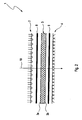
- FIG. 2 shows again the inventive air-permeable structure of an insert mat 1 for optimum acoustic absorption, showing the decorative layer 2, which is for example designed as high-speed air, a first adhesive layer 8, which is shown in a line and the zenith 6 of the filament arches 7 connects, then the Carrier layer 3 with a carrier layer top side 3a and a carrier layer underside 3b, a second adhesive layer 8 between the carrier layer 3 and the adhesive layer 4, which is in particular an anti-slip air.
- the decorative layer 2 which is for example designed as high-speed air
- a first adhesive layer 8 which is shown in a line and the zenith 6 of the filament arches 7 connects
- the Carrier layer 3 with a carrier layer top side 3a and a carrier layer underside 3b
- a second adhesive layer 8 between the carrier layer 3 and the adhesive layer 4, which is in particular an anti-slip air.
- the arrow 10 shows the direction of flow.
- FIG. 4 shows various absorption curves of the sound absorption of a floor mat, measured in an alpha cabin according to the test specifications of the car manufacturer.
- the floor covering is made of tufted carpet and insulation of a thickness of 25 mm, as it corresponds to the carpet construction in motor vehicles recorded.
Landscapes
- Engineering & Computer Science (AREA)
- Transportation (AREA)
- Mechanical Engineering (AREA)
- Textile Engineering (AREA)
- Passenger Equipment (AREA)
- Carpets (AREA)
- Laminated Bodies (AREA)
Description
- Die Erfindung betrifft eine Einlegematte nach dem Oberbegriff des Anspruchs 1.
- Aus der
DE 41 31 394 A1 ist ein Schalldämmmaterial bekannt, welches als Verbund aus wenigstens zwei Schichten aufgebaut ist, wobei wenigstens eine der Schichten aus einem luftdurchlässigen Faservlies besteht, wobei diese Schicht mit wenigstens einer weiteren Komponente des Verbundes so verklebt ist, dass die Luftdurchlässigkeit des Faservlieses im Wesentlichen erhalten bleibt. Des Weiteren ist eine weitere Schicht in Form einer Kernschicht mit im Wesentlichen vertikal, gegebenenfalls leicht geneigt zu der Schicht aus luftdurchlässigen Faservlies verlaufenden Wänden vorgesehen, welche in ihrer Gesamtheit eine Vielzahl an einer Endseite offene Hohlräume bilden. Ein derartiges Schalldämmmaterial ist für den Einsatzzweck der Erfindung nicht geeignet. Insbesondere macht die aus offenen Hohlräumen gebildete Kernschicht den Einsatz als Einlegematte für Kraftfahrzeuge unmöglich, da dieses Schalldämmmaterial nicht ausreichend trittfest ist. - Aus der
US 2005/0075025 A1 ist ein Teppichaufbau für den Gebrauch in Fahrzeugen bekannt, welcher eine Dekorschicht und eine nichtgewebte Faserschicht als Schallabsorptionsschicht sowie eine Klebstoffschicht aufweist, welche die Dekorschicht und die Schallabsorptionsschicht miteinander verbindet. Die Klebeschicht ist als luftdurchlässige Klebeschicht ausgebildet, wobei die Klebstoffschicht durch faserartige, in einem Extruder erschmolzene Klebstofffäden gebildet ist. Ein derartiger Teppichaufbau ist als Einlegematte zum Auflegen auf eine Bodenteppichstruktur ungeeignet, da sie nicht über eine ausreichende Haftung beim Auflegen auf einen bereits vorhandenen Kraftfahrzeugteppich verfügt. Derartige Teppichaufbauten würden, als Einlegematten eingesetzt, zu unerwünschtem Verrutschen auf der z.B. fest im Fahrzeug eingebauten Teppichstruktur neigen. - Aus der
WO 03/045682 A1 - Des Weiteren ist eine relativ hohe Menge an Klebstoff erforderlich, um einerseits die Filamentbögen bezüglich der Trägerschicht des Tufts zu fixieren und andererseits die Filamente der Filamentbögen zueinander ausreichend zu fixieren.
- Ausgehend von oben genanntem Stand der Technik besteht die Aufgabe der Erfindung darin, eine Einlegematte für Kraftfahrzeuge zum Auflegen auf eine schallabsorbierende Bodenteppichstruktur des Kraftfahrzeuges anzugeben, welche es ermöglicht, das Schallabsorptionsvermögen des unter der Einlegematte schallabsorbierenden vorhandenen Fahrzeugteppichs nicht zu beeinträchtigen.
- Insbesondere ist es eine Aufgabe der Erfindung, die Einlegematte dauerhaft verformbar, insbesondere als dreidimensionales Formteil dauerhaft verformbar, ausbilden zu können.
- Eine weitere Aufgabe der Erfindung ist es, zusätzlich zur Schallabsorptionsfähigkeit der Einlegematte diese möglichst feuchtigkeits-/nässeundurchlässig auszubilden.
- Eine weitere Aufgabe der Erfindung ist es, eine Einlegematte anzugeben, die auf einer vorhandenen Bodenteppichstruktur des Kraftfahrzeuges bevorzugt ohne weitere Befestigungsmittel besonders rutschfest angeordnet werden kann.
- Diese Aufgaben werden mit einer Einlegematte mit den Merkmalen des Anspruchs 1 gelöst. Vorteilhafte Ausführungsformen sind in den Unteransprüchen angegeben.
- Die Aufgabe wird insbesondere durch eine Einlegematte für Kraftfahrzeuge zum Auflegen auf eine Bodenteppichstruktur des Kraftfahrzeugs mit einem mindestens dreischichtigen Aufbau gelöst, wobei der Aufbau aufweist:
- eine im bestimmungsgemäßen Gebrauch der Einlegematte einem Fahrzeuginnenraum zugewandte Dekorschicht,
- welche mit einer im bestimmungsgemäßem Gebrauch dem Fahrzeuginnenraum zugewandten Oberseite einer Trägerschicht verbunden ist und
- eine Haftschicht, welche im bestimmungsgemäßen Gebrauch der Einlegematte mit einer Unterseite der Trägerschicht verbunden ist und zum verkrallenden Zusammenwirken mit einem Bodenteppich eines Fahrzeuges eingerichtet ist,
- wobei der gesamte Aufbau luftdurchlässig ausgebildet ist, wobei
- die Dekorschicht ein Tuft ist, die Trägerschicht ein Vlies ist, und die Haftschicht ein Tuft ist.
- Übliche, bisher verwendete Aufbauböden für Fußmatten bestanden aus fünf Schichten, wobei derartige Fußmatten, wenn sie umformbar und damit in Form gebracht in eine Bodenkontur eines Fahrzeugs passgenau einlegbar sein sollen, zwischen einer Dekorschicht und einer Vliesmittellage einerseits und einer Haftschicht und derselben Mittellage zwei dicke Kleberschichten besitzt. Diese dicken Kleberschichten besitzen Flächengewichte von deutlich über 300 g/m2 und bestehen aus einem thermoplastischen Klebstoff, welcher nicht nur eine Bindungs- sondern auch eine Stabilitätsfunktion übernimmt und für die Umformbarkeit sorgt. Bislang verwendete Vliese waren sogenannte Non-Vowen-Vliese mit 80 g/m2 bis 200 g/m2 und 1 mm bis 2 mm Stärke.
- Derartige, bisherige bekannte Fußmattenaufbauten ließen sich in einer Endlosfertigung herstellen, besitzen aber keine oder eine nur sehr geringe Luftdurchlässigkeit. Bei derartigen Materialien nach dem Stand der Technik wird beim Auflegen dieses Materials als Fußmatte auf eine als Schallabsorber arbeitende Bodenteppichstruktur eines Kraftfahrzeuges, deren schallabsorbierende Funktion deutlich verschlechtert.
- Die Erfindung sieht nun vor, ein hochluftdurchlässiges Material zu schaffen, welches gleichwohl verformbar ist und die Form auch beibehält. Dabei ist dieses Material derart luftdurchlässig, dass bei Prüfungen durch dieses Material hindurch eine Kerze ausgeblasen werden konnte, während das getestete Material gleichzeitig jedoch wasserundurchlässig war.
- Diese an sich widersprüchlichen Eigenschaften werden dadurch erreicht, dass als Vliesmittellage ein Vlies verwendet wird, was bislang für derartige Anwendungen unbekannt war und eigentlich in der Textilindustrie für Bekleidung verwendet wird. Dieses Vlies hat eine Dicke von bis zu 2 mm bei einem Flächengewicht von 200 g/m2 bis 450 g/m2, insbesondere 220 g/m2 bis 260 g/ m2. Dieses Vlies enthält 15 % bis 25 % Klebefasern, insbesondere 20 % Klebefasern. Die Luftdurchlässigkeit beträgt zwischen 2000 l/ m2/s und 3500 l/ m2/s bei einer Druckdifferenz von 200 Pa. Die Vliesmittellage besteht z.B. aus einem PET- und/oder einem Naturfaservlies.
- Da diese Vliesmittellage allein bereits ein gutes Umformverhalten besitzt, können sowohl die außenliegende Dekorschicht als auch die unten liegende Haftschicht mit einer relativ dünnen Kleberschicht an die Vliesmittellage angebunden werden, wobei Klebstoffgewichte von 150 g/m2 schon ausreichend sind. Mit einem solchen Flächengewicht an Klebstoff kann diese Kleberschicht eine Umformfunktion nicht erfüllen. Zudem werden diese Kleberschichten nicht vollflächig aufgebracht. Insgesamt ergibt sich hieraus ein Gesamtgewicht des erfindungsgemäßen Aufbaus von etwa 480 g/m2 bis 550 g/m2 gegenüber über 700 g/m2 bei bekannten Aufbauten.
- Der Kleber zwischen der Vliesmittellage und der Dekorschicht einerseits und der Haftschicht andererseits kann ein wärmeaktivierbarer Klebstoff sein, es kann sich jedoch auch um einen Reaktionskleber handeln. Wird ein Reaktionsklebstoff verwendet, verändert sich die Verarbeitbarkeit des Gesamtverbundes. Sollten thermoaktivierbare Kleber verwendet werden, werden entsprechende Vorformlinge sowohl aus der Vliesmittellage als auch aus der Dekorschicht und der Haftpflicht ausgeschnitten, wobei der Klebstoffauftrag auf die jeweilige Rückseite mit den hohlen Noppen sowohl der Haftschicht als auch der Dekorschicht, welche beide als Tuft ausgebildet sind, aufgebracht wird. Diese dann bereits mit Klebstoff versehenen Schichten werden anschließend zusammen mit der Vliesmittellage lagerichtig und fluchtend in ein Formwerkzeug eingelegt, gemeinsam erwärmt und umgeformt. Hierdurch wird einerseits der Verbund hergestellt und andererseits die entsprechende stabile Form erzielt.
- Wird ein Reaktionsklebstoff für die Verbindung der Schichten miteinander verwendet, kann das Material als Rollenware zur Verfügung gestellt werden, da eine Verbindung des Verbundes untereinander schon besteht, die wärmeunabhängig ist. Sodann können aus dieser Rollenware bereits die Vorformlinge ausgestanzt und in ein Umformwerkzeug eingelegt werden.
- Der Klebstoff ist hinsichtlich der Menge je Filamentbogen und hinsichtlich seiner Viskosität während der Herstellung der Einlegematte derart gewählt, dass die Filamentbögen bezüglich einer Trägerschicht des Dekorteppichs und einer Trägerschicht der Haftschicht fixiert sind, und eine nicht vollflächige, partielle, punktuelle/ linienförmige Verklebung der Filamentbögen mit der Trägerschicht der Einlegematte erfolgt, und eine überwiegende Anzahl von Filamenten eines Filamentbogens mittels des Klebstoffs zueinander fixiert sind.
- In vorteilhafter Weise können die Filamentbögen bezüglich der Trägerschicht ausschließlich über dem Klebstoff fixiert sein und keine anderweitige Fixierung, z.B. in Form einer Latexschicht vorgesehen sein.
- Zudem können bei einer weiteren vorteilhaften Ausführungsform zwischen den noppenartigen Filamentbögen Noppengassen frei bleiben, die frei von Klebstoff sind.
- Vorteilhaft ist zudem, wenn der Klebstoff bei der Herstellung der Einlegematte mittels einer Kleberwalze auf die Filamentbögen, insbesondere auf die Zenite der Filamentbögen aufgetragen wird.
- Vorteilhafter Weise ist der Klebstoff ein thermoplastischer Kleber.
- Zudem ist von Vorteil, wenn die Trägerschicht (Vliesmittellage) der Einlegematte ein luftdurchlässiges Trägervlies mit hydrophober Ausrüstung ist.
- Zudem ist von Vorteil, wenn die Dekorschicht ein Econyl-Hochflortuft mit einen Flächengewicht von 860 g/m2 ist.
- Vorteilhaft ist zudem, wenn die Verhakungsschicht ein Antirutschtuft mit 400 g/m2 ist.
- Vorteilhafter Weise hält die hydrophobe Ausrüstung der Trägerschicht einem Druck von 50 mm bis 60 mm Wassersäule stand.
- Vorteilhaft ist zudem, wenn die Trägerschicht ein thermisch verfestigter Vlies mit einem maximalen Anteil an thermisch aktiven Fasern von 20 % ist.
- Vorteilhaft ist zudem, wenn ein Anteil von 100 % bis 20 % der Fasern des die Trägerschicht bildenden Trägervlieses thermisch aktivierbare Fasern sind.
- Vorteilhafter Weise ist die Einlegematte aus zwei Zwischenprodukten hergestellt, wobei das erste Zwischenprodukt aus der Dekorschicht, der Trägerschicht und dem Klebstoff zwischen der Dekorschicht und der Trägerschicht gebildet ist, das zweite Zwischenprodukt aus der Haftschicht gebildet ist, welche an den Zeniten der Filamentbögen den Klebstoff aufweist und das erste Zwischenprodukt mit dem zweiten Zwischenprodukt in einer beheizbaren Presse, insbesondere in einem Formwerkzeug, miteinander verbunden wird.
- Vorteilhafter Weise ist auf einer freien Außenseite der Haftschicht zusätzlich bereichsweise Haft- oder Verhakungsmittel zum Zusammenwirken mit beispielsweise einem Haft- oder Verhakungspartner der Fahrzeugteppichbodenstruktur vorhanden.
- Im Folgenden wird die Erfindung anhand der Figuren beispielhaft näher erläutert. Es zeigen:
- Figur 1:
- schematisch einen Schichtaufbau einer erfindungsgemäßen Einlegematte im Querschnitt;
- Figur 2:
- schematisch eine detailliertere Darstellung des Schichtaufbaus der Ausführungsform gemäß
Figur 1 mit Klebelinie; - Figur 3:
- eine Ansicht auf mit Klebestoff versehene Filamentbögen von als Dekor- und/oder als Haftschicht verwendeten Tuftmaterialien;
- Figur 4:
- schematisch ein Diagramm, in dem die äquivalente Absorptionsfläche über der Frequenz aufgetragen ist, aufweisend Messkurven einer Bodenverkleidung (Bodenteppichstruktur) des Kraftfahrzeugs alleine, der erfindungsgemäßen Einlegematte alleine und einen Verbund aus Bodenverkleidung/Bodenteppichstruktur und der Einlegematte gemäß der Erfindung sowie eine Zielkurve der Absorption.
- Der Schichtaufbau einer erfindungsgemäßen Einlegematte im Querschnitt ergibt sich insbesondere aus
Figur 1 . Die erfindungsgemäße Einlegematte ist grundsätzlich zur zusätzlichen Verwendung zu einem im Fahrzeug befindlichen Teppich bzw. in eine entsprechende textilen Auskleidung vorgesehen. - Insbesondere handelt es sich dabei um die übliche schallabsorbierende Bodenteppichstruktur, die in Kraftfahrzeugen vorhanden ist.
- Grundsätzlich besitzt die erfindungsgemäße Einlegematte 1 einen im Wesentlichen dreischichtigen Aufbau, wobei eine Dekorschicht 2 vorhanden ist. Eine derartige Dekorschicht 2 ist einem Fahrzeuginnenraum zugewandt. Zudem sind eine Trägerschicht 3 und eine bei bestimmungsgemäßem Gebrauch einem Fahrzeugboden bzw. einer Bodenteppichstruktur eines Fahrzeugs zuweisenden Haftschicht 4 vorhanden.
- Die Trägerschicht 3 besitzt eine Oberseite 3a und eine Unterseite 3b, so dass die Oberseite 3a der Dekorschicht 2 zugewandt ist, und die Unterseite 3b der Haftschicht 4 zugewandt ist.
- Die Dekorschicht 2 ist als sogenanntes Tuft ausgebildet. Ein Tuft ist ein textiles Material, bei dem Nadeln das sogenannte Polgarn in ein Grundmaterial, beispielsweise ein Gewebe oder Vlies (den sogenannten Erstrücken), einbringen. Hierdurch werden sogenannte Polnoppen 5, also Schlaufen, auf der Oberseite des Tufting-Gewebes oder -Vlieses ausgebildet. Die Schlingen können mit einem Messer aufgeschnitten werden, so dass ein Veloursteppich bzw. Schnittflorteppich entsteht. Die Dekorschicht ist beispielsweise ein Econyl-Hochflortuft.
- Die Trägerschicht 3 ist als Vlies ausgebildet, wobei auch die Haftschicht 4 als Tuft ausgebildet ist. Sowohl die Dekorschicht 2 als auch die Haftschicht 3 besitzen Polschlaufen 5, wobei die Polschlaufen 5 noppenartige Filamentbögen 7 an der der Trägerschicht 3 zugewandten Seite besitzen, wobei die noppenartigen Filamentbögen 7 Zenite 6 bilden, und die Zenite 6 der Filamentbögen 7 der Trägerschicht 3 zugewandt angeordnet sind.
- Zur Befestigung der Dekorschicht 2 und/oder der Haftschicht 4 ist auf die Zenite 6 punktuell oder linienförmig ein Klebstoff 8 aufgebracht. Eine linienartige Anordnung kann sich auch dadurch ergeben, dass punktuell aufgebrachter Klebstoff 8 benachbarter Zenite 6 zusammenläuft. Wie in
Figur 3 ersichtlich, ergeben sich hier entlang der Zenite 6 laufende Kleberbahnen bzw. -linien und während dazwischen Noppengassen 9 frei bleiben, die frei von Klebstoff sind. - Der Klebstoff 8 wird insbesondere mittels einer Kleberwalze auf die Filamentbögen 7 bzw. die Zenite 6 der Filamentbögen 7 aufgebracht. Hierbei kann der Klebstoff 8 beispielsweise ein thermoplastischer Klebstoff aber auch jeder andere Klebstoff sein.
- Die Trägerschicht 3 ist ein Gewebe, Gewirk, ein Filz oder ein Vlies, wobei die Trägerschicht 3 luftdurchlässig ausgebildet ist. Zudem kann die Trägerschicht 3 eine hydrophobierte Ausrüstung besitzen, wobei die Anforderung an die hydrophobierte Ausrüstung jedoch ist, dass hierdurch die Luftdurchlässigkeit nicht wesentlich beeinflusst wird.
- Die Dekorschicht ist insbesondere ein Hochflortuft mit einem Flächengewicht von 350 g/m2 bis 860 g/m2.
- Das Trägervlies der Trägerschicht 3 ist beispielsweise ein PET-Vlies und/oder ein Naturfaservlies mit einem Flächengewicht von 220 g/m2 bis 450 g/m2.
- Die Haftschicht 4 ist beispielsweise ein Antirutschtuft mit 300 g/m2 bis 500 g/m2.
- Der Klebstoff 8 wird auf die Zenite 6 in einer Menge von 80 g/m2 bis 300 g/m2 je Klebschicht aufgebracht.
- Die hydrophobierte Ausrüstung der Trägerschicht 3 wird vorzugsweise derart ausgelegt, dass sie einem Druck von 50 mm bis 60 mm Wassersäule standhält, so dass zwar die Dekorschicht 2 durchnässt werden kann, jedoch kein Wasser durch die Trägerschicht 3 hindurch auf einen Bodenteppich des Fahrzeuges gelangt. Von der Dekorschicht 2 kann aufgebrachte Flüssigkeit dann abtrocknen.
- Das Vlies der Trägerschicht 3 ist vorzugsweise ein PET-Vlies, wobei die Trägerschicht 3 15 % bis 25 %, insbesondere 20 % der Fasern des die Trägerschicht 3 bildenden Trägervlieses thermisch aktivierbare Klebfasern sind.
- Die erfindungsgemäße Einlegematte 1 kann hierbei aus zwei Zwischenprodukten hergestellt werden, wobei das erste Zwischenprodukt aus der Dekorschicht 2, der Trägerschicht 3 und dem Klebstoff 8 zwischen der Dekorschicht 2 und der Trägerschicht 3 gebildet wird.
- Das zweite Zwischenprodukt besteht aus der Haftschicht 4, welche an den Zeniten 6 der Filamentbögen 7 den Klebstoff 8 aufweist.
- Die beiden Zwischenprodukte werden gemeinsam in eine beheizbare Presse eingebracht und dort durch Pressen und Erhitzen miteinander verbunden, wobei insbesondere von Vorteil ist, wenn sowohl der Kleber als auch das Vlies thermisch aktivierbar sind. Hierbei kann die Verpressung vorzugsweise derart erfolgen, dass bereits die Zwischenprodukte auf das erforderliche Maß zugeschnitten sind, und in die Presse in entsprechender Überdeckung eingelegt, und anschließend verbunden werden.
- Vorzugsweise können an der freien Außenseite der Haftschicht 4 zusätzlich Haft- oder Verhakungsmittel zum Zusammenwirken mit beispielsweise einem Haft- oder Verhakungspartner in der Fahrzeugteppichbodenstruktur vorhanden sein.
- Hierzu ist es zudem möglich, der Einlegematte eine vorgegebene, an die Fahrzeugkarosserie angepasste Form zu geben.
-
Figur 2 zeigt noch einmal den erfindungsgemäßen luftdurchlässigen Aufbau einer Einlegematte 1 für eine optimale, akustische Absorption, zeigend die Dekorschicht 2, welche beispielsweise als Hochflortuft ausgebildet ist, eine erste Klebeschicht 8, welche linienförmig dargestellt ist und die Zenite 6 der Filamentbögen 7 verbindet, so dann die Trägerschicht 3 mit einer Trägerschichtoberseite 3a und einer Trägerschichtunterseite 3b, eine zweite Klebeschicht 8 zwischen der Trägerschicht 3 und der Haftschicht 4, welche insbesondere ein Antirutschtuft ist. - Der Pfeil 10 zeigt die Durchströmungsrichtung.
- Wie bereits ausgeführt, erkennt man in
Figur 3 den nicht vollflächig sondern auf die Zenite 6 der Filamentbögen 7 aufgebrachten Klebstoff 8, der teilweise verlaufen ist, und die entsprechenden Klebstofflinien bildet, teilweise jedoch vereinzelt auf den Noppen aufliegt. Sehr gut erkennt man die dazwischenliegenden Noppengassen 9, welche die Durchströmbarkeit nicht behindern. -
Figur 4 zeigt verschiedene Absorptionskurven der Schallabsorption einer Fußmatte, gemessen in einer Alphakabine nach den Prüfvorschriften der Automobilhersteller. - Hierbei ist einmal die Zielkurve der Absorption dargestellt und im Gegensatz hierzu die Absorptionskurve einer erfindungsgemäßen Fußmatte allein. Zudem ist die Bodenverkleidung aus dem Tuftteppich und einer Isolation aus einer Dicke von 25 mm, wie sie dem Teppichbodenaufbau in Kraftfahrzeugen entspricht, aufgezeichnet.
- Darüberliegend erkennt man die verbesserte Schallabsorption einer Bodenverkleidung und der erfindungsgemäßen Fußmatte im Zusammenspiel.
- Bei der erfindungsgemäßen luftdurchlässigen Fußmatte ist von Vorteil, dass auf eine kostengünstige Weise eine auf eine vorhandene Bodenteppichstruktur des Kraftfahrzeuges ohne weitere Befestigungsmittel rutschfest anordenbare Einlegematte geschaffen wird, welche zusammen mit der Bodenteppichstruktur einen höheren Absorptionsgrad ausbildet.
-
- 1
- Einlegematte
- 2
- Dekorschicht
- 3
- Trägerschicht
- 3a
- Trägerschichtoberseite
- 3b
- Trägerschichtunterseite
- 4
- Haftschicht
- 5
- Polschlaufen
- 6
- Zenite
- 7
- Filamentbögen
- 8
- Klebstoff
- 9
- Noppengassen
- 10
- Pfeil
Claims (11)
- Einlegematte (1) für Kraftfahrzeuge zum Auflegen auf eine schallabsorbierende Bodenteppichstruktur des Kraftfahrzeugs mit einem mindestens dreischichtigen Aufbau, wobei der Aufbau aufweist:- eine im bestimmungsgemäßen Gebrauch der Einlegematte (1) einem Fahrzeuginnenraum zugewandte Dekorschicht (2),- welche mit einer im bestimmungsgemäßem Gebrauch dem Fahrzeuginnenraum zugewandten Oberseite (3a) einer Trägerschicht (3) verbunden ist und- eine Haftschicht (4), welche im bestimmungsgemäßen Gebrauch der Einlegematte (1) mit einer Unterseite (3b) der Trägerschicht (3) verbunden ist und zum verkrallenden Zusammenwirken mit einem Bodenteppich eines Fahrzeuges eingerichtet ist,- wobei der gesamte Aufbau luftdurchlässig ausgebildet ist,dadurch gekennzeichnet, dass- die Dekorschicht (2) ein Tuft ist, die Trägerschicht (3) ein Vlies ist, und die Haftschicht (4) ein Tuft ist,- und der Tuft der Dekorschicht (2) und der Haftschicht (4) jeweils einen Erstrücken durchgreifende Polschlaufen (5) aufweisen, wobei die Polschlaufen (5) der Trägerschicht (3) zugewandte Zenite (6) besitzen und- wobei mittels punktuell oder linienförmig auf die Zenite (6) aufgetragenem Klebstoff (8) die luftdurchlässige Verbindung der Dekorschicht (2) an einer Oberseite (3a) und der Haftschicht (4) an einer Unterseite (3b) der Trägerschicht (3) bewirkt ist.
- Einlegematte nach Anspruch 1, dadurch gekennzeichnet, dass der Klebstoff (8) ein thermoplastischer Kleber ist.
- Einlegematte nach einem der vorangegangenen Ansprüche, dadurch gekennzeichnet, dass die Trägerschicht (3) der Einlegematte (1) ein luftdurchlässiges Trägervlies mit hydrophober Ausrüstung ist.
- Einlegematte nach einem der vorangegangenen Ansprüche, dadurch gekennzeichnet, dass die Dekorschicht (2) ein Tuft, insbesondere ein Econyl-Hochflortuft mit einem Flächengewicht von 305 g/m2 bis 860 g/m2 ist.
- Einlegematte nach einem der vorangegangenen Ansprüche, dadurch gekennzeichnet, dass das Trägervlies der Trägerschicht (3) ein PET-Vlies oder ein Naturvlies mit einem Flächengewicht von 200 g/m2 bis 450 g/m2 ist.
- Einlegematte nach einem der vorangegangenen Ansprüche, dadurch gekennzeichnet, dass die Haftschicht (2) ein Antirutschtuft mit 300 g/m2 bis 500 g/m2 ist.
- Einlegematte nach einem der vorangegangenen Ansprüche, dadurch gekennzeichnet, dass der Klebstoff (8) in einer Menge von 80 g/m2 bis 300 g/m2 je Klebeschicht aufgebracht ist.
- Einlegematte nach einem der vorangegangenen Ansprüche, dadurch gekennzeichnet, dass die hydrophobe Ausrüstung der Trägerschicht (3) einem Druck von mindestens 50 mm Wassersäule standhält.
- Einlegematte nach einem der vorangegangenen Ansprüche, dadurch gekennzeichnet, dass ein Anteil von 20 % der Fasern des die Trägerschicht (3) bildenden Trägervlieses thermisch aktivierbare Klebfasern sind.
- Einlegematte nach einem der vorangegangenen Ansprüche, dadurch gekennzeichnet, dass die Einlegematte aus zwei Zwischenprodukten hergestellt ist, wobei das erste Zwischenprodukt aus der Dekorschicht (2), der Trägerschicht (3) und dem Klebstoff (8) zwischen der Dekorschicht (2) und der Trägerschicht (3) gebildet ist, das zweite Zwischenprodukt aus der Haftschicht (4) gebildet ist, welche an den Zeniten (6) der Filamentbögen (7) den Klebstoff (8) aufweist, wobei das erste Zwischenprodukt mit dem zweiten Zwischenprodukt nach einer thermischen Aktivierung in einer Vorrichtung, vorzugsweise mittels eines Formwerkzeuges, miteinander verbunden wird.
- Einlegematte nach einem der vorangegangenen Ansprüche, dadurch gekennzeichnet, dass auf einer freien Außenseite der Haftschicht (4) zusätzlich bereichsweise Haft- oder Verhakungsmittel zum Zusammenwirken mit beispielsweise einem Haft- oder Verhakungspartner der Fahrzeugteppichbodenstruktur vorhanden ist.
Applications Claiming Priority (2)
| Application Number | Priority Date | Filing Date | Title |
|---|---|---|---|
| DE201210104656 DE102012104656A1 (de) | 2012-05-30 | 2012-05-30 | Einlegematte für Kraftfahrzeuge zum Auflegen auf eine Bodenteppichstruktur des Kraftfahrzeuges |
| PCT/EP2013/061125 WO2013178710A1 (de) | 2012-05-30 | 2013-05-29 | Einlegematte für kraftfahrzeuge zum auflegen auf eine bodenteppichstruktur des kraftfahrzeuges |
Publications (2)
| Publication Number | Publication Date |
|---|---|
| EP2855143A1 EP2855143A1 (de) | 2015-04-08 |
| EP2855143B1 true EP2855143B1 (de) | 2016-03-02 |
Family
ID=48577717
Family Applications (1)
| Application Number | Title | Priority Date | Filing Date |
|---|---|---|---|
| EP13727564.0A Active EP2855143B1 (de) | 2012-05-30 | 2013-05-29 | Einlegematte für kraftfahrzeuge zum auflegen auf eine bodenteppichstruktur des kraftfahrzeuges |
Country Status (7)
| Country | Link |
|---|---|
| US (2) | US20150125648A1 (de) |
| EP (1) | EP2855143B1 (de) |
| CN (1) | CN104470714B (de) |
| DE (1) | DE102012104656A1 (de) |
| ES (1) | ES2575402T3 (de) |
| MX (1) | MX360910B (de) |
| WO (1) | WO2013178710A1 (de) |
Families Citing this family (5)
| Publication number | Priority date | Publication date | Assignee | Title |
|---|---|---|---|---|
| KR101789023B1 (ko) * | 2017-05-02 | 2017-10-23 | 한국특수섬유기술 (주) | 밀림 방지 기능을 갖는 차량용 발판 매트 |
| CN108068720A (zh) * | 2017-12-19 | 2018-05-25 | 芜湖尚唯汽车饰件有限公司 | 一种汽车用中控台防晒垫 |
| KR102131079B1 (ko) * | 2018-10-29 | 2020-07-08 | 주식회사 서연이화 | 차음재용 카페트 |
| CN111319313B (zh) * | 2020-03-20 | 2024-11-26 | 苏州东帝士纤维地毯有限公司 | 一种利用回收纱线制备的软底地毯及其制造方法 |
| DE102020127588B4 (de) * | 2020-10-20 | 2025-06-18 | Adler Pelzer Holding Gmbh | Absorptive Schallisolation |
Family Cites Families (25)
| Publication number | Priority date | Publication date | Assignee | Title |
|---|---|---|---|---|
| US4743330A (en) * | 1985-05-02 | 1988-05-10 | Tillotson John G | Method and apparatus for coating and bonding a secondary carpet backing |
| DE4131394C2 (de) | 1991-09-20 | 1996-12-05 | Pelz Ernst Empe Werke | Schalldämmaterial |
| US5380574A (en) * | 1991-12-18 | 1995-01-10 | Mitsubishi Yuka Badische Co., Ltd. | Mats and rugs and process for producing the same |
| CN1308541C (zh) * | 1997-02-28 | 2007-04-04 | 肖氏工业集团有限公司 | 地毯、地毯背衬和制备地毯、地毯背衬的方法 |
| US6338885B1 (en) * | 1997-03-10 | 2002-01-15 | Fieldturf Inc. | Synthetic turf |
| US20020006495A1 (en) * | 1998-05-08 | 2002-01-17 | Yashavant Vinayak Vinod | Floor covering article having a pile surface and a visible decorative fabric backing |
| CN1511092A (zh) * | 2001-05-22 | 2004-07-07 | �����ɷ� | 吸声防护垫 |
| US7097723B2 (en) * | 2001-11-26 | 2006-08-29 | Collins & Aikman Products Co. | Lightweight acoustic automotive carpet |
| US6821366B2 (en) * | 2001-11-26 | 2004-11-23 | Collins & Aikman Products Co. | Porous carpeting for vehicles and methods of producing same |
| JP4139593B2 (ja) * | 2001-12-27 | 2008-08-27 | 住江織物株式会社 | 車輌用カーペット及びその製造方法 |
| US7563498B2 (en) * | 2001-12-27 | 2009-07-21 | Suminoe Textile Co., Ltd. | Carpet for vehicles |
| JP4136457B2 (ja) | 2002-05-24 | 2008-08-20 | 住江織物株式会社 | 車両用カーペット及びその製造方法 |
| US7803446B2 (en) * | 2002-11-06 | 2010-09-28 | Martz Joel D | Construction of carpet with breathable membrane for eliminating moisture from surface covered by the carpet |
| CA2514015A1 (en) * | 2003-01-30 | 2004-08-12 | Joseph Rocco Pacione | Carpet tile, installation, and methods of manufacture and installation thereof |
| US7329451B2 (en) * | 2003-09-03 | 2008-02-12 | International Automotive Components Group North America, Inc. | Vehicle floor mats having integral hook retention |
| JP4074657B2 (ja) * | 2003-09-10 | 2008-04-09 | 福井ファイバーテック株式会社 | 裏面にラッセル編地が貼着された敷物 |
| KR101181701B1 (ko) * | 2004-03-05 | 2012-09-19 | 가부시끼가이샤타지마 | 시트재료, 블록상 시트재료, 시트재료의 제조방법 및타일카펫으로부터 섬유형성층 유니트와 받침층을분리회수하는 방법 |
| US20060003142A1 (en) * | 2004-05-28 | 2006-01-05 | Suminoe Textile Co., Ltd. | Sound absorbing carpet and method for manufacturing the same |
| DE102005025681A1 (de) * | 2005-06-03 | 2006-12-07 | Ideal Automotive Gmbh | Einlagiges Innenverkleidungsteil |
| DE102005037572A1 (de) * | 2005-08-09 | 2007-02-15 | Ideal Automotive Gmbh | Verkleidungsteil, insbesondere Innenverkleidungs- oder Auskleidungsteil für Kraftfahrzeuge |
| US20070292655A1 (en) * | 2006-06-19 | 2007-12-20 | Lear Corporation | Tuft coating |
| JP2008162399A (ja) * | 2006-12-28 | 2008-07-17 | Hiraoka & Co Ltd | 吸音性置き敷きカーマット |
| US8647452B2 (en) * | 2008-11-25 | 2014-02-11 | John H. Bearden | Method for making artificial turf |
| DE102009040761A1 (de) * | 2009-09-09 | 2011-03-10 | Ideal Automotive Gmbh Bamberg | Rutschfeste Einlegematte und Verfahren zur Herstellung der Einlegematte |
| US8968502B1 (en) * | 2009-11-06 | 2015-03-03 | John H. Bearden | Method for coating a tufted athletic turf backing |
-
2012
- 2012-05-30 DE DE201210104656 patent/DE102012104656A1/de not_active Withdrawn
-
2013
- 2013-05-29 US US14/404,721 patent/US20150125648A1/en not_active Abandoned
- 2013-05-29 WO PCT/EP2013/061125 patent/WO2013178710A1/de not_active Ceased
- 2013-05-29 ES ES13727564.0T patent/ES2575402T3/es active Active
- 2013-05-29 MX MX2014014001A patent/MX360910B/es active IP Right Grant
- 2013-05-29 EP EP13727564.0A patent/EP2855143B1/de active Active
- 2013-05-29 CN CN201380028130.XA patent/CN104470714B/zh active Active
-
2017
- 2017-08-04 US US15/668,741 patent/US20180015861A1/en not_active Abandoned
Also Published As
| Publication number | Publication date |
|---|---|
| CN104470714A (zh) | 2015-03-25 |
| CN104470714B (zh) | 2017-07-07 |
| DE102012104656A1 (de) | 2013-12-19 |
| EP2855143A1 (de) | 2015-04-08 |
| MX2014014001A (es) | 2015-07-06 |
| WO2013178710A1 (de) | 2013-12-05 |
| US20180015861A1 (en) | 2018-01-18 |
| ES2575402T3 (es) | 2016-06-28 |
| US20150125648A1 (en) | 2015-05-07 |
| MX360910B (es) | 2018-11-22 |
Similar Documents
| Publication | Publication Date | Title |
|---|---|---|
| DE3314458C2 (de) | ||
| DE3905607C2 (de) | ||
| EP0763418B1 (de) | Verfahren zum Herstellen einer mehrlagigen Bahn insbesondere als Polsterbezugsmaterial für Fahrzeugsitze | |
| DE102004046201B4 (de) | Hinterschäumtes Teppichformteil für Kraftfahrzeuge und Verfahren zu dessen Herstellung | |
| DE3145138C2 (de) | Fixiereinlage | |
| DE102004032925A1 (de) | Schallisolationssystem | |
| DE102016117622A1 (de) | Herstellungsverfahren eines Innenausstattungsteils eines Kraftfahrzeugs | |
| DE102012104656A1 (de) | Einlegematte für Kraftfahrzeuge zum Auflegen auf eine Bodenteppichstruktur des Kraftfahrzeuges | |
| WO2011029736A9 (de) | Rutschfeste einlegematte und verfahren zur herstellung der einlegematte | |
| EP2653607B1 (de) | Verfahren zum Herstellen eines Kunstleders | |
| DE2834473C2 (de) | Verfahren zur Herstellung eines in erwärmtem Zustand verformbaren Autoteppichs | |
| DE102005037572A1 (de) | Verkleidungsteil, insbesondere Innenverkleidungs- oder Auskleidungsteil für Kraftfahrzeuge | |
| DE3887811T2 (de) | Faseriger Schichtstoff und Verfahren zur Herstellung desselben. | |
| DE102004054299A1 (de) | Akustisch wirksames Teppichformteil für Kraftfahrzeuge und Verfahren zu dessen Herstellung | |
| DE102015103116A1 (de) | Verfahren für die Herstellung eines Innenausstattungsteils eines Kraftfahrzeugs, das eine Velours-Oberschicht aufweist, und verbundenes Teil | |
| WO2013026571A1 (de) | Innenverkleidungteil sowie verfahren zu seiner herstellung | |
| DE1294916B (de) | Verfahren zur Herstellung von insbesondere als Polstermaterial geeigneten Schichtstoffen | |
| EP3911791A1 (de) | Kraftfahrzeug-bodenverkleidung, gepäckraumverkleidung oder ladebodenverkleidung mit strukturgenadelter teppich-oberfläche (ii) | |
| DE202005013023U1 (de) | Textile Verkleidung, insbesondere für einen Fahrgastraum eines Kraftfahrzeuges | |
| DE2544033C3 (de) | Teppichunterlage | |
| DE2215097A1 (de) | Teppich Bodenbelag und Verfahren zu dessen Herstellung | |
| EP3911792B1 (de) | Kraftfahrzeug-bodenverkleidung, gepäckraumverkleidung oder ladebodenverkleidung mit strukturgenadelter teppich-oberfläche | |
| DE19955713C1 (de) | Wand- und Fußbodenbeläge | |
| EP3911790B1 (de) | Kraftfahrzeug-bodenverkleidung, gepäckraumverkleidung oder ladebodenverkleidung mit strukturgenadelter teppich-oberfläche | |
| DE102019118163A1 (de) | Kraftfahrzeug-Bodenverkleidung, Gepäckraumverkleidung oder Ladebodenverkleidung mit strukturgenadelter Teppich-Oberfläche (IV) |
Legal Events
| Date | Code | Title | Description |
|---|---|---|---|
| PUAI | Public reference made under article 153(3) epc to a published international application that has entered the european phase |
Free format text: ORIGINAL CODE: 0009012 |
|
| 17P | Request for examination filed |
Effective date: 20140714 |
|
| AK | Designated contracting states |
Kind code of ref document: A1 Designated state(s): AL AT BE BG CH CY CZ DE DK EE ES FI FR GB GR HR HU IE IS IT LI LT LU LV MC MK MT NL NO PL PT RO RS SE SI SK SM TR |
|
| AX | Request for extension of the european patent |
Extension state: BA ME |
|
| GRAP | Despatch of communication of intention to grant a patent |
Free format text: ORIGINAL CODE: EPIDOSNIGR1 |
|
| DAX | Request for extension of the european patent (deleted) | ||
| INTG | Intention to grant announced |
Effective date: 20150730 |
|
| GRAS | Grant fee paid |
Free format text: ORIGINAL CODE: EPIDOSNIGR3 |
|
| INTG | Intention to grant announced |
Effective date: 20151207 |
|
| GRAA | (expected) grant |
Free format text: ORIGINAL CODE: 0009210 |
|
| AK | Designated contracting states |
Kind code of ref document: B1 Designated state(s): AL AT BE BG CH CY CZ DE DK EE ES FI FR GB GR HR HU IE IS IT LI LT LU LV MC MK MT NL NO PL PT RO RS SE SI SK SM TR |
|
| REG | Reference to a national code |
Ref country code: GB Ref legal event code: FG4D Free format text: NOT ENGLISH |
|
| REG | Reference to a national code |
Ref country code: AT Ref legal event code: REF Ref document number: 777715 Country of ref document: AT Kind code of ref document: T Effective date: 20160315 Ref country code: CH Ref legal event code: EP |
|
| REG | Reference to a national code |
Ref country code: IE Ref legal event code: FG4D Free format text: LANGUAGE OF EP DOCUMENT: GERMAN |
|
| REG | Reference to a national code |
Ref country code: DE Ref legal event code: R096 Ref document number: 502013002071 Country of ref document: DE |
|
| REG | Reference to a national code |
Ref country code: FR Ref legal event code: PLFP Year of fee payment: 4 |
|
| REG | Reference to a national code |
Ref country code: SE Ref legal event code: TRGR Ref country code: ES Ref legal event code: FG2A Ref document number: 2575402 Country of ref document: ES Kind code of ref document: T3 Effective date: 20160628 |
|
| REG | Reference to a national code |
Ref country code: NL Ref legal event code: MP Effective date: 20160302 |
|
| REG | Reference to a national code |
Ref country code: LT Ref legal event code: MG4D |
|
| PG25 | Lapsed in a contracting state [announced via postgrant information from national office to epo] |
Ref country code: FI Free format text: LAPSE BECAUSE OF FAILURE TO SUBMIT A TRANSLATION OF THE DESCRIPTION OR TO PAY THE FEE WITHIN THE PRESCRIBED TIME-LIMIT Effective date: 20160302 Ref country code: HR Free format text: LAPSE BECAUSE OF FAILURE TO SUBMIT A TRANSLATION OF THE DESCRIPTION OR TO PAY THE FEE WITHIN THE PRESCRIBED TIME-LIMIT Effective date: 20160302 Ref country code: NO Free format text: LAPSE BECAUSE OF FAILURE TO SUBMIT A TRANSLATION OF THE DESCRIPTION OR TO PAY THE FEE WITHIN THE PRESCRIBED TIME-LIMIT Effective date: 20160602 Ref country code: GR Free format text: LAPSE BECAUSE OF FAILURE TO SUBMIT A TRANSLATION OF THE DESCRIPTION OR TO PAY THE FEE WITHIN THE PRESCRIBED TIME-LIMIT Effective date: 20160603 |
|
| PG25 | Lapsed in a contracting state [announced via postgrant information from national office to epo] |
Ref country code: NL Free format text: LAPSE BECAUSE OF FAILURE TO SUBMIT A TRANSLATION OF THE DESCRIPTION OR TO PAY THE FEE WITHIN THE PRESCRIBED TIME-LIMIT Effective date: 20160302 Ref country code: RS Free format text: LAPSE BECAUSE OF FAILURE TO SUBMIT A TRANSLATION OF THE DESCRIPTION OR TO PAY THE FEE WITHIN THE PRESCRIBED TIME-LIMIT Effective date: 20160302 Ref country code: PL Free format text: LAPSE BECAUSE OF FAILURE TO SUBMIT A TRANSLATION OF THE DESCRIPTION OR TO PAY THE FEE WITHIN THE PRESCRIBED TIME-LIMIT Effective date: 20160302 Ref country code: BE Free format text: LAPSE BECAUSE OF NON-PAYMENT OF DUE FEES Effective date: 20160531 Ref country code: LT Free format text: LAPSE BECAUSE OF FAILURE TO SUBMIT A TRANSLATION OF THE DESCRIPTION OR TO PAY THE FEE WITHIN THE PRESCRIBED TIME-LIMIT Effective date: 20160302 Ref country code: LV Free format text: LAPSE BECAUSE OF FAILURE TO SUBMIT A TRANSLATION OF THE DESCRIPTION OR TO PAY THE FEE WITHIN THE PRESCRIBED TIME-LIMIT Effective date: 20160302 |
|
| REG | Reference to a national code |
Ref country code: DE Ref legal event code: R082 Ref document number: 502013002071 Country of ref document: DE Representative=s name: DR. GASSNER & PARTNER MBB PATENTANWAELTE, DE Ref country code: DE Ref legal event code: R081 Ref document number: 502013002071 Country of ref document: DE Owner name: BAYERISCHE MOTOREN WERKE AKTIENGESELLSCHAFT, DE Free format text: FORMER OWNER: IDEAL AUTOMOTIVE OELSNITZ GMBH, 08606 OELSNITZ, DE Ref country code: DE Ref legal event code: R081 Ref document number: 502013002071 Country of ref document: DE Owner name: IDEAL AUTOMOTIVE OELSNITZ GMBH, DE Free format text: FORMER OWNER: IDEAL AUTOMOTIVE OELSNITZ GMBH, 08606 OELSNITZ, DE |
|
| REG | Reference to a national code |
Ref country code: DE Ref legal event code: R083 Ref document number: 502013002071 Country of ref document: DE |
|
| PG25 | Lapsed in a contracting state [announced via postgrant information from national office to epo] |
Ref country code: IS Free format text: LAPSE BECAUSE OF FAILURE TO SUBMIT A TRANSLATION OF THE DESCRIPTION OR TO PAY THE FEE WITHIN THE PRESCRIBED TIME-LIMIT Effective date: 20160702 Ref country code: EE Free format text: LAPSE BECAUSE OF FAILURE TO SUBMIT A TRANSLATION OF THE DESCRIPTION OR TO PAY THE FEE WITHIN THE PRESCRIBED TIME-LIMIT Effective date: 20160302 |
|
| PG25 | Lapsed in a contracting state [announced via postgrant information from national office to epo] |
Ref country code: PT Free format text: LAPSE BECAUSE OF FAILURE TO SUBMIT A TRANSLATION OF THE DESCRIPTION OR TO PAY THE FEE WITHIN THE PRESCRIBED TIME-LIMIT Effective date: 20160704 Ref country code: SM Free format text: LAPSE BECAUSE OF FAILURE TO SUBMIT A TRANSLATION OF THE DESCRIPTION OR TO PAY THE FEE WITHIN THE PRESCRIBED TIME-LIMIT Effective date: 20160302 Ref country code: RO Free format text: LAPSE BECAUSE OF FAILURE TO SUBMIT A TRANSLATION OF THE DESCRIPTION OR TO PAY THE FEE WITHIN THE PRESCRIBED TIME-LIMIT Effective date: 20160302 Ref country code: SK Free format text: LAPSE BECAUSE OF FAILURE TO SUBMIT A TRANSLATION OF THE DESCRIPTION OR TO PAY THE FEE WITHIN THE PRESCRIBED TIME-LIMIT Effective date: 20160302 |
|
| REG | Reference to a national code |
Ref country code: DE Ref legal event code: R097 Ref document number: 502013002071 Country of ref document: DE |
|
| PG25 | Lapsed in a contracting state [announced via postgrant information from national office to epo] |
Ref country code: LU Free format text: LAPSE BECAUSE OF FAILURE TO SUBMIT A TRANSLATION OF THE DESCRIPTION OR TO PAY THE FEE WITHIN THE PRESCRIBED TIME-LIMIT Effective date: 20160529 |
|
| REG | Reference to a national code |
Ref country code: CH Ref legal event code: PL |
|
| PLBE | No opposition filed within time limit |
Free format text: ORIGINAL CODE: 0009261 |
|
| STAA | Information on the status of an ep patent application or granted ep patent |
Free format text: STATUS: NO OPPOSITION FILED WITHIN TIME LIMIT |
|
| PG25 | Lapsed in a contracting state [announced via postgrant information from national office to epo] |
Ref country code: DK Free format text: LAPSE BECAUSE OF FAILURE TO SUBMIT A TRANSLATION OF THE DESCRIPTION OR TO PAY THE FEE WITHIN THE PRESCRIBED TIME-LIMIT Effective date: 20160302 Ref country code: LI Free format text: LAPSE BECAUSE OF NON-PAYMENT OF DUE FEES Effective date: 20160531 Ref country code: CH Free format text: LAPSE BECAUSE OF NON-PAYMENT OF DUE FEES Effective date: 20160531 |
|
| 26N | No opposition filed |
Effective date: 20161205 |
|
| REG | Reference to a national code |
Ref country code: IE Ref legal event code: MM4A |
|
| PG25 | Lapsed in a contracting state [announced via postgrant information from national office to epo] |
Ref country code: BG Free format text: LAPSE BECAUSE OF FAILURE TO SUBMIT A TRANSLATION OF THE DESCRIPTION OR TO PAY THE FEE WITHIN THE PRESCRIBED TIME-LIMIT Effective date: 20160602 Ref country code: SI Free format text: LAPSE BECAUSE OF FAILURE TO SUBMIT A TRANSLATION OF THE DESCRIPTION OR TO PAY THE FEE WITHIN THE PRESCRIBED TIME-LIMIT Effective date: 20160302 |
|
| REG | Reference to a national code |
Ref country code: FR Ref legal event code: PLFP Year of fee payment: 5 |
|
| PG25 | Lapsed in a contracting state [announced via postgrant information from national office to epo] |
Ref country code: IE Free format text: LAPSE BECAUSE OF NON-PAYMENT OF DUE FEES Effective date: 20160529 |
|
| REG | Reference to a national code |
Ref country code: FR Ref legal event code: PLFP Year of fee payment: 6 |
|
| PG25 | Lapsed in a contracting state [announced via postgrant information from national office to epo] |
Ref country code: HU Free format text: LAPSE BECAUSE OF FAILURE TO SUBMIT A TRANSLATION OF THE DESCRIPTION OR TO PAY THE FEE WITHIN THE PRESCRIBED TIME-LIMIT; INVALID AB INITIO Effective date: 20130529 |
|
| PG25 | Lapsed in a contracting state [announced via postgrant information from national office to epo] |
Ref country code: CY Free format text: LAPSE BECAUSE OF FAILURE TO SUBMIT A TRANSLATION OF THE DESCRIPTION OR TO PAY THE FEE WITHIN THE PRESCRIBED TIME-LIMIT Effective date: 20160302 Ref country code: MK Free format text: LAPSE BECAUSE OF FAILURE TO SUBMIT A TRANSLATION OF THE DESCRIPTION OR TO PAY THE FEE WITHIN THE PRESCRIBED TIME-LIMIT Effective date: 20160302 Ref country code: MC Free format text: LAPSE BECAUSE OF FAILURE TO SUBMIT A TRANSLATION OF THE DESCRIPTION OR TO PAY THE FEE WITHIN THE PRESCRIBED TIME-LIMIT Effective date: 20160302 Ref country code: MT Free format text: LAPSE BECAUSE OF FAILURE TO SUBMIT A TRANSLATION OF THE DESCRIPTION OR TO PAY THE FEE WITHIN THE PRESCRIBED TIME-LIMIT Effective date: 20160302 |
|
| PG25 | Lapsed in a contracting state [announced via postgrant information from national office to epo] |
Ref country code: AL Free format text: LAPSE BECAUSE OF FAILURE TO SUBMIT A TRANSLATION OF THE DESCRIPTION OR TO PAY THE FEE WITHIN THE PRESCRIBED TIME-LIMIT Effective date: 20160302 Ref country code: TR Free format text: LAPSE BECAUSE OF FAILURE TO SUBMIT A TRANSLATION OF THE DESCRIPTION OR TO PAY THE FEE WITHIN THE PRESCRIBED TIME-LIMIT Effective date: 20160302 |
|
| P01 | Opt-out of the competence of the unified patent court (upc) registered |
Effective date: 20230414 |
|
| PGFP | Annual fee paid to national office [announced via postgrant information from national office to epo] |
Ref country code: DE Payment date: 20250514 Year of fee payment: 13 |
|
| PGFP | Annual fee paid to national office [announced via postgrant information from national office to epo] |
Ref country code: GB Payment date: 20250522 Year of fee payment: 13 Ref country code: ES Payment date: 20250616 Year of fee payment: 13 |
|
| PGFP | Annual fee paid to national office [announced via postgrant information from national office to epo] |
Ref country code: IT Payment date: 20250530 Year of fee payment: 13 |
|
| PGFP | Annual fee paid to national office [announced via postgrant information from national office to epo] |
Ref country code: FR Payment date: 20250521 Year of fee payment: 13 |
|
| PGFP | Annual fee paid to national office [announced via postgrant information from national office to epo] |
Ref country code: AT Payment date: 20250519 Year of fee payment: 13 |
|
| PGFP | Annual fee paid to national office [announced via postgrant information from national office to epo] |
Ref country code: CZ Payment date: 20250516 Year of fee payment: 13 |
|
| PGFP | Annual fee paid to national office [announced via postgrant information from national office to epo] |
Ref country code: SE Payment date: 20250522 Year of fee payment: 13 |