EP2837173B1 - Infrared detector with increased image resolution - Google Patents
Infrared detector with increased image resolution Download PDFInfo
- Publication number
- EP2837173B1 EP2837173B1 EP13729475.7A EP13729475A EP2837173B1 EP 2837173 B1 EP2837173 B1 EP 2837173B1 EP 13729475 A EP13729475 A EP 13729475A EP 2837173 B1 EP2837173 B1 EP 2837173B1
- Authority
- EP
- European Patent Office
- Prior art keywords
- detector
- detector array
- image
- pixel
- fill factor
- Prior art date
- Legal status (The legal status is an assumption and is not a legal conclusion. Google has not performed a legal analysis and makes no representation as to the accuracy of the status listed.)
- Active
Links
Images

Classifications
-
- H—ELECTRICITY
- H04—ELECTRIC COMMUNICATION TECHNIQUE
- H04N—PICTORIAL COMMUNICATION, e.g. TELEVISION
- H04N25/00—Circuitry of solid-state image sensors [SSIS]; Control thereof
- H04N25/20—Circuitry of solid-state image sensors [SSIS]; Control thereof for transforming only infrared radiation into image signals
-
- G—PHYSICS
- G01—MEASURING; TESTING
- G01J—MEASUREMENT OF INTENSITY, VELOCITY, SPECTRAL CONTENT, POLARISATION, PHASE OR PULSE CHARACTERISTICS OF INFRARED, VISIBLE OR ULTRAVIOLET LIGHT; COLORIMETRY; RADIATION PYROMETRY
- G01J5/00—Radiation pyrometry, e.g. infrared or optical thermometry
- G01J5/02—Constructional details
- G01J5/06—Arrangements for eliminating effects of disturbing radiation; Arrangements for compensating changes in sensitivity
- G01J5/061—Arrangements for eliminating effects of disturbing radiation; Arrangements for compensating changes in sensitivity by controlling the temperature of the apparatus or parts thereof, e.g. using cooling means or thermostats
-
- G—PHYSICS
- G01—MEASURING; TESTING
- G01J—MEASUREMENT OF INTENSITY, VELOCITY, SPECTRAL CONTENT, POLARISATION, PHASE OR PULSE CHARACTERISTICS OF INFRARED, VISIBLE OR ULTRAVIOLET LIGHT; COLORIMETRY; RADIATION PYROMETRY
- G01J5/00—Radiation pyrometry, e.g. infrared or optical thermometry
- G01J5/02—Constructional details
- G01J5/08—Optical arrangements
- G01J5/0831—Masks; Aperture plates; Spatial light modulators
-
- H—ELECTRICITY
- H04—ELECTRIC COMMUNICATION TECHNIQUE
- H04N—PICTORIAL COMMUNICATION, e.g. TELEVISION
- H04N23/00—Cameras or camera modules comprising electronic image sensors; Control thereof
- H04N23/20—Cameras or camera modules comprising electronic image sensors; Control thereof for generating image signals from infrared radiation only
- H04N23/23—Cameras or camera modules comprising electronic image sensors; Control thereof for generating image signals from infrared radiation only from thermal infrared radiation
-
- H—ELECTRICITY
- H04—ELECTRIC COMMUNICATION TECHNIQUE
- H04N—PICTORIAL COMMUNICATION, e.g. TELEVISION
- H04N25/00—Circuitry of solid-state image sensors [SSIS]; Control thereof
- H04N25/48—Increasing resolution by shifting the sensor relative to the scene
-
- G—PHYSICS
- G01—MEASURING; TESTING
- G01J—MEASUREMENT OF INTENSITY, VELOCITY, SPECTRAL CONTENT, POLARISATION, PHASE OR PULSE CHARACTERISTICS OF INFRARED, VISIBLE OR ULTRAVIOLET LIGHT; COLORIMETRY; RADIATION PYROMETRY
- G01J5/00—Radiation pyrometry, e.g. infrared or optical thermometry
- G01J2005/0077—Imaging
Definitions
- the disclosed technique generally relates to infrared image detectors having a two-dimensional sensor array, and to image resolution enhancement.
- CMOS complementary metal-oxide-semiconductor
- CCD charge-coupled device
- U.K. Patent No. 2,270,230 to Hirose entitled “Two dimensional image detector” discloses masking the pixels of a sensor array such that a subdivided region is imaged by each pixel.
- a mask is provided in opposition to a surface of the sensor array, where the mask includes windows having a smaller area than the array pixels.
- a mask shifter changes the positions of the windows at pitches smaller than those between the pixels.
- Light passing through the mask window and into each pixel in the sensor array is divided into a desired number of subdivisions as the mask changes position, thus increasing the spatial resolution of the image relative to the pixel size.
- the mask may be implemented via a metal mask or via electronic manipulation of a substance having polarizing characteristics, such as liquid crystals.
- European Patent No. 1,198,119 to Parsons entitled “Improved resolution for an electric image sensor array”, discloses introducing a partially occluding mask/light source between the sensor array and the image. Resolution improvement is obtained by displacement between the array and the mask/light source and calculating grey scale values for the improved resolution from the different changes in the charges of the individual array sensors.
- U.S. Patent No. 5,712,685 to Dumas entitled “Device to enhance imaging resolution”, is directed to improving resolution of a Focal Plane Array (FPA) image sensor with microscanning methodology.
- FPA Focal Plane Array
- a mask having a checkerboard pattern of opaque and transparent areas is located in front of and adjacent to the FPA onto which an image of a scene is optically focused.
- the mask and FPA are displaced with respect to each other in a number of micro-steps that extend in the same direction as the columns/rows of the FPA grid.
- the micro-steps are of equal lengths and are each a fraction of the length of a detector element.
- Opaque areas of the mask progressively cover equal areas of detector elements in discrete steps for each micro-step movement in one direction at the same time as transparent areas of the mask progressively uncover equal areas of other detector elements for each discrete step.
- Outputs from the detector elements provide signals for sample slices of the scene for each micro-step, and an image of the scene is reconstructed from the signals.
- this article introduces the sampling-averaging MTF of a detector array at a spatial Nyquist frequency as a figure of merit to quantitatively evaluate the improvement of different microscanning modes to image quality for different fill factors (i.e., the following fill factors 1, 2/3, 1/2, 1/3) of an infrared sensor.
- fill factors i.e., the following fill factors 1, 2/3, 1/2, 1/3
- Typical sampling imaging processes of focal plane arrays with the above fill factors are simulated.
- U.S. Patent No. 5,371,369 issued to Kent and assigned to Litton Systems, Inc., entitled "Conformal Cold Baffle for Optical Imaging Systems” is directed to a cooled stray light baffle for use in an imaging system such as an infrared camera.
- the baffle includes a tapered shroud portion which is shaped to just enclose the envelope of light rays which pass through the baffle. Space between the envelope of light rays and the inner surface of the baffle is thus minimized resulting in a minimization of the overall surface area and mass of the baffle, which in turn results in a minimization of the refrigeration load of the system.
- the lower refrigeration load requires a smaller refrigerator which results in reduced system size, power consumption, vibration, cool-down time and cost of operation.
- the outer surface of the baffle is covered with a reflective material to reflect light photons.
- the inner surface is roughened and blackened to absorb stray light photons which enter the baffle.
- an apparatus for increasing the resolution of a cryogenically cooled and vacuum-sealed infrared imaging detector includes a two-dimensional detector array of photosensitive pixels arranged in a matrix, a masking filter, an optical element, shifting means, and a processor.
- the detector array is operative within the wavelength range of 1-15 ⁇ m and is successively exposed to an image scene, to acquire multiple imaging samples of the scene.
- the masking filter is disposed between the detector array and the image scene and is maintained at a fixed position with respect to the detector array.
- the f-number of the detector optics may be selected in accordance with to the fill factor reduction amount to provide a selected sensitivity of the detector.
- the selected sensitivity of the detector may correspond to the sensitivity of a non-fill factor reduced detector.
- the detector may be a thermal imaging detector.
- the detector includes a two-dimensional detector array of photosensitive pixels arranged in a matrix, the detector array operative within the wavelength range of 1-15 ⁇ m.
- the method includes the procedures of successively exposing the detector array to an image scene to acquire multiple imaging samples of the scene, and masking part of the active region of the pixels within the wavelength range of 1-15 ⁇ m by a fill factor reduction amount, for each of the imaging samples, via a masking filter disposed within the cryogenic storage dewar and maintained at a fixed position with respect to the detector array, such that only a portion of each pixel area of the image scene is imaged onto the corresponding masked pixel of the detector array.
- the method further includes the procedure of successively shifting the optical path of the image scene relative to the masking filter and the detector array between each of the imaging samples, , by a shifting increment corresponding to the fill factor reduction amount, to provide imaging of different sub-pixel regions in each of the imaging samples.
- the method further includes the procedure of reconstructing an image frame from the acquired imaging samples, the reconstructed image frame having a resolution greater than the intrinsic resolution of the detector, by a factor defined by the fill factor reduction amount.
- the method may further include the procedure of selecting the f-number of the detector optics in accordance with the fill factor reduction amount to provide a selected sensitivity of the detector.
- the selected sensitivity of the detector may correspond to the sensitivity of a non-fill factor reduced detector.
- the disclosed technique overcomes the disadvantages of the prior art by providing a method and apparatus for increasing the intrinsic resolution of an infrared (IR) imaging detector without increasing the total size or the pixel density of the detector array. Instead, the effective spatial resolution of the IR detector is enlarged by reducing the active region within the individual pixels of the detector array (i.e., reducing the "fill factor"). Multiple imaging samples of the same image scene are acquired, in which only a portion of each pixel of the image scene is imaged onto the corresponding pixel of the detector array. The image scene is successively shifted relative to the detector array to provide imaging of different configurations of sub-pixel regions in each of the imaging samples. A higher resolution image frame is then reconstructed from the individual imaging samples.
- IR infrared
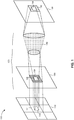
- the pixels in array 110 may be any suitable size or area, where the individual pixel size is generally substantially consistent across all pixels of the array.
- Fill factor reduction means 120 is operative to selectively reduce the active (i.e., photosensitive) region of the pixels of detector array 110, by masking or blocking a portion of the photosensitive region of the pixels from receiving radiation from the image scene, such that only a portion of the image scene pixel is imaged onto the corresponding detector array pixel. The active region and masked region of the pixels are then progressively shifted during subsequent imaging samples of the scene.
- masking region 132 may be embodied by a substantially opaque or non-transmissive portion of filter or a non-transmissive coating disposed at the required portion, whereas non-masking region 134 may be embodied by a substantially transmissive portion of filter 130, such as a window or opening thereat.
- any of the components of fill factor reduction means 120 may be fully or partially integrated with the IR imaging detector in accordance with the disclosed technique, or may be separate therefrom.
- masking filter 130 may be situated within the housing enclosing the IR detector, while optical element 140 may be situated outside of the housing, provided optical element 140 and masking filter function to implement the aforementioned masking operation of the image scene 150 onto the detector array 110.
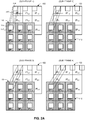
- Masking filter 130 is disposed directly on array 110, and includes nine windows (i.e., non-masking regions 134) situated on a sub-region of each of the detector pixels (DP x,y ) of detector array 110, while the remaining area of masking filter 130 is made up of masking regions 132.
- the image scene 150 is similarly divided into nine image pixels (IP x,y ) arranged in a three-by-three (3x3) matrix (i.e., each image pixel representing the region of image scene 150 that would ordinarily be projected onto a corresponding detector pixel during regular image acquisition).
- a first set of sub-frames of image scene 150 is acquired in Fig. 2A .
- the light (IR radiation) emitted from image scene 150 is directed toward detector array 110 through masking filter 130 via optical element 140 (not shown), such that only the radiation passing through the windows 134 of masking filter 130 reaches detector array 110.
- each detector pixel of detector array 110 captures a portion of a corresponding image pixel of image scene 150.
- radiation corresponding to an upper-left corner image pixel (IP 1,1 ) is directed toward a detector pixel (DP 1,1 ) situated at the upper-left corner of detector array 110.
- a portion of the radiation (154) passes through the masking filter window and is incident onto the a sub-region 114 of detector pixel DP 1,1 .
- the rest of the radiation (152) from image pixel IP 1,1 is blocked by the masking region 132, such that it does not reach detector pixel DP 1,1 . Consequently, detector pixel DP 1,1 includes an imaged region 114 and a non-imaged region 112.
- the next image pixel (IP 1,2 ) in the top row of image scene 150 reaches detector pixel DP 1,2 after passing through the masking filter window, such that only a portion of image pixel IP 1,2 is incident onto a sub-region of detector pixel DP 1,2 .
- Fill factor reduction means 120 is shown implementing an exemplary fill factor reduction of 25% (i.e., "25%FF"), denoting that each imaged region 114 occupies approximately one-quarter of the area of the respective pixel, while each non-imaged region 112 occupies an area of approximately three-quarters of the respective pixel.
- the remaining pixels (DP x,y ) of detector array 110 are imaged in an analogous manner during the first imaging sample (sub-frame), resulting in each detector pixel acquiring an imaged region 114 at its upper-left quadrant, while the remainder of the detector pixel is non-imaged.
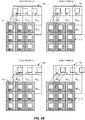
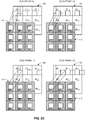
- each image pixel imaged onto detector array 110 is shifted for the subsequent imaging samples.
- the shifting increment between each imaging sample is selected in accordance with the fill factor reduction amount, and is generally equal to a fraction of the pixel width (defined as the distance between the midpoint of adjacent pixels of the detector array).
- the fill factor reduction amount is 25% (25%FF), and so the shifting increment is also selected to be 25%, or approximately one quarter of the pixel width of the detector pixels.
- the shifting may be implemented by adjusting the line-of-sight of fill factor reduction means 120 relative to detector array 110 (e.g., by suitable adjustment of masking filter 130 and/or of optical element 140).
- the line-of-sight is shifted again such that the imaged region 114 of each detector pixel DP x,y corresponds to an upper-right quadrant of the corresponding image pixel IP x,y (e.g., the imaged quadrant of "sub-frame 2" being shifted to the right by a quarter of the pixel width).
- the line-of-sight is shifted downwards by the shifting increment with respect to the first imaging sample, such that the imaged region 114 of each detector pixel DP x,y corresponds to an middle-left quadrant of the corresponding image pixel IP x,y (e.g., the imaged quadrant of "sub-frame 1" being shifted downwards by a quarter of the pixel width).
- the remaining imaging samples (“sub frame 6" through “sub-frame 16") result in additional image pixel portions being acquired (i.e., imaging a respective portion that was not acquired in a previous sub-frame).
- the line-of-sight alignment of fill factor reduction means 120 relative to detector array 110 may be successively shifted using any suitable mechanism or technique, in order to obtain the desired imaged sub-region on the detector pixels for each imaging sample.
- masking filter 130 and detector array 110 remain in a fixed position, and thus the positions of masking regions 132 and non-masking regions 134 remain stationary, while optical element 140 is successively repositioned for each imaging sample to shift the directional angle at which optical element 140 directs the radiation from image scene 150.
- masking filter 130 and detector array 110 are jointly repositioned relative to optical element 140 (i.e., where masking filter 130 remains fixed with respect to detector array 110), for adjusting the optical path of image scene 150 for each imaging sample.
- the actual size of the imaged regions on the detector pixels may be varied, such as by adjusting the characteristics of masking filter 130 (e.g., size, amount, and/or relative positions of non-masking regions 134) and/or adjusting the optical characteristics of optical element 140.
- masking filter 130 e.g., size, amount, and/or relative positions of non-masking regions 1304.
- optical element 140 e.g., optical characteristics of optical element 140.
- it is very difficult to reposition a masking filter relative to the detector array since the two components should be arranged as close as possible to one another. Consequently, a mechanism for repositioning a movable masking filter would need to be situated within the cryogenic storage dewar (vacuum flask) along with the masking filter and detector array.
- a stationary masking filter is maintained at a fixed position and orientation relative to the detector array, while the optical path of the image scene is successively adjusted relative to the stationary masking filter between imaging samples.
- the imaged sub-regions may be nonconsecutive within a given sub-frames (e.g., an upper-left quadrant and lower-right quadrant of the image pixel may be simultaneously acquired in one sub-frame, while an upper-right quadrant and lower-left quadrant of the image pixel are simultaneously acquired in a subsequent sub-frame).
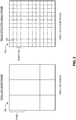
- FIG. 3 is a schematic illustration of a reconstructed image frame, referenced 164, formed from the image sub-frames of Figures 2A , 2B , 2C and 2D , compared with a regular image frame, referenced 162, of the imaging detector.
- Regular image frame 162 includes a total of 9 pixels (3x3), whereas reconstructed image frame 164 includes a total of 144 sub-pixels (12x12), providing a 16-fold increase in resolution (i.e., increasing the number of pixels by a factor of four along each of the horizontal and vertical axes).
- each individual pixel in reconstructed image frame 164 (corresponding to a pixel of image frame 162) is made up of 16 sub-pixels arranged in a 4x4 matrix.
- Each sub-pixel of reconstructed image frame 164 is formed from a combination of the respective sub-frames in which that sub-pixel was imaged.
- sub-pixel 168 of image frame 164 is formed based on sub-frames 1 and 2 ( Fig.2A ) and sub-frames 5 and 6 ( Fig.2B ), in which that particular sub-pixel portion of image scene 150 was acquired (in different configurations).
- Reconstructed image frame 164 represents a 16-fold increase in resolution with respect to image frame 162, which is an image frame that would result from regular imaging with detector array 110 (i.e., without application of the disclosed technique).
- the final image frame contains greater image detail (i.e., by a factor of sixteen) as compared to a standard image frame, as each pixel of the reconstructed image frame is made up of sixteen individual sub-pixels which provides four times the detail or information along each axis as would be contained in the corresponding pixel of the standard image frame.
- alternative resolution increase factors i.e., the amount by which the image resolution is increased
- the shifting increment may be set to be approximately one-ninth (1/9) of the detector pixel width, while each imaging sample would image a sub-region occupying an area of approximately one-ninth (1/9) of the image pixels (i.e., corresponding to a fill factor reduction factor of 1/9 or approximately 11%).
- a masking filter 130 having windows or non-masking regions 134 that are one-ninth (1/9) the size of the detector pixels may be used to provide imaging of the desired image pixel sub-region size, instead of the masking filter 130 shown in Figures 2A-2D which includes windows that are one-quarter (1/4) the detector pixel size.
- a total of 81 sub-frames would be acquired via microscanning (following a shifting increment of one-ninth (1/9) the detector pixel width between sub-frames), from which a final higher-resolution image frame can be reconstructed.
- the fill factor reduction of the detector pixels serves to reduce the overall detector sensitivity, as only a fraction of the entire radiation from the image scene reaches the detector array.
- the f-number also known as the "focal ratio", defined as the ratio between the entrance pupil diameter and the lens focal length
- the f-number decrease also provides an improved optical Modulation Transfer Function (MTF), generally representing the ability the detector to distinguish between detail in the acquired image, thereby allowing the detector to support the enhanced spatial resolution of the reconstructed image frame.
- MTF optical Modulation Transfer Function
- the disclosed technique enhances the performance of the IR imaging detector by essentially reducing the detector sensitivity (by reducing the fill factor) and compensating for this reduction by providing suitable detector optics that will provide an adequate level of overall sensitivity together with a substantially higher image spatial resolution
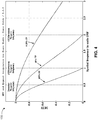
- FIG. 4 is a schematic illustration of a graph, generally referenced 170, showing Modulation Transfer Function (MTF) as a function of spatial frequency for different fill factor reduction amounts in accordance with the disclosed technique.
- Graph 170 depicts the detector MTF as a function of spatial frequency or "detector sampling frequency" (corresponding to a normalized representation of the spatial resolution).
- detector sampling frequency corresponding to a normalized representation of the spatial resolution.
- the potential fill factor reduction amount (and thus the potential resolution increase) that can actually be implemented for a given imaging detector is generally limited by opto-mechanical design constraints. Such limitations in the ability to design and manufacture the suitable high resolution optics may vary according to particular system design and requirements.
- fill factor reduction means 120 may be implemented using any suitable device, mechanism or technique operative for reducing the fill factor of the detector pixels by the desired amount.
- fill factor reduction means 120 may alternatively be implemented by only a masking filter, which is successively repositioned and/or reoriented to obtain different imaging samples, or by only an optical element, which adjusts the optical path of the radiation from the image scene 150 over successive increments for each imaging sample.
- fill factor reduction means 120 may be implemented by configuring detector array 110 such that the active (photosensitive) region of the pixels is less than the potentially maximum active region.
- the pixels may be electronically configured such that only a selected sub-pixel region is active during each imaging sample.
- the disclosed technique is applicable to all types of IR detectors, operative anywhere within the wavelength range of approximately 1-15 ⁇ m, encompassing LWIR, MWIR and SWIR wavelengths.
- the disclosed technique is particularly applicable to thermal imaging cameras, and particularly vacuum-sealed and cryogenically-cooled thermal imagers, where the term "cryogenically-cooled” as used herein encompasses different types of low-temperature detectors, including those operating at temperatures above what may be considered cryogenic temperatures under some definitions (for example, including temperatures between approximately -150°C (123K) and approximately -120°C (153K)).
Landscapes
- Engineering & Computer Science (AREA)
- Multimedia (AREA)
- Signal Processing (AREA)
- Physics & Mathematics (AREA)
- General Physics & Mathematics (AREA)
- Spectroscopy & Molecular Physics (AREA)
- Health & Medical Sciences (AREA)
- Toxicology (AREA)
- Transforming Light Signals Into Electric Signals (AREA)
- Studio Devices (AREA)
- Photometry And Measurement Of Optical Pulse Characteristics (AREA)
Priority Applications (1)
| Application Number | Priority Date | Filing Date | Title |
|---|---|---|---|
| PL13729475T PL2837173T3 (pl) | 2012-05-13 | 2013-05-05 | Detektor podczerwieni ze zwiększoną rozdzielczością obrazu |
Applications Claiming Priority (2)
| Application Number | Priority Date | Filing Date | Title |
|---|---|---|---|
| IL219773A IL219773A (en) | 2012-05-13 | 2012-05-13 | Device and method for increasing the resolution of vacuum-based infrared imaging detectors and cryogenic coolers |
| PCT/IL2013/050380 WO2013171738A1 (en) | 2012-05-13 | 2013-05-05 | Infrared detector with increased image resolution |
Publications (2)
| Publication Number | Publication Date |
|---|---|
| EP2837173A1 EP2837173A1 (en) | 2015-02-18 |
| EP2837173B1 true EP2837173B1 (en) | 2017-03-22 |
Family
ID=48628762
Family Applications (1)
| Application Number | Title | Priority Date | Filing Date |
|---|---|---|---|
| EP13729475.7A Active EP2837173B1 (en) | 2012-05-13 | 2013-05-05 | Infrared detector with increased image resolution |
Country Status (11)
| Country | Link |
|---|---|
| US (2) | US9894292B2 (enExample) |
| EP (1) | EP2837173B1 (enExample) |
| JP (1) | JP6083833B2 (enExample) |
| KR (1) | KR102043325B1 (enExample) |
| BR (1) | BR112014028169B1 (enExample) |
| CA (1) | CA2873196C (enExample) |
| ES (1) | ES2626070T3 (enExample) |
| IL (1) | IL219773A (enExample) |
| PL (1) | PL2837173T3 (enExample) |
| SG (1) | SG11201407311RA (enExample) |
| WO (1) | WO2013171738A1 (enExample) |
Families Citing this family (9)
| Publication number | Priority date | Publication date | Assignee | Title |
|---|---|---|---|---|
| IL219773A (en) * | 2012-05-13 | 2015-09-24 | Elbit Sys Electro Optics Elop | Device and method for increasing the resolution of vacuum-based infrared imaging detectors and cryogenic coolers |
| JP6361965B2 (ja) * | 2013-10-24 | 2018-07-25 | パナソニックIpマネジメント株式会社 | 撮像システム、撮像装置、符号化装置、および撮像方法 |
| KR102357965B1 (ko) * | 2015-01-12 | 2022-02-03 | 삼성전자주식회사 | 객체 인식 방법 및 장치 |
| CN105547490B (zh) * | 2015-12-08 | 2019-01-25 | 中国科学院上海技术物理研究所 | 一种数字tdi红外探测器的实时盲元检测方法 |
| EP4111179A4 (en) * | 2020-02-27 | 2023-11-15 | Shenzhen Xpectvision Technology Co., Ltd. | IMAGING SYSTEM |
| IL274418B (en) * | 2020-05-03 | 2021-12-01 | Elbit Systems Electro Optics Elop Ltd | Systems and methods for enhanced motion detection, objective tracking, situational awareness and super-resolution video using microscanning images |
| US11651474B2 (en) | 2020-11-04 | 2023-05-16 | Bae Systems Information And Electronic Systems Integration Inc. | Real-time super resolution at long standoff ranges |
| CN115546486A (zh) * | 2022-10-17 | 2022-12-30 | 深圳市元视芯智能科技有限公司 | 仿生视觉传感器、成像方法以及无人机图传系统 |
| US12483804B2 (en) * | 2023-12-08 | 2025-11-25 | Varjo Technologies Oy | Subsampling and wobulation in colour filter arrays having smallest repeating units with different sub-units |
Family Cites Families (17)
| Publication number | Priority date | Publication date | Assignee | Title |
|---|---|---|---|---|
| JPS61264874A (ja) * | 1985-05-20 | 1986-11-22 | Fujitsu General Ltd | 固体撮像装置 |
| JPH0682305A (ja) | 1992-08-31 | 1994-03-22 | Shimadzu Corp | 2次元検出器 |
| US5371369A (en) * | 1993-10-13 | 1994-12-06 | Litton Systems, Inc. | Conformal cold baffle for optical imaging systems |
| CA2135676A1 (en) | 1994-11-14 | 1996-05-15 | Jean Dumas | Device to enhance imaging resolution |
| US6005682A (en) | 1995-06-07 | 1999-12-21 | Xerox Corporation | Resolution enhancement by multiple scanning with a low-resolution, two-dimensional sensor array |
| AUPO615297A0 (en) | 1997-04-10 | 1997-05-08 | Commonwealth Scientific And Industrial Research Organisation | Imaging system and method |
| JPH11331857A (ja) * | 1998-05-13 | 1999-11-30 | Mitsubishi Electric Corp | 撮像装置 |
| EP1198119A3 (en) | 2000-10-11 | 2004-05-26 | Charles E. Parsons | Improved resolution for an electric image sensor array |
| US7283231B2 (en) * | 2004-07-20 | 2007-10-16 | Duke University | Compressive sampling and signal inference |
| JP5000395B2 (ja) * | 2007-06-26 | 2012-08-15 | オリンパス株式会社 | 撮像表示方法および撮像表示装置 |
| GB2462137B (en) * | 2008-06-25 | 2013-01-23 | Thales Holdings Uk Plc | Imaging apparatus and method |
| JP4494505B1 (ja) * | 2009-02-13 | 2010-06-30 | シャープ株式会社 | 画像処理装置、撮像装置、画像処理方法、画像処理プログラムおよび記録媒体 |
| US9291506B2 (en) * | 2010-01-27 | 2016-03-22 | Ci Systems Ltd. | Room-temperature filtering for passive infrared imaging |
| JP5341010B2 (ja) * | 2010-04-15 | 2013-11-13 | オリンパス株式会社 | 画像処理装置、撮像装置、プログラム及び画像処理方法 |
| US8866951B2 (en) * | 2011-08-24 | 2014-10-21 | Aptina Imaging Corporation | Super-resolution imaging systems |
| US10110834B2 (en) * | 2011-11-07 | 2018-10-23 | Raytheon Company | Hadamard enhanced sensors |
| IL219773A (en) * | 2012-05-13 | 2015-09-24 | Elbit Sys Electro Optics Elop | Device and method for increasing the resolution of vacuum-based infrared imaging detectors and cryogenic coolers |
-
2012
- 2012-05-13 IL IL219773A patent/IL219773A/en active IP Right Grant
-
2013
- 2013-05-05 EP EP13729475.7A patent/EP2837173B1/en active Active
- 2013-05-05 ES ES13729475.7T patent/ES2626070T3/es active Active
- 2013-05-05 WO PCT/IL2013/050380 patent/WO2013171738A1/en not_active Ceased
- 2013-05-05 KR KR1020147035168A patent/KR102043325B1/ko active Active
- 2013-05-05 US US13/978,054 patent/US9894292B2/en not_active Expired - Fee Related
- 2013-05-05 JP JP2015512193A patent/JP6083833B2/ja active Active
- 2013-05-05 CA CA2873196A patent/CA2873196C/en active Active
- 2013-05-05 PL PL13729475T patent/PL2837173T3/pl unknown
- 2013-05-05 SG SG11201407311RA patent/SG11201407311RA/en unknown
- 2013-05-05 BR BR112014028169-6A patent/BR112014028169B1/pt active IP Right Grant
-
2018
- 2018-01-10 US US15/866,799 patent/US10547799B2/en active Active
Also Published As
| Publication number | Publication date |
|---|---|
| IL219773A (en) | 2015-09-24 |
| WO2013171738A1 (en) | 2013-11-21 |
| SG11201407311RA (en) | 2014-12-30 |
| JP6083833B2 (ja) | 2017-02-22 |
| US20180160056A1 (en) | 2018-06-07 |
| KR20150013795A (ko) | 2015-02-05 |
| ES2626070T3 (es) | 2017-07-21 |
| BR112014028169B1 (pt) | 2023-04-04 |
| CA2873196C (en) | 2019-02-19 |
| KR102043325B1 (ko) | 2019-12-02 |
| EP2837173A1 (en) | 2015-02-18 |
| PL2837173T3 (pl) | 2017-08-31 |
| US9894292B2 (en) | 2018-02-13 |
| CA2873196A1 (en) | 2013-11-21 |
| JP2015519567A (ja) | 2015-07-09 |
| BR112014028169A2 (pt) | 2020-05-05 |
| AU2013261047A1 (en) | 2014-12-04 |
| US20140139684A1 (en) | 2014-05-22 |
| US10547799B2 (en) | 2020-01-28 |
Similar Documents
| Publication | Publication Date | Title |
|---|---|---|
| EP2837173B1 (en) | Infrared detector with increased image resolution | |
| US12147001B2 (en) | Apparatus and method for capturing still images and video using diffraction coded imaging techniques | |
| EP1856710B1 (en) | Apparatus and method for capturing still images and video using coded lens imaging techniques | |
| US8937639B2 (en) | Interlaced focal plane array for wide-area surveillance | |
| WO2010048618A1 (en) | Systems and methods for high resolution imaging | |
| US11861849B2 (en) | Systems and methods for enhanced motion detection, object tracking, situational awareness and super resolution video using microscanned images | |
| US5291327A (en) | Imaging system using focal plane array | |
| US6642497B1 (en) | System for improving image resolution via sensor rotation | |
| Portnoy et al. | Design and characterization of thin multiple aperture infrared cameras | |
| Ben-Ezra | A digital gigapixel large-format tile-scan camera | |
| AU2013261047B2 (en) | Infrared detector with increased image resolution | |
| Göttfert et al. | Optimizing microscan for radiometry with cooled IR cameras | |
| GB2428926A (en) | Imaging device including a pixel sensor array and scene radiation focusing and dislplacement means | |
| Sims et al. | A CMOS visible image sensor with non-destructive readout capability | |
| Greiner et al. | Resolution performance improvements in staring imaging systems using micro-scanning and a reticulated, selectable fill factor InSb FPA | |
| Portnoy et al. | Resolution and interpolation of multichannel long wave infrared camera data | |
| Patel et al. | SPITFIRE multi-band short-wave and mid-wave polarimetric camera | |
| Gilmore | The Large Synoptic Survey Telescope | |
| HK1108970A (en) | Apparatus and method for capturing still images and video using coded lens imaging techniques | |
| HK1108970B (en) | Apparatus and method for capturing still images and video using coded lens imaging techniques |
Legal Events
| Date | Code | Title | Description |
|---|---|---|---|
| PUAI | Public reference made under article 153(3) epc to a published international application that has entered the european phase |
Free format text: ORIGINAL CODE: 0009012 |
|
| 17P | Request for examination filed |
Effective date: 20141113 |
|
| AK | Designated contracting states |
Kind code of ref document: A1 Designated state(s): AL AT BE BG CH CY CZ DE DK EE ES FI FR GB GR HR HU IE IS IT LI LT LU LV MC MK MT NL NO PL PT RO RS SE SI SK SM TR |
|
| AX | Request for extension of the european patent |
Extension state: BA ME |
|
| DAX | Request for extension of the european patent (deleted) | ||
| 17Q | First examination report despatched |
Effective date: 20160301 |
|
| GRAP | Despatch of communication of intention to grant a patent |
Free format text: ORIGINAL CODE: EPIDOSNIGR1 |
|
| INTG | Intention to grant announced |
Effective date: 20161025 |
|
| STAA | Information on the status of an ep patent application or granted ep patent |
Free format text: STATUS: GRANT OF PATENT IS INTENDED |
|
| GRAS | Grant fee paid |
Free format text: ORIGINAL CODE: EPIDOSNIGR3 |
|
| GRAA | (expected) grant |
Free format text: ORIGINAL CODE: 0009210 |
|
| STAA | Information on the status of an ep patent application or granted ep patent |
Free format text: STATUS: THE PATENT HAS BEEN GRANTED |
|
| AK | Designated contracting states |
Kind code of ref document: B1 Designated state(s): AL AT BE BG CH CY CZ DE DK EE ES FI FR GB GR HR HU IE IS IT LI LT LU LV MC MK MT NL NO PL PT RO RS SE SI SK SM TR |
|
| REG | Reference to a national code |
Ref country code: GB Ref legal event code: FG4D |
|
| REG | Reference to a national code |
Ref country code: CH Ref legal event code: EP |
|
| REG | Reference to a national code |
Ref country code: AT Ref legal event code: REF Ref document number: 878770 Country of ref document: AT Kind code of ref document: T Effective date: 20170415 |
|
| REG | Reference to a national code |
Ref country code: IE Ref legal event code: FG4D |
|
| REG | Reference to a national code |
Ref country code: DE Ref legal event code: R096 Ref document number: 602013018883 Country of ref document: DE |
|
| REG | Reference to a national code |
Ref country code: FR Ref legal event code: PLFP Year of fee payment: 5 |
|
| REG | Reference to a national code |
Ref country code: NL Ref legal event code: FP |
|
| REG | Reference to a national code |
Ref country code: SE Ref legal event code: TRGR |
|
| REG | Reference to a national code |
Ref country code: NO Ref legal event code: T2 Effective date: 20170322 |
|
| REG | Reference to a national code |
Ref country code: ES Ref legal event code: FG2A Ref document number: 2626070 Country of ref document: ES Kind code of ref document: T3 Effective date: 20170721 |
|
| PG25 | Lapsed in a contracting state [announced via postgrant information from national office to epo] |
Ref country code: HR Free format text: LAPSE BECAUSE OF FAILURE TO SUBMIT A TRANSLATION OF THE DESCRIPTION OR TO PAY THE FEE WITHIN THE PRESCRIBED TIME-LIMIT Effective date: 20170322 Ref country code: LT Free format text: LAPSE BECAUSE OF FAILURE TO SUBMIT A TRANSLATION OF THE DESCRIPTION OR TO PAY THE FEE WITHIN THE PRESCRIBED TIME-LIMIT Effective date: 20170322 Ref country code: GR Free format text: LAPSE BECAUSE OF FAILURE TO SUBMIT A TRANSLATION OF THE DESCRIPTION OR TO PAY THE FEE WITHIN THE PRESCRIBED TIME-LIMIT Effective date: 20170623 |
|
| REG | Reference to a national code |
Ref country code: LT Ref legal event code: MG4D |
|
| REG | Reference to a national code |
Ref country code: AT Ref legal event code: MK05 Ref document number: 878770 Country of ref document: AT Kind code of ref document: T Effective date: 20170322 |
|
| PG25 | Lapsed in a contracting state [announced via postgrant information from national office to epo] |
Ref country code: LU Free format text: LAPSE BECAUSE OF NON-PAYMENT OF DUE FEES Effective date: 20170531 Ref country code: LV Free format text: LAPSE BECAUSE OF FAILURE TO SUBMIT A TRANSLATION OF THE DESCRIPTION OR TO PAY THE FEE WITHIN THE PRESCRIBED TIME-LIMIT Effective date: 20170322 Ref country code: BG Free format text: LAPSE BECAUSE OF FAILURE TO SUBMIT A TRANSLATION OF THE DESCRIPTION OR TO PAY THE FEE WITHIN THE PRESCRIBED TIME-LIMIT Effective date: 20170622 Ref country code: RS Free format text: LAPSE BECAUSE OF FAILURE TO SUBMIT A TRANSLATION OF THE DESCRIPTION OR TO PAY THE FEE WITHIN THE PRESCRIBED TIME-LIMIT Effective date: 20170322 |
|
| PG25 | Lapsed in a contracting state [announced via postgrant information from national office to epo] |
Ref country code: SK Free format text: LAPSE BECAUSE OF FAILURE TO SUBMIT A TRANSLATION OF THE DESCRIPTION OR TO PAY THE FEE WITHIN THE PRESCRIBED TIME-LIMIT Effective date: 20170322 Ref country code: RO Free format text: LAPSE BECAUSE OF FAILURE TO SUBMIT A TRANSLATION OF THE DESCRIPTION OR TO PAY THE FEE WITHIN THE PRESCRIBED TIME-LIMIT Effective date: 20170322 Ref country code: EE Free format text: LAPSE BECAUSE OF FAILURE TO SUBMIT A TRANSLATION OF THE DESCRIPTION OR TO PAY THE FEE WITHIN THE PRESCRIBED TIME-LIMIT Effective date: 20170322 Ref country code: CZ Free format text: LAPSE BECAUSE OF FAILURE TO SUBMIT A TRANSLATION OF THE DESCRIPTION OR TO PAY THE FEE WITHIN THE PRESCRIBED TIME-LIMIT Effective date: 20170322 Ref country code: AT Free format text: LAPSE BECAUSE OF FAILURE TO SUBMIT A TRANSLATION OF THE DESCRIPTION OR TO PAY THE FEE WITHIN THE PRESCRIBED TIME-LIMIT Effective date: 20170322 |
|
| PG25 | Lapsed in a contracting state [announced via postgrant information from national office to epo] |
Ref country code: IS Free format text: LAPSE BECAUSE OF FAILURE TO SUBMIT A TRANSLATION OF THE DESCRIPTION OR TO PAY THE FEE WITHIN THE PRESCRIBED TIME-LIMIT Effective date: 20170722 Ref country code: PT Free format text: LAPSE BECAUSE OF FAILURE TO SUBMIT A TRANSLATION OF THE DESCRIPTION OR TO PAY THE FEE WITHIN THE PRESCRIBED TIME-LIMIT Effective date: 20170724 Ref country code: SM Free format text: LAPSE BECAUSE OF FAILURE TO SUBMIT A TRANSLATION OF THE DESCRIPTION OR TO PAY THE FEE WITHIN THE PRESCRIBED TIME-LIMIT Effective date: 20170322 |
|
| REG | Reference to a national code |
Ref country code: CH Ref legal event code: PL |
|
| REG | Reference to a national code |
Ref country code: DE Ref legal event code: R097 Ref document number: 602013018883 Country of ref document: DE |
|
| PLBE | No opposition filed within time limit |
Free format text: ORIGINAL CODE: 0009261 |
|
| STAA | Information on the status of an ep patent application or granted ep patent |
Free format text: STATUS: NO OPPOSITION FILED WITHIN TIME LIMIT |
|
| PG25 | Lapsed in a contracting state [announced via postgrant information from national office to epo] |
Ref country code: MC Free format text: LAPSE BECAUSE OF FAILURE TO SUBMIT A TRANSLATION OF THE DESCRIPTION OR TO PAY THE FEE WITHIN THE PRESCRIBED TIME-LIMIT Effective date: 20170322 Ref country code: DK Free format text: LAPSE BECAUSE OF FAILURE TO SUBMIT A TRANSLATION OF THE DESCRIPTION OR TO PAY THE FEE WITHIN THE PRESCRIBED TIME-LIMIT Effective date: 20170322 |
|
| REG | Reference to a national code |
Ref country code: IE Ref legal event code: MM4A |
|
| 26N | No opposition filed |
Effective date: 20180102 |
|
| PG25 | Lapsed in a contracting state [announced via postgrant information from national office to epo] |
Ref country code: LI Free format text: LAPSE BECAUSE OF NON-PAYMENT OF DUE FEES Effective date: 20170531 Ref country code: CH Free format text: LAPSE BECAUSE OF NON-PAYMENT OF DUE FEES Effective date: 20170531 Ref country code: SI Free format text: LAPSE BECAUSE OF FAILURE TO SUBMIT A TRANSLATION OF THE DESCRIPTION OR TO PAY THE FEE WITHIN THE PRESCRIBED TIME-LIMIT Effective date: 20170322 |
|
| PG25 | Lapsed in a contracting state [announced via postgrant information from national office to epo] |
Ref country code: LU Free format text: LAPSE BECAUSE OF NON-PAYMENT OF DUE FEES Effective date: 20170505 |
|
| REG | Reference to a national code |
Ref country code: BE Ref legal event code: MM Effective date: 20170531 |
|
| PG25 | Lapsed in a contracting state [announced via postgrant information from national office to epo] |
Ref country code: IE Free format text: LAPSE BECAUSE OF NON-PAYMENT OF DUE FEES Effective date: 20170505 |
|
| REG | Reference to a national code |
Ref country code: FR Ref legal event code: PLFP Year of fee payment: 6 |
|
| PG25 | Lapsed in a contracting state [announced via postgrant information from national office to epo] |
Ref country code: BE Free format text: LAPSE BECAUSE OF NON-PAYMENT OF DUE FEES Effective date: 20170531 |
|
| PG25 | Lapsed in a contracting state [announced via postgrant information from national office to epo] |
Ref country code: MT Free format text: LAPSE BECAUSE OF NON-PAYMENT OF DUE FEES Effective date: 20170505 |
|
| PG25 | Lapsed in a contracting state [announced via postgrant information from national office to epo] |
Ref country code: HU Free format text: LAPSE BECAUSE OF FAILURE TO SUBMIT A TRANSLATION OF THE DESCRIPTION OR TO PAY THE FEE WITHIN THE PRESCRIBED TIME-LIMIT; INVALID AB INITIO Effective date: 20130505 |
|
| PG25 | Lapsed in a contracting state [announced via postgrant information from national office to epo] |
Ref country code: CY Free format text: LAPSE BECAUSE OF FAILURE TO SUBMIT A TRANSLATION OF THE DESCRIPTION OR TO PAY THE FEE WITHIN THE PRESCRIBED TIME-LIMIT Effective date: 20170322 |
|
| PG25 | Lapsed in a contracting state [announced via postgrant information from national office to epo] |
Ref country code: MK Free format text: LAPSE BECAUSE OF FAILURE TO SUBMIT A TRANSLATION OF THE DESCRIPTION OR TO PAY THE FEE WITHIN THE PRESCRIBED TIME-LIMIT Effective date: 20170322 |
|
| PG25 | Lapsed in a contracting state [announced via postgrant information from national office to epo] |
Ref country code: TR Free format text: LAPSE BECAUSE OF FAILURE TO SUBMIT A TRANSLATION OF THE DESCRIPTION OR TO PAY THE FEE WITHIN THE PRESCRIBED TIME-LIMIT Effective date: 20170322 |
|
| PG25 | Lapsed in a contracting state [announced via postgrant information from national office to epo] |
Ref country code: AL Free format text: LAPSE BECAUSE OF FAILURE TO SUBMIT A TRANSLATION OF THE DESCRIPTION OR TO PAY THE FEE WITHIN THE PRESCRIBED TIME-LIMIT Effective date: 20170322 |
|
| REG | Reference to a national code |
Ref country code: FR Ref legal event code: PLFP Year of fee payment: 11 |
|
| PGFP | Annual fee paid to national office [announced via postgrant information from national office to epo] |
Ref country code: SE Payment date: 20250310 Year of fee payment: 13 |
|
| PGFP | Annual fee paid to national office [announced via postgrant information from national office to epo] |
Ref country code: NL Payment date: 20250317 Year of fee payment: 13 |
|
| PGFP | Annual fee paid to national office [announced via postgrant information from national office to epo] |
Ref country code: FR Payment date: 20250310 Year of fee payment: 13 Ref country code: PL Payment date: 20250312 Year of fee payment: 13 |
|
| PGFP | Annual fee paid to national office [announced via postgrant information from national office to epo] |
Ref country code: GB Payment date: 20250313 Year of fee payment: 13 |
|
| PGFP | Annual fee paid to national office [announced via postgrant information from national office to epo] |
Ref country code: FI Payment date: 20250513 Year of fee payment: 13 |
|
| PGFP | Annual fee paid to national office [announced via postgrant information from national office to epo] |
Ref country code: DE Payment date: 20250311 Year of fee payment: 13 |
|
| PGFP | Annual fee paid to national office [announced via postgrant information from national office to epo] |
Ref country code: ES Payment date: 20250603 Year of fee payment: 13 |
|
| PGFP | Annual fee paid to national office [announced via postgrant information from national office to epo] |
Ref country code: NO Payment date: 20250509 Year of fee payment: 13 |
|
| PGFP | Annual fee paid to national office [announced via postgrant information from national office to epo] |
Ref country code: IT Payment date: 20250422 Year of fee payment: 13 |