EP2825977B1 - System and method for analysis and reconstruction of variable pulse-width signals having low sampling rates - Google Patents
System and method for analysis and reconstruction of variable pulse-width signals having low sampling rates Download PDFInfo
- Publication number
- EP2825977B1 EP2825977B1 EP13713010.0A EP13713010A EP2825977B1 EP 2825977 B1 EP2825977 B1 EP 2825977B1 EP 13713010 A EP13713010 A EP 13713010A EP 2825977 B1 EP2825977 B1 EP 2825977B1
- Authority
- EP
- European Patent Office
- Prior art keywords
- parameters
- time domain
- processor
- coefficients
- dft
- Prior art date
- Legal status (The legal status is an assumption and is not a legal conclusion. Google has not performed a legal analysis and makes no representation as to the accuracy of the status listed.)
- Not-in-force
Links
Images




Classifications
-
- G—PHYSICS
- G06—COMPUTING OR CALCULATING; COUNTING
- G06F—ELECTRIC DIGITAL DATA PROCESSING
- G06F17/00—Digital computing or data processing equipment or methods, specially adapted for specific functions
- G06F17/10—Complex mathematical operations
- G06F17/14—Fourier, Walsh or analogous domain transformations, e.g. Laplace, Hilbert, Karhunen-Loeve, transforms
- G06F17/141—Discrete Fourier transforms
-
- A—HUMAN NECESSITIES
- A61—MEDICAL OR VETERINARY SCIENCE; HYGIENE
- A61B—DIAGNOSIS; SURGERY; IDENTIFICATION
- A61B5/00—Measuring for diagnostic purposes; Identification of persons
- A61B5/0002—Remote monitoring of patients using telemetry, e.g. transmission of vital signals via a communication network
- A61B5/0004—Remote monitoring of patients using telemetry, e.g. transmission of vital signals via a communication network characterised by the type of physiological signal transmitted
- A61B5/0006—ECG or EEG signals
-
- A—HUMAN NECESSITIES
- A61—MEDICAL OR VETERINARY SCIENCE; HYGIENE
- A61B—DIAGNOSIS; SURGERY; IDENTIFICATION
- A61B5/00—Measuring for diagnostic purposes; Identification of persons
- A61B5/24—Detecting, measuring or recording bioelectric or biomagnetic signals of the body or parts thereof
- A61B5/316—Modalities, i.e. specific diagnostic methods
- A61B5/318—Heart-related electrical modalities, e.g. electrocardiography [ECG]
- A61B5/346—Analysis of electrocardiograms
- A61B5/347—Detecting the frequency distribution of signals
-
- A—HUMAN NECESSITIES
- A61—MEDICAL OR VETERINARY SCIENCE; HYGIENE
- A61B—DIAGNOSIS; SURGERY; IDENTIFICATION
- A61B5/00—Measuring for diagnostic purposes; Identification of persons
- A61B5/72—Signal processing specially adapted for physiological signals or for diagnostic purposes
- A61B5/7235—Details of waveform analysis
- A61B5/7253—Details of waveform analysis characterised by using transforms
- A61B5/7257—Details of waveform analysis characterised by using transforms using Fourier transforms
Definitions
- This disclosure relates to systems and methods for applying a predefined functional shape to coefficients of a discrete Fourier transform of a waveform.
- Signal parameterization is widely used in signal processing, storage, transmission, and analysis. Perhaps the most common is the use of Nyquist rate sampling, where a continuous time domain signal is represented by a set of sampled signal values at discrete times. As long as the original continuous signal is band limited to at most half the sampling rate, the set of samples can be used to reconstruct the complete signal by using, for example, a sinc interpolation algorithm, see also Abdelaziz Ouamri, Amine N.-Ali: ECG compression method using Lorentzian functions model; Digital Signal Processing, vol 17, no. 1,2, December 2006, pages 319-326 . In this common example, the signal is represented by a set of discrete parameters, the sample values, which can be stored, transmitted, and used at any time to completely reconstruct the original signal.
- Dirac-FRI models are limited to two parameters for pulse descriptions, an amplitude and a position within a period (for pseudo-periodic signals), and they are restricted to a single pulse shape for reconstruction. Thus these models are limited in their ability to parameterize signals containing pulses of varying widths.
- the systems, methods, and devices of the invention each have several aspects, no single one of which is solely responsible for its desirable attributes. Without limiting the scope of this invention as expressed by the claims which follow, some features will now be discussed briefly. After considering this discussion, and particularly after reading the section entitled "Detailed Description" one will understand how the features of this invention provide advantages that include models for defining and parameterizing signals or system responses containing pulses of varying width.
- the parameters may define the signal and therefore can be used as a compressed version of the original signal. Storage of the parameters as a compressed version of the signal requires less storage space, making storage of signals more memory efficient.
- a computer implemented method of reconstructing a time domain waveform from a compressed original time domain waveform comprises receiving, by a processor, parameters defining a compressed form of the original time domain waveform, generating, with the processor, discrete Fourier transform (DFT) coefficients from the parameters, adjusting, with the processor, the amplitudes of at least some of the generated DFT coefficients to more closely fit the amplitudes of at least some of the generated DFT coefficients to a predefined functional shape, performing, with the processor, an inverse discrete Fourier transform (IDFT) on a set of DFT coefficients including the adjusted DFT coefficients to produce a reconstructed time domain waveform.
- the predefined functional shape is parabolic on a logarithmic scale.
- the waveform is based, at least on part, on an electro-cardiogram (ECG).
- ECG electro-cardiogram
- the parameters are derived from time domain samples of an original signal, and the time domains samples may be spaced at less than 120 Hz.
- an processing apparatus comprises a memory having stored therein parameters defining a compressed form of an original time domain waveform, a processor configured to retrieve parameters, generate discrete Fourier transform (DFT) coefficients from the parameters, and adjust the amplitudes of at least some of the generated DFT coefficients to more closely fit the amplitudes of the at least some of the generated DFT coefficients to a predefined functional shape.
- the processor is also configured toperform an inverse discrete Fourier transform (IDFT) on a set of DFT coefficients including the adjusted DFT coefficients to produce a reconstructed time domain waveform.
- IDFT inverse discrete Fourier transform
- a non-transitory, computer readable medium which comprises instructions that when executed cause a processor to perform a method comprising receivingving, in the processor, parameters defining a compressed form of an original time domain waveform, generating, with the processor, discrete Fourier transform (DFT) coefficients from the parameters, adjusting, with the processor, the amplitudes of at least some of the generated DFT coefficients to more closely fit the amplitudes of at least some of the generated DFT coefficients to a predefined functional shape, performing, with the processor, an inverse discrete Fourier transform (IDFT) on a set of DFT coefficients including the adjusted DFT coefficients to produce a reconstructed time domain waveform.
- DFT discrete Fourier transform
- the methods of the present disclosure may be applicable to a variety of systems.
- the present disclosure may be particularly applicable to signal storage databases such as electro-cardiogram (ECG) databases.
- ECG electro-cardiogram
- the methods herein may be used to parameterize ECG signals and then store those parameters in an ECG database. This may greatly reduce the cost and resources required for storing ECG signals as the memory allocation required to store the data is greatly reduced.
- ECG signal databases provide information used for evaluation and treatment of patients. Further, hospitals may require such ECG databases as part of storage of patient medical records. Thus, the systems and methods described herein may prove valuable to the medical field.
- the disclosure defines the means for performing the analysis to estimate these parameters from the data. It generalizes the model of FRI to a four-parameter pulse model which can represent waveforms as the sum of overlapping pulses (defined by complex poles in the model), each of which is characterized by a position, symmetric component amplitude, asymmetric component amplitude, and width.
- the added degrees of freedom provided by this generalization greatly extend the range and class of signals that can be modeled and it permits the representation of overlapping of pulses rather than concatenations of waveform segments.
- Signals that approximate the parameterization model described herein may be referred to as Variable Pulse-Width Finite Rate of Information (i.e. the VPW-FRI) signals.
- VPW-FRI Variable Pulse-Width Finite Rate of Information
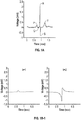
- An example of this class of signals is the heart beat in an ECG waveform as illustrated in Fig. 1A .
- the structure of a heart beat is defined by its P Q R S T components. The location, size, and shape of these components convey critical information about the physical operation of the heart.
- the waveform may be modeled as a sum of Lorentzian (also known as Cauchy distribution) pulses, each of which includes a symmetric and an asymmetric component:
- Lorentzian also known as Cauchy distribution
- the waveform is considered to be formed from K pulses, each one denoted by an index k, and each one of which is defined by a center position t k , a width or damping factor a k , an amplitude for a symmetric pulse component c k , and an amplitude for an asymmetric pulse component d k .
- the number of Lorentzian pulses used to model a signal will depend on the nature of the signal.
- the asymmetric amplitude d k can be set to zero, which reduces the number of parameters used to model the waveform. This is possible with the ECG waveforms, but the results in general are less accurate.
- Figure 1B illustrates five Lorentzian pulses of the form set forth in Equation 1 whose parameters were extracted from the original waveform of Figure 1A using the methods described below.
- the sum of the pulses in Figure 1B is shown in Figure 1C .
- Figure 1C is a good reproduction of the original signal of Figure 1A .
- the signal from Figure 1A is accurately parameterized by 20 parameters, four parameters (c, d, a, and t) for each of the five Lorentzian pulses of Figure 1B and Equation 1.
- a method is required to derive the desired parameters from the original time domain data, which is typically a series of discrete waveform samples taken during the acquisition of an analog electrical signal output from electrodes coupled to a subject.
- the sampling rate may vary, but may be about 120-360 Hz, producing about 100-500 time domain samples of the waveform over the approximately 0.75 to 1.5 second time period of interest containing the P, Q, R, S, and T waveform features. It will be appreciated that parameterizing the waveform to 20 parameter values instead of the 100-500 original waveform sample values can produce a compression of the data by a factor of 5-25.
- FIG. 2 is a flow diagram of one method of signal analysis for deriving the VPW-FRI parameters in the frequency domain.
- the method starts at block 210, where a discrete Fourier transform (DFT) is performed on the original time domain samples.
- DFT discrete Fourier transform
- the method continues at block 212, where a set of MM positive frequency DFT coefficients are selected for further analysis to extract the above described pulse parameters.
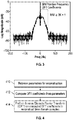
- Figure 3 shows an ECG frequency spectrum produced from a DFT algorithm applied to a time domain ECG waveform sampled at 360 Hz.
- a spectrum typically includes a region of decaying oscillations around 0 Hz and a transition region where the spectral energy decreases with increasing frequency to 60 or 70 Hz.
- a noise floor of around -70 dB can also be seen in Figure 3 at frequencies above about 70 Hz.
- the details of the ECG waveform affect the frequencies and decay rate in the oscillating region, and the details of the shape of the transition region.
- the set of MM DFT coefficients selected for analysis is on the positive side of 0 Hz, and includes at least 2K+1 adjacent DFT coefficient values.
- positive frequency coefficients are selected because the set of coefficients cannot span across 0 Hz due to the methods used to perform the extraction as described further below.
- the selected set of coefficients should include the oscillating region from near 0 Hz and extend to cover at least some of the transition region as well.
- the pulse width and pulse location parameters a k and t k are calculated from at least some of the selected DFT coefficients.
- the method assumes that the DFT of block 210 was generated from a sampled time domain signal having the functional form of Equation 1.
- ⁇ j 2 ⁇ / ⁇ t k m f o r m ⁇ N 2 ... ,0, ... N 2 ⁇ 1
- an annihilating filter can be constructed having roots related to the parameters a k and t k .
- Techniques for solving this mathematical problem of deriving the parameters of a sampled (and possibly noisy) signal, where the signal is a sum of exponentially damped oscillations have been developed and are well known. For example, spectral analysis techniques such as the Prony algorithm are known that can construct the annihilating polynomial and find its roots. Other spectral analysis techniques can also be used to find the roots of the annihilation polynomial such as ESPRIT. Such techniques have been used for similar purposes such as the Dirac-FRI methods mentioned above.
- z k
- the symmetric and asymmetric amplitude parameters are extracted using a linear regression fit of DFT coefficients to be generated by Equation 2 to the DFT coefficients generated from the original time domain signal at block 210.
- a set of linear equations may be defined by matching a set of L values of X(m) from the input data with values expressed by the model in Equation 2. This set may be some or all of the MM previously selected coefficients, or any other selection of L values for m ⁇ 0.
- a minimum of K signal values and K equations ( L ⁇ K ) are needed to form a matrix equation which may be inverted (or least squares inverted) to obtain the values of b k .
- more signal values are generally used and the values of b k are determined by a least squares method.
- each b k is the symmetric amplitude c k of pulse k
- the imaginary part of each b k is the asymmetric amplitude d k of pulse k.
- the parameters are stored at block 218 for future signal reconstruction.
- the complete waveform can be compressed to four values for each pulse (plus potentially an additional DC shift parameter), which for a five pulse waveform is only twenty or twenty-one values, much less than the number of time domain (or frequency domain) values that would be stored as representative of the waveform if a conventional Nyquist rate sampling method were used.
- Figure 4 is a flow diagram of signal reconstruction from the stored parameters.
- the stored parameters a k , t k , c k , and d k are retrieved at block 410.
- DFT coefficients for positive m frequency indices are computed using Equation 2 and the retrieved parameters.
- Coefficients for negative m frequency indices may be computed by taking the complex conjugates of the positive m values produced by Equation 2.
- an inverse discrete Fourier transform is performed on the DFT coefficients, producing a set of time domain values that represent the original time domain signal.
- IDFT inverse discrete Fourier transform
- Equation 1 an alternative reconstruction method may be used in the time domain, where the parameters a k , t k , c k , and d k are plugged into Equation 1 to directly produce time domain data. Care should be taken in this case to use a shifted periodic version of Equation 1 if the original signal has any significant DC offset. This complication is not present if the frequency domain reconstruction of Figure 4 is utilized.
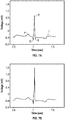
- Figures 5 and 6 show the results of the analysis of a real heart beat waveform obtained from the MIT/BIH data base.
- the original time domain data is shown in dashed line, and the reconstruction output from the above described method (at block 414 of Figure 4 for example) is shown in solid line.
- the DFT of the original signal (originally sampled at 360 Hz) is shown in dashed line, and the DFT coefficients produced by the method using Equation 2 at block 412 of Figure 4 are shown in solid line.
- Figure 8 illustrates the difference between the original waveform of Figure 7A and the reconstructed waveform of Figure 7B in the frequency domain.
- the dashed line illustrates the DFT of the original 360 Hz sampled waveform.
- the solid line illustrates the DFT coefficients produced by Equation 2 at, for example, block 412 of Figure 4 following extraction of the VPW-FRI parameters from the 60 Hz sample set.
- the deviation between the actual spectrum and the reconstructed spectrum becomes large above about 30 Hz (which corresponds to the sampling frequency of 60 Hz).
- the reconstruction overestimates the amplitudes. This produces the overshoot and missed S peak seen in the time domain data of Figures 7A and 7B .
- FIG. 9 a set of DFT coefficients modified from the original outputs of Equation 2 is illustrated.
- the solid line of Figure 9 is a graph of DFT coefficient output from Equation 2 for the region from 0 Hz up to about 30 Hz denoted by line 814.
- the DFT coefficients For the DFT coefficients from 30 Hz up to about 100 Hz (or beyond), denoted by line 1016, the DFT coefficients have an amplitude that is the DFT coefficients output from Equation 2 as modified according to Equation 9.
- the DFT now follows the parabolic shape defined between 15 Hz and 30 Hz all the way out to 100 Hz or more. In practice, the DFT coefficients past 60 to 80 Hz have little effect on the reconstruction.
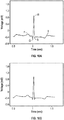
- Figure 10A shows the original time domain waveform sampled at 360 Hz, the same as is shown in Figure 7A .
- Figure 10B shows the time domain waveform produced by performing an IDFT on the solid line DFT of Figure 9 . With the correction from 30 Hz and upward, it can be seen in Figure 10B that the overshoot of the R peak is removed, and the S peak is now reproduced.
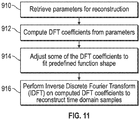
- Figure 11 is a flowchart illustrating this correction method. It generally follows the flow of Figure 4 , with the additional correction step described above.
- the stored parameters a k , t k , c k , and d k are retrieved at block 1110.
- DFT coefficients for positive m frequency indices are computed using Equation 2 and the retrieved parameters.
- Coefficients for negative m frequency indices may again be computed by taking the complex conjugates of the positive m values produced by Equation 2.
- some of the DFT coefficients are adjusted to fit a pre-defined function shape. For ECG waveforms, a parabolic functional shape has been found suitable. For other waveform sources, different functional shapes may be appropriate.
- IDFT inverse discrete Fourier transform
- the ⁇ and ⁇ parameters could be generated during the data analysis process described above with reference to Figure 2 .
- the parabolic curve fitting could be performed by generating the DFT coefficients from the extracted VPW-FRI parameters a, t, c, and d using Equation 2, generating a suitable ⁇ and ⁇ , and then storing these values along with the other VPW-FRI parameters. This eliminates the need to perform the parabolic curve fitting during reconstruction.
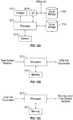
- Figure 12A illustrates a block diagram of one device configured to implement the VPW-FRI methods.
- the device may include a processor 1210.
- the processor 1210 may also be referred to as a central processing unit (CPU).
- Memory 1212 which may include both read-only memory (ROM) and random access memory (RAM), provides instructions and data to the processor 1210.
- a portion of the memory 1212 may also include non-volatile random access memory (NVRAM).
- the processor 1210 typically performs logical and arithmetic operations based on program instructions stored within the memory 1212.
- the instructions in the memory 1212 may be executable to implement the methods of the VPW-FRI model described herein.
- the instructions in the memory 1212 may be executable by the processor 1210 to implement the sequence of signal processing steps for the analysis and/or reconstruction of a waveform as shown in Figures 2 , 4 , and 11 .
- the processor 1210 may be configured to receive N samples (where N is a positive integer) of an input signal in the time domain from a local signal storage 1218 or a remote signal storage 1220. Further, the processor 1210 may transform the N samples utilizing a DFT algorithm to produce the transform coefficients X(m) in the frequency domain as described above. Alternatively, the signal storage may store DFT coefficients of original time domain signals, and these could be used as a starting point for the algorithm implemented by the processor 1210. A subset MM of the transform coefficients (whether received by or generated by the processor 1210), in particular a set of coefficients associated with positive frequencies, may be selected by the processor 1210. The subset MM of the transform coefficients may then be used by the processor to define the VPW-FRI parameters.
- the processor may also be configured to retrieve VPW-FRI parameters from the signal storage memory 1218 or 1220.
- the processor may then generate DFT coefficients using the methods described above, and perform an IDFT on the generated DFT coefficients to reconstruct a time domain waveform.
- An output device such display 1214 or a printer may be used to display either original or reconstructed time domain data.
- the signal storage memory 1218 and/or 1220 may comprise an ECG signal database.
- the processor may then use as input ECG signals, and store them as parameters computed utilizing the VPW-FRI algorithm. Storage of the ECG signals as such parameters may reduce the memory allocation necessary for storing such ECG signals.
- the system of Figure 12A may be employed, for example, at a hospital to efficiently store ECG signals as part of patient medical history records.
- FIGS 12B and 12C are block diagrams illustrating that different processors 1210 which may be geographically separated can separately perform the signal analysis and signal reconstruction.
- the processor 1210 is dedicated to performing the signal analysis portion of the process. This processor takes time domain samples and produces VPW-FRI parameters.
- the processor is dedicated to reconstruction. This processor takes VPW-FRI parameters as an input, and produces reconstructed time domain samples as an output.
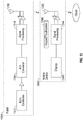
- FIG. 13 illustrates another system in which the above described methods can be implemented.
- a patch ECG monitor 1300 incorporates ECG electrodes 1312 and is mounted with adhesive for example on a subject as an ambulatory cardiac monitoring device.
- the signal from the electrodes is routed to an A/D converter 1314 which produces time domain samples of the signal.
- signal processing circuitry 1316 which may be configured to produce the VPW-FRI parameters of pulse width, time, and symmetric and asymmetric amplitude described above.
- These may be sent wirelessly via antenna 1318 to a mobile device 1340 such as a cell phone, tablet, or other portable electronic system, which receives the parameters via antenna 1342 and routes the parameters to signal processing circuitry 1344 in the mobile device 1340.
- the signal processing circuitry may also produce the ⁇ and ⁇ parameters and send them to the mobile device for curve fitting during reconstruction described above. It will be appreciated that the components of the patch 1300 need not be mounted together on the same physical substrate, but could be split up in a variety of ways.
- the signal processing circuitry 1344 in the mobile device 1340 may be configured to reconstruct the ECG waveforms using the VPW-FRI parameters and the ⁇ and ⁇ parameters that are computed on the mobile device 1340 or are received from the patch monitor 1300.
- the reconstructed signal may be displayed on a display 1346 and manipulated with a keypad/touchscreen 1348 on the mobile device.
- the mobile device may also be configured to transmit either the reconstructed waveform and/or the parameters to an external network such as the Internet for storage, review by a physician, etc.
- the on-body mounted system 1300 should use as little power as possible, it is advantageous to minimize the sampling rate of the A/D converter and also minimize the amount of data that must be transmitted from the on-body system 1300 to the mobile device 1340.
- the compression and accurate reconstruction provided by the methods described above can reduce the power consumed by the on-body system 1300.
- the hardware and data processing apparatus used to implement the various illustrative logics, logical blocks, modules and circuits described in connection with the aspects disclosed herein may be implemented or performed with a general purpose single- or multi-chip processor, a digital signal processor (DSP), an application specific integrated circuit (ASIC), a field programmable gate array (FPGA) or other programmable logic device, discrete gate or transistor logic, discrete hardware components, or any combination thereof designed to perform the functions described herein.
- a general purpose processor may be a microprocessor, or, any conventional processor, controller, microcontroller, or state machine.
- a processor may also be implemented as a combination of computing devices, e.g., a combination of a DSP and a microprocessor, a plurality of microprocessors, one or more microprocessors in conjunction with a DSP core, or any other such configuration.
- particular steps and methods may be performed by circuitry that is specific to a given function.
- the functions described may be implemented in hardware, digital electronic circuitry, computer software, firmware, including the structures disclosed in this specification and their structural equivalents thereof, or in any combination thereof. Implementations of the subject matter described in this specification also can be implemented as one or more computer programs, i.e., one or more modules of computer program instructions, encoded on a computer storage media for execution by, or to control the operation of, data processing apparatus.
- Computer-readable media includes both computer storage media and communication media including any medium that can be enabled to transfer a computer program from one place to another.
- a storage media may be any available media that may be accessed by a computer.
- such computer-readable media may include RAM, ROM, EEPROM, CD-ROM or other optical disk storage, magnetic disk storage or other magnetic storage devices, or any other medium that may be used to store desired program code in the form of instructions or data structures and that may be accessed by a computer.
- Disk and disc includes compact disc (CD), laser disc, optical disc, digital versatile disc (DVD), floppy disk, and blu-ray disc where disks usually reproduce data magnetically, while discs reproduce data optically with lasers. Combinations of the above should also be included within the scope of computer-readable media. Additionally, the operations of a method or algorithm may reside as one or any combination or set of codes and instructions on a machine readable medium and computer-readable medium, which may be incorporated into a computer program product.
Landscapes
- Physics & Mathematics (AREA)
- Health & Medical Sciences (AREA)
- Engineering & Computer Science (AREA)
- Life Sciences & Earth Sciences (AREA)
- Mathematical Physics (AREA)
- General Physics & Mathematics (AREA)
- Theoretical Computer Science (AREA)
- Data Mining & Analysis (AREA)
- Pure & Applied Mathematics (AREA)
- Mathematical Optimization (AREA)
- Mathematical Analysis (AREA)
- Computational Mathematics (AREA)
- General Health & Medical Sciences (AREA)
- Medical Informatics (AREA)
- Molecular Biology (AREA)
- Surgery (AREA)
- Animal Behavior & Ethology (AREA)
- Biomedical Technology (AREA)
- Public Health (AREA)
- Veterinary Medicine (AREA)
- Heart & Thoracic Surgery (AREA)
- Pathology (AREA)
- Biophysics (AREA)
- Physiology (AREA)
- General Engineering & Computer Science (AREA)
- Databases & Information Systems (AREA)
- Discrete Mathematics (AREA)
- Algebra (AREA)
- Software Systems (AREA)
- Cardiology (AREA)
- Computer Vision & Pattern Recognition (AREA)
- Signal Processing (AREA)
- Artificial Intelligence (AREA)
- Computer Networks & Wireless Communication (AREA)
- Psychiatry (AREA)
- Measurement And Recording Of Electrical Phenomena And Electrical Characteristics Of The Living Body (AREA)
- Complex Calculations (AREA)
- Measurement Of Resistance Or Impedance (AREA)
Applications Claiming Priority (3)
| Application Number | Priority Date | Filing Date | Title |
|---|---|---|---|
| US201261611739P | 2012-03-16 | 2012-03-16 | |
| US13/800,754 US9275013B2 (en) | 2012-03-16 | 2013-03-13 | System and method for analysis and reconstruction of variable pulse-width signals having low sampling rates |
| PCT/US2013/031332 WO2013138591A2 (en) | 2012-03-16 | 2013-03-14 | System and method for analysis and reconstruction of variable pulse-width signals having low sampling rates |
Publications (2)
| Publication Number | Publication Date |
|---|---|
| EP2825977A2 EP2825977A2 (en) | 2015-01-21 |
| EP2825977B1 true EP2825977B1 (en) | 2018-08-29 |
Family
ID=49158280
Family Applications (1)
| Application Number | Title | Priority Date | Filing Date |
|---|---|---|---|
| EP13713010.0A Not-in-force EP2825977B1 (en) | 2012-03-16 | 2013-03-14 | System and method for analysis and reconstruction of variable pulse-width signals having low sampling rates |
Country Status (6)
| Country | Link |
|---|---|
| US (1) | US9275013B2 (enExample) |
| EP (1) | EP2825977B1 (enExample) |
| JP (1) | JP2015512111A (enExample) |
| KR (1) | KR20140145595A (enExample) |
| CN (1) | CN104641366B (enExample) |
| WO (1) | WO2013138591A2 (enExample) |
Families Citing this family (11)
| Publication number | Priority date | Publication date | Assignee | Title |
|---|---|---|---|---|
| KR102436729B1 (ko) * | 2015-07-27 | 2022-08-26 | 삼성전자주식회사 | 생체 신호 처리 장치 및 생체 신호 처리 방법 |
| CN105024959A (zh) * | 2015-08-03 | 2015-11-04 | 南京林业大学 | 一种针对无频率跳变宽带信号的分段降噪方法 |
| US10359832B2 (en) * | 2016-03-22 | 2019-07-23 | The Board Of Regents Of The University Of Texas System | Method and apparatus for reducing power and cycle requirement for FFT of ECG signals |
| KR102605896B1 (ko) | 2016-09-20 | 2023-11-23 | 삼성전자주식회사 | 생체정보 검출을 위한 특징 추출 장치 및 방법과, 생체정보 검출 장치 및 웨어러블 기기 |
| CN108984474B (zh) * | 2018-06-04 | 2022-07-15 | 哈尔滨工业大学 | 一种非理想分段多项式信号的欠采样方法 |
| KR102389071B1 (ko) * | 2018-06-11 | 2022-04-22 | 칸도우 랩스 에스에이 | 직교 차동 벡터 시그널링 코드들에 대한 스큐 검출 및 보정 |
| CN109347482B (zh) * | 2018-08-03 | 2021-04-06 | 西安电子科技大学 | 基于参数估计的跳频信号压缩感知重构方法 |
| CN114546029B (zh) * | 2019-12-30 | 2022-12-02 | 珠海极海半导体有限公司 | 控制芯片、mcu芯片、mpu芯片及dsp芯片 |
| CN112329595B (zh) * | 2020-11-02 | 2022-11-15 | 中南大学 | 一种岩石节理面几何形貌频谱分析与重建方法 |
| CN113050043A (zh) * | 2021-03-26 | 2021-06-29 | 浙江工业大学 | 基于非理想lpf的探地雷达超宽带高斯脉冲fri采样方法 |
| CN115881276B (zh) * | 2023-02-22 | 2023-06-09 | 合肥工业大学 | 心电信号的时频双条形码特征图像生成方法及存储介质 |
Family Cites Families (12)
| Publication number | Priority date | Publication date | Assignee | Title |
|---|---|---|---|---|
| US4947857A (en) * | 1989-02-01 | 1990-08-14 | Corazonix Corporation | Method and apparatus for analyzing and interpreting electrocardiograms using spectro-temporal mapping |
| US5609158A (en) | 1995-05-01 | 1997-03-11 | Arrhythmia Research Technology, Inc. | Apparatus and method for predicting cardiac arrhythmia by detection of micropotentials and analysis of all ECG segments and intervals |
| US5891047A (en) | 1997-03-14 | 1999-04-06 | Cambridge Heart, Inc. | Detecting abnormal activation of heart |
| JP2003509748A (ja) * | 1999-09-03 | 2003-03-11 | チェン,ティー.シー. | データ圧縮のための3次スプライン補間の高速で効率のよい計算方法 |
| US6377843B1 (en) | 2000-03-03 | 2002-04-23 | Paceart Associates, L.P. | Transtelephonic monitoring of multi-channel ECG waveforms |
| US6647287B1 (en) | 2000-04-14 | 2003-11-11 | Southwest Research Institute | Dynamic cardiovascular monitor |
| WO2003036509A2 (en) | 2001-10-23 | 2003-05-01 | Ecole Polytechnique Federale De Lausanne | Sampling method reconstruction method and devices for sampling and/or reconstructing multidimensional signals |
| US7702712B2 (en) * | 2003-12-05 | 2010-04-20 | Qualcomm Incorporated | FFT architecture and method |
| US7702502B2 (en) | 2005-02-23 | 2010-04-20 | Digital Intelligence, L.L.C. | Apparatus for signal decomposition, analysis and reconstruction |
| US8144824B2 (en) * | 2005-03-10 | 2012-03-27 | Qualcomm Incorporated | Trend influenced time tracking |
| US8326580B2 (en) | 2008-01-29 | 2012-12-04 | Qualcomm Incorporated | Sparse sampling of signal innovations |
| EP2367293B1 (en) | 2010-03-14 | 2014-12-24 | Technion Research & Development Foundation | Low-rate sampling of pulse streams |
-
2013
- 2013-03-13 US US13/800,754 patent/US9275013B2/en not_active Expired - Fee Related
- 2013-03-14 WO PCT/US2013/031332 patent/WO2013138591A2/en not_active Ceased
- 2013-03-14 KR KR1020147028728A patent/KR20140145595A/ko not_active Ceased
- 2013-03-14 JP JP2015500610A patent/JP2015512111A/ja active Pending
- 2013-03-14 CN CN201380013557.2A patent/CN104641366B/zh not_active Expired - Fee Related
- 2013-03-14 EP EP13713010.0A patent/EP2825977B1/en not_active Not-in-force
Also Published As
| Publication number | Publication date |
|---|---|
| WO2013138591A2 (en) | 2013-09-19 |
| CN104641366B (zh) | 2017-06-23 |
| US20130245471A1 (en) | 2013-09-19 |
| CN104641366A (zh) | 2015-05-20 |
| EP2825977A2 (en) | 2015-01-21 |
| KR20140145595A (ko) | 2014-12-23 |
| WO2013138591A3 (en) | 2014-10-09 |
| US9275013B2 (en) | 2016-03-01 |
| JP2015512111A (ja) | 2015-04-23 |
Similar Documents
| Publication | Publication Date | Title |
|---|---|---|
| EP2825977B1 (en) | System and method for analysis and reconstruction of variable pulse-width signals having low sampling rates | |
| US20130158420A1 (en) | System and method for analysis and reconstruction of variable pulse-width signals with finite-rates-of-innovation | |
| Sandryhaila et al. | Efficient compression of QRS complexes using Hermite expansion | |
| Zorgani et al. | Brain palpation from physiological vibrations using MRI | |
| de la O Serna | Taylor–Fourier analysis of blood pressure oscillometric waveforms | |
| US20180235487A1 (en) | Method and system for cuffless blood pressure estimation using photoplethysmogram features and pulse transit time | |
| US8798726B2 (en) | Method and apparatus for eliminating motion artifacts of bio signal using personalized bio signal pattern | |
| Westerhof et al. | Individualization of transfer function in estimation of central aortic pressure from the peripheral pulse is not required in patients at rest | |
| CN112914528B (zh) | 一种无袖带血压测量的模型生成方法、装置及计算机可读介质 | |
| Brown et al. | A fast discrete S-transform for biomedical signal processing | |
| Baechler et al. | Finite rate of innovation based modeling and compression of ECG signals | |
| CN107708531A (zh) | 从生理数据中确定生理参数的方法 | |
| CN106687033A (zh) | 心跳检测方法和心跳检测设备 | |
| Mirmohamadsadeghi et al. | Real-time multi-signal frequency tracking with a bank of notch filters to estimate the respiratory rate from the ECG | |
| Hu et al. | A hybrid denoising approach for PPG signals utilizing variational mode decomposition and improved wavelet thresholding | |
| CN110477889B (zh) | 识别桡动脉压力波形反射点的方法和装置 | |
| Chou et al. | A Real‐Time Analysis Method for Pulse Rate Variability Based on Improved Basic Scale Entropy | |
| WO2021087632A1 (zh) | 一种有限信号的精确分解方程式构建及分解方法 | |
| Zhang et al. | Blind system identification of noncoprime multichannel systems and its application to noninvasive cardiovascular monitoring | |
| AYDıN | Comparison of power spectrum predictors in computing coherence functions for intracortical EEG signals | |
| Wu et al. | Peripheral arterial disease screening for hemodialysis patients using a fractional‐order integrator and transition probability decision‐making model | |
| Vulaj et al. | A tool for ECG signal analysis using standard and optimized Hermite transform | |
| Had et al. | Detection of heart valves closure instants in phonocardiogram signals | |
| Hoyer et al. | Interactions between short-term and long-term cardiovascular control mechanisms | |
| Flegner et al. | Advanced Frequency Analysis of Signals with High-Frequency Resolution |
Legal Events
| Date | Code | Title | Description |
|---|---|---|---|
| PUAI | Public reference made under article 153(3) epc to a published international application that has entered the european phase |
Free format text: ORIGINAL CODE: 0009012 |
|
| 17P | Request for examination filed |
Effective date: 20140912 |
|
| AK | Designated contracting states |
Kind code of ref document: A2 Designated state(s): AL AT BE BG CH CY CZ DE DK EE ES FI FR GB GR HR HU IE IS IT LI LT LU LV MC MK MT NL NO PL PT RO RS SE SI SK SM TR |
|
| AX | Request for extension of the european patent |
Extension state: BA ME |
|
| RIC1 | Information provided on ipc code assigned before grant |
Ipc: G06F 17/14 20060101AFI20150304BHEP Ipc: H03M 7/30 20060101ALI20150304BHEP Ipc: A61B 5/00 20060101ALI20150304BHEP |
|
| DAX | Request for extension of the european patent (deleted) | ||
| STAA | Information on the status of an ep patent application or granted ep patent |
Free format text: STATUS: EXAMINATION IS IN PROGRESS |
|
| 17Q | First examination report despatched |
Effective date: 20170602 |
|
| GRAP | Despatch of communication of intention to grant a patent |
Free format text: ORIGINAL CODE: EPIDOSNIGR1 |
|
| STAA | Information on the status of an ep patent application or granted ep patent |
Free format text: STATUS: GRANT OF PATENT IS INTENDED |
|
| RIC1 | Information provided on ipc code assigned before grant |
Ipc: G06F 17/14 20060101AFI20180306BHEP |
|
| INTG | Intention to grant announced |
Effective date: 20180320 |
|
| GRAS | Grant fee paid |
Free format text: ORIGINAL CODE: EPIDOSNIGR3 |
|
| GRAA | (expected) grant |
Free format text: ORIGINAL CODE: 0009210 |
|
| STAA | Information on the status of an ep patent application or granted ep patent |
Free format text: STATUS: THE PATENT HAS BEEN GRANTED |
|
| AK | Designated contracting states |
Kind code of ref document: B1 Designated state(s): AL AT BE BG CH CY CZ DE DK EE ES FI FR GB GR HR HU IE IS IT LI LT LU LV MC MK MT NL NO PL PT RO RS SE SI SK SM TR |
|
| REG | Reference to a national code |
Ref country code: GB Ref legal event code: FG4D |
|
| REG | Reference to a national code |
Ref country code: CH Ref legal event code: EP |
|
| REG | Reference to a national code |
Ref country code: AT Ref legal event code: REF Ref document number: 1035969 Country of ref document: AT Kind code of ref document: T Effective date: 20180915 |
|
| REG | Reference to a national code |
Ref country code: IE Ref legal event code: FG4D |
|
| REG | Reference to a national code |
Ref country code: DE Ref legal event code: R096 Ref document number: 602013042710 Country of ref document: DE |
|
| REG | Reference to a national code |
Ref country code: NL Ref legal event code: MP Effective date: 20180829 |
|
| REG | Reference to a national code |
Ref country code: LT Ref legal event code: MG4D |
|
| PG25 | Lapsed in a contracting state [announced via postgrant information from national office to epo] |
Ref country code: SE Free format text: LAPSE BECAUSE OF FAILURE TO SUBMIT A TRANSLATION OF THE DESCRIPTION OR TO PAY THE FEE WITHIN THE PRESCRIBED TIME-LIMIT Effective date: 20180829 Ref country code: BG Free format text: LAPSE BECAUSE OF FAILURE TO SUBMIT A TRANSLATION OF THE DESCRIPTION OR TO PAY THE FEE WITHIN THE PRESCRIBED TIME-LIMIT Effective date: 20181129 Ref country code: NO Free format text: LAPSE BECAUSE OF FAILURE TO SUBMIT A TRANSLATION OF THE DESCRIPTION OR TO PAY THE FEE WITHIN THE PRESCRIBED TIME-LIMIT Effective date: 20181129 Ref country code: IS Free format text: LAPSE BECAUSE OF FAILURE TO SUBMIT A TRANSLATION OF THE DESCRIPTION OR TO PAY THE FEE WITHIN THE PRESCRIBED TIME-LIMIT Effective date: 20181229 Ref country code: NL Free format text: LAPSE BECAUSE OF FAILURE TO SUBMIT A TRANSLATION OF THE DESCRIPTION OR TO PAY THE FEE WITHIN THE PRESCRIBED TIME-LIMIT Effective date: 20180829 Ref country code: LT Free format text: LAPSE BECAUSE OF FAILURE TO SUBMIT A TRANSLATION OF THE DESCRIPTION OR TO PAY THE FEE WITHIN THE PRESCRIBED TIME-LIMIT Effective date: 20180829 Ref country code: GR Free format text: LAPSE BECAUSE OF FAILURE TO SUBMIT A TRANSLATION OF THE DESCRIPTION OR TO PAY THE FEE WITHIN THE PRESCRIBED TIME-LIMIT Effective date: 20181130 Ref country code: RS Free format text: LAPSE BECAUSE OF FAILURE TO SUBMIT A TRANSLATION OF THE DESCRIPTION OR TO PAY THE FEE WITHIN THE PRESCRIBED TIME-LIMIT Effective date: 20180829 Ref country code: FI Free format text: LAPSE BECAUSE OF FAILURE TO SUBMIT A TRANSLATION OF THE DESCRIPTION OR TO PAY THE FEE WITHIN THE PRESCRIBED TIME-LIMIT Effective date: 20180829 |
|
| REG | Reference to a national code |
Ref country code: AT Ref legal event code: MK05 Ref document number: 1035969 Country of ref document: AT Kind code of ref document: T Effective date: 20180829 |
|
| PG25 | Lapsed in a contracting state [announced via postgrant information from national office to epo] |
Ref country code: HR Free format text: LAPSE BECAUSE OF FAILURE TO SUBMIT A TRANSLATION OF THE DESCRIPTION OR TO PAY THE FEE WITHIN THE PRESCRIBED TIME-LIMIT Effective date: 20180829 Ref country code: AL Free format text: LAPSE BECAUSE OF FAILURE TO SUBMIT A TRANSLATION OF THE DESCRIPTION OR TO PAY THE FEE WITHIN THE PRESCRIBED TIME-LIMIT Effective date: 20180829 Ref country code: LV Free format text: LAPSE BECAUSE OF FAILURE TO SUBMIT A TRANSLATION OF THE DESCRIPTION OR TO PAY THE FEE WITHIN THE PRESCRIBED TIME-LIMIT Effective date: 20180829 |
|
| PG25 | Lapsed in a contracting state [announced via postgrant information from national office to epo] |
Ref country code: RO Free format text: LAPSE BECAUSE OF FAILURE TO SUBMIT A TRANSLATION OF THE DESCRIPTION OR TO PAY THE FEE WITHIN THE PRESCRIBED TIME-LIMIT Effective date: 20180829 Ref country code: AT Free format text: LAPSE BECAUSE OF FAILURE TO SUBMIT A TRANSLATION OF THE DESCRIPTION OR TO PAY THE FEE WITHIN THE PRESCRIBED TIME-LIMIT Effective date: 20180829 Ref country code: EE Free format text: LAPSE BECAUSE OF FAILURE TO SUBMIT A TRANSLATION OF THE DESCRIPTION OR TO PAY THE FEE WITHIN THE PRESCRIBED TIME-LIMIT Effective date: 20180829 Ref country code: IT Free format text: LAPSE BECAUSE OF FAILURE TO SUBMIT A TRANSLATION OF THE DESCRIPTION OR TO PAY THE FEE WITHIN THE PRESCRIBED TIME-LIMIT Effective date: 20180829 Ref country code: ES Free format text: LAPSE BECAUSE OF FAILURE TO SUBMIT A TRANSLATION OF THE DESCRIPTION OR TO PAY THE FEE WITHIN THE PRESCRIBED TIME-LIMIT Effective date: 20180829 Ref country code: PL Free format text: LAPSE BECAUSE OF FAILURE TO SUBMIT A TRANSLATION OF THE DESCRIPTION OR TO PAY THE FEE WITHIN THE PRESCRIBED TIME-LIMIT Effective date: 20180829 Ref country code: CZ Free format text: LAPSE BECAUSE OF FAILURE TO SUBMIT A TRANSLATION OF THE DESCRIPTION OR TO PAY THE FEE WITHIN THE PRESCRIBED TIME-LIMIT Effective date: 20180829 |
|
| PG25 | Lapsed in a contracting state [announced via postgrant information from national office to epo] |
Ref country code: SK Free format text: LAPSE BECAUSE OF FAILURE TO SUBMIT A TRANSLATION OF THE DESCRIPTION OR TO PAY THE FEE WITHIN THE PRESCRIBED TIME-LIMIT Effective date: 20180829 Ref country code: DK Free format text: LAPSE BECAUSE OF FAILURE TO SUBMIT A TRANSLATION OF THE DESCRIPTION OR TO PAY THE FEE WITHIN THE PRESCRIBED TIME-LIMIT Effective date: 20180829 Ref country code: SM Free format text: LAPSE BECAUSE OF FAILURE TO SUBMIT A TRANSLATION OF THE DESCRIPTION OR TO PAY THE FEE WITHIN THE PRESCRIBED TIME-LIMIT Effective date: 20180829 |
|
| REG | Reference to a national code |
Ref country code: DE Ref legal event code: R097 Ref document number: 602013042710 Country of ref document: DE |
|
| PLBE | No opposition filed within time limit |
Free format text: ORIGINAL CODE: 0009261 |
|
| STAA | Information on the status of an ep patent application or granted ep patent |
Free format text: STATUS: NO OPPOSITION FILED WITHIN TIME LIMIT |
|
| 26N | No opposition filed |
Effective date: 20190531 |
|
| PG25 | Lapsed in a contracting state [announced via postgrant information from national office to epo] |
Ref country code: SI Free format text: LAPSE BECAUSE OF FAILURE TO SUBMIT A TRANSLATION OF THE DESCRIPTION OR TO PAY THE FEE WITHIN THE PRESCRIBED TIME-LIMIT Effective date: 20180829 |
|
| REG | Reference to a national code |
Ref country code: DE Ref legal event code: R119 Ref document number: 602013042710 Country of ref document: DE |
|
| PG25 | Lapsed in a contracting state [announced via postgrant information from national office to epo] |
Ref country code: MC Free format text: LAPSE BECAUSE OF FAILURE TO SUBMIT A TRANSLATION OF THE DESCRIPTION OR TO PAY THE FEE WITHIN THE PRESCRIBED TIME-LIMIT Effective date: 20180829 |
|
| REG | Reference to a national code |
Ref country code: CH Ref legal event code: PL |
|
| GBPC | Gb: european patent ceased through non-payment of renewal fee |
Effective date: 20190314 |
|
| PG25 | Lapsed in a contracting state [announced via postgrant information from national office to epo] |
Ref country code: LU Free format text: LAPSE BECAUSE OF NON-PAYMENT OF DUE FEES Effective date: 20190314 |
|
| REG | Reference to a national code |
Ref country code: BE Ref legal event code: MM Effective date: 20190331 |
|
| PG25 | Lapsed in a contracting state [announced via postgrant information from national office to epo] |
Ref country code: LI Free format text: LAPSE BECAUSE OF NON-PAYMENT OF DUE FEES Effective date: 20190331 Ref country code: IE Free format text: LAPSE BECAUSE OF NON-PAYMENT OF DUE FEES Effective date: 20190314 Ref country code: GB Free format text: LAPSE BECAUSE OF NON-PAYMENT OF DUE FEES Effective date: 20190314 Ref country code: CH Free format text: LAPSE BECAUSE OF NON-PAYMENT OF DUE FEES Effective date: 20190331 Ref country code: DE Free format text: LAPSE BECAUSE OF NON-PAYMENT OF DUE FEES Effective date: 20191001 |
|
| PG25 | Lapsed in a contracting state [announced via postgrant information from national office to epo] |
Ref country code: FR Free format text: LAPSE BECAUSE OF NON-PAYMENT OF DUE FEES Effective date: 20190331 Ref country code: BE Free format text: LAPSE BECAUSE OF NON-PAYMENT OF DUE FEES Effective date: 20190331 |
|
| PG25 | Lapsed in a contracting state [announced via postgrant information from national office to epo] |
Ref country code: TR Free format text: LAPSE BECAUSE OF FAILURE TO SUBMIT A TRANSLATION OF THE DESCRIPTION OR TO PAY THE FEE WITHIN THE PRESCRIBED TIME-LIMIT Effective date: 20180829 |
|
| PG25 | Lapsed in a contracting state [announced via postgrant information from national office to epo] |
Ref country code: MT Free format text: LAPSE BECAUSE OF NON-PAYMENT OF DUE FEES Effective date: 20190314 Ref country code: PT Free format text: LAPSE BECAUSE OF FAILURE TO SUBMIT A TRANSLATION OF THE DESCRIPTION OR TO PAY THE FEE WITHIN THE PRESCRIBED TIME-LIMIT Effective date: 20181229 |
|
| PG25 | Lapsed in a contracting state [announced via postgrant information from national office to epo] |
Ref country code: CY Free format text: LAPSE BECAUSE OF FAILURE TO SUBMIT A TRANSLATION OF THE DESCRIPTION OR TO PAY THE FEE WITHIN THE PRESCRIBED TIME-LIMIT Effective date: 20180829 |
|
| PG25 | Lapsed in a contracting state [announced via postgrant information from national office to epo] |
Ref country code: HU Free format text: LAPSE BECAUSE OF FAILURE TO SUBMIT A TRANSLATION OF THE DESCRIPTION OR TO PAY THE FEE WITHIN THE PRESCRIBED TIME-LIMIT; INVALID AB INITIO Effective date: 20130314 |
|
| PG25 | Lapsed in a contracting state [announced via postgrant information from national office to epo] |
Ref country code: MK Free format text: LAPSE BECAUSE OF FAILURE TO SUBMIT A TRANSLATION OF THE DESCRIPTION OR TO PAY THE FEE WITHIN THE PRESCRIBED TIME-LIMIT Effective date: 20180829 |