EP2820001B1 - Natrium- und calciumsalze eines dihydrochinazolinderivates und ihre verwendung als antivirale mittel - Google Patents
Natrium- und calciumsalze eines dihydrochinazolinderivates und ihre verwendung als antivirale mittel Download PDFInfo
- Publication number
- EP2820001B1 EP2820001B1 EP13709804.2A EP13709804A EP2820001B1 EP 2820001 B1 EP2820001 B1 EP 2820001B1 EP 13709804 A EP13709804 A EP 13709804A EP 2820001 B1 EP2820001 B1 EP 2820001B1
- Authority
- EP
- European Patent Office
- Prior art keywords
- salt
- methoxy
- phenyl
- methoxyphenyl
- trifluoromethyl
- Prior art date
- Legal status (The legal status is an assumption and is not a legal conclusion. Google has not performed a legal analysis and makes no representation as to the accuracy of the status listed.)
- Active
Links
Images


Classifications
-
- C—CHEMISTRY; METALLURGY
- C07—ORGANIC CHEMISTRY
- C07D—HETEROCYCLIC COMPOUNDS
- C07D239/00—Heterocyclic compounds containing 1,3-diazine or hydrogenated 1,3-diazine rings
- C07D239/70—Heterocyclic compounds containing 1,3-diazine or hydrogenated 1,3-diazine rings condensed with carbocyclic rings or ring systems
- C07D239/72—Quinazolines; Hydrogenated quinazolines
- C07D239/74—Quinazolines; Hydrogenated quinazolines with only hydrogen atoms, hydrocarbon or substituted hydrocarbon radicals, attached to ring carbon atoms of the hetero ring
-
- A—HUMAN NECESSITIES
- A61—MEDICAL OR VETERINARY SCIENCE; HYGIENE
- A61P—SPECIFIC THERAPEUTIC ACTIVITY OF CHEMICAL COMPOUNDS OR MEDICINAL PREPARATIONS
- A61P31/00—Antiinfectives, i.e. antibiotics, antiseptics, chemotherapeutics
-
- A—HUMAN NECESSITIES
- A61—MEDICAL OR VETERINARY SCIENCE; HYGIENE
- A61P—SPECIFIC THERAPEUTIC ACTIVITY OF CHEMICAL COMPOUNDS OR MEDICINAL PREPARATIONS
- A61P31/00—Antiinfectives, i.e. antibiotics, antiseptics, chemotherapeutics
- A61P31/12—Antivirals
-
- A—HUMAN NECESSITIES
- A61—MEDICAL OR VETERINARY SCIENCE; HYGIENE
- A61P—SPECIFIC THERAPEUTIC ACTIVITY OF CHEMICAL COMPOUNDS OR MEDICINAL PREPARATIONS
- A61P31/00—Antiinfectives, i.e. antibiotics, antiseptics, chemotherapeutics
- A61P31/12—Antivirals
- A61P31/20—Antivirals for DNA viruses
- A61P31/22—Antivirals for DNA viruses for herpes viruses
-
- C—CHEMISTRY; METALLURGY
- C07—ORGANIC CHEMISTRY
- C07D—HETEROCYCLIC COMPOUNDS
- C07D239/00—Heterocyclic compounds containing 1,3-diazine or hydrogenated 1,3-diazine rings
- C07D239/70—Heterocyclic compounds containing 1,3-diazine or hydrogenated 1,3-diazine rings condensed with carbocyclic rings or ring systems
- C07D239/72—Quinazolines; Hydrogenated quinazolines
- C07D239/78—Quinazolines; Hydrogenated quinazolines with hetero atoms directly attached in position 2
- C07D239/84—Nitrogen atoms
Definitions
- the present invention relates to salts of ⁇ 8-fluoro-2- [4- (3-methoxyphenyl) piperazin-1-yl] -3- [2-methoxy-5- (trifluoromethyl) phenyl] -3,4-dihydroquinazoline-4 -y ⁇ acetic acid and its solvates.
- the invention further relates to processes for their preparation, these compounds for use for the treatment and / or prophylaxis of diseases, in particular of viral infections and their use for the preparation of medicaments for the treatment and / or prophylaxis of viral infections in particular for the treatment and / or prophylaxis of infections with Cytomegaloviruses or another member of the group of herpes viridae.
- ⁇ 8-fluoro-2- [4- (3-methoxyphenyl) -piperazin-1-yl] -3- [2-methoxy-5- (trifluoromethyl) -phenyl] -3,4-dihydroquinazolin-4-yl ⁇ acetic acid is from the WO 2004/096778 and was developed by the Applicant as a promising candidate for an antiviral active substance, in particular for combating infections with the human cytomegalovirus (HCMV).
- HCMV human cytomegalovirus
- amorphous drugs for the manufacture of medicines is, on the one hand, in view of the fact that it is often difficult to guarantee uniform purity of amorphous substances, and also in view of the fact that amorphous substances are often difficult to maintain consistent pharmacological parameters such as For example, to guarantee a consistent bioavailability, undesirable.
- the salts are meaningfully used in the development of medicines
- they must be stable on storage for a long time.
- the crystalline compounds should also be readily soluble in aqueous medium and especially at physiological pH.
- the salts according to the invention have a high purity.
- crystalline product in the context of the present invention refers to S (+) - ⁇ 8-fluoro-2- [4- (3-methoxyphenyl) piperazin-1-yl] -3- [2-methoxy-5- (trifluoromethyl ) phenyl] -3,4-dihydroquinazolin-4-yl ⁇ acetic acid sodium salts and S (+) - ⁇ 8-fluoro-2- [4- (3-methoxyphenyl) piperazin-1-yl] -3- [2 -methoxy-5- (trifluoromethyl) phenyl] -3,4-dihydroquinazolin-4-yl ⁇ acetic acid calcium salts, which under X-ray diffraction analysis the characteristic peak pattern as in the corresponding Figures 1 - 3 represented or have a similar peak pattern.
- the term "storage-stable" for the salts according to the invention at 25 ° C. denotes a minimum fraction of ⁇ 8-fluoro-2- [4- (3-methoxyphenyl) piperazin-1-yl] -3- [2- methoxy-5- (trifluoromethyl) phenyl] -3,4-dihydroquinazolin-4-yl ⁇ acetic acid of> 90%, preferably> 95%, most preferably> 99% for at least two, preferably at least three, even more preferably at least six most preferably at least 12 months of storage when said salts are measured by HPLC Methods 1-3. Said storage stability of the salts is considered sufficient within the scope of the invention.
- the crystalline sodium and calcium salts obtained according to the invention are characterized by ⁇ 8-fluoro-2- [4- (3-methoxyphenyl) piperazin-1-yl] -3- [2-methoxy-5- (trifluoromethyl) phenyl] -3,4-dihydroquinazolin-4-yl ⁇ acetic acid by high purity.
- the invention thus relates to the crystalline sodium salts and crystalline calcium salts of ⁇ 8-fluoro-2- [4- (3-methoxyphenyl) piperazin-1-yl] -3- [2-methoxy-5- (trifluoromethyl) phenyl] -3 , 4-dihydroquinazolin-4-yl ⁇ acetic acid, and their solvates.
- the ⁇ 8-Fluoro-2- [4- (3-methoxyphenyl) piperazin-1-yl] -3- [2-methoxy-5- (trifluoromethyl) phenyl] -3,4-dihydroquinazolin-4-yl ⁇ acetic acid and the sodium or calcium counterions can be present in any ratio.
- the ratio is integer (eg 1: 1, 1: 2, 1: 3, 3: 1, 2: 1).
- the salts can be obtained by a direct reaction of the ⁇ 8-fluoro-2- [4- (3-methoxyphenyl) piperazin-1-yl] -3- [2-methoxy-5- (trifluoromethyl) phenyl] -3,4- dihydroquinazolin-4-yl ⁇ acetic acid with sodium or calcium bases or by preparing another basic salt of ⁇ 8-fluoro-2- [4- (3-methoxyphenyl) -piperazin-1-yl] -3- [2-methoxy -5- (trifluoromethyl) phenyl] -3,4-dihydroquinazolin-4-yl ⁇ acetic acid, followed by replacement of the counterion.
- Solvates used in the invention are those forms of the salts of ⁇ 8-fluoro-2- [4- (3-methoxyphenyl) piperazin-1-yl] -3- [2-methoxy-5- (trifluoromethyl) phenyl] -3 , 4-dihydroquinazolin-4-yl ⁇ acetic acid which form a complex through coordination with solvent molecules. Hydrates are a special form of solvates that coordinate with water.
- Preferred in the context of the present invention is the monocalcium salt of ⁇ 8-fluoro-2- [4- (3-methoxyphenyl) piperazin-1-yl] -3- [2-methoxy-5- (trifluoromethyl) phenyl] -3,4 dihydroquinazolin-4-yl ⁇ acetic acid and especially the 2,5-hydrate and 3,5-hydrate of the monocalcium salt of ⁇ 8-fluoro-2- [4- (3-methoxyphenyl) piperazin-1-yl] -3- [2-methoxy-5- (trifluoromethyl) phenyl] -3,4-dihydroquinazolin-4-yl ⁇ acetic acid.
- Also preferred in the context of the invention is the monosodium salt of ⁇ 8-fluoro-2- [4- (3-methoxyphenyl) piperazin-1-yl] -3- [2-methoxy-5- (trifluoromethyl) phenyl] -3,4 dihydroquinazolin-4-yl ⁇ acetic acid, and especially the 3-hydrate of the monosodium salt of ⁇ 8-fluoro-2- [4- (3-methoxyphenyl) piperazin-1-yl] -3- [2-methoxy-5- (trifluoromethyl ) phenyl] -3,4-dihydroquinazolin-4-yl ⁇ acetic acid.
- Also preferred in the context of the invention is a 2,5-hydrate of the monocalcium salt of ⁇ 8-fluoro-2- [4- (3-methoxyphenyl) piperazin-1-yl] -3- [2-methoxy-5- (trifluoromethyl) phenyl] -3,4-dihydroquinazolin-4-yl ⁇ acetic acid, which shows characteristic peaks in the powder XRD diffractogram at about 6.1, 9.2 and 15.5 degrees 2Theta.
- Also preferred in the context of the invention is a 3,5-hydrate of the monocalcium salt of ⁇ 8-fluoro-2- [4- (3-methoxyphenyl) piperazin-1-yl] -3- [2-methoxy-5- (trifluoromethyl) phenyl] -3,4-dihydroquinazolin-4-yl ⁇ acetic acid showing characteristic peaks at about 6.2, 12.4 and 22.4 degrees 2Theta in the powder XRD diffractogram.
- Also preferred in the context of the invention is a 3-hydrate of the monosodium salt of ⁇ 8-fluoro-2- [4- (3-methoxyphenyl) -piperazin-1-yl] -3- [2-methoxy-5- (trifluoromethyl) -phenyl ] -3,4-dihydroquinazolin-4-yl] acetic acid showing characteristic peaks at about 6.2, 20.9 and 22.4 degrees 2Theta in the powder XRD diffractogram.
- the salts of the invention are generally prepared by reacting ⁇ 8-fluoro-2- [4- (3-methoxyphenyl) piperazin-1-yl] -3- [2-methoxy-5- (trifluoromethyl) phenyl] -3,4- dihydroquinazolin-4-yl ⁇ acetic acid or an acid salt thereof with a sodium or calcium base, especially sodium hydroxide or calcium hydroxide, in a solvent.
- the solvent used in the above-mentioned reactions is a mixture of at least one di (C 1 -C 4 ) -alkyl ether and at least one (C 1 -C 4 ) -alcohol.
- the resulting salts of the invention may optionally be further processed, e.g. recrystallized or micronized to further adapt their physical properties to the intended use.
- the preparation is carried out by saponifying the ester of a compound of the formula (II) with a base.
- the compound of the formula (II) can be prepared by reacting a compound of the formula (III) in the presence of a base with a compound of the formula (IV)
- the compound of the formula (III) can be prepared by reacting a compound of the formula (V) with phosphorus oxychloride, phosphorus trichloride or phosphorus pentachloride in the presence of a base.
- the compound of the formula (V) can be prepared by reacting a compound of the formula (VI) in the first stage with methyl acrylate in the presence of a palladium catalyst and oleum and in the second stage with a base.
- bases are alkali metal hydroxides such as sodium, lithium or potassium hydroxide, or alkali metal carbonates such as cesium carbonate, sodium or potassium carbonate, or alcoholates such as sodium or potassium methoxide or sodium or potassium ethanolate, the base optionally being in aqueous solution.
- Inert solvents are, for example, ethers, such as 1,2-dimethoxyethane, methyl tert- butyl ether (MTBE), dioxane, tetrahydrofuran, glycol dimethyl ether or diethylene glycol dimethyl ether, alcohols, such as methanol, ethanol, n-propanol, isopropanol, n-butanol or tert-butyl. Butanol, or water, or mixtures of solvents.
- ethers such as 1,2-dimethoxyethane, methyl tert- butyl ether (MTBE), dioxane, tetrahydrofuran, glycol dimethyl ether or diethylene glycol dimethyl ether
- alcohols such as methanol, ethanol, n-propanol, isopropanol, n-butanol or tert-butyl.
- Butanol or water, or mixtures of solvents.
- bases examples include amine bases such as 1,8-diazabicyclo [5.4.0] undec-7-ene (DBU), 1- (3-methoxyphenyl) piperazine or triethylamine, or other bases such as potassium tert-butoxide.
- DBU 1,8-diazabicyclo [5.4.0] undec-7-ene
- 1- (3-methoxyphenyl) piperazine or triethylamine or other bases such as potassium tert-butoxide.
- Inert solvents are, for example, chlorobenzene or ethers, such as 1,2-dimethoxyethane, dioxane, glycol dimethyl ether or diethylene glycol dimethyl ether.
- DBU is preferably in dioxane.
- reaction of a compound of the formula (V) to give a compound of the formula (III) is carried out by reaction of a compound of the formula (V) with phosphorus oxychloride, phosphorus trichloride or phosphorus pentachloride, preferably phosphorus oxychloride, in the presence of a base in an inert solvent, in a temperature range from 40 ° C to the reflux of the solvent, preferably at reflux of the solvent, at atmospheric pressure, within for example 1 to 48 hours, preferably within 2 to 12 hours.
- bases examples include amines such as 1,8-diazabicyclo [5.4.0] undec-7-ene (DBU), pyridine or triethylamine, or other bases such as potassium tert-butoxide.
- Inert solvents are, for example, hydrocarbons such as benzene, xylene, toluene or chlorobenzene.
- DBU is in chlorobenzene.
- reaction of a compound of the formula (VI) to form a compound of the formula (V) is carried out in the first stage by reaction of a compound of the formula (VI) with methyl acrylate in the presence of a palladium catalyst and oleum in a solvent in a temperature range from 0 ° C to 40 ° C, preferably at room temperature and in the second stage by reaction with a base in an inert solvent, in a temperature range from 40 ° C to reflux of the solvent, preferably at reflux of the solvent, at atmospheric pressure, within, for example, 1 to 48 Hours, preferably within 2 to 12 hours.
- Palladium catalysts in the first stage are, for example, palladium (II) acetate, bis (triphenylphosphine) palladium (II) chloride, tetrakis (triphenylphosphine) palladium (0), bis (tris (o-tolyl) phosphino) palladium (II) chloride or a palladium catalyst prepared from bis (acetonitrile) -dichloropalladium or palladium (II) acetate and a ligand, for example, tris (o-tolyl) phosphine, triphenylphosphine or diphenylphosphinoferrocene.
- Solvents in the first stage are, for example, organic acids such as acetic acid or propionic acid.
- bases in the second stage are DBU, triethylamine or diisopropylethylamine.
- Inert solvents in the second stage are, for example, ethers, such as 1,2-dimethoxyethane, dioxane, glycol dimethyl ether or diethylene glycol dimethyl ether, hydrocarbons, such as benzene, xylene or toluene, or other solvents, such as isobutyronitrile, acetonitrile, acetone, nitrobenzene, dimethylformamide, dimethylacetamide, dimethylsulfoxide or N-butyl. methylpyrrolidone.
- ethers such as 1,2-dimethoxyethane, dioxane, glycol dimethyl ether or diethylene glycol dimethyl ether
- hydrocarbons such as benzene, xylene or toluene
- solvents such as isobutyronitrile, acetonitrile, acetone, nitrobenzene, dimethylformamide, dimethylacetamide, dimethylsulfoxide or N-butyl.
- Preferred is DBU in acetone.
- the ⁇ 8-fluoro-2- [4- (3-methoxyphenyl) piperazin-1-yl] -3- [2-methoxy-5- (trifluoromethyl) phenyl] -3,4-dihydroquinazoline-4 -yl ⁇ acetic acid is preferably used in the form of the S-enantiomer.
- This S-enantiomer can be prepared, for example, as shown in the synthesis scheme 2 below.
- the salts according to the invention exhibit an antiviral action against representatives of the group of herpes viridae (herpesviruses), above all against cytomegaloviruses (CMV), in particular against the human cytomegalovirus (HCMV). They are thus suitable for the treatment and prophylaxis of diseases, especially infections with viruses, in particular the viruses mentioned herein and the infectious diseases caused thereby.
- a viral infection is understood to mean both an infection with a virus and a disease caused by an infection with a virus.
- the salts according to the invention can be used for the preparation of medicaments which are suitable for the prophylaxis and / or treatment of diseases, in particular viral infections.
- the salts according to the invention are preferably used for the preparation of medicaments which are suitable for the prophylaxis and / or treatment of infections with a member of the group of herpes viridae, in particular a cytomegalovirus, in particular the human cytomegalovirus.
- the salts according to the invention can be used alone and, if required, also in combination with other active substances, in particular antiviral agents such as valganciclovir, ganciclovir, valacyclovir, acyclovir, foscarnet, cidofovir and related derivatives for the treatment and / or prevention of viral infections, in particular of HCMV Infections, are used.
- antiviral agents such as valganciclovir, ganciclovir, valacyclovir, acyclovir, foscarnet, cidofovir and related derivatives for the treatment and / or prevention of viral infections, in particular of HCMV Infections, are used.
- Another object of the present invention relates to the salts of the invention in a method for the treatment and / or prophylaxis of diseases, preferably viral infections, in particular infections with the human cytomegalovirus (HCMV) or another member of the group of herpes viridae.
- diseases preferably viral infections, in particular infections with the human cytomegalovirus (HCMV) or another member of the group of herpes viridae.
- HCMV human cytomegalovirus
- Another object of the present invention is the use of the salts according to the invention for the manufacture of a medicament for the treatment and / or prophylaxis of diseases, in particular the aforementioned diseases.
- Described is a method for the treatment and / or prophylaxis of diseases, in particular the aforementioned diseases, using an antivirally effective amount of the salts according to the invention.
- the salts according to the invention can act systemically and / or locally.
- they may be applied in a suitable manner, e.g. oral, parenteral, pulmonary, nasal, sublingual, lingual, buccal, rectal, dermal, transdermal, conjunctival, otic or as an implant or stent.
- the salts according to the invention can be administered in suitable administration forms.
- Parenteral administration can be done bypassing a resorption step (eg, intravenous, intraarterial, intracardiac, intraspinal, or intralumbar) or with involvement of resorption (eg, intramuscular, subcutaneous, intracutaneous, percutaneous, or intraperitoneal).
- a resorption step eg, intravenous, intraarterial, intracardiac, intraspinal, or intralumbar
- suitable application forms include injection and infusion preparations in the form of solutions, suspensions, emulsions, lyophilisates or sterile powders.
- Inhalation medicines including powder inhalers, nebulizers
- nasal drops solutions, sprays
- lingual, sublingual or buccal tablets to be applied, films / wafers or capsules, suppositories, ear or ophthalmic preparations, vaginal capsules, aqueous suspensions (lotions, shake mixtures), lipophilic suspensions, ointments, creams, transdermal therapeutic systems, milk, pastes, foams, powdered litter , Implants or stents.
- the salts according to the invention can be converted into the stated administration forms. This can be done in a conventional manner by mixing with inert, non-toxic, pharmaceutically suitable excipients.
- These adjuvants include, among others. Carriers (for example microcrystalline cellulose, lactose, mannitol), solvents (eg liquid polyethylene glycols), emulsifiers and dispersing or wetting agents (for example sodium dodecyl sulfate, polyoxysorbitanoleate), binders (for example polyvinylpyrrolidone), synthetic and natural polymers (for example albumin), stabilizers (eg antioxidants such as ascorbic acid), dyes (eg, inorganic pigments such as iron oxides), and flavor and / or odor remedies.
- Carriers for example microcrystalline cellulose, lactose, mannitol
- solvents eg liquid polyethylene glycols
- emulsifiers and dispersing or wetting agents for example sodium dodecyl
- compositions containing at least one salt according to the invention are pharmaceutical compositions containing at least one salt according to the invention, usually together with one or more inert, non-toxic, pharmaceutically suitable excipients, and their use for the purposes mentioned above.
- the dosage is usually about 0.01 to 25 mg / kg, preferably 0.1 to 10 mg / kg body weight.
- Method 1 Instrument: HP 1050 with variable wavelength detection; Column: Phenomenex-Prodigy ODS (3) 100A, 150 mm x 3 mm, 3 ⁇ m; Eluent A: (1.0 g KH 2 PO 4 + 1.0 mL H 3 PO 4 ) / 1 water, eluent B: acetonitrile; Gradient: 0 min 10% B, 25 min 80% B, 35 min 80% B; Flow: 0.5 ml / min; Temp .: 45 ° C; UV detection: 210 nm.
- Method 2 Instrument: HP 1050 with variable wavelength detection; Column: Chiral AD-H, 250 mm x 4.6 mm, 5 ⁇ m; Eluent A: n- heptane + 0.2% diethylamine, eluent B: isopropanol + 0.2% diethylamine; Gradient: 0 min 12.5% B, 30 min 12.5% B; Flow: 1 ml / min; Temperature: 25 ° C; UV detection: 250 ⁇ m.
- Method 3 Instrument: HP 1050 with variable wavelength detection; Column: Chiral AD-H, 250 mm x 4.6 mm, 5 ⁇ m; Eluent A: n- heptane + 0.2% diethylamine, eluent B: isopropanol + 0.2% diethylamine; Gradient: 0 min 25% B, 15 min 25% B; Flow: 1 ml / min; Temperature: 30 ° C; UV detection: 250 nm.
- Acetic acid (950 l) is initially charged in a second reactor, oleum (57 kg) is cautiously added and palladium (II) acetate (7 kg) is dissolved in the resulting mixture.
- the suspension formed in the first reactor is then added over about 2 h to the mixture contained in the second reactor, wherein the reaction mixture with a mixture of 96% nitrogen and 4% oxygen is flowed over and the resulting reaction mixture is for about 18 h stirred at room temperature.
- a portion of the acetic acid (about 900 l) is distilled off, to the remaining reaction mixture over about 1 h of water (about 5001) was added and the resulting suspension is stirred for 1 h.
- Instrument HP 1100 with variable wavelength detection; Column: Phenomenex-Prodigy ODS (3) 100A, 150 mm x 3 mm, 3 ⁇ m; Eluent A: (1.36 g KH 2 PO 4 + 0.7 mL H 3 PO 4 ) / L water, eluent B: acetonitrile; Gradient: 0 min 20% B, 40 min 45% B, 50 min 80% B, 65 min 80% B; Flow: 0.5 ml / min; Temp .: 55 ° C; UV detection: 210 nm.
- Example 2A ⁇ 8-fluoro-3- [2-methoxy-5- (trifluoromethyl) phenyl] -2-oxo-1,2,3,4-tetrahydroquinazolin-4-yl ⁇ methyl acetate
- DBU 5.7 kg
- the resulting suspension is heated to reflux and stirred at reflux for 4 h.
- the resulting solution is cooled to a jacket temperature of 55 ° C and filtered through diatomaceous earth. A portion of the solvent is removed by distillation from the reaction mixture (about 1125 L) and the remaining residue is cooled to 0 ° C for 2 h.
- the reaction mixture is cooled to room temperature, treated with ethyl acetate (1300 l), washed 1x with water, 3 x with 0.2 N HCl, and 1x with aqueous NaCl solution and the solvent is distilled off.
- the residue obtained is dissolved in Essigester (800 l) and a solution of (2 S, 3 S) given -2,3-bis [(4-methylbenzoyl) oxy] succinic acid (121 kg) in Essigester (600 l).
- the resulting mixture is about 60 min.
- the phases are separated and the organic phase is treated with 35 l of an approximately 7% aqueous sodium bicarbonate solution.
- the phases are separated and the organic phase is treated with 125 l of an approximately four percent aqueous sodium hydroxide solution.
- the reaction mixture is heated to reflux, the solvent is gently distilled to dryness and then the contents of the reactor for a further 5 h at 55 - 60 ° C stirred.
- the reaction mixture is then treated at about 22 ° C with MTBE (160 L) and water (65 L) and stirred.
- the phases are separated and the organic phase extracted with an approximately six percent aqueous sodium chloride solution (30 L).
- the combined aqueous phases are stirred with water (25 l) and MTBE (160 l) and the pH is adjusted to about 6.5 with about 1 N hydrochloric acid.
- the organic phase is separated off, the solvent is gently distilled to dryness and the residue is dissolved in acetone (about 75 l). It is a solvent exchange to acetone (6 distillation operations, each with about 130 l) performed.
- the target product is then precipitated by adding in water, isolated by centrifugation and dried in a vacuum dryer.
- API is the acronym for active pharmaceutical ingredient.
- Table 1 ⁇ / u> Crystallization experiments using acidic counterions counterions
- Ratio API counterions method solvent Result (XRPD) HCL 1: 2 cooling down Acetone, acetonitrile, methanol, THF amorphous Slurry Water, acetonitrile, methanol and ethanol citric acid 1: 1 cooling down Acetone, acetonitrile, methanol, THF amorphous Slurry Water, acetonitrile, methanol and ethanol phosphoric acid 1: 1 cooling down Acetone, acetonitrile, methanol, THF amorphous Slurry Water, acetonitrile, methanol and ethanol gluconic 1: 1 cooling down Acetone, acetonitrile, methanol, THF amorphous Slurry Water, acetonitrile, methanol and ethanol lactic acid 1: 1 cooling down Acetone, acetonitrile, methanol, THF a
- the residue obtained was examined by X-ray diffractometry.
- the diffractogram obtained is in Fig. 1 shown.
- the X-ray diffractogram was recorded at room temperature using a XRD transmission / reflection diffractometer X'Pert PRO (PANalytical) (radiation: copper, K ⁇ 1, wavelength: 1.5406 ⁇ ). There was no sample preparation.
- Example 2 The salt salts of Example 2 and the salts of Examples 3 and 4 are shown in Table 3 below. ⁇ u> Table 3 ⁇ / u> Peak lists of the powder diffractograms of the salts of Examples 2, 3 and 4 2 theta Example 2 Example 3 Example 4 6.2 4.6 6.0 9.4 6.1 6.2 11.3 6.3 7.6 12.4 7.6 9.0 12.9 8.8 9.4 15.6 9.2 9.6 16.4 10.6 10.7 16.8 11.0 11.2 17.9 11.2 11.6 18.6 11.6 12.1 18.9 12.2 12.4 19.9 12.3 13.1 20.9 12.6 15.1 21.5 12.8 15.4 21.8 13.0 16.0 22.4 13.3 16.1 22.7 13.9 16.3 23.5 14.5 16.6 24.9 15.3 16.9 25.2 15.5 17.4 25.9 16.2 17.7 26.4 16.3 18.2 26.7 16.5 18.3 27.2 16.7 18.9 27.4 17.0 19.2 28.1 17.5 19.5 28.5 17.7 19.8 29.5 18.1 20.0 30.1 18.5 20.5 30.8 18.7 20.7 31.2 19.4 2
- Example 3 Using the crystalline solid obtained in Example 3, under the same conditions as mentioned in Example 2, a powder XRD diffractogram was taken, which is described in FIG Fig. 2 is shown.
- Example 3 About 100 mg of the salt obtained in Example 3 are suspended in 1 ml of ethanol water 1: 1 and the resulting suspension is shaken at 25 ° C for 1 week. The resulting crystalline solid is filtered off and the residue obtained is dried at room temperature and ambient humidity.
- the residue obtained corresponds to the 3,5-hydrate of the calcium salt of (S) - ⁇ 8-fluoro-2- [4- (3-methoxyphenyl) piperazin-1-yl] -3- [2-methoxy-5- (trifluoromethyl ) phenyl] -3,4-dihydroquinazolin-4-yl ⁇ acetic acid.
- Example 4 Using the crystalline solid obtained in Example 4, under the same conditions as mentioned in Example 2, a powder XRD diffractogram was recorded, which was recorded in Fig. 3 is shown.
- HCMV fluorescence reduction assay The in vitro activity of the compounds of the invention on the replication of HCMV (human cytomegalovirus) can be demonstrated in the following antiviral assay: HCMV fluorescence reduction assay.
- Table 5 Representative in vitro activity data for the compounds according to the invention are shown in Table 5: Table 5 Virus strain Example 6A EC 50 [ ⁇ M] Example 2 EC 50 [ ⁇ M] Ganciclovir EC 50 [ ⁇ M] AD169 RV- HG 0.0034 0.0039 2.2
- the compounds according to the invention can be converted into pharmaceutical preparations as follows:
- a first stock solution To prepare a first stock solution, dissolve 1.0 g of the salt of Example 2 in 10 ml of water for injection, and stir until a clear solution is obtained. This solution is slowly added to a 20 mM phosphate buffer solution to prepare solutions for intravenous administration at concentrations of 5 mg / ml and 10 mg / ml, respectively. The pH values of the respective solutions were about pH 7.6 (5 mg / ml) and about pH 7.7 (10 mg / ml). Finally, the solutions obtained sterilized by filtration and filled into sterilized suitable containers. The containers are sealed with infusion stoppers and crimp caps.
- the solutions prepared for storage may be lyophilized prior to sealing and later reconstituted for use.
- Example 2 To prepare an oral solid formulation, the salt of Example 2 (50%) is sieved and mixed with calcium hydrogen phosphate dihydrate (48%), croscarmellose sodium (5%), polyvinylpyrrolidone (5%) and colloidal silica gel (1%). Subsequently, sieved magnesium stearate (1%) is added. This press mixture is then tabletted directly.
- the mixture was stirred for three hours, then a suspension is formed. Within the next 10 hours, the mixture was cooled at a cooling rate of 3 ° C per hour to an internal temperature of about 20 ° C and stirred for a further five hours at this temperature. This results in a thicker suspension with a total volume of 1500 ml in a flat-bottomed flask, of which 400 ml are crystal volumes. Under vacuum, the total volume at 110 to 90 mbar to about 750 ml reduced; Internal temperature 17-25 ° C, jacket temperature 35-50 ° C, distillate: 273 g. This was stirred for about two hours. Within 10 minutes, 250 ml of diisopropyl ether are added and stirred for two hours.
- the product thus obtained is isolated and washed twice with 250 ml of diisopropyl ether each time; Moisture yield: 284.8 g; M / W: 805.4 g.
- the product obtained was dried in the VTS at 50 ° C under nitrogen atmosphere at about 160 mbar for 20 hours; Weighing 279.4 g. This product was subjected to the following analysis.
- a comparative solution is prepared analogously to the calibration solution, which additionally contains the organic impurities (quinazolylpiperazine, di-p-toluoyltartaric acid, quinazolyldipiperazine, quinazoline ethyl ester) in a small amount.
- organic impurities quinazolylpiperazine, di-p-toluoyltartaric acid, quinazolyldipiperazine, quinazoline ethyl ester
- the given conditions are indicative and may be adapted to the technical possibilities of the chromatograph and the properties of the respective column, if necessary to achieve optimal separations.
- Measurement wavelength 210 nm bandwidth: 4 nm
- the relative standard deviation of the areas of 6 injections of the reference standard must be ⁇ 1.5%.
Landscapes
- Chemical & Material Sciences (AREA)
- Organic Chemistry (AREA)
- Health & Medical Sciences (AREA)
- Life Sciences & Earth Sciences (AREA)
- Virology (AREA)
- Animal Behavior & Ethology (AREA)
- Medicinal Chemistry (AREA)
- Veterinary Medicine (AREA)
- Communicable Diseases (AREA)
- Oncology (AREA)
- Chemical Kinetics & Catalysis (AREA)
- General Chemical & Material Sciences (AREA)
- Public Health (AREA)
- Nuclear Medicine, Radiotherapy & Molecular Imaging (AREA)
- Pharmacology & Pharmacy (AREA)
- General Health & Medical Sciences (AREA)
- Engineering & Computer Science (AREA)
- Biotechnology (AREA)
- Molecular Biology (AREA)
- Pharmaceuticals Containing Other Organic And Inorganic Compounds (AREA)
- Plural Heterocyclic Compounds (AREA)
Description
- Die vorliegende Erfindung betrifft Salze von {8-Fluor-2-[4-(3-methoxyphenyl)piperazin-1-yl]-3-[2-methoxy-5-(trifluormethyl)phenyl]-3,4-dihydrochinazolin-4-y}essigsäure und deren Solvate.
- Die Erfindung betrifft ferner Verfahren zu ihrer Herstellung, diese Verbindungen zur Verwendung zur Behandlung und/oder Prophylaxe von Krankheiten, insbesondere von Virusinfektionen sowie ihre Verwendung zur Herstellung von Arzneimitteln zur Behandlung und/oder Prophylaxe von Virusinfektionen insbesondere zur Behandlung und/oder Prophylaxe von Infektionen mit Cytomegalieviren oder einem anderen Vertreter der Gruppe der Herpes viridae. {8- Fluor-2-[4-(3-methoxyphenyl)piperazin-1-yl]-3-[2-methoxy-5-(trifluromethyl)phenyl]-3,4-dihydrochinazolin-4-yl}essigsäure ist z.B. aus der
WO 2004/096778 bekannt und wurde von der Anmelderin als aussichtsreicher Kandidat für eine antiviral wirksame Substanz, insbesondere zur Bekämpfung von Infektionen mit dem humanen Cytomegalievirus (HCMV) entwickelt. Bei der Entwicklung hat es sich allerdings als äußerst kompliziert erwiesen, die Verbindung, sei es als Zwitterion, sei es in Salzform, in kristalliner Form zu erhalten und bis jetzt erfolgte die Entwicklung unter Verwendung des Zwitterions in amorpher Form. Die Verwendung amorpher Substanzen zur Herstellung von Arzneimitteln ist allerdings zum einen im Hinblick darauf, dass es häufig schwierig ist, bei amorphen Substanzen eine gleichmäßige Reinheit zu garantieren, sowie auch im Hinblick darauf, dass es bei amorphen Substanzen häufig schwierig ist, gleichbleibende pharmakologische Parameter wie beispielsweise eine gleichbleibende Bioverfügbarkeit zu garantieren, unerwünscht. - Es ist somit eine Aufgabe der Erfindung, Salze von {8-Fluor-2-[4-(3-methoxyphenyl)piperazin-1-yl]-3-[2-methoxy-5-(trifluormethyl)phenyl]-3,4-dihydro-chinazolin-4-yl}essigsäure zu beschreiben, mit denen kristalline Produkte erhalten werden können. Damit die Salze bei der Entwicklung von Medikamenten sinnvoll eingesetzt werden können, müssen diese ferner über lange Zeit lagerstabil sein. Schließlich sollten die kristallinen Verbindungen auch in wässrigem Medium und insbesondere bei physiologischem pH gut löslich sein.
- Ferner weisen die erfindungsgemäßen Salze eine hohe Reinheit auf.
- Der Begriff "kristallines Produkt" im Kontext der vorliegenden Erfindung bezeichnet S(+)-{8-Fluor-2-[4-(3-methoxyphenyl}piperazin-1-yl]-3-[2-methoxy-5-(trifluormethyl)phenyl]-3,4-dihydrochinazolin-4-yl}essigsäure Natrium-Salze und S(+)-{8-Fluor-2-[4-(3-methoxyphenyl)piperazin-1-yl]-3-[2-methoxy-5-(trifluormethyl)phenyl]-3,4-dihydrochinazolin-4-yl}essigsäure Calcium-Salze, welche unter Röntgendiffraktions-Analyse das charakteristische Peak-Muster wie in den entsprechenden
Figuren 1 - 3 dargestellt oder ein ähnliches Peak-Muster aufweisen. - In dem Kontext der Erfindung bezeichnet der Begriff "lagerstabil" für die erfindungsgemäßen Salze bei 25°C, einen Mindestanteil an {8-Fluor-2-[4-(3-methoxyphenyl)piperazin-1-yl]-3-[2-methoxy-5-(trifluormethyl)phenyl]-3,4-dihydrochinazolin-4-yl}essigsäure von > 90%, vorzugsweise > 95%, am meisten bevorzugt > 99% für mindestens zwei, vorzugsweise mindestens drei, noch mehr bevorzugt mindestens sechs, am meisten bevorzugt mindestens 12 Monate Lagerung, wenn mittels einer der HPLC Methoden 1 - 3 die besagten Salze gemessen werden. Diese besagte Lagerstabilität der Salze wird im Rahmen der Erfindung als ausreichend angesehen.
- Überraschenderweise wurde nun herausgefunden, dass {8-Fluor-2-[4-(3-methoxyphenyl)piperazin-1-yl]-3-[2-methoxy-5-(trifluormethyl)phenyl]-3,4-dihydrochinazolin-4-yl}essigsäure mit Natrium- und Calciumkationen gut definierte kristalline Salze bildet. Es hat sich ferner gezeigt, dass diese Salze in wässrigem Medium, insbesondere bei physiologischem pH, gut löslich sowie auch gut lagerstabil sind.
- Ferner zeichnen sich die erfindungsgemäß erhaltenen kristallinen Natrium- und Calcium-Salze der {8-Fluor-2-[4-(3-methoxyphenyl)piperazin-1-yl]-3-[2-methoxy-5-(trifluormethyl)phenyl]-3,4-dihydrochinazolin-4-yl}essigsäure durch hohe Reinheit aus.
- Die Begriffe "hohe Reinheit, Reinheit und rein" im Zusammenhang mit den erfindungsgemäßen S(+)-{8-Fluor-2-[4-(3-methoxyphenyl)piperazin-1-yl]-3-[2-methoxy-5-(trifluormethyl)phenyl]-3,4-dihydrochinazolin-4-yl}essigsäure Natrium-Salze und S(+)-{8-Fluor-2-[4-(3-methoxyphenyl)piperazin-1-yl]-3-[2-methoxy-5-(trifluormethyl)-phenyl]-3,4-dihydrochinazolin-4-yl}essigsäure Calcium-Salze bezeichnet dessen Vorhandensein als Stoff in einem Stoffgemisch mit einem < 0,1 %, vorzugsweise < 0,08%, weiter vorzugsweise < 0,05%, am meisten bevorzugt < 0,01% Gesamtanteil dessen bekannter Verunreinigungen Di-p-Toluoyl-D-Weinsäure, und/oder S-Chinazolylpiperazin, und/oder Chinazolin Ethylester und/oder Chinazolyldipiperazin, und/oder dessen unspezifische Verunreinigungen, wenn mittels HPLC gemäß Ausführungsbeispiel F) gemessen wird.
- Gegenstand der Erfindung sind somit die kristallinen Natriumsalze und kristallinen Calciumsalze von {8-Fluor-2-[4-(3-methoxyphenyl)piperazin-1-yl]-3-[2-methoxy-5-(trifluormethyl)phenyl]-3,4-dihydrochinazolin-4-yl}essigsäure, sowie deren Solvate.
- Natrium und Calciumsalze von {8-Fluor-2-[4-(3-methoxyphenyl)piperazin-1-yl]-3-[2-methoxy-5-(trifluormethyl)phenyl]-3,4-dihydrochinazolin-4-yl}essigsäure sind im Rahmen der Erfindung Addukte einer Reaktion der {8-Fluor-2-[4-(3-methoxyphenyl)piperazin-1-yl]-3-[2-methoxy-5-(trifluormethyl)phenyl]-3,4-dihydrochinazolin-4-yl}essigsäure mit starken Natrium- oder Calciumbasen, insbesondere Natriumhydroxid oder Calciumhydroxid. Die {8-Fluor-2-[4-(3-methoxyphenyl)piperazin-1-yl]-3-[2-methoxy-5-(trifluormethyl)phenyl]-3,4-dihydrochinazolin-4-yl}essigsäure und die Natrium- bzw. Calciumgegenionen können hierbei in jedem Verhältnis vorliegen. Bevorzugt ist das Verhältnis dabei ganzzahlig (z.B. 1:1, 1:2, 1:3, 3:1, 2:1). Die Salze können dabei durch eine direkte Umsetzung der {8-Fluor-2-[4-(3-methoxyphenyl)piperazin-1-yl]-3-[2-methoxy-5-(trifluormethyl)phenyl]-3,4-dihydro-chinazolin-4-yl}essigsäure mit Natrium- oder Calciumbasen oder durch Herstellung eines anderen basischen Salzes der {8-Fluor-2-[4-(3-methoxyphenyl)piperazin-1-yl]-3-[2-methoxy-5-(trifluormethyl)phenyl]-3,4-dihydrochinazolin-4-yl}essigsäure gefolgt von einem Austausch des Gegenions hergestellt werden.
- Als Solvate werden im Rahmen der Erfindung solche Formen der Salze von {8-Fluor-2-[4-(3-methoxyphenyl)piperazin-1-yl]-3-[2-methoxy-5-(trifluormethyl)phenyl]-3,4-dihydrochinazolin-4-yl}essigsäure bezeichnet, welche durch Koordination mit Lösungsmittelmolekülen einen Komplex bilden. Hydrate sind eine spezielle Form der Solvate, bei denen die Koordination mit Wasser erfolgt.
- Bevorzugt im Rahmen der vorliegenden Erfindung ist das Monocalciumsalz von {8-Fluor-2-[4-(3-methoxyphenyl)piperazin-1-yl]-3-[2-methoxy-5-(trifluormethyl)phenyl]-3,4-dihydrochinazolin-4-yl}essigsäure und insbesondere das 2,5-Hydrat und das 3,5-Hydrat des Monocalciumsalzes von {8-Fluor-2-[4-(3-methoxyphenyl)piperazin-1-yl]-3-[2-methoxy-5-(trifluormethyl)phenyl]-3,4-dihydrochinazolin-4-yl}essigsäure. Ferner bevorzugt ist im Rahmen der Erfindung das Mononatriumsalz von {8-Fluor-2-[4-(3-methoxyphenyl)piperazin-1-yl]-3-[2-methoxy-5-(trifluormethyl)phenyl]-3,4-dihydrochinazolin-4-yl}essigsäure und insbesondere das 3-Hydrat des Mononatriumsalzes von {8-Fluor-2-[4-(3-methoxyphenyl)piperazin-1-yl]-3-[2-methoxy-5-(trifluormethyl)phenyl]-3,4-dihydrochinazolin-4-yl}essigsäure.
- Bevorzugt im Rahmen der Erfindung ist ferner ein 2,5-Hydrat des Monocalciumsalzes von {8-Fluor-2-[4-(3-methoxyphenyl)piperazin-1-yl]-3-[2-methoxy-5-(trifluormethyl)phenyl]-3,4-dihydrochinazolin-4-yl}essigsäure, das im Pulver-XRD-Diffraktogramm charakteristische Peaks bei etwa 6.1, 9.2 und 15.5 Grad 2Theta zeigt.
- Bevorzugt im Rahmen der Erfindung ist ferner ein 3,5-Hydrat des Monocalciumsalzes von {8-Fluor-2-[4-(3-methoxyphenyl)piperazin-1-yl]-3-[2-methoxy-5-(trifluormethyl)phenyl]-3,4-dihydrochinazolin-4-yl}essigsäure, das im Pulver-XRD-Diffraktogramm charakteristische Peaks bei etwa 6.2, 12.4 und 22.4 Grad 2Theta zeigt.
- Bevorzugt im Rahmen der Erfindung ist ferner ein 3-Hydrat des Mononatriumsalzes von {8-Fluor-2-[4-(3-methoxyphenyl)piperazin-1-yl]-3-[2-methoxy-5-(trifluormethyl)-phenyl]-3,4-dihydrochinazolin-4-yl]essigsäure, das im Pulver-XRD-Diffraktogramm charakteristische Peaks bei etwa 6.2, 20.9 und 22.4 Grad 2Theta zeigt.
- Wie es einem Fachmann ohne Weiteres ersichtlich ist, weist {8-Fluor-2-[4-(3-methoxyphenyl)piperazin-1-yl]-3-[2-methoxy-5-(trifluormethyl)phenyl]-3,4-dihydrochinazolin-4-yl}essigsäure am Kohlenstoff in 4-Position des Dihydrochinazolinrings ein Stereozentrum auf. Im Rahmen der vorliegenden Erfindung ist es besonders bevorzugt, wenn dieser Kohlenstoff die S-Konfiguration aufweist.
- Die erfindungsgemäßen Salze werden im Allgemeinen durch Umsetzen von {8-Fluor-2-[4-(3-methoxyphenyl)piperazin-1-yl]-3-[2-methoxy-5-(trifluormethyl)phenyl]-3,4-dihydrochinazolin-4-yl}essigsäure oder eines Säuresalzes davon mit einer Natrium- oder Calciumbase, insbesondere Natriumhydroxid oder Calciumhydroxid, in einem Lösungsmittel hergestellt.
- Es ist ferner möglich ein Basensalz von {8-Fluor-2-[4-(3-methoxyphenyl)piperazin-1-yl]-3-[2-methoxy-5-(trifluormethyl)phenyl]-3,4-dihydrochinazolin-4-yl}essigsäure, bei dem es sich nicht um eine Natrium- oder Calciumsalz handelt, mit einer Quelle für Natrium- oder Calciumkationen in einem Lösungsmittel umzusetzen.
- Insbesondere wird bei den oben erwähnten Umsetzungen als Lösungsmittel eine Mischung aus zumindest einem Di-(C1-C4)-alkylether und zumindest einem (C1-C4)-Alkohol eingesetzt.
- Gegenstand der Erfindung ist somit auch ein Verfahren zur Herstellung eines Natrium- oder Calciumsalzes von {8-Fluor-2-[4-(3-methoxyphenyl)piperazin-1-yl]-3-[2-methoxy-5-(trifluormethyl)phenyl]-3,4-dihydrochinazolin-4-yl}essigsäure mit den folgenden Schritten:
- a.) Lösen von {8-Fluor-2-[4-(3-methoxyphenyl)piperazin-1-yl]-3-[2-methoxy-5-(trifluormethyl)phenyl]-3,4-dihydrochinazolin-4-yl}-essigsäure oder eines Solvats davon in einer Mischung aus zumindest einem Di-(C1-C4)-alkylether und zumindest einem (C1-C4)-Alkohol, ggf. unter Erwärmen.
- b.) Zugabe von NaOH oder Ca(OH)2 zu der in Schritt a.) erhaltenen Lösung,
- c.) Entfernen eines Teil des Lösungsmittels aus der in Schritt b.) erhaltenen Lösung und ggf. Animpfen mit geeigneten Impfkristallen, um die Kristallisation des Salzes bzw. eines Solvats des Salzes auszulösen,
- d.) Abtrennen des in Schritt c.) auskristallisierten Salzes oder Solvats davon,
- e.) Ggf Rühren des in Schritt d.) erhaltenen Salzes oder Solvats in einem geeigneten Lösungsmittel, vorzugsweise in einer Mischung aus Wasser und zumindest einem (C1-C4)-Alkohol um ein gewünschtes Solvat zu erhalten, und
- f.) Trocknen des in Schritt d.) oder e.) erhaltenen Salzes oder Solvats.
- Die so erhaltenen erfindungsgemäßen Salze können ggf. weiterbearbeitet, z.B. umkristallisiert oder mikronisiert werden, um deren physikalische Eigenschaften weiter auf den Verwendungszweck anzupassen.
- Die zur Herstellung der erfindungsgemäßen Salze verwendete {8-Fluor-2-[4-(3-methoxyphenyl)piperazin-1-yl]-3-[2-methoxy-5-(trifluormethyl)phenyl]-3,4-dihydrochinazolin-4-yl}essigsäure ist bekannt und kann zum Beispiel nach dem in der
WO 2006/133822 beschriebenen Verfahren hergestellt werden. - Insbesondere erfolgt die Herstellung durch die Verseifung des Esters einer Verbindung der Formel (II)

- Die Verbindung der Formel (II) kann hergestellt werden durch Umsetzung einer Verbindung der Formel (III)


- Die Verbindung der Formel (III) kann hergestellt werden durch Umsetzung einer Verbindung der Formel (V)

- Die Verbindung der Formel (V) kann hergestellt werden durch Umsetzung einer Verbindung der Formel (VI)

- Verbindungen der Formeln (IV) und (VI) sind dem Fachmann an sich bekannt oder lassen sich nach üblichen, literaturbekannten Verfahren herstellen.
- Die Verseifung des Esters einer Verbindung der Formel (II) zu {8-Fluor-2-[4-(3-methoxyphenyl)piperazin-1-yl]-3-[2-methoxy-5-(trifluormethyl)phenyl]-3,4-dihydrochinazolin-4-yl}essigsäure erfolgt durch Umsetzung einer Verbindung der Formel (II) mit einer Base in einem inerten Lösungsmittel, in einem Temperaturbereich von 18°C bis zum Rückfluss des Lösungsmittels, bevorzugt bei 18 bis 50°C, besonders bevorzugt bei 20 bis 30°C, bei Normaldruck, innerhalb von beispielsweise 0,5 bis 10 Stunden, bevorzugt innerhalb von 1 bis 5 Stunden.
- Basen sind beispielsweise Alkalihydroxide wie Natrium-, Lithium- oder Kaliumhydroxid, oder Alkalicarbonate wie Cäsiumcarbonat, Natrium- oder Kaliumcarbonat, oder Alkoholate wie Natrium- oder Kaliummethanolat oder Natrium- oder Kaliumethanolat, wobei die Base ggf. in wässriger Lösung vorliegt.
- Inerte Lösungsmittel sind beispielsweise Ether wie 1,2-Dimethoxyethan, Methyl-tert-butylether (MTBE), Dioxan, Tetrahydrofuran, Glykoldimethylether oder Diethylenglykoldimethylether, Alkohole wie Methanol, Ethanol, n-Propanol, iso-Propanol, n-Butanol oder tert.-Butanol, oder Wasser, oder Gemische von Lösungsmitteln.
- Bevorzugt ist Natriumhydroxid in Wasser und MTBE.
- Die Synthese einer Verbindung der Formel (II) aus einer Verbindung der Formel (III) und einer Verbindung der Formel (IV) in Gegenwart einer Base erfolgt in einem inerten Lösungsmittel, in einem Temperaturbereich von 40°C bis zum Rückfluss des Lösungsmittels, bevorzugt bei Rückfluss des Lösungsmittels, bei Normaldruck, innerhalb von beispielsweise 2 bis 48 Stunden, bevorzugt innerhalb von 4 bis 12 Stunden.
- Basen sind beispielsweise Aminbasen wie 1,8-Diazabicyclo[5.4.0]undec-7-en (DBU), 1-(3-Methoxyphenyl)piperazin oder Triethylamin, oder andere Basen wie Kalium-tert.-butylat.
- Inerte Lösungsmittel sind beispielsweise Chlorbenzol oder Ether wie 1,2-Dimethoxyethan, Dioxan, Glykoldimethylether oder Diethylenglykoldimethylether.
- Bevorzugt ist DBU in Dioxan.
- Die Umsetzung einer Verbindung der Formel (V) zu einer Verbindung der Formel (III) erfolgt durch Reaktion einer Verbindung der Formel (V) mit Phosphoroxychlorid, Phosphortrichlorid oder Phosphorpentachlorid, bevorzugt ist Phosphoroxychlorid, in Gegenwart einer Base in einem inerten Lösungsmittel, in einem Temperaturbereich von 40°C bis zum Rückfluss des Lösungsmittels, bevorzugt bei Rückfluss des Lösungsmittels, bei Normaldruck, innerhalb von beispielsweise 1 bis 48 Stunden, bevorzugt innerhalb von 2 bis 12 Stunden.
- Basen sind beispielsweise Amine wie 1,8-Diazabicyclo[5.4.0]undec-7-en (DBU), Pyridin oder Triethylamin, oder andere Basen wie Kalium-tert.-butylat.
Inerte Lösungsmittel sind beispielsweise Kohlenwasserstoffe wie Benzol, Xylol, Toluol oder Chlorbenzol. - Bevorzugt ist DBU in Chlorbenzol.
- Die Umsetzung einer Verbindung der Formel (VI) zu einer Verbindung der Formel (V) erfolgt in der ersten Stufe durch Reaktion einer Verbindung der Formel (VI) mit Acrylsäuremethylester in Gegenwart eines Palladiumkatalysators und Oleum in einem Lösungsmittel in einem Temperaturbereich von 0°C bis 40°C, bevorzugt bei Raumtemperatur und in der zweiten Stufe durch Reaktion mit einer Base in einem inerten Lösungsmittel, in einem Temperaturbereich von 40°C bis zum Rückfluss des Lösungsmittels, bevorzugt bei Rückfluss des Lösungsmittels, bei Normaldruck, innerhalb von beispielsweise 1 bis 48 Stunden, bevorzugt innerhalb von 2 bis 12 Stunden.
- Palladiumkatalysatoren in der ersten Stufe sind beispielsweise Palladium(II)acetat, Bis(triphenylphosphin)palladium(II)chlorid, Tetrakis(triphenylphosphin)palladium(0), Bis(tris(o-tolyl)phosphino)palladium-(II)-chlorid oder ein aus Bis(acetonitril)-dichlorpalladium oder Palladium(II)acetat und einem Liganden, beispielsweise Tris(o-tolyl)phosphin, Triphenylphosphin oder Diphenylphosphinoferrocen, hergestellter Palladiumkatalysator.
- Lösungsmittel in der ersten Stufe sind beispielsweise organische Säuren wie Essigsäure oder Propionsäure.
- Bevorzugt ist Palladium(II)acetat in Essigsäure.
- Basen in der zweiten Stufe sind beispielsweise DBU, Triethylamin oder Diisopropylethylamin.
- Inerte Lösungsmittel in der zweiten Stufe sind beispielsweise Ether wie 1,2-Dimethoxyethan, Dioxan, Glykoldimethylether oder Diethylenglykoldimethylether, Kohlenwasserstoffe wie Benzol, Xylol oder Toluol, oder andere Lösungsmittel wie Isobutyronitril, Acetonitril, Aceton, Nitrobenzol, Dimethylformamid, Dimethylacetamid, Dimethylsulfoxid oder N-Methylpyrrolidon.
- Bevorzugt ist DBU in Aceton.
- Die Herstellung der zur Herstellung der erfindungsgemäßen Salze verwendeten {8-Fluor-2-[4-(3-methoxyphenyl)piperazin-1-yl]-3-[2-methoxy-5-(trifluormethyl)phenyl]-3,4-dihydrochinazolin-4-yl}essigsäure ist in dem nachstehenden Syntheseschema 1 exemplarisch näher erläutert. Das Syntheseschema ist hierbei rein beispielhaft und in keiner Weise einschränkend zu verstehen.


- Die erfindungsgemäßen Salze können aufgrund ihrer Eigenschaften zur Herstellung von Arzneimitteln verwendet werden, die zur Prophylaxe und/oder Behandlung von Krankheiten, insbesondere Virusinfektionen geeignet sind.
- Als Indikationsgebiete können beispielsweise genannt werden:
- 1) Behandlung und Prophylaxe von HCMV-Infektionen bei AIDS-Patienten (Retinitis, Pneumonitis, gastrointestinale Infektionen).
- 2) Behandlung und Prophylaxe von Cytomegalievirus-Infektionen bei Knochenmark- und Organtransplantationspatienten, die an einer HCMV-Pneumonitis, -Enzephalitis, sowie an gastrointestinalen und systemischen HCMV-Infektionen oft lebensbedrohlich erkranken.
- 3) Behandlung und Prophylaxe von HCMV-Infektionen bei Neugeborenen und Kleinkindern.
- 4) Behandlung einer akuten HCMV-Infektion bei Schwangeren.
- 5) Behandlung der HCMV-Infektion bei immunsupprimierten Patienten bei Krebs und Krebs-Therapie.
- 6) Behandlung von HCMV-positiven Krebspatienten mit dem Ziel, HCMVvermittelte Tumorprogression zu verringern (vgl. J. Cinatl , et al., FEMS Microbiology Reviews 2004, 28, 59-77).
- Bevorzugt werden die erfindungsgemäßen Salze zur Herstellung von Arzneimitteln verwendet, die zur Prophylaxe und/oder Behandlung von Infektionen mit einem Vertreter der Gruppe der Herpes viridae, besonders einem Cytomegalievirus, insbesondere dem humanen Cytomegalievirus, geeignet sind.
- Die erfindungsgemäßen Salze können aufgrund ihrer pharmakologischen Eigenschaften allein und bei Bedarf auch in Kombination mit anderen Wirkstoffen, insbesondere antiviralen Wirkstoffen wie beispielsweise Valganciclovir, Ganciclovir, Valacyclovir, Acyclovir, Foscarnet, Cidofovir und verwandten Derivaten zur Behandlung und/oder Prävention von Virusinfektionen, insbesondere von HCMV-Infektionen, eingesetzt werden.
- Weiterer Gegenstand der vorliegenden Erfindung betrifft die erfindungsgemäßen Salze in einem Verfahren zur Behandlung und/oder Prophylaxe von Erkrankungen, vorzugsweise von Virusinfektionen, insbesondere von Infektionen mit dem humanen Cytomegalievirus (HCMV) oder einem anderen Vertreter der Gruppe der Herpes viridae.
- Beschrieben wird die Verwendung der erfindungsgemäßen Salze zur Behandlung und/oder Prophylaxe von Erkrankungen, insbesondere der zuvor genannten Erkrankungen.
- Weiterer Gegenstand der vorliegenden Erfindung ist die Verwendung der erfindungsgemäßen Salze zur Herstellung eines Arzneimittels zur Behandlung und/oder Prophylaxe von Erkrankungen, insbesondere der zuvor genannten Erkrankungen.
- Beschrieben wird ein Verfahren zur Behandlung und/oder Prophylaxe von Erkrankungen, insbesondere der zuvor genannten Erkrankungen, unter Verwendung einer antiviral wirksamen Menge der erfindungsgemäßen Salze.
- Die erfindungsgemäßen Salze können systemisch und/oder lokal wirken. Zu diesem Zweck können sie auf geeignete Weise appliziert werden, wie z.B. oral, parenteral, pulmonal, nasal, sublingual, lingual, buccal, rectal, dermal, transdermal, conjunctival, otisch oder als Implantat beziehungsweise Stent.
- Für diese Applikationswege können die erfindungsgemäßen Salze in geeigneten Applikationsformen verabreicht werden.
- Für die orale Applikation eignen sich nach dem Stand der Technik funktionierende schnell und/oder modifiziert die erfindungsgemäßen Salze abgebende Applikationsformen, die die erfindungsgemäßen Verbindungen in kristalliner und/oder amorphisierter und/oder gelöster Form enthalten, wie z.B. Tabletten (nichtüberzogene oder überzogene Tabletten, beispielsweise mit magensaftresistenten oder sich verzögert auflösenden oder unlöslichen Überzügen, die die Freisetzung der erfindungsgemäßen Verbindung kontrollieren), in der Mundhöhle schnell zerfallende Tabletten oder Filme/Oblaten, Filme/Lyophilisate, Kapseln (beispielsweise Hart- oder Weichgelatinekapseln), Dragees, Granulate, Pellets, Pulver, Emulsionen, Suspensionen, Aerosole oder Lösungen.
Die parenterale Applikation kann unter Umgehung eines Resorptionsschrittes geschehen (z.B. intravenös, intraarteriell, intrakardial, intraspinal oder intralumbal) oder unter Einschaltung einer Resorption (z.B. intramuskulär, subkutan, intrakutan, perkutan oder intraperitoneal). Für die parenterale Applikation eignen sich als Applikationsformen u.a. Injektions- und Infusionszubereitungen in Form von Lösungen, Suspensionen, Emulsionen, Lyophilisaten oder sterilen Pulvern. - Für die sonstigen Applikationswege eignen sich z.B. Inhalationsarzneiformen (u.a. Pulverinhalatoren, Nebulizer), Nasentropfen, -lösungen, -sprays; lingual, sublingual oder buccal zu applizierende Tabletten, Filme/Oblaten oder Kapseln, Suppositorien, Ohren- oder Augenpräparationen, Vaginalkapseln, wässrige Suspensionen (Lotionen, Schüttelmixturen), lipophile Suspensionen, Salben, Cremes, transdermale therapeutische Systeme, Milch, Pasten, Schäume, Streupuder, Implantate oder Stents.
- Die erfindungsgemäßen Salze können in die angeführten Applikationsformen überführt werden. Dies kann in an sich bekannter Weise durch Mischen mit inerten, nichttoxischen, pharmazeutisch geeigneten Hilfsstoffen geschehen. Zu diesen Hilfsstoffen zählen u.a. Trägerstoffe (beispielsweise mikrokristalline Cellulose, Laktose, Mannitol), Lösungsmittel (z.B. flüssige Polyethylenglykole), Emulgatoren und Dispergier- oder Netzmittel (beispielsweise Natriumdodecylsulfat, Polyoxysorbitanoleat), Bindemittel (beispielsweise Polyvinylpyrrolidon), synthetische und natürliche Polymere (beispielsweise Albumin), Stabilisatoren (z.B. Antioxidantien wie beispielsweise Ascorbinsäure), Farbstoffe (z.B. anorganische Pigmente wie beispielsweise Eisenoxide) und Geschmacks- und / oder Geruchskorrigentien.
- Weiterer Gegenstand der vorliegenden Erfindung sind Arzneimittel, die mindestens ein erfindungsgemäßes Salz, üblicherweise zusammen mit einem oder mehreren inerten, nichttoxischen, pharmazeutisch geeigneten Hilfsstoffen enthalten, sowie deren Verwendung zu den zuvor genannten Zwecken.
- Im Allgemeinen hat es sich als vorteilhaft erwiesen, bei intravenöser Applikation Mengen, bezogen auf den reinen Wirkstoff, von etwa 0,001 bis 10 mg/kg, vorzugsweise etwa 0,01 bis 5 mg/kg Körpergewicht zur Erzielung wirksamer Ergebnisse zu verabreichen. Bei oraler Applikation beträgt die Dosierung üblicherweise etwa 0,01 bis 25 mg/kg, vorzugsweise 0,1 bis 10 mg/kg Körpergewicht.
- Trotzdem kann es ggf. erforderlich sein, von den genannten Mengen abzuweichen, und zwar in Abhängigkeit von Körpergewicht, Applikationsweg, individuellem Verhalten gegenüber dem Wirkstoff, Art der Zubereitung und Zeitpunkt beziehungsweise Intervall, zu welchem die Applikation erfolgt. So kann es in einigen Fällen ausreichend sein, mit weniger als der vorgenannten Mindestmenge auszukommen, während in anderen Fällen die genannte obere Grenze überschritten werden muss. Im Falle der Applikation größerer Mengen kann es empfehlenswert sein, diese in mehreren Einzelgaben über den Tag zu verteilen.
- Es versteht sich, dass die vorstehend genannten und die nachstehend noch zu erläuternden Merkmale nicht nur in der jeweils angegebenen Kombination, sondern auch in anderen Kombinationen oder in Alleinstellung verwendbar sind, ohne den Rahmen der vorliegenden Erfindung zu verlassen.
- Die Erfindung wird nun nachstehend anhand von Beispielen sowie in Bezug auf die beiliegenden Zeichnungen näher erläutert. Es zeigen:
- Fig. 1
- ein Pulver XRD-Diffraktogramm eines 3-Hydrats des Natriumsalzes von {8-Fluor-2-[4-(3-methoxyphenyl)piperazin-1-yl]-3-[2-methoxy-5-(trifluormethyl)phenyl]-3,4-dihydrochinazolin-4-yl}essigsäure, das gemäß Beispiel 2 hergestellt wurde; und
- Fig. 2
- ein Pulver XRD-Diffraktogramm eines 2,5-Hydrats des Calciumsalzes von {8-Fluor-2-[4-(3-methoxyphenyl)piperazin-1-yl]-3-[2-methoxy-5-(trifluormethyl)phenyl]-3,4-dihydrochinazolin-4-yl}essigsäure, das gemäß Beispiel 3 hergestellt wurde; und
- Fig. 3
- ein Pulver XRD-Diffraktogramm eines 3,5-Hydrats des Calciumsalzes von {8-Fluor-2-[4-(3-methoxyphenyl)piperazin-1-yl]-3-[2-methoxy-5-(trifluormethyl)phenyl]-3,4-dihydrochinazolin-4-yl}essigsäure, das gemäß Beispiel 4 hergestellt wurde.
- Fig. 4
- HPLC Chromatogramm für S(+)-{8-Fluor-2-[4-(3-methoxyphenyl)piperazin-1-yl]-3-[2-methoxy-5-(trifluormethyl)phenyl]-3,4-dihydrochinazolin-4-yl}essigsäure Natrium-Salz.
- Fig. 5
- Analyse HPLC-Chromatogramm gemäß
Fig.4 in Tabellenform. - Die Prozentangaben in den folgenden Tests und Beispielen sind, sofern nicht anders angegeben, Gewichtsprozent, Teile sind Gewichtsteile. Lösungsmittelverhältnisse, Verdünnungsverhältnisse und Konzentrationsangaben von Flüssiglösungen beziehen sich jeweils auf das Volumen.
-
- ACN
- Acetonitril
- API
- active pharmaceutical ingredient
- API-ES-pos.
- Atmospheric pressure ionization, electrospray, positive (bei MS)
- API-ES-neg.
- Atmospheric pressure ionization, electrospray, negative (bei MS)
- ca.
- circa
- CI, NH3
- chemische Ionisierung (mit Ammoniak)
- DBU
- 1,8-Diazabicyclo[5.4.0]undec-7-en
- DMAP
- 4-(Dimethylamino)pyridin
- DMSO
- Dimethylsulfoxid
- ESTD
- externe Standardisierung
- h
- Stunde(n)
- HPLC
- Hochdruckflüssigchromatographie (high pressure liquid chromatography)
- konz.
- konzentriert(e)
- min.
- Minuten
- MS
- Massenspektroskopie
- MTBE
- Methyl-tert-butylether
- NMR
- Kernresonanzspektroskopie (nuclear magnetic resonance spectroscopy)
- RT
- Retentionszeit (bei HPLC)
- VTS
- Vakuumtrockenschrank
- Methode 1 (HPLC): Instrument: HP 1050 mit variabler Wellenlängen-Detektion; Säule: Phenomenex-Prodigy ODS (3) 100A, 150 mm x 3 mm, 3 µm; Eluent A: (1,0 g KH2PO4 + 1,0 mL H3PO4) / 1 Wasser, Eluent B: Acetonitril; Gradient: 0 min 10% B, 25 min 80% B, 35 min 80% B; Fluss: 0,5 ml/min; Temp.: 45°C; UV-Detektion: 210 nm.
- Methode 2 (HPLC): Instrument: HP 1050 mit variabler Wellenlängen-Detektion; Säule: Chiral AD-H, 250 mm x 4,6 mm, 5 µm; Eluent A: n-Heptan + 0,2 % Diethylamin, Eluent B: Isopropanol + 0,2 % Diethylamin; Gradient: 0 min 12,5 % B, 30 min 12,5 % B; Fluss: 1 ml/min; Temp.: 25°C; UV-Detektion: 250 um.
- Methode 3 (HPLC): Instrument: HP 1050 mit variabler Wellenlängen-Detektion; Säule: Chiral AD-H, 250 mm x 4,6 mm, 5 µm; Eluent A: n-Heptan + 0,2 % Diethylamin, Eluent B: Isopropanol + 0,2 % Diethylamin; Gradient: 0 min 25 % B, 15 min 25 % B; Fluss: 1 ml/min; Temp.: 30°C; UV-Detektion: 250 nm.
- N-(2-Fluorphenyl)-N'-[2-methoxy-5-(trifluormethyl)phenyl]harnstoff
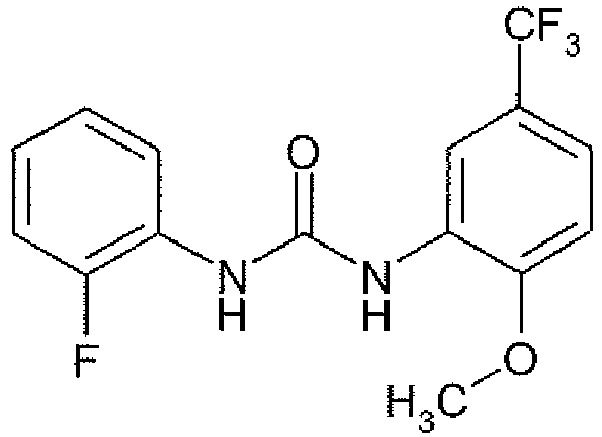
- 1H NMR (300 MHz, d6-DMSO): δ = 8,93 (s, 1H), 8,84 (s, 1H), 8,52 (d, 3 J = 2,3, 2H), 7,55 (d, 2 J = 7,7, 1H), 7,38-7,26 (m, 3H), 7,22 (d, 2 J = 8,5, 1H), 4,00 (s, 3H) ppm;
MS (API-ES-pos.): m/z = 409 [(M+H)+, 100 %];
HPLC (Methode 1): RT = 22,4 und 30,6 min. - Methyl-(2Z)-3-[3-fluor-2-({[2-methoxy-5-(trifluormethyl)phenyl]carbamoyl}amino)-phenyl]acrylat

- 1H NMR (300 MHz, d6-DMSO): δ = 9,16 (s, 1H), 8,84 (s, 1H), 8,45 (d, 1,7Hz, 1H), 7,73 (m, 2H), 7,33 (m, 3H), 7,22 (d, 8,6Hz, 1H), 6,70 (d, 16Hz, 1H), 3,99 (s, 3H), 3,71 (s, 3H) ppm;
MS (API-ES-pos.): m/z = 429,9 [(M+NH4)+]; 412,9 [(M+H)+]
HPLC:RT= 46,4 min. - Instrument: HP 1100 mit variabler Wellenlängen-Detektion; Säule: Phenomenex-Prodigy ODS (3) 100A, 150 mm x 3 mm, 3 µm; Eluent A: (1,36 g KH2PO4 + 0,7 ml H3PO4) / l Wasser, Eluent B: Acetonitril; Gradient: 0 min 20% B, 40 min 45% B, 50 min 80% B, 65 min 80% B; Fluss: 0,5 ml/min; Temp.: 55°C; UV-Detektion: 210 nm.
- {8-Fluor-3-[2-methoxy-5-(trifluormethyl)phenyl]-2-oxo-1,2,3,4-tetrahydrochinazolin-4-yl}essigsäuremethylester
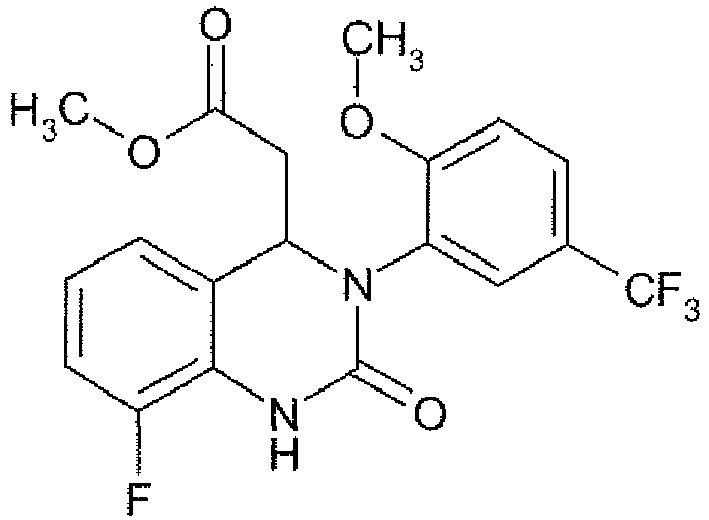
HPLC (Methode 1): RT = 19,4 min. - (2S,3S)-2,3-Bis[(4-methylbenzoyl)oxy]bernsteinsäure-{(4S)-8-Fluor-2-[4-(3-methoxyphenyl)-piperazin-1-yl]-3-[2-methoxy-5-(trifluormethyl)phenyl]-3,4-dihydrochinazolin-4-yl}-essigsäuremethylester (1:1-Salz) Chlorierung/Aminierung/Kristallisation

- 1H NMR (300 MHz, d6-DMSO): δ = 7,90 (d, 2 J = 7,8, 4H), 7,56 (d, 2 J = 8,3, 1H), 7,40 (d, 2 J = 7,8, 4H), 7,28-7,05 (m, 4H), 6,91-6,86 (m, 2H), 6,45 (d, 2J = 8,3, 1H), 6,39-6,36 (m, 2H), 5,82 (s, 2H), 4,94 (m, 1H), 4,03 (q, 2 J = 7,1, 2H), 3,83 (brs, 3H), 3,69 (s, 3H), 3,64 (s, 3H), 3,47-3,36 (m, 8H und Wasser, 2H), 2,98-2,81 (m, 5H), 2,58-2,52 (m, 1H), 2,41 (s, 6H), 1,99 (s, 3H), 1,18 (t, 2 J = 7,2, 3H) ppm;
HPLC (Methode 1): RT = 16,6 und 18,5 min. - (2S,3S)-2,3-Bis[(4-methylbenzoyl)oxy]bernsteinsäure-{(4S)-8-Fluor-2-[4-{3-methoxyphenyl}piperazin-1-yl]-3-[2-methoxy-5-{trifluormethyl}phenyl]-3,4-dihydrochinazolin-4-yl}essigsäuremethylester (1:1-Salz) / Umkristallisation (2S,3S)-2,3-Bis[(4-methylbenzoyl)oxy]bernsteinsäure - (S) {(4S)-8-Fluor-2-[4-(3-methoxyphenyl)piperazin-1-yl]-3-[2-methoxy-5-(trifluormethyl)phenyl]-3,4-dihydrochinazolin-4-y1}essigsäuremethylester (1:1-Salz) (141 kg, berechnet als trocken) wird in Ethylacetat (1400 1) suspendiert und durch Erhitzen auf Rückfluss (77°C) gelöst. Die Lösung wird filtriert und langsam auf Raumtemperatur gekühlt. Dabei erfolgt eine spontane Kristallisation. Die Suspension wird 16 h bei RT gerührt, anschließend auf 0-5°C gekühlt und weitere 3 h gerührt. Die Suspension wird abgesaugt und mit kaltem Ethylacetat nachgewaschen. Die Kristalle werden 16 h im Vakuum bei etwa 40 °C getrocknet. So werden insgesamt 131,2 kg des Salzes als Feststoff erhalten, entsprechend 93,0 % der Theorie.
HPLC (Methode 1): RT = 16,9 und 18,8 min.;
HPLC (Methode 3): 99,9 % e.e. - (S)-{8-Fluor-2-[4-(3-methoxyphenyl)piperazin-1-yl]-3-(2-methoxy-5-trifluormethylphenyl)-3,4-dihydrochinazolin-4-yl} essigsäure

- 1H NMR (300 MHz, d6-DMSO): δ = 7,53 (d, 2 J = 8,4, 1H), 7,41 (brs, 1H), 7,22 (d, 2J = 8,5, 1H), 7,09-7,01 (m, 2H), 6,86 (m, 2H), 6,45 (dd, 2 J = 8,2, 3 J = 1,8, 1H), 6,39-6,34 (m, 2H), 4,87 (t, 2 J = 7,3, 1H), 3,79 (brs, 3H), 3,68 (s, 3H), 3,50-3,38 (m, 4H), 2,96-2,75 (m, 5H), 2,45-2,40 (m, 1H) ppm;
MS (API-ES-neg.): m/z = 571 [(M-H), 100 %];
HPLC (Methode 1): RT = 15,1 min;
HPLC (Methode 2): 99,8 % e.e.; Pd (ICP): <1 ppm. - Kristallisationsversuche zur Auffindung eines geeigneten kristallinen Salzes von {8-Fluor-2-[4-(3-methoxyphenyl)piperazin-1-yl]-3-[2-methoxy-5-(trifluormethyl)phenyl]-3,4-dihydrochinazolin-4-yl}essigsäure wurden sowohl für Säuresalze als auch für Basensalze durchgeführt. Die Kristallisationsversuche erfolgten ausgehend von (S)-{8-Fluor-2-[4-(3-methoxyphenyl)piperazin-1-yl]-3-[2-methoxy-5-(trifluormethyl)phenyl]-3,4-dihydrochinazolin-4-yl}essigsäure und der jeweiligen Säure bzw. Base entweder durch Aufschlämmen im jeweils angegebenen Lösungsmittel für eine Woche bei 20°C oder durch eine Kristallisation durch Abkühlen/Abdampfen ausgehend von einer Lösung, die für 4 Stunden bei 50°C gehalten wurde, gefolgt von einem langsamen Abkühlen auf 20°C mit einer Geschwindigkeit von 3°C/Stunde.
- Die Ergebnisse für die Kristallisationsversuche mit Säuren bzw. Basen sind nachstehend in Tabelle 1 und Tabelle 2 angegeben, wobei die Abkürzung API für (S)-{8-Fluor-2-[4-(3-methoxyphenyl)piperazin-1-yl]-3-[2-methoxy-5-(trifluormethyl)phenyl]-3,4-dihydrochinazolin-4-yl}essigsäure steht.
- "API" ist das Akronym für "active pharmaceutical ingredient" (aus dem Englischen für aktiver Arzneiwirkstoff).
Tabelle 1 Kristallisationsversuche unter Verwendung saurer Gegenionen Gegenionen Verhältnis API: Gegenionen Verfahren Lösungsmittel Ergebnis (XRPD) HCL 1:2 Abkühlen Aceton, Acetonitril, Methanol, THF amorph Aufschlämmen Wasser, Acetonitril, Methanol und Ethanol Citronensäure 1:1 Abkühlen Aceton, Acetonitril, Methanol, THF amorph Aufschlämmen Wasser, Acetonitril Methanol und Ethanol Phosphorsäure 1:1 Abkühlen Aceton, Acetonitril, Methanol, THF amorph Aufschlämmen Wasser, Acetonitril, Methanol und Ethanol Gluconsäure 1:1 Abkühlen Aceton, Acetonitril, Methanol, THF amorph Aufschlämmen Wasser, Acetonitril Methanol und Ethanol Milchsäure 1:1 Abkühlen Aceton, Acetonitril, Methanol, THF amorph Aufschlämmen Wasser, Acetonitril Methanol und Ethanol Maleinsäure 1:1 Abkühlen Aceton, Acetonitril, Methanol, THF amorph Aufschlämmen Wasser, Acetonitril Methanol und Ethanol Bernsteinsäure 1:1 Abkühlen Aceton, Acetonitril, Methanol, THF amorph Aufschlämmen Wasser, Acetonitril Methanol und Ethanol Schwefelsäure 1:1 Abkühlen Aceton, Acetonitril, Methanol, THF amorph Aufschlämmen Wasser, Acetonitril Methanol und Ethanol Weinsäure 1:1 Abkühlen Aceton, Acetonitril, Methanol, THF amorph Aufschlämmen Wasser, Acetonitril Methanol und Ethanol Benzoesäure 1:1 Abkühlen Aceton, Acetonitril, Methanol, THF amorph Aufschlämmen Wasser, Acetonitril Methanol und Ethanol Fumarsäure 1:1 Abkühlen Aceton, Acetonitril, Methanol, THF amorph Aufschlämmen Wasser, Acetonitril Methanol und Ethanol Maleinsäure 1:1 Abkühlen Aceton, Acetonitril, Methanol, THF amorph Aufschlämmen Wasser, Acetonitril Methanol und Ethanol Methansulfonsäure 1:1 Abkühlen Aceton, Acetonitril, Methanol, THF amorph Aufschlämmen Wasser, Acetonitril Methanol und Ethanol Tabelle 2 Kristallisationsversuche unter Verwendung basischer Gegenionen Gegenionen Verfahren Lösungsmittel Ergebnis NaOH Abkühlen Aceton+Isopropylether 1:1, Acetonitril+Isopropylether 1:1, kristalline: Methanol, Ethanol amorph: alle Aufschlämmen Methanol+Isopropylether 1:1, THF und Isopropylether 1:1 Wasser, Acetonitril, Methanol und Ethanol anderen Erbumin Abkühlen Aceton+Isopropylether 1:1, Acetonitril+Isopropylether 1:1, amorph Aufschlämmen Methanol+Isopropylether 1:1, THF THF und Isopropylether 1:1 Wasser, Acetonitril, Methanol und Ethanol 2-Amino-2-methylpropanol Abkühlen Aceton+Isopropylether Acetonitril+Isopropylether 1:1, amorph Aufschlämmen Methanol+Isopropylether 1:1, THF und Isopropylether 1:1 Wasser, Acetonitril, Methanol und Ethanol 2-Amino-2-methyl-1,3-propandiol Abkühlen Aceton+Isopropylether 1:1, Acetonitril+Isopropylether 1:1, kristallin: THF, Acetonitril amorph: alle anderen Aufschlämmen Methanol+Isopropylether 1:1, THF und Isopropylether 1:1 Wasser, Acetonitril, Methanol und Ethanol Tromethamin Abkühlen Aceton+Isopropylether 1:1, Acetonitril+Isopropylether 1:1, amorph Aufschlämmen Methanol+Isopropylether 1:1, THF und Isopropylether 1:1 Wasser, Acetonitril, Methanol und Ethanol Dimethylaminoethanol Abkühlen Aceton+Isopropylether 1:1, Acetonitril+Isopropylether 1:1, amorph Aufschlämmen Methanol+Isopropylether 1:1, THF und Isopropylether 1:1 Wasser, Acetonitril, Methanol und Ethanol Lysin Abkühlen Aceton+Isopropylether 1:1, Acetonitril+Isopropylether 1:1, amorph Aufschlämmen Methanol+Isopropylether 1:1, THF und Isopropylether 1:1 Wasser, Acetonitril, Methanol und Ethanol N-(2-Hydroxyethyl)pyrrolidin Abkühlen Aceton+Isopropylether 1:1, Acetonitril+Isopropylether 1:1, amorph aufschlämmen Aufschlämmen Methanol+Isopropylether 1:1, THF und Isopropylether 1:1 Wasser, Acetonitril, Methanol und Ethanol - Was bei diesen Experimenten auffällig ist, ist dass es sich allgemein als äußerst schwierig erwiesen hat, kristalline Salze von (S)-{8-Fluor-2-[4-(3-methoxyphenyl)piperazin-1-yl]-3-[2-methoxy-5-(trifluormethyl)phenyl]-3,4-dihydrochinazolin-4-yl}essigsäure herzustellen, insbesondere ist auffällig, dass die Kristallisation unter Verwendung saurer Gegenionen vollkommen fehlgeschlagen ist.
- Das 2-Amino-2-methyl-1,3-propandiolsalz von (S)-{8-Fluor-2-[4-(3-methoxyphenyl) piperazin-1-yl]-3-[2-methoxy-5-(trifluormethyl)phenyl]-3,4-dihydrochinazolin-4-yl}essigsäure ist aufgrund dessen, dass dieses nur in organischen Lösungsmitteln wie Tetrahydrofuran und Acetonitril kristallisiert, was zu unerwünschten Verunreinigungen führen kann, für die pharmazeutische Weiterentwicklung eher ungeeignet.
- Im Hinblick auf die mit Natriumhydroxid erhaltenen positiven Ergebnisse wurden weitere Kristallisationsversuche unter Verwendung von Alkalimetall- bzw. Erdalkalimetallhydroxiden unter analogen Kristallisationsbedingungen wie für das Natriumsalz durchgeführt. Es hat sich hierbei gezeigt, dass lediglich unter Verwendung von Calciumhydroxid weitere kristalline Salze erhalten werden konnten.
- Mononatriumsalz von (S)-{8-Fluor-2-[4-(3-methoxyphenyl)piperazin-1-yl]-3-[2-methoxy-5-(trifluormethyl)phenyl]-3,4-dihydrochinazolin-4-yl}essigsäure:
- 331,1 g (S)-{8-Fluor-2-[4-(3-methoxyphenyl)piperazin-1-yl]-3-[2-methoxy-5-(trifluormethyl)phenyl]-3,4-dihydrochinazolin-4-yl}essigsäure (Beispiel 6A) werden in einem 2000 ml Dreihalskolben in 1300 ml einer Mischung aus Ethanol und Diisopropylether (1:1) gelöst. Zu der Lösung werden 21,9 g (546,84 mmol) NaOH als Feststoff zugegeben. Die Mischung wird über 25 min. auf eine Innentemperatur von 50°C erwärmt, wobei eine klare orangegefärbte Lösung erhalten wird. Die so erhaltene Lösung wird 3 h bei dieser Temperatur gerührt, wobei sich nach 1 h bereits eine dünne Suspension bildet. Die Reaktionsmischung wird anschließend über 10 h mit einer Abkühlrate von 3°C/h auf eine Innentemperatur von 20°C abgekühlt und weitere 5 h bei dieser Temperatur gerührt. Unter Vakuum wird das Gesamtvolumen der Reaktionsmischung auf ca. 750 ml reduziert und die erhaltene Suspension bei 20°C für 2 h gerührt. Anschließend werden zu der erhaltenen Reaktionsmischung 250 ml Diisopropylether über 10 min. zugegeben und die erhaltene Mischung wird für weitere 2 h gerührt. Das erhaltene kristalline Produkt wird abgesaugt, 2x mit je 250 ml Diisopropylether gewaschen und bei 20°C und 160 mbar 20 h im Vakuumtrockenschrank getrocknet. Der so erhaltene kristalline Feststoff wird anschließend für 10 min. bei 90°C in einem IR-Trockner und für weitere 16 h bei 60°C erneut im Vakuumtrockenschrank nachgetrocknet. So werden insgesamt 274,4 g (86% der Theorie) des gewünschten kristallinen Natriumsalzes erhalten.
- Herstellung des 3-Hydrats des Mononatriumsalzes von (S)-{8-Fluor-2-[4-(3-methoxyphenyl)piperazin-1-yl]-3-[2-methoxy-5-(trifluormethyl)phenyl]-3,4-dihydrochinazolin-4-yl}essigsäure:
- Ca. 300 mg des Natriumsalzes von Beispiel 1 werden in 1 ml Ethanol (enthält 4 % Wasser) suspendiert und 25°C für eine Woche geschüttelt. Der erhaltene Feststoff wird abfiltriert und der Rückstand bei Raumtemperatur unter Umgebungsfeuchte getrocknet. Der erhaltene Rückstand entspricht der Titelverbindung als Trihydrat.
- Der erhaltene Rückstand wurde röntgendiffraktometrisch untersucht. Das dabei erhaltene Diffraktogramm ist in
Fig. 1 dargestellt. - Das Röntgendiffraktogramm wurde mit einem XRD-Transmissions/Reflexions-Diffraktometer X'Pert PRO (PANalytical) bei Raumtemperatur aufgenommen (Strahlung: Kupfer, Kα1, Wellenlänge: 1,5406 Å). Es gab keine Probenvorbereitung.
- Die Peaklisten für das Salz von Beispiel 2 sowie die Salze der Beispiele 3 und 4 sind nachstehend in Tabelle 3 wiedergegeben.
Tabelle 3 Peaklisten der Pulverdiffraktogramme der Salze von Beispiel 2, 3 und 4 2 Theta Beispiel 2 Beispiel 3 Beispiel 4 6,2 4,6 6,0 9,4 6,1 6,2 11,3 6,3 7,6 12,4 7,6 9,0 12,9 8,8 9,4 15,6 9,2 9,6 16,4 10,6 10,7 16,8 11,0 11,2 17,9 11,2 11,6 18,6 11,6 12,1 18,9 12,2 12,4 19,9 12,3 13,1 20,9 12,6 15,1 21,5 12,8 15,4 21,8 13,0 16,0 22,4 13,3 16,1 22,7 13,9 16,3 23,5 14,5 16,6 24,9 15,3 16,9 25,2 15,5 17,4 25,9 16,2 17,7 26,4 16,3 18,2 26,7 16,5 18,3 27,2 16,7 18,9 27,4 17,0 19,2 28,1 17,5 19,5 28,5 17,7 19,8 29,5 18,1 20,0 30,1 18,5 20,5 30,8 18,7 20,7 31,2 19,4 21,3 32,1 19,7 21,8 32,5 20,5 22,0 32,8 20,8 22,4 33,3 21,3 22,7 34,9 21,5 23,8 35,6 21,7 24,2 36,2 22,2 24,5 36,8 22,3 25,4 36,8 23,0 26,2 37,9 23,3 26,3 23,7 26,5 24,2 27,0 24,8 27,5 25,4 28,3 25,9 29,4 26,3 31,5 26,5 34,1 26,9 35,9 27,3 37,0 27,9 37,3 28,2 28,7 29,0 29,3 30,5 31,9 32,4 33,1 34,1 34,1 36,0 37,4 - Herstellung des 2,5 Hydrats des Calciumsalzes von {8-Fluor-2-[4-(3-methoxyphenyl)piperazin-1-yl]-3-[2-methoxy-5-(trifluormethyl)phenyl]-3,4-dihydrochinazolin-4-yl}essigsäure:
- 10 g (S)-{8-Fluor-2-[4-(3-methoxyphenyl)piperazin-1-yl]-3-[2-methoxy-5-(trifluormethyl) phenyl]-3,4-dihydrochinazolin-4-yl}essigsäure (Beispiel 6A) werden in einem 50 ml Dreihalskolben in 45 ml Ethanol gelöst und zu der entstandenen Lösung werden 1,294 g Ca(OH2) als Feststoff in Form eines Pulvers zugegeben. Die erhaltene Suspension wird über 25 min. auf 50°C erwärmt und dann 3 h bei dieser Temperatur nachgerührt. Zu der auf diese Weise erhaltenen Suspension werden 62,6 g Wasser zugegeben und die dabei erhaltene Lösung wird auf 0°C abgekühlt. Zu der so erhaltenen Lösung werden vorher erzeugte Impfkristalle zugegeben und die ein teilweise öliges Produkt aufweisende Suspension wird auf Raumtemperatur erwärmt und 72 h bei Raumtemperatur stehengelassen. Die erhaltene Suspension wird erneut auf 0°C abgekühlt und 2 h bei dieser Temperatur nachgerührt. Das erhaltene kristalline Produkt wird abfiltriert und 2x mit je 15 ml einer Mischung aus Ethanol und Wasser 1:1 gewaschen und dann bei 50°C und 160 mbar im Vakuumtrockenschrank getrocknet. Insgesamt werden 7,4 g (68,5% der Theorie) des Salzes als kristalliner Feststoff erhalten.
- Unter Verwendung des im Beispiel 3 erhaltenen kristallinen Feststoffs wurde unter den gleichen Bedingungen wie in Beispiel 2 genannt ein Pulver-XRD-Diffraktogramm aufgenommen, welches in
Fig. 2 dargestellt ist. - 3,5-Hydrat des Calciumsalzes von (S)-{8-Fluor-2-[4-(3-methoxyphenyl)piperazin-1-yl]-3-[2-methoxy-5-(trifluormethyl)phenyl]-3,4-dihydrochinazolin-4-yl}essigsäure
- Etwa 100 mg des in Beispiel 3 erhaltenen Salzes werden in 1 ml Ethanol Wasser 1:1 suspendiert und die erhaltene Suspension wird 1 Woche bei 25°C geschüttelt. Der erhaltene kristalline Feststoff wird abfiltriert und der erhaltene Rückstand bei Raumtemperatur und Umgebungsfeuchte getrocknet. Der erhaltene Rückstand entspricht dem 3,5-Hydrat des Calciumsalzes von (S)-{8-Fluor-2-[4-(3-methoxyphenyl)piperazin-1-yl]-3-[2-methoxy-5-(trifluormethyl)phenyl]-3,4-dihydrochinazolin-4-yl}essigsäure.
- Unter Verwendung des im Beispiel 4 erhaltenen kristallinen Feststoffs wurde unter den gleichen Bedingungen wie in Beispiel 2 genannt ein Pulver-XRD-Diffraktogramm aufgezeichnet, welches in
Fig. 3 dargestellt ist. - Zur Bestimmung der Löslichkeit wurde von dem Salz von Beispiel 2 eine gesättigte Lösung in Phosphatpuffer bei pH 7,0 angefertigt und bei Raumtemperatur 2 h geschüttelt. Die erhaltenen Suspensionen wurden über einen Spritzenfilter (0,45 µm Porendurchmesser) gefiltert und die klaren Lösungen wurden nach Verdünnen per HPLC vermessen. Als Nullprobe wurde reiner Phosphatpuffer verwendet. Die Löslichkeit wurde bezogen auf die Absorption einer Referenzlösung des amorphen Zwitterions in Phosphatpuffer berechnet. Die Ergebnisse der Messung sind nachstehend in Tabelle 4 dargestellt.
Tabelle 4 Verbindung Löslichkeit in Puffer [mg/ml] Beispiel 6a 0,4 (bei pH 7) Beispiel 2 > 91,7 - Die in vitro-Wirkung der erfindungsgemäßen Verbindungen auf die Replikation des HCMV (humanes Cytomegalovirus) kann in folgendem antiviralen Assay gezeigt werden: HCMV Fluoreszenzreduktionstest.
- Die Testverbindungen werden als 50 millimolare (mM) Lösungen in Dimethysulfoxid (DMSO) eingesetzt. Als Referenzverbindungen können z.B. Ganciclovir®, Foscarnet® oder Cidofovir® verwendet werden. Einen Tag vor Testansatz werden 1,5 x 10⁴ humane Vorhautfibroblasten (NHDF-Zellen)/well in 200 µl Zellkulturmedium in die Wells B2-G11 von 96-well Platten (schwarz mit durchsichtigem Boden) ausgesät. Die randständigen Wells jeder 96-well Platte werden lediglich mit 200µl Medium befüllt um Randeffekte zu vermeiden. Am Versuchstag wird das Zellkulturmedium der Wells B2 - G11 jeder 96-well Platte abgesaugt und durch 100µl Virussuspension ersetzt (multiplicity of infection (MOI): 0.1-0.2). Bei dem verwendeten Virus handelt es sich um ein rekombinantes HCMV, welches eine Expressionskassette für das green fluorescence protein (GFP) in das Virusgenom integriert hat (HCMV AD 169 RV-HG(E. M. Borst, K. Wagner, A. Binz, B. Sodeik, and M. Messerle, 2008, J. Virol. 82:2065-2078.). Nach einer Inkubationszeit von 2h bei 37°C und 5% CO2 wird das Virus-Inokulat abgesaugt und alle Wells mit Ausnahme der Wells in Spalte 3 werden mit 200µl Zellkulturmedium befüllt. Spalte 2 wird nicht weiter behandelt und dient als Viruskontrolle. Die Wells in Spalte 3 werden jeweils in Doppelbestimmung mit 300µl Testsubstanz (verdünnt in Zellkulturmedium) befüllt. Die Konzentration der jeweiligen antiviralen Substanz in Spalte 3 beträgt ∼ die 27fache Konzentration des jeweils erwarteten EC50 Werts. Die Testsubstanz in Spalte 3 wird in 8 Schritten 1:3 über die 96-well Platte verdünnt indem jeweils 100µl einer Spalte in die jeweils rechte Spalte transferiert- und dort mit den vorhandenen 200µl Zellkulturmedium gemischt werden. Auf diese Weise werden drei antivirale Substanzen in Doppelbestimmungen getestet. Die Platten werden 7 Tage bei 37°C / 5% CO2 inkubiert. Im Anschluss werden alle Wells einer Platte 3 x mit PBS (Phosphate Buffered Saline) gewaschen und mit 50 µl PBS befüllt. Danach wird die GFP-Intensität jedes Wells einer 96-well Platte mittels eines Fluoreszenzlesegerätes (FluoBox; Bayer Technology Services GmbH; Filtereinstellungen: GFP, Ex 480nm, Em 520nm) bestimmt. Aus den so erhaltenen Messwerten kann der EC50 einer anti-HCMV Substanz ermittelt werden:
- EC50 (GFP-RA) = Substanzkonzentration in µM welche im Vergleich zur unbehandelten Viruskontrolle die GFP-Fluoreszenz in infizierten Zellen um 50% reduziert.
- Repräsentative in-vitro-Wirkdaten für die erfindungsgemäßen Verbindungen sind in Tabelle 5 wiedergegeben:
Tabelle 5 Virus- Stamm Beispiel 6A EC50 [µM] Beispiel 2 EC50 [µM] Ganciclovir EC50 [µM] AD169 RV- HG 0.0034 0.0039 2.2 - Die erfindungsgemäßen Verbindungen können folgendermaßen in pharmazeutische Zubereitungen überführt werden:
- Zur Herstellung einer ersten Stammlösung werden 1,0 g des Salzes von Beispiel 2 in 10 ml Wasser für Injektionszwecke gelöst und es wird gerührt bis eine klare Lösung erhalten wird. Diese Lösung wird langsam zu einer 20 mM Phosphat-Puffer-Lösung zugegeben um Lösungen zur intravenösen Verabreichung mit Konzentrationen von 5 mg/ml bzw. 10 mg/ml herzustellen. Die pH-Werte der jeweiligen Lösungen lagen bei etwa pH 7,6 (5 mg/ml) und etwa pH 7,7 (10 mg/ml). Zum Abschluss werden die erhaltenen Lösungen sterilfiltriert und in sterilisierte geeignete Behälter abgefüllt. Die Behälter werden mit Infusionsstopfen und Bördelkappen verschlossen.
- Ggf. können die so hergestellten Lösungen zur Lagerung vor dem Verschließen lyophilisiert und später zur Verwendung rekonstituiert werden.
- Zur Herstellung einer oralen festen Formulierung wird das Salz aus Beispiel 2 (50%) mit Calciumhydrogenphosphatdihydrat (48%), Natriumcroscarmellose (5%), Polyvinylpyrrolidon (5%) und kolloidalem Kieselgel (1%) gesiebt und gemischt. Anschließend wird gesiebtes Magnesiumstearat (1%) dazugegeben. Diese Pressmischung wird dann direkt tablettiert.
- S(+)- {8-Fluor-2-[4-(3-methoxyphenyl)piperazin-1-yl]-3-[2-methoxy-5-(trifluormethyl)-phenyl]-3,4-dihydrochinazolin-4-yl}essigsäure Natrium-Salz:
- 313,1 g S(+)- {8-Fluor-2-[4-(3-methoxyphenyl)piperazin-1-yl]-3-[2-methoxy-5-(trifluormethyl)phenyl]-3,4-dihydrochinazolin-4-yl}essigsäure wurden in 2000 ml Planschliff-Kolben vorgelegt. Daraufhin wurden 1300 ml einer Mischung aus EtOH (vergällt)/Diisopropylether (1:1) als auch 21,9 g NaOH-Plätzchen zugegeben. Mittels Innentemperatursteuerung wurde die Mischung auf eine Innentemperatur von 50°C (Tm=51°C) für 25 Minuten erwärmt. Die NaOH Plätzchen lösen sich auf; es entsteht eine klare orangefarbene Lösung. Die Mischung wurde drei Stunden nachgerührt, so entsteht eine Suspension. Innerhalb von darauf folgenden 10 Stunden wurde die Mischung mit einer Abkühlrate von 3°C pro Stunde auf eine Innentemperatur von ca. 20°C abgekühlt und für weitere fünf Stunden bei dieser Temperatur nachgerührt. So entsteht eine dickere Suspension mit einem Gesamtvolumen von 1500 ml in einem Planschliff-Kolben, davon sind 400 ml Kristallvolumen. Unter Vakuum wird das Gesamtvolumen bei 110 bis 90 mbar auf ca. 750 ml reduziert; Innentemperatur 17-25°C, Manteltemperatur 35-50°C, Destillat: 273 g. Dies wurde ca. zwei Stunden nachgerührt. Innerhalb von 10 Minuten werden 250 ml Diisopropylether zudosiert und zwei Stunden nachgerührt. Das auf diese Weise erhaltene Produkt wird isoliert und zweimal mit je 250 ml Diisopropylether nachgewaschen; Feuchtausbeute: 284,8 g; M/W: 805,4 g. Das erhaltene Produkt wurde im VTS bei 50°C unter Stickstoff-Beiluft bei ca. 160 mbar für 20 Stunden getrocknet; Auswaage 279,4 g. Dieses Produkt wurde der folgenden Analytik unterzogen.
- 200 mg Testsubstanz (S(+)-{8-Fluor-2-[4-(3-methoxyphenyl)piperazin-1-yl]-3-[2-methoxy-5-(trifluormethyl)phenyl]-3,4-dihydrochinazolin-4-yl}essigsäure Natrium-Salz) werden üblicherweise mit HNO3 im Überschuss versetzt und in einem mikrowellengestützten Druckaufschluss aufgeschlossen (nach Methode 2011-0606601 Currenta, Leverkusen). Die Lösung wird mittels Flammen-Atomabsorptionsspektroskopie auf den Natriumgehalt hin untersucht (nach Methode 2011-0267201 Currenta, Leverkusen).
- Ergebnis: S(+)-{8-Fluor-2-[4-(3-methoxyphenyl)piperazin-1-yl]-3-[2-methoxy-5-(trifluormethyl)phenyl]-3,4-dihydrochinazolin-4-yl}essigsäure Natrium-Salz: 3,5 Gew% Natrium
- Modifikation X-Ray: kristallin
- Restlösungsmittelbestimmung: 0,03 Gew% Diisopropylether
- Untersuchung folgender spezifischer und nichtspezifischer Verunreinigungen von_S(+)-{8-Fluor-2-[4-(3-methoxyphenyl)piperazin-1-yl]-3-[2-methoxy-5-(trifluormethyl)phenyl]-3,4-dihydrochinazolin-4-yl}essigsäure Natrium-Salz:
- Chinazolylpiperazin
- Di-p-toluoylweinsäure
- Chinazolyldipiperazin
- Chinazolinethylester
- einzelne nichtspezifische Verunreinigungen
-
1. Hochdruckflüssigkeitschromatograph mit thermostatisiertem Säulenofen, UV-Detektor und Datenauswertesystem
2. Metallsäule aus EdelstahlLänge: 15 cm Innendurchmesser: 3,0 mm Füllung: Prodigy ODS III, 3 µm -
- 1. Acetonitril, für die HPLC
- 2. Kaliumdihydrogenphosphat, p.a.
- 3. o-Phosphorsäure 85%ig, p.a.
- ca. 22 mg Probe S(+)-{8-Fluor-2-[4-(3-methoxyphenyl)piperazin-1-yl]-3-[2-methoxy-5-(trifluormethyl)phenyl]-3,4-dihydrochinazolin-4-yl}essigsäure Natrium-Salz; genau gewogen, in Acetonitril zu 50,0 ml gelöst.
- ca. 22 mg Referenzstandard (S(+)-{8-Fluor-2-[4-(3-methoxyphenyl)piperazin-1-yl]-3-[2-methaxy-5-(trifluormethyl)phenyl]-3,4-dihydrochinazolin-4-yl}essigsäure), genau gewogen, in Acetonitril zu 50,0 ml gelöst.
- Es wird eine Vergleichslösung analog zur Kalibrierlösung hergestellt, die zusätzlich die organischen Verunreinigungen (Chinazolylpiperazin, Di-p-toluoylweinsäure, Chinazolyldipiperazin, Chinazolinethylester) in geringer Menge enthält.
- Die angegebenen Bedingungen gelten als Richtwerte und können gegebenenfalls zur Erzielung optimaler Trennungen den technischen Möglichkeiten des Chromatographen und den Eigenschaften der jeweiligen Säule angepasst werden.
-
- A. 1,36 g Kaliumdihydrogenphosphat und 0,7 ml o-Phosphorsäure 85%ig mit Wasser zu 1000,0 ml lösen
- B. Acetonitril
- 0,5 ml/min
- 55 °C
-
Messwellenlänge: 210 nm Bandbreite: 4 nm - 3 µl
- 10 min (unter Startbedingungen)
-
zeit [min] % A % B 0,00 80 20 40,00 55 45 50,00 20 80 65,00 20 80 - Die relative Standardabweichung der Flächen von 6 Einspritzungen des Referenzstandards muss ≤ 1,5 % sein.
- Prüflösung, Kalibrierlösung und Vergleichslösung unter den angegebenen Bedingungen chromatographieren.
RT [min] RRT RF BAY 73-6327 ca. 27,9 1,00 1,00 Di-p-toluoylweinsäure ca. 30,5 1,09 1,94 Chinazolylpiperazin ca. 34,4 1,24 1,02 Chinazolinethylester ca. 38,1 1,37 1,05 Chinazolyldipiperazin ca. 42,9 1,54 0,81 - Elektronische Integration der Peakflächen.
- Flächenprozent-Methode mit Flächenkorrekturfaktoren (RF) soweit vorhanden.
- S(+)-{8-Fluor-2-[4-(3-methoxyphenyl)piperazin-1-yl]-3-[2-methoxy-5-(trifluormethyl)phenyl]-3,4-dihydrochinazolin-4-yl}essigsäure Natrium-Salz:
- 99,9% F1%
- 0,0 Fl% für bekannte organische Verunreinigungen
- 0,07 Fl% größte nichtspezifische Verunreinigungen
- 0,0907 F1% größte einzelne nichtspezifische Nebenkomponente
- 88,0 Gew%
- Für HPLC-Chromatogramm und dessen Analyse siehe
Figuren 4 und5 .
Reversed-Phase Methode;
Detektion: UV-Bereich;
Analyse: Flächenprozent-Methode mit Flächenkorrekturfaktoren
Claims (16)
- Salz von {8-Fluor-2-[4-(3-methoxyphenyl)piperazin-1-yl]-3-[2-methoxy-5-(trifluormethyl)phenyl]-3,4-dihydrochinazolin-4-yl}essigsäure oder ein Solvat davon, ausgewählt aus der Gruppe bestehend aus den kristallinen Natriumsalzen von {8-Fluor-2-[4-(3-methoxyphenyl)piperazin-1-yl]-3-[2-methoxy-5-(trifluormethyl)phenyl]-3,4-dihydrochinazolin-4-yl}essigsäure, den kristallinen Calciumsalzen von {8-Fluor-2-[4-(3-methoxyphenyl)piperazin-1-yl]-3-[2-methoxy-5-(trifluormethyl)phenyl]-3,4-dihydrochinazolin-4-yl}essigsäure und deren Solvaten.
- Salz nach Anspruch 1, wobei es sich um das Monocalciumsalz von {8-Fluor-2-[4-(3-methoxyphenyl)piperazin-1-yl]-3-[2-methoxy-5-(trifluormethyl)phenyl]-3,4-dihydrochinazolin-4-yl}essigsäure oder ein Solvat davon handelt.
- Salz nach Anspruch 2, wobei es sich um das 2,5-Hydrat des Monocalciumsalzes von {8-Fluor-2-[4-(3-methoxyphenyl)piperazin-1-yl]-3-[2-methoxy-5-(trifluormethyl)phenyl]-3,4-dihydrochinazolin-4-yl}essigsäure handelt.
- Salz nach Anspruch 3, dadurch gekennzeichnet, dass es im Pulver-XRD-Diffraktogramm charakteristische Peaks bei etwa 6.1, 9.2 und 15.5 Grad 2Theta zeigt.
- Salz nach Anspruch 2, wobei es sich um das 3,5-Hydrat des Monocalciumsalzes von {8-Fluor-2-[4-(3-methoxyphenyl)piperazin-1-yl]-3-[2-methoxy-5-(trifluormethyl)phenyl]-3,4-dihydrochinazolin-4-yl}essigsäure handelt.
- Salz nach Anspruch 5, dadurch gekennzeichnet, dass es im Pulver-XRD-Diffraktogramm charakteristische Peaks bei etwa 6.2, 12.4 und 22.4 Grad 2Theta zeigt.
- Salz nach Anspruch 1, wobei es sich um das Mononatriumsalz von {8-Fluor-2-[4-(3-methoxyphenyl)piperazin-1-yl]-3-[2-methoxy-5-(trifluormethyl)phenyl]-3,4-dihydrochinazolin-4-yl}essigsäure oder ein Solvat davon handelt.
- Salz nach Anspruch 7, wobei es sich um das 3-Hydrat des Mononatriumsalzes von {8-Fluor-2-[4-(3-methoxyphenyl)piperazin-1-yl]-3-[2-methoxy-5-(trifluormethyl)phenyl]-3,4-dihydrochinazolin-4-yl}Essigsäure handelt.
- Salz nach Anspruch 8, dadurch gekennzeichnet, dass es im Pulver-XRD-Diffraktogramm charakteristische Peaks bei etwa 6.2, 20.9 und 22.4 Grad 2Theta zeigt.
- Verfahren zur Herstellung eines Salzes nach einem der Ansprüche 1 bis 9 mit den folgenden Schritten:a.) Lösen von {8-Fluor-2-[4-(3-methoxyphenyl)piperazin-1-yl]-3-[2-methoxy-5-(trifluormethyl)phenyl]-3,4-dihydrochinazolin-4-yl}essigsäure oder eines Solvats davon in einer Mischung aus zumindest einem (C1-C4)-Dialkylether und zumindest einem (C1-C4)-Alkohol, ggf. unter Erwärmen.b.) Zugabe von NaOH oder Ca(OH)2 zu der in Schritt a.) erhaltenen Lösung,c.) Entfernen eines Teil des Lösungsmittels aus der in Schritt b.) erhaltenen Lösung und ggf. Animpfen mit geeigneten Impfkristallen um die Kristallisation des Salzes bzw. eines Solvats eines Salzes auszulösen,d.) Abtrennen des in Schritt c.) auskristallisierten Salzes oder Solvats davon,e.) ggf. Rühren des in Schritt d.) erhaltenen Salzes oder Solvats in einem geeigneten Lösungsmittel, vorzugsweise in einer Mischung aus Wasser und zumindest einem (C1-C4)-Alkohol um ein gewünschtes Solvat zu erhalten, undf.) Trocknen des in Schritt d.) oder e.) erhaltenen Salzes oder Solvats.
- Salz nach einem der Ansprüche 1 bis 9 zur Verwendung in einem Verfahren zur Behandlung und/oder Prophylaxe von Krankheiten, insbesondere von Virusinfektionen, vorzugsweise von Infektionen mit HCMV oder einem anderen Vertreter der Gruppe der Herpes viridae.
- Arzneimittel enthaltend ein Salz nach einem der Ansprüche 1 bis 9 in Kombination mit zumindest einem pharmazeutisch annehmbaren Hilfsstoff.
- Arzneimittel nach Anspruch 12 zur Verwendung in einem Verfahren zur Behandlung und/oder Prophylaxe von Virusinfektionen, vorzugsweise von Infektionen mit HCMV oder einem anderen Vertreter der Gruppe der Herpes viridae.
- Salz nach einem der Ansprüche 1 bis 9 zur Verwendung als Arzneimittel, insbesondere als Arzneimittel zur Behandlung und/oder Prophylaxe von Krankheiten, insbesondere von Virusinfektionen vorzugsweise von Infektionen mit HCMV oder einem anderen Vertreter der Gruppe der Herpes viridae.
- Verwendung eines Salzes nach einem der Ansprüche 1 bis 9 zur Herstellung eines Medikaments zur Behandlung und/oder Prophylaxe von Virusinfektionen vorzugsweise von Infektionen mit HCMV oder einem anderen Vertreter der Gruppe der Herpes viridae.
- Salz nach einem der Ansprüche 1 bis 9 oder Arzneimittel nach Anspruch 12 oder 13 zur Verwendung in der Bekämpfung von Virusinfektionen, vorzugsweise von Infektionen mit HCMV oder einem anderen Vertreter der Gruppe der Herpes viridae bei einem Menschen und einem Tier der (das) eine solche Behandlung benötigt.
Priority Applications (3)
| Application Number | Priority Date | Filing Date | Title |
|---|---|---|---|
| RS20160575A RS54990B1 (sr) | 2012-02-29 | 2013-02-28 | Natrijumove i kalcijumove soli derivata dihidrokinazolina i njihova upotreba kao antivirusnih agenasa |
| SI201330241A SI2820001T1 (sl) | 2012-02-29 | 2013-02-28 | Natrijeve in kalcijeve soli dihidrokinazolinskega derivata in njihova uporaba kot protivirusna sredstva |
| HRP20160813TT HRP20160813T1 (hr) | 2012-02-29 | 2013-02-28 | Natrijeve i kalcijeve soli derivata dihidrokinazolina i njihova upotreba kao antivirusna sredstva |
Applications Claiming Priority (2)
| Application Number | Priority Date | Filing Date | Title |
|---|---|---|---|
| DE102012101659A DE102012101659A1 (de) | 2012-02-29 | 2012-02-29 | Salze eines Dihydrochinazolinderivats |
| PCT/EP2013/054115 WO2013127971A1 (de) | 2012-02-29 | 2013-02-28 | Natrium- und calciumsalze eines dihydrochinazolinderivates und ihre verwendung als antivirale mittel |
Publications (2)
| Publication Number | Publication Date |
|---|---|
| EP2820001A1 EP2820001A1 (de) | 2015-01-07 |
| EP2820001B1 true EP2820001B1 (de) | 2016-04-20 |
Family
ID=47891621
Family Applications (1)
| Application Number | Title | Priority Date | Filing Date |
|---|---|---|---|
| EP13709804.2A Active EP2820001B1 (de) | 2012-02-29 | 2013-02-28 | Natrium- und calciumsalze eines dihydrochinazolinderivates und ihre verwendung als antivirale mittel |
Country Status (18)
| Country | Link |
|---|---|
| US (1) | US9637459B2 (de) |
| EP (1) | EP2820001B1 (de) |
| JP (1) | JP6235494B2 (de) |
| CN (1) | CN104144917B (de) |
| CA (1) | CA2865049C (de) |
| CY (1) | CY1117796T1 (de) |
| DE (1) | DE102012101659A1 (de) |
| DK (1) | DK2820001T3 (de) |
| ES (1) | ES2583362T3 (de) |
| HR (1) | HRP20160813T1 (de) |
| HU (1) | HUE027750T2 (de) |
| LT (1) | LT2820001T (de) |
| PL (1) | PL2820001T3 (de) |
| PT (1) | PT2820001T (de) |
| RS (1) | RS54990B1 (de) |
| SI (1) | SI2820001T1 (de) |
| SM (1) | SMT201600344B (de) |
| WO (1) | WO2013127971A1 (de) |
Families Citing this family (27)
| Publication number | Priority date | Publication date | Assignee | Title |
|---|---|---|---|---|
| DE10319612A1 (de) * | 2003-05-02 | 2004-11-18 | Bayer Healthcare Ag | Substituierte Dihydrochinazoline |
| DE102012101673A1 (de) | 2012-02-29 | 2013-08-29 | Aicuris Gmbh & Co. Kg | Salze eines Dihydrochinazolinderivats |
| CN120097924A (zh) * | 2013-06-19 | 2025-06-06 | Aic246股份两合公司 | 无定形莱特莫韦及其用于口服施用的固体药物制剂 |
| WO2016109360A1 (en) * | 2014-12-29 | 2016-07-07 | Auspex Pharmaceuticals, Inc. | Dihydroquinazoline inhibitors of viral terminase |
| MY197231A (en) | 2015-07-22 | 2023-06-06 | Enanta Pharm Inc | Benzodiazepine derivatives as rsv inhibitors |
| AU2019218150B2 (en) * | 2018-02-08 | 2021-05-13 | Phaeno Therapeutics Co., Ltd. | Crystal form of 3,4-dihydrothieno[3,2-d]pyrimidine compound and preparation method therefor |
| CA3133300A1 (en) | 2019-03-18 | 2020-09-24 | Enanta Pharmaceuticals, Inc. | Benzodiazepine derivatives as rsv inhibitors |
| US11505558B1 (en) | 2019-10-04 | 2022-11-22 | Enanta Pharmaceuticals, Inc. | Antiviral heterocyclic compounds |
| UY39032A (es) | 2020-01-24 | 2021-07-30 | Enanta Pharm Inc | Compuestos heterocíclicos como agentes antivirales |
| PY2116975A (es) * | 2020-02-27 | 2022-04-05 | Aic246 Gmbh & Co Kg | Composiciones farmacéuticas que comprenden acetato de 2-[(4s)-8-fluoro-2-[4-(3-metoxifenil)piperazin-1-il]-3-[2-metoxi-5-(trifluorometil)fenil]-4h-quinazolin-4-il] e iones de sodio |
| UY39096A (es) * | 2020-02-27 | 2021-09-30 | Aic246 Gmbh & Co Kg | Un método para producir una forma cristalina de 2-[(4s)-8- fluoro-2-[4-(3-metoxifenil)piperazin-1-il]-3-[2-metoxi-5- (trifluorometil)fenil]-4h-quinazolin-4-il]acetato de sodio trihidrato |
| UY39099A (es) * | 2020-02-27 | 2021-08-31 | Aic246 Gmbh & Co Kg | 2-[(4s)-8-fluoro-2-[4-(3-metoxifenil)piperazin-1-il]-3-[2-metoxi-5-(trifluorometil)fenil]-4h-quinazolin-4-il] acetato de sodio y composiciones farmacéuticas del mismo |
| PY2116987A (es) * | 2020-02-27 | 2021-12-01 | Aic246 Gmbh & Co Kg | 2-[(4s)-8-fluoro-2-[4-(3-metoxifenil)piperazin-1-il]-3-[2-metoxi-5-(trifluorometil)fenil]-4h-quinazolin-4-il] acetato de sodio monohidrato, su preparación y uso |
| PY2116973A (es) | 2020-02-27 | 2021-11-18 | Aic246 Gmbh & Co Kg | Sal de potasio del ácido 2-[(4s)-8-fluoro-2-[4-(3-metoxifenil)piperazin-1-il]-3-[2-metoxi-5-(trifluorometil)fenil]-4h-quinazolin-4-il]acético |
| US11534439B2 (en) | 2020-07-07 | 2022-12-27 | Enanta Pharmaceuticals, Inc. | Dihydroquinoxaline and dihydropyridopyrazine derivatives as RSV inhibitors |
| IT202000017617A1 (it) | 2020-07-21 | 2022-01-21 | Olon Spa | Procedimento per la preparazione di un intermedio utilizzato nella sintesi del letermovir |
| US20230312485A1 (en) * | 2020-08-17 | 2023-10-05 | Lupin Limited | A precipitation process for amorphous letermovir |
| WO2022086840A1 (en) | 2020-10-19 | 2022-04-28 | Enanta Pharmaceuticals, Inc. | Heterocyclic compounds as anti-viral agents |
| US12612412B2 (en) | 2021-02-26 | 2026-04-28 | Enanta Pharmaceuticals, Inc. | Antiviral heterocyclic compounds |
| IL305189A (en) | 2021-02-26 | 2023-10-01 | Enanta Pharm Inc | Heterocyclic antiviral compounds |
| CN115403528B (zh) * | 2021-05-27 | 2025-01-07 | 南京正大天晴制药有限公司 | 无定形3,4-二氢喹唑啉衍生物的制备方法 |
| CN114031560B (zh) * | 2021-11-16 | 2022-10-04 | 山东诚创蓝海医药科技有限公司 | 一种来特莫韦钠盐的制备方法 |
| AR128035A1 (es) | 2021-12-21 | 2024-03-20 | Aic246 Ag & Co Kg | Composiciones farmacéuticas que comprenden acetato de 2-[(4s)-8-fluoro-2-[4-(3-metoxifenil)piperazin-1-il]-3-[2-metoxi-5-(trifluorometil)fenil]-4h-quinazolin-4-il] e iones de potasio |
| AR129003A1 (es) | 2022-04-07 | 2024-07-03 | Enanta Pharm Inc | Compuestos heterocíclicos antivirales |
| WO2023211997A1 (en) | 2022-04-27 | 2023-11-02 | Enanta Pharmaceuticals, Inc. | Antiviral compounds |
| CN117229223A (zh) * | 2022-06-08 | 2023-12-15 | 苏州远智医药科技有限公司 | 一种杂环衍生物及其药物组合物、应用 |
| WO2025133248A1 (en) | 2023-12-21 | 2025-06-26 | Aic246 Ag & Co. Kg | Diastereomeric aminoalcohol and aminoether salts of 2-[(4r,s)-8-fluoro-2-[4-(3-methoxyphenyl)piperazin-1-yl]-3-[2-methoxy-5-(trifluoromethyl)phenyl]-3,4-dihydroquinazolin-4-yl]acetic acid and their use for enantiomeric separation |
Family Cites Families (3)
| Publication number | Priority date | Publication date | Assignee | Title |
|---|---|---|---|---|
| DE10319612A1 (de) * | 2003-05-02 | 2004-11-18 | Bayer Healthcare Ag | Substituierte Dihydrochinazoline |
| DE102005027517A1 (de) | 2005-06-15 | 2006-12-21 | Bayer Healthcare Ag | Verfahren zur Herstellung von Dihydrochinazolinen |
| DE102012101673A1 (de) * | 2012-02-29 | 2013-08-29 | Aicuris Gmbh & Co. Kg | Salze eines Dihydrochinazolinderivats |
-
2012
- 2012-02-29 DE DE102012101659A patent/DE102012101659A1/de not_active Ceased
-
2013
- 2013-02-28 PL PL13709804.2T patent/PL2820001T3/pl unknown
- 2013-02-28 LT LTEP13709804.2T patent/LT2820001T/lt unknown
- 2013-02-28 DK DK13709804.2T patent/DK2820001T3/en active
- 2013-02-28 HU HUE13709804A patent/HUE027750T2/en unknown
- 2013-02-28 US US14/381,618 patent/US9637459B2/en active Active
- 2013-02-28 HR HRP20160813TT patent/HRP20160813T1/hr unknown
- 2013-02-28 CN CN201380011794.5A patent/CN104144917B/zh active Active
- 2013-02-28 WO PCT/EP2013/054115 patent/WO2013127971A1/de not_active Ceased
- 2013-02-28 SI SI201330241A patent/SI2820001T1/sl unknown
- 2013-02-28 JP JP2014559234A patent/JP6235494B2/ja active Active
- 2013-02-28 RS RS20160575A patent/RS54990B1/sr unknown
- 2013-02-28 EP EP13709804.2A patent/EP2820001B1/de active Active
- 2013-02-28 PT PT137098042T patent/PT2820001T/pt unknown
- 2013-02-28 ES ES13709804.2T patent/ES2583362T3/es active Active
- 2013-02-28 CA CA2865049A patent/CA2865049C/en active Active
-
2016
- 2016-07-18 CY CY20161100698T patent/CY1117796T1/el unknown
- 2016-09-30 SM SM201600344T patent/SMT201600344B/it unknown
Also Published As
| Publication number | Publication date |
|---|---|
| LT2820001T (lt) | 2016-11-10 |
| CA2865049A1 (en) | 2013-09-06 |
| WO2013127971A1 (de) | 2013-09-06 |
| ES2583362T3 (es) | 2016-09-20 |
| JP2015508802A (ja) | 2015-03-23 |
| US20150038514A1 (en) | 2015-02-05 |
| EP2820001A1 (de) | 2015-01-07 |
| CN104144917B (zh) | 2017-06-20 |
| US9637459B2 (en) | 2017-05-02 |
| SMT201600344B (it) | 2016-11-10 |
| DK2820001T3 (en) | 2016-08-01 |
| CA2865049C (en) | 2018-11-13 |
| PT2820001T (pt) | 2016-07-15 |
| SI2820001T1 (sl) | 2016-08-31 |
| CN104144917A (zh) | 2014-11-12 |
| HUE027750T2 (en) | 2016-10-28 |
| DE102012101659A1 (de) | 2013-08-29 |
| JP6235494B2 (ja) | 2017-11-22 |
| RS54990B1 (sr) | 2016-11-30 |
| HK1205509A1 (zh) | 2015-12-18 |
| CY1117796T1 (el) | 2017-05-17 |
| PL2820001T3 (pl) | 2016-12-30 |
| HRP20160813T1 (hr) | 2016-09-23 |
Similar Documents
| Publication | Publication Date | Title |
|---|---|---|
| EP2820001A1 (de) | Natrium- und calciumsalze eines dihydrochinazolinderivates und ihre verwendung als antivirale mittel | |
| EP2820000B1 (de) | Besylat- und tosylatsalze eines dihydrochinazolinderivates und ihre verwendung als antivirale mittel | |
| EP2819648B1 (de) | Pharmazeutische zubereitung enthaltend ein antiviral wirksames dihydrochinazolinderivat | |
| EP1622880B3 (de) | Substituierte dihydrochinazoline mit antiviralen eigenschaften | |
| EP2755964B1 (de) | Sulfonsäuresalze heterocyclylamid-substituierter imidazole | |
| EP1603888B1 (de) | 2-(3-phenyl-2-piperazinyl-3,4-dihydrochinazolin-4-yl) essigsäuren als antivirale mittel, speziell gegen cytomegalieviren | |
| EP1751155B1 (de) | Substituierte azachinazoline mit antiviraler wirkung | |
| EP1562913B1 (de) | Substituierte chinazoline als antivirale mittel, insbesondere gegen cytomegaloviren | |
| EP1902030B1 (de) | Substituierte chinolone ii | |
| HK1205509B (en) | Sodium and calcium salts of a dihydroquinazoline derivate and their use as antiviral agents | |
| WO2003097595A1 (de) | Lactame als antivirale mittel |
Legal Events
| Date | Code | Title | Description |
|---|---|---|---|
| PUAI | Public reference made under article 153(3) epc to a published international application that has entered the european phase |
Free format text: ORIGINAL CODE: 0009012 |
|
| 17P | Request for examination filed |
Effective date: 20140926 |
|
| AK | Designated contracting states |
Kind code of ref document: A1 Designated state(s): AL AT BE BG CH CY CZ DE DK EE ES FI FR GB GR HR HU IE IS IT LI LT LU LV MC MK MT NL NO PL PT RO RS SE SI SK SM TR |
|
| AX | Request for extension of the european patent |
Extension state: BA ME |
|
| DAX | Request for extension of the european patent (deleted) | ||
| GRAP | Despatch of communication of intention to grant a patent |
Free format text: ORIGINAL CODE: EPIDOSNIGR1 |
|
| INTG | Intention to grant announced |
Effective date: 20150911 |
|
| RIC1 | Information provided on ipc code assigned before grant |
Ipc: A61P 31/22 20060101ALI20150831BHEP Ipc: C07D 239/84 20060101AFI20150831BHEP Ipc: C07D 239/74 20060101ALI20150831BHEP Ipc: A61K 31/517 20060101ALI20150831BHEP |
|
| REG | Reference to a national code |
Ref country code: HK Ref legal event code: DE Ref document number: 1205509 Country of ref document: HK |
|
| RAP1 | Party data changed (applicant data changed or rights of an application transferred) |
Owner name: AICURIS ANTI-INFECTIVE CURES GMBH |
|
| GRAS | Grant fee paid |
Free format text: ORIGINAL CODE: EPIDOSNIGR3 |
|
| GRAA | (expected) grant |
Free format text: ORIGINAL CODE: 0009210 |
|
| AK | Designated contracting states |
Kind code of ref document: B1 Designated state(s): AL AT BE BG CH CY CZ DE DK EE ES FI FR GB GR HR HU IE IS IT LI LT LU LV MC MK MT NL NO PL PT RO RS SE SI SK SM TR |
|
| REG | Reference to a national code |
Ref country code: GB Ref legal event code: FG4D Free format text: NOT ENGLISH |
|
| REG | Reference to a national code |
Ref country code: CH Ref legal event code: EP |
|
| REG | Reference to a national code |
Ref country code: AT Ref legal event code: REF Ref document number: 792294 Country of ref document: AT Kind code of ref document: T Effective date: 20160515 |
|
| REG | Reference to a national code |
Ref country code: IE Ref legal event code: FG4D Free format text: LANGUAGE OF EP DOCUMENT: GERMAN |
|
| REG | Reference to a national code |
Ref country code: DE Ref legal event code: R096 Ref document number: 502013002675 Country of ref document: DE |
|
| REG | Reference to a national code |
Ref country code: HR Ref legal event code: TUEP Ref document number: P20160813 Country of ref document: HR |
|
| REG | Reference to a national code |
Ref country code: PT Ref legal event code: SC4A Ref document number: 2820001 Country of ref document: PT Date of ref document: 20160715 Kind code of ref document: T Free format text: AVAILABILITY OF NATIONAL TRANSLATION Effective date: 20160711 |
|
| REG | Reference to a national code |
Ref country code: RO Ref legal event code: EPE |
|
| REG | Reference to a national code |
Ref country code: CH Ref legal event code: NV Representative=s name: ISLER AND PEDRAZZINI AG, CH |
|
| REG | Reference to a national code |
Ref country code: DK Ref legal event code: T3 Effective date: 20160726 |
|
| REG | Reference to a national code |
Ref country code: SE Ref legal event code: TRGR |
|
| REG | Reference to a national code |
Ref country code: NL Ref legal event code: FP |
|
| REG | Reference to a national code |
Ref country code: NO Ref legal event code: T2 Effective date: 20160420 |
|
| REG | Reference to a national code |
Ref country code: EE Ref legal event code: FG4A Ref document number: E012188 Country of ref document: EE Effective date: 20160715 |
|
| REG | Reference to a national code |
Ref country code: ES Ref legal event code: FG2A Ref document number: 2583362 Country of ref document: ES Kind code of ref document: T3 Effective date: 20160920 |
|
| REG | Reference to a national code |
Ref country code: HR Ref legal event code: T1PR Ref document number: P20160813 Country of ref document: HR |
|
| REG | Reference to a national code |
Ref country code: HU Ref legal event code: AG4A Ref document number: E027750 Country of ref document: HU |
|
| REG | Reference to a national code |
Ref country code: SK Ref legal event code: T3 Ref document number: E 21596 Country of ref document: SK |
|
| REG | Reference to a national code |
Ref country code: DE Ref legal event code: R097 Ref document number: 502013002675 Country of ref document: DE |
|
| REG | Reference to a national code |
Ref country code: GR Ref legal event code: EP Ref document number: 20160401606 Country of ref document: GR Effective date: 20161020 |
|
| REG | Reference to a national code |
Ref country code: FR Ref legal event code: PLFP Year of fee payment: 5 |
|
| PLBE | No opposition filed within time limit |
Free format text: ORIGINAL CODE: 0009261 |
|
| STAA | Information on the status of an ep patent application or granted ep patent |
Free format text: STATUS: NO OPPOSITION FILED WITHIN TIME LIMIT |
|
| 26N | No opposition filed |
Effective date: 20170123 |
|
| REG | Reference to a national code |
Ref country code: HK Ref legal event code: GR Ref document number: 1205509 Country of ref document: HK |
|
| REG | Reference to a national code |
Ref country code: FR Ref legal event code: PLFP Year of fee payment: 6 |
|
| REG | Reference to a national code |
Ref country code: HR Ref legal event code: ODRP Ref document number: P20160813 Country of ref document: HR Payment date: 20190205 Year of fee payment: 7 |
|
| REG | Reference to a national code |
Ref country code: HR Ref legal event code: ODRP Ref document number: P20160813 Country of ref document: HR Payment date: 20200210 Year of fee payment: 8 |
|
| REG | Reference to a national code |
Ref country code: HR Ref legal event code: ODRP Ref document number: P20160813 Country of ref document: HR Payment date: 20210222 Year of fee payment: 9 |
|
| REG | Reference to a national code |
Ref country code: SK Ref legal event code: PC4A Ref document number: E 21596 Country of ref document: SK Owner name: AIC246 GMBH&CO. KG, WUPPERTAL, DE Free format text: FORMER OWNER: AICURIS ANTI-INFECTIVE CURES GMBH, WUPPERTAL, DE Effective date: 20210603 |
|
| REG | Reference to a national code |
Ref country code: HR Ref legal event code: ODRP Ref document number: P20160813 Country of ref document: HR Payment date: 20220223 Year of fee payment: 10 |
|
| REG | Reference to a national code |
Ref country code: EE Ref legal event code: GB1A Ref document number: E012188 Country of ref document: EE |
|
| REG | Reference to a national code |
Ref country code: HR Ref legal event code: PPPP Ref document number: P20160813 Country of ref document: HR Owner name: AIC246 GMBH & CO. KG, DE Ref country code: HR Ref legal event code: PNAN Ref document number: P20160813 Country of ref document: HR Owner name: AIC246 AG & CO. KG, DE |
|
| REG | Reference to a national code |
Ref country code: SK Ref legal event code: PC4A Ref document number: E 21596 Country of ref document: SK Owner name: AIC246 AG & CO. KG, WUPPERTAL, DE Free format text: FORMER OWNER: AIC246 GMBH&CO. KG, WUPPERTAL, DE Effective date: 20220523 |
|
| REG | Reference to a national code |
Ref country code: NO Ref legal event code: CREP Representative=s name: ZACCO NORWAY AS, POSTBOKS 488, 0213 OSLO, NORGE Ref country code: NO Ref legal event code: CHAD Owner name: AIC246 GMBH & CO. KG, DE |
|
| REG | Reference to a national code |
Ref country code: NL Ref legal event code: PD Owner name: ALC246 GMBH & CO. KG; DE Free format text: DETAILS ASSIGNMENT: CHANGE OF OWNER(S), ASSIGNMENT; FORMER OWNER NAME: ALC246 GMBH & CO. KG Effective date: 20220901 |
|
| REG | Reference to a national code |
Ref country code: HU Ref legal event code: GB9C Owner name: AIC246 AG & CO. KG, DE Free format text: FORMER OWNER(S): AICURIS ANTI-INFECTIVE CURES GMBH, DE Ref country code: HU Ref legal event code: FH1C Free format text: FORMER REPRESENTATIVE(S): DANUBIA SZABADALMI ES JOGI IRODA KFT., HU Representative=s name: DANUBIA SZABADALMI ES JOGI IRODA KFT., HU |
|
| REG | Reference to a national code |
Ref country code: DE Ref legal event code: R081 Ref document number: 502013002675 Country of ref document: DE Owner name: AIC246 AG & CO. KG, DE Free format text: FORMER OWNER: AICURIS ANTI-INFECTIVE CURES GMBH, 42117 WUPPERTAL, DE Ref country code: LU Ref legal event code: PD Owner name: AIC246 GMBH & CO. KG.; DE Free format text: FORMER OWNER: AICURIS ANTI-INFECTIVE CURES GMBH Effective date: 20220913 Ref country code: LU Ref legal event code: HC Owner name: AIC246 AG & CO. KG.; DE Free format text: FORMER OWNER: AIC246 GMBH & CO. KG. Effective date: 20220913 |
|
| REG | Reference to a national code |
Ref country code: BE Ref legal event code: PD Owner name: AIC246 AG & CO. KG; DE Free format text: DETAILS ASSIGNMENT: CHANGE OF OWNER(S), ASSIGNMENT; FORMER OWNER NAME: AIC246 GMBH & CO. KG Effective date: 20220831 |
|
| REG | Reference to a national code |
Ref country code: FI Ref legal event code: PCE Owner name: AIC246 AG & CO. KG |
|
| REG | Reference to a national code |
Ref country code: NO Ref legal event code: CHAD Owner name: AIC246 AG & CO. KG, DE |
|
| REG | Reference to a national code |
Ref country code: SI Ref legal event code: SP73 Owner name: AIC246 AG & CO. KG; DE Effective date: 20220929 |
|
| REG | Reference to a national code |
Ref country code: GB Ref legal event code: 732E Free format text: REGISTERED BETWEEN 20221006 AND 20221012 |
|
| REG | Reference to a national code |
Ref country code: ES Ref legal event code: PC2A Owner name: AIC246 AG & CO. KG Effective date: 20221115 |
|
| REG | Reference to a national code |
Ref country code: HR Ref legal event code: ODRP Ref document number: P20160813 Country of ref document: HR Payment date: 20230208 Year of fee payment: 11 |
|
| P01 | Opt-out of the competence of the unified patent court (upc) registered |
Effective date: 20230420 |
|
| REG | Reference to a national code |
Ref country code: AT Ref legal event code: PC Ref document number: 792294 Country of ref document: AT Kind code of ref document: T Owner name: AIC246 AG & CO. KG, DE Effective date: 20230517 |
|
| REG | Reference to a national code |
Ref country code: HR Ref legal event code: ODRP Ref document number: P20160813 Country of ref document: HR Payment date: 20240209 Year of fee payment: 12 |
|
| REG | Reference to a national code |
Ref country code: HR Ref legal event code: ODRP Ref document number: P20160813 Country of ref document: HR Payment date: 20250211 Year of fee payment: 13 |
|
| PGFP | Annual fee paid to national office [announced via postgrant information from national office to epo] |
Ref country code: HU Payment date: 20250219 Year of fee payment: 13 |
|
| PGFP | Annual fee paid to national office [announced via postgrant information from national office to epo] |
Ref country code: MC Payment date: 20250225 Year of fee payment: 13 |
|
| PGFP | Annual fee paid to national office [announced via postgrant information from national office to epo] |
Ref country code: HR Payment date: 20250211 Year of fee payment: 13 Ref country code: IS Payment date: 20250129 Year of fee payment: 13 |
|
| PGFP | Annual fee paid to national office [announced via postgrant information from national office to epo] |
Ref country code: RO Payment date: 20250218 Year of fee payment: 13 Ref country code: FI Payment date: 20250224 Year of fee payment: 13 Ref country code: SM Payment date: 20250204 Year of fee payment: 13 Ref country code: LT Payment date: 20250207 Year of fee payment: 13 |
|
| PGFP | Annual fee paid to national office [announced via postgrant information from national office to epo] |
Ref country code: BG Payment date: 20250228 Year of fee payment: 13 |
|
| PGFP | Annual fee paid to national office [announced via postgrant information from national office to epo] |
Ref country code: LV Payment date: 20250225 Year of fee payment: 13 Ref country code: GR Payment date: 20250221 Year of fee payment: 13 Ref country code: SI Payment date: 20250211 Year of fee payment: 13 Ref country code: EE Payment date: 20250225 Year of fee payment: 13 |
|
| PGFP | Annual fee paid to national office [announced via postgrant information from national office to epo] |
Ref country code: SK Payment date: 20250210 Year of fee payment: 13 |
|
| PGFP | Annual fee paid to national office [announced via postgrant information from national office to epo] |
Ref country code: RS Payment date: 20250210 Year of fee payment: 13 |
|
| PGFP | Annual fee paid to national office [announced via postgrant information from national office to epo] |
Ref country code: MT Payment date: 20250226 Year of fee payment: 13 |
|
| PGFP | Annual fee paid to national office [announced via postgrant information from national office to epo] |
Ref country code: AL Payment date: 20250226 Year of fee payment: 13 |
|
| PGFP | Annual fee paid to national office [announced via postgrant information from national office to epo] |
Ref country code: CY Payment date: 20250206 Year of fee payment: 13 |
|
| PGFP | Annual fee paid to national office [announced via postgrant information from national office to epo] |
Ref country code: MK Payment date: 20250213 Year of fee payment: 13 |
|
| PGFP | Annual fee paid to national office [announced via postgrant information from national office to epo] |
Ref country code: DK Payment date: 20251223 Year of fee payment: 14 |
|
| REG | Reference to a national code |
Ref country code: CH Ref legal event code: U11 Free format text: ST27 STATUS EVENT CODE: U-0-0-U10-U11 (AS PROVIDED BY THE NATIONAL OFFICE) Effective date: 20260301 |
|
| PGFP | Annual fee paid to national office [announced via postgrant information from national office to epo] |
Ref country code: NL Payment date: 20260220 Year of fee payment: 14 Ref country code: LU Payment date: 20260220 Year of fee payment: 14 |
|
| PGFP | Annual fee paid to national office [announced via postgrant information from national office to epo] |
Ref country code: SE Payment date: 20260223 Year of fee payment: 14 |
|
| PGFP | Annual fee paid to national office [announced via postgrant information from national office to epo] |
Ref country code: GB Payment date: 20260223 Year of fee payment: 14 |
|
| PGFP | Annual fee paid to national office [announced via postgrant information from national office to epo] |
Ref country code: ES Payment date: 20260317 Year of fee payment: 14 |
|
| PGFP | Annual fee paid to national office [announced via postgrant information from national office to epo] |
Ref country code: NO Payment date: 20260218 Year of fee payment: 14 Ref country code: DE Payment date: 20260220 Year of fee payment: 14 Ref country code: IE Payment date: 20260219 Year of fee payment: 14 |
|
| PGFP | Annual fee paid to national office [announced via postgrant information from national office to epo] |
Ref country code: AT Payment date: 20260218 Year of fee payment: 14 |
|
| PGFP | Annual fee paid to national office [announced via postgrant information from national office to epo] |
Ref country code: BE Payment date: 20260220 Year of fee payment: 14 Ref country code: IT Payment date: 20260220 Year of fee payment: 14 |
|
| PGFP | Annual fee paid to national office [announced via postgrant information from national office to epo] |
Ref country code: FR Payment date: 20260227 Year of fee payment: 14 |
|
| PGFP | Annual fee paid to national office [announced via postgrant information from national office to epo] |
Ref country code: TR Payment date: 20260210 Year of fee payment: 14 |
|
| PGFP | Annual fee paid to national office [announced via postgrant information from national office to epo] |
Ref country code: CZ Payment date: 20260216 Year of fee payment: 14 Ref country code: PT Payment date: 20260209 Year of fee payment: 14 Ref country code: CH Payment date: 20260301 Year of fee payment: 14 |
|
| PGFP | Annual fee paid to national office [announced via postgrant information from national office to epo] |
Ref country code: PL Payment date: 20260211 Year of fee payment: 14 |