EP2817151B1 - Fire resistant glazing unit - Google Patents
Fire resistant glazing unit Download PDFInfo
- Publication number
- EP2817151B1 EP2817151B1 EP13708881.1A EP13708881A EP2817151B1 EP 2817151 B1 EP2817151 B1 EP 2817151B1 EP 13708881 A EP13708881 A EP 13708881A EP 2817151 B1 EP2817151 B1 EP 2817151B1
- Authority
- EP
- European Patent Office
- Prior art keywords
- gelling composition
- composition
- acid
- hydrogel
- gelling
- Prior art date
- Legal status (The legal status is an assumption and is not a legal conclusion. Google has not performed a legal analysis and makes no representation as to the accuracy of the status listed.)
- Active
Links
Images


Classifications
-
- B—PERFORMING OPERATIONS; TRANSPORTING
- B32—LAYERED PRODUCTS
- B32B—LAYERED PRODUCTS, i.e. PRODUCTS BUILT-UP OF STRATA OF FLAT OR NON-FLAT, e.g. CELLULAR OR HONEYCOMB, FORM
- B32B17/00—Layered products essentially comprising sheet glass, or glass, slag, or like fibres
- B32B17/06—Layered products essentially comprising sheet glass, or glass, slag, or like fibres comprising glass as the main or only constituent of a layer, next to another layer of a specific material
- B32B17/10—Layered products essentially comprising sheet glass, or glass, slag, or like fibres comprising glass as the main or only constituent of a layer, next to another layer of a specific material of synthetic resin
- B32B17/10005—Layered products essentially comprising sheet glass, or glass, slag, or like fibres comprising glass as the main or only constituent of a layer, next to another layer of a specific material of synthetic resin laminated safety glass or glazing
- B32B17/10009—Layered products essentially comprising sheet glass, or glass, slag, or like fibres comprising glass as the main or only constituent of a layer, next to another layer of a specific material of synthetic resin laminated safety glass or glazing characterized by the number, the constitution or treatment of glass sheets
- B32B17/10036—Layered products essentially comprising sheet glass, or glass, slag, or like fibres comprising glass as the main or only constituent of a layer, next to another layer of a specific material of synthetic resin laminated safety glass or glazing characterized by the number, the constitution or treatment of glass sheets comprising two outer glass sheets
- B32B17/10045—Layered products essentially comprising sheet glass, or glass, slag, or like fibres comprising glass as the main or only constituent of a layer, next to another layer of a specific material of synthetic resin laminated safety glass or glazing characterized by the number, the constitution or treatment of glass sheets comprising two outer glass sheets with at least one intermediate layer consisting of a glass sheet
-
- C—CHEMISTRY; METALLURGY
- C09—DYES; PAINTS; POLISHES; NATURAL RESINS; ADHESIVES; COMPOSITIONS NOT OTHERWISE PROVIDED FOR; APPLICATIONS OF MATERIALS NOT OTHERWISE PROVIDED FOR
- C09D—COATING COMPOSITIONS, e.g. PAINTS, VARNISHES OR LACQUERS; FILLING PASTES; CHEMICAL PAINT OR INK REMOVERS; INKS; CORRECTING FLUIDS; WOODSTAINS; PASTES OR SOLIDS FOR COLOURING OR PRINTING; USE OF MATERIALS THEREFOR
- C09D7/00—Features of coating compositions, not provided for in group C09D5/00; Processes for incorporating ingredients in coating compositions
- C09D7/40—Additives
- C09D7/60—Additives non-macromolecular
- C09D7/61—Additives non-macromolecular inorganic
-
- B—PERFORMING OPERATIONS; TRANSPORTING
- B32—LAYERED PRODUCTS
- B32B—LAYERED PRODUCTS, i.e. PRODUCTS BUILT-UP OF STRATA OF FLAT OR NON-FLAT, e.g. CELLULAR OR HONEYCOMB, FORM
- B32B17/00—Layered products essentially comprising sheet glass, or glass, slag, or like fibres
- B32B17/06—Layered products essentially comprising sheet glass, or glass, slag, or like fibres comprising glass as the main or only constituent of a layer, next to another layer of a specific material
- B32B17/069—Layered products essentially comprising sheet glass, or glass, slag, or like fibres comprising glass as the main or only constituent of a layer, next to another layer of a specific material of intumescent material
-
- B—PERFORMING OPERATIONS; TRANSPORTING
- B32—LAYERED PRODUCTS
- B32B—LAYERED PRODUCTS, i.e. PRODUCTS BUILT-UP OF STRATA OF FLAT OR NON-FLAT, e.g. CELLULAR OR HONEYCOMB, FORM
- B32B17/00—Layered products essentially comprising sheet glass, or glass, slag, or like fibres
- B32B17/06—Layered products essentially comprising sheet glass, or glass, slag, or like fibres comprising glass as the main or only constituent of a layer, next to another layer of a specific material
- B32B17/10—Layered products essentially comprising sheet glass, or glass, slag, or like fibres comprising glass as the main or only constituent of a layer, next to another layer of a specific material of synthetic resin
- B32B17/10005—Layered products essentially comprising sheet glass, or glass, slag, or like fibres comprising glass as the main or only constituent of a layer, next to another layer of a specific material of synthetic resin laminated safety glass or glazing
- B32B17/10165—Functional features of the laminated safety glass or glazing
- B32B17/10311—Intumescent layers for fire protection
-
- C—CHEMISTRY; METALLURGY
- C03—GLASS; MINERAL OR SLAG WOOL
- C03C—CHEMICAL COMPOSITION OF GLASSES, GLAZES OR VITREOUS ENAMELS; SURFACE TREATMENT OF GLASS; SURFACE TREATMENT OF FIBRES OR FILAMENTS MADE FROM GLASS, MINERALS OR SLAGS; JOINING GLASS TO GLASS OR OTHER MATERIALS
- C03C27/00—Joining pieces of glass to pieces of other inorganic material; Joining glass to glass other than by fusing
- C03C27/06—Joining glass to glass by processes other than fusing
- C03C27/10—Joining glass to glass by processes other than fusing with the aid of adhesive specially adapted for that purpose
-
- C—CHEMISTRY; METALLURGY
- C08—ORGANIC MACROMOLECULAR COMPOUNDS; THEIR PREPARATION OR CHEMICAL WORKING-UP; COMPOSITIONS BASED THEREON
- C08K—Use of inorganic or non-macromolecular organic substances as compounding ingredients
- C08K3/00—Use of inorganic substances as compounding ingredients
- C08K3/18—Oxygen-containing compounds, e.g. metal carbonyls
- C08K3/20—Oxides; Hydroxides
-
- C—CHEMISTRY; METALLURGY
- C08—ORGANIC MACROMOLECULAR COMPOUNDS; THEIR PREPARATION OR CHEMICAL WORKING-UP; COMPOSITIONS BASED THEREON
- C08K—Use of inorganic or non-macromolecular organic substances as compounding ingredients
- C08K3/00—Use of inorganic substances as compounding ingredients
- C08K3/18—Oxygen-containing compounds, e.g. metal carbonyls
- C08K3/20—Oxides; Hydroxides
- C08K3/22—Oxides; Hydroxides of metals
-
- C—CHEMISTRY; METALLURGY
- C08—ORGANIC MACROMOLECULAR COMPOUNDS; THEIR PREPARATION OR CHEMICAL WORKING-UP; COMPOSITIONS BASED THEREON
- C08K—Use of inorganic or non-macromolecular organic substances as compounding ingredients
- C08K3/00—Use of inorganic substances as compounding ingredients
- C08K3/18—Oxygen-containing compounds, e.g. metal carbonyls
- C08K3/24—Acids; Salts thereof
-
- C—CHEMISTRY; METALLURGY
- C08—ORGANIC MACROMOLECULAR COMPOUNDS; THEIR PREPARATION OR CHEMICAL WORKING-UP; COMPOSITIONS BASED THEREON
- C08K—Use of inorganic or non-macromolecular organic substances as compounding ingredients
- C08K3/00—Use of inorganic substances as compounding ingredients
- C08K3/30—Sulfur-, selenium- or tellurium-containing compounds
-
- C—CHEMISTRY; METALLURGY
- C08—ORGANIC MACROMOLECULAR COMPOUNDS; THEIR PREPARATION OR CHEMICAL WORKING-UP; COMPOSITIONS BASED THEREON
- C08K—Use of inorganic or non-macromolecular organic substances as compounding ingredients
- C08K5/00—Use of organic ingredients
- C08K5/04—Oxygen-containing compounds
- C08K5/09—Carboxylic acids; Metal salts thereof; Anhydrides thereof
- C08K5/098—Metal salts of carboxylic acids
-
- C—CHEMISTRY; METALLURGY
- C08—ORGANIC MACROMOLECULAR COMPOUNDS; THEIR PREPARATION OR CHEMICAL WORKING-UP; COMPOSITIONS BASED THEREON
- C08L—COMPOSITIONS OF MACROMOLECULAR COMPOUNDS
- C08L33/00—Compositions of homopolymers or copolymers of compounds having one or more unsaturated aliphatic radicals, each having only one carbon-to-carbon double bond, and only one being terminated by only one carboxyl radical, or of salts, anhydrides, esters, amides, imides or nitriles thereof; Compositions of derivatives of such polymers
- C08L33/02—Homopolymers or copolymers of acids; Metal or ammonium salts thereof
-
- C—CHEMISTRY; METALLURGY
- C09—DYES; PAINTS; POLISHES; NATURAL RESINS; ADHESIVES; COMPOSITIONS NOT OTHERWISE PROVIDED FOR; APPLICATIONS OF MATERIALS NOT OTHERWISE PROVIDED FOR
- C09D—COATING COMPOSITIONS, e.g. PAINTS, VARNISHES OR LACQUERS; FILLING PASTES; CHEMICAL PAINT OR INK REMOVERS; INKS; CORRECTING FLUIDS; WOODSTAINS; PASTES OR SOLIDS FOR COLOURING OR PRINTING; USE OF MATERIALS THEREFOR
- C09D5/00—Coating compositions, e.g. paints, varnishes or lacquers, characterised by their physical nature or the effects produced; Filling pastes
- C09D5/18—Fireproof paints including high temperature resistant paints
-
- C—CHEMISTRY; METALLURGY
- C09—DYES; PAINTS; POLISHES; NATURAL RESINS; ADHESIVES; COMPOSITIONS NOT OTHERWISE PROVIDED FOR; APPLICATIONS OF MATERIALS NOT OTHERWISE PROVIDED FOR
- C09D—COATING COMPOSITIONS, e.g. PAINTS, VARNISHES OR LACQUERS; FILLING PASTES; CHEMICAL PAINT OR INK REMOVERS; INKS; CORRECTING FLUIDS; WOODSTAINS; PASTES OR SOLIDS FOR COLOURING OR PRINTING; USE OF MATERIALS THEREFOR
- C09D7/00—Features of coating compositions, not provided for in group C09D5/00; Processes for incorporating ingredients in coating compositions
- C09D7/40—Additives
- C09D7/60—Additives non-macromolecular
- C09D7/63—Additives non-macromolecular organic
-
- C—CHEMISTRY; METALLURGY
- C09—DYES; PAINTS; POLISHES; NATURAL RESINS; ADHESIVES; COMPOSITIONS NOT OTHERWISE PROVIDED FOR; APPLICATIONS OF MATERIALS NOT OTHERWISE PROVIDED FOR
- C09K—MATERIALS FOR MISCELLANEOUS APPLICATIONS, NOT PROVIDED FOR ELSEWHERE
- C09K21/00—Fireproofing materials
- C09K21/14—Macromolecular materials
-
- B—PERFORMING OPERATIONS; TRANSPORTING
- B32—LAYERED PRODUCTS
- B32B—LAYERED PRODUCTS, i.e. PRODUCTS BUILT-UP OF STRATA OF FLAT OR NON-FLAT, e.g. CELLULAR OR HONEYCOMB, FORM
- B32B2333/00—Polymers of unsaturated acids or derivatives thereof
-
- C—CHEMISTRY; METALLURGY
- C08—ORGANIC MACROMOLECULAR COMPOUNDS; THEIR PREPARATION OR CHEMICAL WORKING-UP; COMPOSITIONS BASED THEREON
- C08K—Use of inorganic or non-macromolecular organic substances as compounding ingredients
- C08K3/00—Use of inorganic substances as compounding ingredients
- C08K3/18—Oxygen-containing compounds, e.g. metal carbonyls
- C08K3/20—Oxides; Hydroxides
- C08K3/22—Oxides; Hydroxides of metals
- C08K2003/2217—Oxides; Hydroxides of metals of magnesium
- C08K2003/222—Magnesia, i.e. magnesium oxide
-
- C—CHEMISTRY; METALLURGY
- C08—ORGANIC MACROMOLECULAR COMPOUNDS; THEIR PREPARATION OR CHEMICAL WORKING-UP; COMPOSITIONS BASED THEREON
- C08K—Use of inorganic or non-macromolecular organic substances as compounding ingredients
- C08K3/00—Use of inorganic substances as compounding ingredients
- C08K3/30—Sulfur-, selenium- or tellurium-containing compounds
- C08K2003/3045—Sulfates
- C08K2003/3063—Magnesium sulfate
Definitions
- the present invention relates to a fire resistant glazing unit.
- the present invention also relates to a process for the manufacture of the glazing units of the invention and to a curable gelling composition which is used in the manufacture of these glazing units.
- Glazing such as "insulated glazing units” (IGUs) and the like, are widely used in both domestic environments (e.g. double-glazed windows for homes) and in industrial settings.
- IGUs insulated glazing units
- glazing is not well suited to environments where an inherent fire risk exists.
- glazing suffers from poor fire resistance due to the vulnerability of glass to thermal shock and the resultant loss of integrity. This can be a problem when considering the safety of users of the building in the event of a fire. Furthermore, in many countries safety regulations specify the fire resistance that needs to be exhibited by glazing used in a particular location.
- Fire resistance is the ability of a barrier to control the passage of the products of fire from one side of the barrier to the other, to a defined level for a defined time under standard conditions of test.
- Three properties are commonly defined: Integrity (termed E) - The ability to control the passage of flames and hot gases, (thus preventing ignition on the unexposed face), Radiation (termed W) - The ability to control radiated heat emerging from the unexposed face and Insulation (termed I) - The ability to control conducted heat arriving at the unexposed face
- Fire resistant glazing in which the internal space between the transparent glass panes is filled with an interlayer of aqueous fire-resistant gel are described in US 4264681 (SAINT GOBAIN), WO 03/061963 (FLAMRO), and WO 2009/071409 (FLAMRO).
- Fire resistant glazing comprising silicate based fire-resistant interlayers are also known (see, for example, WO2008/084083 (PILKINGTON)). These are commonly referred to either as glazing units or glazing laminates.
- EP 2 330 174 A1 (SAMGONG) describes an organic-inorganic hybrid transparent hydrogel complex containing a polymerizable acrylic monomer, a metal alkoxide sol solution, a water-soluble salt, a phosphorus compound, a silane coupling agent, a quaternary ammonium salt, a polymerization initiator, and water, in the context of a fire retardant glass assembly.
- the object of the present invention is to provide glazing units that meet these stringent fire resistant criteria.
- the object of the present invention is to provide glazing units which provide excellent insulation whilst also providing an excellent integrity and radiation barrier extending beyond the duration of insulation.
- a gelling composition as set forth in appended claim 1.
- Various embodiments and sub-features of the gelling composition will be apparent from the appended claims and description that follows.
- a glazing unit as set forth in appended claim 13.
- Various embodiments and sub-features of the glazing unit will be apparent from the appended claims and description that follows.
- the glazing unit is suitably sealed about the perimeter edge to retain the gel interlayer in place.
- the first and second panes may be formed from any suitable transparent material, such as glass or transparent plastic.
- additional panes may be present, for example a third pane and optionally a fourth pane.
- the gelling composition described herein may be used to provide fire resistant integrity and a barrier to heat transfer by radiation and/or by conduction.
- the gelling composition (preferably suitable for forming a fire-resistant hydrogel interlayer within a glazing unit), comprises (or is obtained by mixing together):
- the glazing units of the invention provide a durable radiation barrier in the event of a fire, which duly protects those on the "cold-side" of the glazing units for longer.
- the excellent performance of the hydrogel interlayer allows for thinner glazing units (i.e. with less space between the respective panes of glass), thus reducing the overall bulk of the glazing units, and making triple-glazing units (and beyond) more viable.
- the hydrogel interlayer exhibits good stability. In particular, it remains transparent over normal environmental temperature ranges and does not discolour on prolonged exposure to sunlight.
- the intumescent properties of the hydrogel interlay cause it to expand towards the heat source especially if the transparent pane on the fire side of the glazing unit becomes compromised.
- the intumescent property is generally as a result of bubble formation during the resultant controlled release of water from the hydrogel.
- This intumescent behaviour provides passive protection to the "cold side" of the glazing unit and helps suppress an increase in temperature on the "cold side".
- the hydrogel interlayer can expand and deform as it absorbs heat energy from the fire. The ability to do this without forming holes enhances the protection conferred to the cold side of the glazing unit.
- a high melting point inorganic crust tends to form on the surface of the swelled hydrogel layer which further shields the "cold-side" from the fire and maintains the integrity of the glazing unit for longer.
- the gelling compositions of the present invention used to form the hydrogel interlayers are safe to handle, easy to manufacture, and environmentally friendly. Such gelling compositions are also compatible with a wide variety of transparent materials.
- a gelling composition suitable "for forming a fire-resistant hydrogel interlayer within a glazing unit” is a composition which cures to form a fire-resistant (transparent) hydrogel that may suitably sit between two panes of glazing in a glazing unit to thereby impart (additional) fire-resistance to the glazing unit as a whole.
- transparent pane is used herein to refer to any transparent material suitable for use in the formation of a glazing unit.
- suitable transparent panes include panes of glass or transparent plastic (e.g. polycarbonate).
- curable is used herein to refer to a gelling composition which, upon exposure to sufficient heat or radiation (e.g. UV radiation), permanently changes its physical state. Typically, the physical state changes as polymerisation and polymer cross-linking reactions occur. Curing typically leads to a hardening of the gelling composition.
- sufficient heat or radiation e.g. UV radiation
- hydrogel is used herein to refer to a hydrated gel comprising a hydrophilic polymer network.
- cured gelling composition is used herein to refer to the hydrogel formed following the curing of the gelling composition defined herein.
- pH is measured at standard temperature and pressure as defined by the National Institute of Standards and Technology (NIST), i.e. 20°C and 101.325 kPa (1 atm).
- an “acidic pH” is, as would be understood by those skilled in the art, a pH less than pH 7.
- aqueous vehicle refers to a predominantly water based medium.
- (m-nC)alkyl refers to an alkyl group having m to n carbon atoms.
- the term "consists essentially of” used herein in relation to the constitution of a given material indicates that the given material consists almost entirely of a given constituent, suitably at least 90% w/w, more suitably at least 95% w/w, most suitably at least 99% w/w.
- the phrase "the 'material' consists essentially of 'constituent X'" indicates that the 'material' comprises at least 90% w/w 'constituent X', more suitably at least 95% w/w, most suitably at least 99% w.w.
- the present invention provides a gelling composition as defined herein.
- the gelling composition is a fire-resistant gelling composition or a gelling composition which is curable to form a fire-resistant gel.
- fire-resistant is well understood in the art.
- the gelling composition (or cured hydrogel formed therefrom) is said to "comprise”, “consist of”, or be otherwise constituted from a particular ingredient (optionally in a given quantity), this suitably means that this particular ingredient (optionally in the given quantity) is used in the formation of the gelling composition.
- the gelling composition is suitably an optically transparent gelling composition.
- the gelling composition is suitably curable to provide an optically transparent hydrogel.
- the gelling composition is suitably in the form a liquid having a viscosity sufficiently low so as to enable it to be poured or injected into the internal space of a glazing unit (as defined further herein).
- the gelling composition suitably has a viscosity which is sufficiently low so that any bubbles (e.g. formed on pouring) float to the top and can be readily removed (e.g. by venting prior to the gelling composition being sealed in place).
- the gelling composition is a curable gelling composition, which can be cured, for example, by the application of heat or radiation (e.g. UV), to form a polyelectrolyte hydrogel.
- the gelling composition is curable by ultraviolet (UV) radiation curing.
- the gelling composition of the invention is suitable for use in the preparation of a glazing unit as defined herein.
- the gelling composition is suitable for forming a cured hydrogel interlayer of a glazing unit as defined herein, which imparts heat insulation and significant fire resistant properties to the glazing unit.
- the curable hydrogel-forming component comprises:
- the hydrogel-forming component of the gelling composition forms the hydrophilic hydrogel polymer matrix following curing.
- the hydrogel-forming component is suitably an organic hydrogel-forming component.
- the curability of the hydrogel-forming component facilitates the manufacture of the glazing units of the invention because the gelling composition is initially mobile and sufficiently fluid prior to curing so that it can be delivered into the internal space of the glazing units defined herein and then cured in situ to form the hydrogel interlayer.
- the hydrogel forming component of the gelling composition forms the polyelectrolyte network of the hydrogel following curing.
- Such polyelectrolytes suitably dissociate (e.g. from their corresponding counterions) in aqueous solution to yield charged polymers.
- Such polyelectrolytes are suitably "weak" polyelectrolytes (i.e. with a pK a between 2 and 10, more suitably between 2 and 7).
- polyelectrolytes are polyacids which dissociate in aqueous solution to yield polyanions (e.g. carboxylate).
- the hydrogel-forming component suitably comprises one or more hydrophilic polymerisable monomers and/or one or more hydrophilic pre-formed or partially formed polymers.
- the hydrogel-forming component comprises polymerisable monomers, but is (substantially) free of any pre-formed polymers.
- the polymerisable monomer is a vinyl containing monomer that suitably polymerises (e.g. on curing) to form a polyelectrolyte having pendant ionisable groups, especially pendant acidic groups.
- the pre-formed polymer is polyvinyl based polymer, especially a polyvinyl-based polymer having pendant ionisable substituent groups, especially pendant acidic groups.
- the hydrogel-forming component comprises a polymerisable hydrophilic monomer.
- the polymerisable hydrophilic monomer is suitably an acidic monomer, suitably bearing a carboxylic acid moiety (or a moiety which is readily converted to a carboxylic acid moiety, e.g. via hydrolysis, such as an ester (e.g. (1-4C)alkyl ester), acid amide, nitrile, or anhydride thereof).
- the polymerisable monomer suitably facilitates the formation of acidic hydrogels upon curing.
- the polymerisable monomer is selected from the group consisting of acids such as acrylic acid, methacrylic acid, itaconic acid, vinylsulfonic acid, allylsulfonic acid, methallylsulfonic acid, styrenesulfonic acid, 2-acrylamide-2-phenylpropanesulfonic acid, 2-acrylamide- 2-methyl-propanesulfonic acid, vinyl phosphoric acid, (meth)acrylate of ethylene oxide-modified phosphoric acid and the like, and salts thereof; and amines such as N,N-dimethylaminoethyl methacrylate, N,N-diethylaminoethyl methacrylate, N.N-dimethylaminoethyl acrylate, N,N-dimethylaminopropylmethacrylamide, N,N-dimethylaminopropylacrylamide and the like.,.
- acids such as acrylic acid, methacrylic acid, itaconic acid,
- the polymerisable monomer is an acrylate or alkylacrylate monomer of Formula (I):
- R 1 is H or methyl.
- R 1 is H.
- R 2 is OH or NH 2 .
- R 2 is OH
- the polymerisable monomer is acrylic acid or an alkylacrylic acid, which polymerise to form polyacrylic acid or a polyalkylacrylic acid polymers respectively.
- the hydrogel-forming component comprises acrylic acid. In a particular embodiment, the hydrogel-forming component is acrylic acid.
- the hydrogel-forming component may comprise monomers and/or pre-formed polymers which afford either homopolymeric hydrogels or co-polymeric (including terpolymers and beyond) hydrogels.
- the hydrogel-forming component comprises monomers and/or pre-formed polymers which afford homopolymeric hydrogels.
- the hydrogel-forming component may comprise only a single polymerisable monomer which forms hydrogel homopolymers upon curing.
- the hydrogel-forming component comprises monomers and/or pre-formed polymers which afford co-polymeric hydrogels.
- the hydrogel-forming component may comprise more than one polymerisable monomer, as defined herein, which form hydrogel co-polymers upon curing. It is envisaged that incorporating co-monomers into the hydrogel may allow their properties to be fine tuned.
- the hydrogel-forming component comprises a pre-formed polymer.
- the pre-formed polymer may be a homopolymer or co-polymer.
- the pre-formed polymer is suitably acidic, most suitably bearing OH or carboxylic acid groups.
- the pre-formed polymer is suitably a polyacid or polyalcohol, most suitably a polyacrylic acid or polyalkylacrylic acid (e.g. polymethacrylic acid, polyethylacrylic acid).
- references herein to acids and polyacids in relation to the hydrogel-forming component are also intended to include their corresponding salts (i.e. conjugate bases), especially metal salts, such as alkali metal salts or alkaline earth metal salts.
- the gelling composition comprises 5-40% w/w hydrogel-forming component.
- the gelling composition comprises 5-30% w/w hydrogel-forming component.
- the gelling composition comprises 6-15% w/w hydrogel-forming component.
- the gelling composition comprises 9-13% w/w hydrogel-forming component.
- the gelling composition comprises 10-12% w/w hydrogel-forming component.
- the hydrogel-forming component constitutes 5-10% w/w of the gelling composition.
- the gelling composition comprises 5-40% w/w acrylic acid. In a particular embodiment, the gelling composition comprises 5-30% w/w acrylic acid. In a particular embodiment, the gelling composition comprises 6-15% w/w acrylic acid. In a particular embodiment, the gelling composition comprises 9-13% w/w acrylic acid. In a particular embodiment, the gelling composition comprises 10-12% w/w acrylic acid. In a particular embodiment, acrylic acid constitutes 5-10% w/w of the gelling composition.
- the gelling composition (and cured gelling compositions formed therefrom) comprises one or more salts.
- the one or more salts comprise monovalent or divalent metal cations or a combination thereof.
- the one or more salts may suitably be one or more organic and/or inorganic salts.
- Organic salts comprise at least an organic anion (e.g. acetate).
- Inorganic salts comprise both an inorganic cation (e.g. a metal cation) and an inorganic anion (e.g. oxide, sulphate, halide, etc.).
- the one or more salts are or include one or more metal salts.
- Each metal salt suitably comprises a metal cation.
- Each metal salt suitably comprises an organic (e.g. acetate) or inorganic (e.g. oxide, sulphate, etc.) anion.
- the one or more metal salt(s) may comprise monovalent or divalent cations, or a combination thereof.
- Suitable monovalent cations include alkali metal monovalent cations (e.g. Na + , K + , Li + ) or ammonium ions (NHa + ) or substituted ammonium ions such as alkyl ammonium species.
- Suitable divalent cations include alkaline earth metal divalent cations (e.g. Mg 2+ , Ca 2+ ) or transition metal divalent cations (e.g. Zn 2+ ).
- the metal salt(s) comprises divalent cations, suitably selected from Mg 2+ , Ca 2+ , Zn 2+ , or a combination thereof.
- the metal salt(s) comprises Mg 2+ cations.
- the cations of the one or more salts consist essentially of divalent cations, suitably essentially of Mg 2+ cations.
- the cations of the one or more salts consist of divalent cations, suitably of Mg 2+ cations.
- the salt(s) may comprise any suitable anion as a counter ion to any of the above described cations.
- Particularly suitable anions include halide, sulphate, acetate, borate, silicate, oxide, hydroxide, or a combination thereof.
- the anion is selected from sulphate, oxide, and hydroxide, or a combination thereof.
- the salt(s) comprises sulphate anions.
- the salt(s) comprises an Mg 2+ cation and one or more anions selected from sulphate, acetate and oxide.
- the salt(s) comprises magnesium sulphate, suitably in hydrated form (most suitably MgSO 4 .7H 2 O).
- MgSO 4 .7H 2 O comprises 5-35% w/w of the gelling composition, more suitably 15-25% w/w.
- the salt(s) comprises magnesium acetate, suitably in hydrated form (most suitably Mg(OAc) 2 .4H 2 O).
- Mg(OAc) 2 .4H 2 O comprises 5-35% w/w of the gelling composition, more suitably 15-25% w/w.
- the salt(s) comprise magnesium oxide.
- MgO comprises 0-5% w/w of the gelling composition, suitably 0.5-3.0% w/w, more suitably 1-2.5% w/w.
- the gelling composition comprises metal salts including magnesium sulphate, magnesium oxide, and magnesium acetate.
- any magnesium oxide used is the "low iron" grade thereof.
- the salt(s) are derived in situ by acid-base reaction using magnesium oxide.
- the salts include a mixture of metal salts.
- the mixture of metal salts comprises a mixture of anions.
- the mixture of metal salts comprises a single metal cation and a mixture of anions.
- the single metal cation may be magnesium (II).
- the mixture of anions may suitably comprise oxide, sulphate, and acetate.
- references to the one or more salts relate to the general or particular salt form(s) (i.e. in terms of cationic-anionic associations) of the salt starting material(s).
- the person skilled in the art would understand that any or all of the one or more salts may in fact adopt different salt forms within the gelling composition (or cured hydrogel) itself.
- a basic salt e.g. MgO
- an acid e.g. an acidic hydrogel-forming component - e.g. acrylic acid monomer
- MgO is unlikely to exist as such in the gelling composition where the pH is acidic, since all MgO will have generally been neutralised.
- references to a gelling composition or indeed the cured hydrogel adduct thereof "comprising one or more salts", suitably indicates that the gelling composition comprises one or more salts and/or adducts thereof "formed by” (or derived from) mixing said one or more salts together with any other ingredients of the gelling composition.
- the gelling composition may be formed by either the specific salts stipulated or by alternative starting materials which may nevertheless give rise to the same gelling composition.
- the gelling composition is obtained by employing the following salts:
- the gelling composition comprises one or more salts in hydrated form.
- the one or more salts suitably constitute 20-60% w/w of the gelling composition.
- the one or more salts suitably constitute 30-55% w/w of the gelling composition, suitably, 35-52% w/w, and suitably 40-50% w/w of the gelling composition.
- the relatively high loading of the salt(s) in the gelling compositions of the invention duly influences the structure and properties of the hydrogel formed by curing the gelling composition.
- the salt(s) also contribute to the intumescent properties of the hydrogel, which in turn contributes to the passive fire resistant and heat insulation properties of the gel during a fire.
- the salt(s) can also contribute towards the maintenance of the pH of the gelling composition within the limits defined herein.
- metal salts such as MgO suitably raise the pH of the resulting gelling composition, though it will be understood by those skilled in the art that other suitable basifying salts (especially alkaline or basic salts) can be used to adjust the pH to achieve a desirable gelling composition.
- suitable basifying salt(s) which may be used instead of or in addition to MgO, include alkali metal oxides/hydroxides (e.g. lithium or sodium oxide or hydroxide), or even ammonium hydroxide.
- the gelling composition may suitably comprise 0-5% w/w other basifying salt(s), suitably 0.1-3% w/w, suitably 0.5-2.5% w/w.
- any polyvalent metal salts may also provide ionic species capable of forming electrostatic cross-links between the polymers in the hydrogel.
- the salt(s) generally also form a high melting point crust on the surface of the hydrogel exposed to a fire. This crust is believed to contribute to the fire-resistant properties of the cured gelling compositions of the present invention.
- the salt(s) suitably also contribute to an "anti-freeze” effect in either or both the gelling composition and cured hydrogel formed from the gelling composition.
- the gelling composition comprises at least one salt which contributes to such an "anti-freeze” effect (i.e. an antifreeze component).
- an antifreeze component may be present within the gelling composition (and ultimate hydrogels formed therefrom) at the exclusion of any other more conventional antifreeze component.
- the gelling composition (and hydrogels formed therefrom) are free from any (non-salt) organic or solvent-based antifreeze agents.
- the antifreeze component also has fire-resistant properties.
- at least one salt contributing said anti-freeze effect is magnesium acetate or a hydrated form thereof. This salt suitably also contributes a buffering effect to the gelling compositions and/or to the ultimate hydrogel formed therefrom.
- the aqueous vehicle acts as a carrier for the other ingredients of the gelling composition and enables the gelling composition to flow and thereby be poured or otherwise injected into the internal space of a glazing unit prior to curing.
- the gelling composition comprises 40-90% w/w of the aqueous vehicle, more suitably 45-60% w/w, and most suitably 50-55% w/w.
- the aqueous vehicle suitably comprises 75-100% w/w water. Any suitable form of water such as ion-exchanged water, distilled water, underground water, tap water and industrial water can be used.
- the aqueous vehicle is 100% w/w water.
- the aqueous vehicle may comprise a further solvent which is miscible with water.
- the miscible solvent may be selected from a lower alcohol (suitably a (1-4C)alcohol, such as methanol, ethanol, n-propanol, or i-propanol), a glycol, a ketone, an amide, a saccharide and a urea, and is useful for the prevention of freezing of the aqueous vehicle.
- the aqueous vehicle may comprise up to 25% w/w of the miscible solvent.
- the gelling composition has a pH of between 3 and 6.8. Maintaining this pH is important for forming cured hydrogels with the required physical and fire resistant properties in particular providing a suitable vehicle for particular (fire retardant) salt additives and maintaining clarity.
- the pH of the gelling composition is between 3 and 7, suitably between 3.5 and 6, more suitably between 4 and 5.5, most suitably between 4.5 and 5.5.
- the pH is suitably less than or equal to 6.95, suitably less than or equal to 6.9, suitably less than or equal to 6.8, suitably less than or equal to 6.5.
- the pH of the gelling composition may be measured using methods well known in the art, suitably by simply submerging a calibrated pH probe directly into the gelling composition.
- the pH of the gelling composition may be suitably controlled by adjusting the balance of the acidic and basic ingredients present in the gelling composition.
- a buffer system may be generated by mixing appropriate acidic and basic components. Any suitable buffer may be used in conjunction with the gelling compositions of the present invention, although a combination of acetic acid and/or acrylic acid and salts formed from their acid-base reaction with magnesium oxide has been shown to be particularly viable.
- the hydrogel-forming component may provide some or all of the acidic components (e.g. acidic monomers and/or polymers) that contribute to the buffering of the gelling composition.
- the acidic components e.g. acidic monomers and/or polymers
- the gelling composition and/or hydrogel formed therefrom lacks sufficient transparency to be useful in glazing units.
- pH can have a significant effect on the fire-resistance of the resulting cured gels, and may also affect the durability of such gels.
- the gelling composition further comprises a cross-linking agent.
- the cross-linking agent suitably facilitates the cross-linking between polymer chains (and/or internal cross-linking within polymers) during curing of the gelling composition, whether the polymers are pre-formed or formed during curing from polymerisable monomers comprised of the hydrogel-forming component.
- the cross-linking agent suitably participates in the covalent linking of distinct polymer chains and/or distinct portions of an individual polymer chains.
- the cross linking agent partakes in covalent bonding cross-linking through incorporation into more than one polymer chain.
- the aforementioned cross-linking agent suitably constitutes 0.001 to 0.1 % w/w of the gelling composition, more suitably 0.005 to 0.05% w/w of the gelling composition.
- the gelling composition comprises 0.02 to 0.08% w/w cross-linking agent, suitably 0.03-0.06% w/w, more suitably 0.035-0.055% w/w.
- the gelling composition comprises 0.05 to 0.09% w/w cross-linking agent.
- the gelling composition comprises 0.01 to 0.02% w/w cross-linking agent.
- the cross-linking agent is a cross-linking monomer having two or more unsaturated bonds in the molecule, and monomers such as N-alkoxymethyl(meth)acrylamide derivatives which, after being subjected to polymerization, can form a cross-linked structure by a post-treatment such as heating.
- crosslinkable monomers belonging to the former group are N.N'-methylenebisacrylamide, N,N-diallylacrylamide, triacrylformal, N,N-diacryloylimide, N,Ndimethacryloylimide, ethylene glycol acrylate, ethylene glycol dimethacryalte, polyethylene glycol diacrylates, polyethylene glycol dimefhacrylates, propylene glycol diacrylate, propylene glycol dimethacrylate, polypropylene glycol diacrylates, polypropylene glycol dimethacrylates, 1,3-butylene glycol diacrylate, 1,3-butylene glycol dimethacrylate, 1,4-butylene glycol dimethacrylate, glycerol dimethacrylate, neopentyl glycol dimethacrylate, trimethllolpropane triacrylate, trimethylolpropane trimethacrylate, trimethylolethane trimethacrylate, trimethylolethane trim
- N-alkoxymethyl(meth)acrylamide derivatives belonging to the latter group are N-methylol(meth)acrylamide, N-methoxymethyl(meth)acrylamide and N-tertbutoxymethyl(meth)acrylamide and include even N-hydroxymethyl(meth)acrylamide.
- the cross-linking agent comprises N,N-methylenebisacrylamide (MBA).
- the gelling composition is free of covalent bonding cross-linking agents.
- such gelling compositions form polyelectrolyte hydrogels in which di- or tri-valent metal ions form electrostatic cross-links by coordinating with charged groups present in the polymer chains forming the hydrogel matrix.
- acidic moieties (or salts/conjugate bases thereof) within the polymer(s) can serve as suitable charged groups for coordination with metal cations.
- Such electrostatic cross-linking may also occur in addition to any covalent cross-linking formed via a cross-linking agent.
- Mg 2+ cations provide electrostatic cross-linking.
- gelling compositions are cross-linking by a combination of both covalent bonding cross-linking and the use of divalent or trivalent metal ions to form electrostatic cross-links.
- N,N-methylenebisacrylamide provides covalent cross-linking whilst Mg 2+ cations provide electrostatic cross-linking.
- the gelling composition further comprises an initiator.
- the gelling composition further comprises a photoinitiator.
- the photoinitiator may suitably facilitate polymerisation upon curing, for instance on exposure to ultraviolet (UV) radiation.
- UV radiation ultraviolet
- Suitable photoinitiators are well known in the art, and the skilled person could readily select any suitable photoinitiator on the basis of water solubility and wavelength of activation.
- photoinitiators from the Irgacure TM range (commercially available from BASF) have been found to be a particularly effective photoinitiators for use with the present invention, especially Irgacure TM 184 which minimises undesirable "yellowing" and is suitable for curing in the presence of some dissolved air.
- the gelling composition comprises a thermoinitiator.
- Suitable thermoinitiators should have some solubility in the gelling composition these may include but no be limited to potassium persulfate, potassium persulfate and sodium thiosulfate, 4,4-Azobis(4-cyanovaleric acid), 2,2'-Azobis[2-(2-imidazolin-2-yl)propane]dihydrochloride, 2,2'-Azobis[2-(2-imidazolin-2-yl)propane]disulfate dehydrate, 2,2'-Azobis(2-methylpropionamidine)dihydrochloride, 2,2'-Azobis[N-(2-carboxyethyl)-2-methylpropionamidine]hydrate, 2,2'-Azobis ⁇ 2-[1-(2-hydroxyethyl)-2-imidazolin-2-yl]propane ⁇ dihydrochloride, 2,2'-Azobis
- an initiator especially a photoinitiator
- it suitably comprises 0.001-0.05% w/w of the total gelling composition, more suitably 0.005-0.020% w/w.
- the gelling composition additionally comprises a coupling agent to facilitate bonding of the gelling composition, especially the cured gelling composition, to the surface of the transparent panes of the glazing unit.
- the coupling agent is pre-coated onto the contact surface of the transparent panes of the glazing unit prior to the manufacture of the unit, for example, by spray coating prior to the in situ curing of the gelling composition.
- the coupling agent is pre-coated onto the contact surface of the transparent panes of the glazing unit after manufacturer of the unit by swilling the coupling agent around within the internal space and subsequently draining out the excess.
- the advantage of this method is that the spacers are also coated with primer prior to the in situ curing of the gelling composition.
- the coupling agent is a polymerisable coupling agent which may itself partake in coupling reactions during curing.
- the coupling agent suitably comprises a silane moiety.
- the coupling agent comprises a silane coupled to a vinyl group.
- the vinyl group enables the coupling agent to polymerise with vinyl containing monomers or polymers that form the hydrogel forming component and the pendant silane groups bond the resultant hydrogel to the surface of the glass panes.
- Non-limiting examples of suitable silanes include vinyltrichorosilane, vinyltrimethoxysilane, vinyltriethoxysilane, vinyltri(2-methoxyethoxy)silane, vinyltriisopropyl silane, vinyltris(tert-butylperoxy)silane, vinyldimethylchlorosilane, vinyldimethoxysilane, vinyldichlorosilane, vinylmethyldimethoxysilane, vinyldiethoxysilane, methacryloxymethyl)methyldimethoxysilane, methacryloxymethyltrimethoxysilane, 3-methacryloxypropyltriacetoxysilane, 3-methacryloxypropyltrimethoxysilane, and vinyltriacetoxysilane.
- silanes include vinyltriethoxysilane, vinyltrimethoxysilane, and 3-methacryloxypropyltrimethoxysilane.
- organic titanates or organic zirconates may be used similarly as described in US4264681 .
- a coupling agent is present within the gelling composition, it suitably comprises 0.01-2 % w/w of the total gelling composition.
- the present invention further provides a glazing unit comprising a first transparent pane and a second transparent pane with an interlayer disposed therebetween, wherein the interlayer is a hydrogel formed by curing a gelling composition as defined herein.
- the glazing until is suitably sealed about the perimeter edge by a sealing means to retain the gel layer in place.
- the first and second panes may be formed from any suitable transparent material, such as glass or transparent plastic.
- the transparent panes are spaced apart from one another such that the respective internal surfaces of the transparent panes face one another, suitably in a substantially parallel manner.
- the present invention provides a process for forming a glazing unit as defined herein, the process comprising:
- steps i) to v) may be carried out simultaneously or sequentially in any suitable order.
- the skilled person will readily recognise how the sequence of steps can be adapted in different manufacturing methods without departing from the scope of the invention.
- steps iv) and v) may be carried out in either order and, in fact, performing step v) first may afford advantages where curing leads to an expansion in volume of the gelling composition.
- the precise stage at which at least one of the internal surfaces is coated with a coupling agent may be at any point prior to step (iii).
- the internal surfaces of the first and second panes provided in step (i) may have been pre-coated with the coupling agent, or alternatively the relevant internal surfaces may be coated after the partial assembly in step (ii).
- the coupling agent may even be a constituent of the gelling composition itself such that coating with the coupling agent proceeds simultaneously with step iii).
- steps i)-v) are performed in the sequential order as listed above.
- the present invention further provides a glazing unit, wherein the glazing unit is obtainable by, obtained by, or directly obtained by the process as defined herein.
- first and second panes may be formed from any suitable transparent material, such as glass or transparent plastic/polymer sheets.
- the transparent panes are glass panes.
- the glass is selected from borosilicate glass, annealed float glass, toughened glass, heat strengthened glass, hard coated glass, soft coated glass, laminated glass or combinations thereof.
- the transparent panes are polycarbonate sheets.
- the transparent panes are composed of a UV transmissive laminated glass.
- the transparent panes are composed of a UV protective laminated glass
- the transparent panes are composed of a combination of UV protective laminated glass and UV transmissive glass.
- the glass is toughened glass.
- the transparent panes have a thickness between 2mm and 15mm.
- the transparent panes used in accordance with the invention may be any suitable shape, for instance, square, rectangular, triangular, circular, etc.
- the transparent panes may be dimensioned to suit the particular application.
- more than two transparent panes may be present in the glazing unit.
- first, second, and third transparent panes may be present to produce a "triple-glazing" unit.
- such glazing units are "partially assembled", as per step ii) above, such that the third transparent pane is also secured at its respective edges to the perimeter seal associated with the first and second panes, so as to be spaced apart in an opposed manner from the second pane and define an additional internal space therebetween.
- This additional internal space may optionally be open, by virtue of an opening in the perimeter seal, so that a cured gelling composition can also be provided within this additional internal space in the same manner as described in relation to the original internal space between the first and second panes (i.e.
- any additional internal space(s) formed by one or more additional transparent panes in the glazing unit may be free of the cured gelling composition of the present invention (i.e. they are left empty, evacuated, or filled with an alternative substance (e.g. gas or alternative gel).
- the glazing unit may comprise one or more further transparent panes optionally with further interlayer(s) in between neighbouring (i.e. directly opposing) transparent panes, wherein said interlayer(s) preferably comprise the hydrogel formed by curing the gelling composition as defined herein.
- any further transparent panes may suitably be spaced from neighbouring (i.e. directly opposing) transparent panes by between 1 and 100mm, preferably by a sealing means comprising a spacer (wherein the spacer is suitably as herein defined).
- the partial assembly of the glazing unit in step (ii) of the process involves assembling the glazing unit such that the first and second transparent panes are spaced apart from one another and a sealing means holds and seals the first and second panes together.
- the sealing means comprises an opening and the first and second panes and the sealing means together define an internal space which can be accessed through the opening in the sealing means.
- the sealing means takes the form of a perimeter seal that extends around the edges of the transparent panes to hold them together.
- the opening in the sealing means permits the remaining manufacturing steps to be conveniently performed on the partially assembled glazing unit before appropriate sealing takes place to close and completely seal the internal space.
- thermoforming unit assembly processes can be found in WO03/061963 A1 (FLAMRO), WO 2009/071409 (FLAMRO), US 4164108 A (SAINT GOBAIN), and US 4264681 A (SAINT GOBAIN), all of which are duly incorporate herein by reference.
- the partial assembly process may optionally involve producing the opening(s) within the sealing means.
- the opening(s) may be produced at any point during the partial assembly process, for instance after the assembly process is complete or before the assembly process begins.
- the first and second transparent panes may be suitably spaced apart by a sealing means.
- the sealing means may suitably comprise a spacer.
- the sealing means may be formed from any suitable material.
- the person skilled in the art will be able to select appropriate materials, adhesives (for securing the peripheral seal to the respective panes of glass), and configurations of the sealing means. Indeed these features may be appropriately selected based on the type of transparent pane, the spacing therebetween, and the shape of the glass.
- the sealing means is a perimeter seal.
- the perimeter seal may be a single continuous perimeter seal.
- the perimeter seal may comprise a plurality of individual perimeter members, suitably connected together to produce the overall perimeter seal.
- some or all of such individual perimeter members are sealingly connected.
- some or all of such individual perimeter members are sealing connected to the relevant transparent panes.
- the transparent panes are rectangular and the perimeter seal comprises a base perimeter member, two side perimeter members, and a top perimeter member.
- One of said perimeter members may be absent to provide the opening to the internal space or, alternatively, one or more of said perimeter members may comprise one or more openings therein.
- the perimeter seal comprises a spacer.
- the perimeter seal comprises a plurality of perimeter members, at least one of which is a spacer.
- the spacer itself is suitably connected, preferably sealingly connected, to one or more other perimeter members.
- the perimeter seal comprises two spacers.
- the perimeter seal comprises a single continuous spacer which extends around the perimeter, optionally having therein a sealable opening.
- the final glazing unit comprises the peripheral seal.
- the peripheral seal (or part thereof) is removed once the gelling composition has been self-sealed upon curing.
- the peripheral seal (or part thereof) serves as a temporary containment means for the gelling composition and/or the coupling agent during the manufacture of the glazing unit.
- the glazing unit may be free of a peripheral seal or alternatively comprise a peripheral seal around only part of the periphery of the glazing unit.
- the opening in the sealing means facilitates the ingress and egress of fluids into and from the internal space.
- the opening provides a means through which a coupling agent can be introduced into the internal space to pre-coat the internal surfaces of the transparent panes, and also provides a means to drain excess coupling agent solution from the internal space.
- the opening provides an entrance port to the internal space for the delivery of the gelling composition of the invention.
- the sealing means comprises one or more openings. Additional openings can facilitate venting during the delivery of the gelling composition through the opening(s).
- the spacer(s) comprises one or more openings.
- An opening may be produced in the peripheral seal before, during, or after partial assembly of the glazing unit.
- the spacing between the first and second pane of glass i.e. the width of the internal space
- the thickness of the gel determines the duration of the fire resistance.
- the gelling compositions of the present invention allow for smaller spacing between the glass panes than typical prior art glazing units for a required duration of fire resistance.
- thicker spacing allows for thicker hydrogel interlayers which, in general, provides for improved fire-resistance.
- the first and second transparent panes (and indeed the third and subsequent panes, where relevant) of the glazing unit are separated by a spacer located at the edges of the internal space defined by the opposing transparent panes.
- the spacer abuts or forms a part of the peripheral seal.
- the spacer abuts the opposing panes of glass to maintaining spacing therebetween (optionally via one or more intervening sealing members).
- the spacer extends from the peripheral seal (with which it abuts or forms a part thereof) into or towards a portion of the internal space.
- the glazing unit comprises two or more of the above described spacers. Any or all of the spacer(s) may be form part of the peripheral seal.
- the spacer(s) is suitably non-porous.
- the spacer(s) is suitably solid (i.e. as opposed to hollow).
- the spacer(s) suitably comprises solid metal or plastics material.
- the spacer(s) is suitably free of desiccants.
- the spacer(s) is suitably free of perforation.
- At least one spacer suitably comprises one or more sealable openings (optionally corresponding with the "opening in the perimeter seal” described herein), suitably of about 3mm diameter.
- the sealable opening(s) may be produced before, during, or after the partial assembly process.
- the internal space is a transparent region of the glazing unit located between the opposing transparent panes, and is suitably enclosed either partially (prior to sealing step iv)) or fully (after sealing step iv)) by the sealing means.
- Multiple internal spaces may be present where three or more panes of glass comprise the glazing unit (e.g. in triple-glazed units).
- the internal space and components in contact therewith are suitably free of desiccants to prevent adverse interaction with the hydrogel.
- the gelling composition of the invention is sufficiently fluid to allow delivery thereof to the internal space of the partially assembled glazing unit via the one or more openings in the sealing means.
- the gelling composition suitably has a viscosity which is sufficiently low to permit bubbles to float to the top surface of the gelling composition to allow said bubbles to be removed or vented.
- the viscosity of the gelling composition is therefore appreciably low preferably between 8.94 ⁇ 10 -4 Pa.s (at 20 °C) (i.e. that of water) and 0.065 Pa.s (at 20 °C) (e.g. that of a low-viscosity oil).
- the gelling composition is poured into the internal space via the one or more openings.
- the gelling composition is pumped or injected, optionally under high pressure, into the internal space via the one or more openings.
- the gelling composition is delivered through one opening whilst an additional opening serves as a vent.
- the gelling composition is suitably delivered so as to completely fill the internal space (i.e. leaving no vacant space in the internal space).
- the gelling composition is delivered to the internal space as a "degassed" gelling composition.
- Degassing helps to ensure that no bubbles form within the cured gelling composition which could obscure visibility through the internal space of the glazing unit. Methods of degassing are well known in the art.
- degassing of the gelling composition involves exposure of the gelling composition to a vacuum, optionally whilst being agitated or otherwise exposed to sonication.
- the gelling compositions of the present invention are suitably filtered.
- the opening in the sealing means may need to be closed after the gelling composition has been introduced to the internal space.
- Suitable processes for closing the opening to provide a sealed internal space are well known to the person skilled in the art, and any suitable process for sealing the opening may be used.
- the perimeter seal is suitably sealed with a sealant, for instance a silicone or polysulphide sealant.
- the opening in the sealing means is closed following delivery of the gelling composition to the internal space, and prior to curing of the gelling composition.
- the perimeter seal is closed after the in situ curing of the gelling composition within the internal space.
- Curing of the gelling composition to provide a hydrogel gel interlayer within the internal space of the glazing unit is suitably facilitated by the application thereto of heat and/or radiation.
- a person skilled in the art is able to recognise when the gelling composition has been suitably cured.
- curing of the gelling composition can be effected whilst the partially assembled glazing unit is located on an oscillating curing bed in order to ensure an even cure and superior optical quality.
- the gelling composition is cured through exposure to ultraviolet (UV) radiation.
- UV radiation is suitably of a wavelength appropriate to the initiator used.
- the cured gelling composition is hydrogel interlayer formed between the first and second transparent panes.
- the hydrogel-forming component forms a true hydrogel.
- the cured gelling composition is suitably characterised as a hydrogel.
- the hydrogel comprises polymerisation adducts of monomeric units comprised of the initial hydrogel-forming component.
- the hydrogel comprises cross-linked adducts of polymeric units either present in the hydrogel-forming component or present following curing of the hydrogel-forming component (i.e. polymerisation adducts of monomeric units comprised of the initial hydrogel-forming component).
- the hydrogel comprises both the polymerisation adducts and cross-linked adducts as above described.
- Cross-linking of or within polymeric units may suitably involve covalent cross-linking (i.e. via a cross-linking agent) and/or electrostatic cross-linking (i.e. where ions of metal salts co-ordinate with adjacent polymeric units or adjacent portions of an individual polymer unit).
- covalent cross-linking i.e. via a cross-linking agent
- electrostatic cross-linking i.e. where ions of metal salts co-ordinate with adjacent polymeric units or adjacent portions of an individual polymer unit.
- both covalent and electrostatic cross-linking occurs.
- cross-linking occurs upon curing the gelling composition.
- the purpose of the coupling agent is to ultimately adhere the cured gelling composition to the internal surfaces of the panes within the internal space should the cured gelling composition possess ineffective inherent bonding capability.
- all internal surfaces e.g. glass surfaces which face inwards towards the internal space
- the coupling agent optionally including any relevant internal surfaces of the third and subsequent panes of glass.
- the surface(s) to be coated with the coupling agent i.e. the "internal surface(s)" is pre-cleaned prior to coating with the coupling agent.
- the surface(s) to be coated are pre-cleaned or pre-washed with an acidic solution to suitably activate the surface(s).
- Coating of at least one of the internal surfaces with a coupling agent may be performed at a variety of stages during the process of the present invention.
- the internal surface of one or more of the panes of glass provided in step (i) is pre-coated (e.g. spray-coated).
- suitably all internal surfaces are pre-coated.
- Such pre-coating may involve spreading the coupling agent (or a composition thereof) over an internal surface. Such spreading may be effected in a variety of ways well known to those skilled in the art.
- the pre-coating may involve removing excess coupling agent (or a composition thereof).
- the pre-coating may involve a drying step to remove some or all of any residual solvents.
- the pre-coating may involve a curing step to bond the coupling agent to the internal surface. Such curing may involve exposure to heat and/or radiative energy (e.g. UV), most suitably heat.
- the internal surface of one or more of the panes of glass provided in step (i) is coated following partial assembly of the glazing unit (i.e. after step ii)).
- the coupling agent (or composition thereof) is suitably delivered into the internal space via the opening in the peripheral seal.
- the partially assembled glazing unit is moved (e.g. tilted) so as to spread the coupling agent over the internal surfaces of the first and second panes (or third and subsequent panes where relevant).
- any excess coupling agent (or composition thereof) is removed via the opening in the peripheral seal (i.e.
- the excess coupling agent is drained from the internal space).
- the internal surfaces are further rinsed, suitably by delivering a rinsing solvent to the internal space and duly eluting the internal surfaces with the rinsing solvent before removing the rinsing solvent from the internal space (suitably using the opening in the peripheral seal as aforedescribed).
- Curing of the coupling agent may suitably be effected to bond the coupling agent to the internal surface.
- Such curing may involve exposure to heat and/or radiative energy (e.g. UV), most suitably heat.
- This methodology may be considered advantageous as the internal space of the partially assembled glazing unit serves as a temporary container for the coupling agent whilst the internal surface(s) are coated, thus facilitating handling during manufacture.
- the coupling agent is present in the gelling composition itself.
- the one or more panes of glass provided in step i) may be pre-treated with the coupling agent-containing gelling composition as described above.
- the internal surface of one or more of the panes of glass may be coated following partial assembly of the glazing unit in the manner described above (i.e. by delivering a quantity of the coupling agent-containing gelling composition to the internal space, moving the glazing unit to spread the gelling composition over the internal surface(s), optionally removing excess gelling composition, and optionally curing to bond the coupling agent to the internal surface(s)).
- the coupling agent is comprised of the gelling composition
- coating with the coupling agent and delivery of the gelling composition may suitably take place simultaneously during step iii).
- curing of the coupling agent and gelling composition may also take place simultaneously during step iv).
- the coupling agent is cured so as to bond the coupling agent to the internal surface(s) prior to delivery of the gelling agent to the internal space.
- the coupling agent has been described above in relation to the gelling composition.
- the coupling agent is not provided within the gelling composition, but is instead provided as a distinct coupling agent composition.
- a coupling agent composition suitably comprises the coupling agent and one or more solvents.
- the coupling agent composition is an aqueous composition, though in some embodiments the coupling agent composition may be an organic solution, or an aqueous/organic solution of the coupling agent.
- the glazing unit in use
- the glazing units of the present invention may be suitably fixed within a further external window frame.
- the present invention provides a window comprising one or more glazing units as described herein. Furthermore, the present invention also provides a building or vehicle comprising one or more windows in accordance with the present invention.
- Glazing units of the present invention perform extremely well in the containment of fires on one side of the glazing unit.
- the cured gelling composition in the internal space of the glazing units insulates to retard heat transfer from the "fire-side" of the glazing unit to the "cold-side” eventually forming an appreciably solid crust thus maintaining integrity of the glazing unit and offering significant radiation reduction.
- the gelling composition may be used to provide a fire-resistant barrier and/or a radiation barrier.
- the Glazing Unit The Glazing Unit
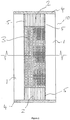
- FIG. 1 shows a cross-sectional view of a fire-resistant glazing unit.
- the glazed unit 10 has two parallel opposed rectangular panes of glass 1 separated at their peripheries by a spacer 2; an internal space 3 enclosed by the two opposed panes of glass 1 and the spacer 2; a cured hydrogel interlayer 3 filling the internal space 3; a secondary seal 4 comprising a suitable adhesive, such as polysulfide or a hot melt sealant, and a primary seal 5 comprising a suitable adhesive, such as butyl or an acrylic tape adhesive.
- a suitable adhesive such as polysulfide or a hot melt sealant
- a primary seal 5 comprising a suitable adhesive, such as butyl or an acrylic tape adhesive.
- Each pane of glass 1 is typically toughened glass or float glass (see later specific examples), each having a thickness of between 3 and 20mm (typically 4-6mm thick - see later specific examples).
- the spacer 2 consists of a single continuous piece which is bent into shape (i.e. substantially forming a rectangle). In alternative examples, the spacer consists of four separate pieces, one for each side of the rectangle. In the examples which follow, the spacers are made from metal or plastics material (see specific examples), and are 6-10mm thick (see later specific examples).
- the spacer 2 together with the primary 5 and secondary 4 seals, may be considered to form a peripheral seal around the glazed unit.
- spacers 2 used in the present examples differ from those known in the art in that:
- Gelling compositions of the present invention are suitably intended for injection into the internal space 3 for subsequent curing in situ to form the cured gel (or hydrogel) 3 described above.
- Embodiments of the pre-cured gelling compositions are described below, and contain various mixtures of ingredients, including water, one or more salts, and a hydrogel-forming monomer.
- Such gelling compositions are produced by mixing all the ingredients and suitably agitating at an appropriate temperature for sufficient time to produce a substantially clear, transparent solution.
- the gelling compositions are typically filtered and degassed prior to use.
- Glazed units 10 are prepared substantially in accordance with standard methods known in the art (e.g. US 2213468 , US 3759771 , US 2389360 ), albeit with the variations described below.
- the glazed unit is partially assembled to include all but the cured gel 3 and primary seal 5.
- the entrance holes (not shown) in the spacers provide access to the internal space 3 for the delivery of the pre-cured gelling composition.
- the internal surfaces of the panes of glass 1 Prior to injection of the gelling composition, the internal surfaces of the panes of glass 1 (i.e. those facing each other and in contact with the internal space 3) are treated with a polymerisable coupling agent (e.g. vinyltriethylsilane, vinyltrimethylsilane or 3-methacryloxypropyltrimethoxy silane) to facilitate bonding between the panes of glass 1 and the cured gel 3.
- a polymerisable coupling agent e.g. vinyltriethylsilane, vinyltrimethylsilane or 3-methacryloxypropyltrimethoxy silane
- silane solution is then drained from the entrance holes before the internal space is rinsed with a rinsing solvent using the same injection, tilting/moving, and draining method. Finally, the coated surfaces are left at room temperature for 30 mins to allow the coating to bond to the surfaces. It will be understood by the skilled person that alternative coating methods may be employed, including applying the silane to the relevant surface as a spray.
- the gelling composition (examples of which are set forth in the examples which follow) is filtered and degassed (e.g. via simultaneous sonication and evacuation) before being pumped into the internal space 3 via one of the entrance holes in the spacer 2.
- a primary seal 5 is secured to cover the entrance holes in the spacer 2 and duly close the internal space.
- the gelling composition within the internal space 3 is then cured in situ through appropriately irradiating the glazed unit upon an oscillating curing bed for a sufficient period of time (typically 15 minutes) with UV light (typically provided by 200 Watt UV lamps with a wavelength maxima of approximately 350nm).
- UV light typically provided by 200 Watt UV lamps with a wavelength maxima of approximately 350nm.
- Gel compositions were assessed by the following primary criteria that a candidate gel be optically clear and free from haze by visual inspection; and that the gel demonstrates intumescence when placed under the flame of a burner.
- Hydrogel-filled glazing units were each placed in freezer units held at 5 °C, -12 °C and -20 °C respectively; and defects were recorded periodically.
- Filled units were each stored in a ventilated oven at 50 °C and defects were recorded periodically. In addition, filled units were subjected to the EN ISO 12543-4 standard durability test which involves storing each sample at 100 °C for 2 hours REF: EN ISO 12543-4:1998, Laminated glass and laminated safety glass - Part 4: Test methods for durability.
- 1 or 2mm thick gels were cast onto 5mm thick float glass squares measuring 100mm x 100mm. These were each subjected to heating under a modified cone calorimeter heater to enable approximation of exposure to the EN cellulosic fire resistance test ( Using a Modified Cone Calorimeter to Predict the Performance of a Thermally Reactive Glazing System in a Furnace Test, V. Crook, A. Napier, H. N. Phylaktou, J.E.J. Staggs; 12 is European Meeting on FRPM'09 Poznan, Poland (2009 )) and viewing of both the cold and hot face of the sample throughout the test. The cold side temperatures were also recorded throughout the tests using thermocouples adhered to the non-exposed face of the glass.
- a gelling composition (GC1) was prepared using the ingredients listed below: Ingredient M.W. % w/w Supplier Water 18 51.387 MgSO4.7H2O (Magnesia 4281) 246.47 31.000 Magnesia Ltd, Luneburgh Acrylic Acid 72.06 7.000 Merck Chemicals Acetic Acid 60.05 7.430 Merck Chemicals Magnesium Oxide, low iron (Magnesia 298) 40.3 3.160 Magnesia Ltd, Luneburgh Irgacure 184 204.3 0.009 Ciba speciality Chemicals N,N'-Methylenebisacrylamide 154.17 0.014 Merck Chemicals
- the solution was allowed to cool, and was subsequently stored at room temperature.
- the gelling composition (GC1) was measured to have a pH of 4.20 prior to gelling.
- the pH was measured by immersing the probe of a pH meter in the solution.
- the cured gel was found to be appreciably optically clear and was seen to intumesce considerably upon application of a flame from a burner.
- the gel was found not to be sufficiently stable in low temperature durability tests.
- the gel was found not to be sufficiently stable in high temperature durability tests.
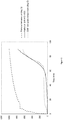
- FIG. 2 is a graph showing how various perameters change with time during the fire test, particularly furnace temperature (thick dotted line), the "cold-face glass temperature” (thin dotted line), and the radiation (solid line).
- a gelling composition (GC2) was prepared using the ingredients listed below: Ingredient M.W. % w/w Supplier Water 18 51.514 MgSO4.7H2O (Magnesia 4281) 246.47 18.000 Magnesia Ltd, Luneburgh Acrylic Acid 72.06 10.000 Merck Chemicals Magnesium Oxide, low iron (Magnesia 298) 40.3 2.450 Magnesia Ltd, Luneburgh Irgacure 184 204.3 0.014 Ciba speciality Chemicals N,N'-Methylenebisacrylamide 154.17 0.022 Merck Chemicals Magnesium acetate tetrahydrate 214.46 18.000 Sigma
- the solution was allowed to cool, and was subsequently stored at room temperature.
- the gelling composition (GC2) was measured to have a pH of 5.03 prior to gelling.
- the cured gel was found to be appreciably optically clear and was seen to intumesce considerably upon application of a flame from a burner.
- the gel was found to be sufficiently stable in low temperature durability tests.
- the gel was found to be sufficiently stable in the 50 °C oven and the 100 °C durability tests
- a gelling composition (GC3) was prepared using the ingredients listed below: Ingredient M.W. % w/w Supplier Water 18 51.276 MgSO 4 .7H 2 O (Magnesia 4281) 246.47 20.000 Magnesia Ltd, Luneburgh Acrylic Acid 72.06 7.000 Merck Chemicals Magnesium Oxide, low iron (Magnesia 298) 40.3 1.700 Magnesia Ltd, Luneburgh Irgacure 184 204.3 0.009 Ciba speciality Chemicals N,N'-Methylenebisacrylamide 154.17 0.015 Merck Chemicals Magnesium acetate tetrahydrate 214.46 20.000 Sigma
- the solution was allowed to cool, and was subsequently stored at room temperature.
- the gelling composition (GC3) was measured to have a pH of 5.30 before gelling.
- the cured gel was found to be appreciably optically clear and was seen to intumesce considerably upon application of a flame from a burner.
- the gel was found to be sufficiently stable in low temperature durability tests.
- the gel was found to be sufficiently stable in the 50 °C high temperature durability tests but did not pass the 100 °C oven test.
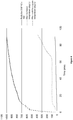
- FIG. 3 is a graph showing how various perameters change with time during this fire test, particularly furnace temperature (thick dotted line), the "cold-face glass temperature” (thin dotted line), and the radiation (solid line).
- FIG. 4 is a graph showing how various perameters change with time during this fire test, particularly mean furnace temperature (thin dotted line), the "mean cold-face glass temperature” (thick dotted line), and the radiation (solid line).
- a gelling composition (GC5) was prepared using the ingredients listed below: Ingredient M.W. % w/w Supplier Water 18 55.643 MgSO4.7H2O (Magnesia 4281) 246.47 13.000 Magnesia Ltd, Luneburgh Acrylic Acid 72.06 7.000 Merck Chemicals Acetic Acid 60.05 4.000 Merck Chemicals Magnesium Oxide, low iron (Magnesia 298) 40.3 3.333 Magnesia Ltd, Luneburgh Irgacure 184 204.3 0.009 Ciba speciality Chemicals N,N'-Methylenebisacrylamide 154.17 0.015 Merck Chemicals Magnesium acetate tetrahydrate 214.46 17.000 Sigma
- the solution was allowed to cool, and was subsequently stored at room temperature.
- the gelling composition (GC5) was measured to have a pH of 5.25.
- the cured gel was found to be appreciably optically clear and was seen to intumesce considerably upon application of a flame from a burner.
- the gel was found to be sufficiently stable in low temperature durability tests.
- the gel was found to be sufficiently stable in the 50 °C high temperature durability tests but did not pass the 100 °C oven test.
- a gelling composition (GC6) was prepared using the ingredients listed below: Ingredient M.W. % w/w Supplier Water 18 52.707 MgSO4.7H2O (Magnesia 4281) 246.47 12.6700 Magnesia Ltd, Luneburgh Acrylic Acid 72.06 12.0000 Merck Chemicals Magnesium Oxide, low iron (Magnesia 298) 40.3 2.5800 Magnesia Ltd, Luneburgh Irgacure 184 204.3 0.0170 Ciba speciality Chemicals N,N'-Methylenebisacrylamide 154.17 0.0260 Merck Chemicals Magnesium acetate tetrahydrate 214.46 20.0000 Sigma
- the solution was allowed to cool, and was subsequently stored at room temperature.
- the gelling composition (GC6) was measured to have a pH of 4.83 prior to gelling.
- the cured gel was found to be appreciably optically clear and was seen to intumesce considerably upon application of a flame from a burner.
- the gel was found to be sufficiently stable in low temperature durability tests.
- the gel was found to be sufficiently stable in the 50 °C high temperature durability tests and passed the 100 °C oven test.
- a gelling composition (GC7) was prepared using the ingredients listed below: Ingredient M.W. % w/w Supplier Water 18 51.8627 MgSO4.7H2O (Magnesia 4281) 246.47 12.000 Magnesia Ltd, Luneburgh Acrylic Acid 72.06 6.600 Merck Chemicals Magnesium Oxide, low iron (Magnesia 298) 40.3 1.5133 Magnesia Ltd, Luneburgh Irgacure 184 204.3 0.009 Ciba speciality Chemicals N,N'-Methylenebisacrylamide 154.17 0.015 Merck Chemicals Magnesium acetate tetrahydrate 214.46 5.000 Sigma MgCl 2 .6H 2 O 214.46 23.000 Sigma
- the solution was allowed to cool, and was subsequently stored at room temperature.
- the gelling composition (GC7) was measured to have a pH of 4.5
- the cured gel was found to be appreciably optically clear and was seen to intumesce considerably upon application of a flame from a burner.
- the gel was found to be sufficiently stable in low temperature durability tests.
- the gel was found to be sufficiently stable in the 50 °C high temperature durability tests and passed the 100 °C oven test.
- FIG. 5 is a graph showing how various perameters change with time during this fire test, particularly mean furnace temperature (solid line), and the mean cold side temperature” (dotted line).
- a gelling composition (GC8) was prepared using the ingredients listed below: Ingredient M.W. % w/w Supplier Water 18 51.734 MgSO4.7H2O (Magnesia 4281) 246.47 18.000 Magnesia Ltd, Luneburgh Acrylic Acid 72.06 10.000 Merck Chemicals Magnesium Oxide, low iron (Magnesia 298) 40.3 2.230 Magnesia Ltd, Luneburgh Irgacure 184 204.3 0.014 Ciba speciality Chemicals N,N'-Methylenebisacrylamide 154.17 0.022 Merck Chemicals Magnesium acetate tetrahydrate 214.46 18.000 Sigma
- the solution was allowed to cool, and was subsequently stored at room temperature.
- the gelling composition (GC8) was measured to have a pH of 4.83 prior to gelling.
- the cured gel was found to be appreciably optically clear and was seen to intumesce considerably upon application of a flame from a burner.
- the gel was found to be sufficiently stable in low temperature durability tests.
- the gel was found to be sufficiently stable in the 50 °C high temperature durability tests and passed the 100 °C oven test.
- a gelling composition (GC9) was prepared using the ingredients listed below (suppliers as per the previous examples): Ingredient M.W. % w/w Water 18 52.641 MgSO 4 .7H 2 O (Magnesia 4281) 246.47 13.000 Acrylic Acid 72.06 7.000 Acetic Acid 60.05 4.000 Magnesium Oxide, low iron (Magnesia 298) 40.3 3.334 Irgacure 184 204.3 0.010 N,N'-Methylenebisacrylamide 154.17 0.015 Magnesium acetate 214.455 17.000 ZnSO 4 .7H 2 O 287.56 3.000 Total 100
- the cured gel was found to be appreciably optically clear and was seen to intumesce considerably upon application of a flame from a burner.
- the gel was found to be sufficiently stable in low temperature durability tests at -12 °C, however it was unstable at -20 °C.
- a gelling composition (GC10) was prepared using the ingredients listed below (suppliers as per previous examples): Ingredient M.W % w/w Water 18 46.075 Acrylic Acid 72.06 7.000 Magnesium Oxide, low iron (Magnesia 298) 40.3 1.900 Irgacure 184 204.3 0.010 N,N'-Methylenebisacrylamide 154.17 0.015 Magnesium acetate 214.455 40.000 CaCl 2 .2H 2 O 147.01 5.000 Total 100
- the cured gel was found to be appreciably optically clear and was seen to intumesce considerably upon application of a flame from a burner.
- the gel was found to be sufficiently stable in low temperature durability tests at -12°C, however it was unstable at -20°C.
- a gelling composition (GC11) was prepared using the ingredients listed below (suppliers as per previous examples): Ingredient M.W % w/w Water 18 56.076 MgSO 4 .7H 2 O (Magnesia 4281) 246.47 20.000 Acrylic Acid 72.06 7.000 Magnesium Oxide, low iron (Magnesia 298) 40.3 1.900 Irgacure 184 204.3 0.009 N,N'-Methylenebisacrylamide 154.17 0.015 Magnesium acetate 214.455 5.000 Li 2 SO 4 .H 2 O 127.96 10.000 Total 100
- the gelling composition (GC11) was measured to have a pH of 5.03 prior to gelling.
- the cured gel was found to be appreciably optically clear and was seen to intumesce considerably upon application of a flame from a burner.
- the gel was found to be sufficiently stable in low temperature durability tests at -12°C, however it was unstable at -20°C.
- a gelling composition (GC12) was prepared using the ingredients listed below (suppliers as per previous examples): Ingredient M.W. % w/w Water 18 46.075 Acrylic Acid 72.06 7.000 Magnesium Oxide, low iron (Magnesia 298) 40.3 1.900 Irgacure 184 204.3 0.010 N,N'-Methylenebisacrylamide 154.17 0.015 Magnesium acetate 214.455 40.000 CaCL 2 .2H 2 O 147.01 5.000 Total 100
- the cured gel was found to be appreciably optically clear and was seen to intumesce considerably upon application of a flame from a burner.
- the gel was found to be sufficiently stable in low temperature durability tests at -12°C, however it was unstable at -20°C.
- a gelling composition (GC13) was prepared using the ingredients listed below (suppliers as per previous examples): Ingredient M.W. % w/w Water 18 52.707 MgSO 4 .7H 2 O (Magnesia 4281) 246.47 12.6700 Acrylic Acid 72.06 12.0000 Magnesium Oxide, low iron (Magnesia 298) 40.3 2.5800 Irgacure 184 204.3 0.0170 N,N'-Methylenebisacrylamide 154.17 0.0260 Magnesium acetate 214.455 20.0000 water 18 52.707 Total 100
- the pH of the gelling composition was measured as pH 3.40.
- the cured gel was found to be appreciably optically clear and was seen to intumesce considerably upon application of a flame from a burner.
- the gel was found to be sufficiently stable in low temperature durability tests at -12°C, however it was unstable at -20°C.
- a gelling composition (GC14) was prepared using the ingredients listed below (suppliers as per previous examples): Ingredient M.W. % w/w Water 18 51.514 MgSO 4 .7H 2 O (Magnesia 4281) 246.47 18 Acrylic Acid 72.06 10 Magnesium Oxide, low iron (Magnesia 298) 40.3 2.23 Irgacure 184 204.3 0.014 N,N'-Methylenebisacrylamide 154.17 0.022 Magnesium acetate 214.455 18 Total 100
- the pH of the gelling composition was measured as pH 4.96.
- the cured gel was found to be appreciably optically clear and was seen to intumesce considerably upon application of a flame from a burner.
- the gel was found to be sufficiently stable in low temperature durability tests at -12 °C, however it was unstable at -20 °C.
- the gelling composition was found to be appreciably optically clear and was seen to intumesce considerably upon application of a flame from a burner.
- the gel was found to be sufficiently stable in low temperature durability tests.
- the gel was found to be sufficiently stable in the 50 °C high temperature durability tests and passed the 100 °C oven test.
- a gelling composition (GC15) was prepared using the ingredients listed below: Ingredient M.W. % w/w Supplier water 18 51.716 MgSO4.7H2O (Magnesia 4281) 246.47 18 Magnesia Ltd, Luneburgh Acrylic Acid 72.06 10 Merck Chemicals Magnesium Oxide, low iron (Magnesia 298) 40.3 2.23 Magnesia Ltd, Luneburgh Irgacure 184 204.3 0.014 Ciba speciality Chemicals N,N'-Methylenebisacrylamide 154.17 0.04 Merck Chemicals Magnesium acetate tetrahydrate 214.46 18 Sigma
- the solution was allowed to cool and was filtered via 0.22 ⁇ m membrane filter, and was subsequently stored at room temperature.
- the gelling composition (GC15) was measured to have a pH of 4.80 prior to gelling.
- the gel was found to be appreciably optically clear and was seen to intumesce considerably upon application of a flame from a burner.
- the gel was found to be sufficiently stable in low temperature durability tests.
- Samples of the gel were found to exceed a predicted lifetime of 10 years when each were exposed to a temperature of 80 °C and 100 °C using 10 year-durability test protocols described in relation to Example 8 above.
- a gelling composition (GC16) was prepared using the ingredients listed below: Ingredient M.W. % w/w Supplier Water 18 51.706 MgSO4.7H2O (Magnesia 4281) 246.47 18 Magnesia Ltd, Luneburgh Acrylic Acid 72.06 10 Merck Chemicals Magnesium Oxide, low iron (Magnesia 298) 40.3 2.23 Magnesia Ltd, Luneburgh Irgacure 184 204.3 0.014 Ciba speciality Chemicals N,N'-Methylenebisacrylamide 154.17 0.05 Merck Chemicals Magnesium acetate tetrahydrate 214.46 18 Sigma
- the gelling composition (GC16) was measured to have a pH of 4.95 prior to gelling.
- the gel was found to be appreciably optically clear and was seen to intumesce considerably upon application of a flame from a burner.
- the gel was found to be sufficiently stable in low temperature durability tests.
- a gelling composition (GC17) was prepared using the ingredients listed below: Ingredient M.W. % w/w Supplier Water 18 51.696 MgSO4.7H2O (Magnesia 4281) 246.47 18 Magnesia Ltd, Luneburgh Acrylic Acid 72.06 10 Merck Chemicals Magnesium Oxide, low iron (Magnesia 298) 40.3 2.23 Magnesia Ltd, Luneburgh Irgacure 184 204.3 0.014 Ciba speciality Chemicals N,N'-Methylenebisacrylamide 154.17 0.06 Merck Chemicals Magnesium acetate tetrahydrate 214.46 18 Sigma
- the gelling composition (GC17) was measured to have a pH of 4.84 prior to gelling.
- the gel was found to be appreciably optically clear and was seen to intumesce considerably upon application of a flame from a burner.
- the gel was found to be sufficiently stable in low temperature durability tests.
- a gelling composition (GC18) was prepared using the ingredients listed below: Ingredient M.W. % w/w Supplier Water 18 51.016 MgSO4.7H2O (Magnesia 4281) 246.47 18 Magnesia Ltd, Luneburgh Acrylic Acid 72.06 10 Merck Chemicals Magnesium Oxide, low iron (Magnesia 298) 40.3 2.23 Magnesia Ltd, Luneburgh Irgacure 184 204.3 0.014 Ciba speciality Chemicals N,N'-Methylenebisacrylamide 154.17 0.04 Merck Chemicals Magnesium acetate tetrahydrate 214.46 18 Sigma Lithium Hydroxide 41.96 0.7
- the solution was allowed to cool and was filtered via 0.22 ⁇ m membrane filter, and was subsequently stored at room temperature.
- the gelling composition (GC18) was measured to have a pH of 5.5 prior to gelling.
- the gel was found to be appreciably optically clear and was seen to intumesce considerably upon application of a flame from a burner.
- the gel was found to be sufficiently stable in low temperature durability tests.
- a gelling composition (GC19) was prepared using the ingredients listed below: Ingredient M.W. % w/w Supplier Water 18 49.716 MgSO4.7H2O (Magnesia 4281) 246.47 18 Magnesia Ltd, Luneburgh Acrylic Acid 72.06 10 Merck Chemicals Magnesium Oxide, low iron (Magnesia 298) 40.3 2.23 Magnesia Ltd, Luneburgh Irgacure 184 204.3 0.014 Ciba speciality Chemicals N,N'-Methylenebisacrylamide 154.17 0.04 Merck Chemicals Magnesium acetate tetrahydrate 214.46 18 Sigma Ammonium Hydroxide (30% aqueous solution) 35.05 2
- the solution was allowed to cool and was filtered via 0.22 ⁇ m membrane filter, and was subsequently stored at room temperature.
- the gelling composition (GC19) was measured to have a pH of 5.5 prior to gelling.
- the gel was found to be appreciably optically clear and was seen to intumesce considerably upon application of a flame from a burner.
- the gel was found to be sufficiently stable in low temperature durability tests.
- a gelling composition (GC20) was prepared using the ingredients listed below: Ingredient M.W. % w/w Supplier water 18 50.934 MgSO4.7H2O (Magnesia 4281) 246.47 18 Magnesia Ltd, Luneburgh Acrylic Acid 72.06 10 Merck Chemicals Magnesium Oxide, low iron (Magnesia 298) 40.3 2.23 Magnesia Ltd, Luneburgh Irgacure 184 204.3 0.014 Ciba speciality Chemicals N,N'-Methylenebisacrylamide 154.17 0.022 Merck Chemicals Magnesium acetate tetrahydrate 214.46 18 Sigma Sodium Hydroxide 40 0.8
- the solution was allowed to cool and was filtered via 0.22 ⁇ m membrane filter, and was subsequently stored at room temperature.
- the gelling composition (GC20) was measured to have a pH of 6.75 prior to gelling.
- the gel was found to be appreciably optically clear and was seen to intumesce considerably upon application of a flame from a burner.
- the gel was found to be sufficiently stable in low temperature durability tests.
- a gelling composition (GC21) was prepared using the ingredients listed below: Ingredient M.W. % w/w Supplier Water 18 51.596 MgSO4.7H2O (Magnesia 4281) 246.47 18 Magnesia Ltd, Luneburgh Acrylic Acid 72.06 10 Merck Chemicals Magnesium Oxide, low iron (Magnesia 298) 40.3 2.35 Magnesia Ltd, Luneburgh Irgacure 184 204.3 0.014 Ciba speciality Chemicals N,N'-Methylenebisacrylamide 154.17 0.04 Merck Chemicals Magnesium acetate tetrahydrate 214.46 18 Sigma
- the gelling composition (GC15) was measured to have a pH of 5.1 prior to gelling.
- the gel was found to be appreciably optically clear and was seen to intumesce considerably upon application of a flame from a burner.
- the gel was found to be sufficiently stable in low temperature durability tests.
- compositions of the present invention exhibit some or all of the above properties to varying degrees, and as such represent a contribution to the technical field of fire-resistant glazing units.
- Example formulations 1-13 The performance of Example formulations 1-13 is summarised as follows:
- Example 6 was deemed to exhibit the best all round performance, though some or all advantages of the invention were also realised in relation to the other examples.
- Fire resistance requirements are becoming more stringent and fire resistant glazings that were once deemed satisfactory are being pushed out of use by trends in regulation. These trends in regulation are as a result of increased knowledge in fire safety engineering and changes in architectural fashion. It is believed that this invention is capable of meeting these new demands and exceeding the performance of many equivalent systems in the field in terms of it being of lesser mass per m 2 of glazing than other equivalent fire resistant products for a given duration of fire resistance and it being economical to produce. All of the components of the preferred embodiment are relatively easy to obtain and the production process can be a simple augment to a conventional IGU production line.
- the components of the preferred gelling compositions are relatively environmentally benign and as such do not pose significant hazard upon handling and disposal of components before or after gelling or during or after a fire has taken place.
Landscapes
- Chemical & Material Sciences (AREA)
- Organic Chemistry (AREA)
- Engineering & Computer Science (AREA)
- Materials Engineering (AREA)
- Chemical Kinetics & Catalysis (AREA)
- Polymers & Plastics (AREA)
- Health & Medical Sciences (AREA)
- Medicinal Chemistry (AREA)
- Life Sciences & Earth Sciences (AREA)
- Wood Science & Technology (AREA)
- Inorganic Chemistry (AREA)
- Ceramic Engineering (AREA)
- General Chemical & Material Sciences (AREA)
- Geochemistry & Mineralogy (AREA)
- Compositions Of Macromolecular Compounds (AREA)
- Joining Of Glass To Other Materials (AREA)
- Addition Polymer Or Copolymer, Post-Treatments, Or Chemical Modifications (AREA)
Priority Applications (1)
| Application Number | Priority Date | Filing Date | Title |
|---|---|---|---|
| PL13708881T PL2817151T3 (pl) | 2012-02-22 | 2013-02-21 | Ognioodporny zespół szklany |
Applications Claiming Priority (2)
| Application Number | Priority Date | Filing Date | Title |
|---|---|---|---|
| GB1203086.2A GB2500368A (en) | 2012-02-22 | 2012-02-22 | Fire resistant glazing unit with hydrogel interlayer |
| PCT/GB2013/050425 WO2013124661A1 (en) | 2012-02-22 | 2013-02-21 | Fire resistant glazing unit |
Publications (2)
| Publication Number | Publication Date |
|---|---|
| EP2817151A1 EP2817151A1 (en) | 2014-12-31 |
| EP2817151B1 true EP2817151B1 (en) | 2017-08-16 |
Family
ID=45940048
Family Applications (1)
| Application Number | Title | Priority Date | Filing Date |
|---|---|---|---|
| EP13708881.1A Active EP2817151B1 (en) | 2012-02-22 | 2013-02-21 | Fire resistant glazing unit |
Country Status (12)
| Country | Link |
|---|---|
| US (1) | US9957397B2 (pl) |
| EP (1) | EP2817151B1 (pl) |
| JP (1) | JP6180446B2 (pl) |
| CN (1) | CN104185549A (pl) |
| BR (1) | BR112014020603A2 (pl) |
| GB (1) | GB2500368A (pl) |
| IL (1) | IL233966A0 (pl) |
| MX (1) | MX2014010175A (pl) |
| PL (1) | PL2817151T3 (pl) |
| RU (1) | RU2014137930A (pl) |
| SG (1) | SG11201405081YA (pl) |
| WO (1) | WO2013124661A1 (pl) |
Cited By (1)
| Publication number | Priority date | Publication date | Assignee | Title |
|---|---|---|---|---|
| WO2024201059A1 (en) * | 2023-03-30 | 2024-10-03 | Pilkington Group Limited | A fire resistant glazing |
Families Citing this family (15)
| Publication number | Priority date | Publication date | Assignee | Title |
|---|---|---|---|---|
| CH708125A1 (de) * | 2013-05-29 | 2014-12-15 | Saint Gobain | Brandschutzverglasung und Verfahren zur Herstellung einer Brandschutzverglasung. |
| US11561070B2 (en) | 2013-09-03 | 2023-01-24 | Disruptive Resources, Llc | Bullet proof barriers |
| US10801815B2 (en) | 2013-09-03 | 2020-10-13 | John B. Adrain | Bullet proof blinds |
| US10151566B2 (en) | 2013-09-03 | 2018-12-11 | John B. Adrain | Bullet proof blinds |
| WO2022212726A1 (en) | 2021-04-01 | 2022-10-06 | Adrain John B | Anti-ballistic laminate manufacturing method & products |
| US10473437B2 (en) * | 2013-09-03 | 2019-11-12 | John B. Adrain | Bullet proof blinds |
| DE202014006615U1 (de) * | 2013-11-29 | 2015-10-15 | Pilkington Group Limited | Feuerbeständiges Material |
| JP6999942B2 (ja) * | 2016-12-20 | 2022-02-10 | 国立大学法人北海道大学 | 体積相転移を示さないlcstを有する温度応答性ゲル及びその製造方法 |
| JP6769556B2 (ja) | 2017-07-28 | 2020-10-14 | 三菱電機株式会社 | 半導体装置及び半導体モジュール |
| FR3078014A1 (fr) * | 2018-02-16 | 2019-08-23 | Saint Gobain Glass France | Vitrage anti-feu |
| DE102018110148B4 (de) | 2018-04-26 | 2023-10-12 | Schott Ag | Verbundglas mit Widerstand gegen Brandwirkung, Brandschutzsystem mit dem Verbundglas, Verwendung eines Verbundglases oder Brandschutzsystems sowie Verfahren zur Herstellung eines Verbundglases |
| EP3693347A1 (en) * | 2019-02-11 | 2020-08-12 | Saint-Gobain Glass France | Fire resistant interlayer |
| GB2586140B (en) * | 2019-08-06 | 2021-11-17 | Pyroguard Uk Ltd | Multi Threat-Proof glazed timber Door |
| US11733005B2 (en) | 2019-08-28 | 2023-08-22 | Disruptive Defenses, Llc | Anti-ballistic barriers |
| US12209845B2 (en) | 2019-08-28 | 2025-01-28 | Disruptive Defenses, Llc | Networked anti-ballistic protective system and method |
Citations (11)
| Publication number | Priority date | Publication date | Assignee | Title |
|---|---|---|---|---|
| US5061748A (en) | 1990-06-28 | 1991-10-29 | Artistic Glass Products Company | Fire resistant windows |
| EP0524786A1 (en) * | 1991-07-18 | 1993-01-27 | MITSUI TOATSU CHEMICALS, Inc. | Hardenable compositions, aqueous gels and processes of making them and applications of said gels |
| EP0590978A1 (en) * | 1992-09-30 | 1994-04-06 | MITSUI TOATSU CHEMICALS, Inc. | Fire-resistant glass and process for production thereof |
| WO2002090458A2 (en) | 2001-05-04 | 2002-11-14 | O'keeffe's, Inc. | Fire resistant materials and methods for production |
| WO2003061963A1 (de) | 2002-01-24 | 2003-07-31 | Flamro Brandschutz-Systeme Gmbh | Brandschutzverglasung und brandschutzfenster sowie verfahren zur herstellung einer brandschutzzusammensetzung und einer brandschutzverglasung |
| DE10237395A1 (de) | 2002-01-24 | 2003-08-07 | Flamro Brandschutz Systeme Gmb | Brandschutzverglasung und Brandschutzfenster sowie Verfahren zur Herstellung einer Brandschutzzusammensetzung und einer Brandschutzverglasung |
| DE102005018842A1 (de) | 2005-04-22 | 2006-10-26 | Hero-Glas Veredelungs Gmbh | Brandschutzverglasung |
| US7223827B1 (en) | 2004-02-27 | 2007-05-29 | Fritz Industries, Inc | Water control in a subsurface formation |
| CN101279822A (zh) | 2007-04-06 | 2008-10-08 | 公安部天津消防研究所 | 薄型防火玻璃及其制备方法 |
| WO2011045597A1 (en) | 2009-10-13 | 2011-04-21 | Pilkington Group Limited | Fire resistant glazing |
| EP2330174A1 (en) | 2009-12-07 | 2011-06-08 | Samgong Co., Ltd. | Organic-inorganic hybrid transparent hydrogel complex for fire retardant glass, fire retardant glass assembly using the same, and manufacturing method thereof |
Family Cites Families (19)
| Publication number | Priority date | Publication date | Assignee | Title |
|---|---|---|---|---|
| US2213468A (en) | 1935-12-26 | 1940-09-03 | Libbey Owens Ford Glass Co | Multiple glass sheet glazing unit |
| US2389360A (en) | 1942-04-07 | 1945-11-20 | Corning Glass Works | Double glazed window and method of manufacture |
| US3759771A (en) | 1971-04-26 | 1973-09-18 | W Battersby | Method of making double glazing unit |
| DE2731979C3 (de) | 1977-07-15 | 1980-12-04 | Vereinigte Glaswerke Gmbh, 5100 Aachen | Fenster mit erhöhter Feuerwiderstandsfähigkeit |
| FR2405905A1 (fr) | 1977-10-11 | 1979-05-11 | Saint Gobain | Vitrage pare-feu a gel aqueux |
| DE3530968A1 (de) * | 1985-08-30 | 1987-03-12 | Ver Glaswerke Gmbh | Feuerwiderstandsfaehige verglasung |
| FR2624546B1 (fr) * | 1987-12-15 | 1993-11-26 | Saint Gobain Vitrage | Vitrage antifeu et procede de fabrication |
| US5124208A (en) * | 1990-06-28 | 1992-06-23 | Artistic Glass Products | Fire resistant windows |
| US5622168A (en) * | 1992-11-18 | 1997-04-22 | John L. Essmyer | Conductive hydrogels and physiological electrodes and electrode assemblies therefrom |
| DE19720269A1 (de) | 1997-05-14 | 1998-11-19 | Inst Neue Mat Gemein Gmbh | Nanokomposit für thermische Isolierzwecke |
| ES2228492T3 (es) * | 1999-03-12 | 2005-04-16 | Basf Aktiengesellschaft | Composicion polimerica super absorbente de color estable. |
| DE10235477A1 (de) | 2002-08-02 | 2004-02-12 | Basf Ag | Glykolfreie wässrige Gefrierschutzmittel enthaltend Dicarbonsäuresalze |
| US20040185066A1 (en) | 2003-03-17 | 2004-09-23 | Yuh-Jye Uang | Antifreeze gel in a deformable container |
| DE112005001511T5 (de) | 2004-07-05 | 2007-05-24 | Abc Research Laboratory For Building Materials Co., Ltd. | Schneeschmelz-/Gefrierschutzmittel |
| FR2881422B1 (fr) | 2005-01-31 | 2007-03-16 | Saint Gobain | Pose de film antigivre sur substrat transparent |
| GB0700518D0 (en) | 2007-01-11 | 2007-02-21 | Pilkington Deutschland Ag | Laminated glazing |
| DE102007058465B4 (de) | 2007-12-04 | 2011-07-07 | H.C. Starck GmbH, 38642 | Verfahren zum Aufschließen von Molybdänoxidkonzentraten |
| CN101875537A (zh) * | 2009-10-28 | 2010-11-03 | 何海波 | 一种能吸收紫外线和近红外线以及强眩目光的夹层安全玻璃及其制备方法 |
| CN101798185A (zh) * | 2010-03-02 | 2010-08-11 | 何海波 | 具有隔热、防辐射功能的防弹玻璃、防火玻璃及其复合玻璃 |
-
2012
- 2012-02-22 GB GB1203086.2A patent/GB2500368A/en not_active Withdrawn
-
2013
- 2013-02-21 SG SG11201405081YA patent/SG11201405081YA/en unknown
- 2013-02-21 MX MX2014010175A patent/MX2014010175A/es unknown
- 2013-02-21 JP JP2014558203A patent/JP6180446B2/ja not_active Expired - Fee Related
- 2013-02-21 WO PCT/GB2013/050425 patent/WO2013124661A1/en not_active Ceased
- 2013-02-21 PL PL13708881T patent/PL2817151T3/pl unknown
- 2013-02-21 RU RU2014137930A patent/RU2014137930A/ru not_active Application Discontinuation
- 2013-02-21 EP EP13708881.1A patent/EP2817151B1/en active Active
- 2013-02-21 US US14/378,475 patent/US9957397B2/en active Active
- 2013-02-21 BR BR112014020603A patent/BR112014020603A2/pt not_active IP Right Cessation
- 2013-02-21 CN CN201380010755.3A patent/CN104185549A/zh active Pending
-
2014
- 2014-08-06 IL IL233966A patent/IL233966A0/en unknown
Patent Citations (12)
| Publication number | Priority date | Publication date | Assignee | Title |
|---|---|---|---|---|
| US5061748A (en) | 1990-06-28 | 1991-10-29 | Artistic Glass Products Company | Fire resistant windows |
| EP0524786A1 (en) * | 1991-07-18 | 1993-01-27 | MITSUI TOATSU CHEMICALS, Inc. | Hardenable compositions, aqueous gels and processes of making them and applications of said gels |
| EP0590978A1 (en) * | 1992-09-30 | 1994-04-06 | MITSUI TOATSU CHEMICALS, Inc. | Fire-resistant glass and process for production thereof |
| DE69316816T2 (de) | 1992-09-30 | 1999-02-11 | Central Glass Co. Ltd., Ube City, Yamaguchi | Feuerwiderstandsfähige Verglasung und Verfahren zur ihrer Herstellung |
| WO2002090458A2 (en) | 2001-05-04 | 2002-11-14 | O'keeffe's, Inc. | Fire resistant materials and methods for production |
| WO2003061963A1 (de) | 2002-01-24 | 2003-07-31 | Flamro Brandschutz-Systeme Gmbh | Brandschutzverglasung und brandschutzfenster sowie verfahren zur herstellung einer brandschutzzusammensetzung und einer brandschutzverglasung |
| DE10237395A1 (de) | 2002-01-24 | 2003-08-07 | Flamro Brandschutz Systeme Gmb | Brandschutzverglasung und Brandschutzfenster sowie Verfahren zur Herstellung einer Brandschutzzusammensetzung und einer Brandschutzverglasung |
| US7223827B1 (en) | 2004-02-27 | 2007-05-29 | Fritz Industries, Inc | Water control in a subsurface formation |
| DE102005018842A1 (de) | 2005-04-22 | 2006-10-26 | Hero-Glas Veredelungs Gmbh | Brandschutzverglasung |
| CN101279822A (zh) | 2007-04-06 | 2008-10-08 | 公安部天津消防研究所 | 薄型防火玻璃及其制备方法 |
| WO2011045597A1 (en) | 2009-10-13 | 2011-04-21 | Pilkington Group Limited | Fire resistant glazing |
| EP2330174A1 (en) | 2009-12-07 | 2011-06-08 | Samgong Co., Ltd. | Organic-inorganic hybrid transparent hydrogel complex for fire retardant glass, fire retardant glass assembly using the same, and manufacturing method thereof |
Non-Patent Citations (2)
| Title |
|---|
| TAHAR BARTIL ET AK: "Swelling behavior and release properties of pH-sensitive hydrogels based on methacrylic derivatives", A CTA PARM., vol. 57, 2007, pages 301 - 314, XP002712363 |
| TATJANA FREIDRICH ET AL: "Copolymer Hydrogels of Acrylic Acid and a Nonionic Surfmer: pH-Induced Switching of Transparency and Volume and Improved Mechanical Stability", LANGMUIR, 2011, pages 2997 - 3005, XP055491693 |
Cited By (1)
| Publication number | Priority date | Publication date | Assignee | Title |
|---|---|---|---|---|
| WO2024201059A1 (en) * | 2023-03-30 | 2024-10-03 | Pilkington Group Limited | A fire resistant glazing |
Also Published As
| Publication number | Publication date |
|---|---|
| US9957397B2 (en) | 2018-05-01 |
| EP2817151A1 (en) | 2014-12-31 |
| WO2013124661A1 (en) | 2013-08-29 |
| GB201203086D0 (en) | 2012-04-04 |
| JP6180446B2 (ja) | 2017-08-16 |
| BR112014020603A2 (pt) | 2019-09-24 |
| JP2015510488A (ja) | 2015-04-09 |
| GB2500368A (en) | 2013-09-25 |
| US20150000825A1 (en) | 2015-01-01 |
| SG11201405081YA (en) | 2014-09-26 |
| IL233966A0 (en) | 2014-09-30 |
| MX2014010175A (es) | 2015-05-07 |
| PL2817151T3 (pl) | 2018-02-28 |
| RU2014137930A (ru) | 2016-04-10 |
| CN104185549A (zh) | 2014-12-03 |
Similar Documents
| Publication | Publication Date | Title |
|---|---|---|
| EP2817151B1 (en) | Fire resistant glazing unit | |
| EP3027408B1 (en) | Fire resistant glazing unit | |
| EP2330174B1 (en) | Organic-inorganic hybrid transparent hydrogel complex for fire retardant glass, fire retardant glass assembly using the same, and manufacturing method thereof | |
| KR960005270B1 (ko) | 내화유리와 이의 제조방법 | |
| RU2451645C2 (ru) | Способ получения огнеупорного остекления | |
| JP5364729B2 (ja) | 耐火性窓ガラス | |
| KR20160014663A (ko) | 내화 유리 및 내화 유리를 제조하기 위한 방법 | |
| KR101963166B1 (ko) | 난연성 단열발포폼 판넬 및 그 제조방법 | |
| CN111417701A (zh) | 阻燃材料和最终产品 | |
| CN102574369B (zh) | 耐火窗玻璃 | |
| WO2016159921A1 (ru) | Фотоотверждаемый прозрачный гидрогель для огнестойкого стекла | |
| KR20100051929A (ko) | 방화유리 | |
| RU2844111C1 (ru) | Фотоотверждаемая огнестойкая прозрачная композиция | |
| EP4656691A2 (en) | Fire-resistant glazing | |
| RU2812969C1 (ru) | Фотоотверждаемая композиция для изготовления многослойного огнестойкого стекла | |
| US20240286386A1 (en) | Fire-resistant glazing | |
| WO2025132508A1 (fr) | Vitrage résistant au feu | |
| JPH06157080A (ja) | スモーク状防火ガラスおよびその製法 | |
| EA050124B1 (ru) | Фотоотверждаемая композиция для изготовления многослойного огнестойкого стекла | |
| KR20060077793A (ko) | 방화 유리용 차열 수지 조성물 | |
| WO2025042303A1 (ru) | Фотоотверждаемая композиция для изготовления многослойного огнестойкого стекла | |
| HK40033836A (en) | Flame resistant material and resultant products | |
| JP2001247341A (ja) | 含水ゲル入り防火ガラス | |
| JP2000203894A (ja) | 調光ガラスの製造方法及び調光ガラス |
Legal Events
| Date | Code | Title | Description |
|---|---|---|---|
| PUAI | Public reference made under article 153(3) epc to a published international application that has entered the european phase |
Free format text: ORIGINAL CODE: 0009012 |
|
| 17P | Request for examination filed |
Effective date: 20140922 |
|
| AK | Designated contracting states |
Kind code of ref document: A1 Designated state(s): AL AT BE BG CH CY CZ DE DK EE ES FI FR GB GR HR HU IE IS IT LI LT LU LV MC MK MT NL NO PL PT RO RS SE SI SK SM TR |
|
| AX | Request for extension of the european patent |
Extension state: BA ME |
|
| DAX | Request for extension of the european patent (deleted) | ||
| RAP1 | Party data changed (applicant data changed or rights of an application transferred) |
Owner name: PYROGUARD UK LIMITED |
|
| 17Q | First examination report despatched |
Effective date: 20160203 |
|
| STAA | Information on the status of an ep patent application or granted ep patent |
Free format text: STATUS: EXAMINATION IS IN PROGRESS |
|
| GRAP | Despatch of communication of intention to grant a patent |
Free format text: ORIGINAL CODE: EPIDOSNIGR1 |
|
| STAA | Information on the status of an ep patent application or granted ep patent |
Free format text: STATUS: GRANT OF PATENT IS INTENDED |
|
| INTG | Intention to grant announced |
Effective date: 20170321 |
|
| GRAS | Grant fee paid |
Free format text: ORIGINAL CODE: EPIDOSNIGR3 |
|
| GRAA | (expected) grant |
Free format text: ORIGINAL CODE: 0009210 |
|
| STAA | Information on the status of an ep patent application or granted ep patent |
Free format text: STATUS: THE PATENT HAS BEEN GRANTED |
|
| AK | Designated contracting states |
Kind code of ref document: B1 Designated state(s): AL AT BE BG CH CY CZ DE DK EE ES FI FR GB GR HR HU IE IS IT LI LT LU LV MC MK MT NL NO PL PT RO RS SE SI SK SM TR |
|
| REG | Reference to a national code |
Ref country code: GB Ref legal event code: FG4D |
|
| REG | Reference to a national code |
Ref country code: CH Ref legal event code: EP |
|
| REG | Reference to a national code |
Ref country code: IE Ref legal event code: FG4D |
|
| REG | Reference to a national code |
Ref country code: AT Ref legal event code: REF Ref document number: 918654 Country of ref document: AT Kind code of ref document: T Effective date: 20170915 |
|
| REG | Reference to a national code |
Ref country code: DE Ref legal event code: R096 Ref document number: 602013025063 Country of ref document: DE |
|
| REG | Reference to a national code |
Ref country code: NL Ref legal event code: FP |
|
| REG | Reference to a national code |
Ref country code: LT Ref legal event code: MG4D |
|
| REG | Reference to a national code |
Ref country code: AT Ref legal event code: MK05 Ref document number: 918654 Country of ref document: AT Kind code of ref document: T Effective date: 20170816 |
|
| PG25 | Lapsed in a contracting state [announced via postgrant information from national office to epo] |
Ref country code: SE Free format text: LAPSE BECAUSE OF FAILURE TO SUBMIT A TRANSLATION OF THE DESCRIPTION OR TO PAY THE FEE WITHIN THE PRESCRIBED TIME-LIMIT Effective date: 20170816 Ref country code: NO Free format text: LAPSE BECAUSE OF FAILURE TO SUBMIT A TRANSLATION OF THE DESCRIPTION OR TO PAY THE FEE WITHIN THE PRESCRIBED TIME-LIMIT Effective date: 20171116 Ref country code: FI Free format text: LAPSE BECAUSE OF FAILURE TO SUBMIT A TRANSLATION OF THE DESCRIPTION OR TO PAY THE FEE WITHIN THE PRESCRIBED TIME-LIMIT Effective date: 20170816 Ref country code: LT Free format text: LAPSE BECAUSE OF FAILURE TO SUBMIT A TRANSLATION OF THE DESCRIPTION OR TO PAY THE FEE WITHIN THE PRESCRIBED TIME-LIMIT Effective date: 20170816 Ref country code: AT Free format text: LAPSE BECAUSE OF FAILURE TO SUBMIT A TRANSLATION OF THE DESCRIPTION OR TO PAY THE FEE WITHIN THE PRESCRIBED TIME-LIMIT Effective date: 20170816 |
|
| REG | Reference to a national code |
Ref country code: FR Ref legal event code: PLFP Year of fee payment: 6 |
|
| PG25 | Lapsed in a contracting state [announced via postgrant information from national office to epo] |
Ref country code: LV Free format text: LAPSE BECAUSE OF FAILURE TO SUBMIT A TRANSLATION OF THE DESCRIPTION OR TO PAY THE FEE WITHIN THE PRESCRIBED TIME-LIMIT Effective date: 20170816 Ref country code: RS Free format text: LAPSE BECAUSE OF FAILURE TO SUBMIT A TRANSLATION OF THE DESCRIPTION OR TO PAY THE FEE WITHIN THE PRESCRIBED TIME-LIMIT Effective date: 20170816 Ref country code: IS Free format text: LAPSE BECAUSE OF FAILURE TO SUBMIT A TRANSLATION OF THE DESCRIPTION OR TO PAY THE FEE WITHIN THE PRESCRIBED TIME-LIMIT Effective date: 20171216 Ref country code: BG Free format text: LAPSE BECAUSE OF FAILURE TO SUBMIT A TRANSLATION OF THE DESCRIPTION OR TO PAY THE FEE WITHIN THE PRESCRIBED TIME-LIMIT Effective date: 20171116 Ref country code: ES Free format text: LAPSE BECAUSE OF FAILURE TO SUBMIT A TRANSLATION OF THE DESCRIPTION OR TO PAY THE FEE WITHIN THE PRESCRIBED TIME-LIMIT Effective date: 20170816 Ref country code: GR Free format text: LAPSE BECAUSE OF FAILURE TO SUBMIT A TRANSLATION OF THE DESCRIPTION OR TO PAY THE FEE WITHIN THE PRESCRIBED TIME-LIMIT Effective date: 20171117 |
|
| PG25 | Lapsed in a contracting state [announced via postgrant information from national office to epo] |
Ref country code: DK Free format text: LAPSE BECAUSE OF FAILURE TO SUBMIT A TRANSLATION OF THE DESCRIPTION OR TO PAY THE FEE WITHIN THE PRESCRIBED TIME-LIMIT Effective date: 20170816 Ref country code: CZ Free format text: LAPSE BECAUSE OF FAILURE TO SUBMIT A TRANSLATION OF THE DESCRIPTION OR TO PAY THE FEE WITHIN THE PRESCRIBED TIME-LIMIT Effective date: 20170816 Ref country code: RO Free format text: LAPSE BECAUSE OF FAILURE TO SUBMIT A TRANSLATION OF THE DESCRIPTION OR TO PAY THE FEE WITHIN THE PRESCRIBED TIME-LIMIT Effective date: 20170816 |
|
| REG | Reference to a national code |
Ref country code: DE Ref legal event code: R026 Ref document number: 602013025063 Country of ref document: DE |
|
| PLBI | Opposition filed |
Free format text: ORIGINAL CODE: 0009260 |
|
| PG25 | Lapsed in a contracting state [announced via postgrant information from national office to epo] |
Ref country code: SM Free format text: LAPSE BECAUSE OF FAILURE TO SUBMIT A TRANSLATION OF THE DESCRIPTION OR TO PAY THE FEE WITHIN THE PRESCRIBED TIME-LIMIT Effective date: 20170816 Ref country code: SK Free format text: LAPSE BECAUSE OF FAILURE TO SUBMIT A TRANSLATION OF THE DESCRIPTION OR TO PAY THE FEE WITHIN THE PRESCRIBED TIME-LIMIT Effective date: 20170816 Ref country code: EE Free format text: LAPSE BECAUSE OF FAILURE TO SUBMIT A TRANSLATION OF THE DESCRIPTION OR TO PAY THE FEE WITHIN THE PRESCRIBED TIME-LIMIT Effective date: 20170816 Ref country code: IT Free format text: LAPSE BECAUSE OF FAILURE TO SUBMIT A TRANSLATION OF THE DESCRIPTION OR TO PAY THE FEE WITHIN THE PRESCRIBED TIME-LIMIT Effective date: 20170816 |
|
| PLAX | Notice of opposition and request to file observation + time limit sent |
Free format text: ORIGINAL CODE: EPIDOSNOBS2 |
|
| 26 | Opposition filed |
Opponent name: SAINT-GOBAIN GLASS FRANCE Effective date: 20180516 |
|
| PG25 | Lapsed in a contracting state [announced via postgrant information from national office to epo] |
Ref country code: SI Free format text: LAPSE BECAUSE OF FAILURE TO SUBMIT A TRANSLATION OF THE DESCRIPTION OR TO PAY THE FEE WITHIN THE PRESCRIBED TIME-LIMIT Effective date: 20170816 |
|
| REG | Reference to a national code |
Ref country code: CH Ref legal event code: PL |
|
| PG25 | Lapsed in a contracting state [announced via postgrant information from national office to epo] |
Ref country code: MC Free format text: LAPSE BECAUSE OF FAILURE TO SUBMIT A TRANSLATION OF THE DESCRIPTION OR TO PAY THE FEE WITHIN THE PRESCRIBED TIME-LIMIT Effective date: 20170816 |
|
| PLBB | Reply of patent proprietor to notice(s) of opposition received |
Free format text: ORIGINAL CODE: EPIDOSNOBS3 |
|
| REG | Reference to a national code |
Ref country code: IE Ref legal event code: MM4A |
|
| PG25 | Lapsed in a contracting state [announced via postgrant information from national office to epo] |
Ref country code: LU Free format text: LAPSE BECAUSE OF NON-PAYMENT OF DUE FEES Effective date: 20180221 Ref country code: CH Free format text: LAPSE BECAUSE OF NON-PAYMENT OF DUE FEES Effective date: 20180228 Ref country code: LI Free format text: LAPSE BECAUSE OF NON-PAYMENT OF DUE FEES Effective date: 20180228 |
|
| PG25 | Lapsed in a contracting state [announced via postgrant information from national office to epo] |
Ref country code: IE Free format text: LAPSE BECAUSE OF NON-PAYMENT OF DUE FEES Effective date: 20180221 |
|
| PLCK | Communication despatched that opposition was rejected |
Free format text: ORIGINAL CODE: EPIDOSNREJ1 |
|
| APBM | Appeal reference recorded |
Free format text: ORIGINAL CODE: EPIDOSNREFNO |
|
| APBP | Date of receipt of notice of appeal recorded |
Free format text: ORIGINAL CODE: EPIDOSNNOA2O |
|
| APAH | Appeal reference modified |
Free format text: ORIGINAL CODE: EPIDOSCREFNO |
|
| PG25 | Lapsed in a contracting state [announced via postgrant information from national office to epo] |
Ref country code: MT Free format text: LAPSE BECAUSE OF NON-PAYMENT OF DUE FEES Effective date: 20180221 |
|
| APBQ | Date of receipt of statement of grounds of appeal recorded |
Free format text: ORIGINAL CODE: EPIDOSNNOA3O |
|
| PG25 | Lapsed in a contracting state [announced via postgrant information from national office to epo] |
Ref country code: TR Free format text: LAPSE BECAUSE OF FAILURE TO SUBMIT A TRANSLATION OF THE DESCRIPTION OR TO PAY THE FEE WITHIN THE PRESCRIBED TIME-LIMIT Effective date: 20170816 |
|
| PLAB | Opposition data, opponent's data or that of the opponent's representative modified |
Free format text: ORIGINAL CODE: 0009299OPPO |
|
| PG25 | Lapsed in a contracting state [announced via postgrant information from national office to epo] |
Ref country code: PT Free format text: LAPSE BECAUSE OF FAILURE TO SUBMIT A TRANSLATION OF THE DESCRIPTION OR TO PAY THE FEE WITHIN THE PRESCRIBED TIME-LIMIT Effective date: 20170816 Ref country code: HU Free format text: LAPSE BECAUSE OF FAILURE TO SUBMIT A TRANSLATION OF THE DESCRIPTION OR TO PAY THE FEE WITHIN THE PRESCRIBED TIME-LIMIT; INVALID AB INITIO Effective date: 20130221 |
|
| R26 | Opposition filed (corrected) |
Opponent name: SAINT-GOBAIN GLASS FRANCE Effective date: 20180516 |
|
| PG25 | Lapsed in a contracting state [announced via postgrant information from national office to epo] |
Ref country code: CY Free format text: LAPSE BECAUSE OF FAILURE TO SUBMIT A TRANSLATION OF THE DESCRIPTION OR TO PAY THE FEE WITHIN THE PRESCRIBED TIME-LIMIT Effective date: 20170816 Ref country code: HR Free format text: LAPSE BECAUSE OF FAILURE TO SUBMIT A TRANSLATION OF THE DESCRIPTION OR TO PAY THE FEE WITHIN THE PRESCRIBED TIME-LIMIT Effective date: 20170816 Ref country code: MK Free format text: LAPSE BECAUSE OF NON-PAYMENT OF DUE FEES Effective date: 20170816 |
|
| PG25 | Lapsed in a contracting state [announced via postgrant information from national office to epo] |
Ref country code: AL Free format text: LAPSE BECAUSE OF FAILURE TO SUBMIT A TRANSLATION OF THE DESCRIPTION OR TO PAY THE FEE WITHIN THE PRESCRIBED TIME-LIMIT Effective date: 20170816 |
|
| PGFP | Annual fee paid to national office [announced via postgrant information from national office to epo] |
Ref country code: NL Payment date: 20210211 Year of fee payment: 9 |
|
| APBU | Appeal procedure closed |
Free format text: ORIGINAL CODE: EPIDOSNNOA9O |
|
| PLAE | Information related to rejection of opposition modified |
Free format text: ORIGINAL CODE: 0009299REJO |
|
| REG | Reference to a national code |
Ref country code: NL Ref legal event code: MM Effective date: 20220301 |
|
| REG | Reference to a national code |
Ref country code: DE Ref legal event code: R100 Ref document number: 602013025063 Country of ref document: DE |
|
| PLBN | Opposition rejected |
Free format text: ORIGINAL CODE: 0009273 |
|
| STAA | Information on the status of an ep patent application or granted ep patent |
Free format text: STATUS: OPPOSITION REJECTED |
|
| D27O | Information related to the rejection of opposition deleted | ||
| 27O | Opposition rejected |
Effective date: 20221007 |
|
| PG25 | Lapsed in a contracting state [announced via postgrant information from national office to epo] |
Ref country code: NL Free format text: LAPSE BECAUSE OF NON-PAYMENT OF DUE FEES Effective date: 20220301 |
|
| P01 | Opt-out of the competence of the unified patent court (upc) registered |
Effective date: 20230412 |
|
| PGFP | Annual fee paid to national office [announced via postgrant information from national office to epo] |
Ref country code: GB Payment date: 20241223 Year of fee payment: 13 |
|
| PGFP | Annual fee paid to national office [announced via postgrant information from national office to epo] |
Ref country code: DE Payment date: 20250212 Year of fee payment: 13 |
|
| PGFP | Annual fee paid to national office [announced via postgrant information from national office to epo] |
Ref country code: BE Payment date: 20250218 Year of fee payment: 13 |
|
| PGFP | Annual fee paid to national office [announced via postgrant information from national office to epo] |
Ref country code: PL Payment date: 20250207 Year of fee payment: 13 Ref country code: FR Payment date: 20250207 Year of fee payment: 13 |