EP2816032A1 - Aromatic ring compound - Google Patents
Aromatic ring compound Download PDFInfo
- Publication number
- EP2816032A1 EP2816032A1 EP13749562.8A EP13749562A EP2816032A1 EP 2816032 A1 EP2816032 A1 EP 2816032A1 EP 13749562 A EP13749562 A EP 13749562A EP 2816032 A1 EP2816032 A1 EP 2816032A1
- Authority
- EP
- European Patent Office
- Prior art keywords
- group
- compound
- added
- methoxyphenyl
- mixture
- Prior art date
- Legal status (The legal status is an assumption and is not a legal conclusion. Google has not performed a legal analysis and makes no representation as to the accuracy of the status listed.)
- Withdrawn
Links
- -1 Aromatic ring compound Chemical class 0.000 title abstract description 245
- 150000001875 compounds Chemical class 0.000 claims abstract description 408
- 150000003839 salts Chemical class 0.000 claims abstract description 71
- 206010012601 diabetes mellitus Diseases 0.000 claims abstract description 28
- 239000003795 chemical substances by application Substances 0.000 claims abstract description 26
- 238000011282 treatment Methods 0.000 claims abstract description 18
- 238000011321 prophylaxis Methods 0.000 claims abstract description 16
- 125000005843 halogen group Chemical group 0.000 claims description 108
- 125000001424 substituent group Chemical group 0.000 claims description 107
- 125000004191 (C1-C6) alkoxy group Chemical group 0.000 claims description 81
- 238000000034 method Methods 0.000 claims description 81
- 125000004169 (C1-C6) alkyl group Chemical group 0.000 claims description 77
- 239000003814 drug Substances 0.000 claims description 58
- JUJWROOIHBZHMG-UHFFFAOYSA-N Pyridine Chemical group C1=CC=NC=C1 JUJWROOIHBZHMG-UHFFFAOYSA-N 0.000 claims description 43
- 125000001997 phenyl group Chemical group [H]C1=C([H])C([H])=C(*)C([H])=C1[H] 0.000 claims description 36
- 125000000714 pyrimidinyl group Chemical group 0.000 claims description 32
- 125000006272 (C3-C7) cycloalkyl group Chemical group 0.000 claims description 30
- 125000004435 hydrogen atom Chemical group [H]* 0.000 claims description 24
- 125000003118 aryl group Chemical group 0.000 claims description 23
- 125000004093 cyano group Chemical group *C#N 0.000 claims description 22
- 125000006615 aromatic heterocyclic group Chemical group 0.000 claims description 18
- 229940124597 therapeutic agent Drugs 0.000 claims description 17
- 125000004209 (C1-C8) alkyl group Chemical group 0.000 claims description 16
- 125000000882 C2-C6 alkenyl group Chemical group 0.000 claims description 16
- 238000004519 manufacturing process Methods 0.000 claims description 13
- 125000003601 C2-C6 alkynyl group Chemical group 0.000 claims description 12
- 102100026148 Free fatty acid receptor 1 Human genes 0.000 claims description 12
- 101000912510 Homo sapiens Free fatty acid receptor 1 Proteins 0.000 claims description 12
- 241000124008 Mammalia Species 0.000 claims description 10
- PZFZPRFWZYLZNQ-UHFFFAOYSA-N COc1ccc(F)c(c1)-c1ccc(COc2cc(ncn2)C(CC(O)=O)C2CC2)nc1CC(C)(C)C Chemical compound COc1ccc(F)c(c1)-c1ccc(COc2cc(ncn2)C(CC(O)=O)C2CC2)nc1CC(C)(C)C PZFZPRFWZYLZNQ-UHFFFAOYSA-N 0.000 claims description 9
- VIMWSBUAGWXPTC-UHFFFAOYSA-N 3-cyclopropyl-3-[3-[[5-(2,2-dimethylpropyl)-6-(2-fluoro-5-methoxyphenyl)pyridin-3-yl]methoxy]phenyl]propanoic acid Chemical compound COC1=CC=C(F)C(C=2C(=CC(COC=3C=C(C=CC=3)C(CC(O)=O)C3CC3)=CN=2)CC(C)(C)C)=C1 VIMWSBUAGWXPTC-UHFFFAOYSA-N 0.000 claims description 3
- MORNHDOWQNPBGA-UHFFFAOYSA-N COc1ccc(F)c(c1)-c1ncc(COc2cc(ncn2)C(CC(O)=O)C2CC2)cc1CC(C)(C)C Chemical compound COc1ccc(F)c(c1)-c1ncc(COc2cc(ncn2)C(CC(O)=O)C2CC2)cc1CC(C)(C)C MORNHDOWQNPBGA-UHFFFAOYSA-N 0.000 claims description 3
- 230000000069 prophylactic effect Effects 0.000 claims description 2
- 230000000694 effects Effects 0.000 abstract description 16
- DGENZVKCTGIDRZ-UHFFFAOYSA-N 3-[4-[(3-phenoxyphenyl)methylamino]phenyl]propanoic acid Chemical compound C1=CC(CCC(=O)O)=CC=C1NCC1=CC=CC(OC=2C=CC=CC=2)=C1 DGENZVKCTGIDRZ-UHFFFAOYSA-N 0.000 abstract description 9
- 229940125827 GPR40 agonist Drugs 0.000 abstract description 9
- XEKOWRVHYACXOJ-UHFFFAOYSA-N Ethyl acetate Chemical compound CCOC(C)=O XEKOWRVHYACXOJ-UHFFFAOYSA-N 0.000 description 522
- VLKZOEOYAKHREP-UHFFFAOYSA-N n-Hexane Chemical compound CCCCCC VLKZOEOYAKHREP-UHFFFAOYSA-N 0.000 description 240
- 239000000203 mixture Substances 0.000 description 199
- 239000000243 solution Substances 0.000 description 189
- 239000011541 reaction mixture Substances 0.000 description 165
- OKKJLVBELUTLKV-UHFFFAOYSA-N Methanol Chemical compound OC OKKJLVBELUTLKV-UHFFFAOYSA-N 0.000 description 150
- 230000002829 reductive effect Effects 0.000 description 132
- WYURNTSHIVDZCO-UHFFFAOYSA-N Tetrahydrofuran Chemical compound C1CCOC1 WYURNTSHIVDZCO-UHFFFAOYSA-N 0.000 description 126
- 239000002904 solvent Substances 0.000 description 120
- IAZDPXIOMUYVGZ-WFGJKAKNSA-N Dimethyl sulfoxide Chemical compound [2H]C([2H])([2H])S(=O)C([2H])([2H])[2H] IAZDPXIOMUYVGZ-WFGJKAKNSA-N 0.000 description 102
- VEXZGXHMUGYJMC-UHFFFAOYSA-N Hydrochloric acid Chemical compound Cl VEXZGXHMUGYJMC-UHFFFAOYSA-N 0.000 description 98
- XLYOFNOQVPJJNP-UHFFFAOYSA-N water Substances O XLYOFNOQVPJJNP-UHFFFAOYSA-N 0.000 description 88
- HEMHJVSKTPXQMS-UHFFFAOYSA-M Sodium hydroxide Chemical compound [OH-].[Na+] HEMHJVSKTPXQMS-UHFFFAOYSA-M 0.000 description 87
- HPALAKNZSZLMCH-UHFFFAOYSA-M sodium;chloride;hydrate Chemical class O.[Na+].[Cl-] HPALAKNZSZLMCH-UHFFFAOYSA-M 0.000 description 84
- 238000000132 electrospray ionisation Methods 0.000 description 80
- 238000001819 mass spectrum Methods 0.000 description 79
- 238000010898 silica gel chromatography Methods 0.000 description 72
- 238000005160 1H NMR spectroscopy Methods 0.000 description 67
- YXFVVABEGXRONW-UHFFFAOYSA-N Toluene Chemical compound CC1=CC=CC=C1 YXFVVABEGXRONW-UHFFFAOYSA-N 0.000 description 63
- 235000002639 sodium chloride Nutrition 0.000 description 60
- PMZURENOXWZQFD-UHFFFAOYSA-L Sodium Sulfate Chemical compound [Na+].[Na+].[O-]S([O-])(=O)=O PMZURENOXWZQFD-UHFFFAOYSA-L 0.000 description 59
- 239000007787 solid Substances 0.000 description 55
- WEVYAHXRMPXWCK-UHFFFAOYSA-N Acetonitrile Chemical compound CC#N WEVYAHXRMPXWCK-UHFFFAOYSA-N 0.000 description 48
- ZMXDDKWLCZADIW-UHFFFAOYSA-N N,N-Dimethylformamide Chemical compound CN(C)C=O ZMXDDKWLCZADIW-UHFFFAOYSA-N 0.000 description 48
- YMWUJEATGCHHMB-UHFFFAOYSA-N Dichloromethane Chemical compound ClCCl YMWUJEATGCHHMB-UHFFFAOYSA-N 0.000 description 42
- 239000003921 oil Substances 0.000 description 41
- 235000019198 oils Nutrition 0.000 description 41
- 238000000746 purification Methods 0.000 description 41
- RTZKZFJDLAIYFH-UHFFFAOYSA-N Diethyl ether Chemical compound CCOCC RTZKZFJDLAIYFH-UHFFFAOYSA-N 0.000 description 38
- 238000006243 chemical reaction Methods 0.000 description 37
- 125000002496 methyl group Chemical group [H]C([H])([H])* 0.000 description 37
- 239000000706 filtrate Substances 0.000 description 36
- HEDRZPFGACZZDS-MICDWDOJSA-N Trichloro(2H)methane Chemical compound [2H]C(Cl)(Cl)Cl HEDRZPFGACZZDS-MICDWDOJSA-N 0.000 description 34
- 229910052731 fluorine Inorganic materials 0.000 description 34
- 125000001153 fluoro group Chemical group F* 0.000 description 34
- 239000012230 colorless oil Substances 0.000 description 33
- 238000002360 preparation method Methods 0.000 description 33
- 229940079593 drug Drugs 0.000 description 31
- 125000000956 methoxy group Chemical group [H]C([H])([H])O* 0.000 description 31
- 235000011121 sodium hydroxide Nutrition 0.000 description 29
- LFQSCWFLJHTTHZ-UHFFFAOYSA-N Ethanol Chemical compound CCO LFQSCWFLJHTTHZ-UHFFFAOYSA-N 0.000 description 28
- 125000005915 C6-C14 aryl group Chemical group 0.000 description 25
- CSNNHWWHGAXBCP-UHFFFAOYSA-L Magnesium sulfate Chemical compound [Mg+2].[O-][S+2]([O-])([O-])[O-] CSNNHWWHGAXBCP-UHFFFAOYSA-L 0.000 description 25
- 239000013078 crystal Substances 0.000 description 24
- 125000003178 carboxy group Chemical group [H]OC(*)=O 0.000 description 23
- KDLHZDBZIXYQEI-UHFFFAOYSA-N Palladium Chemical compound [Pd] KDLHZDBZIXYQEI-UHFFFAOYSA-N 0.000 description 22
- UIIMBOGNXHQVGW-UHFFFAOYSA-M Sodium bicarbonate Chemical compound [Na+].OC([O-])=O UIIMBOGNXHQVGW-UHFFFAOYSA-M 0.000 description 22
- 239000003112 inhibitor Substances 0.000 description 22
- OKTJSMMVPCPJKN-UHFFFAOYSA-N Carbon Chemical compound [C] OKTJSMMVPCPJKN-UHFFFAOYSA-N 0.000 description 20
- 239000008103 glucose Substances 0.000 description 20
- 239000012044 organic layer Substances 0.000 description 20
- WQZGKKKJIJFFOK-GASJEMHNSA-N Glucose Natural products OC[C@H]1OC(O)[C@H](O)[C@@H](O)[C@@H]1O WQZGKKKJIJFFOK-GASJEMHNSA-N 0.000 description 19
- 125000003917 carbamoyl group Chemical group [H]N([H])C(*)=O 0.000 description 18
- 125000002887 hydroxy group Chemical group [H]O* 0.000 description 18
- 125000000449 nitro group Chemical group [O-][N+](*)=O 0.000 description 18
- 239000002585 base Substances 0.000 description 17
- 125000000623 heterocyclic group Chemical group 0.000 description 17
- 239000012299 nitrogen atmosphere Substances 0.000 description 17
- 125000006700 (C1-C6) alkylthio group Chemical group 0.000 description 16
- 125000004397 aminosulfonyl group Chemical group NS(=O)(=O)* 0.000 description 16
- BWHMMNNQKKPAPP-UHFFFAOYSA-L potassium carbonate Chemical compound [K+].[K+].[O-]C([O-])=O BWHMMNNQKKPAPP-UHFFFAOYSA-L 0.000 description 16
- 238000010992 reflux Methods 0.000 description 16
- 239000002198 insoluble material Substances 0.000 description 15
- 125000004739 (C1-C6) alkylsulfonyl group Chemical group 0.000 description 14
- IAZDPXIOMUYVGZ-UHFFFAOYSA-N Dimethylsulphoxide Chemical compound CS(C)=O IAZDPXIOMUYVGZ-UHFFFAOYSA-N 0.000 description 14
- 125000003710 aryl alkyl group Chemical group 0.000 description 14
- 125000001769 aryl amino group Chemical group 0.000 description 14
- 125000001971 neopentyl group Chemical group [H]C([*])([H])C(C([H])([H])[H])(C([H])([H])[H])C([H])([H])[H] 0.000 description 14
- VYPSYNLAJGMNEJ-UHFFFAOYSA-N Silicium dioxide Chemical compound O=[Si]=O VYPSYNLAJGMNEJ-UHFFFAOYSA-N 0.000 description 13
- 125000005153 alkyl sulfamoyl group Chemical group 0.000 description 13
- 239000003153 chemical reaction reagent Substances 0.000 description 13
- 125000004454 (C1-C6) alkoxycarbonyl group Chemical group 0.000 description 12
- 125000004738 (C1-C6) alkyl sulfinyl group Chemical group 0.000 description 12
- ZMANZCXQSJIPKH-UHFFFAOYSA-N Triethylamine Chemical compound CCN(CC)CC ZMANZCXQSJIPKH-UHFFFAOYSA-N 0.000 description 12
- 125000005115 alkyl carbamoyl group Chemical group 0.000 description 12
- 125000005116 aryl carbamoyl group Chemical group 0.000 description 12
- 125000002924 primary amino group Chemical group [H]N([H])* 0.000 description 12
- 125000003718 tetrahydrofuranyl group Chemical group 0.000 description 12
- 206010056997 Impaired fasting glucose Diseases 0.000 description 11
- 230000009471 action Effects 0.000 description 11
- 210000004369 blood Anatomy 0.000 description 11
- 239000008280 blood Substances 0.000 description 11
- 238000005886 esterification reaction Methods 0.000 description 11
- 239000001257 hydrogen Substances 0.000 description 11
- 229910052739 hydrogen Inorganic materials 0.000 description 11
- NOESYZHRGYRDHS-UHFFFAOYSA-N insulin Chemical compound N1C(=O)C(NC(=O)C(CCC(N)=O)NC(=O)C(CCC(O)=O)NC(=O)C(C(C)C)NC(=O)C(NC(=O)CN)C(C)CC)CSSCC(C(NC(CO)C(=O)NC(CC(C)C)C(=O)NC(CC=2C=CC(O)=CC=2)C(=O)NC(CCC(N)=O)C(=O)NC(CC(C)C)C(=O)NC(CCC(O)=O)C(=O)NC(CC(N)=O)C(=O)NC(CC=2C=CC(O)=CC=2)C(=O)NC(CSSCC(NC(=O)C(C(C)C)NC(=O)C(CC(C)C)NC(=O)C(CC=2C=CC(O)=CC=2)NC(=O)C(CC(C)C)NC(=O)C(C)NC(=O)C(CCC(O)=O)NC(=O)C(C(C)C)NC(=O)C(CC(C)C)NC(=O)C(CC=2NC=NC=2)NC(=O)C(CO)NC(=O)CNC2=O)C(=O)NCC(=O)NC(CCC(O)=O)C(=O)NC(CCCNC(N)=N)C(=O)NCC(=O)NC(CC=3C=CC=CC=3)C(=O)NC(CC=3C=CC=CC=3)C(=O)NC(CC=3C=CC(O)=CC=3)C(=O)NC(C(C)O)C(=O)N3C(CCC3)C(=O)NC(CCCCN)C(=O)NC(C)C(O)=O)C(=O)NC(CC(N)=O)C(O)=O)=O)NC(=O)C(C(C)CC)NC(=O)C(CO)NC(=O)C(C(C)O)NC(=O)C1CSSCC2NC(=O)C(CC(C)C)NC(=O)C(NC(=O)C(CCC(N)=O)NC(=O)C(CC(N)=O)NC(=O)C(NC(=O)C(N)CC=1C=CC=CC=1)C(C)C)CC1=CN=CN1 NOESYZHRGYRDHS-UHFFFAOYSA-N 0.000 description 11
- 238000001990 intravenous administration Methods 0.000 description 11
- 229910052763 palladium Inorganic materials 0.000 description 11
- 229910000030 sodium bicarbonate Inorganic materials 0.000 description 11
- 235000017557 sodium bicarbonate Nutrition 0.000 description 11
- WIDCFEJOHYYRQP-UHFFFAOYSA-N COc1ccc(F)c(c1)-c1ccc(CCl)nc1CC(C)(C)C Chemical compound COc1ccc(F)c(c1)-c1ccc(CCl)nc1CC(C)(C)C WIDCFEJOHYYRQP-UHFFFAOYSA-N 0.000 description 10
- 206010006895 Cachexia Diseases 0.000 description 10
- UFHFLCQGNIYNRP-UHFFFAOYSA-N Hydrogen Chemical compound [H][H] UFHFLCQGNIYNRP-UHFFFAOYSA-N 0.000 description 10
- KEAYESYHFKHZAL-UHFFFAOYSA-N Sodium Chemical compound [Na] KEAYESYHFKHZAL-UHFFFAOYSA-N 0.000 description 10
- CDBYLPFSWZWCQE-UHFFFAOYSA-L Sodium Carbonate Chemical compound [Na+].[Na+].[O-]C([O-])=O CDBYLPFSWZWCQE-UHFFFAOYSA-L 0.000 description 10
- QAOWNCQODCNURD-UHFFFAOYSA-N Sulfuric acid Chemical compound OS(O)(=O)=O QAOWNCQODCNURD-UHFFFAOYSA-N 0.000 description 10
- 239000012298 atmosphere Substances 0.000 description 10
- FJDQFPXHSGXQBY-UHFFFAOYSA-L caesium carbonate Chemical compound [Cs+].[Cs+].[O-]C([O-])=O FJDQFPXHSGXQBY-UHFFFAOYSA-L 0.000 description 10
- 229910000024 caesium carbonate Inorganic materials 0.000 description 10
- 230000032050 esterification Effects 0.000 description 10
- 125000001495 ethyl group Chemical group [H]C([H])([H])C([H])([H])* 0.000 description 10
- 125000004356 hydroxy functional group Chemical group O* 0.000 description 10
- 229920006395 saturated elastomer Polymers 0.000 description 10
- 239000000741 silica gel Substances 0.000 description 10
- 229910002027 silica gel Inorganic materials 0.000 description 10
- 239000012312 sodium hydride Substances 0.000 description 10
- 229910000104 sodium hydride Inorganic materials 0.000 description 10
- FYSNRJHAOHDILO-UHFFFAOYSA-N thionyl chloride Chemical compound ClS(Cl)=O FYSNRJHAOHDILO-UHFFFAOYSA-N 0.000 description 10
- 125000004916 (C1-C6) alkylcarbonyl group Chemical group 0.000 description 9
- QTBSBXVTEAMEQO-UHFFFAOYSA-N Acetic acid Chemical compound CC(O)=O QTBSBXVTEAMEQO-UHFFFAOYSA-N 0.000 description 9
- 125000003277 amino group Chemical group 0.000 description 9
- 229910052757 nitrogen Inorganic materials 0.000 description 9
- 125000004433 nitrogen atom Chemical group N* 0.000 description 9
- 239000007858 starting material Substances 0.000 description 9
- 239000000725 suspension Substances 0.000 description 9
- 125000001412 tetrahydropyranyl group Chemical group 0.000 description 9
- AATCKCJRWAGDHO-UHFFFAOYSA-N COc1ccc(F)c(c1)-c1ccc(CO)nc1CC(C)(C)C Chemical compound COc1ccc(F)c(c1)-c1ccc(CO)nc1CC(C)(C)C AATCKCJRWAGDHO-UHFFFAOYSA-N 0.000 description 8
- FBPFZTCFMRRESA-KVTDHHQDSA-N D-Mannitol Chemical compound OC[C@@H](O)[C@@H](O)[C@H](O)[C@H](O)CO FBPFZTCFMRRESA-KVTDHHQDSA-N 0.000 description 8
- DTHNMHAUYICORS-KTKZVXAJSA-N Glucagon-like peptide 1 Chemical compound C([C@@H](C(=O)N[C@@H]([C@@H](C)CC)C(=O)N[C@@H](C)C(=O)N[C@@H](CC=1C2=CC=CC=C2NC=1)C(=O)N[C@@H](CC(C)C)C(=O)N[C@@H](C(C)C)C(=O)N[C@@H](CCCCN)C(=O)NCC(=O)N[C@@H](CCCNC(N)=N)C(N)=O)NC(=O)[C@H](CCC(O)=O)NC(=O)[C@H](CCCCN)NC(=O)[C@H](C)NC(=O)[C@H](C)NC(=O)[C@H](CCC(N)=O)NC(=O)CNC(=O)[C@H](CCC(O)=O)NC(=O)[C@H](CC(C)C)NC(=O)[C@H](CC=1C=CC(O)=CC=1)NC(=O)[C@H](CO)NC(=O)[C@H](CO)NC(=O)[C@@H](NC(=O)[C@H](CC(O)=O)NC(=O)[C@H](CO)NC(=O)[C@@H](NC(=O)[C@H](CC=1C=CC=CC=1)NC(=O)[C@@H](NC(=O)CNC(=O)[C@H](CCC(O)=O)NC(=O)[C@H](C)NC(=O)[C@@H](N)CC=1N=CNC=1)[C@@H](C)O)[C@@H](C)O)C(C)C)C1=CC=CC=C1 DTHNMHAUYICORS-KTKZVXAJSA-N 0.000 description 8
- 229940122199 Insulin secretagogue Drugs 0.000 description 8
- 125000001559 cyclopropyl group Chemical group [H]C1([H])C([H])([H])C1([H])* 0.000 description 8
- 208000037265 diseases, disorders, signs and symptoms Diseases 0.000 description 8
- 238000001914 filtration Methods 0.000 description 8
- 238000002523 gelfiltration Methods 0.000 description 8
- PXBFBXFVUPMAJK-UHFFFAOYSA-N methyl 3-cyclopropyl-3-(3-hydroxyphenyl)propanoate Chemical compound C=1C=CC(O)=CC=1C(CC(=O)OC)C1CC1 PXBFBXFVUPMAJK-UHFFFAOYSA-N 0.000 description 8
- OQJBFFCUFALWQL-UHFFFAOYSA-N n-(piperidine-1-carbonylimino)piperidine-1-carboxamide Chemical compound C1CCCCN1C(=O)N=NC(=O)N1CCCCC1 OQJBFFCUFALWQL-UHFFFAOYSA-N 0.000 description 8
- 229910000027 potassium carbonate Inorganic materials 0.000 description 8
- 239000002244 precipitate Substances 0.000 description 8
- TUQOTMZNTHZOKS-UHFFFAOYSA-N tributylphosphine Chemical compound CCCCP(CCCC)CCCC TUQOTMZNTHZOKS-UHFFFAOYSA-N 0.000 description 8
- RIOQSEWOXXDEQQ-UHFFFAOYSA-N triphenylphosphine Chemical compound C1=CC=CC=C1P(C=1C=CC=CC=1)C1=CC=CC=C1 RIOQSEWOXXDEQQ-UHFFFAOYSA-N 0.000 description 8
- 125000005914 C6-C14 aryloxy group Chemical group 0.000 description 7
- 102400000322 Glucagon-like peptide 1 Human genes 0.000 description 7
- 101800000224 Glucagon-like peptide 1 Proteins 0.000 description 7
- DTQVDTLACAAQTR-UHFFFAOYSA-N Trifluoroacetic acid Chemical compound OC(=O)C(F)(F)F DTQVDTLACAAQTR-UHFFFAOYSA-N 0.000 description 7
- 239000000556 agonist Substances 0.000 description 7
- 125000002102 aryl alkyloxo group Chemical group 0.000 description 7
- 239000012043 crude product Substances 0.000 description 7
- 239000012634 fragment Substances 0.000 description 7
- 125000005844 heterocyclyloxy group Chemical group 0.000 description 7
- GXHFUVWIGNLZSC-UHFFFAOYSA-N meldrum's acid Chemical group CC1(C)OC(=O)CC(=O)O1 GXHFUVWIGNLZSC-UHFFFAOYSA-N 0.000 description 7
- 238000002844 melting Methods 0.000 description 7
- 230000008018 melting Effects 0.000 description 7
- 229910052751 metal Inorganic materials 0.000 description 7
- 239000002184 metal Substances 0.000 description 7
- IIHPVYJPDKJYOU-UHFFFAOYSA-N triphenylcarbethoxymethylenephosphorane Chemical compound C=1C=CC=CC=1P(C=1C=CC=CC=1)(=CC(=O)OCC)C1=CC=CC=C1 IIHPVYJPDKJYOU-UHFFFAOYSA-N 0.000 description 7
- OISVCGZHLKNMSJ-UHFFFAOYSA-N 2,6-dimethylpyridine Chemical compound CC1=CC=CC(C)=N1 OISVCGZHLKNMSJ-UHFFFAOYSA-N 0.000 description 6
- QDUBBYWKNCGSOJ-UHFFFAOYSA-N 3-cyclopropyl-3-(3-hydroxyphenyl)propanoic acid Chemical compound C=1C=CC(O)=CC=1C(CC(=O)O)C1CC1 QDUBBYWKNCGSOJ-UHFFFAOYSA-N 0.000 description 6
- WVDDGKGOMKODPV-UHFFFAOYSA-N Benzyl alcohol Chemical compound OCC1=CC=CC=C1 WVDDGKGOMKODPV-UHFFFAOYSA-N 0.000 description 6
- UGJMXCAKCUNAIE-UHFFFAOYSA-N Gabapentin Chemical compound OC(=O)CC1(CN)CCCCC1 UGJMXCAKCUNAIE-UHFFFAOYSA-N 0.000 description 6
- 208000002705 Glucose Intolerance Diseases 0.000 description 6
- DNIAPMSPPWPWGF-UHFFFAOYSA-N Propylene glycol Chemical compound CC(O)CO DNIAPMSPPWPWGF-UHFFFAOYSA-N 0.000 description 6
- RWRDLPDLKQPQOW-UHFFFAOYSA-N Pyrrolidine Chemical compound C1CCNC1 RWRDLPDLKQPQOW-UHFFFAOYSA-N 0.000 description 6
- FAPWRFPIFSIZLT-UHFFFAOYSA-M Sodium chloride Chemical compound [Na+].[Cl-] FAPWRFPIFSIZLT-UHFFFAOYSA-M 0.000 description 6
- 229940100389 Sulfonylurea Drugs 0.000 description 6
- 239000012300 argon atmosphere Substances 0.000 description 6
- 125000001691 aryl alkyl amino group Chemical group 0.000 description 6
- 229920002678 cellulose Polymers 0.000 description 6
- 239000001913 cellulose Substances 0.000 description 6
- 125000001995 cyclobutyl group Chemical group [H]C1([H])C([H])([H])C([H])(*)C1([H])[H] 0.000 description 6
- 125000001511 cyclopentyl group Chemical group [H]C1([H])C([H])([H])C([H])([H])C([H])(*)C1([H])[H] 0.000 description 6
- 201000010099 disease Diseases 0.000 description 6
- 239000007888 film coating Substances 0.000 description 6
- 238000009501 film coating Methods 0.000 description 6
- 125000002541 furyl group Chemical group 0.000 description 6
- 238000007410 oral glucose tolerance test Methods 0.000 description 6
- 125000002971 oxazolyl group Chemical group 0.000 description 6
- 201000009104 prediabetes syndrome Diseases 0.000 description 6
- 229940002612 prodrug Drugs 0.000 description 6
- 239000000651 prodrug Substances 0.000 description 6
- 125000003373 pyrazinyl group Chemical group 0.000 description 6
- 125000003226 pyrazolyl group Chemical group 0.000 description 6
- UMJSCPRVCHMLSP-UHFFFAOYSA-N pyridine Natural products COC1=CC=CN=C1 UMJSCPRVCHMLSP-UHFFFAOYSA-N 0.000 description 6
- 125000004076 pyridyl group Chemical group 0.000 description 6
- YROXIXLRRCOBKF-UHFFFAOYSA-N sulfonylurea Chemical class OC(=N)N=S(=O)=O YROXIXLRRCOBKF-UHFFFAOYSA-N 0.000 description 6
- 125000000335 thiazolyl group Chemical group 0.000 description 6
- 125000001544 thienyl group Chemical group 0.000 description 6
- 125000003396 thiol group Chemical class [H]S* 0.000 description 6
- JYEUMXHLPRZUAT-UHFFFAOYSA-N 1,2,3-triazine Chemical group C1=CN=NN=C1 JYEUMXHLPRZUAT-UHFFFAOYSA-N 0.000 description 5
- 210000002237 B-cell of pancreatic islet Anatomy 0.000 description 5
- 125000005974 C6-C14 arylcarbonyl group Chemical group 0.000 description 5
- QKNQVIQIXBFSBE-UHFFFAOYSA-N CCOC(=O)CC(C1CC1)c1cc(Cl)ncn1 Chemical compound CCOC(=O)CC(C1CC1)c1cc(Cl)ncn1 QKNQVIQIXBFSBE-UHFFFAOYSA-N 0.000 description 5
- 108010004460 Gastric Inhibitory Polypeptide Proteins 0.000 description 5
- 102000004877 Insulin Human genes 0.000 description 5
- 108090001061 Insulin Proteins 0.000 description 5
- 125000002252 acyl group Chemical group 0.000 description 5
- 238000005804 alkylation reaction Methods 0.000 description 5
- 125000005098 aryl alkoxy carbonyl group Chemical group 0.000 description 5
- 125000005099 aryl alkyl carbonyl group Chemical group 0.000 description 5
- 125000004659 aryl alkyl thio group Chemical group 0.000 description 5
- 125000005110 aryl thio group Chemical group 0.000 description 5
- 125000003236 benzoyl group Chemical group [H]C1=C([H])C([H])=C(C([H])=C1[H])C(*)=O 0.000 description 5
- 125000001797 benzyl group Chemical group [H]C1=C([H])C([H])=C(C([H])=C1[H])C([H])([H])* 0.000 description 5
- ILAHWRKJUDSMFH-UHFFFAOYSA-N boron tribromide Chemical compound BrB(Br)Br ILAHWRKJUDSMFH-UHFFFAOYSA-N 0.000 description 5
- 150000001732 carboxylic acid derivatives Chemical class 0.000 description 5
- 239000003054 catalyst Substances 0.000 description 5
- 239000011248 coating agent Substances 0.000 description 5
- 238000000576 coating method Methods 0.000 description 5
- 150000002148 esters Chemical class 0.000 description 5
- 125000004468 heterocyclylthio group Chemical group 0.000 description 5
- 150000002430 hydrocarbons Chemical group 0.000 description 5
- 125000004029 hydroxymethyl group Chemical group [H]OC([H])([H])* 0.000 description 5
- 229940125396 insulin Drugs 0.000 description 5
- 238000002156 mixing Methods 0.000 description 5
- 230000003287 optical effect Effects 0.000 description 5
- 239000000825 pharmaceutical preparation Substances 0.000 description 5
- 125000001436 propyl group Chemical group [H]C([*])([H])C([H])([H])C([H])([H])[H] 0.000 description 5
- 125000006239 protecting group Chemical group 0.000 description 5
- PBMFSQRYOILNGV-UHFFFAOYSA-N pyridazine Chemical group C1=CC=NN=C1 PBMFSQRYOILNGV-UHFFFAOYSA-N 0.000 description 5
- 238000006722 reduction reaction Methods 0.000 description 5
- 229910000029 sodium carbonate Inorganic materials 0.000 description 5
- 239000000126 substance Substances 0.000 description 5
- CYPYTURSJDMMMP-WVCUSYJESA-N (1e,4e)-1,5-diphenylpenta-1,4-dien-3-one;palladium Chemical compound [Pd].[Pd].C=1C=CC=CC=1\C=C\C(=O)\C=C\C1=CC=CC=C1.C=1C=CC=CC=1\C=C\C(=O)\C=C\C1=CC=CC=C1.C=1C=CC=CC=1\C=C\C(=O)\C=C\C1=CC=CC=C1 CYPYTURSJDMMMP-WVCUSYJESA-N 0.000 description 4
- 241000283690 Bos taurus Species 0.000 description 4
- UWLSTDKYDGLXLU-UHFFFAOYSA-N COC(=O)CC(C1CC1)c1cccc(OCc2ccc(c(CC(C)(C)C)n2)-c2cc(OC)ccc2F)c1 Chemical compound COC(=O)CC(C1CC1)c1cccc(OCc2ccc(c(CC(C)(C)C)n2)-c2cc(OC)ccc2F)c1 UWLSTDKYDGLXLU-UHFFFAOYSA-N 0.000 description 4
- QNXZURGYGNFENA-UHFFFAOYSA-N COc1ccc(F)c(c1)-c1ccc(CO)nc1OCC(C)C Chemical compound COc1ccc(F)c(c1)-c1ccc(CO)nc1OCC(C)C QNXZURGYGNFENA-UHFFFAOYSA-N 0.000 description 4
- 208000002249 Diabetes Complications Diseases 0.000 description 4
- 206010012655 Diabetic complications Diseases 0.000 description 4
- 229940124213 Dipeptidyl peptidase 4 (DPP IV) inhibitor Drugs 0.000 description 4
- 108090000376 Fibroblast growth factor 21 Proteins 0.000 description 4
- 102000003973 Fibroblast growth factor 21 Human genes 0.000 description 4
- 102100039994 Gastric inhibitory polypeptide Human genes 0.000 description 4
- 229920002153 Hydroxypropyl cellulose Polymers 0.000 description 4
- 208000031226 Hyperlipidaemia Diseases 0.000 description 4
- 238000006751 Mitsunobu reaction Methods 0.000 description 4
- YNAVUWVOSKDBBP-UHFFFAOYSA-N Morpholine Chemical compound C1COCCN1 YNAVUWVOSKDBBP-UHFFFAOYSA-N 0.000 description 4
- JGFZNNIVVJXRND-UHFFFAOYSA-N N,N-Diisopropylethylamine (DIPEA) Chemical compound CCN(C(C)C)C(C)C JGFZNNIVVJXRND-UHFFFAOYSA-N 0.000 description 4
- GLUUGHFHXGJENI-UHFFFAOYSA-N Piperazine Chemical compound C1CNCCN1 GLUUGHFHXGJENI-UHFFFAOYSA-N 0.000 description 4
- NQRYJNQNLNOLGT-UHFFFAOYSA-N Piperidine Chemical compound C1CCNCC1 NQRYJNQNLNOLGT-UHFFFAOYSA-N 0.000 description 4
- CZMRCDWAGMRECN-UGDNZRGBSA-N Sucrose Chemical compound O[C@H]1[C@H](O)[C@@H](CO)O[C@@]1(CO)O[C@@H]1[C@H](O)[C@@H](O)[C@H](O)[C@@H](CO)O1 CZMRCDWAGMRECN-UGDNZRGBSA-N 0.000 description 4
- 229930006000 Sucrose Natural products 0.000 description 4
- 238000005917 acylation reaction Methods 0.000 description 4
- 150000001408 amides Chemical class 0.000 description 4
- 239000005557 antagonist Substances 0.000 description 4
- 125000005161 aryl oxy carbonyl group Chemical group 0.000 description 4
- 125000004429 atom Chemical group 0.000 description 4
- AGEZXYOZHKGVCM-UHFFFAOYSA-N benzyl bromide Chemical compound BrCC1=CC=CC=C1 AGEZXYOZHKGVCM-UHFFFAOYSA-N 0.000 description 4
- 230000037396 body weight Effects 0.000 description 4
- 125000006254 cycloalkyl carbonyl group Chemical group 0.000 description 4
- 230000003247 decreasing effect Effects 0.000 description 4
- 239000003603 dipeptidyl peptidase IV inhibitor Substances 0.000 description 4
- AXCFNABUQHCNOJ-UHFFFAOYSA-N ethyl 3-cyclopropyl-3-(6-oxo-1H-pyrimidin-4-yl)propanoate Chemical compound CCOC(=O)CC(C1CC1)c1cc(O)ncn1 AXCFNABUQHCNOJ-UHFFFAOYSA-N 0.000 description 4
- 235000002864 food coloring agent Nutrition 0.000 description 4
- 125000002485 formyl group Chemical group [H]C(*)=O 0.000 description 4
- 230000006870 function Effects 0.000 description 4
- 125000005842 heteroatom Chemical group 0.000 description 4
- 238000004128 high performance liquid chromatography Methods 0.000 description 4
- 238000006460 hydrolysis reaction Methods 0.000 description 4
- 239000001863 hydroxypropyl cellulose Substances 0.000 description 4
- 230000002218 hypoglycaemic effect Effects 0.000 description 4
- CGIGDMFJXJATDK-UHFFFAOYSA-N indomethacin Chemical compound CC1=C(CC(O)=O)C2=CC(OC)=CC=C2N1C(=O)C1=CC=C(Cl)C=C1 CGIGDMFJXJATDK-UHFFFAOYSA-N 0.000 description 4
- 230000003914 insulin secretion Effects 0.000 description 4
- 150000002500 ions Chemical class 0.000 description 4
- ZXEKIIBDNHEJCQ-UHFFFAOYSA-N isobutanol Chemical compound CC(C)CO ZXEKIIBDNHEJCQ-UHFFFAOYSA-N 0.000 description 4
- 125000000959 isobutyl group Chemical group [H]C([H])([H])C([H])(C([H])([H])[H])C([H])([H])* 0.000 description 4
- VFZXMEQGIIWBFJ-UHFFFAOYSA-M magnesium;cyclopropane;bromide Chemical compound [Mg+2].[Br-].C1C[CH-]1 VFZXMEQGIIWBFJ-UHFFFAOYSA-M 0.000 description 4
- 235000010355 mannitol Nutrition 0.000 description 4
- 230000004060 metabolic process Effects 0.000 description 4
- RNVFYQUEEMZKLR-UHFFFAOYSA-N methyl 3,5-dihydroxybenzoate Chemical compound COC(=O)C1=CC(O)=CC(O)=C1 RNVFYQUEEMZKLR-UHFFFAOYSA-N 0.000 description 4
- 229960000698 nateglinide Drugs 0.000 description 4
- OELFLUMRDSZNSF-BRWVUGGUSA-N nateglinide Chemical compound C1C[C@@H](C(C)C)CC[C@@H]1C(=O)N[C@@H](C(O)=O)CC1=CC=CC=C1 OELFLUMRDSZNSF-BRWVUGGUSA-N 0.000 description 4
- FIYYMXYOBLWYQO-UHFFFAOYSA-N ortho-iodylbenzoic acid Chemical compound OC(=O)C1=CC=CC=C1I(=O)=O FIYYMXYOBLWYQO-UHFFFAOYSA-N 0.000 description 4
- XSXHWVKGUXMUQE-UHFFFAOYSA-N osmium dioxide Inorganic materials O=[Os]=O XSXHWVKGUXMUQE-UHFFFAOYSA-N 0.000 description 4
- CTSLXHKWHWQRSH-UHFFFAOYSA-N oxalyl chloride Chemical compound ClC(=O)C(Cl)=O CTSLXHKWHWQRSH-UHFFFAOYSA-N 0.000 description 4
- 125000004430 oxygen atom Chemical group O* 0.000 description 4
- 239000000049 pigment Substances 0.000 description 4
- HYAFETHFCAUJAY-UHFFFAOYSA-N pioglitazone Chemical compound N1=CC(CC)=CC=C1CCOC(C=C1)=CC=C1CC1C(=O)NC(=O)S1 HYAFETHFCAUJAY-UHFFFAOYSA-N 0.000 description 4
- 239000000047 product Substances 0.000 description 4
- 239000000376 reactant Substances 0.000 description 4
- 230000028327 secretion Effects 0.000 description 4
- 229960004793 sucrose Drugs 0.000 description 4
- 229910052717 sulfur Inorganic materials 0.000 description 4
- 125000004434 sulfur atom Chemical group 0.000 description 4
- 125000000999 tert-butyl group Chemical group [H]C([H])([H])C(*)(C([H])([H])[H])C([H])([H])[H] 0.000 description 4
- FPGGTKZVZWFYPV-UHFFFAOYSA-M tetrabutylammonium fluoride Chemical compound [F-].CCCC[N+](CCCC)(CCCC)CCCC FPGGTKZVZWFYPV-UHFFFAOYSA-M 0.000 description 4
- YAPQBXQYLJRXSA-UHFFFAOYSA-N theobromine Chemical compound CN1C(=O)NC(=O)C2=C1N=CN2C YAPQBXQYLJRXSA-UHFFFAOYSA-N 0.000 description 4
- XJDNKRIXUMDJCW-UHFFFAOYSA-J titanium tetrachloride Chemical compound Cl[Ti](Cl)(Cl)Cl XJDNKRIXUMDJCW-UHFFFAOYSA-J 0.000 description 4
- VZCYOOQTPOCHFL-UHFFFAOYSA-N trans-butenedioic acid Natural products OC(=O)C=CC(O)=O VZCYOOQTPOCHFL-UHFFFAOYSA-N 0.000 description 4
- 125000002221 trityl group Chemical group [H]C1=C([H])C([H])=C([H])C([H])=C1C([*])(C1=C(C(=C(C(=C1[H])[H])[H])[H])[H])C1=C([H])C([H])=C([H])C([H])=C1[H] 0.000 description 4
- 125000000391 vinyl group Chemical group [H]C([*])=C([H])[H] 0.000 description 4
- IPTZOWYBCLEBOE-UHFFFAOYSA-N (2-fluoro-5-methoxyphenyl)boronic acid Chemical compound COC1=CC=C(F)C(B(O)O)=C1 IPTZOWYBCLEBOE-UHFFFAOYSA-N 0.000 description 3
- 125000003562 2,2-dimethylpentyl group Chemical group [H]C([H])([H])C([H])([H])C([H])([H])C(C([H])([H])[H])(C([H])([H])[H])C([H])([H])* 0.000 description 3
- XPDKUZUJUNYCBE-UHFFFAOYSA-N 2-methyl-3-phenylmethoxybenzoic acid Chemical compound C1=CC=C(C(O)=O)C(C)=C1OCC1=CC=CC=C1 XPDKUZUJUNYCBE-UHFFFAOYSA-N 0.000 description 3
- 125000004336 3,3-dimethylpentyl group Chemical group [H]C([H])([H])C([H])([H])C(C([H])([H])[H])(C([H])([H])[H])C([H])([H])C([H])([H])* 0.000 description 3
- WFDIJRYMOXRFFG-UHFFFAOYSA-N Acetic anhydride Chemical compound CC(=O)OC(C)=O WFDIJRYMOXRFFG-UHFFFAOYSA-N 0.000 description 3
- CSCPPACGZOOCGX-UHFFFAOYSA-N Acetone Chemical compound CC(C)=O CSCPPACGZOOCGX-UHFFFAOYSA-N 0.000 description 3
- 229940077274 Alpha glucosidase inhibitor Drugs 0.000 description 3
- UHOVQNZJYSORNB-UHFFFAOYSA-N Benzene Chemical compound C1=CC=CC=C1 UHOVQNZJYSORNB-UHFFFAOYSA-N 0.000 description 3
- 229940123208 Biguanide Drugs 0.000 description 3
- 108090000715 Brain-derived neurotrophic factor Proteins 0.000 description 3
- 102000004219 Brain-derived neurotrophic factor Human genes 0.000 description 3
- MKYYKHCXXISXJK-UHFFFAOYSA-N CCOC(=O)CC(C1CC1)c1cc(NCc2ccc(c(OCC(C)C)n2)-c2cc(OC)ccc2F)ncn1 Chemical compound CCOC(=O)CC(C1CC1)c1cc(NCc2ccc(c(OCC(C)C)n2)-c2cc(OC)ccc2F)ncn1 MKYYKHCXXISXJK-UHFFFAOYSA-N 0.000 description 3
- CNEZJOZVJYXJGJ-UHFFFAOYSA-N CCOC(=O)CC(C1CC1)c1cc(OCc2ccc(c(CC(C)(C)C)n2)-c2cc(OC)ccc2F)ncn1 Chemical compound CCOC(=O)CC(C1CC1)c1cc(OCc2ccc(c(CC(C)(C)C)n2)-c2cc(OC)ccc2F)ncn1 CNEZJOZVJYXJGJ-UHFFFAOYSA-N 0.000 description 3
- MLSQXODETNHLEC-UHFFFAOYSA-N COc1ccc(F)c(c1)-c1cnc(CO)cc1OCC(C)C Chemical compound COc1ccc(F)c(c1)-c1cnc(CO)cc1OCC(C)C MLSQXODETNHLEC-UHFFFAOYSA-N 0.000 description 3
- 239000004215 Carbon black (E152) Substances 0.000 description 3
- 241000588724 Escherichia coli Species 0.000 description 3
- VZCYOOQTPOCHFL-OWOJBTEDSA-N Fumaric acid Chemical compound OC(=O)\C=C\C(O)=O VZCYOOQTPOCHFL-OWOJBTEDSA-N 0.000 description 3
- 229940089838 Glucagon-like peptide 1 receptor agonist Drugs 0.000 description 3
- 108010063738 Interleukins Proteins 0.000 description 3
- 102000015696 Interleukins Human genes 0.000 description 3
- WMFOQBRAJBCJND-UHFFFAOYSA-M Lithium hydroxide Chemical compound [Li+].[OH-] WMFOQBRAJBCJND-UHFFFAOYSA-M 0.000 description 3
- 241001465754 Metazoa Species 0.000 description 3
- 108010025020 Nerve Growth Factor Proteins 0.000 description 3
- PVNIIMVLHYAWGP-UHFFFAOYSA-N Niacin Chemical compound OC(=O)C1=CC=CN=C1 PVNIIMVLHYAWGP-UHFFFAOYSA-N 0.000 description 3
- 208000001132 Osteoporosis Diseases 0.000 description 3
- MUBZPKHOEPUJKR-UHFFFAOYSA-N Oxalic acid Chemical compound OC(=O)C(O)=O MUBZPKHOEPUJKR-UHFFFAOYSA-N 0.000 description 3
- 240000004808 Saccharomyces cerevisiae Species 0.000 description 3
- 229920002472 Starch Polymers 0.000 description 3
- 241000282898 Sus scrofa Species 0.000 description 3
- OKJPEAGHQZHRQV-UHFFFAOYSA-N Triiodomethane Natural products IC(I)I OKJPEAGHQZHRQV-UHFFFAOYSA-N 0.000 description 3
- HCHKCACWOHOZIP-UHFFFAOYSA-N Zinc Chemical compound [Zn] HCHKCACWOHOZIP-UHFFFAOYSA-N 0.000 description 3
- 239000012190 activator Substances 0.000 description 3
- 230000010933 acylation Effects 0.000 description 3
- ZSBOMTDTBDDKMP-OAHLLOKOSA-N alogliptin Chemical compound C=1C=CC=C(C#N)C=1CN1C(=O)N(C)C(=O)C=C1N1CCC[C@@H](N)C1 ZSBOMTDTBDDKMP-OAHLLOKOSA-N 0.000 description 3
- 229960001667 alogliptin Drugs 0.000 description 3
- 239000003888 alpha glucosidase inhibitor Substances 0.000 description 3
- HSFWRNGVRCDJHI-UHFFFAOYSA-N alpha-acetylene Natural products C#C HSFWRNGVRCDJHI-UHFFFAOYSA-N 0.000 description 3
- 235000001014 amino acid Nutrition 0.000 description 3
- 150000001413 amino acids Chemical class 0.000 description 3
- 229940030600 antihypertensive agent Drugs 0.000 description 3
- 239000002220 antihypertensive agent Substances 0.000 description 3
- 239000002246 antineoplastic agent Substances 0.000 description 3
- 125000001584 benzyloxycarbonyl group Chemical group C(=O)(OCC1=CC=CC=C1)* 0.000 description 3
- UWTDFICHZKXYAC-UHFFFAOYSA-N boron;oxolane Chemical compound [B].C1CCOC1 UWTDFICHZKXYAC-UHFFFAOYSA-N 0.000 description 3
- 229940077737 brain-derived neurotrophic factor Drugs 0.000 description 3
- 239000000872 buffer Substances 0.000 description 3
- 125000000484 butyl group Chemical group [H]C([*])([H])C([H])([H])C([H])([H])C([H])([H])[H] 0.000 description 3
- ZQNPDAVSHFGLIQ-UHFFFAOYSA-N calcium;hydrate Chemical compound O.[Ca] ZQNPDAVSHFGLIQ-UHFFFAOYSA-N 0.000 description 3
- 150000001721 carbon Chemical group 0.000 description 3
- 229910052799 carbon Inorganic materials 0.000 description 3
- 208000026106 cerebrovascular disease Diseases 0.000 description 3
- 238000004587 chromatography analysis Methods 0.000 description 3
- KRKNYBCHXYNGOX-UHFFFAOYSA-N citric acid Chemical compound OC(=O)CC(O)(C(O)=O)CC(O)=O KRKNYBCHXYNGOX-UHFFFAOYSA-N 0.000 description 3
- 238000001816 cooling Methods 0.000 description 3
- 238000005859 coupling reaction Methods 0.000 description 3
- 125000000113 cyclohexyl group Chemical group [H]C1([H])C([H])([H])C([H])([H])C([H])(*)C([H])([H])C1([H])[H] 0.000 description 3
- 125000002534 ethynyl group Chemical group [H]C#C* 0.000 description 3
- 229960002870 gabapentin Drugs 0.000 description 3
- 229960004580 glibenclamide Drugs 0.000 description 3
- 229960004346 glimepiride Drugs 0.000 description 3
- WIGIZIANZCJQQY-RUCARUNLSA-N glimepiride Chemical compound O=C1C(CC)=C(C)CN1C(=O)NCCC1=CC=C(S(=O)(=O)NC(=O)N[C@@H]2CC[C@@H](C)CC2)C=C1 WIGIZIANZCJQQY-RUCARUNLSA-N 0.000 description 3
- ZNNLBTZKUZBEKO-UHFFFAOYSA-N glyburide Chemical compound COC1=CC=C(Cl)C=C1C(=O)NCCC1=CC=C(S(=O)(=O)NC(=O)NC2CCCCC2)C=C1 ZNNLBTZKUZBEKO-UHFFFAOYSA-N 0.000 description 3
- 125000006517 heterocyclyl carbonyl group Chemical group 0.000 description 3
- 229930195733 hydrocarbon Natural products 0.000 description 3
- 230000007062 hydrolysis Effects 0.000 description 3
- 235000010977 hydroxypropyl cellulose Nutrition 0.000 description 3
- RAXXELZNTBOGNW-UHFFFAOYSA-N imidazole Natural products C1=CNC=N1 RAXXELZNTBOGNW-UHFFFAOYSA-N 0.000 description 3
- 125000002883 imidazolyl group Chemical group 0.000 description 3
- 230000001771 impaired effect Effects 0.000 description 3
- 208000015181 infectious disease Diseases 0.000 description 3
- 210000001596 intra-abdominal fat Anatomy 0.000 description 3
- INQOMBQAUSQDDS-UHFFFAOYSA-N iodomethane Chemical compound IC INQOMBQAUSQDDS-UHFFFAOYSA-N 0.000 description 3
- 125000001449 isopropyl group Chemical group [H]C([H])([H])C([H])(*)C([H])([H])[H] 0.000 description 3
- 208000017169 kidney disease Diseases 0.000 description 3
- NRYBAZVQPHGZNS-ZSOCWYAHSA-N leptin Chemical compound O=C([C@H](CO)NC(=O)[C@H](CC(C)C)NC(=O)[C@H](CC(O)=O)NC(=O)[C@H](CC(C)C)NC(=O)[C@H](CCC(N)=O)NC(=O)[C@H](CC=1C2=CC=CC=C2NC=1)NC(=O)[C@H](CC(C)C)NC(=O)[C@@H](NC(=O)[C@H](CC(O)=O)NC(=O)[C@H](CCC(N)=O)NC(=O)[C@H](CC(C)C)NC(=O)[C@H](CO)NC(=O)CNC(=O)[C@H](CCC(N)=O)NC(=O)[C@@H](N)CC(C)C)CCSC)N1CCC[C@H]1C(=O)NCC(=O)N[C@@H](CS)C(O)=O NRYBAZVQPHGZNS-ZSOCWYAHSA-N 0.000 description 3
- 239000003446 ligand Substances 0.000 description 3
- 231100000053 low toxicity Toxicity 0.000 description 3
- 230000014759 maintenance of location Effects 0.000 description 3
- 229940117841 methacrylic acid copolymer Drugs 0.000 description 3
- 229920003145 methacrylic acid copolymer Polymers 0.000 description 3
- 125000004170 methylsulfonyl group Chemical group [H]C([H])([H])S(*)(=O)=O 0.000 description 3
- 229960003365 mitiglinide Drugs 0.000 description 3
- WPGGHFDDFPHPOB-BBWFWOEESA-N mitiglinide Chemical compound C([C@@H](CC(=O)N1C[C@@H]2CCCC[C@@H]2C1)C(=O)O)C1=CC=CC=C1 WPGGHFDDFPHPOB-BBWFWOEESA-N 0.000 description 3
- 125000005484 neopentoxy group Chemical group 0.000 description 3
- 150000007524 organic acids Chemical class 0.000 description 3
- 210000000496 pancreas Anatomy 0.000 description 3
- 230000007170 pathology Effects 0.000 description 3
- UYWQUFXKFGHYNT-UHFFFAOYSA-N phenylmethyl ester of formic acid Natural products O=COCC1=CC=CC=C1 UYWQUFXKFGHYNT-UHFFFAOYSA-N 0.000 description 3
- 229920000642 polymer Polymers 0.000 description 3
- 239000001267 polyvinylpyrrolidone Substances 0.000 description 3
- 229920000036 polyvinylpyrrolidone Polymers 0.000 description 3
- 235000013855 polyvinylpyrrolidone Nutrition 0.000 description 3
- 230000035484 reaction time Effects 0.000 description 3
- 238000001953 recrystallisation Methods 0.000 description 3
- 230000009467 reduction Effects 0.000 description 3
- 238000000926 separation method Methods 0.000 description 3
- 125000003808 silyl group Chemical group [H][Si]([H])([H])[*] 0.000 description 3
- 239000011780 sodium chloride Substances 0.000 description 3
- 235000019698 starch Nutrition 0.000 description 3
- 239000008107 starch Substances 0.000 description 3
- 239000005720 sucrose Substances 0.000 description 3
- 238000004808 supercritical fluid chromatography Methods 0.000 description 3
- 238000013268 sustained release Methods 0.000 description 3
- 239000012730 sustained-release form Substances 0.000 description 3
- 125000001981 tert-butyldimethylsilyl group Chemical group [H]C([H])([H])[Si]([H])(C([H])([H])[H])[*]C(C([H])([H])[H])(C([H])([H])[H])C([H])([H])[H] 0.000 description 3
- 125000005931 tert-butyloxycarbonyl group Chemical group [H]C([H])([H])C(OC(*)=O)(C([H])([H])[H])C([H])([H])[H] 0.000 description 3
- 125000003831 tetrazolyl group Chemical group 0.000 description 3
- 125000000026 trimethylsilyl group Chemical group [H]C([H])([H])[Si]([*])(C([H])([H])[H])C([H])([H])[H] 0.000 description 3
- 229920002554 vinyl polymer Polymers 0.000 description 3
- FSPOUEPIDNNKTD-UHFFFAOYSA-N (2-methyl-3-phenylmethoxyphenyl)methanol Chemical compound CC1=C(CO)C=CC=C1OCC1=CC=CC=C1 FSPOUEPIDNNKTD-UHFFFAOYSA-N 0.000 description 2
- VLPIATFUUWWMKC-SNVBAGLBSA-N (2r)-1-(2,6-dimethylphenoxy)propan-2-amine Chemical compound C[C@@H](N)COC1=C(C)C=CC=C1C VLPIATFUUWWMKC-SNVBAGLBSA-N 0.000 description 2
- JHDYTSBRCBEKTJ-UHFFFAOYSA-N (3-formyl-4-methoxyphenyl) methyl carbonate Chemical compound COC(=O)OC1=CC=C(OC)C(C=O)=C1 JHDYTSBRCBEKTJ-UHFFFAOYSA-N 0.000 description 2
- KCELXZXGFAISKF-UHFFFAOYSA-N (3-methoxy-5-phenylmethoxyphenyl)methanol Chemical compound COC1=CC(CO)=CC(OCC=2C=CC=CC=2)=C1 KCELXZXGFAISKF-UHFFFAOYSA-N 0.000 description 2
- QCVNMNYRNIMDKV-QGZVFWFLSA-N (3r)-2'-[(4-bromo-2-fluorophenyl)methyl]spiro[pyrrolidine-3,4'-pyrrolo[1,2-a]pyrazine]-1',2,3',5-tetrone Chemical compound FC1=CC(Br)=CC=C1CN1C(=O)[C@@]2(C(NC(=O)C2)=O)N2C=CC=C2C1=O QCVNMNYRNIMDKV-QGZVFWFLSA-N 0.000 description 2
- WVFWYIGNFFDRRK-UHFFFAOYSA-N (4-methoxyphenyl) methyl carbonate Chemical compound COC(=O)OC1=CC=C(OC)C=C1 WVFWYIGNFFDRRK-UHFFFAOYSA-N 0.000 description 2
- GBVCRKCGVJJDFL-UHFFFAOYSA-N (4-methyl-3-phenylmethoxyphenyl)methanol Chemical compound CC1=CC=C(CO)C=C1OCC1=CC=CC=C1 GBVCRKCGVJJDFL-UHFFFAOYSA-N 0.000 description 2
- 125000006376 (C3-C10) cycloalkyl group Chemical group 0.000 description 2
- OGYGFUAIIOPWQD-UHFFFAOYSA-N 1,3-thiazolidine Chemical compound C1CSCN1 OGYGFUAIIOPWQD-UHFFFAOYSA-N 0.000 description 2
- BOVGTQGAOIONJV-BETUJISGSA-N 1-[(3ar,6as)-3,3a,4,5,6,6a-hexahydro-1h-cyclopenta[c]pyrrol-2-yl]-3-(4-methylphenyl)sulfonylurea Chemical compound C1=CC(C)=CC=C1S(=O)(=O)NC(=O)NN1C[C@H]2CCC[C@H]2C1 BOVGTQGAOIONJV-BETUJISGSA-N 0.000 description 2
- GNKNCAKNJIQBSX-UHFFFAOYSA-N 1-bromo-3-fluoro-5-phenylmethoxybenzene Chemical compound FC1=CC(Br)=CC(OCC=2C=CC=CC=2)=C1 GNKNCAKNJIQBSX-UHFFFAOYSA-N 0.000 description 2
- 125000004973 1-butenyl group Chemical group C(=CCC)* 0.000 description 2
- VBICKXHEKHSIBG-UHFFFAOYSA-N 1-monostearoylglycerol Chemical compound CCCCCCCCCCCCCCCCCC(=O)OCC(O)CO VBICKXHEKHSIBG-UHFFFAOYSA-N 0.000 description 2
- 102000004277 11-beta-hydroxysteroid dehydrogenases Human genes 0.000 description 2
- 108090000874 11-beta-hydroxysteroid dehydrogenases Proteins 0.000 description 2
- HZAXFHJVJLSVMW-UHFFFAOYSA-N 2-Aminoethan-1-ol Chemical compound NCCO HZAXFHJVJLSVMW-UHFFFAOYSA-N 0.000 description 2
- NFTMKHWBOINJGM-UHFFFAOYSA-N 2-[1-(5-ethylpyrimidin-2-yl)piperidin-4-yl]-4-[[4-(tetrazol-1-yl)phenoxy]methyl]-1,3-thiazole Chemical compound N1=CC(CC)=CN=C1N1CCC(C=2SC=C(COC=3C=CC(=CC=3)N3N=NN=C3)N=2)CC1 NFTMKHWBOINJGM-UHFFFAOYSA-N 0.000 description 2
- 125000006020 2-methyl-1-propenyl group Chemical group 0.000 description 2
- CZJBHJJWANLNGM-UHFFFAOYSA-N 2-methyl-3-phenylmethoxybenzaldehyde Chemical compound C1=CC=C(C=O)C(C)=C1OCC1=CC=CC=C1 CZJBHJJWANLNGM-UHFFFAOYSA-N 0.000 description 2
- XWKFPIODWVPXLX-UHFFFAOYSA-N 2-methyl-5-methylpyridine Natural products CC1=CC=C(C)N=C1 XWKFPIODWVPXLX-UHFFFAOYSA-N 0.000 description 2
- WGJUVTHJCMTGRY-UHFFFAOYSA-N 2-methyl-5-phenylmethoxybenzaldehyde Chemical compound C1=C(C=O)C(C)=CC=C1OCC1=CC=CC=C1 WGJUVTHJCMTGRY-UHFFFAOYSA-N 0.000 description 2
- WRMNZCZEMHIOCP-UHFFFAOYSA-N 2-phenylethanol Chemical compound OCCC1=CC=CC=C1 WRMNZCZEMHIOCP-UHFFFAOYSA-N 0.000 description 2
- 125000003903 2-propenyl group Chemical group [H]C([*])([H])C([H])=C([H])[H] 0.000 description 2
- UYEMGAFJOZZIFP-UHFFFAOYSA-N 3,5-dihydroxybenzoic acid Chemical compound OC(=O)C1=CC(O)=CC(O)=C1 UYEMGAFJOZZIFP-UHFFFAOYSA-N 0.000 description 2
- DPKFDMMBMONGGQ-UHFFFAOYSA-N 3-(3-hydroxy-2-methoxyphenyl)propanoic acid Chemical compound COC1=C(O)C=CC=C1CCC(O)=O DPKFDMMBMONGGQ-UHFFFAOYSA-N 0.000 description 2
- FPQQSJJWHUJYPU-UHFFFAOYSA-N 3-(dimethylamino)propyliminomethylidene-ethylazanium;chloride Chemical compound Cl.CCN=C=NCCCN(C)C FPQQSJJWHUJYPU-UHFFFAOYSA-N 0.000 description 2
- FJEJHJINOKKDCW-INIZCTEOSA-N 3-[5-(azetidine-1-carbonyl)pyrazin-2-yl]oxy-5-[(2s)-1-methoxypropan-2-yl]oxy-n-(5-methylpyrazin-2-yl)benzamide Chemical compound C=1C(C(=O)NC=2N=CC(C)=NC=2)=CC(O[C@@H](C)COC)=CC=1OC(N=C1)=CN=C1C(=O)N1CCC1 FJEJHJINOKKDCW-INIZCTEOSA-N 0.000 description 2
- MKGXLXXBEMKJPI-UHFFFAOYSA-N 3-cyclopropyl-3-(4-fluoro-3-methoxyphenyl)propanoic acid Chemical compound C1=C(F)C(OC)=CC(C(CC(O)=O)C2CC2)=C1 MKGXLXXBEMKJPI-UHFFFAOYSA-N 0.000 description 2
- ZQLCWPXBHUALQC-UHFFFAOYSA-N 3-hydroxy-4-methylbenzoic acid Chemical compound CC1=CC=C(C(O)=O)C=C1O ZQLCWPXBHUALQC-UHFFFAOYSA-N 0.000 description 2
- IAVREABSGIHHMO-UHFFFAOYSA-N 3-hydroxybenzaldehyde Chemical compound OC1=CC=CC(C=O)=C1 IAVREABSGIHHMO-UHFFFAOYSA-N 0.000 description 2
- LKCOVDDCOGBVEV-UHFFFAOYSA-N 3-methoxy-5-phenylmethoxybenzaldehyde Chemical compound O=CC1=CC(OC)=CC(OCC=2C=CC=CC=2)=C1 LKCOVDDCOGBVEV-UHFFFAOYSA-N 0.000 description 2
- 239000003477 4 aminobutyric acid receptor stimulating agent Substances 0.000 description 2
- VHYFNPMBLIVWCW-UHFFFAOYSA-N 4-Dimethylaminopyridine Chemical compound CN(C)C1=CC=NC=C1 VHYFNPMBLIVWCW-UHFFFAOYSA-N 0.000 description 2
- KLJGSQVYUGQOAW-UHFFFAOYSA-N 4-chloro-6-methoxypyrimidine Chemical compound COC1=CC(Cl)=NC=N1 KLJGSQVYUGQOAW-UHFFFAOYSA-N 0.000 description 2
- FKUDZOTZLOZAII-UHFFFAOYSA-N 4-methyl-3-phenylmethoxybenzaldehyde Chemical compound CC1=CC=C(C=O)C=C1OCC1=CC=CC=C1 FKUDZOTZLOZAII-UHFFFAOYSA-N 0.000 description 2
- ABDMYEWDLHJGIL-UHFFFAOYSA-N 4-methyl-3-phenylmethoxybenzoic acid Chemical compound CC1=CC=C(C(O)=O)C=C1OCC1=CC=CC=C1 ABDMYEWDLHJGIL-UHFFFAOYSA-N 0.000 description 2
- MKYHYIPISWTZBP-UHFFFAOYSA-N 5-[(3-hydroxy-4-methoxyphenyl)methylidene]-2,2-dimethyl-1,3-dioxane-4,6-dione Chemical compound C1=C(O)C(OC)=CC=C1C=C1C(=O)OC(C)(C)OC1=O MKYHYIPISWTZBP-UHFFFAOYSA-N 0.000 description 2
- LCLVJNFWTMYFRL-UHFFFAOYSA-N 5-[(3-hydroxyphenyl)methylidene]-2,2-dimethyl-1,3-dioxane-4,6-dione Chemical compound O=C1OC(C)(C)OC(=O)C1=CC1=CC=CC(O)=C1 LCLVJNFWTMYFRL-UHFFFAOYSA-N 0.000 description 2
- JRQLEKRVRVVAME-UHFFFAOYSA-N 5-[cyclopropyl-(3-hydroxyphenyl)methyl]-2,2-dimethyl-1,3-dioxane-4,6-dione Chemical compound O=C1OC(C)(C)OC(=O)C1C(C=1C=C(O)C=CC=1)C1CC1 JRQLEKRVRVVAME-UHFFFAOYSA-N 0.000 description 2
- WFSRILXNUQMACO-UHFFFAOYSA-N 5-bromo-1-oxidopyridin-1-ium-2-carboxylic acid Chemical compound OC(=O)C1=CC=C(Br)C=[N+]1[O-] WFSRILXNUQMACO-UHFFFAOYSA-N 0.000 description 2
- NEEHOROWKICRQK-UHFFFAOYSA-N 5-bromo-2-methyl-1-oxidopyridin-1-ium Chemical compound CC1=CC=C(Br)C=[N+]1[O-] NEEHOROWKICRQK-UHFFFAOYSA-N 0.000 description 2
- ZXBHWFBOEKPCCN-UHFFFAOYSA-N 5-bromo-2-methyl-4-nitro-1-oxidopyridin-1-ium Chemical compound CC1=CC([N+]([O-])=O)=C(Br)C=[N+]1[O-] ZXBHWFBOEKPCCN-UHFFFAOYSA-N 0.000 description 2
- SEBJRHGSFJEWFZ-UHFFFAOYSA-N 5-bromo-6-chloropyridine-2-carboxylic acid Chemical compound OC(=O)C1=CC=C(Br)C(Cl)=N1 SEBJRHGSFJEWFZ-UHFFFAOYSA-N 0.000 description 2
- OOUKVQBOJCUSAQ-UHFFFAOYSA-N 6-methoxypyrimidine-4-carbonitrile Chemical compound COC1=CC(C#N)=NC=N1 OOUKVQBOJCUSAQ-UHFFFAOYSA-N 0.000 description 2
- 125000003341 7 membered heterocyclic group Chemical group 0.000 description 2
- 229940127110 AZD1656 Drugs 0.000 description 2
- RZVAJINKPMORJF-UHFFFAOYSA-N Acetaminophen Chemical compound CC(=O)NC1=CC=C(O)C=C1 RZVAJINKPMORJF-UHFFFAOYSA-N 0.000 description 2
- 102000000452 Acetyl-CoA carboxylase Human genes 0.000 description 2
- 108010016219 Acetyl-CoA carboxylase Proteins 0.000 description 2
- NLXLAEXVIDQMFP-UHFFFAOYSA-N Ammonia chloride Chemical compound [NH4+].[Cl-] NLXLAEXVIDQMFP-UHFFFAOYSA-N 0.000 description 2
- CIWBSHSKHKDKBQ-JLAZNSOCSA-N Ascorbic acid Chemical compound OC[C@H](O)[C@H]1OC(=O)C(O)=C1O CIWBSHSKHKDKBQ-JLAZNSOCSA-N 0.000 description 2
- XNCOSPRUTUOJCJ-UHFFFAOYSA-N Biguanide Chemical compound NC(N)=NC(N)=N XNCOSPRUTUOJCJ-UHFFFAOYSA-N 0.000 description 2
- 108010018763 Biotin carboxylase Proteins 0.000 description 2
- 239000002083 C09CA01 - Losartan Substances 0.000 description 2
- ZRTVMBQTMCBLIB-UHFFFAOYSA-N CC(C)COc1cc(C)[n+]([O-])cc1Br Chemical compound CC(C)COc1cc(C)[n+]([O-])cc1Br ZRTVMBQTMCBLIB-UHFFFAOYSA-N 0.000 description 2
- OXEXPZQMODDPJV-UHFFFAOYSA-N CC(C)COc1cc(CO)ncc1Br Chemical compound CC(C)COc1cc(CO)ncc1Br OXEXPZQMODDPJV-UHFFFAOYSA-N 0.000 description 2
- XZALDUJSUMECGH-UHFFFAOYSA-N CCN(CC(O)=O)c1cccc(OCc2ccc(c(CC(C)(C)C)n2)-c2cc(OC)ccc2F)c1 Chemical compound CCN(CC(O)=O)c1cccc(OCc2ccc(c(CC(C)(C)C)n2)-c2cc(OC)ccc2F)c1 XZALDUJSUMECGH-UHFFFAOYSA-N 0.000 description 2
- AAHPNLQNWPFICQ-UHFFFAOYSA-N CCOC(=O)CC(C1CC1)c1cc(OC)ncn1 Chemical compound CCOC(=O)CC(C1CC1)c1cc(OC)ncn1 AAHPNLQNWPFICQ-UHFFFAOYSA-N 0.000 description 2
- XQFYBLZHZBXPNY-UHFFFAOYSA-N CCOC(=O)CC(C1CC1)c1cc(OCc2cc(OCC(C)C)c(cn2)-c2cc(OC)ccc2F)ncn1 Chemical compound CCOC(=O)CC(C1CC1)c1cc(OCc2cc(OCC(C)C)c(cn2)-c2cc(OC)ccc2F)ncn1 XQFYBLZHZBXPNY-UHFFFAOYSA-N 0.000 description 2
- FUWVQYNWZKWDNK-UHFFFAOYSA-N CCOC(=O)CC(C1CC1)c1cc(OCc2ccc(c(OCC(C)C)n2)-c2cc(OC)ccc2F)ncn1 Chemical compound CCOC(=O)CC(C1CC1)c1cc(OCc2ccc(c(OCC(C)C)n2)-c2cc(OC)ccc2F)ncn1 FUWVQYNWZKWDNK-UHFFFAOYSA-N 0.000 description 2
- RMDTYMRLVPWIRD-UHFFFAOYSA-N CCOC(=O)CC(C1CC1)c1cc(ncn1)N(C)Cc1ccc(c(OCC(C)C)n1)-c1cc(OC)ccc1F Chemical compound CCOC(=O)CC(C1CC1)c1cc(ncn1)N(C)Cc1ccc(c(OCC(C)C)n1)-c1cc(OC)ccc1F RMDTYMRLVPWIRD-UHFFFAOYSA-N 0.000 description 2
- CMZOVXVRYXGNQJ-UHFFFAOYSA-N CCOC(=O)CCc1cc(O)ccc1C Chemical compound CCOC(=O)CCc1cc(O)ccc1C CMZOVXVRYXGNQJ-UHFFFAOYSA-N 0.000 description 2
- JUQZAHPFCIIHML-UHFFFAOYSA-N CCOC(=O)CCc1cc(OC(=O)OC)ccc1OC Chemical compound CCOC(=O)CCc1cc(OC(=O)OC)ccc1OC JUQZAHPFCIIHML-UHFFFAOYSA-N 0.000 description 2
- IKGDZMFPIHUDJJ-UHFFFAOYSA-N CCOC(=O)CCc1cc(OC)cc(OCc2ccc(c(CC(C)(C)C)n2)-c2cc(OC)ccc2F)c1 Chemical compound CCOC(=O)CCc1cc(OC)cc(OCc2ccc(c(CC(C)(C)C)n2)-c2cc(OC)ccc2F)c1 IKGDZMFPIHUDJJ-UHFFFAOYSA-N 0.000 description 2
- MZCFPLBSRAVMQW-UHFFFAOYSA-N CCOC(=O)CCc1cc(OCc2ccc(c(CC(C)(C)C)n2)-c2cc(OC)ccc2F)ccc1C Chemical compound CCOC(=O)CCc1cc(OCc2ccc(c(CC(C)(C)C)n2)-c2cc(OC)ccc2F)ccc1C MZCFPLBSRAVMQW-UHFFFAOYSA-N 0.000 description 2
- CPMVBUSPAUQYBC-UHFFFAOYSA-N CCOC(=O)CCc1cc(OCc2ccc(c(CC(C)(C)C)n2)-c2cc(OC)ccc2F)ccc1F Chemical compound CCOC(=O)CCc1cc(OCc2ccc(c(CC(C)(C)C)n2)-c2cc(OC)ccc2F)ccc1F CPMVBUSPAUQYBC-UHFFFAOYSA-N 0.000 description 2
- OQTIXGUGXIQKHP-UHFFFAOYSA-N CCOC(=O)CCc1cc(OCc2ccc(c(CC(C)(C)C)n2)-c2cc(OC)ccc2F)ccc1OC Chemical compound CCOC(=O)CCc1cc(OCc2ccc(c(CC(C)(C)C)n2)-c2cc(OC)ccc2F)ccc1OC OQTIXGUGXIQKHP-UHFFFAOYSA-N 0.000 description 2
- CGHIZFHHAXOFGJ-UHFFFAOYSA-N CCOC(=O)CCc1ccc(C)c(O)c1 Chemical compound CCOC(=O)CCc1ccc(C)c(O)c1 CGHIZFHHAXOFGJ-UHFFFAOYSA-N 0.000 description 2
- PHFBPIWRSWKXMF-UHFFFAOYSA-N CCOC(=O)CCc1ccc(C)c(OCc2ccc(c(CC(C)(C)C)n2)-c2cc(OC)ccc2F)c1 Chemical compound CCOC(=O)CCc1ccc(C)c(OCc2ccc(c(CC(C)(C)C)n2)-c2cc(OC)ccc2F)c1 PHFBPIWRSWKXMF-UHFFFAOYSA-N 0.000 description 2
- PVHOYHRUIFDGPX-UHFFFAOYSA-N CCOC(=O)CCc1cccc(O)c1C Chemical compound CCOC(=O)CCc1cccc(O)c1C PVHOYHRUIFDGPX-UHFFFAOYSA-N 0.000 description 2
- MSWDANSCEMDFFK-UHFFFAOYSA-N CCOC(=O)CCc1cccc(OCc2ccc(c(CC(C)(C)C)n2)-c2cc(OC)ccc2F)c1C Chemical compound CCOC(=O)CCc1cccc(OCc2ccc(c(CC(C)(C)C)n2)-c2cc(OC)ccc2F)c1C MSWDANSCEMDFFK-UHFFFAOYSA-N 0.000 description 2
- HTPFOYXFMFQXEH-UHFFFAOYSA-N CCOC(=O)CCc1cccc(OCc2ccc(c(CC(C)(C)C)n2)-c2cc(OC)ccc2F)c1OC Chemical compound CCOC(=O)CCc1cccc(OCc2ccc(c(CC(C)(C)C)n2)-c2cc(OC)ccc2F)c1OC HTPFOYXFMFQXEH-UHFFFAOYSA-N 0.000 description 2
- DYWDWXUILUGAKT-UHFFFAOYSA-N CCOC(=O)CN(CC)c1cccc(OCc2ccc(c(CC(C)(C)C)n2)-c2cc(OC)ccc2F)c1 Chemical compound CCOC(=O)CN(CC)c1cccc(OCc2ccc(c(CC(C)(C)C)n2)-c2cc(OC)ccc2F)c1 DYWDWXUILUGAKT-UHFFFAOYSA-N 0.000 description 2
- HFAIGMXDFGILSO-UHFFFAOYSA-N CCOC(=O)CN(CC)c1cccc(OCc2ccccc2)c1 Chemical compound CCOC(=O)CN(CC)c1cccc(OCc2ccccc2)c1 HFAIGMXDFGILSO-UHFFFAOYSA-N 0.000 description 2
- GOJROMAERAWJMX-UHFFFAOYSA-N CCOC(=O)CNc1cccc(OCc2ccccc2)c1 Chemical compound CCOC(=O)CNc1cccc(OCc2ccccc2)c1 GOJROMAERAWJMX-UHFFFAOYSA-N 0.000 description 2
- HIIXSRYVWGCLSO-UHFFFAOYSA-N COC(=O)CC(C1CC1)c1ccc(F)c(O)c1 Chemical compound COC(=O)CC(C1CC1)c1ccc(F)c(O)c1 HIIXSRYVWGCLSO-UHFFFAOYSA-N 0.000 description 2
- RPMSBCYEQUZPQA-UHFFFAOYSA-N COC(=O)CC(C1CC1)c1ccc(F)c(OC)c1 Chemical compound COC(=O)CC(C1CC1)c1ccc(F)c(OC)c1 RPMSBCYEQUZPQA-UHFFFAOYSA-N 0.000 description 2
- FQDSEWKLXQCGAF-UHFFFAOYSA-N COC(=O)CC(C1CC1)c1ccc(F)c(OCc2ccc(c(CC(C)(C)C)n2)-c2cc(OC)ccc2F)c1 Chemical compound COC(=O)CC(C1CC1)c1ccc(F)c(OCc2ccc(c(CC(C)(C)C)n2)-c2cc(OC)ccc2F)c1 FQDSEWKLXQCGAF-UHFFFAOYSA-N 0.000 description 2
- WQXDMNNGWXOKEH-UHFFFAOYSA-N COC(=O)CC(C1CC1)c1ccc(OC)c(O)c1 Chemical compound COC(=O)CC(C1CC1)c1ccc(OC)c(O)c1 WQXDMNNGWXOKEH-UHFFFAOYSA-N 0.000 description 2
- FTQHDPSTQFRBAI-UHFFFAOYSA-N COC(=O)CC(C1CC1)c1ccc(OC)c(OCc2ccc(c(CC(C)(C)C)n2)-c2cc(OC)ccc2F)c1 Chemical compound COC(=O)CC(C1CC1)c1ccc(OC)c(OCc2ccc(c(CC(C)(C)C)n2)-c2cc(OC)ccc2F)c1 FTQHDPSTQFRBAI-UHFFFAOYSA-N 0.000 description 2
- GBAFKNYDWZLGFI-UHFFFAOYSA-N COC(=O)CC(C1CC1)c1cccc(OCc2cc(OCC(C)C)c(cn2)-c2cc(OC)ccc2F)c1 Chemical compound COC(=O)CC(C1CC1)c1cccc(OCc2cc(OCC(C)C)c(cn2)-c2cc(OC)ccc2F)c1 GBAFKNYDWZLGFI-UHFFFAOYSA-N 0.000 description 2
- MLMPWESGUPJBHV-UHFFFAOYSA-N COC(=O)CC(C1CC1)c1cccc(OCc2ccc(c(OCC(C)C)n2)-c2cc(OC)ccc2F)c1 Chemical compound COC(=O)CC(C1CC1)c1cccc(OCc2ccc(c(OCC(C)C)n2)-c2cc(OC)ccc2F)c1 MLMPWESGUPJBHV-UHFFFAOYSA-N 0.000 description 2
- OPYBXUVVTFDJQC-UHFFFAOYSA-N COC(=O)CCc1cc(F)cc(OCc2ccc(c(CC(C)(C)C)n2)-c2cc(OC)ccc2F)c1 Chemical compound COC(=O)CCc1cc(F)cc(OCc2ccc(c(CC(C)(C)C)n2)-c2cc(OC)ccc2F)c1 OPYBXUVVTFDJQC-UHFFFAOYSA-N 0.000 description 2
- UAKUEDRQTQSGPU-UHFFFAOYSA-N COC(=O)CCc1cccc(O)c1OC Chemical compound COC(=O)CCc1cccc(O)c1OC UAKUEDRQTQSGPU-UHFFFAOYSA-N 0.000 description 2
- DTONEMJHUDNKRS-UHFFFAOYSA-N COC(=O)c1ccc(Br)c(OCC(C)C)n1 Chemical compound COC(=O)c1ccc(Br)c(OCC(C)C)n1 DTONEMJHUDNKRS-UHFFFAOYSA-N 0.000 description 2
- DFNQUQJKKUNHAL-UHFFFAOYSA-N COC(=O)c1ccc(c(Cl)n1)-c1cc(OC)ccc1F Chemical compound COC(=O)c1ccc(c(Cl)n1)-c1cc(OC)ccc1F DFNQUQJKKUNHAL-UHFFFAOYSA-N 0.000 description 2
- CCWZSPQGZZZKDB-UHFFFAOYSA-N COC(=O)c1ccc(c(OCC(C)C)n1)-c1cc(OC)ccc1F Chemical compound COC(=O)c1ccc(c(OCC(C)C)n1)-c1cc(OC)ccc1F CCWZSPQGZZZKDB-UHFFFAOYSA-N 0.000 description 2
- VCYVXHJFZOYBJI-UHFFFAOYSA-N COc1c(O)cccc1C=C1C(=O)OC(C)(C)OC1=O Chemical compound COc1c(O)cccc1C=C1C(=O)OC(C)(C)OC1=O VCYVXHJFZOYBJI-UHFFFAOYSA-N 0.000 description 2
- IASQDQFXXNZQBH-UHFFFAOYSA-N COc1c(O)cccc1CC1C(=O)OC(C)(C)OC1=O Chemical compound COc1c(O)cccc1CC1C(=O)OC(C)(C)OC1=O IASQDQFXXNZQBH-UHFFFAOYSA-N 0.000 description 2
- PHXFDPYDDGKXND-UHFFFAOYSA-N COc1cc(C=C2C(=O)OC(C)(C)OC2=O)ccc1F Chemical compound COc1cc(C=C2C(=O)OC(C)(C)OC2=O)ccc1F PHXFDPYDDGKXND-UHFFFAOYSA-N 0.000 description 2
- IAWFCRCYVUQLNM-UHFFFAOYSA-N COc1cc(ccc1F)C(C1CC1)C1C(=O)OC(C)(C)OC1=O Chemical compound COc1cc(ccc1F)C(C1CC1)C1C(=O)OC(C)(C)OC1=O IAWFCRCYVUQLNM-UHFFFAOYSA-N 0.000 description 2
- TWQDTGYHBQTDPK-UHFFFAOYSA-N COc1ccc(F)c(c1)-c1ccc(CBr)nc1CC(C)(C)C Chemical compound COc1ccc(F)c(c1)-c1ccc(CBr)nc1CC(C)(C)C TWQDTGYHBQTDPK-UHFFFAOYSA-N 0.000 description 2
- WGVVFYYPFOUTAO-UHFFFAOYSA-N COc1ccc(F)c(c1)-c1ccc(CN(C)c2cc(ncn2)C(CC(O)=O)C2CC2)nc1OCC(C)C Chemical compound COc1ccc(F)c(c1)-c1ccc(CN(C)c2cc(ncn2)C(CC(O)=O)C2CC2)nc1OCC(C)C WGVVFYYPFOUTAO-UHFFFAOYSA-N 0.000 description 2
- ODXVVLQZLSTDEP-UHFFFAOYSA-N COc1ccc(F)c(c1)-c1ccc(CN)nc1OCC(C)C Chemical compound COc1ccc(F)c(c1)-c1ccc(CN)nc1OCC(C)C ODXVVLQZLSTDEP-UHFFFAOYSA-N 0.000 description 2
- GWJJPMKGJYDYNP-UHFFFAOYSA-N COc1ccc(F)c(c1)-c1ccc(CN2C(=O)c3ccccc3C2=O)nc1OCC(C)C Chemical compound COc1ccc(F)c(c1)-c1ccc(CN2C(=O)c3ccccc3C2=O)nc1OCC(C)C GWJJPMKGJYDYNP-UHFFFAOYSA-N 0.000 description 2
- KCSICSXQTNKHCP-UHFFFAOYSA-N COc1ccc(F)c(c1)-c1ccc(CNc2cc(ncn2)C(CC(O)=O)C2CC2)nc1OCC(C)C Chemical compound COc1ccc(F)c(c1)-c1ccc(CNc2cc(ncn2)C(CC(O)=O)C2CC2)nc1OCC(C)C KCSICSXQTNKHCP-UHFFFAOYSA-N 0.000 description 2
- ZKJJELXAFVIOJB-UHFFFAOYSA-N COc1ccc(F)c(c1)-c1ccc(CO)nc1Cl Chemical compound COc1ccc(F)c(c1)-c1ccc(CO)nc1Cl ZKJJELXAFVIOJB-UHFFFAOYSA-N 0.000 description 2
- IWLPEIKCALORHF-UHFFFAOYSA-N COc1ccc(F)c(c1)-c1ccc(COc2cc(CCC(O)=O)cc(OC)c2)nc1CC(C)(C)C Chemical compound COc1ccc(F)c(c1)-c1ccc(COc2cc(CCC(O)=O)cc(OC)c2)nc1CC(C)(C)C IWLPEIKCALORHF-UHFFFAOYSA-N 0.000 description 2
- ZEUZTHXUDVNUGK-UHFFFAOYSA-N COc1ccc(F)c(c1)-c1ccc(COc2cc(CCC(O)=O)ccc2C)nc1CC(C)(C)C Chemical compound COc1ccc(F)c(c1)-c1ccc(COc2cc(CCC(O)=O)ccc2C)nc1CC(C)(C)C ZEUZTHXUDVNUGK-UHFFFAOYSA-N 0.000 description 2
- RRLCKJWXXZTYAH-UHFFFAOYSA-N COc1ccc(F)c(c1)-c1ccc(COc2cc(F)cc(CCC(O)=O)c2)nc1CC(C)(C)C Chemical compound COc1ccc(F)c(c1)-c1ccc(COc2cc(F)cc(CCC(O)=O)c2)nc1CC(C)(C)C RRLCKJWXXZTYAH-UHFFFAOYSA-N 0.000 description 2
- YPMBCDPQOGQWTG-UHFFFAOYSA-N COc1ccc(F)c(c1)-c1ccc(COc2cc(ccc2F)C(CC(O)=O)C2CC2)nc1CC(C)(C)C Chemical compound COc1ccc(F)c(c1)-c1ccc(COc2cc(ccc2F)C(CC(O)=O)C2CC2)nc1CC(C)(C)C YPMBCDPQOGQWTG-UHFFFAOYSA-N 0.000 description 2
- CFRGFBYABXMVHD-UHFFFAOYSA-N COc1ccc(F)c(c1)-c1ccc(COc2cc(ccc2OC)C(CC(O)=O)C2CC2)nc1CC(C)(C)C Chemical compound COc1ccc(F)c(c1)-c1ccc(COc2cc(ccc2OC)C(CC(O)=O)C2CC2)nc1CC(C)(C)C CFRGFBYABXMVHD-UHFFFAOYSA-N 0.000 description 2
- YTQYMYVQXZHWLB-UHFFFAOYSA-N COc1ccc(F)c(c1)-c1ccc(COc2cc(ncn2)C(CC(O)=O)C2CC2)nc1OCC(C)C Chemical compound COc1ccc(F)c(c1)-c1ccc(COc2cc(ncn2)C(CC(O)=O)C2CC2)nc1OCC(C)C YTQYMYVQXZHWLB-UHFFFAOYSA-N 0.000 description 2
- KTXQZUWCDABWIS-UHFFFAOYSA-N COc1ccc(F)c(c1)-c1ccc(COc2ccc(C)c(CCC(O)=O)c2)nc1CC(C)(C)C Chemical compound COc1ccc(F)c(c1)-c1ccc(COc2ccc(C)c(CCC(O)=O)c2)nc1CC(C)(C)C KTXQZUWCDABWIS-UHFFFAOYSA-N 0.000 description 2
- PWSBKRUOFGLHFP-UHFFFAOYSA-N COc1ccc(F)c(c1)-c1ccc(COc2ccc(F)c(CCC(O)=O)c2)nc1CC(C)(C)C Chemical compound COc1ccc(F)c(c1)-c1ccc(COc2ccc(F)c(CCC(O)=O)c2)nc1CC(C)(C)C PWSBKRUOFGLHFP-UHFFFAOYSA-N 0.000 description 2
- JTWJKWHPTVPSPB-UHFFFAOYSA-N COc1ccc(F)c(c1)-c1ccc(COc2ccc(OC)c(CCC(O)=O)c2)nc1CC(C)(C)C Chemical compound COc1ccc(F)c(c1)-c1ccc(COc2ccc(OC)c(CCC(O)=O)c2)nc1CC(C)(C)C JTWJKWHPTVPSPB-UHFFFAOYSA-N 0.000 description 2
- MGAPHYSCQNOKTB-UHFFFAOYSA-N COc1ccc(F)c(c1)-c1ccc(COc2cccc(CCC(O)=O)c2C)nc1CC(C)(C)C Chemical compound COc1ccc(F)c(c1)-c1ccc(COc2cccc(CCC(O)=O)c2C)nc1CC(C)(C)C MGAPHYSCQNOKTB-UHFFFAOYSA-N 0.000 description 2
- AQJUNECLCYEGAV-UHFFFAOYSA-N COc1ccc(F)c(c1)-c1ccc(COc2cccc(CCC(O)=O)c2OC)nc1CC(C)(C)C Chemical compound COc1ccc(F)c(c1)-c1ccc(COc2cccc(CCC(O)=O)c2OC)nc1CC(C)(C)C AQJUNECLCYEGAV-UHFFFAOYSA-N 0.000 description 2
- GQJHENDLXIPEJF-UHFFFAOYSA-N COc1ccc(F)c(c1)-c1ccc(COc2cccc(c2)C(CC(O)=O)C2CC2)nc1CC(C)(C)C Chemical compound COc1ccc(F)c(c1)-c1ccc(COc2cccc(c2)C(CC(O)=O)C2CC2)nc1CC(C)(C)C GQJHENDLXIPEJF-UHFFFAOYSA-N 0.000 description 2
- MJVJFZALPRIZSJ-UHFFFAOYSA-N COc1ccc(F)c(c1)-c1ccc(COc2cccc(c2)C(CC(O)=O)C2CC2)nc1OCC(C)C Chemical compound COc1ccc(F)c(c1)-c1ccc(COc2cccc(c2)C(CC(O)=O)C2CC2)nc1OCC(C)C MJVJFZALPRIZSJ-UHFFFAOYSA-N 0.000 description 2
- FKFQSUKRPLYOMF-UHFFFAOYSA-N COc1ccc(F)c(c1)-c1cnc(COc2cc(ncn2)C(CC(O)=O)C2CC2)cc1OCC(C)C Chemical compound COc1ccc(F)c(c1)-c1cnc(COc2cc(ncn2)C(CC(O)=O)C2CC2)cc1OCC(C)C FKFQSUKRPLYOMF-UHFFFAOYSA-N 0.000 description 2
- RHXIPFFHQLNMSR-UHFFFAOYSA-N COc1ccc(F)c(c1)-c1cnc(COc2cccc(c2)C(CC(O)=O)C2CC2)cc1OCC(C)C Chemical compound COc1ccc(F)c(c1)-c1cnc(COc2cccc(c2)C(CC(O)=O)C2CC2)cc1OCC(C)C RHXIPFFHQLNMSR-UHFFFAOYSA-N 0.000 description 2
- KVLXOQBTVGPKER-UHFFFAOYSA-N COc1ccc(cc1O)C(C1CC1)C1C(=O)OC(C)(C)OC1=O Chemical compound COc1ccc(cc1O)C(C1CC1)C1C(=O)OC(C)(C)OC1=O KVLXOQBTVGPKER-UHFFFAOYSA-N 0.000 description 2
- CQHLZFBCYFAGAN-UHFFFAOYSA-N COc1ccc(cc1O)C(CC(O)=O)C1CC1 Chemical compound COc1ccc(cc1O)C(CC(O)=O)C1CC1 CQHLZFBCYFAGAN-UHFFFAOYSA-N 0.000 description 2
- XTNGUQKDFGDXSJ-ZXGKGEBGSA-N Canagliflozin Chemical compound CC1=CC=C([C@H]2[C@@H]([C@@H](O)[C@H](O)[C@@H](CO)O2)O)C=C1CC(S1)=CC=C1C1=CC=C(F)C=C1 XTNGUQKDFGDXSJ-ZXGKGEBGSA-N 0.000 description 2
- GHOSNRCGJFBJIB-UHFFFAOYSA-N Candesartan cilexetil Chemical compound C=12N(CC=3C=CC(=CC=3)C=3C(=CC=CC=3)C3=NNN=N3)C(OCC)=NC2=CC=CC=1C(=O)OC(C)OC(=O)OC1CCCCC1 GHOSNRCGJFBJIB-UHFFFAOYSA-N 0.000 description 2
- CURLTUGMZLYLDI-UHFFFAOYSA-N Carbon dioxide Chemical compound O=C=O CURLTUGMZLYLDI-UHFFFAOYSA-N 0.000 description 2
- MWEURZATYCBCOI-UHFFFAOYSA-N Cc1c(OCc2ccccc2)cccc1C(=O)OCc1ccccc1 Chemical compound Cc1c(OCc2ccccc2)cccc1C(=O)OCc1ccccc1 MWEURZATYCBCOI-UHFFFAOYSA-N 0.000 description 2
- ZRMGANOYZQLKNT-UHFFFAOYSA-N Cc1ccc(OCc2ccccc2)cc1CO Chemical compound Cc1ccc(OCc2ccccc2)cc1CO ZRMGANOYZQLKNT-UHFFFAOYSA-N 0.000 description 2
- HEDRZPFGACZZDS-UHFFFAOYSA-N Chloroform Chemical compound ClC(Cl)Cl HEDRZPFGACZZDS-UHFFFAOYSA-N 0.000 description 2
- RKWGIWYCVPQPMF-UHFFFAOYSA-N Chloropropamide Chemical compound CCCNC(=O)NS(=O)(=O)C1=CC=C(Cl)C=C1 RKWGIWYCVPQPMF-UHFFFAOYSA-N 0.000 description 2
- 208000006545 Chronic Obstructive Pulmonary Disease Diseases 0.000 description 2
- 108010005939 Ciliary Neurotrophic Factor Proteins 0.000 description 2
- 102100031614 Ciliary neurotrophic factor Human genes 0.000 description 2
- GJSURZIOUXUGAL-UHFFFAOYSA-N Clonidine Chemical compound ClC1=CC=CC(Cl)=C1NC1=NCCN1 GJSURZIOUXUGAL-UHFFFAOYSA-N 0.000 description 2
- FEWJPZIEWOKRBE-JCYAYHJZSA-N Dextrotartaric acid Chemical compound OC(=O)[C@H](O)[C@@H](O)C(O)=O FEWJPZIEWOKRBE-JCYAYHJZSA-N 0.000 description 2
- 206010012735 Diarrhoea Diseases 0.000 description 2
- ZAFNJMIOTHYJRJ-UHFFFAOYSA-N Diisopropyl ether Chemical compound CC(C)OC(C)C ZAFNJMIOTHYJRJ-UHFFFAOYSA-N 0.000 description 2
- XTHFKEDIFFGKHM-UHFFFAOYSA-N Dimethoxyethane Chemical compound COCCOC XTHFKEDIFFGKHM-UHFFFAOYSA-N 0.000 description 2
- AOJJSUZBOXZQNB-TZSSRYMLSA-N Doxorubicin Chemical compound O([C@H]1C[C@@](O)(CC=2C(O)=C3C(=O)C=4C=CC=C(C=4C(=O)C3=C(O)C=21)OC)C(=O)CO)[C@H]1C[C@H](N)[C@H](O)[C@H](C)O1 AOJJSUZBOXZQNB-TZSSRYMLSA-N 0.000 description 2
- 208000010228 Erectile Dysfunction Diseases 0.000 description 2
- HTQBXNHDCUEHJF-XWLPCZSASA-N Exenatide Chemical compound C([C@@H](C(=O)N[C@@H]([C@@H](C)CC)C(=O)N[C@@H](CCC(O)=O)C(=O)N[C@@H](CC=1C2=CC=CC=C2NC=1)C(=O)N[C@@H](CC(C)C)C(=O)N[C@@H](CCCCN)C(=O)N[C@@H](CC(N)=O)C(=O)NCC(=O)NCC(=O)N1[C@@H](CCC1)C(=O)N[C@@H](CO)C(=O)N[C@@H](CO)C(=O)NCC(=O)N[C@@H](C)C(=O)N1[C@@H](CCC1)C(=O)N1[C@@H](CCC1)C(=O)N1[C@@H](CCC1)C(=O)N[C@@H](CO)C(N)=O)NC(=O)[C@H](CC(C)C)NC(=O)[C@H](CCCNC(N)=N)NC(=O)[C@@H](NC(=O)[C@H](C)NC(=O)[C@H](CCC(O)=O)NC(=O)[C@H](CCC(O)=O)NC(=O)[C@H](CCC(O)=O)NC(=O)[C@H](CCSC)NC(=O)[C@H](CCC(N)=O)NC(=O)[C@H](CCCCN)NC(=O)[C@H](CO)NC(=O)[C@H](CC(C)C)NC(=O)[C@H](CC(O)=O)NC(=O)[C@H](CO)NC(=O)[C@@H](NC(=O)[C@H](CC=1C=CC=CC=1)NC(=O)[C@@H](NC(=O)CNC(=O)[C@H](CCC(O)=O)NC(=O)CNC(=O)[C@@H](N)CC=1NC=NC=1)[C@@H](C)O)[C@@H](C)O)C(C)C)C1=CC=CC=C1 HTQBXNHDCUEHJF-XWLPCZSASA-N 0.000 description 2
- 108010011459 Exenatide Proteins 0.000 description 2
- GHASVSINZRGABV-UHFFFAOYSA-N Fluorouracil Chemical compound FC1=CNC(=O)NC1=O GHASVSINZRGABV-UHFFFAOYSA-N 0.000 description 2
- 229940100607 GPR119 agonist Drugs 0.000 description 2
- 208000007882 Gastritis Diseases 0.000 description 2
- 108010010803 Gelatin Proteins 0.000 description 2
- 101800001586 Ghrelin Proteins 0.000 description 2
- 102400000442 Ghrelin-28 Human genes 0.000 description 2
- 102000051325 Glucagon Human genes 0.000 description 2
- 108060003199 Glucagon Proteins 0.000 description 2
- FAEKWTJYAYMJKF-QHCPKHFHSA-N GlucoNorm Chemical compound C1=C(C(O)=O)C(OCC)=CC(CC(=O)N[C@@H](CC(C)C)C=2C(=CC=CC=2)N2CCCCC2)=C1 FAEKWTJYAYMJKF-QHCPKHFHSA-N 0.000 description 2
- 102000030595 Glucokinase Human genes 0.000 description 2
- 108010021582 Glucokinase Proteins 0.000 description 2
- NMWQEPCLNXHPDX-UHFFFAOYSA-N Glybuzole Chemical compound S1C(C(C)(C)C)=NN=C1NS(=O)(=O)C1=CC=CC=C1 NMWQEPCLNXHPDX-UHFFFAOYSA-N 0.000 description 2
- PEDCQBHIVMGVHV-UHFFFAOYSA-N Glycerine Chemical compound OCC(O)CO PEDCQBHIVMGVHV-UHFFFAOYSA-N 0.000 description 2
- HNSCCNJWTJUGNQ-UHFFFAOYSA-N Glyclopyramide Chemical compound C1=CC(Cl)=CC=C1S(=O)(=O)NC(=O)NN1CCCC1 HNSCCNJWTJUGNQ-UHFFFAOYSA-N 0.000 description 2
- 206010019280 Heart failures Diseases 0.000 description 2
- OAKJQQAXSVQMHS-UHFFFAOYSA-N Hydrazine Chemical compound NN OAKJQQAXSVQMHS-UHFFFAOYSA-N 0.000 description 2
- MHAJPDPJQMAIIY-UHFFFAOYSA-N Hydrogen peroxide Chemical compound OO MHAJPDPJQMAIIY-UHFFFAOYSA-N 0.000 description 2
- 239000004354 Hydroxyethyl cellulose Substances 0.000 description 2
- 229920000663 Hydroxyethyl cellulose Polymers 0.000 description 2
- 206010060378 Hyperinsulinaemia Diseases 0.000 description 2
- 206010020772 Hypertension Diseases 0.000 description 2
- WRYCSMQKUKOKBP-UHFFFAOYSA-N Imidazolidine Chemical compound C1CNCN1 WRYCSMQKUKOKBP-UHFFFAOYSA-N 0.000 description 2
- 229940122355 Insulin sensitizer Drugs 0.000 description 2
- KFZMGEQAYNKOFK-UHFFFAOYSA-N Isopropanol Chemical compound CC(C)O KFZMGEQAYNKOFK-UHFFFAOYSA-N 0.000 description 2
- 108010092277 Leptin Proteins 0.000 description 2
- 102000016267 Leptin Human genes 0.000 description 2
- YSDQQAXHVYUZIW-QCIJIYAXSA-N Liraglutide Chemical compound C([C@@H](C(=O)N[C@@H](CC(C)C)C(=O)N[C@@H](CCC(O)=O)C(=O)NCC(=O)N[C@@H](CCC(N)=O)C(=O)N[C@@H](C)C(=O)N[C@@H](C)C(=O)N[C@@H](CCCCNC(=O)CC[C@H](NC(=O)CCCCCCCCCCCCCCC)C(O)=O)C(=O)N[C@@H](CCC(O)=O)C(=O)N[C@@H](CC=1C=CC=CC=1)C(=O)N[C@@H]([C@@H](C)CC)C(=O)N[C@@H](C)C(=O)N[C@@H](CC=1C2=CC=CC=C2NC=1)C(=O)N[C@@H](CC(C)C)C(=O)N[C@@H](C(C)C)C(=O)N[C@@H](CCCNC(N)=N)C(=O)NCC(=O)N[C@@H](CCCNC(N)=N)C(=O)NCC(O)=O)NC(=O)[C@H](CO)NC(=O)[C@H](CO)NC(=O)[C@@H](NC(=O)[C@H](CC(O)=O)NC(=O)[C@H](CO)NC(=O)[C@@H](NC(=O)[C@H](CC=1C=CC=CC=1)NC(=O)[C@@H](NC(=O)CNC(=O)[C@H](CCC(O)=O)NC(=O)[C@H](C)NC(=O)[C@@H](N)CC=1NC=NC=1)[C@@H](C)O)[C@@H](C)O)C(C)C)C1=CC=C(O)C=C1 YSDQQAXHVYUZIW-QCIJIYAXSA-N 0.000 description 2
- 108010019598 Liraglutide Proteins 0.000 description 2
- 108010075639 MAP Kinase Kinase Kinase 5 Proteins 0.000 description 2
- 101710151321 Melanostatin Proteins 0.000 description 2
- 208000001145 Metabolic Syndrome Diseases 0.000 description 2
- AFVFQIVMOAPDHO-UHFFFAOYSA-N Methanesulfonic acid Chemical compound CS(O)(=O)=O AFVFQIVMOAPDHO-UHFFFAOYSA-N 0.000 description 2
- BAPJBEWLBFYGME-UHFFFAOYSA-N Methyl acrylate Chemical compound COC(=O)C=C BAPJBEWLBFYGME-UHFFFAOYSA-N 0.000 description 2
- 102100033127 Mitogen-activated protein kinase kinase kinase 5 Human genes 0.000 description 2
- IMNFDUFMRHMDMM-UHFFFAOYSA-N N-Heptane Chemical compound CCCCCCC IMNFDUFMRHMDMM-UHFFFAOYSA-N 0.000 description 2
- SECXISVLQFMRJM-UHFFFAOYSA-N N-Methylpyrrolidone Chemical compound CN1CCCC1=O SECXISVLQFMRJM-UHFFFAOYSA-N 0.000 description 2
- 206010028980 Neoplasm Diseases 0.000 description 2
- 102000007072 Nerve Growth Factors Human genes 0.000 description 2
- 102400000064 Neuropeptide Y Human genes 0.000 description 2
- GRYLNZFGIOXLOG-UHFFFAOYSA-N Nitric acid Chemical compound O[N+]([O-])=O GRYLNZFGIOXLOG-UHFFFAOYSA-N 0.000 description 2
- 208000008589 Obesity Diseases 0.000 description 2
- WYNCHZVNFNFDNH-UHFFFAOYSA-N Oxazolidine Chemical compound C1COCN1 WYNCHZVNFNFDNH-UHFFFAOYSA-N 0.000 description 2
- 102000003728 Peroxisome Proliferator-Activated Receptors Human genes 0.000 description 2
- 108090000029 Peroxisome Proliferator-Activated Receptors Proteins 0.000 description 2
- NBIIXXVUZAFLBC-UHFFFAOYSA-N Phosphoric acid Chemical compound OP(O)(O)=O NBIIXXVUZAFLBC-UHFFFAOYSA-N 0.000 description 2
- 206010036018 Pollakiuria Diseases 0.000 description 2
- 102000002727 Protein Tyrosine Phosphatase Human genes 0.000 description 2
- 239000004373 Pullulan Substances 0.000 description 2
- 229920001218 Pullulan Polymers 0.000 description 2
- GSINGUMRKGRYJP-VZWAGXQNSA-N Remogliflozin Chemical compound C1=CC(OC(C)C)=CC=C1CC1=C(C)N(C(C)C)N=C1O[C@H]1[C@H](O)[C@@H](O)[C@H](O)[C@@H](CO)O1 GSINGUMRKGRYJP-VZWAGXQNSA-N 0.000 description 2
- YASAKCUCGLMORW-UHFFFAOYSA-N Rosiglitazone Chemical compound C=1C=CC=NC=1N(C)CCOC(C=C1)=CC=C1CC1SC(=O)NC1=O YASAKCUCGLMORW-UHFFFAOYSA-N 0.000 description 2
- WQDUMFSSJAZKTM-UHFFFAOYSA-N Sodium methoxide Chemical compound [Na+].[O-]C WQDUMFSSJAZKTM-UHFFFAOYSA-N 0.000 description 2
- 102100020888 Sodium/glucose cotransporter 2 Human genes 0.000 description 2
- 101710103228 Sodium/glucose cotransporter 2 Proteins 0.000 description 2
- 229940127504 Somatostatin Receptor Agonists Drugs 0.000 description 2
- 238000006069 Suzuki reaction reaction Methods 0.000 description 2
- DKGAVHZHDRPRBM-UHFFFAOYSA-N Tert-Butanol Chemical compound CC(C)(C)O DKGAVHZHDRPRBM-UHFFFAOYSA-N 0.000 description 2
- 108090000373 Tissue Plasminogen Activator Proteins 0.000 description 2
- 102000003978 Tissue Plasminogen Activator Human genes 0.000 description 2
- JLRGJRBPOGGCBT-UHFFFAOYSA-N Tolbutamide Chemical compound CCCCNC(=O)NS(=O)(=O)C1=CC=C(C)C=C1 JLRGJRBPOGGCBT-UHFFFAOYSA-N 0.000 description 2
- GSEJCLTVZPLZKY-UHFFFAOYSA-N Triethanolamine Chemical compound OCCN(CCO)CCO GSEJCLTVZPLZKY-UHFFFAOYSA-N 0.000 description 2
- XSQUKJJJFZCRTK-UHFFFAOYSA-N Urea Chemical compound NC(N)=O XSQUKJJJFZCRTK-UHFFFAOYSA-N 0.000 description 2
- 206010046543 Urinary incontinence Diseases 0.000 description 2
- FZNCGRZWXLXZSZ-CIQUZCHMSA-N Voglibose Chemical compound OCC(CO)N[C@H]1C[C@](O)(CO)[C@@H](O)[C@H](O)[C@H]1O FZNCGRZWXLXZSZ-CIQUZCHMSA-N 0.000 description 2
- 230000003187 abdominal effect Effects 0.000 description 2
- 201000000690 abdominal obesity-metabolic syndrome Diseases 0.000 description 2
- 238000010521 absorption reaction Methods 0.000 description 2
- DHKHKXVYLBGOIT-UHFFFAOYSA-N acetaldehyde Diethyl Acetal Natural products CCOC(C)OCC DHKHKXVYLBGOIT-UHFFFAOYSA-N 0.000 description 2
- DPXJVFZANSGRMM-UHFFFAOYSA-N acetic acid;2,3,4,5,6-pentahydroxyhexanal;sodium Chemical compound [Na].CC(O)=O.OCC(O)C(O)C(O)C(O)C=O DPXJVFZANSGRMM-UHFFFAOYSA-N 0.000 description 2
- 229960001466 acetohexamide Drugs 0.000 description 2
- VGZSUPCWNCWDAN-UHFFFAOYSA-N acetohexamide Chemical compound C1=CC(C(=O)C)=CC=C1S(=O)(=O)NC(=O)NC1CCCCC1 VGZSUPCWNCWDAN-UHFFFAOYSA-N 0.000 description 2
- 239000002253 acid Substances 0.000 description 2
- 230000002378 acidificating effect Effects 0.000 description 2
- 230000001154 acute effect Effects 0.000 description 2
- 125000003172 aldehyde group Chemical group 0.000 description 2
- 125000003806 alkyl carbonyl amino group Chemical group 0.000 description 2
- 230000029936 alkylation Effects 0.000 description 2
- AZDRQVAHHNSJOQ-UHFFFAOYSA-N alumane Chemical class [AlH3] AZDRQVAHHNSJOQ-UHFFFAOYSA-N 0.000 description 2
- 229920003144 amino alkyl methacrylate copolymer Polymers 0.000 description 2
- 229960000528 amlodipine Drugs 0.000 description 2
- HTIQEAQVCYTUBX-UHFFFAOYSA-N amlodipine Chemical compound CCOC(=O)C1=C(COCCN)NC(C)=C(C(=O)OC)C1C1=CC=CC=C1Cl HTIQEAQVCYTUBX-UHFFFAOYSA-N 0.000 description 2
- 229940035676 analgesics Drugs 0.000 description 2
- 239000000730 antalgic agent Substances 0.000 description 2
- 239000002260 anti-inflammatory agent Substances 0.000 description 2
- 229940121363 anti-inflammatory agent Drugs 0.000 description 2
- 239000000883 anti-obesity agent Substances 0.000 description 2
- 239000003146 anticoagulant agent Substances 0.000 description 2
- 229940125682 antidementia agent Drugs 0.000 description 2
- 229940125710 antiobesity agent Drugs 0.000 description 2
- 239000003963 antioxidant agent Substances 0.000 description 2
- 235000006708 antioxidants Nutrition 0.000 description 2
- 229960004676 antithrombotic agent Drugs 0.000 description 2
- VMWNQDUVQKEIOC-CYBMUJFWSA-N apomorphine Chemical compound C([C@H]1N(C)CC2)C3=CC=C(O)C(O)=C3C3=C1C2=CC=C3 VMWNQDUVQKEIOC-CYBMUJFWSA-N 0.000 description 2
- 229960004046 apomorphine Drugs 0.000 description 2
- 125000005135 aryl sulfinyl group Chemical group 0.000 description 2
- 125000004391 aryl sulfonyl group Chemical group 0.000 description 2
- 150000001555 benzenes Chemical group 0.000 description 2
- WPYMKLBDIGXBTP-UHFFFAOYSA-N benzoic acid Chemical compound OC(=O)C1=CC=CC=C1 WPYMKLBDIGXBTP-UHFFFAOYSA-N 0.000 description 2
- XLZALOSTKOPWPO-UHFFFAOYSA-N benzyl 2-methyl-5-phenylmethoxybenzoate Chemical compound C1=C(C(=O)OCC=2C=CC=CC=2)C(C)=CC=C1OCC1=CC=CC=C1 XLZALOSTKOPWPO-UHFFFAOYSA-N 0.000 description 2
- KWXYFNWFEHZXLB-UHFFFAOYSA-N benzyl 4-methyl-3-phenylmethoxybenzoate Chemical compound CC1=CC=C(C(=O)OCC=2C=CC=CC=2)C=C1OCC1=CC=CC=C1 KWXYFNWFEHZXLB-UHFFFAOYSA-N 0.000 description 2
- 235000019445 benzyl alcohol Nutrition 0.000 description 2
- SESFRYSPDFLNCH-UHFFFAOYSA-N benzyl benzoate Chemical compound C=1C=CC=CC=1C(=O)OCC1=CC=CC=C1 SESFRYSPDFLNCH-UHFFFAOYSA-N 0.000 description 2
- 239000011230 binding agent Substances 0.000 description 2
- 238000009835 boiling Methods 0.000 description 2
- 159000000007 calcium salts Chemical class 0.000 description 2
- YKPUWZUDDOIDPM-SOFGYWHQSA-N capsaicin Chemical compound COC1=CC(CNC(=O)CCCC\C=C\C(C)C)=CC=C1O YKPUWZUDDOIDPM-SOFGYWHQSA-N 0.000 description 2
- 125000004432 carbon atom Chemical group C* 0.000 description 2
- 229920003123 carboxymethyl cellulose sodium Polymers 0.000 description 2
- 229940063834 carboxymethylcellulose sodium Drugs 0.000 description 2
- 238000010531 catalytic reduction reaction Methods 0.000 description 2
- 230000002490 cerebral effect Effects 0.000 description 2
- 150000001793 charged compounds Chemical class 0.000 description 2
- OSASVXMJTNOKOY-UHFFFAOYSA-N chlorobutanol Chemical compound CC(C)(O)C(Cl)(Cl)Cl OSASVXMJTNOKOY-UHFFFAOYSA-N 0.000 description 2
- 229960001761 chlorpropamide Drugs 0.000 description 2
- HVYWMOMLDIMFJA-DPAQBDIFSA-N cholesterol Chemical compound C1C=C2C[C@@H](O)CC[C@]2(C)[C@@H]2[C@@H]1[C@@H]1CC[C@H]([C@H](C)CCCC(C)C)[C@@]1(C)CC2 HVYWMOMLDIMFJA-DPAQBDIFSA-N 0.000 description 2
- 229960002896 clonidine Drugs 0.000 description 2
- 239000003086 colorant Substances 0.000 description 2
- 238000002425 crystallisation Methods 0.000 description 2
- PAFZNILMFXTMIY-UHFFFAOYSA-N cyclohexylamine Chemical compound NC1CCCCC1 PAFZNILMFXTMIY-UHFFFAOYSA-N 0.000 description 2
- AUMNNPWTSKCMPG-UHFFFAOYSA-N cyclopropyl-(6-methoxypyrimidin-4-yl)methanone Chemical compound C1=NC(OC)=CC(C(=O)C2CC2)=N1 AUMNNPWTSKCMPG-UHFFFAOYSA-N 0.000 description 2
- 229940127089 cytotoxic agent Drugs 0.000 description 2
- CYQFCXCEBYINGO-IAGOWNOFSA-N delta1-THC Chemical compound C1=C(C)CC[C@H]2C(C)(C)OC3=CC(CCCCC)=CC(O)=C3[C@@H]21 CYQFCXCEBYINGO-IAGOWNOFSA-N 0.000 description 2
- FAMRKDQNMBBFBR-BQYQJAHWSA-N diethyl azodicarboxylate Substances CCOC(=O)\N=N\C(=O)OCC FAMRKDQNMBBFBR-BQYQJAHWSA-N 0.000 description 2
- 238000000113 differential scanning calorimetry Methods 0.000 description 2
- XBDQKXXYIPTUBI-UHFFFAOYSA-N dimethylselenoniopropionate Natural products CCC(O)=O XBDQKXXYIPTUBI-UHFFFAOYSA-N 0.000 description 2
- USIUVYZYUHIAEV-UHFFFAOYSA-N diphenyl ether Chemical compound C=1C=CC=CC=1OC1=CC=CC=C1 USIUVYZYUHIAEV-UHFFFAOYSA-N 0.000 description 2
- 239000007884 disintegrant Substances 0.000 description 2
- 208000035475 disorder Diseases 0.000 description 2
- 239000002934 diuretic Substances 0.000 description 2
- 229940030606 diuretics Drugs 0.000 description 2
- ADEBPBSSDYVVLD-UHFFFAOYSA-N donepezil Chemical compound O=C1C=2C=C(OC)C(OC)=CC=2CC1CC(CC1)CCN1CC1=CC=CC=C1 ADEBPBSSDYVVLD-UHFFFAOYSA-N 0.000 description 2
- 206010013990 dysuria Diseases 0.000 description 2
- 230000008030 elimination Effects 0.000 description 2
- 238000003379 elimination reaction Methods 0.000 description 2
- 239000002532 enzyme inhibitor Substances 0.000 description 2
- 125000004185 ester group Chemical group 0.000 description 2
- SSQPWTVBQMWLSZ-AAQCHOMXSA-N ethyl (5Z,8Z,11Z,14Z,17Z)-icosapentaenoate Chemical compound CCOC(=O)CCC\C=C/C\C=C/C\C=C/C\C=C/C\C=C/CC SSQPWTVBQMWLSZ-AAQCHOMXSA-N 0.000 description 2
- UYRVVPNKKMOSHV-UHFFFAOYSA-N ethyl 2-(2-fluoro-3-methoxyphenyl)prop-2-enoate Chemical compound FC1=C(C=CC=C1OC)C(C(=O)OCC)=C UYRVVPNKKMOSHV-UHFFFAOYSA-N 0.000 description 2
- GEVRWGVEDYPBDG-UHFFFAOYSA-N ethyl 2-(n-ethyl-3-hydroxyanilino)acetate Chemical compound CCOC(=O)CN(CC)C1=CC=CC(O)=C1 GEVRWGVEDYPBDG-UHFFFAOYSA-N 0.000 description 2
- OLTUXGREXBTKNE-UHFFFAOYSA-N ethyl 3-(2-fluoro-3-methoxyphenyl)propanoate Chemical compound CCOC(=O)CCC1=CC=CC(OC)=C1F OLTUXGREXBTKNE-UHFFFAOYSA-N 0.000 description 2
- NGINEMZGYSVBMU-UHFFFAOYSA-N ethyl 3-(2-fluoro-5-hydroxyphenyl)propanoate Chemical compound CCOC(=O)CCC1=CC(O)=CC=C1F NGINEMZGYSVBMU-UHFFFAOYSA-N 0.000 description 2
- ILFSDGRKBBPXHA-UHFFFAOYSA-N ethyl 3-(2-fluoro-5-methoxyphenyl)prop-2-enoate Chemical compound CCOC(=O)C=CC1=CC(OC)=CC=C1F ILFSDGRKBBPXHA-UHFFFAOYSA-N 0.000 description 2
- YJTDZSHNXMYNMV-UHFFFAOYSA-N ethyl 3-(2-fluoro-5-methoxyphenyl)propanoate Chemical compound CCOC(=O)CCC1=CC(OC)=CC=C1F YJTDZSHNXMYNMV-UHFFFAOYSA-N 0.000 description 2
- CSIDBIHAQQGWNN-UHFFFAOYSA-N ethyl 3-(2-methoxy-5-methoxycarbonyloxyphenyl)prop-2-enoate Chemical compound CCOC(=O)C=Cc1cc(OC(=O)OC)ccc1OC CSIDBIHAQQGWNN-UHFFFAOYSA-N 0.000 description 2
- VWIGBRZFDCXFTI-UHFFFAOYSA-N ethyl 3-(2-methyl-3-phenylmethoxyphenyl)prop-2-enoate Chemical compound CCOC(=O)C=Cc1cccc(OCc2ccccc2)c1C VWIGBRZFDCXFTI-UHFFFAOYSA-N 0.000 description 2
- JGPOLBKYOTXJSQ-UHFFFAOYSA-N ethyl 3-(2-methyl-5-phenylmethoxyphenyl)prop-2-enoate Chemical compound CCOC(=O)C=Cc1cc(OCc2ccccc2)ccc1C JGPOLBKYOTXJSQ-UHFFFAOYSA-N 0.000 description 2
- WPZUNSYUOYBXLQ-UHFFFAOYSA-N ethyl 3-(3-hydroxy-5-methoxyphenyl)propanoate Chemical compound CCOC(=O)CCC1=CC(O)=CC(OC)=C1 WPZUNSYUOYBXLQ-UHFFFAOYSA-N 0.000 description 2
- XGQFYFMQINKWAT-UHFFFAOYSA-N ethyl 3-(3-methoxy-5-phenylmethoxyphenyl)prop-2-enoate Chemical compound CCOC(=O)C=CC1=CC(OC)=CC(OCC=2C=CC=CC=2)=C1 XGQFYFMQINKWAT-UHFFFAOYSA-N 0.000 description 2
- YRCBSIVDPCMDOO-UHFFFAOYSA-N ethyl 3-(4-methyl-3-phenylmethoxyphenyl)prop-2-enoate Chemical compound CCOC(=O)C=Cc1ccc(C)c(OCc2ccccc2)c1 YRCBSIVDPCMDOO-UHFFFAOYSA-N 0.000 description 2
- OTNWBZFFHKECDS-UHFFFAOYSA-N ethyl 3-(5-hydroxy-2-methoxyphenyl)propanoate Chemical compound CCOC(=O)CCC1=CC(O)=CC=C1OC OTNWBZFFHKECDS-UHFFFAOYSA-N 0.000 description 2
- YMDQSIQZBAHKFZ-UHFFFAOYSA-N ethyl 3-cyclopropyl-3-(6-methoxypyrimidin-4-yl)prop-2-enoate Chemical compound CCOC(=O)C=C(C1CC1)c1cc(OC)ncn1 YMDQSIQZBAHKFZ-UHFFFAOYSA-N 0.000 description 2
- FAMRKDQNMBBFBR-UHFFFAOYSA-N ethyl n-ethoxycarbonyliminocarbamate Chemical compound CCOC(=O)N=NC(=O)OCC FAMRKDQNMBBFBR-UHFFFAOYSA-N 0.000 description 2
- 125000006125 ethylsulfonyl group Chemical group 0.000 description 2
- 229960001519 exenatide Drugs 0.000 description 2
- JEIPFZHSYJVQDO-UHFFFAOYSA-N ferric oxide Chemical compound O=[Fe]O[Fe]=O JEIPFZHSYJVQDO-UHFFFAOYSA-N 0.000 description 2
- 229960005191 ferric oxide Drugs 0.000 description 2
- 235000013305 food Nutrition 0.000 description 2
- 230000037406 food intake Effects 0.000 description 2
- 235000003599 food sweetener Nutrition 0.000 description 2
- 125000000524 functional group Chemical group 0.000 description 2
- ASUTZQLVASHGKV-JDFRZJQESA-N galanthamine Chemical compound O1C(=C23)C(OC)=CC=C2CN(C)CC[C@]23[C@@H]1C[C@@H](O)C=C2 ASUTZQLVASHGKV-JDFRZJQESA-N 0.000 description 2
- 210000004211 gastric acid Anatomy 0.000 description 2
- 239000008273 gelatin Substances 0.000 description 2
- 229920000159 gelatin Polymers 0.000 description 2
- 229940014259 gelatin Drugs 0.000 description 2
- 235000019322 gelatine Nutrition 0.000 description 2
- 235000011852 gelatine desserts Nutrition 0.000 description 2
- AFLFKFHDSCQHOL-IZZDOVSWSA-N gft505 Chemical compound C1=CC(SC)=CC=C1C(=O)\C=C\C1=CC(C)=C(OC(C)(C)C(O)=O)C(C)=C1 AFLFKFHDSCQHOL-IZZDOVSWSA-N 0.000 description 2
- GNKDKYIHGQKHHM-RJKLHVOGSA-N ghrelin Chemical compound C([C@H](NC(=O)[C@@H](NC(=O)[C@H](CO)NC(=O)CN)COC(=O)CCCCCCC)C(=O)N[C@@H](CC(C)C)C(=O)N[C@@H](CO)C(=O)N1[C@@H](CCC1)C(=O)N[C@@H](CCC(O)=O)C(=O)N[C@@H](CC=1N=CNC=1)C(=O)N[C@@H](CCC(N)=O)C(=O)N[C@@H](CCCNC(N)=N)C(=O)N[C@@H](C(C)C)C(=O)N[C@@H](CCC(N)=O)C(=O)N[C@@H](CCC(N)=O)C(=O)N[C@@H](CCCNC(N)=N)C(=O)N[C@@H](CCCCN)C(=O)N[C@@H](CCC(O)=O)C(=O)N[C@@H](CO)C(=O)N[C@@H](CCCCN)C(=O)N[C@@H](CCCCN)C(=O)N1[C@@H](CCC1)C(=O)N1[C@@H](CCC1)C(=O)N[C@@H](C)C(=O)N[C@@H](CCCCN)C(=O)N[C@@H](CC(C)C)C(=O)N[C@@H](CCC(N)=O)C(=O)N1[C@@H](CCC1)C(=O)N[C@@H](CCCNC(N)=N)C(O)=O)C1=CC=CC=C1 GNKDKYIHGQKHHM-RJKLHVOGSA-N 0.000 description 2
- 229960000346 gliclazide Drugs 0.000 description 2
- 229960001381 glipizide Drugs 0.000 description 2
- ZJJXGWJIGJFDTL-UHFFFAOYSA-N glipizide Chemical compound C1=NC(C)=CN=C1C(=O)NCCC1=CC=C(S(=O)(=O)NC(=O)NC2CCCCC2)C=C1 ZJJXGWJIGJFDTL-UHFFFAOYSA-N 0.000 description 2
- MASNOZXLGMXCHN-ZLPAWPGGSA-N glucagon Chemical compound C([C@@H](C(=O)N[C@H](C(=O)N[C@@H](CCC(N)=O)C(=O)N[C@@H](CC=1C2=CC=CC=C2NC=1)C(=O)N[C@@H](CC(C)C)C(=O)N[C@@H](CCSC)C(=O)N[C@@H](CC(N)=O)C(=O)N[C@@H]([C@@H](C)O)C(O)=O)C(C)C)NC(=O)[C@H](CC(O)=O)NC(=O)[C@H](CCC(N)=O)NC(=O)[C@H](C)NC(=O)[C@H](CCCNC(N)=N)NC(=O)[C@H](CCCNC(N)=N)NC(=O)[C@H](CO)NC(=O)[C@H](CC(O)=O)NC(=O)[C@H](CC(C)C)NC(=O)[C@H](CC=1C=CC(O)=CC=1)NC(=O)[C@H](CCCCN)NC(=O)[C@H](CO)NC(=O)[C@H](CC=1C=CC(O)=CC=1)NC(=O)[C@H](CC(O)=O)NC(=O)[C@H](CO)NC(=O)[C@@H](NC(=O)[C@H](CC=1C=CC=CC=1)NC(=O)[C@@H](NC(=O)CNC(=O)[C@H](CCC(N)=O)NC(=O)[C@H](CO)NC(=O)[C@@H](N)CC=1NC=NC=1)[C@@H](C)O)[C@@H](C)O)C1=CC=CC=C1 MASNOZXLGMXCHN-ZLPAWPGGSA-N 0.000 description 2
- 229960004666 glucagon Drugs 0.000 description 2
- 239000003877 glucagon like peptide 1 receptor agonist Substances 0.000 description 2
- 229950005232 glybuzole Drugs 0.000 description 2
- 150000004676 glycans Chemical class 0.000 description 2
- 229950002888 glyclopyramide Drugs 0.000 description 2
- 229920000669 heparin Polymers 0.000 description 2
- IKDUDTNKRLTJSI-UHFFFAOYSA-N hydrazine hydrate Chemical compound O.NN IKDUDTNKRLTJSI-UHFFFAOYSA-N 0.000 description 2
- 235000019447 hydroxyethyl cellulose Nutrition 0.000 description 2
- 229940071826 hydroxyethyl cellulose Drugs 0.000 description 2
- 239000001866 hydroxypropyl methyl cellulose Substances 0.000 description 2
- 229920003088 hydroxypropyl methyl cellulose Polymers 0.000 description 2
- 235000010979 hydroxypropyl methyl cellulose Nutrition 0.000 description 2
- UFVKGYZPFZQRLF-UHFFFAOYSA-N hydroxypropyl methyl cellulose Chemical compound OC1C(O)C(OC)OC(CO)C1OC1C(O)C(O)C(OC2C(C(O)C(OC3C(C(O)C(O)C(CO)O3)O)C(CO)O2)O)C(CO)O1 UFVKGYZPFZQRLF-UHFFFAOYSA-N 0.000 description 2
- 230000003451 hyperinsulinaemic effect Effects 0.000 description 2
- 201000008980 hyperinsulinism Diseases 0.000 description 2
- 239000005457 ice water Substances 0.000 description 2
- 229960002600 icosapent ethyl Drugs 0.000 description 2
- 239000002955 immunomodulating agent Substances 0.000 description 2
- 201000001881 impotence Diseases 0.000 description 2
- 230000006872 improvement Effects 0.000 description 2
- 230000001965 increasing effect Effects 0.000 description 2
- 229960000905 indomethacin Drugs 0.000 description 2
- JVTZFYYHCGSXJV-UHFFFAOYSA-N isovanillin Chemical compound COC1=CC=C(C=O)C=C1O JVTZFYYHCGSXJV-UHFFFAOYSA-N 0.000 description 2
- 229960002623 lacosamide Drugs 0.000 description 2
- VPPJLAIAVCUEMN-GFCCVEGCSA-N lacosamide Chemical compound COC[C@@H](NC(C)=O)C(=O)NCC1=CC=CC=C1 VPPJLAIAVCUEMN-GFCCVEGCSA-N 0.000 description 2
- 229940039781 leptin Drugs 0.000 description 2
- 239000007788 liquid Substances 0.000 description 2
- 229960002701 liraglutide Drugs 0.000 description 2
- 239000012280 lithium aluminium hydride Substances 0.000 description 2
- 239000000314 lubricant Substances 0.000 description 2
- HQKMJHAJHXVSDF-UHFFFAOYSA-L magnesium stearate Chemical compound [Mg+2].CCCCCCCCCCCCCCCCCC([O-])=O.CCCCCCCCCCCCCCCCCC([O-])=O HQKMJHAJHXVSDF-UHFFFAOYSA-L 0.000 description 2
- VZCYOOQTPOCHFL-UPHRSURJSA-N maleic acid Chemical compound OC(=O)\C=C/C(O)=O VZCYOOQTPOCHFL-UPHRSURJSA-N 0.000 description 2
- 238000005259 measurement Methods 0.000 description 2
- 230000007246 mechanism Effects 0.000 description 2
- XZWYZXLIPXDOLR-UHFFFAOYSA-N metformin Chemical compound CN(C)C(=N)NC(N)=N XZWYZXLIPXDOLR-UHFFFAOYSA-N 0.000 description 2
- 229960003105 metformin Drugs 0.000 description 2
- BDAGIHXWWSANSR-UHFFFAOYSA-N methanoic acid Natural products OC=O BDAGIHXWWSANSR-UHFFFAOYSA-N 0.000 description 2
- IRPZWTNVVQNOLD-UHFFFAOYSA-N methyl 3-(3-fluoro-5-hydroxyphenyl)propanoate Chemical compound COC(=O)CCC1=CC(O)=CC(F)=C1 IRPZWTNVVQNOLD-UHFFFAOYSA-N 0.000 description 2
- UAWHAGXJPWSZKA-UHFFFAOYSA-N methyl 3-(3-fluoro-5-phenylmethoxyphenyl)prop-2-enoate Chemical compound COC(=O)C=Cc1cc(F)cc(OCc2ccccc2)c1 UAWHAGXJPWSZKA-UHFFFAOYSA-N 0.000 description 2
- MNWFENBPJIWZOZ-UHFFFAOYSA-N methyl 3-hydroxy-5-methoxybenzoate Chemical compound COC(=O)C1=CC(O)=CC(OC)=C1 MNWFENBPJIWZOZ-UHFFFAOYSA-N 0.000 description 2
- DAVQRPLIYCFEJK-UHFFFAOYSA-N methyl 3-methoxy-5-phenylmethoxybenzoate Chemical compound COC(=O)C1=CC(OC)=CC(OCC=2C=CC=CC=2)=C1 DAVQRPLIYCFEJK-UHFFFAOYSA-N 0.000 description 2
- MCYWPISPRQLCFC-UHFFFAOYSA-N methyl 5-bromo-1-oxidopyridin-1-ium-2-carboxylate Chemical compound COC(=O)C1=CC=C(Br)C=[N+]1[O-] MCYWPISPRQLCFC-UHFFFAOYSA-N 0.000 description 2
- WCWGHRWBXIRYFR-UHFFFAOYSA-N methyl 5-bromo-6-chloropyridine-2-carboxylate Chemical compound COC(=O)C1=CC=C(Br)C(Cl)=N1 WCWGHRWBXIRYFR-UHFFFAOYSA-N 0.000 description 2
- 229920000609 methyl cellulose Polymers 0.000 description 2
- 239000001923 methylcellulose Substances 0.000 description 2
- 229960002900 methylcellulose Drugs 0.000 description 2
- 235000010981 methylcellulose Nutrition 0.000 description 2
- 229960003404 mexiletine Drugs 0.000 description 2
- 239000003094 microcapsule Substances 0.000 description 2
- 150000007522 mineralic acids Chemical class 0.000 description 2
- 239000012046 mixed solvent Substances 0.000 description 2
- BQJCRHHNABKAKU-KBQPJGBKSA-N morphine Chemical compound O([C@H]1[C@H](C=C[C@H]23)O)C4=C5[C@@]12CCN(C)[C@@H]3CC5=CC=C4O BQJCRHHNABKAKU-KBQPJGBKSA-N 0.000 description 2
- 125000002757 morpholinyl group Chemical group 0.000 description 2
- 208000010125 myocardial infarction Diseases 0.000 description 2
- 125000005244 neohexyl group Chemical group [H]C([H])([H])C(C([H])([H])[H])(C([H])([H])[H])C([H])([H])C([H])([H])* 0.000 description 2
- 235000001968 nicotinic acid Nutrition 0.000 description 2
- 239000011664 nicotinic acid Substances 0.000 description 2
- 229910017604 nitric acid Inorganic materials 0.000 description 2
- 239000002664 nootropic agent Substances 0.000 description 2
- URPYMXQQVHTUDU-OFGSCBOVSA-N nucleopeptide y Chemical compound C([C@@H](C(=O)N[C@@H]([C@@H](C)CC)C(=O)N[C@@H](CC(N)=O)C(=O)N[C@@H](CC(C)C)C(=O)N[C@@H]([C@@H](C)CC)C(=O)N[C@@H]([C@@H](C)O)C(=O)N[C@@H](CCCNC(N)=N)C(=O)N[C@@H](CCC(N)=O)C(=O)N[C@@H](CCCNC(N)=N)C(=O)N[C@@H](CC=1C=CC(O)=CC=1)C(N)=O)NC(=O)[C@H](CC=1NC=NC=1)NC(=O)[C@H](CCCNC(N)=N)NC(=O)[C@H](CC(C)C)NC(=O)[C@H](C)NC(=O)[C@H](CO)NC(=O)[C@H](CC=1C=CC(O)=CC=1)NC(=O)[C@H](CC=1C=CC(O)=CC=1)NC(=O)[C@H](CCCNC(N)=N)NC(=O)[C@H](C)NC(=O)[C@H](CC(C)C)NC(=O)[C@H](CC(O)=O)NC(=O)[C@H](CCC(O)=O)NC(=O)[C@H](C)NC(=O)[C@H]1N(CCC1)C(=O)[C@H](C)NC(=O)[C@H](CC(O)=O)NC(=O)[C@H](CCC(O)=O)NC(=O)CNC(=O)[C@H]1N(CCC1)C(=O)[C@H](CC(N)=O)NC(=O)[C@H](CC(O)=O)NC(=O)[C@H]1N(CCC1)C(=O)[C@H](CCCCN)NC(=O)[C@H](CO)NC(=O)[C@H]1N(CCC1)C(=O)[C@@H](N)CC=1C=CC(O)=CC=1)C1=CC=C(O)C=C1 URPYMXQQVHTUDU-OFGSCBOVSA-N 0.000 description 2
- 235000020824 obesity Nutrition 0.000 description 2
- 150000007530 organic bases Chemical class 0.000 description 2
- 125000001715 oxadiazolyl group Chemical group 0.000 description 2
- 238000007254 oxidation reaction Methods 0.000 description 2
- YJVFFLUZDVXJQI-UHFFFAOYSA-L palladium(ii) acetate Chemical compound [Pd+2].CC([O-])=O.CC([O-])=O YJVFFLUZDVXJQI-UHFFFAOYSA-L 0.000 description 2
- 239000008194 pharmaceutical composition Substances 0.000 description 2
- 239000000546 pharmaceutical excipient Substances 0.000 description 2
- 229940127557 pharmaceutical product Drugs 0.000 description 2
- DHHVAGZRUROJKS-UHFFFAOYSA-N phentermine Chemical compound CC(C)(N)CC1=CC=CC=C1 DHHVAGZRUROJKS-UHFFFAOYSA-N 0.000 description 2
- XHXFXVLFKHQFAL-UHFFFAOYSA-N phosphoryl trichloride Chemical compound ClP(Cl)(Cl)=O XHXFXVLFKHQFAL-UHFFFAOYSA-N 0.000 description 2
- 230000026731 phosphorylation Effects 0.000 description 2
- 238000006366 phosphorylation reaction Methods 0.000 description 2
- XNGIFLGASWRNHJ-UHFFFAOYSA-N phthalic acid Chemical compound OC(=O)C1=CC=CC=C1C(O)=O XNGIFLGASWRNHJ-UHFFFAOYSA-N 0.000 description 2
- 230000004962 physiological condition Effects 0.000 description 2
- 229960005095 pioglitazone Drugs 0.000 description 2
- 125000004193 piperazinyl group Chemical group 0.000 description 2
- 125000003386 piperidinyl group Chemical group 0.000 description 2
- 229920000058 polyacrylate Polymers 0.000 description 2
- 229920001282 polysaccharide Polymers 0.000 description 2
- 239000005017 polysaccharide Substances 0.000 description 2
- 238000002600 positron emission tomography Methods 0.000 description 2
- OXCMYAYHXIHQOA-UHFFFAOYSA-N potassium;[2-butyl-5-chloro-3-[[4-[2-(1,2,4-triaza-3-azanidacyclopenta-1,4-dien-5-yl)phenyl]phenyl]methyl]imidazol-4-yl]methanol Chemical compound [K+].CCCCC1=NC(Cl)=C(CO)N1CC1=CC=C(C=2C(=CC=CC=2)C2=N[N-]N=N2)C=C1 OXCMYAYHXIHQOA-UHFFFAOYSA-N 0.000 description 2
- 229960003611 pramlintide Drugs 0.000 description 2
- 108010029667 pramlintide Proteins 0.000 description 2
- NRKVKVQDUCJPIZ-MKAGXXMWSA-N pramlintide acetate Chemical compound C([C@@H](C(=O)NCC(=O)N1CCC[C@H]1C(=O)N[C@@H]([C@@H](C)CC)C(=O)N[C@@H](CC(C)C)C(=O)N1[C@@H](CCC1)C(=O)N1[C@@H](CCC1)C(=O)N[C@@H]([C@@H](C)O)C(=O)N[C@@H](CC(N)=O)C(=O)N[C@@H](C(C)C)C(=O)NCC(=O)N[C@@H](CO)C(=O)N[C@@H](CC(N)=O)C(=O)N[C@@H]([C@@H](C)O)C(=O)N[C@@H](CC=1C=CC(O)=CC=1)C(N)=O)NC(=O)[C@H](CC(N)=O)NC(=O)[C@H](CC(N)=O)NC(=O)[C@H](CO)NC(=O)[C@H](CO)NC(=O)[C@H](CC=1NC=NC=1)NC(=O)[C@@H](NC(=O)[C@H](CC(C)C)NC(=O)[C@H](CC=1C=CC=CC=1)NC(=O)[C@H](CC(N)=O)NC(=O)[C@H](C)NC(=O)[C@H](CC(C)C)NC(=O)[C@H](CCCNC(N)=N)NC(=O)[C@H](CCC(N)=O)NC(=O)[C@@H](NC(=O)[C@H](C)NC(=O)[C@H](CS)NC(=O)[C@@H](NC(=O)[C@H](C)NC(=O)[C@@H](NC(=O)[C@H](CC(N)=O)NC(=O)[C@H](CS)NC(=O)[C@@H](N)CCCCN)[C@@H](C)O)[C@@H](C)O)[C@@H](C)O)C(C)C)C1=CC=CC=C1 NRKVKVQDUCJPIZ-MKAGXXMWSA-N 0.000 description 2
- 229960001233 pregabalin Drugs 0.000 description 2
- AYXYPKUFHZROOJ-ZETCQYMHSA-N pregabalin Chemical compound CC(C)C[C@H](CN)CC(O)=O AYXYPKUFHZROOJ-ZETCQYMHSA-N 0.000 description 2
- 239000003755 preservative agent Substances 0.000 description 2
- WPDCHTSXOPUOII-UHFFFAOYSA-N propan-2-yl 4-[5-methoxy-6-[(2-methyl-6-methylsulfonylpyridin-3-yl)amino]pyrimidin-4-yl]oxypiperidine-1-carboxylate Chemical compound N1=CN=C(OC2CCN(CC2)C(=O)OC(C)C)C(OC)=C1NC1=CC=C(S(C)(=O)=O)N=C1C WPDCHTSXOPUOII-UHFFFAOYSA-N 0.000 description 2
- AQHHHDLHHXJYJD-UHFFFAOYSA-N propranolol Chemical compound C1=CC=C2C(OCC(O)CNC(C)C)=CC=CC2=C1 AQHHHDLHHXJYJD-UHFFFAOYSA-N 0.000 description 2
- 108020000494 protein-tyrosine phosphatase Proteins 0.000 description 2
- 238000000425 proton nuclear magnetic resonance spectrum Methods 0.000 description 2
- 235000019423 pullulan Nutrition 0.000 description 2
- USPWKWBDZOARPV-UHFFFAOYSA-N pyrazolidine Chemical compound C1CNNC1 USPWKWBDZOARPV-UHFFFAOYSA-N 0.000 description 2
- NHZMQXZHNVQTQA-UHFFFAOYSA-N pyridoxamine Chemical compound CC1=NC=C(CO)C(CN)=C1O NHZMQXZHNVQTQA-UHFFFAOYSA-N 0.000 description 2
- 125000000719 pyrrolidinyl group Chemical group 0.000 description 2
- 239000000700 radioactive tracer Substances 0.000 description 2
- 229940044601 receptor agonist Drugs 0.000 description 2
- 239000000018 receptor agonist Substances 0.000 description 2
- 239000002464 receptor antagonist Substances 0.000 description 2
- 229940044551 receptor antagonist Drugs 0.000 description 2
- 229940126844 remogliflozin Drugs 0.000 description 2
- 229960002354 repaglinide Drugs 0.000 description 2
- 230000000580 secretagogue effect Effects 0.000 description 2
- QZAYGJVTTNCVMB-UHFFFAOYSA-N serotonin Chemical compound C1=C(O)C=C2C(CCN)=CNC2=C1 QZAYGJVTTNCVMB-UHFFFAOYSA-N 0.000 description 2
- BNRNXUUZRGQAQC-UHFFFAOYSA-N sildenafil Chemical compound CCCC1=NN(C)C(C(N2)=O)=C1N=C2C(C(=CC=1)OCC)=CC=1S(=O)(=O)N1CCN(C)CC1 BNRNXUUZRGQAQC-UHFFFAOYSA-N 0.000 description 2
- 239000011734 sodium Substances 0.000 description 2
- CMZUMMUJMWNLFH-UHFFFAOYSA-N sodium metavanadate Chemical compound [Na+].[O-][V](=O)=O CMZUMMUJMWNLFH-UHFFFAOYSA-N 0.000 description 2
- 159000000000 sodium salts Chemical class 0.000 description 2
- 239000012453 solvate Substances 0.000 description 2
- 238000000638 solvent extraction Methods 0.000 description 2
- VNFWTIYUKDMAOP-UHFFFAOYSA-N sphos Chemical group COC1=CC=CC(OC)=C1C1=CC=CC=C1P(C1CCCCC1)C1CCCCC1 VNFWTIYUKDMAOP-UHFFFAOYSA-N 0.000 description 2
- 229940032147 starch Drugs 0.000 description 2
- KDYFGRWQOYBRFD-UHFFFAOYSA-L succinate(2-) Chemical compound [O-]C(=O)CCC([O-])=O KDYFGRWQOYBRFD-UHFFFAOYSA-L 0.000 description 2
- 235000000346 sugar Nutrition 0.000 description 2
- 238000009495 sugar coating Methods 0.000 description 2
- 239000000375 suspending agent Substances 0.000 description 2
- 239000003765 sweetening agent Substances 0.000 description 2
- 208000011580 syndromic disease Diseases 0.000 description 2
- 238000003786 synthesis reaction Methods 0.000 description 2
- 239000000454 talc Substances 0.000 description 2
- 229910052623 talc Inorganic materials 0.000 description 2
- 235000012222 talc Nutrition 0.000 description 2
- RMMXLENWKUUMAY-UHFFFAOYSA-N telmisartan Chemical compound CCCC1=NC2=C(C)C=C(C=3N(C4=CC=CC=C4N=3)C)C=C2N1CC(C=C1)=CC=C1C1=CC=CC=C1C(O)=O RMMXLENWKUUMAY-UHFFFAOYSA-N 0.000 description 2
- FAZZKEDLLXCYGT-UHFFFAOYSA-N tert-butyl-[[6-(2,2-dimethylpropyl)-5-(2-fluoro-5-methoxyphenyl)pyridin-2-yl]methoxy]-diphenylsilane Chemical compound COc1ccc(F)c(c1)-c1ccc(CO[Si](c2ccccc2)(c2ccccc2)C(C)(C)C)nc1CC(C)(C)C FAZZKEDLLXCYGT-UHFFFAOYSA-N 0.000 description 2
- DMMRMFJNJKFMDY-UHFFFAOYSA-N tert-butyl-[[6-chloro-5-(2-fluoro-5-methoxyphenyl)pyridin-2-yl]methoxy]-diphenylsilane Chemical compound COc1ccc(F)c(c1)-c1ccc(CO[Si](c2ccccc2)(c2ccccc2)C(C)(C)C)nc1Cl DMMRMFJNJKFMDY-UHFFFAOYSA-N 0.000 description 2
- VZGDMQKNWNREIO-UHFFFAOYSA-N tetrachloromethane Chemical compound ClC(Cl)(Cl)Cl VZGDMQKNWNREIO-UHFFFAOYSA-N 0.000 description 2
- YLQBMQCUIZJEEH-UHFFFAOYSA-N tetrahydrofuran Natural products C=1C=COC=1 YLQBMQCUIZJEEH-UHFFFAOYSA-N 0.000 description 2
- 229960004559 theobromine Drugs 0.000 description 2
- 125000001113 thiadiazolyl group Chemical group 0.000 description 2
- BRNULMACUQOKMR-UHFFFAOYSA-N thiomorpholine Chemical compound C1CSCCN1 BRNULMACUQOKMR-UHFFFAOYSA-N 0.000 description 2
- 125000004568 thiomorpholinyl group Chemical group 0.000 description 2
- 229960002277 tolazamide Drugs 0.000 description 2
- OUDSBRTVNLOZBN-UHFFFAOYSA-N tolazamide Chemical compound C1=CC(C)=CC=C1S(=O)(=O)NC(=O)NN1CCCCCC1 OUDSBRTVNLOZBN-UHFFFAOYSA-N 0.000 description 2
- 229960005371 tolbutamide Drugs 0.000 description 2
- JOXIMZWYDAKGHI-UHFFFAOYSA-N toluene-4-sulfonic acid Chemical compound CC1=CC=C(S(O)(=O)=O)C=C1 JOXIMZWYDAKGHI-UHFFFAOYSA-N 0.000 description 2
- IWYJYHUNXVAVAA-OAHLLOKOSA-N trelagliptin Chemical compound C=1C(F)=CC=C(C#N)C=1CN1C(=O)N(C)C(=O)C=C1N1CCC[C@@H](N)C1 IWYJYHUNXVAVAA-OAHLLOKOSA-N 0.000 description 2
- QAEDZJGFFMLHHQ-UHFFFAOYSA-N trifluoroacetic anhydride Chemical compound FC(F)(F)C(=O)OC(=O)C(F)(F)F QAEDZJGFFMLHHQ-UHFFFAOYSA-N 0.000 description 2
- GETQZCLCWQTVFV-UHFFFAOYSA-N trimethylamine Chemical compound CN(C)C GETQZCLCWQTVFV-UHFFFAOYSA-N 0.000 description 2
- CSRZQMIRAZTJOY-UHFFFAOYSA-N trimethylsilyl iodide Chemical compound C[Si](C)(C)I CSRZQMIRAZTJOY-UHFFFAOYSA-N 0.000 description 2
- LWIHDJKSTIGBAC-UHFFFAOYSA-K tripotassium phosphate Chemical compound [K+].[K+].[K+].[O-]P([O-])([O-])=O LWIHDJKSTIGBAC-UHFFFAOYSA-K 0.000 description 2
- 229940088594 vitamin Drugs 0.000 description 2
- 235000013343 vitamin Nutrition 0.000 description 2
- 239000011782 vitamin Substances 0.000 description 2
- 229930003231 vitamin Natural products 0.000 description 2
- 229960001729 voglibose Drugs 0.000 description 2
- 239000011701 zinc Substances 0.000 description 2
- 229910052725 zinc Inorganic materials 0.000 description 2
- 229910000166 zirconium phosphate Inorganic materials 0.000 description 2
- PROQIPRRNZUXQM-UHFFFAOYSA-N (16alpha,17betaOH)-Estra-1,3,5(10)-triene-3,16,17-triol Natural products OC1=CC=C2C3CCC(C)(C(C(O)C4)O)C4C3CCC2=C1 PROQIPRRNZUXQM-UHFFFAOYSA-N 0.000 description 1
- FTLYMKDSHNWQKD-UHFFFAOYSA-N (2,4,5-trichlorophenyl)boronic acid Chemical compound OB(O)C1=CC(Cl)=C(Cl)C=C1Cl FTLYMKDSHNWQKD-UHFFFAOYSA-N 0.000 description 1
- XUFXOAAUWZOOIT-SXARVLRPSA-N (2R,3R,4R,5S,6R)-5-[[(2R,3R,4R,5S,6R)-5-[[(2R,3R,4S,5S,6R)-3,4-dihydroxy-6-methyl-5-[[(1S,4R,5S,6S)-4,5,6-trihydroxy-3-(hydroxymethyl)-1-cyclohex-2-enyl]amino]-2-oxanyl]oxy]-3,4-dihydroxy-6-(hydroxymethyl)-2-oxanyl]oxy]-6-(hydroxymethyl)oxane-2,3,4-triol Chemical compound O([C@H]1O[C@H](CO)[C@H]([C@@H]([C@H]1O)O)O[C@H]1O[C@@H]([C@H]([C@H](O)[C@H]1O)N[C@@H]1[C@@H]([C@@H](O)[C@H](O)C(CO)=C1)O)C)[C@@H]1[C@@H](CO)O[C@@H](O)[C@H](O)[C@H]1O XUFXOAAUWZOOIT-SXARVLRPSA-N 0.000 description 1
- XMAYWYJOQHXEEK-OZXSUGGESA-N (2R,4S)-ketoconazole Chemical compound C1CN(C(=O)C)CCN1C(C=C1)=CC=C1OC[C@@H]1O[C@@](CN2C=NC=C2)(C=2C(=CC(Cl)=CC=2)Cl)OC1 XMAYWYJOQHXEEK-OZXSUGGESA-N 0.000 description 1
- KSDDQEGWVBODMD-OULINLAESA-N (2S)-2-[[(2S,3S)-2-[[(2S)-2-[[(2S)-6-amino-2-[[(2S)-2-[[(2S,3R)-2-[[(2S)-6-amino-2-[[(2S)-4-amino-2-[[(2S)-4-amino-2-[[(2S)-2-[[(2S,3S)-2-[[(2S)-2-[[(2S)-6-amino-2-[[(2S,3R)-2-[[(2S)-2-[[(2S)-2-[[(2S)-6-amino-2-[[(2S)-2-[[(2S)-2-[[(2S)-2-[[(2S)-2-[[(2R)-2-amino-3-sulfanylpropanoyl]amino]-4-carboxybutanoyl]amino]-3-phenylpropanoyl]amino]-4-methylpentanoyl]amino]-3-methylbutanoyl]amino]hexanoyl]amino]-4-carboxybutanoyl]amino]-3-methylbutanoyl]amino]-3-hydroxybutanoyl]amino]hexanoyl]amino]-4-methylpentanoyl]amino]-3-methylpentanoyl]amino]-3-carboxypropanoyl]amino]-4-oxobutanoyl]amino]-4-oxobutanoyl]amino]hexanoyl]amino]-3-hydroxybutanoyl]amino]-4-carboxybutanoyl]amino]hexanoyl]amino]-4-carboxybutanoyl]amino]-3-methylpentanoyl]amino]-4-methylpentanoic acid Chemical compound CC(C)C[C@@H](C(O)=O)NC(=O)[C@H]([C@@H](C)CC)NC(=O)[C@H](CCC(O)=O)NC(=O)[C@H](CCCCN)NC(=O)[C@H](CCC(O)=O)NC(=O)[C@H]([C@@H](C)O)NC(=O)[C@H](CCCCN)NC(=O)[C@H](CC(N)=O)NC(=O)[C@H](CC(N)=O)NC(=O)[C@H](CC(O)=O)NC(=O)[C@H]([C@@H](C)CC)NC(=O)[C@H](CC(C)C)NC(=O)[C@H](CCCCN)NC(=O)[C@H]([C@@H](C)O)NC(=O)[C@H](C(C)C)NC(=O)[C@H](CCC(O)=O)NC(=O)[C@H](CCCCN)NC(=O)[C@H](C(C)C)NC(=O)[C@H](CC(C)C)NC(=O)[C@@H](NC(=O)[C@H](CCC(O)=O)NC(=O)[C@@H](N)CS)CC1=CC=CC=C1 KSDDQEGWVBODMD-OULINLAESA-N 0.000 description 1
- XEANIURBPHCHMG-SWLSCSKDSA-N (2r)-2-(3-chloro-4-methylsulfonylphenyl)-3-[(1r)-3-oxocyclopentyl]-n-pyrazin-2-ylpropanamide Chemical compound C1=C(Cl)C(S(=O)(=O)C)=CC=C1[C@H](C(=O)NC=1N=CC=NC=1)C[C@@H]1CC(=O)CC1 XEANIURBPHCHMG-SWLSCSKDSA-N 0.000 description 1
- WDQLRUYAYXDIFW-RWKIJVEZSA-N (2r,3r,4s,5r,6r)-4-[(2s,3r,4s,5r,6r)-3,5-dihydroxy-4-[(2r,3r,4s,5s,6r)-3,4,5-trihydroxy-6-(hydroxymethyl)oxan-2-yl]oxy-6-[[(2r,3r,4s,5s,6r)-3,4,5-trihydroxy-6-(hydroxymethyl)oxan-2-yl]oxymethyl]oxan-2-yl]oxy-6-(hydroxymethyl)oxane-2,3,5-triol Chemical compound O[C@@H]1[C@@H](CO)O[C@@H](O)[C@H](O)[C@H]1O[C@H]1[C@H](O)[C@@H](O[C@H]2[C@@H]([C@@H](O)[C@H](O)[C@@H](CO)O2)O)[C@H](O)[C@@H](CO[C@H]2[C@@H]([C@@H](O)[C@H](O)[C@@H](CO)O2)O)O1 WDQLRUYAYXDIFW-RWKIJVEZSA-N 0.000 description 1
- QNLWMPLUWMWDMQ-YTTGMZPUSA-N (2s)-3-[4-(2-carbazol-9-ylethoxy)phenyl]-2-[2-(4-fluorobenzoyl)anilino]propanoic acid Chemical compound N([C@@H](CC=1C=CC(OCCN2C3=CC=CC=C3C3=CC=CC=C32)=CC=1)C(=O)O)C1=CC=CC=C1C(=O)C1=CC=C(F)C=C1 QNLWMPLUWMWDMQ-YTTGMZPUSA-N 0.000 description 1
- JSYGLDMGERSRPC-FQUUOJAGSA-N (2s,4s)-4-fluoro-1-[2-[[(1r,3s)-3-(1,2,4-triazol-1-ylmethyl)cyclopentyl]amino]acetyl]pyrrolidine-2-carbonitrile Chemical compound C1[C@@H](F)C[C@@H](C#N)N1C(=O)CN[C@H]1C[C@@H](CN2N=CN=C2)CC1 JSYGLDMGERSRPC-FQUUOJAGSA-N 0.000 description 1
- ZGGHKIMDNBDHJB-NRFPMOEYSA-M (3R,5S)-fluvastatin sodium Chemical compound [Na+].C12=CC=CC=C2N(C(C)C)C(\C=C\[C@@H](O)C[C@@H](O)CC([O-])=O)=C1C1=CC=C(F)C=C1 ZGGHKIMDNBDHJB-NRFPMOEYSA-M 0.000 description 1
- MZOFCQQQCNRIBI-VMXHOPILSA-N (3s)-4-[[(2s)-1-[[(2s)-1-[[(1s)-1-carboxy-2-hydroxyethyl]amino]-4-methyl-1-oxopentan-2-yl]amino]-5-(diaminomethylideneamino)-1-oxopentan-2-yl]amino]-3-[[2-[[(2s)-2,6-diaminohexanoyl]amino]acetyl]amino]-4-oxobutanoic acid Chemical compound OC[C@@H](C(O)=O)NC(=O)[C@H](CC(C)C)NC(=O)[C@H](CCCN=C(N)N)NC(=O)[C@H](CC(O)=O)NC(=O)CNC(=O)[C@@H](N)CCCCN MZOFCQQQCNRIBI-VMXHOPILSA-N 0.000 description 1
- 125000004890 (C1-C6) alkylamino group Chemical group 0.000 description 1
- GVJHHUAWPYXKBD-IEOSBIPESA-N (R)-alpha-Tocopherol Natural products OC1=C(C)C(C)=C2O[C@@](CCC[C@H](C)CCC[C@H](C)CCCC(C)C)(C)CCC2=C1C GVJHHUAWPYXKBD-IEOSBIPESA-N 0.000 description 1
- METKIMKYRPQLGS-GFCCVEGCSA-N (R)-atenolol Chemical compound CC(C)NC[C@@H](O)COC1=CC=C(CC(N)=O)C=C1 METKIMKYRPQLGS-GFCCVEGCSA-N 0.000 description 1
- RTHCYVBBDHJXIQ-MRXNPFEDSA-N (R)-fluoxetine Chemical compound O([C@H](CCNC)C=1C=CC=CC=1)C1=CC=C(C(F)(F)F)C=C1 RTHCYVBBDHJXIQ-MRXNPFEDSA-N 0.000 description 1
- AGBQKNBQESQNJD-SSDOTTSWSA-N (R)-lipoic acid Chemical compound OC(=O)CCCC[C@@H]1CCSS1 AGBQKNBQESQNJD-SSDOTTSWSA-N 0.000 description 1
- TVYLLZQTGLZFBW-ZBFHGGJFSA-N (R,R)-tramadol Chemical compound COC1=CC=CC([C@]2(O)[C@H](CCCC2)CN(C)C)=C1 TVYLLZQTGLZFBW-ZBFHGGJFSA-N 0.000 description 1
- ZEUITGRIYCTCEM-KRWDZBQOSA-N (S)-duloxetine Chemical compound C1([C@@H](OC=2C3=CC=CC=C3C=CC=2)CCNC)=CC=CS1 ZEUITGRIYCTCEM-KRWDZBQOSA-N 0.000 description 1
- BJEPYKJPYRNKOW-REOHCLBHSA-N (S)-malic acid Chemical compound OC(=O)[C@@H](O)CC(O)=O BJEPYKJPYRNKOW-REOHCLBHSA-N 0.000 description 1
- DQXKOHDUMJLXKH-PHEQNACWSA-N (e)-n-[2-[2-[[(e)-oct-2-enoyl]amino]ethyldisulfanyl]ethyl]oct-2-enamide Chemical compound CCCCC\C=C\C(=O)NCCSSCCNC(=O)\C=C\CCCCC DQXKOHDUMJLXKH-PHEQNACWSA-N 0.000 description 1
- KZPYGQFFRCFCPP-UHFFFAOYSA-N 1,1'-bis(diphenylphosphino)ferrocene Chemical compound [Fe+2].C1=CC=C[C-]1P(C=1C=CC=CC=1)C1=CC=CC=C1.C1=CC=C[C-]1P(C=1C=CC=CC=1)C1=CC=CC=C1 KZPYGQFFRCFCPP-UHFFFAOYSA-N 0.000 description 1
- AKHXXQAIVSMYIS-UHFFFAOYSA-N 1,1-dioxo-3-pentyl-6-(trifluoromethyl)-3,4-dihydro-2h-1$l^{6},2,4-benzothiadiazine-7-sulfonamide Chemical compound FC(F)(F)C1=C(S(N)(=O)=O)C=C2S(=O)(=O)NC(CCCCC)NC2=C1 AKHXXQAIVSMYIS-UHFFFAOYSA-N 0.000 description 1
- WSLDOOZREJYCGB-UHFFFAOYSA-N 1,2-Dichloroethane Chemical compound ClCCCl WSLDOOZREJYCGB-UHFFFAOYSA-N 0.000 description 1
- CYSGHNMQYZDMIA-UHFFFAOYSA-N 1,3-Dimethyl-2-imidazolidinon Chemical compound CN1CCN(C)C1=O CYSGHNMQYZDMIA-UHFFFAOYSA-N 0.000 description 1
- VDFVNEFVBPFDSB-UHFFFAOYSA-N 1,3-dioxane Chemical compound C1COCOC1 VDFVNEFVBPFDSB-UHFFFAOYSA-N 0.000 description 1
- RYHBNJHYFVUHQT-UHFFFAOYSA-N 1,4-Dioxane Chemical compound C1COCCO1 RYHBNJHYFVUHQT-UHFFFAOYSA-N 0.000 description 1
- UNMBLVOFOAGGCG-UHFFFAOYSA-N 1-(3-tert-butyl-4-methoxy-5-morpholin-4-ylphenyl)-2-(5,6-diethoxy-4-fluoro-3-imino-1h-isoindol-2-yl)ethanone;hydrobromide Chemical compound Br.N=C1C=2C(F)=C(OCC)C(OCC)=CC=2CN1CC(=O)C(C=C(C=1OC)C(C)(C)C)=CC=1N1CCOCC1 UNMBLVOFOAGGCG-UHFFFAOYSA-N 0.000 description 1
- 125000004173 1-benzimidazolyl group Chemical group [H]C1=NC2=C([H])C([H])=C([H])C([H])=C2N1* 0.000 description 1
- JHLKSIOJYMGSMB-UHFFFAOYSA-N 1-bromo-3,5-difluorobenzene Chemical compound FC1=CC(F)=CC(Br)=C1 JHLKSIOJYMGSMB-UHFFFAOYSA-N 0.000 description 1
- PJUPKRYGDFTMTM-UHFFFAOYSA-N 1-hydroxybenzotriazole;hydrate Chemical compound O.C1=CC=C2N(O)N=NC2=C1 PJUPKRYGDFTMTM-UHFFFAOYSA-N 0.000 description 1
- 125000001088 1-naphthoyl group Chemical group C1(=CC=CC2=CC=CC=C12)C(=O)* 0.000 description 1
- 125000001637 1-naphthyl group Chemical group [H]C1=C([H])C([H])=C2C(*)=C([H])C([H])=C([H])C2=C1[H] 0.000 description 1
- IIZPXYDJLKNOIY-JXPKJXOSSA-N 1-palmitoyl-2-arachidonoyl-sn-glycero-3-phosphocholine Chemical compound CCCCCCCCCCCCCCCC(=O)OC[C@H](COP([O-])(=O)OCC[N+](C)(C)C)OC(=O)CCC\C=C/C\C=C/C\C=C/C\C=C/CCCCC IIZPXYDJLKNOIY-JXPKJXOSSA-N 0.000 description 1
- 125000006017 1-propenyl group Chemical group 0.000 description 1
- 125000004214 1-pyrrolidinyl group Chemical group [H]C1([H])N(*)C([H])([H])C([H])([H])C1([H])[H] 0.000 description 1
- 125000001462 1-pyrrolyl group Chemical group [*]N1C([H])=C([H])C([H])=C1[H] 0.000 description 1
- DUHQBKLTAVUXFF-FERBBOLQSA-N 192050-59-2 Chemical compound CS(O)(=O)=O.O=C1NC(=O)C2=C1C(C1=CC=CC=C11)=CN1CCO[C@H](CN(C)C)CCN1C3=CC=CC=C3C2=C1 DUHQBKLTAVUXFF-FERBBOLQSA-N 0.000 description 1
- 125000000579 2,2-diphenylethyl group Chemical group [H]C1=C([H])C([H])=C(C([H])=C1[H])C([H])(C1=C([H])C([H])=C([H])C([H])=C1[H])C([H])([H])* 0.000 description 1
- NMRWDFUZLLQSBN-UHFFFAOYSA-N 2,4-dichloro-n-(3,5-dichloro-4-quinolin-3-yloxyphenyl)benzenesulfonamide Chemical compound ClC1=CC(Cl)=CC=C1S(=O)(=O)NC(C=C1Cl)=CC(Cl)=C1OC1=CN=C(C=CC=C2)C2=C1 NMRWDFUZLLQSBN-UHFFFAOYSA-N 0.000 description 1
- DDTQLPXXNHLBAB-UHFFFAOYSA-N 2-(4-chlorophenyl)-2-[3-(trifluoromethyl)phenoxy]acetic acid Chemical compound C=1C=C(Cl)C=CC=1C(C(=O)O)OC1=CC=CC(C(F)(F)F)=C1 DDTQLPXXNHLBAB-UHFFFAOYSA-N 0.000 description 1
- OZMLUMPWPFZWTP-UHFFFAOYSA-N 2-(tributyl-$l^{5}-phosphanylidene)acetonitrile Chemical compound CCCCP(CCCC)(CCCC)=CC#N OZMLUMPWPFZWTP-UHFFFAOYSA-N 0.000 description 1
- FUOOLUPWFVMBKG-UHFFFAOYSA-N 2-Aminoisobutyric acid Chemical compound CC(C)(N)C(O)=O FUOOLUPWFVMBKG-UHFFFAOYSA-N 0.000 description 1
- ZWEHNKRNPOVVGH-UHFFFAOYSA-N 2-Butanone Chemical compound CCC(C)=O ZWEHNKRNPOVVGH-UHFFFAOYSA-N 0.000 description 1
- NCDZABJPWMBMIQ-INIZCTEOSA-N 2-[(3s)-1-[5-(cyclohexylcarbamoyl)-6-propylsulfanylpyridin-2-yl]piperidin-3-yl]acetic acid Chemical compound CCCSC1=NC(N2C[C@H](CC(O)=O)CCC2)=CC=C1C(=O)NC1CCCCC1 NCDZABJPWMBMIQ-INIZCTEOSA-N 0.000 description 1
- CMLUGNQVANVZHY-POURPWNDSA-N 2-[1-[2-[(3r,5s)-1-(3-acetyloxy-2,2-dimethylpropyl)-7-chloro-5-(2,3-dimethoxyphenyl)-2-oxo-5h-4,1-benzoxazepin-3-yl]acetyl]piperidin-4-yl]acetic acid Chemical compound COC1=CC=CC([C@@H]2C3=CC(Cl)=CC=C3N(CC(C)(C)COC(C)=O)C(=O)[C@@H](CC(=O)N3CCC(CC(O)=O)CC3)O2)=C1OC CMLUGNQVANVZHY-POURPWNDSA-N 0.000 description 1
- YEBKYXHNDLEMKJ-CQSZACIVSA-N 2-[[2-[(3r)-3-aminopiperidin-1-yl]-5-fluoro-6-oxopyrimidin-1-yl]methyl]benzonitrile Chemical compound C1[C@H](N)CCCN1C1=NC=C(F)C(=O)N1CC1=CC=CC=C1C#N YEBKYXHNDLEMKJ-CQSZACIVSA-N 0.000 description 1
- NSVFSAJIGAJDMR-UHFFFAOYSA-N 2-[benzyl(phenyl)amino]ethyl 5-(5,5-dimethyl-2-oxido-1,3,2-dioxaphosphinan-2-yl)-2,6-dimethyl-4-(3-nitrophenyl)-1,4-dihydropyridine-3-carboxylate Chemical compound CC=1NC(C)=C(C(=O)OCCN(CC=2C=CC=CC=2)C=2C=CC=CC=2)C(C=2C=C(C=CC=2)[N+]([O-])=O)C=1P1(=O)OCC(C)(C)CO1 NSVFSAJIGAJDMR-UHFFFAOYSA-N 0.000 description 1
- YGZFYDFBHIDIBH-UHFFFAOYSA-N 2-[bis(2-hydroxyethyl)amino]icosan-1-ol Chemical compound CCCCCCCCCCCCCCCCCCC(CO)N(CCO)CCO YGZFYDFBHIDIBH-UHFFFAOYSA-N 0.000 description 1
- 125000004174 2-benzimidazolyl group Chemical group [H]N1C(*)=NC2=C([H])C([H])=C([H])C([H])=C12 0.000 description 1
- JCCBZCMSYUSCFM-UHFFFAOYSA-N 2-chlorobenzenesulfonamide Chemical compound NS(=O)(=O)C1=CC=CC=C1Cl JCCBZCMSYUSCFM-UHFFFAOYSA-N 0.000 description 1
- LIHCOUDNHILORI-UHFFFAOYSA-N 2-fluoro-3-methoxybenzaldehyde Chemical compound COC1=CC=CC(C=O)=C1F LIHCOUDNHILORI-UHFFFAOYSA-N 0.000 description 1
- DKIQXHIAEMGZGO-UHFFFAOYSA-N 2-fluoro-5-methoxybenzaldehyde Chemical compound COC1=CC=C(F)C(C=O)=C1 DKIQXHIAEMGZGO-UHFFFAOYSA-N 0.000 description 1
- 125000002941 2-furyl group Chemical group O1C([*])=C([H])C([H])=C1[H] 0.000 description 1
- YHBDGPJMDIUEEG-UHFFFAOYSA-N 2-methyl-5-phenylmethoxybenzoic acid Chemical compound C1=C(C(O)=O)C(C)=CC=C1OCC1=CC=CC=C1 YHBDGPJMDIUEEG-UHFFFAOYSA-N 0.000 description 1
- YZQLWPMZQVHJED-UHFFFAOYSA-N 2-methylpropanethioic acid S-[2-[[[1-(2-ethylbutyl)cyclohexyl]-oxomethyl]amino]phenyl] ester Chemical compound C=1C=CC=C(SC(=O)C(C)C)C=1NC(=O)C1(CC(CC)CC)CCCCC1 YZQLWPMZQVHJED-UHFFFAOYSA-N 0.000 description 1
- BSKHPKMHTQYZBB-UHFFFAOYSA-N 2-methylpyridine Chemical compound CC1=CC=CC=N1 BSKHPKMHTQYZBB-UHFFFAOYSA-N 0.000 description 1
- 125000001216 2-naphthoyl group Chemical group C1=C(C=CC2=CC=CC=C12)C(=O)* 0.000 description 1
- 125000001622 2-naphthyl group Chemical group [H]C1=C([H])C([H])=C2C([H])=C(*)C([H])=C([H])C2=C1[H] 0.000 description 1
- 125000000094 2-phenylethyl group Chemical group [H]C1=C([H])C([H])=C(C([H])=C1[H])C([H])([H])C([H])([H])* 0.000 description 1
- 125000004105 2-pyridyl group Chemical group N1=C([*])C([H])=C([H])C([H])=C1[H] 0.000 description 1
- 125000004485 2-pyrrolidinyl group Chemical group [H]N1C([H])([H])C([H])([H])C([H])([H])C1([H])* 0.000 description 1
- 125000000389 2-pyrrolyl group Chemical group [H]N1C([*])=C([H])C([H])=C1[H] 0.000 description 1
- 125000000175 2-thienyl group Chemical group S1C([*])=C([H])C([H])=C1[H] 0.000 description 1
- 101710099475 3'-phosphoadenosine 5'-phosphate phosphatase Proteins 0.000 description 1
- BCSVCWVQNOXFGL-UHFFFAOYSA-N 3,4-dihydro-4-oxo-3-((5-trifluoromethyl-2-benzothiazolyl)methyl)-1-phthalazine acetic acid Chemical compound O=C1C2=CC=CC=C2C(CC(=O)O)=NN1CC1=NC2=CC(C(F)(F)F)=CC=C2S1 BCSVCWVQNOXFGL-UHFFFAOYSA-N 0.000 description 1
- NDMPLJNOPCLANR-UHFFFAOYSA-N 3,4-dihydroxy-15-(4-hydroxy-18-methoxycarbonyl-5,18-seco-ibogamin-18-yl)-16-methoxy-1-methyl-6,7-didehydro-aspidospermidine-3-carboxylic acid methyl ester Natural products C1C(CC)(O)CC(CC2(C(=O)OC)C=3C(=CC4=C(C56C(C(C(O)C7(CC)C=CCN(C67)CC5)(O)C(=O)OC)N4C)C=3)OC)CN1CCC1=C2NC2=CC=CC=C12 NDMPLJNOPCLANR-UHFFFAOYSA-N 0.000 description 1
- HPOIPOPJGBKXIR-UHFFFAOYSA-N 3,6-dimethoxy-10-methyl-galantham-1-ene Natural products O1C(C(=CC=2)OC)=C3C=2CN(C)CCC23C1CC(OC)C=C2 HPOIPOPJGBKXIR-UHFFFAOYSA-N 0.000 description 1
- RMNLMKOJDVKOHO-UHFFFAOYSA-N 3-(6-methyl-4,8-dioxo-1,3,6,2-dioxazaborocan-2-yl)benzonitrile Chemical compound O1C(=O)CN(C)CC(=O)OB1C1=CC=CC(C#N)=C1 RMNLMKOJDVKOHO-UHFFFAOYSA-N 0.000 description 1
- RIIDAVMUCMIWKP-AWEZNQCLSA-N 3-[(2s)-1-hydroxypropan-2-yl]oxy-n-(1-methylpyrazol-3-yl)-5-(4-methylsulfonylphenoxy)benzamide Chemical compound C=1C(C(=O)NC2=NN(C)C=C2)=CC(O[C@H](CO)C)=CC=1OC1=CC=C(S(C)(=O)=O)C=C1 RIIDAVMUCMIWKP-AWEZNQCLSA-N 0.000 description 1
- ZPZDIFSPRVHGIF-UHFFFAOYSA-N 3-aminopropylsilicon Chemical compound NCCC[Si] ZPZDIFSPRVHGIF-UHFFFAOYSA-N 0.000 description 1
- BMYNFMYTOJXKLE-UHFFFAOYSA-N 3-azaniumyl-2-hydroxypropanoate Chemical compound NCC(O)C(O)=O BMYNFMYTOJXKLE-UHFFFAOYSA-N 0.000 description 1
- WZFZJEPHYDDFCT-UHFFFAOYSA-N 3-chloro-2-methyl-n-[4-[2-(3-oxomorpholin-4-yl)ethyl]-1,3-thiazol-2-yl]benzenesulfonamide Chemical compound CC1=C(Cl)C=CC=C1S(=O)(=O)NC1=NC(CCN2C(COCC2)=O)=CS1 WZFZJEPHYDDFCT-UHFFFAOYSA-N 0.000 description 1
- NHQDETIJWKXCTC-UHFFFAOYSA-N 3-chloroperbenzoic acid Chemical compound OOC(=O)C1=CC=CC(Cl)=C1 NHQDETIJWKXCTC-UHFFFAOYSA-N 0.000 description 1
- 125000003682 3-furyl group Chemical group O1C([H])=C([*])C([H])=C1[H] 0.000 description 1
- GRIWJVSWLJHHEM-UHFFFAOYSA-N 3-hydroxy-2-methoxybenzaldehyde Chemical compound COC1=C(O)C=CC=C1C=O GRIWJVSWLJHHEM-UHFFFAOYSA-N 0.000 description 1
- RIERSGULWXEJKL-UHFFFAOYSA-N 3-hydroxy-2-methylbenzoic acid Chemical compound CC1=C(O)C=CC=C1C(O)=O RIERSGULWXEJKL-UHFFFAOYSA-N 0.000 description 1
- IGPFOKFDBICQMC-UHFFFAOYSA-N 3-phenylmethoxyaniline Chemical compound NC1=CC=CC(OCC=2C=CC=CC=2)=C1 IGPFOKFDBICQMC-UHFFFAOYSA-N 0.000 description 1
- 125000006201 3-phenylpropyl group Chemical group [H]C1=C([H])C([H])=C(C([H])=C1[H])C([H])([H])C([H])([H])C([H])([H])* 0.000 description 1
- 125000003349 3-pyridyl group Chemical group N1=C([H])C([*])=C([H])C([H])=C1[H] 0.000 description 1
- 125000004575 3-pyrrolidinyl group Chemical group [H]N1C([H])([H])C([H])([H])C([H])(*)C1([H])[H] 0.000 description 1
- 125000001397 3-pyrrolyl group Chemical group [H]N1C([H])=C([*])C([H])=C1[H] 0.000 description 1
- 125000001541 3-thienyl group Chemical group S1C([H])=C([*])C([H])=C1[H] 0.000 description 1
- YMPALHOKRBVHOJ-UHFFFAOYSA-N 3-{5-methoxy-1-[(4-methoxyphenyl)sulfonyl]-1h-indol-3-yl}propanoic acid Chemical compound C1=CC(OC)=CC=C1S(=O)(=O)N1C2=CC=C(OC)C=C2C(CCC(O)=O)=C1 YMPALHOKRBVHOJ-UHFFFAOYSA-N 0.000 description 1
- XJPZKYIHCLDXST-UHFFFAOYSA-N 4,6-dichloropyrimidine Chemical compound ClC1=CC(Cl)=NC=N1 XJPZKYIHCLDXST-UHFFFAOYSA-N 0.000 description 1
- OSWFIVFLDKOXQC-UHFFFAOYSA-N 4-(3-methoxyphenyl)aniline Chemical compound COC1=CC=CC(C=2C=CC(N)=CC=2)=C1 OSWFIVFLDKOXQC-UHFFFAOYSA-N 0.000 description 1
- UZKXVFBKGNVTFE-UHFFFAOYSA-N 4-(4-chlorophenyl)-2-(2-methylimidazol-1-yl)-5-[3-(2-methylphenoxy)propyl]-1,3-oxazole Chemical compound CC1=NC=CN1C(O1)=NC(C=2C=CC(Cl)=CC=2)=C1CCCOC1=CC=CC=C1C UZKXVFBKGNVTFE-UHFFFAOYSA-N 0.000 description 1
- UKOOBSDARBTSHN-NGOMLPPMSA-M 4-(azulen-2-ylmethyl)-2-[(2s,3r,4r,5s,6r)-3,4,5-trihydroxy-6-(hydroxymethyl)oxan-2-yl]phenolate;2-hydroxyethyl(trimethyl)azanium Chemical compound C[N+](C)(C)CCO.O[C@@H]1[C@@H](O)[C@H](O)[C@@H](CO)O[C@H]1C1=CC(CC=2C=C3C=CC=CC=C3C=2)=CC=C1[O-] UKOOBSDARBTSHN-NGOMLPPMSA-M 0.000 description 1
- NALVGTOMKSKFFV-UHFFFAOYSA-N 4-fluoro-3-methoxybenzaldehyde Chemical compound COC1=CC(C=O)=CC=C1F NALVGTOMKSKFFV-UHFFFAOYSA-N 0.000 description 1
- FJKROLUGYXJWQN-UHFFFAOYSA-N 4-hydroxybenzoic acid Chemical class OC(=O)C1=CC=C(O)C=C1 FJKROLUGYXJWQN-UHFFFAOYSA-N 0.000 description 1
- 125000000339 4-pyridyl group Chemical group N1=C([H])C([H])=C([*])C([H])=C1[H] 0.000 description 1
- KDDQRKBRJSGMQE-UHFFFAOYSA-N 4-thiazolyl Chemical group [C]1=CSC=N1 KDDQRKBRJSGMQE-UHFFFAOYSA-N 0.000 description 1
- IETKPTYAGKZLKY-UHFFFAOYSA-N 5-[[4-[(3-methyl-4-oxoquinazolin-2-yl)methoxy]phenyl]methyl]-1,3-thiazolidine-2,4-dione Chemical compound N=1C2=CC=CC=C2C(=O)N(C)C=1COC(C=C1)=CC=C1CC1SC(=O)NC1=O IETKPTYAGKZLKY-UHFFFAOYSA-N 0.000 description 1
- OFKWIQJLYCKDNY-UHFFFAOYSA-N 5-bromo-2-methylpyridine Chemical compound CC1=CC=C(Br)C=N1 OFKWIQJLYCKDNY-UHFFFAOYSA-N 0.000 description 1
- MNNQIBXLAHVDDL-UHFFFAOYSA-N 5-bromopyridine-2-carboxylic acid Chemical compound OC(=O)C1=CC=C(Br)C=N1 MNNQIBXLAHVDDL-UHFFFAOYSA-N 0.000 description 1
- ZIOYQUNKXJQXQY-UHFFFAOYSA-N 5-hydroxy-2-methylbenzoic acid Chemical compound CC1=CC=C(O)C=C1C(O)=O ZIOYQUNKXJQXQY-UHFFFAOYSA-N 0.000 description 1
- CWDWFSXUQODZGW-UHFFFAOYSA-N 5-thiazolyl Chemical group [C]1=CN=CS1 CWDWFSXUQODZGW-UHFFFAOYSA-N 0.000 description 1
- BKYKPTRYDKTTJY-UHFFFAOYSA-N 6-chloro-3-(cyclopentylmethyl)-1,1-dioxo-3,4-dihydro-2H-1$l^{6},2,4-benzothiadiazine-7-sulfonamide Chemical compound C1=C(Cl)C(S(=O)(=O)N)=CC(S(N2)(=O)=O)=C1NC2CC1CCCC1 BKYKPTRYDKTTJY-UHFFFAOYSA-N 0.000 description 1
- ZCYVEMRRCGMTRW-UHFFFAOYSA-N 7553-56-2 Chemical group [I] ZCYVEMRRCGMTRW-UHFFFAOYSA-N 0.000 description 1
- LRFVTYWOQMYALW-UHFFFAOYSA-N 9H-xanthine Chemical class O=C1NC(=O)NC2=C1NC=N2 LRFVTYWOQMYALW-UHFFFAOYSA-N 0.000 description 1
- 239000005541 ACE inhibitor Substances 0.000 description 1
- 208000030507 AIDS Diseases 0.000 description 1
- 208000004998 Abdominal Pain Diseases 0.000 description 1
- 244000215068 Acacia senegal Species 0.000 description 1
- 229940100578 Acetylcholinesterase inhibitor Drugs 0.000 description 1
- 102000011690 Adiponectin Human genes 0.000 description 1
- 108010076365 Adiponectin Proteins 0.000 description 1
- JBMKAUGHUNFTOL-UHFFFAOYSA-N Aldoclor Chemical class C1=C(Cl)C(S(=O)(=O)N)=CC2=C1NC=NS2(=O)=O JBMKAUGHUNFTOL-UHFFFAOYSA-N 0.000 description 1
- GUBGYTABKSRVRQ-XLOQQCSPSA-N Alpha-Lactose Chemical compound O[C@@H]1[C@@H](O)[C@@H](O)[C@@H](CO)O[C@H]1O[C@@H]1[C@@H](CO)O[C@H](O)[C@H](O)[C@H]1O GUBGYTABKSRVRQ-XLOQQCSPSA-N 0.000 description 1
- 229940127438 Amylin Agonists Drugs 0.000 description 1
- 206010002383 Angina Pectoris Diseases 0.000 description 1
- 229940123413 Angiotensin II antagonist Drugs 0.000 description 1
- 201000005670 Anovulation Diseases 0.000 description 1
- 206010002659 Anovulatory cycle Diseases 0.000 description 1
- QNZCBYKSOIHPEH-UHFFFAOYSA-N Apixaban Chemical compound C1=CC(OC)=CC=C1N1C(C(=O)N(CC2)C=3C=CC(=CC=3)N3C(CCCC3)=O)=C2C(C(N)=O)=N1 QNZCBYKSOIHPEH-UHFFFAOYSA-N 0.000 description 1
- 239000004475 Arginine Substances 0.000 description 1
- 206010003210 Arteriosclerosis Diseases 0.000 description 1
- 108010011485 Aspartame Proteins 0.000 description 1
- BSYNRYMUTXBXSQ-UHFFFAOYSA-N Aspirin Chemical compound CC(=O)OC1=CC=CC=C1C(O)=O BSYNRYMUTXBXSQ-UHFFFAOYSA-N 0.000 description 1
- 201000001320 Atherosclerosis Diseases 0.000 description 1
- XUKUURHRXDUEBC-KAYWLYCHSA-N Atorvastatin Chemical compound C=1C=CC=CC=1C1=C(C=2C=CC(F)=CC=2)N(CC[C@@H](O)C[C@@H](O)CC(O)=O)C(C(C)C)=C1C(=O)NC1=CC=CC=C1 XUKUURHRXDUEBC-KAYWLYCHSA-N 0.000 description 1
- XUKUURHRXDUEBC-UHFFFAOYSA-N Atorvastatin Natural products C=1C=CC=CC=1C1=C(C=2C=CC(F)=CC=2)N(CCC(O)CC(O)CC(O)=O)C(C(C)C)=C1C(=O)NC1=CC=CC=C1 XUKUURHRXDUEBC-UHFFFAOYSA-N 0.000 description 1
- 239000005485 Azilsartan Substances 0.000 description 1
- 239000005552 B01AC04 - Clopidogrel Substances 0.000 description 1
- 239000005465 B01AC22 - Prasugrel Substances 0.000 description 1
- 108010028845 BIM 23190 Proteins 0.000 description 1
- 108700001281 BIM 51077 Proteins 0.000 description 1
- 208000008035 Back Pain Diseases 0.000 description 1
- BWSSMIJUDVUASQ-UHFFFAOYSA-N Benzylhydrochlorothiazide Chemical compound C1=C(Cl)C(S(=O)(=O)N)=CC(S(N2)(=O)=O)=C1NC2CC1=CC=CC=C1 BWSSMIJUDVUASQ-UHFFFAOYSA-N 0.000 description 1
- 206010006187 Breast cancer Diseases 0.000 description 1
- 208000026310 Breast neoplasm Diseases 0.000 description 1
- WKBOTKDWSSQWDR-UHFFFAOYSA-N Bromine atom Chemical group [Br] WKBOTKDWSSQWDR-UHFFFAOYSA-N 0.000 description 1
- 239000002080 C09CA02 - Eprosartan Substances 0.000 description 1
- 239000004072 C09CA03 - Valsartan Substances 0.000 description 1
- 239000002947 C09CA04 - Irbesartan Substances 0.000 description 1
- 239000002081 C09CA05 - Tasosartan Substances 0.000 description 1
- 239000002053 C09CA06 - Candesartan Substances 0.000 description 1
- 239000005537 C09CA07 - Telmisartan Substances 0.000 description 1
- 239000002051 C09CA08 - Olmesartan medoxomil Substances 0.000 description 1
- 239000003861 C09CA09 - Azilsartan medoxomil Substances 0.000 description 1
- ZYUZLEUJKZZXNN-UHFFFAOYSA-N C1=CC(CC(N)C(O)=O)=CC=C1OS(=O)(=O)C1=CC=C(C=CC=C2)C2=C1 Chemical group C1=CC(CC(N)C(O)=O)=CC=C1OS(=O)(=O)C1=CC=C(C=CC=C2)C2=C1 ZYUZLEUJKZZXNN-UHFFFAOYSA-N 0.000 description 1
- 125000003320 C2-C6 alkenyloxy group Chemical group 0.000 description 1
- IMJJLHFGPRWLAR-UHFFFAOYSA-N CCOC(=O)CCc1cccc(O)c1F Chemical compound CCOC(=O)CCc1cccc(O)c1F IMJJLHFGPRWLAR-UHFFFAOYSA-N 0.000 description 1
- 108010055448 CJC 1131 Proteins 0.000 description 1
- RBGBKUKPYWIFGY-UHFFFAOYSA-N COC(=O)CC(C1CC1)c1cc(OCc2ccc(c(CC(C)(C)C)n2)-c2cc(OC)ccc2F)ncn1 Chemical compound COC(=O)CC(C1CC1)c1cc(OCc2ccc(c(CC(C)(C)C)n2)-c2cc(OC)ccc2F)ncn1 RBGBKUKPYWIFGY-UHFFFAOYSA-N 0.000 description 1
- TWZJWLIBZNTWHA-UHFFFAOYSA-N COC(=O)c1cc(Cl)c(Br)cn1 Chemical compound COC(=O)c1cc(Cl)c(Br)cn1 TWZJWLIBZNTWHA-UHFFFAOYSA-N 0.000 description 1
- CBUFWEXDRHQSQE-UHFFFAOYSA-N COc1ccc(F)c(c1)-c1ccc(COc2cccc(CCC(O)=O)c2F)nc1CC(C)(C)C Chemical compound COc1ccc(F)c(c1)-c1ccc(COc2cccc(CCC(O)=O)c2F)nc1CC(C)(C)C CBUFWEXDRHQSQE-UHFFFAOYSA-N 0.000 description 1
- VTYYLEPIZMXCLO-UHFFFAOYSA-L Calcium carbonate Chemical compound [Ca+2].[O-]C([O-])=O VTYYLEPIZMXCLO-UHFFFAOYSA-L 0.000 description 1
- 229940127291 Calcium channel antagonist Drugs 0.000 description 1
- UXVMQQNJUSDDNG-UHFFFAOYSA-L Calcium chloride Chemical compound [Cl-].[Cl-].[Ca+2] UXVMQQNJUSDDNG-UHFFFAOYSA-L 0.000 description 1
- 229940122820 Cannabinoid receptor antagonist Drugs 0.000 description 1
- 229920002134 Carboxymethyl cellulose Polymers 0.000 description 1
- 206010007269 Carcinogenicity Diseases 0.000 description 1
- 206010048610 Cardiotoxicity Diseases 0.000 description 1
- 208000002177 Cataract Diseases 0.000 description 1
- 229920000623 Cellulose acetate phthalate Polymers 0.000 description 1
- 241000282693 Cercopithecidae Species 0.000 description 1
- 206010008190 Cerebrovascular accident Diseases 0.000 description 1
- LPCKPBWOSNVCEL-UHFFFAOYSA-N Chlidanthine Natural products O1C(C(=CC=2)O)=C3C=2CN(C)CCC23C1CC(OC)C=C2 LPCKPBWOSNVCEL-UHFFFAOYSA-N 0.000 description 1
- JZUFKLXOESDKRF-UHFFFAOYSA-N Chlorothiazide Chemical compound C1=C(Cl)C(S(=O)(=O)N)=CC2=C1NCNS2(=O)=O JZUFKLXOESDKRF-UHFFFAOYSA-N 0.000 description 1
- 101800001982 Cholecystokinin Proteins 0.000 description 1
- 102100025841 Cholecystokinin Human genes 0.000 description 1
- 229920001268 Cholestyramine Polymers 0.000 description 1
- 108010009685 Cholinergic Receptors Proteins 0.000 description 1
- KJEBULYHNRNJTE-DHZHZOJOSA-N Cinalong Chemical compound COCCOC(=O)C1=C(C)NC(C)=C(C(=O)OC\C=C\C=2C=CC=CC=2)C1C1=CC=CC([N+]([O-])=O)=C1 KJEBULYHNRNJTE-DHZHZOJOSA-N 0.000 description 1
- BMOVQUBVGICXQN-UHFFFAOYSA-N Clinofibrate Chemical compound C1=CC(OC(C)(CC)C(O)=O)=CC=C1C1(C=2C=CC(OC(C)(CC)C(O)=O)=CC=2)CCCCC1 BMOVQUBVGICXQN-UHFFFAOYSA-N 0.000 description 1
- 208000028698 Cognitive impairment Diseases 0.000 description 1
- 206010009900 Colitis ulcerative Diseases 0.000 description 1
- 102000007644 Colony-Stimulating Factors Human genes 0.000 description 1
- 108010071942 Colony-Stimulating Factors Proteins 0.000 description 1
- RYGMFSIKBFXOCR-UHFFFAOYSA-N Copper Chemical compound [Cu] RYGMFSIKBFXOCR-UHFFFAOYSA-N 0.000 description 1
- 229920002261 Corn starch Polymers 0.000 description 1
- 102000034534 Cotransporters Human genes 0.000 description 1
- 108020003264 Cotransporters Proteins 0.000 description 1
- 241000699800 Cricetinae Species 0.000 description 1
- XDTMQSROBMDMFD-UHFFFAOYSA-N Cyclohexane Chemical compound C1CCCCC1 XDTMQSROBMDMFD-UHFFFAOYSA-N 0.000 description 1
- CMSMOCZEIVJLDB-UHFFFAOYSA-N Cyclophosphamide Chemical compound ClCCN(CCCl)P1(=O)NCCCO1 CMSMOCZEIVJLDB-UHFFFAOYSA-N 0.000 description 1
- 206010063057 Cystitis noninfective Diseases 0.000 description 1
- 102000004127 Cytokines Human genes 0.000 description 1
- 108090000695 Cytokines Proteins 0.000 description 1
- FBPFZTCFMRRESA-FSIIMWSLSA-N D-Glucitol Natural products OC[C@H](O)[C@H](O)[C@@H](O)[C@H](O)CO FBPFZTCFMRRESA-FSIIMWSLSA-N 0.000 description 1
- FBPFZTCFMRRESA-JGWLITMVSA-N D-glucitol Chemical compound OC[C@H](O)[C@@H](O)[C@H](O)[C@H](O)CO FBPFZTCFMRRESA-JGWLITMVSA-N 0.000 description 1
- 239000004287 Dehydroacetic acid Substances 0.000 description 1
- HCYAFALTSJYZDH-UHFFFAOYSA-N Desimpramine Chemical compound C1CC2=CC=CC=C2N(CCCNC)C2=CC=CC=C21 HCYAFALTSJYZDH-UHFFFAOYSA-N 0.000 description 1
- YZCKVEUIGOORGS-OUBTZVSYSA-N Deuterium Chemical compound [2H] YZCKVEUIGOORGS-OUBTZVSYSA-N 0.000 description 1
- 229920001353 Dextrin Polymers 0.000 description 1
- 239000004375 Dextrin Substances 0.000 description 1
- 208000007342 Diabetic Nephropathies Diseases 0.000 description 1
- 208000032781 Diabetic cardiomyopathy Diseases 0.000 description 1
- 208000002230 Diabetic coma Diseases 0.000 description 1
- 206010012665 Diabetic gangrene Diseases 0.000 description 1
- 102000002148 Diacylglycerol O-acyltransferase Human genes 0.000 description 1
- 108010001348 Diacylglycerol O-acyltransferase Proteins 0.000 description 1
- XBPCUCUWBYBCDP-UHFFFAOYSA-N Dicyclohexylamine Chemical compound C1CCCCC1NC1CCCCC1 XBPCUCUWBYBCDP-UHFFFAOYSA-N 0.000 description 1
- QXNVGIXVLWOKEQ-UHFFFAOYSA-N Disodium Chemical compound [Na][Na] QXNVGIXVLWOKEQ-UHFFFAOYSA-N 0.000 description 1
- XIQVNETUBQGFHX-UHFFFAOYSA-N Ditropan Chemical compound C=1C=CC=CC=1C(O)(C(=O)OCC#CCN(CC)CC)C1CCCCC1 XIQVNETUBQGFHX-UHFFFAOYSA-N 0.000 description 1
- DVJAMEIQRSHVKC-BDAKNGLRSA-N Dutogliptin Chemical compound OB(O)[C@@H]1CCCN1C(=O)CN[C@H]1CNCC1 DVJAMEIQRSHVKC-BDAKNGLRSA-N 0.000 description 1
- 239000004129 EU approved improving agent Substances 0.000 description 1
- HGVDHZBSSITLCT-JLJPHGGASA-N Edoxaban Chemical compound N([C@H]1CC[C@@H](C[C@H]1NC(=O)C=1SC=2CN(C)CCC=2N=1)C(=O)N(C)C)C(=O)C(=O)NC1=CC=C(Cl)C=N1 HGVDHZBSSITLCT-JLJPHGGASA-N 0.000 description 1
- 241000196324 Embryophyta Species 0.000 description 1
- 108010061435 Enalapril Proteins 0.000 description 1
- 229940118365 Endothelin receptor antagonist Drugs 0.000 description 1
- 102000004190 Enzymes Human genes 0.000 description 1
- 108090000790 Enzymes Proteins 0.000 description 1
- 102000003951 Erythropoietin Human genes 0.000 description 1
- 108090000394 Erythropoietin Proteins 0.000 description 1
- VXLCNTLWWUDBSO-UHFFFAOYSA-N Ethiazide Chemical compound ClC1=C(S(N)(=O)=O)C=C2S(=O)(=O)NC(CC)NC2=C1 VXLCNTLWWUDBSO-UHFFFAOYSA-N 0.000 description 1
- 239000001856 Ethyl cellulose Substances 0.000 description 1
- ZZSNKZQZMQGXPY-UHFFFAOYSA-N Ethyl cellulose Chemical compound CCOCC1OC(OC)C(OCC)C(OCC)C1OC1C(O)C(O)C(OC)C(CO)O1 ZZSNKZQZMQGXPY-UHFFFAOYSA-N 0.000 description 1
- LYCAIKOWRPUZTN-UHFFFAOYSA-N Ethylene glycol Chemical compound OCCO LYCAIKOWRPUZTN-UHFFFAOYSA-N 0.000 description 1
- 229920003148 Eudragit® E polymer Polymers 0.000 description 1
- 229920003138 Eudragit® L 30 D-55 Polymers 0.000 description 1
- 229920003136 Eudragit® L polymer Polymers 0.000 description 1
- 229920003153 Eudragit® NE polymer Polymers 0.000 description 1
- 229920003152 Eudragit® RS polymer Polymers 0.000 description 1
- 229920003137 Eudragit® S polymer Polymers 0.000 description 1
- 208000004930 Fatty Liver Diseases 0.000 description 1
- 241000282326 Felis catus Species 0.000 description 1
- 208000003790 Foot Ulcer Diseases 0.000 description 1
- 102100023374 Forkhead box protein M1 Human genes 0.000 description 1
- 101710196411 Fructose-1,6-bisphosphatase Proteins 0.000 description 1
- 101710186733 Fructose-1,6-bisphosphatase, chloroplastic Proteins 0.000 description 1
- 101710109119 Fructose-1,6-bisphosphatase, cytosolic Proteins 0.000 description 1
- 101710198902 Fructose-1,6-bisphosphate aldolase/phosphatase Proteins 0.000 description 1
- 239000003691 GABA modulator Substances 0.000 description 1
- 206010017964 Gastrointestinal infection Diseases 0.000 description 1
- 108010016122 Ghrelin Receptors Proteins 0.000 description 1
- 206010018364 Glomerulonephritis Diseases 0.000 description 1
- 229940121931 Gluconeogenesis inhibitor Drugs 0.000 description 1
- 108010086800 Glucose-6-Phosphatase Proteins 0.000 description 1
- 102000003638 Glucose-6-Phosphatase Human genes 0.000 description 1
- WHUUTDBJXJRKMK-UHFFFAOYSA-N Glutamic acid Natural products OC(=O)C(N)CCC(O)=O WHUUTDBJXJRKMK-UHFFFAOYSA-N 0.000 description 1
- 102000007390 Glycogen Phosphorylase Human genes 0.000 description 1
- 108010046163 Glycogen Phosphorylase Proteins 0.000 description 1
- 229940121672 Glycosylation inhibitor Drugs 0.000 description 1
- BIVBRWYINDPWKA-VLQRKCJKSA-L Glycyrrhizinate dipotassium Chemical compound [K+].[K+].O([C@@H]1[C@@H](O)[C@H](O)[C@H](O[C@@H]1O[C@H]1CC[C@]2(C)[C@H]3C(=O)C=C4[C@@H]5C[C@](C)(CC[C@@]5(CC[C@@]4(C)[C@]3(C)CC[C@H]2C1(C)C)C)C(O)=O)C([O-])=O)[C@@H]1O[C@H](C([O-])=O)[C@@H](O)[C@H](O)[C@H]1O BIVBRWYINDPWKA-VLQRKCJKSA-L 0.000 description 1
- 201000005569 Gout Diseases 0.000 description 1
- 102000004269 Granulocyte Colony-Stimulating Factor Human genes 0.000 description 1
- 108010017080 Granulocyte Colony-Stimulating Factor Proteins 0.000 description 1
- 239000007818 Grignard reagent Substances 0.000 description 1
- 102100039256 Growth hormone secretagogue receptor type 1 Human genes 0.000 description 1
- 229920000084 Gum arabic Polymers 0.000 description 1
- 229940121710 HMGCoA reductase inhibitor Drugs 0.000 description 1
- HTTJABKRGRZYRN-UHFFFAOYSA-N Heparin Chemical compound OC1C(NC(=O)C)C(O)OC(COS(O)(=O)=O)C1OC1C(OS(O)(=O)=O)C(O)C(OC2C(C(OS(O)(=O)=O)C(OC3C(C(O)C(O)C(O3)C(O)=O)OS(O)(=O)=O)C(CO)O2)NS(O)(=O)=O)C(C(O)=O)O1 HTTJABKRGRZYRN-UHFFFAOYSA-N 0.000 description 1
- 206010019708 Hepatic steatosis Diseases 0.000 description 1
- 206010020112 Hirsutism Diseases 0.000 description 1
- 102000004384 Histamine H3 receptors Human genes 0.000 description 1
- 108090000981 Histamine H3 receptors Proteins 0.000 description 1
- 241000282414 Homo sapiens Species 0.000 description 1
- 101000846529 Homo sapiens Fibroblast growth factor 21 Proteins 0.000 description 1
- 101000907578 Homo sapiens Forkhead box protein M1 Proteins 0.000 description 1
- 101000788682 Homo sapiens GATA-type zinc finger protein 1 Proteins 0.000 description 1
- 101000976075 Homo sapiens Insulin Proteins 0.000 description 1
- 238000006546 Horner-Wadsworth-Emmons reaction Methods 0.000 description 1
- 229920001479 Hydroxyethyl methyl cellulose Polymers 0.000 description 1
- 208000035150 Hypercholesterolemia Diseases 0.000 description 1
- 208000013016 Hypoglycemia Diseases 0.000 description 1
- 239000003458 I kappa b kinase inhibitor Substances 0.000 description 1
- DGAQECJNVWCQMB-PUAWFVPOSA-M Ilexoside XXIX Chemical compound C[C@@H]1CC[C@@]2(CC[C@@]3(C(=CC[C@H]4[C@]3(CC[C@@H]5[C@@]4(CC[C@@H](C5(C)C)OS(=O)(=O)[O-])C)C)[C@@H]2[C@]1(C)O)C)C(=O)O[C@H]6[C@@H]([C@H]([C@@H]([C@H](O6)CO)O)O)O.[Na+] DGAQECJNVWCQMB-PUAWFVPOSA-M 0.000 description 1
- 206010061218 Inflammation Diseases 0.000 description 1
- 208000031773 Insulin resistance syndrome Diseases 0.000 description 1
- 108090000723 Insulin-Like Growth Factor I Proteins 0.000 description 1
- 102000004218 Insulin-Like Growth Factor I Human genes 0.000 description 1
- 102000014150 Interferons Human genes 0.000 description 1
- 108010050904 Interferons Proteins 0.000 description 1
- 108010002352 Interleukin-1 Proteins 0.000 description 1
- 108010065805 Interleukin-12 Proteins 0.000 description 1
- 108010002350 Interleukin-2 Proteins 0.000 description 1
- 108090001005 Interleukin-6 Proteins 0.000 description 1
- 102000004889 Interleukin-6 Human genes 0.000 description 1
- SFBODOKJTYAUCM-UHFFFAOYSA-N Ipriflavone Chemical compound C=1C(OC(C)C)=CC=C(C2=O)C=1OC=C2C1=CC=CC=C1 SFBODOKJTYAUCM-UHFFFAOYSA-N 0.000 description 1
- 108010041872 Islet Amyloid Polypeptide Proteins 0.000 description 1
- 102000036770 Islet Amyloid Polypeptide Human genes 0.000 description 1
- 102000005237 Isophane Insulin Human genes 0.000 description 1
- 108010081368 Isophane Insulin Proteins 0.000 description 1
- KLDXJTOLSGUMSJ-JGWLITMVSA-N Isosorbide Chemical compound O[C@@H]1CO[C@@H]2[C@@H](O)CO[C@@H]21 KLDXJTOLSGUMSJ-JGWLITMVSA-N 0.000 description 1
- AHLPHDHHMVZTML-BYPYZUCNSA-N L-Ornithine Chemical compound NCCC[C@H](N)C(O)=O AHLPHDHHMVZTML-BYPYZUCNSA-N 0.000 description 1
- ODKSFYDXXFIFQN-BYPYZUCNSA-P L-argininium(2+) Chemical compound NC(=[NH2+])NCCC[C@H]([NH3+])C(O)=O ODKSFYDXXFIFQN-BYPYZUCNSA-P 0.000 description 1
- CKLJMWTZIZZHCS-REOHCLBHSA-N L-aspartic acid Chemical compound OC(=O)[C@@H](N)CC(O)=O CKLJMWTZIZZHCS-REOHCLBHSA-N 0.000 description 1
- WHUUTDBJXJRKMK-VKHMYHEASA-N L-glutamic acid Chemical compound OC(=O)[C@@H](N)CCC(O)=O WHUUTDBJXJRKMK-VKHMYHEASA-N 0.000 description 1
- KDXKERNSBIXSRK-YFKPBYRVSA-N L-lysine Chemical compound NCCCC[C@H](N)C(O)=O KDXKERNSBIXSRK-YFKPBYRVSA-N 0.000 description 1
- FBOZXECLQNJBKD-ZDUSSCGKSA-N L-methotrexate Chemical compound C=1N=C2N=C(N)N=C(N)C2=NC=1CN(C)C1=CC=C(C(=O)N[C@@H](CCC(O)=O)C(O)=O)C=C1 FBOZXECLQNJBKD-ZDUSSCGKSA-N 0.000 description 1
- GUBGYTABKSRVRQ-QKKXKWKRSA-N Lactose Natural products OC[C@H]1O[C@@H](O[C@H]2[C@H](O)[C@@H](O)C(O)O[C@@H]2CO)[C@H](O)[C@@H](O)[C@H]1O GUBGYTABKSRVRQ-QKKXKWKRSA-N 0.000 description 1
- 229920001491 Lentinan Polymers 0.000 description 1
- 102100032352 Leukemia inhibitory factor Human genes 0.000 description 1
- 108090000581 Leukemia inhibitory factor Proteins 0.000 description 1
- WHXSMMKQMYFTQS-UHFFFAOYSA-N Lithium Chemical compound [Li] WHXSMMKQMYFTQS-UHFFFAOYSA-N 0.000 description 1
- XVVOERDUTLJJHN-UHFFFAOYSA-N Lixisenatide Chemical compound C=1NC2=CC=CC=C2C=1CC(C(=O)NC(CC(C)C)C(=O)NC(CCCCN)C(=O)NC(CC(N)=O)C(=O)NCC(=O)NCC(=O)N1C(CCC1)C(=O)NC(CO)C(=O)NC(CO)C(=O)NCC(=O)NC(C)C(=O)N1C(CCC1)C(=O)N1C(CCC1)C(=O)NC(CO)C(=O)NC(CCCCN)C(=O)NC(CCCCN)C(=O)NC(CCCCN)C(=O)NC(CCCCN)C(=O)NC(CCCCN)C(=O)NC(CCCCN)C(N)=O)NC(=O)C(CCC(O)=O)NC(=O)C(C(C)CC)NC(=O)C(NC(=O)C(CC(C)C)NC(=O)C(CCCNC(N)=N)NC(=O)C(NC(=O)C(C)NC(=O)C(CCC(O)=O)NC(=O)C(CCC(O)=O)NC(=O)C(CCC(O)=O)NC(=O)C(CCSC)NC(=O)C(CCC(N)=O)NC(=O)C(CCCCN)NC(=O)C(CO)NC(=O)C(CC(C)C)NC(=O)C(CC(O)=O)NC(=O)C(CO)NC(=O)C(NC(=O)C(CC=1C=CC=CC=1)NC(=O)C(NC(=O)CNC(=O)C(CCC(O)=O)NC(=O)CNC(=O)C(N)CC=1NC=NC=1)C(C)O)C(C)O)C(C)C)CC1=CC=CC=C1 XVVOERDUTLJJHN-UHFFFAOYSA-N 0.000 description 1
- 208000008930 Low Back Pain Diseases 0.000 description 1
- KDXKERNSBIXSRK-UHFFFAOYSA-N Lysine Natural products NCCCCC(N)C(O)=O KDXKERNSBIXSRK-UHFFFAOYSA-N 0.000 description 1
- 239000004472 Lysine Substances 0.000 description 1
- 206010054805 Macroangiopathy Diseases 0.000 description 1
- ZPXSCAKFGYXMGA-UHFFFAOYSA-N Mazindol Chemical compound N12CCN=C2C2=CC=CC=C2C1(O)C1=CC=C(Cl)C=C1 ZPXSCAKFGYXMGA-UHFFFAOYSA-N 0.000 description 1
- SMNOERSLNYGGOU-UHFFFAOYSA-N Mefruside Chemical compound C=1C=C(Cl)C(S(N)(=O)=O)=CC=1S(=O)(=O)N(C)CC1(C)CCCO1 SMNOERSLNYGGOU-UHFFFAOYSA-N 0.000 description 1
- 102000001796 Melanocortin 4 receptors Human genes 0.000 description 1
- 208000029725 Metabolic bone disease Diseases 0.000 description 1
- 239000012359 Methanesulfonyl chloride Substances 0.000 description 1
- CESYKOGBSMNBPD-UHFFFAOYSA-N Methyclothiazide Chemical compound ClC1=C(S(N)(=O)=O)C=C2S(=O)(=O)N(C)C(CCl)NC2=C1 CESYKOGBSMNBPD-UHFFFAOYSA-N 0.000 description 1
- BZLVMXJERCGZMT-UHFFFAOYSA-N Methyl tert-butyl ether Chemical compound COC(C)(C)C BZLVMXJERCGZMT-UHFFFAOYSA-N 0.000 description 1
- 229940127308 Microsomal Triglyceride Transfer Protein Inhibitors Drugs 0.000 description 1
- IBAQFPQHRJAVAV-ULAWRXDQSA-N Miglitol Chemical compound OCCN1C[C@H](O)[C@@H](O)[C@H](O)[C@H]1CO IBAQFPQHRJAVAV-ULAWRXDQSA-N 0.000 description 1
- 229930192392 Mitomycin Natural products 0.000 description 1
- PCZOHLXUXFIOCF-UHFFFAOYSA-N Monacolin X Natural products C12C(OC(=O)C(C)CC)CC(C)C=C2C=CC(C)C1CCC1CC(O)CC(=O)O1 PCZOHLXUXFIOCF-UHFFFAOYSA-N 0.000 description 1
- 241000699666 Mus <mouse, genus> Species 0.000 description 1
- NWIBSHFKIJFRCO-WUDYKRTCSA-N Mytomycin Chemical compound C1N2C(C(C(C)=C(N)C3=O)=O)=C3[C@@H](COC(N)=O)[C@@]2(OC)[C@@H]2[C@H]1N2 NWIBSHFKIJFRCO-WUDYKRTCSA-N 0.000 description 1
- FXHOOIRPVKKKFG-UHFFFAOYSA-N N,N-Dimethylacetamide Chemical compound CN(C)C(C)=O FXHOOIRPVKKKFG-UHFFFAOYSA-N 0.000 description 1
- PHSPJQZRQAJPPF-UHFFFAOYSA-N N-alpha-Methylhistamine Chemical compound CNCCC1=CN=CN1 PHSPJQZRQAJPPF-UHFFFAOYSA-N 0.000 description 1
- 238000005481 NMR spectroscopy Methods 0.000 description 1
- 206010028813 Nausea Diseases 0.000 description 1
- 206010029164 Nephrotic syndrome Diseases 0.000 description 1
- 102000015336 Nerve Growth Factor Human genes 0.000 description 1
- 108090000742 Neurotrophin 3 Proteins 0.000 description 1
- 102100029268 Neurotrophin-3 Human genes 0.000 description 1
- ZBBHBTPTTSWHBA-UHFFFAOYSA-N Nicardipine Chemical compound COC(=O)C1=C(C)NC(C)=C(C(=O)OCCN(C)CC=2C=CC=CC=2)C1C1=CC=CC([N+]([O-])=O)=C1 ZBBHBTPTTSWHBA-UHFFFAOYSA-N 0.000 description 1
- KUEUWHJGRZKESU-UHFFFAOYSA-N Niceritrol Chemical compound C=1C=CN=CC=1C(=O)OCC(COC(=O)C=1C=NC=CC=1)(COC(=O)C=1C=NC=CC=1)COC(=O)C1=CC=CN=C1 KUEUWHJGRZKESU-UHFFFAOYSA-N 0.000 description 1
- PXHVJJICTQNCMI-UHFFFAOYSA-N Nickel Chemical compound [Ni] PXHVJJICTQNCMI-UHFFFAOYSA-N 0.000 description 1
- VRAHPESAMYMDQI-UHFFFAOYSA-N Nicomol Chemical compound C1CCC(COC(=O)C=2C=NC=CC=2)(COC(=O)C=2C=NC=CC=2)C(O)C1(COC(=O)C=1C=NC=CC=1)COC(=O)C1=CC=CN=C1 VRAHPESAMYMDQI-UHFFFAOYSA-N 0.000 description 1
- CTQNGGLPUBDAKN-UHFFFAOYSA-N O-Xylene Chemical compound CC1=CC=CC=C1C CTQNGGLPUBDAKN-UHFFFAOYSA-N 0.000 description 1
- 239000005480 Olmesartan Substances 0.000 description 1
- UQGKUQLKSCSZGY-UHFFFAOYSA-N Olmesartan medoxomil Chemical compound C=1C=C(C=2C(=CC=CC=2)C2=NNN=N2)C=CC=1CN1C(CCC)=NC(C(C)(C)O)=C1C(=O)OCC=1OC(=O)OC=1C UQGKUQLKSCSZGY-UHFFFAOYSA-N 0.000 description 1
- 102000004140 Oncostatin M Human genes 0.000 description 1
- 108090000630 Oncostatin M Proteins 0.000 description 1
- 229940123257 Opioid receptor antagonist Drugs 0.000 description 1
- 229940123730 Orexin receptor antagonist Drugs 0.000 description 1
- AHLPHDHHMVZTML-UHFFFAOYSA-N Orn-delta-NH2 Natural products NCCCC(N)C(O)=O AHLPHDHHMVZTML-UHFFFAOYSA-N 0.000 description 1
- UTJLXEIPEHZYQJ-UHFFFAOYSA-N Ornithine Natural products OC(=O)C(C)CCCN UTJLXEIPEHZYQJ-UHFFFAOYSA-N 0.000 description 1
- 241000283973 Oryctolagus cuniculus Species 0.000 description 1
- 206010049088 Osteopenia Diseases 0.000 description 1
- 229940123973 Oxygen scavenger Drugs 0.000 description 1
- 102400000319 Oxyntomodulin Human genes 0.000 description 1
- 101800001388 Oxyntomodulin Proteins 0.000 description 1
- 229910019142 PO4 Inorganic materials 0.000 description 1
- 229930012538 Paclitaxel Natural products 0.000 description 1
- CZYWHNTUXNGDGR-UHFFFAOYSA-L Pamidronate disodium Chemical compound O.O.O.O.O.[Na+].[Na+].NCCC(O)(P(O)([O-])=O)P(O)([O-])=O CZYWHNTUXNGDGR-UHFFFAOYSA-L 0.000 description 1
- 102000019280 Pancreatic lipases Human genes 0.000 description 1
- 108050006759 Pancreatic lipases Proteins 0.000 description 1
- 206010033645 Pancreatitis Diseases 0.000 description 1
- 241001494479 Pecora Species 0.000 description 1
- 208000008469 Peptic Ulcer Diseases 0.000 description 1
- 241000009328 Perro Species 0.000 description 1
- UJEWTUDSLQGTOA-UHFFFAOYSA-N Piretanide Chemical compound C=1C=CC=CC=1OC=1C(S(=O)(=O)N)=CC(C(O)=O)=CC=1N1CCCC1 UJEWTUDSLQGTOA-UHFFFAOYSA-N 0.000 description 1
- 206010035664 Pneumonia Diseases 0.000 description 1
- 239000002202 Polyethylene glycol Substances 0.000 description 1
- 239000004372 Polyvinyl alcohol Substances 0.000 description 1
- TUZYXOIXSAXUGO-UHFFFAOYSA-N Pravastatin Natural products C1=CC(C)C(CCC(O)CC(O)CC(O)=O)C2C(OC(=O)C(C)CC)CC(O)C=C21 TUZYXOIXSAXUGO-UHFFFAOYSA-N 0.000 description 1
- OFOBLEOULBTSOW-UHFFFAOYSA-N Propanedioic acid Natural products OC(=O)CC(O)=O OFOBLEOULBTSOW-UHFFFAOYSA-N 0.000 description 1
- 206010060862 Prostate cancer Diseases 0.000 description 1
- 208000000236 Prostatic Neoplasms Diseases 0.000 description 1
- 201000004681 Psoriasis Diseases 0.000 description 1
- 241000700159 Rattus Species 0.000 description 1
- 206010074268 Reproductive toxicity Diseases 0.000 description 1
- 206010057190 Respiratory tract infections Diseases 0.000 description 1
- 208000017442 Retinal disease Diseases 0.000 description 1
- 206010038923 Retinopathy Diseases 0.000 description 1
- IIDJRNMFWXDHID-UHFFFAOYSA-N Risedronic acid Chemical compound OP(=O)(O)C(P(O)(O)=O)(O)CC1=CC=CN=C1 IIDJRNMFWXDHID-UHFFFAOYSA-N 0.000 description 1
- XSVMFMHYUFZWBK-NSHDSACASA-N Rivastigmine Chemical compound CCN(C)C(=O)OC1=CC=CC([C@H](C)N(C)C)=C1 XSVMFMHYUFZWBK-NSHDSACASA-N 0.000 description 1
- RYMZZMVNJRMUDD-UHFFFAOYSA-N SJ000286063 Natural products C12C(OC(=O)C(C)(C)CC)CC(C)C=C2C=CC(C)C1CCC1CC(O)CC(=O)O1 RYMZZMVNJRMUDD-UHFFFAOYSA-N 0.000 description 1
- 108091006277 SLC5A1 Proteins 0.000 description 1
- 229920002305 Schizophyllan Polymers 0.000 description 1
- 206010040047 Sepsis Diseases 0.000 description 1
- 229940127347 Serotonin 2c Receptor Agonists Drugs 0.000 description 1
- 229920001800 Shellac Polymers 0.000 description 1
- JLRNKCZRCMIVKA-UHFFFAOYSA-N Simfibrate Chemical compound C=1C=C(Cl)C=CC=1OC(C)(C)C(=O)OCCCOC(=O)C(C)(C)OC1=CC=C(Cl)C=C1 JLRNKCZRCMIVKA-UHFFFAOYSA-N 0.000 description 1
- 208000000453 Skin Neoplasms Diseases 0.000 description 1
- 206010040943 Skin Ulcer Diseases 0.000 description 1
- 108010052164 Sodium Channels Proteins 0.000 description 1
- 102000018674 Sodium Channels Human genes 0.000 description 1
- VMHLLURERBWHNL-UHFFFAOYSA-M Sodium acetate Chemical compound [Na+].CC([O-])=O VMHLLURERBWHNL-UHFFFAOYSA-M 0.000 description 1
- FKNQFGJONOIPTF-UHFFFAOYSA-N Sodium cation Chemical compound [Na+] FKNQFGJONOIPTF-UHFFFAOYSA-N 0.000 description 1
- DBMJMQXJHONAFJ-UHFFFAOYSA-M Sodium laurylsulphate Chemical compound [Na+].CCCCCCCCCCCCOS([O-])(=O)=O DBMJMQXJHONAFJ-UHFFFAOYSA-M 0.000 description 1
- ABBQHOQBGMUPJH-UHFFFAOYSA-M Sodium salicylate Chemical compound [Na+].OC1=CC=CC=C1C([O-])=O ABBQHOQBGMUPJH-UHFFFAOYSA-M 0.000 description 1
- 102000058090 Sodium-Glucose Transporter 1 Human genes 0.000 description 1
- 206010062255 Soft tissue infection Diseases 0.000 description 1
- 201000002661 Spondylitis Diseases 0.000 description 1
- 244000228451 Stevia rebaudiana Species 0.000 description 1
- 208000006011 Stroke Diseases 0.000 description 1
- KDYFGRWQOYBRFD-UHFFFAOYSA-N Succinic acid Natural products OC(=O)CCC(O)=O KDYFGRWQOYBRFD-UHFFFAOYSA-N 0.000 description 1
- 206010042674 Swelling Diseases 0.000 description 1
- CYQFCXCEBYINGO-UHFFFAOYSA-N THC Natural products C1=C(C)CCC2C(C)(C)OC3=CC(CCCCC)=CC(O)=C3C21 CYQFCXCEBYINGO-UHFFFAOYSA-N 0.000 description 1
- QLYKJCMUNUWAGO-GAJHUEQPSA-N Taranabant Chemical compound N([C@@H](C)[C@@H](CC=1C=CC(Cl)=CC=1)C=1C=C(C=CC=1)C#N)C(=O)C(C)(C)OC1=CC=C(C(F)(F)F)C=N1 QLYKJCMUNUWAGO-GAJHUEQPSA-N 0.000 description 1
- FEWJPZIEWOKRBE-UHFFFAOYSA-N Tartaric acid Natural products [H+].[H+].[O-]C(=O)C(O)C(O)C([O-])=O FEWJPZIEWOKRBE-UHFFFAOYSA-N 0.000 description 1
- GWEVSGVZZGPLCZ-UHFFFAOYSA-N Titan oxide Chemical compound O=[Ti]=O GWEVSGVZZGPLCZ-UHFFFAOYSA-N 0.000 description 1
- KJADKKWYZYXHBB-XBWDGYHZSA-N Topiramic acid Chemical compound C1O[C@@]2(COS(N)(=O)=O)OC(C)(C)O[C@H]2[C@@H]2OC(C)(C)O[C@@H]21 KJADKKWYZYXHBB-XBWDGYHZSA-N 0.000 description 1
- FNYLWPVRPXGIIP-UHFFFAOYSA-N Triamterene Chemical compound NC1=NC2=NC(N)=NC(N)=C2N=C1C1=CC=CC=C1 FNYLWPVRPXGIIP-UHFFFAOYSA-N 0.000 description 1
- 108060008682 Tumor Necrosis Factor Proteins 0.000 description 1
- 102000000852 Tumor Necrosis Factor-alpha Human genes 0.000 description 1
- 206010067584 Type 1 diabetes mellitus Diseases 0.000 description 1
- 108010021436 Type 4 Melanocortin Receptor Proteins 0.000 description 1
- 201000006704 Ulcerative Colitis Diseases 0.000 description 1
- 108090000435 Urokinase-type plasminogen activator Proteins 0.000 description 1
- 102000003990 Urokinase-type plasminogen activator Human genes 0.000 description 1
- 206010047700 Vomiting Diseases 0.000 description 1
- 208000005946 Xerostomia Diseases 0.000 description 1
- KNDHRUPPBXRELB-UHFFFAOYSA-M [4-[3-(4-ethylphenyl)butyl]phenyl]-trimethylazanium;chloride Chemical compound [Cl-].C1=CC(CC)=CC=C1C(C)CCC1=CC=C([N+](C)(C)C)C=C1 KNDHRUPPBXRELB-UHFFFAOYSA-M 0.000 description 1
- 210000001015 abdomen Anatomy 0.000 description 1
- 235000010489 acacia gum Nutrition 0.000 description 1
- 239000000205 acacia gum Substances 0.000 description 1
- 229960002632 acarbose Drugs 0.000 description 1
- XUFXOAAUWZOOIT-UHFFFAOYSA-N acarviostatin I01 Natural products OC1C(O)C(NC2C(C(O)C(O)C(CO)=C2)O)C(C)OC1OC(C(C1O)O)C(CO)OC1OC1C(CO)OC(O)C(O)C1O XUFXOAAUWZOOIT-UHFFFAOYSA-N 0.000 description 1
- 238000009825 accumulation Methods 0.000 description 1
- BZKPWHYZMXOIDC-UHFFFAOYSA-N acetazolamide Chemical compound CC(=O)NC1=NN=C(S(N)(=O)=O)S1 BZKPWHYZMXOIDC-UHFFFAOYSA-N 0.000 description 1
- 229960000571 acetazolamide Drugs 0.000 description 1
- 150000001242 acetic acid derivatives Chemical class 0.000 description 1
- 125000002777 acetyl group Chemical group [H]C([H])([H])C(*)=O 0.000 description 1
- 230000021736 acetylation Effects 0.000 description 1
- 238000006640 acetylation reaction Methods 0.000 description 1
- 102000034337 acetylcholine receptors Human genes 0.000 description 1
- 229960001138 acetylsalicylic acid Drugs 0.000 description 1
- 239000012445 acidic reagent Substances 0.000 description 1
- 239000004480 active ingredient Substances 0.000 description 1
- 201000009840 acute diarrhea Diseases 0.000 description 1
- 230000007059 acute toxicity Effects 0.000 description 1
- 231100000403 acute toxicity Toxicity 0.000 description 1
- 239000000654 additive Substances 0.000 description 1
- 239000000853 adhesive Substances 0.000 description 1
- 230000001070 adhesive effect Effects 0.000 description 1
- 239000002313 adhesive film Substances 0.000 description 1
- 229940009456 adriamycin Drugs 0.000 description 1
- 239000000443 aerosol Substances 0.000 description 1
- MKOMESMZHZNBIZ-UHFFFAOYSA-M alagebrium Chemical compound [Cl-].CC1=C(C)SC=[N+]1CC(=O)C1=CC=CC=C1 MKOMESMZHZNBIZ-UHFFFAOYSA-M 0.000 description 1
- 229960004733 albiglutide Drugs 0.000 description 1
- OGWAVGNOAMXIIM-UHFFFAOYSA-N albiglutide Chemical compound O=C(O)C(NC(=O)CNC(=O)C(NC(=O)C(NC(=O)C(NC(=O)C(NC(=O)C(NC(=O)C(NC(=O)C(NC(=O)C(NC(=O)C(NC(=O)C(NC(=O)C(NC(=O)C(NC(=O)CNC(=O)C(NC(=O)C(NC(=O)C(NC(=O)C(NC(=O)C(NC(=O)C(NC(=O)C(NC(=O)C(NC(=O)C(NC(=O)C(NC(=O)C(NC(=O)CNC(=O)C(NC(=O)CNC(=O)C(N)CC=1(N=CNC=1))CCC(=O)O)C(O)C)CC2(=CC=CC=C2))C(O)C)CO)CC(=O)O)C(C)C)CO)CO)CC3(=CC=C(O)C=C3))CC(C)C)CCC(=O)O)CCC(=O)N)C)C)CCCCN)CCC(=O)O)CC4(=CC=CC=C4))C(CC)C)C)CC=6(C5(=C(C=CC=C5)NC=6)))CC(C)C)C(C)C)CCCCN)CCCNC(=N)N OGWAVGNOAMXIIM-UHFFFAOYSA-N 0.000 description 1
- 150000001298 alcohols Chemical class 0.000 description 1
- 239000003288 aldose reductase inhibitor Substances 0.000 description 1
- 229940090865 aldose reductase inhibitors used in diabetes Drugs 0.000 description 1
- 239000002170 aldosterone antagonist Substances 0.000 description 1
- DAYKLWSKQJBGCS-NRFANRHFSA-N aleglitazar Chemical compound C1=2C=CSC=2C(C[C@H](OC)C(O)=O)=CC=C1OCCC(=C(O1)C)N=C1C1=CC=CC=C1 DAYKLWSKQJBGCS-NRFANRHFSA-N 0.000 description 1
- 229950010157 aleglitazar Drugs 0.000 description 1
- DCSBSVSZJRSITC-UHFFFAOYSA-M alendronate sodium trihydrate Chemical compound O.O.O.[Na+].NCCCC(O)(P(O)(O)=O)P(O)([O-])=O DCSBSVSZJRSITC-UHFFFAOYSA-M 0.000 description 1
- 229960004343 alendronic acid Drugs 0.000 description 1
- OFHCOWSQAMBJIW-AVJTYSNKSA-N alfacalcidol Chemical compound C1(/[C@@H]2CC[C@@H]([C@]2(CCC1)C)[C@H](C)CCCC(C)C)=C\C=C1\C[C@@H](O)C[C@H](O)C1=C OFHCOWSQAMBJIW-AVJTYSNKSA-N 0.000 description 1
- 229960002535 alfacalcidol Drugs 0.000 description 1
- 150000001338 aliphatic hydrocarbons Chemical class 0.000 description 1
- 229910052783 alkali metal Inorganic materials 0.000 description 1
- 229910052784 alkaline earth metal Inorganic materials 0.000 description 1
- 125000004457 alkyl amino carbonyl group Chemical group 0.000 description 1
- 125000005196 alkyl carbonyloxy group Chemical group 0.000 description 1
- 125000000217 alkyl group Chemical group 0.000 description 1
- 239000002168 alkylating agent Substances 0.000 description 1
- 229940100198 alkylating agent Drugs 0.000 description 1
- 125000005530 alkylenedioxy group Chemical group 0.000 description 1
- 125000005529 alkyleneoxy group Chemical group 0.000 description 1
- JAZBEHYOTPTENJ-JLNKQSITSA-N all-cis-5,8,11,14,17-icosapentaenoic acid Chemical compound CC\C=C/C\C=C/C\C=C/C\C=C/C\C=C/CCCC(O)=O JAZBEHYOTPTENJ-JLNKQSITSA-N 0.000 description 1
- OENHQHLEOONYIE-UKMVMLAPSA-N all-trans beta-carotene Natural products CC=1CCCC(C)(C)C=1/C=C/C(/C)=C/C=C/C(/C)=C/C=C/C=C(C)C=CC=C(C)C=CC1=C(C)CCCC1(C)C OENHQHLEOONYIE-UKMVMLAPSA-N 0.000 description 1
- 229940087168 alpha tocopherol Drugs 0.000 description 1
- AGBQKNBQESQNJD-UHFFFAOYSA-N alpha-Lipoic acid Natural products OC(=O)CCCCC1CCSS1 AGBQKNBQESQNJD-UHFFFAOYSA-N 0.000 description 1
- BJEPYKJPYRNKOW-UHFFFAOYSA-N alpha-hydroxysuccinic acid Natural products OC(=O)C(O)CC(O)=O BJEPYKJPYRNKOW-UHFFFAOYSA-N 0.000 description 1
- 229960003318 alteplase Drugs 0.000 description 1
- 229910000147 aluminium phosphate Inorganic materials 0.000 description 1
- 230000009435 amidation Effects 0.000 description 1
- 238000007112 amidation reaction Methods 0.000 description 1
- 238000005576 amination reaction Methods 0.000 description 1
- MDFFNEOEWAXZRQ-UHFFFAOYSA-N aminyl Chemical compound [NH2] MDFFNEOEWAXZRQ-UHFFFAOYSA-N 0.000 description 1
- 229960000836 amitriptyline Drugs 0.000 description 1
- KRMDCWKBEZIMAB-UHFFFAOYSA-N amitriptyline Chemical compound C1CC2=CC=CC=C2C(=CCCN(C)C)C2=CC=CC=C21 KRMDCWKBEZIMAB-UHFFFAOYSA-N 0.000 description 1
- 235000019270 ammonium chloride Nutrition 0.000 description 1
- 150000003863 ammonium salts Chemical class 0.000 description 1
- MZZLGJHLQGUVPN-HAWMADMCSA-N anacetrapib Chemical compound COC1=CC(F)=C(C(C)C)C=C1C1=CC=C(C(F)(F)F)C=C1CN1C(=O)O[C@H](C=2C=C(C=C(C=2)C(F)(F)F)C(F)(F)F)[C@@H]1C MZZLGJHLQGUVPN-HAWMADMCSA-N 0.000 description 1
- 229950000285 anacetrapib Drugs 0.000 description 1
- LDXYBEHACFJIEL-HNNXBMFYSA-N anagliptin Chemical compound C=1N2N=C(C)C=C2N=CC=1C(=O)NCC(C)(C)NCC(=O)N1CCC[C@H]1C#N LDXYBEHACFJIEL-HNNXBMFYSA-N 0.000 description 1
- 238000004458 analytical method Methods 0.000 description 1
- 239000002333 angiotensin II receptor antagonist Substances 0.000 description 1
- 229940044094 angiotensin-converting-enzyme inhibitor Drugs 0.000 description 1
- 238000010171 animal model Methods 0.000 description 1
- 239000003957 anion exchange resin Substances 0.000 description 1
- 229940124332 anorexigenic agent Drugs 0.000 description 1
- 231100000552 anovulation Toxicity 0.000 description 1
- 125000000748 anthracen-2-yl group Chemical group [H]C1=C([H])C([H])=C2C([H])=C3C([H])=C([*])C([H])=C([H])C3=C([H])C2=C1[H] 0.000 description 1
- 239000003242 anti bacterial agent Substances 0.000 description 1
- 230000003556 anti-epileptic effect Effects 0.000 description 1
- 230000000259 anti-tumor effect Effects 0.000 description 1
- 229940125713 antianxiety drug Drugs 0.000 description 1
- 239000003416 antiarrhythmic agent Substances 0.000 description 1
- 229940088710 antibiotic agent Drugs 0.000 description 1
- 239000001961 anticonvulsive agent Substances 0.000 description 1
- 239000000935 antidepressant agent Substances 0.000 description 1
- 229940005513 antidepressants Drugs 0.000 description 1
- 229960003965 antiepileptics Drugs 0.000 description 1
- 230000003078 antioxidant effect Effects 0.000 description 1
- 229940127218 antiplatelet drug Drugs 0.000 description 1
- 239000004019 antithrombin Substances 0.000 description 1
- 239000002249 anxiolytic agent Substances 0.000 description 1
- 229960003886 apixaban Drugs 0.000 description 1
- 239000002830 appetite depressant Substances 0.000 description 1
- ODKSFYDXXFIFQN-UHFFFAOYSA-N arginine Natural products OC(=O)C(N)CCCNC(N)=N ODKSFYDXXFIFQN-UHFFFAOYSA-N 0.000 description 1
- 150000004945 aromatic hydrocarbons Chemical class 0.000 description 1
- 208000011775 arteriosclerosis disease Diseases 0.000 description 1
- 125000005228 aryl sulfonate group Chemical group 0.000 description 1
- 235000010323 ascorbic acid Nutrition 0.000 description 1
- 229960005070 ascorbic acid Drugs 0.000 description 1
- 239000011668 ascorbic acid Substances 0.000 description 1
- 239000000605 aspartame Substances 0.000 description 1
- IAOZJIPTCAWIRG-QWRGUYRKSA-N aspartame Chemical compound OC(=O)C[C@H](N)C(=O)N[C@H](C(=O)OC)CC1=CC=CC=C1 IAOZJIPTCAWIRG-QWRGUYRKSA-N 0.000 description 1
- 235000010357 aspartame Nutrition 0.000 description 1
- 229960003438 aspartame Drugs 0.000 description 1
- 235000003704 aspartic acid Nutrition 0.000 description 1
- 229960002274 atenolol Drugs 0.000 description 1
- 229960005370 atorvastatin Drugs 0.000 description 1
- MOTJMGVDPWRKOC-QPVYNBJUSA-N atrasentan Chemical compound C1([C@H]2[C@@H]([C@H](CN2CC(=O)N(CCCC)CCCC)C=2C=C3OCOC3=CC=2)C(O)=O)=CC=C(OC)C=C1 MOTJMGVDPWRKOC-QPVYNBJUSA-N 0.000 description 1
- VSRXQHXAPYXROS-UHFFFAOYSA-N azanide;cyclobutane-1,1-dicarboxylic acid;platinum(2+) Chemical compound [NH2-].[NH2-].[Pt+2].OC(=O)C1(C(O)=O)CCC1 VSRXQHXAPYXROS-UHFFFAOYSA-N 0.000 description 1
- KGSXMPPBFPAXLY-UHFFFAOYSA-N azilsartan Chemical compound CCOC1=NC2=CC=CC(C(O)=O)=C2N1CC(C=C1)=CC=C1C1=CC=CC=C1C1=NOC(=O)N1 KGSXMPPBFPAXLY-UHFFFAOYSA-N 0.000 description 1
- 229960002731 azilsartan Drugs 0.000 description 1
- 229960001211 azilsartan medoxomil Drugs 0.000 description 1
- QJFSABGVXDWMIW-UHFFFAOYSA-N azilsartan medoxomil Chemical compound C=12N(CC=3C=CC(=CC=3)C=3C(=CC=CC=3)C=3NC(=O)ON=3)C(OCC)=NC2=CC=CC=1C(=O)OCC=1OC(=O)OC=1C QJFSABGVXDWMIW-UHFFFAOYSA-N 0.000 description 1
- IIOPLILENRZKRV-UHFFFAOYSA-N azosemide Chemical compound C=1C=CSC=1CNC=1C=C(Cl)C(S(=O)(=O)N)=CC=1C1=NN=N[N]1 IIOPLILENRZKRV-UHFFFAOYSA-N 0.000 description 1
- 229960004988 azosemide Drugs 0.000 description 1
- 230000001580 bacterial effect Effects 0.000 description 1
- 229950010663 balaglitazone Drugs 0.000 description 1
- 159000000009 barium salts Chemical class 0.000 description 1
- 229960000686 benzalkonium chloride Drugs 0.000 description 1
- JUHORIMYRDESRB-UHFFFAOYSA-N benzathine Chemical compound C=1C=CC=CC=1CNCCNCC1=CC=CC=C1 JUHORIMYRDESRB-UHFFFAOYSA-N 0.000 description 1
- SRSXLGNVWSONIS-UHFFFAOYSA-N benzenesulfonic acid Chemical compound OS(=O)(=O)C1=CC=CC=C1 SRSXLGNVWSONIS-UHFFFAOYSA-N 0.000 description 1
- 229940092714 benzenesulfonic acid Drugs 0.000 description 1
- BMWITAUNXBHIPO-OZZZDHQUSA-N benzenesulfonic acid;(2s,4s)-4-fluoro-1-[2-[(1-hydroxy-2-methylpropan-2-yl)amino]acetyl]pyrrolidine-2-carbonitrile Chemical compound OS(=O)(=O)C1=CC=CC=C1.OCC(C)(C)NCC(=O)N1C[C@@H](F)C[C@H]1C#N BMWITAUNXBHIPO-OZZZDHQUSA-N 0.000 description 1
- UREZNYTWGJKWBI-UHFFFAOYSA-M benzethonium chloride Chemical compound [Cl-].C1=CC(C(C)(C)CC(C)(C)C)=CC=C1OCCOCC[N+](C)(C)CC1=CC=CC=C1 UREZNYTWGJKWBI-UHFFFAOYSA-M 0.000 description 1
- 229960001950 benzethonium chloride Drugs 0.000 description 1
- 125000003785 benzimidazolyl group Chemical group N1=C(NC2=C1C=CC=C2)* 0.000 description 1
- 150000007657 benzothiazepines Chemical class 0.000 description 1
- 229960002903 benzyl benzoate Drugs 0.000 description 1
- CADWTSSKOVRVJC-UHFFFAOYSA-N benzyl(dimethyl)azanium;chloride Chemical compound [Cl-].C[NH+](C)CC1=CC=CC=C1 CADWTSSKOVRVJC-UHFFFAOYSA-N 0.000 description 1
- QQFYLZXBFWWJHR-UHFFFAOYSA-M benzyl(triethyl)phosphanium;bromide Chemical compound [Br-].CC[P+](CC)(CC)CC1=CC=CC=C1 QQFYLZXBFWWJHR-UHFFFAOYSA-M 0.000 description 1
- 229950007003 benzylhydrochlorothiazide Drugs 0.000 description 1
- 125000000051 benzyloxy group Chemical group [H]C1=C([H])C([H])=C(C([H])=C1[H])C([H])([H])O* 0.000 description 1
- 229960002890 beraprost Drugs 0.000 description 1
- YTCZZXIRLARSET-VJRSQJMHSA-M beraprost sodium Chemical compound [Na+].O([C@H]1C[C@@H](O)[C@@H]([C@@H]21)/C=C/[C@@H](O)C(C)CC#CC)C1=C2C=CC=C1CCCC([O-])=O YTCZZXIRLARSET-VJRSQJMHSA-M 0.000 description 1
- 239000002876 beta blocker Substances 0.000 description 1
- 229940097320 beta blocking agent Drugs 0.000 description 1
- WQZGKKKJIJFFOK-VFUOTHLCSA-N beta-D-glucose Chemical compound OC[C@H]1O[C@@H](O)[C@H](O)[C@@H](O)[C@@H]1O WQZGKKKJIJFFOK-VFUOTHLCSA-N 0.000 description 1
- OQFSQFPPLPISGP-UHFFFAOYSA-N beta-carboxyaspartic acid Natural products OC(=O)C(N)C(C(O)=O)C(O)=O OQFSQFPPLPISGP-UHFFFAOYSA-N 0.000 description 1
- 239000011648 beta-carotene Substances 0.000 description 1
- 235000013734 beta-carotene Nutrition 0.000 description 1
- TUPZEYHYWIEDIH-WAIFQNFQSA-N beta-carotene Natural products CC(=C/C=C/C=C(C)/C=C/C=C(C)/C=C/C1=C(C)CCCC1(C)C)C=CC=C(/C)C=CC2=CCCCC2(C)C TUPZEYHYWIEDIH-WAIFQNFQSA-N 0.000 description 1
- 229960002747 betacarotene Drugs 0.000 description 1
- 229960000516 bezafibrate Drugs 0.000 description 1
- IIBYAHWJQTYFKB-UHFFFAOYSA-N bezafibrate Chemical compound C1=CC(OC(C)(C)C(O)=O)=CC=C1CCNC(=O)C1=CC=C(Cl)C=C1 IIBYAHWJQTYFKB-UHFFFAOYSA-N 0.000 description 1
- 125000002619 bicyclic group Chemical group 0.000 description 1
- 150000004283 biguanides Chemical class 0.000 description 1
- 208000003770 biliary dyskinesia Diseases 0.000 description 1
- 230000004071 biological effect Effects 0.000 description 1
- 230000015572 biosynthetic process Effects 0.000 description 1
- 230000017531 blood circulation Effects 0.000 description 1
- 238000005885 boration reaction Methods 0.000 description 1
- ZADPBFCGQRWHPN-UHFFFAOYSA-N boronic acid Chemical compound OBO ZADPBFCGQRWHPN-UHFFFAOYSA-N 0.000 description 1
- 150000001642 boronic acid derivatives Chemical class 0.000 description 1
- IYYIVELXUANFED-UHFFFAOYSA-N bromo(trimethyl)silane Chemical compound C[Si](C)(C)Br IYYIVELXUANFED-UHFFFAOYSA-N 0.000 description 1
- 229940046011 buccal tablet Drugs 0.000 description 1
- 239000006189 buccal tablet Substances 0.000 description 1
- 229960004111 buformin Drugs 0.000 description 1
- XSEUMFJMFFMCIU-UHFFFAOYSA-N buformin Chemical compound CCCC\N=C(/N)N=C(N)N XSEUMFJMFFMCIU-UHFFFAOYSA-N 0.000 description 1
- MAEIEVLCKWDQJH-UHFFFAOYSA-N bumetanide Chemical compound CCCCNC1=CC(C(O)=O)=CC(S(N)(=O)=O)=C1OC1=CC=CC=C1 MAEIEVLCKWDQJH-UHFFFAOYSA-N 0.000 description 1
- 229960004064 bumetanide Drugs 0.000 description 1
- KDYFGRWQOYBRFD-NUQCWPJISA-N butanedioic acid Chemical compound O[14C](=O)CC[14C](O)=O KDYFGRWQOYBRFD-NUQCWPJISA-N 0.000 description 1
- NEDGUIRITORSKL-UHFFFAOYSA-N butyl 2-methylprop-2-enoate;2-(dimethylamino)ethyl 2-methylprop-2-enoate;methyl 2-methylprop-2-enoate Chemical compound COC(=O)C(C)=C.CCCCOC(=O)C(C)=C.CN(C)CCOC(=O)C(C)=C NEDGUIRITORSKL-UHFFFAOYSA-N 0.000 description 1
- BBBFJLBPOGFECG-VJVYQDLKSA-N calcitonin Chemical compound N([C@H](C(=O)N[C@@H](CC(C)C)C(=O)NCC(=O)N[C@@H](CCCCN)C(=O)N[C@@H](CC(C)C)C(=O)N[C@@H](CO)C(=O)N[C@@H](CCC(N)=O)C(=O)N[C@@H](CCC(O)=O)C(=O)N[C@@H](CC(C)C)C(=O)N[C@@H](CC=1NC=NC=1)C(=O)N[C@@H](CCCCN)C(=O)N[C@@H](CC(C)C)C(=O)N[C@@H](CCC(N)=O)C(=O)N[C@@H]([C@@H](C)O)C(=O)N[C@@H](CC=1C=CC(O)=CC=1)C(=O)N1[C@@H](CCC1)C(=O)N[C@@H](CCCNC(N)=N)C(=O)N[C@@H]([C@@H](C)O)C(=O)N[C@@H](CC(N)=O)C(=O)N[C@@H]([C@@H](C)O)C(=O)NCC(=O)N[C@@H](CO)C(=O)NCC(=O)N[C@@H]([C@@H](C)O)C(=O)N1[C@@H](CCC1)C(N)=O)C(C)C)C(=O)[C@@H]1CSSC[C@H](N)C(=O)N[C@@H](CO)C(=O)N[C@@H](CC(N)=O)C(=O)N[C@@H](CC(C)C)C(=O)N[C@@H](CO)C(=O)N[C@@H]([C@@H](C)O)C(=O)N1 BBBFJLBPOGFECG-VJVYQDLKSA-N 0.000 description 1
- 229960003773 calcitonin (salmon synthetic) Drugs 0.000 description 1
- GMRQFYUYWCNGIN-NKMMMXOESA-N calcitriol Chemical compound C1(/[C@@H]2CC[C@@H]([C@]2(CCC1)C)[C@@H](CCCC(C)(C)O)C)=C\C=C1\C[C@@H](O)C[C@H](O)C1=C GMRQFYUYWCNGIN-NKMMMXOESA-N 0.000 description 1
- 229960005084 calcitriol Drugs 0.000 description 1
- 235000020964 calcitriol Nutrition 0.000 description 1
- 239000011612 calcitriol Substances 0.000 description 1
- 239000001110 calcium chloride Substances 0.000 description 1
- 229910001628 calcium chloride Inorganic materials 0.000 description 1
- CJZGTCYPCWQAJB-UHFFFAOYSA-L calcium stearate Chemical compound [Ca+2].CCCCCCCCCCCCCCCCCC([O-])=O.CCCCCCCCCCCCCCCCCC([O-])=O CJZGTCYPCWQAJB-UHFFFAOYSA-L 0.000 description 1
- 239000008116 calcium stearate Substances 0.000 description 1
- 235000013539 calcium stearate Nutrition 0.000 description 1
- AVVIDTZRJBSXML-UHFFFAOYSA-L calcium;2-carboxyphenolate;dihydrate Chemical compound O.O.[Ca+2].OC1=CC=CC=C1C([O-])=O.OC1=CC=CC=C1C([O-])=O AVVIDTZRJBSXML-UHFFFAOYSA-L 0.000 description 1
- 229960000932 candesartan Drugs 0.000 description 1
- 229960004349 candesartan cilexetil Drugs 0.000 description 1
- 239000003536 cannabinoid receptor antagonist Substances 0.000 description 1
- 235000017663 capsaicin Nutrition 0.000 description 1
- 229960002504 capsaicin Drugs 0.000 description 1
- 239000002775 capsule Substances 0.000 description 1
- 229960000830 captopril Drugs 0.000 description 1
- FAKRSMQSSFJEIM-RQJHMYQMSA-N captopril Chemical compound SC[C@@H](C)C(=O)N1CCC[C@H]1C(O)=O FAKRSMQSSFJEIM-RQJHMYQMSA-N 0.000 description 1
- FFGPTBGBLSHEPO-UHFFFAOYSA-N carbamazepine Chemical compound C1=CC2=CC=CC=C2N(C(=O)N)C2=CC=CC=C21 FFGPTBGBLSHEPO-UHFFFAOYSA-N 0.000 description 1
- 229960000623 carbamazepine Drugs 0.000 description 1
- 239000004202 carbamide Substances 0.000 description 1
- 239000001569 carbon dioxide Substances 0.000 description 1
- 229910002092 carbon dioxide Inorganic materials 0.000 description 1
- 239000003489 carbonate dehydratase inhibitor Substances 0.000 description 1
- 150000004649 carbonic acid derivatives Chemical class 0.000 description 1
- 125000002915 carbonyl group Chemical group [*:2]C([*:1])=O 0.000 description 1
- 125000006243 carbonyl protecting group Chemical group 0.000 description 1
- 229960004562 carboplatin Drugs 0.000 description 1
- 239000001768 carboxy methyl cellulose Substances 0.000 description 1
- 235000010948 carboxy methyl cellulose Nutrition 0.000 description 1
- 125000002057 carboxymethyl group Chemical group [H]OC(=O)C([H])([H])[*] 0.000 description 1
- 239000008112 carboxymethyl-cellulose Substances 0.000 description 1
- 229940105329 carboxymethylcellulose Drugs 0.000 description 1
- 229940084030 carboxymethylcellulose calcium Drugs 0.000 description 1
- 230000007670 carcinogenicity Effects 0.000 description 1
- 231100000260 carcinogenicity Toxicity 0.000 description 1
- 229940082638 cardiac stimulant phosphodiesterase inhibitors Drugs 0.000 description 1
- 231100000259 cardiotoxicity Toxicity 0.000 description 1
- 230000007211 cardiovascular event Effects 0.000 description 1
- 239000004203 carnauba wax Substances 0.000 description 1
- 235000013869 carnauba wax Nutrition 0.000 description 1
- OGHNVEJMJSYVRP-UHFFFAOYSA-N carvedilol Chemical compound COC1=CC=CC=C1OCCNCC(O)COC1=CC=CC2=C1C1=CC=CC=C1N2 OGHNVEJMJSYVRP-UHFFFAOYSA-N 0.000 description 1
- 229960004195 carvedilol Drugs 0.000 description 1
- 229940081734 cellulose acetate phthalate Drugs 0.000 description 1
- 206010008118 cerebral infarction Diseases 0.000 description 1
- MVCQKIKWYUURMU-UHFFFAOYSA-N cetilistat Chemical compound C1=C(C)C=C2C(=O)OC(OCCCCCCCCCCCCCCCC)=NC2=C1 MVCQKIKWYUURMU-UHFFFAOYSA-N 0.000 description 1
- 229950002397 cetilistat Drugs 0.000 description 1
- WGEWUYACXPEFPO-AULYBMBSSA-N chembl2016681 Chemical compound C1C[C@@H](NS(=O)(=O)C(C)(C)C)CC[C@@H]1C(=O)NC1=CC=C(C(F)(F)F)C=N1 WGEWUYACXPEFPO-AULYBMBSSA-N 0.000 description 1
- DDPFHDCZUJFNAT-PZPWKVFESA-N chembl2104402 Chemical compound N([C@H](C(=O)N[C@@H](CC(C)C)C(=O)NCC(=O)N[C@@H](CCCCN)C(=O)N[C@@H](CC(C)C)C(=O)N[C@@H](CO)C(=O)N[C@@H](CCC(N)=O)C(=O)N[C@@H](CCC(O)=O)C(=O)N[C@@H](CC(C)C)C(=O)N[C@@H](CC=1N=CNC=1)C(=O)N[C@@H](CCCCN)C(=O)N[C@@H](CC(C)C)C(=O)N[C@@H](CCC(N)=O)C(=O)N[C@@H]([C@@H](C)O)C(=O)N[C@@H](CC=1C=CC(O)=CC=1)C(=O)N1[C@@H](CCC1)C(=O)N[C@@H](CCCNC(N)=N)C(=O)N[C@@H]([C@@H](C)O)C(=O)N[C@@H](CC(O)=O)C(=O)N[C@@H](C(C)C)C(=O)NCC(=O)N[C@@H](C)C(=O)NCC(=O)N[C@@H]([C@@H](C)O)C(=O)N1[C@@H](CCC1)C(N)=O)C(C)C)C(=O)[C@@H]1CCCCCC(=O)N[C@@H](CO)C(=O)N[C@@H](CC(N)=O)C(=O)N[C@@H](CC(C)C)C(=O)N[C@@H](CO)C(=O)N[C@@H]([C@@H](C)O)C(=O)N1 DDPFHDCZUJFNAT-PZPWKVFESA-N 0.000 description 1
- SLYFITHISHUGLZ-LWZDQURMSA-N chembl2105635 Chemical compound N([C@H](C(=O)N[C@@H](CC(C)C)C(=O)NCC(=O)N[C@@H](CCCNC(N)=N)C(=O)N[C@@H](CC(C)C)C(=O)N[C@@H](CO)C(=O)N[C@@H](CCC(N)=O)C(=O)N[C@@H](CCC(O)=O)C(=O)N[C@@H](CC(C)C)C(=O)N[C@@H](CC=1N=CNC=1)C(=O)N[C@@H](CCCNC(N)=N)C(=O)N[C@@H](CC(C)C)C(=O)N[C@H](CCC(N)=O)C(=O)N[C@@H]([C@H](C)O)C(=O)N[C@@H](CC=1C=CC(O)=CC=1)C(=O)N1[C@@H](CCC1)C(=O)N[C@@H](CCCNC(N)=N)C(=O)N[C@@H]([C@H](C)O)C(=O)N[C@@H](CC(N)=O)C(=O)N[C@@H]([C@@H](C)O)C(=O)NCC(=O)N[C@@H](CO)C(=O)N[C@@H](CC(N)=O)C(=O)N[C@@H]([C@@H](C)O)C(=O)N[C@@H](CC=1C=CC(O)=CC=1)C(N)=O)C(C)C)C(=O)[C@@H]1CSSC[C@H](NC(=O)[C@@H](N)CCCCN)C(=O)N[C@@H](CC(N)=O)C(=O)N[C@@H]([C@H](C)O)C(=O)N[C@@H](C)C(=O)N[C@@H]([C@H](C)O)C(=O)N1 SLYFITHISHUGLZ-LWZDQURMSA-N 0.000 description 1
- 238000000451 chemical ionisation Methods 0.000 description 1
- 229910052801 chlorine Inorganic materials 0.000 description 1
- 125000001309 chloro group Chemical group Cl* 0.000 description 1
- 229960004926 chlorobutanol Drugs 0.000 description 1
- 229960001523 chlortalidone Drugs 0.000 description 1
- JIVPVXMEBJLZRO-UHFFFAOYSA-N chlorthalidone Chemical compound C1=C(Cl)C(S(=O)(=O)N)=CC(C2(O)C3=CC=CC=C3C(=O)N2)=C1 JIVPVXMEBJLZRO-UHFFFAOYSA-N 0.000 description 1
- 201000001352 cholecystitis Diseases 0.000 description 1
- 229940107137 cholecystokinin Drugs 0.000 description 1
- 235000012000 cholesterol Nutrition 0.000 description 1
- 230000001906 cholesterol absorption Effects 0.000 description 1
- 239000003354 cholesterol ester transfer protein inhibitor Substances 0.000 description 1
- 208000019902 chronic diarrheal disease Diseases 0.000 description 1
- 208000023652 chronic gastritis Diseases 0.000 description 1
- 230000007665 chronic toxicity Effects 0.000 description 1
- 231100000160 chronic toxicity Toxicity 0.000 description 1
- 229960003020 cilnidipine Drugs 0.000 description 1
- 229960004588 cilostazol Drugs 0.000 description 1
- RRGUKTPIGVIEKM-UHFFFAOYSA-N cilostazol Chemical compound C=1C=C2NC(=O)CCC2=CC=1OCCCCC1=NN=NN1C1CCCCC1 RRGUKTPIGVIEKM-UHFFFAOYSA-N 0.000 description 1
- DQLATGHUWYMOKM-UHFFFAOYSA-L cisplatin Chemical compound N[Pt](N)(Cl)Cl DQLATGHUWYMOKM-UHFFFAOYSA-L 0.000 description 1
- 229960004316 cisplatin Drugs 0.000 description 1
- 150000001860 citric acid derivatives Chemical class 0.000 description 1
- 229950003072 clinofibrate Drugs 0.000 description 1
- 229960001214 clofibrate Drugs 0.000 description 1
- KNHUKKLJHYUCFP-UHFFFAOYSA-N clofibrate Chemical compound CCOC(=O)C(C)(C)OC1=CC=C(Cl)C=C1 KNHUKKLJHYUCFP-UHFFFAOYSA-N 0.000 description 1
- 229960003009 clopidogrel Drugs 0.000 description 1
- GKTWGGQPFAXNFI-HNNXBMFYSA-N clopidogrel Chemical compound C1([C@H](N2CC=3C=CSC=3CC2)C(=O)OC)=CC=CC=C1Cl GKTWGGQPFAXNFI-HNNXBMFYSA-N 0.000 description 1
- AGVAZMGAQJOSFJ-WZHZPDAFSA-M cobalt(2+);[(2r,3s,4r,5s)-5-(5,6-dimethylbenzimidazol-1-yl)-4-hydroxy-2-(hydroxymethyl)oxolan-3-yl] [(2r)-1-[3-[(1r,2r,3r,4z,7s,9z,12s,13s,14z,17s,18s,19r)-2,13,18-tris(2-amino-2-oxoethyl)-7,12,17-tris(3-amino-3-oxopropyl)-3,5,8,8,13,15,18,19-octamethyl-2 Chemical compound [Co+2].N#[C-].[N-]([C@@H]1[C@H](CC(N)=O)[C@@]2(C)CCC(=O)NC[C@@H](C)OP(O)(=O)O[C@H]3[C@H]([C@H](O[C@@H]3CO)N3C4=CC(C)=C(C)C=C4N=C3)O)\C2=C(C)/C([C@H](C\2(C)C)CCC(N)=O)=N/C/2=C\C([C@H]([C@@]/2(CC(N)=O)C)CCC(N)=O)=N\C\2=C(C)/C2=N[C@]1(C)[C@@](C)(CC(N)=O)[C@@H]2CCC(N)=O AGVAZMGAQJOSFJ-WZHZPDAFSA-M 0.000 description 1
- 238000002288 cocrystallisation Methods 0.000 description 1
- 208000010877 cognitive disease Diseases 0.000 description 1
- 229960001678 colestyramine Drugs 0.000 description 1
- 206010009887 colitis Diseases 0.000 description 1
- 239000008119 colloidal silica Substances 0.000 description 1
- 229940047120 colony stimulating factors Drugs 0.000 description 1
- 238000004440 column chromatography Methods 0.000 description 1
- 238000007796 conventional method Methods 0.000 description 1
- 229920001577 copolymer Polymers 0.000 description 1
- 239000010949 copper Substances 0.000 description 1
- 229910052802 copper Inorganic materials 0.000 description 1
- LTYZGLKKXZXSEC-UHFFFAOYSA-N copper dihydride Chemical compound [CuH2] LTYZGLKKXZXSEC-UHFFFAOYSA-N 0.000 description 1
- 229910000050 copper hydride Inorganic materials 0.000 description 1
- 235000005687 corn oil Nutrition 0.000 description 1
- 239000002285 corn oil Substances 0.000 description 1
- 239000008120 corn starch Substances 0.000 description 1
- 229940099112 cornstarch Drugs 0.000 description 1
- 230000008878 coupling Effects 0.000 description 1
- 238000010168 coupling process Methods 0.000 description 1
- 230000008025 crystallization Effects 0.000 description 1
- 125000000000 cycloalkoxy group Chemical group 0.000 description 1
- 125000000582 cycloheptyl group Chemical group [H]C1([H])C([H])([H])C([H])([H])C([H])([H])C([H])(*)C([H])([H])C1([H])[H] 0.000 description 1
- 125000006639 cyclohexyl carbonyl group Chemical group 0.000 description 1
- 229960003206 cyclopenthiazide Drugs 0.000 description 1
- 125000006638 cyclopentyl carbonyl group Chemical group 0.000 description 1
- 229960004397 cyclophosphamide Drugs 0.000 description 1
- 125000004186 cyclopropylmethyl group Chemical group [H]C([H])(*)C1([H])C([H])([H])C1([H])[H] 0.000 description 1
- 229960003850 dabigatran Drugs 0.000 description 1
- YBSJFWOBGCMAKL-UHFFFAOYSA-N dabigatran Chemical compound N=1C2=CC(C(=O)N(CCC(O)=O)C=3N=CC=CC=3)=CC=C2N(C)C=1CNC1=CC=C(C(N)=N)C=C1 YBSJFWOBGCMAKL-UHFFFAOYSA-N 0.000 description 1
- 229950004181 dalcetrapib Drugs 0.000 description 1
- 229940018872 dalteparin sodium Drugs 0.000 description 1
- IJNIQYINMSGIPS-UHFFFAOYSA-N darexaban Chemical compound C1=CC(OC)=CC=C1C(=O)NC1=CC=CC(O)=C1NC(=O)C1=CC=C(N2CCN(C)CCC2)C=C1 IJNIQYINMSGIPS-UHFFFAOYSA-N 0.000 description 1
- 108010007487 davalintide Proteins 0.000 description 1
- 229940061632 dehydroacetic acid Drugs 0.000 description 1
- 235000019258 dehydroacetic acid Nutrition 0.000 description 1
- JEQRBTDTEKWZBW-UHFFFAOYSA-N dehydroacetic acid Chemical compound CC(=O)C1=C(O)OC(C)=CC1=O JEQRBTDTEKWZBW-UHFFFAOYSA-N 0.000 description 1
- PGRHXDWITVMQBC-UHFFFAOYSA-N dehydroacetic acid Natural products CC(=O)C1C(=O)OC(C)=CC1=O PGRHXDWITVMQBC-UHFFFAOYSA-N 0.000 description 1
- WOUOLAUOZXOLJQ-MBSDFSHPSA-N delapril Chemical compound C([C@@H](C(=O)OCC)N[C@@H](C)C(=O)N(CC(O)=O)C1CC2=CC=CC=C2C1)CC1=CC=CC=C1 WOUOLAUOZXOLJQ-MBSDFSHPSA-N 0.000 description 1
- 229960005227 delapril Drugs 0.000 description 1
- 239000003405 delayed action preparation Substances 0.000 description 1
- 230000001419 dependent effect Effects 0.000 description 1
- 238000010511 deprotection reaction Methods 0.000 description 1
- 238000013461 design Methods 0.000 description 1
- 229960003914 desipramine Drugs 0.000 description 1
- 229910052805 deuterium Inorganic materials 0.000 description 1
- 238000011161 development Methods 0.000 description 1
- 230000018109 developmental process Effects 0.000 description 1
- 229960003957 dexamethasone Drugs 0.000 description 1
- UREBDLICKHMUKA-CXSFZGCWSA-N dexamethasone Chemical compound C1CC2=CC(=O)C=C[C@]2(C)[C@]2(F)[C@@H]1[C@@H]1C[C@@H](C)[C@@](C(=O)CO)(O)[C@@]1(C)C[C@@H]2O UREBDLICKHMUKA-CXSFZGCWSA-N 0.000 description 1
- 235000019425 dextrin Nutrition 0.000 description 1
- 208000033679 diabetic kidney disease Diseases 0.000 description 1
- 238000003745 diagnosis Methods 0.000 description 1
- 230000035487 diastolic blood pressure Effects 0.000 description 1
- CVKBMWWNKUWISK-UHFFFAOYSA-L dichloromethane;dichloropalladium Chemical compound ClCCl.Cl[Pd]Cl CVKBMWWNKUWISK-UHFFFAOYSA-L 0.000 description 1
- GRTGGSXWHGKRSB-UHFFFAOYSA-N dichloromethyl methyl ether Chemical compound COC(Cl)Cl GRTGGSXWHGKRSB-UHFFFAOYSA-N 0.000 description 1
- 235000013681 dietary sucrose Nutrition 0.000 description 1
- ZBCBWPMODOFKDW-UHFFFAOYSA-N diethanolamine Chemical compound OCCNCCO ZBCBWPMODOFKDW-UHFFFAOYSA-N 0.000 description 1
- CRVGKGJPQYZRPT-UHFFFAOYSA-N diethylamino acetate Chemical compound CCN(CC)OC(C)=O CRVGKGJPQYZRPT-UHFFFAOYSA-N 0.000 description 1
- 208000019836 digestive system infectious disease Diseases 0.000 description 1
- 125000006222 dimethylaminomethyl group Chemical group [H]C([H])([H])N(C([H])([H])[H])C([H])([H])* 0.000 description 1
- 125000005982 diphenylmethyl group Chemical group [H]C1=C([H])C([H])=C(C([H])=C1[H])C([H])(*)C1=C([H])C([H])=C([H])C([H])=C1[H] 0.000 description 1
- 229940101029 dipotassium glycyrrhizinate Drugs 0.000 description 1
- RLIRIVMEKVNVQX-UHFFFAOYSA-L disodium;(2-cycloheptyl-1-phosphonatoethyl)-dioxido-oxo-$l^{5}-phosphane;hydron Chemical compound [Na+].[Na+].OP([O-])(=O)C(P(O)([O-])=O)CC1CCCCCC1 RLIRIVMEKVNVQX-UHFFFAOYSA-L 0.000 description 1
- 229960001446 distigmine Drugs 0.000 description 1
- GJHSNEVFXQVOHR-UHFFFAOYSA-L distigmine bromide Chemical compound [Br-].[Br-].C=1C=C[N+](C)=CC=1OC(=O)N(C)CCCCCCN(C)C(=O)OC1=CC=C[N+](C)=C1 GJHSNEVFXQVOHR-UHFFFAOYSA-L 0.000 description 1
- 238000004821 distillation Methods 0.000 description 1
- 238000009826 distribution Methods 0.000 description 1
- DWHHIPIOLSXJLV-UHFFFAOYSA-N dodecyl 2-aminopropanoate Chemical compound CCCCCCCCCCCCOC(=O)C(C)N DWHHIPIOLSXJLV-UHFFFAOYSA-N 0.000 description 1
- 229960003530 donepezil Drugs 0.000 description 1
- 239000003136 dopamine receptor stimulating agent Substances 0.000 description 1
- ZWAOHEXOSAUJHY-ZIYNGMLESA-N doxifluridine Chemical compound O[C@@H]1[C@H](O)[C@@H](C)O[C@H]1N1C(=O)NC(=O)C(F)=C1 ZWAOHEXOSAUJHY-ZIYNGMLESA-N 0.000 description 1
- 229950005454 doxifluridine Drugs 0.000 description 1
- 239000008298 dragée Substances 0.000 description 1
- 229960004242 dronabinol Drugs 0.000 description 1
- 206010013781 dry mouth Diseases 0.000 description 1
- 229960002866 duloxetine Drugs 0.000 description 1
- 229960000622 edoxaban Drugs 0.000 description 1
- 230000002526 effect on cardiovascular system Effects 0.000 description 1
- 230000002500 effect on skin Effects 0.000 description 1
- 229950003102 efonidipine Drugs 0.000 description 1
- JAZBEHYOTPTENJ-UHFFFAOYSA-N eicosapentaenoic acid Natural products CCC=CCC=CCC=CCC=CCC=CCCCC(O)=O JAZBEHYOTPTENJ-UHFFFAOYSA-N 0.000 description 1
- 108700032313 elcatonin Proteins 0.000 description 1
- 229960000756 elcatonin Drugs 0.000 description 1
- 238000000921 elemental analysis Methods 0.000 description 1
- 239000012156 elution solvent Substances 0.000 description 1
- 229950000269 emiglitate Drugs 0.000 description 1
- 239000000839 emulsion Substances 0.000 description 1
- GBXSMTUPTTWBMN-XIRDDKMYSA-N enalapril Chemical compound C([C@@H](C(=O)OCC)N[C@@H](C)C(=O)N1[C@@H](CCC1)C(O)=O)CC1=CC=CC=C1 GBXSMTUPTTWBMN-XIRDDKMYSA-N 0.000 description 1
- 229960000873 enalapril Drugs 0.000 description 1
- 239000002308 endothelin receptor antagonist Substances 0.000 description 1
- 230000002708 enhancing effect Effects 0.000 description 1
- 229960005153 enoxaparin sodium Drugs 0.000 description 1
- 230000002255 enzymatic effect Effects 0.000 description 1
- 229940088598 enzyme Drugs 0.000 description 1
- CHNUOJQWGUIOLD-NFZZJPOKSA-N epalrestat Chemical compound C=1C=CC=CC=1\C=C(/C)\C=C1/SC(=S)N(CC(O)=O)C1=O CHNUOJQWGUIOLD-NFZZJPOKSA-N 0.000 description 1
- 229950010170 epalrestat Drugs 0.000 description 1
- CHNUOJQWGUIOLD-UHFFFAOYSA-N epalrestate Natural products C=1C=CC=CC=1C=C(C)C=C1SC(=S)N(CC(O)=O)C1=O CHNUOJQWGUIOLD-UHFFFAOYSA-N 0.000 description 1
- 229960004563 eprosartan Drugs 0.000 description 1
- OROAFUQRIXKEMV-LDADJPATSA-N eprosartan Chemical compound C=1C=C(C(O)=O)C=CC=1CN1C(CCCC)=NC=C1\C=C(C(O)=O)/CC1=CC=CS1 OROAFUQRIXKEMV-LDADJPATSA-N 0.000 description 1
- 229940105423 erythropoietin Drugs 0.000 description 1
- PROQIPRRNZUXQM-ZXXIGWHRSA-N estriol Chemical compound OC1=CC=C2[C@H]3CC[C@](C)([C@H]([C@H](O)C4)O)[C@@H]4[C@@H]3CCC2=C1 PROQIPRRNZUXQM-ZXXIGWHRSA-N 0.000 description 1
- 229960001348 estriol Drugs 0.000 description 1
- AVOLMBLBETYQHX-UHFFFAOYSA-N etacrynic acid Chemical compound CCC(=C)C(=O)C1=CC=C(OCC(O)=O)C(Cl)=C1Cl AVOLMBLBETYQHX-UHFFFAOYSA-N 0.000 description 1
- 229960003199 etacrynic acid Drugs 0.000 description 1
- BEFDCLMNVWHSGT-UHFFFAOYSA-N ethenylcyclopentane Chemical compound C=CC1CCCC1 BEFDCLMNVWHSGT-UHFFFAOYSA-N 0.000 description 1
- 150000002170 ethers Chemical class 0.000 description 1
- 229950007164 ethiazide Drugs 0.000 description 1
- 125000003754 ethoxycarbonyl group Chemical group C(=O)(OCC)* 0.000 description 1
- DTMGIJFHGGCSLO-FIAQIACWSA-N ethyl (4z,7z,10z,13z,16z,19z)-docosa-4,7,10,13,16,19-hexaenoate;ethyl (5z,8z,11z,14z,17z)-icosa-5,8,11,14,17-pentaenoate Chemical class CCOC(=O)CCC\C=C/C\C=C/C\C=C/C\C=C/C\C=C/CC.CCOC(=O)CC\C=C/C\C=C/C\C=C/C\C=C/C\C=C/C\C=C/CC DTMGIJFHGGCSLO-FIAQIACWSA-N 0.000 description 1
- NWWORXYTJRPSMC-QKPAOTATSA-N ethyl 4-[2-[(2r,3r,4r,5s)-3,4,5-trihydroxy-2-(hydroxymethyl)piperidin-1-yl]ethoxy]benzoate Chemical compound C1=CC(C(=O)OCC)=CC=C1OCCN1[C@H](CO)[C@@H](O)[C@H](O)[C@@H](O)C1 NWWORXYTJRPSMC-QKPAOTATSA-N 0.000 description 1
- AKFNKZFJBFQFAA-DIOPXHOYSA-N ethyl 4-[[2-[(2s,4s)-2-cyano-4-fluoropyrrolidin-1-yl]-2-oxoethyl]amino]bicyclo[2.2.2]octane-1-carboxylate Chemical compound C1CC(C(=O)OCC)(CC2)CCC12NCC(=O)N1C[C@@H](F)C[C@H]1C#N AKFNKZFJBFQFAA-DIOPXHOYSA-N 0.000 description 1
- PQJJJMRNHATNKG-UHFFFAOYSA-N ethyl bromoacetate Chemical compound CCOC(=O)CBr PQJJJMRNHATNKG-UHFFFAOYSA-N 0.000 description 1
- 229920001249 ethyl cellulose Polymers 0.000 description 1
- 235000019325 ethyl cellulose Nutrition 0.000 description 1
- GDCRSXZBSIRSFR-UHFFFAOYSA-N ethyl prop-2-enoate;2-methylprop-2-enoic acid Chemical compound CC(=C)C(O)=O.CCOC(=O)C=C GDCRSXZBSIRSFR-UHFFFAOYSA-N 0.000 description 1
- FSXVSUSRJXIJHB-UHFFFAOYSA-M ethyl prop-2-enoate;methyl 2-methylprop-2-enoate;trimethyl-[2-(2-methylprop-2-enoyloxy)ethyl]azanium;chloride Chemical compound [Cl-].CCOC(=O)C=C.COC(=O)C(C)=C.CC(=C)C(=O)OCC[N+](C)(C)C FSXVSUSRJXIJHB-UHFFFAOYSA-M 0.000 description 1
- 125000006260 ethylaminocarbonyl group Chemical group [H]N(C(*)=O)C([H])([H])C([H])([H])[H] 0.000 description 1
- VJJPUSNTGOMMGY-MRVIYFEKSA-N etoposide Chemical compound COC1=C(O)C(OC)=CC([C@@H]2C3=CC=4OCOC=4C=C3[C@@H](O[C@H]3[C@@H]([C@@H](O)[C@@H]4O[C@H](C)OC[C@H]4O3)O)[C@@H]3[C@@H]2C(OC3)=O)=C1 VJJPUSNTGOMMGY-MRVIYFEKSA-N 0.000 description 1
- 229960005420 etoposide Drugs 0.000 description 1
- 230000029142 excretion Effects 0.000 description 1
- 239000003889 eye drop Substances 0.000 description 1
- OLNTVTPDXPETLC-XPWALMASSA-N ezetimibe Chemical compound N1([C@@H]([C@H](C1=O)CC[C@H](O)C=1C=CC(F)=CC=1)C=1C=CC(O)=CC=1)C1=CC=C(F)C=C1 OLNTVTPDXPETLC-XPWALMASSA-N 0.000 description 1
- 201000005577 familial hyperlipidemia Diseases 0.000 description 1
- 235000019197 fats Nutrition 0.000 description 1
- 208000010706 fatty liver disease Diseases 0.000 description 1
- 229940125753 fibrate Drugs 0.000 description 1
- 239000003527 fibrinolytic agent Substances 0.000 description 1
- WAAPEIZFCHNLKK-PELKAZGASA-N fidarestat Chemical compound C([C@@H](OC1=CC=C(F)C=C11)C(=O)N)[C@@]21NC(=O)NC2=O WAAPEIZFCHNLKK-PELKAZGASA-N 0.000 description 1
- 229950007256 fidarestat Drugs 0.000 description 1
- 239000007941 film coated tablet Substances 0.000 description 1
- XOEVKNFZUQEERE-UHFFFAOYSA-N flavoxate hydrochloride Chemical compound Cl.C1=CC=C2C(=O)C(C)=C(C=3C=CC=CC=3)OC2=C1C(=O)OCCN1CCCCC1 XOEVKNFZUQEERE-UHFFFAOYSA-N 0.000 description 1
- 229960003064 flavoxate hydrochloride Drugs 0.000 description 1
- 229960002949 fluorouracil Drugs 0.000 description 1
- 229960002464 fluoxetine Drugs 0.000 description 1
- 229960003765 fluvastatin Drugs 0.000 description 1
- 235000019253 formic acid Nutrition 0.000 description 1
- 238000010575 fractional recrystallization Methods 0.000 description 1
- 239000001530 fumaric acid Substances 0.000 description 1
- 235000011087 fumaric acid Nutrition 0.000 description 1
- ZZUFCTLCJUWOSV-UHFFFAOYSA-N furosemide Chemical compound C1=C(Cl)C(S(=O)(=O)N)=CC(C(O)=O)=C1NCC1=CC=CO1 ZZUFCTLCJUWOSV-UHFFFAOYSA-N 0.000 description 1
- 229960003883 furosemide Drugs 0.000 description 1
- AIWAEWBZDJARBJ-PXUUZXDZSA-N fz7co35x2s Chemical compound C([C@@H](C(=O)N[C@@H]([C@@H](C)CC)C(=O)N[C@@H](C)C(=O)N[C@@H](CC=1C2=CC=CC=C2NC=1)C(=O)N[C@@H](CC(C)C)C(=O)N[C@@H](C(C)C)C(=O)N[C@@H](CCCCN)C(=O)NCC(=O)N[C@@H](CCCN=C(N)N)C(=O)N[C@@H](CCCCNC(=O)COCCOCCNC(=O)CCN1C(C=CC1=O)=O)C(N)=O)NC(=O)[C@H](CCC(O)=O)NC(=O)[C@H](CCCCN)NC(=O)[C@H](C)NC(=O)[C@H](C)NC(=O)[C@H](CCC(N)=O)NC(=O)CNC(=O)[C@H](CCC(O)=O)NC(=O)[C@H](CC(C)C)NC(=O)[C@H](CC=1C=CC(O)=CC=1)NC(=O)[C@H](CO)NC(=O)[C@H](CO)NC(=O)[C@@H](NC(=O)[C@H](CC(O)=O)NC(=O)[C@H](CO)NC(=O)[C@@H](NC(=O)[C@H](CC=1C=CC=CC=1)NC(=O)[C@@H](NC(=O)CNC(=O)[C@H](CCC(O)=O)NC(=O)[C@@H](C)NC(=O)[C@@H](N)CC=1N=CNC=1)[C@@H](C)O)[C@@H](C)O)C(C)C)C1=CC=CC=C1 AIWAEWBZDJARBJ-PXUUZXDZSA-N 0.000 description 1
- 229960003980 galantamine Drugs 0.000 description 1
- BGLNUNCBNALFOZ-WMLDXEAASA-N galanthamine Natural products COc1ccc2CCCC[C@@]34C=CCC[C@@H]3Oc1c24 BGLNUNCBNALFOZ-WMLDXEAASA-N 0.000 description 1
- ASUTZQLVASHGKV-UHFFFAOYSA-N galanthamine hydrochloride Natural products O1C(=C23)C(OC)=CC=C2CN(C)CCC23C1CC(O)C=C2 ASUTZQLVASHGKV-UHFFFAOYSA-N 0.000 description 1
- FODTZLFLDFKIQH-FSVGXZBPSA-N gamma-Oryzanol (TN) Chemical compound C1=C(O)C(OC)=CC(\C=C\C(=O)O[C@@H]2C([C@@H]3CC[C@H]4[C@]5(C)CC[C@@H]([C@@]5(C)CC[C@@]54C[C@@]53CC2)[C@H](C)CCC=C(C)C)(C)C)=C1 FODTZLFLDFKIQH-FSVGXZBPSA-N 0.000 description 1
- 238000010353 genetic engineering Methods 0.000 description 1
- 230000007674 genetic toxicity Effects 0.000 description 1
- 231100000025 genetic toxicology Toxicity 0.000 description 1
- 208000004104 gestational diabetes Diseases 0.000 description 1
- 206010061989 glomerulosclerosis Diseases 0.000 description 1
- 239000004220 glutamic acid Substances 0.000 description 1
- 235000013922 glutamic acid Nutrition 0.000 description 1
- YQEMORVAKMFKLG-UHFFFAOYSA-N glycerine monostearate Natural products CCCCCCCCCCCCCCCCCC(=O)OC(CO)CO YQEMORVAKMFKLG-UHFFFAOYSA-N 0.000 description 1
- 235000011187 glycerol Nutrition 0.000 description 1
- SVUQHVRAGMNPLW-UHFFFAOYSA-N glycerol monostearate Natural products CCCCCCCCCCCCCCCCC(=O)OCC(O)CO SVUQHVRAGMNPLW-UHFFFAOYSA-N 0.000 description 1
- QWEWGXUTRTXFRF-KBPBESRZSA-N gosogliptin Chemical compound C1C(F)(F)CCN1C(=O)[C@H]1NC[C@@H](N2CCN(CC2)C=2N=CC=CN=2)C1 QWEWGXUTRTXFRF-KBPBESRZSA-N 0.000 description 1
- 239000008187 granular material Substances 0.000 description 1
- 150000004795 grignard reagents Chemical class 0.000 description 1
- 239000000122 growth hormone Substances 0.000 description 1
- 229940093915 gynecological organic acid Drugs 0.000 description 1
- 150000008282 halocarbons Chemical class 0.000 description 1
- 229910052736 halogen Inorganic materials 0.000 description 1
- 150000002367 halogens Chemical class 0.000 description 1
- 238000010438 heat treatment Methods 0.000 description 1
- 229960002897 heparin Drugs 0.000 description 1
- ZFGMDIBRIDKWMY-PASTXAENSA-N heparin Chemical compound CC(O)=N[C@@H]1[C@@H](O)[C@H](O)[C@@H](COS(O)(=O)=O)O[C@@H]1O[C@@H]1[C@@H](C(O)=O)O[C@@H](O[C@H]2[C@@H]([C@@H](OS(O)(=O)=O)[C@@H](O[C@@H]3[C@@H](OC(O)[C@H](OS(O)(=O)=O)[C@H]3O)C(O)=O)O[C@@H]2O)CS(O)(=O)=O)[C@H](O)[C@H]1O ZFGMDIBRIDKWMY-PASTXAENSA-N 0.000 description 1
- 229940095529 heparin calcium Drugs 0.000 description 1
- 229960001008 heparin sodium Drugs 0.000 description 1
- 208000006454 hepatitis Diseases 0.000 description 1
- 231100000283 hepatitis Toxicity 0.000 description 1
- 125000003187 heptyl group Chemical group [H]C([*])([H])C([H])([H])C([H])([H])C([H])([H])C([H])([H])C([H])([H])C([H])([H])[H] 0.000 description 1
- GNOIPBMMFNIUFM-UHFFFAOYSA-N hexamethylphosphoric triamide Chemical compound CN(C)P(=O)(N(C)C)N(C)C GNOIPBMMFNIUFM-UHFFFAOYSA-N 0.000 description 1
- 125000004051 hexyl group Chemical group [H]C([H])([H])C([H])([H])C([H])([H])C([H])([H])C([H])([H])C([H])([H])* 0.000 description 1
- 102000056713 human FGF21 Human genes 0.000 description 1
- 229960002003 hydrochlorothiazide Drugs 0.000 description 1
- 229960003313 hydroflumethiazide Drugs 0.000 description 1
- DMDGGSIALPNSEE-UHFFFAOYSA-N hydroflumethiazide Chemical compound C1=C(C(F)(F)F)C(S(=O)(=O)N)=CC2=C1NCNS2(=O)=O DMDGGSIALPNSEE-UHFFFAOYSA-N 0.000 description 1
- 150000002431 hydrogen Chemical class 0.000 description 1
- 229920001477 hydrophilic polymer Polymers 0.000 description 1
- NPZTUJOABDZTLV-UHFFFAOYSA-N hydroxybenzotriazole Substances O=C1C=CC=C2NNN=C12 NPZTUJOABDZTLV-UHFFFAOYSA-N 0.000 description 1
- 238000005805 hydroxylation reaction Methods 0.000 description 1
- 229920003063 hydroxymethyl cellulose Polymers 0.000 description 1
- 229940031574 hydroxymethyl cellulose Drugs 0.000 description 1
- 239000002471 hydroxymethylglutaryl coenzyme A reductase inhibitor Substances 0.000 description 1
- 229940031704 hydroxypropyl methylcellulose phthalate Drugs 0.000 description 1
- 229920003132 hydroxypropyl methylcellulose phthalate Polymers 0.000 description 1
- 229940071676 hydroxypropylcellulose Drugs 0.000 description 1
- 229920000639 hydroxypropylmethylcellulose acetate succinate Polymers 0.000 description 1
- 201000010066 hyperandrogenism Diseases 0.000 description 1
- 230000002727 hyperosmolar Effects 0.000 description 1
- 230000001631 hypertensive effect Effects 0.000 description 1
- 208000006575 hypertriglyceridemia Diseases 0.000 description 1
- 229960001101 ifosfamide Drugs 0.000 description 1
- HOMGKSMUEGBAAB-UHFFFAOYSA-N ifosfamide Chemical compound ClCCNP1(=O)OCCCN1CCCl HOMGKSMUEGBAAB-UHFFFAOYSA-N 0.000 description 1
- 125000002636 imidazolinyl group Chemical group 0.000 description 1
- 150000003949 imides Chemical class 0.000 description 1
- 229960004801 imipramine Drugs 0.000 description 1
- BCGWQEUPMDMJNV-UHFFFAOYSA-N imipramine Chemical compound C1CC2=CC=CC=C2N(CCCN(C)C)C2=CC=CC=C21 BCGWQEUPMDMJNV-UHFFFAOYSA-N 0.000 description 1
- 239000012729 immediate-release (IR) formulation Substances 0.000 description 1
- 230000036039 immunity Effects 0.000 description 1
- 229950006971 incadronic acid Drugs 0.000 description 1
- 229960004569 indapamide Drugs 0.000 description 1
- NDDAHWYSQHTHNT-UHFFFAOYSA-N indapamide Chemical compound CC1CC2=CC=CC=C2N1NC(=O)C1=CC=C(Cl)C(S(N)(=O)=O)=C1 NDDAHWYSQHTHNT-UHFFFAOYSA-N 0.000 description 1
- 125000001041 indolyl group Chemical group 0.000 description 1
- 230000001939 inductive effect Effects 0.000 description 1
- 239000012442 inert solvent Substances 0.000 description 1
- 230000002458 infectious effect Effects 0.000 description 1
- 208000027866 inflammatory disease Diseases 0.000 description 1
- 230000002757 inflammatory effect Effects 0.000 description 1
- 230000004054 inflammatory process Effects 0.000 description 1
- 238000001802 infusion Methods 0.000 description 1
- 238000002347 injection Methods 0.000 description 1
- 239000007924 injection Substances 0.000 description 1
- PBGKTOXHQIOBKM-FHFVDXKLSA-N insulin (human) Chemical compound C([C@@H](C(=O)N[C@@H](CC(C)C)C(=O)N[C@H]1CSSC[C@H]2C(=O)N[C@H](C(=O)N[C@@H](CO)C(=O)N[C@H](C(=O)N[C@H](C(N[C@@H](CO)C(=O)N[C@@H](CC(C)C)C(=O)N[C@@H](CC=3C=CC(O)=CC=3)C(=O)N[C@@H](CCC(N)=O)C(=O)N[C@@H](CC(C)C)C(=O)N[C@@H](CCC(O)=O)C(=O)N[C@@H](CC(N)=O)C(=O)N[C@@H](CC=3C=CC(O)=CC=3)C(=O)N[C@@H](CSSC[C@H](NC(=O)[C@H](C(C)C)NC(=O)[C@H](CC(C)C)NC(=O)[C@H](CC=3C=CC(O)=CC=3)NC(=O)[C@H](CC(C)C)NC(=O)[C@H](C)NC(=O)[C@H](CCC(O)=O)NC(=O)[C@H](C(C)C)NC(=O)[C@H](CC(C)C)NC(=O)[C@H](CC=3NC=NC=3)NC(=O)[C@H](CO)NC(=O)CNC1=O)C(=O)NCC(=O)N[C@@H](CCC(O)=O)C(=O)N[C@@H](CCCNC(N)=N)C(=O)NCC(=O)N[C@@H](CC=1C=CC=CC=1)C(=O)N[C@@H](CC=1C=CC=CC=1)C(=O)N[C@@H](CC=1C=CC(O)=CC=1)C(=O)N[C@@H]([C@@H](C)O)C(=O)N1[C@@H](CCC1)C(=O)N[C@@H](CCCCN)C(=O)N[C@@H]([C@@H](C)O)C(O)=O)C(=O)N[C@@H](CC(N)=O)C(O)=O)=O)CSSC[C@@H](C(N2)=O)NC(=O)[C@H](CCC(N)=O)NC(=O)[C@H](CCC(O)=O)NC(=O)[C@H](C(C)C)NC(=O)[C@@H](NC(=O)CN)[C@@H](C)CC)[C@@H](C)CC)[C@@H](C)O)NC(=O)[C@H](CCC(N)=O)NC(=O)[C@H](CC(N)=O)NC(=O)[C@@H](NC(=O)[C@@H](N)CC=1C=CC=CC=1)C(C)C)C1=CN=CN1 PBGKTOXHQIOBKM-FHFVDXKLSA-N 0.000 description 1
- 229940079322 interferon Drugs 0.000 description 1
- 229940047122 interleukins Drugs 0.000 description 1
- 210000000936 intestine Anatomy 0.000 description 1
- 238000007918 intramuscular administration Methods 0.000 description 1
- 238000010255 intramuscular injection Methods 0.000 description 1
- 239000007927 intramuscular injection Substances 0.000 description 1
- 238000007912 intraperitoneal administration Methods 0.000 description 1
- 239000007928 intraperitoneal injection Substances 0.000 description 1
- 238000010253 intravenous injection Methods 0.000 description 1
- 229910052740 iodine Inorganic materials 0.000 description 1
- HVTICUPFWKNHNG-UHFFFAOYSA-N iodoethane Chemical compound CCI HVTICUPFWKNHNG-UHFFFAOYSA-N 0.000 description 1
- 238000000752 ionisation method Methods 0.000 description 1
- AHFWIQIYAXSLBA-RQXATKFSSA-N ipragliflozin Chemical compound O[C@@H]1[C@@H](O)[C@H](O)[C@@H](CO)O[C@H]1C1=CC=C(F)C(CC=2SC3=CC=CC=C3C=2)=C1 AHFWIQIYAXSLBA-RQXATKFSSA-N 0.000 description 1
- 229950000991 ipragliflozin Drugs 0.000 description 1
- 229960005431 ipriflavone Drugs 0.000 description 1
- 229960002198 irbesartan Drugs 0.000 description 1
- YCPOHTHPUREGFM-UHFFFAOYSA-N irbesartan Chemical compound O=C1N(CC=2C=CC(=CC=2)C=2C(=CC=CC=2)C=2[N]N=NN=2)C(CCCC)=NC21CCCC2 YCPOHTHPUREGFM-UHFFFAOYSA-N 0.000 description 1
- UQSXHKLRYXJYBZ-UHFFFAOYSA-N iron oxide Inorganic materials [Fe]=O UQSXHKLRYXJYBZ-UHFFFAOYSA-N 0.000 description 1
- 208000002551 irritable bowel syndrome Diseases 0.000 description 1
- 210000004153 islets of langerhan Anatomy 0.000 description 1
- 238000002955 isolation Methods 0.000 description 1
- 125000001972 isopentyl group Chemical group [H]C([H])([H])C([H])(C([H])([H])[H])C([H])([H])C([H])([H])* 0.000 description 1
- JMMWKPVZQRWMSS-UHFFFAOYSA-N isopropanol acetate Natural products CC(C)OC(C)=O JMMWKPVZQRWMSS-UHFFFAOYSA-N 0.000 description 1
- 125000000555 isopropenyl group Chemical group [H]\C([H])=C(\*)C([H])([H])[H] 0.000 description 1
- 229940011051 isopropyl acetate Drugs 0.000 description 1
- 125000005956 isoquinolyl group Chemical group 0.000 description 1
- 229960002479 isosorbide Drugs 0.000 description 1
- 125000001786 isothiazolyl group Chemical group 0.000 description 1
- GWYFCOCPABKNJV-UHFFFAOYSA-N isovaleric acid Chemical compound CC(C)CC(O)=O GWYFCOCPABKNJV-UHFFFAOYSA-N 0.000 description 1
- 125000000842 isoxazolyl group Chemical group 0.000 description 1
- 229940062717 keppra Drugs 0.000 description 1
- 229960004125 ketoconazole Drugs 0.000 description 1
- 150000002576 ketones Chemical class 0.000 description 1
- 239000008101 lactose Substances 0.000 description 1
- PYZRQGJRPPTADH-UHFFFAOYSA-N lamotrigine Chemical compound NC1=NC(N)=NN=C1C1=CC=CC(Cl)=C1Cl PYZRQGJRPPTADH-UHFFFAOYSA-N 0.000 description 1
- 229960001848 lamotrigine Drugs 0.000 description 1
- 239000010410 layer Substances 0.000 description 1
- 239000000787 lecithin Substances 0.000 description 1
- 235000010445 lecithin Nutrition 0.000 description 1
- 229940067606 lecithin Drugs 0.000 description 1
- 229940115286 lentinan Drugs 0.000 description 1
- 230000003902 lesion Effects 0.000 description 1
- 208000032839 leukemia Diseases 0.000 description 1
- HPHUVLMMVZITSG-LURJTMIESA-N levetiracetam Chemical compound CC[C@@H](C(N)=O)N1CCCC1=O HPHUVLMMVZITSG-LURJTMIESA-N 0.000 description 1
- 229950011452 lidorestat Drugs 0.000 description 1
- 230000037356 lipid metabolism Effects 0.000 description 1
- 235000019136 lipoic acid Nutrition 0.000 description 1
- 230000008604 lipoprotein metabolism Effects 0.000 description 1
- 238000004811 liquid chromatography Methods 0.000 description 1
- 238000004895 liquid chromatography mass spectrometry Methods 0.000 description 1
- 229910052744 lithium Inorganic materials 0.000 description 1
- 229960001093 lixisenatide Drugs 0.000 description 1
- 108010004367 lixisenatide Proteins 0.000 description 1
- CHHXEZSCHQVSRE-UHFFFAOYSA-N lobeglitazone Chemical compound C1=CC(OC)=CC=C1OC1=CC(N(C)CCOC=2C=CC(CC3C(NC(=O)S3)=O)=CC=2)=NC=N1 CHHXEZSCHQVSRE-UHFFFAOYSA-N 0.000 description 1
- 229950007685 lobeglitazone Drugs 0.000 description 1
- 229960005060 lorcaserin Drugs 0.000 description 1
- XTTZERNUQAFMOF-QMMMGPOBSA-N lorcaserin Chemical compound C[C@H]1CNCCC2=CC=C(Cl)C=C12 XTTZERNUQAFMOF-QMMMGPOBSA-N 0.000 description 1
- 229960004773 losartan Drugs 0.000 description 1
- KJJZZJSZUJXYEA-UHFFFAOYSA-N losartan Chemical compound CCCCC1=NC(Cl)=C(CO)N1CC1=CC=C(C=2C(=CC=CC=2)C=2[N]N=NN=2)C=C1 KJJZZJSZUJXYEA-UHFFFAOYSA-N 0.000 description 1
- 229960000519 losartan potassium Drugs 0.000 description 1
- 239000006210 lotion Substances 0.000 description 1
- 229960004844 lovastatin Drugs 0.000 description 1
- PCZOHLXUXFIOCF-BXMDZJJMSA-N lovastatin Chemical compound C([C@H]1[C@@H](C)C=CC2=C[C@H](C)C[C@@H]([C@H]12)OC(=O)[C@@H](C)CC)C[C@@H]1C[C@@H](O)CC(=O)O1 PCZOHLXUXFIOCF-BXMDZJJMSA-N 0.000 description 1
- QLJODMDSTUBWDW-UHFFFAOYSA-N lovastatin hydroxy acid Natural products C1=CC(C)C(CCC(O)CC(O)CC(O)=O)C2C(OC(=O)C(C)CC)CC(C)C=C21 QLJODMDSTUBWDW-UHFFFAOYSA-N 0.000 description 1
- 229940083747 low-ceiling diuretics xanthine derivative Drugs 0.000 description 1
- IYVSXSLYJLAZAT-NOLJZWGESA-N lycoramine Natural products CN1CC[C@@]23CC[C@H](O)C[C@@H]2Oc4cccc(C1)c34 IYVSXSLYJLAZAT-NOLJZWGESA-N 0.000 description 1
- 229960003511 macrogol Drugs 0.000 description 1
- 159000000003 magnesium salts Chemical class 0.000 description 1
- 235000019359 magnesium stearate Nutrition 0.000 description 1
- BKUUBJVRXLTPMT-UHFFFAOYSA-M magnesium;2-methanidyl-2-methylpropane;chloride Chemical compound [Mg+2].[Cl-].CC(C)(C)[CH2-] BKUUBJVRXLTPMT-UHFFFAOYSA-M 0.000 description 1
- 239000011976 maleic acid Substances 0.000 description 1
- 239000001630 malic acid Substances 0.000 description 1
- 235000011090 malic acid Nutrition 0.000 description 1
- 229960003963 manidipine Drugs 0.000 description 1
- ANEBWFXPVPTEET-UHFFFAOYSA-N manidipine Chemical compound COC(=O)C1=C(C)NC(C)=C(C(=O)OCCN2CCN(CC2)C(C=2C=CC=CC=2)C=2C=CC=CC=2)C1C1=CC=CC([N+]([O-])=O)=C1 ANEBWFXPVPTEET-UHFFFAOYSA-N 0.000 description 1
- 230000000873 masking effect Effects 0.000 description 1
- 239000000463 material Substances 0.000 description 1
- 229960000299 mazindol Drugs 0.000 description 1
- 229960004678 mefruside Drugs 0.000 description 1
- RQZAXGRLVPAYTJ-GQFGMJRRSA-N megestrol acetate Chemical compound C1=C(C)C2=CC(=O)CC[C@]2(C)[C@@H]2[C@@H]1[C@@H]1CC[C@@](C(C)=O)(OC(=O)C)[C@@]1(C)CC2 RQZAXGRLVPAYTJ-GQFGMJRRSA-N 0.000 description 1
- 229960004296 megestrol acetate Drugs 0.000 description 1
- 230000002503 metabolic effect Effects 0.000 description 1
- AFCCDDWKHLHPDF-UHFFFAOYSA-M metam-sodium Chemical compound [Na+].CNC([S-])=S AFCCDDWKHLHPDF-UHFFFAOYSA-M 0.000 description 1
- 229940098779 methanesulfonic acid Drugs 0.000 description 1
- QARBMVPHQWIHKH-UHFFFAOYSA-N methanesulfonyl chloride Chemical compound CS(Cl)(=O)=O QARBMVPHQWIHKH-UHFFFAOYSA-N 0.000 description 1
- WVJKHCGMRZGIJH-UHFFFAOYSA-N methanetriamine Chemical compound NC(N)N WVJKHCGMRZGIJH-UHFFFAOYSA-N 0.000 description 1
- 229960000485 methotrexate Drugs 0.000 description 1
- 125000001160 methoxycarbonyl group Chemical group [H]C([H])([H])OC(*)=O 0.000 description 1
- 238000006063 methoxycarbonylation reaction Methods 0.000 description 1
- 229960003739 methyclothiazide Drugs 0.000 description 1
- IVAQJHSXBVHUQT-ZVHZXABRSA-N methyl (e)-3-(3,5-dimethoxyphenyl)-2-[4-[4-[(2,4-dioxo-1,3-thiazolidin-5-yl)methyl]phenoxy]phenyl]prop-2-enoate Chemical compound C=1C=C(OC=2C=CC(CC3C(NC(=O)S3)=O)=CC=2)C=CC=1/C(C(=O)OC)=C\C1=CC(OC)=CC(OC)=C1 IVAQJHSXBVHUQT-ZVHZXABRSA-N 0.000 description 1
- XMJHPCRAQCTCFT-UHFFFAOYSA-N methyl chloroformate Chemical compound COC(Cl)=O XMJHPCRAQCTCFT-UHFFFAOYSA-N 0.000 description 1
- 125000000250 methylamino group Chemical group [H]N(*)C([H])([H])[H] 0.000 description 1
- 125000004458 methylaminocarbonyl group Chemical group [H]N(C(*)=O)C([H])([H])[H] 0.000 description 1
- 125000006216 methylsulfinyl group Chemical group [H]C([H])([H])S(*)=O 0.000 description 1
- 229960004503 metoclopramide Drugs 0.000 description 1
- TTWJBBZEZQICBI-UHFFFAOYSA-N metoclopramide Chemical compound CCN(CC)CCNC(=O)C1=CC(Cl)=C(N)C=C1OC TTWJBBZEZQICBI-UHFFFAOYSA-N 0.000 description 1
- IUBSYMUCCVWXPE-UHFFFAOYSA-N metoprolol Chemical compound COCCC1=CC=C(OCC(O)CNC(C)C)C=C1 IUBSYMUCCVWXPE-UHFFFAOYSA-N 0.000 description 1
- 229960002237 metoprolol Drugs 0.000 description 1
- 108700008455 metreleptin Proteins 0.000 description 1
- 229960000668 metreleptin Drugs 0.000 description 1
- 244000005700 microbiome Species 0.000 description 1
- 229960003793 midazolam Drugs 0.000 description 1
- DDLIGBOFAVUZHB-UHFFFAOYSA-N midazolam Chemical compound C12=CC(Cl)=CC=C2N2C(C)=NC=C2CN=C1C1=CC=CC=C1F DDLIGBOFAVUZHB-UHFFFAOYSA-N 0.000 description 1
- 229960001110 miglitol Drugs 0.000 description 1
- 229960004857 mitomycin Drugs 0.000 description 1
- PXZWGQLGAKCNKD-DPNMSELWSA-N molport-023-276-326 Chemical compound C([C@@H](C(=O)N[C@H](C(=O)N[C@@H](CCC(N)=O)C(=O)N[C@@H](CC=1C2=CC=CC=C2NC=1)C(=O)N[C@@H](CC(C)C)C(=O)N[C@@H](CCSC)C(=O)N[C@@H](CC(N)=O)C(=O)N[C@H](C(=O)N[C@@H](CCCCN)C(=O)N[C@@H](CCCNC(N)=N)C(=O)N[C@@H](CC(N)=O)C(=O)N[C@@H](CCCCN)C(=O)N[C@@H](CC(N)=O)C(=O)N[C@@H](CC(N)=O)C(=O)N[C@@H]([C@@H](C)CC)C(=O)N[C@@H](C)C(O)=O)[C@@H](C)O)C(C)C)NC(=O)[C@H](CC(O)=O)NC(=O)[C@H](CCC(N)=O)NC(=O)[C@H](C)NC(=O)[C@H](CCCNC(N)=N)NC(=O)[C@H](CCCNC(N)=N)NC(=O)[C@H](CO)NC(=O)[C@H](CC(O)=O)NC(=O)[C@H](CC(C)C)NC(=O)[C@H](CC=1C=CC(O)=CC=1)NC(=O)[C@H](CCCCN)NC(=O)[C@H](CO)NC(=O)[C@H](CC=1C=CC(O)=CC=1)NC(=O)[C@H](CC(O)=O)NC(=O)[C@H](CO)NC(=O)[C@@H](NC(=O)[C@H](CC=1C=CC=CC=1)NC(=O)[C@@H](NC(=O)CNC(=O)[C@H](CCC(N)=O)NC(=O)[C@H](CO)NC(=O)[C@@H](N)CC=1NC=NC=1)[C@@H](C)O)[C@@H](C)O)C1=CC=CC=C1 PXZWGQLGAKCNKD-DPNMSELWSA-N 0.000 description 1
- 125000002950 monocyclic group Chemical group 0.000 description 1
- 229950005805 monteplase Drugs 0.000 description 1
- 108010075698 monteplase Proteins 0.000 description 1
- 229960005181 morphine Drugs 0.000 description 1
- 125000004312 morpholin-2-yl group Chemical group [H]N1C([H])([H])C([H])([H])OC([H])(*)C1([H])[H] 0.000 description 1
- 125000004572 morpholin-3-yl group Chemical group N1C(COCC1)* 0.000 description 1
- 125000004573 morpholin-4-yl group Chemical group N1(CCOCC1)* 0.000 description 1
- BSOQXXWZTUDTEL-ZUYCGGNHSA-N muramyl dipeptide Chemical class OC(=O)CC[C@H](C(N)=O)NC(=O)[C@H](C)NC(=O)[C@@H](C)O[C@H]1[C@H](O)[C@@H](CO)O[C@@H](O)[C@@H]1NC(C)=O BSOQXXWZTUDTEL-ZUYCGGNHSA-N 0.000 description 1
- 201000006938 muscular dystrophy Diseases 0.000 description 1
- HWMFFWCDLWDYGX-UHFFFAOYSA-N n-(4-aminophenyl)furan-2-carboxamide Chemical compound C1=CC(N)=CC=C1NC(=O)C1=CC=CO1 HWMFFWCDLWDYGX-UHFFFAOYSA-N 0.000 description 1
- CMCWIHQJEQYHPX-UHFFFAOYSA-N n-[2-[(2-aminohydrazinyl)methylideneamino]ethyl]acetamide;hydrochloride Chemical compound Cl.CC(=O)NCCN=CNNN CMCWIHQJEQYHPX-UHFFFAOYSA-N 0.000 description 1
- WIEDUMBCZQRGSY-UHFFFAOYSA-N n-[[2,6-difluoro-4-[3-(1h-1,2,4-triazol-5-yl)phenyl]phenyl]methyl]-2,3-dihydro-1h-inden-2-amine Chemical compound C=1C(F)=C(CNC2CC3=CC=CC=C3C2)C(F)=CC=1C(C=1)=CC=CC=1C1=NC=NN1 WIEDUMBCZQRGSY-UHFFFAOYSA-N 0.000 description 1
- BDQCDIWFPIDPQU-NDEPHWFRSA-N n-methyl-5-[4-[1-[(1r)-3-oxospiro[2-benzofuran-1,3'-pyrrolidine]-1'-carbonyl]cyclopropyl]phenyl]pyridine-2-carboxamide Chemical compound C1=NC(C(=O)NC)=CC=C1C1=CC=C(C2(CC2)C(=O)N2C[C@@]3(CC2)C2=CC=CC=C2C(=O)O3)C=C1 BDQCDIWFPIDPQU-NDEPHWFRSA-N 0.000 description 1
- 125000001624 naphthyl group Chemical group 0.000 description 1
- 230000003533 narcotic effect Effects 0.000 description 1
- 229950002774 nateplase Drugs 0.000 description 1
- 230000008693 nausea Effects 0.000 description 1
- 201000009925 nephrosclerosis Diseases 0.000 description 1
- 210000005036 nerve Anatomy 0.000 description 1
- 208000004296 neuralgia Diseases 0.000 description 1
- 201000001119 neuropathy Diseases 0.000 description 1
- 230000007823 neuropathy Effects 0.000 description 1
- 239000003900 neurotrophic factor Substances 0.000 description 1
- 230000007935 neutral effect Effects 0.000 description 1
- 229940033757 niaspan Drugs 0.000 description 1
- 229960001783 nicardipine Drugs 0.000 description 1
- 229960000827 niceritrol Drugs 0.000 description 1
- 229950001071 nicomol Drugs 0.000 description 1
- 229960003512 nicotinic acid Drugs 0.000 description 1
- 229960001597 nifedipine Drugs 0.000 description 1
- HYIMSNHJOBLJNT-UHFFFAOYSA-N nifedipine Chemical compound COC(=O)C1=C(C)NC(C)=C(C(=O)OC)C1C1=CC=CC=C1[N+]([O-])=O HYIMSNHJOBLJNT-UHFFFAOYSA-N 0.000 description 1
- 150000002825 nitriles Chemical class 0.000 description 1
- QJGQUHMNIGDVPM-UHFFFAOYSA-N nitrogen group Chemical group [N] QJGQUHMNIGDVPM-UHFFFAOYSA-N 0.000 description 1
- 235000020925 non fasting Nutrition 0.000 description 1
- 208000008338 non-alcoholic fatty liver disease Diseases 0.000 description 1
- 206010053219 non-alcoholic steatohepatitis Diseases 0.000 description 1
- 239000000041 non-steroidal anti-inflammatory agent Substances 0.000 description 1
- 229940021182 non-steroidal anti-inflammatory drug Drugs 0.000 description 1
- 239000002767 noradrenalin uptake inhibitor Substances 0.000 description 1
- 125000002347 octyl group Chemical group [H]C([*])([H])C([H])([H])C([H])([H])C([H])([H])C([H])([H])C([H])([H])C([H])([H])C([H])([H])[H] 0.000 description 1
- 239000002674 ointment Substances 0.000 description 1
- 239000004006 olive oil Substances 0.000 description 1
- 235000008390 olive oil Nutrition 0.000 description 1
- VTRAEEWXHOVJFV-UHFFFAOYSA-N olmesartan Chemical compound CCCC1=NC(C(C)(C)O)=C(C(O)=O)N1CC1=CC=C(C=2C(=CC=CC=2)C=2NN=NN=2)C=C1 VTRAEEWXHOVJFV-UHFFFAOYSA-N 0.000 description 1
- 229960005117 olmesartan Drugs 0.000 description 1
- 229960001199 olmesartan medoxomil Drugs 0.000 description 1
- 229940012843 omega-3 fatty acid Drugs 0.000 description 1
- 235000020660 omega-3 fatty acid Nutrition 0.000 description 1
- 229940125395 oral insulin Drugs 0.000 description 1
- 239000006191 orally-disintegrating tablet Substances 0.000 description 1
- 235000005985 organic acids Nutrition 0.000 description 1
- AHLBNYSZXLDEJQ-FWEHEUNISA-N orlistat Chemical compound CCCCCCCCCCC[C@H](OC(=O)[C@H](CC(C)C)NC=O)C[C@@H]1OC(=O)[C@H]1CCCCCC AHLBNYSZXLDEJQ-FWEHEUNISA-N 0.000 description 1
- 229960001243 orlistat Drugs 0.000 description 1
- 229960003104 ornithine Drugs 0.000 description 1
- 201000008482 osteoarthritis Diseases 0.000 description 1
- 235000006408 oxalic acid Nutrition 0.000 description 1
- 125000000160 oxazolidinyl group Chemical group 0.000 description 1
- CTRLABGOLIVAIY-UHFFFAOYSA-N oxcarbazepine Chemical compound C1C(=O)C2=CC=CC=C2N(C(=O)N)C2=CC=CC=C21 CTRLABGOLIVAIY-UHFFFAOYSA-N 0.000 description 1
- 230000003647 oxidation Effects 0.000 description 1
- 230000001590 oxidative effect Effects 0.000 description 1
- 108010071584 oxidized low density lipoprotein Proteins 0.000 description 1
- 125000004043 oxo group Chemical group O=* 0.000 description 1
- 229960005434 oxybutynin Drugs 0.000 description 1
- NWVVVBRKAWDGAB-UHFFFAOYSA-N p-methoxyphenol Chemical compound COC1=CC=C(O)C=C1 NWVVVBRKAWDGAB-UHFFFAOYSA-N 0.000 description 1
- 125000001037 p-tolyl group Chemical group [H]C1=C([H])C(=C([H])C([H])=C1*)C([H])([H])[H] 0.000 description 1
- 229960001592 paclitaxel Drugs 0.000 description 1
- 230000026792 palmitoylation Effects 0.000 description 1
- 229960003978 pamidronic acid Drugs 0.000 description 1
- 229950003603 pamiteplase Drugs 0.000 description 1
- 108010085108 pamiteplase Proteins 0.000 description 1
- 229940116369 pancreatic lipase Drugs 0.000 description 1
- 229960005489 paracetamol Drugs 0.000 description 1
- 239000008188 pellet Substances 0.000 description 1
- 229950001707 penflutizide Drugs 0.000 description 1
- 125000001147 pentyl group Chemical group C(CCCC)* 0.000 description 1
- 208000011906 peptic ulcer disease Diseases 0.000 description 1
- 230000008447 perception Effects 0.000 description 1
- 210000005259 peripheral blood Anatomy 0.000 description 1
- 239000011886 peripheral blood Substances 0.000 description 1
- 208000033808 peripheral neuropathy Diseases 0.000 description 1
- 239000003208 petroleum Substances 0.000 description 1
- 125000006678 phenoxycarbonyl group Chemical group 0.000 description 1
- 229960003562 phentermine Drugs 0.000 description 1
- WVDDGKGOMKODPV-ZQBYOMGUSA-N phenyl(114C)methanol Chemical compound O[14CH2]C1=CC=CC=C1 WVDDGKGOMKODPV-ZQBYOMGUSA-N 0.000 description 1
- HKOOXMFOFWEVGF-UHFFFAOYSA-N phenylhydrazine Chemical compound NNC1=CC=CC=C1 HKOOXMFOFWEVGF-UHFFFAOYSA-N 0.000 description 1
- 229940067157 phenylhydrazine Drugs 0.000 description 1
- 125000003170 phenylsulfonyl group Chemical group C1(=CC=CC=C1)S(=O)(=O)* 0.000 description 1
- 235000021317 phosphate Nutrition 0.000 description 1
- 239000002571 phosphodiesterase inhibitor Substances 0.000 description 1
- 150000003008 phosphonic acid esters Chemical class 0.000 description 1
- 150000003013 phosphoric acid derivatives Chemical class 0.000 description 1
- 125000005633 phthalidyl group Chemical group 0.000 description 1
- XKJCHHZQLQNZHY-UHFFFAOYSA-N phthalimide Chemical compound C1=CC=C2C(=O)NC(=O)C2=C1 XKJCHHZQLQNZHY-UHFFFAOYSA-N 0.000 description 1
- 125000000612 phthaloyl group Chemical group C(C=1C(C(=O)*)=CC=CC1)(=O)* 0.000 description 1
- 230000000704 physical effect Effects 0.000 description 1
- 230000035790 physiological processes and functions Effects 0.000 description 1
- 229940023488 pill Drugs 0.000 description 1
- 239000006187 pill Substances 0.000 description 1
- JZQKKSLKJUAGIC-UHFFFAOYSA-N pindolol Chemical compound CC(C)NCC(O)COC1=CC=CC2=C1C=CN2 JZQKKSLKJUAGIC-UHFFFAOYSA-N 0.000 description 1
- 229960002508 pindolol Drugs 0.000 description 1
- 125000004483 piperidin-3-yl group Chemical group N1CC(CCC1)* 0.000 description 1
- 125000004482 piperidin-4-yl group Chemical group N1CCC(CC1)* 0.000 description 1
- 229950010267 piragliatin Drugs 0.000 description 1
- 229960001085 piretanide Drugs 0.000 description 1
- 229960002797 pitavastatin Drugs 0.000 description 1
- VGYFMXBACGZSIL-MCBHFWOFSA-N pitavastatin Chemical compound OC(=O)C[C@H](O)C[C@H](O)\C=C\C1=C(C2CC2)N=C2C=CC=CC2=C1C1=CC=C(F)C=C1 VGYFMXBACGZSIL-MCBHFWOFSA-N 0.000 description 1
- 229940096701 plain lipid modifying drug hmg coa reductase inhibitors Drugs 0.000 description 1
- 239000000106 platelet aggregation inhibitor Substances 0.000 description 1
- 229910003446 platinum oxide Inorganic materials 0.000 description 1
- 201000010065 polycystic ovary syndrome Diseases 0.000 description 1
- 229920001223 polyethylene glycol Polymers 0.000 description 1
- 108010001062 polysaccharide-K Proteins 0.000 description 1
- 229920002451 polyvinyl alcohol Polymers 0.000 description 1
- 235000019422 polyvinyl alcohol Nutrition 0.000 description 1
- 230000002980 postoperative effect Effects 0.000 description 1
- 230000000291 postprandial effect Effects 0.000 description 1
- XAEFZNCEHLXOMS-UHFFFAOYSA-M potassium benzoate Chemical compound [K+].[O-]C(=O)C1=CC=CC=C1 XAEFZNCEHLXOMS-UHFFFAOYSA-M 0.000 description 1
- 229910000160 potassium phosphate Inorganic materials 0.000 description 1
- 235000011009 potassium phosphates Nutrition 0.000 description 1
- LPNYRYFBWFDTMA-UHFFFAOYSA-N potassium tert-butoxide Chemical compound [K+].CC(C)(C)[O-] LPNYRYFBWFDTMA-UHFFFAOYSA-N 0.000 description 1
- WSHYKIAQCMIPTB-UHFFFAOYSA-M potassium;2-oxo-3-(3-oxo-1-phenylbutyl)chromen-4-olate Chemical compound [K+].[O-]C=1C2=CC=CC=C2OC(=O)C=1C(CC(=O)C)C1=CC=CC=C1 WSHYKIAQCMIPTB-UHFFFAOYSA-M 0.000 description 1
- 230000003389 potentiating effect Effects 0.000 description 1
- 239000000843 powder Substances 0.000 description 1
- DTGLZDAWLRGWQN-UHFFFAOYSA-N prasugrel Chemical compound C1CC=2SC(OC(=O)C)=CC=2CN1C(C=1C(=CC=CC=1)F)C(=O)C1CC1 DTGLZDAWLRGWQN-UHFFFAOYSA-N 0.000 description 1
- 229960004197 prasugrel Drugs 0.000 description 1
- 229960002965 pravastatin Drugs 0.000 description 1
- TUZYXOIXSAXUGO-PZAWKZKUSA-N pravastatin Chemical compound C1=C[C@H](C)[C@H](CC[C@@H](O)C[C@@H](O)CC(O)=O)[C@H]2[C@@H](OC(=O)[C@@H](C)CC)C[C@H](O)C=C21 TUZYXOIXSAXUGO-PZAWKZKUSA-N 0.000 description 1
- 229940088417 precipitated calcium carbonate Drugs 0.000 description 1
- 239000002243 precursor Substances 0.000 description 1
- GCYXWQUSHADNBF-AAEALURTSA-N preproglucagon 78-108 Chemical compound C([C@@H](C(=O)N[C@@H]([C@@H](C)CC)C(=O)N[C@@H](C)C(=O)N[C@@H](CC=1C2=CC=CC=C2NC=1)C(=O)N[C@@H](CC(C)C)C(=O)N[C@@H](C(C)C)C(=O)N[C@@H](CCCCN)C(=O)NCC(=O)N[C@@H](CCCNC(N)=N)C(=O)NCC(O)=O)NC(=O)[C@H](CCC(O)=O)NC(=O)[C@H](CCCCN)NC(=O)[C@H](C)NC(=O)[C@H](C)NC(=O)[C@H](CCC(N)=O)NC(=O)CNC(=O)[C@H](CCC(O)=O)NC(=O)[C@H](CC(C)C)NC(=O)[C@H](CC=1C=CC(O)=CC=1)NC(=O)[C@H](CO)NC(=O)[C@H](CO)NC(=O)[C@@H](NC(=O)[C@H](CC(O)=O)NC(=O)[C@H](CO)NC(=O)[C@@H](NC(=O)[C@H](CC=1C=CC=CC=1)NC(=O)[C@@H](NC(=O)CNC(=O)[C@H](CCC(O)=O)NC(=O)[C@H](C)NC(=O)[C@@H](N)CC=1N=CNC=1)[C@@H](C)O)[C@@H](C)O)C(C)C)C1=CC=CC=C1 GCYXWQUSHADNBF-AAEALURTSA-N 0.000 description 1
- 230000002335 preservative effect Effects 0.000 description 1
- FYPMFJGVHOHGLL-UHFFFAOYSA-N probucol Chemical compound C=1C(C(C)(C)C)=C(O)C(C(C)(C)C)=CC=1SC(C)(C)SC1=CC(C(C)(C)C)=C(O)C(C(C)(C)C)=C1 FYPMFJGVHOHGLL-UHFFFAOYSA-N 0.000 description 1
- 229960003912 probucol Drugs 0.000 description 1
- 108090000765 processed proteins & peptides Proteins 0.000 description 1
- 150000003145 progesterone derivatives Chemical class 0.000 description 1
- 238000004393 prognosis Methods 0.000 description 1
- 230000001737 promoting effect Effects 0.000 description 1
- VVWRJUBEIPHGQF-UHFFFAOYSA-N propan-2-yl n-propan-2-yloxycarbonyliminocarbamate Chemical compound CC(C)OC(=O)N=NC(=O)OC(C)C VVWRJUBEIPHGQF-UHFFFAOYSA-N 0.000 description 1
- 125000004368 propenyl group Chemical group C(=CC)* 0.000 description 1
- 235000019260 propionic acid Nutrition 0.000 description 1
- FVSKHRXBFJPNKK-UHFFFAOYSA-N propionitrile Chemical compound CCC#N FVSKHRXBFJPNKK-UHFFFAOYSA-N 0.000 description 1
- 229960001187 propiverine hydrochloride Drugs 0.000 description 1
- 229960003712 propranolol Drugs 0.000 description 1
- 125000004742 propyloxycarbonyl group Chemical group 0.000 description 1
- 108010076038 prosaptide Proteins 0.000 description 1
- 239000002599 prostaglandin synthase inhibitor Substances 0.000 description 1
- 230000002633 protecting effect Effects 0.000 description 1
- 230000001012 protector Effects 0.000 description 1
- 230000002685 pulmonary effect Effects 0.000 description 1
- 125000002206 pyridazin-3-yl group Chemical group [H]C1=C([H])C([H])=C(*)N=N1 0.000 description 1
- 125000004940 pyridazin-4-yl group Chemical group N1=NC=C(C=C1)* 0.000 description 1
- 125000002098 pyridazinyl group Chemical group 0.000 description 1
- AOJFQRQNPXYVLM-UHFFFAOYSA-N pyridin-1-ium;chloride Chemical compound [Cl-].C1=CC=[NH+]C=C1 AOJFQRQNPXYVLM-UHFFFAOYSA-N 0.000 description 1
- 235000008151 pyridoxamine Nutrition 0.000 description 1
- 239000011699 pyridoxamine Substances 0.000 description 1
- HNWCOANXZNKMLR-UHFFFAOYSA-N pyridoxamine dihydrochloride Chemical compound Cl.Cl.CC1=NC=C(CO)C(CN)=C1O HNWCOANXZNKMLR-UHFFFAOYSA-N 0.000 description 1
- 125000005400 pyridylcarbonyl group Chemical group N1=C(C=CC=C1)C(=O)* 0.000 description 1
- 125000000246 pyrimidin-2-yl group Chemical group [H]C1=NC(*)=NC([H])=C1[H] 0.000 description 1
- 125000004527 pyrimidin-4-yl group Chemical group N1=CN=C(C=C1)* 0.000 description 1
- 125000000168 pyrrolyl group Chemical group 0.000 description 1
- IUVKMZGDUIUOCP-BTNSXGMBSA-N quinbolone Chemical compound O([C@H]1CC[C@H]2[C@H]3[C@@H]([C@]4(C=CC(=O)C=C4CC3)C)CC[C@@]21C)C1=CCCC1 IUVKMZGDUIUOCP-BTNSXGMBSA-N 0.000 description 1
- 125000005493 quinolyl group Chemical group 0.000 description 1
- 108700027806 rGLP-1 Proteins 0.000 description 1
- 229950004123 ranirestat Drugs 0.000 description 1
- HELXLJCILKEWJH-NCGAPWICSA-N rebaudioside A Chemical compound O([C@H]1[C@H](O)[C@@H](CO)O[C@H]([C@@H]1O[C@H]1[C@@H]([C@@H](O)[C@H](O)[C@@H](CO)O1)O)O[C@]12C(=C)C[C@@]3(C1)CC[C@@H]1[C@@](C)(CCC[C@]1([C@@H]3CC2)C)C(=O)O[C@H]1[C@@H]([C@@H](O)[C@H](O)[C@@H](CO)O1)O)[C@@H]1O[C@H](CO)[C@@H](O)[C@H](O)[C@H]1O HELXLJCILKEWJH-NCGAPWICSA-N 0.000 description 1
- 229940075993 receptor modulator Drugs 0.000 description 1
- 229940100618 rectal suppository Drugs 0.000 description 1
- 239000006215 rectal suppository Substances 0.000 description 1
- 230000008929 regeneration Effects 0.000 description 1
- 238000011069 regeneration method Methods 0.000 description 1
- 231100000372 reproductive toxicity Toxicity 0.000 description 1
- 230000007696 reproductive toxicity Effects 0.000 description 1
- 230000002441 reversible effect Effects 0.000 description 1
- 206010039073 rheumatoid arthritis Diseases 0.000 description 1
- JZCPYUJPEARBJL-UHFFFAOYSA-N rimonabant Chemical compound CC=1C(C(=O)NN2CCCCC2)=NN(C=2C(=CC(Cl)=CC=2)Cl)C=1C1=CC=C(Cl)C=C1 JZCPYUJPEARBJL-UHFFFAOYSA-N 0.000 description 1
- 229960003015 rimonabant Drugs 0.000 description 1
- CRPGRUONUFDYBG-UHFFFAOYSA-N risarestat Chemical compound C1=C(OCC)C(OCCCCC)=CC=C1C1C(=O)NC(=O)S1 CRPGRUONUFDYBG-UHFFFAOYSA-N 0.000 description 1
- 229940089617 risedronate Drugs 0.000 description 1
- KGFYHTZWPPHNLQ-AWEZNQCLSA-N rivaroxaban Chemical compound S1C(Cl)=CC=C1C(=O)NC[C@@H]1OC(=O)N(C=2C=CC(=CC=2)N2C(COCC2)=O)C1 KGFYHTZWPPHNLQ-AWEZNQCLSA-N 0.000 description 1
- 229960001148 rivaroxaban Drugs 0.000 description 1
- 229960004136 rivastigmine Drugs 0.000 description 1
- XMSXOLDPMGMWTH-UHFFFAOYSA-N rivoglitazone Chemical compound CN1C2=CC(OC)=CC=C2N=C1COC(C=C1)=CC=C1CC1SC(=O)NC1=O XMSXOLDPMGMWTH-UHFFFAOYSA-N 0.000 description 1
- 229950010764 rivoglitazone Drugs 0.000 description 1
- 229960004586 rosiglitazone Drugs 0.000 description 1
- 229960000672 rosuvastatin Drugs 0.000 description 1
- BPRHUIZQVSMCRT-VEUZHWNKSA-N rosuvastatin Chemical compound CC(C)C1=NC(N(C)S(C)(=O)=O)=NC(C=2C=CC(F)=CC=2)=C1\C=C\[C@@H](O)C[C@@H](O)CC(O)=O BPRHUIZQVSMCRT-VEUZHWNKSA-N 0.000 description 1
- 229950000261 ruboxistaurin Drugs 0.000 description 1
- 229940085605 saccharin sodium Drugs 0.000 description 1
- 108010068072 salmon calcitonin Proteins 0.000 description 1
- 229950005789 sarpogrelate Drugs 0.000 description 1
- FFYNAVGJSYHHFO-UHFFFAOYSA-N sarpogrelate Chemical compound COC1=CC=CC(CCC=2C(=CC=CC=2)OCC(CN(C)C)OC(=O)CCC(O)=O)=C1 FFYNAVGJSYHHFO-UHFFFAOYSA-N 0.000 description 1
- QGJUIPDUBHWZPV-SGTAVMJGSA-N saxagliptin Chemical compound C1C(C2)CC(C3)CC2(O)CC13[C@H](N)C(=O)N1[C@H](C#N)C[C@@H]2C[C@@H]21 QGJUIPDUBHWZPV-SGTAVMJGSA-N 0.000 description 1
- 108010033693 saxagliptin Proteins 0.000 description 1
- 229960004937 saxagliptin Drugs 0.000 description 1
- 125000002914 sec-butyl group Chemical group [H]C([H])([H])C([H])([H])C([H])(*)C([H])([H])[H] 0.000 description 1
- 230000009863 secondary prevention Effects 0.000 description 1
- 230000001235 sensitizing effect Effects 0.000 description 1
- 229940076279 serotonin Drugs 0.000 description 1
- 108010064112 serotonin 6 receptor Proteins 0.000 description 1
- 239000008159 sesame oil Substances 0.000 description 1
- 235000011803 sesame oil Nutrition 0.000 description 1
- 239000004208 shellac Substances 0.000 description 1
- ZLGIYFNHBLSMPS-ATJNOEHPSA-N shellac Chemical compound OCCCCCC(O)C(O)CCCCCCCC(O)=O.C1C23[C@H](C(O)=O)CCC2[C@](C)(CO)[C@@H]1C(C(O)=O)=C[C@@H]3O ZLGIYFNHBLSMPS-ATJNOEHPSA-N 0.000 description 1
- 229940113147 shellac Drugs 0.000 description 1
- 235000013874 shellac Nutrition 0.000 description 1
- UNAANXDKBXWMLN-UHFFFAOYSA-N sibutramine Chemical compound C=1C=C(Cl)C=CC=1C1(C(N(C)C)CC(C)C)CCC1 UNAANXDKBXWMLN-UHFFFAOYSA-N 0.000 description 1
- 229960004425 sibutramine Drugs 0.000 description 1
- 229960003310 sildenafil Drugs 0.000 description 1
- DEIYFTQMQPDXOT-UHFFFAOYSA-N sildenafil citrate Chemical compound OC(=O)CC(O)(C(O)=O)CC(O)=O.CCCC1=NN(C)C(C(N2)=O)=C1N=C2C(C(=CC=1)OCC)=CC=1S(=O)(=O)N1CCN(C)CC1 DEIYFTQMQPDXOT-UHFFFAOYSA-N 0.000 description 1
- 229960002639 sildenafil citrate Drugs 0.000 description 1
- RMAQACBXLXPBSY-UHFFFAOYSA-N silicic acid Chemical compound O[Si](O)(O)O RMAQACBXLXPBSY-UHFFFAOYSA-N 0.000 description 1
- 235000012239 silicon dioxide Nutrition 0.000 description 1
- 229960004058 simfibrate Drugs 0.000 description 1
- 229960002855 simvastatin Drugs 0.000 description 1
- RYMZZMVNJRMUDD-HGQWONQESA-N simvastatin Chemical compound C([C@H]1[C@@H](C)C=CC2=C[C@H](C)C[C@@H]([C@H]12)OC(=O)C(C)(C)CC)C[C@@H]1C[C@@H](O)CC(=O)O1 RYMZZMVNJRMUDD-HGQWONQESA-N 0.000 description 1
- IZTQOLKUZKXIRV-YRVFCXMDSA-N sincalide Chemical compound C([C@@H](C(=O)N[C@@H](CCSC)C(=O)NCC(=O)N[C@@H](CC=1C2=CC=CC=C2NC=1)C(=O)N[C@@H](CCSC)C(=O)N[C@@H](CC(O)=O)C(=O)N[C@@H](CC=1C=CC=CC=1)C(N)=O)NC(=O)[C@@H](N)CC(O)=O)C1=CC=C(OS(O)(=O)=O)C=C1 IZTQOLKUZKXIRV-YRVFCXMDSA-N 0.000 description 1
- 229960004034 sitagliptin Drugs 0.000 description 1
- MFFMDFFZMYYVKS-SECBINFHSA-N sitagliptin Chemical compound C([C@H](CC(=O)N1CC=2N(C(=NN=2)C(F)(F)F)CC1)N)C1=CC(F)=C(F)C=C1F MFFMDFFZMYYVKS-SECBINFHSA-N 0.000 description 1
- 201000000849 skin cancer Diseases 0.000 description 1
- 229910052708 sodium Inorganic materials 0.000 description 1
- 239000001632 sodium acetate Substances 0.000 description 1
- 235000017281 sodium acetate Nutrition 0.000 description 1
- 239000012279 sodium borohydride Substances 0.000 description 1
- 229910000033 sodium borohydride Inorganic materials 0.000 description 1
- 239000001509 sodium citrate Substances 0.000 description 1
- NLJMYIDDQXHKNR-UHFFFAOYSA-K sodium citrate Chemical compound O.O.[Na+].[Na+].[Na+].[O-]C(=O)CC(O)(CC([O-])=O)C([O-])=O NLJMYIDDQXHKNR-UHFFFAOYSA-K 0.000 description 1
- 229910001415 sodium ion Inorganic materials 0.000 description 1
- 235000019333 sodium laurylsulphate Nutrition 0.000 description 1
- 229960004025 sodium salicylate Drugs 0.000 description 1
- 239000007901 soft capsule Substances 0.000 description 1
- 239000004334 sorbic acid Substances 0.000 description 1
- 235000010199 sorbic acid Nutrition 0.000 description 1
- 229940075582 sorbic acid Drugs 0.000 description 1
- 229960002920 sorbitol Drugs 0.000 description 1
- 229940033331 soy sterol Drugs 0.000 description 1
- LXMSZDCAJNLERA-ZHYRCANASA-N spironolactone Chemical compound C([C@@H]1[C@]2(C)CC[C@@H]3[C@@]4(C)CCC(=O)C=C4C[C@H]([C@@H]13)SC(=O)C)C[C@@]21CCC(=O)O1 LXMSZDCAJNLERA-ZHYRCANASA-N 0.000 description 1
- 229960002256 spironolactone Drugs 0.000 description 1
- 239000004059 squalene synthase inhibitor Substances 0.000 description 1
- SIARJEKBADXQJG-LFZQUHGESA-N stearoyl-CoA Chemical compound O[C@@H]1[C@H](OP(O)(O)=O)[C@@H](COP(O)(=O)OP(O)(=O)OCC(C)(C)[C@@H](O)C(=O)NCCC(=O)NCCSC(=O)CCCCCCCCCCCCCCCCC)O[C@H]1N1C2=NC=NC(N)=C2N=C1 SIARJEKBADXQJG-LFZQUHGESA-N 0.000 description 1
- 125000004079 stearyl group Chemical group [H]C([*])([H])C([H])([H])C([H])([H])C([H])([H])C([H])([H])C([H])([H])C([H])([H])C([H])([H])C([H])([H])C([H])([H])C([H])([H])C([H])([H])C([H])([H])C([H])([H])C([H])([H])C([H])([H])C([H])([H])C([H])([H])[H] 0.000 description 1
- 231100000240 steatosis hepatitis Toxicity 0.000 description 1
- 238000003756 stirring Methods 0.000 description 1
- 239000006190 sub-lingual tablet Substances 0.000 description 1
- 238000007920 subcutaneous administration Methods 0.000 description 1
- 238000010254 subcutaneous injection Methods 0.000 description 1
- 239000007929 subcutaneous injection Substances 0.000 description 1
- 229940098466 sublingual tablet Drugs 0.000 description 1
- 239000000758 substrate Substances 0.000 description 1
- 230000035322 succinylation Effects 0.000 description 1
- 238000010613 succinylation reaction Methods 0.000 description 1
- 239000007940 sugar coated tablet Substances 0.000 description 1
- PXQLVRUNWNTZOS-UHFFFAOYSA-N sulfanyl Chemical compound [SH] PXQLVRUNWNTZOS-UHFFFAOYSA-N 0.000 description 1
- LSNNMFCWUKXFEE-UHFFFAOYSA-L sulfite Chemical class [O-]S([O-])=O LSNNMFCWUKXFEE-UHFFFAOYSA-L 0.000 description 1
- 150000003462 sulfoxides Chemical class 0.000 description 1
- 239000000829 suppository Substances 0.000 description 1
- 230000001629 suppression Effects 0.000 description 1
- 239000004094 surface-active agent Substances 0.000 description 1
- 230000002459 sustained effect Effects 0.000 description 1
- 230000008961 swelling Effects 0.000 description 1
- 208000024891 symptom Diseases 0.000 description 1
- 230000002195 synergetic effect Effects 0.000 description 1
- 229920001059 synthetic polymer Polymers 0.000 description 1
- 239000006188 syrup Substances 0.000 description 1
- 235000020357 syrup Nutrition 0.000 description 1
- 230000035488 systolic blood pressure Effects 0.000 description 1
- 239000003826 tablet Substances 0.000 description 1
- 229960001685 tacrine Drugs 0.000 description 1
- YLJREFDVOIBQDA-UHFFFAOYSA-N tacrine Chemical compound C1=CC=C2C(N)=C(CCCC3)C3=NC2=C1 YLJREFDVOIBQDA-UHFFFAOYSA-N 0.000 description 1
- 229950005022 taranabant Drugs 0.000 description 1
- 239000011975 tartaric acid Substances 0.000 description 1
- 235000002906 tartaric acid Nutrition 0.000 description 1
- 229940095064 tartrate Drugs 0.000 description 1
- 229960000651 tasosartan Drugs 0.000 description 1
- ADXGNEYLLLSOAR-UHFFFAOYSA-N tasosartan Chemical compound C12=NC(C)=NC(C)=C2CCC(=O)N1CC(C=C1)=CC=C1C1=CC=CC=C1C=1N=NNN=1 ADXGNEYLLLSOAR-UHFFFAOYSA-N 0.000 description 1
- WRGVLTAWMNZWGT-VQSPYGJZSA-N taspoglutide Chemical compound C([C@@H](C(=O)N[C@@H]([C@@H](C)CC)C(=O)N[C@@H](C)C(=O)N[C@@H](CC=1C2=CC=CC=C2NC=1)C(=O)N[C@@H](CC(C)C)C(=O)N[C@@H](C(C)C)C(=O)N[C@@H](CCCCN)C(=O)NC(C)(C)C(=O)N[C@@H](CCCNC(N)=N)C(N)=O)NC(=O)[C@H](CCC(O)=O)NC(=O)[C@H](CCCCN)NC(=O)[C@H](C)NC(=O)[C@H](C)NC(=O)[C@H](CCC(N)=O)NC(=O)CNC(=O)[C@H](CCC(O)=O)NC(=O)[C@H](CC(C)C)NC(=O)[C@H](CC=1C=CC(O)=CC=1)NC(=O)[C@H](CO)NC(=O)[C@H](CO)NC(=O)[C@@H](NC(=O)[C@H](CC(O)=O)NC(=O)[C@H](CO)NC(=O)[C@@H](NC(=O)[C@H](CC=1C=CC=CC=1)NC(=O)[C@@H](NC(=O)CNC(=O)[C@H](CCC(O)=O)NC(=O)C(C)(C)NC(=O)[C@@H](N)CC=1NC=NC=1)[C@@H](C)O)[C@@H](C)O)C(C)C)C1=CC=CC=C1 WRGVLTAWMNZWGT-VQSPYGJZSA-N 0.000 description 1
- 229950007151 taspoglutide Drugs 0.000 description 1
- RCINICONZNJXQF-MZXODVADSA-N taxol Chemical compound O([C@@H]1[C@@]2(C[C@@H](C(C)=C(C2(C)C)[C@H](C([C@]2(C)[C@@H](O)C[C@H]3OC[C@]3([C@H]21)OC(C)=O)=O)OC(=O)C)OC(=O)[C@H](O)[C@@H](NC(=O)C=1C=CC=CC=1)C=1C=CC=CC=1)O)C(=O)C1=CC=CC=C1 RCINICONZNJXQF-MZXODVADSA-N 0.000 description 1
- MKTAGSRKQIGEBH-SSDOTTSWSA-N tebanicline Chemical compound C1=NC(Cl)=CC=C1OC[C@@H]1NCC1 MKTAGSRKQIGEBH-SSDOTTSWSA-N 0.000 description 1
- 229960005187 telmisartan Drugs 0.000 description 1
- WGRQANOPCQRCME-PMACEKPBSA-N teneligliptin Chemical compound O=C([C@H]1NC[C@H](C1)N1CCN(CC1)C1=CC(=NN1C=1C=CC=CC=1)C)N1CCSC1 WGRQANOPCQRCME-PMACEKPBSA-N 0.000 description 1
- WMOVHXAZOJBABW-UHFFFAOYSA-N tert-butyl acetate Chemical compound CC(=O)OC(C)(C)C WMOVHXAZOJBABW-UHFFFAOYSA-N 0.000 description 1
- MHYGQXWCZAYSLJ-UHFFFAOYSA-N tert-butyl-chloro-diphenylsilane Chemical compound C=1C=CC=CC=1[Si](Cl)(C(C)(C)C)C1=CC=CC=C1 MHYGQXWCZAYSLJ-UHFFFAOYSA-N 0.000 description 1
- 230000006209 tert-butylation Effects 0.000 description 1
- VCVWXKKWDOJNIT-ZOMKSWQUSA-N tesofensine Chemical compound C1([C@H]2C[C@@H]3CC[C@@H](N3C)[C@@H]2COCC)=CC=C(Cl)C(Cl)=C1 VCVWXKKWDOJNIT-ZOMKSWQUSA-N 0.000 description 1
- 229950009970 tesofensine Drugs 0.000 description 1
- PCZOZSATUTWXIC-UHFFFAOYSA-N tetraethylazanium;cyanide Chemical compound N#[C-].CC[N+](CC)(CC)CC PCZOZSATUTWXIC-UHFFFAOYSA-N 0.000 description 1
- 125000001712 tetrahydronaphthyl group Chemical group C1(CCCC2=CC=CC=C12)* 0.000 description 1
- CIJQTPFWFXOSEO-NDMITSJXSA-J tetrasodium;(2r,3r,4s)-2-[(2r,3s,4r,5r,6s)-5-acetamido-6-[(1r,2r,3r,4r)-4-[(2r,3s,4r,5r,6r)-5-acetamido-6-[(4r,5r,6r)-2-carboxylato-4,5-dihydroxy-6-[[(1r,3r,4r,5r)-3-hydroxy-4-(sulfonatoamino)-6,8-dioxabicyclo[3.2.1]octan-2-yl]oxy]oxan-3-yl]oxy-2-(hydroxy Chemical compound [Na+].[Na+].[Na+].[Na+].O([C@@H]1[C@@H](COS(O)(=O)=O)O[C@@H]([C@@H]([C@H]1O)NC(C)=O)O[C@@H]1C(C[C@H]([C@@H]([C@H]1O)O)O[C@@H]1[C@@H](CO)O[C@H](OC2C(O[C@@H](OC3[C@@H]([C@@H](NS([O-])(=O)=O)[C@@H]4OC[C@H]3O4)O)[C@H](O)[C@H]2O)C([O-])=O)[C@H](NC(C)=O)[C@H]1C)C([O-])=O)[C@@H]1OC(C([O-])=O)=C[C@H](O)[C@H]1O CIJQTPFWFXOSEO-NDMITSJXSA-J 0.000 description 1
- DPJRMOMPQZCRJU-UHFFFAOYSA-M thiamine hydrochloride Chemical compound Cl.[Cl-].CC1=C(CCO)SC=[N+]1CC1=CN=C(C)N=C1N DPJRMOMPQZCRJU-UHFFFAOYSA-M 0.000 description 1
- 239000003451 thiazide diuretic agent Substances 0.000 description 1
- 229960002663 thioctic acid Drugs 0.000 description 1
- 125000005505 thiomorpholino group Chemical group 0.000 description 1
- 229960000103 thrombolytic agent Drugs 0.000 description 1
- 229960002961 ticlopidine hydrochloride Drugs 0.000 description 1
- MTKNGOHFNXIVOS-UHFFFAOYSA-N ticlopidine hydrochloride Chemical compound [H+].[Cl-].ClC1=CC=CC=C1CN1CC(C=CS2)=C2CC1 MTKNGOHFNXIVOS-UHFFFAOYSA-N 0.000 description 1
- OGIDPMRJRNCKJF-UHFFFAOYSA-N titanium oxide Inorganic materials [Ti]=O OGIDPMRJRNCKJF-UHFFFAOYSA-N 0.000 description 1
- AOBORMOPSGHCAX-DGHZZKTQSA-N tocofersolan Chemical compound OCCOC(=O)CCC(=O)OC1=C(C)C(C)=C2O[C@](CCC[C@H](C)CCC[C@H](C)CCCC(C)C)(C)CCC2=C1C AOBORMOPSGHCAX-DGHZZKTQSA-N 0.000 description 1
- 229960000984 tocofersolan Drugs 0.000 description 1
- LUBHDINQXIHVLS-UHFFFAOYSA-N tolrestat Chemical compound OC(=O)CN(C)C(=S)C1=CC=CC2=C(C(F)(F)F)C(OC)=CC=C21 LUBHDINQXIHVLS-UHFFFAOYSA-N 0.000 description 1
- 229960003069 tolrestat Drugs 0.000 description 1
- 229960004394 topiramate Drugs 0.000 description 1
- 229960004380 tramadol Drugs 0.000 description 1
- TVYLLZQTGLZFBW-GOEBONIOSA-N tramadol Natural products COC1=CC=CC([C@@]2(O)[C@@H](CCCC2)CN(C)C)=C1 TVYLLZQTGLZFBW-GOEBONIOSA-N 0.000 description 1
- 238000012546 transfer Methods 0.000 description 1
- 238000002054 transplantation Methods 0.000 description 1
- 229960001288 triamterene Drugs 0.000 description 1
- 125000001425 triazolyl group Chemical group 0.000 description 1
- 229960004813 trichlormethiazide Drugs 0.000 description 1
- LMJSLTNSBFUCMU-UHFFFAOYSA-N trichlormethiazide Chemical compound C1=C(Cl)C(S(=O)(=O)N)=CC2=C1NC(C(Cl)Cl)NS2(=O)=O LMJSLTNSBFUCMU-UHFFFAOYSA-N 0.000 description 1
- GGUBFICZYGKNTD-UHFFFAOYSA-N triethyl phosphonoacetate Chemical compound CCOC(=O)CP(=O)(OCC)OCC GGUBFICZYGKNTD-UHFFFAOYSA-N 0.000 description 1
- IMNIMPAHZVJRPE-UHFFFAOYSA-N triethylenediamine Chemical compound C1CN2CCN1CC2 IMNIMPAHZVJRPE-UHFFFAOYSA-N 0.000 description 1
- 125000000876 trifluoromethoxy group Chemical group FC(F)(F)O* 0.000 description 1
- 125000002023 trifluoromethyl group Chemical group FC(F)(F)* 0.000 description 1
- UFTFJSFQGQCHQW-UHFFFAOYSA-N triformin Chemical compound O=COCC(OC=O)COC=O UFTFJSFQGQCHQW-UHFFFAOYSA-N 0.000 description 1
- 229940061414 trileptal Drugs 0.000 description 1
- 208000001072 type 2 diabetes mellitus Diseases 0.000 description 1
- 208000019206 urinary tract infection Diseases 0.000 description 1
- 229960005356 urokinase Drugs 0.000 description 1
- 229940120293 vaginal suppository Drugs 0.000 description 1
- 239000006216 vaginal suppository Substances 0.000 description 1
- 229960004699 valsartan Drugs 0.000 description 1
- ACWBQPMHZXGDFX-QFIPXVFZSA-N valsartan Chemical compound C1=CC(CN(C(=O)CCCC)[C@@H](C(C)C)C(O)=O)=CC=C1C1=CC=CC=C1C1=NN=NN1 ACWBQPMHZXGDFX-QFIPXVFZSA-N 0.000 description 1
- 229940124549 vasodilator Drugs 0.000 description 1
- 239000003071 vasodilator agent Substances 0.000 description 1
- 229950006508 velneperit Drugs 0.000 description 1
- SYOKIDBDQMKNDQ-XWTIBIIYSA-N vildagliptin Chemical compound C1C(O)(C2)CC(C3)CC1CC32NCC(=O)N1CCC[C@H]1C#N SYOKIDBDQMKNDQ-XWTIBIIYSA-N 0.000 description 1
- 229960001254 vildagliptin Drugs 0.000 description 1
- OGWKCGZFUXNPDA-XQKSVPLYSA-N vincristine Chemical compound C([N@]1C[C@@H](C[C@]2(C(=O)OC)C=3C(=CC4=C([C@]56[C@H]([C@@]([C@H](OC(C)=O)[C@]7(CC)C=CCN([C@H]67)CC5)(O)C(=O)OC)N4C=O)C=3)OC)C[C@@](C1)(O)CC)CC1=C2NC2=CC=CC=C12 OGWKCGZFUXNPDA-XQKSVPLYSA-N 0.000 description 1
- 229960004528 vincristine Drugs 0.000 description 1
- OGWKCGZFUXNPDA-UHFFFAOYSA-N vincristine Natural products C1C(CC)(O)CC(CC2(C(=O)OC)C=3C(=CC4=C(C56C(C(C(OC(C)=O)C7(CC)C=CCN(C67)CC5)(O)C(=O)OC)N4C=O)C=3)OC)CN1CCC1=C2NC2=CC=CC=C12 OGWKCGZFUXNPDA-UHFFFAOYSA-N 0.000 description 1
- HHJUWIANJFBDHT-KOTLKJBCSA-N vindesine Chemical compound C([N@]1C[C@@H](C[C@]2(C(=O)OC)C=3C(=CC4=C([C@]56[C@H]([C@@]([C@H](O)[C@]7(CC)C=CCN([C@H]67)CC5)(O)C(N)=O)N4C)C=3)OC)C[C@@](C1)(O)CC)CC1=C2NC2=CC=CC=C12 HHJUWIANJFBDHT-KOTLKJBCSA-N 0.000 description 1
- 229960004355 vindesine Drugs 0.000 description 1
- 239000011691 vitamin B1 Substances 0.000 description 1
- 239000011715 vitamin B12 Substances 0.000 description 1
- 230000008673 vomiting Effects 0.000 description 1
- 229960000883 warfarin potassium Drugs 0.000 description 1
- 239000008215 water for injection Substances 0.000 description 1
- 239000000080 wetting agent Substances 0.000 description 1
- 239000008096 xylene Substances 0.000 description 1
- 229940051223 zetia Drugs 0.000 description 1
- 229940061639 zonegran Drugs 0.000 description 1
- UBQNRHZMVUUOMG-UHFFFAOYSA-N zonisamide Chemical compound C1=CC=C2C(CS(=O)(=O)N)=NOC2=C1 UBQNRHZMVUUOMG-UHFFFAOYSA-N 0.000 description 1
- 229950005346 zopolrestat Drugs 0.000 description 1
- KYHVTMFADJNSGS-UHFFFAOYSA-N {3-[(4,5,7-trifluoro-1,3-benzothiazol-2-yl)methyl]-1h-indol-1-yl}acetic acid Chemical compound C12=CC=CC=C2N(CC(=O)O)C=C1CC1=NC2=C(F)C(F)=CC(F)=C2S1 KYHVTMFADJNSGS-UHFFFAOYSA-N 0.000 description 1
- 239000002076 α-tocopherol Substances 0.000 description 1
- 235000004835 α-tocopherol Nutrition 0.000 description 1
- OENHQHLEOONYIE-JLTXGRSLSA-N β-Carotene Chemical compound CC=1CCCC(C)(C)C=1\C=C\C(\C)=C\C=C\C(\C)=C\C=C\C=C(/C)\C=C\C=C(/C)\C=C\C1=C(C)CCCC1(C)C OENHQHLEOONYIE-JLTXGRSLSA-N 0.000 description 1
Classifications
-
- C—CHEMISTRY; METALLURGY
- C07—ORGANIC CHEMISTRY
- C07D—HETEROCYCLIC COMPOUNDS
- C07D213/00—Heterocyclic compounds containing six-membered rings, not condensed with other rings, with one nitrogen atom as the only ring hetero atom and three or more double bonds between ring members or between ring members and non-ring members
- C07D213/02—Heterocyclic compounds containing six-membered rings, not condensed with other rings, with one nitrogen atom as the only ring hetero atom and three or more double bonds between ring members or between ring members and non-ring members having three double bonds between ring members or between ring members and non-ring members
- C07D213/04—Heterocyclic compounds containing six-membered rings, not condensed with other rings, with one nitrogen atom as the only ring hetero atom and three or more double bonds between ring members or between ring members and non-ring members having three double bonds between ring members or between ring members and non-ring members having no bond between the ring nitrogen atom and a non-ring member or having only hydrogen or carbon atoms directly attached to the ring nitrogen atom
- C07D213/60—Heterocyclic compounds containing six-membered rings, not condensed with other rings, with one nitrogen atom as the only ring hetero atom and three or more double bonds between ring members or between ring members and non-ring members having three double bonds between ring members or between ring members and non-ring members having no bond between the ring nitrogen atom and a non-ring member or having only hydrogen or carbon atoms directly attached to the ring nitrogen atom with hetero atoms or with carbon atoms having three bonds to hetero atoms with at the most one bond to halogen, e.g. ester or nitrile radicals, directly attached to ring carbon atoms
- C07D213/62—Oxygen or sulfur atoms
- C07D213/63—One oxygen atom
- C07D213/64—One oxygen atom attached in position 2 or 6
-
- A—HUMAN NECESSITIES
- A61—MEDICAL OR VETERINARY SCIENCE; HYGIENE
- A61P—SPECIFIC THERAPEUTIC ACTIVITY OF CHEMICAL COMPOUNDS OR MEDICINAL PREPARATIONS
- A61P1/00—Drugs for disorders of the alimentary tract or the digestive system
-
- A—HUMAN NECESSITIES
- A61—MEDICAL OR VETERINARY SCIENCE; HYGIENE
- A61P—SPECIFIC THERAPEUTIC ACTIVITY OF CHEMICAL COMPOUNDS OR MEDICINAL PREPARATIONS
- A61P1/00—Drugs for disorders of the alimentary tract or the digestive system
- A61P1/04—Drugs for disorders of the alimentary tract or the digestive system for ulcers, gastritis or reflux esophagitis, e.g. antacids, inhibitors of acid secretion, mucosal protectants
-
- A—HUMAN NECESSITIES
- A61—MEDICAL OR VETERINARY SCIENCE; HYGIENE
- A61P—SPECIFIC THERAPEUTIC ACTIVITY OF CHEMICAL COMPOUNDS OR MEDICINAL PREPARATIONS
- A61P1/00—Drugs for disorders of the alimentary tract or the digestive system
- A61P1/16—Drugs for disorders of the alimentary tract or the digestive system for liver or gallbladder disorders, e.g. hepatoprotective agents, cholagogues, litholytics
-
- A—HUMAN NECESSITIES
- A61—MEDICAL OR VETERINARY SCIENCE; HYGIENE
- A61P—SPECIFIC THERAPEUTIC ACTIVITY OF CHEMICAL COMPOUNDS OR MEDICINAL PREPARATIONS
- A61P1/00—Drugs for disorders of the alimentary tract or the digestive system
- A61P1/18—Drugs for disorders of the alimentary tract or the digestive system for pancreatic disorders, e.g. pancreatic enzymes
-
- A—HUMAN NECESSITIES
- A61—MEDICAL OR VETERINARY SCIENCE; HYGIENE
- A61P—SPECIFIC THERAPEUTIC ACTIVITY OF CHEMICAL COMPOUNDS OR MEDICINAL PREPARATIONS
- A61P11/00—Drugs for disorders of the respiratory system
-
- A—HUMAN NECESSITIES
- A61—MEDICAL OR VETERINARY SCIENCE; HYGIENE
- A61P—SPECIFIC THERAPEUTIC ACTIVITY OF CHEMICAL COMPOUNDS OR MEDICINAL PREPARATIONS
- A61P11/00—Drugs for disorders of the respiratory system
- A61P11/04—Drugs for disorders of the respiratory system for throat disorders
-
- A—HUMAN NECESSITIES
- A61—MEDICAL OR VETERINARY SCIENCE; HYGIENE
- A61P—SPECIFIC THERAPEUTIC ACTIVITY OF CHEMICAL COMPOUNDS OR MEDICINAL PREPARATIONS
- A61P13/00—Drugs for disorders of the urinary system
- A61P13/02—Drugs for disorders of the urinary system of urine or of the urinary tract, e.g. urine acidifiers
-
- A—HUMAN NECESSITIES
- A61—MEDICAL OR VETERINARY SCIENCE; HYGIENE
- A61P—SPECIFIC THERAPEUTIC ACTIVITY OF CHEMICAL COMPOUNDS OR MEDICINAL PREPARATIONS
- A61P13/00—Drugs for disorders of the urinary system
- A61P13/10—Drugs for disorders of the urinary system of the bladder
-
- A—HUMAN NECESSITIES
- A61—MEDICAL OR VETERINARY SCIENCE; HYGIENE
- A61P—SPECIFIC THERAPEUTIC ACTIVITY OF CHEMICAL COMPOUNDS OR MEDICINAL PREPARATIONS
- A61P13/00—Drugs for disorders of the urinary system
- A61P13/12—Drugs for disorders of the urinary system of the kidneys
-
- A—HUMAN NECESSITIES
- A61—MEDICAL OR VETERINARY SCIENCE; HYGIENE
- A61P—SPECIFIC THERAPEUTIC ACTIVITY OF CHEMICAL COMPOUNDS OR MEDICINAL PREPARATIONS
- A61P15/00—Drugs for genital or sexual disorders; Contraceptives
- A61P15/08—Drugs for genital or sexual disorders; Contraceptives for gonadal disorders or for enhancing fertility, e.g. inducers of ovulation or of spermatogenesis
-
- A—HUMAN NECESSITIES
- A61—MEDICAL OR VETERINARY SCIENCE; HYGIENE
- A61P—SPECIFIC THERAPEUTIC ACTIVITY OF CHEMICAL COMPOUNDS OR MEDICINAL PREPARATIONS
- A61P17/00—Drugs for dermatological disorders
- A61P17/06—Antipsoriatics
-
- A—HUMAN NECESSITIES
- A61—MEDICAL OR VETERINARY SCIENCE; HYGIENE
- A61P—SPECIFIC THERAPEUTIC ACTIVITY OF CHEMICAL COMPOUNDS OR MEDICINAL PREPARATIONS
- A61P19/00—Drugs for skeletal disorders
-
- A—HUMAN NECESSITIES
- A61—MEDICAL OR VETERINARY SCIENCE; HYGIENE
- A61P—SPECIFIC THERAPEUTIC ACTIVITY OF CHEMICAL COMPOUNDS OR MEDICINAL PREPARATIONS
- A61P19/00—Drugs for skeletal disorders
- A61P19/02—Drugs for skeletal disorders for joint disorders, e.g. arthritis, arthrosis
-
- A—HUMAN NECESSITIES
- A61—MEDICAL OR VETERINARY SCIENCE; HYGIENE
- A61P—SPECIFIC THERAPEUTIC ACTIVITY OF CHEMICAL COMPOUNDS OR MEDICINAL PREPARATIONS
- A61P19/00—Drugs for skeletal disorders
- A61P19/06—Antigout agents, e.g. antihyperuricemic or uricosuric agents
-
- A—HUMAN NECESSITIES
- A61—MEDICAL OR VETERINARY SCIENCE; HYGIENE
- A61P—SPECIFIC THERAPEUTIC ACTIVITY OF CHEMICAL COMPOUNDS OR MEDICINAL PREPARATIONS
- A61P19/00—Drugs for skeletal disorders
- A61P19/08—Drugs for skeletal disorders for bone diseases, e.g. rachitism, Paget's disease
- A61P19/10—Drugs for skeletal disorders for bone diseases, e.g. rachitism, Paget's disease for osteoporosis
-
- A—HUMAN NECESSITIES
- A61—MEDICAL OR VETERINARY SCIENCE; HYGIENE
- A61P—SPECIFIC THERAPEUTIC ACTIVITY OF CHEMICAL COMPOUNDS OR MEDICINAL PREPARATIONS
- A61P21/00—Drugs for disorders of the muscular or neuromuscular system
- A61P21/04—Drugs for disorders of the muscular or neuromuscular system for myasthenia gravis
-
- A—HUMAN NECESSITIES
- A61—MEDICAL OR VETERINARY SCIENCE; HYGIENE
- A61P—SPECIFIC THERAPEUTIC ACTIVITY OF CHEMICAL COMPOUNDS OR MEDICINAL PREPARATIONS
- A61P25/00—Drugs for disorders of the nervous system
- A61P25/28—Drugs for disorders of the nervous system for treating neurodegenerative disorders of the central nervous system, e.g. nootropic agents, cognition enhancers, drugs for treating Alzheimer's disease or other forms of dementia
-
- A—HUMAN NECESSITIES
- A61—MEDICAL OR VETERINARY SCIENCE; HYGIENE
- A61P—SPECIFIC THERAPEUTIC ACTIVITY OF CHEMICAL COMPOUNDS OR MEDICINAL PREPARATIONS
- A61P27/00—Drugs for disorders of the senses
- A61P27/02—Ophthalmic agents
- A61P27/12—Ophthalmic agents for cataracts
-
- A—HUMAN NECESSITIES
- A61—MEDICAL OR VETERINARY SCIENCE; HYGIENE
- A61P—SPECIFIC THERAPEUTIC ACTIVITY OF CHEMICAL COMPOUNDS OR MEDICINAL PREPARATIONS
- A61P29/00—Non-central analgesic, antipyretic or antiinflammatory agents, e.g. antirheumatic agents; Non-steroidal antiinflammatory drugs [NSAID]
-
- A—HUMAN NECESSITIES
- A61—MEDICAL OR VETERINARY SCIENCE; HYGIENE
- A61P—SPECIFIC THERAPEUTIC ACTIVITY OF CHEMICAL COMPOUNDS OR MEDICINAL PREPARATIONS
- A61P3/00—Drugs for disorders of the metabolism
-
- A—HUMAN NECESSITIES
- A61—MEDICAL OR VETERINARY SCIENCE; HYGIENE
- A61P—SPECIFIC THERAPEUTIC ACTIVITY OF CHEMICAL COMPOUNDS OR MEDICINAL PREPARATIONS
- A61P3/00—Drugs for disorders of the metabolism
- A61P3/04—Anorexiants; Antiobesity agents
-
- A—HUMAN NECESSITIES
- A61—MEDICAL OR VETERINARY SCIENCE; HYGIENE
- A61P—SPECIFIC THERAPEUTIC ACTIVITY OF CHEMICAL COMPOUNDS OR MEDICINAL PREPARATIONS
- A61P3/00—Drugs for disorders of the metabolism
- A61P3/06—Antihyperlipidemics
-
- A—HUMAN NECESSITIES
- A61—MEDICAL OR VETERINARY SCIENCE; HYGIENE
- A61P—SPECIFIC THERAPEUTIC ACTIVITY OF CHEMICAL COMPOUNDS OR MEDICINAL PREPARATIONS
- A61P3/00—Drugs for disorders of the metabolism
- A61P3/08—Drugs for disorders of the metabolism for glucose homeostasis
- A61P3/10—Drugs for disorders of the metabolism for glucose homeostasis for hyperglycaemia, e.g. antidiabetics
-
- A—HUMAN NECESSITIES
- A61—MEDICAL OR VETERINARY SCIENCE; HYGIENE
- A61P—SPECIFIC THERAPEUTIC ACTIVITY OF CHEMICAL COMPOUNDS OR MEDICINAL PREPARATIONS
- A61P31/00—Antiinfectives, i.e. antibiotics, antiseptics, chemotherapeutics
-
- A—HUMAN NECESSITIES
- A61—MEDICAL OR VETERINARY SCIENCE; HYGIENE
- A61P—SPECIFIC THERAPEUTIC ACTIVITY OF CHEMICAL COMPOUNDS OR MEDICINAL PREPARATIONS
- A61P31/00—Antiinfectives, i.e. antibiotics, antiseptics, chemotherapeutics
- A61P31/04—Antibacterial agents
-
- A—HUMAN NECESSITIES
- A61—MEDICAL OR VETERINARY SCIENCE; HYGIENE
- A61P—SPECIFIC THERAPEUTIC ACTIVITY OF CHEMICAL COMPOUNDS OR MEDICINAL PREPARATIONS
- A61P31/00—Antiinfectives, i.e. antibiotics, antiseptics, chemotherapeutics
- A61P31/04—Antibacterial agents
- A61P31/06—Antibacterial agents for tuberculosis
-
- A—HUMAN NECESSITIES
- A61—MEDICAL OR VETERINARY SCIENCE; HYGIENE
- A61P—SPECIFIC THERAPEUTIC ACTIVITY OF CHEMICAL COMPOUNDS OR MEDICINAL PREPARATIONS
- A61P35/00—Antineoplastic agents
-
- A—HUMAN NECESSITIES
- A61—MEDICAL OR VETERINARY SCIENCE; HYGIENE
- A61P—SPECIFIC THERAPEUTIC ACTIVITY OF CHEMICAL COMPOUNDS OR MEDICINAL PREPARATIONS
- A61P35/00—Antineoplastic agents
- A61P35/02—Antineoplastic agents specific for leukemia
-
- A—HUMAN NECESSITIES
- A61—MEDICAL OR VETERINARY SCIENCE; HYGIENE
- A61P—SPECIFIC THERAPEUTIC ACTIVITY OF CHEMICAL COMPOUNDS OR MEDICINAL PREPARATIONS
- A61P37/00—Drugs for immunological or allergic disorders
-
- A—HUMAN NECESSITIES
- A61—MEDICAL OR VETERINARY SCIENCE; HYGIENE
- A61P—SPECIFIC THERAPEUTIC ACTIVITY OF CHEMICAL COMPOUNDS OR MEDICINAL PREPARATIONS
- A61P37/00—Drugs for immunological or allergic disorders
- A61P37/02—Immunomodulators
- A61P37/04—Immunostimulants
-
- A—HUMAN NECESSITIES
- A61—MEDICAL OR VETERINARY SCIENCE; HYGIENE
- A61P—SPECIFIC THERAPEUTIC ACTIVITY OF CHEMICAL COMPOUNDS OR MEDICINAL PREPARATIONS
- A61P43/00—Drugs for specific purposes, not provided for in groups A61P1/00-A61P41/00
-
- A—HUMAN NECESSITIES
- A61—MEDICAL OR VETERINARY SCIENCE; HYGIENE
- A61P—SPECIFIC THERAPEUTIC ACTIVITY OF CHEMICAL COMPOUNDS OR MEDICINAL PREPARATIONS
- A61P5/00—Drugs for disorders of the endocrine system
-
- A—HUMAN NECESSITIES
- A61—MEDICAL OR VETERINARY SCIENCE; HYGIENE
- A61P—SPECIFIC THERAPEUTIC ACTIVITY OF CHEMICAL COMPOUNDS OR MEDICINAL PREPARATIONS
- A61P5/00—Drugs for disorders of the endocrine system
- A61P5/48—Drugs for disorders of the endocrine system of the pancreatic hormones
-
- A—HUMAN NECESSITIES
- A61—MEDICAL OR VETERINARY SCIENCE; HYGIENE
- A61P—SPECIFIC THERAPEUTIC ACTIVITY OF CHEMICAL COMPOUNDS OR MEDICINAL PREPARATIONS
- A61P5/00—Drugs for disorders of the endocrine system
- A61P5/48—Drugs for disorders of the endocrine system of the pancreatic hormones
- A61P5/50—Drugs for disorders of the endocrine system of the pancreatic hormones for increasing or potentiating the activity of insulin
-
- A—HUMAN NECESSITIES
- A61—MEDICAL OR VETERINARY SCIENCE; HYGIENE
- A61P—SPECIFIC THERAPEUTIC ACTIVITY OF CHEMICAL COMPOUNDS OR MEDICINAL PREPARATIONS
- A61P7/00—Drugs for disorders of the blood or the extracellular fluid
-
- A—HUMAN NECESSITIES
- A61—MEDICAL OR VETERINARY SCIENCE; HYGIENE
- A61P—SPECIFIC THERAPEUTIC ACTIVITY OF CHEMICAL COMPOUNDS OR MEDICINAL PREPARATIONS
- A61P7/00—Drugs for disorders of the blood or the extracellular fluid
- A61P7/10—Antioedematous agents; Diuretics
-
- A—HUMAN NECESSITIES
- A61—MEDICAL OR VETERINARY SCIENCE; HYGIENE
- A61P—SPECIFIC THERAPEUTIC ACTIVITY OF CHEMICAL COMPOUNDS OR MEDICINAL PREPARATIONS
- A61P9/00—Drugs for disorders of the cardiovascular system
- A61P9/10—Drugs for disorders of the cardiovascular system for treating ischaemic or atherosclerotic diseases, e.g. antianginal drugs, coronary vasodilators, drugs for myocardial infarction, retinopathy, cerebrovascula insufficiency, renal arteriosclerosis
-
- A—HUMAN NECESSITIES
- A61—MEDICAL OR VETERINARY SCIENCE; HYGIENE
- A61P—SPECIFIC THERAPEUTIC ACTIVITY OF CHEMICAL COMPOUNDS OR MEDICINAL PREPARATIONS
- A61P9/00—Drugs for disorders of the cardiovascular system
- A61P9/12—Antihypertensives
-
- C—CHEMISTRY; METALLURGY
- C07—ORGANIC CHEMISTRY
- C07D—HETEROCYCLIC COMPOUNDS
- C07D213/00—Heterocyclic compounds containing six-membered rings, not condensed with other rings, with one nitrogen atom as the only ring hetero atom and three or more double bonds between ring members or between ring members and non-ring members
- C07D213/02—Heterocyclic compounds containing six-membered rings, not condensed with other rings, with one nitrogen atom as the only ring hetero atom and three or more double bonds between ring members or between ring members and non-ring members having three double bonds between ring members or between ring members and non-ring members
- C07D213/04—Heterocyclic compounds containing six-membered rings, not condensed with other rings, with one nitrogen atom as the only ring hetero atom and three or more double bonds between ring members or between ring members and non-ring members having three double bonds between ring members or between ring members and non-ring members having no bond between the ring nitrogen atom and a non-ring member or having only hydrogen or carbon atoms directly attached to the ring nitrogen atom
- C07D213/24—Heterocyclic compounds containing six-membered rings, not condensed with other rings, with one nitrogen atom as the only ring hetero atom and three or more double bonds between ring members or between ring members and non-ring members having three double bonds between ring members or between ring members and non-ring members having no bond between the ring nitrogen atom and a non-ring member or having only hydrogen or carbon atoms directly attached to the ring nitrogen atom with substituted hydrocarbon radicals attached to ring carbon atoms
- C07D213/28—Radicals substituted by singly-bound oxygen or sulphur atoms
- C07D213/30—Oxygen atoms
-
- C—CHEMISTRY; METALLURGY
- C07—ORGANIC CHEMISTRY
- C07D—HETEROCYCLIC COMPOUNDS
- C07D213/00—Heterocyclic compounds containing six-membered rings, not condensed with other rings, with one nitrogen atom as the only ring hetero atom and three or more double bonds between ring members or between ring members and non-ring members
- C07D213/02—Heterocyclic compounds containing six-membered rings, not condensed with other rings, with one nitrogen atom as the only ring hetero atom and three or more double bonds between ring members or between ring members and non-ring members having three double bonds between ring members or between ring members and non-ring members
- C07D213/04—Heterocyclic compounds containing six-membered rings, not condensed with other rings, with one nitrogen atom as the only ring hetero atom and three or more double bonds between ring members or between ring members and non-ring members having three double bonds between ring members or between ring members and non-ring members having no bond between the ring nitrogen atom and a non-ring member or having only hydrogen or carbon atoms directly attached to the ring nitrogen atom
- C07D213/24—Heterocyclic compounds containing six-membered rings, not condensed with other rings, with one nitrogen atom as the only ring hetero atom and three or more double bonds between ring members or between ring members and non-ring members having three double bonds between ring members or between ring members and non-ring members having no bond between the ring nitrogen atom and a non-ring member or having only hydrogen or carbon atoms directly attached to the ring nitrogen atom with substituted hydrocarbon radicals attached to ring carbon atoms
- C07D213/54—Radicals substituted by carbon atoms having three bonds to hetero atoms with at the most one bond to halogen, e.g. ester or nitrile radicals
- C07D213/55—Acids; Esters
-
- C—CHEMISTRY; METALLURGY
- C07—ORGANIC CHEMISTRY
- C07D—HETEROCYCLIC COMPOUNDS
- C07D213/00—Heterocyclic compounds containing six-membered rings, not condensed with other rings, with one nitrogen atom as the only ring hetero atom and three or more double bonds between ring members or between ring members and non-ring members
- C07D213/02—Heterocyclic compounds containing six-membered rings, not condensed with other rings, with one nitrogen atom as the only ring hetero atom and three or more double bonds between ring members or between ring members and non-ring members having three double bonds between ring members or between ring members and non-ring members
- C07D213/04—Heterocyclic compounds containing six-membered rings, not condensed with other rings, with one nitrogen atom as the only ring hetero atom and three or more double bonds between ring members or between ring members and non-ring members having three double bonds between ring members or between ring members and non-ring members having no bond between the ring nitrogen atom and a non-ring member or having only hydrogen or carbon atoms directly attached to the ring nitrogen atom
- C07D213/60—Heterocyclic compounds containing six-membered rings, not condensed with other rings, with one nitrogen atom as the only ring hetero atom and three or more double bonds between ring members or between ring members and non-ring members having three double bonds between ring members or between ring members and non-ring members having no bond between the ring nitrogen atom and a non-ring member or having only hydrogen or carbon atoms directly attached to the ring nitrogen atom with hetero atoms or with carbon atoms having three bonds to hetero atoms with at the most one bond to halogen, e.g. ester or nitrile radicals, directly attached to ring carbon atoms
- C07D213/62—Oxygen or sulfur atoms
- C07D213/63—One oxygen atom
- C07D213/68—One oxygen atom attached in position 4
-
- C—CHEMISTRY; METALLURGY
- C07—ORGANIC CHEMISTRY
- C07D—HETEROCYCLIC COMPOUNDS
- C07D213/00—Heterocyclic compounds containing six-membered rings, not condensed with other rings, with one nitrogen atom as the only ring hetero atom and three or more double bonds between ring members or between ring members and non-ring members
- C07D213/02—Heterocyclic compounds containing six-membered rings, not condensed with other rings, with one nitrogen atom as the only ring hetero atom and three or more double bonds between ring members or between ring members and non-ring members having three double bonds between ring members or between ring members and non-ring members
- C07D213/04—Heterocyclic compounds containing six-membered rings, not condensed with other rings, with one nitrogen atom as the only ring hetero atom and three or more double bonds between ring members or between ring members and non-ring members having three double bonds between ring members or between ring members and non-ring members having no bond between the ring nitrogen atom and a non-ring member or having only hydrogen or carbon atoms directly attached to the ring nitrogen atom
- C07D213/60—Heterocyclic compounds containing six-membered rings, not condensed with other rings, with one nitrogen atom as the only ring hetero atom and three or more double bonds between ring members or between ring members and non-ring members having three double bonds between ring members or between ring members and non-ring members having no bond between the ring nitrogen atom and a non-ring member or having only hydrogen or carbon atoms directly attached to the ring nitrogen atom with hetero atoms or with carbon atoms having three bonds to hetero atoms with at the most one bond to halogen, e.g. ester or nitrile radicals, directly attached to ring carbon atoms
- C07D213/62—Oxygen or sulfur atoms
- C07D213/69—Two or more oxygen atoms
-
- C—CHEMISTRY; METALLURGY
- C07—ORGANIC CHEMISTRY
- C07D—HETEROCYCLIC COMPOUNDS
- C07D239/00—Heterocyclic compounds containing 1,3-diazine or hydrogenated 1,3-diazine rings
- C07D239/02—Heterocyclic compounds containing 1,3-diazine or hydrogenated 1,3-diazine rings not condensed with other rings
- C07D239/24—Heterocyclic compounds containing 1,3-diazine or hydrogenated 1,3-diazine rings not condensed with other rings having three or more double bonds between ring members or between ring members and non-ring members
- C07D239/28—Heterocyclic compounds containing 1,3-diazine or hydrogenated 1,3-diazine rings not condensed with other rings having three or more double bonds between ring members or between ring members and non-ring members with hetero atoms or with carbon atoms having three bonds to hetero atoms with at the most one bond to halogen, directly attached to ring carbon atoms
- C07D239/32—One oxygen, sulfur or nitrogen atom
- C07D239/34—One oxygen atom
-
- C—CHEMISTRY; METALLURGY
- C07—ORGANIC CHEMISTRY
- C07D—HETEROCYCLIC COMPOUNDS
- C07D401/00—Heterocyclic compounds containing two or more hetero rings, having nitrogen atoms as the only ring hetero atoms, at least one ring being a six-membered ring with only one nitrogen atom
- C07D401/02—Heterocyclic compounds containing two or more hetero rings, having nitrogen atoms as the only ring hetero atoms, at least one ring being a six-membered ring with only one nitrogen atom containing two hetero rings
- C07D401/12—Heterocyclic compounds containing two or more hetero rings, having nitrogen atoms as the only ring hetero atoms, at least one ring being a six-membered ring with only one nitrogen atom containing two hetero rings linked by a chain containing hetero atoms as chain links
-
- C—CHEMISTRY; METALLURGY
- C07—ORGANIC CHEMISTRY
- C07D—HETEROCYCLIC COMPOUNDS
- C07D403/00—Heterocyclic compounds containing two or more hetero rings, having nitrogen atoms as the only ring hetero atoms, not provided for by group C07D401/00
- C07D403/02—Heterocyclic compounds containing two or more hetero rings, having nitrogen atoms as the only ring hetero atoms, not provided for by group C07D401/00 containing two hetero rings
- C07D403/12—Heterocyclic compounds containing two or more hetero rings, having nitrogen atoms as the only ring hetero atoms, not provided for by group C07D401/00 containing two hetero rings linked by a chain containing hetero atoms as chain links
-
- C—CHEMISTRY; METALLURGY
- C07—ORGANIC CHEMISTRY
- C07D—HETEROCYCLIC COMPOUNDS
- C07D405/00—Heterocyclic compounds containing both one or more hetero rings having oxygen atoms as the only ring hetero atoms, and one or more rings having nitrogen as the only ring hetero atom
- C07D405/14—Heterocyclic compounds containing both one or more hetero rings having oxygen atoms as the only ring hetero atoms, and one or more rings having nitrogen as the only ring hetero atom containing three or more hetero rings
Definitions
- the present invention relates to a novel aromatic ring compound having a GPR40 agonist activity.
- Patent document 1 describes the following compound. wherein each symbol is as described in patent document 1.
- Patent document 2 describes the following compound. wherein each symbol is as described in patent document 2.
- Patent document 3 describes the following compound. wherein each symbol is as described in patent document 3.
- Patent document 4 describes the following compound. wherein each symbol is as described in patent document 4.
- Patent document 5 describes the following compound. wherein each symbol is as described in patent document 5.
- Non-patent document 1 describes the following compound.
- Patent document 6 describes the following compound. wherein each symbol is as described in patent document 6.
- Non-patent document 2 describes the following compound.
- Patent document 7 describes the following compound. wherein each symbol is as described in patent document 7.
- Non-patent document 3 describes the following compound.
- Patent document 8 describes the following compound. wherein each symbol is as described in patent document 8.
- Patent document 9 describes the following compound. wherein each symbol is as described in patent document 9.
- Non-patent document 4 describes the following compound.
- the present invention aims to provide a novel aromatic ring compound having a GPR40 agonist activity, and useful as an agent for the prophylaxis or treatment of diabetes and the like.
- the present inventors have conducted various intensive studies and found that the compound represented by the following formula (I) unexpectedly has a superior GPR40 agonist activity, is superior in the property as a pharmaceutical product such as stability and the like, and particularly shows high solubility, low toxicity, good pharmacokinetics such as sustainability in blood and the like, and therefore, provides a safe and useful medicament to be an agent for the prophylaxis or treatment of mammalian GPR40 receptor-related pathology or disease. Based on these findings, they have completed the present invention.
- the present invention relates to
- compound (I) Since compound (I) has a superior GPR40 agonist activity, is superior in the property as a pharmaceutical product such as stability and the like, and particularly shows high solubility, low toxicity, good kinetics such as sustainability in blood and the like, it can provide a safe and useful agent for the prophylaxis or treatment of mammalian GPR40 receptor-related pathology or disease.
- halogen atom examples include a fluorine atom, a chlorine atom, a bromine atom, and an iodine atom.
- examples of the "optionally substituted hydrocarbon group” in the present specification include “optionally substituted C 1-6 alkyl group”, “optionally substituted C 2-6 alkenyl group”, “optionally substituted C 2-6 alkynyl group”, “optionally substituted C 3-7 cycloalkyl group”, “optionally substituted C 6-14 aryl group”, “optionally substituted C 7-16 aralkyl group” and the like.
- examples of the "C 1-8 alkyl group” in the present specification include methyl, ethyl, propyl, isopropyl, butyl, isobutyl, sec-butyl, tert-butyl, pentyl, isopentyl, neopentyl, hexyl, neohexyl, 2,2-dimethylbutyl, 2,2,3-trimethylpropyl, heptyl, 2,2-dimethylpentyl, 3,3-dimethylpentyl, 4,4-dimethylpentyl, 3,3-diethylbutyl, octyl and the like.
- C 1-6 alkyl group in the present specification, C 1-6 alkyl group from the above-mentioned "C 1-8 alkyl group” can be mentioned.
- examples of the "C 2-6 alkenyl group" in the present specification include vinyl, propenyl, isopropenyl, 2-buten-1-yl, 4-penten-1-yl, 5-hexen-1-yl and the like.
- examples of the "C 2-6 alkynyl group" in the present specification include 2-butyn-1-yl, 4-pentyn-1-yl, 5-hexyn-1-yl and the like.
- C 3-7 cycloalkyl group examples include cyclopropyl, cyclobutyl, cyclopentyl, cyclohexyl, cycloheptyl and the like.
- examples of the "C 6-14 aryl group" in the present specification include phenyl, 1-naphthyl, 2-naphthyl, 2-biphenylyl, 3-biphenylyl, 4-biphenylyl, 2-anthryl and the like.
- the C 6-14 aryl group may be partially saturated, and examples of the partially saturated C 6-14 aryl group include tetrahydronaphthyl and the like.
- examples of the "C 7-16 aralkyl group" in the present specification include benzyl, phenethyl, diphenylmethyl, 1-naphthylmethyl, 2-naphthylmethyl, 2,2-diphenylethyl, 3-phenylpropyl, 4-phenylbutyl, 5-phenylpentyl, 2-biphenylylmethyl, 3-biphenylylmethyl, 4-biphenylylmethyl and the like.
- examples of the "optionally substituted hydroxy” in the present specification include “hydroxy”, “optionally substituted C 1-6 alkoxy group”, “optionally substituted heterocyclyl-oxy group”, “optionally substituted C 6-14 aryloxy group”, “optionally substituted C 7-16 aralkyloxy group” and the like.
- examples of the "C 1-6 alkoxy group" in the present specification include methoxy, ethoxy, propoxy, isopropoxy, butoxy, isobutoxy, tert-butoxy, pentyloxy, neopentyloxy, hexyloxy and the like.
- C 1-6 alkoxy-C 1-6 alkoxy group examples include methoxymethoxy, methoxyethoxy, ethoxymethoxy, ethoxyethoxy and the like.
- heterocyclyl-oxy group in the present specification include hydroxy substituted by a “heterocyclic group” to be mentioned below.
- heterocyclyl-oxy group include tetrahydropyranyloxy, thiazolyloxy, pyridyloxy, pyrazolyloxy, oxazolyloxy, thienyloxy, furyloxy and the like.
- examples of the "C 6-14 aryloxy group" in the present specification include phenoxy, 1-naphthyloxy, 2-naphthyloxy and the like.
- examples of the "C 7-16 aralkyloxy group" in the present specification include benzyloxy, phenethyloxy and the like.
- examples of the “optionally substituted mercapto” in the present specification include “mercapto”, “optionally substituted C 1-6 alkylthio group”, “optionally substituted heterocyclyl-thio group”, “optionally substituted C 6-14 arylthio group”, “optionally substituted C 7-16 aralkylthio group” and the like.
- C 1-6 alkylthio group examples include methylthio, ethylthio, propylthio, isopropylthio, butylthio, sec-butylthio, tert-butylthio and the like.
- heterocyclyl-thio group examples include mercapto substituted by a “heterocyclic group” to be mentioned below.
- heterocyclyl-thio group examples include tetrahydropyranylthio, thiazolylthio, pyridylthio, pyrazolylthio, oxazolylthio, thienylthio, furylthio and the like.
- examples of the "C 6-14 arylthio group" in the present specification include phenylthio, 1-naphthylthio, 2-naphthylthio and the like.
- examples of the "C 7-16 aralkylthio group" in the present specification include benzylthio, phenethylthio and the like.
- heterocyclic group in the present specification include a 5- to 14-membered (monocyclic, bicyclic or tricyclic) heterocyclic group containing, as a ring-constituting atom besides carbon atom, one or two kinds of 1 to 4 hetero atoms selected from a nitrogen atom, a sulfur atom and an oxygen atom, preferably (i) a 5- to 14-membered (preferably 5- to 10-membered) aromatic heterocyclic group, (ii) a 5- to 10-membered nonaromatic heterocyclic group and the like.
- a 5- or 6-membered aromatic heterocyclic group is preferable.
- aromatic heterocyclic groups such as thienyl (e.g., 2-thienyl, 3-thienyl), furyl (e.g., 2-furyl, 3-furyl), pyridyl (e.g., 2-pyridyl, 3-pyridyl, 4-pyridyl), thiazolyl (e.g., 2-thiazolyl, 4-thiazolyl, 5-thiazolyl), oxazolyl (e.g., 2-oxazolyl, 4-oxazolyl, 5-oxazolyl), pyrazinyl, pyrimidinyl (e.g., 2-pyrimidinyl, 4-pyrimidinyl), pyrrolyl (e.g., 1-pyrrolyl, 2-pyrrolyl, 3-pyrrolyl), imidazolyl (e.g., 1-imidazolyl, 2-imidazolyl, 4-imidazolyl), pyrazolyl (e.g., 1-pyrazolyl,
- non-aromatic heterocyclic group in the present specification, the above-mentioned 5- to 10-membered non-aromatic heterocyclic group can be mentioned.
- examples of the "6-membered aromatic heterocycle” in the present specification include a 6-membered aromatic heterocycle constituting a 6-membered aromatic heterocyclic group in the above-mentioned "5- to 14-membered (preferably 5- to 10-membered) aromatic heterocyclic group” and the like. Specific examples thereof include a pyridine ring, pyrimidine ring, pyrazine ring, pyridazine ring, triazine ring and the like.
- the "6-membered aromatic ring" in the present specification for example, a benzene ring and the above-mentioned "6-membered aromatic heterocycle” and the like can be mentioned. Specific examples thereof include a benzene ring, a pyridine ring, a pyrimidine ring, a pyrazine ring, a pyridazine ring, a triazine ring and the like can be mentioned.
- C 1-6 alkyl-carbonyl group examples include acetyl, isobutanoyl, isopentanoyl and the like.
- C 1-6 alkoxy-carbonyl group examples include methoxycarbonyl, ethoxycarbonyl, propoxycarbonyl, tert-butoxycarbonyl and the like.
- examples of the "C 3-7 cycloalkyl-carbonyl group" in the present specification include cyclopentylcarbonyl, cyclohexylcarbonyl and the like.
- examples of the "C 6-14 aryl-carbonyl group" in the present specification include benzoyl, 1-naphthoyl, 2-naphthoyl and the like.
- C 7-16 aralkyl-carbonyl group examples include phenylacetyl, 2-phenylpropanoyl and the like.
- examples of the "C 6-14 aryloxy-carbonyl group" in the present specification include phenoxycarbonyl, naphthyloxycarbonyl and the like.
- examples of the "C 7-16 aralkyloxy-carbonyl group" in the present specification include benzyloxycarbonyl, phenethyloxycarbonyl and the like.
- nitrogen-containing heterocyclyl-carbonyl group examples include pyrrolidinylcarbonyl, piperidinocarbonyl and the like.
- C 1-6 alkylsulfonyl group examples include methylsulfonyl, ethylsulfonyl and the like.
- examples of the "C 6-14 arylsulfonyl group" in the present specification include phenylsulfonyl, 1-naphthylsulfonyl, 2-naphthylsulfonyl and the like.
- C 1-6 alkylsulfinyl group examples include methylsulfinyl, ethylsulfinyl and the like.
- examples of the "C 6-14 arylsulfinyl group" in the present specification include phenylsulfinyl, 1-naphthylsulfinyl, 2-naphthylsulfinyl and the like.
- examples of the "optionally esterified carboxyl” in the present specification include carboxyl, C 1-6 alkoxy-carbonyl group, C 6-14 aryloxy-carbonyl group, C 7-16 aralkyloxy-carbonyl group and the like.
- examples of the "C 1-6 alkyl group optionally substituted by a halogen atom” in the present specification include the above-mentioned “C 1-6 alkyl group” optionally substituted by the above-mentioned 1 to 5 "halogen atoms".
- respective halogen atoms may be the same or different.
- methyl, ethyl, propyl, isopropyl, butyl, tert-butyl, isobutyl, trifluoromethyl and the like can be mentioned.
- C 1-6 alkoxy group optionally substituted a halogen in the present specification, the above-mentioned “C 1-6 alkoxy group” optionally substituted by 1 to 5 the above-mentioned “halogen atoms” can be mentioned.
- respective halogen atoms may be the same or different. For example, methoxy, ethoxy, isopropoxy, tert-butoxy, trifluoromethoxy and the like can be mentioned.
- examples of the "mono- or di-C 1-6 alkyl-amino group" in the present specification include amino mono- or di-substituted by the above-mentioned "C 1-6 alkyl group”.
- examples of the "mono- or di-C 1-6 alkyl-amino group" in the present specification include amino mono- or di-substituted by the above-mentioned "C 1-6 alkyl group”.
- methylamino, ethylamino, propylamino, dimethylamino, diethylamino and the like can be mentioned.
- examples of the "mono- or di-C 6-14 aryl-amino group" in the present specification include amino mono- or di-substituted by the above-mentioned "C 6-14 aryl group”.
- phenylamino, diphenylamino, 1-naphthylamino, 2-naphthylamino and the like can be mentioned.
- examples of the "mono- or di-C 7-16 aralkyl-amino group" in the present specification include amino mono- or di-substituted by the above-mentioned "C 7-16 aralkyl group”.
- examples of the "mono- or di-C 7-16 aralkyl-amino group" in the present specification include amino mono- or di-substituted by the above-mentioned "C 7-16 aralkyl group”.
- benzylamino, phenethylamino and the like can be mentioned.
- examples of the "N-C 1-6 alkyl-N-C 6-14 aryl-amino group" in the present specification include amino substituted the above-mentioned “C 1-6 alkyl group” and the above-mentioned "C 6-14 aryl group”.
- N-methyl-N-phenylamino, N-ethyl-N-phenylamino and the like can be mentioned.
- examples of the "N-C 1-6 alkyl-N-C 7-16 aralkyl-amino group" in the present specification include amino substituted by the above-mentioned “C 1-6 alkyl group” and the above-mentioned "C 7-16 aralkyl group”.
- N-methyl-N-benzylamino, N-ethyl-N-benzylamino and the like can be mentioned.
- examples of the "mono- or di-C 1-6 alkyl-carbamoyl group" in the present specification include carbamoyl mono- or di-substituted by the above-mentioned "C 1-6 alkyl group”.
- methylcarbamoyl, ethylcarbamoyl, dimethylcarbamoyl, diethylcarbamoyl, ethylmethylcarbamoyl and the like can be mentioned.
- examples of the "mono- or di-C 6-14 aryl-carbamoyl group" in the present specification include carbamoyl mono- or di-substituted by the above-mentioned "C 6-14 aryl group”.
- phenylcarbamoyl, 1-naphthylcarbamoyl, 2-naphthylcarbamoyl and the like can be mentioned.
- examples of the "mono- or di-C 3-7 cycloalkyl-carbamoyl group" in the present specification include carbamoyl mono- or di-substituted by the above-mentioned "C 3-7 cycloalkyl group”.
- C 3-7 cycloalkyl group For example, cyclopropylcarbamoyl and the like can be mentioned.
- examples of the "mono- or di-C 7-16 aralkyl-carbamoyl group" in the present specification include carbamoyl mono- or di-substituted by the above-mentioned "C 7-16 aralkyl group”.
- examples of the "mono- or di-C 7-16 aralkyl-carbamoyl group" in the present specification include carbamoyl mono- or di-substituted by the above-mentioned "C 7-16 aralkyl group”.
- benzylcarbamoyl and the like can be mentioned.
- examples of the "mono- or di-5- to 7-membered heterocyclyl-carbamoyl group" in the present specification include carbamoyl mono- or di-substituted by a 5-to 7-membered heterocyclic group.
- a heterocyclic group containing, as a ring-constituting atom besides carbon atom, one or two kinds of 1 to 4 hetero atoms selected from a nitrogen atom, a sulfur atom and an oxygen atom can be mentioned.
- Preferable examples of the "mono- or di-5- to 7-membered heterocyclyl-carbamoyl group” include 2-pyridylcarbamoyl, 3-pyridylcarbamoyl, 4-pyridylcarbamoyl, 2-thienylcarbamoyl, 3-thienylcarbamoyl and the like.
- C 1-6 alkyl-sulfamoyl group sulfamoyl mono- or di-substituted by the above-mentioned "C 1-6 alkyl group” is used and, for example, methylsulfamoyl, ethylsulfamoyl, dimethylsulfamoyl, diethylsulfamoyl and the like can be mentioned.
- sulfamoyl mono- or di-substituted by the above-mentioned "C 6-14 aryl group” is used and, for example, phenylsulfamoyl, diphenylsulfamoyl, 1-naphthylsulfamoyl, 2-naphthylsulfamoyl and the like can be mentioned.
- examples of the "mono- or di-C 7-16 aralkyl-sulfamoyl group" in the present specification include sulfamoyl mono- or di-substituted by the above-mentioned "C 7-16 aralkyl group”.
- benzylsulfamoyl and the like can be mentioned.
- examples of the "optionally substituted C 1-6 alkyl group”, “optionally substituted C 2-6 alkenyl group”, “optionally substituted C 2-6 alkynyl group”, “optionally substituted C 1-6 alkoxy group” and “optionally substituted C 1-6 alkylthio group” in the present specification include “C 1-6 alkyl group”, “C 2-6 alkenyl group”, “C 2-6 alkynyl group”, “C 1-6 alkoxy group” and "C 1-6 alkylthio group” optionally having, at each substitutable position, 1 to 5 substituents selected from
- examples of the "optionally substituted C 3-7 cycloalkyl group”, “optionally substituted C 6-14 aryl group”, “optionally substituted C 7-16 aralkyl group”, “optionally substituted heterocyclic group”, “optionally substituted heterocyclyl-oxy group”, “optionally substituted C 6-14 aryloxy group”, “optionally substituted C 7-16 aralkyloxy group”, “optionally substituted heterocyclyl-thio group”, “optionally substituted C 6-14 arylthio group” and “optionally substituted C 7-16 aralkylthio group” include "C 3-7 cycloalkyl group”, “C 6-14 aryl group”, “C 7-16 aralkyl group”, “heterocyclic group”, “heterocyclyl-oxy group”, “C 6-14 aryloxy group”, “C 7-16 aralkyloxy group”, “heterocyclyl-thio group”, “C 6-14 arylthio group” and "C 7-16 aralkyl
- examples of the "optionally substituted acyl" in the present specification include groups represented by the formulas: -COR 7 , -CO-OR 7 , -SO 2 R 7 -SOR 7 , - PO (O R 7) (OR 8 ), -CO-NR 7a R 8a and -CS-NR 7a R 8a wherein R 7 and R 8 are the same or different and each is a hydrogen atom, an optionally substituted hydrocarbon group or an optionally substituted heterocyclic group, R 7a and R 8a are the same or different and each is a hydrogen atom, an optionally substituted hydrocarbon group or an optionally substituted heterocyclic group, or R 7a and R 8a may form, together with the adjacent nitrogen atom, an optionally substituted nitrogen-containing heterocycle] and the like.
- the nitrogen-containing heterocycle include pyrrolidine, imidazolidine, pyrazolidine, piperidine, piperazine, morpholine, thiomorpholine, thiazolidine, oxazolidine and the like.
- the nitrogen-containing heterocycle optionally has 1 or 2 substituents at substitutable position(s).
- substituents include hydroxy, C 1-6 alkyl optionally substituted by a halogen atom, C 6-14 aryl, C 7-16 aralkyl and the like. When the number of the substituents is 2, the respective substituents may be the same or different.
- acyl examples include formyl; carboxyl; carbamoyl; C 1-6 alkyl-carbonyl; C 1-6 alkoxy-carbonyl; C 3-7 cycloalkyl-carbonyl; C 6-14 aryl-carbonyl; C 7-16 aralkyl-carbonyl; C 6-14 aryloxy-carbonyl; C 7-16 aralkyloxy-carbonyl; mono- or di-C 1-6 alkyl-carbamoyl; mono- or di-C 6-14 aryl-carbamoyl; mono- or di-C 3-7 cycloalkyl-carbamoyl; mono- or di-C 7-16 aralkyl-carbamoyl; C 1-6 alkylsulfonyl; C 6-14 arylsulfonyl optionally substituted by nitro; nitrogen-containing heterocyclyl-carbonyl; C 1-6 alkylsulfinyl;
- Ring A is an optionally further substituted 6-membered aromatic ring.
- a benzene ring As the "6-membered aromatic ring" of the "optionally further substituted 6-membered aromatic ring” for ring A, a benzene ring, a pyridine ring, a pyrimidine ring, a pyrazine ring, a pyridazine ring, a triazine ring and the like can be mentioned. Preferred is a benzene ring.
- the "6-membered aromatic ring” is optionally further substituted by 1 - 5 (preferably 1 - 3, more preferably 1 or 2) substituents other than ring B(R 1 )-CH 2 -O-, at substitutable position(s).
- the substituent is preferably a halogen atom (e.g., fluorine atom), a C 1-6 alkoxy group (e.g., methoxy), a C 1-6 alkyl group, a C 1-6 alkylthio group, a C 1-6 alkylamino group (e.g., methylamino), or a cyano group, more preferably a halogen atom (e.g., fluorine atom) or a C 1-6 alkoxy group (e.g., methoxy).
- Ring A is preferably an optionally further substituted benzene ring, more preferably a benzene ring optionally further substituted by 1 to 3 substituents selected from a halogen atom (e.g., fluorine atom) and a C 1-6 alkoxy group (e.g., methoxy).
- a halogen atom e.g., fluorine atom
- a C 1-6 alkoxy group e.g., methoxy
- Ring A is more preferably a benzene ring further substituted by 1 to 3 substituents selected from a halogen atom (e.g., fluorine atom) and a C 1-6 alkoxy group (e.g., methoxy), further preferably a benzene ring further substituted by one halogen atom (e.g., fluorine atom) and one C 1-6 alkoxy group (e.g., methoxy).
- a halogen atom e.g., fluorine atom
- C 1-6 alkoxy group e.g., methoxy
- Ring B is an optionally further substituted 6-membered aromatic heterocycle.
- a pyridine ring As the "6-membered aromatic heterocycle" of the "optionally further substituted 6-membered aromatic heterocycle” for ring B, a pyridine ring, a pyrimidine ring, a pyrazine ring, a pyridazine ring, and a triazine ring can be mentioned. Preferred are a pyridine ring, and a pyrimidine ring.
- the "6-membered aromatic heterocycle" of the "optionally further substituted 6-membered aromatic heterocycle" for ring B is more preferably a pyridine ring.
- the "6-membered aromatic heterocycle” is optionally further substituted by 1 or 2 (preferably 1) substituents other than R 1 , ring A and CH 2 -O-ring C-, at substitutable position (s).
- substituents examples include those similar to the substituents that the "6-membered aromatic ring" of the "optionally further substituted 6-membered aromatic ring" for ring A optionally has. When the number of the substituents is two, the respective substituents may be the same or different.
- the substituent is preferably C 1-6 alkoxy groups (e.g., methoxy).
- Ring B is preferably a pyridine ring or pyrimidine ring each of which is optionally further substituted, more preferably a pyridine ring or pyrimidine ring optionally further substituted by 1 to 3 C 1-6 alkoxy groups (e.g., methoxy), further preferably (1) a pyridine ring optionally further substituted by 1 to 3 (preferably, 1) C 1-6 alkoxy groups (e.g., methoxy), or (2) a pyrimidine ring.
- C 1-6 alkoxy groups e.g., methoxy
- Ring B is preferably a pyridine ring or pyrimidine ring each of which is optionally further substituted, more preferably a pyridine ring or pyrimidine ring optionally further substituted by 1 to 3 C 1-6 alkoxy groups (e.g., methoxy), further preferably (1) a pyridine ring optionally further substituted by 1 to 3 (preferably, 1) C 1-6 alkoxy groups (e.g., me
- Ring B is particularly preferably an (unsubstituted) pyridine ring.
- Ring C is an optionally further substituted 6-membered aromatic ring.
- Examples of the "6-membered aromatic ring" of the "optionally further substituted 6-membered aromatic ring” for ring C include a benzene ring, a pyridine ring, a pyrimidine ring, a pyrazine ring, a pyridazine ring and a triazine ring, preferably a benzene ring, a pyridine ring and a pyrimidine ring.
- the "6-membered aromatic ring" of the "optionally further substituted 6-membered aromatic ring” for ring C is more preferably a pyrimidine ring.
- the "6-membered aromatic ring” is optionally further substituted by 1 - 4 (preferably 1 - 3, more preferably 1 or 2) substituents other than -CH 2 -O- and -Y-CR 2 R 3 -CO-OH, at substitutable position(s).
- substituents include those similar to the substituents that the "6-membered aromatic ring" of the "optionally further substituted 6-membered aromatic ring" for ring A optionally has. When the number of the substituents is two or more, the respective substituents may be the same or different.
- the substituent is preferably a halogen atom (e.g., fluorine atom), a C 1-6 alkyl group (e.g., methyl) or a C 1-6 alkoxy group (e.g., methoxy).
- Ring C is preferably a benzene ring, a pyridine ring or a pyrimidine ring, each of which is optionally further substituted, more preferably, a benzene ring, a pyridine ring or a pyrimidine ring, each of which is optionally further substituted by 1 to 3 substituents selected from a halogen atom (e.g., fluorine atom), a C 1-6 alkyl group (e.g., methyl) and a C 1-6 alkoxy group (e.g., methoxy).
- a halogen atom e.g., fluorine atom
- C 1-6 alkyl group e.g., methyl
- C 1-6 alkoxy group e.g., methoxy
- Ring C is further more preferably (1) a benzene ring optionally further substituted by 1 to 3(preferably, 1) substituents selected from a halogen atom (e.g., fluorine atom), a C 1-6 alkyl group (e.g., methyl) and a C 1-6 alkoxy group (e.g., methoxy), (2) a pyridine ring, or (3) a pyrimidine ring optionally further substituted by 1 to 3 (preferably, 1) substituents selected from a halogen atom (e.g., fluorine atom), a C 1-6 alkyl group (e.g., methyl) and a C 1-6 alkoxy group (e.g., methoxy).
- a halogen atom e.g., fluorine atom
- C 1-6 alkyl group e.g., methyl
- C 1-6 alkoxy group e.g., methoxy
- Ring C is particularly preferably an (unsubstituted) pyrimidine ring.
- an (unsubstituted) benzene ring is preferable.
- ring C is a pyrimidine ring optionally further substituted by 1 to 3 (preferably, 1) substituents selected from a halogen atom (e.g., fluorine atom), a C 1-6 alkyl group (e.g., methyl) and a C 1-6 alkoxy group (e.g., methoxy).
- a halogen atom e.g., fluorine atom
- a C 1-6 alkyl group e.g., methyl
- C 1-6 alkoxy group e.g., methoxy
- ring C is a pyridine ring optionally further substituted by 1 to 3 (preferably, 1) substituents selected from a halogen atom (e.g., fluorine atom), a C 1-6 alkyl group (e.g., methyl) and a C 1-6 alkoxy group (e.g., methoxy).
- a halogen atom e.g., fluorine atom
- C 1-6 alkyl group e.g., methyl
- C 1-6 alkoxy group e.g., methoxy
- Y is -NR 4A -, -CR 4B R 4C -, or -O- wherein R 4A , R 4B and R 4C are each independently a hydrogen atom, an optionally substituted C 1-6 alkyl group, an optionally substituted C 2-6 alkenyl group, an optionally substituted C 2-6 alkynyl group, or an optionally substituted C 3-7 cycloalkyl group.
- C 1-6 alkyl group" of the "optionally substituted C 1-6 alkyl group" for R 4A , R 4B or R 4C is preferably methyl, ethyl, propyl, isopropyl or isobutyl, more preferably, methyl or ethyl.
- C 2-6 alkenyl group" of the "optionally substituted C 2-6 alkenyl group” for R 4A , R 4B or R 4C is preferably vinyl, allyl, 1-butenyl or 2-methyl-1-propenyl.
- C 2-6 alkynyl group" of the "optionally substituted C 2-6 alkynyl group" for R 4A , R 4B or R 4C is preferably ethynyl, propen-2-yl or cyclopropylethynyl, more preferably, ethynyl or propen-2-yl.
- C 3-7 cycloalkyl group" of the "optionally substituted C 3-7 cycloalkyl group" for R 4A , R 4B or R 4C is preferably cyclopropyl, cyclobutyl, cyclopentyl or cyclohexyl, more preferably, cyclopropyl or cyclobutyl.
- R 4A is preferably an optionally substituted C 1-6 alkyl group (e.g., methyl, ethyl, propyl), more preferably, a C 1-6 alkyl group (e.g., ethyl).
- C 1-6 alkyl group e.g., methyl, ethyl, propyl
- a C 1-6 alkyl group e.g., ethyl
- R 4B is preferably a hydrogen atom.
- R 4C is preferably a hydrogen atom or an optionally substituted C 3-7 cycloalkyl group (e.g., cyclopropyl, cyclopropylmethyl, cyclobutyl, cyclopentyl), more preferably, a hydrogen atom or a C 3-7 cycloalkyl group (e.g., cyclopropyl, cyclobutyl).
- C 3-7 cycloalkyl group e.g., cyclopropyl, cyclopropylmethyl, cyclobutyl, cyclopentyl
- R 4C is preferably a hydrogen atom or an optionally substituted C 3-7 cycloalkyl group (e.g., cyclopropyl, cyclopropylmethyl, cyclobutyl, cyclopentyl), more preferably, a hydrogen atom or a C 3-7 cycloalkyl group (e.g., cyclopropyl, cyclobuty
- Y is specifically -N(ethyl)-, -CH 2 - or -CH(cyclopropyl)-, preferably -CH(cyclopropyl)-.
- R 1 is a substituent
- substituent for R 1 examples include "halogen atom”, “nitro”, “cyano”, “optionally substituted hydrocarbon group”, “optionally substituted heterocyclic group”, “optionally substituted hydroxy”, “optionally substituted amino”, “optionally substituted mercapto”, “optionally substituted acyl” and the like, preferably, an optionally substituted C 1-8 alkyl group, and an optionally substituted C 1-6 alkoxy group.
- R 1 is more preferably a C 1-6 alkoxy group (e.g., methoxy, propoxy, isobutoxy, neopentyloxy) optionally substituted by substituent(s) selected from (1) a C 1-8 alkyl group (e.g., neopentyl), (2) a non-aromatic heterocyclic group (e.g., tetrahydrofuranyl, tetrahydropyranyl) optionally substituted by (i) a halogen atom (e.g., fluorine atom) and (ii) 1 or 2 C 1-6 alkyl groups (e.g., methyl), more preferably, (1) neopentyl, (2) methoxy, propoxy, isobutoxy or neopentyloxy, each of which is optionally substituted by 1 to 3 substituents selected from (i) a fluorine atom; and (ii) tetrahydrofuranyl and tetrahydropyranyl
- R 1 is preferably a (1) C 1-8 alkyl group (e.g., methyl, neopentyl), optionally substituted by 1 to 3 substituents selected from (i) a C 3-7 cycloalkyl group (e.g., cyclopentyl) optionally substituted by cyano and (ii) cyano or (2) a C 1-6 alkoxy group (e.g., methoxy, propoxy, isobutoxy, neopentyloxy) optionally substituted by 1 to 3 substituents selected from (i) a halogen atom (e.g., fluorine atom) and (ii) a non-aromatic heterocyclic group (e.g., tetrahydrofuranyl, tetrahydropyranyl) optionally substituted by 1 or 2 C 1-6 alkyl groups (e.g., methyl).
- substituents selected from (i) a C 3-7 cycloalkyl group (e.g
- R 1 is more preferably, (1) a C 1-8 alkyl group (e.g., methyl, neopentyl) optionally substituted by 1 to 3 substituents selected from (i) a C 3-7 cycloalkyl group (e.g., cyclopentyl) and (ii) cyano, or (2) a C 1-6 alkoxy group (e.g., methoxy, propoxy, isobutoxy, neopentyloxy) optionally substituted by 1 to 3 substituents selected from (i) a halogen atom (e.g., fluorine atom) and (ii) a non-aromatic heterocyclic group (e.g., tetrahydrofuranyl, tetrahydropyranyl) optionally substituted by 1 or 2 C 1-6 alkyl groups (e.g., methyl).
- a C 1-8 alkyl group e.g., methyl, neopentyl
- R 1 is more preferably (1) a C 1-8 alkyl group (e.g., methyl, neopentyl), or (2) a C 1-6 alkoxy group (e.g., methoxy, propoxy, isobutoxy, neopentyloxy).
- a C 1-8 alkyl group e.g., methyl, neopentyl
- a C 1-6 alkoxy group e.g., methoxy, propoxy, isobutoxy, neopentyloxy
- R 2 and R 3 are each independently a hydrogen atom or a substituent.
- R 2 or R 3 examples include "halogen atom”, “nitro”, “cyano”, “optionally substituted hydrocarbon group”, “optionally substituted heterocyclic group”, “optionally substituted hydroxy”, “optionally substituted amino”, “optionally substituted mercapto”, “optionally substituted acyl” and the like, preferably, a hydrogen atom and methyl.
- Both R 2 and R 3 are preferably hydrogen atoms.
- compound (I) include the following compounds.
- ring A is an optionally further substituted benzene ring
- ring B is a pyridine ring or a pyrimidine ring eac of which is optionally further substituted
- ring C is benzene ring, a pyridine ring or a pyrimidine ring each of which is optionally further substituted
- Y is -NR 4A - or -CR 4B R 4C - wherein R 4A , R 4B and R 4C are each independently a hydrogen atom, an optionally substituted C 1-6 alkyl group (e.g., methyl, ethyl), an optionally substituted C 2 - 6 alkenyl group (e.g., vinyl, allyl, 1-butenyl, 2-methyl-1-propenyl), an optionally substituted C 2-6 alkynyl group (e.g., ethynyl, propen-2-yl, cyclopropylethynyl) or
- ring A is a benzene ring optionally further substituted by 1 to 3 substituents selected from a halogen atom (e.g., fluorine atom) and a C 1-6 alkoxy group (e.g., methoxy);
- ring B is a pyridine ring or a pyrimidine ring each optionally further substituted by 1 to 3 C 1-6 alkoxy groups (e.g., methoxy);
- ring C is a benzene ring, a pyridine ring or a pyrimidine ring, each optionally further substituted by 1 to 3 substituents selected from a halogen atom (e.g., fluorine atom), a C 1-6 alkyl group (e.g., methyl) and a C 1-6 alkoxy group (e.g., methoxy);
- Y is -NR 4A - or -CR 4B R 4C - wherein R 4A , R 4B and R 4
- ring A is a benzene ring further substituted by 1 to 3 substituents selected from a halogen atom (e.g., fluorine atom) and a C 1-6 alkoxy group (e.g., methoxy);
- ring B is (1) a pyridine ring optionally further substituted by 1 to 3 C 1-6 alkoxy groups (e.g., methoxy), or (2) a pyrimidine ring;
- ring C is (1) a benzene ring optionally further substituted by 1 to 3 substituents selected from a halogen atom (e.g., fluorine atom), a 1-6 alkyl group (e.g., methyl) and a C 1-6 alkoxy group (e.g., methoxy), (2) a pyridine ring, or (3) a pyrimidine ring optionally further substituted by 1 to 3 substituents selected from a halogen atom (e.g., fluorine atom),
- ring A is a benzene ring further substituted by 1 to 3 substituents selected from a halogen atom (e.g., fluorine atom) and a C 1-6 alkoxy group (e.g., methoxy);
- ring B is (1) a pyridine ring optionally further substituted by 1 to 3 C 1-6 alkoxy groups (e.g., methoxy), or (2) a pyrimidine ring;
- ring C is a pyrimidine ring optionally further substituted by 1 to 3 substituents selected from a halogen atom (e.g., fluorine atom), a C 1-6 alkyl group (e.g., methyl) and a C 1-6 alkoxy group (e.g., methoxy);
- Y is -N(ethyl)-, -CH 2 - or -CH(cyclopropyl)-;
- R 1 is (1) neopentyl, or (2) methoxy,
- ring A is a benzene ring further substituted by one halogen atom (e.g., fluorine atom) and one C 1-6 alkoxy group (e.g., methoxy);
- ring B is (1) a pyridine ring optionally further substituted by 1 to 3 (preferably, 1) C 1-6 alkoxy groups (e.g., methoxy), or (2) a pyrimidine ring;
- ring C is (1) a benzene ring optionally further substituted by 1 to 3 (preferably, 1) substituents selected from a halogen atom (e.g., fluorine atom), a C 1-6 alkyl group (e.g., methyl) and a C 1-6 alkoxy group (e.g., methoxy), (2) a pyridine ring, or (3) a pyrimidine ring optionally further substituted 1 to 3 (preferably, 1) substituent selected from a halogen atom (e.g., fluorine atom), and one
- ring A is a benzene ring further substituted by one halogen atom (e.g., fluorine atom) and one C 1-6 alkoxy group (e.g., methoxy);
- ring B is an (unsubstituted) pyridine ring;
- ring C is an (unsubstituted) pyrimidine ring;
- Y is -CH(cyclopropyl)-;
- R 1 is (1) a C 1-8 alkyl group (e.g., methyl, neopentyl), or (2) a C 1-6 alkoxy group (e.g., methoxy, propoxy, isobutoxy, neopentyloxy); and both R 2 and R 3 are hydrogen atoms.
- ring A is a benzene ring further substituted by one halogen atom (e.g., fluorine atom) and one C 1-6 alkoxy group (e.g., methoxy);
- ring B is an (unsubstituted) pyridine ring;
- ring C is an (unsubstituted) benzene ring;
- Y is -CH(cyclopropyl)-;
- R 1 is (1) a C 1-8 alkyl group (e.g., methyl, neopentyl), or (2) a C 1-6 alkoxy group (e.g., methoxy, propoxy, isobutoxy, neopentyloxy); and both R 2 and R 3 are hydrogen atoms.
- compound (I) include the compounds of Examples 1 - 44, of which 3-cyclopropyl-3-(6-((5-(2,2-dimethylpropyl)-6-(2-fluoro-5-methoxyphenyl)pyridin-3-yl)methoxy)pyrimidin-4-yl)propanoic acid or a salt thereof (Example 35); 3-cyclopropyl-3-(6-((6-(2,2-dimethylpropyl)-5-(2-fluoro-5-methoxyphenyl)pyridin-2-yl)methoxy)pyrimidin-4-yl)propanoic acid or a salt thereof (Example 8); or 3-cyclopropyl-3-(3-((5-(2,2-dimethylpropyl)-6-(2-fluoro-5-methoxyphenyl)pyridin-3-yl)methoxy)phenyl)propanoic acid or a salt thereof (Example 34) is preferable.
- salts of compounds represented by the formula (I) include metal salt, ammonium salt, salt with organic base, salt with inorganic acid, salt with organic acid, salt with basic or acidic amino acid and the like.
- the metal salt include alkali metal salts such as sodium salt, potassium salt and the like; alkaline earth metal salts such as calcium salt, magnesium salt, barium salt and the like; aluminum salt and the like.
- salt with organic base examples include salts with trimethylamine, triethylamine, pyridine, picoline, 2,6-lutidine, ethanolamine, diethanolamine, triethanolamine, cyclohexylamine, dicyclohexylamine, N,N'-dibenzylethylenediamine and the like.
- salt with inorganic acid examples include salt with hydrochloric acid, hydrobromic acid, nitric acid, sulfuric acid, phosphoric acid and the like.
- the salt with organic acid include salts with formic acid, acetic acid, trifluoroacetic acid, phthalic acid, fumaric acid, oxalic acid, tartaric acid, maleic acid, citric acid, succinic acid, malic acid, methanesulfonic acid, benzenesulfonic acid, p-toluenesulfonic acid and the like.
- salt with basic amino acid examples include salts with arginine, lysine, ornithine and the like
- salt with acidic amino acid include salts with aspartic acid, glutamic acid and the like.
- a pharmaceutically acceptable salt is preferable.
- Compound (I) may be used as a prodrug.
- a prodrug of the compound (I) means a compound which is converted to the compound (I) with a reaction due to an enzyme, an gastric acid, etc. under the physiological condition in the living body, that is, a compound which is converted to the compound (I) with enzymatic oxidation, reduction, hydrolysis and the like; a compound which is converted to the compound (I) by hydrolysis and the like due to gastric acid and the like.
- a prodrug of the compound (I) may be a compound obtained by subjecting amino in the compound (I) to an acylation, alkylation or phosphorylation (e.g., a compound obtained by subjecting amino in the compound (I) to an eicosanoylation, alanylation, pentylaminocarbonylation, (5-methyl-2-oxo-1,3-dioxolen-4-yl)methoxycarbonylation, tetrahydrofuranylation, pyrrolidylmethylation, pivaloyloxymethylation or tert-butylation); a compound obtained by subjecting hydroxy in the compound (I) to an acylation, alkylation, phosphorylation or boration (e.g., a compound obtained by subjecting hydroxy in the compound (I) to an acetylation, palmitoylation, propanoylation, pivaloylation, succinylation, fumarylation, alanylation or dimethylaminomethylcarbonylation
- a compound (I) wherein carboxy is esterified by C 1-6 alkyl such as methyl, ethyl, tert-butyl and the like is preferably used.
- These compounds can be produced from the compound (I) according to a method known per se.
- a prodrug of compound (I) may also be one which is converted to compound (I) under a physiological condition, such as those described in IYAKUHIN no KAIHATSU, Development of Pharmaceuticals, Vol. 7, Design of Molecules, p. 163-198, Published by HIROKAWA SHOTEN, 1990 .
- a prodrug may be in the form of a salt.
- the salt include those exemplified as the salt of the compound represented by the aforementioned formula (I).
- Compound (I) can be produced by a method known per se, for example, reaction schemes 1 - 5 shown below or a method analogous thereto.
- the starting material compound may be used in the form of a salt.
- those exemplified as the salt of a compound represented by the formula (I) can be used.
- the starting compound may be easily commercially available, or can also be produced according to a method known per se, or a method analogous thereto.
- the resultant product obtained by each reaction can be used directly as the reaction mixture or as a crude product for the next reaction, or can be isolated from the reaction mixture according a conventional method, and can be purified according to separation means such as recrystallization, distillation, chromatography and HPLC and the like.
- separation means e.g., diastereomer salt method, chromatography, HPLC or SFC (supercritical fluid chromatography) and the like
- the method described in Example or a method analogous thereto and the like can be used directly as the reaction mixture or as a crude product for the next reaction, or can be isolated from the reaction mixture according a conventional method, and can be purified according to separation means such as recrystallization, distillation, chromatography and HPLC and the like.
- the resultant product is a mixture of stereoisomers
- the mixture can be purified by separation means (e.g., diastereomer salt method, chromatography, HPLC or SFC (supercritical fluid chromatography) and the like), for example, the method
- reagents and reactants used in each reaction are commercially available, such commercially available products can also be used directly, or can also be produced by a method known per se or a method analogous thereto, or the method described in the Examples.
- the reagents and reactants described in the Examples can be used.
- the leaving group used in each reaction is, for example, a halogen atom, -OSO 2 Me, - OSO 2 (4-toly -OSO 2 CF 3 and the like.
- the solvent in each reaction is not particularly limited as long as the reaction proceeds, and the reaction can be performed in a solvent inert to the reaction, or without solvent, and two or more kinds thereof may be mixed at an appropriately ratio and used.
- the solvents described in the Examples can be used.
- the equivalent amount of the reagents and reactants used in each reaction is 0.001 equivalent - 100 equivalents relative to the substrate in each reaction.
- equivalent amounts of the reagents and reactants described in the Examples can be used.
- reaction time of each reaction is generally 5 min - 72 hr.
- reaction time described in the Examples can be employed.
- reaction temperature of each reaction is under ice-cooling to reflux under heating.
- reaction temperatures described in the Examples can be employed.
- solvent used for the reaction in each of the following reaction schemes is not particularly limited as long as it does not inhibit the reaction and dissolves the starting material to a certain degree, for example, aromatic hydrocarbons such as benzene, toluene, xylene and the like; aliphatic hydrocarbons such as hexane, heptane, cyclohexane and the like; ethers such as diethyl ether, diisopropyl ether, tert-butyl methyl ether, tetrahydrofuran, dioxane, 1,2-dimethoxyethane, diphenyl ether and the like; ketones such as acetone, 2-butanone and the like; nitriles such as acetonitrile, propionitrile and the like; esters such as ethyl acetate, isopropyl acetate, tert-butyl acetate and the like; amides such as N,N-dimethylformamide
- the reaction temperature is generally -100°C - 250°C which is not higher than the boiling point of the aforementioned solvent. In some cases, a pressure-resistant reaction conditions and the like may be used, and the reaction may be performed at a temperature not lower than the boiling point of the solvent.
- the reaction time is generally 0.5 hr - 100 hr. In the following reaction schemes, ring A, ring B, ring C, R 1 , R 2 , R 3 , R 4 and Y are as defined above.
- Compound (I) can be produced, for example, according to the method shown in reaction scheme 1, or a method analogous thereto.
- Compound (I) can be produced from compound (II) by, for example, a method using hydrolysis in the presence of a base such as sodium hydroxide, lithium hydroxide and the like, or in the presence of an acid such as hydrochloric acid and the like, or a method analogous thereto.
- Compound (II) can be produced, for example, by a method using the Mitsunobu reaction of compound (III) and compound (IV), or a method analogous thereto.
- the Mitsunobu reaction is performed, for example, by reacting compound (III) with compound (IV) in the presence of a hydroxy group activator (e.g., cyanomethylene tri-n-butylphosphorane, diisopropyl azodicarboxylate and triphenylphosphine, diethyl azodicarboxylate and triphenylphosphine, ADDP (1,1'-(azodicarbonyl)dipiperidine) and tributylphosphine and the like) in an inert solvent (e.g., toluene, THF and the like).
- a hydroxy group activator e.g., cyanomethylene tri-n-butylphosphorane, diisopropyl azodicarboxylate and triphenylphosphine, diethyl azodicarboxylate and triphenylphosphine, ADDP (1,1'-(azodicarbonyl)dipiperidine
- compound (II) can also be produced, for example, by reacting compound (IIIa) with compound (IV) or compound (III) with compound (IVa) generally in the presence of a base (e.g., pyridine, 2,6-lutidine, 4-dimethylaminopyridine, triethylamine, diisopropylethylamine, sodium hydride, t-butoxy potassium, potassium carbonate, sodium carbonate, potassium phosphate, cesium carbonate and the like).
- a base e.g., pyridine, 2,6-lutidine, 4-dimethylaminopyridine, triethylamine, diisopropylethylamine, sodium hydride, t-butoxy potassium, potassium carbonate, sodium carbonate, potassium phosphate, cesium carbonate and the like.
- R 4 is a C 1-6 alkyl group, a C 7-16 aralkyl group and the like
- L is a leaving group (e.g., a halogen atom or -OSO 2 Me, -OSO 2 (4-tolyl), -OSO 2 CF 3 and the like).
- Compound (III) can be produced by the method shown in the below-mentioned reaction scheme 4, or a method known per se, or a method analogous thereto.
- compound (IV) and compound (IVa) can be produced by the method shown in the below-mentioned reaction scheme 5, or a method known per se, or a method analogous thereto.
- Compounds (IIa) wherein R 1a is variously converted can be produced by, for example, the method shown in reaction scheme 2, which is a method including Suzuki reaction using compound (IIb) as a starting material, a method using other coupling reaction, or a method analogous thereto.
- the Suzuki reaction can be performed, for example, by a method known per se including reacting compound (IIb) with a boronic acid derivative generally in the presence of a base and in the presence of a catalyst (e.g., palladium catalyst, copper catalyst, nickel catalyst and the like) and an appropriate ligand.
- R 1a is a group similar to those exemplified for R 1 and R 1b is a leaving group and the like.
- R 1c is variously converted by, for example, the method shown in reaction scheme 3, which is a method including an alkylation reaction or Mitsunobu reaction in the presence of a base, using compound (IId) as a starting material, or a method analogous thereto.
- reaction scheme 3 is a method including an alkylation reaction or Mitsunobu reaction in the presence of a base, using compound (IId) as a starting material, or a method analogous thereto.
- R 1c is a group similar to those exemplified for R 1 .
- Compound (III) can be produced by, for example, the method shown in reaction scheme 4, or a method analogous thereto.
- Compound (III) can be produced by hydroxylation reaction when Z 3 in compound (V) is a methyl group, or a reduction reaction thereof when Z 3 is carboxylic acid or ester group, or an aldehyde group, or a method analogous thereto and the like.
- Z 3 is a carboxylic acid or ester group, an aldehyde group, a cyano group, a methyl group, a hydroxyl group, a leaving group, a substituent having an optionally protected hydroxyl group, or a substituent having a leaving group.
- Compound (III) can also be produced, for example, by a method known per se including reacting compound (VI) or compound (VII) with halogenated aryl or aryl sulfonate, an organic metal reagent (e.g., lithium reagent or Grignard reagent, zinc reagent and the like), or a boronic acid reagent generally in the presence of a base, and in the presence of a catalyst and an appropriate ligand where necessary.
- compound (III) can be produced by an alkylation reaction or Mitsunobu reaction in the presence of a base when Z 1 of compound (VI) is a substituent containing an optionally protected hydroxyl group, or a method analogous thereto.
- P is a protecting group or hydrogen
- Z 1 and Z 2 are each a hydroxyl group, a substituent having an optionally protected hydroxyl group, a leaving group or a substituent of a precursor thereof.
- Compound (VI) and compound (VII) can be each produced by, as mentioned above, converting Z 3 of compound (VIII) or compound (IX) to an optionally protected hydroxymethyl group by a method known per se or a method analogous thereto.
- compound (V) can be produced by, as mentioned above, converting Z 1 of compound (VIII) to R 1 or Z 2 of compound (IX) to ring A, by a method known per se or a method analogous thereto.
- Compound (VIII) and compound (IX) can be each produced by, as mentioned above, converting Z 1 of compound (X) to R 1 or Z 2 of compound (X) to ring A, by a method known per se or a method analogous thereto.
- compound (VI) and compound (VII) can be each produced by, as mentioned above, converting Z 1 of compound (XI) to R 1 or Z 2 of compound (XI) to ring A, by a method known per se or a method analogous thereto.
- Compound (XI) can be produced by converting Z 3 of compound (X) to an optionally protected hydroxymethyl group by a method known per se or a method analogous thereto.
- Compound (IV) wherein Y is an optionally substituted carbon can be produced, for example, by the method shown in reaction scheme 5, or a method analogous thereto.
- Compound (IVa) can be produced, for example, by converting the hydroxyl group of compound (IV) to a leaving group L by a method known per se or a method analogous thereto.
- Compound (IV) can be produced, for example, by reacting compound (XII) and an organic metal reagent by a method known per se or a method analogous thereto to convert the meldrum's acid moiety to an ester.
- Compound (IV) can be produced, for example, by reacting compound (XIII) or compound (XIV) and an organic metal reagent by a method known per se or a method analogous thereto.
- R 5 is a group similar to those exemplified for R 2 and R 3
- R 6 is a group similar to those exemplified for R 4B or R 4C
- Z 4 is ester, amide, carboxylic acid, a halogen atom or an optionally protected hydroxymethyl group.
- compound (IV) can be produced by reacting compound (XV) with a Wittig reagent or phosphonic acid ester according to the Horner-Emmons reaction or a method analogous thereto, and subjecting the resulting compound (XIV) to, for example, catalytic reduction (e.g., hydrogen-palladium/carbon, hydrogen-platinum oxide, hydrogen-palladium hydroxide/carbon, hydrogen-palladium/carbon ethylenediamine complex) or reduction using copper hydride and the like.
- compound (IV) can be produced by subjecting compound (XIII) to, for example, catalytic reduction and the like.
- Compound (XII) can be produced, for example, by reacting compound (XVI) and meldrum's acid by a method known per se or a method analogous thereto.
- Compound (XV) can also be produced, for example, by reacting compound (XVI) and an organic metal reagent by a method known per se or a method analogous thereto, and oxidizing the resulting hydroxyl group.
- Compound (XV) can be produced, for example, by reacting compound (XVII) with an organic metal reagent by a method known per se or a method analogous thereto.
- Z 5 is ester, amide, carboxylic acid, a halogen atom or an optionally protected hydroxymethyl group.
- Compound (XVI) and compound (XVII) can be produced by, for example, converting Z 6 of compound (XVIII) to a formyl group or a cyano group by a method known per se or a method analogous thereto.
- Z 6 is ester, amide, carboxylic acid, a halogen atom or an optionally protected hydroxymethyl group.
- a protecting group generally used in the peptide chemistry and the like may be introduced into these groups, and the object compound can be obtained by eliminating the protecting group as necessary after the reaction.
- amino-protecting group examples include a formyl group; a C 1-6 alkyl-carbonyl group, a C 1-6 alkoxy-carbonyl group, a benzoyl group, a C 7-10 aralkyl-carbonyl group (e.g., benzylcarbonyl), a C 7-13 aralkyloxy-carbonyl group (e.g., benzyloxycarbonyl, 9-fluorenylmethoxycarbonyl), a trityl group, a phthaloyl group, an N,N-dimethylaminomethylene group, a substituted silyl group (e.g., trimethylsilyl, triethylsilyl, dimethylphenylsilyl, tert-butyldimethylsilyl, tert-butyldiethylsilyl), a C 2-6 alkenyl group (e.g., 1-allyl) and the like. These groups are optionally substituted
- Examples of the carboxyl-protecting group include a C 1-6 alkyl group, a C 7-11 aralkyl group (e.g., benzyl), a phenyl group, a trityl, a substituted silyl group (e.g., trimethylsilyl, triethylsilyl, dimethylphenylsilyl, tert-butyldimethylsilyl, tert-butyldiethylsilyl), a C 2-6 alkenyl group (e.g., 1-allyl) and the like. These groups are optionally substituted by 1 to 3 substituents selected from a halogen atom, a C 1-6 alkoxy group and a nitro group.
- hydroxy-protecting group examples include a C 1-6 alkyl group, a phenyl group, a trityl group, a C 7-10 aralkyl group (e.g., benzyl), a formyl group, a C 1-6 alkyl-carbonyl group, a benzoyl group, a C 7-10 aralkyl-carbonyl group (e.g., benzylcarbonyl), a 2-tetrahydropyranyl group, a 2-tetrahydrofuranyl group, a substituted silyl group (e.g., trimethylsilyl, triethylsilyl, dimethylphenylsilyl, tert-butyldimethylsilyl, tert-butyldiethylsilyl), a C 2-6 alkenyl group (e.g., 1-allyl), and the like. These groups are optionally substituted by 1 to 3 substituents selected from a halogen
- Examples of the carbonyl-protecting group include a cyclic acetal (e.g., 1,3-dioxane), a non-cyclic acetal (e.g., a di-C 1-6 alkylacetal) and the like.
- a cyclic acetal e.g., 1,3-dioxane
- a non-cyclic acetal e.g., a di-C 1-6 alkylacetal
- Examples of the mercapto-protecting group include a C 1-6 alkyl group, a phenyl group, a trityl group, a C 7-10 aralkyl group (e.g., benzyl), a C 1-6 alkyl-carbonyl group, a benzoyl group, a C 7-10 aralkyl-carbonyl group (e.g., benzylcarbonyl), a C 1-6 alkoxy-carbonyl group, a C 6-14 aryloxy-carbonyl group (e.g., phenyloxycarbonyl), a C 7-14 aralkyloxy-carbonyl group (e.g., benzyloxycarbonyl, 9-fluorenylmethoxycarbonyl), a 2-tetrahydropyranyl group, a C 1-6 alkylamino-carbonyl group (e.g., methylaminocarbonyl, ethylaminocarbonyl)
- the above-mentioned protecting groups can be removed by a method known per se, for example, the method described in Protective Groups in Organic Synthesis, John Wiley and Sons (1980) and the like. Specifically, a method using acid, base, ultraviolet rays, hydrazine, phenylhydrazine, sodium N-methyldithiocarbamate, tetrabutylammonium fluoride, palladium acetate, trialkylsilyl halide (e.g., trimethylsilyl iodide, trimethylsilyl bromide) and the like, a reduction method and the like can be mentioned.
- a functional group in a molecule can also be converted to a desired functional group by a combination of chemical reactions known per se.
- the chemical reaction include oxidation reaction, reduction reaction, alkylation reaction, acylation reaction, ureation reaction, hydrolysis reaction, amination reaction, esterification reaction, aryl coupling reaction, deprotection reaction and the like.
- the compound of the formula (I) obtained by each of the above-mentioned production methods can be isolated and purified by a known means such as concentration, concentration under reduced pressure, solvent extraction, crystallization, recrystallization, phase transfer, chromatography and the like.
- the starting compounds used for each of the above-mentioned production methods can be isolated and purified by a known means similar to the aforementioned methods. These starting compounds may be used in the form of a reaction mixture without isolation, as a starting material for the next step.
- compound (I) contains an isomer such as an optical isomer, a stereoisomer, a regioisomer or a rotamer, any one of them and a mixture thereof are also encompassed in compound (I).
- an optical isomer such as an optical isomer, a stereoisomer, a regioisomer or a rotamer
- any one of them and a mixture thereof are also encompassed in compound (I).
- compound (I) contains an optical isomer
- an optical isomer resolved from racemate is also encompassed in compound (I).
- Each of these isomers can be obtained as a single product by a synthesis means, separation means (e.g., concentration, solvent extraction, column chromatography, recrystallization etc.), optical resolution means (e.g., fractional recrystallization method, chiral column method, diastereomer method etc.) and the like, which are known per se.
- Compound (I) may be a crystal, and the crystal form may be single or a mixture of crystal forms, both of which are encompassed in compound (I).
- the crystal can be produced by a crystallization method known per se.
- Compound (I) may be a pharmaceutically acceptable cocrystal or cocrystal salt.
- the cocrystal or cocrystal salt means a crystalline substance consisting of two or more particular substances which are solids at room temperature, each having different physical properties (e.g., structure, melting point, heat of melting, hygroscopicity, solubility, stability etc.).
- the cocrystal and cocrystal salt can be produced by cocrystallization method known per se.
- the melting point means that measured using, for example, a micromelting point apparatus (Yanako, MP-500D or Buchi, B-545), a DSC (differential scanning calorimetry) device (SEIKO, EXSTAR6000) or the like.
- the melting points vary depending on the measurement apparatuses, the measurement conditions and the like.
- the crystal in the present specification may show different values from the melting point described in the present specification, as long as they are within each of a general error range.
- the crystal of the present invention is superior in physicochemical properties (e.g., melting point, solubility, stability) and biological properties (e.g., pharmacokinetics (absorption, distribution, metabolism, excretion), efficacy expression), and thus it is extremely useful as a medicament.
- physicochemical properties e.g., melting point, solubility, stability
- biological properties e.g., pharmacokinetics (absorption, distribution, metabolism, excretion), efficacy expression
- Compound (I) may be a solvate (e.g., hydrate etc.), or a non-solvate (e.g., non-hydrate etc.), and both are encompassed in compound (I).
- a compound labeled with an isotope (e.g., 3 H, 13 C, 14 C, 18 F, 35 S, 125 I etc.) and the like is also encompassed in compound (I).
- Compound (I) also encompasses a deuterium conversion form wherein 1 H is converted to 2 H(D).
- Compound (I) labeled or substituted with an isotope can be used as, for example, a tracer (PET tracer) used for Positron Emission Tomography (PET), and is useful in the fields of medical diagnosis and the like.
- PET tracer used for Positron Emission Tomography
- Compound (I) and a prodrug thereof have a GPR40 receptor function modulating action, particularly, a GPR40 agonist activity.
- GPR40 agonist activates GPR40 expressed in pancreatic ⁇ cells to promote insulin secretion, and activates GPR40 expressed in the intestine to promote glucagon-like peptide-1 (glucagon-like peptide-1; GLP-1) secretion. That is, the compound of the present invention has a hypoglycemic action, an insulin secretagogue action, a GLP-1 secretagogue action and a pancreatic ⁇ cell protecting action.
- the compound of the present invention may have a glucose-dependent insulinotropic polypeptide (GIP) secretagogue action, a food ingestion suppressive action and a glucagon secretion suppressive action.
- GIP glucose-dependent insulinotropic polypeptide
- the compound of the present invention shows low toxicity (e.g., acute toxicity, chronic toxicity, genetic toxicity, reproductive toxicity, cardiotoxicity, carcinogenicity and the like) and can be safely administered a mammal (e.g., mouse, rat, hamster, rabbit, cat, dog, bovine, sheep, monkey, human) directly or as a pharmaceutical composition by mixing same with a pharmacologically acceptable carrier and the like.
- a mammal e.g., mouse, rat, hamster, rabbit, cat, dog, bovine, sheep, monkey, human
- the compound of the present invention is useful as modulators of physiological function in which GPR40 receptor is involved or as agents for the prophylaxis or treatment of pathology or disease in which GPR40 receptor is involved.
- the compound of the present invention is useful as an agent for the prophylaxis or treatment of diabetes (e.g., type 1 diabetes, type 2 diabetes, gestational diabetes, obese diabetes), an insulin secretagogue, a pancreatic ⁇ cell protector, a GLP-1 secretion promoter, a GIP secretion promoter, an agent for the prophylaxis or treatment of impaired glucose tolerance (IGT) and an agent for preventing progression of impaired glucose tolerance to diabetes.
- diabetes e.g., type 1 diabetes, type 2 diabetes, gestational diabetes, obese diabetes
- an insulin secretagogue e.g., a pancreatic ⁇ cell protector, a GLP-1 secretion promoter, a GIP secretion promoter, an agent for the prophylaxis or treatment of impaired glucose tolerance (IGT) and an agent for preventing progression of impaired glucose tolerance to diabetes.
- diabetes e.g., type 1 diabetes, type 2 diabetes, gestational diabetes, obese diabetes
- ITT impaired glucose tolerance
- the compound of the present invention is useful as blood glucose level-dependent insulin secretagogues based on the GPR40 agonist activity thereof. That is different from sulfonylureas, the compound of the present invention is useful as insulin secretagogues that do not cause hypoglycemia.
- the compound of the present invention can be used as an agent for the prophylaxis or treatment of obesity, hyperlipidemia (e.g., hypertriglyceridemia, hypercholesterolemia, high LDL-cholesterolemia, hypoHDL-emia, postprandial hyperlipemia), hypertension, cardiac failure, diabetic complications [e.g., neuropathy, nephropathy, retinopathy, diabetic cardiomyopathy, cataract, macroangiopathy, osteopenia, hyperosmolar diabetic coma, infections (e.g., respiratory infection, urinary tract infection, gastrointestinal infection, dermal soft tissue infections, inferior limb infection), diabetic gangrene, xerostomia, hypacusis, cerebrovascular disorder, peripheral blood circulation disorder], metabolic syndrome (according to the diagnostic criteria for Japanese people as reported in 2005 by the Japan Society for the Study of Obesity and the like, the metabolic syndrome refers to males having an abdominal circumference of 85 cm or above and females having an abdominal circumference of 90 cm or above and satisfying two
- diabetes is a condition showing any of a fasting blood glucose level (glucose concentration of intravenous plasma) of not less than 126 mg/dl, a 75 g oral glucose tolerance test (75 g OGTT) 2 h level (glucose concentration of intravenous plasma) of not less than 200 mg/dl, and a non-fasting blood glucose level (glucose concentration of intravenous plasma) of not less than 200 mg/dl.
- a condition not falling under the above-mentioned diabetes and different from "a condition showing a fasting blood glucose level (glucose concentration of intravenous plasma) of less than 110 mg/dl or a 75 g oral glucose tolerance test (75 g OGTT) 2 h level (glucose concentration of intravenous plasma) of less than 140 mg/dl" (normal type) is called a "borderline type”.
- ADA American Diabetes Association
- WHO reported diagnostic criteria of diabetes.
- diabetes is a condition showing a fasting blood glucose level (glucose concentration of intravenous plasma) of not less than 126 mg/dl, or a 75 g oral glucose tolerance test 2 h level (glucose concentration of intravenous plasma) of not less than 200 mg/dl.
- impaired glucose tolerance is a condition showing a 75 g oral glucose tolerance test 2 h level (glucose concentration of intravenous plasma) of not less than 140 mg/dl and less than 200 mg/dl.
- a condition showing a fasting blood glucose level (glucose concentration of intravenous plasma) of not less than 110 mg/dl and less than 126 mg/dl is called IFG (Impaired Fasting Glucose).
- IFG Impaired Fasting Glucose
- a condition showing a fasting blood glucose level (glucose concentration of intravenous plasma) of not less than 110 mg/dl and less than 126 mg/dl is called IFG (Impaired Fasting Glycemia).
- the compound of the present invention can also be used as an agent for the prophylaxis or treatment of diabetes, borderline type, impaired glucose tolerance, IFG (Impaired Fasting Glucose) and IFG (Impaired Fasting Glycemia), as determined according to the above-mentioned diagnostic criteria. Moreover, the compound of the present invention can prevent progress of borderline type, impaired glucose tolerance, IFG (Impaired Fasting Glucose) or IFG (Impaired Fasting Glycemia) into diabetes.
- the compound of the present invention is also useful as a therapeutic agent for diabetes with sulfonylurea secondary failure and affords a superior insulin secretion effect and a hypoglycemic effect for diabetic patients for whom sulfonylurea compounds and fast-acting insulin secretagogues fail to provide an insulin secretion effect, and therefore, fail to provide a sufficient hypoglycemic effect.
- a compound having a sulfonylurea skeleton or a derivative thereof e.g., tolbutamide, glibenclamide, gliclazide, chlorpropamide, tolazamide, acetohexamide, glyclopyramide, glimepiride, glipizide, glybuzole and the like
- a compound having a sulfonylurea skeleton or a derivative thereof e.g., tolbutamide, glibenclamide, gliclazide, chlorpropamide, tolazamide, acetohexamide, glyclopyramide, glimepiride, glipizide, glybuzole and the like
- a compound that promotes insulin secretion from pancreatic B cell in the same manner as a sulfonylurea compound, though it does not have a sulfonylurea skeleton such as glinide compounds (e.g., repaglinide, senaglinide, nateglinide, mitiglinide or a calcium salt hydrate thereof etc.), and the like, can be mentioned.
- glinide compounds e.g., repaglinide, senaglinide, nateglinide, mitiglinide or a calcium salt hydrate thereof etc.
- the compound of the present invention can also be used as an agent for the prophylaxis or treatment of, for example, cognitive impairment, osteoporosis, cachexia (e.g., cancerous cachexia, tuberculous cachexia, diabetic cachexia, hemopathic cachexia, endocrinopathic cachexia, infectious cachexia or cachexia induced by acquired immunodeficiency syndrome), fatty liver, polycystic ovary syndrome, renal disease (e.g., diabetic nephropathy, glomerulonephritis, glomerulosclerosis, nephrotic syndrome, hypertensive nephrosclerosis, end-stage renal disorder), muscular dystrophy, myocardial infarction, angina pectoris, cerebrovascular disorder (e.g., cerebral infarction, cerebral apoplexy), insulin resistance syndrome, syndrome X, hyperinsulinemia, perception disorder in hyperinsulinemia, tumor (e.g., leukemia, breast cancer, prostate cancer, skin cancer), irritable bowel syndrome, acute or chronic diarrhea
- the compound of the present invention can also be used for the improvement of the symptoms of abdominal pain, nausea, vomiting, uncomfortable feeling in the upper abdomen and the like, which are associated with peptic ulcer, acute or chronic gastritis, biliary dyskinesia, cholecystitis and the like and the like.
- the compound of the present invention Since the compound of the present invention has a pancreatic ⁇ cell protection action, it can be used for the prognosis improvement in pancreatic islet transplantation.
- the compound of the present invention can also be used for decreasing the visceral fat, suppressing visceral fat accumulation, improving sugar metabolism, improving lipid metabolism, insulin sensitizing, suppressing oxidized LDL production, improving lipoprotein metabolism, improving coronary metabolism, preventing or treating cardiovascular complication, preventing or treating heart failure complication, decreasing blood remnant, preventing or treating anovulation, preventing or treating hirsutism, preventing or treating hyperandrogenism and the like.
- the compound of the present invention can also be used for the secondary prevention and the suppression of progression of the above-mentioned various diseases (e.g., cardiovascular event such as myocardial infarction and the like).
- cardiovascular event such as myocardial infarction and the like.
- a medicament containing the compound of the present invention can be safely administered solely to a mammal or by mixing with a pharmacologically acceptable carrier according to a method known per se (e.g., the method described in the Japanese Pharmacopoeia etc.) as the production method of a pharmaceutical preparation, and in the form of, for example, tablet (including sugar-coated tablet, film-coated tablet, sublingual tablet, orally disintegrating tablet, buccal tablet and the like), pill, powder, granule, capsule (including soft capsule, microcapsule), troche, syrup, liquid, emulsion, suspension, release control preparation (e.g., immediate-release preparation, sustained-release preparation, sustained-release microcapsule), aerosol, film (e.g., orally disintegrating film, oral mucosa-adhesive film), injection (e.g., subcutaneous injection, intravenous injection, intramuscular injection, intraperitoneal injection), drip infusion, transdermal absorption type preparation, ointment, lotion, adhesive preparation,
- a pharmaceutical composition can be produced by a method conventionally used in the technical field of pharmaceutical preparation, for example, the method described in the Japanese Pharmacopoeia and the like.
- coating may be applied as necessary for the purpose of masking of taste, enteric property or durability.
- Examples of the coating base to be used for coating include sugar coating base, aqueous film coating base, enteric film coating base and sustained-release film coating base.
- sucrose is used as the sugar coating base.
- one or more kinds selected from talc, precipitated calcium carbonate, gelatin, gum arabic, pullulan, carnauba wax and the like may be used in combination.
- aqueous film coating base examples include cellulose polymers such as hydroxypropyl cellulose, hydroxypropylmethyl cellulose, hydroxyethyl cellulose, methylhydroxyethyl cellulose etc.; synthetic polymers such as polyvinylacetal diethylaminoacetate, aminoalkyl methacrylate copolymer E [Eudragit E (trade name)], polyvinylpyrrolidone etc.; and polysaccharides such as pullulan etc.
- cellulose polymers such as hydroxypropyl cellulose, hydroxypropylmethyl cellulose, hydroxyethyl cellulose, methylhydroxyethyl cellulose etc.
- synthetic polymers such as polyvinylacetal diethylaminoacetate, aminoalkyl methacrylate copolymer E [Eudragit E (trade name)], polyvinylpyrrolidone etc.
- polysaccharides such as pullulan etc.
- enteric film coating base examples include cellulose polymers such as hydroxypropylmethyl cellulose phthalate, hydroxypropylmethyl cellulose acetate succinate, carboxymethylethyl cellulose, cellulose acetate phthalate etc.; acrylic polymers such as methacrylic acid copolymer L [Eudragit L (trade name)], methacrylic acid copolymer LD [Eudragit L-30D55 (trade name)], methacrylic acid copolymer S [Eudragit S (trade name)] etc.; and naturally occurring substances such as shellac etc.
- cellulose polymers such as hydroxypropylmethyl cellulose phthalate, hydroxypropylmethyl cellulose acetate succinate, carboxymethylethyl cellulose, cellulose acetate phthalate etc.
- acrylic polymers such as methacrylic acid copolymer L [Eudragit L (trade name)], methacrylic acid copolymer LD [Eudragit L-30D55 (trade name)], me
- sustained-release film coating base examples include cellulose polymers such as ethyl cellulose etc.; and acrylic polymers such as aminoalkyl methacrylate copolymer RS [Eudragit RS (trade name)], ethyl acrylate-methyl methacrylate copolymer suspension [Eudragit NE (trade name)] etc.
- cellulose polymers such as ethyl cellulose etc.
- acrylic polymers such as aminoalkyl methacrylate copolymer RS [Eudragit RS (trade name)], ethyl acrylate-methyl methacrylate copolymer suspension [Eudragit NE (trade name)] etc.
- the above-mentioned coating bases may be used after mixing with two or more kinds thereof at appropriate ratios.
- a light shielding agent such as titanium oxide, red ferric oxide and the like can be used.
- the content of the compound of the present invention in a pharmaceutical preparation is about 0.01 to about 100% by weight relative to the whole preparation.
- the dose varies depending on the administration subject, administration route, diseases, condition and the like, for example, the compound of the present invention (as an active ingredient) can be orally administered to a patient with diabetes (body weight about 60 kg) in about 0.01 to about 30 mg/kg body weight per day, preferably about 0.1 to about 20 mg/kg body weight per day, more preferably about 1 to about 20 mg/kg body weight per day, which may be given at once or in several portions (e.g., 1-3 portions) a day.
- various organic or inorganic carrier substances conventionally used as a preparation material.
- excipient, lubricant, binder and disintegrant for solid preparations solvent, solubilizing agents, suspending agent, isotonicity agent, buffer and soothing agent for liquid preparations and the like can be mentioned.
- conventional additives such as preservatives, antioxidants, colorants, sweetening agents, adsorbing agents, wetting agents and the like can be used.
- excipient for example, lactose, sucrose, D-mannitol, starch, corn starch, crystalline cellulose, light anhydrous silicic acid and the like can be mentioned.
- lubricant for example, magnesium stearate, calcium stearate, talc, colloidal silica and the like can be mentioned.
- binder for example, crystalline cellulose, sucrose, D-mannitol, dextrin, hydroxypropylcellulose, hydroxypropylmethylcellulose, polyvinylpyrrolidone, starch, saccharose, gelatin, methylcellulose, carboxymethylcellulose sodium and the like can be mentioned.
- disintegrant for example, starch, carboxymethylcellulose, carboxymethylcellulose calcium, carboxymethylstarch sodium, L-hydroxypropylcellulose and the like can be mentioned.
- solvent for example, water for injection, alcohol, propylene glycol, macrogol, sesame oil, corn oil, olive oil and the like can be mentioned.
- solubilizing agents for example, polyethylene glycol, propylene glycol, D-mannitol, benzyl benzoate, ethanol, trisaminomethane, cholesterol, triethanolamine, sodium carbonate, sodium citrate and the like can be mentioned.
- suspending agent for example, surfactants such as stearyltriethanolamine, sodium lauryl sulfate, lauryl aminopropionate, lecithin, benzalkonium chloride, benzethonium chloride, glycerol monostearate and the like; hydrophilic polymers such as polyvinyl alcohol, polyvinylpyrrolidone, carboxymethylcellulose sodium, methylcellulose, hydroxymethylcellulose, hydroxyethylcellulose, hydroxypropylcellulose and the like, and the like can be mentioned.
- surfactants such as stearyltriethanolamine, sodium lauryl sulfate, lauryl aminopropionate, lecithin, benzalkonium chloride, benzethonium chloride, glycerol monostearate and the like
- hydrophilic polymers such as polyvinyl alcohol, polyvinylpyrrolidone, carboxymethylcellulose sodium, methylcellulose, hydroxymethylcellulose, hydroxyethylcellulose, hydroxypropy
- glucose, D-sorbitol, sodium chloride, glycerin, D-mannitol and the like can be mentioned.
- buffers such as phosphates, acetates, carbonates, citrates and the like, and the like can be mentioned.
- the soothing agent for example, benzyl alcohol and the like can be mentioned.
- preservative for example, p-hydroxybenzoates, chlorobutanol, benzyl alcohol, phenethyl alcohol, dehydroacetic acid, sorbic acid and the like can be mentioned.
- antioxidant for example, sulfites, ascorbic acid, ⁇ -tocopherol and the like can be mentioned.
- water-soluble edible tar pigments e.g., foodcolors such as Food Color Red Nos. 2 and 3, Food Color Yellow Nos. 4 and 5, Food Color Blue Nos. 1 and 2 and the like
- water insoluble lake pigments e.g., aluminum salt of the aforementioned water-soluble edible tar pigment and the like
- natural pigments e.g., ⁇ -carotene, chlorophil, ferric oxide red etc.
- sweetening agent for example, saccharin sodium, dipotassium glycyrrhizinate, aspartame, stevia and the like can be mentioned.
- the compound of the present invention can be used in combination with drugs other than the compound of the present invention.
- drugs that can be used in combination with the compound of the present invention for example, other therapeutic agents for diabetes, therapeutic agents for diabetic complications, therapeutic agents for hyperlipidemia, antihypertensive agents, antiobesity agents, diuretics, chemotherapeutic agents, immunotherapeutic agents, antiinflammatory agents, antithrombotic agents, therapeutic agents for osteoporosis, vitamins, antidementia agents, erectile dysfunction improving drugs, therapeutic agents for pollakiuria or urinary incontinence, therapeutic agents for dysuria and the like can be mentioned. Specifically, the following agents can be mentioned.
- insulin preparations e.g., animal insulin preparations extracted from pancreas of bovine or swine; human insulin preparations genetically synthesized using Escherichia coli or yeast; zinc insulin; protamine zinc insulin; fragment or derivative of insulin (e.g., INS-1), oral insulin preparation
- insulin sensitizers e.g., pioglitazone or a salt thereof (preferably hydrochloride), rosiglitazone or a salt thereof (preferably maleate), Metaglidasen, AMG-131, Balaglitazone, MBX-2044, Rivoglitazone, Aleglitazar, Chiglitazar, Lobeglitazone, PLX-204, PN-2034, GFT-505, THR-0921, compounds described in WO2007/013694 , WO2007/018314 , WO2008/093639 and WO2008/099794 ), ⁇ -glucosidase inhibitors (e.g.,
- Examples of the therapeutic agents for diabetic complications include aldose reductase inhibitors (e.g., Tolrestat, Epalrestat, Zopolrestat, Fidarestat, CT-112, ranirestat (AS-3201), Lidorestat), neurotrophic factors and increasing drugs thereof (e.g., NGF, NT-3, BDNF, neurotrophin production-secretion promoters described in WO01/14372 (e.g., 4-(4-chlorophenyl)-2-(2-methyl-1-imidazolyl)-5-[3-(2-methylphenoxy)propyl]oxazole), compound described in WO2004/039365 ), PKC inhibitors (e.g., ruboxistaurin mesylate), AGE inhibitors (e.g., ALT-946, N-phenacylthiazolium bromide (ALT-766), EXO-226, Pyridorin, Pyridoxamine), GABA receptor agonists (e.g., gabapentin,
- HMG-CoA reductase inhibitors e.g., pravastatin, simvastatin, lovastatin, atorvastatin, fluvastatin, rosuvastatin, pitavastatin or a salt thereof (e.g., sodium salt, calcium salt)
- squalene synthase inhibitors e.g., compound described in WO97/10224 , for example, N-[[(3R,5S)-1-(3-acetoxy-2,2-dimethylpropyl)-7-chloro-5-(2,3-dimethoxyphenyl)-2-oxo-1,2,3,5-tetrahydro-4,1-benzoxazepin-3-yl]acetyl]piperidine-4-acetic acid
- fibrate compounds e.g., bezafibrate, clofibrate, simfibrate, clinofibrate
- anion exchange resins e.g.,
- antihypertensive agent examples include angiotensin converting enzyme inhibitors (e.g., captopril, enalapril, delapril and the like), angiotensin II antagonists (e.g., candesartan cilexetil, candesartan, losartan, losartan potassium, eprosartan, valsartan, telmisartan, irbesartan, tasosartan, olmesartan, olmesartan medoxomil, azilsartan, azilsartan medoxomil and the like), calcium antagonists (e.g., manidipine, nifedipine, amlodipine, efonidipine, nicardipine, amlodipine, cilnidipine and the like), ⁇ blockers (e.g., metoprolol, atenolol, propranolol, carvedilo
- antiobesity agent examples include monoamine uptake inhibitors (e.g., phentermine, sibutramine, mazindol, fluoxetine, tesofensine), serotonin 2C receptor agonists (e.g., lorcaserin), serotonin 6 receptor antagonists, histamine H3 receptor modulator, GABA modulator (e.g., topiramate), neuropeptide Y antagonists (e.g., velneperit), cannabinoid receptor antagonists (e.g., rimonabant, taranabant), ghrelin antagonists, ghrelin receptor antagonists, ghrelin acylation enzyme inhibitors, opioid receptor antagonists (e.g., GSK-1521498), orexin receptor antagonists, melanocortin 4 receptor agonists, 11 ⁇ -hydroxysteroid dehydrogenase inhibitors (e.g., AZD-4017), pancreatic lipase inhibitors (e.g., or
- diuretics examples include xanthine derivatives (e.g., sodium salicylate and theobromine, calcium salicylate and theobromine), thiazide preparations (e.g., ethiazide, cyclopenthiazide, trichloromethiazide, hydrochlorothiazide, hydroflumethiazide, benzylhydrochlorothiazide, penflutizide, poly5thiazide, methyclothiazide), antialdosterone preparations (e.g., spironolactone, triamterene), carbonate dehydratase inhibitors (e.g., acetazolamide), chlorobenzenesulfonamide preparations (e.g., chlortalidone, mefruside, indapamide), azosemide, isosorbide, etacrynic acid, piretanide, bumetanide, furosemide and the like
- chemotherapeutic agents examples include alkylating agents (e.g., cyclophosphamide, ifosfamide), metabolic antagonists (e.g., methotrexate, 5-fluorouracil), antitumor antibiotics (e.g., mitomycin, adriamycin), plant-derived antitumor agents (e.g., vincristine, vindesine, Taxol), cisplatin, carboplatin, etoposide and the like.
- alkylating agents e.g., cyclophosphamide, ifosfamide
- metabolic antagonists e.g., methotrexate, 5-fluorouracil
- antitumor antibiotics e.g., mitomycin, adriamycin
- plant-derived antitumor agents e.g., vincristine, vindesine, Taxol
- cisplatin carboplatin, etoposide and the like.
- immunotherapeutic agents examples include microorganism or bacterial components (e.g., muramyl dipeptide derivatives, Picibanil), polysaccharides having immunity potentiating activity (e.g., lentinan, schizophyllan, krestin), cytokines obtained by genetic engineering techniques (e.g., interferon, interleukin (IL)), colony stimulating factors (e.g., granulocyte colony stimulating factor, erythropoietin) and the like, with preference given to interleukins such as IL-1, IL-2, IL-12 and the like.
- IL-1 interleukin
- IL-12 interleukin
- antiinflammatory agents examples include non-steroidal antiinflammatory agents such as aspirin, acetaminophen, indomethacin and the like.
- antithrombotic agents examples include heparin (e.g., heparin sodium, heparin calcium, enoxaparin sodium, dalteparin sodium), warfarins (e.g., warfarin potassium), anti-thrombin drugs (e.g., aragatroban, dabigatran)), FXa inhibitors (e.g., rivaroxaban, apixaban, edoxaban, YM150, compounds described in WO02/06234 , WO2004/048363 , WO2005/030740 , WO2005/058823 and WO2005/113504 ), thrombolytic agents (e.g., urokinase, tisokinase, alteplase, nateplase, monteplase, pamiteplase), platelet aggregation inhibitors (e.g., ticlopidine hydrochloride, clopidogrel, prasugrel
- Examples of the therapeutic agents for osteoporosis include alfacalcidol, calcitriol, elcatonin, calcitonin salmon, estriol, ipriflavone, pamidronate disodium, alendronate sodium hydrate, reminderonate disodium, risedronate disodium and the like.
- vitamins examples include vitamin B 1 , vitamin B 12 and the like.
- antidementia agents examples include tacrine, donepezil, rivastigmine, galanthamine and the like.
- Examples of the erectile dysfunction improving drug include apomorphine, sildenafil citrate and the like.
- Examples of the therapeutic agents for pollakiuria or urinary incontinence include flavoxate hydrochloride, oxybutynin hydrochloride, propiverine hydrochloride and the like.
- Examples of the therapeutic agents for dysuria include acetylcholine esterase inhibitors (e.g., distigmine) and the like.
- drugs having a cachexia-improving action established in animal models and clinical situations such as cyclooxygenase inhibitors (e.g., indomethacin), progesterone derivatives (e.g., megestrol acetate), glucosteroids (e.g., dexamethasone), metoclopramide agents, tetrahydrocannabinol agents, fat metabolism improving agents (e.g., eicosapentanoic acid), growth hormones, IGF-1, or antibodies to a cachexia-inducing factor such as TNF- ⁇ , LIF, IL-6, oncostatin M and the like, can be used in combination with the compound of the present invention.
- cyclooxygenase inhibitors e.g., indomethacin
- progesterone derivatives e.g., megestrol acetate
- glucosteroids e.g., dexamethasone
- metoclopramide agents e
- glycosylation inhibitors e.g., ALT-711
- nerve regeneration promoting drugs e.g., Y-128, VX853, prosaptide
- antidepressants e.g., desipramine, amitriptyline, imipramine
- antiepileptics e.g., lamotrigine, Trileptal, Keppra, Zonegran, Pregabalin, Harkoseride, carbamazepine
- antiarrhythmic agents e.g., mexiletine
- acetylcholine receptor ligands e.g., ABT-594
- endothelin receptor antagonists e.g., ABT-627
- monoamine uptake inhibitors e.g., tramadol
- narcotic analgesics e.g., morphine
- GABA receptor agonists e.g., gabapentin, gabapentin MR agent
- ⁇ 2 receptor agonists e.
- the concomitant drug is preferably an insulin preparation, a PPAR function modulator (preferably pioglitazone or its hydrochloride), an ⁇ -glucosidase inhibitor (preferably voglibose), a biguanide (preferably metformin or hydrochloride thereof), a sulfonylurea (preferably glibenclamide, glimepiride), mitiglinide or calcium salt hydrate thereof, nateglinide, a dipeptidyl peptidase IV inhibitor (preferably alogliptin or benzoate thereof, 2-[[6-[(3R)-3-amino-1-piperidinyl]-3,4-dihydro-3-methyl-2,4-dioxo-1(2H)-pyrimidinyl]methyl]-4-fluorobenzonitrile or succinate thereof, 2-[2-(3-(R)-amino-piperidin-1-yl)-5-fluoro-6-oxo-6H-pyrimi
- a combined use with a dipeptidyl peptidase IV inhibitor preferably, alogliptin or a salt thereof
- a dipeptidyl peptidase IV inhibitor preferably, alogliptin or a salt thereof
- Two or more kinds of the above-mentioned concomitant drugs may be used in combination at an appropriate ratio.
- the amounts thereof can be increased or decreased within the safe range in consideration of the side effects thereof.
- the doses of insulin sensitizer, dipeptidyl peptidase IV inhibitor, ⁇ -glucosidase inhibitor, biguanide, insulin secretagogue and GLP-1 receptor agonist can be reduced from the general doses. Therefore, the side effects that will be caused by these agents can be prevented safely.
- the doses of therapeutic agents for diabetic complications, therapeutic agents for hyperlipidemia, and antihypertensive agents can be reduced and, as a result, the side effects that will be caused by these agents can be prevented effectively.
- the administration time of the compound of the present invention and the concomitant drug is not restricted, and the compound of the present invention and the concomitant drug may be administered simultaneously, or may be administered at staggered times, to an administration subject.
- the dosage of the concomitant drug may be determined according to the dose clinically used, and can be appropriately selected depending on an administration subject, administration route, disease, combination and the like.
- the following methods can be mentioned: (1) The compound of the present invention and the concomitant drug are simultaneously formulated to give a single preparation which is administered. (2) The compound of the present invention and the concomitant drug are separately formulated to give two kinds of preparations which are administered simultaneously by the same administration route. (3) The compound of the present invention and the concomitant drug are separately formulated to give two kinds of preparations which are administered by the same administration route at staggered times. (4) The compound of the present invention and the concomitant drug are separately formulated to give two kinds of preparations which are administered simultaneously by the different administration routes.
- the compound of the present invention and the concomitant drug are separately formulated to give two kinds of preparations which are administered by the different administration routes at staggered times (e.g., the compound of the present invention and the concomitant drug are administered in this order, or in the reverse order), and the like.
- room temperature in the following Examples indicates the range of generally from about 10°C to about 35°C.
- the ratios indicated for mixed solvents are volume mixing ratios, unless otherwise specified. % means wt%, unless otherwise specified.
- NH means use of aminopropylsilane-bound silica gel.
- HPLC high performance liquid chromatography
- C18 means use of octadecyl-bound silica gel.
- the ratios of elution solvents are volume mixing ratios, unless otherwise specified.
- MS mass spectrum
- LC/MS liquid chromatography mass spectrometer
- a peak after elimination of a tert-butoxycarbonyl group or tert-butyl group may be observed as a fragment ion.
- a peak after addition of a sodium ion (+Na) is sometimes observed as a fragment ion.
- a peak after elimination of H 2 O may be observed as a fragment ion.
- a salt a molecular ion peak or fragment ion peak of free form is generally observed.
- the unit of reagent concentration (c) in optical rotation ([ ⁇ ] D ) is g/100 mL.
- the reaction mixture was extracted with ethyl acetate, and the extract was washed with water and saturated brine.
- the organic layer was dried over anhydrous magnesium sulfate, and the solvent was evaporated under reduced pressure.
- the residue was purified by silica gel column chromatography (ethyl acetate/hexane) to give the title compound (594 mg) as a pale-yellow oil.
- reaction mixture was extracted with ethyl acetate, and the extract was washed with water and saturated brine.
- the organic layer was dried over anhydrous magnesium sulfate, and the solvent was evaporated under reduced pressure.
- the residue was purified by silica gel column chromatography (NH, ethyl acetate/hexane) to give the title compound (506 mg) as a pale-yellow solid.
- reaction mixture was extracted with ethyl acetate, and the extract was washed with water and saturated brine.
- the organic layer was dried over anhydrous magnesium sulfate, and the solvent was evaporated under reduced pressure.
- the residue was purified by silica gel column chromatography (ethyl acetate/hexane) to give the title compound (1.82 g) as a yellow oil.
- reaction mixture was extracted with ethyl acetate, and the extract was washed with water and saturated brine, and dried over anhydrous magnesium sulfate, and the solvent was evaporated under reduced pressure.
- the residue was purified by silica gel column chromatography (ethyl acetate/hexane) to give the title compound (2.81 g) as a pale-yellow oil.
- reaction mixture was extracted with ethyl acetate, and the extract was washed with saturated brine, and dried over anhydrous sodium sulfate.
- the solvent was evaporated under reduced pressure and the residue was purified by silica gel column chromatography (ethyl acetate/hexane and then methanol/ethyl acetate) to give the title compound (164 mg) as a colorless transparent oil.
Landscapes
- Health & Medical Sciences (AREA)
- Chemical & Material Sciences (AREA)
- Organic Chemistry (AREA)
- Medicinal Chemistry (AREA)
- Veterinary Medicine (AREA)
- Pharmacology & Pharmacy (AREA)
- Chemical Kinetics & Catalysis (AREA)
- General Chemical & Material Sciences (AREA)
- Public Health (AREA)
- Nuclear Medicine, Radiotherapy & Molecular Imaging (AREA)
- General Health & Medical Sciences (AREA)
- Animal Behavior & Ethology (AREA)
- Life Sciences & Earth Sciences (AREA)
- Bioinformatics & Cheminformatics (AREA)
- Engineering & Computer Science (AREA)
- Diabetes (AREA)
- Hematology (AREA)
- Physical Education & Sports Medicine (AREA)
- Endocrinology (AREA)
- Rheumatology (AREA)
- Immunology (AREA)
- Obesity (AREA)
- Pulmonology (AREA)
- Urology & Nephrology (AREA)
- Orthopedic Medicine & Surgery (AREA)
- Oncology (AREA)
- Neurology (AREA)
- Communicable Diseases (AREA)
- Biomedical Technology (AREA)
- Cardiology (AREA)
- Neurosurgery (AREA)
- Reproductive Health (AREA)
- Heart & Thoracic Surgery (AREA)
- Pain & Pain Management (AREA)
- Ophthalmology & Optometry (AREA)
- Vascular Medicine (AREA)
- Child & Adolescent Psychology (AREA)
- Otolaryngology (AREA)
- Gastroenterology & Hepatology (AREA)
- Gynecology & Obstetrics (AREA)
Abstract
Description
- The present invention relates to a novel aromatic ring compound having a GPR40 agonist activity.
- Patent document 1 describes the following compound.

- Patent document 2 describes the following compound.

- Patent document 3 describes the following compound.

- Patent document 4 describes the following compound.

- Patent document 5 describes the following compound.

- Non-patent document 1 describes the following compound.

- Patent document 6 describes the following compound.

- Non-patent document 2 describes the following compound.

- Patent document 7 describes the following compound.

- Non-patent document 3 describes the following compound.

- Patent document 8 describes the following compound.

- Patent document 9 describes the following compound.

- Non-patent document 4 describes the following compound.

- However, no documents specifically disclose the compound of the present application.
-
- patent document 1:
WO2009/048527 - patent document 2:
WO2004/041266 - patent document 3:
WO2004/106276 - patent document 4:
WO2005/063729 - patent document 5:
WO2007/013689 - patent document 6:
WO2007/056497 - patent document 7:
EP434034 - patent document 8:
WO2002/088084 - patent document 9:
JP08-333287 -
- non-patent document 1: Journal of Medicinal Chemistry 2010, 53(1), p.77-105
- non-patent document 2: Journal of Medicinal Chemistry 1992, 35(19), p.3483-3497
- non-patent document 3: Bioorganic & Medicinal Chemistry 2007, 15(21), p.6692-6704
- non-patent document 4: CAS Registry No. 1026431-77-5
- The present invention aims to provide a novel aromatic ring compound having a GPR40 agonist activity, and useful as an agent for the prophylaxis or treatment of diabetes and the like. Means of Solving the Problems
- The present inventors have conducted various intensive studies and found that the compound represented by the following formula (I) unexpectedly has a superior GPR40 agonist activity, is superior in the property as a pharmaceutical product such as stability and the like, and particularly shows high solubility, low toxicity, good pharmacokinetics such as sustainability in blood and the like, and therefore, provides a safe and useful medicament to be an agent for the prophylaxis or treatment of mammalian GPR40 receptor-related pathology or disease. Based on these findings, they have completed the present invention.
- Accordingly, the present invention relates to
- [1] a compound represented by the formula (I):

- wherein ring A is an optionally further substituted 6-membered aromatic ring;
- ring B is an optionally further substituted 6-membered aromatic heterocycle;
- ring C is an optionally further substituted 6-membered aromatic ring;
- Y is -NR4A-, -CR4BR4C- or -O-;
- R1 is a substituent;
- R2 and R3 are each independently a hydrogen atom or a substituent; and
- R4A, R4B and R4C are each independently a hydrogen atom, an optionally substituted C1-6 alkyl group, an optionally substituted C2-6 alkenyl group, an optionally substituted C2-6 alkynyl group, or an optionally substituted C3-7 cycloalkyl group,
- or a salt thereof (hereinafter sometimes to be abbreviated as compound (I));
- [2] the compound of [1], wherein ring A is a benzene ring further substituted by one halogen atom and one C1-6 alkoxy group, or a salt thereof;
- [3] the compound of [1] or [2], wherein ring B is (1) a pyridine ring optionally further substituted by 1 to 3 C1-6 alkoxy groups, or (2) a pyrimidine ring, or a salt thereof;
- [4] the compound of [1], [2] or [3], wherein ring C is (1) a benzene ring optionally further substituted by 1 to 3 substituents selected from a halogen atom, a C1-6 alkyl group and a C1-6 alkoxy group, (2) a pyridine ring, or (3) a pyrimidine ring optionally further substituted by 1 to 3 substituents selected from a halogen atom, a C1-6 alkyl group and a C1-6 alkoxy group, or a salt thereof;
- [5] the compound of [1], [2], [3] or [4], wherein Y is - N(ethyl)-, -CH2- or -CH(cyclopropyl)-, or a salt thereof;
- [6] the compound of [1], [2], [3], [4] or [5], wherein R1 is (1) a C1-8 alkyl group optionally substituted by 1 to 3 substituents selected from (i) a C3-7 cycloalkyl group and cyano, or (2) a C1-6 alkoxy group optionally substituted by 1 to 3 substituents selected from (i) a halogen atom and (ii) a non-aromatic heterocyclic group optionally substituted by 1 or 2 C1-6 alkyl groups, or a salt thereof;
- [7] the compound of [1], [2], [3], [4], [5] or [6], wherein both R2 and R3 are hydrogen atoms, or a salt thereof;
- [8] 3-cyclopropyl-3-(6-((5-(2,2-dimethylpropyl)-6-(2-fluoro-5-methoxyphenyl)pyridin-3-yl)methoxy)pyrimidin-4-yl)propanoic acid or a salt thereof;
- [9] 3-cyclopropyl-3-(6-((6-(2,2-dimethylpropyl)-5-(2-fluoro-5-methoxyphenyl)pyridin-2-yl)methoxy)pyrimidin-4-yl)propanoic acid or a salt thereof;
- [10] 3-cyclopropyl-3-(3-((5-(2,2-dimethylpropyl)-6-(2-fluoro-5-methoxyphenyl)pyridin-3-yl)methoxy)phenyl)propanoic acid or a salt thereof;
- [11] a medicament comprising the compound of [1] or a salt thereof;
- [12] the medicament of [11], which is a GPR40 receptor function modulator;
- [13] the medicament of [11], which is a prophylactic or therapeutic agent for diabetes;
- [14] a method for the prophylaxis or treatment of diabetes in a mammal, comprising administering an effective amount of the compound of [1] or a salt thereof to the mammal;
- [15] a method of modulating a GPR40 receptor function in a mammal, comprising administering an effective amount of the compound of [1] or a salt thereof to the mammal;
- [16] use of the compound of [1] or a salt thereof in the production of an agent for the prophylaxis or treatment of diabetes;
- [17] the compound of [1] or a salt thereof for use in the prophylaxis or treatment of diabetes;
- Since compound (I) has a superior GPR40 agonist activity, is superior in the property as a pharmaceutical product such as stability and the like, and particularly shows high solubility, low toxicity, good kinetics such as sustainability in blood and the like, it can provide a safe and useful agent for the prophylaxis or treatment of mammalian GPR40 receptor-related pathology or disease.
- The present invention is explained in detail in the following.
- Unless otherwise specified, examples of the "halogen atom" in the present specification include a fluorine atom, a chlorine atom, a bromine atom, and an iodine atom.
- Unless otherwise specified, examples of the "optionally substituted hydrocarbon group" in the present specification include "optionally substituted C1-6 alkyl group", "optionally substituted C2-6 alkenyl group", "optionally substituted C2-6 alkynyl group", "optionally substituted C3-7 cycloalkyl group", "optionally substituted C6-14 aryl group", "optionally substituted C7-16 aralkyl group" and the like.
- Unless otherwise specified, examples of the "C1-8 alkyl group" in the present specification include methyl, ethyl, propyl, isopropyl, butyl, isobutyl, sec-butyl, tert-butyl, pentyl, isopentyl, neopentyl, hexyl, neohexyl, 2,2-dimethylbutyl, 2,2,3-trimethylpropyl, heptyl, 2,2-dimethylpentyl, 3,3-dimethylpentyl, 4,4-dimethylpentyl, 3,3-diethylbutyl, octyl and the like. Unless otherwise specified, as the "C1-6 alkyl group" in the present specification, C1-6 alkyl group from the above-mentioned "C1-8 alkyl group" can be mentioned.
- Unless otherwise specified, examples of the "C2-6 alkenyl group" in the present specification include vinyl, propenyl, isopropenyl, 2-buten-1-yl, 4-penten-1-yl, 5-hexen-1-yl and the like.
- Unless otherwise specified, examples of the "C2-6 alkynyl group" in the present specification include 2-butyn-1-yl, 4-pentyn-1-yl, 5-hexyn-1-yl and the like.
- Unless otherwise specified, examples of the "C3-7 cycloalkyl group" in the present specification include cyclopropyl, cyclobutyl, cyclopentyl, cyclohexyl, cycloheptyl and the like.
- Unless otherwise specified, examples of the "C6-14 aryl group" in the present specification include phenyl, 1-naphthyl, 2-naphthyl, 2-biphenylyl, 3-biphenylyl, 4-biphenylyl, 2-anthryl and the like. The C6-14 aryl group may be partially saturated, and examples of the partially saturated C6-14 aryl group include tetrahydronaphthyl and the like.
- Unless otherwise specified, examples of the "C7-16 aralkyl group" in the present specification include benzyl, phenethyl, diphenylmethyl, 1-naphthylmethyl, 2-naphthylmethyl, 2,2-diphenylethyl, 3-phenylpropyl, 4-phenylbutyl, 5-phenylpentyl, 2-biphenylylmethyl, 3-biphenylylmethyl, 4-biphenylylmethyl and the like.
- Unless otherwise specified, examples of the "optionally substituted hydroxy" in the present specification include "hydroxy", "optionally substituted C1-6 alkoxy group", "optionally substituted heterocyclyl-oxy group", "optionally substituted C6-14 aryloxy group", "optionally substituted C7-16 aralkyloxy group" and the like.
- Unless otherwise specified, examples of the "C1-6 alkoxy group" in the present specification include methoxy, ethoxy, propoxy, isopropoxy, butoxy, isobutoxy, tert-butoxy, pentyloxy, neopentyloxy, hexyloxy and the like.
- Unless otherwise specified, examples of the "C1-6 alkoxy-C1-6 alkoxy group" in the present specification include methoxymethoxy, methoxyethoxy, ethoxymethoxy, ethoxyethoxy and the like.
- Unless otherwise specified, examples of the "heterocyclyl-oxy group" in the present specification include hydroxy substituted by a "heterocyclic group" to be mentioned below. Preferable examples of the heterocyclyl-oxy group include tetrahydropyranyloxy, thiazolyloxy, pyridyloxy, pyrazolyloxy, oxazolyloxy, thienyloxy, furyloxy and the like.
- Unless otherwise specified, examples of the "C6-14 aryloxy group" in the present specification include phenoxy, 1-naphthyloxy, 2-naphthyloxy and the like.
- Unless otherwise specified, examples of the "C7-16 aralkyloxy group" in the present specification include benzyloxy, phenethyloxy and the like.
- Unless otherwise specified, examples of the "optionally substituted mercapto" in the present specification include "mercapto", "optionally substituted C1-6 alkylthio group", "optionally substituted heterocyclyl-thio group", "optionally substituted C6-14 arylthio group", "optionally substituted C7-16 aralkylthio group" and the like.
- Unless otherwise specified, examples of the "C1-6 alkylthio group" in the present specification include methylthio, ethylthio, propylthio, isopropylthio, butylthio, sec-butylthio, tert-butylthio and the like.
- Unless otherwise specified, examples of the "heterocyclyl-thio group" in the present specification include mercapto substituted by a "heterocyclic group" to be mentioned below. Preferable examples of the heterocyclyl-thio group include tetrahydropyranylthio, thiazolylthio, pyridylthio, pyrazolylthio, oxazolylthio, thienylthio, furylthio and the like.
- Unless otherwise specified, examples of the "C6-14 arylthio group" in the present specification include phenylthio, 1-naphthylthio, 2-naphthylthio and the like.
- Unless otherwise specified, examples of the "C7-16 aralkylthio group" in the present specification include benzylthio, phenethylthio and the like.
- Unless otherwise specified, examples of the "heterocyclic group" in the present specification include a 5- to 14-membered (monocyclic, bicyclic or tricyclic) heterocyclic group containing, as a ring-constituting atom besides carbon atom, one or two kinds of 1 to 4 hetero atoms selected from a nitrogen atom, a sulfur atom and an oxygen atom, preferably (i) a 5- to 14-membered (preferably 5- to 10-membered) aromatic heterocyclic group, (ii) a 5- to 10-membered nonaromatic heterocyclic group and the like. Among these, a 5- or 6-membered aromatic heterocyclic group is preferable. Specific examples thereof include aromatic heterocyclic groups such as thienyl (e.g., 2-thienyl, 3-thienyl), furyl (e.g., 2-furyl, 3-furyl), pyridyl (e.g., 2-pyridyl, 3-pyridyl, 4-pyridyl), thiazolyl (e.g., 2-thiazolyl, 4-thiazolyl, 5-thiazolyl), oxazolyl (e.g., 2-oxazolyl, 4-oxazolyl, 5-oxazolyl), pyrazinyl, pyrimidinyl (e.g., 2-pyrimidinyl, 4-pyrimidinyl), pyrrolyl (e.g., 1-pyrrolyl, 2-pyrrolyl, 3-pyrrolyl), imidazolyl (e.g., 1-imidazolyl, 2-imidazolyl, 4-imidazolyl), pyrazolyl (e.g., 1-pyrazolyl, 3-pyrazolyl, 4-pyrazolyl), triazolyl (e.g., 1-triazolyl, 2-triazolyl), tetrazolyl, pyridazinyl (e.g., 3-pyridazinyl, 4-pyridazinyl), isothiazolyl (e.g., 3-isothiazolyl, 4-isothiazolyl, 5-isothiazolyl), isoxazolyl (e.g., 3-isoxazolyl, 4-isoxazolyl, 5-isoxazolyl), indolyl (e.g., 1-indolyl, 2-indolyl, 3-indolyl), 2-benzothiazolyl, 2-benzoxazolyl, benzimidazolyl (e.g., 1-benzimidazolyl, 2-benzimidazolyl), benzo[b]thienyl (e.g., 2-benzo[b]thienyl, 3-benzo[b]thienyl), benzo[b]furanyl (e.g., 2-benzo[b]furanyl, 3-benzo[b]furanyl), quinolyl (e.g., 2-quinolyl, 3-quinolyl, 4-quinolyl, 5-quinolyl, 8-quinolyl), isoquinolyl (e.g., 1-isoquinolyl, 3-isoquinolyl, 4-isoquinolyl, 5-isoquinolyl) and the like; non-aromatic heterocyclic groups such as pyrrolidinyl (e.g., 1-pyrrolidinyl, 2-pyrrolidinyl, 3-pyrrolidinyl), oxazolidinyl (e.g., 2-oxazolidinyl), imidazolinyl (e.g., 1-imidazolinyl, 2-imidazolinyl, 4-imidazolinyl), piperidinyl (e.g., piperidino, 2-piperidinyl, 3-piperidinyl, 4-piperidinyl), piperazinyl (e.g., 1-piperazinyl, 2-piperazinyl), morpholinyl (e.g., 2-morpholinyl, 3-morpholinyl, morpholino), thiomorpholinyl (e.g., 2-thiomorpholinyl, 3-thiomorpholinyl, thiomorpholino), tetrahydrofuranyl, tetrahydropyranyl, and the like, and the like.
- Unless otherwise specified, as the "non-aromatic heterocyclic group" in the present specification, the above-mentioned 5- to 10-membered non-aromatic heterocyclic group can be mentioned.
- Unless otherwise specified, examples of the "6-membered aromatic heterocycle" in the present specification include a 6-membered aromatic heterocycle constituting a 6-membered aromatic heterocyclic group in the above-mentioned "5- to 14-membered (preferably 5- to 10-membered) aromatic heterocyclic group" and the like. Specific examples thereof include a pyridine ring, pyrimidine ring, pyrazine ring, pyridazine ring, triazine ring and the like.
- Unless otherwise specified, as the "6-membered aromatic ring" in the present specification, for example, a benzene ring and the above-mentioned "6-membered aromatic heterocycle" and the like can be mentioned. Specific examples thereof include a benzene ring, a pyridine ring, a pyrimidine ring, a pyrazine ring, a pyridazine ring, a triazine ring and the like can be mentioned.
- Unless otherwise specified, examples of the "C1-6 alkyl-carbonyl group" in the present specification include acetyl, isobutanoyl, isopentanoyl and the like.
- Unless otherwise specified, examples of the "C1-6 alkoxy-carbonyl group" in the present specification include methoxycarbonyl, ethoxycarbonyl, propoxycarbonyl, tert-butoxycarbonyl and the like.
- Unless otherwise specified, examples of the "C3-7 cycloalkyl-carbonyl group" in the present specification include cyclopentylcarbonyl, cyclohexylcarbonyl and the like.
- Unless otherwise specified, examples of the "C6-14 aryl-carbonyl group" in the present specification include benzoyl, 1-naphthoyl, 2-naphthoyl and the like.
- Unless otherwise specified, examples of the "C7-16 aralkyl-carbonyl group" in the present specification include phenylacetyl, 2-phenylpropanoyl and the like.
- Unless otherwise specified, examples of the "C6-14 aryloxy-carbonyl group" in the present specification include phenoxycarbonyl, naphthyloxycarbonyl and the like.
- Unless otherwise specified, examples of the "C7-16 aralkyloxy-carbonyl group" in the present specification include benzyloxycarbonyl, phenethyloxycarbonyl and the like.
- Unless otherwise specified, examples of the "nitrogen-containing heterocyclyl-carbonyl group" in the present specification include pyrrolidinylcarbonyl, piperidinocarbonyl and the like.
- Unless otherwise specified, examples of the "C1-6 alkylsulfonyl group" in the present specification include methylsulfonyl, ethylsulfonyl and the like.
- Unless otherwise specified, examples of the "C6-14 arylsulfonyl group" in the present specification include phenylsulfonyl, 1-naphthylsulfonyl, 2-naphthylsulfonyl and the like.
- Unless otherwise specified, examples of the "C1-6 alkylsulfinyl group" in the present specification include methylsulfinyl, ethylsulfinyl and the like.
- Unless otherwise specified, examples of the "C6-14 arylsulfinyl group" in the present specification include phenylsulfinyl, 1-naphthylsulfinyl, 2-naphthylsulfinyl and the like.
- Unless otherwise specified, examples of the "optionally esterified carboxyl" in the present specification include carboxyl, C1-6 alkoxy-carbonyl group, C6-14 aryloxy-carbonyl group, C7-16 aralkyloxy-carbonyl group and the like.
- Unless otherwise specified, examples of the "C1-6 alkyl group optionally substituted by a halogen atom" in the present specification include the above-mentioned "C1-6 alkyl group" optionally substituted by the above-mentioned 1 to 5 "halogen atoms". When substituted by plural halogen atoms, respective halogen atoms may be the same or different. For example, methyl, ethyl, propyl, isopropyl, butyl, tert-butyl, isobutyl, trifluoromethyl and the like can be mentioned.
- Unless otherwise specified, as the "C1-6 alkoxy group optionally substituted a halogen" in the present specification, the above-mentioned "C1-6 alkoxy group" optionally substituted by 1 to 5 the above-mentioned "halogen atoms" can be mentioned. When substituted by plural halogen atoms, respective halogen atoms may be the same or different. For example, methoxy, ethoxy, isopropoxy, tert-butoxy, trifluoromethoxy and the like can be mentioned.
- Unless otherwise specified, examples of the "mono- or di-C1-6 alkyl-amino group" in the present specification include amino mono- or di-substituted by the above-mentioned "C1-6 alkyl group". For example, methylamino, ethylamino, propylamino, dimethylamino, diethylamino and the like can be mentioned.
- Unless otherwise specified, examples of the "mono- or di-C6-14 aryl-amino group" in the present specification include amino mono- or di-substituted by the above-mentioned "C6-14 aryl group". For example, phenylamino, diphenylamino, 1-naphthylamino, 2-naphthylamino and the like can be mentioned.
- Unless otherwise specified, examples of the "mono- or di-C7-16 aralkyl-amino group" in the present specification include amino mono- or di-substituted by the above-mentioned "C7-16 aralkyl group". For example, benzylamino, phenethylamino and the like can be mentioned.
- Unless otherwise specified, examples of the "N-C1-6 alkyl-N-C6-14 aryl-amino group" in the present specification include amino substituted the above-mentioned "C1-6 alkyl group" and the above-mentioned "C6-14 aryl group". For example, N-methyl-N-phenylamino, N-ethyl-N-phenylamino and the like can be mentioned.
- Unless otherwise specified, examples of the "N-C1-6 alkyl-N-C7-16 aralkyl-amino group" in the present specification include amino substituted by the above-mentioned "C1-6 alkyl group" and the above-mentioned "C7-16 aralkyl group". For example, N-methyl-N-benzylamino, N-ethyl-N-benzylamino and the like can be mentioned.
- Unless otherwise specified, examples of the "mono- or di-C1-6 alkyl-carbamoyl group" in the present specification include carbamoyl mono- or di-substituted by the above-mentioned "C1-6 alkyl group". For example, methylcarbamoyl, ethylcarbamoyl, dimethylcarbamoyl, diethylcarbamoyl, ethylmethylcarbamoyl and the like can be mentioned.
- Unless otherwise specified, examples of the "mono- or di-C6-14 aryl-carbamoyl group" in the present specification include carbamoyl mono- or di-substituted by the above-mentioned "C6-14 aryl group". For example, phenylcarbamoyl, 1-naphthylcarbamoyl, 2-naphthylcarbamoyl and the like can be mentioned.
- Unless otherwise specified, examples of the "mono- or di-C3-7 cycloalkyl-carbamoyl group" in the present specification include carbamoyl mono- or di-substituted by the above-mentioned "C3-7 cycloalkyl group". For example, cyclopropylcarbamoyl and the like can be mentioned.
- Unless otherwise specified, examples of the "mono- or di-C7-16 aralkyl-carbamoyl group" in the present specification include carbamoyl mono- or di-substituted by the above-mentioned "C7-16 aralkyl group". For example, benzylcarbamoyl and the like can be mentioned.
- Unless otherwise specified, examples of the "mono- or di-5- to 7-membered heterocyclyl-carbamoyl group" in the present specification include carbamoyl mono- or di-substituted by a 5-to 7-membered heterocyclic group. Here, as the 5- to 7-membered heterocyclic group, a heterocyclic group containing, as a ring-constituting atom besides carbon atom, one or two kinds of 1 to 4 hetero atoms selected from a nitrogen atom, a sulfur atom and an oxygen atom can be mentioned. Preferable examples of the "mono- or di-5- to 7-membered heterocyclyl-carbamoyl group" include 2-pyridylcarbamoyl, 3-pyridylcarbamoyl, 4-pyridylcarbamoyl, 2-thienylcarbamoyl, 3-thienylcarbamoyl and the like.
- Unless otherwise specified, as the "mono- or di-C1-6 alkyl-sulfamoyl group" in the present specification, sulfamoyl mono- or di-substituted by the above-mentioned "C1-6 alkyl group" is used and, for example, methylsulfamoyl, ethylsulfamoyl, dimethylsulfamoyl, diethylsulfamoyl and the like can be mentioned.
- Unless otherwise specified, as the "mono- or di-C6-14 aryl-sulfamoyl group" in the present specification, sulfamoyl mono- or di-substituted by the above-mentioned "C6-14 aryl group" is used and, for example, phenylsulfamoyl, diphenylsulfamoyl, 1-naphthylsulfamoyl, 2-naphthylsulfamoyl and the like can be mentioned.
- Unless otherwise specified, examples of the "mono- or di-C7-16 aralkyl-sulfamoyl group" in the present specification include sulfamoyl mono- or di-substituted by the above-mentioned "C7-16 aralkyl group". For example, benzylsulfamoyl and the like can be mentioned.
- Unless otherwise specified, examples of the "optionally substituted C1-6 alkyl group", "optionally substituted C2-6 alkenyl group", "optionally substituted C2-6 alkynyl group", "optionally substituted C1-6 alkoxy group" and "optionally substituted C1-6 alkylthio group" in the present specification include "C1-6 alkyl group", "C2-6 alkenyl group", "C2-6 alkynyl group", "C1-6 alkoxy group" and "C1-6 alkylthio group" optionally having, at each substitutable position, 1 to 5 substituents selected from
- (1) a halogen atom;
- (2) hydroxy;
- (3) amino;
- (4) nitro;
- (5) cyano;
- (6) a heterocyclic group (preferably furyl, pyridyl, thienyl, pyrazolyl, thiazolyl, oxazolyl) optionally substituted by 1 to 3 substituents selected from a halogen atom, hydroxy, amino, nitro, cyano, C1-6 alkyl optionally substituted by a halogen atom, mono- or di-C1-6 alkyl-amino, C6-14 aryl, mono- or di-C6-14 aryl-amino, C3-7 cycloalkyl, C1-6 alkoxy, C1-6 alkoxy-C1-6 alkoxy, C1-6 alkylthio, C1-6 alkylsulfinyl, C1-6 alkylsulfonyl, optionally esterified carboxyl, carbamoyl, thiocarbamoyl, mono- or di-C1-6 alkyl-carbamoyl, mono- or di-C6-14 aryl-carbamoyl, sulfamoyl, mono- or di-C1-6 alkyl-sulfamoyl and mono- or di-C6-14 aryl-sulfamoyl;
- (7) mono- or di-C1-6 alkyl-amino;
- (8) mono- or di-C6-14 aryl-amino;
- (9) mono- or di-C7-16 aralkyl-amino;
- (10) N-C1-6 alkyl-N-C6-14 aryl-amino;
- (11) N-C1-6 alkyl-N-C7-16 aralkyl-amino;
- (12) C3-7 cycloalkyl;
- (13) C1-6 alkoxy optionally substituted by a halogen atom;
- (14) C1-6 alkylthio;
- (15) C1-6 alkylsulfinyl;
- (16) C1-6 alkylsulfonyl;
- (17) optionally esterified carboxyl;
- (18) C1-6 alkyl-carbonyl;
- (19) C3-7 cycloalkyl-carbonyl;
- (20) C6-14 aryl-carbonyl;
- (21) carbamoyl;
- (22) thiocarbamoyl;
- (23) mono- or di-C1-6 alkyl-carbamoyl;
- (24) mono- or di-C6-14 aryl-carbamoyl;
- (25) mono- or di-5- to 7-membered heterocyclyl-carbamoyl;
- (26) C1-6 alkyl-carbonylamino (e.g., acetylamino, propionylamino) optionally substituted by carboxyl;
- (27) C6-14 aryloxy optionally substituted by 1 to 3 substituents selected from a halogen atom, hydroxy, amino, nitro, cyano, C1-6 alkyl optionally substituted by a halogen atom, mono- or di-C1-6 alkyl-amino, C6-14 aryl, mono- or di-C6-14 aryl-amino, C3-7 cycloalkyl, C1-6 alkoxy, C1-6 alkoxy-C1-6 alkoxy, C1-6 alkylthio, C1-6 alkylsulfinyl, C1-6 alkylsulfonyl, optionally esterified carboxyl, carbamoyl, thiocarbamoyl, mono- or di-C1-6 alkyl-carbamoyl, mono- or di-C6-14 aryl-carbamoyl, sulfamoyl, mono- or di-C1-6 alkyl-sulfamoyl and mono- or di-C6-14 aryl-sulfamoyl;
- (28) C6-14 aryl optionally substituted by 1 to 3 substituents selected from a halogen atom, hydroxy, amino, nitro, cyano, C1-6 alkyl optionally substituted by a halogen atom, mono- or di-C1-6 alkyl-amino, C6-14 aryl, mono- or di-C6-14 aryl-amino, C3-7 cycloalkyl, C1-6 alkoxy, C1-6 alkoxy-C1-6 alkoxy, C1-6 alkylthio, C1-6 alkylsulfinyl, C1-6 alkylsulfonyl, optionally esterified carboxyl, carbamoyl, thiocarbamoyl, mono- or di-C1-6 alkyl-carbamoyl, mono- or di-C6-14 aryl-carbamoyl, sulfamoyl, mono- or di-C1-6 alkyl-sulfamoyl and mono- or di-C6-14 aryl-sulfamoyl;
- (29) heterocyclyl-oxy;
- (30) sulfamoyl;
- (31) mono- or di-C1-6 alkyl-sulfamoyl;
- (32) mono- or di-C6-14 aryl-sulfamoyl;
- (33) C7-16 aralkyloxy optionally substituted by 1 to 3 substituents selected from a halogen atom, hydroxy, amino, nitro, cyano, C1-6 alkyl optionally substituted by a halogen atom, mono- or di-C1-6 alkyl-amino, C6-14 aryl, mono- or di-C6-14 aryl-amino, C3-7 cycloalkyl, C1-6 alkoxy, C1-6 alkoxy-C1-6 alkoxy, C1-6 alkylthio, C1-6 alkylsulfinyl, C1-6 alkylsulfonyl, optionally esterified carboxyl, carbamoyl, thiocarbamoyl, mono- or di-C1-6 alkyl-carbamoyl, mono- or di-C6-14 aryl-carbamoyl, sulfamoyl, mono- or di-C1-6 alkyl-sulfamoyl and mono- or di-C6-14 aryl-sulfamoyl;
- In the present specification, examples of the "optionally substituted C3-7 cycloalkyl group", "optionally substituted C6-14 aryl group", "optionally substituted C7-16 aralkyl group", "optionally substituted heterocyclic group", "optionally substituted heterocyclyl-oxy group", "optionally substituted C6-14 aryloxy group", "optionally substituted C7-16 aralkyloxy group", "optionally substituted heterocyclyl-thio group", "optionally substituted C6-14 arylthio group" and "optionally substituted C7-16 aralkylthio group" include "C3-7 cycloalkyl group", "C6-14 aryl group", "C7-16 aralkyl group", "heterocyclic group", "heterocyclyl-oxy group", "C6-14 aryloxy group", "C7-16 aralkyloxy group", "heterocyclyl-thio group", "C6-14 arylthio group" and "C7-16 aralkylthio group" optionally having, at each substitutable position, 1 to 5 substituents selected from
- (1) a halogen atom;
- (2) hydroxy;
- (3) amino;
- (4) nitro;
- (5) cyano;
- (6) optionally substituted C1-8 alkyl (preferably, neopentyl, 2,2-dimethylbutyl, 2,2-dimethylpentyl, 3,3-diethylbutyl, 2,2,3-trimethylpropyl, 3,3-dimethylpentyl);
- (7) optionally substituted C2-6 alkenyl;
- (8) optionally substituted C2-6 alkynyl;
- (9) C6-14 aryl optionally substituted by 1 to 3 substituents selected from a halogen atom, hydroxy, amino, nitro, cyano, C1-6 alkyl optionally substituted by a halogen atom, mono- or di-C1-6 alkyl-amino, C6-14 aryl, mono- or di-C6-14 aryl-amino, C3-7 cycloalkyl, C1-6 alkoxy, C1-6 alkoxy-C1-6 alkoxy, C1-6 alkylthio, C1-6 alkylsulfinyl, C1-6 alkylsulfonyl, optionally esterified carboxyl, carbamoyl, thiocarbamoyl, mono- or di-C1-6 alkyl-carbamoyl, mono- or di-C6-14 aryl-carbamoyl, sulfamoyl, mono- or di-C1-6 alkyl-sulfamoyl and mono- or di-C6-14 aryl-sulfamoyl;
- (10) C6-14 aryloxy optionally substituted by 1 to 3 substituents selected from a halogen atom, hydroxy, amino, nitro, cyano, C1-6 alkyl optionally substituted by a halogen atom, mono- or di-C1-6 alkyl-amino, C6-14 aryl, mono- or di-C6-14 aryl-amino, C3-7 cycloalkyl, C1-6 alkoxy, C1-6 alkoxy-C1-6 alkoxy, C1-6 alkylthio, C1-6 alkylsulfinyl, C1-6 alkylsulfonyl, optionally esterified carboxyl, carbamoyl, thiocarbamoyl, mono- or di-C1-6 alkyl-carbamoyl, mono- or di-C6-14 aryl-carbamoyl, sulfamoyl, mono- or di-C1-6 alkyl-sulfamoyl and mono- or di-C6-14 aryl-sulfamoyl;
- (11) C7-16 aralkyloxy optionally substituted by 1 to 3 substituents selected from a halogen atom, hydroxy, amino, nitro, cyano, C1-6 alkyl optionally substituted by a halogen atom, mono- or di-C1-6 alkyl-amino, C6-14 aryl, mono- or di-C6-14 aryl-amino, C3-7 cycloalkyl, C1-6 alkoxy, C1-6 alkoxy-C1-6 alkoxy, C1-6 alkylthio, C1-6 alkylsulfinyl, C1-6 alkylsulfonyl, optionally esterified carboxyl, carbamoyl, thiocarbamoyl, mono- or di-C1-6 alkyl-carbamoyl, mono- or di-C6-14 aryl-carbamoyl, sulfamoyl, mono- or di-C1-6 alkyl-sulfamoyl and mono- or di-C6-14 aryl-sulfamoyl;
- (12) a heterocyclic group (preferably, furyl, pyridyl, thienyl, pyrazolyl, thiazolyl, oxazolyl) optionally substituted by 1 to 3 substituents selected from a halogen atom, hydroxy, amino, nitro, cyano, C1-6 alkyl optionally substituted by a halogen atom, mono- or di-C1-6 alkyl-amino, C6-14 aryl, mono- or di-C6-14 aryl-amino, C3-7 cycloalkyl, C1-6 alkoxy, C1-6 alkoxy-C1-6 alkoxy, C1-6 alkylthio, C1-6 alkylsulfinyl, C1-6 alkylsulfonyl, optionally esterified carboxyl, carbamoyl, thiocarbamoyl, mono- or di-C1-6 alkyl-carbamoyl, mono- or di-C6-14 aryl-carbamoyl, sulfamoyl, mono- or di-C1-6 alkyl-sulfamoyl and mono- or di-C6-14 aryl-sulfamoyl;
- (13) mono- or di-C1-6 alkyl-amino;
- (14) mono- or di-C6-14 aryl-amino;
- (15) mono- or di-C7-16 aralkyl-amino;
- (16) N-C1-6 alkyl-N-C6-14 aryl-amino;
- (17) N-C1-6 alkyl-N-C7-16 aralkyl-amino;
- (18) C3-7 cycloalkyl;
- (19) optionally substituted C1-6 alkoxy (preferably, methoxy, ethoxy, propoxy, isopropoxy, isobutoxy, neopentyloxy);
- (20) optionally substituted C1-6 alkylthio;
- (21) C1-6 alkylsulfinyl;
- (22) C1-6 alkylsulfonyl;
- (23) optionally esterified carboxyl;
- (24) C1-6 alkyl-carbonyl;
- (25) C3-7 cycloalkyl-carbonyl;
- (26) C6-14 aryl-carbonyl;
- (27) carbamoyl;
- (28) thiocarbamoyl;
- (29) mono- or di-C1-6 alkyl-carbamoyl;
- (30) mono- or di-C6-14 aryl-carbamoyl;
- (31) mono- or di-5- to 7-membered heterocyclyl-carbamoyl;
- (32) sulfamoyl;
- (33) mono- or di-C1-6 alkyl-sulfamoyl;
- (34) mono- or di-C6-14 aryl-sulfamoyl;
- (35) C1-6 alkyl-carbonylamino (e.g., acetylamino, propionylamino) optionally substituted by carboxy;
- (36) heterocyclyl-oxy;
- Unless otherwise specified, examples of the "optionally substituted amino" in the present specification include amino optionally substituted by 1 or 2 substituents selected from
- (1) optionally substituted C1-6 alkyl;
- (2) optionally substituted C2-6 alkenyl;
- (3) optionally substituted C2-6 alkynyl;
- (4) optionally substituted C3-7 cycloalkyl;
- (5) optionally substituted C6-14 aryl;
- (6) optionally substituted C1-6 alkoxy;
- (7) optionally substituted acyl;
- (8) an optionally substituted heterocyclic group (preferably furyl, pyridyl, thienyl, pyrazolyl, thiazolyl, oxazolyl);
- (9) sulfamoyl;
- (10) mono- or di-C1-6 alkyl-sulfamoyl;
- (11) mono- or di-C6-14 aryl-sulfamoyl;
- Unless otherwise specified, examples of the "optionally substituted acyl" in the present specification include groups represented by the formulas: -COR7, -CO-OR7, -SO2R7 -SOR7, - PO (OR7) (OR8), -CO-NR7aR8a and -CS-NR7aR8a wherein R7 and R8 are the same or different and each is a hydrogen atom, an optionally substituted hydrocarbon group or an optionally substituted heterocyclic group, R7a and R8a are the same or different and each is a hydrogen atom, an optionally substituted hydrocarbon group or an optionally substituted heterocyclic group, or R7a and R8a may form, together with the adjacent nitrogen atom, an optionally substituted nitrogen-containing heterocycle] and the like.
- Examples of the "nitrogen-containing heterocycle" of the "optionally substituted nitrogen-containing heterocycle" formed by R7a and RBa together with the adjacent nitrogen atom include a 5- to 7-membered nitrogen-containing heterocycle containing, as a ring-constituting atom besides carbon atoms, at least one nitrogen atom and optionally further containing one or two hetero atoms selected from an oxygen atom, a sulfur atom and a nitrogen atom. Preferable examples of the nitrogen-containing heterocycle include pyrrolidine, imidazolidine, pyrazolidine, piperidine, piperazine, morpholine, thiomorpholine, thiazolidine, oxazolidine and the like.
- The nitrogen-containing heterocycle optionally has 1 or 2 substituents at substitutable position(s). Examples of such substituent include hydroxy, C1-6 alkyl optionally substituted by a halogen atom, C6-14 aryl, C7-16 aralkyl and the like. When the number of the substituents is 2, the respective substituents may be the same or different.
- Preferable examples of the "optionally substituted acyl" include
formyl;
carboxyl;
carbamoyl;
C1-6 alkyl-carbonyl;
C1-6 alkoxy-carbonyl;
C3-7 cycloalkyl-carbonyl;
C6-14 aryl-carbonyl;
C7-16 aralkyl-carbonyl;
C6-14 aryloxy-carbonyl;
C7-16 aralkyloxy-carbonyl;
mono- or di-C1-6 alkyl-carbamoyl;
mono- or di-C6-14 aryl-carbamoyl;
mono- or di-C3-7 cycloalkyl-carbamoyl;
mono- or di-C7-16 aralkyl-carbamoyl;
C1-6 alkylsulfonyl;
C6-14 arylsulfonyl optionally substituted by nitro; nitrogen-containing heterocyclyl-carbonyl;
C1-6 alkylsulfinyl;
C6-14 arylsulfinyl;
thiocarbamoyl;
sulfamoyl;
mono- or di-C1-6 alkyl-sulfamoyl;
mono- or di-C6-14 aryl-sulfamoyl;
mono- or di-C7-16 aralkyl-sulfamoyl;
and the like. - The definition of each symbol in the formula (I) is described in detail in the following.
- Ring A is an optionally further substituted 6-membered aromatic ring.
- As the "6-membered aromatic ring" of the "optionally further substituted 6-membered aromatic ring" for ring A, a benzene ring, a pyridine ring, a pyrimidine ring, a pyrazine ring, a pyridazine ring, a triazine ring and the like can be mentioned. Preferred is a benzene ring.
- The "6-membered aromatic ring" is optionally further substituted by 1 - 5 (preferably 1 - 3, more preferably 1 or 2) substituents other than ring B(R1)-CH2-O-, at substitutable position(s).
- Examples of such substituent include
- (1) a C3-10 cycloalkyl group (e.g., cyclopropyl, cyclohexyl);
- (2) a C6-14 aryl group (e.g., phenyl, naphthyl) optionally substituted by 1 to 3 substituents selected from
- (a) a C1-6 alkyl group optionally substituted by 1 to 3 halogen atoms,
- (b) a hydroxy group,
- (c) a C1-6 alkoxy group optionally substituted by 1 to 3 halogen atoms, and
- (d) a halogen atom;
- (3) an aromatic heterocyclic group (e.g., thienyl, furyl, pyridyl, pyrazolyl, imidazolyl, tetrazolyl, oxazolyl, thiazolyl, oxadiazolyl, thiadiazolyl) optionally substituted by 1 to 3 substituents selected from
- (a) a C1-6 alkyl group optionally substituted by 1 to 3 halogen atoms,
- (b) a hydroxy group,
- (c) a C1-6 alkoxy group optionally substituted by 1 to 3 halogen atoms, and
- (d) a halogen atom;
- (4) a non-aromatic heterocyclic group (e.g., tetrahydrofuryl, morpholinyl, thiomorpholinyl, piperidinyl, pyrrolidinyl, piperazinyl) optionally substituted by 1 to 3 substituents selected from
- (a) a C1-6 alkyl group optionally substituted by 1 to 3 halogen atoms,
- (b) a hydroxy group,
- (c) a C1-6 alkoxy group optionally substituted by 1 to 3 halogen atoms,
- (d) a halogen atom, and
- (e) an oxo group;
- (5) an amino group optionally mono- or di-substituted by substituent(s) selected from
- (a) a C1-6 alkyl group optionally substituted by 1 to 3 halogen atoms,
- (b) a C1-6 alkyl-carbonyl group optionally substituted by 1 to 3 halogen atoms,
- (c) a C1-6 alkoxy-carbonyl group optionally substituted by 1 to 3 halogen atoms,
- (d) a C1-6 alkylsulfonyl group (e.g., methylsulfonyl) optionally substituted by 1 to 3 halogen atoms,
- (e) a carbamoyl group optionally mono- or di-substituted by a C1-6 alkyl group optionally substituted by 1 to 3 halogen atoms, and
- (f) an aromatic heterocyclic group (e.g., thienyl, furyl, pyridyl, pyrazolyl, imidazolyl, tetrazolyl, oxazolyl, thiazolyl, oxadiazolyl, thiadiazolyl);
- (6) a C1-6 alkyl-carbonyl group optionally substituted by 1 to 3 halogen atoms;
- (7) a C1-6 alkoxy-carbonyl group optionally substituted by 1 to 3 substituents selected from
- (a) a halogen atom,
- (b) a C1-6 alkoxy group,
- (c) a C6-14 aryl group (e.g., phenyl), and
- (d) a heterocyclic group (e.g., tetrahydrofuryl);
- (8) a C1-6 alkylsulfonyl group (e.g., methylsulfonyl, ethylsulfonyl, isopropylsulfonyl) optionally substituted by 1 to 3 halogen atoms;
- (9) a carbamoyl group optionally mono- or di-substituted by a C1-6 alkyl group optionally substituted by 1 to 3 halogen atoms;
- (10) a thiocarbamoyl group optionally mono- or di-substituted by a C1-6 alkyl group optionally substituted by 1 to 3 halogen atoms;
- (11) a sulfamoyl group optionally mono- or di-substituted by a C1-6 alkyl group optionally substituted by 1 to 3 halogen atoms;
- (12) a carboxy group;
- (13) a hydroxy group;
- (14) a C1-6 alkoxy group (e.g., methoxy, ethoxy, propoxy, isopropoxy, isobutoxy, neopentyloxy) optionally substituted by 1 to 3 substituents selected from
- (a) a halogen atom,
- (b) a carboxy group,
- (c) a C1-6 alkoxy group,
- (d) a C1-6 alkoxy-carbonyl group optionally substituted by 1 to 3 C6-14 aryl groups (e.g., phenyl),
- (e) an amino group optionally mono- or di-substituted by substituent (s) selected from a C1-6 alkyl group and a C1-6 alkoxy-carbonyl group,
- (f) a heterocyclic group (e.g., tetrahydrofuryl), and
- (g) a C3-10 cycloalkyl group;
- (15) a C2-6 alkenyloxy group (e.g., ethenyloxy) optionally substituted by 1 to 3 halogen atoms;
- (16) a C7-13 aralkyloxy group (e.g., benzyloxy) ;
- (17) a C6-14 aryloxy group (e.g., phenyloxy, naphthyloxy);
- (18) a C1-6 alkyl-carbonyloxy group (e.g., acetyloxy, tert-butylcarbonyloxy);
- (19) a C6-14 aryl-carbonyl group (e.g., benzoyl) optionally substituted by 1 to 3 substituents selected from
- (a) a halogen atom, and
- (b) a C1-6 alkyl group optionally substituted by 1 to 3 halogen atoms;
- (20) a non-aromatic heterocyclylcarbonyl group (e.g., pyrrolidinylcarbonyl, morpholinylcarbonyl) optionally substituted by 1 to 3 substituents selected from a C1-6 alkyl group optionally substituted by 1 to 3 halogen atoms;
- (21) a mercapto group;
- (22) a C1-6 alkylthio group (e.g., methylthio, ethylthio) optionally substituted by 1 to 3 substituents selected from
- (a) a halogen atom, and
- (b) a C1-6 alkoxy-carbonyl group;
- (23) a C7-13 aralkylthio group (e.g., benzylthio ) ;
- (24) a C6-14 arylthio group (e.g., phenylthio, naphthylthio);
- (25) a cyano group;
- (26) a nitro group;
- (27) a halogen atom (e.g., fluorine atom);
- (28) a C1-3 alkylenedioxy group;
- (29) a C1-3 alkyleneoxy group (e.g., methyleneoxy, ethyleneoxy);
- (30) aromatic heterocyclylcarbonyl group (e.g., pyrazolylcarbonyl, pyrazinylcarbonyl, isoxazolylcarbonyl, pyridylcarbonyl, thiazolylcarbonyl) optionally substituted by 1 to 3 substituents selected from a C1-6 alkyl group optionally substituted by 1 to 3 halogen atoms;
- (31) a C3-10 cycloalkoxy group (e.g., cyclopropoxy, cyclopentyloxy) optionally substituted by 1 to 3 substituents selected from
- (a) a halogen atom (e.g., fluorine atom), and
- (b) a C1-6 alkoxy group (e.g., methoxy);
- (32) a C1-8 alkyl group (e.g., methyl, ethyl, propyl, butyl, isobutyl, neopentyl, neohexyl, 2,2-dimethylbutyl, 2,2-dimethylpentyl, 3,3-diethylbutyl, 2,2,3-trimethylpropyl, 3,3-dimethylpentyl) optionally substituted by 1 to 3 substituents selected from
- (a) a halogen atom,
- (b) a carboxy group,
- (c) a hydroxy group,
- (d) a C1-6 alkoxy-carbonyl group,
- (e) a C1-6 alkoxy group, and
- (f) an amino group optionally mono- or di-substituted by a C1-6 alkyl group;
- (33) a C2-6 alkenyl group (e.g., ethenyl, 1-propenyl) optionally substituted by 1 to 3 substituents selected from
- (a) a halogen atom,
- (b) a carboxy group,
- (c) a hydroxy group,
- (d) a C1-6 alkoxy-carbonyl group,
- (e) a C1-6 alkoxy group, and
- (f) an amino group optionally mono- or di-substituted by a C1-6 alkyl group;
- (34) a C7-13 aralkyl group (e.g., benzyl) optionally substituted by 1 to 3 substituents selected from
- (a) a C1-6 alkyl group optionally substituted by 1 to 3 halogen atoms,
- (b) a hydroxy group,
- (c) a C1-6 alkoxy group, and
- (d) a halogen atom;
- The substituent is preferably a halogen atom (e.g., fluorine atom), a C1-6 alkoxy group (e.g., methoxy), a C1-6 alkyl group, a C1-6 alkylthio group, a C1-6 alkylamino group (e.g., methylamino), or a cyano group, more preferably a halogen atom (e.g., fluorine atom) or a C1-6 alkoxy group (e.g., methoxy).
- Ring A is preferably an optionally further substituted benzene ring, more preferably a benzene ring optionally further substituted by 1 to 3 substituents selected from a halogen atom (e.g., fluorine atom) and a C1-6 alkoxy group (e.g., methoxy).
- Ring A is more preferably a benzene ring further substituted by 1 to 3 substituents selected from a halogen atom (e.g., fluorine atom) and a C1-6 alkoxy group (e.g., methoxy), further preferably a benzene ring further substituted by one halogen atom (e.g., fluorine atom) and one C1-6 alkoxy group (e.g., methoxy).
- Ring B is an optionally further substituted 6-membered aromatic heterocycle.
- As the "6-membered aromatic heterocycle" of the "optionally further substituted 6-membered aromatic heterocycle" for ring B, a pyridine ring, a pyrimidine ring, a pyrazine ring, a pyridazine ring, and a triazine ring can be mentioned. Preferred are a pyridine ring, and a pyrimidine ring.
- The "6-membered aromatic heterocycle" of the "optionally further substituted 6-membered aromatic heterocycle" for ring B is more preferably a pyridine ring.
- The "6-membered aromatic heterocycle" is optionally further substituted by 1 or 2 (preferably 1) substituents other than R1, ring A and CH2-O-ring C-, at substitutable position (s).
- Examples of such substituent include those similar to the substituents that the "6-membered aromatic ring" of the "optionally further substituted 6-membered aromatic ring" for ring A optionally has. When the number of the substituents is two, the respective substituents may be the same or different. The substituent is preferably C1-6 alkoxy groups (e.g., methoxy).
- Ring B is preferably a pyridine ring or pyrimidine ring each of which is optionally further substituted, more preferably a pyridine ring or pyrimidine ring optionally further substituted by 1 to 3 C1-6 alkoxy groups (e.g., methoxy), further preferably (1) a pyridine ring optionally further substituted by 1 to 3 (preferably, 1) C1-6 alkoxy groups (e.g., methoxy), or (2) a pyrimidine ring.
- Ring B is particularly preferably an (unsubstituted) pyridine ring.
- Ring C is an optionally further substituted 6-membered aromatic ring.
- Examples of the "6-membered aromatic ring" of the "optionally further substituted 6-membered aromatic ring" for ring C include a benzene ring, a pyridine ring, a pyrimidine ring, a pyrazine ring, a pyridazine ring and a triazine ring, preferably a benzene ring, a pyridine ring and a pyrimidine ring.
the "6-membered aromatic ring" of the "optionally further substituted 6-membered aromatic ring" for ring C is more preferably a pyrimidine ring. - The "6-membered aromatic ring" is optionally further substituted by 1 - 4 (preferably 1 - 3, more preferably 1 or 2) substituents other than -CH2-O- and -Y-CR2R3-CO-OH, at substitutable position(s).
- Examples of such substituent include those similar to the substituents that the "6-membered aromatic ring" of the "optionally further substituted 6-membered aromatic ring" for ring A optionally has. When the number of the substituents is two or more, the respective substituents may be the same or different. The substituent is preferably a halogen atom (e.g., fluorine atom), a C1-6 alkyl group (e.g., methyl) or a C1-6 alkoxy group (e.g., methoxy).
- Ring C is preferably a benzene ring, a pyridine ring or a pyrimidine ring, each of which is optionally further substituted, more preferably, a benzene ring, a pyridine ring or a pyrimidine ring, each of which is optionally further substituted by 1 to 3 substituents selected from a halogen atom (e.g., fluorine atom), a C1-6 alkyl group (e.g., methyl) and a C1-6 alkoxy group (e.g., methoxy).
- Ring C is further more preferably (1) a benzene ring optionally further substituted by 1 to 3(preferably, 1) substituents selected from a halogen atom (e.g., fluorine atom), a C1-6 alkyl group (e.g., methyl) and a C1-6 alkoxy group (e.g., methoxy), (2) a pyridine ring, or (3) a pyrimidine ring optionally further substituted by 1 to 3 (preferably, 1) substituents selected from a halogen atom (e.g., fluorine atom), a C1-6 alkyl group (e.g., methyl) and a C1-6 alkoxy group (e.g., methoxy).
- Ring C is particularly preferably an (unsubstituted) pyrimidine ring.
- As another embodiment of ring C, an (unsubstituted) benzene ring is preferable.
- Another embodiment of ring C is a pyrimidine ring optionally further substituted by 1 to 3 (preferably, 1) substituents selected from a halogen atom (e.g., fluorine atom), a C1-6 alkyl group (e.g., methyl) and a C1-6 alkoxy group (e.g., methoxy).
- Another embodiment of ring C is a pyridine ring optionally further substituted by 1 to 3 (preferably, 1) substituents selected from a halogen atom (e.g., fluorine atom), a C1-6 alkyl group (e.g., methyl) and a C1-6 alkoxy group (e.g., methoxy).
- Y is -NR4A-, -CR4BR4C-, or -O- wherein R4A, R4B and R4C are each independently a hydrogen atom, an optionally substituted C1-6 alkyl group, an optionally substituted C2-6 alkenyl group, an optionally substituted C2-6 alkynyl group, or an optionally substituted C3-7 cycloalkyl group.
- The "C1-6 alkyl group" of the "optionally substituted C1-6 alkyl group" for R4A, R4B or R4C is preferably methyl, ethyl, propyl, isopropyl or isobutyl, more preferably, methyl or ethyl.
- The "C2-6 alkenyl group" of the "optionally substituted C2-6 alkenyl group" for R4A, R4B or R4C is preferably vinyl, allyl, 1-butenyl or 2-methyl-1-propenyl.
- The "C2-6 alkynyl group" of the "optionally substituted C2-6 alkynyl group" for R4A, R4B or R4C is preferably ethynyl, propen-2-yl or cyclopropylethynyl, more preferably, ethynyl or propen-2-yl.
- The "C3-7 cycloalkyl group" of the "optionally substituted C3-7 cycloalkyl group" for R4A, R4B or R4C is preferably cyclopropyl, cyclobutyl, cyclopentyl or cyclohexyl, more preferably, cyclopropyl or cyclobutyl.
- R4A is preferably an optionally substituted C1-6 alkyl group (e.g., methyl, ethyl, propyl), more preferably, a C1-6 alkyl group (e.g., ethyl).
- R4B is preferably a hydrogen atom.
- R4C is preferably a hydrogen atom or an optionally substituted C3-7 cycloalkyl group (e.g., cyclopropyl, cyclopropylmethyl, cyclobutyl, cyclopentyl), more preferably, a hydrogen atom or a C3-7 cycloalkyl group (e.g., cyclopropyl, cyclobutyl).
- Y is specifically -N(ethyl)-, -CH2- or -CH(cyclopropyl)-, preferably -CH(cyclopropyl)-.
- R1 is a substituent.
- Examples of the substituent for R1 include "halogen atom", "nitro", "cyano", "optionally substituted hydrocarbon group", "optionally substituted heterocyclic group", "optionally substituted hydroxy", "optionally substituted amino", "optionally substituted mercapto", "optionally substituted acyl" and the like, preferably, an optionally substituted C1-8 alkyl group, and an optionally substituted C1-6 alkoxy group.
- R1 is more preferably a C1-6 alkoxy group (e.g., methoxy, propoxy, isobutoxy, neopentyloxy) optionally substituted by substituent(s) selected from (1) a C1-8 alkyl group (e.g., neopentyl), (2) a non-aromatic heterocyclic group (e.g., tetrahydrofuranyl, tetrahydropyranyl) optionally substituted by (i) a halogen atom (e.g., fluorine atom) and (ii) 1 or 2 C1-6 alkyl groups (e.g., methyl), more preferably, (1) neopentyl, (2) methoxy, propoxy, isobutoxy or neopentyloxy, each of which is optionally substituted by 1 to 3 substituents selected from (i) a fluorine atom; and (ii) tetrahydrofuranyl and tetrahydropyranyl each optionally substituted by 1 or 2 methyl.
- In another embodiment of the present invention, R1 is preferably a (1) C1-8 alkyl group (e.g., methyl, neopentyl), optionally substituted by 1 to 3 substituents selected from (i) a C3-7 cycloalkyl group (e.g., cyclopentyl) optionally substituted by cyano and (ii) cyano or (2) a C1-6 alkoxy group (e.g., methoxy, propoxy, isobutoxy, neopentyloxy) optionally substituted by 1 to 3 substituents selected from (i) a halogen atom (e.g., fluorine atom) and (ii) a non-aromatic heterocyclic group (e.g., tetrahydrofuranyl, tetrahydropyranyl) optionally substituted by 1 or 2 C1-6 alkyl groups (e.g., methyl).
- In another embodiment of the present invention, R1 is more preferably, (1) a C1-8 alkyl group (e.g., methyl, neopentyl) optionally substituted by 1 to 3 substituents selected from (i) a C3-7 cycloalkyl group (e.g., cyclopentyl) and (ii) cyano, or (2) a C1-6 alkoxy group (e.g., methoxy, propoxy, isobutoxy, neopentyloxy) optionally substituted by 1 to 3 substituents selected from (i) a halogen atom (e.g., fluorine atom) and (ii) a non-aromatic heterocyclic group (e.g., tetrahydrofuranyl, tetrahydropyranyl) optionally substituted by 1 or 2 C1-6 alkyl groups (e.g., methyl).
- In another embodiment of the present invention, R1 is more preferably (1) a C1-8 alkyl group (e.g., methyl, neopentyl), or (2) a C1-6 alkoxy group (e.g., methoxy, propoxy, isobutoxy, neopentyloxy).
- R2 and R3 are each independently a hydrogen atom or a substituent.
- Examples of the substituent for R2 or R3 include "halogen atom", "nitro", "cyano", "optionally substituted hydrocarbon group", "optionally substituted heterocyclic group", "optionally substituted hydroxy", "optionally substituted amino", "optionally substituted mercapto", "optionally substituted acyl" and the like, preferably, a hydrogen atom and methyl.
- Both R2 and R3 are preferably hydrogen atoms.
- Preferable examples of compound (I) include the following compounds.
- Compound (I) wherein
ring A is an optionally further substituted benzene ring;
ring B is a pyridine ring or a pyrimidine ring eac of which is optionally further substituted;
ring C is benzene ring, a pyridine ring or a pyrimidine ring each of which is optionally further substituted;
Y is -NR4A- or -CR4BR4C- wherein R4A, R4B and R4C are each independently a hydrogen atom, an optionally substituted C1-6 alkyl group (e.g., methyl, ethyl), an optionally substituted C2-6 alkenyl group (e.g., vinyl, allyl, 1-butenyl, 2-methyl-1-propenyl), an optionally substituted C2-6 alkynyl group (e.g., ethynyl, propen-2-yl, cyclopropylethynyl) or an optionally substituted C3-7 cycloalkyl group (e.g., cyclopropyl, cyclobutyl);
R1 is an optionally substituted C1-8 alkyl group, optionally substituted C1-6 alkoxy group; and
both R2 and R3 are hydrogen atoms. - Compound (I) wherein
ring A is a benzene ring optionally further substituted by 1 to 3 substituents selected from a halogen atom (e.g., fluorine atom) and a C1-6 alkoxy group (e.g., methoxy);
ring B is a pyridine ring or a pyrimidine ring each optionally further substituted by 1 to 3 C1-6 alkoxy groups (e.g., methoxy);
ring C is a benzene ring, a pyridine ring or a pyrimidine ring, each optionally further substituted by 1 to 3 substituents selected from a halogen atom (e.g., fluorine atom), a C1-6 alkyl group (e.g., methyl) and a C1-6 alkoxy group (e.g., methoxy);
Y is -NR4A- or -CR4BR4C- wherein R4A, R4B and R4C are each independently a hydrogen atom, an optionally substituted C1-6 alkyl group (e.g., ethyl) or an optionally substituted C3-7 cycloalkyl group (e.g., cyclopropyl);
R1 is (1) a C1-8 alkyl group (e.g., neopentyl), or (2) a C1-6 alkoxy group (e.g., methoxy, ethoxy, propoxy, isobutoxy, neopentyloxy) optionally substituted by substituent(s) selected from (i) a halogen atom (e.g., fluorine atom) and (ii) a non-aromatic heterocyclic group (e.g., tetrahydrofuranyl, tetrahydropyranyl) optionally substituted by 1 or 2 C1-6 alkyl groups (e.g., methyl); and
both R2 and R3 are hydrogen atoms. - Compound (I) wherein
ring A is a benzene ring further substituted by 1 to 3 substituents selected from a halogen atom (e.g., fluorine atom) and a C1-6 alkoxy group (e.g., methoxy);
ring B is (1) a pyridine ring optionally further substituted by 1 to 3 C1-6 alkoxy groups (e.g., methoxy), or (2) a pyrimidine ring;
ring C is (1) a benzene ring optionally further substituted by 1 to 3 substituents selected from a halogen atom (e.g., fluorine atom), a 1-6 alkyl group (e.g., methyl) and a C1-6 alkoxy group (e.g., methoxy), (2) a pyridine ring, or (3) a pyrimidine ring optionally further substituted by 1 to 3 substituents selected from a halogen atom (e.g., fluorine atom), a C1-6 alkyl group (e.g., methyl) and a C1-6 alkoxy group (e.g., methoxy);
Y is -N(ethyl)-, -CH2- or -CH(cyclopropyl)-;
R1 is (1) neopentyl, or (2) methoxy, propoxy, isobutoxy or neopentyloxy optionally substituted by substituent(s) selected from (i) a fluorine atom; and (ii) tetrahydrofuranyl and tetrahydropyranyl each optionally substituted by 1 or 2 methyl; and
both R2 and R3 are hydrogen atoms. - Compound (I) wherein
ring A is a benzene ring further substituted by 1 to 3 substituents selected from a halogen atom (e.g., fluorine atom) and a C1-6 alkoxy group (e.g., methoxy);
ring B is (1) a pyridine ring optionally further substituted by 1 to 3 C1-6 alkoxy groups (e.g., methoxy), or (2) a pyrimidine ring;
ring C is a pyrimidine ring optionally further substituted by 1 to 3 substituents selected from a halogen atom (e.g., fluorine atom), a C1-6 alkyl group (e.g., methyl) and a C1-6 alkoxy group (e.g., methoxy);
Y is -N(ethyl)-, -CH2- or -CH(cyclopropyl)-;
R1 is (1) neopentyl, or (2) methoxy, propoxy, isobutoxy or neopentyloxy, each optionally substituted by substituent(s) selected from (i) a fluorine atom; and (ii) tetrahydrofuranyl and tetrahydropyranyl optionally substituted by 1 or 2 methyl; and
both R2 and R3 are hydrogen atoms. - Compound (I) wherein
ring A is a benzene ring further substituted by one halogen atom (e.g., fluorine atom) and one C1-6 alkoxy group (e.g., methoxy);
ring B is (1) a pyridine ring optionally further substituted by 1 to 3 (preferably, 1) C1-6 alkoxy groups (e.g., methoxy), or (2) a pyrimidine ring;
ring C is (1) a benzene ring optionally further substituted by 1 to 3 (preferably, 1) substituents selected from a halogen atom (e.g., fluorine atom), a C1-6 alkyl group (e.g., methyl) and a C1-6 alkoxy group (e.g., methoxy), (2) a pyridine ring, or (3) a pyrimidine ring optionally further substituted 1 to 3 (preferably, 1) substituent selected from a halogen atom (e.g., fluorine atom), a C1-6 alkyl group (e.g., methyl) and a C1-6 alkoxy group (e.g., methoxy);
Y is -N(ethyl)-, -CH2- or -CH(cyclopropyl)-;
R1 is (1) a C1-8 alkyl group (e.g., methyl, neopentyl) optionally substituted by 1 to 3 substituents selected from (i) a C3-7 cycloalkyl group (e.g., cyclopentyl) and cyano, or (2) a C1-6 alkoxy group (e.g., methoxy, propoxy, isobutoxy, neopentyloxy) optionally substituted by 1 to 3 substituents selected from (i) a halogen atom (e.g., fluorine atom) and (ii) a non-aromatic heterocyclic group (e.g., tetrahydrofuranyl, tetrahydropyranyl) optionally substituted by 1 or 2 C1-6 alkyl groups (e.g., methyl); and
both R2 and R3 are hydrogen atoms. - Compound (I) wherein
ring A is a benzene ring further substituted by one halogen atom (e.g., fluorine atom) and one C1-6 alkoxy group (e.g., methoxy);
ring B is an (unsubstituted) pyridine ring;
ring C is an (unsubstituted) pyrimidine ring;
Y is -CH(cyclopropyl)-;
R1 is (1) a C1-8 alkyl group (e.g., methyl, neopentyl), or (2) a C1-6 alkoxy group (e.g., methoxy, propoxy, isobutoxy, neopentyloxy); and
both R2 and R3 are hydrogen atoms. - Compound (I) wherein
ring A is a benzene ring further substituted by one halogen atom (e.g., fluorine atom) and one C1-6 alkoxy group (e.g., methoxy);
ring B is an (unsubstituted) pyridine ring;
ring C is an (unsubstituted) benzene ring;
Y is -CH(cyclopropyl)-;
R1 is (1) a C1-8 alkyl group (e.g., methyl, neopentyl), or (2) a C1-6 alkoxy group (e.g., methoxy, propoxy, isobutoxy, neopentyloxy); and
both R2 and R3 are hydrogen atoms. - Specific examples of compound (I) include the compounds of Examples 1 - 44, of which
3-cyclopropyl-3-(6-((5-(2,2-dimethylpropyl)-6-(2-fluoro-5-methoxyphenyl)pyridin-3-yl)methoxy)pyrimidin-4-yl)propanoic acid or a salt thereof (Example 35);
3-cyclopropyl-3-(6-((6-(2,2-dimethylpropyl)-5-(2-fluoro-5-methoxyphenyl)pyridin-2-yl)methoxy)pyrimidin-4-yl)propanoic acid or a salt thereof (Example 8); or
3-cyclopropyl-3-(3-((5-(2,2-dimethylpropyl)-6-(2-fluoro-5-methoxyphenyl)pyridin-3-yl)methoxy)phenyl)propanoic acid or a salt thereof (Example 34)
is preferable. - Examples of salts of compounds represented by the formula (I) include metal salt, ammonium salt, salt with organic base, salt with inorganic acid, salt with organic acid, salt with basic or acidic amino acid and the like.
- Preferable examples of the metal salt include alkali metal salts such as sodium salt, potassium salt and the like; alkaline earth metal salts such as calcium salt, magnesium salt, barium salt and the like; aluminum salt and the like.
- Preferable examples of the salt with organic base include salts with trimethylamine, triethylamine, pyridine, picoline, 2,6-lutidine, ethanolamine, diethanolamine, triethanolamine, cyclohexylamine, dicyclohexylamine, N,N'-dibenzylethylenediamine and the like.
- Preferable examples of the salt with inorganic acid include salt with hydrochloric acid, hydrobromic acid, nitric acid, sulfuric acid, phosphoric acid and the like.
- Preferable examples of the salt with organic acid include salts with formic acid, acetic acid, trifluoroacetic acid, phthalic acid, fumaric acid, oxalic acid, tartaric acid, maleic acid, citric acid, succinic acid, malic acid, methanesulfonic acid, benzenesulfonic acid, p-toluenesulfonic acid and the like.
- Preferable examples of the salt with basic amino acid include salts with arginine, lysine, ornithine and the like, and preferable examples of the salt with acidic amino acid include salts with aspartic acid, glutamic acid and the like.
- Among the above-mentioned salts, a pharmaceutically acceptable salt is preferable.
- Compound (I) may be used as a prodrug.
- A prodrug of the compound (I) means a compound which is converted to the compound (I) with a reaction due to an enzyme, an gastric acid, etc. under the physiological condition in the living body, that is, a compound which is converted to the compound (I) with enzymatic oxidation, reduction, hydrolysis and the like; a compound which is converted to the compound (I) by hydrolysis and the like due to gastric acid and the like.
- A prodrug of the compound (I) may be a compound obtained by subjecting amino in the compound (I) to an acylation, alkylation or phosphorylation (e.g., a compound obtained by subjecting amino in the compound (I) to an eicosanoylation, alanylation, pentylaminocarbonylation, (5-methyl-2-oxo-1,3-dioxolen-4-yl)methoxycarbonylation, tetrahydrofuranylation, pyrrolidylmethylation, pivaloyloxymethylation or tert-butylation); a compound obtained by subjecting hydroxy in the compound (I) to an acylation, alkylation, phosphorylation or boration (e.g., a compound obtained by subjecting hydroxy in the compound (I) to an acetylation, palmitoylation, propanoylation, pivaloylation, succinylation, fumarylation, alanylation or dimethylaminomethylcarbonylation); a compound obtained by subjecting carboxy in the compound (I) to an esterification or amidation (e.g., a compound obtained by subjecting carboxy in the compound (I) to C1-6 alkyl esterification, phenyl esterification, carboxymethyl esterification, dimethylaminomethyl esterification, pivaloyloxymethyl esterification, ethoxycarbonyloxyethyl esterification, phthalidyl esterification, (5-methyl-2-oxo-1,3-dioxolen-4-yl)methyl esterification, cyclohexyloxycarbonylethyl esterification or methylamidation) and the like. Particularly, a compound (I) wherein carboxy is esterified by C1-6 alkyl such as methyl, ethyl, tert-butyl and the like is preferably used. These compounds can be produced from the compound (I) according to a method known per se.
- A prodrug of compound (I) may also be one which is converted to compound (I) under a physiological condition, such as those described in IYAKUHIN no KAIHATSU, Development of Pharmaceuticals, Vol. 7, Design of Molecules, p. 163-198, Published by HIROKAWA SHOTEN, 1990.
- In the present specification, a prodrug may be in the form of a salt. Examples of the salt include those exemplified as the salt of the compound represented by the aforementioned formula (I).
- The production method of compound (I) is explained below.
- While a representative production method of compound (I) is described below as an exemplary production method, the production method is not limited thereto.
- Compound (I) can be produced by a method known per se, for example, reaction schemes 1 - 5 shown below or a method analogous thereto. In each of the following reaction schemes, the starting material compound may be used in the form of a salt. As such salt, those exemplified as the salt of a compound represented by the formula (I) can be used.
- When a specific production method is not described, the starting compound may be easily commercially available, or can also be produced according to a method known per se, or a method analogous thereto.
- The resultant product obtained by each reaction can be used directly as the reaction mixture or as a crude product for the next reaction, or can be isolated from the reaction mixture according a conventional method, and can be purified according to separation means such as recrystallization, distillation, chromatography and HPLC and the like. When the resultant product is a mixture of stereoisomers, the mixture can be purified by separation means (e.g., diastereomer salt method, chromatography, HPLC or SFC (supercritical fluid chromatography) and the like), for example, the method described in Example or a method analogous thereto and the like.
- When the reagents and reactants used in each reaction are commercially available, such commercially available products can also be used directly, or can also be produced by a method known per se or a method analogous thereto, or the method described in the Examples. For example, the reagents and reactants described in the Examples can be used.
- Unless otherwise specified, the leaving group used in each reaction is, for example, a halogen atom, -OSO2Me, - OSO2(4-toly -OSO2CF3 and the like.
- Unless particularly indicated, the solvent in each reaction is not particularly limited as long as the reaction proceeds, and the reaction can be performed in a solvent inert to the reaction, or without solvent, and two or more kinds thereof may be mixed at an appropriately ratio and used. For example, the solvents described in the Examples can be used.
- Unless particularly indicated, the equivalent amount of the reagents and reactants used in each reaction is 0.001 equivalent - 100 equivalents relative to the substrate in each reaction. For example, equivalent amounts of the reagents and reactants described in the Examples can be used.
- Unless particularly indicated, the reaction time of each reaction is generally 5 min - 72 hr. For example, the reaction time described in the Examples can be employed.
- Unless particularly indicated, the reaction temperature of each reaction is under ice-cooling to reflux under heating. For example, the reaction temperatures described in the Examples can be employed.
- While the solvent used for the reaction in each of the following reaction schemes is not particularly limited as long as it does not inhibit the reaction and dissolves the starting material to a certain degree, for example, aromatic hydrocarbons such as benzene, toluene, xylene and the like; aliphatic hydrocarbons such as hexane, heptane, cyclohexane and the like; ethers such as diethyl ether, diisopropyl ether, tert-butyl methyl ether, tetrahydrofuran, dioxane, 1,2-dimethoxyethane, diphenyl ether and the like; ketones such as acetone, 2-butanone and the like; nitriles such as acetonitrile, propionitrile and the like; esters such as ethyl acetate, isopropyl acetate, tert-butyl acetate and the like; amides such as N,N-dimethylformamide, N,N-dimethylacetamide, 1-methyl-2-pyrrolidinone, hexamethylphosphoric triamide and the like; imides such as 1,3-dimethyl-2-imidazolidinone and the like; alcohols such as methanol, ethanol, isopropanol, tert-butanol and the like; halogenated hydrocarbons such as chloroform, dichloromethane, 1,2-dichloroethane, carbon tetrachloride and the like; sulfoxides such as dimethyl sulfoxide and the like; organic acids such as acetic acid, propionic acid, trifluoroacetic acid and the like; water and the like can be mentioned. These solvents may be mixed at an appropriately ratio and used. The reaction temperature is generally -100°C - 250°C which is not higher than the boiling point of the aforementioned solvent. In some cases, a pressure-resistant reaction conditions and the like may be used, and the reaction may be performed at a temperature not lower than the boiling point of the solvent. The reaction time is generally 0.5 hr - 100 hr. In the following reaction schemes, ring A, ring B, ring C, R1, R2, R3, R4 and Y are as defined above.

- Compound (I) can be produced, for example, according to the method shown in reaction scheme 1, or a method analogous thereto.
- Compound (I) can be produced from compound (II) by, for example, a method using hydrolysis in the presence of a base such as sodium hydroxide, lithium hydroxide and the like, or in the presence of an acid such as hydrochloric acid and the like, or a method analogous thereto. Compound (II) can be produced, for example, by a method using the Mitsunobu reaction of compound (III) and compound (IV), or a method analogous thereto. The Mitsunobu reaction is performed, for example, by reacting compound (III) with compound (IV) in the presence of a hydroxy group activator (e.g., cyanomethylene tri-n-butylphosphorane, diisopropyl azodicarboxylate and triphenylphosphine, diethyl azodicarboxylate and triphenylphosphine, ADDP (1,1'-(azodicarbonyl)dipiperidine) and tributylphosphine and the like) in an inert solvent (e.g., toluene, THF and the like). In addition, compound (II) can also be produced, for example, by reacting compound (IIIa) with compound (IV) or compound (III) with compound (IVa) generally in the presence of a base (e.g., pyridine, 2,6-lutidine, 4-dimethylaminopyridine, triethylamine, diisopropylethylamine, sodium hydride, t-butoxy potassium, potassium carbonate, sodium carbonate, potassium phosphate, cesium carbonate and the like). Here, R4 is a C1-6 alkyl group, a C7-16 aralkyl group and the like, and L is a leaving group (e.g., a halogen atom or -OSO2Me, -OSO2(4-tolyl), -OSO2CF3 and the like). Compound (III) can be produced by the method shown in the below-mentioned reaction scheme 4, or a method known per se, or a method analogous thereto. In addition, compound (IV) and compound (IVa) can be produced by the method shown in the below-mentioned reaction scheme 5, or a method known per se, or a method analogous thereto.

- Compounds (IIa) wherein R1a is variously converted can be produced by, for example, the method shown in reaction scheme 2, which is a method including Suzuki reaction using compound (IIb) as a starting material, a method using other coupling reaction, or a method analogous thereto. The Suzuki reaction can be performed, for example, by a method known per se including reacting compound (IIb) with a boronic acid derivative generally in the presence of a base and in the presence of a catalyst (e.g., palladium catalyst, copper catalyst, nickel catalyst and the like) and an appropriate ligand. Here, R1a is a group similar to those exemplified for R1 and R1b is a leaving group and the like.

- Compounds (IIc) wherein R1c is variously converted can be produced by, for example, the method shown in reaction scheme 3, which is a method including an alkylation reaction or Mitsunobu reaction in the presence of a base, using compound (IId) as a starting material, or a method analogous thereto. Here, R1c is a group similar to those exemplified for R1.

- Compound (III) can be produced by, for example, the method shown in reaction scheme 4, or a method analogous thereto. Compound (III) can be produced by hydroxylation reaction when Z3 in compound (V) is a methyl group, or a reduction reaction thereof when Z3 is carboxylic acid or ester group, or an aldehyde group, or a method analogous thereto and the like. Here, Z3 is a carboxylic acid or ester group, an aldehyde group, a cyano group, a methyl group, a hydroxyl group, a leaving group, a substituent having an optionally protected hydroxyl group, or a substituent having a leaving group. Compound (III) can also be produced, for example, by a method known per se including reacting compound (VI) or compound (VII) with halogenated aryl or aryl sulfonate, an organic metal reagent (e.g., lithium reagent or Grignard reagent, zinc reagent and the like), or a boronic acid reagent generally in the presence of a base, and in the presence of a catalyst and an appropriate ligand where necessary. Also, compound (III) can be produced by an alkylation reaction or Mitsunobu reaction in the presence of a base when Z1 of compound (VI) is a substituent containing an optionally protected hydroxyl group, or a method analogous thereto. Here, P is a protecting group or hydrogen, and Z1 and Z2 are each a hydroxyl group, a substituent having an optionally protected hydroxyl group, a leaving group or a substituent of a precursor thereof. Compound (VI) and compound (VII) can be each produced by, as mentioned above, converting Z3 of compound (VIII) or compound (IX) to an optionally protected hydroxymethyl group by a method known per se or a method analogous thereto. In addition, compound (V) can be produced by, as mentioned above, converting Z1 of compound (VIII) to R1 or Z2 of compound (IX) to ring A, by a method known per se or a method analogous thereto. Compound (VIII) and compound (IX) can be each produced by, as mentioned above, converting Z1 of compound (X) to R1 or Z2 of compound (X) to ring A, by a method known per se or a method analogous thereto. Moreover, compound (VI) and compound (VII) can be each produced by, as mentioned above, converting Z1 of compound (XI) to R1 or Z2 of compound (XI) to ring A, by a method known per se or a method analogous thereto. Compound (XI) can be produced by converting Z3 of compound (X) to an optionally protected hydroxymethyl group by a method known per se or a method analogous thereto.

- Compound (IV) wherein Y is an optionally substituted carbon (-CR4BR4C-) can be produced, for example, by the method shown in reaction scheme 5, or a method analogous thereto. Compound (IVa) can be produced, for example, by converting the hydroxyl group of compound (IV) to a leaving group L by a method known per se or a method analogous thereto. Compound (IV) can be produced, for example, by reacting compound (XII) and an organic metal reagent by a method known per se or a method analogous thereto to convert the meldrum's acid moiety to an ester. Compound (IV) can be produced, for example, by reacting compound (XIII) or compound (XIV) and an organic metal reagent by a method known per se or a method analogous thereto. Here, R5 is a group similar to those exemplified for R2 and R3, R6 is a group similar to those exemplified for R4B or R4C, and Z4 is ester, amide, carboxylic acid, a halogen atom or an optionally protected hydroxymethyl group. In addition, compound (IV) can be produced by reacting compound (XV) with a Wittig reagent or phosphonic acid ester according to the Horner-Emmons reaction or a method analogous thereto, and subjecting the resulting compound (XIV) to, for example, catalytic reduction (e.g., hydrogen-palladium/carbon, hydrogen-platinum oxide, hydrogen-palladium hydroxide/carbon, hydrogen-palladium/carbon ethylenediamine complex) or reduction using copper hydride and the like. Furthermore, compound (IV) can be produced by subjecting compound (XIII) to, for example, catalytic reduction and the like. Compound (XII) can be produced, for example, by reacting compound (XVI) and meldrum's acid by a method known per se or a method analogous thereto. Compound (XV) can also be produced, for example, by reacting compound (XVI) and an organic metal reagent by a method known per se or a method analogous thereto, and oxidizing the resulting hydroxyl group. Compound (XV) can be produced, for example, by reacting compound (XVII) with an organic metal reagent by a method known per se or a method analogous thereto. Here, Z5 is ester, amide, carboxylic acid, a halogen atom or an optionally protected hydroxymethyl group. Compound (XVI) and compound (XVII) can be produced by, for example, converting Z6 of compound (XVIII) to a formyl group or a cyano group by a method known per se or a method analogous thereto. Here, Z6 is ester, amide, carboxylic acid, a halogen atom or an optionally protected hydroxymethyl group.
- In each of the aforementioned reactions, when the starting compound has an amino group, a carboxy group, a hydroxy group, a carbonyl group or a mercapto group as a substituent, a protecting group generally used in the peptide chemistry and the like may be introduced into these groups, and the object compound can be obtained by eliminating the protecting group as necessary after the reaction.
- Examples of the amino-protecting group include a formyl group; a C1-6 alkyl-carbonyl group, a C1-6 alkoxy-carbonyl group, a benzoyl group, a C7-10 aralkyl-carbonyl group (e.g., benzylcarbonyl), a C7-13 aralkyloxy-carbonyl group (e.g., benzyloxycarbonyl, 9-fluorenylmethoxycarbonyl), a trityl group, a phthaloyl group, an N,N-dimethylaminomethylene group, a substituted silyl group (e.g., trimethylsilyl, triethylsilyl, dimethylphenylsilyl, tert-butyldimethylsilyl, tert-butyldiethylsilyl), a C2-6 alkenyl group (e.g., 1-allyl) and the like. These groups are optionally substituted by 1 to 3 substituents selected from a halogen atom, a C1-6 alkoxy group and a nitro group.
- Examples of the carboxyl-protecting group include a C1-6 alkyl group, a C7-11 aralkyl group (e.g., benzyl), a phenyl group, a trityl, a substituted silyl group (e.g., trimethylsilyl, triethylsilyl, dimethylphenylsilyl, tert-butyldimethylsilyl, tert-butyldiethylsilyl), a C2-6 alkenyl group (e.g., 1-allyl) and the like. These groups are optionally substituted by 1 to 3 substituents selected from a halogen atom, a C1-6 alkoxy group and a nitro group.
- Examples of the hydroxy-protecting group include a C1-6 alkyl group, a phenyl group, a trityl group, a C7-10 aralkyl group (e.g., benzyl), a formyl group, a C1-6 alkyl-carbonyl group, a benzoyl group, a C7-10 aralkyl-carbonyl group (e.g., benzylcarbonyl), a 2-tetrahydropyranyl group, a 2-tetrahydrofuranyl group, a substituted silyl group (e.g., trimethylsilyl, triethylsilyl, dimethylphenylsilyl, tert-butyldimethylsilyl, tert-butyldiethylsilyl), a C2-6 alkenyl group (e.g., 1-allyl), and the like. These groups are optionally substituted by 1 to 3 substituents selected from a halogen atom, a C1-6 alkyl group, a C1-6 alkoxy group and a nitro group.
- Examples of the carbonyl-protecting group include a cyclic acetal (e.g., 1,3-dioxane), a non-cyclic acetal (e.g., a di-C1-6 alkylacetal) and the like.
- Examples of the mercapto-protecting group include a C1-6 alkyl group, a phenyl group, a trityl group, a C7-10 aralkyl group (e.g., benzyl), a C1-6 alkyl-carbonyl group, a benzoyl group, a C7-10 aralkyl-carbonyl group (e.g., benzylcarbonyl), a C1-6 alkoxy-carbonyl group, a C6-14 aryloxy-carbonyl group (e.g., phenyloxycarbonyl), a C7-14 aralkyloxy-carbonyl group (e.g., benzyloxycarbonyl, 9-fluorenylmethoxycarbonyl), a 2-tetrahydropyranyl group, a C1-6 alkylamino-carbonyl group (e.g., methylaminocarbonyl, ethylaminocarbonyl) and the like. These groups are optionally substituted by 1 to 3 substituents selected from a halogen atom, a C1-6 alkyl group, a C1-6 alkoxy group and a nitro group.
- The above-mentioned protecting groups can be removed by a method known per se, for example, the method described in Protective Groups in Organic Synthesis, John Wiley and Sons (1980) and the like. Specifically, a method using acid, base, ultraviolet rays, hydrazine, phenylhydrazine, sodium N-methyldithiocarbamate, tetrabutylammonium fluoride, palladium acetate, trialkylsilyl halide (e.g., trimethylsilyl iodide, trimethylsilyl bromide) and the like, a reduction method and the like can be mentioned.
- In compound (I) obtained by each of the above-mentioned production methods, a functional group in a molecule can also be converted to a desired functional group by a combination of chemical reactions known per se. Examples of the chemical reaction include oxidation reaction, reduction reaction, alkylation reaction, acylation reaction, ureation reaction, hydrolysis reaction, amination reaction, esterification reaction, aryl coupling reaction, deprotection reaction and the like.
- The compound of the formula (I) obtained by each of the above-mentioned production methods can be isolated and purified by a known means such as concentration, concentration under reduced pressure, solvent extraction, crystallization, recrystallization, phase transfer, chromatography and the like. In addition, the starting compounds used for each of the above-mentioned production methods can be isolated and purified by a known means similar to the aforementioned methods. These starting compounds may be used in the form of a reaction mixture without isolation, as a starting material for the next step.
- When compound (I) contains an isomer such as an optical isomer, a stereoisomer, a regioisomer or a rotamer, any one of them and a mixture thereof are also encompassed in compound (I). For example, when compound (I) contains an optical isomer, an optical isomer resolved from racemate is also encompassed in compound (I). Each of these isomers can be obtained as a single product by a synthesis means, separation means (e.g., concentration, solvent extraction, column chromatography, recrystallization etc.), optical resolution means (e.g., fractional recrystallization method, chiral column method, diastereomer method etc.) and the like, which are known per se.
- Compound (I) may be a crystal, and the crystal form may be single or a mixture of crystal forms, both of which are encompassed in compound (I). The crystal can be produced by a crystallization method known per se.
- Compound (I) may be a pharmaceutically acceptable cocrystal or cocrystal salt. Here, the cocrystal or cocrystal salt means a crystalline substance consisting of two or more particular substances which are solids at room temperature, each having different physical properties (e.g., structure, melting point, heat of melting, hygroscopicity, solubility, stability etc.). The cocrystal and cocrystal salt can be produced by cocrystallization method known per se.
- In the present specification, the melting point means that measured using, for example, a micromelting point apparatus (Yanako, MP-500D or Buchi, B-545), a DSC (differential scanning calorimetry) device (SEIKO, EXSTAR6000) or the like.
- In general, the melting points vary depending on the measurement apparatuses, the measurement conditions and the like. The crystal in the present specification may show different values from the melting point described in the present specification, as long as they are within each of a general error range.
- The crystal of the present invention is superior in physicochemical properties (e.g., melting point, solubility, stability) and biological properties (e.g., pharmacokinetics (absorption, distribution, metabolism, excretion), efficacy expression), and thus it is extremely useful as a medicament.
- Compound (I) may be a solvate (e.g., hydrate etc.), or a non-solvate (e.g., non-hydrate etc.), and both are encompassed in compound (I).
- A compound labeled with an isotope (e.g., 3H, 13C, 14C, 18F, 35S, 125I etc.) and the like is also encompassed in compound (I).
- Compound (I) also encompasses a deuterium conversion form wherein 1H is converted to 2H(D).
- Compound (I) labeled or substituted with an isotope can be used as, for example, a tracer (PET tracer) used for Positron Emission Tomography (PET), and is useful in the fields of medical diagnosis and the like.
- Compound (I) and a prodrug thereof (hereinafter, these are collectively abbreviated as the compound of the present invention) have a GPR40 receptor function modulating action, particularly, a GPR40 agonist activity. GPR40 agonist activates GPR40 expressed in pancreatic β cells to promote insulin secretion, and activates GPR40 expressed in the intestine to promote glucagon-like peptide-1 (glucagon-like peptide-1; GLP-1) secretion. That is, the compound of the present invention has a hypoglycemic action, an insulin secretagogue action, a GLP-1 secretagogue action and a pancreatic β cell protecting action. Moreover, the compound of the present invention may have a glucose-dependent insulinotropic polypeptide (GIP) secretagogue action, a food ingestion suppressive action and a glucagon secretion suppressive action.
- The compound of the present invention shows low toxicity (e.g., acute toxicity, chronic toxicity, genetic toxicity, reproductive toxicity, cardiotoxicity, carcinogenicity and the like) and can be safely administered a mammal (e.g., mouse, rat, hamster, rabbit, cat, dog, bovine, sheep, monkey, human) directly or as a pharmaceutical composition by mixing same with a pharmacologically acceptable carrier and the like.
- The compound of the present invention is useful as modulators of physiological function in which GPR40 receptor is involved or as agents for the prophylaxis or treatment of pathology or disease in which GPR40 receptor is involved.
- To be specific, the compound of the present invention is useful as an agent for the prophylaxis or treatment of diabetes (e.g., type 1 diabetes, type 2 diabetes, gestational diabetes, obese diabetes), an insulin secretagogue, a pancreatic β cell protector, a GLP-1 secretion promoter, a GIP secretion promoter, an agent for the prophylaxis or treatment of impaired glucose tolerance (IGT) and an agent for preventing progression of impaired glucose tolerance to diabetes.
- Particularly, the compound of the present invention is useful as blood glucose level-dependent insulin secretagogues based on the GPR40 agonist activity thereof. That is different from sulfonylureas, the compound of the present invention is useful as insulin secretagogues that do not cause hypoglycemia.
- Furthermore, the compound of the present invention can be used as an agent for the prophylaxis or treatment of obesity, hyperlipidemia (e.g., hypertriglyceridemia, hypercholesterolemia, high LDL-cholesterolemia, hypoHDL-emia, postprandial hyperlipemia), hypertension, cardiac failure, diabetic complications [e.g., neuropathy, nephropathy, retinopathy, diabetic cardiomyopathy, cataract, macroangiopathy, osteopenia, hyperosmolar diabetic coma, infections (e.g., respiratory infection, urinary tract infection, gastrointestinal infection, dermal soft tissue infections, inferior limb infection), diabetic gangrene, xerostomia, hypacusis, cerebrovascular disorder, peripheral blood circulation disorder], metabolic syndrome (according to the diagnostic criteria for Japanese people as reported in 2005 by the Japan Society for the Study of Obesity and the like, the metabolic syndrome refers to males having an abdominal circumference of 85 cm or above and females having an abdominal circumference of 90 cm or above and satisfying two items out of three items of: systolic blood pressure of not less than 130 or diastolic blood pressure of not less than 85 mmHg, neutral triglyceride not less than 150 mg/dl or HDLc less than 40 mg/dl, and fasting blood sugar level (venous plasma glucose concentration) not less than 110 mg/dl) and the like.
- For diagnostic criteria of diabetes, Japan Diabetes Society reported diagnostic criteria in 1999.
- According to this report, diabetes is a condition showing any of a fasting blood glucose level (glucose concentration of intravenous plasma) of not less than 126 mg/dl, a 75 g oral glucose tolerance test (75 g OGTT) 2 h level (glucose concentration of intravenous plasma) of not less than 200 mg/dl, and a non-fasting blood glucose level (glucose concentration of intravenous plasma) of not less than 200 mg/dl. A condition not falling under the above-mentioned diabetes and different from "a condition showing a fasting blood glucose level (glucose concentration of intravenous plasma) of less than 110 mg/dl or a 75 g oral glucose tolerance test (75 g OGTT) 2 h level (glucose concentration of intravenous plasma) of less than 140 mg/dl" (normal type) is called a "borderline type".
- In addition, ADA (American Diabetes Association) and WHO reported diagnostic criteria of diabetes.
- According to these reports, diabetes is a condition showing a fasting blood glucose level (glucose concentration of intravenous plasma) of not less than 126 mg/dl, or a 75 g oral glucose tolerance test 2 h level (glucose concentration of intravenous plasma) of not less than 200 mg/dl.
- According to the above-mentioned reports by ADA and WHO, impaired glucose tolerance is a condition showing a 75 g oral glucose tolerance test 2 h level (glucose concentration of intravenous plasma) of not less than 140 mg/dl and less than 200 mg/dl. According to the report of ADA, a condition showing a fasting blood glucose level (glucose concentration of intravenous plasma) of not less than 110 mg/dl and less than 126 mg/dl is called IFG (Impaired Fasting Glucose). According to the report of WHO, among the IFG (Impaired Fasting Glucose), a condition showing a fasting blood glucose level (glucose concentration of intravenous plasma) of not less than 110 mg/dl and less than 126 mg/dl is called IFG (Impaired Fasting Glycemia).
- The compound of the present invention can also be used as an agent for the prophylaxis or treatment of diabetes, borderline type, impaired glucose tolerance, IFG (Impaired Fasting Glucose) and IFG (Impaired Fasting Glycemia), as determined according to the above-mentioned diagnostic criteria. Moreover, the compound of the present invention can prevent progress of borderline type, impaired glucose tolerance, IFG (Impaired Fasting Glucose) or IFG (Impaired Fasting Glycemia) into diabetes.
- The compound of the present invention is also useful as a therapeutic agent for diabetes with sulfonylurea secondary failure and affords a superior insulin secretion effect and a hypoglycemic effect for diabetic patients for whom sulfonylurea compounds and fast-acting insulin secretagogues fail to provide an insulin secretion effect, and therefore, fail to provide a sufficient hypoglycemic effect.
- As the sulfonylurea compound here, a compound having a sulfonylurea skeleton or a derivative thereof (e.g., tolbutamide, glibenclamide, gliclazide, chlorpropamide, tolazamide, acetohexamide, glyclopyramide, glimepiride, glipizide, glybuzole and the like) can be mentioned.
- As the fast-acting insulin secretagogue, a compound that promotes insulin secretion from pancreatic B cell in the same manner as a sulfonylurea compound, though it does not have a sulfonylurea skeleton, such as glinide compounds (e.g., repaglinide, senaglinide, nateglinide, mitiglinide or a calcium salt hydrate thereof etc.), and the like, can be mentioned.
- The compound of the present invention can also be used as an agent for the prophylaxis or treatment of, for example, cognitive impairment, osteoporosis, cachexia (e.g., cancerous cachexia, tuberculous cachexia, diabetic cachexia, hemopathic cachexia, endocrinopathic cachexia, infectious cachexia or cachexia induced by acquired immunodeficiency syndrome), fatty liver, polycystic ovary syndrome, renal disease (e.g., diabetic nephropathy, glomerulonephritis, glomerulosclerosis, nephrotic syndrome, hypertensive nephrosclerosis, end-stage renal disorder), muscular dystrophy, myocardial infarction, angina pectoris, cerebrovascular disorder (e.g., cerebral infarction, cerebral apoplexy), insulin resistance syndrome, syndrome X, hyperinsulinemia, perception disorder in hyperinsulinemia, tumor (e.g., leukemia, breast cancer, prostate cancer, skin cancer), irritable bowel syndrome, acute or chronic diarrhea, inflammatory disease (e.g., arteriosclerosis (e.g., atherosclerosis), rheumatoid arthritis, spondylitis deformans, osteoarthritis, lumbago, gout, postoperative or post-traumatic inflammation, swelling, neuralgia, pharyngolaryngitis, bladder inflammation, hepatitis (including nonalcoholic steatohepatitis), pneumonia, pancreatitis, inflammatory colitis, ulcerative colitis, chronic obstructive pulmonary diseases (COPD)), visceral fat syndrome, foot ulcer, sepsis, psoriasis and the like.
- In addition, the compound of the present invention can also be used for the improvement of the symptoms of abdominal pain, nausea, vomiting, uncomfortable feeling in the upper abdomen and the like, which are associated with peptic ulcer, acute or chronic gastritis, biliary dyskinesia, cholecystitis and the like and the like.
- Since the compound of the present invention has a pancreatic β cell protection action, it can be used for the prognosis improvement in pancreatic islet transplantation.
- The compound of the present invention can also be used for decreasing the visceral fat, suppressing visceral fat accumulation, improving sugar metabolism, improving lipid metabolism, insulin sensitizing, suppressing oxidized LDL production, improving lipoprotein metabolism, improving coronary metabolism, preventing or treating cardiovascular complication, preventing or treating heart failure complication, decreasing blood remnant, preventing or treating anovulation, preventing or treating hirsutism, preventing or treating hyperandrogenism and the like.
- The compound of the present invention can also be used for the secondary prevention and the suppression of progression of the above-mentioned various diseases (e.g., cardiovascular event such as myocardial infarction and the like).
- A medicament containing the compound of the present invention can be safely administered solely to a mammal or by mixing with a pharmacologically acceptable carrier according to a method known per se (e.g., the method described in the Japanese Pharmacopoeia etc.) as the production method of a pharmaceutical preparation, and in the form of, for example, tablet (including sugar-coated tablet, film-coated tablet, sublingual tablet, orally disintegrating tablet, buccal tablet and the like), pill, powder, granule, capsule (including soft capsule, microcapsule), troche, syrup, liquid, emulsion, suspension, release control preparation (e.g., immediate-release preparation, sustained-release preparation, sustained-release microcapsule), aerosol, film (e.g., orally disintegrating film, oral mucosa-adhesive film), injection (e.g., subcutaneous injection, intravenous injection, intramuscular injection, intraperitoneal injection), drip infusion, transdermal absorption type preparation, ointment, lotion, adhesive preparation, suppository (e.g., rectal suppository, vaginal suppository), pellet, nasal preparation, pulmonary preparation (inhalant), eye drop and the like, orally or parenterally (e.g., intravenous, intramuscular, subcutaneous, intraorgan, intranasal, intradermal, instillation, intracerebral, intrarectal, intravaginal, intraperitoneal and intratumor administrations, administration to the vicinity of tumor, and direct administration to the lesion).
- A pharmaceutical composition can be produced by a method conventionally used in the technical field of pharmaceutical preparation, for example, the method described in the Japanese Pharmacopoeia and the like.
- During production of an oral preparation, coating may be applied as necessary for the purpose of masking of taste, enteric property or durability.
- Examples of the coating base to be used for coating include sugar coating base, aqueous film coating base, enteric film coating base and sustained-release film coating base.
- As the sugar coating base, sucrose is used. Moreover, one or more kinds selected from talc, precipitated calcium carbonate, gelatin, gum arabic, pullulan, carnauba wax and the like may be used in combination.
- Examples of the aqueous film coating base include cellulose polymers such as hydroxypropyl cellulose, hydroxypropylmethyl cellulose, hydroxyethyl cellulose, methylhydroxyethyl cellulose etc.; synthetic polymers such as polyvinylacetal diethylaminoacetate, aminoalkyl methacrylate copolymer E [Eudragit E (trade name)], polyvinylpyrrolidone etc.; and polysaccharides such as pullulan etc.
- Examples of the enteric film coating base include cellulose polymers such as hydroxypropylmethyl cellulose phthalate, hydroxypropylmethyl cellulose acetate succinate, carboxymethylethyl cellulose, cellulose acetate phthalate etc.; acrylic polymers such as methacrylic acid copolymer L [Eudragit L (trade name)], methacrylic acid copolymer LD [Eudragit L-30D55 (trade name)], methacrylic acid copolymer S [Eudragit S (trade name)] etc.; and naturally occurring substances such as shellac etc.
- Examples of the sustained-release film coating base include cellulose polymers such as ethyl cellulose etc.; and acrylic polymers such as aminoalkyl methacrylate copolymer RS [Eudragit RS (trade name)], ethyl acrylate-methyl methacrylate copolymer suspension [Eudragit NE (trade name)] etc.
- The above-mentioned coating bases may be used after mixing with two or more kinds thereof at appropriate ratios. For coating, for example, a light shielding agent such as titanium oxide, red ferric oxide and the like can be used.
- The content of the compound of the present invention in a pharmaceutical preparation is about 0.01 to about 100% by weight relative to the whole preparation. While the dose varies depending on the administration subject, administration route, diseases, condition and the like, for example, the compound of the present invention (as an active ingredient) can be orally administered to a patient with diabetes (body weight about 60 kg) in about 0.01 to about 30 mg/kg body weight per day, preferably about 0.1 to about 20 mg/kg body weight per day, more preferably about 1 to about 20 mg/kg body weight per day, which may be given at once or in several portions (e.g., 1-3 portions) a day.
- As the above-mentioned pharmacologically acceptable carrier, various organic or inorganic carrier substances conventionally used as a preparation material. For example, excipient, lubricant, binder and disintegrant for solid preparations; solvent, solubilizing agents, suspending agent, isotonicity agent, buffer and soothing agent for liquid preparations and the like can be mentioned. Where necessary, conventional additives such as preservatives, antioxidants, colorants, sweetening agents, adsorbing agents, wetting agents and the like can be used.
- As the excipient, for example, lactose, sucrose, D-mannitol, starch, corn starch, crystalline cellulose, light anhydrous silicic acid and the like can be mentioned.
- As the lubricant, for example, magnesium stearate, calcium stearate, talc, colloidal silica and the like can be mentioned.
- As the binder, for example, crystalline cellulose, sucrose, D-mannitol, dextrin, hydroxypropylcellulose, hydroxypropylmethylcellulose, polyvinylpyrrolidone, starch, saccharose, gelatin, methylcellulose, carboxymethylcellulose sodium and the like can be mentioned.
- As the disintegrant, for example, starch, carboxymethylcellulose, carboxymethylcellulose calcium, carboxymethylstarch sodium, L-hydroxypropylcellulose and the like can be mentioned.
- As the solvent, for example, water for injection, alcohol, propylene glycol, macrogol, sesame oil, corn oil, olive oil and the like can be mentioned.
- As the solubilizing agents, for example, polyethylene glycol, propylene glycol, D-mannitol, benzyl benzoate, ethanol, trisaminomethane, cholesterol, triethanolamine, sodium carbonate, sodium citrate and the like can be mentioned.
- As the suspending agent, for example, surfactants such as stearyltriethanolamine, sodium lauryl sulfate, lauryl aminopropionate, lecithin, benzalkonium chloride, benzethonium chloride, glycerol monostearate and the like; hydrophilic polymers such as polyvinyl alcohol, polyvinylpyrrolidone, carboxymethylcellulose sodium, methylcellulose, hydroxymethylcellulose, hydroxyethylcellulose, hydroxypropylcellulose and the like, and the like can be mentioned.
- As the isotonicity agent, for example, glucose, D-sorbitol, sodium chloride, glycerin, D-mannitol and the like can be mentioned.
- As the buffer, for example, buffers such as phosphates, acetates, carbonates, citrates and the like, and the like can be mentioned.
- As the soothing agent, for example, benzyl alcohol and the like can be mentioned.
- As the preservative, for example, p-hydroxybenzoates, chlorobutanol, benzyl alcohol, phenethyl alcohol, dehydroacetic acid, sorbic acid and the like can be mentioned.
- As the antioxidant, for example, sulfites, ascorbic acid, α-tocopherol and the like can be mentioned.
- As the colorant, for example, water-soluble edible tar pigments (e.g., foodcolors such as Food Color Red Nos. 2 and 3, Food Color Yellow Nos. 4 and 5, Food Color Blue Nos. 1 and 2 and the like), water insoluble lake pigments (e.g., aluminum salt of the aforementioned water-soluble edible tar pigment and the like), natural pigments (e.g., β-carotene, chlorophil, ferric oxide red etc.) and the like can be mentioned.
- As the sweetening agent, for example, saccharin sodium, dipotassium glycyrrhizinate, aspartame, stevia and the like can be mentioned.
- Moreover, the compound of the present invention can be used in combination with drugs other than the compound of the present invention.
- As the drugs that can be used in combination with the compound of the present invention (hereinafter sometimes to be abbreviated as a concomitant drug), for example, other therapeutic agents for diabetes, therapeutic agents for diabetic complications, therapeutic agents for hyperlipidemia, antihypertensive agents, antiobesity agents, diuretics, chemotherapeutic agents, immunotherapeutic agents, antiinflammatory agents, antithrombotic agents, therapeutic agents for osteoporosis, vitamins, antidementia agents, erectile dysfunction improving drugs, therapeutic agents for pollakiuria or urinary incontinence, therapeutic agents for dysuria and the like can be mentioned. Specifically, the following agents can be mentioned.
- Examples of other therapeutic agents for diabetes include insulin preparations (e.g., animal insulin preparations extracted from pancreas of bovine or swine; human insulin preparations genetically synthesized using Escherichia coli or yeast; zinc insulin; protamine zinc insulin; fragment or derivative of insulin (e.g., INS-1), oral insulin preparation), insulin sensitizers (e.g., pioglitazone or a salt thereof (preferably hydrochloride), rosiglitazone or a salt thereof (preferably maleate), Metaglidasen, AMG-131, Balaglitazone, MBX-2044, Rivoglitazone, Aleglitazar, Chiglitazar, Lobeglitazone, PLX-204, PN-2034, GFT-505, THR-0921, compounds described in
WO2007/013694 ,WO2007/018314 ,WO2008/093639 andWO2008/099794 ), α-glucosidase inhibitors (e.g., voglibose, acarbose, miglitol, emiglitate), biguanides (e.g., metformin, buformin or a salt thereof (e.g., hydrochloride, fumarate, succinate)), insulin secretagogues [sulfonylurea (e.g., tolbutamide, glibenclamide, gliclazide, chlorpropamide, tolazamide, acetohexamide, glyclopyramide, glimepiride, glipizide, glybuzole), repaglinide, nateglinide, mitiglinide or calcium salt hydrate thereof], dipeptidyl-peptidase IV inhibitors (e.g., Alogliptin or a salt thereof (preferably benzoate), Vildagliptin, Sitagliptin, Saxagliptin, BI1356, GRC8200, MP-513, PF-00734200, PHX1149, SK-0403, ALS2-0426, TA-6666, TS-021, KRP-104, 2-[[6-[(3R)-3-amino-1-piperidinyl]-3,4-dihydro-3-methyl-2,4-dioxo-1(2H)-pyrimidinyl]methyl]-4-fluorobenzonitrile or a salt thereof), β3 agonists (e.g., N-5984), GPR40 agonists (e.g., compounds described inWO2004/041266 ,WO2004/106276 ,WO2005/063729 ,WO2005/063725 ,WO2005/087710 ,WO2005/095338 ,WO2007/013689 andWO2008/001931 ), GLP-1 receptor agonists (e.g., GLP-1, GLP-1MR agent, Liraglutide, Exenatide, AVE-0010, BIM-51077, Aib(8,35)hGLP-1(7,37)NH2, CJC-1131, Albiglutide), amylin agonists (e.g., pramlintide), phosphotyrosine phosphatase inhibitors (e.g., sodium vanadate), gluconeogenesis inhibitors (e.g., glycogen phosphorylase inhibitors, glucose-6-phosphatase inhibitors, glucagon antagonists, FBPase inhibitors), SGLT2 (sodium-glucose cotransporter 2) inhibitors (e.g., Depagliflozin, AVE2268, TS-033, YM543, TA-7284, Remogliflozin, ASP1941), SGLT1 inhibitor, 11β-hydroxysteroid dehydrogenase inhibitors (e.g., BVT-3498, INCB-13739), adiponectin or agonist thereof, IKK inhibitors (e.g., AS-2868), leptin resistance improving drugs, somatostatin receptor agonists, glucokinase activators (e.g., Piragliatin, AZD1656, AZD6370, TTP-355, compounds described inWO2006/112549 ,WO2007/028135 ,WO2008/047821 ,WO2008/050821 ,WO2008/136428 andWO2008/156757 ), GIP (Glucose-dependent insulinotropic peptide), GPR119 agonists (e.g., PSN821, MBX-2982, APD597), FGF21, FGF analogue and the like. - Examples of the therapeutic agents for diabetic complications include aldose reductase inhibitors (e.g., Tolrestat, Epalrestat, Zopolrestat, Fidarestat, CT-112, ranirestat (AS-3201), Lidorestat), neurotrophic factors and increasing drugs thereof (e.g., NGF, NT-3, BDNF, neurotrophin production-secretion promoters described in
WO01/14372 WO2004/039365 ), PKC inhibitors (e.g., ruboxistaurin mesylate), AGE inhibitors (e.g., ALT-946, N-phenacylthiazolium bromide (ALT-766), EXO-226, Pyridorin, Pyridoxamine), GABA receptor agonists (e.g., gabapentin, Pregabalin), serotonin· noradrenaline reuptake inhibitors (e.g., duloxetine), sodium channel inhibitors (e.g., Lacosamide), active oxygen scavengers (e.g., thioctic acid), cerebral vasodilators (e.g., tiapuride, mexiletine), somatostatin receptor agonists (BIM23190), apoptosis signal regulating kinase-1 (ASK-1) inhibitors and the like. - Examples of the therapeutic agent for hyperlipidemia include HMG-CoA reductase inhibitors (e.g., pravastatin, simvastatin, lovastatin, atorvastatin, fluvastatin, rosuvastatin, pitavastatin or a salt thereof (e.g., sodium salt, calcium salt)), squalene synthase inhibitors (e.g., compound described in
WO97/10224 - Examples of the antihypertensive agent include angiotensin converting enzyme inhibitors (e.g., captopril, enalapril, delapril and the like), angiotensin II antagonists (e.g., candesartan cilexetil, candesartan, losartan, losartan potassium, eprosartan, valsartan, telmisartan, irbesartan, tasosartan, olmesartan, olmesartan medoxomil, azilsartan, azilsartan medoxomil and the like), calcium antagonists (e.g., manidipine, nifedipine, amlodipine, efonidipine, nicardipine, amlodipine, cilnidipine and the like), β blockers (e.g., metoprolol, atenolol, propranolol, carvedilol, pindolol and the like), clonidine and the like.
- Examples of the antiobesity agent include monoamine uptake inhibitors (e.g., phentermine, sibutramine, mazindol, fluoxetine, tesofensine), serotonin 2C receptor agonists (e.g., lorcaserin), serotonin 6 receptor antagonists, histamine H3 receptor modulator, GABA modulator (e.g., topiramate), neuropeptide Y antagonists (e.g., velneperit), cannabinoid receptor antagonists (e.g., rimonabant, taranabant), ghrelin antagonists, ghrelin receptor antagonists, ghrelin acylation enzyme inhibitors, opioid receptor antagonists (e.g., GSK-1521498), orexin receptor antagonists, melanocortin 4 receptor agonists, 11β-hydroxysteroid dehydrogenase inhibitors (e.g., AZD-4017), pancreatic lipase inhibitors (e.g., orlistat, cetilistat), β3 agonists (e.g., N-5984), diacylglycerol acyltransferase 1 (DGAT1) inhibitors, acetylCoA carboxylase (ACC) inhibitors, stearoyl-CoA desaturated enzyme inhibitors, microsomal triglyceride transfer protein inhibitors (e.g., R-256918), Na-glucose cotransporter inhibitors (e.g., JNJ-28431754, remogliflozin), NFκ inhibitors (e.g., HE-3286), PPAR agonists (e.g., GFT-505, DRF-11605), phosphotyrosine phosphatase inhibitors (e.g., sodium vanadate, Trodusquemin), GPR119 agonists (e.g., PSN-821, MBX-2982, APD597), glucokinase activators (e.g., AZD-1656), leptin, leptin derivatives (e.g., metreleptin), CNTF (ciliary neurotrophic factor), BDNF (brain-derived neurotrophic factor), cholecystokinin agonists, glucagon-like peptide-1 (GLP-1) preparations (e.g., animal GLP-1 preparations extracted from the pancreas of bovine or swine; human GLP-1 preparations genetically synthesized using Escherichia coli or yeast; fragments or derivatives of GLP-1 (e.g., exenatide, liraglutide)), amylin preparations (e.g., pramlintide, AC-2307), neuropeptide Y agonists (e.g., PYY3-36, derivatives of PYY3-36, obineptide, TM-30339, TM-30335), oxyntomodulin preparations: FGF21 preparations (e.g., animal FGF21 preparations extracted from the pancreas of bovine or swine; human FGF21 preparations genetically synthesized using Escherichia coli or yeast; fragments or derivatives of FGF21)), anorexigenic agents (e.g., P-57) and the like.
- Examples of the diuretics include xanthine derivatives (e.g., sodium salicylate and theobromine, calcium salicylate and theobromine), thiazide preparations (e.g., ethiazide, cyclopenthiazide, trichloromethiazide, hydrochlorothiazide, hydroflumethiazide, benzylhydrochlorothiazide, penflutizide, poly5thiazide, methyclothiazide), antialdosterone preparations (e.g., spironolactone, triamterene), carbonate dehydratase inhibitors (e.g., acetazolamide), chlorobenzenesulfonamide preparations (e.g., chlortalidone, mefruside, indapamide), azosemide, isosorbide, etacrynic acid, piretanide, bumetanide, furosemide and the like.
- Examples of the chemotherapeutic agents include alkylating agents (e.g., cyclophosphamide, ifosfamide), metabolic antagonists (e.g., methotrexate, 5-fluorouracil), antitumor antibiotics (e.g., mitomycin, adriamycin), plant-derived antitumor agents (e.g., vincristine, vindesine, Taxol), cisplatin, carboplatin, etoposide and the like. Of these, Furtulon or NeoFurtulon, which are 5-fluorouracil derivatives, and the like are preferable.
- Examples of the immunotherapeutic agents include microorganism or bacterial components (e.g., muramyl dipeptide derivatives, Picibanil), polysaccharides having immunity potentiating activity (e.g., lentinan, schizophyllan, krestin), cytokines obtained by genetic engineering techniques (e.g., interferon, interleukin (IL)), colony stimulating factors (e.g., granulocyte colony stimulating factor, erythropoietin) and the like, with preference given to interleukins such as IL-1, IL-2, IL-12 and the like.
- Examples of the antiinflammatory agents include non-steroidal antiinflammatory agents such as aspirin, acetaminophen, indomethacin and the like.
- Examples of the antithrombotic agents include heparin (e.g., heparin sodium, heparin calcium, enoxaparin sodium, dalteparin sodium), warfarins (e.g., warfarin potassium), anti-thrombin drugs (e.g., aragatroban, dabigatran)), FXa inhibitors (e.g., rivaroxaban, apixaban, edoxaban, YM150, compounds described in
WO02/06234 WO2004/048363 ,WO2005/030740 ,WO2005/058823 andWO2005/113504 ), thrombolytic agents (e.g., urokinase, tisokinase, alteplase, nateplase, monteplase, pamiteplase), platelet aggregation inhibitors (e.g., ticlopidine hydrochloride, clopidogrel, prasugrel, E5555, SHC530348, cilostazol, ethyl icosapentate, beraprost sodium, sarpogrelate hydrochloride) and the like. - Examples of the therapeutic agents for osteoporosis include alfacalcidol, calcitriol, elcatonin, calcitonin salmon, estriol, ipriflavone, pamidronate disodium, alendronate sodium hydrate, incadronate disodium, risedronate disodium and the like.
- Examples of the vitamins include vitamin B1, vitamin B12 and the like.
- Examples of the antidementia agents include tacrine, donepezil, rivastigmine, galanthamine and the like.
- Examples of the erectile dysfunction improving drug include apomorphine, sildenafil citrate and the like.
- Examples of the therapeutic agents for pollakiuria or urinary incontinence include flavoxate hydrochloride, oxybutynin hydrochloride, propiverine hydrochloride and the like.
- Examples of the therapeutic agents for dysuria include acetylcholine esterase inhibitors (e.g., distigmine) and the like.
- Furthermore, drugs having a cachexia-improving action established in animal models and clinical situations, such as cyclooxygenase inhibitors (e.g., indomethacin), progesterone derivatives (e.g., megestrol acetate), glucosteroids (e.g., dexamethasone), metoclopramide agents, tetrahydrocannabinol agents, fat metabolism improving agents (e.g., eicosapentanoic acid), growth hormones, IGF-1, or antibodies to a cachexia-inducing factor such as TNF-α, LIF, IL-6, oncostatin M and the like, can be used in combination with the compound of the present invention.
- Furthermore, glycosylation inhibitors (e.g., ALT-711), nerve regeneration promoting drugs (e.g., Y-128, VX853, prosaptide), antidepressants (e.g., desipramine, amitriptyline, imipramine), antiepileptics (e.g., lamotrigine, Trileptal, Keppra, Zonegran, Pregabalin, Harkoseride, carbamazepine), antiarrhythmic agents (e.g., mexiletine), acetylcholine receptor ligands (e.g., ABT-594), endothelin receptor antagonists (e.g., ABT-627), monoamine uptake inhibitors (e.g., tramadol), narcotic analgesics (e.g., morphine), GABA receptor agonists (e.g., gabapentin, gabapentin MR agent), α2 receptor agonists (e.g., clonidine), local analgesics (e.g., capsaicin), antianxiety drugs (e.g., benzothiazepines), phosphodiesterase inhibitors (e.g., sildenafil), dopamine receptor agonists (e.g., apomorphine), midazolam, Ketoconazole and the like can be also used in combination with the compound of the present invention.
- The concomitant drug is preferably an insulin preparation, a PPAR function modulator (preferably pioglitazone or its hydrochloride), an α-glucosidase inhibitor (preferably voglibose), a biguanide (preferably metformin or hydrochloride thereof), a sulfonylurea (preferably glibenclamide, glimepiride), mitiglinide or calcium salt hydrate thereof, nateglinide, a dipeptidyl peptidase IV inhibitor (preferably alogliptin or benzoate thereof, 2-[[6-[(3R)-3-amino-1-piperidinyl]-3,4-dihydro-3-methyl-2,4-dioxo-1(2H)-pyrimidinyl]methyl]-4-fluorobenzonitrile or succinate thereof, 2-[2-(3-(R)-amino-piperidin-1-yl)-5-fluoro-6-oxo-6H-pyrimidin-1-ylmethyl]-benzonitrile or tartrate thereof), GLP-1 receptor agonist and the like. For enhancing the food ingestion suppressive action, a combined use with a dipeptidyl peptidase IV inhibitor (preferably, alogliptin or a salt thereof) is more preferable. Two or more kinds of the above-mentioned concomitant drugs may be used in combination at an appropriate ratio.
- When the compound of the present invention is used in combination with a concomitant drug, the amounts thereof can be increased or decreased within the safe range in consideration of the side effects thereof. Particularly, the doses of insulin sensitizer, dipeptidyl peptidase IV inhibitor, α-glucosidase inhibitor, biguanide, insulin secretagogue and GLP-1 receptor agonist can be reduced from the general doses. Therefore, the side effects that will be caused by these agents can be prevented safely. In addition, the doses of therapeutic agents for diabetic complications, therapeutic agents for hyperlipidemia, and antihypertensive agents can be reduced and, as a result, the side effects that will be caused by these agents can be prevented effectively.
- By combining the compound of the present invention with a concomitant drug, superior effects such as
- (1) decreased dose of the compound of the present invention or a concomitant drug as compared to single administration of the compound of the present invention or a concomitant drug,
- (2) possible setting of a long treatment period by selecting a concomitant drug having different action and mechanism from those of the compound of the present invention,
- (3) possible designing of a sustained treatment effect by selecting a concomitant drug having different action and mechanism from those of the compound of the present invention,
- (4) a synergistic effect afforded by a combined use of the compound of the present invention and a concomitant drug,
- When the compound of the present invention and a concomitant drug are used in combination, the administration time of the compound of the present invention and the concomitant drug is not restricted, and the compound of the present invention and the concomitant drug may be administered simultaneously, or may be administered at staggered times, to an administration subject. The dosage of the concomitant drug may be determined according to the dose clinically used, and can be appropriately selected depending on an administration subject, administration route, disease, combination and the like.
- As the administration mode of the compound of the present invention and the concomitant drug, the following methods can be mentioned: (1) The compound of the present invention and the concomitant drug are simultaneously formulated to give a single preparation which is administered. (2) The compound of the present invention and the concomitant drug are separately formulated to give two kinds of preparations which are administered simultaneously by the same administration route. (3) The compound of the present invention and the concomitant drug are separately formulated to give two kinds of preparations which are administered by the same administration route at staggered times. (4) The compound of the present invention and the concomitant drug are separately formulated to give two kinds of preparations which are administered simultaneously by the different administration routes. (5) The compound of the present invention and the concomitant drug are separately formulated to give two kinds of preparations which are administered by the different administration routes at staggered times (e.g., the compound of the present invention and the concomitant drug are administered in this order, or in the reverse order), and the like.
- The present invention is further explained in detail by referring to the following Reference Examples and Examples and Experimental Example which are not to be construed as limitative and may be changed without departing from the scope of the present invention.
- The term "room temperature" in the following Examples indicates the range of generally from about 10°C to about 35°C. The ratios indicated for mixed solvents are volume mixing ratios, unless otherwise specified. % means wt%, unless otherwise specified.
- In silica gel column chromatography, NH means use of aminopropylsilane-bound silica gel. In HPLC (high performance liquid chromatography), C18 means use of octadecyl-bound silica gel. The ratios of elution solvents are volume mixing ratios, unless otherwise specified.
- In the following Reference Examples and Examples, the following abbreviations are used.
- mp: melting point
- THF: tetrahydrofuran
- DMF: dimethylformamide
- WSC: 1-(3-dimethylaminopropyl)-3-ethylcarbodiimide hydrochloride
- HOBt: 1-hydroxybenzotriazole monohydrate
- 1H NMR (proton nuclear magnetic resonance spectrum) was measured by Fourier-transform type NMR. For the analysis, ACD/SpecManager (trade name) and the like were used. Peaks with very mild protons such as hydroxyl group, amino group and the like are not described.
- The other symbols used herein mean the following:
- s: singlet
- d: doublet
- t: triplet
- q: quartet
- m: multiplet
- br: broad
- J: coupling constant
- Hz: Hertz
- CDCl3: deuterated chloroform
- DMSO-d6: d6-dimethyl sulfoxide
- 1H-NMR: proton nuclear magnetic resonance
- TFA: trifluoroacetic acid
- MS (mass spectrum) was measured by LC/MS (liquid chromatography mass spectrometer). As the ionization method, ESI (ElectroSpray Ionization) method, or APCI (Atomospheric Pressure Chemical Ionization) method was used. As the ionization mode, both or either one of the positive mode (ESI+) and negative mode (ESI-) were/was used and either data are described. The data indicates those found. Generally, a molecular ion peak is observed. In the case of a compound having a tert-butoxycarbonyl group (-Boc), a peak after elimination of a tert-butoxycarbonyl group or tert-butyl group may be observed as a fragment ion. Depending on the compound, a peak after addition of a sodium ion (+Na) is sometimes observed as a fragment ion. In the case of a compound having a hydroxyl group (-OH), a peak after elimination of H2O may be observed as a fragment ion. In the case of a salt, a molecular ion peak or fragment ion peak of free form is generally observed.
- The unit of reagent concentration (c) in optical rotation ([α]D) is g/100 mL.
- The elemental analysis value (Anal.) shows Calculated (Calcd) and Found.
-
- Under a nitrogen atmosphere, to water (2.10 L) were added m-hydroxybenzaldehyde (70.0 g) and meldrum's acid (82.6 g), and the mixture was stirred at room temperature for 16 hr. Meldrum's acid (20.7 g) was added, and the mixture was further stirred at room temperature for 4 hr. The precipitated crystals were collected by filtration, washed with water, and dried to give the title compound (139 g) as yellow crystals. This compound was used for the next step without further purification.
- To a solution of (5-(3-hydroxybenzylidene)-2,2-dimethyl-1,3-dioxane-4,6-dione (65.0 g) in THF (1.30 L) was added dropwise a 10% solution of cyclopropylmagnesium bromide in THF (2.20 kg) at -11°C to -1°C over 1.6 hr, and the mixture was stirred at room temperature for 2 hr. 1N Hydrochloric acid was added to the reaction mixture at 2°C to 17°C to adjust the solution to pH 3. Water was added to the reaction mixture, and the mixture was extracted with ethyl acetate. The extract was washed with saturated brine and dried over anhydrous sodium sulfate. The solvent was evaporated under reduced pressure and the residue was purified by silica gel column chromatography (ethyl acetate/hexane) to give the title compound (76.0 g) as a yellow oil.
- To a solution of 5-(cyclopropyl(3-hydroxyphenyl)methyl)-2,2-dimethyl-1,3-dioxane-4,6-dione (164 g) in DMF (1.64 L) was added water (164 mL), and the mixture was stirred at 90°C for 7 hr. Water and sodium chloride were added to the reaction mixture, and the mixture was extracted with ethyl acetate. The organic layer was back-extracted with saturated aqueous sodium hydrogen carbonate solution, and hydrochloric acid was added until the aqueous layer became pH 4. The reaction mixture was extracted with ethyl acetate, and the extract was washed with saturated brine, and dried over anhydrous sodium sulfate. The solvent was evaporated under reduced pressure to give the title compound (100 g) as a brown oil. This compound was used for the next step without further purification.
- To a solution of 3-cyclopropyl-3-(3-hydroxyphenyl)propanoic acid (99.0 g) in methanol (990 mL) was added conc. sulfuric acid (4.71 g), and the mixture was stirred at 64°C for 2 hr. Water and sodium chloride were added to the reaction mixture, and the mixture was extracted with ethyl acetate. The extract was washed with saturated aqueous sodium hydrogen carbonate solution and then saturated brine, and dried over anhydrous sodium sulfate. The solvent was evaporated under reduced pressure and the residue was purified by silica gel column chromatography (ethyl acetate/hexane) to give the title compound (84.0 g) as a pale-yellow oil.
- To a solution of 5-bromopicolinic acid (25.0 g) and urea · hydrogen peroxide adduct (20.0 g) in acetonitrile (200 mL) was added trifluoroacetic anhydride (50 mL) at 0°C, and the mixture was stirred for 30 min. The reaction mixture was filtered and the filtrate was concentrated under reduced pressure. The crude crystals were recrystallized from diethyl ether to give the title compound (19.6 g) as white crystals.
MS (ESI+): [M+H]+217.8 - To a solution of 5-bromo-2-carboxypyridine 1-oxide (19.6 g) in methanol (300 mL) was added dropwise thionyl chloride (37.1 g) at 0°C, and the mixture was heated under reflux for 1 hr. The reaction mixture was concentrated under reduced pressure and the residue was washed with ethyl acetate to give the title compound (22.0 g) as white crystals. This compound was used for the next step without further purification. MS (ESI+): [M+H]+231.9
- To 5-bromo-2-(methoxycarbonyl)pyridine 1-oxide (22.0 g) was added phosphoryl chloride (40.0 mL), and the mixture was stirred at 90°C for 10 min. The reaction mixture was cooled to room temperature and poured into ice water. The reaction mixture was extracted with ethyl acetate, and the extract was washed with saturated aqueous sodium hydrogen carbonate solution and saturated brine, and dried over anhydrous sodium sulfate. The solvent was evaporated under reduced pressure to give the title compound (16.0 g) as a white amorphous solid. This compound was used for the next step without further purification.
MS (ESI+): [M+H]+251.8 - To a solution of methyl 5-bromo-4-chloropicolinate (1.08 g) in THF (25 mL) and methanol (12.5 mL) was added 1N aqueous sodium hydroxide solution (25 mL), and the mixture was stirred at room temperature for 30 min. 1N Hydrochloric acid was added to the reaction mixture at 0°C, and the mixture was extracted with ethyl acetate. The extract was washed with water and saturated brine, and dried over anhydrous magnesium sulfate. The solvent was evaporated under reduced pressure to give a crude product of the title compound (944 mg) as a pale-yellow solid. This compound was used for the next step without further purification.
1H NMR (300 MHz, DMSO-d6) δ 7.92 (1H, d, J = 8.0 Hz), 8.44 (1H, d, J = 9.1 Hz), 13.73 (1H, brs). - 2-Methyl-1-propanol (1.48 mL) was added to a suspension of 60% sodium hydride (958 mg) in DMF (30 mL) at room temperature. 5-Bromo-6-chloropicolinic acid (entire amount) obtained in Example 1, step H, was added to the reaction mixture at room temperature. The reaction mixture was stirred under a nitrogen atmosphere at 90°C for 1 hr. Iodomethane (2.49 mL) was added to the reaction mixture, and the mixture was stirred at 90°C for 5 min. Water was added to the reaction mixture at room temperature, and the mixture was extracted with ethyl acetate. The extract was washed with water and saturated brine, and dried over anhydrous magnesium sulfate. The solvent was evaporated under reduced pressure and the residue was purified by silica gel column chromatography (ethyl acetate/hexane) to give a crude product of the title compound (698 mg) as a pale-yellow oil. This compound was used for the next step without further purification.
1H NMR (300 MHz, DMSO-d6) δ 1.00 (6H, d, J = 6.8 Hz), 2.01-2.18 (1H, m), 3.87 (3H, s), 4.15 (2H, d, J = 6.4 Hz), 7.58 (1H, d, J = 7.5 Hz), 8.22 (1H, d, J = 7.9 Hz). - Under an argon atmosphere, to a solution of methyl 5-bromo-6-isobutoxypicolinate (698 mg), 2-fluoro-5-methoxyphenylboronic acid (454 mg), tris(dibenzylideneacetone)dipalladium(0) (65 mg) and 2-dicyclohexylphosphino-2',6'-dimethoxybiphenyl (117 mg) in toluene (10 mL) was added 2.0 M aqueous sodium carbonate solution (2.67 mL), and the mixture was stirred at 100°C for 30 min. The reaction mixture was filtered through celite, and water was added at room temperature. The reaction mixture was extracted with ethyl acetate, and the extract was washed with water and saturated brine. The organic layer was dried over anhydrous magnesium sulfate, and the solvent was evaporated under reduced pressure. The residue was purified by silica gel column chromatography (ethyl acetate/hexane) to give the title compound (594 mg) as a pale-yellow oil.
1H NMR (300 MHz, DMSO-d6) δ 0.89 (6H, d, J = 6.8 Hz), 1.87-1.99 (1H, m), 3.77 (3H, s), 3.89 (3H, s), 4.11 (2H, d, J = 6.4 Hz), 6.95-7.07 (2H, m), 7.17-7.28 (1H, m), 7.76 (1H, d, J = 7.2 Hz), 7.90 (1H, d, J = 7.6 Hz). - To a suspension of lithium aluminum hydride (250 mg) in diethyl ether (5.0 mL) was added a solution of methyl 5-(2-fluoro-5-methoxyphenyl)-6-isobutoxypicolinate (594 mg) in diethyl ether (2.0 mL) at 0°C, and the mixture was stirred for 1 hr. Water and aqueous sodium hydroxide solution were added to the reaction mixture at 0°C, and the mixture was extracted with ethyl acetate. The extract was washed with water and saturated brine, and dried over anhydrous magnesium sulfate. The solvent was evaporated under reduced pressure, and the residue was purified by silica gel column chromatography (ethyl acetate/hexane) to give the title compound (486 mg) as a colorless oil.
1H NMR (300 MHz, DMSO-d6) δ 0.87 (6H, d, J = 6.8 Hz), 1.80-1.97 (1H, m), 3.76 (3H, s), 4.02 (2H, d, J = 6.4 Hz), 4.50 (2H, d, J = 6.0 Hz), 5.38 (1H, t, J = 5.9 Hz), 6.86-7.00 (2H, m), 7.06-7.25 (2H, m), 7.68 (1H, d, J = 7.2 Hz). - Under a nitrogen atmosphere, to a solution of (5-(2-fluoro-5-methoxyphenyl)-6-isobutoxypyridin-2-yl)methanol (100 mg) and methyl 3-cyclopropyl-3-(3-hydroxyphenyl)propanoate (72 mg) in toluene (4.7 mL) were added 1,1'-(azodicarbonyl)dipiperidine (132 mg) and tributylphosphine (131 µL), and the mixture was stirred at room temperature for 14 hr. To the reaction mixture was added hexane/ethyl acetate (1:1), and the resulting precipitate was removed by filtration. The solvent in the filtrate was evaporated under reduced pressure, and the residue was purified by silica gel column chromatography (ethyl acetate/hexane) to give the title compound (131 mg) as a colorless oil.
1H NMR (300 MHz, DMSO-d6) δ 0.03-0.38 (3H, m), 0.42-0.57 (1H, m), 0.88 (6H, d, J = 6.8 Hz), 0.95-1.11 (1H, m), 1.83-1.99 (1H, m), 2.18-2.34 (1H, m), 2.74 (2H, dd, J = 7.6, 2.6 Hz), 3.50 (3H, s), 3.76 (3H, s), 4.06 (2H, d, J = 6.4 Hz), 5.11 (2H, s), 6.80-7.03 (5H, m), 7.11-7.29 (3H, m), 7.73 (1H, d, J = 7.6 Hz). - To a solution of methyl 3-cyclopropyl-3-(3-((5-(2-fluoro-5-methoxyphenyl)-6-isobutoxypyridin-2-yl)methoxy)phenyl)propanoate (131 mg) in THF (2.0 mL) and methanol (1.0 mL) was added 1N aqueous sodium hydroxide solution (2.0 mL), and the mixture was stirred at room temperature for 14 hr. 1N Hydrochloric acid (2.0 mL) was added to the reaction mixture at 0°C, and the mixture was extracted with ethyl acetate. The extract was washed with water and saturated brine, and dried over anhydrous magnesium sulfate. After silica gel filtration, the solvent was evaporated under reduced pressure to give the title compound (124 mg) as a white amorphous solid.
MS (ESI+): [M+H]+494.2
1H NMR (300 MHz, DMSO-d6) δ 0.04-0.16 (1H, m), 0.17-0.36 (2H, m), 0.41-0.57 (1H, m), 0.88 (6H, d, J = 6.8 Hz), 0.93-1.05 (1H, m), 1.83-1.98 (1H, m), 2.19-2.36 (1H, m), 2.64 (2H, dd, J = 7.5, 3.4 Hz), 3.76 (3H, s), 4.06 (2H, d, J = 6.4 Hz), 5.11 (2H, s), 6.77-6.91 (2H, m), 6.92-7.03 (3H, m), 7.13-7.27 (3H, m), 7.73 (1H, d, J = 7.5 Hz), 12.00 (1H, brs). -
- Under a nitrogen atmosphere, methanol (5.4 mL) was added to a suspension of 60% sodium hydride (8.05 g) in THF (200 mL) at 0°C. To the obtained suspension was added a solution of 4,6-dichloropyrimidine (20.0 g) in THF (45 mL) at 0°C, and the mixture was stirred at 0°C for 1 hr. 1N Hydrochloric acid was added to the reaction mixture at 0°C, and the mixture was extracted with ethyl acetate. The extract was washed with water and saturated brine, and dried over anhydrous magnesium sulfate. The solvent was evaporated under reduced pressure, and the residue was recrystallized (hexane) to give the title compound (10.2 g) as pale-yellow crystals.
1H NMR (300 MHz, DMSO-d6) δ 3.96 (3H, s), 7.19 (1H, s), 8.69 (1H, s). - To a solution of 4-chloro-6-methoxypyrimidine (10.6 g) in acetonitrile (150 mL) was added 1,4-diazabicyclo[2.2.2]octane (8.18 g), and the mixture was stirred at room temperature for 10 min. Tetraethylammonium cyanide (11.5 g) was added to the obtained reaction mixture, and the mixture was stirred at room temperature for 3 hr. Water was added to the reaction mixture at room temperature, and the mixture was extracted with ethyl acetate. The extract was washed with water and saturated brine, and dried over anhydrous magnesium sulfate. The solvent was evaporated under reduced pressure, and the residue was purified by silica gel column chromatography (ethyl acetate/hexane) to give the title compound (6.00 g) as a pale-yellow oil.
1H NMR (300 MHz, DMSO-d6) δ 4.00 (3H, s), 7.75 (1H, s), 8.96 (1H, s). - Under a nitrogen atmosphere, to a solution of 6-methoxypyrimidine-4-carbonitrile (6.00 g) in THF (120 mL) was added dropwise a 0.52 M solution of cyclopropylmagnesium bromide in THF (215 mL) at 0°C, and the mixture was stirred at 0°C for 1 hr. 6N Hydrochloric acid (60 mL) was added to the reaction mixture at 0°C, and the mixture was stirred at room temperature for 15 min. The reaction mixture was neutralized with sodium hydrogen carbonate (35.0 g), and extracted with ethyl acetate. The extract was washed with water and saturated brine, and dried over anhydrous magnesium sulfate. The solvent was evaporated under reduced pressure to give a crude product of the title compound as a brown oil. This compound was used for the next step without further purification.
1H NMR (300 MHz, DMSO-d6) δ 1.07-1.24 (4H, m), 3.57-3.80 (1H, m), 4.00 (3H, s), 7.25 (1H, s, J = 1.1 Hz), 9.02 (1H, d, J = 1.1 Hz). - Under a nitrogen atmosphere, to a suspension of 60% sodium hydride (2.13 g) in THF (100 mL) was added ethyl diethylphosphonoacetate (13.2 mL) at 0°C. To the obtained transparent solution was added cyclopropyl(6-methoxypyrimidin-4-yl)methanone (entire amount) obtained in Example 2, step C, and the mixture was stirred at 0°C for 1 hr. Water was added to the reaction mixture at room temperature, and the mixture was extracted with ethyl acetate. The extract was washed with water and saturated brine, and dried over anhydrous magnesium sulfate. The solvent was evaporated under reduced pressure, and the residue was purified by silica gel column chromatography (ethyl acetate/hexane) to give an isomer mixture of the title compound (E:Z = 93:7 or 7:93, 5.57 g) as a yellow oil.
1H NMR (300 MHz, DMSO-d6) δ 0.56-0.66 (2H, m), 0.79-0.91 (2H, m), 1.02 (3H, t, J = 7.2 Hz), 1.73-1.91 (1H, m), 3.89 (2H, q, J = 7.2 Hz), 3.93 (3H, s), 5.98 (1H, s), 6.79 (1H, s), 8.75 (1H, s). - A zinc powder (11.5 g) was added to a solution of ethyl 3-cyclopropyl-3-(6-methoxypyrimidin-4-yl)acrylate (5.57 g) in acetic acid (60 mL), and the mixture was stirred at room temperature for 10 min. The reaction mixture was filtered, and the solvent in the filtrate was evaporated under reduced pressure to give a crude product of the title compound (5.68 g) as a yellow oil. This compound was used for the next step without further purification.
1H NMR (300 MHz, DMSO-d6) δ 0.18-0.43 (3H, m), 0.52 (1H, td, J = 8.3, 2.3 Hz), 0.86-1.04 (1H, m), 1.09 (3H, t, J = 7.0 Hz), 2.24-2.41 (1H, m), 2.66-2.79 (1H, m), 2.85-3.00 (1H, m), 3.91 (3H, s), 3.92-4.04 (2H, m), 6.88 (1H, s), 8.70 (1H, s). - Under a nitrogen atmosphere, to a solution of ethyl 3-cyclopropyl-3-(6-methoxypyrimidin-4-yl)propanoate (entire amount) in DMF (15 mL) was added pyridinium chloride (25.9 g), and the mixture was stirred at 130°C for 20 min. The reaction mixture was cooled to 0°C and diluted with acetonitrile (20 mL). Sodium hydrogen carbonate (17.0 g) was added to the reaction mixture, the insoluble material was filtered off, and the solvent in the filtrate was evaporated under reduced pressure. The residue was purified by silica gel column chromatography (ethyl acetate/hexane), and the obtained solid was washed with diisopropyl ether to give the title compound (3.66 g) as a white solid.
1H NMR (300 MHz, DMSO-d6) δ 0.11-0.29 (2H, m), 0.31-0.43 (1H, m), 0.44-0.59 (1H, m), 0.82-1.03 (1H, m), 1.12 (3H, t, J = 7.2 Hz), 1.99-2.19 (1H, m), 2.55-2.69 (1H, m), 2.70-2.86 (1H, m), 3.86-4.10 (2H, m), 6.20 (1H, s), 8.12 (1H, s), 12.37 (1H, brs). - Under a nitrogen atmosphere, to a solution of ethyl 3-cyclopropyl-3-(6-hydroxypyrimidin-4-yl)propanoate (1.00 g) and DMF (66 µL) in ethyl acetate (11 mL) was added oxalyl dichloride (1.11 mL) at 0°C, and the mixture was stirred at room temperature for 1 hr. A small amount of 1N hydrochloric acid was added to the reaction mixture, and the solvent was evaporated under reduced pressure. The residue was purified by silica gel column chromatography (ethyl acetate/hexane) to give the title compound (929 mg) as a colorless oil.
1H NMR (300 MHz, DMSO-d6) δ 0.20-0.46 (3H, m), 0.48-0.60 (1H, m), 0.80-1.03 (1H, m), 1.08 (3H, t, J = 7.0 Hz), 2.44 (1H, d, J = 3.8 Hz), 2.68-2.87 (1H, m), 2.90-3.12 (1H, m), 3.72-4.11 (2H, m), 7.75 (1H, d, J = 1.1 Hz), 8.96 (1H, d, J = 1.1 Hz). - 60% Sodium hydride (34 mg) was added to a solution of (5-(2-fluoro-5-methoxyphenyl)-6-isobutoxypyridin-2-yl)methanol (200 mg) and ethyl 3-(6-chloropyrimidin-4-yl)-3-cyclopropylpropanoate (167 mg) in THF (6.0 mL) at 0°C, and the mixture was stirred at room temperature for 30 min and at 50°C for 4 hr. 1N Hydrochloric acid was added to the reaction mixture at 0°C, and the mixture was extracted with ethyl acetate. The extract was washed with water and saturated brine, and dried over anhydrous magnesium sulfate. The solvent was evaporated under reduced pressure, and the residue was purified by silica gel column chromatography (ethyl acetate/hexane) and silica gel column chromatography (NH, ethyl acetate/hexane) to give the title compound (198 mg) as a colorless oil.
1H NMR (300 MHz, DMSO-d6) δ 0.17-0.45 (3H, m), 0.47-0.61 (1H, m), 0.86 (6H, d, J = 6.4 Hz), 0.92-1.04 (1H, m), 1.09 (3H, t, J = 7.2 Hz), 1.90 (1H, dt, J = 13.2, 6.6 Hz), 2.37 (1H, td, J = 9.0, 6.0 Hz), 2.66-2.82 (1H, m), 2.86-3.03 (1H, m), 3.76 (3H, s), 3.90-4.10 (4H, m), 5.46 (2H, s), 6.80-7.00 (2H, m), 7.02 (1H, s), 7.11 (1H, d, J = 7.5 Hz), 7.19 (1H, t, J = 9.4 Hz), 7.72 (1H, d, J = 7.5 Hz), 8.71 (1H, s). - To a solution of ethyl 3-cyclopropyl-3-(6-((5-(2-fluoro-5-methoxyphenyl)-6-isobutoxypyridin-2-yl)methoxy)pyrimidin-4-yl)propanoate (198 mg) in THF (3.0 mL) and methanol (1.5 mL) was added 1N aqueous sodium hydroxide solution (3.0 mL), and the mixture was stirred at room temperature for 30 min. 1N Hydrochloric acid (3.0 mL) was added to the reaction mixture at 0°C, and the mixture was extracted with ethyl acetate. The extract was washed with water and saturated brine, and dried over anhydrous magnesium sulfate. After silica gel filtration, the solvent was evaporated under reduced pressure to give the title compound (180 mg) as a white amorphous solid. MS (ESI+): [M+H]+496.3
1H NMR (300 MHz, DMSO-d6) δ 0.19-0.44 (3H, m), 0.47-0.62 (1H, m), 0.86 (6H, d, J = 6.8 Hz), 0.92-1.06 (1H, m), 1.81-2.00 (1H, m), 2.28-2.42 (1H, m), 2.61-2.74 (1H, m), 2.82-2.98 (1H, m), 3.76 (3H, s), 4.01 (2H, d, J = 6.4 Hz), 5.45 (2H, s), 6.87-7.05 (3H, m), 7.12 (1H, d, J = 7.6 Hz), 7.15-7.25 (1H, m), 7.72 (1H, d, J = 7.2 Hz), 8.72 (1H, s), 12.08 (1H, brs). -
- To a solution of ethyl 3-cyclopropyl-3-(6-hydroxypyrimidin-4-yl)propanoate (199 mg) and DMF (13 µL) in ethyl acetate (3.0 mL) was added oxalyl dichloride (220 µL), and the mixture was stirred at room temperature for 1 hr. Water was added, and the reaction mixture was extracted with ethyl acetate. The extract was washed with saturated brine and dried over anhydrous magnesium sulfate. The solvent was evaporated under reduced pressure, and the residue was purified by silica gel column chromatography (ethyl acetate/hexane) to give the title compound (194 mg) as a colorless oil.
1H NMR (300 MHz, CDCl3) δ 0.20-0.40 (2H, m), 0.47-0.60 (1H, m), 0.61-0.72 (1H, m), 0.97-1.14 (1H, m), 1.19 (3H, t, J = 7.0 Hz), 2.39 (1H, dt, J = 9.5, 4.7 Hz), 2.82 (1H, dd, J = 16.3, 4.9 Hz), 3.07 (1H, dd, J = 16.3, 9.1 Hz), 4.00-4.13 (2H, m), 7.32 (1H, d, J = 1.1 Hz), 8.90 (1H, d, J = 0.8 Hz). - To a solution of (5-(2-fluoro-5-methoxyphenyl)-6-isobutoxypyridin-2-yl)methanol (177 mg) in THF (5.0 mL) was added phthalimide (102 mg), triphenylphosphine (181 mg) and a 40% solution of diethyl azodicarboxylate in toluene (320 µL), and the mixture was stirred at room temperature for 15 hr. Water was added, and the reaction mixture was extracted with ethyl acetate. The extract was washed with saturated brine, and dried over anhydrous sodium sulfate. The solvent was evaporated under reduced pressure, and the residue was purified by silica gel column chromatography (ethyl acetate/hexane) to give the title compound (228 mg) as a colorless oil.
1H NMR (300 MHz, DMSO-d6) δ 0.59 (6H, d, J = 6.8 Hz), 1.61-1.77 (1H, m), 3.64 (2H, d, J = 6.8 Hz), 3.73 (3H, s), 4.92 (2H, s), 6.88-6.98 (2H, m), 7.08 (1H, d, J = 7.5 Hz), 7.12-7.21 (1H, m), 7.67 (1H, d, J = 7.5 Hz), 7.86-7.92 (2H, m), 7.93-8.00 (2H, m). - To a solution of 2-((5-(2-fluoro-5-methoxyphenyl)-6-isobutoxypyridin-2-yl)methyl)-1H-isoindole-1,3(2H)-dione (228 mg) in ethanol (3.0 mL) was added hydrazine monohydrate (3.0 mL), and the mixture was stirred at room temperature for 20 hr. The solvent was evaporated under reduced pressure, and the residue was dissolved in ethyl acetate. The mixture was washed with water and saturated brine, and dried over anhydrous sodium sulfate. The solvent was evaporated under reduced pressure to give the title compound (152 mg) as a pale-yellow oil. This compound was used for the next step without further purification.
1H NMR (300 MHz, DMSO-d6) δ 0.88 (6H, d, J = 6.8 Hz), 1.84-1.99 (3H, m), 3.74 (2H, s), 3.76 (3H, s), 4.05 (2H, d, J = 6.4 Hz), 6.89-6.98 (2H, m), 7.09 (1H, d, J = 7.5 Hz), 7.18 (1H, m), 7.64 (1H, d, J = 7.5 Hz). - To a solution of 1-(5-(2-fluoro-5-methoxyphenyl)-6-isobutoxypyridin-2-yl)methanamine (56 mg) and ethyl 3-(6-chloropyrimidin-4-yl)-3-cyclopropylpropanoate (137 mg) in acetonitrile (3.0 mL) was added N,N-diisopropylethylamine (96 µL), and the mixture was stirred at 70°C for 15 hr. Water was added, and the reaction mixture was extracted with ethyl acetate. The extract was washed with saturated brine, and dried over anhydrous sodium sulfate. The solvent was evaporated under reduced pressure, and the residue was purified by silica gel column chromatography (ethyl acetate/hexane) to give the title compound (52 mg) as a colorless oil.
1H NMR (300 MHz, CDCl3) δ 0.13-0.34 (2H, m), 0.39-0.52 (1H, m), 0.54-0.66 (1H, m), 0.95 (6H, d, J = 6.8 Hz), 1.02-1.15 (1H, m), 1.19 (3H, t, J = 7.2 Hz), 1.94-2.10 (1H, m), 2.18-2.30 (1H, m), 2.75 (1H, dd, J = 15.5, 6.0 Hz), 3.00 (1H, dd, J = 15.7, 8.5 Hz), 3.80 (3H, s), 4.02-4.11 (2H, m), 4.13 (2H, d, J = 6.4 Hz), 4.60 (2H, d, J = 5.3 Hz), 5.88 (1H, brs), 6.34 (1H, d, J = 0.8 Hz), 6.80-6.97 (3H, m), 7.04 (1H, t, J = 9.1 Hz), 7.57 (1H, dd, J = 7.6, 1.1 Hz), 8.58 (1H, s). - To a solution of ethyl 3-cyclopropyl-3-(6-(((5-(2-fluoro-5-methoxyphenyl)-6-isobutoxypyridin-2-yl)methyl)amino)pyrimidin-4-yl)propanoate (65 mg) in methanol (5.0 mL) was added 1N aqueous sodium hydroxide solution (0.37 mL), and the mixture was stirred at 50°C for 15 hr. 1N Hydrochloric acid was added, and the reaction mixture was extracted with ethyl acetate. The extract was washed with saturated brine, and dried over anhydrous sodium sulfate. The solvent was evaporated under reduced pressure, and the residue was recrystallized from hexane/diethyl ether to give the title compound (51 mg) as a white solid.
1H NMR (300 MHz, DMSO-d6) δ 0.09-0.31 (2H, m), 0.31-0.42 (1H, m), 0.44-0.56 (1H, m), 0.87 (6H, d, J = 6.8 Hz), 0.90-1.04 (1H, m), 1.83-1.99 (1H, m), 2.07-2.19 (1H, m), 2.57 (1H, dd, J = 15.5, 5.7 Hz), 2.81 (1H, dd, J = 15.7, 8.5 Hz), 3.75 (3H, s), 4.04 (2H, d, J = 6.4 Hz), 4.54 (2H, m,), 6.48 (1H, s), 6.88-6.99 (3H, m), 7.12-7.23 (1H, m), 7.64 (1H, d, J = 7.2 Hz), 7.79-7.89 (1H, m), 8.35 (1H, s), 12.13 (1H, brs). -
- To a solution of ethyl 3-cyclopropyl-3-(6-(((5-(2-fluoro-5-methoxyphenyl)-6-isobutoxypyridin-2-yl)methyl)amino)pyrimidin-4-yl)propanoate (52 mg) in DMF (3.0 mL) were added potassium carbonate (21 mg) and iodomethane (20 µL), and the mixture was stirred at 40°C for 17 hr. 60% Sodium hydride (10 mg) was added, and the mixture was stirred at room temperature for 1 hr. Saturated aqueous ammonium chloride solution was added, and the reaction mixture was extracted with ethyl acetate. The extract was washed with saturated brine, and dried over anhydrous sodium sulfate. The solvent was evaporated under reduced pressure, and the residue was purified by silica gel column chromatography (ethyl acetate/hexane) to give the title compound (30 mg) as a colorless oil.
1H NMR (300 MHz, CDCl3) δ0.08-0.21 (1H, m), 0.22-0.33 (1H, m), 0.43 (1H, m), 0.51-0.65 (1H, m), 0.91 (6H, d, J = 6.8 Hz), 1.00-1.14 (1H, m), 1.18 (3H, t, J = 7.2 Hz), 1.98 (1H, m), 2.21 (1H, m), 2.74 (1H, dd, J = 15.5, 6.0 Hz), 2.98 (1H, dd, J = 15.5, 8.3 Hz), 3.22 (3H, s), 3.78 (3H, s), 3.99-4.11 (4H, m), 4.81 (2H, brs), 6.36-6.42 (1H, m), 6.78 (1H, d, J = 7.6 Hz), 6.80-6.86 (1H, m), 6.89 (1H, dd, J = 5.9, 3.2 Hz), 6.97-7.08 (1H, m), 7.51 (1H, dd, J = 7.4, 0.9 Hz), 8.59 (1H, s). - To a solution of ethyl 3-cyclopropyl-3-(6-(((5-(2-fluoro-5-methoxyphenyl)-6-isobutoxypyridin-2-yl)methyl)(methyl)amino)pyrimidin-4-yl)propanoate (30 mg) in methanol (3.0 mL) was added 1N aqueous sodium hydroxide solution (0.17 mL), and the mixture was stirred at 50°C for 3 hr. 1N Hydrochloric acid was added, and the reaction mixture was extracted with ethyl acetate. The extract was washed with saturated brine, and dried over anhydrous sodium sulfate. The solvent was evaporated under reduced pressure, and the residue was recrystallized from hexane/diethyl ether to give the title compound (20 mg) as a white solid.
1H NMR (300 MHz, DMSO-d6) δ0.16-0.45 (3H, m), 0.48-0.65 (1H, m), 0.68-0.95 (6H, m), 0.97-1.16 (1H, m), 1.72-1.95 (1H, m), 2.31-2.46 (1H, m), 2.71-2.91 (1H, m), 2.93-3.14 (1H, m), 3.33 (3H, s), 3.75 (3H, s), 3.82-3.98 (2H, m), 4.91-5.12 (2H, m), 6.85-7.28 (5H, m), 7.70 (1H, d, J = 7.2 Hz), 8.75 (1H, brs). -
- To a solution of 5-bromo-2-methylpyridine (5.00 g) in acetonitrile (30 mL) was added 70% m-chloroperbenzoic acid (10.8 g), and the mixture was stirred at room temperature for 30 min. The resulting white precipitate was filtered off, and the solvent in the filtrate was evaporated under reduced pressure. The residue was purified by silica gel column chromatography (NH, methanol/ethyl acetate) and recrystallized (ethyl acetate/hexane) to give the title compound (5.36 g) as a pale-yellow solid.
1H NMR (300 MHz, DMSO-d6) δ 2.30 (3H, s), 7.44 (1H, d, J = 8.7 Hz), 7.52 (1H, d, J = 9.0 Hz), 8.58 (1H, s). - 5-Bromo-2-methylpyridine 1-oxide (5.36 g) was added to a mixture of conc. nitric acid (10.1 mL) and conc. sulfuric acid (8.94 mL), and the mixture was stirred at 90°C for 20 hr. The reaction mixture was poured into ice water, and the resulting pale-yellow precipitate was collected by filtration. The crude crystals were washed with water to give the title compound (3.83 g) as a pale-yellow solid. The filtrate was neutralized with 8N aqueous sodium hydroxide solution at room temperature, and extracted with a mixed solvent of ethyl acetate and THF. The extract was washed with water and saturated brine, and dried over anhydrous magnesium sulfate. The solvent was evaporated under reduced pressure, and the residue was purified by silica gel column chromatography (NH, ethyl acetate/hexane) to give the title compound (360 mg) as a pale-yellow solid.
1H NMR (300 MHz, DMSO-d6) δ 2.36 (3H, s), 8.39 (1H, s), 8.88 (1H, s). - Under a nitrogen atmosphere, to a solution of 5-bromo-2-methyl-4-nitropyridine 1-oxide (4.10 g) in 2-methyl-1-propanol (80 mL) was added 60% sodium hydride (2.69 g) at 0°C, and the mixture was stirred for 2 hr. 6N Hydrochloric acid was added to the reaction mixture, and the resulting brown solid was filtered off. The solvent in the filtrate was evaporated under reduced pressure, and the residue was purified by silica gel column chromatography (NH, methanol/ethyl acetate) to give the title compound (3.40 g) as a pale-yellow solid.
1H NMR (300 MHz, DMSO-d6) δ 1.00 (6H, d, J = 6.8 Hz), 1.84-2.17 (1H, m), 2.31 (3H, s), 3.89 (2H, d, J = 6.4 Hz), 7.33 (1H, s), 8.49 (1H, s). - A mixture of 5-bromo-4-isobutoxy-2-methylpyridine 1-oxide (3.40 g) and acetic anhydride (50 mL) was stirred at 80°C for 1 hr. The solvent in the reaction mixture was evaporated under reduced pressure, and the residue was dissolved in THF (50 mL) and methanol (25 mL). 1N Aqueous sodium hydroxide solution (50 mL) was added to the obtained solution, and the reaction mixture was stirred at room temperature for 15 min. 1N Hydrochloric acid (50 mL) was added to the reaction mixture at 0°C, and the mixture was extracted with ethyl acetate. The extract was washed with water and saturated brine, and dried over anhydrous magnesium sulfate. The solvent was evaporated under reduced pressure, and the residue was purified by silica gel column chromatography (ethyl acetate/hexane) to give the title compound (2.20 g) as a pale-yellow oil.
1H NMR (300 MHz, DMSO-d6) δ 1.01 (6H, d, J = 6.8 Hz), 1.88-2.21 (1H, m), 3.95 (2H, d, J = 6.4 Hz), 4.48 (2H, d, J = 5.7 Hz), 5.48 (1H, t, J = 5.7 Hz), 7.16 (1H, s), 8.44 (1H, s). - Under an argon atmosphere, to a solution of (5-bromo-4-isobutoxypyridin-2-yl)methanol (500 mg) in toluene (8.0 mL) were added 2-fluoro-5-methoxyphenylboronic acid (490 mg), tris(dibenzylideneacetone)dipalladium(0) (70 mg), 2-dicyclohexylphosphino-2',6'-dimethoxybiphenyl (126 mg) and 2.0 M aqueous sodium carbonate solution (2.9 mL), and the mixture was stirred at 100°C for 1 hr. The reaction mixture was filtered through celite, and water was added at room temperature. The reaction mixture was extracted with ethyl acetate, and the extract was washed with water and saturated brine. The organic layer was dried over anhydrous magnesium sulfate, and the solvent was evaporated under reduced pressure. The residue was purified by silica gel column chromatography (NH, ethyl acetate/hexane) to give the title compound (506 mg) as a pale-yellow solid.
1H NMR (300 MHz, DMSO-d6) δ 0.89 (6H, d, J = 6.8 Hz), 1.81-1.98 (1H, m), 3.76 (3H, s), 3.86 (2H, d, J = 6.4 Hz), 4.56 (2H, d, J = 6.0 Hz), 5.45 (1H, t, J = 5.8 Hz), 6.87-7.02 (2H, m), 7.12-7.25 (2H, m), 8.21 (1H, s). - Under a nitrogen atmosphere, to a solution of (5-(2-fluoro-5-methoxyphenyl)-4-isobutoxypyridin-2-yl)methanol (214 mg) and methyl 3-cyclopropyl-3-(3-hydroxyphenyl)propanoate (155 mg) in toluene (10 mL) were added 1,1'-(azodicarbonyl)dipiperidine (283 mg) and tributylphosphine (280 µL), and the mixture was stirred at room temperature overnight. Hexane/ethyl acetate (1:1) was added to the reaction mixture, and the resulting precipitate was filtered off. The solvent in the filtrate was evaporated under reduced pressure, and the residue was purified by silica gel column chromatography (ethyl acetate/hexane) to give the title compound (302 mg) as a colorless amorphous solid.
1H NMR (300 MHz, DMSO-d6) δ 0.05-0.39 (3H, m), 0.41-0.58 (1H, m), 0.87 (6H, d, J = 6.4 Hz), 0.94-1.11 (1H, m), 1.75-1.97 (1H, m), 2.18-2.35 (1H, m), 2.74 (2H, dd, J = 7.3, 3.2 Hz), 3.50 (3H, d, J = 0.8 Hz), 3.76 (3H, d, J = 0.8 Hz), 3.87 (2H, d, J = 6.0 Hz), 5.15 (2H, s), 6.76-7.05 (5H, m), 7.07-7.26 (2H, m), 7.27 (1H, s), 8.32 (1H, s). - To a solution of methyl 3-cyclopropyl-3-(3-((5-(2-fluoro-5-methoxyphenyl)-4-isobutoxypyridin-2-yl)methoxy)phenyl)propanoate (128 mg) in THF (2.0 mL) and methanol (1.0 mL) was added 1N aqueous sodium hydroxide solution (2.0 mL), and the mixture was stirred at room temperature for 4 hr. 1N Hydrochloric acid (2.0 mL) was added to the reaction mixture at 0°C, and the mixture was extracted with ethyl acetate. The extract was washed with water and saturated brine, and dried over anhydrous magnesium sulfate. After silica gel filtration, the solvent was evaporated under reduced pressure to give the title compound (121 mg) as a white amorphous solid.
MS (ESI+): [M+H]+494.2
1H NMR (300 MHz, DMSO-d6) δ 0.03-0.17 (1H, m), 0.18-0.37 (2H, m), 0.42-0.57 (1H, m), 0.87 (6H, d, J = 6.4 Hz), 0.93-1.09 (1H, m), 1.80-1.97 (1H, m), 2.19-2.35 (1H, m), 2.65 (2H, dd, J = 7.6, 4.2 Hz), 3.76 (3H, s), 3.87 (2H, d, J = 6.4 Hz), 5.15 (2H, s), 6.76-7.06 (5H, m), 7.12-7.25 (2H, m), 7.28 (1H, s), 8.32 (1H, s), 12.01 (1H, brs). -
- Under a nitrogen atmosphere, to a solution of (5-(2-fluoro-5-methoxyphenyl)-4-isobutoxypyridin-2-yl)methanol (200 mg) and ethyl 3-cyclopropyl-3-(6-hydroxypyrimidin-4-yl)propanoate (155 mg) in toluene (9.4 mL) were added 1,1'-(azodicarbonyl)dipiperidine (264 mg) and tributylphosphine (261 µL), and the mixture was stirred at room temperature for 24 hr. Hexane/ethyl acetate (1:1) was added to the reaction mixture, the resulting precipitate was filtered off, and the solvent in the filtrate was evaporated under reduced pressure. The residue was purified by silica gel column chromatography (ethyl acetate/hexane) to give the title compound (78 mg) as a colorless amorphous solid.
1H NMR (300 MHz, DMSO-d6) δ 0.24-0.43 (3H, m), 0.48-0.59 (1H, m), 0.87 (6H, d, J = 6.8 Hz), 0.94-1.04 (1H, m), 1.09 (3H, t, J = 7.2 Hz), 1.84-1.97 (1H, m), 2.29-2.43 (1H, m), 2.69-2.81 (1H, m), 2.89-3.01 (1H, m), 3.76 (3H, s), 3.86 (2H, d, J = 6.4 Hz), 3.97 (2H, qd, J = 7.1, 2.8 Hz), 5.47 (2H, s), 6.87-7.01 (2H, m), 7.02 (1H, d, J = 1.1 Hz), 7.16-7.27 (2H, m), 8.31 (1H, s), 8.73 (1H, d, J = 0.8 Hz). - To a solution of ethyl 3-cyclopropyl-3-(6-((5-(2-fluoro-5-methoxyphenyl)-4-isobutoxypyridin-2-yl)methoxy)pyrimidin-4-yl)propanoate (78 mg) in THF (2.0 mL) and methanol (1.0 mL) was added 1N aqueous sodium hydroxide solution (2.0 mL), and the mixture was stirred at room temperature for 1 hr. 1N Hydrochloric acid (2.0 mL) was added to the reaction mixture at 0°C, and the mixture was extracted with ethyl acetate. The extract was washed with water and saturated brine, and dried over anhydrous magnesium sulfate. After silica gel filtration, the solvent was evaporated under reduced pressure to give the title compound (19 mg) as a pale-yellow amorphous solid. MS (ESI+): [M+H]+496.3
1H NMR (300 MHz, DMSO-d6) δ 0.16-0.61 (4H, m), 0.87 (6H, d, J = 6.8 Hz), 0.92-1.11 (1H, m), 1.81-2.01 (1H, m), 2.28-2.44 (1H, m), 2.59-2.70 (1H, m), 2.80-3.00 (1H, m), 3.76 (3H, s), 3.87 (2H, d, J = 6.4 Hz), 5.47 (2H, s), 6.85-7.05 (3H, m), 7.11-7.33 (2H, m), 8.31 (1H, s), 8.73 (1H, s), 12.11(1H, brs). -
- Under an argon atmosphere, to a solution of methyl 5-bromo-6-chloropicolinate (12.0 g) in toluene (300 mL) was added a solution of 2-fluoro-5-methoxyphenylboronic acid (9.83 g), [1,1-bis(diphenylphosphino)ferrocene]dichloropalladium(II) dichloromethane adduct (1.00 g) and sodium carbonate (14.8 g) in water (60 mL), and the mixture was stirred at 80°C for 2 hr. The reaction mixture was concentrated under reduced pressure and diluted with water. The reaction mixture was extracted with ethyl acetate, and the extract was washed with saturated brine, and dried over anhydrous sodium sulfate. The solvent was evaporated under reduced pressure, and the crude crystals were recrystallized from ethyl acetate to give the title compound (13.1 g) as pale-yellow crystals.
MS (ESI+): [M+H]+296.0 - Under a nitrogen atmosphere, to a suspension of calcium chloride (12.3 g) in ethanol (100 mL) and THF (50 mL) was added sodium tetrahydroborate (2.62 g) at 0°C, and the mixture was stirred at 0°C for 10 min. To the reaction mixture was added a solution of methyl 6-chloro-5-(2-fluoro-5-methoxyphenyl)picolinate (8.30 g) in ethanol (25 mL) and THF (50 mL) at room temperature, and the mixture was stirred for 14 hr. 1N Hydrochloric acid was added to the reaction mixture, and the mixture was neutralized with aqueous sodium hydrogen carbonate solution. The reaction mixture was extracted with ethyl acetate, and the extract was washed with saturated brine, and dried over anhydrous sodium sulfate. The solvent was evaporated under reduced pressure to give the title compound (7.30 g) as a pale-gray amorphous solid. This compound was used for the next step without further purification.
MS (ESI+) : [M+H]+268.0 - To a solution of (6-chloro-5-(2-fluoro-5-methoxyphenyl)pyridin-2-yl)methanol (3.00 g) and tert-butylchlorodiphenylsilane (1.53 g) in DMF (7.0 mL) was added imidazole (1.53 g) at room temperature, and the mixture was stirred for 14 hr. Water was added to the reaction mixture, and the mixture was extracted with ethyl acetate. The extract was washed with saturated brine, and dried over anhydrous sodium sulfate. The solvent was evaporated under reduced pressure to give the title compound (7.10 g) as a pale-yellow oil. This compound was used for the next step without further purification.
MS (ESI+) : [M+H]+506.0 - Under an argon atmosphere, to a solution of 6-((tert-butyldiphenylsilyloxy)methyl)-2-chloro-3-(2-fluoro-5-methoxyphenyl)pyridine (10.0 g) and PEPPSI™-SIPr catalyst (trade name) (1.33 g) in THF (100 mL) was added a 1.5 M solution of 2,2-dimethylpropylmagnesium chloride in diethyl ether (50 mL), and the mixture was stirred at room temperature for 16 hr. 1N Hydrochloric acid was added to the reaction mixture at 0°C, and the mixture was extracted with ethyl acetate. The extract was washed with saturated brine, and dried over anhydrous sodium sulfate. The solvent was evaporated under reduced pressure to give the title compound (10.0 g) as a crude brown oil. This compound was used for the next step without further purification.
MS (ESI+) : [M+H]+542.3 - To a solution of 6-((tert-butyldiphenylsilyloxy)methyl)-3-(2-fluoro-5-methoxyphenyl)-2-neopentylpyridine (10.0 g) in THF (50 mL) was added a 1.0 M solution of tetrabutylammonium fluoride in THF (55.0 mL), and the mixture was stirred at room temperature for 2 hr. Water was added to the reaction mixture, and the mixture was extracted with ethyl acetate. The extract was washed with saturated brine, and dried over anhydrous sodium sulfate. The solvent was evaporated under reduced pressure, and the residue was purified by silica gel column chromatography (ethyl acetate/petroleum ether) to give the title compound (3.00 g) as a white amorphous solid.
1H NMR (400 MHz, DMSO-d6) δ 0.74 (9H, s), 2.55-2.67 (2H, br), 3.76 (3H, s), 4.59 (2H, d, J = 5.6 Hz), 5.40 (1H, t, J = 5.6 Hz), 6.85-6.87 (1H, m), 6.97-7.02 (1H, m), 7.23 (1H, t, J = 9.2 Hz), 7.39(1H, d, J = 8.0 Hz), 7.60 (1H, d, J = 8.0 Hz). - Under a nitrogen atmosphere, to a solution of (5-(2-fluoro-5-methoxyphenyl)-6-neopentylpyridin-2-yl)methanol (100 mg) and methyl 3-cyclopropyl-3-(3-hydroxyphenyl)propanoate (72 mg) in toluene (4.7 mL) were added 1,1'-(azodicarbonyl)dipiperidine (133 mg) and tributylphosphine (131 µL), and the mixture was stirred at room temperature for 14 hr. Hexane/ethyl acetate (1:1) was added to the reaction mixture, and the resulting precipitate was filtered off. The solvent in the filtrate was evaporated under reduced pressure, and the residue was purified by silica gel column chromatography (ethyl acetate/hexane) to give the title compound (90 mg) as a colorless oil.
1H NMR (300 MHz, DMSO-d6) δ 0.04-0.38 (3H, m), 0.41-0.59 (1H, m), 0.75 (9H, s), 0.91-1.09 (1H, m), 2.14-2.33 (1H, m), 2.58-2.82 (4H, m), 3.51 (3H, s), 3.76 (3H, s), 5.20 (2H, s), 6.70-6.95 (4H, m), 7.01 (1H, dt, J = 9.1, 3.6 Hz), 7.14-7.29 (2H, m), 7.43 (1H, d, J = 7.6 Hz), 7.65 (1H, d, J = 8.0 Hz). - To a solution of methyl 3-cyclopropyl-3-(3-((5-(2-fluoro-5-methoxyphenyl)-6-neopentylpyridin-2-yl)methoxy)phenyl)propanoate (90 mg) in THF (2.0 mL) and methanol (1.0 mL) was added 1N aqueous sodium hydroxide solution (2.0 mL), and the mixture was stirred at room temperature for 4 hr. 1N Hydrochloric acid (2.0 mL) was added to the reaction mixture at 0°C, and the mixture was extracted with ethyl acetate. The extract was washed with water and saturated brine, and dried over anhydrous magnesium sulfate. After silica gel filtration, the solvent was evaporated under reduced pressure to give the title compound (81 mg) as a white amorphous solid.
MS (ESI+): [M+H]+492.2
1H NMR (300 MHz, DMSO-d6) δ 0.04-0.16 (1H, m), 0.17-0.37 (2H, m), 0.41-0.59 (1H, m), 0.76 (9H, s), 0.88-1.06 (1H, m), 2.13-2.34 (1H, m), 2.57-2.81 (4H, m), 3.76 (3H, s), 5.19 (2H, s), 6.69-6.95 (4H, m), 6.97-7.07 (1H, m), 7.13-7.30 (2H, m), 7.44 (1H, d, J = 7.6 Hz), 7.65 (1H, d, J = 8.0 Hz), 11.98 (1H, brs). -
- To a solution of (5-(2-fluoro-5-methoxyphenyl)-6-neopentylpyridin-2-yl)methanol (504 mg) and ethyl 3-(6-chloropyrimidin-4-yl)-3-cyclopropylpropanoate (465 mg) in THF (5.0 mL) was added 60% sodium hydride (86 mg) at 0°C, and the mixture was stirred at room temperature for 14 hr. The reaction mixture was diluted with ethyl acetate, and water was added at room temperature. The reaction mixture was extracted with ethyl acetate, and the extract was washed with water and saturated brine. The organic layer was dried over anhydrous magnesium sulfate, and the solvent was evaporated under reduced pressure. The residue was purified by silica gel column chromatography (ethyl acetate/hexane) to give the title compound (672 mg) as a pale-yellow oil.
1H NMR (300 MHz, DMSO-d6) δ 0.19-0.44 (3H, m), 0.46-0.57 (1H, m), 0.69 (9H, s), 0.89-1.05 (1H, m), 1.09 (3H, t, J = 7.0 Hz), 2.37 (1H, td, J = 9.2, 6.0 Hz), 2.62 (2H, brs), 2.69-2.79 (1H, m), 2.84-3.02 (1H, m), 3.76 (3H, s), 3.90-4.01 (2H, m), 5.54 (2H, s), 6.88 (1H, dd, J = 6.0, 3.4 Hz), 6.95-7.06 (2H, m), 7.24 (1H, t, J = 9.0 Hz), 7.38 (1H, d, J = 7.9 Hz), 7.64 (1H, d, J = 7.9 Hz), 8.69 (1H, d, J = 1.1 Hz). - To a solution of ethyl 3-cyclopropyl-3-(6-((5-(2-fluoro-5-methoxyphenyl)-6-neopentylpyridin-2-yl)methoxy)pyrimidin-4-yl)propanoate (672 mg) in THF (6.0 mL) and methanol (3.0 mL) was added 1N aqueous sodium hydroxide solution (6.0 mL), and the mixture was stirred at room temperature for 1 hr. 1N Hydrochloric acid (6.0 mL) was added to the reaction mixture at room temperature, and the mixture was extracted with ethyl acetate. The extract was washed with water and saturated brine, and dried over anhydrous magnesium sulfate. After silica gel filtration, the solvent was evaporated under reduced pressure to give the title compound (549 mg) as a white amorphous solid. MS (ESI+): [M+H]+492.2
1H NMR (300 MHz, DMSO-d6) δ 0.22-0.41 (3H, m), 0.45-0.58 (1H, m), 0.70 (9H, s), 0.88-1.05 (1H, m), 2.28-2.41 (1H, m), 2.56-2.74 (3H, m), 2.83-2.95 (1H, m), 3.76 (3H, s), 5.53 (2H, s), 6.89 (1H, dd, J = 6.0, 3.0 Hz), 6.95-7.05 (2H, m), 7.24 (1H, t, J = 8.7 Hz), 7.38 (1H, d, J = 7.9 Hz), 7.64 (1H, d, J = 7.9 Hz), 8.69 (1H, d, J = 1.1 Hz), 12.04 (1H, brs). -
- The racemate (11.1 g) of 3-cyclopropyl-3-(3-hydroxyphenyl)propanoic acid was fractionated by SFC (column: CHIRALCEL AD-H (KG010), 20 mmIDx250 mmL, manufactured by DAICEL CHEMICAL INDUSTRIES, LTD., mobile phase: carbon dioxide/ethanol = 900/100), whereby the title compound (4.75 g) with a shorter retention time and the title compound (4.76 g) with a longer retention time were obtained.
- To a solution of 3-cyclopropyl-3-(3-hydroxyphenyl)propanoic acid (longer retention time: 2.47 g) in methanol (60 mL) was added conc. sulfuric acid (64 µL), and the mixture was heated under reflux for 12 hr. The reaction mixture was cooled to room temperature, and the solvent was evaporated under reduced pressure. The residue was diluted with ethyl acetate (30 mL), and washed with saturated aqueous sodium hydrogen carbonate solution and saturated brine. The organic layer was dried over anhydrous magnesium sulfate. The solvent was evaporated under reduced pressure to give a crude product of the title compound (2.53 g) as a colorless oil. This compound was used for the next step without further purification.
1H NMR (300 MHz, DMSO-d6) δ 0.04-0.13 (1H, m), 0.14-0.24 (1H, m), 0.26-0.40 (1H, m), 0.42-0.55 (1H, m), 0.89-1.05 (1H, m), 2.18 (1H, dt, J = 9.4, 7.6 Hz), 2.65 (1H, dd, J = 14.7, 7.9 Hz), 2.71 (1H, dd, J = 14.3, 7.2 Hz), 3.51 (3H, s), 6.58 (1H, ddd, J = 8.0, 2.3, 1.0 Hz), 6.61-6.69 (2H, m), 7.06 (1H, t, J = 7.7 Hz), 9.23 (1H, s). - Under a nitrogen atmosphere, to a solution of (5-(2-fluoro-5-methoxyphenyl)-6-neopentylpyridin-2-yl)methanol (207 mg) and methyl 3-cyclopropyl-3-(3-hydroxyphenyl)propanoate (150 mg) in toluene (9.7 mL) were added 1,1'-(azodicarbonyl)dipiperidine (275 mg) and tributylphosphine (271 µL), and the mixture was stirred at room temperature for 14 hr. Hexane/ethyl acetate (1:1) was added to the reaction mixture, and the resulting precipitate was filtered off. The solvent in the filtrate was evaporated under reduced pressure, and the residue was purified by silica gel column chromatography (ethyl acetate/hexane) to give the title compound (224 mg) as a colorless oil.
1H NMR (300 MHz, DMSO-d6) δ 0.03-0.37 (3H, m), 0.42-0.57 (1H, m), 0.75 (9H, s), 0.91-1.09 (1H, m), 2.15-2.32 (1H, m), 2.57-2.81 (4H, m), 3.51 (3H, s), 3.76 (3H, s), 5.20 (2H, s), 6.80-6.91 (3H, m), 6.93 (1H, d, J = 1.5 Hz), 7.01 (1H, dt, J = 9.0, 3.6 Hz), 7.14-7.29 (2H, m), 7.44 (1H, d, J = 7.9 Hz), 7.65 (1H, d, J = 7.9 Hz). - To a solution of ethyl 3-cyclopropyl-3-(6-((5-(2-fluoro-5-methoxyphenyl)-6-neopentylpyridin-2-yl)methoxy)pyrimidin-4-yl)propanoate (224 mg) in THF (4.0 mL) and methanol (2.0 mL) was added 1N aqueous sodium hydroxide solution (4.0 mL), and the mixture was stirred at room temperature for 4 hr. 1N Hydrochloric acid (4.0 mL) was added to the reaction mixture at room temperature, and the mixture was extracted with ethyl acetate. The extract was washed with water and saturated brine, and dried over anhydrous magnesium sulfate. After silica gel filtration, the solvent was evaporated under reduced pressure to give the title compound (549 mg) as a white amorphous solid. MS (ESI+): [M+H]+492.2
1H NMR (300 MHz, DMSO-d6) δ 0.02-0.15 (1H, m), 0.17-0.38 (2H, m), 0.41-0.57 (1H, m), 0.76 (9H, s), 0.90-1.10 (1H, m), 2.17-2.32 (1H, m), 2.55-2.80 (4H, m), 3.76 (3H, s), 5.19 (2H, s), 6.78-6.96 (4H, m), 7.01 (1H, dt, J = 8.9, 3.7 Hz), 7.12-7.30 (2H, m), 7.44 (1H, d, J = 7.9 Hz), 7.65 (1H, d, J = 7.6 Hz), 11.98 (1H, brs). -
- To a solution of 3-(benzyloxy)aniline (5.00 g) in DMF (50 mL) were added sodium acetate (2.10 g) and ethyl bromoacetate (4.20 g), and the mixture was stirred at room temperature for 12 hr. Water was added, and the reaction mixture was extracted with ethyl acetate. The extract was washed with saturated brine, and dried over anhydrous sodium sulfate. The solvent was evaporated under reduced pressure, and the residue was purified by silica gel column chromatography (ethyl acetate/hexane) to give the title compound (4.80 g) as orange crystals.
1H NMR (300 MHz, DMSO-d6) δ 1.15-1.22 (3H, m), 3.85 (2H, d, J = 6.4 Hz), 4.10 (2H, q, J = 6.9 Hz), 5.00 (2H, s), 5.98 (1H, t, J = 6.4 Hz), 6.12-6.28 (3H, m), 6.96 (1H, t, J = 8.1 Hz), 7.26-7.50 (4H, m). - To a solution of ethyl 2-((3-(benzyloxy)phenyl)amino)acetate (1.00 g) in DMF (10 mL) were added potassium carbonate (970 mg) and iodoethane (2.20 g), and the mixture was stirred at 120°C for 4 hr. The mixture was allowed to cool to room temperature, and water was added. The reaction mixture was extracted with ethyl acetate, and the extract was washed with saturated brine. The organic layer was dried over anhydrous sodium sulfate, and the solvent was evaporated under reduced pressure. The residue was purified by silica gel column chromatography (ethyl acetate/hexane) to give the title compound (960 mg) as a colorless oil.
- To a solution of ethyl 2-((3-(benzyloxy)phenyl)(ethyl)amino)acetate (960 mg) in methanol (30 mL) was added 10% palladium-activated carbon (300 mg) and, under a hydrogen atmosphere, the mixture was stirred at room temperature for 12 hr. The reaction mixture was filtered, and the filtrate was evaporated under reduced pressure. The residue was purified by silica gel column chromatography (ethyl acetate/hexane) to give the title compound (360 mg) as a colorless oil.
MS (ESI+): [M+H]+314.2 - Phosphorus tribromide (112 µL) was added to DMF (3.0 mL) at 0°C, and the mixture was stirred at 0°C for 20 min. To the obtained white suspension was added a solution of (5-(2-fluoro-5-methoxyphenyl)-6-neopentylpyridin-2-yl)methanol (300 mg) in DMF (1.0 mL), and the mixture was stirred at room temperature for 1 hr. Saturated aqueous sodium hydrogen carbonate solution was added to the reaction mixture at 0°C, and the mixture was extracted with ethyl acetate. The extract was washed with water and saturated brine, and dried over anhydrous magnesium sulfate. The solvent was evaporated under reduced pressure, and the residue was purified by silica gel column chromatography (ethyl acetate/hexane) to give the title compound (255 mg) as a pale-yellow oil.
1H NMR (300 MHz, DMSO-d6) δ 0.75 (9H, s), 2.64 (2H, brs), 3.76 (3H, s), 4.72 (2H, s), 6.90 (1H, dd, J = 6.0, 3.0 Hz), 7.01 (1H, dt, J = 9.0, 3.6 Hz), 7.24 (1H, t, J = 9.2 Hz), 7.47 (1H, d, J = 7.5 Hz), 7.63 (1H, d, J = 7.9 Hz). - To a solution of ethyl 2-(ethyl(3-hydroxyphenyl)amino)acetate (122 mg) in DMF (5.0 mL) were added potassium carbonate (75 mg) and 6-(bromomethyl)-3-(2-fluoro-5-methoxyphenyl)-2-neopentylpyridine (100 mg), and the mixture was stirred at 80°C for 1 hr. The mixture was allowed to cool to room temperature, and water was added. The reaction mixture was extracted with ethyl acetate, and the extract was washed with saturated brine. The organic layer was dried over anhydrous sodium sulfate, and the solvent was evaporated under reduced pressure. The residue was purified by silica gel column chromatography (NH, ethyl acetate/hexane) to give the title compound (107 mg) as a colorless oil.
MS (ESI+): [M+H]+509.2 - To a solution of ethyl 2-(ethyl(3-((5-(2-fluoro-5-methoxyphenyl)-6-neopentylpyridin-2-yl)methoxy)phenyl)amino)acetate (entire amount) in ethanol (3.0 mL) was added 1N aqueous sodium hydroxide solution (2.0 mL), and the mixture was stirred at 50°C for 1 hr. 1N Hydrochloric acid was added, and the reaction mixture was extracted with ethyl acetate. The extract was washed with saturated brine, and dried over anhydrous sodium sulfate. The solvent was evaporated under reduced pressure, and the residue was purified by silica gel column chromatography (ethyl acetate/hexane) to give the title compound (90 mg) as pale-yellow crystals. MS (ESI+): [M+H]+481.3
1H NMR (300 MHz, DMSO-d6) δ 0.76 (9H, s), 1.03-1.15 (3H, m), 2.67 (2H, brs), 3.17-3.48 (2H, m), 3.76 (3H, s), 3.98 (2H, s), 5.15 (2H, s), 6.15-6.25 (2H, m), 6.30 (1H, d, J = 7.2 Hz), 6.85-6.95 (1H, m), 6.97-7.10 (2H, m), 7.24 (1H, t, J = 9.1 Hz), 7.41 (1H, d, J = 7.6 Hz), 7.64 (1H, d, J = 8.0 Hz), 12.08-13.08 (1H, m). -
- To a solution of 3-cyclopropyl-3-(3-hydroxyphenyl)propanoic acid (1.45 g) in methanol (20 mL) was added conc. sulfuric acid (75 µL), and the mixture was heated under reflux for 14 hr. Saturated aqueous sodium hydrogen carbonate solution was added to the reaction mixture at room temperature, and the mixture was extracted with ethyl acetate. The extract was washed with water and saturated brine, and dried over anhydrous magnesium sulfate. The solvent was evaporated under reduced pressure to give a crude product of the title compound (1.43 g) as a pale-brown oil. This compound was used for the next step without further purification.
1H NMR (300 MHz, DMSO-d6) δ 0.03-0.23 (2H, m), 0.26-0.38 (1H, m), 0.42-0.55 (1H, m), 0.88-1.05 (1H, m), 2.10-2.25 (1H, m), 2.68 (2H, dd, J = 7.5, 5.3 Hz), 3.51 (3H, s), 6.52-6.61 (1H, m), 6.61-6.70 (2H, m), 7.06 (1H, t, J = 7.7 Hz), 9.23 (1H, s). - Under a nitrogen atmosphere, to a solution of (5-(2-fluoro-5-methoxyphenyl)-6-neopentylpyridin-2-yl)methanol (100 mg) and methyl 3-cyclopropyl-3-(3-hydroxyphenyl)propanoate (73 mg) in toluene (4.7 mL) were added 1,1'-(azodicarbonyl)dipiperidine (133 mg) and tributylphosphine (131 µL) at room temperature, and the mixture was stirred at room temperature for 14 hr. Hexane/ethyl acetate (1:1) was added to the reaction mixture, and the resulting precipitate was filtered off. The solvent in the filtrate was evaporated under reduced pressure, and the residue was purified by silica gel column chromatography (ethyl acetate/hexane) to give the title compound (112 mg) as a colorless oil.
1H NMR (300 MHz, DMSO-d6) δ 0.03-0.38 (3H, m), 0.40-0.58 (1H, m), 0.75 (9H, s), 0.91-1.11 (1H, m), 2.17-2.33 (1H, m), 2.57-2.83 (4H, m), 3.51 (3H, s), 3.76 (3H, s), 5.20 (2H, s), 6.80-6.96 (4H, m), 7.01 (1H, dt, J = 8.9, 3.7 Hz), 7.13-7.30 (2H, m), 7.43 (1H, d, J = 8.0 Hz), 7.65 (1H, d, J = 7.6 Hz). - To a solution of methyl 3-cyclopropyl-3-(6-((5-(2-fluoro-5-methoxyphenyl)-6-neopentylpyridin-2-yl)methoxy)pyrimidin-4-yl)propanoate (112 mg) in THF (2.0 mL) and methanol (1.0 mL) was added 1N aqueous sodium hydroxide solution (2.0 mL), and the mixture was stirred at 50°C for 30 min. 1N Hydrochloric acid (2.0 mL) was added to the reaction mixture at room temperature, and the mixture was extracted with ethyl acetate. The extract was washed with water and saturated brine, and dried over anhydrous magnesium sulfate. After silica gel filtration, the solvent was evaporated under reduced pressure to give the title compound (96 mg) as a white amorphous solid. MS (ESI+): [M+H]+492.2
1H NMR (300 MHz, DMSO-d6) δ 0.04-0.15 (1H, m), 0.18-0.36 (2H, m), 0.41-0.57 (1H, m), 0.76 (9H, s), 0.91-1.06 (1H, m), 2.18-2.32 (1H, m), 2.55-2.80 (4H, m), 3.76 (3H, s), 5.19 (2H, s), 6.78-6.96 (4H, m), 6.97-7.05 (1H, m), 7.14-7.30 (2H, m), 7.44 (1H, d, J = 7.9 Hz), 7.65 (1H, d, J = 7.9 Hz), 11.98 (1H, brs). -
- To a solution of titanium (IV) chloride (11.1 g) in THF (50 mL) was added dropwise a solution of 2,2-dimethyl-1,3-dioxane-4,6-dione (4.26 g) and 3-hydroxy-4-methoxybenzaldehyde (3.00 g) in THF (50 mL) at 0°C, and then a solution of pyridine (4.00 g) in THF (20 mL) was added dropwise. The reaction mixture was stirred for 1 hr, and water was added to the reaction mixture. The reaction mixture was extracted with ethyl acetate, and the extract was washed with 1N hydrochloric acid and saturated brine. The organic layer was dried over anhydrous sodium sulfate. The solvent was evaporated under reduced pressure to give the title compound (3.50 g) as a yellow solid. This compound was used for the next step without further purification.
1H NMR (400 MHz, CDCl3) δ 1.80 (6H, s), 4.01 (3H, s), 5.78 (1H, s), 6.95 (1H, dd, J=2.0Hz, 8.4 Hz), 7.73 (1H, d, J = 8.4 Hz), 7.93 (1H, s), 8.33 (1H, d, J = 2.0 Hz). - To a solution of 5-(3-hydroxy-4-methoxybenzylidene)-2,2-dimethyl-1,3-dioxane-4,6-dione (556 mg) in THF (10 mL) was added a 1.0 M solution of cyclopropylmagnesium bromide in THF (6.0 mL) at 0°C, and the mixture was stirred for 1 hr. 3N Hydrochloric acid (10 mL) was added to the reaction mixture, and the mixture was stirred for 15 min. The reaction mixture was neutralized with saturated aqueous sodium hydrogen carbonate solution, and the mixture was extracted with ethyl acetate. The extract was washed with saturated brine, and dried over anhydrous sodium sulfate. The solvent was evaporated under reduced pressure to give the title compound (300 mg) as a yellow solid. This compound was used for the next step without further purification.
MS (ESI+) : [M+H]+321.0 - To a solution of 5-(cyclopropyl(3-hydroxy-4-methoxyphenyl)methyl)-2,2-dimethyl-1,3-dioxane-4,6-dione (2.70 g) in DMF (20 mL) was added water (2.0 mL), and the mixture was stirred at 90°C for 15 hr. The reaction mixture was cooled to room temperature, and extracted with ethyl acetate. The extract was washed with 1N hydrochloric acid and saturated brine, and dried over anhydrous sodium sulfate. The solvent was evaporated under reduced pressure, and the residue was purified by silica gel column chromatography (ethyl acetate/hexane) to give the title compound (1.50 g) as a yellow oil.
MS (ESI+) : [M+H]+237.1 - To a solution of 3-cyclopropyl-3-(3-hydroxy-4-methoxyphenyl)propanoic acid (1.40 g) in methanol (50 mL) was added dropwise thionyl chloride (2.0 mL) at room temperature, and the mixture was stirred at room temperature for 1 hr. Water was added to the reaction mixture, and the mixture was extracted with ethyl acetate. The extract was washed with saturated brine, and dried over anhydrous sodium sulfate. The solvent was evaporated under reduced pressure to give the title compound (4.30 g) as a colorless oil. Ethyl acetate (250 mL) was added to the reaction mixture, and the insoluble material was filtered off. The filtrate was washed with saturated brine, and dried over anhydrous sodium sulfate. The solvent was evaporated under reduced pressure, and the residue was purified by silica gel column chromatography (ethyl acetate/hexane) to give the title compound (1.00 g) as a yellow oil.
MS (ESI+): [M+H]+251.1 - Under a nitrogen atmosphere, to a solution of methyl 3-cyclopropyl-3-(3-hydroxy-4-methoxyphenyl)propanoate (168 mg) and (6-(2,2-dimethylpropyl)-5-(2-fluoro-5-methoxyphenyl)pyridin-2-yl)methanol (202 mg) in toluene (15 mL) were added 1,1'-(azodicarbonyl)dipiperidine (268 mg) and tributylphosphine (262 µL), and the mixture was stirred at room temperature for 15 hr. Hexane and ethyl acetate were added to the reaction mixture, and the insoluble material was filtered off. The filtrate was concentrated under reduced pressure, and the residue was purified by silica gel column chromatography (ethyl acetate/hexane) to give the title compound (190 mg) as a colorless oil.
MS (ESI+) : [M+H]+536.2 - To a solution of methyl 3-cyclopropyl-3-(3-((6-(2,2-dimethylpropyl)-5-(2-fluoro-5-methoxyphenyl)pyridin-2-yl)methoxy)-4-methoxyphenyl)propanoate (190 mg) in methanol (2.0 mL) and THF (4.0 mL) was added 1N aqueous sodium hydroxide solution (4.5 mL), and the mixture was stirred at room temperature for 3 hr. The reaction mixture was concentrated under reduced pressure, and 1N hydrochloric acid was added to the residue to adjust to pH<4. The reaction mixture was extracted with ethyl acetate, and the extract was washed with saturated brine. The organic layer was dried over anhydrous sodium sulfate. The solvent was evaporated under reduced pressure to give the title compound (144 mg) as a white solid.
MS (ESI+): [M+H]+522.2
1H NMR (400 MHz, DMSO-d6) δ 0.01-0.05 (1H, m), 0.18-0.25 (2H, m), 0.43-0.47 (1H, m), 0.75 (9H, s), 0.92-0.95 (1H, m), 2.18-0.23 (1H, m), 2.53-2.66 (4H, m), 3.76 (6H, s), 5.19 (2H, s), 6.76-6.79 (1H, m), 6.86-6.93 (3H, m), 7.00-7.03 (1H, m), 7.25 (1H, t, J = 7.2 Hz), 7.45 (1H, d, J = 8.0 Hz), 7.67 (1H, d, J = 8.0 Hz), 12.03 (1H, brs). -
- To a mixture of 3-hydroxy-4-methylbenzoic acid (2.00 g) and potassium carbonate (5.40 g) in DMF (20 mL) was added dropwise benzyl bromide (4.50 g) at room temperature, and the mixture was stirred for 3 hr. Water was added to the reaction mixture, and the mixture was extracted with ethyl acetate. The extract was washed with saturated brine, and dried over anhydrous sodium sulfate. The solvent was evaporated under reduced pressure to give the title compound (4.30 g) as a colorless oil. This compound was used for the next step without further purification.
MS (ESI+): [M+H]+333.1 - To a solution of benzyl 3-(benzyloxy)-4-methylbenzoate (4.30 g) in methanol (40 mL) and THF (40 mL) was added a solution of sodium hydroxide (2.60 g) in water (40 mL), and the mixture was stirred at 70°C for 2 hr. The reaction mixture was allowed to cool to room temperature, and evaporated under reduced pressure. Water (20 mL) was added to the residue, and the mixture was adjusted with 1N hydrochloric acid to pH<4. The precipitated crystals were collected by filtration, and dried to give the title compound (2.80 g) as white crystals.
MS (ESI+): [M+H]+243.1 - To a solution of 3-(benzyloxy)-4-methylbenzoic acid (2.80 g) in THF (10 mL) was added dropwise a 1.0 M solution of borane-THF in THF (23 mL) at room temperature over 30 min, and the mixture was stirred for 2 hr. Methanol (20 mL) was added dropwise to the reaction mixture over 20 min, and water was further added. The reaction mixture was extracted with ethyl acetate, and the extract was washed with saturated brine. The organic layer was dried over anhydrous sodium sulfate. The solvent was evaporated under reduced pressure to give the title compound (2.60 g) as a yellow oil. This compound was used for the next step without further purification.
- To a solution of (3-(benzyloxy)-4-methylphenyl)methanol (entire amount) in DMSO (15 mL) was added 2-iodoxybenzoic acid (3.20 g), and the mixture was stirred at room temperature for 2 hr. Ethyl acetate (250 mL) was added to the reaction mixture, and the insoluble material was filtered off. The filtrate was washed with saturated brine, and dried over anhydrous sodium sulfate. The solvent was evaporated under reduced pressure, and the residue was purified by silica gel column chromatography (ethyl acetate/hexane) to give the title compound (2.50 g) as a yellow oil.
MS (ESI+): [M+H]+270.0 - Under a nitrogen atmosphere, to a solution of 3-(benzyloxy)-4-methylbenzaldehyde (2.50 g) in toluene (50 mL) was added ethyl (triphenylphosphoranylidene)acetate (4.20 g), and the mixture was stirred at 70°C for 15 hr. The reaction mixture was concentrated, diethyl ether (100 mL) was added, and the insoluble material was filtered off. The filtrate was concentrated under reduced pressure. The residue was purified by silica gel column chromatography (ethyl acetate/hexane) to give the title compound (2.50 g) as a colorless oil. This compound was used for the next step without further purification.
1H NMR (400 MHz, CDCl3) δ 1.37 (3H, t, J = 7.6 Hz), 2.33 (3H, s), 4.29 (2H, q, J = 7.6 Hz), 5.13 (2H, s), 6.40 (1H, d, J = 16.0 Hz), 7.06-7.10 (2H, m), 7.18-7.21 (1H, m), 7.34-7.50 (5H, m), 7. 67 (1H, d, J = 16.0 Hz). - To a solution of ethyl 3-(3-(benzyloxy)-4-methylphenyl)acrylate (2.50 g) in ethanol (50 mL) was added 10% palladium-activated carbon (250 mg) and, under a hydrogen atmosphere, the mixture was stirred at room temperature for 15 hr. The reaction mixture was filtered, and the filtrate was concentrated under reduced pressure. The residue was purified by silica gel column chromatography (ethyl acetate/hexane) to give the title compound (1.50 g) as a colorless oil.
MS (ESI+) : [M+H]+209.1 - To a solution of (6-(2,2-dimethylpropyl)-5-(2-fluoro-5-methoxyphenyl)pyridin-2-yl)methanol (4.00 g) and triethylamine (4.00 g) in dichloromethane (20 mL) was added dropwise methanesulfonyl chloride (3.00 g) at 0°C, and the mixture was stirred at room temperature for 15 hr. Dichloromethane (150 mL) was added to the reaction mixture, and the mixture was washed with saturated brine. The organic layer was dried over anhydrous sodium sulfate, and the solvent was evaporated under reduced pressure. The residue was purified by silica gel column chromatography (ethyl acetate/hexane) to give the title compound (2.75 g) as a colorless oil.
MS (ESI+): [M+H]+322.1 - To a solution of 6-(chloromethyl)-2-(2,2-dimethylpropyl)-3-(2-fluoro-5-methoxyphenyl)pyridine (350 mg) in acetonitrile (30 mL) were added ethyl 3-(3-hydroxy-4-methylphenyl)propanoate (191 mg) and cesium carbonate (597 mg), and the mixture was heated under reflux for 15 hr. The reaction mixture was concentrated, and water was added to the residue. The reaction mixture was extracted with ethyl acetate, and the extract was washed with saturated brine. The organic layer was dried over anhydrous sodium sulfate, and the solvent was evaporated under reduced pressure. The residue was purified by silica gel column chromatography (ethyl acetate/hexane) to give the title compound (400 mg) as a yellow oil.
MS (ESI+): [M+H]+494.1 - To a solution of ethyl 3-(3-((5-(2-fluoro-5-methoxyphenyl)-6-neopentylpyridin-2-yl)methoxy)-4-methylphenyl)propanoate (400 mg) in methanol (5.0 mL) and THF (10 mL) was added a solution of sodium hydroxide (333 mg) in water (10 mL), and the mixture was stirred at room temperature for 15 hr. The reaction mixture was concentrated under reduced pressure, and 1N hydrochloric acid was added to the residue to adjust to pH<4. The reaction mixture was extracted with ethyl acetate, and the extract was washed with saturated brine. The organic layer was dried over anhydrous sodium sulfate, and the solvent was evaporated under reduced pressure. The residue was purified by silica gel column chromatography (ethyl acetate/hexane) to give the title compound (350 mg) as a yellow solid.
MS (ESI+) : [M+H]+466.1
1H NMR (400 MHz, CDCl3) δ 0.82 (9H, s), 2.34 (3H, s), 2.68 (2H, t, J = 7.6 Hz), 2.72-2.91 (2H, m), 2.95 (2H, t, J = 7.6 Hz), 3.83 (3H, s), 5.29 (2H, s), 6.76-6.82 (3H, m), 6.89-6.93 (1H, m), 7.07-7.13 (2H, m), 7.52 (1H, d, J = 8.0 Hz), 7.60 (1H, d, J = 8.0 Hz). -
- To a solution of titanium (IV) chloride (11.1 g) in THF (50 mL) was added dropwise a solution of 2,2-dimethyl-1,3-dioxane-4,6-dione (4.26 g) and 4-fluoro-3-methoxybenzaldehyde (3.08 g) in THF (50 mL) at 0°C, and then a solution of pyridine (4.00 g) in THF (20 mL) was added dropwise. The reaction mixture was stirred for 1 hr, and water was added. The reaction mixture was extracted with ethyl acetate, and the extract was washed with 1N hydrochloric acid and saturated brine. The organic layer was dried over anhydrous sodium sulfate. The solvent was evaporated under reduced pressure to give the title compound (3.20 g) as a yellow solid. This compound was used for the next step without further purification.
1H NMR (400 MHz, CDCl3) δ 1.81 (6H, s), 3.98 (3H, s), 7.17-7.21 (1H, m), 7.55-7.59 (1H, m), 8.25-8.28 (1H, m), 8.38 (1H, s). - Under an argon atmosphere, to a solution of (5-(4-fluoro-3-methoxybenzylidene)-2,2-dimethyl-1,3-dioxane-4,6-dione (3.00 g) in THF (20 mL) was added dropwise a 1.0 M solution of cyclopropylmagnesium bromide in THF (53.5 mL) at 0°C, and the mixture was stirred for 1 hr. 3N Hydrochloric acid (30 mL) was added to the reaction mixture, and the mixture was stirred for 15 min. The reaction mixture was neutralized with saturated aqueous sodium hydrogen carbonate solution, and extracted with ethyl acetate. The extract was washed with saturated brine, and dried over anhydrous sodium sulfate. The solvent was evaporated under reduced pressure to give the title compound (2.40 g) as a yellow solid. This compound was used for the next step without further purification.
MS (ESI+) : [M+H]+323.0 - To a solution of 5-(cyclopropyl(4-fluoro-3-methoxyphenyl)methyl)-2,2-dimethyl-1,3-dioxane-4,6-dione (2.00 g) in DMF (20 mL) was added water (2.0 mL), and the mixture was stirred at 90°C for 15 hr. The reaction mixture was allowed to cool to room temperature, and extracted with ethyl acetate. The extract was washed with 1N hydrochloric acid and saturated brine, and dried over anhydrous sodium sulfate. The solvent was evaporated under reduced pressure, and the obtained residue was purified by silica gel column chromatography (ethyl acetate/hexane) to give the title compound (1.10 g) as a yellow oil.
1H NMR (400.MHz, CDCl3) δ 0.15-0.19 (1H, m), 0.28-0.32 (1H, m), 0.44-0.49 (1H, m), 0.59-0.64 (1H, m), 1.00-1.05 (1H, m), 2.32-2.38 (1H, m), 2.71-2.84 (2H, m), 3.92 (3H, s), 6.75-6.79 (1H, m), 6.83-6.85 (1H, m), 6.99-7.04 (1H, m). - To a solution of 3-cyclopropyl-3-(4-fluoro-3-methoxyphenyl)propanoic acid (1.00 g) in methanol (50 mL) was added dropwise at room temperature thionyl chloride (2.0 mL), and the mixture was stirred at room temperature for 1 hr. Water was added to the reaction mixture, and the mixture was extracted with ethyl acetate. The extract was washed with saturated brine, and dried over anhydrous sodium sulfate. The solvent was evaporated under reduced pressure, and the obtained residue was purified by silica gel column chromatography (ethyl acetate/hexane) to give the title compound (900 mg) as a yellow oil.
MS (ESI+) : [M+H]+253.1 - To a solution of methyl 3-cyclopropyl-3-(4-fluoro-3-methoxyphenyl)propanoate (800 mg) in dichloromethane (20 mL) was added dropwise a 1.0 M solution of boron tribromide in dichloromethane (3.8 mL) at -5°C over 20 min, and thereafter the mixture was stirred for 2 hr. Water (20 mL) was added dropwise to the reaction mixture, and the mixture was extracted with dichloromethane. The extract was washed with saturated brine, and dried over anhydrous sodium sulfate. The solvent was evaporated under reduced pressure and the obtained residue was purified by silica gel column chromatography (ethyl acetate/hexane) to give the title compound (400 mg) as a yellow oil.
MS (ESI+): [M+H]+239.1 - To a solution of 6-(chloromethyl)-2-(2,2-dimethylpropyl)-3-(2-fluoro-5-methoxyphenyl)pyridine (320 mg) in acetonitrile (30 mL) were added methyl 3-cyclopropyl-3-(4-fluoro-3-hydroxyphenyl)propanoate (220 mg) and cesium carbonate (550 mg), and the mixture was heated under reflux for 15 hr. The reaction mixture was concentrated, and water was added to the residue. The mixture was extracted with ethyl acetate, and the extract was washed with saturated brine. The organic layer was dried over anhydrous sodium sulfate, and the solvent was evaporated under reduced pressure. The residue was purified by silica gel column chromatography (ethyl acetate/hexane) to give the title compound (400 mg) as a yellow oil.
1H NMR (400 MHz, CDCl3) δ 0.06-0.09 (1H, m), 0.21-0.27 (1H, m), 0.36-0.43 (1H, m), 0.54-0.60 (1H, m), 0.82 (9H, s), 0.87-0.98 (1H, m), 2.28-2.35 (1H, m), 2.64-2.87 (4H, m), 3.60 (3H, s), 3.82 (2H, s), 5.33 (2H, s), 6.76-6.80 (2H, m), 6.88-6.94 (2H, m), 7.02-7.10 (2H, m), 7.49-7.58 (2H, m). - To a solution of methyl 3-cyclopropyl-3-(3-((6-(2,2-dimethylpropyl)-5-(2-fluoro-5-methoxyphenyl)pyridin-2-yl)methoxy)-4-fluorophenyl)propanoate (400 mg) in methanol (5.0 mL) and THF (10 mL) was added a solution of sodium hydroxide (305 mg) in water (10 mL), and the mixture was stirred at room temperature for 15 hr. The reaction mixture was concentrated under reduced pressure, and 1N hydrochloric acid was added to the residue to adjust to pH<4. The reaction mixture was extracted with ethyl acetate, and the extract was washed with saturated brine. The organic layer was dried over anhydrous sodium sulfate, and the solvent was evaporated under reduced pressure. The residue was purified by silica gel column chromatography (ethyl acetate/hexane) to give the title compound (350 mg) as a yellow solid.
MS (ESI+): [M+H]+510.2
1H NMR (400 MHz, CDCl3) δ 0.08-0.11 (1H, m), 0.26-0.30 (1H, m), 0.38-0.40 (1H, m), 0.57-0.60 (1H, m), 0.80 (9H, s), 0.95-0.98 (1H, m), 2.33-2.35 (1H, m), 2.68-2.82 (4H, m), 3.82 (3H, s), 5.33 (2H, s), 6.76-6.81 (2H, m), 6.88-6.95 (2H, m), 7.02-7.07 (2H, m), 7.50-7.59 (2H, m). -
- To a solution of 3,5-dihydroxybenzoic acid (30.0 g) in methanol (300 mL) was added dropwise thionyl chloride (20 mL) at 0°C, and the mixture was heated under reflux for 2 hr. The reaction mixture was concentrated, and the obtained crystals were washed with diethyl ether to give the title compound (30.0 g) as a white solid.
1H NMR (400 MHz, DMSO-d6) δ 3.79 (3H, s), 6.44 (1H, s), 6.81 (2H, s), 9.60 (2H, s). - To a solution of methyl 3,5-dihydroxybenzoate (28.0 g) in DMF (300 mL) was added 60% sodium hydride (4.70 g) at 0°C, and the mixture was stirred for 30 min. Iodomethane (23.7 g) was added dropwise, and the mixture was stirred at 0°C for 1 hr. 1N Hydrochloric acid (300 mL) was added to the reaction mixture, and the mixture was extracted with ethyl acetate. The extract was washed with saturated brine, and dried over anhydrous sodium sulfate. The solvent was evaporated under reduced pressure, and the residue was purified by silica gel column chromatography (ethyl acetate/hexane) to give the title compound (10.1 g) as a white solid.
MS (ESI+) : [M+H]+183.1 - To a solution of methyl 3-hydroxy-5-methoxybenzoate (6.00 g) in DMF (50 mL) were added benzyl bromide (6.20 g) and potassium carbonate (5.50 g), and the mixture was stirred at room temperature for 15 hr. Water was added to the reaction mixture, and the mixture was extracted with ethyl acetate. The extract was washed with saturated brine, and dried over anhydrous sodium sulfate. The solvent was evaporated under reduced pressure, and the residue was purified by silica gel column chromatography (ethyl acetate/hexane) to give the title compound (8.90 g) as a white solid.
MS (ESI+): [M+H]+273.1 - To a solution of methyl 3-(benzyloxy)-5-methoxybenzoate (8.90 g) in THF (100 mL) was added lithium aluminum hydride (1.30 g) at 0°C, and the mixture was stirred at room temperature for 1 hr. Water was added to the reaction mixture, and the mixture was extracted with ethyl acetate. The extract was washed with saturated brine, and dried over anhydrous sodium sulfate. The solvent was evaporated under reduced pressure to give the title compound (7.50 g) as an oil. This compound was used for the next step without further purification.
MS (ESI+): [M+H]+245.1 - To a solution of (3-(benzyloxy)-5-methoxyphenyl)methanol (6.50 g) in DMSO (100 mL) was added 2-iodoxybenzoic acid (9.00 g), and the mixture was stirred at room temperature for 3 hr. Water was added to the reaction mixture, and the mixture was extracted with ethyl acetate. The extract was washed with saturated brine, and dried over anhydrous sodium sulfate. The solvent was evaporated under reduced pressure, and the residue was purified by silica gel column chromatography (ethyl acetate/hexane) to give the title compound (5.50 g) as an oil.
MS (ESI+): [M+H]+243.1 - To a solution of 3-(benzyloxy)-5-methoxybenzaldehyde (5.50 g) in toluene (50 mL) was added ethyl (triphenylphosphoranylidene)acetate (7.90 g), and the mixture was heated under reflux for 4 hr. The reaction mixture was concentrated, and the residue was purified by silica gel column chromatography (ethyl acetate/hexane) to give the title compound (6.00 g) as a colorless oil.
MS (ESI+): [M+H]+313.1 - To a solution of ethyl 3-(3-(benzyloxy)-5-methoxyphenyl)acrylate (6.00 g) in methanol (100 mL) was added 10% palladium-activated carbon (500 mg) was added, and the mixture was stirred for 15 hr under a hydrogen atmosphere. The reaction mixture was filtered, and the filtrate was concentrated under reduced pressure. The residue was purified by silica gel column chromatography (ethyl acetate/hexane) to give the title compound (4.00 g) as a colorless oil.
MS (ESI+): [M+H]+225.1 - To a solution of 6-(chloromethyl)-2-(2,2-dimethylpropyl)-3-(2-fluoro-5-methoxyphenyl)pyridine (300 mg) in acetonitrile (10 mL) were added ethyl 3-(3-hydroxy-5-methoxyphenyl)propanoate (270 mg) and cesium carbonate (510 mg), and the mixture was heated under reflux for 15 hr. Ethyl acetate was added to the reaction mixture, and the insoluble material was filtered off. The solvent in the filtrate was evaporated under reduced pressure, and the residue was purified by silica gel column chromatography (ethyl acetate/hexane) to give the title compound (450 mg) as a colorless oil.
MS (ESI+): [M+H]+510.0 - To a solution of ethyl 3-(3-((6-(2,2-dimethylpropyl)-5-(2-fluoro-5-methoxyphenyl)pyridin-2-yl)methoxy)-5-methoxyphenyl)propanoate (450 mg) in methanol (4.0 mL) and THF (8.0 mL) was added 1N aqueous sodium hydroxide solution (8.0 mL), and the mixture was stirred at room temperature for 15 hr. The reaction mixture was concentrated under reduced pressure, and 1N hydrochloric acid was added to the residue to adjust to pH<4. The reaction mixture was extracted with ethyl acetate, and the extract was washed with saturated brine. The organic layer was dried over anhydrous sodium sulfate. The solvent was evaporated under reduced pressure to give the title compound (319 mg) as a yellow solid.
1H NMR (400 MHz, DMSO-d6) δ 0.76 (9H, s), 2.51 (2H, t, J = 8.0 Hz), 2.60-2.72 (2H, m), 2.75 (2H, t, J = 8.0 Hz), 3.71 (3H, s), 3.76 (3H, s), 5.18 (2H, s), 6.41-6.45 (2H, m), 6.53 (1H, s), 6.89-6.91 (1H, m), 6.99-7.03 (1H, m), 7.25 (1H, t, J = 9.2 Hz), 7.43 (1H, d, J = 7.6 Hz), 7.65 (1H, d, J = 7.6 Hz), 12.11 (1H, brs).
MS (ESI+): [M+H]+482.2 -
- To a solution of benzyl alcohol (1.10 g) in THF (90 mL) was added 60% sodium hydride (2.50 g) at 0°C, and the mixture was stirred for 1 hr. A solution of 1-bromo-3,5-difluorobenzene (1.00 g) in THF (10 mL) was added dropwise to the reaction mixture at 0°C over 1 hr, and the mixture was stirred for 15 hr. Water was added to the reaction mixture, and the mixture was extracted with ethyl acetate. The extract was washed with saturated brine, and dried over anhydrous sodium sulfate. The solvent was evaporated under reduced pressure to give the title compound (2.00 g) as a yellow oil. This compound was used for the next step without further purification.
1H NMR (400 MHz, CDCl3) δ 5.01 (2H, s), 6.62 (1H, dd, J = 10.4, 1.2 Hz), 6.85 (1H, dd, J = 8.0, 1.2 Hz), 6.93-6.95 (1H, m), 7.33-7.39 (5H, m). - To a solution of 1-(benzyloxy)-3-bromo-5-fluorobenzene (6.60 g) in acetonitrile (130 mL) were added methyl acrylate (13.7 g), triphenylphosphine (3.36 g) and triethylamine (14.5 g), and toluene (2.0 mL) and palladium acetate (480 mg) were further added. The reaction mixture was stirred at 100°C for 96 hr, and the solvent was evaporated under reduced pressure. The residue was purified by silica gel column chromatography (ethyl acetate/hexane) to give the title compound (2.70 g) as a white solid.
MS (ESI+): [M+H]+286.9 - To a solution of methyl 3-(3-(benzyloxy)-5-fluorophenyl)acrylate (2.60 g) in methanol (15 mL) was added 10% palladium-activated carbon (2.20 g), and the mixture was stirred for 1 hr under a hydrogen atmosphere. The reaction mixture was filtered, and the filtrate was concentrated under reduced pressure. The residue was purified by silica gel column chromatography (ethyl acetate/hexane) to give the title compound (710 mg) as a white solid.
MS (ESI+) : [M+H]+199.9 - To a solution of 6-(chloromethyl)-2-(2,2-dimethylpropyl)-3-(2-fluoro-5-methoxyphenyl)pyridine (350 mg) in acetonitrile (25 mL) were added methyl 3-(3-fluoro-5-hydroxyphenyl)propanoate (208 mg) and cesium carbonate (1.41 g), and the mixture was heated under reflux for 15 hr. Ethyl acetate was added to the reaction mixture, and the insoluble material was filtered off. The solvent in the filtrate was evaporated under reduced pressure, and the residue was purified by silica gel column chromatography (ethyl acetate/hexane) to give the title compound (390 mg) as a white solid.
MS (ESI+): [M+H]+484.2 - To a solution of methyl 3-(3-((6-(2,2-dimethylpropyl)-5-(2-fluoro-5-methoxyphenyl)pyridin-2-yl)methoxy)-5-fluorophenyl)propanoate (380 mg) in methanol (4.0 mL) and THF (3.0 mL) was added a solution of sodium hydroxide (183 mg) in water (4.0 mL), and the mixture was stirred at room temperature for 15 hr. 2N Hydrochloric acid was added to the reaction mixture to adjust to pH<2, and the mixture was extracted with ethyl acetate. The extract was washed with saturated brine, and dried over anhydrous sodium sulfate. The solvent was evaporated under reduced pressure to give the title compound (290 mg) as a white solid.
MS (ESI+) : [M+H]+468.1
1H NMR (400 MHz, DMSO-d6) δ 0.75 (9H, s), 2.50-2.55 (2H, m), 2.64-2.69 (2H, m), 2.79 (2H, t, J = 7.2 Hz), 3.76 (3H, s), 5.21 (2H, s), 6.68 (1H, d, J = 9.2 Hz), 6.75-6.80 (2H, m), 6.89-6.91 (1H, m), 6.99-7.03 (1H, m), 7.25 (1H, t, J = 9.2 Hz), 7.44 (1H, d, J = 8.4 Hz), 7.66 (1H, d, J = 8.4 Hz). -
- To a solution of 5-hydroxy-2-methylbenzoic acid (1.52 g) in DMF (25 mL) were added benzyl bromide (3.40 g) and potassium carbonate (4.14 g), and the mixture was stirred at room temperature for 3 hr. Water was added to the reaction mixture, and the precipitated crystals were collected by filtration, and dried to give the title compound (2.80 g) as a white solid. This compound was used for the next step without further purification.
MS (ESI+): [M+H]+333.0 - To a solution of benzyl 5-(benzyloxy)-2-methylbenzoate (2.80 g) in methanol (50 mL) and THF (50 mL) was added a solution of sodium hydroxide (3.30 g) in water (50 mL), and the mixture was stirred at room temperature for 3 hr. Water was added to the reaction mixture and the mixture was concentrated. Water (30 mL) was added to the residue, and the mixture was adjusted with 2N hydrochloric acid to pH<2. The precipitated crystals were collected by filtration, and dried to give the title compound (1.70 g) as a white solid. This compound was used for the next step without further purification.
- To a solution of 3-(benzyloxy)-2-methylbenzoic acid (300 mg) in THF (10 mL) was added a 1.0 M solution of borane-THF in THF (1.85 mL) over 30 min. After stirring for 2 hr, methanol (20 mL) was added dropwise to the reaction mixture over 20 min. Methanol (10 mL) was added to the reaction mixture, and the solvent was evaporated under reduced pressure to give the title compound (280 mg) as a white solid. This compound was used for the next step without further purification.
MS (ESI+): [M+H]+246.0 - To a solution of (5-(benzyloxy)-2-methylphenyl)methanol (280 mg) in DMSO (5.0 mL) was added 2-iodoxybenzoic acid (343 mg), and the mixture was stirred at room temperature for 2 hr. Water was added to the reaction mixture, and the mixture was extracted with ethyl acetate. The extract was washed with saturated brine, and dried over anhydrous sodium sulfate. The solvent was evaporated under reduced pressure to give the title compound (250 mg) as a pale-yellow oil. This compound was used for the next step without further purification.
MS (ESI+) : [M+H]+227.0. - To a solution of 5-(benzyloxy)-2-methylbenzaldehyde (250 mg) in toluene (20 mL) was added ethyl (triphenylphosphoranylidene)acetate (379 mg), and the mixture was stirred at 60°C for 15 hr. The reaction mixture was concentrated, diethyl ether was added, and the insoluble material was filtered off. The filtrate was concentrated, and the residue was purified by silica gel column chromatography (ethyl acetate/hexane) to give the title compound (200 mg) as a yellow oil.
MS (ESI+): [M+H]+297.1 - To a solution of ethyl 3-(5-(benzyloxy)-2-methylphenyl)acrylate (1.00 g) in methanol (50 mL) was added 10% palladium-activated carbon (150 mg), and the mixture was stirred for 15 hr under a hydrogen atmosphere. The reaction mixture was filtered, and the filtrate was concentrated under reduced pressure. The residue was purified by silica gel column chromatography (ethyl acetate/hexane) to give the title compound (500 mg) as a yellow oil.
1H NMR (400 MHz, CDCl3) δ 1.28 (3H, t, J = 6.8 Hz), 2.26 (3H, s), 2.58 (2H, t, J = 7.6 Hz), 2.90 (2H, t, J = 7.6 Hz), 4.16 (2H, q, J = 6.8 Hz), 6.62 (1H, dd, J = 2.8, 8.0 Hz), 6.67 (1H, d, J = 2.8 Hz), 7.02 (1H, d, J = 8.0 Hz). - To a solution of 6-(chloromethyl)-2-(2,2-dimethylpropyl)-3-(2-fluoro-5-methoxyphenyl)pyridine (320 mg) in acetonitrile (10 mL) were added ethyl 3-(5-hydroxy-2-methylphenyl)propanoate (230 mg) and cesium carbonate (546 mg), and the mixture was heated under reflux for 15 hr. Ethyl acetate was added to the reaction mixture, and the insoluble material was filtered off. The solvent in the filtrate was evaporated under reduced pressure, and the residue was purified by silica gel column chromatography (ethyl acetate/hexane) to give the title compound (427 mg) as a colorless oil.
MS (ESI+): [M+H]+494.2 - To a solution of ethyl 3-(5-((6-(2,2-dimethylpropyl)-5-(2-fluoro-5-methoxyphenyl)pyridin-2-yl)methoxy)-2-methylphenyl)propanoate (427 mg) in methanol (4.0 mL) was added 1N aqueous sodium hydroxide solution (8.6 mL), and the mixture was stirred at room temperature for 15 hr. 1N Hydrochloric acid was added to the reaction mixture to adjust to pH<4, and the mixture was extracted with ethyl acetate. The extract was washed with saturated brine, and dried over anhydrous sodium sulfate. The solvent was evaporated under reduced pressure to give the title compound (275 mg) as a white solid. MS (ESI+): [M+H]+466.1
1H NMR (400 MHz, DMSO-d6) δ 0.76 (9H, s), 2.19 (3H, s), 2.51 (2H, t, J = 8.0 Hz), 2.60-2.74 (2H, m), 2.76 (2H, t, J = 8.0 Hz), 3.76 (3H, s), 5.16 (2H, s), 6.77-6.79 (1H, m), 6.86-6.91 (2H, m), 6.99-7.06 (2H, m), 7.25 (1H, t, J = 9.2 Hz), 7.41 (1H, d, J = 7.6 Hz), 7.65 (1H, d, J = 7.6 Hz), 12.17 (1H, s). -
- To a mixture of 4-hydroxyanisole (12.4 g), pyridine (8.5 mL) and dichloromethane (75 mL) was added methyl chloroformate (8.1 mL), and the mixture was stirred for 4 hr. The reaction mixture was concentrated, ethyl acetate was added to the residue, and the mixture was washed with saturated brine. The organic layer was dried over anhydrous sodium sulfate. The solvent was evaporated under reduced pressure to give the title compound (18.0 g) as a colorless oil. This compound was used for the next step without further purification.
MS (ESI+) : [M+H]+183.0 - Under an argon atmosphere, to a solution of 4-methoxyphenyl methyl carbonate (10.0 g) in dichloromethane (125 mL) was added a solution of titanium (IV) chloride (14.3 mL) in dichloromethane (25 mL) at 0°C, and then dichloro(methoxy)methane (5.8 mL) was added dropwise over 30 min. The reaction mixture was warmed to room temperature, and stirred for 30 min. Dichloromethane (about 70 mL) was evaporated, and ice (120 g) and 12N hydrochloric acid were added. The mixture was extracted with ethyl acetate, and the extract was washed with saturated brine. The organic layer was dried over anhydrous sodium sulfate. The solvent was evaporated under reduced pressure to give the title compound (10.5 g) as a yellow oil. This compound was used for the next step without further purification.
MS (ESI+): [M+H]+211.0 - To a solution of 3-formyl-4-methoxyphenyl methyl carbonate (10.0 g) in toluene (10 mL) was added ethyl (triphenylphosphoranylidene)acetate (21.5 g), and the mixture was stirred at 80°C for 15 hr. The reaction mixture was concentrated, and the residue was purified by silica gel column chromatography (ethyl acetate/hexane) to give the title compound (12.0 g) as a yellow oil.
MS (ESI+) : [M+H]+281.0 - To a solution of ethyl 3-(2-methoxy-5-(methoxycarbonyloxy)phenyl)acrylate (1.00 g) in methanol (3.0 mL) was added 10% palladium-activated carbon (100 mg), and the mixture was stirred for 1 hr under a hydrogen atmosphere. The reaction mixture was filtered, and the filtrate was concentrated under reduced pressure to give the title compound (800 mg) as a yellow oil. This compound was used for the next step without further purification.
MS (ESI+): [M+H]+283.0 - To a solution of sodium methoxide (227 mg) in methanol (10 mL) was added ethyl 3-(2-methoxy-5-(methoxycarbonyloxy)phenyl)propanoate (1.00 g), and the mixture was stirred for 1 hr. The reaction mixture was concentrated, and the residue was extracted with ethyl acetate. The extract was washed with saturated brine, and the organic layer was dried over anhydrous sodium sulfate. The solvent was evaporated under reduced pressure to give the title compound (730 mg) as a yellow oil. This compound was used for the next step without further purification.
MS (ESI+): [M+H]+225.1 - To a solution of 6-(chloromethyl)-2-(2,2-dimethylpropyl)-3-(2-fluoro-5-methoxyphenyl)pyridine (330 mg) in acetonitrile (8.0 mL) were added ethyl 3-(5-hydroxy-2-methoxyphenyl)propanoate (216 mg) and cesium carbonate (647 mg), and the mixture was heated under reflux for 15 hr. Ethyl acetate was added to the reaction mixture, and the insoluble material was filtered off. The solvent in the filtrate was evaporated under reduced pressure, and the residue was purified by silica gel column chromatography (ethyl acetate/hexane) to give the title compound (290 mg) as a white solid.
MS (ESI+): [M+H]+510.7 - To a solution of ethyl 3-(5-((6-(2,2-dimethylpropyl)-5-(2-fluoro-5-methoxyphenyl)pyridin-2-yl)methoxy)-2-methoxyphenyl)propanoate (200 mg) in methanol (3.0 mL) was added a solution of sodium hydroxide (100 mg) in water (3.0 mL), and the mixture was stirred at room temperature for 15 hr. 2N Hydrochloric acid was added to the reaction mixture to adjust to pH<2, and the mixture was extracted with ethyl acetate. The extract was washed with saturated brine, and dried over anhydrous sodium sulfate. The solvent was evaporated under reduced pressure to give the title compound (143 mg) as a white solid.
MS (ESI+): [M+H]+482.2
1H NMR (400 MHz, DMSO-d6) δ 0.76 (9H, s), 2.45 (2H, t, J = 8.0 Hz), 2.64-2.68 (2H, m), 2.75 (2H, t, J = 8.0 Hz), 3.74 (3H, s), 3.76 (3H, s), 5.13 (2H, s), 6.86-6.90 (1H, m), 6.99-7.03 (1H, m), 7.25 (1H, t, J = 8.8 Hz), 7.42 (1H, d, J = 8.0 Hz), 7.64 (1H, d, J = 8.0 Hz), 12.12 (1H, s). -
- To a solution of 2-fluoro-5-methoxybenzaldehyde (1.54 g) in toluene (50 mL) was added ethyl (triphenylphosphoranylidene)acetate (3.83 g), and the mixture was stirred at 70°C for 15 hr. The reaction mixture was concentrated, and diethyl ether was added. The insoluble material was filtered off, and the filtrate was concentrated. The residue was purified by silica gel column chromatography (ethyl acetate/hexane) to give the title compound (862 mg) as a colorless oil.
MS (ESI+): [M+H]+225.0 - To a solution of ethyl 3-(2-fluoro-5-methoxyphenyl)acrylate (224 mg) in ethanol (50 mL) was added 10% palladium-activated carbon (24 mg), and the mixture was stirred for 15 hr under a hydrogen atmosphere. The reaction mixture was filtered, and the filtrate was concentrated under reduced pressure to give the title compound (208 mg) as a colorless oil. This compound was used for the next step without further purification.
MS (ESI+): [M+H]+227.0 - To a solution of ethyl 3-(2-fluoro-5-methoxyphenyl)propanoate (100 mg) in dichloromethane (3.0 mL) was added dropwise a 1.0 M solution of boron tribromide in dichloromethane (0.15 mL) at -15°C, and the mixture was stirred at -15°C for 5 hr. Water (20 mL) was added dropwise to the reaction mixture, and the mixture was extracted with dichloromethane. The extract was washed with saturated brine, and dried over anhydrous sodium sulfate. The solvent was evaporated under reduced pressure to give the title compound (60 mg) as a colorless oil. This compound was used for the next step without further purification.
1H NMR (400 MHz, CDCl3) δ 1.23-1.30 (3H, m), 2.63 (2H, t, J = 8.0 Hz), 2.92 (2H, t, J = 8.0 Hz), 4.12-4.18 (2H, m), 6.15-6.42 (1H, m), 6.63-6.71 (2H, m), 6.84-6.89 (1H, m). - To a solution of 6-(chloromethyl)-2-(2,2-dimethylpropyl)-3-(2-fluoro-5-methoxyphenyl)pyridine (380 mg) in acetonitrile (10 mL) were added ethyl 3-(2-fluoro-5-hydroxyphenyl)propanoate (300 mg) and cesium carbonate (650 mg), and the mixture was heated under reflux for 15 hr. Ethyl acetate was added to the reaction mixture, and the insoluble material was filtered off. The solvent in the filtrate was evaporated under reduced pressure, and the residue was purified by silica gel column chromatography (ethyl acetate/hexane) to give the title compound (480 mg) as a colorless oil.
MS (ESI+) : [M+H]+498.2 - To a solution of ethyl 3-(5-((6-(2,2-dimethylpropyl)-5-(2-fluoro-5-methoxyphenyl)pyridin-2-yl)methoxy)-2-fluorophenyl)propanoate (480 mg) in methanol (4.0 mL) and THF (8.0 mL) was added 1N aqueous sodium hydroxide solution (8.7 mL), and the mixture was stirred at room temperature for 15 hr. 1N Hydrochloric acid was added to the reaction mixture to adjust to pH<4, and the mixture was extracted with ethyl acetate. The extract was washed with saturated brine, and dried over anhydrous sodium sulfate. The solvent was evaporated under reduced pressure to give the title compound (388 mg) as a white solid.
MS (ESI+): [M+H]+470.1
1H NMR (400 MHz, DMSO-d6) δ 0.75 (9H, s), 2.52 (2H, t, J = 8.0 Hz), 2.58-2.77 (2H, m), 2.81 (2H, t, J = 8.0 Hz), 3.76 (3H, s), 5.17 (2H, s), 6.88-6.93 (2H, m), 6.99-7.10 (3H, m), 7.25 (1H, t, J = 9.2 Hz), 7.44 (1H, d, J = 8.0 Hz), 7.66 (1H, d, J = 8.0 Hz), 12.22 (1H, brs). -
- To a solution of 3-hydroxy-2-methylbenzoic acid (1.52 g) in DMF (25 mL) were added benzyl bromide (3.40 g) and potassium carbonate (4.14 g), and the mixture was stirred at room temperature for 3 hr. Water was added to the reaction mixture, and the precipitated crystals were collected by filtration, and dried to give the title compound (2.90 g) as a white solid. This compound was used for the next step without further purification.
MS (ESI+) : [M+H]+333.0 - To a solution of benzyl 3-(benzyloxy)-2-methylbenzoate (2.90 g) in methanol (50 mL) and THF (50 mL) was added a solution of sodium hydroxide (3.40 g) in water (50 mL), and the mixture was stirred at room temperature for 3 hr. Water was added to the reaction mixture and the mixture was concentrated. Water (30 mL) was added to the residue, and the mixture was adjusted with 2N hydrochloric acid to pH<2. The precipitated crystals were collected by filtration, and dried to give the title compound (2.00 g) as a white solid. This compound was used for the next step without further purification.
MS (ESI+) : [M+H]+243.0 - To a solution of 3-(benzyloxy)-2-methylbenzoic acid (800 mg) in THF (10 mL) was added dropwise a 1.0 M solution of borane-THF in THF (6.6 mL) at room temperature over 30 min, and the mixture was stirred at room temperature for 2 hr. Methanol (10 mL) was added to the reaction mixture under ice-cooling, and the solvent was evaporated under reduced pressure. The residue was purified by silica gel column chromatography (ethyl acetate/hexane) to give the title compound (480 mg) as a white solid.
MS (ESI+): [M+H]+229.0 - To a solution of (3-(benzyloxy)-2-methylphenyl)methanol (228 mg) in DMSO (5.0 mL) was added 2-iodoxybenzoic acid (280 mg), and the mixture was stirred at room temperature for 2 hr. Water was added to the reaction mixture, and the mixture was extracted with ethyl acetate. The extract was washed with saturated brine, and dried over anhydrous sodium sulfate. The solvent was evaporated under reduced pressure to give the title compound (200 mg) as a yellow oil. This compound was used for the next step without further purification.
MS (ESI+): [M+H]+227.0 - To a solution of 3-(benzyloxy)-2-methylbenzaldehyde (200 mg) in toluene (20 mL) was added ethyl (triphenylphosphoranylidene)acetate (303 mg), and the mixture was stirred at 60°C for 15 hr. The reaction mixture was concentrated, and diethyl ether was added. The insoluble material was filtered off, and the filtrate was concentrated. The residue was purified by silica gel column chromatography (ethyl acetate/hexane) to give the title compound (120 mg) as a yellow oil.
1H NMR (400 MHz, CDCl3) δ 1.38 (3H, t, J = 6.8 Hz), 2.40 (3H, s), 4.30 (2H, q, J = 6.8 Hz), 5.11 (2H, s), 6.38 (1H, d, J = 16.0 Hz), 6.96 (1H, d, J = 7.6 Hz), 7.16-7.22 (2H, m), 7.36-7.48 (5H, m), 8.07 (1H, d, J = 16.0 Hz). - To a solution of ethyl 3-(3-(benzyloxy)-2-methylphenyl)acrylate (5.00 g) in methanol (100 mL) was added 10% palladium-activated carbon (500 mg), and the mixture was stirred for 15 hr under a hydrogen atmosphere. The reaction mixture was filtered, and the filtrate was concentrated under reduced pressure. The residue was purified by silica gel column chromatography (ethyl acetate/hexane) to give the title compound (2.50 g) as a yellow oil.
MS (ESI+): [M+H]+209.1 - To a solution of 6-(chloromethyl)-2-(2,2-dimethylpropyl)-3-(2-fluoro-5-methoxyphenyl)pyridine (300 mg) in acetonitrile (20 mL) were added ethyl 3-(3-hydroxy-2-methylphenyl)propanoate (197 mg) and cesium carbonate (511 mg), and the mixture was heated under reflux for 15 hr. Ethyl acetate was added to the reaction mixture, and the insoluble material was filtered off. The solvent in the filtrate was evaporated under reduced pressure, and the residue was purified by silica gel column chromatography (ethyl acetate/hexane) to give the title compound (400 mg) as a yellow solid.
MS (ESI+): [M+H]+494.1 - To a solution of ethyl 3-(3-((6-(2,2-dimethylpropyl)-5-(2-fluoro-5-methoxyphenyl)pyridin-2-yl)methoxy)-2-methylphenyl)propanoate (400 mg) in methanol (5.0 mL) and THF (10 mL) was added a solution of sodium hydroxide (336 mg) in water (10 mL), and the mixture was stirred at room temperature for 15 hr. 1N Hydrochloric acid was added to the reaction mixture to adjust to pH<4, and the mixture was extracted with ethyl acetate. The extract was washed with saturated brine, and dried over anhydrous sodium sulfate. The solvent was evaporated under reduced pressure to give the title compound (210 mg) as a yellow solid.
MS (ESI+) : [M+H]+466.2
1H NMR (400 MHz, CDCl3) δ 0.82 (9H, s), 2.35 (3H, s), 2.68 (2H, t, J = 8.0 Hz), 2.70-2.95 (2H, m), 3.03 (2H, t, J = 8.0 Hz), 3.83 (3H, s), 5.26 (2H, s), 6.77-6.80 (1H, m), 6.84-6.93 (3H, m), 7.07-7.14 (2H, m), 7.49 (1H, d, J = 7.2 Hz), 7.58 (1H, d, J = 7.2 Hz). -
- To a solution of titanium (IV) chloride (11.1 g) in THF (50 mL) was added dropwise under ice-cooling a solution of 2,2-dimethyl-1,3-dioxane-4,6-dione (4.26 g) and 3-hydroxy-2-methoxybenzaldehyde (3.0 g) in THF (50 mL) at 0°C, and then a solution of pyridine (4.00 g) in THF (20 mL) was added dropwise. The reaction mixture was stirred at 0°C for 1 hr, and water was added. The mixture was extracted with ethyl acetate, and the extract was washed with 1N hydrochloric acid and saturated brine, and dried over anhydrous sodium sulfate, and the solvent was evaporated under reduced pressure. The residue was purified by silica gel column chromatography (ethyl acetate/hexane) to give the title compound (3.50 g) as a yellow solid. This compound was used for the next step without further purification.
- To a solution of 5-(3-hydroxy-2-methoxybenzylidene)-2,2-dimethyl-1,3-dioxane-4,6-dione (entire amount) in methanol (100 mL) was added 10% palladium-activated carbon (62 mg), and the mixture was stirred for 1.5 hr under a hydrogen atmosphere. The reaction mixture was filtered, and the filtrate was concentrated under reduced pressure to give the title compound (510 mg) as a pale-yellow oil. This compound was used for the next step without further purification.
MS (ESI+): [M+H]+281.0 - To a solution of 5-(3-hydroxy-2-methoxybenzyl)-2,2-dimethyl-1,3-dioxane-4,6-dione (100 mg) in DMF (10 mL) was added water (1.0 mL), and the mixture was stirred at 90°C for 15 hr. The reaction mixture was cooled to room temperature, and ethyl acetate was added. The mixture was washed with 1N hydrochloric acid and saturated brine, and dried over anhydrous sodium sulfate. The solvent was evaporated under reduced pressure to give the title compound (50 mg) as a yellow oil. This compound was used for the next step without further purification.
MS (ESI+): [M+H]+179.0 - To a solution of 3-(3-hydroxy-2-methoxyphenyl)propanoic acid (50 mg) in methanol (10 mL) was added dropwise thionyl chloride (2.0 mL) at 0°C. The reaction mixture was heated under reflux for 3 hr. The reaction mixture was concentrated, and ethyl acetate was added. The reaction mixture was washed with saturated brine, and dried over anhydrous sodium sulfate. The solvent was evaporated under reduced pressure to give the title compound (45 mg) as a yellow oil. This compound was used for the next step without further purification.
MS (ESI+): [M+H]+211.1 - To a solution of 6-(chloromethyl)-2-(2,2-dimethylpropyl)-3-(2-fluoro-5-methoxyphenyl)pyridine (300 mg) in acetonitrile (10 mL) were added methyl 3-(3-hydroxy-2-methoxyphenyl)propanoate (210 mg) and cesium carbonate (512 mg), and the mixture was heated under reflux for 15 hr. Ethyl acetate was added to the reaction mixture, and the insoluble material was filtered off. The solvent in the filtrate was evaporated under reduced pressure. The residue was purified by silica gel column chromatography (ethyl acetate/hexane) to give the title compound (450 mg) as a colorless oil.
MS (ESI+): [M+H]+496.1 - To a solution of ethyl 3-(3-((6-(2,2-dimethylpropyl)-5-(2-fluoro-5-methoxyphenyl)pyridin-2-yl)methoxy)-2-methoxyphenyl)propanoate (450 mg) in methanol (4.0 mL) and THF (8.0 mL) was added 1N aqueous sodium hydroxide solution (8.0 mL), and the mixture was stirred at room temperature 15 hr. The reaction mixture was concentrated under reduced pressure, and 1N hydrochloric acid was added to the residue to adjust to pH<4. The reaction mixture was extracted with ethyl acetate, and the extract was washed with saturated brine, and dried over anhydrous sodium sulfate. The solvent was evaporated under reduced pressure to give the title compound (275 mg) as a white solid.
MS (ESI+): [M+H]+482.2
1H NMR (400 MHz, DMSO-d6) δ 0.75 (9H, s), 2.49 (2H, t, J = 7.6 Hz), 2.60-2.75 (2H, m), 2.82 (2H, t, J = 7.6 Hz), 3.76 (3H, s), 3.83 (3H, s), 5.23 (2H, s), 6.80-6.83 (1H, m), 6.89-7.03 (4H, m), 7.25 (1H, t, J = 8.8 Hz), 7.49 (1H, d, J = 8.0 Hz), 7.68 (1H, d, J = 8.0 Hz), 12.15 (1H, s). -
- To a solution of 2-fluoro-3-methoxybenzaldehyde (2.00 g) in toluene (50 mL) was added ethyl (triphenylphosphoranylidene)acetate (4.50 g), and the mixture was stirred at 110°C for 4 hr. The reaction mixture was concentrated, and the residue was purified by silica gel column chromatography (ethyl acetate/hexane) to give the title compound (2.50 g) as a colorless oil.
MS (ESI+): [M+H]+225.1 - To a solution of ethyl (2-fluoro-3-methoxyphenyl)acrylate (2.50 g) in methanol (50 mL) was added 10% palladium-activated carbon (200 mg), and the mixture was stirred for 15 hr under a hydrogen atmosphere. The reaction mixture was filtered, and the filtrate was concentrated under reduced pressure to give the title compound (2.50 g) as a colorless oil. This compound was used for the next step without further purification.
MS (ESI+): [M+H]+227.1 - To a solution of ethyl 3-(2-fluoro-3-methoxyphenyl)propanoate (2.50 g) in dichloromethane (50 mL) was added a 3.0 M solution of boron tribromide in dichloromethane (11 mL) at 0°C, and the mixture was stirred at room temperature for 15 hr. Ice water (100 mL) was added to the reaction mixture, and the mixture was extracted with ethyl acetate. The extract was washed with saturated brine, and dried over anhydrous sodium sulfate. The solvent was evaporated under reduced pressure to give the title compound (2.20 g) as a solid. This compound was used for the next step without further purification.
MS (ESI+): [M+H]+213.1 - To a solution of 6-(chloromethyl)-2-(2,2-dimethylpropyl)-3-(2-fluoro-5-methoxyphenyl)pyridine (321 mg) in acetonitrile (10 mL) were added ethyl 3-(2-fluoro-3-hydroxyphenyl)propanoate (430 mg) and cesium carbonate (980 mg), and the mixture was heated under reflux for 15 hr. Ethyl acetate was added to the reaction mixture, and the insoluble material was filtered off. The solvent in the filtrate was evaporated under reduced pressure. The residue was purified by silica gel column chromatography (ethyl acetate/hexane) to give the title compound (350 mg) as a white solid.
MS (ESI+): [M+H]+498.2 - To a solution of ethyl 3-(3-((6-(2,2-dimethylpropyl)-5-(2-fluoro-5-methoxyphenyl)pyridin-2-yl)methoxy)-2-fluorophenyl)propanoate (400 mg) in methanol (4.0 mL) was added 1N aqueous sodium hydroxide solution (4.0 mL), and the mixture was stirred at room temperature for 15 hr. 1N Hydrochloric acid was added to the reaction mixture to adjust to pH<4, and the mixture was extracted with ethyl acetate. The extract was washed with saturated brine, and dried over anhydrous sodium sulfate. The solvent was evaporated under reduced pressure to give the title compound (170 mg) as a white solid.
1H NMR (400 MHz, DMSO-d6) δ 0.74 (9H, s), 2.49-2.51 (2H, m), 2.52-2.57 (2H, m), 2.82-2.87 (2H, m), 3.76 (3H, s), 5.27 (2H, s), 6.87-6.91 (2H, m), 6.99-7.03 (2H, m), 7.11 (1H, t, J = 7.6 Hz), 7.24 (1H, t, J = 8.8 Hz), 7.44 (1H, d, J = 8.0 Hz), 7.67 (1H, d, J = 8.0 Hz), 12.21 (1H, brs).
MS (ESI+): [M+H]+470.0 -
- To a solution of 1-(bromomethyl)-3-methoxy-5-methylbenzene (2.14 g) in acetone (80 mL) were added sodium hydrogen carbonate (1.05 g) and water (50 mL), and the mixture was heated under reflux for 18 hr. The reaction mixture was extracted with ethyl acetate, and the extract was washed with saturated brine. The organic layer was dried over anhydrous sodium sulfate, and the solvent was evaporated under reduced pressure. The residue was purified by silica gel column chromatography (ethyl acetate/hexane) to give the title compound (1.22 g) as a yellow oil.
1H NMR (400 MHz, CDCl3) δ 2.35 (3H, s), 3.82 (3H, s), 4.64 (2H, s), 6.68 (1H, s), 6.75 (1H, s), 6.79 (1H, s). - To a solution of (3-methoxy-5-methylphenyl)methanol (2.20 g) in DMSO (15 mL) was added 2-iodoxybenzoic acid (4.00 g), and the mixture was stirred at room temperature for 2 hr. Ethyl acetate (50 mL) and water (10 mL) were added to the reaction mixture, and the insoluble material was filtered off. The filtrate was washed with saturated brine, and dried over anhydrous sodium sulfate. The solvent was evaporated under reduced pressure to give the title compound (2.00 g) as a yellow oil. This compound was used for the next step without further purification.
- To a solution of 3-methoxy-5-methylbenzaldehyde (entire amount) obtained in Example 23, step C, in toluene (30 mL) was added ethyl (triphenylphosphoranylidene)acetate (4.60 g), and the mixture was stirred at 70°C for 15 hr. The reaction mixture was concentrated, and diethyl ether (50 mL) was added. The insoluble material was filtered off, and the filtrate was concentrated under reduced pressure. The residue was purified by silica gel column chromatography (ethyl acetate/hexane) to give the title compound (2.00 g) as a yellow oil.
MS (ESI+): [M+H]+221.0 - To a solution of ethyl 3-(3-methoxy-5-methylphenyl)acrylate (2.00 g) in methanol (50 mL) was added 10% palladium-activated carbon (300 mg), and the mixture was stirred for 15 hr under a hydrogen atmosphere. The reaction mixture was filtered, and the filtrate was concentrated under reduced pressure. The residue was purified by silica gel column chromatography (ethyl acetate/hexane) to give the title compound (2.00 g) as a yellow oil.
MS (ESI+): [M+H]+223.1 - To a solution of ethyl 3-(3-methoxy-5-methylphenyl)propanoate (2.00 g) in dichloromethane (30 mL) was added a 1.0 M solution (13.5 mL) of boron tribromide in dichloromethane at -5°C, and the mixture was stirred at -5°C for 2 hr. Water (20 mL) was added dropwise to the reaction mixture over 30 min, and the mixture was extracted with dichloromethane. The extract was washed with saturated brine, and dried over anhydrous sodium sulfate. The solvent was evaporated under reduced pressure, and the residue was purified by silica gel column chromatography (ethyl acetate/hexane) to give the title compound (1.00 g) as a yellow oil.
MS (ESI+): [M+H]+209.2 - To a solution of 6-(chloromethyl)-2-(2,2-dimethylpropyl)-3-(2-fluoro-5-methoxyphenyl)pyridine (320 mg) in acetonitrile (10 mL) were added ethyl 3-(3-hydroxy-5-methylphenyl)propanoate (260 mg) and cesium carbonate (546 mg), and the mixture was heated under reflux for 15 hr. The reaction mixture was concentrated, and water was added to the residue. The reaction mixture was extracted with ethyl acetate, and the extract was washed with saturated brine, and dried over anhydrous sodium sulfate, and the solvent was evaporated under reduced pressure. The residue was purified by silica gel column chromatography (ethyl acetate/hexane) to give the title compound (400 mg) as a colorless oil.
MS (ESI+): [M+H]+494.1 - To a solution of ethyl 3-(3-((6-(2,2-dimethylpropyl)-5-(2-fluoro-5-methoxyphenyl)pyridin-2-yl)methoxy)-5-methylphenyl)propanoate (400 mg) in methanol (4.0 mL) and THF (8.0 mL) was added 1N aqueous sodium hydroxide solution (8.0 mL), and the mixture was stirred at room temperature for 15 hr. The reaction mixture was concentrated under reduced pressure, and 1N hydrochloric acid was added to the residue to adjust to pH<4. The reaction mixture was extracted with ethyl acetate, and the extract was washed with saturated brine. The organic layer was dried over anhydrous sodium sulfate. The solvent was evaporated under reduced pressure to give the title compound (249 mg) as a pale-yellow oil.
MS (ESI+): [M+H]+465.9 - To a solution of 3-(3-((6-(2,2-dimethylpropyl)-5-(2-fluoro-5-methoxyphenyl)pyridin-2-yl)methoxy)-5-methylphenyl)propanoic acid (259 mg) in methanol (5.0 mL) was added sodium methoxide (29 mg) at room temperature, and the mixture was stirred for 1 hr. The reaction mixture was concentrated under reduced pressure. The residue was washed with hexane, and dried to give the title compound (147 mg) as a white solid.
MS (ESI+) : [M+H]+464.1
1H NMR (400 MHz, MeOD-d4) δ 0.79 (9H, s), 2.28 (3H, s), 2.48 (2H, t, J = 8.0 Hz), 2.77-2.80 (2H, m), 2.85 (2H, t, J = 8.0 Hz), 3.82 (3H, s), 5.20 (2H, s), 6.66-6.73 (3H, m), 6.85-6.87 (1H, m), 6.97-7.01 (1H, m), 7.13 (1H, t, J = 9.2 Hz), 7.49 (1H, d, J = 8.0 Hz), 7.65 (1H, d, J = 8.0 Hz). -
- To a solution of 4,6-dichloro-2-methylpyrimidine (2.45 g) and methyl acrylate (3.87 g) in DMF (20 mL) were added tris(dibenzylideneacetone)dipalladium (680 mg), N-ethyldiisopropylamine (3.90 g) and tetrabutylammonium chloride (82 mg) under a nitrogen atmosphere, and the mixture was stirred at 90°C for 15 hr. Water was added to the reaction mixture, and the mixture was extracted with ethyl acetate. The organic layer was washed with saturated brine, and dried over anhydrous sodium sulfate. The residue was purified by silica gel column chromatography (ethyl acetate/hexane) to give the title compound (1.20 g) as a white solid.
MS (ESI+): [M+H]+212.9 - To a solution of (6-(2,2-dimethylpropyl)-5-(2-fluoro-5-methoxyphenyl)pyridin-2-yl)methanol (606 mg) and methyl 3-(6-chloro-2-methylpyrimidin-4-yl)acrylate (424 mg) in THF (10 mL) was added 60% sodium hydride (120 mg) at 0°C, and the mixture was stirred at 50°C for 2 hr. The reaction mixture was neutralized with 1N hydrochloric acid, and extracted with ethyl acetate. The extract was washed with saturated brine, and dried over anhydrous sodium sulfate. The solvent was evaporated under reduced pressure, and the residue was purified by silica gel column chromatography (ethyl acetate/hexane) to give the title compound (450 mg) as a white solid.
MS (ESI+) : [M+H]+465.9 - To a solution of 3-(6-((6-(2,2-dimethylpropyl)-5-(2-fluoro-5-methoxyphenyl)pyridin-2-yl)methoxy)-2-methylpyrimidin-4-yl)acrylic acid (330 mg) in THF (5.0 mL) and ethyl acetate (5.0 mL) was added 10% palladium-activated carbon (30 mg), and the mixture was stirred under a hydrogen atmosphere at room temperature for 2 hr. The reaction mixture was filtered, and the filtrate was concentrated under reduced pressure. The residue was purified by preparative HPLC to give the title compound (153 mg) as a white solid.
MS (ESI+): [M+H]+468.2
1H NMR (400 MHz, DMSO-d6) δ 0.71 (9H, s), 2.45 (3H, s), 2.57-2.61 (4H, m), 2.83 (2H, t, J = 7.2 Hz), 3.76 (3H, s), 5.49 (2H, s), 6.72 (1H, s), 6.87-6.90 (1H, m), 6.98-7.02 (1H, m), 7.24 (1H, t, J = 8.8 Hz), 7.37 (1H, d, J = 8.0 Hz), 7.63 (1H, d, J = 8.0 Hz). -
- To a solution of 4,6-dichloro-2-methoxypyrimidine (780 mg) in DMF (10 mL) were added methyl acrylate (760 mg), tris(dibenzylideneacetone)dipalladium (200 mg), N-ethyldiisopropylamine (1.14 g) and tetrabutylammonium chloride (61 mg), and the mixture was stirred at 90°C for 15 hr. Water was added to the reaction mixture, and the mixture was extracted with ethyl acetate. The organic layer was washed with saturated brine, and dried over anhydrous sodium sulfate. The residue was purified by silica gel column chromatography (ethyl acetate/hexane) to give the title compound (330 mg) as a white solid.
MS (ESI+): [M+H]+229.0 - To a solution of (6-(2,2-dimethylpropyl)-5-(2-fluoro-5-methoxyphenyl)pyridin-2-yl)methanol (480 mg) and methyl 3-(6-chloro-2-methoxypyrimidin-4-yl)acrylate (360 mg) in THF (8.0 mL) was added 60% sodium hydride (128 mg) at 0°C, and the mixture was stirred at 50°C for 2 hr. 1N Hydrochloric acid was added to the reaction mixture, and the mixture was extracted with ethyl acetate. The extract was washed with saturated brine, and dried over anhydrous sodium sulfate. The solvent was evaporated under reduced pressure, and the residue was purified by silica gel column chromatography (ethyl acetate/hexane) to give the title compound (520 mg) as a white solid.
MS (ESI+): [M+H]+482.0 - To a solution of 3-(6-((6-(2,2-dimethylpropyl)-5-(2-fluoro-5-methoxyphenyl)pyridin-2-yl)methoxy)-2-methoxypyrimidin-4-yl)acrylic acid (530 mg) in THF (5.0 mL) and ethyl acetate (5.0 mL) was added 10% palladium-activated carbon (53 mg) and, under a hydrogen atmosphere, the mixture was stirred at room temperature for 2 hr. The reaction mixture was filtered, and the filtrate was concentrated under reduced pressure. The residue was purified by preparative HPLC to give the title compound (135 mg) as a white solid.
MS (ESI+): [M+H]+484.0
1H NMR (400 MHz, DMSO-d6) δ 0.70 (9H, s), 2.61-2.65 (4H, m), 2.84 (2H, t, J = 7.2 Hz), 3.76 (3H, s), 3.82 (3H, s), 5.49 (2H, s), 6.57 (1H, s), 6.87-6.89 (1H, m), 6.98-7.02 (1H, m), 7.24 (1H, t, J = 9.2 Hz), 7.35 (1H, d, J = 7.6 Hz), 7.63 (1H, d, J = 8.0 Hz). -
- To a solution of 4,6-dichloro-5-methylpyrimidine(160 mg) and (6-(2,2-dimethylpropyl)-5-(2-fluoro-5-methoxyphenyl)pyridin-2-yl)methanol (300 mg) in THF (8.0 mL) was added 60% sodium hydride (60 mg) at 0°C, and the mixture was stirred at 50°C for 2 hr. The reaction mixture was neutralized with 1N hydrochloric acid, and extracted with ethyl acetate. The extract was washed with saturated brine, and dried over anhydrous sodium sulfate. The solvent was evaporated under reduced pressure, and the residue was purified by silica gel column chromatography (ethyl acetate/hexane) to give the title compound (340 mg) as a white solid.
MS (ESI+): [M+H]+429.9 - To a solution of 4-chloro-6-((6-(2,2-dimethylpropyl)-5-(2-fluoro-5-methoxyphenyl)pyridin-2-yl)methoxy)-5-methylpyrimidine (200 mg) in DMF (5.0 mL) were added ethyl 3-(4,4,5,5-tetramethyl-1,3,2-dioxaborolan-2-yl)acrylate (212 mg), tris(dibenzylideneacetone)dipalladium (50 mg), cesium carbonate (230 mg) and dicyclohexyl(2',6'-dimethoxy-[1,1'-biphenyl]-2-yl)phosphine (45 mg), and the mixture was stirred at 90°C for 6 hr. Water was added to the reaction mixture, and the mixture was extracted with ethyl acetate. The extract was washed with saturated brine, and dried over anhydrous sodium sulfate. The solvent was evaporated under reduced pressure, and the residue was purified by silica gel column chromatography (ethyl acetate/hexane) to give the title compound (180 mg) as a white solid.
MS (ESI+): [M+H]+494.2 - To a solution of ethyl (2E)-3-(6-((6-(2,2-dimethylpropyl)-5-(2-fluoro-5-methoxyphenyl)pyridin-2-yl)methoxy)-5-methylpyrimidin-4-yl)acrylate (180 mg) in THF (2.0 mL) and ethyl acetate (2.0 mL) was added 10% palladium-activated carbon (18 mg), and the mixture was stirred for 2 hr under a hydrogen atmosphere. The reaction mixture was filtered, and the filtrate was concentrated under reduced pressure to give the title compound (180 mg) as a pale-yellow solid. This compound was used for the next step without further purification.
MS (ESI+): [M+H]+495.9 - To a solution of ethyl 3-(6-((6-(2,2-dimethylpropyl)-5-(2-fluoro-5-methoxyphenyl)pyridin-2-yl)methoxy)-5-methylpyrimidin-4-yl)propanoate (180 mg) in methanol (2.0 mL) and THF (2.0 mL) were added water (2.0 mL) and lithium hydroxide monohydrate (75 mg), and the mixture was stirred at room temperature for 2 hr. Water was added to the reaction mixture, and the mixture was extracted with ethyl acetate. The extract was washed with saturated brine, and dried over anhydrous sodium sulfate. The solvent was evaporated under reduced pressure, and the residue was purified by preparative HPLC to give the title compound (88 mg) as a white solid.
MS (ESI+): [M+H]+ 468.0
1H NMR (400 MHz, DMSO-d6) δ 0.70 (9H, s), 2.20 (3H, s), 2.62-2.67 (4H, m), 2.90-2.93 (2H, m), 3.75 (3H, s), 5.53 (2H, s), 6.87-6.89 (1H, m), 6.98-7.01 (1H, m), 7.21-7.26 (1H, m), 7.35-7.38 (1H, m), 7.62-7.64 (1H, m), 8.52 (1H, s). -
- To a solution of 4,6-dichloro-5-methoxypyrimidine (450 mg) and (6-(2,2-dimethylpropyl)-5-(2-fluoro-5-methoxyphenyl)pyridin-2-yl)methanol (760 mg) in THF (8.0 mL) was added 60% sodium hydride (200 mg) at 0°C, and the mixture was stirred at 50°C for 2 hr. The reaction mixture was neutralized with 1N hydrochloric acid, and extracted with ethyl acetate. The extract was washed with saturated brine, and dried over anhydrous sodium sulfate. The solvent was evaporated under reduced pressure, and the residue was purified by silica gel column chromatography (ethyl acetate/hexane) to give the title compound (1.05 g) as a white solid.
MS (ESI+) : [M+H]+445.9 - To a solution of 4-chloro-6-((6-(2,2-dimethylpropyl)-5-(2-fluoro-5-methoxyphenyl)pyridin-2-yl)methoxy)-5-methoxypyrimidine (1.20 g) in DMF (10 mL) were added ethyl 3-(4,4,5,5-tetramethyl-1,3,2-dioxaborolan-2-yl)acrylate (1.22 g), tris(dibenzylideneacetone)dipalladium (310 mg), cesium carbonate (1.30 g) and dicyclohexyl(2',6'-dimethoxy-[1,1'-biphenyl]-2-yl)phosphine (257 mg), and the mixture was stirred at 90°C for 6 hr. Water was added to the reaction mixture, and the mixture was extracted with ethyl acetate. The extract was washed with saturated brine, and dried over anhydrous sodium sulfate. The solvent was evaporated under reduced pressure, and the residue was purified by silica gel column chromatography (ethyl acetate/hexane) to give the title compound (1.09 g) as a white solid.
MS (ESI+): [M+H]+510.0 - To a solution of ethyl (2E)-3-(6-((6-(2,2-dimethylpropyl)-5-(2-fluoro-5-methoxyphenyl)pyridin-2-yl)methoxy)-5-methoxypyrimidin-4-yl)acrylate (1.13 g) in THF (10 mL) and ethyl acetate (10 mL) was added 10% palladium-activated carbon (113 mg) and, under a hydrogen atmosphere, the mixture was stirred at room temperature for 2 hr. The reaction mixture was filtered, and the filtrate was concentrated under reduced pressure to give the title compound (1.13 g) as a pale-yellow solid. This compound was used for the next step without further purification.
MS (ESI+): [M+H]+512.1 - To a solution of ethyl 3-(6-((6-(2,2-dimethylpropyl)-5-(2-fluoro-5-methoxyphenyl)pyridin-2-yl)methoxy)-5-methoxypyrimidin-4-yl)propanoate (1.13 g) in methanol (5.0 mL) and THF (10 mL) were added water (5.0 mL) and lithium hydroxide monohydrate (450 mg), and the mixture was stirred at room temperature for 2 hr. Water was added to the reaction mixture, and the mixture was extracted with ethyl acetate. The extract was washed with saturated brine, and dried over anhydrous sodium sulfate. The solvent was evaporated under reduced pressure, and the residue was purified by silica gel column chromatography (ethyl acetate/hexane) to give the title compound (330 mg) as a pale-yellow solid.
MS (ESI+): [M+H]+484.0
1H NMR (400 MHz, DMSO-d6) δ 0.68 (9H, s), 2.62-2.69 (4H, m), 2.97 (2H, t, J = 7.2 Hz), 3.76 (3H, s), 3.89 (3H, s), 5.60 (2H, s), 6.88-6.90 (1H, m), 6.99-7.03 (1H, m), 7.24 (1H, t, J = 9.2 Hz), 7.39 (1H, d, J=8.0Hz), 7.65 (1H, d, J=8.0Hz), 8.41 (1H, s), 12.15 (1H, brs). -
- To a solution of 4,6-dichloro-5-methoxypyrimidine (420 mg) and (6-(2,2-dimethylpropyl)-5-(2-fluoro-5-methoxyphenyl)pyridin-2-yl)methanol (760 mg) in THF (10 mL) was added 60% sodium hydride (200 mg) at 0°C, and the mixture was stirred at 50°C for 2 hr. The reaction mixture was neutralized with 1N hydrochloric acid, and extracted with ethyl acetate. The extract was washed with saturated brine, and dried over anhydrous sodium sulfate. The solvent was evaporated under reduced pressure, and the residue was purified by silica gel column chromatography (ethyl acetate/hexane) to give the title compound (1.00 g) as a white solid.
MS (ESI+) : [M+H]+433.8 - To a solution of 4-chloro-6-((6-(2,2-dimethylpropyl)-5-(2-fluoro-5-methoxyphenyl)pyridin-2-yl)methoxy)-5-fluoropyrimidine (930 mg) in DMF (10 mL) were added ethyl 3-(4,4,5,5-tetramethyl-1,3,2-dioxaborolan-2-yl)acrylate (970 mg), tris(dibenzylideneacetone)dipalladium (250 mg), cesium carbonate (1.00 g) and dicyclohexyl(2',6'-dimethoxy-[1,1'-biphenyl]-2-yl)phosphine (205 mg), and the mixture was stirred at 90°C for 6 hr. Water was added to the reaction mixture, and the mixture was extracted with ethyl acetate. The extract was washed with saturated brine, and dried over anhydrous sodium sulfate. The solvent was evaporated under reduced pressure, and the residue was purified by silica gel column chromatography (ethyl acetate/hexane) to give the title compound (285 mg) as a white solid.
MS (ESI+): [M+H]+498.1 - To a solution of ethyl (2E)-3-(6-((6-(2,2-dimethylpropyl)-5-(2-fluoro-5-methoxyphenyl)pyridin-2-yl)methoxy)-5-fluoropyrimidin-4-yl)acrylate (300 mg) in THF (2.0 ml) and ethyl acetate (2.0 mL) was added 10% palladium-activated carbon (30 mg) and, under a hydrogen atmosphere, the mixture was stirred at room temperature for 2 hr. The reaction mixture was filtered, and the filtrate was concentrated under reduced pressure to give the title compound (300 mg) as a pale-yellow solid.
MS (ESI+): [M+H]+500.0 - To a solution of ethyl 3-(6-((6-(2,2-dimethylpropyl)-5-(2-fluoro-5-methoxyphenyl)pyridin-2-yl)methoxy)-5-fluoropyrimidin-4-yl)propanoate (300 mg) in methanol (2.0 mL) and THF (4.0 mL) were added water (2.0 mL) and lithium hydroxide monohydrate (123 mg), and the mixture was stirred at room temperature for 2 hr. Water was added to the reaction mixture, and the mixture was extracted with ethyl acetate. The extract was washed with saturated brine, and dried over anhydrous sodium sulfate. The solvent was evaporated under reduced pressure, and the residue was purified by preparative HPLC to give the title compound (30 mg) as a pale-yellow solid.
MS (ESI+): [M+H]+472.0
1H NMR (400 MHz, DMSO-d6) δ 0.68 (9H, s), 2.58-2.69 (4H, m), 2.93-2.97 (2H, m), 3.76 (3H, s), 5.63 (2H, s), 6.87-6.90 (1H, m), 6.99-7.02 (1H, m), 7.24 (1H, t, J = 9.2 Hz), 7.39 (1H, d, J = 8.0 Hz), 7.64 (1H, d, J = 8.0 Hz), 8.47 (1H, s). -
- To a solution of (E)-3-(3-hydroxyphenyl)acrylic acid (15.0 g) in methanol (100 mL) was added sulfuric acid (2.0 mL), and the mixture was stirred at 70°C for 15 hr. Water was added to the reaction mixture, and the mixture was extracted with ethyl acetate. The extract was washed with saturated brine, and dried over anhydrous magnesium sulfate. The solvent was evaporated under reduced pressure to give the title compound (15.8 g) as white crystals. This compound was used for the next step without further purification.
1H NMR (300 MHz, CDCl3) δ 3.81 (3H, s), 5.18 (1H, s), 6.41 (1H, d, J = 16.2 Hz), 6.87 (1H, dd, J = 7.9, 2.6 Hz), 6.96-7.04 (1H, m), 7.10 (1H, d, J = 7.5 Hz), 7.21-7.30 (1H, m), 7.64 (1H, d, J = 16.2 Hz). - To a solution of (E)-methyl 3-(3-hydroxyphenyl)acrylate (15.8 g) in methanol (150 mL) was added 10% palladium-activated carbon (1.50 g) and, under a hydrogen atmosphere, the mixture was stirred at room temperature for 5 hr. The reaction mixture was filtered to remove palladium carbon, and the filtrate was evaporated under reduced pressure to give the title compound (16.0 g) as a colorless oil. This compound was used for the next step without further purification.
1H NMR (300 MHz, CDCl3) δ 2.57-2.68 (2H, m), 2.83-2.95 (2H, m), 3.68 (3H, s), 6.63-6.72 (2H, m), 6.75 (1H, d, J = 7.6 Hz), 7.04-7.19 (1H, m). - Under an argon atmosphere, to a solution of methyl 3-(3-hydroxyphenyl)propanoate (131 mg), (5-(2-fluoro-5-methoxyphenyl)-6-neopentylpyridin-2-yl)methanol (200 mg) and triphenylphosphine (259 mg) in THF (3.0 mL) was added a about 2.2 M solution of diethyl azodicarboxylate in toluene (450 µL), and the mixture was stirred for 30 min. The reaction mixture was concentrated under reduced pressure, and the residue was purified by silica gel column chromatography (ethyl acetate/hexane) to give the title compound (249 mg) as a colorless oil.
1H NMR (300 MHz, CDCl3) δ 50.80 (9H, s), 2.63 (2H, t, J = 7.8 Hz), 2.93 (2H, t, J = 7.8 Hz), 3.67 (3H, s), 3.80 (3H, s), 5.23 (2H, s), 6.75 (1H, dd, J = 5.5, 3.2 Hz), 6.81 (1H, d, J = 7.5 Hz), 6.84-6.91 (3H, m), 7.05 (1H, t, J = 9.0 Hz), 7.21 (1H, t, J = 8.1 Hz), 7.42 (1H, d, J = 7.9 Hz), 7.52 (1H, d, J = 7.8 Hz). - To a solution of methyl 3-(3-((5-(2-fluoro-5-methoxyphenyl)-6-neopentylpyridin-2-yl)methoxy)phenyl)propanoate (240 mg) in methanol (2.0 mL) was added 1N aqueous sodium hydroxide solution (1.0 mL), and the mixture was stirred at room temperature for 1 hr. 1N Hydrochloric acid (1.0 mL) was added to the reaction mixture, and the mixture was extracted with ethyl acetate. The extract was washed with saturated brine, and dried over anhydrous sodium sulfate. The solvent was evaporated under reduced pressure, and the residue was purified by silica gel column chromatography (ethyl acetate/hexane) to give the title compound (181 mg) as white crystals.
MS (ESI+) : [M+H]+452.4
1H NMR (300 MHz, DMSO-d6) δ 0.76 (9H, s), 2.50 (2H, t, J = 7.6 Hz), 2.79 (2H, t, J = 7.6 Hz), 5.19 (2H, s), 6.82 (1H, d, J = 7.4 Hz), 6.88 (2H, t, J = 8.2 Hz), 6.93 (1H, s), 6.97-7.06 (1H, m), 7.14-7.28 (2H, m), 7.43 (1H, d, J = 8.0 Hz), 7.65 (1H, d, J = 7.9 Hz), 12.11 (1H, brs). -
- Under a nitrogen atmosphere, to a solution of 2-chloroisonicotinic acid (10.0 g) in DMF (150 mL) was added a 28% solution of sodium methoxide in methanol (38.6 mL), and the mixture was stirred at 130°C for 14 hr. Iodomethane (15.9 mL) was added to the reaction mixture at 80°C, and the mixture was stirred at 80°C for 5 min. Water was added at 0°C, and the mixture was extracted with ethyl acetate. The extract was washed with saturated aqueous sodium hydrogen carbonate solution, water and saturated brine, and dried over anhydrous magnesium sulfate. After silica gel filtration, the solvent was evaporated under reduced pressure to give a crude product of the title compound (8.57 g) as a pale-yellow oil. This compound was used for the next step without further purification.
1H NMR (400 MHz, DMSO-d6) δ 3.88 (3H, s), 3.90 (3H, s), 7.22 (1H, s), 7.41 (1H, d, J = 5.1 Hz), 8.37 (1H, d, J = 5.3 Hz). - To a suspension of lithium aluminum hydride (2.92 g) in diethyl ether (200 mL) and THF (50 mL) was added dropwise a solution of methyl 2-methoxyisonicotinate (8.57 g) in diethyl ether (50 mL) at 0°C, and the reaction mixture was stirred at 0°C for 20 min. Water (3.0 mL), 4N aqueous sodium hydroxide solution (3.0 mL) and water (9.0 mL) were successively added to the reaction mixture at 0°C, and the mixture was stirred at room temperature for 15 min. The resulting white precipitate was filtered off, and the solvent in the filtrate was evaporated under reduced pressure to give a crude product of the title compound (6.74 g) as a pale-yellow oil. This compound was used for the next step without further purification.
1H NMR (400 MHz, DMSO-d6) δ 3.83 (3H, s), 4.48 (2H, d, J = 5.5 Hz), 5.37 (1H, t, J = 5.6 Hz), 6.73 (1H, s), 6.90 (1H, d, J = 5.3 Hz), 8.07 (1H, d, J = 5.1 Hz). - To a solution of (2-methoxypyridin-4-yl)methanol (6.74 g) and triethylamine (67.5 mL) in DMSO (200 mL) was added sulfur trioxide pyridine complex (30.8 g), and the mixture was stirred at room temperature for 30 min. Water was added to the reaction mixture at room temperature, and the mixture was extracted with ethyl acetate. The extract was washed with water and saturated brine, and dried over anhydrous magnesium sulfate. After silica gel filtration, the solvent was evaporated under reduced pressure to give a crude product of the title compound (4.33 g) as a brown oil. This compound was used for the next step without further purification.
1H NMR (300 MHz, DMSO-d6) δ 3.92 (3H, s), 7.24-7.32 (1H, m), 7.37 (1H, dd, J = 5.1, 1.3 Hz), 8.42 (1H, d, J = 5.2 Hz), 10.03 (1H, d, J = 0.3 Hz). - Under a nitrogen atmosphere, to a solution of 2-methoxyisonicotinaldehyde (4.33 g) in THF (100 mL) was added 0.60 M cyclopropylmagnesium bromide (63.1 mL) at 0°C, and the mixture was stirred at 0°C for 10 min. Saturated aqueous ammonium chloride solution was added to the reaction mixture at 0°C, and the mixture was extracted with ethyl acetate. The extract was washed with water and saturated brine, and dried over anhydrous magnesium sulfate. After silica gel filtration, the solvent was evaporated under reduced pressure to give a crude product of the title compound (5.30 g) as a brown oil. This compound was used for the next step without further purification.
1H NMR (400 MHz, DMSO-d6) δ 0.34-0.50 (4H, m), 0.90-1.04 (1H, m), 3.83 (3H, s), 3.95 (1H, dd, J = 7.2, 4.6 Hz), 5.35 (1H, d, J = 4.6 Hz), 6.77 (1H, s), 6.99 (1H, d, J = 5.3 Hz), 8.07 (1H, d, J = 5.3 Hz). - To a solution of cyclopropyl(2-methoxypyridin-4-yl)methanol (5.30 g) and triethylamine (41.2 mL) in DMSO (120 mL) was added sulfur trioxide pyridine complex (18.8 g), and the mixture was stirred at room temperature for 30 min. Water was added to the reaction mixture at room temperature, and the mixture was extracted with ethyl acetate. The extract was washed with water and saturated brine, and dried over anhydrous magnesium sulfate. After silica gel filtration, the solvent was evaporated under reduced pressure to give a crude product of the title compound (4.42 g) as a brown oil. This compound was used for the next step without further purification.
1H NMR (400 MHz, DMSO-d6) δ 1.00-1.19 (4H, m), 2.82-2.95 (1H, m), 3.92 (3H, s), 7.34 (1H, s), 7.45 (1H, d, J = 5.3 Hz), 8.37 (1H, d, J = 5.3 Hz). - Under a nitrogen atmosphere, to a suspension of 60% sodium hydride (2.99 g) in THF (200 mL) was added ethyl diethylphosphonoacetate (29.7 mL) at 0°C, and the mixture was stirred at 0°C for 5 min. To the obtained colorless solution was added cyclopropyl(2-methoxypyridin-4-yl)methanone (4.42 g) at 0°C, and the mixture was heated under reflux for 1 hr. Water was added to the reaction mixture at room temperature, and the mixture was extracted with ethyl acetate. The extract was washed with water and saturated brine, and dried over anhydrous magnesium sulfate. The solvent was evaporated under reduced pressure to give a crude product of the title compound. This compound was used for the next step without further purification.
- To a solution of ethyl 3-cyclopropyl-3-(2-methoxypyridin-4-yl)acrylate in acetic acid (100 mL) was added a zinc powder (16.3 g), and the mixture was stirred at room temperature for 5 min. The reaction mixture was filtered, and the solvent in the filtrate was evaporated under reduced pressure. The residue was purified by silica gel column chromatography (NH, ethyl acetate/hexane) to give the title compound (4.17 g) as a pale-yellow oil.
1H NMR (400 MHz, DMSO-d6) δ 0.09-0.20 (1H, m), 0.20-0.29 (1H, m), 0.29-0.38 (1H, m), 0.44-0.57 (1H, m), 0.94-1.05 (1H, m), 1.08 (3H, t, J = 7.1 Hz), 2.19-2.30 (1H, m), 2.75 (2H, d, J = 7.5 Hz), 3.82 (3H, s), 3.90-4.02 (2H, m), 6.71 (1H, s), 6.92 (1H, d, J = 5.1 Hz), 8.05 (1H, d, J = 5.1 Hz). - Under a nitrogen atmosphere, to a solution of ethyl 3-cyclopropyl-3-(2-methoxypyridin-4-yl)propanoate (4.17 g) in DMF (10 mL) was added pyridinium chloride (19.3 g), and the mixture was stirred at 130°C for 15 min. Ethyl acetate was added to the reaction mixture at 0°C, and the resulting white precipitate was filtered off. The solvent in the filtrate was evaporated under reduced pressure, and the residue was purified by silica gel column chromatography (methanol/ethyl acetate) to give the title compound (3.61 g) as a yellow oil.
1H NMR (300 MHz, DMSO-d6) δ 0.10-0.28 (2H, m), 0.29-0.43 (1H, m), 0.43-0.58 (1H, m), 0.86-1.03 (1H, m), 1.11 (3H, t, J = 7.1 Hz), 2.07 (1H, dt, J = 9.7, 7.6 Hz), 2.68 (2H, d, J = 7.5 Hz), 3.91-4.07 (2H, m), 6.19 (1H, s), 6.20-6.25 (1H, m), 7.30 (1H, d, J = 6.7 Hz), 11.48 (1H, brs). - Under a nitrogen atmosphere, to a solution of 6-(bromomethyl)-3-(2-fluoro-5-methoxyphenyl)-2-neopentylpyridine (200 mg) in toluene (3.0 mL) were added ethyl 3-cyclopropyl-3-(2-hydroxypyridin-4-yl)propanoate (141 mg) and silver carbonate (166 mg), and the mixture was heated under reflux for 3 hr. The reaction mixture was cooled to room temperature, and filtered. The solvent in the filtrate was evaporated under reduced pressure, and the residue was purified by silica gel column chromatography (ethyl acetate/hexane) to give the title compound (218 mg) as a pale-yellow oil.
1H NMR (400 MHz, DMSO-d6) δ 0.12-0.22 (1H, m), 0.22-0.30 (1H, m), 0.30-0.40 (1H, m), 0.46-0.58 (1H, m), 0.73 (9H, s), 0.97-1.07 (1H, m), 1.09 (3H, t, J = 7.1 Hz), 2.22-2.34 (1H, m), 2.64 (2H, brs), 2.77 (2H, d, J = 7.5 Hz), 3.76 (3H, s), 3.92-4.02 (2H, m), 5.44 (2H, s), 6.84-6.92 (2H, m), 6.96 (1H, d, J = 5.3 Hz), 6.98-7.04 (1H, m), 7.24 (1H, t, J = 9.2 Hz), 7.35 (1H, d, J = 8.0 Hz), 7.62 (1H, d, J = 7.9 Hz), 8.04 (1H, d, J = 5.1 Hz). - To a solution of ethyl 3-cyclopropyl-3-(2-((5-(2-fluoro-5-methoxyphenyl)-6-neopentylpyridin-2-yl)methoxy)pyridin-4-yl)propanoate (218 mg) in THF (3.0 mL) and methanol (1.5 mL) was added 1N aqueous sodium hydroxide solution (3.0 mL), and the mixture was stirred at room temperature for 1 hr. 1N Hydrochloric acid (3.0 mL) was added to the reaction mixture, and the mixture was extracted with ethyl acetate. The extract was washed with water and saturated brine, and dried over anhydrous magnesium sulfate. After silica gel filtration, the solvent was evaporated under reduced pressure to give the title compound (175 mg) as a white amorphous solid.
MS (ESI+): [M+H]+493.2
1H NMR (400 MHz, DMSO-d6) δ 0.13-0.23 (1H, m), 0.24-0.41 (2H, m), 0.46-0.58 (1H, m), 0.73 (9H, s), 0.95-1.05 (1H, m), 2.20-2.32 (1H, m), 2.65 (2H, brs), 2.70 (2H, d, J = 7.4 Hz), 3.76 (3H, s), 5.43 (2H, s), 6.86 (1H, s), 6.88 (1H, dd, J = 6.0, 3.1 Hz), 6.96 (1H, d, J = 5.4 Hz), 6.98-7.03 (1H, m), 7.24 (1H, t, J = 9.2 Hz), 7.36 (1H, d, J = 7.9 Hz), 7.62 (1H, d, J = 7.9 Hz), 8.04 (1H, d, J = 5.3 Hz), 12.13 (1H, brs). -
- Under a nitrogen atmosphere, to a solution of methyl 5-hydroxynicotinate (5.00 g) in DMF (50 mL) were added isobutyl bromide (5.33 mL) and potassium carbonate (9.04 g), and the mixture was stirred at 80°C for 2 hr. Water was added to the reaction mixture at room temperature, and the mixture was extracted with ethyl acetate. The extract was washed with water and saturated brine, and dried over anhydrous magnesium sulfate. After silica gel filtration, the solvent was evaporated under reduced pressure to give a crude product of the title compound (5.13 g) as a pale-brown oil. The obtained crude product was directly used for the next step.
1H NMR (300 MHz, DMSO-d6) δ 0.99 (6H, d, J = 6.8 Hz), 1.99-2.13 (1H, m), 3.86-3.94 (5H, m), 7.74 (1H, dd, J = 2.8, 1.7 Hz), 8.53 (1H, d, J = 3.0 Hz), 8.68 (1H, d, J = 1.9 Hz). - Under a nitrogen atmosphere, to a mixture of methyl 5-isobutoxynicotinate (5.13 g), urea-hydrogen peroxide adduct (4.84 g) and acetonitrile (82 mL) was added trifluoroacetic anhydride (8.25 mL) at 0°C, and the mixture was stirred at 0°C for 2 hr. Saturated aqueous sodium hydrogen carbonate solution was added to the reaction mixture, and the solvent was evaporated under reduced pressure. The residue was filtered, and washed with acetonitrile. The solvent in the filtrate was evaporated under reduced pressure, and the residue was purified by silica gel column chromatography (NH, ethyl acetate/hexane) and silica gel column chromatography (ethyl acetate/hexane) to give a crude product of the title compound (7.04 g) as a white amorphous solid. This compound was used for the next step without further purification.
1H NMR (300 MHz, DMSO-d6) δ 0.97 (6H, d, J = 6.4 Hz), 1.79-2.11 (1H, m), 3.85-3.93 (5H, m), 7.37 (1H, dd, J = 2.1, 1.3 Hz), 8.19 (1H, t, J = 1.5 Hz), 8.25-8.35 (1H, m). - To 3-isobutoxy-5-(methoxycarbonyl)pyridine 1-oxide (7.04 g) was added phosphoryl chloride (25 mL), and the mixture was heated under reflux for 30 min. The solvent in the reaction mixture was evaporated under reduced pressure, and saturated aqueous sodium hydrogen carbonate solution was added at 0°C. The reaction mixture was extracted with ethyl acetate, and the extract was washed with water and saturated brine, and dried over anhydrous magnesium sulfate. The solvent was evaporated under reduced pressure, and the obtained residue was purified by silica gel column chromatography (ethyl acetate/hexane) to give a crude product of the title compound (3.18 g) as a white amorphous solid. This compound was used for the next step without further purification.
1H NMR (300 MHz, DMSO-d6) δ 1.00 (6H, s), 2.00-2.16 (1H, m), 3.90 (3H, s), 3.99 (2H, d, J = 6.4 Hz), 7.81 (1H, d, J = 3.0 Hz), 7.87 (1H, d, J = 1.9 Hz), 8.49 (1H, d, J = 1.9 Hz). - Under an argon atmosphere, to a solution of methyl 6-chloro-5-isobutoxynicotinate (1.84 g) in toluene (25 mL) were added 2-fluoro-5-methoxyphenylboronic acid (2.21 g), tris(dibenzylideneacetone)dipalladium(0) (318 mg), 2-dicyclohexylphosphino-2',6'-dimethoxybiphenyl (570 mg) and 2.0 M aqueous sodium carbonate solution (13.0 mL), and the mixture was stirred at 100°C for 1 hr. The reaction mixture was filtered through celite, and water was added at room temperature. The reaction mixture was extracted with ethyl acetate, and the extract was washed with water and saturated brine. The organic layer was dried over anhydrous magnesium sulfate, and the solvent was evaporated under reduced pressure. The residue was purified by silica gel column chromatography (ethyl acetate/hexane) to give the title compound (1.82 g) as a yellow oil.
1H NMR (300 MHz, DMSO-d6) δ 0.88 (6H, d, J = 6.8 Hz), 1.79-1.97 (1H, m), 3.77 (3H, s), 3.89 (2H, d, J = 6.4 Hz), 3.93 (3H, s), 6.58-7.09 (2H, m), 7.15-7.31 (1H, m), 7.88 (1H, d, J = 1.5 Hz), 8.76 (1H, d, J = 1.9 Hz). - To a suspension of lithium aluminum hydride (622 mg) in diethyl ether (20 mL) was added a solution of methyl 6-(2-fluoro-5-methoxyphenyl)-5-isobutoxynicotinate (1.82 g) in diethyl ether (5.0 mL) at 0°C, and the mixture was stirred for 30 min. Water and aqueous sodium hydroxide solution were added to the reaction mixture, and the resulting precipitate was filtered off. The solvent in the filtrate was concentrated, and the residue was recrystallized (ethyl acetate/hexane) to give the title compound (1.30 g) as a white solid.
1H NMR (300 MHz, DMSO-d6) δ 0.87 (6H, d, J = 6.8 Hz), 1.83-1.97 (1H, m), 3.76 (3H, s), 3.79 (2H, d, J = 6.4 Hz), 4.58 (2H, d, J = 5.7 Hz), 5.35 (1H, t, J = 5.7 Hz), 6.78-7.03 (2H, m), 7.06-7.26 (1H, m), 7.45 (1H, d, J = 1.5 Hz), 8.18 (1H, d, J = 1.5 Hz). - Under a nitrogen atmosphere, to a solution of (6-(2-fluoro-5-methoxyphenyl)-5-isobutoxypyridin-3-yl)methanol (100 mg) and methyl 3-cyclopropyl-3-(3-hydroxyphenyl)propanoate (72 mg) in toluene (4.7 mL) were added 1,1'-(azodicarbonyl)dipiperidine (132 mg) and tributylphosphine (131 µL), and the mixture was stirred at room temperature for 14 hr. Hexane/ethyl acetate (1:1) was added to the reaction mixture, and the resulting precipitate was filtered off. The solvent in the filtrate was evaporated under reduced pressure, and the residue was purified by silica gel column chromatography (ethyl acetate/hexane) to give the title compound (132 mg) as a colorless oil.
1H NMR (300 MHz, DMSO-d6) δ 0.04-0.39 (3H, m), 0.43-0.57 (1H, m), 0.87 (6H, d, J = 6.4 Hz), 0.94-1.11 (1H, m), 1.83-1.96 (1H, m), 2.17-2.33 (1H, m), 2.75 (2H, dd, J = 7.6, 3.4 Hz), 3.51 (3H, s), 3.76 (3H, s), 3.81 (2H, d, J = 6.4 Hz), 5.18 (2H, s), 6.80-6.93 (2H, m), 6.93-7.04 (3H, m), 7.11-7.28 (2H, m), 7.64 (1H, d, J = 1.5 Hz), 8.33 (1H, d, J = 1.5 Hz). - To a solution of methyl 3-cyclopropyl-3-(3-((6-(2-fluoro-5-methoxyphenyl)-5-isobutoxypyridin-3-yl)methoxy)phenyl)propanoate (132 mg) in THF (2.0 mL) and methanol (1.0 mL) was added 1N aqueous sodium hydroxide solution (2.0 mL), and the mixture was stirred at room temperature for 4 hr. 1N Hydrochloric acid (2.0 mL) was added to the reaction mixture at room temperature, and the mixture was extracted with ethyl acetate. The extract was washed with water and saturated brine, and dried over anhydrous magnesium sulfate. After silica gel filtration, the solvent was evaporated under reduced pressure to give the title compound (114 mg) as a white amorphous solid.
MS (ESI+): [M+H]+494.2
1H NMR (300 MHz, DMSO-d6) δ 0.05-0.18 (1H, m), 0.18-0.38 (2H, m), 0.43-0.56 (1H, m), 0.87 (6H, d, J = 6.8 Hz), 0.92-1.10 (1H, m), 1.81-1.98 (1H, m), 2.17-2.37 (1H, m), 2.65 (2H, dd, J = 7.3, 4.0 Hz), 3.76 (3H, s), 3.81 (2H, d, J = 6.4 Hz), 5.17 (2H, s), 6.79-7.07 (5H, m), 7.11-7.30 (2H, m), 7.65 (1H, d, J = 1.5 Hz), 8.33 (1H, d, J = 1.5 Hz), 12.02 (1H, brs). -
- Under an argon atmosphere, to a solution of (6-(2-fluoro-5-methoxyphenyl)-5-isobutoxypyridin-3-yl)methanol (587 mg) and ethyl 3-(6-chloropyrimidin-4-yl)-3-cyclopropylpropanoate (587 mg) in THF (9.6 mL) was added 60% sodium hydride (100 mg) at 0°C, and the mixture was stirred at room temperature for 4 hr. 1N Hydrochloric acid was added to the reaction mixture at 0°C, and the mixture was neutralized with saturated aqueous sodium hydrogen carbonate solution. The reaction mixture was extracted with ethyl acetate, and the extract was washed with water and saturated brine. The organic layer was dried over anhydrous magnesium sulfate. The solvent was evaporated under reduced pressure, and the obtained residue was purified by silica gel column chromatography (ethyl acetate/hexane) to give the title compound (890 mg) as a colorless oil.
1H NMR (400 MHz, DMSO-d6) δ 0.22-0.43 (3H, m), 0.48-0.58 (1H, m), 0.87 (6H, d, J = 6.8 Hz), 0.92-1.05 (1H, m), 1.08 (3H, t, J = 7.2 Hz), 1.91 (1H, dt, J = 13.3, 6.6 Hz), 2.36 (1H, td, J = 9.3, 5.9 Hz), 2.74 (1H, dd, J = 15.7, 5.8 Hz), 2.94 (1H, dd, J = 15.6, 8.8 Hz), 3.76 (3H, s), 3.81 (2H, d, J = 6.4 Hz), 3.90-4.01 (2H, m), 5.49 (2H, s), 6.92-7.03 (3H, m), 7.18 (1H, t, J = 9.2 Hz), 7.67 (1H, d, J = 1.4 Hz), 8.34 (1H, d, J = 1.4 Hz), 8.76 (1H, s). - To a solution of ethyl 3-cyclopropyl-3-(6-((6-(2-fluoro-5-methoxyphenyl)-5-isobutoxypyridin-3-yl)methoxy)pyrimidin-4-yl)propanoate (890 mg) in THF (5.0 mL) and methanol (2.5 mL) was added 1N aqueous sodium hydroxide solution (5.0 mL), and the mixture was stirred at room temperature for 1 hr. 1N Hydrochloric acid (5.0 mL) was added to the reaction mixture at room temperature, and the mixture was extracted with ethyl acetate. The extract was washed with water and saturated brine, and dried over anhydrous magnesium sulfate. After silica gel filtration, the solvent was evaporated under reduced pressure, and the obtained crude crystals were recrystallized (ethyl acetate/hexane) to give the title compound (688 mg) as a white solid.
MS (ESI+) : [M+H]+496.2
1H NMR (400 MHz, DMSO-d6) δ 0.21-0.43 (3H, m), 0.44-0.59 (1H, m), 0.87 (6H, d, J = 6.8 Hz), 0.91-1.05 (1H, m), 1.91 (1H, dt, J = 13.1, 6.5 Hz), 2.34 (1H, td, J = 9.3, 5.5 Hz), 2.67 (1H, dd, J = 16.0, 5.5 Hz), 2.90 (1H, dd, J = 16.0, 9.0 Hz), 3.76 (3H, s), 3.81 (2H, d, J = 6.3 Hz), 5.48 (2H, s), 6.89-7.05 (3H, m), 7.18 (1H, t, J = 9.1 Hz), 7.68 (1H, d, J = 1.1 Hz), 8.35 (1H, d, J = 1.1 Hz), 8.76 (1H, s), 12.05 (1H, brs). -
- Under a nitrogen atmosphere, to a solution of methyl 6-(2-fluoro-5-methoxyphenyl)-5-isobutoxynicotinate (758 mg) in acetonitrile (9.4 mL) were added urea-hydrogen peroxide adduct (555 mg) and trifluoroacetic anhydride (793 µL) at 0°C, and the mixture was gradually warmed to room temperature and stirred overnight. Saturated aqueous sodium hydrogen carbonate solution was added to the reaction mixture, and the solvent was evaporated under reduced pressure. The residue was filtered, and the solvent in the filtrate was evaporated under reduced pressure. The residue was purified by silica gel column chromatography (ethyl acetate/hexane) to give the title compound (631 mg) as a pale-yellow oil.
1H NMR (300 MHz, DMSO-d6) 5 0.80 (6H, d, J = 6.8 Hz), 1.71-1.94 (1H, m), 3.74 (3H, s), 3.85-3.96 (5H, m), 6.99 (1H, dd, J = 5.3, 3.0 Hz), 7.03-7.11 (1H, m), 7.24 (1H, t, J = 9.1 Hz), 7.51 (1H, d, J = 1.5 Hz), 8.37 (1H, d, J = 1.1 Hz). - A mixture of 2-(2-fluoro-5-methoxyphenyl)-3-isobutoxy-5-(methoxycarbonyl)pyridine 1-oxide (600 mg) and phosphoryl chloride (5.0 mL) was heated under reflux for 1 hr. The solvent was evaporated under reduced pressure, and the residue was purified by silica gel column chromatography (ethyl acetate/hexane) to give the title compound (315 mg) as a pale-yellow oil.
1H NMR (300 MHz, DMSO-d6) δ 0.86 (6H, d, J = 6.8 Hz), 1.84-1.97 (1H, m), 3.77 (3H, s), 3.88 (2H, d, J = 6.1 Hz), 3.92 (3H, s), 6.90-7.12 (2H, m), 7.16-7.30 (1H, m), 7.96 (1H, s). - Under a nitrogen atmosphere, to a solution of methyl 2-chloro-6-(2-fluoro-5-methoxyphenyl)-5-isobutoxynicotinate (248 mg) in THF (5.0 mL) was added a 28% solution of sodium methoxide in methanol (3.42 mL). The reaction mixture was stirred at room temperature for 1 hr and further at 60°C for 48 hr. 6N Hydrochloric acid (0.44 mL) was added to the reaction mixture, and the resulting sodium chloride was filtered off. The solvent in the filtrate was evaporated under reduced pressure, and the residue was heated with conc. sulfuric acid (108 µL) and methanol (10 mL) under reflux for 3 hr. The reaction mixture was neutralized with sodium hydrogen carbonate, and the solvent in the reaction mixture was evaporated under reduced pressure and the residue was filtered. The solvent in the filtrate was evaporated under reduced pressure to give a crude product of the title compound (213 mg) as a yellow oil. This compound was used for the next step without further purification.
1H NMR (300 MHz, DMSO-d6) δ 0.85 (6H, d, J = 6.8 Hz), 1.81-1.94 (1H, m), 3.77 (5H, s), 3.84 (3H, s), 3.88 (3H, s), 6.97-7.09 (2H, m), 7.13-7.28 (1H, m), 7.89 (1H, s). - To a suspension of lithium aluminum hydride (67 mg) in diethyl ether (2.0 mL) was added a solution of methyl 6-(2-fluoro-5-methoxyphenyl)-5-isobutoxy-2-methoxynicotinate (213 mg) in diethyl ether (1.0 mL) at 0°C, and the mixture was stirred for 20 min. Water and aqueous sodium hydroxide solution were added to the reaction mixture, and the resulting precipitate was filtered off. The solvent in the filtrate was evaporated to give a crude product of the title compound (1.30 g) as an orange oil. This compound was used for the next step without further purification.
1H NMR (300 MHz, DMSO-d6) δ 0.85 (6H, d, J = 6.4 Hz), 1.78-1.95 (1H, m), 3.71 (2H, d, J = 6.4 Hz), 3.76 (3H, s), 3.82 (3H, s), 4.49 (2H, d, J = 5.3 Hz), 5.30 (1H, t, J = 5.5 Hz), 6.92-7.04 (2H, m), 7.07-7.23 (1H, m), 7.58 (1H, s). - Under a nitrogen atmosphere, to a solution of (6-(2-fluoro-5-methoxyphenyl)-5-isobutoxy-2-methoxypyridin-3-yl)methanol (94 mg) and methyl 3-cyclopropyl-3-(3-hydroxyphenyl)propanoate (62 mg) in toluene (4.0 mL) were added 1,1'-(azodicarbonyl)dipiperidine (113 mg) and tributylphosphine (112 µL), and the mixture was stirred at room temperature for 14 hr. Hexane/ethyl acetate (1:1) was added to the reaction mixture, and the resulting precipitate was filtered off. The solvent in the filtrate was evaporated under reduced pressure, and the residue was purified by silica gel column chromatography (ethyl acetate/hexane) to give the title compound (120 mg) as a colorless oil.
1H NMR (300 MHz, DMSO-d6) δ 0.04-0.38 (3H, m), 0.43-0.57 (1H, m), 0.83 (6H, d, J = 6.8 Hz), 0.93-1.12 (1H, m), 1.73-1.93 (1H, m), 2.18-2.34 (1H, m), 2.75 (2H, dd, J = 7.7, 3.2 Hz), 3.51 (3H, s), 3.72 (2H, d, J = 6.4 Hz), 3.77 (3H, s), 3.88 (3H, s), 5.06 (2H, s), 6.77-6.92 (2H, m), 6.93-7.06 (3H, m), 7.10-7.30 (2H, m), 7.71 (1H, s). - To a solution of methyl 3-cyclopropyl-3-(3-((6-(2-fluoro-5-methoxyphenyl)-5-isobutoxy-2-methoxypyridin-3-yl)methoxy)phenyl)propanoate (120 mg) in THF (2.0 mL) and methanol (1.0 mL) was added 1N aqueous sodium hydroxide solution (2.0 mL), and the mixture was stirred at 50°C for 1 hr. 1N Hydrochloric acid (2.0 mL) was added to the reaction mixture at 0°C, and the mixture was extracted with ethyl acetate. The extract was washed with water and saturated brine, and dried over anhydrous magnesium sulfate. After silica gel filtration, the solvent was evaporated under reduced pressure. The crude crystals were recrystallized (ethyl acetate/hexane) to give the title compound (98 mg) as a colorless amorphous solid.
MS (ESI+): [M+H]+524.1
1H NMR (300 MHz, DMSO-d6) δ 0.05-0.38 (3H, m), 0.43-0.58 (1H, m), 0.83 (6H, d, J = 6.8 Hz), 0.94-1.08 (1H, m), 1.78-1.91 (1H, m), 2.20-2.34 (1H, m), 2.65 (2H, dd, J = 7.4, 4.0 Hz), 3.72 (2H, d, J = 6.4 Hz), 3.77 (3H, s), 3.88 (3H, s), 5.06 (2H, s), 6.78-6.92 (2H, m), 6.93-7.08 (3H, m), 7.11-7.29 (2H, m), 7.72 (1H, s), 12.01 (1H, brs). -
- To a mixture of methyl 5-hydroxynicotinate (10.0 g) and water (2.0 mL) was added dropwise 5% aqueous sodium hypochlorite solution (69.2 mL) at 0°C, and the mixture was stirred for 2 hr. 2N Hydrochloric acid (50 mL) was added to the reaction mixture at 0°C, and the resulting white precipitate was collected by filtration. The crude crystals were washed with water, and the obtained solid was dissolved in acetonitrile. The solvent was evaporated under reduced pressure to give a crude product of the title compound (3.71 g) as a pale-yellow solid. This compound was used for the next step without further purification.
1H NMR (300 MHz, DMSO-d6) δ 3.87 (3H, s), 7.76 (1H, d, J = 1.9 Hz), 8.37 (1H, d, J = 1.9 Hz), 11.29 (1H, s). - To a solution of methyl 6-chloro-5-hydroxynicotinate (3.71 g) in DMF (30 mL) were added potassium carbonate (5.47 g) and benzyl bromide (2.59 mL), and the mixture was stirred at room temperature for 30 min. Water was added to the reaction mixture at 0°C, and the resulting precipitate was collected by filtration. The obtained crude crystals were washed with water and hexane, and dried at 50°C for 15 min under reduced pressure to give a crude product of the title compound (4.57 g) as a pale-yellow solid. This compound was used for the next step without further purification.
1H NMR (300 MHz, DMSO-d6) δ 3.90 (3H, s), 5.37 (2H, s), 7.31-7.56 (5H, m), 8.01 (1H, d, J = 1.9 Hz), 8.52 (1H, d, J = 1.9 Hz). - To a suspension of methyl 5-(benzyloxy)-6-chloronicotinate (3.00 g) in ethanol (40 mL) was added sodium tetrahydroborate (1.02 g), and the mixture was stirred at 60°C for 3 hr. Water was added to the reaction mixture at 0°C, and the mixture was extracted with ethyl acetate. The extract was washed with water and saturated brine, and dried over anhydrous magnesium sulfate. The solvent was evaporated under reduced pressure, and the residue was purified by silica gel column chromatography (ethyl acetate/hexane) to give the title compound (1.76 g) as a colorless solid.
1H NMR (300 MHz, DMSO-d6) δ 4.52 (2H, d, J = 5.7 Hz), 5.25 (2H, s), 5.42 (1H, t, J = 5.7 Hz), 7.24-7.53 (5H, m), 7.61 (1H, d, J = 1.9 Hz), 7.94 (1H, d, J = 1.5 Hz). - To a solution of (5-(benzyloxy)-6-chloropyridin-3-yl)methanol (1.76 g) and tert-butyldimethylchlorosilane (1.59 g) in DMF (10 mL) was added imidazole (960 mg), and the mixture was stirred at room temperature for 14 hr. Water was added to the reaction mixture at room temperature, and the mixture was extracted with ethyl acetate. The extract was washed with water and saturated brine, and dried over anhydrous magnesium sulfate. The solvent was evaporated under reduced pressure, and the residue was purified by silica gel column chromatography (ethyl acetate/hexane) to give the title compound (2.64 g) as a colorless oil.
1H NMR (300 MHz, DMSO-d6) δ 0.06 (6H, s), 0.88 (9H, s), 4.73 (2H, s), 5.27 (2H, s), 7.18-7.51 (5H, m), 7.53 (1H, d, J = 1.5 Hz), 7.93 (1H, d, J = 1.5 Hz). - Under an argon atmosphere, to a solution of 3-(benzyloxy)-5-(((tert-butyldimethylsilyl)oxy)methyl)-2-chloropyridine (2.53 g) in toluene (20 mL) were added 2-fluoro-5-methoxyphenylboronic acid (1.77 g), tris(dibenzylideneacetone)dipalladium(0) (255 mg), 2-dicyclohexylphosphino-2',6'-dimethoxybiphenyl (457 mg) and 2.0 M aqueous sodium carbonate solution (10.4 mL), and the mixture was stirred at 90°C for 3 hr. The reaction mixture was filtered through celite, and water was added at room temperature. The reaction mixture was extracted with ethyl acetate, and the extract was washed with water and saturated brine, and dried over anhydrous magnesium sulfate, and the solvent was evaporated under reduced pressure. The residue was purified by silica gel column chromatography (ethyl acetate/hexane) to give the title compound (2.81 g) as a pale-yellow oil.
1H NMR (300 MHz, DMSO-d6) δ 0.09 (6H, s), 0.90 (9H, s), 3.75 (3H, s), 4.78 (2H, s), 5.17 (2H, s), 6.86-7.05 (2H, m), 7.10-7.23 (1H, m), 7.24-7.41 (5H, m), 7.48 (1H, s), 8.21 (1H, s). - Under a hydrogen atmosphere, a mixture of 3-(benzyloxy)-5-(((tert-butyldimethylsilyl)oxy)methyl)-2-(2-fluoro-5-methoxyphenyl)pyridine (2.81 g), 10% palladium-activated carbon (280 mg) and ethyl acetate (30 mL) was stirred at room temperature for 30 min. The catalyst was filtered off, and the solvent in the filtrate was evaporated under reduced pressure to give the title compound (2.33 g) as a pale-yellow solid. This compound was used for the next step without further purification.
1H NMR (300 MHz, DMSO-d6) δ 0.12 (6H, s), 0.93 (9H, s), 3.75 (3H, s), 4.74 (2H, s), 6.73-7.01 (2H, m), 7.08-7.19 (1H, m), 7.27 (1H, d, J = 1.5 Hz), 8.05 (1H, d, J = 1.5 Hz), 10.01 (1H, s). - Under a nitrogen atmosphere, to a mixture of 5-(((tertbutyldimethylsilyl)oxy)methyl)-2-(2-fluoro-5-methoxyphenyl)pyridin-3-ol (2.33 g) and pyridine (20 mL) was added trifluoromethanesulfonic anhydride (2.17 mL) at 0°C, and the mixture was stirred for 10 min. Water was added to the reaction mixture at 0°C, and the mixture was extracted with ethyl acetate. The extract was washed with 1N hydrochloric acid and saturated brine, and dried over anhydrous magnesium sulfate. The solvent was evaporated under reduced pressure, and the residue was purified by silica gel column chromatography (ethyl acetate/hexane) to give the title compound (2.72 g) as a pale-yellow oil.
1H NMR (300 MHz, DMSO-d6) δ 0.13 (6H, s), 0.93 (9H, s), 3.79 (3H, s), 4.93 (2H, s), 6.98-7.19 (2H, m), 7.23-7.39 (1H, m), 7.97 (1H, d, J = 1.5 Hz), 8.75 (1H, d, J = 1.5 Hz). - Under an argon atmosphere, to a solution of 5-(((tertbutyldimethylsilyl)oxy)methyl)-2-(2-fluoro-5-methoxyphenyl)pyridin-3-yl trifluoromethanesulfonate (2.72 g) and PEPPSI-SIPr (trade name) (374 mg) in THF (25 mL) was added dropwise a 1.0 M solution (24 mL) of neopentylmagnesium chloride in diethyl ether, and the mixture was stirred at room temperature for 10 min. 1N Hydrochloric acid was added at room temperature, and the mixture was extracted with ethyl acetate. The extract was washed with water and saturated brine, and dried over anhydrous magnesium sulfate. The solvent was evaporated under reduced pressure to give a crude product of the title compound. This compound was used for the next step without further purification.
- To a solution of 5-(((tertbutyldimethylsilyl)oxy)methyl)-2-(2-fluoro-5-methoxyphenyl)-3-neopentylpyridine in THF (25 mL) was added a 1 M solution of tetrabutylammonium fluoride in THF (10 mL), and the mixture was stirred at room temperature for 5 min. Water was added to the reaction mixture at room temperature, and the mixture was extracted with ethyl acetate. The extract was washed with water and saturated brine, and dried over anhydrous magnesium sulfate. The solvent was evaporated under reduced pressure, and the residue was purified by silica gel column chromatography (ethyl acetate/hexane) to give the title compound (1.50 g) as a pale-yellow oil.
1H NMR (300 MHz, DMSO-d6) δ 0.67 (9H, s), 2.54 (2H, s), 3.75 (3H, s), 4.58 (2H, d, J = 5.7 Hz), 5.33 (1H, t, J = 5.7 Hz), 6.88 (1H, dd, J = 5.9, 3.2 Hz), 6.96-7.05 (1H, m), 7.20 (1H, t, J = 9.3 Hz), 7.62 (1H, d, J = 2.3 Hz), 8.45 (1H, d, J = 2.3 Hz). - Under a nitrogen atmosphere, to a solution of (6-(2-fluoro-5-methoxyphenyl)-5-neopentylpyridin-3-yl)methanol (100 mg) and methyl 3-cyclopropyl-3-(3-hydroxyphenyl)propanoate (73 mg) in toluene (4.7 mL) were added 1,1'-(azodicarbonyl)dipiperidine (133 mg) and tributylphosphine (130 µL), and the mixture was stirred at room temperature for 60 hr. Hexane/ethyl acetate (1:1) was added to the reaction mixture, and the resulting precipitate was filtered off. The solvent in the filtrate was evaporated under reduced pressure, and the residue was purified by silica gel column chromatography (ethyl acetate/hexane) to give the title compound (144 mg) as a colorless oil.
1H NMR (300 MHz, DMSO-d6) δ 0.04-0.38 (3H, m), 0.41-0.55 (1H, m), 0.65 (9H, s), 0.92-1.10 (1H, m), 2.20-2.32 (1H, m), 2.56 (2H, s), 2.73 (2H, dd, J = 7.5, 4.1 Hz), 3.51 (3H, s), 3.75 (3H, s), 5.20 (2H, s), 6.80-6.98 (4H, m), 7.02 (1H, dt, J = 8.9, 3.6 Hz), 7.14-7.26 (2H, m), 7.76 (1H, d, J = 1.9 Hz), 8.61 (1H, d, J = 1.9 Hz). - To a solution of methyl 3-cyclopropyl-3-(3-((6-(2-fluoro-5-methoxyphenyl)-5-neopentylpyridin-3-yl)methoxy)phenyl)propanoate (143 mg) in THF (2.0 mL) and methanol (1.0 mL) was added 1N aqueous sodium hydroxide solution (2.0 mL), and the mixture was stirred at room temperature for 4 hr. 1N Hydrochloric acid (2.0 mL) was added to the reaction mixture at room temperature, and the mixture was extracted with ethyl acetate. The extract was washed with water and saturated brine, and dried over anhydrous magnesium sulfate. After silica gel filtration, the solvent was evaporated under reduced pressure to give the title compound (129 mg) as a white amorphous solid.
MS (ESI+): [M+H]+492.2
1H NMR (300 MHz, DMSO-d6) δ 0.04-0.16 (1H, m), 0.17-0.38 (2H, m), 0.41-0.57 (1H, m), 0.65 (9H, s), 0.91-1.09 (1H, m), 2.18-2.34 (1H, m), 2.56 (2H, s), 2.64 (2H, dd, J = 7.5, 4.9 Hz), 3.75 (3H, s), 5.19 (2H, s), 6.79-6.96 (4H, m), 6.97-7.07 (1H, m), 7.14-7.28 (2H, m), 7.77 (1H, d, J = 1.9 Hz), 8.61 (1H, d, J = 1.9 Hz), 11.98 (1H, brs). -
- Under a nitrogen atmosphere, to a solution of (6-(2-fluoro-5-methoxyphenyl)-5-neopentylpyridin-3-yl)methanol (379 mg) and ethyl 3-(6-chloropyrimidin-4-yl)-3-cyclopropylpropanoate (382 mg) in THF (5.0 mL) was added 60% sodium hydride (65 mg) at 0°C, and the mixture was stirred at room temperature for 5 hr. 1N Hydrochloric acid was added to the reaction mixture at 0°C, and the mixture was extracted with ethyl acetate. The extract was washed with water and saturated brine, and dried over anhydrous magnesium sulfate. The solvent was evaporated under reduced pressure, and the residue was purified by silica gel column chromatography (ethyl acetate/hexane) to give the title compound (489 mg) as a colorless oil.
1H NMR (400 MHz, DMSO-d6) δ 0.21-0.30 (2H, m), 0.31-0.41 (1H, m), 0.47-0.57 (1H, m), 0.64 (9H, s), 0.92-1.04 (1H, m), 1.08 (3H, t, J = 7.1 Hz), 2.29-2.41 (1H, m), 2.55 (2H, brs), 2.74 (1H, dd, J = 15.8, 5.9 Hz), 2.93 (1H, dd, J = 15.6, 8.9 Hz), 3.75 (3H, s), 3.89-4.00 (2H, m), 5.52 (2H, s), 6.88-6.94 (1H, m), 6.97 (1H, s), 6.99-7.06 (1H, m), 7.21 (1H, t, J = 9.2 Hz), 7.79 (1H, s), 8.63 (1H, s), 8.74 (1H, s). - To a solution of ethyl 3-cyclopropyl-3-(6-((6-(2-fluoro-5-methoxyphenyl)-5-neopentylpyridin-3-yl)methoxy)pyrimidin-4-yl)propanoate (489 mg) in THF (5.0 mL) and methanol (2.5 mL) was added 1N aqueous sodium hydroxide solution (5.0 mL), and the mixture was stirred at room temperature for 1 hr. 1N Hydrochloric acid (5.0 mL) was added to the reaction mixture at room temperature, and the mixture was extracted with ethyl acetate. The extract was washed with water and saturated brine, and dried over anhydrous magnesium sulfate. After silica gel filtration, the solvent was evaporated under reduced pressure, and the obtained solid was washed with diisopropyl ether to give the title compound (336 mg) as a white solid.
MS (ESI+): [M+H]+494.3
1H NMR (400 MHz, DMSO-d6) δ 0.19-0.39 (3H, m), 0.52 (1H, t, J = 8.7 Hz), 0.64 (9H, s), 0.89-1.02 (1H, m), 2.25-2.40 (1H, m), 2.56 (2H, brs), 2.66 (1H, dd, J = 16.0, 5.3 Hz), 2.90 (1H, dd, J = 16.0, 9.1 Hz), 3.75 (3H, s), 5.51 (2H, s), 6.88-6.98 (2H, m), 6.99-7.07 (1H, m), 7.21 (1H, t, J = 9.2 Hz), 7.80 (1H, s), 8.63 (1H, s), 8.74 (1H, s), 12.06 (1H, brs). -
- Under a nitrogen atmosphere, to a solution of methyl 6-chloro-5-hydroxynicotinate (703 mg) in toluene (15 mL) were added 3,4-dihydro-2H-pyran (685 µL) and pyridinium p-toluenesulfonate (94 mg), and the mixture was stirred at room temperature for 2 hr and further at 60°C for 1.5 hr. The reaction mixture was poured into water at room temperature, and the mixture was extracted with ethyl acetate. The extract was washed with saturated brine, and dried over anhydrous sodium sulfate. The solvent was evaporated under reduced pressure, and the residue was purified by silica gel column chromatography (ethyl acetate/hexane) to give the title compound (546 mg) as a white solid.
1H NMR (300 MHz, CDCl3) δ 1.60-1.83 (3H, m), 1.84-2.21 (3H, m), 3.59-3.71 (1H, m), 3.80 (1H, td, J = 11.1, 3.2 Hz), 3.94 (3H, s), 5.62 (1H, t, J = 2.7 Hz), 8.02 (1H, d, J = 1.9 Hz), 8.63 (1H, d, J = 2.3 Hz). - Under a nitrogen atmosphere, to a solution of methyl 6-chloro-5-((tetrahydro-2H-pyran-2-yl)oxy)nicotinate (546 mg) in toluene (6.7 mL) were added 2-fluoro-5-methoxyphenylboronic acid (512 mg), 2-dicyclohexylphosphino-2',6'-dimethoxybiphenyl (132 mg), tris(dibenzylideneacetone)dipalladium(0) (74 mg) and 2.0 M aqueous sodium carbonate (3.0 mL) solution, and the mixture was stirred at 100°C for 20 hr. The reaction mixture was poured into water, and the mixture was extracted with ethyl acetate. The extract was washed with saturated brine, and dried over anhydrous sodium sulfate. The solvent was evaporated under reduced pressure, and the residue was purified by silica gel column chromatography (ethyl acetate/hexane) to give the title compound (466 mg) as a yellow oil.
1H NMR (300 MHz, CDCl3) δ 1.57-1.85 (6H, m), 3.57-3.70 (1H, m), 3.75-3.88 (4H, m), 3.93-4.01 (3H, m), 5.54 (1H, s), 6.89-6.99 (1H, m), 7.01-7.11 (2H, m), 8.14 (1H, d, J = 1.5 Hz), 8.94 (1H, d, J = 1.9 Hz). - Under a nitrogen atmosphere, to a suspension of lithium aluminum hydride (74 mg) in THF (9.7 mL) was added dropwise a solution of methyl 6-(2-fluoro-5-methoxyphenyl)-5-((tetrahydro-2H-pyran-2-yl)oxy)nicotinate (466 mg) in THF (3.2 mL) at 0°C, and the mixture was stirred for 1 hr. Sodium sulfate decahydrate was added by small portions, and the mixture was further stirred at room temperature for 1 hr. The reaction mixture was filtered, and the solvent was evaporated under reduced pressure. The residue was purified by silica gel column chromatography (ethyl acetate/hexane) to give the title compound (193 mg) as a colorless transparent gummy substance.
1H NMR (300 MHz, CDCl3) δ 1.55-1.86 (7H, m), 3.56-3.66 (1H, m), 3.77-3.89 (4H, m), 4.78 (2H, d, J = 5.7 Hz), 5.48 (1H, s), 6.86-6.94 (1H, m), 6.98-7.09 (2H, m), 7.62 (1H, d, J = 1.9 Hz), 8.33 (1H, d, J = 1.9 Hz). - Under a nitrogen atmosphere, to a solution of (6-(2-fluoro-5-methoxyphenyl)-5-((tetrahydro-2H-pyran-2-yl)oxy)pyridin-3-yl)methanol (189 mg) and ethyl 3-(6-chloropyrimidin-4-yl)-3-cyclopropylpropanoate (174 mg) in THF (2.8 mL) was added 60% sodium hydride (25 mg) at 0°C, and the mixture was stirred at room temperature for 2 hr. The reaction mixture was cooled to 0°C, and neutralized with 1N hydrochloric acid. The reaction mixture was extracted with ethyl acetate, and the extract was washed with saturated brine, and dried over anhydrous sodium sulfate. The solvent was evaporated under reduced pressure and the residue was purified by silica gel column chromatography (ethyl acetate/hexane and then methanol/ethyl acetate) to give the title compound (164 mg) as a colorless transparent oil.
1H NMR (300 MHz, CDCl3) δ 0.20-0.38 (2H, m), 0.45-0.57 (1H, m), 0.57-0.70 (1H, m), 0.98-1.14 (1H, m), 1.19 (3H, t, J = 7.2 Hz), 1.56-1.83 (6H, m), 2.30-2.43 (1H, m), 2.72-2.86 (1H, m), 2.96-3.09 (1H, m), 3.57-3.66 (1H, m), 3.78-3.84 (4H, m), 4.01-4.18 (2H, m), 5.45-5.51 (3H, m), 6.74 (1H, s), 6.87-6.95 (1H, m), 6.99-7.10 (2H, m), 7.67-7.72 (1H, m), 8.43 (1H, d, J = 1.5 Hz), 8.74 (1H, s). - Under a nitrogen atmosphere, to a solution of ethyl 3-cyclopropyl-3-(6-((6-(2-fluoro-5-methoxyphenyl)-5-((tetrahydro-2H-pyran-2-yl)oxy)pyridin-3-yl)methoxy)pyrimidin-4-yl)propanoate (163 mg) in methanol (1.5 mL) was added pyridinium p-toluenesulfonate (7.5 mg), and the mixture was stirred at 50°C for 20 hr. The reaction mixture was poured into water at room temperature, and the mixture was extracted with ethyl acetate. The extract was washed with saturated brine, and dried over anhydrous sodium sulfate. The solvent was evaporated under reduced pressure, and the residue was purified by silica gel column chromatography (ethyl acetate/hexane) to give the title compound (119 mg) as a white amorphous solid.
1H NMR (300 MHz, CDCl3) δ 0.18-0.37 (2H, m), 0.45-0.56 (1H, m), 0.57-0.69 (1H, m), 1.01-1.14 (1H, m), 1.19 (3H, t, J = 7.2 Hz), 2.34 (1H, td, J = 9.2, 5.7 Hz), 2.79 (1H, dd, J = 15.8, 5.7 Hz), 3.03 (1H, dd, J = 15.8, 8.7 Hz), 3.83 (3H, s), 4.00-4.13 (2H, m), 5.45-5.53 (3H, m), 6.75 (1H, s), 6.93-7.02 (1H, m), 7.08 (1H, dt, J = 5.7, 2.8 Hz), 7.11-7.19 (1H, m), 7.44 (1H, d, J = 1.9 Hz), 8.42 (1H, d, J = 1.5 Hz), 8.73 (1H, s). - Under a nitrogen atmosphere, to a solution of ethyl 3-cyclopropyl-3-(6-((6-(2-fluoro-5-methoxyphenyl)-5-hydroxypyridin-3-yl)methoxy)pyrimidin-4-yl)propanoate (60 mg) in DMF (1.3 mL) were added 1-bromo-2,2-dimethylpropane (80 µL) and cesium carbonate (83 mg), and the mixture was stirred at 80°C for 20 hr. The reaction mixture was poured into water at room temperature, and the mixture was extracted with ethyl acetate. The extract was washed with saturated brine, and dried over anhydrous sodium sulfate. The solvent was evaporated under reduced pressure, and the residue was purified by silica gel column chromatography (ethyl acetate/hexane) to give the title compound (20 mg) as a colorless transparent amorphous solid.
1H NMR (300 MHz, CDCl3) δ 0.13-0.37 (2H, m), 0.43-0.56 (1H, m), 0.56-0.73 (1H, m), 0.91 (9H, s), 1.02-1.16 (1H, m), 1.16-1.24 (3H, m), 2.30-2.42 (1H, m), 2.79 (1H, dd, J = 15.6, 5.8 Hz), 3.04 (1H, dd, J = 15.6, 8.9 Hz), 3.64 (2H, s), 3.77-3.86 (3H, m), 3.99-4.16 (2H, m), 5.47 (2H, s), 6.75 (1H, s), 6.85-6.95 (1H, m), 6.96-7.05 (2H, m), 7.35 (1H, s), 8.37 (1H, s), 8.75 (1H, s). - To a solution of ethyl 3-cyclopropyl-3-(6-((6-(2-fluoro-5-methoxyphenyl)-5-(neopentyloxy)pyridin-3-yl)methoxy)pyrimidin-4-yl)propanoate (20 mg) in methanol (1.0 mL) was added 2N aqueous sodium hydroxide (91 µL) solution, and the mixture was stirred at room temperature for 20 hr. The reaction mixture was cooled to 0°C and neutralized with 1N hydrochloric acid, and extracted with ethyl acetate. The extract was washed with saturated brine, and dried over anhydrous sodium sulfate. The solvent was evaporated under reduced pressure, and the residue was fractionated by HPLC (C18, mobile phase: water/acetonitrile (10 mM NH4HCO3-containing system)). The obtained fraction was evaporated under reduced pressure to give the title compound (4.4 mg) as a colorless transparent oil.
1H NMR (300 MHz, DMSO-d6) δ 0.02-0.15 (1H, m), 0.17-0.41 (2H, m), 0.85 (10H, s), 0.94-1.05 (1H, m), 2.29-2.37 (1H, m), 3.40 (2H, s), 3.69 (2H, s), 3.76 (3H, s), 5.47 (2H, s), 6.86-7.07 (3H, m), 7.13-7.24 (1H, m), 7.67 (1H, s), 8.35 (1H, s), 8.75 (1H, s). -
- Under a nitrogen atmosphere, to a solution of ethyl 3-cyclopropyl-3-(6-((6-(2-fluoro-5-methoxyphenyl)-5-hydroxypyridin-3-yl)methoxy)pyrimidin-4-yl)propanoate (57 mg) in toluene (1.2 mL) were added 3,3,3-trifluoro-1-propanol (21 µL) and cyanomethylenetributylphosphorane (64 µL), and the mixture was stirred at 100°C for 4 hr. After allowing to cool to room temperature, the reaction mixture was poured into water, and the mixture was extracted with ethyl acetate. The extract was washed with saturated brine, and dried over anhydrous sodium sulfate. The solvent was evaporated under reduced pressure, and the residue was purified by silica gel column chromatography (ethyl acetate/hexane) to give the title compound (53 mg) as a pale-yellow amorphous solid.
1H NMR (300 MHz, CDCl3) δ 0.17-0.39 (2H, m), 0.42-0.57 (1H, m), 0.58-0.73 (1H, m), 1.00-1.15 (1H, m), 1.19 (3H, t, J = 7.2 Hz), 2.28-2.44 (1H, m), 2.50-2.70 (2H, m), 2.75-2.85 (1H, m), 2.98-3.11 (1H, m), 3.81 (3H, s), 4.01-4.13 (2H, m), 4.26 (2H, t, J = 6.8 Hz), 5.49 (2H, s), 6.76 (1H, s), 6.87-6.96 (1H, m), 6.98-7.06 (2H, m), 7.41 (1H, d, J = 1.5 Hz), 8.44 (1H, d, J = 1.5 Hz), 8.74 (1H, s). - To a solution of ethyl 3-cyclopropyl-3-(6-((6-(2-fluoro-5-methoxyphenyl)-5-(3,3,3-trifluoropropoxy)pyridin-3-yl)methoxy)pyrimidin-4-yl)propanoate (53 mg) in methanol (1.0 mL) was added 2N aqueous sodium hydroxide (235 µL) solution at room temperature, and the mixture was stirred for 20 hr. The reaction mixture was cooled to 0°C, neutralized with 1N hydrochloric acid and extracted with ethyl acetate. The extract was washed with saturated brine. The organic layer was dried over anhydrous sodium sulfate, and the solvent was evaporated under reduced pressure. The residue was purified by preparative HPLC (C18, mobile phase: water/acetonitrile (10 mM NH4HCO3-containing system)), and the obtained fraction was evaporated under reduced pressure to give the title compound (32 mg) as a colorless transparent oil.
1H NMR (300 MHz, DMSO-d6) δ 0.22-0.41 (3H, m), 0.46-0.60 (1H, m), 0.90-1.06 (1H, m), 2.28-2.40 (1H, m), 2.61-2.80 (3H, m), 2.82-2.97 (1H, m), 3.75 (3H, s), 4.28 (2H, t, J = 5.9 Hz), 5.49 (2H, s), 6.91-7.04 (3H, m), 7.11-7.21 (1H, m), 7.78 (1H, d, J = 1.5 Hz), 8.40 (1H, d, J = 1.5 Hz), 8.76 (1H, d, J = 0.8 Hz), 12.06 (1H, s). -
- To a solution of methyl 6-chloro-5-hydroxynicotinate (10.5 g) in DMF (80 mL) was added 60% sodium hydride (2.80 g) at 0°C, and the mixture was stirred at 0°C for 0.5 hr. Benzyl bromide (10.5 g) was added, and the mixture was stirred at room temperature for 20 hr. The reaction mixture was poured into water, and the precipitate was collected by filtration. The crude crystals were purified by silica gel column chromatography (petroleum ether/THF) to give the title compound (6.00 g) as a white solid.
MS (ESI+) : [M+H]+278.0 - Under a nitrogen atmosphere, to a solution of methyl 5-(benzyloxy)-6-chloronicotinate (2.77 g) in 1,4-dioxane (100 mL) were added 2-fluoro-5-methoxyphenylboronic acid (2.00 g), potassium carbonate (2.76 g), [1,1-bis(diphenylphosphino)ferrocene]dichloropalladium(II) (36 mg) and water (10 mL), and the mixture was stirred at 80°C for 20 hr. The reaction mixture was concentrated, and the residue was extracted with ethyl acetate. The extract was washed with saturated brine, and dried over anhydrous sodium sulfate. The solvent was evaporated under reduced pressure, and the residue was purified by silica gel column chromatography (petroleum ether/ethyl acetate) to give the title compound (3.50 g) as a colorless transparent oil.
1H NMR (400 MHz, CDCl3) δ 3.82 (3H, s), 4.00 (3H, s), 5.21 (2H, s), 6.95-6.98 (1H, m), 7.06-7.11 (2H, m), 7.29-7.38 (5H, m), 7.95 (1H, d, J = 1. 6 Hz), 8.94 (1H, d, J = 1. 6 Hz). - Under a nitrogen atmosphere, to a solution of methyl 5-(benzyloxy)-6-(2-fluoro-5-methoxyphenyl)nicotinate (1.50 g) in ethyl acetate (20 mL) was added 10% palladium-activated carbon (433 mg) and the mixture was stirred under a hydrogen atmosphere at room temperature for 20 hr. The reaction mixture was filtered through celite, and the filtrate was concentrated under reduced pressure to give the title compound (1.00 g) as a yellow solid. This compound was used for the next step without further purification.
1H NMR (400 MHz, DMSO-d6) δ 3.81 (3H, s), 3.90 (3H, s), 6.99-7.05 (2H, m), 7.20 (1H, t, J = 8.8Hz), 7.79 (1H, d, J = 1.6Hz), 8.65 (1H, d, J = 2.0 Hz), 10.60 (1H, s). - To a solution of diethyl malonate (2.30 g) in THF (20 mL) was added 60% sodium hydride (592 mg) at 0°C, and the mixture was stirred for 1 hr. 3-Bromo-2-methylpropene (2.00 g) was added to the reaction mixture, and the mixture was stirred at room temperature for 20 hr. Aqueous ammonium chloride solution was added to the reaction mixture, and the mixture was extracted with ethyl acetate. The extract was washed with saturated brine, and dried over anhydrous magnesium sulfate, and the solvent was evaporated under reduced pressure. The residue was purified by silica gel column chromatography (ethyl acetate/petroleum ether) to give the title compound (2.60 g) as a colorless transparent oil.
1H NMR (400 MHz, CDCl3) δ 1.26-1.30 (6H, m), 1.77 (3H, s), 2.63 (2H, d, J = 7.6 Hz), 3.59 (1H, t, J = 8.0 Hz), 4.18-4.21 (4H, m), 4.75 (1H, s), 4.80 (1H, s). - To a solution of lithium aluminum hydride (9.20 g) in THF (250 mL) was slowly added a solution of dimethyl 2-(2-methylallyl)malonate (13.0 g) in THF (20 mL) at 0°C. The reaction mixture was heated under reflux for 2 hr. Water (60 mL) and 15% aqueous sodium hydroxide solution (72 mL) were added to the reaction mixture, and the mixture was filtered and extracted with ethyl acetate. The extract was dried over anhydrous sodium sulfate, and the solvent was evaporated under reduced pressure. The residue was purified by silica gel column chromatography (ethyl acetate/petroleum ether) to give the title compound (4.80 g) as a yellow oil.
1H NMR (400 MHz, CDCl3) δ 1.76 (3H, s), 2.01 (3H, s), 2.49 (2H, s), 3.64-3.68 (2H, m), 3.78-3.82 (2H, m), 4.74 (1H, m), 4.81 (1H, m). - Under a nitrogen atmosphere, a solution of 2-(2-methylallyl)propane-1,3-diol (2.00 g) and silver trifluoromethanesulfonate (197 mg) in dichloromethane (40 mL) was stirred at 80°C for 2 days. The reaction mixture was filtered through celite, and the filtrate was evaporated under reduced pressure to give the title compound (2.00 g) as a brown oil. This compound was used for the next step without further purification.
1H NMR (400 MHz, CDCl3) δ 1.23 (3H, s), 1.32 (3H, s), 1.43-1.48 (1H, m), 1.90-1.95 (1H, m), 2.39 (1H, s), 2.60-2.62 (1H, m), 3.60-3.70 (3H, m), 3.97-4.02 (1H, m). - To a solution of (5,5-dimethyltetrahydrofuran-3-yl)methanol (2.00 g) in dichloromethane (30 mL) were added carbon tetrabromide (6.10 g) and triphenylphosphine (4.80 g) at room temperature. The reaction mixture was stirred at room temperature for 20 hr, and extracted with diethyl ether. The extract was dried over anhydrous sodium sulfate, and the solvent was evaporated under reduced pressure. The residue was purified by silica gel column chromatography (ethyl acetate/petroleum ether) to give the title compound (2.40 g) as a colorless transparent oil.
1H-NMR (400 MHz, CDCl3) δ 1.22 (3H, s), 1.31 (3H, s), 1.47-1.52 (1H, m), 1.98-2.03 (1H, m), 2.78-2.82 (1H, m), 3.39-3.42 (2H, m), 3.60-3.65 (1H, m), 4.00-4.04 (1H, m). - A solution of methyl 6-(2-fluoro-5-methoxyphenyl)-5-hydroxynicotinate (700 mg), potassium carbonate (1.10 g) and 4-(bromomethyl)-2,2-dimethyltetrahydrofuran (730 mg) in DMF (5.0 mL) was stirred at 80°C for 4 hr. Water was added to the reaction mixture, and the mixture was extracted with ethyl acetate and the extract was dried over anhydrous sodium sulfate. The solvent was evaporated under reduced pressure to give the title compound (980 mg) as a pale-yellow oil. This compound was used for the next step without further purification.
1H NMR(400 MHz, DMSO-d6) δ 1.13 (3H, s), 1.16 (3H, s), 1.45-1.49 (1H, m), 1.76-1.79 (1H, m), 2.47-2.51 (1H, m), 3.47-3.56 (2H, m), 3.77 (3H, s), 3.93 (3H, s), 4.04-4.08 (1H, m), 4.12-4.14 (1H, m), 6.99-7.06 (2H, m), 7.22 (1H, t, J = 9.2 Hz), 7.92 (1H, s), 8.77 (1H, s). - A solution of methyl 5-((5,5-dimethyltetrahydrofuran-3-yl)methoxy)-6-(2-fluoro-5-methoxyphenyl)nicotinate (700 mg) in methanol (10 mL) was cooled to 0°C, and sodium tetrahydroborate (342 mg) was slowly added by small portions. The reaction mixture was stirred at 60°C for 4 hr. The solvent was evaporated under reduced pressure, saturated brine was added to the residue, and the mixture was extracted with ethyl acetate. The extract was dried over anhydrous sodium sulfate, and the solvent was evaporated under reduced pressure to give the title compound (700 mg) as a pale-yellow oil. This compound was used for the next step without further purification.
1H NMR(400 MHz, DMSO-d6) δ 1.15 (3H, s), 1.21 (3H, s), 1.41-1.46 (1H, m), 1.76-1.82 (1H, m), 2.62-2.65 (1H, m), 3.46-3.50 (1H, m), 3.72-3.79 (4H, m), 3.92-3.96 (1H, m), 4.00-4.06 (1H, m), 4.58-4.60 (1H, m), 5.36-5.39 (1H, m), 6.92-7.00 (2H, m), 7.17 (1H, t, J = 9.2 Hz), 7.49 (1H, s), 8.20 (1H, s). - To a solution of (5-((5,5-dimethyltetrahydrofuran-3-yl)methoxy)-6-(2-fluoro-5-methoxyphenyl)pyridin-3-yl)methanol (180 mg) and ethyl 3-(6-chloropyrimidin-4-yl)-3-cyclopropylpropanoate (140 mg) in THF (5.0 mL) was slowly added 60% sodium hydride (60 mg) at 0°C by small portions, and the mixture was stirred at 50°C for 3 hr. The mixture was acidified with 1N hydrochloric acid at 0°C and extracted with ethyl acetate. The extract was dried over anhydrous sodium sulfate, and the solvent was evaporated under reduced pressure. The residue was purified by preparative HPLC (C18, mobile phase: water/acetonitrile (10 mM NH4HCO3-containing system)), and the obtained fraction was evaporated under reduced pressure to give the title compound (40 mg) as a white solid.
1H NMR(400 MHz, DMSO-d6) δ 0.27-0.36 (3H, m), 0.48-0.54 (1H, br), 0.94-1.00 (1H, m), 1.10 (3H, s), 1.14 (3H, s), 1.40-1.45 (1H, m), 1.75-1.82 (1H, m), 2.30-2.36 (1H, m), 2.60-2.67 (2H, m), 2.82-2.88 (1H, m), 3.46-3.50 (1H, m), 3.71-3.80 (4H, m), 3.95-4.07 (2H, m), 5.47 (1H, s), 6.92-7.01 (3H, m), 7.18 (1H, t, J = 9.2 Hz), 7.71 (1H, s), 8.36 (1H, s), 8.76 (1H, s). -
- Thereto was added (methoxymethyl)triphenylphosphonium chloride (17.0 g), and the mixture was dried under reduced pressure at 100°C for 1 hr. Under a nitrogen atmosphere, dehydrated THF (80 mL) was added, and potassium tert-butoxide (5.40 g) was further added at -30°C. After 40 min, to the reaction mixture was added dropwise a solution of 2,2-dimethyltetrahydropyran-4-one (5.20 g) in dehydrated THF (5.0 mL) over 15 min, and the mixture was stirred at room temperature for 4 hr. To the reaction mixture was added aqueous ammonium chloride solution, and the mixture was extracted with diethyl ether. The extract was washed with saturated brine, and dried. The solvent was evaporated, and the residue was purified by silica gel column chromatography (ethyl acetate/petroleum ether) to give an isomer mixture (E:Z = 1:1, 4.00 g) of the title compound as a colorless transparent oil.
1H NMR(400 MHz, CDCl3) δ 1.18 (6H, s), 1.20 (6H, s), 1.92 (2H, d, J = 1.2 Hz), 1.98-2.02 (2H, m), 2.17 (2H, d, J = 0.8 Hz), 2.23-2.26 (2H, m), 3.54 (3H, s), 3.56 (3H, s), 3.64-3.70 (4H, m), 5.77-5.78 (1H, m), 5.92-5.93 (1H, m). - To a solution of 4-(methoxymethylene)-2,2-dimethyltetrahydro-2H-pyran (4.00 g) in THF (20 mL) were added water (8.0 mL) and p-toluenesulfonic acid (4.90 g), and the mixture was stirred at room temperature for 20 hr. To the reaction mixture was added water, and the mixture was extracted with diethyl ether. The extract was dried over anhydrous sodium sulfate, and the solvent was evaporated under reduced pressure. The residue was purified by silica gel column chromatography (ethyl acetate/petroleum ether) to give the title compound (2.20 g) as a colorless transparent oil.
1H NMR(400 MHz, CDCl3) δ 1.24 (3H, s), 1.27 (3H, s), 1.53-1.60 (2H, m), 1.74-1.81 (2H, m), 2.59-2.64 (1H, m), 3.66-3.73 (1H, m), 3.80-3.84 (1H, m), 9.61 (1H, s). - To a solution of 2,2-dimethyltetrahydro-2H-pyran-4-carbaldehyde (2.50 g) in methanol (15 mL) was slowly added at 0°C sodium tetrahydroborate (3.30 g) by small portions, and the mixture was stirred at room temperature for 6 hr. The solvent was evaporated under reduced pressure, and saturated brine was added to the residue. The reaction mixture was extracted with dichloromethane, and the extract was dried over anhydrous sodium sulfate. The solvent was evaporated under reduced pressure to give the title compound (2.50 g) as a pale-yellow oil. This compound was used for the next step without further purification.
1H NMR(400 MHz, CDCl3) δ 1.23 (6H, s), 1.56-1.65 (4H, m), 1.90-1.94 (1H, m), 3.45-3.48 (2H, m), 3.67-3.71 (1H, m), 3.75-3.77 (1H, m). - To a solution of (2,2-dimethyltetrahydro-2H-pyran-4-yl)methanol (2.50 g) in dichloromethane (30 mL) were added carbon tetrabromide (6.80 g) and triphenylphosphine (5.40 g), and the mixture was stirred at room temperature for 20 hr. Water was added and the mixture was extracted with diethyl ether. The extract was dried over anhydrous sodium sulfate and the solvent was evaporated under reduced pressure. The residue was purified by silica gel column chromatography (petroleum ether) to give the title compound (1.10 g) as a colorless transparent oil.
1H NMR (400 MHz, CDCl3) δ 1.08-1.27 (8H, m), 1.67-1.77 (2H, m), 1.98-2.08 (1H, m), 3.24 (2H, d, J = 6.8 Hz), 3.62-3.69 (1H, m), 3.75-3.80 (1H, m). - To a solution of methyl 6-(2-fluoro-5-methoxyphenyl)-5-hydroxynicotinate (739 mg) and 4-(bromomethyl)-2,2-dimethyltetrahydro-2H-pyran (828 mg) in DMF (20 mL) was added potassium carbonate (736 mg), and the mixture was stirred at room temperature for 2 hr. The reaction mixture was poured into water (100 mL), and the mixture was extracted with ethyl acetate. The extract was dried over anhydrous sodium sulfate and the solvent was evaporated under reduced pressure. The residue was purified by silica gel column chromatography (ethyl acetate/petroleum ether) to give the title compound (950 mg) as a colorless transparent oil.
1H NMR (400 MHz, DMSO-d6) δ 1.23 (3H, s), 1.26 (3H, s), 1.56-1.65 (4H, m), 2.17-2.20 (1H, m), 3.63-3.70 (1H, m), 3.75-3.80 (1H, m), 3.83 (3H, s), 3.89 (2H, m), 4.00 (3H, s), 6.94-6.98 (1H m), 7.03-7.08 (2H, m), 7.85 (1H, d, J = 1.2 Hz), 8.92 (1H, d, J = 2.0 Hz). - To a solution of methyl 5-((2,2-dimethyltetrahydro-2H-pyran-4-yl)methoxy)-6-(2-fluoro-5-methoxyphenyl)nicotinate (950 mg) in methanol (20 mL) was added, at 0°C, sodium tetrahydroborate (1.16 g) by small portions, and the mixture was stirred at 60°C for 4 hr. The solvent was evaporated under reduced pressure, and ethyl acetate was added to the residue. The organic layer was washed with saturated brine, and dried over anhydrous sodium sulfate. The solvent was evaporated under reduced pressure to give the title compound (930 mg) as a pale-yellow oil.
1H NMR (400 MHz, CDCl3) δ 1.13-1.31 (8H, m), 1.54-1.64 (2H, m), 2.13-2.18 (1H, m), 3.63-3.69 (1H, m), 3.74-3.77 (1H, m), 3.78-3.80 (5H, m), 4.80 (2H, s), 6.90-6.94 (1H, m), 7.01-7.07 (2H, m), 7.37 (1H, s), 8.27 (1H, s). - To a solution of (5-((2,2-dimethyltetrahydro-2H-pyran-4-yl)methoxy)-6-(2-fluoro-5-methoxyphenyl)pyridin-3-yl)methanol (930 mg) and ethyl 3-(6-chloropyrimidin-4-yl)-3-cyclopropylpropanoate (945 mg) in THF (20 mL) was slowly added, at 0°C, 60% sodium hydride (300 mg) by small portions, and the mixture was stirred at 60°C for 3 hr. After cooling to 0°C, water (1.0 mL) was added to the reaction mixture, and the mixture was further stirred at 60°C for 1 hr. The mixture was acidified with 1N hydrochloric acid at 0°C, and the mixture was extracted with ethyl acetate. The extract was washed with saturated brine, and dried over anhydrous sodium sulfate. The solvent was evaporated under reduced pressure, and the residue was purified by preparative HPLC (C18, mobile phase: water/acetonitrile (0.1% TFA-containing system)), and saturated aqueous sodium carbonate solution was added to the obtained fraction. The mixture was extracted with ethyl acetate, and the extract was dried over anhydrous sodium sulfate and evaporated under reduced pressure to give the title compound (192 mg) as a white solid.
1H NMR (400 MHz, DMSO-d6) δ 0.28-0.38 (3H, m), 0.50-0.55 (1H, m), 0.94-1.16 (9H, m), 1.47-1.50 (2H, m), 2.01-2.04 (1H, m), 2.33-2.37 (1H, m), 2.63-2.69 (1H, m), 2.86-2.93 (1H, m), 3.47-3.60 (2H, m), 3.77 (3H, s), 3.86 (2H, d. J = 6.4 Hz), 5.49 (2H, s), 6.75-7.02 (3H, m), 7.18 (1H, t, J = 9.2 Hz), 7.70 (1H, s), 8.36 (1H, s), 8.77 (1H, s). -
- Under a nitrogen atmosphere, phosphorus tribromide (37 µL) was added to DMF (1.0 mL) at 0°C and the mixture was stirred at 0°C for 5 min. To the obtained white suspension was added (6-(2-fluoro-5-methoxyphenyl)-5-neopentylpyridin-3-yl)methanol (100 mg), and the mixture was stirred at room temperature for 30 min. A saturated aqueous sodium hydrogen carbonate solution was added to the reaction solution at 0°C, and the mixture was extracted with ethyl acetate. The extract was washed with water and saturated brine, and dried over anhydrous magnesium sulfate. The solvent was evaporated under reduced pressure to give a crude product of the title compound (88 mg) as a pale-yellow oil. This compound was used for the next step without further purification.
1H NMR (400 MHz, DMSO-d6) δ 0.67 (9H, s), 2.55 (2H, brs), 3.75 (3H, s), 4.80 (2H, s), 6.93 (1H, dd, J = 5.6, 3.1 Hz), 6.98-7.07 (1H, m), 7.12-7.29 (1H, m), 7.78 (1H, s), 8.59 (1H, d, J = 1.8 Hz). - A mixture of 5-(bromomethyl)-2-(2-fluoro-5-methoxyphenyl)-3-neopentylpyridine (88 mg), ethyl 3-cyclopropyl-3-(2-hydroxypyridin-4-yl)propanoate (62 mg), silver carbonate (72.6 mg) and toluene (2.0 mL) was heated under reflux for 3 hr. The reaction mixture was cooled to room temperature and filtered. The solvent in the filtrate was evaporated under reduced pressure, and the residue was purified by silica gel column chromatography (ethyl acetate/hexane) to give the title compound (28 mg) as an orange oil.
1H NMR (400 MHz, DMSO-d6) δ 0.12-0.20 (1H, m), 0.21-0.29 (1H, m), 0.29-0.38 (1H, m), 0.45-0.57 (1H, m), 0.64 (9H, s), 0.96-1.05 (1H, m), 1.07 (3H, t, J = 7.2 Hz), 2.21-2.30 (1H, m), 2.54 (2H, brs), 2.76 (2H, d, J = 7.5 Hz), 3.75 (3H, s), 3.92-4.01 (2H, m), 5.43 (2H, s), 6.82 (1H, s), 6.91 (1H, dd, J = 5.6, 3.2 Hz), 6.96 (1H, d, J = 5.3 Hz), 6.98-7.05 (1H, m), 7.21 (1H, t, J = 9.2 Hz), 7.76 (1H, s), 8.07 (1H, d, J = 5.1 Hz), 8.60 (1H, s). - To a solution of ethyl 3-cyclopropyl-3-(2-((6-(2-fluoro-5-methoxyphenyl)-5-neopentylpyridin-3-yl)methoxy)pyridin-4-yl)propanoate (28 mg) in THF (1.0 mL) and methanol (0.50 mL) was added 1N aqueous sodium hydroxide solution (1.0 mL), and the mixture was stirred at room temperature for 1 hr. The solvent in the reaction mixture was evaporated under reduced pressure, and the residue was purified by silica gel column chromatography (ethyl acetate/hexane) to give the title compound (21 mg) as a yellow amorphous solid.
MS (ESI+): [M+H]+493.2
1H NMR (400 MHz, DMSO-d6) δ 0.11-0.20 (1H, m), 0.23-0.38 (2H, m), 0.44-0.56 (1H, m), 0.64 (9H, s), 0.93-1.05 (1H, m), 2.20-2.31 (1H, m), 2.55 (2H, brs), 2.66 (2H, d, J = 7.2 Hz), 3.75 (3H, s), 5.42 (2H, s), 6.80 (1H, s), 6.92 (1H, dd, J = 5.5, 3.1 Hz), 6.96 (1H, d, J = 5.0 Hz), 6.98-7.07 (1H, m), 7.21 (1H, t, J = 9.2 Hz), 7.77 (1H, s), 8.07 (1H, d, J = 5.3 Hz), 8.60 (1H, s), 12.20 (1H, brs). -
- Under a nitrogen atmosphere, to a solution of 5-bromo-2,4-dichloropyrimidine (2.56 mL) and 2-methyl-1-propanol (1.85 mL) in THF (80 mL) was added 60% sodium hydride (960 mg) at 0°C, and the mixture was stirred at 0°C for 1 hr. To the reaction mixture was added water at 0°C, and the mixture was extracted with ethyl acetate. The extract was washed with water and saturated brine, and dried over anhydrous magnesium sulfate. The solvent was evaporated under reduced pressure, and the residue was purified by silica gel column chromatography (NH, ethyl acetate/hexane) to give a crude product of the title compound (4.15 g) as a colorless oil. This compound was used for the next step without further purification.
1H NMR (300 MHz, DMSO-d6) δ 0.99 (6H, d, J = 6.8 Hz), 2.01-2.15 (1H, m), 4.20 (2H, d, J = 6.8 Hz), 8.72 (1H, s). - To a solution of 5-bromo-2-chloro-4-isobutoxypyrimidine(2.16 g) and 1,4-diazabicyclo[2.2.2]octane (1.83 g) in acetonitrile (30 mL) was added tetraethylammonium cyanide (1.40 g), and the mixture was stirred at room temperature for 30 min. To the reaction mixture was added water at room temperature, and the mixture was extracted with ethyl acetate. The extract was washed with water and saturated brine, and dried over anhydrous magnesium sulfate. The solvent was evaporated under reduced pressure, and the residue was purified by silica gel column chromatography (ethyl acetate/hexane) to give the title compound (1.71 g) as a colorless oil.
1H NMR (300 MHz, DMSO-d6) δ 1.00 (6H, d, J = 6.4 Hz), 2.04-2.22 (1H, m), 4.24 (3H, d, J = 6.8 Hz), 8.98 (1H, s). - Under an argon atmosphere, to a solution of methyl 5-bromo-4-isobutoxypyrimidine-2-carbonitrile (1.71 g) in toluene (20 mL) were added 2-fluoro-5-methoxyphenylboronic acid (1.70 g), tris(dibenzylideneacetone)dipalladium(0) (245 mg), 2-dicyclohexylphosphino-2',6'-dimethoxybiphenyl (439 mg) and 2.0 M aqueous sodium carbonate solution (10.0 mL), and the mixture was stirred at 80°C for 1 hr. The reaction mixture was filtered through celite, and water was added at room temperature. The reaction mixture was extracted with ethyl acetate, and the extract was washed with water and saturated brine. The organic layer was dried over anhydrous magnesium sulfate, and the solvent was evaporated under reduced pressure. The residue was purified by silica gel column chromatography (ethyl acetate/hexane) to give the title compound (1.78 g) as a yellow oil.
1H NMR (300 MHz, DMSO-d6) δ 0.90 (6H, d, J = 6.8 Hz), 1.87-2.08 (1H, m), 3.78 (3H, s), 4.21 (2H, d, J = 6.4 Hz), 7.00-7.16 (2H, m), 7.20-7.36 (1H, m), 8.76 (1H, s). - To a solution of 5-(2-fluoro-5-methoxyphenyl)-4-isobutoxypyrimidine-2-carbonitrile (1.00 g) in ethanol (25 mL) and water (8.3 mL) was added conc. sulfuric acid (25 mL) at 0°C, and the mixture was stirred at 120°C for 1 hr. To the reaction mixture was added water at 0°C, and the mixture was extracted with ethyl acetate. The extract was washed with water, saturated aqueous sodium hydrogen carbonate solution and saturated brine, and dried over anhydrous magnesium sulfate. The solvent was evaporated under reduced pressure, and the residue was purified by silica gel column chromatography (ethyl acetate/hexane) to give the title compound (284 mg) as a pale-yellow oil.
1H NMR (300 MHz, DMSO-d6) δ 0.91 (6H, d, J = 6.4 Hz), 1.34 (3H, t, J = 7.0 Hz), 1.90-2.07 (1H, m), 3.78 (3H, s), 4.21 (2H, d, J = 6.4 Hz), 4.38 (2H, q, J = 7.2 Hz), 6.99-7.14 (2H, m), 7.28 (1H, t, J = 9.2 Hz), 8.69 (1H, s). - To a suspension of lithium aluminum hydride (93 mg) in diethyl ether (5.0 mL) was added a solution of ethyl 5-(2-fluoro-5-methoxyphenyl)-4-isobutoxypyrimidine-2-carboxylate (284 mg) in diethyl ether (2.0 mL) at 0°C, and the mixture was stirred for 10 min. To the reaction mixture were added water and aqueous sodium hydroxide solution, and the resulting white precipitate was filtered off. The solvent in the filtrate was evaporated under reduced pressure, and the residue was dissolved in toluene (2.0 mL) and THF (1.0 mL). To the obtained solution was added 2,3-dichloro-5,6-dicyano-p-benzoquinone (277 mg), and the mixture was stirred at room temperature for 20 min. The solvent in the reaction mixture was evaporated under reduced pressure, and the residue was purified by silica gel column chromatography (NH, ethyl acetate/hexane) to give the title compound (111 mg) as a colorless solid.
1H NMR (300 MHz, DMSO-d6) δ 0.90 (6H, d, J = 6.8 Hz), 1.72-2.05 (1H, m), 3.77 (3H, s), 4.17 (2H, d, J = 6.8 Hz), 4.55 (2H, d, J = 6.1 Hz), 5.24 (1H, t, J = 6.1 Hz), 6.71-7.08 (2H, m), 7.15-7.34 (1H, m), 8.50 (1H, s). - Under a nitrogen atmosphere, to a solution of (5-(2-fluoro-5-methoxyphenyl)-4-isobutoxypyrimidin-2-yl)methanol (111 mg) and ethyl 3-(6-chloropyrimidin-4-yl)-3-cyclopropylpropanoate (92 mg) in THF (2.0 mL) was added 60% sodium hydride (17 mg) at room temperature, and the mixture was stirred at 50°C for 2 hr. To the reaction mixture was added 1N hydrochloric acid at 0°C, and the mixture was extracted with ethyl acetate. The extract was washed with water and saturated brine, and dried over anhydrous magnesium sulfate. The solvent was evaporated under reduced pressure, and the residue was purified by silica gel column chromatography (NH, ethyl acetate/hexane) to give the title compound (111 mg) as a colorless oil.
1H NMR (300 MHz, DMSO-d6) δ 0.22-0.44 (3H, m), 0.48-0.61 (1H, m), 0.81 (6H, d, J = 6.8 Hz), 0.91-1.05 (1H, m), 1.10 (3H, t, J = 7.0 Hz), 1.69-1.95 (1H, m), 2.27-2.46 (1H, m), 2.62-2.82 (1H, m), 2.84-3.03 (1H, m), 3.76 (3H, s), 3.91-4.07 (4H, m), 5.56 (2H, s), 6.88-7.07 (3H, m), 7.13-7.31 (1H, m), 8.49 (1H, s), 8.63 (1H, d, J = 1.1 Hz). - To a solution of ethyl 3-cyclopropyl-3-(6-((5-(2-fluoro-5-methoxyphenyl)-4-isobutoxypyrimidin-2-yl)methoxy)pyrimidin-4-yl)propanoate (111 mg) in THF (2.0 mL) and methanol (1.0 mL) was added 1N aqueous sodium hydroxide solution (2.0 mL), and the mixture was stirred at room temperature for 30 min. To the reaction mixture was added 1N hydrochloric acid (2.0 mL) at 0°C, and the mixture was extracted with ethyl acetate. The extract was washed with water and saturated brine, and dried over anhydrous magnesium sulfate. After silica gel filtration, the solvent was evaporated under reduced pressure to give the title compound (105 mg) as a white amorphous solid.
MS (ESI+): [M+H]+497.1
1H NMR (300 MHz, DMSO-d6) δ 0.19-0.45 (3H, m), 0.47-0.60 (1H, m), 0.81 (6H, d, J = 6.8 Hz), 0.90-1.08 (1H, m), 1.75-1.93 (1H, m), 2.29-2.43 (1H, m), 2.59-2.75 (1H, m), 2.79-2.97 (1H, m), 3.76 (3H, s), 4.03 (2H, d, J = 6.4 Hz), 5.55 (2H, s), 6.91-7.09 (3H, m), 7.16-7.30 (1H, m), 8.49 (1H, s), 8.64 (1H, d, J = 0.8 Hz), 12.05 (1H, brs). -
- Under a nitrogen atmosphere, a hexane solution (1.6 M, 29.5 mL) of n-butyllithium was added to a solution of diisopropylamine (6.60 mL) in THF (80 mL) at -15°C, and the mixture was stirred at -15°C for 5 min. A solution of 5-fluoro-2-methoxypyridine (5.00 g) in THF (30 mL) was added dropwise to the reaction mixture at -78°C over 15 min, and the mixture was stirred at -78°C for 1.5 hr. A solution of cyclopropanecarbaldehyde (3.53 mL) in THF (15 mL) was added dropwise to the reaction mixture at -78°C over 20 min, and the mixture was stirred at -78°C for 30 min. To the reaction mixture was added saturated aqueous ammonium chloride solution at 0°C, and the mixture was extracted with ethyl acetate. The extract was washed with water and saturated brine, and dried over anhydrous magnesium sulfate. The solvent was evaporated under reduced pressure to give a crude product (8.87 g) of the title compound as a pale-yellow oil. This compound was used for the next step without further purification.
1H NMR (300 MHz, DMSO-d6) δ 0.25-0.52 (4H, m), 0.94-1.14 (1H, m), 3.82 (3H, s), 4.30 (1H, dd, J = 6.9, 5.0 Hz), 5.52 (1H, d, J = 4.9 Hz), 6.88 (1H, d, J = 4.8 Hz), 8.05 (1H, d, J = 1.8 Hz). - To a solution of cyclopropyl(5-fluoro-2-methoxypyridin-4-yl)methanol (entire amount) obtained in Example 42, step A, and triethylamine (55.2 mL) in DMSO (200 mL) was added sulfur trioxide pyridine complex (31.5 g), and the mixture was stirred at room temperature for 30 min. To the reaction mixture was added water at room temperature, and the mixture was extracted with ethyl acetate. The extract was washed with water and saturated brine, and dried over anhydrous magnesium sulfate. The solvent was evaporated under reduced pressure to give a crude product (7.49 g) of the title compound as a brown oil. This compound was used for the next step without further purification.
1H NMR (300 MHz, DMSO-d6) δ 1.07-1.22 (4H, m), 2.56-2.67 (1H, m), 3.88 (3H, s), 7.06 (1H, d, J = 4.7 Hz), 8.34 (1H, d, J = 1.9 Hz). - Under a nitrogen atmosphere, to a suspension of 60% sodium hydride (2.76 g) in THF (100 mL) was added ethyl diethylphosphonoacetate (15.2 mL) at 0°C, and the mixture was stirred at 0°C for 5 min. To the obtained colorless solution was added cyclopropyl(5-fluoro-2-methoxypyridin-4-yl)methanone (entire amount) obtained in Example 42, step B, at 0°C, and the mixture was stirred at room temperature for 30 min. To the reaction mixture was added water at room temperature, and the mixture was extracted with ethyl acetate. The extract was washed with water and saturated brine, and dried over anhydrous magnesium sulfate. The solvent was evaporated under reduced pressure to give a crude product of the title compound as a brown oil. This compound was used for the next step without further purification.
- To a solution of ethyl 3-cyclopropyl-3-(5-fluoro-2-methoxypyridin-4-yl)acrylate (entire amount) in acetic acid (100 mL) was added a zinc powder (50.2 g), and the mixture was stirred at room temperature for 30 min. The reaction mixture was filtered, and the solvent in the filtrate was evaporated under reduced pressure. The residue was purified by silica gel column chromatography (ethyl acetate/hexane) to give the title compound (5.72 g) as a colorless oil.
1H NMR (400 MHz, DMSO-d6) δ 0.05-0.16 (1H, m), 0.23-0.41 (2H, m), 0.47-0.58 (1H, m), 0.99-1.08 (1H, m), 1.08 (3H, t, J = 7.1 Hz), 2.51-2.59 (1H, m), 2.73-2.90 (2H, m), 3.81 (3H, s), 3.90-4.07 (2H, m), 6.91 (1H, d, J = 4.9 Hz), 8.05 (1H, s). - Under a nitrogen atmosphere, to a solution of ethyl 3-cyclopropyl-3-(5-fluoro-2-methoxypyridin-4-yl)propanoate (5.72 g) in DMF (10 mL) was added pyridinium chloride (24.7 g), and the mixture was stirred at 130°C for 1 hr. To the reaction mixture was added ethyl acetate at 0°C, and the resulting precipitate was removed by filtration. The solvent in the filtrate was evaporated under reduced pressure, and the residue was purified by silica gel column chromatography (methanol/ethyl acetate) to give the title compound (4.29 g) as a colorless oil.
1H NMR (400 MHz, DMSO-d6) δ 0.07-0.18 (1H, m), 0.21-0.31 (1H, m), 0.35-0.44 (1H, m), 0.47-0.60 (1H, m), 0.93-1.05 (1H, m), 1.10 (3H, t, J = 7.0 Hz), 2.35-2.46 (1H, m), 2.66-2.86 (2H, m), 3.90-4.09 (2H, m), 6.43 (1H, d, J = 5.9 Hz), 7.60 (1H, d, J = 4.0 Hz), 11.14 (1H, brs). - Silver oxide (327 mg) was added to a solution of (6-(2,2-dimethylpropyl)-5-(2-fluoro-5-methoxyphenyl)pyridin-2-yl)methanol (415 mg) and ethyl 3-cyclopropyl-3-(5-fluoro-2-hydroxypyridin-4-yl)propanoate (300 mg) in toluene (5 mL) at room temperature, and the mixture was heated under reflux for 2 hr. The reaction mixture was filtered, and the solvent in the filtrate was evaporated under reduced pressure. The residue was purified by silica gel column chromatography (ethyl acetate/hexane) to give the title compound (379 mg) as a pale-yellow oil.
1H NMR (400 MHz, DMSO-d6) δ 0.09-0.18 (1H, m), 0.24-0.43 (2H, m), 0.55 (1H, d, J = 4.0 Hz), 0.71 (9H, s), 0.99-1.13 (1H, m), 1.08 (3H, t, J = 7.0 Hz), 2.48-2.74 (3H, m), 2.76-2.95 (2H, m), 3.76 (3H, s), 3.91-4.03 (2H, m), 5.41 (2H, s), 6.80-6.91 (1H, m), 6.96-7.03 (1H, m), 7.07 (1H, d, J = 4.6 Hz), 7.24 (1H, t, J = 9.0 Hz), 7.36 (1H, d, J = 7.8 Hz), 7.62 (1H, d, J = 7.9 Hz), 8.05 (1H, s). - To a solution of ethyl 3-cyclopropyl-3-(5-fluoro-2-((5-(2-fluoro-5-methoxyphenyl)-6-neopentylpyridin-2-yl)methoxy)pyridin-4-yl)propanoate (379 mg) in THF (2.0 mL) and methanol (1.0 mL) was added 1N aqueous sodium hydroxide solution (2.0 mL), and the mixture was stirred at 50°C for 20 min. To the reaction mixture was added 1N hydrochloric acid (2.0 mL) at room temperature, and the mixture was extracted with ethyl acetate. The extract was washed with water and saturated brine, and dried over anhydrous magnesium sulfate. After silica gel filtration, the solvent was evaporated under reduced pressure to give the title compound (330 mg) as a white amorphous solid.
1H NMR (400 MHz, DMSO-d6) δ 0.14 (1H, d, J = 4.4 Hz), 0.26-0.43 (2H, m), 0.48-0.61 (1H, m), 0.72 (9H, s), 1.00-1.13 (1H, m), 2.52-2.70 (3H, m), 2.71-2.87 (2H, m), 3.76 (3H, s), 5.41 (2H, s), 6.82-6.93 (1H, m), 6.96-7.03 (1H, m), 7.05 (1H, d, J = 4.6 Hz), 7.24 (1H, t, J = 9.1 Hz), 7.37 (1H, d, J = 7.9 Hz), 7.63 (1H, d, J = 7.9 Hz), 8.05 (1H, s), 12.17 (1H, brs). MS (ESI+): [M+H]+ 511.5 -
- Bromine (0.60 mL) was added to a solution of 6-hydroxynicotinic acid (1.02 g) in acetic acid (5 mL) and the mixture was stirred at 60°C for 16 hr. The solvent was evaporated under reduced pressure and the residue was dissolved in phosphorus oxychloride (5 mL). Phosphorus pentachloride (3.05 g) was added and the mixture was stirred at 100°C for 2 hr. The solvent was evaporated under reduced pressure, and the residue was dissolved in methanol (5 mL), and the mixture was refluxed for 2 hr. To the reaction mixture was added saturated aqueous sodium hydrogen carbonate solution, and the mixture was extracted with ethyl acetate. The extract was washed with saturated brine, and dried over anhydrous sodium sulfate. The solvent was evaporated under reduced pressure and the residue was dissolved in methanol (10 mL). A methanol solution (28%, 2.2 mL) of sodium methoxide was added and the mixture was stirred at room temperature for 2 hr. To the reaction mixture was added saturated aqueous ammonium chloride solution, and the mixture was extracted with ethyl acetate. The extract was washed with saturated brine, and dried over anhydrous sodium sulfate. The solvent was evaporated under reduced pressure, and the residue was purified by silica gel column chromatography (ethyl acetate/hexane) to give the title compound (1.18 g) as white crystals.
1H NMR (400 MHz, CDCl3) δ3.92 (3H, s), 4.08 (3H, s), 8.40 (1H, d, J = 1.8 Hz), 8.75 (1H, d, J = 1.6 Hz). - Under a nitrogen atmosphere, to a mixture of methyl 5-bromo-6-methoxynicotinate (2.37 g), palladium acetate (430 mg), tri(o-tolyl)phosphine (1.17 g), triethylamine (4.0 mL) and DMF (20 mL) was added acrylonitrile (6.4 mL), and the mixture was stirred under microwave irradiation at 120°C for 10 hr. To the reaction mixture was added saturated aqueous ammonium chloride solution, and the mixture was extracted with ethyl acetate and THF. The extract was washed with saturated brine, and dried over anhydrous sodium sulfate. The solvent was evaporated under reduced pressure and the residue was purified by silica gel column chromatography (ethyl acetate/hexane) to give the title compound (552 mg) as pale-yellow crystals. This compound was used for the next step without further purification.
- To a mixture of methyl 5-(2-cyanovinyl)-6-methoxynicotinate (1.02 g), acetic acid (20 mL) and methanol (20 mL) was added 10% palladium-carbon (504 mg), and the mixture was stirred under a hydrogen atmosphere at 70°C for 40 hr. The reaction mixture was filtered, and the filtrate was diluted with THF and ethyl acetate. The diluted solution was washed with saturated aqueous sodium hydrogen carbonate solution and saturated brine, and dried over anhydrous sodium sulfate. The solvent was evaporated under reduced pressure and the residue was purified by silica gel column chromatography (ethyl acetate/hexane) to give the title compound (589 mg) as white crystals.
1H NMR (300 MHz, DMSO-d6) δ 2.79-2.95 (4H, m), 3.85 (3H, s), 3.98 (3H, s), 8.14 (1H, d, J = 2.3 Hz), 8.68 (1H, d, J = 2.3 Hz). - Under a nitrogen atmosphere, to a solution of methyl 5-(2-cyanoethyl)-6-methoxynicotinate (589 mg) in DMF (10 mL) was added pyridinium chloride (3.01 g), and the mixture was stirred at 100°C for 4 hr. To the reaction mixture was added THF at 0°C, and the resulting precipitate was removed by filtration. The solvent in the filtrate was evaporated under reduced pressure, and the residue was purified by silica gel column chromatography (ethyl acetate/hexane) to give the title compound (479 mg) as white crystals.
1H NMR (400 MHz, DMSO-d6) δ2.67-2.74 (2H, m), 2.75-2.82 (2H, m), 3.78 (3H, s), 7.81 (1H, d, J = 2.0 Hz), 8.01 (1H, d, J = 2.1 Hz), 12.23 (1H, brs). - To a solution of methyl 5-(2-cyanoethyl)-6-hydroxynicotinate (479 mg) in pyridine (10 mL) was added trifluoromethanesulfonic anhydride (0.79 mL), and the mixture was stirred at room temperature for 1 hr. To the reaction mixture was added saturated aqueous ammonium chloride solution, and the mixture was extracted with ethyl acetate. The extract was washed with saturated brine, and dried over anhydrous sodium sulfate. The solvent was evaporated under reduced pressure and the residue was purified by silica gel column chromatography (ethyl acetate/hexane) to give the title compound (701 mg) as a pale-yellow oil.
1H NMR (400 MHz, DMSO-d6) δ2.96 (2H, t, J = 6.8 Hz), 3.06 (2H, t, J = 7.1 Hz), 3.92 (3H, s), 8.63 (1H, d, J = 1.9 Hz), 8.86 (1H, d, J = 2.0 Hz). - Under a nitrogen atmosphere, to a mixture of methyl 5-(2-cyanoethyl)-6-(((trifluoromethyl)sulfonyl)oxy)nicotinate (700 mg), 2-fluoro-5-methoxyphenylboronic acid (700 mg), tetrakis(triphenylphosphine)palladium (237 mg) and toluene (10 mL) was added 2 M aqueous sodium carbonate solution (3.1 mL), and the mixture was stirred at 90°C for 1 hr. The reaction mixture was filtered, and the filtrate was diluted with ethyl acetate and THF. The diluted solution was washed with water and saturated brine, and dried over anhydrous sodium sulfate. The solvent was evaporated under reduced pressure and the residue was purified by silica gel column chromatography (ethyl acetate/hexane) to give the title compound (635 mg) as a colorless oil.
1H NMR (400 MHz, DMSO-d6) δ2.77 (2H, t, J = 7.0 Hz), 2.89 (2H, t, J = 7.0 Hz), 3.78 (3H, s), 3.94 (3H, s), 7.00 (1H, dd, J = 5.8, 3.1 Hz), 7.06-7.14 (1H, m), 7.30 (1H, t, J = 9.2 Hz), 8.44 (1H, d, J = 1.8 Hz), 9.07 (1H, d, J = 1.8 Hz). - To a mixture of methyl 5-(2-cyanoethyl)-6-(2-fluoro-5-methoxyphenyl)nicotinate (548 mg), methanol (2 mL) and THF (10 mL) was added sodium borohydride (208 mg), and the mixture was refluxed for 1 hr. To the reaction mixture was added saturated aqueous ammonium chloride solution, and the mixture was extracted with ethyl acetate. The extract was washed with saturated brine, and dried over anhydrous sodium sulfate. The solvent was evaporated under reduced pressure and the residue was purified by silica gel column chromatography (ethyl acetate/hexane) to give the title compound (425 mg) as a colorless oil.
1H NMR (400 MHz, DMSO-d6) δ2.71 (2H, t, J = 6.6 Hz), 2.79 (2H, t, J = 6.5 Hz), 3.77 (3H, s), 4.60 (2H, d, J = 5.6 Hz), 5.40 (1H, t, J = 5.6 Hz), 6.93 (1H, dd, J = 5.8, 3.1 Hz), 7.01-7.09 (1H, m), 7.25 (1H, t, J = 9.2 Hz), 7.82 (1H, s), 8.51 (1H, s). - To a solution of 3-(2-(2-fluoro-5-methoxyphenyl)-5-(hydroxymethyl)pyridin-3-yl)propanenitrile (424 mg) and imidazole (155 mg) in DMF (10 mL) was added tert-butyldimethylchlorosilane (265 mg), and the mixture was stirred at room temperature for 30 min. To the reaction mixture was added saturated aqueous ammonium chloride solution, and the mixture was extracted with ethyl acetate. The extract was washed with saturated brine, and dried over anhydrous sodium sulfate. The solvent was evaporated under reduced pressure and the residue was purified by silica gel column chromatography (ethyl acetate/hexane) to give the title compound (524 mg) as a colorless oil.
1H NMR (400 MHz, DMSO-d6) δ0.13 (6H, s), 0.93 (9H, s), 2.66-2.74 (2H, m), 2.76-2.84 (2H, m), 3.77 (3H, s), 4.82 (2H, s), 6.94 (1H, dd, J = 5.8, 3.1 Hz), 7.01-7.08 (1H, m), 7.25 (1H, t, J = 9.2 Hz), 7.81 (1H, s), 8.51 (1H, s). - To a solution of 3-(5-(((tert-butyl(dimethyl)silyl)oxy)methyl)-2-(2-fluoro-5-methoxyphenyl)pyridin-3-yl)propanenitrile (514 mg) and 1,4-dibromobutane (0.30 mL) in THF (10 mL) was added a THF solution (1 M, 3.9 mL) of lithium bis(trimethylsilyl)amide, and the mixture was stirred at room temperature for 1 hr. To the reaction mixture was added saturated aqueous ammonium chloride solution, and the mixture was extracted with ethyl acetate. The extract was washed with saturated brine, and dried over anhydrous sodium sulfate. The solvent was evaporated under reduced pressure and the residue was purified by silica gel column chromatography (ethyl acetate/hexane) to give the title compound (514 mg) as a colorless oil.
1H NMR (400 MHz, DMSO-d6) δ0.13 (6H, s), 0.93 (9H, s), 1.35-1.48 (2H, m), 1.49-1.64 (4H, m), 1.75-1.91 (2H, m), 2.92 (2H, s), 3.76 (3H, s), 4.83 (2H, s), 6.97 (1H, dd, J = 5.5, 2.9 Hz), 7.00-7.07 (1H, m), 7.22 (1H, t, J = 9.0 Hz), 7.90 (1H, s), 8.53 (1H, s). - To a solution of 1-((5-(((tert-butyl(dimethyl)silyl)oxy)methyl)-2-(2-fluoro-5-methoxyphenyl)pyridin-3-yl)methyl)cyclopentanecarbonitrile (514 mg) in THF (10 mL) was added a THF solution (1 M, 2.2 mL) of tetrabutylammonium fluoride, and the mixture was stirred at room temperature for 20 min. To the reaction mixture was added saturated aqueous ammonium chloride solution, and the mixture was extracted with ethyl acetate. The extract was washed with water and saturated brine, and dried over anhydrous sodium sulfate. The solvent was evaporated under reduced pressure and the residue was purified by silica gel column chromatography (ethyl acetate/hexane) to give the title compound (355 mg) as white crystals.
1H NMR (400 MHz, DMSO-d6) δ1.37-1.48 (2H, m), 1.49-1.66 (4H, m), 1.77-1.90 (2H, m), 2.92 (2H, s), 3.76 (3H, s), 4.61 (2H, d, J = 5.5 Hz), 5.41 (1H, t, J = 5.6 Hz), 6.97 (1H, dd, J = 5.6, 3.1 Hz), 7.00-7.06 (1H, m), 7.22 (1H, t, J = 9.2 Hz), 7.88 (1H, s), 8.53 (1H, s). - To a solution of 1-((2-(2-fluoro-5-methoxyphenyl)-5-(hydroxymethyl)pyridin-3-yl)methyl)cyclopentanecarbonitrile (353 mg) and triphenylphosphine (410 mg) in toluene (10 mL) was added carbon tetrabromide (512 mg), and the mixture was stirred at room temperature for 3 hr. To the reaction mixture was added water, and the mixture was extracted with ethyl acetate. The extract was washed with saturated brine, and dried over anhydrous sodium sulfate. The solvent was evaporated under reduced pressure and the residue was purified by silica gel column chromatography (ethyl acetate/hexane) to give the title compound (339 mg) as white crystals.
1H NMR (400 MHz, DMSO-d6) δ1.38-1.49 (2H, m), 1.49-1.66 (4H, m), 1.77-1.90 (2H, m), 2.94 (2H, s), 3.76 (3H, s), 4.82 (2H, s), 6.98-7.08 (2H, m), 7.24 (1H, t, J = 9.2 Hz), 8.02 (1H, d, J = 1.9 Hz), 8.68 (1H, d, J = 1.6 Hz). - Under a nitrogen atmosphere, to a solution of 1-((5-(bromomethyl)-2-(2-fluoro-5-methoxyphenyl)pyridin-3-yl)methyl)cyclopentanecarbonitrile (48 mg) and ethyl 3-cyclopropyl-3-(5-fluoro-2-hydroxypyridin-4-yl)propanoate (40 mg) obtained in Example 42, step E, in toluene (1 mL) was added silver carbonate (48 mg), and the mixture was refluxed for 2 hr. The reaction mixture was filtered, and the solvent in the filtrate was evaporated under reduced pressure and the residue was purified by preparative HPLC (water/acetonitrile, TFA added) to give the title compound (11 mg) as a yellow oil. 1H NMR (400 MHz, DMSO-d6) δ0.07-0.18 (1H, m), 0.24-0.42 (2H, m), 0.48-0.59 (1H, m), 1.01-1.12 (4H, m), 1.37-1.48 (2H, m), 1.48-1.65 (4H, m), 1.74-1.87 (2H, m), 2.53-2.61 (1H, m), 2.74-2.88 (2H, m), 2.94 (2H, s), 3.76 (3H, s), 3.90-4.05 (2H, m), 5.42 (2H, s), 6.95-7.09 (3H, m), 7.23 (1H, t, J = 8.9 Hz), 8.02 (1H, s), 8.10 (1H, s), 8.69 (1H, s).
- In the same manner as in Example 42, step G, the title compound (6 mg) was obtained as a yellow oil.
1H NMR (400 MHz, CDCl3) δ0.15-0.26 (1H, m), 0.28-0.39 (1H, m), 0.42-0.53 (1H, m), 0.57-0.68 (1H, m), 1.06-1.15 (1H, m), 1.38-1.55 (4H, m), 1.63-1.79 (2H, m), 1.83-2.02 (2H, m), 2.49-2.61 (1H, m), 2.83 (2H, d, J = 7.4 Hz), 2.95 (2H, s), 3.81 (3H, s), 5.44 (2H, s), 6.75 (1H, d, J = 4.5 Hz), 6.89-6.98 (2H, m), 7.05 (1H, t, J = 8.7 Hz), 7.93 (1H, s), 8.06 (1H, s), 8.70 (1H, s). MS (ESI-): [M-H]- 546.4 -
- The racemate (3.09 g) of ethyl 3-cyclopropyl-3-(5-fluoro-2-methoxypyridin-4-yl)propanoate was fractionated by HPLC (column: CHIRALPAK AS (CC001), 50 mmIDx500 mmL, manufactured by DAICEL CHEMICAL INDUSTRIES, LTD., mobile phase: hexane/2-propanol = 950/50), and the title compound (1.38 g) with a longer retention time was obtained.
- Under a nitrogen atmosphere, to a solution of ethyl 3-cyclopropyl-3-(5-fluoro-2-methoxypyridin-4-yl)propanoate (1.38 g) obtained in step A in DMF (2.5 mL) was added pyridinium chloride (5.97 g), and the mixture was stirred at 130°C for 2 hr. To the reaction mixture was added ethyl acetate at 0°C, and the resulting precipitate was removed by filtration. The solvent in the filtrate was evaporated under reduced pressure, and the residue was purified by silica gel column chromatography (methanol/ethyl acetate) to give the title compound (1.65 g) as a pale-yellow oil.
- Using ethyl 3-cyclopropyl-3-(5-fluoro-2-hydroxypyridin-4-yl)propanoate obtained in step B, and in the same manner as in Example 43, the title compound (47 mg) was obtained as a white amorphous solid.
1H NMR (400 MHz, DMSO-d6) δ0.07-0.19 (1H, m), 0.25-0.41 (2H, m), 0.46-0.59 (1H, m), 0.97-1.13 (1H, m), 1.37-1.48 (2H, m), 1.48-1.64 (4H, m), 1.74-1.88 (2H, m), 2.53-2.62 (1H, m), 2.66-2.84 (2H, m), 2.94 (2H, s), 3.76 (3H, s), 5.42 (2H, s), 6.96-7.08 (3H, m), 7.23 (1H, t, J = 9.2 Hz), 8.03 (1H, s), 8.09 (1H, s), 8.69 (1H, s), 12.14 (1H, brs).
MS (ESI-): [M-H]- 546.3 -
- To a solution of 4-bromothiazole-2-carbaldehyde (1.20 g) in THF (10 mL) were successively added sodium borohydride (236 mg) and methanol (1.0 mL) at 0°C, and the mixture was stirred at room temperature for 1 hr. 1N Hydrochloric acid was added, and the reaction mixture was extracted with ethyl acetate. The extract was washed with saturated brine, and dried over anhydrous sodium sulfate. The solvent was evaporated under reduced pressure, and the residue was purified by silica gel column chromatography (NH, ethyl acetate/hexane) to give the title compound (865 mg) as a colorless oil.
1H NMR (300 MHz, DMSO-d6) δ 4.72 (2H, d, J = 6.0 Hz), 6.19 (1H, t, J = 5.9 Hz), 7.75 (1H, s). - To a solution of (4-bromothiazol-2-yl)methanol (1.30 g) and imidazole (600 mg) in THF (10 mL) was added dropwise tert-butyldimethylchlorosilane (1.60 mL), and the mixture was stirred at room temperature for 1 hr. 1N Hydrochloric acid was added, and the reaction mixture was extracted with ethyl acetate. The extract was washed with saturated brine, and dried over anhydrous sodium sulfate. The solvent was evaporated under reduced pressure, and the residue was purified by silica gel column chromatography (ethyl acetate/hexane) to give the title compound (1.90 g) as a colorless oil.
1H NMR (300 MHz, DMSO-d6) δ 0.12 (6H, s), 0.92 (9H, s), 4.95 (2H, s), 7.77 (1H, s). - To a solution of 4-bromo-2-((tert-butyldimethylsilyloxy)methyl)thiazole (900 mg) in toluene (50 mL) were added 4-trifluorophenylboronic acid (998 mg), 2-dicyclohexylphosphino-2',6'-dimethoxybiphenyl (192 mg), tris(dibenzylideneacetone)dipalladium(0) (134 mg) and 2.0 M aqueous sodium carbonate solution (4.4 mL), and the mixture was stirred at 100°C for 1 hr. The mixture was allowed to cool to room temperature, and water was added. The reaction mixture was extracted with ethyl acetate, and the extract was washed with saturated brine. The organic layer was dried over anhydrous sodium sulfate, and the solvent was evaporated under reduced pressure. The residue was purified by silica gel column chromatography (ethyl acetate/hexane) to give the title compound (1.10 g) as white crystals.
1H NMR (400 MHz, DMSO-d6) δ 0.15 (6H, s), 0.94 (9H, s), 5.03 (2H, s), 7.80 (2H, d, J = 8.3 Hz), 8.16 (2H, d, J = 8.3 Hz), 8.29 (1H, s). - To a solution of 2-((tert-butyldimethylsilyloxy)methyl)-4-(4-(trifluoromethyl)phenyl)thiazole (500 mg) in ethyl acetate (10 mL) was added bromine (428 mg), and the mixture was stirred at room temperature 12 hr, and further at 60°C for 2 hr. To the reaction mixture was added aqueous sodium thiosulfate solution, and the reaction mixture was extracted with ethyl acetate. The extract was washed with saturated brine, and dried over anhydrous sodium sulfate. The solvent was evaporated under reduced pressure to give a crude product of the title compound. This compound was used for the next step without further purification.
- To a solution of 5-bromo-2-((tert-butyldimethylsilyloxy)methyl)-4-(4-(trifluoromethyl)phenyl)thiazole (entire amount) obtained in Reference Example 1, step D, in THF (10 mL) was added a 1.0 M solution of tetrabutylammonium fluoride in THF (1.6 mL), and the mixture was stirred at room temperature for 10 min. Water was added, and the reaction mixture was extracted with ethyl acetate. The extract was washed with saturated brine, and dried over anhydrous sodium sulfate. The solvent was evaporated under reduced pressure, and the residue was purified by silica gel column chromatography (ethyl acetate/hexane) to give the title compound (310 mg) as pale-yellow crystals.
1H NMR (400 MHz, DMSO-d6) δ 4.77 (2H, d, J = 4.9 Hz), 6.24-6.37 (1H, m), 7.87 (2H, d, J = 8.3 Hz), 8.11 (2H, d, J = 8.3 Hz). - To a solution of (5-bromo-4-(4-(trifluoromethyl)phenyl)thiazol-2-yl)methanol (300 mg) in THF (15 mL) were added triphenylphosphine (349 mg), methyl 3-cyclopropyl-3-(3-hydroxyphenyl)propanoate (293 mg), and a 40% solution of diethyl azodicarboxylate in toluene (520 µL), and the mixture was stirred at room temperature for 30 min. The reaction mixture was concentrated under reduced pressure, and the residue was purified by silica gel column chromatography (ethyl acetate/hexane) to give the title compound (110 mg) as a colorless oil.
MS (ESI+): [M+H]+541.9 - To methyl 3-(3-((5-bromo-4-(4-(trifluoromethyl)phenyl)thiazol-2-yl)methoxy)phenyl)-3-cyclopropylpropanoate (115 mg) in toluene (10 mL) were added (2-fluoro-5-methoxyphenyl)boronic acid (108 mg), 2-dicyclohexylphosphino-2',6'-dimethoxybiphenyl (26 mg), tris(dibenzylideneacetone)dipalladium(0) (20 mg) and 2.0 M aqueous sodium carbonate solution (0.32 mL), and the mixture was stirred at 100°C for 1 hr. The mixture was allowed to cool to room temperature, and water was added. The reaction mixture was extracted with ethyl acetate, and the extract was washed with saturated brine. The organic layer was dried over anhydrous sodium sulfate, and the solvent was evaporated under reduced pressure. The residue was purified by silica gel column chromatography (ethyl acetate/hexane) to give the title compound (120 mg) as orange crystals.
MS (ESI+): [M+H]+586.1 - To a solution of methyl 3-cyclopropyl-3-(3-((5-(2-fluoro-5-methoxyphenyl)-4-(4-(trifluoromethyl)phenyl)thiazol-2-yl)methoxy)phenyl)propanoate (120 mg) in THF (3.0 mL) and methanol (3.0 mL) was added 1N aqueous sodium hydroxide solution (3.0 mL), and the mixture was stirred at 50°C for 1 hr. 1N Hydrochloric acid was added, and the reaction mixture was extracted with ethyl acetate. The extract was washed with saturated brine and dried over anhydrous sodium sulfate. The solvent was evaporated under reduced pressure, and the residue was purified by silica gel column chromatography (ethyl acetate/hexane) to give the title compound (100 mg) as pale-yellow crystals.
MS (ESI+): [M+H]+572.2
1H NMR (300 MHz, DMSO-d6) δ 0.06-0.17 (1H, m), 0.19-0.35 (2H, m), 0.49 (1H, dt, J = 7.8, 5.1 Hz), 0.93-1.08 (1H, m), 2.23-2.35 (1H, m), 2.66 (2H, dd, J = 7.5, 2.6 Hz), 3.72 (3H, s), 5.52 (2H, s), 6.87-6.99 (2H, m), 7.00-7.11 (3H, m), 7.20-7.33 (2H, m), 7.61-7.79 (4H, m), 12.01 (1H, brs). - The structural formulas of the compounds obtained in Examples 1 - 44 are shown in the following Tables 1 - 8.
Table 1 Ex. No. compound name structural formula salt MS 1 3-cyclopropyl-3-(3-((5-(2-fluoro-5-methoxyphenyl)-6-isobutoxypyridin-2-yl)methoxy)phenyl)propanoic acid 
- 494.2 2 3-cyclopropyl-3-(6-((5-(2-fluoro-5-methoxyphenyl)-6-isobutoxypyridin-2-yl)methoxy)pyrimidin-4-yl)propanoic acid 
- 496.3 3 3-cyclopropyl-3-(6-(((5-(2-fluoro-5-methoxyphenyl)-6-isobutoxypyridin-2-yl)methyl)amino)pyrimidin-4-yl)propanoic acid 
- 495.2 4 3-cyclopropyl-3-(6-(((5-(2-fluoro-5-methoxyphenyl)-6-isobutoxypyridin-2-yl)-methyl)(methyl)amino)-pyrimidin-4-yl)propanoic acid 
- 509.2 5 3-cyclopropyl-3-(3-((5-(2-fluoro-5-methoxyphenyl)-4-isobutoxypyridin-2-yl)methoxy)phenyl)-propanoic acid 
- 494.2 6 3-cyclopropyl-3-(6-((5-(2-fluoro-5-methoxyphenyl)-4-isobutoxypyridin-2-yl)methoxy)pyrimidin-4-yl)propanoic acid 
- 496.3 Table 2 Ex. No. compound name structural formula salt MS 7 3-cyclopropyl-3-(3-((6-(2,2-dimethylpropyl)-5-(2-fluoro-5-methoxyphenyl)pyridin-2-yl)methoxy)phenyl)-propanoic acid 
- 492.2 8 3-cyclopropyl-3-(6-((6-(2,2-dimethylpropyl)-5-(2-fluoro-5-methoxyphenyl)pyridin-2-yl)methoxy)pyrimidin-4-yl)propanoic acid 
- 492.2 9 3-cyclopropyl-3-(3-((6-(2,2-dimethylpropyl)-5-(2-fluoro-5-methoxyphenyl)pyridin-2-yl)methoxy)phenyl)-propanoic acid 
- 492.2 10 N-(3-((6-(2,2-dimethylpropyl)-5-(2-fluoro-5-methoxyphenyl)pyridin-2-yl)methoxy)phenyl)-N-ethylglycine 
- 481.3 11 3-cyclopropyl-3-(3-((6-(2,2-dimethylpropyl)-5-(2-fluoro-5-methoxyphenyl)pyridin-2-yl)methoxy)phenyl)-propanoic acid 
- 492.2 12 3-cyclopropyl-3-(3-((6-(2,2-dimethylpropyl)-5-(2-fluoro-5-methoxyphenyl)pyridin-2-yl)methoxy)-4-methoxyphenyl)propanoic acid 
- 522.2 Table 3 Ex. No. compound name structural formula salt MS 13 3-(3-((6-(2,2-dimethylpropyl)-5-(2-fluoro-5-methoxyphenyl)pyridin-2-yl)methoxy)-4-methylphenyl)propanoic acid 
- 466.1 14 3-cyclopropyl-3-(3-((6-(2,2-dimethylpropyl)-5-(2-fluoro-5-methoxyphenyl)pyridin-2-yl)methoxy)-4-fluorophenyl)propanoic acid 
- 510.2 15 3-(3-((6-(2,2-dimethylpropyl)-5-(2-fluoro-5-methoxyphenyl)pyridin-2-yl)methoxy)-5-methoxyphenyl)propanoic acid 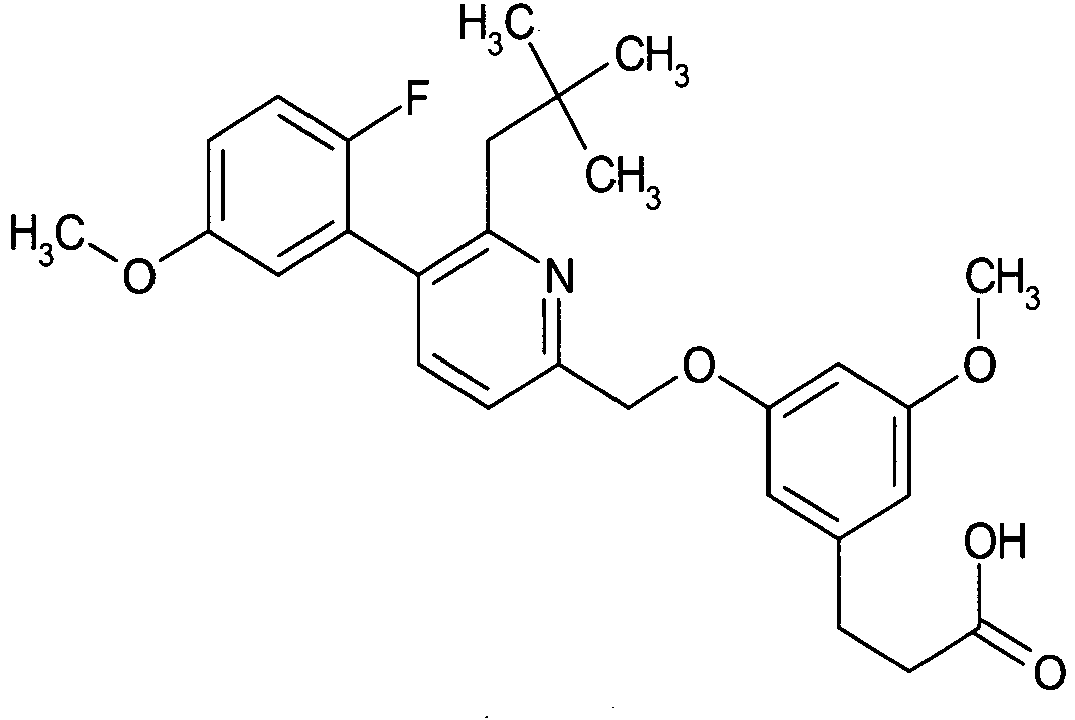
- 482.2 16 3-(3-((6-(2,2-dimethylpropyl)-5-(2-fluoro-5-methoxyphenyl)pyridin-2-yl)methoxy)-5-fluorophenyl)propanoic acid 
- 468.1 17 3-(5-((6-(2,2-dimethylpropyl)-5-(2-fluoro-5-methoxyphenyl)pyridin-2-yl)methoxy)-2-methylphenyl)propanoic acid 
- 466.1 18 3-(5-((6-(2,2-dimethylpropyl)-5-(2-fluoro-5-methoxyphenyl)pyridin-2-yl)methoxy)-2-methoxyphenyl)propanoic acid 
- 482.2 Table 4 Ex. No. compound name structural formula salt MS 19 3-(5-((6-(2,2-dimethylpropyl)-5-(2-fluoro-5-methoxyphenyl)pyridin-2-yl)methoxy)-2-fluorophenyl)propanoic acid 
- 470.1 20 3-(3-((6-(2,2-dimethylpropyl)-5-(2-fluoro-5-methoxyphenyl)pyridin-2-yl)methoxy)-2-methylphenyl)propanoic acid 
- 466.2 21 3-(3-((6-(2,2-dimethylpropyl)-5-(2-fluoro-5-methoxyphenyl)pyridin-2-yl)methoxy)-2-methoxyphenyl)propanoic acid 
- 482.2 22 3-(3-((6-(2,2-dimethylpropyl)-5-(2-fluoro-5-methoxyphenyl)pyridin-2-yl)methoxy)-2-fluorophenyl)propanoic acid 
- 470.0 23 3-(3-((6-(2,2-dimethylpropyl)-5-(2-fluoro-5-methoxyphenyl)pyridin-2-yl)methoxy)-5-methylphenyl)propanoic acid 
Na+ 464.1 24 3-(6-((6-(2,2-dimethylpropyl)-5-(2-fluoro-5-methoxyphenyl)pyridin-2-yl)methoxy)-2-methylpyrimidin-4-yl)propanoic acid 
- 468.2 Table 5 Ex. No. compound name structural formula salt MS 25 3-(6-((6-(2,2-dimethylpropyl)-5-(2-fluoro-5-methoxyphenyl)pyridin-2-yl)methoxy)-2-methoxypyrimidin-4-yl)propanoic acid 
- 484.0 26 3-(6-((6-(2,2-dimethylpropyl)-5-(2-fluoro-5-methoxyphenyl)pyridin-2-yl)methoxy)-5-methylpyrimidin-4-yl)propanoic acid 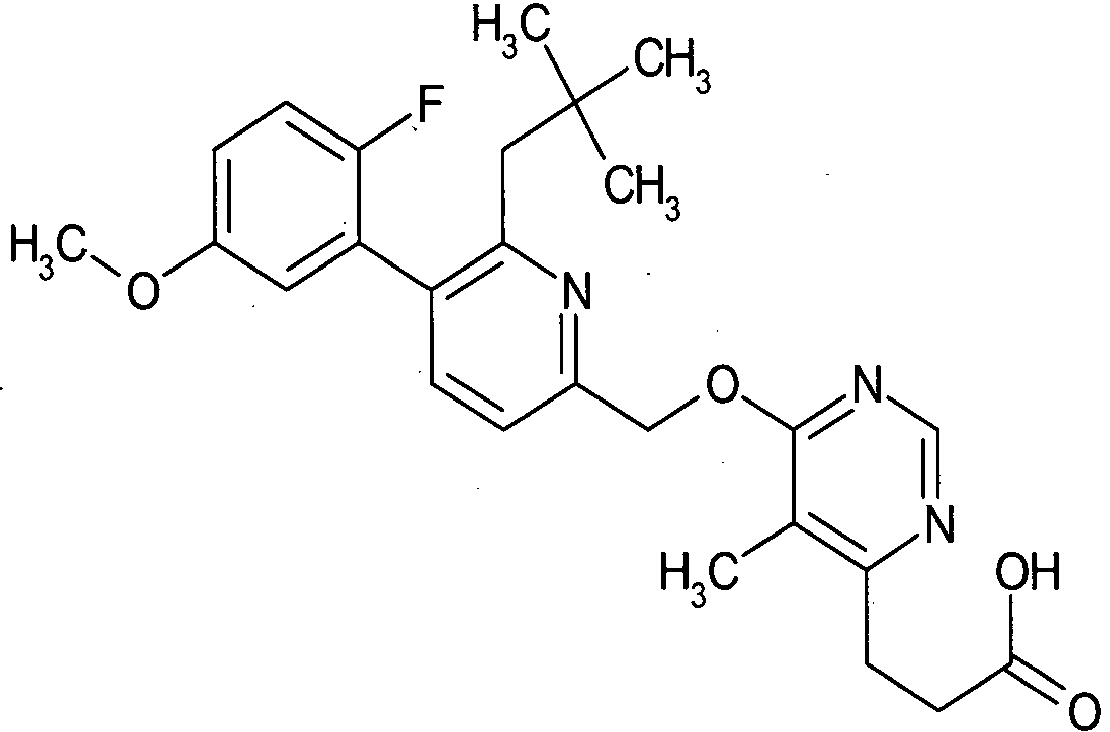
- 468.0 27 3-(6-((6-(2,2-dimethylpropyl)-5-(2-fluoro-5-methoxyphenyl)pyridin-2-yl)methoxy)-5-methoxypyrimidin-4-yl)propanoic acid 
- 484.0 28 3-(6-((6-(2,2-dimethylpropyl)-5-(2-fluoro-5-methoxyphenyl)pyridin-2-yl)methoxy)-5-fluoropyrimidin-4-yl)propanoic acid 
- 472.0 29 3-(3-((6-(2,2-dimethylpropyl)-5-(2-fluoro-5-methoxyphenyl)-pyridin-2-yl)methoxy)-phenyl)propanoic acid 
- 452.2 30 3-cyclopropyl-3-(2-((6-(2,2-dimethylpropyl)-5-(2-fluoro-5-methoxyphenyl)pyridin-2-yl)methoxy)pyridin-4-yl)propanoic acid 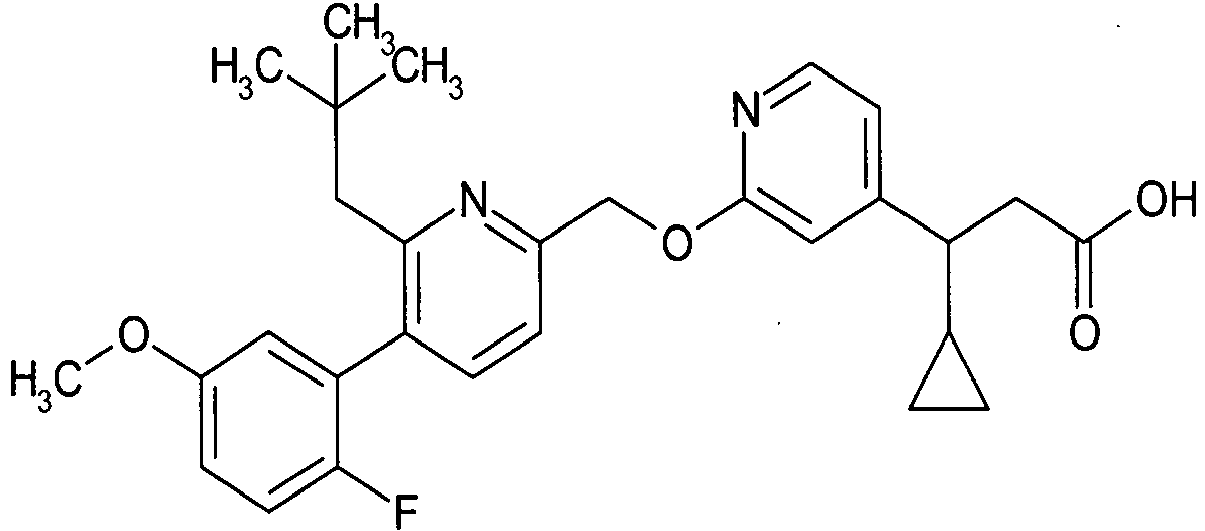
- 492.2 Table 6 Ex. No. compound name structural formula salt MS 31 3-cyclopropyl-3-(3-((6-(2 fluoro-5-methoxyphenyl)-5 isobutoxypyridin-3-yl)-methoxy)phenyl)propanoic acid 
- 494.2 32 3-cyclopropyl-3-(6-((6-(2-fluoro-5-methoxyphenyl)-5-isobutoxypyridin-3-yl)methoxy)pyrimidin-4-yl)propanoic acid 
- 496.2 33 3-cyclopropyl-3-(3-((6-(2-fluoro-5-methoxyphenyl)-5-isobutoxy-2-methoxypyridin-3-yl)-methoxy)phenyl)propanoic acid 
- 524.1 34 3-cyclopropyl-3-(3-((5-(2,2-dimethylpropyl)-6-(2-fluoro-5-methoxyphenyl)pyridin-3-yl)methoxy)phenyl)-propanoic acid 
- 492.2 35 3-cyclopropyl-3-(6-((5-(2,2-dimethylpropyl)-6-(2-fluoro-5-methoxyphenyl)-pyridin-3-yl)methoxy)-pyrimidin-4-yl)propanoic acid 
- 494.2 36 3-cyclopropyl-3-(6-((5-(2,2-dimethylpropoxy)-6-(2-fluoro-5-methoxyphenyl)pyridin-3-yl)methoxy)pyrimidin-4-yl)propanoic acid 
- 510.3 Table 7 Ex. No. compound name structural formula salt MS 37 3-cyclopropyl-3-(6-((6-(2-fluoro-5-methoxyphenyl)-5-(3,3,3-trifluoropropoxy)pyridin-3-yl)methoxy)pyrimidin-4-yl)propanoic acid 
- 536.3 38 3-cyclopropyl-3-(6-((5-((5,5-dimethyltetrahydrofuran-3-yl)methoxy)-6-(2-fluoro-5-methoxyphenyl)pyridin-3-yl)methoxy)pyrimidin-4-yl)propanoic acid 
- 552.0 39 3-cyclopropyl-3-(6-((5-((2,2-dimethyltetrahydro-2H-pyran-4-yl)methoxy)-6-(2-fluoro-5-methoxyphenyl)pyridin-3-yl)methoxy)pyrimidin-4-yl)propanoic acid 
- 566.1 40 3-cyclopropyl-3-(2-((5-(2,2-dimethylpropyl)-6-(2-fluoro-5-methoxyphenyl)pyridin-3-yl)methoxy)pyridin-4-yl)propanoic acid 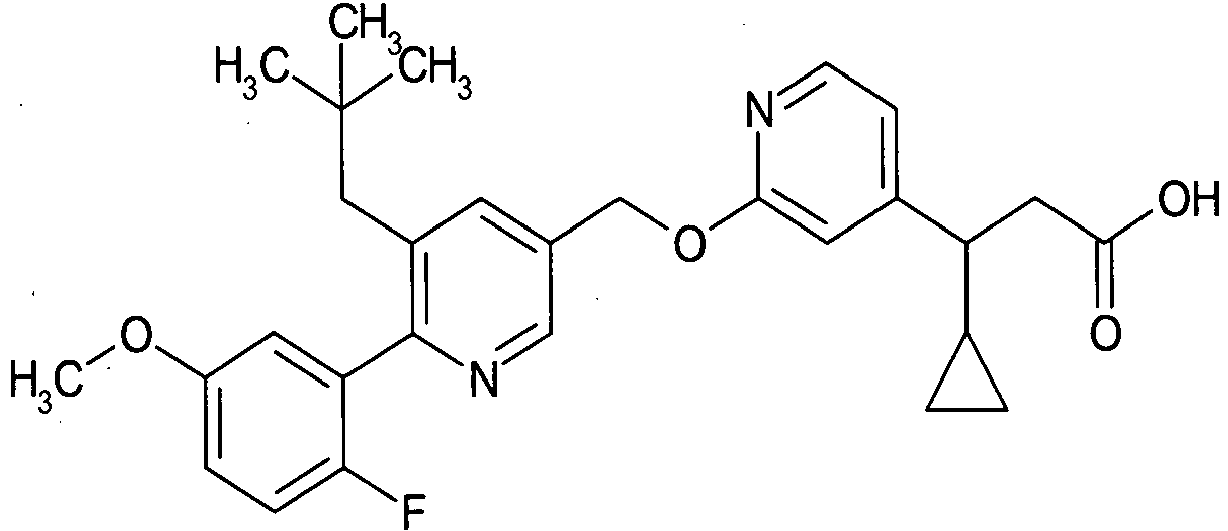
- 493.2 41 3-cyclopropyl-3-(6-((5-(2-fluoro-5-methoxyphenyl)-4-isobutoxypyrimidin-2-yl)methoxy)pyrimidin-4-yl)propanoic acid 
- 497.1 Table 8 Ex. No. compound name structural formula salt MS 42 3-cyclopropyl-3-(5-fluoro-2-((5-(2-fluoro-5-methoxyphenyl)-6-neopentylpyridin-2-yl)methoxy)pyridin-4-yl)propanoic acid 
- 511.5 43 3-(2-((5-((1-cyanocyclopentyl)methyl)-6-(2-fluoro-5-methoxyphenyl)pyridin-3-yl)methoxy)-5-fluoropyridin-4-yl)-3-cyclopropylpropanoic acid 
- 546.4 44 3-(2-((5-((1-cyanocyclopentyl)methyl)-6-(2-fluoro-5-methoxyphenyl)pyridin-3-yl)methoxy)-5-fluoropyridin-4-yl)-3-cyclopropylpropanoic acid 
- 546.3 - CHO(dhfr-) cells that stably expressed human GPR40 were suspended in MEMα (Nikken Bio Medical Laboratory) containing 10% dialysis serum (GEMINI BIO-PRODUCTS), 10 mM HEPES (Invitrogen), 100 U/mL penicillin, 100 µg/mL streptomycin (Invitrogen), and plated on a 384 well black/clear cell culture plate at 10,000 cells/well. After culture overnight in a CO2 incubator at 37°C, the culture supernatant was removed, and a loading buffer [dye attached to Calcium 5 Assay Kit (Molecular Devices) was dissolved in an assay buffer (20 mM HEPES, 0.2% fatty acid-free BSA (Sigma-Aldrich), 2.5 mM probenecid (DOJINDO)-containing HBSS (Invitrogen)) added with 0.025% Cremophor EL (DOJINDO)] was added at 37.5 µL/well. After incubation in a CO2 incubator at 37°C for 1 hr, the cells were stood at room temperature for 15 min, an assay buffer containing the test compound at a final concentration of 1 µM was added at 12.5 µL/well in FLIPR Tetra (Molecular Devices), and the fluorescence amount was successively measured. Human GPR40 agonist activity calculated using an increase in the intracellular Ca2+ concentration as an index, wherein the activity of 1 µM of the compound described in
WO 2009/048527 (WO2009/048527 Example 99.2) was 100%, and the activity when DMSO was added instead of the test compound was 0%. The results are shown in Table 9.Table 9 Example 1 µM 1 100 2 107 6 98 7 106 8 106 9 1007 11 100 12 112 13 110 15 103 16 109 17 109 18 109 19 109 22 103 23 99 29 103 30 112 31 104 32 104 34 118 35 101 36 106 37 101 40 113 41 110 42 115 43 115 44 107 Formulation Example 1 (production of capsule) 1) compound of Example 1 30 mg 2) finely divided powder cellulose 10 mg 3) lactose 19 mg 4) magnesium stearate 1 mg total 60 mg 1), 2), 3) and 4) are mixed and filled in a gelatin capsule. Formulation Example 2 (production of tablets) 1) compound of Example 1 30 g 2) lactose 50 g 3) cornstarch 15 g 4) calcium carboxymethylcellulose 44 g 5) magnesium stearate 1 g 1000 tablets total 140 g - The entire amount of 1), 2) and 3) and 4) (30 g) is kneaded with water, vacuum dried, and sieved. The sieved powder is mixed with 4) (14 g) and 5) (1 g), and the mixture is punched by a tableting machine, whereby 1000 tablets containing 30 mg of the compound of Ex. 1 per tablet are obtained.
- The compound of the present invention has a superior GPR40 agonist activity, and is useful as an agent for the prophylaxis or treatment of diabetes and the like.
- This application is based on patent application No.
2012-028943
Claims (17)
- A compound represented by the formula (I):
 wherein ring A is an optionally further substituted 6-membered aromatic ring;ring B is an optionally further substituted 6-membered aromatic heterocycle;ring C is an optionally further substituted 6-membered aromatic ring;Y is -NR4A-, -CR4BR4C- or -O-;R1 is a substituent;R2 and R3 are each independently a hydrogen atom or a substituent; andR4A, R4B and R4C are each independently a hydrogen atom, an optionally substituted C1-6 alkyl group, an optionally substituted C2-6 alkenyl group, an optionally substituted C2-6 alkynyl group, or an optionally substituted C3-7 cycloalkyl group,or a salt thereof.
 - The compound according to claim 1, wherein ring A is a benzene ring further substituted by one halogen atom and one C1-6 alkoxy group, or a salt thereof.
- The compound according to claim 1, wherein ring B is (1) a pyridine ring optionally further substituted by 1 to 3 C1-6 alkoxy groups, or (2) a pyrimidine ring, or a salt thereof.
- The compound according to claim 1, wherein ring C is (1) a benzene ring optionally further substituted by 1 to 3 substituents selected from a halogen atom, a C1-6 alkyl group and a C1-6 alkoxy group, (2) a pyridine ring, or (3) a pyrimidine ring optionally further substituted by 1 to 3 substituents selected from a halogen atom, a C1-6 alkyl group and a C1-6 alkoxy group, or a salt thereof.
- The compound according to claim 1, wherein Y is -N(ethyl)-, -CH2- or -CH(cyclopropyl)-, or a salt thereof.
- The compound according to claim 1, wherein R1 is (1) a C1-8 alkyl group optionally substituted by 1 to 3 substituents selected from (i) a C3-7 cycloalkyl group and cyano, or (2) a C1-6 alkoxy group optionally substituted by 1 to 3 substituents selected from (i) a halogen atom and (ii) a non-aromatic heterocyclic group optionally substituted by 1 or 2 C1-6 alkyl groups, or a salt thereof.
- The compound according to claim 1, wherein both R2 and R3 are hydrogen atoms, or a salt thereof.
- 3-Cyclopropyl-3-(6-((5-(2,2-dimethylpropyl)-6-(2-fluoro-5-methoxyphenyl)pyridin-3-yl)methoxy)pyrimidin-4-yl)propanoic acid or a salt thereof.
- 3-Cyclopropyl-3-(6-((6-(2,2-dimethylpropyl)-5-(2-fluoro-5-methoxyphenyl)pyridin-2-yl)methoxy)pyrimidin-4-yl)propanoic acid or a salt thereof.
- 3-Cyclopropyl-3-(3-((5-(2,2-dimethylpropyl)-6-(2-fluoro-5-methoxyphenyl)pyridin-3-yl)methoxy)phenyl)propanoic acid or a salt thereof.
- A medicament comprising the compound according to claim 1 or a salt thereof.
- The medicament according to claim 11, which is a GPR40 receptor function modulator.
- The medicament according to claim 11, which is a prophylactic or therapeutic agent for diabetes.
- A method for the prophylaxis or treatment of diabetes in a mammal, comprising administering an effective amount of the compound according to claim 1 or a salt thereof to the mammal.
- A method of modulating a GPR40 receptor function in a mammal, comprising administering an effective amount of the compound according to claim 1 or a salt thereof to the mammal.
- Use of the compound according to claim 1 or a salt thereof in the production of an agent for the prophylaxis or treatment of diabetes.
- The compound according to claim 1 or a salt thereof for use in the prophylaxis or treatment of diabetes.
Applications Claiming Priority (2)
| Application Number | Priority Date | Filing Date | Title |
|---|---|---|---|
| JP2012028943 | 2012-02-13 | ||
| PCT/JP2013/053197 WO2013122029A1 (en) | 2012-02-13 | 2013-02-12 | Aromatic ring compound |
Publications (2)
| Publication Number | Publication Date |
|---|---|
| EP2816032A1 true EP2816032A1 (en) | 2014-12-24 |
| EP2816032A4 EP2816032A4 (en) | 2015-09-30 |
Family
ID=48984139
Family Applications (1)
| Application Number | Title | Priority Date | Filing Date |
|---|---|---|---|
| EP13749562.8A Withdrawn EP2816032A4 (en) | 2012-02-13 | 2013-02-12 | AROMATIC CORE COMPOUND |
Country Status (4)
| Country | Link |
|---|---|
| US (1) | US9181186B2 (en) |
| EP (1) | EP2816032A4 (en) |
| JP (1) | JP6121339B2 (en) |
| WO (1) | WO2013122029A1 (en) |
Families Citing this family (31)
| Publication number | Priority date | Publication date | Assignee | Title |
|---|---|---|---|---|
| US9382188B2 (en) * | 2012-02-13 | 2016-07-05 | Takeda Pharmaceutical Company Limited | Aromatic ring compound |
| WO2014130608A1 (en) | 2013-02-22 | 2014-08-28 | Merck Sharp & Dohme Corp. | Antidiabetic bicyclic compounds |
| JP6397410B2 (en) | 2013-08-09 | 2018-09-26 | 武田薬品工業株式会社 | Aromatic ring compound |
| JP2015090785A (en) * | 2013-11-06 | 2015-05-11 | 株式会社豊田自動織機 | Compound for adding to electrolyte |
| US10519115B2 (en) | 2013-11-15 | 2019-12-31 | Merck Sharp & Dohme Corp. | Antidiabetic tricyclic compounds |
| EP3076959B1 (en) | 2013-12-04 | 2018-07-04 | Merck Sharp & Dohme Corp. | Antidiabetic bicyclic compounds |
| US10059667B2 (en) | 2014-02-06 | 2018-08-28 | Merck Sharp & Dohme Corp. | Antidiabetic compounds |
| WO2015176267A1 (en) | 2014-05-22 | 2015-11-26 | Merck Sharp & Dohme Corp. | Antidiabetic tricyclic compounds |
| WO2016022446A1 (en) | 2014-08-08 | 2016-02-11 | Merck Sharp & Dohme Corp. | [5,6]-fused bicyclic antidiabetic compounds |
| EP3177287B1 (en) | 2014-08-08 | 2022-02-23 | Merck Sharp & Dohme Corp. | Antidiabetic bicyclic compounds |
| WO2016019587A1 (en) | 2014-08-08 | 2016-02-11 | Merck Sharp & Dohme Corp. | [7, 6]-fused bicyclic antidiabetic compounds |
| EP3177282B1 (en) | 2014-08-08 | 2021-10-06 | Merck Sharp & Dohme Corp. | Antidiabetic bicyclic compounds |
| WO2017172505A1 (en) | 2016-03-29 | 2017-10-05 | Merck Sharp & Dohme Corp. | Antidiabetic bicyclic compounds |
| US11072602B2 (en) | 2016-12-06 | 2021-07-27 | Merck Sharp & Dohme Corp. | Antidiabetic heterocyclic compounds |
| EP3558298B1 (en) | 2016-12-20 | 2026-03-11 | Merck Sharp & Dohme LLC | Antidiabetic spirochroman compounds |
| AR111199A1 (en) | 2017-03-31 | 2019-06-12 | Takeda Pharmaceuticals Co | GPR40 AGONIST AROMATIC COMPOUND |
| WO2018181847A1 (en) | 2017-03-31 | 2018-10-04 | 武田薬品工業株式会社 | Aromatic compound |
| BR102018007822A2 (en) | 2017-04-20 | 2018-11-06 | Gilead Sciences, Inc. | compound, methods for inhibiting pd-1, pd-11 and / or interaction of pd-1 / pd-11 and for cancer treatment, pharmaceutical composition, and kit for treating or preventing cancer or a disease or condition |
| US11225471B2 (en) | 2017-11-16 | 2022-01-18 | Merck Sharp & Dohme Corp. | Antidiabetic bicyclic compounds |
| KR102708681B1 (en) | 2018-02-13 | 2024-09-26 | 길리애드 사이언시즈, 인코포레이티드 | Pd-1/pd-l1 inhibitors |
| CN110294744A (en) * | 2018-03-21 | 2019-10-01 | 中国医学科学院药物研究所 | GPR40 receptor stimulating agent, its preparation method and its pharmaceutical composition and purposes |
| EP4600247A3 (en) | 2018-04-19 | 2025-11-19 | Gilead Sciences, Inc. | Pd-1/pd-l1 inhibitors |
| UA126421C2 (en) | 2018-07-13 | 2022-09-28 | Гіліад Сайєнсіз, Інк. | PD-1/PD-L1 INHIBITORS |
| US11236085B2 (en) | 2018-10-24 | 2022-02-01 | Gilead Sciences, Inc. | PD-1/PD-L1 inhibitors |
| CN110627827B (en) * | 2019-09-11 | 2022-11-08 | 杭州澳赛诺生物科技有限公司 | Synthesis method of 4-ethynyl-tetrahydropyrane or 4-ethynyl piperidine |
| BR112022006546A2 (en) | 2019-10-07 | 2022-08-30 | Kallyope Inc | GPR119 AGONISTS |
| CA3173731A1 (en) | 2020-02-28 | 2021-09-02 | Kallyope, Inc. | Gpr40 agonists |
| CN116323608A (en) | 2020-05-19 | 2023-06-23 | 卡尔优普公司 | AMPK activator |
| EP4172162A4 (en) | 2020-06-26 | 2024-08-07 | Kallyope, Inc. | AMPK ACTIVATORS |
| US12029718B2 (en) | 2021-11-09 | 2024-07-09 | Cct Sciences, Llc | Process for production of essentially pure delta-9-tetrahydrocannabinol |
| KR102699076B1 (en) * | 2021-04-01 | 2024-08-27 | 현대약품 주식회사 | Novel use of 3-(4-(benzyloxy)phenyl)hex-4-inoic acid derivative |
Family Cites Families (39)
| Publication number | Priority date | Publication date | Assignee | Title |
|---|---|---|---|---|
| NZ236474A (en) | 1989-12-20 | 1993-07-27 | Bristol Myers Squibb Co | 4,5-diphenyl-2-oxazole octanoic, nonanoic and decanoic acid and ester derivatives, preparation and pharmaceutical compositions thereof |
| JPH08333287A (en) | 1995-06-02 | 1996-12-17 | Fuji Yakuhin Kogyo Kk | Aromatic ring-substituted alkylcarboxylic acid and alkanol derivative and antithrombogenic medicine containing these compounds |
| CN1072649C (en) | 1995-09-13 | 2001-10-10 | 武田药品工业株式会社 | Benzoxazepine compounds, their production method and use |
| AR035016A1 (en) | 1999-08-25 | 2004-04-14 | Takeda Chemical Industries Ltd | COMPOSITION OF AZOL PROMOTER OF PRODUCTION / SECRETION OF NEUROTROFINE, COMPOSITE PRODROGA OF THE SAME, PHARMACEUTICAL COMPOSITION THAT INCLUDES IT AND USE OF THE SAME TO PREPARE THIS LAST. |
| US20030187023A1 (en) | 2000-07-17 | 2003-10-02 | Keiji Kubo | Sulfone derivatives, process for their production and use thereof |
| TWI316055B (en) | 2001-04-26 | 2009-10-21 | Nippon Shinyaku Co Ltd | |
| EP1556032A1 (en) | 2002-11-01 | 2005-07-27 | Takeda Pharmaceutical Company Limited | Agent for preventing or treating neuropathy |
| JP4594611B2 (en) * | 2002-11-08 | 2010-12-08 | 武田薬品工業株式会社 | Receptor function regulator |
| EP1559422B1 (en) | 2002-11-08 | 2014-04-30 | Takeda Pharmaceutical Company Limited | Receptor function controlling agent |
| WO2004048363A1 (en) | 2002-11-22 | 2004-06-10 | Takeda Pharmaceutical Company Limited | Imidazole derivative, process for producing the same, and use |
| EP1630152A4 (en) | 2003-05-30 | 2009-09-23 | Takeda Pharmaceutical | CONNECTION WITH CONDENSED RING |
| US7534887B2 (en) | 2003-09-30 | 2009-05-19 | Takeda Pharmaceutical Company Limited | Thiazoline derivative and use of the same |
| WO2005049573A1 (en) * | 2003-11-05 | 2005-06-02 | F. Hoffmann-La Roche Ag | Phenyl derivatives as ppar agonists |
| EP1695961A4 (en) | 2003-12-17 | 2007-10-24 | Takeda Pharmaceutical | UREA DERIVATIVES, CORRESPONDING PRODUCTION PROCESS AND USE |
| JP4074616B2 (en) * | 2003-12-25 | 2008-04-09 | 武田薬品工業株式会社 | 3- (4-Benzyloxyphenyl) propanoic acid derivatives |
| CA2551610A1 (en) | 2003-12-25 | 2005-07-14 | Takeda Pharmaceutical Company Limited | 3-(4-benzyloxyphenyl)propanoic acid derivatives |
| JP4855777B2 (en) | 2003-12-26 | 2012-01-18 | 武田薬品工業株式会社 | Phenylpropanoic acid derivatives |
| WO2005087710A1 (en) | 2004-03-15 | 2005-09-22 | Takeda Pharmaceutical Company Limited | Aminophenylpropanoic acid derivative |
| EP2253315A1 (en) | 2004-03-30 | 2010-11-24 | Takeda Pharmaceutical Company Limited | Alkoxyphenylpropanoic acid derivatives |
| TWI396686B (en) | 2004-05-21 | 2013-05-21 | Takeda Pharmaceutical | Cyclic guanamine derivatives, as well as their products and usage |
| JP5094394B2 (en) | 2005-04-20 | 2012-12-12 | 武田薬品工業株式会社 | Fused heterocyclic compounds |
| EP1916234B1 (en) | 2005-07-29 | 2014-11-12 | Takeda Pharmaceutical Company Limited | Cyclopropanecarboxylic acid compound |
| EP1911738A4 (en) | 2005-07-29 | 2009-12-16 | Takeda Pharmaceutical | PHENOXYALKANSÄUREVERBINDUNG |
| TW200740435A (en) | 2005-08-10 | 2007-11-01 | Takeda Pharmaceuticals Co | Therapeutic agent for diabetes |
| JP2007063225A (en) | 2005-09-01 | 2007-03-15 | Takeda Chem Ind Ltd | Imidazopyridine compound |
| CN101304993A (en) | 2005-11-07 | 2008-11-12 | Irm责任有限公司 | Compounds and compositions as PPAR modulators |
| CL2007001873A1 (en) | 2006-06-27 | 2008-01-04 | Takeda Pharmaceutical | ((3s)) - 6 - ((¨2,6-dimethyl-4- (3- (methylsulfonyl) -propoxy) biphenyl-3-yl) methoxy-2,3-dihydro-1-benzofuran-3-yl acid ) acetic or salt thereof |
| US8492405B2 (en) | 2006-10-18 | 2013-07-23 | Takeda Pharmaceutical Company Limited | Glucokinase-activating fused heterocyclic compounds and methods of treating diabetes and obesity |
| UA97257C2 (en) | 2006-10-19 | 2012-01-25 | Такеда Фармасьютикал Компани Лимитед | Indole derivatives |
| JPWO2008093639A1 (en) | 2007-01-29 | 2010-05-20 | 武田薬品工業株式会社 | Pyrazole compounds |
| MX2009008103A (en) | 2007-02-09 | 2009-08-18 | Takeda Pharmaceutical | Fused ring compounds as partial agonists of ppar-gamma. |
| WO2008136428A1 (en) | 2007-04-27 | 2008-11-13 | Takeda Pharmaceutical Company Limited | Nitrogen-containing five-membered heterocyclic compound |
| EP2157859A4 (en) | 2007-06-19 | 2011-01-12 | Takeda Pharmaceutical | INDAZOLE COMPOUNDS FOR ACTIVATING GLUCOKINASE |
| KR20100090249A (en) * | 2007-10-10 | 2010-08-13 | 암젠 인크 | Substituted biphenyl gpr 40 modulators |
| EP2310371B1 (en) * | 2008-05-26 | 2013-05-15 | Genfit | Ppar agonist compounds and preparation and uses thereof for treating diabetes and/or dyslipidemia |
| US8937055B2 (en) * | 2010-07-15 | 2015-01-20 | Takeda Pharmaceutical Company Limited | Heterocyclic ring compound having muscle cell or adipocyte differentiation regulating action |
| JP5560989B2 (en) | 2010-07-21 | 2014-07-30 | 富士通株式会社 | Receiver circuit |
| US9382188B2 (en) * | 2012-02-13 | 2016-07-05 | Takeda Pharmaceutical Company Limited | Aromatic ring compound |
| RS58321B1 (en) * | 2013-10-29 | 2019-03-29 | Takeda Pharmaceuticals Co | Heterocyclic compound |
-
2013
- 2013-02-12 EP EP13749562.8A patent/EP2816032A4/en not_active Withdrawn
- 2013-02-12 JP JP2013558683A patent/JP6121339B2/en active Active
- 2013-02-12 US US14/377,951 patent/US9181186B2/en not_active Expired - Fee Related
- 2013-02-12 WO PCT/JP2013/053197 patent/WO2013122029A1/en not_active Ceased
Also Published As
| Publication number | Publication date |
|---|---|
| US9181186B2 (en) | 2015-11-10 |
| JP6121339B2 (en) | 2017-04-26 |
| WO2013122029A1 (en) | 2013-08-22 |
| US20150045378A1 (en) | 2015-02-12 |
| EP2816032A4 (en) | 2015-09-30 |
| JPWO2013122029A1 (en) | 2015-05-11 |
Similar Documents
| Publication | Publication Date | Title |
|---|---|---|
| US9181186B2 (en) | Aromatic ring compound | |
| US9382188B2 (en) | Aromatic ring compound | |
| US11186565B2 (en) | Aromatic compound | |
| US9776962B2 (en) | Aromatic compounds with GPR40 agonistic activity | |
| JP5657578B2 (en) | Novel fused ring compounds and uses thereof | |
| EP1731505B1 (en) | Alkoxyphenylpropanoic acid derivatives | |
| US10968231B2 (en) | Substituted cyclyl-acetic acid derivatives for the treatment of metabolic disorders | |
| JP6458054B2 (en) | Heterocyclic compounds | |
| EP2563765B1 (en) | Bicyclic compound derivatives and their use as acc inhibitors. | |
| JPWO2016104630A1 (en) | Fused heterocyclic compounds | |
| KR20210117194A (en) | Glp-1 receptor agonists, pharmaceutical composition comprising the same and method for preparing the same | |
| EP2583965B1 (en) | Heterocyclic ring compound | |
| WO2016121782A1 (en) | Sulfonamide compound | |
| EP2970331A1 (en) | Spiro azetidine isoxazole derivatives and their use as sstr5 antagonists | |
| HK40015122A (en) | Aromatic compound |
Legal Events
| Date | Code | Title | Description |
|---|---|---|---|
| PUAI | Public reference made under article 153(3) epc to a published international application that has entered the european phase |
Free format text: ORIGINAL CODE: 0009012 |
|
| 17P | Request for examination filed |
Effective date: 20140813 |
|
| AK | Designated contracting states |
Kind code of ref document: A1 Designated state(s): AL AT BE BG CH CY CZ DE DK EE ES FI FR GB GR HR HU IE IS IT LI LT LU LV MC MK MT NL NO PL PT RO RS SE SI SK SM TR |
|
| AX | Request for extension of the european patent |
Extension state: BA ME |
|
| DAX | Request for extension of the european patent (deleted) | ||
| RA4 | Supplementary search report drawn up and despatched (corrected) |
Effective date: 20150827 |
|
| RIC1 | Information provided on ipc code assigned before grant |
Ipc: A61P 13/12 20060101ALI20150821BHEP Ipc: A61K 31/4418 20060101ALI20150821BHEP Ipc: A61K 31/444 20060101ALI20150821BHEP Ipc: A61P 3/04 20060101ALI20150821BHEP Ipc: A61P 11/00 20060101ALI20150821BHEP Ipc: A61P 5/48 20060101ALI20150821BHEP Ipc: A61P 9/10 20060101ALI20150821BHEP Ipc: A61P 7/10 20060101ALI20150821BHEP Ipc: A61P 3/10 20060101ALI20150821BHEP Ipc: C07D 213/64 20060101AFI20150821BHEP Ipc: A61P 1/00 20060101ALI20150821BHEP Ipc: A61P 13/10 20060101ALI20150821BHEP Ipc: A61P 7/00 20060101ALI20150821BHEP Ipc: A61P 1/16 20060101ALI20150821BHEP Ipc: A61K 31/506 20060101ALI20150821BHEP Ipc: A61P 3/00 20060101ALI20150821BHEP Ipc: A61P 1/18 20060101ALI20150821BHEP Ipc: A61P 11/04 20060101ALI20150821BHEP Ipc: A61P 1/04 20060101ALI20150821BHEP Ipc: A61P 5/50 20060101ALI20150821BHEP Ipc: A61P 5/00 20060101ALI20150821BHEP |
|
| 17Q | First examination report despatched |
Effective date: 20160802 |
|
| STAA | Information on the status of an ep patent application or granted ep patent |
Free format text: STATUS: EXAMINATION IS IN PROGRESS |
|
| STAA | Information on the status of an ep patent application or granted ep patent |
Free format text: STATUS: THE APPLICATION IS DEEMED TO BE WITHDRAWN |
|
| 18D | Application deemed to be withdrawn |
Effective date: 20171006 |