EP2811368A1 - Dispositif d'inhibition, procédé de commande d'un dispositif d'inhibition, dispositif sous commande, équipement électronique, programme de commande, et support d'enregistrement - Google Patents
Dispositif d'inhibition, procédé de commande d'un dispositif d'inhibition, dispositif sous commande, équipement électronique, programme de commande, et support d'enregistrement Download PDFInfo
- Publication number
- EP2811368A1 EP2811368A1 EP13742898.3A EP13742898A EP2811368A1 EP 2811368 A1 EP2811368 A1 EP 2811368A1 EP 13742898 A EP13742898 A EP 13742898A EP 2811368 A1 EP2811368 A1 EP 2811368A1
- Authority
- EP
- European Patent Office
- Prior art keywords
- inhibition
- controlled device
- information
- user
- state
- Prior art date
- Legal status (The legal status is an assumption and is not a legal conclusion. Google has not performed a legal analysis and makes no representation as to the accuracy of the status listed.)
- Granted
Links
Images


Classifications
-
- G—PHYSICS
- G06—COMPUTING OR CALCULATING; COUNTING
- G06F—ELECTRIC DIGITAL DATA PROCESSING
- G06F13/00—Interconnection of, or transfer of information or other signals between, memories, input/output devices or central processing units
- G06F13/14—Handling requests for interconnection or transfer
- G06F13/20—Handling requests for interconnection or transfer for access to input/output bus
- G06F13/24—Handling requests for interconnection or transfer for access to input/output bus using interrupt
-
- G—PHYSICS
- G06—COMPUTING OR CALCULATING; COUNTING
- G06F—ELECTRIC DIGITAL DATA PROCESSING
- G06F1/00—Details not covered by groups G06F3/00 - G06F13/00 and G06F21/00
- G06F1/26—Power supply means, e.g. regulation thereof
- G06F1/32—Means for saving power
- G06F1/3203—Power management, i.e. event-based initiation of a power-saving mode
- G06F1/3206—Monitoring of events, devices or parameters that trigger a change in power modality
-
- G—PHYSICS
- G06—COMPUTING OR CALCULATING; COUNTING
- G06F—ELECTRIC DIGITAL DATA PROCESSING
- G06F1/00—Details not covered by groups G06F3/00 - G06F13/00 and G06F21/00
- G06F1/26—Power supply means, e.g. regulation thereof
- G06F1/32—Means for saving power
- G06F1/3203—Power management, i.e. event-based initiation of a power-saving mode
- G06F1/3234—Power saving characterised by the action undertaken
-
- H—ELECTRICITY
- H04—ELECTRIC COMMUNICATION TECHNIQUE
- H04W—WIRELESS COMMUNICATION NETWORKS
- H04W52/00—Power management, e.g. Transmission Power Control [TPC] or power classes
- H04W52/02—Power saving arrangements
- H04W52/0209—Power saving arrangements in terminal devices
- H04W52/0251—Power saving arrangements in terminal devices using monitoring of local events, e.g. events related to user activity
- H04W52/0254—Power saving arrangements in terminal devices using monitoring of local events, e.g. events related to user activity detecting a user operation or a tactile contact or a motion of the device
-
- G—PHYSICS
- G06—COMPUTING OR CALCULATING; COUNTING
- G06F—ELECTRIC DIGITAL DATA PROCESSING
- G06F1/00—Details not covered by groups G06F3/00 - G06F13/00 and G06F21/00
- G06F1/26—Power supply means, e.g. regulation thereof
- G06F1/32—Means for saving power
- G06F1/3203—Power management, i.e. event-based initiation of a power-saving mode
- G06F1/3234—Power saving characterised by the action undertaken
- G06F1/324—Power saving characterised by the action undertaken by lowering clock frequency
-
- G—PHYSICS
- G06—COMPUTING OR CALCULATING; COUNTING
- G06F—ELECTRIC DIGITAL DATA PROCESSING
- G06F1/00—Details not covered by groups G06F3/00 - G06F13/00 and G06F21/00
- G06F1/26—Power supply means, e.g. regulation thereof
- G06F1/32—Means for saving power
- G06F1/3203—Power management, i.e. event-based initiation of a power-saving mode
- G06F1/3234—Power saving characterised by the action undertaken
- G06F1/3296—Power saving characterised by the action undertaken by lowering the supply or operating voltage
-
- Y—GENERAL TAGGING OF NEW TECHNOLOGICAL DEVELOPMENTS; GENERAL TAGGING OF CROSS-SECTIONAL TECHNOLOGIES SPANNING OVER SEVERAL SECTIONS OF THE IPC; TECHNICAL SUBJECTS COVERED BY FORMER USPC CROSS-REFERENCE ART COLLECTIONS [XRACs] AND DIGESTS
- Y02—TECHNOLOGIES OR APPLICATIONS FOR MITIGATION OR ADAPTATION AGAINST CLIMATE CHANGE
- Y02D—CLIMATE CHANGE MITIGATION TECHNOLOGIES IN INFORMATION AND COMMUNICATION TECHNOLOGIES [ICT], I.E. INFORMATION AND COMMUNICATION TECHNOLOGIES AIMING AT THE REDUCTION OF THEIR OWN ENERGY USE
- Y02D10/00—Energy efficient computing, e.g. low power processors, power management or thermal management
-
- Y—GENERAL TAGGING OF NEW TECHNOLOGICAL DEVELOPMENTS; GENERAL TAGGING OF CROSS-SECTIONAL TECHNOLOGIES SPANNING OVER SEVERAL SECTIONS OF THE IPC; TECHNICAL SUBJECTS COVERED BY FORMER USPC CROSS-REFERENCE ART COLLECTIONS [XRACs] AND DIGESTS
- Y02—TECHNOLOGIES OR APPLICATIONS FOR MITIGATION OR ADAPTATION AGAINST CLIMATE CHANGE
- Y02D—CLIMATE CHANGE MITIGATION TECHNOLOGIES IN INFORMATION AND COMMUNICATION TECHNOLOGIES [ICT], I.E. INFORMATION AND COMMUNICATION TECHNOLOGIES AIMING AT THE REDUCTION OF THEIR OWN ENERGY USE
- Y02D30/00—Reducing energy consumption in communication networks
- Y02D30/70—Reducing energy consumption in communication networks in wireless communication networks
Definitions
- the present invention relates to an inhibition device that inhibits a transition of a status of a controlled device (device under control).
- Electric power control by use of electronic devices is becoming increasingly important due to an increase in electric power consumption of CPUs (Central Processing Unit) as a result of performance advancements.
- CPUs Central Processing Unit
- electronic devices are equipped with such a function as power-saving mode called “suspension” or “hibernation” in order to reduce electric power consumption while users are not using the electronic devices.
- the power-saving mode function works so that, before a user turns off a power supply of an electronic device, the electronic device transfers, to a non-volatile storage device (hard disk), information which is stored in a volatile storage device (memory). Then, the electronic device transfers the information back to the volatile storage device when the user turns the power supply back on. This allows the user to resume his/her operation in a state identical to that immediately before the power supply was turned off.
- this function is widely implemented in various electronic devices, the function is only available while a user is not using an electronic device at all. This is because operations of all of components included in the electronic device become suspended while the above function is taking effect.
- timings, with which a computation load is applied to a CPU are limited. Therefore, such a method is possible in which, even while a user is using an electronic device, electric power consumption is dynamically reduced by suspending, with predetermined timings, part of components included in the electronic device (it is generally called "degenerate operation" when an electronic device is operating while part of components is suspended).
- another method is possible in which all the devices are made to operate by intensively supplying electric power only when a computation load is applied, and electric power consumption is therefore efficiently distributed.
- Patent Literature 1 discloses an image capturing device that simultaneously achieves an improvement in start-up performance and a reduction in electric power consumption.
- the image capturing device enhances image capturing performance by temporarily increasing a clock frequency of a CPU.
- Patent Literature 2 discloses a device that controls an operating frequency of a CPU in accordance with a process to be executed. In a case where the device receives user input, the device sets a clock frequency of the CPU to a predetermined rate.
- Patent Literature 3 discloses an information processing system that includes a processor whose operating speed is changeable. The information processing system is designed to reduce electric power consumption by reducing, within tolerance of a response time, an operating frequency of the processor.
- Patent Literature 4 discloses an information processing device that eliminates delay time of low priority tasks. The information processing device enhances processing stability by eliminating, from execution time, delay time that has resulted from interrupt processing while electric power is controlled.
- Patent Literature 5 discloses a processing system that executes, at a lower electric power consumption rate, a process that involves a time limit for a response.
- the processing system includes a hardware mechanism that changes, during a system operation, an operating frequency and a power supply voltage which are to be supplied to a processor.
- an electronic device executes a degenerate operation with a timing with which a user executes an operation that causes an application program (hereinafter referred to as "application") to be launched
- application an application program
- the user experiences a substandard operating feel of the electronic device such as "sluggishness” or “poor responsiveness.” This is because numerous calculations are involved in initialization that is executed when the application is launched.
- GUI graphical user interface
- the device disclosed in Patent Literature 1 has a unique hardware configuration. This makes it impossible to increase a clock frequency in accordance with an identified process that is dependent only on the CPU. Therefore, the device is incapable of inhibiting the degenerate operation of an electronic device in accordance with any process executed by the electronic device.
- the device disclosed in Patent Literature 2 sets the clock frequency of the CPU to the predetermined rate whenever receiving key input of the user even in a case where no computation load is applied to the CPU. This makes it impossible to effectively reduce the electric power consumption.
- Patent Literatures 3, 4, and 5 cause adverse effects (such as necessitating unnecessary calculations) or have a limited range of applications.
- the system of Patent Literature 3 it is not possible for an electronic device to learn, in advance, how many calculations are required for launching an application. This prevents the system from properly inhibiting the degenerate operation.
- the device disclosed in Patent Literature 4 is merely effective in such a specific process as "interrupt processing.” This makes it impossible for the device to handle complex tasks such as the launch of application.
- Patent Literature 5 changes the operating frequency only after detecting the delay in a given process. Therefore, a process for changing the operating frequency may not be executed in time for the inhibition of the degenerate operation. In short, none of the conventional technologies disclosed in the above patent literatures improves an operating feel of a user by effectively inhibiting the degenerate operation.
- the present invention has been made in view of the problem, and it is an object of the present invention to provide an inhibition device and the like that enable, by inhibiting a degenerate operation of an electronic device in accordance with a usage status of a user, the electronic device to efficiently consume electric power without interfering with an operating feel of the user.
- an inhibition device in accordance with one aspect of the present invention is an inhibition device for transmitting, to a controlled device, inhibition information that causes the controlled device to be inhibited from transitioning from a first state, in which the controlled device executes a process at a predetermined performance level, to a second state in which the controlled device executes the process at a performance level lower than the predetermined performance level, the controlled device being capable of obtaining, from an electronic device that includes an input screen capable of detecting a location specified by a user, location information on the location, the inhibition device including: first obtaining means for obtaining, from the controlled device, the location information on the location specified by the user; first determining means for determining, in accordance with the location information obtained by the first obtaining means, whether or not an operation of the user is an operation for causing the controlled device to execute a predetermined process; and transmitting means for transmitting the inhibition information in a case where the first determining means determines that the operation of the user is an operation for causing the controlled device to execute the pre
- a method of controlling the inhibition device in accordance with one aspect of the present invention is a method of controlling an inhibition device, said inhibition device being configured to transmit, to a controlled device, inhibition information that causes the controlled device to be inhibited from transitioning from a first state, in which the controlled device executes a process at a predetermined performance level, to a second state in which the controlled device executes the process at a performance level lower than the predetermined performance level, the controlled device being capable of obtaining, from an electronic device that includes an input screen capable of detecting a location specified by a user, location information on the location, said method including: a first obtaining step of obtaining, from the controlled device, the location information on the location specified by the user; a first determining step of determining, in accordance with the location information obtained in the first obtaining step, whether or not an operation of the user is an operation for causing the controlled device to execute a predetermined process; and a transmitting step of transmitting the inhibition information in a case where it is determined in the first
- an inhibition device and a method of controlling the inhibition device in accordance with one aspect of the present invention it is possible to inhibit a controlled device from operating in a second state in accordance with a usage status of a user. Therefore, the inhibition device and the method of controlling the inhibition device bring about such an effect as allowing the controlled device to efficiently consume electric power without interfering with an operating feel of the user.
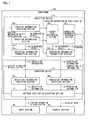
- Fig. 1 is a block diagram illustrating a main configuration of the smartphone 100 in accordance with the present embodiment.
- the smartphone (electronic device) 100 includes an input screen capable of detecting a location specified by a user operation, and at least includes an inhibition device 11 and a computing device 12.
- the present embodiment will employ the smartphone 100 as an example of an electronic device. Note, however, that the electronic device is not limited to a smartphone, but can be a tablet device, a personal computer, or any other electronic devices.
- the smartphone 100 is also equipped with a Graphical User Interface (GUI), and contains a plurality of applications that are executable in the computing device 12. A user can cause the computing device 12 to execute a desirable application by selecting an icon or the like on the GUI.
- GUI Graphical User Interface
- the computing device (controlled device) 12 is a device that is (i) capable of obtaining location information on a touch location (location specified by a user operation) 3 from the smartphone 100 that includes the input screen capable of detecting the touch location 3 and (ii) capable of operating either in (a) a normal state (first state) in which the computing device 12 executes a process at a normal performance level (predetermined performance level) or (b) a degenerate state (second state) in which the computing device 12 executes a process at a performance level lower than the normal performance level.
- the "degenerate state” refers to a state in which electric power consumption and performance level are reduced. Examples of a method for the reduction encompass (i) suspending part of the functions of the computing device 12 and (ii) changing a frequency, a voltage, or the like at which the computing device 12 operates.
- the "normal state” refers to a state that is not the degenerate state.
- the "normal performance level” refers to a performance level at which the computing device 12 operates in the normal state.
- the inhibition device 11 is a device that transmits, to the computing device 12 which is capable of obtaining location information on the touch location 3 from the smartphone 100 that includes the input screen capable of detecting the touch location 3, inhibition information 1a for inhibiting the computing device 12 from transitioning from the normal state, in which the computing device 12 executes a process at the normal performance level, to the degenerate state in which the computing device 12 executes a process at a performance level lower than the normal performance level.
- the inhibition device 11 determines, based on the touch location 3, whether or not a user operation is an operation for causing the computing device 12 to execute a predetermined process (i.e., process for launching an application). Then, in a case where the inhibition device 11 determines that the user operation is an operation for the execution of the predetermined process, the inhibition device 11 transmits the inhibition information 1a to the computing device 12. In a case where the inhibition information 1a is supplied from the inhibition device 11 to the computing device 12, the computing device 12 executes the predetermined process in the normal state.
- a predetermined process i.e., process for launching an application
- the inhibition device 11 can release the computing device 12 from the operation in the degenerate state only at a timing with which a computation load is applied to the computing device 12 (i.e., timing with which the user touches an icon with his/her finger in order to launch application). This allows, in a case where the user operation is an operation for causing the computing device 12 to execute the predetermined process, the inhibition device 11 to prevent the user from experiencing a substandard operating feel such as "sluggishness" or "poor responsiveness.”
- the inhibition device 11 is also capable of intensively supplying electric power to the computing device 12 only with a timing with which a computation load is applied to the computing device 12. This allows the computing device 12 to efficiently consume electric power.
- the computing device 12 is configured by processing devices, such as a CPU (Central Processing Unit), which is capable of executing a given computation process (program).
- the inhibition device 11 can be realized by causing the processing device to execute a program which is stored in a storage device such as RAM (Random Access Memory) or a flash memory.
- the inhibition device 11 is realized as part of functions of (i) an OS (Operating System; OS) that is to be mounted on the smartphone 100 and is capable of multitask processing, (ii) a launcher to be executed on the GUI (application with an interface designed for launching any application), or the like.
- OS Operating System
- the OS allows, by storing the launcher in a volatile storage device memory in advance, a user to operate the launcher via a user interface.
- the details of the realization are as follows: With a timing with which the user places his/her finger on an icon displayed on the launcher, the launcher transmits, to the OS, location information (on touch location 3) indicating that the application may become launched. Then, the OS transmits, to the CPU, a command (inhibition information 1a) to inhibit its degenerate operation.
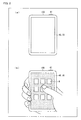
- FIG. 2 is a view schematically illustrating the external appearance of the smartphone 100.
- FIG. 2 is a view schematically illustrating how a user uses the smartphone 100.
- the smartphone 100 includes the input section 40, a display section 70, and a power supply switch 41.
- the input section 40 and the display section 70 are separately illustrated for the clarification of respective functions of the members.
- both the members can be integrated as illustrated in (a) of Fig. 2 in a case where the input section 40 and the display section 70 are realized as a touch panel and a liquid crystal display, respectively.
- a user can select an icon 6 by specifying to the smartphone 100 a location on the input screen included in the input section 40 (i.e. by providing the smartphone 100 with the location information on the touch location 3) through touching the input screen.
- the computing device 12 executes a process identified by the icon (e.g. process for launching an application identified by the icon).
- Fig. 2 assume a case where a right-handed user is holding the smartphone 100 with his/her right hand, and that a right thumb touches the input screen. Note, however, that a hand to hold and operate the smartphone 100 can be a right or left hand, and that a finger to touch the input screen does not need to be a thumb.
- a user can use a navigating tool such as a stylus, instead of a finger, can be used for operating the smartphone 100.
- a navigating tool such as a stylus
- the concept of "user operation” in the following description encompasses operations executed by "a user's finger” and "a navigating tool such as a stylus.”
- a configuration of the smartphone 100 in accordance with the present embodiment will be described below with reference to Fig. 1 .
- the description of the configuration and the block diagram omit members that are not closely related to the implementation of the present embodiment. Under given circumstances, however, the smartphone 100 can include such members.
- the following description will discuss respective functions of the input section 40, a location information obtaining section 13a, an operation determining section 14a, an inhibition information transmitting section 15a, an elapsed time determining section 14b, a completion information obtaining section 13b, a permission information transmitting section 15b, an application executing section 17, an inhibition information receiving section 16a, a permission information receiving section 16b, and a display section 70 in this order.
- the input section 40 transmits, to the application executing section 17, information (location information on a touch location 3) on two-dimensional coordinates of a location on the input screen, which location has been touched by a user.
- the smartphone 100 preferably includes, as an input section 40, a touch panel capable of detecting multi-touch operations (i.e. the "input screen" is included in the input section 40).
- a touch panel capable of detecting multi-touch operations
- the type of hardware to be used for the input section 40 is not limited to a touch panel, provided that the input section 40 includes an input device that is capable of detecting a touch location 3 based on a user operation.
- the location information obtaining section (first obtaining means) 13a obtains the location information on the touch location 3 from the computing device 12. Specifically, the location information obtaining section 13a receives the location information on the touch location 3 from the application executing section 17, and then transmits the location information on the touch location 3 to (i) the operation determining section 14a and (ii) the elapsed time determining section 14b.
- the operation determining section (first determining means) 14a determines whether or not the user operation is an operation for causing the computing device 12 to execute a predetermined process.
- predetermined process means a process for launching an application which is associated with the icon 6 that has been selected by the user.
- the operation determining section 14a determines whether or not the touch location 3 (location on a display screen which location corresponds to the touch location 3) matches a location on which the icon 6 is displayed. This is how the operation determining section 14a determines whether or not the user has selected the icon 6. Then, the operation determining section 14a transmits a determined result 4a to (i) the inhibition information transmitting section 15a and (ii) the elapsed time determining section 14b.
- the inhibition information transmitting section (transmitting means) 15a transmits inhibition information 1a to the computing device 12. Specifically, in a case where the determined result 4a transmitted from the operation determining section 14a indicates that "the user has selected the icon 6", the inhibition information transmitting section 15a transmits the inhibition information 1a to the inhibition information receiving section 16a.
- the inhibition information transmitting section 15a transmits the inhibition information 1a during a period between (i) a point in time where the operation determining section 14a determines the user operation is an operation for causing the predetermined process to be executed and (ii) a point in time where the computing device 12 executes the predetermined process.
- the inhibition information transmitting section 15a can transmit the inhibition information 1a at any point in time between (a) a point in time where the user touches the input screen and (b) a point in time where an initializing process for launching the application is initiated.
- the operation determining section 14a determines the user operation is an operation for causing the predetermined process to be executed
- the elapsed time determining section (second determining means) 14b determines whether or not a predetermined length of time has elapsed since the point in time where the location information obtaining section 13a obtained the location information on the touch location 3.
- the elapsed time determining section 14b stores, in a predetermined memory or the like, time information on a time at which the location information on the touch location 3 was supplied to the elapsed time determining section 14b. In so doing, in a case where the operation determining section 14a supplies a determined result 4a indicating that "the user did not select the icon 6", the elapsed time determining section 14b deletes the time information thus stored in the memory or the like.
- the elapsed time determining section 14b determines, at fixed intervals, whether or not the predetermined length of time has elapsed since the location information on the touch location 3 was supplied and then (ii) transmits a determined result 4b to the permission information transmitting section 15b.
- the predetermined length of time to which the operation determining section 14a refers for the determining process is preferably one second, the predetermined length of time can be longer or shorter than one second, depending on the properties of the application or the like.
- the inhibition device 11 merely inhibits or permits the degenerate operation of the computing device 12. Therefore, even in a case where it takes more than one second to launch an application, the computing device 12 does not carry out the degenerate operation while making a large amount of calculations for launching the application. This sufficiently produces such an effect as not interfering with the operational feel of the user.
- the completion information obtaining section (second obtaining means) 13b obtains, from the computing device 12, completion information 2 indicating that the predetermined process has ended. Specifically, the completion information obtaining section 13b (i) obtains the completion information 2 from the application executing section 17 and then (ii) transmits the completion information to the permission information transmitting section 15b.
- the permission information transmitting section 15b transmits, to the permission information receiving section 16b, permission information 1b that permits the computing device 12 to transition from the normal state to the degenerate state.
- the above-described process can be specifically realized by the following operation:
- the OS recognizes a timing with which control of the smartphone 100 is transferred to an application
- the OS issues an instruction (permission information 1b) that permits the degenerate operation of the CPU.
- the timing can be (i) a timing with which an animation involved in the launch of the application ends or (ii) a timing with which a command for depicting an application to be launched is issued.
- the permission information transmitting section 15b receives from the elapsed time determining section 14b a determined result 4b indicating that the "predetermined length of time has elapsed"
- the permission information transmitting section 15b transmits the permission information 1b to the permission information receiving section 16b.
- the permission information transmitting section 15b further transmits permission information 1b, which permits the computing device 12 to transition from the normal state to the degenerate state, to the computing device 12 in a case where the following is true: After the inhibition information 1a was transmitted because the operation determining section 14 had determined the user operation was an operation for causing the predetermined process to be executed, the operation determining section 14a then determines another user operation is an operation for not causing the predetermined process to be executed, in accordance with location information on a touch location 3 which location information has been further supplied from the location information obtaining section 13a.
- the application executing section (executing means) 17 receives the inhibition information 1a from the inhibition information receiving section 16a
- the application executing section 17 executes the predetermined process in the normal state. Specifically, in a case where the inhibition information 1a is supplied from the inhibition information receiving section 16a to the application executing section 17, the application executing section 17 executes the predetermined process that is specified by the icon 6 selected by the user (e.g. process for launching an application associated with the icon 6).
- the application executing section 17 receives the location information on the touch location 3 from the input section 40, the application executing section 17 transmits the location information on the touch location 3 to the location information obtaining section 13a.
- the application executing section 17 executes the predetermined process either in the normal state or in the degenerate state. In a case where the application executing section 17 ends the predetermined process for launching the application, the application executing section 17 transmits the completion information 2 to the completion information obtaining section 13b.
- the inhibition information receiving section (receiving means) 16a receives the inhibition information 1a transmitted from the inhibition device 11, and then transmits the inhibition information 1a to the application executing section 17.
- the permission information receiving section (receiving means) 16b receives, from the inhibition device 11, the permission information 1b that permits the transition from the normal state to the degenerate state. Then, the permission information receiving section 16b transmits the permission information 1b to the application executing section 17.
- the display section 70 is a device for displaying an image based on display data 7 that is transmitted from the computing device 12 (i.e. the "display screen" is included in the display section 70).
- the display section 70 is assumed to be primarily a liquid crystal display (Liquid Crystal Display; LCD).
- LCD Liquid Crystal Display
- the type of hardware to be used for the display section 70 is not particularly limited, provided that the display section 70 is a device (particularly a flat panel display) that is equipped with display functionality.
- the display section 70 can be a device which includes (i) a display element such as a plasma display (Plasma Display Panel; PDP) or an EL (Electroluminescence) display, (ii) a driver circuit for driving the display element in accordance with the display data 7, and (iii) the like.
- a display element such as a plasma display (Plasma Display Panel; PDP) or an EL (Electroluminescence) display
- PDP Plasma Display
- EL Electrode
- the input section 40 and the display section 70 are realized by a touch panel and a liquid crystal display, respectively, the input section 40 and the display section 70 can be integrated (see Fig. 2 ).
- the input section 40 can (i) include an input screen made of a transparent, transmissive material such as a glass having a rectangular shape and (ii) cover the display screen of the display section 70 so as to be integrated with the display section 70.
- This allows for a match between (a) the touch location 3 of the input screen of the input section 40, which touch location 3 is specified by the finger of the user and (b) a location at which the display section 70 displays a graphic or the like in response to the touch of the user. Therefore, the user can experience a natural input feel.
- Fig. 3 is a diagram schematically illustrating the specific configuration of the smartphone 100.
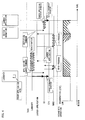
- Fig. 4 is a timing chart showing a flow of a specific operation of the smartphone 100.
- P1 User's screen touch and transmission (of information on location touched by user), P2: Transmission of information on screen touch and its location to application, P3: Request for inhibition of degenerate operation of CPU, P4: Inhibition of degenerate operation, P5: Command to recover from inhibited state after 1 second, P6: Command to launch application, P7: Command to expand program memory, P8: Read out data from NAND-type flash memory (inverted AND-type flash memory), P9: Write in program-executable memory, P10: Command to execute application, P11: Initialization of camera hardware as part of initialization process, P12: Depiction Command, and P13: Depict graphic on display (display section 70).
- an application When launched, an application executes initialization.
- initialization There are two types of initialization. One of them is an initialization process (first initialization process) pre-programmed in an OS.
- first initialization process an executable program of the application is stored in a volatile storage device memory, and then initialization information is provided in a memory space. In so doing, if a dynamic-link library is required, a file of the dynamic-link library is searched out, and is then made available.
- information (such as a size of a display screen), which is necessary for realization of a GUI, is obtained so that a necessary process is executed.
- the OS is equipped with a security function, it is determined whether or not the program meets predetermined conditions regarding the security.
- the other one of the two is an initialization process (second initialization process) that is unique to each application.
- the second initialization process is to be executed by use of a function which is called after the completion of the first initialization process. It should be noted that a function to be called is generally a main function, but may vary, depending on the circumstances.
- the details of the second initialization process encompass (i) reading out data from a database, (ii) initializing a device driver such as that of a camera, and (iii) connecting to a network.
- the second initialization process is continued until the application is in an operable state in which the application is available for use by the user.
- the operable state is a state in which an initial screen of an application can be depicted.
- the OS transfer the control of the smartphone 100 to the application.
- a GUI in order to let the user be aware of switching between a launcher and an application, it is possible for a GUI to display an animation such as a fade-in by use of information regarding respective screens of the launcher and of the application.
- the animation can be displayed, by the OS, during a period between (i) a point in time where the OS receives the depiction command and (ii) a point in time where the OS transfers the control to the application.
- the launcher can, while the application is executing the initialization process for the launch, execute a suspension process such as (a) reserving information which is stored in RAM and (b) capturing the screen.
- the launcher can (i) inhibit the degenerate operation until the suspension process ends and (ii) permits the degenerate operation with the completion of the suspension process as a trigger for such permission.
- the inhibition device 11 determines that a user operation is an operation for the execution of a process for causing the computing device 12 to launch the application
- the inhibition device 11 issues, to the computing device 12, a command (inhibition information 1a) to inhibit the degenerate operation. That is, the inhibition device 11 is capable of causing the computing device 12 to execute a high-speed process for launching the application. This improves the user's operating feel.
- the computing device 12 While the computing device 12 is executing the process for launching the application, there is a possibility that a variety of interrupt processing can occur, such as input-output control. Since the inhibition device 11 can inhibit the computing device 12 from operating in the degenerate state while launching the application, it is possible for the computing device 12 to launch the application at a stable speed.
- the inhibition device 11 can also allow the computing device 12 to execute a high-speed process for deactivating the launcher.
- the inhibition device 11 can have a general configuration in which a memory, a clock generator, and the like are included.
- Fig. 5 is a flow chart illustrating the process to be executed by the smartphone 100.
- step 1 the application executing section 17 supplies location information on a touch location 3 to the location information obtaining section 13a (S2).
- the location information obtaining section 13a obtains the location information on the touch location 3 which has been supplied from the input section 40 (S3, First obtaining step), and then the operation determining section 14a determines whether or not a user operation was to select an icon 6 (S4, First determining step).
- the inhibition information transmitting section 15a transmits inhibition information 1a to the computing device 12 (S5, Transmitting step).
- the inhibition information receiving section 16a receives the inhibition information 1a (S6), and then the application executing section 17 executes the application in the normal state (S7). In so doing, the elapsed time determining section 14b determines, at fixed intervals, whether or not a predetermined length of time has elapsed since the above time at which the location information obtaining section obtained the location information on the touch location 3 (S10). In a case where the application executing section 17 ends the process for launching the predetermined application (YES in S8), the application executing section 17 transmits completion information 2 (S9).
- the permission information transmitting section 15b transmits permission information 1b to the computing device 12 (S12).
- the permission information receiving section 16b receives the permission information (S13)
- the computing device 12 executes the process in the degenerate state (S14).
- the inhibition device 11 is capable of inhibiting, in accordance with a usage status of a user, the operation of the computing device 12 in the degenerate state. This brings about such an effect that the inhibition device 11 can allow the computing device 12 to efficiently consume electric power without interfering with the operating feel of the user.
- the inhibition device 11 can reduce, by approximately 35%, a length of processing time required for the computing device 12 to complete launching the application.
- the inhibition device 11 is capable of causing the computing device 12 to swiftly execute the process required for launching the application.
- the inhibition device 11 is realized as part of the functions of an OS, a launcher, or the like, discussed the conditions in which the launcher can cause the application to be launched.
- another process or library running on the smartphone 100 inhibits the degenerate operation, in accordance with the operation of the launcher.
- the OS issues to the CPU a command (inhibition information 1a) to inhibit the degenerate operation with the timing with which the application is launched.
- a command inhibition information 1a
- the GUI is included in the OS.
- the OS cancels the permission for degenerate operation at predetermined time.
- this process it is also possible to for this process to be executed by a process or library which is separately prepared.
- the inhibition device 11 in accordance with the present embodiment can also be described as:
- the inhibition device 11 in accordance with the present embodiment can also be described as:
- the present invention is not limited to the description of the embodiment, but can be altered in many ways by a person skilled in the art within the scope of the claims.
- An embodiment derived from a proper combination of technical means disclosed in different embodiments is also encompassed in the technical scope of the present invention.
- Blocks of the inhibition device 11, the computing device 12, and the smartphone 100 may be realized by means of hardware by a logic circuit provided in an integrated circuit (IC chip) or the like or may be realized by means of software as executed by a CPU.
- IC chip integrated circuit
- the inhibition device 11, the computing device 12, and the smartphone 100 each include (I) a CPU for executing a command of a program for achieving a function, (II) storage devices (storage media) such as, (i) a ROM (Read Only Memory) for storing the program, (ii) a RAM (Random Access Memory) for extracting the program, (iii) a memory for storing the program and various data, and (III) the like.
- storage media such as, (i) a ROM (Read Only Memory) for storing the program, (ii) a RAM (Random Access Memory) for extracting the program, (iii) a memory for storing the program and various data, and (III) the like.
- the object of the present invention can also be attained by (a) providing a storage medium in each of the inhibition device 11, the computing device 12, and the smartphone 100, the storage medium having stored (in a computer-readable manner) program codes (executable program, intermediate code program, and source program) of a control program for each of the tuner section 1 and the display section 2, which control program is a piece of software for achieving the function and (b) causing a computer (or CPU or MPU) to read out and then execute the program codes thus stored in the storage medium.
- program codes executable program, intermediate code program, and source program
- Examples of the storage medium encompass (i) tapes such as a magnetic tape and a cassette tape, (ii) disks including magnetic disks such as a floppy disk (Registered Trademark) and a hard disk and optical disks such as a CD-ROM, an MO, an MD, a DVD, and a CD-R, (iii) cards such as an IC card (including a memory card) and an optical card, (iv) semiconductor memories such as a mask ROM, an EPROM, an EEPROM (Registered Trademark), and a flash ROM, and (v) logic circuits such as a PLD (Programmable logic device) and an FPGA (Field Programmable Gate Array).
- the inhibition device 11, the computing device 12, and the smartphone 100 can each be configured to be connectable to a communications network so that a program code is made available, via the communications network, to each of the inhibition device 11, the computing device 12, and the smartphone 100.
- the communications network is not limited to any particular one, provided that the program code can be transmitted via the communications network.
- Examples of the communications network encompass the Internet, an intranet, an extranet, a LAN, an ISDN, a VAN, a CATV communications network, a virtual dedicated network (virtual private network), a telephone line network, a mobile communications network, and a satellite communications network.
- a transfer medium for configuring the communications network need only be a medium via which the program code can be transmitted, and is not limited to any particular configuration or any type.
- Examples of the transfer medium encompass (i) wired lines such as IEEE 1394, a USB, an electric power line, a cable TV line, a telephone line, and an ADSL (Asymmetric Digital Subscriber Line) and (ii) wireless communications such as an infrared radiation (e.g. IrDA and remote control), Bluetooth (Registered Trademark), IEEE 802.11 wireless, HDR (High Data Rate), NFC (Near Field Communication), DLNA (Digital Living Network Alliance), a mobile telephone network, a satellite line, and a terrestrial digital network.
- the present invention encompasses transmission of a computer data signal which is (a) embodied by electronic transmission of the program code and (b) incorporated in a carrier wave.
- the inhibition device (inhibition device 11) in accordance with Aspect 1 of the present invention is a device having Aspect 1 of the present invention.
- a method of the controlling the inhibition device in accordance with Aspect 1 of the present invention is
- the inhibition device of Aspect 1 configured as such and the method of controlling the inhibition device, (i) the location information on the location specified by the user is obtained and (ii) it is determined, in accordance with the location information, whether or not the user operation is an operation for causing the predetermined process to be executed. Then, in a case where it is determined that the user operation is an operation for causing the predetermined process to be executed, the inhibition information, which inhibition the transition from the first state to the second state, is transmitted to the controlled device.
- the conventional technologies have focused only on a reduction in electric power consumption of electronic devices. Specifically, according to the conventional technologies, a normal state (first state) and a degenerate state (second state) of an electronic device is switched between, only based on an operation status of the electronic device. That is, the conventional technologies have no regard for electric power control in accordance with a usage status of a user. The conventional technologies are therefore unable to handle cases where maintenance of high usability of an electronic device is to be prioritized over a reduction in electric power consumption.
- inhibition information is transmitted to the controlled device in a case where (i) a user operation is detected by an input screen (e.g. touch panel) and (ii) it can be determined that the user operation is an operation for causing controlled device to execute a predetermined process.
- an input screen e.g. touch panel
- the inhibition device or the like to inhibit the controlled device from transitioning from the first state to the second state when the controlled device is to execute the predetermined process desired by the user.
- the inhibition device or the like is capable of inhibiting, in accordance with the usage status of the user, the controlled device from operating in the degenerate state. Therefore, with the inhibition device and the method of controlling the inhibition device in accordance with Aspect 1 of the present invention, it is possible to allow the controlled device to efficiently consume electric power without interfering with an operating feel of the user.
- An inhibition device in accordance with Aspect 2 of the present invention can be configured in Aspect 1 to further include:
- the inhibition device in a case where the inhibition device in accordance with Aspect 2 of the present invention obtains from the controlled device the completion information indicating that the controlled device has ended the predetermined process, the inhibition device transmits the permission information that permits the controlled device to transition from the first state to the second state.
- the inhibition device in a case where the controlled device ends a predetermined process presented by the user, the inhibition device permits the controlled device to operate in the degenerate state (second state) by transmitting the permission information to the controlled device.
- the inhibition device in accordance with Aspect 2 of the present invention is capable of allowing the controlled device to efficiently consume electric power without interfering with an operating feel of the user.
- the inhibition device in accordance with Aspect 3 of the present invention can be configured in Aspect 1 or 2 to further include:
- the inhibition device in accordance with Aspect 3 of the present invention determines, in a case where the first determining means determines that the user operation is an operation for causing the controlled device to execute the predetermined process, whether or not a predetermined length of time has elapsed since a time at which the first obtaining means obtained the location information on the location specified by the user. Then, in a case where it is determined that the predetermined length of time has elapsed, the inhibition device transmits the permission information to the controlled device.
- the inhibition device permits the controlled device to operate in the degenerate state if the predetermined length of time elapses since the user operation was detected.
- the inhibition device in accordance with Aspect 3 of the present invention is capable of permitting, in accordance with the length of processing time required for the predetermined process to be executed, the controlled device to operate in the degenerate state.
- the inhibition device in accordance with Aspect 3 of the present invention is capable of allowing the controlled device to efficiently consume electric power.
- the inhibition device in accordance with Aspect 4 of the present invention can be configured in any one of Aspects 1 through 3 such that
- inhibition device in accordance with Aspect 4 of the present invention further transmits permission information, which permits the controlled device to transition from the first state to the second state, to the controlled device in a case where the following is true: After the inhibition information was transmitted, it is determined, in accordance with a new location that has been further obtained, that the user operation is not an operation for causing the predetermined process to be executed.
- the inhibition device in a case where the user operation once determined as an operation for causing the predetermined process to be executed can ultimately be determined (after the inhibition device transmits the inhibition information) as an operation for not causing the predetermined process to be executed, the inhibition device further transmits permission information in order to overrule the inhibition information that was transmitted earlier. This causes the inhibition device in accordance with Aspect 4 of the present invention to allow the controlled device to efficiently consume electric power.
- the inhibition device in accordance with Aspect 5 of the present invention can be configured in any one of Aspects 1 through 4 such that
- the inhibition device in accordance with Aspect 5 of the present invention transmits the inhibition information during a period between (i) a point in time where the first determining means determines that a user operation is an operation for causing the controlled device to execute the predetermined process and (ii) a point in time where the controlled device executes the predetermined process. This causes the inhibition device in accordance with Aspect 5 of the present invention to allow the controlled device to efficiently consume electric power without interfering with an operating feel of the user.
- the inhibition device in accordance with Aspect 6 of the present invention can be configured in any one of Aspects 1 through 5 such that (1) the first determining means determines, in a case where the predetermined process is a process for launching an application, that an operation of the user is an operation for causing the controlled device to execute the predetermined process.
- the predetermined process is a process for launching an application.
- the controlled device in accordance with Aspect 1 of the present invention executes the predetermined process in the first state in a case where the controlled device receives the inhibition information transmitted from the inhibition device. This allows the controlled device in accordance with Aspect 1 of the present invention to efficiently consume electric power without interfering with an operating feel of the user.
- the controlled device in accordance with Aspect 2 can be configured in Aspect 1 such that:
- controlled device in accordance with Aspect 2 of the present invention receives the permission information transmitted from the inhibition device, the controlled device executes the process either in the first state or in the second state. This allows the controlled device in accordance with Aspect 2 of the present invention to efficiently consume electric power without interfering with an operating feel of the user.
- An electronic device in accordance with Aspect 1 of the present invention is
- the inhibition device and the controlled device can each be realized by a computer.
- the scope of the present invention encompass (i) a program allowing, by causing a computer to serve as each means included in the inhibition device and/or the controlled device, the inhibition device and/or the controlled device to be realized by the computer and (ii) a computer-readable storage medium in which the program is stored.
- the present invention is applicable not only to a smartphone, but also to a tablet device, a personal computer, and other electronic devices and the like.
Landscapes
- Engineering & Computer Science (AREA)
- Theoretical Computer Science (AREA)
- Physics & Mathematics (AREA)
- General Engineering & Computer Science (AREA)
- General Physics & Mathematics (AREA)
- Computer Networks & Wireless Communication (AREA)
- Signal Processing (AREA)
- Telephone Function (AREA)
- User Interface Of Digital Computer (AREA)
- Position Input By Displaying (AREA)
Applications Claiming Priority (2)
| Application Number | Priority Date | Filing Date | Title |
|---|---|---|---|
| JP2012021247A JP2013162239A (ja) | 2012-02-02 | 2012-02-02 | 抑止装置、抑止装置の制御方法、被制御装置、電子機器、制御プログラム、および記録媒体 |
| PCT/JP2013/050480 WO2013114935A1 (fr) | 2012-02-02 | 2013-01-11 | Dispositif d'inhibition, procédé de commande d'un dispositif d'inhibition, dispositif sous commande, équipement électronique, programme de commande, et support d'enregistrement |
Publications (3)
| Publication Number | Publication Date |
|---|---|
| EP2811368A1 true EP2811368A1 (fr) | 2014-12-10 |
| EP2811368A4 EP2811368A4 (fr) | 2015-11-11 |
| EP2811368B1 EP2811368B1 (fr) | 2019-12-04 |
Family
ID=48904979
Family Applications (1)
| Application Number | Title | Priority Date | Filing Date |
|---|---|---|---|
| EP13742898.3A Active EP2811368B1 (fr) | 2012-02-02 | 2013-01-11 | Dispositif d'inhibition, procédé de commande d'un dispositif d'inhibition, dispositif sous commande, équipement électronique, programme de commande, et support d'enregistrement |
Country Status (4)
| Country | Link |
|---|---|
| US (1) | US9569382B2 (fr) |
| EP (1) | EP2811368B1 (fr) |
| JP (1) | JP2013162239A (fr) |
| WO (1) | WO2013114935A1 (fr) |
Families Citing this family (7)
| Publication number | Priority date | Publication date | Assignee | Title |
|---|---|---|---|---|
| JP2013162239A (ja) * | 2012-02-02 | 2013-08-19 | Sharp Corp | 抑止装置、抑止装置の制御方法、被制御装置、電子機器、制御プログラム、および記録媒体 |
| KR101513398B1 (ko) * | 2014-07-02 | 2015-04-17 | 연세대학교 산학협력단 | 소모전력을 감소시킬 수 있는 단말장치 및 이의 제어방법 |
| JP6500406B2 (ja) * | 2014-12-01 | 2019-04-17 | セイコーエプソン株式会社 | 入出力制御装置、入出力制御プログラム |
| US10673197B2 (en) | 2016-09-29 | 2020-06-02 | Nlight, Inc. | Fiber-based optical modulator |
| US10673199B2 (en) | 2016-09-29 | 2020-06-02 | Nlight, Inc. | Fiber-based saturable absorber |
| US10673198B2 (en) | 2016-09-29 | 2020-06-02 | Nlight, Inc. | Fiber-coupled laser with time varying beam characteristics |
| JP6569185B1 (ja) | 2018-06-14 | 2019-09-04 | レノボ・シンガポール・プライベート・リミテッド | 情報処理装置、情報処理装置の制御方法およびプログラム |
Family Cites Families (33)
| Publication number | Priority date | Publication date | Assignee | Title |
|---|---|---|---|---|
| US6389447B1 (en) * | 1998-10-21 | 2002-05-14 | Ericsson Inc. | System and method for providing adaptive task management in a multi-application device |
| JP2000222075A (ja) * | 1999-01-29 | 2000-08-11 | Matsushita Electric Ind Co Ltd | 電源制御装置 |
| JP4123640B2 (ja) * | 1999-06-16 | 2008-07-23 | ソニー株式会社 | 情報処理システム及びその制御方法、タスク割当て制御方法及び制御装置、並びにプログラム提供媒体 |
| JP2002304232A (ja) | 2001-04-03 | 2002-10-18 | Sony Corp | 演算処理システム及び演算処理制御方法、並びに記憶媒体 |
| JP4445410B2 (ja) | 2005-02-24 | 2010-04-07 | 株式会社ルネサステクノロジ | 情報処理装置 |
| JP2006251982A (ja) * | 2005-03-09 | 2006-09-21 | Matsushita Electric Ind Co Ltd | 省電力システム、記録媒体、ドライバ及びプログラム |
| JP2007108855A (ja) * | 2005-10-11 | 2007-04-26 | Canon Inc | ネットワーク接続周辺装置のスリープモード移行制御装置 |
| US8553014B2 (en) * | 2008-06-19 | 2013-10-08 | Neonode Inc. | Optical touch screen systems using total internal reflection |
| JP2010039791A (ja) | 2008-08-05 | 2010-02-18 | Toshiba Corp | 携帯端末装置 |
| US8504935B2 (en) * | 2008-12-22 | 2013-08-06 | Verizon Patent And Licensing Inc. | Quick-access menu for mobile device |
| US9311112B2 (en) * | 2009-03-16 | 2016-04-12 | Apple Inc. | Event recognition |
| US20110040989A1 (en) * | 2009-06-22 | 2011-02-17 | David Keyes Keyes | Systems and methods for managing power consumption of mobile computing devices |
| US8190939B2 (en) * | 2009-06-26 | 2012-05-29 | Microsoft Corporation | Reducing power consumption of computing devices by forecasting computing performance needs |
| US8538484B2 (en) * | 2009-08-14 | 2013-09-17 | Google Inc. | Providing a user with feedback regarding power consumption in battery-operated electronic devices |
| KR101721539B1 (ko) * | 2010-02-11 | 2017-03-30 | 삼성전자주식회사 | 휴대 단말기의 ui 제공 방법 및 장치 |
| JP4849352B2 (ja) | 2010-03-23 | 2012-01-11 | ソニー株式会社 | 撮像装置及びその起動方法 |
| US8904220B2 (en) * | 2011-05-19 | 2014-12-02 | Microsoft Corporation | Intelligent user determinable power conservation in a portable electronic device |
| US9026814B2 (en) * | 2011-06-17 | 2015-05-05 | Microsoft Technology Licensing, Llc | Power and load management based on contextual information |
| JP2013162239A (ja) * | 2012-02-02 | 2013-08-19 | Sharp Corp | 抑止装置、抑止装置の制御方法、被制御装置、電子機器、制御プログラム、および記録媒体 |
| US10013511B2 (en) * | 2012-04-09 | 2018-07-03 | Purdue Research Foundation | System and method for energy usage accounting in software applications |
| US8812029B1 (en) * | 2012-04-11 | 2014-08-19 | WhitePages, Inc. | Automated user check-in utilizing mobile computing devices |
| KR20130131959A (ko) * | 2012-05-25 | 2013-12-04 | 삼성전자주식회사 | 휴대 단말기의 휴면 모드 제어 방법 및 장치 |
| US9119314B2 (en) * | 2012-05-30 | 2015-08-25 | Blackberry Limited | Flexible printed circuit connector |
| US20150168174A1 (en) * | 2012-06-21 | 2015-06-18 | Cellepathy Ltd. | Navigation instructions |
| US8949639B2 (en) * | 2012-06-29 | 2015-02-03 | Intel Corporation | User behavior adaptive sensing scheme for efficient power consumption management |
| US9075514B1 (en) * | 2012-12-13 | 2015-07-07 | Amazon Technologies, Inc. | Interface selection element display |
| US9363772B2 (en) * | 2013-05-21 | 2016-06-07 | Motorola Solutions, Inc. | Method and apparatus for reducing call setup delay |
| KR102108439B1 (ko) * | 2013-08-23 | 2020-05-08 | 삼성전자주식회사 | 휴대 장치 및 휴대 장치의 사용 제한 방법 |
| US9229522B1 (en) * | 2013-08-27 | 2016-01-05 | Symantec Corporation | Mobile battery performance by identifying apps that disproportionally run background tasks that prevent mobile devices from sleeping |
| US20150109257A1 (en) * | 2013-10-23 | 2015-04-23 | Lumi Stream Inc. | Pre-touch pointer for control and data entry in touch-screen devices |
| US8972760B1 (en) * | 2013-12-20 | 2015-03-03 | Futurewei Technologies, Inc. | Method and apparatus for reducing power consumption in a mobile electronic device using a second launcher |
| US9351254B2 (en) * | 2014-01-22 | 2016-05-24 | Seven Networks, Llc | Method for power saving in mobile devices by optimizing wakelocks |
| WO2015126848A1 (fr) * | 2014-02-18 | 2015-08-27 | Arokia Nathan | Commutation dynamique de modes de puissance pour des écrans tactiles à l'aide de la force tactile |
-
2012
- 2012-02-02 JP JP2012021247A patent/JP2013162239A/ja active Pending
-
2013
- 2013-01-11 EP EP13742898.3A patent/EP2811368B1/fr active Active
- 2013-01-11 WO PCT/JP2013/050480 patent/WO2013114935A1/fr not_active Ceased
- 2013-01-11 US US14/357,892 patent/US9569382B2/en not_active Expired - Fee Related
Also Published As
| Publication number | Publication date |
|---|---|
| JP2013162239A (ja) | 2013-08-19 |
| WO2013114935A1 (fr) | 2013-08-08 |
| US20140317326A1 (en) | 2014-10-23 |
| EP2811368B1 (fr) | 2019-12-04 |
| US9569382B2 (en) | 2017-02-14 |
| EP2811368A4 (fr) | 2015-11-11 |
Similar Documents
| Publication | Publication Date | Title |
|---|---|---|
| EP2811368B1 (fr) | Dispositif d'inhibition, procédé de commande d'un dispositif d'inhibition, dispositif sous commande, équipement électronique, programme de commande, et support d'enregistrement | |
| CN106233249B (zh) | 用于管理睡眠模式的处理器的图形缓冲区的装备和方法 | |
| US8922476B2 (en) | Information handling devices with touch-based reflective display | |
| US10649540B2 (en) | Information handling devices with touch-based reflective display | |
| US9904510B2 (en) | Information handling devices with touch-based reflective display | |
| EP2993566B1 (fr) | Procédé et appareil de présentation d'interfaces d'applications et dispositif électronique | |
| EP3200061B1 (fr) | Procédé et appareil de gestion d'icônes ainsi que terminal | |
| EP3485358B1 (fr) | Dispositif électronique et son procédé de gestion d'applications | |
| US9454396B2 (en) | Thin client computing device having touch screen interactive capability support | |
| US11487574B2 (en) | Targeted interrupts for virtual processors | |
| EP2704070A1 (fr) | Procédé d'affichage de calendrier et son dispositif électronique | |
| KR102619117B1 (ko) | 전자 장치 및 전자 장치의 동작 방법 | |
| CN104375880B (zh) | 内存释放方法及装置 | |
| US20150058760A1 (en) | Method and system to implement a quasi-user interface for applications on an electronic device | |
| CN105917300B (zh) | 用于触摸设备的用户界面 | |
| US20140317634A1 (en) | Information processing device | |
| JP2006351013A (ja) | 電子装置において保存/リストア手順を行なうための方法及びシステム | |
| WO2013179954A1 (fr) | Dispositif électronique | |
| CN104866232B (zh) | 一种信息处理方法及电子设备 | |
| CN116009803A (zh) | 一种控制方法、设备和计算机可读存储介质 | |
| JP2015049686A (ja) | 電子機器、電子機器の制御方法及びプログラム | |
| Halsey | Introducing Windows 8.1 |
Legal Events
| Date | Code | Title | Description |
|---|---|---|---|
| PUAI | Public reference made under article 153(3) epc to a published international application that has entered the european phase |
Free format text: ORIGINAL CODE: 0009012 |
|
| 17P | Request for examination filed |
Effective date: 20140512 |
|
| AK | Designated contracting states |
Kind code of ref document: A1 Designated state(s): AL AT BE BG CH CY CZ DE DK EE ES FI FR GB GR HR HU IE IS IT LI LT LU LV MC MK MT NL NO PL PT RO RS SE SI SK SM TR |
|
| AX | Request for extension of the european patent |
Extension state: BA ME |
|
| DAX | Request for extension of the european patent (deleted) | ||
| RA4 | Supplementary search report drawn up and despatched (corrected) |
Effective date: 20151012 |
|
| RIC1 | Information provided on ipc code assigned before grant |
Ipc: G06F 1/26 20060101AFI20151006BHEP Ipc: H04M 1/73 20060101ALI20151006BHEP |
|
| STAA | Information on the status of an ep patent application or granted ep patent |
Free format text: STATUS: EXAMINATION IS IN PROGRESS |
|
| 17Q | First examination report despatched |
Effective date: 20180214 |
|
| GRAP | Despatch of communication of intention to grant a patent |
Free format text: ORIGINAL CODE: EPIDOSNIGR1 |
|
| STAA | Information on the status of an ep patent application or granted ep patent |
Free format text: STATUS: GRANT OF PATENT IS INTENDED |
|
| INTG | Intention to grant announced |
Effective date: 20190705 |
|
| GRAS | Grant fee paid |
Free format text: ORIGINAL CODE: EPIDOSNIGR3 |
|
| GRAA | (expected) grant |
Free format text: ORIGINAL CODE: 0009210 |
|
| STAA | Information on the status of an ep patent application or granted ep patent |
Free format text: STATUS: THE PATENT HAS BEEN GRANTED |
|
| AK | Designated contracting states |
Kind code of ref document: B1 Designated state(s): AL AT BE BG CH CY CZ DE DK EE ES FI FR GB GR HR HU IE IS IT LI LT LU LV MC MK MT NL NO PL PT RO RS SE SI SK SM TR |
|
| REG | Reference to a national code |
Ref country code: GB Ref legal event code: FG4D |
|
| REG | Reference to a national code |
Ref country code: CH Ref legal event code: EP |
|
| REG | Reference to a national code |
Ref country code: AT Ref legal event code: REF Ref document number: 1210189 Country of ref document: AT Kind code of ref document: T Effective date: 20191215 |
|
| REG | Reference to a national code |
Ref country code: DE Ref legal event code: R096 Ref document number: 602013063599 Country of ref document: DE |
|
| REG | Reference to a national code |
Ref country code: IE Ref legal event code: FG4D |
|
| REG | Reference to a national code |
Ref country code: NL Ref legal event code: MP Effective date: 20191204 |
|
| REG | Reference to a national code |
Ref country code: LT Ref legal event code: MG4D |
|
| PG25 | Lapsed in a contracting state [announced via postgrant information from national office to epo] |
Ref country code: LT Free format text: LAPSE BECAUSE OF FAILURE TO SUBMIT A TRANSLATION OF THE DESCRIPTION OR TO PAY THE FEE WITHIN THE PRESCRIBED TIME-LIMIT Effective date: 20191204 Ref country code: GR Free format text: LAPSE BECAUSE OF FAILURE TO SUBMIT A TRANSLATION OF THE DESCRIPTION OR TO PAY THE FEE WITHIN THE PRESCRIBED TIME-LIMIT Effective date: 20200305 Ref country code: NO Free format text: LAPSE BECAUSE OF FAILURE TO SUBMIT A TRANSLATION OF THE DESCRIPTION OR TO PAY THE FEE WITHIN THE PRESCRIBED TIME-LIMIT Effective date: 20200304 Ref country code: ES Free format text: LAPSE BECAUSE OF FAILURE TO SUBMIT A TRANSLATION OF THE DESCRIPTION OR TO PAY THE FEE WITHIN THE PRESCRIBED TIME-LIMIT Effective date: 20191204 Ref country code: LV Free format text: LAPSE BECAUSE OF FAILURE TO SUBMIT A TRANSLATION OF THE DESCRIPTION OR TO PAY THE FEE WITHIN THE PRESCRIBED TIME-LIMIT Effective date: 20191204 Ref country code: SE Free format text: LAPSE BECAUSE OF FAILURE TO SUBMIT A TRANSLATION OF THE DESCRIPTION OR TO PAY THE FEE WITHIN THE PRESCRIBED TIME-LIMIT Effective date: 20191204 Ref country code: FI Free format text: LAPSE BECAUSE OF FAILURE TO SUBMIT A TRANSLATION OF THE DESCRIPTION OR TO PAY THE FEE WITHIN THE PRESCRIBED TIME-LIMIT Effective date: 20191204 Ref country code: BG Free format text: LAPSE BECAUSE OF FAILURE TO SUBMIT A TRANSLATION OF THE DESCRIPTION OR TO PAY THE FEE WITHIN THE PRESCRIBED TIME-LIMIT Effective date: 20200304 |
|
| PG25 | Lapsed in a contracting state [announced via postgrant information from national office to epo] |
Ref country code: RS Free format text: LAPSE BECAUSE OF FAILURE TO SUBMIT A TRANSLATION OF THE DESCRIPTION OR TO PAY THE FEE WITHIN THE PRESCRIBED TIME-LIMIT Effective date: 20191204 Ref country code: HR Free format text: LAPSE BECAUSE OF FAILURE TO SUBMIT A TRANSLATION OF THE DESCRIPTION OR TO PAY THE FEE WITHIN THE PRESCRIBED TIME-LIMIT Effective date: 20191204 |
|
| PG25 | Lapsed in a contracting state [announced via postgrant information from national office to epo] |
Ref country code: AL Free format text: LAPSE BECAUSE OF FAILURE TO SUBMIT A TRANSLATION OF THE DESCRIPTION OR TO PAY THE FEE WITHIN THE PRESCRIBED TIME-LIMIT Effective date: 20191204 |
|
| PG25 | Lapsed in a contracting state [announced via postgrant information from national office to epo] |
Ref country code: PT Free format text: LAPSE BECAUSE OF FAILURE TO SUBMIT A TRANSLATION OF THE DESCRIPTION OR TO PAY THE FEE WITHIN THE PRESCRIBED TIME-LIMIT Effective date: 20200429 Ref country code: EE Free format text: LAPSE BECAUSE OF FAILURE TO SUBMIT A TRANSLATION OF THE DESCRIPTION OR TO PAY THE FEE WITHIN THE PRESCRIBED TIME-LIMIT Effective date: 20191204 Ref country code: RO Free format text: LAPSE BECAUSE OF FAILURE TO SUBMIT A TRANSLATION OF THE DESCRIPTION OR TO PAY THE FEE WITHIN THE PRESCRIBED TIME-LIMIT Effective date: 20191204 Ref country code: NL Free format text: LAPSE BECAUSE OF FAILURE TO SUBMIT A TRANSLATION OF THE DESCRIPTION OR TO PAY THE FEE WITHIN THE PRESCRIBED TIME-LIMIT Effective date: 20191204 Ref country code: CZ Free format text: LAPSE BECAUSE OF FAILURE TO SUBMIT A TRANSLATION OF THE DESCRIPTION OR TO PAY THE FEE WITHIN THE PRESCRIBED TIME-LIMIT Effective date: 20191204 |
|
| PG25 | Lapsed in a contracting state [announced via postgrant information from national office to epo] |
Ref country code: IS Free format text: LAPSE BECAUSE OF FAILURE TO SUBMIT A TRANSLATION OF THE DESCRIPTION OR TO PAY THE FEE WITHIN THE PRESCRIBED TIME-LIMIT Effective date: 20200404 Ref country code: SK Free format text: LAPSE BECAUSE OF FAILURE TO SUBMIT A TRANSLATION OF THE DESCRIPTION OR TO PAY THE FEE WITHIN THE PRESCRIBED TIME-LIMIT Effective date: 20191204 Ref country code: SM Free format text: LAPSE BECAUSE OF FAILURE TO SUBMIT A TRANSLATION OF THE DESCRIPTION OR TO PAY THE FEE WITHIN THE PRESCRIBED TIME-LIMIT Effective date: 20191204 |
|
| REG | Reference to a national code |
Ref country code: CH Ref legal event code: PL |
|
| REG | Reference to a national code |
Ref country code: DE Ref legal event code: R097 Ref document number: 602013063599 Country of ref document: DE |
|
| REG | Reference to a national code |
Ref country code: AT Ref legal event code: MK05 Ref document number: 1210189 Country of ref document: AT Kind code of ref document: T Effective date: 20191204 |
|
| PG25 | Lapsed in a contracting state [announced via postgrant information from national office to epo] |
Ref country code: MC Free format text: LAPSE BECAUSE OF FAILURE TO SUBMIT A TRANSLATION OF THE DESCRIPTION OR TO PAY THE FEE WITHIN THE PRESCRIBED TIME-LIMIT Effective date: 20191204 |
|
| PLBE | No opposition filed within time limit |
Free format text: ORIGINAL CODE: 0009261 |
|
| STAA | Information on the status of an ep patent application or granted ep patent |
Free format text: STATUS: NO OPPOSITION FILED WITHIN TIME LIMIT |
|
| REG | Reference to a national code |
Ref country code: BE Ref legal event code: MM Effective date: 20200131 |
|
| PG25 | Lapsed in a contracting state [announced via postgrant information from national office to epo] |
Ref country code: DK Free format text: LAPSE BECAUSE OF FAILURE TO SUBMIT A TRANSLATION OF THE DESCRIPTION OR TO PAY THE FEE WITHIN THE PRESCRIBED TIME-LIMIT Effective date: 20191204 Ref country code: LU Free format text: LAPSE BECAUSE OF NON-PAYMENT OF DUE FEES Effective date: 20200111 |
|
| 26N | No opposition filed |
Effective date: 20200907 |
|
| PG25 | Lapsed in a contracting state [announced via postgrant information from national office to epo] |
Ref country code: AT Free format text: LAPSE BECAUSE OF FAILURE TO SUBMIT A TRANSLATION OF THE DESCRIPTION OR TO PAY THE FEE WITHIN THE PRESCRIBED TIME-LIMIT Effective date: 20191204 Ref country code: LI Free format text: LAPSE BECAUSE OF NON-PAYMENT OF DUE FEES Effective date: 20200131 Ref country code: PL Free format text: LAPSE BECAUSE OF FAILURE TO SUBMIT A TRANSLATION OF THE DESCRIPTION OR TO PAY THE FEE WITHIN THE PRESCRIBED TIME-LIMIT Effective date: 20191204 Ref country code: CH Free format text: LAPSE BECAUSE OF NON-PAYMENT OF DUE FEES Effective date: 20200131 Ref country code: SI Free format text: LAPSE BECAUSE OF FAILURE TO SUBMIT A TRANSLATION OF THE DESCRIPTION OR TO PAY THE FEE WITHIN THE PRESCRIBED TIME-LIMIT Effective date: 20191204 Ref country code: BE Free format text: LAPSE BECAUSE OF NON-PAYMENT OF DUE FEES Effective date: 20200131 |
|
| PG25 | Lapsed in a contracting state [announced via postgrant information from national office to epo] |
Ref country code: IE Free format text: LAPSE BECAUSE OF NON-PAYMENT OF DUE FEES Effective date: 20200111 Ref country code: IT Free format text: LAPSE BECAUSE OF FAILURE TO SUBMIT A TRANSLATION OF THE DESCRIPTION OR TO PAY THE FEE WITHIN THE PRESCRIBED TIME-LIMIT Effective date: 20191204 |
|
| PGFP | Annual fee paid to national office [announced via postgrant information from national office to epo] |
Ref country code: FR Payment date: 20210122 Year of fee payment: 9 |
|
| PGFP | Annual fee paid to national office [announced via postgrant information from national office to epo] |
Ref country code: DE Payment date: 20210120 Year of fee payment: 9 Ref country code: GB Payment date: 20210121 Year of fee payment: 9 |
|
| PG25 | Lapsed in a contracting state [announced via postgrant information from national office to epo] |
Ref country code: TR Free format text: LAPSE BECAUSE OF FAILURE TO SUBMIT A TRANSLATION OF THE DESCRIPTION OR TO PAY THE FEE WITHIN THE PRESCRIBED TIME-LIMIT Effective date: 20191204 Ref country code: MT Free format text: LAPSE BECAUSE OF FAILURE TO SUBMIT A TRANSLATION OF THE DESCRIPTION OR TO PAY THE FEE WITHIN THE PRESCRIBED TIME-LIMIT Effective date: 20191204 Ref country code: CY Free format text: LAPSE BECAUSE OF FAILURE TO SUBMIT A TRANSLATION OF THE DESCRIPTION OR TO PAY THE FEE WITHIN THE PRESCRIBED TIME-LIMIT Effective date: 20191204 |
|
| PG25 | Lapsed in a contracting state [announced via postgrant information from national office to epo] |
Ref country code: MK Free format text: LAPSE BECAUSE OF FAILURE TO SUBMIT A TRANSLATION OF THE DESCRIPTION OR TO PAY THE FEE WITHIN THE PRESCRIBED TIME-LIMIT Effective date: 20191204 |
|
| REG | Reference to a national code |
Ref country code: DE Ref legal event code: R119 Ref document number: 602013063599 Country of ref document: DE |
|
| GBPC | Gb: european patent ceased through non-payment of renewal fee |
Effective date: 20220111 |
|
| PG25 | Lapsed in a contracting state [announced via postgrant information from national office to epo] |
Ref country code: GB Free format text: LAPSE BECAUSE OF NON-PAYMENT OF DUE FEES Effective date: 20220111 Ref country code: DE Free format text: LAPSE BECAUSE OF NON-PAYMENT OF DUE FEES Effective date: 20220802 |
|
| PG25 | Lapsed in a contracting state [announced via postgrant information from national office to epo] |
Ref country code: FR Free format text: LAPSE BECAUSE OF NON-PAYMENT OF DUE FEES Effective date: 20220131 |