EP2806040A1 - Martensitische Legierungskomponente und Verfahren zur Herstellung einer martensitischen Legierungskomponente - Google Patents
Martensitische Legierungskomponente und Verfahren zur Herstellung einer martensitischen Legierungskomponente Download PDFInfo
- Publication number
- EP2806040A1 EP2806040A1 EP14168707.9A EP14168707A EP2806040A1 EP 2806040 A1 EP2806040 A1 EP 2806040A1 EP 14168707 A EP14168707 A EP 14168707A EP 2806040 A1 EP2806040 A1 EP 2806040A1
- Authority
- EP
- European Patent Office
- Prior art keywords
- component
- martensitic alloy
- martensitic
- inches
- alloy component
- Prior art date
- Legal status (The legal status is an assumption and is not a legal conclusion. Google has not performed a legal analysis and makes no representation as to the accuracy of the status listed.)
- Granted
Links
Images
Classifications
-
- C—CHEMISTRY; METALLURGY
- C22—METALLURGY; FERROUS OR NON-FERROUS ALLOYS; TREATMENT OF ALLOYS OR NON-FERROUS METALS
- C22C—ALLOYS
- C22C38/00—Ferrous alloys, e.g. steel alloys
- C22C38/18—Ferrous alloys, e.g. steel alloys containing chromium
- C22C38/40—Ferrous alloys, e.g. steel alloys containing chromium with nickel
- C22C38/46—Ferrous alloys, e.g. steel alloys containing chromium with nickel with vanadium
-
- C—CHEMISTRY; METALLURGY
- C21—METALLURGY OF IRON
- C21D—MODIFYING THE PHYSICAL STRUCTURE OF FERROUS METALS; GENERAL DEVICES FOR HEAT TREATMENT OF FERROUS OR NON-FERROUS METALS OR ALLOYS; MAKING METAL MALLEABLE, e.g. BY DECARBURISATION OR TEMPERING
- C21D1/00—General methods or devices for heat treatment, e.g. annealing, hardening, quenching or tempering
- C21D1/55—Hardenability tests, e.g. end-quench tests
-
- C—CHEMISTRY; METALLURGY
- C21—METALLURGY OF IRON
- C21D—MODIFYING THE PHYSICAL STRUCTURE OF FERROUS METALS; GENERAL DEVICES FOR HEAT TREATMENT OF FERROUS OR NON-FERROUS METALS OR ALLOYS; MAKING METAL MALLEABLE, e.g. BY DECARBURISATION OR TEMPERING
- C21D8/00—Modifying the physical properties of ferrous metals or ferrous alloys by deformation combined with, or followed by, heat treatment
- C21D8/06—Modifying the physical properties of ferrous metals or ferrous alloys by deformation combined with, or followed by, heat treatment during manufacturing of rods or wires
-
- C—CHEMISTRY; METALLURGY
- C22—METALLURGY; FERROUS OR NON-FERROUS ALLOYS; TREATMENT OF ALLOYS OR NON-FERROUS METALS
- C22C—ALLOYS
- C22C38/00—Ferrous alloys, e.g. steel alloys
-
- C—CHEMISTRY; METALLURGY
- C22—METALLURGY; FERROUS OR NON-FERROUS ALLOYS; TREATMENT OF ALLOYS OR NON-FERROUS METALS
- C22C—ALLOYS
- C22C38/00—Ferrous alloys, e.g. steel alloys
- C22C38/02—Ferrous alloys, e.g. steel alloys containing silicon
-
- C—CHEMISTRY; METALLURGY
- C22—METALLURGY; FERROUS OR NON-FERROUS ALLOYS; TREATMENT OF ALLOYS OR NON-FERROUS METALS
- C22C—ALLOYS
- C22C38/00—Ferrous alloys, e.g. steel alloys
- C22C38/04—Ferrous alloys, e.g. steel alloys containing manganese
-
- C—CHEMISTRY; METALLURGY
- C22—METALLURGY; FERROUS OR NON-FERROUS ALLOYS; TREATMENT OF ALLOYS OR NON-FERROUS METALS
- C22C—ALLOYS
- C22C38/00—Ferrous alloys, e.g. steel alloys
- C22C38/18—Ferrous alloys, e.g. steel alloys containing chromium
- C22C38/40—Ferrous alloys, e.g. steel alloys containing chromium with nickel
- C22C38/42—Ferrous alloys, e.g. steel alloys containing chromium with nickel with copper
-
- C—CHEMISTRY; METALLURGY
- C22—METALLURGY; FERROUS OR NON-FERROUS ALLOYS; TREATMENT OF ALLOYS OR NON-FERROUS METALS
- C22C—ALLOYS
- C22C38/00—Ferrous alloys, e.g. steel alloys
- C22C38/18—Ferrous alloys, e.g. steel alloys containing chromium
- C22C38/40—Ferrous alloys, e.g. steel alloys containing chromium with nickel
- C22C38/44—Ferrous alloys, e.g. steel alloys containing chromium with nickel with molybdenum or tungsten
-
- Y—GENERAL TAGGING OF NEW TECHNOLOGICAL DEVELOPMENTS; GENERAL TAGGING OF CROSS-SECTIONAL TECHNOLOGIES SPANNING OVER SEVERAL SECTIONS OF THE IPC; TECHNICAL SUBJECTS COVERED BY FORMER USPC CROSS-REFERENCE ART COLLECTIONS [XRACs] AND DIGESTS
- Y02—TECHNOLOGIES OR APPLICATIONS FOR MITIGATION OR ADAPTATION AGAINST CLIMATE CHANGE
- Y02E—REDUCTION OF GREENHOUSE GAS [GHG] EMISSIONS, RELATED TO ENERGY GENERATION, TRANSMISSION OR DISTRIBUTION
- Y02E10/00—Energy generation through renewable energy sources
- Y02E10/70—Wind energy
- Y02E10/72—Wind turbines with rotation axis in wind direction
Definitions
- the present invention is directed to martensitic alloys, articles including martensitic alloys, and processes of forming alloys. More specifically, the present invention is directed to a reduced nickel-chromium martensitic alloy and a process of forming a reduced nickel-chromium martensitic alloy.
- Wind turbines are exposed to significant operational stresses from wind, rotational forces and the weight of a plurality of blades.
- the operational stresses are often amplified by environmental temperatures with extremes depending on geographical location.
- the materials used for the components of the wind turbines must be able to withstand operating stresses and strains throughout the range of temperatures.
- Wind turbines have a main shaft that transmits power from a rotor to a generator. As wind turbines increase their outputs from 1.5 and 2.5 megawatts (MW) to 3, 4, 5, and 6 MW, the size and required properties of the wind turbine drive shaft increases. In addition, the loads from gearbox components, such as planet gear carriers, are typically too high for conventional ductile iron grades (ferritic/pearlitic grades). Forged/hardened steel is the material of choice for gearbox components and drive shafts having sizes greater than 3 tons. This shaft is typically machined out of a steel forging. The material of the shaft is usually quenched-tempered high-strength low-alloy steel with critical fatigue properties. A common alloy currently used for these large wind turbine components is 34CrNiMo6 steel.
- the nickel and chromium provide a desirable hardenability of the alloy.
- 34CrNiMo6 steel provides desired hardenability and fracture appearance transition temperature (FATT)
- FATT fracture appearance transition temperature
- the nickel and chromium used in 34CrNiMo6 steel is expensive, increasing the price of wind turbines and replacement shafts.
- a desired feature for wind turbine components is a FATT of -40°C (-40°F).
- the FATT is the temperature at which the fracture surface of a material is 50% low energy brittle cleavage and 50% high energy ductile fibrous. Both a composition of the material as well as the processes for forming and heat treating the material affect FATT. FATT is important because it represents the temperature above which brittle fracture will not occur. The lower the FATT, the greater the toughness of the material.
- Martensitic stainless steels such as 34 CrNiMo6 steel, having excellent strength, low brittle to ductile transition temperature, and good hardening characteristics in thick sections have long been used as turbine shaft materials. Decreasing the amount of Ni and Cr in the alloy decreases the hardenability, which reduces the amount of martensite that forms in the material. Reducing the amount of martensite has the undesirable consequence of increasing the FATT of the material.
- a martensitic alloy and a method of forming an inexpensive martensitic alloy having reduced amounts of nickel and chromium and not suffering from the above drawbacks would be desirable in the art.
- a martensitic alloy component includes by weight:
- the component has a hardenability corresponding to an ideal diameter of greater than about 10 inches (25.4 cm).
- a process of forming a reduced nickel-chromium martensitic alloy component includes forging the reduced nickel-chromium alloy component including by weight:
- the reduced nickel-chromium martensitic alloy component is austenitized, quenched and tempered.
- the tempered forged alloy has a hardenability corresponding to an ideal diameter of greater than about 10 inches (25.4 cm).
- Embodiments of the present disclosure in comparison to methods and products not utilizing one or more features disclosed herein, decrease nickel percentage, decrease chromium percentage, increase carbon percentage, increase manganese percentage, decrease material cost, maintain or increase martensite percentage, maintain or decrease fracture appearance transition temperature (FATT), or a combination thereof.
- the disclosure includes a process for producing the main shaft for a wind turbine from a martensitic alloy, though it should be understood that the invention is also well suited for the production of a wide variety of components from martensitic alloy compositions.
- Other non-limiting examples include automotive components, such as turbine shafts, axles, and various other components used in the energy, automotive, railroad, construction, mining and agricultural industries. Such components are well known in the art and therefore require no further description.
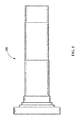
- the shaft 100 is represented as having a tubular shape with a flange formed at one end, though it can be appreciated that FIG. 1 is merely a schematic representation and different configurations for the shaft 100 are also within the scope of the invention.
- the shaft 100 shown in FIG. 1 includes a plurality of segments, the shaft 100 may also be formed of a unitary piece.
- the shaft 100 may be solid or hollow or a combination of solid and hollow components.
- the shaft 100 has an axisymmetric geometry with respect to the longitudinal axis of rotation of the shaft 100.
- the main shaft 100 will have an outer diameter well in excess of 20 inches (about 50 cm), and more typically in excess of 24 inches (about 60 cm), with a typical range being about 25 to 60 inches (about 63 to about 152 cm), though lesser and greater diameters are also foreseeable.
- Other aspects of the shaft 100, including its installation in wind turbines and the operation of the wind turbines, are otherwise known in the art, and therefore will not be discussed here in any detail.
- the martensitic alloy includes the composition shown in Table 1.
- Table 1 wt% Broad Range Alternate Range Alternate Range C 0.38-0.43 0.38-0.43 0.39-0.41 Si 0.15-.030 0.15-.030 0.20-.025 Mn 1.00-1.25 1.05-1.25 1.10-1.17 Ni 0.75-0.90 0.75-0.90 0.78-0.85 Cr 1.00-1.30 1.00-1.30 1.10-1.20 Mo 0.25-0.35 0.25-0.35 0.27-0.32 V 0.05-0.12 0.05-0.12 0.07-0.11 S ⁇ 0.015 ⁇ 0.015 ⁇ 0.015 P ⁇ 0.015 ⁇ 0.015 ⁇ 0.015 Cu ⁇ 0.15 ⁇ 0.15 ⁇ 0.15 Fe Bal Bal Bal Bal Bal Bal Bal Bal Bal Bal Bal Bal Bal Bal Bal Bal Bal Bal Bal Bal Bal Bal Bal Bal Bal Bal Bal Bal Bal Bal Bal Bal Bal Bal Bal Bal Bal Bal Bal Bal Bal Bal Bal Bal Bal Bal Bal Bal Bal Bal Bal Bal Bal Bal Bal Bal Bal Bal Bal Bal Bal Bal Bal Bal Bal Bal
- a component formed from the composition, according to the present disclosure includes a hardenability corresponding to an ideal diameter of greater than about 10 inches (25.4 cm) or 10 to 18 inches (25.4 to 45.72 cm) or 11 to 12 inches (27.94 to 30.48 cm) or 13 to 14 inches (33.02 to 35.56 cm) or any suitable combination, subcombination, range, or sub-range within.
- the component has a hardenability corresponding to an ideal diameter of about 11.4 inches (28.96 cm).
- the component has a hardenability corresponding to an ideal diameter of about 13.3 inches (33.78cm).
- Hardenability corresponding to an ideal diameter is the ability of material, component, and heat treatment (e.g., after quench from an austenitizing temperature), to form at least 50% martensite at the center of a solid cylinder. While the above definition of hardenability corresponding to an ideal diameter is based from a solid component, one of ordinary skill in the art would understand that the geometry is not limited to a solid cylinder and may include other geometries and/or hollow components. For example, the hardenability of hollow components corresponds to the corresponding center depth within the material (e.g., the center of the wall) in which at least 50% martensite forms after heat treatment.
- the martensitic microstructure has increased material toughness as compared to bainite and ferrite/pearlite microstructures. Increasing the percentage of martensite in the material microstructure will decrease the FATT of the material. Increasing the ideal diameter of a material increases the amount of martensite thus decreasing the FATT of the material in thicker cross sections. A material at a temperature below the FATT will have low fracture toughness and low damage tolerance. To form a damage tolerant component, the operating temperature of the component should be above the FATT.
- a component formed from the composition includes a FATT at the surface of less than -40°F (-40°C) or less than -50°F (-45.6°C) or less than -60°F (-51.1°C).
- the component includes a FATT of less than 86°F (30°C) or less than 80°F (26.7°C) or less than 75°F (23.9°C) at the maximum thickness of the component.
- properties of the material that decrease FATT include, but are not limited to, increasing martensite percentage, decreasing grain size, decreasing yield strength, or a combination thereof.
- a desired yield strength of the material is 650 MPa or greater or about 650 MPa to about 1000 MPa and tensile strength between about 800 and about 1,000 MPa.
- the average grain size of a material is formed during processing of the material, and is maintained to about 62 ⁇ m or less or about 50 ⁇ m or less.
- the FATT of the material having a defined yield strength range and grain size range is adjusted through adjustments in microstructure.
- the microstructure is adjusted through increases and/or decreases in concentrations of alloying elements.
- the alloying elements include, but are not limited to, carbon, silicon, manganese, nickel, chromium, molybdenum, vanadium, sulfur, phosphorus, copper, or a combination thereof. In addition to adjusting microstructure, increases and/or decreases in the concentrations of the alloying elements adjust material strength, toughness, ductility, grain size, or a combination thereof.
- the nickel concentration and the chromium concentration are decreased and a carbon concentration and a manganese concentration are increased.
- a hardenability of a material is affected by the amount of each element present in the material. The hardenability is the ease at which the material forms a martensitic structure during quenching from an austenitizing temperature. Increasing the carbon concentration and the manganese concentration maintains or increases a hardenability of the material. Increasing the hardenability of the material increases the ideal diameter, which increases martensitic structure formation and decreases the FATT in thick cross sections, thus providing for increased damage tolerance.
- An exemplary process for forming the component includes forging of the component. After forging, the component is heat treated through methods including, but not limited to, austenitizing, quenching, tempering, or a combination thereof.
- Austenitizing is the process of holding the martensitic alloy forging above a critical temperature for a sufficient period of time to ensure that the matrix is fully transformed to austenite.
- austenitizing includes holding the forging at temperatures greater than about 870°C (1598°F) for a time period that is sufficient to fully convert the matrix of the thickest section to austenite.
- Quenching from the austenitizing temperature forms a martensite microstructure and may be accomplished with any suitable quenching method known in the art.
- the rate of quench has to be high enough to reduce or eliminate ferrite/pearlite formation.
- Tempering is provided to increase the toughness and reduce the brittleness of the component. Suitable tempering temperatures include, but are not limited to, between about 550°C (1022°F) and about 650°C (1202°F), between about 580°C (1076°F) and about 620°C (1048°F), or about 600°C (1112°F), or any combination, subcombination, range, or sub-range thereof.
- Comparative Example 1 The known composition of 34CrNiMo6 steel, a material known for use in wind turbine main shaft manufacture, is shown below: Comparative Ex. 1 - 34CrNiMo6 wt% Carbon 0.34 Silicon 0.2 Manganese 0.65 Nickel 1.5 Chromium 1.5 Molybdenum 0.23 Vanadium - Iron Balance
- the nominal composition of Comparative Example 1 corresponds to a hardenability corresponding to an ideal diameter of 7.4 inches.
- Comparative Example 2 A steel alloy composition having the following composition: Comparative Ex. 2 wt% wt% Carbon 0.26 Silicon 0.23 Manganese 1.00 Nickel 0.70 Chromium 1.10 Molybdenum 0.25 Vanadium 0.09 Sulfur ⁇ 0.015 Phosphorus ⁇ 0.015 Copper ⁇ 0.25 Iron Balance
- the nominal composition of Comparative Example 2 has a hardenability corresponding to an ideal diameter of 6.1 inches.
- Example 1 A martensitic alloy composition having the following composition: Example 1 Element wt% Carbon 0.35 Silicon 0.31 Manganese 1.12 Nickel 0.94 Chromium 1.31 Molybdenum 0.35 Vanadium 0.092 Sulfur 0.002 Phosphorus 0.014 Copper 0.06 Aluminum 0.004 Tin 0.004 Antimony 0.001 Arsenic 0.003 Iron Balance
- a component, shown as Example 1, is formed from an exemplary composition according to the present disclosure.
- the final product includes a hardenability corresponding to an ideal diameter of 13.3 inches (33.78 cm).
- Example 2 A martensitic alloy composition having the following composition: Example 2 Element wt% Carbon 0.40 Silicon 0.23 Manganese 1.10 Nickel 0.80 Chromium 1.15 Molybdenum 0.30 Vanadium 0.09 Sulfur - Phosphorus - Copper - Iron Balance
- a component, shown as Example 2 is formed from an exemplary composition according to the present disclosure.
- the final product includes a hardenability corresponding to an ideal diameter of 12.4 inches (31.50 cm).
- Example 3 A martensitic alloy composition having the following omposition: Example 3 Element wt% Carbon 0.43 Silicon 0.30 Manganese 1.25 Nickel 0.90 Chromium 1.30 Molybdenum 0.35 Vanadium 0.12 Iron Balance
- a component, shown as Example 3, is formed from an exemplary composition, according to the present disclosure.
- the final product includes a hardenability corresponding to an ideal diameter of 17.3 inches (43.94 cm).
Landscapes
- Chemical & Material Sciences (AREA)
- Engineering & Computer Science (AREA)
- Materials Engineering (AREA)
- Mechanical Engineering (AREA)
- Metallurgy (AREA)
- Organic Chemistry (AREA)
- Physics & Mathematics (AREA)
- Thermal Sciences (AREA)
- Crystallography & Structural Chemistry (AREA)
- Manufacturing & Machinery (AREA)
- Heat Treatment Of Articles (AREA)
- Wind Motors (AREA)
Applications Claiming Priority (1)
| Application Number | Priority Date | Filing Date | Title |
|---|---|---|---|
| US13/898,720 US20140345756A1 (en) | 2013-05-21 | 2013-05-21 | Martensitic alloy component and process of forming a martensitic alloy component |
Publications (2)
| Publication Number | Publication Date |
|---|---|
| EP2806040A1 true EP2806040A1 (de) | 2014-11-26 |
| EP2806040B1 EP2806040B1 (de) | 2018-04-18 |
Family
ID=50828698
Family Applications (1)
| Application Number | Title | Priority Date | Filing Date |
|---|---|---|---|
| EP14168707.9A Not-in-force EP2806040B1 (de) | 2013-05-21 | 2014-05-16 | Martensitische Legierungskomponente und Verfahren zur Herstellung einer martensitischen Legierungskomponente |
Country Status (4)
| Country | Link |
|---|---|
| US (1) | US20140345756A1 (de) |
| EP (1) | EP2806040B1 (de) |
| JP (1) | JP2014227608A (de) |
| CN (1) | CN104178699A (de) |
Families Citing this family (1)
| Publication number | Priority date | Publication date | Assignee | Title |
|---|---|---|---|---|
| US10760150B2 (en) * | 2018-03-23 | 2020-09-01 | General Electric Company | Martensitic alloy component and process of forming a martensitic alloy component |
Citations (8)
| Publication number | Priority date | Publication date | Assignee | Title |
|---|---|---|---|---|
| JPH0853714A (ja) * | 1994-08-09 | 1996-02-27 | Kobe Steel Ltd | ねじり疲労強度に優れた機械構造用軸物部品 |
| JPH09118950A (ja) * | 1995-10-24 | 1997-05-06 | Nippon Steel Corp | 厚手高硬度高靱性耐摩耗鋼およびその製造方法 |
| JPH10195589A (ja) * | 1996-12-26 | 1998-07-28 | Nippon Steel Corp | 高捩り疲労強度高周波焼入れ鋼材 |
| JP2001234277A (ja) * | 2000-02-23 | 2001-08-28 | Nippon Steel Corp | 疲労特性の優れた高強度鋼およびその製造方法 |
| EP2110454A1 (de) * | 2008-01-22 | 2009-10-21 | Kabushiki Kaisha Kobe Seiko Sho (Kobe Steel, Ltd.) | Schmiedestahl und geschmiedete Produkte, die daraus erhalten werden können |
| EP2169082A1 (de) * | 2008-09-30 | 2010-03-31 | Kabushiki Kaisha Kobe Seiko Sho | Schmiedestück aus Stahl 0.15-0.75%C, Si, Mn,Ni,Cr,Mo,V und Al und Kurbelwelle |
| EP2465952A1 (de) * | 2010-12-16 | 2012-06-20 | General Electric Company | Verfahren zur Herstellung von Legierungen aus bainitischem Gusseisen mit Kugelgraphit für große Komponentenformen |
| US20120298262A1 (en) * | 2010-03-11 | 2012-11-29 | Nippon Steel Corporation | High strength steel and high strength bolt excellent in delayed fracture resistance and methods of production of same |
Family Cites Families (12)
| Publication number | Priority date | Publication date | Assignee | Title |
|---|---|---|---|---|
| JPH01242761A (ja) * | 1988-03-23 | 1989-09-27 | Kawasaki Steel Corp | 低降伏比の超高張力鋼およびその製造方法 |
| FR2726287B1 (fr) * | 1994-10-31 | 1997-01-03 | Creusot Loire | Acier faiblement allie pour la fabrication de moules pour matieres plastiques ou pour caoutchouc |
| US5922145A (en) * | 1996-11-25 | 1999-07-13 | Sumitomo Metal Industries, Ltd. | Steel products excellent in machinability and machined steel parts |
| JP4210362B2 (ja) * | 1998-03-24 | 2009-01-14 | 日新製鋼株式会社 | 疲労特性に優れた高強度鋼の製造方法 |
| JP4435954B2 (ja) * | 1999-12-24 | 2010-03-24 | 新日本製鐵株式会社 | 冷間鍛造用棒線材とその製造方法 |
| CZ298442B6 (cs) * | 2000-11-22 | 2007-10-03 | Kabushiki Kaisha Kobe Seiko Sho | Ocel pro kování s vysokou pevností |
| JP2004010996A (ja) * | 2002-06-10 | 2004-01-15 | Jfe Steel Kk | 低温靭性に優れた耐摩耗鋼およびその製造方法 |
| JP4332070B2 (ja) * | 2004-06-01 | 2009-09-16 | 株式会社神戸製鋼所 | 大型鍛鋼品用高強度鋼およびクランク軸 |
| EP2035698B1 (de) * | 2006-07-03 | 2017-06-14 | Vestas Wind Systems A/S | Prüfstand und verfahren zum prüfen von windturbinenausrüstung |
| BE1018151A5 (nl) * | 2008-05-20 | 2010-06-01 | Hansen Transmissions Int | Werkwijze voor het verhogen van de vermoeiingssterkte van een hoofdzakelijk stalen werktuigonderdeel en/of het verminderen van de neiging tot het vormen van zogenaamde "white etching cracks" of brittle flakes" bij zulk stalen werktuigonderdeel. |
| CN102876860B (zh) * | 2012-10-11 | 2014-09-24 | 清华大学 | 一种新型合金钢空心车轴材料的热处理方法 |
| CN103060715B (zh) * | 2013-01-22 | 2015-08-26 | 宝山钢铁股份有限公司 | 一种具有低屈服比的超高强韧钢板及其制造方法 |
-
2013
- 2013-05-21 US US13/898,720 patent/US20140345756A1/en not_active Abandoned
-
2014
- 2014-05-16 EP EP14168707.9A patent/EP2806040B1/de not_active Not-in-force
- 2014-05-16 JP JP2014101872A patent/JP2014227608A/ja active Pending
- 2014-05-21 CN CN201410245624.XA patent/CN104178699A/zh active Pending
Patent Citations (8)
| Publication number | Priority date | Publication date | Assignee | Title |
|---|---|---|---|---|
| JPH0853714A (ja) * | 1994-08-09 | 1996-02-27 | Kobe Steel Ltd | ねじり疲労強度に優れた機械構造用軸物部品 |
| JPH09118950A (ja) * | 1995-10-24 | 1997-05-06 | Nippon Steel Corp | 厚手高硬度高靱性耐摩耗鋼およびその製造方法 |
| JPH10195589A (ja) * | 1996-12-26 | 1998-07-28 | Nippon Steel Corp | 高捩り疲労強度高周波焼入れ鋼材 |
| JP2001234277A (ja) * | 2000-02-23 | 2001-08-28 | Nippon Steel Corp | 疲労特性の優れた高強度鋼およびその製造方法 |
| EP2110454A1 (de) * | 2008-01-22 | 2009-10-21 | Kabushiki Kaisha Kobe Seiko Sho (Kobe Steel, Ltd.) | Schmiedestahl und geschmiedete Produkte, die daraus erhalten werden können |
| EP2169082A1 (de) * | 2008-09-30 | 2010-03-31 | Kabushiki Kaisha Kobe Seiko Sho | Schmiedestück aus Stahl 0.15-0.75%C, Si, Mn,Ni,Cr,Mo,V und Al und Kurbelwelle |
| US20120298262A1 (en) * | 2010-03-11 | 2012-11-29 | Nippon Steel Corporation | High strength steel and high strength bolt excellent in delayed fracture resistance and methods of production of same |
| EP2465952A1 (de) * | 2010-12-16 | 2012-06-20 | General Electric Company | Verfahren zur Herstellung von Legierungen aus bainitischem Gusseisen mit Kugelgraphit für große Komponentenformen |
Also Published As
| Publication number | Publication date |
|---|---|
| EP2806040B1 (de) | 2018-04-18 |
| US20140345756A1 (en) | 2014-11-27 |
| JP2014227608A (ja) | 2014-12-08 |
| CN104178699A (zh) | 2014-12-03 |
Similar Documents
| Publication | Publication Date | Title |
|---|---|---|
| EP2135962B1 (de) | Einsatzgehärtetes stahlrohr mit hervorragender bearbeitbarkeit und herstellungsverfahren dafür | |
| US9869009B2 (en) | High strength low alloy steel and method of manufacturing | |
| US11078559B2 (en) | Rolling element bearing having bainite microstructure | |
| US20110052442A1 (en) | Bearing component | |
| CN101613831B (zh) | 非调质高硬度热轧钢及其制造方法和应用 | |
| EP2912200B1 (de) | Vergütete korrosionsbeständige stahllegierung | |
| CN110923410A (zh) | 一种高稳定性贝氏体辙叉用钢及其制备方法 | |
| JP2012125838A (ja) | 肌焼鋼用の熱間鍛造品の製造方法 | |
| KR20120012837A (ko) | 저사이클 굽힘 피로 강도가 우수한 침탄강 부품 | |
| EP2982771A1 (de) | Verfahren zur herstellung hochfester bolzen mit hervorragender zugfestigkeit | |
| CN112048668B (zh) | 一种高硬度盾构刀具用钢及其制造方法 | |
| JPWO2011108764A1 (ja) | 靭性に優れた機械構造用高強度シームレス鋼管とその製造方法 | |
| JP2020045565A (ja) | 連続冷却及びそれに続く焼鈍中にオーステンパされたオースフェライト鋼を製造するための方法 | |
| US8652273B2 (en) | High tensile steel for deep drawing and manufacturing method thereof and high-pressure container produced thereof | |
| GB2527387A (en) | Bearing steel composition | |
| JP5778903B2 (ja) | 切欠き疲労強度に優れた高強度鋼製加工品の製造方法 | |
| JPH11269541A (ja) | 疲労特性に優れた高強度鋼の製造方法 | |
| EP2806040B1 (de) | Martensitische Legierungskomponente und Verfahren zur Herstellung einer martensitischen Legierungskomponente | |
| EP3712285B1 (de) | Legierter stahl und vergütungsstahl | |
| KR101713677B1 (ko) | 전동피로수명 특성이 우수한 고질소 공기 경화형 베어링강 및 그 제조방법 | |
| Zhou et al. | Tailored properties of a novelly-designed press-hardened 22MnMoB steel | |
| KR101802424B1 (ko) | 베어링강 및 그 제조 방법 | |
| EP3543363B1 (de) | Verfahren zur herstellung einer martensitischen stahllegierungskomponente | |
| EP4481064A1 (de) | Stahl zum hochfrequenzhärten | |
| GB2513881A (en) | Steel Alloy |
Legal Events
| Date | Code | Title | Description |
|---|---|---|---|
| PUAI | Public reference made under article 153(3) epc to a published international application that has entered the european phase |
Free format text: ORIGINAL CODE: 0009012 |
|
| 17P | Request for examination filed |
Effective date: 20140516 |
|
| AK | Designated contracting states |
Kind code of ref document: A1 Designated state(s): AL AT BE BG CH CY CZ DE DK EE ES FI FR GB GR HR HU IE IS IT LI LT LU LV MC MK MT NL NO PL PT RO RS SE SI SK SM TR |
|
| AX | Request for extension of the european patent |
Extension state: BA ME |
|
| R17P | Request for examination filed (corrected) |
Effective date: 20150526 |
|
| RBV | Designated contracting states (corrected) |
Designated state(s): AL AT BE BG CH CY CZ DE DK EE ES FI FR GB GR HR HU IE IS IT LI LT LU LV MC MK MT NL NO PL PT RO RS SE SI SK SM TR |
|
| 17Q | First examination report despatched |
Effective date: 20161129 |
|
| REG | Reference to a national code |
Ref country code: DE Ref legal event code: R079 Ref document number: 602014023987 Country of ref document: DE Free format text: PREVIOUS MAIN CLASS: C21D0006000000 Ipc: C21D0008060000 |
|
| GRAP | Despatch of communication of intention to grant a patent |
Free format text: ORIGINAL CODE: EPIDOSNIGR1 |
|
| RIC1 | Information provided on ipc code assigned before grant |
Ipc: C21D 8/06 20060101AFI20170828BHEP Ipc: C21D 1/55 20060101ALI20170828BHEP Ipc: C22C 38/00 20060101ALI20170828BHEP Ipc: C22C 38/46 20060101ALI20170828BHEP |
|
| INTG | Intention to grant announced |
Effective date: 20170920 |
|
| GRAS | Grant fee paid |
Free format text: ORIGINAL CODE: EPIDOSNIGR3 |
|
| GRAA | (expected) grant |
Free format text: ORIGINAL CODE: 0009210 |
|
| AK | Designated contracting states |
Kind code of ref document: B1 Designated state(s): AL AT BE BG CH CY CZ DE DK EE ES FI FR GB GR HR HU IE IS IT LI LT LU LV MC MK MT NL NO PL PT RO RS SE SI SK SM TR |
|
| REG | Reference to a national code |
Ref country code: GB Ref legal event code: FG4D |
|
| REG | Reference to a national code |
Ref country code: CH Ref legal event code: EP |
|
| REG | Reference to a national code |
Ref country code: AT Ref legal event code: REF Ref document number: 990539 Country of ref document: AT Kind code of ref document: T Effective date: 20180515 |
|
| REG | Reference to a national code |
Ref country code: IE Ref legal event code: FG4D |
|
| REG | Reference to a national code |
Ref country code: DE Ref legal event code: R096 Ref document number: 602014023987 Country of ref document: DE |
|
| REG | Reference to a national code |
Ref country code: FR Ref legal event code: PLFP Year of fee payment: 5 |
|
| PGFP | Annual fee paid to national office [announced via postgrant information from national office to epo] |
Ref country code: DE Payment date: 20180529 Year of fee payment: 5 Ref country code: CH Payment date: 20180601 Year of fee payment: 5 |
|
| REG | Reference to a national code |
Ref country code: NL Ref legal event code: MP Effective date: 20180418 |
|
| PGFP | Annual fee paid to national office [announced via postgrant information from national office to epo] |
Ref country code: FR Payment date: 20180525 Year of fee payment: 5 |
|
| REG | Reference to a national code |
Ref country code: LT Ref legal event code: MG4D |
|
| PG25 | Lapsed in a contracting state [announced via postgrant information from national office to epo] |
Ref country code: NL Free format text: LAPSE BECAUSE OF FAILURE TO SUBMIT A TRANSLATION OF THE DESCRIPTION OR TO PAY THE FEE WITHIN THE PRESCRIBED TIME-LIMIT Effective date: 20180418 |
|
| PG25 | Lapsed in a contracting state [announced via postgrant information from national office to epo] |
Ref country code: AL Free format text: LAPSE BECAUSE OF FAILURE TO SUBMIT A TRANSLATION OF THE DESCRIPTION OR TO PAY THE FEE WITHIN THE PRESCRIBED TIME-LIMIT Effective date: 20180418 Ref country code: ES Free format text: LAPSE BECAUSE OF FAILURE TO SUBMIT A TRANSLATION OF THE DESCRIPTION OR TO PAY THE FEE WITHIN THE PRESCRIBED TIME-LIMIT Effective date: 20180418 Ref country code: BG Free format text: LAPSE BECAUSE OF FAILURE TO SUBMIT A TRANSLATION OF THE DESCRIPTION OR TO PAY THE FEE WITHIN THE PRESCRIBED TIME-LIMIT Effective date: 20180718 Ref country code: PL Free format text: LAPSE BECAUSE OF FAILURE TO SUBMIT A TRANSLATION OF THE DESCRIPTION OR TO PAY THE FEE WITHIN THE PRESCRIBED TIME-LIMIT Effective date: 20180418 Ref country code: LT Free format text: LAPSE BECAUSE OF FAILURE TO SUBMIT A TRANSLATION OF THE DESCRIPTION OR TO PAY THE FEE WITHIN THE PRESCRIBED TIME-LIMIT Effective date: 20180418 Ref country code: FI Free format text: LAPSE BECAUSE OF FAILURE TO SUBMIT A TRANSLATION OF THE DESCRIPTION OR TO PAY THE FEE WITHIN THE PRESCRIBED TIME-LIMIT Effective date: 20180418 Ref country code: SE Free format text: LAPSE BECAUSE OF FAILURE TO SUBMIT A TRANSLATION OF THE DESCRIPTION OR TO PAY THE FEE WITHIN THE PRESCRIBED TIME-LIMIT Effective date: 20180418 Ref country code: NO Free format text: LAPSE BECAUSE OF FAILURE TO SUBMIT A TRANSLATION OF THE DESCRIPTION OR TO PAY THE FEE WITHIN THE PRESCRIBED TIME-LIMIT Effective date: 20180718 |
|
| PGFP | Annual fee paid to national office [announced via postgrant information from national office to epo] |
Ref country code: IT Payment date: 20180719 Year of fee payment: 5 |
|
| PG25 | Lapsed in a contracting state [announced via postgrant information from national office to epo] |
Ref country code: GR Free format text: LAPSE BECAUSE OF FAILURE TO SUBMIT A TRANSLATION OF THE DESCRIPTION OR TO PAY THE FEE WITHIN THE PRESCRIBED TIME-LIMIT Effective date: 20180719 Ref country code: RS Free format text: LAPSE BECAUSE OF FAILURE TO SUBMIT A TRANSLATION OF THE DESCRIPTION OR TO PAY THE FEE WITHIN THE PRESCRIBED TIME-LIMIT Effective date: 20180418 Ref country code: HR Free format text: LAPSE BECAUSE OF FAILURE TO SUBMIT A TRANSLATION OF THE DESCRIPTION OR TO PAY THE FEE WITHIN THE PRESCRIBED TIME-LIMIT Effective date: 20180418 Ref country code: LV Free format text: LAPSE BECAUSE OF FAILURE TO SUBMIT A TRANSLATION OF THE DESCRIPTION OR TO PAY THE FEE WITHIN THE PRESCRIBED TIME-LIMIT Effective date: 20180418 |
|
| REG | Reference to a national code |
Ref country code: AT Ref legal event code: MK05 Ref document number: 990539 Country of ref document: AT Kind code of ref document: T Effective date: 20180418 |
|
| PG25 | Lapsed in a contracting state [announced via postgrant information from national office to epo] |
Ref country code: PT Free format text: LAPSE BECAUSE OF FAILURE TO SUBMIT A TRANSLATION OF THE DESCRIPTION OR TO PAY THE FEE WITHIN THE PRESCRIBED TIME-LIMIT Effective date: 20180820 |
|
| REG | Reference to a national code |
Ref country code: DE Ref legal event code: R097 Ref document number: 602014023987 Country of ref document: DE |
|
| REG | Reference to a national code |
Ref country code: BE Ref legal event code: MM Effective date: 20180531 |
|
| PG25 | Lapsed in a contracting state [announced via postgrant information from national office to epo] |
Ref country code: CZ Free format text: LAPSE BECAUSE OF FAILURE TO SUBMIT A TRANSLATION OF THE DESCRIPTION OR TO PAY THE FEE WITHIN THE PRESCRIBED TIME-LIMIT Effective date: 20180418 Ref country code: SK Free format text: LAPSE BECAUSE OF FAILURE TO SUBMIT A TRANSLATION OF THE DESCRIPTION OR TO PAY THE FEE WITHIN THE PRESCRIBED TIME-LIMIT Effective date: 20180418 Ref country code: RO Free format text: LAPSE BECAUSE OF FAILURE TO SUBMIT A TRANSLATION OF THE DESCRIPTION OR TO PAY THE FEE WITHIN THE PRESCRIBED TIME-LIMIT Effective date: 20180418 Ref country code: MC Free format text: LAPSE BECAUSE OF FAILURE TO SUBMIT A TRANSLATION OF THE DESCRIPTION OR TO PAY THE FEE WITHIN THE PRESCRIBED TIME-LIMIT Effective date: 20180418 Ref country code: DK Free format text: LAPSE BECAUSE OF FAILURE TO SUBMIT A TRANSLATION OF THE DESCRIPTION OR TO PAY THE FEE WITHIN THE PRESCRIBED TIME-LIMIT Effective date: 20180418 Ref country code: AT Free format text: LAPSE BECAUSE OF FAILURE TO SUBMIT A TRANSLATION OF THE DESCRIPTION OR TO PAY THE FEE WITHIN THE PRESCRIBED TIME-LIMIT Effective date: 20180418 Ref country code: EE Free format text: LAPSE BECAUSE OF FAILURE TO SUBMIT A TRANSLATION OF THE DESCRIPTION OR TO PAY THE FEE WITHIN THE PRESCRIBED TIME-LIMIT Effective date: 20180418 |
|
| REG | Reference to a national code |
Ref country code: IE Ref legal event code: MM4A |
|
| PLBE | No opposition filed within time limit |
Free format text: ORIGINAL CODE: 0009261 |
|
| STAA | Information on the status of an ep patent application or granted ep patent |
Free format text: STATUS: NO OPPOSITION FILED WITHIN TIME LIMIT |
|
| PG25 | Lapsed in a contracting state [announced via postgrant information from national office to epo] |
Ref country code: SM Free format text: LAPSE BECAUSE OF FAILURE TO SUBMIT A TRANSLATION OF THE DESCRIPTION OR TO PAY THE FEE WITHIN THE PRESCRIBED TIME-LIMIT Effective date: 20180418 |
|
| 26N | No opposition filed |
Effective date: 20190121 |
|
| GBPC | Gb: european patent ceased through non-payment of renewal fee |
Effective date: 20180718 |
|
| PG25 | Lapsed in a contracting state [announced via postgrant information from national office to epo] |
Ref country code: LU Free format text: LAPSE BECAUSE OF NON-PAYMENT OF DUE FEES Effective date: 20180516 |
|
| PG25 | Lapsed in a contracting state [announced via postgrant information from national office to epo] |
Ref country code: IE Free format text: LAPSE BECAUSE OF NON-PAYMENT OF DUE FEES Effective date: 20180516 Ref country code: GB Free format text: LAPSE BECAUSE OF NON-PAYMENT OF DUE FEES Effective date: 20180718 |
|
| PG25 | Lapsed in a contracting state [announced via postgrant information from national office to epo] |
Ref country code: BE Free format text: LAPSE BECAUSE OF NON-PAYMENT OF DUE FEES Effective date: 20180531 Ref country code: SI Free format text: LAPSE BECAUSE OF FAILURE TO SUBMIT A TRANSLATION OF THE DESCRIPTION OR TO PAY THE FEE WITHIN THE PRESCRIBED TIME-LIMIT Effective date: 20180418 |
|
| REG | Reference to a national code |
Ref country code: DE Ref legal event code: R119 Ref document number: 602014023987 Country of ref document: DE |
|
| REG | Reference to a national code |
Ref country code: CH Ref legal event code: PL |
|
| PG25 | Lapsed in a contracting state [announced via postgrant information from national office to epo] |
Ref country code: LI Free format text: LAPSE BECAUSE OF NON-PAYMENT OF DUE FEES Effective date: 20190531 Ref country code: CH Free format text: LAPSE BECAUSE OF NON-PAYMENT OF DUE FEES Effective date: 20190531 Ref country code: MT Free format text: LAPSE BECAUSE OF NON-PAYMENT OF DUE FEES Effective date: 20180516 |
|
| PG25 | Lapsed in a contracting state [announced via postgrant information from national office to epo] |
Ref country code: TR Free format text: LAPSE BECAUSE OF FAILURE TO SUBMIT A TRANSLATION OF THE DESCRIPTION OR TO PAY THE FEE WITHIN THE PRESCRIBED TIME-LIMIT Effective date: 20180418 |
|
| PG25 | Lapsed in a contracting state [announced via postgrant information from national office to epo] |
Ref country code: DE Free format text: LAPSE BECAUSE OF NON-PAYMENT OF DUE FEES Effective date: 20191203 Ref country code: IT Free format text: LAPSE BECAUSE OF NON-PAYMENT OF DUE FEES Effective date: 20190516 |
|
| PG25 | Lapsed in a contracting state [announced via postgrant information from national office to epo] |
Ref country code: HU Free format text: LAPSE BECAUSE OF FAILURE TO SUBMIT A TRANSLATION OF THE DESCRIPTION OR TO PAY THE FEE WITHIN THE PRESCRIBED TIME-LIMIT; INVALID AB INITIO Effective date: 20140516 |
|
| PG25 | Lapsed in a contracting state [announced via postgrant information from national office to epo] |
Ref country code: MK Free format text: LAPSE BECAUSE OF NON-PAYMENT OF DUE FEES Effective date: 20180418 Ref country code: FR Free format text: LAPSE BECAUSE OF NON-PAYMENT OF DUE FEES Effective date: 20190531 Ref country code: CY Free format text: LAPSE BECAUSE OF FAILURE TO SUBMIT A TRANSLATION OF THE DESCRIPTION OR TO PAY THE FEE WITHIN THE PRESCRIBED TIME-LIMIT Effective date: 20180418 |
|
| PG25 | Lapsed in a contracting state [announced via postgrant information from national office to epo] |
Ref country code: IS Free format text: LAPSE BECAUSE OF FAILURE TO SUBMIT A TRANSLATION OF THE DESCRIPTION OR TO PAY THE FEE WITHIN THE PRESCRIBED TIME-LIMIT Effective date: 20180818 |