EP2804493B1 - Gewelltes lebensmittelprodukt mit hoher amplitude und herstellungsverfahren dafür - Google Patents
Gewelltes lebensmittelprodukt mit hoher amplitude und herstellungsverfahren dafür Download PDFInfo
- Publication number
- EP2804493B1 EP2804493B1 EP13738534.0A EP13738534A EP2804493B1 EP 2804493 B1 EP2804493 B1 EP 2804493B1 EP 13738534 A EP13738534 A EP 13738534A EP 2804493 B1 EP2804493 B1 EP 2804493B1
- Authority
- EP
- European Patent Office
- Prior art keywords
- corrugated
- food product
- product
- inertia
- peaks
- Prior art date
- Legal status (The legal status is an assumption and is not a legal conclusion. Google has not performed a legal analysis and makes no representation as to the accuracy of the status listed.)
- Active
Links
Images







Classifications
-
- A—HUMAN NECESSITIES
- A23—FOODS OR FOODSTUFFS; TREATMENT THEREOF, NOT COVERED BY OTHER CLASSES
- A23L—FOODS, FOODSTUFFS OR NON-ALCOHOLIC BEVERAGES, NOT OTHERWISE PROVIDED FOR; PREPARATION OR TREATMENT THEREOF
- A23L19/00—Products from fruits or vegetables; Preparation or treatment thereof
-
- A—HUMAN NECESSITIES
- A23—FOODS OR FOODSTUFFS; TREATMENT THEREOF, NOT COVERED BY OTHER CLASSES
- A23L—FOODS, FOODSTUFFS OR NON-ALCOHOLIC BEVERAGES, NOT OTHERWISE PROVIDED FOR; PREPARATION OR TREATMENT THEREOF
- A23L7/00—Cereal-derived products; Malt products; Preparation or treatment thereof
- A23L7/10—Cereal-derived products
- A23L7/117—Flakes or other shapes of ready-to-eat type; Semi-finished or partly-finished products therefor
-
- A—HUMAN NECESSITIES
- A23—FOODS OR FOODSTUFFS; TREATMENT THEREOF, NOT COVERED BY OTHER CLASSES
- A23L—FOODS, FOODSTUFFS OR NON-ALCOHOLIC BEVERAGES, NOT OTHERWISE PROVIDED FOR; PREPARATION OR TREATMENT THEREOF
- A23L19/00—Products from fruits or vegetables; Preparation or treatment thereof
- A23L19/09—Mashed or comminuted products, e.g. pulp, purée, sauce, or products made therefrom, e.g. snacks
-
- A—HUMAN NECESSITIES
- A23—FOODS OR FOODSTUFFS; TREATMENT THEREOF, NOT COVERED BY OTHER CLASSES
- A23L—FOODS, FOODSTUFFS OR NON-ALCOHOLIC BEVERAGES, NOT OTHERWISE PROVIDED FOR; PREPARATION OR TREATMENT THEREOF
- A23L19/00—Products from fruits or vegetables; Preparation or treatment thereof
- A23L19/10—Products from fruits or vegetables; Preparation or treatment thereof of tuberous or like starch containing root crops
-
- A—HUMAN NECESSITIES
- A23—FOODS OR FOODSTUFFS; TREATMENT THEREOF, NOT COVERED BY OTHER CLASSES
- A23L—FOODS, FOODSTUFFS OR NON-ALCOHOLIC BEVERAGES, NOT OTHERWISE PROVIDED FOR; PREPARATION OR TREATMENT THEREOF
- A23L19/00—Products from fruits or vegetables; Preparation or treatment thereof
- A23L19/10—Products from fruits or vegetables; Preparation or treatment thereof of tuberous or like starch containing root crops
- A23L19/12—Products from fruits or vegetables; Preparation or treatment thereof of tuberous or like starch containing root crops of potatoes
-
- A—HUMAN NECESSITIES
- A23—FOODS OR FOODSTUFFS; TREATMENT THEREOF, NOT COVERED BY OTHER CLASSES
- A23L—FOODS, FOODSTUFFS OR NON-ALCOHOLIC BEVERAGES, NOT OTHERWISE PROVIDED FOR; PREPARATION OR TREATMENT THEREOF
- A23L19/00—Products from fruits or vegetables; Preparation or treatment thereof
- A23L19/10—Products from fruits or vegetables; Preparation or treatment thereof of tuberous or like starch containing root crops
- A23L19/12—Products from fruits or vegetables; Preparation or treatment thereof of tuberous or like starch containing root crops of potatoes
- A23L19/18—Roasted or fried products, e.g. snacks or chips
-
- A—HUMAN NECESSITIES
- A23—FOODS OR FOODSTUFFS; TREATMENT THEREOF, NOT COVERED BY OTHER CLASSES
- A23L—FOODS, FOODSTUFFS OR NON-ALCOHOLIC BEVERAGES, NOT OTHERWISE PROVIDED FOR; PREPARATION OR TREATMENT THEREOF
- A23L19/00—Products from fruits or vegetables; Preparation or treatment thereof
- A23L19/10—Products from fruits or vegetables; Preparation or treatment thereof of tuberous or like starch containing root crops
- A23L19/12—Products from fruits or vegetables; Preparation or treatment thereof of tuberous or like starch containing root crops of potatoes
- A23L19/18—Roasted or fried products, e.g. snacks or chips
- A23L19/19—Roasted or fried products, e.g. snacks or chips from powdered or mashed potato products
-
- A—HUMAN NECESSITIES
- A23—FOODS OR FOODSTUFFS; TREATMENT THEREOF, NOT COVERED BY OTHER CLASSES
- A23L—FOODS, FOODSTUFFS OR NON-ALCOHOLIC BEVERAGES, NOT OTHERWISE PROVIDED FOR; PREPARATION OR TREATMENT THEREOF
- A23L7/00—Cereal-derived products; Malt products; Preparation or treatment thereof
- A23L7/10—Cereal-derived products
- A23L7/117—Flakes or other shapes of ready-to-eat type; Semi-finished or partly-finished products therefor
- A23L7/13—Snacks or the like obtained by oil frying of a formed cereal dough
-
- A—HUMAN NECESSITIES
- A23—FOODS OR FOODSTUFFS; TREATMENT THEREOF, NOT COVERED BY OTHER CLASSES
- A23P—SHAPING OR WORKING OF FOODSTUFFS, NOT FULLY COVERED BY A SINGLE OTHER SUBCLASS
- A23P30/00—Shaping or working of foodstuffs characterised by the process or apparatus
- A23P30/10—Moulding
Definitions
- the present invention relates generally to food products, and more particularly to high-amplitude corrugated food product and method of making the same having unique textural characteristics.
- Figure 1 depicts an enlarged cross-sectional side view of a prior art corrugated snack food product 10 having parallel ridges formed by peaks 12 and grooves 14 forming corrugations on one side and peaks 16 and grooves 18 forming corrugations on the other side.
- These corrugations on the opposing surfaces of the product 10 are "in-phase" such that the peaks 12 on one side of the product directly overlie the grooves 18 of the other side so that the thickness 20 of the product is substantially uniform along the cross section depicted in Figure 1 .
- Examples of corrugated food products having out-of-phase surfaces or different frequencies along opposing sides are also known. Such products have periodically varying thicknesses throughout that, when subjected to dehydration processes, such as frying, cook at different rates.
- U.S. Patent Nos. 2,769,714 and 2,769,715 describe several examples of corrugated food products, both in-phase and out-of-phase. However, these require a number of perforations that extend from the first face of the product to the second face in order to properly cook the product. Perforations produce significant amount of waste and require additional processing, time, and equipment. There remains a need in the art for additional corrugated food products with a texture that consumers find appealing while also enabling uniform finished moisture after dehydration steps to produce shelf stable snack food products. The corrugated snack food products should also be strong enough to be used as carriers for dip and resist breakage.
- a high-amplitude corrugated food product having amplitude and texture heretofore unseen is provided which substantially eliminates or reduces disadvantages associated with previous corrugated food products.
- a corrugated food product having a first side and a second side is disclosed, wherein the first side comprises a first corrugated pattern and the second side comprises a second corrugated pattern, wherein the first and the second corrugated patterns comprise a plurality of peaks, wherein the food product comprises a normalized area moment of inertia of between 20 x 10 -8 m 3 and 160 x 10 -8 m 3 , a dehydration factor of less than 1.7.
- the peaks of the corrugated food product have an amplitude ranging from 2.54 mm to 8.64 mm.
- the corrugated food products have a 90°-to-0° hardness ratio of at least about 2.6 and a 90°-to-0° crispiness ratio of at least about 2.75 in at least some embodiments.
- a corrugated food product having: a first side and a second side, wherein the first side comprises a first corrugated pattern and the second side comprises a second corrugated pattern, wherein the first and the second corrugated patterns comprise a plurality of peaks, wherein the food product comprises a 90°-to-0° hardness ratio of at least about 2.6.
- a corrugated food product having: a first side and a second side, wherein the first side comprises a first corrugated pattern and the second side comprises a second corrugated pattern, wherein the first and the second corrugated patterns comprise a plurality of peaks, wherein the food product comprises a 90°-to-0° crispiness ratio of at least about 2.75.
- Corrugated snack food products comprising a high-amplitude are produced, which can be cooked without negatively impacting shelf life and without significantly increased cooking times.
- the high-amplitude corrugated food product comprises corrugations with substantially the same amplitude, pitch, and tip radius on opposing sides while providing for a high area moment of inertia and a low dehydration factor. Dehydrated high-amplitude corrugated food products can be safely stored in a sealed package at room temperatures for a long shelf life.
- An object of the invention is to economically produce a corrugated food product having large corrugations producing a unique textural experience upon cooking.
- Another object of the invention is to produce an overall thicker corrugated food product that delivers a heartier texture and more filling sensation.
- Another object of the invention is to produce an appealing corrugated food product while also enabling consistent or uniform finished moisture throughout the product at the conclusion of a dehydration step.
- Another object of the invention is to produce a corrugated food product having a uniform low moisture without significantly increasing the time required to dehydrate the chip and without having to perforate the chip prior to cooking into a shelf-stable snack food product.
- Another object of the invention is to produce a corrugated food product that provides for a different textural experience while remaining crunchy, strong, satisfying and flavorful.
- Another object of the invention is to economically produce a corrugated food product with the above advantages using existing equipment and hardware with minimal or no modifications.
- corrugated surface refers to an undulating surface having peaks and grooves.
- Figure 2 depicts a fragmentary cross-sectional view of one embodiment of a corrugated food product 100 comprising peaks 102 and grooves 104 forming a first corrugated surface along one side, and peaks 106 and grooves 108 forming a second corrugated surface on its opposing side.
- the first corrugation surface is generally in phase with the second corrugation surface, forming a corrugated product where the peaks 102 on first side directly overlie the grooves 108 on the opposite (second) side when viewed with the naked eye.
- the corrugated food products disclosed herein comprise no intentional or significant phase shift.
- the first and the second corrugated surfaces are not in phase.
- a first corrugated surface is substantially similar to and substantially parallel to a second corrugated surface such that every point along a wave of first corrugated surface is substantially parallel to a corresponding point of the opposing wave of the second corrugated surface.
- substantially parallel means the patterns are parallel when viewed with the naked eye.
- the second corrugation pattern of the present invention is substantially identical to a first corrugated pattern of the snack food product, where both patterns are substantially in phase with each other and have the same amplitude, pitch and tip radius.
- the products described herein may comprise cell expansion and collapse and/or other variables, which will create variability in the surface smoothness and physical shape.
- the peaks 102, 106 are nonsymmetrical when compared between one peak and its adjacent or subsequent peaks.
- the web 110 region lies between a peak 102 and its adjacent groove 104 (or peak 108 and groove 106 when viewed from the perspective of the second corrugated surface) and is formed by substantially parallel lines of the first corrugated surface and the second corrugated surface.
- the minimum web thickness 112 refers to the minimum distance between two opposing faces of a corrugated food product or, stated differently, the smallest measurement of the perpendicular distance between two opposing faces (i.e., the first and the second corrugated surfaces).
- a corrugated food product 100 undergoes a dehydrating cooking process (for example, frying or baking), cooking begins on either side of the product 100, and will dehydrate beginning at the outer surface (the first and the second corrugated surfaces) and continue penetrating deeper over time. At the thinnest cross-sections, the dehydrated boundary will reach the center of the piece first. This location is considered the minimum web thickness 112, and the distance to the center of this section is referred to as half web thickness 114, which is the half of the minimum web thickness 112. The thickness of the cooked region is substantially equal to the half web thickness 114 in the web 110 region. But wet zones 150 exist where thickness between the first and the second corrugated surface is generally greater at the peaks 102, 106.
- a dehydrating cooking process for example, frying or baking
- Wet zone refers to the area within the corrugated food product 100 where higher moisture still exists upon dehydration of the thinnest cross-section of the corrugation surface.
- Wet zones 150 generally lie at the peaks 102, 106 between the two layers of cooked zones that are about half web thickness 114 deep.
- Wet zone concentration 152 refers to the area representing the highest concentration of wet zone 150. This is located at and bound by the largest possible circle that can be inscribed inside the wet zone 150 (see Figures 2 and 6A -6C, for example).
- the wet zone concentration diameter refers to the diameter of the circle defining the wet zone concentration 152.
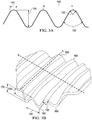
- Figures 3A and 3B better illustrate the dimensions of the corrugation according to one embodiment.
- Figure 3A illustrates a profile view of one corrugated surface of the product 100.
- the tip radius 120 refers to the radius of curvature of a rounded peak of a corrugated food product. In embodiments where a peak is pointed rather than rounded, the tip radius is zero.
- the included angle 122 is the angle between the sloped lines forming a peak.
- the amplitude 130 is the vertical distance from apex of the peak to the bottom of the adjacent groove.
- the pitch 140 is the distance between the apex of two adjacent peaks along the same surface of a corrugated food product.
- the tip width 145 is the width of the curvature of a peak 102, 106 or a groove 104, 108.
- Figure 3B illustrates a perspective view of the corrugated food product 100 according to one embodiment.
- the amplitude 130, pitch 140, and tip radius 120 are shown in context of the whole corrugated food product 100.
- the ridges 160 which refers to the horizontal line or narrow surface formed at peaks of the corrugated surface (on either top or bottom surface).
- the ridges 160 comprise smooth, arcuate waves.
- the peaks comprise sharp angular points (not shown).
- the overall thickness 170 of the corrugated food product 100 is the distance from the apex of a peak on the first corrugated surface to the apex of a peak on second corrugated surface.
- the first corrugated surface is substantially identical to a second corrugated surface and both surfaces have the substantially identical tip radius 120, amplitude 130, and pitch 140.
- the corrugated food product 100 can be described in terms of these corrugation geometrical terms.
- the corrugated food product 100 has variable web thicknesses along a cross-section perpendicular to a series of parallel corrugations along both sides of the product, where the thickness is relatively greater beneath an apex of a peak.
- the products 100 comprise no perforations or holes.
- each of the peaks on either side of the product 100 comprises a symmetrical form, each peak comprising a line of symmetry through the apex of a peak that divides the ridge into halves that are substantially mirror images of each other when viewed with the naked eye.
- either side of the peak's line of symmetry comprises substantially the same length when viewed with the naked eye.
- the corrugation surfaces have peaks 102, 106 that are nonsymmetrical halves.
- the amplitude 130 and pitch 140 of the corrugation surfaces on either face of the product 100 are substantially equal and parallel in one embodiment.
- peaks 102, 106 have similar but variable amplitude 130 and pitch 140 from one peak to another.
- the corrugation has a non-sinusoidal waveform, such as square, rectangular, triangular, spiked, trapezoidal, or saw tooth waves. This can be achieved by varying the tip width 145 and/or the included angle 122 or by any other adjustments known in the art.
- the peaks 102, 106 comprising an amplitude 130 of from about 0.100 inch (2.54 mm) and to about 0.340 inch (8.64 mm), a pitch 140 of from about 0.100 inch (2.54 mm) and not more than 1.50 inch (38.1 mm), a tip radius 120 not more than 0.300 inch (7.62 mm), and a minimum web thickness 112 at least 0.020 inch (0.508 mm) to about 0.080 inch (2.03 mm).
- the tip width 145 ranges from about 0 to about 0.500 inch (12.7 mm).
- the included angle 122 ranges from about 0 degree (e.g., parallel webs 110 in a square or rectangular waveform) to less than 90 degree.
- the wet zone concentration 152 diameter ranges from about 0.015 inch (0.38 mm) to about 0.095 inch (2.4 mm).
- the first and second corrugated surfaces each comprise a plurality of pitches 140, each of the pitches ranging from between about 0.100 inch (2.54 mm) to about 1.5 inches (38.1 mm). Pitch values higher than about 1.5 inches (38.1 mm) tend to lose the corrugated appearance, and pitch values below about 0.1 inch (2.54 mm) pitch values make a product that is too dense.
- the first corrugated surface and the second corrugated surface each comprise a plurality of pitches, each of the pitches ranging from between about 0.200 inch (5.08 mm) to about 0.600 inch (15.2 mm).
- the first corrugated surface and the second corrugated surface each comprise a plurality of pitches, each of the pitches ranging from between about 0.300 inch (7.62 mm) to about 0.500 inch (12.7 mm).
- first and second corrugated surfaces each comprise a plurality of tip radii 120, each of the tip radii ranging from zero to about 0.300 inch (7.62 mm).
- first corrugated surface and the second corrugated surface each comprise a plurality of tip radii, each of the tip radii ranging from between about 0.040 inch (1.02 mm) to about 0.150 inch (3.81 mm).
- first corrugated surface and the second corrugated surface each comprise a plurality of tip radii, each of the tip radii ranging from between about 0.030 inch (0.76 mm) to about 0.070 inch (1.78 mm).
- the corrugated snack food product may generally comprise a minimum web thickness 112 of between about 0.020 inch (0.51 mm) and about 0.080 inch (2.03 mm). In one embodiment, the corrugated snack food product may comprise a minimum web thickness 112 of between about 0.030 inch (0.76 mm) and about 0.070 inch (1.78 mm). In another embodiment, the corrugated snack food product may comprise a minimum web thickness 112 of between about 0.040 inch (1.02 mm) and about 0.060 inch (1.52 mm). In general, the overall thickness of the snack food products ranges from about 0.230 inch (5.84 mm) to about 0.470 inch (11.94 mm). If much beyond this range, the product can become not large enough to deliver the desired texture or too large for consumers to feel comfortable consuming.
- the corrugated food products comprise first and second corrugated surfaces, each with a plurality of peaks, each peak comprising an amplitude 130 ranging from about 0.100 inch (2.54 mm) to about 0.300 inch (7.62 mm).
- the corrugated surfaces comprise a plurality of peaks, each peak comprising an amplitude ranging from about 0.125 inch (3.17 mm) to about 0.280 inch (7.11 mm).
- the corrugated surfaces comprise a plurality of peaks, each peak comprising an amplitude ranging from about 0.100 inch (2.54 mm) to about 0.220 inch (5.59 mm).
- Figure 3B also shows Line A that runs along the ridges 160 (or 0° with respect to the ridge 160 ) and Line B that runs across or perpendicular to the ridges 160 (or 90° respect to the ridge 160 ).
- the corrugated food product 100 exhibits different strength characteristics in the 0° versus the 90° orientation. This characteristic is relevant to the objective of providing a unique textural experience for the consumer as the product breaks easier along the ridges 160 while it is more difficult to break across the ridges 160.
- breakage refers to the lack of structural integrity of the finished product. Stated differently, breakage represents the product's inability to remain whole when it impacts a surface or encounters a force, such as a force of biting.
- This characteristic of the corrugated food product 100 can be quantified in part by area moment of inertia. The area moment of inertia of the product's 100 corrugation pattern can be calculated through an axis of rotation.
- Figures 4A and 4B depict the central axis line X used to determine the area moment of inertia.
- the area moment of inertia (also known as the second moment of inertia) depends on the location of the reference line or axis used. By using a reference line that passes through the area's centroid, or geometric center, the smallest moment of inertia is calculated.
- the reference line X is the central axis line, bisecting the corrugation pattern midway between the series of ridges 160.
- the central axis line X may be relatively straight through the centroid of the corrugation, as depicted in Figure 4A ; or it may be curvilinear as depicted, by way of example, at Figure 4B , so long as the line passes through the centroid.
- line X may be curvilinear and the resulting area moment of inertia will represent the inherent corrugated shape without different curvatures that may result from different cooking processes.
- the area moment of inertia is a property of a cross section that can be used to predict the resistance to bending and deflection. The larger the moment of inertia, the harder it is to bend the product. In products such as potato chips where the finished chip is crisp, it is believed that this property relates to the force to break the product. For a given product, a larger moment of inertia will result in a higher force required to fracture the product.
- Ix ⁇ y 2 dA
- Ix is the area moment of inertia with respect to the reference Line X
- reference Line X is the "central axis”
- dA is the area of an infinitesimally narrow sliver of the corrugated surface
- y is the perpendicular distance from the reference Line X to the centroid, or geometric center, of element dA.
- a normalized area moment of inertia is the area moment of inertia divided by the minimum web thickness 112.
- the normalized area moment of inertia enables a more rigorous comparison of corrugation pattern for food products of varying overall thickness because changes in the overall thickness influence both the minimum web thickness 112 and the area moment of inertia for a given sample. By normalizing against the minimum web thickness 112, the effects of changes in corrugation pattern can be evaluated more directly.
- dehydration factor is the ratio of the wet zone concentration diameter to the minimum web thickness 112 of a corrugated food product 100.
- Dehydration factor relates to the moisture uniformity of the dehydrated product 100. As mentioned above, the areas near the peaks 102, 106 have higher moisture levels. But Applicants have found that when the dehydration factor is below about 1.25, the product is able to dehydrate uniformly under atmospheric pressure frying, for example. Applicants have also found that a dehydration factor between about 1.25 to about 1.7 dehydrates uniformly, for example, under non-atmospheric frying conditions (e.g., vacuum frying).
- friability refers to the tendency of a product to obtain substantially the same moisture throughout its cross-section when subjected to a dehydration process such as frying.
- a dehydration process such as frying.
- frying any other dehydration methods known in the art can be used. Such dehydration methods include freeze drying, air drying, or heating (e.g., conduction, convection, or radiation).
- Table 1 shows product dimensions, and calculated values for dehydration factor, area moments of inertia, I x , and normalized area moment of inertia, I x-norm , for the aforementioned range of amplitude, pitch, and tip radius.
- Sample numbers 1 through 6 are commercially available (sold on the markets)for prior art samples tested for comparison, and samples 7 through 21 are various embodiments of the corrugated food products 100 disclosed herein.
- Sample 22 is a flat chip without corrugation that was tested for comparison. Numerical values for the area moment of inertia are calculated on a typical product width and then adjusted to a nominal 6.35-cm [2.5-inch] width of the corrugated food product 100.
- A, B, and C following the sample number indicates the three thickness categories (both in terms of the minimum web thickness 112 and the overall thickness 170 ), where A, B, and C represent nominal, thin, and thick cuts, respectively.
- A indicates nominal minimum web thickness 112 of about 1.397 mm (0.055 inch).
- B indicates thin minimum web thickness 112 in the range from about 0.889 mm (0.035 inch) to about 1.016 mm (0.04 inch).
- “C” indicates thick minimum web thickness 112 in the range from about 1.778 mm (0.07 inch) to about 1.905 mm (0.075 inch).
- sample 2 shape knife
- sample 2A, 2B, and 2C were cut using the "sample 2 shape” knife at different thicknesses. So while the general shape is same among the three samples sharing the same knife, the values for the overall thickness and the minimum web thickness 112, wet zone concentration diameter, and the calculated values of dehydration factor, area moment of inertia, and normalized area moment of inertia are different.
- the corrugated food product can be formed by any other means known in the art, including extrusion, which is capable of reproducing substantially the same shape products.
- Table 1 Product Dimensions and Calculated Area Moments of Inertia and Dehydration Factors Sample Overall Thickness (mm) Minimum Web Thickness (mm) Amplitude (mm) Pitch (mm) Tip Radius (mm) Wet Zone Conc. Diameter (mm) Dehydration Factor I x (x10 -11 m 4 ) Norm.
- the lower amplitudes previously known in the art which range from about 1.270 mm (sample 1) to about 2.159 mm (sample 5), result in lower area moments of inertia.
- the low amplitude products are not as strong as the corrugated food products having higher amplitudes at least with respect to the orientation parallel to the central axis X (e.g., along line B in Figure 3B or in the 90° orientation).
- too high of an amplitude may provide for undesirable texture that is too hard (e.g., sample 21).
- the amplitude should be less than about 0.340 inch (8.636 mm).
- the amplitude is less than or equal to about 0.286 inch (or 7.62 mm).
- the dehydration factor is above about 1.7, the products have a poor dehydration uniformity, which gives the product less friability, making it more difficult to obtain a shelf stable, crunchy, crispy product with desirable coloring and texture.
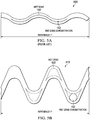
- Figures 2 , 5A , 5B , and 5C illustrate embodiments of the present disclosure and prior art samples.
- Figure 2 illustrates the corrugated product 100 representing sample 10.
- Figure 5A illustrates the prior art product 500 representing sample 6.
- Figure 5B illustrates the corrugated food product 510 representing sample 15.
- Figure 5C illustrates the corrugated food product 520 representing sample 21.
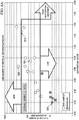
- the area moments of inertia of all 21 samples were plotted against the dehydration factor as depicted in Figure 6A .
- Prior art sample numbers 1-6 are marked with an X within the circle.
- the plotted data points for the corrugated food product 100 of Figure 2 (sample 10), prior art product 500 (sample 6), corrugated food products 510 (sample 15) and 520 (sample 21) are marked accordingly in Figure 6A to further distinguish for illustrative purposes.
- the prior art product 500 (sample 6) has a wet zone 150 and a wet zone concentration 152 as shown in Figure 5A .
- the prior art product 500 has an acceptable dehydration factor of about 0.19 (calculated at thickness A), it also comprises a lower area moment of inertia at about 8.20 x10 -11 m 4 .
- the corrugated food product 510 (sample 15) similarly has a wet zone 150 and a wet zone concentration 152 as shown in Figure 5B . While the product 510 has an acceptable area moment of inertia at about 188.68 x10 -11 m 4 , the dehydration factor is about 1.47, which is well above the dehydration factor determined as desirable. It is difficult to form a shelf stable product where the dehydration factor is too high.
- the corrugated food product 520 (sample 21) also has a wet zone 150 and a wet zone concentration 152 as shown in Figure 5C . While the product 520 comprises an acceptable dehydration factor of about 0.85 (calculated at thickness A), the area moment of inertia is much higher than desired, at about 257.99 x10 -11 m 4 , which in turn provides for a less desirable product and texture. Comparatively, one embodiment of the corrugated product 100 as illustrated in Figure 2 (sample 10) has both the area moment of inertia (73.88 x10 -11 m 4 ) and the dehydration factor (0.94) in the acceptable range. Thus, both the dehydration factor and the area moment of inertia as recited herein contribute to an enhanced textural experience, which has been found to be heartier, crunchier and overall more desirable than other corrugated food products presently known.
- various embodiments of the corrugated food product 100 comprises an area moment of inertia values of between about 25 x 10 -11 m 4 to about 200 x 10 -11 m 4 and a dehydration factor of less than about 1.25.
- the products suffer from poor dehydration uniformity where the cooking process must continue for longer periods of time until a low moisture content is achieved throughout the product for long term storage or shelf stability.
- Variable cooking rates typically produce over-dried areas and high scorch flavor notes as well as less visually appealing products following dehydration.
- a corrugated food product 100 comprises an area moment of inertia of between about 28 x 10 -11 m 4 to about 100 x 10 -11 m 4 . In another embodiment, a corrugated food product 100 comprises an area moment of inertia of between about 30 x 10 -11 m 4 to about 50 x 10 -11 m 4 . In one embodiment, the corrugated food products 100 comprise a dehydration factor of less than about 0.90. In another embodiment, the corrugated food products 100 comprise a dehydration factor of less than about 0.60.
- Figure 6B illustrates a scatter plot of the normalized area moments of inertia against the dehydration factor for all 21 samples at various thicknesses (A, B, and C). This was done to show the effect of varying thicknesses of the corrugated food product on the normalized area moment of inertia, which translates to the relationship between the thickness of the product versus its strength (or breakability). Surprisingly, increasing or decreasing the thickness of the prior art products (samples 1-6) did not result in a significant increase in the normalized area moment of inertia.
- the corrugated food product 100 comprises a normalized area moment of inertia of between about 20 x 10 -8 m 3 and about 160 x 10 -8 m 3 . In another embodiment, the corrugated food product 100 comprises a normalized area moment of inertia of between about 20 x 10 -8 m 3 and about 80 x 10 -8 m 3 . As with noted in Figure 6A and accompanying text, the dehydration factor is less than about 1.7 in one embodiment. In another embodiment, the corrugated food products 100 comprise a dehydration factor of less than about 0.90. In other embodiments, the corrugated food products 100 comprise a dehydration factor of less than about 0.60.
- the corrugated products 510 (sample 15) has dehydration factor ranging from 1.27 to 1.46 depending on the thickness. This is too high of dehydration factor as explained above.
- the preferred embodiments of the corrugated food products 100 have a normalized area moment of inertia and dehydration factor levels within the region boxed and labeled as "desirable moment of inertia" in Figure 6B .
- the present invention relates to a method of making corrugated snack food product for consumption.
- a method for producing a corrugated snack food product comprises the steps of: providing a food product; shaping the food product to have a first corrugated surface on a first side of the product and a second corrugated surface on a second side of the product, wherein the first and second corrugated surfaces are substantially parallel and comprise a plurality of peaks; and cooking the product thereby producing a corrugated snack food product with peaks having an amplitude from about 0.100 inch (2.54 mm), a normalized area moment of inertia of between about 20 x 10 -8 m 3 and about 160 x 10 -8 m 3 , and a dehydration factor of less than 1.7.
- the providing step comprising one or more of the steps of forming, impressing, molding, shaping, cutting, extruding or obtaining from a third party corrugated food products according to the principles and characteristics disclosed herein.
- forming of the corrugated food products having a high-amplitude, high normalized area moment of inertia and low dehydration factor comprises the steps of sheeting a dough material into a cohesive dough; impressing a corrugated configuration on both surfaces of the dough sheet; and cutting the corrugated dough sheet into suitably shaped pieces.
- the cutting may be done before or after the corrugated configurations are impressed upon a dough, which can be formed by the step of mixing together any number of dry ingredients with a liquid solution.
- suitable dry ingredients may be derived from any number of fruits or vegetable and may include without limitation, dehydrated potato products, corn products, grains, wheat, barley or flours.
- the forming of the corrugated configuration may be performed, for example, by compressing the dough in between a pair of corrugated sheet rolls or by extruding the dough through corrugated die openings.
- forming may comprise the step of molding.
- the forming of may be accomplished by slicing a food product into the desired shape. Forming may also be accomplished by expanding one or more pellets.
- Suitable food products include without limitation turnips, carrots, roots, tubers, fruits, vegetables, or potatoes such as, for example, sweet potatoes, Russet potatoes or any variety of chipping potato.
- Chipping variety potatoes are those potatoes normally used for frying and include, for example, Saturna, Lady Rosetta, Lady Clair, Hermes, Maris Piper, Erntestolz, Agria, Atlantic, Monona, Norchip, Snowden, Kennebec, Oneida, and Tobique.
- the corrugations of one side of the product should be substantially in phase with the corrugations on the opposing side of the product, should comprise substantially the same pitch and amplitude and consist of a plurality of symmetrical peaks, each having substantially the same amplitude.
- the first and the second corrugated surfaces are phase shifted up to about 25% of the pitch 140.
- the product may then be cooked to reduce the moisture content.
- Cooking steps may preserve the product for subsequent cooking or may reduce the moisture to a final content of between about 0.8% and about 3% by weight of finished product.
- the product may be partially cooked then preserved for subsequent cooking.
- the moisture content should be reduced to at least about 50%.
- the cooking step reduces the moisture content to between about 0.8% and about 50%.
- the moisture content may be reduced to between about 12% and 50% before freezing.
- the method may further comprise a freezing step, where the product is frozen to temperatures below about 0°C [32°F] until subsequent cooking for consumption is desired. Products requiring refrigeration are also possible.
- the cooking step reduces the moisture content to between about 0.8% to about 12%.
- the cooking step may reduce the moisture content to between about 3.5% to about 12% in some embodiments.
- the method may comprise a refrigeration step, wherein the product may be refrigerated to temperatures of about 0°C [32°F] to about 4.4°C [40°F] until subsequent cooking for consumption is desired.
- the product can be cooked at temperatures ranging from about 65.5°C [150°F] up to about 287.8°C [550°F] depending upon the cooking process used. In one embodiment, the product should be cooked at temperatures below about 287.8°C [550°F]. In another embodiment, the product should be cooked at temperatures below about 232.2°C [450°F]. In another embodiment, the product should be cooked at temperatures below about 176.7°C [350°].
- the product should be cooked at temperatures below about 121.1°C [250°F].
- the corrugated product is fried using a liquid cooking medium such as oil in temperatures of less than about 204.4°C [400°F].
- the product is fried in a liquid cooking medium such as oil at temperatures below about 185°C [365°F] to about 148.9°C [300°F].
- the product is fried in a liquid cooking medium such as oil at temperatures below about 160°C [320°F] to about 121.1°C [250°F].
- cook time is less than 12 minutes. In another embodiment, cook time is less than 4 minutes.
- Cook time for kettle style chips is between about 8 to 11 minutes at temperatures of less than about 160°C [320°F] to about 121.1°C [250°F].
- Cook time for continuous frying processes is between about 2.4 to about 4 minutes at higher temperatures of between about 148.9°C [300°F] to about 187.8°C [370°F].
- cook time may range from about 4 to about 15 minutes at between about 148.9°C [300°F] to about 260°C [500°'], depending on the amount of heat transfer.
- the corrugated product is baked by any means known in the art.
- Examples of products that can be made using the method described herein include without limitation formed potato chips, corn chips, wheat chips, multi-grain chips, crackers, and the like.
- Finished, shelf-stable products comprise a unique structural strength and a high resistance to breaking.
- Other metrics useful for characterizing the finished product comprise shelf life, moisture, hardness, breaking force, color (L-values or RGB analysis), various acoustic measurements and flavor and measurement of volatile and non-volatile compounds.
- the fracturability of the corrugated food products may be measured using a ball probe compression/fracture device where a sample is placed on a cylinder and a ball probe is lowered onto the sample until it bends and then fractures. Analysis of the mechanical properties can be performed with the measurements of force, time, distance and work.
- Mechanical properties may be analyzed as follows: 1) an initial slope of a plot of the force vs. time to provide a measure of the resistance to bending; 2) a plot of force vs. distance of the first fracture; 3) maximum force and distance as a measure of sample hardness; 4) the work required to completely break through the sample; 5) the total number of peaks (differing by 5 grams force) which is related to the number of fracture events; and 6) the total linear distance as a measure of "jaggedness,” which often relates to crispness of a product.
- the sounds or acoustics of the corrugated food product can also be analyzed.
- any number of properties can be determined. For example, the following may be analyzed: 1) the frequency spectrum of the sounds, which may relate to the tonal character and whether the sample is crispy, crunchy or crackly; 2) the number of sound peaks, which relates to the number of fracture events; and 3) the total sound energy, which relates to how noisy the product is.
- Raw data of a number of samples may be evaluated using mathematical techniques such as analysis of variance (ANOVA) or least significant difference (LSD) in order to identify further characteristics of the product for each of the individual mechanical properties mentioned above.
- ANOVA analysis of variance
- LSD least significant difference
- multivariate nature of the texture of these food products can be investigated by fusing all mechanical properties mentioned above via multivariate data analysis techniques such as PCA (Principal Component Analysis), PLS (Partial Least Squares), PLS-DA (PLS-Discriminant Analysis), and PCA-DA (PCA-Discriminant Analysis) to identify unique textural characteristics of the high-amplitude corrugated products described herein.
- PCA Principal Component Analysis
- PLS Partial Least Squares
- PLS-DA PLS-Discriminant Analysis
- PCA-DA PCA-Discriminant Analysis
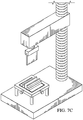
- FIGs 7A, 7B , and 7C illustrate one embodiment of the three-point compression or bend testing apparatus. Due to the unique shape of the corrugated food product 100, the compression test is carried out in two different orientations. First, as shown in Figure 7A , the three-point bend test is carried out in the 0° with respect to the ridge 160, parallel to Line A in Figure 3B .
- FIG. 7B Another three-point bend test is carried out in the 90° with respect to the ridge 160, parallel to Line B in Figure 3B .
- the corrugated food product 100 exhibits different strength characteristics in the 0° versus the 90° orientation.
- the three points of compression are the blade moving in the downward direction upon the corrugated food product 100 and the edges of the two bend supports.
- the corrugated food product 100 rests on the two bend supports and the downward blade descends upon the corrugated food product 100 at a known speed and with known force.
- TA.XT2 Texture Analyzer made from Texture Technologies Corp. is used.
- any system capable of carrying out the disclosed testing method is used.
- the downward blade is 3 mm thick with rounded end and the distance between the two bend supports is 14.5 mm.
- the blade acts upon the same length of the corrugated product in both 0 and 90 degree orientations.
- the blade acts upon a different length in the 0 versus the 90 degree orientation when considered in proportion to the product length or width. For example, a product having an oblong shape tested with 2 inch length and 1 inch width impacted with a blade of 2 inch width would have a different proportion of the product tested in the 0 versus the 90 degree orientations.
- the results can be scaled accordingly (e.g., on force per length basis).
- a 50 kg loading cell is used in one embodiment as the compression loads.
- the downward blade descends at 20.00 mm per second, which simulates the speed of human jaws biting a food product.
- a penetration distance is 8.00 mm and a trigger force of 5.0 g is used.
- a three-point bend test enables an objective quantification of the unique texture of the corrugated food product 100.
- the textural characteristics tested are hardness and crispiness.
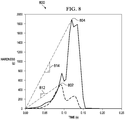
- Figure 8 illustrates a graphical representation 800 of the hardness and crispiness testing results according to one embodiment.
- hardness refers to the maximum compressive force (e.g., 802, 804 ) required to fracture a corrugated food product 100. This is analogous of the first bite into the corrugated food product. Because the three-point bend testing apparatus above described uses a constant speed and acceleration, the force values can be expressed simply in terms of mass (e.g., grams).
- This gradient represents the stiffness or deformability modulus.
- the gradient represents the Young's modulus.
- the graph 800 shows the hardness 802 and the crispiness 812 for the 0° test. It also shows a much higher 804 hardness and a higher crispiness 814 values in the 90° test.
- the three embodiments of the corrugated food product 100, A, B, and C are substantially similar to Samples 11A, 12A, and 7A from Table 1, respectively. While the tested samples were two plain potato chips, six corrugated (or wavy) potato chips, and three embodiments of the corrugated food product 100 in the form of potato chips, it is within the scope of the present disclosure to encompass any corrugated food product and is not limited merely to potato chips.
- Table 2 summarizes the hardness results and Table 3 summarizes the crispiness results for the chips tested. Each type of chip was tested with 30 chips at 0° and 90°. Table 2.
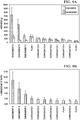
- Embodiments of the corrugated food product 100 exhibits a statistically significantly higher 90°-to-0° hardness ratio when compared to commercially available potato chips.
- the 90°-to-0° crispiness ratio values for the tested samples are plotted in Figure 10B .
- the commercially available corrugated potato chips had 90°-to-0° crispiness ratio values that are quite similar to plain potato chips.
- Embodiments of the corrugated food product 100 however, had a 90°-to-0° crispiness ratios that are nearly 2 to 10 times that of the commercially available products tested.
- the corrugated food product 100 exhibits a distinct characteristic texture in both hardness and crispiness measurements, especially when the 90°-to-0° ratios are compared.
- Various statistical models were utilized as methods to identify the embodiments of the corrugated food product 100 disclosed here versus commercially available corrugated food product. For example, Applicants used the analysis of variable (ANOVA), linear discriminant analysis (LDA), and ordinary linear regression to analyze corrugated food product 100 and the commercial products as listed in Tables 2 and 3.
- the ANOVA results showed that the mean 90°-to-0° hardness ratio (ranging from about 1.252 to about 3.086) and 90°- to-0° crispiness ratio (ranging from about 2.362 to about 8.133) values for the corrugated food product 100 were different in statistically significant way when compared to the commercial products' 90°-to-0° hardness ratio (ranging from about 0.418 to about 0.824) and 90°-to-0° crispiness ratio (ranging from about 2.362 to about 8.133) values.
- the linear discriminant analysis was carried out using the following predictors: hardness at 0°; hardness at 90°; 90°-to-0° hardness ratio; crispiness at 0°; crispiness at 90°; and 90°-to-0° crispiness ratio.
- LDA was able to identify the three embodiments (Embodiments A, B, and C) of the corrugated food product 100 approximately 73% to 97% of the time compared to any of the tested commercially available corrugated food products.
- a linear regression analysis enables one to predict whether a given corrugated food product is a high-amplitude (and consequently high normalized area moment of inertia) corrugated food product 100 of the present disclosure.
- Figures 11A and 11B show linear regression results on hardness and crispiness 90°-to-0° ratios, respectively, versus the normalized area moment of inertia.
- Figure 11A represents a fitted line plot using linear regression on the 90°-to-0° hardness ratio of the tested samples (the results of which are summarized above in Table 2).
- the adjusted coefficient of determination (R 2 value) of this line is 0.801.
- the normalized area moment of inertia is between about 20 x 10 -8 m 3 and about 160 x 10 -8 m 3
- the corresponding range of 90°-to-0° hardness ratio is between about 2.78 to about 14.97.
- Figure 11B represents a fitted line plot using linear regression on the 90°-to-0° crispiness ratio of the tested samples.
- the adjusted R 2 value of this line is 0.613.
- the normalized area moment of inertia is between about 20 x 10 -8 m 3 and about 160 x 10 -8 m 3
- the corresponding range of 90°-to-0° crispiness ratio is between about 3.14 to about 22.69. This represents the shaded region in Figure 11B .
- the corresponding range of 90°-to-0° crispiness ratio is between about 3.14 to about 11.52. It should be understood that these statistical analyses are provided as a description of how the distinctive textural characteristics of the high amplitude corrugated food product 100 is statistically distinguishable by objective textural testing. The statistical confidence or coefficient of determination values provided above are not intended to be limitive nor intended to characterize the high amplitude corrugated food product 100.
Landscapes
- Engineering & Computer Science (AREA)
- Polymers & Plastics (AREA)
- Chemical & Material Sciences (AREA)
- Food Science & Technology (AREA)
- Life Sciences & Earth Sciences (AREA)
- Nutrition Science (AREA)
- Health & Medical Sciences (AREA)
- Manufacturing & Machinery (AREA)
- Preparation Of Fruits And Vegetables (AREA)
- General Preparation And Processing Of Foods (AREA)
- Meat, Egg Or Seafood Products (AREA)
- Confectionery (AREA)
- Seeds, Soups, And Other Foods (AREA)
- Medicines Containing Plant Substances (AREA)
- Cereal-Derived Products (AREA)
Claims (13)
- Gewelltes Lebensmittelprodukt, das Folgendes umfasst:eine erste Seite und eine zweite Seite, wobei die erste Seite ein erstes Wellenmuster hat und die zweite Seite ein zweites Wellenmuster hat, wobei das erste und das zweite Wellenmuster mehrere Spitzen haben und wobei das zweite Wellenmuster im Wesentlichen phasengleich mit dem ersten Wellenmuster ist, und wobei das Lebensmittelprodukt ein normalisiertes Flächenträgheitsmoment zwischen 20 x 10-8 m3 und 160 x 10-8 m3 und einen Dehydrationsfaktor von weniger als 1,7 und eine Gesamtdicke im Bereich von 5,84 mm bis 11,94 mm hat;wobei wenigstens eine der Spitzen eine Amplitude im Bereich von 2,54 mm bis 8,64 mm hat.
- Gewelltes Lebensmittelprodukt nach Anspruch 1, wobei wenigstens eine der Spitzen eine Amplitude im Bereich von 2,54 mm bis 8,64 mm und einen Nasszonen-Konzentrationsdurchmesser im Bereich von 0,38 mm bis 2,4 mm hat, oder wobei wenigstens eine der Spitzen eine Teilung im Bereich von 2,54 mm bis 38,1 mm hat oder wobei wenigstens eine der Spitzen einen Spitzenradius im Bereich von 0 mm bis 7,62 mm hat.
- Gewelltes Lebensmittelprodukt nach Anspruch 1, das ferner eine Mindeststegdicke im Bereich von 0,5 mm bis 2,03 mm und einen Dehydrationsfaktor von weniger als 1,25 hat.
- Gewelltes Lebensmittelprodukt nach Anspruch 1, das ferner ein 90° zu 0° Härteverhältnis von wenigstens 2,78 hat oder ferner ein 90° zu 0° Knusprigkeitsverhältnis von wenigstens 3,14 hat.
- Gewelltes Lebensmittelprodukt, das Folgendes umfasst:eine erste Seite und eine zweite Seite, wobei die erste Seite ein erstes Wellenmuster hat und die zweite Seite ein zweites Wellenmuster hat, wobei das erste und das zweite Wellenmuster mehrere Spitzen haben und wobei das zweite Wellenmuster im Wesentlichen phasengleich mit dem ersten Wellenmuster ist, und wobei das Lebensmittelprodukt ein 90° zu 0° Härteverhältnis von wenigstens 2,78, eine Gesamtdicke im Bereich von 5,48 mm bis 11,94 mm und einen Dehydrationsfaktor von weniger als 1,7 hat;wobei wenigstens eine der Spitzen des gewellten Lebensmittelprodukts eine Amplitude im Bereich von 2,54 mm bis 8,64 mm hat.
- Gewelltes Lebensmittelprodukt nach Anspruch 5, wobei das 90° zu 0° Härteverhältnis weniger als 14,97 beträgt.
- Gewelltes Lebensmittelprodukt nach Anspruch 5, das ferner ein normalisiertes Flächenträgheitsmoment zwischen etwa 20 x 10-8 m3 und etwa 160 x 10-8 m3 hat oder ferner einen Dehydrationsfaktor von weniger als 1,25 und einen Nasszonen-Konzentrationsdurchmesser im Bereich von 0,38 mm bis 2,4 mm hat.
- Gewelltes Lebensmittelprodukt nach Anspruch 5, wobei wenigstens eine der Spitzen eine Amplitude im Bereich von etwa 3,17 mm bis etwa 7,11 mm hat oder ferner eine Mindeststegdicke im Bereich von 0,5 mm bis 2,03 mm hat.
- Gewelltes Lebensmittelprodukt, das Folgendes umfasst:eine erste Seite und eine zweite Seite, wobei die erste Seite ein erstes Wellenmuster hat und die zweite Seite ein zweites Wellenmuster hat, wobei das erste und das zweite Wellenmuster mehrere Spitzen haben und wobei das zweite Wellenmuster im Wesentlichen phasengleich mit dem ersten Wellenmuster ist und wobei das Lebensmittelprodukt ein 90° zu 0° Knusprigkeitsverhältnis von wenigstens 3,14, eine Gesamtdicke im Bereich von 5,84 mm bis 11,94 mm und einen Dehydrationsfaktor von weniger als 1,7 hat;wobei wenigstens eine der Spitzen eine Amplitude im Bereich von 2,54 mm bis 8,64 mm hat.
- Gewelltes Lebensmittelprodukt nach Anspruch 9, wobei das 90° zu 0° Knusprigkeitsverhältnis weniger als 22,69 beträgt.
- Gewelltes Lebensmittelprodukt nach Anspruch 9, das ferner ein normalisiertes Flächenträgheitsmoment zwischen etwa 20 x 10-8 m3 und etwa 160 x 10-8 m3 hat oder ferner einen Dehydrationsfaktor von weniger als 1,25 hat.
- Gewelltes Lebensmittelprodukt nach Anspruch 9, das ferner eine Mindeststegdicke im Bereich von 0,5 mm bis 2,03 mm hat.
- Gewelltes Lebensmittelprodukt nach Anspruch 1, 5 oder 9, wobei das gewellte Lebensmittelprodukt aus wenigstens einem Inhaltsstoff gebildet ist, ausgewählt aus einer Gruppe bestehend aus Kartoffeln, Knollenfrüchten, Früchten, Mais, Gemüse und Getreide.
Applications Claiming Priority (2)
| Application Number | Priority Date | Filing Date | Title |
|---|---|---|---|
| US201261587943P | 2012-01-18 | 2012-01-18 | |
| PCT/US2013/021920 WO2013109740A1 (en) | 2012-01-18 | 2013-01-17 | High-amplitude corrugated food product and method of making same |
Publications (4)
| Publication Number | Publication Date |
|---|---|
| EP2804493A1 EP2804493A1 (de) | 2014-11-26 |
| EP2804493A4 EP2804493A4 (de) | 2015-12-02 |
| EP2804493B1 true EP2804493B1 (de) | 2018-05-09 |
| EP2804493B8 EP2804493B8 (de) | 2018-06-27 |
Family
ID=48780144
Family Applications (1)
| Application Number | Title | Priority Date | Filing Date |
|---|---|---|---|
| EP13738534.0A Active EP2804493B8 (de) | 2012-01-18 | 2013-01-17 | Gewelltes lebensmittelprodukt mit hoher amplitude und herstellungsverfahren dafür |
Country Status (10)
| Country | Link |
|---|---|
| US (1) | US9462818B2 (de) |
| EP (1) | EP2804493B8 (de) |
| AU (2) | AU2013209724B2 (de) |
| BR (1) | BR112014015463A8 (de) |
| ES (1) | ES2676536T3 (de) |
| GB (3) | GB2507434B (de) |
| IN (1) | IN2014CN03795A (de) |
| MX (2) | MX343086B (de) |
| RU (1) | RU2619900C2 (de) |
| WO (1) | WO2013109740A1 (de) |
Families Citing this family (12)
| Publication number | Priority date | Publication date | Assignee | Title |
|---|---|---|---|---|
| CA2870562C (en) * | 2012-04-23 | 2017-02-14 | Urschel Laboratories, Inc. | Methods and equipment for cutting food products |
| CN105745053B (zh) * | 2013-11-21 | 2018-03-23 | Fam公司 | 用于波纹刀片的刀组件以及配备有所述刀组件的切割系统 |
| USD752841S1 (en) | 2013-12-13 | 2016-04-05 | Natural Balance Pet Foods, Inc. | Pet chew |
| USD759341S1 (en) | 2014-12-17 | 2016-06-21 | Natural Balance Pet Foods, Inc. | Pet chew |
| US20160174596A1 (en) * | 2014-12-19 | 2016-06-23 | Mccain Foods Limited | Wiggle-shaped food strip and method of cutting the same |
| EP3527342A1 (de) * | 2018-02-20 | 2019-08-21 | Fam | Messeranordnung und damit ausgestattetes schneidsystem |
| CN109169796B (zh) * | 2018-08-30 | 2021-08-27 | 山西海玉园食品有限公司 | 一种石头饼和夹心石头饼 |
| USD1043028S1 (en) * | 2022-09-20 | 2024-09-24 | Lamb-Weston/Meijer V.O.F. | Cut potato product |
| USD1044200S1 (en) * | 2022-09-20 | 2024-10-01 | Lamb-Weston/Meijer V.O.F. | Cut potato product |
| USD1043027S1 (en) * | 2022-09-20 | 2024-09-24 | Lamb-Weston/Meijer V.O.F. | Cut potato product |
| USD1043030S1 (en) * | 2022-09-20 | 2024-09-24 | Lamb-Weston/Meijer V.O.F. | Cut potato product |
| USD1043029S1 (en) * | 2022-09-20 | 2024-09-24 | Lamb-Weston/Meijer V.O.F. | Cut potato product |
Citations (1)
| Publication number | Priority date | Publication date | Assignee | Title |
|---|---|---|---|---|
| US5700508A (en) * | 1993-12-27 | 1997-12-23 | Meiji Seika Kaisha, Ltd. | Process for the manufacture of fried potatoes |
Family Cites Families (45)
| Publication number | Priority date | Publication date | Assignee | Title |
|---|---|---|---|---|
| US95990A (en) | 1869-10-19 | Improved metallic roofing | ||
| US2627644A (en) | 1950-06-24 | 1953-02-10 | Us Rubber Co | Single-ply corrugated fabric and method of making the same |
| US2769714A (en) | 1955-04-12 | 1956-11-06 | Stahmer Bernhardt | Sliced potato product |
| US2769715A (en) * | 1955-10-21 | 1956-11-06 | Stahmer Beruhardt | Sliced corrugated potato products |
| US3139127A (en) | 1959-12-03 | 1964-06-30 | Joe R Urschel | Machine for slicing a food product |
| US3139130A (en) | 1959-12-03 | 1964-06-30 | Joe R Urschel | Method of slicing food products |
| US3498798A (en) | 1966-07-29 | 1970-03-03 | Procter & Gamble | Packaging of chip-type snack food products |
| US3956517A (en) | 1974-05-13 | 1976-05-11 | The Procter & Gamble Company | Method of forming rippled chip-type products |
| SE416069B (sv) | 1977-11-10 | 1980-11-24 | Bo Ekmark | Forfarande och anordning for tillverkning av en takbeklednad av plat |
| IT1131614B (it) | 1980-05-15 | 1986-06-25 | Mario Pavan | Procedimento per la produzione di pasta secca,impianto per la sua attuazione,nonche' prodotto ottenuto |
| US4508739A (en) * | 1982-12-07 | 1985-04-02 | Frito-Lay, Inc. | Potato product with opposite corrugations of different frequencies |
| US4511586A (en) | 1983-08-03 | 1985-04-16 | Frito-Lay, Inc. | Potato product with opposite phase-shifted corrugations of the same frequency and amplitude |
| US4601227A (en) * | 1983-08-03 | 1986-07-22 | Frito-Lay, Inc. | Food product with opposite phase-shifted corrugations of the same frequency and amplitude and method and apparatus of manufacture |
| US4680191A (en) | 1985-02-05 | 1987-07-14 | Frito-Lay, Inc. | Cross-cut extrusion method |
| US4889737A (en) | 1985-02-12 | 1989-12-26 | Willard Miles J | Fried snack product having dockering holes therein |
| GB2172185B (en) | 1985-03-12 | 1989-06-28 | Simba Quix Ltd | Food product with smooth and corrugated surfaces |
| US4650684A (en) | 1985-11-08 | 1987-03-17 | Frito-Lay, Inc. | Reduction in phase-locking of corrugated chips and product thereof |
| US4855151A (en) | 1986-08-27 | 1989-08-08 | Curtice-Burns, Inc. | Potato product with asymmetric corrugations |
| US4852441A (en) | 1987-07-22 | 1989-08-01 | Frito-Lay, Inc. | Apparatus for slicing food pieces |
| US5128157A (en) | 1987-12-09 | 1992-07-07 | Ruiz Mark R | Fragile food product package |
| US4933194A (en) * | 1989-02-01 | 1990-06-12 | Frito-Lay, Inc. | Low oil corrugated potato chip |
| US4933199A (en) * | 1989-02-01 | 1990-06-12 | Frito-Lay, Inc. | Process for preparing low oil potato chips |
| CA2003712C (en) | 1989-03-17 | 1999-09-28 | Kyle E. Dayley | Process for producing rippled snack chips |
| US4973481A (en) * | 1989-03-17 | 1990-11-27 | Miles J. Willard | Process for producing rippled snack chips and product thereof |
| GB9026991D0 (en) | 1990-12-12 | 1991-01-30 | United Biscuits Ltd | Improvements in and relating to biscuits |
| ATE186177T1 (de) * | 1994-07-08 | 1999-11-15 | Procter & Gamble | Verfahren zur herstellung verbesserter wellenförmiger imbiss-chips |
| USD380885S (en) | 1995-04-10 | 1997-07-15 | Oscar Mayer Foods Corporation | Pickle slice |
| USD389373S (en) | 1996-12-06 | 1998-01-20 | C.M. Products, Inc. | Tortilla/taco shell bake pan |
| JP4028617B2 (ja) | 1997-05-14 | 2007-12-26 | 森永製菓株式会社 | 成形チップス及びその製造法 |
| US20020160092A1 (en) * | 1999-04-26 | 2002-10-31 | The Procter & Gamble Company | Potato mash |
| US6412399B1 (en) | 2000-04-24 | 2002-07-02 | Recot, Inc. | Apparatus for form-frying snack food product |
| USD453977S1 (en) | 2001-03-13 | 2002-02-26 | Tiffany Park | Wave shaped pet product |
| USD495852S1 (en) | 2002-11-21 | 2004-09-14 | Frito-Lay North America, Inc. | Ridged snack food chip |
| US20040197530A1 (en) | 2003-04-07 | 2004-10-07 | Gritti Fabio Angelo | Packaging and insulating plastic sheet-like element |
| US7331087B2 (en) | 2003-12-22 | 2008-02-19 | Kimberly-Clark Worldwide, Inc. | Activatable fastening system and web having elevated regions and functional material members |
| USD541006S1 (en) | 2004-09-08 | 2007-04-24 | Baumgartner Thomas J | Pet food treat |
| USD577176S1 (en) | 2006-04-11 | 2008-09-23 | Conagra Foods, Inc. | Potato product |
| USD540507S1 (en) | 2006-04-13 | 2007-04-17 | Sabritas, S. De R.L. De C.V. | Snack food product |
| USD632246S1 (en) | 2008-11-22 | 2011-02-08 | Rin-Soon Park | Silicon wafer for solar battery |
| US20120101174A1 (en) | 2009-07-08 | 2012-04-26 | Mittag Matthew D | Method for forming a shaped foam article |
| USD625486S1 (en) | 2010-04-02 | 2010-10-19 | Frito-Lay North America, Inc. | Snack food product |
| USD640036S1 (en) | 2010-04-26 | 2011-06-21 | J.R. Simplot Company | Spiral potato piece |
| USD643178S1 (en) | 2010-09-14 | 2011-08-16 | Baptista's Bakery, Inc. | Food product |
| USD670560S1 (en) | 2011-05-16 | 2012-11-13 | Victor Amend | Packing panel |
| US9517572B2 (en) | 2011-12-27 | 2016-12-13 | Urschel Laboratories, Inc. | Apparatuses for cutting food products |
-
2013
- 2013-01-17 MX MX2016002848A patent/MX343086B/es unknown
- 2013-01-17 RU RU2014131587A patent/RU2619900C2/ru not_active IP Right Cessation
- 2013-01-17 GB GB1401452.6A patent/GB2507434B/en active Active
- 2013-01-17 IN IN3795CHN2014 patent/IN2014CN03795A/en unknown
- 2013-01-17 GB GB1507217.6A patent/GB2526935B/en active Active
- 2013-01-17 WO PCT/US2013/021920 patent/WO2013109740A1/en not_active Ceased
- 2013-01-17 ES ES13738534.0T patent/ES2676536T3/es active Active
- 2013-01-17 US US13/743,915 patent/US9462818B2/en active Active
- 2013-01-17 MX MX2014008568A patent/MX338559B/es active IP Right Grant
- 2013-01-17 GB GB1507212.7A patent/GB2526934B/en active Active
- 2013-01-17 AU AU2013209724A patent/AU2013209724B2/en active Active
- 2013-01-17 BR BR112014015463A patent/BR112014015463A8/pt not_active IP Right Cessation
- 2013-01-17 EP EP13738534.0A patent/EP2804493B8/de active Active
-
2016
- 2016-06-29 AU AU2016204477A patent/AU2016204477B2/en active Active
Patent Citations (1)
| Publication number | Priority date | Publication date | Assignee | Title |
|---|---|---|---|---|
| US5700508A (en) * | 1993-12-27 | 1997-12-23 | Meiji Seika Kaisha, Ltd. | Process for the manufacture of fried potatoes |
Also Published As
| Publication number | Publication date |
|---|---|
| AU2013209724B2 (en) | 2016-05-12 |
| GB201507212D0 (en) | 2015-06-10 |
| IN2014CN03795A (de) | 2015-10-16 |
| GB2526935A (en) | 2015-12-09 |
| EP2804493A1 (de) | 2014-11-26 |
| GB2526934B (en) | 2016-06-22 |
| RU2619900C2 (ru) | 2017-05-19 |
| GB201401452D0 (en) | 2014-03-12 |
| GB2507434B (en) | 2015-11-18 |
| RU2014131587A (ru) | 2016-03-10 |
| GB2526934A (en) | 2015-12-09 |
| WO2013109740A1 (en) | 2013-07-25 |
| EP2804493A4 (de) | 2015-12-02 |
| US20130183415A1 (en) | 2013-07-18 |
| BR112014015463A2 (pt) | 2017-06-13 |
| GB201507217D0 (en) | 2015-06-10 |
| AU2013209724A1 (en) | 2014-05-29 |
| GB2526935B (en) | 2016-06-22 |
| AU2016204477A1 (en) | 2016-07-21 |
| MX343086B (es) | 2016-10-24 |
| ES2676536T3 (es) | 2018-07-20 |
| GB2507434A (en) | 2014-04-30 |
| EP2804493B8 (de) | 2018-06-27 |
| AU2016204477B2 (en) | 2017-05-25 |
| BR112014015463A8 (pt) | 2017-07-04 |
| MX338559B (es) | 2016-04-21 |
| US9462818B2 (en) | 2016-10-11 |
| MX2014008568A (es) | 2014-10-13 |
Similar Documents
| Publication | Publication Date | Title |
|---|---|---|
| US9462818B2 (en) | High amplitude corrugated food product | |
| Saeleaw et al. | The effect of extrusion conditions on mechanical-sound and sensory evaluation of rye expanded snack | |
| US4933194A (en) | Low oil corrugated potato chip | |
| Pedreschi et al. | Oil uptake and texture development in fried potato slices | |
| CN103120287B (zh) | 制造小吃食品的方法及由此制造的产品 | |
| VICKERS et al. | Crispness in foods‐a review | |
| Salvador et al. | Understanding potato chips crispy texture by simultaneous fracture and acoustic measurements, and sensory analysis | |
| Miranda et al. | Structure and texture properties of fried potato products | |
| Saeleaw et al. | Effect of frying parameters on crispiness and sound emission of cassava crackers | |
| CA2186480A1 (en) | Ridged dough structure and method of making the ridged dough structure | |
| AU728796B2 (en) | Crisp dough products comprising projections on their surface, process for making such products by extrusion, and corresponding extrusion die | |
| JPH08308518A (ja) | 復元性の良い麺線及びその製造方法 | |
| KR20150016549A (ko) | 개재물을 가지는 단편화된 제품의 생산 | |
| Lujan-Acosta et al. | Reduction of oil in tortilla chips using impingement drying | |
| US6149959A (en) | Process for preparing dockered potato products | |
| Lujan‐Acosta et al. | Effects of different drying processes on oil absorption and microstructure of tortilla chips | |
| US20200196618A1 (en) | Crunchy baked snacks | |
| Liberty | Objective quantification of food texture using innovative synchronous acoustic-mechanical approach | |
| US20120009313A1 (en) | Friable, baked potato pieces and process | |
| Varela et al. | 15 Appreciation of Food Crispness and New Product Development | |
| CN118330039A (zh) | 一种分析膨化食品感官脆度的方法 | |
| US20210084912A1 (en) | Pretzel food product with reduced gluten interconnection | |
| HK1010970B (en) | Ridged dough structure and method of making the ridged dough structure |
Legal Events
| Date | Code | Title | Description |
|---|---|---|---|
| PUAI | Public reference made under article 153(3) epc to a published international application that has entered the european phase |
Free format text: ORIGINAL CODE: 0009012 |
|
| 17P | Request for examination filed |
Effective date: 20140808 |
|
| AK | Designated contracting states |
Kind code of ref document: A1 Designated state(s): AL AT BE BG CH CY CZ DE DK EE ES FI FR GB GR HR HU IE IS IT LI LT LU LV MC MK MT NL NO PL PT RO RS SE SI SK SM TR |
|
| DAX | Request for extension of the european patent (deleted) | ||
| RA4 | Supplementary search report drawn up and despatched (corrected) |
Effective date: 20151030 |
|
| RIC1 | Information provided on ipc code assigned before grant |
Ipc: A23L 1/217 20060101ALI20151026BHEP Ipc: A23L 1/00 20060101ALI20151026BHEP Ipc: A23L 1/216 20060101AFI20151026BHEP Ipc: A23L 1/164 20060101ALI20151026BHEP |
|
| REG | Reference to a national code |
Ref country code: DE Ref legal event code: R079 Ref document number: 602013037226 Country of ref document: DE Free format text: PREVIOUS MAIN CLASS: A23L0001216000 Ipc: A23L0019120000 |
|
| GRAP | Despatch of communication of intention to grant a patent |
Free format text: ORIGINAL CODE: EPIDOSNIGR1 |
|
| STAA | Information on the status of an ep patent application or granted ep patent |
Free format text: STATUS: GRANT OF PATENT IS INTENDED |
|
| RIC1 | Information provided on ipc code assigned before grant |
Ipc: A23L 19/12 20160101AFI20171102BHEP Ipc: A23L 7/17 20160101ALI20171102BHEP Ipc: A23L 7/13 20160101ALI20171102BHEP Ipc: A23L 19/18 20160101ALI20171102BHEP Ipc: A23P 30/10 20160101ALI20171102BHEP |
|
| INTG | Intention to grant announced |
Effective date: 20171124 |
|
| GRAS | Grant fee paid |
Free format text: ORIGINAL CODE: EPIDOSNIGR3 |
|
| GRAA | (expected) grant |
Free format text: ORIGINAL CODE: 0009210 |
|
| STAA | Information on the status of an ep patent application or granted ep patent |
Free format text: STATUS: THE PATENT HAS BEEN GRANTED |
|
| AK | Designated contracting states |
Kind code of ref document: B1 Designated state(s): AL AT BE BG CH CY CZ DE DK EE ES FI FR GB GR HR HU IE IS IT LI LT LU LV MC MK MT NL NO PL PT RO RS SE SI SK SM TR |
|
| REG | Reference to a national code |
Ref country code: GB Ref legal event code: FG4D |
|
| REG | Reference to a national code |
Ref country code: CH Ref legal event code: EP Ref country code: AT Ref legal event code: REF Ref document number: 996678 Country of ref document: AT Kind code of ref document: T Effective date: 20180515 |
|
| REG | Reference to a national code |
Ref country code: IE Ref legal event code: FG4D |
|
| REG | Reference to a national code |
Ref country code: DE Ref legal event code: R096 Ref document number: 602013037226 Country of ref document: DE |
|
| RBV | Designated contracting states (corrected) |
Designated state(s): AL AT BE BG CH CY CZ DE DK EE ES FI FR GR HR HU IE IS IT LI LT LU LV MC MK MT NL NO PL PT RO RS SE SI SK SM TR |
|
| REG | Reference to a national code |
Ref country code: ES Ref legal event code: FG2A Ref document number: 2676536 Country of ref document: ES Kind code of ref document: T3 Effective date: 20180720 |
|
| REG | Reference to a national code |
Ref country code: NL Ref legal event code: FP |
|
| REG | Reference to a national code |
Ref country code: LT Ref legal event code: MG4D |
|
| PG25 | Lapsed in a contracting state [announced via postgrant information from national office to epo] |
Ref country code: FI Free format text: LAPSE BECAUSE OF FAILURE TO SUBMIT A TRANSLATION OF THE DESCRIPTION OR TO PAY THE FEE WITHIN THE PRESCRIBED TIME-LIMIT Effective date: 20180509 Ref country code: BG Free format text: LAPSE BECAUSE OF FAILURE TO SUBMIT A TRANSLATION OF THE DESCRIPTION OR TO PAY THE FEE WITHIN THE PRESCRIBED TIME-LIMIT Effective date: 20180809 Ref country code: LT Free format text: LAPSE BECAUSE OF FAILURE TO SUBMIT A TRANSLATION OF THE DESCRIPTION OR TO PAY THE FEE WITHIN THE PRESCRIBED TIME-LIMIT Effective date: 20180509 Ref country code: SE Free format text: LAPSE BECAUSE OF FAILURE TO SUBMIT A TRANSLATION OF THE DESCRIPTION OR TO PAY THE FEE WITHIN THE PRESCRIBED TIME-LIMIT Effective date: 20180509 Ref country code: NO Free format text: LAPSE BECAUSE OF FAILURE TO SUBMIT A TRANSLATION OF THE DESCRIPTION OR TO PAY THE FEE WITHIN THE PRESCRIBED TIME-LIMIT Effective date: 20180809 |
|
| PG25 | Lapsed in a contracting state [announced via postgrant information from national office to epo] |
Ref country code: HR Free format text: LAPSE BECAUSE OF FAILURE TO SUBMIT A TRANSLATION OF THE DESCRIPTION OR TO PAY THE FEE WITHIN THE PRESCRIBED TIME-LIMIT Effective date: 20180509 Ref country code: LV Free format text: LAPSE BECAUSE OF FAILURE TO SUBMIT A TRANSLATION OF THE DESCRIPTION OR TO PAY THE FEE WITHIN THE PRESCRIBED TIME-LIMIT Effective date: 20180509 Ref country code: GR Free format text: LAPSE BECAUSE OF FAILURE TO SUBMIT A TRANSLATION OF THE DESCRIPTION OR TO PAY THE FEE WITHIN THE PRESCRIBED TIME-LIMIT Effective date: 20180810 Ref country code: RS Free format text: LAPSE BECAUSE OF FAILURE TO SUBMIT A TRANSLATION OF THE DESCRIPTION OR TO PAY THE FEE WITHIN THE PRESCRIBED TIME-LIMIT Effective date: 20180509 |
|
| REG | Reference to a national code |
Ref country code: AT Ref legal event code: MK05 Ref document number: 996678 Country of ref document: AT Kind code of ref document: T Effective date: 20180509 |
|
| PG25 | Lapsed in a contracting state [announced via postgrant information from national office to epo] |
Ref country code: SK Free format text: LAPSE BECAUSE OF FAILURE TO SUBMIT A TRANSLATION OF THE DESCRIPTION OR TO PAY THE FEE WITHIN THE PRESCRIBED TIME-LIMIT Effective date: 20180509 Ref country code: EE Free format text: LAPSE BECAUSE OF FAILURE TO SUBMIT A TRANSLATION OF THE DESCRIPTION OR TO PAY THE FEE WITHIN THE PRESCRIBED TIME-LIMIT Effective date: 20180509 Ref country code: CZ Free format text: LAPSE BECAUSE OF FAILURE TO SUBMIT A TRANSLATION OF THE DESCRIPTION OR TO PAY THE FEE WITHIN THE PRESCRIBED TIME-LIMIT Effective date: 20180509 Ref country code: RO Free format text: LAPSE BECAUSE OF FAILURE TO SUBMIT A TRANSLATION OF THE DESCRIPTION OR TO PAY THE FEE WITHIN THE PRESCRIBED TIME-LIMIT Effective date: 20180509 Ref country code: DK Free format text: LAPSE BECAUSE OF FAILURE TO SUBMIT A TRANSLATION OF THE DESCRIPTION OR TO PAY THE FEE WITHIN THE PRESCRIBED TIME-LIMIT Effective date: 20180509 Ref country code: AT Free format text: LAPSE BECAUSE OF FAILURE TO SUBMIT A TRANSLATION OF THE DESCRIPTION OR TO PAY THE FEE WITHIN THE PRESCRIBED TIME-LIMIT Effective date: 20180509 Ref country code: PL Free format text: LAPSE BECAUSE OF FAILURE TO SUBMIT A TRANSLATION OF THE DESCRIPTION OR TO PAY THE FEE WITHIN THE PRESCRIBED TIME-LIMIT Effective date: 20180509 |
|
| REG | Reference to a national code |
Ref country code: DE Ref legal event code: R097 Ref document number: 602013037226 Country of ref document: DE |
|
| PG25 | Lapsed in a contracting state [announced via postgrant information from national office to epo] |
Ref country code: SM Free format text: LAPSE BECAUSE OF FAILURE TO SUBMIT A TRANSLATION OF THE DESCRIPTION OR TO PAY THE FEE WITHIN THE PRESCRIBED TIME-LIMIT Effective date: 20180509 Ref country code: IT Free format text: LAPSE BECAUSE OF FAILURE TO SUBMIT A TRANSLATION OF THE DESCRIPTION OR TO PAY THE FEE WITHIN THE PRESCRIBED TIME-LIMIT Effective date: 20180509 |
|
| PLBE | No opposition filed within time limit |
Free format text: ORIGINAL CODE: 0009261 |
|
| STAA | Information on the status of an ep patent application or granted ep patent |
Free format text: STATUS: NO OPPOSITION FILED WITHIN TIME LIMIT |
|
| 26N | No opposition filed |
Effective date: 20190212 |
|
| PG25 | Lapsed in a contracting state [announced via postgrant information from national office to epo] |
Ref country code: SI Free format text: LAPSE BECAUSE OF FAILURE TO SUBMIT A TRANSLATION OF THE DESCRIPTION OR TO PAY THE FEE WITHIN THE PRESCRIBED TIME-LIMIT Effective date: 20180509 |
|
| PG25 | Lapsed in a contracting state [announced via postgrant information from national office to epo] |
Ref country code: MC Free format text: LAPSE BECAUSE OF FAILURE TO SUBMIT A TRANSLATION OF THE DESCRIPTION OR TO PAY THE FEE WITHIN THE PRESCRIBED TIME-LIMIT Effective date: 20180509 |
|
| REG | Reference to a national code |
Ref country code: CH Ref legal event code: PL |
|
| PG25 | Lapsed in a contracting state [announced via postgrant information from national office to epo] |
Ref country code: LU Free format text: LAPSE BECAUSE OF NON-PAYMENT OF DUE FEES Effective date: 20190117 |
|
| REG | Reference to a national code |
Ref country code: BE Ref legal event code: MM Effective date: 20190131 |
|
| REG | Reference to a national code |
Ref country code: IE Ref legal event code: MM4A |
|
| PG25 | Lapsed in a contracting state [announced via postgrant information from national office to epo] |
Ref country code: AL Free format text: LAPSE BECAUSE OF FAILURE TO SUBMIT A TRANSLATION OF THE DESCRIPTION OR TO PAY THE FEE WITHIN THE PRESCRIBED TIME-LIMIT Effective date: 20180509 Ref country code: BE Free format text: LAPSE BECAUSE OF NON-PAYMENT OF DUE FEES Effective date: 20190131 |
|
| PG25 | Lapsed in a contracting state [announced via postgrant information from national office to epo] |
Ref country code: LI Free format text: LAPSE BECAUSE OF NON-PAYMENT OF DUE FEES Effective date: 20190131 Ref country code: CH Free format text: LAPSE BECAUSE OF NON-PAYMENT OF DUE FEES Effective date: 20190131 |
|
| PG25 | Lapsed in a contracting state [announced via postgrant information from national office to epo] |
Ref country code: IE Free format text: LAPSE BECAUSE OF NON-PAYMENT OF DUE FEES Effective date: 20190117 |
|
| PG25 | Lapsed in a contracting state [announced via postgrant information from national office to epo] |
Ref country code: TR Free format text: LAPSE BECAUSE OF FAILURE TO SUBMIT A TRANSLATION OF THE DESCRIPTION OR TO PAY THE FEE WITHIN THE PRESCRIBED TIME-LIMIT Effective date: 20180509 |
|
| PG25 | Lapsed in a contracting state [announced via postgrant information from national office to epo] |
Ref country code: PT Free format text: LAPSE BECAUSE OF FAILURE TO SUBMIT A TRANSLATION OF THE DESCRIPTION OR TO PAY THE FEE WITHIN THE PRESCRIBED TIME-LIMIT Effective date: 20180910 Ref country code: MT Free format text: LAPSE BECAUSE OF NON-PAYMENT OF DUE FEES Effective date: 20190117 |
|
| PG25 | Lapsed in a contracting state [announced via postgrant information from national office to epo] |
Ref country code: CY Free format text: LAPSE BECAUSE OF FAILURE TO SUBMIT A TRANSLATION OF THE DESCRIPTION OR TO PAY THE FEE WITHIN THE PRESCRIBED TIME-LIMIT Effective date: 20180509 |
|
| PG25 | Lapsed in a contracting state [announced via postgrant information from national office to epo] |
Ref country code: IS Free format text: LAPSE BECAUSE OF FAILURE TO SUBMIT A TRANSLATION OF THE DESCRIPTION OR TO PAY THE FEE WITHIN THE PRESCRIBED TIME-LIMIT Effective date: 20180909 |
|
| PG25 | Lapsed in a contracting state [announced via postgrant information from national office to epo] |
Ref country code: HU Free format text: LAPSE BECAUSE OF FAILURE TO SUBMIT A TRANSLATION OF THE DESCRIPTION OR TO PAY THE FEE WITHIN THE PRESCRIBED TIME-LIMIT; INVALID AB INITIO Effective date: 20130117 |
|
| PG25 | Lapsed in a contracting state [announced via postgrant information from national office to epo] |
Ref country code: MK Free format text: LAPSE BECAUSE OF FAILURE TO SUBMIT A TRANSLATION OF THE DESCRIPTION OR TO PAY THE FEE WITHIN THE PRESCRIBED TIME-LIMIT Effective date: 20180509 |
|
| P01 | Opt-out of the competence of the unified patent court (upc) registered |
Effective date: 20230518 |
|
| PGFP | Annual fee paid to national office [announced via postgrant information from national office to epo] |
Ref country code: NL Payment date: 20260126 Year of fee payment: 14 |
|
| PGFP | Annual fee paid to national office [announced via postgrant information from national office to epo] |
Ref country code: ES Payment date: 20260202 Year of fee payment: 14 |
|
| PGFP | Annual fee paid to national office [announced via postgrant information from national office to epo] |
Ref country code: DE Payment date: 20260128 Year of fee payment: 14 |
|
| PGFP | Annual fee paid to national office [announced via postgrant information from national office to epo] |
Ref country code: FR Payment date: 20260126 Year of fee payment: 14 |