EP2804410B1 - Intelligenter kommunikations- und werbemechanismus - Google Patents
Intelligenter kommunikations- und werbemechanismus Download PDFInfo
- Publication number
- EP2804410B1 EP2804410B1 EP14154657.2A EP14154657A EP2804410B1 EP 2804410 B1 EP2804410 B1 EP 2804410B1 EP 14154657 A EP14154657 A EP 14154657A EP 2804410 B1 EP2804410 B1 EP 2804410B1
- Authority
- EP
- European Patent Office
- Prior art keywords
- information
- broadcasting
- devices
- communication device
- smart communication
- Prior art date
- Legal status (The legal status is an assumption and is not a legal conclusion. Google has not performed a legal analysis and makes no representation as to the accuracy of the status listed.)
- Active
Links
Images


Classifications
-
- G—PHYSICS
- G06—COMPUTING OR CALCULATING; COUNTING
- G06Q—INFORMATION AND COMMUNICATION TECHNOLOGY [ICT] SPECIALLY ADAPTED FOR ADMINISTRATIVE, COMMERCIAL, FINANCIAL, MANAGERIAL OR SUPERVISORY PURPOSES; SYSTEMS OR METHODS SPECIALLY ADAPTED FOR ADMINISTRATIVE, COMMERCIAL, FINANCIAL, MANAGERIAL OR SUPERVISORY PURPOSES, NOT OTHERWISE PROVIDED FOR
- G06Q30/00—Commerce
- G06Q30/02—Marketing; Price estimation or determination; Fundraising
- G06Q30/0241—Advertisements
- G06Q30/0251—Targeted advertisements
- G06Q30/0267—Wireless devices
-
- H—ELECTRICITY
- H04—ELECTRIC COMMUNICATION TECHNIQUE
- H04W—WIRELESS COMMUNICATION NETWORKS
- H04W12/00—Security arrangements; Authentication; Protecting privacy or anonymity
- H04W12/06—Authentication
- H04W12/062—Pre-authentication
-
- H—ELECTRICITY
- H04—ELECTRIC COMMUNICATION TECHNIQUE
- H04W—WIRELESS COMMUNICATION NETWORKS
- H04W12/00—Security arrangements; Authentication; Protecting privacy or anonymity
- H04W12/06—Authentication
- H04W12/068—Authentication using credential vaults, e.g. password manager applications or one time password [OTP] applications
-
- H—ELECTRICITY
- H04—ELECTRIC COMMUNICATION TECHNIQUE
- H04W—WIRELESS COMMUNICATION NETWORKS
- H04W12/00—Security arrangements; Authentication; Protecting privacy or anonymity
- H04W12/06—Authentication
- H04W12/069—Authentication using certificates or pre-shared keys
-
- H—ELECTRICITY
- H04—ELECTRIC COMMUNICATION TECHNIQUE
- H04W—WIRELESS COMMUNICATION NETWORKS
- H04W4/00—Services specially adapted for wireless communication networks; Facilities therefor
- H04W4/02—Services making use of location information
- H04W4/021—Services related to particular areas, e.g. point of interest [POI] services, venue services or geofences
-
- H—ELECTRICITY
- H04—ELECTRIC COMMUNICATION TECHNIQUE
- H04W—WIRELESS COMMUNICATION NETWORKS
- H04W4/00—Services specially adapted for wireless communication networks; Facilities therefor
- H04W4/06—Selective distribution of broadcast services, e.g. multimedia broadcast multicast service [MBMS]; Services to user groups; One-way selective calling services
-
- H—ELECTRICITY
- H04—ELECTRIC COMMUNICATION TECHNIQUE
- H04W—WIRELESS COMMUNICATION NETWORKS
- H04W4/00—Services specially adapted for wireless communication networks; Facilities therefor
- H04W4/20—Services signaling; Auxiliary data signalling, i.e. transmitting data via a non-traffic channel
- H04W4/21—Services signaling; Auxiliary data signalling, i.e. transmitting data via a non-traffic channel for social networking applications
-
- Y—GENERAL TAGGING OF NEW TECHNOLOGICAL DEVELOPMENTS; GENERAL TAGGING OF CROSS-SECTIONAL TECHNOLOGIES SPANNING OVER SEVERAL SECTIONS OF THE IPC; TECHNICAL SUBJECTS COVERED BY FORMER USPC CROSS-REFERENCE ART COLLECTIONS [XRACs] AND DIGESTS
- Y04—INFORMATION OR COMMUNICATION TECHNOLOGIES HAVING AN IMPACT ON OTHER TECHNOLOGY AREAS
- Y04S—SYSTEMS INTEGRATING TECHNOLOGIES RELATED TO POWER NETWORK OPERATION, COMMUNICATION OR INFORMATION TECHNOLOGIES FOR IMPROVING THE ELECTRICAL POWER GENERATION, TRANSMISSION, DISTRIBUTION, MANAGEMENT OR USAGE, i.e. SMART GRIDS
- Y04S40/00—Systems for electrical power generation, transmission, distribution or end-user application management characterised by the use of communication or information technologies, or communication or information technology specific aspects supporting them
- Y04S40/20—Information technology specific aspects, e.g. CAD, simulation, modelling, system security
Definitions
- the present invention relates to a field of wireless communication. More particularly, it relates to a system and method for exchanging information between a broadcasting device and a smart communication device in a non-intrusive manner.
- the traditional way of advertising or publishing advertisement in an outdoor environment is by means of a physical advertising medium such as billboard or a signage or a hoarding generally placed at the top of designated market areas.
- the physical advertising medium may be a large outdoor advertising structure, typically found in high traffic areas such as alongside busy roads. Further the physical advertising medium renders large advertisements to the passing pedestrians and drivers located primarily on major highways, expressways or high population density market place.
- the physical advertising medium acts as either basic display units or static display units that showcase preloaded advertisements such as shop hoardings, sale signs, glass display boards, displaying static information or preloaded advertisements. These are conceptualized for human consumption (via human vision) and are limited by display area/space available.
- the physical advertising medium (billboards, signage or display boards) are generally placed outdoors which are mostly missed by people while commuting or roaming in the high population density market place. Further at times it also becomes a means of distraction for the drivers or commuters while driving the vehicle at a high speed on a highway or within a city.
- the physical advertising medium act as dynamic display units which are communicatively connected with a server for dynamically displaying the information stored on the server.
- the physical advertising medium is located at a location where network connectivity is not present, and the need to make it dynamic rather than static with manual updates.
- the advertisements and other information has started reaching the users carrying a mobile communication device via pop-up ads on browsers and installed applications or via user initiated actions like Bluetooth ad messages or QR code scanning.
- various users of the mobile communication devices have been targeted for receiving advertisement information sent by an establishment using wireless communication means.
- the user manually initiates the communication for receiving the information from the corresponding establishment.
- the manual establishment of communication with the physical advertising medium may not be beneficial. For example, till the time the user initiates the communication with the physical advertising medium, the physical advertising medium may not be within the range of the user and hence the information displayed on the physical advertising medium may not be rendered on the user's device, though the user was interested in consuming said information. This is because; the user may be driving vehicle at speed, and hence is unable to capture the information displayed. Further, the present art lacks in broadcasting the information to other devices through a single device in the range of the physical advertising medium. Additionally, there is no provision in the art that enables the user to communicate with the multiple physical advertising mediums deployed in same location.
- David et. al. discloses a method and an apparatus that allows owners of electronic signs, such as retailers, real estate owners, other space owners, and content providers, such as advertisers, entertainment producers, event promoters, visual artists, and the general community to participate in an open content network, in which electronic signs are universally uniquely identified and then added to a network in a distributed fashion, after which content is selectively downloaded to the electronic signs.
- Further Delay-Tolerant Networks in VANET (Yifeng Shao et. al) discloses a roadside unit (RSU) that may act as a router in a delay-tolerant network or as an access point for vehicles to access the Internet. It may be observed that the RSU may bring many benefits to drivers such as uploading or downloading the information from and to RSU upon initiating the request but also significantly involves deployment and maintenance cost.
- the primary object of a present invention is to enable a system and method for dynamically synchronizing information to be published on a plurality of broadcasting / pluggable devices with the information stored on a server with intermittent/no network connectivity.
- Yet another object of a present invention is to enable a system and method for detecting at least one smart communication device within the vicinity of the broadcasting / pluggable device.
- Yet another object of a present invention is to enable a system and method for establishing a communication channel between the detected device and the broadcasting /pluggable device in a very short span of time.
- Yet another object of the invention is to provide a system and method for transmitting the information from the broadcasting / pluggable device over the established communication channel to the smart communication device in a non-intrusive manner.
- Yet another object of the invention is to provide a system and method for transmitting and relaying the information through one or more intermediate smart communication devices from the smart communication device to one or more broadcasting / pluggable device connected intermittently with the server.
- Still another object of the invention is to provide a system and method for synchronizing the previously stored information in the one or more broadcasting / pluggable devices with the information relayed through the one or more intermediate smart communication devices.
- Still another object of the invention is to provide a system and method for enabling one or more smart communication devices utilize relayed relevant information of a product or list of products from the one or more broadcasting /pluggable devices for banking, analytics, preference based search, payments, transactions etc.
- the present invention discloses a system and method for synchronizing information to be published on at least one broadcasting/pluggable device with the information stored on a server in intermittent/no network connectivity areas.
- the information that is to be synchronized may comprise of text, audio, video, multimedia, application software or combinations thereof.
- the method and system of the present invention enables an instantaneous communication between at least one broadcasting device and at least one smart communication device.
- the broadcasting device can be a traditional static billboard (hoardings, posters etc.), intelligent billboard or a signage or a business establishment unit.
- the broadcasting device is communicatively or electronically coupled with a pluggable device.
- the pluggable device further comprises of a first processor and a first memory coupled with the first processor comprising a plurality of modules.
- the plurality of modules further comprises a detection module, a transceiver module, an authorization module, a database module and a congestion control module.
- the broadcasting device and the pluggable device can be communicatively coupled in cases where the broadcasting device is an intelligent, electronic device like a TV, computer etc. In cases of static broadcasting device, the pluggable device is physically coupled with the broadcasting device. In one embodiment, the broadcasting device and the pluggable device can be treated as one or separate depending on the practical implementation of the invention.
- the detection module is configured to detect the presence of at least one smart communication device within its vicinity.
- the transceiver module is configured to establish a handshake communication channel with the at least one smart communication device.
- the authorization module is configured to authorize the at least one smart communication device and securing the handshake communication channel.
- the database module is configured to store the information received from the at least one smart communication device or from the server.
- the congestion control module is configured to control congestion traffic due to instantaneous information exchange with plurality of smart communication devices.
- the detection module in the pluggable device is configured to detect the at least one smart communication device within the vicinity of the at least one broadcasting device.
- the at least one smart communication device can be a smart mobile phone or a personal digital assistant (PDA) or a Heads-up display (HUD) unit.
- the at least one smart communication device comprises of a second processor and a second memory coupled with the second processor comprising a plurality of modules.
- the plurality of modules further comprises a display module, a database module, an authorization module, a transceiver module and a synchronization module.
- the display module is configured to display the information to be published by a plurality of broadcasting devices.
- the database module is configured to store the information received from the plurality of broadcasting devices.
- the authorization module is configured to authorize at least one other smart communication device from a first and a second set of smart communication devices.
- the transceiver module is configured to transmit and receive the information to and from the plurality of broadcasting devices and at least one broadcasting device and the at least one other smart communication device.
- the synchronization module is configured to synchronize the information to be published on the plurality of broadcasting devices.
- the pluggable device and the at least one smart communication device utilize the respective authorization modules for authorizing the smart communication device using at least one of an authentication, an authorization and a cryptographic technique.
- the authorization module utilizes Public-Key cryptography in order to authorize the smart communication device.
- the pluggable device and the smart communication device is provided with a public key and a private key for encrypting or decrypting the information transmitted over the handshake communication channel.
- the transceiver module in the pluggable device and the transceiver module in the smart communication device are configured to establish the handshake communication channel for carrying the information transmitted by the broadcasting device for the smart communication device.
- the handshake communication channel is further utilized to relay the information through one or more intermediate smart communication devices in order to synchronize the information displayed on at least one broadcasting device that is intermittently/not connected with the server.
- each block in the flowchart or block diagrams may represent a module, segment, or portion of code, which comprises of one or more executable instructions for implementing the specified logical function(s).
- the present invention discloses a system and method for dynamically synchronizing information to be published on at least one broadcasting device from a first and a second set of broadcasting devices with the information stored on a server.
- the first set of broadcasting devices are communicatively coupled in a continuous manner with the server while the second set of broadcasting devices are intermittently connected with the server.
- the server is configured for periodically updating the information to be published and therefore synchronizes the updated information on the first set of broadcasting devices, which is further updated in the second set of broadcasting devices using the first set of broadcasting devices in association with at least one smart communication device from a first or a second set of smart communication devices detected within the vicinity of the first and second set of broadcasting devices.
- the present invention enables synchronization of the information to be published by establishing an instantaneous communication channel to transmit the information in a very short span of time.
- Each of the first and second set of broadcasting devices comprises of a pluggable device, wherein the pluggable device may be electronically or physically coupled with the broadcasting device.
- the pluggable device is configured to establish the communication channel between the smart communication devices within its vicinity.
- the pluggable device in at least one broadcasting device from the first set of broadcasting devices is adapted to detect at least one smart communication device from the first set of smart communication devices within its vicinity.
- the pluggable device is then adapted to establish a handshake communication channel with the at least one smart communication device to transmit (in some cases exchange) the information by confirming the authorization of the smart communication device using at least one cryptographic technique.
- the at least one smart communication device following authorization, receives the information which gets stored in a database module of the smart communication device for future references. As soon as the at least one smart communication device enters within the vicinity of at least one broadcasting device selected from the second set of broadcasting devices, the previously stored information in the at least one broadcasting device from the second set of broadcasting devices is synchronized with the information received by the at least one smart communication device in a non-intrusive manner.
- the at least one smart communication device from the first set of smart communication devices relays the information received to at least one other smart communication device selected from a second set of smart communication devices in a non-intrusive manner using the handshake communication channel. The relayed information further enables the synchronization of the information to be published by the at least one broadcasting device from the second set of broadcasting devices.
- the smart communication device selected either from the first or the second set of smart communication devices smartly verifies whether the information stored earlier on the at least one broadcasting device is synchronized. If the information is not synchronized, the at least one smart communication device synchronizes the information with the broadcasting device with the second set of broadcasting devices. In one embodiment, each of the smart communication devices from the first and the second set of smart communication devices are authorized using the at least one cryptographic technique comprising public-key cryptography or transparent encryption or symmetric encryption or combinations thereof.
- the authorization is performed by public-key encryption technique, wherein the pluggable device is coupled with the at least one broadcasting device and the at least one smart communication device holds two types of keys, a public key and a private key.
- the private key is confidential and should not be shared, whereas the public key is allowed to be shared with the other party.
- the information is encrypted using the public key whereas the information is decrypted using the private key.
- the broadcasting device encrypts the information to be shared using a private key whereas the smart communication device decrypts the information using a public key.
- the smart communication device encrypts the information using the public key and the broadcasting device needs to decrypt the information using its private key.
- the appropriate public and the private keys are either pre-loaded on the devices or updated by the server based on the network/provider policies.
- the at least one smart communication device is authorized using at least one authentication, authorization technique such as secret passphrase, PIN, password, challenge-response or the like.
- the smart communication device from the first or the second set of smart communication devices is detected within the vicinity of one or more broadcasting devices from the first or the second set of broadcasting devices, then the smart communication device is enabled to communicate with the one or more broadcasting devices in parallel.
- each block of the flowchart illustrations and/or block diagrams, and combinations of blocks in the flowchart illustrations and/or block diagrams can be implemented by programmed instructions or code.
- These programmed instructions may be provided to a processor included in the at least one pluggable device and/or the at least one smart communication device, or other programmable data processing apparatus to produce a machine, such that the instructions, which when executed via the processor of the at least one pluggable device and/or the at least one smart communication device or the other programmable data processing apparatus, create means for implementing the functions/acts specified in the flowchart and/or block diagram block or blocks.
- Figure 1 is an architecture diagram (100) illustrating various system components, according to an embodiment of the present invention.
- the system comprises of a first set of broadcasting devices (110), a second set of broadcasting devices (120), a pluggable device (114) coupled with each of the broadcasting device in the first set of broadcasting devices (110), a pluggable device (128) coupled with each of the broadcasting device in the second (120) set of the broadcasting devices, a server (124), a first set of smart communication devices (102), a second set of smart communication devices (116) and a handshake communication channel (108).
- the first set of broadcasting devices (110) and the second set of broadcasting devices (120) can be selected from a group comprising of a static advertisement medium, a dynamic advertisement medium, television receiver, an Out-of-home (OOH) advertising platform, a signage, a display device of a business establishment unit or any other broadcasting unit capable of broadcasting mass media information.
- the first set of broadcasting devices (110) and the second set of broadcasting devices (120) are communicatively coupled with the server (124).
- the server (124) stores the information that is to be published on the first set of broadcasting devices (110) and the second set of broadcasting devices (120).
- the information is frequently updated by the server (124) at a pre-defined time interval. As a result of this, the information published on the first set of broadcasting devices (110) and the second set of broadcasting devices (120) needs to be synchronized with the updated information on the server (124).
- the first set of broadcasting devices (110) are communicatively coupled with the server (124) in a continuous manner, and hence the information published on these are dynamically updated with the information updated on the server (124).
- the second set of broadcasting devices (120) may be intermittently connected with the server (124) as the network is not constantly available, and hence the information published on the second set of broadcasting devices (120) may not be synchronized with the updated information on the server (124).
- the present invention enables to utilize the updated information on the first set of broadcasting devices (110) to synchronize the information published on the second set of broadcasting devices (120). This is achieved by relaying the information published on the first set of broadcasting devices (110) through at least one smart communication device from the first set of smart communication devices (102) and the second set of smart communication devices (116).
- the first (102) and the second (116) set of smart communication devices can be at least one selected from a group comprising a smart mobile phone, a personal digital assistant (PDA), a Head-up display (HUD) unit, an in-car infotainment system, a Google glass project.
- the at least one smart communication from the first set of smart communication devices (102) is detected by the pluggable device (114) coupled with the at least one broadcasting device (112) from the first set of broadcasting devices (110).
- the pluggable device (114) is an autonomous, remote-controlled or remotely-programmed, electronic device that can be reprogrammed or controlled by the server (124) to broadcast dynamic information on the at least one broadcasting device (112).
- the pluggable device (114) is communicatively coupled or can be placed near the at least one broadcasting device (112).
- the pluggable device (114) is adapted to authorize the at least one smart communication device from the first set of smart communication devices (102) by using at least one cryptographic or authentication/authorization technique.
- the pluggable device (114) is further adapted to establish the handshake communication channel (108) with the at least one smart communication device from the first set of smart communication devices (102) to transmit the information.
- the at least one smart communication device from the first set of smart communication devices (102), carrying the information is configured to detect at least one smart communication device from the second set of smart communication devices (116) within its vicinity.
- the at least one smart communication device from the first set of smart communication devices (102) is adapted to authorize the at least one smart communication device from the second set of smart communication devices (116).
- the at least one smart communication device from the first set of smart communication devices (102) then establishes the handshake communication channel (108) with the at least one smart communication device from the second set of smart communication devices (116).
- the dynamic information is then relayed through the established handshake communication channel (108) to the at least one smart communication device from the second set of smart communication devices (116).
- the at least one smart communication device from the second set of smart communication devices (116) carrying the relayed information is then adapted to establish the handshake communication channel (108) with at least one broadcasting device (122) from the second set of broadcasting devices (120).
- the at least one smart communication device from the second set of smart communication devices (116) transmits the relayed information to the at least one broadcasting device (122).
- the previously stored information in the at least one broadcasting device (122) is updated with the relayed information and hence synchronization of the information is achieved.
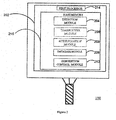
- FIG. 2 illustrates various modules embedded in a broadcasting device (200) according to an embodiment of the invention.
- the broadcasting device (200) comprises of a pluggable device (202) communicatively coupled with the broadcasting device (200).
- the pluggable device (202) further comprises a first processor (214) and a first memory (216), wherein the first memory (216) is coupled to the first processor (214).
- the first memory (216) further comprises a plurality of modules such as a detection module (204), a transceiver module (206), an authorization module (208), a database module (210) and a congestion control module (212).
- the detection module (204) is configured to detect the presence of at least one smart communication device within its vicinity.
- the pluggable device (202) further enables the transceiver module (206) to establish a handshake communication channel with the at least one smart communication device.
- the authorization module (208) is further configured to authorize the at least one smart communication device using at least one cryptographic technique such as public-key cryptography or transparent encryption or symmetric encryption or the like. Further, in another embodiment, the authorization module (208) is further configured to authorize the at least one smart communication device using at least one authentication or authorization technique selected from a group comprising secret passphrase, PIN, password, challenge-response or combinations thereof.
- the database module (210) is further configured to store the information received either from the server (124 of figure 1 ) or from the smart communication device.
- the congestion control module (212) is configured to control the congestion traffic due to instantaneous information exchange with a plurality of smart communication devices and a plurality of broadcasting devices.
- the congestion control module (212) is further enabled to maintain the robustness and integrity of the communication and all the users present in the vicinity of the broadcasting device (200).
- the broadcasting device (200) may be installed at a remote location with no network connectivity as well as no power availability.
- the broadcasting device (200) is adapted to draw power from non-conventional source of energy including solar, wind, tidal, geo-thermal, biomass or combinations thereof.
- the pluggable device (202) would exchange information with the server (124 of figure 1 ) using the smart communication devices as the communication channel, as explained earlier under [042] and [043].
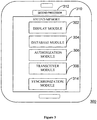
- FIG. 3 illustrates various modules embedded in a smart communication device (300) according to an embodiment of the invention.
- the smart communication device (300) illustrated in figure 3 can be considered to be at least one smart communication device selected from the first set of smart communication devices (102) or from the second set of smart communication devices (116), as illustrated in figure 1 .
- the smart communication device (300) comprises a second processor (312) and a second memory (310), wherein the second memory (310) is coupled to the second processor (312).
- the second memory (310) further comprises a plurality of modules such as a display module (302), a database module (304), an authorization module (306), a transceiver module (308) and a synchronization module.
- the at least one pluggable device when the smart communication device (300) is detected by at least one pluggable device (not shown in the figure) coupled with at least one broadcasting device (not shown in the figure), the at least one pluggable device transmits the information to the smart communication device (300) through a handshake communication channel.
- the display module (302) is configured to display the information received from the broadcasting device to the user.
- the database module (304) is further adapted to store the information received for future reference of the user. In one embodiment, before transmitting the information, the at least one smart communication device (300) is authorized.
- the method for authorizing the smart communication device (300) is performed by the authorization module (306) using at least one cryptographic technique such as public-key cryptography or transparent encryption or symmetric encryption or at least one authentication, authorization technique such as secret passphrase, PIN, password, challenge-response.
- the transceiver module (308) is further adapted for transmitting and receiving the information to and from the at least one broadcasting device.
- the second processor (312) is further adapted to control the display module (302), the database module (304), the authorization module (306) and the transceiver module (308) are configured to perform one or more intended functions/tasks/methodologies as disclosed above.
- the synchronization module (314) is configured to synchronize the information to be published on the plurality of broadcasting devices.
- the received information can be utilized for enabling the second processor (312) to perform analytics, in-depth search based on user preferences, monetary transactions, etc.
- the second processor (312) is also configured to analyze the user demographic profile to selectively filter the information relevant with the user's demographic profile and discarding the irrelevant information received from the plurality of broadcasting devices. This helps in avoiding overloading of second memory space with irrelevant information in the database module (304).
- a pluggable device, at least one broadcasting device and a handshake communication channel illustrated in figure 2 and figure 3 are similar to the pluggable device (114, 128), the broadcasting device (112, 122) and the handshake communication channel (108) as illustrated in figure 1 .
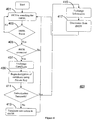
- FIG. 4 illustrates a flow diagram (400) showing various steps implemented by the system (400) according to exemplary embodiment of the invention.
- the at least one broadcasting device and the at least one smart communication device as shown in figure 1 are referred as Billboard Information Communication System (BICS) and Smart Billboard Information Display System (iBIDS) respectively.
- BICS Billboard Information Communication System
- iBIDS Smart Billboard Information Display System
- the BICS is an autonomous, remote-controlled or remotely-programmed, electronic device that can be placed near a billboard/business establishment which establishes a handshake communication channel and initiates the information exchange with the iBIDS.
- the iBIDS is a smart communication device that is carried by the customer or is present with the customer which is capable of working independently to communicate with the BICS.
- the BICS and the iBIDS are provided with their own set of keys, wherein the set of keys comprises a public key and a private key for encrypting or decrypting at least one certificate that is to be shared between the iBIDS and BICS for authorization in order to enable exchange of the information.
- the BICS is in searching mode to detect the at least one iBIDS within its vicinity.
- the BICS is connected with the detected iBIDS, or the BICS continuously searches for the iBIDS, until the iBIDS is detected within its vicinity.
- a connection request is initiated from the BICS to the iBIDS for establishing the handshake communication channel.
- the iBIDS is capable of accepting this connection request non-intrusively.
- the iBIDS is adapted to transmit at least one authorization certificate to the BICS for authorization of the iBIDS with the BICS.
- the BICS is adapted to decrypt the authorization certificate using its private key.
- the exchange of information takes place between the BICS and the iBIDS at step (415).
- the BICS gets disconnected from the iBIDS.
- the BICS terminates the handshake communication channel with the iBIDS at step (413).
- FIG. 5 is a working example illustrating the communication between a car infotainment system (510) integrated within a vehicle (508) and a billboard (502) while passing through the billboard (502).
- the car infotainment system (510) refers to 'iBIDS' and the billboard refer to 'BICS' which exchanges the information through a handshake communication channel (506).
- a pluggable device (504) is communicatively and/or physically coupled with the billboard (502). The pluggable device (504) detects the car infotainment system (510), when the vehicle (508) moving on a highway at a very high speed appears within the vicinity of the pluggable device (504).
- the pluggable device (504) is further enabled to establish the handshake communication channel (506) with the car infotainment system (510) to transmit the information.
- the car infotainment system (510) is then adapted to receive the transmitted information which gets stored for future reference. As the vehicle (508) moves out of the vicinity of the pluggable device (504), the established communication channel (506) gets disconnected from the car infotainment system (510).
- the car infotainment system (510) further carries the information to different location and synchronizes the information of another billboard which is remotely located and hence intermittently connected with the server.
- the car infotainment system (510) can relay the information to other 'iBIDS' (not shown in the figure) in the vicinity capable of carrying the information, which then synchronizes the information of the billboard remotely located (not shown in the figure) in no network connectivity area and intermittently connected with the server.
- the present invention provides a means for communication between a broadcasting device or billboard and a person/user carrying a smart communication device for exchanging information between them.
- the present invention further reduces the communication barrier and also enhances the capability of the Out-of-home (OOH) advertising platform or billboard to be noticed, stored/saved in the memory of the smart communication device and analyzed at a later point.
- OOH Out-of-home
- the present invention is further enabled to transmit the information published on the Out-of-home (OOH) advertising platform to the smart communication device over a wireless communication channel in a non-intrusive manner.
- OOH Out-of-home
- the present invention is further enabled to transmit such information to the person or user carrying the smart communication device in a very short span of time (to cater people moving at high speeds such as highways).
- the present invention is further enabled to transmit the information based on the user's demographic profile or user preferences and further discard all the information received from the broadcasting device in order to release the memory space of the smart communication device.
Landscapes
- Engineering & Computer Science (AREA)
- Computer Networks & Wireless Communication (AREA)
- Signal Processing (AREA)
- Business, Economics & Management (AREA)
- Computer Security & Cryptography (AREA)
- Strategic Management (AREA)
- Finance (AREA)
- Accounting & Taxation (AREA)
- Development Economics (AREA)
- General Business, Economics & Management (AREA)
- Marketing (AREA)
- Physics & Mathematics (AREA)
- Economics (AREA)
- General Physics & Mathematics (AREA)
- Theoretical Computer Science (AREA)
- Entrepreneurship & Innovation (AREA)
- Game Theory and Decision Science (AREA)
- Multimedia (AREA)
- Mobile Radio Communication Systems (AREA)
Claims (6)
- Verfahren zum dynamischen Synchronisieren von auf einer Vielzahl von Rundsendevorrichtungen zu veröffentlichenden Informationen mit den Informationen, die auf einem Server (124) in einer intermittierenden Netzwerkverbindung gespeichert sind, gekennzeichnet durch das Weiterleiten der Informationen über eine oder mehrere Zwischenkommunikationsgeräte, wobei das Verfahren umfasst:Erfassen eines ersten Kommunikationsgerätes eines ersten Satzes von Kommunikationsgeräten (102), das in einer Kommunikationsreichweite der ersten Rundsendevorrichtung (112) vorhanden ist, durch eine erste Rundsendevorrichtung (112), eines ersten Satzes von Rundsendevorrichtungen (110);Einrichten eines Handshake-Kommunikationskanals (108) zwischen dem ersten Kommunikationsgerät (102) und der ersten Rundsendevorrichtung (112), wobei das erste Kommunikationsgerät (102) unter Verwendung mindestens ein Verfahrens der Authentifizierung, der Autorisierungs oder der Kryptographie autorisiert ist, ehe der Handshake-Kommunikationskanal (108) eingerichtet wird;Übertragen der vom Server (124) erhaltenen Informationen durch die erste Rundsendevorrichtung (112) an das erste Kommunikationsgerät über den Handshake-Kommunikationskanal (108), wobei das erste Kommunikationsgerät das demografische Benutzerprofil analysiert, um die empfangenen Informationen selektiv zu filtern, die für das demografische Benutzerprofil relevant sind;Weiterleiten der von dem ersten Kommunikationsgerät empfangenen Informationen an ein zweites Kommunikationsgerät eines zweiten Satzes von Kommunikationsgeräten (116);Einrichten des Handshake-Kommunikationskanals (108) zwischen dem zweiten Kommunikationsgerät des zweiten Satzes von Kommunikationsgeräten (116) und einer zweiten Rundsendevorrichtung (112) eines zweiten Satzes von Rundsendevorrichtungen (120) mit intermittierender Netzwerkverbindung zum Server (124);Verifizieren durch das zweite Kommunikationsgerät, dass die zuvor auf der zweiten Rundsendevorrichtung (112) eines zweiten Satzes von Rundsendevorrichtungen gespeicherten Informationen vor der Synchronisation der Daten synchronisiert werden; undwenn die Informationen nicht synchronisiert sind, Synchronisieren der zuvor auf der zweiten Rundsendevorrichtung des zweiten Satzes von Rundsendevorrichtungen gespeicherten Daten mit den Daten, die an das zweite Kommunikationsgerät des zweiten Satzes von Kommunikationsgeräten unter Verwendung des Handshake-Kommunikationskanals weitergeleitet wurden.
- Verfahren nach Anspruch 1, wobei der erste Satz Rundsendevorrichtungen (110) kommunikativ mit dem Server (124) gekoppelt ist.
- Verfahren nach einem der vorhergehenden Ansprüche, wobei der Server (124) zum periodischen Aktualisieren der von dem ersten Satz von Rundsendevorrichtungen (110) und dem zweiten Satz von Rundsendevorrichtungen (120) zu veröffentlichen Informationen konfiguriert ist.
- Verfahren nach einem der vorhergehenden Ansprüche, wobei das mindestens eine Verfahren der Authentifizierung/ Autorisierung aus einer Gruppe ausgewählt werden kann, die aus geheimer Passphrase, PIN, Passwort, Frage-Antwort oder Kombinationen daraus besteht.
- Verfahren nach einem der vorhergehenden Ansprüche, wobei das mindestens eine kryptographische Verfahren aus einer Gruppe ausgewählt werden kann, die das Public-Key-Verschlüsselungsverfahren, die transparente Verschlüsselung, die symmetrische Verschlüsselung oder Kombinationen daraus umfasst.
- System zum dynamischen Synchronisieren von auf einer Vielzahl von Rundsendevorrichtungen (110) zu veröffentlichenden Informationen, wobei die Information auf einem Server (124) in einer intermettierenden Netzwerkumgebung gespeichert ist, gekennzeichnet durch das Weiterleiten der Informationen über ein oder mehrere Zwischenkommunikationsgeräte, wobei das System Mittel zum Ausführen der Schritte des Verfahrens nach einem der Ansprüche 1 bis 5 umfasst.
Applications Claiming Priority (1)
| Application Number | Priority Date | Filing Date | Title |
|---|---|---|---|
| IN1757MU2013 | 2013-05-16 |
Publications (2)
| Publication Number | Publication Date |
|---|---|
| EP2804410A1 EP2804410A1 (de) | 2014-11-19 |
| EP2804410B1 true EP2804410B1 (de) | 2019-10-02 |
Family
ID=50137482
Family Applications (1)
| Application Number | Title | Priority Date | Filing Date |
|---|---|---|---|
| EP14154657.2A Active EP2804410B1 (de) | 2013-05-16 | 2014-02-11 | Intelligenter kommunikations- und werbemechanismus |
Country Status (3)
| Country | Link |
|---|---|
| US (1) | US9355409B2 (de) |
| EP (1) | EP2804410B1 (de) |
| AU (1) | AU2014200887B2 (de) |
Families Citing this family (12)
| Publication number | Priority date | Publication date | Assignee | Title |
|---|---|---|---|---|
| WO2015081260A1 (en) * | 2013-11-27 | 2015-06-04 | Cloudwear | Responding to an advertisement using a mobile computing device |
| JP6578705B2 (ja) * | 2015-03-31 | 2019-09-25 | 富士通株式会社 | 配信システム、配信方法、配信装置および配信プログラム |
| US11113727B2 (en) | 2017-10-11 | 2021-09-07 | Toyota Motor Engineering & Manufacturing North America, Inc. | Systems and methods for dynamic road sign personalization |
| US20190251600A1 (en) * | 2018-02-10 | 2019-08-15 | Andres Felipe Cabrera | Vehicle-mounted directed advertisement system and method |
| US10728230B2 (en) * | 2018-07-05 | 2020-07-28 | Dell Products L.P. | Proximity-based authorization for encryption and decryption services |
| US10917680B2 (en) | 2018-10-01 | 2021-02-09 | Uvertz, Llc | Distributing content to render at vehicles |
| US10949887B2 (en) | 2018-10-01 | 2021-03-16 | Uvertz, Llc | Transmitting display content to vehicles to render contemporaneously during a content time period with related content at a display screen |
| US11064241B2 (en) | 2018-10-01 | 2021-07-13 | Uvertz, Llc | Rendering content at a vehicle transmitted from a content distribution system |
| JP7119863B2 (ja) * | 2018-10-02 | 2022-08-17 | トヨタ自動車株式会社 | 路側装置、センタサーバ、及び情報処理方法 |
| EP3661155B1 (de) * | 2018-11-29 | 2022-07-20 | Tata Consultancy Services Limited | Autonomes kontextbewusstes hierarchisches kognitives edge-netzwerk mit zustandsaustausch |
| US10795527B1 (en) * | 2019-04-26 | 2020-10-06 | Capital One Services, Llc | Systems and methods configured to provide the improved real time user experience involving mobile computing devices, a back-end server and NFC-coupled interactive posters including encryption, network operation and/or other features |
| US10659525B1 (en) | 2019-04-26 | 2020-05-19 | Capital One Services, Llc | Computer-based platforms/systems, computing devices/components and/or computing methods for one or more technological applications involving real-time data processing between a server, one or more mobile computing devices and near field communication connected interactive posters |
Family Cites Families (13)
| Publication number | Priority date | Publication date | Assignee | Title |
|---|---|---|---|---|
| US7038637B1 (en) * | 1999-04-22 | 2006-05-02 | Si Diamond Technology, Inc. | System and method for selling advertising space on electronic billboards over the internet |
| JP2001333455A (ja) | 2000-05-23 | 2001-11-30 | Aisin Aw Co Ltd | 移動体広告情報配信方法、移動体広告情報配信システム、移動体広告情報登録システム、移動体広告情報課金システム、移動体通信機器及び記録媒体 |
| US20020087401A1 (en) | 2000-12-29 | 2002-07-04 | Gateway, Inc. | System and method for targeted advertising |
| US6993326B2 (en) | 2001-04-02 | 2006-01-31 | Bellsouth Intellectual Property Corporation | System and method for providing short message targeted advertisements over a wireless communications network |
| US20050171788A1 (en) * | 2004-01-30 | 2005-08-04 | Shah Arshad A. | Wireless display system |
| US7353034B2 (en) | 2005-04-04 | 2008-04-01 | X One, Inc. | Location sharing and tracking using mobile phones or other wireless devices |
| US7783575B2 (en) * | 2006-02-13 | 2010-08-24 | Rmg Networks, Inc. | Method and apparatus for connecting a network of electronic signs |
| US7620026B2 (en) | 2006-10-12 | 2009-11-17 | At&T Intellectual Property I, L.P. | Methods, systems, and computer program products for providing advertising and/or information services over mobile ad hoc cooperative networks using electronic billboards and related devices |
| US9830637B2 (en) * | 2007-02-23 | 2017-11-28 | Epona Llc | System and method for processing vehicle transactions |
| WO2010120375A1 (en) * | 2009-04-17 | 2010-10-21 | Daktronics, Inc. | An enterprise network system for programmable electronic displays |
| US9972026B2 (en) * | 2012-04-27 | 2018-05-15 | Beelinx Usa, Llc | Use of localized broadcast signals to modify mobile application behavior |
| DE112013005751B4 (de) * | 2012-11-30 | 2023-11-30 | Myine Electronics, Inc. | Systeme und Verfahren zum Einfügen von gespeichertem Werbeinhalt in Rundfunkinhalt |
| US9037133B2 (en) * | 2012-12-27 | 2015-05-19 | Verizon Patent And Licensing Inc. | Broadcast based proximity service to mobile device users |
-
2014
- 2014-02-11 EP EP14154657.2A patent/EP2804410B1/de active Active
- 2014-02-13 US US14/179,677 patent/US9355409B2/en active Active
- 2014-02-20 AU AU2014200887A patent/AU2014200887B2/en active Active
Non-Patent Citations (1)
| Title |
|---|
| None * |
Also Published As
| Publication number | Publication date |
|---|---|
| EP2804410A1 (de) | 2014-11-19 |
| AU2014200887B2 (en) | 2015-10-01 |
| US9355409B2 (en) | 2016-05-31 |
| AU2014200887A1 (en) | 2014-12-04 |
| US20140344063A1 (en) | 2014-11-20 |
Similar Documents
| Publication | Publication Date | Title |
|---|---|---|
| US9355409B2 (en) | Intelligent communication and advertising mechanism | |
| TWI450554B (zh) | 無線網路驗證機制 | |
| US20130013414A1 (en) | Apparatus and method for direct discovery of digital content from observed physical media | |
| KR101464950B1 (ko) | 정보 처리 및 전달 방법 | |
| US10733396B2 (en) | Systems and methods for scanning a user environment and evaluating data of interest | |
| US8635058B2 (en) | Increasing the relevancy of media content | |
| US20130228615A1 (en) | Systems and methods for scanning a user environment and evaluating data of interest | |
| CN101421985A (zh) | 使用无线信标广播来提供媒体消息 | |
| CN1338081A (zh) | 在因特网中的电子广告牌上销售广告空间的系统和方法 | |
| TW201907351A (zh) | 利用移動體的廣告之提供及管理 | |
| US20160337548A1 (en) | System and Method for Capturing and Sharing Content | |
| KR20100057014A (ko) | 컨텐츠 퍼블리싱 시스템 및 방법 | |
| KR20250122440A (ko) | 웹 기반 활동에 따른 맞춤형 광고 제공 장치 및 방법 | |
| CN1326098C (zh) | 定向图像显示 | |
| US7936397B2 (en) | Method and process for electronically posting bulletin board messages | |
| KR20220005665A (ko) | 광역 와이파이를 이용한 실내 및 실외 와이파이 광고 시스템 및 광고 서비스 방법 | |
| TW201629871A (zh) | 結合多媒體及社群整合之app商業方法及其裝置 | |
| KR100394122B1 (ko) | 개인 접근정보를 획득하고 획득된 개인 접근정보를이용하여 통신망을 통해 전자정보를 제공하는 방법 및 장치 | |
| KR20150091200A (ko) | 사물통신 기반의 광고 제공 시스템 및 그 제공 방법 | |
| Idwan et al. | Enhancing mobile advertising via Bluetooth technology | |
| US20080082403A1 (en) | Method for providing customized information for using a public transportation system | |
| JP2001022840A (ja) | インターネット網を利用した広告掲出システム | |
| WO2020245837A1 (en) | Interactive billboard system and method thereof | |
| KR20140042392A (ko) | Nfc 기반의 스마트폰을 이용한 광고정보의 전파방법 | |
| US20220182100A1 (en) | System and method for interactive communication |
Legal Events
| Date | Code | Title | Description |
|---|---|---|---|
| PUAI | Public reference made under article 153(3) epc to a published international application that has entered the european phase |
Free format text: ORIGINAL CODE: 0009012 |
|
| 17P | Request for examination filed |
Effective date: 20140211 |
|
| AK | Designated contracting states |
Kind code of ref document: A1 Designated state(s): AL AT BE BG CH CY CZ DE DK EE ES FI FR GB GR HR HU IE IS IT LI LT LU LV MC MK MT NL NO PL PT RO RS SE SI SK SM TR |
|
| AX | Request for extension of the european patent |
Extension state: BA ME |
|
| R17P | Request for examination filed (corrected) |
Effective date: 20150519 |
|
| RBV | Designated contracting states (corrected) |
Designated state(s): AL AT BE BG CH CY CZ DE DK EE ES FI FR GB GR HR HU IE IS IT LI LT LU LV MC MK MT NL NO PL PT RO RS SE SI SK SM TR |
|
| STAA | Information on the status of an ep patent application or granted ep patent |
Free format text: STATUS: EXAMINATION IS IN PROGRESS |
|
| 17Q | First examination report despatched |
Effective date: 20170817 |
|
| REG | Reference to a national code |
Ref country code: DE Ref legal event code: R079 Ref document number: 602014054447 Country of ref document: DE Free format text: PREVIOUS MAIN CLASS: H04W0012060000 Ipc: H04W0004060000 |
|
| GRAP | Despatch of communication of intention to grant a patent |
Free format text: ORIGINAL CODE: EPIDOSNIGR1 |
|
| STAA | Information on the status of an ep patent application or granted ep patent |
Free format text: STATUS: GRANT OF PATENT IS INTENDED |
|
| RIC1 | Information provided on ipc code assigned before grant |
Ipc: H04W 4/21 20180101ALI20190401BHEP Ipc: H04W 4/06 20090101AFI20190401BHEP Ipc: H04W 12/06 20090101ALI20190401BHEP Ipc: G06Q 30/02 20120101ALI20190401BHEP |
|
| INTG | Intention to grant announced |
Effective date: 20190426 |
|
| GRAS | Grant fee paid |
Free format text: ORIGINAL CODE: EPIDOSNIGR3 |
|
| GRAA | (expected) grant |
Free format text: ORIGINAL CODE: 0009210 |
|
| STAA | Information on the status of an ep patent application or granted ep patent |
Free format text: STATUS: THE PATENT HAS BEEN GRANTED |
|
| AK | Designated contracting states |
Kind code of ref document: B1 Designated state(s): AL AT BE BG CH CY CZ DE DK EE ES FI FR GB GR HR HU IE IS IT LI LT LU LV MC MK MT NL NO PL PT RO RS SE SI SK SM TR |
|
| REG | Reference to a national code |
Ref country code: GB Ref legal event code: FG4D |
|
| REG | Reference to a national code |
Ref country code: CH Ref legal event code: EP Ref country code: CH Ref legal event code: NV Representative=s name: DENNEMEYER AG, CH Ref country code: AT Ref legal event code: REF Ref document number: 1187558 Country of ref document: AT Kind code of ref document: T Effective date: 20191015 |
|
| REG | Reference to a national code |
Ref country code: DE Ref legal event code: R096 Ref document number: 602014054447 Country of ref document: DE |
|
| REG | Reference to a national code |
Ref country code: IE Ref legal event code: FG4D |
|
| REG | Reference to a national code |
Ref country code: NL Ref legal event code: FP |
|
| REG | Reference to a national code |
Ref country code: LT Ref legal event code: MG4D |
|
| REG | Reference to a national code |
Ref country code: AT Ref legal event code: MK05 Ref document number: 1187558 Country of ref document: AT Kind code of ref document: T Effective date: 20191002 |
|
| PG25 | Lapsed in a contracting state [announced via postgrant information from national office to epo] |
Ref country code: ES Free format text: LAPSE BECAUSE OF FAILURE TO SUBMIT A TRANSLATION OF THE DESCRIPTION OR TO PAY THE FEE WITHIN THE PRESCRIBED TIME-LIMIT Effective date: 20191002 Ref country code: GR Free format text: LAPSE BECAUSE OF FAILURE TO SUBMIT A TRANSLATION OF THE DESCRIPTION OR TO PAY THE FEE WITHIN THE PRESCRIBED TIME-LIMIT Effective date: 20200103 Ref country code: PL Free format text: LAPSE BECAUSE OF FAILURE TO SUBMIT A TRANSLATION OF THE DESCRIPTION OR TO PAY THE FEE WITHIN THE PRESCRIBED TIME-LIMIT Effective date: 20191002 Ref country code: NO Free format text: LAPSE BECAUSE OF FAILURE TO SUBMIT A TRANSLATION OF THE DESCRIPTION OR TO PAY THE FEE WITHIN THE PRESCRIBED TIME-LIMIT Effective date: 20200102 Ref country code: LT Free format text: LAPSE BECAUSE OF FAILURE TO SUBMIT A TRANSLATION OF THE DESCRIPTION OR TO PAY THE FEE WITHIN THE PRESCRIBED TIME-LIMIT Effective date: 20191002 Ref country code: SE Free format text: LAPSE BECAUSE OF FAILURE TO SUBMIT A TRANSLATION OF THE DESCRIPTION OR TO PAY THE FEE WITHIN THE PRESCRIBED TIME-LIMIT Effective date: 20191002 Ref country code: LV Free format text: LAPSE BECAUSE OF FAILURE TO SUBMIT A TRANSLATION OF THE DESCRIPTION OR TO PAY THE FEE WITHIN THE PRESCRIBED TIME-LIMIT Effective date: 20191002 Ref country code: PT Free format text: LAPSE BECAUSE OF FAILURE TO SUBMIT A TRANSLATION OF THE DESCRIPTION OR TO PAY THE FEE WITHIN THE PRESCRIBED TIME-LIMIT Effective date: 20200203 Ref country code: AT Free format text: LAPSE BECAUSE OF FAILURE TO SUBMIT A TRANSLATION OF THE DESCRIPTION OR TO PAY THE FEE WITHIN THE PRESCRIBED TIME-LIMIT Effective date: 20191002 Ref country code: BG Free format text: LAPSE BECAUSE OF FAILURE TO SUBMIT A TRANSLATION OF THE DESCRIPTION OR TO PAY THE FEE WITHIN THE PRESCRIBED TIME-LIMIT Effective date: 20200102 Ref country code: FI Free format text: LAPSE BECAUSE OF FAILURE TO SUBMIT A TRANSLATION OF THE DESCRIPTION OR TO PAY THE FEE WITHIN THE PRESCRIBED TIME-LIMIT Effective date: 20191002 |
|
| PG25 | Lapsed in a contracting state [announced via postgrant information from national office to epo] |
Ref country code: CZ Free format text: LAPSE BECAUSE OF FAILURE TO SUBMIT A TRANSLATION OF THE DESCRIPTION OR TO PAY THE FEE WITHIN THE PRESCRIBED TIME-LIMIT Effective date: 20191002 Ref country code: RS Free format text: LAPSE BECAUSE OF FAILURE TO SUBMIT A TRANSLATION OF THE DESCRIPTION OR TO PAY THE FEE WITHIN THE PRESCRIBED TIME-LIMIT Effective date: 20191002 Ref country code: IS Free format text: LAPSE BECAUSE OF FAILURE TO SUBMIT A TRANSLATION OF THE DESCRIPTION OR TO PAY THE FEE WITHIN THE PRESCRIBED TIME-LIMIT Effective date: 20200224 Ref country code: HR Free format text: LAPSE BECAUSE OF FAILURE TO SUBMIT A TRANSLATION OF THE DESCRIPTION OR TO PAY THE FEE WITHIN THE PRESCRIBED TIME-LIMIT Effective date: 20191002 |
|
| PG25 | Lapsed in a contracting state [announced via postgrant information from national office to epo] |
Ref country code: AL Free format text: LAPSE BECAUSE OF FAILURE TO SUBMIT A TRANSLATION OF THE DESCRIPTION OR TO PAY THE FEE WITHIN THE PRESCRIBED TIME-LIMIT Effective date: 20191002 |
|
| REG | Reference to a national code |
Ref country code: DE Ref legal event code: R097 Ref document number: 602014054447 Country of ref document: DE |
|
| PG2D | Information on lapse in contracting state deleted |
Ref country code: IS |
|
| PG25 | Lapsed in a contracting state [announced via postgrant information from national office to epo] |
Ref country code: EE Free format text: LAPSE BECAUSE OF FAILURE TO SUBMIT A TRANSLATION OF THE DESCRIPTION OR TO PAY THE FEE WITHIN THE PRESCRIBED TIME-LIMIT Effective date: 20191002 Ref country code: DK Free format text: LAPSE BECAUSE OF FAILURE TO SUBMIT A TRANSLATION OF THE DESCRIPTION OR TO PAY THE FEE WITHIN THE PRESCRIBED TIME-LIMIT Effective date: 20191002 Ref country code: RO Free format text: LAPSE BECAUSE OF FAILURE TO SUBMIT A TRANSLATION OF THE DESCRIPTION OR TO PAY THE FEE WITHIN THE PRESCRIBED TIME-LIMIT Effective date: 20191002 Ref country code: IS Free format text: LAPSE BECAUSE OF FAILURE TO SUBMIT A TRANSLATION OF THE DESCRIPTION OR TO PAY THE FEE WITHIN THE PRESCRIBED TIME-LIMIT Effective date: 20200202 |
|
| PLBE | No opposition filed within time limit |
Free format text: ORIGINAL CODE: 0009261 |
|
| STAA | Information on the status of an ep patent application or granted ep patent |
Free format text: STATUS: NO OPPOSITION FILED WITHIN TIME LIMIT |
|
| PG25 | Lapsed in a contracting state [announced via postgrant information from national office to epo] |
Ref country code: SM Free format text: LAPSE BECAUSE OF FAILURE TO SUBMIT A TRANSLATION OF THE DESCRIPTION OR TO PAY THE FEE WITHIN THE PRESCRIBED TIME-LIMIT Effective date: 20191002 Ref country code: SK Free format text: LAPSE BECAUSE OF FAILURE TO SUBMIT A TRANSLATION OF THE DESCRIPTION OR TO PAY THE FEE WITHIN THE PRESCRIBED TIME-LIMIT Effective date: 20191002 Ref country code: IT Free format text: LAPSE BECAUSE OF FAILURE TO SUBMIT A TRANSLATION OF THE DESCRIPTION OR TO PAY THE FEE WITHIN THE PRESCRIBED TIME-LIMIT Effective date: 20191002 |
|
| 26N | No opposition filed |
Effective date: 20200703 |
|
| REG | Reference to a national code |
Ref country code: BE Ref legal event code: MM Effective date: 20200229 |
|
| PG25 | Lapsed in a contracting state [announced via postgrant information from national office to epo] |
Ref country code: MC Free format text: LAPSE BECAUSE OF FAILURE TO SUBMIT A TRANSLATION OF THE DESCRIPTION OR TO PAY THE FEE WITHIN THE PRESCRIBED TIME-LIMIT Effective date: 20191002 Ref country code: LU Free format text: LAPSE BECAUSE OF NON-PAYMENT OF DUE FEES Effective date: 20200211 |
|
| PG25 | Lapsed in a contracting state [announced via postgrant information from national office to epo] |
Ref country code: SI Free format text: LAPSE BECAUSE OF FAILURE TO SUBMIT A TRANSLATION OF THE DESCRIPTION OR TO PAY THE FEE WITHIN THE PRESCRIBED TIME-LIMIT Effective date: 20191002 |
|
| PG25 | Lapsed in a contracting state [announced via postgrant information from national office to epo] |
Ref country code: IE Free format text: LAPSE BECAUSE OF NON-PAYMENT OF DUE FEES Effective date: 20200211 |
|
| PG25 | Lapsed in a contracting state [announced via postgrant information from national office to epo] |
Ref country code: BE Free format text: LAPSE BECAUSE OF NON-PAYMENT OF DUE FEES Effective date: 20200229 |
|
| PG25 | Lapsed in a contracting state [announced via postgrant information from national office to epo] |
Ref country code: TR Free format text: LAPSE BECAUSE OF FAILURE TO SUBMIT A TRANSLATION OF THE DESCRIPTION OR TO PAY THE FEE WITHIN THE PRESCRIBED TIME-LIMIT Effective date: 20191002 Ref country code: MT Free format text: LAPSE BECAUSE OF FAILURE TO SUBMIT A TRANSLATION OF THE DESCRIPTION OR TO PAY THE FEE WITHIN THE PRESCRIBED TIME-LIMIT Effective date: 20191002 Ref country code: CY Free format text: LAPSE BECAUSE OF FAILURE TO SUBMIT A TRANSLATION OF THE DESCRIPTION OR TO PAY THE FEE WITHIN THE PRESCRIBED TIME-LIMIT Effective date: 20191002 |
|
| PG25 | Lapsed in a contracting state [announced via postgrant information from national office to epo] |
Ref country code: MK Free format text: LAPSE BECAUSE OF FAILURE TO SUBMIT A TRANSLATION OF THE DESCRIPTION OR TO PAY THE FEE WITHIN THE PRESCRIBED TIME-LIMIT Effective date: 20191002 |
|
| P01 | Opt-out of the competence of the unified patent court (upc) registered |
Effective date: 20230526 |
|
| REG | Reference to a national code |
Ref country code: CH Ref legal event code: U11 Free format text: ST27 STATUS EVENT CODE: U-0-0-U10-U11 (AS PROVIDED BY THE NATIONAL OFFICE) Effective date: 20260301 |
|
| PGFP | Annual fee paid to national office [announced via postgrant information from national office to epo] |
Ref country code: NL Payment date: 20260227 Year of fee payment: 13 |
|
| PGFP | Annual fee paid to national office [announced via postgrant information from national office to epo] |
Ref country code: GB Payment date: 20260227 Year of fee payment: 13 |
|
| PGFP | Annual fee paid to national office [announced via postgrant information from national office to epo] |
Ref country code: DE Payment date: 20260227 Year of fee payment: 13 |
|
| PGFP | Annual fee paid to national office [announced via postgrant information from national office to epo] |
Ref country code: FR Payment date: 20260227 Year of fee payment: 13 |
|
| PGFP | Annual fee paid to national office [announced via postgrant information from national office to epo] |
Ref country code: CH Payment date: 20260301 Year of fee payment: 13 |