EP2803939B1 - Vorratsmodul zum Versorgen eines Waffensystems sowie Waffensystem mit Vorratsmodul - Google Patents
Vorratsmodul zum Versorgen eines Waffensystems sowie Waffensystem mit Vorratsmodul Download PDFInfo
- Publication number
- EP2803939B1 EP2803939B1 EP14001619.7A EP14001619A EP2803939B1 EP 2803939 B1 EP2803939 B1 EP 2803939B1 EP 14001619 A EP14001619 A EP 14001619A EP 2803939 B1 EP2803939 B1 EP 2803939B1
- Authority
- EP
- European Patent Office
- Prior art keywords
- supply module
- weapons system
- electrical
- weapon system
- storage apparatus
- Prior art date
- Legal status (The legal status is an assumption and is not a legal conclusion. Google has not performed a legal analysis and makes no representation as to the accuracy of the status listed.)
- Active
Links
Images
Classifications
-
- H—ELECTRICITY
- H05—ELECTRIC TECHNIQUES NOT OTHERWISE PROVIDED FOR
- H05K—PRINTED CIRCUITS; CASINGS OR CONSTRUCTIONAL DETAILS OF ELECTRIC APPARATUS; MANUFACTURE OF ASSEMBLAGES OF ELECTRICAL COMPONENTS
- H05K7/00—Constructional details common to different types of electric apparatus
- H05K7/20—Modifications to facilitate cooling, ventilating, or heating
- H05K7/2089—Modifications to facilitate cooling, ventilating, or heating for power electronics, e.g. for inverters for controlling motor
-
- H—ELECTRICITY
- H01—ELECTRIC ELEMENTS
- H01M—PROCESSES OR MEANS, e.g. BATTERIES, FOR THE DIRECT CONVERSION OF CHEMICAL ENERGY INTO ELECTRICAL ENERGY
- H01M10/00—Secondary cells; Manufacture thereof
- H01M10/05—Accumulators with non-aqueous electrolyte
- H01M10/052—Li-accumulators
-
- F—MECHANICAL ENGINEERING; LIGHTING; HEATING; WEAPONS; BLASTING
- F28—HEAT EXCHANGE IN GENERAL
- F28D—HEAT-EXCHANGE APPARATUS, NOT PROVIDED FOR IN ANOTHER SUBCLASS, IN WHICH THE HEAT-EXCHANGE MEDIA DO NOT COME INTO DIRECT CONTACT
- F28D20/00—Heat storage plants or apparatus in general; Regenerative heat-exchange apparatus not covered by groups F28D17/00 or F28D19/00
- F28D20/0034—Heat storage plants or apparatus in general; Regenerative heat-exchange apparatus not covered by groups F28D17/00 or F28D19/00 using liquid heat storage material
-
- F—MECHANICAL ENGINEERING; LIGHTING; HEATING; WEAPONS; BLASTING
- F28—HEAT EXCHANGE IN GENERAL
- F28D—HEAT-EXCHANGE APPARATUS, NOT PROVIDED FOR IN ANOTHER SUBCLASS, IN WHICH THE HEAT-EXCHANGE MEDIA DO NOT COME INTO DIRECT CONTACT
- F28D20/00—Heat storage plants or apparatus in general; Regenerative heat-exchange apparatus not covered by groups F28D17/00 or F28D19/00
- F28D20/02—Heat storage plants or apparatus in general; Regenerative heat-exchange apparatus not covered by groups F28D17/00 or F28D19/00 using latent heat
-
- F—MECHANICAL ENGINEERING; LIGHTING; HEATING; WEAPONS; BLASTING
- F41—WEAPONS
- F41H—ARMOUR; ARMOURED TURRETS; ARMOURED OR ARMED VEHICLES; MEANS OF ATTACK OR DEFENCE, e.g. CAMOUFLAGE, IN GENERAL
- F41H13/00—Means of attack or defence not otherwise provided for
- F41H13/0043—Directed energy weapons, i.e. devices that direct a beam of high energy content toward a target for incapacitating or destroying the target
-
- H—ELECTRICITY
- H01—ELECTRIC ELEMENTS
- H01M—PROCESSES OR MEANS, e.g. BATTERIES, FOR THE DIRECT CONVERSION OF CHEMICAL ENERGY INTO ELECTRICAL ENERGY
- H01M10/00—Secondary cells; Manufacture thereof
- H01M10/05—Accumulators with non-aqueous electrolyte
- H01M10/052—Li-accumulators
- H01M10/0525—Rocking-chair batteries, i.e. batteries with lithium insertion or intercalation in both electrodes; Lithium-ion batteries
-
- H—ELECTRICITY
- H01—ELECTRIC ELEMENTS
- H01M—PROCESSES OR MEANS, e.g. BATTERIES, FOR THE DIRECT CONVERSION OF CHEMICAL ENERGY INTO ELECTRICAL ENERGY
- H01M10/00—Secondary cells; Manufacture thereof
- H01M10/60—Heating or cooling; Temperature control
- H01M10/61—Types of temperature control
- H01M10/613—Cooling or keeping cold
-
- H—ELECTRICITY
- H01—ELECTRIC ELEMENTS
- H01M—PROCESSES OR MEANS, e.g. BATTERIES, FOR THE DIRECT CONVERSION OF CHEMICAL ENERGY INTO ELECTRICAL ENERGY
- H01M10/00—Secondary cells; Manufacture thereof
- H01M10/60—Heating or cooling; Temperature control
- H01M10/62—Heating or cooling; Temperature control specially adapted for specific applications
- H01M10/625—Vehicles
-
- F—MECHANICAL ENGINEERING; LIGHTING; HEATING; WEAPONS; BLASTING
- F28—HEAT EXCHANGE IN GENERAL
- F28D—HEAT-EXCHANGE APPARATUS, NOT PROVIDED FOR IN ANOTHER SUBCLASS, IN WHICH THE HEAT-EXCHANGE MEDIA DO NOT COME INTO DIRECT CONTACT
- F28D15/00—Heat-exchange apparatus with the intermediate heat-transfer medium in closed tubes passing into or through the conduit walls ; Heat-exchange apparatus employing intermediate heat-transfer medium or bodies
-
- F—MECHANICAL ENGINEERING; LIGHTING; HEATING; WEAPONS; BLASTING
- F28—HEAT EXCHANGE IN GENERAL
- F28D—HEAT-EXCHANGE APPARATUS, NOT PROVIDED FOR IN ANOTHER SUBCLASS, IN WHICH THE HEAT-EXCHANGE MEDIA DO NOT COME INTO DIRECT CONTACT
- F28D20/00—Heat storage plants or apparatus in general; Regenerative heat-exchange apparatus not covered by groups F28D17/00 or F28D19/00
- F28D2020/0004—Particular heat storage apparatus
- F28D2020/0026—Particular heat storage apparatus the heat storage material being enclosed in mobile containers for transporting thermal energy
-
- F—MECHANICAL ENGINEERING; LIGHTING; HEATING; WEAPONS; BLASTING
- F28—HEAT EXCHANGE IN GENERAL
- F28D—HEAT-EXCHANGE APPARATUS, NOT PROVIDED FOR IN ANOTHER SUBCLASS, IN WHICH THE HEAT-EXCHANGE MEDIA DO NOT COME INTO DIRECT CONTACT
- F28D21/00—Heat-exchange apparatus not covered by any of the groups F28D1/00 - F28D20/00
- F28D2021/0019—Other heat exchangers for particular applications; Heat exchange systems not otherwise provided for
- F28D2021/0028—Other heat exchangers for particular applications; Heat exchange systems not otherwise provided for for cooling heat generating elements, e.g. for cooling electronic components or electric devices
-
- F—MECHANICAL ENGINEERING; LIGHTING; HEATING; WEAPONS; BLASTING
- F28—HEAT EXCHANGE IN GENERAL
- F28F—DETAILS OF HEAT-EXCHANGE AND HEAT-TRANSFER APPARATUS, OF GENERAL APPLICATION
- F28F2280/00—Mounting arrangements; Arrangements for facilitating assembling or disassembling of heat exchanger parts
- F28F2280/02—Removable elements
-
- H—ELECTRICITY
- H01—ELECTRIC ELEMENTS
- H01M—PROCESSES OR MEANS, e.g. BATTERIES, FOR THE DIRECT CONVERSION OF CHEMICAL ENERGY INTO ELECTRICAL ENERGY
- H01M2220/00—Batteries for particular applications
- H01M2220/20—Batteries in motive systems, e.g. vehicle, ship, plane
-
- H—ELECTRICITY
- H01—ELECTRIC ELEMENTS
- H01S—DEVICES USING THE PROCESS OF LIGHT AMPLIFICATION BY STIMULATED EMISSION OF RADIATION [LASER] TO AMPLIFY OR GENERATE LIGHT; DEVICES USING STIMULATED EMISSION OF ELECTROMAGNETIC RADIATION IN WAVE RANGES OTHER THAN OPTICAL
- H01S3/00—Lasers, i.e. devices using stimulated emission of electromagnetic radiation in the infrared, visible or ultraviolet wave range
- H01S3/02—Constructional details
- H01S3/04—Arrangements for thermal management
- H01S3/0407—Liquid cooling, e.g. by water
-
- H—ELECTRICITY
- H01—ELECTRIC ELEMENTS
- H01S—DEVICES USING THE PROCESS OF LIGHT AMPLIFICATION BY STIMULATED EMISSION OF RADIATION [LASER] TO AMPLIFY OR GENERATE LIGHT; DEVICES USING STIMULATED EMISSION OF ELECTROMAGNETIC RADIATION IN WAVE RANGES OTHER THAN OPTICAL
- H01S3/00—Lasers, i.e. devices using stimulated emission of electromagnetic radiation in the infrared, visible or ultraviolet wave range
- H01S3/09—Processes or apparatus for excitation, e.g. pumping
- H01S3/091—Processes or apparatus for excitation, e.g. pumping using optical pumping
- H01S3/094—Processes or apparatus for excitation, e.g. pumping using optical pumping by coherent light
- H01S3/0941—Processes or apparatus for excitation, e.g. pumping using optical pumping by coherent light of a laser diode
-
- H—ELECTRICITY
- H01—ELECTRIC ELEMENTS
- H01S—DEVICES USING THE PROCESS OF LIGHT AMPLIFICATION BY STIMULATED EMISSION OF RADIATION [LASER] TO AMPLIFY OR GENERATE LIGHT; DEVICES USING STIMULATED EMISSION OF ELECTROMAGNETIC RADIATION IN WAVE RANGES OTHER THAN OPTICAL
- H01S5/00—Semiconductor lasers
- H01S5/04—Processes or apparatus for excitation, e.g. pumping, e.g. by electron beams
- H01S5/042—Electrical excitation ; Circuits therefor
-
- Y—GENERAL TAGGING OF NEW TECHNOLOGICAL DEVELOPMENTS; GENERAL TAGGING OF CROSS-SECTIONAL TECHNOLOGIES SPANNING OVER SEVERAL SECTIONS OF THE IPC; TECHNICAL SUBJECTS COVERED BY FORMER USPC CROSS-REFERENCE ART COLLECTIONS [XRACs] AND DIGESTS
- Y02—TECHNOLOGIES OR APPLICATIONS FOR MITIGATION OR ADAPTATION AGAINST CLIMATE CHANGE
- Y02E—REDUCTION OF GREENHOUSE GAS [GHG] EMISSIONS, RELATED TO ENERGY GENERATION, TRANSMISSION OR DISTRIBUTION
- Y02E60/00—Enabling technologies; Technologies with a potential or indirect contribution to GHG emissions mitigation
- Y02E60/10—Energy storage using batteries
-
- Y—GENERAL TAGGING OF NEW TECHNOLOGICAL DEVELOPMENTS; GENERAL TAGGING OF CROSS-SECTIONAL TECHNOLOGIES SPANNING OVER SEVERAL SECTIONS OF THE IPC; TECHNICAL SUBJECTS COVERED BY FORMER USPC CROSS-REFERENCE ART COLLECTIONS [XRACs] AND DIGESTS
- Y02—TECHNOLOGIES OR APPLICATIONS FOR MITIGATION OR ADAPTATION AGAINST CLIMATE CHANGE
- Y02E—REDUCTION OF GREENHOUSE GAS [GHG] EMISSIONS, RELATED TO ENERGY GENERATION, TRANSMISSION OR DISTRIBUTION
- Y02E60/00—Enabling technologies; Technologies with a potential or indirect contribution to GHG emissions mitigation
- Y02E60/14—Thermal energy storage
Definitions
- the present invention relates to a storage module for supplying a weapon system. Furthermore, the present invention comprises an active system, comprising a weapon system to be supplied and the storage module. Particularly preferably, the weapon system to be supplied is a laser weapon system.
- the weapon system to be supplied is a laser weapon system.
- diode-pumped solid-state lasers in the power class of about 100 kW are often proposed for generating the laser radiation.
- the proposed high energy laser weapons systems have laser devices that typically have an efficiency of about 20%. Therefore, a very high cooling capacity of 80% of the applied electrical power is necessary in operation, with a stabilization of the coolant temperature to a few degrees Celsius is needed exactly.
- the cooling of the laser devices represents a very great challenge. From the prior art it is known that the electrical supply and cooling of laser devices can be done with a suitably sized electrical generator and a sufficiently large cooling unit. But such supply devices have a very large mass and a very large volume in the required services. In particular, a realization of a laser weapon on a mobile carrier vehicle is impossible.
- the US2011 / 113949A1 forms a starting point for claim 1 and discloses an electric and a thermal storage module for supplying a weapon system.
- an underwater vehicle that comprises a laser active system. Since underwater vehicles usually already have power generation and cooling systems, the laser weapon system relies on said systems of the underwater vehicle.
- an electro-hydraulic unit is known.
- an electric motor drives a pump, by means of which a fluid pressure is built up in the hydraulic system.
- a fluid pressure is built up in the hydraulic system.
- an accumulator the hydraulic pressure is finally stored, thus providing a hydraulic power reserve available.
- Last is from the DE 10 2008 054 264 B4 a multi-functional service and testing facility for unmanned aerial vehicles known.
- the service and test device also includes the possibility of supplying the missile with externally supplied electrical energy from the power network of the service device.
- the object is achieved by a storage module that can be used to supply a weapon system.
- the storage module according to the invention comprises an electrical storage device and a thermal storage device.
- the electrical storage device is designed to store electrical energy over a long period of time.
- the thermal storage device is configured to store a coolant.
- at least one electrical connection is present, via which electrical energy can be transmitted from the electrical storage device to the active system.
- a thermal connection allows the transfer of the coolant from the thermal storage device to the active system.
- the invention provides that the supply module for supplying the weapon system is interchangeable.
- the invention furthermore relates to an active system which comprises at least one weapon system to be supplied and at least one supply module, as described above or according to one of the refinements explained below.
- the weapon system to be supplied is in particular a laser weapon.
- the active system comprises at least one receiving device, which is firmly connected to the weapon system.
- the storage module can be introduced into the receiving device, so that the weapon system is supplied with electrical energy and with the coolant from the storage module. Therefore, it is preferably provided that the receiving device via a fluid line and via an electrical line with connected to the weapon system.
- this connection can be made solid, since the supply module can preferably be connected to the receiving device via the electrical connection and the thermal connection, so that electrical energy and coolant can be removed from the supply module.
- the supply module for supplying the weapon system is interchangeable, so that the weapon system is not ready for use after an operating time that consumes the supplies of the storage module, only for the time of changing the storage module.
- the supply module can be reused in particular by replenishing its supplies.
- the electrical connection and / or the thermal connection of the storage module comprises a quick release coupling. Therefore, the storage module can be quickly, easily and reliably connected to the weapon system to provide the weapon system with coolant and electrical energy.
- the rapidly releasable couplings of the electrical connection or of the thermal connection can be contacted with the weapon system either together or independently of one another.
- the electrical storage device is designed such that it has a power density of at least 1000 watts per kilogram (W / kg). In particular, the electrical storage device has a power density of at least 3000 W / kg. Alternatively or additionally, it is provided that the energy density of the electrical storage device amounts to at least 100 watt-hours per kilogram (Wh / kg). In particular, the energy density is at least 120 Wh / kg. With such a power supply, it is possible, in particular, to realize a maximum operating time of the weapon system with minimal weight and minimum volume of the electrical storage device.
- the electrical storage device may provide power to the weapon system for an operating time of at least 100 seconds maintained. More preferably, the electrical storage device can maintain the operating time for at least 150 seconds.
- the weapon system is sufficiently long available to ward off threats.
- the electrical storage device preferably comprises lithium iron phosphate accumulators.
- Such accumulators have a long life, a low self-discharge and can often be recharged. Therefore, such accumulators are very well suited for use in weapons systems.
- the lithium iron phosphate accumulators are rechargeable at least 1000 times.
- the thermal storage device comprises a latent heat storage.
- the cooling fluid contains a material which changes its phase when heat is absorbed without changing its temperature.
- such a material may include paraffin, such that cooling of the weapon system is accomplished by converting the paraffin from a solid state to a liquid state.
- the coolant may comprise an aqueous emulsion in which paraffin-filled plastic capsules are present. The diameters of the plastic capsules are in particular 5 microns.
- Such a cooling fluid is very advantageous for the cooling of laser systems, since this always maintains its temperature, while the cooling is realized by the phase transformation of the paraffin.
- the coolant has a latent heat capacity of at least 20 kilojoules per kilogram (kJ / kg).
- the coolant has a latent heat capacity of at least 40 kJ / kg.
- a phase transition temperature is defined in particular at 20 ° C.
- the active system according to the invention is preferably designed such that a loading device is present.
- the loading device may preferably be Be a crane.
- the storage module can be introduced into the receiving device and / or be brought out of the receiving device. Due to the advantageous loading device, therefore, the storage module is quickly and easily replaceable, so that only a short service life is necessary during which the weapon system to be supplied is not ready for use.
- At least two receiving devices are present, wherein a supply of the weapon system between the receiving devices is switchable.
- the weapon system is continuously operable, since it can be switched from a first supply module to a second supply module when the first supply module is consumed.
- the first storage module can be removed from the receiving device, since the supply of the weapon system is ensured by the second storage module.
- a third supply module can be introduced into the receiving device of the first supply module, so that can be switched to the third supply module after the consumption of the second supply module. It is obvious that in this way a continuous operation of the weapon system is possible.
- the active system comprises a platform.
- the weapon system and the at least one receiving device are preferably mounted on the platform.
- the platform is designed as a mobile platform, in particular as a land vehicle or as a watercraft. This has the advantage that the weapon system can always be brought to a location where it is needed.
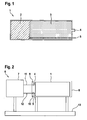
- FIG. 1 shows a storage module 1 according to an embodiment of the invention.
- the storage module 1 comprises an electrical storage device 2 and a thermal storage device 3.
- the electrical storage device 2 is connected to an electrical connection 5, which is designed in particular as a quick-release coupling. Via the electrical connection 5, the energy of the electrical storage device can be discharged.
- a thermal connection 4 is provided, which is also designed as a quick release coupling. Via the thermal connection 4, a coolant stored within the thermal storage device 3 can be discharged.
- the module consists of a cylindrical container made of steel or aluminum with a diameter of 0.5 m and a length of 1.5 m.
- the electric storage device 2 is attached in the form of electric storage batteries, while the thermal storage device 3 comprises a cooling liquid comprising a latent heat storage material.
- the electrical energy is preferably stored by means of lithium iron phosphate batteries having a power density of 3000 W / kg and an energy density of 120 Wh / kg.
- a power of 50 kW can be outputted for 140 seconds, the electric storage device having a mass of only 16.7 kg and a volume of 50 l.
- the thermal storage device 3 comprises a coolant comprising an aqueous emulsion of paraffin-filled plastic capsules.
- the plastic capsules preferably have a dimension of about 5 microns.
- This emulsion has a latent heat capacity of 40 kJ / kg at a predefined phase transition temperature.
- This phase transition temperature is in particular 20 ° C.
- the thermal storage device has a mass of 100 kg at a volume of 100 l. Thus, it is possible to provide 4 MJ of cooling energy.
- the total mass of the supply module is about 170 kg. Therefore, the storage module 1 can be handled very easily.
- the storage module can be introduced into a receiving device 8, what in FIG. 2 is shown.
- FIG. 2 shows an active system 6, which includes a weapon system 7 to be supplied.
- the weapon system 7 is in particular a high-energy laser weapon system.
- the weapon system 7 is connected by means of a fluid line 11 and by means of an electrical line 12 to the receiving device 8.
- the receiving device 8 the storage module 1 described above can be introduced.
- the receiving device 8 makes it possible to connect the electrical connection 5 via an electrical coupling element 10 to the electrical line 12, in order thus to supply the weapon system 7 with electrical energy.
- the receiving device 8 by a thermal coupling element 9 allows the thermal connection 4 of the storage module 1 to connect to the thermal line 11 so as to supply the weapon system 7 with the coolant.
- an electrical control unit to be present within the weapon system 7, which regulates a power supply of the weapon system 7 from the electrical storage device 2. Also, there is provided a cooling pump that removes the coolant from the thermal storage device 3 and supplies the coolant to the thermal storage device 3 again. Between removal and supply of the coolant, the coolant is used to absorb waste heat of the weapon system 7 and dissipate.
- the weapon system 7 has in particular a power of 50 kW, wherein an optical beam power of 10 kW can be generated. Thus, the weapon system has an efficiency of 20%.
- the storage module 1 according to said Embodiment therefore allows the supply of the weapon system 7 for an operating time of at least 100 seconds.
- the weapon system 7 is ready for use within a very short period of time, so that the active system 6 is characterized in a high availability rate.
- the spent stock module 1 can then be prepared by a reuse device for reuse by charging the electrical storage device and re-cooling the coolant of the thermal storage device to a cool ready state by re-phase conversion.
- the active system 6 has at least two receiving devices 8. This makes it possible for a supply module 1 to be removed from one of the receiving devices 8, while another supply module 1 in the other receiving device 8 supplies the weapon system 7. This means that an exchange of the storage modules 1 during the operation of the weapon system 7 is possible. Thus, the weapon system 7 can also be operated in a steady state, which is not possible or only with great effort in known systems.
- the active system 6 is finally mounted on a platform 13. This means that both the weapon system 7 and the receiving device 8 are mounted on the platform 13.
- the platform 13 is preferably designed as a mobile platform, in particular as a land vehicle or as a watercraft. Therefore, the platform 13 allows a very variable and versatile use of the weapon system 7, since the active unit 6 can be quickly and easily relocated to a location where it is needed.
Landscapes
- Engineering & Computer Science (AREA)
- Chemical & Material Sciences (AREA)
- Manufacturing & Machinery (AREA)
- Chemical Kinetics & Catalysis (AREA)
- Electrochemistry (AREA)
- General Chemical & Material Sciences (AREA)
- General Engineering & Computer Science (AREA)
- Thermal Sciences (AREA)
- Physics & Mathematics (AREA)
- Mechanical Engineering (AREA)
- Microelectronics & Electronic Packaging (AREA)
- Remote Sensing (AREA)
- Radar, Positioning & Navigation (AREA)
- Materials Engineering (AREA)
- Secondary Cells (AREA)
- Battery Mounting, Suspending (AREA)
- Charge And Discharge Circuits For Batteries Or The Like (AREA)
- Manipulator (AREA)
- Cooling Or The Like Of Electrical Apparatus (AREA)
Description
- Die vorliegende Erfindung betrifft ein Vorratsmodul zum Versorgen eines Waffensystems. Weiterhin umfasst die vorliegende Erfindung ein Wirksystem, umfassend ein zu versorgendes Waffensystem und das Vorratsmodul. Besonders bevorzugt ist das zu versorgende Waffensystem ein Laserwaffensystem.
Bei Konzepten für Hochenergielaser-Waffensysteme werden für die Erzeugung der Laserstrahlung oftmals diodengepumpte Festkörperlaser in der Leistungsklasse von etwa 100 kW vorgeschlagen. Die vorgeschlagenen Hochenergielaser-Waffensysteme besitzen Lasergeräte, die üblicherweise einen Wirkungsgrad von etwa 20% aufweisen. Daher ist im Betrieb eine sehr hohe Kühlleistung von 80% der aufgewandten elektrischen Leistung nötig, wobei eine Stabilisierung der Kühlmitteltemperatur auf wenige Grad Celsius genau vonnöten ist. Betrachtet man die zuvor genannte Größenordnung der diodengepumpten Festkörperlaser von einigen hundert Kilowatt, so stellt die Kühlung der Lasergeräte eine sehr große Herausforderung dar.
Aus dem Stand der Technik ist bekannt, dass die elektrische Versorgung und Kühlung von Lasergeräten mit einem entsprechend dimensionierten elektrischen Generator und einem hinreichend großen Kühlaggregat erfolgen kann. Solche Versorgungsgeräte besitzen aber bei den erforderlichen Leistungen eine sehr große Masse und ein sehr großes Volumen. Insbesondere eine Realisierung einer Laserwaffe auf einem mobilen Trägerfahrzeug wird dadurch unmöglich. - Die
US2011/113949A1 bildet einen Ausgangspunkt für Anspruch 1 und offenbart ein elektrisches und ein thermisches Vorratsmodul zum Versorgen eines Waffensystems. - Weiterhin ist aus dem Stand der Technik bekannt, dass zur Versorgung der Hochenergielaser-Waffensysteme elektrische Akkumulatoren verwendet werden, die elektrische Energie zum Betreiben des Waffensystems zwischenspeichern. Eine Kühlung kann beispielsweise durch eine hohe Menge an Kühlflüssigkeit erfolgen, wobei sich die Kühlflüssigkeit während des Betriebs des Waffensystems sehr stark erwärmt. Diese Konzepte haben jedoch den großen Nachteil, dass nach einer gewissen Betriebszeit des Waffensystems (typische Dauer etwa eine Minute) ein längerer Zeitraum (typischerweise etwa 15 Minuten) benötigt wird, um die Akkumulatoren erneut aufzuladen und die Kühlflüssigkeit wieder zu entwärmen. Somit ist die Einsatzzeit des Waffensystems sehr stark eingeschränkt.
- Aus der
DE 10 2011 116 288 A1 ist beispielsweise ein Unterwasserfahrzeug bekannt, dass ein Laser-Wirksystem umfasst. Da Unterwasserfahrzeuge üblicherweise bereits über Energieerzeugungs- und Kühlungssysteme verfügen, greift das Laserwaffensystem auf besagte Systeme des Unterwasserfahrzeugs zurück. - Aus der
DE 10 2012 000 672 A1 ist hingegen ein Laser-Waffensystem bekannt, dass stationär betrieben wird. Hier wird durch eine spezielle Anordnung von Energiespeichern versucht, die von einem stationären Generator erzeugte Energie zu speichern, um diese konzentriert an das Laser-Waffensystem abgeben zu können. Durch eine verteilte Anordnung der Energiespeicher soll ein Übertragen eines hohen Stroms vermieden werden. - Aus der
DE 60 2004 000 303 T2 wiederum ist ein elektrohydraulisches Aggregat bekannt. Hier treibt ein Elektromotor eine Pumpe an, mittels der ein Fluiddruck im Hydrauliksystem aufgebaut wird. Innerhalb eines Akkumulators wird schließlich der Hydraulikdruck gespeichert, um somit eine hydraulische Leistungsreserve zur Verfügung zu stellen. - Zuletzt ist aus der
DE 10 2008 054 264 B4 eine multifunktionale Service- und Testeinrichtung für unbemannte Flugkörper bekannt. Die Service- und Testeinrichtung umfasst dabei unter anderem auch die Möglichkeit, den Flugkörper mit extern zugeführter elektrischer Energie vom Stromnetz des Servicegeräts zu versorgen. - Es ist daher Aufgabe der Erfindung, ein Versorgungsmodul für ein Waffensystem, insbesondere für ein Hochenergielaser-Waffensystem, bereitzustellen, das bei einfacher und kostengünstiger Herstellung und Montage ein geringes Gewicht und ein geringes Volumen aufweist, dabei aber einen langen Einsatzzeitraum des Waffensystems ermöglicht. Es ist weiter Aufgabe der Erfindung, ein Wirksystem bereitzustellen, das ebenfalls die zuvor genannten Eigenschaften erfüllt.
- Die Aufgabe wird gelöst durch die Merkmale der unabhängigen Ansprüche.
- Somit wird die Aufgabe gelöst durch ein Vorratsmodul, das zur Versorgung eines Waffensystems verwendbar ist. Das erfindungsgemäße Vorratsmodul umfasst eine elektrische Speichervorrichtung sowie eine thermische Speichervorrichtung. Die elektrische Speichervorrichtung ist insbesondere derart ausgelegt, dass diese elektrische Energie über einen langen Zeitraum speichert. Die thermische Speichervorrichtung ist ausgebildet, ein Kühlmittel zu speichern. Erfindungsgemäß ist weiterhin vorgesehen, dass zumindest ein elektrischer Anschluss vorhanden ist, über den elektrische Energie aus der elektrischen Speichervorrichtung an das Wirksystem übertragbar ist. Ein thermischer Anschluss erlaubt hingegen das Übertragen des Kühlmittels aus der thermischen Speichervorrichtung an das Wirksystem. Eine derartige Anordnung ist insbesondere dann vorteilhaft, wenn das Waffensystem mobil versorgt werden soll. Hier werden dann keine leistungsstarken Geräte zur Versorgung benötigt. Vielmehr ist erfindungsgemäß vorgesehen, dass das Vorratsmodul zum Versorgen des Waffensystems austauschbar ist.
- Die Erfindung betrifft weiterhin ein Wirksystem, das zumindest ein zu versorgendes Waffensystem und zumindest ein Vorratsmodul, wie zuvor beschrieben oder gemäß einer der nachfolgend ausgeführten Weiterbildungen umfasst. Das zu versorgende Waffensystem ist insbesondere eine Laserwaffe. Weiterhin umfasst das Wirksystem zumindest eine Aufnahmevorrichtung, die fest mit dem Waffensystem verbunden ist. Dabei ist das Vorratsmodul in die Aufnahmevorrichtung einbringbar, so dass eine Versorgung des Waffensystems mit elektrischer Energie und mit dem Kühlmittel aus dem Vorratsmodul erfolgt. Daher ist bevorzugt vorgesehen, dass die Aufnahmevorrichtung über eine Fluidleitung und über eine elektrische Leitung mit dem Waffensystem verbunden ist. Diese Verbindung kann insbesondere fest ausgebildet sein, da das Vorratsmodul bevorzugt über den elektrischen Anschluss und den thermischen Anschluss mit der Aufnahmevorrichtung verbunden werden kann, so dass elektrische Energie und Kühlmittel aus dem Vorratsmodul entnommen werden kann. Somit ist vorteilhafterweise das Vorratsmodul zum Versorgen des Waffensystems austauschbar, so dass das Waffensystem nach einer Betriebszeit, die die Vorräte des Vorratsmoduls aufbraucht, nur für die Zeit des Wechselns des Vorratsmoduls nicht einsatzbereit ist. Das Vorratsmodul wiederum kann insbesondere wiederverwendet werden, indem dessen Vorräte wieder aufgefüllt werden.
- Die Unteransprüche haben bevorzugte Weiterbildungen der Erfindung zum Inhalt.
- Bevorzugt wird vorgesehen, dass der elektrische Anschluss und/oder der thermische Anschluss des Vorratsmoduls eine schnell lösbare Kupplung umfasst. Daher kann das Vorratsmodul schnell, einfach und zuverlässig mit dem Waffensystem verbunden werden, um das Waffensystem mit Kühlmittel und elektrischer Energie zu versorgen. Dabei können die schnell lösbaren Kupplungen des elektrischen Anschlusses oder des thermischen Anschlusses entweder gemeinsam oder unabhängig voneinander mit dem Waffensystem kontaktiert werden.
- Vorteilhafterweise ist die elektrische Speichervorrichtung derart ausgebildet, dass diese eine Leistungsdichte von zumindest 1000 Watt pro Kilogramm (W/kg) aufweist. Insbesondere weist die elektrische Speichervorrichtung eine Leistungsdichte von zumindest 3000 W/kg auf. Alternativ oder zusätzlich ist vorgesehen, dass die Energiedichte der elektrischen Speichervorrichtung zumindest 100 Wattstunden pro Kilogramm (Wh/kg) beträgt. Insbesondere beträgt die Energiedichte zumindest 120 Wh/kg. Mit einer derartigen Energieversorgung ist es insbesondere möglich, bei minimalem Gewicht und minimalem Volumen der elektrischen Speichervorrichtung eine maximale Betriebszeit des Waffensystems zu realisieren.
- Vorteilhafterweise kann die elektrische Speichervorrichtung eine Energieversorgung des Waffensystems für eine Betriebszeit von zumindest 100 Sekunden aufrechterhalten. Besonders bevorzugt kann die elektrische Speichervorrichtung die Betriebszeit zumindest 150 Sekunden aufrechterhalten. Somit ist das Waffensystem ausreichend lange verfügbar, um Bedrohungen abzuwehren.
- Bevorzugt umfasst die elektrische Speichervorrichtung Lithium-Eisenphosphatakkumulatoren. Derartige Akkumulatoren haben eine hohe Lebensdauer, eine geringe Selbstentladung und können oftmals wieder aufgeladen werden. Daher eignen sich derartige Akkumulatoren sehr gut für den Einsatz in Waffensystemen. Insbesondere ist vorgesehen, dass die Lithium-Eisenphosphatakkumulatoren mindestens 1000 Mal wiederaufladbar sind.
- In einer vorteilhaften Ausführungsform umfasst die thermische Speichervorrichtung einen Latentwärmespeicher. Dies ist insbesondere derart realisiert, dass das Kühlfluid ein Material enthält, das bei Aufnahme von Wärme seine Phase ändert, ohne dabei seine Temperatur zu verändern. Besonders bevorzugt kann ein derartiges Material Paraffin enthalten, so dass eine Kühlung des Waffensystems dadurch realisiert wird, dass das Paraffin von einem festen Zustand in einen flüssigen Zustand überführt wird. Besonders bevorzugt kann das Kühlmittel eine wässrige Emulsion umfassen, in der mit Paraffin gefüllte Kunststoffkapseln vorhanden sind. Die Durchmesser der Kunststoffkapseln betragen dabei insbesondere 5 µm. Ein derartiges Kühlfluid ist für die Kühlung von Lasersystemen sehr vorteilhaft, da dieses stets seine Temperatur beibehält, während die Kühlung durch die Phasenumwandlung des Paraffins realisiert wird.
- Besonders vorteilhaft weist das Kühlmittel eine Latentwärmekapazität von zumindest 20 Kilojoule pro Kilogramm (kJ/kg) auf. Insbesondere weist das Kühlmittel eine Latentwärmekapazität von zumindest 40 kJ/kg auf. Eine Phasenübergangstemperatur ist insbesondere auf 20°C definiert. Derartige Werte ermöglichen eine vorteilhafte Kühlung von Laserwaffensystemen, so dass die entstehende Wärme effektiv abgeführt wird.
- Das erfindungsgemäße Wirksystem ist bevorzugt derart ausgebildet, dass eine Beladungsvorrichtung vorhanden ist. Die Beladungsvorrichtung kann bevorzugt ein Kran sein. Durch die Beladungsvorrichtung ist das Vorratsmodul in die Aufnahmevorrichtung einbringbar und/oder aus der Aufnahmevorrichtung ausbringbar. Durch die vorteilhafte Beladungsvorrichtung ist daher das Vorratsmodul schnell und einfach austauschbar, so dass nur eine kurze Standzeit notwendig ist, während der das zu versorgende Waffensystem nicht einsatzbereit ist.
- In einer weiteren bevorzugten Ausführungsform des erfindungsgemäßen Wirksystems sind zumindest zwei Aufnahmevorrichtungen vorhanden, wobei eine Versorgung des Waffensystems zwischen den Aufnahmevorrichtungen umschaltbar ist. Auf diese Weise ist das Waffensystem kontinuierlich betreibbar, da von einem ersten Vorratsmodul auf ein zweites Vorratsmodul umgeschaltet werden kann, wenn das erste Vorratsmodul verbraucht ist. Anschließend kann das erste Vorratsmodul aus der Aufnahmevorrichtung entnommen werden, da die Versorgung des Waffensystems durch das zweite Vorratsmodul sichergestellt ist. Ein drittes Vorratsmodul kann in die Aufnahmevorrichtung des ersten Vorratsmoduls eingebracht werden, so dass nach dem Aufbrauchen des zweiten Vorratsmoduls auf das dritte Vorratsmodul umgeschaltet werden kann. Es ist offensichtlich, dass auf diese Weise ein durchgehender Betrieb des Waffensystems ermöglicht ist.
- Schließlich ist bevorzugt vorgesehen, dass das Wirksystem eine Plattform umfasst. Auf der Plattform ist bevorzugt das Waffensystem sowie die zumindest eine Aufnahmevorrichtung montiert. Vorteilhafterweise ist die Plattform als mobile Plattform ausgebildet, insbesondere als Landfahrzeug oder als Wasserfahrzeug. Dies hat den Vorteil, dass das Waffensystem stets an einen Ort gebracht werden kann, an dem dieses gerade benötigt wird.
- Die Erfindung wird nun anhand von Ausführungsbeispielen unter Berücksichtigung der beigefügten Zeichnungen detailliert beschrieben. In den Zeichnungen ist:
- Figur 1
- eine schematische Ansicht des Vorratsmoduls gemäß einem Ausführungsbeispiel der Erfindung, und
- Figur 2
- eine schematische Ansicht des Wirksystems gemäß einem Ausführungsbeispiel der Erfindung.
-
Figur 1 zeigt ein Vorratsmodul 1 gemäß einem Ausführungsbeispiel der Erfindung. Das Vorratsmodul 1 umfasst eine elektrische Speichervorrichtung 2 sowie eine thermische Speichervorrichtung 3. Die elektrische Speichervorrichtung 2 ist mit einem elektrischen Anschluss 5 verbunden, der insbesondere als schnelllösende Kupplung ausgelegt ist. Über den elektrischen Anschluss 5 kann die Energie der elektrischen Speichervorrichtung abgegeben werden. Weiterhin ist ein thermischer Anschluss 4 vorhanden, der ebenfalls als schnell lösbare Kupplung ausgelegt ist. Über den thermischen Anschluss 4 kann ein Kühlmittel, das innerhalb der thermischen Speichervorrichtung 3 gespeichert ist, abgegeben werden. - Bevorzugt besteht das Modul aus einem zylindrischen Behälter aus Stahl oder Aluminium mit einem Durchmesser von 0,5 m und einer Länge von 1,5 m. In diesem Behälter ist die elektrische Speichervorrichtung 2 in Form von elektrischen Akkumulatoren angebracht, während die thermische Speichervorrichtung 3 eine Kühlflüssigkeit umfasst, die ein latentwärmespeicherndes Material umfasst.
- Die elektrische Energie ist bevorzugt mittels Lithium-Eisenphosphat-Akkumulatoren gespeichert, die eine Leistungsdichte von 3000 W/kg und eine Energiedichte von 120 Wh/kg aufweisen. Somit kann durch die elektrische Speichervorrichtung 2 eine Energie von 50 kW 140 Sekunden lang abgegeben werden, wobei die elektrische Speichervorrichtung eine Masse von lediglich 16,7 kg und ein Volumen von 50 I aufweist.
- Die thermische Speichervorrichtung 3 umfasst ein Kühlmittel, das eine wässrige Emulsion aus mit Paraffin gefüllten Kunststoffkapseln umfasst. Die Kunststoffkapseln haben bevorzugt eine Abmessung von etwa 5 µm. Diese Emulsion besitzt eine Latentwärmekapazität von 40 kJ/kg bei einer vordefinierten Phasenübergangstemperatur. Diese Phasenübergangstemperatur beträgt insbesondere 20°C. Während eines Kühlvorgangs durch die wässrige Emulsion bleibt diese Temperatur konstant, da die aufgenommene Wärme ein Umwandeln der Phase des Paraffins von fest in flüssig bewirkt. Die thermische Speichervorrichtung weist insbesondere eine Masse von 100 kg bei einem Volumen von 100 I auf. Somit ist es möglich, 4 MJ Kühlenergie bereitzustellen.
- Gemäß dem Ausführungsbeispiel beträgt die Gesamtmasse des Versorgungsmoduls etwa 170 kg. Daher kann das Vorratsmodul 1 sehr einfach gehandhabt werden. Insbesondere kann das Vorratsmodul in eine Aufnahmevorrichtung 8 eingebracht werden, was in
Figur 2 gezeigt ist. -
Figur 2 zeigt ein Wirksystem 6, das ein zu versorgendes Waffensystem 7 umfasst. Das Waffensystem 7 ist insbesondere ein Hochenergielaser-Waffensystem. Das Waffensystem 7 ist mittels einer Fluidleitung 11 und mittels einer elektrischen Leitung 12 mit der Aufnahmevorrichtung 8 verbunden. In die Aufnahmevorrichtung 8 ist das zuvor beschriebene Vorratsmodul 1 einbringbar. Weiterhin ermöglicht die Aufnahmevorrichtung 8, den elektrischen Anschluss 5 über ein elektrisches Kupplungselement 10 mit der elektrischen Leitung 12 zu verbinden, um somit das Waffensystem 7 mit elektrischer Energie zu versorgen. Außerdem ermöglicht die Aufnahmevorrichtung 8 durch ein thermisches Kopplungselement 9 den thermischen Anschluss 4 des Vorratsmoduls 1 mit der thermischen Leitung 11 zu verbinden, um so das Waffensystem 7 mit dem Kühlmittel zu versorgen. - Zur Versorgung des Waffensystems 7 ist vorgesehen, dass innerhalb des Waffensystems 7 eine elektrische Regelungseinheit vorhanden ist, die eine Energieversorgung des Waffensystems 7 aus der elektrischen Speichervorrichtung 2 regelt. Ebenso ist eine Kühlpumpe vorhanden, die das Kühlmittel aus der thermischen Speichervorrichtung 3 entnimmt und das Kühlmittel der thermischen Speichervorrichtung 3 wieder zuführt. Zwischen Entnahme und Zuführung des Kühlmittels wird das Kühlmittel verwendet, um Abwärme des Waffensystems 7 aufzunehmen und abzuführen.
- Das Waffensystem 7 weist insbesondere eine Leistung von 50 kW auf, wobei eine optische Strahlleistung von 10 kW erzeugbar ist. Somit hat das Waffensystem einen Wirkungsgrad von 20%. Das Vorratsmodul 1 gemäß dem genannten Ausführungsbeispiel ermöglicht daher die Versorgung des Waffensystems 7 für eine Betriebszeit von zumindest 100 Sekunden.
- Sobald das Versorgungsmodul 1 aufgebraucht ist, kann dieses aus der Aufnahmevorrichtung 8 entnommen werden, um ein weiteres Versorgungsmodul 1 einzusetzen. Auf diese Weise ist das Waffensystem 7 innerhalb einer sehr kurzen Zeitspanne wieder einsatzbereit, so dass sich das Wirksystem 6 in einer hohen Verfügbarkeitsrate auszeichnet. Das verbrauchte Vorratsmodul 1 kann anschließend durch eine Wiederverwendungsvorrichtung für einen erneuten Einsatz vorbereitet werden, indem die elektrische Speichervorrichtung aufgeladen wird und das Kühlmittel der thermischen Speichervorrichtung durch erneute Phasenumwandlung wieder in einen kühlbereiten Zustand gebracht wird.
- Vorteilhafterweise weist das Wirksystem 6 zumindest zwei Aufnahmevorrichtungen 8 auf. Dadurch ist es möglich, dass ein Vorratsmodul 1 aus einer der Aufnahmevorrichtungen 8 entnommen werden kann, während ein weiteres Vorratsmodul 1 in der anderen Aufnahmevorrichtung 8 das Waffensystem 7 versorgt. Dies bedeutet, dass ein Austausch der Vorratsmodule 1 während des Betriebs des Waffensystems 7 möglich ist. Somit kann das Waffensystem 7 auch in einem Dauerzustand betrieben werden, was bei bekannten Systemen nicht oder nur mit sehr großem Aufwand möglich ist. Das Wirksystem 6 ist schließlich auf einer Plattform 13 angebracht. Dies bedeutet, dass sowohl das Waffensystem 7 als auch die Aufnahmevorrichtung 8 auf der Plattform 13 montiert sind. Die Plattform 13 ist dabei bevorzugt als mobile Plattform, insbesondere als Landfahrzeug oder als Wasserfahrzeug, ausgelegt. Daher ermöglicht die Plattform 13 einen sehr variablen und vielseitigen Einsatz des Waffensystems 7, da die Wirkeinheit 6 schnell und einfach an einen Ort verlegt werden kann, an dem diese benötigt wird.
-
- 1
- Vorratsmodul
- 2
- Elektrische Speichervorrichtung
- 3
- Thermische Speichervorrichtung
- 4
- Thermischer Anschluss
- 5
- Elektrischer Anschluss
- 6
- Wirksystem
- 7
- Waffensystem
- 8
- Aufnahmevorrichtung
- 9
- Thermische Kupplung
- 10
- Elektrische Kupplung
- 11
- Thermische Leitung
- 12
- Elektrische Leitung
- 13
- Plattform
Claims (11)
- Vorratsmodul (1) zum Versorgen eines Waffensystems (7), umfassend- eine elektrische Speichervorrichtung (2),- eine thermische Speichervorrichtung (3), wobei die thermische Speichervorrichtung (3) ein Kühlmittel speichert, und- zumindest einen elektrischen Anschluss (5), über den Energie aus der elektrischen Speichervorrichtung (2) an das Waffensystem (7) übertragbar ist, und- zumindest einen thermischen Anschluss (4), über den das Kühlmittel aus der thermischen Speichervorrichtung (3) an das Waffensystem (7) übertragbar ist,- wobei das Vorratsmodul (1) austauschbar ist.
- Vorratsmodul (1) nach Anspruch 1, dadurch gekennzeichnet, dass der elektrische Anschluss (5) und/oder der thermische Anschluss (4) eine schnelllösbare Kupplung umfasst.
- Vorratsmodul (1) nach einem der vorhergehenden Ansprüche, dadurch gekennzeichnet, dass die elektrische Speichervorrichtung (2) eine Leistungsdichte von zumindest 1000 W/kg, insbesondere von zumindest 3000 W/kg, aufweist und/oder eine Energiedichte von zumindest 100 Wh/kg, insbesondere von zumindest 120 Wh/kg, aufweist.
- Vorratsmodul (1) nach einem der vorhergehenden Ansprüche, dadurch gekennzeichnet, dass durch die elektrische Speichervorrichtung (2) eine Energieversorgung für eine Betriebszeit von zumindest 100 Sekunden, insbesondere von zumindest 150 Sekunden, des Waffensystems aufrechterhaltbar ist.
- Vorratsmodul (1) nach einem der vorhergehenden Ansprüche, dadurch gekennzeichnet, dass die elektrische Speichervorrichtung (2) Lithium-Eisenphosphat Akkumulatoren umfasst.
- Vorratsmodul (1) nach einem der vorhergehenden Ansprüche, dadurch gekennzeichnet, dass die thermische Speichervorrichtung (3) einen Latentwärmespeicher umfasst.
- Vorratsmodul (1) nach Anspruch 6, dadurch gekennzeichnet, dass das Kühlmittel eine Latentwärmekapazität von zumindest 20 kJ/kg, insbesondere zumindest 40 kJ/kg, aufweist.
- Wirksystem (6), umfassend- zumindest ein zu versorgendes Waffensystem (7), insbesondere eine Laserwaffe,- zumindest ein austauschbares Vorratsmodul (1) nach einem der vorhergehenden Ansprüche, und- zumindest ein Aufnahmevorrichtung (8), die fest mit dem Waffensystem (7) verbunden ist, wobei- das Vorratsmodul (1) in die Aufnahmevorrichtung (8) einbringbar ist, so dass eine Versorgung des Waffensystems (7) mit elektrischer Energie und mit Kühlmittel aus dem Vorratsmodul (1) erfolgt.
- Wirksystem (6) nach Anspruch 8, gekennzeichnet durch eine Beladungsvorrichtung, insbesondere einen Kran, wobei das Vorratsmodul (1) durch die Beladungsvorrichtung in die Aufnahmevorrichtung (8) einbringbar und/oder aus der Aufnahmevorrichtung (8) ausbringbar ist.
- Wirksystem (6) nach einem der Ansprüche 8 bis 9, gekennzeichnet durch zumindest zwei Aufnahmevorrichtungen (8), wobei eine Versorgung des Waffensystems (7) zwischen den Aufnahmevorrichtungen (8) umschaltbar ist, so dass das Waffensystem (7) kontinuierlich betreibbar ist.
- Wirksystem (6) nach einem der Ansprüche 8 bis 10, gekennzeichnet durch eine Plattform (13), auf der das Waffensystem (7) und die Aufnahmevorrichtung (8) montiert sind, wobei die Plattform (13) als mobile Plattform ausgebildet ist.
Applications Claiming Priority (1)
| Application Number | Priority Date | Filing Date | Title |
|---|---|---|---|
| DE201310008407 DE102013008407B3 (de) | 2013-05-16 | 2013-05-16 | Vorratsmodul zum Versorgen eines Wirksystems sowie Wirksystem mit Vorratsmodul |
Publications (3)
| Publication Number | Publication Date |
|---|---|
| EP2803939A2 EP2803939A2 (de) | 2014-11-19 |
| EP2803939A3 EP2803939A3 (de) | 2014-12-24 |
| EP2803939B1 true EP2803939B1 (de) | 2016-03-09 |
Family
ID=50732734
Family Applications (1)
| Application Number | Title | Priority Date | Filing Date |
|---|---|---|---|
| EP14001619.7A Active EP2803939B1 (de) | 2013-05-16 | 2014-05-08 | Vorratsmodul zum Versorgen eines Waffensystems sowie Waffensystem mit Vorratsmodul |
Country Status (7)
| Country | Link |
|---|---|
| US (1) | US10631444B2 (de) |
| EP (1) | EP2803939B1 (de) |
| DE (1) | DE102013008407B3 (de) |
| ES (1) | ES2572560T3 (de) |
| IL (1) | IL232628B (de) |
| PL (1) | PL2803939T3 (de) |
| SG (1) | SG10201402326WA (de) |
Families Citing this family (4)
| Publication number | Priority date | Publication date | Assignee | Title |
|---|---|---|---|---|
| FR3027244B1 (fr) * | 2014-10-15 | 2016-12-09 | Thales Sa | Systeme de decoupe ou de perforation a distance |
| US10794667B2 (en) * | 2017-01-04 | 2020-10-06 | Rolls-Royce Corporation | Optical thermal profile |
| US11437665B2 (en) * | 2020-06-29 | 2022-09-06 | Rocky Research | Battery thermal and power control system |
| DE102021001293B4 (de) | 2021-03-10 | 2024-10-31 | Mbda Deutschland Gmbh | Modulares Laserwaffensystem |
Family Cites Families (12)
| Publication number | Priority date | Publication date | Assignee | Title |
|---|---|---|---|---|
| US3392259A (en) * | 1964-12-18 | 1968-07-09 | United Aircraft Corp | Portable beam generator |
| ATE315178T1 (de) * | 2003-02-18 | 2006-02-15 | Giat Ind Sa | Kompaktes elektrohydraulisches aggregat zum antrieb eines gefechtsturms |
| WO2006113877A2 (en) * | 2005-04-20 | 2006-10-26 | Lugg Richard H | Hybrid jet/electric vtol aircraft |
| US8205536B2 (en) * | 2007-06-13 | 2012-06-26 | Efw Inc. | Integrated weapons pod |
| US20100110198A1 (en) * | 2008-04-01 | 2010-05-06 | Daylight Solutions, Inc. | Mid infrared optical illuminator assembly |
| DE102008054264B4 (de) * | 2008-10-31 | 2012-09-13 | Lfk-Lenkflugkörpersysteme Gmbh | Multifunktionale Service- und Testeinrichtung für unbemannte Flugkörper |
| US8367991B2 (en) * | 2009-08-14 | 2013-02-05 | The United States Of America As Represented By The Secretary Of The Navy | Modulation device for a mobile tracking device |
| EP3059413B1 (de) * | 2011-03-29 | 2019-05-08 | Rolls-Royce North American Technologies, Inc. | Fahrzeugsystem |
| DE102011116288B4 (de) * | 2011-10-19 | 2013-09-19 | Mbda Deutschland Gmbh | Unterwasserfahrzeug mit einem optischen Strahlenwirksystem |
| DE102012000672A1 (de) * | 2011-10-21 | 2013-04-25 | Lfk-Lenkflugkörpersysteme Gmbh | Verteilte Energieversorgung eines Laserwaffensystems |
| EP2752911A1 (de) * | 2013-01-08 | 2014-07-09 | Siemens Aktiengesellschaft | Elektrochemische Speichereinrichtung mit verbesserten elektrischen Leitungseigenschaften |
| CA2901822C (en) * | 2013-03-15 | 2020-03-31 | Rolls-Royce Corporation | Propulsion, electrical, and thermal management device for a small unmanned aerial vehicle |
-
2013
- 2013-05-16 DE DE201310008407 patent/DE102013008407B3/de not_active Withdrawn - After Issue
-
2014
- 2014-05-08 ES ES14001619.7T patent/ES2572560T3/es active Active
- 2014-05-08 PL PL14001619.7T patent/PL2803939T3/pl unknown
- 2014-05-08 EP EP14001619.7A patent/EP2803939B1/de active Active
- 2014-05-14 IL IL232628A patent/IL232628B/en active IP Right Grant
- 2014-05-15 US US14/277,959 patent/US10631444B2/en active Active
- 2014-05-15 SG SG10201402326WA patent/SG10201402326WA/en unknown
Also Published As
| Publication number | Publication date |
|---|---|
| ES2572560T3 (es) | 2016-06-01 |
| EP2803939A3 (de) | 2014-12-24 |
| US10631444B2 (en) | 2020-04-21 |
| IL232628A0 (en) | 2014-08-31 |
| SG10201402326WA (en) | 2014-12-30 |
| DE102013008407B3 (de) | 2014-07-17 |
| US20140338863A1 (en) | 2014-11-20 |
| EP2803939A2 (de) | 2014-11-19 |
| PL2803939T3 (pl) | 2016-09-30 |
| IL232628B (en) | 2018-02-28 |
Similar Documents
| Publication | Publication Date | Title |
|---|---|---|
| EP2803939B1 (de) | Vorratsmodul zum Versorgen eines Waffensystems sowie Waffensystem mit Vorratsmodul | |
| DE102017110703B4 (de) | Kühlvorrichtung und Verfahren zum Betreiben einer Mehrzahl von Ladestationen | |
| EP2678547B1 (de) | Betrieb einer brennkraftmaschine | |
| WO2015185184A1 (de) | Fahrzeug mit einem energiespeicher | |
| DE102012213855A1 (de) | Batterieladesystem für Fahrzeuge, umfassend eine stationäre Ladestation und eine mobile, im Fahrzeug angeordnete, Batterie | |
| DE102018108181A1 (de) | Ladekoppler mit Kühlvorrichtung, Ladekabel mit Ladekoppler sowie ein Kraftfahrzeug mit Ladekoppler | |
| EP3100334A1 (de) | Bordnetz und verfahren zum betrieb eines bordnetzes | |
| WO2017021488A1 (de) | Elektrofahrzeug-ladestation und verfahren zum steuern einer elektrofahrzeug-ladestation | |
| WO2015172924A1 (de) | Vorrichtung und verfahren zum laden zweier energiespeicher | |
| WO2018149815A1 (de) | Verfahren zum kühlen einer batterie, batterie, fahrzeug mit batterie sowie ladevorrichtung zum aufladen und kühlen einer batterie | |
| DE102010063057A1 (de) | Batteriesystem für ein Kraftfahrzeug mit wenigstens einer elektrochemischen Zelle und wenigstens einem Latentwärmespeicher | |
| EP3906573B1 (de) | Elektrofahrzeug, insbesondere baumaschine, und verfahren zum betrieb eines elektrofahrzeugs | |
| EP3427326B1 (de) | Batteriesystem, verfahren zum betrieb eines batteriesystems und kraftfahrzeug | |
| EP2254218A2 (de) | Verfahren und Vorrichtung zum Aufladen von Akkumulatoren | |
| EP2584661A2 (de) | Verteilte Energieversorgung eines Laserwaffensystems | |
| EP1748183B1 (de) | Elektrische Einrichtung zur Verstellung der Rotorblätter einer Windenergieanlage | |
| DE102013016645B3 (de) | Energieübertragung zu einem Unterwasserfahrzeug mittels Lichtwellenleiter | |
| DE102010019298A1 (de) | Energieversorgungseinrichtung zum Betreiben eines Elektromotors eines Kraftwagens | |
| DE102007049173B4 (de) | Kraftfahrzeugbordnetz | |
| DE102020204691B4 (de) | Ladevorrichtung, System aus einem elektrifizierten Kraftfahrzeug und einer Ladevorrichtung sowie Verfahren zur Steuerung des Systems | |
| DE102015222978A1 (de) | Fahrzeug und Verfahren zum Betreiben eines Fahrzeugs | |
| EP2556983A1 (de) | Verfahren zum Aufladen eines Akkumulators mit Hilfe eines Energierückgewinnungssystems und Antriebseinheit für ein Elektro- oder Hybridfahrzeug | |
| DE102017209712A1 (de) | Ladevorrichtung zum Laden einer Energiespeichereinrichtung eines elektrisch betreibbaren Kraftfahrzeugs, Verfahren zum Betreiben einer Ladevorrichtung sowie Schnellladeeinrichtung | |
| DE102023105180A1 (de) | Ladesteckverbinder für Elektro- und Hybridfahrzeuge | |
| DE102015200749B4 (de) | Elektrisches Batterieladen durch Rekuperation von Abgaswärme |
Legal Events
| Date | Code | Title | Description |
|---|---|---|---|
| PUAI | Public reference made under article 153(3) epc to a published international application that has entered the european phase |
Free format text: ORIGINAL CODE: 0009012 |
|
| 17P | Request for examination filed |
Effective date: 20140508 |
|
| AK | Designated contracting states |
Kind code of ref document: A2 Designated state(s): AL AT BE BG CH CY CZ DE DK EE ES FI FR GB GR HR HU IE IS IT LI LT LU LV MC MK MT NL NO PL PT RO RS SE SI SK SM TR |
|
| AX | Request for extension of the european patent |
Extension state: BA ME |
|
| PUAL | Search report despatched |
Free format text: ORIGINAL CODE: 0009013 |
|
| AK | Designated contracting states |
Kind code of ref document: A3 Designated state(s): AL AT BE BG CH CY CZ DE DK EE ES FI FR GB GR HR HU IE IS IT LI LT LU LV MC MK MT NL NO PL PT RO RS SE SI SK SM TR |
|
| AX | Request for extension of the european patent |
Extension state: BA ME |
|
| RIC1 | Information provided on ipc code assigned before grant |
Ipc: F41H 13/00 20060101AFI20141118BHEP Ipc: H01M 10/052 20100101ALI20141118BHEP Ipc: H01S 3/04 20060101ALI20141118BHEP Ipc: F41A 99/00 20060101ALI20141118BHEP |
|
| R17P | Request for examination filed (corrected) |
Effective date: 20150523 |
|
| GRAP | Despatch of communication of intention to grant a patent |
Free format text: ORIGINAL CODE: EPIDOSNIGR1 |
|
| RIC1 | Information provided on ipc code assigned before grant |
Ipc: F41H 13/00 20060101AFI20150930BHEP Ipc: H01M 10/052 20100101ALI20150930BHEP Ipc: F41A 99/00 20060101ALI20150930BHEP Ipc: H01S 3/04 20060101ALI20150930BHEP |
|
| INTG | Intention to grant announced |
Effective date: 20151013 |
|
| RIC1 | Information provided on ipc code assigned before grant |
Ipc: H01S 3/04 20060101ALI20151002BHEP Ipc: H01M 10/052 20100101ALI20151002BHEP Ipc: F41H 13/00 20060101AFI20151002BHEP |
|
| GRAS | Grant fee paid |
Free format text: ORIGINAL CODE: EPIDOSNIGR3 |
|
| GRAA | (expected) grant |
Free format text: ORIGINAL CODE: 0009210 |
|
| AK | Designated contracting states |
Kind code of ref document: B1 Designated state(s): AL AT BE BG CH CY CZ DE DK EE ES FI FR GB GR HR HU IE IS IT LI LT LU LV MC MK MT NL NO PL PT RO RS SE SI SK SM TR |
|
| REG | Reference to a national code |
Ref country code: GB Ref legal event code: FG4D Free format text: NOT ENGLISH |
|
| REG | Reference to a national code |
Ref country code: AT Ref legal event code: REF Ref document number: 779840 Country of ref document: AT Kind code of ref document: T Effective date: 20160315 Ref country code: CH Ref legal event code: EP |
|
| REG | Reference to a national code |
Ref country code: IE Ref legal event code: FG4D Free format text: LANGUAGE OF EP DOCUMENT: GERMAN |
|
| REG | Reference to a national code |
Ref country code: DE Ref legal event code: R096 Ref document number: 502014000421 Country of ref document: DE |
|
| REG | Reference to a national code |
Ref country code: FR Ref legal event code: PLFP Year of fee payment: 3 |
|
| REG | Reference to a national code |
Ref country code: ES Ref legal event code: FG2A Ref document number: 2572560 Country of ref document: ES Kind code of ref document: T3 Effective date: 20160601 |
|
| REG | Reference to a national code |
Ref country code: LT Ref legal event code: MG4D |
|
| REG | Reference to a national code |
Ref country code: NL Ref legal event code: MP Effective date: 20160309 |
|
| PG25 | Lapsed in a contracting state [announced via postgrant information from national office to epo] |
Ref country code: FI Free format text: LAPSE BECAUSE OF FAILURE TO SUBMIT A TRANSLATION OF THE DESCRIPTION OR TO PAY THE FEE WITHIN THE PRESCRIBED TIME-LIMIT Effective date: 20160309 Ref country code: NO Free format text: LAPSE BECAUSE OF FAILURE TO SUBMIT A TRANSLATION OF THE DESCRIPTION OR TO PAY THE FEE WITHIN THE PRESCRIBED TIME-LIMIT Effective date: 20160609 Ref country code: GR Free format text: LAPSE BECAUSE OF FAILURE TO SUBMIT A TRANSLATION OF THE DESCRIPTION OR TO PAY THE FEE WITHIN THE PRESCRIBED TIME-LIMIT Effective date: 20160610 Ref country code: HR Free format text: LAPSE BECAUSE OF FAILURE TO SUBMIT A TRANSLATION OF THE DESCRIPTION OR TO PAY THE FEE WITHIN THE PRESCRIBED TIME-LIMIT Effective date: 20160309 |
|
| PG25 | Lapsed in a contracting state [announced via postgrant information from national office to epo] |
Ref country code: SE Free format text: LAPSE BECAUSE OF FAILURE TO SUBMIT A TRANSLATION OF THE DESCRIPTION OR TO PAY THE FEE WITHIN THE PRESCRIBED TIME-LIMIT Effective date: 20160309 Ref country code: LV Free format text: LAPSE BECAUSE OF FAILURE TO SUBMIT A TRANSLATION OF THE DESCRIPTION OR TO PAY THE FEE WITHIN THE PRESCRIBED TIME-LIMIT Effective date: 20160309 Ref country code: BE Free format text: LAPSE BECAUSE OF NON-PAYMENT OF DUE FEES Effective date: 20160531 Ref country code: RS Free format text: LAPSE BECAUSE OF FAILURE TO SUBMIT A TRANSLATION OF THE DESCRIPTION OR TO PAY THE FEE WITHIN THE PRESCRIBED TIME-LIMIT Effective date: 20160309 Ref country code: NL Free format text: LAPSE BECAUSE OF FAILURE TO SUBMIT A TRANSLATION OF THE DESCRIPTION OR TO PAY THE FEE WITHIN THE PRESCRIBED TIME-LIMIT Effective date: 20160309 Ref country code: LT Free format text: LAPSE BECAUSE OF FAILURE TO SUBMIT A TRANSLATION OF THE DESCRIPTION OR TO PAY THE FEE WITHIN THE PRESCRIBED TIME-LIMIT Effective date: 20160309 |
|
| PG25 | Lapsed in a contracting state [announced via postgrant information from national office to epo] |
Ref country code: EE Free format text: LAPSE BECAUSE OF FAILURE TO SUBMIT A TRANSLATION OF THE DESCRIPTION OR TO PAY THE FEE WITHIN THE PRESCRIBED TIME-LIMIT Effective date: 20160309 Ref country code: IS Free format text: LAPSE BECAUSE OF FAILURE TO SUBMIT A TRANSLATION OF THE DESCRIPTION OR TO PAY THE FEE WITHIN THE PRESCRIBED TIME-LIMIT Effective date: 20160709 |
|
| PG25 | Lapsed in a contracting state [announced via postgrant information from national office to epo] |
Ref country code: RO Free format text: LAPSE BECAUSE OF FAILURE TO SUBMIT A TRANSLATION OF THE DESCRIPTION OR TO PAY THE FEE WITHIN THE PRESCRIBED TIME-LIMIT Effective date: 20160309 Ref country code: PT Free format text: LAPSE BECAUSE OF FAILURE TO SUBMIT A TRANSLATION OF THE DESCRIPTION OR TO PAY THE FEE WITHIN THE PRESCRIBED TIME-LIMIT Effective date: 20160711 Ref country code: CZ Free format text: LAPSE BECAUSE OF FAILURE TO SUBMIT A TRANSLATION OF THE DESCRIPTION OR TO PAY THE FEE WITHIN THE PRESCRIBED TIME-LIMIT Effective date: 20160309 Ref country code: SK Free format text: LAPSE BECAUSE OF FAILURE TO SUBMIT A TRANSLATION OF THE DESCRIPTION OR TO PAY THE FEE WITHIN THE PRESCRIBED TIME-LIMIT Effective date: 20160309 Ref country code: SM Free format text: LAPSE BECAUSE OF FAILURE TO SUBMIT A TRANSLATION OF THE DESCRIPTION OR TO PAY THE FEE WITHIN THE PRESCRIBED TIME-LIMIT Effective date: 20160309 |
|
| REG | Reference to a national code |
Ref country code: DE Ref legal event code: R097 Ref document number: 502014000421 Country of ref document: DE |
|
| PG25 | Lapsed in a contracting state [announced via postgrant information from national office to epo] |
Ref country code: LU Free format text: LAPSE BECAUSE OF FAILURE TO SUBMIT A TRANSLATION OF THE DESCRIPTION OR TO PAY THE FEE WITHIN THE PRESCRIBED TIME-LIMIT Effective date: 20160508 |
|
| PLBE | No opposition filed within time limit |
Free format text: ORIGINAL CODE: 0009261 |
|
| STAA | Information on the status of an ep patent application or granted ep patent |
Free format text: STATUS: NO OPPOSITION FILED WITHIN TIME LIMIT |
|
| PG25 | Lapsed in a contracting state [announced via postgrant information from national office to epo] |
Ref country code: DK Free format text: LAPSE BECAUSE OF FAILURE TO SUBMIT A TRANSLATION OF THE DESCRIPTION OR TO PAY THE FEE WITHIN THE PRESCRIBED TIME-LIMIT Effective date: 20160309 |
|
| 26N | No opposition filed |
Effective date: 20161212 |
|
| REG | Reference to a national code |
Ref country code: IE Ref legal event code: MM4A |
|
| PG25 | Lapsed in a contracting state [announced via postgrant information from national office to epo] |
Ref country code: BG Free format text: LAPSE BECAUSE OF FAILURE TO SUBMIT A TRANSLATION OF THE DESCRIPTION OR TO PAY THE FEE WITHIN THE PRESCRIBED TIME-LIMIT Effective date: 20160609 |
|
| REG | Reference to a national code |
Ref country code: FR Ref legal event code: RU Effective date: 20170329 |
|
| REG | Reference to a national code |
Ref country code: FR Ref legal event code: PLFP Year of fee payment: 4 |
|
| PG25 | Lapsed in a contracting state [announced via postgrant information from national office to epo] |
Ref country code: IE Free format text: LAPSE BECAUSE OF NON-PAYMENT OF DUE FEES Effective date: 20160508 Ref country code: SI Free format text: LAPSE BECAUSE OF FAILURE TO SUBMIT A TRANSLATION OF THE DESCRIPTION OR TO PAY THE FEE WITHIN THE PRESCRIBED TIME-LIMIT Effective date: 20160309 |
|
| REG | Reference to a national code |
Ref country code: FR Ref legal event code: D7 Effective date: 20170724 |
|
| REG | Reference to a national code |
Ref country code: CH Ref legal event code: PL |
|
| PG25 | Lapsed in a contracting state [announced via postgrant information from national office to epo] |
Ref country code: LI Free format text: LAPSE BECAUSE OF NON-PAYMENT OF DUE FEES Effective date: 20170531 Ref country code: CH Free format text: LAPSE BECAUSE OF NON-PAYMENT OF DUE FEES Effective date: 20170531 |
|
| REG | Reference to a national code |
Ref country code: FR Ref legal event code: PLFP Year of fee payment: 5 |
|
| PG25 | Lapsed in a contracting state [announced via postgrant information from national office to epo] |
Ref country code: HU Free format text: LAPSE BECAUSE OF FAILURE TO SUBMIT A TRANSLATION OF THE DESCRIPTION OR TO PAY THE FEE WITHIN THE PRESCRIBED TIME-LIMIT; INVALID AB INITIO Effective date: 20140508 |
|
| PG25 | Lapsed in a contracting state [announced via postgrant information from national office to epo] |
Ref country code: MK Free format text: LAPSE BECAUSE OF FAILURE TO SUBMIT A TRANSLATION OF THE DESCRIPTION OR TO PAY THE FEE WITHIN THE PRESCRIBED TIME-LIMIT Effective date: 20160309 Ref country code: CY Free format text: LAPSE BECAUSE OF FAILURE TO SUBMIT A TRANSLATION OF THE DESCRIPTION OR TO PAY THE FEE WITHIN THE PRESCRIBED TIME-LIMIT Effective date: 20160309 Ref country code: MC Free format text: LAPSE BECAUSE OF FAILURE TO SUBMIT A TRANSLATION OF THE DESCRIPTION OR TO PAY THE FEE WITHIN THE PRESCRIBED TIME-LIMIT Effective date: 20160309 Ref country code: MT Free format text: LAPSE BECAUSE OF FAILURE TO SUBMIT A TRANSLATION OF THE DESCRIPTION OR TO PAY THE FEE WITHIN THE PRESCRIBED TIME-LIMIT Effective date: 20160309 |
|
| PG25 | Lapsed in a contracting state [announced via postgrant information from national office to epo] |
Ref country code: AL Free format text: LAPSE BECAUSE OF FAILURE TO SUBMIT A TRANSLATION OF THE DESCRIPTION OR TO PAY THE FEE WITHIN THE PRESCRIBED TIME-LIMIT Effective date: 20160309 |
|
| PGFP | Annual fee paid to national office [announced via postgrant information from national office to epo] |
Ref country code: TR Payment date: 20190425 Year of fee payment: 6 |
|
| REG | Reference to a national code |
Ref country code: AT Ref legal event code: MM01 Ref document number: 779840 Country of ref document: AT Kind code of ref document: T Effective date: 20190508 |
|
| PG25 | Lapsed in a contracting state [announced via postgrant information from national office to epo] |
Ref country code: AT Free format text: LAPSE BECAUSE OF NON-PAYMENT OF DUE FEES Effective date: 20190508 |
|
| PG25 | Lapsed in a contracting state [announced via postgrant information from national office to epo] |
Ref country code: TR Free format text: LAPSE BECAUSE OF NON-PAYMENT OF DUE FEES Effective date: 20200508 |
|
| P01 | Opt-out of the competence of the unified patent court (upc) registered |
Effective date: 20230509 |
|
| PGFP | Annual fee paid to national office [announced via postgrant information from national office to epo] |
Ref country code: PL Payment date: 20250425 Year of fee payment: 12 Ref country code: DE Payment date: 20250528 Year of fee payment: 12 |
|
| PGFP | Annual fee paid to national office [announced via postgrant information from national office to epo] |
Ref country code: GB Payment date: 20250521 Year of fee payment: 12 Ref country code: ES Payment date: 20250627 Year of fee payment: 12 |
|
| PGFP | Annual fee paid to national office [announced via postgrant information from national office to epo] |
Ref country code: IT Payment date: 20250527 Year of fee payment: 12 |
|
| PGFP | Annual fee paid to national office [announced via postgrant information from national office to epo] |
Ref country code: FR Payment date: 20250528 Year of fee payment: 12 |