EP2802875B1 - Verfahren zum direkten nachweis und zur identifizierung von mikroorganismen in einer biologischen probe durch optische mittel - Google Patents
Verfahren zum direkten nachweis und zur identifizierung von mikroorganismen in einer biologischen probe durch optische mittel Download PDFInfo
- Publication number
- EP2802875B1 EP2802875B1 EP13701855.2A EP13701855A EP2802875B1 EP 2802875 B1 EP2802875 B1 EP 2802875B1 EP 13701855 A EP13701855 A EP 13701855A EP 2802875 B1 EP2802875 B1 EP 2802875B1
- Authority
- EP
- European Patent Office
- Prior art keywords
- microorganism
- detection
- microorganisms
- sample
- container
- Prior art date
- Legal status (The legal status is an assumption and is not a legal conclusion. Google has not performed a legal analysis and makes no representation as to the accuracy of the status listed.)
- Active
Links
Images

Classifications
-
- C—CHEMISTRY; METALLURGY
- C12—BIOCHEMISTRY; BEER; SPIRITS; WINE; VINEGAR; MICROBIOLOGY; ENZYMOLOGY; MUTATION OR GENETIC ENGINEERING
- C12Q—MEASURING OR TESTING PROCESSES INVOLVING ENZYMES, NUCLEIC ACIDS OR MICROORGANISMS; COMPOSITIONS OR TEST PAPERS THEREFOR; PROCESSES OF PREPARING SUCH COMPOSITIONS; CONDITION-RESPONSIVE CONTROL IN MICROBIOLOGICAL OR ENZYMOLOGICAL PROCESSES
- C12Q1/00—Measuring or testing processes involving enzymes, nucleic acids or microorganisms; Compositions therefor; Processes of preparing such compositions
- C12Q1/02—Measuring or testing processes involving enzymes, nucleic acids or microorganisms; Compositions therefor; Processes of preparing such compositions involving viable microorganisms
- C12Q1/04—Determining presence or kind of microorganism; Use of selective media for testing antibiotics or bacteriocides; Compositions containing a chemical indicator therefor
- C12Q1/10—Enterobacteria
-
- C—CHEMISTRY; METALLURGY
- C12—BIOCHEMISTRY; BEER; SPIRITS; WINE; VINEGAR; MICROBIOLOGY; ENZYMOLOGY; MUTATION OR GENETIC ENGINEERING
- C12Q—MEASURING OR TESTING PROCESSES INVOLVING ENZYMES, NUCLEIC ACIDS OR MICROORGANISMS; COMPOSITIONS OR TEST PAPERS THEREFOR; PROCESSES OF PREPARING SUCH COMPOSITIONS; CONDITION-RESPONSIVE CONTROL IN MICROBIOLOGICAL OR ENZYMOLOGICAL PROCESSES
- C12Q1/00—Measuring or testing processes involving enzymes, nucleic acids or microorganisms; Compositions therefor; Processes of preparing such compositions
-
- C—CHEMISTRY; METALLURGY
- C12—BIOCHEMISTRY; BEER; SPIRITS; WINE; VINEGAR; MICROBIOLOGY; ENZYMOLOGY; MUTATION OR GENETIC ENGINEERING
- C12C—BEER; PREPARATION OF BEER BY FERMENTATION; PREPARATION OF MALT FOR MAKING BEER; PREPARATION OF HOPS FOR MAKING BEER
- C12C1/00—Preparation of malt
-
- C—CHEMISTRY; METALLURGY
- C12—BIOCHEMISTRY; BEER; SPIRITS; WINE; VINEGAR; MICROBIOLOGY; ENZYMOLOGY; MUTATION OR GENETIC ENGINEERING
- C12Q—MEASURING OR TESTING PROCESSES INVOLVING ENZYMES, NUCLEIC ACIDS OR MICROORGANISMS; COMPOSITIONS OR TEST PAPERS THEREFOR; PROCESSES OF PREPARING SUCH COMPOSITIONS; CONDITION-RESPONSIVE CONTROL IN MICROBIOLOGICAL OR ENZYMOLOGICAL PROCESSES
- C12Q1/00—Measuring or testing processes involving enzymes, nucleic acids or microorganisms; Compositions therefor; Processes of preparing such compositions
- C12Q1/02—Measuring or testing processes involving enzymes, nucleic acids or microorganisms; Compositions therefor; Processes of preparing such compositions involving viable microorganisms
- C12Q1/04—Determining presence or kind of microorganism; Use of selective media for testing antibiotics or bacteriocides; Compositions containing a chemical indicator therefor
-
- G—PHYSICS
- G01—MEASURING; TESTING
- G01N—INVESTIGATING OR ANALYSING MATERIALS BY DETERMINING THEIR CHEMICAL OR PHYSICAL PROPERTIES
- G01N33/00—Investigating or analysing materials by specific methods not covered by groups G01N1/00 - G01N31/00
- G01N33/48—Biological material, e.g. blood, urine; Haemocytometers
- G01N33/50—Chemical analysis of biological material, e.g. blood, urine; Testing involving biospecific ligand binding methods; Immunological testing
- G01N33/53—Immunoassay; Biospecific binding assay; Materials therefor
- G01N33/543—Immunoassay; Biospecific binding assay; Materials therefor with an insoluble carrier for immobilising immunochemicals
- G01N33/54313—Immunoassay; Biospecific binding assay; Materials therefor with an insoluble carrier for immobilising immunochemicals the carrier being characterised by its particulate form
- G01N33/54326—Magnetic particles
-
- G—PHYSICS
- G01—MEASURING; TESTING
- G01N—INVESTIGATING OR ANALYSING MATERIALS BY DETERMINING THEIR CHEMICAL OR PHYSICAL PROPERTIES
- G01N33/00—Investigating or analysing materials by specific methods not covered by groups G01N1/00 - G01N31/00
- G01N33/48—Biological material, e.g. blood, urine; Haemocytometers
- G01N33/50—Chemical analysis of biological material, e.g. blood, urine; Testing involving biospecific ligand binding methods; Immunological testing
- G01N33/53—Immunoassay; Biospecific binding assay; Materials therefor
- G01N33/569—Immunoassay; Biospecific binding assay; Materials therefor for microorganisms, e.g. protozoa, bacteria, viruses
-
- B—PERFORMING OPERATIONS; TRANSPORTING
- B01—PHYSICAL OR CHEMICAL PROCESSES OR APPARATUS IN GENERAL
- B01L—CHEMICAL OR PHYSICAL LABORATORY APPARATUS FOR GENERAL USE
- B01L3/00—Containers or dishes for laboratory use, e.g. laboratory glassware; Droppers
- B01L3/50—Containers for the purpose of retaining a material to be analysed, e.g. test tubes
- B01L3/502—Containers for the purpose of retaining a material to be analysed, e.g. test tubes with fluid transport, e.g. in multi-compartment structures
- B01L3/5029—Containers for the purpose of retaining a material to be analysed, e.g. test tubes with fluid transport, e.g. in multi-compartment structures using swabs
-
- C—CHEMISTRY; METALLURGY
- C12—BIOCHEMISTRY; BEER; SPIRITS; WINE; VINEGAR; MICROBIOLOGY; ENZYMOLOGY; MUTATION OR GENETIC ENGINEERING
- C12M—APPARATUS FOR ENZYMOLOGY OR MICROBIOLOGY; APPARATUS FOR CULTURING MICROORGANISMS FOR PRODUCING BIOMASS, FOR GROWING CELLS OR FOR OBTAINING FERMENTATION OR METABOLIC PRODUCTS, i.e. BIOREACTORS OR FERMENTERS
- C12M41/00—Means for regulation, monitoring, measurement or control, e.g. flow regulation
- C12M41/30—Means for regulation, monitoring, measurement or control, e.g. flow regulation of concentration
- C12M41/36—Means for regulation, monitoring, measurement or control, e.g. flow regulation of concentration of biomass, e.g. colony counters or by turbidity measurements
-
- G—PHYSICS
- G01—MEASURING; TESTING
- G01N—INVESTIGATING OR ANALYSING MATERIALS BY DETERMINING THEIR CHEMICAL OR PHYSICAL PROPERTIES
- G01N2333/00—Assays involving biological materials from specific organisms or of a specific nature
- G01N2333/195—Assays involving biological materials from specific organisms or of a specific nature from bacteria
- G01N2333/24—Assays involving biological materials from specific organisms or of a specific nature from bacteria from Enterobacteriaceae (F), e.g. Citrobacter, Serratia, Proteus, Providencia, Morganella, Yersinia
- G01N2333/255—Salmonella (G)
Definitions
- the present invention relates, in general, to the field of analysis, for example biological analysis. More specifically, the present invention relates to a method for the detection and direct identification of at least one microorganism by the optical route in a biological sample, possibly enriched.
- Microbiological analysis requires precise techniques and the time to obtain the result must be as short as possible.
- the microbiological analysis can implement one or more pre-enrichment and / or enrichment phases, one or more detection phases, one or more microorganism enumeration phases.
- a phase of confirmation may also be required, in order to meet the standards in force in this area.
- the enrichment phase uses culture media, selective or not, the aim of which is to promote the growth of target microorganisms in biological or environmental samples, while limiting the growth of non-target flora.
- the media are often used in containers of the sterile plastic bag type, in which they are brought into contact with food or environmental samples, for the purpose of resuspension and enrichment of the microorganisms sought.
- This phase is necessary in order to meet the needs which is to reveal the potential initial presence of at least one target microorganism in a very variable and possibly very large amount of sample, eg 25 grams (g) to 375 g diluted in 225 to 3375 milliliters (mL) in the culture medium.
- an aliquot (from 5 microliters ( ⁇ l) to 5 mL) is taken to implement the step of detecting the target microorganisms. Now, in this aliquot, it is necessary to have a sufficient quantity of target microorganisms to ensure their systematic detection. A secondary enrichment step or subculture may then be necessary.
- Vimont et al. veterinary microbiology, Elsevier BV, NL, vol 123 no 1-3, July 20, 2007, page 274-281 ) describes the study of different enrichment conditions allowing the simultaneous growth of Escherichia coli producing shiga-toxins and the bacterial microflora usually present in bovine faeces.
- the detection phase is historically based on the culture of microorganisms on agar media, to demonstrate the metabolic characteristics of the microorganisms sought.
- Specific enzymatic substrates are conventionally used. These enzymatic substrates are generally composed of two parts, a first part specific for the enzymatic activity to be revealed, also called part target, and a second part acting as a marker, called a marker part, generally consisting of a chromophore or a fluorophore.
- the appearance or disappearance of a coloration or of a fluorescence will be the signature of a genus or of a type of microorganisms.
- the use of chromogenic media allows the simultaneous detection and identification of the germs sought. It simplifies the process and significantly reduces the time taken to obtain the result.
- ChromID® media are based on the detection of specific metabolic characters of the germs sought, such as, for example, beta-glucuronidase enzymatic activity for Escherichia coli.
- immunoassays Another technology used for detection testing is immunoassays. They call on the immunogenic characteristics of the microorganisms sought. In a non-exhaustive manner, mention may be made of immunofluorescence techniques, ELISA (Enzyme Linked Immuno Sorbent Assay) techniques, by competition or of the sandwich type. These techniques make use of a so-called indirect revelation step which uses a secondary antibody conjugated to an enzyme for subsequent detection via a substrate specific for the latter.
- the document EP-B-1 440 316 describes for example a device allowing the detection of microorganisms.
- This device consists of a solid support on which are attached specific capture partners of the target microorganisms, such as antibodies.
- the capture support is then placed in various containers comprising the sample to be analyzed and the various reagents in order to carry out an ELISA reaction.
- This so-called indirect revelation step involves (following the enrichment step) then carrying out various processing steps (sampling, heating, centrifugation, washing, etc.) of the sample before the screening / detection step. , which have for consequence the complexification of the operating protocol, the degradation of the practicality of the analysis and the increase of the time of rendering of the results.
- molecular biology techniques based on the genomic characteristics of the microorganisms sought, are also used to detect and identify the target microorganisms.
- conventional amplification techniques such as PCR (Polymerase Chain Reaction) and NASBA (Nucleic Acid Sequence Based Amplification), which can be coupled with real-time detection techniques known to those skilled in the art.
- PCR Polymerase Chain Reaction
- NASBA Nucleic Acid Sequence Based Amplification
- the confirmation phase for its part, is more particularly attached to microbiological analysis in the agrifood sector.
- the result of the methods developed above is positive, it is necessary to confirm the presence of the pathogen sought. This requires an additional test and the use of a detection principle different from that used during the first analysis.
- the techniques described above are used at will for confirmation.
- the document FR 2 928 656 describes a method for real-time detection of microorganisms in a culture medium by agglutination.
- the document WO2007 / 106936 describes an electrochemical detector for detecting an analyte.
- the documents EP 0 446 972 and WO96 / 39533 describe an instrument and a consumable allowing the detection of microorganisms in a sample, said consumable comprising a culture medium and a “sensor” of pH or of CO 2 concentration
- one of the essential objectives of the present invention is to provide a process simplified for the detection, identification and confirmation of microorganisms present in samples, especially food.
- Another objective of the present invention is to provide a method for the detection and identification of microorganisms, which makes it possible to reduce the time and the cost necessary for the analysis of the sample.
- the method comprises an intermediate step c ′) consisting in placing the second container under conditions suitable for allowing the growth of the microorganism (s).
- the method according to the invention comprises an additional step e) consisting in confirming the detection of the microorganism (s) detected.
- confirmation step e) is carried out at using a detection means, identical or different from the revealing means used for detection.
- the specific binding partner is taken from the group comprising: antibodies, Fab fragments, Fab 'fragments, aptamers, phage proteins, whether recombinant or not, phages or all another ligand well known to those skilled in the art.
- the capture support can be any support capable of allowing the detection of microorganisms. Mention will be made of one-piece, possibly porous, supports. It can quite simply be an inert support, such as a plate of plastic material or fiberglass. According to the invention, the support is a one-piece support.
- the capture support can advantageously be sensitized with an optionally specific binding partner.
- the capture support can also be a compressible monobloc support.
- the support can be protected by a protective film.
- the detection of the microorganism (s) is carried out in real time.
- the first and / or the second container is a homogenization bag.
- They can also be rigid containers such as flasks, bottles or pill boxes.
- the detection step can be carried out using a reading device.
- a reading device may for example consist of a camera pointing at the capture medium, allowing the recording or analysis of images of said medium.
- the method for detecting, or even identifying a microorganism consists in using a plastic and sterile homogenization bag, conventionally called a Stomacher® bag.
- a bag is referenced 10 in figure 1A .
- This bag 10 consists of two substantially rectangular plastic sheets, secured to one another by three of their sides, so as to define an interior space intended to receive the culture medium and the sample to be analyzed. It also comprises a filter 12 of substantially rectangular shape and connected to the leaves by one side, separating the interior space in two.
- step A the homogenization bag 10, closed, is incubated with a food sample 14, consisting here of a sample of raw milk cheese.
- a food sample 14 consisting here of a sample of raw milk cheese.
- This food sample 14 is immersed in an enrichment medium 16, which may or may not be selective. Incubation can be carried out at temperatures between 25 and 44 ° C for 6 to 48 hours.
- a fraction of the enrichment medium is then taken from the homogenization bag 10 and transferred during step B, into a secondary container, which here consists of a tube 20.
- This tube 20 comprises a reaction medium 22.
- reaction medium 22 may consist of a diluent (eg tryptone salt broth) capable of maintaining the integrity of the target microorganisms and of at least one revealing means.
- the revealing means can be a dye capable of coloring the microorganisms present in the fraction of enrichment medium transferred and resulting from the food sample 14.
- the revealing means can also be a fluorescent compound making the microorganisms fluorescent.
- the reaction medium may contain, in addition to nutrients, a selective system making it possible to increase the population of target bacteria.
- the revealing means is based on the reduction of triphenyl 2-3-5-tetrazolium chloride (TTC) by microorganisms. Simultaneously with the growth of the microorganisms, the TTC (colorless in its unreduced form) is internalized by said microorganisms, then reduced within the cytoplasm by the latter to triphenyl-formazan (red) thus coloring said microorganisms in red and then allowing their revelation. on the support.
- TTC triphenyl 2-3-5-tetrazolium chloride
- red triphenyl-formazan
- Other tetrazolium salts can be used (CTC, MTT, etc.).
- compounds making it possible to accelerate the reaction of reduction of the tetrazolium salts can be added to the reaction medium.
- membrane dyes such as gentian violet or fuchsin.
- the revealing means is a fluorescent compound, it may be acridine orange or fluorescein diacetate.
- a sensitized capture support 24 is placed in the tube 20 and is kept immersed in the reaction medium 22 by any suitable means.
- the sensitized capture support 24 is functionalized with at least one specific binding partner of a target microorganism to be detected.
- the capture support can consist of any support capable of allowing the attachment of specific binding partners and well known to those skilled in the art.
- a suitable capture support can be made of irradiated polystyrene, such as that sold by the company Nunc / Thermo Scientific (Cat. No. 472230).
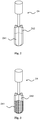
- Such a capture medium is shown schematically on the figure 2 , under the reference 24.
- the lower part can be advantageously and according to a preferred embodiment, divided in two.
- the area referenced 241 can be sensitized with a solution of binding partners (polyclonal antibodies, monoclonal antibodies, Fab 'or Fab'2 fragments, aptamers, phage proteins), while the upper part 242 remains virgin of any partner of binding and thus plays a negative control role.
- binding partners polyclonal antibodies, monoclonal antibodies, Fab 'or Fab'2 fragments, aptamers, phage proteins
- a subculture step it may be advantageous to carry out a subculture step, once the capture support 24 has been immersed in the reaction medium 22.
- This subculture consists in incubating the tube 20 for 1 to 18 hours, at temperatures between 25 and 44 ° C.
- the microorganisms are colored simultaneously with their growth thanks to the revealing means contained in the reaction medium. The analysis can then be done in real time.
- the sensitized capture support is no longer in contact with the reaction medium.
- the reading can be done in end point, in dotted lines or in real time.
- the capture support consists of sensitized particles, namely carrying a specific or non-specific binding partner of the microorganism (s) to be detected.
- the detection is then preferably demonstrated by the appearance of a coloration or fluorescence of the initially colorless sensitized particles, via the target microorganisms bound to the latter, during the reaction.
- the sensitized particles can be magnetic particles. So, reading can be done manually and visually, by using a magnetization system which will allow the gathering of the magnetic particles on which the colored or fluorescent microorganisms are captured, in the form of clusters against the wall of the container. A movement of the magnetization system vertically upwards makes it possible to remove the cluster of magnetic particles from the reaction medium and thus to facilitate the analysis. It can also be envisaged to immerse the magnetization system directly into the container, in order to collect the magnetic particles on which the microorganisms are fixed. In this case, the magnetic particles attach themselves directly to the magnetization system which then becomes colored or fluorescent.
- the reaction medium and the capture support are added directly to the first container at the end of the enrichment step.
- the detection step is therefore carried out in said first container without transferring all or part of the mixture consisting of the culture medium and the sample to be analyzed to a second container.
- a subculture can optionally be carried out in order to increase the population of target microorganisms.
- the capture medium can be protected using a protective film.
- the purpose of this film is to prevent clogging of the capture medium. Indeed, such fouling is likely to reduce the capture performance of said medium.
- a film can be placed permanently on the capture support.
- it can be a film which has the capacity to dissolve after a certain time of contact with the liquid culture medium.
- the method according to the invention is particularly advantageous because at the end of the analysis, only the containers identified as positive using the detection system (described below) are opened in order to carry out additional analyzes to confirm the. presumptive result obtained.
- the confirmation step can be carried out by means of a technology different from that implemented in the method according to the invention.
- Example 1 Optical detection of Salmonella Napoli, via the use of a sensitized support, in a food sample in subculture in a reaction medium
- the aim of this experiment is to directly detect the presence of the target bacterium Salmonella Napoli in a food sample in subculture in a reaction medium, via the use of a sensitized support, in irradiated polystyrene, marketed by the company Nunc / Thermo Scientific. (Cat. No. 472230) and shown on figures 2 and 3 .
- the detection is carried out during the reaction phase by immersing the capture support sensitized with a recombinant phage protein specific for Salmonella in a tube which contains the enriched sample, diluted to 1 / 100th in the reaction medium. .
- Step 1 Resuspend the samples in the primary enrichment medium
- Step 2 After 16 hours of incubation, transfer an aliquot of 0.1 mL from the homogenization bag to the reaction tube
- Step 3 Immersion of the sensitized supports in the reaction tubes before subculture and reaction
- the sensitized capture support is placed in each tube (Samples A 'and B').
- the tubes are then closed and incubated in an oven at 37 ° C. for 6 h.
- Step 4 Reading the capture media at the end of the incubation period
- the reaction medium s is colored red. Also, in order to be able to observe the capture support revealing the positivity or negativity of the sample analyzed, the tubes are tilted in order to isolate said capture support from the reaction medium.
- the capture medium disposed in sample A 'appears colored red, confirming that sample A' is positive while the capture medium disposed in sample B 'remains colorless, confirming that the sample B 'is negative.
- VIDAS® SPT method marketed by the applicant (ref. 30707) led to similar results, thus confirming the results obtained by optical reading of the sensitized capture medium.
- Example 2 Optical detection of Salmonella Napoli in an enriched biological sample, via the use of a sensitized support immersed in a reaction medium
- the aim of this experiment is to directly detect the presence of the target bacterium Salmonella Napoli in an enriched food sample, via the use of a sensitized support, in irradiated polystyrene, marketed by the company Nunc / Thermo Scientific (Cat. No. 472230) and represented on figures 2 and 3 .
- the detection is carried out during the reaction phase by immersing the capture support sensitized with a recombinant anti-Salmonella phage protein in a tube which contains the enriched sample, diluted 1/2 in the reaction medium. .
- Step 1 Resuspend the samples in the primary enrichment medium
- Step 2 After 16 hours of incubation, transfer of a 1 mL aliquot from the homogenization bag into the reaction tube
- Step 3 Immersion of the sensitized supports in the reaction tubes before reaction
- the sensitized capture support is placed in each tube (Samples A 'and B'), as described below.
- the tubes are then closed during the reaction period.
- Step 4 Reading the capture media at the end of the reaction period
- the capture medium disposed in sample A 'appears colored purple, confirming that sample A' is positive while the capture medium disposed in sample B 'remains colorless, confirming that the sample B 'is negative.
- the analysis of these same samples by the VIDAS® SPT method, marketed by the applicant (ref. 30707) led to similar results, thus confirming the results obtained via an eye reading of the sensitized capture medium.
Landscapes
- Health & Medical Sciences (AREA)
- Life Sciences & Earth Sciences (AREA)
- Chemical & Material Sciences (AREA)
- Engineering & Computer Science (AREA)
- Immunology (AREA)
- Organic Chemistry (AREA)
- Molecular Biology (AREA)
- Zoology (AREA)
- Wood Science & Technology (AREA)
- General Health & Medical Sciences (AREA)
- Biochemistry (AREA)
- Proteomics, Peptides & Aminoacids (AREA)
- Biotechnology (AREA)
- Microbiology (AREA)
- Physics & Mathematics (AREA)
- Analytical Chemistry (AREA)
- Biomedical Technology (AREA)
- Urology & Nephrology (AREA)
- Hematology (AREA)
- Bioinformatics & Cheminformatics (AREA)
- Genetics & Genomics (AREA)
- General Engineering & Computer Science (AREA)
- Food Science & Technology (AREA)
- Biophysics (AREA)
- Cell Biology (AREA)
- Medicinal Chemistry (AREA)
- General Physics & Mathematics (AREA)
- Pathology (AREA)
- Toxicology (AREA)
- Tropical Medicine & Parasitology (AREA)
- Virology (AREA)
- Measuring Or Testing Involving Enzymes Or Micro-Organisms (AREA)
Claims (10)
- Verfahren zum Nachweis mindestens eines Mikroorganismus, der in einer Probe vorliegt, wobei das Verfahren im Wesentlichen die folgenden Schritte umfasst:a) Inkontaktbringen der Probe, in einem ersten Behälter, mit mindestens einem Kulturmedium,b) Einwirkenlassen von Bedingungen, welche ein Wachstum des oder der Mikroorganismus/Mikroorganismen ermöglichen, auf den ersten Behälter über einen Zeitraum von 6 bis 48 Std.;c) Inkontaktbringen, in einem zweiten Behälter, eines Teils oder der Gesamtheit der Mischung, welche aus der Probe und dem Kulturmedium besteht, mit einem Reaktionsmilieu und einem einstückigen Träger zum Abfangen des oder der Mikroorganismus/Mikroorganismen, wobei das Reaktionsmilieu Nährstoffe, ein selektives System, welches ein Wachstum der Population von Zielbakterien ermöglicht, ein Mittel zum Sichtbarmachen des oder der Mikroorganismus/Mikroorganismen umfasst, welches aus den Farbstoffen und den fluoreszierenden Verbindungen ausgewählt ist;d) Einwirkenlassen von Bedingungen, welche ein Wachstum des oder der Mikroorganismus/Mikroorganismen ermöglichen, auf den zweiten Behälter;e) Nachweisen, im Inneren des zweiten Behälters, des Vorhandenseins des oder der Mikroorganismus/Mikroorganismen, der/die durch das Mittel zum Sichtbarmachen sichtbar gemacht wurde(n) und auf dem Abfangträger fixiert wurde(n), wobei der Nachweis in Echtzeit erfolgt.
- Verfahren nach einem der vorhergehenden Ansprüche, wobei es einen zusätzlichen Schritt aufweist, der darin besteht, den Nachweis des oder der nachgewiesenen Mikroorganismus/Mikroorganismen zu bestätigen.
- Verfahren nach Anspruch 2, wobei der Schritt des Bestätigens mit Hilfe eines Nachweismittels durchgeführt wird, das bezüglich des Mittels zum Sichtbarmachen, welches für den Nachweis verwendet wird, gleichartig ist oder sich davon unterscheidet.
- Nachweisverfahren nach einem der vorhergehenden Ansprüche, wobei an dem einstückigen Abfangträger mindestens ein Bindungspartner befestigt ist, der spezifisch oder unspezifisch für den oder die Mikroorganismus/Mikroorganismen ist.
- Nachweisverfahren nach dem vorhergehenden Anspruch, wobei der spezifische Bindungspartner aus der Gruppe ausgewählt ist, die Folgendes umfasst: Antikörper, Fab-Fragmente, Fab'-Fragmente, Aptamere, Phagenproteine, die rekombinanter Art sind oder nicht, Phagen.
- Nachweisverfahren nach einem der vorhergehenden Ansprüche, wobei der Nachweis des oder der Mikroorganismus/Mikroorganismen nach Abschluss des Schrittes des Wachstums des oder der Mikroorganismus/Mikroorganismen durchgeführt wird.
- Nachweisverfahren nach einem der vorhergehenden Ansprüche, wobei es sich bei dem ersten und/oder dem zweiten Behälter um einen Homogenisierungsbeutel, ein Probenfläschchen, eine Flasche, eine Tablettenbox handelt.
- Verfahren nach einem der vorhergehenden Ansprüche, wobei es sich bei dem Abfangträger um einen porösen einstückigen Träger handelt.
- Verfahren nach Anspruch 8, wobei der Abfangträger durch eine Schutzfolie geschützt ist.
- Verfahren nach Anspruch 8 oder 9, wobei es sich bei dem einstückigen Abfangträger um einen komprimierbaren Träger handelt.
Applications Claiming Priority (2)
| Application Number | Priority Date | Filing Date | Title |
|---|---|---|---|
| FR1250249A FR2985519B1 (fr) | 2012-01-10 | 2012-01-10 | Procede de detection et d'identification directe par voie optique d'un microorganisme dans un echantillon biologique |
| PCT/FR2013/050051 WO2013104864A1 (fr) | 2012-01-10 | 2013-01-09 | Procede de detection et d'identification directe par voie optique d'un microorganisme dans un echantillon biologique |
Publications (2)
| Publication Number | Publication Date |
|---|---|
| EP2802875A1 EP2802875A1 (de) | 2014-11-19 |
| EP2802875B1 true EP2802875B1 (de) | 2021-03-31 |
Family
ID=47628382
Family Applications (1)
| Application Number | Title | Priority Date | Filing Date |
|---|---|---|---|
| EP13701855.2A Active EP2802875B1 (de) | 2012-01-10 | 2013-01-09 | Verfahren zum direkten nachweis und zur identifizierung von mikroorganismen in einer biologischen probe durch optische mittel |
Country Status (7)
| Country | Link |
|---|---|
| US (1) | US9902987B2 (de) |
| EP (1) | EP2802875B1 (de) |
| JP (1) | JP6563654B2 (de) |
| CN (1) | CN104115010A (de) |
| ES (1) | ES2875894T3 (de) |
| FR (1) | FR2985519B1 (de) |
| WO (1) | WO2013104864A1 (de) |
Families Citing this family (7)
| Publication number | Priority date | Publication date | Assignee | Title |
|---|---|---|---|---|
| FR2962445B1 (fr) * | 2010-07-08 | 2013-06-28 | Biomerieux Sa | Procede de detection et d'identification directe d'un microorganisme dans un echantillon biologique dilue dans un bouillon d'enrichissement |
| FR2997703B1 (fr) * | 2012-11-07 | 2016-12-30 | Biomerieux Sa | Procede de traitement d'au moins un echantillon biologique |
| EP3280792A1 (de) * | 2015-04-08 | 2018-02-14 | 3M Innovative Properties Company | Aufrechtstehender faltenfilterbeutel |
| KR102050166B1 (ko) * | 2018-08-10 | 2019-11-28 | 연세대학교 산학협력단 | 부유 미생물의 실시간 연속 측정장치 |
| FR3086952A1 (fr) * | 2018-10-08 | 2020-04-10 | Biomerieux | Procede de prelevement de microorganismes a partir d'un echantillon biologique liquide ou visqueux ou d'une suspension de microorganismes fortement contamines |
| JP7344540B2 (ja) * | 2019-06-19 | 2023-09-14 | 株式会社Icst | 試験器具および試験方法 |
| IT202100003080A1 (it) * | 2021-02-11 | 2022-08-11 | Mectron S P A | Un metodo per la cattura di batteri da sospensioni e relativo dispositivo |
Family Cites Families (14)
| Publication number | Priority date | Publication date | Assignee | Title |
|---|---|---|---|---|
| US5094955A (en) * | 1988-03-15 | 1992-03-10 | Akzo N.V. | Device and method for detecting microorganisms |
| ES2294787T3 (es) * | 1995-06-05 | 2008-04-01 | Biomerieux, Inc. | Dispositivo y metodo para detectar microorganismos. |
| US5843699A (en) * | 1997-04-08 | 1998-12-01 | Difco Laboratories, Inc. | Rapid microorganism detection method |
| JP3773633B2 (ja) * | 1997-10-31 | 2006-05-10 | 株式会社三菱化学ヤトロン | 大腸菌o157の分析方法及び分析用試薬 |
| DE60140563D1 (de) * | 2000-11-30 | 2009-12-31 | Boston Probes Inc | Verfahren und zusammensetzungen zum aussortieren und/oder nachweis von mikroorganismen |
| FR2819266B1 (fr) * | 2001-01-05 | 2004-01-16 | Alain Rambach | Milieu de culture pour la detection et/ou la discrimination des bacteries du genre listeria et procede de mise en oeuvre |
| EP1253203A1 (de) * | 2001-04-25 | 2002-10-30 | Becton Dickinson and Company | Schnelles Keimen, Wachstum, Immobilisierung und Detektion von Mikroorganismen |
| ATE450796T1 (de) | 2001-10-10 | 2009-12-15 | 3M Innovative Properties Co | Teststäbchen zur verwendung beim nachweis von mikroorganismen |
| EP2005161B1 (de) * | 2006-03-17 | 2016-02-24 | NewSouth Innovations Pty Limited | Elektrochemischer sensor |
| JP4339375B2 (ja) * | 2007-05-21 | 2009-10-07 | 白鶴酒造株式会社 | 微生物センサーおよびその製造方法 |
| FR2928656B1 (fr) * | 2008-03-14 | 2011-08-26 | Biomerieux Sa | Procede de detection en temps reel de microorganismes dans un milieu de culture liquide par agglutination. |
| US20120165215A1 (en) * | 2009-06-26 | 2012-06-28 | The Regents Of The University Of California | Methods and systems for phylogenetic analysis |
| FR2962445B1 (fr) * | 2010-07-08 | 2013-06-28 | Biomerieux Sa | Procede de detection et d'identification directe d'un microorganisme dans un echantillon biologique dilue dans un bouillon d'enrichissement |
| CN203007262U (zh) * | 2013-01-15 | 2013-06-19 | 温州医学院 | 微阵列细菌识别和筛分装置 |
-
2012
- 2012-01-10 FR FR1250249A patent/FR2985519B1/fr not_active Expired - Fee Related
-
2013
- 2013-01-09 ES ES13701855T patent/ES2875894T3/es active Active
- 2013-01-09 US US14/371,488 patent/US9902987B2/en not_active Expired - Fee Related
- 2013-01-09 JP JP2014550752A patent/JP6563654B2/ja not_active Expired - Fee Related
- 2013-01-09 WO PCT/FR2013/050051 patent/WO2013104864A1/fr not_active Ceased
- 2013-01-09 EP EP13701855.2A patent/EP2802875B1/de active Active
- 2013-01-09 CN CN201380005118.7A patent/CN104115010A/zh active Pending
Non-Patent Citations (1)
| Title |
|---|
| None * |
Also Published As
| Publication number | Publication date |
|---|---|
| JP2015504163A (ja) | 2015-02-05 |
| WO2013104864A1 (fr) | 2013-07-18 |
| US9902987B2 (en) | 2018-02-27 |
| EP2802875A1 (de) | 2014-11-19 |
| FR2985519B1 (fr) | 2016-02-19 |
| ES2875894T3 (es) | 2021-11-11 |
| JP6563654B2 (ja) | 2019-08-21 |
| FR2985519A1 (fr) | 2013-07-12 |
| US20140349280A1 (en) | 2014-11-27 |
| CN104115010A (zh) | 2014-10-22 |
Similar Documents
| Publication | Publication Date | Title |
|---|---|---|
| Kaya-Okur et al. | Efficient low-cost chromatin profiling with CUT&Tag | |
| Roy et al. | Recent developments towards portable point-of-care diagnostic devices for pathogen detection | |
| EP2252892B1 (de) | Verfahren zum echtzeitnachweis von mikroorganismen in einem flüssigen kulturmedium durch agglutinierung | |
| Ishii et al. | Single-cell analysis and isolation for microbiology and biotechnology: methods and applications | |
| EP2591122B1 (de) | Verfahren zum direkten nachweis und zur identifizierung eines mikroorganismus aus einer biologischen probe, die mit einem angereicherten kulturmedium verduennt ist | |
| Filonov et al. | RNA imaging with dimeric Broccoli in live bacterial and mammalian cells | |
| WO2013104864A1 (fr) | Procede de detection et d'identification directe par voie optique d'un microorganisme dans un echantillon biologique | |
| EP3668992A1 (de) | Verfahren zur bestimmung der konzentration von intakten mikroorganismen in einer probe | |
| CA2868703A1 (en) | Method and device for detecting metabollically active cells | |
| Feng et al. | Artificial intelligence-based imaging transcoding system for multiplex screening of viable foodborne pathogens | |
| JP2025004230A (ja) | 微生物の検出のための自己完結型装置およびシステム | |
| Kumar et al. | Disease diagnostic tools for health management in aquaculture | |
| Marcos-Fernández et al. | Convergence of flow cytometry and bacteriology. Current and future applications: a focus on food and clinical microbiology | |
| Jiang et al. | Simultaneous detection of Vibrio parahemolyticus and antimicrobial resistance genes using immonomagnetic separation combined with RPA-microfluidic method in seafood | |
| Hogmander et al. | Luminometric label array for counting and differentiation of bacteria | |
| EP2802874A1 (de) | Verfahren zur erfassung und konzentration eines mikroorganismus in einer biologischen probe | |
| Haddad et al. | Emerging analytical techniques for determination of foodborne pathogens and toxins: a review | |
| Ekrami et al. | Validity of bioconjugated silica nanoparticles in comparison with direct smear, culture, and polymerase chain reaction for detection of Mycobacterium tuberculosis in sputum specimens | |
| CA2867288A1 (en) | Biologic machines for the detection of biomolecules | |
| Ragavan et al. | Modified fields’ stain: ideal to differentiate Dientamoeba fragilis and Blastocystis sp. | |
| EP2252700B1 (de) | Verfahren zum echtzeitnachweis von mikroorganismen in einem flüssigen kulturmedium mithilfe zellulärer lyse | |
| Robinson et al. | Preparation of Cryptosporidium DNA for whole genome sequencing | |
| JP2005525804A (ja) | insituハイブリダイゼーションおよびフローサイトメトリーを用いる微生物の同定方法 | |
| Watkins | Immunohistochemistry | |
| Rossmanith et al. | Sample preparation for the detection of foodborne pathogens by molecular biological methods |
Legal Events
| Date | Code | Title | Description |
|---|---|---|---|
| PUAI | Public reference made under article 153(3) epc to a published international application that has entered the european phase |
Free format text: ORIGINAL CODE: 0009012 |
|
| 17P | Request for examination filed |
Effective date: 20140722 |
|
| AK | Designated contracting states |
Kind code of ref document: A1 Designated state(s): AL AT BE BG CH CY CZ DE DK EE ES FI FR GB GR HR HU IE IS IT LI LT LU LV MC MK MT NL NO PL PT RO RS SE SI SK SM TR |
|
| RIN1 | Information on inventor provided before grant (corrected) |
Inventor name: JUNILLON, THOMAS Inventor name: BARIL, FLORENT Inventor name: VIMONT, ANTOINE Inventor name: FLANDROIX, JEAN-PIERRE Inventor name: RAYMOND, JEAN-CLAUDE Inventor name: MOSTICONE, DAVID Inventor name: MALLEN, BENOIT |
|
| RIN1 | Information on inventor provided before grant (corrected) |
Inventor name: JUNILLON, THOMAS Inventor name: RAYMOND, JEAN-CLAUDE Inventor name: FLANDROIX, JEAN-PIERRE Inventor name: MALLEN, BENOIT Inventor name: BARIL, FLORENT Inventor name: VIMONT, ANTOINE Inventor name: MOSTICONE, DAVID |
|
| RIN1 | Information on inventor provided before grant (corrected) |
Inventor name: JUNILLON, THOMAS Inventor name: VIMONT, ANTOINE Inventor name: MALLEN, BENOIT Inventor name: RAYMOND, JEAN-CLAUDE Inventor name: MOSTICONE, DAVID Inventor name: FLANDROIX, JEAN-PIERRE Inventor name: BARIL, FLORENT |
|
| DAX | Request for extension of the european patent (deleted) | ||
| 17Q | First examination report despatched |
Effective date: 20160630 |
|
| STAA | Information on the status of an ep patent application or granted ep patent |
Free format text: STATUS: EXAMINATION IS IN PROGRESS |
|
| REG | Reference to a national code |
Ref country code: DE Ref legal event code: R079 Ref document number: 602013076559 Country of ref document: DE Free format text: PREVIOUS MAIN CLASS: G01N0033543000 Ipc: C12C0001000000 |
|
| GRAP | Despatch of communication of intention to grant a patent |
Free format text: ORIGINAL CODE: EPIDOSNIGR1 |
|
| STAA | Information on the status of an ep patent application or granted ep patent |
Free format text: STATUS: GRANT OF PATENT IS INTENDED |
|
| RIC1 | Information provided on ipc code assigned before grant |
Ipc: G01N 33/543 20060101ALI20201007BHEP Ipc: C12Q 1/00 20060101ALI20201007BHEP Ipc: C12C 1/00 20060101AFI20201007BHEP Ipc: G01N 33/569 20060101ALI20201007BHEP Ipc: C12Q 1/04 20060101ALI20201007BHEP Ipc: C12M 1/34 20060101ALI20201007BHEP Ipc: B01L 3/00 20060101ALI20201007BHEP |
|
| INTG | Intention to grant announced |
Effective date: 20201029 |
|
| RAP1 | Party data changed (applicant data changed or rights of an application transferred) |
Owner name: BIOMERIEUX |
|
| GRAS | Grant fee paid |
Free format text: ORIGINAL CODE: EPIDOSNIGR3 |
|
| GRAA | (expected) grant |
Free format text: ORIGINAL CODE: 0009210 |
|
| STAA | Information on the status of an ep patent application or granted ep patent |
Free format text: STATUS: THE PATENT HAS BEEN GRANTED |
|
| AK | Designated contracting states |
Kind code of ref document: B1 Designated state(s): AL AT BE BG CH CY CZ DE DK EE ES FI FR GB GR HR HU IE IS IT LI LT LU LV MC MK MT NL NO PL PT RO RS SE SI SK SM TR |
|
| REG | Reference to a national code |
Ref country code: GB Ref legal event code: FG4D Free format text: NOT ENGLISH Ref country code: CH Ref legal event code: EP |
|
| REG | Reference to a national code |
Ref country code: DE Ref legal event code: R096 Ref document number: 602013076559 Country of ref document: DE Ref country code: AT Ref legal event code: REF Ref document number: 1376943 Country of ref document: AT Kind code of ref document: T Effective date: 20210415 |
|
| REG | Reference to a national code |
Ref country code: IE Ref legal event code: FG4D Free format text: LANGUAGE OF EP DOCUMENT: FRENCH |
|
| REG | Reference to a national code |
Ref country code: LT Ref legal event code: MG9D |
|
| PG25 | Lapsed in a contracting state [announced via postgrant information from national office to epo] |
Ref country code: NO Free format text: LAPSE BECAUSE OF FAILURE TO SUBMIT A TRANSLATION OF THE DESCRIPTION OR TO PAY THE FEE WITHIN THE PRESCRIBED TIME-LIMIT Effective date: 20210630 Ref country code: BG Free format text: LAPSE BECAUSE OF FAILURE TO SUBMIT A TRANSLATION OF THE DESCRIPTION OR TO PAY THE FEE WITHIN THE PRESCRIBED TIME-LIMIT Effective date: 20210630 Ref country code: FI Free format text: LAPSE BECAUSE OF FAILURE TO SUBMIT A TRANSLATION OF THE DESCRIPTION OR TO PAY THE FEE WITHIN THE PRESCRIBED TIME-LIMIT Effective date: 20210331 Ref country code: HR Free format text: LAPSE BECAUSE OF FAILURE TO SUBMIT A TRANSLATION OF THE DESCRIPTION OR TO PAY THE FEE WITHIN THE PRESCRIBED TIME-LIMIT Effective date: 20210331 |
|
| PG25 | Lapsed in a contracting state [announced via postgrant information from national office to epo] |
Ref country code: SE Free format text: LAPSE BECAUSE OF FAILURE TO SUBMIT A TRANSLATION OF THE DESCRIPTION OR TO PAY THE FEE WITHIN THE PRESCRIBED TIME-LIMIT Effective date: 20210331 Ref country code: LV Free format text: LAPSE BECAUSE OF FAILURE TO SUBMIT A TRANSLATION OF THE DESCRIPTION OR TO PAY THE FEE WITHIN THE PRESCRIBED TIME-LIMIT Effective date: 20210331 Ref country code: RS Free format text: LAPSE BECAUSE OF FAILURE TO SUBMIT A TRANSLATION OF THE DESCRIPTION OR TO PAY THE FEE WITHIN THE PRESCRIBED TIME-LIMIT Effective date: 20210331 |
|
| REG | Reference to a national code |
Ref country code: NL Ref legal event code: MP Effective date: 20210331 |
|
| REG | Reference to a national code |
Ref country code: AT Ref legal event code: MK05 Ref document number: 1376943 Country of ref document: AT Kind code of ref document: T Effective date: 20210331 |
|
| PG25 | Lapsed in a contracting state [announced via postgrant information from national office to epo] |
Ref country code: CZ Free format text: LAPSE BECAUSE OF FAILURE TO SUBMIT A TRANSLATION OF THE DESCRIPTION OR TO PAY THE FEE WITHIN THE PRESCRIBED TIME-LIMIT Effective date: 20210331 Ref country code: EE Free format text: LAPSE BECAUSE OF FAILURE TO SUBMIT A TRANSLATION OF THE DESCRIPTION OR TO PAY THE FEE WITHIN THE PRESCRIBED TIME-LIMIT Effective date: 20210331 Ref country code: NL Free format text: LAPSE BECAUSE OF FAILURE TO SUBMIT A TRANSLATION OF THE DESCRIPTION OR TO PAY THE FEE WITHIN THE PRESCRIBED TIME-LIMIT Effective date: 20210331 Ref country code: LT Free format text: LAPSE BECAUSE OF FAILURE TO SUBMIT A TRANSLATION OF THE DESCRIPTION OR TO PAY THE FEE WITHIN THE PRESCRIBED TIME-LIMIT Effective date: 20210331 Ref country code: SM Free format text: LAPSE BECAUSE OF FAILURE TO SUBMIT A TRANSLATION OF THE DESCRIPTION OR TO PAY THE FEE WITHIN THE PRESCRIBED TIME-LIMIT Effective date: 20210331 Ref country code: AT Free format text: LAPSE BECAUSE OF FAILURE TO SUBMIT A TRANSLATION OF THE DESCRIPTION OR TO PAY THE FEE WITHIN THE PRESCRIBED TIME-LIMIT Effective date: 20210331 |
|
| REG | Reference to a national code |
Ref country code: ES Ref legal event code: FG2A Ref document number: 2875894 Country of ref document: ES Kind code of ref document: T3 Effective date: 20211111 |
|
| PG25 | Lapsed in a contracting state [announced via postgrant information from national office to epo] |
Ref country code: RO Free format text: LAPSE BECAUSE OF FAILURE TO SUBMIT A TRANSLATION OF THE DESCRIPTION OR TO PAY THE FEE WITHIN THE PRESCRIBED TIME-LIMIT Effective date: 20210331 Ref country code: IS Free format text: LAPSE BECAUSE OF FAILURE TO SUBMIT A TRANSLATION OF THE DESCRIPTION OR TO PAY THE FEE WITHIN THE PRESCRIBED TIME-LIMIT Effective date: 20210731 Ref country code: SK Free format text: LAPSE BECAUSE OF FAILURE TO SUBMIT A TRANSLATION OF THE DESCRIPTION OR TO PAY THE FEE WITHIN THE PRESCRIBED TIME-LIMIT Effective date: 20210331 Ref country code: PT Free format text: LAPSE BECAUSE OF FAILURE TO SUBMIT A TRANSLATION OF THE DESCRIPTION OR TO PAY THE FEE WITHIN THE PRESCRIBED TIME-LIMIT Effective date: 20210802 Ref country code: PL Free format text: LAPSE BECAUSE OF FAILURE TO SUBMIT A TRANSLATION OF THE DESCRIPTION OR TO PAY THE FEE WITHIN THE PRESCRIBED TIME-LIMIT Effective date: 20210331 |
|
| REG | Reference to a national code |
Ref country code: DE Ref legal event code: R097 Ref document number: 602013076559 Country of ref document: DE |
|
| PG25 | Lapsed in a contracting state [announced via postgrant information from national office to epo] |
Ref country code: DK Free format text: LAPSE BECAUSE OF FAILURE TO SUBMIT A TRANSLATION OF THE DESCRIPTION OR TO PAY THE FEE WITHIN THE PRESCRIBED TIME-LIMIT Effective date: 20210331 Ref country code: AL Free format text: LAPSE BECAUSE OF FAILURE TO SUBMIT A TRANSLATION OF THE DESCRIPTION OR TO PAY THE FEE WITHIN THE PRESCRIBED TIME-LIMIT Effective date: 20210331 |
|
| PLBE | No opposition filed within time limit |
Free format text: ORIGINAL CODE: 0009261 |
|
| STAA | Information on the status of an ep patent application or granted ep patent |
Free format text: STATUS: NO OPPOSITION FILED WITHIN TIME LIMIT |
|
| 26N | No opposition filed |
Effective date: 20220104 |
|
| PG25 | Lapsed in a contracting state [announced via postgrant information from national office to epo] |
Ref country code: IS Free format text: LAPSE BECAUSE OF FAILURE TO SUBMIT A TRANSLATION OF THE DESCRIPTION OR TO PAY THE FEE WITHIN THE PRESCRIBED TIME-LIMIT Effective date: 20210731 |
|
| PG25 | Lapsed in a contracting state [announced via postgrant information from national office to epo] |
Ref country code: MC Free format text: LAPSE BECAUSE OF FAILURE TO SUBMIT A TRANSLATION OF THE DESCRIPTION OR TO PAY THE FEE WITHIN THE PRESCRIBED TIME-LIMIT Effective date: 20210331 |
|
| REG | Reference to a national code |
Ref country code: CH Ref legal event code: PL |
|
| REG | Reference to a national code |
Ref country code: BE Ref legal event code: MM Effective date: 20220131 |
|
| PG25 | Lapsed in a contracting state [announced via postgrant information from national office to epo] |
Ref country code: LU Free format text: LAPSE BECAUSE OF NON-PAYMENT OF DUE FEES Effective date: 20220109 |
|
| PG25 | Lapsed in a contracting state [announced via postgrant information from national office to epo] |
Ref country code: BE Free format text: LAPSE BECAUSE OF NON-PAYMENT OF DUE FEES Effective date: 20220131 |
|
| PG25 | Lapsed in a contracting state [announced via postgrant information from national office to epo] |
Ref country code: LI Free format text: LAPSE BECAUSE OF NON-PAYMENT OF DUE FEES Effective date: 20220131 Ref country code: CH Free format text: LAPSE BECAUSE OF NON-PAYMENT OF DUE FEES Effective date: 20220131 |
|
| PG25 | Lapsed in a contracting state [announced via postgrant information from national office to epo] |
Ref country code: IE Free format text: LAPSE BECAUSE OF NON-PAYMENT OF DUE FEES Effective date: 20220109 |
|
| PG25 | Lapsed in a contracting state [announced via postgrant information from national office to epo] |
Ref country code: HU Free format text: LAPSE BECAUSE OF FAILURE TO SUBMIT A TRANSLATION OF THE DESCRIPTION OR TO PAY THE FEE WITHIN THE PRESCRIBED TIME-LIMIT; INVALID AB INITIO Effective date: 20130109 |
|
| PGFP | Annual fee paid to national office [announced via postgrant information from national office to epo] |
Ref country code: ES Payment date: 20240201 Year of fee payment: 12 |
|
| PG25 | Lapsed in a contracting state [announced via postgrant information from national office to epo] |
Ref country code: MK Free format text: LAPSE BECAUSE OF FAILURE TO SUBMIT A TRANSLATION OF THE DESCRIPTION OR TO PAY THE FEE WITHIN THE PRESCRIBED TIME-LIMIT Effective date: 20210331 Ref country code: CY Free format text: LAPSE BECAUSE OF FAILURE TO SUBMIT A TRANSLATION OF THE DESCRIPTION OR TO PAY THE FEE WITHIN THE PRESCRIBED TIME-LIMIT Effective date: 20210331 |
|
| PGFP | Annual fee paid to national office [announced via postgrant information from national office to epo] |
Ref country code: DE Payment date: 20240129 Year of fee payment: 12 Ref country code: GB Payment date: 20240129 Year of fee payment: 12 |
|
| PGFP | Annual fee paid to national office [announced via postgrant information from national office to epo] |
Ref country code: IT Payment date: 20240122 Year of fee payment: 12 Ref country code: FR Payment date: 20240125 Year of fee payment: 12 |
|
| PG25 | Lapsed in a contracting state [announced via postgrant information from national office to epo] |
Ref country code: MT Free format text: LAPSE BECAUSE OF FAILURE TO SUBMIT A TRANSLATION OF THE DESCRIPTION OR TO PAY THE FEE WITHIN THE PRESCRIBED TIME-LIMIT Effective date: 20210331 |
|
| PG25 | Lapsed in a contracting state [announced via postgrant information from national office to epo] |
Ref country code: GR Free format text: LAPSE BECAUSE OF NON-PAYMENT OF DUE FEES Effective date: 20210331 |
|
| PG25 | Lapsed in a contracting state [announced via postgrant information from national office to epo] |
Ref country code: GR Free format text: LAPSE BECAUSE OF NON-PAYMENT OF DUE FEES Effective date: 20210331 |
|
| REG | Reference to a national code |
Ref country code: DE Ref legal event code: R119 Ref document number: 602013076559 Country of ref document: DE |
|
| GBPC | Gb: european patent ceased through non-payment of renewal fee |
Effective date: 20250109 |
|
| PG25 | Lapsed in a contracting state [announced via postgrant information from national office to epo] |
Ref country code: DE Free format text: LAPSE BECAUSE OF NON-PAYMENT OF DUE FEES Effective date: 20250801 |
|
| PG25 | Lapsed in a contracting state [announced via postgrant information from national office to epo] |
Ref country code: GB Free format text: LAPSE BECAUSE OF NON-PAYMENT OF DUE FEES Effective date: 20250109 |
|
| PG25 | Lapsed in a contracting state [announced via postgrant information from national office to epo] |
Ref country code: FR Free format text: LAPSE BECAUSE OF NON-PAYMENT OF DUE FEES Effective date: 20250131 |
|
| PG25 | Lapsed in a contracting state [announced via postgrant information from national office to epo] |
Ref country code: TR Free format text: LAPSE BECAUSE OF FAILURE TO SUBMIT A TRANSLATION OF THE DESCRIPTION OR TO PAY THE FEE WITHIN THE PRESCRIBED TIME-LIMIT Effective date: 20210331 |
|
| PG25 | Lapsed in a contracting state [announced via postgrant information from national office to epo] |
Ref country code: IT Free format text: LAPSE BECAUSE OF NON-PAYMENT OF DUE FEES Effective date: 20250109 |
|
| REG | Reference to a national code |
Ref country code: ES Ref legal event code: FD2A Effective date: 20260227 |
|
| PG25 | Lapsed in a contracting state [announced via postgrant information from national office to epo] |
Ref country code: ES Free format text: LAPSE BECAUSE OF NON-PAYMENT OF DUE FEES Effective date: 20250110 |