EP2800768B1 - Method for making over-indexed thermoplastic polyurethane elastomer precursor and thermoplastic polyurethane elastomer made from the precursor - Google Patents
Method for making over-indexed thermoplastic polyurethane elastomer precursor and thermoplastic polyurethane elastomer made from the precursor Download PDFInfo
- Publication number
- EP2800768B1 EP2800768B1 EP13733836.4A EP13733836A EP2800768B1 EP 2800768 B1 EP2800768 B1 EP 2800768B1 EP 13733836 A EP13733836 A EP 13733836A EP 2800768 B1 EP2800768 B1 EP 2800768B1
- Authority
- EP
- European Patent Office
- Prior art keywords
- precursor
- thermoplastic polyurethane
- polyurethane elastomer
- over
- dried
- Prior art date
- Legal status (The legal status is an assumption and is not a legal conclusion. Google has not performed a legal analysis and makes no representation as to the accuracy of the status listed.)
- Active
Links
Images

Classifications
-
- C—CHEMISTRY; METALLURGY
- C08—ORGANIC MACROMOLECULAR COMPOUNDS; THEIR PREPARATION OR CHEMICAL WORKING-UP; COMPOSITIONS BASED THEREON
- C08G—MACROMOLECULAR COMPOUNDS OBTAINED OTHERWISE THAN BY REACTIONS ONLY INVOLVING UNSATURATED CARBON-TO-CARBON BONDS
- C08G18/00—Polymeric products of isocyanates or isothiocyanates
- C08G18/06—Polymeric products of isocyanates or isothiocyanates with compounds having active hydrogen
- C08G18/28—Polymeric products of isocyanates or isothiocyanates with compounds having active hydrogen characterised by the compounds used containing active hydrogen
-
- A—HUMAN NECESSITIES
- A63—SPORTS; GAMES; AMUSEMENTS
- A63B—APPARATUS FOR PHYSICAL TRAINING, GYMNASTICS, SWIMMING, CLIMBING, OR FENCING; BALL GAMES; TRAINING EQUIPMENT
- A63B37/00—Solid balls; Rigid hollow balls; Marbles
- A63B37/0003—Golf balls
- A63B37/0023—Covers
- A63B37/0024—Materials other than ionomers or polyurethane
- A63B37/0027—Polyurea
-
- A—HUMAN NECESSITIES
- A63—SPORTS; GAMES; AMUSEMENTS
- A63B—APPARATUS FOR PHYSICAL TRAINING, GYMNASTICS, SWIMMING, CLIMBING, OR FENCING; BALL GAMES; TRAINING EQUIPMENT
- A63B37/00—Solid balls; Rigid hollow balls; Marbles
- A63B37/0003—Golf balls
- A63B37/0038—Intermediate layers, e.g. inner cover, outer core, mantle
- A63B37/0039—Intermediate layers, e.g. inner cover, outer core, mantle characterised by the material
-
- A—HUMAN NECESSITIES
- A63—SPORTS; GAMES; AMUSEMENTS
- A63B—APPARATUS FOR PHYSICAL TRAINING, GYMNASTICS, SWIMMING, CLIMBING, OR FENCING; BALL GAMES; TRAINING EQUIPMENT
- A63B37/00—Solid balls; Rigid hollow balls; Marbles
- A63B37/0003—Golf balls
- A63B37/005—Cores
- A63B37/0051—Materials other than polybutadienes; Constructional details
- A63B37/0058—Polyurethane
-
- C—CHEMISTRY; METALLURGY
- C07—ORGANIC CHEMISTRY
- C07C—ACYCLIC OR CARBOCYCLIC COMPOUNDS
- C07C263/00—Preparation of derivatives of isocyanic acid
- C07C263/16—Preparation of derivatives of isocyanic acid by reactions not involving the formation of isocyanate groups
-
- C—CHEMISTRY; METALLURGY
- C08—ORGANIC MACROMOLECULAR COMPOUNDS; THEIR PREPARATION OR CHEMICAL WORKING-UP; COMPOSITIONS BASED THEREON
- C08G—MACROMOLECULAR COMPOUNDS OBTAINED OTHERWISE THAN BY REACTIONS ONLY INVOLVING UNSATURATED CARBON-TO-CARBON BONDS
- C08G18/00—Polymeric products of isocyanates or isothiocyanates
- C08G18/06—Polymeric products of isocyanates or isothiocyanates with compounds having active hydrogen
- C08G18/08—Processes
- C08G18/10—Prepolymer processes involving reaction of isocyanates or isothiocyanates with compounds having active hydrogen in a first reaction step
- C08G18/12—Prepolymer processes involving reaction of isocyanates or isothiocyanates with compounds having active hydrogen in a first reaction step using two or more compounds having active hydrogen in the first polymerisation step
-
- C—CHEMISTRY; METALLURGY
- C08—ORGANIC MACROMOLECULAR COMPOUNDS; THEIR PREPARATION OR CHEMICAL WORKING-UP; COMPOSITIONS BASED THEREON
- C08G—MACROMOLECULAR COMPOUNDS OBTAINED OTHERWISE THAN BY REACTIONS ONLY INVOLVING UNSATURATED CARBON-TO-CARBON BONDS
- C08G18/00—Polymeric products of isocyanates or isothiocyanates
- C08G18/06—Polymeric products of isocyanates or isothiocyanates with compounds having active hydrogen
- C08G18/28—Polymeric products of isocyanates or isothiocyanates with compounds having active hydrogen characterised by the compounds used containing active hydrogen
- C08G18/40—High-molecular-weight compounds
- C08G18/48—Polyethers
- C08G18/4854—Polyethers containing oxyalkylene groups having four carbon atoms in the alkylene group
-
- C—CHEMISTRY; METALLURGY
- C08—ORGANIC MACROMOLECULAR COMPOUNDS; THEIR PREPARATION OR CHEMICAL WORKING-UP; COMPOSITIONS BASED THEREON
- C08G—MACROMOLECULAR COMPOUNDS OBTAINED OTHERWISE THAN BY REACTIONS ONLY INVOLVING UNSATURATED CARBON-TO-CARBON BONDS
- C08G18/00—Polymeric products of isocyanates or isothiocyanates
- C08G18/06—Polymeric products of isocyanates or isothiocyanates with compounds having active hydrogen
- C08G18/28—Polymeric products of isocyanates or isothiocyanates with compounds having active hydrogen characterised by the compounds used containing active hydrogen
- C08G18/65—Low-molecular-weight compounds having active hydrogen with high-molecular-weight compounds having active hydrogen
- C08G18/66—Compounds of groups C08G18/42, C08G18/48, or C08G18/52
- C08G18/6666—Compounds of group C08G18/48 or C08G18/52
- C08G18/667—Compounds of group C08G18/48 or C08G18/52 with compounds of group C08G18/32 or polyamines of C08G18/38
- C08G18/6674—Compounds of group C08G18/48 or C08G18/52 with compounds of group C08G18/32 or polyamines of C08G18/38 with compounds of group C08G18/3203
-
- C—CHEMISTRY; METALLURGY
- C08—ORGANIC MACROMOLECULAR COMPOUNDS; THEIR PREPARATION OR CHEMICAL WORKING-UP; COMPOSITIONS BASED THEREON
- C08G—MACROMOLECULAR COMPOUNDS OBTAINED OTHERWISE THAN BY REACTIONS ONLY INVOLVING UNSATURATED CARBON-TO-CARBON BONDS
- C08G18/00—Polymeric products of isocyanates or isothiocyanates
- C08G18/06—Polymeric products of isocyanates or isothiocyanates with compounds having active hydrogen
- C08G18/28—Polymeric products of isocyanates or isothiocyanates with compounds having active hydrogen characterised by the compounds used containing active hydrogen
- C08G18/67—Unsaturated compounds having active hydrogen
- C08G18/675—Low-molecular-weight compounds
-
- C—CHEMISTRY; METALLURGY
- C08—ORGANIC MACROMOLECULAR COMPOUNDS; THEIR PREPARATION OR CHEMICAL WORKING-UP; COMPOSITIONS BASED THEREON
- C08G—MACROMOLECULAR COMPOUNDS OBTAINED OTHERWISE THAN BY REACTIONS ONLY INVOLVING UNSATURATED CARBON-TO-CARBON BONDS
- C08G18/00—Polymeric products of isocyanates or isothiocyanates
- C08G18/06—Polymeric products of isocyanates or isothiocyanates with compounds having active hydrogen
- C08G18/70—Polymeric products of isocyanates or isothiocyanates with compounds having active hydrogen characterised by the isocyanates or isothiocyanates used
- C08G18/72—Polyisocyanates or polyisothiocyanates
- C08G18/74—Polyisocyanates or polyisothiocyanates cyclic
- C08G18/76—Polyisocyanates or polyisothiocyanates cyclic aromatic
- C08G18/7657—Polyisocyanates or polyisothiocyanates cyclic aromatic containing two or more aromatic rings
- C08G18/7664—Polyisocyanates or polyisothiocyanates cyclic aromatic containing two or more aromatic rings containing alkylene polyphenyl groups
- C08G18/7671—Polyisocyanates or polyisothiocyanates cyclic aromatic containing two or more aromatic rings containing alkylene polyphenyl groups containing only one alkylene bisphenyl group
-
- C—CHEMISTRY; METALLURGY
- C08—ORGANIC MACROMOLECULAR COMPOUNDS; THEIR PREPARATION OR CHEMICAL WORKING-UP; COMPOSITIONS BASED THEREON
- C08G—MACROMOLECULAR COMPOUNDS OBTAINED OTHERWISE THAN BY REACTIONS ONLY INVOLVING UNSATURATED CARBON-TO-CARBON BONDS
- C08G18/00—Polymeric products of isocyanates or isothiocyanates
- C08G18/06—Polymeric products of isocyanates or isothiocyanates with compounds having active hydrogen
- C08G18/83—Chemically modified polymers
- C08G18/86—Chemically modified polymers by peroxides
-
- C—CHEMISTRY; METALLURGY
- C08—ORGANIC MACROMOLECULAR COMPOUNDS; THEIR PREPARATION OR CHEMICAL WORKING-UP; COMPOSITIONS BASED THEREON
- C08L—COMPOSITIONS OF MACROMOLECULAR COMPOUNDS
- C08L75/00—Compositions of polyureas or polyurethanes; Compositions of derivatives of such polymers
- C08L75/04—Polyurethanes
- C08L75/08—Polyurethanes from polyethers
-
- C—CHEMISTRY; METALLURGY
- C09—DYES; PAINTS; POLISHES; NATURAL RESINS; ADHESIVES; COMPOSITIONS NOT OTHERWISE PROVIDED FOR; APPLICATIONS OF MATERIALS NOT OTHERWISE PROVIDED FOR
- C09D—COATING COMPOSITIONS, e.g. PAINTS, VARNISHES OR LACQUERS; FILLING PASTES; CHEMICAL PAINT OR INK REMOVERS; INKS; CORRECTING FLUIDS; WOODSTAINS; PASTES OR SOLIDS FOR COLOURING OR PRINTING; USE OF MATERIALS THEREFOR
- C09D175/00—Coating compositions based on polyureas or polyurethanes; Coating compositions based on derivatives of such polymers
- C09D175/04—Polyurethanes
-
- B—PERFORMING OPERATIONS; TRANSPORTING
- B29—WORKING OF PLASTICS; WORKING OF SUBSTANCES IN A PLASTIC STATE IN GENERAL
- B29C—SHAPING OR JOINING OF PLASTICS; SHAPING OF MATERIAL IN A PLASTIC STATE, NOT OTHERWISE PROVIDED FOR; AFTER-TREATMENT OF THE SHAPED PRODUCTS, e.g. REPAIRING
- B29C45/00—Injection moulding, i.e. forcing the required volume of moulding material through a nozzle into a closed mould; Apparatus therefor
- B29C45/0001—Injection moulding, i.e. forcing the required volume of moulding material through a nozzle into a closed mould; Apparatus therefor characterised by the choice of material
-
- B—PERFORMING OPERATIONS; TRANSPORTING
- B29—WORKING OF PLASTICS; WORKING OF SUBSTANCES IN A PLASTIC STATE IN GENERAL
- B29L—INDEXING SCHEME ASSOCIATED WITH SUBCLASS B29C, RELATING TO PARTICULAR ARTICLES
- B29L2031/00—Other particular articles
- B29L2031/54—Balls
- B29L2031/546—Golf balls
Definitions
- the present invention relates to a method for making over-indexed thermoplastic polyurethane elastomer precursor.
- the invention also relates to thermoplastic polyurethane elastomer made from the precursor.
- Polyurethane is a polymer widely used in many industries.
- One feature of polyurethane is that it can be made in thermoplastic form or thermoset form.
- Thermoplastic polymer materials may be reversibly melted, and so may be used in a variety of manufacturing techniques, such as compression molding, that take advantage of this property.
- thermoset polymer materials are generally formed by mixing two or more components to form a cured polymer material that cannot be re-melted or reworked.
- Each type of polymer material present advantages and disadvantages when used to manufacture various articles, including golf balls.
- polyurethane typically is the reaction product of an isocyanate moiety and a hydroxyl moiety
- properties and characteristics of polyurethane can be adjusted to an extent by selecting specific reactants.
- both long-chain polyols and short polyols often are used in the same polyurethane molecule.
- Long-chain polyols provide soft areas or segments in the polyurethane and short-chain polyols, in combination with isocyanate, form hard areas or segments in the polyurethane.
- the identity and molecular weight of reactants are not the only determinants of the properties and characteristics of the polyurethane product, as can be seen from the differences between thermoset and thermoplastic forms of polyurethane.
- thermoset polyurethane elastomers As a substitute for early (balata) and late (ionomers) compositions for making, for example, outer cover layers. Ionomers often are softened to improve feel and control. Thermoset polyurethane elastomers are relatively inexpensive and offer good hitting feel and good scuff resistance. Particularly, thermoset polyurethane elastomers may present improvements in the scuff resistance as compared to softened ionomer resin blends. However, thermoset materials require complex manufacturing processes to introduce the raw material and then effect a curing reaction, which causes the manufacturing process to be less efficient.
- thermoset polyurethane can be made into tough, damage-resistant articles, these articles are not easily recycled.
- Thermoplastic polyurethane is softened by heat and therefore is amenable to recycling.
- Thermoplastic polyurethane often is made by preparing a precursor, and typically is cured in stages during various processing steps.
- thermoplastic polyurethane typically is less durable and less scuff-resistant than thermoset polyurethane.
- thermoplastic polyurethane is over-indexed.
- Manufacture and storage of over-indexed polyurethane is typical, but free isocyanate moieties in the product are known to be hygroscopic and to react in the presence of water. Therefore, current processing technique for such stored thermoplastic polyurethane requires drying before use. Even so, this process has been found wanting, and the resultant thermoplastic polyurethane elastomer may have inferior quality.
- thermoplastic polyurethane Although golf ball technology is a significant user of thermoplastic polyurethane, scuff-resistant, durable materials also are important in other technologies. For example, articles such as livestock identity tags, shoe soles, luggage tags, and sports balls of many types, require a durable, tough product, good Shore D hardness, and flexural modulus. A scuff-resistant surface also may be useful.
- thermoplastic polyurethane elastomer that is durable and resistant to scuffing from use.
- this disclosure relates to a method for making a thermoplastic polyurethane elastomer precursor.
- the precursor is over-indexed, i.e., has a molar excess of isocyanate moieties over hydroxyl or other reactants with the isocyanate. These isocyanate moieties are available for reaction with water in the second of a two-step curing process.
- the resultant polyurethane/urea hybrid is an over-indexed thermoplastic polyurethane elastomer that is durable and tough, and may be resistant to scuffing.
- the over-indexed thermoplastic polyurethane elastomer precursor also is cross-linked.
- the thermoplastic polyurethane elastomer precursor has hard segments and soft segments, with optional cross-links in the hard segments.
- the cross-links are the reaction product of unsaturated bonds pendant from the hard segments, as catalyzed by a free-radical initiator.
- the resultant over-indexed cross-linked thermoplastic polyurethane elastomer is tough, durable, and may be resistant to scuffing.
- Another aspect of the disclosure relates to an over-indexed, cross-linked thermoplastic polyurethane elastomer precursor that is the reaction product formed from reacting
- the precursor composition exhibits a dual cure phenomenon.
- the manufacture of the precursor composition provides a partial cure, and then the composition is moisture-cured to form a polyurethane/urea hybrid composition, which is an over-indexed, optionally cross-linked thermoplastic polyurethane elastomer disclosed herein.
- Another aspect of this disclosure relates to a method by which the over-indexed, optionally cross-linked TPU elastomer precursor is made.
- the ingredients are combined in a mixing device, typically an extruder, and are allowed to react.
- the free radical initiator (for crosslinking) can be included in the extruder or at any subsequent processing step.
- the thermoplastic polyurethane elastomer precursor is extruded, then cooled, dried, and further processed in a manner that yields an over-indexed, optionally cross-linked thermoplastic polyurethane elastomer product containing a stoichiometric excess of isocyanate moieties.
- Another aspect of the disclosure is directed to articles that require a tough, durable product that has a good Shore D hardness and flexural modulus, and may have a scuff-resistant surface.
- Such articles golf balls, luggage tags, shoe soles), or the surfaces thereof, can be made from the over-indexed, optionally cross-linked thermoplastic polyurethane elastomer precursor of the disclosure, just as with the method of making golf balls disclosed herein.
- compression deformation As used herein, unless otherwise stated, compression deformation, hardness, COR, flexural modulus, and Vicat softening temperature are measured as follows:
- this disclosure provides an over-indexed, optionally cross-linked thermoplastic polyurethane elastomer precursor, a method of making the over-indexed, optionally cross-linked precursor, and a method of making the over-indexed, optionally cross-linked thermoplastic polyurethane elastomer.
- the over-indexed, optionally cross-linked thermoplastic polyurethane composition exhibits a dual cure phenomenon.
- This disclosure also provides a method of making articles, particularly golf balls, from the precursor.
- the outer cover layer is made from the over-indexed, optionally cross-linked thermoplastic polyurethane.
- the toughness, durability, or scuff resistance of a golf ball's outer cover, or of the outer surface of any article may be greatly improved.
- cross-links are formed in the hard segments. Thermoplastic polyurethane elastomer having these cross-links provides superior scuff resistance.
- a golf ball in accordance with this disclosure may generally take any construction, such as a regulation or non-regulation construction. Regulation golf balls are golf balls which meet the Rules of Golf as approved by the United States Golf Association (USGA).
- USGA United States Golf Association
- FIG. 1 shows a golf ball 100 having a two-piece construction comprising core 120 and cover layer 110.
- FIG. 2 shows a second golf ball 200 having a three-piece construction comprising core 230, inner cover layer 220, and an outer cover layer 210.
- FIG. 3 shows a third golf ball 300 having a three-piece construction comprising inner core layer 330, an outer core layer 320, and outer cover layer 310.
- FIG. 4 shows a fourth golf ball 400 having inner core layer 440, outer core layer 430, inner cover layer 420, and outer cover layer 410.
- each layer essentially encompasses interior layers.
- the disclosure thus can be applied, not only to these golf balls, but also to golf balls having 5 or more layers, or pieces. However, for convenience herein, the disclosure will be related only to a four-piece, or four-layer, ball.
- FIG. 4 shows a golf ball 400 made in accordance with the method of the present invention.
- Golf ball 400 includes an inner core layer 440, an outer core layer 430 substantially surrounding inner core layer 440, an inner cover layer 420 substantially surrounding outer core layer 430, and an outer cover layer 410 substantially surrounding inner cover layer 420, wherein outer cover 410 comprises the over-indexed, optionally cross-linked, thermoplastic polyurethane elastomer disclosed herein.
- outer cover layer 410 may have a material Shore D hardness (measured on a slab) of from 30 to 45 and a ball surface Shore D hardness of from about 45 to about 65, typically from about 50 to about 60. Typically, the ball surface Shore D hardness is from about 55 to about 60. Outer cover layer 410 may have a flexural modulus of less than about 1,000 psi, typically less than about 800 psi. These properties and characteristics also inure to any article made from thermoplastic polyurethane elastomer precursor disclosed herein.
- thermoplastic polyurethanes are known to include.
- Thermoplastic polyurethanes are generally made up of (1) a long chain polyol, (2) a relatively short chain extender, and (3) a diisocyanate. Once reacted, the portions of the polymer chain made up of the chain extender and diisocyanate generally align themselves into semi-crystalline structures through weak (i.e., noncovalent) association, such as through Van der Waals forces, dipole-dipole interactions or hydrogen bonding. These portions are commonly referred to as the hard segments, because the semi-crystalline structure is harder than the amorphous portions made up of the long chain polyol.
- the over-indexed cross-linked thermoplastic polyurethane elastomer precursor may include cross-links located specifically in the hard segments. These cross-links may be the reaction product of unsaturated bonds located in the hard segments, as catalyzed by a free radical initiator. These unsaturated bonds may be introduced into the hard segments by the use of unsaturated diols as chain extenders. In particular embodiments, the cross-links may be formed from allyl ether side groups present in the hard segments.
- composition of an over-indexed cross-linked thermoplastic polyurethane elastomer precursor may be derived from reacting the following:
- the precursor disclosed herein then is treated with moisture to cure the precursor and form an over-indexed, optionally cross-linked thermoplastic polyurethane elastomer.
- an article can be fully cured in this way.
- an unsubstituted alkyl group includes any chemical group comprising only carbon and hydrogen linked by single bonds.
- a substituted alkyl group may include atoms other than carbon and hydrogen in a side chain portion, such as a halogen group, an inorganic group, or other well-known functional groups.
- a substituted or unsubstituted alkyl group may include from 1 to about 100 carbon atoms in the alkyl chain.
- a substituted or unsubstituted alkyl group may have from 1 to 10 carbon atoms in the alkyl chain.
- An alkyl group, or any portion thereof, or alkyl substituent may be a straight chain or branched.
- an aryl group is defined as any group that includes an aromatic benzene ring.
- an alkyl-aryl group includes at least one aromatic benzene ring in addition to at least one alkyl carbon.
- An ether group includes at least one oxygen atom bonded to two carbon atoms.
- An ester group includes at least one carbon atom that is double bonded to a first oxygen atom and single bonded to a second oxygen atom.
- substituted groups such as a substituted alkyl group or a substitute aryl group, may be substituted with another of the same group.
- an alkyl may be substituted with another alkyl to create a branched alkyl group.
- substituted groups may be substituted with a different group, for example an alkyl may be substituted with an ether group, or an ether group may be substituted with an alkyl group.
- a person having ordinary skill in the art of chemistry may also synthesize suitable combinations of these groups, as may be desired.
- the method of the present disclosure, and the products manufactured therefrom, include a molar ratio of the organic isocyanate moieties to the hydroxyl (or oxyhydrogen) moieties of the other reactants is at least about 1.01:1.00, typically at least about 1.06:1.00, more typically from about 1.06:1.00 to about 1.18:1.00, or from about 1.10:1.00 to about 1.15:1.00.
- the disclosure also contemplates embodiments in which the molar ratio is from about 1.01:1.00 to about 1.35:1.00, typically from about 1.06:1.00 to about 1.35:1.00, more typically from about 1.06:1.00 and about 1.25:1.00, and even more typically from about 1.12:1.00 to about 1.18:1.00.
- Additional cross-linking agents also may be incorporated in the thermoplastic polyurethane elastomer precursor disclosed herein. These agents have at least 2 functional groups. Each such unsaturated functional group reacts with the unsaturated moieties in the unsaturated diol of different polyurethane molecules by free-radical or other polymerization to cross-link the molecules.
- the organic isocyanate may include any of the known aromatic, aliphatic, and cycloaliphatic di- or poly-isocyanates.
- suitable isocyanates include: 2,2'-, 2,4'- (and particularly) 4,4'-diphenylmethane diisocyanate (MDI), and isomeric mixtures thereof; polyphenylene polymethylene polyisocyanates(poly-MDI, PMDI); 2,4- and 2,6-toluene diisocyanates, and isomeric mixtures thereof such as an 80:20 mixture of the 2,4- and 2,6-isomers (TDI); the saturated, isophorone diisocyanate; 1,4-diisocyanatobutane; 1,5-diisocyanatopentane; 1,6-diisocyanatohexane; 1,4-cyclohexane diisocyanate; cycloaliphatic analogs of PMDI; and the like.
- MDI 4,4'-diphen
- Suitable chain extenders may include the common diols, such as ethylene glycol, diethylene glycol, triethylene glycol, propylene glycol, dipropylene glycol, tripropylene glycol, 1,3-propanediol, 1,4-butanediol, 1,6-hexanediol, 1,10-decanediol, neopentyl glycol, dihydroxyethoxy hydroquinone, 1,4-cyclo-hexanedimethanol, 1,4-dihydroxycyclohexane, and the like.
- Minor amounts of cross-linking agents such as glycerine, trimethylolpropane, diethanolamine, and triethanolamine may be used in conjunction with the diol chain extenders.
- reaction product of isocyanate and hydroxyl moieties is a urethane.
- isocyanate also is reactive with amines, with the reaction product forming a urea. Therefore, in addition to the common diol chain extenders, diamines and amino alcohols may also be used to make over-indexed, optionally cross-linked thermoplastic polyurethane elastomer precursor.
- suitable diamines include aliphatic, cycloaliphatic, or aromatic diamines.
- a diamine chain extender may be ethylene diamine, hexamethylene diamine, 1,4-cyclohexylene diamine, benzidine, toluene diamine, diaminodiphenyl methane, the isomers of phenylene diamine or hydrazine.
- Aromatic amines may also be used, such as MOCA (4,4'-methylene-bis-o-chloroaniline), M-CDEA (4,4'-methylenebis(3-chloro-2,6-diethyl-aniline)).
- Suitable amino alcohols which can result in both urea and urethane structures, include ethanol amine, N-methylethanolamine, N-butylethanolamine, N-oleylethanolamine, N-cyclohexylisopropanolamine, and the like. Mixtures of various types of chain extenders may also be used to form the cross-linked thermoplastic polyurethane.
- the long chain polyol (“the polyol”) may generally be a polyester polyol or a polyether polyol. Accordingly, the over-indexed cross-linked thermoplastic polyurethane may be either general type of polyurethane: a polyether-based polyurethane elastomer precursor or a polyester-based polyurethane elastomer precursor, or mixtures thereof.
- the long chain polyol may be a polyhydroxy compound having a molecular weight between 500 and 4,000.
- Suitable long chain polyols may generally include linear polyesters, polyethers, polycarbonates, polylactones (e.g., ⁇ -caprolactone), and mixtures thereof.
- the polyol may include carboxyl, amino or mercapto terminal groups.
- Polyester polyols are produced by the reaction of dicarboxylic acids and diols or an esterifiable derivative thereof.
- suitable dicarboxylic acids include succinic acid, glutaric acid, adipic acid, suberic acid, azelaic acid, sebacic acid, decanedicarboxylic acid, maleic acid, fumaric acid, phthalic acid, isophthalic acid, and terephthalic acid.
- diols examples include ethanediol, diethylene glycol, 1,2- and 1,3-propanediol, dipropylene glycol, 1,4-butanediol, 1,5-pentanediol, 1,6-hexanediol, 1,10-decanediol, glycerine and trimethylolpropanes, tripropylene glycol, tetraethylene glycol, tetrapropylene glycol, tetramethylene glycol, 1,4-cyclohexane-dimethanol, and the like. Both of the dicarboxylic acids and diols can be used individually or in mixtures to make specific polyesters in the practice applications.
- Polyether polyols are prepared by the ring-opening addition polymerization of an alkylene oxide with an initiator of a polyhydric alcohol.
- suitable polyether polyols are polypropylene glycol (PPG), polyethylene glycol (PEG), polytetramethylene ether glycol (PTMEG).
- Block copolymers such as combinations of polyoxypropylene and polyoxyethylene glycols, poly-1,2-oxybutylene and polyoxyethylene glycols, poly-1,4-tetramethylene and polyoxyethylene glycols are also preferred in the present invention.
- Polycarbonate polyols are made through a condensation reaction of diols with phosgene, chloroformic acid ester, dialkyl carbonate, or diallyl carbonate.
- diols in the suitable polycarbonate polyols of the cross-linked thermoplastic polyurethane elastomers are ethanediol, diethylene glycol, 1,3-butanediol, 1,4-butanediol, 1,6-hexanediol, neopentylglycol, and 1,5-pentanediol.
- thermoplastic polyurethane elastomer may include additional di- or multi-functional cross-linking agents also may be included in the thermoplastic polyurethane elastomer.
- One class of suitable compounds is diacrylates, particularly diacrylates having terminal unsaturation.
- One such compound is 1,6-hexanediol diacrylate, a commercially-available product.
- Other similar diacrylates also are suitable.
- the over-indexed, optionally cross-linked thermoplastic polyurethane elastomer precursor may comprise a sufficient amount of free radical initiator so as to be capable of inducing cross-linking structures in the hard segments by free radical initiation at the unsaturated moiety.
- the free radical initiator may generate free radicals through thermal cleavage or UV radiation.
- the weight ratio of initiators to unsaturated diols may be from 100:0.1 to 100:100. In particular embodiments, the weight ratio of free radical initiator to unsaturated diols may be about 5:100.
- radical initiators may include peroxides, sulfurs, and sulfides, and peroxides may be particularly suitable in some embodiments.
- the peroxides may be aliphatic peroxides or and aromatic peroxides, or mixtures thereof.
- Aromatic peroxides such as diacetylperoxide, di-tert-butylperoxide, dicumylperoxide, dibenzoylperoxide, 2,5-dimethyl-2,5-di(benzoylperoxy)hexane, 2,5-dimethyl-2,5-di(butylperoxy)-3-hexyne, 2,5-bis-(t-butylperoxy)-2,5-dimethyl hexane, n-butyl-4,4-bis(t-butylperoxyl)valerate, 1,4-bis-(t-butylperoxyisopropyl)-benzene, t-butyl peroxybenzoate, 1,1-bis-(t-butylperoxy)-3,3,5 tri-methylcyclohexane, and di(2,4-dichloro-benzoyl) may be used as the free radical initiator in some embodiments.
- free radical initiators begin to act at different temperatures.
- dicumyl peroxide begins initiation at a higher temperature than does benzoyl peroxide.
- the skilled practitioner will be able to select a suitable initiator.
- Cross-links are introduced by an unsaturated diol for cross-linking, i.e., generally any diol having at least one unsaturated bond.
- an unsaturated bond may be a double bond between two carbon atoms (as in an alkene) or a triple bond (as in an alkyne).
- the unsaturated diol may have two primary alcohol groups. The presence of two primary alcohol groups may result in favorable reaction kinetics, such that the cross-linked thermoplastic polyurethane may be formed in an easily controlled "one step" continuous process.
- the unsaturated diol may have two primary hydroxyl groups and at least one allyl ether side group, so as to be of the formula: in which R is alkyl group with or without modified functional groups, and x and y are integers of 1 to 4.
- R is alkyl group with or without modified functional groups
- x and y are integers of 1 to 4.
- x and y may both have values of 1, 2, 3 or 4.
- x and y may each have different values of between 1 and 4.
- the unsaturated diol may be trimethylolpropane monoallylether ("TMPME").
- TMPME may also be named “trimethylol propane monoallyl ether”, “trimethylol propane monoallylether”, or “trimethylolpropane monoallyl ether.”
- TMPME has CAS no. 682-11-1 .
- TMPME may also be referred to as 1,3-Propanediol, 2-ethyl-2-[(2-propen-1-yloxy)methyl] or as 2-allyloxymethyl-2-ethyl-1,3-propanediol.
- TMPME is commercially available from Perstorp Specialty Chemicals AB.
- suitable compounds that may be used as the unsaturated diol of formula (1) may include: 1,3-Propanediol, 2-(2-propen-1-yl)-2-[(2-propen-1-yloxy)methyl]; 1,3-Propanediol, 2-methyl-2-[(2-propen-1-yloxy)methyl]; 1,3-Propanediol, 2,2-bis[(2-propen-1-yloxy)methyl; and 1,3-Propanediol, 2-[(2,3-dibromopropoxy)methyl]-2-[(2-propen-1-yloxy)methyl]. Further compounds within the scope of formula (1) may be known to a person having ordinary skill in the art, and may be used in the present invention.
- the weight ratio of over-indexed cross-linked thermoplastic polyurethane elastomer precursor to the unsaturated diols may generally be from about 100:0.1 to about 100:25. In particular embodiments, the weight ratio of cross-linked thermoplastic polyurethane elastomer precursor to the unsaturated diols may be about 100:10.
- the over-indexed, optionally cross-linked TPU elastomer precursor described herein is particularly suitable for thermoforming, such as forming a cover on an article or an outer cover layer on a golf ball.
- the outer cover layer thus would resist stress failure that typically manifests itself as corrugations or 'hairs' on the surface of the golf ball, particularly if the thermoplastic polyurethane elastomer precursor is cross-linked.
- golf ball covers and other surfaces that require stress resistance, toughness, or hardness, such as livestock tags, shoe bindings, and furniture also are suitably made with such material.
- the index of over-indexed, optionally cross-linked TPU elastomer precursor according to the present invention is between 1.05 and 1.35, typically is at least about 1.06, typically is between about 1.06 and about 1 18, and still more typically between about 1.10 and about 1.15. According to the present invention, the index is between about 1.05 and about 1.35, typically between about 1.06 and about 1.35, more typically between about 1.06 and about 1.25, and even more typically between about 1.12 and about 1.18.
- a large excess of isocyanate, for example, an index greater than about 1.35 typically is a waste of reactant and leaves unreacted isocyanate, which is a source of unintended reactions that may form corrosive materials, even after the second curing step.
- isocyanate compounds are costly and are dense, thus adding weight to products and driving up costs without benefit to the process.
- the over-indexed, optionally cross-linked thermoplastic polyurethane elastomer precursor may include further components such as fillers and/or additives. These further compounds then appear in the thermoplastic polyurethane elastomer made from the precursor. Fillers and additives may be used based on any of a variety of desired characteristics, such as enhancement of physical properties, UV light resistance, and other properties.
- the over-indexed cross-linked thermoplastic polyurethane elastomer may include at least one light stabilizer. Light stabilizers may include hindered amines, UV stabilizers, or a mixture thereof.
- Inorganic or organic fillers can be also added to the over-indexed, optionally cross-linked thermoplastic polyurethane elastomer precursor.
- Suitable inorganic fillers may include silicate minerals, metal oxides, metal salts, clays, metal silicates, glass fibers, natural fibrous minerals, synthetic fibrous minerals, or a mixture thereof.
- Suitable organic fillers may include carbon black, fullerene and/or carbon nanotubes, melamine colophony, cellulose fibers, polyamide fibers, polyacrylonitrile fibers, polyurethane fibers, polyester fibers based on aromatic and/aliphatic dicarboxylic acid esters, carbon fibers or a mixture thereof.
- the inorganic and organic fillers may be used individually or as a mixture thereof.
- the total amount of the filler may be from about 0.5 to about 30 percent by weight of the polyurethane components.
- Flame retardants may also be used to improve the flame resistance of the over-indexed cross-linked thermoplastic polyurethane elastomer.
- Suitable flame retardants may include organic phosphates, metal phosphates, metal polyphosphates, metal oxides (such as aluminum oxide hydrate, antimony trioxide, arsenic oxide), metal salts (such as calcium sulfate, expandable graphite), and cyanuric acid derivatives (such as melamine cyanurate). These flame retardants may be used individually or as a mixture thereof, and the total amount of the flame retardant may be from about 10 to about 35 percent by weight of the polyurethane components.
- the over-indexed, optionally cross-linked thermoplastic polyurethane elastomer may include at least one dispersant, such as a monomer or oligomer comprising unsaturated bonds.
- suitable monomers include styrene, acrylic esters; suitable oligomers include di- and tri-acrylates/methacrylates, ester acrylates/methacrylates, and urethane or urea acrylates/methacrylates.
- a diacrylate-containing compound is used as a dispersant, it also may enter into the cross-linking reaction.
- Over-indexed, optionally cross-linked thermoplastic polyurethane elastomer precursor used to form a visible part of an article may include at least one white pigment to aid in better visibility.
- the white pigment may be selected from the group consisting of titanium dioxide, zinc oxide, and a mixture thereof. Pigments of other colors may serve equally well, particularly in other articles, such as sports balls or livestock tags, for color-coding the articles, to increase visibility, or to increase the legibility of text printed thereon. With the guidance provided herein, the skilled practitioner can identify suitable additives.
- the over-indexed, optionally cross-linked thermoplastic polyurethane elastomer may generally be formed by a single-screw, twin-screw, or a batch method in order to mix and react all of the ingredients described above.
- the products of the reaction process may be in the form of pellets or ground chips.
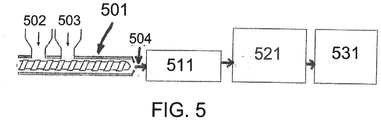
- FIG. 5 illustrates the manufacture of over-indexed, optionally cross-linked thermoplastic polyurethane elastomer precursor.
- This one-shot process is less complicated that processes that require formation of a prepolymer, typically the reaction product of the isocyanate and the long-chain diol, then reacting the prepolymer with the remaining reactants, typically the chain extenders. Rather, as shown in FIG. 5 , all reactants (502, 503) can be combined in a screw extruder (501) in a single process step. If the precursor or the thermoplastic polyurethane elastomer is to be cross-linked, free-radical initiator can be included at any step in the manufacturing and curing process. After the appropriate period of mixing, over-indexed, optionally cross-linked thermoplastic polyurethane elastomer precursor (504) having unreacted isocyanate moieties is extruded from the extruder.
- the dwell times of the molten reaction mixture in the screw extruder may generally be in the range of from about 0.3 to about 10 minutes, and in some embodiments may be from about 0.4 to about 4 minutes.
- the temperature of the screw housing may be in the range of about 70°C to 280°C.
- the product of this reaction process is an over-indexed, optionally cross-linked thermoplastic polyurethane elastomer precursor having unreacted isocyanate moieties.
- the thermoplastic polyurethane elastomer precursor will be cross-linked if cross-linker and free-radical initiator were included in the extruder.
- the cross-linker and free-radical initiator will be incorporated into the thermoplastic polyurethane elastomer precursor as part of the thermoplastic polyurethane elastomer formation before final reaction, i.e., when the precursor is shaped to form the article.
- the precursor composition is sensitive to moisture, which will begin a reaction chain by reacting with the isocyanate moieties.
- moisture reacts with the free isocyanate moieties to produce carbamic acid, which is relatively unstable and thus decomposes to form an amine and carbon dioxide.
- the amine then reacts with an isocyanate moiety to produce urea moieties, thus forming a thin shell of polyurethane/polyurea hybrid composition.
- the proportion of urethane and urea linkages will vary, depending on reaction concentrations. This thin shell may reduce reaction of additional isocyanate, but the shell does not completely preclude reaction.
- extrudate 504 from extruder 501 typically is cooled and pelletized, or comminuted, in association with water bath 511.
- the water used in this cooling step typically reacts with some of the excess isocyanate.
- drying the over-indexed material and protecting it from water until it is used to make thermoplastic polyurethane elastomer stops the consumption of isocyanate moieties and leaves excess isocyanate for secondary curing after the desired product, such as a shoe sole or a golf ball having the composition as an outer cover layer, is formed.
- exposure of the precursor composition to water is limited by drying the precursor after water cooling.
- the moisture level in precursor is reduced to less than about 800 ppm water after water cooling.
- the moisture concentration of precursor herein is reduced to less than about 3,000 ppm, typically less than about 2,000 ppm, more typically less than about 1,000 ppm, and even more typically less than about 800 ppm water immediately after water cooling. This moisture reduction may be carried out in any suitable manner. In some embodiments of the disclosure, the moisture is removed by heating.
- the precursor material may be dried and cured in an oven. In some embodiments of the disclosure, this oven drying is carried out after the first moisture reduction. In some embodiments of the disclosure, the oven drying is the only drying step.
- the moisture content is reduced to less than about 800 ppm, and more typically from about 300 ppm to about 500 ppm, by purging the oven with nitrogen or any inert gas.
- the temperature in the oven is between about 70°C and about 90°C, and typically about 80°C. In some embodiments of the disclosure, the heating period is between about 3 hours and 12 hours, and typically about 6 hours.
- the inventors have discovered that packaging the material having less than about 800 ppm moisture in moisture-resistant containers, such as aluminum-lined bags/packages, ensures that the moisture content remains below about 800 ppm, typically below about 500 ppm, and more typically below about 300 ppm. In particular, maintenance of low water concentration ensures that sufficient excess isocyanate is available for the second curing of the product.
- thermoplastic polyurethane elastomer precursor If a batch method is used to form the over-indexed, optionally cross-linked thermoplastic polyurethane elastomer precursor, all the components are molten and mixed together with a high agitated stir at a temperature in the range of about 70°C to 120°C for about 1 to about 3 minutes. Subsequently, the mixture is cured and pelletized, or comminuted, in a manner that keeps the moisture content as low as possible, and is stored in containers that maintain the moisture content below about 800 ppm. In embodiments of the disclosure, the moisture content of packaged precursor is less than about 800 ppm. In other embodiments of the disclosure, the moisture content of packaged precursor is between about 300 ppm and about 500 ppm.
- the over-indexed, optionally cross-linked thermoplastic polyurethane elastomer precursor of the disclosure may be used to make articles, such as shoe soles, luggage tags, or golf balls, by injection molding or compression molding. Other articles can be made in the same way. Injection molding may be used in particular embodiments in order to achieve increased productivity.
- the free radical initiator may be added to the polymer mixture at any of several stages during manufacturing. For example, the free radical initiator may be added during extrusion of the polymer precursor, or during compression molding. Similarly, the free radical initiator may be activated so as to form cross-links during any of several stages of manufacturing. For example, the free radical initiator may be activated by heating during an extrusion process.
- thermoplastic polyurethane elastomer precursor is comminuted, or pelletized, in association with water bath 511 to form pellets or granules. Often, these pellets retain a pellet shape, i.e., are roughly cylindrical. The inventors have discovered that pellets comprising thermoplastic polyurethane elastomer precursor having an NCO index greater than about 1.15 may not retain such a cylindrical shape when cooled. Rather, pellets having an NCO index greater than about 1.15 may form pillows or other flatter, less-defined shape because the thermoplastic polyurethane elastomer precursor is not as rigid as thermoplastic polyurethane elastomer precursor having an NCO index less than about 1.15.
- thermoplastic polyurethane elastomer precursor compositions of this disclosure are subjected to a dual-curing process.
- the composition is chemically-cured when it is reacted with the diol chain extenders. Then, the resulting composition is moisture-cured in accordance with the steps described below.
- the above-described chemical curing mechanism provides an over-indexed, optionally cross-linked thermoplastic polyurethane elastomer, which subsequently is fully-cured by contacting the composition with moisture.
- the resulting fully-cured composition has improved scuff resistance performance.
- Different methods may be used for applying the moisture to the composition in the moisture-curing step.
- the partially-cured composition formed by the chemical-curing step simply may be exposed to ambient moisture for a sufficient period to fully-cure the material.
- a spray of moisture may be applied to the composition so that it fully cures.
- a composition is soaked in hot water for one to two hours.
- the composition is placed in a humidity chamber at relatively high humidity (particularly, the relative humidity is at least 50%.)
- the humidity chamber has a temperature of 70° C., a relative humidity (RH) of 90%, and the composition is placed in the chamber for one to two hours to achieve good curing of the composition in a relatively short period.
- thermoplastic polyurethane elastomer precursors were made, as follows: Table 1 - Thermoplastic Polyurethane Elastomer Precursors F G H I J PTMEG (pbw) 100 100 100 100 100 100 100 BG (pbw) 15 15 15 15 15 15 15 TMPME (weight % to total components) 10% 10% 0 10% 10% DCP (weight % to total components) 0.5% 0.5% 0 0 0 MDI (pbw) 92.1 102.6 55.0 92.1 102.6 Molar ratio of organic isocyanate to oxyhydrogen (hydroxyl) 1.06:1.00 1.18:1.00 1.01:1.00 1.06:1.00 1.18:1.00
- PTMEG polytetramethylene ether glycol, having a number average molecular weight of 2,000, and is commercially available from Invista, under the trade name of Terathane® 2000.
- BG is 1,4-butanediol, commercially available from BASF and other suppliers.
- TMPME is trimethylolpropane monoallylether, commercially available from Perstorp Specialty Chemicals AB.
- DCP is dicumyl peroxide, commercially available from LaPorte Chemicals Ltd.
- MDI is diphenylmethane diisocyanate, commercially available from Huntsman, under the trade name of Suprasec® 1100.
- Thermoplastic polyurethane elastomer precursor materials F, G, H, I and J were formed by mixing PTMEG, BG, TMPME, DCP, and MDI in the proportions shown. Specifically, these materials were prepared by mixing the components in a highly agitated stirrer for 1 minute, starting at a temperature of about 70°C, followed by a 10-hour post curing process at a temperature of about 100°C. Each post cured polyurethane elastomer precursor was ground into small chips. The manufacturing process maintained low moisture levels, including less than about 800 ppm after cooling and pelletizing, or comminution to form pellets, and less than about 300 ppm after secondary drying.
- thermoplastic polyurethane elastomer precursor materials of Table 1 were used, in combination with the materials described in Tables 2, 3, and 4 below, to manufacture five kinds of golf balls, as shown in Table 5.
- the inner core layer was made from a material selected from Table 2
- the outer core layer was made from a material selected from Table 3
- the inner cover layer was made from a material select from Table 4
- the cover layer was made from a material selected from Table 1.
- the amounts of the materials listed in Tables 2, 3, and 4 are shown in parts by weight (pbw) or percentages by weight.
- Table 2 - Inner Core Materials Resin: A B HPF 2000* 78 0 HPF AD 1035* 22 100 Table 3 - Outer Core Material Rubber compound: C D TAIPOLTM BR0150* 100 100 Zinc diacrylate 29 29 Zinc oxide 9 9 Barium sulfate 11 9 Peroxide 1 1 *HPF 2000 and HPF AD 1035 are trade names of ionomeric resins by E. I. DuPont de Nemours and Company *TAIPOLTM BR0150 is the trade name of a rubber produced by Taiwan Synthetic Rubber Corp.
- Table 4 Inner Cover Material Resin: E Neothane 6303D* 100 *Neothane 6303D is the trade name of a thermoplastic polyurethane produced by Dongsung Highchem Co. LTD.
- a scuff resistance test was conducted in the following manner: a Nike Victory Red forged standard sand wedge (loft: 54°; bounce: 12°; shaft: True Temper Dynamic Gold shaft; flex: S) is fixed to a swing robot manufactured by Miyamae Co., Ltd. and then swung at the head speed of about 32 m/s. The club face was oriented for a square hit. The forward/backward tee position was adjusted so that the tee was four inches behind the point in the downswing where the club was vertical.
- the height of the tee and the toe-heel position of the club relative to the tee were adjusted in order that the center of the impact mark was about 3/4 of an inch above the sole and was centered toe to heel across the face. Three samples of each ball were tested. Each ball was hit three times.
- each golf ball cover was visually observed and rated according to the following scale: a golf ball cover was rated "1" when little or no damage was visible, only groove markings or dents; a golf ball cover was rated “2" when small cuts and/or ripples in the cover were apparent; a golf ball cover was rated “3” when moderate amounts of cover material were lifted from the ball's surface, but the cover material was still attached to the ball; and finally a golf ball cover was rated "4" when cover material was removed or barely attached to the golf ball.
- Shore D hardness values of the core and cover layer were measured on the spherical surface of the layer to be measured by using a Shore D hardness tester.
- golf balls 1 and 2 made from compositions including an over-indexed, cross-linked thermoplastic polyurethane elastomer having cross-links located in the hard segments, where the cross-links are the reaction product of unsaturated bonds located in the hard segments as catalyzed by a free radical initiator and a proper ratio of the organic isocyanate to the long chain polyol, provides superior scuff resistance.
- the other three balls although not as scuff-resistant, clearly indicate that increasing NCO index increased scuff resistance.
- golf balls 3-5 do not exhibit the scuff resistance of golf balls 1 and 2, the thermoplastic polyurethane elastomer has desirable properties and characteristics for the manufacture of other articles requiring, for example, good Shore D hardness and flexural modulus.
- thermoplastic polyurethane elastomer precursors were used with the same outer core materials and inner cover material other inner core materials, golf balls were made in accordance with the exemplified method, with inner core material selected from Table 6, outer core material from Table 3, inner cover material from Table 4, and outer cover material from Table 1.
- the golf balls made from compositions including an over-indexed cross-linked thermoplastic polyurethane elastomer having cross-links located in the hard segments, where the cross-links are the reaction product of unsaturated bonds located in the hard segments as catalyzed by a free radical initiator and a proper ratio of the organic isocyanate to the long chain polyol provides superior scuff resistance.
- Golf balls 1 and 2 exhibit the same scuff-resistance as golf balls 6 and 7.
- golf balls 3-5 and 8-10 exemplify the increased scuff resistance of material with increasing NCO index.
Landscapes
- Chemical & Material Sciences (AREA)
- Health & Medical Sciences (AREA)
- Organic Chemistry (AREA)
- Chemical Kinetics & Catalysis (AREA)
- Polymers & Plastics (AREA)
- Medicinal Chemistry (AREA)
- General Health & Medical Sciences (AREA)
- Physical Education & Sports Medicine (AREA)
- Materials Engineering (AREA)
- Engineering & Computer Science (AREA)
- General Chemical & Material Sciences (AREA)
- Wood Science & Technology (AREA)
- Life Sciences & Earth Sciences (AREA)
- Polyurethanes Or Polyureas (AREA)
Applications Claiming Priority (3)
| Application Number | Priority Date | Filing Date | Title |
|---|---|---|---|
| US201261582658P | 2012-01-03 | 2012-01-03 | |
| US13/730,215 US8946375B2 (en) | 2012-01-03 | 2012-12-28 | Method for making over-indexed thermoplastic polyurethane elastomer precursor and thermoplastic polyurethane elastomer made from the precursor |
| PCT/US2013/020013 WO2013103633A1 (en) | 2012-01-03 | 2013-01-03 | Method for making over-indexed thermoplastic polyurethane elastomer precursor and thermoplastic polyurethane elastomer made from the precursor |
Publications (3)
| Publication Number | Publication Date |
|---|---|
| EP2800768A1 EP2800768A1 (en) | 2014-11-12 |
| EP2800768A4 EP2800768A4 (en) | 2016-05-04 |
| EP2800768B1 true EP2800768B1 (en) | 2017-11-15 |
Family
ID=48745384
Family Applications (1)
| Application Number | Title | Priority Date | Filing Date |
|---|---|---|---|
| EP13733836.4A Active EP2800768B1 (en) | 2012-01-03 | 2013-01-03 | Method for making over-indexed thermoplastic polyurethane elastomer precursor and thermoplastic polyurethane elastomer made from the precursor |
Country Status (7)
| Country | Link |
|---|---|
| US (1) | US8946375B2 (enExample) |
| EP (1) | EP2800768B1 (enExample) |
| JP (1) | JP2015503670A (enExample) |
| KR (1) | KR20140109428A (enExample) |
| CN (1) | CN104125970B (enExample) |
| TW (1) | TWI482790B (enExample) |
| WO (1) | WO2013103633A1 (enExample) |
Families Citing this family (3)
| Publication number | Priority date | Publication date | Assignee | Title |
|---|---|---|---|---|
| JP6641414B2 (ja) * | 2018-04-27 | 2020-02-05 | クレハ合繊株式会社 | 分離体、機械要素、運動ガイド装置および産業用機械 |
| CN109370197A (zh) * | 2018-10-24 | 2019-02-22 | 李宁(中国)体育用品有限公司 | 鞋底用高分子透明橡胶材料与制备方法及鞋 |
| US20220411577A1 (en) * | 2019-10-09 | 2022-12-29 | Dupont Polymers, Inc. | Improved polyester |
Family Cites Families (17)
| Publication number | Priority date | Publication date | Assignee | Title |
|---|---|---|---|---|
| JPS5331193B2 (enExample) * | 1973-12-08 | 1978-08-31 | ||
| US4293679A (en) | 1979-06-13 | 1981-10-06 | W. R. Grace & Co. | Composition and method of controlling solid polyurethane particle size with water reactant |
| JPS59129279A (ja) * | 1983-01-12 | 1984-07-25 | Sekisui Chem Co Ltd | ウレタン系粘着剤層の形成方法 |
| JPS6166779A (ja) * | 1984-09-10 | 1986-04-05 | Nitto Electric Ind Co Ltd | 一液型弾性シ−ラント |
| JPH07138551A (ja) | 1993-07-01 | 1995-05-30 | Minnesota Mining & Mfg Co <3M> | 湿分硬化性ポリウレタン接着剤 |
| JP3096559B2 (ja) * | 1994-04-15 | 2000-10-10 | オート化学工業株式会社 | 湿気硬化性ウレタン組成物 |
| US6935970B2 (en) | 2002-07-25 | 2005-08-30 | Callaway Golf Company | Golf ball |
| US7108921B2 (en) | 2002-10-24 | 2006-09-19 | Acushnet Company | Compositions for use in golf balls |
| US20040157945A1 (en) | 2002-12-30 | 2004-08-12 | Barber Thomas Allan | Rigid urethane foams |
| US7157032B2 (en) * | 2003-11-21 | 2007-01-02 | Gala Industries, Inc. | Method and apparatus for making crystalline PET pellets |
| JP5879034B2 (ja) * | 2007-12-28 | 2016-03-08 | ボスティック,インコーポレイテッド | 湿気硬化型ポリウレタンシーラントおよび接着剤の連続的製造プロセス |
| JP5359101B2 (ja) * | 2008-08-01 | 2013-12-04 | オート化学工業株式会社 | 湿気硬化型樹脂組成物の包装体 |
| JP5072910B2 (ja) | 2009-06-30 | 2012-11-14 | ダンロップスポーツ株式会社 | ゴルフボール |
| US20110064883A1 (en) | 2009-09-16 | 2011-03-17 | Nike, Inc. | Method Of Post-Mold Crosslinking Thermoplastic Polyurethane Golf Ball Cover Compositions |
| US20110081492A1 (en) | 2009-10-05 | 2011-04-07 | Michael Michalewich | Methods of curing polyurethane prepolymers for golf balls |
| JP5371881B2 (ja) * | 2009-12-10 | 2013-12-18 | 三井化学株式会社 | カバー材の製造方法およびカバー材 |
| US8193296B2 (en) | 2010-06-30 | 2012-06-05 | Nike, Inc. | Golf balls including crosslinked thermoplastic polyurethane |
-
2012
- 2012-12-28 US US13/730,215 patent/US8946375B2/en active Active
-
2013
- 2013-01-03 EP EP13733836.4A patent/EP2800768B1/en active Active
- 2013-01-03 TW TW102100120A patent/TWI482790B/zh active
- 2013-01-03 WO PCT/US2013/020013 patent/WO2013103633A1/en not_active Ceased
- 2013-01-03 JP JP2014551297A patent/JP2015503670A/ja active Pending
- 2013-01-03 KR KR1020147019009A patent/KR20140109428A/ko not_active Withdrawn
- 2013-01-03 CN CN201380004714.3A patent/CN104125970B/zh not_active Expired - Fee Related
Non-Patent Citations (1)
| Title |
|---|
| None * |
Also Published As
| Publication number | Publication date |
|---|---|
| CN104125970B (zh) | 2017-03-01 |
| EP2800768A4 (en) | 2016-05-04 |
| JP2015503670A (ja) | 2015-02-02 |
| US8946375B2 (en) | 2015-02-03 |
| TW201341419A (zh) | 2013-10-16 |
| EP2800768A1 (en) | 2014-11-12 |
| CN104125970A (zh) | 2014-10-29 |
| TWI482790B (zh) | 2015-05-01 |
| KR20140109428A (ko) | 2014-09-15 |
| WO2013103633A1 (en) | 2013-07-11 |
| US20130211034A1 (en) | 2013-08-15 |
Similar Documents
| Publication | Publication Date | Title |
|---|---|---|
| JP5610437B2 (ja) | 架橋結合熱可塑性ポリウレタンを含むゴルフボール | |
| US9227368B2 (en) | Golf balls including a crosslinked thermoplastic polyurethane cover layer having improved scuff resistance | |
| US20120077621A1 (en) | Four-Piece Golf Balls Including A Crosslinked Thermoplastic Polyurethane Cover Layer | |
| JP5982485B2 (ja) | 高度に中和された酸ポリマーのブレンドを含むゴルフボール | |
| US8980155B2 (en) | Over-indexed thermoplastic polyurethane elastomer, method of making, and articles comprising the elastomer | |
| CN104027953A (zh) | 用于高尔夫球的具有泡沫内芯的多层芯 | |
| EP2800612B1 (en) | Golf ball having an over-indexed thermoplastic polyurethane elastomer cover and having a soft feeling when hit | |
| US8987405B2 (en) | Golf ball having an over-indexed thermoplastic polyurethane elastomer cover and having a soft feeling when hit | |
| JP2014524267A (ja) | 高度に中和された酸ポリマーのブレンドを含むゴルフボールを製造する方法 | |
| US8946375B2 (en) | Method for making over-indexed thermoplastic polyurethane elastomer precursor and thermoplastic polyurethane elastomer made from the precursor | |
| US8906508B2 (en) | Method of toughening thermoplastic polyurethane and articles comprising toughened thermoplastic polyurethane |
Legal Events
| Date | Code | Title | Description |
|---|---|---|---|
| PUAI | Public reference made under article 153(3) epc to a published international application that has entered the european phase |
Free format text: ORIGINAL CODE: 0009012 |
|
| 17P | Request for examination filed |
Effective date: 20140731 |
|
| AK | Designated contracting states |
Kind code of ref document: A1 Designated state(s): AL AT BE BG CH CY CZ DE DK EE ES FI FR GB GR HR HU IE IS IT LI LT LU LV MC MK MT NL NO PL PT RO RS SE SI SK SM TR |
|
| DAX | Request for extension of the european patent (deleted) | ||
| RA4 | Supplementary search report drawn up and despatched (corrected) |
Effective date: 20160405 |
|
| RIC1 | Information provided on ipc code assigned before grant |
Ipc: C08L 75/04 20060101ALI20160330BHEP Ipc: C08G 18/10 20060101ALI20160330BHEP Ipc: C08G 18/08 20060101AFI20160330BHEP Ipc: C08J 5/00 20060101ALI20160330BHEP |
|
| GRAP | Despatch of communication of intention to grant a patent |
Free format text: ORIGINAL CODE: EPIDOSNIGR1 |
|
| INTG | Intention to grant announced |
Effective date: 20170207 |
|
| GRAS | Grant fee paid |
Free format text: ORIGINAL CODE: EPIDOSNIGR3 |
|
| GRAA | (expected) grant |
Free format text: ORIGINAL CODE: 0009210 |
|
| RAP1 | Party data changed (applicant data changed or rights of an application transferred) |
Owner name: FENG TAY ENTERPRISES CO., LTD. |
|
| AK | Designated contracting states |
Kind code of ref document: B1 Designated state(s): AL AT BE BG CH CY CZ DE DK EE ES FI FR GB GR HR HU IE IS IT LI LT LU LV MC MK MT NL NO PL PT RO RS SE SI SK SM TR |
|
| REG | Reference to a national code |
Ref country code: CH Ref legal event code: EP Ref country code: GB Ref legal event code: FG4D Ref country code: AT Ref legal event code: REF Ref document number: 946214 Country of ref document: AT Kind code of ref document: T Effective date: 20171115 |
|
| REG | Reference to a national code |
Ref country code: IE Ref legal event code: FG4D |
|
| REG | Reference to a national code |
Ref country code: FR Ref legal event code: PLFP Year of fee payment: 6 |
|
| REG | Reference to a national code |
Ref country code: DE Ref legal event code: R096 Ref document number: 602013029467 Country of ref document: DE |
|
| REG | Reference to a national code |
Ref country code: NL Ref legal event code: MP Effective date: 20171115 |
|
| REG | Reference to a national code |
Ref country code: LT Ref legal event code: MG4D |
|
| REG | Reference to a national code |
Ref country code: AT Ref legal event code: MK05 Ref document number: 946214 Country of ref document: AT Kind code of ref document: T Effective date: 20171115 |
|
| PG25 | Lapsed in a contracting state [announced via postgrant information from national office to epo] |
Ref country code: SE Free format text: LAPSE BECAUSE OF FAILURE TO SUBMIT A TRANSLATION OF THE DESCRIPTION OR TO PAY THE FEE WITHIN THE PRESCRIBED TIME-LIMIT Effective date: 20171115 Ref country code: ES Free format text: LAPSE BECAUSE OF FAILURE TO SUBMIT A TRANSLATION OF THE DESCRIPTION OR TO PAY THE FEE WITHIN THE PRESCRIBED TIME-LIMIT Effective date: 20171115 Ref country code: NO Free format text: LAPSE BECAUSE OF FAILURE TO SUBMIT A TRANSLATION OF THE DESCRIPTION OR TO PAY THE FEE WITHIN THE PRESCRIBED TIME-LIMIT Effective date: 20180215 Ref country code: FI Free format text: LAPSE BECAUSE OF FAILURE TO SUBMIT A TRANSLATION OF THE DESCRIPTION OR TO PAY THE FEE WITHIN THE PRESCRIBED TIME-LIMIT Effective date: 20171115 Ref country code: NL Free format text: LAPSE BECAUSE OF FAILURE TO SUBMIT A TRANSLATION OF THE DESCRIPTION OR TO PAY THE FEE WITHIN THE PRESCRIBED TIME-LIMIT Effective date: 20171115 Ref country code: LT Free format text: LAPSE BECAUSE OF FAILURE TO SUBMIT A TRANSLATION OF THE DESCRIPTION OR TO PAY THE FEE WITHIN THE PRESCRIBED TIME-LIMIT Effective date: 20171115 |
|
| PG25 | Lapsed in a contracting state [announced via postgrant information from national office to epo] |
Ref country code: RS Free format text: LAPSE BECAUSE OF FAILURE TO SUBMIT A TRANSLATION OF THE DESCRIPTION OR TO PAY THE FEE WITHIN THE PRESCRIBED TIME-LIMIT Effective date: 20171115 Ref country code: AT Free format text: LAPSE BECAUSE OF FAILURE TO SUBMIT A TRANSLATION OF THE DESCRIPTION OR TO PAY THE FEE WITHIN THE PRESCRIBED TIME-LIMIT Effective date: 20171115 Ref country code: HR Free format text: LAPSE BECAUSE OF FAILURE TO SUBMIT A TRANSLATION OF THE DESCRIPTION OR TO PAY THE FEE WITHIN THE PRESCRIBED TIME-LIMIT Effective date: 20171115 Ref country code: BG Free format text: LAPSE BECAUSE OF FAILURE TO SUBMIT A TRANSLATION OF THE DESCRIPTION OR TO PAY THE FEE WITHIN THE PRESCRIBED TIME-LIMIT Effective date: 20180215 Ref country code: LV Free format text: LAPSE BECAUSE OF FAILURE TO SUBMIT A TRANSLATION OF THE DESCRIPTION OR TO PAY THE FEE WITHIN THE PRESCRIBED TIME-LIMIT Effective date: 20171115 Ref country code: GR Free format text: LAPSE BECAUSE OF FAILURE TO SUBMIT A TRANSLATION OF THE DESCRIPTION OR TO PAY THE FEE WITHIN THE PRESCRIBED TIME-LIMIT Effective date: 20180216 |
|
| PG25 | Lapsed in a contracting state [announced via postgrant information from national office to epo] |
Ref country code: CZ Free format text: LAPSE BECAUSE OF FAILURE TO SUBMIT A TRANSLATION OF THE DESCRIPTION OR TO PAY THE FEE WITHIN THE PRESCRIBED TIME-LIMIT Effective date: 20171115 Ref country code: SK Free format text: LAPSE BECAUSE OF FAILURE TO SUBMIT A TRANSLATION OF THE DESCRIPTION OR TO PAY THE FEE WITHIN THE PRESCRIBED TIME-LIMIT Effective date: 20171115 Ref country code: EE Free format text: LAPSE BECAUSE OF FAILURE TO SUBMIT A TRANSLATION OF THE DESCRIPTION OR TO PAY THE FEE WITHIN THE PRESCRIBED TIME-LIMIT Effective date: 20171115 Ref country code: CY Free format text: LAPSE BECAUSE OF FAILURE TO SUBMIT A TRANSLATION OF THE DESCRIPTION OR TO PAY THE FEE WITHIN THE PRESCRIBED TIME-LIMIT Effective date: 20171115 Ref country code: DK Free format text: LAPSE BECAUSE OF FAILURE TO SUBMIT A TRANSLATION OF THE DESCRIPTION OR TO PAY THE FEE WITHIN THE PRESCRIBED TIME-LIMIT Effective date: 20171115 |
|
| REG | Reference to a national code |
Ref country code: DE Ref legal event code: R097 Ref document number: 602013029467 Country of ref document: DE |
|
| PG25 | Lapsed in a contracting state [announced via postgrant information from national office to epo] |
Ref country code: PL Free format text: LAPSE BECAUSE OF FAILURE TO SUBMIT A TRANSLATION OF THE DESCRIPTION OR TO PAY THE FEE WITHIN THE PRESCRIBED TIME-LIMIT Effective date: 20171115 Ref country code: SM Free format text: LAPSE BECAUSE OF FAILURE TO SUBMIT A TRANSLATION OF THE DESCRIPTION OR TO PAY THE FEE WITHIN THE PRESCRIBED TIME-LIMIT Effective date: 20171115 Ref country code: RO Free format text: LAPSE BECAUSE OF FAILURE TO SUBMIT A TRANSLATION OF THE DESCRIPTION OR TO PAY THE FEE WITHIN THE PRESCRIBED TIME-LIMIT Effective date: 20171115 Ref country code: IT Free format text: LAPSE BECAUSE OF FAILURE TO SUBMIT A TRANSLATION OF THE DESCRIPTION OR TO PAY THE FEE WITHIN THE PRESCRIBED TIME-LIMIT Effective date: 20171115 |
|
| REG | Reference to a national code |
Ref country code: CH Ref legal event code: PL |
|
| PLBE | No opposition filed within time limit |
Free format text: ORIGINAL CODE: 0009261 |
|
| STAA | Information on the status of an ep patent application or granted ep patent |
Free format text: STATUS: NO OPPOSITION FILED WITHIN TIME LIMIT |
|
| 26N | No opposition filed |
Effective date: 20180817 |
|
| PG25 | Lapsed in a contracting state [announced via postgrant information from national office to epo] |
Ref country code: LU Free format text: LAPSE BECAUSE OF NON-PAYMENT OF DUE FEES Effective date: 20180103 |
|
| REG | Reference to a national code |
Ref country code: IE Ref legal event code: MM4A |
|
| REG | Reference to a national code |
Ref country code: BE Ref legal event code: MM Effective date: 20180131 |
|
| PG25 | Lapsed in a contracting state [announced via postgrant information from national office to epo] |
Ref country code: LI Free format text: LAPSE BECAUSE OF NON-PAYMENT OF DUE FEES Effective date: 20180131 Ref country code: SI Free format text: LAPSE BECAUSE OF FAILURE TO SUBMIT A TRANSLATION OF THE DESCRIPTION OR TO PAY THE FEE WITHIN THE PRESCRIBED TIME-LIMIT Effective date: 20171115 Ref country code: CH Free format text: LAPSE BECAUSE OF NON-PAYMENT OF DUE FEES Effective date: 20180131 Ref country code: BE Free format text: LAPSE BECAUSE OF NON-PAYMENT OF DUE FEES Effective date: 20180131 |
|
| PG25 | Lapsed in a contracting state [announced via postgrant information from national office to epo] |
Ref country code: IE Free format text: LAPSE BECAUSE OF NON-PAYMENT OF DUE FEES Effective date: 20180103 |
|
| PG25 | Lapsed in a contracting state [announced via postgrant information from national office to epo] |
Ref country code: MC Free format text: LAPSE BECAUSE OF FAILURE TO SUBMIT A TRANSLATION OF THE DESCRIPTION OR TO PAY THE FEE WITHIN THE PRESCRIBED TIME-LIMIT Effective date: 20171115 |
|
| PG25 | Lapsed in a contracting state [announced via postgrant information from national office to epo] |
Ref country code: MT Free format text: LAPSE BECAUSE OF NON-PAYMENT OF DUE FEES Effective date: 20180103 |
|
| PG25 | Lapsed in a contracting state [announced via postgrant information from national office to epo] |
Ref country code: TR Free format text: LAPSE BECAUSE OF FAILURE TO SUBMIT A TRANSLATION OF THE DESCRIPTION OR TO PAY THE FEE WITHIN THE PRESCRIBED TIME-LIMIT Effective date: 20171115 |
|
| PG25 | Lapsed in a contracting state [announced via postgrant information from national office to epo] |
Ref country code: PT Free format text: LAPSE BECAUSE OF FAILURE TO SUBMIT A TRANSLATION OF THE DESCRIPTION OR TO PAY THE FEE WITHIN THE PRESCRIBED TIME-LIMIT Effective date: 20171115 Ref country code: HU Free format text: LAPSE BECAUSE OF FAILURE TO SUBMIT A TRANSLATION OF THE DESCRIPTION OR TO PAY THE FEE WITHIN THE PRESCRIBED TIME-LIMIT; INVALID AB INITIO Effective date: 20130103 |
|
| PG25 | Lapsed in a contracting state [announced via postgrant information from national office to epo] |
Ref country code: MK Free format text: LAPSE BECAUSE OF NON-PAYMENT OF DUE FEES Effective date: 20171115 |
|
| PG25 | Lapsed in a contracting state [announced via postgrant information from national office to epo] |
Ref country code: AL Free format text: LAPSE BECAUSE OF FAILURE TO SUBMIT A TRANSLATION OF THE DESCRIPTION OR TO PAY THE FEE WITHIN THE PRESCRIBED TIME-LIMIT Effective date: 20171115 Ref country code: IS Free format text: LAPSE BECAUSE OF FAILURE TO SUBMIT A TRANSLATION OF THE DESCRIPTION OR TO PAY THE FEE WITHIN THE PRESCRIBED TIME-LIMIT Effective date: 20180315 |
|
| PGFP | Annual fee paid to national office [announced via postgrant information from national office to epo] |
Ref country code: GB Payment date: 20251204 Year of fee payment: 14 |
|
| PGFP | Annual fee paid to national office [announced via postgrant information from national office to epo] |
Ref country code: FR Payment date: 20251208 Year of fee payment: 14 |
|
| PGFP | Annual fee paid to national office [announced via postgrant information from national office to epo] |
Ref country code: DE Payment date: 20251203 Year of fee payment: 14 |