EP2767680A1 - Tragestruktur für eine nockenwelle - Google Patents
Tragestruktur für eine nockenwelle Download PDFInfo
- Publication number
- EP2767680A1 EP2767680A1 EP11873837.6A EP11873837A EP2767680A1 EP 2767680 A1 EP2767680 A1 EP 2767680A1 EP 11873837 A EP11873837 A EP 11873837A EP 2767680 A1 EP2767680 A1 EP 2767680A1
- Authority
- EP
- European Patent Office
- Prior art keywords
- camshaft
- support bases
- cylinder head
- support
- internal combustion
- Prior art date
- Legal status (The legal status is an assumption and is not a legal conclusion. Google has not performed a legal analysis and makes no representation as to the accuracy of the status listed.)
- Withdrawn
Links
- 238000002485 combustion reaction Methods 0.000 claims abstract description 38
- 239000000463 material Substances 0.000 claims description 5
- 229910000838 Al alloy Inorganic materials 0.000 description 5
- 230000006866 deterioration Effects 0.000 description 4
- 239000010935 stainless steel Substances 0.000 description 4
- 229910001220 stainless steel Inorganic materials 0.000 description 4
- 230000002542 deteriorative effect Effects 0.000 description 2
- 230000006698 induction Effects 0.000 description 1
Images
Classifications
-
- F—MECHANICAL ENGINEERING; LIGHTING; HEATING; WEAPONS; BLASTING
- F01—MACHINES OR ENGINES IN GENERAL; ENGINE PLANTS IN GENERAL; STEAM ENGINES
- F01L—CYCLICALLY OPERATING VALVES FOR MACHINES OR ENGINES
- F01L1/00—Valve-gear or valve arrangements, e.g. lift-valve gear
- F01L1/46—Component parts, details, or accessories, not provided for in preceding subgroups
-
- F—MECHANICAL ENGINEERING; LIGHTING; HEATING; WEAPONS; BLASTING
- F01—MACHINES OR ENGINES IN GENERAL; ENGINE PLANTS IN GENERAL; STEAM ENGINES
- F01L—CYCLICALLY OPERATING VALVES FOR MACHINES OR ENGINES
- F01L1/00—Valve-gear or valve arrangements, e.g. lift-valve gear
- F01L1/02—Valve drive
- F01L1/04—Valve drive by means of cams, camshafts, cam discs, eccentrics or the like
- F01L1/047—Camshafts
- F01L1/053—Camshafts overhead type
-
- F—MECHANICAL ENGINEERING; LIGHTING; HEATING; WEAPONS; BLASTING
- F01—MACHINES OR ENGINES IN GENERAL; ENGINE PLANTS IN GENERAL; STEAM ENGINES
- F01L—CYCLICALLY OPERATING VALVES FOR MACHINES OR ENGINES
- F01L1/00—Valve-gear or valve arrangements, e.g. lift-valve gear
- F01L1/02—Valve drive
- F01L1/04—Valve drive by means of cams, camshafts, cam discs, eccentrics or the like
- F01L1/047—Camshafts
- F01L2001/0476—Camshaft bearings
-
- F—MECHANICAL ENGINEERING; LIGHTING; HEATING; WEAPONS; BLASTING
- F01—MACHINES OR ENGINES IN GENERAL; ENGINE PLANTS IN GENERAL; STEAM ENGINES
- F01L—CYCLICALLY OPERATING VALVES FOR MACHINES OR ENGINES
- F01L1/00—Valve-gear or valve arrangements, e.g. lift-valve gear
- F01L1/02—Valve drive
- F01L1/04—Valve drive by means of cams, camshafts, cam discs, eccentrics or the like
- F01L1/047—Camshafts
- F01L1/053—Camshafts overhead type
- F01L2001/0537—Double overhead camshafts [DOHC]
Definitions
- the present invention relates to a camshaft support structure that includes support bases, which are mounted on the cylinder head of an internal combustion engine and support camshafts to be freely rotational.
- the weight of the internal combustion engine is reduced as compared to a structure in which an outer frame for connecting the support bases is provided, as in a ladder-frame camshaft housing, by the weight corresponding to the outer frame.
- the temperature of the cylinder head is increased by receiving heat of exhaust gas, causing the cylinder head to be thermally deformed. Since the support bases are arranged to abut against the cylinder head, the support bases are thermally deformed by receiving heat from the cylinder head. This deteriorates alignment of bearing portions, which are formed in the support bases and support the camshafts. As a result, problems may arise such as an increase in rotational sliding resistance of the camshafts.
- camshaft support structure that favorably reduces deterioration in the alignment of bearing portions of support bases, which support camshafts, due to engine operation.
- the bearing portions of the support bases mounted on the cylinder head of the internal combustion engine support the camshaft to be freely rotational. Since the support bases are arranged apart from one another in the axial direction of the camshaft, the contact area between the support bases and the cylinder head is reduced as compared to the structure with an outer frame for connecting the support bases, such as a ladder-frame camshaft housing. This reduces the amount of heat received from the cylinder head, thus reducing thermal deformation of the support bases caused by the received heat.
- the rod is assembled to the cylinder head together with the support bases in a state in which the rod is inserted in the through holes.
- the cylinder head is assembled to the cylinder block with head bolts.
- the top surface of the cylinder head is slightly distorted from a flat state due to the axial tightening force of the head bolts. The rod is thus maintained in a state pressed by the inner walls of the through holes, and secured to the support bases.
- the structure thus favorably reduces deterioration in the alignment of the bearing portions of the support bases, which support the camshaft, due to engine operation.
- the rod is preferably made of material having higher rigidity than the support bases. According to this embodiment, thermal deformation of the support bases is reduced in an appropriate manner.
- the rod may be made of stainless-steel, which has higher rigidity than the aluminum alloy.
- each support base preferably includes a receiving member, which is mounted on the cylinder head and receives the camshaft, and a cap member, which is mounted on a top surface of the receiving member and forms the bearing portion together with the receiving member.
- the through hole is preferably formed in the receiving member.
- the thermal deformation of the cylinder head is thus greater in the region closer to the exhaust camshaft.
- the through holes in which the rod is inserted are formed closer to the exhaust camshaft than to the intake camshaft. That is, the rod is arranged close to the region of the receiving members of the support bases where the amount of heat received from the cylinder head is great and the degree of thermal deformation is great. The region of the support bases in the vicinity of the exhaust camshaft where the amount of heat received from the cylinder head is great is thus restricted from being thermally deformed in an appropriate manner.
- the thermal deformation amount of the support bases caused by heat received from the cylinder head is great. Furthermore, in the internal combustion engine provided with a forced-induction device, since the pressure in the cylinders is higher than that without the forced-induction device, the cylinder head is significantly deformed by fluctuation of the pressure in the cylinders of the internal combustion engine. As a result, the deformation amount of the support bases mounted on the cylinder head is increased.
- a camshaft support structure of a double overhead camshaft (DOHC) inline 4-cylinder internal combustion engine according to one embodiment of the present invention will now be described with reference to Figs. 1 to 3 .
- the internal combustion engine of the present embodiment is provided with an exhaust driven forced-induction device.
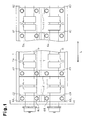
- Fig. 1 shows a planar structure of an internal combustion engine as viewed from above an exhaust camshaft and an intake camshaft.
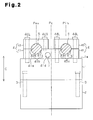
- Fig. 2 shows a cross-sectional structure of the internal combustion engine taken along line A-A of Fig. 1 .
- a cylinder head 1 which is provided with a valve mechanism including exhaust valves and intake valves, is provided on the top surface of a cylinder block 2 as shown in Fig. 2 .
- the cylinder block 2 and the cylinder head 1 are tightened with head bolts 3 in a known manner (see Figs. 2 and 3 ).
- An exhaust camshaft 5 provided with exhaust cams 51 for opening and closing the exhaust valves and an intake camshaft 6 provided with intake cams 61 for opening and closing the intake valves are arranged on a top surface 1 a of the cylinder head 1 to be parallel to each other. More specifically, five support bases 4 for supporting the camshafts 5, 6 to be freely rotational are mounted on the top surface 1 a of the cylinder head 1. Only one of the support bases 4 is shown in Fig. 2 .
- the support bases 4 are arranged apart from one another in an axial direction L of the camshafts 5, 6 as shown in Fig. 1 . More specifically, the support bases 4 are arranged to be perpendicular to the axial direction L of the camshafts 5, 6.
- Each of the support bases 4 includes a receiving member 41 located on the top surface 1 a of the cylinder head 1, and an exhaust side cap member 42 and an intake side cap member 43, which are located on the top surface of the receiving member 41 as shown in Fig. 2 .
- Semi-circular lower recesses 41 b, 41 c are formed on the top surface of each receiving member 41 at positions corresponding to the camshafts 5, 6.
- a semicircular upper recess 42b is formed on the bottom surface of each exhaust side cap member 42 at a position corresponding to the associated lower recess 41 b.
- Each lower recess 41 b and the associated upper recess 42b form a circular bearing portion 45b, which supports one of cam journals 5a of the exhaust camshaft 5 (see Fig. 1 ).
- each intake side cap member 43 Furthermore, a semicircular upper recess 43c is formed on the bottom surface of each intake side cap member 43 at a position corresponding to the associated lower recess 41 c.
- Each lower recess 41c and the associated upper recess 43c form a circular bearing portion 45c, which supports one of cam journals 6a of the intake camshaft 6 (see Fig. 1 ).
- each exhaust side cap member 42 and the associated receiving member 41 are formed in an axial direction C of the cylinders with the exhaust camshaft 5 located in between.
- the receiving member 41 and the exhaust side cap member 42 are tightened to the cylinder head 1 with bolts 44L, 44S inserted in the bolt holes.
- each intake side cap member 43 and the associated receiving member 41 are coupled to the cylinder head 1 with other bolts 44L in the same manner as each exhaust side cap member 42 and the associated receiving member 41.
- the cylinder head 1 In a state in which the support bases 4 are mounted on the cylinder head 1 with the bolts 44L, 44S, the cylinder head 1 is assembled to the cylinder block 2 with the head bolts 3.
- the cylinder head 1, the cylinder block 2, and the support bases 4 are all made of an aluminum alloy.
- a through hole 41 d which extends in the axial direction L of the camshafts 5, 6, is formed in each receiving member 41 as shown in Fig. 2 .
- Each through hole 41 d is formed at a position closer to a center position Pex of the exhaust camshaft 5 than to a middle position Pc between the center position Pex of the exhaust camshaft 5 and a center position Pin of the intake camshaft 6 in a direction perpendicular to the axial direction L of the camshafts 5, 6.
- the through holes 41 d are formed closer to the exhaust camshaft 5 than to the intake camshaft 6.
- a rod 7 made of stainless-steel is inserted in the through holes 41 d. That is, the rod 7 is made of material having higher rigidity than the support bases 4.
- the outer diameter of the rod 7 is slightly smaller than the inner diameter of the through holes 41 d.
- the bolts 44S located closer to the rod 7 than to the exhaust camshaft 5 are shorter than the other bolts 44L so as not to interfere with the rod 7.
- the camshafts 5, 6 are supported to be freely rotational by the bearing portions 45b, 45c of the five support bases 4 mounted on the cylinder head 1. Since the support bases 4 are located separate from one another in the axial direction L of the camshafts 5, 6, the contact area between the support bases 4 and the cylinder head 1 is reduced as compared to a case in which an outer frame for connecting the support bases is provided, as in a ladder-frame camshaft housing. The amount of heat received from the cylinder head 1 is thus reduced, which reduces thermal deformation of the support bases 4 caused by receiving heat.
- the temperature of exhaust gas is increased as compared to the internal combustion engine without a forced-induction device.
- This increases the thermal deformation amount of the support bases 4 caused by receiving heat from the cylinder head 1.
- the cylinder head 1 is deformed significantly as the pressure in the cylinders of the internal combustion engine fluctuates. The deformation amount of the support bases 4 mounted on the cylinder head 1 is consequently increased.
- the alignment of the bearing portions 45b, 45c in the support bases 4 is likely to deteriorate due to engine operation although with the camshaft support structure of the present embodiment that does not include the outer frame for the support bases 4.
- the support bases 4 are favorably restricted from being thermally deformed due to heat received from the cylinder head 1.
- the through holes 41d in which the rod 7 is inserted are formed at positions closer to the exhaust camshaft 5 than to the intake camshaft 6. That is, the rod 7 is arranged in the vicinity of the regions in the receiving members 41 of the support bases 4 where the amount of heat received from the cylinder head 1 is great and the degree of thermal deformation is great. Thermal deformation of the receiving members 41 in the vicinity of the exhaust camshaft 5 is thus reduced in an appropriate manner.
- the rod 7 is assembled to the cylinder head 1 together with the support bases 4 in a state in which the rod 7 is inserted in the through holes 41 d.
- the cylinder head 1 is further assembled to the cylinder block 2 with the head bolts 3 in a state in which the support bases 4 and the rod 7 are assembled to the cylinder head 1.
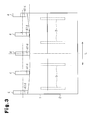
- the top surface 1 a of the cylinder head 1 is slightly distorted from a flat state due to the axial tightening force of the head bolts 3 as shown in Fig. 3 .
- the rod 7 is thus maintained in a state pressed by the inner walls of the through holes 41 d, and secured to the support bases 4.
- the distortion of the top surface 1 a of the cylinder head 1 is exaggerated and the rod 7 is omitted in Fig. 3 .
- the camshaft support structure of the present embodiment as described above has the following advantages.
- camshaft support structure of the present invention is not limited to the structure illustrated in the above described embodiment, but may be modified as follows.
- the present invention is applied to an internal combustion engine provided with an exhaust driven forced-induction device, that is, a turbocharger.
- the present invention may, however, be applied to an internal combustion engine provided with an engine driven forced-induction device, or a supercharger.
- the present invention is applied to an internal combustion engine provided with a forced-induction device.
- the present invention is not only applied to an internal combustion engine provided with a forced-induction device, but may be applied to an internal combustion engine without a forced-induction device.
- the alignment of the bearing portions of the support bases is favorably restricted from deteriorating due to engine operation in the same manner as the above-described embodiment.
- the through holes 41d be formed closer to the exhaust camshaft 5 than to the intake camshaft 6 to prevent thermal deformation of the receiving members 41 in the vicinity of the exhaust camshaft 5 where the amount of heat received from the cylinder head 1 is great.
- the present invention is not limited to this, but through holes may be formed at, for example, the middle position Pc between the exhaust camshaft 5 and the intake camshaft 6. In this case also, thermal deformation of the receiving members is restricted to some extent.
- one through hole 41d is formed in each of the support bases 4.
- two or more through holes may be formed in each of the support bases 4, and two or more rods may be provided corresponding to the number of the through holes. This further reduces thermal deformation of the support bases.
- the rod 7 made of stainless-steel is illustrated in the above-described embodiment, but the rod may be made of any material that has higher rigidity than the support bases.
Landscapes
- Engineering & Computer Science (AREA)
- Mechanical Engineering (AREA)
- General Engineering & Computer Science (AREA)
- Valve-Gear Or Valve Arrangements (AREA)
- Cylinder Crankcases Of Internal Combustion Engines (AREA)
Applications Claiming Priority (1)
| Application Number | Priority Date | Filing Date | Title |
|---|---|---|---|
| PCT/JP2011/073339 WO2013054395A1 (ja) | 2011-10-11 | 2011-10-11 | カムシャフト支持構造 |
Publications (2)
| Publication Number | Publication Date |
|---|---|
| EP2767680A1 true EP2767680A1 (de) | 2014-08-20 |
| EP2767680A4 EP2767680A4 (de) | 2015-09-30 |
Family
ID=48081474
Family Applications (1)
| Application Number | Title | Priority Date | Filing Date |
|---|---|---|---|
| EP11873837.6A Withdrawn EP2767680A4 (de) | 2011-10-11 | 2011-10-11 | Tragestruktur für eine nockenwelle |
Country Status (5)
| Country | Link |
|---|---|
| US (1) | US20140305397A1 (de) |
| EP (1) | EP2767680A4 (de) |
| JP (1) | JP5742956B2 (de) |
| CN (1) | CN103874830A (de) |
| WO (1) | WO2013054395A1 (de) |
Cited By (1)
| Publication number | Priority date | Publication date | Assignee | Title |
|---|---|---|---|---|
| EP3375991A4 (de) * | 2015-11-09 | 2019-07-24 | Isuzu Motors Limited | Zylinderkopf für verbrennungsmotor sowie verbrennungsmotor |
Families Citing this family (2)
| Publication number | Priority date | Publication date | Assignee | Title |
|---|---|---|---|---|
| EP3306065A4 (de) * | 2015-05-25 | 2018-06-06 | Nissan Motor Co., Ltd. | Verbrennungsmotor |
| JP7611868B2 (ja) * | 2022-03-30 | 2025-01-10 | ダイハツ工業株式会社 | 内燃機関 |
Family Cites Families (12)
| Publication number | Priority date | Publication date | Assignee | Title |
|---|---|---|---|---|
| JPS60531B2 (ja) * | 1981-10-05 | 1985-01-08 | マツダ株式会社 | エンジンのカムシヤフト軸受構造 |
| JPS6127905U (ja) * | 1984-07-25 | 1986-02-19 | 本田技研工業株式会社 | Ohc型内燃機関 |
| DE3641129C1 (de) * | 1986-12-02 | 1987-07-30 | Daimler Benz Ag | Vorrichtung zur Lagerung von zwei Nockenwellen im Zylinderkopf einer mehrzylindrigen Reihenbrennkraftmaschine |
| JPH11351243A (ja) * | 1998-06-05 | 1999-12-24 | Hitachi Ltd | スラスト軸受 |
| JP4238874B2 (ja) * | 2006-01-19 | 2009-03-18 | トヨタ自動車株式会社 | 内燃機関のカムシャフト支持構造 |
| JP4365373B2 (ja) * | 2006-01-19 | 2009-11-18 | トヨタ自動車株式会社 | 内燃機関のカムシャフト支持構造 |
| JP4144625B2 (ja) * | 2006-01-19 | 2008-09-03 | トヨタ自動車株式会社 | 内燃機関のカムシャフト支持構造 |
| JP4218715B2 (ja) * | 2006-08-31 | 2009-02-04 | トヨタ自動車株式会社 | シリンダヘッド |
| JP2008133749A (ja) * | 2006-11-27 | 2008-06-12 | Toyota Motor Corp | カムシャフトの軸受構造及び軸受方法 |
| JP2008303856A (ja) * | 2007-06-11 | 2008-12-18 | Toyota Motor Corp | エンジン構造およびエンジンにおける熱変形制御方法 |
| JP2009097487A (ja) * | 2007-10-19 | 2009-05-07 | Honda Motor Co Ltd | 頭上カム軸型内燃機関の動弁装置 |
| JP2010209796A (ja) | 2009-03-10 | 2010-09-24 | Toyota Motor Corp | カムシャフト支持構造 |
-
2011
- 2011-10-11 JP JP2013538353A patent/JP5742956B2/ja not_active Expired - Fee Related
- 2011-10-11 EP EP11873837.6A patent/EP2767680A4/de not_active Withdrawn
- 2011-10-11 US US14/349,738 patent/US20140305397A1/en not_active Abandoned
- 2011-10-11 CN CN201180074058.5A patent/CN103874830A/zh active Pending
- 2011-10-11 WO PCT/JP2011/073339 patent/WO2013054395A1/ja not_active Ceased
Cited By (2)
| Publication number | Priority date | Publication date | Assignee | Title |
|---|---|---|---|---|
| EP3375991A4 (de) * | 2015-11-09 | 2019-07-24 | Isuzu Motors Limited | Zylinderkopf für verbrennungsmotor sowie verbrennungsmotor |
| US10690015B2 (en) | 2015-11-09 | 2020-06-23 | Isuzu Motors Limited | Cylinder head structure for internal combustion engine and internal combustion engine |
Also Published As
| Publication number | Publication date |
|---|---|
| JPWO2013054395A1 (ja) | 2015-03-30 |
| EP2767680A4 (de) | 2015-09-30 |
| CN103874830A (zh) | 2014-06-18 |
| JP5742956B2 (ja) | 2015-07-01 |
| US20140305397A1 (en) | 2014-10-16 |
| WO2013054395A1 (ja) | 2013-04-18 |
Similar Documents
| Publication | Publication Date | Title |
|---|---|---|
| CN101371011B (zh) | 用于内燃发动机的凸轮轴支撑结构 | |
| US9593642B2 (en) | Composite cam carrier | |
| EP2767680A1 (de) | Tragestruktur für eine nockenwelle | |
| US9562446B2 (en) | Engine | |
| US20130047951A1 (en) | Crankcase | |
| EP2679792B1 (de) | Kopfabdeckungsstruktur für einen verbrennungsmotor | |
| JP5468673B1 (ja) | ガスケットとシリンダヘッドガスケット | |
| JPH0522041B2 (de) | ||
| US7975381B2 (en) | Valve operating camshaft system for internal combustion engine | |
| JP3971528B2 (ja) | ピストンの油路構造 | |
| JP2015108343A (ja) | エンジン | |
| JP2012162999A (ja) | 内燃機関の吸気バルブ | |
| JP2016128682A (ja) | エンジンの動弁機構 | |
| US10690015B2 (en) | Cylinder head structure for internal combustion engine and internal combustion engine | |
| JP4075717B2 (ja) | 内燃機関のシリンダヘッド構造 | |
| JP2016044572A (ja) | 内燃機関のシリンダヘッド | |
| JP2000329002A (ja) | 自動二輪車用エンジン | |
| US7343893B2 (en) | Internal combustion engine | |
| JP4063960B2 (ja) | 多気筒エンジンの動弁機構 | |
| US20100326379A1 (en) | Narrow profile horizontally-opposed engine | |
| JP6186290B2 (ja) | 内燃機関の軸受構造 | |
| JP6686417B2 (ja) | エンジン | |
| JP6686416B2 (ja) | エンジン | |
| JP2009197725A (ja) | 内燃機関のシリンダヘッド | |
| JP2008057406A (ja) | 内燃機関のカムシャフト支持構造 |
Legal Events
| Date | Code | Title | Description |
|---|---|---|---|
| PUAI | Public reference made under article 153(3) epc to a published international application that has entered the european phase |
Free format text: ORIGINAL CODE: 0009012 |
|
| 17P | Request for examination filed |
Effective date: 20140221 |
|
| AK | Designated contracting states |
Kind code of ref document: A1 Designated state(s): AL AT BE BG CH CY CZ DE DK EE ES FI FR GB GR HR HU IE IS IT LI LT LU LV MC MK MT NL NO PL PT RO RS SE SI SK SM TR |
|
| DAX | Request for extension of the european patent (deleted) | ||
| RA4 | Supplementary search report drawn up and despatched (corrected) |
Effective date: 20150902 |
|
| RIC1 | Information provided on ipc code assigned before grant |
Ipc: F01L 1/04 20060101AFI20150827BHEP Ipc: F01L 1/053 20060101ALI20150827BHEP Ipc: F02F 7/00 20060101ALI20150827BHEP Ipc: F01L 1/047 20060101ALI20150827BHEP Ipc: F01L 1/46 20060101ALI20150827BHEP |
|
| GRAP | Despatch of communication of intention to grant a patent |
Free format text: ORIGINAL CODE: EPIDOSNIGR1 |
|
| INTG | Intention to grant announced |
Effective date: 20160610 |
|
| STAA | Information on the status of an ep patent application or granted ep patent |
Free format text: STATUS: THE APPLICATION IS DEEMED TO BE WITHDRAWN |
|
| 18D | Application deemed to be withdrawn |
Effective date: 20161021 |