EP2755964B1 - Sulfonsäuresalze heterocyclylamid-substituierter imidazole - Google Patents
Sulfonsäuresalze heterocyclylamid-substituierter imidazole Download PDFInfo
- Publication number
- EP2755964B1 EP2755964B1 EP12761936.9A EP12761936A EP2755964B1 EP 2755964 B1 EP2755964 B1 EP 2755964B1 EP 12761936 A EP12761936 A EP 12761936A EP 2755964 B1 EP2755964 B1 EP 2755964B1
- Authority
- EP
- European Patent Office
- Prior art keywords
- methyl
- salt
- infections
- formula
- salts
- Prior art date
- Legal status (The legal status is an assumption and is not a legal conclusion. Google has not performed a legal analysis and makes no representation as to the accuracy of the status listed.)
- Active
Links
- 0 C[n]1c(C(O*)=O)ncc1 Chemical compound C[n]1c(C(O*)=O)ncc1 0.000 description 2
- GEMDNSVTMUNWEL-UHFFFAOYSA-N CCOC(c1nc(N)c[n]1CC1CC1)=O Chemical compound CCOC(c1nc(N)c[n]1CC1CC1)=O GEMDNSVTMUNWEL-UHFFFAOYSA-N 0.000 description 1
- POJYGGKAMADAET-UHFFFAOYSA-N C[n]1c(C(N(CC2)CCN2c(nc2)ccc2Cl)=O)nc(NC(Nc(cc2)ccc2OC(F)(F)F)=O)c1 Chemical compound C[n]1c(C(N(CC2)CCN2c(nc2)ccc2Cl)=O)nc(NC(Nc(cc2)ccc2OC(F)(F)F)=O)c1 POJYGGKAMADAET-UHFFFAOYSA-N 0.000 description 1
Images

Classifications
-
- C—CHEMISTRY; METALLURGY
- C07—ORGANIC CHEMISTRY
- C07D—HETEROCYCLIC COMPOUNDS
- C07D401/00—Heterocyclic compounds containing two or more hetero rings, having nitrogen atoms as the only ring hetero atoms, at least one ring being a six-membered ring with only one nitrogen atom
- C07D401/02—Heterocyclic compounds containing two or more hetero rings, having nitrogen atoms as the only ring hetero atoms, at least one ring being a six-membered ring with only one nitrogen atom containing two hetero rings
- C07D401/12—Heterocyclic compounds containing two or more hetero rings, having nitrogen atoms as the only ring hetero atoms, at least one ring being a six-membered ring with only one nitrogen atom containing two hetero rings linked by a chain containing hetero atoms as chain links
-
- A—HUMAN NECESSITIES
- A61—MEDICAL OR VETERINARY SCIENCE; HYGIENE
- A61K—PREPARATIONS FOR MEDICAL, DENTAL OR TOILETRY PURPOSES
- A61K31/00—Medicinal preparations containing organic active ingredients
- A61K31/33—Heterocyclic compounds
- A61K31/395—Heterocyclic compounds having nitrogen as a ring hetero atom, e.g. guanethidine or rifamycins
- A61K31/435—Heterocyclic compounds having nitrogen as a ring hetero atom, e.g. guanethidine or rifamycins having six-membered rings with one nitrogen as the only ring hetero atom
- A61K31/44—Non condensed pyridines; Hydrogenated derivatives thereof
- A61K31/4427—Non condensed pyridines; Hydrogenated derivatives thereof containing further heterocyclic ring systems
- A61K31/4439—Non condensed pyridines; Hydrogenated derivatives thereof containing further heterocyclic ring systems containing a five-membered ring with nitrogen as a ring hetero atom, e.g. omeprazole
-
- A—HUMAN NECESSITIES
- A61—MEDICAL OR VETERINARY SCIENCE; HYGIENE
- A61K—PREPARATIONS FOR MEDICAL, DENTAL OR TOILETRY PURPOSES
- A61K31/00—Medicinal preparations containing organic active ingredients
- A61K31/33—Heterocyclic compounds
- A61K31/395—Heterocyclic compounds having nitrogen as a ring hetero atom, e.g. guanethidine or rifamycins
- A61K31/495—Heterocyclic compounds having nitrogen as a ring hetero atom, e.g. guanethidine or rifamycins having six-membered rings with two or more nitrogen atoms as the only ring heteroatoms, e.g. piperazine or tetrazines
- A61K31/496—Non-condensed piperazines containing further heterocyclic rings, e.g. rifampin, thiothixene or sparfloxacin
-
- A—HUMAN NECESSITIES
- A61—MEDICAL OR VETERINARY SCIENCE; HYGIENE
- A61P—SPECIFIC THERAPEUTIC ACTIVITY OF CHEMICAL COMPOUNDS OR MEDICINAL PREPARATIONS
- A61P31/00—Antiinfectives, i.e. antibiotics, antiseptics, chemotherapeutics
-
- A—HUMAN NECESSITIES
- A61—MEDICAL OR VETERINARY SCIENCE; HYGIENE
- A61P—SPECIFIC THERAPEUTIC ACTIVITY OF CHEMICAL COMPOUNDS OR MEDICINAL PREPARATIONS
- A61P31/00—Antiinfectives, i.e. antibiotics, antiseptics, chemotherapeutics
- A61P31/12—Antivirals
-
- A—HUMAN NECESSITIES
- A61—MEDICAL OR VETERINARY SCIENCE; HYGIENE
- A61P—SPECIFIC THERAPEUTIC ACTIVITY OF CHEMICAL COMPOUNDS OR MEDICINAL PREPARATIONS
- A61P31/00—Antiinfectives, i.e. antibiotics, antiseptics, chemotherapeutics
- A61P31/12—Antivirals
- A61P31/20—Antivirals for DNA viruses
-
- A—HUMAN NECESSITIES
- A61—MEDICAL OR VETERINARY SCIENCE; HYGIENE
- A61P—SPECIFIC THERAPEUTIC ACTIVITY OF CHEMICAL COMPOUNDS OR MEDICINAL PREPARATIONS
- A61P31/00—Antiinfectives, i.e. antibiotics, antiseptics, chemotherapeutics
- A61P31/12—Antivirals
- A61P31/20—Antivirals for DNA viruses
- A61P31/22—Antivirals for DNA viruses for herpes viruses
-
- C—CHEMISTRY; METALLURGY
- C07—ORGANIC CHEMISTRY
- C07C—ACYCLIC OR CARBOCYCLIC COMPOUNDS
- C07C309/00—Sulfonic acids; Halides, esters, or anhydrides thereof
- C07C309/01—Sulfonic acids
- C07C309/02—Sulfonic acids having sulfo groups bound to acyclic carbon atoms
- C07C309/03—Sulfonic acids having sulfo groups bound to acyclic carbon atoms of an acyclic saturated carbon skeleton
- C07C309/04—Sulfonic acids having sulfo groups bound to acyclic carbon atoms of an acyclic saturated carbon skeleton containing only one sulfo group
Definitions
- the invention further relates to processes for their preparation, to corresponding medicaments and to said methanesulfonic acid salts and medicaments for the treatment and / or prophylaxis of diseases, in particular for use as antiviral agents, in particular against cytomegaloviruses.
- the compounds of the formula (I) are known, for example, from WO 2006/089664 and were developed by the Applicant as promising candidates for antiviral active substances, in particular for combating infections with the human cytomegalovirus (HCMV).
- HCMV human cytomegalovirus
- the substances showed insufficient solubility in aqueous as well as strongly polar solvents. Solubility problems have been exacerbated by the fact that the compounds are also under conditions in the human stomach (about 0.1M HCl, pH ⁇ 1), which can be assumed to be the in situ formation of an HCl salt , showed insufficient solubility.
- salts which, compared to the free base of the compounds of the formula (I), show a markedly improved solubility. Furthermore, these salts should be long-term stable even under the usual storage conditions. In particular, the compounds should not show increased hygroscopicity. Also, in the presence of a dilute HCl solution, the salts should only slowly convert to the HCl salt to ensure the fastest possible and even release under conditions such as those found in the human stomach.
- the organic sulfonic acid salts of the compounds of the formula (I) show a superior solubility in comparison with the free base, as well as a wide range of other salts of the compounds of the formula (I). Furthermore, these salts also show the long-term stability necessary for use in medicaments. It has also been shown that the salts according to the invention show a high and uniform solubility even under conditions which correspond to those in the human stomach.
- the invention relates to salts of the compounds of the formula (I) with methanesulfonic acid.
- Salts of organic sulfonic acids are, in the context of the disclosure, adducts of a reaction of a compound of the formula (I) with an organic sulfonic acid.
- the compounds of the formula (I) and the organic sulfonic acids can be present in any ratio. The ratio is preferably an integer (eg 1: 1, 1: 2, 1: 3, 3: 1, 2: 1).
- These salts can be prepared by a direct reaction of the compounds of formula (I) with an organic sulfonic acid or by preparing other acid salts of the compounds of formula (I) followed by an exchange of the counterion.
- Solvates in the context of the disclosure are those forms of the compounds according to the invention which form a complex by coordination with solvent molecules. Hydrates are a special form of solvates that coordinate with water.
- N- (1-methyl-2 - ⁇ [4- (5-methylpyridin-2-yl) piperazin-1-yl] carbonyl ⁇ -1H-imidazol-4-yl) is particularly preferred in the context of the invention.
- N '- [4-trifluoromethoxyphenyl] urea dimesylate showing characteristic peaks at about 6.37, 11.77, 12.56, 17.17, 18.81, 20.34, 21.47, 23.04, 35.46 degrees 2Theta in the powder XRD diffractogram.
- the salts of the invention are generally prepared by reacting a compound of formula (I) with methanesulfonic acid in a solvent.
- salts according to the invention by reacting an acid salt of the compounds of formula (I), which is not an organic sulfonic acid salt, with a source of sulfonate anions of an organic sulfonic acid in a solvent.
- the source of sulfonate anions may be an organic sulfonic acid or an organic sulfonic acid salt.
- the disclosure thus further includes a process for preparing organic sulfonic acid salts of the compounds of formula (I) which comprises reacting compounds of formula (I) or salts of compounds of formula (I) which are not acidic organic sulfonic acid salts an organic sulfonic acid or a source of organic sulfonate anions in a solvent.
- the solvent is preferably selected to provide a good balance between the solubility of the compounds of formula (I) and the salts of the compound of formula (I) which are not sulfonic acid salts and the organic sulfonic acid or source of sulfonate anions ,
- the salts according to the invention should be as slightly soluble as possible in the solvent used.
- the salts according to the invention may also be precipitated by the addition of a counter-solvent.
- solvents used to prepare the salts of the present invention include alcohols such as methanol, ethanol, n-propanol, iso-propanol and butanol; Ethers, such as diethyl ether, methyl tert -butyl ether, 1,2-dimethoxyethane, dioxane or tetrahydrofuran; Hydrocarbons such as benzene or toluene; or other solvents such as acetone, ethyl acetate, methyl ethyl ketone, methyl isobutyl ketone, acetonitrile, heptane, dimethyl sulfoxide or dimethylformamide.
- alcohols such as methanol, ethanol, n-propanol, iso-propanol and butanol
- Ethers such as diethyl ether, methyl tert -butyl ether, 1,2-dimethoxyethane, dioxane
- a counter-solvent is added to precipitate the salts of the invention.
- counter-solvents include water and alcohols such as methanol, ethanol or propanol.
- the resulting salts of the invention may optionally be further processed, e.g. recrystallized or micronized to further adapt their physical properties to the intended use.
- heterocyclylamide-substituted imidazoles used for the preparation of the salts according to the invention are known and can, for example, according to the in the WO 2006/089664 described method can be produced.
- the reaction in the first stage is generally carried out in inert solvents, preferably in a temperature range from 0 ° C to reflux of the solvent at atmospheric pressure.
- bases examples include alkali metal hydroxides such as sodium, lithium or potassium hydroxide, or alkali metal carbonates such as cesium carbonate, sodium or potassium carbonate.
- Sodium hydroxide is preferred.
- Inert solvents are, for example, halogenated hydrocarbons such as methylene chloride, trichloromethane, tetrachloromethane, trichloroethane, tetrachloroethane, 1,2-dichloroethane or trichlorethylene, ethers such as diethyl ether, methyl tert -butyl ether, 1,2-dimethoxyethane, dioxane, tetrahydrofuran, glycol dimethyl ether or diethylene glycol dimethyl ether, alcohols such as methanol, ethanol, n-propanol, isopropanol, n-butanol or tert -butanol, hydrocarbons such as benzene, xylene, toluene, hexane, cyclohexane or petroleum fractions, or other solvents such as dimethylformamide, dimethylacetamide, dimethylsulfoxide, ace
- the reaction in the second stage is generally carried out in inert solvents, if appropriate in the presence of a base, preferably in a temperature range from -70 ° C to 40 ° C at atmospheric pressure.
- Carbodiimides such as N, N'-diethyl, N, N'-dipropyl, N, N'-diisopropyl, N, N'-dicyclohexylcarbodiimide, N - (3-dimethylaminoisopropyl) - N ' are suitable as dehydrating reagents in this case, for example.
- EDC -ethylcarbodiimid hydrochloride
- PS-carbodiimide N-Cyclohexylcarbodiimid- N '-propyloxymethyl polystyrene
- carbonyl compounds such as carbonyldiimidazole
- 1,2-oxazolium compounds such as 2-ethyl-5-phenyl-1,2-oxazolium-3 sulfate or 2- tert -butyl-5-methylisoxazolium perchlorate
- acylamino compounds such as 2-ethoxy-1-ethoxycarbonyl-1,2-dihydroquinoline, or propanephosphonic anhydride, or isobutylchloroformate, or bis (2-oxo-3 -oxazolidinyl) phosphoryl chloride or benzotriazolyloxy-tri (dimethylamino) phosphonium hexafluorophosphate, or O- (benzotriazol-1-yl)
- bases are alkali metal carbonates, such as sodium or potassium carbonate or bicarbonate, or organic bases such as trialkylamines, for example triethylamine, N -methylmorpholine, N -methylpiperidine, 4-dimethylaminopyridine or diisopropylethylamine or DBU, DBN or pyridine, preferably N-methylmorpholine.
- alkali metal carbonates such as sodium or potassium carbonate or bicarbonate
- organic bases such as trialkylamines, for example triethylamine, N -methylmorpholine, N -methylpiperidine, 4-dimethylaminopyridine or diisopropylethylamine or DBU, DBN or pyridine, preferably N-methylmorpholine.
- the condensation is carried out with propanephosphonic anhydride (T3P) in the presence of N- methylmorpholine (NMM).
- T3P propanephosphonic anhydride
- NMM N- methylmorpholine
- Inert solvents are, for example, halogenated hydrocarbons such as methylene chloride, trichloromethane, tetrachloromethane, trichloroethane, tetrachloroethane, 1,2-dichloroethane or trichlorethylene, ethers such as diethyl ether, methyl tert -butyl ether, 1,2-dimethoxyethane, dioxane, tetrahydrofuran, glycol dimethyl ether or diethylene glycol dimethyl ether, hydrocarbons such as benzene, xylene, toluene, hexane, cyclohexane or petroleum fractions, or other solvents such as ethyl acetate, acetone, dimethylformamide, dimethylacetamide, 2-butanone, dimethylsulfoxide, acetonitrile or pyridine, in the case of water-miscible solvents, mixtures thereof with
- the compounds of the formula (II) are known or can be prepared by reacting compounds of the formula (IV) in which R 1 and R 4 are as defined above, in the first stage with a reducing agent and in the second stage in the presence of a carbonic acid derivative with compounds of the formula H 2 NR 2 (V) in which R 2 is as defined above, or in the second step with compounds of the formula OCN-R 2 (VI), in which R 2 is as defined above, be implemented.
- the reaction in the first stage is generally carried out in inert solvents, preferably in a temperature range from 0 ° C to reflux of the solvent at atmospheric pressure to 3 bar.
- Reducing agents are, for example, palladium on activated carbon and hydrogen, formic acid / triethylamine / palladium on activated carbon, zinc, zinc / hydrochloric acid, iron, iron / hydrochloric acid, iron (II) sulfate / hydrochloric acid, sodium sulfide, sodium disulfide sodium dithionite, ammonium polysulfide, sodium borohydride / nickel chloride, tin dichloride, Titanium trichloride or Raney nickel and aqueous hydrazine solution, preferably Raney nickel and aqueous hydrazine solution, palladium on activated carbon and hydrogen or formic acid / triethylamine / palladium on activated carbon.
- Inert solvents are, for example, ethers, such as diethyl ether, methyl tert -butyl ether, 1,2-dimethoxyethane, dioxane, tetrahydrofuran, glycol dimethyl ether or diethylene glycol dimethyl ether, alcohols, such as methanol, ethanol, n-propanol, isopropanol, n-butanol or tert -butanol, hydrocarbons such as benzene, xylene, toluene, hexane, cyclohexane or petroleum fractions, or other solvents such as dimethylformamide, dimethylacetamide, acetonitrile or pyridine, in the case of water-miscible solvents, mixtures thereof with water.
- ethers such as diethyl ether, methyl tert -butyl ether, 1,2-dimethoxyethane, dioxane, te
- the reaction in the second stage according to the first variant is generally carried out in inert solvents, preferably in a temperature range from room temperature to 40 ° C at atmospheric pressure.
- Carbonic acid derivatives are, for example, N, N-carbonyldiimidazole, phosgene, diphosgene, triphosgene, phenyl chloroformate or 4-nitrophenyl chloroformate, preferably N, N-carbonyldiimidazole.
- Inert solvents are, for example, halogenated hydrocarbons such as methylene chloride, trichloromethane, tetrachloromethane, trichloroethane, tetrachloroethane, 1,2-dichloroethane or trichlorethylene, ethers such as diethyl ether, methyl tert -butyl ether, 1,2-dimethoxyethane, dioxane, tetrahydrofuran, glycol dimethyl ether or diethylene glycol dimethyl ether, hydrocarbons such as benzene, xylene, toluene, hexane, cyclohexane or petroleum fractions, or other solvents such as ethyl acetate, acetone, dimethylformamide, dimethylacetamide, 2-butanone, dimethyl sulfoxide, acetonitrile or pyridine, in the case of water-miscible solvents, mixtures thereof
- reaction in the second stage according to the second variant is generally carried out in inert solvents, if appropriate in the presence of a base, preferably in a temperature range from room temperature to reflux of the solvent under atmospheric pressure.
- Inert solvents are, for example, halogenated hydrocarbons such as methylene chloride, trichloromethane, tetrachloromethane, trichloroethane, tetrachloroethane, 1,2-dichloroethane or trichlorethylene, ethers, such as diethyl ether, methyl tert -butyl ether, 1,2-dimethoxyethane, dioxane, tetrahydrofuran, glycol dimethyl ether or diethylene glycol dimethyl ether, hydrocarbons, such as benzene, xylene, toluene, hexane, cyclohexane or petroleum fractions, or other solvents, such as ethyl acetate, acetone, Dimethylformamide, dimethylacetamide, 2-butanone, dimethylsulfoxide, acetonitrile or pyridine, preferred are tetrahydrofuran or methylene
- bases examples include alkali metal carbonates such as cesium carbonate, sodium or potassium carbonate, or potassium tert -butoxide, or other bases such as sodium hydride, DBU, triethylamine or diisopropylethylamine, preferably triethylamine.
- the compounds of the formula (IV) are known or can be prepared by reacting compounds of the formula in which R 1 and R 4 are as previously defined with fuming nitric acid, concentrated nitric acid, nitrating acid or other mixing ratios of sulfuric acid and nitric acid, optionally in acetic anhydride as solvent, preferably in a temperature range from room temperature to 60 ° C at atmospheric pressure, are reacted.
- the salts of the invention show an antiviral activity against representatives of the group of herpes viridae (herpesviruses), especially against cytomegaloviruses (CMV), especially against the human cytomegalovirus (HCMV). They are thus suitable for the treatment and / or prophylaxis of diseases, especially infections with viruses, in particular the viruses mentioned herein, and the infectious diseases caused thereby.
- a viral infection is understood to mean both an infection with a virus and a disease caused by an infection with a virus.
- the salts according to the invention can be used for the preparation of medicaments which are suitable for the prophylaxis and / or treatment of diseases, in particular viral infections.
- the salts according to the invention are preferably used for the preparation of medicaments which are suitable for the prophylaxis and / or treatment of infections with a member of the group of herpes viridae, in particular a cytomegalovirus, in particular the human cytomegalovirus.
- the salts according to the invention can be used alone and, if required, also in combination with other active substances, in particular antiviral agents such as valganciclovir, ganciclovir, valacyclovir, acyclovir, foscarnet, cidofovir and related derivatives for the treatment and / or prevention of viral infections, in particular of HCMV Infections, are used.
- antiviral agents such as valganciclovir, ganciclovir, valacyclovir, acyclovir, foscarnet, cidofovir and related derivatives for the treatment and / or prevention of viral infections, in particular of HCMV Infections, are used.
- Another object of the present disclosure is the use of the salts according to the invention in a method for the treatment and / or prophylaxis of diseases, preferably of viral infections, in particular of infections with the human cytomegalovirus (HCMV) or another member of the group of herpes viridae.
- diseases preferably of viral infections, in particular of infections with the human cytomegalovirus (HCMV) or another member of the group of herpes viridae.
- HCMV human cytomegalovirus
- Another object of the present disclosure is the use of the salts according to the invention for the treatment and / or prophylaxis of diseases, in particular the aforementioned diseases.
- Another object of the present invention are the salts according to the invention for use in a method for the treatment and / or prophylaxis of diseases, in particular the aforementioned diseases.
- Another object of the present disclosure is a method for the treatment and / or prophylaxis of diseases, in particular the aforementioned diseases, using an antiviral effective amount of erfindungsgemä ⁇ en salts.
- the salts according to the invention can act systemically and / or locally.
- they may be applied in a suitable manner, e.g. oral, parenteral, pulmonary, nasal, sublingual, lingual, buccal, rectal, dermal, transdermal, conjunctival, otic or as an implant or stent.
- the salts according to the invention can be administered in suitable administration forms.
- the salts of the invention donating application forms containing the compounds of the invention in crystalline and / or amorphized and / or dissolved form, such.
- Tablets uncoated or coated tablets, for example with enteric or delayed-release or insoluble coatings which control the release of the compound of the invention
- orally disintegrating tablets or films / wafers, films / lyophilisates, capsules (for example hard or soft gelatin capsules) in the oral cavity Dragees, granules, pellets, powders, emulsions, suspensions, aerosols or solutions.
- Parenteral administration can be accomplished by bypassing a resorption step (e.g., intravenously, intraarterially, intracardially, intraspinal, or intralumbar) or by resorting to absorption (e.g., intramuscularly, subcutaneously, intracutaneously, percutaneously, or intraperitoneally).
- a resorption step e.g., intravenously, intraarterially, intracardially, intraspinal, or intralumbar
- absorption e.g., intramuscularly, subcutaneously, intracutaneously, percutaneously, or intraperitoneally.
- parenteral administration are suitable as application forms u.a. Injection and infusion preparations in the form of solutions, suspensions, emulsions, lyophilisates or sterile powders.
- Inhalation medicines including powder inhalers, nebulizers
- nasal drops solutions, sprays
- lingual, sublingual or buccal tablets to be applied, films / wafers or capsules, suppositories, ear or ophthalmic preparations, vaginal capsules, aqueous suspensions (lotions, shake mixtures), lipophilic suspensions, ointments, creams, transdermal therapeutic systems, milk, pastes, foams, powdered litter , Implants or stents.
- the salts according to the invention can be converted into the stated administration forms. This can be done in a conventional manner by mixing with inert, non-toxic, pharmaceutically suitable excipients.
- excipients include, but are not limited to, excipients (e.g., microcrystalline cellulose, lactose, mannitol), solvents (eg, liquid polyethylene glycols), emulsifiers and dispersing or wetting agents (e.g., sodium dodecyl sulfate, polyoxysorbitanoleate), binders (e.g., polyvinylpyrrolidone), synthetic and natural polymers (e.g., albumin). , Stabilizers (eg antioxidants such as ascorbic acid), Dyes (eg, inorganic pigments such as iron oxides) and flavor and / or odor remedies.
- excipients e.g., microcrystalline cellulose, lactose, mannitol
- solvents eg, liquid polyethylene
- Preferred within the scope of the invention is a medicament containing 5 to 12.5 mg / ml of a salt according to the invention, 50 to 150 mg / ml of hydroxypropyl- ⁇ -cyclodextrin, 0.5 to 2.0 mg / ml of sodium acetate and water and optionally further pharmaceutically acceptable excipients having.
- compositions containing at least one salt according to the invention are pharmaceutical compositions containing at least one salt according to the invention, usually together with one or more inert, non-toxic, pharmaceutically suitable excipients, and their use for the purposes mentioned above.
- the dosage is usually about 0.01 to 25 mg / kg, preferably 0.1 to 10 mg / kg body weight.
- Method 1 (LC-MS) : Instrument: Micromass Quattro LCZ with HPLC Agilent Series 1100; Column: Phenomenex Synergi 2 ⁇ Hydro-RP Mercury 20 mm x 4 mm; Eluent A: 1 l of water + 0.5 ml of 50% formic acid, eluent B: 1 l of acetonitrile + 0.5 ml of 50% formic acid; Gradient: 0.0 min 90% A ⁇ 2.5 min 30% A ⁇ 3.0 min 5% A ⁇ 4.5 min 5% A; Flow: 0.0 min 1 ml / min, 2.5 min / 3.0 min / 4.5 min 2 ml / min; Oven: 50 ° C; UV detection: 208-400 nm.
- Method 2 Instrument: Micromass Platform LCZ with HPLC Agilent Series 1100; Column: Phenomenex Synergi 2 ⁇ Hydro-RP Mercury 20 mm x 4 mm; Eluent A: 1 l of water + 0.5 ml of 50% formic acid, eluent B: 1 l of acetonitrile + 0.5 ml of 50% formic acid; Gradient: 0.0 min 90% A ⁇ 2.5 min 30% A ⁇ 3.0 min 5% A ⁇ 4.5 min 5% A; Flow: 0.0 min 1 ml / min, 2.5 min / 3.0 min / 4.5 min 2 ml / min; Oven: 50 ° C; UV detection: 210 nm.
- Method 3 Device Type MS: Micromass ZQ; Device type HPLC: Waters Alliance 2795; Column: Phenomenex Synergi 2 ⁇ Hydro-RP Mercury 20 mm x 4 mm; Eluent A: 1 l of water + 0.5 ml of 50% formic acid, eluent B: 1 l of acetonitrile + 0.5 ml of 50% formic acid; Gradient: 0.0 min 90% A ⁇ 2.5 min 30% A ⁇ 3.0 min 5% A ⁇ 4.5 min 5% A; Flow: 0.0 min 1 ml / min, 2.5 min / 3.0 min / 4.5 min 2 ml / min; Oven: 50 ° C; UV detection: 210 nm.
- Method 4 Device Type MS: Micromass ZQ; Device type HPLC: HP 1100 Series; UV DAD; Column: Phenomenex Synergi 2 ⁇ Hydro-RP Mercury 20mm x 4mm; Eluent A: 1 l of water + 0.5 ml of 50% formic acid, eluent B: 1 l of acetonitrile + 0.5 ml of 50% formic acid; Gradient: 0.0 min 90% A ⁇ 2.5 min 30% A ⁇ 3.0 min 5% A ⁇ 4.5 min 5% A; Flow: 0.0 min 1 ml / min, 2.5 min / 3.0 min / 4.5 min 2 ml / min; Oven: 50 ° C; UV detection: 210 nm.
- Method 5 (analytical HPLC): column: Kromasil 100 RP-18, 60 mm x 2.1 mm, 3.5 ⁇ m; Eluent A: water + 0.5% perchloric acid (70%), eluent B: acetonitrile; Gradient: 0 min 2% B, 0.5 min 2% B, 4.5 min 90% B, 9 min 90% B, 9.2 min 2% B, 10 min 2% B; Flow: 0.75 ml / min; Column temperature: 30 ° C; Detection: UV 210 nm.
- Table 1 The examples of Table 1 are prepared analogously to Example 8A. ⁇ b> ⁇ u> Table 1 ⁇ / u> ⁇ /b> Expl structure molar mass MS (ESI) [M + H] + LC-MS R t [min] (method) starting compound Yield (% of theory) 13A 565981 566 2.94 (4) Example 2A 72 14A 517509 518 1.94 (4) Example 5A 22 15A 523901 524 2.67 (4) Example 4A 50 16A 543547 544 2.11 (4) Example 1A 59
- the compounds of Examples 8A and 10A to 15A can be converted into the dimesylate salts in an analogous manner.
- the hygroscopicity of the salts of the invention was measured.
- the salt of Example 1 showed a weight gain of less than 0.11% after a storage time of about 2 days, which is a hygroscopy acceptable for use in medicaments.
- HCMV human cytomegalovirus
- test compounds are used as 50 millimolar (mM) solutions in dimethylsulfoxide (DMSO).
- DMSO dimethylsulfoxide
- ganciclovir®, foscarnet® cidofovir® or the compound of example 9A can be used as reference compounds.
- 1.5 ⁇ 10 4 human foreskin fibroblasts (NHDF cells) / well are seeded in 200 ⁇ l cell culture medium into the wells B2-G11 of 96-well plates (black with transparent bottom). The marginal wells of each 96-well plate are filled only with 200 ⁇ l medium to avoid edge effects.
- the cell culture medium of the wells B2-G11 of each 96-well plate is aspirated and replaced by 100 ⁇ l of virus suspension (multiplicity of infection (MOI): 0.1-0.2).
- the virus used is a recombinant HCMV which has an expression cassette for the green fluorescence protein (GFP) integrated into the virus genome (HCMV AD 169 RV-HG ( EM Borst, K. Wagner, A. Binz, B. Sodeik, and M. Messerle, 2008, J. Virol. 82: 2065-2078 .). After an incubation period of 2 h at 37 ° C.
- the virus inoculate is aspirated and all wells except the wells in column 3 are filled with 200 ⁇ l of cell culture medium.
- Column 2 is not further treated and serves as a virus control.
- the wells in column 3 are each filled in duplicate with 300 ⁇ l of test substance (diluted in cell culture medium).
- the concentration of the respective antiviral substance in column 3 is 27 times the concentration of the respectively expected EC 50 value.
- the test substance in column 3 is diluted 1: 3 in 8 steps over the 96-well plate by transferring in each case 100 .mu.l of a column in the right column and there mixed with the existing 200 .mu.l cell culture medium. In this way, three antiviral substances are tested in duplicate.
- the plates are incubated for 7 days at 37 ° C / 5% CO 2 . Subsequently, all wells of a plate are washed 3 times with PBS (Phosphate Buffered Saline) and filled with 50 ⁇ l PBS. Thereafter, the GFP intensity of each well of a 96-well plate is measured by means of a fluorescence reader (FluoBox; Bayer Technology Services GmbH; Filter settings: GFP, Ex 480 nm, Em 520 nm). From the measured values thus obtained, the EC 50 of an anti-HCMV substance can be determined:
- EC 50 (GFP-RA) substance concentration in ⁇ M which reduces the GFP fluorescence in infected cells by 50% compared to the untreated virus control.
- the compounds according to the invention can be converted into pharmaceutical preparations as follows:
- Example 1 100 mg of the compound of Example 1, 50 mg of lactose (monohydrate), 50 mg of corn starch (native), 10 mg of polyvinylpyrrolidone (PVP 25) (BASF, Ludwigshafen, Germany) and 2 mg of magnesium stearate.
- the mixture of active ingredient, lactose and starch is granulated with a 5% solution (m / m) of the PVP in water.
- This mixture is compressed with a conventional tablet press (for the tablet format see above).
- a pressing force of 15 kN is used as a guideline for the compression.
- a single dose of 100 mg of the compound of the invention corresponds to 10 ml of oral suspension.
- the rhodigel is suspended in ethanol, the active ingredient is added to the suspension. While stirring, the addition of water. Until the swelling of the Rhodigels swirling is about 6 h stirred.
- the compound according to the invention is dissolved in the water with stirring and the pH of the solution is adjusted to a pH of about 3.94 with the sodium acetate.
- the solution is sterile filtered (pore diameter 0.22 microns) and filled under aseptic conditions in heat sterilized infusion bottles. These are closed with infusion stoppers and crimp caps.
Landscapes
- Health & Medical Sciences (AREA)
- Chemical & Material Sciences (AREA)
- Organic Chemistry (AREA)
- Life Sciences & Earth Sciences (AREA)
- Veterinary Medicine (AREA)
- Medicinal Chemistry (AREA)
- Public Health (AREA)
- General Health & Medical Sciences (AREA)
- Animal Behavior & Ethology (AREA)
- Pharmacology & Pharmacy (AREA)
- Virology (AREA)
- Oncology (AREA)
- General Chemical & Material Sciences (AREA)
- Nuclear Medicine, Radiotherapy & Molecular Imaging (AREA)
- Chemical Kinetics & Catalysis (AREA)
- Communicable Diseases (AREA)
- Epidemiology (AREA)
- Biotechnology (AREA)
- Molecular Biology (AREA)
- Engineering & Computer Science (AREA)
- Pharmaceuticals Containing Other Organic And Inorganic Compounds (AREA)
- Plural Heterocyclic Compounds (AREA)
- Medicinal Preparation (AREA)
- Acyclic And Carbocyclic Compounds In Medicinal Compositions (AREA)
Description
- Die vorliegende Erfindung betrifft Methansulfonsäuresalze von Verbindungen der Formel

- R1
- für Methyl, Ethyl, Butyl oder Cyclopropylmethyl steht,
- R2
- für Phenyl steht, wobei Phenyl substituiert ist mit einem Substituenten ausgewählt aus der Gruppe bestehend aus Trifluormethoxy und Difluormethoxy, und
- R3
- für Wasserstoff, Methyl, Chlor, Methoxy oder Trifluormethyl steht.
- Die Erfindung betrifft ferner Verfahren zu ihrer Herstellung, entsprechende Arzneimittel und die genannten Methansulfonsäuresalze und Arzneimittel zur Behandlung und/oder Prophylaxe von Krankheiten, insbesondere zur Verwendung als antivirale Mittel, insbesondere gegen Cytomegalieviren.
- Die Verbindungen der Formel (I) sind z.B. aus der
WO 2006/089664 bekannt und wurden von der Anmelderin als aussichtsreiche Kandidaten für antiviral wirksame Substanzen insbesondere zur Bekämpfung von Infektionen mit dem humanen Cytomegalievirus (HCMV) entwickelt. Bei der Entwicklung hat sich allerdings herausgestellt, dass die Substanzen in wässrigen, sowie stark polaren Lösungsmitteln eine ungenügende Löslichkeit zeigten. Die Probleme im Hinblick auf die Löslichkeit wurden ferner noch dadurch verschärft, dass die Verbindungen auch unter den im menschlichen Magen vorliegenden Bedingungen (ca. 0.1M HCl, pH∼1), bei denen von der in situ Bildung eines HCl-Salzes ausgegangen werden kann, eine nicht ausreichende Löslichkeit zeigten. - Es ist somit eine Aufgabe der Erfindung Salze zu beschreiben, die im Vergleich zur freien Base der Verbindungen der Formel (I) eine deutlich verbesserte Löslichkeit zeigen. Ferner sollten diese Salze auch unter den üblichen Lagerbedingungen langzeitstabil sein. Insbesondere sollten die Verbindungen keine erhöhte Hygroskopie zeigen. Auch sollten die Salze in Gegenwart einer verdünnten HCl-Lösung sich nur langsam in das HCl-Salz umwandeln um auch unter Bedingungen, wie sie im menschlichen Magen vorliegen eine möglichst schnelle und gleichmäßige Freisetzung sicherzustellen.
- Überraschenderweise wurde herausgefunden, dass die organischen Sulfonsäuresalze der Verbindungen der Formel (I) im Vergleich mit der freien Base, sowie einem breiten Spektrum anderer Salze der Verbindungen der Formel (I) eine überlegene Löslichkeit zeigen. Ferner zeigen diese Salze auch die für die Verwendung in Medikamenten nötige Langzeitstabilität. Es hat sich außerdem gezeigt, dass die erfindungsgemäßen Salze auch unter Bedingungen, die denen im menschlichen Magen entsprechen eine hohe und gleichmäßig Löslichkeit zeigen.
- Gegenstand der Erfindung sind Salze der Verbindungen der Formel (I) mit Methansulfonsäure.
- Salze organischer Sulfonsäuren sind im Rahmen der Offenbarung Addukte einer Reaktion einer Verbindung der Formel (I) mit einer organischen Sulfonsäure. Die Verbindungen der Formel (I) und die organischen Sulfonsäuren können hierbei in jedem Verhältnis vorliegen. Bevorzugt ist das Verhältnis dabei ganzzahlig (z.B. 1 : 1, 1 : 2, 1 : 3, 3:1; 2:1). Diese Salze können dabei durch eine direkte Umsetzung der Verbindungen der Formel (I) mit einer organischen Sulfonsäure oder durch Herstellen anderer Säuresalze der Verbindungen der Formel (I) gefolgt von einem Austausch des Gegenions hergestellt werden.
- Als Solvate werden im Rahmen der Offenbarung solche Formen der offenbarungsgemäßen Verbindungen bezeichnet, welche durch Koordination mit Lösungsmittelmolekülen einen Komplex bilden. Hydrate sind eine spezielle Form der Solvate, bei denen die Koordination mit Wasser erfolgt.
- Besonders bevorzugt im Rahmen der Erfindung sind die Dimesylatsalze.
- Bevorzugt im Rahmen der Erfindung ist ein Salz mit der folgenden Formel:
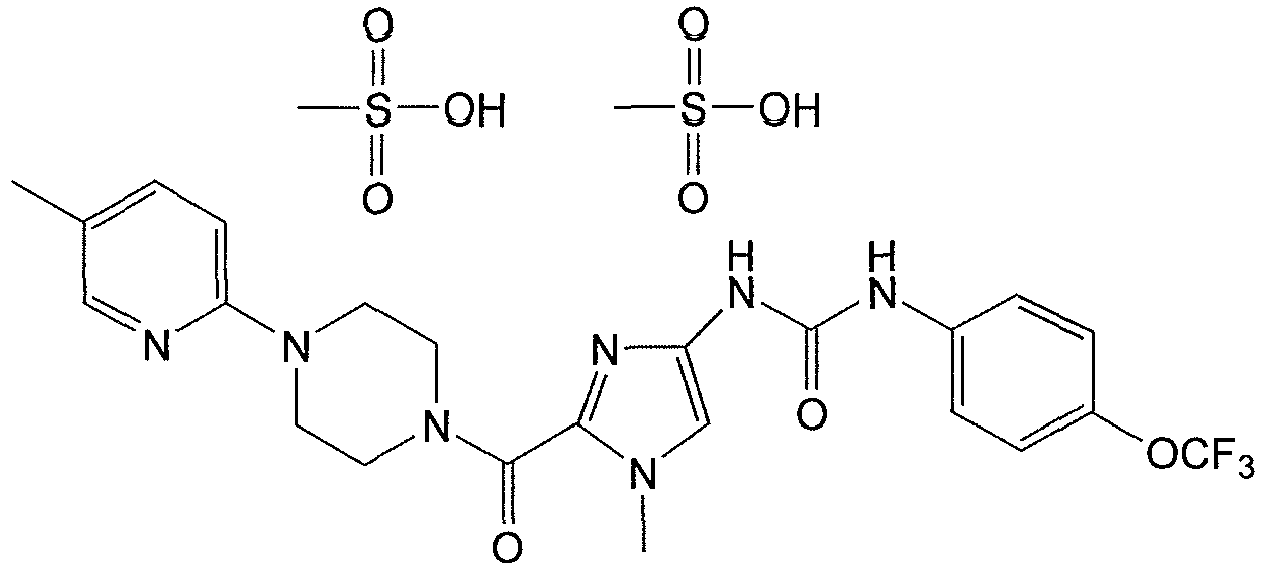
- Bevorzugt im Rahmen der Erfindung ist insbesondere ein kristallines N-(1-Methyl-2-{[4-(5-methylpyridin-2-yl)piperazin-1-yl]-carbonyl}-1H-imidazol-4-yl)-N'-[4-trifluormethoxyphenyl]harnstoff Dimesylat, das im Pulver-XRD-Diffraktogramm charakteristische Peaks bei etwa 6.37, 11.77, 12.56, 17.17, 18.81, 20.34, 21.47, 23.04, 35.46 Grad 2Theta zeigt.
- Bevorzugt im Rahmen der Erfindung ist ferner kristallines N-(1-Methyl-2-{[4-(5-methylpyridin-2-yl)piperazin-1-yl]-carbonyl}-1H-imidazol-4-yl)-N'-[4-trifluormethoxyphenyl]harnstoff Dimesylat, das ein Pulver-XRD-Diffraktogramm zeigt, wie in
Fig. 1 dargestellt. - Die erfindungsgemäßen Salze werden im Allgemeinen durch Umsetzen einer Verbindung der Formel (I) mit Methansulfonsäure in einem Lösungsmittel hergestellt.
- Es ist ferner möglich offenbarungsgemäße Salze durch Umsetzen eines Säuresalzes der Verbindungen der Formel (I), das kein Salz einer organischen Sulfonsäure ist, mit einer Quelle für Sulfonat-Anionen einer organischen Sulfonsäure in einem Lösungsmittel herzustellen.
- Im letzteren Fall kann die Quelle für Sulfonat-Anionen eine organische Sulfonsäure oder ein Salz einer organischen Sulfonsäure sein.
- Gegenstand der Offenbarung ist somit ferner ein Verfahren zur Herstellung von organischen Sulfonsäuresalzen der Verbindungen der Formel (I), das die Umsetzung von Verbindungen der Formel (I) oder Salzen von Verbindungen der Formel (I), die keine Säuresalze einer organischen Sulfonsäure sind, mit einer organischen Sulfonsäure oder einer Quelle für organische Sulfonat-Anionen in ein Lösungsmittel aufweist.
- Das Lösungsmittel ist vorzugsweise so ausgewählt, dass es eine gute Balance zwischen der Löslichkeit der Verbindungen der Formel (I) beziehungsweise den Salzen der Verbindung der Formel (I), die keine Sulfonsäuresalze sind, und der organischen Sulfonsäure beziehungsweise der Quelle für Sulfonat-Anionen bietet. Vorzugsweise sollten die offenbarungsgemäßen Salze in dem verwendeten Lösungsmittel möglichst wenig löslich sein. Gegebenenfalls können die offenbarungsgemäßen Salze jedoch auch durch Zugabe eines Gegenlösungsmittels ausgefällt werden.
- Beispiele für Lösungsmittel, die zur Herstellung der erfindungsgemäßen Salze verwendet werden, schließen Folgendes ein, nämlich Alkohole wie Methanol, Ethanol, n-Propanol, iso-Propanol und Butanol; Ether wie Diethylether, Methyl-tert.-butylether, 1,2-Dimethoxyethan, Dioxan oder Tetrahydrofuran; Kohlenwasserstoffe wie Benzol oder Toluol; oder andere Lösungsmittel wie Aceton, Essigester, Methylethylketon, Methylisobutylketon, Acetonitril, Heptan, Dimethylsulfoxid oder Dimethylformamid.
- Gegebenenfalls wird zum Ausfällen der erfindungsgemäßen Salze ein Gegenlösungsmittel zugegeben. Beispiele für solchen Gegenlösungsmittel schließen Folgendes ein, nämlich Wasser und Alkohole wie Methanol, Ethanol oder Propanol.
- Die so erhaltenen erfindungsgemäßen Salze können gegebenenfalls weiter bearbeitet, z.B. umkristallisiert oder mikronisiert werden, um deren physikalische Eigenschaften weiter auf den Verwendungszweck anzupassen.
- Die zur Herstellung der erfindungsgemäßen Salze verwendeten Heterocyclylamid-substituierten Imidazole sind bekannt und können z.B. nach dem in der
WO 2006/089664 beschriebene Verfahren hergestellt werden. - Insbesondere erfolgt die Herstellung der verwendeten Heterocyclylamidsubstituierten Imidazole durch Umsetzen von Verbindungen der Formel

- R1 und R2
- wie zuvor definiert sind, und
- R4
- für Methyl oder Ethyl steht,
- R3
- wie zuvor definiert ist,
- Die Umsetzung in der ersten Stufe erfolgt im Allgemeinen in inerten Lösungsmitteln, bevorzugt in einem Temperaturbereich von 0°C bis zum Rückfluss der Lösungsmittel bei Normaldruck.
- Basen sind beispielsweise Alkalihydroxide wie Natrium-, Lithium- oder Kaliumhydroxid, oder Alkalicarbonate wie Cäsiumcarbonat, Natrium- oder Kaliumcarbonat. Natriumhydroxid ist dabei bevorzugt.
- Inerte Lösungsmittel sind beispielsweise Halogenkohlenwasserstoffe wie Methylenchlorid, Trichlormethan, Tetrachlormethan, Trichlorethan, Tetrachlorethan, 1,2-Dichlorethan oder Trichlorethylen, Ether wie Diethylether, Methyl-tert.-butylether, 1,2-Dimethoxyethan, Dioxan, Tetrahydrofuran, Glykoldimethylether oder Diethylenglykoldimethylether, Alkohole wie Methanol, Ethanol, n-Propanol, iso-Propanol, n-Butanol oder tert.-Butanol, Kohlenwasserstoffe wie Benzol, Xylol, Toluol, Hexan, Cyclohexan oder Erdölfraktionen, oder andere Lösungsmittel wie Dimethylformamid, Dimethylacetamid, Dimethylsulfoxid, Acetonitril oder Pyridin, oder Gemische von Lösungsmitteln mit Wasser. Als Lösungsmittel ist ein Gemisch aus Ethanol und Wasser bevorzugt.
- Die Umsetzung in der zweiten Stufe erfolgt im Allgemeinen in inerten Lösungsmitteln, gegebenenfalls in Gegenwart einer Base, bevorzugt in einem Temperaturbereich von -70°C bis 40°C bei Normaldruck.
- Als Dehydratisierungsreagenzien eignen sich hierbei beispielsweise Carbodiimide wie z.B. N,N'-Diethyl-, N,N'-Dipropyl-, N,N'-Diisopropyl-, N,N'-Dicyclohexylcarbodiimid, N-(3-Dimethylaminoisopropyl)-N'-ethylcarbodiimid-Hydrochlorid (EDC), N-Cyclohexylcarbodiimid-N'-propyloxymethyl-Polystyrol (PS-Carbodiimid) oder Carbonylverbindungen wie Carbonyldiimidazol, oder 1,2-Oxazoliumverbindungen wie 2-Ethyl-5-phenyl-1,2-oxazolium-3-sulfat oder 2-tert.-Butyl-5-methyl-isoxazolium-perchlorat, oder Acylaminoverbindungen wie 2-Ethoxy-1-ethoxycarbonyl-1,2-dihydrochinolin, oder Propanphosphonsäureanhydrid, oder Isobutylchloroformat, oder Bis-(2-oxo-3-oxazolidinyl)phosphorylchlorid oder Benzotriazolyloxy-tri(dimethylamino)phosphoniumhexafluorophosphat, oder O-(Benzotriazol-1-yl)-N,N,N',N'-tetramethyluroniumhexafluorophosphat (HBTU), 2-(2-Oxo1-(2H)-pyridyl)-1,1,3,3-tetramethyluroniumtetrafluoroborat (TPTU) oder O-(7-Azabenzotriazol-1-yl)-N,N,N',N'-tetramethyluroniumhexafluorophosphat (HATU), oder 1-Hydroxybenztriazol (HOBt), oder Benzotriazol-1-yloxytris(dimethylamino)phosphoniumhexafluorophosphat (BOP), oder Mischungen aus diesen, mit Basen.
- Basen sind beispielsweise Alkalicarbonate, wie z.B. Natrium- oder Kaliumcarbonat, oder -hydrogencarbonat, oder organische Basen wie Trialkylamine z.B. Triethylamin, N-Methylmorpholin, N-Methylpiperidin, 4-Dimethylaminopyridin oder Diisopropylethylamin oder DBU, DBN oder Pyridin, bevorzugt ist N-Methylmorpholin.
- Vorzugsweise wird die Kondensation mit Propanphosphonsäureanhydrid (T3P) in Gegenwart von N-Methylmorpholin (NMM) durchgeführt.
- Inerte Lösungsmittel sind beispielsweise Halogenkohlenwasserstoffe wie Methylenchlorid, Trichlormethan, Tetrachlormethan, Trichlorethan, Tetrachlorethan, 1,2-Dichlorethan oder Trichlorethylen, Ether wie Diethylether, Methyl-tert.-butylether, 1,2-Dimethoxyethan, Dioxan, Tetrahydrofuran, Glykoldimethylether oder Diethylenglykoldimethylether, Kohlenwasserstoffe wie Benzol, Xylol, Toluol, Hexan, Cyclohexan oder Erdölfraktionen, oder andere Lösungsmittel wie Ethylacetat, Aceton, Dimethylformamid, Dimethylacetamid, 2-Butanon, Dimethylsulfoxid, Acetonitril oder Pyridin, im Falle von wassermischbaren Lösungsmitteln auch Gemische derselben mit Wasser, bevorzugt ist Dimethylformamid.
- Die Verbindungen der Formel (II) sind bekannt oder können hergestellt werden, indem Verbindungen der Formel (IV)

R1 und R4 wie zuvor definiert sind,
in der ersten Stufe mit einem Reduktionsmittel und in der zweiten Stufe in Gegenwart eines Kohlensäurederivates mit Verbindungen der Formel
H2N-R2 (V)
in welcher
R2 wie zuvor definiert ist,
oder in der zweiten Stufe mit Verbindungen der Formel
OCN-R2 (VI),
in welcher
R2 wie zuvor definiert ist,
umgesetzt werden. - Die Umsetzung in der ersten Stufe erfolgt dabei im Allgemeinen in inerten Lösungsmitteln, bevorzugt in einem Temperaturbereich von 0°C bis zum Rückfluss der Lösungsmittel bei Normaldruck bis 3 bar.
- Reduktionsmittel sind beispielsweise Palladium auf Aktivkohle und Wasserstoff, Ameisensäure/Triethylamin/Palladium auf Aktivkohle, Zink, Zink/Salzsäure, Eisen, Eisen/Salzsäure, Eisen(II)sulfat/Salzsäure, Natriumsulfid, Natriumdisulfid Natriumdithionit, Ammoniumpolysulfid, Natriumborhydrid/Nickelchlorid, Zinndichlorid, Titantrichlorid oder Raney-Nickel und wässrige Hydrazin-Lösung, bevorzugt ist Raney-Nickel und wässrige Hydrazin-Lösung, Palladium auf Aktivkohle und Wasserstoff oder Ameisensäure/Triethylamin/Palladium auf Aktivkohle.
- Inerte Lösungsmittel sind beispielsweise Ether wie Diethylether, Methyl-tert.-butylether, 1,2-Dimethoxyethan, Dioxan, Tetrahydrofuran, Glykoldimethylether oder Diethylenglykoldimethylether, Alkohole wie Methanol, Ethanol, n-Propanol, iso-Propanol, n-Butanol oder tert.-Butanol, Kohlenwasserstoffe wie Benzol, Xylol, Toluol, Hexan, Cyclohexan oder Erdölfraktionen, oder andere Lösungsmittel wie Dimethylformamid, Dimethylacetamid, Acetonitril oder Pyridin, im Falle von wassermischbaren Lösungsmitteln auch Gemische derselben mit Wasser. Als Lösungsmittel sind Methanol, Ethanol, iso-Propanol oder im Falle von Raney-Nickel und wässrige Hydrazin-Lösung Tetrahydrofuran bevorzugt.
- Die Umsetzung in der zweiten Stufe gemäß der ersten Variante erfolgt im Allgemeinen in inerten Lösungsmitteln, bevorzugt in einem Temperaturbereich von Raumtemperatur bis 40°C bei Normaldruck.
- Kohlensäurederivate sind beispielsweise N,N-Carbonyldiimidazol, Phosgen, Diphosgen, Triphosgen, Chlorameisensäurephenylester oder Chlorameisensäure-4-nitrophenylester, bevorzugt ist N,N-Carbonyldiimidazol.
- Inerte Lösungsmittel sind beispielsweise Halogenkohlenwasserstoffe wie Methylenchlorid, Trichlormethan, Tetrachlormethan, Trichlorethan, Tetrachlorethan, 1,2-Dichlorethan oder Trichlorethylen, Ether wie Diethylether, Methyl-tert.-butylether, 1,2-Dimethoxyethan, Dioxan, Tetrahydrofuran, Glykoldimethylether oder Diethylenglykoldimethylether, Kohlenwasserstoffe wie Benzol, Xylol, Toluol, Hexan, Cyclohexan oder Erdölfraktionen, oder andere Lösungsmittel wie Ethylacetat, Aceton, Dimethylformamid, Dimethylacetamid, 2-Butanon, Dimethylsulfoxid, Acetonitril oder Pyridin, im Falle von wassermischbaren Lösungsmitteln auch Gemische derselben mit Wasser, bevorzugt ist Dimethylsulfoxid.
- Die Umsetzung in der zweiten Stufe gemäß der zweiten Variante erfolgt im Allgemeinen in inerten Lösungsmitteln, gegebenenfalls in Gegenwart einer Base, bevorzugt in einem Temperaturbereich von Raumtemperatur bis zum Rückfluss der Lösungsmittel bei Normaldruck.
- Inerte Lösungsmittel sind beispielsweise Halogenkohlenwasserstoffe wie Methylenchlorid, Trichlormethan, Tetrachlormethan, Trichlorethan, Tetrachlorethan, 1,2-Dichlorethan oder Trichlorethylen, Ether wie Diethylether, Methyl-tert.-butylether, 1,2-Dimethoxyethan, Dioxan, Tetrahydrofuran, Glykoldimethylether oder Diethylenglykoldimethylether, Kohlenwasserstoffe wie Benzol, Xylol, Toluol, Hexan, Cyclohexan oder Erdölfraktionen, oder andere Lösungsmittel wie Ethylacetat, Aceton, Dimethylformamid, Dimethylacetamid, 2-Butanon, Dimethylsulfoxid, Acetonitril oder Pyridin, bevorzugt sind Tetrahydrofuran oder Methylenchlorid.
- Basen sind beispielsweise Alkalicarbonate wie Cäsiumcarbonat, Natrium- oder Kaliumcarbonat, oder Kalium-tert.-butanolat, oder andere Basen wie Natriumhydrid, DBU, Triethylamin oder Diisopropylethylamin, bevorzugt Triethylamin.
- Die Verbindungen der Formel (IV) sind bekannt oder können hergestellt werden, indem Verbindungen der Formel

R1 und R4 wie zuvor definiert sind
mit rauchender Salpetersäure, konzentrierter Salpetersäure, Nitriersäure oder anderen Mischungsverhältnissen von Schwefelsäure und Salpetersäure, gegebenenfalls in Acetanhydrid als Lösungsmittel, bevorzugt in einem Temperaturbereich von Raumtemperatur bis 60°C bei Normaldruck, umgesetzt werden. - Die Verbindungen der Formeln (III), (IV), (V), (VII) sind bekannt oder lassen sich nach bekannten Verfahren aus den entsprechenden Edukten synthetisieren.
- Die Herstellung der zur Herstellung der erfindungsgemäßen Salze verwendeten Heterocyclylamid-substituierten Imidazole ist in dem nachstehenden Syntheseschema exemplarisch näher erläutert. Das Syntheseschema ist hierbei rein beispielhaft und in keiner Weise einschränkend zu verstehen.
-

- Die erfindungsgemäßen Salze zeigen eine antivirale Wirkung gegenüber Vertretern der Gruppe der Herpes viridae (Herpesviren), vor allem gegenüber Cytomegalieviren (CMV), insbesondere gegenüber dem humanen Cytomegalievirus (HCMV). Sie sind somit geeignet zur Behandlung und/oder Prophylaxe von Krankheiten, vor allem von Infektionen mit Viren, insbesondere den hierin genannten Viren, und den dadurch hervorgerufenen Infektionskrankheiten. Unter einer Virusinfektion wird hierin sowohl eine Infektion mit einem Virus als auch eine durch eine Infektion mit einem Virus hervorgerufene Krankheit verstanden.
- Die erfindungsgemäßen Salze können aufgrund ihrer besonderen Eigenschaften zur Herstellung von Arzneimitteln verwendet werden, die zur Prophylaxe und/oder Behandlung von Krankheiten, insbesondere Virusinfektionen, geeignet sind.
- Als Indikationsgebiete können beispielsweise genannt werden:
- 1) Behandlung und Prophylaxe von HCMV-Infektionen bei AIDS-Patienten (Retinitis, Pneumonitis, gastrointestinale Infektionen).
- 2) Behandlung und Prophylaxe von Cytomegalievirus-Infektionen bei Knochenmark- und Organtransplantationspatienten, die an einer HCMV-Pneumonitis, -Enzephalitis, sowie an gastrointestinalen und systemischen HCMV-Infektionen oft lebensbedrohlich erkranken.
- 3) Behandlung und Prophylaxe von HCMV-Infektionen bei Neugeborenen und Kleinkindern.
- 4) Behandlung einer akuten HCMV-Infektion bei Schwangeren.
- 5) Behandlung der HCMV-Infektion bei immunsupprimierten Patienten bei Krebs und Krebs-Therapie.
- Behandlung von HCMV-positiven Krebspatienten mit dem Ziel, HCMVvermittelte Tumorprogression zu verringern (vgl. J. Cinatl, et al., FEMS Microbiology Reviews 2004, 28, 59-77).
- Bevorzugt werden die erfindungsgemäßen Salze zur Herstellung von Arzneimitteln verwendet, die zur Prophylaxe und/oder Behandlung von Infektionen mit einem Vertreter der Gruppe der Herpes viridae, besonders einem Cytomegalievirus, insbesondere dem humanen Cytomegalievirus, geeignet sind.
- Die erfindungsgemäßen Salze können aufgrund ihrer pharmakologischen Eigenschaften allein und bei Bedarf auch in Kombination mit anderen Wirkstoffen, insbesondere antiviralen Wirkstoffen wie beispielsweise Valganciclovir, Ganciclovir, Valacyclovir, Acyclovir, Foscarnet, Cidofovir und verwandte Derivate zur Behandlung und/oder Prävention von Virusinfektionen, insbesondere von HCMV-Infektionen, eingesetzt werden.
- Weiterer Gegenstand der vorliegenden Offenbarung ist der Einsatz der erfindungsgemäßen Salze in einem Verfahren zur Behandlung und/oder Prophylaxe von Erkrankungen, vorzugsweise von Virusinfektionen, insbesondere von Infektionen mit dem humanen Cytomegalievirus (HCMV) oder einem anderen Vertreter der Gruppe der Herpes viridae.
- Weiterer Gegenstand der vorliegenden Offenbarung ist die Verwendung der erfindungsgemäßen Salze zur Behandlung und/oder Prophylaxe von Erkrankungen, insbesondere der zuvor genannten Erkrankungen.
- Weiterer Gegenstand der vorliegenden Erfindung sind die erfindungsgemäßen Salze zur Verwendung in einem Verfahren zur Behandlung und/oder Prophylaxe von Erkrankungen, insbesondere der zuvor genannten Erkrankungen.
- Weiterer Gegenstand der vorliegenden Offenbarung ist ein Verfahren zur Behandlung und/oder Prophylaxe von Erkrankungen, insbesondere der zuvor genannten Erkrankungen, unter Verwendung einer antiviral wirksamen Menge der erfindungsgemäβen Salze.
- Die erfindungsgemäßen Salze können systemisch und/oder lokal wirken. Zu diesem Zweck können sie auf geeignete Weise appliziert werden, wie z.B. oral, parenteral, pulmonal, nasal, sublingual, lingual, buccal, rectal, dermal, transdermal, conjunctival, otisch oder als Implantat beziehungsweise Stent.
- Für diese Applikationswege können die erfindungsgemäßen Salze in geeigneten Applikationsformen verabreicht werden.
- Für die orale Applikation eignen sich nach dem Stand der Technik funktionierende schnell und/oder modifiziert die erfindungsgemäßen Salze abgebende Applikationsformen, die die erfindungsgemäßen Verbindungen in kristalliner und/oder amorphisierter und/oder gelöster Form enthalten, wie z.B. Tabletten (nichtüberzogene oder überzogene Tabletten, beispielsweise mit magensaftresistenten oder sich verzögert auflösenden oder unlöslichen Überzügen, die die Freisetzung der erfindungsgemäßen Verbindung kontrollieren), in der Mundhöhle schnell zerfallende Tabletten oder Filme/Oblaten, Filme/Lyophilisate, Kapseln (beispielsweise Hart- oder Weichgelatinekapseln), Dragees, Granulate, Pellets, Pulver, Emulsionen, Suspensionen, Aerosole oder Lösungen.
- Die parenterale Applikation kann unter Umgehung eines Resorptionsschrittes geschehen (z.B. intravenös, intraarteriell, intrakardial, intraspinal oder intralumbal) oder unter Einschaltung einer Resorption (z.B. intramuskulär, subkutan, intrakutan, perkutan oder intraperitoneal). Für die parenterale Applikation eignen sich als Applikationsformen u.a. Injektions- und Infusionszubereitungen in Form von Lösungen, Suspensionen, Emulsionen, Lyophilisaten oder sterilen Pulvern.
- Für die sonstigen Applikationswege eignen sich z.B. Inhalationsarzneiformen (u.a. Pulverinhalatoren, Nebulizer), Nasentropfen, -lösungen, -sprays; lingual, sublingual oder buccal zu applizierende Tabletten, Filme/Oblaten oder Kapseln, Suppositorien, Ohren- oder Augenpräparationen, Vaginalkapseln, wässrige Suspensionen (Lotionen, Schüttelmixturen), lipophile Suspensionen, Salben, Cremes, transdermale therapeutische Systeme, Milch, Pasten, Schäume, Streupuder, Implantate oder Stents.
- Die erfindungsgemäßen Salze können in die angeführten Applikationsformen überführt werden. Dies kann in an sich bekannter Weise durch Mischen mit inerten, nichttoxischen, pharmazeutisch geeigneten Hilfsstoffen geschehen. Zu diesen Hilfsstoffen zählen u.a. Trägerstoffe (beispielsweise mikrokristalline Cellulose, Laktose, Mannitol), Lösungsmittel (z.B. flüssige Polyethylenglykole), Emulgatoren und Dispergier- oder Netzmittel (beispielsweise Natriumdodecylsulfat, Polyoxysorbitanoleat), Bindemittel (beispielsweise Polyvinylpyrrolidon), synthetische und natürliche Polymere (beispielsweise Albumin), Stabilisatoren (z.B. Antioxidantien wie beispielsweise Ascorbinsäure), Farbstoffe (z.B. anorganische Pigmente wie beispielsweise Eisenoxide) und Geschmacks- und/oder Geruchskorrigentien.
- Bevorzugt im Rahmen der Erfindung ist ein Arzneimittel, dass 5 bis 12,5 mg/ml eines erfindungsgemäßen Salzes, 50 bis 150 mg/ml Hydroxypropyl-β-cyclodextrin, 0.5 bis 2.0 mg/ml Natriumacetat sowie Wasser und ggf. weitere pharmazeutisch unbedenkliche Hilfsstoffe aufweist.
- Weiterer Gegenstand der vorliegenden Erfindung sind Arzneimittel, die mindestens ein erfindungsgemäßes Salz, üblicherweise zusammen mit einem oder mehreren inerten, nichttoxischen, pharmazeutisch geeigneten Hilfsstoffen enthalten, sowie deren Verwendung zu den zuvor genannten Zwecken.
- Im Allgemeinen hat es sich als vorteilhaft erwiesen, bei intravenöser Applikation Mengen, bezogen auf den reinen Wirkstoff, von etwa 0,001 bis 10 mg/kg, vorzugsweise etwa 0,01 bis 5 mg/kg Körpergewicht zur Erzielung wirksamer Ergebnisse zu verabreichen. Bei oraler Applikation beträgt die Dosierung üblicherweise etwa 0,01 bis 25 mg/kg, vorzugsweise 0,1 bis 10 mg/kg Körpergewicht.
- Trotzdem kann es gegebenenfalls erforderlich sein, von den genannten Mengen abzuweichen, und zwar in Abhängigkeit von Körpergewicht, Applikationsweg, individuellem Verhalten gegenüber dem Wirkstoff, Art der Zubereitung und Zeitpunkt beziehungsweise Intervall, zu welchem die Applikation erfolgt. So kann es in einigen Fällen ausreichend sein, mit weniger als der vorgenannten Mindestmenge auszukommen, während in anderen Fällen die genannte obere Grenze überschritten werden muss. Im Falle der Applikation größerer Mengen kann es empfehlenswert sein, diese in mehreren Einzelgaben über den Tag zu verteilen.
- Die Erfindung wird nun nachstehend anhand von Beispielen sowie in Bezug auf die beiliegende Zeichnung näher erläutert. Es zeigt:
- Fig. 1:
- ein Pulver-XRD-Diffraktogramm des Salzes von Beispiel 1.
- Die Prozentangaben in den folgenden Tests und Beispielen sind, sofern nicht anders angegeben, Gewichtsprozente; Teile sind Gewichtsteile. Lösungsmittelverhältnisse, Verdünnungsverhältnisse und Konzentrationsangaben von flüssig/flüssig-Lösungen beziehen sich jeweils auf das Volumen.
- Verwendete Abkürzungen:
- Bsp.
- Beispiel
- DC
- Dünnschichtchromatographie
- DMF
- N,N-Dimethylformamid
- DMSO
- Dimethylsulfoxid
- d. Th.
- der Theorie
- El
- Elektronenstoß-Ionisation (bei MS)
- ESI
- Elektrospray-Ionisation (bei MS)
- h
- Stunde
- HPLC
- Hochdruck-, Hochleistungsflüssigchromatographie
- LC-MS
- Flüssigchromatographie-gekoppelte Massenspektroskopie
- MS
- Massenspektroskopie
- NMR
- Kernresonanzspektroskopie
- RP-HPLC
- Reverse Phase HPLC
- RT
- Raumtemperatur
- Rt
- Retentionszeit (bei HPLC)
- TBTU
- O-(Benzotriazol-1-yl)-N,N,N,N'-tetramethyluronium-tetrafluoroborat
- THF
- Tetrahydrofuran
- Methode 1 (LC-MS): Instrument: Micromass Quattro LCZ mit HPLC Agilent Serie 1100; Säule: Phenomenex Synergi 2µ Hydro-RP Mercury 20 mm x 4 mm; Eluent A: 1 I Wasser + 0.5 ml 50%ige Ameisensäure, Eluent B: 1 I Acetonitril + 0.5 ml 50%ige Ameisensäure; Gradient: 0.0 min 90%A → 2.5 min 30%A →3.0 min 5%A →4.5 min 5%A; Fluss: 0.0 min 1 ml/min, 2.5 min/3.0 min/4.5 min 2 ml/min; Ofen: 50°C; UV-Detektion: 208- 400 nm.
- Methode 2 (LC-MS): Instrument: Micromass Platform LCZ mit HPLC Agilent Serie 1100; Säule: Phenomenex Synergi 2µ Hydro-RP Mercury 20 mm x 4 mm; Eluent A: 1 I Wasser + 0.5 ml 50%ige Ameisensäure, Eluent B: 1 I Acetonitril + 0.5 ml 50%ige Ameisensäure; Gradient: 0.0 min 90%A → 2.5 min 30%A → 3.0 min 5%A → 4.5 min 5%A; Fluss: 0.0 min 1 ml/min, 2.5 min/3.0 min/4.5 min 2 ml/min; Ofen: 50°C; UV-Detektion: 210 nm.
- Methode 3 (LC-MS): Gerätetyp MS: Micromass ZQ; Gerätetyp HPLC: Waters Alliance 2795; Säule: Phenomenex Synergi 2µ Hydro-RP Mercury 20 mm x 4 mm; Eluent A: 1 I Wasser + 0.5 ml 50%ige Ameisensäure, Eluent B: 1 I Acetonitril + 0.5 ml 50%ige Ameisensäure; Gradient: 0.0 min 90%A → 2.5 min 30%A → 3.0 min 5%A → 4.5 min 5%A; Fluss: 0.0 min 1 ml/min, 2.5 min/3.0 min/4.5 min 2 ml/min; Ofen: 50°C; UV-Detektion: 210 nm.
- Methode 4 (LC-MS): Gerätetyp MS: Micromass ZQ; Gerätetyp HPLC: HP 1100 Series; UV DAD; Säule: Phenomenex Synergi 2µHydro-RP Mercury 20 mm x 4 mm; Eluent A: 1 I Wasser + 0.5 ml 50%ige Ameisensäure, Eluent B: 1 I Acetonitril + 0.5 ml 50%ige Ameisensäure; Gradient: 0.0 min 90%A → 2.5 min 30%A → 3.0 min 5%A → 4.5 min 5%A; Fluss: 0.0 min 1 ml/min, 2.5 min/3.0 min/4.5 min 2 ml/min; Ofen: 50°C; UV-Detektion: 210 nm.
- Methode 5 (analytische HPLC): Säule: Kromasil 100 RP-18, 60 mm x 2.1 mm, 3.5 µm; Eluent A: Wasser + 0.5% Perchlorsäure (70%ig), Eluent B: Acetonitril; Gradient: 0 min 2%B, 0.5 min 2%B, 4.5 min 90%B, 9 min 90%B, 9.2 min 2%B, 10 min 2%B; Fluss: 0.75 ml/min; Säulentemperatur: 30°C; Detektion: UV 210 nm.
-

-

- 15 g (81 mmol) 4-Nitro-1H-imidazol-2-carbonsäureethylester werden unter Argon zusammen mit 13.13 g (97.2 mmol) Cyclopropylmethylbromid und 22.4 g (162 mmol) Kaliumcarbonat in 165 ml DMF 1 h bei 80°C gerührt. Nach Abkühlen wird die Reaktionsmischung mit Wasser verdünnt und viermal mit Ethylacetat extrahiert. Die vereinigten organischen Phasen werden einmal mit Wasser und dreimal mit gesättigter Natriumchloridlösung gewaschen, mit Magnesiumsulfat getrocknet und im Vakuum eingedampft. Der kristalline Rückstand wird für die nächste Reaktion direkt weiterverwendet. Ausbeute: 17.59 g (70 % d. Th.)
- LC-MS (Methode 1): Rt = 2.02 min.
- MS (ESI+): m/z = 240 [M+H]+
- 1H-NMR (300MHz, DMSO-d6): δ= 8.2 (s, 1H), 4.4 (q, 2H), 4.3 (d, 2H), 1.4 (m, 4H), 0.55 (q, 2H), 0.45 (q, 2H) ppm.
-

- 3.89 g (16.26 mmol) 1-(Cyclopropylmethyl)-4-nitro-1H-imidazol-2-carbonsäureethylester werden in 50 ml THF gelöst und mit einer Spatelspitze Raney-Nickel versetzt. Die Reaktionsmischung wird in einer Hydrierungsapparatur bei Raumtemperatur mit Wasserstoff hydriert. Der Katalysator wird abfiltriert und das Filtrat im Vakuum eingedampft. Der Eindampfrückstand wird für die nächste Reaktion direkt weiterverwendet.
- Ausbeute: 3.46 g (100 % d. Th.)
- LC-MS (Methode 2): Rt = 1.21 min.
- MS (ESI+): m/z = 210 [M+H]+
- 1H-NMR (300MHz, DMSO-d6): δ = 6.55 (s, 1H), 4.55 (s, 2H), 4.2 (q, 2H), 4.1 (d, 2H), 1.25 (tr, 3H), 1.2 (m, 1H), 0.5 (q, 2H), 0.3 (q, 2H) ppm.
-

- 7.49 g (35.8 mmol) 4-Amino-1-(cyclopropylmethyl)-1H-imidazol-2-carbon-säureethylester werden in 18 ml THF unter Argon mit 6 g (35.8 mmol) 4-(Trifluormethoxy)phenylisocyanat versetzt und 4 h bei Raumtemperatur gerührt. Die Reaktionsmischung wird im Vakuum eingeengt und das dabei auskristallisierende Produkt in 40 ml Ethylacetat verrührt und abgesaugt.
- Ausbeute: 11.1 g (82% d.Th.)
- LC-MS (Methode 1): Rt = 2.66 min.
- MS (ESI+): m/z = 376 [M+H]+
- 1H-NMR (300MHz, DMSO-d6): δ = 9.45 (s, 1H), 8.0 (d, 1H), 7.35 (s, 1H), 7.3 (d, 1H), 7.2 (dd, 1H), 4.3 (q, 2H), 4.25 (d, 2H), 2.25 (s, 3H), 1.3 (tr, 3H), 1.25 (m, 1H), 0.55 (q, 2H), 0.35 (q, 2H) ppm.
-

- 10.6 g (28.1 mmol) 4-[({[4-(Trifluormethoxy)phenyl]amino}carbonyl)amino]-1-(cyclopropylmethyl)-1H-imidazol-2-carbonsäureethylester werden in 158 ml Ethanol suspendiert. Unter Eiskühlung werden 16.4 ml Wasser und 6 ml (112 mmol) 50%ige wässrige Natronlauge-Lösung zugegeben. Die Reaktionsmischung wird 1 h bei Raumtemperatur gerührt und dann im Vakuum eingeengt. Der Rückstand wird in 100 ml Isopropanol aufgenommen und unter Eiskühlung mit 100 ml 1N Salzsäure versetzt. Die Kristalle werden abgesaugt und im Vakuum bei 40°C getrocknet.
- Ausbeute: 9.85 g (100 % d. Th.)
- LC-MS (Methode 3): Rt = 1.74 min.
- MS (ESI+): m/z = 349 [M+H]+
- 1H-NMR (400MHz, DMSO-d6): δ = 9.4 (s, 1H), 8.0 (d, 1H), 7.3 (s, 1H), 7.25 (d, 1H), 7.2 (dd, 1H), 4.25 (d, 2H), 2.25 (s, 3H), 1.25 (m, 1H), 0.55 (q, 2H), 0.35 (q, 2H) ppm.
-

- Die Herstellung erfolgt analog zu Beispiel 1A.
- Ausbeute: 2.05 g (96 % d. Th.)
- LC-MS (Methode 3): Rt = 1.96 min.
- MS (ESI+): m/z = 387 [M+H]+
- 1H-NMR (300MHz, DMSO-d6): δ = 9.0 (s, 1H), 8.9 (s, 1H), 7.55 (d, 2H), 7.3 (s, 1H), 7.25 (d, 1H), 4.35 (tr, 2H), 1.7 (quintett, 2H), 1.25 (sextett, 2H), 0.9 (tr, 3H) ppm.
-

- 1.22 g (3.61 mmol) 4-Amino-1-methyl-1H-imidazol-2-carbonsäureethylester (Synthese analog Beispiel 1A Stufe 3 oder auch gemäß Tetrahedron Lett. 2003, 44, 1607 und dort zitierter Literatur) werden in 50 ml THF unter Argon mit 1.46 g (7.21 mmol) 4-(Trifluormethoxy)phenylisocyanat versetzt und über Nacht bei Raumtemperatur gerührt. Die Reaktionsmischung wird filtriert, das Filtrat im Vakuum eingeengt und chromatographisch gereinigt.
- Ausbeute: 860 mg (62 % d. Th.)
- LC-MS (Methode 4): Rt = 2.41 min.
- MS (ESI+): m/z = 373 [M+H]+
- 1H-NMR (300MHz, DMSO-d6): δ = 8.98 (bs, 2H), 7.55 (m, 2H), 7.36 (s, 1H), 7.29 (m, 2H), 4.28 (q, 2H), 3.91 (s, 3H), 1.30 (t, 3H).
-

- 835 mg (2.13 mmol) 1-Methyl-4-[({[4-(trifluormethoxy)phenyl]amino}carbonyl)amino]-1H-imidazol-2-carbonsäureethylester (Beispiel 3A) werden in 5 ml Ethanol und 12 ml Tetrahydrofuran suspendiert. Unter Eiskühlung werden 2 ml (25 mmol) 50%ige wässrige Natronlauge-Lösung zugegeben. Die Reaktionsmischung wird über Nacht bei Raumtemperatur gerührt und dann unter Eiskühlung mit 1 N Salzsäure sauer gestellt. Die Lösung wird mit Dichlormethan extrahiert. Die organische Phase wird im Vakuum eingeengt. Der Rückstand wird durch präparative HPLC gereinigt.
- Ausbeute: 346 mg (44 % d. Th.).
- LC-MS (Methode 3): Rt = 1.62 min.
- MS (ESI+): m/z = 345 [M+H]+
- 1H-NMR (400MHz, DMSO-d6): δ = 9.33 (bs, 1 H), 8.98 (bs, 1 H), 7.55 (m, 2H), 7.30 (s, 1 H), 7.28 (m, 2H), 3.90 (s, 3H).
-

- Die Herstellung erfolgt analog zu Beispiel 4A.
- Ausbeute: 425 mg (91 % d. Th.).
- LC-MS (Methode 4): Rt = 1.94 min.
- MS (ESI+): m/z = 359 [M+H]+
- 1H-NMR (300MHz, DMSO-d6): δ = 10.3 (bs, 1H), 7.67 (m, 2H), 7.24 (s, 1H), 7.20 (m, 2H), 4.45 (q, 2H), 1.33 (t, 3H).
-

- Die Herstellung erfolgt analog zu Beispiel 4A.
- Ausbeute: 964 mg (81 % d. Th.).
- HPLC (Methode 5): Rt = 3.57 min.
- MS (ESI+): m/z = 327 [M+H]+
- 1H-NMR (400MHz, CDCl3): δ = 8.9 (s, 1 H), 8.8 (s, 1H), 7.5 (d, 2H), 7.3 (s, 2H), 7.1 (t, 1H), 7.09 (d, 2H), 3.9 (s, 3H).
-

-

- Unter einer Argonatmosphäre werden 2.50 g (19.6 mmol) 2-Methyl-5-chlorpyridin und 4.38 g (23.5 mmol) N-(tert.-Butyloxycarbonyl)-piperazin in 50 ml absolutem Toluol gelöst. Anschließend gibt man 2.26 g (23.5 mmol) Natrium-tert.-butylat, 0.37 g (0.59 mmol) BINAP und 0.36 g (0.39 mmol) Tris(dibenzylidenaceton)dipalladium hinzu und erhitzt 12 h auf 70°C. Nach dem Abkühlen wird das Reaktionsgemisch mit Diethylether versetzt, dreimal mit gesättigter Natriumchloridlösung gewaschen, über Natriumsulfat getrocknet und im Vakuum vom Lösungsmittel befreit. Der Rückstand wird flashchromatographisch (Cyclohexan/ Ethylacetat 9:1) gereinigt.
- Alternativ kann die Kupplungsreaktion auch unter Verwendung von Palladium-(II)-acetat als Katalysator durchgeführt werden.
- Ausbeute: 5.27 g (97 % d. Th.).
- LC-MS (Methode 3): Rt = 1.26 min.
- MS (ESI+): m/z = 278 [M+H]+
- 1H-NMR (300MHz, CDCl3): δ = 8.02 (d, 1H), 7.34 (dd, 1H), 6.59 (d, 1H), 3.55 (m, 4H), 3.45 (m, 4H), 2.21 (s, 3H), 1.49 (s, 9H).
-

- 3.47 g (12.5 mmol) 1-(tert.-Butyloxycarbonyl)-4-(5-methylpyridin-2-yl)piperazin werden in 10 ml Dioxan gelöst und mit 31 ml (125 mmol) Chlorwasserstoff in Dioxan (4 Molar) versetzt. Man lässt 2 h bei RT rühren. Anschließend wird eingeengt, der Rückstand mit 1 M Natronlauge alkalisiert und mehrmals mit Dichlormethan extrahiert. Die vereinigten organischen Phasen werden über Natriumsulfat getrocknet, eingeengt und im Vakuum getrocknet.
- Alternativ kann die Verbindung von Beispiel 7A auch in Form des Hydrochlorid-Salzes isoliert werden.
- Ausbeute: 2.18 g (98 % d. Th.).
- LC-MS (Methode 4): Rt = 0.38 min.
- MS(ESI+): m/z = 177[M+H]+
- 1H-NMR (300MHz, CDCl3): δ = 8.02 (d, 1H), 7.32 (dd, 1H), 6.59 (d, 1H), 3.45 (m, 4H), 3.00 (m, 4H), 2.20 (s, 3H).
-

- 1.50 g (4.36 mmol) der Verbindung aus Beispiel 4A werden in 30 ml DMF gelöst und mit 1.82 g (5.66 mmol) O-(Benzotriazol-1-yl)-N,N,N`,N`-tetramethyluroniumtetrafluoroborat (TBTU) und 266 mg (2.18 mmol) 4-Dimethylaminopyridin versetzt. Nach Zugabe von 925 mg (5.66 mmol) 1-(Pyridin-2-yl)-piperazin lässt man 4 h bei RT rühren. Das Reaktionsgemisch wird durch RP-HPLC gereinigt.
- Ausbeute: 1.79 g (83 % d. Th.).
- LC-MS (Methode 1): Rt= 1.83 min.
- MS (ESI+): m/z = 490 [M+H]+
- 1H-NMR (400MHz, DMSO-d6): δ = 8.89 (bs, 2H), 8.12 (d, 1H), 7.55 (m, 3H), 7.29 (m, 2H), 7.20 (s, 1H), 6.88 (d, 1H), 6.68 (dd, 1H), 4.02 (bs, 2H), 3.77 (s, 3H), 3.71 (bs, 2H), 3.58 (bs, 4H).
-

- Zu einer Lösung von 9.0 g (26.14 mmol) der Verbindung aus Beispiel 4A in 110 ml Essigsäureethylester werden 5.6 g (26.14 mmol) der Verbindung aus Beispiel 7A und 13.22 g (130.7 mmol) N-Methylmorpholin zugegeben und die Reaktionsmischung wird auf 0°C abgekühlt. Zu der Reaktionslösung werden über 90 min 16.63 g (52.26 mmol) Propanphosphonsäureanhydrid (T3P) zugegeben und die resultierende Suspension wird für weitere 10 min bei dieser Temperatur gerührt. Die Reaktionsmischung wird dann über 60 min auf 20°C erwärmt und bei dieser Temperatur über Nacht gerührt. Unreagiertes T3P wird durch Zugabe von 45 ml Wasser gequencht und die Reaktionsmischung wird für weitere 10 min gerührt. Danach werden die Phasen getrennt und die organische Phase wird mehrmals mit Wasser gewaschen (3 x 45 ml), das auf pH 5 eingestellt ist. Die vereinigten wässrigen Phasen werden noch einmal mit Essigsäureethylester gewaschen und die vereinigten organischen Phasen werden zweimal mit 45 ml wässriger Natriumhydrogencarbonatlösung gewaschen, über Natriumsulfat getrocknet und eingeengt. Das erhaltene Rohprodukt wird aus Ethanol umkristallisiert, wonach das Endprodukt als schwach gelber Feststoff erhalten wird.
- Ausbeute: 8.42g (64 % d. Th.).
- LC-MS (Methode 4): Rt = 2.01 min.
- MS (ESI+): m/z = 504 [M+H]+
- 1H-NMR (300MHz, DMSO-d6): δ = 8.92 (bs, 2H), 7.99 (d, 1H), 7.54 (m, 2H), 7.42 (dd, 1H), 7.28 (m, 2H), 7.20 (s, 1H), 6.80 (d, 1H), 4.00 (bs, 2H), 3.77 (s, 3H), 3.72 (bs, 2H), 3.51 (bs, 4H), 2.16 (s, 3H).
-

- Die Herstellung erfolgt analog zu Beispiel 9A aus Beispiel 5A.
- Ausbeute: 55 mg (68 % d. Th.).
- LC-MS (Methode 4): Rt = 2.76 min.
- MS (ESI+): m/z = 538 [M+H]+
- 1H-NMR (300MHz, DMSO-d6): δ = 8.97 (bs, 1H), 8.92 (bs, 1H), 8.14 (d, 1H), 7.65 (dd, 1H), 7.54 (m, 2H), 7.28 (m, 2H), 7.24 (s, 1H), 6.92 (d, 1H), 4.16 (q, 2H), 3.97 (bs, 2H), 3.72 (bs, 2H), 3.59 (bs, 4H), 1.32 (t, 3H).
-

- Die Herstellung erfolgt analog zu Beispiel 9A aus Beispiel 4A.
- Ausbeute: 35 mg (58 % d. Th.).
- LC-MS (Methode 3): Rt = 2.24 min.
- MS (ESI+): m/z = 519 [M+H]+
- 1H-NMR (400MHz, DMSO-d6): δ = 8.89 (bs, 2H), 7.53 (m, 2H), 7.28 (m, 2H), 7.19 (s, 1H), 6.92 (m, 2H), 6.84 (m, 2H), 4.05 (bs, 2H), 3.75 (m, 5H), 3.69 (s, 3H), 3.08 (bs, 4H).
-

- Die Herstellung erfolgt analog zu Beispiel 9A aus Beispiel 6A.
- Ausbeute: 17 mg (29 % d. Th.).
- LC-MS (Methode 4): Rt = 1.70 min.
- MS (ESI+): m/z = 486 [M+H]+
- 1H-NMR (400MHz, DMSO-d6): δ = 8.84 (bs, 1 H), 8.77 (bs, 1 H), 7.98 (d, 1 H), 7.47 (m, 2H), 7.42 (dd, 1H), 7.18 (s, 1H), 7.11 (t, 1H), 7.10 (m, 2H), 6.80 (d, 1H), 4.01 (bs, 2H), 3.77 (s, 3H), 3.71 (bs, 2H), 3.50 (bs, 4H), 2.16 (s, 3H).
- Die Beispiele der Tabelle 1 werden analog zu Beispiel 8A hergestellt.
Tabelle 1 Bsp.-Nr. Struktur Molmasse MS (ESI) [M+H]+ LC-MS Rt [min] (Methode) Ausgangsverbindung Ausbeute (% d. Th.) 13A 
565.981 566 2.94 (4) Beispiel 2A 72 14A 
517.509 518 1.94 (4) Beispiel 5A 22 15A 
523.901 524 2.67 (4) Beispiel 4A 50 16A 
543.547 544 2.11 (4) Beispiel 1A 59 -

- Alle Arbeiten werden unter einer Stickstoff-Schutzgasatmosphäre durchgeführt. In einem Reaktionskessel werden 3202 g der Verbindung von Beispiel 9A (6,36 mol, 1 eq.) mit einer Mischung aus 15 I THF und 1 I Wasser vermischt. Die resultierende Suspension wird langsam auf 60°C erwärmt und dann 30 min bei dieser Temperatur gerührt. Zu der gebildeten gelblichen Lösung werden über 30 min 1252 g Methansulfonsäure (13,03 mol, 2,05 eq.) zugegeben und danach wird mit N-(1-Methyl-2-{[4-(5-methyl-pyridin-2-yl)piperazin-1-yl]-carbonyl}-1H-imidazol-4-yl)-N'-[4-trifluormethoxyphenyl]harnstoff Dimesylat angeimpft. Zu der entstehenden Suspension von kristallinem N-(1-Methyl-2-{[4-(5-methylpyridin-2-yl)piperazin-1-yl]-carbonyl}-1H-imidazol-4-yl)-N'-[4-trifluormethoxyphenyl]harnstoff Dimesylat werden über 2 Stunden weitere 30 I THF zugegeben. Die Suspension wird langsam auf 20°C abgekühlt und dann für weitere 12 h bei dieser Temperatur gerührt. Die gebildeten Kristalle werden durch Vakuumfiltration gesammelt und der Reaktor wird mit THF und anschließend n-Heptan nachgespült, wobei diese organischen Phasen dann zum Waschen der Kristalle verwendet werden. Zum Abschluss werden die Kristalle unter Vakuum und einem Stickstoffstrom auf dem Filter getrocknet. Es werden 4262g (Ausbeute: 96,4 %, Reinheit > 99 %) des gewünschten Dimesylat-Salzes erhalten.
1H-NMR (400MHz, DMSO-d6): δ = 9.07 (s, 1H), 8.98 (s, 1H), 7.99 (s, 1H), 7.92 (d, 1H), 7.56 (d, 2H), 7.41 (d, 1H), 7.33-7.24 (m, 3H), 4.18 (s, br., 2H), 3.92-3.69 (m, 9H), 2.43-2.39 (s, 6H), 2.25 (s, 3H). - Unter Verwendung eines Rigaku MiniFlex Pulver-XRD-Spektrometers wurde das in
Fig. 1 dargestellte Röntgendiffraktogramm aufgenommen. - Die Verbindungen der Beispiele 8A sowie 10A bis 15A können in analoger Weise in die Dimesylat-Salze überführt werden.
- 20 mg der Verbindung von Beispiel 1 sowie zum Vergleich die Citrat-, Maleat-, Sulfat- und Tartratsalze der Verbindung von Beispiel 9A sowie Chloridsalze der Verbindung von Beispiel 9A, die mit 1, 2 und 4 eq. Chlorwasserstoffsäure hergestellt wurden, sowie die freie Base werden in HPLC-Gläschen eingewogen, die mit einem Magnetrührer ausgestattet waren. Es werden je 1 ml H2O zugegeben und die HPLC-Gläschen werden verschlossen. Die entstehenden Suspensionen werden über Nacht bei 25°C gerührt. Zur Abschätzung der Menge an gelöster Substanz werden die Suspensionen über Pipettenmikrofilter filtriert und die erhaltenen Filtrate werden 1:4 verdünnt und mittels HPLC analysiert. Die HPLC-Analyse erfolgte auf einer Dionex Luna RP18 (100A)-Säule mit den folgenden Abmessungen: 5µm 50x4,6 mm unter Verwendung einer isokratischen Mischung aus Acetonitril und H2O + 0,1 % TFA im Verhältnis 3:7.
- Als Ergebnis der Löslichkeitsmessungen wurden die nachstehend Tabelle 2 dargestellten Werte ermittelt.
Tabelle 2 Verbindung Löslichkeit [mg/ml] Bsp. 9A, freie Base 0,004 Bsp. 9A Citrat 0,42 Bsp. 9A Maleat 0,12 Bsp. 9A Sulfat 0,18 Bsp. 9A Tartrat 0,72 Bsp. 9A Chlorid 1 eq. 0,19 Bsp. 9A Chlorid 2 eq. 0,07 Bsp. 9A Chlorid 4 eq. 0,11 Bsp.1 >9,70 - Diese Werte zeigen deutlich die überlegene Löslichkeit des Salzes von Beispiel 1 in wässrigem Medium gegenüber anderen Salzen der Verbindung von Beispiel 9A.
- Zur Bestimmung der Löslichkeit unter simulierten Bedingungen im menschlichen Magen werden Aufschlämmungen des Salzes von Beispiel 1 sowie der Citrat- und Tartratsalze von Beispiel 9A und der entsprechenden freien Base in wässriger Natriumchloridlösung (0,2 Gew.-%), die mit Chlorwasserstoffsäure auf einen pH von 1,2 eingestellt wurde, für 5 Stunden gerührt. Die Proben wurden danach wie oben beschrieben behandelt und die Menge an freier Base in Lösung wird mittels HPLC ermittelt. Die entsprechenden Werte für die Löslichkeit unter simulierten Bedingungen des menschlichen Magens sind nachstehend in Tabelle 3 dargestellt.
Tabelle 3 Verbindung Menge an gelöster freier Base [mg/ml] Bsp. 9A Citrat 0,068 Bsp. 9A Tartrat 0,047 Bsp. 9A, freie Base 0,065 Bsp. 1 0,103 - Diese Tabelle zeigt klar die deutlich bessere Löslichkeit der erfindungsgemäßen Salze unter simulierten Bedingungen im menschlichen Magen. Es ist hierbei anzumerken, dass nach Stehenlassen der Lösung für längere Zeiträume das erneute Auftreten einer Suspension beobachtet werden konnte. Es steht zu vermuten, dass dieses aus der Bildung von schlechter löslichen Chloridsalzen von Beispiel 9A herrührt. Diese beobachtete Bildung von unlöslichen Chloridsalzen wurde aber als nicht schwerwiegend eingeschätzt, da diese-vor allem bei Verwendung von Beispiel 1 - mit Verzögerung eintritt und somit zunächst eine metastabile übersättigte Lösung vorliegt. Dies ist ein weiteres Indiz für die Vorteile, die mit der Verwendung der erfindungsgemäßen Salze zur Herstellung von Medikamenten erreicht werden können.
- Durch Lagern des Salzes von Beispiel 1 in reiner Form bei etwa 46 % relativer Luftfeuchtigkeit und 24°C wurde die Hygroskopie der erfindungsgemäßen Salze vermessen. Das Salz von Beispiel 1 zeigte dabei nach einer Lagerzeit von ca. 2 Tagen eine Gewichtszunahme von weniger als 0,11 %, was eine für die Verwendung in Medikamenten annehmbare Hygroskopie darstellt.
- Die in-vitro-Wirkung der erfindungsgemäßen Verbindungen auf die Replikation des HCMV (humanes Cytomegalovirus) kann in folgendem antiviralen Assay gezeigt werden:
- Die Testverbindungen werden als 50 millimolare (mM) Lösungen in Dimethylsulfoxid (DMSO) eingesetzt. Als Referenzverbindungen können z.B. Ganciclovir®, Foscarnet® Cidofovir® oder auch die Verbindung von Beispiel 9A verwendet werden. Einen Tag vor Testansatz werden 1,5 x 10⁴ humane Vorhautfibroblasten (NHDF-Zellen)/well in 200 µl Zellkulturmedium in die Wells B2-G11 von 96-well Platten (schwarz mit durchsichtigem Boden) ausgesät. Die randständigen Wells jeder 96-well Platte werden lediglich mit 200µl Medium befüllt um Randeffekte zu vermeiden. Am Versuchstag wird das Zellkulturmedium der Wells B2-G11 jeder 96-well Platte abgesaugt und durch 100 µl Virussuspension ersetzt (multiplicity of infection (MOI): 0.1-0.2). Bei dem verwendeten Virus handelt es sich um ein rekombinantes HCMV welches eine Expressionskassette für das green fluorescence protein (GFP) in das Virusgenom integriert hat (HCMV AD 169 RV-HG(E. M. Borst, K. Wagner, A. Binz, B. Sodeik, und M. Messerle, 2008, J. Virol. 82:2065-2078.). Nach einer Inkubationszeit von 2h bei 37°C und 5% CO2 wird das Virus-Inokulat abgesaugt und alle Wells mit Ausnahme der Wells in Spalte 3 werden mit 200 µl Zellkulturmedium befüllt. Spalte 2 wird nicht weiter behandelt und dient als Viruskontrolle. Die Wells in Spalte 3 werden jeweils in Doppelbestimmung mit 300 µlTestsubstanz (verdünnt in Zellkulturmedium) befüllt. Die Konzentration der jeweiligen antiviralen Substanz in Spalte 3 beträgt∼die 27fache Konzentration des jeweils erwarteten EC50 Werts. Die Testsubstanz in Spalte 3 wird in 8 Schritten 1:3 über die 96-well Platte verdünnt indem jeweils 100 µl einer Spalte in die jeweils rechte Spalte transferiert- und dort mit den vorhandenen 200 µl Zellkulturmedium gemischt werden. Auf diese Weise werden drei antivirale Substanzen in Doppelbestimmungen getestet. Die Platten werden 7 Tage bei 37°C / 5% CO2 inkubiert. Im Anschluss werden alle Wells einer Platte 3 x mit PBS (Phosphate Buffered Saline) gewaschen und mit 50 µl PBS befüllt. Danach wird die GFP-Intensität jedes Wells einer 96-well Platte mittels eines Fluoreszenzlesegerätes (FluoBox; Bayer Technology Services GmbH; Filtereinstellungen: GFP, Ex 480 nm, Em 520 nm) bestimmt. Aus den so erhaltenen Messwerten kann der EC50 einer anti-HCMV-Substanz ermittelt werden:
- EC50 (GFP-RA) = Substanzkonzentration in µM welche im Vergleich zur unbehandelten Viruskontrolle die GFP-Fluoreszenz in infizierten Zellen um 50% reduziert.
- Repräsentative in-vitro-Wirkdaten für die erfindungsgemäßen Verbindungen sind in Tabelle 4 wiedergegeben:
Tabelle 4 Virus-Stamm Beispiel 9A EC50 [µM] Beispiel 1 EC50 [µM] Ganciclovir EC50 [µM] AD169 RV-HG 0.0015 0.0018 3.2 - Die erfindungsgemäßen Verbindungen können folgendermaßen in pharmazeutische Zubereitungen überführt werden:
- 100 mg der Verbindung von Beispiel 1, 50 mg Lactose (Monohydrat), 50 mg Maisstärke (nativ), 10 mg Polyvinylpyrrolidon (PVP 25) (Fa. BASF, Ludwigshafen, Deutschland) und 2 mg Magnesiumstearat.
- Tablettengewicht 212 mg. Durchmesser 8 mm, Wölbungsradius 12 mm.
- Die Mischung aus Wirkstoff, Lactose und Stärke wird mit einer 5 %-igen Lösung (m/m) des PVPs in Wasser granuliert. Das Granulat wird nach dem Trocknen mit dem Magnesiumstearat für 5 min. gemischt. Diese Mischung wird mit einer üblichen Tablettenpresse verpresst (Format der Tablette siehe oben). Als Richtwert für die Verpressung wird eine Presskraft von 15 kN verwendet.
- 1000 mg der Verbindung von Beispiel 1, 1000 mg Ethanol (96 %), 400 mg Rhodigel (Xanthan gum der Fa. FMC, Pennsylvania, USA) und 99 g Wasser.
- Einer Einzeldosis von 100 mg der erfindungsgemäßen Verbindung entsprechen 10 ml orale Suspension.
- Das Rhodigel wird in Ethanol suspendiert, der Wirkstoff wird der Suspension zugefügt. Unter Rühren erfolgt die Zugabe des Wassers. Bis zum Abschluss der Quellung des Rhodigels wird ca. 6 h gerührt.
- 5,53 g der Verbindung aus Beispiel 1, 1000 g Wasser für Injektionszwecke, das 10% (w/v) Hydroxypropyl-β-cyclodextrin (Aldrich) enthält, und 985 mg Natriumacetat.
- Die erfindungsgemäße Verbindung wird unter Rühren in dem Wasser gelöst und der pH-Wert der Lösung mit dem Natriumacetat auf einen pH-Wert von ca. 3,94 eingestellt. Die Lösung wird sterilfiltriert (Porendurchmesser 0,22 µm) und unter aseptischen Bedingungen in hitzesterilisierte Infusionsflaschen abgefüllt. Diese werden mit Infusionsstopfen und Bördelkappen verschlossen.

Claims (10)
- Salz einer Verbindung der Formel
 R1 für Methyl, Ethyl, Butyl oder Cyclopropylmethyl steht,R2 für Phenyl steht, wobei Phenyl substituiert ist mit einem Substituenten ausgewählt aus der Gruppe bestehend aus Trifluormethoxy und Difluormethoxy, undR3 für Wasserstoff, Methyl, Chlor, Methoxy oder Trifluormethyl steht,mit Methansulfonsäure.
 - Salz nach Anspruch 1, dadurch gekennzeichnet, dass es ein Dimesylatsalz ist.
- Salz nach Anspruch 2 mit der folgenden Formel:

- Salz nach einem der Ansprüche 1 bis 3, gekennzeichnet durch kristallines N-(1-Methyl-2-{[4-(5-methylpyridin-2-yl)piperazin-1-yl]-carbonyl}-1H-imidazol-4-yl)-N'-[4-trifluormethoxyphenyl]harnstoff Dimesylat, weiter dadurch gekennzeichnet, dass das Pulver-XRD-Diffraktogramm charakteristische Peaks bei 6.37, 11.77, 12.56, 17.17, 18.81, 20.34, 21.47, 23.04, 35.46 Grad 2Theta zeigt, wenn es mit einem Rigaku MiniFlex Pulver-XRD-Spektrometer aufgenommen wird.
- Salz nach einem der Ansprüche 1 bis 4, gekennzeichnet durch kristallines N-(1-Methyl-2-{[4-(5-methylpyridin-2-yl)piperazin-1-yl]-carbonyl}-1H-imidazol-4-yl)-N'-[4-trifluormethoxyphenyl]harnstoff Dimesylat, weiter gekennzeichnet durch ein Pulver-XRD-Diffraktogramm wie in Fig. 1 dargestellt, wenn es mit einem Rigaku MiniFlex Pulver-XRD-Spektrometer aufgenommen wird.
- Verfahren zur Herstellung eines Salzes der Verbindungen der Formel (I) nach Anspruch 1, das die Umsetzung einer Verbindung der Formel (I) mit Methansulfonsäure aufweist.
- Salz nach einem der Ansprüche 1 bis 5 zur Verwendung in einem Verfahren zur Behandlung und/oder Prophylaxe von Krankheiten, insbesondere von Virusinfektionen, vorzugsweise von Infektionen mit HCMV oder einem anderen Vertreter der Gruppe der Herpes viridae.
- Arzneimittel enthaltend ein Salz nach einem der Ansprüche 1 bis 5 in Kombination mit mindestens einem inerten, nichttoxischen, pharmazeutisch geeigneten Hilfsstoff.
- Arzneimittel nach Anspruch 8, dadurch gekennzeichnet, dass es 5 bis 12,5 mg/ml eines Salzes nach einem der Ansprüche 1 bis 5, 50 bis 150 mg/ml Hydroxypropyl-β-cyclodextrin, 0.5 bis 2.0 mg/ml Natriumacetat sowie Wasser und ggf. weitere pharmazeutisch unbedenkliche Hilfsstoffe aufweist.
- Arzneimittel nach Anspruch 8 oder 9 zur Verwendung in einem Verfahren zur Behandlung und/oder Prophylaxe von Virusinfektionen, vorzugsweise von Infektionen mit HCMV oder einem anderen Vertreter der Gruppe der Herpes viridae.
Priority Applications (3)
| Application Number | Priority Date | Filing Date | Title |
|---|---|---|---|
| SI201230712A SI2755964T1 (sl) | 2011-09-14 | 2012-09-12 | Soli sulfonske kisline heterociklilamidno substituiranih imidazolov |
| RS20160793A RS55191B1 (sr) | 2011-09-14 | 2012-09-12 | Soli sulfonske kiseline imidazola supstituisanih heterociklilamidom |
| HRP20161186TT HRP20161186T1 (hr) | 2011-09-14 | 2012-09-12 | Soli heterociklamidno supstituiranih imidazola sa sulfonskim kiselinama |
Applications Claiming Priority (2)
| Application Number | Priority Date | Filing Date | Title |
|---|---|---|---|
| DE201110113749 DE102011113749A1 (de) | 2011-09-14 | 2011-09-14 | Sulfonsäuresalze Heterocyclylamid-substituiertr Imidazole |
| PCT/EP2012/067814 WO2013037812A1 (de) | 2011-09-14 | 2012-09-12 | Sulfonsäuresalze heterocyclylamid-substituierter imidazole |
Publications (2)
| Publication Number | Publication Date |
|---|---|
| EP2755964A1 EP2755964A1 (de) | 2014-07-23 |
| EP2755964B1 true EP2755964B1 (de) | 2016-06-22 |
Family
ID=46888404
Family Applications (1)
| Application Number | Title | Priority Date | Filing Date |
|---|---|---|---|
| EP12761936.9A Active EP2755964B1 (de) | 2011-09-14 | 2012-09-12 | Sulfonsäuresalze heterocyclylamid-substituierter imidazole |
Country Status (27)
| Country | Link |
|---|---|
| US (1) | US9133165B2 (de) |
| EP (1) | EP2755964B1 (de) |
| JP (1) | JP6193860B2 (de) |
| KR (1) | KR101983416B1 (de) |
| CN (1) | CN103889973B (de) |
| AU (1) | AU2012307449B8 (de) |
| BR (1) | BR112014006196A2 (de) |
| CA (1) | CA2848806C (de) |
| CY (1) | CY1118487T1 (de) |
| DE (1) | DE102011113749A1 (de) |
| DK (1) | DK2755964T3 (de) |
| ES (1) | ES2593268T3 (de) |
| HR (1) | HRP20161186T1 (de) |
| HU (1) | HUE030091T2 (de) |
| IL (1) | IL231546A (de) |
| LT (1) | LT2755964T (de) |
| MX (1) | MX2014002921A (de) |
| PH (1) | PH12014500577A1 (de) |
| PL (1) | PL2755964T3 (de) |
| PT (1) | PT2755964T (de) |
| RS (1) | RS55191B1 (de) |
| RU (1) | RU2606639C2 (de) |
| SG (1) | SG11201400653PA (de) |
| SI (1) | SI2755964T1 (de) |
| SM (1) | SMT201600353B (de) |
| WO (1) | WO2013037812A1 (de) |
| ZA (1) | ZA201401911B (de) |
Families Citing this family (4)
| Publication number | Priority date | Publication date | Assignee | Title |
|---|---|---|---|---|
| AU2017296392B2 (en) | 2016-07-14 | 2020-09-24 | Crinetics Pharmaceuticals, Inc. | Somatostatin modulators and uses thereof |
| AU2018208422B2 (en) | 2017-01-10 | 2021-11-11 | Bayer Aktiengesellschaft | Heterocyclene derivatives as pest control agents |
| US12617767B2 (en) * | 2019-07-17 | 2026-05-05 | Crinetics Pharmaceuticals, Inc. | Crystalline forms of somatostatin modulators |
| WO2022055880A1 (en) | 2020-09-09 | 2022-03-17 | Crinetics Pharmaceuticals, Inc. | Formulations of a somatostatin modulator |
Family Cites Families (12)
| Publication number | Priority date | Publication date | Assignee | Title |
|---|---|---|---|---|
| GB1062357A (en) * | 1965-03-23 | 1967-03-22 | Pfizer & Co C | Quinazolone derivatives |
| US4337341A (en) * | 1976-11-02 | 1982-06-29 | Eli Lilly And Company | 4a-Aryl-octahydro-1H-2-pyrindines |
| CA2071529C (en) * | 1989-12-28 | 2001-03-20 | Donna Lee Romero | Diaromatic substituted anti-aids compounds |
| DK0755393T3 (da) * | 1994-04-15 | 2001-12-17 | Upjohn Co | Nye krystalformer af 1-[5-methansulfonamidoindolyl-2-carbonyl]-4-[3-(1-methylethylamino)-2-pyridinyl]piperazin |
| AU723563B2 (en) * | 1996-01-26 | 2000-08-31 | Pharmacia & Upjohn Company | Use of a combination of delavirdine and one or more protease inhibitors in HIV-1 infected patients |
| FR2842808B1 (fr) * | 2002-07-25 | 2004-09-10 | Sod Conseils Rech Applic | Nouveaux derives d'arylimidazoles, leur preparation et leurs applications therapeutiques |
| DE10257358A1 (de) * | 2002-12-09 | 2004-07-08 | Bayer Healthcare Ag | Substituierte Pyrrole |
| CA2531116A1 (en) * | 2003-07-01 | 2005-01-20 | Michael Hawley | Diffusion layer modulated solids |
| DE102005008183A1 (de) | 2005-02-23 | 2006-08-31 | Bayer Healthcare Ag | Heterocyclylamid-substituierte Imidazole |
| US8524735B2 (en) * | 2005-05-18 | 2013-09-03 | Mpex Pharmaceuticals, Inc. | Aerosolized fluoroquinolones and uses thereof |
| DE102005033103A1 (de) * | 2005-07-15 | 2007-01-25 | Bayer Healthcare Ag | Heterocyclylamid-substituierte Thiazole, Pyrrole und Thiophene |
| WO2007109120A2 (en) * | 2006-03-17 | 2007-09-27 | Ambit Biosciences Corporation | Imidazolothiazole compounds for the treatment of disease |
-
2011
- 2011-09-14 DE DE201110113749 patent/DE102011113749A1/de not_active Ceased
-
2012
- 2012-09-12 EP EP12761936.9A patent/EP2755964B1/de active Active
- 2012-09-12 AU AU2012307449A patent/AU2012307449B8/en not_active Ceased
- 2012-09-12 SI SI201230712A patent/SI2755964T1/sl unknown
- 2012-09-12 CN CN201280052142.1A patent/CN103889973B/zh not_active Expired - Fee Related
- 2012-09-12 DK DK12761936.9T patent/DK2755964T3/en active
- 2012-09-12 LT LTEP12761936.9T patent/LT2755964T/lt unknown
- 2012-09-12 PL PL12761936.9T patent/PL2755964T3/pl unknown
- 2012-09-12 WO PCT/EP2012/067814 patent/WO2013037812A1/de not_active Ceased
- 2012-09-12 RS RS20160793A patent/RS55191B1/sr unknown
- 2012-09-12 ES ES12761936.9T patent/ES2593268T3/es active Active
- 2012-09-12 BR BR112014006196A patent/BR112014006196A2/pt not_active Application Discontinuation
- 2012-09-12 US US14/344,995 patent/US9133165B2/en not_active Expired - Fee Related
- 2012-09-12 HU HUE12761936A patent/HUE030091T2/en unknown
- 2012-09-12 PH PH1/2014/500577A patent/PH12014500577A1/en unknown
- 2012-09-12 SG SG11201400653PA patent/SG11201400653PA/en unknown
- 2012-09-12 RU RU2014114381A patent/RU2606639C2/ru active
- 2012-09-12 PT PT127619369T patent/PT2755964T/pt unknown
- 2012-09-12 KR KR1020147009444A patent/KR101983416B1/ko not_active Expired - Fee Related
- 2012-09-12 CA CA2848806A patent/CA2848806C/en not_active Expired - Fee Related
- 2012-09-12 HR HRP20161186TT patent/HRP20161186T1/hr unknown
- 2012-09-12 MX MX2014002921A patent/MX2014002921A/es unknown
- 2012-09-12 JP JP2014530193A patent/JP6193860B2/ja not_active Expired - Fee Related
-
2014
- 2014-03-13 ZA ZA2014/01911A patent/ZA201401911B/en unknown
- 2014-03-16 IL IL231546A patent/IL231546A/en active IP Right Grant
-
2016
- 2016-09-20 CY CY20161100929T patent/CY1118487T1/el unknown
- 2016-10-06 SM SM201600353T patent/SMT201600353B/it unknown
Also Published As
Similar Documents
| Publication | Publication Date | Title |
|---|---|---|
| EP2820001B1 (de) | Natrium- und calciumsalze eines dihydrochinazolinderivates und ihre verwendung als antivirale mittel | |
| EP2820000B1 (de) | Besylat- und tosylatsalze eines dihydrochinazolinderivates und ihre verwendung als antivirale mittel | |
| EP1991529B1 (de) | Substituierte arylsulfonamide als antivirale mittel | |
| EP2755964A1 (de) | Sulfonsäuresalze heterocyclylamid-substituierter imidazole | |
| EP1853582B1 (de) | Heterocyclylamid-substituierte imidazole | |
| EP2513101A1 (de) | Neue solvate von methyl{4,6-diamino-2-[1-(2-fluorobenzyl)-1h-pyrazolo[3,4-b]pyridin-3-yl]pyrimidin-5-yl}carbamat | |
| EP1685123B1 (de) | Substituierte dihydrochinazoline ii | |
| EP1603888B1 (de) | 2-(3-phenyl-2-piperazinyl-3,4-dihydrochinazolin-4-yl) essigsäuren als antivirale mittel, speziell gegen cytomegalieviren | |
| EP1751155B1 (de) | Substituierte azachinazoline mit antiviraler wirkung | |
| EP1562913B1 (de) | Substituierte chinazoline als antivirale mittel, insbesondere gegen cytomegaloviren | |
| EP1910330B1 (de) | Heterocyclylamid-substituierte thiazole, pyrrole und thiophene | |
| EP1732901B1 (de) | 4-aminocarbonylamino-substitutierte imidazolverbindungen mit antiviraler wirkung | |
| HK1199033B (en) | Sulfonic acid salts of heterocyclylamide-substituted imidazoles | |
| DE102008062688A1 (de) | Monohydrat der 4-({(4-Carboxybutyl)[2-(2-{[4-(2-phenylethyl)benzyl]oxy}phenyl)ethyl]-amino}methyl)benzoesäure |
Legal Events
| Date | Code | Title | Description |
|---|---|---|---|
| PUAI | Public reference made under article 153(3) epc to a published international application that has entered the european phase |
Free format text: ORIGINAL CODE: 0009012 |
|
| 17P | Request for examination filed |
Effective date: 20140325 |
|
| AK | Designated contracting states |
Kind code of ref document: A1 Designated state(s): AL AT BE BG CH CY CZ DE DK EE ES FI FR GB GR HR HU IE IS IT LI LT LU LV MC MK MT NL NO PL PT RO RS SE SI SK SM TR |
|
| DAX | Request for extension of the european patent (deleted) | ||
| GRAP | Despatch of communication of intention to grant a patent |
Free format text: ORIGINAL CODE: EPIDOSNIGR1 |
|
| RAP1 | Party data changed (applicant data changed or rights of an application transferred) |
Owner name: AICURIS ANTI-INFECTIVE CURES GMBH |
|
| INTG | Intention to grant announced |
Effective date: 20160104 |
|
| GRAS | Grant fee paid |
Free format text: ORIGINAL CODE: EPIDOSNIGR3 |
|
| GRAA | (expected) grant |
Free format text: ORIGINAL CODE: 0009210 |
|
| AK | Designated contracting states |
Kind code of ref document: B1 Designated state(s): AL AT BE BG CH CY CZ DE DK EE ES FI FR GB GR HR HU IE IS IT LI LT LU LV MC MK MT NL NO PL PT RO RS SE SI SK SM TR |
|
| REG | Reference to a national code |
Ref country code: GB Ref legal event code: FG4D Free format text: NOT ENGLISH |
|
| REG | Reference to a national code |
Ref country code: CH Ref legal event code: EP |
|
| REG | Reference to a national code |
Ref country code: IE Ref legal event code: FG4D Free format text: LANGUAGE OF EP DOCUMENT: GERMAN |
|
| REG | Reference to a national code |
Ref country code: AT Ref legal event code: REF Ref document number: 807590 Country of ref document: AT Kind code of ref document: T Effective date: 20160715 |
|
| REG | Reference to a national code |
Ref country code: DE Ref legal event code: R096 Ref document number: 502012007468 Country of ref document: DE |
|
| REG | Reference to a national code |
Ref country code: DK Ref legal event code: T3 Effective date: 20160825 |
|
| REG | Reference to a national code |
Ref country code: NL Ref legal event code: FP |
|
| REG | Reference to a national code |
Ref country code: RO Ref legal event code: EPE |
|
| REG | Reference to a national code |
Ref country code: CH Ref legal event code: NV Representative=s name: ISLER AND PEDRAZZINI AG, CH |
|
| REG | Reference to a national code |
Ref country code: HR Ref legal event code: TUEP Ref document number: P20161186 Country of ref document: HR |
|
| REG | Reference to a national code |
Ref country code: FR Ref legal event code: PLFP Year of fee payment: 5 |
|
| REG | Reference to a national code |
Ref country code: PT Ref legal event code: SC4A Ref document number: 2755964 Country of ref document: PT Date of ref document: 20160923 Kind code of ref document: T Free format text: AVAILABILITY OF NATIONAL TRANSLATION Effective date: 20160919 |
|
| REG | Reference to a national code |
Ref country code: SE Ref legal event code: TRGR |
|
| REG | Reference to a national code |
Ref country code: HR Ref legal event code: T1PR Ref document number: P20161186 Country of ref document: HR |
|
| REG | Reference to a national code |
Ref country code: NO Ref legal event code: T2 Effective date: 20160622 |
|
| REG | Reference to a national code |
Ref country code: EE Ref legal event code: FG4A Ref document number: E012481 Country of ref document: EE Effective date: 20160908 |
|
| REG | Reference to a national code |
Ref country code: ES Ref legal event code: FG2A Ref document number: 2593268 Country of ref document: ES Kind code of ref document: T3 Effective date: 20161207 |
|
| REG | Reference to a national code |
Ref country code: GR Ref legal event code: EP Ref document number: 20160402101 Country of ref document: GR Effective date: 20161118 Ref country code: SK Ref legal event code: T3 Ref document number: E 22137 Country of ref document: SK |
|
| REG | Reference to a national code |
Ref country code: DE Ref legal event code: R097 Ref document number: 502012007468 Country of ref document: DE |
|
| PLBE | No opposition filed within time limit |
Free format text: ORIGINAL CODE: 0009261 |
|
| REG | Reference to a national code |
Ref country code: HU Ref legal event code: AG4A Ref document number: E030091 Country of ref document: HU |
|
| STAA | Information on the status of an ep patent application or granted ep patent |
Free format text: STATUS: NO OPPOSITION FILED WITHIN TIME LIMIT |
|
| 26N | No opposition filed |
Effective date: 20170323 |
|
| REG | Reference to a national code |
Ref country code: FR Ref legal event code: PLFP Year of fee payment: 6 |
|
| REG | Reference to a national code |
Ref country code: FR Ref legal event code: PLFP Year of fee payment: 7 |
|
| REG | Reference to a national code |
Ref country code: HR Ref legal event code: ODRP Ref document number: P20161186 Country of ref document: HR Payment date: 20190906 Year of fee payment: 8 |
|
| PGFP | Annual fee paid to national office [announced via postgrant information from national office to epo] |
Ref country code: AL Payment date: 20180907 Year of fee payment: 7 |
|
| REG | Reference to a national code |
Ref country code: HR Ref legal event code: ODRP Ref document number: P20161186 Country of ref document: HR Payment date: 20200903 Year of fee payment: 9 |
|
| PGFP | Annual fee paid to national office [announced via postgrant information from national office to epo] |
Ref country code: DK Payment date: 20200922 Year of fee payment: 9 Ref country code: NO Payment date: 20200922 Year of fee payment: 9 Ref country code: FR Payment date: 20200914 Year of fee payment: 9 Ref country code: NL Payment date: 20200925 Year of fee payment: 9 Ref country code: GB Payment date: 20200922 Year of fee payment: 9 Ref country code: IS Payment date: 20200910 Year of fee payment: 9 Ref country code: PT Payment date: 20200903 Year of fee payment: 9 Ref country code: LT Payment date: 20200826 Year of fee payment: 9 Ref country code: CZ Payment date: 20200911 Year of fee payment: 9 Ref country code: GR Payment date: 20200918 Year of fee payment: 9 Ref country code: RO Payment date: 20200904 Year of fee payment: 9 Ref country code: LU Payment date: 20200923 Year of fee payment: 9 Ref country code: EE Payment date: 20200921 Year of fee payment: 9 Ref country code: IE Payment date: 20200918 Year of fee payment: 9 Ref country code: SM Payment date: 20200923 Year of fee payment: 9 Ref country code: TR Payment date: 20200910 Year of fee payment: 9 Ref country code: MC Payment date: 20200922 Year of fee payment: 9 Ref country code: FI Payment date: 20200921 Year of fee payment: 9 Ref country code: SK Payment date: 20200910 Year of fee payment: 9 |
|
| PGFP | Annual fee paid to national office [announced via postgrant information from national office to epo] |
Ref country code: BE Payment date: 20200925 Year of fee payment: 9 Ref country code: CH Payment date: 20200921 Year of fee payment: 9 Ref country code: BG Payment date: 20200925 Year of fee payment: 9 Ref country code: PL Payment date: 20200907 Year of fee payment: 9 Ref country code: RS Payment date: 20200908 Year of fee payment: 9 Ref country code: MK Payment date: 20200820 Year of fee payment: 9 Ref country code: SE Payment date: 20200925 Year of fee payment: 9 Ref country code: SI Payment date: 20200903 Year of fee payment: 9 Ref country code: IT Payment date: 20200922 Year of fee payment: 9 Ref country code: LV Payment date: 20200915 Year of fee payment: 9 Ref country code: AT Payment date: 20200921 Year of fee payment: 9 |
|
| PGFP | Annual fee paid to national office [announced via postgrant information from national office to epo] |
Ref country code: HR Payment date: 20200903 Year of fee payment: 9 Ref country code: MT Payment date: 20200821 Year of fee payment: 9 |
|
| PGFP | Annual fee paid to national office [announced via postgrant information from national office to epo] |
Ref country code: DE Payment date: 20200930 Year of fee payment: 9 Ref country code: ES Payment date: 20201120 Year of fee payment: 9 Ref country code: CY Payment date: 20200907 Year of fee payment: 9 Ref country code: HU Payment date: 20201021 Year of fee payment: 9 |
|
| REG | Reference to a national code |
Ref country code: DE Ref legal event code: R119 Ref document number: 502012007468 Country of ref document: DE |
|
| REG | Reference to a national code |
Ref country code: LT Ref legal event code: MM4D Effective date: 20210912 |
|
| REG | Reference to a national code |
Ref country code: FI Ref legal event code: MAE |
|
| REG | Reference to a national code |
Ref country code: EE Ref legal event code: MM4A Ref document number: E012481 Country of ref document: EE Effective date: 20210930 |
|
| REG | Reference to a national code |
Ref country code: HR Ref legal event code: PB20 Ref document number: P20161186 Country of ref document: HR Effective date: 20210912 Ref country code: NO Ref legal event code: MMEP |
|
| PG25 | Lapsed in a contracting state [announced via postgrant information from national office to epo] |
Ref country code: RS Free format text: LAPSE BECAUSE OF NON-PAYMENT OF DUE FEES Effective date: 20210912 Ref country code: FI Free format text: LAPSE BECAUSE OF NON-PAYMENT OF DUE FEES Effective date: 20210912 |
|
| REG | Reference to a national code |
Ref country code: CH Ref legal event code: PL |
|
| REG | Reference to a national code |
Ref country code: DK Ref legal event code: EBP Effective date: 20210930 |
|
| REG | Reference to a national code |
Ref country code: SE Ref legal event code: EUG |
|
| REG | Reference to a national code |
Ref country code: NL Ref legal event code: MM Effective date: 20211001 |
|
| REG | Reference to a national code |
Ref country code: SK Ref legal event code: MM4A Ref document number: E 22137 Country of ref document: SK Effective date: 20210912 |
|
| REG | Reference to a national code |
Ref country code: AT Ref legal event code: MM01 Ref document number: 807590 Country of ref document: AT Kind code of ref document: T Effective date: 20210912 |
|
| REG | Reference to a national code |
Ref country code: BE Ref legal event code: MM Effective date: 20210930 |
|
| GBPC | Gb: european patent ceased through non-payment of renewal fee |
Effective date: 20210912 |
|
| PG25 | Lapsed in a contracting state [announced via postgrant information from national office to epo] |
Ref country code: RO Free format text: LAPSE BECAUSE OF NON-PAYMENT OF DUE FEES Effective date: 20210912 Ref country code: PT Free format text: LAPSE BECAUSE OF NON-PAYMENT OF DUE FEES Effective date: 20220314 Ref country code: MC Free format text: LAPSE BECAUSE OF NON-PAYMENT OF DUE FEES Effective date: 20210930 Ref country code: LV Free format text: LAPSE BECAUSE OF NON-PAYMENT OF DUE FEES Effective date: 20210912 Ref country code: CZ Free format text: LAPSE BECAUSE OF NON-PAYMENT OF DUE FEES Effective date: 20210912 Ref country code: CY Free format text: LAPSE BECAUSE OF NON-PAYMENT OF DUE FEES Effective date: 20210912 |
|
| PG25 | Lapsed in a contracting state [announced via postgrant information from national office to epo] |
Ref country code: NL Free format text: LAPSE BECAUSE OF NON-PAYMENT OF DUE FEES Effective date: 20211001 |
|
| REG | Reference to a national code |
Ref country code: SI Ref legal event code: KO00 Effective date: 20220520 |
|
| PG25 | Lapsed in a contracting state [announced via postgrant information from national office to epo] |
Ref country code: SM Free format text: LAPSE BECAUSE OF NON-PAYMENT OF DUE FEES Effective date: 20220411 Ref country code: SK Free format text: LAPSE BECAUSE OF NON-PAYMENT OF DUE FEES Effective date: 20210912 Ref country code: SE Free format text: LAPSE BECAUSE OF NON-PAYMENT OF DUE FEES Effective date: 20210913 Ref country code: NO Free format text: LAPSE BECAUSE OF NON-PAYMENT OF DUE FEES Effective date: 20210930 Ref country code: LU Free format text: LAPSE BECAUSE OF NON-PAYMENT OF DUE FEES Effective date: 20210912 Ref country code: LT Free format text: LAPSE BECAUSE OF NON-PAYMENT OF DUE FEES Effective date: 20210912 Ref country code: IE Free format text: LAPSE BECAUSE OF NON-PAYMENT OF DUE FEES Effective date: 20210912 Ref country code: HU Free format text: LAPSE BECAUSE OF NON-PAYMENT OF DUE FEES Effective date: 20210913 Ref country code: HR Free format text: LAPSE BECAUSE OF NON-PAYMENT OF DUE FEES Effective date: 20210912 Ref country code: GB Free format text: LAPSE BECAUSE OF NON-PAYMENT OF DUE FEES Effective date: 20210912 Ref country code: FR Free format text: LAPSE BECAUSE OF NON-PAYMENT OF DUE FEES Effective date: 20210930 Ref country code: EE Free format text: LAPSE BECAUSE OF NON-PAYMENT OF DUE FEES Effective date: 20210930 Ref country code: DE Free format text: LAPSE BECAUSE OF NON-PAYMENT OF DUE FEES Effective date: 20220401 Ref country code: BG Free format text: LAPSE BECAUSE OF NON-PAYMENT OF DUE FEES Effective date: 20220331 Ref country code: BE Free format text: LAPSE BECAUSE OF NON-PAYMENT OF DUE FEES Effective date: 20210930 |
|
| PG25 | Lapsed in a contracting state [announced via postgrant information from national office to epo] |
Ref country code: LI Free format text: LAPSE BECAUSE OF NON-PAYMENT OF DUE FEES Effective date: 20210930 Ref country code: GR Free format text: LAPSE BECAUSE OF NON-PAYMENT OF DUE FEES Effective date: 20220407 Ref country code: CH Free format text: LAPSE BECAUSE OF NON-PAYMENT OF DUE FEES Effective date: 20210930 Ref country code: AT Free format text: LAPSE BECAUSE OF NON-PAYMENT OF DUE FEES Effective date: 20210912 |
|
| PG25 | Lapsed in a contracting state [announced via postgrant information from national office to epo] |
Ref country code: IT Free format text: LAPSE BECAUSE OF NON-PAYMENT OF DUE FEES Effective date: 20210912 Ref country code: DK Free format text: LAPSE BECAUSE OF NON-PAYMENT OF DUE FEES Effective date: 20210930 |
|
| REG | Reference to a national code |
Ref country code: ES Ref legal event code: FD2A Effective date: 20221107 |
|
| PG25 | Lapsed in a contracting state [announced via postgrant information from national office to epo] |
Ref country code: ES Free format text: LAPSE BECAUSE OF NON-PAYMENT OF DUE FEES Effective date: 20210913 |
|
| PG25 | Lapsed in a contracting state [announced via postgrant information from national office to epo] |
Ref country code: PL Free format text: LAPSE BECAUSE OF NON-PAYMENT OF DUE FEES Effective date: 20210912 |
|
| PG25 | Lapsed in a contracting state [announced via postgrant information from national office to epo] |
Ref country code: AL Free format text: LAPSE BECAUSE OF NON-PAYMENT OF DUE FEES Effective date: 20210912 |
|
| PG25 | Lapsed in a contracting state [announced via postgrant information from national office to epo] |
Ref country code: MT Free format text: LAPSE BECAUSE OF NON-PAYMENT OF DUE FEES Effective date: 20211209 |
|
| PG25 | Lapsed in a contracting state [announced via postgrant information from national office to epo] |
Ref country code: IS Free format text: LAPSE BECAUSE OF NON-PAYMENT OF DUE FEES Effective date: 20220404 |