EP2751123B1 - Biocompatible material - Google Patents
Biocompatible material Download PDFInfo
- Publication number
- EP2751123B1 EP2751123B1 EP12759326.7A EP12759326A EP2751123B1 EP 2751123 B1 EP2751123 B1 EP 2751123B1 EP 12759326 A EP12759326 A EP 12759326A EP 2751123 B1 EP2751123 B1 EP 2751123B1
- Authority
- EP
- European Patent Office
- Prior art keywords
- alkyl
- group
- formula
- alkylene
- integer
- Prior art date
- Legal status (The legal status is an assumption and is not a legal conclusion. Google has not performed a legal analysis and makes no representation as to the accuracy of the status listed.)
- Active
Links
- 0 C*C1(CCCC2(CC3C2)C*32C(C)=CC2)C(CC(C2)CC2C(C)C2C(C)C2)C1C Chemical compound C*C1(CCCC2(CC3C2)C*32C(C)=CC2)C(CC(C2)CC2C(C)C2C(C)C2)C1C 0.000 description 3
- FNZIBEPCOTTWFA-UHFFFAOYSA-N CC(C)(C)[Si](C)(C)OCCC(CCN1C=C)C1=O Chemical compound CC(C)(C)[Si](C)(C)OCCC(CCN1C=C)C1=O FNZIBEPCOTTWFA-UHFFFAOYSA-N 0.000 description 1
Classifications
-
- C—CHEMISTRY; METALLURGY
- C07—ORGANIC CHEMISTRY
- C07F—ACYCLIC, CARBOCYCLIC OR HETEROCYCLIC COMPOUNDS CONTAINING ELEMENTS OTHER THAN CARBON, HYDROGEN, HALOGEN, OXYGEN, NITROGEN, SULFUR, SELENIUM OR TELLURIUM
- C07F9/00—Compounds containing elements of Groups 5 or 15 of the Periodic Table
- C07F9/02—Phosphorus compounds
- C07F9/547—Heterocyclic compounds, e.g. containing phosphorus as a ring hetero atom
- C07F9/553—Heterocyclic compounds, e.g. containing phosphorus as a ring hetero atom having one nitrogen atom as the only ring hetero atom
- C07F9/572—Five-membered rings
-
- C—CHEMISTRY; METALLURGY
- C07—ORGANIC CHEMISTRY
- C07F—ACYCLIC, CARBOCYCLIC OR HETEROCYCLIC COMPOUNDS CONTAINING ELEMENTS OTHER THAN CARBON, HYDROGEN, HALOGEN, OXYGEN, NITROGEN, SULFUR, SELENIUM OR TELLURIUM
- C07F9/00—Compounds containing elements of Groups 5 or 15 of the Periodic Table
- C07F9/02—Phosphorus compounds
- C07F9/06—Phosphorus compounds without P—C bonds
- C07F9/08—Esters of oxyacids of phosphorus
- C07F9/09—Esters of phosphoric acids
- C07F9/091—Esters of phosphoric acids with hydroxyalkyl compounds with further substituents on alkyl
-
- C—CHEMISTRY; METALLURGY
- C08—ORGANIC MACROMOLECULAR COMPOUNDS; THEIR PREPARATION OR CHEMICAL WORKING-UP; COMPOSITIONS BASED THEREON
- C08F—MACROMOLECULAR COMPOUNDS OBTAINED BY REACTIONS ONLY INVOLVING CARBON-TO-CARBON UNSATURATED BONDS
- C08F230/00—Copolymers of compounds having one or more unsaturated aliphatic radicals, each having only one carbon-to-carbon double bond, and containing phosphorus, selenium, tellurium or a metal
- C08F230/04—Copolymers of compounds having one or more unsaturated aliphatic radicals, each having only one carbon-to-carbon double bond, and containing phosphorus, selenium, tellurium or a metal containing a metal
- C08F230/08—Copolymers of compounds having one or more unsaturated aliphatic radicals, each having only one carbon-to-carbon double bond, and containing phosphorus, selenium, tellurium or a metal containing a metal containing silicon
- C08F230/085—Copolymers of compounds having one or more unsaturated aliphatic radicals, each having only one carbon-to-carbon double bond, and containing phosphorus, selenium, tellurium or a metal containing a metal containing silicon the monomer being a polymerisable silane, e.g. (meth)acryloyloxy trialkoxy silanes or vinyl trialkoxysilanes
-
- C—CHEMISTRY; METALLURGY
- C08—ORGANIC MACROMOLECULAR COMPOUNDS; THEIR PREPARATION OR CHEMICAL WORKING-UP; COMPOSITIONS BASED THEREON
- C08F—MACROMOLECULAR COMPOUNDS OBTAINED BY REACTIONS ONLY INVOLVING CARBON-TO-CARBON UNSATURATED BONDS
- C08F30/00—Homopolymers or copolymers of compounds having one or more unsaturated aliphatic radicals, each having only one carbon-to-carbon double bond, and containing phosphorus, selenium, tellurium or a metal
- C08F30/02—Homopolymers or copolymers of compounds having one or more unsaturated aliphatic radicals, each having only one carbon-to-carbon double bond, and containing phosphorus, selenium, tellurium or a metal containing phosphorus
-
- G—PHYSICS
- G02—OPTICS
- G02B—OPTICAL ELEMENTS, SYSTEMS OR APPARATUS
- G02B1/00—Optical elements characterised by the material of which they are made; Optical coatings for optical elements
- G02B1/04—Optical elements characterised by the material of which they are made; Optical coatings for optical elements made of organic materials, e.g. plastics
- G02B1/041—Lenses
- G02B1/043—Contact lenses
Definitions
- This invention relates to biocompatible materials, in particular monomers and polymers and articles formed therefrom.
- the materials of the present invention are useful for either coating surfaces of devices or for forming devices from bulk materials where improved biocompatibility is a requirement, for instance where protein adsorption is a concern.
- the materials are particularly useful in the manufacture of ophthalmic devices, such as contact lenses.
- Materials used in the manufacture of devices which are to be used in contact with protein-containing or biological fluids are selected on the basis of acceptable chemical, physical and mechanical properties and compatibility with the protein-containing or biological fluid. However, it is often difficult to optimise all of these properties simultaneously and so a compromise must be reached which often results in sub-optimal performance.
- An example is in the manufacture of contact lenses and intraocular lenses which will, in use, be in contact with biological fluids. In particular, contact lenses will be in contact with tear components. The adsorption of tear components onto contact lenses results in deposit formation which is problematic.
- Biocompatible materials which can either be used to coat or form the bulk of such devices to discourage protein adsorption.
- Biocompatible materials should be capable of reproducible manufacture, be capable of being coated onto surfaces or processed into a suitable form without being degraded or adversely changed, have the requisite mechanical and permeability properties required for the particular application for which they are to be used, be sterilisable without adverse changes in, for example, permeability and mechanical or surface properties, be not damaged or degraded by the biological environment and not be carcinogenic. It is important that such materials do not provoke an unwanted biological response.
- biocompatible materials are particularly important is in the manufacture of ocular devices, in particular ophthalmic lenses, in particular contact lenses. This is a key example of a situation where a balance of different properties is required.
- Such hydrogel systems have a much higher water content than the original rigid gas permeable silicone lenses, and are more conformable and generally less prone to fouling and on-eye dehydration and so are more comfortable for the wearer.
- the oxygen permeability of these materials is not as high as it is for silicones which can increase the risk of corneal damage.
- the oxygen permeability of these lenses may be regarded as adequate for daily use but less suitable for extended wear.
- EP0537972A1 relates to contact lens comprising a copolymer which contains as an ingredient a monomer having a constitution similar to that of a phospholipid.
- polymerisable vinyl components such as 2-hydroxyethylmethacrylate and N-vinyl pyrrolidone
- MPC hydroxyethyl methacrylate - phosphorylcholine
- PC zwitterionic phosphorylcholine
- MPC metal-organic styrene-styrene-styrene-styrene-styrene-styrene-styrene-styrene-styrene-styrene-styrene-styrene-styrene-styrene-styrene-styrene-styrene-styrene-styrene-styrene-styrene-styrene-styrene-styrene-styrene-styrene-styrene-styrene-styrene-styrene-styrene-styrene-styrene-styrene-styrene-styrene-styrene-styrene-styrene-styrene-styrene-
- biocompatible polymers which impart biocompatibility suitable for the synthesis of biocompatible polymers, particularly biocompatible polymers further comprising residues derived from vinyl co-monomers.
- biocompatible monomers which have an improved solubility in, and/or reaction rates comparable with, vinyl monomers, suitable for the synthesis of biocompatible copolymers, particularly biocompatible copolymers useful in the manufacture of devices which are in contact with protein-containing solutions and biological fluids, such as ocular devices, such as contact lenses.
- biocompatible materials which, when formed into such devices, exhibit both a high gas permeability and a wettable surface.
- the present invention provides ethylenically unsaturated monomers which include both a terminal vinyl group and a zwitterionic group.
- the present invention provides a monomer of formula (I) as defined in claim 1: wherein:
- the monomers of the present invention include both a zwitterionic functionality, to provide improved biocompatibility, and a vinyl group.
- the presence and nature of the vinyl group means that, where the monomers are to be used in a copolymerisation, a range of comonomers become suitable co-reactants, with better matched reactivity, in particular vinyl comonomers, such as N-vinyl pyrrolidone and N-vinylcarbamates which are already known to be useful in the manufacture of ocular devices, such as contact lenses.
- the monomers of the present invention having increased solubility in co-monomer systems can be copolymerized with such co-monomer systems which include siloxane co-monomers to form polymers which are particularly useful for forming ocular devices, in particular ophthalmic lenses, in particular contact lenses.
- This is a particular advantage as compared to the commonly used material, MPC, which is known to be of very limited solubility.
- n may be 0, 1, 2, 3, 4, 5 or 6. In a preferred embodiment, n is 0. In an alternative embodiment, n is 1. In a further embodiment, n is 2. Where n is 0, the vinyl group is adjacent to the heteroatom which means that the lone pair of electrons on the heteroatom can interact with the electrons in the vinyl group which has the effect of increasing the reactivity of the monomer.
- R 1 is hydrogen. In an alternative embodiment, R 1 is C 1-4 alkyl, in particular ethyl or methyl, in particular methyl. In an alternative embodiment, R 1 may be halogen, in particular fluorine.
- R 1 may be a C 1-4 haloalkyl group, wherein one or more of the hydrogen atoms in the alkyl group is substituted with a halogen, in particular fluorine.
- An example of a C 1-4 haloalkyl group is CF 3 .
- Each R 1 group may be the same or different. In one embodiment, the R 1 groups are different. In one embodiment, the R 1 groups are the same. For example, when n is 1, each of the two R 1 groups bound to the carbon atom may be the same or different. Similarly, when n is 2, each of the four R 1 groups may be the same or different. Similarly, when n is 1 and m is 1, each of the four R 1 groups may be the same or different.
- the present invention provides a monomer of formula (IB): wherein W, X and Z, R 1 , R 2 , n and m are as defined above in connection with formula (I), V is S or O; and A is selected from NR M , O and S. Where the monomer of the present invention has formula (IB), preferably V is O and A is O such that Y as defined in formula (I) is -C(O)O-.
- R 2 , Y and the N atom to which they are bonded taken together may form a 5 to 7 membered heterocyclic ring optionally substituted with one or more R N , particularly wherein R N is O.
- R 2 , Y and the N atom to which they are bonded taken together form a 5-membered heterocyclic ring be optionally substituted with one or more R N , particularly wherein R N is O.
- the monomer has the formula (IA): wherein W, R 1 and Z are as defined above. In one embodiment, the monomer has the formula (IA), wherein n is 0 and hence the group W is not present. In one embodiment, the monomer has the formula (IA), wherein all R 1 are H and m is 2.
- the value of m may be 0, 1, 2, 3, 4, 5 or 6.
- m is 0.
- Y is a group as defined above other than -C(O)O-, -C(O)S-, -C(O)N(R M )-, - or -C(S)N(R M )-.
- m is 1 or 2.
- Z is a zwitterionic group.
- a zwitterionic group is one which carries both a positive charge and a negative charge located on different atoms within the group such that the net charge of the group is zero.
- zwitterionic groups have a high polarity and a natural affinity for water.
- Phospholipids such as phosphatidylcholine and sphingomyelin, which are the major components of the outer membrane of all living cells have a zwitterionic structure.
- the monomers of the present invention include a zwitterionic group, they can be used to produce polymers which mimic the zwitterionic structure of phospholipids. This improves the biocompatibility of the polymers which the monomers of the present invention may be used to produce.
- Z is a zwitterionic group selected from the group consisting of formula (IIA), (IIB), (IIC), (IID) and (IIE).
- Z is a zwitterionic group of formula (IIB).
- Group (IIA) has the formula: wherein each R 3 and R 3A is independently selected from hydrogen and C 1-4 alkyl and a is an integer from 2 to 4.
- both R 3 groups are the same.
- both R 3 groups may be C 1-4 alkyl, in one embodiment, methyl.
- both R 3A groups are the same.
- both R 3A groups may be hydrogen.
- a is 2 or 3. In a further embodiment, a is 3.
- m is 1 or 2.
- Group (IIB) has the formula: wherein each R 4 and R 4A is independently selected from hydrogen and C 1-4 alkyl and b is an integer from 1 to 4;
- all R 4 groups are the same.
- all R 4 groups may be C 1-4 alkyl, in one embodiment, methyl.
- at least one R 4 group is C 1-4 alkyl.
- the R 4A groups are the same.
- the R 4A groups may be hydrogen.
- b is 2 or 3. In a further embodiment, b is 3. Preferably b is 2.
- m is 1 or 2.
- Z is a group of formula (IIB), wherein all R 4 groups are methyl groups and b is 2.
- Z is a phosphorylcholine (PC) group.
- PC groups occur naturally in the phospholipids which form the membranes of all living cells. Therefore, with a view to mimicking the zwitterionic properties of phospholipids, it is particularly advantageous for Z to be a PC group.
- Group (IIC) has the formula: wherein each R 5 and R 5C is independently selected from hydrogen and C 1-4 alkyl; R 5A is hydrogen or a group -C(O)B 1 R 5B , wherein R 5B is hydrogen or methyl, B 1 is selected from the group consisting of a bond; C 1-10 alkylene, C 2-10 alkenylene, C 2-10 alkynylene, C 3-10 cycloalkylene, C 3-10 cycloalkenylene, C 1-10 heteroalkylene, C 2-10 heteroalkenylene, C 2-10 heteroalkynylene, arylene, heteroarylene, wherein the alkylene, alkenylene, alkynylene, cycloalkylene, cycloalkenylene, heteroalkylene, heteroalkenylene, heteroalkynylene, arylene and heteroarylene groups may be optionally substituted with one or more R N as defined previously, and c is an integer from 1 to 4, wherein if Z is directly
- the R 5 groups are the same.
- the R 5 groups may be C 1-4 alkyl, in one embodiment, methyl.
- at least one R 5 group is C 1-4 alkyl.
- both R 5C groups are the same.
- the R 5C groups may be hydrogen.
- c is 2 or 3. In a further embodiment, c is 3.
- Group (IID) has the formula: wherein each R 6 and R 6C is independently selected from hydrogen and C 1-4 alkyl; R 6A is hydrogen or a group -C(O)B 2 R 6B , wherein R 6B is hydrogen or methyl, B 2 is selected from the group consisting of a bond; C 1-10 alkylene, C 2-10 alkenylene, C 2-10 alkynylene, C 3-10 cycloalkylene, C 3-10 cycloalkenylene, C 1-10 heteroalkylene, C 2-10 heteroalkenylene, C 2-10 heteroalkynylene, arylene, heteroarylene, wherein the alkylene, alkenylene, alkynylene, cycloalkylene, cycloalkenylene, heteroalkylene, heteroalkenylene, heteroalkynylene, arylene and heteroarylene groups may be optionally substituted with one or more R N as defined previously, and d is an integer from 1 to 4, wherein if Z is directly
- the R 6 groups are the same.
- the R 6 groups may be C 1-4 alkyl, in one embodiment, methyl.
- at least one R 6 group is C 1-4 alkyl.
- both R 6C groups are the same.
- the R 6C groups may be hydrogen.
- d is 1 or 2. In a further embodiment, d is 2.
- Group (IIE) has the formula: wherein each R 7 and R 7C is independently selected from hydrogen and C 1-4 alkyl; R 7A is hydrogen or a group -C(O)B 2 R 7B , wherein R 7B is hydrogen or methyl, B 2 is selected from the group consisting of a bond; C 1-10 alkylene, C 2-10 alkenylene, C 2-10 alkynylene, C 3-10 cycloalkylene, C 3-10 cycloalkenylene, C 1-10 heteroalkylene, C 2-10 heteroalkenylene, C 2-10 heteroalkynylene, arylene, heteroarylene, wherein the alkylene, alkenylene, alkynylene, cycloalkylene, cycloalkenylene, heteroalkylene, heteroalkenylene, heteroalkynylene, arylene and heteroarylene groups may be optionally substituted with one or more R N as defined previously, and e is an integer from 1 to 4, wherein if Z is directly
- the R 7 groups are the same.
- the R 7 groups may be C 1-4 alkyl, in one embodiment, methyl.
- at least one R 7 group is C 1-4 alkyl.
- both R 7C groups are the same.
- the R 7C groups may be hydrogen.
- e is 1 or 2. In a further embodiment, e is 2.
- zwitterionic groups are those of formula (IIF), (IIG) and (IIH). These groups contain an alkyl or fluoroalkyl group capable of binding to a surface by physisorption.
- the zwitterionic group has the formula (IIF): wherein each R 8 and R 8C is independently selected from hydrogen and C 1-4 alkyl; R 8A is a group -C(O)B 3 R 8B , wherein R 8B is hydrogen or methyl, B 3 is selected from the group consisting of a bond; C 1-10 alkylene, C 2-10 alkenylene, C 2-10 alkynylene, C 3-10 cycloalkylene, C 3-10 cycloalkenylene, C 1-10 heteroalkylene, C 2-10 heteroalkenylene, C 2-10 heteroalkynylene, arylene, heteroarylene, wherein the alkylene, alkenylene, alkynylene, cycloalkylene, cycloalkenylene, heteroalkylene, heteroalkenylene, heteroalkynylene, arylene and heteroarylene groups may be optionally substituted with one or more R N as defined previously; f is an integer from 1 to 4,
- the R 8A groups are the same.
- the R 8A groups may be C 1-4 alkyl, in one embodiment, methyl.
- at least one R 8A group is C 1-4 alkyl.
- both R 8 groups are the same.
- the R 8 groups may be hydrogen.
- each R 8B group is hydrogen.
- R 8A is a group -C(O)B 3 R 8B , wherein B 3 is a group of formula-[(CR 8D 2 ) aa O] bb - where the groups -(CR 8D 2 )- are the same or different and in each group-(CR 8D 2 )-, the groups R 8D are the same or different and each group R 8D is hydrogen, fluorine or C 1-4 alkyl or fluoroalkyl and aa is from 2 to 6, preferably 3 or 4 and bb is from 1 to 12, preferably 1 to 6.
- B 3 is a group of formula -[(CR 8D 2 ) aa O] bb -
- aa is 2 in about 50 or less, about 70 or less, about 90 mol% or less of the residues-[(CR 8D 2 ) aa O] bb -.
- the zwiterionic group has the formula (IIG): wherein each R 9 and R 9C is independently selected from hydrogen and C 1-4 alkyl; R 9A is a group -C(O)B 4 R 9B , wherein R 9B is hydrogen or methyl, B 4 is selected from the group consisting of a bond; C 1-10 alkylene, C 2-10 alkenylene, C 2-10 alkynylene, C 3-10 cycloalkylene, C 3-10 cycloalkenylene, C 1-10 heteroalkylene, C 2-10 heteroalkenylene, C 2-10 heteroalkynylene, arylene, heteroarylene, wherein the alkylene, alkenylene, alkynylene, cycloalkylene, cycloalkenylene, heteroalkylene, heteroalkenylene, heteroalkynylene, arylene and heteroarylene groups may be optionally substituted with one or more R N as defined previously; g is an integer from 1
- the R 9A groups are the same.
- the R 9A groups may be C 1-4 alkyl, in one embodiment, methyl.
- at least one R 9A group is C 1-4 alkyl.
- both R 9 groups are the same.
- the R 9 groups may be hydrogen.
- each R 9B group is hydrogen.
- R 9A is a group -C(O)B 4 R 9B , wherein B 4 is a group of formula-[(CR 9D 2 ) cc O] dd - where the groups -(CR 9D 2 )- are the same or different and in each group-(CR 9D 2 )-, the groups R 9D are the same or different and each group R 9D is hydrogen, fluorine or C 1-4 alkyl or fluoroalkyl and cc is from 2 to 6, preferably 3 or 4 and dd is from 1 to 12, preferably 1 to 6.
- B 4 is a group of formula -[(CR 9D 2 ) cc O] dd -
- cc is 2 in about 50 or less, about 70 or less, about 90 mol% or less of the residues-[(CR 9D 2 ) cc O] dd -.
- the zwitterionic group has the formula (IIH):
- the R 10A groups are the same.
- the R 10A groups may be C 1-4 alkyl, in one embodiment, methyl.
- at least one R 10A group is C 1-4 alkyl.
- both R 10 groups are the same.
- the R 10 groups may be hydrogen.
- each R 10B group is hydrogen.
- R 10A is a group -C(O)B 5 R 10B , wherein B 5 is a group of formula-[(CR 10D 2 ) ee O] ff - where the groups -(CR 10D 2 )- are the same or different and in each group -(CR 10D 2 )-, the groups R 10D are the same or different and each group R 10D is hydrogen, fluorine or C 1-4 alkyl or fluoroalkyl and ee is from 2 to 6, preferably 3 or 4 and ff is from 1 to 12, preferably 1 to 6.
- B 5 is a group of formula -[(CR 10d 2 ) ee O] ff -
- ee is 2 in about 50 or less, about 70 or less, about 90 mol% or less of the residues-[(CR 10 D 2 ) ee O] ff -.
- the present invention provides a monomer of formula (I), which has the formula (IB): wherein W, R 1 and m are as defined previously in connection with formula (I).
- the present invention provides a monomer of formula (IB), wherein X is O, and wherein A is O, n is 0 and Z is a group of formula IIB, particularly wherein A is O, n is 0 and Z is a group of formula IIB, wherein each R 4 is methyl and b is 2.
- the present invention provides a monomer of formula (IB), wherein X is NR 2 and wherein A is O, n is 0 and Z is a group of formula IIB, particularly wherein A is O, n is 0 and Z is a group of formula IIB, wherein each R 4 is methyl and b is 2.
- the present invention provides a monomer of formula (IB), wherein X is O and A is NR M , wherein Z is a group of formula IIB and n is 0, particularly wherein n is 0 and Z is a group of formula IIB, wherein each R 4 is methyl and b is 2.
- the present invention provides a monomer of formula (IC): wherein W, X, Y, R 1 , R 2 , R 4 , R 4A , m, n and b are as defined previously.
- the present invention provides a monomer of formula (IC), wherein X is NR 2 and n is 0, particularly wherein m is 2, particularly wherein m is 2 and Y, R 2 and the N atom to which they are bonded together form a 5 to 7-membered heterocyclic ring, preferably a 5-membered heterocyclic ring.
- IC formula
- the present invention provides a monomer of formula (IC), wherein X is NR 2 , n is 0, m is 2 and Y, R 2 and the N atom to which they are bonded together form a 5-membered heterocyclic ring, each R 4 is methyl and b is 2.
- the present invention provides a monomer of formula (ID): wherein W, R 4 , R 4A and b are as defined previously.
- the present invention provides a monomer of formula (IE): wherein W, R 4 , R 4A and b are as defined previously.
- the monomers of the present invention may be prepared by conventional techniques using known reactions.
- halogen (or “halo") is used herein to refer to fluorine, chlorine, bromine and iodine.
- carbonyl is used herein to refer to a carbon connected with a double bond to an oxygen atom, and tautomeric forms thereof.
- a carbonyl group may also be denoted as -C(O)-.
- moieties that contain a carbonyl include but are not limited to aldehydes -C(O)H, ketones -C(O)-(C 1 -C 10 alkyl)-, carboxylic acids -CO 2 H and amides -C(O)NH 2 , -C(O)-NH(C 1 -C 10 alkyl), -C(O)-N(C 1 -C 10 alkyl) 2 , -NH-C(O)-(C 1 -C 10 alkyl), -NH(C 1 -C 10 alkyl)-C(O)-(C 1 -C 10 alkyl) and esters -C(O)-O(C 1 -C 10 alkyl).
- thiocarbonyl and “thiocarboxy” are used herein to refer to a carbon connected via a double bond to a sulfur atom, and tautomeric forms thereof.
- Alkyl alkenyl, cycloalkyl etc.
- alkyl is used herein to refer to monovalent straight chain or branched, saturated, acyclic hydrocarbyl groups.
- alkyl is C 1-10 alkyl, in another embodiment C 1-6 alkyl, in another embodiment C 1-4 alkyl, such as methyl, ethyl, n -propyl, i -propyl or i-, n-, secondary or t -butyl groups.
- cycloalkyl is used herein to refer to monovalent, saturated, cyclic hydrocarbyl groups.
- cycloalkyl is C 3-10 cycloalkyl, in another embodiment, C 3-6 cycloalkyl, such as cyclopentyl and cyclohexyl.
- alkenyl is used herein to refer to monovalent straight or branched, unsaturated, acyclic hydrocarbyl groups having at least one carbon-carbon double bond and, in one embodiment, no carbon-carbon triple bonds. In one embodiment alkenyl is C 2-10 alkenyl, in another embodiment, C 2-6 alkenyl, in another embodiment C 2-4 alkenyl.
- cycloalkenyl is used herein to refer to monovalent, unsaturated, cyclic hydrocarbyl groups.
- cycloalkenyl is C 3-10 cycloalkyl, in another embodiment, C 3-6 cycloalkyl, such as cyclopentenyl and cyclohexenyl.
- alkynyl is used herein to refer to monovalent straight or branched, unsaturated, acyclic hydrocarbyl groups having at least one carbon-carbon triple bond.
- alkynyl is C 2-10 alkynyl, in another embodiment, C 2-6 alkynyl, in another embodiment C 2-4 alkynyl.
- heteroalkyl is used herein to refer to monovalent alkyl groups in which up to three carbon atoms, in one embodiment up to two carbon atoms, in another embodiment one carbon atom, are each replaced independently by O, S(O) q or N, provided at least one of the alkyl carbon atoms remains.
- the heteroalkyl group may be C-linked or hetero-linked, i.e . it may be linked to the remainder of the molecule through a carbon atom or through O, S(O) q or N, wherein q is independently 0, 1 or 2.
- heterocyclyl or “heterocyclic ring” is used herein to refer to monovalent, cycloalkyl groups or divalent cycloalkylene groups in which up to three carbon atoms, in one embodiment up to two carbon atoms, in another embodiment one carbon atom, are each replaced independently by O, S(O) q or N, provided at least one of the cycloalkyl carbon atoms remains.
- heterocyclyl groups include oxiranyl, thiaranyl, aziridinyl, oxetanyl, thiatanyl, azetidinyl, tetrahydrofuranyl, tetrahydrothiophenyl, pyrrolidinyl, pyrazolidinyl, imidazolidinyl, tetrahydropyranyl, tetrahydrothiopyranyl, piperidinyl, 1,4-dioxanyl, 1,4-oxathianyl, morpholinyl, 1,4-dithianyl, piperazinyl, 1,4-azathianyl, oxepanyl, thiepanyl, azepanyl, 1,4-dioxepanyl, 1,4-oxathiepanyl, 1,4-oxaazepanyl, 1,4-dithiepanyl, 1,4-thieazepanyl and 1,4--
- heterocyclyl group may be C-linked or N-linked, i.e. it may be linked to the remainder of the molecule through a carbon atom or through a nitrogen atom.
- aryl is used herein to refer to monovalent, aromatic, cyclic hydrocarbyl groups, such as phenyl or naphthyl (e.g. 1-naphthyl or 2-naphthyl).
- the aryl group may be a monocyclic or polycyclic fused ring aromatic group.
- Preferred aryl groups are C 6 -C 14 aryl.
- aryl groups are monovalent radicals derived from aceanthrylene, acenaphthylene, acephenanthrylene, anthracene, azulene, chrysene, coronene, fluoranthene, fluorene, as-indacene, s-indacene, indene, naphthalene, ovalene, perylene, phenalene, phenanthrene, picene, pleiadene, pyrene, pyranthrene and rubicene.
- heteroaryl is used herein to refer to monovalent, heteroaromatic, cyclic hydrocarbyl groups additionally containing one or more heteroatoms independently selected from O, S, N and NR N , wherein R N is preferably H, alkyl (e.g. C 1-6 alkyl) or cycloalkyl (e.g. C 3-6 cycloalkyl).
- the heteroaryl group may be a monocyclic or polycyclic (e.g. bicyclic) fused ring heteroaromatic group.
- heteroaryl groups contain 5-13 ring members (preferably 5-10 members) and 1, 2, 3 or 4 ring heteroatoms independently selected from O, S, N and NR N .
- a heteroaryl group may be 5, 6, 9 or 10 membered, e.g. 5-membered monocyclic, 6-membered monocyclic, 9-membered fused-ring bicyclic or 10-membered fused-ring bicyclic.
- Monocyclic heteroaromatic groups include heteroaromatic groups containing 5-6 ring members and 1, 2, 3 or 4 heteroatoms selected from O, S, N or NR N .
- Examples of 5-membered monocyclic heteroaryl groups are pyrrolyl, furanyl, thiophenyl, pyrazolyl, imidazolyl, isoxazolyl, oxazolyl, isothiazolyl, thiazolyl, 1,2,3 triazolyl, 1,2,4 triazolyl, 1,2,3 oxadiazolyl, 1,2,4 oxadiazolyl, 1,2,5 oxadiazolyl, 1,3,4 oxadiazolyl, 1,3,4 thiadiazolyl and tetrazolyl.
- 6-membered monocyclic heteroaryl groups are pyridinyl, pyridazinyl, pyrimidinyl, pyrazinyl, 1,3,5 triazinyl, 1,2,4 triazinyl and 1,2,3 triazinyl.
- Bicyclic heteroaromatic groups include fused-ring heteroaromatic groups containing 9-13 ring members and 1, 2, 3, 4 or more heteroatoms selected from O, S, N or NR N .
- 9-membered fused-ring bicyclic heteroaryl groups are benzofuranyl, benzothiophenyl, indolyl, benzimidazolyl, indazolyl, benzotriazolyl, pyrrolo[2,3-b]pyridinyl, pyrrolo[2,3-c]pyridinyl, pyrrolo[3,2-c]pyridinyl, pyrrolo[3,2-b]pyridinyl, imidazo[4,5-b]pyridinyl, imidazo[4,5-c]pyridinyl, pyrazolo[4,3-d]pyridinyl, pyrazolo[4,3-c]pyridinyl, pyrazolo[3,4-c]pyridinyl, pyrazolo[3,4-b]pyridinyl, isoindolyl, indazolyl, purinyl, indolininyl, imidazo[1,2-a]pyridiny
- 10-membered fused-ring bicyclic heteroaryl groups are quinolinyl, isoquinolinyl, cinnolinyl, quinazolinyl, quinoxalinyl, phthalazinyl, 1,6-naphthyridinyl, 1,7-naphthyridinyl, 1,8-naphthyridinyl, 1,5-naphthyridinyl, 2,6-naphthyridinyl, 2,7-naphthyridinyl, pyrido[3,2-d]pyrimidinyl, pyrido[4,3-d]pyrimidinyl, pyrido[3,4-d]pyrimidinyl, pyrido[2,3-d]pyrimidinyl, pyrido[2,3-d]pyrimidinyl, pyrido[2,3-b]pyrazinyl, pyrido[3,4-b
- a heterocyclyl group may be fused to an aryl or heteroaryl group to form a bicyclic ring system containing 5 to 13 members.
- groups include dihydroisoindolyl, dihydroindolyl, tetrahydroisoquinolinyl, tetrahydroquinolinyl or 2,3-dihydro-pyrrolyl-[2,3-b]pyridine.
- alkoxy and alkyloxy are used herein to refer to an -O-alkyl group in which alkyl is as described above.
- exemplary alkoxy groups include methoxy (-OCH 3 ) and ethoxy (-OC 2 H 5 ).
- alkylene is used herein to refer to a divalent -alkyl- group in which alkyl is as defined previously.
- exemplary alkylene groups include -CH 2 -, -(CH 2 ) 2 - and-C(CH 3 )HCH 2 -.
- alkenylene is used herein to refer to a divalent -alkenyl- group in which alkenyl is as defined previously.
- alkynylene is used herein to refer to a divalent -alkynyl- group in which-alkynyl- refers to a straight or branched chain hydrocarbon group having from 2 to 12, conveniently 2 to 6, carbon atoms and one carbon-carbon triple bond in the chain.
- exemplary alkynylene groups include ethynyl and propargyl.
- arylene is used herein to refer to a divalent -aryl- group where aryl is as described above which is linked to two or more other groups. Examples of arylene groups include phenylene.
- Phenylene means a -phenyl- group. Exemplary groups are 1,3-phenylene and 1,4-phenylene.
- heteroarylene is used herein to refer to a -heteroaryl- group, where heteroaryl is as described above, which is linked to two or more other groups.
- exemplary groups include 2,5-furyl, 2,5-thienyl, 2,4-thiazolyl, 2,5-thiazolyl and 2,6-pyridyl.
- nucleophilic has its conventional meaning and refers to a derivative which includes a group that forms a bond with another species (an electrophile) by donating an electron pair.
- nucleophilic groups examples include alcohols, peroxides, alkoxide anions, carboxylate anions, ammonia, amines, azides, nitrites, thiols, (RSH), thiolate anions (RS - ), anions of thiolcarboxylic acids (RC(O)-S - ), and anions of dithiocarbonates (RO-C(S)-S-) and dithiocarbamates (R 2 N-C(S)-S - ).
- the reactive vinyl derivative will include an electrophilic group which reacts with the nucleophilic zwitterionic or zwitterionic precursor derivative.
- suitable reagents which may be used as the reactive vinyl derivative. Examples of suitable reactive vinyl derivatives include vinylchloroformate and vinyl isocyanate.
- the reactive vinyl derivative is an N-vinyl lactam derivative.
- N-vinyl lactams have properties which are useful in the preparation of contact lenses.
- N-vinyl pyrrolidone is a compound which is commonly used in the manufacture of contact lenses. Hence, it would be advantageous to provide a biocompatible co-monomer which is reactive with this compound.
- the reactive vinyl derivative is reacted with a nucleophilic derivative of a zwitterion or zwitterionic precursor which may be depicted generally as having a structure A 1 -(CR 1 ) m -Z, wherein A 1 is a nucleophilic group containing a heteroatom selected from N, O and S.
- a 1 may be selected from the group consisting of alcohols, peroxides, alkoxide anions, carboxylate anions, ammonia, amines, azides, nitrites, thiols (RSH), thiolate anions (RS - ), anions of thiolcarboxylic acids (RC(O)-S - ), and anions of dithiocarbonates (RO-C(S)-S - ) and dithiocarbamates (R 2 N-C(S)-S - ).
- nucleophilic derivatives of a zwitterion include but are not limited to hydroxyethylphosphorylcholine and aminoethylphosphorylcholine.
- nucleophilic derivatives of a zwitterionic precursor include but are not limited to ethylene glycol or monoprotected derivatives thereof and aminoethanol.
- the zwitterionic group Z is a group of formula (IIB), in particular a phosphorylcholine group.
- Synthetic routes for adding a PC group to a monomer are known in the art. For example, Chabrier et al. describes a two step reaction which involves reacting a hydroxyl substituted starting material with a halophospholane and then ring opening with a trialkylamine in FR-A-2270887 and Bul. Soc. Chim de France (1974) 667-671 .
- An analogous two stage reaction for producing HEMA-PC was described by Nakaya et al in JP-A-58-154591 and Makromol. Chem, Rapid Commun., 1982, 3, 457 .
- a more recent synthetic route is described in EP-A-0730 599 .
- Monomers of formula (IB) may be synthesized using reaction (i) above, wherein the reactive vinyl derivative used has the formula (IIIA): wherein W, X and R 1 are as defined above and L is a leaving group which, together with the carbonyl group, forms an electrophilic group which reacts with the nucleophilic derivative of a zwitterion or zwitterionic precursor.
- suitable leaving groups include halogens, amine moieties, alkoxy, allylthio, triflates, mesylates, tosylates and fluorosulphonates.
- a vinyl isocyanate i.e. a compound of formula (IIIB) or a vinyl isothiocyanate, i.e. a compound of formula (IIIC)
- a vinyl isothiocyanate i.e. a compound of formula (IIIC)
- suitable nucleophilic groups include but are not limited to -OH, -NH 2 , NHR, SH and suitable anions, including carboxylate anions.
- the nucleophilic vinyl compound is an N-vinyl lactam derivative, in particular a derivative of N-vinyl pyrrolidone.
- N-vinyl lactam derivatives may be formed by reacting an N-vinyl lactam with a base to form an anion at position 3 on the ring (adjacent to the carbonyl group) and then subsequently reacting the anion with, for example, iodooethanol, to form a 3-hydroxyethyl - substituted lactam.
- the nucleophilic vinyl derivative may have the formula:
- the nucleophilic vinyl compound is reacted with a reactive zwitterionic derivative having the general formula Z-L, wherein L is a leaving group as defined above in connection with reaction scheme (i).
- suitable reactive zwitterionic derivatives include but are not limited to those having a leaving group selected from the group consisting of tosyl-, mesyl-, fluorosulphonate-, triflate-, imidazolecarbonyloxy-, halo, amononiumalkyl, epoxyalkyl, alkoxycarbonyl, alkylthiocarbonyl and alkylcarbonyloxycarbonylalkyl.
- the zwitterionic group in the monomers of the present invention is a group of formula (IIB), specifically a phosphorylcholine type group.
- Monomers of formula (IA), wherein Z is a group of formula (IIB) may alternatively be formed by a reaction (iii), wherein a nucleophilic vinyl compound, such as those described above in connection with reaction scheme (ii), is reacted with a phospholane followed by ring opening with a trialkylamine.
- Monomers of formula (IC), wherein b is 2, may be synthesized by reacting a nucleophilic vinyl derivative of formula (V): with a phospholane reagent (VIA) or (VIB): wherein each R 4A is independently selected from the group consisting of H and C 1-4 alkyl and L' is a leaving group.
- suitable leaving groups include halogens, amine moieties, alkoxy, allylthio, triflates, mesylates, tosylates and fluorosulphonates.
- Reaction with a phospholane reagent (VIA) forms an intermediate compound of formula (VII): which can then be reacted with a trialkylamine reagent N(R 4 ) 3 , wherein each R 4 is independently hydrogen or C 1-4 alkyl to produce a compound of formula (IC).
- Phospholane reagents of formula (VIA) and (VIB) are commercially available and methods for synthesizing phospholane reagents are known in the art ( N. Thung, M Chassignol, U. Asseline and P. Chalvier, Bull. Soc. Chim. Fr. 1981 (Part 2) 51 ). The skilled person will also be familiar with the fact that suitable substituted phosphorus compounds may also be used in place of a phospholane reagent.
- each R 4A is hydrogen.
- the phospholane reagent is ethylenechlorophosphate (ECP) (CAS 6609-64-9, 2-chloro-1,3,2-dioxaphospholane-2-oxide). It is advantageous to minimise the presence of impurities in the phospholane reagent to avoid side reactions and this can be monitored by 31 P NMR.
- Trialkylamine reagents are commercially available. Examples of suitable trialkylamine reagents include trimethylamine and triethylamine. In one embodiment, the trialkylamine reagent is trimethylamine i.e. each R 4 is methyl.
- the first step may be carried out in a first suitable solvent in which the compound of formula (V) and the phospholane reagents (VIA) and (VIB) are soluble, and in which an acid scavenger is insoluble.
- a nitrile in particular, a nitrile derivative of a C 1-6 carboxylic acid, preferably acetonitrile may be advantageously used or a nitrile solvent may be used for both the first and second steps.
- the monomers of the present invention are useful in producing biocompatible polymers which can be used in biocompatible coatings and in forming bulk materials and devices.
- the present invention provides polymers derived from copolymerizing a monomer of formula (I) as defined herein with one or more comonomers comprising a siloxane group-containing monomer or macromer.
- the polymers of the present invention are biocompatible and advantageously can be used to produce articles which have both a high gas, in particular oxygen permeability and a high water content.
- the polymers of the present invention may be produced by conventional polymerization reactions, for example by thermal or photochemical polymerization.
- thermal polymerisation a temperature in the range from 40 to 100°C, typically 50 to 80°C may be used.
- photochemical polymerisation actinic radiation such as gamma, UV, visible or microwave radiation may be use. Typically UV radiation of wavelength 200 to 400 nm is used.
- the polymerisation is generally performed in a reaction medium, which is for instance a solution or dispersion using a solvent with which the groups present in the monomers will not react under the polymerisation conditions used, for example water, alcohols, such as ethanol, methanol and glycol, and furthermore carboxylic acid amides, such as dimethylformamide, dipolar aprotic solvents, such as dimethyl sulfoxide or methyl ethyl ketone, ketones for example acetone or cyclohexanone, hydrocarbons, for example toluene, ethers, for example THF, dimethoxyethane or dioxane and halogenated hydrocarbons, for example trichloroethane and also mixtures of suitable solvents, for example mixtures of water with an alcohol, for example a water/ethanol or water/methanol mix. Any mixtures of these solvents may be used.
- a solvent for example water, alcohols, such as ethanol, methanol and glycol
- the polymerisation may be carried out in the presence of one or more polymerisation initiators, such as benzoyl peroxide, 2,2'-azo-bis(2-methylpropionitrile) or benzoin methyl ether.
- polymerisation initiators such as benzoyl peroxide, 2,2'-azo-bis(2-methylpropionitrile) or benzoin methyl ether.
- Other polymerisation initiators which may be used are disclosed in " Polymer Handbook", 3rd Edition, Ed. J. Brandrup and E.H. Immergut, Pub. Wiley-Interscience, New York 1989 .
- the copolymerisation is performed for 0.1 to 72 hours, in one embodiment, 0.1 to 1 hours, in an alternative embodiment, 8 to 48 hours, for instance 16 to 24 hours and under an inert atmosphere of, for example, nitrogen or argon.
- the polymer is generally purified by dialysis, precipitation in a non-solvent (e.g. diethyl ether or acetone) or ultrafiltration.
- the resulting polymer is generally dried under vacuum e.g. for 5 to 72 hours and has a molecular weight from 10,000 to 10 million, in one instance, from 20,000 to 1 million, in an alternative instance, from 50,000 to 750,000, in an alternative instance, from 50,000 to 500,000.
- the polymerisation conditions are set such that cross-linking does not occur during polymerisation.
- actinic radiation would not be used to prepare polymer containing a co-monomer which can form crosslinks by exposure to actinic radiation.
- the monomers of the present invention are reacted with a co-monomer system which includes a siloxane group-containing monomer or macromer.
- a siloxane group-containing component is one which includes the residue having the general structure -[Si(R) 2 O]-, wherein R is hydrogen or a C 1-10 alkylene, C 2-10 alkenylene, C 2-10 alkynylene, C 3-10 cycloalkylene, C 3-10 cycloalkenylene, C 1-10 heteroalkylene, C 2-10 heteroalkenylene, C 2-10 heteroalkynylene, arylene, heteroarylene group.
- R is a C 1-10 alkylene group, preferably a C 1 alkylene group.
- the Si and attached O are present in the siloxane group-containing monomer or macromer in an amount greater than 20 weight percent, and more preferably greater than 30 weight percent of the total molecular weight of the siloxane group-containing monomer or macromer.
- siloxane group-containing monomer or macromer may comprise polymerizable functional groups such as acrylate, methacrylate, acrylamide, methacrylamide, N-vinyl lactam, N-vinylamide, and styryl functional groups.
- siloxane group-containing components which may be included in the co-solvent system are described in US 3,808,178 , US 4,120,570 , US 4,136,250 , US 4,153,641 , US 4,740,533 , US 5,034,461 , US 5,070,215 and EP 080539 . All of the patents cited herein are hereby incorporated in their entireties by reference.
- the siloxane group-containing monomer may be a polysiloxanylalkyl(meth)acrylic monomer represented by the following formula X: wherein: T denotes H or lower alkyl and in certain embodiments H or methyl; Q denotes O or NR 14 ; each R 14 independently denotes hydrogen or methyl, each R 11 , R 12 and R 13 independently denotes a lower alkyl radical or a phenyl radical, and j is 1 or 3 to 10.
- polysiloxanylalkyl (meth)acrylic monomers examples include methacryloxypropyl tris(trimethylsiloxy) silane, pentamethyldisiloxanyl methylmethacrylate, and methyldi(trimethylsiloxy)methacryloxymethyl silane.
- each A' independently denotes an activated unsaturated group, such as an ester or amide of an acrylic or a methacrylic acid or an alkyl or aryl group (providing that at least one A' comprises an activated unsaturated group capable of undergoing radical polymerization); each of R 16 , R 17 , R 18 and R 19 are independently selected from the group consisting of a monovalent hydrocarbon radical or a halogen substituted monovalent hydrocarbon radical having 1 to 18 carbon atoms which may have ether linkages between carbon atoms; R 15 denotes a divalent hydrocarbon radical having from 1 to 22 carbon atoms, and n' is 0 or an integer greater than or equal to 1, in one embodiment n' is 5 to 400, in another embodiment n' is 10 to 300.
- each A' independently denotes an activated unsaturated group, such as an ester or amide of an acrylic or a methacrylic acid or an alkyl or aryl group (providing that at least one A' comprises an
- ⁇ , ⁇ -bismethacryloxypropyl poly-dimethylsiloxane is ⁇ , ⁇ -bismethacryloxypropyl poly-dimethylsiloxane.
- mPDMS monoomethacryloxypropyl terminated mono-n-butyl terminated polydimethylsiloxane.
- siloxane group-containing components includes silicone-containing vinyl carbonate or vinyl carbamate monomers of the following formula XII: wherein: X' denotes O, S or NH; R Si denotes a silicone-containing organic radical; T denotes hydrogen or lower alkyl, in certain embodiments H or methyl; t is 1, 2, 3 or 4; and q' is 0 or 1.
- Suitable silicone-containing organic radicals R Si include the following: -(CH 2 ) t' Si[(CH 2 ) s CH 3 ] 3 ; -(CH 2 ) t' Si[OSi(CH 2 ) s CH 3 ] 3 ; wherein R 20 denotes wherein p' is 1 to 6; or an alkyl radical or a fluoro-alkyl radical having 1 to 6 carbon atoms; r' is 1 to 200, t' is 1, 2, 3 or 4; and s is 0, 1, 2, 3, 4 or 5.
- siloxane group-containing vinyl carbonate or vinyl carbamate monomers specifically include: 1,3-bis[4-(vinyloxycarbonyloxy)but-1-yl]tetramethyl-isiloxane 3-(vinyloxycarbonylthio) propyl-[tris(trimethylsiloxysilane]; 3-[tris(trimethylsiloxy)silyl]propyl allyl carbamate; 3-[tris(trimethylsiloxy)wilyl]propyl vinyl carbamate; trimethylsilylethyl vinyl carbonate; trimethylsilylmethyl vinyl carbonate, and
- silicone-containing components includes compounds of the following formulae: (*D*L*D*G) aa *D*D*E 1 ; E(*D*G*D*L) aa *D*G*D*E 1 or; E(*D*L*D*G) aa *D*L*D*E 1 (Formulae XIII-XV) wherein:
- a preferred silicone-containing component is represented by the following formula XVIII: wherein R 26 is a diradical of a diisocyanate after removal of the isocyanate group, such as the diradical of isophorone diisocyanate.
- Another preferred silicone containing macromer is compound of formula XIX (in which x+y is a number in the range of 10 to 30) formed by the reaction of fluoroether, hydroxy-terminated polydimethylsiloxane, isophorone diisocyanate and isocyanatoethylmethacrylate.
- the siloxane group-containing monomer may be a material of formula (A) or (B): (T 1 -Y 1 ) k -G 1 (Y 2 -Z) 1 (A) [(T 1 ) k -Y 3 (Z) u ] v -G 1 -R 24 (B) wherein
- the siloxane group-containing monomer includes a polymerisable group, siloxane functionality and a zwitterionic functionality within the same molecule. This is advantageous because any phase separation may be at a molecular level and so will not be visible to the naked eye. Furthermore, combining the functionalities on a molecular level makes it possible to provide materials which have a higher oxygen permeability than might be expected for a given water content.
- the polymerisable group T 1 is not limited and it may be any group which is capable of reaction under polymerisation conditions to form a polymer. It is the presence of the polymerisable group in the materials of the present invention which means that it is possible to form polymers and, ultimately, contact lenses from the materials of the present invention.
- the polymerisable group includes at least one carbon-carbon unsaturated bond.
- the group is capable of addition polymerisation reactions.
- the group which is capable of reaction to form a polymer is a multi-functionalised derivative which is capable of condensation polymerisation. This includes, for example, materials such as diols, diamines, diacids and derivatives thereof.
- the siloxane group-containing monomer is a material of formula (A). In an alternative embodiment, the siloxane group-containing monomer is a material of formula (B).
- the polymerisable group T 1 includes a group which is selected from the group consisting of acrylates, methacrylates, acrylamides, methacrylamides, styrenic and vinylic groups.
- suitable vinylic groups include allyl derivatives, N-vinyl lactam derivatives, such as suitably substituted N-vinyl pyrrolidone derivatives and N- and O-vinyl derivatives.
- the polymerisable group T 1 is a methacrylate or acrylate group.
- the polymerisable group T 1 is a methacrylate group.
- k is an integer which defines the number of polymerisable groups, T 1 , present in the polymerisable material. k may be 1, 2, 3, 4, 5, 6, 7, 8, 9 or 10. Preferably, k is 1 or 2.
- Y 1 is a linker group which forms a link between the polymerisable group T 1 and the siloxane group-containing component, G 1 , in a polymerisable material of formula (A).
- Y 2 is a linker group which forms a link between the siloxane group-containing component, G 1 and the zwitterionic group, Z in a polymerisable material of formula (A).
- Y 1 and Y 2 are each independently selected from the group consisting of a bond, C 1-12 alkylene, C 2-12 alkenylene, C 2-12 alkynylene, C 3-12 cycloalkylene, C 3-12 cycloalkenylene, C 2-12 heteroalkenylene, C 2-12 heteroalkynylene, arylene, heteroarylene, -C(O)-C 1-12 alkylene, -C(S)-C 1-12 alkylene, -C(O)O-C 1-12 alkylene, -C(O)S-C 1-12 alkylene,-C(O)N(R M )-C 1-12 alkylene, -C(S)-C 1-12 alkylene, -C(S)O-C 1-12 alkylene, -C(S)N(R M )-C 1-12 alkylene, -(CH 2 ) qq (OCH 2 CH 2 ) rr
- Y 1 and Y 2 are each independently a C 1-12 alkylene group.
- Y 1 is a group of formula -(CH 2 ) q (OCH 2 CH 2 ) r - and Y 2 is a group of formula -(CH 2 CH 2 O) rr (CH 2 ) qq - wherein rr is an integer in the range from 1 to 10, preferably 4 to 6 and qq is an integer in the range from 1 to 10, in one embodiment, 2 to 4, preferably 3.
- Y 3 is a linker group which forms a link between the polymerisable group, T 1 and the siloxane group, G 1 , in polymerisable material of formula (B).
- the zwitterionic group, Z is a substituent on the linker group, Y 3 .
- Y 3 is selected from the group consisting of a bond, C 1-12 alkylene, C 2-12 alkenylene, C 2-12 alkynylene, C 3-12 cycloalkylene, C 3-12 cycloalkenylene, C 1-12 heteroalkylene, C 2-12 heteroalkenylene, C 2-12 heteroalkynylene, arylene, heteroarylene, -C(O)-, -C(S)-, -C(O)O-, -C(O)S-,-C(O)N(R M )-, -C(S)-, -C(S)O-, -C(S)S- and -C(S)N(R M )-, wherein R M is hydrogen or C 1-4 alkyl.
- the alkylene, alkenylene, alkynylene, cycloalkylene, cycloalkenylene, heteroalkylene, heteroalkenylene, heteroalkynylene, arylene and heteroarylene groups may be optionally substituted with one or more R N , wherein each R N is independently selected from the group consisting of -H, -OH, -CN, -NO 2 , -CF 3 , -OCF 3 , -CO 2 H, -NH 2 , C 1 -C 10 alkyl, C 2 -C 10 alkenyl, C 2 -C 10 alkynyl, -O(C 1 -C 10 alkyl), -O(C 2 -C 10 alkenyl), -O(C 2 -C 10 alkynyl), halogen, -C(O)H, -C(O)-(C 1 -C 10 alkyl), -C(O)-O(C 1 -C 10 alkyl
- the position of the group Z as a substituent of the linker group Y 3 is not limited.
- the group Z may be a substituent on any one of the carbon atoms which form a part of the backbone of the linker group, Y 3 .
- Y 3 is a C 1-12 alkylene or heteroalkylene group, in particular a heteroalkylene group of formula -(CH 2 ) qq (OCH 2 CH 2 ) rr - or -(CH 2 CH 2 O) rr (CH 2 ) qq -, wherein qq is an integer from 1 to 10 and rr is an integer from 1 to 10.
- Y 3 is -(CH 2 ) 3 -O-(CH 2 ) 3 -.
- the position of substitution of the Z group on the Y 3 group is such that the group -Y 3 (Z)- is -(CH 2 CH(Z)CH 2 )-O-(CH 2 ) 3 -.
- G 1 is the siloxane group-containing component of the siloxane-group containing monomer of this embodiment. As described previously, it is the inclusion of the siloxane functionality in the siloxane group-containing monomer which provides a material which has good gas permeability.
- the nature of the siloxane group-containing component is not particularly limited and the skilled person will be familiar with suitable components.
- a siloxane group is one which includes the residue having the general structure -[Si(R) 2 O]-, wherein each R is independently selected from hydrogen or a C 1-12 alkylene, C 2-12 alkenylene, C 2-12 alkynylene, C 3-12 cycloalkylene, C 3-12 cycloalkenylene, C 1-12 heteroalkylene, C 2-12 heteroalkenylene, C 2-12 heteroalkynylene, arylene, heteroarylene group, optionally substituted with one or more R N , wherein each R N is independently selected from the group consisting of -H, -OH, -CN, -NO 2 , -CF 3 , -OCF 3 ,-CO 2 H, -NH 2 , C 1 -C 10 alkyl, C 2 -C 10 alkenyl, C 2 -C 10 alkynyl, -O(C 1 -C 10 alkyl), -O(C 2 -C 10 alkenyl), -
- the R groups may be the same or different. In one embodiment all of the R groups are the same. In an alternative embodiment, the R groups are different.
- R is a C 1-12 alkylene group, preferably a C 1-6 alkylene group.
- the Si and attached O are present in the siloxane group in an amount greater than 20 weight percent, and more preferably greater than 30 weight percent of the total molecular weight of the siloxane group-containing component.
- the siloxane group-containing component has the formula (a): wherein R is as defined previously and w is an integer from 1 to 500.
- the siloxane group-containing component has the formula (b): wherein R is as defined previously and w 1 and w 2 are independently an integer in the range from 1 to 500.
- the siloxane group-containing component has the formula (c): wherein R is as defined previously and w 3 , w 4 and w 5 are each independently an integer in the range from 1 to 500.
- the siloxane group-containing component has the formula (d): wherein R is as defined previously and w 6 , w 7 , w 8 and w 9 are each independently an integer in the range from 1 to 500.
- Z is a zwitterionic group as defined previously. Where the siloxane group-containing monomer has formula (A), Z is bonded to Y 2 . Where the siloxane group-containing monomer has formula (B), Z is a substituent on the linker group Y 3 .
- Z is a group of formula (IIB), in particular, a group of formula (IIB), wherein all R 4 groups are methyl groups and b is 2.
- the zwitterionic group is a phosphorylcholine (PC) group.
- 1 is an integer which defines the number of zwitterionic groups which are present in the siloxane group-containing monomer of formula (A). 1 may be 1, 2 or 3. Preferably, 1 is 1 or 2.
- u is an integer which defines the number of zwitterionic groups which are present in the siloxane group-containing monomer of formula (B). u may be 1, 2 or 3. Preferably, u is 1 or 2.
- v is an integer which defines the number of [(T 1 ) k -Y 3 (Z) u ] groups which are present in the siloxane group-containing monomer of formula (B).
- u may be 1, 2 or 3.
- u is 1 or 2.
- the siloxane group-containing monomer of the present invention has the formula (AA): wherein "OPC” is a zwitterionic group of formula (IIB), wherein all R 4 groups are methyl and b is 2, w is an integer from 1 to 500, r' and r" may be the same or different and are each independently an integer from 0 to 10, preferably 4 to 6.
- the siloxane group-containing monomer is a material of formula (A), wherein T 1 is a methacrylate group, Y 1 is (CH 2 CH 2 O) r' (CH 2 ) 3 , G 1 is a group of formula (c), w is an integer from 1 to 500, Y 2 is (CH 2 ) 3 (CH 2 CH 2 O) r" , Z is a group of formula (IIB) wherein all R 4 groups are methyl and b is 2, k is 1, 1 is 1 and r' and r" may be the same or different and are each independently an integer between 0 and 10, preferably 4 to 6.
- the polymerisable material is a material of formula (AB): wherein "OPC” is a zwitterionic group of formula (IIB), wherein all R 4 groups are methyl and b is 2 and w is 0 to 15.
- the siloxane group-containing monomer is a material of formula (A), wherein T 1 is a methacrylate group, Y 1 is (CH 2 ) 3 , w is 0 to 15, preferably 2 to 4, Y 2 is (CH 2 ) 3 , Z is a group of formula (IIB) wherein all R 4 groups are methyl and b is 2, k is 1 and 1 is 2.
- the polymerisable monomer of the present invention has the formula (BB): wherein "OPC” is a zwitterionic group of formula (IIB), wherein all R 4 groups are methyl and b is 2.
- the siloxane group-containing monomer is a material of formula (B), wherein T 1 is a methacrylate group, Y 3 is -(CH 2 ) 3 -O-(CH 2 ) 3 -, Z is a group of formula (IIB) wherein all R 4 groups are methyl and b is 2, W is a group of formula (c), R 24 is methyl, u is 1 and v is 1.
- the siloxane group-containing monomer has the formula (BC). wherein "OPC” is a zwitterionic group of formula (IIB), wherein all R 4 groups are methyl and b is 2.
- the siloxane group-containing monomer is a material of formula (B), wherein T 1 is a methacrylate group, Y 3 is -(CH 2 ) 3 -O-(CH 2 ) 3 -, Z is a group of formula (IIB), wherein all R 4 groups are methyl and b is 2, G 1 is a group of formula (a), R 24 is (CH 2 ) 4 CH 3 , u is 1 and v is 1.
- the siloxane group-containing monomer has the formula (BD): wherein "OPC” is a zwitterionic group of formula (IIB), wherein all R 4 groups are methyl and b is 2 and w is an integer from 1 to 500.
- the siloxane group-containing monomer is a material of formula (B), wherein T 1 is an acrylate group, Y 3 is -(CH 2 )-(CH(OZ))-CH 2 -O-(CH 2 ) 3 -, Z is a group of formula (IIB), wherein all R 4 groups are methyl and b is 2, G 1 is a group of formula (a), R 24 is methyl, u is 1 and v is 2.
- silicone-containing components suitable for use in this invention include those described in WO 96/31792 such as macromers containing polysiloxane, polyalkylene ether, diisocyanate, polyfluorinated hydrocarbon, polyfluorinated ether and polysaccharide groups.
- US 5,321,108 , US 5,387,662 and US 5,539,016 all describe polysiloxanes with a polar fluorinated graft or side group having a hydrogen atom attached to a terminal difluoro-substituted carbon atom.
- Such polysiloxanes may also be used as the siloxane group-containing monomer in the co-solvent system.
- the siloxane group-containing monomer may be a hydroxyl-functionalised siloxane group-containing monomer.
- examples include 2-methyl-2-hydroxy-3-[3-[1,3,3,3-tetramethyl-1-[trimethylsilyl)oxy]disiloxanyl]propoxy]propyl ester (which can also be named (3-methacryloxy-2-hydroxypropyloxy)propylbis(trimethylsiloxy)methylsilane), 3-methacryloxy-2-hydroxypropyloxy)propyltris(trimethylsiloxy)silane, bis-3-methacryloxy-2-hydroxypropyloxypropyl polydimethylsiloxane, 3-methacryloxy-2-(2-hydroxyethoxy)propyloxy) propylbis(trimethylsiloxy)methylsilane, N-2-methacryloxyethyl-O-(methyl-bis-trimethylsiloxy-3-propyl)silyl carbamate and N,N,N',N'-
- the siloxane group-containing monomer is selected from the group consisting of 3-[Tris(trimethylsiloxy)silyl]propyl methacrylate, methacryloxypropyl terminated polydimethylsiloxane; monomethacryloxypropyl functional polydimethylsiloxane; monomethacryloxypropyl terminated polytrifluoropropylmethyl-siloxane- symmetric, 2-hydroxy-3-[3-[1,3,3,3-tetramethyl-1-[(trimethylsilyl)oxy]disiloxanyl]propoxy]propyl methacrylate and tristrimethylsiloxysilyl propylvinyl carbamate.
- the polymers of the present invention are obtainable by reacting about 1 to 100 mol% monomer of formula (I) with about 1 to about 95 mol% siloxane monomer and other diluent monomers to a total of 100%.
- the diluent monomers may be monomers which comprise a vinyl group, including but not limited to acrylates, methacrylates such as methacrylic acid, methylmethacrylate, hydroxyethylmethacrylate , acrylamides such as dimethylacrylamide, N-vinyl lactams, such as N-vinylpyrrolidone, and N- and O-vinyl derivatives such as hydroxyethylvinylcarbamate, hydroxyethylvinylcarbonate
- a monomer of formula (I) preferably accounts for about 1 to 100%, alternatively about 1 to about 80%, alternatively about 2 to about 70%, alternatively about 3 to about 60%, alternatively about 4 to about 50%, alternatively about 5 to about 40% by weight based on the total polymer.
- the co-monomer system with which the monomers of the present invention are reacted comprises a co-monomer which comprises a vinyl group.
- the co-monomer which comprises a vinyl group is one in which the vinyl group is directly attached to a heteroatom.
- the reactivity rates of the two co-monomers need to be closely matched.
- the monomers of the present invention include a terminal vinyl group
- These polymer products cannot be produced using the presently used methacrylate monomers, such as MPC, due to solubility issues and the difference in reaction rate between methacrylate and vinyl systems.
- the polymers of the present invention have been obtained by reaction with a comonomer system which includes a siloxane monomer, as a consequence of the presence of the terminal vinyl group, the zwitterionic group and the siloxane functionality, the polymers of the present invention are particularly useful in the manufacture of ophthalmic lenses, in particular contact lenses.
- the present invention provides a contact lens comprising a polymer as defined herein.
- the contact lenses of the present invention may be manufactured by applying an appropriate amount of a mixture of a monomer of the present invention and the co-monomer system with which it is to be reacted to a lens mold cavity and initiating polymerization.
- Initiators including photoinitiators, which are commercially available may be added to the mixture to aid initiation of the polymerization.
- polymerization may be initiated by a number of well known techniques depending on the exact nature of the mixture. Examples of suitable techniques include application of radiation such as microwave, e-beam or ultraviolet. Alternatively, polymerization may be initiated by heating.
- the cornea In contrast to other tissues which receive oxygen from blood flow, the cornea receives oxygen primarily from the corneal surface which is exposed to the environment. Therefore, an contact lens which is intended to be worn on the eye for extended periods of time must allow sufficient oxygen to permeate through the lens in order to sustain corneal health. It is possible to detect when the cornea has received an inadequate supply of oxygen because it will swell.
- the oxygen permeability of the contact lenses of the present invention is sufficient to prevent any clinically significant swelling of the cornea from occurring.
- the extent of corneal swelling observed is about 10% or less over at least 8 hours, about 8% or less over at least 8 hours, about 6% or less over at least 8 hours, about 4% or less over at least 8 hours, about 2% or less over at least 8 hours, about 1% or less over at least 8 hours.
- a contact lens of the present invention is suitable for extended wear.
- the contact lenses of the present invention may be worn by a user for up to 4 days or more, in one embodiment 7 days or more, in one embodiment 14 days or more, in one embodiment 30 days or more, without causing substantial corneal damage or user discomfort.
- the contact lens of the present invention has an oxygen permeability of about 20 barriers or more, alternatively about 30 barriers or more, alternatively about 40 barriers or more, alternatively about 50 barriers or more, preferably about 60 barriers or more.
- the polymer of the present invention has an equilibrium water content of 10% or more, 15% or more, 20% or more, 25% or more, 30% or more, 35% or more, 40% or more, 45% or more, 50% or more, 55 % or more, 60% or more, 65% or more, 70% or more, 75% or more, 80% or more, 85% or more, 90% or more, 95% or more.
- the water content of the polymer is in the range from about 20 to about 60%, preferably about 30 to about 50%.
- the polymers of the present invention may have a tensile modulus (modulus of elasticity, E) of less than about 3 MPa.
- E modulus of elasticity
- the tensile modulus is in the range from 0.2 to about 2.5 MPa, in one instance about 0.3 to 1.5 MPa, preferably about 0.4 to about 1 MPa.
- the contact lens of the present invention may have an optical transmission of about 80% or more, about 85% or more, about 90% or more, about 95% or more, about 99% or more.
- the contact lens of the present invention are transparent and/or clear.
- the contact lens of the present invention may have a % of scattered visible light (haze) of ⁇ 100%, in one embodiment, ⁇ 80%, in one embodiment, ⁇ 60%, in one embodiment ⁇ 50%, measured according to the standard ASTM D 1003.
- the polymers of the present invention may be used to biocompatibilise a surface.
- the present invention provides a process for biocompatibilising a surface comprising coating the surface with a polymer of the present invention.
- the invention further provides a contact lens comprising a surface having coated thereon a polymer as defined herein.
- the polymers of the present invention may be used to coat many different surfaces, depending on the nature of the groups which are present in the polymer and capable of binding it to the surface.
- Coating of a surface with the polymer may generally be carried out by coating the surface with a solution or dispersion of the polymer, generally in an alcoholic, aqueous, organic or halogenated solvent or a mixture thereof.
- suitable solvents include methanol, ethanol, dichloromethane and freon. Coating may be carried out at room temperature or at an elevated temperature. Generally, coating is carried out at a temperature in the range from 5 to 60°C.
- Surfaces may be coated with the polymers of the present invention by known techniques, such as dip-coating, spray-coating, web-coating or spin coating.
- the polymer is coated onto the surface in the form of a microdispersion, such as a microemulsion.
- the polymer of the present invention may be subjected to a cross-linking reaction.
- the cross-linking may be carried out by known methods, for example thermally, using actinic radiation, using reactive gases, for example ammonia, by changing the pH, using difunctional additives or by using activation chemistries, for example by known methods as described in " Methods in Enzymology, volume 135, Immobilised Enzymes and Cells, part B", Ed. K. Mosbach, Academic Press Inc., New York, 1987 .
- the treatment may be carried out on the dried coating.
- the pH needs to be changed or additives need to be included treatment may be performed on the coated material in a solution which does not remove the coating.
- crosslinking may be carried out with the coating hydrated which facilitates the crosslinking reaction.
- the polymers of the present invention may be used to coat a surface of materials which can be used as a construction material for implants or prostheses for the human or animal body, particularly where these implants or prostheses have direct physical contact with blood and where biocompatibility and haemocompatibility are required. They can also be used in the construction of membranes and other devices that are to be brought into contact with blood or other body fluids on an extra-corporeal basis, for example in heart-lung machines or artificial kidneys.
- the polymers of the present invention may also be used to coat materials used in processing applications, for example separation membranes and process equipment and tubing.
- the polymers of the present invention may be used to modify the surface properties of biofiltration membranes in bioreactors and fermentation systems where the membranes come into direct contact with complex biological solutions containing e.g. proteins, polysaccharides, fats and whole cells.
- the polymers of the present invention may be useful in reducing membrane fouling by components of a process solution.
- the polymers of the present invention are used to coat the surface of a material which is then used in the construction coat of finished devices, it may be necessary to take precautionary steps to ensure that the coated surface is not damaged and the effectiveness of the treatment reduced before the finished device is produced.
- the polymers of the present invention may be used to coat finished implants, prostheses, membranes, catheters, contact lenses, intraocular lenses, and other devices to impart biocompatibility to the article.
- the Young's modulus of the lens materials were determined using a TA-XT2 Texture Analyser, and the value was obtained by drawing a tangent to the initial linear portion of the stress-strain curve, and dividing the tensile stress by the corresponding strain. Measurements were performed on films of 500 ⁇ m thickness prepared from the formulations and cut into 10 mm x 50 mm samples.
- EWC Equilibrium Water Contents
- the oxygen permeability (in barriers) of prototype lenses produced according to the method of the present invention was determined by the polargraphic method generally described in ISO 9913-1:1996(E).
- Hexamethylphosphoramide (0.57 mL; 3.3 mmol; 1.1 equiv.) was added and the solution left stirring for further 20 min.
- To the solution was dropwise added (2-iodoethoxy)- tert -butyldimethylsilane (859 mg; 3.0 mmol) and the solution was left stirring at around -80 to -70 °C for 17 h.
- the reaction mixture was warmed to ambient temperature and quenched with a saturated aqueous solution of NH 4 Cl (15 mL).
- the aqueous phase was extracted with diethyl ether (2x 15 mL), the combined organic extracts were dried over MgSO 4 and concentrated under reduced pressure.
- the crystalline product was filtered under argon atmosphere, successively washed with acetonitrile (6 mL) and ethyl acetate (3x 6 mL) and dried in vacuo at ambient temperature to afford 2.95 g of a white powder comprising the target compound (2.83 g; 8.83 mmol; 29 %) and residual acetonitrile (0.12 g; 2.94 mmol).
- Each component of the polymerisable system including the monomers, cross linker (EGDMA) and initiator (PD16) was weighed and added to a glass vial.
- the vials were sealed with a cap and then placed on a roller mixer at room temperature until all components were fully dissolved. After dissolution, the mixture was filtered through a 0.45 micron filter and the solution was de-oxygenated by gently bubbling dry argon gas through the formulation.
- Polypropylene contact lens molds were cleaned by rinsing with 20% Decon 90 in water followed by drying in an oven at 70°C for 30 min.
- the female molds were filled with the formulation and the male molds were added to the female molds.
- the molds were then placed in an oven preheated to 70°C for 1 hour.
- EWC equilibrium water content
Landscapes
- Chemical & Material Sciences (AREA)
- Organic Chemistry (AREA)
- Health & Medical Sciences (AREA)
- Chemical Kinetics & Catalysis (AREA)
- Medicinal Chemistry (AREA)
- Polymers & Plastics (AREA)
- Physics & Mathematics (AREA)
- General Health & Medical Sciences (AREA)
- Biochemistry (AREA)
- Molecular Biology (AREA)
- Life Sciences & Earth Sciences (AREA)
- General Physics & Mathematics (AREA)
- Optics & Photonics (AREA)
- Addition Polymer Or Copolymer, Post-Treatments, Or Chemical Modifications (AREA)
- Pharmaceuticals Containing Other Organic And Inorganic Compounds (AREA)
- Eyeglasses (AREA)
- Pyrrole Compounds (AREA)
- Materials For Medical Uses (AREA)
Description
- This invention relates to biocompatible materials, in particular monomers and polymers and articles formed therefrom. The materials of the present invention are useful for either coating surfaces of devices or for forming devices from bulk materials where improved biocompatibility is a requirement, for instance where protein adsorption is a concern. The materials are particularly useful in the manufacture of ophthalmic devices, such as contact lenses.
- Materials used in the manufacture of devices which are to be used in contact with protein-containing or biological fluids are selected on the basis of acceptable chemical, physical and mechanical properties and compatibility with the protein-containing or biological fluid. However, it is often difficult to optimise all of these properties simultaneously and so a compromise must be reached which often results in sub-optimal performance. An example is in the manufacture of contact lenses and intraocular lenses which will, in use, be in contact with biological fluids. In particular, contact lenses will be in contact with tear components. The adsorption of tear components onto contact lenses results in deposit formation which is problematic.
- In order to avoid these problems occurring, the focus has been on the provision of biocompatible materials which can either be used to coat or form the bulk of such devices to discourage protein adsorption. Biocompatible materials should be capable of reproducible manufacture, be capable of being coated onto surfaces or processed into a suitable form without being degraded or adversely changed, have the requisite mechanical and permeability properties required for the particular application for which they are to be used, be sterilisable without adverse changes in, for example, permeability and mechanical or surface properties, be not damaged or degraded by the biological environment and not be carcinogenic. It is important that such materials do not provoke an unwanted biological response.
- An area where biocompatible materials are particularly important is in the manufacture of ocular devices, in particular ophthalmic lenses, in particular contact lenses. This is a key example of a situation where a balance of different properties is required.
- Historically, early contact lenses were formed from polymethylmethacrylate which were rigid and allowed very little oxygen through to the cornea. Later, lenses incorporating silicones were made which had improved gas permeability The hydrophobic nature of silicone materials meant that the lenses were easily fouled with tear film components and in certain cases had a tendency to stick to the eye. Furthermore, while lenses formed from such silicones have a high oxygen permeability, the low water content of such materials means that they can be uncomfortable for the wearer. Hence, the focus then shifted to hydrogel systems for the development of more comfortable lenses. Examples of hydrogel systems are those comprising hydroxyethyl methacrylate (HEMA), vinyl pyrrolidone and methacrylic acid or combinations thereof. Such hydrogel systems have a much higher water content than the original rigid gas permeable silicone lenses, and are more conformable and generally less prone to fouling and on-eye dehydration and so are more comfortable for the wearer. However, the oxygen permeability of these materials is not as high as it is for silicones which can increase the risk of corneal damage. In this regard, the oxygen permeability of these lenses may be regarded as adequate for daily use but less suitable for extended wear.
- Therefore, more recent research, has been focused on balancing the oxygen permeability associated with silicone materials, with the water content and hydrophilicity (and hence comfort) associated with hydrogel systems. This has led to the development of a class of materials known as silicone hydrogels in which hydrophobic silicone monomers are combined with hydrophilic materials without resulting phase separation which can cause the derived polymer to become translucent or opaque. However, as the contact lenses will be in contact with the surface of the eye, it is also of utmost importance that the silicone hydrogels used to form contact lenses do not elicit any unwanted biological response. As silicone materials are inherently hydrophobic this is a particular challenge because hydrophobicity can cause break up of the tear film on the eye and to surface fouling, both of which can lead to discomfort. Hence, there is a need for biocompatible materials which balance biocompatibility with both high gas, in particular oxygen, permeability and provide a suitably wettable surface
- Specific examples of biocompatible materials known in the art are described in
EP0537972A1 andJPH0772430A EP0537972A1 relates to contact lens comprising a copolymer which contains as an ingredient a monomer having a constitution similar to that of a phospholipid. - As described above, polymerisable vinyl components, such as 2-hydroxyethylmethacrylate and N-vinyl pyrrolidone, have been used to manufacture ophthalmic lenses, and much effort has been devoted to copolymerise such vinyl systems with co-monomers to produce lens materials with improved properties. In particular, 2-(methacryloyloxyethyl)-2'(trimethylammonium ethyl)phosphate, inner salt (MPC, hydroxyethyl methacrylate - phosphorylcholine, HEMA-PC), has been used to form biocompatible polymers. These materials contain a zwitterionic phosphorylcholine (PC) group and the biocompatibility of these materials is derived from the fact that this PC group mimics the zwitterionic structure of phospholipids such as phosphatidylcholine and sphingomyelin which are the major components of the outer membrane of all living cells. Contact lens materials incorporating MPC have been shown to possess beneficial properties, including reduced dehydration on eye and reduced deposition of tear film components. More generally, polymers containing zwitterionic groups have been shown to improve biocompatability by reducing protein deposition, blood activation, inflammatory reactions, bacterial adhesion and inhibiting biofilm formation.
- A disadvantage of MPC is that is it a solid which has very limited solubility. This places limitations on the utility of MPC as a component in lens formulations.
- Furthermore, while MPC has been shown to react with other methacrylate compounds to form co- and ter-polymer systems, the reactions with the other vinyl systems have not been straightforward. This is a consequence of the mismatch in the relative reactivity rates of methacrylate groups and vinyl groups, in addition to the insolubility of MPC in other comonomers In this regard, it has been found that where a mixture of vinyl and methacrylate monomers is polymerised, it will predominantly result in mixtures of polymer derivatives comprising either methacrylate components or vinyl components. There is a need for new biocompatible materials. In particular, there is a need for materials which impart biocompatibility suitable for the synthesis of biocompatible polymers, particularly biocompatible polymers further comprising residues derived from vinyl co-monomers. Additionally, there is a need for biocompatible monomers which have an improved solubility in, and/or reaction rates comparable with, vinyl monomers, suitable for the synthesis of biocompatible copolymers, particularly biocompatible copolymers useful in the manufacture of devices which are in contact with protein-containing solutions and biological fluids, such as ocular devices, such as contact lenses. In the field of ocular devices and contact lenses specifically, there is also a need for biocompatible materials which, when formed into such devices, exhibit both a high gas permeability and a wettable surface.
- The present invention provides ethylenically unsaturated monomers which include both a terminal vinyl group and a zwitterionic group.
- Various embodiments of the invention are described herein. It will be recognised that features specified in each embodiment may be combined with other specified features to provide further embodiments.
- In this regard, in a first aspect, the present invention provides a monomer of formula (I) as defined in claim 1:

- W is (CR1 2)n;
- Z is a zwitterionic group selected from the group consisting of (IIA), (IIB), (IIC), (IID) and (IIE), wherein group (IIA) has the formula:

- group (IIB) has the formula:

- group (IIC) has the formula:

- group (IID) has the formula:

- group (IIE) has the formula:

- X is NR2;
where R2, Y and the N atom to which they are bonded taken together form a 5 to 7 membered heterocyclic ring, wherein the heterocyclic ring may be optionally substituted with one or more RN, wherein each RN is independently selected from the group consisting of -H, -OH, -CN, -NO2, -CF3, -OCF3,-CO2H, -NH2, C1-C10 alkyl, C2-C10 alkenyl, C2-C10 alkynyl, -O(C1-C10 alkyl), -O(C2-C10 alkenyl), -O(C2-C10 alkynyl), halogen, -C(O)H, -C(O)-(C1-C10 alkyl), -C(O)-O(C1-C10 alkyl), -NH(C1-C10 alkyl), -N(C1-C10 alkyl)2, -C(O)-NH(C1-C10 alkyl), -C(O)-N(C1-C10 alkyl)2, -NH-C(O)-(C1-C10 alkyl), -NH(C1-C10 alkyl)-C(O)-(C1-C10 alkyl), -NH-S(O)2-(C1-C10 alkyl), -NH-(C1-C10 alkyl)-S(O)2-(C1-C10 alkyl), -(C0-C10)-SH, -S(O)-(C1-C10 alkyl), -S(O)2-(C1-C10 alkyl), -S(O)2-NH2, -S(O)2-NH-(C1-C10 alkyl), -S(O)2-N(C1-C10 alkyl)2 and =O;
m is an integer from 0 to 6; and
n is an integer from 0 to 6; or - X is NR2, where R2 is H or C1-4 alkyl;
Y is -C(O)O-;
m is an integer from 1 to 4; and
n is 0; or - X is O;
Y is -C(=V)A-; where V is S or O; and A is selected from NRM, O and S,
where RM is hydrogen or C1-4 alkyl;
m is an integer from 0 to 6; and
n is 0. - Advantageously, the monomers of the present invention include both a zwitterionic functionality, to provide improved biocompatibility, and a vinyl group. The presence and nature of the vinyl group means that, where the monomers are to be used in a copolymerisation, a range of comonomers become suitable co-reactants, with better matched reactivity, in particular vinyl comonomers, such as N-vinyl pyrrolidone and N-vinylcarbamates which are already known to be useful in the manufacture of ocular devices, such as contact lenses. The monomers of the present invention, having increased solubility in co-monomer systems can be copolymerized with such co-monomer systems which include siloxane co-monomers to form polymers which are particularly useful for forming ocular devices, in particular ophthalmic lenses, in particular contact lenses. This is a particular advantage as compared to the commonly used material, MPC, which is known to be of very limited solubility.
- In some embodiments, the value of n may be 0, 1, 2, 3, 4, 5 or 6. In a preferred embodiment, n is 0. In an alternative embodiment, n is 1. In a further embodiment, n is 2. Where n is 0, the vinyl group is adjacent to the heteroatom which means that the lone pair of electrons on the heteroatom can interact with the electrons in the vinyl group which has the effect of increasing the reactivity of the monomer. In one embodiment, R1 is hydrogen. In an alternative embodiment, R1 is C1-4 alkyl, in particular ethyl or methyl, in particular methyl. In an alternative embodiment, R1 may be halogen, in particular fluorine. In an alternative embodiment, R1 may be a C1-4 haloalkyl group, wherein one or more of the hydrogen atoms in the alkyl group is substituted with a halogen, in particular fluorine. An example of a C1-4 haloalkyl group is CF3. Each R1 group may be the same or different. In one embodiment, the R1 groups are different. In one embodiment, the R1 groups are the same. For example, when n is 1, each of the two R1 groups bound to the carbon atom may be the same or different. Similarly, when n is 2, each of the four R1 groups may be the same or different. Similarly, when n is 1 and m is 1, each of the four R1 groups may be the same or different.
- In one embodiment, R2 is hydrogen. In one embodiment, R2 is C1-4 alkyl, in particular ethyl or methyl, in particular methyl. In one embodiment, Y is -C(=V)A-, wherein V is S or O and A is selected from NRM, O or S, wherein RM is H or C1-4 alkyl. In particular, in one embodiment, the present invention provides a monomer of formula (IB):

- In some embodiments, in the compounds of formula (I) wherein X is selected from NR2, then R2, Y and the N atom to which they are bonded taken together may form a 5 to 7 membered heterocyclic ring optionally substituted with one or more RN, particularly wherein RN is O. In particular, R2, Y and the N atom to which they are bonded taken together form a 5-membered heterocyclic ring be optionally substituted with one or more RN, particularly wherein RN is O.
- In one embodiment, the monomer has the formula (IA):

- In some embodiments, in the compounds of formula (I), the value of m may be 0, 1, 2, 3, 4, 5 or 6. In one embodiment, m is 0. In particular, preferably m is 0 when Y is a group as defined above other than -C(O)O-, -C(O)S-, -C(O)N(RM)-, - or -C(S)N(RM)-. In an alternative embodiment, in particular where Y is -C(O)O-, -C(O)S-, -C(O)N(RM)- or-C(S)N(RM)-, m is 1 or 2.
- Z is a zwitterionic group. A zwitterionic group is one which carries both a positive charge and a negative charge located on different atoms within the group such that the net charge of the group is zero. As a consequence, zwitterionic groups have a high polarity and a natural affinity for water. Phospholipids, such as phosphatidylcholine and sphingomyelin, which are the major components of the outer membrane of all living cells have a zwitterionic structure. Hence, because the monomers of the present invention include a zwitterionic group, they can be used to produce polymers which mimic the zwitterionic structure of phospholipids. This improves the biocompatibility of the polymers which the monomers of the present invention may be used to produce.
- Z is a zwitterionic group selected from the group consisting of formula (IIA), (IIB), (IIC), (IID) and (IIE).
- In one embodiment, Z is a zwitterionic group of formula (IIB).
- Group (IIA) has the formula:

- In one embodiment, both R3 groups are the same. In particular, both R3 groups may be C1-4 alkyl, in one embodiment, methyl.
- In one embodiment, both R3A groups are the same. In particular, both R3A groups may be hydrogen.
- In one embodiment, a is 2 or 3. In a further embodiment, a is 3.
- In one embodiment of a monomer of formula (I), where Z is a group of formula (IIA), m is 1 or 2.
- Group (IIB) has the formula:

- In one embodiment, all R4 groups are the same. In particular, all R4 groups may be C1-4 alkyl, in one embodiment, methyl. In one embodiment, at least one R4 group is C1-4 alkyl.
- In one embodiment, the R4A groups are the same. In particular, the R4A groups may be hydrogen.
- In one embodiment, b is 2 or 3. In a further embodiment, b is 3. Preferably b is 2.
- In one embodiment of a monomer of formula (I), where Z is a group of formula (IIB), m is 1 or 2.
- In one embodiment, Z is a group of formula (IIB), wherein all R4 groups are methyl groups and b is 2. In this embodiment, Z is a phosphorylcholine (PC) group. PC groups occur naturally in the phospholipids which form the membranes of all living cells. Therefore, with a view to mimicking the zwitterionic properties of phospholipids, it is particularly advantageous for Z to be a PC group.
- In one embodiment, Group (IIC) has the formula:

- In one embodiment, the R5 groups are the same. In particular, the R5 groups may be C1-4 alkyl, in one embodiment, methyl. In one embodiment, at least one R5 group is C1-4 alkyl.
- In one embodiment, both R5C groups are the same. In particular, the R5C groups may be hydrogen.
- In one embodiment, c is 2 or 3. In a further embodiment, c is 3.
- In one embodiment, Group (IID) has the formula:

- In one embodiment, the R6 groups are the same. In particular, the R6 groups may be C1-4 alkyl, in one embodiment, methyl. In one embodiment, at least one R6 group is C1-4 alkyl.
- In one embodiment, both R6C groups are the same. In particular, the R6C groups may be hydrogen.
- In one embodiment, d is 1 or 2. In a further embodiment, d is 2.
- In one embodiment, Group (IIE) has the formula:
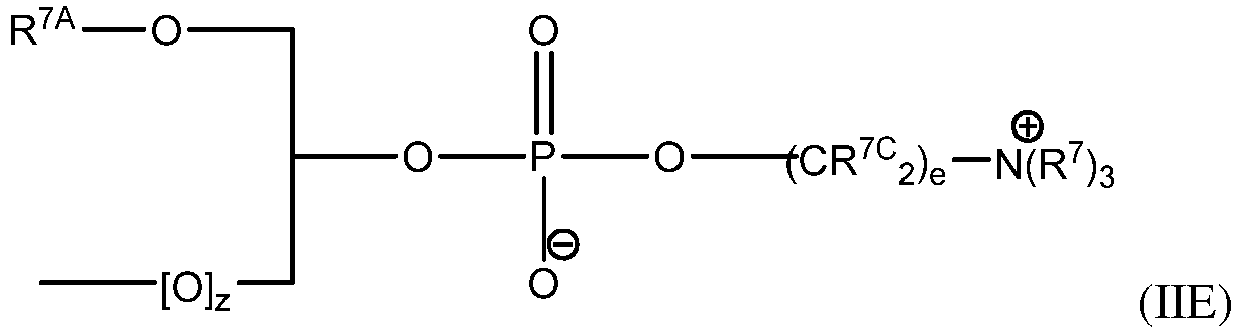
- In one embodiment, the R7 groups are the same. In particular, the R7 groups may be C1-4 alkyl, in one embodiment, methyl. In one embodiment, at least one R7 group is C1-4 alkyl.
- In one embodiment, both R7C groups are the same. In particular, the R7C groups may be hydrogen.
- In one embodiment, e is 1 or 2. In a further embodiment, e is 2.
- Further embodiments of zwitterionic groups are those of formula (IIF), (IIG) and (IIH). These groups contain an alkyl or fluoroalkyl group capable of binding to a surface by physisorption.
- In one embodiment of Group (IIC), the zwitterionic group has the formula (IIF):

f is an integer from 1 to 4, wherein if Z is directly bonded to an O or N atom, z is 0 and otherwise z is 1; - In one embodiment, the R8A groups are the same. In particular, the R8A groups may be C1-4 alkyl, in one embodiment, methyl. In one embodiment, at least one R8A group is C1-4 alkyl.
- In one embodiment, both R8 groups are the same. In particular, the R8 groups may be hydrogen.
- In one embodiment, each R8B group is hydrogen.
- In one embodiment, R8A is a group -C(O)B3R8B, wherein B3 is a group of formula-[(CR8D 2)aaO]bb- where the groups -(CR8D 2)- are the same or different and in each group-(CR8D 2)-, the groups R8D are the same or different and each group R8D is hydrogen, fluorine or C1-4 alkyl or fluoroalkyl and aa is from 2 to 6, preferably 3 or 4 and bb is from 1 to 12, preferably 1 to 6. In an embodiment wherein all groups R8D are hydrogen and in all the groups -[(CR8D 2)aaO]-, aa is 2, the residues of the monomer of formula (IIF) are not able to form strong secondary valence interactions with hydrophobic surfaces. While residues of such monomers may be included in the polymers of the invention, it is usually also necessary to include residues of monomers which are capable of forming strong secondary valence interactions if such interactions are to bind a polymer to a surface. Monomers which have groups wherein dd is higher than 2 can be used to provide strong secondary valence interactions. In this regard, where B3 is a group of formula -[(CR8D 2)aaO]bb-, it is advantageous that aa is 2 in about 50 or less, about 70 or less, about 90 mol% or less of the residues-[(CR8D 2)aaO]bb-.
- In one of embodiment of Group (IID), the zwiterionic group has the formula (IIG):

g is an integer from 1 to 4, wherein if Z is directly bonded to an O or N atom, z is 0 and otherwise z is 1; - In one embodiment, the R9A groups are the same. In particular, the R9A groups may be C1-4 alkyl, in one embodiment, methyl. In one embodiment, at least one R9A group is C1-4 alkyl.
- In one embodiment, both R9 groups are the same. In particular, the R9 groups may be hydrogen.
- In one embodiment, each R9B group is hydrogen.
- In one embodiment, R9A is a group -C(O)B4R9B, wherein B4 is a group of formula-[(CR9D 2)ccO]dd- where the groups -(CR9D 2)- are the same or different and in each group-(CR9D 2)-, the groups R9D are the same or different and each group R9D is hydrogen, fluorine or C1-4 alkyl or fluoroalkyl and cc is from 2 to 6, preferably 3 or 4 and dd is from 1 to 12, preferably 1 to 6. In an embodiment wherein all groups R9D are hydrogen and in all the groups -[(CR9D 2)ccO]-, cc is 2, the residues of the monomer of formula (IIG) are not able to form strong secondary valence interactions with hydrophobic surfaces. While residues of such monomers may be included in the polymers of the invention, it is usually also necessary to include residues of monomers which are capable of forming strong secondary valence interactions if such interactions are to bind a polymer to a surface. Monomers which have groups wherein cc is higher than 2 can be used to provide strong secondary valence interactions. In this regard, where B4 is a group of formula -[(CR9D 2)ccO]dd-, it is advantageous that cc is 2 in about 50 or less, about 70 or less, about 90 mol% or less of the residues-[(CR9D 2)ccO]dd-.
- In one embodiment of Group (IIE), the zwitterionic group has the formula (IIH):

- wherein each R10 and R10C is independently selected from hydrogen and C1-4 alkyl; R10A is a group -C(O)B5R10B, wherein R10B is hydrogen or methyl, B5 is selected from the group consisting of a bond; C1-10 alkylene, C2-10 alkenylene, C2-10 alkynylene, C3-10 cycloalkylene, C3-10 cycloalkenylene, C1-10 heteroalkylene, C2-10 heteroalkenylene, C2-10 heteroalkynylene, arylene, heteroarylene, wherein the alkylene, alkenylene, alkynylene, cycloalkylene, cycloalkenylene, heteroalkylene, heteroalkenylene, heteroalkynylene, arylene and heteroarylene groups may be optionally substituted with one or more RN as defined previously;
- h is an integer from 1 to 4, wherein if Z is directly bonded to an O or N atom, z is 0 and otherwise z is 1;
- In one embodiment, the R10A groups are the same. In particular, the R10A groups may be C1-4 alkyl, in one embodiment, methyl. In one embodiment, at least one R10A group is C1-4 alkyl.
- In one embodiment, both R10 groups are the same. In particular, the R10 groups may be hydrogen.
- In one embodiment, each R10B group is hydrogen.
- In one embodiment, R10A is a group -C(O)B5R10B, wherein B5 is a group of formula-[(CR10D 2)eeO]ff- where the groups -(CR10D 2)- are the same or different and in each group -(CR10D 2)-, the groups R10D are the same or different and each group R10D is hydrogen, fluorine or C1-4 alkyl or fluoroalkyl and ee is from 2 to 6, preferably 3 or 4 and ff is from 1 to 12, preferably 1 to 6. In an embodiment wherein all groups R10D are hydrogen and in all the groups -[(CR10D 2)eeO]-, ee is 2, the residues of the monomer of formula (IIH) are not able to form strong secondary valence interactions with hydrophobic surfaces. While residues of such monomers may be included in the polymers of the invention, it is usually also necessary to include residues of monomers which are capable of forming strong secondary valence interactions if such interactions are to bind a polymer to a surface. Monomers which have groups wherein ee is higher than 2 can be used to provide strong secondary valence interactions. In this regard, where B5 is a group of formula -[(CR10d 2)eeO]ff-, it is advantageous that ee is 2 in about 50 or less, about 70 or less, about 90 mol% or less of the residues-[(CR10D2)eeO]ff-.
- In one embodiment, the present invention provides a monomer of formula (I), which has the formula (IB):

- In one embodiment, the present invention provides a monomer of formula (IB), wherein X is O, and wherein A is O, n is 0 and Z is a group of formula IIB, particularly wherein A is O, n is 0 and Z is a group of formula IIB, wherein each R4 is methyl and b is 2.
- In one embodiment, the present invention provides a monomer of formula (IB), wherein X is NR2 and wherein A is O, n is 0 and Z is a group of formula IIB, particularly wherein A is O, n is 0 and Z is a group of formula IIB, wherein each R4 is methyl and b is 2.
- In one embodiment, the present invention provides a monomer of formula (IB), wherein X is O and A is NRM, wherein Z is a group of formula IIB and n is 0, particularly wherein n is 0 and Z is a group of formula IIB, wherein each R4 is methyl and b is 2.
- In one embodiment, the present invention provides a monomer of formula (IC):

- In one embodiment, the present invention provides a monomer of formula (IC), wherein X is NR2 and n is 0, particularly wherein m is 2, particularly wherein m is 2 and Y, R2 and the N atom to which they are bonded together form a 5 to 7-membered heterocyclic ring, preferably a 5-membered heterocyclic ring.
- In one embodiment, the present invention provides a monomer of formula (IC), wherein X is NR2, n is 0, m is 2 and Y, R2 and the N atom to which they are bonded together form a 5-membered heterocyclic ring, each R4 is methyl and b is 2.
- In one embodiment, the present invention provides a monomer of formula (ID):

- In one embodiment, the present invention provides a monomer of formula (IE):

- The monomers of the present invention may be prepared by conventional techniques using known reactions.
- In general, there are three routes by which the monomers may be synthesized, specifically:
- (i) reaction of a nucleophilic zwitterionic derivative with a reactive vinyl derivative;
- (ii) reaction of a nucleophilic vinyl compound with a reactive zwitterionic derivative; or
- (iii) reaction of a nucleophilic vinyl compound with a phospholane followed by ring opening with a trialkylamine.
- The term "halogen" (or "halo") is used herein to refer to fluorine, chlorine, bromine and iodine.
- The term "carbonyl" is used herein to refer to a carbon connected with a double bond to an oxygen atom, and tautomeric forms thereof. A carbonyl group may also be denoted as -C(O)-. Examples of moieties that contain a carbonyl include but are not limited to aldehydes -C(O)H, ketones -C(O)-(C1-C10 alkyl)-, carboxylic acids -CO2H and amides -C(O)NH2, -C(O)-NH(C1-C10 alkyl), -C(O)-N(C1-C10 alkyl)2, -NH-C(O)-(C1-C10 alkyl), -NH(C1-C10 alkyl)-C(O)-(C1-C10 alkyl) and esters -C(O)-O(C1-C10 alkyl).
- The terms "thiocarbonyl" and "thiocarboxy" are used herein to refer to a carbon connected via a double bond to a sulfur atom, and tautomeric forms thereof.
- The term "alkyl" is used herein to refer to monovalent straight chain or branched, saturated, acyclic hydrocarbyl groups. In one embodiment, alkyl is C1-10alkyl, in another embodiment C1-6alkyl, in another embodiment C1-4alkyl, such as methyl, ethyl, n-propyl, i-propyl or i-, n-, secondary or t-butyl groups.
- The term "cycloalkyl" is used herein to refer to monovalent, saturated, cyclic hydrocarbyl groups. In one embodiment, cycloalkyl is C3-10cycloalkyl, in another embodiment, C3-6cycloalkyl, such as cyclopentyl and cyclohexyl.
- The term "alkenyl" is used herein to refer to monovalent straight or branched, unsaturated, acyclic hydrocarbyl groups having at least one carbon-carbon double bond and, in one embodiment, no carbon-carbon triple bonds. In one embodiment alkenyl is C2-10alkenyl, in another embodiment, C2-6alkenyl, in another embodiment C2-4alkenyl.
- The term "cycloalkenyl" is used herein to refer to monovalent, unsaturated, cyclic hydrocarbyl groups. In one embodiment, cycloalkenyl is C3-10cycloalkyl, in another embodiment, C3-6cycloalkyl, such as cyclopentenyl and cyclohexenyl.
- The term "alkynyl" is used herein to refer to monovalent straight or branched, unsaturated, acyclic hydrocarbyl groups having at least one carbon-carbon triple bond. In one embodiment alkynyl is C2-10alkynyl, in another embodiment, C2-6alkynyl, in another embodiment C2-4alkynyl.
- The term "heteroalkyl" is used herein to refer to monovalent alkyl groups in which up to three carbon atoms, in one embodiment up to two carbon atoms, in another embodiment one carbon atom, are each replaced independently by O, S(O)q or N, provided at least one of the alkyl carbon atoms remains. The heteroalkyl group may be C-linked or hetero-linked, i.e. it may be linked to the remainder of the molecule through a carbon atom or through O, S(O)q or N, wherein q is independently 0, 1 or 2.
- The term "heterocyclyl" or "heterocyclic ring" is used herein to refer to monovalent, cycloalkyl groups or divalent cycloalkylene groups in which up to three carbon atoms, in one embodiment up to two carbon atoms, in another embodiment one carbon atom, are each replaced independently by O, S(O)q or N, provided at least one of the cycloalkyl carbon atoms remains.
- Examples of heterocyclyl groups include oxiranyl, thiaranyl, aziridinyl, oxetanyl, thiatanyl, azetidinyl, tetrahydrofuranyl, tetrahydrothiophenyl, pyrrolidinyl, pyrazolidinyl, imidazolidinyl, tetrahydropyranyl, tetrahydrothiopyranyl, piperidinyl, 1,4-dioxanyl, 1,4-oxathianyl, morpholinyl, 1,4-dithianyl, piperazinyl, 1,4-azathianyl, oxepanyl, thiepanyl, azepanyl, 1,4-dioxepanyl, 1,4-oxathiepanyl, 1,4-oxaazepanyl, 1,4-dithiepanyl, 1,4-thieazepanyl and 1,4-diazepanyl. Other examples include cyclic imides, cyclic anhydrides and thiazolidindiones. The heterocyclyl group may be C-linked or N-linked, i.e. it may be linked to the remainder of the molecule through a carbon atom or through a nitrogen atom.
- The term "aryl" is used herein to refer to monovalent, aromatic, cyclic hydrocarbyl groups, such as phenyl or naphthyl (e.g. 1-naphthyl or 2-naphthyl). In general, the aryl group may be a monocyclic or polycyclic fused ring aromatic group. Preferred aryl groups are C6-C14aryl.
- Other examples of aryl groups are monovalent radicals derived from aceanthrylene, acenaphthylene, acephenanthrylene, anthracene, azulene, chrysene, coronene, fluoranthene, fluorene, as-indacene, s-indacene, indene, naphthalene, ovalene, perylene, phenalene, phenanthrene, picene, pleiadene, pyrene, pyranthrene and rubicene.
- The term "heteroaryl" is used herein to refer to monovalent, heteroaromatic, cyclic hydrocarbyl groups additionally containing one or more heteroatoms independently selected from O, S, N and NRN, wherein RN is preferably H, alkyl (e.g. C1-6alkyl) or cycloalkyl (e.g. C3-6cycloalkyl).
- In general, the heteroaryl group may be a monocyclic or polycyclic (e.g. bicyclic) fused ring heteroaromatic group. In one embodiment, heteroaryl groups contain 5-13 ring members (preferably 5-10 members) and 1, 2, 3 or 4 ring heteroatoms independently selected from O, S, N and NRN. In one embodiment, a heteroaryl group may be 5, 6, 9 or 10 membered, e.g. 5-membered monocyclic, 6-membered monocyclic, 9-membered fused-ring bicyclic or 10-membered fused-ring bicyclic.
- Monocyclic heteroaromatic groups include heteroaromatic groups containing 5-6 ring members and 1, 2, 3 or 4 heteroatoms selected from O, S, N or NRN.
- In one embodiment, 5-membered monocyclic heteroaryl groups contain 1 ring member which is an -NRN- group, an -O- atom or an -S- atom and, optionally, 1-3 ring members (e.g. 1 or 2 ring members) which are =N- atoms (where the remainder of the 5 ring members are carbon atoms).
- Examples of 5-membered monocyclic heteroaryl groups are pyrrolyl, furanyl, thiophenyl, pyrazolyl, imidazolyl, isoxazolyl, oxazolyl, isothiazolyl, thiazolyl, 1,2,3 triazolyl, 1,2,4 triazolyl, 1,2,3 oxadiazolyl, 1,2,4 oxadiazolyl, 1,2,5 oxadiazolyl, 1,3,4 oxadiazolyl, 1,3,4 thiadiazolyl and tetrazolyl.
- Examples of 6-membered monocyclic heteroaryl groups are pyridinyl, pyridazinyl, pyrimidinyl, pyrazinyl, 1,3,5 triazinyl, 1,2,4 triazinyl and 1,2,3 triazinyl.
- In one embodiment, 6-membered monocyclic heteroaryl groups contain 1 or 2 ring members which are =N- atoms (where the remainder of the 6 ring members are carbon atoms).
- Bicyclic heteroaromatic groups include fused-ring heteroaromatic groups containing 9-13 ring members and 1, 2, 3, 4 or more heteroatoms selected from O, S, N or NRN.
- In one embodiment, 9-membered bicyclic heteroaryl groups contain 1 ring member which is an -NRN- group, an -O- atom or an -S- atom and, optionally, 1-3 ring members (e.g. 1 or 2 ring members) which are =N- atoms (where the remainder of the 9 ring members are carbon atoms).
- Examples of 9-membered fused-ring bicyclic heteroaryl groups are benzofuranyl, benzothiophenyl, indolyl, benzimidazolyl, indazolyl, benzotriazolyl, pyrrolo[2,3-b]pyridinyl, pyrrolo[2,3-c]pyridinyl, pyrrolo[3,2-c]pyridinyl, pyrrolo[3,2-b]pyridinyl, imidazo[4,5-b]pyridinyl, imidazo[4,5-c]pyridinyl, pyrazolo[4,3-d]pyridinyl, pyrazolo[4,3-c]pyridinyl, pyrazolo[3,4-c]pyridinyl, pyrazolo[3,4-b]pyridinyl, isoindolyl, indazolyl, purinyl, indolininyl, imidazo[1,2-a]pyridinyl, imidazo[1,5-a]pyridinyl, pyrazolo[1,2-a]pyridinyl, pyrrolo[1,2-b]pyridazinyl and imidazo[1,2-c]pyrimidinyl.
- In one embodiment, 10-membered bicyclic heteroaryl groups contain 1-3 ring members which are =N- atoms (where the remainder of the 10 ring members are carbon atoms).
- Examples of 10-membered fused-ring bicyclic heteroaryl groups are quinolinyl, isoquinolinyl, cinnolinyl, quinazolinyl, quinoxalinyl, phthalazinyl, 1,6-naphthyridinyl, 1,7-naphthyridinyl, 1,8-naphthyridinyl, 1,5-naphthyridinyl, 2,6-naphthyridinyl, 2,7-naphthyridinyl, pyrido[3,2-d]pyrimidinyl, pyrido[4,3-d]pyrimidinyl, pyrido[3,4-d]pyrimidinyl, pyrido[2,3-d]pyrimidinyl, pyrido[2,3-b]pyrazinyl, pyrido[3,4-b]pyrazinyl, pyrimido[5,4-d]pyrimidinyl, pyrazino[2,3-b]pyrazinyl and pyrimido[4,5-d]pyrimidinyl.
- In some embodiments, a heterocyclyl group may be fused to an aryl or heteroaryl group to form a bicyclic ring system containing 5 to 13 members. Examples of such groups include dihydroisoindolyl, dihydroindolyl, tetrahydroisoquinolinyl, tetrahydroquinolinyl or 2,3-dihydro-pyrrolyl-[2,3-b]pyridine.
- The terms "alkoxy" and "alkyloxy" are used herein to refer to an -O-alkyl group in which alkyl is as described above. Exemplary alkoxy groups include methoxy (-OCH3) and ethoxy (-OC2H5).
- The term "alkylene" is used herein to refer to a divalent -alkyl- group in which alkyl is as defined previously. Exemplary alkylene groups include -CH2-, -(CH2)2- and-C(CH3)HCH2-.
- The term "alkenylene" is used herein to refer to a divalent -alkenyl- group in which alkenyl is as defined previously. Exemplary alkenylene groups include -CH=CH-,-CH=CHCH2-, and -CH2CH=CH-.
- The term "alkynylene" is used herein to refer to a divalent -alkynyl- group in which-alkynyl- refers to a straight or branched chain hydrocarbon group having from 2 to 12, conveniently 2 to 6, carbon atoms and one carbon-carbon triple bond in the chain. Exemplary alkynylene groups include ethynyl and propargyl.
- The term "arylene" is used herein to refer to a divalent -aryl- group where aryl is as described above which is linked to two or more other groups. Examples of arylene groups include phenylene.
- "Phenylene" means a -phenyl- group. Exemplary groups are 1,3-phenylene and 1,4-phenylene.
- The term "heteroarylene" is used herein to refer to a -heteroaryl- group, where heteroaryl is as described above, which is linked to two or more other groups. Exemplary groups include 2,5-furyl, 2,5-thienyl, 2,4-thiazolyl, 2,5-thiazolyl and 2,6-pyridyl.
- As used herein, the term "nucleophilic" has its conventional meaning and refers to a derivative which includes a group that forms a bond with another species (an electrophile) by donating an electron pair.
- The term "vinyl compound" refers to a compound which includes a terminal -CH=CH2 group.
- Examples of nucleophilic groups include alcohols, peroxides, alkoxide anions, carboxylate anions, ammonia, amines, azides, nitrites, thiols, (RSH), thiolate anions (RS-), anions of thiolcarboxylic acids (RC(O)-S-), and anions of dithiocarbonates (RO-C(S)-S-) and dithiocarbamates (R2N-C(S)-S-).
- In the general reaction (i) described above, the reactive vinyl derivative will include an electrophilic group which reacts with the nucleophilic zwitterionic or zwitterionic precursor derivative. Hence, the reactive vinyl derivative can be described by the general formula C=C-W-X-E, wherein W and X are as defined for formula (I) and E is an electrophilic group. The skilled person will be familiar with suitable reagents which may be used as the reactive vinyl derivative. Examples of suitable reactive vinyl derivatives include vinylchloroformate and vinyl isocyanate.
- In one embodiment, the reactive vinyl derivative is an N-vinyl lactam derivative. N-vinyl lactams have properties which are useful in the preparation of contact lenses. For example, N-vinyl pyrrolidone is a compound which is commonly used in the manufacture of contact lenses. Hence, it would be advantageous to provide a biocompatible co-monomer which is reactive with this compound.
- The reactive vinyl derivative is reacted with a nucleophilic derivative of a zwitterion or zwitterionic precursor which may be depicted generally as having a structure A1-(CR1)m-Z, wherein A1 is a nucleophilic group containing a heteroatom selected from N, O and S. For example, A1 may be selected from the group consisting of alcohols, peroxides, alkoxide anions, carboxylate anions, ammonia, amines, azides, nitrites, thiols (RSH), thiolate anions (RS-), anions of thiolcarboxylic acids (RC(O)-S-), and anions of dithiocarbonates (RO-C(S)-S-) and dithiocarbamates (R2N-C(S)-S-).
- Examples of suitable nucleophilic derivatives of a zwitterion include but are not limited to hydroxyethylphosphorylcholine and aminoethylphosphorylcholine.
- Examples of suitable nucleophilic derivatives of a zwitterionic precursor include but are not limited to ethylene glycol or monoprotected derivatives thereof and aminoethanol.
- As described above, in one embodiment the zwitterionic group Z is a group of formula (IIB), in particular a phosphorylcholine group. Synthetic routes for adding a PC group to a monomer are known in the art. For example, Chabrier et al. describes a two step reaction which involves reacting a hydroxyl substituted starting material with a halophospholane and then ring opening with a trialkylamine in
FR-A-2270887 Nakaya et al in JP-A-58-154591 EP-A-0730 599 . - Monomers of formula (IB) may be synthesized using reaction (i) above, wherein the reactive vinyl derivative used has the formula (IIIA):

- Alternatively, where X in formula (IB) is N, a vinyl isocyanate, i.e. a compound of formula (IIIB) or a vinyl isothiocyanate, i.e. a compound of formula (IIIC), may be used as the reactive vinyl derivative:
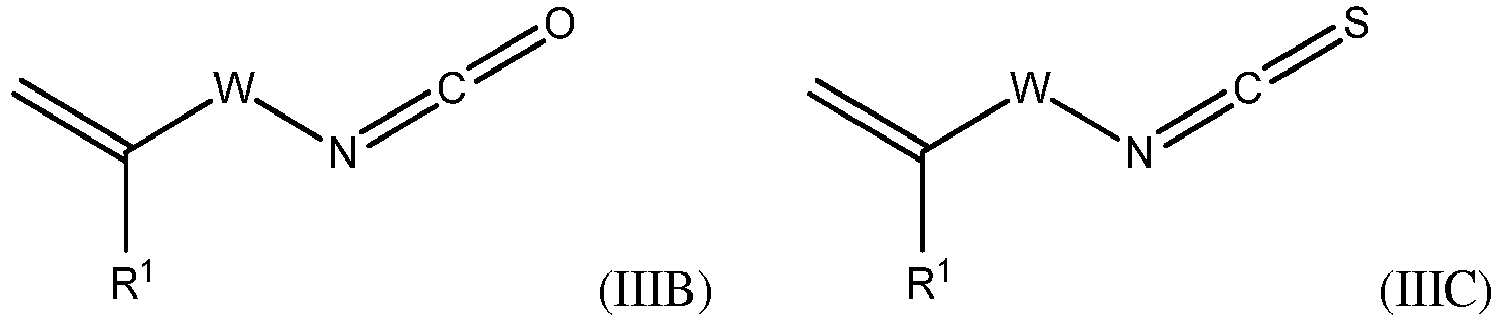
- With reference to the general reaction (ii) described above, the nucleophilic vinyl compound is one which includes both a nucleophilic group and a vinyl group. It has the general structure C=C-W-X-Y-(CR1)m-Nuc, wherein "Nuc" is a nucleophilic group. Examples of suitable nucleophilic groups include but are not limited to -OH, -NH2, NHR, SH and suitable anions, including carboxylate anions. In one embodiment, the nucleophilic vinyl compound is an N-vinyl lactam derivative, in particular a derivative of N-vinyl pyrrolidone. N-vinyl lactam derivatives may be formed by reacting an N-vinyl lactam with a base to form an anion at position 3 on the ring (adjacent to the carbonyl group) and then subsequently reacting the anion with, for example, iodooethanol, to form a 3-hydroxyethyl - substituted lactam.
- In one embodiment, the nucleophilic vinyl derivative may have the formula:

- The nucleophilic vinyl compound is reacted with a reactive zwitterionic derivative having the general formula Z-L, wherein L is a leaving group as defined above in connection with reaction scheme (i). Examples of suitable reactive zwitterionic derivatives include but are not limited to those having a leaving group selected from the group consisting of tosyl-, mesyl-, fluorosulphonate-, triflate-, imidazolecarbonyloxy-, halo, amononiumalkyl, epoxyalkyl, alkoxycarbonyl, alkylthiocarbonyl and alkylcarbonyloxycarbonylalkyl.
- In one embodiment of the present invention, the zwitterionic group in the monomers of the present invention is a group of formula (IIB), specifically a phosphorylcholine type group.
- Monomers of formula (IA), wherein Z is a group of formula (IIB) may alternatively be formed by a reaction (iii), wherein a nucleophilic vinyl compound, such as those described above in connection with reaction scheme (ii), is reacted with a phospholane followed by ring opening with a trialkylamine.
- Monomers of formula (IC), wherein b is 2, may be synthesized by reacting a nucleophilic vinyl derivative of formula (V):


- Reaction with a phospholane reagent (VIA) forms an intermediate compound of formula (VII):

- Phospholane reagents of formula (VIA) and (VIB) are commercially available and methods for synthesizing phospholane reagents are known in the art (N. Thung, M Chassignol, U. Asseline and P. Chalvier, Bull. Soc. Chim. Fr. 1981 (Part 2) 51). The skilled person will also be familiar with the fact that suitable substituted phosphorus compounds may also be used in place of a phospholane reagent. In one embodiment, in the phospholane reagent (VI), each R4A is hydrogen. In one embodiment, the phospholane reagent is ethylenechlorophosphate (ECP) (CAS 6609-64-9, 2-chloro-1,3,2-dioxaphospholane-2-oxide). It is advantageous to minimise the presence of impurities in the phospholane reagent to avoid side reactions and this can be monitored by 31P NMR.
- Trialkylamine reagents are commercially available. Examples of suitable trialkylamine reagents include trimethylamine and triethylamine. In one embodiment, the trialkylamine reagent is trimethylamine i.e. each R4 is methyl.
- In one embodiment, the first step may be carried out in a first suitable solvent in which the compound of formula (V) and the phospholane reagents (VIA) and (VIB) are soluble, and in which an acid scavenger is insoluble. For the second step, a nitrile in particular, a nitrile derivative of a C1-6 carboxylic acid, preferably acetonitrile may be advantageously used or a nitrile solvent may be used for both the first and second steps.
- The monomers of the present invention are useful in producing biocompatible polymers which can be used in biocompatible coatings and in forming bulk materials and devices.
- Therefore, in a further aspect, the present invention provides polymers derived from copolymerizing a monomer of formula (I) as defined herein with one or more comonomers comprising a siloxane group-containing monomer or macromer.
- The polymers of the present invention are biocompatible and advantageously can be used to produce articles which have both a high gas, in particular oxygen permeability and a high water content.
- The polymers of the present invention may be produced by conventional polymerization reactions, for example by thermal or photochemical polymerization. For thermal polymerisation, a temperature in the range from 40 to 100°C, typically 50 to 80°C may be used. For a photochemical polymerisation, actinic radiation such as gamma, UV, visible or microwave radiation may be use. Typically UV radiation of wavelength 200 to 400 nm is used.
- The polymerisation is generally performed in a reaction medium, which is for instance a solution or dispersion using a solvent with which the groups present in the monomers will not react under the polymerisation conditions used, for example water, alcohols, such as ethanol, methanol and glycol, and furthermore carboxylic acid amides, such as dimethylformamide, dipolar aprotic solvents, such as dimethyl sulfoxide or methyl ethyl ketone, ketones for example acetone or cyclohexanone, hydrocarbons, for example toluene, ethers, for example THF, dimethoxyethane or dioxane and halogenated hydrocarbons, for example trichloroethane and also mixtures of suitable solvents, for example mixtures of water with an alcohol, for example a water/ethanol or water/methanol mix. Any mixtures of these solvents may be used. Alternatively the polymerisation may be carried out in the absence of a solvent or where a co-monomer acts as the solvent.
- The polymerisation may be carried out in the presence of one or more polymerisation initiators, such as benzoyl peroxide, 2,2'-azo-bis(2-methylpropionitrile) or benzoin methyl ether. Other polymerisation initiators which may be used are disclosed in "Polymer Handbook", 3rd Edition, Ed. J. Brandrup and E.H. Immergut, Pub. Wiley-Interscience, New York 1989.
- Generally, the copolymerisation is performed for 0.1 to 72 hours, in one embodiment, 0.1 to 1 hours, in an alternative embodiment, 8 to 48 hours, for instance 16 to 24 hours and under an inert atmosphere of, for example, nitrogen or argon.
- The polymer is generally purified by dialysis, precipitation in a non-solvent (e.g. diethyl ether or acetone) or ultrafiltration. The resulting polymer is generally dried under vacuum e.g. for 5 to 72 hours and has a molecular weight from 10,000 to 10 million, in one instance, from 20,000 to 1 million, in an alternative instance, from 50,000 to 750,000, in an alternative instance, from 50,000 to 500,000.
- Where the aim is to provide a biocompatible coating and co-monomers capable of producing cross-linking are present in the monomer mixture, the polymerisation conditions are set such that cross-linking does not occur during polymerisation. For example, actinic radiation would not be used to prepare polymer containing a co-monomer which can form crosslinks by exposure to actinic radiation.
- The precise nature of the co-monomer system with which the monomers of the present invention are co-polymerized will depend on the intended use of the polymer which is produced.
- Advantageously, where the polymer is intended for use in forming ocular devices such as contact lenses, the monomers of the present invention are reacted with a co-monomer system which includes a siloxane group-containing monomer or macromer.
- A siloxane group-containing component is one which includes the residue having the general structure -[Si(R)2O]-, wherein R is hydrogen or a C1-10 alkylene, C2-10 alkenylene, C2-10 alkynylene, C3-10 cycloalkylene, C3-10 cycloalkenylene, C1-10 heteroalkylene, C2-10 heteroalkenylene, C2-10 heteroalkynylene, arylene, heteroarylene group. Preferably R is a C1-10 alkylene group, preferably a C1 alkylene group. Preferably, the Si and attached O are present in the siloxane group-containing monomer or macromer in an amount greater than 20 weight percent, and more preferably greater than 30 weight percent of the total molecular weight of the siloxane group-containing monomer or macromer.
- Useful siloxane group-containing monomer or macromer may comprise polymerizable functional groups such as acrylate, methacrylate, acrylamide, methacrylamide, N-vinyl lactam, N-vinylamide, and styryl functional groups. Examples of siloxane group-containing components which may be included in the co-solvent system are described in
US 3,808,178 ,US 4,120,570 ,US 4,136,250 ,US 4,153,641 ,US 4,740,533 ,US 5,034,461 ,US 5,070,215 andEP 080539 - In one embodiment of the present invention, the siloxane group-containing monomer may be a polysiloxanylalkyl(meth)acrylic monomer represented by the following formula X:

- An alternative class of siloxane group-containing components which may form a part of the co-solvent system are poly(organosiloxane) prepolymers represented by Formula XI:

- Another useful class of siloxane group-containing components includes silicone-containing vinyl carbonate or vinyl carbamate monomers of the following formula XII:


- The siloxane group-containing vinyl carbonate or vinyl carbamate monomers specifically include: 1,3-bis[4-(vinyloxycarbonyloxy)but-1-yl]tetramethyl-isiloxane 3-(vinyloxycarbonylthio) propyl-[tris(trimethylsiloxysilane]; 3-[tris(trimethylsiloxy)silyl]propyl allyl carbamate; 3-[tris(trimethylsiloxy)wilyl]propyl vinyl carbamate; trimethylsilylethyl vinyl carbonate; trimethylsilylmethyl vinyl carbonate, and

- Another class of silicone-containing components includes compounds of the following formulae:
(*D*L*D*G)aa*D*D*E1 ;
E(*D*G*D*L)aa*D*G*D*E1 or;
E(*D*L*D*G)aa*D*L*D*E1 (Formulae XIII-XV)
wherein: - D denotes an alkyl diradical, an alkyl cycloalkyl diradical, a cycloalkyl diradical, an aryl diradical or an alkylaryl diradical having 6 to 30 carbon atoms,
- G denotes an alkyl diradical, a cycloalkyl diradical, an alkyl cycloalkyl diradical, an aryl diradical or an alkylaryl diradical having 1 to 40 carbon atoms and which may contain ether, thio or amine linkages in the main chain;
- * denotes a urethane or ureido linkage;
- aa is an integer of at least 1;
- L denotes a divalent polymeric radical of formula XVI:


- A preferred silicone-containing component is represented by the following formula XVIII:


- In an alternative embodiment of the present invention, the siloxane group-containing monomer may be a material of formula (A) or (B):
(T1-Y1)k-G1(Y2-Z)1 (A)
[(T1)k-Y3(Z)u]v-G1-R24 (B)
wherein - T1 is a polymerisable group;
- Y1 and Y2 are each independently a linker group selected from the group consisting of a bond, C1-12 alkylene, C2-12 alkenylene, C2-12 alkynylene, C3-12 cycloalkylene, C3-12 cycloalkenylene, C2-12 heteroalkenylene, C2-12 heteroalkynylene, arylene, heteroarylene, -C(O)-C1-12 alkylene, -C(S)-C1-12 alkylene, -C(O)O-C1-12 alkylene, -C(O)S-C1-12 alkylene, -C(O)N(RM)-C1-12 alkylene, -C(S)-C1-12 alkylene, -C(S)O-C1-12 alkylene,-C(S)S-C1-12 alkylene, -C(S)N(RM)-C1-12 alkylene, -(CH2)qq(OCH2CH2)rr- and-(CH2CH2O)rr(CH2)qq- wherein RM is hydrogen or C1-4 alkyl, qq is an integer from 1 to 10, rr is an integer from 1 to 10, wherein one or more carbon atoms in the C1-12 alkylene group may be optionally replaced with a heteroatom selected from the group consisting of S and O and the alkylene, alkenylene, alkynylene, cycloalkylene, cycloalkenylene, heteroalkenylene, heteroalkynylene, arylene and heteroarylene groups may be optionally substituted with one or more RN, wherein each RN is independently selected from the group consisting of -H, -OH, -CN, -NO2, -CF3, -OCF3, -CO2H, -NH2, C1-C10 alkyl, C2-C10 alkenyl, C2-C10 alkynyl, -O(C1-C10 alkyl), -O(C2-C10 alkenyl), -O(C2-C10 alkynyl), halogen, -C(O)H, -C(O)-(C1-C10 alkyl), -C(O)-O(C1-C10 alkyl), -NH(C1-C10 alkyl), -N(C1-C10 alkyl)2, -C(O)-NH(C1-C10 alkyl), -C(O)-N(C1-C10 alkyl)2, -NH-C(O)-(C1-C10 alkyl), -NH(C1-C10 alkyl)-C(O)-(C1-C10 alkyl), -NH-S(O)2-(C1-C10 alkyl), -NH-(C1-C10 alkyl)-S(O)2-(C1-C10 alkyl), -(C0-C10)-SH, -S(O)-(C1-C10 alkyl), -S(O)2-(C1-C10 alkyl), -S(O)2-NH2, -S(O)2-NH-(C1-C10 alkyl), -S(O)2-N(C1-C10 alkyl)2 and =O;
- Y3 is a linker group;
- R24 is a C1-12 alkyl group which may be optionally substituted with one or more RN;
- G1 is a siloxane group-containing component;
- Z is a zwitterionic group;
- k is an integer from 1 to 10;
- l is an integer from 1 to 3;
- u is an integer from 1 to 3; and
- v is an integer from 1 to 3.
- In such embodiments of the present invention, the siloxane group-containing monomer includes a polymerisable group, siloxane functionality and a zwitterionic functionality within the same molecule. This is advantageous because any phase separation may be at a molecular level and so will not be visible to the naked eye. Furthermore, combining the functionalities on a molecular level makes it possible to provide materials which have a higher oxygen permeability than might be expected for a given water content.
- Although formula (A) and formula (B) (and the chemical formulae which follow herein) are represented without any indication of specific stereochemistry, the skilled person will understand that a number of isomers are possible. In this regard, the present invention includes within its scope, all possible stereoisomers of the chemical structures depicted.
- The polymerisable group T1 is not limited and it may be any group which is capable of reaction under polymerisation conditions to form a polymer. It is the presence of the polymerisable group in the materials of the present invention which means that it is possible to form polymers and, ultimately, contact lenses from the materials of the present invention. In certain embodiments, the polymerisable group includes at least one carbon-carbon unsaturated bond. In such embodiments, the group is capable of addition polymerisation reactions. Alternatively, or in addition, the group which is capable of reaction to form a polymer is a multi-functionalised derivative which is capable of condensation polymerisation. This includes, for example, materials such as diols, diamines, diacids and derivatives thereof.
- In one embodiment, the siloxane group-containing monomer is a material of formula (A). In an alternative embodiment, the siloxane group-containing monomer is a material of formula (B).
- In one embodiment, the polymerisable group T1 includes a group which is selected from the group consisting of acrylates, methacrylates, acrylamides, methacrylamides, styrenic and vinylic groups. Examples of suitable vinylic groups include allyl derivatives, N-vinyl lactam derivatives, such as suitably substituted N-vinyl pyrrolidone derivatives and N- and O-vinyl derivatives.
- In one embodiment, the polymerisable group T1 is a methacrylate or acrylate group. Preferably, the polymerisable group T1 is a methacrylate group.
- With reference to formula (A) and formula (B) above, k is an integer which defines the number of polymerisable groups, T1, present in the polymerisable material. k may be 1, 2, 3, 4, 5, 6, 7, 8, 9 or 10. Preferably, k is 1 or 2.
- Y1 is a linker group which forms a link between the polymerisable group T1 and the siloxane group-containing component, G1, in a polymerisable material of formula (A). Y2 is a linker group which forms a link between the siloxane group-containing component, G1 and the zwitterionic group, Z in a polymerisable material of formula (A). Y1 and Y2 are each independently selected from the group consisting of a bond, C1-12 alkylene, C2-12 alkenylene, C2-12 alkynylene, C3-12 cycloalkylene, C3-12 cycloalkenylene, C2-12 heteroalkenylene, C2-12 heteroalkynylene, arylene, heteroarylene, -C(O)-C1-12 alkylene, -C(S)-C1-12 alkylene, -C(O)O-C1-12 alkylene, -C(O)S-C1-12 alkylene,-C(O)N(RM)-C1-12 alkylene, -C(S)-C1-12 alkylene, -C(S)O-C1-12 alkylene, -C(S)S-C1-12 alkylene, -C(S)N(RM)-C1-12 alkylene, -(CH2)qq(OCH2CH2)rr- and -(CH2CH2O)rr(CH2)qq-, wherein RM is hydrogen or C1-4 alkyl, qq is an integer from 1 to 10, rr is an integer from 1 to 10, wherein one or more carbon atoms in the C1-12 alkylene group may be optionally replaced with a heteroatom selected from the group consisting of S and O and the alkylene, alkenylene, alkynylene, cycloalkylene, cycloalkenylene, heteroalkenylene, heteroalkynylene, arylene and heteroarylene groups may be optionally substituted with one or more RN, wherein each RN is independently selected from the group consisting of -H, -OH, -CN, -NO2, -CF3, -OCF3, -CO2H, -NH2, C1-C10 alkyl, C2-C10 alkenyl, C2-C10 alkynyl, -O(C1-C10 alkyl), -O(C2-C10 alkenyl), -O(C2-C10 alkynyl), halogen, -C(O)H,-C(O)-(C1-C10 alkyl), -C(O)-O(C1-C10 alkyl), -NH(C1-C10 alkyl), -N(C1-C10 alkyl)2,-C(O)-NH(C1-C10 alkyl), -C(O)-N(C1-C10 alkyl)2, -NH-C(O)-(C1-C10 alkyl), -NH(C1-C10 alkyl)-C(O)-(C1-C10 alkyl), -NH-S(O)2-(C1-C10 alkyl), -NH-(C1-C10 alkyl)-S(O)2-(C1-C10 alkyl), -(C0-C10)-SH, -S(O)-(C1-C10 alkyl), -S(O)2-(C1-C10 alkyl), -S(O)2-NH2, -S(O)2-NH-(C1-C10 alkyl), -S(O)2-N(C1-C10 alkyl)2 and =O. Y1 and Y2 may be the same or different. In one embodiment, Y1 and Y2 are the same. In an alternative embodiment, Y1 and Y2 are different.
- In one embodiment, Y1 and Y2 are each independently a C1-12 alkylene group. In an alternative embodiment, Y1 is a group of formula -(CH2)q(OCH2CH2)r- and Y2 is a group of formula -(CH2CH2O)rr(CH2)qq- wherein rr is an integer in the range from 1 to 10, preferably 4 to 6 and qq is an integer in the range from 1 to 10, in one embodiment, 2 to 4, preferably 3.
- Y3 is a linker group which forms a link between the polymerisable group, T1 and the siloxane group, G1, in polymerisable material of formula (B). In this embodiment of the present invention, the zwitterionic group, Z, is a substituent on the linker group, Y3. The nature of Y3 is not particularly limited and in a preferred embodiment, Y3 is selected from the group consisting of a bond, C1-12 alkylene, C2-12 alkenylene, C2-12 alkynylene, C3-12 cycloalkylene, C3-12 cycloalkenylene, C1-12 heteroalkylene, C2-12 heteroalkenylene, C2-12 heteroalkynylene, arylene, heteroarylene, -C(O)-, -C(S)-, -C(O)O-, -C(O)S-,-C(O)N(RM)-, -C(S)-, -C(S)O-, -C(S)S- and -C(S)N(RM)-, wherein RM is hydrogen or C1-4 alkyl. The alkylene, alkenylene, alkynylene, cycloalkylene, cycloalkenylene, heteroalkylene, heteroalkenylene, heteroalkynylene, arylene and heteroarylene groups may be optionally substituted with one or more RN, wherein each RN is independently selected from the group consisting of -H, -OH, -CN, -NO2, -CF3, -OCF3, -CO2H, -NH2, C1-C10 alkyl, C2-C10 alkenyl, C2-C10 alkynyl, -O(C1-C10 alkyl), -O(C2-C10 alkenyl), -O(C2-C10 alkynyl), halogen, -C(O)H, -C(O)-(C1-C10 alkyl), -C(O)-O(C1-C10 alkyl), -NH(C1-C10 alkyl), -N(C1-C10 alkyl)2, -C(O)-NH(C1-C10 alkyl), -C(O)-N(C1-C10 alkyl)2, -NH-C(O)-(C1-C10 alkyl), -NH(C1-C10 alkyl)-C(O)-(C1-C10 alkyl), -NH-S(O)2-(C1-C10 alkyl), -NH-(C1-C10 alkyl)-S(O)2-(C1-C10 alkyl), -(C0-C10)-SH, -S(O)-(C1-C10 alkyl), -S(O)2-(C1-C10 alkyl), -S(O)2-NH2, -S(O)2-NH-(C1-C10 alkyl), -S(O)2-N(C1-C10 alkyl)2 and =O. The position of the group Z as a substituent of the linker group Y3 is not limited. In this regard, the group Z may be a substituent on any one of the carbon atoms which form a part of the backbone of the linker group, Y3.
- In one embodiment, Y3 is a C1-12 alkylene or heteroalkylene group, in particular a heteroalkylene group of formula -(CH2)qq(OCH2CH2)rr- or -(CH2CH2O)rr(CH2)qq-, wherein qq is an integer from 1 to 10 and rr is an integer from 1 to 10. In a preferred embodiment, Y3 is -(CH2)3-O-(CH2)3-. In a preferred embodiment of the present invention, the position of substitution of the Z group on the Y3 group is such that the group -Y3(Z)- is -(CH2CH(Z)CH2)-O-(CH2)3-.
- G1 is the siloxane group-containing component of the siloxane-group containing monomer of this embodiment. As described previously, it is the inclusion of the siloxane functionality in the siloxane group-containing monomer which provides a material which has good gas permeability. The nature of the siloxane group-containing component is not particularly limited and the skilled person will be familiar with suitable components. A siloxane group is one which includes the residue having the general structure -[Si(R)2O]-, wherein each R is independently selected from hydrogen or a C1-12 alkylene, C2-12 alkenylene, C2-12 alkynylene, C3-12 cycloalkylene, C3-12 cycloalkenylene, C1-12 heteroalkylene, C2-12 heteroalkenylene, C2-12 heteroalkynylene, arylene, heteroarylene group, optionally substituted with one or more RN, wherein each RN is independently selected from the group consisting of -H, -OH, -CN, -NO2, -CF3, -OCF3,-CO2H, -NH2, C1-C10 alkyl, C2-C10 alkenyl, C2-C10 alkynyl, -O(C1-C10 alkyl), -O(C2-C10 alkenyl), -O(C2-C10 alkynyl), halogen, -C(O)H, -C(O)-(C1-C10 alkyl), -C(O)-O(C1-C10 alkyl), -NH(C1-C10 alkyl), -N(C1-C10 alkyl)2, -C(O)-NH(C1-C10 alkyl), -C(O)-N(C1-C10 alkyl)2, -NH-C(O)-(C1-C10 alkyl), -NH(C1-C10 alkyl)-C(O)-(C1-C10 alkyl), -NH-S(O)2-(C1-C10 alkyl), -NH-(C1-C10 alkyl)-S(O)2-(C1-C10 allyl), -(C0-C10)-SH, -S(O)-(C1-C10 alkyl), -S(O)2-(C1-C10 alkyl), -S(O)2-NH2, -S(O)2-NH-(C1-C10 alkyl), -S(O)2-N(C1-C10 alkyl)2 and =O. The R groups may be the same or different. In one embodiment all of the R groups are the same. In an alternative embodiment, the R groups are different. Preferably R is a C1-12 alkylene group, preferably a C1-6 alkylene group. Preferably, the Si and attached O are present in the siloxane group in an amount greater than 20 weight percent, and more preferably greater than 30 weight percent of the total molecular weight of the siloxane group-containing component.
- In one embodiment, the siloxane group-containing component has the formula (a):
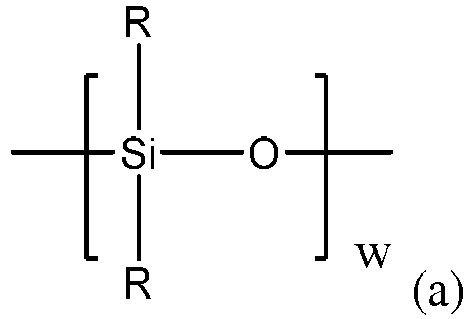
- In one embodiment, the siloxane group-containing component has the formula (b):

- In one embodiment, the siloxane group-containing component has the formula (c):

- In one embodiment, the siloxane group-containing component has the formula (d):

- Z is a zwitterionic group as defined previously. Where the siloxane group-containing monomer has formula (A), Z is bonded to Y2. Where the siloxane group-containing monomer has formula (B), Z is a substituent on the linker group Y3.
- Preferably, Z is a group of formula (IIB), in particular, a group of formula (IIB), wherein all R4 groups are methyl groups and b is 2. In this embodiment, the zwitterionic group is a phosphorylcholine (PC) group. 1 is an integer which defines the number of zwitterionic groups which are present in the siloxane group-containing monomer of formula (A). 1 may be 1, 2 or 3. Preferably, 1 is 1 or 2.
- u is an integer which defines the number of zwitterionic groups which are present in the siloxane group-containing monomer of formula (B). u may be 1, 2 or 3. Preferably, u is 1 or 2.
- v is an integer which defines the number of [(T1)k-Y3(Z)u] groups which are present in the siloxane group-containing monomer of formula (B). u may be 1, 2 or 3. Preferably, u is 1 or 2.
- In one embodiment, the siloxane group-containing monomer of the present invention has the formula (AA):

- Accordingly, in one embodiment, the siloxane group-containing monomer is a material of formula (A), wherein T1 is a methacrylate group, Y1 is (CH2CH2O)r'(CH2)3, G1 is a group of formula (c), w is an integer from 1 to 500, Y2 is (CH2)3(CH2CH2O)r", Z is a group of formula (IIB) wherein all R4 groups are methyl and b is 2, k is 1, 1 is 1 and r' and r" may be the same or different and are each independently an integer between 0 and 10, preferably 4 to 6.
- In one embodiment of the invention, the polymerisable material is a material of formula (AB):

- Accordingly, in one embodiment, the siloxane group-containing monomer is a material of formula (A), wherein T1 is a methacrylate group, Y1 is (CH2)3, w is 0 to 15, preferably 2 to 4, Y2 is (CH2)3, Z is a group of formula (IIB) wherein all R4 groups are methyl and b is 2, k is 1 and 1 is 2.
- In one embodiment of the present invention, the polymerisable monomer of the present invention has the formula (BB):

- Accordingly, in one embodiment, the siloxane group-containing monomer is a material of formula (B), wherein T1 is a methacrylate group, Y3 is -(CH2)3-O-(CH2)3-, Z is a group of formula (IIB) wherein all R4 groups are methyl and b is 2, W is a group of formula (c), R24 is methyl, u is 1 and v is 1.
- In an alternative embodiment of the present invention, the siloxane group-containing monomer has the formula (BC).

- Accordingly, in one embodiment, the siloxane group-containing monomer is a material of formula (B), wherein T1 is a methacrylate group, Y3 is -(CH2)3-O-(CH2)3-, Z is a group of formula (IIB), wherein all R4 groups are methyl and b is 2, G1 is a group of formula (a), R24 is (CH2)4CH3, u is 1 and v is 1.
- In one embodiment the siloxane group-containing monomer has the formula (BD):

- Accordingly, in one embodiment, the siloxane group-containing monomer is a material of formula (B), wherein T1 is an acrylate group, Y3 is -(CH2)-(CH(OZ))-CH2-O-(CH2)3-, Z is a group of formula (IIB), wherein all R4 groups are methyl and b is 2, G1 is a group of formula (a), R24 is methyl, u is 1 and v is 2.
- Other silicone-containing components suitable for use in this invention include those described in
WO 96/31792 US 5,321,108 ,US 5,387,662 andUS 5,539,016 all describe polysiloxanes with a polar fluorinated graft or side group having a hydrogen atom attached to a terminal difluoro-substituted carbon atom. Such polysiloxanes may also be used as the siloxane group-containing monomer in the co-solvent system. - Alternatively, the siloxane group-containing monomer may be a hydroxyl-functionalised siloxane group-containing monomer. Examples include 2-methyl-2-hydroxy-3-[3-[1,3,3,3-tetramethyl-1-[trimethylsilyl)oxy]disiloxanyl]propoxy]propyl ester (which can also be named (3-methacryloxy-2-hydroxypropyloxy)propylbis(trimethylsiloxy)methylsilane), 3-methacryloxy-2-hydroxypropyloxy)propyltris(trimethylsiloxy)silane, bis-3-methacryloxy-2-hydroxypropyloxypropyl polydimethylsiloxane, 3-methacryloxy-2-(2-hydroxyethoxy)propyloxy) propylbis(trimethylsiloxy)methylsilane, N-2-methacryloxyethyl-O-(methyl-bis-trimethylsiloxy-3-propyl)silyl carbamate and N,N,N',N'-tetrakis(3-methacryloxy-2-hydroxypropyl)-[alpha],[omega]-bis-3-aminopropyl-polydimethylsiloxane and mixtures thereof.
- In one embodiment, the siloxane group-containing monomer is selected from the group consisting of 3-[Tris(trimethylsiloxy)silyl]propyl methacrylate, methacryloxypropyl terminated polydimethylsiloxane; monomethacryloxypropyl functional polydimethylsiloxane; monomethacryloxypropyl terminated polytrifluoropropylmethyl-siloxane- symmetric, 2-hydroxy-3-[3-[1,3,3,3-tetramethyl-1-[(trimethylsilyl)oxy]disiloxanyl]propoxy]propyl methacrylate and tristrimethylsiloxysilyl propylvinyl carbamate.
- In one embodiment, the polymers of the present invention are obtainable by reacting about 1 to 100 mol% monomer of formula (I) with about 1 to about 95 mol% siloxane monomer and other diluent monomers to a total of 100%. The diluent monomers may be monomers which comprise a vinyl group, including but not limited to acrylates, methacrylates such as methacrylic acid, methylmethacrylate, hydroxyethylmethacrylate , acrylamides such as dimethylacrylamide, N-vinyl lactams, such as N-vinylpyrrolidone, and N- and O-vinyl derivatives such as hydroxyethylvinylcarbamate, hydroxyethylvinylcarbonate
- In the polymers of the present invention, a monomer of formula (I) preferably accounts for about 1 to 100%, alternatively about 1 to about 80%, alternatively about 2 to about 70%, alternatively about 3 to about 60%, alternatively about 4 to about 50%, alternatively about 5 to about 40% by weight based on the total polymer.
- In one embodiment, the co-monomer system with which the monomers of the present invention are reacted comprises a co-monomer which comprises a vinyl group. In one embodiment, the co-monomer which comprises a vinyl group is one in which the vinyl group is directly attached to a heteroatom.
- Advantageously, for a copolymerisation reaction to be effective, the reactivity rates of the two co-monomers need to be closely matched. Thus, as the monomers of the present invention include a terminal vinyl group, it is possible to generate a whole new class of polymers which include a zwitterionic functionality, because it enables vinyl systems of differing reactivity, which are useful in ophthalmic applications, to be used as co-monomers in place or together with acrylic monomers. These polymer products cannot be produced using the presently used methacrylate monomers, such as MPC, due to solubility issues and the difference in reaction rate between methacrylate and vinyl systems.
- Where the polymers of the present invention have been obtained by reaction with a comonomer system which includes a siloxane monomer, as a consequence of the presence of the terminal vinyl group, the zwitterionic group and the siloxane functionality, the polymers of the present invention are particularly useful in the manufacture of ophthalmic lenses, in particular contact lenses.
- Therefore, in a further aspect, the present invention provides a contact lens comprising a polymer as defined herein.
- The contact lenses of the present invention may be manufactured by applying an appropriate amount of a mixture of a monomer of the present invention and the co-monomer system with which it is to be reacted to a lens mold cavity and initiating polymerization. Initiators, including photoinitiators, which are commercially available may be added to the mixture to aid initiation of the polymerization. As described previously, polymerization may be initiated by a number of well known techniques depending on the exact nature of the mixture. Examples of suitable techniques include application of radiation such as microwave, e-beam or ultraviolet. Alternatively, polymerization may be initiated by heating.
- In contrast to other tissues which receive oxygen from blood flow, the cornea receives oxygen primarily from the corneal surface which is exposed to the environment. Therefore, an contact lens which is intended to be worn on the eye for extended periods of time must allow sufficient oxygen to permeate through the lens in order to sustain corneal health. It is possible to detect when the cornea has received an inadequate supply of oxygen because it will swell. Preferably, the oxygen permeability of the contact lenses of the present invention is sufficient to prevent any clinically significant swelling of the cornea from occurring. In one embodiment, the extent of corneal swelling observed is about 10% or less over at least 8 hours, about 8% or less over at least 8 hours, about 6% or less over at least 8 hours, about 4% or less over at least 8 hours, about 2% or less over at least 8 hours, about 1% or less over at least 8 hours.
- In this regard, preferably a contact lens of the present invention is suitable for extended wear. Advantageously, the contact lenses of the present invention may be worn by a user for up to 4 days or more, in one embodiment 7 days or more, in one embodiment 14 days or more, in one embodiment 30 days or more, without causing substantial corneal damage or user discomfort.
- Accordingly, in one embodiment, the contact lens of the present invention has an oxygen permeability of about 20 barriers or more, alternatively about 30 barriers or more, alternatively about 40 barriers or more, alternatively about 50 barriers or more, preferably about 60 barriers or more.
- In one embodiment, the polymer of the present invention has an equilibrium water content of 10% or more, 15% or more, 20% or more, 25% or more, 30% or more, 35% or more, 40% or more, 45% or more, 50% or more, 55 % or more, 60% or more, 65% or more, 70% or more, 75% or more, 80% or more, 85% or more, 90% or more, 95% or more. In one embodiment, the water content of the polymer is in the range from about 20 to about 60%, preferably about 30 to about 50%.
- Alternatively or in addition, the polymers of the present invention may have a tensile modulus (modulus of elasticity, E) of less than about 3 MPa. In one embodiment, the tensile modulus is in the range from 0.2 to about 2.5 MPa, in one instance about 0.3 to 1.5 MPa, preferably about 0.4 to about 1 MPa.
- Alternatively or in addition, the contact lens of the present invention may have an optical transmission of about 80% or more, about 85% or more, about 90% or more, about 95% or more, about 99% or more. In a preferred embodiment, the contact lens of the present invention are transparent and/or clear.
- Alternatively or in addition, the contact lens of the present invention may have a % of scattered visible light (haze) of <100%, in one embodiment, <80%, in one embodiment, <60%, in one embodiment <50%, measured according to the standard ASTM D 1003.
- In one embodiment, the polymers of the present invention may be used to biocompatibilise a surface. Thus, in a further aspect, the present invention provides a process for biocompatibilising a surface comprising coating the surface with a polymer of the present invention. The invention further provides a contact lens comprising a surface
having coated thereon a polymer as defined herein. The polymers of the present invention may be used to coat many different surfaces, depending on the nature of the groups which are present in the polymer and capable of binding it to the surface. - Coating of a surface with the polymer may generally be carried out by coating the surface with a solution or dispersion of the polymer, generally in an alcoholic, aqueous, organic or halogenated solvent or a mixture thereof. Examples of suitable solvents include methanol, ethanol, dichloromethane and freon. Coating may be carried out at room temperature or at an elevated temperature. Generally, coating is carried out at a temperature in the range from 5 to 60°C.
- Surfaces may be coated with the polymers of the present invention by known techniques, such as dip-coating, spray-coating, web-coating or spin coating.
- In one embodiment, the polymer is coated onto the surface in the form of a microdispersion, such as a microemulsion.
- After coating, where the polymer of the present invention includes cross-linkable groups, it may be subjected to a cross-linking reaction. The cross-linking may be carried out by known methods, for example thermally, using actinic radiation, using reactive gases, for example ammonia, by changing the pH, using difunctional additives or by using activation chemistries, for example by known methods as described in "Methods in Enzymology, volume 135, Immobilised Enzymes and Cells, part B", Ed. K. Mosbach, Academic Press Inc., New York, 1987. In cases where crosslinking is achieved thermally or by gas treatment, the treatment may be carried out on the dried coating. Alternatively, where the pH needs to be changed or additives need to be included, treatment may be performed on the coated material in a solution which does not remove the coating. In some embodiments, crosslinking may be carried out with the coating hydrated which facilitates the crosslinking reaction.
- The polymers of the present invention may be used to coat a surface of materials which can be used as a construction material for implants or prostheses for the human or animal body, particularly where these implants or prostheses have direct physical contact with blood and where biocompatibility and haemocompatibility are required. They can also be used in the construction of membranes and other devices that are to be brought into contact with blood or other body fluids on an extra-corporeal basis, for example in heart-lung machines or artificial kidneys.
- The polymers of the present invention may also be used to coat materials used in processing applications, for example separation membranes and process equipment and tubing. In particular, the polymers of the present invention may be used to modify the surface properties of biofiltration membranes in bioreactors and fermentation systems where the membranes come into direct contact with complex biological solutions containing e.g. proteins, polysaccharides, fats and whole cells. The polymers of the present invention may be useful in reducing membrane fouling by components of a process solution.
- When the polymers of the present invention are used to coat the surface of a material which is then used in the construction coat of finished devices, it may be necessary to take precautionary steps to ensure that the coated surface is not damaged and the effectiveness of the treatment reduced before the finished device is produced.
- The polymers of the present invention may be used to coat finished implants, prostheses, membranes, catheters, contact lenses, intraocular lenses, and other devices to impart biocompatibility to the article.
- The Young's modulus of the lens materials were determined using a TA-XT2 Texture Analyser, and the value was obtained by drawing a tangent to the initial linear portion of the stress-strain curve, and dividing the tensile stress by the corresponding strain. Measurements were performed on films of 500 µm thickness prepared from the formulations and cut into 10 mm x 50 mm samples.
- The Equilibrium Water Contents (EWC) of the prototype hydrogel lenses produced according to the present invention were determined by gravimetric means. The wet weight of lenses after equilibration in water at room temperature overnight was first measured. The lenses were then dried in an oven at 70°C to a constant weight, which was the dry weight. The EWC of the lenses was then calculated as follows.

- The oxygen permeability (in barriers) of prototype lenses produced according to the method of the present invention was determined by the polargraphic method generally described in ISO 9913-1:1996(E).
- The following examples describe the syntheses of monomers of formula (I). These examples are intended to illustrate the invention and are not to be construed as being limitations thereon.
- The reactions carried out in Example 1 are summarised in scheme 1 below:


- To a stirred solution of 2-iodoethanol (17.2 g; 100 mmol) and imidazole (8.17 g; 120 mmol) in dichloromethane (100 mL) was added tert-butyldimethylsilyl chloride (15.83 g; 105 mmol) at such a rate that the reaction temperature did not rise above 30 °C. Upon complete addition the solution was left stirring for 17 h, then washed with water (2x 50 mL) and brine (50 mL) and dried over MgSO4. Evaporation of the solvent afforded the target compound (28.0 g; 97.8 mmol; 98 %) as a colourless liquid.

1H-NMR (400 MHz) (CDCl3): δ = 3.83 (t, 2H, J = 7.0 Hz), 3.83 (t, 2H, J = 7.0 Hz), 3.20 (t, 2H, J = 7 Hz), 0.90 (s, 9H), 0.08 (s, 6H) ppm. - To a stirred ice-cold solution of diisopropylamine (0.46 mL; 3.3 mmol; 1.1 equiv.) in dry tetrahydrofuran (20 mL) was dropwise added a 2.5M solution of n-butyllithium (1.32 mL; 3.3 mmol; 1.1 equiv.) under an argon atmosphere. Upon complete addition the solution was left stirring for 10 min and then cooled to around -80 to -70 °C. 1-vinylpyrrolidin-2-one (0.32 mL; 3.0 mmol) was added dropwise and the solution was left stirring for 20 min. Hexamethylphosphoramide (0.57 mL; 3.3 mmol; 1.1 equiv.) was added and the solution left stirring for further 20 min. To the solution was dropwise added (2-iodoethoxy)-tert-butyldimethylsilane (859 mg; 3.0 mmol) and the solution was left stirring at around -80 to -70 °C for 17 h. The reaction mixture was warmed to ambient temperature and quenched with a saturated aqueous solution of NH4Cl (15 mL). The aqueous phase was extracted with diethyl ether (2x 15 mL), the combined organic extracts were dried over MgSO4 and concentrated under reduced pressure. Column chromatography (ethyl acetate / petroleum ether (b.p. 40-60 °C) = 1:9) afforded byproduct 3, 3-bis-[2-(tert-butyldimethylsilanyloxy)-ethyl]-1-vinylpyrrolidin-2-one ([TBSE] 2-VP) (49 mg; 0.115 mmol; 4 %) as a colourless liquid. Further elution with ethyl acetate / petroleum ether (b.p. 40-60 °C) (1:4) afforded the target compound 3-[2-(tert-butyldimethylsilanyloxy)-ethyl]-1-vinylpyrrolidin-2-one (TBSE-VP) (621 mg; 2.30 mmol; 77 %) as a colourless liquid.

1H-NMR (400 MHz) (CD3OD): δ = 7.01 (dd, 1H, -CH=CH2, J cis = 9.1 Hz, J trans = 16.0 Hz), 4.53 (d, 1H, =CH2, J trans = 16.0 Hz), 4.49 (d, 1H, =CH2, J cis = 9.1 Hz), 3.83 - 3.70 (m, 2H, -CH2O-), 3.57 (td, 1H, -CH2N-, J = 9.9 Hz, 3.0 Hz), 3.48 - 3.40 (m, 1H,-CH2N-), 2.76 - 2.65 (m, 1H, -CH-(C=O)-), 2.39 - 2.28 and 1.90 - 1.79 (2x m, 2H, -CH 2-CH2N-), 2.10 - 2.00 and 1.63 - 1.52 (2x m, 2H, -CH 2-CH2O-), 0.90 (s, 9H, -C(CH3)3), 0.07 (s, 6H, -Si(CH3)2-) ppm. - To a stirred and ice-cold solution of 3-[2-(tert-butyldimethylsilanyloxy)-ethyl]-1-vinylpyrrolidin-2-one (TBSE-VP) (269 mg; 1.0 mmol) in dry tetrahydrofuran (10 mL) was dropwise added a 1.0M solution of tetrabutylammonium fluoride (2.0 mL; 2.0 mmol; 2.0 equiv.) under an argon atmosphere. Upon completion of the addition the reaction mixture was left stirring at 0 °C for 5 min, allowed to warm to ambient temperature over 5 min and left stirring for another 40 min. The reaction mixture was partitioned between water (5 mL) and ethyl acetate (10 mL) and the aqueous phase was extracted with ethyl acetate (3x 5 mL). The combined organic extracts were dried over MgSO4 and concentrated under reduced pressure. Column chromatography (ethyl acetate) afforded the target compound (135 mg; 0.87 mmol; 87 %) as a pale yellow liquid.

1H-NMR (400 MHz) (CD3OD): δ = 7.02 (dd, 1H, -CH=CH2, J cis = 9.1 Hz, J trans = 16.0 Hz), 4.54 (d, 1H, =CH2, J trans = 16.0 Hz), 4.50 (d, 1H, =CH2, J cis = 9.1 Hz), 3.75 - 3.62 (m, 2H, -CH2O-), 3.59 (td, 1H, -CH2N-, J = 9.8 Hz, 3.0 Hz), 3.44 (dt, 1H, -CH2N-, J = 10.2 Hz, 8.2 Hz), 2.70 (qd, 1H, -CH-(C=O)-, J = 9.1 Hz, 5.0 Hz), 2.36 (dddd, 1H, -CH 2-CH2N-, J = 15.7 Hz, 8.8 Hz, 7.9 Hz, 2.9 Hz), 2.06 (dddd, 1H, -CH 2-CH2O-, J = 19.1 Hz, 7.8 Hz, 6.6 Hz, 5.0 Hz), 1.80 (ddd, 1H, -CH 2-CH2N-, J = 17.8 Hz, 12.8 Hz, 9.2 Hz), 1.56 (ddt, 1H, -CH2-CH2O-, J = 13.8 Hz, 9.2 Hz, 5.7 Hz) ppm. - To a stirred and chilled (-10 °C) solution of 2-chloro-2-oxo-1,3,2-dioxaphospholane (4.58 g; 32.1 mmol; 1.04 equiv.) in acetonitrile (3 g) was dropwise added a solution of 3-(2-hydroxyethyl)-1-vinylpyrrolidin-2-one (4.80 g; 30.9 mmol) and N,N,N',N'-tetramethylethylenediamine (1.98 g; 17.1 mmol; 0.55 equiv.) in acetonitrile (7 g). Upon completion of the addition the reaction mixture was left stirring for 15 min, filtered under an argon atmosphere and the N,N,N',N'-tetramethylethylenediaminedihydrochloride precipitate washed with dry acetonitrile (7 g) to give a filtrate comprising a solution of 2-(3-oxyethyl-1-vinylpyrrolidin-2-one)-2-oxo-1,3,2-dioxaphospholane in acetonitrile.
- To the stirred and chilled phospholane solution was added 4-methoxyphenol (4 mg; 0.029 mmol), acetonitrile (30 g) and trimethylamine (3.7 g; 62.6 mmol; 2.02 equiv.) and the reaction mixture was heated in a closed system (water condenser fitted with balloon) at 70 °C for 19 h. The reaction mixture was concentrated (ca. 10 to 20 mL of acetonitrile and excess trimethylamine removed) under vacuum and the product allowed to crystallise out of solution at 5 °C and allowed to warm to ambient temperature.
The crystalline product was filtered under argon atmosphere, successively washed with acetonitrile (6 mL) and ethyl acetate (3x 6 mL) and dried in vacuo at ambient temperature to afford 2.95 g of a white powder comprising the target compound (2.83 g; 8.83 mmol; 29 %) and residual acetonitrile (0.12 g; 2.94 mmol).
1H-NMR (400 MHz) (CD3OD): δ = 7.01 (dd, 1H, -CH=CH2, J cis = 9.1 Hz, J trans = 16.0 Hz), 4.54 (d, 1H, =CH2, J trans = 16.0 Hz), 4.49 (d, 1H, =CH2, J cis = 9.1 Hz), 4.31 - 4.23 (m, 2H, -OCH 2-CH2N+-), 4.10 - 3.93 (m, 2H, -CH-CH2-CH 2O-), 3.67 - 3.62 (m, 2H,-CH2N+-), 3.62 - 3.55 and 3.49 - 3.40 (2x m, 2H, -CH2N-), 3.23 (s, 9H, -N+(CH3)3), 2.81 - 2.72 (m, 1H, -CH-(C=O)-), 2.39 - 2.28 and 1.90 - 1.79 (2x m, 2H, -CH 2-CH2N-), 2.10 - 2.00 and 1.63 - 1.52 (2x m, 2H, -CH-CH 2-CH2O-) ppm.13C-NMR (100 MHz) (CD3OD): δ = 176.39 (-(C=O)-), 129.38 (-CH=CH2), 95.00 (=CH2), 66.69 (-CH2N+-), 63.86 and 63.80 (-CH-CH2-CH2O-), 59.56 and 59.51 (-OCH2-CH2N+-), 53.91, 53.87 and 53.81 (-N+(CH3)3), 43.47 (-CH2N-), 39.90 (-CH-(C=O)-), 32.51 and 32.42 (-CH-CH2-CH2O-), 24.82 (-CH 2-CH2N-) ppm. 31P-NMR (162 MHz) (CD3OD): δ = -0.14 ppm. HRMS (ESI) for C13H26N2O5P [M+H]+: calculated: 321.1574 - The reactions carried out in Example 2 are summarised in scheme 2 below:

- To a stirred and chilled (-10 °C) solution of 2-chloro-2-oxo-1,3,2-dioxaphospholane (5.00 g; 35.1 mmol) in acetonitrile (3 g) was dropwise added a solution of N-hydroxyethyl-O-vinylcarbamate (HEVC) (4.60 g; 35.1 mmol) and N,N,N',N'-tetramethylethylenediamine (2.24 g; 19.3 mmol; 0.55 equiv.) in acetonitrile (7.5 g). Upon completion of the addition the reaction mixture was left stirring for 1 h, filtered under an argon atmosphere and the N,N,N',N'-tetramethylethylenediamine dihydrochloride precipitate washed with dry acetonitrile (8 g) to give a filtrate comprising a solution of 2-(N-oxyethyl-O-vinylcarbamate)-2-oxo-1,3,2-dioxaphospholane in acetonitrile.
- To the stirred and chilled phospholane solution was added 4-methoxyphenol (20 mg; 0.161 mmol), acetonitrile (35 g) and trimethylamine (3.67 g; 61.4 mmol; 1.75 equiv.) and the reaction mixture was heated in a closed system (water condenser fitted with balloon) at 70 °C for 17 h. The reaction mixture was concentrated (ca. 10 mL of acetonitrile and excess trimethylamine removed) under vacuum and the product allowed to crystallise out of solution at around -25 °C.
- The crystalline product was rapidly filtered and dried in vacuo at ambient temperature to afford the target compound (1.08 g; 3.65 mmol; 10 %) as an off-white solid.

1H-NMR (400 MHz) (CD3OD): δ = 7.16 (dd, 1H, -CH=CH2, J cis = 6.3 Hz, J trans = 14.0 Hz), 4.71 (dd, 1H, =CH2, J gem = 1.4 Hz, = 14.0 Hz), 4.41 (dd, 1H, =CH2, J gem = 1.4 Hz, J cis = 6.3 Hz), 4.32 - 4.23 (m, 2H, -OCH 2-CH2N+-), 3.93 and 3.91 (2x t, 2H, -NH-CH2-CH 2O-, J = 5.5 Hz), 3.68 - 3.60 (m, 2H, -CH2N+-), 3.37 (t, 2H, -NH-CH 2-, J = 5.5 Hz), 3.22 (s, 9H, -N+(CH3)3) ppm, 31P-NMR (162 MHz) (CD3OD): δ = -0.12 ppm. - The reaction carried out in Example 3 is summarised in Scheme 3 below:

- Hydroxyethylphosphorylcholine (0.11g, 0.4mmol) as a suspension in dimethylsulphoxide (1.2g) with tris(2-(2-methoxyethoxy)ethyl)amine (0.04g, 0.1mmol) was stirred under a nitrogen atmosphere while vinylisocyanate (0.04g, 0.6 mmol) was added portion wise over 15 minutes. The mixture was stirred at room temperature for 3 days and then the solution was added to MEK (30g) under nitrogen and stirred for 30 minutes. The white solid that separated was collected by filtration, washed with MEK and dried under vacuum (0.09g, 0.3mmol, 63%).
1H-NMR (400 MHz) (d6DMSO): δ = 6.55 (1H, m), 4.52 (1H, d), 4.15 (1H, d), 4.10 (2H, m), 4.02 (2H, m), 3.78 (2H, m), 3.52 (2H, m) and 3.15 (9H, s) ppm, 13C-NMR (100 MHz) (d6DMSO): δ = 157.2, 130.9, 92.9, 65.5, 62.3, 62.3, 58.2 and 53.1 ppm, 31P-NMR (162 MHz) (d6DMSO): δ = -0.12 ppm. - Polymer systems were made using the following general procedure:
Monomer components indicated in table 1 were mixed, degassed using argon and heated to 70°C for 1 hr. to give the cross-linked polymer systems derived from the monomer feedstocks.Table 1 Formulation Components (wt%) NVP-PC HEVC-PC HEMA VP DMA SC1 SC6 EGDMA PD16 LN007/2/201 14.74 0 49.14 0 0 0 34.40 0.74 0.98 LN007/2/202 19.66 0 44.23 0 0 0 34.40 0.74 0.98 LN007/2/203 9.83 0 58.97 0 0 0 29.48 0.74 0.98 LN007/2/204 4.91 0 63.88 0 0 0 29.48 0.74 0.98 LN007/2/205 9.83 0 68.8 0 0 0 19.66 0.74 0.98 LN007/2/206 4.91 0 73.71 0 0 0 19.66 0.74 0.98 LN007/2/292 14.74 0 24.57 18.67 10.81 29.48 0 0.74 0.98 LN007/2/207 9.83 0 88.45 0 0 0 0 0.74 0.98 LN007/2/208 19.66 0 78.62 0 0 0 0 0.74 0.98 LN007/2/213 15.71 0 83.05 0 0 0 0 0.75 0.49 LN007/2/369 15.71 0 83.05 0 0 0 0 0.75 0.49 LN007/2/354 9.83 0 58.97 0 0 29.48 0 0.74 0.98 LN007/2/355 19.66 0 49.14 0 0 29.48 0 0.74 0.98 LN007/2/214 8.85 0 24.57 24.57 10.81 29.48 0 0.74 0.98 LN007/2/215 7.85 0 90.91 0 0 0 0 0.75 0.49 LN007/2/370 8.85 0 24.57 24.57 10.81 29.48 0 0.74 0.98 LN007/2/393 0 7.37 90.91 0.00 0.00 0.00 0.00 0.74 0.98 - This example describes the general procedure for preparing polymerisable materials and corresponding contact lenses (Table 2). Unless otherwise stated, all the materials were used as received.
- Each component of the polymerisable system including the monomers, cross linker (EGDMA) and initiator (PD16) was weighed and added to a glass vial. The vials were sealed with a cap and then placed on a roller mixer at room temperature until all components were fully dissolved. After dissolution, the mixture was filtered through a 0.45 micron filter and the solution was de-oxygenated by gently bubbling dry argon gas through the formulation.
- Polypropylene contact lens molds were cleaned by rinsing with 20% Decon 90 in water followed by drying in an oven at 70°C for 30 min. The female molds were filled with the formulation and the male molds were added to the female molds. The molds were then placed in an oven preheated to 70°C for 1 hour.
- After cooling, the molds were immersed in purified water overnight to de-mold the lenses.
Table 2 Description Procedure 1. Mixing • weigh components used to form the polymerisable solution into a glass vial • seal the vial with a lid • place on a roller-mixer at room temperature until fullydissolved, filter through 0.45micron membrane and de-oxygenate 2. Preparation and filling the molds • rinse the plastic molds with 20% Decon 90 in water • dry the molds in an oven at 70°C for 30 min • fill the molds with the polymerisable solution and close 3. Polymerization • preheat the oven to 70°C • place the material-containing molds in the oven for 1hr and then allow to cool for 30mins 4. Hydration and Demolding • place the lenses/molds in purified water • open the molds and leave overnight • remove the lenses from the molds - The monomers were mixed with other components as listed in table 3 below and used to form contact lenses according to the methodology set out in table 2. The abbreviations and corresponding full names of the components are listed in Table 4.
Table 3 Formulation Components (wt%) Hydrogel appearance Water content (%) NVP-PC HEV C-PC HEMA VP DMA SC1 EGDM A PD16 LN007/2/207 9.83 0 88.45 0 0 0 0.74 0.98 clear nd LN007/2/208 19.66 0 78.62 0 0 0 0.74 0.98 clear nd LN007/2/213 15.71 0 83.05 0 0 0 0.75 0.49 clear 58.3 LN007/2/354 9.83 0 58.97 0 0 29.48 0.74 0.98 clear 32.6 LN007/2/355 19.66 0 49.14 0 0 29.48 0.74 0.98 clear 42.6 LN007/2/214 8.85 0 24.57 24.57 10.81 29.48 0.74 0.98 clear 38.5 LN007/2/215 7.85 0 90.91 0 0 0 0.75 0.49 clear 47.7 LN007/2/370 8.85 0 24.57 24.57 10.81 29.48 0.74 0.98 clear 40.9 LN007/2/393 0 7.37 90.91 0 0 0 0.74 0.98 slightly hazy 37.0 Table 4 Abbreviation Full name NVP-PC 2-(3-Oxyethyl-1-vinylpyrrolidin-2-one)-2'-(trimethylammonium)-ethyl phosphate, inner salt HEVC-PC 2-(Trimethylammonium)ethyl-2-(vinyloxycarbonylamino)ethyl phosphate, inner salt HEMA 2-Hydroxyethylmethacrylate VP N-Vinylpyrrolidone DMA Dimethylacrylamide SC1 (3-Methacryloxy-2-hydroxypropoxy)propylbis(trimethylsiloxy)-methylsilane SC6 Poly(dimethylsiloxane), monomethacryloxypropyl substituted, di-hydroxypropyl terminated EGDMA Ethyleneglycoldimethacrylate PD16 Bis(tert-butylcyclohexyl) peroxydicarbonate - The equilibrium water content (EWC) of certain of the prototype lenses was determined by gravimetric means. The wet weight of the lens after equilibration in water at room temperature overnight was first measured. The lens was then dried in an oven at 70°C to a constant weight, which was the dry weight. The water content of the lenses was calculated as follows.

- The EWC of certain of the polymers of example 6 are shown in table 3.
Claims (18)
- A monomer of formula (I):
 W is (CR1 2)n;Z is a zwitterionic group selected from the group consisting of (IIA), (IIB), (IIC), (IID) and (IIE), wherein group (IIA) has the formula:
 group (IIB) has the formula:
 group (IIC) has the formula:
 group (IID) has the formula:
 group (IIE) has the formula:
 X is NR2;where R2, Y and the N atom to which they are bonded taken together form a 5 to 7 membered heterocyclic ring, wherein the heterocyclic ring may be optionally substituted with one or more RN, wherein each RN is independently selected from the group consisting of -H, -OH, -CN, -NO2, -CF3, -OCF3, -CO2H, -NH2, C1-C10 alkyl, C2-C10 alkenyl, C2-C10 alkynyl, -O(C1-C10 alkyl), -O(C2-C10 alkenyl), -O(C2-C10 alkynyl), halogen, -C(O)H, -C(O)-(C1-C10 alkyl), -C(O)-O(C1-C10 alkyl), -NH(C1-C10 alkyl), -N(C1-C10 alkyl)2, -C(O)-NH(C1-C10 alkyl), -C(O)-N(C1-C10 alkyl)2, -NH-C(O)-(C1-C10 alkyl), -NH(C1-C10 alkyl)-C(O)-(C1-C10 alkyl), -NH-S(O)2-(C1-C10 alkyl), -NH-(C1-C10 alkyl)-S(O)2-(C1-C10 alkyl), -(C0-C10)-SH, -S(O)-(C1-C10 alkyl), -S(O)2-(C1-C10 alkyl), -S(O)2-NH2, -S(O)2-NH-(C1-C10 alkyl), -S(O)2-N(C1-C10 alkyl)2 and =O;m is an integer from 0 to 6; andn is an integer from 0 to 6; orX is NR2, where R2 is H or C1-4 alkyl;Y is -C(O)O-;m is an integer from 1 to 4; andn is 0; orX is O;Y is -C(=V)A-; where V is S or O; and A is selected from NRM, O and S, where RM is hydrogen or C1-4 alkyl;m is an integer from 0 to 6; andn is 0.
 - A monomer according to claim 1, wherein X is NR2; and where R2, Y and the N atom to which they are bonded taken together form a 5 to 7 membered heterocyclic ring, wherein the heterocyclic ring may be optionally substituted with one or more RN, wherein each RN is independently selected from the group consisting of -H, -OH, -CN, -NO2, -CF3, -OCF3, -CO2H,-NH2, C1-C10 alkyl, C2-C10 alkenyl, C2-C10 alkynyl, -O(C1-C10 alkyl), -O(C2-C10 alkenyl), -O(C2-C10 alkynyl), halogen, -C(O)H, -C(O)-(C1-C10 alkyl), -C(O)-O(C1-C10 alkyl), -NH(C1-C10 alkyl), -N(C1-C10 alkyl)2, -C(O)-NH(C1-C10 alkyl), -C(O)-N(C1-C10 alkyl)2, -NH-C(O)-(C1-C10 alkyl), -NH(C1-C10 alkyl)-C(O)-(C1-C10 alkyl), -NH-S(O)2-(C1-C10 alkyl), -NH-(C1-C10 alkyl)-S(O)2-(C1-C10 alkyl), -(C0-C10)-SH, -S(O)-(C1-C10 alkyl), -S(O)2-(C1-C10 alkyl), -S(O)2-NH2,-S(O)2-NH-(C1-C10 alkyl), -S(O)2-N(C1-C10 alkyl)2 and =O; and
n is an integer from 0 to 6. - A monomer according to claim 2, wherein the heterocyclic ring is a 5-membered heterocyclic ring.
- A monomer according to claim 3, wherein the 5-membered heterocyclic ring is substituted with =O.
- A monomer according to claim 4, which has the formula (IA):

- A monomer according to claim 5, wherein n is 0.
- A monomer according to claim 1, wherein X is NR2, where R2 is H or C1-4 alkyl; Y is-C(O)O-; n is 0; and m is 1 to 4.
- A monomer according to claim 1 wherein X is O; Y is -C(=V)A-; where V is S or O; and A is selected from NRM, O and S, where RM is hydrogen or C1-4 alkyl; and n is 0.
- A monomer according to any preceding claim, wherein Z is a group (IIB).
- A monomer according to claim 9, wherein R4 is methyl and b is 2.
- A monomer according to claim 5 of formula (ID):

- A monomer according to claim 5, which has formula (IE):

- A polymer obtainable by reacting a monomer as defined in any preceding claim with a co-monomer system comprising a siloxane group-containing monomer or macromer.
- A polymer according to claim 13, wherein the the siloxane group-containing monomer is a material of formula (A) or (B):
(T1-Y1)k-G1(Y2-Z)1 (A)
[(T1)k-Y3(Z)u]v-G1-R24 (B)
whereinT1 is a polymerisable group;Y1 and Y2 are each independently a linker group selected from the group consisting of a bond, C1-12 alkylene, C2-12 alkenylene, C2-12 alkynylene, C3-12 cycloalkylene, C3-12 cycloalkenylene, C2-12 heteroalkenylene, C2-12 heteroalkynylene, arylene, heteroarylene, -C(O)-C1-12 alkylene, -C(S)-C1-12 alkylene, -C(O)O-C1-12 alkylene,-C(O)S-C1-12 alkylene, -C(O)N(RM)-C1-12 alkylene, -C(S)-C1-12 alkylene, -C(S)O-C1-12 alkylene, -C(S)S-C1-12 alkylene, -C(S)N(RM)-C1-12 alkylene, -(CH2)qq(OCH2CH2)rr-and -(CH2CH2O)rr(CH2)qq-, wherein RM is hydrogen or C1-4 alkyl, qq is an integer from 1 to 10, rr is an integer from 1 to 10, wherein one or more carbon atoms in the C1-12 alkylene group may be optionally replaced with a heteroatom selected from the group consisting of S and O and the alkylene, alkenylene, alkynylene, cycloalkylene, cycloalkenylene, heteroalkenylene, heteroalkynylene, arylene and heteroarylene groups may be optionally substituted with one or more RN, wherein each RN is independently selected from the group consisting of -H, -OH, -CN, -NO2, - CF3, -OCF3, -CO2H, -NH2, C1-C10 alkyl, C2-C10 alkenyl, C2-C10 alkynyl, -O(C1-C10 alkyl), -O(C2-C10 alkenyl), -O(C2-C10 alkynyl), halogen, -C(O)H, -C(O)-(C1-C10 alkyl), -C(O)-O(C1-C10 alkyl), -NH(C1-C10 alkyl), -N(C1-C10 alkyl)2, -C(O)-NH(C1-C10 alkyl), -C(O)-N(C1-C10 alkyl)2, -NH-C(O)-(C1-C10alkyl), -NH(C1-C10 alkyl)-C(O)-(C1-C10 alkyl), -NH-S(O)2-(C1-C10 alkyl), -NH-(C1-C10 alkyl)-S(O)2-(C1-C10 alkyl), -(C0-C10)-SH, -S(O)-(C1-C10 alkyl), -S(O)2-(C1-C10 alkyl), -S(O)2-NH2, -S(O)2-NH-(C1-C10 alkyl), -S(O)2-N(C1-C10 alkyl)2 and =O;Y3 is a linker group;R24 is a C1-12 alkyl group which may be optionally substituted with one or more RN;G1 is a siloxane group-containing component;Z is a zwitterionic group;k is an integer from 1 to 10;l is an integer from 1 to 3;u is an integer from 1 to 3; andv is an integer from 1 to 3. - A polymer according to claim 13 or 14, which has an oxygen permeability of 30 barriers or more, or which has has an equilibrium water content in the range from 30 to 50%, or which has a modulus of less than 3 MPa.
- A contact lense comprising a polymer as defined in any one of claims 13 to 15.
- A contact lense comprising a surface having coated thereon a polymer as defined in any one of claims 13 to 15.
- A method of coating an article having a surface comprising applying a polymer as defined in any one of claims 13 to 15 to the surface of the article.
Applications Claiming Priority (5)
| Application Number | Priority Date | Filing Date | Title |
|---|---|---|---|
| US201161530120P | 2011-09-01 | 2011-09-01 | |
| GB201115107A GB201115107D0 (en) | 2011-09-01 | 2011-09-01 | Biocompatible material |
| US201161558066P | 2011-11-10 | 2011-11-10 | |
| GBGB1119365.3A GB201119365D0 (en) | 2011-11-10 | 2011-11-10 | Biocompatible material |
| PCT/US2012/053372 WO2013033554A1 (en) | 2011-09-01 | 2012-08-31 | Biocompatible material |
Publications (2)
| Publication Number | Publication Date |
|---|---|
| EP2751123A1 EP2751123A1 (en) | 2014-07-09 |
| EP2751123B1 true EP2751123B1 (en) | 2017-08-02 |
Family
ID=47753623
Family Applications (1)
| Application Number | Title | Priority Date | Filing Date |
|---|---|---|---|
| EP12759326.7A Active EP2751123B1 (en) | 2011-09-01 | 2012-08-31 | Biocompatible material |
Country Status (9)
| Country | Link |
|---|---|
| US (1) | US9006305B2 (en) |
| EP (1) | EP2751123B1 (en) |
| JP (1) | JP6178315B2 (en) |
| CN (1) | CN104053662A (en) |
| BR (1) | BR112014004776A2 (en) |
| ES (1) | ES2644132T3 (en) |
| MY (1) | MY166013A (en) |
| SG (1) | SG11201400281PA (en) |
| WO (1) | WO2013033554A1 (en) |
Families Citing this family (4)
| Publication number | Priority date | Publication date | Assignee | Title |
|---|---|---|---|---|
| WO2020106348A1 (en) * | 2018-11-20 | 2020-05-28 | Dentsply Sirona Inc. | Compositions and methods to antibacterial nanogel and hydrolytically stable antibacterial nanogel for dental compositions |
| US12378333B2 (en) | 2019-04-15 | 2025-08-05 | Nof Corporation | Phosphoryl-choline-group-containing vinyl monomer |
| KR102545476B1 (en) * | 2021-12-09 | 2023-06-21 | 문샷옵티컬주식회사 | Production method of silicone hydrogel lens improved functionally using MPC |
| EP4710959A1 (en) * | 2023-05-12 | 2026-03-18 | Toray Industries, Inc. | Coated device and method for manufacturing same |
Family Cites Families (53)
| Publication number | Priority date | Publication date | Assignee | Title |
|---|---|---|---|---|
| DE1211156B (en) | 1963-06-14 | 1966-02-24 | Bayer Ag | Process for the production of unsaturated sulfonic acid betaines by reacting a tertiary amine with a sultone |
| US3808178A (en) | 1972-06-16 | 1974-04-30 | Polycon Laboratories | Oxygen-permeable contact lens composition,methods and article of manufacture |
| FR2270887A1 (en) | 1974-05-16 | 1975-12-12 | Chabrier De Lassauniere Pierre | Prepn of lecithins and glycol-lecithins - by reaction of trimethylamine with 2-substd-2-oxo-1,3,2-dioxaphospholans |
| US4120570A (en) | 1976-06-22 | 1978-10-17 | Syntex (U.S.A.) Inc. | Method for correcting visual defects, compositions and articles of manufacture useful therein |
| US4136250A (en) | 1977-07-20 | 1979-01-23 | Ciba-Geigy Corporation | Polysiloxane hydrogels |
| US4153641A (en) | 1977-07-25 | 1979-05-08 | Bausch & Lomb Incorporated | Polysiloxane composition and contact lens |
| GB2107725B (en) | 1981-10-03 | 1985-02-27 | Dow Corning | Siloxane quaternary ammonium salt preparation |
| EP0080539B1 (en) | 1981-11-27 | 1986-05-07 | Tsuetaki, George F. | Polymers primarily for contact lenses, and contact lenses made from them |
| JPS58154591A (en) | 1982-03-09 | 1983-09-14 | Tadao Nakaya | Preparation of monomer analogous to phospholipid |
| EP0090539A3 (en) | 1982-03-31 | 1985-11-21 | AMP INCORPORATED (a New Jersey corporation) | Shielded connector |
| JPS6242995A (en) * | 1986-08-30 | 1987-02-24 | Toyama Chem Co Ltd | Production of novel lysolecithin-type compound or salt thereof |
| US4740533A (en) | 1987-07-28 | 1988-04-26 | Ciba-Geigy Corporation | Wettable, flexible, oxygen permeable, substantially non-swellable contact lens containing block copolymer polysiloxane-polyoxyalkylene backbone units, and use thereof |
| US5070215A (en) | 1989-05-02 | 1991-12-03 | Bausch & Lomb Incorporated | Novel vinyl carbonate and vinyl carbamate contact lens material monomers |
| US5034461A (en) | 1989-06-07 | 1991-07-23 | Bausch & Lomb Incorporated | Novel prepolymers useful in biomedical devices |
| GB9023498D0 (en) | 1990-10-29 | 1990-12-12 | Biocompatibles Ltd | Soft contact lens material |
| US5270415A (en) | 1990-12-21 | 1993-12-14 | Allergan Inc. | Balanced charge polymer and hydrophilic contact lens manufactured therefrom |
| WO1993001221A1 (en) | 1991-07-05 | 1993-01-21 | Biocompatibles Limited | Polymeric surface coatings |
| US6743878B2 (en) | 1991-07-05 | 2004-06-01 | Biocompatibles Uk Limited | Polymeric surface coatings |
| US6090901A (en) | 1991-07-05 | 2000-07-18 | Biocompatibles Limited | Polymeric surface coatings |
| EP0537972B1 (en) | 1991-10-14 | 1996-07-10 | Nof Corporation | Treating solution for contact lenses |
| US5466853A (en) | 1992-07-23 | 1995-11-14 | Nof Corporation | Diester monomer, its polymer, water-containing soft contact lens, and processing solution for contact lens |
| US5321108A (en) | 1993-02-12 | 1994-06-14 | Bausch & Lomb Incorporated | Fluorosilicone hydrogels |
| JP3419030B2 (en) * | 1993-06-22 | 2003-06-23 | 日本油脂株式会社 | Method for producing phosphorylcholine derivative |
| JPH0772430A (en) | 1993-09-02 | 1995-03-17 | Nippon Oil & Fats Co Ltd | Contact lens |
| GB9324033D0 (en) | 1993-11-23 | 1994-01-12 | Biocompatibles Ltd | Ethylenically unsaturated compounds |
| US5760100B1 (en) | 1994-09-06 | 2000-11-14 | Ciba Vision Corp | Extended wear ophthalmic lens |
| JP3532692B2 (en) * | 1995-04-03 | 2004-05-31 | 日本油脂株式会社 | Phosphorylcholine group-containing polymer aqueous solution and production method |
| WO1996031566A1 (en) | 1995-04-03 | 1996-10-10 | Nof Corporation | Process for producing an aqueous solution of phosphorylcholine group bearing polymer and aqueous solution of phosphorylcholine group bearing polymer |
| JPH09183819A (en) * | 1995-12-28 | 1997-07-15 | Nippon Oil & Fats Co Ltd | Copolymer having phospholipid-like structure and medical material |
| JP3791045B2 (en) | 1996-04-26 | 2006-06-28 | コニカミノルタホールディングス株式会社 | Novel compound and silver halide photographic light-sensitive material using the same as photosensitive dye |
| JP4772939B2 (en) | 1998-09-29 | 2011-09-14 | 日油株式会社 | Polymerizable monomer composition and contact lens |
| DE69915114T2 (en) | 1998-12-11 | 2004-09-09 | Biocompatibles Uk Ltd., Farnham | CROSSLINKED POLYMERS AND REFRACTOR DEVICE MOLDED FROM THESE |
| JP4120852B2 (en) | 1998-12-22 | 2008-07-16 | 株式会社日本コンタクトレンズ | Resin material, lens, and manufacturing method thereof |
| US6200626B1 (en) | 1999-05-20 | 2001-03-13 | Bausch & Lomb Incorporated | Surface-treatment of silicone medical devices comprising an intermediate carbon coating and graft polymerization |
| WO2001001957A1 (en) | 1999-05-27 | 2001-01-11 | Biocompatibles Limited | Local drug delivery |
| US6649722B2 (en) | 1999-12-10 | 2003-11-18 | Novartis Ag | Contact lens |
| DE60010644T2 (en) | 2000-02-07 | 2005-05-19 | Biocompatibles Uk Ltd., Farnham | Silicon-containing compounds produced by Michael addition as monomers and Macromere |
| EP1255761B1 (en) | 2000-02-07 | 2005-08-31 | Biocompatibles UK Limited | Silicon containing compounds from michael - type addition reactions useful as monomers and macromers |
| DE60126641T2 (en) | 2000-11-16 | 2008-02-07 | Biocompatibles Uk Ltd., Farnham | POLYMERS AND POLYMERIZATION PROCESS |
| US6838452B2 (en) | 2000-11-24 | 2005-01-04 | Vascular Biogenics Ltd. | Methods employing and compositions containing defined oxidized phospholipids for prevention and treatment of atherosclerosis |
| US6891010B2 (en) | 2001-10-29 | 2005-05-10 | Bausch & Lomb Incorporated | Silicone hydrogels based on vinyl carbonate endcapped fluorinated side chain polysiloxanes |
| US7632389B2 (en) | 2003-04-09 | 2009-12-15 | Merck Patent Gmbh | Open tube suitable for separation purposes comprising covalently bonded zwitterionic betaine groups |
| JP4665629B2 (en) | 2005-06-30 | 2011-04-06 | 日油株式会社 | Monomer composition and contact lens |
| US7540609B2 (en) | 2006-06-15 | 2009-06-02 | Coopervision International Holding Company, Lp | Wettable silicone hydrogel contact lenses and related compositions and methods |
| US8231218B2 (en) | 2006-06-15 | 2012-07-31 | Coopervision International Holding Company, Lp | Wettable silicone hydrogel contact lenses and related compositions and methods |
| US8252878B2 (en) | 2006-07-14 | 2012-08-28 | Biocompatibles Uk Limited | Polymer |
| US8025918B2 (en) | 2007-11-16 | 2011-09-27 | Rhodia, Inc. | High definition printing with waterborne inks on non-porous substrates |
| WO2010055914A1 (en) | 2008-11-14 | 2010-05-20 | 国立大学法人東京大学 | Polymer material having excellent oxygen permeability and antifouling property |
| US8580904B2 (en) | 2009-03-09 | 2013-11-12 | Nof Corporation | Silicone monomer |
| JP2012530052A (en) | 2009-06-15 | 2012-11-29 | ディーエスエム アイピー アセッツ ビー.ブイ. | Medical amphiphilic silicones based on phosphorylcholine |
| JP5740234B2 (en) * | 2010-07-30 | 2015-06-24 | 富士フイルム株式会社 | Planographic printing plate precursor and novel betaine-containing polymer used therefor |
| EP2621590A4 (en) | 2010-10-01 | 2014-03-26 | Tyco Fire Products Lp | Aqueous fire-fighting foams with reduced fluorine content |
| US20140135408A1 (en) | 2011-02-01 | 2014-05-15 | Dsm Ip Assets B.V. | Silicone containing monomers with hydrophilic end groups |
-
2012
- 2012-08-31 SG SG11201400281PA patent/SG11201400281PA/en unknown
- 2012-08-31 JP JP2014528645A patent/JP6178315B2/en active Active
- 2012-08-31 BR BR112014004776A patent/BR112014004776A2/en not_active IP Right Cessation
- 2012-08-31 WO PCT/US2012/053372 patent/WO2013033554A1/en not_active Ceased
- 2012-08-31 EP EP12759326.7A patent/EP2751123B1/en active Active
- 2012-08-31 CN CN201280053569.3A patent/CN104053662A/en active Pending
- 2012-08-31 ES ES12759326.7T patent/ES2644132T3/en active Active
- 2012-08-31 MY MYPI2014000587A patent/MY166013A/en unknown
- 2012-08-31 US US13/601,123 patent/US9006305B2/en active Active
Non-Patent Citations (1)
| Title |
|---|
| None * |
Also Published As
| Publication number | Publication date |
|---|---|
| WO2013033554A1 (en) | 2013-03-07 |
| JP2014531423A (en) | 2014-11-27 |
| ES2644132T3 (en) | 2017-11-27 |
| US9006305B2 (en) | 2015-04-14 |
| CN104053662A (en) | 2014-09-17 |
| MY166013A (en) | 2018-05-21 |
| SG11201400281PA (en) | 2014-08-28 |
| EP2751123A1 (en) | 2014-07-09 |
| JP6178315B2 (en) | 2017-08-09 |
| BR112014004776A2 (en) | 2017-03-21 |
| US20130059970A1 (en) | 2013-03-07 |
Similar Documents
| Publication | Publication Date | Title |
|---|---|---|
| EP2776446B1 (en) | Polymerisable material | |
| US9039174B2 (en) | Ethylenically unsaturated polymerizable groups comprising polycarbosiloxane monomers | |
| US7994356B2 (en) | Mono ethylenically unsaturated polycarbosiloxane monomers | |
| US8980956B2 (en) | Methods for producing biocompatible materials | |
| KR101738186B1 (en) | Mono ethylenically unsaturated polymerizable group containing polycarbosiloxane monomers | |
| ES2390246T3 (en) | Process for manufacturing cationic hydrophilic siloxanyl monomers | |
| US6346594B1 (en) | Ocular lens material and process for producing same | |
| EP0124017B1 (en) | Polysiloxane composition with improved surface wetting characteristics and biomedical devices made thereof | |
| US20110009587A1 (en) | Mono ethylenically unsaturated polycarbosiloxane monomers | |
| EP2723752B1 (en) | Biocompatible, biomimetic ampholyte materials | |
| CS242886B2 (en) | Method of netting copolymer production | |
| WO2014143926A1 (en) | Ethylenically unsaturated polymerizable groups comprising polycarbosiloxane monomers | |
| EP2828337B1 (en) | Hydrophilic macromers and hydrogels comprising the same | |
| US9006305B2 (en) | Biocompatible material | |
| US7732546B2 (en) | Use of silylated sulfonate monomers to improve contact lens wettability | |
| US10160854B1 (en) | Hydrogel materials | |
| JP2002327063A (en) | Contact lens material comprising hydrophilic polysiloxane monomer and copolymer thereof, and contact lens | |
| US12378333B2 (en) | Phosphoryl-choline-group-containing vinyl monomer | |
| US20090092655A1 (en) | Novel prepolymerizable surface active monomers with both fluorine-containing groups and hydrophilic groups | |
| ES2366968T3 (en) | PROCESS FOR MANUFACTURING MONOMERS OF SILOXANIL CATIÓNIC HYDROPHILES. | |
| ES2359186T3 (en) | IMPROVED SYNTHESIS OF CATIONIC SILOXANO PREPOLYMERS. | |
| HK1025106A (en) | Ocular lens material and process for producing the same |
Legal Events
| Date | Code | Title | Description |
|---|---|---|---|
| PUAI | Public reference made under article 153(3) epc to a published international application that has entered the european phase |
Free format text: ORIGINAL CODE: 0009012 |
|
| 17P | Request for examination filed |
Effective date: 20140328 |
|
| AK | Designated contracting states |
Kind code of ref document: A1 Designated state(s): AL AT BE BG CH CY CZ DE DK EE ES FI FR GB GR HR HU IE IS IT LI LT LU LV MC MK MT NL NO PL PT RO RS SE SI SK SM TR |
|
| DAX | Request for extension of the european patent (deleted) | ||
| 17Q | First examination report despatched |
Effective date: 20150429 |
|
| GRAP | Despatch of communication of intention to grant a patent |
Free format text: ORIGINAL CODE: EPIDOSNIGR1 |
|
| RIC1 | Information provided on ipc code assigned before grant |
Ipc: G02B 1/04 20060101ALI20170103BHEP Ipc: C07F 9/572 20060101ALI20170103BHEP Ipc: C08F 30/02 20060101ALI20170103BHEP Ipc: C07F 9/10 20060101AFI20170103BHEP Ipc: C07F 9/09 20060101ALI20170103BHEP Ipc: C08F 230/08 20060101ALI20170103BHEP |
|
| INTG | Intention to grant announced |
Effective date: 20170125 |
|
| RAP1 | Party data changed (applicant data changed or rights of an application transferred) |
Owner name: VERTELLUS HOLDINGS LLC |
|
| GRAS | Grant fee paid |
Free format text: ORIGINAL CODE: EPIDOSNIGR3 |
|
| GRAJ | Information related to disapproval of communication of intention to grant by the applicant or resumption of examination proceedings by the epo deleted |
Free format text: ORIGINAL CODE: EPIDOSDIGR1 |
|
| GRAL | Information related to payment of fee for publishing/printing deleted |
Free format text: ORIGINAL CODE: EPIDOSDIGR3 |
|
| GRAR | Information related to intention to grant a patent recorded |
Free format text: ORIGINAL CODE: EPIDOSNIGR71 |
|
| GRAA | (expected) grant |
Free format text: ORIGINAL CODE: 0009210 |
|
| INTC | Intention to grant announced (deleted) | ||
| AK | Designated contracting states |
Kind code of ref document: B1 Designated state(s): AL AT BE BG CH CY CZ DE DK EE ES FI FR GB GR HR HU IE IS IT LI LT LU LV MC MK MT NL NO PL PT RO RS SE SI SK SM TR |
|
| INTG | Intention to grant announced |
Effective date: 20170628 |
|
| REG | Reference to a national code |
Ref country code: CH Ref legal event code: EP Ref country code: AT Ref legal event code: REF Ref document number: 914337 Country of ref document: AT Kind code of ref document: T Effective date: 20170815 |
|
| REG | Reference to a national code |
Ref country code: IE Ref legal event code: FG4D |
|
| REG | Reference to a national code |
Ref country code: DE Ref legal event code: R096 Ref document number: 602012035339 Country of ref document: DE |
|
| REG | Reference to a national code |
Ref country code: ES Ref legal event code: FG2A Ref document number: 2644132 Country of ref document: ES Kind code of ref document: T3 Effective date: 20171127 |
|
| REG | Reference to a national code |
Ref country code: NL Ref legal event code: MP Effective date: 20170802 |
|
| REG | Reference to a national code |
Ref country code: AT Ref legal event code: MK05 Ref document number: 914337 Country of ref document: AT Kind code of ref document: T Effective date: 20170802 |
|
| REG | Reference to a national code |
Ref country code: LT Ref legal event code: MG4D |
|
| PG25 | Lapsed in a contracting state [announced via postgrant information from national office to epo] |
Ref country code: FI Free format text: LAPSE BECAUSE OF FAILURE TO SUBMIT A TRANSLATION OF THE DESCRIPTION OR TO PAY THE FEE WITHIN THE PRESCRIBED TIME-LIMIT Effective date: 20170802 Ref country code: NO Free format text: LAPSE BECAUSE OF FAILURE TO SUBMIT A TRANSLATION OF THE DESCRIPTION OR TO PAY THE FEE WITHIN THE PRESCRIBED TIME-LIMIT Effective date: 20171102 Ref country code: HR Free format text: LAPSE BECAUSE OF FAILURE TO SUBMIT A TRANSLATION OF THE DESCRIPTION OR TO PAY THE FEE WITHIN THE PRESCRIBED TIME-LIMIT Effective date: 20170802 Ref country code: AT Free format text: LAPSE BECAUSE OF FAILURE TO SUBMIT A TRANSLATION OF THE DESCRIPTION OR TO PAY THE FEE WITHIN THE PRESCRIBED TIME-LIMIT Effective date: 20170802 Ref country code: NL Free format text: LAPSE BECAUSE OF FAILURE TO SUBMIT A TRANSLATION OF THE DESCRIPTION OR TO PAY THE FEE WITHIN THE PRESCRIBED TIME-LIMIT Effective date: 20170802 Ref country code: LT Free format text: LAPSE BECAUSE OF FAILURE TO SUBMIT A TRANSLATION OF THE DESCRIPTION OR TO PAY THE FEE WITHIN THE PRESCRIBED TIME-LIMIT Effective date: 20170802 Ref country code: SE Free format text: LAPSE BECAUSE OF FAILURE TO SUBMIT A TRANSLATION OF THE DESCRIPTION OR TO PAY THE FEE WITHIN THE PRESCRIBED TIME-LIMIT Effective date: 20170802 |
|
| PG25 | Lapsed in a contracting state [announced via postgrant information from national office to epo] |
Ref country code: GR Free format text: LAPSE BECAUSE OF FAILURE TO SUBMIT A TRANSLATION OF THE DESCRIPTION OR TO PAY THE FEE WITHIN THE PRESCRIBED TIME-LIMIT Effective date: 20171103 Ref country code: LV Free format text: LAPSE BECAUSE OF FAILURE TO SUBMIT A TRANSLATION OF THE DESCRIPTION OR TO PAY THE FEE WITHIN THE PRESCRIBED TIME-LIMIT Effective date: 20170802 Ref country code: IS Free format text: LAPSE BECAUSE OF FAILURE TO SUBMIT A TRANSLATION OF THE DESCRIPTION OR TO PAY THE FEE WITHIN THE PRESCRIBED TIME-LIMIT Effective date: 20171202 Ref country code: RS Free format text: LAPSE BECAUSE OF FAILURE TO SUBMIT A TRANSLATION OF THE DESCRIPTION OR TO PAY THE FEE WITHIN THE PRESCRIBED TIME-LIMIT Effective date: 20170802 Ref country code: BG Free format text: LAPSE BECAUSE OF FAILURE TO SUBMIT A TRANSLATION OF THE DESCRIPTION OR TO PAY THE FEE WITHIN THE PRESCRIBED TIME-LIMIT Effective date: 20171102 Ref country code: PL Free format text: LAPSE BECAUSE OF FAILURE TO SUBMIT A TRANSLATION OF THE DESCRIPTION OR TO PAY THE FEE WITHIN THE PRESCRIBED TIME-LIMIT Effective date: 20170802 |
|
| REG | Reference to a national code |
Ref country code: CH Ref legal event code: PL |
|
| PG25 | Lapsed in a contracting state [announced via postgrant information from national office to epo] |
Ref country code: CZ Free format text: LAPSE BECAUSE OF FAILURE TO SUBMIT A TRANSLATION OF THE DESCRIPTION OR TO PAY THE FEE WITHIN THE PRESCRIBED TIME-LIMIT Effective date: 20170802 Ref country code: CH Free format text: LAPSE BECAUSE OF NON-PAYMENT OF DUE FEES Effective date: 20170831 Ref country code: DK Free format text: LAPSE BECAUSE OF FAILURE TO SUBMIT A TRANSLATION OF THE DESCRIPTION OR TO PAY THE FEE WITHIN THE PRESCRIBED TIME-LIMIT Effective date: 20170802 Ref country code: RO Free format text: LAPSE BECAUSE OF FAILURE TO SUBMIT A TRANSLATION OF THE DESCRIPTION OR TO PAY THE FEE WITHIN THE PRESCRIBED TIME-LIMIT Effective date: 20170802 Ref country code: LI Free format text: LAPSE BECAUSE OF NON-PAYMENT OF DUE FEES Effective date: 20170831 |
|
| REG | Reference to a national code |
Ref country code: DE Ref legal event code: R097 Ref document number: 602012035339 Country of ref document: DE |
|
| PG25 | Lapsed in a contracting state [announced via postgrant information from national office to epo] |
Ref country code: EE Free format text: LAPSE BECAUSE OF FAILURE TO SUBMIT A TRANSLATION OF THE DESCRIPTION OR TO PAY THE FEE WITHIN THE PRESCRIBED TIME-LIMIT Effective date: 20170802 Ref country code: SK Free format text: LAPSE BECAUSE OF FAILURE TO SUBMIT A TRANSLATION OF THE DESCRIPTION OR TO PAY THE FEE WITHIN THE PRESCRIBED TIME-LIMIT Effective date: 20170802 Ref country code: MC Free format text: LAPSE BECAUSE OF FAILURE TO SUBMIT A TRANSLATION OF THE DESCRIPTION OR TO PAY THE FEE WITHIN THE PRESCRIBED TIME-LIMIT Effective date: 20170802 Ref country code: IT Free format text: LAPSE BECAUSE OF FAILURE TO SUBMIT A TRANSLATION OF THE DESCRIPTION OR TO PAY THE FEE WITHIN THE PRESCRIBED TIME-LIMIT Effective date: 20170802 Ref country code: SM Free format text: LAPSE BECAUSE OF FAILURE TO SUBMIT A TRANSLATION OF THE DESCRIPTION OR TO PAY THE FEE WITHIN THE PRESCRIBED TIME-LIMIT Effective date: 20170802 |
|
| PLBE | No opposition filed within time limit |
Free format text: ORIGINAL CODE: 0009261 |
|
| STAA | Information on the status of an ep patent application or granted ep patent |
Free format text: STATUS: NO OPPOSITION FILED WITHIN TIME LIMIT |
|
| PG25 | Lapsed in a contracting state [announced via postgrant information from national office to epo] |
Ref country code: LU Free format text: LAPSE BECAUSE OF NON-PAYMENT OF DUE FEES Effective date: 20170831 |
|
| REG | Reference to a national code |
Ref country code: FR Ref legal event code: ST Effective date: 20180607 |
|
| 26N | No opposition filed |
Effective date: 20180503 |
|
| PG25 | Lapsed in a contracting state [announced via postgrant information from national office to epo] |
Ref country code: SI Free format text: LAPSE BECAUSE OF FAILURE TO SUBMIT A TRANSLATION OF THE DESCRIPTION OR TO PAY THE FEE WITHIN THE PRESCRIBED TIME-LIMIT Effective date: 20170802 Ref country code: FR Free format text: LAPSE BECAUSE OF NON-PAYMENT OF DUE FEES Effective date: 20171002 |
|
| PG25 | Lapsed in a contracting state [announced via postgrant information from national office to epo] |
Ref country code: MT Free format text: LAPSE BECAUSE OF NON-PAYMENT OF DUE FEES Effective date: 20170831 |
|
| PG25 | Lapsed in a contracting state [announced via postgrant information from national office to epo] |
Ref country code: HU Free format text: LAPSE BECAUSE OF FAILURE TO SUBMIT A TRANSLATION OF THE DESCRIPTION OR TO PAY THE FEE WITHIN THE PRESCRIBED TIME-LIMIT; INVALID AB INITIO Effective date: 20120831 |
|
| PG25 | Lapsed in a contracting state [announced via postgrant information from national office to epo] |
Ref country code: CY Free format text: LAPSE BECAUSE OF NON-PAYMENT OF DUE FEES Effective date: 20170802 |
|
| PG25 | Lapsed in a contracting state [announced via postgrant information from national office to epo] |
Ref country code: MK Free format text: LAPSE BECAUSE OF FAILURE TO SUBMIT A TRANSLATION OF THE DESCRIPTION OR TO PAY THE FEE WITHIN THE PRESCRIBED TIME-LIMIT Effective date: 20170802 |
|
| PG25 | Lapsed in a contracting state [announced via postgrant information from national office to epo] |
Ref country code: TR Free format text: LAPSE BECAUSE OF FAILURE TO SUBMIT A TRANSLATION OF THE DESCRIPTION OR TO PAY THE FEE WITHIN THE PRESCRIBED TIME-LIMIT Effective date: 20170802 |
|
| PG25 | Lapsed in a contracting state [announced via postgrant information from national office to epo] |
Ref country code: PT Free format text: LAPSE BECAUSE OF FAILURE TO SUBMIT A TRANSLATION OF THE DESCRIPTION OR TO PAY THE FEE WITHIN THE PRESCRIBED TIME-LIMIT Effective date: 20170802 |
|
| PG25 | Lapsed in a contracting state [announced via postgrant information from national office to epo] |
Ref country code: AL Free format text: LAPSE BECAUSE OF FAILURE TO SUBMIT A TRANSLATION OF THE DESCRIPTION OR TO PAY THE FEE WITHIN THE PRESCRIBED TIME-LIMIT Effective date: 20170802 |
|
| P01 | Opt-out of the competence of the unified patent court (upc) registered |
Effective date: 20230523 |
|
| PGFP | Annual fee paid to national office [announced via postgrant information from national office to epo] |
Ref country code: ES Payment date: 20250901 Year of fee payment: 14 |
|
| PGFP | Annual fee paid to national office [announced via postgrant information from national office to epo] |
Ref country code: DE Payment date: 20250827 Year of fee payment: 14 |
|
| PGFP | Annual fee paid to national office [announced via postgrant information from national office to epo] |
Ref country code: BE Payment date: 20250827 Year of fee payment: 14 Ref country code: GB Payment date: 20250827 Year of fee payment: 14 |
|
| PGFP | Annual fee paid to national office [announced via postgrant information from national office to epo] |
Ref country code: IE Payment date: 20250827 Year of fee payment: 14 |