EP2730178B1 - Zubereitungen zur oralen Aufnahme - Google Patents
Zubereitungen zur oralen Aufnahme Download PDFInfo
- Publication number
- EP2730178B1 EP2730178B1 EP12192171.2A EP12192171A EP2730178B1 EP 2730178 B1 EP2730178 B1 EP 2730178B1 EP 12192171 A EP12192171 A EP 12192171A EP 2730178 B1 EP2730178 B1 EP 2730178B1
- Authority
- EP
- European Patent Office
- Prior art keywords
- acid
- weight
- preparations
- substances
- ethyl
- Prior art date
- Legal status (The legal status is an assumption and is not a legal conclusion. Google has not performed a legal analysis and makes no representation as to the accuracy of the status listed.)
- Active
Links
Classifications
-
- A—HUMAN NECESSITIES
- A23—FOODS OR FOODSTUFFS; TREATMENT THEREOF, NOT COVERED BY OTHER CLASSES
- A23L—FOODS, FOODSTUFFS OR NON-ALCOHOLIC BEVERAGES, NOT OTHERWISE PROVIDED FOR; PREPARATION OR TREATMENT THEREOF
- A23L13/00—Meat products; Meat meal; Preparation or treatment thereof
- A23L13/40—Meat products; Meat meal; Preparation or treatment thereof containing additives
-
- A—HUMAN NECESSITIES
- A23—FOODS OR FOODSTUFFS; TREATMENT THEREOF, NOT COVERED BY OTHER CLASSES
- A23F—COFFEE; TEA; THEIR SUBSTITUTES; MANUFACTURE, PREPARATION, OR INFUSION THEREOF
- A23F3/00—Tea; Tea substitutes; Preparations thereof
- A23F3/16—Tea extraction; Tea extracts; Treating tea extract; Making instant tea
- A23F3/163—Liquid or semi-liquid tea extract preparations, e.g. gels or liquid extracts in solid capsules
-
- A—HUMAN NECESSITIES
- A23—FOODS OR FOODSTUFFS; TREATMENT THEREOF, NOT COVERED BY OTHER CLASSES
- A23L—FOODS, FOODSTUFFS OR NON-ALCOHOLIC BEVERAGES, NOT OTHERWISE PROVIDED FOR; PREPARATION OR TREATMENT THEREOF
- A23L15/00—Egg products; Preparation or treatment thereof
- A23L15/30—Addition of substances other than those covered by A23L15/20 – A23L15/25
-
- A—HUMAN NECESSITIES
- A23—FOODS OR FOODSTUFFS; TREATMENT THEREOF, NOT COVERED BY OTHER CLASSES
- A23L—FOODS, FOODSTUFFS OR NON-ALCOHOLIC BEVERAGES, NOT OTHERWISE PROVIDED FOR; PREPARATION OR TREATMENT THEREOF
- A23L2/00—Non-alcoholic beverages; Dry compositions or concentrates therefor; Preparation or treatment thereof
- A23L2/52—Adding ingredients
- A23L2/56—Flavouring or bittering agents
-
- A—HUMAN NECESSITIES
- A23—FOODS OR FOODSTUFFS; TREATMENT THEREOF, NOT COVERED BY OTHER CLASSES
- A23L—FOODS, FOODSTUFFS OR NON-ALCOHOLIC BEVERAGES, NOT OTHERWISE PROVIDED FOR; PREPARATION OR TREATMENT THEREOF
- A23L27/00—Spices; Flavouring agents or condiments; Artificial sweetening agents; Table salts; Dietetic salt substitutes; Preparation or treatment thereof
- A23L27/20—Synthetic spices, flavouring agents or condiments
- A23L27/203—Alicyclic compounds
-
- A—HUMAN NECESSITIES
- A23—FOODS OR FOODSTUFFS; TREATMENT THEREOF, NOT COVERED BY OTHER CLASSES
- A23L—FOODS, FOODSTUFFS OR NON-ALCOHOLIC BEVERAGES, NOT OTHERWISE PROVIDED FOR; PREPARATION OR TREATMENT THEREOF
- A23L27/00—Spices; Flavouring agents or condiments; Artificial sweetening agents; Table salts; Dietetic salt substitutes; Preparation or treatment thereof
- A23L27/84—Flavour masking or reducing agents
-
- A—HUMAN NECESSITIES
- A23—FOODS OR FOODSTUFFS; TREATMENT THEREOF, NOT COVERED BY OTHER CLASSES
- A23L—FOODS, FOODSTUFFS OR NON-ALCOHOLIC BEVERAGES, NOT OTHERWISE PROVIDED FOR; PREPARATION OR TREATMENT THEREOF
- A23L27/00—Spices; Flavouring agents or condiments; Artificial sweetening agents; Table salts; Dietetic salt substitutes; Preparation or treatment thereof
- A23L27/86—Addition of bitterness inhibitors
-
- A—HUMAN NECESSITIES
- A61—MEDICAL OR VETERINARY SCIENCE; HYGIENE
- A61K—PREPARATIONS FOR MEDICAL, DENTAL OR TOILETRY PURPOSES
- A61K8/00—Cosmetics or similar toiletry preparations
- A61K8/18—Cosmetics or similar toiletry preparations characterised by the composition
- A61K8/30—Cosmetics or similar toiletry preparations characterised by the composition containing organic compounds
- A61K8/33—Cosmetics or similar toiletry preparations characterised by the composition containing organic compounds containing oxygen
- A61K8/37—Esters of carboxylic acids
-
- A—HUMAN NECESSITIES
- A61—MEDICAL OR VETERINARY SCIENCE; HYGIENE
- A61Q—SPECIFIC USE OF COSMETICS OR SIMILAR TOILETRY PREPARATIONS
- A61Q11/00—Preparations for care of the teeth, of the oral cavity or of dentures; Dentifrices, e.g. toothpastes; Mouth rinses
-
- C—CHEMISTRY; METALLURGY
- C12—BIOCHEMISTRY; BEER; SPIRITS; WINE; VINEGAR; MICROBIOLOGY; ENZYMOLOGY; MUTATION OR GENETIC ENGINEERING
- C12G—WINE; PREPARATION THEREOF; ALCOHOLIC BEVERAGES; PREPARATION OF ALCOHOLIC BEVERAGES NOT PROVIDED FOR IN SUBCLASSES C12C OR C12H
- C12G3/00—Preparation of other alcoholic beverages
- C12G3/04—Preparation of other alcoholic beverages by mixing, e.g. for preparation of liqueurs
- C12G3/06—Preparation of other alcoholic beverages by mixing, e.g. for preparation of liqueurs with flavouring ingredients
Definitions
- the invention is in the field of flavorings and relates to the use of special lactic acid esters for masking unpleasant taste notes.
- Food and luxury foods often contain a large number of different bitter substances, which are desirable in moderation in certain foods and contribute to their characteristic taste (e.g. caffeine in tea or coffee, quinine in so-called bitter lemon drinks, bitter substances from hops in beer ), but on the other hand can also greatly reduce the value.
- bitter substances include e.g. Flavonoid glycosides and limonoids in citrus juices, the bitter aftertaste of many high-intensity sweeteners such as aspartame, cyclamate, acesulfame K, rebaudioside A, glyccyrhizic acid or saccharin, and the unpleasant taste that hydrophobic amino acids and peptides can cause in cheese.
- Bitter taste is regularly caused by individual substances that bind to special bitter receptors on taste cells, which can be found in the so-called taste buds on the tongue, and send a signal to the brain via neurochemical cascades that causes a defense reaction and a negative taste impression (cf. . Meyerhof, Reviews of Physiology, Biochemistry and Pharmacology 2005, 154, 37-72 ).
- Astringent taste is usually caused by the precipitation of proline-rich proteins in saliva by astringents, e.g. metal salts, polyphenols such as (gallo) catechins, proanthocyanidins, other flavonoids or tannins.
- astringents e.g. metal salts, polyphenols such as (gallo) catechins, proanthocyanidins, other flavonoids or tannins.
- the homogeneous saliva which is normally used as a "lubricant” then contains denatured proteins that reduce the lubricity and thus leave a rough or dry feeling in the mouth that is also perceived as astringent (cf. At the. J. Clin. Nutr. 2005, 81, 330S-335S ).
- Subsequent treatment is often necessary, in particular to lower the natural content of astringents, for example by rejecting a pre-infusion for green tea to remove catechins, or enzymatically, e.g. treatment of tea with decomposing enzymes to destroy the astringent polyphenols, as in WO 2003 022065 A1 (Unicafe) or JP 2007 135481 A1 (Kikkoman), or the use of special peptidases in the ripening of cheese.
- fat emulsions are used as antidotes for astringents, but their use is not indicated in many cases, e.g. in fat-free drinks or health-conscious low-fat products.
- JP 2000 287630 A1 (Shiga) and WO 2006 013930 A1 (Suntory) describes a method to reduce the astringent taste of polyphenols in tea beverages using sugar and certain amino acids.
- the amino acids are used in the range from 0.04 to 0.1%.
- JP 2001 046037 A1 the mitigation of the astringent taste of polyphenols is achieved with starch and proteins.
- this process has the disadvantage that proteins and starches in particular have a great influence on the rheological properties of the products.
- JP 2003 128664 A1 (Nagaoka) the reduction of astringency is achieved through salt formation of the polyphenols. Unfortunately, in many cases this reduces the stability of these compounds and increases their susceptibility to oxidation.
- JP 2004 315 441 A1 (Taisho) describes that the astringent taste of iron salts can be reduced with special amino acids such as ⁇ -aminobutyric acid.
- special amino acids such as ⁇ -aminobutyric acid.
- the necessary use of extremely high concentrations (1% and more) gives the product or preparation a sour taste.
- Gallate catechins such as those found in green tea, were also masked using this method (see N. Hayashi et al. in: Biosci. Biotechnol. Biochem. 2005, 69 (7), 1306-1310 ).
- EP 2058297 A1 describes the use of unsaturated alkamides such as pellitorin or mixtures of such unsaturated aliphatic alkamides such as spilanthol and pellitorin to reduce the astringent properties of orally consumable preparations; but through the necessary effective concentration there is also the trigeminal effect, in particular the trigeminal effect described as tingling or "tingling", is still clearly pronounced and can interfere with its use as astringency mask.
- sweeteners are also used to reduce astringency, for example in JP 2007 135481 A1 (Kikkoman). But basically you only get sweet applications.
- US 2012/0196018 A1 discloses an orally acceptable product comprising an ingredient or ingredients which, in connection with their use, have an unacceptable aftertaste and a cooling compound used as a taste masking agent in an amount of 0.5 ppm or less.
- the complex task on which the present invention is based therefore consisted in finding substances which, in very small amounts, are also suitable in very small amounts for masking or reducing the unpleasant taste impression of substances that taste unpleasant and in particular an astringency-masking effect against a large number of astringents show, are widely applicable, easily accessible and ideally occur naturally.
- the invention relates to the use of 1-menthyl lactic acid esters of the formula (I) for masking or reducing unpleasant taste impressions in preparations for oral intake the concentration of the 1-menthyl lactate of the formula (I) in the preparations for oral intake being below the concentration at which the compounds of the formula (I) cause a perceptible physiological cooling effect, with the unpleasant taste impressions being astringent, dry, dusty, floury and / or chalky, and with the preparations for oral intake comprising substances selected from the group formed by (b1) catechins , (b2) proanthocyanidins, (b3) caffeine, (b4) theobromine, (b5) naringin and (b6) sweeteners.
- L-lactic acid-L-menthyl ester of the formula (1-LL) and D-lactic acid-L-menthyl ester of the formula (1-DL) are particularly preferred as individual compounds in any mixture, particularly preferably in a mixture with more than 50 wt .-%, particularly preferably more than 75% by weight, very particularly preferably more than 95% by weight of L-lactic acid-L-menthyl ester of the formula (1-LL) based on the total mass of lactic acid-menthyl esters of the formula (1).
- mixtures of the eluenthyl lactate of the formulas (1-LL) and (1-DL) defined above are preferred, which are naturally occurring or isolated by physical separation processes or which are naturally produced via enzymatic, fermentative or conventional food preparation processes; these mixtures can be obtained from essential oils of the Mentha family, if necessary after fermentation with lactic acid bacteria or by natural esterification of natural lactic acid with natural L-menthol.
- the aforementioned unpleasant-tasting substances which form component (b) can have other, not unpleasant taste and / or smell qualities.
- the impressions spicy, umami, sweet, salty, sour, hot, cooling, warming, burning or tingling are preferred as not unpleasant taste qualities.
- Substances that taste bitter, astringent, sticky, chalky, dusty, dry, floury, rancid and / or metallic include: xanthine alkaloids, xanthines (caffeine, theobromine, theophylline), alkaloids (quinine, brucine, strychnine, nicotine), phenolic Glycosides (e.g. salicin, arbutin), flavanoid glycosides (e.g.
- chalcones or chalcone glycosides dihydrochalcone glycosides (phloridannins, carbohydrates), carbohydrates, carbohydrates, trilobatins which cannot be hydrolysed (e.g. Tannins (possibly galloylated catechins or epicatechins and their oligomers, e.g. proanthyocyanidins or procyanidins, thearubigenin), flavones and their glycosides (e.g.
- quercetin quercitrin, rutin, taxifolin, myricetin, myrictrin
- other polyphenols ⁇ -oryzanol, caffeic acid or their esters
- terpenoid bitter substances e.g. limonoids such as limonin or nomilin from citrus fruits, lupolone and humolone from hops
- limonoids such as limonin or nomilin from citrus fruits, lupolone and humolone from hops
- iridoids iridoids, secoiridoids
- absinthin from wormwood amarogentin from gentian
- metallic salts potassium chloride, sodium sulfate, magnesium salts, iron salts, aluminum salts, zinc salts
- active pharmaceutical ingredients e.g.
- vitamin H for example, vitamins from the B series such as vitamins B1, B2, B6, B12, niacin, pantothenic acid
- denatonium benzoate or other denatonium salts for example, sucralose octaacetate, urea, unsaturated fatty acids, especially unsaturated ones Fatty acids in emulsions, amino acids (e.g.
- leucine leucine, isoleucine, valine, tryptophan, proline, histidine, tyrosine, lysine or phenylalanine
- peptides especially peptides with an amino acid from the group leucine, isoleucine, valine, tryptophan, proline or phenylalanine at the N- or C-terminus.
- the aforementioned substances can either be used individually or occur as a mixture, preferably also as natural extracts from fresh, dried, roasted and / or fermented plants or parts of plants, for example as extracts from leaves, fruits, branches, roots, fruit peels, kernels, seeds, for example from Camellia sinensis, Camellia japonica , Coffea ssp., Cocoa theobroma, Vitis vinifera, Citrus ssp. and hybrids, Poncirus ssp. and hybrids, perilla, Humulus lupulus, or related species.
- Bitter substances to be masked according to the invention are, in particular, xanthines (in particular caffeine, theobromine, theophylline), phenolic glycosides (in particular salicin, arbutin), flavanoid glycosides (in particular neohesperedin, eriocitrin, neoeriocitrin, narirutin, hesperidin, in particular phalidoglycosin, chalcidylcin, chalcone glycosides, dihydrochalcine) , Trilobatin), hydrolyzable tannins (in particular gallic or ellagic acid esters of carbohydrates, e.g.
- xanthines in particular caffeine, theobromine, theophylline
- phenolic glycosides in particular salicin, arbutin
- flavanoid glycosides in particular neohesperedin, eriocitrin, neoeriocitrin,
- pentagalloylglucose non-hydrolyzable tannins (in particular galloylated catechins or epicatechins and their oligomers, e.g. proanthyocyanidins or procyanidins, thearubigenin), flavones and their glycosides in particular ( , Taxifolin, myricetin, myrictrin), caffeic acid or its esters, terpenoid bitter substances (especially limonin, nomilin, lupolone and humolone), metallic salts (potassium chloride, sodium sulfate, magnesium salts, iron salts, aluminum salts, zinc salts), pharmaceuticals Active ingredients (e.g.
- Fluoroquinolone antibiotics paracetamol, aspirin, ⁇ -lactam antibiotics, ambroxol, propylthiouracil [PROP], guaifenesin), amino acids (e.g. leucine, isoleucine, valine, tryptophan, proline, histidine, tyrosine, lysine or phenylalanine (especially peptides) with an amino acid from the group leucine, isoleucine, valine, tryptophan, proline or phenylalanine at the N- or C-terminus).
- amino acids e.g. leucine, isoleucine, valine, tryptophan, proline, histidine, tyrosine, lysine or phenylalanine (especially peptides) with an amino acid from the group leucine, isoleucine, valine, tryptophan, proline or phenylalanine at the N- or C-terminus).
- bitter substances to be masked are selected from the group consisting of caffeine, theobromine, quinine, salicin, arbutin, neohesperedin, eriocitrin, neoeriocitrin, narirutin, hesperidin, naringin, phloridzin, catechin, epicatechin, gallocatechin, gallocatechin gallate (EGGallocatechin) gallate -gallate, procyanidin B2, procyanidin B5, procyanidin C1, thearubigenin, rutin, taxifolin, myricetin, myrictrin, caffeic acid or their esters, limonin and nomilin, amino acids (e.g.
- leucine isoleucine, valine, tryptophan, proline, histidine, tyrosine, lysine or Phenylalanine
- peptides with an amino acid from the group leucine, isoleucine, valine, tryptophan, proline or phenylalanine at the N- or C-terminus potassium chloride, paracetamol, aspirin and ⁇ -lactam antibiotics.
- Substances that have a bitter, astringent, sticky, chalky, dusty, dry, floury, rancid and / or metallic aftertaste and / or aftertaste can have aromas or flavors with a not unpleasant primary taste (e.g. sweet, salty, spicy, sour ) and / or odor, and e.g. belong to the group of sweeteners, sugar substitutes or flavorings.
- Examples include: aspartame, neotame, superaspartame, alitame, saccharin, sucralose, tagatose, monellin, montin, stevioside, rubusoside, stevioside, rebaudioside A, rebaudioside C, thaumatin, miraculin, glycyrrhizin (glycyrrhizic acid, or their derivatives), glycyrrhizic acid or their derivatives the physiologically acceptable salts of the aforementioned compounds
- RBE relative bitter equivalents
- caffeine is used as a reference substance.
- the RBE value as a measure of the relative bitterness of a sample is determined using a scale from 1 to 10.
- a relative bitterness of 1, ie an RBE value of 1, corresponds to this the bitterness of an amount of caffeine in the dosage of 100 mg / kg of the sample to be examined.
- a relative bitterness of 5, ie an RBE value of 5, corresponds to the bitterness of an amount of caffeine in a dosage of 500 mg / kg of the sample to be examined.
- the sample to be examined can vary greatly in its composition.
- the sample to be examined can be a preparation used for nutrition, oral care, enjoyment, an oral pharmaceutical preparation or a cosmetic preparation, for example a food, a beverage, a chewing gum, a mouthwash, a candy, a Act cough syrup or a tablet.
- the scale used to determine the RBE values corresponds to ISO 4121 [Sensory Analysis - Guidelines for the use of quantitative response scales; A.3 Example 2].
- the panelists for determining the RBE values are selected in accordance with ISO 8586-1 [Sensory analysis - General guidance for the selection, training, and monitoring, of assessors - Part 1: Selected assessors].
- the number of panelists corresponds to ISO 8586-1, 4.2.3 [Number of persons to be selected, together with ISO 6658 Sensory analysis - Methodology - General guidance - 5.3.5 Scoring (5 or more selected panelists)].
- the decisive advantage of the menthyl lactate to be used according to the invention is that such bitter substances can also be compensated for in their unpleasant taste if they are present in a concentration that corresponds to at least 2 relative bitter equivalents.
- the oral preparations to be used according to the invention can contain one or more aromatic substances as optional component (c).
- the elk acid elk acid to be used according to the invention in combination with one or more flavoring substances, preferably flavoring substances, which give a milky-creamy and mouth-filling and / or a sweet-caramel-like taste impression, particularly well the unpleasant taste of a as defined above Change unpleasant tasting material, especially mask or reduce it.
- flavoring substances preferably flavoring substances, which give a milky-creamy and mouth-filling and / or a sweet-caramel-like taste impression, particularly well the unpleasant taste of a as defined above Change unpleasant tasting material, especially mask or reduce it.
- these combinations are accordingly to be regarded as further mixtures according to the invention.
- one aspect of the present invention relates to the use of the maleal acid ester, in a mixture with one or more flavoring substances, which impart a milky-creamy and mouth-filling and / or a sweet-caramel-like taste impression.
- uses according to the invention in a pharmaceutical or diet intended for oral intake are certain Apples, grapes, wine, grape seed extracts, rhubarb, amla, cocoa, mate) based products, soy based products and low-fat dairy products, especially yoghurt), oral care or indulgent preparation are preferred.
- a pharmaceutical or diet intended for oral intake in particular food based on green or black tea, catechin-rich and / or tannin-rich, astringent-tasting plant parts (e.g. fruits of certain rosacea species) are certain Apples, grapes, wine, grape seed extracts, rhubarb, amla, cocoa, mate) based products, soy based products and low-fat dairy products, especially yoghurt), oral care or indulgent preparation are preferred.
- a total amount of the eluenthyl lactate (s) to be used according to the invention is particularly suitable which is not sufficient to increase the flow of saliva.
- the flavoring substances preferably used in the uses according to the invention have the positive property of changing the effect of the elk acid, in particular of masking or reducing the unpleasant taste impression in a synergistic manner.
- a further aspect of the present invention consists in a use as defined above, the amount of the flavoring substance or substances used synergistically enhancing the unpleasant taste impression of an unpleasant tasting substance or mixture of substances, in particular the masking or reducing effect of the menthyl lactate (s).
- Such a synergistic reinforcement occurs in particular when the weight ratio of the amount of lactic acid menthyl esters to be used according to the invention and flavoring substances is in the range from about 1: 2 to about 1: 200, preferably in the range from about 1: 3 to about 1: 100, particularly preferred in the range from about 1: 5 to about 1:70. Appropriate mixtures are preferred.
- the one or more flavoring substances are preferably selected from the group consisting of alcohols, aldehydes, ketones, organic Acids, esters, lactones, sulfur components, acetals, phenols, furans, pyrans and pyrazines.
- Typical examples include: acetophenone, allyl caproate, alpha-ionone, beta-ionone, anisaldehyde, anisyl acetate, anisyl formate, benzaldehyde, benzothiazole, benzyl acetate, benzyl alcohol, benzyl benzoate, beta-ionhenone, butyl butyrate, butyl caproate, butylidene phthalide, carvone, cinnamyl acetate, citral, citronellol, citronellal, citronellyl acetate, cyclohexyl acetate, cymol, damascone, decalactone, dihydrocoumarin, dimethyl anthranilate, dimethyl anthranilate, dodecalactone, ethoxyethyl acetate, ethylbutyric acid, ethyl butyrate, ethyl caprate, e
- Hedion® heliotropin
- 2-heptanone 4-heptanone, 3- -Heptanone
- trans-2-heptenal cis-4-heptenal
- trans-2-hexenal cis-3-hexenol
- trans-2-hex enoic acid trans-3-hexenoic acid
- cis-2-hexenyl acetate cis-3-hexenyl acetate
- cis-3-hexenyl caproate trans-2-hexenyl caproate
- cis-3-hexenyl formate cis-2-hexyl acetate, cis-3-hexyl acetate, trans-2-hexyl acetate, cis-3-hexyl formate
- para-hydroxybenzyl acetone isoamyl alcohol, isoamyl isovalerate, isobutyl butyrate, isobutyraldehyde, isoeu
- Oral preparations which are the subject of the use according to the invention are understood below not only as those products which are used for human nutrition, but also those agents which come into contact with the oral mucosa.
- this term includes food on the one hand and oral and tooth cleaning and care products as well as orally administered pharmaceutical products on the other hand.
- the oral preparations are preferably baked goods, for example bread, dry biscuits, cakes, other pastries, sweets (for example chocolates, chocolate bar products, other bar products, fruit gums, hard and soft caramels, chewing gum), alcoholic or non-alcoholic beverages (for example coffee , Tea, iced tea, (green, black) tea drinks enriched with (green, black) tea extracts, roibos tea, wine, drinks containing wine, beer, drinks containing beer, liqueurs, schnapps, brandies, (carbonized ) fruit-based lemonades, (carbonized) isotonic drinks, (carbonized) soft drinks, nectars, spritzers, fruit and vegetable juices, fruit or vegetable juice preparations, instant drinks (e.g.
- sweets for example chocolates, chocolate bar products, other bar products, fruit gums, hard and soft caramels, chewing gum
- alcoholic or non-alcoholic beverages for example coffee , Tea, iced tea, (green, black) tea drinks enriched with (green, black) tea extract
- instant cocoa drinks instant tea drinks, instant coffee drinks, instant drinks Fruit drinks
- meat products e.g. ham, fresh sausage or raw sausage preparations, seasoned or marinated fresh or salted meat products
- Eggs or egg products dried egg, protein, egg yolk
- cereal products e.g. breakfast cereals, muesli bars, pre-cooked ready-to-eat rice products
- dairy products e.g.
- milk drinks for example soy milk and products made from it, fruit drinks with soy protein, preparations containing soy lecithin, fermented products such as tofu or tempe or products made from them), Products from other vegetable protein sources, for example oat protein drinks, fruit preparations (for example jams, fruit ice cream, fruit sauces, fruit fillings), vegetable preparations (for example ketchup, sauces, dried vegetables, frozen vegetables, pre-cooked vegetables, cooked vegetables), snacks (for example g Baked or deep-fried potato chips or potato dough products, extrudates based on corn or peanuts), products based on fat and oil or emulsions thereof (e.g.
- toothpastes can be used.
- mouthwashes can be used.
- cold remedies or active ingredient capsules
- the orally consumable products within the meaning of the invention can also be used as semi-finished goods for the production of further orally consumable products.
- the orally consumable sweet-tasting products within the meaning of the invention can also be in the form of capsules, tablets (non-coated and coated tablets, for example enteric coatings), coated tablets, granules, pellets, solid mixtures, dispersions in liquid phases, as emulsions, as powders, as solutions , as pastes or as other swallowable or chewable preparations as food supplements.
- the total amount of components (a) and (b) used in the oral preparations can be about 0.001 to about 1 and preferably, based on the formulated end products be about 0.01 to 0.5 wt .-%.
- the amount of the tungsten lactate based on the semi-finished goods or the packaged end products can be in the range from 0.05 mg / kg (corresponding to 50 ppb) to 1 g / kg, in particular 0.1 mg / kg (corresponding to 0.1 ppm) to 900 mg / kg preferably in the range from 0.5 to 750 mg / kg (corresponding to 0.5 to 900 ppm), preferably in the range from 1 to 500 mg / kg, more preferably in the range from 3 to 300 mg / kg, particularly preferred in the range from 5 to 200 mg / kg, most preferably in the range from 10 to 100 mg / kg.
- the oral preparations can also comprise other substances which also serve to mask bitter and / or astringent taste impressions.
- These other taste corrections are z. B. selected from the following list: nucleotides (e.g. adenosine-5'-monophosphate, cytidine-5'-monophosphate) or their physiologically acceptable salts, lactisols, sodium salts (e.g.
- hydroxybenzoic acid amides preferably 2,4-dihydroxybenzoic acid vanillylamide, 2,4-dihydroxybenzoic acid N - (4-hydroxy-3-methoxybenzyl) amide, 2, 4,6-trihydroxybenzoic acid N - (4-hydroxy-3-methoxybenzyl) amide, 2-hydroxy-benzoic acid N -4- (hydroxy-3-methoxybenzyl) amide, 4-hydroxybenzoic acid- N - (4-hydroxy-3 -methoxybenzyl) amide, 2,4-d
- the preparations can furthermore contain additional aromatic substances to induce or intensify a salty, possibly slightly acidic and / or umami taste impression.
- Salty-tasting compounds and salt-strengthening compounds are preferred here.
- Preferred compounds are in the WO 2007/045566 A1 disclosed.
- umami compounds as in FIG WO 2008/046895 A1 and EP 1989944 A1 are described.
- homofuraneol 2-ethyl-4-hydroxy- 5-methyl-3 (2H) -furanone
- homofuronol (2-ethyl-5-methyl-4-hydroxy-3 (2H) -furanone and 5-ethyl-2-methyl-4-hydroxy-3 (2H) - furanone
- maltol and derivatives e.g. ethyl maltol
- coumarin and derivatives e.g. gamma-lactones (e.g. gamma-undecalactone, gamma-nonalactone), delta-lactones (e.g.
- n-butyl acetate isoamyl acetate, ethyl propionate, ethyl butyl ester, n-butyl butyl ester, isoamyl butyrate, ethyl 3-methyl butyrate, ethyl n-hexanoate, allyl n-hexanoate, n-hexanoate , ethyl n-octanoate, ethyl -3-methyl-3-phenylglycidate, ethyl-2-trans-4-cis-decadienoate), 4- (p-hydroxyphenyl) -2-butanone, 1,1-dimethoxy-2,2,5-trimethyl-4- hexane, 2,6-dimethyl-5-hepten-l-al, 4-hydroxycinnamic acid, 4-methoxy-3-hydroxycinnamic acid, 3-methoxy-4-hydroxycinnamic acid, 2-hydroxyc
- Examples of common raw materials, auxiliaries and additives are water, mixtures of fresh or processed, vegetable or animal raw materials (for example raw, fried, dried, fermented, smoked and / or cooked meat, bones, cartilage, fish, vegetables, fruits , Herbs, nuts, vegetable or fruit juices or pastes or their mixtures), digestible or non-digestible carbohydrates (e.g. dextrins, amylose, amylopectin, inulin, xylans, cellulose), natural or hydrogenated fats (e.g. tallow, lard, palm fat, coconut fat , hydrogenated vegetable fat), oils (e.g.
- sunflower oil peanut oil, corn oil, olive oil, fish oil, soybean oil, sesame oil
- fatty acids or their salts e.g. potassium stearate
- proteinogenic or non-proteinogenic amino acids and related compounds e.g. taurine
- peptides e.g. native or processed proteins (e.g. gelatine)
- enzymes e.g.
- nucleic acids for example inositol phosphate, nucleotides such as guanosine monophosphate, adenosine monophosphate or other substances such as sodium glutamate or 2-phenoxypropionic acid
- taste-modulating substances for example inositol phosphate, nucleotides such as guanosine monophosphate, adenosine monophosphate or other substances such as sodium glutamate or 2-phenoxypropionic acid
- Stabilizers e.g. carageenan, alginate
- preservatives e.g. benzoic acid, sorbic acid
- antioxidants e.g. tocopherol, ascorbic acid
- chelators e.g. citric acid
- organic or inorganic acidulants e.g.
- malic acid acetic acid, citric acid, tartaric acid, phosphoric acid
- additional bitter substances for example quinine, caffeine, limonine, amarogentine, humolone, lupolone, catechins, tannins
- mineral salts for example sodium chloride, potassium chloride, magnesium chloride, sodium phosphates
- di e prevents enzymatic browning Substances (e.g. sulphite, ascorbic acid), essential oils, plant extracts, natural or synthetic dyes or color pigments (e.g. carotenoids, flavonoids, anthocyanins, chlorophyll and their derivatives), spices, synthetic, natural or nature-identical aromas or fragrances and odor correctors.
- Oral preparations which can contain the lactic acid methyl esters to be used according to the invention are, in particular, beverages which can also be carbonated.
- Preferred beverages according to the invention are optionally carbonized, acidic and fruit-containing ice teas, optionally enriched with catechins or plant extracts, lemonades (for example orange, lime or lemon type), carbonated isotonic drinks (for example orange, lime or lemon type), carbonated, acidic soft drinks ( e.g. cola, lemon, orange, lime, cherry, apple, vanilla type or a mixture thereof), carbonated spritzers, carbonated fruit and vegetable juices, carbonated fruit or vegetable juice preparations.
- carbonized means that the drink naturally contains carbon dioxide (e.g. from fermentation processes such as in beer production or through water from mineral sources containing carbon dioxide) or that carbon dioxide was added to this during the production and / or filling process.
- auxiliaries or carriers maltodextrin, starch, natural or artificial polysaccharides and / or vegetable gums such as modified starches or gum arabic, solvents approved for the flavor mixtures such as ethanol, 1,2-propylene glycol, water, glycerol, triacetin, vegetable oil triglycerides, Coloring agents, for example approved food colors, coloring plant extracts, stabilizers, preservatives, antioxidants and viscosity-influencing substances contain.
- Particularly preferred orally consumable sweet-tasting products within the meaning of the invention are alcoholic drinks such as mixed beer drinks, mixed wine drinks or other mixed drinks containing a maximum of 5% by volume of alcohol and / or non-alcoholic drinks such as tea, iced tea (sweetened, for example also with herbal aromas or fruit aromas of the type Lemon, orange), (carbonized) fruit-containing lemonades (e.g. orange, lime or lemon type), (carbonized) isotonic drinks (e.g. orange, lime or lemon type), (carbonized) soft drinks (e.g.
- “Near water” drinks in the sense of this text are (carbonated) drinks based on (mineral) water, which are mostly clear, only slightly colored, often only slightly sweetened (less than 5% sucrose or sweeteners with a sweetening power of less than 5% sucrose), are mostly not at all or only slightly acidic and have a pH range of approx. 4 to 8, are mostly only flavored and can also be provided with minerals, vitamins and / or plant extracts. Unlike most other drinks (eg lemonades, fruit juice drinks, [ice] tea drinks etc.) the "water” character of the drink is still in the foreground.
- Drinks with a pH value of less than 7, particularly preferably less than 5, particularly preferably less than 4, are preferred.
- Orally consumable sweet-tasting products to be used according to the invention can also be used for cleaning and caring for the mouth and teeth.
- examples of these are toothpastes, tooth gels, tooth powders, mouthwashes and the like. Toothpastes or toothpastes are generally understood to mean gel-like or pasty preparations made from water, thickeners, humectants, abrasives or cleaning agents, surfactants, sweeteners, flavorings, deodorizing active ingredients and active ingredients against oral and dental diseases.
- all conventional cleaning bodies such as. B. chalk, dicalcium phosphate, insoluble sodium metaphosphate, aluminum silicates, calcium pyrophosphate, finely divided synthetic resins, silicas, aluminum oxide and aluminum oxide trihydrate can be used.
- Particularly suitable cleaning bodies for the toothpastes according to the invention are, above all, finely divided xerogels, hydrogel silicas, precipitated silicas, aluminum oxide trihydrate and finely divided alpha-aluminum oxide or mixtures of these cleaning bodies in amounts of 15 to 40% by weight of the toothpaste.
- Suitable humectants are mainly low molecular weight polyethylene glycols, glycerol, sorbitol or mixtures of these products come in amounts up to 50 wt .-% in question.
- the known thickeners are the thickening, finely divided gel silicas and hydrocolloids, such as. B. carboxymethyl cellulose, hydroxyethyl cellulose, hydroxypropyl guar, hydroxyethyl starch, polyvinylpyrrolidone, high molecular weight polyethylene glycol, vegetable gums such as tragacanth, agar agar, carragheen moss, gum arabic, xantham gum and carboxyvinyl polymers (e.g. Carbopol® types) are suitable.
- a preferred embodiment of the cosmetic preparations are toothpastes in the form of an aqueous, pasty dispersion containing polishing agents, humectants, viscosity regulators and optionally other conventional components, as well as the mixture of menthofuran and menthol compounds in amounts of 0.5 to 2% by weight.
- a combination with aqueous-alcoholic solutions of various degrees of essential oils, emulsifiers, astringent and tonic drug extracts, anti-tartar, antibacterial additives and flavor correctors is easily possible.
- Another preferred embodiment of the invention is a mouthwash in the form of an aqueous or aqueous-alcoholic solution containing the mixture of menthofuran and menthol compounds in amounts of 0.5 to 2% by weight.
- mouthwashes that are diluted before use adequate effects can be achieved with higher concentrations in accordance with the intended dilution ratio.
- Suitable preservatives include, for example, phenoxyethanol, formaldehyde solution, parabens, pentanediol or sorbic acid, as well as the silver complexes known under the name Surfacine® and the other classes of substances listed in Appendix 6, Parts A and B of the Cosmetics Ordinance.
- the preferred oral preparations can also be chewing gum. These products typically contain a water-insoluble and a water-soluble component.
- the water-insoluble base also known as the "gum base”. usually includes natural or synthetic elastomers, resins, fats and oils, plasticizers, fillers, dyes and optionally waxes.
- the proportion of the base in the total composition is usually from 5 to 95, preferably from 10 to 50 and in particular from 20 to 35% by weight.
- the base is made up of 20 to 60% by weight synthetic elastomers, 0 to 30% by weight natural elastomers, 5 to 55% by weight plasticizers, 4 to 35% by weight fillers and in minor amounts of additives such as dyes, antioxidants and the like together, with the proviso that they are water-soluble at most in small amounts.
- Suitable synthetic elastomers are, for example, polyisobutylenes with average molecular weights (according to GPC) of 10,000 to 100,000 and preferably 50,000 to 80,000, isobutylene-isoprene copolymers ("butyl elastomers”), styrene-butadiene copolymers (styrene: butadiene ratio, e.g. 1: 3 to 3: 1), polyvinyl acetates with average molecular weights (according to GPC) of 2,000 to 90,000 and preferably 10,000 to 65,000, polyisoprenes, polyethylene, vinyl acetate-vinyl laurate copolymers and mixtures thereof.
- suitable natural elastomers are rubbers such as smoked or liquid latex or guayule and natural rubber materials such as Jelutong, Lechi caspi, Perillo, Sorva, Massaranduba balata, Massaranduba chocolate, Nispero, Rosindinba, Chicle, Gutta hang lkang and mixtures thereof.
- the selection of synthetic and natural elastomers and their mixing ratios essentially depends on whether or not bubbles are to be generated with the chewing gums ("bubble gums").
- Elastomer mixtures are preferably used which contain Jelutong, Chicle, Sorva and Massaranduba.
- esters of resin acids are particularly suitable, for example esters of lower aliphatic alcohols or polyols with completely or partially hardened, monomeric or oligomeric resin acids.
- the methyl, glycerol, or pentareythritol esters and mixtures thereof are used for this purpose.
- terpene resins are also suitable, which can be derived from alpha-pinene, beta-pinene, delta-limonene or mixtures thereof.
- Magnesium or calcium carbonate, ground pumice stone, silicates, especially magnesium or aluminum silicates, clays, aluminum oxides are used as fillers or texturing agents.
- Suitable emulsifiers are tallow, hardened tallow, hardened or partially hardened vegetable oils, cocoa butter, partial glycerides, lecithin, triacetin and saturated or unsaturated fatty acids with 6 to 22 and preferably 12 to 18 carbon atoms and mixtures thereof.
- Possible colorants and whitening agents are, for example, the FD and C types approved for coloring food, plant and fruit extracts and titanium dioxide.
- the base materials can contain waxes or be wax-free; Examples of wax-free compositions can be found, inter alia, in U.S. Patent 5,286,500 , the content of which is hereby expressly referred to.
- chewing gum preparations regularly contain a water-soluble component, which is formed, for example, by softeners, sweeteners, fillers, flavorings, flavor enhancers, emulsifiers, colorants, acidulants, antioxidants and the like, with the proviso that the ingredients have at least sufficient water solubility .
- a water-soluble component which is formed, for example, by softeners, sweeteners, fillers, flavorings, flavor enhancers, emulsifiers, colorants, acidulants, antioxidants and the like, with the proviso that the ingredients have at least sufficient water solubility .
- individual components can therefore belong to both the water-insoluble and the water-soluble phase.
- the water-insoluble portion usually makes up 5 to 95 and preferably 20 to 80% by weight of the preparation.
- Water-soluble softeners or plasticizers are added to the chewing gum compositions in order to improve chewability and chewing feel and are typically present in the mixtures in amounts of 0.5 to 15% by weight.
- Typical examples are glycerin, lecithin and aqueous solutions of sorbitol, hardened starch hydrolysates or corn syrup.
- Both sugar-containing and sugar-free compounds which are used in amounts of 5 to 95, preferably 20 to 80 and in particular 30 to 60% by weight, based on the chewing gum composition, are suitable as sweeteners.
- Typical saccharide sweeteners are sucrose, dextrose, maltose, dextrin, dried invert sugar, fructose, levulose, galactose, corn syrup and their mixtures. Sorbitol, mannitol, xylitol, hardened starch hydrolysates, maltitol and mixtures thereof can be used as sugar substitutes.
- HIAS High Intensity Artificial Sweeteners
- sucralose aspartame, acesulfame salts, alitame, saccharine and saccharine salts, cyclamic acid and its salts, glycyrrhizine, dihydrochalcones, thaumatin, monelline and the like alone or in mixtures.
- the hydrophobic HIAS which are the subject of the international patent application, are also particularly effective WO 2002 091849 A1 (Wrigleys) as well as stevia extracts and their active ingredients, especially ribeaudioside A. The amount of these substances used depends primarily on their performance and is typically in the range from 0.02 to 8% by weight.
- Fillers such as polydextrose, raftilose, rafitilin, fructooligosaccharides (NutraFlora), palatinose oligosaaccharides, guar gum hydrolysates (Sun Fiber) and dextrins are particularly suitable for the production of low-calorie chewing gum.
- flavorings are practically unlimited and not critical to the essence of the invention.
- the total proportion of all flavorings is usually 0.1 to 15 and preferably 0.2 to 5% by weight, based on the chewing gum composition.
- suitable further flavors are, for example, essential oils, synthetic flavors and the like, such as anise oil, star anise oil, caraway oil, eucalyptus oil, fennel oil, lemon oil, wintergreen oil, clove oil, and the like, as are also used, for example, in oral and dental care products.
- the chewing gum can also contain auxiliaries and additives that are suitable, for example, for dental care, especially for combating plaque and gingivitis, such as e.g. Chlorhexidine, CPC or trichlosan. It can also contain pH regulators (e.g. buffers or urea), agents against tooth decay (e.g. phosphates or fluorides), biogenic agents (antibodies, enzymes, caffeine, plant extracts), as long as these substances are approved for food and are not mixed up in an undesirable manner Interaction.
- pH regulators e.g. buffers or urea
- agents against tooth decay e.g. phosphates or fluorides
- biogenic agents antibodies, enzymes, caffeine, plant extracts
- oral preparations are pharmaceutical agents
- these comprise a pharmaceutical active ingredient.
- Advantageous pharmaceutical active ingredients are, for example, steroidal anti-inflammatory substances of the corticosteroid type such as hydrocortisone, hydrocortisone derivatives such as hydrocortisone-17-butyrate, dexamethasone, dexamethasone phosphate, methylprednisolone or cortisone.
- nonsteroidal pharmaceutical active ingredients are, for example, anti-inflammatory agents such as oxicams such as piroxicam or tenoxicam; Salicylates such as Aspirin® (acetylsalicylic acid), Disalcid, Solprin or Fendosal; Acetic acid derivatives such as diclofenac, fenclofenac, indomethacin, sulindac, tolmetin, or clindanac; Fenamates such as mefenamic, meclofenamic, flufenamic or niflumic; Propionic acid derivatives such as ibuprofen, naproxen, flurbiprofen, benoxaprofen or pyrazoles such as phenylbutazone, oxyphenylbutazone, febrazone or azapropazone.
- oxicams such as piroxicam or tenoxicam
- Salicylates such as Aspirin® (acetylsalicylic acid), Disalcid,
- Particularly preferred pharmaceutical preparations are non-prescription products and over-the-counter drugs, so-called OTC ("over the counter") preparations, containing active ingredients such as paracetamol, acetylsalicylic acid or ibuprofen, vitamins (for example vitamin H, vitamins from the B series such as vitamin B1, B2, B6, B12, niacin, pantothenic acid, preferably in the form of (effervescent) tablets or capsules), minerals (preferably in the form of (effervescent) tablets or capsules) such as iron salts, zinc salts, selenium salts, products containing active ingredients or extracts of ribwort (for example in cough syrup) or St. John's wort.
- active ingredients such as paracetamol, acetylsalicylic acid or ibuprofen
- vitamins for example vitamin H, vitamins from the B series such as vitamin B1, B2, B6, B12, niacin, pantothenic acid, preferably in the form of (effervescent)
- the oral preparations can also be in emulsions, in liposomes, for example based on phosphatidylcholine, in microspheres, in nanospheres and in particular also in capsules, granules or extrudates from a matrix suitable for food and luxury goods, for example from starch, starch derivatives, cellulose or cellulose derivatives ( e.g. hydroxypropyl cellulose).
- the flavor mixtures according to the invention are complexed with one or more suitable complexing agents, for example with cycloglycans, for example cyclofructans, cyclodextrins or cyclodextrin derivatives, preferably ⁇ -, ⁇ - and ⁇ -cyclodextrin, and in this complexed form as a packaged end product, i.e. used as an oral preparation.
- suitable complexing agents for example with cycloglycans, for example cyclofructans, cyclodextrins or cyclodextrin derivatives, preferably ⁇ -, ⁇ - and ⁇ -cyclodextrin, and in this complexed form as a packaged end product, i.e. used as an oral preparation.
- a suitable complexing agents for example with cycloglycans, for example cyclofructans, cyclodextrins or cyclodextrin derivatives, preferably ⁇ -, ⁇ - and ⁇
- micro- or nanocapsules are also particularly suitable.
- the person skilled in the art understands this to mean spherical aggregates with a diameter in the range from about 0.0001 to about 5 and preferably 0.005 to 0.5 mm which contain at least one solid or liquid core which is enclosed by at least one continuous shell. More precisely, they are finely dispersed liquid or solid phases encased with film-forming polymers, during the production of which the polymers precipitate on the material to be encased after emulsification and coacervation or interfacial polymerisation.
- melted waxes are taken up in a matrix ("microsponge"), which can be additionally coated as microparticles with film-forming polymers.
- microsponge a matrix
- particles are coated alternately with polyelectrolytes of different charges (“layer-by-layer” method).
- the microscopic capsules can be dried like powder.
- multi-core aggregates also called microspheres, are known which contain two or more cores distributed in the continuous shell material.
- Single or multi-core microcapsules can also be enclosed by an additional second, third, etc. shell.
- the shell can be made of natural, semi-synthetic or synthetic materials.
- shell materials are, for example, gum arabic, agar-agar, agarose, maltodextrins, alginic acid or their salts, e.g. sodium or calcium alginate, fats and fatty acids, cetyl alcohol, collagen, chitosan, lecithins, gelatin, albumin, shellac, polysaccharides such as starch or Dextran, polypeptides, protein hydrolysates, sucrose and waxes.
- Semi-synthetic casing materials include chemically modified celluloses, in particular cellulose esters and ethers, for example cellulose acetate, ethyl cellulose, hydroxypropyl cellulose, hydroxypropylmethyl cellulose and carboxymethyl cellulose, and starch derivatives, in particular starch ethers and esters.
- Synthetic shell materials are, for example, polymers such as polyacrylates, polyamides, polyvinyl alcohol or polyvinylpyrrolidone.
- microcapsules examples are the following commercial products (the shell material is indicated in each case in brackets): Hallcrest Microcapsules (gelatine, gum arabic), Coletica Thalaspheres (maritime collagen), Lipotec Millicapsules (alginic acid, agar-agar), Induchem Unispheres (lactose , microcrystalline cellulose, hydroxypropylmethyl cellulose); Unicerin C30 (lactose, microcrystalline cellulose, hydroxypropylmethyl cellulose), Kobo Glycospheres (modified starch, fatty acid esters, phospholipids), Softspheres (modified agar-agar) and Kuhs Probiol Nanospheres (phospholipids) as well as Primaspheres and Primasponges (chitosan, alginates) and Primasys (phospholipids).
- Coacervates of cationic polymers, in particular of chitosan, with anionic polymers, especially alginates, are of particular interest for the encapsulation of preparations for cosmetic applications.
- Corresponding methods are for example in the publications WO 2001 001926 , WO 2001 001927 , WO 2001 001928 and WO 2001 001929 (Cognis).
- Microcapsules often contain the active ingredients dissolved or dispersed in a gel phase. Those substances are preferably considered as gel formers which exhibit the property of forming gels in aqueous solution at temperatures above 40 ° C. Typical examples are heteropolysaccharides and proteins. Suitable thermogelling heteropolysaccharides are preferably agaroses, which can also be present in the form of the agar-agar to be obtained from red algae together with up to 30% by weight of non-gel-forming agaropectins.
- the main constituents of agaroses are linear polysaccharides made from D-galactose and 3,6-anhydro-L-galactose, which are alternately linked by ⁇ -1,3- and ⁇ -1,4-glycosidic links.
- the heteropolysaccharides preferably have a molecular weight in the range of 110,000 to 160,000 and are both colorless and tasteless.
- Pectins, xanthans (including xanthan gum) and mixtures thereof are possible alternatives.
- Those types are also preferred which still form gels in 1% strength by weight aqueous solution which do not melt below 80 ° C and solidify again above 40 ° C. From the group of thermogelling proteins, the various types of gelatine may be mentioned as examples.
- Suitable cationic polymers are, for example, cationic cellulose derivatives, such as a quaternized hydroxyethyl cellulose, which is available under the name Polymer JR 400® from Amerchol, cationic starch, copolymers of diallylammonium salts and acrylamides, quaternized vinylpyrrolidone / vinylimidazole polymers such as Luviquat® (BASF) , Condensation products of polyglycols and amines, quaternized collagen polypeptides, such as lauryldimonium hydroxypropyl hydrolyzed collagen (La-mequat®L / Grünau), quaternized wheat polypeptides, polyethyleneimine, cationic silicone polymers, such as amodimethicones, copolymers of adipic acid / sandozoyl propylamine (Sandoziaminyldozihydroxypropine®) Copolymers of acrylic acid with dimethyldially
- Chitosan is preferably used as the encapsulation material.
- Chitosans are biopolymers and belong to the group of hydrocolloids. From a chemical point of view, these are partially deacetylated chitins of different molecular weights, which contain the following - idealized - monomer building block:
- chitosans are cationic biopolymers under these conditions.
- the positively charged chitosans can interact with oppositely charged surfaces and are therefore used in cosmetic hair and body care products as well as pharmaceuticals Preparations used.
- Chitin preferably the shell remains of crustaceans, which are available in large quantities as cheap raw materials, is used to produce the chitosans.
- the chitin is used in a process that was first introduced by Hackmann et al. has been described, usually first deproteinized by adding bases, demineralized by adding mineral acids and finally deacetylated by adding strong bases, the molecular weights being able to be distributed over a broad spectrum.
- the types used are preferably those which have an average molecular weight of 10,000 to 500,000 or 800,000 to 1,200,000 Dalton and / or a Brookfield viscosity (1% by weight in glycolic acid) below 5000 mPas, a degree of deacetylation in the range from 80 to 88% and an ash content of less than 0.3% by weight.
- the chitosans are generally used in the form of their salts, preferably as glycolates.
- the task of the anionic polymers is to form membranes with the cationic. Salts of alginic acid are preferably suitable for this purpose.
- Alginic acid is a mixture of polysaccharides containing carboxyl groups with the following idealized monomer component:
- the average molecular weight of the alginic acids or alginates is in the range from 150,000 to 250,000.
- Salts of alginic acid are to be understood as meaning both its complete and its partial neutralization products, in particular the alkali salts and, among these, preferably sodium alginate ("algin") and the ammonium and alkaline earth salts.
- Mixed alginates such as sodium / magnesium or sodium / calcium alginates, are particularly preferred.
- anionic chitosan derivatives such as, for example, carboxylation and, above all, succinylation products, are also suitable.
- poly (meth) acrylates with average molecular weights in the range from 5,000 to 50,000 Daltons and the various carboxymethyl celluloses are also suitable.
- anionic polymers it is also possible to use anionic surfactants or low molecular weight inorganic salts such as pyrophosphates for the formation of the shell membrane.
- a second aqueous solution is added which contains the cation polymer, preferably the chitosan in amounts of 0.1 to 2, preferably 0.25 to 0.5% by weight and the active ingredients contains in amounts of 0.1 to 25 and in particular 0.25 to 10% by weight; this mixture is called a matrix.
- the loading of the microcapsules with active ingredients can therefore also be 0.1 to 25% by weight based on the capsule weight.
- water-insoluble constituents for example inorganic pigments
- inorganic pigments can also be added at this point in time to adjust the viscosity, these usually being added in the form of aqueous or aqueous / alcoholic dispersions.
- emulsifiers and / or solubilizers can also be added to the matrix.
- the matrix After the matrix has been produced from gel former, cation polymer and active ingredients, the matrix can optionally be very finely dispersed in an oil phase with strong shear in order to produce the smallest possible particles in the subsequent encapsulation. It has been found to be particularly advantageous to heat the matrix to temperatures in the range from 40 to 60 ° C.
- the actual encapsulation then takes place, i.e. the formation of the envelope membrane by bringing the cation polymer in the matrix into contact with the anionic polymers.
- the matrix optionally dispersed in the oil phase, at a temperature in the range from 40 to 100, preferably 50 to 60 ° C., with an aqueous, about 1 to 50 and preferably 10 to 15% strength by weight aqueous solution of the anion polymer to be treated and - if necessary - to remove the oil phase at the same time or afterwards.
- the resulting aqueous preparations generally have a microcapsule content in the range from 1 to 10% by weight.
- the solution of the polymers contains further ingredients, for example emulsifiers or preservatives.
- microcapsules After filtration, microcapsules are obtained which, on average, have a diameter in the range of preferably about 0.01 to 1 mm. It is advisable to sieve the capsules to ensure that the size distribution is as even as possible.
- the microcapsules obtained in this way can have any shape in the context of production, but they are preferably approximately spherical.
- the anion polymers can also be used to produce the matrix and the encapsulation can be carried out with the cation polymers, especially the chitosans.
- the encapsulation can also be carried out with the exclusive use of cation polymers, taking advantage of their property of coagulating at pH values above the pKa value.
- an O / W emulsion is first prepared which, in addition to the oil component, water and the active ingredients, contains an effective amount of emulsifier.
- this preparation is mixed with vigorous stirring with a corresponding amount of an aqueous Anion polymer solution added.
- microcapsules are separated from the aqueous phase, for example by decanting, filtering or centrifuging.
- the microcapsules are formed around a preferably solid, for example crystalline core by enveloping it in layers with oppositely charged polyelectrolytes.
- EP 1064088 B1 Max Planck Society
- the amounts used can be in the range of well below 5 mg / kg, preferably below 2 mg / kg and preferably about 0.005 to about 0.1 mg / kg - each based on the total preparation.
- mTIP Multiple Time-Intensity Profilng
- the panel was trained, among other things, with an aqueous test solution containing 750 mg / kg epigallocathechin gallate and 125 mg / kg ascorbic acid. The panelists were asked to rate the test solution for its bitterness and astringency using the method described above. In a subsequent test, these two descriptors were assessed on the one hand for the test solution described above and on the other hand for the test solution plus 300 ⁇ g / kg Frescolat ML.
- Table 2 shows various liquid flavor compositions.
- the substances or solutions were mixed in the proportions given below and then taken up with propylene glycol or ethanol, completely dissolved by gentle heating and homogeneously mixed.
- Table 2 ⁇ /b> Formulation examples ingredient Preparation (use in% by weight) A.
- Table 4 shows various spray-dried flavor compositions as semi-finished products for flavoring finished products.
- the drinking water was placed in a container and the maltodextrin and gum arabic dissolved in it. Components were then emulsified into the carrier solution described below using a mixer (Turrax). The temperature of the resulting mixture should not exceed 30 ° C. The mixture was then spray-dried (target temperature inlet: 185-195 ° C., target temperature outlet: 70-75 ° C.). Spray-dried preparations with other aroma compositions according to the invention can also be produced analogously.
- Table 4 ⁇ /b> Formulation examples ingredient Preparation (use in% by weight) A. B. C. D. E. F.
- Table 5 shows flavor mixtures for reducing the unpleasant taste impressions in a sweetener mixture for sweetening beverages containing cocoa, coffee or tea.
- Preparations A to D were dosed with 1% on black coffee (freshly brewed).
- Preparations B, C and D are according to the invention, A is used for comparison. Compared with preparation A (comparison), the astringency and the long-lasting sweetness were reduced in preparations B - D. The metallic notes have also been reduced.
- Preparation D also had a more typical sucrose taste.
- Table 5 ⁇ /b> Formulation examples ingredient Preparation (data as% by weight) A. B. C. D.
- Table 6 gives examples of the use of 1-menthyl lactate in a sweetener mixture for sweetening reduced-fat, low-fat or fat-free milk products to reduce the unpleasant taste impressions.
- Preparations A to D were dosed with 1% on black coffee (freshly brewed).
- Preparations B, C and D are according to the invention, A is used for comparison.
- the aroma compositions as well as the sweeteners were mixed with neutral 0.1% fat-containing yogurt. The mixtures require a maturation time of 3 days. Compared with preparation A (comparison), the astringency and the long-lasting sweetness were reduced in preparations B - D. The metallic notes have also been reduced. In preparation C, the mouth was significantly more full (pronounced of sucrose).
- Table 7 shows examples of the use of 1-menthyl lactate in a soy milk drink.
- Preparations B to H are according to the invention, A is used for comparison.
- the aroma compositions were mixed with the neutral soy milk.
- the mixtures required a ripening time of 5 to 6 days.
- preparation A comparative
- the astringency of the soy milk was reduced in preparations B to H.
- preparation B to D as well as G + H
- the mouth fullness of the soy milk was significantly improved, the soy-bean notes were reduced.
- preparation E and F in addition to the astringency, the bitterness of the soy milk was particularly reduced.
- Table 7 ⁇ /b> Formulation examples ingredient Preparation (data as% by weight) A.
- Table 8 is an example of the use of 1-menthyl lactate in a soy drink in combination with ⁇ -aminobutyric acid.
- ⁇ -aminobutyric acid was pre-dissolved in water and added to a soy milk from a local supermarket together with a flavoring mixture according to the invention. The mixture was stirred together with the milk aroma in the beaker.
- the astringency was significantly reduced, and the soymilk has a very neutral freshness.
- Table 8 ⁇ /b> Formulation example ingredient Use in% by weight Soy milk, without additives (local supermarket) 99.76 Aroma composition according to application example 1F 0.04 1% ⁇ -aminobutyric acid in water 0.2
- Table 9 shows examples of the use of 1-menthyl lactate in a soy fruit drink.
- Preparations B to D are according to the invention, A is used for comparison.
- the flavor compositions were mixed with the remaining ingredients.
- the mixture was homogenized and then pasteurized (15 min. At 80-85 ° C).
- preparation A comparative
- the astringency and the soy-bean notes were reduced in preparations B to D.
- the bitterness was also significantly reduced. All samples had a significantly more fruity taste.
- Table 9 ⁇ /b> Formulation examples ingredient Preparation (data as% by weight) A. B. C. D.
- Table 10 shows examples of the use of 1-menthyl lactate in a soy ice cream.
- Preparations B to D are according to the invention, A is used for comparison.
- the aroma compositions are mixed with the ice cream mix.
- the mass is then frozen in the freezer with a premium of 100% and stored at -25 ° C.
- preparation A comparative
- soy-bean notes in preparations B to D were significantly reduced.
- Table 10 ⁇ /b> Formulation examples ingredient Preparation (data as% by weight) A. B. C. D.
- Table 11 shows examples of the use of 1-menthyl lactate in a low-fat yogurt.
- Preparations B to D are according to the invention, A is used for comparison.
- the aroma compositions and the sucrose are mixed with the neutral 0.1% fat-containing yogurt.
- the mixtures require a maturation time of 3 days.
- preparation A comparative
- the astringency was reduced in preparations B - D.
- the acidity of the yogurt has been reduced.
- preparation D a significantly greater mouth fullness was achieved.
- Table 11 ⁇ /b> Formulation examples ingredient Preparation (data as% by weight) A.
- Table 12 shows an example of the use of 1-menthyl lactate in a reduced-fat mayonnaise. In comparison to reduced-fat mayonnaise without a flavor composition, the astringency was improved and the preparation had a better mouthfeel / fatness.
- Table 12 ⁇ /b> Formulation example ingredient Use in% by weight Reduced fat mayonnaise 99.93 Aroma composition according to application example 1F 0.07
- Table 13 gives examples of the use of 1-menthyl lactate in a green tea preparation.
- the green tea extract, acid and sweetener mixture as well as the aroma compositions were dissolved in 80 ° hot water and filled into bottles.
- the astringency was reduced.
- the bitterness was also particularly reduced in preparation B;
- Preparation B showed a significantly fuller sweetness.
- Table 13 ⁇ /b> Formulation examples ingredient Use in% by weight A.
- B. Green tea extract, approx. 16% catechin content 0.25 0.25 Aroma composition according to application example 2 D 0.1 - Aroma composition according to application example 2 E. - 0.1 Mixture of sweeteners (aspartame, sucralose 1: 1) 0.01 0.01 Malic acid, citric acid 0.1 0.1 Demineralised water ad 100 ad 100
- Table 14 shows examples of the use of 1-menthyl lactate in various tea preparations. Tea leaves and the semi-finished products were mixed and packed in filter bags. For tasting, 100 to 250 ml of boiling water were poured onto the tea bag and left to steep for 2 to 5 minutes. ⁇ b> Table 14 ⁇ /b> Formulation examples ingredient Use in% by weight A.
- Table 15 shows examples of the use of 1-menthyl lactate in other tea preparations. Tea leaves and the semi-finished products were mixed and packed in filter bags. For tasting, add 100 to 250 ml of boiling water to the tea bag and let it steep for 2 to 5 minutes. ⁇ b> Table 15 ⁇ /b> Formulation examples ingredient Use in% by weight A. B. Black tea, Ceylon, leaves 94 - Green tea, Japan Sencha, leaves - 95 Semi-finished product A from example 2 3 - Semi-finished product C from example 2 3 5
- Table 16 gives examples of the use of 1-menthyl lactate in iced tea preparations based on black tea. ⁇ b> Table 16 ⁇ /b> Formulation examples ingredient Use in% by weight
- Table 17 shows examples of the use of 1-menthyl lactate in low-calorie iced tea preparations based on green tea. ⁇ b> Table 17 ⁇ /b> Formulation examples ingredient Use in% by weight A.
- Table 18 shows examples of the use of 1-menthyl lactate in low-calorie iced tea preparations based on black tea. ⁇ b> Table 18 ⁇ /b> Formulation examples ingredient Use in% by weight A.
- Table 19 shows an example of the use of 1-menthyl lactate in a bitter chocolate.
- the ingredients were incorporated into the chocolate, which was melted at 40 ° C., and the liquid mass was poured into the form of a bar and cooled using the tempering process known to the person skilled in the art, resulting in chocolate eating.
- the chocolate prepared in this way was described by the trained experts as less bitter, less astringent and overall more rounded.
- Table 19 ⁇ /b> Formulation example ingredient Use in% by weight Dark chocolate, min. 85% cocoa (commercial product) 99.7 Aroma composition according to application example 2G 0.3
Landscapes
- Health & Medical Sciences (AREA)
- Life Sciences & Earth Sciences (AREA)
- Chemical & Material Sciences (AREA)
- Engineering & Computer Science (AREA)
- Polymers & Plastics (AREA)
- Food Science & Technology (AREA)
- Nutrition Science (AREA)
- General Health & Medical Sciences (AREA)
- Veterinary Medicine (AREA)
- Public Health (AREA)
- Animal Behavior & Ethology (AREA)
- Organic Chemistry (AREA)
- Epidemiology (AREA)
- Birds (AREA)
- Emergency Medicine (AREA)
- Oral & Maxillofacial Surgery (AREA)
- General Engineering & Computer Science (AREA)
- Bioinformatics & Cheminformatics (AREA)
- Genetics & Genomics (AREA)
- Biochemistry (AREA)
- Wood Science & Technology (AREA)
- Zoology (AREA)
- Dispersion Chemistry (AREA)
- Confectionery (AREA)
- Medicinal Preparation (AREA)
- Cosmetics (AREA)
- Seasonings (AREA)
Description
- Die Erfindung befindet sich auf dem Gebiet der Aromastoffe und betrifft den Einsatz von speziellen Milchsäureestern zur Maskierung von unangenehmen Geschmacksnoten.
- Nahrungs- und Genussmittel enthalten häufig eine Vielzahl verschiedener Bitterstoffe, die zwar einerseits in bestimmten Lebensmitteln in Maßen erwünscht sind und zu deren charakteristischen Geschmack beitragen (z.B. Coffein in Tee oder Kaffee, Chinin in so genannten Bitter-Lemon-Getränken, Bitterstoffe aus Hopfen in Bier), andererseits den Wert aber auch stark mindern können. Dazu gehören z.B. Flavonoidglycoside und Limonoide in Zitrus-Säften, der bittere Nachgeschmack vieler hochintensiver Süßstoffe wie Aspartam, Cyclamat, Acesulfam K, Rebaudiosid A, Glyccyrhizinsäure oder Saccharin sowie der unangenehme Geschmack, den hydrophobe Aminosäuren und Peptide in Käse verursachen können.
- Bittergeschmack wird regelmäßig durch einzelne Stoffe verursacht, die an spezielle Bitterrezeptoren auf Geschmackszellen, die in den so genannten Geschmacksknospen auf der Zunge zu finden sind, binden und über neurochemische Kaskaden ein Signal an das Gehirn senden, dass eine Abwehrreaktion und einen negativen Geschmackseindruck verursacht (vgl. Meyerhof, Reviews of Physiology, Biochemistry and Pharmacology 2005, 154, 37-72 ).
- Adstringierender Geschmack wird in der Regel durch Fällung von Prolin-reichen Proteinen im Speichel durch Adstringentien, z.B. Metallsalze, Polyphenole wie (Gallo-)Catechine, Proanthocyanidine, andere Flavonoide oder Tannine, verursacht. Der normalerweise als "Schmiermittel" dienende homogene Speichel enthält dann denaturierte Proteine, die die Gleitfähigkeit herabsetzen und dadurch ein raues oder trockenes, auch als adstringierend empfundenes Gefühl im Mund hinterlassen (vgl. Am. J. Clin. Nutr. 2005, 81, 330S-335S ).
- Insbesondere zur Senkung des natürlichen Gehalts an Adstringentien ist dementsprechend oft eine nachträgliche Behandlung nötig, beispielsweise durch einen zu verwerfenden Voraufguss bei grünem Tee zur Entfernung von Catechinen, oder enzymatisch, z.B. Behandlung von Tee mit zersetzenden Enzymen zur Zerstörung der adstringierenden Polyphenole, wie in
WO 2003 022065 A1 (Unicafe) oderJP 2007 135481 A1 - Diese Behandlungen zur Senkung des natürlichen Gehalts an Adstringentien sind belastend für das Produkt, erzeugen Abfallstoffe und bedingen z.B. auch Lösungsmittelreste und andere Rückstände (Enzyme) in den Produkten.
- Daher ist es wünschenswert, Stoffe zu finden, die unangenehme Geschmackseindrücke, insbesondere adstringierende, trockene, mehlige, staubige, kalkige und/oder metallische Geschmackseindrücke, in kleinsten Konzentrationen wirkungsvoll unterdrücken, oder zumindest vermindern können.
- Besonders wichtig ist die Unterdrückung unangenehmer Geschmackseindrücke auch bei vielen pharmazeutischen Wirkstoffen, da dadurch die Bereitschaft der Patienten, insbesondere bei Kindern, die den Wirkstoff enthaltende Zubereitung oral zu sich zu nehmen, deutlich erhöht werden kann. Viele pharmazeutische Wirkstoffe, beispielsweise Aspirin, Salicin, Paracetamol, Ambroxol oder Chinin, um nur eine sehr kleine Auswahl zur Verdeutlichung zu nennen, haben einen ausgeprägten adstringierenden und/oder metallischen Geschmack und/oder Nachgeschmack.
- Klassischerweise werden als Gegenmittel für Adstringentien Fettemulsionen verwendet, deren Verwendung in vielen Fällen aber nicht angezeigt ist, so z.B. in fettfreien Getränken oder gesundheitsbewussten fettarmen Produkten.
- In
JP 2000 287630 A1 WO 2006 013930 A1 (Suntory) wird eine Methode beschrieben, den adstringierenden Geschmack von Polyphenolen in Teegetränken unter Verwendung von Zucker und bestimmten Aminosäuren zu mindern. Dabei werden die Aminosäuren im Bereich von 0,04 bis 0,1 % eingesetzt. - In
JP 2001 046037 A1 - In
JP 2003 128664 A1 - In
JP 2004 315 441 A1 - Spezielle Zucker wie Palatinose, auch in Kombination mit Süßstoffen, wurden zur Maskierung der Adstringenz von Sojagetränken in der
WO 2004 062385 A1 (Mitsui) vorgeschlagen, allerdings sind auch hier sehr große Mengen erforderlich. InWO 2005 016031 A1 (Cargill) werden nichtreduzierende Disaccharide wie Trehalose als Adstringenz-Maskierer vorgeschlagen. InJP 2004 337132 A1 JP 2005 145933 A1 - In
EP 2058297 A1 (Symrise ) wird die Verwendung von ungesättigten Alkamiden wie z.B. Pellitorin oder Mischungen solcher ungesättigten aliphatischen Alkamide wie Spilanthol und Pellitorin zur Minderung der adstringierenden Eigenschaften von oral konsumierbaren Zubereitungen beschrieben; dabei ist aber durch die notwendige wirksame Konzentration auch der trigeminale Effekt, insbesondere der als Kribbeln oder "Tingling" beschriebene trigeminale Effekt, noch deutlich ausgeprägt und kann die Anwendung als Adstringenzmaskierung stören. -
DE 102010049708 A1 (Hexal) beschreibt die Verwendung von Mischungen enthaltend bestimmte monocyclische Monoterpene (1-(2,6,6-Trimethylcyclohexenyl)-2-buten-1-on, N-Ethyl-2-(isopropyl)-5-methyl-cyclohexancarboxamid, Menthyllactat, Mentholethylenglycolcarbonat und Mentholpropylenglycolcarbonat), anorganische oder organische Salze, sowie einen oder mehrere Süßstoffe zur Maskierung bitter schmeckender Arzneimittel (z.B. Cetrizidin, in einer pharmazeutischen Filmformulierung. Aufgrund der hohen Dosierung der auch als physiologische Kühlwirkung auslösenden Monoterpene von 0,01 - 10% ist jedoch eine starke Kühlwirkung wahrzunehmen, die für den angestrebten Einsatz als Maskierer in Lebensmittel störend wirkt. - Teilweise werden auch Süßstoffe zur Reduktion der Adstringenz eingesetzt, wie z.B. in
JP 2007 135481 A1 -
US 2012/0196018 A1 offenbart ein oral verträgliches Produkt, umfassend einen Bestandteil oder Bestandteile, die in Verbindung mit ihrer Verwendung einen unakzeptablen Nachgeschmack haben, und eine kühlende Verbindung, die als Geschmacksmaskierungsmittel in einer Menge von 0,5 ppm oder weniger verwendet wird. - Bei den oben erwähnten, bekannten Verfahren besteht neben den bereits genannten Nachteilen regelmäßig ein weiterer Nachteil darin, dass die Maskierungsmittel in erheblichen Mengen (> 0,05 %-Bereich) eingesetzt werden sollten, was zu höheren Kosten und im Falle der polymeren Kohlenhydrate oder Proteine auch zu Anwendungsproblemen führt.
- Die komplexe Aufgabe, die der vorliegenden Erfindung zugrunde liegt, hat daher darin bestanden, Stoffe zu finden, die gleichzeitig in sehr geringen Mengen zur Maskierung oder Verminderung des unangenehmen Geschmackseindrucks unangenehm schmeckender Stoffe geeignet sind und insbesondere einen Adstringenz-maskierenden Effekt gegen eine Vielzahl von Adstringentien zeigen, breit anwendbar sowie leicht zugänglich sind und im Idealfall natürlich vorkommen.
- Gegenstand der Erfindung ist die Verwendung von Milchsäure-1-menthylestern der Formel (I) zur Maskierung oder Reduzierung von unangenehmen Geschmackseindrücken bei Zubereitungen zur oralen Aufnahme

- Überraschenderweise wurde gefunden, dass sich sämtliche der obengenannte Milchsäurementhylester besonders gut dazu eignen, einen unangenehmen Geschmack oder Nachgeschmack eines unangenehm schmeckenden, insbesondere eines adstringierenden Stoffes oder Stoffgemisches zu verändern, insbesondere zu maskieren oder zu vermindern. Ebenfalls maskiert bzw. reduziert werden unangenehme Geschmackseindrücke vom Typ trocken, staubig, mehlig, kalkig oder metallisch. Dabei ist besonders überraschend, dass die für die erfindungsgemäße Maskierung notwendige Konzentration der Milchsäurementhylester regelmäßig unter der Konzentration liegt, bei der die Verbindungen der Formel (1) einen wahrnehmbaren physiologischen Kühleffekt verursachen.
- Die bevorzugten Milchsäure-l-menthylester und ihre möglichen Stereoisomere sind in der folgenden Abbildung als Formeln (1-LL), (1-LD), (1-DL), und (1-DD) noch einmal zur Verdeutlichung aufgeführt:

- Besonders bevorzugt sind dabei L-Milchsäure-L-menthylester der Formel (1-LL) und D-Milchsäure-L-menthylester der Formel (1-DL) als Einzelverbindungen in einer beliebigen Mischung, besonders bevorzugt in einer Mischung mit mehr als 50 Gew.-%, insbesondere bevorzugt mehr als 75 Gew.-%, ganz besonders bevorzugt mehr als 95 Gew.-% L-Milchsäure-L-menthylester der Formel (1-LL) bezogen auf die Gesamtmasse an Milchsäurementhylestern der Formel (1).
- Diese besonders bevorzugten Mischungen der Milchsäurementhylester der Formeln (1-LL) und (1-DL) sind auch in der Natur zu finden (vgl. Gassenmeier, Flavour and Fragrance Journal 2006, 21, (4), 725-730 ).
- Daher sind insbesondere natürlich vorkommende oder durch physikalische Trennprozesse isolierte oder über enzymatische, fermentative oder übliche Prozesse der Lebensmittelzubereitung natürlich hergestellte oben definierte Mischungen der Milchsäurementhylester der Formeln (1-LL) und (1-DL) bevorzugt; diese Mischungen können aus ätherischen Ölen der Mentha-Familie, ggfs. nach Fermentation mit Milchsäurebakterien oder durch natürliche Veresterung von natürlicher Milchsäure mit natürlichem L-Menthol gewonnen werden.
- Die vorgenannten unangenehm schmeckenden Stoffe, die die Komponente (b) bilden, können weitere, nicht unangenehme Geschmacks- und/oder Geruchsqualitäten besitzen. Im Rahmen dieses Textes sind als nicht unangenehme Geschmacksqualitäten bevorzugt die Eindrücke würzig, umami, süß, salzig, sauer, scharf, kühlend, wärmend, brennend oder kribbelnd zu nennen.
- Beispiele für Stoffe mit unangenehmen Geschmackseigenschaften, die die Komponente (b) bilden, sind beispielsweise die Folgenden:
- Catechine und Proanthocyanidine in einer Gesamtmenge von beispielsweise zumindest 0,01 Gew.-%, vorzugsweise von zumindest 0,05 Gew.-%, bevorzugt im Bereich von 0,075 Gew.-% bis 1 Gew.-%,
- Coffein und Theobromin in einer Gesamtmenge von beispielsweise zumindest 0,005 Gew.-%, vorzugsweise von zumindest 0,01 Gew.-%, bevorzugt von zumindest 0,02 Gew.-%, weiter bevorzugt im Bereich von 0,025 Gew.-% bis 1 Gew.-%,
- Naringin in einer Konzentration von beispielsweise zumindest 0,005 Gew.-%, vorzugsweise von zumindest 0,01 Gew.-%, bevorzugt im Bereich von 0,02 Gew.-% bis 0,5 Gew.-%,
- Süßstoffe in einer Gesamtmenge von beispielsweise zumindest 0,005 Gew.-%, vorzugsweise von zumindest 0,05 Gew.-%, bevorzugt im Bereich von 0,1 Gew.-% bis 2 Gew.-%,
- Stoffe, die bitter, adstringierend, pappig, kalkig, staubig, trocken, mehlig, ranzig und/oder metallisch schmecken, sind beispielsweise: Xanthinalkaloide, Xanthine (Coffein, Theobromin, Theophyllin), Alkaloide (Chinin, Brucin, Strychnin, Nicotin), phenolische Glycoside (z.B. Salicin, Arbutin), Flavanoidglycoside (z.B. Neohesperidin, Eriocitron, Neoeriocitrin, Narirutin, Hesperidin, Naringin), Chalcone oder Chalconglycoside, Dihydrochalconglycoside (Phloridzin, Trilobatin), hydrolisierbare Tannine (Gallus- oder Elagsäureester von Kohlenhydraten, z.B. Pentagalloylglucose), nichthydrolisierbare Tannine (ggfs. galloylierte Catechine oder Epicatechine und deren Oligomeren, z.B. Proanthyocyanidine oder Procyanidine, Thearubigenin), Flavone und deren Glycoside (z.B. Quercetin, Quercitrin, Rutin, Taxifolin, Myricetin, Myrictrin), andere Polyphenole (γ-Oryzanol, Kaffeesäure oder deren Ester), terpenoide Bitterstoffe (z.B. Limonoide wie Limonin oder Nomilin aus Zitrusfrüchten, Lupolone und Humolone aus Hopfen, Iridoide, Secoiridoide), Absinthin aus Wermut, Amarogentin aus Enzian, metallische Salze (Kaliumchlorid, Natriumsulfat, Magnesiumsalze, Eisensalze, Aluminiumsalze, Zinksalze), pharmazeutische Wirkstoffe (z.B. Fluorchinolon-Antibiotika, Paracetamol, Aspirin, β-Lactam-Antibiotika, Ambroxol, Propylthiouracil [PROP], Guaifenesin), Vitamine (beispielsweise Vitamin H, Vitamine aus der B-Reihe wie Vitamin B1, B2, B6, B12, Niacin, Panthotensäure), Denatoniumbenzoat oder andere Denatoniumsalze, Sucraloseoctaacetat, Harnstoff, ungesättigte Fettsäuren, insbesondere ungesättigte Fettsäuren in Emulsionen, Aminosäuren (z.B. Leucin, Isoleucin, Valin, Tryptophan, Prolin, Histidin, Tyrosin, Lysin oder Phenylalanin), Peptide (insbesondere Peptide mit einer Aminosäure aus der Gruppe Leucin, Isoleucin, Valin, Tryptophan, Prolin oder Phenylalanin am N- oder C-Terminus). Die vorgenannten Stoffe können entweder einzeln oder als Gemisch vorkommen, bevorzugt auch als natürliche Extrakte aus frischen, getrockneten, gerösteten, und/oder fermentierten Pflanzen oder Pflanzenteilen, so z.B. als Extrakte aus Blättern, Früchten, Ästen, Wurzeln, Fruchtschalen, Kernen, Samen z.B. aus Camellia sinensis, Camellia japonica, Coffea ssp., Cocoa theobroma, Vitis vinifera, Citrus ssp. und Hybriden, Poncirus ssp. und Hybriden, Perilla, Humulus lupulus, oder verwandten Arten stammen.
- Erfindungsgemäß zu maskierende Bitterstoffe sind dabei insbesondere Xanthine (insbesondere Coffein, Theobromin, Theophyllin), phenolische Glycoside (insbesondere Salicin, Arbutin), Flavanoidglycoside (insbesondere Neohesperedin, Eriocitrin, Neoeriocitrin, Narirutin, Hesperidin, Naringin), Chalcone oder Chalconglycoside, Dihydrochalconglycoside (insbesondere Phloridzin, Trilobatin), hydrolisierbare Tannine (insbesondere Gallus- oder Ellagsäureester von Kohlenhydraten, z.B. Pentagalloylglucose), nichthydrolisierbare Tannine (insbesondere galloylierte Catechine oder Epicatechine und deren Oligomeren, z.B. Proanthyocyanidine oder Procyanidine, Thearubigenin), Flavone und deren Glycoside (insbesondere Quercetin, Quercitrin, Rutin, Taxifolin, Myricetin, Myrictrin), Kaffeesäure oder deren Ester, terpenoide Bitterstoffe (insbesondere Limonin, Nomilin, Lupolone und Humolone), metallische Salze (Kaliumchlorid, Natriumsulfat, Magnesiumsalze, Eisensalze, Aluminiumsalze, Zinksalze), pharmazeutische Wirkstoffe (z.B. Fluorchinolon-Antibiotika, Paracetamol, Aspirin, β-Lactam-Antibiotika, Ambroxol, Propylthiouracil [PROP], Guaifenesin), Aminosäuren (z.B. Leucin, Isoleucin, Valin, Tryptophan, Prolin, Histidin, Tyrosin, Lysin oder Phenylalanin), Peptide (insbesondere Peptide mit einer Aminosäure aus der Gruppe Leucin, Isoleucin, Valin, Tryptophan, Prolin oder Phenylalanin am N- oder C-Terminus).
- Speziell bevorzugte zu maskierende Bitterstoffe sind ausgewählt aus der Gruppe bestehend aus Coffein, Theobromin, Chinin, Salicin, Arbutin, Neohesperedin, Eriocitrin, Neoeriocitrin, Narirutin, Hesperidin, Naringin, Phloridzin, Catechin, Epicatechin, Epigallocatechingallat (EGCG), Gallocatechin, Gallocatechin-3-gallat, Procyanidin B2, Procyanidin B5, Procyanidin C1, Thearubigenin, Rutin, Taxifolin, Myricetin, Myrictrin, Kaffeesäure oder deren Ester, Limonin und Nomilin, Aminosäuren (z.B. Leucin, Isoleucin, Valin, Tryptophan, Prolin, Histidin, Tyrosin, Lysin oder Phenylalanin), Peptide mit einer Aminosäure aus der Gruppe Leucin, Isoleucin, Valin, Tryptophan, Prolin oder Phenylalanin am N- oder C-Terminus, Kaliumchlorid, Paracetamol, Aspirin und β-Lactam-Antibiotika.
- Stoffe, die einen bitteren, adstringierenden, pappigen, kalkigen, staubigen, trockenen, mehligen, ranzigen und/oder metallischen Neben- und/oder Nachgeschmack haben, können Aroma- oder Geschmackstoffe mit einem nicht unangenehmen Primärgeschmack (beispielsweise süß, salzig, würzig, sauer) und/oder -geruch sein, und z.B. zur Gruppe der Süßstoffe, Zuckeraustauschstoffe oder der Aromastoffe gehören. Beispielsweise seien genannt: Aspartam, Neotam, Superaspartam, Alitam, Saccharin, Sucralose, Tagatose, Monellin, Monatin, Stevioside, Rubusosid, Steviosid, Rebaudiosid A, Rebaudioside C, Thaumatin, Miraculin, Glycyrrhizin (Glycyrrhizinsäure), Glycyrrhetinsäure oder deren Derivate, Cyclamat oder die physiologisch akzeptablen Salze der vorgenannten Verbindungen
- Da sich die Bitterintensität verschiedener Bitterstoffe deutlich unterscheidet, wird die Bitterkeit einer Verbindung im Folgenden manchmal in relativen Bitterequivalenten (RBE) angegeben. Als Bezugssubstanz wird hier der bekannte Bitterstoff Coffein verwendet. Die Bestimmung des RBE-Wertes als Maß für die relative Bitterkeit einer Probe erfolgt mit Hilfe einer Skala von 1 bis 10. Eine relative Bitterkeit von 1, d.h. eine RBE-Wert von 1, entspricht dabei der Bitterkeit einer Menge von Coffein in der Dosierung von 100 mg/kg zu untersuchender Probe. Eine relative Bitterkeit von 5, d.h. eine RBE-Wert von 5, entspricht dabei der Bitterkeit einer Menge von Coffein in der Dosierung von 500 mg/kg zu untersuchender Probe. Die zu untersuchende Probe kann dabei in ihrer Zusammensetzung stark variieren. So kann es sich bei der zu untersuchenden Probe beispielsweise um eine der Ernährung, der Mundpflege, dem Genuss dienende Zubereitung, eine orale pharmazeutischen Zubereitung oder eine kosmetischen Zubereitung, beispielsweise um ein Lebensmittel, ein Getränk, ein Kaugummi, ein Mundwasser, ein Bonbon, einen Hustensaft oder eine Tablette handeln. Die verwendete Skala zur Bestimmung der RBE-Werte entspricht ISO 4121 [Sensory Analysis - Guidelines for the use of quantitative response scales; A.3 Beispiel 2].Die Auswahl der Panelisten zur Bestimmung der RBE-Werte erfolgt gemäß ISO 8586-1 [Sensory analysis - General guidance for the selection, training, and monitoring,of assessors - Part 1: Selected assessors]. Die Zahl der Panelisten entspricht dabei ISO 8586-1, 4.2.3 [Number of persons to be selected, zusammen mit ISO 6658 Sensory analysis - Methodology - General guidance - 5.3.5 Scoring (5 oder mehr ausgewählte Panelisten)]. Dabei besteht der entscheidende Vorteil der erfindungsgemäß einzusetzenden Milchsäurementhylester darin, dass auch solche Bitterstoffe in ihrem unangenehmen Geschmack kompensiert werden können, wenn sie in einer Konzentration vorliegen, die mindestens 2 relativen Bitterequivalenten entspricht.
- Die erfindungsgemäß zu verwendenden oralen Zubereitungen können als fakultative Komponente (c) einen oder mehrere Aromastoffe enthalten.
- Überraschenderweise wurde des Weiteren gefunden, dass die erfindungsgemäß zu verwendenden Milchsäurementhylester in Kombination mit einem oder mehreren Aromastoffen, vorzugsweise Aromastoffen, die einen milchig-sahnigen und Mundfülle gebenden und/oder einen süß-karamelligen Geschmackseindruck vermitteln, besonders gut den unangenehmen Geschmack eines wie oben definierten unangenehm schmeckenden Stoffes verändern, insbesondere maskieren oder vermindern. Diese Kombinationen sind demnach als weitere erfindungsgemäße Mischungen anzusehen. Dementsprechend betrifft ein Aspekt der vorliegenden Erfindung die Verwendung der Milchsäurementhylester, in Mischung mit einem oder mehreren Aromastoffen, die einen milchig-sahnigen und Mundfülle gebenden und/oder einen süß-karamelligen Geschmackseindruck vermitteln.
- Entsprechend sind auch hier erfindungsgemäße Verwendungen in einer zur oralen Aufnahme bestimmten pharmazeutischen oder einer der Ernährung (insbesondere auf Grün- oder Schwarztee-basierende Lebensmittel, auf Catechin- und/oder Tannin-reichen, adstringierend schmeckenden Pflanzenteilen (z.B. Früchte bestimmter Rosacea-Arten, bestimmte Apfelarten, Weintrauben, Wein, Traubenkernextrakten, Rhabarber, Amla, Kakao, Mate) beruhende Produkte, auf Soja basierende Produkte und fettreduzierte (low-fat) Milchprodukte, insbesondere Joghurts), der Mundpflege oder dem Genuss dienenden Zubereitung bevorzugt.
- Bei den erfindungsgemäßen Verwendungen einer Mischung, die einen oder mehrere Aromastoffe umfasst, ist eine Gesamtmenge an dem oder den erfindungsgemäß zu verwendenden Milchsäurementhylester besonders geeignet, die nicht ausreicht, den Speichelfluss zu verstärken.
- Besonders überraschend ist, dass die in den erfindungsgemäßen Verwendungen bevorzugt eingesetzten Aromastoffe die positive Eigenschaft aufweisen, die Wirkung der Milchsäurementhylester den unangenehmen Geschmackseindruck zu verändern, insbesondere zu maskieren oder zu vermindern in synergistischer Art und Weise zu verstärken. Dementsprechend besteht ein weiterer Aspekt der vorliegenden Erfindung in einer wie weiter oben definierten Verwendung, wobei die eingesetzte Menge an dem oder den Aromastoffen die den unangenehmen Geschmackseindruck eines unangenehm schmeckenden Stoffes oder Stoffgemisches verändernde, insbesondere maskierende oder vermindernde Wirkung des oder der Milchsäurementhylester synergistisch verstärkt.
- Eine solche synergistische Verstärkung tritt insbesondere auf, wenn das Gewichtsverhältnis der Menge von erfindungsgemäß zu verwendenden Milchsäurementhylestern und Aromastoffen im Bereich von etwa 1:2 bis etwa 1:200 liegt, vorzugsweise im Bereich von etwa 1:3 bis etwa 1:100, besonders bevorzugt im Bereich von etwa 1:5 bis etwa 1:70. Entsprechende Mischungen sind bevorzugt.
- In den durchgeführten Untersuchungen hat sich zudem herausgestellt, dass bei den erfindungsgemäßen Verwendungen von Mischungen, die wie weiter oben definiert einen oder mehrere Aromastoffe enthalten, der eine oder die mehreren Aromastoffe, vorzugsweise ausgewählt sind aus der Gruppe bestehend aus Alkohole, Aldehyde, Ketone, organische Säuren, Ester, Lactone, Schwefelkomponenten, Acetale, Phenole, Furane, Pyrane und Pyrazine.
- Typische Beispiele umfassen: Acetophenon, Allylcapronat, alpha-lonon, beta-lonon, Anisaldehyd, Anisylacetat, Anisylformiat, Benzaldehyd, Benzothiazol, Benzylacetat, Benzylalkohol, Benzylbenzoat, beta-lonon, Butylbutyrat, Butylcapronat, Butylidenphthalid, Carvon, Camphen, Caryophyllen, Cineol, Cinnamylacetat, Citral, Citronellol, Citronellal, Citronellylacetat, Cyclohexylacetat, Cymol, Damascon, Decalacton, Dihydrocumarin, Dimethylanthranilat, Dimethylanthranilat, Dodecalacton, Ethoxyethylacetat, Ethylbuttersäure, Ethylbutyrat, Ethylcaprinat, Ethylcapronat, Ethylcrotonat, Ethylfuraneol, Ethylguajakol, Ethylisobutyrat, Ethylisovalerianat, Ethyllactat, Ethylmethylbutyrat, Ethylpropionat, Eucalyptol, Eugenol, Ethylheptylat, 4-(p-Hydroxyphenyl)-2-butanon, gamma-Decalacton, Geraniol, Geranylacetat, Geranylacetat, Grapefruitaldehyd, Methyldihydrojasmonat (z.B. Hedion®), Heliotropin, 2-Heptanon, 3-Heptanon, 4-Heptanon, trans-2-Heptenal, cis-4-Heptenal, trans-2-Hexenal, cis-3-Hexenol, trans-2-Hexensäure, trans-3-Hexensäure, cis-2-Hexenylacetat, cis-3-Hexenylacetat, cis-3-Hexenylcapronat, trans-2-Hexenylcapronat, cis-3-Hexenylformiat, cis-2-Hexylacetat, cis-3-Hexylacetat, trans-2-Hexylacetat, cis-3-Hexylformiat, para-Hydroxybenzylaceton, Isoamylalkohol, Isoamylisovalerianat, Isobutylbutyrat, Isobutyraldehyd, Isoeugenolmethylether, Isopropylmethylthiazol, Laurinsäure, Leavulinsäure, Linalool, Linalooloxid, Linalylacetat, Menthol, Menthofuran, Methylanthranilat, Methylbutanol, Methylbuttersäure, 2-Methylbutylacetat, Methylcapronat, Methylcinnamat, 5-Methylfurfural, 3,2,2-Methylcyclopentenolon, 6,5,2-Methylheptenon, Methyldihydrojasmonat, Methyljasmonat, 2-Methylmethylbutyrat, 2-Methyl-2-Pentenolsäure, Methylthiobutyrat, 3,1-Methylthiohexanol, 3-Methylthiohexylacetat, Nerol, Nerylacetat, trans,trans-2,4-Nonadienal, 2,4-Nonadienol, 2,6-Nonadienol, 2,4-Nonadienol, Nootkaton, delta Octalacton, gamma Octalacton, 2-Octanol, 3-Octanol, 1,3-Octenol, 1-Octylacetat, 3-Octylacetat, Palmitinsäure, Paraldehyd, Phellandren, Pentandion, Phenylethylacetat, Phenylethylalkohol, Phenylethylalkohol, Phenylethylisovalerianat, Piperonal, Propionaldehyd, Propylbutyrat, Pulegon, Pulegol, Sinensal, Sulfurol, Terpinen, Terpineol, Terpinolen, 8,3-Thiomenthanon, 4,4,2-Thiomethylpentanon, Thymol, delta-Undecalacton, gamma-Undecalacton, Valencen, Valeriansäure, Vanillin, Acetoin, Ethylvanillin, Ethylvanillinisobutyrat (= 3-Ethoxy-4-isobutyryloxybenzaldehyd), 2,5-Dimethyl-4-hydroxy-3(2H)-furanon und dessen Abkömmlinge (dabei vorzugsweise Homofuraneol (= 2-Ethyl-4-hydroxy-5-methyl-3(2H)-furanon), Homofuronol (= 2-Ethyl-5-methyl-4-hydroxy-3(2H)-furanon und 5-Ethyl-2-methyl-4-hydroxy-3(2H)-furanon), Maltol und Maltol-Abkömmlinge (dabei vorzugsweise Ethylmaltol), Cumarin und Cumarin-Abkömmlinge, gamma-Lactone (dabei vorzugsweise gamma-Undecalacton, gamma-Nonalacton, gamma-Decalacton), delta-Lactone (dabei vorzugsweise 4-Methyldeltadecalacton, Massoilacton, Deltadecalacton, Tuberolacton), Methylsorbat, Divanillin, 4-Hydroxy-2(oder 5)-ethyl-5(oder 2)-methyl-3(2H)furanon, 2-Hydroxy-3-methyl-2-cyclopentenon, 3-Hydroxy-4,5-dimethyl-2(5H)-furanon, Essigsäureisoamylester, Buttersäureethylester, Buttersäure-n-butylester, Buttersäureisoamylester, 3-Methyl-buttersäureethylester, n-Hexansäureethylester, n-Hexansäureallylester, n-Hexansäure-n-butylester, n-Octansäureethylester, Ethyl-3-methyl-3-phenylglycidat, Ethyl-2-trans-4-cis-decadienoat, 4-(p-Hydroxyphenyl)-2-butanon, 1,1-Dimethoxy-2,2,5-trimethyl-4-hexan, 2,6-Dimethyl-5-hepten-1-al und Phenylacetaldehyd, 2-Methyl-3-(methylthio)furan, 2-Methyl-3-furanthiol, bis(2-Methyl-3-furyl)disulfid, Furfurylmercaptan, Methional, 2-Acetyl-2-thiazolin, 3-Mercapto-2-pentanon, 2,5-Dimethyl-3-furanthiol, 2,4,5-Trimethylthiazol, 2-Acetylthiazol, 2,4-Dimethyl-5-ethylthiazol, 2-Acetyl-1-pyrrolin, 2-Methyl-3-ethylpyrazin, 2-Ethyl-3,5-dimethylpyrazin, 2-Ethyl-3,6-dimethylpyrazin, 2,3-Diethyl-5-methylpyrazin, 3-Isopropyl-2-methoxypyrazin, 3-lsobutyl-2-methoxypyrazin, 2-Acetylpyrazin, 2-Pentylpyridin, (E,E)-2,4-Decadienal, (E,E)-2,4-Nonadienal, (E)-2-Octenal, (E)-2-Nonenal, 2-Undecenal, 12-Methyltridecanal, 1-Penten-3-on, 4-Hydroxy-2,5-dimethyl-3(2H)-furanon, Guajakol, 3-Hydroxy-4,5-dimethyl-2(5H)-furanon, 3-Hydroxy-4-methyl-5-ethyl-2(5H)-furanon, Zimtaldehyd, Zimtalkohol, Methylsalicylat, Isopulegol sowie (hier nicht explizit genannte) Stereoisomere, Enantiomere, Stellungsisomere, Diastereomere, cis/trans-Isomere bzw. Epimere dieser Substanzen.
- Besonders bevorzugt sind die folgenden Aromastoffe, da sie einen milchig-sahnigen und Mundfülle gebenden und/oder einen süß-karamelligen Geschmackseindruck vermitteln: Diacetyl, Acetoin, Benzaldehyd, Furaneol, Heliotropin, Vanillin, Ethylvanillin, Ethylvanillinisobutyrat (= 3-Ethoxy-4-isobutyryloxybenzaldehyd), Furaneol® (2,5-Dimethyl-4-hydroxy-3(2H)-furanon) und dessen Abkömmlinge (dabei vorzugsweise Homofuraneol (= 2-Ethyl-4-hydroxy-5-methyl-3(2H)-furanon), Homofuronol (= 2-Ethyl-5-methyl-4-hydroxy-3(2H)-furanon und 5-Ethyl-2-methyl-4-hydroxy-3(2H)-furanon), Maltol und Maltol-Abkömmlinge (dabei vorzugsweise Ethylmaltol), Cumarin und Cumarin-Abkömmlinge, gamma-Lactone (dabei vorzugsweise gamma-Undecalacton, gamma-Nonalacton, gamma-Decalalcton), delta-Lactone (dabei vorzugsweise 4-Methyldeltadecalacton, Massoilacton, Deltadecalacton, Tuberolacton), Methylsorbat, Divanillin, 4-Hydroxy-2(oder 5)-ethyl-5(oder 2)-methyl-3(2H)furanon, 2-Hydroxy-3-methyl-2-cyclopentenon, 3-Hydroxy-4,5-dimethyl-2(5H)-furanon, Essigsäureisoamylester, Buttersäureethylester, Buttersäure-n-butylester, Buttersäureisoamylester, 3-Methyl-buttersäureethylester, n-Hexansäureethylester, n-Hexansäureallylester, n-Hexansäure-n-butylester, n-Octansäureethylester, Ethyl-3-methyl-3-phenylglycidat, Ethyl-2-trans-4-cis-decadienoat, 4-(p-Hydroxyphenyl)-2-butanon, 1,1-Dimethoxy-2,2,5-trimethyl-4-hexan, 2,6-Dimethyl-5-hepten-l-al und Phenylacetaldehyd.
- Unter oralen Zubereitungen, die Gegenstand der erfindungsgemäßen Verwendung sind, werden im Folgenden nicht nur solche Produkte verstanden, die der menschlichen Ernährung dienen, sondern auch solche Mittel, die mit der Mundschleimhaut in Kontakt kommen. Somit umfasst diese Bezeichnung Nahrungsmittel auf der einen und Mund- und Zahnreinigungs- und -pflegemittel sowie oral verabreichte pharmazeutische Mittel auf der anderen Seite.
- Vorzugsweise handelt es sich bei den oralen Zubereitung um Backwaren, beispielsweise Brot, Trockenkekse, Kuchen, sonstiges Gebäck, Süßwaren (beispielsweise Schokoladen, Schokoladenriegelprodukte, sonstige Riegelprodukte, Fruchtgummi, Hart- und Weichkaramellen, Kaugummi), alkoholische oder nicht-alkoholische Getränke (beispielsweise Kaffee, Tee, Eistee, mit (Grün-, Schwarz-)Tee-Extrakten angereicherte (Grün-, Schwarz-)Tee-Getränke, Roibos-Tee, Wein, weinhaltige Getränke, Bier, bierhaltige Getränke, Liköre, Schnäpse, Weinbrände, (carbonisierte) fruchthaltige Limonaden, (carbonisierte) isotonische Getränke, (carbonisierte) Erfrischungsgetränke, Nektare, Schorlen, Obst- und Gemüsesäfte, Frucht- oder Gemüsesaftzubereitungen, Instantgetränke (beispielsweise Instant-Kakao-Getränke, Instant-Tee-Getränke, Instant-Kaffeegetränke, Instant-Fruchtgetränke), Fleischprodukte (beispielsweise Schinken, Frischwurst- oder Rohwurstzubereitungen, gewürzte oder marinierte Frisch- oder Pökelfleischprodukte), Eier oder Eiprodukte (Trockenei, Eiweiß, Eigelb), Getreideprodukte (beispielsweise Frühstückscerealien, Müsliriegel, vorgegarte Fertigreis-Produkte), Milchprodukte (beispielsweise Milchgetränke, Buttermilchgetränke, Milcheis, Joghurt, Kefir, Frischkäse, Weichkäse, Hartkäse, Trockenmilchpulver, Molke, Molkegetränke, Butter, Buttermilch, teilweise oder ganz hydrolisierte Milchprotein-haltige Produkte), Produkte aus Sojaprotein oder anderen Sojabohnen-Fraktionen (beispielsweise Sojamilch und daraus gefertigte Produkte, Fruchtgetränke mit Sojaprotein, Sojalecithin-haltige Zubereitungen, fermentierte Produkte wie Tofu oder Tempe oder daraus gefertigte Produkte), Produkte aus anderen pflanzlichen Proteinquellen, beispielsweise Haferprotein-Getränke, Fruchtzubereitungen (beispielsweise Konfitüren, Fruchteis, Fruchtsoßen, Fruchtfüllungen), Gemüsezubereitungen (beispielsweise Ketchup, Soßen, Trockengemüse, Tiefkühlgemüse, vorgegarte Gemüse, eingekochte Gemüse), Knabberartikel (beispielsweise gebackene oder frittierte Kartoffelchips oder Kartoffelteigprodukte, Extrudate auf Mais- oder Erdnussbasis), Produkte auf Fett- und Ölbasis oder Emulsionen derselben (beispielsweise Mayonnaise, Remoulade, Dressings), sonstige Fertiggerichte und Suppen (beispielsweise Trockensuppen, Instant-Suppen, vorgegarte Suppen), Gewürze, Würzmischungen sowie insbesondere Aufstreuwürzungen (englisch: Seasonings), die beispielsweise im Snackbereich Anwendung finden.
- Alternativ kommen Zahnpasten, Mundwässer, Erkältungsmittel oder Wirkstoffkapseln in Betracht.
- Die oral konsumierbaren Produkte im Sinne der Erfindung können auch als Halbfertigware zur Herstellung weiterer oral konsumierbarer Produkte dienen. Die oral konsumierbaren süß schmeckenden Produkte im Sinne der Erfindung können auch in Form von Kapseln, Tabletten (nichtüberzogene sowie überzogene Tabletten, beispielsweise magensaftresistente Überzüge), Dragees, Granulaten, Pellets, Feststoffmischungen, Dispersionen in flüssigen Phasen, als Emulsionen, als Pulver, als Lösungen, als Pasten oder als andere schluck- oder kaubare Zubereitungen als Nahrungsergänzungsmittel vorliegen.
- Die in den oralen Zubereitungen eingesetzte Gesamtmenge der Komponenten (a) und (b) kann bezogen auf die konfektionierten Endprodukte etwa 0,001 bis etwa 1 und vorzugsweise etwa 0,01 bis 0,5 Gew.-% betragen. Insbesondere kann die Menge der Milchsäurementhylester bezogen auf die Halbfertigwaren oder die konfektionierten Endprodukte im Bereich von 0,05 mg/kg (entsprechend 50 ppb) bis 1 g/kg, insbesondere 0,1 mg/kg (entsprechend 0,1 ppm) bis 900 mg/kg vorzugsweise im Bereich von 0,5 bis 750 mg/kg (entsprechend 0,5 bis 900 ppm), bevorzugt im Bereich von 1 bis 500 mg/kg, weiter bevorzugt im Bereich von 3 bis 300 mg/kg, besonders bevorzugt im Bereich von 5 bis 200 mg/kg, am meisten bevorzugt im Bereich von 10 bis 100 mg/kg liegen.
- Weiterhin können die oralen Zubereitungen auch weitere Stoffe umfassen, die ebenfalls zur Maskierung von bitteren und/oder adstringierenden Geschmackseindrücken dienen. Diese weiteren Geschmackskorrigenzien werden z. B. aus der folgenden Liste ausgewählt: Nucleotiden (z.B. Adenosin-5'-monophosphat, Cytidin-5'-monophosphat) oder deren physiologisch akzeptablen Salzen, Lactisolen, Natriumsalzen (z.B. Natriumchlorid, Natriumlactat, Natriumcitrat, Natriumacetat, Natriumgluconoat), Hydroxyflavanonen, dabei bevorzugt Eriodictyol, Sterubin (Eriodictyol-7-methylether), Homoeriodictyol, und deren Natrium-, Kalium-, Calcium-, Magnesium- oder Zinksalzen (insbesondere solche wie beschrieben in
EP 1258200 A2 , die bezüglich der darin offenbarten entsprechenden Verbindungen auf dem Wege der Verweisung Bestandteil dieser Anmeldung wird), Hydroxybenzoesäureamiden, dabei vorzugsweise 2,4-Dihydroxybenzoesäurevanillylamid, 2,4-Dihydroxybenzoesäure-N-(4-hydroxy-3-methoxybenzyl)amid, 2,4,6-Trihydroxybenzoesäure-N-(4-hydroxy-3-methoxybenzyl)amid, 2-Hydroxy-benzoesäure-N-4-(hydroxy-3-methoxybenzyl)amid, 4-Hydroxybenzoesäure-N-(4-hydroxy-3-methoxybenzyl)amid, 2,4-Dihydroxybenzoesäure-N-(4-hydroxy-3-methoxy-benzyl)amid-Mono-natriumsalz, 2,4-Dihydroxybenzoesäure-N-2-(4-hydroxy-3-methoxy-phenyl)-ethylamid, 2,4-Dihydroxybenzoesäure-N-(4-hydroxy-3-ethoxybenzyl)amid, 2,4-Dihydroxybenzoesäure-N-(3,4-dihydroxybenzyl)amid und 2-Hydroxy-5-methoxy-N-[2-(4-hydroxy-3-methoxyphenyl)ethyl]amid; 4-Hydroxybenzoesäurevanillylamiden (insbesondere solche wie beschrieben inWO 2006/024587 , die bezüglich der darin offenbarten entsprechenden Verbindungen auf dem Wege der Verweisung Bestandteil dieser Anmeldung wird); Hydroxydeoxybenzoinen, dabei vorzugsweise 2-(4-Hydroxy-3-methoxyphenyl)-1-(2,4,6-trihydroxy-phenyl)ethanon, 1-(2,4-Dihydroxyphenyl)-2-(4-hydroxy-3-methoxyphenyl)-ethanon und 1-(2-Hydroxy-4-methoxyphenyl)-2-(4-hydroxy-3-methoxyphenyl)ethanon) (insbesondere solche wie beschrieben inWO 2006/106023 beschrieben), Hydroxyphenylalkandionen, wie zum Beispiel Gingerdion-[2], Gingerdion-[3], Gingerdion-[4], Dehydrogingerdion-[2], Dehydrogingerdion-[3], Dehydrogingerdion-[4]) (insbesondere solche wie beschrieben inWO 2007/003527 , Diacetyltrimeren (insbesondere solche wie beschrieben inWO 2006/058893 ); gamma-Aminobuttersäuren (insbesondere solche wie beschrieben inWO 2005/096841 ); Divanillinen (insbesondere solche wie beschrieben inWO 2004/078302 ) und 4-Hydroxydihydrochalconen (vorzugsweise wie beschrieben inUS 2008/0227867 A1 ), dabei insbesondere Phloretin und Davidigenin, Aminosäuren oder Gemische von Molkeproteinen mit Lecithinen, Hesperetin wie in derWO 2007/014879 offenbart, 4-Hydroxydihydro-chalko-nen wie in derWO 2007/107596 offenbart, oder Propenylphenylglycosiden (Chavicolglycosiden) wie inEP 1955601 A1 beschrieben, oder Extrakten aus Rubus suavissimus, Extrakte aus Hydrangea macrophylla wie inEP 2298084 A1 beschrieben, Pellitorin und abgeleiteten Aromakompositionen wie inEP 2008530 A1 beschrieben, Umami-Verbindungen wie inWO 2008/046895 A1 undEP 1989944 A1 beschrieben, Umami-Verbindungen wie beschrieben inEP 2064959 A1 bzw.EP 2135516 A1 , Vanillyllignanen, Enterodiol, sowie N-Decadienoyl-aminosäuren und deren Gemische. - Die oralen Zubereitungen können insbesondere auch Süßstoffe enthalten, die beispielsweise ausgewählt sind aus den folgenden Gruppen:
- Kohlenhydrate bzw. Zucker ausgewählt aus der Untergruppe bestehend aus Sucrose, D-Fructose, D-Glucose und hochangereicherte Fructose-Sirupe aus Maisstärke (High Fructose Corn Sirup);
- Süßstoffe ausgewählt aus der Untergruppe bestehend aus Steviosid, Rebaudiosid A und Rubusosid, wobei auch Extrakte oder angereicherte Fraktionen dieser Extrakte verwendet werden können, z.B. Stevia-Extrakte und Rubus suavissimus-Extrakte;
- natürlich vorkommende Süßstoffe, ausgewählt aus der Untergruppe bestehend aus Miraculin, Curculin, Monellin, Mabinlin, Thaumatin, Curculin, Brazzein, Pentadin, D-Phenylalanin, D-Tryptophan und deren Gemische;
- natürlich vorkommende Süßstoffe, ausgewählt aus der Untergruppe bestehend aus Steviosid, Steviolbiosid, Rebaudiosid A, weiteren Steviolglycosiden wie Rebaudiosid B, Rebaudiosid C, Rebaudiosid D, Rebaudiosid E, Rebaudiosid F, Rebaudiosid G, Rebaudiosid H, Dulcosid und/oder Rubusosid, Oslandin, Polypodosid A, Strogin 1, Strogin 2, Strogin 4, Selligueanin A, Dihydroquercetin-3-acetat, Perillartin, Telosmosid A15, Periandrin I-V, Phyllodulcin, Pterocaryosiden, Cyclocaryosiden, Mukuroziosiden, trans-Anethol, trans-Cinnamaldehyd, Bryosiden, Bryonosiden, Bryonodulcosiden, Carnosiflosiden, Scandenosiden, Gypenosiden, Trilobatin, Phloridzin, Dihydroflavanolen, Hematoxylin, Cyanin, Chlorogensäure, Albiziasaponin, Telosmosiden, Gaudichaudiosid, Mogrosiden, Hernandulcin, Glycyrrhetinsäure, Balansin A, Balansin B und deren Gemiscche;
- süßverstärkende Aroma- und/oder Geschmackstoffe einschließlich deren physiologisch verträglichen Salze, ausgewählt aus der Gruppe bestehend aus Hesperetin, Phloretin, Phyllodulcin oder Extrakte enthaltend Phyllodulcin, Balansin A und/oder Balansin B oder Extrakte aus Mycetia balansae, enthaltend Balansin A und/oder Balansin B, 3',7-Dihydroxy-4'-methoxyflavan, (S)-3',7-Dihydroxy-4'-methoxy-flavan, 1-(2,4-Dihydroxy-phenyl)-3-(3-hydroxy-4-methoxy-phenyl)-propan-1-on, und deren Gemische.
- Die Zubereitungen können des Weiteren zusätzliche Aromastoffe zum Herbeiführen oder Verstärken eines salzigen, gegebenenfalls leicht sauren und/oder Umami-Geschmackseindrucks enthalten. Hierbei bevorzugt sind salzig schmeckende Verbindungen und salzverstärkende Verbindungen. Bevorzugte Verbindungen sind in der
WO 2007/045566 A1 offenbart. Ferner bevorzugt sind Umami-Verbindungen wie in derWO 2008/046895 A1 undEP 1989944 A1 beschrieben sind. - Bevorzugte Aromastoffe sind solche, die einen süßen Geruchseindruck verursachen, wobei der oder die weiteren Aromastoffe, die einen süßen Geruchseindruck verursachen, bevorzugt ausgewählt sind aus der Gruppe bestehend aus:
Vanillin, Ethylvanillin, Ethylvanillinisobutyrat (= 3-Ethoxy-4-isobutyryloxybenzaldehyd), Furaneol® (2,5-Dimethyl-4-hydroxy-3(2H)-furanon) und Abkömmlinge (z.B. Homofuraneol, 2-Ethyl-4-hydroxy-5-methyl-3(2H)-furanon), Homofuronol (2-Ethyl-5-methyl-4-hydroxy-3(2H)-furanon und 5-Ethyl-2-methyl-4-hydroxy-3(2H)-furanon), Maltol und Abkömmlinge (z.B. Ethylmaltol), Cumarin und Abkömmlinge, gamma-Lactone (z.B. gamma-Undecalacton, gamma-Nonalacton), delta-Lactone (z.B. 4-Methyldeltalacton, Massoilacton, Deltadecalacton, Tuberolacton), Methylsorbat, Divanillin, 4-Hydroxy-2(oder 5)-ethyl-5(oder 2)-methyl-3(2H)furanon, 2-Hydroxy-3-methyl-2-cyclopentenone, 3-Hydroxy-4,5-dimethyl-2(5H)-furanon, Fruchtester und Fruchtlactone (z.B. Essigsäure-n-butylester, Essigsäureisoamylester, Propionsäureethylester, Buttersäureethylester, Buttersäure-n-butylester, Buttersäureisoamylester, 3-Methyl-buttersäureethylester, n-Hexansäureethylester, n-Hexansäureallylester, n-Hexansäure-n-butylester, n-Octansäureethylester, Ethyl-3-methyl-3-phenylglycidat, Ethyl-2-trans-4-cis-decadienoat), 4-(p-Hydroxyphenyl)-2-butanon, 1,1-Dimethoxy-2,2,5-trimethyl-4-hexan, 2,6-Dimethyl-5-hepten-l-al, 4-Hydroxyzimtsäure, 4-Methoxy-3-hydroxyzimtsäure, 3-Methoxy-4-hydroxyzimtsäure, 2-Hydroxyzimtsäure, 2,4-Dihydroxybenzoesäure, 3-Hydroxybenzoesäure, 3,4-Dihydroxybenzoesäure, Vanillinsäure, Homovanillinsäure, Vanillomandelsäure und Phenylacetaldehyd. - Beispiele üblicher Grund-, Hilfs- und Zusatzstoffe sind Wasser, Gemische frischer oder prozessierter, pflanzlicher oder tierischer Grund- oder Rohstoffe (beispielsweise rohes, gebratenes, getrocknetes, fermentiertes, geräuchertes und/oder gekochtes Fleisch, Knochen, Knorpel, Fisch, Gemüse, Früchte, Kräuter, Nüsse, Gemüse- oder Fruchtsäfte oder -pasten oder deren Gemische), verdauliche oder nicht verdauliche Kohlenhydrate (beispielsweise Dextrine, Amylose, Amylopektin, Inulin, Xylane, Cellulose), natürliche oder gehärtete Fette (beispielsweise Talg, Schmalz, Palmfett, Kokosfett, gehärtetes Pflanzenfett), Öle (beispielsweise Sonnenblumenöl, Erdnussöl, Maiskeimöl, Olivenöl, Fischöl, Sojaöl, Sesamöl), Fettsäuren oder deren Salze (beispielsweise Kaliumstearat), proteinogene oder nicht-proteinogene Aminosäuren und verwandte Verbindungen (beispielsweise Taurin), Peptide, native oder prozessierte Proteine (beispielsweise Gelatine), Enzyme (beispielsweise Peptidasen), Nukleinsäuren, Nucleotide, andere als die vorbeschriebenen Geschmackskorrigenzien für unangenehme Geschmackseindrücke, Geschmackskorrigenzien für weitere, in der Regel nicht unangenehme Geschmackseindrücke, geschmacksmodulierende Stoffe (beispielsweise Inositolphosphat, Nucleotide wie Guanosinmonophosphat, Adenosinmonophosphat oder andere Stoffe wie Natriumglutamat oder 2-Phenoxypropionsäure), Emulgatoren (beispielsweise Lecithine, Diacylglycerole), Stabilisatoren (beispielsweise Carageenan, Alginat), Konservierungsstoffe (beispielsweise Benzoesäure, Sorbinsäure), Antioxidantien (beispielsweise Tocopherol, Ascorbinsäure), Chelatoren (beispielsweise Citronensäure), organische oder anorganische Säuerungsmittel (beispielsweise Äpfelsäure, Essigsäure, Citronensäure, Weinsäure, Phosphorsäure), zusätzliche Bitterstoffe (beispielsweise Chinin, Coffein, Limonin, Amarogentin, Humolone, Lupolone, Catechine, Tannine), mineralische Salze (beispielsweise Natriumchlorid, Kaliumchlorid, Magnesiumchlorid, Natriumphosphate), die enzymatische Bräunung verhindernde Stoffe (beispielsweise Sulfit, Ascorbinsäure), ätherische Öle, Pflanzenextrakte, natürliche oder synthetische Farbstoffe oder Farbpigmente (beispielsweise Carotinoide, Flavonoide, Anthocyane, Chlorophyll und deren Derivate), Gewürze, synthetische, natürliche oder naturidentische Aromastoffe oder Riechstoffe sowie Geruchskorrigenzien.
- Als orale Zubereitungen, die die erfindungsgemäßen einzusetzenden Milchsäuremethylester enthalten können, sind insbesondere Getränke zu nennen, die auch karbonisiert sein können. Bevorzugte erfindungsgemäße Getränke sind gegebenenfalls karbonisierte, säure- und fruchthaltige Eistees, gegebenenfalls angereichert mit Catechinen oder Pflanzenextrakten, Limonaden (beispielsweise Orangen-, Limonen- oder Zitronentyp), karbonisierte isotonische Getränke (beispielsweise Orangen-, Limonen oder Zitronentyp), karbonisierte, saure Erfrischungsgetränke (beispielsweise Cola-, Zitrone-, Orange-, Limone-, Kirsch-, Apfel-, Vanille-Typ oder deren Mischung), karbonisierte Schorlen, karbonisierte Obst- und Gemüsesäfte, karbonisierte Frucht- oder Gemüsesaftzubereitungen. Dabei bedeutet karbonisiert im Sinne der Erfindung, dass das Getränk natürlich (z.B. aus Gärungsprozessen wie bei der Bierherstellung oder durch Wasser aus Kohlendioxid-haltigen Mineralquellen) eingetragenes Kohlendioxid enthält oder diesem Kohlendioxid während des Herstell- und/oder Abfüllprozesses zugesetzt wurde.
- Diese können als bevorzugte Hilfs- oder Trägerstoffe Maltodextrin, Stärke, natürliche oder künstliche Polysaccharide und/oder Pflanzengummen wie modifizierte Stärken oder Gummi Arabicum, für die Aromamischungen zugelassene Lösungsmittel wie beispielsweise Ethanol, 1,2-Propylenglycol, Wasser, Glycerin, Triacetin, Pflanzenöltriglyceride, färbende Mittel, beispielsweise zugelassene Lebensmittelfarbstoffe, färbende Pflanzenextrakte, Stabilisitoren, Konservierungsstoffe, Antioxidantien und viskositäte-beeinflussende Stoffe enthalten.
- Besonders bevorzugte oral konsumierbare süß schmeckende Produkte im Sinne der Erfindung sind alkoholische Getränke wie Biermixgetränke, Weinmixgetränke oder sonstige, maximal 5 Vol.-% Alkohol enthaltende Mischgetränke und/oder nichtalkoholische Getränke wie Tee, Eistee (gesüßt, beispielsweise auch mit Kräuteraromen oder Fruchtaromen vom Typ Zitrone, Orange), (carbonisierte) fruchthaltige Limonaden (beispielsweise Orangen-, Limonen- oder Zitronentyp), (carbonisierte) isotonische Getränke (beispielsweise Orangen-, Limonen oder Zitronentyp), (carbonisierte) Erfrischungsgetränke (beispielsweise Cola-, Zitrone-, Orange-, Limone-, Kirsch-, Apfel-, Vanille-Typ oder deren Mischung), Nektare, Schorlen, Milchgetränke, Buttermilchgetränke, Joghurt, Kefir, Molkegetränke, Sojamilch und daraus gefertigte Produkte, Fruchtgetränke mit Sojaprotein, Haferprotein-Getränke, und Instantgetränke (beispielsweise Instant-Kakao-Getränke, Instant-Tee-Getränke, Instant-Kaffee-getränke, Instant-Fruchtgetränke), sogenannte aromatisierte Wässer ("Near Water"-Getränke, wobei letztere eine Süßung haben müssen.
- "Near Water"-Getränke im Sinne dieses Textes sind (karbonisierte) Getränke auf (Mineral-) Wasserbasis, die meist klar sind, nur schwach gefärbt werden, oft nur schwach gesüßt sind (weniger als 5 % Sucrose oder Süßstoffe mit einer Süßkraft von weniger als 5 % Sucrose), meist gar nicht oder nur schwach angesäuert sind und dabei einen pH-Bereich von ca. 4 bis 8 umfassen, meist nur aromatisiert sind und dabei noch mit Mineralien, Vitaminen und/oder Pflanzenextrakten versehen werden können. Im Gegensatz zu den meisten anderen Getränken (z.B. Limonaden, Fruchtsaftgetränken, [Eis-]Teegetränken u.s.w.) steht dabei der "Wasser"-Charakter des Getränks immer noch im Vordergrund.
- Bevorzugt sind dabei die Getränke, die einen pH-Wert kleiner 7, besonders bevorzugt kleiner 5, insbesondere bevorzugt kleiner 4 haben.
- Erfindungsgemäß zu verwendende, oral konsumierbare süß schmeckende Produkte können auch der Mund- und Zahnreinigung und-pflege dienen. Beispiele hierfür sind Zahnpasten, Zahngele, Zahnpulver, Mundwässer und dergleichen. Unter Zahnpasten oder Zahncremes werden im allgemeinen gelförmige oder pastöse Zubereitungen aus Wasser, Verdickungsmitteln, Feuchthaltemitteln, Schleif- oder Putzkörpern, Tensiden, Süßmitteln, Aromastoffen, deodorierenden Wirkstoffen sowie Wirkstoffen gegen Mund- und Zahnerkrankungen verstanden. In die erfindungsgemäßen Zahnpasten können alle üblichen Putzkörper, wie z. B. Kreide, Dicalciumphosphat, unlösliches Natriummetaphosphat, Aluminiumsilikate, Calciumpyrophosphat, feinteilige Kunstharze, Kieselsäuren, Aluminiumoxid und Aluminiumoxidtrihydrat eingesetzt werden.
- Bevorzugt geeignete Putzkörper für die erfindungsgemäßen Zahnpasten sind vor allem feinteilige Xerogelkieselsäuren, Hydrogelkieselsäuren, Fällungskieselsäuren, Aluminiumoxidtrihydrat und feinteiliges alpha -Aluminiumoxid oder Mischungen dieser Putzkörper in Mengen von 15 bis 40 Gew.-% der Zahnpasta.
- Als Feuchthaltemittel kommen vorwiegend niedermolekulare Polyethylenglykole, Glycerin, Sorbit oder Mischungen dieser Produkte in Mengen bis zu 50 Gew.-% in Frage. Unter den bekannten Verdickungsmitteln sind die verdickenden, feinteiligen Gelkieselsäuren und Hydrokolloide, wie z. B. Carboxymethylcellulose, Hydroxyethylcellulose, Hydroxypropylguar, Hydroxyethylstärke, Polyvinylpyrrolidon, hochmolekulares Polyethylenglykol, Pflanzengummen wie Traganth, Agar-Agar, Carragheenmoos, Gummiarabicum, Xantham-Gum und Carboxyvinylpolymere (z. B. Carbopol®-Typen) geeignet.
- Zusätzlich können die Mund- und Zahnpflegemittel insbesondere oberflächenaktive Stoffe, bevorzugt anionische und nichtionische schaumstarke Tenside, wie die bereits oben genannten Stoffe, insbesondere aber Alkylethersulfat-Salze, Alkylpolyglucoside und deren Gemische.Weitere übliche Zahnpastenzusätze sind:
- Konservierungsmittel und antimikrobielle Stoffe wie z. B. p- Hydroxybenzösäuremethyl-, -ethyl- oder -propylester, Natriumsorbat, Natriumbenzoat, Bromchlorophen, Phenylsalicylsäureester, Thymol und dergleichen;
- Antizahnsteinwirkstoffe, z. B. Organophosphate wie 1-Hydroxyethan- 1.1-diphosphonsäure, 1-Phosphonpropan-1,2,3-tricarbonsäure und andere, die z. B. aus
US 3,488,419 ,DE 2224430 A1 undDE 2343196 A1 bekannt sind; - andere karieshemmende Stoffe wie z. B. Natriumfluorid, Natriummonofluorphosphat, Zinnfluorid;
- Süßungsmittel, wie z. B. Saccharin-Natrium, Natrium-Cyclamat, Sucrose, Lactose, Maltose, Fructose oder Apartam®, (L-Aspartyl- L-phenylalanin-methylester), Stivia-extrakte oder deren süßenden Bestandteile, insbesondere Ribeaudioside;
- geschmacksmodulierende Stoffe (beispielsweise Inositolphosphat, Nucleotide wie Guanosinmonophosphat, Adenosinmonophosphat oder andere Stoffe wie Natriumglutamat oder 2-Phenoxypropionsäure),
- Kühlwirkstoffen wie beispielsweise Menthol, Mentholderivate (beispielsweise L-Menthol, L-Menthyllactat, L-Menthylalkylcarbonate, Menthonketale, Menthancarbonsäureamide), 2,2,2-Trialkylessigsäureamiden (beispielsweise 2,2-Diisopropylpropionsäuremethylamid), Icilin-Derivate,
- Zusätzliche Aromen wie z. B. Eukalyptusöl, Anisöl, Fenchelöl, Kümmelöl, Methylacetat, Zimtaldehyd, Anethol, Vanillin, Thymol sowie Mischungen dieser und anderer natürlicher und synthetischer Aromen;
- Pigmente wie z. B. Titandioxid;
- Farbstoffe;
- Puffersubstanzen wie z. B. primäre, sekundäre oder tertiäre Alkaliphosphate oder Citronensäure/Natriumcitrat;
- wundheilende und entzündungshemmende Stoffe wie z. B. Allantoin, Harnstoff, Azulen, Kamillenwirkstoffe und Acetylsalicylsäurederivate.
- Eine bevorzugte Ausführung der kosmetischen Zubereitungen sind Zahnpasten in Form einer wässrigen, pastösen Dispersion, enthaltend Poliermittel, Feuchthaltemittel, Viskositätsregulatoren und gegebenenfalls weitere übliche Komponenten, sowie die Mischung aus Menthofuran und Mentholverbindungen in Mengen von 0,5 bis 2 Gew.-% enthalten.
- In Mundwässern ist eine Kombination mit wässrig-alkoholischen Lösungen verschiedener Grädigkeit von ätherischen Ölen, Emulgatoren, adstringierenden und tonisierenden Drogenauszügen, zahnsteinhemmenden, antibakteriellen Zusätzen und Geschmackskorrigentien ohne weiteres möglich. Eine weitere bevorzugte Ausführung der Erfindung ist ein Mundwasser in Form einer wässrigen oder wässrig-alkoholischen Lösung enthaltend die Mischung aus Menthofuran und Mentholverbindungen in Mengen von 0,5 bis 2 Gew.-%. In Mundwässern, die vor der Anwendung verdünnt werden, können mit, entsprechend dem vorgesehenen Verdünnungsverhältnis, höheren Konzentrationen ausreichende Effekte erzielt werden.
- Zur Verbesserung des Fließverhaltens können ferner Hydrotrope, wie beispielsweise Ethanol, Isopropylalkohol, oder Polyole eingesetzt werden; diese Stoffe entsprechen weitgehend den eingangs geschilderten Trägern. Polyole, die hier in Betracht kommen, besitzen vorzugsweise 2 bis 15 Kohlenstoffatome und mindestens zwei Hydroxylgruppen. Die Polyole können noch weitere funktionelle Gruppen, insbesondere Aminogruppen, enthalten bzw. mit Stickstoff modifiziert sein. Typische Beispiele sind
- Glycerin;
- Alkylenglycole, wie beispielsweise Ethylenglycol, Diethylenglycol, Propylenglycol, Butylenglycol, Hexylenglycol sowie Polyethylenglycole mit einem durchschnittlichen Molekulargewicht von 100 bis 1.000 Dalton;
- technische Oligoglyceringemische mit einem Eigenkondensationsgrad von 1,5 bis 10 wie etwa technische Diglyceringemische mit einem Diglyceringehalt von 40 bis 50 Gew.-%;
- Methyolverbindungen, wie insbesondere Trimethylolethan, Trimethylolpropan, Trimethylolbutan, Pentaerythrit und Dipentaerythrit;
- Niedrigalkylglucoside, insbesondere solche mit 1 bis 8 Kohlenstoffen im Alkylrest, wie beispielsweise Methyl- und Butylglucosid;
- Zuckeralkohole mit 5 bis 12 Kohlenstoffatomen, wie beispielsweise Sorbit oder Mannit,
- Zucker mit 5 bis 12 Kohlenstoffatomen, wie beispielsweise Glucose oder Saccharose;
- Aminozucker, wie beispielsweise Glucamin;
- Dialkoholamine, wie Diethanolamin oder 2-Amino-1,3-propandiol.
- Als Konservierungsmittel eignen sich beispielsweise Phenoxyethanol, Formaldehydlösung, Parabene, Pentandiol oder Sorbinsäure sowie die unter der Bezeichnung Surfacine® bekannten Silberkomplexe und die in Anlage 6, Teil A und B der Kosmetikverordnung aufgeführten weiteren Stoffklassen.
- Bei den bevorzugten oralen Zubereitungen kann es sich auch um Kaugummis handeln. Diese Produkte enthalten typischerweise eine wasserunlösliche und eine wasserlösliche Komponente.
- Die wasserunlösliche Basis, die auch als "Gummibasis" bezeichnet wird. umfasst üblicherweise natürliche oder synthetische Elastomere, Harze, Fette und Öle, Weichmacher, Füllstoffe, Farbstoffe sowie gegebenenfalls Wachse. Der Anteil der Basis an der Gesamtzusammensetzung macht üblicherweise 5 bis 95, vorzugsweise 10 bis 50 und insbesondere 20 bis 35 Gew.-% aus. In einer typischen Ausgestaltungsform der Erfindung setzt sich die Basis aus 20 bis 60 Gew.-% synthetischen Elastomeren, 0 bis 30 Gew.-% natürlichen Elastomeren, 5 bis 55 Gew.-% Weichmachern, 4 bis 35 Gew.-% Füllstoffe und in untergeordneten Mengen Zusatzstoffe wie Farbstoffe, Antioxidantien und dergleichen zusammen, mit der Maßgabe, dass sie allenfalls in geringen Mengen wasserlöslich sind.
- Als geeignete synthetische Elastomere kommen beispielsweise Polyisobutylene mit durchschnittlichen Molekulargewichten (nach GPC) von 10.000 bis 100.000 und vorzugsweise 50.000 bis 80.000, Isobutylen-Isopren-Copolymere ("Butyl Elastomere"), Styrol-Butadien-Copolymere (Styrol:Butadien-Verhältnis z.B. 1: 3 bis 3: 1), Polyvinylacetate mit durchschnittlichen Molekulargewichten (nach GPC) von 2.000 bis 90.000 und vorzugsweise 10.000 bis 65.000, Polyisoprene, Polyethylen, Vinylacetat-Vinyllaurat-Copolymere und deren Gemische. Beispiele für geeignete natürliche Elastomere sind Kautschuks wie etwa geräucherter oder flüssiger Latex oder Guayule sowie natürliche Gummistoffe wie Jelutong, Lechi caspi, Perillo, Sorva, Massaranduba balata, Massaranduba chocolate, Nispero, Rosindinba, Chicle, Gutta hang lkang sowie deren Gemische. Die Auswahl der synthetischen und natürlichen Elastomere und deren Mischungsverhältnisse richtet sich im Wesentlichen danach, ob mit den Kaugummis Blasen erzeugt werden sollen ("bubble gums") oder nicht. Vorzugsweise werden Elastomergemische eingesetzt, die Jelutong, Chicle, Sorva und Massaranduba enthalten.
- In den meisten Fällen erweisen sich die Elastomere in der Verarbeitung als zu hart oder zu wenig verformbar, so dass es sich als vorteilhaft erwiesen hat, spezielle Weichmacher mitzuverwenden, die natürlich insbesondere auch alle Anforderungen an die Zulassung als Nahrungsmittelzusatzstoffe erfüllen müssen. In dieser Hinsicht kommen vor allem Ester von Harzsäuren in Betracht, beispielsweise Ester von niederen aliphatischen Alkoholen oder Polyolen mit ganz oder teilweise gehärteten, monomeren oder oligomeren Harzsäuren. Insbesondere werden für diesen Zweck die Methyl-, Glycerin-, oder Pentareythritester sowie deren Gemische eingesetzt. Alternativ kommen auch Terpenharze in Betracht, die sich von alpha-Pinen, beta-Pinen, delta-Limonen oder deren Gemischen ableiten können.
- Als Füllstoffe oder Texturiermittel kommen Magnesium- oder Calciumcarbonat, gemahlener Bimsstein, Silicate, speziell Magnesium- oder Aluminiumsilicate, Tone, Aluminiumoxide. Talkum, Titandioxid, Mono-, Di- und Tricalciumphosphat sowie Cellulosepolymere.
- Geeignete Emulgatoren sind Talg, gehärteter Talg, gehärtete oder teilweise gehärtete pflanzliche Öle, Kakaobutter, Partialglyceride, Lecithin, Triacetin und gesättigte oder ungesättigte Fettsäuren mit 6 bis 22 und vorzugsweise 12 bis 18 Kohlenstoffatomen sowie deren Gemische.
- Als Farbstoffe und Weißungsmittel kommen beispielsweise die für die Färbung von Lebensmitteln zugelassenen FD und C-Typen, Pflanzen- und Fruchtextrakte sowie Titandioxid in Frage.
- Die Basismassen können Wachse enthalten oder wachsfrei sein; Beispiele für wachsfreie Zusammensetzungen finden sich unter anderem in der
Patentschrift US 5,286,500 , auf deren Inhalt hiermit ausdrücklich Bezug genommen wird. - Zusätzlich zu der wasserunlöslichen Gummibasis enthalten Kaugummizubereitungen regelmäßig einen wasserlösliche Anteil, der beispielsweise von Softener, Süßstoffen, Füllstoffen, Geschmacksstoffen, Geschmacksverstärkern, Emulgatoren, Farbstoffen, Säuerungsmitteln, Antioxidantien und dergleichen gebildet werden, hier mit der Maßgabe, dass die Bestandteile eine wenigstens hinreichende Wasserlöslichkeit besitzen. In Abhängigkeit der Wasserlöslichkeit der speziellen Vertreter können demnach einzelne Bestandteile sowohl der wasserunlöslichen wie auch der wasserlöslichen Phase angehören. Es ist jedoch auch möglich, Kombinationen beispielsweise eines wasserlöslichen und eines wasserunlöslichen Emulgators einzusetzen, wobei sich die einzelnen Vertreter, dann in unterschiedlichen Phasen befinden. Üblicherweise macht der wasserunlösliche Anteil 5 bis 95 und vorzugsweise 20 bis 80 Gew.-% der Zubereitung aus.
- Wasserlösliche Softener oder Plastifiziermittel werden den Kaugummizusammensetzungen hinzugegeben um die Kaubarkeit und das Kaugefühl zu verbessern und sind in den Mischungen typischerweise in Mengen von 0,5 bis 15 Gew.-% zugegen. Typische Beispiele sind Glycerin, Lecithin sowie wässrige Lösungen von Sorbitol, gehärteten Stärkehydrolysaten oder Kornsirup.
- Als Süßstoffe kommen sowohl zuckerhaltige wie zuckerfreie Verbindungen in Frage, die in Mengen von 5 bis 95, vorzugsweise 20 bis 80 und insbesondere 30 bis 60 Gew.-% bezogen auf die Kaugummizusammensetzung eingesetzt werden. Typische Saccharid-Süßstoffe sind Sucrose, Dextrose, Maltose, Dextrin, getrockneter Invertzucker, Fructose, Levulose, Galactose, Kornsirup sowie deren Gemische. Als Zuckerersatzstoffe kommen Sorbitol, Mannitol, Xylitol, gehärtete Stärkehydrolysate, Maltitol und deren Gemische in Frage. Weiterhin kommen als Zusatzstoffe auch sogenannte HIAS ("High Intensity Articifical Sweeteners") in Betracht, wie beispielsweise Sucralose, Aspartam, Acesulfamsalze, Alitam, Saccharin und Saccharinsalze, Cyclamsäure und deren Salze, Glycyrrhizine, Dihydrochalcone, Thaumatin, Monellin und dergleichen alleine oder in Abmischungen. Besonders wirksam sind auch die hydrophoben HIAS, die Gegenstand der internationalen Patentanmeldung
WO 2002 091849 A1 (Wrigleys) sowie Stevia Extrakte und deren aktiven Bestandteile, insbesondere Ribeaudiosid A sind. Die Einsatzmenge dieser Stoffe hängt in erster Linie von ihrem Leistungsvermögen ab und liegt typischerweise im Bereich von 0,02 bis 8 Gew.-%. - Insbesondere für die Herstellung kalorienarmer Kaugummis eignen sich Füllstoffe wie beispielsweise Polydextrose, Raftilose, Rafitilin, Fructooligosaccharide (NutraFlora), Palatinoseoligosaaccharide, Guar Gum Hydrolysate (Sun Fiber) sowie Dextrine.
- Die Auswahl an weiteren Geschmacksstoffen ist praktisch unbegrenzt und für das Wesen der Erfindung unkritisch. Üblicherweise liegt der Gesamtanteil aller Geschmacksstoffe bei 0,1 bis 15 und vorzugsweise 0,2 bis 5 gew.-% bezogen auf die Kaugummizusammensetzung. Geeignete weitere Geschmacksstoffe stellen beispielsweise essentielle Öle, synthetische Aromen und dergleichen dar, wie etwa Anisöl, Sternanisöl, Kümmelöl, Eukalyptusöl, Fenchelöl, Citronenöl, Wintergrünöl, Nelkenöl, und dergleichen, wie sie auch beispielsweise in Mund- und Zahnpflegemittel Verwendung finden.
- Die Kaugummis können des weiteren Hilfs- und Zusatzstoffe enthalten, die beispielsweise für die Zahnpflege, speziell zur Bekämpfung von Plaque und Gingivitis geeignet sind, wie z.B. Chlorhexidin, CPC oder Trichlosan. Weiter können pH-Regulatoren (z.B. Puffer oder Harnstoff), Wirkstoffe gegen Karies (z.B. Phosphate oder Fluoride), biogene Wirkstoffe (Antikörper, Enzyme, Koffein, Pflanzenextrakte) enthalten sein, solange diese Stoffe für Nahrungsmittel zugelassen sind und nicht in unerwünschter Weise miteinander in Wechselwirkung treten.
- Sofern die oralen Zubereitungen pharmazeutische Mittel darstellen, umfassen diese einen pharmazeutischen Wirkstoff. Vorteilhafte pharmazeutische Wirkstoffe sind beispielsweise steroidale entzündungshemmende Substanzen vom Kortikosteroiden-Typ wie beispielsweise Hydrocortison, Hydrocortison-Derivate wie Hydrocortison-17-butyrat, Dexamethason, Dexamethasonphosphat, Methylprednisolon oder Cortison.
- Vorteilhafte nichtsteroidale pharmazeutische Wirkstoffe sind beispielsweise Entzündungshemmer wie Oxicame wie Piroxicam oder Tenoxicam; Salicylate wie Aspirin® (Acetylsalicylsäure), Disalcid, Solprin oder Fendosal; Essigsäure-Derivate wie Diclofenac, Fenclofenac, Indomethacin, Sulindac, Tolmetin, oder Clindanac; Fenamate wie Mefenamic, Meclofenamic, Flufenamic oder Niflumic; Propionsäure-Derivate wie Ibuprofen, Naproxen, Flurbiprofen, Benoxaprofen oder Pyrazole wie Phenylbutazon, Oxyphenylbutazon, Febrazon oder Azapropazon.
- Besonders bevorzugte pharmazeutische Zubereitungen sind nicht verschreibungspflichtige Produkte und frei verkäufliche Arzneimittel, sogenannte OTC ("over the counter") - Präparate, enthaltend Wirkstoffe wie Paracetamol, Acetylsalicylsäure oder Ibuprofen, Vitamine (beispielsweise Vitamin H, Vitamine aus der B-Reihe wie Vitamin B1, B2, B6, B12, Niacin, Panthotensäure, vorzugsweise in Form von (Brause)Tabletten oder Kapseln), Mineralien (vorzugsweise in Form von (Brause)Tabletten oder Kapseln) wie Eisensalze, Zinksalze, Selensalze, Produkte enthaltend Wirkstoffe oder Extrakte von Spitzwegerich (beispielsweise in Hustensirup) oder Johanniskraut.
- Die oralen Zubereitungen können auch in Emulsionen, in Liposomen, beispielsweise ausgehend von Phosphatidylcholin, in Microsphären, in Nanosphären und insbesondere auch in Kapseln, Granulaten oder Extrudaten aus einer für Lebens- und Genussmittel geeigneten Matrix, beispielsweise aus Stärke, Stärkederivaten, Cellulose oder Cellulosederivaten (beispielsweise Hydroxypropylcellulose) eingearbeitet werden.
- In eine weiteren bevorzugten Ausführungsform werden die erfindungsgemäßen Aromamischungen mit einem oder mehreren geeigneten Komplexbildnern, beispielsweise mit Cycloglycanen, beispielsweise Cyclofructanen, Cyclodextrinen oder Cyclodextrinderivaten, bevorzugt α-, γ- und ?-Cyclodextrin, komplexiert und in dieser komplexierten Form als konfektioniertes Endprodukt, d.h. als orale Zubereitung eingesetzt. Besonders bevorzugt ist eine erfindungsgemäßes oral konsumierbares süß schmeckendes Produkt, bei der die Matrix so gewählt wird, dass die erfindungsgemäße Aromamischung verzögert von der Matrix freigegeben wird, so dass man eine langanhaltende Wirkung erhält.
- Neben üblichen Makrokapseln auf Basis von Gelatine kommen dabei vor allem auch so genannte Mikro- oder Nanokapseln in Betracht. Darunter werden vom Fachmann sphärische Aggregate mit einem Durchmesser im Bereich von etwa 0,0001 bis etwa 5 und vorzugsweise 0,005 bis 0,5 mm verstanden, die mindestens einen festen oder flüssigen Kern enthalten, der von mindestens einer kontinuierlichen Hülle umschlossen ist. Genauer gesagt handelt es sich um mit filmbildenden Polymeren umhüllte feindisperse flüssige oder feste Phasen, bei deren Herstellung sich die Polymere nach Emulgierung und Koazervation oder Grenzflächenpolymerisation auf dem einzuhüllenden Material niederschlagen. Nach einem anderen Verfahren werden geschmolzene Wachse in einer Matrix aufgenommen ("microsponge"), die als Mikropartikel zusätzlich mit filmbildenden Polymeren umhüllt sein können. Nach einem dritten Verfahren werden Partikel abwechselnd mit Polyelektrolyten unterschiedlicher Ladung beschichtet ("layer-by-layer"-Verfahren). Die mikroskopisch kleinen Kapseln lassen sich wie Pulver trocknen. Neben einkernigen Mikrokapseln sind auch mehrkernige Aggregate, auch Mikrosphären genannt, bekannt, die zwei oder mehr Kerne im kontinuierlichen Hüllmaterial verteilt enthalten. Ein- oder mehrkernige Mikrokapseln können zudem von einer zusätzlichen zweiten, dritten etc. Hülle umschlossen sein. Die Hülle kann aus natürlichen, halbsynthetischen oder synthetischen Materialien bestehen. Natürlich Hüllmaterialien sind beispielsweise Gummi Arabicum, Agar-Agar, Agarose, Maltodextrine, Alginsäure bzw. ihre Salze, z.B. Natrium- oder Calciumalginat, Fette und Fettsäuren, Cetylalkohol, Collagen, Chitosan, Lecithine, Gelatine, Albumin, Schellack, Polysaccharide, wie Stärke oder Dextran, Polypeptide, Proteinhydrolysate, Sucrose und Wachse. Halbsynthetische Hüllmaterialien sind unter anderem chemisch modifizierte Cellulosen, insbesondere Celluloseester und -ether, z.B. Celluloseacetat, Ethylcellulose, Hydroxypropylcellulose, Hydroxypropylmethylcellulose und Carboxymethylcellulose, sowie Stärkederivate, insbesondere Stärkeether und -ester. Synthetische Hüllmaterialien sind beispielsweise Polymere wie Polyacrylate, Polyamide, Polyvinylalkohol oder Polyvinylpyrrolidon. Beispiele für Mikrokapseln des Stands der Technik sind folgende Handelsprodukte (in Klammern angegeben ist jeweils das Hüllmaterial) : Hallcrest Microcapsules (Gelatine, Gummi Arabicum), Coletica Thalaspheres (maritimes Collagen), Lipotec Millicapseln (Alginsäure, Agar-Agar), Induchem Unispheres (Lactose, mikrokristalline Cellulose, Hydroxypropylmethylcellulose); Unicerin C30 (Lactose, mikrokristalline Cellulose, Hydroxypropylmethylcellulose), Kobo Glycospheres (modifizierte Stärke, Fettsäureester, Phospholipide), Softspheres (modifiziertes Agar-Agar) und Kuhs Probiol Nanospheres (Phospholipide) sowie Primaspheres und Primasponges (Chitosan, Alginate) und Primasys (Phospholipide). Besonders interessant für die Verkapselung von Zubereitungen für kosmetische Anwendungen sind Koazervate von kationischen Polymeren, insbesondere von Chitosan, mit anioniscchen polymeren, speziell Alginaten. Entsprechende Verfahren sind beispielsweise in den Druckschriften
WO 2001 001926 ,WO 2001 001927 ,WO 2001 001928 undWO 2001 001929 (Cognis) beschrieben. - Mikrokapseln enthalten die Wirkstoffe häufig in einer Gelphase gelöst oder dispergiert. Als Gelbildner werden vorzugsweise solche Stoffe in Betracht gezogen, welche die Eigenschaft zeigen in wässriger Lösung bei Temperaturen oberhalb von 40 °C Gele zu bilden. Typische Beispiele hierfür sind Heteropolysaccharide und Proteine. Als thermogelierende Heteropolysaccharide kommen vorzugsweise Agarosen in Frage, welche in Form des aus Rotalgen zu gewinnenden Agar-Agar auch zusammen mit bis zu 30 Gew.-% nicht-gelbildenden Agaropektinen vorliegen können. Hauptbestandteil der Agarosen sind lineare Polysaccharide aus D-Galaktose und 3,6-Anhydro-L-galaktose, die alternierend β-1,3- und β-1,4-glykosidisch verknüpft sind. Die Heteropolysaccharide besitzen vorzugsweise ein Molekulargewicht im Bereich von 110.000 bis 160.000 und sind sowohl farb- als auch geschmacklos. Als Alternativen kommen Pektine, Xanthane (auch Xanthan Gum) sowie deren Mischungen in Frage. Es sind weiterhin solche Typen bevorzugt, die noch in 1-Gew.-%iger wässriger Lösung Gele bilden, die nicht unterhalb von 80 °C schmelzen und sich bereits oberhalb von 40 °C wieder verfestigen. Aus der Gruppe der thermogelierenden Proteine seien exemplarisch die verschiedenen Gelatine-Typen genannt.
- Geeignete kationische Polymere sind beispielsweise kationische Cellulosederivate, wie z.B. eine quaternierte Hydroxyethylcellulose, die unter der Bezeichnung Polymer JR 400® von Amerchol erhältlich ist, kationische Stärke, Copolymere von Diallylammoniumsalzen und Acrylamiden, quaternierte Vinylpyrrolidon/Vinylimidazol-Polymere, wie z.B. Luviquat® (BASF), Kondensationsprodukte von Polyglycolen und Aminen, quaternierte Kollagenpolypeptide, wie beispielsweise Lauryldimonium Hydroxypropyl Hydrolyzed Collagen (La-mequat®L/Grünau), quaternierte Weizenpolypeptide, Polyethylenimin, kationische Siliconpolymere, wie z.B. Amodimethicone, Copolymere der Adipinsäure und Dimethylaminohydroxypropyldiethylentriamin (Cartaretine®/Sandoz), Copolymere der Acrylsäure mit Dimethyldiallylammoniumchlorid (Merquat® 550/Chemviron), Polyaminopolyamide sowie deren vernetzte wasserlöslichen Polymere, kationische Chitinderivate wie beispielsweise quaterniertes Chitosan, gegebenenfalls mikrokristallin verteilt, Kondensationsprodukte aus Dihalogenalkylen, wie z.B. Dibrombutan mit Bisdialkylaminen, wie z.B. Bis-Dimethylamino-1,3-propan, kationischer Guar-Gum, wie z.B. Jaguar® CBS, Jaguar® C-17, Jaguar® C-16 der Firma Celanese, quaternierte Ammoniumsalz-Polymere, wie z.B. Mirapol® A-15, Mirapol® AD-1, Mirapol® AZ-1 der Firma Miranol. Vorzugsweise wird als Verkapselungsmaterial Chitosan eingesetzt. Chitosane stellen Biopolymere dar und werden zur Gruppe der Hydrokolloide gezählt. Chemisch betrachtet handelt es sich um partiell deacetylierte Chitine unterschiedlichen Molekulargewichtes, die den folgenden - idealisierten - Monomerbaustein enthalten:
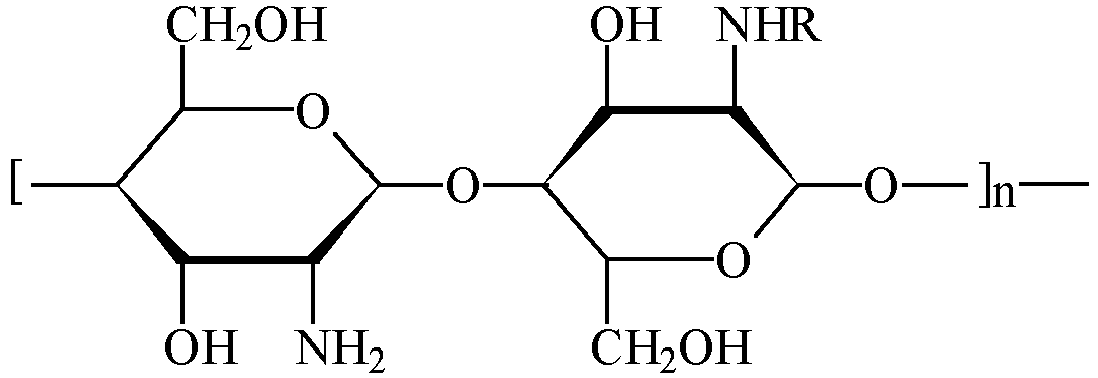
- Im Gegensatz zu den meisten Hydrokolloiden, die im Bereich biologischer pH-Werte negativ geladen sind, stellen Chitosane unter diesen Bedingungen kationische Biopolymere dar. Die positiv geladenen Chitosane können mit entgegengesetzt geladenen Oberflächen in Wechselwirkung treten und werden daher in kosmetischen Haar- und Körperpflegemitteln sowie pharmazeutischen Zubereitungen eingesetzt. Zur Herstellung der Chitosane geht man von Chitin, vorzugsweise den Schalenresten von Krustentieren aus, die als billige Rohstoffe in großen Mengen zur Verfügung stehen. Das Chitin wird dabei in einem Verfahren, das erstmals von Hackmann et al. beschrieben worden ist, üblicherweise zunächst durch Zusatz von Basen deproteiniert, durch Zugabe von Mineralsäuren demineralisiert und schließlich durch Zugabe von starken Basen deacetyliert, wobei die Molekulargewichte über ein breites Spektrum verteilt sein können. Vorzugsweise werden solche Typen eingesetzt, wie die ein durchschnittliches Molekulargewicht von 10.000 bis 500.000 bzw. 800.000 bis 1.200.000 Dalton aufweisen und/oder eine Viskosität nach Brookfield (1 Gew.-%ig in Glycolsäure) unterhalb von 5000 mPas, einen Deacetylierungsgrad im Bereich von 80 bis 88 % und einem Aschegehalt von weniger als 0,3 Gew.-% besitzen. Aus Gründen der besseren Wasserlöslichkeit werden die Chitosane in der Regel in Form ihrer Salze, vorzugsweise als Glycolate eingesetzt.
- Die anionischen Polymere haben die Aufgabe, mit den kationischen Membranen zu bilden. Für diesen Zweck eignen sich vorzugsweise Salze der Alginsäure. Bei der Alginsäure handelt es sich um ein Gemisch carboxylgruppenhaltiger Polysaccharide mit folgendem idealisierten Monomerbaustein:

- Das durchschnittliche Molekulargewicht der Alginsäuren bzw. der Alginate liegt im Bereich von 150.000 bis 250.000. Dabei sind als Salze der Alginsäure sowohl deren vollständige als auch deren partiellen Neutralisationsprodukte zu verstehen, insbesondere die Alkalisalze und hierunter vorzugsweise das Natriumalginat ("Algin") sowie die Ammonium- und Erdalkalisalze. besonders bevorzugt sind Mischalginate, wie z.B. Natrium/Magnesium- oder Natrium/Calciumalginate. In einer alternativen Ausführungsform der Erfindung kommen für diesen Zweck jedoch auch anionische Chitosanderivate, wie z.B. Carboxylierungs- und vor allem Succinylierungsprodukte in Frage. Alternativ kommen auch Poly(meth)acrylate mit durchschnittlichen Molekulargewichten im Bereich von 5.000 bis 50.000 Dalton sowie die verschiedenen Carboxymethylcellulosen in Frage. Anstelle der anionischen Polymeren können für die Ausbildung der Hüllmembran auch anionische Tenside oder niedermolekulare anorganische Salze, wie beispielsweise Pyrophosphate eingesetzt werden.
- Zur Herstellung der Mikrokapseln stellt man üblicherweise eine 1 bis 10, vorzugsweise 2 bis 5 Gew.-%ige wässrige Lösung des Gelbildners, vorzugsweise des Agar-Agars her und erhitzt diese unter Rückfluss. In der Siedehitze, vorzugsweise bei 80 bis 100 °C, wird eine zweite wässrige Lösung zugegeben, welche das Kationpolymer, vorzugsweise das Chitosan in Mengen von 0,1 bis 2, vorzugsweise 0,25 bis 0,5 Gew.-% und den Wirkstoffen in Mengen von 0,1 bis 25 und insbesondere 0,25 bis 10 Gew.-% enthält; diese Mischung wird als Matrix bezeichnet. Die Beladung der Mikrokapseln mit Wirkstoffen kann daher ebenfalls 0,1 bis 25 Gew.-% bezogen auf das Kapselgewicht betragen. Falls gewünscht, können zu diesem Zeitpunkt zur Viskositätseinstellung auch wasserunlösliche Bestandteile, beispielsweise anorganische Pigmente zugegeben werden, wobei man diese in der Regel in Form von wässrigen oder wässrig/alkoholischen Dispersionen zusetzt. Zur Emulgierung bzw. Dispergierung der Wirkstoffe kann es ferner von Nutzen sein, der Matrix Emulgatoren und/oder Lösungsvermittler hinzuzugeben. Nach der Herstellung der Matrix aus Gelbildner, Kationpolymer und Wirkstoffen kann die Matrix optional in einer Ölphase unter starker Scherung sehr fein dispergiert werden, um bei der nachfolgenden Verkapselung möglichst kleine Teilchen herzustellen. Dabei hat es sich als besonders vorteilhaft erwiesen, die Matrix auf Temperaturen im Bereich von 40 bis 60 °C zu erwärmen, während man die Ölphase auf 10 bis 20 °C kühlt. Im letzten, nun wieder obligatorischen Schritt erfolgt dann die eigentliche Verkapselung, d.h. die Ausbildung der Hüllmembran durch Inkontaktbringen des Kationpolymers in der Matrix mit den anionischen Polymeren. Hierzu empfiehlt es sich, die gegebenenfalls in der Ölphase dispergierte Matrix bei einer Temperatur im Bereich von 40 bis 100, vorzugsweise 50 bis 60 °C mit einer wässrigen, etwa 1 bis 50 und vorzugsweise 10 bis 15 Gew.-%ige wässrigen Lösung des Anionpolymers zu behandeln und dabei - falls erforderlich - gleichzeitig oder nachträglich die Ölphase zu entfernen. Die dabei resultierenden wässrigen Zubereitungen weisen in der Regel einen Mikrokapselgehalt im Bereich von 1 bis 10 Gew.-% auf. In manchen Fällen kann es dabei von Vorteil sein, wenn die Lösung der Polymeren weitere Inhaltsstoffe, beispielsweise Emulgatoren oder Konservierungsmittel enthält. Nach Filtration werden Mikrokapseln erhalten, welche im Mittel einen Durchmesser im Bereich von vorzugsweise etwa 0,01 bis 1 mm aufweisen. Es empfiehlt sich, die Kapseln zu sieben, um eine möglichst gleichmäßige Größenverteilung sicherzustellen. Die so erhaltenen Mikrokapseln können im herstellungsbedingten Rahmen eine beliebige Form aufweisen, sie sind jedoch bevorzugt näherungsweise kugelförmig. Alternativ kann man die Anionpolymere auch zur Herstellung der Matrix einsetzen und die Verkapselung mit den Kationpolymeren, speziell den Chitosanen durchführen.
- Alternativ kann die Verkapselung auch unter ausschließlicher Verwendung von Kationpolymeren erfolgen, wobei man sich deren Eigenschaft zu Nutze macht, bei pH-Werten oberhalb des pKs-Wertes zu koagulieren.
- In einem zweiten alternativen Verfahren wird zur Herstellung der erfindungsgemäßen Mikrokapseln wird zunächst eine O/W-Emulsion zubereitet, welche neben dem Ölkörper, Wasser und den Wirkstoffen eine wirksame Menge Emulgator enthält. Zur Herstellung der Matrix wird diese Zubereitung unter starkem Rühren mit einer entsprechenden Menge einer wässrigen Anionpolymerlösung versetzt. Die Membranbildung erfolgt durch Zugabe der Chitosanlösung. Der gesamte Vorgang findet vorzugsweise im schwach sauren Bereich bei pH = 3 bis 4 statt. Falls erforderlich erfolgt die pH-Einstellung durch Zugabe von Mineralsäure. Nach der Membranbildung wird der pH-Wert auf 5 bis 6 angehoben, beispielsweise durch Zugabe von Triethanolamin oder einer anderen Base. Hierbei kommt es zu einem Anstieg der Viskosität, die durch Zugabe von weiteren Verdickungsmitteln, wie z.B. Polysacchariden, insbesondere Xanthan-Gum, Guar-Guar, Agar-Agar, Alginaten und Tylosen, Carboxymethylcellulose und Hydroxyethylcellulose, höhermolekularen Polyethylenglycolmono- und -diestern von Fettsäuren, Polyacrylaten, Polyacrylamiden und dergleichen noch unterstützt werden kann. Abschließend werden die Mikrokapseln von der wässrigen Phase beispielsweise durch Dekantieren, Filtrieren oder Zentrifugieren abgetrennt.
- In einem dritten alternativen Verfahren erfolgt die Bildung der Mikrokapseln um einen vorzugsweise festen, beispielsweise kristallinen Kern, indem dieser schichtweise mit entgegengesetzt geladenen Polyelektrolyten eingehüllt wird. In diesem Zusammenhang sei auf das Europäische Patent
EP 1064088 B1 (Max-Planck Gesellschaft) verwiesen. - Bei der Verwendung der besagten Milchsäure-l-menthylester zur Maskierung von unangenehmen Geschmackseindrücken bei Zubereitungen zur oralen Aufnahme können die Einsatzmengen im Bereich von deutlich unter 5 mg/kg, vorzugsweise unter 2 mg/kg und vorzugsweise etwa 0,005 bis etwa 0,1 mg/kg - jeweils bezogen auf die Gesamtzubereitung - betragen.
- Um verschiedene Attribute einer Probe gleichzeitig über einen bestimmten Zeitraum zu bewerten, wurde die Methode das so genannte "Multiple Time-Intensity Profilng" (mTIP) herangezogen. Diese deskriptive Methode vereinigt die Vorteile der "Dual-Attribute Time-Intensity" (DATI) -Methode, bei der die Intensitäten von 2 Deskriptoren auf einer zweidimensionalen Ebene aufgetragen werden können, sowie der "Time-Intensity Profiling" (TIP) -Methode, bei der mehr als zwei Deskriptoren nacheinander über die Zeit evaluiert werden.
- Bei jedem mTIP-Test werden trainierten Panelisten (n=15) gebeten, nacheinander 2 Schlucke (je 5 ml) der zu bewertenden Probe in den Mund zu nehmen, den kompletten Mundraum damit zu benetzen und die Probe danach wieder auszuspucken. Die Messung beginnt, indem die Intensitäten mehrerer Deskriptoren auf horizontalen Linienskalen, die auf dem Computerbildschirm abgebildet sind, markiert werden. Für jeden Deskriptor ist jeweils eine Linienskala abgebildet. Somit ist eine parallele Bewertung von mehr als zwei Attributen möglich. Die Intensitäten werden nach den ersten 10 Sekunden und im Anschluss daran alle 20 Sekunden über einen Zeitraum von 70 Sekunden abgefragt. Die dabei entstehenden Daten werden mittels Compusense® five analysiert und grafisch in einer Zeit-Intensitäts-Kurve dargestellt.
- Um den adstringenz-maskierenden Effekt von L-Milchsäure-L-menthylester (Frescolat ML) aufzuzeigen wurde das Panel unter anderem mit einer wässrigen Testlösung geschult, die 750 mg/kg Epigallocathechingallat und 125 mg/kg Ascorbinsäure enthielt. Die Panelisten wurden gebeten, die Testlösung mit der oben beschriebenen Methode in Bezug auf ihre Bitterkeit und Adstringenz hin zu bewerten. In einem anschließenden Test folgte die Bewertung dieser beiden Deskriptoren zum einen von der oben beschriebenen Testlösung und zum anderen der Testlösung plus 300 µg/kg Frescolat ML. Die Ergebnisse beider Zeit-Intensitäts-Kurven wurden statistisch ausgewertet und miteinander verglichen, um einen adstringenz-maskierenden Effekt von Frescolat® ML zu bestimmen. Der Test erfolgte in Dreifachbestimmung und die Mittelwerte der Adstringenz-Reduktion sind in Tabelle 1 abgebildet. Für die Signifikanzberechung wurde der Student t-Test, doppelt mit gepaarten Stichproben, herangezogen.
Tabelle 1 Adstringenz-Reduktion von 750 mg/kg EGCG (+ 125 mg/kg Ascorbinsäure) nach Zugabe von 300 µg/kg von L-Milchsäure-L-menthylester (Frescolat® ML), Mittelwert aus 2 Wiederholungen Zeit (Sek.) Adstringenz ohne Frescolat ML Adstringenz mit Frescolat ML Reduktion (%) 0 4,84 4,81 -0,49 10 4,80 4,11 -14,29 30 4,26 3,38 -20,58* 50 3,32 2,58 -22,24* 70 2,49 2,04 -17,82 *signifikant (p < 0.1) - In Tabelle 2 sind verschiedene flüssige Aromakompositionen angegeben. Die Stoffe bzw. Lösungen wurden in den unten angegebenen Mengenverhältnissen gemischt und dann mit Propylenglykol oder Ethanol aufgenommen, durch leichtes Erwärmen vollständig gelöst und homogen gemischt.
Tabelle 2 Formulierungsbeispiele Inhaltsstoff Zubereitung (Einsatz in Gew.-%) A B C D E F G H Frescolat® ML 1 0,6 1 0,55 1,95 1 0,25 1,6 Hesperetin 2 - - 2 - - - - Symrise Zucker Aroma in Propylenglykol-1,2 1,5 4 - - 2 - 0,3 - Symrise Milch Aroma in Propylenglykol-1,2 - - - 4 - - - - Symrise Sahne Aroma in Propylenglycol-1,2 - - 3 0,3 0,5 5 1 2,5 Propylenglykol-1,2 ad 100 - ad 100 ad 100 ad 100 ad 100 - ad 100 Ethanol - ad 100 - - - - ad 100 - - In Tabelle 3 sind verschiedene trockene Aromakompositionen angegeben. Die Stoffe wurden in den unten angegebenen Mengenverhältnissen gemischt und mit den festen Trägerstoffen homogen gemischt
Tabelle 3 Formulierungsbeispiele Inhaltsstoff Zubereitung (Einsatz in Gew.-%) A B C D E F G H Frescolat® ML 25 15 0,5 1 1 0,25 1,2 6 Ca. 10 Gew.% Pellitorin in Lösung Propylenglykol-1,2 - - - - - - - 10 Ca. 10 Gew-% Homoeriodictiol sprühgetrocknet - - 35 50 45 15 13 20 Ca. 10 Gew.-% Hesperetin sprühgetrocknet - - - - 10 10 6 - Symrise Abrundungsaroma für Tee sprühgetrocknet - - 1 - 30 5 - - Symrise Zucker Aroma in Triacetin 8 5 0,5 - - - - - Symrise Vanille sprühgetrocknet - - - - - - 3 10 Dextrose wasserfrei - ad 100 - - - ad 100 - - Maltodextrin ad 100 - ad 100 ad 100 ad 100 - ad 100 ad 100 - In Tabelle 4 sind verschiedene sprühgetrocknete Aromakompositionen als Halbfertigwaren zur Aromatisierung von Fertigwaren angegeben. Das Trinkwasser wurde in einem Behälter vorgelegt und das Maltodextrin und das Gummi Arabicum darin gelöst. Anschließend wurden Bestandteile mit einem Mixer (Turrax) in die unten beschriebene Trägerstofflösung emulgiert. Die Temperatur des resultierenden Gemisches sollte 30°C nicht überschreiten. Das Gemisch wurde dann sprühgetrocknet (Solltemperatur Eingang: 185 - 195°C, Solltemperatur Ausgang: 70 - 75°C). Analog können auch sprühgetrocknete Zubereitungen mit erfindungsgemäßen anderen Aromakompositionen hergestellt werden.
Tabelle 4 Formulierungsbeispiele Inhaltsstoff Zubereitung (Einsatz in Gew.-%) A B C D E F Maltodextrin aus Weizen 24,3 24,3 24,3 24,3 24,3 24,3 Gummi Arabicum 6,1 6,1 6,1 6,1 6,1 6,1 Frescolat® ML 0,1 0,08 0,04 0,06 0,1 0,1 Symrise Zucker Aroma in Triacetin - 0,5 0,2 - 0,1 - Symrise Sahne Aroma in Triacetin - - - 0,05 0,05 - Symrise Milch Aroma in Triacetin - - - - - 0,1 Trinkwasser ad 100 ad 100 ad 100 ad 100 ad 100 ad 100 - In Tabelle 5 sind Aromamischungen zur Reduktion der unangenehmen Geschmackseindrücke in einer Süßstoffmischung zum Süßen von Kakao-, Kaffee- oder Tee-haltigen Getränken angegeben. Die Zubereitungen A bis D wurden mit 1% auf schwarzen Kaffee (frisch gebrüht) dosiert. Die Zubereitungen B, C und D sind erfindungsgemäß, A dient zum Vergleich. Verglichen mit Zubereitung A (Vergleich) war in Zubereitung B - D die Adstringenz und die langanhaltende Süße vermindert. Die metallischen Noten wurden zudem reduziert. Zubereitung D hatte zudem einen Sucrose-typischeren Geschmack.
Tabelle 5 Formulierungsbeispiele Inhaltsstoff Zubereitung (Angaben als Gew.-%) A B C D Saccharin 1,50 1,50 1,50 1,50 Aromakomposition nach Anwendungs-beispiel 2 B - 1,7 - 0,6 Aromakomposition nach Anwendungs-beispiel 2 A - - - 1,00 Aromakomposition nach Anwendungsbeispiel 3 B - - 1,00 - Sorbitol ad 100 ad 100 ad 100 ad 100 - In Tabelle 6 sind Beispiele für die Verwendung von Milchsäure-l-menthylester in einer Süßstoffmischung zum Süßen von fettreduzierten, fettarmen bzw. fettfreien Milchprodukten zur Reduktion der unangenehmen Geschmackseindrücke angegeben. Die Zubereitungen A bis D wurden mit 1% auf schwarzen Kaffee (frisch gebrüht) dosiert. Die Zubereitungen B, C und D sind erfindungsgemäß, A dient zum Vergleich. Die Aromakompositionen sowie die Süßstoffe wurden mit neutralem 0,1 % Fett-haltigen Joghurt verrührt. Die Mischungen erfordern eine Reifezeit von 3 Tagen. Verglichen mit Zubereitung A (Vergleich) war in Zubereitung B - D die Adstringenz und die langanhaltende Süße vermindert. Die metallischen Noten wurden zudem reduziert. In Zubereitung C wurde eine deutlich stärkere Mundfülle erreicht (an Sucrose erinnernd).
Tabelle 6 Formulierungsbeispiele Inhaltsstoff Zubereitung (Angaben als Gew.-%) A B C D Aromakomposition nach Anwendungsbeispiel 1 E - 0,03 - - Aromakomposition nach Anwendungsbeispiel 1 A - - - 0,08 Aromakomposition nach Anwendungs-beispiel 1 H - - 0,03 - Acesulfam K 0,01 0,01 0,01 0,01 Aspartam 0,02 0,02 0,02 0,02 Joghurt natur, 0,1% Fett ad 100 ad 100 ad 100 ad 100 - In Tabelle 7 sind Beispiele für die Verwendung von Milchsäure-l-menthylester in einem Sojamilch-Getränk angegeben. Die Zubereitungen B bis H sind erfindungsgemäß, A dient zum Vergleich. Die Aromakompositionen wurden mit der neutralen Sojamilch gemischt. Die Mischungen erforderten eine Reifezeit von 5 bis 6 Tagen. Verglichen mit Zubereitung A (Vergleich) war in Zubereitung B bis H die Adstringenz der Sojamilch vermindert. In Zubereitung B bis D, sowie G+H wurde die Mundfülle der Sojamilch deutlich verbessert, die Soja-bohnigen Noten wurden reduziert. In Zubereitung E und F wurde neben der Adstringenz besonders die Bitterkeit der Sojamilch reduziert.
Tabelle 7 Formulierungsbeispiele Inhaltsstoff Zubereitung (Angaben als Gew.-%) A B C D E F G H Aromakomposition nach Anwendungsbeispiel 3A 0,015 - - - - - - - Aromakomposition nach Anwendungsbeispiel 1 G - - 0,1 - - - - - Aromakomposition nach Anwendungsbeispiel 1 F - 0,04 - - - - - - Aromakomposition nach Anwendungsbeispiel 1 C - - - 0,01 - - 0,005 - Aromakomposition nach Anwendungsbeispiel 1 A - - - - - 0,1 - - Aromakomposition nach Anwendungsbeispiel 1 D - - - - 0,15 - 0,1 - Aromakomposition nach Anwendungsbeispiel 3 E - - - - - - - 0,015 Sojamilch, ohne Zusätze (lokaler Supermarkt) ad 100 ad 100 ad 100 ad 100 ad 100 ad 100 ad 100 ad 100 - In Tabelle 8 ist ein Beispiel für die Verwendung von Milchsäure-l-menthylester in einem Soja-Getränk in Kombination mit γ-Aminobuttersäure. γ-Aminobuttersäure wurde in Wasser vorgelöst und zusammen mit einer erfindungsgemäßen Aromamischung zu einer Sojamilch aus einem lokalen Supermarkt hinzugefügt. Die Mischung wurde zusammen mit dem Milcharoma im Becherglas verrührt. Im Vergleich zu Anwendungsbeispiel 6 B wurde die Adstringenz deutlich reduziert, die Sojamilch erhält eine sehr neutrale Frische.
Tabelle 8 Formulierungsbeispiel Inhaltsstoff Einsatz in Gew.-% Sojamilch, ohne Zusätze (lokaler Supermarkt) 99,76 Aromakomposition nach Anwendungsbeispiel 1 F 0,04 1 % γ-Aminobuttersäure in Wasser 0,2 - In Tabelle 9 sind Beispiele für die Verwendung von Milchsäure-l-menthylester in einem Soja-Frucht-Getränk angegeben. Die Zubereitungen B bis D sind erfindungsgemäß, A dient zum Vergleich. Die Aromakompositionen wurden mit den restlichen Zutaten gemischt. Die Mischung wurde homogenisiert und anschließend pasteurisiert (15 Min. bei 80-85°C). Verglichen mit Zubereitung A (Vergleich) waren in Zubereitung B bis D die Adstringenz und die Soja-bohnigen Noten vermindert. In Zubereitung B wurde zudem die Bitterkeit deutlich reduziert. Alle Proben hatten einen deutlich fruchtigeren Angeschmack.
Tabelle 9 Formulierungsbeispiele Inhaltsstoff Zubereitung (Angaben als Gew.-%) A B C D Aromakomposition nach Anwendungsbeispiel 1 D - 0,12 0,1 - Aromakomposition nach Anwendungsbeispiel 1 A - - - 0,08 Aromakomposition nach Anwendungsbeispiel 1 C - - 0,003 - Süßstoffmix 0,03 0,03 0,03 0,03 Zucker 5 5 5 5 Fruchtsaftmix aus Fruchtsaftkonzentraten 50 50 50 50 Wasser ad 100 ad 100 ad 100 ad 100 Soja pulver 5 5 5 5 - In Tabelle 10 sind Beispiele für die Verwendung von Milchsäure-l-menthylester in einer Sojaeiscreme angegeben. Die Zubereitungen B bis D sind erfindungsgemäß, A dient zum Vergleich. Die Aromakompositionen werden mit dem Eiscrememix gemischt. Anschließend wird die Masse im Freezer mit einem Aufschlag von 100% gefroren und bei -25°C gelagert. Verglichen mit Zubereitung A (Vergleich) waren in Zubereitung B bis D die Soja-bohnigen Noten deutlich reduziert.
Tabelle 10 Formulierungsbeispiele Inhaltsstoff Zubereitung (Angaben als Gew.-%) A B C D Aromakomposition nach Anwendungsbeispiel 1 F - 0,06 - - Aromakomposition nach Anwendungsbeispiel 1 G - - - 0,12 Aromakomposition nach Anwendungsbeispiel 1 C - - 0,014 - Sojaeiscreme-Mix (mit 12% Saccharos, 8% Glucofructose Sirup, 3% Sojapulver, 4,5% Fett) ad 100 ad 100 ad 100 ad 100 - In Tabelle 11 sind Beispiele für die Verwendung von Milchsäure-l-menthylester in einem fettarmen Joghurt angegeben. Die Zubereitungen B bis D sind erfindungsgemäß, A dient zum Vergleich. Die Aromakompositionen sowie die Sucrose werden mit dem neutralen 0,1% Fett-haltigen Joghurt verrührt. Die Mischungen erfordern eine Reifezeit von 3 Tagen. Verglichen mit Zubereitung A (Vergleich) war in Zubereitung B - D die Adstringenz vermindert. Zudem wurde die Säure des Joghurts vermindert. In Zubereitung D wurde eine deutlich stärkere Mundfülle erreicht.
Tabelle 11 Formulierungsbeispiele Inhaltsstoff Zubereitung (Angaben als Gew.-%) A B C D Aromakomposition nach Anwendungsbeispiel 1 F - 0,03 - - Aromakomposition nach Anwendungsbeispiel 1 G - - - 0,1 Aromakomposition nach Anwendungsbeispiel 3 F - - 0,015 - Sucrose 5 5 5 5 Joghurt natur, 0,1% Fett ad 100 ad 100 ad 100 ad 100 - In Tabelle 12 ist ein Beispiel für die Verwendung von Milchsäure-l-menthylester in einer fettreduzierten Mayonnaise angegeben. Im Vergleich zu fettreduzierter Mayonnaise ohne Aromakomposition wurde die Adstringenz verbessert, die Zubereitung erhielt ein besseres Mundgefühl/Fettigkeit.
Tabelle 12 Formulierungsbeispiel Inhaltsstoff Einsatz in Gew.-% Fettreduzierte Mayonnaise 99,93 Aromakomposition nach Anwendungsbeispiel 1 F 0,07 - In Tabelle 13 sind Beispiele für die Verwendung von Milchsäure-l-menthylester in einer Grüntee-Zubereitung angegeben. Der Grünteextrakt, Säure und Süßstoffmischung sowie die Aromakompositionen wurden in 80° heißem Wasser gelöst und in Flaschen abgefüllt. Im Vergleich zur Kontroll-Grüntee-Zubereitung (ohne Aromakomposition) wurde die Adstringenz reduziert. Die Bitterkeit war zudem besonders in Zubereitung B reduziert; Zubereitung B zeigte eine deutlich vollere Süße.
Tabelle 13 Formulierungsbeispiele Inhaltsstoff Einsatz in Gew.-% A B Grüntee-Extrakt, ca. 16% Catechingehalt 0,25 0,25 Aromakomposition nach Anwendungsbeispiel 2 D 0,1 - Aromakomposition nach Anwendungsbeispiel 2 E - 0,1 Süßstoffmischung (Aspartam, Sucralose 1:1) 0,01 0,01 Äpfelsäure, Citronensäure 0,1 0,1 Demineralisiertes Wasser ad 100 ad 100 - In Tabelle 14 sind Beispiele für die Verwendung von Milchsäure-l-menthylester in verschiedenen Tee-Zubereitungen angegeben. Teeblätter und die Halbfertigprodukte wurden gemischt und in Filterbeutel bepackt. Für die Verkostung wurden 100 bis 250 ml kochendes Wasser auf den Teebeutel gegeben und 2 bis 5 min ziehen gelassen.
Tabelle 14 Formulierungsbeispiele Inhaltsstoff Einsatz in Gew.-% A B C Schwarztee, Ceylon, Blätter 94 - - Grüntee, China, Blätter - 92 - Mate Tee, Peru, Blätter - - 95 Halbfertigprodukt A aus Beispiel 3 6 - - Halbfertigprodukt B aus Beispiel 3 - 8 - Halbfertigprodukt C aus Beispiel 3 - - 5 - In Tabelle 15 sind Beispiele für die Verwendung von Milchsäure-l-menthylester in weiteren Tee-Zubereitungen angegeben. Teeblätter und die Halbfertigprodukte wurden gemischt und in Filterbeutel bepackt. Für die Verkostung werden 100 bis 250 ml kochendes Wasser auf den Teebeutel gegeben 2 bis 5 min ziehen gelassen.
Tabelle 15 Formulierungsbeispiele Inhaltsstoff Einsatz in Gew.-% A B Schwarztee, Ceylon, Blätter 94 - Grüntee, Japan Sencha, Blätter - 95 Halbfertigprodukt A aus Beispiel 2 3 - Halbfertigprodukt C aus Beispiel 2 3 5 - In Tabelle 16 sind Beispiele für die Verwendung von Milchsäure-l-menthylester in Eistee-Zubereitungen auf Basis von Schwarztee angegeben.
Tabelle 16 Formulierungsbeispiele Inhaltsstoff Einsatz in Gew.-% A B Schwarztee, Assam, Blätter 1.4 1.4 Wasser ad 100 ad 100 Natürliches Pfirsicharoma 0.65 0.65 Sucrose 7 7 Zitronensäure (kristallin) 1.2 1.2 Ascorbinsäure 0.2 0.2 Frescolat® ML 0.00003 - Homoeriodictyol (10% in Ethanol) 0,01 - Matairesinol (10% in Ethanol) - 0,01 - In Tabelle 17 sind Beispiele für die Verwendung von Milchsäure-l-menthylester in kalorienreduzierten Eistee-Zubereitungen auf Basis von Grüntee angegeben.
Tabelle 17 Formulierungsbeispiele Inhaltsstoff Einsatz in Gew.-% A B Grüntee Extrakt, Catechingehalt 10 Gew.% 1.4 1.2 Wasser ad 100 ad 100 Aroma Typ Zitrone 0.65 0.65 Sucrose 3.45 3.45 Saccharin, Natriumsalz 0.1 - Rebaudiosid A - 0.02 Zitronensäure (kristallin) 1.2 1.2 Ascorbinsäure 0.2 0.2 Frescolat® ML 0.00005 0.00003 - In Tabelle 18 sind Beispiele für die Verwendung von Milchsäure-l-menthylester in kalorienreduzierten Eistee-Zubereitungen auf Basis von Schwarztee angegeben.
Tabelle 18 Formulierungsbeispiele Inhaltsstoff Einsatz in Gew.-% A B Schwarztee Extrakt 1.4 1.4 Wasser Ad 100 Ad 100 Saccharin 0.035 0.035 Aroma Typ Zitrone 0.65 0.65 Zitronensäure (kristallin) 1.2 1.2 Ascorbinsäure 0.2 0.2 Frescolat® ML 0.00005 0,00004 Eriodictyol (10% in Ethanol) - 0.05 Schwarztee Extrakt 1.4 1.4 - In Tabelle 19 ist ein Beispiel für die Verwendung von Milchsäure-l-menthylester in einer bitteren Schokolade angegeben. Die Zutaten wurden in die bei 40 °C geschmolzene Schokolade eingearbeitet und die flüssige Masse in Tafelform gegossen und nach dem dem Fachmann bekannten Temperungsverfahren abgekühlt, wobei man eine Essschokolade erhielt. Die so zubereitete Schokolade wurde von den trainierten Fachleuten als weniger bitter, weniger adstringierend und insgesamt als mehr abgerundet bezeichnet.
Tabelle 19 Formulierungsbeispiel Inhaltsstoff Einsatz in Gew.-% Bitterschokolade, min. 85 % Kakao (Handelsprodukt) 99,7 Aromakomposition nach Anwendungsbeispiel 2G 0,3
Claims (5)
- Verwendung von Milchsäure-1-menthylestern der Formel (I) zur Maskierung oder Reduzierung von unangenehmen Geschmackseindrücken bei Zubereitungen zur oralen Aufnahme

wobei es sich bei den unangenehmen Geschmackseindrücken um adstringierend, trocken, staubig, mehlig und/oder kalkig handelt,
und wobei die Zubereitungen zur oralen Aufnahme Stoffe umfassen, ausgewählt aus der Gruppe, die gebildet wird von(b1) Catechinen,(b2) Proanthocyanidinen,(b3) Coffein,(b4) Theobromin,(b5) Naringin und(b6) Süßstoffen. - Verwendung nach Anspruch 1, dadurch gekennzeichnet, dass man die Catechine und Proanthocyanidine in einer Gesamtmenge von 0,01 bis 1 Gew.-% - bezogen auf die oralen Zubereitungen - einsetzt.
- Verwendung nach Anspruch 1, dadurch gekennzeichnet, dass man Coffein und Theobromin in einer Gesamtmenge von 0,005 bis 1 Gew.-% - bezogen auf die oralen Zubereitungen - einsetzt.
- Verwendung nach Anspruch 1, dadurch gekennzeichnet, dass man Naringin in einer Menge von 0,005 bis 0,5 Gew.-% - bezogen auf die oralen Zubereitungen - einsetzt.
- Verwendung nach Anspruch 1, dadurch gekennzeichnet, dass man die Süßstoffe in einer Gesamtmenge von 0,005 bis 2 Gew.-% einsetzt.
Priority Applications (2)
| Application Number | Priority Date | Filing Date | Title |
|---|---|---|---|
| EP12192171.2A EP2730178B1 (de) | 2012-11-12 | 2012-11-12 | Zubereitungen zur oralen Aufnahme |
| US14/074,221 US9386787B2 (en) | 2012-11-12 | 2013-11-07 | Preparations for oral consumption |
Applications Claiming Priority (1)
| Application Number | Priority Date | Filing Date | Title |
|---|---|---|---|
| EP12192171.2A EP2730178B1 (de) | 2012-11-12 | 2012-11-12 | Zubereitungen zur oralen Aufnahme |
Publications (2)
| Publication Number | Publication Date |
|---|---|
| EP2730178A1 EP2730178A1 (de) | 2014-05-14 |
| EP2730178B1 true EP2730178B1 (de) | 2020-08-26 |
Family
ID=47146266
Family Applications (1)
| Application Number | Title | Priority Date | Filing Date |
|---|---|---|---|
| EP12192171.2A Active EP2730178B1 (de) | 2012-11-12 | 2012-11-12 | Zubereitungen zur oralen Aufnahme |
Country Status (2)
| Country | Link |
|---|---|
| US (1) | US9386787B2 (de) |
| EP (1) | EP2730178B1 (de) |
Families Citing this family (15)
| Publication number | Priority date | Publication date | Assignee | Title |
|---|---|---|---|---|
| EP2756765B1 (de) * | 2013-01-17 | 2019-03-27 | Symrise AG | Pharmazeutische Zubereitungen |
| DE102014115518A1 (de) | 2014-10-24 | 2016-04-28 | orochemie GmbH + Co. KG | Dentale Polier- und Reinigungspaste |
| TWI610678B (zh) * | 2015-06-09 | 2018-01-11 | 國立臺灣大學 | 柑橘多酚於促進傷口癒合之用途及其組成物 |
| US10285927B2 (en) | 2016-08-05 | 2019-05-14 | Apollo Laboratories Inc. | Oral care compositions |
| JP7114519B2 (ja) * | 2018-03-26 | 2022-08-08 | 三栄源エフ・エフ・アイ株式会社 | 果汁含有製品の光劣化臭マスキング剤 |
| EP3556219A1 (de) * | 2018-04-13 | 2019-10-23 | Markus Traxler | Sirup zur aufwertung von heissgetränken zu fitness-drinks |
| US20210204580A1 (en) * | 2018-05-29 | 2021-07-08 | Givaudan Sa | Organic compounds |
| JP7627116B2 (ja) * | 2018-05-31 | 2025-02-05 | 三栄源エフ・エフ・アイ株式会社 | 豆類タンパク質由来の豆臭マスキング剤 |
| US11484487B1 (en) * | 2018-07-23 | 2022-11-01 | Robell Research, Inc. | Gingivitis gum serum |
| EP4470389A3 (de) | 2019-03-01 | 2025-05-14 | Voyage Foods, Inc. | Aus einzelnen komponenten hergestellte kaffee-replikas |
| JP6706372B1 (ja) * | 2019-07-08 | 2020-06-03 | サントリーホールディングス株式会社 | 低カフェインコーヒー濃縮液 |
| AU2021369807A1 (en) * | 2020-10-29 | 2023-06-08 | Oye Therapeutics, Inc | Caffeine compositions |
| CN116456998A (zh) * | 2020-10-29 | 2023-07-18 | 睁开眼治疗股份有限公司 | 咖啡因组合物 |
| JP7600443B1 (ja) | 2024-01-09 | 2024-12-16 | サントリーホールディングス株式会社 | ビタミンc含有飲料 |
| CN118275573B (zh) * | 2024-04-07 | 2025-12-09 | 四川新绿色药业科技发展有限公司 | 一种檀香药材、饮片、标准汤剂、配方颗粒含量的测定方法 |
Citations (2)
| Publication number | Priority date | Publication date | Assignee | Title |
|---|---|---|---|---|
| JP2004161679A (ja) * | 2002-11-13 | 2004-06-10 | Taiho Yakuhin Kogyo Kk | 内服用液剤 |
| JP2005082594A (ja) * | 2003-09-04 | 2005-03-31 | Boehringer Ingelheim Internatl Gmbh | 苦味を隠蔽する薬理組成物 |
Family Cites Families (4)
| Publication number | Priority date | Publication date | Assignee | Title |
|---|---|---|---|---|
| ZA937353B (en) * | 1992-10-07 | 1994-04-29 | Warner Lambert Co | Taste masking of thymol |
| WO2007089652A2 (en) * | 2006-01-27 | 2007-08-09 | Cadbury Adams Usa Llc | Flavor-enhancing compositions, methods of manufacture, and methods of use |
| BR112012002071A2 (pt) * | 2009-07-29 | 2017-07-04 | Givaudan Sa | melhoramentos em ou relacionados com compostos orgânicos |
| DE102010049708A1 (de) * | 2010-10-28 | 2012-05-03 | Hexal Ag | Orale pharmazeutische Filmformulierung für bitter schmeckende Arzneistoffe |
-
2012
- 2012-11-12 EP EP12192171.2A patent/EP2730178B1/de active Active
-
2013
- 2013-11-07 US US14/074,221 patent/US9386787B2/en active Active
Patent Citations (2)
| Publication number | Priority date | Publication date | Assignee | Title |
|---|---|---|---|---|
| JP2004161679A (ja) * | 2002-11-13 | 2004-06-10 | Taiho Yakuhin Kogyo Kk | 内服用液剤 |
| JP2005082594A (ja) * | 2003-09-04 | 2005-03-31 | Boehringer Ingelheim Internatl Gmbh | 苦味を隠蔽する薬理組成物 |
Non-Patent Citations (4)
| Title |
|---|
| "Encyclopedia of Food Sciences and Nutrition", 1 January 2003, ELSEVIER, ISBN: 978-0-12-227055-0, article H. VALENTOVÁ ET AL: "SENSORY EVALUATION | Taste", pages: 5180 - 5187, XP055632392, DOI: 10.1016/B0-12-227055-X/01069-5 * |
| DATABASE WPI Week 200528, Derwent World Patents Index; AN 2005-266728 * |
| JAKOB P. LEY: "Masking Bitter Taste by Molecules", CHEMOSENSORY PERCEPTION, vol. 1, no. 1, 13 February 2008 (2008-02-13), US, pages 58 - 77, XP055562140, ISSN: 1936-5802, DOI: 10.1007/s12078-008-9008-2 * |
| MASATAKA NARUKAWA ET AL: "Taste characterisation of green tea catechins : Taste characterisation of catechins", INTERNATIONAL JOURNAL OF FOOD SCIENCE AND TECHNOLOGY., vol. 45, no. 8, 1 August 2010 (2010-08-01), GB, pages 1579 - 1585, XP055632356, ISSN: 0950-5423, DOI: 10.1111/j.1365-2621.2010.02304.x * |
Also Published As
| Publication number | Publication date |
|---|---|
| US9386787B2 (en) | 2016-07-12 |
| US20140134114A1 (en) | 2014-05-15 |
| EP2730178A1 (de) | 2014-05-14 |
Similar Documents
| Publication | Publication Date | Title |
|---|---|---|
| EP2517574B1 (de) | Bestimmte Vanillyllignane und deren Verwendung als Geschmacksverbesserer | |
| EP1972203B1 (de) | Verwendung von 4-Hydroxychalkonderivaten zur Maskierung eines unangenehmen Geschmacks | |
| EP2298084B1 (de) | Süßmittelreduzierte Produkte, Aromamischungen dafür sowie Verfahren zum Herstellen solcher Produkte | |
| US9386787B2 (en) | Preparations for oral consumption | |
| EP2253226B1 (de) | Verwendung von Hydroxyflavan-Derivaten zur Geschmacksmodifizierung | |
| EP2058297B1 (de) | Verwendung von Alkamiden zur Maskierung eines unangenehmen Geschmacks | |
| EP2353403B1 (de) | Verwendung von 1-(2,4-Dihydroxy-phenyl)-3-(3-hydroxy-4-methoxy-phenyl)-propan-1-on | |
| EP2570036B1 (de) | Verwendung bestimmter Neoflavonoide zur Verstärkung und/oder Erzeugung eines süßen sensorischen Eindruckes | |
| EP1977655B1 (de) | Aromakompositionen von Alkamiden mit Hesperetin und/oder 4-Hydroxydihydrochalkonen und deren Salzen zur Verstärkung süßer sensorischer Eindrücke | |
| EP2008530B1 (de) | Aromakomposition zum Verringern oder Unterdrücken von unerwünschtem bitteren und adstringierenden Eindruck | |
| EP2570035B1 (de) | Verwendung von Neoflavonoiden zur Geschmacksmodifizierung | |
| DE102004017076A1 (de) | Verwendung von gamma-Aminobuttersäure zur Maskierung oder Verminderung eines unangenehmen Geschmackseindrucks sowie Zubereitungen enthaltend gamma-Aminobuttersäure | |
| EP3383200B1 (de) | Stoffgemische | |
| WO2012164062A1 (de) | ORAL KONSUMIERBARE ZUBEREITUNGEN UMFASSEND BESTIMMTE SÜß SCHMECKENDE TRITERPENE UND TRITERPENGLYCOSIDE | |
| EP2386211A1 (de) | Verwendung von Rubusosid zum Verringern oder Unterdrücken von bestimmten unangenehmen Geschmackseindrücken | |
| EP2725026B1 (de) | Heterozyklische neoflavonoide mit geschmacksmaskierenden eigenschaften | |
| EP2865372B1 (de) | Wirkstoffkapseln | |
| DE102012214560A1 (de) | Bestimmte Lignane und deren Verwendung als Geschmacksverbesserer | |
| EP2883459B1 (de) | Zubereitungen zur oralen Aufnahme | |
| EP2926673B1 (de) | Stoffgemische | |
| DE102009046126A1 (de) | Oral konsumierbare Zubereitung umfassend Wurzelextrakt aus Mondia whitei | |
| DE102009002268A1 (de) | 4,4'-Dihydroxydeoxybenzoine und deren Verwendung als Geschmacksverbesserer | |
| EP2756765A1 (de) | Pharmazeutische Zubereitungen | |
| EP3641564B1 (de) | Geschmacksmodulierende aromastoffe | |
| DE202016009245U1 (de) | Verwendung von 3-(3-Hydroxy-4-Methoxy-Phenyl)-1-(2,4,6-Trihydroxy-Phenyl)-Propan-1-one |
Legal Events
| Date | Code | Title | Description |
|---|---|---|---|
| PUAI | Public reference made under article 153(3) epc to a published international application that has entered the european phase |
Free format text: ORIGINAL CODE: 0009012 |
|
| 17P | Request for examination filed |
Effective date: 20121112 |
|
| AK | Designated contracting states |
Kind code of ref document: A1 Designated state(s): AL AT BE BG CH CY CZ DE DK EE ES FI FR GB GR HR HU IE IS IT LI LT LU LV MC MK MT NL NO PL PT RO RS SE SI SK SM TR |
|
| AX | Request for extension of the european patent |
Extension state: BA ME |
|
| R17P | Request for examination filed (corrected) |
Effective date: 20141113 |
|
| RBV | Designated contracting states (corrected) |
Designated state(s): AL AT BE BG CH CY CZ DE DK EE ES FI FR GB GR HR HU IE IS IT LI LT LU LV MC MK MT NL NO PL PT RO RS SE SI SK SM TR |
|
| 17Q | First examination report despatched |
Effective date: 20151210 |
|
| STAA | Information on the status of an ep patent application or granted ep patent |
Free format text: STATUS: EXAMINATION IS IN PROGRESS |
|
| RIN1 | Information on inventor provided before grant (corrected) |
Inventor name: OBST, KATJA Inventor name: REICHELT, KATHARINA Inventor name: LEY, JAKOB Inventor name: KRAMMER, GERHARD |
|
| REG | Reference to a national code |
Ref country code: DE Ref legal event code: R079 Ref document number: 502012016316 Country of ref document: DE Free format text: PREVIOUS MAIN CLASS: A23L0001314000 Ipc: A23F0003160000 |
|
| RIC1 | Information provided on ipc code assigned before grant |
Ipc: A23F 3/16 20060101AFI20200304BHEP Ipc: A23L 27/20 20160101ALI20200304BHEP Ipc: A61Q 11/00 20060101ALI20200304BHEP Ipc: C12G 3/06 20060101ALI20200304BHEP Ipc: A23L 13/40 20160101ALI20200304BHEP Ipc: A23L 2/56 20060101ALI20200304BHEP Ipc: A23L 15/00 20160101ALI20200304BHEP Ipc: A61K 8/37 20060101ALI20200304BHEP Ipc: A23L 27/00 20160101ALI20200304BHEP |
|
| GRAP | Despatch of communication of intention to grant a patent |
Free format text: ORIGINAL CODE: EPIDOSNIGR1 |
|
| STAA | Information on the status of an ep patent application or granted ep patent |
Free format text: STATUS: GRANT OF PATENT IS INTENDED |
|
| INTG | Intention to grant announced |
Effective date: 20200508 |
|
| GRAS | Grant fee paid |
Free format text: ORIGINAL CODE: EPIDOSNIGR3 |
|
| GRAA | (expected) grant |
Free format text: ORIGINAL CODE: 0009210 |
|
| STAA | Information on the status of an ep patent application or granted ep patent |
Free format text: STATUS: THE PATENT HAS BEEN GRANTED |
|
| AK | Designated contracting states |
Kind code of ref document: B1 Designated state(s): AL AT BE BG CH CY CZ DE DK EE ES FI FR GB GR HR HU IE IS IT LI LT LU LV MC MK MT NL NO PL PT RO RS SE SI SK SM TR |
|
| REG | Reference to a national code |
Ref country code: GB Ref legal event code: FG4D Free format text: NOT ENGLISH |
|
| REG | Reference to a national code |
Ref country code: CH Ref legal event code: EP |
|
| REG | Reference to a national code |
Ref country code: AT Ref legal event code: REF Ref document number: 1305490 Country of ref document: AT Kind code of ref document: T Effective date: 20200915 |
|
| REG | Reference to a national code |
Ref country code: IE Ref legal event code: FG4D Free format text: LANGUAGE OF EP DOCUMENT: GERMAN |
|
| REG | Reference to a national code |
Ref country code: DE Ref legal event code: R096 Ref document number: 502012016316 Country of ref document: DE |
|
| REG | Reference to a national code |
Ref country code: LT Ref legal event code: MG4D |
|
| PG25 | Lapsed in a contracting state [announced via postgrant information from national office to epo] |
Ref country code: FI Free format text: LAPSE BECAUSE OF FAILURE TO SUBMIT A TRANSLATION OF THE DESCRIPTION OR TO PAY THE FEE WITHIN THE PRESCRIBED TIME-LIMIT Effective date: 20200826 Ref country code: GR Free format text: LAPSE BECAUSE OF FAILURE TO SUBMIT A TRANSLATION OF THE DESCRIPTION OR TO PAY THE FEE WITHIN THE PRESCRIBED TIME-LIMIT Effective date: 20201127 Ref country code: HR Free format text: LAPSE BECAUSE OF FAILURE TO SUBMIT A TRANSLATION OF THE DESCRIPTION OR TO PAY THE FEE WITHIN THE PRESCRIBED TIME-LIMIT Effective date: 20200826 Ref country code: SE Free format text: LAPSE BECAUSE OF FAILURE TO SUBMIT A TRANSLATION OF THE DESCRIPTION OR TO PAY THE FEE WITHIN THE PRESCRIBED TIME-LIMIT Effective date: 20200826 Ref country code: NO Free format text: LAPSE BECAUSE OF FAILURE TO SUBMIT A TRANSLATION OF THE DESCRIPTION OR TO PAY THE FEE WITHIN THE PRESCRIBED TIME-LIMIT Effective date: 20201126 Ref country code: BG Free format text: LAPSE BECAUSE OF FAILURE TO SUBMIT A TRANSLATION OF THE DESCRIPTION OR TO PAY THE FEE WITHIN THE PRESCRIBED TIME-LIMIT Effective date: 20201126 Ref country code: LT Free format text: LAPSE BECAUSE OF FAILURE TO SUBMIT A TRANSLATION OF THE DESCRIPTION OR TO PAY THE FEE WITHIN THE PRESCRIBED TIME-LIMIT Effective date: 20200826 Ref country code: PT Free format text: LAPSE BECAUSE OF FAILURE TO SUBMIT A TRANSLATION OF THE DESCRIPTION OR TO PAY THE FEE WITHIN THE PRESCRIBED TIME-LIMIT Effective date: 20201228 |
|
| REG | Reference to a national code |
Ref country code: NL Ref legal event code: MP Effective date: 20200826 |
|
| PG25 | Lapsed in a contracting state [announced via postgrant information from national office to epo] |
Ref country code: IS Free format text: LAPSE BECAUSE OF FAILURE TO SUBMIT A TRANSLATION OF THE DESCRIPTION OR TO PAY THE FEE WITHIN THE PRESCRIBED TIME-LIMIT Effective date: 20201226 Ref country code: PL Free format text: LAPSE BECAUSE OF FAILURE TO SUBMIT A TRANSLATION OF THE DESCRIPTION OR TO PAY THE FEE WITHIN THE PRESCRIBED TIME-LIMIT Effective date: 20200826 Ref country code: LV Free format text: LAPSE BECAUSE OF FAILURE TO SUBMIT A TRANSLATION OF THE DESCRIPTION OR TO PAY THE FEE WITHIN THE PRESCRIBED TIME-LIMIT Effective date: 20200826 Ref country code: NL Free format text: LAPSE BECAUSE OF FAILURE TO SUBMIT A TRANSLATION OF THE DESCRIPTION OR TO PAY THE FEE WITHIN THE PRESCRIBED TIME-LIMIT Effective date: 20200826 Ref country code: RS Free format text: LAPSE BECAUSE OF FAILURE TO SUBMIT A TRANSLATION OF THE DESCRIPTION OR TO PAY THE FEE WITHIN THE PRESCRIBED TIME-LIMIT Effective date: 20200826 |
|
| PG25 | Lapsed in a contracting state [announced via postgrant information from national office to epo] |
Ref country code: RO Free format text: LAPSE BECAUSE OF FAILURE TO SUBMIT A TRANSLATION OF THE DESCRIPTION OR TO PAY THE FEE WITHIN THE PRESCRIBED TIME-LIMIT Effective date: 20200826 Ref country code: SM Free format text: LAPSE BECAUSE OF FAILURE TO SUBMIT A TRANSLATION OF THE DESCRIPTION OR TO PAY THE FEE WITHIN THE PRESCRIBED TIME-LIMIT Effective date: 20200826 Ref country code: CZ Free format text: LAPSE BECAUSE OF FAILURE TO SUBMIT A TRANSLATION OF THE DESCRIPTION OR TO PAY THE FEE WITHIN THE PRESCRIBED TIME-LIMIT Effective date: 20200826 Ref country code: EE Free format text: LAPSE BECAUSE OF FAILURE TO SUBMIT A TRANSLATION OF THE DESCRIPTION OR TO PAY THE FEE WITHIN THE PRESCRIBED TIME-LIMIT Effective date: 20200826 Ref country code: DK Free format text: LAPSE BECAUSE OF FAILURE TO SUBMIT A TRANSLATION OF THE DESCRIPTION OR TO PAY THE FEE WITHIN THE PRESCRIBED TIME-LIMIT Effective date: 20200826 |
|
| REG | Reference to a national code |
Ref country code: DE Ref legal event code: R097 Ref document number: 502012016316 Country of ref document: DE |
|
| PG25 | Lapsed in a contracting state [announced via postgrant information from national office to epo] |
Ref country code: AL Free format text: LAPSE BECAUSE OF FAILURE TO SUBMIT A TRANSLATION OF THE DESCRIPTION OR TO PAY THE FEE WITHIN THE PRESCRIBED TIME-LIMIT Effective date: 20200826 Ref country code: ES Free format text: LAPSE BECAUSE OF FAILURE TO SUBMIT A TRANSLATION OF THE DESCRIPTION OR TO PAY THE FEE WITHIN THE PRESCRIBED TIME-LIMIT Effective date: 20200826 |
|
| PG25 | Lapsed in a contracting state [announced via postgrant information from national office to epo] |
Ref country code: SK Free format text: LAPSE BECAUSE OF FAILURE TO SUBMIT A TRANSLATION OF THE DESCRIPTION OR TO PAY THE FEE WITHIN THE PRESCRIBED TIME-LIMIT Effective date: 20200826 Ref country code: MC Free format text: LAPSE BECAUSE OF FAILURE TO SUBMIT A TRANSLATION OF THE DESCRIPTION OR TO PAY THE FEE WITHIN THE PRESCRIBED TIME-LIMIT Effective date: 20200826 |
|
| PLBE | No opposition filed within time limit |
Free format text: ORIGINAL CODE: 0009261 |
|
| STAA | Information on the status of an ep patent application or granted ep patent |
Free format text: STATUS: NO OPPOSITION FILED WITHIN TIME LIMIT |
|
| PG25 | Lapsed in a contracting state [announced via postgrant information from national office to epo] |
Ref country code: LU Free format text: LAPSE BECAUSE OF NON-PAYMENT OF DUE FEES Effective date: 20201112 Ref country code: IT Free format text: LAPSE BECAUSE OF FAILURE TO SUBMIT A TRANSLATION OF THE DESCRIPTION OR TO PAY THE FEE WITHIN THE PRESCRIBED TIME-LIMIT Effective date: 20200826 |
|
| 26N | No opposition filed |
Effective date: 20210527 |
|
| REG | Reference to a national code |
Ref country code: BE Ref legal event code: MM Effective date: 20201130 |
|
| PG25 | Lapsed in a contracting state [announced via postgrant information from national office to epo] |
Ref country code: SI Free format text: LAPSE BECAUSE OF FAILURE TO SUBMIT A TRANSLATION OF THE DESCRIPTION OR TO PAY THE FEE WITHIN THE PRESCRIBED TIME-LIMIT Effective date: 20200826 |
|
| PG25 | Lapsed in a contracting state [announced via postgrant information from national office to epo] |
Ref country code: IE Free format text: LAPSE BECAUSE OF NON-PAYMENT OF DUE FEES Effective date: 20201112 |
|
| REG | Reference to a national code |
Ref country code: AT Ref legal event code: MM01 Ref document number: 1305490 Country of ref document: AT Kind code of ref document: T Effective date: 20201112 |
|
| PG25 | Lapsed in a contracting state [announced via postgrant information from national office to epo] |
Ref country code: AT Free format text: LAPSE BECAUSE OF NON-PAYMENT OF DUE FEES Effective date: 20201112 |
|
| PG25 | Lapsed in a contracting state [announced via postgrant information from national office to epo] |
Ref country code: TR Free format text: LAPSE BECAUSE OF FAILURE TO SUBMIT A TRANSLATION OF THE DESCRIPTION OR TO PAY THE FEE WITHIN THE PRESCRIBED TIME-LIMIT Effective date: 20200826 Ref country code: MT Free format text: LAPSE BECAUSE OF FAILURE TO SUBMIT A TRANSLATION OF THE DESCRIPTION OR TO PAY THE FEE WITHIN THE PRESCRIBED TIME-LIMIT Effective date: 20200826 Ref country code: CY Free format text: LAPSE BECAUSE OF FAILURE TO SUBMIT A TRANSLATION OF THE DESCRIPTION OR TO PAY THE FEE WITHIN THE PRESCRIBED TIME-LIMIT Effective date: 20200826 |
|
| PG25 | Lapsed in a contracting state [announced via postgrant information from national office to epo] |
Ref country code: MK Free format text: LAPSE BECAUSE OF FAILURE TO SUBMIT A TRANSLATION OF THE DESCRIPTION OR TO PAY THE FEE WITHIN THE PRESCRIBED TIME-LIMIT Effective date: 20200826 |
|
| PG25 | Lapsed in a contracting state [announced via postgrant information from national office to epo] |
Ref country code: BE Free format text: LAPSE BECAUSE OF NON-PAYMENT OF DUE FEES Effective date: 20201130 |
|
| REG | Reference to a national code |
Ref country code: CH Ref legal event code: U11 Free format text: ST27 STATUS EVENT CODE: U-0-0-U10-U11 (AS PROVIDED BY THE NATIONAL OFFICE) Effective date: 20251201 |
|
| PGFP | Annual fee paid to national office [announced via postgrant information from national office to epo] |
Ref country code: DE Payment date: 20251118 Year of fee payment: 14 |
|
| PGFP | Annual fee paid to national office [announced via postgrant information from national office to epo] |
Ref country code: GB Payment date: 20251120 Year of fee payment: 14 |
|
| PGFP | Annual fee paid to national office [announced via postgrant information from national office to epo] |
Ref country code: FR Payment date: 20251125 Year of fee payment: 14 |
|
| PGFP | Annual fee paid to national office [announced via postgrant information from national office to epo] |
Ref country code: CH Payment date: 20251201 Year of fee payment: 14 |