EP2729405B1 - Verfahren zur synthesegaserzeugung - Google Patents
Verfahren zur synthesegaserzeugung Download PDFInfo
- Publication number
- EP2729405B1 EP2729405B1 EP12734811.8A EP12734811A EP2729405B1 EP 2729405 B1 EP2729405 B1 EP 2729405B1 EP 12734811 A EP12734811 A EP 12734811A EP 2729405 B1 EP2729405 B1 EP 2729405B1
- Authority
- EP
- European Patent Office
- Prior art keywords
- carbon
- reaction chamber
- process according
- gas
- synthesis gas
- Prior art date
- Legal status (The legal status is an assumption and is not a legal conclusion. Google has not performed a legal analysis and makes no representation as to the accuracy of the status listed.)
- Active
Links
Images
Classifications
-
- C—CHEMISTRY; METALLURGY
- C01—INORGANIC CHEMISTRY
- C01B—NON-METALLIC ELEMENTS; COMPOUNDS THEREOF; METALLOIDS OR COMPOUNDS THEREOF NOT COVERED BY SUBCLASS C01C
- C01B32/00—Carbon; Compounds thereof
- C01B32/05—Preparation or purification of carbon not covered by groups C01B32/15, C01B32/20, C01B32/25, C01B32/30
-
- C—CHEMISTRY; METALLURGY
- C01—INORGANIC CHEMISTRY
- C01B—NON-METALLIC ELEMENTS; COMPOUNDS THEREOF; METALLOIDS OR COMPOUNDS THEREOF NOT COVERED BY SUBCLASS C01C
- C01B3/00—Hydrogen; Gaseous mixtures containing hydrogen; Separation of hydrogen from mixtures containing it; Purification of hydrogen; Reversible storage of hydrogen
- C01B3/02—Production of hydrogen; Production of gaseous mixtures containing hydrogen
- C01B3/32—Production of hydrogen; Production of gaseous mixtures containing hydrogen by reaction of gaseous or liquid organic compounds with gasifying agents, e.g. water, carbon dioxide or air
- C01B3/34—Production of hydrogen; Production of gaseous mixtures containing hydrogen by reaction of gaseous or liquid organic compounds with gasifying agents, e.g. water, carbon dioxide or air by reaction of hydrocarbons with gasifying agents
- C01B3/344—Production of hydrogen; Production of gaseous mixtures containing hydrogen by reaction of gaseous or liquid organic compounds with gasifying agents, e.g. water, carbon dioxide or air by reaction of hydrocarbons with gasifying agents using non-catalytic solid particles
-
- B—PERFORMING OPERATIONS; TRANSPORTING
- B01—PHYSICAL OR CHEMICAL PROCESSES OR APPARATUS IN GENERAL
- B01J—CHEMICAL OR PHYSICAL PROCESSES, e.g. CATALYSIS OR COLLOID CHEMISTRY; THEIR RELEVANT APPARATUS
- B01J8/00—Chemical or physical processes in general, conducted in the presence of fluids and solid particles; Apparatus for such processes
- B01J8/08—Chemical or physical processes in general, conducted in the presence of fluids and solid particles; Apparatus for such processes with moving particles
- B01J8/087—Heating or cooling the reactor
-
- C—CHEMISTRY; METALLURGY
- C01—INORGANIC CHEMISTRY
- C01B—NON-METALLIC ELEMENTS; COMPOUNDS THEREOF; METALLOIDS OR COMPOUNDS THEREOF NOT COVERED BY SUBCLASS C01C
- C01B3/00—Hydrogen; Gaseous mixtures containing hydrogen; Separation of hydrogen from mixtures containing it; Purification of hydrogen; Reversible storage of hydrogen
- C01B3/02—Production of hydrogen; Production of gaseous mixtures containing hydrogen
- C01B3/32—Production of hydrogen; Production of gaseous mixtures containing hydrogen by reaction of gaseous or liquid organic compounds with gasifying agents, e.g. water, carbon dioxide or air
- C01B3/34—Production of hydrogen; Production of gaseous mixtures containing hydrogen by reaction of gaseous or liquid organic compounds with gasifying agents, e.g. water, carbon dioxide or air by reaction of hydrocarbons with gasifying agents
-
- C—CHEMISTRY; METALLURGY
- C01—INORGANIC CHEMISTRY
- C01B—NON-METALLIC ELEMENTS; COMPOUNDS THEREOF; METALLOIDS OR COMPOUNDS THEREOF NOT COVERED BY SUBCLASS C01C
- C01B32/00—Carbon; Compounds thereof
- C01B32/40—Carbon monoxide
-
- C—CHEMISTRY; METALLURGY
- C10—PETROLEUM, GAS OR COKE INDUSTRIES; TECHNICAL GASES CONTAINING CARBON MONOXIDE; FUELS; LUBRICANTS; PEAT
- C10J—PRODUCTION OF PRODUCER GAS, WATER-GAS, SYNTHESIS GAS FROM SOLID CARBONACEOUS MATERIAL, OR MIXTURES CONTAINING THESE GASES; CARBURETTING AIR OR OTHER GASES
- C10J1/00—Production of fuel gases by carburetting air or other gases without pyrolysis
- C10J1/20—Carburetting gases other than air
-
- C—CHEMISTRY; METALLURGY
- C10—PETROLEUM, GAS OR COKE INDUSTRIES; TECHNICAL GASES CONTAINING CARBON MONOXIDE; FUELS; LUBRICANTS; PEAT
- C10J—PRODUCTION OF PRODUCER GAS, WATER-GAS, SYNTHESIS GAS FROM SOLID CARBONACEOUS MATERIAL, OR MIXTURES CONTAINING THESE GASES; CARBURETTING AIR OR OTHER GASES
- C10J1/00—Production of fuel gases by carburetting air or other gases without pyrolysis
- C10J1/26—Production of fuel gases by carburetting air or other gases without pyrolysis using raised temperatures or pressures
-
- C—CHEMISTRY; METALLURGY
- C01—INORGANIC CHEMISTRY
- C01B—NON-METALLIC ELEMENTS; COMPOUNDS THEREOF; METALLOIDS OR COMPOUNDS THEREOF NOT COVERED BY SUBCLASS C01C
- C01B2203/00—Integrated processes for the production of hydrogen or synthesis gas
- C01B2203/02—Processes for making hydrogen or synthesis gas
- C01B2203/0205—Processes for making hydrogen or synthesis gas containing a reforming step
- C01B2203/0211—Processes for making hydrogen or synthesis gas containing a reforming step containing a non-catalytic reforming step
- C01B2203/0222—Processes for making hydrogen or synthesis gas containing a reforming step containing a non-catalytic reforming step containing a non-catalytic carbon dioxide reforming step
-
- C—CHEMISTRY; METALLURGY
- C01—INORGANIC CHEMISTRY
- C01B—NON-METALLIC ELEMENTS; COMPOUNDS THEREOF; METALLOIDS OR COMPOUNDS THEREOF NOT COVERED BY SUBCLASS C01C
- C01B2203/00—Integrated processes for the production of hydrogen or synthesis gas
- C01B2203/04—Integrated processes for the production of hydrogen or synthesis gas containing a purification step for the hydrogen or the synthesis gas
- C01B2203/042—Purification by adsorption on solids
-
- C—CHEMISTRY; METALLURGY
- C01—INORGANIC CHEMISTRY
- C01B—NON-METALLIC ELEMENTS; COMPOUNDS THEREOF; METALLOIDS OR COMPOUNDS THEREOF NOT COVERED BY SUBCLASS C01C
- C01B2203/00—Integrated processes for the production of hydrogen or synthesis gas
- C01B2203/04—Integrated processes for the production of hydrogen or synthesis gas containing a purification step for the hydrogen or the synthesis gas
- C01B2203/042—Purification by adsorption on solids
- C01B2203/0425—In-situ adsorption process during hydrogen production
-
- C—CHEMISTRY; METALLURGY
- C01—INORGANIC CHEMISTRY
- C01B—NON-METALLIC ELEMENTS; COMPOUNDS THEREOF; METALLOIDS OR COMPOUNDS THEREOF NOT COVERED BY SUBCLASS C01C
- C01B2203/00—Integrated processes for the production of hydrogen or synthesis gas
- C01B2203/04—Integrated processes for the production of hydrogen or synthesis gas containing a purification step for the hydrogen or the synthesis gas
- C01B2203/0465—Composition of the impurity
- C01B2203/049—Composition of the impurity the impurity being carbon
-
- C—CHEMISTRY; METALLURGY
- C01—INORGANIC CHEMISTRY
- C01B—NON-METALLIC ELEMENTS; COMPOUNDS THEREOF; METALLOIDS OR COMPOUNDS THEREOF NOT COVERED BY SUBCLASS C01C
- C01B2203/00—Integrated processes for the production of hydrogen or synthesis gas
- C01B2203/08—Methods of heating or cooling
- C01B2203/0805—Methods of heating the process for making hydrogen or synthesis gas
- C01B2203/0811—Methods of heating the process for making hydrogen or synthesis gas by combustion of fuel
- C01B2203/0822—Methods of heating the process for making hydrogen or synthesis gas by combustion of fuel the fuel containing hydrogen
-
- C—CHEMISTRY; METALLURGY
- C01—INORGANIC CHEMISTRY
- C01B—NON-METALLIC ELEMENTS; COMPOUNDS THEREOF; METALLOIDS OR COMPOUNDS THEREOF NOT COVERED BY SUBCLASS C01C
- C01B2203/00—Integrated processes for the production of hydrogen or synthesis gas
- C01B2203/08—Methods of heating or cooling
- C01B2203/0805—Methods of heating the process for making hydrogen or synthesis gas
- C01B2203/085—Methods of heating the process for making hydrogen or synthesis gas by electric heating
-
- C—CHEMISTRY; METALLURGY
- C01—INORGANIC CHEMISTRY
- C01B—NON-METALLIC ELEMENTS; COMPOUNDS THEREOF; METALLOIDS OR COMPOUNDS THEREOF NOT COVERED BY SUBCLASS C01C
- C01B2203/00—Integrated processes for the production of hydrogen or synthesis gas
- C01B2203/08—Methods of heating or cooling
- C01B2203/0872—Methods of cooling
-
- C—CHEMISTRY; METALLURGY
- C01—INORGANIC CHEMISTRY
- C01B—NON-METALLIC ELEMENTS; COMPOUNDS THEREOF; METALLOIDS OR COMPOUNDS THEREOF NOT COVERED BY SUBCLASS C01C
- C01B2203/00—Integrated processes for the production of hydrogen or synthesis gas
- C01B2203/12—Feeding the process for making hydrogen or synthesis gas
- C01B2203/1205—Composition of the feed
- C01B2203/1211—Organic compounds or organic mixtures used in the process for making hydrogen or synthesis gas
- C01B2203/1235—Hydrocarbons
- C01B2203/1241—Natural gas or methane
-
- Y—GENERAL TAGGING OF NEW TECHNOLOGICAL DEVELOPMENTS; GENERAL TAGGING OF CROSS-SECTIONAL TECHNOLOGIES SPANNING OVER SEVERAL SECTIONS OF THE IPC; TECHNICAL SUBJECTS COVERED BY FORMER USPC CROSS-REFERENCE ART COLLECTIONS [XRACs] AND DIGESTS
- Y02—TECHNOLOGIES OR APPLICATIONS FOR MITIGATION OR ADAPTATION AGAINST CLIMATE CHANGE
- Y02P—CLIMATE CHANGE MITIGATION TECHNOLOGIES IN THE PRODUCTION OR PROCESSING OF GOODS
- Y02P20/00—Technologies relating to chemical industry
- Y02P20/10—Process efficiency
-
- Y—GENERAL TAGGING OF NEW TECHNOLOGICAL DEVELOPMENTS; GENERAL TAGGING OF CROSS-SECTIONAL TECHNOLOGIES SPANNING OVER SEVERAL SECTIONS OF THE IPC; TECHNICAL SUBJECTS COVERED BY FORMER USPC CROSS-REFERENCE ART COLLECTIONS [XRACs] AND DIGESTS
- Y02—TECHNOLOGIES OR APPLICATIONS FOR MITIGATION OR ADAPTATION AGAINST CLIMATE CHANGE
- Y02P—CLIMATE CHANGE MITIGATION TECHNOLOGIES IN THE PRODUCTION OR PROCESSING OF GOODS
- Y02P20/00—Technologies relating to chemical industry
- Y02P20/50—Improvements relating to the production of bulk chemicals
- Y02P20/584—Recycling of catalysts
Definitions
- the invention relates to a process for the production of synthesis gas, wherein methane and carbon dioxide are introduced into a reaction space and reacted in the presence of a solid to hydrogen and carbon monoxide.
- Synthesis gas is understood to mean a mixture of hydrogen and carbon monoxide which can be used as a basic chemical in a large number of industrial processes. Synthesis gas provides the ideal interface to existing petrochemical processes for the production of e.g. Methanol, dimethyl ether or Fischer-Tropsch products.
- US20110089378 describes the preparation of catalysts such as BaCO 3 -Ba 2 TiO 4 (1: 1) / NiO (catalyst A), Sr 2 TiO 4 / NiO (catalyst B), BaCO 3 -BaAl 2 O 4 (2: 1) / NiO and their use in the dry reforming of methane.
- the at least 8 hours coking resistant catalyst is in principle suitable for the realization of a continuous driving style.
- this solution involves the disadvantage of high catalyst costs.
- the object of the present invention is to provide a process for producing synthesis gas which uses the educts methane and carbon dioxide. It is another object of the invention to obtain a gaseous product stream; which is substantially free of solid particles. Furthermore, it is the object of the invention to demonstrate a continuous procedure for synthesis gas production in which no catalyst regeneration is required.
- the reaction of the starting materials methane and carbon dioxide takes place at temperatures between 800 to 1600 ° C and more preferably between 900 and 1400 ° C.
- a carbonaceous granule is advantageously used as the carbonaceous solid.
- a carbonaceous granulate in the present invention is to be understood as meaning a material which advantageously consists of solid grains which have at least 50% by weight, preferably at least 80% by weight, in particular at least 90% by weight of carbon.
- the carbonaceous granules advantageously have a grain size, ie an equivalent diameter, which can be determined by sieving with a certain mesh size, from 0.5 to 100 mm, preferably from 1 to 80 mm.
- the carbonaceous granules are advantageously spherical. In the method according to the invention, a multiplicity of different carbonaceous granules can be used.
- Such a granulate may for example consist of coal, coke, coke breeze and / or mixtures thereof.
- Coke breeze usually has a grain size of less than 20 mm. Further, the carbonaceous granules 0 to 15 wt .-% based on the total mass of the granules, preferably 0 to 5 wt .-%, metal, metal oxide and / or ceramic. With special preference Granules used, the coke breeze and / or low-quality, ie not directly suitable for the smelting process coke, Kokereikoks on brown or hard coal basis and / or derived from biomass coke.
- the 1 to 3 times the mass of carbonaceous solid is used in comparison to the mass of the synthesis gas produced, preferably 1.8 to 2.5 times the mass.
- the carbon formed by the reaction according to the invention is advantageously added to at least 90% by weight, based on the total mass of the carbon formed and preferably at least 95% by weight, of the carbonaceous solid, in particular of the carbonaceous granules.
- the gaseous product stream has a solids content of less than 10 mg solids / g gas, preferably less than 5 mg solid / g gas, in particular less than 1 mg solid / g gas.
- carbon formed does not present a problem, since it deposits predominantly on the carbonaceous solid and only changes its size, structure and strength.
- carbonaceous granules filter out carbon from the gas phase, so that the synthesis gas generated can be largely removed from the reaction space free of carbon particles.
- An embodiment of the method according to the invention makes use of the mechanism of carbon deposition by introducing the gaseous starting materials having an atomic carbon / oxygen ratio C / O> 1 into the reaction space, so that in addition to synthesis gas selectively generated carbon and deposited on the carbonaceous solid ,
- carbon can be removed from the solid when a carbon / oxygen ratio C / O ⁇ 1 is set.
- a preferred embodiment provides that for carrying out the method according to the invention required thermal energy is generated by oxidation or partial oxidation of a fuel comprising hydrocarbons and / or hydrogen.
- the oxidizing agents used are preferably air and / or oxygen-enriched air and / or technically pure oxygen. Oxidation or partial oxidation may be performed outside of the reaction space by mixing and reacting the fuel with an oxidizing agent. The resulting hot gas is subsequently introduced into the reaction space and passed over the carbonaceous solid, releasing some of its sensible heat to the carbonaceous solid and / or the gases to be reacted. However, the oxidizing agent may also be introduced into the reaction space where it is mixed with an existing fuel and reacted.
- the carbonaceous solid comprises low-grade coke ovens based on lignite, hard coal or biomass, from which pyrolysis gases can escape at elevated temperature, it is intended to generate energy, to feed in oxygen after the pyrolysis zone and to oxidize the pyrolysis gases at least partially.
- a hot gas is generated by means of an outside of the reaction space arranged electric heater through which a gas stream is guided and thereby heated by means of an arc, before it with a temperature between 3000 K and 10000 K, preferably between 4000 K and 10000 K is introduced into the high-temperature zone, where it gives off its heat to the reactant (s).
- the gas stream can consist, for example, of hydrogen obtained in the hydrocarbon decomposition, which is withdrawn from the reaction space and, after possible cleaning (for example dedusting), fed to the electrical heating device and at least partially ionized.
- a further preferred embodiment of the method according to the invention provides that thermal energy is generated in the reaction space by electromagnetic induction.
- one or more electrically conductive elements are arranged so that they can enter into thermal communication with the gases to be reacted and / or the carbonaceous solid.
- An alternating electromagnetic field generates eddy currents in the electrically conductive elements, which heat up as a result. The heat generated in this way transfers directly or indirectly to the gases to be reacted and thus at least partially covers the energy required for synthesis gas formation.
- the one or more electrically conductive elements are fixedly arranged in the reaction space and / or distributed in granular form in the carbonaceous solid, in particular in a carbonaceous granules, so that they are introduced together with this in the reaction space and removed from the reaction space.
- the impedance of the carbonaceous solid can be used for direct inductive heating.
- the energy to be provided by the process according to the invention is not more than 150 kJ, preferably not more than 120 kJ, preferably not more than 100 kJ, per mole of methane reacted.
- the thermal decomposition reaction of hydrocarbons according to the invention is advantageously carried out at a pressure which is between atmospheric pressure and 50 bar, preferably between 10 and 50 bar.
- the residence time in the reaction zone in the decomposition reaction according to the invention is advantageously 0.5 seconds to 25 minutes, preferably 1 to 60 seconds, in particular 1 to 30 seconds.
- the carbonaceous solid in particular the carbonaceous granules, is passed as a moving bed through the reaction space, wherein methane and carbon dioxide are expediently passed in countercurrent to the solid.
- the reaction space is expediently designed as a vertical shaft, so that the movement of the moving bed alone comes about under the action of gravity.
- the moving bed is advantageously homogeneous and can be flowed through evenly.
- the moving bed allows a continuous or quasi-continuous operation.
- a particularly preferred variant of the method according to the invention provides that the carbonaceous solid with ambient temperature in the reaction space initiated there, first heated there to a maximum temperature and then cooled again, the maximum temperature is in a high temperature zone, prevail in the temperatures in the range of 1000 ° C.
- the cooling can be carried out up to a maximum of 500 K, preferably up to 300 K, more preferably up to 50 K, above the ambient temperature, so that cooling or quenching of the carbonaceous solid withdrawn from the reaction space is not necessary.
- To form and maintain the described temperature profile is proposed to introduce a methane and carbon dioxide containing gas mixture with ambient temperature in the reaction space and to lead in countercurrent through the moving bed.
- the gas mixture exchanges heat in direct contact with the moving bed, wherein the gas mixture is heated to about 1000 ° C and the moving bed is cooled simultaneously.
- Hot syngas formed in the high temperature zone is further passed countercurrently through the moving bed and cooled in direct heat exchange therewith, so that hydrogen and carbon monoxide can be withdrawn from the reaction space at a temperature near ambient temperature. Due to the high energy integration, the disadvantages arising from the omission of a special, highly active catalyst with regard to the total energy requirement can be compensated.
- thermal energy is generated in particular in the high temperature zone and / or introduced into the high temperature zone. However, the generation and / or introduction of thermal energy at other locations of the reaction space should not be excluded.
- the synthesis gas formed in the high-temperature zone is cooled as quickly as possible, whereby the Boudouard reaction and methanation can be effectively suppressed, which are formed on the one hand from carbon monoxide, carbon dioxide and carbon and on the other hand from hydrogen and carbon or from hydrogen and carbon monoxide methane. Under certain circumstances, the flow rate at which the moving bed is passed through the high-temperature zone, this is not sufficient.
- the invention provides a cycle formed from carbonaceous granules through which a portion of the synthesis gas formed in the high-temperature zone is passed in countercurrent and thereby cooled. If possible, the use of a heat pipe through which heat is removed from the synthesis gas is possible. Both over the granular circuit and over the Heat pipe dissipated heat can be used to preheat feedstocks.
- the grains from which the carbonaceous granules drawn off from the reaction space scatter in their grain size and density, so that a direct utilization of the granules, for example as blast furnace coke, in which a grain size between 35 and 80 mm is required is not possible .
- Grains that are within the required specification are discharged as product.
- Grains whose diameter is too small or whose density is too low for the intended purpose are preferably recycled back to the same or a parallel operated reaction space. Grains with too large diameters are broken before being returned and the fines are returned.
- the undesirable substances include, for example, sulfur compounds, mono- or polyhydric aromatics, such as benzene, toluene, xylene and / or naphthalene, and other hydrocarbons which u. a. may be contained in natural gas.
- An embodiment of the method according to the invention therefore provides that a gas occurring in the process is passed through a coke bed for cleaning and thereby freed from substances which are undesirable even in the synthesis gas or can be converted into undesirable substances in the reaction space.
- the coke loaded with unwanted substances during gas cleaning can be disposed of by incineration or fed to a coking plant.
- the inventive method is particularly suitable for the conversion of natural gas to synthesis gas, wherein depending on the natural gas deposit, the methane content in the natural gas is typically between 75 and 99% of the molar fraction lies.
- Carbon dioxide and natural gas can be introduced into the reaction space together or separately at at least one point.
- dome gases such as coke oven gas and / or converter gas and / or gases from cupola furnaces is possible, containing both methane and carbon dioxide.
- blast furnace gases from cupola furnaces operated with technically pure oxygen or with air enriched with oxygen Because of its low nitrogen content, the blast furnace gas obtained in this case has higher proportions of carbon monoxide and carbon dioxide.
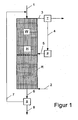
- FIG. 1 schematically illustrated embodiment.
- FIG. 1 shows a variant of the method according to the invention, in which methane and carbon dioxide are reacted in a continuous process to synthesis gas and a carbon product, for example, injection coal for a blast furnace.
- a carbonaceous granules which is, for example, coke breeze, introduced with ambient temperature from above into the reaction chamber R, through which it is subsequently guided under the action of gravity in a moving bed W down.
- a methane-containing gas 2 which is, for example, a mixture of natural gas and carbon dioxide, is simultaneously passed from below into the reaction space R and passed in countercurrent through the moving bed W upwards.
- the gas 2, which has ambient temperature at its entry into the reaction space R, is heated on its way up in direct heat exchange with the moving bed W.
- the high temperature zone H in which temperatures of more than 1000 ° C prevail, react primarily methane and carbon dioxide to hydrogen and carbon monoxide, whereby a synthesis gas is formed.
- granules 6 are withdrawn, which can be used, for example, as Kokereizutschsstoff or Aufkohlungsstoff of cast iron in foundries due to the deposits with high carbon content and low ash and sulfur content.
- Components of the granules 6, which do not meet the quality requirements, because they have too large or too small a diameter or, for example, too low density are separated in the separator S by screening and / or sighting and after a possible crushing via line 7 back in the reaction space R returned.
- the remainder of the remainder 8 is blast furnace coke, which is delivered as a high quality product.
Landscapes
- Chemical & Material Sciences (AREA)
- Organic Chemistry (AREA)
- Chemical Kinetics & Catalysis (AREA)
- Inorganic Chemistry (AREA)
- Engineering & Computer Science (AREA)
- Combustion & Propulsion (AREA)
- Health & Medical Sciences (AREA)
- General Health & Medical Sciences (AREA)
- Oil, Petroleum & Natural Gas (AREA)
- Industrial Gases (AREA)
- Hydrogen, Water And Hydrids (AREA)
- Carbon And Carbon Compounds (AREA)
- Organic Low-Molecular-Weight Compounds And Preparation Thereof (AREA)
- Low-Molecular Organic Synthesis Reactions Using Catalysts (AREA)
Description
- Die Erfindung betrifft ein Verfahren zur Erzeugung von Synthesegas, wobei Methan und Kohlendioxid in einen Reaktionsraum eingeleitet und in Gegenwart eines Feststoffes zu Wasserstoff und Kohlenmonoxid umgesetzt werden.
- Unter Synthesegas ist ein aus Wasserstoff und Kohlenmonoxid bestehendes Stoffgemisch zu verstehen, das in einer Vielzahl von industriellen Prozessen als Basischemikalie eingesetzt werden kann. Synthesegas bietet die ideale Schnittstelle zu vorhandenen petrochemischen Verfahren für die Produktion von z.B. Methanol, Dimethylether oder Fischer-Tropsch Produkten.
- Derartige Verfahren sind beispielsweise aus den Patentanmeldungen
US2009203519 undUS2011089378 bekannt. Beide Anmeldungen beschreiben Verfahren, bei denen Methan und Kohlendioxid über einen Katalysator geleitet und dabei durch Trockenreformierung umgesetzt werden. Aufgrund des Boudouard-Gleichgewichts sowie der thermischen Zersetzung von Methan entsteht Kohlenstoff, der sich unter anderem auf dem Katalysator absetzt und diesen vergiftet. - Um dieser Problematik zu begegnen, schlägt
US2009203519 den Einsatz eines eisenhaltigen Abscheide-Katalysators vor, auf dem sich gebildeter Kohlenstoff ablagert. Die Aufnahmefähigkeit des Abscheide-Katalysators ist allerdings begrenzt, so dass in periodischen Abständen eine Katalysatorregeneration, beispielsweise mit Hilfe eines Fluids, durchgeführt werden muss.US2009203519 offenbart keine technische Lösung bezüglich der Wärmezufuhr für die stark endotherme Reformierungsreaktion. -
US20110089378 beschreibt die Präparation von Katalysatoren wie beispielsweise BaCO3-Ba2TiO4 (1:1)/NiO (catalystA), Sr2TiO4/NiO (catalyst B), BaCO3-BaAl2O4 (2:1)/NiO sowie deren Anwendung bei der Trockenreformierung von Methan. Der über mindestens 8 Stunden verkokungsresistente Katalysator ist prinzipiell für die Realisierung einer kontinuierlichen Fahrweise geeignet. Diese Lösung ist allerdings mit dem Nachteil hoher Katalysatorkosten verbunden. - Aufgrund der beschriebenen Nachteile konnte bislang auf Basis des aufgeführten Stands der Technik keine großtechnische Produktion von Synthesegas durch die Umsetzung von Methan mit Kohlendioxid entwickelt werden.
- Aufgabe der vorliegenden Erfindung ist es, ein Verfahren zur Synthesegasherstellung aufzuzeigen, das die Edukte Methan und Kohlendioxid verwendet. Ferner ist Aufgabe der Erfindung, einen gasförmigen Produktstrom zu erhalten; der im Wesentlichen frei von Feststoffpartikeln ist. Des Weiteren ist Aufgabe der Erfindung, eine kontinuierliche Fahrweise zur Synthesegasherstellung aufzuzeigen, bei der keine Katalysatorregeneration erforderlich ist.
- Diese Aufgabe wird erfindungsgemäß dadurch gelöst, dass Methan und Kohlendioxid in Gegenwart eines kohlenstoffhaltigen Feststoffs umgesetzt werden, gemäß Anspruch 1.
- Bevorzugt erfolgt die Umsetzung der Edukte Methan und Kohlendioxid bei Temperaturen zwischen 800 bis 1600°C und besonders bevorzugt zwischen 900 und 1400°C.
- Erfindungsgemäß wird als kohlenstoffhaltiger Feststoff vorteilhaft ein kohlenstoffhaltiges Granulat eingesetzt.
- Unter einem kohlenstoffhaltigen Granulat ist in der vorliegenden Erfindung ein Material zu verstehen, das vorteilhaft aus festen Körnern besteht, die mindestens 50 Gew.-%, bevorzugt mindestens 80 Gew.-%, insbesondere mindestens 90 Gew.-% Kohlenstoff aufweisen. Das kohlenstoffhaltige Granulat besitzt vorteilhaft eine Körnung, d.h. einen Äquivalenzdurchmesser, der durch Siebung mit einer bestimmten Maschengröße bestimmbar ist, von 0,5 bis 100 mm, bevorzugt von 1 bis 80 mm. Das kohlenstoffhaltige Granulat ist vorteilhaft kugelförmig. In dem erfindungsgemäßen Verfahren kann eine Vielzahl von unterschiedlichen kohlenstoffhaltigen Granulaten eingesetzt werden. Ein derartiges Granulat kann beispielsweise aus Kohle, Koks, Koksgrus und/oder Mischungen hieraus bestehen. Koksgrus weist in der Regel eine Körnung von kleiner 20 mm auf. Ferner kann das kohlenstoffhaltige Granulat 0 bis 15 Gew.-% bezogen auf die Gesamtmasse des Granulats, bevorzugt 0 bis 5 Gew.-%, Metall, Metalloxid und/oder Keramik enthalten. Mit besonderem Vorzug werden Granulate eingesetzt, die Koksgrus und/oder geringwertigen, d.h. nicht direkt für den Verhüttungsprozess geeigneten Koks, Kokereikoks auf Braun- oder Steinkohlebasis und/oder aus Biomasse gewonnenen Koks umfassen.
- Vorteilhaft wird die 1- bis 3-fache Masse an kohlenstoffhaltigem Feststoff im Vergleich zur Masse des produzierten Synthesegases eingesetzt, bevorzugt die 1,8- bis 2,5-fache Masse.
- Der durch die erfindungsgemäße Reaktion gebildete Kohlenstoff lagert sich vorteilhaft zu mindestens 90 Gew.-% bezogen auf die gesamte Masse des gebildeten Kohlenstoffs und bevorzugt zu mindestens 95 Gew.-% an den kohlenstoffhaltigen Feststoff, insbesondere an das kohlenstoffhaltige Granulat an.
- Vorteilhaft weist der gasförmige Produktstrom einen Feststoffgehalt von weniger als 10 mg Feststoff/g Gas, bevorzugt von weniger als 5 mg Feststoff/g Gas, insbesondere von weniger als 1 mg Feststoff/g Gas auf.
- Bei der Durchführung des erfindungsgemäßen Verfahrens stellt entstehender Kohlenstoff kein Problem dar, da er sich vorwiegend auf dem kohlenstoffhaltigen Feststoff ablagert und lediglich dessen Größe, Struktur und Festigkeit ändert. Insbesondere kohlenstoffhaltiges Granulat filtert Kohlenstoff aus der Gasphase heraus, so dass das erzeugte Synthesegas weitgehend frei von Kohlenstoffpartikeln aus dem Reaktionsraum abgezogen werden kann. Eine Ausgestaltung des erfindungsgemäßen Verfahrens macht sich den Mechanismus der Kohlenstoffabscheidung zunutze, indem die gasförmigen Einsatzstoffe mit einem atomaren Kohlenstoff/Sauerstoff-Verhältnis C/O > 1 in den Reaktionsraum eingebracht werden, so dass neben Synthesegas gezielt Kohlenstoff erzeugt und auf dem kohlenstoffhaltigen Feststoff abgeschieden wird. Andererseits kann Kohlenstoff von dem Feststoff abgetragen werden, wenn ein Kohlenstoff/ Sauerstoff-Verhältnis C/O < 1 eingestellt wird. Auf diese Weise ist es beispielsweise möglich, aus einem minderwertigen Granulat durch gezielte Einstellung der Dichte im Bereich von 0,7 bis 1,4 g/cm3, bevorzugt von 0,8 bis 1,4 g/cm3 ein hochwertiges Koks-Produkt zu erzeugen, das aus dem Reaktionsraum abgezogen und beispielsweise im Hochofen eingesetzt werden kann.
- Eine bevorzugte Ausgestaltung sieht vor, dass für die Durchführung des erfindungsgemäßen Verfahrens erforderliche thermische Energie durch Oxidation oder partielle Oxidation eines Brennstoffs erzeugt wird, der Kohlenwasserstoffe und/oder Wasserstoff umfasst. Als Oxidationsmittel werden vorzugsweise Luft und/oder mit Sauerstoff angereicherte Luft und/oder technisch reiner Sauerstoff verwendet. Oxidation oder partielle Oxidation können außerhalb des Reaktionsraums durchgeführt werden, wozu der Brennstoff mit einem Oxidationsmittel gemischt und zur Reaktion gebracht wird. Das entstehende heiße Gas wird nachfolgend in den Reaktionsraum eingeleitet und über den kohlenstoffhaltigen Feststoff geführt, wobei es einen Teil seiner fühlbaren Wärme an den kohlenstoffhaltigen Feststoff und/oder die umzusetzenden Gase abgibt. Das Oxidationsmittel kann jedoch auch in den Reaktionsraum eingeleitet und dort mit einem vorliegenden Brennstoff vermischt und zur Reaktion gebracht werden. Umfasst der kohlenstoffhaltige Feststoff geringwertigen Kokereikoks auf Braunkohle-, Steinkohle- oder Biomassebasis, aus dem bei erhöhter Temperatur Pyrolysegase austreten können, so ist zur Energiegewinnung vorgesehen, im Anschluss an die Pyrolysezone Sauerstoff einzuspeisen und die Pyrolysegase zumindest partiell zu oxidieren.
- In einer anderen Ausgestaltung wird ein heißes Gas mit Hilfe einer außerhalb des Reaktionsraums angeordneten elektrischen Heizeinrichtung erzeugt, durch die ein Gasstrom geführt und dabei mit Hilfe eines Lichtbogens erhitzt wird, bevor er mit einer Temperatur zwischen 3000 K und 10000 K, bevorzugt zwischen 4000 K und 10000 K in die Hochtemperaturzone eingeleitet wird und dort seine Wärme an den oder die Reaktanden abgibt. Der Gasstrom kann beispielsweise aus bei der Kohlenwasserstoffzersetzung gewonnenem Wasserstoff bestehen, der aus dem Reaktionsraum abgezogen und nach eventueller Reinigung (z. B. Entstaubung) der elektrischen Heizeinrichtung zugeleitet und zumindest teilweise ionisiert wird.
- Eine weitere bevorzugte Ausgestaltung des erfindungsgemäßen Verfahrens sieht vor, dass thermische Energie im Reaktionsraum durch elektromagnetische Induktion erzeugt wird. Im Reaktionsraum sind hierzu ein oder mehrere elektrisch leitfähige Elemente so angeordnet, dass sie mit den umzusetzenden Gasen und/oder dem kohlenstoffhaltigen Feststoff in thermische Verbindung treten können. Über ein elektromagnetisches Wechselfeld werden Wirbelströme in den elektrisch leitfähigen Elementen erzeugt, die sich dadurch aufheizen. Die auf diese Weise erzeugte Wärme überträgt sich direkt oder indirekt auf die umzusetzenden Gase und deckt somit wenigstens teilweise den für die Synthesegasbildung erforderlichen Energiebedarf. Das oder die elektrisch leitfähigen Elemente werden fest im Reaktionsraum angeordnet und/oder in granularer Form im kohlenstoffhaltigen Feststoff, insbesondere in einem kohlenstoffhaltigen Granulat, verteilt, so dass sie gemeinsam mit diesem in den Reaktionsraum eingebracht und aus dem Reaktionsraum entfernt werden. Alternativ kann die Impedanz des kohlenstoffhaltigen Feststoffs zur direkten induktiven Beheizung genutzt werden.
- Vorstellbar ist es auch, thermische Energie im Reaktionsraum über einen elektrischen Strom zu erzeugen, der durch den kohlenstoffhaltigen Feststoff geleitet wird und diesen erhitzt.
- Die bereitzustellende Energie des erfindungsgemäßen Verfahrens beträgt pro Mol umgesetztes Methan nicht mehr als 150 kJ, vorteilhaft nicht mehr als 120 kJ, bevorzugt nicht mehr als 100 kJ.
- Die erfindungsgemäße thermische Zersetzungsreaktion von Kohlenwasserstoffen wird vorteilhaft bei einem Druck, der zwischen Atmosphärendruck und 50 bar, bevorzugt zwischen 10 und 50 bar liegt, durchgeführt.
- Die Verweilzeit in der Reaktionszone bei der erfindungsgemäßen Zersetzungsreaktion beträgt vorteilhaft 0,5 Sekunden bis 25 Minuten, bevorzugt 1 bis 60 Sekunden, insbesondere 1 bis 30 Sekunden.
- Der kohlenstoffhaltige Feststoff, insbesondere das kohlenstoffhaltige Granulat, wird als Wanderbett durch den Reaktionsraum geführt, wobei Methan und Kohlendioxid zweckmäßigerweise im Gegenstrom zu dem Feststoff geleitet werden. Der Reaktionsraum ist hierfür sinnvollerweise als senkrechter Schacht ausgeführt, so dass die Bewegung des Wanderbetts alleine unter Wirkung der Schwerkraft zustande kommt. Das Wanderbett ist vorteilhaft homogen und gleichmäßig durchströmbar. Das Wanderbett erlaubt eine kontinuierliche oder quasi-kontinuierliche Betriebsweise.
- Eine besonders bevorzugte Variante des erfindungsgemäßen Verfahrens sieht vor, dass der kohlenstoffhaltige Feststoff mit Umgebungstemperatur in den Reaktionsraum eingeleitet, dort zunächst bis auf eine Maximaltemperatur aufgeheizt und anschließend wieder abgekühlt wird, wobei die Maximaltemperatur in einer Hochtemperaturzone liegt, in der Temperaturen im Bereich von 1000°C herrschen. Die Abkühlung kann bis maximal 500 K, bevorzugt bis 300 K noch mehr bevorzugt bis 50 K oberhalb der Umgebungstemperatur durchgeführt werden, so dass eine Kühlung bzw. Löschung des aus dem Reaktionsraum abgezogenen kohlenstoffhaltigen Feststoffs nicht erforderlich ist. Zur Ausbildung und Aufrechterhaltung des beschriebenen Temperaturprofils wird vorgeschlagen, ein Methan und Kohlendioxid enthaltendes Gasgemisch mit Umgebungstemperatur in den Reaktionsraum einzuleiten und im Gegenstrom durch das Wanderbett zu führen. Auf seinem Weg durch den Reaktionsraum tauscht das Gasgemisch in direktem Kontakt mit dem Wanderbett Wärme aus, wobei das Gasgemisch bis auf ca. 1000°C aufgeheizt und das Wanderbett gleichzeitig abgekühlt wird. In der Hochtemperaturzone gebildetes heißes Synthesegas wird weiter im Gegenstrom durch das Wanderbett geführt und in direktem Wärmetausch mit diesem abgekühlt, so dass Wasserstoff und Kohlenmonoxid mit einer Temperatur in der Nähe der Umgebungstemperatur aus dem Reaktionsraum abgezogen werden können. Durch die hohe energetische Integration können die aus dem Verzicht auf einen speziellen, hochaktiven Katalysator entstehenden Nachteile hinsichtlich des Gesamtenergiebedarfs ausgeglichen werden. Für die Synthesegaserzeugung erforderliche thermische Energie wird insbesondere in der Hochtemperaturzone erzeugt und/oder in die Hochtemperaturzone eingebracht. Die Erzeugung und/oder Einbringung von thermischer Energie an anderen Stellen des Reaktionsraumes soll jedoch nicht ausgeschlossen werden.
- Das in der Hochtemperaturzone gebildete Synthesegas ist möglichst rasch abzukühlen, wodurch die Boudouard-Reaktion und die Methanisierung effektiv unterdrückt werden können, bei denen einerseits aus Kohlenmonoxid, Kohlendioxid und Kohlenstoff und andererseits aus Wasserstoff und Kohlenstoff oder aus Wasserstoff und Kohlenmonoxid Methan gebildet werden. Unter Umständen reicht der Mengenstrom, mit dem das Wanderbett durch die Hochtemperaturzone geführt wird, hierzu nicht aus. In diesem Fall sieht die Erfindung einen aus kohlenstoffhaltigem Granulat gebildeten Kreislauf vor, durch den ein Teil des in der Hochtemperaturzone gebildeten Synthesegases im Gegenstrom geführt und dabei abgekühlt wird. Ebenenfalls möglich ist der Einsatz eines Wärmerohres, über das Wärme aus dem Synthesegas abgeführt wird. Sowohl die über den Granulatkreislauf als auch über das Wärmerohr abgeführte Wärme kann zur Vorwärmung von Einsatzstoffen genutzt werden.
- Die Körner, aus denen das aus dem Reaktionsraum abgezogene kohlenstoffhaltige Granulat besteht, streuen in ihrer Korngröße und in ihrer Dichte, so dass eine direkte Verwertung des Granulats, beispielsweise als Hochofenkoks, bei dem eine Korngröße zwischen 35 und 80 mm gefordert wird, nicht möglich ist. Erfindungsgemäß ist daher vorgesehen, das aus dem Reaktionsraum abgezogene kohlenstoffhaltige Granulat durch Siebung und/oder Sichtung zu klassieren. Körner, die innerhalb der geforderten Spezifikation liegen, werden als Produkt ausgetragen. Körner, deren Durchmesser zu klein oder deren Dichte zu niedrig für den beabsichtigten Einsatzzweck sind, werden vorzugsweise wieder in den gleichen oder einen parallel betriebenen Reaktionsraum zurückgeführt. Körner mit zu großen Durchmessern werden vor ihrer Rückführung gebrochen, und der Feinanteil wird zurückgeführt.
- Zur Erzeugung eines hochreinen Synthesegases kann es erforderlich sein, die in den Reaktionsraum einzuleitenden Stoffströme von Substanzen zu reinigen, die selbst im Synthesegas unerwünscht sind oder die im Reaktionsraum in unerwünschte Substanzen umgesetzt werden können. Zusätzlich oder alternativ können unerwünschte Substanzen auch aus den aus dem Reaktionsraum abgezogenen Gasen abgetrennt werden. Zu den unerwünschten Substanzen gehören beispielsweise Schwefelverbindungen, ein- oder mehrringige Aromaten, wie beispielsweise Benzol, Toluol, Xylol und/oder Naphthalin sowie andere Kohlenwasserstoffe, die u. a. in Erdgas enthalten sein können.
- Eine Ausgestaltung des erfindungsgemäßen Verfahrens sieht daher vor, dass ein im Verfahren auftretendes Gas zur Reinigung durch ein Koksbett geleitet und dabei von Substanzen befreit wird, die selbst im Synthesegas unerwünscht sind oder im Reaktionsraum in unerwünschte Substanzen umgesetzt werden können. Abhängig von seiner Qualität kann der bei der Gasreinigung mit unerwünschten Substanzen beladene Koks durch Verbrennung entsorgt oder einer Kokerei als Einsatz zugeführt werden.
- Das erfindungsgemäße Verfahren eignet sich insbesondere zur Umsetzung von Erdgas zu Synthesegas, wobei in Abhängigkeit von der Erdgaslagerstätte der Methananteil im Erdgas typischerweise zwischen 75 und 99 % der molaren Faktion liegt. Kohlendioxid und Erdgas können hierbei gemeinsam oder getrennt an mindestens einer Stelle in den Reaktionsraum eingeleitet werden. Jedoch ist auch die Umsetzung von Kuppelgasen wie Koksofengas und/oder Konvertergas und/oder Gasen aus Kupolöfen möglich, die sowohl Methan als auch Kohlendioxid enthalten. Insbesondere geeignet sind Gichtgase aus Kupolöfen, die mit technisch reinem Sauerstoff oder mit Luft betrieben werden, die mit Sauerstoff angereichert ist Wegen seines geringen Stickstoffgehalts weist das hierbei erhaltene Gichtgas höhere Anteile an Kohlenmonoxid und Kohlendioxid auf.
- Bei der Durchführung des erfindungsgemäßen Verfahrens kann im Gegensatz zum Stand der Technik ein Synthesegas ohne nennenswerte Feststoffbelastung hergestellt werden.
- Obwohl die erfindungsgemäßen Temperaturbereiche oberhalb der im Stand der Technik genannten Bereiche liegen, stellt dies keinen wirtschaftlichen Nachteil dar, da die hier beschriebene erfindungsgemäße Verfahrensvariante einen zuvor nicht erreichten Grad der Wärmerückgewinnung beinhaltet.
- Im Folgenden soll die Erfindung anhand eines in der
Figur 1 schematisch dargestellten Ausführungsbeispiels näher erläutert werden. - Die
Figur 1 zeigt eine Variante des erfindungsgemäßen Verfahrens, bei dem Methan und Kohlendioxid in einem kontinuierlichen Prozess zu Synthesegas und einem Kohlenstoffsprodukt, beispielsweise Einblaskohle für einen Hochofen, umgesetzt werden. - Über die Zuführung 1 wird ein kohlenstoffhaltiges Granulat, bei dem es sich beispielsweise um Koksgrus handelt, mit Umgebungstemperatur von oben in den Reaktionsraum R eingeleitet, durch den es nachfolgend unter Wirkung der Schwerkraft in einem Wanderbett W nach unten geführt wird. Ein Methan enthaltendes Gas 2, bei dem es sich beispielsweise um ein Gemisch aus Erdgas und Kohlendioxid handelt, wird gleichzeitig von unten in den Reaktionsraum R geleitet und im Gegenstrom durch das Wanderbett W nach oben geführt. Das Gas 2, das bei seinem Eintritt in den Reaktionsraum R Umgebungstemperatur aufweist, wird auf seinem Weg nach oben in direktem Wärmetausch mit dem Wanderbett W aufgeheizt. In der Hochtemperaturzone H, in der Temperaturen von mehr als 1000°C herrschen, reagieren in erster Linie Methan und Kohlendioxid zu Wasserstoff und Kohlenmonoxid, wodurch ein Synthesegas gebildet wird. Durch thermische Zersetzung von Methan und die Boudouard-Reaktion wird jedoch auch Kohlenstoff gebildet, der sich zu mehr als 95 % an die kohlenstoffhaltigen Körner des Wanderbetts W anlagert. Das gebildete heiße Synthesegas strömt weiter nach oben, wobei es in direktem Wärmetausch mit dem Wanderbett W abgekühlt wird, so dass über Leitung 3 Synthesegas mit einer Temperatur abgezogen werden kann, die oberhalb der Umgebungstemperatur, aber mindestens 500 K unter der Reaktionstemperatur liegt. In der Trenneinrichtung T wird Wasserstoff 4 aus dem Synthesegas abgetrennt, der nachfolgend in der elektrischen Heizeinrichtung P mit Hilfe eines Lichtbogens in ein heißes Gas 5 umgesetzt wird. Mit einer Temperatur zwischen 3000 und 10000 K wird das heiße Gas 5 in die Hochtemperaturzone H eingeleitet und stellt dort die für die Synthesegaserzeugung benötigte Energie bereit. Am unteren Ende des Reaktionsraums R wird Granulat 6 abgezogen, das aufgrund der Anlagerungen mit hohem Kohlenstoffgehalt und geringen Asche- und Schwefelgehalt beispielsweise als Kokereizuschlagsstoff oder Aufkohlungsmittel von legiertem Gusseisen in Gießereien eingesetzt werden kann. Bestandteile des Granulats 6, die die Qualitätsanforderungen nicht erfüllen, weil sie einen zu großen oder zu kleinen Durchmesser oder beispielsweise eine zu niedrige Dichte aufweisen, werden in der Trenneinrichtung S durch Siebung und/oder Sichtung abgetrennt und nach einer eventuellen Zerkleinerung über Leitung 7 wieder in den Reaktionsraum R zurückgeführt. Bei dem verbleibenden Rest 8 handelt es sich um Hochofenkoks, der als hochwertiges Produkt abgegeben wird.
Claims (13)
- Verfahren zur Erzeugung von Synthesegas, wobei Methan und Kohlendioxid in einen Reaktionsraum eingeleitet und in einem kohlenstoffhaltigen Feststoffbett zu Wasserstoff und Kohlenmonoxid umgesetzt werden, dadurch gekennzeichnet, dass das kohlenstoffhaltige Feststoffbett als Wanderbett durch den Reaktionsraum geführt wird, wobei im Reaktionsraum gebildetes Synthesegas im Gegenstrom zu dem Wanderbett geleitet und dabei in direktem Wärmetausch mit dem kohlenstoffhaltigen Feststoff abgekühlt wird.
- Verfahren nach Anspruch 1, dadurch gekennzeichnet, däss Methan und Kohlendioxid bei Temperaturen zwischen 800 bis 1600°C und besonders bevorzugt zwischen 900 und 1400°C umgesetzt werden.
- Verfahren nach einem der Ansprüche 1 oder 2, dadurch gekennzeichnet, dass als kohlenstoffhaltiger Feststoff ein kohlenstoffhaltiges Granulat eingesetzt wird, das mindestens 80 Gew.-% Kohlenstoff und eine Körnung von 0,1 bis 100 mm aufweist.
- Verfahren nach einem der Ansprüche 1 bis 3, dadurch gekennzeichnet, dass das Sauerstoff/Kohlenstoff-Verhältnis der gasförmigen Einsatzstoffe gezielt so eingestellt wird, dass Kohlenstoff im Reaktionsraum gebildet oder von dem kohlenstoffhaltigen Feststoff abgetragen wird.
- Verfahren nach einem der Ansprüche 1 bis 4, dadurch gekennzeichnet, dass wenigstens ein Teil der für die Synthesegaserzeugung erforderlichen thermischen Energie im Reaktionsraum erzeugt und/oder über ein heißes Gas in den Reaktionsraum eingebracht wird.
- Verfahren nach einem der Ansprüche 1 bis 5, dadurch gekennzeichnet, dass der kohlenstoffhaltige Feststoff als Wanderbett kontinuierlich durch den Reaktionsraum geführt wird.
- Verfahren nach einem der Ansprüche 1 bis 6, dadurch gekennzeichnet, dass im Reaktionsraum gebildetes Synthesegas über einen aus kohlenstoffhaltigem Granulat gebildeten Kreislauf gekühlt wird.
- Verfahren nach einem der Ansprüche 1 bis 7, dadurch gekennzeichnet, dass im Reaktionsraum gebildetes Synthesegas über ein Wärmerohr abgekühlt wird.
- Verfahren nach einem der Ansprüche 1 bis 8, dadurch gekennzeichnet, dass als kohlenstoffhaltiger Feststoff ein Granulat aus geringwertigem Kokereikoks und/oder Koksgrus auf Basis von hochporöser Braun- oder Steinkohle und/oder aus Biomasse gewonnenem Koks eingesetzt wird.
- Verfahren nach einem der Ansprüche 3 bis 9, dadurch gekennzeichnet, dass ein Teil des aus dem Reaktionsraum abgezogenen kohlenstoffhaltigen Granulats wieder in den Reaktionsraum zurückgeführt wird.
- Verfahren nach einem der Ansprüche 1 bis 10, dadurch gekennzeichnet, dass Erdgas und/oder Koksofengas und/oder Konvertergas und/oder Gichtgas aus Kupol- oder Hochöfen an mindestens einer Stelle in den Reaktionsraum eingeleitet und zu Synthesegas umgesetzt werden.
- Verfahren nach einem der Ansprüche 1 bis 11, dadurch gekennzeichnet, dass ein im Verfahren auftretendes Gas zur Reinigung von unerwünschten Substanzen durch ein Koksbett geleitet wird.
- Verfahren nach einem der Ansprüche 1 bis 12, dadurch gekennzeichnet, dass das Verfahren kontinuierlich durchgeführt wird.
Priority Applications (1)
| Application Number | Priority Date | Filing Date | Title |
|---|---|---|---|
| PL12734811T PL2729405T3 (pl) | 2011-07-05 | 2012-07-05 | Sposób wytwarzania gazu do syntezy |
Applications Claiming Priority (2)
| Application Number | Priority Date | Filing Date | Title |
|---|---|---|---|
| DE102011106642A DE102011106642A1 (de) | 2011-07-05 | 2011-07-05 | Verfahren zur Synthesegaserzeugung |
| PCT/EP2012/002837 WO2013004391A1 (de) | 2011-07-05 | 2012-07-05 | Verfahren zur synthesegaserzeugung |
Publications (2)
| Publication Number | Publication Date |
|---|---|
| EP2729405A1 EP2729405A1 (de) | 2014-05-14 |
| EP2729405B1 true EP2729405B1 (de) | 2015-08-19 |
Family
ID=46507961
Family Applications (1)
| Application Number | Title | Priority Date | Filing Date |
|---|---|---|---|
| EP12734811.8A Active EP2729405B1 (de) | 2011-07-05 | 2012-07-05 | Verfahren zur synthesegaserzeugung |
Country Status (15)
| Country | Link |
|---|---|
| US (1) | US9266731B2 (de) |
| EP (1) | EP2729405B1 (de) |
| JP (1) | JP6133283B2 (de) |
| KR (1) | KR101909626B1 (de) |
| CN (1) | CN103796948B (de) |
| AU (1) | AU2012280624B2 (de) |
| BR (1) | BR112014000094A2 (de) |
| CA (1) | CA2839717C (de) |
| DE (1) | DE102011106642A1 (de) |
| ES (1) | ES2552528T3 (de) |
| PL (1) | PL2729405T3 (de) |
| RU (1) | RU2610082C2 (de) |
| UA (1) | UA110840C2 (de) |
| WO (1) | WO2013004391A1 (de) |
| ZA (1) | ZA201309699B (de) |
Cited By (3)
| Publication number | Priority date | Publication date | Assignee | Title |
|---|---|---|---|---|
| DE102016005188A1 (de) | 2016-04-29 | 2017-11-02 | CCP Technology GmbH | Verfahren und Vorrichtung zur Herstellung von Synthesegas |
| WO2017186482A1 (de) | 2016-04-28 | 2017-11-02 | CCP Technology GmbH | Verfahren und vorrichtung zur herstellung von synthesegas |
| DE102022125987A1 (de) | 2021-11-25 | 2023-05-25 | Dbi - Gastechnologisches Institut Ggmbh Freiberg | Verfahren und Vorrichtung zur Erzeugung von Wasserstoff aus kohlenwasserstoffhaltigen Gasgemischen |
Families Citing this family (15)
| Publication number | Priority date | Publication date | Assignee | Title |
|---|---|---|---|---|
| DE102013021418A1 (de) | 2012-12-18 | 2014-06-18 | Basf Se | Verfahren zum Speichern elektrischer Energie und zur kohlenstoffdioxidarmen Energiegewinnung |
| UA115346C2 (uk) * | 2012-12-18 | 2017-10-25 | Басф Се | Спосіб утилізації відхідних газів, супровідних газів і/або біогазів |
| PL2935098T3 (pl) | 2012-12-21 | 2018-08-31 | Basf Se | Równoległe wytwarzanie wodoru, tlenku węgla i produktu zawierającego węgiel |
| EP2987769B1 (de) | 2014-08-19 | 2020-02-05 | Basf Se | Verfahren zur Erzeugung von Synthesegas und elektrischer Energie |
| AR102047A1 (es) | 2014-08-19 | 2017-02-01 | Linde Ag | Proceso para producir gas de síntesis |
| DE102015015531A1 (de) * | 2015-12-01 | 2017-06-01 | Basf Se | Verfahren zur Erzeugung von Synthesegas |
| EP3722259A1 (de) * | 2017-11-08 | 2020-10-14 | Tigerstone Technologies Limited | Herstellung von aktivkohle |
| EP3814274B1 (de) | 2018-06-29 | 2022-05-04 | Shell Internationale Research Maatschappij B.V. | Elektrisch beheizter reaktor und verfahren zur gasumwandlung mit diesem reaktor |
| GB2568564B (en) | 2018-07-17 | 2020-01-01 | Omnagen Ltd | Carbon dioxide conversion using combined fuel cell and electrolysis cell |
| CN114867683A (zh) * | 2019-10-25 | 2022-08-05 | 巴斯夫欧洲公司 | 通过将烃热解与电化学氢分离耦合生产高纯度氢气的方法 |
| US12544728B2 (en) | 2019-12-23 | 2026-02-10 | Shell Usa, Inc. | Electrically heated reactor, a furnace comprising said reactor and a method for gas conversions using said reactor |
| CN114057161B (zh) * | 2021-12-07 | 2023-07-07 | 湖南大学 | 一种电磁感应加热甲醇水重整制氢装置及其制氢方法 |
| FI130529B (en) * | 2022-02-17 | 2023-11-02 | Dimodi Energy Oy | Method for conversion of carbon dioxide into a fuel gas |
| WO2025073661A1 (en) | 2023-10-06 | 2025-04-10 | Basf Se | Process for preparing methanol from pyrolytic hydrogen |
| EP4534479A1 (de) * | 2023-10-06 | 2025-04-09 | Basf Se | Verfahren zur herstellung von kohlenmonoxid über einem wanderbett |
Family Cites Families (19)
| Publication number | Priority date | Publication date | Assignee | Title |
|---|---|---|---|---|
| CH409890A (de) * | 1960-05-25 | 1966-03-31 | Exxon Research Engineering Co | Verfahren zur Umwandlung von Kohlenwasserstoffen |
| GB8426344D0 (en) | 1984-10-18 | 1984-11-21 | British Petroleum Co Plc | Conversion process |
| DE3680122D1 (de) * | 1985-02-13 | 1991-08-14 | Shell Int Research | Verfahren zur erzeugung eines wasserstoff enthaltenden gases aus kohlenwasserstoffen, wasserdampf und/ggf. kohlendioxid. |
| IL100520A (en) * | 1991-12-26 | 1995-12-31 | Yeda Res & Dev | Solar energy gasification of solid carbonaceous material in liquid dispersion |
| JPH08175804A (ja) * | 1994-12-26 | 1996-07-09 | Cosmo Sogo Kenkyusho:Kk | 水素及び一酸化炭素の製造方法 |
| US6284214B1 (en) * | 1998-06-09 | 2001-09-04 | Marathon Ashland Petroleum Llc | Low or no slag molten metal processing of coke containing vanadium and sulfur |
| US7658776B1 (en) * | 1999-08-25 | 2010-02-09 | Pearson Larry E | Biomass reactor for producing gas |
| US7033570B2 (en) * | 2000-05-08 | 2006-04-25 | Regents Of The University Of Colorado | Solar-thermal fluid-wall reaction processing |
| MXPA02011011A (es) * | 2000-05-08 | 2004-08-19 | Midwest Research Inst | Proceso para la reaccon de flujo en aerosol termico solar. |
| JP2002003865A (ja) | 2000-06-23 | 2002-01-09 | Sanyo Electric Co Ltd | 一酸化炭素除去器 |
| JP2004010376A (ja) * | 2002-06-04 | 2004-01-15 | Nissan Motor Co Ltd | Co除去装置および燃料電池システム |
| JP4203326B2 (ja) * | 2003-01-09 | 2008-12-24 | 千代田化工建設株式会社 | 合成ガス製造の運転方法 |
| US20070253886A1 (en) | 2004-04-06 | 2007-11-01 | Universite De Sherbrooke | Carbon sequestration and dry reforming process and catalysts to produce same |
| KR101512672B1 (ko) * | 2006-12-08 | 2015-04-16 | 쉘 인터내셔날 리써취 마트샤피지 비.브이. | 정제된 합성가스 스트림의 제조 공정 |
| RU2361809C2 (ru) * | 2007-09-25 | 2009-07-20 | Борис Тихонович Плаченов | Способ получения синтез-газа и устройство для его осуществления |
| US20090133407A1 (en) * | 2007-11-28 | 2009-05-28 | Nrg Energy, Inc. | Plasma gasification system |
| EP2301889B1 (de) | 2008-07-04 | 2014-04-09 | Murata Manufacturing Co. Ltd. | Verfahren zum reformieren von kohlendioxid |
| JP2011057869A (ja) * | 2009-09-10 | 2011-03-24 | Babcock Hitachi Kk | 改質炉 |
| JP5581658B2 (ja) * | 2009-11-11 | 2014-09-03 | Jfeスチール株式会社 | 排ガス顕熱の回収方法および排ガスの冷却方法 |
-
2011
- 2011-07-05 DE DE102011106642A patent/DE102011106642A1/de not_active Withdrawn
-
2012
- 2012-07-05 US US14/130,942 patent/US9266731B2/en active Active
- 2012-07-05 UA UAA201401061A patent/UA110840C2/uk unknown
- 2012-07-05 ES ES12734811.8T patent/ES2552528T3/es active Active
- 2012-07-05 KR KR1020147003076A patent/KR101909626B1/ko active Active
- 2012-07-05 BR BR112014000094A patent/BR112014000094A2/pt not_active IP Right Cessation
- 2012-07-05 AU AU2012280624A patent/AU2012280624B2/en active Active
- 2012-07-05 PL PL12734811T patent/PL2729405T3/pl unknown
- 2012-07-05 RU RU2014103786A patent/RU2610082C2/ru active
- 2012-07-05 JP JP2014517518A patent/JP6133283B2/ja not_active Expired - Fee Related
- 2012-07-05 EP EP12734811.8A patent/EP2729405B1/de active Active
- 2012-07-05 CA CA2839717A patent/CA2839717C/en active Active
- 2012-07-05 CN CN201280033368.7A patent/CN103796948B/zh active Active
- 2012-07-05 WO PCT/EP2012/002837 patent/WO2013004391A1/de not_active Ceased
-
2013
- 2013-12-20 ZA ZA2013/09699A patent/ZA201309699B/en unknown
Cited By (3)
| Publication number | Priority date | Publication date | Assignee | Title |
|---|---|---|---|---|
| WO2017186482A1 (de) | 2016-04-28 | 2017-11-02 | CCP Technology GmbH | Verfahren und vorrichtung zur herstellung von synthesegas |
| DE102016005188A1 (de) | 2016-04-29 | 2017-11-02 | CCP Technology GmbH | Verfahren und Vorrichtung zur Herstellung von Synthesegas |
| DE102022125987A1 (de) | 2021-11-25 | 2023-05-25 | Dbi - Gastechnologisches Institut Ggmbh Freiberg | Verfahren und Vorrichtung zur Erzeugung von Wasserstoff aus kohlenwasserstoffhaltigen Gasgemischen |
Also Published As
| Publication number | Publication date |
|---|---|
| JP6133283B2 (ja) | 2017-05-24 |
| KR101909626B1 (ko) | 2018-10-18 |
| ES2552528T3 (es) | 2015-11-30 |
| BR112014000094A2 (pt) | 2017-02-14 |
| CA2839717A1 (en) | 2013-01-10 |
| CN103796948B (zh) | 2017-03-01 |
| RU2014103786A (ru) | 2015-08-10 |
| DE102011106642A1 (de) | 2013-01-10 |
| WO2013004391A1 (de) | 2013-01-10 |
| ZA201309699B (en) | 2015-05-27 |
| JP2014520739A (ja) | 2014-08-25 |
| AU2012280624B2 (en) | 2015-10-08 |
| UA110840C2 (uk) | 2016-02-25 |
| EP2729405A1 (de) | 2014-05-14 |
| US20140217327A1 (en) | 2014-08-07 |
| US9266731B2 (en) | 2016-02-23 |
| KR20140078603A (ko) | 2014-06-25 |
| CN103796948A (zh) | 2014-05-14 |
| RU2610082C2 (ru) | 2017-02-07 |
| AU2012280624A1 (en) | 2014-02-20 |
| CA2839717C (en) | 2022-03-29 |
| PL2729405T3 (pl) | 2016-01-29 |
Similar Documents
| Publication | Publication Date | Title |
|---|---|---|
| WO2013004391A1 (de) | Verfahren zur synthesegaserzeugung | |
| EP2729404B1 (de) | Verfahren zur parallelen herstellung von wasserstoff und kohlenstoffhaltigen produkten | |
| EP2935517B1 (de) | Verfahren zur verwertung von kuppelgasen, begleitgasen und/oder biogasen | |
| EP1623957B1 (de) | Verfahren und Vorrichtung zur Herstellung von Wasserstoff | |
| EP3008218B1 (de) | Hochofen und verfahren zum betrieb eines hochofens | |
| EP2935098B1 (de) | Parallele herstellung von wasserstoff, kohlenstoffmonoxid und einem kohlenstoffhaltigen produkt | |
| EP2987769B1 (de) | Verfahren zur Erzeugung von Synthesegas und elektrischer Energie | |
| EP3212566B1 (de) | Verfahren und anlage zur herstellung von synthesegas | |
| EP3383976A1 (de) | Verfahren zur erzeugung von synthesegas | |
| EP3194333A1 (de) | Verfahren zur erzeugung von synthesegas | |
| DE102013226126A1 (de) | Allotherme Methan-Reformierung mit physikalischer Energierückgewinnung | |
| EP2714942B1 (de) | Reduktion von metalloxiden unter verwendung eines sowohl kohlenwasserstoff als auch wasserstoff enthaltenden gasstromes | |
| Cui et al. | Enhancement of perovskites performance for coal tar decomposition by pore structure and acid-base modification | |
| DE102015015968A1 (de) | Verfahren zur Erzeugung von Synthesegas | |
| WO2020127838A2 (de) | Verfahren und vorrichtung zur herstellung von wasserstoff, kohlenmonoxid und einem kohlenstoffhaltigen produkt | |
| WO2024023586A1 (de) | Verfahren zur gewinnung von methan aus heissem prozessgas unter umsetzung von kohlenstoffhaltigen altstoffen | |
| AT206101B (de) | Verfahren zur thermischen oder thermisch/katalytischen Umwandlung organische Schwefelverbindungen enthaltender, flüssiger oder gasförmiger Kohlenwasserstoffe | |
| EP2875102A1 (de) | Gegenstrom-/gleichstrom-vergasung von kohlenstoffreichen substanzen | |
| EP0020957A1 (de) | Verfahren zur Herstellung von Calciumcarbid | |
| DE102009053374A1 (de) | Verfahren zur Verwendung von Kohlendioxid | |
| WO2017186482A1 (de) | Verfahren und vorrichtung zur herstellung von synthesegas | |
| DE102016005188A1 (de) | Verfahren und Vorrichtung zur Herstellung von Synthesegas |
Legal Events
| Date | Code | Title | Description |
|---|---|---|---|
| PUAI | Public reference made under article 153(3) epc to a published international application that has entered the european phase |
Free format text: ORIGINAL CODE: 0009012 |
|
| 17P | Request for examination filed |
Effective date: 20131217 |
|
| AK | Designated contracting states |
Kind code of ref document: A1 Designated state(s): AL AT BE BG CH CY CZ DE DK EE ES FI FR GB GR HR HU IE IS IT LI LT LU LV MC MK MT NL NO PL PT RO RS SE SI SK SM TR |
|
| DAX | Request for extension of the european patent (deleted) | ||
| REG | Reference to a national code |
Ref country code: DE Ref legal event code: R079 Ref document number: 502012004239 Country of ref document: DE Free format text: PREVIOUS MAIN CLASS: C01B0003340000 Ipc: C01B0031180000 |
|
| RIC1 | Information provided on ipc code assigned before grant |
Ipc: C01B 31/18 20060101AFI20150212BHEP Ipc: C01B 3/34 20060101ALI20150212BHEP Ipc: C01B 31/02 20060101ALI20150212BHEP |
|
| GRAP | Despatch of communication of intention to grant a patent |
Free format text: ORIGINAL CODE: EPIDOSNIGR1 |
|
| INTG | Intention to grant announced |
Effective date: 20150320 |
|
| GRAP | Despatch of communication of intention to grant a patent |
Free format text: ORIGINAL CODE: EPIDOSNIGR1 |
|
| GRAS | Grant fee paid |
Free format text: ORIGINAL CODE: EPIDOSNIGR3 |
|
| INTG | Intention to grant announced |
Effective date: 20150528 |
|
| GRAA | (expected) grant |
Free format text: ORIGINAL CODE: 0009210 |
|
| AK | Designated contracting states |
Kind code of ref document: B1 Designated state(s): AL AT BE BG CH CY CZ DE DK EE ES FI FR GB GR HR HU IE IS IT LI LT LU LV MC MK MT NL NO PL PT RO RS SE SI SK SM TR |
|
| REG | Reference to a national code |
Ref country code: GB Ref legal event code: FG4D Free format text: NOT ENGLISH |
|
| REG | Reference to a national code |
Ref country code: CH Ref legal event code: EP |
|
| REG | Reference to a national code |
Ref country code: IE Ref legal event code: FG4D Free format text: LANGUAGE OF EP DOCUMENT: GERMAN |
|
| REG | Reference to a national code |
Ref country code: AT Ref legal event code: REF Ref document number: 743648 Country of ref document: AT Kind code of ref document: T Effective date: 20150915 |
|
| REG | Reference to a national code |
Ref country code: DE Ref legal event code: R096 Ref document number: 502012004239 Country of ref document: DE |
|
| REG | Reference to a national code |
Ref country code: ES Ref legal event code: FG2A Ref document number: 2552528 Country of ref document: ES Kind code of ref document: T3 Effective date: 20151130 |
|
| REG | Reference to a national code |
Ref country code: NO Ref legal event code: T2 Effective date: 20150819 |
|
| REG | Reference to a national code |
Ref country code: NL Ref legal event code: FP |
|
| REG | Reference to a national code |
Ref country code: LT Ref legal event code: MG4D |
|
| PG25 | Lapsed in a contracting state [announced via postgrant information from national office to epo] |
Ref country code: LT Free format text: LAPSE BECAUSE OF FAILURE TO SUBMIT A TRANSLATION OF THE DESCRIPTION OR TO PAY THE FEE WITHIN THE PRESCRIBED TIME-LIMIT Effective date: 20150819 Ref country code: LV Free format text: LAPSE BECAUSE OF FAILURE TO SUBMIT A TRANSLATION OF THE DESCRIPTION OR TO PAY THE FEE WITHIN THE PRESCRIBED TIME-LIMIT Effective date: 20150819 Ref country code: GR Free format text: LAPSE BECAUSE OF FAILURE TO SUBMIT A TRANSLATION OF THE DESCRIPTION OR TO PAY THE FEE WITHIN THE PRESCRIBED TIME-LIMIT Effective date: 20151120 Ref country code: FI Free format text: LAPSE BECAUSE OF FAILURE TO SUBMIT A TRANSLATION OF THE DESCRIPTION OR TO PAY THE FEE WITHIN THE PRESCRIBED TIME-LIMIT Effective date: 20150819 |
|
| PG25 | Lapsed in a contracting state [announced via postgrant information from national office to epo] |
Ref country code: SE Free format text: LAPSE BECAUSE OF FAILURE TO SUBMIT A TRANSLATION OF THE DESCRIPTION OR TO PAY THE FEE WITHIN THE PRESCRIBED TIME-LIMIT Effective date: 20150819 Ref country code: RS Free format text: LAPSE BECAUSE OF FAILURE TO SUBMIT A TRANSLATION OF THE DESCRIPTION OR TO PAY THE FEE WITHIN THE PRESCRIBED TIME-LIMIT Effective date: 20150819 Ref country code: PT Free format text: LAPSE BECAUSE OF FAILURE TO SUBMIT A TRANSLATION OF THE DESCRIPTION OR TO PAY THE FEE WITHIN THE PRESCRIBED TIME-LIMIT Effective date: 20151221 Ref country code: IS Free format text: LAPSE BECAUSE OF FAILURE TO SUBMIT A TRANSLATION OF THE DESCRIPTION OR TO PAY THE FEE WITHIN THE PRESCRIBED TIME-LIMIT Effective date: 20151219 |
|
| PG25 | Lapsed in a contracting state [announced via postgrant information from national office to epo] |
Ref country code: SK Free format text: LAPSE BECAUSE OF FAILURE TO SUBMIT A TRANSLATION OF THE DESCRIPTION OR TO PAY THE FEE WITHIN THE PRESCRIBED TIME-LIMIT Effective date: 20150819 Ref country code: DK Free format text: LAPSE BECAUSE OF FAILURE TO SUBMIT A TRANSLATION OF THE DESCRIPTION OR TO PAY THE FEE WITHIN THE PRESCRIBED TIME-LIMIT Effective date: 20150819 Ref country code: CZ Free format text: LAPSE BECAUSE OF FAILURE TO SUBMIT A TRANSLATION OF THE DESCRIPTION OR TO PAY THE FEE WITHIN THE PRESCRIBED TIME-LIMIT Effective date: 20150819 Ref country code: EE Free format text: LAPSE BECAUSE OF FAILURE TO SUBMIT A TRANSLATION OF THE DESCRIPTION OR TO PAY THE FEE WITHIN THE PRESCRIBED TIME-LIMIT Effective date: 20150819 |
|
| REG | Reference to a national code |
Ref country code: DE Ref legal event code: R097 Ref document number: 502012004239 Country of ref document: DE |
|
| PG25 | Lapsed in a contracting state [announced via postgrant information from national office to epo] |
Ref country code: RO Free format text: LAPSE BECAUSE OF FAILURE TO SUBMIT A TRANSLATION OF THE DESCRIPTION OR TO PAY THE FEE WITHIN THE PRESCRIBED TIME-LIMIT Effective date: 20150819 |
|
| REG | Reference to a national code |
Ref country code: FR Ref legal event code: PLFP Year of fee payment: 5 |
|
| PLBE | No opposition filed within time limit |
Free format text: ORIGINAL CODE: 0009261 |
|
| STAA | Information on the status of an ep patent application or granted ep patent |
Free format text: STATUS: NO OPPOSITION FILED WITHIN TIME LIMIT |
|
| 26N | No opposition filed |
Effective date: 20160520 |
|
| PG25 | Lapsed in a contracting state [announced via postgrant information from national office to epo] |
Ref country code: SI Free format text: LAPSE BECAUSE OF FAILURE TO SUBMIT A TRANSLATION OF THE DESCRIPTION OR TO PAY THE FEE WITHIN THE PRESCRIBED TIME-LIMIT Effective date: 20150819 |
|
| REG | Reference to a national code |
Ref country code: DE Ref legal event code: R079 Ref document number: 502012004239 Country of ref document: DE Free format text: PREVIOUS MAIN CLASS: C01B0031180000 Ipc: C01B0032400000 |
|
| REG | Reference to a national code |
Ref country code: CH Ref legal event code: PL |
|
| PG25 | Lapsed in a contracting state [announced via postgrant information from national office to epo] |
Ref country code: MC Free format text: LAPSE BECAUSE OF FAILURE TO SUBMIT A TRANSLATION OF THE DESCRIPTION OR TO PAY THE FEE WITHIN THE PRESCRIBED TIME-LIMIT Effective date: 20150819 |
|
| PG25 | Lapsed in a contracting state [announced via postgrant information from national office to epo] |
Ref country code: CH Free format text: LAPSE BECAUSE OF NON-PAYMENT OF DUE FEES Effective date: 20160731 Ref country code: LI Free format text: LAPSE BECAUSE OF NON-PAYMENT OF DUE FEES Effective date: 20160731 |
|
| REG | Reference to a national code |
Ref country code: IE Ref legal event code: MM4A |
|
| REG | Reference to a national code |
Ref country code: FR Ref legal event code: PLFP Year of fee payment: 6 |
|
| PG25 | Lapsed in a contracting state [announced via postgrant information from national office to epo] |
Ref country code: IE Free format text: LAPSE BECAUSE OF NON-PAYMENT OF DUE FEES Effective date: 20160705 |
|
| PG25 | Lapsed in a contracting state [announced via postgrant information from national office to epo] |
Ref country code: LU Free format text: LAPSE BECAUSE OF NON-PAYMENT OF DUE FEES Effective date: 20160705 |
|
| PG25 | Lapsed in a contracting state [announced via postgrant information from national office to epo] |
Ref country code: CY Free format text: LAPSE BECAUSE OF FAILURE TO SUBMIT A TRANSLATION OF THE DESCRIPTION OR TO PAY THE FEE WITHIN THE PRESCRIBED TIME-LIMIT Effective date: 20150819 Ref country code: SM Free format text: LAPSE BECAUSE OF FAILURE TO SUBMIT A TRANSLATION OF THE DESCRIPTION OR TO PAY THE FEE WITHIN THE PRESCRIBED TIME-LIMIT Effective date: 20150819 Ref country code: HU Free format text: LAPSE BECAUSE OF FAILURE TO SUBMIT A TRANSLATION OF THE DESCRIPTION OR TO PAY THE FEE WITHIN THE PRESCRIBED TIME-LIMIT; INVALID AB INITIO Effective date: 20120705 |
|
| REG | Reference to a national code |
Ref country code: FR Ref legal event code: PLFP Year of fee payment: 7 |
|
| PG25 | Lapsed in a contracting state [announced via postgrant information from national office to epo] |
Ref country code: MK Free format text: LAPSE BECAUSE OF FAILURE TO SUBMIT A TRANSLATION OF THE DESCRIPTION OR TO PAY THE FEE WITHIN THE PRESCRIBED TIME-LIMIT Effective date: 20150819 Ref country code: MT Free format text: LAPSE BECAUSE OF FAILURE TO SUBMIT A TRANSLATION OF THE DESCRIPTION OR TO PAY THE FEE WITHIN THE PRESCRIBED TIME-LIMIT Effective date: 20150819 Ref country code: HR Free format text: LAPSE BECAUSE OF FAILURE TO SUBMIT A TRANSLATION OF THE DESCRIPTION OR TO PAY THE FEE WITHIN THE PRESCRIBED TIME-LIMIT Effective date: 20150819 |
|
| PG25 | Lapsed in a contracting state [announced via postgrant information from national office to epo] |
Ref country code: BG Free format text: LAPSE BECAUSE OF FAILURE TO SUBMIT A TRANSLATION OF THE DESCRIPTION OR TO PAY THE FEE WITHIN THE PRESCRIBED TIME-LIMIT Effective date: 20150819 |
|
| REG | Reference to a national code |
Ref country code: AT Ref legal event code: MM01 Ref document number: 743648 Country of ref document: AT Kind code of ref document: T Effective date: 20170705 |
|
| PG25 | Lapsed in a contracting state [announced via postgrant information from national office to epo] |
Ref country code: AL Free format text: LAPSE BECAUSE OF FAILURE TO SUBMIT A TRANSLATION OF THE DESCRIPTION OR TO PAY THE FEE WITHIN THE PRESCRIBED TIME-LIMIT Effective date: 20150819 |
|
| PG25 | Lapsed in a contracting state [announced via postgrant information from national office to epo] |
Ref country code: AT Free format text: LAPSE BECAUSE OF NON-PAYMENT OF DUE FEES Effective date: 20170705 |
|
| REG | Reference to a national code |
Ref country code: DE Ref legal event code: R081 Ref document number: 502012004239 Country of ref document: DE Owner name: LINDE GMBH, DE Free format text: FORMER OWNERS: BASF SE, 67063 LUDWIGSHAFEN, DE; LINDE AKTIENGESELLSCHAFT, 80331 MUENCHEN, DE Ref country code: DE Ref legal event code: R081 Ref document number: 502012004239 Country of ref document: DE Owner name: BASF SE, DE Free format text: FORMER OWNERS: BASF SE, 67063 LUDWIGSHAFEN, DE; LINDE AKTIENGESELLSCHAFT, 80331 MUENCHEN, DE |
|
| PGFP | Annual fee paid to national office [announced via postgrant information from national office to epo] |
Ref country code: PL Payment date: 20200624 Year of fee payment: 9 |
|
| PGFP | Annual fee paid to national office [announced via postgrant information from national office to epo] |
Ref country code: ES Payment date: 20200818 Year of fee payment: 9 Ref country code: FR Payment date: 20200727 Year of fee payment: 9 Ref country code: TR Payment date: 20200701 Year of fee payment: 9 |
|
| PGFP | Annual fee paid to national office [announced via postgrant information from national office to epo] |
Ref country code: IT Payment date: 20200731 Year of fee payment: 9 |
|
| REG | Reference to a national code |
Ref country code: BE Ref legal event code: PD Owner name: BASF SE; DE Free format text: DETAILS ASSIGNMENT: CHANGE OF OWNER(S), CESSION; FORMER OWNER NAME: BASF SE Effective date: 20201118 Ref country code: BE Ref legal event code: HC Owner name: BASF SE; DE Free format text: DETAILS ASSIGNMENT: CHANGE OF OWNER(S), CHANGEMENT DE NOM DU PROPRIETAIRE; FORMER OWNER NAME: BASF SE Effective date: 20201118 |
|
| PG25 | Lapsed in a contracting state [announced via postgrant information from national office to epo] |
Ref country code: FR Free format text: LAPSE BECAUSE OF NON-PAYMENT OF DUE FEES Effective date: 20210731 |
|
| PG25 | Lapsed in a contracting state [announced via postgrant information from national office to epo] |
Ref country code: TR Free format text: LAPSE BECAUSE OF NON-PAYMENT OF DUE FEES Effective date: 20210705 |
|
| PG25 | Lapsed in a contracting state [announced via postgrant information from national office to epo] |
Ref country code: IT Free format text: LAPSE BECAUSE OF NON-PAYMENT OF DUE FEES Effective date: 20210705 |
|
| REG | Reference to a national code |
Ref country code: ES Ref legal event code: FD2A Effective date: 20220906 |
|
| PG25 | Lapsed in a contracting state [announced via postgrant information from national office to epo] |
Ref country code: ES Free format text: LAPSE BECAUSE OF NON-PAYMENT OF DUE FEES Effective date: 20210706 |
|
| PG25 | Lapsed in a contracting state [announced via postgrant information from national office to epo] |
Ref country code: PL Free format text: LAPSE BECAUSE OF NON-PAYMENT OF DUE FEES Effective date: 20210705 |
|
| PGFP | Annual fee paid to national office [announced via postgrant information from national office to epo] |
Ref country code: NL Payment date: 20250724 Year of fee payment: 14 |
|
| PGFP | Annual fee paid to national office [announced via postgrant information from national office to epo] |
Ref country code: DE Payment date: 20250728 Year of fee payment: 14 |
|
| PGFP | Annual fee paid to national office [announced via postgrant information from national office to epo] |
Ref country code: NO Payment date: 20250718 Year of fee payment: 14 |
|
| PGFP | Annual fee paid to national office [announced via postgrant information from national office to epo] |
Ref country code: BE Payment date: 20250724 Year of fee payment: 14 Ref country code: GB Payment date: 20250722 Year of fee payment: 14 |