EP2724942B1 - Balg sowohl eines Übergangs zwischen zwei gelenkig miteinander verbundenen Fahrzeugen als auch einer Fluggastbrücke oder -treppe - Google Patents
Balg sowohl eines Übergangs zwischen zwei gelenkig miteinander verbundenen Fahrzeugen als auch einer Fluggastbrücke oder -treppe Download PDFInfo
- Publication number
- EP2724942B1 EP2724942B1 EP13000321.3A EP13000321A EP2724942B1 EP 2724942 B1 EP2724942 B1 EP 2724942B1 EP 13000321 A EP13000321 A EP 13000321A EP 2724942 B1 EP2724942 B1 EP 2724942B1
- Authority
- EP
- European Patent Office
- Prior art keywords
- bellows
- reinforcement
- transition
- vehicles
- coating
- Prior art date
- Legal status (The legal status is an assumption and is not a legal conclusion. Google has not performed a legal analysis and makes no representation as to the accuracy of the status listed.)
- Active
Links
Images
Classifications
-
- B—PERFORMING OPERATIONS; TRANSPORTING
- B60—VEHICLES IN GENERAL
- B60D—VEHICLE CONNECTIONS
- B60D5/00—Gangways for coupled vehicles, e.g. of concertina type
- B60D5/003—Bellows for interconnecting vehicle parts
-
- B—PERFORMING OPERATIONS; TRANSPORTING
- B64—AIRCRAFT; AVIATION; COSMONAUTICS
- B64F—GROUND OR AIRCRAFT-CARRIER-DECK INSTALLATIONS SPECIALLY ADAPTED FOR USE IN CONNECTION WITH AIRCRAFT; DESIGNING, MANUFACTURING, ASSEMBLING, CLEANING, MAINTAINING OR REPAIRING AIRCRAFT, NOT OTHERWISE PROVIDED FOR; HANDLING, TRANSPORTING, TESTING OR INSPECTING AIRCRAFT COMPONENTS, NOT OTHERWISE PROVIDED FOR
- B64F1/00—Ground or aircraft-carrier-deck installations
- B64F1/30—Ground or aircraft-carrier-deck installations for embarking or disembarking passengers
- B64F1/305—Bridges extending between terminal building and aircraft, e.g. telescopic, vertically adjustable
Definitions
- the invention relates to both a bellows for a transition between two articulated vehicles and for a boarding bridge or passenger staircase, the bellows material having at least one reinforcement member, or the bellows material having at least one reinforcement member and at least one coating made of an elastomer.
- Bellows as part of a transition are sufficiently known from the prior art, so the bellows are, for example, as folds or also designed as corrugated bellows.
- Bellows are designed like an accordion and usually have an aluminum frame with a U-shaped cross section on their outside in the region of the apex. These aluminum frames serve to increase the rigidity of the bellows.
- the material for producing the bellows consists in detail of at least one, but preferably of several layers of a reinforcement carrier, a layer of an elastomer being provided on each side of the reinforcement carriers.
- the elastomer coating can be, for example, a TPU, an EPDM or even a silicone.
- the use of silicone in particular has the great advantage of higher fire and UV resistance.
- bellows become fouled over time. Buses and rail vehicles are indeed driven through washing systems, but in particular with bellows it is the case that the washing brushes do not run parallel to the folds, but transversely to them. To that extent the bellows is essentially not cleaned by a conventional type of washing installation. Rather, cleaning usually has to be carried out by hand using a high-pressure cleaner.
- the use of high-pressure cleaners for cleaning bellows is also known for the passenger bellows of passenger boarding bridges or stairs. However, the use of high pressure cleaners has the disadvantage that the bellows wear out faster when high pressure cleaners are used.
- the surfaces of conventionally manufactured bellows fabrics are such that, depending on the area of application, they become more or less soiled and the dirt adheres strongly to the surface. This is due to the surface of the coating material or also to the reinforcement when it pushes through the coating.
- lacquered bellows From the DE 10 2010 006 939 A1 a so-called lacquered bellows is known in which a layer of lacquer is applied to the bellows material.
- the paint layer is also easy to clean.
- This lacquer layer also does not form a permanent connection to the coating material of the bellows.
- the EP 2 404 748 A1 describes a bellows material, with the reinforcement on both sides each with a different one Rubber is coated.
- a silicone rubber is used for one side of the reinforcement and an organic rubber, e.g. B. CSM, provided.
- the object on which the invention is based is accordingly to create a bellows of a transition between two articulated vehicles, for example in a bus or a rail transport vehicle, the surface of the Bellows material is insensitive to dirt, but still adheres permanently to the bellows material.
- a protective layer be applied to the reinforcement or the elastomer layer.
- the layer applied to a base in the printing process is characterized on the one hand by an extremely low thickness, and on the other hand by a surface similar to the lotus flower effect.
- a relatively thin protective layer can be applied to the bellows material, which gives the bellows a dirt-repellent surface.
- bellows material includes both the coated fabric and the uncoated fabric. It has been shown that, particularly in the case of a fabric that is tightly woven, it can be sufficient if, by way of printing, for example by way of digital printing, e.g. B. Ways the inkjet process, the coating material is applied to the reinforcement to form the protective layer.
- the material applied by means of printing can be a color, or any other material that remains elastic after application, but still dries out.
- coating materials that z. B. can be applied by way of the inkjet process, polymer-based materials can be used; In particular, such polymer-based materials can be mixed with nanoparticles in order to make the surface dense and dirt-repellent.
- the bellows material has at least one reinforcement which can be, for example, a woven, knitted or knitted fabric.
- the articulated vehicle has the reference number 1, a bellows, in particular a bellows 4, being provided between the two vehicle parts 2 and 3 of the articulated vehicle.
- a section from the bellows 4 shows Fig. 2 , the individual folds 5 being held in the region of the outer apex by bellows frames 7 with a U-shaped cross section.
- the bellows frame which is U-shaped in cross section, is preferably made of aluminum.
- the reinforcement 10 can be on both sides, for. B. be covered with an elastomer layer 11 as a coating, which is applied in particular by calendering on the reinforcement.
- a protective layer 12 is then printed onto this elastomer layer, for example a color layer which has a surface structured according to the lotus effect in order to ensure that dirt particles only have low adhesive forces to the coating material of the bellows. It can be sufficient here if the protective layer is only applied to the outside of the bellows. However, it is also conceivable to apply the protective layer directly to a tightly woven fabric using the printing process. Such a procedure has proven to be particularly weight-saving. If necessary, the protective layer must be applied in several passes to ensure that the bellows material is tight.
Landscapes
- Engineering & Computer Science (AREA)
- Mechanical Engineering (AREA)
- Architecture (AREA)
- Civil Engineering (AREA)
- Structural Engineering (AREA)
- Aviation & Aerospace Engineering (AREA)
- Diaphragms And Bellows (AREA)
- Laminated Bodies (AREA)
- Tents Or Canopies (AREA)
Description
- Die Erfindung betrifft sowohl einen Balg sowohl für einen Übergang zwischen zwei gelenkig miteinander verbundenen Fahrzeugen als auch für eine Fluggastbrücke oder Fluggasttreppe, wobei das Balgmaterial mindestens einen Festigkeitsträger aufweist, oder wobei das Balgmaterial mindestens einen Festigkeitsträger und mindestens eine Beschichtung aus einem Elastomer aufweist.
- Bälge als Teil eines Übergangs sind aus dem Stand der Technik hinreichend bekannt, so sind die Bälge beispielsweise als Falten- oder auch als Wellenbälge ausgebildet. Faltenbälge sind ziehharmonikaartig ausgebildet und weisen üblicherweise auf ihrer Außenseite im Bereich des Scheitels einen im Querschnitt U-förmigen Aluminiumrahmen auf. Diese Aluminiumrahmen dienen der Erhöhung der Steifigkeit des Balges.
- Auch bei einem Wellenbalg sind im Bereich des Übergangs von einer Welle zur nächsten Welle derartige Rahmen vorgesehen, die gleichfalls der Erhöhung der Steifigkeit des Balges dienen.
- Das Material zur Herstellung des Balges besteht im Einzelnen aus mindestens einer vorzugsweise allerdings aus mehreren Lagen eines Festigkeitsträgers, wobei zu beiden Seiten der Festigkeitsträger jeweils eine Schicht aus einem Elastomer vorgesehen ist. Die Beschichtung aus einem Elastomer kann beispielsweise ein TPU, ein EPDM oder auch ein Silikon sein. Insbesondere die Verwendung von Silikon hat den großen Vorteil der höheren Brand- und UV-Beständigkeit.
- Es ist nun bekannt, dass je dicker die Beschichtung ist, desto schwerer der Balg wird. Das heißt, dass ein mit einer dicken Beschichtung versehener Balg sehr stark zum Durchhängen neigt, was besondere Vorkehrungen erfordert, um das Durchhängen zu vermeiden. In diesem Zusammenhang ist bereits bekannt, auf der Dachseite des Balges am Fahrzeug einen Galgen vorzusehen, an den der Balg aufgehängt ist. Eine gewisse Dicke der Elastomerbeschichtung ist allerdings erforderlich, um die Dichtigkeit des Balgstoffes zu gewährleisten. Auch das Beschichtungsverfahren selbst bedingt eine gewisse Stärke der Beschichtung.
- Darüber hinaus ist bekannt, dass Bälge mit der Zeit verschmutzen. Busse und Schienenfahrzeuge werden zwar durch Waschanlagen gefahren, insbesondere bei Faltenbälgen ist es jedoch so, dass die Waschbürsten nicht parallel zu den Falten verlaufen, sondern quer dazu. Insofern wird durch eine Waschanlage herkömmlicher Art der Balg im Wesentlichen nicht gesäubert. Vielmehr muss eine Reinigung üblicherweise von Hand mithilfe eines Hochdruckreinigers vorgenommen werden. Die Verwendung von Hochdruckreinigern zur Reinigung von Bälgen ist im Übrigen auch bei den Fluggastbälgen von Fluggastbrücken oder -Treppen bekannt. Die Verwendung von Hochdruckreinigern hat aber den Nachteil, dass die Bälge unter dem Einsatz von Hochdruckreinigern schneller verschleißen.
- Es hat sich allerdings gezeigt, dass Oberflächen mit Lotuseffekt dem Schmutz wenig Angriffspunkte zum Haften geben bzw. sich ansammelnder Schmutz wesentlich leichter von der Oberfläche löst.
- Die Oberflächen von herkömmlich hergestellten Balgstoffen sind derart, dass diese in Abhängigkeit vom Einsatzgebiet mehr oder weniger stark verschmutzen und der Schmutz auf der Oberfläche stark haftet. Bedingt ist dies durch die Oberfläche des Beschichtungsmaterials bzw. auch durch den Festigkeitsträger, wenn dieser sich durch die Beschichtung drückt.
- In diesem Zusammenhang ist aus der
EP 2 258 568 A ein Balg bekannt, wobei das Balgmaterial zwischen den Rahmen mit einer Folie beklebt ist. Eine solche Folie kann gut gereinigt werden. Es hat sich allerdings herausgestellt, dass aufgrund der Bewegung des Balges die Folie nicht dauerhaft mit dem Faltenbalgmaterial verbunden bleibt. - Aus der
DE 10 2010 006 939 A1 ist ein sogenannter lackierter Balg bekannt, bei dem eine Lackschicht auf das Balgmaterial aufgebracht wird. Auch die Lackschicht lässt sich gut reinigen. Auch diese Lackschicht bildet keine dauerhafte Verbindung zu dem Beschichtungsmaterial des Balges. - Die
EP 2 404 748 A1 beschreibt ein Balgmaterial, wobei der Festigkeitsträger zu beiden Seiten jeweils mit einem unterschiedlichen Kautschuk beschichtet ist, Insofern ist für die eine Seite des Festigkeitsträgers ein Silikonkautschuk und für die andere Seite ein organischer Kautschuk, z. B. CSM, vorgesehen. - Die der Erfindung zugrunde liegende Aufgabe besteht demzufolge darin einen Balg eines Übergangs zwischen zwei gelenkig miteinander verbundenen Fahrzeugen zu schaffen, beispielsweise bei einem Bus oder einem Schienentransportverkehrsmittel, wobei die Oberfläche des Balgmaterials schmutzunempfindlich ist, aber dennoch dauerhaft auf dem Balgmaterial haftet.
- Zur Lösung der Aufgabe wird erfindungsgemäß vorgeschlagen, dass eine Schutzschicht auf dem Festigkeitsträger oder der Elastomerschicht aufgebracht ist. Die im Druckverfahren auf eine Unterlage aufgebrachte Schicht zeichnet sich einerseits durch eine äußerst geringe Stärke auf, und andererseits durch eine dem Lotusblumeneffekt ähnliche Oberfläche. Das heißt, dass auf dem Balgmaterial eine relativ dünne Schutzschicht aufgebracht werden kann, die dem Balg eine schmutzabweisende Oberfläche vermittelt. Vorgesehen ist hierbei zum einen, die Schutzschicht unmittelbar auf das fertig hergestellte Balgmaterial aufzubringen, also auf die äußere Elastomerschicht, oder aber es besteht sogar die Möglichkeit, auf den Festigkeitsträger als Balgmaterial selbst ein oder mehrere solcher Schutzschichten anzubringen, um auf diese Weise den Festigkeitsträger dicht im Sinne von flüssigkeitsdicht, also wind- und regenabweisend auszubilden. Das heißt, der Begriff des Balgmaterials umfasst sowohl das beschichtete Gewebe als auch das unbeschichtete Gewebe. Es hat sich gezeigt, dass insbesondere bei einem Gewebe, das dicht gewebt ist, es ausreichend sein kann, wenn im Wege des Bedruckens beispielsweise im Wege des Digitaldruckes, z. B. Wege des Inkjet-Verfahrens auf den Festigkeitsträger das Beschichtungsmaterial zur Bildung der Schutzschicht aufgebracht wird. Das im Wege des Druckes aufgebrachte Material kann eine Farbe sein, oder auch jedes andere Material, das nach dem Aufbringen zwar elastisch bleibt, aber dennoch austrocknet. Als Beschichtungsmaterialien, die z. B. im Wege des Inkjet-Verfahrens aufgebracht werden können, können Materialien auf Polymerbasis Verwendung finden; insbesondere können solche Materialien auf Polymerbasis mit Nanopartikeln versetzt sein, um die Oberfläche dicht und schmutzabweisend zu gestalten. Bereits bei Auflösungen von 700 bis 5700 dpi können gegenüber Umwelteinflüssen dichte Balgmaterialien mit z. B. einem Gewebe als Basis, hergestellt werden, die zudem aufgrund der geringen Stärke der Druckschicht sehr leicht sind, und die Bälge daher nur in geringem Maße zum Durchhängen neigen.
- Vorteilhafte Merkmale und Ausgestaltungen zu der Erfindung ergeben sich aus den Unteransprüchen.
- Wie bereits in einem anderen Zusammenhang ausgeführt weist das Balgmaterial mindestens einen Festigkeitsträger auf, der beispielsweise ein Gewebe, Gewirk oder Gestrick sein kann.
- Anhand der Zeichnungen wird die Erfindung nachstehend beispielhaft näher erläutert.
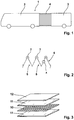
- Fig. 1
- zeigt beispielhaft ein Gelenkfahrzeug, z. B. einen Bus;
- Fig. 2
- zeigt schematisch einen Ausschnitt aus einem Faltenbalg in einer Ansicht im Schnitt;
- Fig. 3
- zeigt die Einzelheit X aus
Fig. 2 , wobei dieFig. 3 ein Stück eines Balgmaterials in Explosionsdarstellung zeigt. - Das Gelenkfahrzeug weist das Bezugszeichen 1 auf, wobei zwischen den beiden Fahrzeugteilen 2 und 3 des Gelenkfahrzeugs ein Balg, insbesondere ein Faltenbalg 4 vorgesehen ist. Einen Ausschnitt aus dem Faltenbalg 4 zeigt
Fig. 2 , wobei die einzelnen Falten 5 im Bereich des äußeren Scheitels durch im Querschnitt U-förmige Balgrahmen 7 gehalten sind. Der im Querschnitt U-förmige Balgrahmen ist vorzugsweise aus Aluminium hergestellt. - Aus
Fig. 3 ergibt sich perspektivisch der Ausschnitt eines Gewebes gemäß der Einzelheit X ausFig. 2 . Dargestellt ist hierbei eine Gewebelage als Festigkeitsträger mit dem Bezugszeichen 10. Der Festigkeitsträger 10 kann hierbei auf beiden Seiten z. B. mit einer Elastomerschicht 11 als Beschichtung belegt sein, die insbesondere im Wege des Kalandrierens auf dem Festigkeitsträger aufgebracht ist. Nachfolgend wird eine Schutzschicht 12 auf diese Elastomerschicht aufgedruckt, beispielsweise eine Farbschicht, die eine nach dem Lotuseffekt strukturierte Oberfläche aufweist, um so zu gewährleisten, dass Schmutzpartikel nur geringe Haftkräfte zu dem Beschichtungsmaterial des Balges aufweisen. Hierbei kann es ausreichend sein, wenn die Schutzschicht nur auf der Außenseite des Balges aufgebracht wird. Denkbar ist allerdings auch, durch das Druckverfahren die Schutzschicht auf ein dicht gewebtes Gewebe unmittelbar aufzubringen. Eine solche Vorgehensweise hat sich als besonders gewichtssparend herausgestellt. Gegebenenfalls muss die Aufbringung der Schutzschicht in mehreren Durchgängen erfolgen, um sicherzustellen, dass das Balgmaterial dicht ist. -
- 1
- Gelenkfahrzeug
- 2
- Fahrzeugteil
- 3
- Fahrzeugteil
- 4
- Faltenbalg
- 5
- Falten
- 7
- Balgrahmen
- 10
- Festigkeitsträger
- 11
- Beschichtung aus Elastomerschicht
- 12
- Schutzschicht
Claims (3)
- Balg sowohl für einen Übergang zwischen zwei gelenkig miteinander verbundenen Fahrzeugen als auch für eine Fluggastbrücke oder - treppe,
wobei das Balgmaterial mindestens einen Festigkeitsträger (10) aufweist und wobei eine Schutzschicht (12) auf dem Festigkeitsträger (10) aufgedruckt ist, oder wobei das Balgmaterial mindestens einen Festigkeitsträger (10) und der Festigkeitsträger mindestens eine Beschichtung (11) aus einem Elastomer aufweist und wobei eine Schutzschicht (10) auf der Elastomerbeschichtung aufgedruckt ist. - Balg nach Anspruch 1,
dadurch gekennzeichnet,
dass die Schutzschicht (12) im Digitaldruckverfahren, z. B. im Ink-Jet-Verfahren aufgebracht ist. - Balg nach einem der voranstehenden Ansprüche,
dadurch gekennzeichnet,
dass der Balg (4) mehrere hintereinander angeordnete Balgrahmen (7) aufweist, wobei durch die Balgrahmen (7) das Balgmaterial als Falten oder Wellen klemmend erfasst ist.
Priority Applications (1)
| Application Number | Priority Date | Filing Date | Title |
|---|---|---|---|
| PL13000321T PL2724942T3 (pl) | 2012-10-24 | 2013-01-23 | Miech, zarówno na przejście pomiędzy dwoma pojazdami połączonymi ze sobą przegubowo, jak i miech do rękawa lotniczego |
Applications Claiming Priority (1)
| Application Number | Priority Date | Filing Date | Title |
|---|---|---|---|
| DE202012010192U DE202012010192U1 (de) | 2012-10-24 | 2012-10-24 | Balg sowohl eines Übergangs zwischen zwei gelenkig miteinander verbundenen Fahrzeugen als auch einer Fluggastbrücke oder -treppe |
Publications (3)
| Publication Number | Publication Date |
|---|---|
| EP2724942A2 EP2724942A2 (de) | 2014-04-30 |
| EP2724942A3 EP2724942A3 (de) | 2017-12-13 |
| EP2724942B1 true EP2724942B1 (de) | 2021-01-06 |
Family
ID=47503475
Family Applications (1)
| Application Number | Title | Priority Date | Filing Date |
|---|---|---|---|
| EP13000321.3A Active EP2724942B1 (de) | 2012-10-24 | 2013-01-23 | Balg sowohl eines Übergangs zwischen zwei gelenkig miteinander verbundenen Fahrzeugen als auch einer Fluggastbrücke oder -treppe |
Country Status (4)
| Country | Link |
|---|---|
| EP (1) | EP2724942B1 (de) |
| CN (1) | CN103770588B (de) |
| DE (1) | DE202012010192U1 (de) |
| PL (1) | PL2724942T3 (de) |
Family Cites Families (9)
| Publication number | Priority date | Publication date | Assignee | Title |
|---|---|---|---|---|
| AT386564B (de) * | 1986-02-18 | 1988-09-12 | Isovolta | Dekorative verbundfolie fuer oberflaechenbeschichtungen, deren verwendung in einem mehrschichtverbund, sowie verfahren zum herstellen eines solchen mehrschichtverbundes |
| DE10246236B3 (de) * | 2002-10-02 | 2004-04-08 | Contitech Elastomer-Beschichtungen Gmbh | Durchgangsbalg zum Schutz von Personen |
| DE102009023823B4 (de) * | 2009-06-04 | 2011-02-17 | Hübner GmbH | Balg zwischen zwei gelenkig miteinander verbundenen Fahrzeugen oder Balg einer Fluggasttreppe oder -brücke |
| DE102010006939A1 (de) | 2010-02-04 | 2011-08-04 | Voxeljet Technology GmbH, 86167 | Vorrichtung zum Herstellen dreidimensionaler Modelle |
| DE102010006909B4 (de) * | 2010-02-05 | 2013-11-21 | Hübner GmbH | Balg als Teil eines Übergangs zwischen zwei gelenkig miteinander verbundenen Fahrzeugen, Verfahren zur Herstellung einer Stoffbahn für einen Balg sowie Verfahren zur Herstellung eines Balges |
| PL2353894T3 (pl) * | 2010-02-05 | 2015-10-30 | Huebner Gmbh & Co Kg | Osłona harmonijkowa falista do przejścia między dwoma połączonymi przegubowo pojazdami |
| DE102010026115A1 (de) * | 2010-07-05 | 2012-01-05 | Hübner GmbH | Tuch zur Herstellung eines Balges eines Übergangs sowie Verfahren zur Herstellung eines solchen Tuches |
| EP2407322A1 (de) * | 2010-07-16 | 2012-01-18 | Hübner GmbH | Balg |
| EP2455242B1 (de) * | 2010-11-18 | 2013-04-24 | Hübner GmbH | Anordnung zur Bildung des Balges eines Übergangs oder der Seitenwand zwischen zwei gelenking miteinander verbundenen Fahrzeugen |
-
2012
- 2012-10-24 DE DE202012010192U patent/DE202012010192U1/de not_active Expired - Lifetime
-
2013
- 2013-01-23 EP EP13000321.3A patent/EP2724942B1/de active Active
- 2013-01-23 PL PL13000321T patent/PL2724942T3/pl unknown
- 2013-10-24 CN CN201310505532.6A patent/CN103770588B/zh not_active Expired - Fee Related
Non-Patent Citations (1)
| Title |
|---|
| None * |
Also Published As
| Publication number | Publication date |
|---|---|
| PL2724942T3 (pl) | 2021-06-28 |
| CN103770588B (zh) | 2016-11-16 |
| DE202012010192U1 (de) | 2012-12-06 |
| EP2724942A3 (de) | 2017-12-13 |
| CN103770588A (zh) | 2014-05-07 |
| EP2724942A2 (de) | 2014-04-30 |
Similar Documents
| Publication | Publication Date | Title |
|---|---|---|
| DE202013000165U1 (de) | Balg eines Übergangs eines Gelenkfahrzeugs sowie Gelenkfahrzeug des öffentlichen Personentransports mit einem solchen Balg | |
| WO2017207076A1 (de) | Dichtung für eine versenkbare fensterscheibe eines fahrzeugtürfensters | |
| DE69314461T2 (de) | Material und Verwendung zum Auskleiden von Tunneln | |
| DE102006061503A1 (de) | Materialbahn für die Herstellung eines Balges | |
| DE102009023823B4 (de) | Balg zwischen zwei gelenkig miteinander verbundenen Fahrzeugen oder Balg einer Fluggasttreppe oder -brücke | |
| DE102012018447A1 (de) | Kraftfahrzeugkarosserie | |
| EP2724942A2 (de) | Balg sowohl eines Übergangs zwischen zwei gelenkig miteinander verbundenen Fahrzeugen als auch einer Fluggastbrücke oder -treppe | |
| EP2743007B1 (de) | Zumindest zweifarbige Karosserieleiste und Verfahren zum Lackieren einer solchen Karosserieleiste | |
| DE202008015485U1 (de) | Heizelement | |
| DE10246236B3 (de) | Durchgangsbalg zum Schutz von Personen | |
| DE20113705U1 (de) | Verstärkter, flexibler Schlauch, insbesondere Brauseschlauch | |
| DE202009001125U1 (de) | Profilleiste mit Wärmedämmung | |
| DE102019101783A1 (de) | Flugzeugrumpfstruktur | |
| EP1717082B1 (de) | Dichtungsstrang mit Beschichtung | |
| EP2196081B1 (de) | Sieb | |
| DE19922202B4 (de) | Plastisch verformbare Materialbahn | |
| DE102010006909A1 (de) | Balg als Teil eines Übergangs zwischen zwei gelenkig miteinander verbundenen Fahrzeugen sowie Verfahren zur Herstellung eines solchen Balgs | |
| DE102017001975A1 (de) | Die Erfindung betrifft ein Schachtgerüst | |
| DE2313981A1 (de) | Aus untereinander verbundenen einzellamellen zusammengesetzte jalousette | |
| DE60306608T2 (de) | Laminat | |
| EP2407322A1 (de) | Balg | |
| CH665242A5 (de) | Freitragende verbundplatte fuer doppelboeden, decken oder dergleichen. | |
| DE69803409T2 (de) | Verfahren zur herstellung eines konvexen segels oder einer zugbelastbaren struktur | |
| WO2007115649A1 (de) | Verfahren zur beschichtung von oberflächen und beschichtungssystem zor beschichtung von oberflächen | |
| DE202008012960U1 (de) | Großflächige flexible Hüllen und Einrichtungsgegenstände |
Legal Events
| Date | Code | Title | Description |
|---|---|---|---|
| PUAI | Public reference made under article 153(3) epc to a published international application that has entered the european phase |
Free format text: ORIGINAL CODE: 0009012 |
|
| 17P | Request for examination filed |
Effective date: 20130123 |
|
| AK | Designated contracting states |
Kind code of ref document: A2 Designated state(s): AL AT BE BG CH CY CZ DE DK EE ES FI FR GB GR HR HU IE IS IT LI LT LU LV MC MK MT NL NO PL PT RO RS SE SI SK SM TR |
|
| AX | Request for extension of the european patent |
Extension state: BA ME |
|
| PUAL | Search report despatched |
Free format text: ORIGINAL CODE: 0009013 |
|
| AK | Designated contracting states |
Kind code of ref document: A3 Designated state(s): AL AT BE BG CH CY CZ DE DK EE ES FI FR GB GR HR HU IE IS IT LI LT LU LV MC MK MT NL NO PL PT RO RS SE SI SK SM TR |
|
| AX | Request for extension of the european patent |
Extension state: BA ME |
|
| RIC1 | Information provided on ipc code assigned before grant |
Ipc: B64F 1/305 20060101AFI20171109BHEP Ipc: B60D 5/00 20060101ALI20171109BHEP |
|
| STAA | Information on the status of an ep patent application or granted ep patent |
Free format text: STATUS: REQUEST FOR EXAMINATION WAS MADE |
|
| 17P | Request for examination filed |
Effective date: 20171219 |
|
| RBV | Designated contracting states (corrected) |
Designated state(s): AL AT BE BG CH CY CZ DE DK EE ES FI FR GB GR HR HU IE IS IT LI LT LU LV MC MK MT NL NO PL PT RO RS SE SI SK SM TR |
|
| STAA | Information on the status of an ep patent application or granted ep patent |
Free format text: STATUS: EXAMINATION IS IN PROGRESS |
|
| 17Q | First examination report despatched |
Effective date: 20190607 |
|
| RAP1 | Party data changed (applicant data changed or rights of an application transferred) |
Owner name: HUEBNER GMBH & CO. KG |
|
| GRAP | Despatch of communication of intention to grant a patent |
Free format text: ORIGINAL CODE: EPIDOSNIGR1 |
|
| STAA | Information on the status of an ep patent application or granted ep patent |
Free format text: STATUS: GRANT OF PATENT IS INTENDED |
|
| INTG | Intention to grant announced |
Effective date: 20200824 |
|
| GRAS | Grant fee paid |
Free format text: ORIGINAL CODE: EPIDOSNIGR3 |
|
| GRAA | (expected) grant |
Free format text: ORIGINAL CODE: 0009210 |
|
| STAA | Information on the status of an ep patent application or granted ep patent |
Free format text: STATUS: THE PATENT HAS BEEN GRANTED |
|
| AK | Designated contracting states |
Kind code of ref document: B1 Designated state(s): AL AT BE BG CH CY CZ DE DK EE ES FI FR GB GR HR HU IE IS IT LI LT LU LV MC MK MT NL NO PL PT RO RS SE SI SK SM TR |
|
| REG | Reference to a national code |
Ref country code: GB Ref legal event code: FG4D Free format text: NOT ENGLISH |
|
| REG | Reference to a national code |
Ref country code: AT Ref legal event code: REF Ref document number: 1352087 Country of ref document: AT Kind code of ref document: T Effective date: 20210115 Ref country code: CH Ref legal event code: EP |
|
| REG | Reference to a national code |
Ref country code: DE Ref legal event code: R096 Ref document number: 502013015408 Country of ref document: DE |
|
| REG | Reference to a national code |
Ref country code: IE Ref legal event code: FG4D Free format text: LANGUAGE OF EP DOCUMENT: GERMAN |
|
| REG | Reference to a national code |
Ref country code: NL Ref legal event code: MP Effective date: 20210106 |
|
| REG | Reference to a national code |
Ref country code: LT Ref legal event code: MG9D |
|
| PG25 | Lapsed in a contracting state [announced via postgrant information from national office to epo] |
Ref country code: NO Free format text: LAPSE BECAUSE OF FAILURE TO SUBMIT A TRANSLATION OF THE DESCRIPTION OR TO PAY THE FEE WITHIN THE PRESCRIBED TIME-LIMIT Effective date: 20210406 Ref country code: NL Free format text: LAPSE BECAUSE OF FAILURE TO SUBMIT A TRANSLATION OF THE DESCRIPTION OR TO PAY THE FEE WITHIN THE PRESCRIBED TIME-LIMIT Effective date: 20210106 Ref country code: BG Free format text: LAPSE BECAUSE OF FAILURE TO SUBMIT A TRANSLATION OF THE DESCRIPTION OR TO PAY THE FEE WITHIN THE PRESCRIBED TIME-LIMIT Effective date: 20210406 Ref country code: PT Free format text: LAPSE BECAUSE OF FAILURE TO SUBMIT A TRANSLATION OF THE DESCRIPTION OR TO PAY THE FEE WITHIN THE PRESCRIBED TIME-LIMIT Effective date: 20210506 Ref country code: LT Free format text: LAPSE BECAUSE OF FAILURE TO SUBMIT A TRANSLATION OF THE DESCRIPTION OR TO PAY THE FEE WITHIN THE PRESCRIBED TIME-LIMIT Effective date: 20210106 Ref country code: GR Free format text: LAPSE BECAUSE OF FAILURE TO SUBMIT A TRANSLATION OF THE DESCRIPTION OR TO PAY THE FEE WITHIN THE PRESCRIBED TIME-LIMIT Effective date: 20210407 Ref country code: FI Free format text: LAPSE BECAUSE OF FAILURE TO SUBMIT A TRANSLATION OF THE DESCRIPTION OR TO PAY THE FEE WITHIN THE PRESCRIBED TIME-LIMIT Effective date: 20210106 Ref country code: HR Free format text: LAPSE BECAUSE OF FAILURE TO SUBMIT A TRANSLATION OF THE DESCRIPTION OR TO PAY THE FEE WITHIN THE PRESCRIBED TIME-LIMIT Effective date: 20210106 |
|
| PG25 | Lapsed in a contracting state [announced via postgrant information from national office to epo] |
Ref country code: LV Free format text: LAPSE BECAUSE OF FAILURE TO SUBMIT A TRANSLATION OF THE DESCRIPTION OR TO PAY THE FEE WITHIN THE PRESCRIBED TIME-LIMIT Effective date: 20210106 Ref country code: RS Free format text: LAPSE BECAUSE OF FAILURE TO SUBMIT A TRANSLATION OF THE DESCRIPTION OR TO PAY THE FEE WITHIN THE PRESCRIBED TIME-LIMIT Effective date: 20210106 Ref country code: SE Free format text: LAPSE BECAUSE OF FAILURE TO SUBMIT A TRANSLATION OF THE DESCRIPTION OR TO PAY THE FEE WITHIN THE PRESCRIBED TIME-LIMIT Effective date: 20210106 |
|
| REG | Reference to a national code |
Ref country code: CH Ref legal event code: PL |
|
| PG25 | Lapsed in a contracting state [announced via postgrant information from national office to epo] |
Ref country code: LU Free format text: LAPSE BECAUSE OF NON-PAYMENT OF DUE FEES Effective date: 20210123 Ref country code: IS Free format text: LAPSE BECAUSE OF FAILURE TO SUBMIT A TRANSLATION OF THE DESCRIPTION OR TO PAY THE FEE WITHIN THE PRESCRIBED TIME-LIMIT Effective date: 20210506 |
|
| REG | Reference to a national code |
Ref country code: BE Ref legal event code: MM Effective date: 20210131 |
|
| REG | Reference to a national code |
Ref country code: DE Ref legal event code: R097 Ref document number: 502013015408 Country of ref document: DE |
|
| PG25 | Lapsed in a contracting state [announced via postgrant information from national office to epo] |
Ref country code: MC Free format text: LAPSE BECAUSE OF FAILURE TO SUBMIT A TRANSLATION OF THE DESCRIPTION OR TO PAY THE FEE WITHIN THE PRESCRIBED TIME-LIMIT Effective date: 20210106 Ref country code: CZ Free format text: LAPSE BECAUSE OF FAILURE TO SUBMIT A TRANSLATION OF THE DESCRIPTION OR TO PAY THE FEE WITHIN THE PRESCRIBED TIME-LIMIT Effective date: 20210106 Ref country code: EE Free format text: LAPSE BECAUSE OF FAILURE TO SUBMIT A TRANSLATION OF THE DESCRIPTION OR TO PAY THE FEE WITHIN THE PRESCRIBED TIME-LIMIT Effective date: 20210106 Ref country code: SM Free format text: LAPSE BECAUSE OF FAILURE TO SUBMIT A TRANSLATION OF THE DESCRIPTION OR TO PAY THE FEE WITHIN THE PRESCRIBED TIME-LIMIT Effective date: 20210106 |
|
| PLBE | No opposition filed within time limit |
Free format text: ORIGINAL CODE: 0009261 |
|
| STAA | Information on the status of an ep patent application or granted ep patent |
Free format text: STATUS: NO OPPOSITION FILED WITHIN TIME LIMIT |
|
| PG25 | Lapsed in a contracting state [announced via postgrant information from national office to epo] |
Ref country code: LI Free format text: LAPSE BECAUSE OF NON-PAYMENT OF DUE FEES Effective date: 20210131 Ref country code: RO Free format text: LAPSE BECAUSE OF FAILURE TO SUBMIT A TRANSLATION OF THE DESCRIPTION OR TO PAY THE FEE WITHIN THE PRESCRIBED TIME-LIMIT Effective date: 20210106 Ref country code: CH Free format text: LAPSE BECAUSE OF NON-PAYMENT OF DUE FEES Effective date: 20210131 Ref country code: DK Free format text: LAPSE BECAUSE OF FAILURE TO SUBMIT A TRANSLATION OF THE DESCRIPTION OR TO PAY THE FEE WITHIN THE PRESCRIBED TIME-LIMIT Effective date: 20210106 Ref country code: ES Free format text: LAPSE BECAUSE OF FAILURE TO SUBMIT A TRANSLATION OF THE DESCRIPTION OR TO PAY THE FEE WITHIN THE PRESCRIBED TIME-LIMIT Effective date: 20210106 Ref country code: SK Free format text: LAPSE BECAUSE OF FAILURE TO SUBMIT A TRANSLATION OF THE DESCRIPTION OR TO PAY THE FEE WITHIN THE PRESCRIBED TIME-LIMIT Effective date: 20210106 |
|
| 26N | No opposition filed |
Effective date: 20211007 |
|
| GBPC | Gb: european patent ceased through non-payment of renewal fee |
Effective date: 20210406 |
|
| PG25 | Lapsed in a contracting state [announced via postgrant information from national office to epo] |
Ref country code: GB Free format text: LAPSE BECAUSE OF NON-PAYMENT OF DUE FEES Effective date: 20210406 Ref country code: IE Free format text: LAPSE BECAUSE OF NON-PAYMENT OF DUE FEES Effective date: 20210123 Ref country code: AL Free format text: LAPSE BECAUSE OF FAILURE TO SUBMIT A TRANSLATION OF THE DESCRIPTION OR TO PAY THE FEE WITHIN THE PRESCRIBED TIME-LIMIT Effective date: 20210106 |
|
| PG25 | Lapsed in a contracting state [announced via postgrant information from national office to epo] |
Ref country code: SI Free format text: LAPSE BECAUSE OF FAILURE TO SUBMIT A TRANSLATION OF THE DESCRIPTION OR TO PAY THE FEE WITHIN THE PRESCRIBED TIME-LIMIT Effective date: 20210106 |
|
| REG | Reference to a national code |
Ref country code: AT Ref legal event code: MM01 Ref document number: 1352087 Country of ref document: AT Kind code of ref document: T Effective date: 20210123 |
|
| PG25 | Lapsed in a contracting state [announced via postgrant information from national office to epo] |
Ref country code: AT Free format text: LAPSE BECAUSE OF NON-PAYMENT OF DUE FEES Effective date: 20210123 |
|
| PG25 | Lapsed in a contracting state [announced via postgrant information from national office to epo] |
Ref country code: IS Free format text: LAPSE BECAUSE OF FAILURE TO SUBMIT A TRANSLATION OF THE DESCRIPTION OR TO PAY THE FEE WITHIN THE PRESCRIBED TIME-LIMIT Effective date: 20210506 |
|
| PG25 | Lapsed in a contracting state [announced via postgrant information from national office to epo] |
Ref country code: BE Free format text: LAPSE BECAUSE OF NON-PAYMENT OF DUE FEES Effective date: 20210131 |
|
| PG25 | Lapsed in a contracting state [announced via postgrant information from national office to epo] |
Ref country code: HU Free format text: LAPSE BECAUSE OF FAILURE TO SUBMIT A TRANSLATION OF THE DESCRIPTION OR TO PAY THE FEE WITHIN THE PRESCRIBED TIME-LIMIT; INVALID AB INITIO Effective date: 20130123 |
|
| PG25 | Lapsed in a contracting state [announced via postgrant information from national office to epo] |
Ref country code: CY Free format text: LAPSE BECAUSE OF FAILURE TO SUBMIT A TRANSLATION OF THE DESCRIPTION OR TO PAY THE FEE WITHIN THE PRESCRIBED TIME-LIMIT Effective date: 20210106 |
|
| PG25 | Lapsed in a contracting state [announced via postgrant information from national office to epo] |
Ref country code: MK Free format text: LAPSE BECAUSE OF FAILURE TO SUBMIT A TRANSLATION OF THE DESCRIPTION OR TO PAY THE FEE WITHIN THE PRESCRIBED TIME-LIMIT Effective date: 20210106 |
|
| PG25 | Lapsed in a contracting state [announced via postgrant information from national office to epo] |
Ref country code: MT Free format text: LAPSE BECAUSE OF FAILURE TO SUBMIT A TRANSLATION OF THE DESCRIPTION OR TO PAY THE FEE WITHIN THE PRESCRIBED TIME-LIMIT Effective date: 20210106 |
|
| PGFP | Annual fee paid to national office [announced via postgrant information from national office to epo] |
Ref country code: PL Payment date: 20250113 Year of fee payment: 13 |
|
| PG25 | Lapsed in a contracting state [announced via postgrant information from national office to epo] |
Ref country code: TR Free format text: LAPSE BECAUSE OF FAILURE TO SUBMIT A TRANSLATION OF THE DESCRIPTION OR TO PAY THE FEE WITHIN THE PRESCRIBED TIME-LIMIT Effective date: 20210106 |
|
| PGFP | Annual fee paid to national office [announced via postgrant information from national office to epo] |
Ref country code: DE Payment date: 20260120 Year of fee payment: 14 |
|
| PGFP | Annual fee paid to national office [announced via postgrant information from national office to epo] |
Ref country code: IT Payment date: 20260130 Year of fee payment: 14 |
|
| PGFP | Annual fee paid to national office [announced via postgrant information from national office to epo] |
Ref country code: FR Payment date: 20260121 Year of fee payment: 14 |