EP2716699A1 - Anti-vibration rubber composition and anti-vibration rubber - Google Patents
Anti-vibration rubber composition and anti-vibration rubber Download PDFInfo
- Publication number
- EP2716699A1 EP2716699A1 EP12792017.1A EP12792017A EP2716699A1 EP 2716699 A1 EP2716699 A1 EP 2716699A1 EP 12792017 A EP12792017 A EP 12792017A EP 2716699 A1 EP2716699 A1 EP 2716699A1
- Authority
- EP
- European Patent Office
- Prior art keywords
- rubber
- vibration rubber
- rubber composition
- low
- vibration
- Prior art date
- Legal status (The legal status is an assumption and is not a legal conclusion. Google has not performed a legal analysis and makes no representation as to the accuracy of the status listed.)
- Granted
Links
- 229920001971 elastomer Polymers 0.000 title claims abstract description 103
- 239000005060 rubber Substances 0.000 title claims abstract description 103
- 239000000203 mixture Substances 0.000 title claims abstract description 42
- 239000003795 chemical substances by application Substances 0.000 claims abstract description 16
- -1 bismaleimide compound Chemical class 0.000 claims abstract description 15
- 229920003192 poly(bis maleimide) Polymers 0.000 claims abstract description 12
- 229920003244 diene elastomer Polymers 0.000 claims abstract description 7
- 238000004073 vulcanization Methods 0.000 claims description 61
- 239000000126 substance Substances 0.000 claims description 29
- CAXJFBOSFXRPOJ-UHFFFAOYSA-N n-phenyl-n-(trichloromethylsulfanyl)benzenesulfonamide Chemical compound C=1C=CC=CC=1S(=O)(=O)N(SC(Cl)(Cl)Cl)C1=CC=CC=C1 CAXJFBOSFXRPOJ-UHFFFAOYSA-N 0.000 claims description 19
- NINIDFKCEFEMDL-UHFFFAOYSA-N Sulfur Chemical compound [S] NINIDFKCEFEMDL-UHFFFAOYSA-N 0.000 claims description 18
- 229910052717 sulfur Inorganic materials 0.000 claims description 16
- 239000011593 sulfur Substances 0.000 claims description 16
- 125000000217 alkyl group Chemical group 0.000 claims description 3
- 125000002015 acyclic group Chemical group 0.000 claims 1
- 238000007906 compression Methods 0.000 abstract description 30
- 230000006835 compression Effects 0.000 abstract description 30
- 238000004519 manufacturing process Methods 0.000 abstract 1
- 230000032683 aging Effects 0.000 description 46
- 230000014759 maintenance of location Effects 0.000 description 34
- 230000000052 comparative effect Effects 0.000 description 21
- 239000003963 antioxidant agent Substances 0.000 description 18
- 239000003921 oil Substances 0.000 description 16
- 235000019198 oils Nutrition 0.000 description 16
- 230000003078 antioxidant effect Effects 0.000 description 13
- 239000005062 Polybutadiene Substances 0.000 description 12
- 229920002857 polybutadiene Polymers 0.000 description 12
- 230000035882 stress Effects 0.000 description 11
- 244000043261 Hevea brasiliensis Species 0.000 description 10
- XLOMVQKBTHCTTD-UHFFFAOYSA-N Zinc monoxide Chemical compound [Zn]=O XLOMVQKBTHCTTD-UHFFFAOYSA-N 0.000 description 10
- 239000006229 carbon black Substances 0.000 description 10
- 235000019241 carbon black Nutrition 0.000 description 10
- 229920003052 natural elastomer Polymers 0.000 description 10
- 229920001194 natural rubber Polymers 0.000 description 10
- 235000014692 zinc oxide Nutrition 0.000 description 10
- 239000011787 zinc oxide Substances 0.000 description 10
- 238000012360 testing method Methods 0.000 description 9
- 235000021355 Stearic acid Nutrition 0.000 description 8
- 238000013329 compounding Methods 0.000 description 8
- QIQXTHQIDYTFRH-UHFFFAOYSA-N octadecanoic acid Chemical compound CCCCCCCCCCCCCCCCCC(O)=O QIQXTHQIDYTFRH-UHFFFAOYSA-N 0.000 description 8
- OQCDKBAXFALNLD-UHFFFAOYSA-N octadecanoic acid Natural products CCCCCCCC(C)CCCCCCCCC(O)=O OQCDKBAXFALNLD-UHFFFAOYSA-N 0.000 description 8
- 238000012545 processing Methods 0.000 description 8
- 239000008117 stearic acid Substances 0.000 description 8
- IPJGAEWUPXWFPL-UHFFFAOYSA-N 1-[3-(2,5-dioxopyrrol-1-yl)phenyl]pyrrole-2,5-dione Chemical compound O=C1C=CC(=O)N1C1=CC=CC(N2C(C=CC2=O)=O)=C1 IPJGAEWUPXWFPL-UHFFFAOYSA-N 0.000 description 7
- 239000000463 material Substances 0.000 description 7
- DEQZTKGFXNUBJL-UHFFFAOYSA-N n-(1,3-benzothiazol-2-ylsulfanyl)cyclohexanamine Chemical compound C1CCCCC1NSC1=NC2=CC=CC=C2S1 DEQZTKGFXNUBJL-UHFFFAOYSA-N 0.000 description 7
- HIDBROSJWZYGSZ-UHFFFAOYSA-N 1-phenylpyrrole-2,5-dione Chemical compound O=C1C=CC(=O)N1C1=CC=CC=C1 HIDBROSJWZYGSZ-UHFFFAOYSA-N 0.000 description 6
- ZNRLMGFXSPUZNR-UHFFFAOYSA-N 2,2,4-trimethyl-1h-quinoline Chemical compound C1=CC=C2C(C)=CC(C)(C)NC2=C1 ZNRLMGFXSPUZNR-UHFFFAOYSA-N 0.000 description 6
- AUZONCFQVSMFAP-UHFFFAOYSA-N disulfiram Chemical compound CCN(CC)C(=S)SSC(=S)N(CC)CC AUZONCFQVSMFAP-UHFFFAOYSA-N 0.000 description 6
- 239000001993 wax Substances 0.000 description 6
- CPGFMWPQXUXQRX-UHFFFAOYSA-N 3-amino-3-(4-fluorophenyl)propanoic acid Chemical compound OC(=O)CC(N)C1=CC=C(F)C=C1 CPGFMWPQXUXQRX-UHFFFAOYSA-N 0.000 description 5
- VTEKOFXDMRILGB-UHFFFAOYSA-N bis(2-ethylhexyl)carbamothioylsulfanyl n,n-bis(2-ethylhexyl)carbamodithioate Chemical compound CCCCC(CC)CN(CC(CC)CCCC)C(=S)SSC(=S)N(CC(CC)CCCC)CC(CC)CCCC VTEKOFXDMRILGB-UHFFFAOYSA-N 0.000 description 5
- 235000014113 dietary fatty acids Nutrition 0.000 description 5
- 239000000194 fatty acid Substances 0.000 description 5
- 229930195729 fatty acid Natural products 0.000 description 5
- 150000004665 fatty acids Chemical class 0.000 description 5
- 238000010058 rubber compounding Methods 0.000 description 5
- 230000003068 static effect Effects 0.000 description 5
- KUAZQDVKQLNFPE-UHFFFAOYSA-N thiram Chemical compound CN(C)C(=S)SSC(=S)N(C)C KUAZQDVKQLNFPE-UHFFFAOYSA-N 0.000 description 5
- 229960002447 thiram Drugs 0.000 description 5
- XQUPVDVFXZDTLT-UHFFFAOYSA-N 1-[4-[[4-(2,5-dioxopyrrol-1-yl)phenyl]methyl]phenyl]pyrrole-2,5-dione Chemical class O=C1C=CC(=O)N1C(C=C1)=CC=C1CC1=CC=C(N2C(C=CC2=O)=O)C=C1 XQUPVDVFXZDTLT-UHFFFAOYSA-N 0.000 description 4
- 229920000459 Nitrile rubber Polymers 0.000 description 4
- PGAXJQVAHDTGBB-UHFFFAOYSA-N dibutylcarbamothioylsulfanyl n,n-dibutylcarbamodithioate Chemical compound CCCCN(CCCC)C(=S)SSC(=S)N(CCCC)CCCC PGAXJQVAHDTGBB-UHFFFAOYSA-N 0.000 description 4
- 238000010438 heat treatment Methods 0.000 description 4
- 238000004898 kneading Methods 0.000 description 4
- 239000004200 microcrystalline wax Substances 0.000 description 4
- 235000019808 microcrystalline wax Nutrition 0.000 description 4
- WWZKQHOCKIZLMA-UHFFFAOYSA-N Caprylic acid Natural products CCCCCCCC(O)=O WWZKQHOCKIZLMA-UHFFFAOYSA-N 0.000 description 3
- 239000000654 additive Substances 0.000 description 3
- 125000003118 aryl group Chemical group 0.000 description 3
- 229910052799 carbon Inorganic materials 0.000 description 3
- 150000001875 compounds Chemical class 0.000 description 3
- 239000004615 ingredient Substances 0.000 description 3
- VNDRMZTXEFFQDR-UHFFFAOYSA-N (piperidine-1-carbothioyltrisulfanyl) piperidine-1-carbodithioate Chemical compound C1CCCCN1C(=S)SSSSC(=S)N1CCCCC1 VNDRMZTXEFFQDR-UHFFFAOYSA-N 0.000 description 2
- YXIWHUQXZSMYRE-UHFFFAOYSA-N 1,3-benzothiazole-2-thiol Chemical compound C1=CC=C2SC(S)=NC2=C1 YXIWHUQXZSMYRE-UHFFFAOYSA-N 0.000 description 2
- OWRCNXZUPFZXOS-UHFFFAOYSA-N 1,3-diphenylguanidine Chemical compound C=1C=CC=CC=1NC(=N)NC1=CC=CC=C1 OWRCNXZUPFZXOS-UHFFFAOYSA-N 0.000 description 2
- BUZICZZQJDLXJN-UHFFFAOYSA-N 3-azaniumyl-4-hydroxybutanoate Chemical compound OCC(N)CC(O)=O BUZICZZQJDLXJN-UHFFFAOYSA-N 0.000 description 2
- HLBZWYXLQJQBKU-UHFFFAOYSA-N 4-(morpholin-4-yldisulfanyl)morpholine Chemical compound C1COCCN1SSN1CCOCC1 HLBZWYXLQJQBKU-UHFFFAOYSA-N 0.000 description 2
- ZZMVLMVFYMGSMY-UHFFFAOYSA-N 4-n-(4-methylpentan-2-yl)-1-n-phenylbenzene-1,4-diamine Chemical compound C1=CC(NC(C)CC(C)C)=CC=C1NC1=CC=CC=C1 ZZMVLMVFYMGSMY-UHFFFAOYSA-N 0.000 description 2
- RSWGJHLUYNHPMX-UHFFFAOYSA-N Abietic-Saeure Natural products C12CCC(C(C)C)=CC2=CCC2C1(C)CCCC2(C)C(O)=O RSWGJHLUYNHPMX-UHFFFAOYSA-N 0.000 description 2
- ZRALSGWEFCBTJO-UHFFFAOYSA-N Guanidine Chemical compound NC(N)=N ZRALSGWEFCBTJO-UHFFFAOYSA-N 0.000 description 2
- 239000002253 acid Substances 0.000 description 2
- 150000007513 acids Chemical class 0.000 description 2
- DKVNPHBNOWQYFE-UHFFFAOYSA-N carbamodithioic acid Chemical class NC(S)=S DKVNPHBNOWQYFE-UHFFFAOYSA-N 0.000 description 2
- 238000004132 cross linking Methods 0.000 description 2
- AFZSMODLJJCVPP-UHFFFAOYSA-N dibenzothiazol-2-yl disulfide Chemical compound C1=CC=C2SC(SSC=3SC4=CC=CC=C4N=3)=NC2=C1 AFZSMODLJJCVPP-UHFFFAOYSA-N 0.000 description 2
- POULHZVOKOAJMA-UHFFFAOYSA-N dodecanoic acid Chemical compound CCCCCCCCCCCC(O)=O POULHZVOKOAJMA-UHFFFAOYSA-N 0.000 description 2
- 238000009472 formulation Methods 0.000 description 2
- IPCSVZSSVZVIGE-UHFFFAOYSA-N hexadecanoic acid Chemical compound CCCCCCCCCCCCCCCC(O)=O IPCSVZSSVZVIGE-UHFFFAOYSA-N 0.000 description 2
- 229920003049 isoprene rubber Polymers 0.000 description 2
- 238000005259 measurement Methods 0.000 description 2
- 239000005022 packaging material Substances 0.000 description 2
- 229920000642 polymer Polymers 0.000 description 2
- 238000007670 refining Methods 0.000 description 2
- 229920005989 resin Polymers 0.000 description 2
- 239000011347 resin Substances 0.000 description 2
- 229920003048 styrene butadiene rubber Polymers 0.000 description 2
- WRIDQFICGBMAFQ-UHFFFAOYSA-N (E)-8-Octadecenoic acid Natural products CCCCCCCCCC=CCCCCCCC(O)=O WRIDQFICGBMAFQ-UHFFFAOYSA-N 0.000 description 1
- YHMYGUUIMTVXNW-UHFFFAOYSA-N 1,3-dihydrobenzimidazole-2-thione Chemical compound C1=CC=C2NC(S)=NC2=C1 YHMYGUUIMTVXNW-UHFFFAOYSA-N 0.000 description 1
- UFFVWIGGYXLXPC-UHFFFAOYSA-N 1-[2-(2,5-dioxopyrrol-1-yl)phenyl]pyrrole-2,5-dione Chemical compound O=C1C=CC(=O)N1C1=CC=CC=C1N1C(=O)C=CC1=O UFFVWIGGYXLXPC-UHFFFAOYSA-N 0.000 description 1
- AQGZJQNZNONGKY-UHFFFAOYSA-N 1-[4-(2,5-dioxopyrrol-1-yl)phenyl]pyrrole-2,5-dione Chemical compound O=C1C=CC(=O)N1C1=CC=C(N2C(C=CC2=O)=O)C=C1 AQGZJQNZNONGKY-UHFFFAOYSA-N 0.000 description 1
- XAZPKEBWNIUCKF-UHFFFAOYSA-N 1-[4-[4-[2-[4-[4-(2,5-dioxopyrrol-1-yl)phenoxy]phenyl]propan-2-yl]phenoxy]phenyl]pyrrole-2,5-dione Chemical compound C=1C=C(OC=2C=CC(=CC=2)N2C(C=CC2=O)=O)C=CC=1C(C)(C)C(C=C1)=CC=C1OC(C=C1)=CC=C1N1C(=O)C=CC1=O XAZPKEBWNIUCKF-UHFFFAOYSA-N 0.000 description 1
- YNSSPVZNXLACMW-UHFFFAOYSA-N 1-[4-[[4-(2,5-dioxopyrrol-1-yl)-3-ethyl-5-methylphenyl]methyl]-2-ethyl-6-methylphenyl]pyrrole-2,5-dione Chemical compound C=1C(C)=C(N2C(C=CC2=O)=O)C(CC)=CC=1CC(C=C1CC)=CC(C)=C1N1C(=O)C=CC1=O YNSSPVZNXLACMW-UHFFFAOYSA-N 0.000 description 1
- GYSCBCSGKXNZRH-UHFFFAOYSA-N 1-benzothiophene-2-carboxamide Chemical compound C1=CC=C2SC(C(=O)N)=CC2=C1 GYSCBCSGKXNZRH-UHFFFAOYSA-N 0.000 description 1
- 125000004493 2-methylbut-1-yl group Chemical group CC(C*)CC 0.000 description 1
- 125000005916 2-methylpentyl group Chemical group 0.000 description 1
- LQJBNNIYVWPHFW-UHFFFAOYSA-N 20:1omega9c fatty acid Natural products CCCCCCCCCCC=CCCCCCCCC(O)=O LQJBNNIYVWPHFW-UHFFFAOYSA-N 0.000 description 1
- 125000005917 3-methylpentyl group Chemical group 0.000 description 1
- BTXXTMOWISPQSJ-UHFFFAOYSA-N 4,4,4-trifluorobutan-2-one Chemical compound CC(=O)CC(F)(F)F BTXXTMOWISPQSJ-UHFFFAOYSA-N 0.000 description 1
- YPIFGDQKSSMYHQ-UHFFFAOYSA-N 7,7-dimethyloctanoic acid Chemical compound CC(C)(C)CCCCCC(O)=O YPIFGDQKSSMYHQ-UHFFFAOYSA-N 0.000 description 1
- QSBYPNXLFMSGKH-UHFFFAOYSA-N 9-Heptadecensaeure Natural products CCCCCCCC=CCCCCCCCC(O)=O QSBYPNXLFMSGKH-UHFFFAOYSA-N 0.000 description 1
- BQACOLQNOUYJCE-FYZZASKESA-N Abietic acid Natural products CC(C)C1=CC2=CC[C@]3(C)[C@](C)(CCC[C@@]3(C)C(=O)O)[C@H]2CC1 BQACOLQNOUYJCE-FYZZASKESA-N 0.000 description 1
- 239000004604 Blowing Agent Substances 0.000 description 1
- GHVNFZFCNZKVNT-UHFFFAOYSA-N Decanoic acid Natural products CCCCCCCCCC(O)=O GHVNFZFCNZKVNT-UHFFFAOYSA-N 0.000 description 1
- 241001441571 Hiodontidae Species 0.000 description 1
- 239000006237 Intermediate SAF Substances 0.000 description 1
- OYHQOLUKZRVURQ-HZJYTTRNSA-N Linoleic acid Chemical compound CCCCC\C=C/C\C=C/CCCCCCCC(O)=O OYHQOLUKZRVURQ-HZJYTTRNSA-N 0.000 description 1
- CERQOIWHTDAKMF-UHFFFAOYSA-N Methacrylic acid Chemical compound CC(=C)C(O)=O CERQOIWHTDAKMF-UHFFFAOYSA-N 0.000 description 1
- TUNFSRHWOTWDNC-UHFFFAOYSA-N Myristic acid Natural products CCCCCCCCCCCCCC(O)=O TUNFSRHWOTWDNC-UHFFFAOYSA-N 0.000 description 1
- AFCARXCZXQIEQB-UHFFFAOYSA-N N-[3-oxo-3-(2,4,6,7-tetrahydrotriazolo[4,5-c]pyridin-5-yl)propyl]-2-[[3-(trifluoromethoxy)phenyl]methylamino]pyrimidine-5-carboxamide Chemical compound O=C(CCNC(=O)C=1C=NC(=NC=1)NCC1=CC(=CC=C1)OC(F)(F)F)N1CC2=C(CC1)NN=N2 AFCARXCZXQIEQB-UHFFFAOYSA-N 0.000 description 1
- CHJJGSNFBQVOTG-UHFFFAOYSA-N N-methyl-guanidine Natural products CNC(N)=N CHJJGSNFBQVOTG-UHFFFAOYSA-N 0.000 description 1
- ZQPPMHVWECSIRJ-UHFFFAOYSA-N Oleic acid Natural products CCCCCCCCC=CCCCCCCCC(O)=O ZQPPMHVWECSIRJ-UHFFFAOYSA-N 0.000 description 1
- 239000005642 Oleic acid Substances 0.000 description 1
- CBENFWSGALASAD-UHFFFAOYSA-N Ozone Chemical compound [O-][O+]=O CBENFWSGALASAD-UHFFFAOYSA-N 0.000 description 1
- 235000021314 Palmitic acid Nutrition 0.000 description 1
- KHPCPRHQVVSZAH-HUOMCSJISA-N Rosin Natural products O(C/C=C/c1ccccc1)[C@H]1[C@H](O)[C@@H](O)[C@@H](O)[C@@H](CO)O1 KHPCPRHQVVSZAH-HUOMCSJISA-N 0.000 description 1
- 241000872198 Serjania polyphylla Species 0.000 description 1
- FZWLAAWBMGSTSO-UHFFFAOYSA-N Thiazole Chemical compound C1=CSC=N1 FZWLAAWBMGSTSO-UHFFFAOYSA-N 0.000 description 1
- HCHKCACWOHOZIP-UHFFFAOYSA-N Zinc Chemical compound [Zn] HCHKCACWOHOZIP-UHFFFAOYSA-N 0.000 description 1
- 239000006096 absorbing agent Substances 0.000 description 1
- 230000001154 acute effect Effects 0.000 description 1
- 150000004996 alkyl benzenes Chemical class 0.000 description 1
- OBETXYAYXDNJHR-UHFFFAOYSA-N alpha-ethylcaproic acid Natural products CCCCC(CC)C(O)=O OBETXYAYXDNJHR-UHFFFAOYSA-N 0.000 description 1
- DTOSIQBPPRVQHS-PDBXOOCHSA-N alpha-linolenic acid Chemical compound CC\C=C/C\C=C/C\C=C/CCCCCCCC(O)=O DTOSIQBPPRVQHS-PDBXOOCHSA-N 0.000 description 1
- 235000020661 alpha-linolenic acid Nutrition 0.000 description 1
- 239000010692 aromatic oil Substances 0.000 description 1
- GONOPSZTUGRENK-UHFFFAOYSA-N benzyl(trichloro)silane Chemical compound Cl[Si](Cl)(Cl)CC1=CC=CC=C1 GONOPSZTUGRENK-UHFFFAOYSA-N 0.000 description 1
- 125000004432 carbon atom Chemical group C* 0.000 description 1
- 150000001735 carboxylic acids Chemical class 0.000 description 1
- 239000004359 castor oil Substances 0.000 description 1
- 235000019438 castor oil Nutrition 0.000 description 1
- 239000003240 coconut oil Substances 0.000 description 1
- 235000019864 coconut oil Nutrition 0.000 description 1
- GMVARPAQVYKXMQ-UHFFFAOYSA-N cyclohexanecarboxylic acid Chemical compound OC(=O)C1CCCCC1.OC(=O)C1CCCCC1 GMVARPAQVYKXMQ-UHFFFAOYSA-N 0.000 description 1
- WITDFSFZHZYQHB-UHFFFAOYSA-N dibenzylcarbamothioylsulfanyl n,n-dibenzylcarbamodithioate Chemical compound C=1C=CC=CC=1CN(CC=1C=CC=CC=1)C(=S)SSC(=S)N(CC=1C=CC=CC=1)CC1=CC=CC=C1 WITDFSFZHZYQHB-UHFFFAOYSA-N 0.000 description 1
- CVMRCQCMDBHELO-UHFFFAOYSA-N didodecylcarbamothioylsulfanyl n,n-didodecylcarbamodithioate Chemical compound CCCCCCCCCCCCN(CCCCCCCCCCCC)C(=S)SSC(=S)N(CCCCCCCCCCCC)CCCCCCCCCCCC CVMRCQCMDBHELO-UHFFFAOYSA-N 0.000 description 1
- SWSQBOPZIKWTGO-UHFFFAOYSA-N dimethylaminoamidine Natural products CN(C)C(N)=N SWSQBOPZIKWTGO-UHFFFAOYSA-N 0.000 description 1
- HKOUMIFWHSIIBQ-UHFFFAOYSA-N dioctylcarbamothioylsulfanyl n,n-dioctylcarbamodithioate Chemical compound CCCCCCCCN(CCCCCCCC)C(=S)SSC(=S)N(CCCCCCCC)CCCCCCCC HKOUMIFWHSIIBQ-UHFFFAOYSA-N 0.000 description 1
- 239000002270 dispersing agent Substances 0.000 description 1
- 230000000694 effects Effects 0.000 description 1
- 125000001495 ethyl group Chemical group [H]C([H])([H])C([H])([H])* 0.000 description 1
- 239000000945 filler Substances 0.000 description 1
- ZEMPKEQAKRGZGQ-XOQCFJPHSA-N glycerol triricinoleate Natural products CCCCCC[C@@H](O)CC=CCCCCCCCC(=O)OC[C@@H](COC(=O)CCCCCCCC=CC[C@@H](O)CCCCCC)OC(=O)CCCCCCCC=CC[C@H](O)CCCCCC ZEMPKEQAKRGZGQ-XOQCFJPHSA-N 0.000 description 1
- 125000003187 heptyl group Chemical group [H]C([*])([H])C([H])([H])C([H])([H])C([H])([H])C([H])([H])C([H])([H])C([H])([H])[H] 0.000 description 1
- 238000011835 investigation Methods 0.000 description 1
- 125000000959 isobutyl group Chemical group [H]C([H])([H])C([H])(C([H])([H])[H])C([H])([H])* 0.000 description 1
- 125000004491 isohexyl group Chemical group C(CCC(C)C)* 0.000 description 1
- QXJSBBXBKPUZAA-UHFFFAOYSA-N isooleic acid Natural products CCCCCCCC=CCCCCCCCCC(O)=O QXJSBBXBKPUZAA-UHFFFAOYSA-N 0.000 description 1
- 125000001972 isopentyl group Chemical group [H]C([H])([H])C([H])(C([H])([H])[H])C([H])([H])C([H])([H])* 0.000 description 1
- 125000001449 isopropyl group Chemical group [H]C([H])([H])C([H])(*)C([H])([H])[H] 0.000 description 1
- 235000020778 linoleic acid Nutrition 0.000 description 1
- OYHQOLUKZRVURQ-IXWMQOLASA-N linoleic acid Natural products CCCCC\C=C/C\C=C\CCCCCCCC(O)=O OYHQOLUKZRVURQ-IXWMQOLASA-N 0.000 description 1
- 229960004488 linolenic acid Drugs 0.000 description 1
- KQQKGWQCNNTQJW-UHFFFAOYSA-N linolenic acid Natural products CC=CCCC=CCC=CCCCCCCCC(O)=O KQQKGWQCNNTQJW-UHFFFAOYSA-N 0.000 description 1
- 239000000314 lubricant Substances 0.000 description 1
- 238000000034 method Methods 0.000 description 1
- 125000002496 methyl group Chemical group [H]C([H])([H])* 0.000 description 1
- IUJLOAKJZQBENM-UHFFFAOYSA-N n-(1,3-benzothiazol-2-ylsulfanyl)-2-methylpropan-2-amine Chemical compound C1=CC=C2SC(SNC(C)(C)C)=NC2=C1 IUJLOAKJZQBENM-UHFFFAOYSA-N 0.000 description 1
- 125000004108 n-butyl group Chemical group [H]C([H])([H])C([H])([H])C([H])([H])C([H])([H])* 0.000 description 1
- FUZZWVXGSFPDMH-UHFFFAOYSA-N n-hexanoic acid Natural products CCCCCC(O)=O FUZZWVXGSFPDMH-UHFFFAOYSA-N 0.000 description 1
- 125000001280 n-hexyl group Chemical group C(CCCCC)* 0.000 description 1
- 125000000740 n-pentyl group Chemical group [H]C([H])([H])C([H])([H])C([H])([H])C([H])([H])C([H])([H])* 0.000 description 1
- 125000004123 n-propyl group Chemical group [H]C([H])([H])C([H])([H])C([H])([H])* 0.000 description 1
- 125000005608 naphthenic acid group Chemical group 0.000 description 1
- RQFLGKYCYMMRMC-UHFFFAOYSA-N octadecanoic acid Chemical compound CCCCCCCCCCCCCCCCCC(O)=O.CCCCCCCCCCCCCCCCCC(O)=O RQFLGKYCYMMRMC-UHFFFAOYSA-N 0.000 description 1
- 125000002347 octyl group Chemical group [H]C([*])([H])C([H])([H])C([H])([H])C([H])([H])C([H])([H])C([H])([H])C([H])([H])C([H])([H])[H] 0.000 description 1
- ZQPPMHVWECSIRJ-KTKRTIGZSA-N oleic acid Chemical compound CCCCCCCC\C=C/CCCCCCCC(O)=O ZQPPMHVWECSIRJ-KTKRTIGZSA-N 0.000 description 1
- 235000021313 oleic acid Nutrition 0.000 description 1
- 239000010690 paraffinic oil Substances 0.000 description 1
- 239000003208 petroleum Substances 0.000 description 1
- 239000002530 phenolic antioxidant Substances 0.000 description 1
- 239000004014 plasticizer Substances 0.000 description 1
- 239000010734 process oil Substances 0.000 description 1
- 238000011160 research Methods 0.000 description 1
- 230000000717 retained effect Effects 0.000 description 1
- 229920006395 saturated elastomer Polymers 0.000 description 1
- 235000003441 saturated fatty acids Nutrition 0.000 description 1
- 150000004671 saturated fatty acids Chemical class 0.000 description 1
- 125000002914 sec-butyl group Chemical group [H]C([H])([H])C([H])([H])C([H])(*)C([H])([H])[H] 0.000 description 1
- 125000003548 sec-pentyl group Chemical group [H]C([H])([H])C([H])([H])C([H])([H])C([H])(*)C([H])([H])[H] 0.000 description 1
- 238000007493 shaping process Methods 0.000 description 1
- 239000007858 starting material Substances 0.000 description 1
- QAZLUNIWYYOJPC-UHFFFAOYSA-M sulfenamide Chemical compound [Cl-].COC1=C(C)C=[N+]2C3=NC4=CC=C(OC)C=C4N3SCC2=C1C QAZLUNIWYYOJPC-UHFFFAOYSA-M 0.000 description 1
- 150000003464 sulfur compounds Chemical class 0.000 description 1
- 238000005987 sulfurization reaction Methods 0.000 description 1
- 230000002195 synergetic effect Effects 0.000 description 1
- 239000003784 tall oil Substances 0.000 description 1
- 125000000999 tert-butyl group Chemical group [H]C([H])([H])C(*)(C([H])([H])[H])C([H])([H])[H] 0.000 description 1
- 238000010998 test method Methods 0.000 description 1
- KHPCPRHQVVSZAH-UHFFFAOYSA-N trans-cinnamyl beta-D-glucopyranoside Natural products OC1C(O)C(O)C(CO)OC1OCC=CC1=CC=CC=C1 KHPCPRHQVVSZAH-UHFFFAOYSA-N 0.000 description 1
- 235000021122 unsaturated fatty acids Nutrition 0.000 description 1
- 150000004670 unsaturated fatty acids Chemical class 0.000 description 1
- 235000015112 vegetable and seed oil Nutrition 0.000 description 1
- 239000008158 vegetable oil Substances 0.000 description 1
- 239000003981 vehicle Substances 0.000 description 1
- 239000011701 zinc Substances 0.000 description 1
- 229910052725 zinc Inorganic materials 0.000 description 1
- DUBNHZYBDBBJHD-UHFFFAOYSA-L ziram Chemical compound [Zn+2].CN(C)C([S-])=S.CN(C)C([S-])=S DUBNHZYBDBBJHD-UHFFFAOYSA-L 0.000 description 1
Classifications
-
- C—CHEMISTRY; METALLURGY
- C08—ORGANIC MACROMOLECULAR COMPOUNDS; THEIR PREPARATION OR CHEMICAL WORKING-UP; COMPOSITIONS BASED THEREON
- C08C—TREATMENT OR CHEMICAL MODIFICATION OF RUBBERS
- C08C19/00—Chemical modification of rubber
- C08C19/20—Incorporating sulfur atoms into the molecule
-
- C—CHEMISTRY; METALLURGY
- C08—ORGANIC MACROMOLECULAR COMPOUNDS; THEIR PREPARATION OR CHEMICAL WORKING-UP; COMPOSITIONS BASED THEREON
- C08F—MACROMOLECULAR COMPOUNDS OBTAINED BY REACTIONS ONLY INVOLVING CARBON-TO-CARBON UNSATURATED BONDS
- C08F8/00—Chemical modification by after-treatment
- C08F8/34—Introducing sulfur atoms or sulfur-containing groups
-
- C—CHEMISTRY; METALLURGY
- C08—ORGANIC MACROMOLECULAR COMPOUNDS; THEIR PREPARATION OR CHEMICAL WORKING-UP; COMPOSITIONS BASED THEREON
- C08K—Use of inorganic or non-macromolecular organic substances as compounding ingredients
- C08K5/00—Use of organic ingredients
- C08K5/16—Nitrogen-containing compounds
- C08K5/34—Heterocyclic compounds having nitrogen in the ring
- C08K5/3412—Heterocyclic compounds having nitrogen in the ring having one nitrogen atom in the ring
- C08K5/3415—Five-membered rings
-
- C—CHEMISTRY; METALLURGY
- C08—ORGANIC MACROMOLECULAR COMPOUNDS; THEIR PREPARATION OR CHEMICAL WORKING-UP; COMPOSITIONS BASED THEREON
- C08K—Use of inorganic or non-macromolecular organic substances as compounding ingredients
- C08K5/00—Use of organic ingredients
- C08K5/36—Sulfur-, selenium-, or tellurium-containing compounds
- C08K5/43—Compounds containing sulfur bound to nitrogen
- C08K5/435—Sulfonamides
-
- C—CHEMISTRY; METALLURGY
- C08—ORGANIC MACROMOLECULAR COMPOUNDS; THEIR PREPARATION OR CHEMICAL WORKING-UP; COMPOSITIONS BASED THEREON
- C08J—WORKING-UP; GENERAL PROCESSES OF COMPOUNDING; AFTER-TREATMENT NOT COVERED BY SUBCLASSES C08B, C08C, C08F, C08G or C08H
- C08J2307/00—Characterised by the use of natural rubber
-
- C—CHEMISTRY; METALLURGY
- C08—ORGANIC MACROMOLECULAR COMPOUNDS; THEIR PREPARATION OR CHEMICAL WORKING-UP; COMPOSITIONS BASED THEREON
- C08J—WORKING-UP; GENERAL PROCESSES OF COMPOUNDING; AFTER-TREATMENT NOT COVERED BY SUBCLASSES C08B, C08C, C08F, C08G or C08H
- C08J2309/00—Characterised by the use of homopolymers or copolymers of conjugated diene hydrocarbons
-
- C—CHEMISTRY; METALLURGY
- C08—ORGANIC MACROMOLECULAR COMPOUNDS; THEIR PREPARATION OR CHEMICAL WORKING-UP; COMPOSITIONS BASED THEREON
- C08J—WORKING-UP; GENERAL PROCESSES OF COMPOUNDING; AFTER-TREATMENT NOT COVERED BY SUBCLASSES C08B, C08C, C08F, C08G or C08H
- C08J3/00—Processes of treating or compounding macromolecular substances
- C08J3/24—Crosslinking, e.g. vulcanising, of macromolecules
Definitions
- the present invention relates to an anti-vibration rubber composition which can be advantageously used in high-temperature environments, and to an anti-vibration rubber obtained by curing such a composition.
- the invention relates in particular to anti-vibration rubber compositions and anti-vibration rubbers which can be advantageously used in parts of an automobile that are exposed to elevated temperatures, such as torsional dampers, engine mounts and muffler hangers.
- the inventor has conducted extensive investigations in order to achieve the above objects, discovering as a result that by using, in combination, a bismaleimide compound and N-phenyl-N-(trichloromethylthio)benzenesulfonamide as vulcanizing agents for a rubber component consisting primarily of a diene rubber, owing to synergistic effects by these vulcanizing agents, the heat resistance, compression set, low dynamic-to-static modulus ratio, tensile properties, low-temperature characteristics and processability of cured rubber articles obtained from the rubber composition can all be improved.
- a bismaleimide compound is used as one of the vulcanizing agents.
- the bismaleimide compound may be one that is publicly known, and is not particularly limited. However, in this invention, preferred use may be made of a bismaleimide of the following structural formula.
- bismaleimide compounds of the above structural formulas include N,N'-o-phenylenebismaleimide, N,N'-m-phenylenebismaleimide, N,N'-p-phenylenebismaleimide, 4,4'-methanebis(N-phenylmaleimide), 2,2-bis-[4-(4-maleimidophenoxy)phenyl]propane and bis(3-ethyl-5-methyl-4-maleimidophenyl)methane.
- preferred use may be made of N,N'-m-phenylenebismaleimide and 4,4'-methanebis(N-phenylmaleimide).
- Comparative Example 11 was an example in which N-phenyl-N-(trichloromethylthio)benzenesulfonamide was not used as a vulcanizing agent. As a result, the low-temperature characteristics were poor and the dynamic-to-static modulus ratio was poor.
Landscapes
- Chemical & Material Sciences (AREA)
- Health & Medical Sciences (AREA)
- Chemical Kinetics & Catalysis (AREA)
- Medicinal Chemistry (AREA)
- Polymers & Plastics (AREA)
- Organic Chemistry (AREA)
- General Chemical & Material Sciences (AREA)
- Compositions Of Macromolecular Compounds (AREA)
Abstract
Description
- The present invention relates to an anti-vibration rubber composition which can be advantageously used in high-temperature environments, and to an anti-vibration rubber obtained by curing such a composition. The invention relates in particular to anti-vibration rubber compositions and anti-vibration rubbers which can be advantageously used in parts of an automobile that are exposed to elevated temperatures, such as torsional dampers, engine mounts and muffler hangers.
- To improve passenger comfort in vehicles such as automobiles, efforts have hitherto been made to reduce the incursion of noise and vibrations into the passenger compartment by installing various anti-vibration materials at places where noise and vibrations are generated. For example, by using, for the engine that is the main source of noise and vibrations in an automobile, anti-vibration rubber in components such as torsional dampers, engine mounts and muffler hangers, vibrations while driving the engine are absorbed and both the incursion of noise and vibrations into the passenger compartment and noise dissemination into the surrounding environment are reduced.
- The basic properties required of such anti-vibration rubbers are strength properties for supporting a massive body such as an engine, and an anti-vibration performance which absorbs and suppresses vibrations from the body. In addition, when used in a high-temperature environment such as an engine compartment, the anti-vibration rubber, in addition to having, of course, excellent strength properties, a low dynamic-to-static modulus ratio and an excellent anti-vibration performance, is also required to have an excellent heat resistance, ozone resistance and compression set. In recent years, particularly with the trend toward higher engine power and with tighter space constraints in the engine compartment owing to factors such as expansion of the passenger compartment space, temperatures within the engine compartment have been trending upward, creating a more acute need for heat-resistance in automotive anti-vibration rubber.
- In addition to the above, because automobiles are used even in high-latitude regions, automotive anti-vibration rubbers are also required to have good low-temperature properties.
- Research on compounding specific amounts of a rubber component, a crosslinking system and other additives for anti-vibration rubber in order to impart such collectively outstanding properties is actively underway, and numerous patent applications have already been filed. Of these many patent applications, some make deliberate use of bismaleimide compounds to improve the crosslinking system. For example,
JP-A H03-258840 - In addition,
JP-A 2005-194501 - However, although the above rubber compositions have excellent heat resistances and low dynamic-to-static modulus ratios, they leave something to be desired in terms of durability, compression set, low-temperature properties and processability. Also, in order to maintain for an extended period of time the spring characteristics which are strongly desired in anti-vibration rubber, it is necessary to minimize changes in moduli and further enhance the heat resistance.
- The inventor earlier disclosed a rubber composition endowed with a low dynamic-to-static modulus ratio and excellent failure characteristics, heat resistance and durability by including, as vulcanizing agents: sulfur, a specific sulfur compound, and a bismaleimide compound (
JP-A 2010-254872 -
- Patent Document 1:
JP-A H03-258840 - Patent Document 2:
JP-A 2005-194501 - Patent Document 3:
JP-A 2010-254872 - It is therefore an object of the present invention to provide an anti-vibration rubber composition from which there can be obtained cured rubber articles endowed with an excellent heat resistance and compression set, a low dynamic-to-static modulus ratio, excellent tensile properties (elongation, strength), excellent low-temperature characteristics and excellent processability (scorch resistance). A further object of the invention is to provide an anti-vibration rubber obtained by curing such a rubber composition.
- The inventor has conducted extensive investigations in order to achieve the above objects, discovering as a result that by using, in combination, a bismaleimide compound and N-phenyl-N-(trichloromethylthio)benzenesulfonamide as vulcanizing agents for a rubber component consisting primarily of a diene rubber, owing to synergistic effects by these vulcanizing agents, the heat resistance, compression set, low dynamic-to-static modulus ratio, tensile properties, low-temperature characteristics and processability of cured rubber articles obtained from the rubber composition can all be improved.
- Moreover, in the heat resistance of the anti-vibration rubber of the invention, the above-described rubber compounding, while having the same retention of rubber elongation and strength, enables changes in modulus to be suppressed. The ability to suppress changes in modulus after heat aging enables the spring characteristics strongly desired in anti-vibration rubber to be retained for a long time, making it possible to obtain the riding comfort of a new car for a longer period of time.
- Accordingly, this invention provides the following anti-vibration rubber composition and anti-vibration rubber.
- [1] An anti-vibration rubber composition comprising:
- a rubber component composed primarily of diene rubber,
- a bismaleimide compound as a vulcanizing agent and,
- an N-phenyl-N-(trichloromethylthio)benzenesulfonamide.
- [2] The anti-vibration rubber composition of [1], wherein the rubber component includes a sulfur.
- [3] The anti-vibration rubber composition of [2], wherein the sulfur is included in an amount of from 0.2 to 1.0 part by weight per 100 parts by weight of the rubber component.
- [4] The anti-vibration rubber composition of [1], [2] or [3], wherein the rubber component includes a thiuram-type vulcanizing accelerator having the subsequently described specific chemical structure.
- [5] The anti-vibration rubber composition of any one of [1] to [4], wherein the thiuram-type vulcanization accelerator is included in an amount of from 0.5 to 5.0 parts by weight per 100 parts by weight of the rubber component.
- [6] An anti-vibration rubber obtained by curing the rubber composition of any one of [1] to [5].
- The anti-vibration rubber composition of the invention, while maintaining a good heat resistance, has a compression set, low dynamic-to-static modulus ratio, tensile properties, low-temperature characteristics and processability (scorch resistance) which are all excellent. In addition, in the anti-vibration rubber composition of the invention, because changes in moduli (tensile moduli) after heat aging can be suppressed, it is possible to maintain for a long time the spring characteristics that are strongly desired of anti-vibration rubber, thus enabling the riding comfort of a new car to be maintained for a longer period of time.
- The rubber component of the anti-vibration rubber composition of the invention is composed primarily of a diene rubber. Illustrative examples of the diene rubber include, but are not particularly limited to, natural rubber (NR), isoprene rubber (IR), butadiene rubber (BR), styrene-butadiene rubber (SBR) and acrylonitrile-butadiene rubber (NBR). Any one of these may be used alone, or two or more may be used in admixture. In this invention, the use of butadiene rubber (BR) or styrene-butadiene rubber (SBR) is especially preferred.
- In the practice of the invention, a bismaleimide compound is used as one of the vulcanizing agents. The bismaleimide compound may be one that is publicly known, and is not particularly limited. However, in this invention, preferred use may be made of a bismaleimide of the following structural formula.

- In this formula, x and y are each independently any integer from 0 to 20, and more preferably an integer from 0 to 10. R2 is an aromatic group of 5 to 18 carbons or an alkyl group-containing aromatic group of 7 to 24 carbons. Specific examples include aromatic groups of the structures shown below. Two bond symbols are not shown in the following structures, although divalent groups are formed by two bonds from any two carbon atoms selected within the following structures.

- Illustrative examples of bismaleimide compounds of the above structural formulas include N,N'-o-phenylenebismaleimide, N,N'-m-phenylenebismaleimide, N,N'-p-phenylenebismaleimide, 4,4'-methanebis(N-phenylmaleimide), 2,2-bis-[4-(4-maleimidophenoxy)phenyl]propane and bis(3-ethyl-5-methyl-4-maleimidophenyl)methane. In this invention, preferred use may be made of N,N'-m-phenylenebismaleimide and 4,4'-methanebis(N-phenylmaleimide).
- The above bismaleimide compound may be of one type used alone or may be of two or more types used in combination. The amount included is preferably set to from 1.0 to 5.0 parts by weight per 100 parts by weight of the diene rubber. At a bismaleimide compound content below 1.0 part by weight, properties such as the heat resistance and compression set may worsen. On the other hand, at more than 5.0 parts by weight, the tensile properties (elongation, strength), durability and the like may worsen.
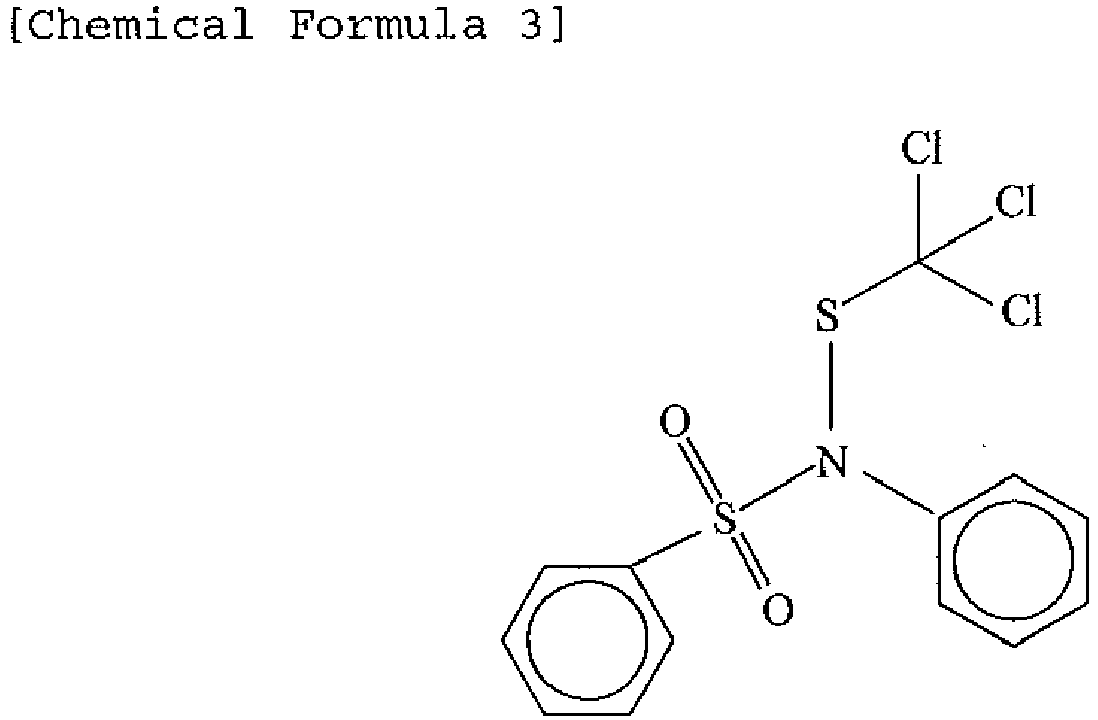
- The rubber composition of the invention includes N-phenyl-N-(trichloromethylthio)benzenesulfonamide. N-phenyl-N-(trichloromethylthio)benzenesulfonamide has the following chemical structure. In this invention, by including the above substance, it is possible to obtain an anti-vibration rubber which excels in terms of all of the following: heat resistance, compression set, dynamic-to-static modulus ratio, low-temperature properties and processability (scorch resistance). Such improvements were not possible merely by adjusting the relative proportions of sulfur and vulcanization accelerator or the type of vulcanization accelerator as in the prior art.
- The content of N-phenyl-N-(trichloromethylthio)-benzenesulfonamide per 100 parts by weight of the rubber component is preferably from 0.2 to 4 parts by weight. Outside of this range, improvements in heat resistance, compression set, dynamic-to-static modulus ratio, low-temperature characteristics and processability (scorch resistance) may not be observable.
- An example of a specific trade name for N-phenyl-N-(trichloromethylthio)benzenesulfonamide is "Vulkalent E/C" (from Lanxess AG).
- A vulcanization accelerator may be used in the rubber composition of the invention. The vulcanization accelerator is exemplified by, but not particularly limited to, benzothiazole-type vulcanization accelerators such as 2-mercaptobenzothiazole, dibenzothiazyl disulfide, N-cyclohexyl-2-benzothiazyl sulfenamide, N-t-butyl-2-benzothiazyl sulfenamide and N-t-butyl-2-benzothiazyl sulfenamide; guanidine-type vulcanization accelerators such as diphenylguanidine; thiuram-type vulcanization accelerators such as tetramethylthiuram disulfide, tetraethylthiuram disulfide, tetrabutylthiuram disulfide, tetradodecylthiuram disulfide, tetraoctylthiuram disulfide, tetrabenzylthiuram disulfide and dipentamethylenethiuram tetrasulfide; dithiocarbamic acid salts such as zinc dimethyldithiocarbamate; and zinc dialkyldithiophosphate.
- The above vulcanization accelerators may be of one type, such as a sulfenamide type, a thiuram type, a thiazole type, a guanidine type or a dithiocarbamic acid salt type, or may be a combination of two or more such types. In order to, for example, adjust the vulcanization behavior (rate), it is preferable to use a combination of a thiuram-type and/or a thiazole-type vulcanization accelerator having a relatively high vulcanization accelerating ability with a guanidine-type and/or a sulfenamide-type vulcanization accelerator having a relatively moderate to low vulcanization accelerating ability. Specific examples include the combination of tetramethylthiuram disulfide with N-cyclohexyl-2-benzothiazyl sulfenamide, the combination of tetrabutylthiuram disulfide with N-t-butyl-2-benzothiazyl sulfenamide, and the combination of dibenzothiazyl disulfide with diphenylguanidine. The combination of vulcanization accelerators is not limited to the above combinations. The total amount of vulcanization accelerator included per 100 parts by weight of the rubber component is preferably from 0.2 to 10 parts by weight.
- In cases where a thiuram-type vulcanization accelerator is used as the vulcanization accelerator, one having chemical structure (1) or (2) below is preferred.

- In the above formula, x is a positive number of at least 2. R1, R2, R3 and R4 are each like or unlike acylic alkyl groups, illustrative examples of which include methyl, ethyl, n-propyl, isopropyl, n-butyl, isobutyl, sec-butyl, t-butyl, n-pentyl, isopentyl, 2-methylbutyl, 1-methylbutyl, n-hexyl, isohexyl, 3-methylpentyl, 2-methylpentyl, 1-methylpentyl, heptyl, octyl, isooctyl and 2-ethylhexyl.

- In the above formula, y is a positive number of 2 or more, and m and n are each positive numbers of 2 or more. A specific example of a thiuram-type vulcanization accelerator of the above formula is dipentamethylenethiuram tetrasulfide (DPTT), in which m and n are each 5.
- An example of a thiuram-type vulcanization accelerator of the above chemical structure in which x = 1 is tetramethylthiuram monosulfide (e.g., that available under the trade name "Nocceler TS" from Ouchi Shinko Chemical Industry Co., Ltd.).
- Illustrative examples of the above thiuram-type vulcanization accelerators include tetramethylthiuram disulfide, tetraethylthiuram disulfide, tetrabutylthiuram disulfide, tetrakis(2-ethylhexyl)thiuram disulfide and dipentamethylenethiuram tetrasulfide. Examples of commercial products include those available under the trade names "Nocceler TT-P", "Nocceler TET-G", "Nocceler TBT", ""Nocceler TOT-N" and ""Nocceler TRA" (all available from Ouchi Shinko Chemical Industry Co., Ltd.).
- The amount of the above thiuram-type vulcanization accelerator included per 100 parts by weight of the rubber component is preferably from 0.5 to 5.0 parts by weight. In excess of this content, the vulcanization rate may become too high, the processability may dramatically worsen, and the tensile properties (elongation, strength) may worsen. On the other hand, below the above content, the degree of vulcanization may become low, and the low-temperature characteristics, tensile properties (elongation, strength), heat aging resistance, compression set and dynamic-to-static modulus ratio may worsen.
- Sulfur may or may not be included in the rubber composition of the invention. However, including sulfur enables, in relative terms, even further improvement to be achieved in the properties of the rubber. When sulfur is included, the content of sulfur per 100 parts by weight of the rubber component is preferably from 0.2 to 1.0 part by weight.
- In this invention, a vulcanization co-accelerator such as zinc white (ZnO) or a fatty acid may be included to help promote vulcanization. The fatty acid may be a straight-chain or branched fatty acid that is saturated or unsaturated. The number of carbons on the fatty acid is not particularly limited, although a fatty acid of from 1 to 30 carbons, and preferably from 15 to 30 carbons, is advantageous. Specific examples include naphthenic acids such as cyclohexanoic acid (cyclohexanecarboxylic acid) and alkylcyclopentanes having side chains; saturated fatty acids such as hexanoic acid, octanoic acid, decanoic acid (including branched carboxylic acids such as neodecanoic acid), dodecanoic acid, tetradecanoic acid, hexadecanoic acid and octadecanoic acid (stearic acid); unsaturated fatty acids such as methacrylic acid, oleic acid, linoleic acid and linolenic acid; and resin acids such as rosin, tall oil acids and abietic acid. These may be used singly, or two or more may be used in combination. In this invention, preferred use can be made of zinc white and stearic acid. The content of these co-accelerators per 100 parts by weight of the rubber component is preferably from 1 to 10 parts by weight, and more preferably from 2 to 7 parts by weight. A content greater than 10 parts by weight may lead to a poor workability and a poor dynamic-to-static modulus ratio, whereas a content of less than 1 part by weight may retard vulcanization.
- A known oil may be used. Examples include, without particular limitation, process oils such as aromatic oils, naphthenic oils and paraffinic oils; vegetable oils such as coconut oil; synthetic oils such as alkylbenzene oils; and castor oil. In this invention, the use of naphthenic oils is preferred. These may be used singly or two or more may be used in combination. The content of these oils per 100 parts by weight of the rubber component, although not particularly limited, may be set to generally from 2 to 80 parts by weight, with the upper limit preferably being not more than 70 parts by weight. At a content outside of the above range, the kneading workability may worsen. When oil-extended rubber is used in the rubber component, the oil included in the rubber should be adjusted such that the combined amount of such oil and any oils that are separately added during mixing falls within the above range.
- A known carbon black may be used. Examples include, without particular limitation, carbon blacks such as SRF, GPF, FEF, HAF, ISAF, SAF, FT and MT. In this invention, preferred use may be made of FEF. These carbon blacks may be used singly or two or more may be used in combination. The content of these carbon blacks per 100 parts by weight of the rubber component may be set to generally from 15 to 100 parts by weight, preferably from 20 to 80 parts by weight, and more preferably not more than 60 parts by weight. At a content of more than 100 parts by weight, the workability may worsen. On the other hand, at a content of less than 15 parts by weight, the adhesion may worsen.
- A known antioxidant may be used. Examples include, without particular limitation, phenolic antioxidants, imidazole-type antioxidants and amine-type antioxidants. The content of these antioxidants per 100 parts by weight of the rubber component is generally from 2 to 10 parts by weight, and preferably from 3 to 7 parts by weight. A single antioxidant may be used alone or two or more antioxidants may be used in combination.
- Where necessary, additives commonly used in the rubber industry, such as waxes, antioxidants, fillers, blowing agents, plasticizers, oils, lubricants, tackifiers, petroleum-based resins, ultraviolet absorbers, dispersants, compatibilizing agents, homogenizing agents and vulcanization retardants, may be suitably included in the rubber component, provided the use of these additives does not detract from the objects of the invention.
- The method used to compound the various above ingredients when preparing the rubber composition of the invention is not particularly limited. Kneading may be carried out by compounding all the ingredient starting materials at once, or kneading may be carried out by compounding the respective ingredients in two or three separate stages. Kneading may be carried out using a mixer such as roll mill, an internal mixer or a Banbury rotor. In addition, a known shaping machine such as an extruder or a press may be used when forming the rubber composition into a sheet, strip or the like.
- The vulcanization conditions when curing the above rubber composition are not particularly limited, although use can generally be made of a vulcanization temperature of from 140 to 180°C and a vulcanization time of from 5 to 120 minutes.
- The anti-vibration rubber of the invention is obtained by vulcanizing the above-described rubber composition. This anti-vibration rubber is preferably used in those parts of an automobile which are exposed to elevated temperatures, such as torsional dampers, engine mounts or muffler hangers, but is not limited to such uses.
- The invention is illustrated more fully below by way of Working Examples and Comparative Examples, although the invention is not limited by these Examples.
- The compounding formulations shown in Tables 1 to 3 were kneaded, and the anti-vibration rubber compositions of Working Examples 1 to 14 and Comparative Examples 1 to 10 were each vulcanized and cured to given shapes under given conditions, thereby producing shaped materials. The resulting shaped materials were used as specimens for evaluating the anti-vibration rubbers of the invention. These shaped materials were evaluated by carrying measurements of the hardness (Hd), tensile elongation (Eb), tensile strength (Tb), tensile stress (Md100 and Md300), heat resistance, compression set (CS), dynamic-to-static modulus ratio (Kd/Ks), low-temperature properties and Mooney scorching time (processability) in accordance with the following JIS standards. The results are presented in Tables 1 to 3.
- Carried out in accordance with JIS K 6253 (type A).
- Carried out in accordance with JIS K 6251.
- Carried out in accordance with JIS K 6251.
- The stress under 100% elongation (Md100) and the stress under 300% elongation (Md300) were determined in accordance with JIS K 6251.
- This test was carried out under heat aging conditions of 100°C and 96 hours in accordance with JIS K 6257. The respective test specimens were left to stand under these conditions, following which the above tensile elongation (Eb), tensile strength (Tb) and tensile stress (Md100 and Md300) were each measured. In addition, the percent retention of each of these values was determined. The percent retention is defined as the ratio (%) of a physical value for a test specimen after heat aging with respect to the physical value for the test specimen before heat heating. For example, the percent retention of the tensile elongation (Eb) is expressed as (Eb after heat aging)/(Eb before heating aging) x 100. A percent retention approaching 100 (%) means the absence of change with heat aging, which is excellent.
- A compression set test was carried out in accordance with JIS K 6262 under heating and temperature conditions of 100°C and 72 hours.
- Carried out in accordance with JIS K 6385. The Kd was measured at 100 Hz.
- A cylindrical rubber sample having a diameter of 30 mm and a height of 30 mm was fabricated, and the low-temperature characteristics were measured in accordance with JIS K 6385. The Kd value was measured at 40 Hz (this is treated as the initial Kd value). Next, after 10 days of exposure at -35°C in a constant-temperature tank, the Kd value was similarly measured under the above conditions (this is treated as the Kd value after low-temperature exposure). The ratio (Kd after low-temperature exposure)/(initial Kd) was used as the criterion for rating the low-temperature characteristics. That is, in the respective tables, (Kd after low-temperature exposure)/(initial Kd) ≤ 5 was denoted as "Good"; 5 < (Kd after low-temperature exposure)/(initial Kd) ≤ 20 was denoted as "Fair"; and (Kd after low-temperature exposure)/(initial Kd) ≥ 20 was denoted as "NG".
- The rubber compositions to be evaluated were vulcanized at 165°C and measured in accordance with JIS K 6300 (Physical Test Methods for Unvulcanized Rubber). The t(10) values were measured, and indices relative to an arbitrary value of 100 for the t(10) time in Comparative Example 1 are entered in the tables. A larger index represents a better scorching resistance. Here, t(10) signifies the onset of vulcanization, and so this was treated as the scorching time.
- Details on the compounding described above are given below.
- Rubber Component
- Natural rubber (NR) : "RSS#4"
- Butadiene rubber (BR): "T700" from JSR Corporation
- Carbon Black
- FEF carbon black was used: "Asahi #65" from Asahi Carbon Co., Ltd.
- FT carbon black was used: "Asahi Thermal" from Asahi Carbon Co., Ltd.
- Stearic Acid
"Stearic Acid 50S" from New Japan Chemical Co., Ltd. - Zinc White
Available as "No. 3 Zinc White" (Hakusui Tech Co., Ltd.) - Wax
Available under the trade name "Suntight S" (Seiko Chemical Co., Ltd.) - Antioxidant: RD
2,2,4-Trimethyl-1,2-dihydroquinoline polymer, available as "Nocrac 224" from Ouchi Shinko Chemical Industry Co., Ltd. - Antioxidant: 6C
N-Phenyl-N'-(1,3-dimethylbutyl)-p-phenylenediamine, available as "Nocrac NS-6" from Ouchi Shinko Chemical Industry Co., Ltd. - Microcrystalline Wax
Available as "Suntight S" from Seiko Chemical Co., Ltd. - Naphthenic Oil
"Sunthene 4240" from Sun Refining and Marketing Company - Sulfur
Available as "Sulfur Powder" from Tsurumi Chemical - N,N'-m-Phenylenebismaleimide
Available as "Vulnoc PM" from Ouchi Shinko Chemical Industry Co., Ltd. - 4,4'-Methanebis(N-phenylmaleimide)_
Available as "BMI-RB" from Daiwa Kasei Industry Co., Ltd. - Vulcanization Accelerator TT
Available under the trade name "Accel TMT-PO" (Kawaguchi Chemical Industry Co., Ltd.) - Vulcanization Accelerator CZ
Available under the trade name "Nocceler CZ-G" (Ouchi Shinko Chemical Industry Co., Ltd.) - Vulcanization Accelerator TBT-P
Available under the trade name "Accel TBT-P" (Kawaguchi Chemical Industry Co., Ltd.) - Vulcanization Accelerator NS)
Available under the trade name "Nocceler NS" (Ouchi Shinko Chemical Industry Co., Ltd.) - Vulcanization Accelerator TOT
Available under the trade name "Nocceler TOT-N" (Ouchi Shinko Chemical Industry Co., Ltd.) - N-Phenyl-N-(trichloromethylthio)benzenesulfonamide
Available under the trade name "Vulkalent E/C" (Lanxess AG) - As is apparent from the results in Table 1, Working Example 1, compared with Comparative Example 2, shows improvements in the Md100 retention after aging, Md300 retention after aging, compression set, dynamic-to-static modulus ratio and processing stability (scorching stability). Similarly, Working Example 2, compared with Comparative Example 3, shows improvements in the Md100 retention after aging, Md300 retention after aging, compression set, dynamic-to-static modulus ratio, low-temperature characteristics and processing stability (scorching stability). Likewise, Working Example 3, compared with Comparative Example 4, shows improvements in the Md100 retention after aging, Md300 retention after aging, compression set, dynamic-to-static modulus ratio, low-temperature characteristics and processing stability (scorching stability).
Table 2 Rubber formulation (pbw) Comparative Example Working Example Comp.Ex. 5 6 7 4 5 6 8 NR 100.0 100.0 100.0 100.0 100.0 100.0 100.0 BR FT CB FEF CB 30.0 30.0 30.0 30.0 30.0 30.0 30.0 Stearic acid 2.0 2.0 2.0 2.0 2.0 2.0 2.0 Zinc white 3.0 3.0 3.0 3.0 3.0 3.0 3.0 Wax 1.0 1.0 1.0 1.0 1.0 1.0 1.0 Antioxidant RD 1.0 1.0 1.0 1.0 1.0 1.0 1.0 Antioxidant 6C 3.0 3.0 3.0 3.0 3.0 3.0 3.0 Microcrystalline wax 2.0 2.0 2.0 2.0 2.0 2.0 2.0 Naphthenic oil 8.0 8.0 8.0 8.0 8.0 8.0 8.0 Sulfur 0.5 0.5 0.5 0.5 0.5 0.5 0.5 N,N'-m-Phenylenebismaleimide 4,4'-Methanebis(N-phenylmaleimide) 5.0 2.0 1.0 5.0 2.0 1.0 Vulcanization accelerator TT 1.5 1.5 1.5 1.5 1.5 1.5 1.5 Vulcanization accelerator CZ 1.5 1.5 1.5 1.5 1.5 1.5 1.5 Vulcanization accelerator TBT Vulcanization accelerator TOT Vulcanization accelerator NS N-Phenyl-N-(trichloromethyl-sulfenyl)benzene-sulfonamide 1.0 1.0 1.0 1.0 Hardness Hd 57 54 51 57 55 53 50 Tensile elongation Eb (%) 520 560 600 510 540 570 600 Tensile strength Tb (MPa) 26.8 25.8 26.9 26.2 24.3 25.4 25.3 Tensile stress Md100 (MPa) 1.92 1.70 1.61 2.06 1.88 1.74 1.43 Tensile stress Md300 (MPa) 9.35 8.10 7.20 10.00 9.20 8.38 6.83 Hd after aging 58 57 54 58 58 57 56 Eb retention after aging (%) 96 91 83 90 91 84 80 Tb retention after aging (%) 92 89 85 93 95 87 84 Md100 retention after aging (%) 133 141 137 126 124 131 140 Md300 retention after aging (%) 125 137 139 121 120 126 146 Compression set (%) 23 25 32 20 23 29 33 Static spring constant Ks (N/mm) 130.0 115.0 105.2 134.0 120.0 112.2 97.8 Dynamic spring constant Kd100 (N/mm) 223.6 192.1 180.3 223.8 192.7 181.0 171.3 Dynamic-to-static modulus ratio (Kd100/Ks) 1.72 1.67 1.71 1.67 1.61 1.61 1.75 Low-temperature characteristics NG NG NG good good good good Curelastometer (165°C) T10 (Index) 60 70 75 70 80 80 78 - As is apparent from the results in Table 2, Working Example 4, compared with Comparative Example 5, shows improvements in the Md100 retention after aging, Md300 retention after aging, compression set, dynamic-to-static modulus ratio, low-temperature characteristics and processing stability (scorching stability). Similarly, Working Example 5, compared with Comparative Example 6, shows improvements in the Md100 retention after aging, Md300 retention after aging, compression set, dynamic-to-static modulus ratio, low-temperature characteristics and processing stability (scorching stability). Likewise, Working Example 6, compared with Comparative Example 7, shows improvements in the Md100 retention after aging, Md300 retention after aging, compression set, dynamic-to-static modulus ratio, low-temperature characteristics and processing stability (scorching stability).
Table 3 Rubber formulation (pbw) Corp.Ex. Working Example Comp.Ex. Working Example 9 7 8 9 10 11 12 10 13 14 NR 100.0 100.0 100.0 100.0 100.0 100.0 100.0 80.0 80.0 80.0 BR 20.0 20.0 20.0 FT CB 50.0 50.0 50.0 50.0 50.0 50.0 50.0 50.0 50.0 50.0 FEF CB Stearic acid 2.0 2.0 2.0 2.0 2.0 2.0 2.0 2.0 2.0 2.0 Zinc white 3.0 3.0 3.0 3.0 3.0 3.0 3.0 3.0 3.0 3.0 Wax 1.0 1.0 1.0 1.0 1.0 1.0 1.0 1.0 1.0 1.0 Antioxidant RD 1.0 1.0 1.0 1.0 1.0 1.0 1.0 1.0 1.0 1.0 Antioxidant 6C 3.0 3.0 3.0 3.0 3.0 3.0 3.0 3.0 3.0 3.0 Microcrystalline wax 2.0 2.0 2.0 2.0 2.0 2.0 2.0 2.0 2.0 2.0 Naphthenic oil 5.0 5.0 5.0 5.0 5.0 5.0 5.0 5.0 5.0 5.0 Sulfur 0.5 0.5 0.5 0.5 0.5 0.5 0.5 0.5 0.5 0.5 N,N'-m-Phenylenebismaleimide 3.0 3.0 3.0 3.0 3.0 3.0 3.0 3.0 3.0 3.0 4,4'-Methanebis(N-phenyl-maleimide) Vulcanization accelerator TT 1.5 1.5 1.5 1.5 1.5 1.5 1.5 1.5 Vulcanization accelerator CZ 1.5 1.5 1.5 1.5 1.5 1.5 1.5 1.5 1.5 1.5 Vulcanization accelerator TBT 2.5 Vulcanization accelerator TOT 4.5 Vulcanization accelerator NS N-Phenyl-N-(trichloromethyl-sulfenyl)-benzenesulfonamide 0.2 1.0 1.0 1.0 2.0 4.0 1.0 2.0 Hardness Hd 53 54 54 54 55 54 55 55 57 58 Tensile elongation Eb (%) 550 530 520 520 560 480 490 590 570 550 Tensile strength Tb (MPa) 23.2 22.7 23.5 22.5 23.5 20.4 21.2 18.4 18.6 17.9 Tensile stress Md100 (MPa) 1.50 1.58 1.70 1.69 1.94 1.71 1.86 1.64 1.95 1.95 Tensile stress Md300 (MPa) 7.76 8.15 9.47 8.68 8.90 9.18 9.48 6.00 6.74 6.77 Hd after aging 54 55 56 56 58 56 58 57 58 59 Eb retention after aging (%) 87 91 89 88 85 90 88 90 91 92 Tb retention after aging (%) 91 95 90 91 85 101 91 90 90 91 Md100 retention after aging (%) 123 115 120 116 123 119 118 117 114 115 Md300 retention after aging (%) 126 119 124 115 125 124 121 123 120 118 Compression set (%) 23 22 21 20 17 20 22 23 22 21 Static spring constant Ks (N/mm) 109.2 109.0 117.0 115.4 120.1 116.3 118.2 118.3 124.8 126.2 Dynamic spring constant Kd100 (N/mm) 141.0 137.2 143.1 142.1 143.0 144.2 147.1 152.9 158.3 156.3 Dynamic-to-static modulus ratio (Kd100/Ks) 1.29 1.26 1.22 1.23 1.19 1.24 1.24 1.29 1.27 1.24 Low-temperature characteristics NG good good good good good good fair good good Curelastometer (165°C) T10 (Index) 75 77 108 85 111 96 100 85 95 100 - As is apparent from the results in Table 3, Working Examples 7 to 12, compared with Comparative Example 9, show improvements in the Md100 retention after aging, Md300 retention after aging, compression set, dynamic-to-static modulus ratio, low-temperature characteristics and processing stability (scorching stability). Also, Working Examples 13 and 14, compared with Comparative Example 10, show improvements in the Md100 retention after aging, Md300 retention after aging, compression set, dynamic-to-static modulus ratio, low-temperature characteristics and processing stability (scorching stability).
- The compounding formulations shown in Tables 4 and 5 were kneaded, and the anti-vibration rubber compositions of Working Examples 15 to 26 and Comparative Examples 11 to 14 were vulcanized and cured to given shapes under given conditions, thereby producing shaped materials. The resulting shaped materials were used as specimens for evaluating the anti-vibration rubbers of the invention. These shaped materials were evaluated by carrying measurements of the hardness (Hd), tensile elongation (Eb), tensile strength (Tb), heat aging resistance, compression set (CS), dynamic-to-static modulus ratio (Kd/Ks) and low-temperature characteristics in accordance with the following JIS standards. The results are presented in Tables 4 and 5.
- A cylindrical rubber sample having a diameter of 30 mm and a height of 30 mm was fabricated, and the Kd value was measured at 40 Hz in accordance with JIS K 6385 (this is treated as the initial Kd value). Next, after 10 days of exposure at -35°C, the Kd value was similarly measured rapidly under the above conditions (this is treated as the Kd value after low-temperature exposure). Using the ratio (Kd after low-temperature exposure)/(initial Kd) as the criterion for rating the low-temperature characteristics, the target values in the tables were (Kd after low-temperature exposure)/(initial Kd) ≤ 5.
- Carried out in accordance with JIS K 6253 (type A).
- Carried out in accordance with JIS K 6251. The target value for Eb was set to at least 500%.
- Carried out in accordance with JIS K 6251. The target value for Tb was set to at least 20 MPa.
- Carried out in accordance with JIS K 6257 under heat aging conditions of 100°C and 96 hours. The respective test specimens were left to stand under these conditions, following which the above hardness (Hd), tensile elongation (Eb) and tensile strength (Tb) were each measured. The change in hardness (Hd) was expressed in durometer degrees, and the changes in tensile elongation (Eb) and tensile strength (Tb) were expressed as the percent retention (%). The target values were a change in Hd of within ±4, a change in Eb of at least 80%, and a change in Tb of at least 80%.
- A compression set test was carried out under heating and temperature conditions of 100°C and 72 hours, in accordance with JIS K 6262. The target value for compression set was 25% or less.
- The Kd value was measured in accordance with JIS K 6385 at 100 Hz. The target value for the dynamic-to-static modulus ratio was 1.5 or less.
- Details on the compounding described above are given below.
- Rubber Component
- Natural rubber (NR): "RSS#4"
- Butadiene rubber (BR): "T700" from JSR Corporation
- Carbon Black
- FEF carbon black was used: "Asahi #65" from Asahi Carbon Co., Ltd.
- Stearic Acid
"Stearic Acid 50S" from New Japan Chemical Co., Ltd. - Zinc White
Available as "No. 3 Zinc White" (Hakusui Tech Co., Ltd.) - Wax
Available under the trade name "Suntight S" (Seiko Chemical Co., Ltd.) - Antioxidant: RD
2,2,4-Trimethyl-1,2-dihydroquinoline polymer, available as "Nocrac 224" from Ouchi Shinko Chemical Industry Co., Ltd. - Antioxidant: 6C
N-Phenyl-N'-(1,3-dimethylbutyl)-p-phenylenediamine, available as "Nocrac NS-6" from Ouchi Shinko Chemical Industry Co., Ltd. - Antioxidant: MB
2-Mercaptobenzoimidazole, available as "Nocrac MB" from Ouchi Shinko Chemical Industry Co., Ltd. - oil
Naphthenic oil, available under the trade name "Sunthene 4240" from Sun Refining and Marketing Company. - Sulfur
Available as "Sulfur Powder" from Tsurumi Chemical - N,N'-m-Phenylenedimaleimide
Available under the trade name "Vulnoc PM" from Ouchi Shinko Chemical Industry Co., Ltd. - Vulcanization Accelerator: TS
Tetramethylthiuram monosulfide, available under the trade name "Nocceler TS" from Ouchi Shinko Chemical Industry. - Vulcanization Accelerator: TT
Tetramethylthiuram disulfide, available under the trade name "Nocceler TT-P" from Ouchi Shinko Chemical Industry Co., Ltd. - Vulcanization Accelerator: CZ
N-Cyclohexyl-2-benzothiazolyl sulfenamide, available under the trade name "Nocceler CZ-G" from Ouchi Shinko Chemical Industry Co., Ltd. - Vulcanization Accelerator: TRA
Dipentamethylenethiuram tetrasulfide, available under the trade name "Nocceler TRA" from Ouchi Shinko Chemical Industry Co., Ltd. - Vulcanization Accelerator: TBT
Tetrabutylthiuram disulfide, available under the trade name "Nocceler TBT" from Ouchi Shinko Chemical Industry Co., Ltd. - Vulcanization Accelerator: TET
Tetraethylthiuram disulfide, available under the trade name ""Nocceler TET-G" from Ouchi Shinko Chemical Industry Co., Ltd. - Vulcanization Accelerator: TOT
Tetrakis(2-ethylhexyl)thiuram disulfide, available under the trade name ""Nocceler TOT-N" from Ouchi Shinko Chemical Industry Co., Ltd. - N-Phenyl-N-(trichloromethylthio)benzenesulfonamide
Available under the trade name "Vulkalent E/C" from Lanxess AG - As is apparent from the rubber properties in Tables 4 and 5 above, the low-temperature characteristics, hardness, tensile properties such as elongation and strength, heat aging resistance, compression set and dynamic-to-static modulus ratio for the rubber compositions in Working Examples 15 to 26 according to the invention all cleared their target values, demonstrating that each of these compositions had good properties.
- By contrast, Comparative Example 11 was an example in which N-phenyl-N-(trichloromethylthio)benzenesulfonamide was not used as a vulcanizing agent. As a result, the low-temperature characteristics were poor and the dynamic-to-static modulus ratio was poor.
- Comparative Example 12 was an example in which N-phenyl-N-(trichloromethylthio)benzenesulfonamide was not used as a vulcanizing agent. As a result, the low-temperature characteristics and the heat aging resistance were poor. The compression set properties were also poor.
- Comparative Example 13 was an example in which N-phenyl-N-(trichloromethylthio)benzenesulfonamide was not used as a vulcanizing agent. As a result, the low-temperature characteristics were poor.
- Comparative Example 14 was an example in which N-phenyl-N-(trichloromethylthio)benzenesulfonamide was not used as a vulcanizing agent. As a result, the low-temperature characteristics were poor. Tensile properties such as elongation and strength were also poor (the rubber compounding here differed from that in Comparative Example 12 in that BR was substituted for some of the NR).
| Rubber formulation (pbw) | Comparative Example | Working Example | |||||
| 1 | 2 | 3 | 4 | 1 | 2 | 3 | |
| NR | 100.0 | 100.0 | 100.0 | 100.0 | 100.0 | 100.0 | 100.0 |
| BR | |||||||
| FT CB | 60.0 | ||||||
| FEF CB | 30.0 | 30.0 | 30.0 | 30.0 | 30.0 | 30.0 | |
| stearic acid | 2.0 | 2.0 | 2.0 | 2.0 | 2.0 | 2.0 | 2.0 |
| Zinc white | 3.0 | 3.0 | 3.0 | 3.0 | 3.0 | 3.0 | 3.0 |
| Wax | 1.0 | 1.0 | 1.0 | 1.0 | 1.0 | 1.0 | 1.0 |
| Antioxidant RD | 1.0 | 1.0 | 1.0 | 1.0 | 1.0 | 1.0 | 1.0 |
| Antioxidant 6C | 3.0 | 3.0 | 3.0 | 3.0 | 3.0 | 3.0 | 3.0 |
| Microcrystalline wax | 2.0 | 2.0 | 2.0 | 2.0 | 2.0 | 2.0 | 2.0 |
| Naphthenic oil | 4.0 | 8.0 | 8.0 | 8.0 | 8.0 | 8.0 | 8.0 |
| Sulfur | 1.5 | 1.0 | 0.4 | 0.2 | 1.0 | 0.4 | 0.2 |
| N,N'-m-Phenylenebismaleimide | |||||||
| 4,4'-Methanebis(N-phenylmaleimide) | 3.0 | 3 .0 | 3.0 | 3.0 | 3.0 | 3.0 | |
| Vulcanization accelerator TT | 1.5 | 1.5 | 1.5 | 1.5 | 1.5 | 1.5 | |
| Vulcanization accelerator CZ | 1.5 | 1.5 | 1.5 | 1.5 | 1.5 | 1.5 | |
| Vulcanization accelerator TBT | 2.0 | ||||||
| Vulcanization accelerator TOT | |||||||
| Vulcanization accelerator NS | 1.0 | ||||||
| N-Phenyl-N-(trichloromethyl-sulfenyl)benzene-sulfonamide | 1.0 | 1.0 | 1.0 | ||||
| Hardness Hd | 52 | 53 | 56 | 52 | 57 | 56 | 53 |
| Tensile elongation Eb (%) | 530 | 520 | 540 | 600 | 530 | 560 | 580 |
| Tensile strength Tb (MPa) | 21.5 | 23.6 | 25.1 | 25.4 | 24.3 | 25.4 | 24.8 |
| Tensile stress Md100 (MPa) | 1.50 | 1.70 | 1.93 | 1.45 | 2.00 | 1.90 | 1.63 |
| Tensile stress Md300 (MPa) | 7.94 | 7.92 | 9.99 | 7.40 | 8.80 | 9.07 | 8.24 |
| Hd after aging | 57 | 55 | 57 | 54 | 58 | 58 | 55 |
| Eb retention after aging (%) | 79 | 83 | 89 | 87 | 91 | 84 | 93 |
| Tb retention after aging (%) | 87 | 81 | 87 | 89 | 92 | 86 | 94 |
| Md100 retention after aging (%) | 148 | 120 | 120 | 123 | 113 | 113 | 117 |
| Md300 retention after aging (%) | 151 | 122 | 118 | 131 | 113 | 114 | 112 |
| Compression set (%) | 51 | 26 | 26 | 28 | 20 | 20 | 23 |
| Static spring constant Ks (N/mm) | 105.3 | 128.0 | 123.7 | 100.1 | 129.2 | 123.1 | 109.9 |
| Dynamic spring constant Kd100 (N/mm) | 132.8 | 182.2 | 192.9 | 175.4 | 179.0 | 185.7 | 177.3 |
| Dynamic-to-static modulus ratio (Kd100/Ks) | 1.26 | 1.42 | 1.56 | 1.75 | 1.39 | 1.51 | 1.61 |
| Low-temperature characteristics | good | good | NG | NG | good | good | fair |
| Curelastometer (165°C) T10 (Index) | 100 | 77 | 70 | 75 | 81 | 85 | 87 |


Claims (6)
- An anti-vibration rubber composition comprising:a rubber component composed primarily of diene rubber,a bismaleimide compound as a vulcanizing agent and,an N-phenyl-N-(trichloromethylthio)benzenesulfonamide.
- The anti-vibration rubber composition of claim 1, wherein the rubber component includes a sulfur.
- The anti-vibration rubber composition of claim 2, wherein the sulfur is included in an amount of from 0.2 to 1.0 part by weight per 100 parts by weight of the rubber component.
- The anti-vibration rubber composition of claim 1, 2 or 3, wherein the rubber component includes a thiuram-type vulcanizing accelerator having chemical structure (1) or (2) below


- The anti-vibration rubber composition of any one of claims 1 to 4, wherein the thiuram-type vulcanization accelerator is included in an amount of from 0.5 to 5.0 parts by weight per 100 parts by weight of the rubber component.
- An anti-vibration rubber obtained by curing the rubber composition of any one of claims 1 to 5.
Applications Claiming Priority (3)
| Application Number | Priority Date | Filing Date | Title |
|---|---|---|---|
| JP2011123049 | 2011-06-01 | ||
| JP2011159824A JP5790236B2 (en) | 2011-07-21 | 2011-07-21 | Anti-vibration rubber composition and anti-vibration rubber |
| PCT/JP2012/064116 WO2012165561A1 (en) | 2011-06-01 | 2012-05-31 | Anti-vibration rubber composition and anti-vibration rubber |
Publications (3)
| Publication Number | Publication Date |
|---|---|
| EP2716699A1 true EP2716699A1 (en) | 2014-04-09 |
| EP2716699A4 EP2716699A4 (en) | 2015-03-11 |
| EP2716699B1 EP2716699B1 (en) | 2016-01-13 |
Family
ID=47259413
Family Applications (1)
| Application Number | Title | Priority Date | Filing Date |
|---|---|---|---|
| EP12792017.1A Not-in-force EP2716699B1 (en) | 2011-06-01 | 2012-05-31 | Anti-vibration rubber composition and anti-vibration rubber |
Country Status (4)
| Country | Link |
|---|---|
| US (1) | US9725524B2 (en) |
| EP (1) | EP2716699B1 (en) |
| CN (1) | CN103562294B (en) |
| WO (1) | WO2012165561A1 (en) |
Cited By (3)
| Publication number | Priority date | Publication date | Assignee | Title |
|---|---|---|---|---|
| EP3006497A4 (en) * | 2013-06-07 | 2016-04-27 | Bridgestone Corp | Rubber composition for anti-vibration rubber |
| EP2924072A4 (en) * | 2012-11-22 | 2016-07-13 | Bridgestone Corp | Antivibration rubber composition, and antivibration rubber |
| EP4378992A4 (en) * | 2021-07-27 | 2024-11-27 | Bridgestone Corporation | RUBBER COMPOSITION FOR HOSE INNER TUBES, LAMINATE AND HOSE |
Families Citing this family (13)
| Publication number | Priority date | Publication date | Assignee | Title |
|---|---|---|---|---|
| JP6112755B2 (en) * | 2011-04-26 | 2017-04-12 | 株式会社ブリヂストン | Anti-vibration rubber composition and anti-vibration rubber |
| JP5893937B2 (en) * | 2012-01-30 | 2016-03-23 | 株式会社ブリヂストン | Anti-vibration rubber composition, crosslinked anti-vibration rubber composition and anti-vibration rubber |
| JP5893938B2 (en) * | 2012-01-30 | 2016-03-23 | 株式会社ブリヂストン | Anti-vibration rubber composition and anti-vibration rubber |
| EP2810984B1 (en) * | 2012-01-30 | 2016-09-14 | Bridgestone Corporation | Anti-vibration rubber composition, crosslinked anti-vibration rubber composition, and anti-vibration rubber |
| JP5928273B2 (en) * | 2012-09-20 | 2016-06-01 | 株式会社ブリヂストン | Method for producing rubber composition |
| ES2646952T3 (en) * | 2013-06-24 | 2017-12-18 | Bridgestone Corporation | Tire |
| JP6147594B2 (en) * | 2013-07-09 | 2017-06-14 | 東洋ゴム工業株式会社 | Rubber composition for tire sidewall and pneumatic tire |
| JP2015101693A (en) * | 2013-11-27 | 2015-06-04 | 三菱電線工業株式会社 | Rubber composition and seal member |
| JP6287601B2 (en) * | 2014-06-06 | 2018-03-07 | 株式会社ブリヂストン | Anti-vibration rubber composition and anti-vibration rubber |
| JP2017110093A (en) * | 2015-12-16 | 2017-06-22 | 東洋ゴム工業株式会社 | Rubber composition for vibration-proof rubber |
| US20170217263A1 (en) | 2016-01-29 | 2017-08-03 | The Goodyear Tire & Rubber Company | Air maintenance tire |
| JP5957159B1 (en) * | 2016-03-23 | 2016-07-27 | 三菱電線工業株式会社 | Rubber composition and seal member |
| JP7543057B2 (en) * | 2020-09-28 | 2024-09-02 | Toyo Tire株式会社 | Rubber composition and vibration-proof rubber obtained by vulcanization molding of the rubber composition |
Family Cites Families (21)
| Publication number | Priority date | Publication date | Assignee | Title |
|---|---|---|---|---|
| BE758927A (en) | 1969-11-15 | 1971-05-13 | Bayer Ag | NEW VULCANIZATION DELAYERS BASED ON SUBSTITUTE SULFONAMIDES |
| BE787079A (en) * | 1971-08-03 | 1973-02-02 | Polymer Corp | CURING LIQUID COMPOSITION AND ITS APPLICATIONS TO COATING SURFACES |
| JPS5221619B2 (en) * | 1973-05-22 | 1977-06-11 | ||
| JPS58160331A (en) * | 1982-03-18 | 1983-09-22 | Sumitomo Chem Co Ltd | Sulfonamide-containing rubber composition |
| JPS6054975B2 (en) * | 1983-06-09 | 1985-12-03 | 大阪曹達株式会社 | Method for suppressing early vulcanization of halogen-containing polymers |
| DE3906188A1 (en) * | 1989-02-28 | 1990-08-30 | Bayer Ag | SULFUR-VOLCANIZABLE RUBBER MATERIALS WITH REDUCED FLOW-OUT EFFECT |
| JP2897836B2 (en) | 1990-03-08 | 1999-05-31 | 株式会社ブリヂストン | Rubber composition for anti-vibration rubber |
| JPH03258533A (en) * | 1990-03-08 | 1991-11-18 | Bridgestone Corp | Heat-resistant composite of rubber and metal |
| JPH11302477A (en) * | 1998-04-16 | 1999-11-02 | Toyo Tire & Rubber Co Ltd | Vibration-insulating rubber composition |
| JP4595488B2 (en) | 2003-12-09 | 2010-12-08 | 東海ゴム工業株式会社 | Anti-vibration rubber composition |
| JP5133503B2 (en) * | 2004-10-08 | 2013-01-30 | 株式会社ブリヂストン | Anti-vibration rubber composition and anti-vibration rubber member |
| JP4622618B2 (en) * | 2005-03-28 | 2011-02-02 | 東海ゴム工業株式会社 | Anti-vibration rubber composition |
| US7735533B2 (en) * | 2005-12-20 | 2010-06-15 | The Goodyear Tire & Rubber Company | Heavy duty tire with silica-rich polyisoprene rubber based intermediate transition layer |
| JP5209343B2 (en) * | 2008-02-27 | 2013-06-12 | 東海ゴム工業株式会社 | Thermoplastic elastomer product and production method thereof |
| JP5247206B2 (en) | 2008-03-31 | 2013-07-24 | 東洋ゴム工業株式会社 | Rubber composition for anti-vibration rubber and anti-vibration rubber |
| JP5524522B2 (en) | 2008-08-19 | 2014-06-18 | 株式会社ブリヂストン | Rubber composition |
| JP5420224B2 (en) | 2008-10-20 | 2014-02-19 | 東洋ゴム工業株式会社 | Rubber composition for anti-vibration rubber, anti-vibration rubber and method for producing the same |
| JP2010111742A (en) * | 2008-11-05 | 2010-05-20 | Toyo Tire & Rubber Co Ltd | Rubber composition for vibration-proof rubber and vibration-proof rubber |
| US20100119855A1 (en) * | 2008-11-10 | 2010-05-13 | Trazollah Ouhadi | Thermoplastic Elastomer with Excellent Adhesion to EPDM Thermoset Rubber and Low Coefficient of Friction |
| JP2010254872A (en) | 2009-04-28 | 2010-11-11 | Bridgestone Corp | Rubber composition for vibration insulating rubber |
| US8952092B2 (en) * | 2010-10-14 | 2015-02-10 | Basf Se | Non-carboxylated styrene-butadiene copolymers, preparation method and use thereof |
-
2012
- 2012-05-31 EP EP12792017.1A patent/EP2716699B1/en not_active Not-in-force
- 2012-05-31 CN CN201280026491.6A patent/CN103562294B/en not_active Withdrawn - After Issue
- 2012-05-31 WO PCT/JP2012/064116 patent/WO2012165561A1/en not_active Ceased
- 2012-05-31 US US14/122,751 patent/US9725524B2/en not_active Expired - Fee Related
Cited By (3)
| Publication number | Priority date | Publication date | Assignee | Title |
|---|---|---|---|---|
| EP2924072A4 (en) * | 2012-11-22 | 2016-07-13 | Bridgestone Corp | Antivibration rubber composition, and antivibration rubber |
| EP3006497A4 (en) * | 2013-06-07 | 2016-04-27 | Bridgestone Corp | Rubber composition for anti-vibration rubber |
| EP4378992A4 (en) * | 2021-07-27 | 2024-11-27 | Bridgestone Corporation | RUBBER COMPOSITION FOR HOSE INNER TUBES, LAMINATE AND HOSE |
Also Published As
| Publication number | Publication date |
|---|---|
| WO2012165561A1 (en) | 2012-12-06 |
| US9725524B2 (en) | 2017-08-08 |
| CN103562294B (en) | 2015-09-30 |
| EP2716699B1 (en) | 2016-01-13 |
| EP2716699A4 (en) | 2015-03-11 |
| US20140080979A1 (en) | 2014-03-20 |
| CN103562294A (en) | 2014-02-05 |
Similar Documents
| Publication | Publication Date | Title |
|---|---|---|
| EP2716699B1 (en) | Anti-vibration rubber composition and anti-vibration rubber | |
| US9416257B2 (en) | Antivibration rubber composition, and antivibration rubber | |
| EP3006497B1 (en) | Rubber composition for anti-vibration rubber | |
| JP6112755B2 (en) | Anti-vibration rubber composition and anti-vibration rubber | |
| JP5928273B2 (en) | Method for producing rubber composition | |
| US10059834B2 (en) | Rubber vibration isolator composition and rubber vibration isolator | |
| JP2010254872A (en) | Rubber composition for vibration insulating rubber | |
| JP5983049B2 (en) | Anti-vibration rubber composition and anti-vibration rubber | |
| JP5790236B2 (en) | Anti-vibration rubber composition and anti-vibration rubber | |
| JP6702313B2 (en) | Anti-vibration member | |
| JP6248777B2 (en) | Rubber composition for anti-vibration rubber and anti-vibration rubber | |
| JP2019048959A (en) | Rubber composition for vibration-damping rubber and vibration-damping rubber product | |
| JP2017226732A (en) | Anti-vibration rubber composition and anti-vibration rubber | |
| JP2017214531A (en) | Rubber composition, rubber composition for vibration-proof rubber products, and vibration-proof rubber product |
Legal Events
| Date | Code | Title | Description |
|---|---|---|---|
| PUAI | Public reference made under article 153(3) epc to a published international application that has entered the european phase |
Free format text: ORIGINAL CODE: 0009012 |
|
| 17P | Request for examination filed |
Effective date: 20131202 |
|
| AK | Designated contracting states |
Kind code of ref document: A1 Designated state(s): AL AT BE BG CH CY CZ DE DK EE ES FI FR GB GR HR HU IE IS IT LI LT LU LV MC MK MT NL NO PL PT RO RS SE SI SK SM TR |
|
| DAX | Request for extension of the european patent (deleted) | ||
| REG | Reference to a national code |
Ref country code: DE Ref legal event code: R079 Ref document number: 602012013980 Country of ref document: DE Free format text: PREVIOUS MAIN CLASS: C08L0007000000 Ipc: C08L0009000000 |
|
| A4 | Supplementary search report drawn up and despatched |
Effective date: 20150210 |
|
| RIC1 | Information provided on ipc code assigned before grant |
Ipc: C08L 7/00 20060101ALI20150203BHEP Ipc: C08K 5/3415 20060101ALI20150203BHEP Ipc: C08L 9/00 20060101AFI20150203BHEP Ipc: C08K 5/435 20060101ALI20150203BHEP |
|
| GRAP | Despatch of communication of intention to grant a patent |
Free format text: ORIGINAL CODE: EPIDOSNIGR1 |
|
| INTG | Intention to grant announced |
Effective date: 20150715 |
|
| GRAS | Grant fee paid |
Free format text: ORIGINAL CODE: EPIDOSNIGR3 |
|
| GRAA | (expected) grant |
Free format text: ORIGINAL CODE: 0009210 |
|
| AK | Designated contracting states |
Kind code of ref document: B1 Designated state(s): AL AT BE BG CH CY CZ DE DK EE ES FI FR GB GR HR HU IE IS IT LI LT LU LV MC MK MT NL NO PL PT RO RS SE SI SK SM TR |
|
| REG | Reference to a national code |
Ref country code: GB Ref legal event code: FG4D |
|
| REG | Reference to a national code |
Ref country code: CH Ref legal event code: EP |
|
| REG | Reference to a national code |
Ref country code: IE Ref legal event code: FG4D |
|
| REG | Reference to a national code |
Ref country code: AT Ref legal event code: REF Ref document number: 770498 Country of ref document: AT Kind code of ref document: T Effective date: 20160215 |
|
| REG | Reference to a national code |
Ref country code: DE Ref legal event code: R096 Ref document number: 602012013980 Country of ref document: DE |
|
| REG | Reference to a national code |
Ref country code: LT Ref legal event code: MG4D |
|
| REG | Reference to a national code |
Ref country code: NL Ref legal event code: MP Effective date: 20160113 |
|
| REG | Reference to a national code |
Ref country code: FR Ref legal event code: PLFP Year of fee payment: 5 |
|
| REG | Reference to a national code |
Ref country code: AT Ref legal event code: MK05 Ref document number: 770498 Country of ref document: AT Kind code of ref document: T Effective date: 20160113 |
|
| PG25 | Lapsed in a contracting state [announced via postgrant information from national office to epo] |
Ref country code: NL Free format text: LAPSE BECAUSE OF FAILURE TO SUBMIT A TRANSLATION OF THE DESCRIPTION OR TO PAY THE FEE WITHIN THE PRESCRIBED TIME-LIMIT Effective date: 20160113 |
|
| PG25 | Lapsed in a contracting state [announced via postgrant information from national office to epo] |
Ref country code: NO Free format text: LAPSE BECAUSE OF FAILURE TO SUBMIT A TRANSLATION OF THE DESCRIPTION OR TO PAY THE FEE WITHIN THE PRESCRIBED TIME-LIMIT Effective date: 20160413 Ref country code: IT Free format text: LAPSE BECAUSE OF FAILURE TO SUBMIT A TRANSLATION OF THE DESCRIPTION OR TO PAY THE FEE WITHIN THE PRESCRIBED TIME-LIMIT Effective date: 20160113 Ref country code: HR Free format text: LAPSE BECAUSE OF FAILURE TO SUBMIT A TRANSLATION OF THE DESCRIPTION OR TO PAY THE FEE WITHIN THE PRESCRIBED TIME-LIMIT Effective date: 20160113 Ref country code: FI Free format text: LAPSE BECAUSE OF FAILURE TO SUBMIT A TRANSLATION OF THE DESCRIPTION OR TO PAY THE FEE WITHIN THE PRESCRIBED TIME-LIMIT Effective date: 20160113 Ref country code: ES Free format text: LAPSE BECAUSE OF FAILURE TO SUBMIT A TRANSLATION OF THE DESCRIPTION OR TO PAY THE FEE WITHIN THE PRESCRIBED TIME-LIMIT Effective date: 20160113 Ref country code: GR Free format text: LAPSE BECAUSE OF FAILURE TO SUBMIT A TRANSLATION OF THE DESCRIPTION OR TO PAY THE FEE WITHIN THE PRESCRIBED TIME-LIMIT Effective date: 20160414 |
|
| PG25 | Lapsed in a contracting state [announced via postgrant information from national office to epo] |
Ref country code: IS Free format text: LAPSE BECAUSE OF FAILURE TO SUBMIT A TRANSLATION OF THE DESCRIPTION OR TO PAY THE FEE WITHIN THE PRESCRIBED TIME-LIMIT Effective date: 20160513 Ref country code: SE Free format text: LAPSE BECAUSE OF FAILURE TO SUBMIT A TRANSLATION OF THE DESCRIPTION OR TO PAY THE FEE WITHIN THE PRESCRIBED TIME-LIMIT Effective date: 20160113 Ref country code: LT Free format text: LAPSE BECAUSE OF FAILURE TO SUBMIT A TRANSLATION OF THE DESCRIPTION OR TO PAY THE FEE WITHIN THE PRESCRIBED TIME-LIMIT Effective date: 20160113 Ref country code: RS Free format text: LAPSE BECAUSE OF FAILURE TO SUBMIT A TRANSLATION OF THE DESCRIPTION OR TO PAY THE FEE WITHIN THE PRESCRIBED TIME-LIMIT Effective date: 20160113 Ref country code: AT Free format text: LAPSE BECAUSE OF FAILURE TO SUBMIT A TRANSLATION OF THE DESCRIPTION OR TO PAY THE FEE WITHIN THE PRESCRIBED TIME-LIMIT Effective date: 20160113 Ref country code: PT Free format text: LAPSE BECAUSE OF FAILURE TO SUBMIT A TRANSLATION OF THE DESCRIPTION OR TO PAY THE FEE WITHIN THE PRESCRIBED TIME-LIMIT Effective date: 20160513 Ref country code: PL Free format text: LAPSE BECAUSE OF FAILURE TO SUBMIT A TRANSLATION OF THE DESCRIPTION OR TO PAY THE FEE WITHIN THE PRESCRIBED TIME-LIMIT Effective date: 20160113 Ref country code: BE Free format text: LAPSE BECAUSE OF NON-PAYMENT OF DUE FEES Effective date: 20160531 Ref country code: LV Free format text: LAPSE BECAUSE OF FAILURE TO SUBMIT A TRANSLATION OF THE DESCRIPTION OR TO PAY THE FEE WITHIN THE PRESCRIBED TIME-LIMIT Effective date: 20160113 |
|
| REG | Reference to a national code |
Ref country code: DE Ref legal event code: R097 Ref document number: 602012013980 Country of ref document: DE |
|
| PG25 | Lapsed in a contracting state [announced via postgrant information from national office to epo] |
Ref country code: DK Free format text: LAPSE BECAUSE OF FAILURE TO SUBMIT A TRANSLATION OF THE DESCRIPTION OR TO PAY THE FEE WITHIN THE PRESCRIBED TIME-LIMIT Effective date: 20160113 Ref country code: EE Free format text: LAPSE BECAUSE OF FAILURE TO SUBMIT A TRANSLATION OF THE DESCRIPTION OR TO PAY THE FEE WITHIN THE PRESCRIBED TIME-LIMIT Effective date: 20160113 |
|
| PLBE | No opposition filed within time limit |
Free format text: ORIGINAL CODE: 0009261 |
|
| STAA | Information on the status of an ep patent application or granted ep patent |
Free format text: STATUS: NO OPPOSITION FILED WITHIN TIME LIMIT |
|
| PG25 | Lapsed in a contracting state [announced via postgrant information from national office to epo] |
Ref country code: RO Free format text: LAPSE BECAUSE OF FAILURE TO SUBMIT A TRANSLATION OF THE DESCRIPTION OR TO PAY THE FEE WITHIN THE PRESCRIBED TIME-LIMIT Effective date: 20160113 Ref country code: SM Free format text: LAPSE BECAUSE OF FAILURE TO SUBMIT A TRANSLATION OF THE DESCRIPTION OR TO PAY THE FEE WITHIN THE PRESCRIBED TIME-LIMIT Effective date: 20160113 Ref country code: CZ Free format text: LAPSE BECAUSE OF FAILURE TO SUBMIT A TRANSLATION OF THE DESCRIPTION OR TO PAY THE FEE WITHIN THE PRESCRIBED TIME-LIMIT Effective date: 20160113 Ref country code: SK Free format text: LAPSE BECAUSE OF FAILURE TO SUBMIT A TRANSLATION OF THE DESCRIPTION OR TO PAY THE FEE WITHIN THE PRESCRIBED TIME-LIMIT Effective date: 20160113 |
|
| 26N | No opposition filed |
Effective date: 20161014 |
|
| PG25 | Lapsed in a contracting state [announced via postgrant information from national office to epo] |
Ref country code: BE Free format text: LAPSE BECAUSE OF FAILURE TO SUBMIT A TRANSLATION OF THE DESCRIPTION OR TO PAY THE FEE WITHIN THE PRESCRIBED TIME-LIMIT Effective date: 20160113 Ref country code: LU Free format text: LAPSE BECAUSE OF FAILURE TO SUBMIT A TRANSLATION OF THE DESCRIPTION OR TO PAY THE FEE WITHIN THE PRESCRIBED TIME-LIMIT Effective date: 20160531 |
|
| REG | Reference to a national code |
Ref country code: CH Ref legal event code: PL |
|
| PG25 | Lapsed in a contracting state [announced via postgrant information from national office to epo] |
Ref country code: CH Free format text: LAPSE BECAUSE OF NON-PAYMENT OF DUE FEES Effective date: 20160531 Ref country code: LI Free format text: LAPSE BECAUSE OF NON-PAYMENT OF DUE FEES Effective date: 20160531 |
|
| REG | Reference to a national code |
Ref country code: IE Ref legal event code: MM4A |
|
| PG25 | Lapsed in a contracting state [announced via postgrant information from national office to epo] |
Ref country code: SI Free format text: LAPSE BECAUSE OF FAILURE TO SUBMIT A TRANSLATION OF THE DESCRIPTION OR TO PAY THE FEE WITHIN THE PRESCRIBED TIME-LIMIT Effective date: 20160113 Ref country code: BG Free format text: LAPSE BECAUSE OF FAILURE TO SUBMIT A TRANSLATION OF THE DESCRIPTION OR TO PAY THE FEE WITHIN THE PRESCRIBED TIME-LIMIT Effective date: 20160413 |
|
| REG | Reference to a national code |
Ref country code: FR Ref legal event code: PLFP Year of fee payment: 6 |
|
| PG25 | Lapsed in a contracting state [announced via postgrant information from national office to epo] |
Ref country code: IE Free format text: LAPSE BECAUSE OF NON-PAYMENT OF DUE FEES Effective date: 20160531 |
|
| REG | Reference to a national code |
Ref country code: FR Ref legal event code: PLFP Year of fee payment: 7 |
|
| PG25 | Lapsed in a contracting state [announced via postgrant information from national office to epo] |
Ref country code: CY Free format text: LAPSE BECAUSE OF FAILURE TO SUBMIT A TRANSLATION OF THE DESCRIPTION OR TO PAY THE FEE WITHIN THE PRESCRIBED TIME-LIMIT Effective date: 20160113 Ref country code: HU Free format text: LAPSE BECAUSE OF FAILURE TO SUBMIT A TRANSLATION OF THE DESCRIPTION OR TO PAY THE FEE WITHIN THE PRESCRIBED TIME-LIMIT; INVALID AB INITIO Effective date: 20120531 |
|
| PG25 | Lapsed in a contracting state [announced via postgrant information from national office to epo] |
Ref country code: MT Free format text: LAPSE BECAUSE OF NON-PAYMENT OF DUE FEES Effective date: 20160531 Ref country code: MC Free format text: LAPSE BECAUSE OF FAILURE TO SUBMIT A TRANSLATION OF THE DESCRIPTION OR TO PAY THE FEE WITHIN THE PRESCRIBED TIME-LIMIT Effective date: 20160113 Ref country code: TR Free format text: LAPSE BECAUSE OF FAILURE TO SUBMIT A TRANSLATION OF THE DESCRIPTION OR TO PAY THE FEE WITHIN THE PRESCRIBED TIME-LIMIT Effective date: 20160113 Ref country code: MK Free format text: LAPSE BECAUSE OF FAILURE TO SUBMIT A TRANSLATION OF THE DESCRIPTION OR TO PAY THE FEE WITHIN THE PRESCRIBED TIME-LIMIT Effective date: 20160113 |
|
| PG25 | Lapsed in a contracting state [announced via postgrant information from national office to epo] |
Ref country code: AL Free format text: LAPSE BECAUSE OF FAILURE TO SUBMIT A TRANSLATION OF THE DESCRIPTION OR TO PAY THE FEE WITHIN THE PRESCRIBED TIME-LIMIT Effective date: 20160113 |
|
| PGFP | Annual fee paid to national office [announced via postgrant information from national office to epo] |
Ref country code: DE Payment date: 20200520 Year of fee payment: 9 Ref country code: FR Payment date: 20200522 Year of fee payment: 9 |
|
| PGFP | Annual fee paid to national office [announced via postgrant information from national office to epo] |
Ref country code: GB Payment date: 20200603 Year of fee payment: 9 |
|
| REG | Reference to a national code |
Ref country code: DE Ref legal event code: R231 Ref document number: 602012013980 Country of ref document: DE |
|
| REG | Reference to a national code |
Ref country code: GB Ref legal event code: S29 Free format text: OFFER FILED; APPLICATION FILED 12 FEBRUARY 2021 |
|
| REG | Reference to a national code |
Ref country code: GB Ref legal event code: S29 Free format text: OFFER ACCEPTED |
|
| PG25 | Lapsed in a contracting state [announced via postgrant information from national office to epo] |
Ref country code: DE Free format text: LAPSE BECAUSE OF THE APPLICANT RENOUNCES Effective date: 20210303 |
|
| PG25 | Lapsed in a contracting state [announced via postgrant information from national office to epo] |
Ref country code: GB Free format text: LAPSE BECAUSE OF THE APPLICANT RENOUNCES Effective date: 20210519 |
|
| PG25 | Lapsed in a contracting state [announced via postgrant information from national office to epo] |
Ref country code: FR Free format text: LAPSE BECAUSE OF NON-PAYMENT OF DUE FEES Effective date: 20210531 |