EP2716625A1 - Cinnamic acid derivative, polymer thereof, and liquid crystal alignment layer comprising cured article thereof - Google Patents
Cinnamic acid derivative, polymer thereof, and liquid crystal alignment layer comprising cured article thereof Download PDFInfo
- Publication number
- EP2716625A1 EP2716625A1 EP12792317.5A EP12792317A EP2716625A1 EP 2716625 A1 EP2716625 A1 EP 2716625A1 EP 12792317 A EP12792317 A EP 12792317A EP 2716625 A1 EP2716625 A1 EP 2716625A1
- Authority
- EP
- European Patent Office
- Prior art keywords
- group
- substituted
- alkyl group
- general formula
- atom
- Prior art date
- Legal status (The legal status is an assumption and is not a legal conclusion. Google has not performed a legal analysis and makes no representation as to the accuracy of the status listed.)
- Granted
Links
- 0 CC1C=C[C@](C)*1 Chemical compound CC1C=C[C@](C)*1 0.000 description 29
- AVSVGWHKIVZPPM-UHFFFAOYSA-N CC(C)(C)C(C[N](C)(C)C)(C(OC)=O)c1ccccc1 Chemical compound CC(C)(C)C(C[N](C)(C)C)(C(OC)=O)c1ccccc1 AVSVGWHKIVZPPM-UHFFFAOYSA-N 0.000 description 1
- ABWQRSPWBLOYLM-UHFFFAOYSA-N CC(CC1)=CC=C1C(CC1)=CC=C1C(OC)=O Chemical compound CC(CC1)=CC=C1C(CC1)=CC=C1C(OC)=O ABWQRSPWBLOYLM-UHFFFAOYSA-N 0.000 description 1
- AHEBJCQIQYFSGF-UHFFFAOYSA-N CC(OCCCCCCCl)=O Chemical compound CC(OCCCCCCCl)=O AHEBJCQIQYFSGF-UHFFFAOYSA-N 0.000 description 1
- ZGGRHDFZDKKRTD-UHFFFAOYSA-N CC1CCC(COC)CC1 Chemical compound CC1CCC(COC)CC1 ZGGRHDFZDKKRTD-UHFFFAOYSA-N 0.000 description 1
- OPFHSCYUXASFFG-UHFFFAOYSA-N CCC1CCC(COC)CC1 Chemical compound CCC1CCC(COC)CC1 OPFHSCYUXASFFG-UHFFFAOYSA-N 0.000 description 1
- HCKIPDCIYKTKON-UHFFFAOYSA-N CCCC1CCC(COC)CC1 Chemical compound CCCC1CCC(COC)CC1 HCKIPDCIYKTKON-UHFFFAOYSA-N 0.000 description 1
- JWYKWCSQVIEMJJ-UHFFFAOYSA-N CCCCC1CCC(COC)CC1 Chemical compound CCCCC1CCC(COC)CC1 JWYKWCSQVIEMJJ-UHFFFAOYSA-N 0.000 description 1
- HACISIHRYULTPW-UHFFFAOYSA-N CCCCCC1CCC(COC)CC1 Chemical compound CCCCCC1CCC(COC)CC1 HACISIHRYULTPW-UHFFFAOYSA-N 0.000 description 1
- ZDHCNECONGEHGS-UHFFFAOYSA-N CCCCCCC1CCC(COC)CC1 Chemical compound CCCCCCC1CCC(COC)CC1 ZDHCNECONGEHGS-UHFFFAOYSA-N 0.000 description 1
- NMTSXUUTJSCLGQ-UHFFFAOYSA-N CCCCCCCC1CCC(C[O-]C)CC1 Chemical compound CCCCCCCC1CCC(C[O-]C)CC1 NMTSXUUTJSCLGQ-UHFFFAOYSA-N 0.000 description 1
- ALHILFUZWNLAOM-LVZFUZTISA-N CCCCCCCOc1cc(C)c(/C=C(\C)/OCCCCNC=O)cc1 Chemical compound CCCCCCCOc1cc(C)c(/C=C(\C)/OCCCCNC=O)cc1 ALHILFUZWNLAOM-LVZFUZTISA-N 0.000 description 1
- WTAMQTDERILNDF-UHFFFAOYSA-N CCCCCCC[ClH]c(ccc1c2)cc1ccc2NCCOC(C)=C Chemical compound CCCCCCC[ClH]c(ccc1c2)cc1ccc2NCCOC(C)=C WTAMQTDERILNDF-UHFFFAOYSA-N 0.000 description 1
- AGDTVZVZZYOVPE-UHFFFAOYSA-N CCCCCOc(cc1)ccc1C(OCCCCOC)=N Chemical compound CCCCCOc(cc1)ccc1C(OCCCCOC)=N AGDTVZVZZYOVPE-UHFFFAOYSA-N 0.000 description 1
- CNPNBSOBBISYGC-UHFFFAOYSA-N CCOc(cc1)cc(cc2)c1cc2OCCCCCCOC=O Chemical compound CCOc(cc1)cc(cc2)c1cc2OCCCCCCOC=O CNPNBSOBBISYGC-UHFFFAOYSA-N 0.000 description 1
- BREVXVCFDZBTOK-UHFFFAOYSA-N CCOc(cc1)ccc1C([U]CCCCOC)=O Chemical compound CCOc(cc1)ccc1C([U]CCCCOC)=O BREVXVCFDZBTOK-UHFFFAOYSA-N 0.000 description 1
- FNJIZDLHHWHZAX-UHFFFAOYSA-N COC(C(C=C1)=CCC1c1ccc(C(F)(F)F)cc1)O Chemical compound COC(C(C=C1)=CCC1c1ccc(C(F)(F)F)cc1)O FNJIZDLHHWHZAX-UHFFFAOYSA-N 0.000 description 1
- IHEMXNZNZWCQHU-UHFFFAOYSA-N COC(C(C=C1)=CCC1c1ccccc1)=O Chemical compound COC(C(C=C1)=CCC1c1ccccc1)=O IHEMXNZNZWCQHU-UHFFFAOYSA-N 0.000 description 1
- JQKYFMDKOIUTAO-UHFFFAOYSA-N COCCCCOC(c(cc1)ccc1I)=O Chemical compound COCCCCOC(c(cc1)ccc1I)=O JQKYFMDKOIUTAO-UHFFFAOYSA-N 0.000 description 1
- RZHAPYWSDSXTTO-UHFFFAOYSA-N Cc1ccc(cc([CH2+])cc2)c2c1 Chemical compound Cc1ccc(cc([CH2+])cc2)c2c1 RZHAPYWSDSXTTO-UHFFFAOYSA-N 0.000 description 1
Classifications
-
- C—CHEMISTRY; METALLURGY
- C07—ORGANIC CHEMISTRY
- C07C—ACYCLIC OR CARBOCYCLIC COMPOUNDS
- C07C69/00—Esters of carboxylic acids; Esters of carbonic or haloformic acids
- C07C69/76—Esters of carboxylic acids having a carboxyl group bound to a carbon atom of a six-membered aromatic ring
- C07C69/94—Esters of carboxylic acids having a carboxyl group bound to a carbon atom of a six-membered aromatic ring of polycyclic hydroxy carboxylic acids, the hydroxy groups and the carboxyl groups of which are bound to carbon atoms of six-membered aromatic rings
-
- G—PHYSICS
- G02—OPTICS
- G02B—OPTICAL ELEMENTS, SYSTEMS OR APPARATUS
- G02B1/00—Optical elements characterised by the material of which they are made; Optical coatings for optical elements
- G02B1/04—Optical elements characterised by the material of which they are made; Optical coatings for optical elements made of organic materials, e.g. plastics
-
- C—CHEMISTRY; METALLURGY
- C07—ORGANIC CHEMISTRY
- C07C—ACYCLIC OR CARBOCYCLIC COMPOUNDS
- C07C69/00—Esters of carboxylic acids; Esters of carbonic or haloformic acids
- C07C69/66—Esters of carboxylic acids having esterified carboxylic groups bound to acyclic carbon atoms and having any of the groups OH, O—metal, —CHO, keto, ether, acyloxy, groups, groups, or in the acid moiety
- C07C69/73—Esters of carboxylic acids having esterified carboxylic groups bound to acyclic carbon atoms and having any of the groups OH, O—metal, —CHO, keto, ether, acyloxy, groups, groups, or in the acid moiety of unsaturated acids
- C07C69/732—Esters of carboxylic acids having esterified carboxylic groups bound to acyclic carbon atoms and having any of the groups OH, O—metal, —CHO, keto, ether, acyloxy, groups, groups, or in the acid moiety of unsaturated acids of unsaturated hydroxy carboxylic acids
-
- C—CHEMISTRY; METALLURGY
- C07—ORGANIC CHEMISTRY
- C07C—ACYCLIC OR CARBOCYCLIC COMPOUNDS
- C07C69/00—Esters of carboxylic acids; Esters of carbonic or haloformic acids
- C07C69/76—Esters of carboxylic acids having a carboxyl group bound to a carbon atom of a six-membered aromatic ring
- C07C69/84—Esters of carboxylic acids having a carboxyl group bound to a carbon atom of a six-membered aromatic ring of monocyclic hydroxy carboxylic acids, the hydroxy groups and the carboxyl groups of which are bound to carbon atoms of a six-membered aromatic ring
- C07C69/86—Esters of carboxylic acids having a carboxyl group bound to a carbon atom of a six-membered aromatic ring of monocyclic hydroxy carboxylic acids, the hydroxy groups and the carboxyl groups of which are bound to carbon atoms of a six-membered aromatic ring with esterified hydroxyl groups
-
- C—CHEMISTRY; METALLURGY
- C07—ORGANIC CHEMISTRY
- C07C—ACYCLIC OR CARBOCYCLIC COMPOUNDS
- C07C69/00—Esters of carboxylic acids; Esters of carbonic or haloformic acids
- C07C69/76—Esters of carboxylic acids having a carboxyl group bound to a carbon atom of a six-membered aromatic ring
- C07C69/84—Esters of carboxylic acids having a carboxyl group bound to a carbon atom of a six-membered aromatic ring of monocyclic hydroxy carboxylic acids, the hydroxy groups and the carboxyl groups of which are bound to carbon atoms of a six-membered aromatic ring
- C07C69/92—Esters of carboxylic acids having a carboxyl group bound to a carbon atom of a six-membered aromatic ring of monocyclic hydroxy carboxylic acids, the hydroxy groups and the carboxyl groups of which are bound to carbon atoms of a six-membered aromatic ring with etherified hydroxyl groups
-
- C—CHEMISTRY; METALLURGY
- C07—ORGANIC CHEMISTRY
- C07D—HETEROCYCLIC COMPOUNDS
- C07D207/00—Heterocyclic compounds containing five-membered rings not condensed with other rings, with one nitrogen atom as the only ring hetero atom
- C07D207/02—Heterocyclic compounds containing five-membered rings not condensed with other rings, with one nitrogen atom as the only ring hetero atom with only hydrogen or carbon atoms directly attached to the ring nitrogen atom
- C07D207/44—Heterocyclic compounds containing five-membered rings not condensed with other rings, with one nitrogen atom as the only ring hetero atom with only hydrogen or carbon atoms directly attached to the ring nitrogen atom having three double bonds between ring members or between ring members and non-ring members
- C07D207/444—Heterocyclic compounds containing five-membered rings not condensed with other rings, with one nitrogen atom as the only ring hetero atom with only hydrogen or carbon atoms directly attached to the ring nitrogen atom having three double bonds between ring members or between ring members and non-ring members having two doubly-bound oxygen atoms directly attached in positions 2 and 5
- C07D207/448—Heterocyclic compounds containing five-membered rings not condensed with other rings, with one nitrogen atom as the only ring hetero atom with only hydrogen or carbon atoms directly attached to the ring nitrogen atom having three double bonds between ring members or between ring members and non-ring members having two doubly-bound oxygen atoms directly attached in positions 2 and 5 with only hydrogen atoms or radicals containing only hydrogen and carbon atoms directly attached to other ring carbon atoms, e.g. maleimide
- C07D207/452—Heterocyclic compounds containing five-membered rings not condensed with other rings, with one nitrogen atom as the only ring hetero atom with only hydrogen or carbon atoms directly attached to the ring nitrogen atom having three double bonds between ring members or between ring members and non-ring members having two doubly-bound oxygen atoms directly attached in positions 2 and 5 with only hydrogen atoms or radicals containing only hydrogen and carbon atoms directly attached to other ring carbon atoms, e.g. maleimide with hydrocarbon radicals, substituted by hetero atoms, directly attached to the ring nitrogen atom
-
- C—CHEMISTRY; METALLURGY
- C07—ORGANIC CHEMISTRY
- C07D—HETEROCYCLIC COMPOUNDS
- C07D257/00—Heterocyclic compounds containing rings having four nitrogen atoms as the only ring hetero atoms
- C07D257/02—Heterocyclic compounds containing rings having four nitrogen atoms as the only ring hetero atoms not condensed with other rings
- C07D257/08—Six-membered rings
-
- C—CHEMISTRY; METALLURGY
- C08—ORGANIC MACROMOLECULAR COMPOUNDS; THEIR PREPARATION OR CHEMICAL WORKING-UP; COMPOSITIONS BASED THEREON
- C08F—MACROMOLECULAR COMPOUNDS OBTAINED BY REACTIONS ONLY INVOLVING CARBON-TO-CARBON UNSATURATED BONDS
- C08F120/00—Homopolymers of compounds having one or more unsaturated aliphatic radicals, each having only one carbon-to-carbon double bond, and only one being terminated by only one carboxyl radical or a salt, anhydride, ester, amide, imide or nitrile thereof
- C08F120/02—Monocarboxylic acids having less than ten carbon atoms; Derivatives thereof
- C08F120/10—Esters
- C08F120/40—Esters of unsaturated alcohols, e.g. allyl (meth)acrylate
-
- C—CHEMISTRY; METALLURGY
- C08—ORGANIC MACROMOLECULAR COMPOUNDS; THEIR PREPARATION OR CHEMICAL WORKING-UP; COMPOSITIONS BASED THEREON
- C08F—MACROMOLECULAR COMPOUNDS OBTAINED BY REACTIONS ONLY INVOLVING CARBON-TO-CARBON UNSATURATED BONDS
- C08F134/00—Homopolymers of cyclic compounds having no unsaturated aliphatic radicals in a side chain and having one or more carbon-to-carbon double bonds in a heterocyclic ring
-
- C—CHEMISTRY; METALLURGY
- C08—ORGANIC MACROMOLECULAR COMPOUNDS; THEIR PREPARATION OR CHEMICAL WORKING-UP; COMPOSITIONS BASED THEREON
- C08F—MACROMOLECULAR COMPOUNDS OBTAINED BY REACTIONS ONLY INVOLVING CARBON-TO-CARBON UNSATURATED BONDS
- C08F20/00—Homopolymers and copolymers of compounds having one or more unsaturated aliphatic radicals, each having only one carbon-to-carbon double bond, and only one being terminated by only one carboxyl radical or a salt, anhydride, ester, amide, imide or nitrile thereof
- C08F20/02—Monocarboxylic acids having less than ten carbon atoms, Derivatives thereof
- C08F20/10—Esters
- C08F20/40—Esters of unsaturated alcohols, e.g. allyl (meth)acrylate
-
- C—CHEMISTRY; METALLURGY
- C08—ORGANIC MACROMOLECULAR COMPOUNDS; THEIR PREPARATION OR CHEMICAL WORKING-UP; COMPOSITIONS BASED THEREON
- C08F—MACROMOLECULAR COMPOUNDS OBTAINED BY REACTIONS ONLY INVOLVING CARBON-TO-CARBON UNSATURATED BONDS
- C08F22/00—Homopolymers and copolymers of compounds having one or more unsaturated aliphatic radicals each having only one carbon-to-carbon double bond, and at least one being terminated by a carboxyl radical and containing at least one other carboxyl radical in the molecule; Salts, anhydrides, esters, amides, imides or nitriles thereof
- C08F22/36—Amides or imides
- C08F22/40—Imides, e.g. cyclic imides
-
- C—CHEMISTRY; METALLURGY
- C08—ORGANIC MACROMOLECULAR COMPOUNDS; THEIR PREPARATION OR CHEMICAL WORKING-UP; COMPOSITIONS BASED THEREON
- C08F—MACROMOLECULAR COMPOUNDS OBTAINED BY REACTIONS ONLY INVOLVING CARBON-TO-CARBON UNSATURATED BONDS
- C08F220/00—Copolymers of compounds having one or more unsaturated aliphatic radicals, each having only one carbon-to-carbon double bond, and only one being terminated by only one carboxyl radical or a salt, anhydride ester, amide, imide or nitrile thereof
- C08F220/02—Monocarboxylic acids having less than ten carbon atoms; Derivatives thereof
- C08F220/10—Esters
- C08F220/40—Esters of unsaturated alcohols, e.g. allyl (meth)acrylate
-
- C—CHEMISTRY; METALLURGY
- C08—ORGANIC MACROMOLECULAR COMPOUNDS; THEIR PREPARATION OR CHEMICAL WORKING-UP; COMPOSITIONS BASED THEREON
- C08F—MACROMOLECULAR COMPOUNDS OBTAINED BY REACTIONS ONLY INVOLVING CARBON-TO-CARBON UNSATURATED BONDS
- C08F234/00—Copolymers of cyclic compounds having no unsaturated aliphatic radicals in a side chain and having one or more carbon-to-carbon double bonds in a heterocyclic ring
-
- C—CHEMISTRY; METALLURGY
- C09—DYES; PAINTS; POLISHES; NATURAL RESINS; ADHESIVES; COMPOSITIONS NOT OTHERWISE PROVIDED FOR; APPLICATIONS OF MATERIALS NOT OTHERWISE PROVIDED FOR
- C09K—MATERIALS FOR MISCELLANEOUS APPLICATIONS, NOT PROVIDED FOR ELSEWHERE
- C09K19/00—Liquid crystal materials
- C09K19/52—Liquid crystal materials characterised by components which are not liquid crystals, e.g. additives with special physical aspect: solvents, solid particles
- C09K19/54—Additives having no specific mesophase characterised by their chemical composition
- C09K19/56—Aligning agents
-
- G—PHYSICS
- G02—OPTICS
- G02F—OPTICAL DEVICES OR ARRANGEMENTS FOR THE CONTROL OF LIGHT BY MODIFICATION OF THE OPTICAL PROPERTIES OF THE MEDIA OF THE ELEMENTS INVOLVED THEREIN; NON-LINEAR OPTICS; FREQUENCY-CHANGING OF LIGHT; OPTICAL LOGIC ELEMENTS; OPTICAL ANALOGUE/DIGITAL CONVERTERS
- G02F1/00—Devices or arrangements for the control of the intensity, colour, phase, polarisation or direction of light arriving from an independent light source, e.g. switching, gating or modulating; Non-linear optics
- G02F1/01—Devices or arrangements for the control of the intensity, colour, phase, polarisation or direction of light arriving from an independent light source, e.g. switching, gating or modulating; Non-linear optics for the control of the intensity, phase, polarisation or colour
- G02F1/13—Devices or arrangements for the control of the intensity, colour, phase, polarisation or direction of light arriving from an independent light source, e.g. switching, gating or modulating; Non-linear optics for the control of the intensity, phase, polarisation or colour based on liquid crystals, e.g. single liquid crystal display cells
- G02F1/133—Constructional arrangements; Operation of liquid crystal cells; Circuit arrangements
- G02F1/1333—Constructional arrangements; Manufacturing methods
- G02F1/1337—Surface-induced orientation of the liquid crystal molecules, e.g. by alignment layers
-
- G—PHYSICS
- G02—OPTICS
- G02F—OPTICAL DEVICES OR ARRANGEMENTS FOR THE CONTROL OF LIGHT BY MODIFICATION OF THE OPTICAL PROPERTIES OF THE MEDIA OF THE ELEMENTS INVOLVED THEREIN; NON-LINEAR OPTICS; FREQUENCY-CHANGING OF LIGHT; OPTICAL LOGIC ELEMENTS; OPTICAL ANALOGUE/DIGITAL CONVERTERS
- G02F1/00—Devices or arrangements for the control of the intensity, colour, phase, polarisation or direction of light arriving from an independent light source, e.g. switching, gating or modulating; Non-linear optics
- G02F1/01—Devices or arrangements for the control of the intensity, colour, phase, polarisation or direction of light arriving from an independent light source, e.g. switching, gating or modulating; Non-linear optics for the control of the intensity, phase, polarisation or colour
- G02F1/13—Devices or arrangements for the control of the intensity, colour, phase, polarisation or direction of light arriving from an independent light source, e.g. switching, gating or modulating; Non-linear optics for the control of the intensity, phase, polarisation or colour based on liquid crystals, e.g. single liquid crystal display cells
- G02F1/133—Constructional arrangements; Operation of liquid crystal cells; Circuit arrangements
- G02F1/1333—Constructional arrangements; Manufacturing methods
- G02F1/1337—Surface-induced orientation of the liquid crystal molecules, e.g. by alignment layers
- G02F1/133711—Surface-induced orientation of the liquid crystal molecules, e.g. by alignment layers by organic films, e.g. polymeric films
- G02F1/133719—Surface-induced orientation of the liquid crystal molecules, e.g. by alignment layers by organic films, e.g. polymeric films with coupling agent molecules, e.g. silane
-
- G—PHYSICS
- G02—OPTICS
- G02F—OPTICAL DEVICES OR ARRANGEMENTS FOR THE CONTROL OF LIGHT BY MODIFICATION OF THE OPTICAL PROPERTIES OF THE MEDIA OF THE ELEMENTS INVOLVED THEREIN; NON-LINEAR OPTICS; FREQUENCY-CHANGING OF LIGHT; OPTICAL LOGIC ELEMENTS; OPTICAL ANALOGUE/DIGITAL CONVERTERS
- G02F1/00—Devices or arrangements for the control of the intensity, colour, phase, polarisation or direction of light arriving from an independent light source, e.g. switching, gating or modulating; Non-linear optics
- G02F1/01—Devices or arrangements for the control of the intensity, colour, phase, polarisation or direction of light arriving from an independent light source, e.g. switching, gating or modulating; Non-linear optics for the control of the intensity, phase, polarisation or colour
- G02F1/13—Devices or arrangements for the control of the intensity, colour, phase, polarisation or direction of light arriving from an independent light source, e.g. switching, gating or modulating; Non-linear optics for the control of the intensity, phase, polarisation or colour based on liquid crystals, e.g. single liquid crystal display cells
- G02F1/133—Constructional arrangements; Operation of liquid crystal cells; Circuit arrangements
- G02F1/1333—Constructional arrangements; Manufacturing methods
- G02F1/1337—Surface-induced orientation of the liquid crystal molecules, e.g. by alignment layers
- G02F1/13378—Surface-induced orientation of the liquid crystal molecules, e.g. by alignment layers by treatment of the surface, e.g. embossing, rubbing or light irradiation
- G02F1/133788—Surface-induced orientation of the liquid crystal molecules, e.g. by alignment layers by treatment of the surface, e.g. embossing, rubbing or light irradiation by light irradiation, e.g. linearly polarised light photo-polymerisation
-
- C—CHEMISTRY; METALLURGY
- C07—ORGANIC CHEMISTRY
- C07C—ACYCLIC OR CARBOCYCLIC COMPOUNDS
- C07C2601/00—Systems containing only non-condensed rings
- C07C2601/02—Systems containing only non-condensed rings with a three-membered ring
-
- C—CHEMISTRY; METALLURGY
- C07—ORGANIC CHEMISTRY
- C07C—ACYCLIC OR CARBOCYCLIC COMPOUNDS
- C07C2601/00—Systems containing only non-condensed rings
- C07C2601/04—Systems containing only non-condensed rings with a four-membered ring
-
- C—CHEMISTRY; METALLURGY
- C07—ORGANIC CHEMISTRY
- C07C—ACYCLIC OR CARBOCYCLIC COMPOUNDS
- C07C2601/00—Systems containing only non-condensed rings
- C07C2601/06—Systems containing only non-condensed rings with a five-membered ring
- C07C2601/08—Systems containing only non-condensed rings with a five-membered ring the ring being saturated
-
- C—CHEMISTRY; METALLURGY
- C07—ORGANIC CHEMISTRY
- C07C—ACYCLIC OR CARBOCYCLIC COMPOUNDS
- C07C2601/00—Systems containing only non-condensed rings
- C07C2601/12—Systems containing only non-condensed rings with a six-membered ring
- C07C2601/14—The ring being saturated
-
- C—CHEMISTRY; METALLURGY
- C09—DYES; PAINTS; POLISHES; NATURAL RESINS; ADHESIVES; COMPOSITIONS NOT OTHERWISE PROVIDED FOR; APPLICATIONS OF MATERIALS NOT OTHERWISE PROVIDED FOR
- C09K—MATERIALS FOR MISCELLANEOUS APPLICATIONS, NOT PROVIDED FOR ELSEWHERE
- C09K19/00—Liquid crystal materials
- C09K19/04—Liquid crystal materials characterised by the chemical structure of the liquid crystal components, e.g. by a specific unit
- C09K2019/0444—Liquid crystal materials characterised by the chemical structure of the liquid crystal components, e.g. by a specific unit characterized by a linking chain between rings or ring systems, a bridging chain between extensive mesogenic moieties or an end chain group
- C09K2019/0448—Liquid crystal materials characterised by the chemical structure of the liquid crystal components, e.g. by a specific unit characterized by a linking chain between rings or ring systems, a bridging chain between extensive mesogenic moieties or an end chain group the end chain group being a polymerizable end group, e.g. -Sp-P or acrylate
-
- G—PHYSICS
- G02—OPTICS
- G02F—OPTICAL DEVICES OR ARRANGEMENTS FOR THE CONTROL OF LIGHT BY MODIFICATION OF THE OPTICAL PROPERTIES OF THE MEDIA OF THE ELEMENTS INVOLVED THEREIN; NON-LINEAR OPTICS; FREQUENCY-CHANGING OF LIGHT; OPTICAL LOGIC ELEMENTS; OPTICAL ANALOGUE/DIGITAL CONVERTERS
- G02F1/00—Devices or arrangements for the control of the intensity, colour, phase, polarisation or direction of light arriving from an independent light source, e.g. switching, gating or modulating; Non-linear optics
- G02F1/01—Devices or arrangements for the control of the intensity, colour, phase, polarisation or direction of light arriving from an independent light source, e.g. switching, gating or modulating; Non-linear optics for the control of the intensity, phase, polarisation or colour
- G02F1/13—Devices or arrangements for the control of the intensity, colour, phase, polarisation or direction of light arriving from an independent light source, e.g. switching, gating or modulating; Non-linear optics for the control of the intensity, phase, polarisation or colour based on liquid crystals, e.g. single liquid crystal display cells
- G02F1/133—Constructional arrangements; Operation of liquid crystal cells; Circuit arrangements
- G02F1/1333—Constructional arrangements; Manufacturing methods
- G02F1/1337—Surface-induced orientation of the liquid crystal molecules, e.g. by alignment layers
- G02F1/133711—Surface-induced orientation of the liquid crystal molecules, e.g. by alignment layers by organic films, e.g. polymeric films
Definitions
- the present invention relates to a compound, a polymer, a liquid crystal alignment layer, a liquid crystal display element, and an optical anisotropic body. More specifically, the present invention relates to a liquid crystal display element, a liquid crystal alignment layer in the liquid crystal display element, a compound and a polymer for producing the liquid crystal alignment layer, and an optical anisotropic body useful for an optical anisotropy film used in optical compensation of a liquid crystal display element, or the like.
- An alignment layer for aligning a liquid crystal is important for keeping the order of alignment of the liquid crystals and realizing optical characteristics based on refractive index anisotropy of liquid crystal molecules, and is an essential compositional member that constitutes a liquid crystal display element. Alignment of the liquid crystals significantly affects display characteristics of liquid crystal display elements, and thus various methods for aligning the liquid crystal have been investigated.
- the liquid crystal display elements can be broadly classified into two types, that is, a vertical alignment type and a horizontal alignment type.
- a liquid crystal display element (sometimes referred to as a VA mode liquid crystal display element) using a liquid crystal layer of a vertical alignment type has been widely used in displays for their excellent display characteristics such as high contrast.
- various methods have been investigated to improve the viewing angle characteristics.
- a multi-domain vertical alignment mode (MVA mode) has become prevalent, in which a plurality of liquid crystal domains having different alignment directions is formed in one pixel (an alignment division structure is incorporated therein).
- the slit or the rib is linear unlike a case where a pretilt direction is defined by an alignment film used in a TN mode used in the related art, and thus, the ability to control the alignment for the liquid crystal molecules becomes uneven within a pixel, whereby a problem of generation of a distribution in the response speeds arises.
- PSA Polymer Sustained Alignment
- This method can overcome the problem in the distribution of the response speeds or a decrease in the optical transmittance in the slit-and-rib method.
- this method faces a problem such as changes in characteristics caused by the addition of monomers in the liquid crystal material, difficulty in controlling the process, and adverse effects of the residual monomers.
- the VA mode liquid crystal display element it is preferable even for the VA mode liquid crystal display element to form an alignment division structure by controlling the tilt alignment with an alignment film.
- a method of providing an ability to control the tilt alignment on the vertical alignment film there is a rubbing method, in which an alignment film made of a polyimide or the like is applied onto a substrate, and then the alignment film is rubbed with rubbing cloth to control the alignment direction and the pretilt angle.
- a rubbing method in which an alignment film made of a polyimide or the like is applied onto a substrate, and then the alignment film is rubbed with rubbing cloth to control the alignment direction and the pretilt angle.
- the IPS mode liquid crystal display element has little dependency on viewing angles, for example in contrast and color tone, and is widely used in displays due to its excellent display characteristics.
- the IPS mode in order to reduce viewing angle dependency in the black display and the color reproducibility, it is required to have a low pretilt angle of one degree or less on the electrode surface.
- a rubbing method as a general alignment method is used.
- the pretilt angle provided to the liquid crystal molecules exceeds one degree, and thus, a problem that the display characteristics are deteriorated arises.
- any alignment mode of the vertical alignment type and the horizontal alignment type it is important to control the alignment direction and the pretilt angle using the alignment film so as to improve the display characteristics.
- a photo-alignment method is known, in addition to the methods using rubbing treatment (see PTL 2).
- a precise alignment division structure can be formed easily by changing the illumination pattern of light, and generation of static electricity or impurities is difficult, as compared with the rubbing treatment since a non-contact treatment on the alignment film can be carried out, and thus, it is expected to solve the above-described problems and to improve the display characteristics.
- a compound having a photochemically isomerizable site such as an azobenzene derivative (see PTL 3)
- a compound having a photochemically crosslinkable site such as a cinnamic acid derivative, a coumarin derivative, and a chalcone derivative (see PTLs 4, 5, and 6)
- a compound causing an anisotropic photo-degradation such as a polyimide derivative, and the like are known.
- the photo-alignment method using these compounds has a problem such as a low voltage holding ratio (VHR), as compared with a case using an ordinary alignment film. Therefore, various characteristics such as reliability, which allows realization of performance for controlling the tilt alignment of the liquid crystals and use in active matrix driving, are required, and photo-alignment layers for liquid crystals, which satisfy the requirements, have been required.
- VHR voltage holding ratio
- the voltage holding ratio (VHR) means how much voltage applied to each pixel in a liquid crystal display element is held for a predetermined period of time (for example, one frame in the liquid crystal display element, 16.7 msec).
- the present invention has an object to provide a liquid crystal alignment layer which is efficiently provided with an alignment property at a low dose of irradiation of polarized light, and has a superior ability to control the alignment of liquid crystals and the pretilt angles, a high voltage holding ratio (VHR), and coatability; a polymer used for the liquid crystal alignment layer; a compound constituting the polymer; a liquid crystal display element using the liquid crystal alignment layer; and an optical anisotropic body using the polymer.
- VHR voltage holding ratio
- a liquid crystal alignment layer which is efficiently provided with an alignment property at a low dose of irradiation of polarized light during the production, is excellent in the control of the alignment of the liquid crystals and the pretilt angles, coatability, and the like, and has a high voltage holding ratio (VHR) ; a polymer used for the liquid crystal alignment layer; a compound constituting the polymer; a liquid crystal display element using the liquid crystal alignment layer; and an optical anisotropic body using the polymer, are obtained by applying a polymer obtained from a specific cinnamic acid derivative onto a substrate, and curing it, thereby leading to the completion of the present invention.
- VHR voltage holding ratio
- the present invention provides the following (1) to (77).
- a liquid crystal alignment layer which has a superior ability to control the alignment of the liquid crystals and the pretilt angles, and a high voltage holding ratio (VHR) can be produced, which is efficiently provided with an alignment property at a low dose of irradiation of polarized light.
- the liquid crystal alignment layer of the present invention has a high voltage holding ratio (VHR) and is excellent in the control of the alignment of the liquid crystals and the pretilt angles, and coatability, it can be used to efficiently produce a liquid crystal display element and a liquid crystal display element, each exhibiting excellent display properties and reliability.
- the optical anisotropic body of the present invention is useful for the production of an optical anisotropy film that can be used in optical compensation or the like.
- the cinnamic acid derivative of the present invention is specifically preferably a structure represented by the general formula (I).
- L represents a polymerizable group
- Sp represents a spacer unit
- A's each independently represent a 1, 4-naphthylene group, a 2,6-naphthylene group, a pyridine-2,5-diyl group, a pyrimidine-2,5-diyl group, a 1,2,4,5-tetrazine-2,5-diyl group, a 2,5-thiophenylene group, a 2,5-furanylene group, or a 1, 4-phenylene group, and these may be unsubstituted or have one or more hydrogen atoms substituted with a fluorine atom, a chlorine atom, a methyl group, or a methoxy group
- X and Y each independently represent a hydrogen atom, a fluorine atom, a chlorine atom, a cyano group, or an alkyl group having 1 to 20 carbon atoms, a hydrogen atom in the alkyl group may be
- the alkyl group having 1 to 30 carbon atoms, represented by R 2 is preferably a linear or branched alkyl group or a cycloalkyl group having a ring member number of 3 to 8, which may have the alkyl group interposed therein as a linking group.
- A is preferably a pyridine-2,5-diyl group, a pyrimidine-2,5-diyl group, a 1,2,4,5-tetrazine-2,5-diyl group, or a 1,4-phenylene group.
- A is preferably a 1,4-naphthylene group, a 2,6-naphthylene group, a 2,5-thiophenylene group, or a 2,5-furanylene group.
- A is preferably a pyridine-2,5-diyl group, a pyrimidine-2,5-diyl group, a 2,5-thiophenylene group, or a 1,4-phenylene group.
- X and Y are each preferably a hydrogen atom, and R 2 is preferably a linear or cyclic alkyl group having 1 to 12 carbon atoms.
- X and Y are each preferably a hydrogen atom.
- the voltage holding ratio in the liquid crystal alignment layer of the present invention using the polymer obtained by using the compound can be improved.
- a display element using a liquid crystal alignment layer which has good coatability, a superior ability to control the alignment of the liquid crystals and the pretilt angles, and a high voltage holding ratio (VHR), and the composition is obtained.
- an alignment layer having a superior ability to control the alignment of the liquid crystals and the pretilt angles is formed, which is thus preferable.
- the compounds represented by the general formula (I) have polymerizable substituents therein, the compounds can be polymerized with each other.
- the polymerizable substituent is preferably specifically any substituent selected from the group consisting of the substituents of the general formula (I), in which L is represented by any one of the general formulae (III-1) to (III-17), and among these, the general formula (III-1), (III-2), (III-6), (III-7), or (III-13) is preferable, and the general formula (III-1) or (III-2) is more preferable.
- the broken line represents a bond to Sp and R's independently represent hydrogen atom or an alkyl group having 1 to 5 carbon atoms).
- the general formula (III-1), (III-2), (III-3), (III-6), (III-7), (111-8), (III-10), (III-12), (III-14), (III-16), or (111-17) is preferable, and among these, the general formula (III-1), (III-2), (III-10), (III-12), or (III-17) is particularly preferable.
- the general formula (III-3), (III-8), (III-10), (III-12), (III-13), (III-14), (III-15), (III-16), or (III-17) is preferable, and among these, the general formula (III-3), (III-8), (III-10), (III-12), or (III-17) is more preferable.
- the general formula (III-2), (III-4), (III-5), (III-7), (III-9), (III-13), (III-14), or (III-15) is preferable.
- Mw/Mn is preferably from 1.2 to 6.0, and more preferably from 1.4 to 4.0.
- the compound represented by the general formula (I) of the present invention is preferably a compound in which L is represented by the general formula (III-1), (III-2), (III-6), (III-7), or (III-13). By using the compound, the above-described effects can be obtained.
- a display element using a liquid crystal alignment layer having a superior ability to control the alignment of the liquid crystals and the pretilt angles and having effects such as a high voltage holding ratio (VHR) and the composition can be obtained.
- VHR voltage holding ratio
- q is preferably 1.
- p is preferably 1.
- a 7 is preferably a 1,4-naphthylene group, a 2,5-thiophenylene group, a 1,2,4,5-tetrazine-3,6-diyl group, or a 2,6-naphthylene group.
- a hydrogen atom of these groups may be unsubstituted or one or more hydrogen atoms of these groups may be substituted with a fluorine atom, a chlorine atom, a methyl group, or a methoxy group.
- a 2 is preferably any group of a trans-1,4-cyclohexylene group, a trans-1,3-dioxane-2,5-diyl group, a 1,4-naphthylene group, a 2,6-naphthylene group, a pyridine-2,5-diyl group, a pyrimidine-2,5-diyl group, or a 1,4-phenylene group.
- a hydrogen atom of these groups may be unsubstituted or one or more hydrogen atoms of these groups may be substituted with a fluorine atom, a chlorine atom, a methyl group, or a methoxy group.
- a 7 is particularly preferably a 2, 6-naphthylene group.
- a hydrogen atom of these groups may be unsubstituted or one or more hydrogen atoms of these groups may be substituted with a fluorine atom, a methyl group, or a methoxy group.
- a 2 is each independently particularly preferably any group of a trans-1,4-cyclohexylene group, a 2,6-naphthylene group, or a 1,4-phenylene group.
- a hydrogen atom of these groups may be unsubstituted or one or more hydrogen atoms of these groups may be substituted with a fluorine atom, a methyl group, or a methoxy group.
- a 7 is preferably a 1,4-naphthylene group, a 2,5-thiophenylene group, a 1,2,4,5-tetrazine-3,6-diyl group, or a 2,6-naphthylene group, more preferably a 1,4-naphthylene group or a 2,6-naphthylene group, and still more preferably a 2,6-naphthylene group.
- an alignment property may be sometimes provided at a lower dose of irradiation of polarized light, which is thus preferable.
- a 7 is preferably a 1, 4-naphthylene group or a 2,6-naphthylene group
- a 2 is preferably a trans-1,4-cyclohexylene group, a trans-1,3-dioxane-2,5-diyl group
- Z 1 , Z 2 and Z 3 are each independently preferably -NR-CO-, -CO-NR-, -NR-CO-O-, -O-CO-NR-, -NR-CO-NR-, or -O-CO-O-,
- a 7 is preferably a 1,4-naphthylene group or a 2,6-naphthylene group
- a 2 is preferably a trans-1,4-cyclohexylene group, a trans-1,3-dioxane-2,5-diyl group, a pyridine-2,5-diyl group, a pyrimidine-2,5-diyl group, a 2,5-thiophenylene group, or a 1,4-phenylene group.
- Z 1 , Z 2 and Z 3 are each independently preferably -OCH 2 -, -CH 2 O-, -CF 2 O-, -OCF 2 -, -CF 2 CF 2 -, -NR-, or -CO-,
- a 7 is preferably a 1,4-naphthylene group or a 2,6-naphthylene group
- a 2 is preferably a trans-1,4-cyclohexylene group, a 1,4-naphthylene group, a 2,6-naphthylene group, or a 2,5-furanylene group.
- an alignment property can be efficiently provided at a low dose of irradiation of polarized light during the production of the liquid crystal alignment layer, and thus, a display element using a liquid crystal alignment layer which has a superior ability to control the alignment of the liquid crystals and the pretilt angles, and a high voltage holding ratio (VHR), and the composition can be obtained.
- VHR voltage holding ratio
- an alignment property can be efficiently provided at a low dose of irradiation of polarized light during the production of the liquid crystal alignment layer, and thus, a display element using a liquid crystal alignment layer which has a superior ability to control the alignment of the liquid crystals and the pretilt angles, and a high voltage holding ratio (VHR), and the composition can be obtained.
- VHR voltage holding ratio
- the liquid crystal alignment layer of the present invention is obtained by forming a polymer for a liquid crystal alignment layer on the surface of a base material used for aligning the liquid crystal, and irradiating it with light to conduct crosslinking and/or isomerization.
- the liquid crystal alignment layer of the present invention is produced using a cured product of the cinnamic acid derivative or a composition containing the cinnamic acid derivative.
- the cured product is preferably a polymer having a structural unit represented by the following general formula (PI). These specific aspects are preferably those described as follows.
- M b is preferably any one or more selected from the group consisting of the following general formulae (QIII-A-1) to (QIII-A-17).
- the broken line represents a bond to Sp
- R's independently represent hydrogen or an alkyl group having 1 to 5 carbon atoms, and any hydrogen atom in each of the structures may be substituted with a fluorine atom, a chlorine atom, a methyl group, or a methoxy group).
- examples of the monovalent organic group include a trans-1,4-cyclohexylene group, a trans-1,3-dioxan-2,5-yl group, a 1,4-naphthylene group, a 2,6-naphthylene group, a 2,5-pyridyl group, a 2,5-pyrimidyl group, a 1,2,4,5-tetrazine-2,5-diyl group, a 2,5-thiophenylene group, a 2,5-furanylene group, or a 1,4-phenylene group (any hydrogen atom in each of the structures may be substituted with a fluorine atom, a chlorine atom, a methyl group, or a methoxy group).
- S a may be a single bond or use a spacer unit represented by the general formula (IVc) as described above.
- V a is preferably a structure represented by the following general formula (VI).
- a 3 , A 4 , A 5 and A 6 each independently preferably represent a trans-1,4-cyclohexylene group, a 2,6-naphthylene group, a pyridine-2,5-diyl group, a pyrimidine-2,5-diyl group, or a 1,4-phenylene group.
- these groups are unsubstituted or have one or more hydrogen atoms substituted with a fluorine atom, a chlorine atom, a methyl group, or a methoxy group.
- Z 4 , Z 5 , Z 6 and Z 7 are each independently preferably -OCH 2 -, -CH 2 O-, -CF 2 O-, -OCF 2 -, -CF 2 CF 2 -, -NR-, or -CO-, and A 3 , A 4 , A 5 and A 6 are each independently preferably a trans-1,4-cyclohexylene group, a 1,4-naphthylene group, a 2,6-naphthylene group, or a 2,5-furanylene group.
- Z 4 , Z 5 , Z 6 and Z 7 are each independently preferably a single bond, -OCH 2 -, -CH 2 O-, -COO-, -OCO-, and -C ⁇ C-,
- a 3 , A 4 , A 5 and A 6 are each independently preferably a trans-1,4-cyclohexylene group, a trans-1,3-dioxane-2,5-diyl group, and a 1, 4-phenylene group
- R 12 is preferably an alkyl group having 1 to 20 carbon atoms, an alkoxy group, fluorine, a trifluoromethyl group, and a trifluoromethoxy group.
- Va represented by the general formula (VI) for example, compounds represented by the following chemical formulae (VI-a-1) to (VI-q-10) are particularly preferable.
- the broken line represents a bond to S a .
- the chemical formulae (VI-a-1) to (VI-a-15), the chemical formulae (VI-b-11) to (VI-b-15), the chemical formulae (VI-c-1) to (VI-c-11), the chemical formulae (VI-d-10) to (VI-d-15), the chemical formulae (VI-f-1) to (VI-f-10), the chemical formulae (VI-g-1) to (VI-g-10), the chemical formulae (VI-h-1) to (VI-h-10), the chemical formulae (VI-j-1) to (VI-j-9), the chemical formulae (VI-l-1) to (VI-l-11), or the chemical formulae (VI-m-1) to (VI-m-11) are more preferable.
- the cinnamic acid derivative in the present invention may be used alone as a material for the polymer, or the cinnamic acid derivative may be used in a composition formed by mixing other monomers with the cinnamic acid derivative.
- the composition it is possible to prepare the polymer at an arbitrary mixing ratio of the cinnamic acid derivative and the other monomers.
- the ratio of the other monomers relative to 100 moles of the cinnamic acid derivative is preferably from 0.1 to 30 moles.
- the other monomers are preferably liquid crystalline compounds.
- the material and the composition include a solvent and/or a polymerization initiator.
- the polymer of the present invention can be prepared by polymerizing the cinnamic acid derivative or the composition in the present invention.
- thermal polymerization initiator in the radical polymerization examples include azo compounds such as azobisisobutyronitrile and peroxides such as benzoyl peroxide.
- Examples of a photopolymerization initiator include aromatic ketone compounds such as benzophenone, Michler's ketone, xanthone, and thioxanthone, quinone compounds such as 2-ethylanthraquinone, acetophenone compounds such as acetophenone, trichloroacetophenone, 2-hydroxy-2-methylpropiophenone, 1-hydroxycyclohexyl phenyl ketone, benzoin ether, 2,2-diethoxyacetophenone, and 2,2-dimethoxy-2-phenylacetophenone, diketone compounds such as benzyl and methylbenzoyl formate, acyloxime ester compounds such as 1-phenyl-1,2-propanedione-2-(o-benzoyl)oxime, acylphosphine oxide compounds such as 2,4,6-trimethylbenzoyldiphenylphosphine oxide, sulfur compounds such as tetramethylthiuram and dithiocarbamate
- thermal polymerization initiator used in cationic polymerization examples include aromatic sulfonium salt compounds.
- examples of the photopolymerization initiator include organic sulfonium salt compounds, iodonium salt compounds, and phosphonium compounds.
- the amount of the polymerization initiator added is preferably from 0.1 to 10% by mass, more preferably from 0.1 to 6% by mass, and still more preferably from 0.1 to 3% by mass in the composition.
- a desired polymer can be synthesized by an addition reaction to a polymer main chain, as in the case of a polysiloxane compound.
- the polymer in the present invention is obtained by first subjecting the materials or the composition to a polymerization reaction in a reactor made of glass, stainless steel, or the like, and then purifying the resulting polymer.
- the solvent which may be included in the materials or the composition include benzene, toluene, xylene, ethylbenzene, pentane, hexane, heptane, octane, cyclohexane, cycloheptane, methanol, ethanol, 1-propanol, 2-propanol, ethylene glycol, ethylene glycol monomethyl ether, ethylene glycol dimethyl ether, 2-butanone, acetone, tetrahydrofuran, ⁇ -butyrolactone, N-methyl-pyrrolidone, dimethyl sulfoxide, and dimethylformamide.
- the organic solvents may be used alone or in combination of two or more kinds thereof.
- the polymer according to the present invention can also be obtained by dissolving the cinnamic acid derivative or the composition in a solvent, applying the solution onto a substrate to remove the solvent by drying, and conducting a polymerization reaction by heating or light irradiation.
- the ability to control the alignment of liquid crystal molecules and the stability of the alignment of the liquid crystal molecules against heat and light can be developed by irradiating the polymer in the present invention with light.
- the liquid crystal alignment layer obtained by conducting light irradiation may be referred to as a photo-alignment film.
- An example of a method for producing the liquid crystal alignment layer (photo-alignment film) of the present invention is a method of dissolving the polymer in a solvent, applying the solution onto a substrate, and then irradiating the coating film with light to exhibit the ability to control the alignment to give a photo-alignment film.
- the same solvent as the solvent used for dissolving the polymer may be used.
- preparation of the polymer and exhibition of an ability to control the alignment may be simultaneously conducted by light irradiation. Further, preparation of the polymer and exhibition of an ability to control the alignment may be separately conducted by a method of combining heating and light irradiation or by a method of using two or more light beams having different wavelengths.
- an alignment film may be preliminarily formed on a substrate and then a photo-alignment film using the cinnamic acid derivative, the composition, or the polymer of the present invention may be produced on the substrate so that the substrate may be provided with an ability to control the alignment direction and the alignment angle.
- Examples of the material for the substrate include glass, silicon, polyethylene terephthalate, polybutylene terephthalate, polyether sulfone, polycarbonate, and triacetyl cellulose.
- An electrode layer (conductive layer) such Cr, Al, an ITO film composed of In 2 O 3 -SnO 2 , and a NESA film composed of SnO 2 may be provided to this substrate.
- a photoetching method may be applied.
- the electrode layers may also be patterned by, for example, a method using a mask, in forming the electrode layers.
- a color filter layer or the like may also be formed on the substrate.
- Examples of the method of applying a solution of the cinnamic acid derivative, the composition, or the polymer of the present invention onto a substrate include spin coating, die coating, gravure coating, flexographic printing, and ink jet printing.
- the concentration of the solid content in the solution used in the application is preferably 0.5 to 10% by weight, and is more preferably selected from this range by considering a method of applying the solution on the substrate, viscosity, volatility, or the like.
- the applied surface is preferably heated after the application so as to remove the solvent.
- the drying conditions are preferably 50 to 300°C, and more preferably 80 to 200°C for preferably 2 to 200 minutes, and more preferably 2 to 100 minutes.
- a polymer may be prepared on the substrate by conducting thermal polymerization by the heating treatment, and in this case, a polymerization initiator is preferably added to the material and the composition.
- a polymer may be prepared by photopolymerization through irradiating the composition with unpolarized light after removal of the solvent in the heating treatment, or alternatively, thermal polymerization and photopolymerization may be combined.
- the heating temperature may be any temperature sufficient for allowing the polymerization to proceed. Typically, the heating temperature is about 50 to 250°C, and more preferably about 70 to 200°C. Further, the polymerization initiator may or may not be added to the composition.
- unpolarized ultraviolet light is preferably used for light irradiation.
- a polymerization initiator is preferably incorporated into the composition.
- the irradiation energy is preferably 10 mJ/cm 2 to 8000 mJ/cm 2 , and more preferably 40 mJ/cm 2 to 5000 mJ/cm 2 .
- the luminous intensity is preferably 2 to 1000 mW/cm 2 , and more preferably 4 to 500 mW/cm 2 .
- the radiation wavelength preferably has a peak in a range of 250 to 450 nm.
- a photocrosslinking reaction is conducted on a coating film composed of the polymer formed by the method, by applying linear polarized light in the coated surface normal direction and applying unpolarized or linear polarized light in a tilt direction and curing is conducted to exhibit an ability to control the alignment. Further, these irradiation methods may be combined.
- irradiation with linear polarized light in a tilt direction is preferable.
- the tilt direction refers to inclination with respect to a direction parallel to the substrate surface and this angle of inclination is referred to as a pretilt angle.
- the pretilt angle is typically preferably 70 to 89.8°.
- the pretilt angle is typically 1 to 7°
- the pretilt angle is preferably 0 to 1°.
- the light used for irradiation when subjecting a coating film composed of the polymer to curing (photocrosslinking reaction), thereby forming the film into a liquid crystal alignment layer (photo-alignment film) for example, ultraviolet rays or visible rays containing light having a wavelength of 150 nm to 800 nm may be used, and among these, ultraviolet rays having a wavelength of 270 nm to 450 nm are particularly preferable.
- the cinnamic acid derivative constituting the polymer has a naphthylene group
- the naphthylene group sufficiently absorbs ultraviolet rays at 270 to 450 nm, and as a result, the efficiency for providing the alignment property by light irradiation can be further increased.
- the light source examples include a xenon lamp, a high-pressure mercury lamp, an ultrahigh-pressure mercury lamp, and a metal halide lamp.
- Linear polarized light is obtained by using a polarizing filter and a polarizing prism for light from these light sources.
- the ultraviolet light and visible light obtained from such light sources may have a wavelength range for irradiation restricted by using an interference filter or a color filter.
- the thickness of the liquid crystal alignment layer (photo-alignment film) to be formed is preferably about 10 to 250 nm, and more preferably about 10 to 100 nm.
- a liquid crystal cell including a pair of substrates and a liquid crystal composition sandwiched between the substrates, and a liquid crystal display element using the same can be produced by using the liquid crystal alignment layer (photo-alignment film) formed by the method as described above, for example, by the following manner.
- Examples of a method for producing the liquid crystal cell include the following methods.
- two substrates are arranged so that the respective liquid crystal alignment layers face each other, and the peripheral portions of the two substrates are bonded with a sealing agent while maintaining a particular space (cell gap) between the two substrates.
- Liquid crystal is poured into a cell gap defined by the substrate surfaces and the sealing agent to fill the cell gap, and the inlet hole is sealed to produce a liquid crystal cell.
- the liquid crystal cell may also be produced by a technique called a One Drop Fill (ODF) process.
- ODF One Drop Fill
- the process can be conducted, for example, by the following procedure. For example, an ultraviolet light-curable sealing agent is applied to a predetermined position on a substrate on which the liquid crystal alignment layer is formed, a liquid crystal is dropped onto the liquid crystal alignment layer, and another substrate is then bonded so that the liquid crystal alignment layers face each other. Then, the entire surfaces of the substrates are irradiated with UV light to cure the sealing agent, thereby producing a liquid crystal cell.
- ODF One Drop Fill
- the liquid crystal used is preferably heated to a temperature at which the liquid crystal transitions to an isotropic phase and slowly cooled to room temperature so as to eliminate the alignment induced by the flow during pouring.
- beads of silica gel, alumina, acrylic resin, or the like may be used as a spacer prior to bonding the two substrates. These spacers may be spread over the coating film of the liquid crystal alignment layer, or added to a sealing agent and then two substrates may be bonded.
- nematic-type liquid crystals may be used as the liquid crystal.
- a liquid crystal having a negative dielectric anisotropy is preferable, and for example, dicyanobenzene-based liquid crystals, pyridazine-based liquid crystals, Schiff-base-based liquid crystals, azoxy-based liquid crystals, naphthalene-based liquid crystals, biphenyl-based liquid crystals, and phenylcyclohexane-based liquid crystals are used.
- a liquid crystal having a positive dielectric anisotropy is preferable, and for example, cyanobenzene-based liquid crystals, difluorobenzene-based liquid crystals, trifluorobenzene-based liquid crystals, trifluoromethylbenzene-based liquid crystals, trifluoromethoxybenzene-based liquid crystals, pyrimidine-based liquid crystals, naphthalene-based liquid crystals, biphenyl-based liquid crystals, and phenyl cyclohexane-based liquid crystals are used.
- a liquid crystal display element can be obtained by bonding a polarizing plate to an outer surface of the liquid crystal cell thus produced.
- the polarizing plate include a polarizing plate formed of an "H film” in which iodine has been absorbed while stretching and aligning a polyvinyl alcohol, and a polarizing plate having an H film sandwiched between cellulose acetate protective films.
- An optical anisotropic body may also be produced by applying a polymerizable liquid crystal composition onto the photo-alignment film and polymerizing it while aligning the polymerizable liquid crystal molecules in the polymerizable liquid crystal composition.
- the optical anisotropic body means a material having differences in optical properties such as light speed, the refractive index, and absorption, depending on the moving direction of the light, when light moves into the material.
- rod-shaped polymerizable liquid crystal compounds having an allyl ether group as described in Japanese Unexamined Patent Application, First Publication No. 2004-149522 ; and for example, discotic polymerizable compounds as described in the Handbook of Liquid Crystals, (edited by D. Demus, J. W. Goodby, G. W. Gray, H. W. Spiess, V. Vill, published by Wiley-VCH, 1998 ), Kikan Kagaku Sosetsu No. 22, Liquid Crystal Chemistry (edited by Chemical Society of Japan, 1994 ) or Japanese Unexamined Patent Application, First Publication No. H07-146409 .
- the rod-shaped liquid crystal compounds having a polymerizable group are preferable since a film having a low liquid crystal temperature range which is in the vicinity of room temperature is easily fabricated.
- A's each independently represent a 1, 4-naphthylene group, a 2,6-naphthylene group, a pyridine-2,5-diyl group, a pyrimidine-2,5-diyl group, a 2,5-thiophenylene group, a 2, 5-furanylene group, or a 1, 4-phenylene group, and these may be unsubstituted or have one or more hydrogen atoms substituted with a fluorine atom, a chlorine atom, a methyl group, or a methoxy group
- X and Y each independently represent a hydrogen atom, a fluorine atom, a chlorine atom, a cyano group, or an alkyl group having 1 to 20 carbon atoms, but a hydrogen atom in the alkyl group may be substituted with a fluorine atom, and one CH 2 group or two or more non-adjacent CH 2 groups may be substituted with -O-, -CO-O
- the alkyl group having 1 to 20 carbon atoms, represented by R 8 is preferably a linear or branched alkyl group or a cycloalkyl group having a ring member number of 3 to 8.
- A is preferably a pyridine-2,5-diyl group, a pyrimidine-2,5-diyl group, a 1,2,4,5-tetrazine-2,5-diyl group, or a 1,4-phenylene group.
- A is preferably a 1,4-naphthylene group, a 2,6-naphthylene group, a 2,5-thiophenylene group, or a 2,5-furanylene group.
- A is preferably a pyridine-2,5-diyl group, a pyrimidine-2,5-diyl group, a 2,5-thiophenylene group, or a 1,4-phenylene group.
- X and Y are each preferably a hydrogen atom
- W 2 is preferably a single bond or -CH 2 -
- W 2 is preferably -CO-O- or -CO-NH-
- R 6 is preferably an alkyl group having 1 to 6 carbon atoms
- the broken line represents a bond to Sp and R's independently represent hydrogen or an alkyl group having 1 to 5 carbon atoms).
- the compound represented by the general formula (I) of the present invention is preferably the compound in which L is represented by the general formula (III-1) or (III-2).
- a display element using a liquid crystal alignment layer having the effects such as having good coatability, a superior ability to control the alignment of the liquid crystals and the pretilt angles, and a high voltage holding ratio (VHR), and the composition is obtained.
- q is preferably 1.
- a 1 and A 2 are each independently more preferably any group of a trans-1,4-cyclohexylene group, a 2,6-naphthylene group, a pyridine-2,5-diyl group, a pyrimidine-2,5-diyl group, or a 1,4-phenylene group.
- a hydrogen atom of these groups may be unsubstituted or one or more hydrogen atoms of these groups may be substituted with a fluorine atom, a chlorine atom, a methyl group, or a methoxy group.
- a 2 is most preferably a 1,4-phenylene group.
- a hydrogen atom of the 1,4-phenylene group may be unsubstituted or one or more hydrogen atoms of the 1, 4-phenylene group may be substituted with a fluorine atom, a methyl group, or a methoxy group.
- a display element using a liquid crystal alignment layer which has good coatability, a superior ability to control the alignment of the liquid crystals and the pretilt angles, and a high voltage holding ratio (VHR), and the composition can be obtained.
- a more preferable compound of the present invention is a compound, in which Sp is represented by the general formula (IVa), and in the general formula (IVa), A 2 represents a 1,4-phenylene group having one or more hydrogen atoms which may be substituted with a fluorine atom, a chlorine atom, a methyl group, or a methoxy group.
- a display element using a liquid crystal alignment layer which has good coatability, a superior ability to control the alignment of the liquid crystals and the pretilt angles, and a high voltage holding ratio (VHR), and the composition can be obtained.
- V a is preferably a structure represented by the following general formula (VI).
- ultraviolet rays or visible rays containing light having a wavelength of 150 nm to 800 nm may be used, and among these, ultraviolet rays having a wavelength of 270 nm to 450 nm are particularly preferable.
- the light source include a xenon lamp, a high-pressure mercury lamp, an ultrahigh-pressure mercury lamp, and a metal halide lamp. Linear polarized light is obtained by using a polarizing filter and a polarizing prism for light from these light sources.
- the ultraviolet light and visible light obtained from such light sources may have a wavelength range for irradiation restricted by using an interference filter or a color filter.
- the irradiation energy is preferably 15 mJ/cm 2 to 500 mJ/cm 2 , and more preferably 20 mJ/cm 2 to 300 mJ/cm 2 .
- the luminous intensity is preferably 2 to 500 mW/cm 2 , and more preferably 5 to 300 mW/cm 2 .
- the film thickness of the photo-alignment film to be formed is preferably about 10 to 250 nm and more preferably about 10 to 100 nm.
- a liquid crystal cell including a pair of substrates and a liquid crystal composition sandwiched between the substrates, and a liquid crystal display element including the same can be produced by using the alignment film (photo-alignment film) formed by the method as described above, for example, by the following manner.
- Examples of a method for producing the liquid crystal cell include the following methods.
- two substrates are arranged so that the respective alignment films face each other, and the peripheral portions of the two substrates are bonded with a sealing agent while maintaining a particular space (cell gap) between the two substrates.
- Liquid crystal is poured into a cell gap defined by the substrate surfaces and the sealing agent to fill the cell gap, and the inlet hole is sealed to produce a liquid crystal cell.
- the liquid crystal cell may also be produced by a technique called a One Drop Fill (ODF) process.
- ODF One Drop Fill
- the process can be conducted, for example, by the following procedure. For example, an ultraviolet light-curable sealing agent is applied to a predetermined position on a substrate on which the alignment film is formed, a liquid crystal is dropped onto the alignment film, and another substrate is then bonded so that the alignment films face each other. Then, the entire surfaces of the substrates are irradiated with UV light to cure the sealing agent, thereby producing a liquid crystal cell.
- the liquid crystal used is preferably heated to a temperature at which the liquid crystal transitions to an isotropic phase and slowly cooled to room temperature so as to eliminate the alignment induced by the flow during pouring.
- beads of silica gel, alumina, acrylic resin, or the like may be used as a spacer prior to bonding the two substrates. These spacers may be spread over the coating film of the alignment film or added to a sealing agent and then two substrates may be bonded.
- the cinnamic acid derivative of the present invention is specifically preferably a compound represented by the general formula (I): (wherein L represents a polymerizable group, Sp represents a spacer unit, A's each independently represent a 1,4-naphthylene group, a 2,6-naphthylene group, a pyridine-2,5-diyl group, a pyrimidine-2,5-diyl group, a 1,2,4,5-tetrazine-2,5-diyl group, a 2,5-thiophenylene group, a 2,5-furanylene group, or a 1,4-phenylene group, these may be unsubstituted or may have one or more hydrogen atoms substituted with a fluorine atom, a chlorine atom, a methyl group, or a methoxy group, X and Y each independently represent a hydrogen atom, a fluorine atom, a chlorine atom, a cyano group,
- R 1 is preferably a compound represented by the general formula (IIc): (wherein the broken line represents a bond to an oxygen atom or a nitrogen atom, W 1 represents a methylene group (a hydrogen atom of the methylene group may be unsubstituted or substituted with an alkyl group having 1 to 5 carbon atoms), -CO-O-, or -CO-NH-, R 3 represents a hydrogen atom or an alkyl group having 1 to 5 carbon atoms, and R 4 represents a linear or branched alkyl group having 1 to 20 carbon atoms (one -CH 2 - group or two or more non-adjacent -CH 2 - groups in the alkyl group may be substituted with -O-, -CO-, -CO-O-, -O-CO-, -CO-NH-, -NH-CO-, -NCH 3 -, one or two or more -CH 2
- A in order to improve the liquid crystal alignment property, is preferably a pyridine-2,5-diyl group, a pyrimidine-2,5-diyl group, a 1,2,4,5-tetrazine-2,5-diyl group, or a 1,4-phenylene group. Further, in order to improve the solubility of the polymer, A is preferably a 1,4-naphthylene group, a 2,6-naphthylene group, a 2,5-thiophenylene group, or a 2,5-furanylene group.
- A is preferably a pyridine-2,5-diyl group, a pyrimidine-2,5-diyl group, a 2,5-thiophenylene group, or a 1,4-phenylene group.
- A is preferably a pyrimidine-2,5-diyl group, a 2,5-thiophenylene group, a 2,6-naphthylene group, or a 2,5-furanylene group
- X and Y are each preferably a fluorine atom, a chlorine atom, or a cyano group.
- X and Y are each preferably a hydrogen atom
- W 1 is preferably -CH 2 -
- R 4 is preferably an alkyl group having 1 to 12 carbon atoms, and one CH 2 group is preferably substituted with O.
- W 1 is preferably -CO-O- or -CO-NH-
- R 4 is preferably an alkyl group having 1 to 6 carbon atoms, and one CH 2 group is preferably substituted with O, -CO-O-, -O-CO-, or -N(CH 3 )-.
- the compound represented by the general formula (I) has polymerizability, the compound has a polymerizable substituent, and therefore, the compounds can be polymerized with each other.
- L is preferably any substituent selected from the group consisting of the general formulae (III-1) to (III-17), and among these, the general formula (III-1), (III-2), (III-6), (III-7), or (111-13) is preferable, and the general formula (III-1) or (III-2) is more preferable.
- the broken line represents a bond to Sp and R's independently represent hydrogen or an alkyl group having 1 to 5 carbon atoms).
- the general formulae (III-1), (III-2), (III-3), (III-6), (III-7), (III-8), (III-10), (III-12), (III-14), (III-16), or (III-17) is preferable, and among these, the general formulae (III-1), (III-2), (III-10), (III-12), or (III-17) is particularly preferable.
- the general formulae (III-3), (III-8), (III-10), (III-12), (III-13), (III-14), (III-15), (III-16), or (III-17) is preferable, and among these, the general formulae (III-3), (III-8), (III-10), (III-12), or (III-17) is more preferable.
- the general formulae (III-2), (III-10), (III-11), or (III-12) is preferable. Further, in order to improve the stability of alignment, the general formulae (III-2), (III-4), (III-5), (III-7), (III-9), (III-13), (III-14), or (III-15) is preferable. Further, in order to improve the adhesion onto a substrate, the general formulae (III-1), (III-6), (III-7), (III-8), (III-9), (III-10), (III-12), (III-13), or (III-17) is preferable, and among these, the general formulae (III-6), (III-7), (III-8), or (III-13) is particularly preferable.
- the liquid crystal alignment layer is obtained by forming a layer of a polymer for a liquid crystal alignment layer on a surface of a base material used for aligning a liquid crystal, and then irradiating the layer with light to conduct crosslinking.
- the liquid crystal alignment layer is produced using a polymer of a composition containing the cinnamic acid derivative or the cinnamic acid derivative, but the specific aspects are preferably those as described below.
- a structure is preferable which is constituted of a polymer of a composition containing the cinnamic acid derivative or the cinnamic acid derivative as described in the aspects of cinnamic acid derivatives, the polymer is represented by the general formula (PI): (wherein Sp, A, X, Y, Z, and r have the same definitions as in the general formula (I), M b and M d each represent a monomer unit of the polymer, y and w each represent a molar fraction of the copolymer, each satisfying 0 ⁇ y ⁇ 1 and 0 ⁇ w ⁇ 1, n represents 4 to 100, 000, the order in which M b and M d are arranged may be the same as or different from that shown in the formula, and the monomer units of M d may be each independently constituted with one or two or more different units).
- PI general formula
- the liquid crystal alignment layer is obtained by forming a layer of the polymer on the surface of a base material used for aligning the liquid crystal, and then irradiating it with light to conduct crosslinking and/or isomerization, thereby curing it.
- the monomer unit (M b ) may be the same as or different from the monomer unit (M d ), and a known monomer unit can be used without a particular limitation. Further, the sequencing order and randomness of the monomer units (M b and M d ) in the polymer are not particularly limited. Further, as the monomer units (M d ), one kind of the monomer units or combination of two or more kinds of the monomer units may be used. They are preferably used to a degree which does not interfere with the effects exerted by the polymer as a liquid crystal alignment film.
- acrylate, methacrylate, acrylamide, methacrylamide, maleic acid derivatives, siloxanes, or epoxides is preferable, and examples thereof include an acryloyloxy group, a methacryloyloxy group, a 2-chloroacryloyloxy group, a 2-phenylacryloyloxy group, a 2-phenyloxyacryloyloxy group, an acrylamide group, a methacrylamide group, a 2-chloromethacrylamide group, a 2-phenylacrylamide group, a vinyloxy group, a styryl group, a vinyloxycarbonyl group, a maleimide group, maleic esters, fumaric esters, siloxanes, a vinyl group, and an epoxy group.
- the formulae (QIII-A-1) to (QIII-A-17) may be used: (wherein the broken line represents a bond to Sp and R's independently represent hydrogen or an alkyl group having 1 to 5 carbon atoms).
- the formulae (QIII-1) to (QIII-17) may be used: (wherein the broken line represents a bond to a monovalent organic group, R's independently represent hydrogen or an alkyl group having 1 to 5 carbon atoms, and any hydrogen atom in each of the structures may be substituted with a fluorine atom, a chlorine atom, a methyl group, or a methoxy group).
- the monovalent organic group examples include a trans-1,4-cyclohexylene group, a trans-1,3-dioxan-2,5-yl group, a 1,4-naphthylene group, a 2,6-naphthylene group, a 2,5-pyridyl group, a 2,5-pyrimidyl group, a 1,2,4,5-tetrazine-2,5-diyl group, a 2,5-thiophenylene group, a 2,5-furanylene group, and a 1,4-phenylene group (any hydrogen atom in each of the structures may be substituted with a fluorine atom, a chlorine atom, a methyl group, or a methoxy group).
- examples of the monovalent organic group include the general formula (QIV): [Chem. 115] ----S a -V a (QIV) (wherein the broken line represents a bond to a monomer unit (M d ), S a represents a spacer unit, and V a represents a moiety that stabilizes vertical alignment).
- Z 4 , Z 5 , Z 6 and Z 7 are each independently preferably -NR-CO-, -CO-NR-, -NR-CO-O-, -O-CO-NR-, -NR-CO-NR-, or -O-CO-O-, and A 3 , A 4 , A 5 and A 6 are each independently preferably a 1,4-naphthylene group, a 2,6-naphthylene group, a pyridine-2,5-diyl group, a pyrimidine-2,5-diyl group, a 2,5-thiophenylene group, a 2,5-furanylene group, or a 1,4-phenylene group.
- Z 4 , Z 5 , Z 6 and Z 7 are each independently preferably -OCH 2 -, -CH 2 O-, -CF 2 O-, -OCF 2 -, -CF 2 CF 2 -, -NR-, or -CO-, and A 3 , A 4 , A 5 and A 6 are each independently preferably a trans-1,4-cyclohexylene group, a 1,4-naphthylene group, a 2,6-naphthylene group, or a 2,5-furanylene group.
- Z 4 , Z 5 , Z 6 and Z 7 are each independently preferably a single bond, -OCH 2 -, -CH 2 O-, -COO-, -OCO-, and -C ⁇ C-,
- a 3 , A 4 , A 5 and A 6 are each independently preferably a trans-1,4-cyclohexylene group, a trans-1,3-dioxane-2,5-diyl group, and a 1, 4-phenylene group
- R 2 is preferably an alkyl group having 1 to 20 carbon atoms, an alkoxy group, fluorine, a trifluoromethyl group, and a trifluoromethoxy group.
- the general formulae (V-a-1) to (V-a-15), the general formulae (V-b-11) to (V-b-15), the general formulae (V-c-1) to (V-c-11), the general formulae (V-d-10) to (V-d-15), the general formulae (V-f-1) to (V-f-10), the general formulae (V-g-1) to (V-g-10), the general formulae (V-h-1) to (V-h-10), the general formulae (V-j-1) to (V-j-9), the general formulae (V-l-1) to (V-l-11), or the general formulae (V-m-1) to (V-m-11) are more preferable.
- Z 1 , Z 2 and Z 3 are each independently preferably -NR-CO-, -CO-NR-, -NR-CO-O-, -O-CO-NR-, -NR-CO-NR-, or -O-CO-O-, and A 1 and A 2 are each independently preferably a 1,4-naphthylene group, a 2,6-naphthylene group, a pyridine-2,5-diyl group, a pyrimidine-2,5-diyl group, a 2,5-thiophenylene group, a 2,5-furanylene group, or a 1,4-phenylene group.
- Z 1 , Z 2 and Z 3 are each independently preferably -OCH 2 -, -CH 2 O-, -CF 2 O-, -OCF 2 -, -CF 2 CF 2 -, -NR-, or -CO-, and A 1 and A 2 are each independently preferably a trans-1,4-cyclohexylene group, a 1,4-naphthylene group, a 2,6-naphthylene group, or a 2,5-furanylene group.
- the compounds represented by the general formulae (S-a-6) to (S-a-16), the general formulae (S-b-3) to (S-b-10), the general formulae (S-c-3) to (S-c-10), the general formulae (S-d-3) to (S-d-12), the general formulae (S-k-4) to (S-k-7), the general formulae (S-l-13) to (S-l-17), the general formulae (S-o-3) to (S-o-14), the general formulae (S-p-2) to (S-p-13), the general formulae (S-s-1) to (S-s-8), the general formulae (S-t-1) to (S-t-8), the general formulae (S-y-1) to (S-y-9), and the general formulae (S-aa-1) to (S-aa-9) are more preferable.
- Examples of the method of applying a solution of the cinnamic acid derivative, the composition, or the polymer of the present invention onto a substrate include spin coating, die coating, gravure coating, flexography, and ink jet printing methods.
- the concentration of the solid content in the solution used in the application is preferably 0.5 to 10% by weight, and is more preferably selected from this range by considering a method of applying the solution on the substrate, viscosity, volatility, or the like.
- the applied surface is preferably heated after the application so as to remove the solvent.
- the drying conditions are preferably 50 to 300°C, and more preferably 80 to 200°C for preferably 5 to 200 minutes, and more preferably 10 to 100 minutes.
- ultraviolet rays or visible rays containing light having a wavelength of 150 nm to 800 nm may be used, and among these, ultraviolet rays having a wavelength of 270 nm to 450 nm are particularly preferable.
- the light source examples include a xenon lamp, a high-pressure mercury lamp, an ultrahigh-pressure mercury lamp, and a metal halide lamp.
- Linear polarized light is obtained from these light sources through a polarizing filter and a polarizing prism.
- the ultraviolet light and visible light obtained from such light sources may have a wavelength range for irradiation restricted by using an interference filter or a color filter.
- the irradiation energy is preferably 15 mJ/cm 2 to 500 mJ/cm 2 , and more preferably 20 mJ/cm 2 to 300 mJ/cm 2 .
- the luminous intensity is preferably 2 to 500 mW/cm 2 , and more preferably 5 mJ/cm 2 to 300 mW/cm 2 .
- a compound represented by the general formula (I) is preferable: (wherein L represents a polymerizable group and Sp represents a spacer unit, A represents a group selected from the group consisting of:
- the alkyl group having 1 to 30 carbon atoms, represented by R 1 is a linear or branched alkyl group, in which one -CH 2 -group is preferably substituted with a cycloalkyl group having a ring member number of 3 to 8.
- the alkyl group having 1 to 30 carbon atoms, represented by R 2 is preferably a linear or branched alkyl group or a cycloalkyl group having a ring member number of 3 to 8, which may have the alkyl group interposed therein as a linking group.
- q is preferably 0.
- p is preferably 1.
- a 2 is preferably any group of a trans-1, 4-cyclohexylene group, a trans-1,3-dioxane-2,5-diyl group, a 1,4-naphthylene group, a 2,6-naphthylene group, a pyridine-2,5-diyl group, a pyrimidine-2,5-diyl group, or a 1,4-phenylene group.
- a hydrogen atom of these groups may be unsubstituted or one or more hydrogen atoms of these groups may be substituted with a fluorine atom, a chlorine atom, a methyl group, or a methoxy group.
- 6-(6-(2-Methylacryloxy)hexyloxy)-2-naphthaldehyde (118.7 g), 2-methyl-2-butene (91.5 g), and sodium dihydrogen phosphate (67.9 g) were suspended in tert-butyl alcohol (750 ml) and water (204 ml), and a solution prepared by dissolving sodium chlorite (49.2 g) in water (172 ml) was added dropwise thereto at 25°C. The mixture was stirred at 25°C for 8 hours. Thereafter, the mixture was stirred at 5°C for 1 hour and the precipitated solid was collected by filtration. The solid was purified by reprecipitation to obtain 6-(6-(2-methylacryloxy)hexyloxy)-2-naphthoic acid (83.8 g) as a yellow powder.
- Ethyl 4-(3,4,5,6-tetrahydropyran-2-yloxy)benzoic acid (10.0 g) was dissolved in dimethoxyethane (60 ml), and a 5% aqueous potassium hydroxide solution (65.0 g) was added thereto at 25°C. The mixture was stirred at 60°C for 2 hours, toluene was then added thereto to separate the organic phase and the aqueous phase. The aqueous phase was neutralized with a 1 M aqueous sodium hydrogen sulfate solution, and the precipitated solid was collected by filtration. The solid was dried under reduced pressure to obtain 4-(3,4,5,6-tetrahydropyran-2-yloxy)benzoic acid (8.88 g) as a colorless powder.
- Methyl 3-(4-(4-(3,4,5,6-tetrahydropyran-2-yloxy)benz oyloxy)-3-methoxyphenyl)acrylate (6.9 g) was dissolved in dichloromethane (35 ml) and methanol (35 ml), and 30% hydrochloric acid (0.35 ml) was added thereto at 25°C. The mixture was stirred at 25°C for 8 hours and neutralized by the addition of a 5% aqueous sodium hydrogen carbonate solution. The organic phase was collected by separation and the aqueous layer was extracted with dichloromethane.
- Methyl 3-(4-(4-hydroxybenzoyloxy)-3-methoxyphenyl)ac rylate (5.0 g), 6-(6-(2-methylacryloyloxy)hexyloxy)-2-naphthoic acid (5.43 g), and DMAP (0.092 g) were suspended in dichloromethane (50 ml), and DIC (2.49 g) was added dropwise thereto at 25°C. After stirring at 25°C for 2 hours, the solvent was evaporated under reduced pressure. Methanol (50 ml) was added thereto and the precipitated solid was collected by filtration.
- CinNp-1 The products obtained above may be sometimes referred to as CinNp-1 hereinafter.
- V-2 Stearyl acrylate (manufactured by Tokyo Chemical Industry Co., Ltd.) was purchased and used.
- V-3) N-(Butoxymethyl)acrylamide (manufactured by Tokyo Chemical Industry Co., Ltd.) was purchased and used.
- a compound (V-4) was synthesized according to the procedure described in a known document ( Farmaco. Edizione Scientifica Vol. 22 (1967) 190, 590-598 ).
- the obtained solid was dissolved in 5 parts of THF, the solution was added dropwise to 120 parts of ice-cooled methanol under stirring, and the precipitated solid was filtered. The obtained solid was dissolved in THF and then vacuum-dried to obtain a polymer (NCE-1).
- the obtained solid was dissolved in 5 parts of tetrahydrofuran (THF), the solution was added dropwise to 120 parts of ice-cooled hexane under stirring, and the precipitated solid was filtered.
- THF tetrahydrofuran
- the obtained solid was dissolved in 5 parts of THF, the solution was added dropwise to 120 parts of ice-cooled methanol under stirring, and the precipitated solid was filtered.
- the obtained solid was dissolved in THF and then vacuum-dried to obtain a polymer (NCEV-1).
- NCEV-1 cinnamic acid polymer
- NCEV-2 CinNp-2 CinNp-3 CinNp-4 CinNp-5 CinNp-6 V-1 V-2 V-3 V-4
- NCEV-1 10 29 NCEV-2 85 15 30 NCEV-3 80 20 31 NCEV-4 80 20 32 NCEV-5 80 20 33 NCEV-6 80 20 34 NCEV-7 80 20 35 NCEV-8 80 20 36 NCEV-9 80 20 37 NCEV-10 80 20 38 NCEV-11 80 20 39 NCEV-12 80 20 40 NCEV-13 80 20 41 NCEV-14 80 20 42 NCEV-15 80 20 43 NCEV-16 80 20 44 NCEV-17 80 20 45 NCEV-18 80 20 46 NCEV-19 80 20 47 NCEV-20 80 20 48 NCEV-21 80 20 49 NCEV-22 80 20 50 NCEV-23 80 20 51 NCEV-24 80 20 52 NCEV-25 80 20 53 NC
- the cinnamic acid polymer (NCE-1) was dissolved in cyclopentanone to 1.0% and the solution was stirred at room temperature for 10 minutes. Then, the solution was applied onto a glass plate as a base material, using a spin coater, and dried at 100°C for 3 minutes. Then, the surface was visually observed and as a result, it was found that a polymer was uniformly applied on the glass plate to form a smooth film.
- the coated glass plate as a base material was irradiated with linear polarized and parallel light of visible ultraviolet light (wavelength: 313 nm, irradiation intensity: 8 mW/cm 2 ) using an ultrahigh-pressure mercury lamp via a wavelength cut filter, a band-pass filter, and a polarizing filter in a direction of 45 degrees with respect to the substrate.
- the irradiation dose was 100 mJ/cm 2 .
- the thickness of the film was measured and found to be about 50 nm.
- the tilt angle of the liquid crystal in the cell was optically measured by a crystal rotation method, and the pretilt angle was found to be 1 degree.
- a voltage of 5 V was applied to this liquid crystal cell for an application time of 60 microseconds at a span of 167 milliseconds, and the voltage holding ratio after 167 milliseconds from the release of the voltage was measured by means of "VHR-AMP01" manufactured by TOYO Corporation at 23°C, and as a result, the voltage holding ratio (VHR) was found to be 99.3%.
- an irradiation dose of less than 120 mJ/cm 2 was denoted as ⁇
- an irradiation dose of 120 mJ/cm 2 or more and less than 300 mJ/cm 2 was denoted as ⁇
- an irradiation dose of 300 mJ/cm 2 or more was denoted as X.
- the pretilt angles were optically measured by a crystal rotation method, and a case where the pretilt angle was 80 degrees or more and less than 90 degrees was denoted as V, and a case where the pretilt angle was 0 degrees or more and less than 15 degrees was denoted as P.
- VHR a case where the VHR was 98% or more was denoted as ⁇
- ⁇ a case where the VHR was 95% or more and less than 98%
- X a case where the VHR was 95% or less
- an alignment layer which allows a small irradiation dose of linear polarized light, and has a superior liquid crystal alignment property and a superior ability to control the pretilt, and exhibits a high voltage holding ratio, can be obtained, by the cinnamic acid polymerized product obtained by polymerizing the cinnamic acid derivatives of the present invention.
- cinnamic acid derivatives (D-1) and (D-3) were synthesized, and thus, by the same method as in Example 14, cinnamic acid polymers (CE-1) to (CE-2) and (CEV-1) to (CEV-8) were prepared.
- Sample name Blending amount (% by mole) D-1 D-3 V-1 V-2 V-3 V-4 Comparative Example 1 CE-1 100 Comparative Example 2 CE-2 100 Comparative Example 3 CEV-1 80 20 Comparative Example 4 CEV-2 80 20 Comparative Example 5 CEV-3 80 20 Comparative Example 6 CEV-4 80 20 Comparative Example 7 CEV-5 80 20 Comparative Example 8 CEV-6 80 20 Comparative Example 9 CEV-7 80 20 Comparative Example 10 CEV-8 80 20
- Example 9 Sample name Irradiation dose of linear polarized light Liquid crystal alignment property Pretilt angle VHR Comparative Example 11 CE-1 ⁇ ⁇ P ⁇ Comparative Example 12 CE-2 ⁇ ⁇ P ⁇ Comparative Example 13 CEV-1 ⁇ ⁇ V ⁇ Comparative Example 14 CEV-2 ⁇ ⁇ V ⁇ Comparative Example 15 CEV-3 ⁇ ⁇ P ⁇ Comparative Example 16 CEV-4 ⁇ ⁇ P ⁇ Comparative Example 17 CEV-5 ⁇ ⁇ V ⁇ Comparative Example 18 CEV-6 ⁇ ⁇ V ⁇ Comparative Example 19 CEV-7 ⁇ ⁇ P ⁇ Comparative Example 20 CEV-8 ⁇ ⁇ P ⁇
- a liquid crystal alignment layer, and a display element using the liquid crystal alignment layer each of which allows a small irradiation dose of linear polarized light during the production, and has the effects, such as having a superior ability to control the alignment of the liquid crystals and the pretilt angles, and exhibiting a high voltage holding ratio (VHR), can be obtained, by using the compound (cinnamic acid derivative) of the present invention and a polymer thereof.
- Cinv-1 (22 g) as a white solid.
- Cinv-2 (26 g) as a white solid.
- V-2 Stearyl acrylate (manufactured by Tokyo Chemical Industry Co., Ltd.) was purchased and used.
- V-3) N-(Butoxymethyl)acrylamide (manufactured by Tokyo Chemical Industry Co., Ltd.) was purchased and used.
- a compound (V-4) was synthesized according to the procedure described in a known document ( Farmaco. Edizione Scientifica Vol. 22 (1967) 190, 590-598 ).
- the obtained solid was dissolved in 5 parts of THF, the solution was added dropwise to 120 parts of ice-cooled methanol under stirring, and the precipitated solid was filtered. The obtained solid was dissolved in THF and then vacuum-dried to obtain a polymer (CEv-1).
- the obtained solid was dissolved in 5 parts of tetrahydrofuran (THF), the solution was added dropwise to 120 parts of ice-cooled hexane under stirring, and the precipitated solid was filtered.
- THF tetrahydrofuran
- the obtained solid was dissolved in 5 parts of THF, the solution was added dropwise to 120 parts of ice-cooled methanol under stirring, and the precipitated solid was filtered.
- the obtained solid was dissolved in THF and then vacuum-dried to obtain a polymer (CEvV-1).
- the cinnamic acid polymer (CEv-1) was dissolved in cyclopentanone to 2.0% and the solution was stirred at room temperature for 10 minutes. Then, the solution was applied onto a glass plate as a base material at 2000 rpm for 30 seconds, using a spin coater, and dried at 100°C for 3 minutes. Then, the surface was visually observed and as a result, it was found that a polymer was uniformly applied on the glass plate to form a smooth film.
- the coated glass plate as a base material was irradiated with linear polarized and parallel light of visible ultraviolet light (wavelength: 313 nm, irradiation intensity: 8 mW/cm 2 ) using an ultrahigh-pressure mercury lamp via a wavelength cut filter, a band-pass filter, and a polarizing filter in a direction of 45 degrees with respect to the substrate.
- the irradiation dose was 120 mJ/cm 2 .
- the tilt angle of the liquid crystal in the cell was optically measured by a crystal rotation method, and the pretilt angle was found to be 1 degree.
- a voltage of 5 V was applied to this liquid crystal cell for an application time of 60 microseconds at a span of 167 milliseconds, and the voltage holding ratio after 167 milliseconds from the release of the voltage was measured by means of "VHR-AMP01" manufactured by TOYO Corporation at 23°C, and as a result, the voltage holding ratio (VHR) was found to be 99.3%.
- the pretilt angles were optically measured by a crystal rotation method, and a case where the pretilt angle was 80 degrees or more and less than 90 degrees was denoted as V, and a case where the pretilt angle was 0 degrees or more and less than 15 degrees was denoted as P.
- VHR For VHR, a case where the VHR was 98% or more was denoted as ⁇ , a case where the VHR was 95% or more and less than 98% was denoted as ⁇ , and a case where the VHR was 95% or less was denoted as X.
- an alignment layer which has good coatability, a superior liquid crystal alignment property, and a superior ability to control the pretilt, and exhibits a high voltage holding ratio, can be obtained, by the cinnamic acid polymerized product obtained by polymerizing the cinnamic acid derivatives of the present invention.
- cinnamic acid derivatives (D-1) and (D-3) were synthesized, and thus, by the same method as in Example 158, cinnamic acid polymer (CE-1) to (CE-2) and (CEV-1) to (CEV-8) were prepared.
- Sample name Blending amount (% by mole) D-1 D-3 V-1 V-2 V-3 V-4 Comparative Example 21 CE-1 100 Comparative Example 22 CE-2 100 Comparative Example 23 CEV-1 80 20 Comparative Example 24 CEV-2 80 20 Comparative Example 25 CEV-3 80 20 Comparative Example 26 CEV-4 80 20 Comparative Example 27 CEV-5 80 20 Comparative Example 28 CEV-6 80 20 Comparative Example 29 CEV-7 80 20 Comparative Example 30 CEV-8 80 20
- Example 18 Sample name Coatability Liquid crystal alignment property Pretilt angle VHR Comparative Example 31 CE-1 ⁇ ⁇ P ⁇ Comparative Example 32 CE-2 ⁇ ⁇ P ⁇ Comparative Example 33 CEV-1 ⁇ ⁇ V ⁇ Comparative Example 34 CEV-2 ⁇ ⁇ V ⁇ Comparative Example 35 CEV-3 ⁇ ⁇ P ⁇ Comparative Example 36 CEV-4 ⁇ ⁇ P ⁇ Comparative Example 37 CEV-5 ⁇ ⁇ V ⁇ Comparative Example 38 CEV-6 ⁇ ⁇ V ⁇ Comparative Example 39 CEV-7 ⁇ ⁇ P ⁇ Comparative Example 40 CEV-8 ⁇ ⁇ P ⁇
- a display element using a liquid crystal alignment layer which has the effects such as having good coatability, and a superior ability to control the alignment of the liquid crystals and the pretilt angles, and exhibiting a high voltage holding ratio (VHR), and the composition is obtained.
- V-2 Stearyl acrylate (manufactured by Tokyo Chemical Industry Co., Ltd.) was purchased and used.
- V-3) N-(Butoxymethyl)acrylamide (manufactured by Tokyo Chemical Industry Co., Ltd.) was purchased and used.
- a compound (V-4) was synthesized according to the procedure described in a known document ( Farmaco. Edizione Scientifica Vol. 22 (1967) 190, 590-598 ).
- the obtained solid was dissolved in 5 parts of THF, the solution was added dropwise to 120 parts of ice-cooled methanol under stirring, and the precipitated solid was filtered. The obtained solid was dissolved in THF and then vacuum-dried to obtain a polymer (CEE-1).
- the obtained solid was dissolved in 5 parts of tetrahydrofuran (THF), the solution was added dropwise to 120 parts of ice-cooled hexane under stirring, and the precipitated solid was filtered.
- THF tetrahydrofuran
- the obtained solid was dissolved in 5 parts of THF, the solution was added dropwise to 120 parts of ice-cooled methanol under stirring, and the precipitated solid was filtered.
- the obtained solid was dissolved in THF and then vacuum-dried to obtain a polymer (CEEV-1).
- the cinnamic acid polymer (CEE-1) was dissolved in cyclopentanone to 0.5% and the solution was stirred at room temperature for 10 minutes. Then, the solution was applied onto a glass plate as a base material, using a spin coater, and dried at 100°C for 30 minutes.
- the coated glass plate as a base material was irradiated with linear polarized and parallel light of visible ultraviolet light (wavelength: 313 nm, irradiation intensity: 10 mW/cm 2 ) using an ultrahigh-pressure mercury lamp via a wavelength cut filter, a band-pass filter, and a polarizing filter in a direction of 45 degrees with respect to the substrate.
- the irradiation dose was 100 mJ/cm 2 .
- the tilt angle of the liquid crystal in the cell was optically measured by a crystal rotation method, and the pretilt angle was found to be 1 degree.
- a voltage of 5 V was applied to this liquid crystal cell for an application time of 60 microseconds at a span of 167 milliseconds, and the voltage holding ratio after 167 milliseconds from the release of the voltage was measured by means of "VHR-AMP01" manufactured by TOYO Corporation at 23°C, and as a result, the voltage holding ratio (VHR) was found to be 99.3%.
- the pretilt angles were optically measured by a crystal rotation method, and a case where the pretilt angle was 80 degrees or more and less than 90 degrees was denoted as V, and a case where the pretilt angle was 0 degrees or more and less than 15 degrees was denoted as P.
- VHR a case where the VHR was 98% or more was denoted as ⁇
- a case where the VHR was 95% or more and less than 98% was denoted as ⁇
- a case where the VHR was 95% or less was denoted as X.
- RDC For RDC, a case where the RDC was less than 50 mV was denoted as ⁇ , a case where the RDC was 50 mV or more and 150 mV or less was denoted as ⁇ , and a case where the RDC was 150 mV or more was denoted as X.
- the RDC is indicative of afterimage characteristics (seizure), and thus, it can be said that when the value is approximately 150 mV or less, the afterimage characteristics are good, whereas when the value is approximately 50 mV or less, the afterimage characteristics are particularly excellent.
- an alignment layer which has a superior liquid crystal alignment property, and a superior ability to control the pretilt, and exhibits a high voltage holding ratio and a low residual voltage, can be obtained, by the cinnamic acid polymerized product obtained by polymerizing the cinnamic acid derivatives of the present invention.
- Example 366 Furthermore, by the same method as in Example 366, an alignment layer was fabricated, and thus, various measurements were conducted and the results therefrom are shown in Table 9.
- Table 27 Sample name Liquid crystal alignment property Pretilt angle VHR RDC Comparative Example 51 CE-1 ⁇ P ⁇ ⁇ Comparative Example 52 CE-2 ⁇ P ⁇ ⁇ Comparative Example 53 CEV-1 ⁇ V ⁇ ⁇ Comparative Example 54 CEV-2 ⁇ V ⁇ ⁇ Comparative Example 55 CEV-3 ⁇ P ⁇ ⁇ Comparative Example 56 CEV-4 ⁇ P ⁇ ⁇ Comparative Example 57 CEV-5 ⁇ V ⁇ ⁇ Comparative Example 58 CEV-6 ⁇ V ⁇ ⁇ Comparative Example 59 CEV-7 ⁇ P ⁇ ⁇ Comparative Example 60 CEV-8 ⁇ P ⁇ ⁇ ⁇
- a display element using a liquid crystal alignment layer which has effects such as a superior ability to control the alignment of the liquid crystals and the pretilt angles, a high voltage holding ratio (VHR), and a low residual voltage, and in which it is difficult for seizure to occur, and the composition is obtained.
- the pretilt angles were optically measured by a crystal rotation method, and a case where the pretilt angle was 80 degrees or more and less than 90 degrees was denoted as V, and a case where the pretilt angle was 0 degrees or more and less than 15 degrees was denoted as P.
- VHR For VHR, a case where the VHR was 98% or more was denoted as ⁇ , a case where the VHR was 95% or more and less than 98% was denoted as ⁇ , and a case where the VHR was 95% or less was denoted as X.
- an alignment layer which has a superior liquid crystal alignment property and a superior ability to control the pretilt, and exhibits a high voltage holding ratio, is obtained, by the cinnamic acid polymerized product obtained by polymerizing the cinnamic acid derivatives of the present invention.
- Example 366 Furthermore, by the same method as in Example 366, an alignment layer was fabricated, and thus, various measurements were conducted and the results therefrom are shown in Table 9.
- Table 33 Sample name Coatability Liquid crystal alignment property Pretilt angle VHR Comparative Example 71 CE-1 ⁇ ⁇ P ⁇ Comparative Example 72 CE-2 ⁇ ⁇ P ⁇ Comparative Example 73 CEV-1 ⁇ ⁇ V ⁇ Comparative Example 74 CEV-2 ⁇ ⁇ V ⁇ Comparative Example 75 CEV-3 ⁇ ⁇ P ⁇ Comparative Example 76 CEV-4 ⁇ ⁇ P ⁇ Comparative Example 77 CEV-5 ⁇ ⁇ V ⁇ Comparative Example 78 CEV-6 ⁇ ⁇ V ⁇ Comparative Example 79 CEV-7 ⁇ ⁇ P ⁇ Comparative Example 80 CEV-8 ⁇ ⁇ P ⁇
- a display element using a liquid crystal alignment layer which has the effects such as having a superior ability to control the alignment of the liquid crystals and the pretilt angles, and exhibiting a high voltage holding ratio (VHR), and the composition is obtained.
- a liquid crystal alignment layer which is efficiently provided with an alignment property at a low dose of irradiation of polarized light during the production, and has a superior ability to control the alignment of the liquid crystals and the pretilt angles, and a high voltage holding ratio (VHR); a polymer used for the liquid crystal alignment layer; a compound constituting the polymer; a liquid crystal display element using the liquid crystal alignment layer; and an optical anisotropic body using the polymer can be provided.
- VHR voltage holding ratio
Landscapes
- Chemical & Material Sciences (AREA)
- Organic Chemistry (AREA)
- Physics & Mathematics (AREA)
- Health & Medical Sciences (AREA)
- Polymers & Plastics (AREA)
- Medicinal Chemistry (AREA)
- Chemical Kinetics & Catalysis (AREA)
- Nonlinear Science (AREA)
- Crystallography & Structural Chemistry (AREA)
- Optics & Photonics (AREA)
- General Physics & Mathematics (AREA)
- Spectroscopy & Molecular Physics (AREA)
- Mathematical Physics (AREA)
- Engineering & Computer Science (AREA)
- Materials Engineering (AREA)
- Organic Low-Molecular-Weight Compounds And Preparation Thereof (AREA)
- Addition Polymer Or Copolymer, Post-Treatments, Or Chemical Modifications (AREA)
- Liquid Crystal (AREA)
- Pyrrole Compounds (AREA)
- Heterocyclic Carbon Compounds Containing A Hetero Ring Having Oxygen Or Sulfur (AREA)
Abstract
Description
- The present invention relates to a compound, a polymer, a liquid crystal alignment layer, a liquid crystal display element, and an optical anisotropic body. More specifically, the present invention relates to a liquid crystal display element, a liquid crystal alignment layer in the liquid crystal display element, a compound and a polymer for producing the liquid crystal alignment layer, and an optical anisotropic body useful for an optical anisotropy film used in optical compensation of a liquid crystal display element, or the like.
- An alignment layer for aligning a liquid crystal is important for keeping the order of alignment of the liquid crystals and realizing optical characteristics based on refractive index anisotropy of liquid crystal molecules, and is an essential compositional member that constitutes a liquid crystal display element. Alignment of the liquid crystals significantly affects display characteristics of liquid crystal display elements, and thus various methods for aligning the liquid crystal have been investigated. The liquid crystal display elements can be broadly classified into two types, that is, a vertical alignment type and a horizontal alignment type.
- A liquid crystal display element (sometimes referred to as a VA mode liquid crystal display element) using a liquid crystal layer of a vertical alignment type has been widely used in displays for their excellent display characteristics such as high contrast. However, since it cannot be said that the liquid crystal display element using a liquid crystal layer of a vertical alignment type necessarily has sufficient viewing angle characteristics, various methods have been investigated to improve the viewing angle characteristics. As a method for improving the viewing angle characteristics, a multi-domain vertical alignment mode (MVA mode) has become prevalent, in which a plurality of liquid crystal domains having different alignment directions is formed in one pixel (an alignment division structure is incorporated therein). In the MVA mode, it is necessary to control the tilt alignment of the liquid crystal molecules in order to form the alignment division structure, and as such a method, a method in which a slit (opening) or a rib (projection structure) is provided in electrodes, is used. However, with the use of the slit or the rib, the slit or the rib is linear unlike a case where a pretilt direction is defined by an alignment film used in a TN mode used in the related art, and thus, the ability to control the alignment for the liquid crystal molecules becomes uneven within a pixel, whereby a problem of generation of a distribution in the response speeds arises.
- In addition, there is another problem that a region provided with a slit or a rib exhibits decreased optical transmittance, resulting in a decrease in display luminance.
- As another method for controlling the tilt alignment, there is disclosed a polymer alignment support (PSA; Polymer Sustained Alignment) technology in which photo- or thermo-polymerizable monomers are incorporated into a liquid crystal, the monomers being polymerized while tilting the liquid crystal molecules by voltage application so that the tilt direction of the liquid crystal molecules is memorized (see PTL 1). This method can overcome the problem in the distribution of the response speeds or a decrease in the optical transmittance in the slit-and-rib method. However, this method faces a problem such as changes in characteristics caused by the addition of monomers in the liquid crystal material, difficulty in controlling the process, and adverse effects of the residual monomers.
- In order to avoid these problems, it is preferable even for the VA mode liquid crystal display element to form an alignment division structure by controlling the tilt alignment with an alignment film. As a method of providing an ability to control the tilt alignment on the vertical alignment film, there is a rubbing method, in which an alignment film made of a polyimide or the like is applied onto a substrate, and then the alignment film is rubbed with rubbing cloth to control the alignment direction and the pretilt angle. However, it is difficult to form a precise alignment division structure by the rubbing method, and thus problems of static electricity caused by friction and generation of impurities arise.
- Meanwhile, as one of liquid crystal display elements using a liquid crystal layer of the horizontal alignment type, there is an IPS mode liquid crystal display element. The IPS mode liquid crystal display element has little dependency on viewing angles, for example in contrast and color tone, and is widely used in displays due to its excellent display characteristics. In the IPS mode, in order to reduce viewing angle dependency in the black display and the color reproducibility, it is required to have a low pretilt angle of one degree or less on the electrode surface. Even when achieving the horizontal alignment, a rubbing method as a general alignment method is used. However, when a horizontal alignment treatment is carried out by a rubbing treatment of a polyimide alignment film, the pretilt angle provided to the liquid crystal molecules exceeds one degree, and thus, a problem that the display characteristics are deteriorated arises.
- From these problems, in any alignment mode of the vertical alignment type and the horizontal alignment type, it is important to control the alignment direction and the pretilt angle using the alignment film so as to improve the display characteristics. As a method for controlling the tilt alignment with an alignment film, a photo-alignment method is known, in addition to the methods using rubbing treatment (see PTL 2). In the photo-alignment method, a precise alignment division structure can be formed easily by changing the illumination pattern of light, and generation of static electricity or impurities is difficult, as compared with the rubbing treatment since a non-contact treatment on the alignment film can be carried out, and thus, it is expected to solve the above-described problems and to improve the display characteristics.
- As the materials which can be a photo-alignment layer for the liquid crystal display element, a compound having a photochemically isomerizable site, such as an azobenzene derivative (see PTL 3), a compound having a photochemically crosslinkable site, such as a cinnamic acid derivative, a coumarin derivative, and a chalcone derivative (see PTLs 4, 5, and 6), a compound causing an anisotropic photo-degradation, such as a polyimide derivative, and the like are known.
- However, the photo-alignment method using these compounds has a problem such as a low voltage holding ratio (VHR), as compared with a case using an ordinary alignment film. Therefore, various characteristics such as reliability, which allows realization of performance for controlling the tilt alignment of the liquid crystals and use in active matrix driving, are required, and photo-alignment layers for liquid crystals, which satisfy the requirements, have been required. Incidentally, the voltage holding ratio (VHR) means how much voltage applied to each pixel in a liquid crystal display element is held for a predetermined period of time (for example, one frame in the liquid crystal display element, 16.7 msec).
- As described above, there has been a demand for a liquid crystal alignment layer having a superior ability to control the alignment of the liquid crystals and the pretilt angles and further, a high voltage holding ratio (VHR).
-
- [PTL 1] Japanese Unexamined Patent Application, First Publication No.
2003-149647 - [PTL 2] Japanese Patent No.
2682771 - [PTL 3] Japanese Unexamined Patent Application, First Publication No.
H05-232473 - [PTL 4] Japanese Unexamined Patent Application, First Publication No.
H06-287453 - [PTL 5] Japanese Unexamined Patent Application, First Publication No.
H09-118717 - [PTL 6] Japanese Unexamined Patent Application Publication (Translation of PCT Application) No. 2002-517605
- The present invention has an object to provide a liquid crystal alignment layer which is efficiently provided with an alignment property at a low dose of irradiation of polarized light, and has a superior ability to control the alignment of liquid crystals and the pretilt angles, a high voltage holding ratio (VHR), and coatability; a polymer used for the liquid crystal alignment layer; a compound constituting the polymer; a liquid crystal display element using the liquid crystal alignment layer; and an optical anisotropic body using the polymer.
- The present inventors have made extensive studies on various materials in order to solve the problems, and as a result, they have found that a liquid crystal alignment layer which is efficiently provided with an alignment property at a low dose of irradiation of polarized light during the production, is excellent in the control of the alignment of the liquid crystals and the pretilt angles, coatability, and the like, and has a high voltage holding ratio (VHR) ; a polymer used for the liquid crystal alignment layer; a compound constituting the polymer; a liquid crystal display element using the liquid crystal alignment layer; and an optical anisotropic body using the polymer, are obtained by applying a polymer obtained from a specific cinnamic acid derivative onto a substrate, and curing it, thereby leading to the completion of the present invention.
- Specifically, the present invention provides the following (1) to (77).
- (1) A compound represented by the general formula (I):


A represents a group selected from the group consisting of:- (a) a trans-1, 4-cyclohexylene group (one methylene group or two or more non-adjacent methylene groups present in this group may be substituted with -O-, -NH-, or -S-),
- (b) a 1,4-phenylene group (one or two or more -CH='s present in this group may be substituted with -N=), and
- (c) a 1,4-cyclohexenylene group, a 2,5-thiophenylene group, a 2,5-furanylene group, a 1,4-bicyclo(2.2.2)octylene group, a naphthalene-1,4-diyl group, a naphthalene-2,6-diyl group, a decahydronaphthalene-2,6-diyl group, and a 1,2,3,4-tetrahydronaphthalene-2,6-diyl group, in which the group (a), (b), or (c) may be each unsubstituted or may have one or more hydrogen atoms substituted with a fluorine atom, a chlorine atom, a cyano group, a methyl group, or a methoxy group,
r represents 0, 1, or 2, but in the case where r represents 2, a plurality of A's, may be the same as or different from each other,
X and Y each independently represent a hydrogen atom, a fluorine atom, a chlorine atom, a cyano group, or an alkyl group having 1 to 20 carbon atoms, but a hydrogen atom in the alkyl group may be substituted with a fluorine atom, and one CH2 group or two or more non-adjacent CH2 groups may be substituted with -O-, -CO-O-, -O-CO- and/or -CH=CH-, and
Z is represented by the general formula (IIa) or (IIb):
R1 and R2 each independently represent a hydrogen atom or a linear or branched alkyl group having 1 to 30 carbon atoms, one -CH2- group or two or more non-adjacent -CH2- groups in R1 and R2 may be substituted with -O-, -CO-, -CO-O-, -O-CO-, -CO-NH-, -NH-CO-, -NCH3-, -CH=CH-, -CF=CF-, and/or -C≡C-, one or two or more -CH2- groups in R1 and R2 may be each independently substituted with a cycloalkyl group having a ring member number of 3 to 8, and a hydrogen atom in R1 and R2 may be substituted with an alkyl group having 1 to 20 carbon atoms, a cyano group, or a halogen atom)).
- (2) The compound as described in (1), in which in the general formula (IIa) or (IIb),
R1 represents a linear or branched alkyl group having 1 to 30 carbon atoms (one -CH2- group or two or more non-adjacent -CH2- groups in the alkyl group are substituted with -O-, -CO-, -CO-O-, -O-CO-, -CO-NH-, -NH-CO-, or -NCH3-, one or two or more -CH2- groups in the alkyl group may be each independently substituted with a cycloalkyl group having a ring member number of 3 to 8, and a hydrogen atom in the alkyl group may be substituted with an alkyl group having 1 to 20 carbon atoms, a cyano group, or a halogen atom), and
R2 represents a linear or branched alkyl group having 1 to 30 carbon atoms (one or two or more -CH2- groups in the alkyl group may be each independently substituted with a cycloalkyl group having a ring member number of 3 to 8, and a hydrogen atom in the alkyl group may be unsubstituted or may be substituted with an alkyl group having 1 to 20 carbon atoms, a cyano group, or a halogen atom). - (3) The compound as described in (1) or (2), in which in the general formula (IIa) or (IIb), R1 is represented by the general formula (IIc):

W1 represents a methylene group (a hydrogen atom in the methylene group may be unsubstituted or substituted with an alkyl group having 1 to 5 carbon atoms), -CO-O-, or -CO-NH-,
R3 represents a hydrogen atom or an alkyl group having 1 to 5 carbon atoms, and
R4 represents a linear or branched alkyl group having 1 to 20 carbon atoms (one -CH2- group or two or more non-adj acent -CH2- groups in the alkyl group are substituted with -O-, -CO-, -CO-O-, -O-CO-, -CO-NH-, -NH-CO-, or -NCH3-, one or two or more -CH2- groups in the alkyl group may be each independently substituted with a cycloalkyl group having a ring member number of 3 to 8, and a hydrogen atom in the alkyl group may be unsubstituted or substituted with a fluorine atom or a chlorine atom). - (4) The compound as described in (1), in which in the general formula (IIa) or (IIb),
R1 represents a linear or branched alkyl group having 1 to 30 carbon atoms (one -CH2- group or two or more non-adj acent -CH2- groups in the alkyl group are substituted with -CH=CH-, -CF=CF-, and/or -C≡C-, and one or two or more -CH2- groups in the alkyl group may be each independently substituted with a cycloalkyl group having a ring member number of 3 to 8, and a hydrogen atom in the alkyl group may be substituted with an alkyl group having 1 to 20 carbon atoms, a cyano group, or a halogen atom), and
R2 represents a linear or branched alkyl group having 1 to 30 carbon atoms (one or two or more -CH2- groups in the alkyl group may be each independently substituted with a cycloalkyl group having a ring member number of 3 to 8, and a hydrogen atom in the alkyl group may be unsubstituted or may be substituted with an alkyl group having 1 to 20 carbon atoms, a cyano group, or a halogen atom). - (5) The compound as described in (1) or (4), in which in the general formula (IIa) or (IIb), R1 is represented by the general formulae (IId) to (IIg):

W2 represents a single bond, -CH2-, -CO-O-, or -CO-NH-,
R7 represents a hydrogen atom or an alkyl group having 1 to 5 carbon atoms,
R8 represents a hydrogen atom, or a linear or branched alkyl group having 1 to 20 carbon atoms (one or two or more -CH2- groups in the alkyl group may be each independently substituted with a cycloalkyl group having a ring member number of 3 to 8, and a hydrogen atom in the alkyl group may be unsubstituted or substituted with a fluorine atom or a chlorine atom),
R5 represents an alkyl group having 1 to 20 carbon atoms, in which a hydrogen atom in the alkyl group may be substituted with a fluorine atom, and
R6 represents an alkyl group having 1 to 20 carbon atoms (one -CH2- group or two or more non-adjacent -CH2- groups in the alkyl group are substituted with -CH=CH-, -CF=CF-, and/or -C≡C-, and one or two or more -CH2- groups in the alkyl group may be each independently substituted with a cycloalkyl group having a ring member number of 3 to 8, and a hydrogen atom in the alkyl group may be substituted with a fluorine atom or a chlorine atom)). - (6) The compound as described in any one of (1) to (5), in which in the general formula (I), Sp is represented by the following general formula (IVa):

Z1, Z2 and Z3 each independently represent a single bond, -(CH2)u- (wherein u represents 1 to 20), -OCH2-, -CH2O-, -COO-, -OCO-, -CH=CH-, -CF=CF-, -CF2O-, -OCF2-, -CF2CF2-, or -C≡C-, but one or more of the non-adjacent CH2 groups in these substituents may be independently substituted with -O-, -CO-, -CO-O-, -O-CO-, -Si(CH3)2-O-Si(CH3)2-, -NR-, -NR-CO-, -CO-NR-, -NR-CO-O-, -O-CO-NR-, -NR-CO-NR-, -CH=CH-, -C≡C-, or -O-CO-O-(wherein R' s independently represent hydrogen or an alkyl group having 1 to 5 carbon atoms),
A1 and A2 each independently represent a group selected from the group consisting of:- (a) a trans-1, 4-cyclohexylene group (one methylene group or two or more non-adjacent methylene groups present in this group may be substituted with -O-, -NH-, or -S-),
- (b) a 1,4-phenylene group (one or two or more -CH='s present in this group may be substituted with -N=), and
- (c) a 1,4-cyclohexenylene group, a 2,5-thiophenylene group, a 2,5-furanylene group, a 1,4-bicyclo(2.2.2)octylene group, a naphthalene-1,4-diyl group, a naphthalene-2,6-diyl group, a decahydronaphthalene-2,6-diyl group, and a 1,2,3,4-tetrahydronaphthalene-2,6-diyl group,
p and q each independently represent 0 or 1). - (7) The compound as described in (1), in which in the general formula (IIa) or (IIb),
R1 represents a hydrogen atom or a linear or branched alkyl group having 1 to 30 carbon atoms (one or two or more -CH2- groups in the alkyl group may be each independently substituted with a cycloalkyl group having a ring member number of 3 to 8, and a hydrogen atom in the alkyl group may be substituted with an alkyl group having 1 to 20 carbon atoms, a cyano group, or a halogen atom), and
R2 represents a linear or branched alkyl group having 1 to 30 carbon atoms (one or two or more -CH2- groups in the alkyl group may be each independently substituted with a cycloalkyl group having a ring member number of 3 to 8, and a hydrogen atom in the alkyl group may be unsubstituted or may be substituted with an alkyl group having 1 to 20 carbon atoms, a cyano group, or a halogen atom), and
in the general formula (I), Sp is represented by the general formula (IVc):
a 1,4-phenylene group (three or more -CH=' s present in this group are substituted with -N=), a 1,4-cyclohexenylene group, a 2,5-thiophenylene group, a 2,5-furanylene group, a 1,4-bicyclo(2.2.2)octylene group, a naphthalene-1,4-diyl group, a naphthalene-2,6-diyl group, a decahydronaphthalene-2,6-diyl group, and a 1,2,3,4-tetrahydronaphthalene-2,6-diyl group, and these may be each unsubstituted or have one or more hydrogen atoms substituted with a fluorine atom, a chlorine atom, a cyano group, a methyl group, or a methoxy group, and
p represents 1 and q represents 1 or 2, but, in the case where q represents 2, a plurality of A2 and Z3 are present, and they may be the same as or different from each other). - (8) The compound as described in (1), in which in the general formula (IIa) or (IIb),
R1 represents a linear or branched alkyl group having 1 to 30 carbon atoms (one or two or more -CH2- groups in the alkyl group are each independently substituted with a cycloalkyl group having a ring member number of 3 to 8, and a hydrogen atom in the alkyl group may be substituted with an alkyl group having 1 to 20 carbon atoms, a cyano group, or a halogen atom), and
R2 represents a linear or branched alkyl group having 1 to 30 carbon atoms (one or two or more -CH2- groups in the alkyl group may be each independently substituted with a cycloalkyl group having a ring member number of 3 to 8, and a hydrogen atom in the alkyl group may be unsubstituted or may be substituted with an alkyl group having 1 to 20 carbon atoms, a cyano group, or a halogen atom), and
in the general formula (I), Sp is represented by the general formula (IVb):
a trans-1, 4-cyclohexylene group (one methylene group or two or more non-adj acent methylene groups present in this group may be substituted with -O-, -NH-, or -S-), and a 1, 4-phenylene group (one or two -CH='s present in this group may be substituted with -N=), and these may be each unsubstituted or have one or more hydrogen atoms substituted with a fluorine atom, a chlorine atom, a cyano group, a methyl group, or a methoxy group). - (9) The compound as described in any one of (1) to (8), in which in the general formula (I), L represents any substituent selected from the group consisting of the general formulae (III-1) to (III-17):

- (10) The compound as described in any one of (1) to (9), in which in the general formula (I), X and Y each represent a hydrogen atom.
- (11) The compound as described in any one of (6) to (8), in which in the general formulae (IVa), (IVb), and (IVc), A2 represents any group of a trans-1,4-cyclohexylene group, a 2,6-naphthylene group, a pyridine-2,5-diyl group, a pyrimidine-2,5-diyl group, or a 1,4-phenylene group, one or more hydrogen atoms in any group of these groups may be substituted with a fluorine atom, a chlorine atom, a methyl group, or a methoxy group, Z3 represents any one of a single bond, -(CH2)u- (wherein u represents 1 to 20), -OCH2-, -CH2O-, -COO-, -OCO-, -CH=CH-, or -C≡C-, one or more of the non-adjacent CH2 groups in any one of these groups may be independently substituted with -O-, -CO-, -CO-O-, -O-CO-, -CH=CH-, or -C≡C-, and q represents 1.
- (12) The compound as described in any one of (1) to (11), in which in the general formula (I), L is represented by the general formula (III-1), (III-2), (III-6), (III-7), or (III-13).
- (13) The compound as described in any one of (1) to (12), in which in the general formula (I), A represents a 1,4-phenylene group having one or more hydrogen atoms which may be substituted with a fluorine atom, a chlorine atom, a methyl group, or a methoxy group.
- (14) The compound as described in any one of (6) to (13), in which in the general formulae (IVa), (IVb), and (IVc), A2 represents a 1,4-phenylene group having one or more hydrogen atoms which may be substituted with a fluorine atom, a chlorine atom, a methyl group, or a methoxy group.
- (15) The compound as described in any one of (1) to (14), in which in the general formula (I), L is represented by the general formula (III-1) or (III-2).
- (16) The compound as described in any one of (7), (9) to (15), in which in the general formula (IVc), A7 represents a 2, 6-naphthylene group and one or more hydrogen atoms in the 2, 6-naphthylene group may be substituted with a fluorine atom, a chlorine atom, a methyl group, or a methoxy group.
- (17) A polymer constituted with a cured product of a composition containing a compound as described in any one of (1) to (16), in which the cured product has a structural unit represented by the general formula (PI):

- (18) The polymer as described in (17), in which in the general formula (PI), Mb represents any one or more selected from the group consisting of the general formulae (QIII-A-1) to (QIII-A-17):

- (19) The polymer as described in (17) or (18), in which in the general formula (PI), Md represents any one or more selected from the group consisting of the general formulae (QIII-1) to (QIII-17):


- (20) The polymer as described in any one of (17) to (19), in which in the general formulae (QIII-1) to (QIII-17), the monovalent organic group is represented by the general formula (QIV):


A3, A4, A5 and A6 each independently represent a group selected from the group consisting of:- (a) a trans-1, 4-cyclohexylene group (one methylene group or two or more non-adjacent methylene groups present in this group may be substituted with -O-, -NH-, or -S-),
- (b) a 1,4-phenylene group (one or two or more -CH='s present in this group may be substituted with -N=), and
- (c) a 1,4-cyclohexenylene group, a 2,5-thiophenylene group, a 2,5-furanylene group, a 1,4-bicyclo(2.2.2)octylene group, a naphthalene-1,4-diyl group, a naphthalene-2,6-diyl group, a decahydronaphthalene-2,6-diyl group, and a 1,2,3,4-tetrahydronaphthalene-2,6-diyl group,
r1, s1, t1, and u1 each independently represent 0 or 1, and
R12 represents hydrogen, fluorine, chlorine, a cyano group, or an alkyl group having 1 to 20 carbon atoms, a hydrogen atom in the alkyl group may be substituted with a fluorine atom, and one CH2 group or two or more non-adjacent CH2 groups may be substituted with -O-, -CO-O-, -O-CO- and/or -CH=CH-)). - (21) A liquid crystal alignment layer for a vertical alignment mode liquid crystal display element, using the polymer as described in any one of (17) to (20).
- (22) A vertical alignment mode liquid crystal display element using the liquid crystal alignment layer as described in (21).
- (23) A liquid crystal alignment layer for a horizontal alignment mode liquid crystal display element, using the polymer as described in any one of (17) to (20).
- (24) A horizontal alignment mode liquid crystal display element using the liquid crystal alignment layer as described in (23).
- (25) An optical anisotropic body constituted with a polymer of a polymerizable liquid crystal composition, in which polymerizable liquid crystal molecules in the polymerizable liquid crystal composition are aligned using the polymer as described in any one of (17) to (20).
- (26) A compound represented by the general formula (I):

A's each independently represent a 1, 4-naphthylene group, a 2,6-naphthylene group, a pyridine-2,5-diyl group, a pyrimidine-2,5-diyl group, a 1,2,4,5-tetrazine-2,5-diyl group, a 2,5-thiophenylene group, a 2,5-furanylene group, or a 1, 4-phenylene group, these may be unsubstituted or may have one or more hydrogen atoms substituted with a fluorine atom, a chlorine atom, a methyl group, or a methoxy group, X and Y each independently represent a hydrogen atom, a fluorine atom, a chlorine atom, a cyano group, or an alkyl group having 1 to 20 carbon atoms, a hydrogen atom in the alkyl group may be substituted with a fluorine atom, and one CH2 group or two or more non-adjacent CH2 groups in the alkyl group may be substituted with -O-, -CO-O-, -O-CO- and/or -CH=CH-, and
Z is represented by the general formula (IIa) or (IIb):
R2 represents a linear or branched alkyl group having 1 to 30 carbon atoms (one or two or more -CH2- groups in the alkyl group may be each independently substituted with a cycloalkyl group having a ring member number of 3 to 8, and a hydrogen atom in the alkyl group may be unsubstituted or may be substituted with an alkyl group having 1 to 20 carbon atoms, a cyano group, or a halogen atom)), and
r represents 1 or 2). - (27) The compound as described in (26), in which in the general formula (I), L represents any substituent selected from the group consisting of the general formulae (III-1) to (III-17):

- (28) The compound as described in (26) or (27), in which in the general formula (I), Sp is represented by the following general formula (IVc):

Z1, Z2 and Z3 each independently represent a single bond, -(CH2)u- (wherein u represents 1 to 20), -OCH2-, -CH2O-, -COO-, -OCO-, -CH=CH-, -CF=CF-, -CF2O-, -OCF2-, -CF2CF2-, or -C≡C-, and one or more of the non-adjacent CH2 groups in these groups may be independently substituted with -O-, -CO-, -CO-O-, -O-CO-, -Si(CH3)2-O-Si(CH3)2-, -NR-, -NR-CO-, -CO-NR-, -NR-CO-O-, -O-CO-NR-, -NR-CO-NR-, -CH=CH-, -C≡C-, or -O-CO-O- (wherein R's independently represent hydrogen or an alkyl group having 1 to 5 carbon atoms),
A7 represents any group of a 1,4-naphthylene group, a 2,6-naphthylene group, a 2,5-thiophenylene group, a 1,2,4,5-tetrazine-3,6-diyl group, or a 2, 5-furanylene group, and one or more hydrogen atoms in any group of these groups may be substituted with a fluorine atom, a chlorine atom, a methyl group, or a methoxy group, and
A2 represents any group of a trans-1,4-cyclohexylene group, a trans-1,3-dioxane-2,5-diyl group, a 1,4-naphthylene group, a 2,6-naphthylene group, a pyridine-2,5-diyl group, a pyrimidine-2,5-diyl group, a 1,2,4,5-tetrazine-3,6-diyl group, a 2,5-thiophenylene group, a 2,5-furanylene group, or a 1, 4-phenylene group, one or more hydrogen atoms in any group of these groups may be substituted with a fluorine atom, a chlorine atom, a methyl group, or a methoxy group, p represents 1, and q represents 1 or 2). - (29) The compound as described in any one of (26) to (28), in which in the general formula (I), X and Y each represent a hydrogen atom.
- (30) The compound as described in (28) or (29), in which in the general formula (IVc), A2 represents any group of a trans-1,4-cyclohexylene group, a 2,6-naphthylene group, a pyridine-2,5-diyl group, a pyrimidine-2,5-diyl group, or a 1,4-phenylene group, one or more hydrogen atoms in any group of these groups may be substituted with a fluorine atom, a chlorine atom, a methyl group, or a methoxy group, Z3 represents a single bond or any group of -(CH2)u- (wherein u represents 1 to 20), -OCH2-, -CH2O-, -COO-, -OCO-, -CH=CH-, or -C≡C-, one or more of the non-adjacent CH2 groups in any group of these groups may be independently substituted with -O-, -CO-, -CO-O-, -O-CO-, -CH=CH-, or -C≡C-, and q represents 1.
- (31) The compound as described in any one of (27) to (30), in which in the general formula (I), L is represented by the general formula (III-1), (III-2), (III-6), (III-7), or (III-13).
- (32) The compound as described in any one of (28) to (31), in which in the general formula (IVc), A1 represents a 2,6-naphthylene group and one or more hydrogen atoms in the 2, 6-naphthylene group may be substituted with a fluorine atom, a chlorine atom, a methyl group, or a methoxy group.
- (33) The compound as described in any one of (26) to (32), in which in the general formula (I), A represents a 1,4-phenylene group having one or more hydrogen atoms which may be substituted with a fluorine atom, a chlorine atom, a methyl group, or a methoxy group.
- (34) The compound as described in any one of (28) to (33), in which in the general formula (IVc), A2 represents a 1,4-phenylene group having one or more hydrogen atoms which may be substituted with a fluorine atom, a chlorine atom, a methyl group, or a methoxy group.
- (35) The compound as described in any one of (27) to (34), in which in the general formula (I), L is represented by the general formula (III-1) or (III-2).
- (36) A polymer constituted with a cured product of a composition containing the compound as described in any one of (26) to (35), wherein the cured product has a structural unit represented by the general formula (PI):

- (37) The polymer as described in (36), in which in the general formula (PI), Mb represents any one or more selected from the group consisting of the general formulae (QIII-A-1) to (QIII-A-17):

- (38) The polymer as described in (36) or (37), in which in the general formula (PI), Md represents any one or more selected from the group consisting of the general formulae (QIII-1) to (QIII-17):

In the general formulae (QIII-1) to (QIII-17) of (38), the monovalent organic group is preferably represented by the general formula (QIV):

A3, A4, A5 and A6 each independently represent a trans-1,4-cyclohexylene group, a trans-1,3-dioxane-2,5-diyl group, a 1,4-naphthylene group, a 2,6-naphthylene group, a pyridine-2,5-diyl group, a pyrimidine-2,5-diyl group, a 1,2,4,5-tetrazine-2,5-diyl group, a 2,5-thiophenylene group, a 2,5-furanylene group, or a 1,4-phenylene group, and these may be unsubstituted or have one or more hydrogen atoms substituted with a fluorine atom, a chlorine atom, a methyl group, or a methoxy group,
r1, s1, t1, and u1 each independently represent 0 or 1, and
R12 represents hydrogen, fluorine, chlorine, a cyano group, or an alkyl group having 1 to 20 carbon atoms, a hydrogen atom in the alkyl group may be substituted with a fluorine atom, and one CH2 group or two or more non-adjacent CH2 groups may be substituted with -O-, -CO-O-, -O-CO-, and/or -CH=CH-)). - (39) A liquid crystal alignment layer for a vertical alignment mode liquid crystal display element, using the polymer as described in any one of (36) to (38).
- (40) A vertical alignment mode liquid crystal display element using the liquid crystal alignment layer as described in (39).
- (41) A liquid crystal alignment layer for a horizontal alignment mode liquid crystal display element, using the polymer as described in any one of (36) to (38).
- (42) A horizontal alignment mode liquid crystal display element using the liquid crystal alignment layer as described in (41).
- (43) A liquid crystal alignment layer for an optical anisotropic body, using the polymer as described in any one of (36) to (38).
- (44) An optical anisotropic body constituted with a polymer of a polymerizable liquid crystal composition, in which polymerizable liquid crystal molecules in the polymerizable liquid crystal composition are aligned using the liquid crystal alignment layer as described in (43).
- (45) A compound represented by the general formula (I):

A's each independently represent a 1, 4-naphthylene group, a 2,6-naphthylene group, a pyridine-2,5-diyl group, a pyrimidine-2,5-diyl group, a 1,2,4,5-tetrazine-2,5-diyl group, a 2,5-thiophenylene group, a 2,5-furanylene group, or a 1,4-phenylene group, and these may be unsubstituted or may have one or more hydrogen atoms substituted with a fluorine atom, a chlorine atom, a methyl group, or a methoxy group,
X and Y each independently represent a hydrogen atom, a fluorine atom, a chlorine atom, a cyano group, or an alkyl group having 1 to 20 carbon atoms, but a hydrogen atom in the alkyl group may be substituted with a fluorine atom, and one CH2 group or two or more non-adjacent CH2 groups may be substituted with -O-, -CO-O-, -O-CO-, and/or -CH=CH-, and
Z is represented by the general formula (IIa) or (IIb):

R1 represents a linear or branched alkyl group having 1 to 30 carbon atoms (one -CH2- group or two or more non-adjacent -CH2- groups in the alkyl group are substituted with -CH=CH-, -CF=CF-, and/or -C≡C-, one or two or more -CH2- groups in the alkyl group may be each independently substituted with a cycloalkyl group having a ring member number of 3 to 8, and a hydrogen atom in the alkyl group may be substituted with an alkyl group having 1 to 20 carbon atoms, a cyano group, or a halogen atom), and
R2 represents a linear or branched alkyl group having 1 to 30 carbon atoms (one or two or more -CH2- groups in the alkyl group may be each independently substituted with a cycloalkyl group having a ring member number of 3 to 8, and a hydrogen atom in the alkyl group may be unsubstituted or may be substituted with an alkyl group having 1 to 20 carbon atoms, a cyano group, or a halogen atom)).
In the general formula (IIa) or (IIb) of (45), R1 is preferably represented by the general formulae (IId) to (IIg) :

W2 represents a single bond, -CH2-, -CO-O-, or -CO-NH-,
R7 represents a hydrogen atom or an alkyl group having 1 to 5 carbon atoms,
R8 represents a hydrogen atom, or a linear or branched alkyl group having 1 to 20 carbon atoms (one or two or more -CH2- groups in the alkyl group may be each independently substituted with a cycloalkyl group having a ring member number of 3 to 8, and a hydrogen atom in the alkyl group may be unsubstituted or substituted with a fluorine atom or a chlorine atom),
R5 represents an alkyl group having 1 to 20 carbon atoms, in which a hydrogen atom in the alkyl group may be substituted with a fluorine atom,
R6 represents an alkyl group having 1 to 20 carbon atoms (one -CH2- group or two or more non-adjacent -CH2- groups in the alkyl group are substituted with -CH=CH-, -CF=CF-, and/or -C≡C-, one or two or more -CH2- groups in the alkyl group may be each independently substituted with a cycloalkyl group having a ring member number of 3 to 8, and a hydrogen atom in the alkyl group may be substituted with a fluorine atom or a chlorine atom), and
r represents 0, 1, or 2). - (47) The compound as described in (45), in which in the general formula (I), L represents any substituent selected from the group consisting of the general formulae (III-1) to (III-17):

- (47) The compound as described in (45) or (46), in which in the general formula (I), Sp is represented by the following general formula (IVa):

Z1, Z2 and Z3 each independently represent a single bond, -(CH2)u- (wherein u represents 1 to 20), -OCH2-, -CH2O-, -COO-, -OCO-, -CH=CH-, -CF=CF-, -CF2O-, -OCF2-, -CF2CF2-, or -C≡C-, but one or more of the non-adjacent CH2 groups in these substituents may be independently substituted with -O-, -CO-, -CO-O-, -O-CO-, -Si(CH3)2-O-Si(CH3)2-, -NR-, -NR-CO-, -CO-NR-, -NR-CO-O-, -O-CO-NR-, -NR-CO-NR-, -CH=CH-, -C≡C-, or -O-CO-O-(wherein R's independently represent hydrogen or an alkyl group having 1 to 5 carbon atoms),
A1 and A2 each independently represent any group of a trans-1,4-cyclohexylene group, a trans-1,3-dioxane-2,5-diyl group, a 1,4-naphthylene group, a 2,6-naphthylene group, a pyridine-2,5-diyl group, a pyrimidine-2,5-diyl group, a 1,2,4,5-tetrazine-2,5-diyl group, a 2,5-thiophenylene group, a 2,5-furanylene group, or a 1,4-phenylene group, and one or more hydrogen atoms in any group of these groups may be substituted with a fluorine atom, a chlorine atom, a methyl group, or a methoxy group, and
p and q each independently represent 0 or 1). - (48) The compound as described in any one of (45) to (47), in which in the general formula (I), X and Y each represent a hydrogen atom.
- (49) The compound as described in any one of (45) to (48), in which in the general formula (IVa), A2 represents any group of a trans-1,4-cyclohexylene group, a 2,6-naphthylene group, a pyridine-2,5-diyl group, a pyrimidine-2,5-diyl group, or a 1,4-phenylene group, one or more hydrogen atoms in any group of these groups may be substituted with a fluorine atom, a chlorine atom, a methyl group, or a methoxy group, Z3 represents any one of a single bond, -(CH2)u- (wherein u represents 1 to 20), -OCH2-, -CH2O-, -COO-, -OCO-, -CH=CH-, or -C≡C-, one or more of the non-adjacent CH2 groups in any one of these groups may be independently substituted with -O-, -CO-, -CO-O-, -O-CO-, -CH=CH-, or -C≡C-, and q represents 1.
- (50) The compound as described in any one of (45) to (49), in which in the general formula (I), L is represented by the general formula (III-1), (III-2), (III-6), (III-7), or (III-13).
- (51) The compound as described in any one of (45) to (50), in which in the general formula (I), A represents a 1,4-phenylene group having one or more hydrogen atoms which may be substituted with a fluorine atom, a chlorine atom, a methyl group, or a methoxy group.
- (52) The compound as described in any one of (45) to (51), in which in the general formula (IVa), A2 represents a 1,4-phenylene group having one or more hydrogen atoms which may be substituted with a fluorine atom, a chlorine atom, a methyl group, or a methoxy group.
- (53) The compound as described in any one of (45) to (52), in which in the general formula (I), L is represented by the general formula (III-1) or (III-2).
- (54) A polymer constituted with a cured product of a composition containing a compound as described in any one of (45) to (53), wherein the cured product has a structural unit represented by the general formula (PI):

- (55) The polymer as described in (54), in which in the general formula (V), Mb represents any one or more selected from the group consisting of the general formulae (QIII-A-1) to (QIII-A-17):

- (56) The polymer as described in (54) or (55), in which in the general formula (V), Md represents any one or more selected from the group consisting of the general formulae (QIII-1) to (QIII-17):

In the general formulae (QIII-1) to (QIII-17) of (56), the monovalent organic group is preferably represented by the general formula (QIV):

Z4, Z5, Z6 and Z7 each independently represent a single bond, -(CH2)u- (wherein u represents 1 to 20), -OCH2-, -CH2O-, -COO-, -OCO-, -CH=CH-, -CF=CF-, -CF2O-, -OCF2-, -CF2CF2-, or -C≡C-, but one or more of the non-adjacent CH2 groups in these substituents may be independently substituted with -O-, -CO-, -CO-O-, -O-CO-, -Si(CH3)2-O-Si(CH3)2-, -NR-, -NR-CO-, -CO-NR-, -NR-CO-O-, -O-CO-NR-, -NR-CO-NR-, -CH=CH-, -C≡C-, or -O-CO-O-(wherein R's independently represent hydrogen or an alkyl group having 1 to 5 carbon atoms),
A3, A4, A5 and A6 each independently represent a trans-1,4-cyclohexylene group, a trans-1,3-dioxane-2,5-diyl group, a 1,4-naphthylene group, a 2,6-naphthylene group, a pyridine-2,5-diyl group, a pyrimidine-2,5-diyl group, a 1,2,4,5-tetrazine-2,5-diyl group, a 2,5-thiophenylene group, a 2,5-furanylene group, or a 1,4-phenylene group, and these may be unsubstituted or have one or more hydrogen atoms substituted with a fluorine atom, a chlorine atom, a methyl group, or a methoxy group,
r1, s1, t1, and u1 each independently represent 0 or 1, and
R12 represents hydrogen, fluorine, chlorine, a cyano group, or an alkyl group having 1 to 20 carbon atoms, a hydrogen atom in the alkyl group may be substituted with a fluorine atom, and one CH2 group or two or more non-adjacent CH2 groups may be substituted with -O-, -CO-O-, -O-CO-, and/or -CH=CH-)). - (57) A liquid crystal alignment layer for a vertical alignment mode liquid crystal display element, using the polymer as described in any one of (54) to (56).
- (58) A vertical alignment mode liquid crystal display element using the liquid crystal alignment layer as described in (57).
- (59) A liquid crystal alignment layer for a horizontal alignment mode liquid crystal display element, using the polymer as described in any one of (54) to (56).
- (60) A horizontal alignment mode liquid crystal display element using the liquid crystal alignment layer as described in (59).
- (61) An optical anisotropic body constituted with a polymer of a polymerizable liquid crystal composition, in which polymerizable liquid crystal molecules in the polymerizable liquid crystal composition are aligned using the polymer as described in any one of (54) to (56).
- (62) A compound represented by the general formula (I):


X and Y each independently represent a hydrogen atom, a fluorine atom, a chlorine atom, a cyano group, or an alkyl group having 1 to 20 carbon atoms, but a hydrogen atom in the alkyl group may be substituted with a fluorine atom, and one CH2 group or two or more non-adjacent CH2 groups may be substituted with -O-, -CO-O-, -O-CO-, and/or -CH=CH-, and
Z is represented by the general formula (IIa) or (IIb):
R1 represents a linear or branched alkyl group having 1 to 30 carbon atoms (one -CH2- group or two or more non-adj acent -CH2- groups in the alkyl group are substituted with -O-, -CO-, -CO-O-, -O-CO-, -CO-NH-, -NH-CO-, -NCH3-, and one or two or more -CH2- groups in the alkyl group may be each independently substituted with a cycloalkyl group having a ring member number of 3 to 8, and a hydrogen atom in the alkyl group may be substituted with an alkyl group having 1 to 20 carbon atoms, a cyano group, or a halogen atom), and
R2 represents a linear or branched alkyl group having 1 to 30 carbon atoms (one or two or more -CH2- groups in the alkyl group may be each independently substituted with a cycloalkyl group having a ring member number of 3 to 8, and a hydrogen atom in the alkyl group may be unsubstituted or may be substituted with an alkyl group having 1 to 20 carbon atoms, a cyano group, or a halogen atom)), and
r represents 0, 1, or 2).
In the general formula (IIa) or (IIb) of (62), R1 is preferably represented by the general formula (IIc):
W1 represents a methylene group (a hydrogen atom of the methylene group may be unsubstituted or substituted with an alkyl group having 1 to 5 carbon atoms), -CO-O-, or -CO-NH-,
R3 represents a hydrogen atom or an alkyl group having 1 to 5 carbon atoms, and
R4 represents a linear or branched alkyl group having 1 to 20 carbon atoms (one -CH2- group or two or more non-adjacent -CH2- groups in the alkyl group are substituted with -O-, -CO-, -CO-O-, -O-CO-, -CO-NH-, -NH-CO-, -NCH3-, one or two or more -CH2- groups in the alkyl group may be each independently substituted with a cycloalkyl group having a ring member number of 3 to 8, and a hydrogen atom in the alkyl group may be unsubstituted or substituted with a fluorine atom or a chlorine atom)). - (63) The compound as described in (62), in which in the general formula (I), L represents any substituent selected from the group consisting of the general formulae (III-1) to (III-17):


- (64) The compound as described in (62) or (63), in which in the general formula (I), Sp is represented by the following general formula (IVa):
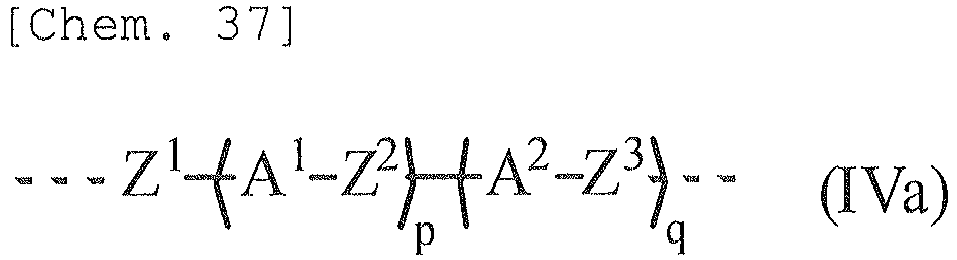
Z1, Z2 and Z3 each independently represent a single bond, -(CH2)u- (wherein u represents 1 to 20), -OCH2-, -CH2O-, -COO-, -OCO-, -CH=CH-, -CF=CF-, -CF2O-, -OCF2-, -CF2CF2-, or -C≡C-, but one or more of the non-adjacent CH2 groups in these substituents may be independently substituted with -O-, -CO-, -CO-O-, -O-CO-, -Si(CH3)2-O-Si(CH3)2-, -NR-, -NR-CO-, -CO-NR-, -NR-CO-O-, -O-CO-NR-, -NR-CO-NR-, -CH=CH-, -C≡C-, or -O-CO-O-(wherein R's independently represent hydrogen or an alkyl group having 1 to 5 carbon atoms),
A1 and A2 each independently represent a trans-1,4-cyclohexylene group, a trans-1,3-dioxane-2,5-diyl group, a 1,4-naphthylene group, a 2,6-naphthylene group, a pyridine-2,5-diyl group, a pyrimidine-2,5-diyl group, a 1,2,4,5-tetrazine-2,5-diyl group, a 2,5-thiophenylene group, a 2,5-furanylene group, or a 1,4-phenylene group, and these may be unsubstituted or have one or more hydrogen atoms substituted with a fluorine atom, a chlorine atom, a methyl group, or a methoxy group, and
p and q each independently represent 0 or 1). - (65) The compound as described in any one of (62) to (64), in which in the general formula (I), X and Y each represent a hydrogen atom.
- (66) The compound as described in any one of (62) to (65), in which in the general formula (IVa), A2 represents a trans-1,4-cyclohexylene group, a 2,6-naphthylene group, a pyridine-2,5-diyl group, a pyrimidine-2,5-diyl group, a 1,4-phenylene group (these may be unsubstituted or have one or more hydrogen atoms which may be substituted with a fluorine atom, a chlorine atom, a methyl group, or a methoxy group), Z3 represents a single bond, -(CH2)u- (wherein u represents 1 to 20), -OCH2-, -CH2O-, -COO-, -OCO-, -CH=CH-, or -C≡C- (one or more of the non-adjacent CH2 groups in these substituents may be independently substituted with -O-, -CO-, -CO-O-, -O-CO-, -CH=CH-, or -C≡C-), and q represents 1.
- (67) The compound as described in any one of (62) to (66), in which in the general formula (I), L is represented by the general formula (III-1), (III-2), (III-6), (III-7), or (III-13).
- (68) The compound as described in any one of (62) to (67), in which in the general formula (I), A represents a 1,4-phenylene group (these may be unsubstituted or have one or more hydrogen atoms which may be substituted with a fluorine atom, a chlorine atom, a methyl group, or a methoxy group).
- (69) The compound as described in any one of (62) to (68), in which in the general formula (IVa), A2 represents a 1,4-phenylene group (these may be unsubstituted or have one or more hydrogen atoms which may be substituted with a fluorine atom, a chlorine atom, a methyl group, or a methoxy group).
- (70) The compound as described in any one of (62) to (69), in which in the general formula (I), L is represented by the general formula (III-1) or (III-2).
- (71) A polymer constituted with a cured product of a composition containing a compound as described in any one of (62) to (70), wherein the cured product has a structural unit represented by the general formula (PI):

- (72) The polymer as described in (71), in which in the general formula (PI), Mb represents any substituent selected from the group consisting of the general formulae (QIII-A-1) to (QIII-A-17):

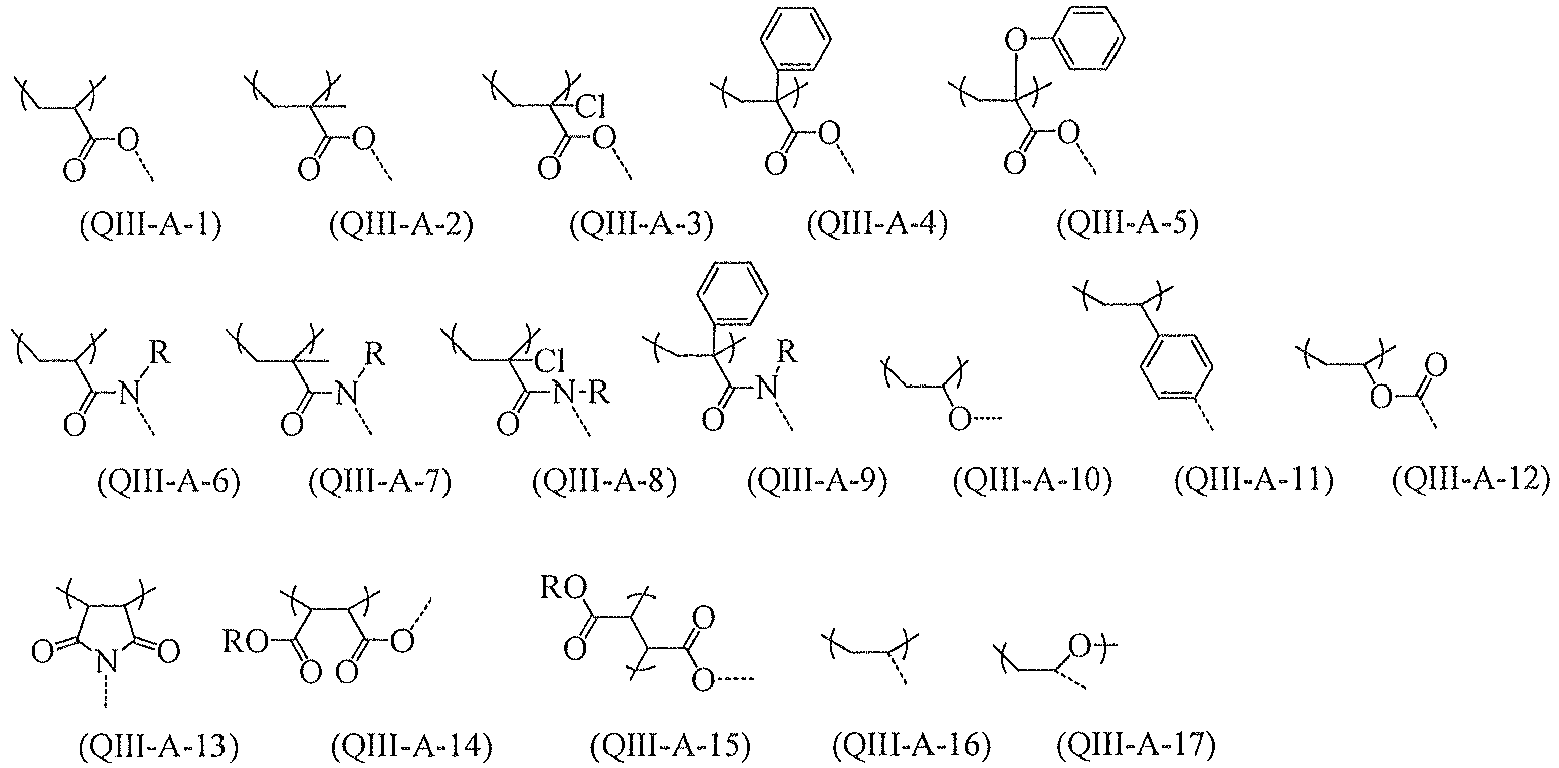
In the general formula (PI) of (71), Md preferably represents any substituent selected from the group consisting of the general formulae (QIII-1) to (QIII-17):
Preferably, in the general formulae (QIII-1) to (QIII-17), the monovalent organic group is represented by the general formula (QIV):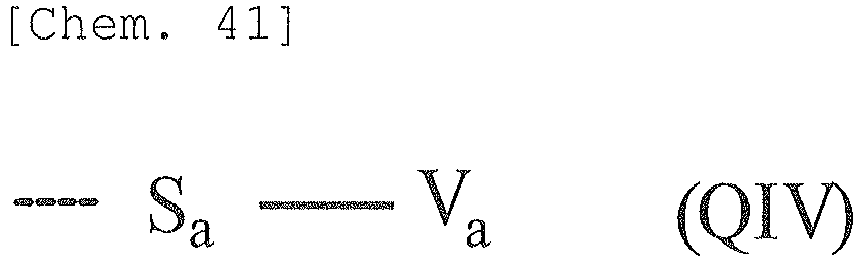

Z4, Z5, Z6 and Z7 each independently represent a single bond, -(CH2)u- (wherein u represents 1 to 20), -OCH2-, -CH2O-, -COO-, -OCO-, -CH=CH-, -CF=CF-, -CF2O-, -OCF2-, -CF2CF2-, or -C≡C-, but one or more of the non-adjacent CH2 groups in these substituents may be independently substituted with -O-, -CO-, -CO-O-, -O-CO-, -Si(CH3)2-O-Si(CH3)2-, -NR-, -NR-CO-, -CO-NR-, -NR-CO-O-, -O-CO-NR-, -NR-CO-NR-, -CH=CH-, -C≡C-, or -O-CO-O-(wherein R's independently represent hydrogen or an alkyl group having 1 to 5 carbon atoms),
A3, A4, A5 and A6 each independently represent a trans-1,4-cyclohexylene group, a trans-1,3-dioxane-2,5-diyl group, a 1,4-naphthylene group, a 2,6-naphthylene group, a pyridine-2,5-diyl group, a pyrimidine-2,5-diyl group, a 1,2,4,5-tetrazine-2,5-diyl group, a 2,5-thiophenylene group, a 2,5-furanylene group, or a 1,4-phenylene group, and these may be unsubstituted or have one or more hydrogen atoms substituted with a fluorine atom, a chlorine atom, a methyl group, or a methoxy group,
r1, s1, t1, and u1 each independently represent 0 or 1, and
R12 represents hydrogen, fluorine, chlorine, a cyano group, or an alkyl group having 1 to 20 carbon atoms, a hydrogen atom in the alkyl group may be substituted with a fluorine atom, and one CH2 group or two or more non-adjacent CH2 groups may be substituted with -O-, -CO-O-, -O-CO-, and/or -CH=CH-). - (73) A liquid crystal alignment layer for a vertical alignment mode liquid crystal display element, using the polymer as described in (71) or (72).
- (74) A vertical alignment mode liquid crystal display element using the liquid crystal alignment layer as described in (73).
- (75) A liquid crystal alignment layer for a horizontal alignment mode liquid crystal display element, using the polymer as described in (71) or (72).
- (76) A horizontal alignment mode liquid crystal display element using the liquid crystal alignment layer as described in (75).
- (77) An optical anisotropic body constituted with a polymer of a polymerizable liquid crystal composition, in which polymerizable liquid crystal molecules in the polymerizable liquid crystal composition are aligned using the polymer as described in (71) or (72).
- By using the compound (cinnamic acid derivative) of the present invention and a polymer thereof, a liquid crystal alignment layer which has a superior ability to control the alignment of the liquid crystals and the pretilt angles, and a high voltage holding ratio (VHR) can be produced, which is efficiently provided with an alignment property at a low dose of irradiation of polarized light. Since the liquid crystal alignment layer of the present invention has a high voltage holding ratio (VHR) and is excellent in the control of the alignment of the liquid crystals and the pretilt angles, and coatability, it can be used to efficiently produce a liquid crystal display element and a liquid crystal display element, each exhibiting excellent display properties and reliability. Further, the optical anisotropic body of the present invention is useful for the production of an optical anisotropy film that can be used in optical compensation or the like.
- Hereinafter, preferable examples of the present invention will be described, but the present invention is not limited thereto in any case. Within a range not departing from the spirit of the present invention, addition, deletion, replacement, and other modifications in the constitution may be made.
- The first embodiment of the present invention will be described.
- The cinnamic acid derivative of the present invention is specifically preferably a structure represented by the general formula (I).

- In the general formula (I), L represents a polymerizable group, Sp represents a spacer unit,
A's each independently represent a 1, 4-naphthylene group, a 2,6-naphthylene group, a pyridine-2,5-diyl group, a pyrimidine-2,5-diyl group, a 1,2,4,5-tetrazine-2,5-diyl group, a 2,5-thiophenylene group, a 2,5-furanylene group, or a 1, 4-phenylene group, and these may be unsubstituted or have one or more hydrogen atoms substituted with a fluorine atom, a chlorine atom, a methyl group, or a methoxy group, X and Y each independently represent a hydrogen atom, a fluorine atom, a chlorine atom, a cyano group, or an alkyl group having 1 to 20 carbon atoms, a hydrogen atom in the alkyl group may be substituted with a fluorine atom, and one CH2 group or two or more non-adjacent CH2 groups in the alkyl group may be substituted with -O-, -CO-O-, -0-CO- and/or -CH=CH-,
Z is represented by the general formula (IIa) or (IIb), and
r represents 1 or 2.
- In the general formulae (IIa) and (IIb), the broken line represents a bond to a carbon atom, to which Z is bonded,
R1 represents a hydrogen atom or a linear or branched alkyl group having 1 to 30 carbon atoms (one or two or more -CH2- groups in the alkyl group may be each independently substituted with a cycloalkyl group having a ring member number of 3 to 8, and a hydrogen atom in the alkyl group may be substituted with an alkyl group having 1 to 20 carbon atoms, a cyano group, or a halogen atom), and
R2 represents a linear or branched alkyl group having 1 to 30 carbon atoms (one or two or more -CH2- groups in the alkyl group may be each independently substituted with a cycloalkyl group having a ring member number of 3 to 8, and a hydrogen atom in the alkyl group may be unsubstituted or may be substituted with an alkyl group having 1 to 20 carbon atoms, a cyano group, or a halogen atom). - The alkyl group having 1 to 30 carbon atoms, represented by R1, is preferably a linear or branched alkyl group or a cycloalkyl group having a ring member number of 3 to 8, which may have the alkyl group interposed therein as a linking group.
- The alkyl group having 1 to 30 carbon atoms, represented by R2, is preferably a linear or branched alkyl group or a cycloalkyl group having a ring member number of 3 to 8, which may have the alkyl group interposed therein as a linking group.
- In the present specification and claims, "two or more non-adjacent CH2 groups" means "two or more CH2 groups that are not adjacent to each other".
- In the general formula (I), (IIa), or (IIb), in order to improve the liquid crystal alignment properties of the liquid crystal alignment layer of the present invention, A is preferably a pyridine-2,5-diyl group, a pyrimidine-2,5-diyl group, a 1,2,4,5-tetrazine-2,5-diyl group, or a 1,4-phenylene group.
- Furthermore, in order to improve the solubility of the polymer of the present invention, A is preferably a 1,4-naphthylene group, a 2,6-naphthylene group, a 2,5-thiophenylene group, or a 2,5-furanylene group.
- Moreover, in order to reduce the light irradiation dose required for aligning the liquid crystal in the liquid crystal alignment layer of the present invention, A is preferably a pyridine-2,5-diyl group, a pyrimidine-2,5-diyl group, a 2,5-thiophenylene group, or a 1,4-phenylene group.
- In addition, in the liquid crystal alignment layer of the present invention, in order to realize photo-alignment at a longer wavelength, A is preferably a pyrimidine-2,5-diyl group, a 2, 5-thiophenylene group, a 2, 6-naphthylene group, or a 2,5-furanylene group, and X and Y are each preferably a fluorine atom, a chlorine atom, or a cyano group.
- Incidentally, in order to improve the voltage holding ratio in the liquid crystal alignment layer of the present invention, X and Y are each preferably a hydrogen atom, and R2 is preferably a linear or cyclic alkyl group having 1 to 12 carbon atoms.
- In addition, in order to reduce the residual charges in the liquid crystal alignment layer of the present invention, R2 is preferably a linear or cyclic alkyl group having 1 to 6 carbon atoms.
- In the compound represented by the general formula (I) of the present invention, X and Y are each preferably a hydrogen atom. The voltage holding ratio in the liquid crystal alignment layer of the present invention using the polymer obtained by using the compound can be improved.
- In the compound represented by the general formula (I) of the present invention, A is preferably a 1, 4-phenylene group having one or more hydrogen atoms which may be substituted with a fluorine atom, a chlorine atom, a methyl group, or a methoxy group.
- By using the compound, a display element using a liquid crystal alignment layer which has good coatability, a superior ability to control the alignment of the liquid crystals and the pretilt angles, and a high voltage holding ratio (VHR), and the composition is obtained.
- In addition, when one or more hydrogen atoms of the 1,4-phenylene group are substituted with methoxy groups, an alignment layer having a superior ability to control the alignment of the liquid crystals and the pretilt angles is formed, which is thus preferable.
- Since the compounds represented by the general formula (I) have polymerizable substituents therein, the compounds can be polymerized with each other. The polymerizable substituent is preferably specifically any substituent selected from the group consisting of the substituents of the general formula (I), in which L is represented by any one of the general formulae (III-1) to (III-17), and among these, the general formula (III-1), (III-2), (III-6), (III-7), or (III-13) is preferable, and the general formula (III-1) or (III-2) is more preferable.

- In order to improve the solubility of the polymer of the present invention, the general formula (III-1), (III-2), (III-3), (III-6), (III-7), (111-8), (III-10), (III-12), (III-14), (III-16), or (111-17) is preferable, and among these, the general formula (III-1), (III-2), (III-10), (III-12), or (III-17) is particularly preferable.
- Incidentally, in order to improve the polymerization speed of the compound of the present invention, the general formula (III-3), (III-8), (III-10), (III-12), (III-13), (III-14), (III-15), (III-16), or (III-17) is preferable, and among these, the general formula (III-3), (III-8), (III-10), (III-12), or (III-17) is more preferable.
- Furthermore, in order to attain a narrow distribution of molecular weights of the polymer of the present invention, the general formula (III-2), (III-10), (III-11), or (III-12) is preferable.
- Moreover, in order to improve the alignment stability in the liquid crystal alignment layer of the present invention, the general formula (III-2), (III-4), (III-5), (III-7), (III-9), (III-13), (III-14), or (III-15) is preferable.
- In addition, in order to improve the adhesion of the polymer of the present invention to a substrate, the general formula (III-1), (III-6), (III-7), (III-8), (III-9), (III-10), (III-12), (III-13), or (111-17) is preferable, and among these, the general formula (III-6), (III-7), (III-8), or (III-13) is particularly preferable.
- For the molecular weight distribution of the polymer of the present invention, Mw/Mn is preferably from 1.2 to 6.0, and more preferably from 1.4 to 4.0.
- The compound represented by the general formula (I) of the present invention is preferably a compound in which L is represented by the general formula (III-1), (III-2), (III-6), (III-7), or (III-13). By using the compound, the above-described effects can be obtained.
- The compound represented by the general formula (I) of the present invention is preferably a compound in which L is represented by the general formula (III-1) or (III-2).
- By using the compound, a display element using a liquid crystal alignment layer having a superior ability to control the alignment of the liquid crystals and the pretilt angles and having effects such as a high voltage holding ratio (VHR) and the composition can be obtained.
- In the general formula (I), Sp is preferably a structure represented by the following general formula (IVc):

Z1, Z2 and Z3 each independently represent a single bond, -(CH2)u- (wherein u represents 1 to 20), -OCH2-, -CH2O-, -COO-, -OCO-, -CH=CH-, -CF=CF-, -CF2O-, -OCF2-, -CF2CF2-, or -C≡C-, but one or more of the non-adjacent CH2 groups in these groups may be independently substituted with -O-, -CO-, -CO-O-, -O-CO-, -Si(CH3)2-O-Si(CH3)2-, -NR-, -NR-CO-, -CO-NR-, -NR-CO-O-, -O-CO-NR-, -NR-CO-NR-, -CH=CH-, -C≡C-, or -O-CO-O- (wherein R's independently represent hydrogen or an alkyl group having 1 to 5 carbon atoms),
A7 represents any group of a 1,4-naphthylene group, a 2,6-naphthylene group, a 2,5-thiophenylene group, a 1,2,4,5-tetrazine-3,6-diyl group, or a 2,5-furanylene group, and one or more hydrogen atoms in any group of these groups may be substituted with a fluorine atom, a chlorine atom, a methyl group, or a methoxy group,
A2 represents any group of a trans-1,4-cyclohexylene group, a trans-1,3-dioxane-2,5-diyl group, a 1,4-naphthylene group, a 2,6-naphthylene group, a pyridine-2,5-diyl group, a pyrimidine-2,5-diyl group, a 1,2,4,5-tetrazine-2,5-diyl group, a 2,5-thiophenylene group, a 2,5-furanylene group, or a 1,4-phenylene group, and one or more hydrogen atoms in any group of these groups may be substituted with a fluorine atom, a chlorine atom, a methyl group, or a methoxy group, and
p represents 1, and q represents 1 or 2). - In the general formula (IVc), Z1, Z2 and Z3 are each independently preferably a single bond, -(CH2)u- (wherein u represents 1 to 20, one or more of the non-adjacent CH2 groups may be independently substituted with -O-, -CO-, -CO-O-, -O-CO-, -NR-, -NR-CO-, -CO-NR-, -NR-CO-NR-, -CH=CH-, -C≡C-, or -O-CO-O-, and R represents hydrogen, a methyl group, or an ethyl group), -OCH2-, -CH2O-, -COO-, -OCO-, -CH=CH-, -CF2O-, -OCF2-, or -C≡C-.
- In the general formula (IVc), Z1, Z2 and Z3 are each independently more preferably a single bond, -(CH2)u- (wherein u represents 1 to 20, and one or more of the non-adjacent CH2 groups may be independently substituted with -O-, -CO-O-, -O-CO-, -CH=CH-, or -C≡C-), -OCH2-, -CH2O-, -COO-, -OCO-, -CH=CH-, or -C≡C-.
- In the general formula (IVc), Z1, Z2 and Z3 are each independently particularly preferably a single bond, -(CH2)u-(wherein u represents 1 to 20, and one or more of the non-adjacent CH2 groups may be independently substituted with -O-, -CO-O-, -O-CO-, -CH=CH-, or -C≡C-), -OCH2-, -CH2O-, -COO-, -OCO-, -CH=CH-, or -C≡C-.
- Here, "one or more of the non-adjacent CH2 groups" means "one or more CH2 groups that are not adjacent to each other".
- In the general formula (IVc), q is preferably 1.
- In the general formula (IVc), p is preferably 1.
- In the general formula (IVc),
A7 is preferably a 1,4-naphthylene group, a 2,5-thiophenylene group, a 1,2,4,5-tetrazine-3,6-diyl group, or a 2,6-naphthylene group. A hydrogen atom of these groups may be unsubstituted or one or more hydrogen atoms of these groups may be substituted with a fluorine atom, a chlorine atom, a methyl group, or a methoxy group. - In the general formula (IVc), A2 is preferably any group of a trans-1,4-cyclohexylene group, a trans-1,3-dioxane-2,5-diyl group, a 1,4-naphthylene group, a 2,6-naphthylene group, a pyridine-2,5-diyl group, a pyrimidine-2,5-diyl group, or a 1,4-phenylene group. A hydrogen atom of these groups may be unsubstituted or one or more hydrogen atoms of these groups may be substituted with a fluorine atom, a chlorine atom, a methyl group, or a methoxy group.
- In the general formula (IVc), A7 is more preferably a 1,4-naphthylene group or a 2, 6-naphthylene group. A hydrogen atom of these groups may be unsubstituted or one or more hydrogen atoms of these groups may be substituted with a fluorine atom, a chlorine atom, a methyl group, or a methoxy group.
- In the general formula (IVc), A2 is still more preferably any group of a trans-1,4-cyclohexylene group, a 2,6-naphthylene group, a pyridine-2,5-diyl group, a pyrimidine-2,5-diyl group, or a 1,4-phenylene group. A hydrogen atom of these groups may be unsubstituted or one or more hydrogen atoms of these groups may be substituted with a fluorine atom, a chlorine atom, a methyl group, or a methoxy group.
- In the general formula (IVc), A7 is particularly preferably a 2, 6-naphthylene group. A hydrogen atom of these groups may be unsubstituted or one or more hydrogen atoms of these groups may be substituted with a fluorine atom, a methyl group, or a methoxy group.
- In the general formula (IVc), A2 is each independently particularly preferably any group of a trans-1,4-cyclohexylene group, a 2,6-naphthylene group, or a 1,4-phenylene group. A hydrogen atom of these groups may be unsubstituted or one or more hydrogen atoms of these groups may be substituted with a fluorine atom, a methyl group, or a methoxy group.
- Because it is possible to provide an alignment property efficiently at a low dose of irradiation of polarized light during the production of the liquid crystal alignment layer of the present invention, in the general formula (IVc), A7 is preferably a 1,4-naphthylene group, a 2,5-thiophenylene group, a 1,2,4,5-tetrazine-3,6-diyl group, or a 2,6-naphthylene group, more preferably a 1,4-naphthylene group or a 2,6-naphthylene group, and still more preferably a 2,6-naphthylene group.
- Because it is possible to provide an alignment property efficiently at a low dose of irradiation of polarized light during the production of the liquid crystal alignment layer of the present invention, in the general formula (IVc), A2 is preferably a 1,4-naphthylene group, a 2,6-naphthylene group, or a 1,4-phenylene group, more preferably a 2,6-naphthylene group or a 1,4-phenylene group, and still more preferably a 1, 4-phenylene group. If a hydrogen atom of the 1, 4-phenylene group is unsubstituted or one or more hydrogen atoms are substituted with a fluorine atom, a methyl group, or a methoxy group, an alignment property may be sometimes provided at a lower dose of irradiation of polarized light, which is thus preferable.
- In order to improve the liquid crystal alignment property in the liquid crystal alignment layer of the present invention, in the general formula (IVc), Z1, Z2 and Z3 are each independently preferably a single bond, -(CH2)u- (wherein u represents 1 to 8 and one or two of the non-adjacent CH2 groups may be independently substituted with -0-, -CO-O-, -O-CO-, -Si(CH3)2-O-Si(CH3)2-, -CH=CH-, or -C≡C-), -COO-, -OCO-, -CH=CH-, -CF=CF-, or -C≡C-, A7 is preferably a 1, 4-naphthylene group or a 2,6-naphthylene group, and A2 is preferably a trans-1,4-cyclohexylene group, a trans-1,3-dioxane-2,5-diyl group, a pyridine-2, 5-diyl group, a pyrimidine-2,5-diyl group, a 1,2,4,5-tetrazine-2,5-diyl group, a 2,5-thiophenylene group, or a 1,4-phenylene group.
- Furthermore, in order to improve the thermal stability of the alignment in the liquid crystal alignment layer of the present invention, in the general formula (IVc), Z1, Z2 and Z3 are each independently preferably -NR-CO-, -CO-NR-, -NR-CO-O-, -O-CO-NR-, -NR-CO-NR-, or -O-CO-O-, A7 is preferably a 1,4-naphthylene group or a 2,6-naphthylene group, and A2 is preferably a trans-1,4-cyclohexylene group, a trans-1,3-dioxane-2,5-diyl group, a pyridine-2,5-diyl group, a pyrimidine-2,5-diyl group, a 2,5-thiophenylene group, or a 1,4-phenylene group.
- Furthermore, in order to improve the solubility of the polymer of the present invention, Z1, Z2 and Z3 are each independently preferably -OCH2-, -CH2O-, -CF2O-, -OCF2-, -CF2CF2-, -NR-, or -CO-, A7 is preferably a 1,4-naphthylene group or a 2,6-naphthylene group, and A2 is preferably a trans-1,4-cyclohexylene group, a 1,4-naphthylene group, a 2,6-naphthylene group, or a 2,5-furanylene group.
- Sp represented by the general formula (IVc) is preferably, for example, one represented by the following chemical formulae (Sp-a-1) to (Sp-ad-9). Among these chemical formulae, the left broken line represents a bond to L and the right broken line represents a bond to A.
- Among these, those represented by the chemical formulae (Sp-a-6) to (Sp-a-16), the chemical formulae (Sp-b-3) to (Sp-b-10), the chemical formulae (Sp-c-3) to (Sp-c-10), the chemical formulae (Sp-d-3) to (Sp-d-12), the chemical formulae (Sp-k-4) to (Sp-k-7), the chemical formulae (Sp-l-13) to (Sp-l-17), the chemical formulae (Sp-o-3) to (Sp-o-14), the chemical formulae (Sp-p-2) to (Sp-p-13), the chemical formulae (Sp-s-1) to (Sp-s-8), the chemical formulae (Sp-t-1) to (Sp-t-8), the chemical formulae (Sp-y-1) to (Sp-y-9), the chemical formulae (Sp-aa-1) to (Sp-aa-9), the chemical formulae (Sp-ae-1) to (Sp-ae-9), the chemical formulae (Sp-af-1) to (Sp-af-8), the chemical formulae (Sp-ag-1) to (Sp-ag-9), and the chemical formulae (Sp-ah-1) to (Sp-ah-8) are more preferable.


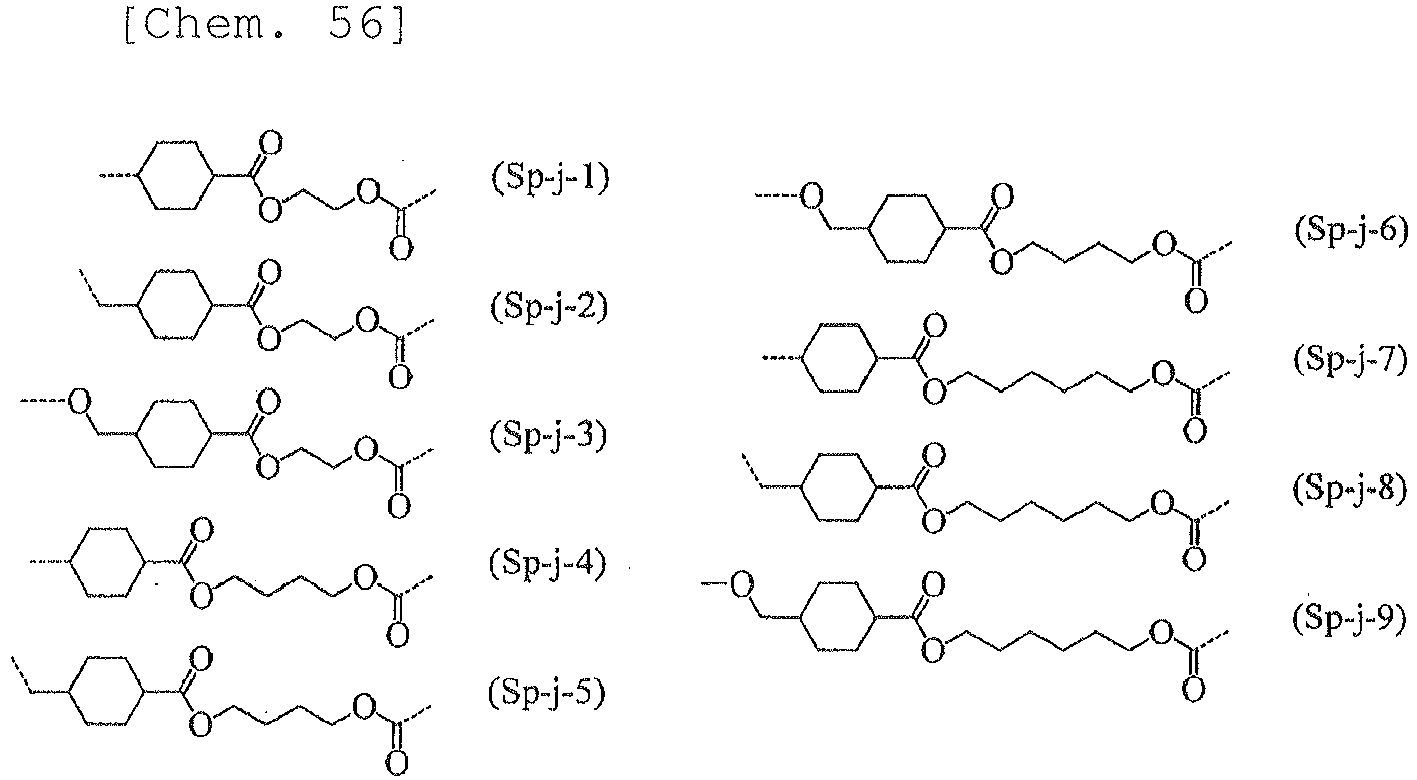


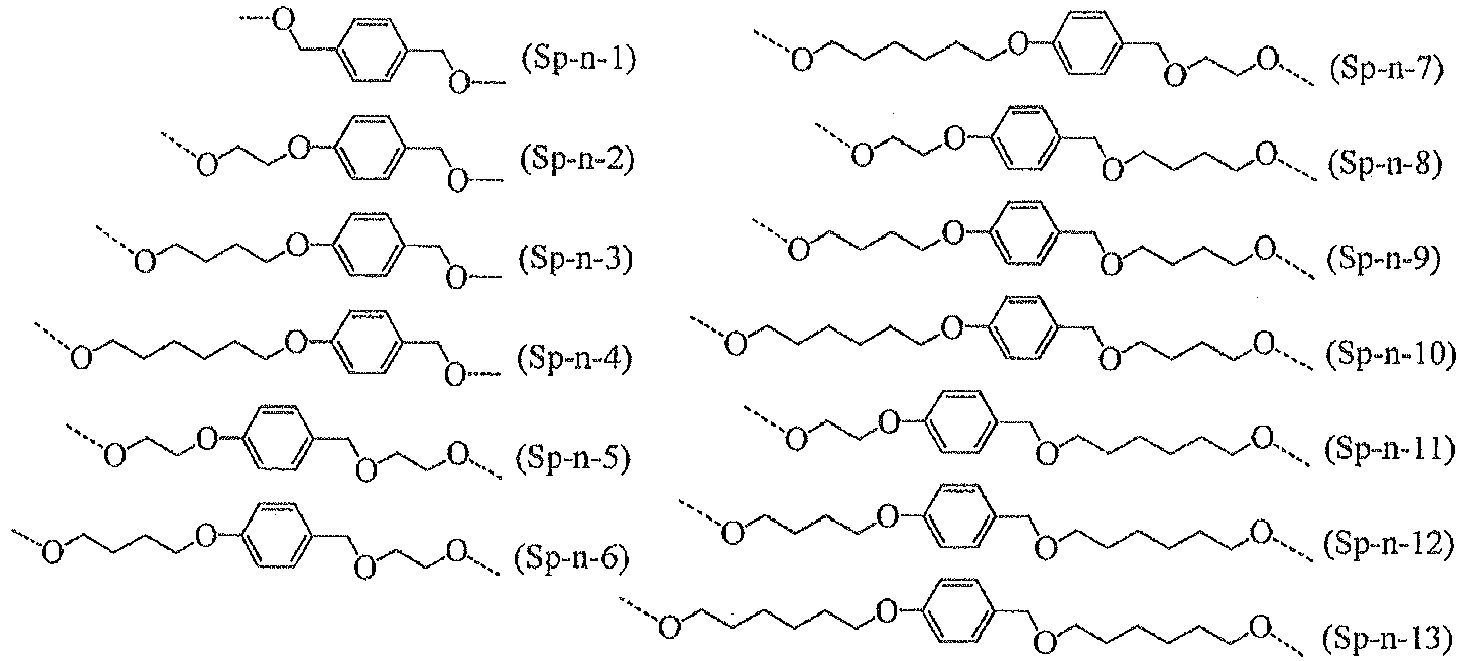




- A preferable compound of the present invention is a compound, in which Sp is represented by the general formula (IVc), in the general formula (IVc), A7 represents a 1, 4-naphthylene group or a 2, 6-naphthylene group, one or more hydrogen atoms in any group of these groups may be substituted with a fluorine atom, a chlorine atom, a methyl group, or a methoxy group, Z2 represents a single bond or any group of -(CH2)u- (wherein u represents 1 to 20), -OCH2-, -CH2O-, -COO-, -OCO-, -CH=CH-, or -C≡C-, one or more of the non-adjacent CH2 groups in any group of these groups may be independently substituted with -O-, -CO-, -CO-O-, -O-CO-, -CH=CH-, or -C≡C-, and p represents 1.
- By using the compound, an alignment property can be efficiently provided at a low dose of irradiation of polarized light during the production of the liquid crystal alignment layer, and thus, a display element using a liquid crystal alignment layer which has a superior ability to control the alignment of the liquid crystals and the pretilt angles, and a high voltage holding ratio (VHR), and the composition can be obtained.
- A more preferable compound of the present invention is a compound, in which Sp is represented by the general formula (IVc), and in the general formula (IVc), A7 represents a 1,4-naphthylene group or a 2,6-naphthylene group, having one or more hydrogen atoms which may be substituted with a fluorine atom, a chlorine atom, a methyl group, or a methoxy group.
- By using the compound, an alignment property can be efficiently provided at a low dose of irradiation of polarized light during the production of the liquid crystal alignment layer, and thus, a display element using a liquid crystal alignment layer which has a superior ability to control the alignment of the liquid crystals and the pretilt angles, and a high voltage holding ratio (VHR), and the composition can be obtained.
- A preferable compound of the present invention is a compound, in which Sp is represented by the general formula (IVc), in the general formula (IVc), A2 represents any group of a trans-1,4-cyclohexylene group, a 2,6-naphthylene group, a pyridine-2,5-diyl group, a pyrimidine-2,5-diyl group, or a 1,4-phenylene group, one or more hydrogen atoms in any group of these groups may be substituted with a fluorine atom, a chlorine atom, a methyl group, or a methoxy group, Z3 represents a single bond or any group of -(CH2)u- (wherein u represents 1 to 20), -OCH2-, -CH2O-, -COO-, -OCO-, -CH=CH-, or -C≡C-, one or more of the non-adjacent CH2 groups in any group of these groups may be independently substituted with -O-, -CO-, -CO-O-, -O-CO-, -CH=CH-, or -C≡C-, and q represents 1.
- By using the compound, a display element using a liquid crystal alignment layer which has a superior ability to control the alignment of the liquid crystals and the pretilt angles, and a high voltage holding ratio (VHR), and the composition can be obtained.
- A more preferable compound of the present invention is a compound, in which Sp is represented by the general formula (IVc), and in the general formula (IVc), A2 represents 1,4-phenylene group having one or more hydrogen atoms which may be substituted with a fluorine atom, a chlorine atom, a methyl group, or a methoxy group.
- By using the compound, a display element using a liquid crystal alignment layer which has a superior ability to control the alignment of the liquid crystals and the pretilt angles, and a high voltage holding ratio (VHR), and the composition can be obtained.
- The liquid crystal alignment layer of the present invention is obtained by forming a polymer for a liquid crystal alignment layer on the surface of a base material used for aligning the liquid crystal, and irradiating it with light to conduct crosslinking and/or isomerization. The liquid crystal alignment layer of the present invention is produced using a cured product of the cinnamic acid derivative or a composition containing the cinnamic acid derivative. The cured product is preferably a polymer having a structural unit represented by the following general formula (PI). These specific aspects are preferably those described as follows.

- In the present specification and claims, the "monomer unit (Mb)" and the "monomer unit (Md)" are sometimes abbreviated as "Mb" and "Md", respectively.
- In the general formula (PI), a hydrogen atom of Mb is substituted with Sp and Sp is bonded to Mb.
- Mb and Md may be the same as or different from each other except that Sp is bonded to Mb, and a known monomer unit can be used while not being particularly limited. Further, the sequencing order and randomness of the monomer units (Mb and Md) in the polymer are not particularly limited.
- In addition, as Mb and Md, as one kind of the monomer units, each independently, or in combination of two or more kinds of the monomer units can be used. In this case, they are preferably used to a degree which does not interfere with the effects exerted by the polymer as a liquid crystal alignment film.
- In the general formula (PI), Mb is preferably any one or more selected from the group consisting of the following general formulae (QIII-A-1) to (QIII-A-17).

- In the general formula (PI), Md is preferably any one or more selected from the group consisting of the following general formulae (QIII-1) to (QIII-17).

- Examples of the monovalent organic group include hydrogen, an alkyl group having 1 to 20 carbon atoms (any hydrogen atom in the alkyl group may be substituted with a fluorine atom, a chlorine atom, a methyl group, or a methoxy group, and one CH2 group or two or more non-adjacent CH2 groups in the alkyl group may be substituted with -O-, -CO-O-, -O-CO-, and/or -CH=CH-).
- Incidentally, examples of the monovalent organic group include a trans-1,4-cyclohexylene group, a trans-1,3-dioxan-2,5-yl group, a 1,4-naphthylene group, a 2,6-naphthylene group, a 2,5-pyridyl group, a 2,5-pyrimidyl group, a 1,2,4,5-tetrazine-2,5-diyl group, a 2,5-thiophenylene group, a 2,5-furanylene group, or a 1,4-phenylene group (any hydrogen atom in each of the structures may be substituted with a fluorine atom, a chlorine atom, a methyl group, or a methoxy group).
- Moreover, particularly in order to obtain an alignment layer for vertical alignment, examples of the monovalent organic group include the general formula (QIV):
[Chem. 84] -Sa-Va (QIV)
(wherein the broken line represents a bond to a monomer unit (Md), Sa represents a spacer unit, and Va represents a moiety that stabilizes the vertical alignment). - Sa may be a single bond or use a spacer unit represented by the general formula (IVc) as described above.
- Va is preferably a structure represented by the following general formula (VI).


- In the general formula (VI), the broken line represents a bond to Sa,
Z4, Z5, Z6 and Z7 each independently represent a single bond, -(CH2)u- (wherein u represents 1 to 20), -OCH2-, -CH2O-, -COO-, -OCO-, -CH=CH-, -CF=CF-, -CF2O-, -OCF2-, -CF2CF2-, or -C≡C-, but one or more of the non-adjacent CH2 groups in these substituents may be independently substituted with -O-, -CO-, -CO-O-, -O-CO-, -Si(CH3)2-O-Si(CH3)2-, -NR-, -NR-CO-, -CO-NR-, -NR-CO-O-, -O-CO-NR-, -NR-CO-NR-, -CH=CH-, -C≡C-, or -O-CO-O-(wherein R's independently represent hydrogen or an alkyl group having 1 to 5 carbon atoms),
A3, A4, A5 and A6 each independently represent a trans-1,4-cyclohexylene group, a trans-1,3-dioxane-2,5-diyl group, a 1,4-naphthylene group, a 2,6-naphthylene group, a pyridine-2,5-diyl group, a pyrimidine-2,5-diyl group, a 1,2,4,5-tetrazine-2,5-diyl group, a 2, 5-thiophenylene group, a 2,5-furanylene group, or a 1,4-phenylene group, and these may be unsubstituted or have one or more hydrogen atoms substituted with a fluorine atom, a chlorine atom, a methyl group, or a methoxy group,
r1, s1, t1, and u1 each independently represent 0 or 1, and
R12 represents hydrogen, fluorine, chlorine, a cyano group, or an alkyl group having 1 to 20 carbon atoms, a hydrogen atom in the alkyl group may be substituted with a fluorine atom, and one CH2 group or two or more non-adjacent CH2 groups in the alkyl group may be substituted with -O-, -CO-O-, -O-CO-, and/or -CH=CH-. - Z4, Z5, Z6 and Z7 are each independently preferably a single bond, -(CH2)u- (wherein u represents 1 to 12, one or more of the non-adjacent CH2 groups may be independently substituted with -O-, -CO-, -CO-O-, -O-CO-, -NR-CO-, -CO-NR-, -NR-CO-NR-, -CH=CH-, -C≡C-, or -O-CO-O-, and R's independently represent hydrogen, a methyl group, or an ethyl group), -OCH2-, -CH2O-, -COO-, -OCO-, -CH=CH-, -CF2O-, -OCF2-, or -C≡C-.
- A3, A4, A5 and A6 each independently preferably represent a trans-1,4-cyclohexylene group, a 2,6-naphthylene group, a pyridine-2,5-diyl group, a pyrimidine-2,5-diyl group, or a 1,4-phenylene group. Preferably, these groups are unsubstituted or have one or more hydrogen atoms substituted with a fluorine atom, a chlorine atom, a methyl group, or a methoxy group.
- For r1, s1, t1, and u1, r1+s1+t1+u1 is preferably from 0 to 3,
R12 is preferably a structure represented by hydrogen, fluorine, chlorine, a cyano group, or an alkyl group having 1 to 18 carbon atoms (one CH2 group or two or more non-adjacent CH2 groups in the alkyl group may be substituted with -O-, -CO-O-, -O-CO-, and/or -CH=CH-). - In order to improve the liquid crystal alignment property in the liquid crystal alignment layer of the present invention, Z4, Z5, Z6 and Z7 are each independently preferably a single bond, -(CH2)u- (wherein u represents 1 to 8, and one or two of the non-adjacent CH2 groups may be independently substituted with -O-, -CO-O-, -O-CO-, -Si(CH3)2-O-Si(CH3)2-, -CH=CH-, or -C≡C-), -COO-, -OCO-, -CH=CH-, -CF=CF-, or -C≡C-, and A3, A4, A5 and A6 are each independently preferably a trans-1,4-cyclohexylene group, a trans-1,3-dioxane-2,5-diyl group, a pyridine-2,5-diyl group, a pyrimidine-2, 5-diyl group, a 1,2,4,5-tetrazine-2,5-diyl group, a 2, 5-thiophenylene group, or a 1,4-phenylene group.
- Moreover, in order to improve the thermal stability of alignment in the liquid crystal alignment layer of the present invention, Z4, Z5, Z6 and Z7 are each independently preferably -NR-CO-, -CO-NR-, -NR-CO-O-, -O-CO-NR-, -NR-CO-NR-, or -O-CO-O-, and A3, A4, A5 and A6 are each independently preferably a 1,4-naphthylene group, a 2,6-naphthylene group, a pyridine-2,5-diyl group, a pyrimidine-2,5-diyl group, a 2,5-thiophenylene group, a 2,5-furanylene group, or a 1,4-phenylene group.
- Furthermore, in order to improve the solubility of the polymer of the present invention, Z4, Z5, Z6 and Z7 are each independently preferably -OCH2-, -CH2O-, -CF2O-, -OCF2-, -CF2CF2-, -NR-, or -CO-, and A3, A4, A5 and A6 are each independently preferably a trans-1,4-cyclohexylene group, a 1,4-naphthylene group, a 2,6-naphthylene group, or a 2,5-furanylene group.
- Furthermore, in order to provide a pretilt angle of 80 degrees or more to the liquid crystal alignment layer of the present invention, Z4, Z5, Z6 and Z7 are each independently preferably a single bond, -OCH2-, -CH2O-, -COO-, -OCO-, and -C≡C-, A3, A4, A5 and A6 are each independently preferably a trans-1,4-cyclohexylene group, a trans-1,3-dioxane-2,5-diyl group, and a 1, 4-phenylene group, and R12 is preferably an alkyl group having 1 to 20 carbon atoms, an alkoxy group, fluorine, a trifluoromethyl group, and a trifluoromethoxy group.
- In the case of providing a pretilt angle of 80 degrees or more for the liquid crystal alignment layer of the present invention, as Va represented by the general formula (VI), for example, compounds represented by the following chemical formulae (VI-a-1) to (VI-q-10) are particularly preferable. Among these chemical formulae, the broken line represents a bond to Sa.
- Among these, the chemical formulae (VI-a-1) to (VI-a-15), the chemical formulae (VI-b-11) to (VI-b-15), the chemical formulae (VI-c-1) to (VI-c-11), the chemical formulae (VI-d-10) to (VI-d-15), the chemical formulae (VI-f-1) to (VI-f-10), the chemical formulae (VI-g-1) to (VI-g-10), the chemical formulae (VI-h-1) to (VI-h-10), the chemical formulae (VI-j-1) to (VI-j-9), the chemical formulae (VI-l-1) to (VI-l-11), or the chemical formulae (VI-m-1) to (VI-m-11) are more preferable.





- In the polymer represented by the general formula (PI) of the present invention, as Mb or Md, for example, acrylate, methacrylate, acrylamide, methacrylamide, maleic acid derivatives, siloxanes, epoxides, an acryloyloxy group, a methacryloyloxy group, a 2-chloroacryloyloxy group, a 2-phenylacryloyloxy group, a 2-phenyloxyacryloyloxy group, an acrylamide group, a methacrylamide group, a 2-chloromethacrylamide group, a 2-phenylacrylamide group, a vinyloxy group, a styryl group, a vinyloxycarbonyl group, a maleimide group, maleic esters, fumaric esters, siloxanes, a vinyl group, or an epoxy group may be used.
- The cinnamic acid derivative in the present invention may be used alone as a material for the polymer, or the cinnamic acid derivative may be used in a composition formed by mixing other monomers with the cinnamic acid derivative. In the composition, it is possible to prepare the polymer at an arbitrary mixing ratio of the cinnamic acid derivative and the other monomers. For example, the ratio of the other monomers relative to 100 moles of the cinnamic acid derivative is preferably from 0.1 to 30 moles. Further, the other monomers are preferably liquid crystalline compounds.
- It is preferable that the material and the composition include a solvent and/or a polymerization initiator.
- The polymer of the present invention can be prepared by polymerizing the cinnamic acid derivative or the composition in the present invention.
- During the polymerization, a polymerization initiator may be optionally used, depending on the polymerization mode of the polymerizable functional group. Examples of the polymerization initiator include those as described in known publications such as "Synthesis and Reaction of Polymers, edited by The Society of Polymer Science, Japan and published by Kyoritsu Shuppan Co., Ltd.".
- Examples of the thermal polymerization initiator in the radical polymerization include azo compounds such as azobisisobutyronitrile and peroxides such as benzoyl peroxide.
- Examples of a photopolymerization initiator include aromatic ketone compounds such as benzophenone, Michler's ketone, xanthone, and thioxanthone, quinone compounds such as 2-ethylanthraquinone, acetophenone compounds such as acetophenone, trichloroacetophenone, 2-hydroxy-2-methylpropiophenone, 1-hydroxycyclohexyl phenyl ketone, benzoin ether, 2,2-diethoxyacetophenone, and 2,2-dimethoxy-2-phenylacetophenone, diketone compounds such as benzyl and methylbenzoyl formate, acyloxime ester compounds such as 1-phenyl-1,2-propanedione-2-(o-benzoyl)oxime, acylphosphine oxide compounds such as 2,4,6-trimethylbenzoyldiphenylphosphine oxide, sulfur compounds such as tetramethylthiuram and dithiocarbamate, organic peroxides such as benzoyl peroxide, and azo compounds such as azobisisobutyronitrile.
- Further, examples of the thermal polymerization initiator used in cationic polymerization include aromatic sulfonium salt compounds.
- In addition, examples of the photopolymerization initiator include organic sulfonium salt compounds, iodonium salt compounds, and phosphonium compounds.
- The amount of the polymerization initiator added is preferably from 0.1 to 10% by mass, more preferably from 0.1 to 6% by mass, and still more preferably from 0.1 to 3% by mass in the composition. Further, a desired polymer can be synthesized by an addition reaction to a polymer main chain, as in the case of a polysiloxane compound.
- The polymer in the present invention is obtained by first subjecting the materials or the composition to a polymerization reaction in a reactor made of glass, stainless steel, or the like, and then purifying the resulting polymer. Preferable examples of the solvent which may be included in the materials or the composition include benzene, toluene, xylene, ethylbenzene, pentane, hexane, heptane, octane, cyclohexane, cycloheptane, methanol, ethanol, 1-propanol, 2-propanol, ethylene glycol, ethylene glycol monomethyl ether, ethylene glycol dimethyl ether, 2-butanone, acetone, tetrahydrofuran, γ-butyrolactone, N-methyl-pyrrolidone, dimethyl sulfoxide, and dimethylformamide. The organic solvents may be used alone or in combination of two or more kinds thereof.
- The polymer according to the present invention can also be obtained by dissolving the cinnamic acid derivative or the composition in a solvent, applying the solution onto a substrate to remove the solvent by drying, and conducting a polymerization reaction by heating or light irradiation.
- The ability to control the alignment of liquid crystal molecules and the stability of the alignment of the liquid crystal molecules against heat and light can be developed by irradiating the polymer in the present invention with light. The liquid crystal alignment layer obtained by conducting light irradiation may be referred to as a photo-alignment film.
- An example of a method for producing the liquid crystal alignment layer (photo-alignment film) of the present invention is a method of dissolving the polymer in a solvent, applying the solution onto a substrate, and then irradiating the coating film with light to exhibit the ability to control the alignment to give a photo-alignment film.
- The solvent used for dissolving the polymer is preferably a solvent that dissolves but does not react with the polymer of the present invention and other components optionally used. Examples of the solvent include 1,1,2-trichloroethane, N-methylpyrrolidone, butoxyethanol, γ-butyrolactone, ethylene glycol, polyethylene glycol monomethyl ether, propylene glycol, 2-pyrrolidone, N,N-dimethylformamide, phenoxyethanol, tetrahydrofuran, dimethylsulfoxide, methyl isobutyl ketone, and cyclohexanone. The organic solvents may be used alone or in combination of two or more kinds thereof.
- Another method for producing the liquid crystal alignment layer (photo-alignment film) of the present invention is a method of dissolving the cinnamic acid derivative or the composition of the present invention in a solvent, applying the solution onto a substrate, heating the coating film or irradiating the coating film with light to prepare a polymer, and further irradiating the polymer with light to exhibit the ability to control the alignment, thereby giving a photo-alignment film.
- As a solvent used for dissolving the cinnamic acid derivative or the composition, the same solvent as the solvent used for dissolving the polymer may be used.
- In the method for producing the liquid crystal alignment layer (photo-alignment film) of the present invention, preparation of the polymer and exhibition of an ability to control the alignment may be simultaneously conducted by light irradiation. Further, preparation of the polymer and exhibition of an ability to control the alignment may be separately conducted by a method of combining heating and light irradiation or by a method of using two or more light beams having different wavelengths.
- In any of the methods of producing the liquid crystal alignment layer (photo-alignment film) of the present invention, an alignment film may be preliminarily formed on a substrate and then a photo-alignment film using the cinnamic acid derivative, the composition, or the polymer of the present invention may be produced on the substrate so that the substrate may be provided with an ability to control the alignment direction and the alignment angle.
- Examples of the material for the substrate include glass, silicon, polyethylene terephthalate, polybutylene terephthalate, polyether sulfone, polycarbonate, and triacetyl cellulose. An electrode layer (conductive layer) such Cr, Al, an ITO film composed of In2O3-SnO2, and a NESA film composed of SnO2 may be provided to this substrate. For the patterning of these electrode layers, a photoetching method may be applied. Further, the electrode layers may also be patterned by, for example, a method using a mask, in forming the electrode layers. In addition, a color filter layer or the like may also be formed on the substrate.
- Examples of the method of applying a solution of the cinnamic acid derivative, the composition, or the polymer of the present invention onto a substrate include spin coating, die coating, gravure coating, flexographic printing, and ink jet printing.
- The concentration of the solid content in the solution used in the application is preferably 0.5 to 10% by weight, and is more preferably selected from this range by considering a method of applying the solution on the substrate, viscosity, volatility, or the like.
- Further, the applied surface is preferably heated after the application so as to remove the solvent. The drying conditions are preferably 50 to 300°C, and more preferably 80 to 200°C for preferably 2 to 200 minutes, and more preferably 2 to 100 minutes.
- In the case where the cinnamic acid derivative or the composition of the present invention is used, a polymer may be prepared on the substrate by conducting thermal polymerization by the heating treatment, and in this case, a polymerization initiator is preferably added to the material and the composition. Alternatively, a polymer may be prepared by photopolymerization through irradiating the composition with unpolarized light after removal of the solvent in the heating treatment, or alternatively, thermal polymerization and photopolymerization may be combined.
- In the case of preparing the polymer by thermal polymerization on the substrate, the heating temperature may be any temperature sufficient for allowing the polymerization to proceed. Typically, the heating temperature is about 50 to 250°C, and more preferably about 70 to 200°C. Further, the polymerization initiator may or may not be added to the composition.
- In preparing the polymer by photopolymerization on the substrate, unpolarized ultraviolet light is preferably used for light irradiation. Moreover, a polymerization initiator is preferably incorporated into the composition. The irradiation energy is preferably 10 mJ/cm2 to 8000 mJ/cm2, and more preferably 40 mJ/cm2 to 5000 mJ/cm2. The luminous intensity is preferably 2 to 1000 mW/cm2, and more preferably 4 to 500 mW/cm2. The radiation wavelength preferably has a peak in a range of 250 to 450 nm.
- Next, a photocrosslinking reaction is conducted on a coating film composed of the polymer formed by the method, by applying linear polarized light in the coated surface normal direction and applying unpolarized or linear polarized light in a tilt direction and curing is conducted to exhibit an ability to control the alignment. Further, these irradiation methods may be combined. In order to form a desired pretilt angle, irradiation with linear polarized light in a tilt direction is preferable. The tilt direction refers to inclination with respect to a direction parallel to the substrate surface and this angle of inclination is referred to as a pretilt angle. In the case where the film is used as the alignment film for vertical alignment, the pretilt angle is typically preferably 70 to 89.8°. Further, in the case where the film is used as an alignment film for horizontal alignment, typically, the pretilt angle is preferably 1 to 7°, and in an IPS mode, the pretilt angle is preferably 0 to 1°.
- As the light used for irradiation when subjecting a coating film composed of the polymer to curing (photocrosslinking reaction), thereby forming the film into a liquid crystal alignment layer (photo-alignment film), for example, ultraviolet rays or visible rays containing light having a wavelength of 150 nm to 800 nm may be used, and among these, ultraviolet rays having a wavelength of 270 nm to 450 nm are particularly preferable. In the case where the cinnamic acid derivative constituting the polymer has a naphthylene group, the naphthylene group sufficiently absorbs ultraviolet rays at 270 to 450 nm, and as a result, the efficiency for providing the alignment property by light irradiation can be further increased.
- Examples of the light source include a xenon lamp, a high-pressure mercury lamp, an ultrahigh-pressure mercury lamp, and a metal halide lamp. Linear polarized light is obtained by using a polarizing filter and a polarizing prism for light from these light sources. Further, the ultraviolet light and visible light obtained from such light sources may have a wavelength range for irradiation restricted by using an interference filter or a color filter.
- In addition, the irradiation energy is preferably 15 mJ/cm2 to 500 mJ/cm2, and more preferably 20 mJ/cm2 to 300 mJ/cm2. The luminous intensity is more preferably 2 to 500 mW/cm2, and still more preferably 5 to 300 mW/cm2.
- The thickness of the liquid crystal alignment layer (photo-alignment film) to be formed is preferably about 10 to 250 nm, and more preferably about 10 to 100 nm.
- A liquid crystal cell including a pair of substrates and a liquid crystal composition sandwiched between the substrates, and a liquid crystal display element using the same can be produced by using the liquid crystal alignment layer (photo-alignment film) formed by the method as described above, for example, by the following manner.
- By preparing two substrates on which the liquid crystal alignment layer in the present invention is formed and arranging liquid crystal between the two substrates, a liquid crystal cell can be produced. Further, the liquid crystal alignment layer may be formed on only one of the two substrates.
- Examples of a method for producing the liquid crystal cell include the following methods.
- First, two substrates are arranged so that the respective liquid crystal alignment layers face each other, and the peripheral portions of the two substrates are bonded with a sealing agent while maintaining a particular space (cell gap) between the two substrates. Liquid crystal is poured into a cell gap defined by the substrate surfaces and the sealing agent to fill the cell gap, and the inlet hole is sealed to produce a liquid crystal cell.
- The liquid crystal cell may also be produced by a technique called a One Drop Fill (ODF) process. The process can be conducted, for example, by the following procedure. For example, an ultraviolet light-curable sealing agent is applied to a predetermined position on a substrate on which the liquid crystal alignment layer is formed, a liquid crystal is dropped onto the liquid crystal alignment layer, and another substrate is then bonded so that the liquid crystal alignment layers face each other. Then, the entire surfaces of the substrates are irradiated with UV light to cure the sealing agent, thereby producing a liquid crystal cell.
- Regardless of the method with which the liquid crystal cell is produced, the liquid crystal used is preferably heated to a temperature at which the liquid crystal transitions to an isotropic phase and slowly cooled to room temperature so as to eliminate the alignment induced by the flow during pouring.
- For example, an epoxy resin may be used as the sealing agent.
- In order to keep the cell gap constant, beads of silica gel, alumina, acrylic resin, or the like may be used as a spacer prior to bonding the two substrates. These spacers may be spread over the coating film of the liquid crystal alignment layer, or added to a sealing agent and then two substrates may be bonded.
- For example, nematic-type liquid crystals may be used as the liquid crystal.
- For a vertical alignment-type liquid crystal cell, a liquid crystal having a negative dielectric anisotropy is preferable, and for example, dicyanobenzene-based liquid crystals, pyridazine-based liquid crystals, Schiff-base-based liquid crystals, azoxy-based liquid crystals, naphthalene-based liquid crystals, biphenyl-based liquid crystals, and phenylcyclohexane-based liquid crystals are used.
- In the case of the horizontal alignment type liquid crystal cell, a liquid crystal having a positive dielectric anisotropy is preferable, and for example, cyanobenzene-based liquid crystals, difluorobenzene-based liquid crystals, trifluorobenzene-based liquid crystals, trifluoromethylbenzene-based liquid crystals, trifluoromethoxybenzene-based liquid crystals, pyrimidine-based liquid crystals, naphthalene-based liquid crystals, biphenyl-based liquid crystals, and phenyl cyclohexane-based liquid crystals are used.
- A liquid crystal display element can be obtained by bonding a polarizing plate to an outer surface of the liquid crystal cell thus produced. Examples of the polarizing plate include a polarizing plate formed of an "H film" in which iodine has been absorbed while stretching and aligning a polyvinyl alcohol, and a polarizing plate having an H film sandwiched between cellulose acetate protective films.
- The liquid crystal display element of the present invention thus produced is excellent in various performance such as display characteristics and reliability. Further, the alignment mode of the liquid crystal display element can be produced in any one of a horizontal alignment mode and a vertical alignment mode.
- An optical anisotropic body may also be produced by applying a polymerizable liquid crystal composition onto the photo-alignment film and polymerizing it while aligning the polymerizable liquid crystal molecules in the polymerizable liquid crystal composition. Furthermore, the optical anisotropic body means a material having differences in optical properties such as light speed, the refractive index, and absorption, depending on the moving direction of the light, when light moves into the material.
- The polymerizable liquid crystal composition is a liquid crystal composition containing a polymerizable liquid crystal which exhibits liquid crystal properties either alone or in a composition with another liquid crystal compound. Examples thereof include a compound having a polymerizable group. Examples of such compounds include rod-shaped polymerizable liquid crystal compounds having a rigid site, referred to as a mesogen in which a plurality of structures such as a 1,4-phenylyene group and a 1,4-cyclohexylene group are connected, and a polymerizable functional group such as a (meth) acryloyloxy group, a vinyloxy group, and an epoxy group, as described in the Handbook of Liquid Crystals (edited by D. Demus, J. W. Goodby, G. W. Gray, H. W. Spiess, V. Vill, published by Wiley-VCH publishers, 1998), Kikan Kagaku Sosetsu No. 22, Liquid Crystal Chemistry (edited by Chemical Society of Japan, 1994), or Japanese Unexamined Patent Application, First Publication Nos.
H07-294735 H08-3111 H08-29618 H11-80090 H11-148079 2000-178233 2002-308831 2002-145830 2004-2373 2004-99446 2004-149522 H07-146409 - Next, a second embodiment of the present invention will be described while focusing on the difference from the first embodiment, and the description of the same contents will be omitted.
- In the general formula (I), L represents a polymerizable group and Sp represents a spacer unit,
- A's each independently represent a 1, 4-naphthylene group, a 2,6-naphthylene group, a pyridine-2,5-diyl group, a pyrimidine-2,5-diyl group, a 2,5-thiophenylene group, a 2, 5-furanylene group, or a 1, 4-phenylene group, and these may be unsubstituted or have one or more hydrogen atoms substituted with a fluorine atom, a chlorine atom, a methyl group, or a methoxy group,
X and Y each independently represent a hydrogen atom, a fluorine atom, a chlorine atom, a cyano group, or an alkyl group having 1 to 20 carbon atoms, but a hydrogen atom in the alkyl group may be substituted with a fluorine atom, and one CH2 group or two or more non-adjacent CH2 groups may be substituted with -O-, -CO-O-, -O-CO-, and/or -CH=CH-,
Z is represented by the general formula (IId), (IIe), (IIf) or (IIg), and
r represents 1 or 2.
- In the general formulae (IId), (IIe), (IIf), and (IIg), the broken line represents a bond to an oxygen atom or a nitrogen atom,
W2 represents a single bond, -CH2-, -CO-O-, or -CO-NH-,
R7 represents a hydrogen atom or an alkyl group having 1 to 5 carbon atoms,
R8 represents a hydrogen atom, or a linear or branched alkyl group having 1 to 20 carbon atoms (one or two or more -CH2- groups in the alkyl group may be each independently substituted with a cycloalkyl group having a ring member number of 3 to 8, and a hydrogen atom in the alkyl group may be unsubstituted or substituted with a fluorine atom or a chlorine atom),
R5 represents an alkyl group having 1 to 20 carbon atoms, in which a hydrogen atom in the alkyl group may be substituted with a fluorine atom, and
R6 represents an alkyl group having 1 to 20 carbon atoms (one -CH2- group or two or more non-adjacent -CH2- groups in the alkyl group are substituted with -CH=CH-, -CF=CF-, and/or -C≡C-, and one or two or more -CH2- groups in the alkyl group may be each independently substituted with a cycloalkyl group having a ring member number of 3 to 8, and a hydrogen atom in the alkyl group may be substituted with a fluorine atom or a chlorine atom). - The alkyl group having 1 to 20 carbon atoms, represented by R8, is preferably a linear or branched alkyl group or a cycloalkyl group having a ring member number of 3 to 8.
- In the general formula (I), (IId), (IIe), (IIf), or (IIg), in order to improve the liquid crystal alignment property of the liquid crystal alignment layer of the present invention, A is preferably a pyridine-2,5-diyl group, a pyrimidine-2,5-diyl group, a 1,2,4,5-tetrazine-2,5-diyl group, or a 1,4-phenylene group.
- Furthermore, in order to improve the solubility of the polymer of the present invention, A is preferably a 1,4-naphthylene group, a 2,6-naphthylene group, a 2,5-thiophenylene group, or a 2,5-furanylene group.
- Moreover, in order to reduce the light irradiation dose required for aligning the liquid crystal in the liquid crystal alignment layer of the present invention, A is preferably a pyridine-2,5-diyl group, a pyrimidine-2,5-diyl group, a 2,5-thiophenylene group, or a 1,4-phenylene group.
- In addition, in the liquid crystal alignment layer of the present invention, in order to realize photo-alignment at a longer wavelength, A is preferably a pyrimidine-2,5-diyl group, a 2,5-thiophenylene group, a 2, 6-naphthylene group, or a 2,5-furanylene group, and X and Y are preferably a fluorine atom, a chlorine atom, or a cyano group.
- Furthermore, in order to improve the voltage holding ratio in the liquid crystal alignment layer of the present invention, X and Y are each preferably a hydrogen atom, W2 is preferably a single bond or -CH2-, R6 is preferably an alkyl group having 1 to 12 carbon atoms, and one CH2 group is preferably substituted with -CH=CH- or -C≡C-.
- In addition, in order to reduce the residual charges in the liquid crystal alignment layer of the present invention, W2 is preferably -CO-O- or -CO-NH-, R6 is preferably an alkyl group having 1 to 6 carbon atoms, and one CH2 group is preferably substituted with -CH=CH- or -C≡C-.

- The compound represented by the general formula (I) of the present invention is preferably the compound in which L is represented by the general formula (III-1) or (III-2).
- By using the compound, a display element using a liquid crystal alignment layer having the effects such as having good coatability, a superior ability to control the alignment of the liquid crystals and the pretilt angles, and a high voltage holding ratio (VHR), and the composition is obtained.

Z1, Z2 and Z3 each independently represent a single bond, -(CH2)u- (wherein u represents 1 to 20), -OCH2-, -CH2O-, -COO-, -OCO-, -CH=CH-, -CF=CF-, -CF2O-, -OCF2-, -CF2CF2-, or -C≡C-, but one or more of the non-adjacent CH2 groups in these substituents may be independently substituted with -O-, -CO-, -CO-O-, -O-CO-, -Si(CH3)2-O-Si(CH3)2-, -NR-, -NR-CO-, -CO-NR-, -NR-CO-O-, -O-CO-NR-, -NR-CO-NR-, -CH=CH-, -C≡C-, or -O-CO-O-(wherein R's independently represent hydrogen or an alkyl group having 1 to 5 carbon atoms),
A1 and A2 each independently represent any group of a trans-1,4-cyclohexylene group, a trans-1,3-dioxane-2,5-diyl group, a 1,4-naphthylene group, a 2,6-naphthylene group, a pyridine-2,5-diyl group, a pyrimidine-2,5-diyl group, a 1,2,4,5-tetrazine-2,5-diyl group, a 2,5-thiophenylene group, a 2,5-furanylene group, or a 1,4-phenylene group, and one or more hydrogen atoms in any group of these groups may be substituted with a fluorine atom, a chlorine atom, a methyl group, or a methoxy group, and
p and q each independently represent 0 or 1). - In the general formula (IVa), q is preferably 1.
- In the general formula (IVa), p is preferably 0.
- In the general formula (IVa), A1 and A2 are each independently preferably any group of a trans-1,4-cyclohexylene group, a trans-1,3-dioxane-2,5-diyl group, a 1,4-naphthylene group, a 2,6-naphthylene group, a pyridine-2,5-diyl group, a pyrimidine-2,5-diyl group, or a 1,4-phenylene group. A hydrogen atom of these groups may be unsubstituted or one or more hydrogen atoms of these groups may be substituted with a fluorine atom, a chlorine atom, a methyl group, or a methoxy group.
- In the general formula (IVa), A1 and A2 are each independently more preferably any group of a trans-1,4-cyclohexylene group, a 2,6-naphthylene group, a pyridine-2,5-diyl group, a pyrimidine-2,5-diyl group, or a 1,4-phenylene group. A hydrogen atom of these groups may be unsubstituted or one or more hydrogen atoms of these groups may be substituted with a fluorine atom, a chlorine atom, a methyl group, or a methoxy group.
- In the general formula (IVa), A1 and A2 are each independently particularly preferably any group of a trans-1,4-cyclohexylene group, a 2,6-naphthylene group, or a 1,4-phenylene group. A hydrogen atom of these groups may be unsubstituted or one or more hydrogen atoms of these groups may be substituted with a fluorine atom, a methyl group, or a methoxy group.
- In the general formula (IVa), A2 is most preferably a 1,4-phenylene group. A hydrogen atom of the 1,4-phenylene group may be unsubstituted or one or more hydrogen atoms of the 1, 4-phenylene group may be substituted with a fluorine atom, a methyl group, or a methoxy group.
- Sp represented by the general formula (IVa) is preferably, for example, one represented by the following chemical formulae (Sp-a-1) to (Sp-ad-9). Among these chemical formulae, the left broken line represents a bond to L and the right broken line represents a bond to A or a bond to a carbon atom, to which X is bonded.
- Among these, those represented by the chemical formulae (Sp-a-6) to (Sp-a-16), the chemical formulae (Sp-b-3) to (Sp-b-10), the chemical formulae (Sp-c-3) to (Sp-c-10), the chemical formulae (Sp-d-3) to (Sp-d-12), the chemical formulae (Sp-k-4) to (Sp-k-7), the chemical formulae (Sp-1-13) to (Sp-1-17), the chemical formulae (Sp-o-3) to (Sp-o-14), the chemical formulae (Sp-p-2) to (Sp-p-13), the chemical formulae (Sp-s-1) to (Sp-s-8), the chemical formulae (Sp-t-1) to (Sp-t-8), the chemical formulae (Sp-y-1) to (Sp-y-9), and the chemical formulae (Sp-aa-1) to (Sp-aa-9) are more preferable.
- A preferable compound of the present invention is a compound, in which Sp is represented by the general formula (IVa), in the general formula (IVa), A2 represents any group of a trans-1,4-cyclohexylene group, a 2,6-naphthylene group, a pyridine-2,5-diyl group, a pyrimidine-2,5-diyl group, or a 1,4-phenylene group, one or more hydrogen atoms in any group of these groups may be substituted with a fluorine atom, a chlorine atom, a methyl group, or a methoxy group, Z3 represents any group of a single bond, -(CH2)u- (wherein u represents 1 to 20), -OCH2-, -CH2O-, -COO-, -OCO-, -CH=CH-, or -C≡C-, one or more of the non-adjacent CH2 groups in any group of these groups may be independently substituted with -O-, -CO-, -CO-O-, -O-CO-, -CH=CH-, or -C≡C-, and q represents 1.
- By using the compound, a display element using a liquid crystal alignment layer which has good coatability, a superior ability to control the alignment of the liquid crystals and the pretilt angles, and a high voltage holding ratio (VHR), and the composition can be obtained.
- A more preferable compound of the present invention is a compound, in which Sp is represented by the general formula (IVa), and in the general formula (IVa), A2 represents a 1,4-phenylene group having one or more hydrogen atoms which may be substituted with a fluorine atom, a chlorine atom, a methyl group, or a methoxy group.
- By using the compound, a display element using a liquid crystal alignment layer which has good coatability, a superior ability to control the alignment of the liquid crystals and the pretilt angles, and a high voltage holding ratio (VHR), and the composition can be obtained.
- In the general formula (PI), Md is preferably any one or more selected from the group consisting of the following general formulae (QIII-1) to (QIII-17):

- As Sa, a spacer unit represented by the general formula (IVa) as described above may be used.
- Va is preferably a structure represented by the following general formula (VI).

- In order to improve the liquid crystal alignment property in the liquid crystal alignment layer of the present invention, Z4, Z5, Z6 and Z7 are each independently preferably a single bond, -(CH2)u- (wherein u represents 1 to 8, and one or two of the non-adjacent CH2 groups independently represent -O-, -CO-O-, -O-CO-, -Si(CH3)2-O-Si(CH3)2-, -CH=CH-, or -C≡C-), -COO-, -OCO-, -CH=CH-, -CF=CF-, or -C≡C-, and A3, A4, A5 and A6 are each independently preferably a trans-1, 4-cyclohexylene group, a trans-1,3-dioxane-2,5-diyl group, a pyridine-2,5-diyl group, a pyrimidine-2,5-diyl group, a 1,2,4,5-tetrazine-2,5-diyl group, a 2,5-thiophenylene group, or a 1,4-phenylene group.
- As the light used for irradiation when subjecting a coating film composed of the polymer to curing, for example, ultraviolet rays or visible rays containing light having a wavelength of 150 nm to 800 nm may be used, and among these, ultraviolet rays having a wavelength of 270 nm to 450 nm are particularly preferable. Examples of the light source include a xenon lamp, a high-pressure mercury lamp, an ultrahigh-pressure mercury lamp, and a metal halide lamp. Linear polarized light is obtained by using a polarizing filter and a polarizing prism for light from these light sources. Further, the ultraviolet light and visible light obtained from such light sources may have a wavelength range for irradiation restricted by using an interference filter or a color filter. In addition, the irradiation energy is preferably 15 mJ/cm2 to 500 mJ/cm2, and more preferably 20 mJ/cm2 to 300 mJ/cm2. The luminous intensity is preferably 2 to 500 mW/cm2, and more preferably 5 to 300 mW/cm2.
- The film thickness of the photo-alignment film to be formed is preferably about 10 to 250 nm and more preferably about 10 to 100 nm.
- A liquid crystal cell including a pair of substrates and a liquid crystal composition sandwiched between the substrates, and a liquid crystal display element including the same can be produced by using the alignment film (photo-alignment film) formed by the method as described above, for example, by the following manner.
- By preparing two substrates on which the alignment film in the present invention is formed and arranging liquid crystal between the two substrates, a liquid crystal cell can be produced. Further, the alignment film may be formed on only one of the two substrates.
- Examples of a method for producing the liquid crystal cell include the following methods.
- First, two substrates are arranged so that the respective alignment films face each other, and the peripheral portions of the two substrates are bonded with a sealing agent while maintaining a particular space (cell gap) between the two substrates. Liquid crystal is poured into a cell gap defined by the substrate surfaces and the sealing agent to fill the cell gap, and the inlet hole is sealed to produce a liquid crystal cell.
- The liquid crystal cell may also be produced by a technique called a One Drop Fill (ODF) process. The process can be conducted, for example, by the following procedure. For example, an ultraviolet light-curable sealing agent is applied to a predetermined position on a substrate on which the alignment film is formed, a liquid crystal is dropped onto the alignment film, and another substrate is then bonded so that the alignment films face each other. Then, the entire surfaces of the substrates are irradiated with UV light to cure the sealing agent, thereby producing a liquid crystal cell.
- In any case where the liquid crystal cell is produced by any method, the liquid crystal used is preferably heated to a temperature at which the liquid crystal transitions to an isotropic phase and slowly cooled to room temperature so as to eliminate the alignment induced by the flow during pouring.
- For example, an epoxy resin may be used as the sealing agent.
- In order to keep the cell gap constant, beads of silica gel, alumina, acrylic resin, or the like may be used as a spacer prior to bonding the two substrates. These spacers may be spread over the coating film of the alignment film or added to a sealing agent and then two substrates may be bonded.
- Next, a third embodiment of the present invention will be described while focusing on the difference from the first embodiment, and the description of the same contents will be omitted.
- The cinnamic acid derivative of the present invention is specifically preferably a compound represented by the general formula (I):

X and Y each independently represent a hydrogen atom, a fluorine atom, a chlorine atom, a cyano group, or an alkyl group having 1 to 20 carbon atoms, but a hydrogen atom in the alkyl group may be substituted with a fluorine atom, and one CH2 group or two or more non-adjacent CH2 groups may be substituted with -O-, -CO-O-, -O-CO-, and/or -CH=CH-,
Z is represented by the general formula (IIa) or (IIb):
R1 represents a linear or branched alkyl group having 1 to 30 carbon atoms (one -CH2- group or two or more non-adjacent -CH2- groups in the alkyl group are substituted with -O-, -CO-, -CO-O-, -O-CO-, -CO-NH-, -NH-CO-, -NCH3-, one or two or more -CH2- groups in the alkyl group may be each independently substituted with a cycloalkyl group having a ring member number of 3 to 8, and a hydrogen atom in the alkyl group may be substituted with an alkyl group having 1 to 20 carbon atoms, a cyano group, or a halogen atom),
R2 represents a linear or branched alkyl group having 1 to 30 carbon atoms (one or two or more -CH2- groups in the alkyl group may be each independently substituted with a cycloalkyl group having a ring member number of 3 to 8, and a hydrogen atom in the alkyl group may be unsubstituted or may be substituted with an alkyl group having 1 to 20 carbon atoms, a cyano group, or a halogen atom)), and
r represents 0, 1, or 2). - In the general formula (IIa) or (IIb), R1 is preferably a compound represented by the general formula (IIc):

W1 represents a methylene group (a hydrogen atom of the methylene group may be unsubstituted or substituted with an alkyl group having 1 to 5 carbon atoms), -CO-O-, or -CO-NH-,
R3 represents a hydrogen atom or an alkyl group having 1 to 5 carbon atoms, and
R4 represents a linear or branched alkyl group having 1 to 20 carbon atoms (one -CH2- group or two or more non-adjacent -CH2- groups in the alkyl group may be substituted with -O-, -CO-, -CO-O-, -O-CO-, -CO-NH-, -NH-CO-, -NCH3-, one or two or more -CH2- groups in the alkyl group may be each independently substituted with a cycloalkyl group having a ring member number of 3 to 8, and a hydrogen atom in the alkyl group may be unsubstituted or substituted with a fluorine atom or a chlorine atom). - In the general formula (I), (IIa), or (IIb), in order to improve the liquid crystal alignment property, A is preferably a pyridine-2,5-diyl group, a pyrimidine-2,5-diyl group, a 1,2,4,5-tetrazine-2,5-diyl group, or a 1,4-phenylene group. Further, in order to improve the solubility of the polymer, A is preferably a 1,4-naphthylene group, a 2,6-naphthylene group, a 2,5-thiophenylene group, or a 2,5-furanylene group. Further, in order to reduce the dose of light irradiation required for aligning the liquid crystal, A is preferably a pyridine-2,5-diyl group, a pyrimidine-2,5-diyl group, a 2,5-thiophenylene group, or a 1,4-phenylene group. Further, in order to conduct photo-alignment at a longer wavelength, A is preferably a pyrimidine-2,5-diyl group, a 2,5-thiophenylene group, a 2,6-naphthylene group, or a 2,5-furanylene group, and X and Y are each preferably a fluorine atom, a chlorine atom, or a cyano group. Further, in order to improve the voltage holding ratio, X and Y are each preferably a hydrogen atom, W1 is preferably -CH2-, R4 is preferably an alkyl group having 1 to 12 carbon atoms, and one CH2 group is preferably substituted with O. Further, in order to reduce the residual voltage, W1 is preferably -CO-O- or -CO-NH-, R4 is preferably an alkyl group having 1 to 6 carbon atoms, and one CH2 group is preferably substituted with O, -CO-O-, -O-CO-, or -N(CH3)-.
- From the viewpoint that the compound represented by the general formula (I) has polymerizability, the compound has a polymerizable substituent, and therefore, the compounds can be polymerized with each other. As the polymerizable substituent, specifically, in the general formula (I), L is preferably any substituent selected from the group consisting of the general formulae (III-1) to (III-17), and among these, the general formula (III-1), (III-2), (III-6), (III-7), or (111-13) is preferable, and the general formula (III-1) or (III-2) is more preferable.

- In order to improve the solubility of the polymer, the general formulae (III-1), (III-2), (III-3), (III-6), (III-7), (III-8), (III-10), (III-12), (III-14), (III-16), or (III-17) is preferable, and among these, the general formulae (III-1), (III-2), (III-10), (III-12), or (III-17) is particularly preferable. Further, in order to improve the polymerization speed, the general formulae (III-3), (III-8), (III-10), (III-12), (III-13), (III-14), (III-15), (III-16), or (III-17) is preferable, and among these, the general formulae (III-3), (III-8), (III-10), (III-12), or (III-17) is more preferable. Further, in order to narrow the molecular weight distribution of the polymer, the general formulae (III-2), (III-10), (III-11), or (III-12) is preferable. Further, in order to improve the stability of alignment, the general formulae (III-2), (III-4), (III-5), (III-7), (III-9), (III-13), (III-14), or (III-15) is preferable. Further, in order to improve the adhesion onto a substrate, the general formulae (III-1), (III-6), (III-7), (III-8), (III-9), (III-10), (III-12), (III-13), or (III-17) is preferable, and among these, the general formulae (III-6), (III-7), (III-8), or (III-13) is particularly preferable.
- The liquid crystal alignment layer is obtained by forming a layer of a polymer for a liquid crystal alignment layer on a surface of a base material used for aligning a liquid crystal, and then irradiating the layer with light to conduct crosslinking. The liquid crystal alignment layer is produced using a polymer of a composition containing the cinnamic acid derivative or the cinnamic acid derivative, but the specific aspects are preferably those as described below.
- A structure is preferable which is constituted of a polymer of a composition containing the cinnamic acid derivative or the cinnamic acid derivative as described in the aspects of cinnamic acid derivatives, the polymer is represented by the general formula (PI):

- The liquid crystal alignment layer is obtained by forming a layer of the polymer on the surface of a base material used for aligning the liquid crystal, and then irradiating it with light to conduct crosslinking and/or isomerization, thereby curing it.
- The monomer unit (Mb) may be the same as or different from the monomer unit (Md), and a known monomer unit can be used without a particular limitation. Further, the sequencing order and randomness of the monomer units (Mb and Md) in the polymer are not particularly limited. Further, as the monomer units (Md), one kind of the monomer units or combination of two or more kinds of the monomer units may be used. They are preferably used to a degree which does not interfere with the effects exerted by the polymer as a liquid crystal alignment film. As the monomer units (Md), acrylate, methacrylate, acrylamide, methacrylamide, maleic acid derivatives, siloxanes, or epoxides is preferable, and examples thereof include an acryloyloxy group, a methacryloyloxy group, a 2-chloroacryloyloxy group, a 2-phenylacryloyloxy group, a 2-phenyloxyacryloyloxy group, an acrylamide group, a methacrylamide group, a 2-chloromethacrylamide group, a 2-phenylacrylamide group, a vinyloxy group, a styryl group, a vinyloxycarbonyl group, a maleimide group, maleic esters, fumaric esters, siloxanes, a vinyl group, and an epoxy group.
- As the monomer unit (Mb), specifically, the formulae (QIII-A-1) to (QIII-A-17) may be used:


- As the monomer unit (Md), specifically, the formulae (QIII-1) to (QIII-17) may be used:
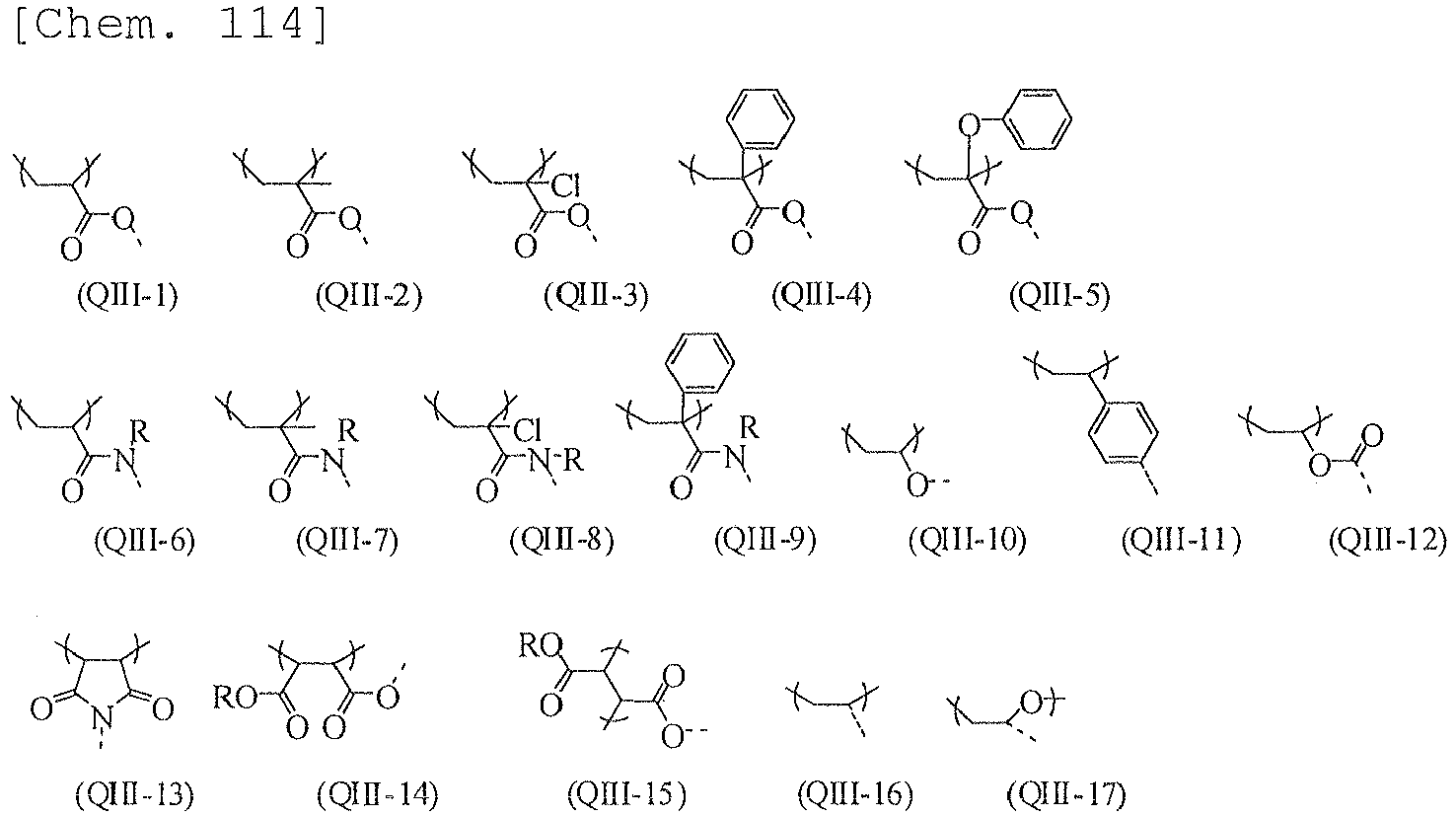
- Examples of the monovalent organic group include hydrogen, an alkyl group having 1 to 12 carbon atoms (any hydrogen atom in the alkyl group may be substituted with a fluorine atom, a chlorine atom, a methyl group, or a methoxy group, and one CH2 group or two or more non-adjacent CH2 groups in the alkyl group may be substituted with -O-, -CO-O-, -O-CO-, and/or -CH=CH-). Other examples of the monovalent organic group include a trans-1,4-cyclohexylene group, a trans-1,3-dioxan-2,5-yl group, a 1,4-naphthylene group, a 2,6-naphthylene group, a 2,5-pyridyl group, a 2,5-pyrimidyl group, a 1,2,4,5-tetrazine-2,5-diyl group, a 2,5-thiophenylene group, a 2,5-furanylene group, and a 1,4-phenylene group (any hydrogen atom in each of the structures may be substituted with a fluorine atom, a chlorine atom, a methyl group, or a methoxy group).
- Furthermore, particularly, in order to obtain an alignment layer for vertical alignment, examples of the monovalent organic group include the general formula (QIV):
[Chem. 115] ----Sa-Va (QIV)
(wherein the broken line represents a bond to a monomer unit (Md), Sa represents a spacer unit, and Va represents a moiety that stabilizes vertical alignment). - As Sa, a structure which is the same as Sp in the general formula (I) may be used.
- Va is preferably a structure represented by the following general formula (V):

Z4, Z5, Z6 and Z7 each independently represent a single bond, -(CH2)u- (wherein u represents 1 to 20), -OCH2-, -CH2O-, -COO-, -OCO-, -CH=CH-, -CF=CF-, -CF2O-, -OCF2-, -CF2CF2-, or -C≡C-, but one or more of the non-adjacent CH2 groups in these substituents may be independently substituted with -O-, -CO-, -CO-O-, -O-CO-, -Si(CH3)2-O-Si(CH3)2-, -NR-, -NR-CO-, -CO-NR-, -NR-CO-O-, -O-CO-NR-, -NR-CO-NR-, -CH=CH-, -C≡C-, or -O-CO-O-(wherein R's independently represent hydrogen or an alkyl group having 1 to 5 carbon atoms),
A3, A4, A5 and A6 each independently represent a trans-1,4-cyclohexylene group, a trans-1,3-dioxane-2,5-diyl group, a 1,4-naphthylene group, a 2,6-naphthylene group, a pyridine-2,5-diyl group, a pyrimidine-2,5-diyl group, a 1,2,4,5-tetrazine-2,5-diyl group, a 2,5-thiophenylene group, a 2,5-furanylene group, or a 1,4-phenylene group, and these may be unsubstituted or have one or more hydrogen atoms substituted with a fluorine atom, a chlorine atom, a methyl group, or a methoxy group,
r1, s1, t1, and u1 each independently represent 0 or 1, and
R12 represents hydrogen, fluorine, chlorine, a cyano group, or an alkyl group having 1 to 20 carbon atoms, a hydrogen atom in the alkyl group may be substituted with a fluorine atom, and one CH2 group or two or more non-adjacent CH2 groups may be substituted with -O-, -CO-O-, -O-CO-, and/or -CH=CH-). - Z4, Z5, Z6 and Z7 are each independently preferably a single bond, -(CH2)u- (wherein u represents 1 to 12, one or more of the non-adjacent CH2 groups independently represent -O-, -CO-, -CO-O-, -O-CO-, -NR-CO-, -CO-NR-, -NR-CO-NR-, -CH=CH-, -C≡C-, or -O-CO-O-, and R's independently represent hydrogen, a methyl group, or an ethyl group), -OCH2-, -CH2O-, -COO-, -OCO-, -CH=CH-, -CF2O-, -OCF2-, or -C≡C-, and
A3, A4, A5 and A6 each independently represent a trans-1,4-cyclohexylene group, a 2,6-naphthylene group, a pyridine-2,5-diyl group, a pyrimidine-2,5-diyl group, or a 1,4-phenylene group, and these are preferably unsubstituted or have one or more hydrogen atoms substituted with a fluorine atom, a chlorine atom, a methyl group, or a methoxy group,
for r1, s1, t1, and u1, r1+s1+t1+u1 is preferably from 0 to 3, and
R12 is preferably a structure represented by hydrogen, fluorine, chlorine, a cyano group, or an alkyl group having 1 to 18 carbon atoms (one CH2 group or two or more non-adjacent CH2 groups in the alkyl group may be substituted with -O-, -CO-O-, -O-CO-, and/or -CH=CH-). - In order to improve the liquid crystal alignment property in the liquid crystal alignment layer of the present invention, Z4, Z5, Z6 and Z7 are each independently preferably a single bond, -(CH2)u- (wherein u represents 1 to 8, and one or two of the non-adjacent CH2 groups independently represent -O-, -CO-O-, -O-CO-, -si(CH3)2-O-Si(CH3)2-, -CH=CH-, or -C≡C-), -COO-, -OCO-, -CH=CH-, -CF=CF-, or -C≡C-, and A3, A4, A5 and A6 are each independently preferably a trans-1, 4-cyclohexylene group, a trans-1,3-dioxane-2,5-diyl group, a pyridine-2,5-diyl group, a pyrimidine-2,5-diyl group, a 1, 2, 4, 5-tetrazine-2, 5-diyl group, a 2, 5-thiophenylene group, or a 1,4-phenylene group.
- Furthermore, in order to improve the thermal stability of alignment in the liquid crystal alignment layer of the present invention, Z4, Z5, Z6 and Z7 are each independently preferably -NR-CO-, -CO-NR-, -NR-CO-O-, -O-CO-NR-, -NR-CO-NR-, or -O-CO-O-, and A3, A4, A5 and A6 are each independently preferably a 1,4-naphthylene group, a 2,6-naphthylene group, a pyridine-2,5-diyl group, a pyrimidine-2,5-diyl group, a 2,5-thiophenylene group, a 2,5-furanylene group, or a 1,4-phenylene group. Further, in order to improve the solubility of the polymer, Z4, Z5, Z6 and Z7 are each independently preferably -OCH2-, -CH2O-, -CF2O-, -OCF2-, -CF2CF2-, -NR-, or -CO-, and A3, A4, A5 and A6 are each independently preferably a trans-1,4-cyclohexylene group, a 1,4-naphthylene group, a 2,6-naphthylene group, or a 2,5-furanylene group.
- Furthermore, in order to provide a pretilt angle of 80 degrees or more, Z4, Z5, Z6 and Z7 are each independently preferably a single bond, -OCH2-, -CH2O-, -COO-, -OCO-, and -C≡C-, A3, A4, A5 and A6 are each independently preferably a trans-1,4-cyclohexylene group, a trans-1,3-dioxane-2,5-diyl group, and a 1, 4-phenylene group, and R2 is preferably an alkyl group having 1 to 20 carbon atoms, an alkoxy group, fluorine, a trifluoromethyl group, and a trifluoromethoxy group.
- Many compounds belong to the general formula (V), but in order to provide a pretilt angle of 80 degrees or more, specifically, the compounds represented by the following general formulae (V-a-1) to (V-q-10) are particularly preferable:
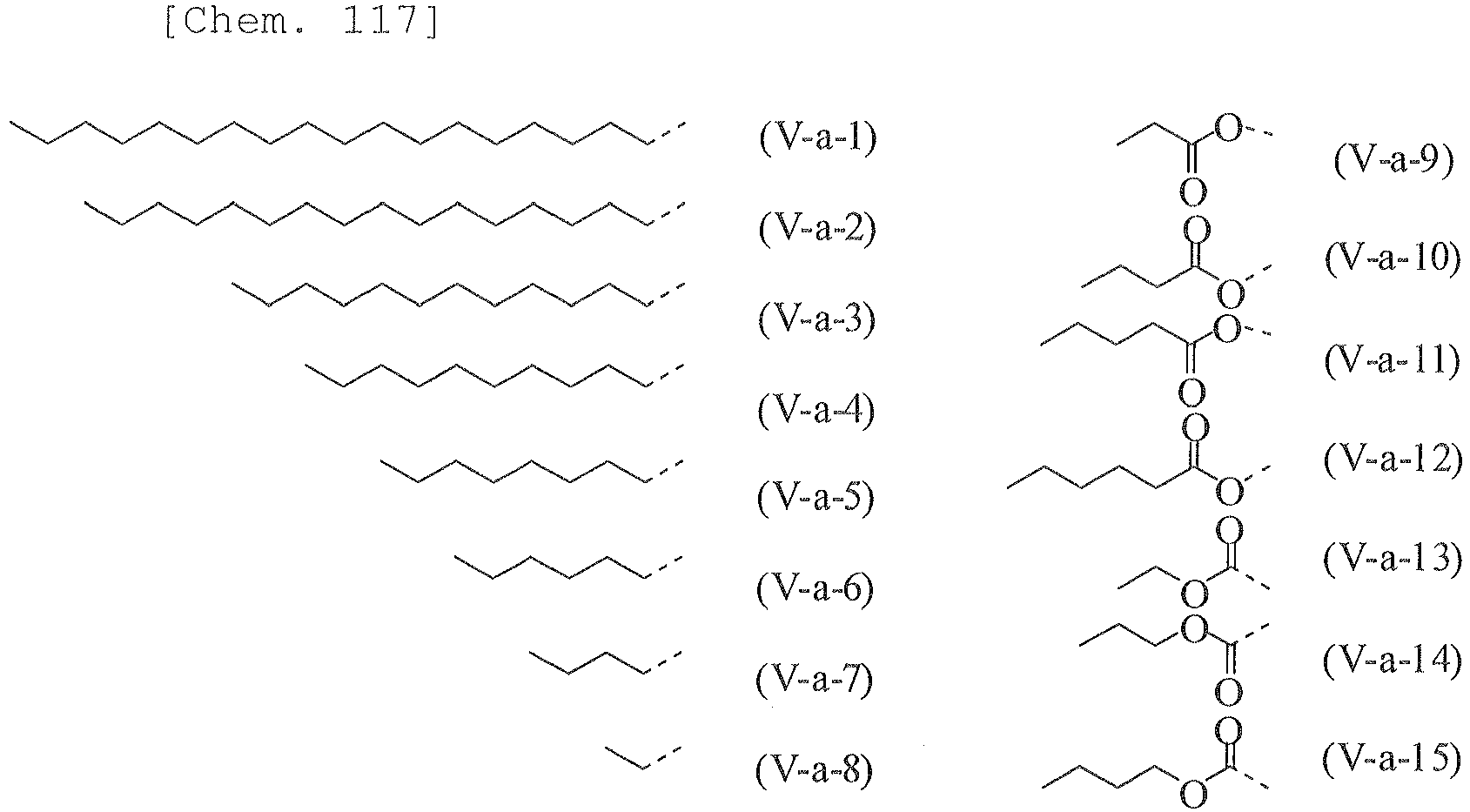


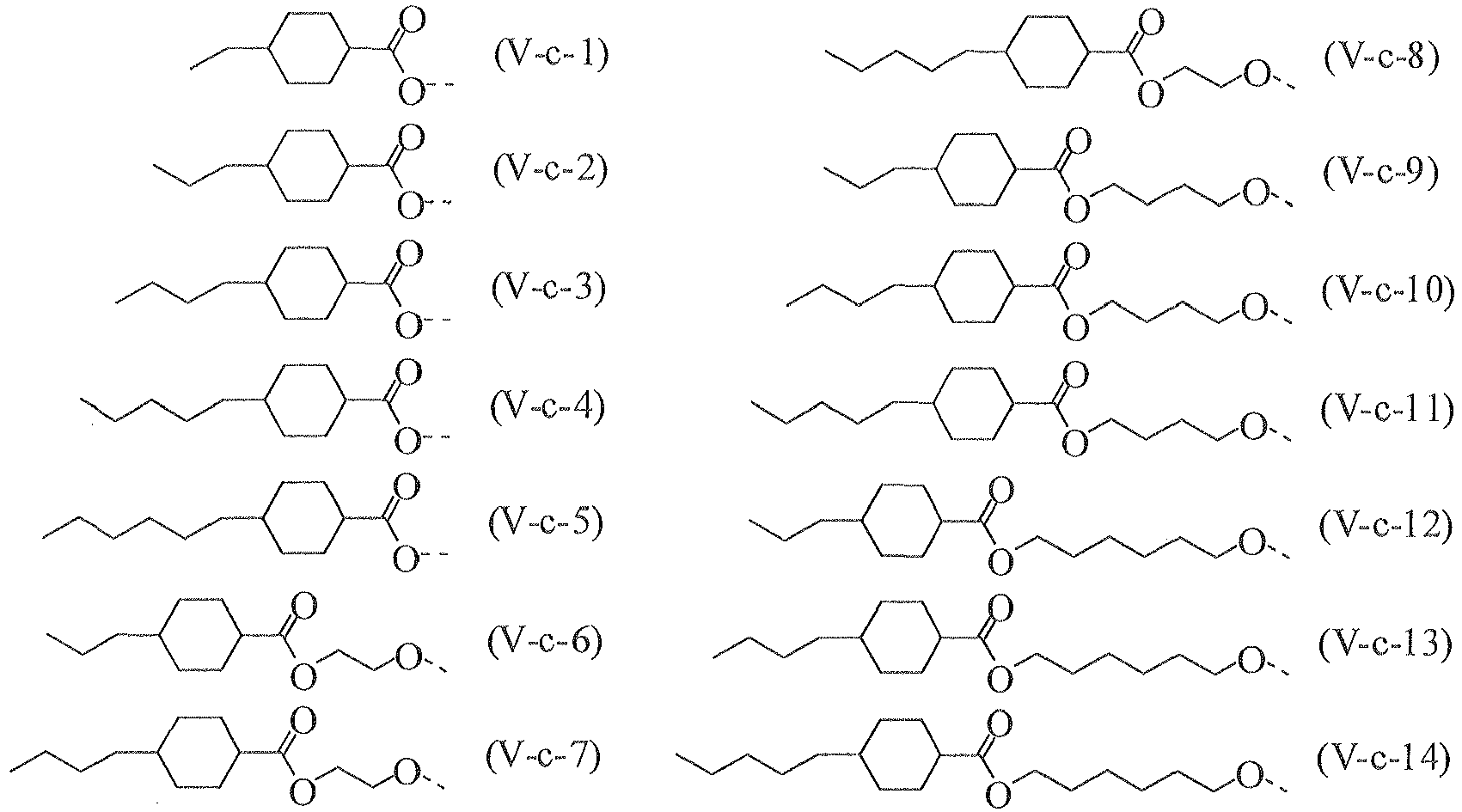


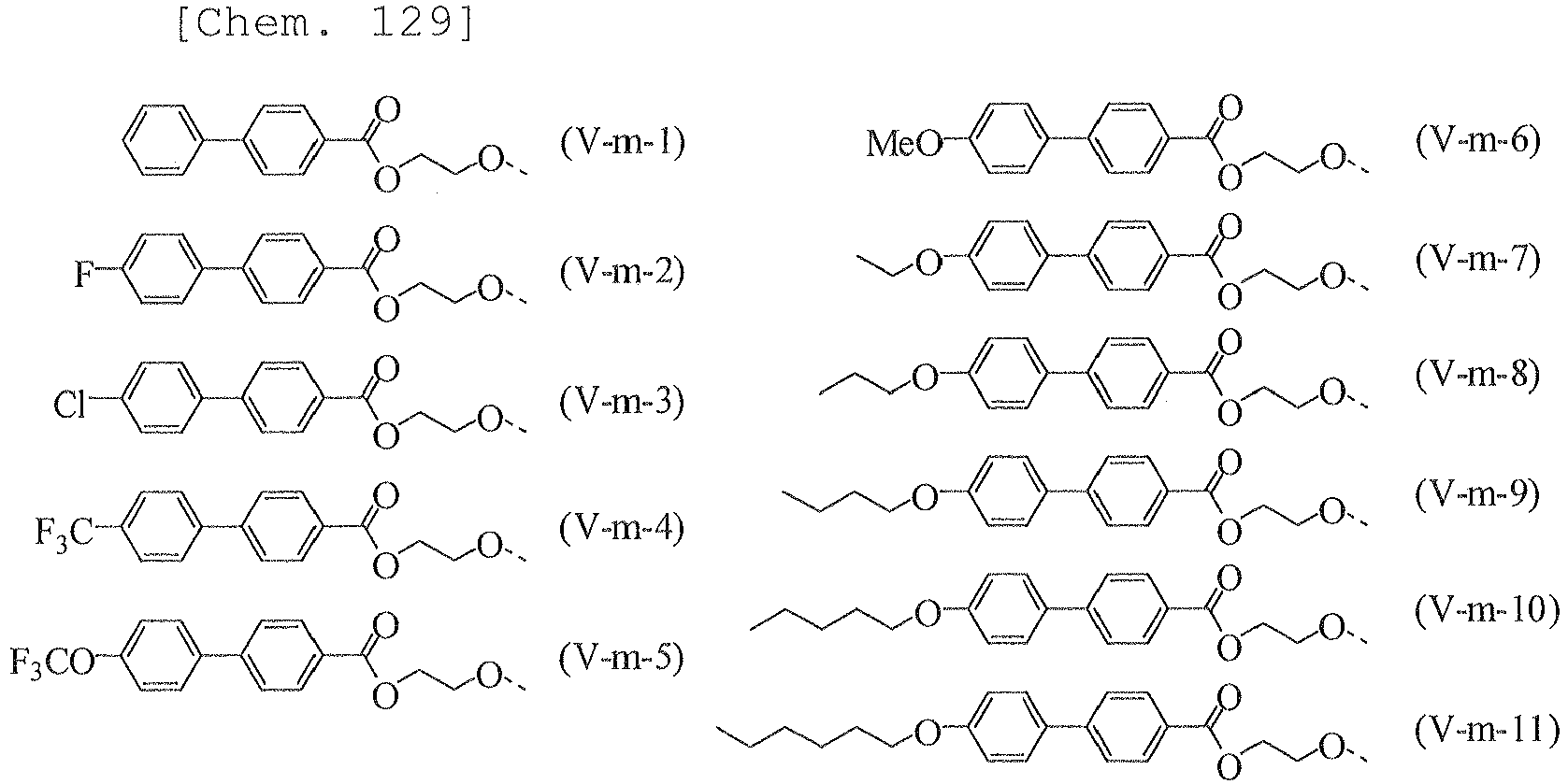


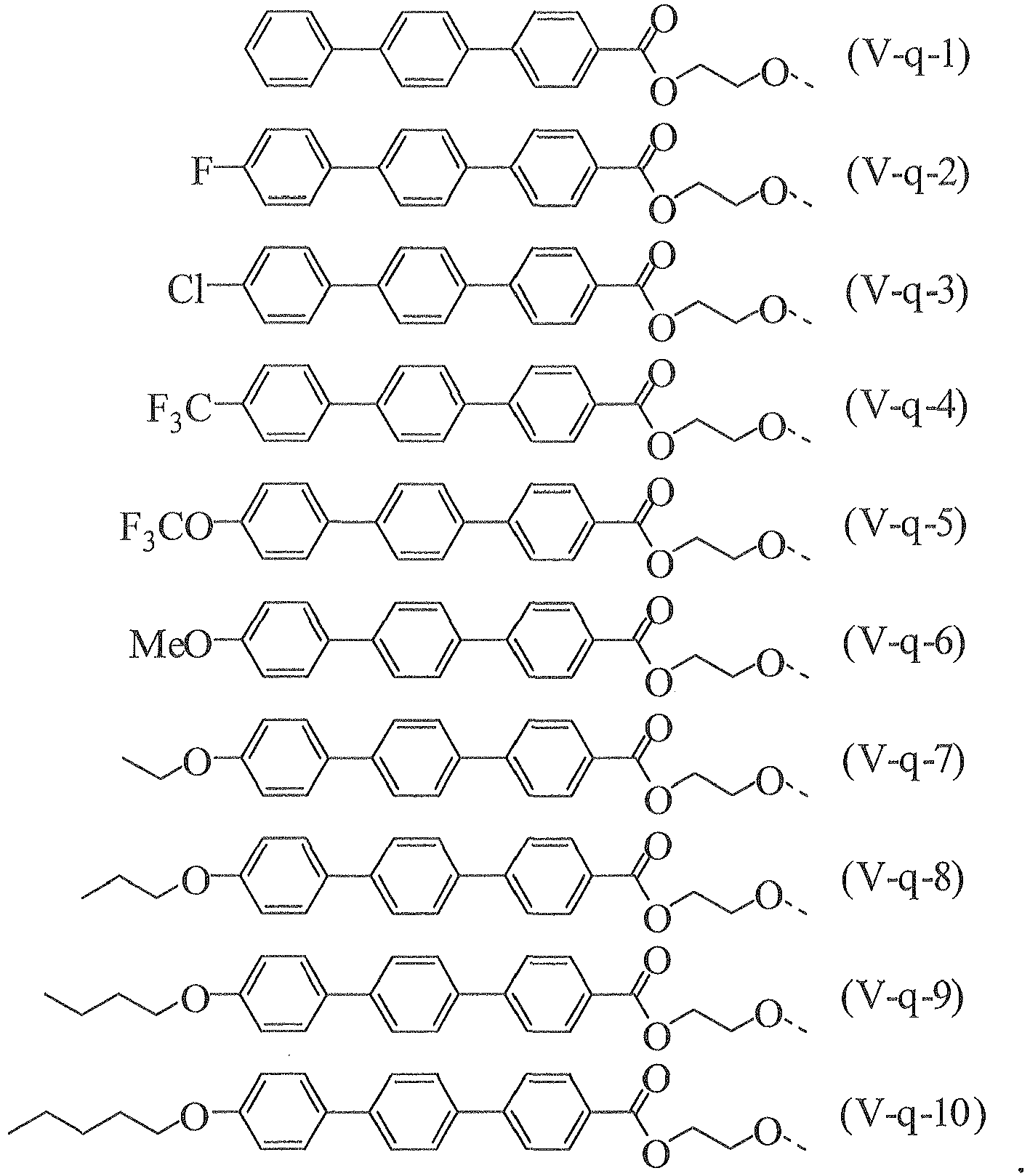
- Among these, the general formulae (V-a-1) to (V-a-15), the general formulae (V-b-11) to (V-b-15), the general formulae (V-c-1) to (V-c-11), the general formulae (V-d-10) to (V-d-15), the general formulae (V-f-1) to (V-f-10), the general formulae (V-g-1) to (V-g-10), the general formulae (V-h-1) to (V-h-10), the general formulae (V-j-1) to (V-j-9), the general formulae (V-l-1) to (V-l-11), or the general formulae (V-m-1) to (V-m-11) are more preferable.
- In the general formula (I), Sp is a structure represented by the following general formula (IVa):

Z1, Z2 and Z3 each independently represent a single bond, -(CH2)u- (wherein u represents 1 to 20), -OCH2-, -CH2O-, -COO-, -OCO-, -CH=CH-, -CF=CF-, -CF2O-, -OCF2-, -CF2CF2-, or -C≡C-, but one or more of the non-adjacent CH2 groups in these substituents may be independently substituted with -O-, -CO-, -CO-O-, -O-CO-, -si(CH3)2-O-Si(CH3)2-, -NR-, -NR-CO-, -CO-NR-, -NR-CO-O-, -O-CO-NR-, -NR-CO-NR-, -CH=CH-, -C≡C-, or -O-CO-O-(wherein R's independently represent hydrogen or an alkyl group having 1 to 5 carbon atoms),
A1 and A2 each independently represent a trans-1,4-cyclohexylene group, a trans-1,3-dioxane-2,5-diyl group, a 1,4-naphthylene group, a 2,6-naphthylene group, a pyridine-2,5-diyl group, a pyrimidine-2,5-diyl group, a 1,2,4,5-tetrazine-2,5-diyl group, a 2,5-thiophenylene group, a 2,5-furanylene group, or a 1,4-phenylene group, and these may be unsubstituted or have one or more hydrogen atoms substituted with a fluorine atom, a chlorine atom, a methyl group, or a methoxy group, and
p and q each independently represent 0 or 1),
Z1, Z2 and Z3 are each independently preferably a single bond, -(CH2)u- (wherein u represents 1 to 20, and one or more of the non-adjacent CH2 groups independently represent -O-, -CO-, -CO-O-, -O-CO-, -NR-, -NR-CO-, -CO-NR-, -NR-CO-NR-, -CH=CH-, -C≡C-, or -O-CO-O-, and R represents hydrogen, a methyl group, or an ethyl group), -OCH2-, -CH2O-, -COO-, -OCO-, -CH=CH-, -CF2O-, -OCF2-, or -C≡C-, A1 and A2 each independently represent a trans-1,4-cyclohexylene group, a trans-1,3-dioxane-2,5-diyl group, a 1,4-naphthylene group, a 2,6-naphthylene group, a pyridine-2,5-diyl group, a pyrimidine-2, 5-diyl group, or a 1, 4-phenylene group, these are preferably unsubstituted or have one or more hydrogen atoms substituted with a fluorine atom, a chlorine atom, a methyl group, or a methoxy group, Z1, Z2 and Z3 are each independently more preferably a single bond, -(CH2)u- (wherein u represents 1 to 20), -OCH2-, -CH2O-, -COO-, -OCO-, -CH=CH-, or -C=C- (one or more of the non-adjacent CH2 groups in these substituents may be independently substituted with -O-, -CO-, -CO-O-, -O-CO-, -CH=CH-, or -C≡C-), q is more preferably 1, A1 and A2 each independently represent a trans-1,4-cyclohexylene group, a 2,6-naphthylene group, a pyridine-2,5-diyl group, a pyrimidine-2, 5-diyl group, or a 1, 4-phenylene group, these are more preferably unsubstituted or have one or more hydrogen atoms substituted with a fluorine atom, a chlorine atom, a methyl group, or a methoxy group, Z1, Z2 and Z3 are each independently particularly preferably a single bond, -(CH2)u-(wherein u represents 1 to 20, and one or more of the non-adjacent CH2 groups independently represent -O-, -CO-O-, -O-CO-, -CH=CH-, or -C≡C-), -OCH2-, -CH2O-, -COO-, -OCO-, -CH=CH-, or -C=C, A1 and A2 each independently represent a trans-1,4-cyclohexylene group, a 2,6-naphthylene group, or a 1,4-phenylene group, these are particularly preferably unsubstituted or have one or more hydrogen atoms substituted with a fluorine atom, a methyl group, or a methoxy group, A2 represents a 1,4-phenylene group, and these are most preferably unsubstituted or have one or more hydrogen atoms substituted with a fluorine atom, a methyl group, or a methoxy group. - In the general formula (IVa), in order to improve the liquid crystal alignment property, Z1, Z2 and Z3 are each independently preferably a single bond, -(CH2)u- (wherein u represents 1 to 8, and one or two of the non-adjacent CH2 groups independently represent -O-, -CO-O-, -O-CO-, -si(CH3)2-O-Si(CH3)2-, -CH=CH-, or -C≡C-), -COO-, -OCO-, -CH=CH-, -CF=CF-, or -C≡C-, and A1 and A2 are each independently preferably a trans-1,4-cyclohexylene group, a trans-1,3-dioxane-2,5-diyl group, a pyridine-2,5-diyl group, a pyrimidine-2,5-diyl group, a 2,5-thiophenylene group, or a 1, 4-phenylene group. Further, in order to improve the thermal stability of alignment, Z1, Z2 and Z3 are each independently preferably -NR-CO-, -CO-NR-, -NR-CO-O-, -O-CO-NR-, -NR-CO-NR-, or -O-CO-O-, and A1 and A2 are each independently preferably a 1,4-naphthylene group, a 2,6-naphthylene group, a pyridine-2,5-diyl group, a pyrimidine-2,5-diyl group, a 2,5-thiophenylene group, a 2,5-furanylene group, or a 1,4-phenylene group. Further, in order to improve the solubility of the polymer, Z1, Z2 and Z3 are each independently preferably -OCH2-, -CH2O-, -CF2O-, -OCF2-, -CF2CF2-, -NR-, or -CO-, and A1 and A2 are each independently preferably a trans-1,4-cyclohexylene group, a 1,4-naphthylene group, a 2,6-naphthylene group, or a 2,5-furanylene group.
- Many compounds belong to the general formula (IVa), but specifically, the compounds represented by the following general formulae (S-a-1) to (S-ad-9) are particularly preferable:


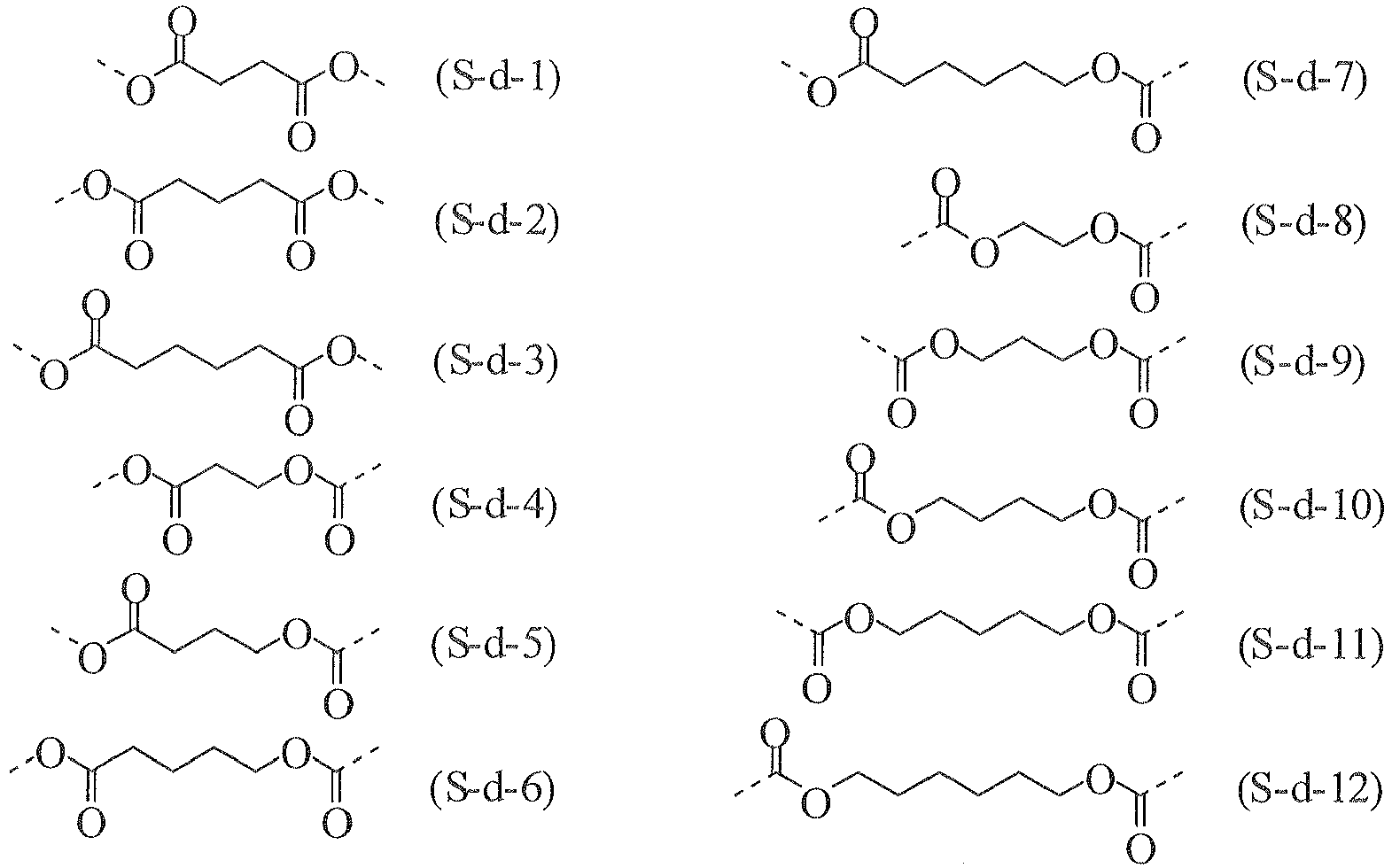


- Among these, the compounds represented by the general formulae (S-a-6) to (S-a-16), the general formulae (S-b-3) to (S-b-10), the general formulae (S-c-3) to (S-c-10), the general formulae (S-d-3) to (S-d-12), the general formulae (S-k-4) to (S-k-7), the general formulae (S-l-13) to (S-l-17), the general formulae (S-o-3) to (S-o-14), the general formulae (S-p-2) to (S-p-13), the general formulae (S-s-1) to (S-s-8), the general formulae (S-t-1) to (S-t-8), the general formulae (S-y-1) to (S-y-9), and the general formulae (S-aa-1) to (S-aa-9) are more preferable.
- Examples of the method of applying a solution of the cinnamic acid derivative, the composition, or the polymer of the present invention onto a substrate include spin coating, die coating, gravure coating, flexography, and ink jet printing methods. The concentration of the solid content in the solution used in the application is preferably 0.5 to 10% by weight, and is more preferably selected from this range by considering a method of applying the solution on the substrate, viscosity, volatility, or the like. Further, the applied surface is preferably heated after the application so as to remove the solvent. The drying conditions are preferably 50 to 300°C, and more preferably 80 to 200°C for preferably 5 to 200 minutes, and more preferably 10 to 100 minutes.
- As the light used for irradiation when subjecting a coating film composed of the polymer to curing, for example, ultraviolet rays or visible rays containing light having a wavelength of 150 nm to 800 nm may be used, and among these, ultraviolet rays having a wavelength of 270 nm to 450 nm are particularly preferable.
- Examples of the light source include a xenon lamp, a high-pressure mercury lamp, an ultrahigh-pressure mercury lamp, and a metal halide lamp. Linear polarized light is obtained from these light sources through a polarizing filter and a polarizing prism. Further, the ultraviolet light and visible light obtained from such light sources may have a wavelength range for irradiation restricted by using an interference filter or a color filter. In addition, the irradiation energy is preferably 15 mJ/cm2 to 500 mJ/cm2, and more preferably 20 mJ/cm2 to 300 mJ/cm2. The luminous intensity is preferably 2 to 500 mW/cm2, and more preferably 5 mJ/cm2 to 300 mW/cm2.
- Next, a fourth embodiment of the present invention will be described while focusing on the difference from the first to third embodiments, and the description of the same contents will be omitted.
- A compound represented by the general formula (I) is preferable:

A represents a group selected from the group consisting of: - (a) a trans-1, 4-cyclohexylene group (one methylene group or two or more non-adjacent methylene groups present in this group may be substituted with -O-, -NH-, or -S-),
- (b) a 1,4-phenylene group (one or two or more -CH='s present in this group may be substituted with -N=), and
- (c) a 1,4-cyclohexenylene group, a 2,5-thiophenylene group, a 2,5-furanylene group, a 1,4-bicyclo(2.2.2)octylene group, a naphthalene-1,4-diyl group, a naphthalene-2,6-diyl group, a decahydronaphthalene-2,6-diyl group, and a 1,2,3,4-tetrahydronaphthalene-2,6-diyl group,
- The alkyl group having 1 to 30 carbon atoms, represented by R1, is a linear or branched alkyl group, in which one -CH2-group is preferably substituted with a cycloalkyl group having a ring member number of 3 to 8.
- The alkyl group having 1 to 30 carbon atoms, represented by R2, is preferably a linear or branched alkyl group or a cycloalkyl group having a ring member number of 3 to 8, which may have the alkyl group interposed therein as a linking group. In the general formula (IVb), Z1, Z2 and Z3 are each independently preferably a single bond, -(CH2)u- (wherein u represents 1 to 20, and one or more of the non-adjacent CH2 groups may be independently substituted with -0-, -CO-O-, -O-CO-, -CH=CH-, or -C≡C-), -OCH2-, -CH2O-, -COO-, -OCO-, -CH=CH-, or -C≡C-.
- In the general formula (IVb), q is preferably 0.
- In the general formula (IVb), p is preferably 1.
- In the general formula (IVb),
A8 is preferably a trans-1,4-cyclohexylene group (one methylene group or two or more non-adjacent methylene groups present in this group may be substituted with -O-, -NH-, or -S-), and a 1, 4-phenylene group (one or two -CH='s present in this group may be substituted with -N=). In the general formula (IVb), A2 is preferably any group of a trans-1, 4-cyclohexylene group, a trans-1,3-dioxane-2,5-diyl group, a 1,4-naphthylene group, a 2,6-naphthylene group, a pyridine-2,5-diyl group, a pyrimidine-2,5-diyl group, or a 1,4-phenylene group. A hydrogen atom of these groups may be unsubstituted or one or more hydrogen atoms of these groups may be substituted with a fluorine atom, a chlorine atom, a methyl group, or a methoxy group. - The present invention will be described in further detail with reference to Examples below, but the present invention is not limited to Examples. The structure of a compound was identified with a nuclear magnetic resonance (NMR) spectrum, a mass spectrum (MS), or the like. Unless otherwise noted, "parts" and "%" are on a mass basis.
- Synthesis of Methyl=3-(4-(6-(6-(2-methylacryloyloxy)hexyloxy)naphthalen e-2-carbonyloxy)phenylcarbonyloxy-3-methoxyphenyl)acrylate

- 6-Chlorohexyl=2-methylacrylate (77.2 g), 6-hydroxy-2-naphthaldehyde (50.0 g), and potassium carbonate (60.0 g) were suspended in dimethyl formamide (150 ml), and the suspension was stirred at 95°C for 8 hours. The suspension was cooled to 25°C and 10% hydrochloric acid was added thereto. The mixture was extracted twice with toluene. The organic phase was combined, washed with saturated saline, and dried over anhydrous sodium sulfate. The solvent was evaporated under reduced pressure to obtain a brown liquid. The mixture was purified by column chromatography to obtain 6-(6-(2-methylacryloxy)hexyloxy)-2-naphthaldehyde (118.7 g) as a yellow liquid.
- 6-(6-(2-Methylacryloxy)hexyloxy)-2-naphthaldehyde (118.7 g), 2-methyl-2-butene (91.5 g), and sodium dihydrogen phosphate (67.9 g) were suspended in tert-butyl alcohol (750 ml) and water (204 ml), and a solution prepared by dissolving sodium chlorite (49.2 g) in water (172 ml) was added dropwise thereto at 25°C. The mixture was stirred at 25°C for 8 hours. Thereafter, the mixture was stirred at 5°C for 1 hour and the precipitated solid was collected by filtration. The solid was purified by reprecipitation to obtain 6-(6-(2-methylacryloxy)hexyloxy)-2-naphthoic acid (83.8 g) as a yellow powder.
- 1H-NMR (400 MHz, CDCl3) δ: 1.46-1.62 (m, 4H), 1.75 (dt, J = 7.0 Hz, J = 14.6 Hz, 2H), 1.89 (dt, J =6.9 Hz, J = 14.6 Hz, 2H), 1.94 (s, 3H), 4.11 (t, J = 6.5 Hz, 2H), 4.18 (t, J = 6.6 Hz, 2H), 5.55 (s, 1H), 6. 10 (s, 1H), 7. 16 (bs, 1H), 7.22 (dd, J = 2.4 Hz, J = 8.8 Hz, 1H), 7.77 (d, J = 8.8 Hz, 1H), 7.87 (d, J = 9.0 Hz, 1H), 8.08 (dd, J = 1.7 Hz, J = 8.5 Hz, 1H), 8.63 (s, 1H).
- Ethyl=4-(3,4,5,6-tetrahydropyran-2-yloxy)benzoic acid (10.0 g) was dissolved in dimethoxyethane (60 ml), and a 5% aqueous potassium hydroxide solution (65.0 g) was added thereto at 25°C. The mixture was stirred at 60°C for 2 hours, toluene was then added thereto to separate the organic phase and the aqueous phase. The aqueous phase was neutralized with a 1 M aqueous sodium hydrogen sulfate solution, and the precipitated solid was collected by filtration. The solid was dried under reduced pressure to obtain 4-(3,4,5,6-tetrahydropyran-2-yloxy)benzoic acid (8.88 g) as a colorless powder.
- 4-(3,4,5,6-Tetrahydropyran-2-yloxy)benzoic acid (7.33 g), methyl=4-hydroxy-3-methoxycinnamate (6.87 g), and 4-dimethyl aminopyridine (DMAP, 0.20 g) were suspended in dichloromethane (48 ml), and diisopropylcarbodiimide (DIC, 5.41 g) was added dropwise thereto at 25°C. After stirring at 25°C for 2 hours, the solvent was evaporated under reduced pressure. Methanol (50 ml) was added thereto and the precipitated solid was collected by filtration. The residue was purified by column chromatography and reprecipitation to obtain methyl=3-(4-(4-(3,4,5,6-tetrahydropyran-2-yloxy)benzoyloxy )-3-methoxyphenyl)acrylate (13.8 g) as a colorless powder.
- Methyl=3-(4-(4-(3,4,5,6-tetrahydropyran-2-yloxy)benz oyloxy)-3-methoxyphenyl)acrylate (6.9 g) was dissolved in dichloromethane (35 ml) and methanol (35 ml), and 30% hydrochloric acid (0.35 ml) was added thereto at 25°C. The mixture was stirred at 25°C for 8 hours and neutralized by the addition of a 5% aqueous sodium hydrogen carbonate solution. The organic phase was collected by separation and the aqueous layer was extracted with dichloromethane.
- The organic phase was combined, washed with saturated saline, and dried over anhydrous sodium sulfate. The solvent was evaporated under reduced pressure to obtain a pale brown solid. The solid was washed with hexane to obtain methyl=3-(4-(4-hydroxybenzoyloxy)-3-methoxyphenyl)acrylate (5.24 g) as a pale brown powder.
- 1H-NMR (400 MHz, CDCl3) δ: 3.82 (s, 3H), 3.84 (s, 3H), 5.60 (bs, 1H), 6.42 (d, J= 16.1 Hz, 1H), 6.92 (d, J= 8.5 Hz, 2H), 7.15 (d, J = 12 . 0 Hz, 1H), 7.17 (s, 2H), 7.68 (d, J = 15.9 Hz, 1H), 8.13 (d, J = 8.5 Hz, 2H).
- Methyl=3-(4-(4-hydroxybenzoyloxy)-3-methoxyphenyl)ac rylate (5.0 g), 6-(6-(2-methylacryloyloxy)hexyloxy)-2-naphthoic acid (5.43 g), and DMAP (0.092 g) were suspended in dichloromethane (50 ml), and DIC (2.49 g) was added dropwise thereto at 25°C. After stirring at 25°C for 2 hours, the solvent was evaporated under reduced pressure. Methanol (50 ml) was added thereto and the precipitated solid was collected by filtration. The residue was purified by column chromatography and recrystallization to obtain methyl=3-(4-(6-(6-(2-methylacryloyloxy)hexyloxy)naphthalen e-2-carbonyloxy)phenylcarbonyloxy-3-methoxyphenyl)acrylate as colorless powder (9.26 g).
- Transition temperature Cr 141 Iso
- 1H-NMR (400 MHz, CDCl3) δ: 1.46-1.64 (m, 4H), 1.75 (dt, J = 7.0 Hz, J = 14.4 Hz, 2H), 1.86-2.00 (m, 2H), 1.95 (s, 3H), 3.84 (s, 3H), 3.86 (s, 3H), 4.12 (t, J = 6.4 Hz, 2H), 4.18 (t, J = 6.5 Hz, 2H), 5.55 (t, J = 1.5 Hz, 1H), 6.10 (s, 1H), 6.42 (d, J = 16.1 Hz, 1H), 7.05-7.28 (m, 5H), 7.42 (d, J = 8.3 Hz, 2H), 7.68 (d, J = 16.1 Hz, 1H), 7.82 (d, J = 8.8 Hz, 1H), 7.90 (d, J = 9.0 Hz, 1H), 8.15 (dd, J =1. 7 Hz, J= 8.5 Hz, 1H), 8.32 (d, J = 6.8 Hz, 2H), 8.72 (s, 1H).
- The products obtained above may be sometimes referred to as CinNp-1 hereinafter.
- In this manner, the following compounds CinNp-2 to CinNp-13 were synthesized.


-


- 9.01 g of butyl maleimidoacetate, 0.33 g of dibutyltin (IV) oxide, and 9.14 g of tetradecanol were dissolved in 40 ml of toluene, followed by stirring for 15 hours while heating to reflux. The reaction solution was cooled to room temperature and 100 ml of toluene was added thereto. The mixture was subjected to liquid separation and washed with saturated sodium bicarbonate water and then with saturated saline. To this solution was added sodium sulfate, and the mixture was dried. Sodium sulfate was removed and the solvent was evaporated under reduced pressure to reduce the volume to about 50 ml, and 40 ml of hexane and 20 ml of dichloromethane were added thereto. The mixture was purified by column chromatography (alumina/silica gel, hexane/dichloromethane = 2:1), the solvent was evaporated under reduced pressure, and the residue was reprecipitated with methanol to obtain (V-1) (7.95 g) as a white crystal.
- 1H-NMR (400 MHz, CDCl3) δ: 0.88 (t, J = 6.8 Hz, 3H), 1.15-1.40 (m, 22H), 1.61-1.66 (tt, 2H), 4.14 (t, J = 6.6 Hz, 2H), 4.15 (s, 2H), 6.79 (s, 2H) EI-MS: 351 [M+]

- Stearyl acrylate (V-2) (manufactured by Tokyo Chemical Industry Co., Ltd.) was purchased and used.

- N-(Butoxymethyl)acrylamide (V-3) (manufactured by Tokyo Chemical Industry Co., Ltd.) was purchased and used.

- A compound (V-4) was synthesized according to the procedure described in a known document (Farmaco. Edizione Scientifica Vol. 22 (1967) 190, 590-598).
- 1 part (10.0 mmol) of a compound represented by the formula (CinNp-1) was dissolved in 10 parts of ethyl methyl ketone to obtain a solution 1. To this solution 1 was added 0.01 parts of azobisisobutyronitrile (AIBN). The mixture was heated to reflux for 2 days under a nitrogen atmosphere to obtain a solution 2. Then, the solution 2 was added dropwise to 60 parts of methanol under stirring, and the precipitated solid was filtered. The obtained solid was dissolved in 5 parts of tetrahydrofuran (THF), the solution was added dropwise to 120 parts of ice-cooled hexane under stirring, and the precipitated solid was filtered. The obtained solid was dissolved in 5 parts of THF, the solution was added dropwise to 120 parts of ice-cooled methanol under stirring, and the precipitated solid was filtered. The obtained solid was dissolved in THF and then vacuum-dried to obtain a polymer (NCE-1).
- In the same manner as for the cinnamic acid polymer (NCE-1), polymers (NCE-2) to (NCE-13) were obtained. The compositions of the respective polymers are as shown in Tables 1 and 2.
[Table 1] Sample name Blending amount (% by mole) CinNp-1 CinNp-2 CinNp-3 CinNp-4 CinNp-5 CinNp-6 Example 14 NCE-1 100 Example 15 NCE-2 100 Example 16 NCE-3 100 Example 17 NCE-4 100 Example 18 NCE-5 100 Example 19 NCE-6 100 [Table 2] Sample name Blending amount (% by mole) CinNp-7 CinNp-8 CinNp-9 CinNp-10 CinNp-11 CinNp-12 CinNp-13 Example 20 NCE-7 100 Example 21 NCE-8 100 Example 22 NCE-9 100 Example 23 NCE-10 100 Example 24 NCE-11 100 Example 25 NCE-12 100 Example 27 NCE-13 100 - 0.9 parts (9.0 mmol) of the compound represented by the formula (CinNp-1) and 0.1 parts (1.0 mmol) of a compound represented by the formula (V-1) were dissolved in 10 parts of ethyl methyl ketone to obtain a solution 3. To this solution 3 was added 0.01 parts of azobisisobutyronitrile (AIBN). The mixture was heated to reflux for 2 days under a nitrogen atmosphere to obtain a solution 4. Then, the solution 4 was added dropwise to 60 parts of methanol under stirring, and the precipitated solid was filtered. The obtained solid was dissolved in 5 parts of tetrahydrofuran (THF), the solution was added dropwise to 120 parts of ice-cooled hexane under stirring, and the precipitated solid was filtered. The obtained solid was dissolved in 5 parts of THF, the solution was added dropwise to 120 parts of ice-cooled methanol under stirring, and the precipitated solid was filtered. The obtained solid was dissolved in THF and then vacuum-dried to obtain a polymer (NCEV-1).
- In the same manner as for the cinnamic acid polymer (NCEV-1), polymers (NCEV-2) to (NCEV-50) were obtained. The compositions of the respective polymers are as shown in Tables 3 and 4.
[Table 3] Example Sample name Blending amount (% by mole) CinNp-1 CinNp-2 CinNp-3 CinNp-4 CinNp-5 CinNp-6 V-1 V-2 V-3 V-4 28 NCEV-1 90 10 29 NCEV-2 85 15 30 NCEV-3 80 20 31 NCEV-4 80 20 32 NCEV-5 80 20 33 NCEV-6 80 20 34 NCEV-7 80 20 35 NCEV-8 80 20 36 NCEV-9 80 20 37 NCEV-10 80 20 38 NCEV-11 80 20 39 NCEV-12 80 20 40 NCEV-13 80 20 41 NCEV-14 80 20 42 NCEV-15 80 20 43 NCEV-16 80 20 44 NCEV-17 80 20 45 NCEV-18 80 20 46 NCEV-19 80 20 47 NCEV-20 80 20 48 NCEV-21 80 20 49 NCEV-22 80 20 50 NCEV-23 80 20 51 NCEV-24 80 20 52 NCEV-25 80 20 53 NCEV-26 80 20 [Table 4] Example Sample name Blending amount (% by mole) CinNp -7 CinNp -8 CinNp -9 CinNp -10 CinNp -11 CinNp -12 CinNp -13 V-1 V-2 V-3 V-4 54 NCEV-27 80 20 55 NCEV-28 80 20 56 NCEV-29 80 20 57 NCEV-30 80 20 58 NCEV-31 80 20 59 NCEV-32 80 20 60 NCEV-33 80 20 61 NCEV-34 80 20 62 NCEV-35 80 20 63 NCEV-36 80 20 64 NCEV-37 80 20 65 NCEV-38 80 20 66 NCEV-39 80 20 67 NCEV-40 80 20 68 NCEV-41 80 20 69 NCEV-42 80 20 70 NCEV-43 80 20 71 NCEV-44 80 20 72 NCEV-45 80 20 73 NCEV-46 80 20 74 NCEV-47 80 20 75 NCEV-48 80 20 76 NCEV-49 80 20 77 NCEV-50 80 20 78 NCEV-51 80 20 79 NCEV-52 80 20 - The cinnamic acid polymer (NCE-1) was dissolved in cyclopentanone to 1.0% and the solution was stirred at room temperature for 10 minutes. Then, the solution was applied onto a glass plate as a base material, using a spin coater, and dried at 100°C for 3 minutes. Then, the surface was visually observed and as a result, it was found that a polymer was uniformly applied on the glass plate to form a smooth film.
- Next, the coated glass plate as a base material was irradiated with linear polarized and parallel light of visible ultraviolet light (wavelength: 313 nm, irradiation intensity: 8 mW/cm2) using an ultrahigh-pressure mercury lamp via a wavelength cut filter, a band-pass filter, and a polarizing filter in a direction of 45 degrees with respect to the substrate. The irradiation dose was 100 mJ/cm2. The thickness of the film was measured and found to be about 50 nm.
- A liquid crystal cell was fabricated by using the coated glass plate prepared by the method above. The gap between the plates was set to 10 µm and the two glass plates were bonded in the anti-parallel direction. Next, a nematic liquid crystal mixture having a negative dielectric anisotropy with a composition described below was charged into the cell at a temperature just exceeding a transparent point (Tc = 84.4°C), and then cooled to room temperature. A polarizing plate was placed on the top and the bottom of the liquid crystal cell, and a back light was placed below. The light transmittance was changed by rotating the liquid crystal cell by 90 degrees and dark-light contrast was clearly observed and there was no abnormal domain and alignment unevenness, from which it was confirmed that the liquid crystals were normally aligned. The tilt angle of the liquid crystal in the cell was optically measured by a crystal rotation method, and the pretilt angle was found to be 1 degree. A voltage of 5 V was applied to this liquid crystal cell for an application time of 60 microseconds at a span of 167 milliseconds, and the voltage holding ratio after 167 milliseconds from the release of the voltage was measured by means of "VHR-AMP01" manufactured by TOYO Corporation at 23°C, and as a result, the voltage holding ratio (VHR) was found to be 99.3%.

- Hereinafter, in the same manner as the cinnamic acid polymer (NCE-1), for (NCE-2) to (NCE-12), and (NCEV-1) to (NCEV-50), alignment layers were fabricated and liquid crystal cells were fabricated. The measurement results of the irradiation doses of linear polarized light, liquid crystal alignment property, pretilt angle, VHR are shown in conjunction in Table 5. For the irradiation dose of linear polarized light, an irradiation dose of less than 120 mJ/cm2 was denoted as ○, an irradiation dose of 120 mJ/cm2 or more and less than 300 mJ/cm2 was denoted as Δ, and an irradiation dose of 300 mJ/cm2 or more was denoted as X. For the liquid crystal alignment property, when the presence or absence of the abnormal domain and alignment unevenness of the liquid crystal cell was observed, a case where there was the abnormal domain and alignment unevenness at zero place was denoted as ○, a case where there was the abnormal domain and alignment unevenness in two or less places was denoted as Δ, and a case where there was the abnormal domain and alignment unevenness in three or more places was denoted as X.
- The pretilt angles were optically measured by a crystal rotation method, and a case where the pretilt angle was 80 degrees or more and less than 90 degrees was denoted as V, and a case where the pretilt angle was 0 degrees or more and less than 15 degrees was denoted as P. For VHR, a case where the VHR was 98% or more was denoted as ○, a case where the VHR was 95% or more and less than 98% was denoted as Δ, and a case where the VHR was 95% or less was denoted as X.
[Table 5] Sample name Irradiation dose of linear polarized light Liquid crystal alignment property Pretilt angle VHR Example 80 NCE-1 ○ ○ P ○ Example 81 NCE-2 ○ ○ P ○ Example 82 NCE-3 ○ ○ P ○ Example 83 NCE-4 ○ ○ P ○ Example 84 NCE-5 ○ ○ P ○ Example 85 NCE-6 ○ ○ P ○ Example 86 NCE-7 ○ ○ P ○ Example 87 NCE-8 ○ ○ P ○ Example 88 NCE-9 ○ ○ P ○ Example 89 NCE-10 ○ ○ P ○ Example 90 NCE-11 ○ ○ P ○ Example 91 NCE-12 ○ ○ P ○ Example 92 NCE-13 ○ ○ P ○ [Table 6] Sample name Irradiation dose of linear polarized light Liquid crystal alignment property Pretilt angle VHR Example 93 NCEV-1 ○ ○ V ○ Example 94 NCEV-2 ○ ○ V ○ Example 95 NCEV-3 ○ ○ V ○ Example 96 NCEV-4 ○ ○ V ○ Example 97 NCEV-5 ○ ○ P ○ Example 98 NCEV-6 ○ ○ P ○ Example 99 NCEV-7 ○ ○ V ○ Example 100 NCEV-8 ○ ○ V ○ Example 101 NCEV-9 ○ ○ P ○ Example 102 NCEV-10 ○ ○ P ○ Example 103 NCEV-11 ○ ○ V ○ Example 104 NCEV-12 ○ ○ V ○ Example 105 NCEV-13 ○ ○ P ○ Example 106 NCEV-14 ○ ○ P ○ Example 107 NCEV-15 ○ ○ V ○ Example 108 NCEV-16 ○ ○ V ○ Example 109 NCEV-17 ○ ○ P ○ Example 110 NCEV-18 ○ ○ P ○ Example 111 NCEV-19 ○ ○ V ○ Example 112 NCEV-20 ○ ○ V ○ Example 113 NCEV-21 ○ ○ P ○ Example 114 NCEV-22 ○ ○ P ○ Example 115 NCEV-23 ○ ○ V ○ Example 116 NCEV-24 ○ ○ V ○ Example 117 NCEV-25 ○ ○ P ○ Example 118 NCEV-26 ○ ○ P ○ [Table 7] Sample name Irradiation dose of linear polarized light Liquid crystal alignment property Pretilt angle VHR Example 119 NCEV-27 ○ ○ V ○ Example 120 NCEV-28 ○ ○ V ○ Example 121 NCEV-29 ○ ○ P ○ Example 122 NCEV-30 ○ ○ P ○ Example 123 NCEV-31 ○ ○ V ○ Example 124 NCEV-32 ○ ○ V ○ Example 125 NCEV-33 ○ ○ P ○ Example 126 NCEV-34 ○ ○ P ○ Example 127 NCEV-35 ○ ○ V ○ Example 128 NCEV-36 ○ ○ V ○ Example 129 NCEV-37 ○ ○ P ○ Example 130 NCEV-38 ○ ○ P ○ Example 131 NCEV-39 ○ ○ V ○ Example 132 NCEV-40 ○ ○ V ○ Example 133 NCEV-41 ○ ○ P ○ Example 134 NCEV-42 ○ ○ P ○ Example 135 NCEV-43 ○ ○ V ○ Example 136 NCEV-44 ○ ○ V ○ Example 137 NCEV-45 ○ ○ P ○ Example 138 NCEV-46 ○ ○ P ○ Example 139 NCEV-47 ○ ○ V ○ Example 140 NCEV-48 ○ ○ V ○ Example 141 NCEV-49 ○ ○ P ○ Example 142 NCEV-50 ○ ○ P ○ Example 143 NCEV-51 ○ ○ V ○ Example 144 NCEV-52 ○ ○ P ○ - From the above results, it can be seen that an alignment layer, which allows a small irradiation dose of linear polarized light, and has a superior liquid crystal alignment property and a superior ability to control the pretilt, and exhibits a high voltage holding ratio, can be obtained, by the cinnamic acid polymerized product obtained by polymerizing the cinnamic acid derivatives of the present invention.
- For comparison, cinnamic acid derivatives (D-1) and (D-3) were synthesized, and thus, by the same method as in Example 14, cinnamic acid polymers (CE-1) to (CE-2) and (CEV-1) to (CEV-8) were prepared.

[Table 8] Sample name Blending amount (% by mole) D-1 D-3 V-1 V-2 V-3 V-4 Comparative Example 1 CE-1 100 Comparative Example 2 CE-2 100 Comparative Example 3 CEV-1 80 20 Comparative Example 4 CEV-2 80 20 Comparative Example 5 CEV-3 80 20 Comparative Example 6 CEV-4 80 20 Comparative Example 7 CEV-5 80 20 Comparative Example 8 CEV-6 80 20 Comparative Example 9 CEV-7 80 20 Comparative Example 10 CEV-8 80 20 - Furthermore, by the same method as in Example 80, an alignment layer was fabricated, and thus, various measurements were conducted and the results therefrom are shown in Table 9.
[Table 9] Sample name Irradiation dose of linear polarized light Liquid crystal alignment property Pretilt angle VHR Comparative Example 11 CE-1 Δ ○ P Δ Comparative Example 12 CE-2 Δ ○ P Δ Comparative Example 13 CEV-1 Δ Δ V ○ Comparative Example 14 CEV-2 Δ Δ V ○ Comparative Example 15 CEV-3 Δ ○ P Δ Comparative Example 16 CEV-4 Δ ○ P Δ Comparative Example 17 CEV-5 Δ Δ V ○ Comparative Example 18 CEV-6 Δ Δ V ○ Comparative Example 19 CEV-7 Δ ○ P Δ Comparative Example 20 CEV-8 Δ ○ P Δ - Therefore, it can be seen that a liquid crystal alignment layer, and a display element using the liquid crystal alignment layer, each of which allows a small irradiation dose of linear polarized light during the production, and has the effects, such as having a superior ability to control the alignment of the liquid crystals and the pretilt angles, and exhibiting a high voltage holding ratio (VHR), can be obtained, by using the compound (cinnamic acid derivative) of the present invention and a polymer thereof.
-

- 11.5 g of 4-hydroxybenzaldehyde, 20.0 g of 6-chlorohexyl methacrylate, and 62 g of cesium carbonate were dissolved in 150 ml of dimethyl sulfoxide and the mixture was stirred at 60°C for 3 hours. The reaction solution was cooled to room temperature, and 600 ml of water and 300 ml of dichloromethane were added thereto. The organic phase was separated and the aqueous layer was extracted twice with 150 ml of dichloromethane. The organic phase was combined, and washed with 10% hydrochloric acid, saturated sodium bicarbonate, and saturated saline, and then dried by the addition of sodium sulfate. Sodium sulfate was removed and the mixture was purified by column chromatography (alumina/silica gel, dichloromethane), and the solvent was evaporated under a reduced pressure to obtain 4-(6-methacryloyloxy)benzaldehyde (23 g) as a white solid.
- Next, 20.0 g of the obtained 4-(6-methacryloyloxy)benzaldehyde was suspended in 300 ml of acetonitrile, and 10 g of sodium dihydrogen phosphate dihydrate dissolved in 120 ml of water was added dropwise thereto. To this suspension was added 15 ml of 30% hydrogen peroxide, and then 13 g of sodium chlorite dissolved in 100 ml of water was added dropwise thereto, and the mixture was stirred at 45°C for 3 hours. To the reaction solution was added dropwise 350 ml of water, and the mixture was stirred at 10°C for 1 hour. The solid was separated by filtration, dissolved in 120 ml of THF, washed with saturated saline, and then dried by the addition of sodium sulfate. Sodium sulfate was removed and the solvent was evaporated under reduced pressure. Then, 340 ml of ice-cooled hexane was added dropwise and the solid was separated by filtration to obtain 4-(6-methacryloyloxy)benzoic acid (22 g) as a white solid.
- 21.5 g of 4-hydroxy-3-methoxycinnamic acid, 80 g of 2-propen-1-ol, 0.5 g of propylphosphonic acid anhydride (trimer), and 0.03 g of p-methoxyphenol (MEHQ) were dissolved in 200 ml of toluene, and the mixture was heated at 135°C for 24 hours. This reaction solution was cooled to room temperature and the toluene was evaporated. Then, the residue was purified by column chromatography (alumina/silica gel, dichloromethane) and the solvent was evaporated under reduced pressure to obtain 2-propenyl 4-hydroxy-3-methoxycinnamate (20.3 g) as a yellow liquid.
- Next, 17 g of the obtained 2-propenyl 4-hydroxy-3-methoxycinnamate, 24.5 g of 4-(6-methacryloyloxy)benzoic acid, and 0.9 g of 4,4-dimethylaminopyridine were dissolved in 350 ml of dichloromethane, and the solution was cooled to 3°C under a nitrogen atmosphere. 11 g of diisopropylcarbodiimide diluted with 30 ml of dichloromethane was added dropwise thereto, and the mixture was stirred at room temperature for 8 hours. The reaction solution was filtered and the solid was removed. Then, the residue was washed with 10% hydrochloric acid and saturated saline, and dried by the addition of sodium sulfate. Sodium sulfate was removed and the residue was purified by column chromatography (alumina/silica gel, hexane/dichloromethane). The solvent was evaporated under reduced pressure to obtain Cinv-1 (22 g) as a white solid.
- 1H-NMR (400 MHz, CDCl3) δ: 1.41-1. 59 (m, 4H), 1.72 (tt, 2H), 1.84 (tt, 2H), 1.95 (s, 3H), 3.85 (s, 3H), 4.05 (t, J = 6.4 Hz, 2H), 4.17 (t, J = 6.4 Hz, 2H), 4.73 (d, J = 5.6 Hz, 2H), 5.29 (d, J = 10.4 Hz, 1H), 5.39 (d, J1 = 8.4 Hz, J2 = 1.0 Hz, 1H), 5.55 (s, 1H), 5.96-6.05 (m, 1H), 6.10 (s, 1H), 6.44 (d, J= 16 Hz, 1H), 6.97 (d, J = 8.8 Hz, 2H), 7.16 (s+d+d, 3H), 7.70 (d, J = 16 Hz, 1H), 8.14 (d, J = 8.8 Hz, 2H)
- EI-MS: 522 [M+]
-

- 21.5 g of 4-hydroxy-3-methoxycinnamic acid, 88 g of 2-buten-1-ol, 0.5 g of propylphosphonic acid anhydride (trimer), and 0.03 g of p-methoxyphenol (MEHQ) were dissolved in 200 ml of toluene, and the solution was heated to 135°C for 24 hours. This reaction solution was cooled to room temperature and the toluene was evaporated. Then, the residue was purified by column chromatography (alumina/silica gel, dichloromethane), and the solvent was evaporated under reduced pressure to obtain 2-butenyl 4-hydroxy-3-methoxycinnamate (21.6 g) as a yellow liquid.
- Next, 17.8 g of the obtained 2-butenyl 4-hydroxy-3-methoxycinnamate, 24.5 g of 4-(6-methacryloyloxy)benzoic acid, and 1.1 g of 4, 4-dimethyl aminopyridine were dissolved in 350 ml of dichloromethane, and cooled to 3°C under a nitrogen atmosphere. 11 g of diisopropylcarbodiimide diluted with 30 ml of dichloromethane was added dropwise thereto, and the mixture was stirred at room temperature for 8 hours. The reaction solution was filtered and the solid was removed. Then, the residue was washed with 10% hydrochloric acid and saturated saline, and dried by the addition of sodium sulfate. Sodium sulfate was removed and the residue was purified by column chromatography (alumina/silica gel, hexane/dichloromethane). The solvent was evaporated under reduced pressure to obtain Cinv-2 (26 g) as a white solid.
- 1H-NMR (400 MHz, CDCl3) δ: 1.41-1.59 (m, 4H), 1.67-1.79 (d+tt, 5H), 1.84 (tt, 2H), 1.95 (s, 3H), 3.84 (s, 3H), 4.05 (t, J = 6.4 Hz, 2H), 4.17 (t, J = 6.4 Hz, 2H), 4.65 (d, J = 6.8 Hz, 2H), 5.56 (s, 1H), 5.62-5.71 (m, 1H), 5.79-5.88 (m, 1H), 6.10 (s, 1H), 6.42 (d, J = 16 Hz, 1H), 6.97 (d, J = 8.8 Hz, 2H), 7.16 (s+d+d, 3H), 7.70 (d, J = 16 Hz, 1H), 8.15 (d, J = 8.8 Hz, 2H)
- EI-MS: 536[M+]
- In the same manner, the following compounds Cinv-3 to Cinv-12 were synthesized.


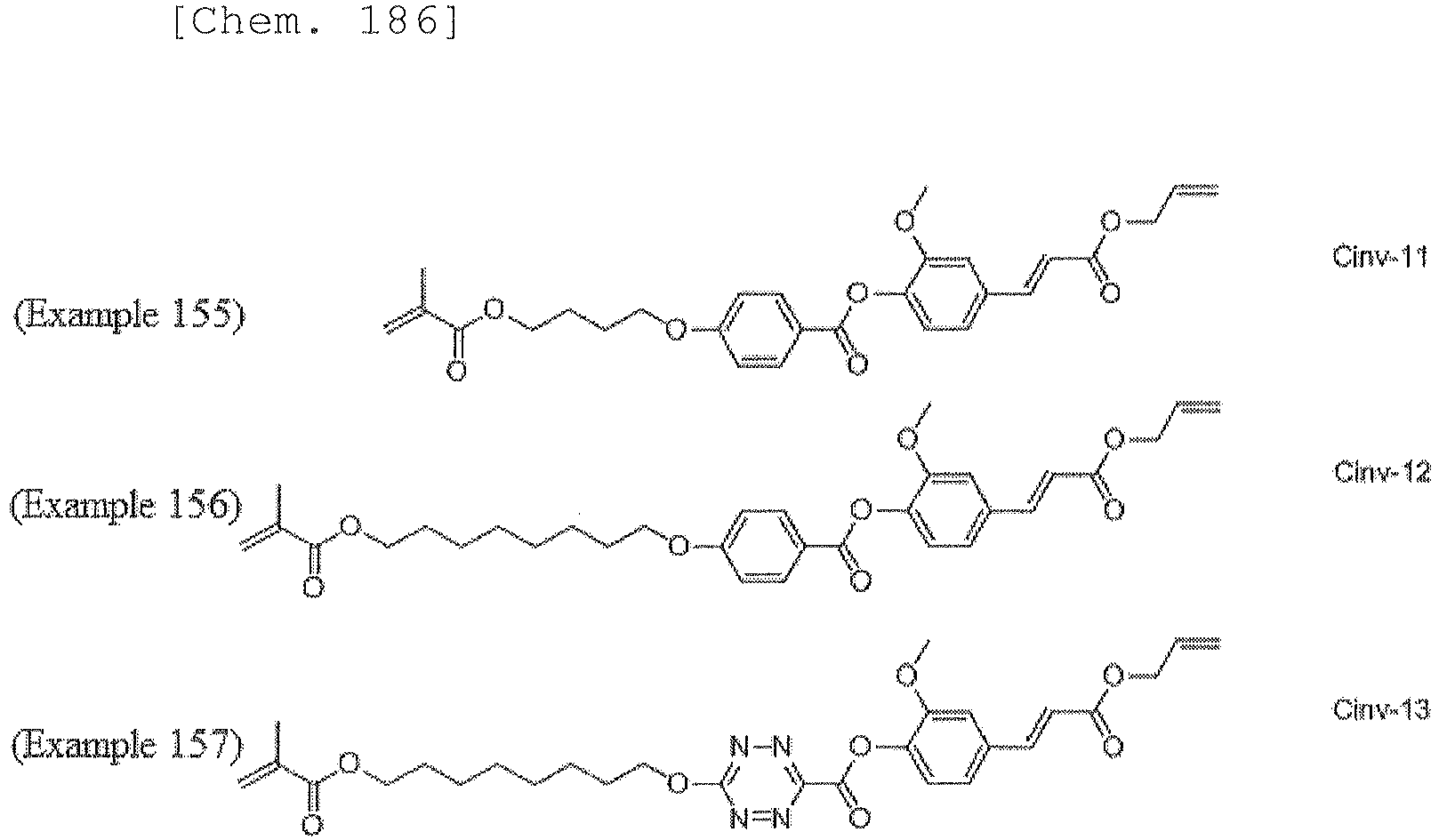
-


- 9.01 g of butyl maleimidoacetate, 0.33 g of dibutyltin (IV) oxide, and 9.14 g of tetradecanol were dissolved in 40 ml of toluene, followed by stirring for 15 hours while heating to reflux. The reaction solution was cooled to room temperature and 100 ml of toluene was added thereto. The mixture was subjected to liquid separation and washed with saturated sodium bicarbonate water and then with saturated saline. To this solution was added sodium sulfate, and the mixture was dried. Sodium sulfate was removed and the solvent was evaporated under reduced pressure to reduce the volume to about 50 ml, and 40 ml of hexane and 20 ml of dichloromethane were added thereto. The mixture was purified by column chromatography (alumina/silica gel, hexane/dichloromethane = 2:1), the solvent was evaporated under reduced pressure, and the residue was reprecipitated with methanol to obtain (V-1) (7.95 g) as a white crystal.
- 1H-NMR (400 MHz, CDCl3) δ: 0.88 (t, J = 6.8 Hz, 3H), 1.15-1.40 (m, 22H), 1.61-1.66 (tt, 2H), 4.14 (t, J = 6.6 Hz, 2H), 4.15 (s, 2H), 6.79 (s, 2H)
- EI-MS: 351[M+]

- Stearyl acrylate (V-2) (manufactured by Tokyo Chemical Industry Co., Ltd.) was purchased and used.

- N-(Butoxymethyl)acrylamide (V-3) (manufactured by Tokyo Chemical Industry Co., Ltd.) was purchased and used.

- A compound (V-4) was synthesized according to the procedure described in a known document (Farmaco. Edizione Scientifica Vol. 22 (1967) 190, 590-598).
- 1 part (10.0 mmol) of a compound represented by the formula (Cinv-1) was dissolved in 10 parts of ethyl methyl ketone to obtain a solution 1. To this solution 1 was added 0.01 parts of azobisisobutyronitrile (AIBN). The mixture was heated to reflux for 2 days under a nitrogen atmosphere to obtain a solution 2. Then, the solution 2 was added dropwise to 60 parts of methanol under stirring, and the precipitated solid was filtered. The obtained solid was dissolved in 5 parts of tetrahydrofuran (THF), the solution was added dropwise to 120 parts of ice-cooled hexane under stirring, and the precipitated solid was filtered. The obtained solid was dissolved in 5 parts of THF, the solution was added dropwise to 120 parts of ice-cooled methanol under stirring, and the precipitated solid was filtered. The obtained solid was dissolved in THF and then vacuum-dried to obtain a polymer (CEv-1).
- In the same manner as for the cinnamic acid polymer (CEv-1), polymers (CEv-2) to (CEv-12) were obtained. The compositions of the respective polymers are as shown in Tables 1 and 2.
[Table 10] Sample name Blending amount (% by mole) Cinv-1 Cinv-2 Cinv-3 Cinv-4 Cinv-5 Cinv-6 Example 158 CEv-1 100 Example 159 CEv-2 100 Example 160 CEv-3 100 Example 161 CEv-4 100 Example 162 CEv-5 100 Example 163 CEv-6 100 [Table 11] Sample name Blending amount (% by mole) Cinv-7 Cinv-8 Cinv-9 Cinv-10 Cinv-11 Cinv-12 Cinv-13 Example 164 CEv-7 100 Example 165 CEv-8 100 Example 166 CEv-9 100 Example 167 CEv-10 100 Example 168 CEv-11 100 Example 169 CEv-12 100 Example 170 CEv-13 100 - 0.9 parts (9.0 mmol) of the compound represented by the formula (Cinv-1) and 0.1 parts (1.0 mmol) of a compound represented by the formula (V-1) were dissolved in 10 parts of ethyl methyl ketone to obtain a solution 3. To this solution 3 was added 0.01 parts of azobisisobutyronitrile (AIBN). The mixture was heated to reflux for 2 days under a nitrogen atmosphere to obtain a solution 4. Then, the solution 4 was added dropwise to 60 parts of methanol under stirring, and the precipitated solid was filtered. The obtained solid was dissolved in 5 parts of tetrahydrofuran (THF), the solution was added dropwise to 120 parts of ice-cooled hexane under stirring, and the precipitated solid was filtered. The obtained solid was dissolved in 5 parts of THF, the solution was added dropwise to 120 parts of ice-cooled methanol under stirring, and the precipitated solid was filtered. The obtained solid was dissolved in THF and then vacuum-dried to obtain a polymer (CEvV-1).
- In the same manner as for the cinnamic acid polymer (CEvV-1), polymers (CEvV-2) to (CEvV-50) were obtained. The compositions of the respective polymers are as shown in Tables 3 and 4.
[Table 12] Example Sample name Blending amount (% by mole) Cinv-1 Cinv-2 Cinv-3 Cinv-4 Cinv-5 Cinv-6 V-1 V-2 V-3 V-4 171 CEvV-1 90 10 172 CEvV-2 85 15 173 CEvV-3 80 20 174 CEvV-4 80 20 175 CEvV-5 80 20 176 CEvV-6 80 20 177 CEvV-7 80 20 178 CEvV-8 80 20 179 CEvV-9 80 20 180 CEvV-10 80 20 181 CEvV-11 80 20 182 CEvV-12 80 20 183 CEvV-13 80 20 184 CEvV-14 80 20 185 CEvV-15 80 20 186 CEvV-16 80 20 187 CEvV-17 80 20 188 CEvV-18 80 20 189 CEvV-19 80 20 190 CEvV-20 80 20 191 CEvV-21 80 20 192 CEvV-22 80 20 193 CEvV-23 80 20 194 CEvV-24 80 20 195 CEvV-25 80 20 196 CEvV-26 80 20 [Table 13] Example Sample name Blending amount (% by mole) Cinv-7 Cinv-8 Cinv-9 Cinv-10 Cinv-11 Cinv-12 Cinv-13 V-1 V-2 V-3 V-4 197 CEvV-27 80 20 198 CEvV-28 80 20 199 CEvV-29 80 20 200 CEvV-30 80 20 201 CEvV-31 80 20 202 CEvV-32 80 20 203 CEvV-33 80 20 204 CEvV-34 80 20 205 CEvV-35 80 20 206 CEvV-36 80 20 207 CEvV-37 80 20 208 CEvV-38 80 20 209 CEvV-39 80 20 210 CEvV-40 80 20 211 CEvV-41 80 20 212 CEvV-42 80 20 213 CEvV-43 80 20 214 CEvV-44 80 20 215 CEvV-45 80 20 216 CEvV-46 80 20 217 CEvV-47 80 20 218 CEvV-48 80 20 219 CEvV-49 80 20 220 CEvV-50 80 20 221 CEvV-51 80 20 222 CEvV-52 80 20 - The cinnamic acid polymer (CEv-1) was dissolved in cyclopentanone to 2.0% and the solution was stirred at room temperature for 10 minutes. Then, the solution was applied onto a glass plate as a base material at 2000 rpm for 30 seconds, using a spin coater, and dried at 100°C for 3 minutes. Then, the surface was visually observed and as a result, it was found that a polymer was uniformly applied on the glass plate to form a smooth film.
- Next, the coated glass plate as a base material was irradiated with linear polarized and parallel light of visible ultraviolet light (wavelength: 313 nm, irradiation intensity: 8 mW/cm2) using an ultrahigh-pressure mercury lamp via a wavelength cut filter, a band-pass filter, and a polarizing filter in a direction of 45 degrees with respect to the substrate. The irradiation dose was 120 mJ/cm2.

- A liquid crystal cell was fabricated by using the coated glass plate prepared by the method above. The gap between the plates was set to 10 µm and the two glass plates were bonded in the anti-parallel direction. Next, a nematic liquid crystal mixture having a negative dielectric anisotropy with a composition described below was charged into the cell at a temperature just exceeding a transparent point (Tc = 84.4°C), and then cooled to room temperature. A polarizing plate was placed on the top and the bottom of the liquid crystal cell, and a back light was placed below. The light transmittance was changed by rotating the liquid crystal cell by 90 degrees and dark-light contrast was clearly observed and there was no abnormal domain and alignment unevenness, from which it was confirmed that the liquid crystals were normally aligned. The tilt angle of the liquid crystal in the cell was optically measured by a crystal rotation method, and the pretilt angle was found to be 1 degree. A voltage of 5 V was applied to this liquid crystal cell for an application time of 60 microseconds at a span of 167 milliseconds, and the voltage holding ratio after 167 milliseconds from the release of the voltage was measured by means of "VHR-AMP01" manufactured by TOYO Corporation at 23°C, and as a result, the voltage holding ratio (VHR) was found to be 99.3%.
- Hereinafter, in the same manner as the cinnamic acid polymer (CEv-1), for (CEv-2) to (CEv-12), and (CEvV-1) to (CEvV-50), alignment layers were fabricated and liquid crystal cells were fabricated. The measurement results of the coatability, liquid crystal alignment property, pretilt angle, VHR are shown in conjunction in Table 5. For the coatability, when a film was formed by applying a polymer onto a glass plate and observed, a case where the polymer was uniformly applied to form a smooth film was denoted as ○, a case where there was chipping and/or unevenness on the coated surface at one place was denoted as Δ, and a case where there was chipping and/or unevenness on the coated surface in two or more places was denoted as X. For the liquid crystal alignment property, when the presence or absence of the abnormal domain and alignment unevenness of the liquid crystal cell was observed, a case where there was the abnormal domain and alignment unevenness at zero place was denoted as ○, a case where there was the abnormal domain and alignment unevenness in two or less places was denoted as Δ, and a case where there was the abnormal domain and alignment unevenness in three or more places was denoted as X. For the pretilt angles, the pretilt angles were optically measured by a crystal rotation method, and a case where the pretilt angle was 80 degrees or more and less than 90 degrees was denoted as V, and a case where the pretilt angle was 0 degrees or more and less than 15 degrees was denoted as P. For VHR, a case where the VHR was 98% or more was denoted as ○, a case where the VHR was 95% or more and less than 98% was denoted as Δ, and a case where the VHR was 95% or less was denoted as X.
[Table 14] Sample name Coatability Liquid crystal alignment property Pretilt angle VHR Example 223 CEv-1 ○ ○ P ○ Example 224 CEv-2 ○ ○ P ○ Example 225 CEv-3 ○ ○ P ○ Example 226 CEv-4 ○ ○ P ○ Example 227 CEv-5 ○ ○ P ○ Example 228 CEv-6 ○ ○ P ○ Example 229 CEv-7 ○ ○ P ○ Example 230 CEv-8 ○ ○ P ○ Example 231 CEv-9 ○ ○ P ○ Example 232 CEv-10 ○ ○ P ○ Example 233 CEv-11 ○ ○ P ○ Example 234 CEv-12 ○ ○ P ○ Example 235 CEv-13 ○ ○ P ○ [Table 15] Sample name Coatability Liquid crystal alignment property Pretilt angle VHR Example 236 CEvV-1 ○ ○ V ○ Example 237 CEvV-2 ○ ○ V ○ Example 238 CEvV-3 ○ ○ V ○ Example 239 CEvV-4 ○ ○ V ○ Example 240 CEvV-5 ○ ○ P ○ Example 241 CEvV-6 ○ ○ P ○ Example 242 CEvV-7 ○ ○ V ○ Example 243 CEvV-8 ○ ○ V ○ Example 244 CEvV-9 ○ ○ P ○ Example 245 CEvV-10 ○ ○ P ○ Example 246 CEvV-11 ○ ○ V ○ Example 247 CEvV-12 ○ ○ V ○ Example 248 CEvV-13 ○ ○ P ○ Example 249 CEvV-14 ○ ○ P ○ Example 250 CEvV-15 ○ ○ V ○ Example 251 CEvV-16 ○ ○ V ○ Example 252 CEvV-17 ○ ○ P ○ Example 253 CEvV-18 ○ ○ P ○ Example 254 CEvV-19 ○ ○ V ○ Example 255 CEvV-20 ○ ○ V ○ Example 256 CEvV-21 ○ ○ P ○ Example 257 CEvV-22 ○ ○ P ○ Example 258 CEvV-23 ○ ○ V ○ Example 259 CEvV-24 ○ ○ V ○ Example 260 CEvV-25 ○ ○ P ○ Example 261 CEvV-26 ○ ○ P ○ [Table 16] Sample name Coatability Liquid crystal alignment property Pretilt angle VHR Example 262 CEvV-27 ○ ○ V ○ Example 263 CEvV-28 ○ ○ V ○ Example 264 CEvV-29 ○ ○ P ○ Example 265 CEvV-30 ○ ○ P ○ Example 266 CEvV-31 ○ ○ V ○ Example 267 CEvV-32 ○ ○ V ○ Example 268 CEvV-33 ○ ○ P ○ Example 269 CEvV-34 ○ ○ P ○ Example 270 CEvV-35 ○ ○ V ○ Example 271 CEvV-36 ○ ○ V ○ Example 272 CEvV-37 ○ ○ P ○ Example 273 CEvV-38 ○ ○ P ○ Example 274 CEvV-39 ○ ○ V ○ Example 275 CEvV-40 ○ ○ V ○ Example 276 CEvV-41 ○ ○ P ○ Example 277 CEvV-42 ○ ○ P ○ Example 278 CEvV-43 ○ ○ V ○ Example 279 CEvV-44 ○ ○ V ○ Example 280 CEvV-45 ○ ○ P ○ Example 281 CEvV-46 ○ ○ P ○ Example 282 CEvV-47 ○ ○ V ○ Example 283 CEvV-48 ○ ○ V ○ Example 284 CEvV-49 ○ ○ P ○ Example 285 CEvV-50 ○ ○ P ○ Example 286 CEvV-51 ○ ○ V ○ Example 287 CEvV-52 ○ ○ P ○ - From the above results, it can be seen that an alignment layer, which has good coatability, a superior liquid crystal alignment property, and a superior ability to control the pretilt, and exhibits a high voltage holding ratio, can be obtained, by the cinnamic acid polymerized product obtained by polymerizing the cinnamic acid derivatives of the present invention.
- For comparison, cinnamic acid derivatives (D-1) and (D-3) were synthesized, and thus, by the same method as in Example 158, cinnamic acid polymer (CE-1) to (CE-2) and (CEV-1) to (CEV-8) were prepared.

[Table 17] Sample name Blending amount (% by mole) D-1 D-3 V-1 V-2 V-3 V-4 Comparative Example 21 CE-1 100 Comparative Example 22 CE-2 100 Comparative Example 23 CEV-1 80 20 Comparative Example 24 CEV-2 80 20 Comparative Example 25 CEV-3 80 20 Comparative Example 26 CEV-4 80 20 Comparative Example 27 CEV-5 80 20 Comparative Example 28 CEV-6 80 20 Comparative Example 29 CEV-7 80 20 Comparative Example 30 CEV-8 80 20 - Furthermore, by the same method as in Example 223, an alignment layer was fabricated, and thus, various measurements were conducted and the results therefrom are shown in Table 9.
[Table 18] Sample name Coatability Liquid crystal alignment property Pretilt angle VHR Comparative Example 31 CE-1 Δ ○ P Δ Comparative Example 32 CE-2 Δ ○ P Δ Comparative Example 33 CEV-1 ○ Δ V ○ Comparative Example 34 CEV-2 ○ Δ V ○ Comparative Example 35 CEV-3 Δ ○ P Δ Comparative Example 36 CEV-4 Δ ○ P Δ Comparative Example 37 CEV-5 ○ Δ V ○ Comparative Example 38 CEV-6 ○ Δ V ○ Comparative Example 39 CEV-7 Δ ○ P Δ Comparative Example 40 CEV-8 Δ ○ P Δ - Therefore, it can be seen that according to the present invention, a display element using a liquid crystal alignment layer which has the effects such as having good coatability, and a superior ability to control the alignment of the liquid crystals and the pretilt angles, and exhibiting a high voltage holding ratio (VHR), and the composition is obtained.
-

- 11.5 g of 4-hydroxybenzaldehyde, 20.0 g of 6-chlorohexyl methacrylate, and 62 g of cesium carbonate were dissolved in 150 ml of dimethyl sulfoxide and the mixture was stirred at 60°C for 3 hours. The reaction solution was cooled to room temperature, and 600 ml of water and 300 ml of dichloromethane were added thereto. The organic layer was separated and the aqueous layer was extracted twice with 150 ml of dichloromethane. The organic layer was combined, and washed with 10% hydrochloric acid, saturated sodium bicarbonate, and saturated saline, and then dried by the addition of sodium sulfate. Sodium sulfate was removed and the mixture was purified by column chromatography (alumina/silica gel, dichloromethane), and the solvent was evaporated under a reduced pressure to obtain 4-(6-methacryloyloxy)benzaldehyde (23 g) as a white solid.
- Next, 20.0 g of the obtained 4-(6-methacryloyloxy)benzaldehyde was suspended in 300 ml of acetonitrile, and 10 g of sodium dihydrogen phosphate dihydrate dissolved in 120 ml of water was added dropwise thereto. To this suspension was added 15 ml of 30% hydrogen peroxide, and then 13 g of sodium chlorite dissolved in 100 ml of water was added dropwise thereto, and the mixture was stirred at 45°C for 3 hours. To the reaction solution was added dropwise 350 ml of water, and the mixture was stirred at 10°C for 1 hour. The solid was separated by filtration, dissolved in 120 ml of THF, washed with saturated saline, and then dried by the addition of sodium sulfate. Sodium sulfate was removed and the solvent was evaporated under reduced pressure. Then, 340 ml of ice-cooled hexane was added dropwise and the solid was separated by filtration to obtain 4-(6-methacryloyloxy)benzoic acid (22 g) as a white solid.
- 30 g of 4-hydroxy-3-methoxycinnamic acid, 20 g of 2-methoxyethanol, and 3 g of p-toluenesulfonic acid were dissolved in 200 ml of cyclohexane and 20 ml of diisopropyl ether, and heated to reflux for 6 hours while removing water produced. The residue was cooled to room temperature, 100 ml of ethyl acetate was added thereto, and the mixture was washed with saturated sodium bicarbonate, water, and saturated saline, and then dried by the addition of sodium sulfate. Sodium sulfate was removed and the solvent was evaporated under reduced pressure to obtain 2-methoxyethyl 4-hydroxy-3-methoxycinnamate (30 g) as a white solid.
- Next, 15.1 g of the obtained 2-methoxyethyl 4-hydroxy-3-methoxycinnamate, 20.2 g of 4-(6-methacryloyloxy)benzoic acid, and 0.9 g of 4,4-dimethylaminopyridine were dissolved in 300 ml of dichloromethane, and the solution was cooled to 3°C under a nitrogen atmosphere. 9.1 g of diisopropylcarbodiimide diluted with 100 ml of dichloromethane was added dropwise thereto, and the mixture was stirred at room temperature for 8 hours. The reaction solution was filtered and the solid was removed. Then, the residue was washed with 10% hydrochloric acid and saturated saline, and dried by the addition of sodium sulfate. Sodium sulfate was removed and the residue was purified by column chromatography (alumina/silica gel, heptane/dichloromethane/ethyl acetate). The solvent was evaporated under reduced pressure and the residue was recrystallized with methanol to obtain Cinn-1 (21.7 g) as a white solid.
- 1H-NMR (400 MHz, CDCL3) δ: 1.41-1.59 (m, 4H), 1.73 (tt, 2H), 1.84 (tt, 2H), 1.94 (s, 3H), 3.43 (s, 3H), 3.68 (t, J = 4.6 Hz, 2H), 3,84 (s, 3H), 4.05 (t, J = 6.4 Hz, 2H), 4.17 (t, J= 6.4 Hz, 2H), 4.38 (t, J= 4.6 Hz, 2H), 5.55 (s, 1H), 6.10 (s, 1H), 6.47 (d, J = 15.8 Hz, 1H), 6.96 (d, J = 8.8 Hz, 2H), 7.16 (s+d+d, 3H), 7.70 (d, J = 15.8 Hz, 1H), 8.14 (d, J = 8.8 Hz, 2H)
- EI-MS: 540 [M+]
- In the same manner, the following compounds Cinn-2 to Cinn-12 were synthesized.


-


- 9.01 g of butyl maleimidoacetate, 0.33 g of dibutyltin (IV) oxide, and 9.14 g of tetradecanol were dissolved in 40 ml of toluene, followed by stirring for 15 hours while heating to reflux. The reaction solution was cooled to room temperature and 100 ml of toluene was added thereto. The mixture was subjected to liquid separation and washed with saturated sodium bicarbonate water and then with saturated saline. To this solution was added sodium sulfate, and the mixture was dried. Sodium sulfate was removed and the solvent was evaporated under reduced pressure to reduce the volume to about 50 ml, and 40 ml of hexane and 20 ml of dichloromethane were added thereto. The mixture was purified by column chromatography (alumina/silica gel, hexane/dichloromethane = 2:1), the solvent was evaporated under reduced pressure, and the residue was reprecipitated with methanol to obtain (V-1) (7.95 g) as a white crystal.
- 1H-NMR (400 MHz, CDCl3) δ: 0.88 (t, J = 6.8 Hz, 3H), 1.15-1.40 (m, 22H), 1.61-1.66 (tt, 2H), 4.14 (t, J = 6.6 Hz, 2H), 4.15 (s, 2H), 6.79 (s, 2H)
- EI-MS: 351 [M+]

- Stearyl acrylate (V-2) (manufactured by Tokyo Chemical Industry Co., Ltd.) was purchased and used.

- N-(Butoxymethyl)acrylamide (V-3) (manufactured by Tokyo Chemical Industry Co., Ltd.) was purchased and used.

- A compound (V-4) was synthesized according to the procedure described in a known document (Farmaco. Edizione Scientifica Vol. 22 (1967) 190, 590-598).
- 1 part (10.0 mmol) of a compound represented by the formula (Cinn-1) was dissolved in 10 parts of ethyl methyl ketone to obtain a solution 1. To this solution 1 was added 0.01 parts of azobisisobutyronitrile (AIBN). The mixture was heated to reflux for 2 days under a nitrogen atmosphere to obtain a solution 2. Then, the solution 2 was added dropwise to 60 parts of methanol under stirring, and the precipitated solid was filtered. The obtained solid was dissolved in 5 parts of tetrahydrofuran (THF), the solution was added dropwise to 120 parts of ice-cooled hexane under stirring, and the precipitated solid was filtered. The obtained solid was dissolved in 5 parts of THF, the solution was added dropwise to 120 parts of ice-cooled methanol under stirring, and the precipitated solid was filtered. The obtained solid was dissolved in THF and then vacuum-dried to obtain a polymer (CEE-1).
- In the same manner as for the cinnamic acid polymer (CEE-1), polymers (CEE-2) to (CEE-12) were obtained. The compositions of the respective polymers are as shown in Tables 1 and 2.
[Table 19] Sample name Blending amount (% by mole) Cinn-1 Cinn-2 Cinn-3 Cinn-4 Cinn-5 Cinn-6 Example 301 CEE-1 100 Example 302 CEE-2 100 Example 303 CEE-3 100 Example 304 CEE-4 100 Example 305 CEE-5 100 Example 306 CEE-6 100 [Table 20] Sample name Blending amount (% by mole) Cinn-7 Cinn-8 Cinn-9 Cinn-10 Cinn-11 Cinn-12 Cinn-13 Example 307 CEE-7 100 Example 308 CEE-8 100 Example 309 CEE-9 100 Example 310 CEE-10 100 Example 311 CEE-11 100 Example 312 CEE-12 100 Example 313 CEE-13 100 - 0.9 parts (9.0 mmol) of the compound represented by the formula (Cinn-1) and 0.1 parts (1.0 mmol) of a compound represented by the formula (V-1) were dissolved in 10 parts of ethyl methyl ketone to obtain a solution 3. To this solution 3 was added 0.01 parts of azobisisobutyronitrile (AIBN). The mixture was heated to reflux for 2 days under a nitrogen atmosphere to obtain a solution 4. Then, the solution 4 was added dropwise to 60 parts of methanol under stirring, and the precipitated solid was filtered. The obtained solid was dissolved in 5 parts of tetrahydrofuran (THF), the solution was added dropwise to 120 parts of ice-cooled hexane under stirring, and the precipitated solid was filtered. The obtained solid was dissolved in 5 parts of THF, the solution was added dropwise to 120 parts of ice-cooled methanol under stirring, and the precipitated solid was filtered. The obtained solid was dissolved in THF and then vacuum-dried to obtain a polymer (CEEV-1).
- In the same manner as for the cinnamic acid polymer (CEEV-1), polymers (CEEV-2) to (CEEV-50) were obtained. The compositions of the respective polymers are as shown in Tables 3 and 4.
[Table 21] Example Sample name Blending amount (% by mole) Cinn-1 Cinn-2 Cinn-3 Cinn-4 Cinn-5 Cinn-6 V-1 V-2 V-3 V-4 314 CEEV-1 90 10 315 CEEV-2 80 20 316 CEEV-3 70 30 317 CEEV-4 70 30 318 CEEV-5 70 30 319 CEEV-6 70 30 320 CEEV-7 70 30 321 CEEV-8 70 30 322 CEEV-9 70 30 323 CEEV-10 70 30 324 CEEV-11 70 30 325 CEEV-12 70 30 326 CEEV-13 70 30 327 CEEV-14 70 30 328 CEEV-15 70 30 329 CEEV-16 70 30 330 CEEV-17 70 30 331 CEEV-18 70 30 332 CEEV-19 70 30 333 CEEV-20 70 30 334 CEEV-21 70 30 335 CEEV-22 70 30 336 CEEV-23 70 30 337 CEEV-24 70 30 338 CEEV-25 70 30 339 CEEV-26 70 30 [Table 22] Example Sample name Blending amount (% by mole) Cinn-7 Cinn-8 Cinn-9 Cinn-10 Cinn-11 Cinn-12 Cinn-13 V-1 V-2 V-3 V-4 340 CEEV-27 70 30 341 CEEV-28 70 30 342 CEEV-29 70 30 343 CEEV-30 70 30 344 CEEV-31 70 30 345 CEEV-32 70 30 346 CEEV-33 70 30 347 CEEV-34 70 30 348 CEEV-35 70 30 349 CEEV-36 70 30 350 CEEV-37 70 30 351 CEEV-38 70 30 352 CEEV-39 70 30 353 CEEV-40 70 30 354 CEEV-41 70 30 355 CEEV-42 70 30 356 CEEV-43 70 30 358 CEEV-44 70 30 358 CEEV-45 70 30 359 CEEV-46 70 30 360 CEEV-47 70 30 361 CEEV-48 70 30 362 CEEV-49 70 30 363 CEEV-50 70 30 364 CEEV-51 70 30 365 CEEV-52 70 30 - The cinnamic acid polymer (CEE-1) was dissolved in cyclopentanone to 0.5% and the solution was stirred at room temperature for 10 minutes. Then, the solution was applied onto a glass plate as a base material, using a spin coater, and dried at 100°C for 30 minutes.
- Next, the coated glass plate as a base material was irradiated with linear polarized and parallel light of visible ultraviolet light (wavelength: 313 nm, irradiation intensity: 10 mW/cm2) using an ultrahigh-pressure mercury lamp via a wavelength cut filter, a band-pass filter, and a polarizing filter in a direction of 45 degrees with respect to the substrate. The irradiation dose was 100 mJ/cm2.
- A liquid crystal cell was fabricated by using the coated glass plate prepared by the method above. The gap between the plates was set to 10 µm and the two glass plates were bonded in the anti-parallel direction. Next, a nematic liquid crystal mixture having a negative dielectric anisotropy with a composition described below was charged into the cell at a temperature just exceeding a transparent point (Tc = 84.4°C), and then cooled to room temperature. A polarizing plate was placed on the top and the bottom of the liquid crystal cell, and a back light was placed below. The light transmittance was changed by rotating the liquid crystal cell by 90 degrees and dark-light contrast was clearly observed and there was no abnormal domain and alignment unevenness, from which it was confirmed that the liquid crystals were normally aligned. The tilt angle of the liquid crystal in the cell was optically measured by a crystal rotation method, and the pretilt angle was found to be 1 degree. A voltage of 5 V was applied to this liquid crystal cell for an application time of 60 microseconds at a span of 167 milliseconds, and the voltage holding ratio after 167 milliseconds from the release of the voltage was measured by means of "VHR-AMP01" manufactured by TOYO Corporation at 23°C, and as a result, the voltage holding ratio (VHR) was found to be 99.3%. A square wave of 60 Hz/±10 V having a voltage of DC 10 V superimposed therewith was applied to this liquid crystal cell at 60°C for 60 minutes, and short-circuited for 1 second, and 10 minutes later, the residual voltage (RDC) in the liquid crystal cell was measured, and as a result, it was found to be 43 mV.

- Hereinafter, in the same manner as the cinnamic acid polymer (CEE-1), for (CEE-2) to (CEE-12), and (CEEV-1) to (CEEV-50), alignment layers were fabricated and liquid crystal cells were fabricated. The measurement results of liquid crystal alignment property, pretilt angle, VHR, RDC are shown in conjunction in Table 5. For the liquid crystal alignment property, when the presence or absence of the abnormal domain and alignment unevenness of the liquid crystal cell was observed, a case where there was the abnormal domain and alignment unevenness at zero place was denoted as ○, a case where there was the abnormal domain and alignment unevenness in two or less places was denoted as Δ, and a case where there was the abnormal domain and alignment unevenness in three or more places was denoted as X. For the pretilt angles, the pretilt angles were optically measured by a crystal rotation method, and a case where the pretilt angle was 80 degrees or more and less than 90 degrees was denoted as V, and a case where the pretilt angle was 0 degrees or more and less than 15 degrees was denoted as P. For VHR, a case where the VHR was 98% or more was denoted as ○, a case where the VHR was 95% or more and less than 98% was denoted as Δ, and a case where the VHR was 95% or less was denoted as X. For RDC, a case where the RDC was less than 50 mV was denoted as ○, a case where the RDC was 50 mV or more and 150 mV or less was denoted as Δ, and a case where the RDC was 150 mV or more was denoted as X. The RDC is indicative of afterimage characteristics (seizure), and thus, it can be said that when the value is approximately 150 mV or less, the afterimage characteristics are good, whereas when the value is approximately 50 mV or less, the afterimage characteristics are particularly excellent.
[Table 23] Sample name Liquid crystal alignment property Pretilt angle VHR RDC Example 366 CEE-1 ○ P ○ ○ Example 367 CEE-2 ○ P ○ ○ Example 368 CEE-3 ○ P ○ ○ Example 369 CEE-4 ○ P ○ ○ Example 370 CEE-5 ○ P ○ ○ Example 371 CEE-6 ○ P ○ ○ Example 372 CEE-7 ○ P ○ ○ Example 373 CEE-8 ○ P ○ ○ Example 374 CEE-9 ○ P ○ ○ Example 375 CEE-10 ○ P ○ ○ Example 376 CEE-11 ○ P ○ ○ Example 377 CEE-12 ○ P ○ ○ Example 378 CEE-13 ○ P ○ ○ [Table 24] Sample name Liquid crystal alignment property Pretilt angle VHR RDC Example 379 CEEV-1 ○ V ○ ○ Example 380 CEEV-2 ○ V ○ ○ Example 381 CEEV-3 ○ V ○ ○ Example 382 CEEV-4 ○ V ○ ○ Example 383 CEEV-5 ○ P ○ ○ Example 384 CEEV-6 ○ P ○ ○ Example 385 CEEV-7 ○ V ○ ○ Example 386 CEEV-8 ○ V ○ ○ Example 387 CEEV-9 ○ P ○ ○ Example 388 CEEV-10 ○ P ○ ○ Example 389 CEEV-11 ○ V ○ ○ Example 390 CEEV-12 ○ V ○ ○ Example 391 CEEV-13 ○ P ○ ○ Example 392 CEEV-14 ○ P ○ ○ Example 393 CEEV-15 ○ V ○ ○ Example 394 CEEV-16 ○ V ○ ○ Example 395 CEEV-17 ○ P ○ ○ Example 396 CEEV-18 ○ P ○ ○ Example 397 CEEV-19 ○ V ○ ○ Example 398 CEEV-20 ○ V ○ ○ Example 399 CEEV-21 ○ P ○ ○ Example 400 CEEV-22 ○ P ○ ○ Example 401 CEEV-23 ○ V ○ ○ Example 402 CEEV-24 ○ V ○ ○ Example 403 CEEV-25 ○ P ○ ○ Example 404 CEEV-26 ○ P ○ ○ [Table 25] Sample name Liquid crystal alignment property Pretilt angle VHR RDC Example 405 CEEV-27 ○ V ○ ○ Example 406 CEEV-28 ○ V ○ ○ Example 407 CEEV-29 ○ P ○ ○ Example 408 CEEV-30 ○ P ○ ○ Example 409 CEEV-31 ○ V ○ ○ Example 410 CEEV-32 ○ V ○ ○ Example 411 CEEV-33 ○ P ○ ○ Example 412 CEEV-34 ○ P ○ ○ Example 413 CEEV-35 ○ V ○ ○ Example 414 CEEV-36 ○ V ○ ○ Example 415 CEEV-37 ○ P ○ ○ Example 416 CEEV-38 ○ P ○ ○ Example 417 CEEV-39 ○ V ○ ○ Example 418 CEEV-40 ○ V ○ ○ Example 419 CEEV-41 ○ P ○ ○ Example 420 CEEV-42 ○ P ○ ○ Example 421 CEEV-43 ○ V ○ ○ Example 422 CEEV-44 ○ V ○ ○ Example 423 CEEV-45 ○ P ○ ○ Example 424 CEEV-46 ○ P ○ ○ Example 425 CEEV-47 ○ V ○ ○ Example 426 CEEV-48 ○ V ○ ○ Example 427 CEEV-49 ○ P ○ ○ Example 428 CEEV-50 ○ P ○ ○ Example 429 CEEV-51 ○ V ○ ○ Example 430 CEEV-52 ○ P ○ ○ - From the above results, it can be seen that an alignment layer, which has a superior liquid crystal alignment property, and a superior ability to control the pretilt, and exhibits a high voltage holding ratio and a low residual voltage, can be obtained, by the cinnamic acid polymerized product obtained by polymerizing the cinnamic acid derivatives of the present invention.
- For comparison, cinnamic acid derivatives (D-1) and (D-3) were synthesized, and thus, by the same method as in Example 301, cinnamic acid polymers (CE-1) to (CE-2) and (CEV-1) to (CEV-8) were prepared.

[Table 26] Sample name Blending amount (% by mole) D-1 D-3 V-1 V-2 V-3 V-4 Comparative Example 41 CE-1 100 Comparative Example 42 CE-2 100 Comparative Example 43 CEV-1 70 30 Comparative Example 44 CEV-2 70 30 Comparative Example 45 CEV-3 70 30 Comparative Example 46 CEV-4 70 30 Comparative Example 47 CEV-5 70 30 Comparative Example 48 CEV-6 70 30 Comparative Example 49 CEV-7 70 30 Comparative Example 50 CEV-8 70 30 - Furthermore, by the same method as in Example 366, an alignment layer was fabricated, and thus, various measurements were conducted and the results therefrom are shown in Table 9.
[Table 27] Sample name Liquid crystal alignment property Pretilt angle VHR RDC Comparative Example 51 CE-1 ○ P Δ Δ Comparative Example 52 CE-2 ○ P Δ Δ Comparative Example 53 CEV-1 ○ V ○ Δ Comparative Example 54 CEV-2 ○ V ○ Δ Comparative Example 55 CEV-3 ○ P Δ Δ Comparative Example 56 CEV-4 ○ P Δ Δ Comparative Example 57 CEV-5 ○ V ○ Δ Comparative Example 58 CEV-6 ○ V ○ Δ Comparative Example 59 CEV-7 ○ P Δ Δ Comparative Example 60 CEV-8 ○ P Δ Δ - Therefore, it can be seen that according to the present invention, a display element using a liquid crystal alignment layer which has effects such as a superior ability to control the alignment of the liquid crystals and the pretilt angles, a high voltage holding ratio (VHR), and a low residual voltage, and in which it is difficult for seizure to occur, and the composition is obtained.
- In the same manner as in Example 288, the following compounds CinCy-1 to CinCy-4 were synthesized.

- In the same manner as for the cinnamic acid polymer (CEv-1), polymers (CEY-1) to (CEY-4) were obtained. The compositions of the respective polymers are as shown in Tables 28 and 29.
[Table 28] Sample name Blending amount (% by mole) CinCy-1 CinCy-2 CinCy-3 CinCy-4 Example 435 CEY-1 100 Example 436 CEY-2 100 Example 437 CEY-3 100 Example 438 CEY-4 100 - In the same manner as for the cinnamic acid polymer (CEvV -1), polymers (CEYV-1) to (CEYV-18) were obtained. The compositions of the respective polymers are as shown in Tables 30 and 31.
[Table 29] Example Sample name Blending amount (% by mole) CinCy-1 CinCy-2 CinCy-3 CinCy-4 V-1 V-2 V-3 V-4 439 CEYV-1 90 10 440 CEYV-2 85 15 441 CEYV-3 80 20 442 CEYV-4 80 20 443 CEYV-5 80 20 444 CEYV-6 80 20 445 CEYV-7 80 20 446 CEYV-8 80 20 447 CEYV-9 80 20 448 CEYV-10 80 20 449 CEYV-11 80 20 450 CEYV-12 80 20 451 CEYV-13 80 20 452 CEYV-14 80 20 453 CEYV-15 80 20 454 CEYV-16 80 20 455 CEYV-17 80 20 456 CEYV-18 80 20 - Hereinafter, in the same manner as the cinnamic acid polymer (CEv-1), for (CEY-1) to (CEY-4), and (CEYV-1) to (CEYV-18), alignment layers were fabricated and liquid crystal cells were fabricated. The measurement results of coatability, liquid crystal alignment property, pretilt angle, VHR are shown in conjunction in Tables 32 and 33. For the coatability, when a film was formed by applying a polymer onto a glass plate and observed, a case where the polymer was uniformly applied to form a smooth film was denoted as ○, a case where there was chipping and/or unevenness on the coated surface at one place was denoted as Δ, and a case where there was chipping and/or unevenness on the coated surface in two or more places was denoted as X. For the liquid crystal alignment property, when the presence or absence of the abnormal domain and alignment unevenness of the liquid crystal cell was observed, a case where there was the abnormal domain and alignment unevenness at zero place was denoted as ○, a case where there was the abnormal domain and alignment unevenness in two or less places was denoted as Δ, and a case where there was the abnormal domain and alignment unevenness in three or more places was denoted as X. For the pretilt angles, the pretilt angles were optically measured by a crystal rotation method, and a case where the pretilt angle was 80 degrees or more and less than 90 degrees was denoted as V, and a case where the pretilt angle was 0 degrees or more and less than 15 degrees was denoted as P. For VHR, a case where the VHR was 98% or more was denoted as ○, a case where the VHR was 95% or more and less than 98% was denoted as Δ, and a case where the VHR was 95% or less was denoted as X.
[Table 30] Sample name Coatability Liquid crystal alignment property Pretilt angle VHR Example 457 CEY-1 ○ ○ P ○ Example 458 CEY-2 ○ ○ P ○ Example 459 CEY-3 ○ ○ P ○ Example 460 CEY-4 ○ ○ P ○ [Table 31] Sample name Coatability Liquid crystal alignment property Pretilt angle VHR Example 461 CEYV-1 ○ ○ V ○ Example 462 CEYV-2 ○ ○ V ○ Example 463 CEYV-3 ○ ○ V ○ Example 464 CEYV-4 ○ ○ V ○ Example 465 CEYV-5 ○ ○ P ○ Example 466 CEYV-6 ○ ○ P ○ Example 467 CEYV-7 ○ ○ V ○ Example 468 CEYV-8 ○ ○ V ○ Example 469 CEYV-9 ○ ○ P ○ Example 470 CEYV-10 ○ ○ P ○ Example 471 CEYV-11 ○ ○ V ○ Example 472 CEYV-12 ○ ○ V ○ Example 473 CEYV-13 ○ ○ P ○ Example 474 CEYV-14 ○ ○ P ○ Example 475 CEYV-15 ○ ○ V ○ Example 476 CEYV-16 ○ ○ V ○ Example 477 CEYV-17 ○ ○ P ○ Example 478 CEYV-18 ○ ○ P ○ - From the above results, it can be seen that an alignment layer, which has a superior liquid crystal alignment property and a superior ability to control the pretilt, and exhibits a high voltage holding ratio, is obtained, by the cinnamic acid polymerized product obtained by polymerizing the cinnamic acid derivatives of the present invention.
- For comparison, cinnamic acid derivatives (D-1) and (D-3) were synthesized, and thus, by the same method as in Example 301, cinnamic acid polymers (CE-1) to (CE-2) and (CEV-1) to (CEV-8) were prepared.

[Table 32] Sample name Blending amount (% by mole) D-1 D-3 V-1 V-2 V-3 V-4 Comparative Example 61 CE-1 100 Comparative Example 62 CE-2 100 Comparative Example 63 CEV-1 80 20 Comparative Example 64 CEV-2 80 20 Comparative Example 65 CEV-3 80 20 Comparative Example 66 CEV-4 80 20 Comparative Example 67 CEV-5 80 20 Comparative Example 68 CEV-6 80 20 Comparative Example 69 CEV-7 80 20 Comparative Example 70 CEV-8 80 20 - Furthermore, by the same method as in Example 366, an alignment layer was fabricated, and thus, various measurements were conducted and the results therefrom are shown in Table 9.
[Table 33] Sample name Coatability Liquid crystal alignment property Pretilt angle VHR Comparative Example 71 CE-1 Δ ○ P Δ Comparative Example 72 CE-2 Δ ○ P Δ Comparative Example 73 CEV-1 ○ Δ V ○ Comparative Example 74 CEV-2 ○ Δ V ○ Comparative Example 75 CEV-3 Δ ○ P Δ Comparative Example 76 CEV-4 Δ ○ P Δ Comparative Example 77 CEV-5 ○ Δ V ○ Comparative Example 78 CEV-6 ○ Δ V ○ Comparative Example 79 CEV-7 Δ ○ P Δ Comparative Example 80 CEV-8 Δ ○ P Δ - Therefore, it can be seen that according to the present invention, a display element using a liquid crystal alignment layer which has the effects such as having a superior ability to control the alignment of the liquid crystals and the pretilt angles, and exhibiting a high voltage holding ratio (VHR), and the composition is obtained.
- A liquid crystal alignment layer which is efficiently provided with an alignment property at a low dose of irradiation of polarized light during the production, and has a superior ability to control the alignment of the liquid crystals and the pretilt angles, and a high voltage holding ratio (VHR); a polymer used for the liquid crystal alignment layer; a compound constituting the polymer; a liquid crystal display element using the liquid crystal alignment layer; and an optical anisotropic body using the polymer can be provided.
r represents 0, 1, or 2, but in the case where r represents 2, a plurality of A's, may be the same as or different from each other,
X and Y each independently represent a hydrogen atom, a fluorine atom, a chlorine atom, a cyano group, or an alkyl group having 1 to 20 carbon atoms, but a hydrogen atom in the alkyl group may be substituted with a fluorine atom, and one CH2 group or two or more non-adjacent CH2 groups may be substituted with -O-, -CO-O-, -O-CO- and/or -CH=CH-, and
Z is represented by the general formula (IIa) or (IIb):

R2 represents a linear or branched alkyl group having 1 to 30 carbon atoms (one or two or more -CH2- groups in the alkyl group may be each independently substituted with a cycloalkyl group having a ring member number of 3 to 8, and a hydrogen atom in the alkyl group may be unsubstituted or may be substituted with an alkyl group having 1 to 20 carbon atoms, a cyano group, or a halogen atom), and in the general formula (I), Sp is represented by the general formula (IVb):
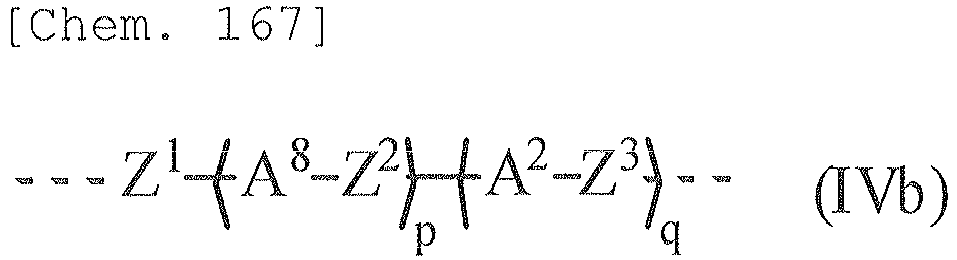
a trans-1, 4-cyclohexylene group (one methylene group or two or more non-adjacent methylene groups present in this group may be substituted with -O-, -NH-, or -S-), and a 1, 4-phenylene group (one or two -CH='s present in this group may be substituted with -N=), and these may be each unsubstituted or one or more hydrogen atoms may be substituted with a fluorine atom, a chlorine atom, a cyano group, a methyl group, or a methoxy group), and
r represents 0, 1, or 2).
Claims (25)
- A compound represented by the general formula (I):

A represents a group selected from the group consisting of:(a) a trans-1, 4-cyclohexylene group (one methylene group or two or more non-adjacent methylene groups present in this group may be substituted with -O-, -NH-, or -S-),(b) a 1,4-phenylene group (one or two or more -CH='s present in this group may be substituted with -N=), and(c) a 1,4-cyclohexenylene group, a 2,5-thiophenylene group, a 2,5-furanylene group, a 1,4-bicyclo(2.2.2)octylene group, a naphthalene-1,4-diyl group, a naphthalene-2,6-diyl group, a decahydronaphthalene-2,6-diyl group, and a 1,2,3,4-tetrahydronaphthalene-2,6-diyl group, in which the group (a), (b), or (c) may be each unsubstituted or may have one or more hydrogen atoms substituted with a fluorine atom, a chlorine atom, a cyano group, a methyl group, or a methoxy group,
r represents 0, 1, or 2, but in the case where r represents 2, a plurality of A's, may be the same as or different from each other,
X and Y each independently represent a hydrogen atom, a fluorine atom, a chlorine atom, a cyano group, or an alkyl group having 1 to 20 carbon atoms, but a hydrogen atom in the alkyl group may be substituted with a fluorine atom, and one CH2 group or two or more non-adjacent CH2 groups may be substituted with -O-, -CO-O-, -O-CO- and/or -CH=CH-, and
Z is represented by the general formula (IIa) or (IIb):
R1 and R2 each independently represent a hydrogen atom or a linear or branched alkyl group having 1 to 30 carbon atoms, one -CH2- group or two or more non-adjacent -CH2- groups in R1 and R2 may be substituted with -O-, -CO-, -CO-O-, -O-CO-, -CO-NH-, -NH-CO-, -NCH3-, -CH=CH-, -CF=CF-, and/or -C≡C-, one or two or more -CH2- groups in R1 and R2 may be each independently substituted with a cycloalkyl group having a ring member number of 3 to 8, and a hydrogen atom in R1 and R2 may be substituted with an alkyl group having 1 to 20 carbon atoms, a cyano group, or a halogen atom)). - The compound according to claim 1, wherein in the general formula (IIa) or (IIb),
R1 represents a linear or branched alkyl group having 1 to 30 carbon atoms (one -CH2- group or two or more non-adjacent -CH2- groups in the alkyl group are substituted with -O-, -CO-, -CO-O-, -O-CO-, -CO-NH-, -NH-CO-, or -NCH3-, one or two or more -CH2- groups in the alkyl group may be each independently substituted with a cycloalkyl group having a ring member number of 3 to 8, and a hydrogen atom in the alkyl group may be substituted with an alkyl group having 1 to 20 carbon atoms, a cyano group, or a halogen atom), and
R2 represents a linear or branched alkyl group having 1 to 30 carbon atoms (one or two or more -CH2- groups in the alkyl group may be each independently substituted with a cycloalkyl group having a ring member number of 3 to 8, and a hydrogen atom in the alkyl group may be unsubstituted or may be substituted with an alkyl group having 1 to 20 carbon atoms, a cyano group, or a halogen atom). - The compound according to claim 1 or 2, wherein in the general formula (IIa) or (IIb), R1 is represented by the general formula (IIc):


W1 represents a methylene group (a hydrogen atom in the methylene group may be unsubstituted or substituted with an alkyl group having 1 to 5 carbon atoms), -CO-O-, or -CO-NH-,
R3 represents a hydrogen atom or an alkyl group having 1 to 5 carbon atoms, and
R4 represents a linear or branched alkyl group having 1 to 20 carbon atoms (one -CH2- group or two or more non-adjacent -CH2- groups in the alkyl group are substituted with -O-, -CO-, -CO-O-, -O-CO-, -CO-NH-, -NH-CO-, or -NCH3-, one or two or more -CH2- groups in the alkyl group may be each independently substituted with a cycloalkyl group having a ring member number of 3 to 8, and a hydrogen atom in the alkyl group may be unsubstituted or substituted with a fluorine atom or a chlorine atom). - The compound according to claim 1, wherein in the general formula (IIa) or (IIb),
R1 represents a linear or branched alkyl group having 1 to 30 carbon atoms (one -CH2- group or two or more non-adjacent -CH2- groups in the alkyl group are substituted with -CH=CH-, -CF=CF-, and/or -C≡C-, and one or two or more -CH2- groups in the alkyl group may be each independently substituted with a cycloalkyl group having a ring member number of 3 to 8, and a hydrogen atom in the alkyl group may be substituted with an alkyl group having 1 to 20 carbon atoms, a cyano group, or a halogen atom), and
R2 represents a linear or branched alkyl group having 1 to 30 carbon atoms (one or two or more -CH2- groups in the alkyl group may be each independently substituted with a cycloalkyl group having a ring member number of 3 to 8, and a hydrogen atom in the alkyl group may be unsubstituted or may be substituted with an alkyl group having 1 to 20 carbon atoms, a cyano group, or a halogen atom). - The compound according to claim 1 or 4, wherein in the general formula (IIa) or (IIb), R1 is represented by the general formulae (IId) to (IIg):

W2 represents a single bond, -CH2-, -CO-O-, or -CO-NH-,
R7 represents a hydrogen atom or an alkyl group having 1 to 5 carbon atoms,
R8 represents a hydrogen atom, or a linear or branched alkyl group having 1 to 20 carbon atoms (one or two or more -CH2- groups in the alkyl group may be each independently substituted with a cycloalkyl group having a ring member number of 3 to 8, and a hydrogen atom in the alkyl group may be unsubstituted or substituted with a fluorine atom or a chlorine atom),
R5 represents an alkyl group having 1 to 20 carbon atoms, in which a hydrogen atom in the alkyl group may be substituted with a fluorine atom, and
R6 represents an alkyl group having 1 to 20 carbon atoms (one -CH2- group or two or more non-adjacent -CH2- groups in the alkyl group are substituted with -CH=CH-, -CF=CF-, and/or -C≡C-, and one or two or more -CH2- groups in the alkyl group may be each independently substituted with a cycloalkyl group having a ring member number of 3 to 8, and a hydrogen atom in the alkyl group may be substituted with a fluorine atom or a chlorine atom)). - The compound according to any one of claims 1 to 5, wherein in the general formula (I), Sp is represented by the following general formula (IVa):


Z1, Z2 and Z3 each independently represent a single bond, -(CH2)u- (wherein u represents 1 to 20), -OCH2-, -CH2O-, -COO-, -OCO-, -CH=CH-, -CF=CF-, -CF2O-, -OCF2-, -CF2CF2-, or -C≡C-, but one or more of the non-adjacent CH2 groups in these substituents may be independently substituted with -O-, -CO-, -CO-O-, -O-CO-, -Si(CH3)2-O-Si(CH3)2-, -NR-, -NR-CO-, -CO-NR-, -NR-CO-O-, -O-CO-NR-, -NR-CO-NR-, -CH=CH-, -C≡C-, or -O-CO-O-(wherein R's independently represent hydrogen or an alkyl group having 1 to 5 carbon atoms),
A1 and A2 each independently represent a group selected from the group consisting of:(a) a trans-1, 4-cyclohexylene group (one methylene group or two or more non-adjacent methylene groups present in this group may be substituted with -O-, -NH-, or -S-),(b) a 1,4-phenylene group (one or two or more -CH='s present in this group may be substituted with -N=), and(c) a 1,4-cyclohexenylene group, a 2,5-thiophenylene group, a 2,5-furanylene group, a 1,4-bicyclo(2.2.2)octylene group, a naphthalene-1,4-diyl group, a naphthalene-2,6-diyl group, a decahydronaphthalene-2,6-diyl group, and a 1,2,3,4-tetrahydronaphthalene-2,6-diyl group,
in which the group (a), (b), or (c) may be each unsubstituted or may have one or more hydrogen atoms substituted with a fluorine atom, a chlorine atom, a cyano group, a methyl group, or a methoxy group, and
p and q each independently represent 0 or 1). - The compound according to claim 1, wherein in the general formula (IIa) or (IIb),
R1 represents a hydrogen atom or a linear or branched alkyl group having 1 to 30 carbon atoms (one or two or more -CH2- groups in the alkyl group may be each independently substituted with a cycloalkyl group having a ring member number of 3 to 8, and a hydrogen atom in the alkyl group may be substituted with an alkyl group having 1 to 20 carbon atoms, a cyano group, or a halogen atom), and
R2 represents a linear or branched alkyl group having 1 to 30 carbon atoms (one or two or more -CH2- groups in the alkyl group may be each independently substituted with a cycloalkyl group having a ring member number of 3 to 8, and a hydrogen atom in the alkyl group may be unsubstituted or may be substituted with an alkyl group having 1 to 20 carbon atoms, a cyano group, or a halogen atom), and
in the general formula (I), Sp is represented by the general formula (IVc):
a 1,4-phenylene group (three or more -CH='s present in this group are substituted with -N=), a 1,4-cyclohexenylene group, a 2,5-thiophenylene group, a 2,5-furanylene group, a 1,4-bicyclo(2.2.2)octylene group, a naphthalene-1,4-diyl group, a naphthalene-2,6-diyl group, a decahydronaphthalene-2,6-diyl group, and a 1,2,3,4-tetrahydronaphthalene-2,6-diyl group, and these may be each unsubstituted or have one or more hydrogen atoms substituted with a fluorine atom, a chlorine atom, a cyano group, a methyl group, or a methoxy group, and
p represents 1 and q represents 1 or 2, but, in the case where q represents 2, a plurality of A2 and Z3 are present, and they may be the same as or different from each other). - The compound according to claim 1, wherein in the general formula (IIa) or (IIb),
R1 represents a linear or branched alkyl group having 1 to 30 carbon atoms (one or two or more -CH2- groups in the alkyl group are each independently substituted with a cycloalkyl group having a ring member number of 3 to 8, and a hydrogen atom in the alkyl group may be substituted with an alkyl group having 1 to 20 carbon atoms, a cyano group, or a halogen atom), and
R2 represents a linear or branched alkyl group having 1 to 30 carbon atoms (one or two or more -CH2- groups in the alkyl group may be each independently substituted with a cycloalkyl group having a ring member number of 3 to 8, and a hydrogen atom in the alkyl group may be unsubstituted or may be substituted with an alkyl group having 1 to 20 carbon atoms, a cyano group, or a halogen atom), and
in the general formula (I), Sp is represented by the general formula (IVb):
a trans-1, 4-cyclohexylene group (one methylene group or two or more non-adjacent methylene groups present in this group may be substituted with -O-, -NH-, or -S-), and a 1, 4-phenylene group (one or two -CH='s present in this group may be substituted with -N=), and these may be each unsubstituted or have one or more hydrogen atoms substituted with a fluorine atom, a chlorine atom, a cyano group, a methyl group, or a methoxy group). - The compound according to any one of claims 1 to 8, wherein in the general formula (I), L represents any substituent selected from the group consisting of the general formulae (III-1) to (III-17):

- The compound according to any one of claims 1 to 9, wherein in the general formula (I), X and Y each represent a hydrogen atom.
- The compound according to any one of claims 6 to 8, wherein in the general formulae (IVa), (IVb), and (IVc), A2 represents any group of a trans-1,4-cyclohexylene group, a 2,6-naphthylene group, a pyridine-2,5-diyl group, a pyrimidine-2,5-diyl group, or a 1,4-phenylene group, one or more hydrogen atoms in any group of these groups may be substituted with a fluorine atom, a chlorine atom, a methyl group, or a methoxy group, Z3 represents any one of a single bond, -(CH2)u- (wherein u represents 1 to 20), -OCH2-, -CH2O-, -COO-, -OCO-, -CH=CH-, or -C≡C-, one or more of the non-adjacent CH2 groups in any one of these groups may be independently substituted with -O-, -CO-, -CO-O-, -O-CO-, -CH=CH-, or -C≡C-, and q represents 1.
- The compound according to any one of claims 1 to 11, wherein in the general formula (I), L is represented by the general formula (III-1), (III-2), (III-6), (III-7), or (III-13).
- The compound according to any one of claims 1 to 12, wherein in the general formula (I), A represents a 1,4-phenylene group having one or more hydrogen atoms which may be substituted with a fluorine atom, a chlorine atom, a methyl group, or a methoxy group.
- The compound according to any one of claims 6 to 13, wherein in the general formulae (IVa), (IVb), and (IVc), A2 represents a 1,4-phenylene group having one or more hydrogen atoms which may be substituted with a fluorine atom, a chlorine atom, a methyl group, or a methoxy group.
- The compound according to any one of claims 1 to 14, wherein in the general formula (I), L is represented by the general formula (III-1) or (III-2).
- The compound according to any one of claims 7, 9 to 15, wherein in the general formula (IVc), A7 represents a 2,6-naphthylene group and one or more hydrogen atoms in the 2, 6-naphthylene group may be substituted with a fluorine atom, a chlorine atom, a methyl group, or a methoxy group.
- A polymer constituted with a cured product of a composition containing a compound according to any one of claims 1 to 16, wherein the cured product has a structural unit represented by the general formula (PI):

- The polymer according to claim 17, wherein in the general formula (PI), Mb represents any one or more selected from the group consisting of the general formulae (QIII-A-1) to (QIII-A-17):

- The polymer according to claim 17 or 18, wherein in the general formula (PI), Md represents any one or more selected from the group consisting of the general formulae (QIII-1) to (QIII-17):

- The polymer according to any one of claims 17 to 19, wherein in the general formulae (QIII-1) to (QIII-17), the monovalent organic group is represented by the general formula (QIV):
[Chem. 12] ----Sa-Va (QIV)
(wherein the broken line represents a bond to Md, Sa represents a structure represented by the general formula (IVa), and Va is represented by the following general formula (VI):
Z4, Z5, Z6 and Z7 each independently represent a single bond, -(CH2)u- (wherein u represents 1 to 20), -OCH2-, -CH2O-, -COO-, -OCO-, -CH=CH-, -CF=CF-, -CF2O-, -OCF2-, -CF2CF2- or -C≡C-, but one or more of the non-adjacent CH2 groups in these substituents may be independently substituted with -O-, -CO-, -CO-O-, -O-CO-, -Si(CH3)2-O-Si(CH3)2-, -NR-, -NR-CO-, -CO-NR-, -NR-CO-O-, -O-CO-NR-, -NR-CO-NR-, -CH=CH-, -C≡C-, or -O-CO-O-(wherein R's independently represent hydrogen or an alkyl group having 1 to 5 carbon atoms),
A3, A4, A5 and A6 each independently represent a group selected from the group consisting of:(a) a trains -1, 4-cyclohexylene group (one methylene group or two or more non-adjacent methylene groups present in this group may be substituted with -O-, -NH-, or -S-),(b) a 1,4-phenylene group (one or two or more -CH='s present in this group may be substituted with -N=), and(c) a 1,4-cyclohexenylene group, a 2,5-thiophenylene group, a 2,5-furanylene group, a 1,4-bicyclo(2.2.2)octylene group, a naphthalene-1,4-diyl group, a naphthalene-2,6-diyl group, a decahydronaphthalene-2,6-diyl group, and a 1,2,3,4-tetrahydronaphthalene-2,6-diyl group,
in which the group (a), (b), or (c) may be each unsubstituted or may have one or more hydrogen atoms substituted with a fluorine atom, a chlorine atom, a cyano group, a methyl group, or a methoxy group,
r1, s1, t1, and u1 each independently represent 0 or 1, and
R12 represents hydrogen, fluorine, chlorine, a cyano group, or an alkyl group having 1 to 20 carbon atoms, a hydrogen atom in the alkyl group may be substituted with a fluorine atom, and one CH2 group or two or more non-adjacent CH2 groups may be substituted with -O-, -CO-O-, -O-CO- and/or -CH=CH-)). - A liquid crystal alignment layer for a vertical alignment mode liquid crystal display element, using the polymer according to any one of claims 17 to 20.
- A vertical alignment mode liquid crystal display element using the liquid crystal alignment layer according to claim 21.
- A liquid crystal alignment layer for a horizontal alignment mode liquid crystal display element, using the polymer according to any one of claims 17 to 20.
- A horizontal alignment mode liquid crystal display element using the liquid crystal alignment layer according to claim 23.
- An optical anisotropic body constituted with a polymer of a polymerizable liquid crystal composition, wherein polymerizable liquid crystal molecules in the polymerizable liquid crystal composition are aligned using the polymer according to any one of claims 17 to 20.
Applications Claiming Priority (4)
| Application Number | Priority Date | Filing Date | Title |
|---|---|---|---|
| JP2011121851 | 2011-05-31 | ||
| JP2011121818 | 2011-05-31 | ||
| JP2011145095 | 2011-06-30 | ||
| PCT/JP2012/064081 WO2012165550A1 (en) | 2011-05-31 | 2012-05-31 | Cinnamic acid derivative, polymer thereof, and liquid crystal alignment layer comprising cured article thereof |
Publications (3)
| Publication Number | Publication Date |
|---|---|
| EP2716625A1 true EP2716625A1 (en) | 2014-04-09 |
| EP2716625A4 EP2716625A4 (en) | 2015-01-28 |
| EP2716625B1 EP2716625B1 (en) | 2020-11-11 |
Family
ID=47259402
Family Applications (1)
| Application Number | Title | Priority Date | Filing Date |
|---|---|---|---|
| EP12792317.5A Not-in-force EP2716625B1 (en) | 2011-05-31 | 2012-05-31 | Cinnamic acid derivative, polymer thereof, and liquid crystal alignment layer comprising cured product thereof |
Country Status (7)
| Country | Link |
|---|---|
| US (1) | US9939555B2 (en) |
| EP (1) | EP2716625B1 (en) |
| JP (2) | JP5549781B2 (en) |
| KR (1) | KR101867348B1 (en) |
| CN (1) | CN103619803B (en) |
| TW (1) | TWI532713B (en) |
| WO (1) | WO2012165550A1 (en) |
Cited By (2)
| Publication number | Priority date | Publication date | Assignee | Title |
|---|---|---|---|---|
| WO2018073158A1 (en) * | 2016-10-19 | 2018-04-26 | Merck Patent Gmbh | Liquid-crystal medium |
| WO2018073159A3 (en) * | 2016-10-19 | 2018-06-07 | Merck Patent Gmbh | Liquid-crystal medium |
Families Citing this family (8)
| Publication number | Priority date | Publication date | Assignee | Title |
|---|---|---|---|---|
| CN102741740B (en) * | 2010-03-29 | 2015-03-25 | Dic株式会社 | Polymer for use in a liquid-crystal alignment layer |
| KR101867348B1 (en) * | 2011-05-31 | 2018-06-15 | 디아이씨 가부시끼가이샤 | Cinnamic acid derivative, polymer thereof, and liquid crystal alignment layer comprising cured article thereof |
| KR101960827B1 (en) | 2013-05-03 | 2019-03-22 | 삼성디스플레이 주식회사 | Liquid crystal composition, liquid crystal display and method of manufacturing liquid crystal display |
| JP2015094801A (en) * | 2013-11-11 | 2015-05-18 | 林テレンプ株式会社 | Optical anisotropic element and manufacturing method thereof |
| WO2015080221A1 (en) * | 2013-11-29 | 2015-06-04 | Dic株式会社 | Compound, polymer, liquid crystal alignment film, liquid crystal display element, and optical anisotropic body |
| US9708535B2 (en) * | 2014-06-02 | 2017-07-18 | Dic Corporation | Liquid crystal alignment layer |
| US10981865B2 (en) * | 2016-06-03 | 2021-04-20 | Dic Corporation | Substituted or unsubstituted allyl group-containing maleimide compound, production method therefor, and composition and cured product using said compound |
| KR102609041B1 (en) * | 2016-11-22 | 2023-12-01 | 닛산 가가쿠 가부시키가이샤 | Manufacturing method of liquid crystal display device and substrate for liquid crystal display device and liquid crystal display device assembly |
Family Cites Families (61)
| Publication number | Priority date | Publication date | Assignee | Title |
|---|---|---|---|---|
| JPS6097946A (en) * | 1983-11-01 | 1985-05-31 | Ono Pharmaceut Co Ltd | Carboxamide derivative, its production and remedy containing said derivative |
| JP2641274B2 (en) | 1988-11-07 | 1997-08-13 | 帝人株式会社 | Liquid crystal-forming polymer and method for producing the same |
| EP0525478B1 (en) | 1991-07-26 | 1997-06-11 | F. Hoffmann-La Roche Ag | Liquid crystal display cell |
| DE59209499D1 (en) | 1991-07-26 | 1998-10-22 | Rolic Ag | Oriented photopolymers and processes for their manufacture |
| EP0600064A1 (en) | 1992-06-19 | 1994-06-08 | F. Hoffmann-La Roche Ag | Optical non-linear polymers |
| US5539074A (en) | 1993-02-17 | 1996-07-23 | Hoffmann-La Roche Inc. | Linear and cyclic polymers or oligomers having a photoreactive ethene group |
| JP2641086B2 (en) | 1993-11-25 | 1997-08-13 | 富士写真フイルム株式会社 | Manufacturing method of optical compensation sheet |
| JP3579922B2 (en) | 1994-07-14 | 2004-10-20 | 大日本インキ化学工業株式会社 | Optical anisotropic film and liquid crystal display device using the same |
| JPH083111A (en) | 1993-12-24 | 1996-01-09 | Dainippon Ink & Chem Inc | Polymerizable liquid crystal composition and optical anisotropic body using the same |
| JP3579914B2 (en) | 1994-04-22 | 2004-10-20 | 大日本インキ化学工業株式会社 | Substrate with optical anisotropy |
| JP3452393B2 (en) * | 1994-04-15 | 2003-09-29 | 御木本製薬株式会社 | Cosmetics |
| US6107427A (en) | 1995-09-15 | 2000-08-22 | Rolic Ag | Cross-linkable, photoactive polymer materials |
| JP4006608B2 (en) | 1997-09-05 | 2007-11-14 | 大日本インキ化学工業株式会社 | Liquid crystalline (meth) acrylate compound, composition containing the compound, and optical anisotropic body using the same |
| JP4207233B2 (en) | 1997-11-18 | 2009-01-14 | Dic株式会社 | Liquid crystal composition and optical anisotropic body using the same |
| EP1051454B1 (en) | 1998-01-27 | 2004-03-10 | Rolic AG | Liquid-crystalline photocrosslinkable mixture |
| GB9812636D0 (en) | 1998-06-11 | 1998-08-12 | Rolic Ag | Optical component orientation layer and layerable polymerisable mixture |
| JP4200195B2 (en) | 1998-10-09 | 2008-12-24 | Dic株式会社 | Liquid crystalline (meth) acrylate compound, liquid crystal composition containing the compound, and optical anisotropic body using the same |
| EP1147452B1 (en) | 1998-12-15 | 2004-08-18 | Rolic AG | Orientation layer for a liquid crystal material |
| JP4640540B2 (en) | 2000-09-19 | 2011-03-02 | 林テレンプ株式会社 | Alignment film manufacturing method |
| JP5295471B2 (en) | 2000-11-13 | 2013-09-18 | Dic株式会社 | Polymerizable liquid crystal compound, polymerizable liquid crystal composition containing the compound, and polymer thereof |
| JP4810750B2 (en) | 2001-04-11 | 2011-11-09 | Dic株式会社 | Polymerizable liquid crystal compound, polymerizable liquid crystal composition containing the compound, and polymer thereof |
| US7113241B2 (en) | 2001-08-31 | 2006-09-26 | Sharp Kabushiki Kaisha | Liquid crystal display and method of manufacturing the same |
| JP4296821B2 (en) | 2002-04-17 | 2009-07-15 | チッソ株式会社 | Maleimide derivatives and polymers thereof |
| TW200305636A (en) * | 2002-04-18 | 2003-11-01 | Merck Patent Gmbh | Polymerisable compounds comprising a cinnamic acid group and an acetylene group |
| US6919404B2 (en) * | 2002-05-31 | 2005-07-19 | Elsicon, Inc. | Hybrid polymer materials for liquid crystal alignment layers |
| US6900271B2 (en) * | 2002-05-31 | 2005-05-31 | Elsicon, Inc | Hybrid polymer materials for liquid crystal alignment layers |
| WO2003102045A1 (en) * | 2002-05-31 | 2003-12-11 | Elsicon, Inc. | Hybrid polymer materials for liquid crystal alignment layers |
| US8362151B2 (en) | 2002-05-31 | 2013-01-29 | Elsicon, Inc. | Hybrid polymer materials for liquid crystal alignment layers |
| CN1665772A (en) * | 2002-06-28 | 2005-09-07 | 皇家飞利浦电子股份有限公司 | Chiral dopants containing phenylglycol functionality |
| US20060166033A1 (en) * | 2002-07-01 | 2006-07-27 | Merck Patent Gmbh | Polymerizable, luminescent compounds and mixtures, luminescent polymer materials and their use |
| JP4296761B2 (en) | 2002-09-04 | 2009-07-15 | チッソ株式会社 | N-substituted maleimide and polymer thereof |
| JP4442179B2 (en) | 2002-10-10 | 2010-03-31 | チッソ株式会社 | Allyl ether compound, liquid crystal composition containing this compound, and liquid crystal display device containing this liquid crystal composition |
| WO2004060861A2 (en) | 2002-12-06 | 2004-07-22 | Rolic Ag | Crosslinkable, photoactive polymers and their use |
| JP4402429B2 (en) * | 2003-11-11 | 2010-01-20 | 大日本印刷株式会社 | Optical element |
| JP4537718B2 (en) | 2004-01-22 | 2010-09-08 | 大日本印刷株式会社 | Liquid crystal display element |
| US7425394B2 (en) * | 2004-02-10 | 2008-09-16 | Dai Nippon Printing Co., Ltd. | Liquid crystal display |
| JP4676214B2 (en) | 2004-02-10 | 2011-04-27 | 大日本印刷株式会社 | Liquid crystal display element |
| JP2005309362A (en) | 2004-03-23 | 2005-11-04 | Fuji Photo Film Co Ltd | Optical compensate sheet, its manufacturing method, polarizing plate, and liquid crystal display device |
| EP1655359A1 (en) * | 2004-11-06 | 2006-05-10 | Covion Organic Semiconductors GmbH | Organic electroluminescent device |
| JP2007086673A (en) | 2005-09-26 | 2007-04-05 | Dainippon Printing Co Ltd | Optical element |
| JP2007297606A (en) | 2006-03-31 | 2007-11-15 | Dainippon Printing Co Ltd | Ultraviolet curable composition, retardation film, and method for producing retardation film |
| WO2008145225A2 (en) * | 2007-05-25 | 2008-12-04 | Rolic Ag | Photocrosslinkable materials comprising alicyclic group |
| JP2009098596A (en) | 2007-09-28 | 2009-05-07 | Fujifilm Corp | Optically anisotropic film, manufacturing method thereof, and liquid crystal display device using the same |
| JP4918447B2 (en) | 2007-09-28 | 2012-04-18 | 富士フイルム株式会社 | Alignment film, method for producing the same, composition for forming alignment film, and liquid crystal cell and liquid crystal display device having the same |
| JP5245118B2 (en) * | 2008-03-07 | 2013-07-24 | 和歌山県 | Novel polymerizable compound and method for producing the same |
| JP2009229524A (en) | 2008-03-19 | 2009-10-08 | Fujifilm Corp | Optical anisotropic film and method of forming the film, and liquid crystal display device |
| JP5493416B2 (en) * | 2009-03-23 | 2014-05-14 | Dic株式会社 | Polymerizable biphenyl compound |
| JP5509678B2 (en) | 2009-05-29 | 2014-06-04 | Dic株式会社 | Polymerizable compound and polymerizable composition using the compound |
| JP5556991B2 (en) * | 2009-07-21 | 2014-07-23 | Dic株式会社 | Polymerizable compound and production intermediate of the compound |
| JP5545516B2 (en) | 2009-09-25 | 2014-07-09 | Dic株式会社 | Polymerizable compound |
| JP5549174B2 (en) * | 2009-10-13 | 2014-07-16 | Dic株式会社 | Polymerizable naphthalene compound |
| JP5545519B2 (en) | 2009-10-27 | 2014-07-09 | Dic株式会社 | Polymerizable compound |
| CN102741740B (en) | 2010-03-29 | 2015-03-25 | Dic株式会社 | Polymer for use in a liquid-crystal alignment layer |
| JP4900518B2 (en) | 2010-03-29 | 2012-03-21 | Dic株式会社 | Composition for vertical alignment layer |
| JP4957976B2 (en) | 2010-03-31 | 2012-06-20 | Dic株式会社 | Composition for vertical alignment layer |
| WO2012014915A1 (en) | 2010-07-28 | 2012-02-02 | 大阪有機化学工業株式会社 | Copolymerizable (meth) acrylic acid polymer, optical alignment film and phase difference film |
| WO2012085048A1 (en) | 2010-12-23 | 2012-06-28 | Rolic Ag | Photoactive polymer materials |
| JP4957977B1 (en) | 2011-01-17 | 2012-06-20 | Dic株式会社 | Composition for liquid crystal alignment layer |
| KR101867348B1 (en) | 2011-05-31 | 2018-06-15 | 디아이씨 가부시끼가이샤 | Cinnamic acid derivative, polymer thereof, and liquid crystal alignment layer comprising cured article thereof |
| CN103732638B (en) * | 2011-06-30 | 2016-01-20 | Dic株式会社 | Copolymer and liquid crystal alignment layer comprising cured product of the copolymer |
| WO2013002224A1 (en) | 2011-06-30 | 2013-01-03 | Dic株式会社 | Cinnamic acid derivative, polymer thereof, and liquid crystal alignment layer comprising hardened product of said polymer |
-
2012
- 2012-05-31 KR KR1020137031825A patent/KR101867348B1/en not_active Expired - Fee Related
- 2012-05-31 US US14/123,435 patent/US9939555B2/en not_active Expired - Fee Related
- 2012-05-31 EP EP12792317.5A patent/EP2716625B1/en not_active Not-in-force
- 2012-05-31 JP JP2013514262A patent/JP5549781B2/en not_active Expired - Fee Related
- 2012-05-31 WO PCT/JP2012/064081 patent/WO2012165550A1/en not_active Ceased
- 2012-05-31 CN CN201280026801.4A patent/CN103619803B/en not_active Expired - Fee Related
- 2012-05-31 TW TW101119453A patent/TWI532713B/en not_active IP Right Cessation
-
2014
- 2014-03-10 JP JP2014046306A patent/JP2014156465A/en active Pending
Cited By (2)
| Publication number | Priority date | Publication date | Assignee | Title |
|---|---|---|---|---|
| WO2018073158A1 (en) * | 2016-10-19 | 2018-04-26 | Merck Patent Gmbh | Liquid-crystal medium |
| WO2018073159A3 (en) * | 2016-10-19 | 2018-06-07 | Merck Patent Gmbh | Liquid-crystal medium |
Also Published As
| Publication number | Publication date |
|---|---|
| JP2014156465A (en) | 2014-08-28 |
| EP2716625A4 (en) | 2015-01-28 |
| US20140121345A1 (en) | 2014-05-01 |
| KR101867348B1 (en) | 2018-06-15 |
| EP2716625B1 (en) | 2020-11-11 |
| JP5549781B2 (en) | 2014-07-16 |
| TW201302696A (en) | 2013-01-16 |
| CN103619803B (en) | 2016-01-20 |
| JPWO2012165550A1 (en) | 2015-02-23 |
| WO2012165550A1 (en) | 2012-12-06 |
| TWI532713B (en) | 2016-05-11 |
| US9939555B2 (en) | 2018-04-10 |
| KR20140015519A (en) | 2014-02-06 |
| CN103619803A (en) | 2014-03-05 |
Similar Documents
| Publication | Publication Date | Title |
|---|---|---|
| EP2727903B1 (en) | Cinnamic acid derivative, polymer thereof, and liquid crystal alignment layer comprising hardened product of said polymer | |
| EP2727947B1 (en) | Copolymer, and liquid crystal alignment layer comprising hardened product thereof | |
| EP2555046B1 (en) | Polymer for use in a liquid-crystal alignment layer | |
| KR101867348B1 (en) | Cinnamic acid derivative, polymer thereof, and liquid crystal alignment layer comprising cured article thereof | |
| JP5839147B2 (en) | Compound, polymer, liquid crystal alignment film, liquid crystal display element, and optical anisotropic body | |
| JP4957976B2 (en) | Composition for vertical alignment layer |
Legal Events
| Date | Code | Title | Description |
|---|---|---|---|
| PUAI | Public reference made under article 153(3) epc to a published international application that has entered the european phase |
Free format text: ORIGINAL CODE: 0009012 |
|
| 17P | Request for examination filed |
Effective date: 20131218 |
|
| AK | Designated contracting states |
Kind code of ref document: A1 Designated state(s): AL AT BE BG CH CY CZ DE DK EE ES FI FR GB GR HR HU IE IS IT LI LT LU LV MC MK MT NL NO PL PT RO RS SE SI SK SM TR |
|
| DAX | Request for extension of the european patent (deleted) | ||
| A4 | Supplementary search report drawn up and despatched |
Effective date: 20150107 |
|
| RIC1 | Information provided on ipc code assigned before grant |
Ipc: C07C 69/94 20060101AFI20141219BHEP Ipc: C07C 69/92 20060101ALI20141219BHEP Ipc: G02F 1/1337 20060101ALI20141219BHEP Ipc: C08F 22/40 20060101ALI20141219BHEP Ipc: C07D 257/08 20060101ALI20141219BHEP Ipc: C08F 20/40 20060101ALI20141219BHEP Ipc: C07D 207/452 20060101ALI20141219BHEP Ipc: C07C 69/86 20060101ALI20141219BHEP |
|
| STAA | Information on the status of an ep patent application or granted ep patent |
Free format text: STATUS: EXAMINATION IS IN PROGRESS |
|
| 17Q | First examination report despatched |
Effective date: 20170331 |
|
| REG | Reference to a national code |
Ref country code: DE Ref legal event code: R079 Ref document number: 602012073200 Country of ref document: DE Free format text: PREVIOUS MAIN CLASS: C07C0069940000 Ipc: C07C0069732000 |
|
| GRAP | Despatch of communication of intention to grant a patent |
Free format text: ORIGINAL CODE: EPIDOSNIGR1 |
|
| STAA | Information on the status of an ep patent application or granted ep patent |
Free format text: STATUS: GRANT OF PATENT IS INTENDED |
|
| RIC1 | Information provided on ipc code assigned before grant |
Ipc: C09K 19/56 20060101ALI20200519BHEP Ipc: C07D 257/08 20060101ALI20200519BHEP Ipc: G02F 1/1337 20060101ALI20200519BHEP Ipc: C09K 19/04 20060101ALI20200519BHEP Ipc: C07D 207/452 20060101ALI20200519BHEP Ipc: C08F 20/40 20060101ALI20200519BHEP Ipc: C07C 69/92 20060101ALI20200519BHEP Ipc: C07C 69/732 20060101AFI20200519BHEP Ipc: C08F 22/40 20060101ALI20200519BHEP |
|
| INTG | Intention to grant announced |
Effective date: 20200610 |
|
| GRAS | Grant fee paid |
Free format text: ORIGINAL CODE: EPIDOSNIGR3 |
|
| GRAA | (expected) grant |
Free format text: ORIGINAL CODE: 0009210 |
|
| STAA | Information on the status of an ep patent application or granted ep patent |
Free format text: STATUS: THE PATENT HAS BEEN GRANTED |
|
| AK | Designated contracting states |
Kind code of ref document: B1 Designated state(s): AL AT BE BG CH CY CZ DE DK EE ES FI FR GB GR HR HU IE IS IT LI LT LU LV MC MK MT NL NO PL PT RO RS SE SI SK SM TR |
|
| REG | Reference to a national code |
Ref country code: GB Ref legal event code: FG4D |
|
| REG | Reference to a national code |
Ref country code: CH Ref legal event code: EP |
|
| REG | Reference to a national code |
Ref country code: AT Ref legal event code: REF Ref document number: 1333331 Country of ref document: AT Kind code of ref document: T Effective date: 20201115 |
|
| REG | Reference to a national code |
Ref country code: DE Ref legal event code: R096 Ref document number: 602012073200 Country of ref document: DE |
|
| REG | Reference to a national code |
Ref country code: IE Ref legal event code: FG4D |
|
| REG | Reference to a national code |
Ref country code: NL Ref legal event code: MP Effective date: 20201111 |
|
| REG | Reference to a national code |
Ref country code: AT Ref legal event code: MK05 Ref document number: 1333331 Country of ref document: AT Kind code of ref document: T Effective date: 20201111 |
|
| PG25 | Lapsed in a contracting state [announced via postgrant information from national office to epo] |
Ref country code: NO Free format text: LAPSE BECAUSE OF FAILURE TO SUBMIT A TRANSLATION OF THE DESCRIPTION OR TO PAY THE FEE WITHIN THE PRESCRIBED TIME-LIMIT Effective date: 20210211 Ref country code: PT Free format text: LAPSE BECAUSE OF FAILURE TO SUBMIT A TRANSLATION OF THE DESCRIPTION OR TO PAY THE FEE WITHIN THE PRESCRIBED TIME-LIMIT Effective date: 20210311 Ref country code: RS Free format text: LAPSE BECAUSE OF FAILURE TO SUBMIT A TRANSLATION OF THE DESCRIPTION OR TO PAY THE FEE WITHIN THE PRESCRIBED TIME-LIMIT Effective date: 20201111 Ref country code: FI Free format text: LAPSE BECAUSE OF FAILURE TO SUBMIT A TRANSLATION OF THE DESCRIPTION OR TO PAY THE FEE WITHIN THE PRESCRIBED TIME-LIMIT Effective date: 20201111 Ref country code: GR Free format text: LAPSE BECAUSE OF FAILURE TO SUBMIT A TRANSLATION OF THE DESCRIPTION OR TO PAY THE FEE WITHIN THE PRESCRIBED TIME-LIMIT Effective date: 20210212 |
|
| PG25 | Lapsed in a contracting state [announced via postgrant information from national office to epo] |
Ref country code: LV Free format text: LAPSE BECAUSE OF FAILURE TO SUBMIT A TRANSLATION OF THE DESCRIPTION OR TO PAY THE FEE WITHIN THE PRESCRIBED TIME-LIMIT Effective date: 20201111 Ref country code: PL Free format text: LAPSE BECAUSE OF FAILURE TO SUBMIT A TRANSLATION OF THE DESCRIPTION OR TO PAY THE FEE WITHIN THE PRESCRIBED TIME-LIMIT Effective date: 20201111 Ref country code: SE Free format text: LAPSE BECAUSE OF FAILURE TO SUBMIT A TRANSLATION OF THE DESCRIPTION OR TO PAY THE FEE WITHIN THE PRESCRIBED TIME-LIMIT Effective date: 20201111 Ref country code: IS Free format text: LAPSE BECAUSE OF FAILURE TO SUBMIT A TRANSLATION OF THE DESCRIPTION OR TO PAY THE FEE WITHIN THE PRESCRIBED TIME-LIMIT Effective date: 20210311 Ref country code: AT Free format text: LAPSE BECAUSE OF FAILURE TO SUBMIT A TRANSLATION OF THE DESCRIPTION OR TO PAY THE FEE WITHIN THE PRESCRIBED TIME-LIMIT Effective date: 20201111 Ref country code: BG Free format text: LAPSE BECAUSE OF FAILURE TO SUBMIT A TRANSLATION OF THE DESCRIPTION OR TO PAY THE FEE WITHIN THE PRESCRIBED TIME-LIMIT Effective date: 20210211 |
|
| REG | Reference to a national code |
Ref country code: LT Ref legal event code: MG9D |
|
| PG25 | Lapsed in a contracting state [announced via postgrant information from national office to epo] |
Ref country code: HR Free format text: LAPSE BECAUSE OF FAILURE TO SUBMIT A TRANSLATION OF THE DESCRIPTION OR TO PAY THE FEE WITHIN THE PRESCRIBED TIME-LIMIT Effective date: 20201111 |
|
| PG25 | Lapsed in a contracting state [announced via postgrant information from national office to epo] |
Ref country code: LT Free format text: LAPSE BECAUSE OF FAILURE TO SUBMIT A TRANSLATION OF THE DESCRIPTION OR TO PAY THE FEE WITHIN THE PRESCRIBED TIME-LIMIT Effective date: 20201111 Ref country code: RO Free format text: LAPSE BECAUSE OF FAILURE TO SUBMIT A TRANSLATION OF THE DESCRIPTION OR TO PAY THE FEE WITHIN THE PRESCRIBED TIME-LIMIT Effective date: 20201111 Ref country code: SK Free format text: LAPSE BECAUSE OF FAILURE TO SUBMIT A TRANSLATION OF THE DESCRIPTION OR TO PAY THE FEE WITHIN THE PRESCRIBED TIME-LIMIT Effective date: 20201111 Ref country code: SM Free format text: LAPSE BECAUSE OF FAILURE TO SUBMIT A TRANSLATION OF THE DESCRIPTION OR TO PAY THE FEE WITHIN THE PRESCRIBED TIME-LIMIT Effective date: 20201111 Ref country code: CZ Free format text: LAPSE BECAUSE OF FAILURE TO SUBMIT A TRANSLATION OF THE DESCRIPTION OR TO PAY THE FEE WITHIN THE PRESCRIBED TIME-LIMIT Effective date: 20201111 Ref country code: EE Free format text: LAPSE BECAUSE OF FAILURE TO SUBMIT A TRANSLATION OF THE DESCRIPTION OR TO PAY THE FEE WITHIN THE PRESCRIBED TIME-LIMIT Effective date: 20201111 |
|
| REG | Reference to a national code |
Ref country code: DE Ref legal event code: R097 Ref document number: 602012073200 Country of ref document: DE |
|
| PG25 | Lapsed in a contracting state [announced via postgrant information from national office to epo] |
Ref country code: DK Free format text: LAPSE BECAUSE OF FAILURE TO SUBMIT A TRANSLATION OF THE DESCRIPTION OR TO PAY THE FEE WITHIN THE PRESCRIBED TIME-LIMIT Effective date: 20201111 |
|
| PLBE | No opposition filed within time limit |
Free format text: ORIGINAL CODE: 0009261 |
|
| STAA | Information on the status of an ep patent application or granted ep patent |
Free format text: STATUS: NO OPPOSITION FILED WITHIN TIME LIMIT |
|
| 26N | No opposition filed |
Effective date: 20210812 |
|
| PG25 | Lapsed in a contracting state [announced via postgrant information from national office to epo] |
Ref country code: NL Free format text: LAPSE BECAUSE OF FAILURE TO SUBMIT A TRANSLATION OF THE DESCRIPTION OR TO PAY THE FEE WITHIN THE PRESCRIBED TIME-LIMIT Effective date: 20201111 Ref country code: AL Free format text: LAPSE BECAUSE OF FAILURE TO SUBMIT A TRANSLATION OF THE DESCRIPTION OR TO PAY THE FEE WITHIN THE PRESCRIBED TIME-LIMIT Effective date: 20201111 Ref country code: IT Free format text: LAPSE BECAUSE OF FAILURE TO SUBMIT A TRANSLATION OF THE DESCRIPTION OR TO PAY THE FEE WITHIN THE PRESCRIBED TIME-LIMIT Effective date: 20201111 |
|
| PG25 | Lapsed in a contracting state [announced via postgrant information from national office to epo] |
Ref country code: ES Free format text: LAPSE BECAUSE OF FAILURE TO SUBMIT A TRANSLATION OF THE DESCRIPTION OR TO PAY THE FEE WITHIN THE PRESCRIBED TIME-LIMIT Effective date: 20201111 Ref country code: SI Free format text: LAPSE BECAUSE OF FAILURE TO SUBMIT A TRANSLATION OF THE DESCRIPTION OR TO PAY THE FEE WITHIN THE PRESCRIBED TIME-LIMIT Effective date: 20201111 |
|
| REG | Reference to a national code |
Ref country code: CH Ref legal event code: PL |
|
| GBPC | Gb: european patent ceased through non-payment of renewal fee |
Effective date: 20210531 |
|
| PG25 | Lapsed in a contracting state [announced via postgrant information from national office to epo] |
Ref country code: CH Free format text: LAPSE BECAUSE OF NON-PAYMENT OF DUE FEES Effective date: 20210531 Ref country code: LI Free format text: LAPSE BECAUSE OF NON-PAYMENT OF DUE FEES Effective date: 20210531 Ref country code: MC Free format text: LAPSE BECAUSE OF FAILURE TO SUBMIT A TRANSLATION OF THE DESCRIPTION OR TO PAY THE FEE WITHIN THE PRESCRIBED TIME-LIMIT Effective date: 20201111 Ref country code: LU Free format text: LAPSE BECAUSE OF NON-PAYMENT OF DUE FEES Effective date: 20210531 |
|
| REG | Reference to a national code |
Ref country code: BE Ref legal event code: MM Effective date: 20210531 |
|
| PG25 | Lapsed in a contracting state [announced via postgrant information from national office to epo] |
Ref country code: IE Free format text: LAPSE BECAUSE OF NON-PAYMENT OF DUE FEES Effective date: 20210531 Ref country code: GB Free format text: LAPSE BECAUSE OF NON-PAYMENT OF DUE FEES Effective date: 20210531 |
|
| PG25 | Lapsed in a contracting state [announced via postgrant information from national office to epo] |
Ref country code: IS Free format text: LAPSE BECAUSE OF FAILURE TO SUBMIT A TRANSLATION OF THE DESCRIPTION OR TO PAY THE FEE WITHIN THE PRESCRIBED TIME-LIMIT Effective date: 20210311 Ref country code: FR Free format text: LAPSE BECAUSE OF NON-PAYMENT OF DUE FEES Effective date: 20210531 |
|
| PG25 | Lapsed in a contracting state [announced via postgrant information from national office to epo] |
Ref country code: BE Free format text: LAPSE BECAUSE OF NON-PAYMENT OF DUE FEES Effective date: 20210531 |
|
| PG25 | Lapsed in a contracting state [announced via postgrant information from national office to epo] |
Ref country code: HU Free format text: LAPSE BECAUSE OF FAILURE TO SUBMIT A TRANSLATION OF THE DESCRIPTION OR TO PAY THE FEE WITHIN THE PRESCRIBED TIME-LIMIT; INVALID AB INITIO Effective date: 20120531 Ref country code: CY Free format text: LAPSE BECAUSE OF FAILURE TO SUBMIT A TRANSLATION OF THE DESCRIPTION OR TO PAY THE FEE WITHIN THE PRESCRIBED TIME-LIMIT Effective date: 20201111 |
|
| P01 | Opt-out of the competence of the unified patent court (upc) registered |
Effective date: 20230324 |
|
| PG25 | Lapsed in a contracting state [announced via postgrant information from national office to epo] |
Ref country code: MK Free format text: LAPSE BECAUSE OF FAILURE TO SUBMIT A TRANSLATION OF THE DESCRIPTION OR TO PAY THE FEE WITHIN THE PRESCRIBED TIME-LIMIT Effective date: 20201111 |
|
| PGFP | Annual fee paid to national office [announced via postgrant information from national office to epo] |
Ref country code: DE Payment date: 20240418 Year of fee payment: 13 |
|
| PG25 | Lapsed in a contracting state [announced via postgrant information from national office to epo] |
Ref country code: MT Free format text: LAPSE BECAUSE OF FAILURE TO SUBMIT A TRANSLATION OF THE DESCRIPTION OR TO PAY THE FEE WITHIN THE PRESCRIBED TIME-LIMIT Effective date: 20201111 |
|
| REG | Reference to a national code |
Ref country code: DE Ref legal event code: R119 Ref document number: 602012073200 Country of ref document: DE |
|
| PG25 | Lapsed in a contracting state [announced via postgrant information from national office to epo] |
Ref country code: TR Free format text: LAPSE BECAUSE OF FAILURE TO SUBMIT A TRANSLATION OF THE DESCRIPTION OR TO PAY THE FEE WITHIN THE PRESCRIBED TIME-LIMIT Effective date: 20201111 |
|
| PG25 | Lapsed in a contracting state [announced via postgrant information from national office to epo] |
Ref country code: DE Free format text: LAPSE BECAUSE OF NON-PAYMENT OF DUE FEES Effective date: 20251202 |