EP2706597A1 - Surface processing method for anode-active-material particles, and anode-active-material particles formed therefrom - Google Patents
Surface processing method for anode-active-material particles, and anode-active-material particles formed therefrom Download PDFInfo
- Publication number
- EP2706597A1 EP2706597A1 EP12779849.4A EP12779849A EP2706597A1 EP 2706597 A1 EP2706597 A1 EP 2706597A1 EP 12779849 A EP12779849 A EP 12779849A EP 2706597 A1 EP2706597 A1 EP 2706597A1
- Authority
- EP
- European Patent Office
- Prior art keywords
- active material
- cathode active
- particle surface
- treating
- plasma
- Prior art date
- Legal status (The legal status is an assumption and is not a legal conclusion. Google has not performed a legal analysis and makes no representation as to the accuracy of the status listed.)
- Granted
Links
Images


Classifications
-
- H—ELECTRICITY
- H01—ELECTRIC ELEMENTS
- H01M—PROCESSES OR MEANS, e.g. BATTERIES, FOR THE DIRECT CONVERSION OF CHEMICAL ENERGY INTO ELECTRICAL ENERGY
- H01M4/00—Electrodes
- H01M4/02—Electrodes composed of, or comprising, active material
- H01M4/36—Selection of substances as active materials, active masses, active liquids
- H01M4/48—Selection of substances as active materials, active masses, active liquids of inorganic oxides or hydroxides
- H01M4/485—Selection of substances as active materials, active masses, active liquids of inorganic oxides or hydroxides of mixed oxides or hydroxides for inserting or intercalating light metals, e.g. LiTi2O4 or LiTi2OxFy
-
- C—CHEMISTRY; METALLURGY
- C01—INORGANIC CHEMISTRY
- C01D—COMPOUNDS OF ALKALI METALS, i.e. LITHIUM, SODIUM, POTASSIUM, RUBIDIUM, CAESIUM, OR FRANCIUM
- C01D15/00—Lithium compounds
- C01D15/02—Oxides; Hydroxides
-
- H—ELECTRICITY
- H01—ELECTRIC ELEMENTS
- H01M—PROCESSES OR MEANS, e.g. BATTERIES, FOR THE DIRECT CONVERSION OF CHEMICAL ENERGY INTO ELECTRICAL ENERGY
- H01M4/00—Electrodes
- H01M4/02—Electrodes composed of, or comprising, active material
- H01M4/04—Processes of manufacture in general
-
- H—ELECTRICITY
- H01—ELECTRIC ELEMENTS
- H01M—PROCESSES OR MEANS, e.g. BATTERIES, FOR THE DIRECT CONVERSION OF CHEMICAL ENERGY INTO ELECTRICAL ENERGY
- H01M10/00—Secondary cells; Manufacture thereof
- H01M10/05—Accumulators with non-aqueous electrolyte
- H01M10/052—Li-accumulators
-
- H—ELECTRICITY
- H01—ELECTRIC ELEMENTS
- H01M—PROCESSES OR MEANS, e.g. BATTERIES, FOR THE DIRECT CONVERSION OF CHEMICAL ENERGY INTO ELECTRICAL ENERGY
- H01M4/00—Electrodes
- H01M4/02—Electrodes composed of, or comprising, active material
- H01M4/36—Selection of substances as active materials, active masses, active liquids
- H01M4/48—Selection of substances as active materials, active masses, active liquids of inorganic oxides or hydroxides
-
- H—ELECTRICITY
- H01—ELECTRIC ELEMENTS
- H01M—PROCESSES OR MEANS, e.g. BATTERIES, FOR THE DIRECT CONVERSION OF CHEMICAL ENERGY INTO ELECTRICAL ENERGY
- H01M4/00—Electrodes
- H01M4/02—Electrodes composed of, or comprising, active material
- H01M4/36—Selection of substances as active materials, active masses, active liquids
- H01M4/48—Selection of substances as active materials, active masses, active liquids of inorganic oxides or hydroxides
- H01M4/50—Selection of substances as active materials, active masses, active liquids of inorganic oxides or hydroxides of manganese
- H01M4/505—Selection of substances as active materials, active masses, active liquids of inorganic oxides or hydroxides of manganese of mixed oxides or hydroxides containing manganese for inserting or intercalating light metals, e.g. LiMn2O4 or LiMn2OxFy
-
- H—ELECTRICITY
- H01—ELECTRIC ELEMENTS
- H01M—PROCESSES OR MEANS, e.g. BATTERIES, FOR THE DIRECT CONVERSION OF CHEMICAL ENERGY INTO ELECTRICAL ENERGY
- H01M4/00—Electrodes
- H01M4/02—Electrodes composed of, or comprising, active material
- H01M4/36—Selection of substances as active materials, active masses, active liquids
- H01M4/48—Selection of substances as active materials, active masses, active liquids of inorganic oxides or hydroxides
- H01M4/52—Selection of substances as active materials, active masses, active liquids of inorganic oxides or hydroxides of nickel, cobalt or iron
- H01M4/525—Selection of substances as active materials, active masses, active liquids of inorganic oxides or hydroxides of nickel, cobalt or iron of mixed oxides or hydroxides containing iron, cobalt or nickel for inserting or intercalating light metals, e.g. LiNiO2, LiCoO2 or LiCoOxFy
-
- H—ELECTRICITY
- H01—ELECTRIC ELEMENTS
- H01M—PROCESSES OR MEANS, e.g. BATTERIES, FOR THE DIRECT CONVERSION OF CHEMICAL ENERGY INTO ELECTRICAL ENERGY
- H01M4/00—Electrodes
- H01M4/02—Electrodes composed of, or comprising, active material
- H01M4/36—Selection of substances as active materials, active masses, active liquids
- H01M4/58—Selection of substances as active materials, active masses, active liquids of inorganic compounds other than oxides or hydroxides, e.g. sulfides, selenides, tellurides, halogenides or LiCoFy; of polyanionic structures, e.g. phosphates, silicates or borates
-
- H—ELECTRICITY
- H01—ELECTRIC ELEMENTS
- H01M—PROCESSES OR MEANS, e.g. BATTERIES, FOR THE DIRECT CONVERSION OF CHEMICAL ENERGY INTO ELECTRICAL ENERGY
- H01M4/00—Electrodes
- H01M4/02—Electrodes composed of, or comprising, active material
- H01M4/36—Selection of substances as active materials, active masses, active liquids
- H01M4/58—Selection of substances as active materials, active masses, active liquids of inorganic compounds other than oxides or hydroxides, e.g. sulfides, selenides, tellurides, halogenides or LiCoFy; of polyanionic structures, e.g. phosphates, silicates or borates
- H01M4/5825—Oxygenated metallic salts or polyanionic structures, e.g. borates, phosphates, silicates, olivines
-
- Y—GENERAL TAGGING OF NEW TECHNOLOGICAL DEVELOPMENTS; GENERAL TAGGING OF CROSS-SECTIONAL TECHNOLOGIES SPANNING OVER SEVERAL SECTIONS OF THE IPC; TECHNICAL SUBJECTS COVERED BY FORMER USPC CROSS-REFERENCE ART COLLECTIONS [XRACs] AND DIGESTS
- Y02—TECHNOLOGIES OR APPLICATIONS FOR MITIGATION OR ADAPTATION AGAINST CLIMATE CHANGE
- Y02E—REDUCTION OF GREENHOUSE GAS [GHG] EMISSIONS, RELATED TO ENERGY GENERATION, TRANSMISSION OR DISTRIBUTION
- Y02E60/00—Enabling technologies; Technologies with a potential or indirect contribution to GHG emissions mitigation
- Y02E60/10—Energy storage using batteries
Definitions
- the present invention relates to a surface-treatment method of cathode active material and a cathode active material formed therefrom, and more particularly to a method for treating the particle surface of cathode active material for a secondary battery with a plasma generated by gases and a cathode active material formed therefrom.
- a cathode active material for a secondary battery has lithium impurities such as LiOH and LiCO 3 which are present on the particle surface thereof. If these impurities are present in an excessive amount, not only do they cause to make an electrode slurry to be gelated during the production of an electrode slurry in the preparation of an electrode of a lithium secondary battery, but also causes a swelling phenomenon, particularly a lithium ion prismatic or polymer battery expanding, when reacted with the components of an electrolyte introduced in the lithium secondary battery.
- lithium impurities such as LiOH and LiCO 3 which are present on the particle surface thereof. If these impurities are present in an excessive amount, not only do they cause to make an electrode slurry to be gelated during the production of an electrode slurry in the preparation of an electrode of a lithium secondary battery, but also causes a swelling phenomenon, particularly a lithium ion prismatic or polymer battery expanding, when reacted with the components of an electrolyte introduced in the lithium secondary battery.
- the present invention is designed to solve the problems described above, therefore, it is an object of the present invention to improve the properties of a cathode active material for a lithium secondary battery by removing lithium impurities present on the particle surface thereof.
- the present invention provides a method for treating the particle surface of a cathode active material for a lithium secondary battery, the method comprising (a) preparing a cathode active material having a lithium compound; (b) generating a plasma from gases comprising at least one of a fluorine-containing gas and a phosphorus-containing gas as a part of a reactive gas; and (c) removing lithium impurities present on the particle surface of the cathode active material with the plasma.
- the lithium compound may be selected from the group consisting of LiCoO 2 , LiNiO 2 , LiMn 2 O 4 , LiFePO 4 , LiFe 1-x Mn x PO 4 , LiNi 1-x-y Mn x Co y O 2 (0 ⁇ x ⁇ 1, 0 ⁇ y ⁇ 1) and LiNi 1-x-y-z Co x M1 y M2 z O 2 (wherein, M1 and M2 are each independently selected from the group consisting of Al, Ni, Co, Fe, Mn, V, Cr, Ti, W, Ta, Ma and Mo; and x, y and z are each independently an atomic fraction of oxide-forming elements, in which 0 ⁇ x ⁇ 1, 0 ⁇ y ⁇ 1, and 0 ⁇ z ⁇ 1).
- the reactive gas may further comprise at least one selected from hydrogen, oxygen, hydrocarbon and a compound containing other halogen family elements, as well as the fluorine-containing gas and the phosphorus-containing gas.
- the fluorine-containing gas may be SF 6 .
- the phosphorus-containing gas may comprise at least one selected from PH 3 , P(CH 3 ) 3 and PF 3 .
- the hydrocarbon may be CH 4 .
- the gases used for generating the plasma may further comprise a carrier gas comprising an inert gas, as well as the reactive gas.
- the carrier gas may comprise at least one selected from nitrogen, argon, helium and neon.
- the reactive gas may comprise SF 6 and CH 4 , and the carrier gas may comprise N 2 .
- the lithium impurities may comprise LiOH or Li 2 CO 3 .
- the step (b) may be conducted by using a capacitively-coupled plasma (CCP) generator, an inductively-coupled plasma (ICP) generator, a direct current (DC) plasma generator or a dielectric barrier discharge (DBD) plasma generator.
- CCP capacitively-coupled plasma
- ICP inductively-coupled plasma
- DC direct current
- DBD dielectric barrier discharge
- the step (c) may comprise modifying at least part of the lithium impurities to LiF.
- the step (c) may further comprise sputtering at least part of the lithium impurities with the accelerated ions of the plasma.
- a cathode active material according to the present invention is prepared by the surface treatment method mentioned above.
- the cathode active material of the present invention comprises lithium compounds having lithium impurities including LiOH and Li 2 CO 3 on the particle surface of the cathode active surface in an amount less than 0.3 wt% relative to total weight of the cathode active material particles.
- plasma ions generated in a plasma generator react with lithium impurities present on the particle surface of a cathode active material to modify the lithium impurities to other materials which do not react with an electrode, thereby suppressing a side reaction of the lithium impurities and the electrolyte.
- the plasma ions which are generated and accelerated in the plasma generator eliminate the modified lithium impurities and the remaining lithium impurities from the particle surface of the cathode active material to suppress a side reaction of the lithium impurities and the electrolyte.
- FIG. 1 is a flow chart showing a method for treating the particle surface of a cathode active material.
- the method for treating the particle surface of a cathode active material comprises the preparation of a cathode active material for a lithium secondary battery (S1), the generation of plasma (S2), and the removal of lithium impurities (S3).
- the step S1 is to prepare a cathode active material for a lithium secondary battery, intended for plasma-treatment.
- the cathode active material used in the present invention may include any cathode active material which is known to be used in conventional secondary batteries, and the non-limiting examples of the cathode active material may include lithium-manganese oxides, lithium-cobalt oxides, lithium-nickel oxides, lithium-iron oxides and lithium composite oxides obtained from these combinations, more specifically, may be selected from the group consisting of LiCoO 2 , LiNiO 2 , LiMn 2 O 4 , LiFePO 4 , LiFe 1-x Mn x PO 4 , LiNi 1-x-y Mn x Co y O 2 (0 ⁇ x ⁇ 1, 0 ⁇ y ⁇ 1) and LiNi 1-x-y-z Co x M1 y M2 z O 2 (wherein, M1 and M2 are each independently selected from the group consisting of Al, Ni, Co, Fe, Mn, V, Cr
- the step S2 is to generate a plasma for treating the particle surface of the cathode active material prepared in the step S1.
- the plasma may be generated by using a reactive gas comprising at least one selected from hydrogen, oxygen, a halogen family element-containing compound, a phosphorus-containing compound and hydrocarbon.
- the reaction gas may be used together with a carrier gas comprising at least one inert gas such as nitrogen, argon, helium and neon.
- the halogen family element-containing compound may be a fluorine-containing gas such as SF 6 .
- exemplary phosphorus-containing gases may include at least one selected from PH 3 , P(CH 3 ) 3 and PF 3 .
- a plasma generator used in the generation of the plasma is not particularly limited, and may include, for example, a capacitively-coupled plasma (CCP) generator, an inductively-coupled plasma (ICP) generator, a DC plasma generator or a dielectric barrier discharge (DBD) plasma generator.
- CCP capacitively-coupled plasma
- ICP inductively-coupled plasma
- DC plasma generator DC plasma generator
- DBD dielectric barrier discharge
- the step S3 is to surface-treat the particles of the cathode active material prepared in the step S1 with the plasma generated in the step S2 to remove lithium impurities present on the particle surface of the cathode active material.
- lithium impurities such as LiOH or Li 2 CO 3 are present on the particle surface of the cathode active material and react with the plasma ions generated in the plasma generator to modify the lithium impurities to other materials which do not react with an electrode, thereby removing the lithium impurities.
- the modified lithium impurities and the remaining lithium impurities may be removed from the particle surface of the cathode active material by sputtering with the plasma ions which are generated and accelerated in the plasma.
- a cathode active material prepared by the surface treatment method according to the present invention preferably has lithium impurities such as LiOH and Li 2 CO 3 on the particle surface thereof in an amount less than 0.3 wt% relative to the total weight of the cathode active material particles. If the lithium impurities are present in an amount of 0.3 wt% or more on the particle surface of the cathode active material, an excessive swelling phenomenon occurs due to the high reactivity of the lithium impurities for an electrolyte.
- a 3-membered (Ni/Mn/Co) cathode active material having a composition of Li(Ni 0.8 Mn 0.1 Co 0.1 )O 2 was used for plasma-treatinent. Since the cathode active material having a composition of Li(Ni 0.8 Mn 0.1 Co 0.1 )O 2 has a high content of Ni to provide large capacity, whereas the presence of excessive lithium impurities on the surface thereof causes high reactivity with an electrolyte. Accordingly, this may increase the swelling phenomenon of a battery cell, which may remarkably be exhibited at high temperatures.
- the particle surface of the cathode active material having a composition of Li(Ni 0.8 Mn 0.1 Co 0.1 )O 2 was plasma-treated by using a capacitively-coupled plasma (CCP) generator under the conditions as follows.
- the amount of impurities remaining on the surface of the cathode active material was calculated by a HCl-titration according to the method disclosed in US2009/0226810A1. Explanation for the specific titration method is omitted herein.
- the amount of HCl used in the HCl-titration up to pH 4 after the plasma-treatment is less than that before the plasma-treatment, which means the lithium impurities, such as LiOH and LiCO 3 , excessively present on the surface of the cathode active material before the plasma-treatment is reduced after the plasma-treatment.
- FIG. 3b shows a HCl-titration curve at a pH of 5 or less after the plasma-treatment, which is consistent with the HCl-titration curve of LiF. From this, it can be confirmed that LiF is newly generated by the plasma-treatment.
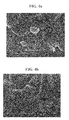
- FIGs. 4a and 4b are photographs showing the particle surface of the cathode active material before and after the plasma-treatment, respectively.
- each amount of the lithium impurities before and after the plasma-treatment was calculated and listed in Table 1 below.
- Table 1 Before the plasma-treatment After the plasma-treatment LiOH (wt%) 0.233 0.196 LiCO 3 (wt%) 0.296 0.103 Total (wt% ) 0.529 0.299 * wt% the weight of lithium impurities relative to the total weight of cathode active material particles
- the amount of the lithium impurities present on the particle surface of the cathode active material is reduced by about 44% after the plasma-treatment, compared with that before the plasma-treatment.
- Example 1 The procedure of Example 1 was repeated except that a 3-membered (Ni/Mn/Co) cathode active matenal having a composition of Li(Ni 0.6 Mn 0.2 Co 0.2 )O 2 was used for plasma-treatment by means of a CCP generator, so as to reduce lithium impurities on the surface of a cathode active matenal, thereby alleviating the swelling phenomenon of a battery cell.
- a 3-membered (Ni/Mn/Co) cathode active matenal having a composition of Li(Ni 0.6 Mn 0.2 Co 0.2 )O 2 was used for plasma-treatment by means of a CCP generator, so as to reduce lithium impurities on the surface of a cathode active matenal, thereby alleviating the swelling phenomenon of a battery cell.
- the amount of HCl used in a HCl-titration after the plasma-treatment is less than that before the plasma-treatment, which means the lithium impurities, such as LiOH and LiCO 3 , excessively present on the surface of the cathode active material before the plasma-treatment is reduced after the plasma-treatment, similar to the results in Example 1.
- the amount of the lithium impurities present on the particle surface of the cathode active material is reduced by about 36% after the plasma-treatment, compared with that before the plasma-treatment.
- lithium impurities present on the particle surface of the cathode active material can be reduced to alleviate the swelling phenomenon of a battery cell using the cathode active material.
Landscapes
- Chemical & Material Sciences (AREA)
- Chemical Kinetics & Catalysis (AREA)
- Electrochemistry (AREA)
- General Chemical & Material Sciences (AREA)
- Inorganic Chemistry (AREA)
- Engineering & Computer Science (AREA)
- Crystallography & Structural Chemistry (AREA)
- Materials Engineering (AREA)
- Organic Chemistry (AREA)
- Manufacturing & Machinery (AREA)
- Battery Electrode And Active Subsutance (AREA)
Abstract
Description
- The present invention relates to a surface-treatment method of cathode active material and a cathode active material formed therefrom, and more particularly to a method for treating the particle surface of cathode active material for a secondary battery with a plasma generated by gases and a cathode active material formed therefrom.
- This application claims priority to Korean Patent Application Nos.
10-2011-0042034 10-2012-0043934 - A cathode active material for a secondary battery has lithium impurities such as LiOH and LiCO3 which are present on the particle surface thereof. If these impurities are present in an excessive amount, not only do they cause to make an electrode slurry to be gelated during the production of an electrode slurry in the preparation of an electrode of a lithium secondary battery, but also causes a swelling phenomenon, particularly a lithium ion prismatic or polymer battery expanding, when reacted with the components of an electrolyte introduced in the lithium secondary battery.
- Accordingly, there is a need for minimizing the content of lithium impurities present on the particle surface of the cathode active material for a lithium secondary battery.
- The present invention is designed to solve the problems described above, therefore, it is an object of the present invention to improve the properties of a cathode active material for a lithium secondary battery by removing lithium impurities present on the particle surface thereof.
- In order to achieve the object, the present invention provides a method for treating the particle surface of a cathode active material for a lithium secondary battery, the method comprising (a) preparing a cathode active material having a lithium compound; (b) generating a plasma from gases comprising at least one of a fluorine-containing gas and a phosphorus-containing gas as a part of a reactive gas; and (c) removing lithium impurities present on the particle surface of the cathode active material with the plasma.
- In the present invention, the lithium compound may be selected from the group consisting of LiCoO2, LiNiO2, LiMn2O4, LiFePO4, LiFe1-xMnxPO4, LiNi1-x-yMnxCoyO2 (0≤x<1, 0≤y<1) and LiNi1-x-y-zCoxM1yM2zO2 (wherein, M1 and M2 are each independently selected from the group consisting of Al, Ni, Co, Fe, Mn, V, Cr, Ti, W, Ta, Ma and Mo; and x, y and z are each independently an atomic fraction of oxide-forming elements, in which 0≤x<1, 0≤y<1, and 0≤z<1).
- The reactive gas may further comprise at least one selected from hydrogen, oxygen, hydrocarbon and a compound containing other halogen family elements, as well as the fluorine-containing gas and the phosphorus-containing gas.
- The fluorine-containing gas may be SF6.
- The phosphorus-containing gas may comprise at least one selected from PH3, P(CH3)3 and PF3.
- The hydrocarbon may be CH4.
- In the present invention, the gases used for generating the plasma may further comprise a carrier gas comprising an inert gas, as well as the reactive gas.
- The carrier gas may comprise at least one selected from nitrogen, argon, helium and neon.
- The reactive gas may comprise SF6 and CH4, and the carrier gas may comprise N2. The lithium impurities may comprise LiOH or Li2CO3.
- The step (b) may be conducted by using a capacitively-coupled plasma (CCP) generator, an inductively-coupled plasma (ICP) generator, a direct current (DC) plasma generator or a dielectric barrier discharge (DBD) plasma generator.
- The step (c) may comprise modifying at least part of the lithium impurities to LiF.
- The step (c) may further comprise sputtering at least part of the lithium impurities with the accelerated ions of the plasma.
- In order to accomplish the above object, a cathode active material according to the present invention is prepared by the surface treatment method mentioned above.
- Meanwhile, the cathode active material of the present invention comprises lithium compounds having lithium impurities including LiOH and Li2CO3 on the particle surface of the cathode active surface in an amount less than 0.3 wt% relative to total weight of the cathode active material particles.
- In accordance with one aspect of the present invention, plasma ions generated in a plasma generator react with lithium impurities present on the particle surface of a cathode active material to modify the lithium impurities to other materials which do not react with an electrode, thereby suppressing a side reaction of the lithium impurities and the electrolyte.
- In accordance with another aspect of the present invention, the plasma ions which are generated and accelerated in the plasma generator eliminate the modified lithium impurities and the remaining lithium impurities from the particle surface of the cathode active material to suppress a side reaction of the lithium impurities and the electrolyte.
- The accompanying drawings illustrate preferred embodiments of the present invention and, together with the foregoing disclosure, serve to provide further understanding of the technical spirit of the present invention. However, the present invention is not to be construed as being limited to the drawings.
-
FIG. 1 is a flow chart showing a method for treating the particle surface of a cathode active material according to the present invention. -
FIG. 2 schematically shows the attack of ions generated in a plasma generator to lithium impurities present on the particle surface of a cathode active material. -
FIG. 3a is an HCl-titration graph (pH of 4 or higher) for the particle surface of a cathode active material according to Example 1 of the present invention. -
FIG. 3b is an HCl-titration graph (pH of 5 or less) for the particle surface of a cathode active material which is surface-treated according to Example 1 of the present invention. -
FIG. 4a is a photograph for the particle surface of a cathode active material before plasma-treatment. -
FIG. 4b is a photograph for the particle surface of a cathode active material after plasma-treatment. -
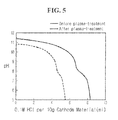
FIG. 5 is an HCl-titration graph (pH of 5 or higher) for the particle surface of a cathode active material according to Example 2 of the present invention. - Hereinafter, preferred embodiments of the present invention will be described in detail. Prior to the description, it should be understood that the terms used in the specification and the appended claims should not be construed as limited to general and dictionary meanings, but interpreted based on the meanings and concepts corresponding to technical aspects of the present invention on the basis of the principle that the inventor is allowed to define terms appropriately for the best explanation. Accordingly, the configurations illustrate in the embodiments and the drawings are just preferable examples for the purpose of illustrations only, not intended to limit the scope of the disclosure, so it should be understood that other equivalents and modifications could be made thereto without departing from the spirit and scope of the disclosure.
-
FIG. 1 is a flow chart showing a method for treating the particle surface of a cathode active material. - Referring to
FIG. 1 , the method for treating the particle surface of a cathode active material according to the present invention comprises the preparation of a cathode active material for a lithium secondary battery (S1), the generation of plasma (S2), and the removal of lithium impurities (S3). - The step S1 is to prepare a cathode active material for a lithium secondary battery, intended for plasma-treatment. The cathode active material used in the present invention may include any cathode active material which is known to be used in conventional secondary batteries, and the non-limiting examples of the cathode active material may include lithium-manganese oxides, lithium-cobalt oxides, lithium-nickel oxides, lithium-iron oxides and lithium composite oxides obtained from these combinations, more specifically, may be selected from the group consisting of LiCoO2, LiNiO2, LiMn2O4, LiFePO4, LiFe1-xMnxPO4, LiNi1-x-yMnxCoyO2 (0≤x<1, 0≤y<1) and LiNi1-x-y-zCoxM1yM2zO2 (wherein, M1 and M2 are each independently selected from the group consisting of Al, Ni, Co, Fe, Mn, V, Cr, Ti, W, Ta, Ma and Mo; and x, y and z are each independently an atomic fraction of oxide-forming elements, in which 0=x<1, 0=y<1, and 0=z<1).
- The step S2 is to generate a plasma for treating the particle surface of the cathode active material prepared in the step S1. The plasma may be generated by using a reactive gas comprising at least one selected from hydrogen, oxygen, a halogen family element-containing compound, a phosphorus-containing compound and hydrocarbon. The reaction gas may be used together with a carrier gas comprising at least one inert gas such as nitrogen, argon, helium and neon.
- Specifically, the halogen family element-containing compound may be a fluorine-containing gas such as SF6. Exemplary phosphorus-containing gases may include at least one selected from PH3, P(CH3)3 and PF3.
- A plasma generator used in the generation of the plasma is not particularly limited, and may include, for example, a capacitively-coupled plasma (CCP) generator, an inductively-coupled plasma (ICP) generator, a DC plasma generator or a dielectric barrier discharge (DBD) plasma generator.
- The step S3 is to surface-treat the particles of the cathode active material prepared in the step S1 with the plasma generated in the step S2 to remove lithium impurities present on the particle surface of the cathode active material.
- As shown in
FIG. 2 , lithium impurities such as LiOH or Li2CO3 are present on the particle surface of the cathode active material and react with the plasma ions generated in the plasma generator to modify the lithium impurities to other materials which do not react with an electrode, thereby removing the lithium impurities. In addition, the modified lithium impurities and the remaining lithium impurities may be removed from the particle surface of the cathode active material by sputtering with the plasma ions which are generated and accelerated in the plasma. - A cathode active material prepared by the surface treatment method according to the present invention preferably has lithium impurities such as LiOH and Li2CO3 on the particle surface thereof in an amount less than 0.3 wt% relative to the total weight of the cathode active material particles. If the lithium impurities are present in an amount of 0.3 wt% or more on the particle surface of the cathode active material, an excessive swelling phenomenon occurs due to the high reactivity of the lithium impurities for an electrolyte.
- Hereinafter, the present invention will be described in detail through specific examples. However, the description proposed herein is just a preferable example for the purpose of illustrations only, not intended to limit the scope of the invention, so it should be understood that the examples are provided for a more definite explanation to an ordinary person skilled in the art.
- A 3-membered (Ni/Mn/Co) cathode active material having a composition of Li(Ni0.8Mn0.1Co0.1)O2 was used for plasma-treatinent. Since the cathode active material having a composition of Li(Ni0.8Mn0.1Co0.1)O2 has a high content of Ni to provide large capacity, whereas the presence of excessive lithium impurities on the surface thereof causes high reactivity with an electrolyte. Accordingly, this may increase the swelling phenomenon of a battery cell, which may remarkably be exhibited at high temperatures. In order to prevent such a swelling phenomenon, the particle surface of the cathode active material having a composition of Li(Ni0.8Mn0.1Co0.1)O2 was plasma-treated by using a capacitively-coupled plasma (CCP) generator under the conditions as follows.
- N2/SF6/CH4 (Molecular weight - 100:10:1) atmosphere
- Atmospheric pressure
- Power for maintaining plasma: 500W
- Applied frequency: 1kHz ~ 2.5GHz
- After the plasma-treatment, the amount of impurities remaining on the surface of the cathode active material was calculated by a HCl-titration according to the method disclosed in US2009/0226810A1. Explanation for the specific titration method is omitted herein.
- As shown in
FIG. 3a , the amount of HCl used in the HCl-titration up topH 4 after the plasma-treatment is less than that before the plasma-treatment, which means the lithium impurities, such as LiOH and LiCO3, excessively present on the surface of the cathode active material before the plasma-treatment is reduced after the plasma-treatment. -
FIG. 3b shows a HCl-titration curve at a pH of 5 or less after the plasma-treatment, which is consistent with the HCl-titration curve of LiF. From this, it can be confirmed that LiF is newly generated by the plasma-treatment.FIGs. 4a and 4b are photographs showing the particle surface of the cathode active material before and after the plasma-treatment, respectively. - Meanwhile, each amount of the lithium impurities before and after the plasma-treatment was calculated and listed in Table 1 below.
Table 1 Before the plasma-treatment After the plasma-treatment LiOH (wt%) 0.233 0.196 LiCO3 (wt%) 0.296 0.103 Total (wt%) 0.529 0.299 * wt% the weight of lithium impurities relative to the total weight of cathode active material particles - As shown in Table 1, the amount of the lithium impurities present on the particle surface of the cathode active material is reduced by about 44% after the plasma-treatment, compared with that before the plasma-treatment.
- The procedure of Example 1 was repeated except that a 3-membered (Ni/Mn/Co) cathode active matenal having a composition of Li(Ni0.6Mn0.2Co0.2)O2 was used for plasma-treatment by means of a CCP generator, so as to reduce lithium impurities on the surface of a cathode active matenal, thereby alleviating the swelling phenomenon of a battery cell.
- As shown in
FIG. 5 , the amount of HCl used in a HCl-titration after the plasma-treatment is less than that before the plasma-treatment, which means the lithium impurities, such as LiOH and LiCO3, excessively present on the surface of the cathode active material before the plasma-treatment is reduced after the plasma-treatment, similar to the results in Example 1. - Meanwhile, each amount of the lithium impurities before and after the plasma-treatment was calculated and listed in Table 2 below.
Table 2 Before the plasma-treatment After the plasma-treatment LiOH (wt%) 0.119 0.087 LiCO3 (wt%) 0.125 0.069 Total (wt%) 0.244 0.156 * w-t% : the weight of lithium impurities relative to the total weight of cathode active material particles - As shown in Table 2, the amount of the lithium impurities present on the particle surface of the cathode active material is reduced by about 36% after the plasma-treatment, compared with that before the plasma-treatment.
- As mentioned above, in accordance with the inventive method for treating the particle surface of a cathode active material, lithium impurities present on the particle surface of the cathode active material can be reduced to alleviate the swelling phenomenon of a battery cell using the cathode active material.
- The present invention has been described with reference to the specific examples and drawings, however, is not limited thereto, and so it should be understood that various modifications and changes may be made by those having ordinary skill in the art without departing from the technology of the present invention and the spirit and scope of the following claims.
Claims (15)
- A method for treating the particle surface of a cathode active material for a lithium secondary battery, the method comprising:(a) preparing a cathode active material comprising a lithium compound;(b) generating a plasma from gases comprising at least one of a fluorine-containing gas and a phosphorus-containing gas as a part of a reactive gas; and(c) removing lithium impurities present on the particle surface of the cathode active material with the plasma.
- The method for treating the particle surface of a cathode active material according to claim 1, wherein the lithium compound is selected from the group consisting of LiCoO2, LiNiO2, LiMn2O4, LiFePO4, LiFe1-xMnxPO4, LiNi1-x-yMnxCoyO2 (0≤x<1, 0≤y<1) and LiNi1-x-y-zCoxM1yM2zO2 (wherein, M1 and M2 are each independently selected from the group consisting of Al, Ni, Co, Fe, Mn, V, Cr, Ti, W, Ta, Ma and Mo; and x, y and z are each independently an atomic fraction of oxide-forming elements, in which 0≤x<1, 0≤y<1, and 0≤z<1).
- The method for treating the particle surface of a cathode active material according to claim 1, wherein the reactive gas further comprises at least one selected from hydrogen, oxygen, hydrocarbon and a compound containing halogen family elements.
- The method for treating the particle surface of a cathode active material according to claim 1, wherein the fluorine-containing gas is SF6.
- The method for treating the particle surface of a cathode active material according to claim 1, wherein the phosphorus-containing gas comprises at least one selected from PH3, P(CH3)3 and PF3.
- The method for treating the particle surface of a cathode active material according to claim 3, wherein the hydrocarbon is CH4.
- The method for treating the particle surface of a cathode active material according to claim 1, wherein the gases further comprise a carrier gas comprising an inert gas.
- The method for treating the particle surface of a cathode active material according to claim 7, wherein the carrier gas comprises at least one selected from nitrogen, argon, helium and neon.
- The method for treating the particle surface of a cathode active material according to claim 7, wherein the reactive gas comprises SF6 and CH4, and the carrier gas comprises N2.
- The method for treating the particle surface of a cathode active material according to claim 1, wherein the lithium impurities comprise at least one of LiOH and Li2CO3.
- The method for treating the particle surface of a cathode active material according to claim 1, wherein the step (b) is conducted by using a capacitively-coupled plasma (CCP) generator, an inductively-coupled plasma (ICP) generator, a direct current (DC) plasma generator or a dielectric barrier discharge (DBD) plasma generator.
- The method for treating the particle surface of a cathode active material according to claim 1, wherein the step (c) comprises modifying at least part of the lithium impurities to LiF.
- The method for treating the particle surface of a cathode active material according to claim 12, wherein the step (c) further comprises sputtering at least part of the lithium impurities with the accelerated ions of the plasma.
- A cathode active material prepared by the method for treating the particle surface of a cathode active material according to any one of claims 1 to 13.
- A cathode active material comprising lithium compounds wherein lithium impurities including LiOH and Li2CO3 are present in an amount less than 0.3 wt% relative to total weight of the cathode active material particles on the particle surface of the cathode active material.
Applications Claiming Priority (3)
| Application Number | Priority Date | Filing Date | Title |
|---|---|---|---|
| KR20110042034 | 2011-05-03 | ||
| KR20120043934A KR101492175B1 (en) | 2011-05-03 | 2012-04-26 | Treatment method of surface of cathode active particle and cathode active particle formed therefrom |
| PCT/KR2012/003502 WO2012150837A2 (en) | 2011-05-03 | 2012-05-03 | Surface processing method for anode-active-material particles, and anode-active-material particles formed therefrom |
Publications (3)
| Publication Number | Publication Date |
|---|---|
| EP2706597A1 true EP2706597A1 (en) | 2014-03-12 |
| EP2706597A4 EP2706597A4 (en) | 2014-10-08 |
| EP2706597B1 EP2706597B1 (en) | 2016-08-31 |
Family
ID=47108154
Family Applications (1)
| Application Number | Title | Priority Date | Filing Date |
|---|---|---|---|
| EP12779849.4A Active EP2706597B1 (en) | 2011-05-03 | 2012-05-03 | Surface processing method for cathode active material particles |
Country Status (6)
| Country | Link |
|---|---|
| US (1) | US9776879B2 (en) |
| EP (1) | EP2706597B1 (en) |
| JP (1) | JP5813209B2 (en) |
| KR (1) | KR101492175B1 (en) |
| CN (1) | CN103503203B (en) |
| WO (1) | WO2012150837A2 (en) |
Cited By (1)
| Publication number | Priority date | Publication date | Assignee | Title |
|---|---|---|---|---|
| US12469838B2 (en) | 2020-05-03 | 2025-11-11 | Sparkz Inc. | Systems and methods involving use of nitrogen-containing plasma to treat lithium iron phosphate cathodes |
Families Citing this family (18)
| Publication number | Priority date | Publication date | Assignee | Title |
|---|---|---|---|---|
| US9692039B2 (en) | 2012-07-24 | 2017-06-27 | Quantumscape Corporation | Nanostructured materials for electrochemical conversion reactions |
| KR101532997B1 (en) * | 2013-03-08 | 2015-07-09 | 한국기초과학지원연구원 | Method for f passivating lithium transition metal oxide |
| CN104282884A (en) * | 2013-07-05 | 2015-01-14 | 深圳市大成精密设备有限公司 | Processing technology and equipment for removing aluminum skimmings of lithium battery electrode plate by use of plasma |
| JP6201277B2 (en) * | 2013-09-13 | 2017-09-27 | 住友金属鉱山株式会社 | Cathode active material for non-aqueous electrolyte secondary battery and method for producing the same |
| US9339784B2 (en) * | 2014-01-03 | 2016-05-17 | Quantumscape Corporation | Plasma synthesis of metal and lithium fluoride nanostructures |
| CN103779556A (en) * | 2014-01-26 | 2014-05-07 | 中信国安盟固利电源技术有限公司 | Doped and surface coating co-modified anode material for lithium ion battery and preparation method thereof |
| WO2015130831A1 (en) | 2014-02-25 | 2015-09-03 | Quantumscape Corporation | Hybrid electrodes with both intercalation and conversion materials |
| WO2016025866A1 (en) | 2014-08-15 | 2016-02-18 | Quantumscape Corporation | Doped conversion materials for secondary battery cathodes |
| US10388944B2 (en) * | 2014-10-06 | 2019-08-20 | Hitachi Metals, Ltd. | Positive electrode active material for lithium ion secondary battery, and positive electrode for lithium ion secondary battery and lithium ion secondary battery comprising the same |
| KR102027460B1 (en) * | 2015-01-09 | 2019-10-02 | 주식회사 에코프로비엠 | Manufacuring method of cathode active material for lithium rechargeable battery, and cathode active material made by the same |
| KR101943481B1 (en) * | 2015-03-20 | 2019-01-30 | 주식회사 엘지화학 | A method of treating surface of cathode active material particles and Cathode active material particles obtained therefrom |
| KR20160112766A (en) * | 2015-03-20 | 2016-09-28 | 주식회사 엘지화학 | Cathode active material for lithium secondary battery with high voltage and Lithium secondary battery comprising the same |
| CN107919475B (en) * | 2016-10-09 | 2020-10-16 | 上海中聚佳华电池科技有限公司 | Graphene modified lithium ion battery positive electrode material, and preparation method and application thereof |
| KR102231062B1 (en) * | 2018-03-09 | 2021-03-23 | 주식회사 엘지화학 | Positive electrode active material, method for producing thereof, positive electrode and secondary battery comprising the same |
| CN108832117A (en) * | 2018-06-27 | 2018-11-16 | 江西星盈科技有限公司 | A kind of nickelic positive electrode method of modifying of stratiform |
| US12015142B2 (en) | 2020-05-03 | 2024-06-18 | Venkatraman Prabhakar | Methods involving use of nitrogen-containing plasma to treat liquid electrolyte lithium-ion cathode materials |
| WO2021225998A1 (en) * | 2020-05-03 | 2021-11-11 | Venkatraman Prabhakar | Systems and methods of fabricating a lithium ion cell |
| CN114094103B (en) * | 2021-11-16 | 2024-05-03 | 江苏超电新能源科技发展有限公司 | Preparation method and application of fluorine and sulfur doped lithium battery electrode conductive agent material |
Family Cites Families (27)
| Publication number | Priority date | Publication date | Assignee | Title |
|---|---|---|---|---|
| JP3487556B2 (en) * | 1992-11-30 | 2004-01-19 | キヤノン株式会社 | Lithium secondary battery |
| JPH08213014A (en) * | 1995-02-06 | 1996-08-20 | Sony Corp | Non-aqueous electrolyte secondary battery |
| JPH09180721A (en) * | 1995-12-28 | 1997-07-11 | Mitsui Petrochem Ind Ltd | Electrode for lithium battery, manufacturing method thereof, electrochemical device and manufacturing method thereof |
| JP4081694B2 (en) * | 1997-02-06 | 2008-04-30 | 株式会社ジーエス・ユアサコーポレーション | Method for producing host substance |
| US5916516A (en) * | 1998-02-18 | 1999-06-29 | Mitsubishi Chemical Corporation | Fluoridated electrode materials and associated process for fabrication |
| JP3913941B2 (en) * | 1999-10-14 | 2007-05-09 | 株式会社日立製作所 | Positive electrode active material for lithium secondary battery and lithium secondary battery |
| JP4777543B2 (en) * | 2001-06-20 | 2011-09-21 | Agcセイミケミカル株式会社 | Method for producing lithium cobalt composite oxide |
| JP2004164934A (en) * | 2002-11-11 | 2004-06-10 | Mitsui Chemicals Inc | Surface treatment method of anode active material for secondary battery and secondary battery using the same |
| JP4422439B2 (en) * | 2003-06-30 | 2010-02-24 | Tdk株式会社 | Carbon material for electrode and manufacturing method thereof, battery electrode and manufacturing method thereof, and battery and manufacturing method thereof |
| JP2006108047A (en) * | 2004-10-08 | 2006-04-20 | Gs Yuasa Corporation:Kk | Manufacturing method of battery |
| JP5208353B2 (en) | 2005-03-31 | 2013-06-12 | 東洋炭素株式会社 | Positive electrode active material and manufacturing method thereof |
| US7648693B2 (en) * | 2005-04-13 | 2010-01-19 | Lg Chem, Ltd. | Ni-based lithium transition metal oxide |
| KR101001827B1 (en) * | 2005-07-21 | 2010-12-15 | 파나소닉 주식회사 | Manufacturing method of negative electrode for lithium ion secondary battery |
| JP4241837B2 (en) * | 2007-01-15 | 2009-03-18 | トヨタ自動車株式会社 | Vehicle and control method thereof |
| JP4920475B2 (en) * | 2007-03-30 | 2012-04-18 | ソニー株式会社 | Positive electrode active material, positive electrode and non-aqueous electrolyte battery |
| CN102290573B (en) * | 2007-03-30 | 2015-07-08 | 索尼株式会社 | Cathode active material, cathode and nonaqueous electrolyte battery |
| WO2008138901A1 (en) | 2007-05-11 | 2008-11-20 | Force Technology | Enhancing plasma surface modification using high intensity and high power ultrasonic acoustic waves |
| JP4905267B2 (en) * | 2007-06-21 | 2012-03-28 | ソニー株式会社 | Positive electrode mixture and non-aqueous electrolyte battery |
| JP5098882B2 (en) * | 2007-08-31 | 2012-12-12 | 東京エレクトロン株式会社 | Plasma processing equipment |
| JP4518125B2 (en) * | 2007-09-27 | 2010-08-04 | トヨタ自動車株式会社 | Positive electrode active material and lithium secondary battery |
| US8187746B2 (en) * | 2008-05-16 | 2012-05-29 | Uchicago Argonne, Llc | Surface modification agents for lithium batteries |
| TWI365562B (en) | 2008-10-03 | 2012-06-01 | Ind Tech Res Inst | Positive electrode and method for manufacturing the same and lithium battery utilizing the same |
| FR2937494B1 (en) * | 2008-10-17 | 2012-12-07 | Centre Nat Rech Scient | LOW POWER GAS PLASMA SOURCE |
| FR2943181B1 (en) * | 2009-03-16 | 2011-05-13 | Commissariat Energie Atomique | LITHIUM MICROBATTERIUM AND METHOD FOR MANUFACTURING THE SAME |
| KR100946598B1 (en) * | 2009-04-24 | 2010-03-09 | 주식회사 엘파니 | Solid dopants for conductive polymers, method and apparatus for preparing the same using plasma treatment, and solid doping method of conductive polymers |
| KR101249974B1 (en) * | 2010-04-01 | 2013-04-03 | 한국기초과학지원연구원 | An elecltrod for lithium secondary battery processed in reducing atmospheres, method for fabricating the same, and lithium secondary battery containing the same |
| KR101348946B1 (en) * | 2012-01-27 | 2014-01-09 | 한국기초과학지원연구원 | A method for removing impurities of lithium transtion metal oxide |
-
2012
- 2012-04-26 KR KR20120043934A patent/KR101492175B1/en active Active
- 2012-05-03 EP EP12779849.4A patent/EP2706597B1/en active Active
- 2012-05-03 CN CN201280021584.XA patent/CN103503203B/en active Active
- 2012-05-03 WO PCT/KR2012/003502 patent/WO2012150837A2/en not_active Ceased
- 2012-05-03 JP JP2014506344A patent/JP5813209B2/en active Active
-
2013
- 2013-10-10 US US14/050,990 patent/US9776879B2/en active Active
Cited By (1)
| Publication number | Priority date | Publication date | Assignee | Title |
|---|---|---|---|---|
| US12469838B2 (en) | 2020-05-03 | 2025-11-11 | Sparkz Inc. | Systems and methods involving use of nitrogen-containing plasma to treat lithium iron phosphate cathodes |
Also Published As
| Publication number | Publication date |
|---|---|
| US20140050656A1 (en) | 2014-02-20 |
| KR20120124355A (en) | 2012-11-13 |
| WO2012150837A2 (en) | 2012-11-08 |
| CN103503203A (en) | 2014-01-08 |
| JP2014514721A (en) | 2014-06-19 |
| WO2012150837A3 (en) | 2013-02-21 |
| EP2706597B1 (en) | 2016-08-31 |
| WO2012150837A9 (en) | 2012-12-20 |
| CN103503203B (en) | 2016-04-20 |
| EP2706597A4 (en) | 2014-10-08 |
| US9776879B2 (en) | 2017-10-03 |
| KR101492175B1 (en) | 2015-02-10 |
| JP5813209B2 (en) | 2015-11-17 |
Similar Documents
| Publication | Publication Date | Title |
|---|---|---|
| EP2706597A1 (en) | Surface processing method for anode-active-material particles, and anode-active-material particles formed therefrom | |
| EP3179539B1 (en) | Multi-layer structured lithium metal electrode and method for manufacturing same | |
| Li et al. | Tris (trimethylsilyl) borate as an electrolyte additive for improving interfacial stability of high voltage layered lithium-rich oxide cathode/carbonate-based electrolyte | |
| US20210104743A1 (en) | Lithium complex oxide for lithium secondary battery positive active material and method of preparing the same | |
| JP5992016B2 (en) | Method for modifying lithium ion battery cathode material | |
| US20150214545A1 (en) | Nonaqueous electrolyte secondary battery | |
| Zhang et al. | Dual-defect modulating potassium anchored NH4V4O10 for stable high-energy aqueous zinc-ion batteries | |
| KR20170139462A (en) | Anode active material for sodium secondary battery, and manufacturing method therefor | |
| KR101589738B1 (en) | Method of preparing positive active material precursor | |
| KR20190073758A (en) | Method for purifying graphite materials and graphite materials | |
| Shaw et al. | Coating-A potent method to enhance electrochemical performance of Li (NixMnyCoz) O2 cathodes for Li-ion batteries | |
| KR20240006436A (en) | Recycling cathode active material, method for recycling cathode active material and secondary battery containing the same | |
| KR101943481B1 (en) | A method of treating surface of cathode active material particles and Cathode active material particles obtained therefrom | |
| EP4459701A2 (en) | Silicon clathrate electrode active material, negative electrode mixture, negative electrode active material layer, solid-state lithium-ion battery, and method for manufacturing negative electrode active material layer | |
| US20250246618A1 (en) | Doped and coated nickel-rich cathode active materials and methods thereof | |
| KR101354481B1 (en) | A method for removing impurities of lithium transtion metal oxide | |
| EP4112557A1 (en) | Methods for preparing cathode active material precursor material and cathode active material for lithium secondary battery, and cathode active material for lithium secondary battery prepared according to same | |
| CN115275143A (en) | Coating method of nickel cobalt lithium manganate positive electrode material | |
| JP4061743B2 (en) | Battery electrode, battery, battery electrode active material modification method and electrode active material | |
| CN111533163B (en) | Black lithium titanate material for lithium ion battery cathode and preparation method and application thereof | |
| KR102779932B1 (en) | Direct upcycling method of spent cathode materials for manganese based cathode materials and lithium secondary battery comprising same | |
| US20250051877A1 (en) | Curing process for surface defects of cathode material | |
| KR102404146B1 (en) | Lithium titnate oxide-based anode for lithium-ion batteries doped with iron atoms and preparing method thereof | |
| KR20250153649A (en) | Method for Recovering Lithium from Waste Lithium Secondary Batteries | |
| KR20240096193A (en) | Silicon anode material |
Legal Events
| Date | Code | Title | Description |
|---|---|---|---|
| PUAI | Public reference made under article 153(3) epc to a published international application that has entered the european phase |
Free format text: ORIGINAL CODE: 0009012 |
|
| 17P | Request for examination filed |
Effective date: 20131120 |
|
| AK | Designated contracting states |
Kind code of ref document: A1 Designated state(s): AL AT BE BG CH CY CZ DE DK EE ES FI FR GB GR HR HU IE IS IT LI LT LU LV MC MK MT NL NO PL PT RO RS SE SI SK SM TR |
|
| DAX | Request for extension of the european patent (deleted) | ||
| A4 | Supplementary search report drawn up and despatched |
Effective date: 20140909 |
|
| RIC1 | Information provided on ipc code assigned before grant |
Ipc: H01M 4/485 20100101ALI20140903BHEP Ipc: H01M 4/139 20100101AFI20140903BHEP Ipc: H01M 4/58 20100101ALI20140903BHEP Ipc: H01M 10/052 20100101ALI20140903BHEP Ipc: H01M 4/525 20100101ALI20140903BHEP Ipc: H01M 4/505 20100101ALI20140903BHEP |
|
| 17Q | First examination report despatched |
Effective date: 20150904 |
|
| REG | Reference to a national code |
Ref country code: DE Ref legal event code: R079 Ref document number: 602012022457 Country of ref document: DE Free format text: PREVIOUS MAIN CLASS: H01M0004139000 Ipc: H01M0004485000 |
|
| GRAP | Despatch of communication of intention to grant a patent |
Free format text: ORIGINAL CODE: EPIDOSNIGR1 |
|
| RIC1 | Information provided on ipc code assigned before grant |
Ipc: H01M 4/485 20100101AFI20160330BHEP Ipc: H01M 4/525 20100101ALI20160330BHEP Ipc: H01M 4/505 20100101ALI20160330BHEP Ipc: H01M 4/58 20060101ALI20160330BHEP |
|
| INTG | Intention to grant announced |
Effective date: 20160418 |
|
| GRAS | Grant fee paid |
Free format text: ORIGINAL CODE: EPIDOSNIGR3 |
|
| GRAA | (expected) grant |
Free format text: ORIGINAL CODE: 0009210 |
|
| AK | Designated contracting states |
Kind code of ref document: B1 Designated state(s): AL AT BE BG CH CY CZ DE DK EE ES FI FR GB GR HR HU IE IS IT LI LT LU LV MC MK MT NL NO PL PT RO RS SE SI SK SM TR |
|
| REG | Reference to a national code |
Ref country code: CH Ref legal event code: EP Ref country code: GB Ref legal event code: FG4D |
|
| REG | Reference to a national code |
Ref country code: IE Ref legal event code: FG4D |
|
| REG | Reference to a national code |
Ref country code: DE Ref legal event code: R096 Ref document number: 602012022457 Country of ref document: DE |
|
| REG | Reference to a national code |
Ref country code: AT Ref legal event code: REF Ref document number: 825676 Country of ref document: AT Kind code of ref document: T Effective date: 20161015 |
|
| REG | Reference to a national code |
Ref country code: LT Ref legal event code: MG4D |
|
| REG | Reference to a national code |
Ref country code: NL Ref legal event code: MP Effective date: 20160831 |
|
| REG | Reference to a national code |
Ref country code: AT Ref legal event code: MK05 Ref document number: 825676 Country of ref document: AT Kind code of ref document: T Effective date: 20160831 |
|
| PG25 | Lapsed in a contracting state [announced via postgrant information from national office to epo] |
Ref country code: RS Free format text: LAPSE BECAUSE OF FAILURE TO SUBMIT A TRANSLATION OF THE DESCRIPTION OR TO PAY THE FEE WITHIN THE PRESCRIBED TIME-LIMIT Effective date: 20160831 Ref country code: FI Free format text: LAPSE BECAUSE OF FAILURE TO SUBMIT A TRANSLATION OF THE DESCRIPTION OR TO PAY THE FEE WITHIN THE PRESCRIBED TIME-LIMIT Effective date: 20160831 Ref country code: LT Free format text: LAPSE BECAUSE OF FAILURE TO SUBMIT A TRANSLATION OF THE DESCRIPTION OR TO PAY THE FEE WITHIN THE PRESCRIBED TIME-LIMIT Effective date: 20160831 Ref country code: HR Free format text: LAPSE BECAUSE OF FAILURE TO SUBMIT A TRANSLATION OF THE DESCRIPTION OR TO PAY THE FEE WITHIN THE PRESCRIBED TIME-LIMIT Effective date: 20160831 Ref country code: NO Free format text: LAPSE BECAUSE OF FAILURE TO SUBMIT A TRANSLATION OF THE DESCRIPTION OR TO PAY THE FEE WITHIN THE PRESCRIBED TIME-LIMIT Effective date: 20161130 |
|
| PG25 | Lapsed in a contracting state [announced via postgrant information from national office to epo] |
Ref country code: GR Free format text: LAPSE BECAUSE OF FAILURE TO SUBMIT A TRANSLATION OF THE DESCRIPTION OR TO PAY THE FEE WITHIN THE PRESCRIBED TIME-LIMIT Effective date: 20161201 Ref country code: SE Free format text: LAPSE BECAUSE OF FAILURE TO SUBMIT A TRANSLATION OF THE DESCRIPTION OR TO PAY THE FEE WITHIN THE PRESCRIBED TIME-LIMIT Effective date: 20160831 Ref country code: NL Free format text: LAPSE BECAUSE OF FAILURE TO SUBMIT A TRANSLATION OF THE DESCRIPTION OR TO PAY THE FEE WITHIN THE PRESCRIBED TIME-LIMIT Effective date: 20160831 Ref country code: LV Free format text: LAPSE BECAUSE OF FAILURE TO SUBMIT A TRANSLATION OF THE DESCRIPTION OR TO PAY THE FEE WITHIN THE PRESCRIBED TIME-LIMIT Effective date: 20160831 Ref country code: ES Free format text: LAPSE BECAUSE OF FAILURE TO SUBMIT A TRANSLATION OF THE DESCRIPTION OR TO PAY THE FEE WITHIN THE PRESCRIBED TIME-LIMIT Effective date: 20160831 Ref country code: AT Free format text: LAPSE BECAUSE OF FAILURE TO SUBMIT A TRANSLATION OF THE DESCRIPTION OR TO PAY THE FEE WITHIN THE PRESCRIBED TIME-LIMIT Effective date: 20160831 |
|
| REG | Reference to a national code |
Ref country code: FR Ref legal event code: PLFP Year of fee payment: 6 |
|
| PG25 | Lapsed in a contracting state [announced via postgrant information from national office to epo] |
Ref country code: EE Free format text: LAPSE BECAUSE OF FAILURE TO SUBMIT A TRANSLATION OF THE DESCRIPTION OR TO PAY THE FEE WITHIN THE PRESCRIBED TIME-LIMIT Effective date: 20160831 Ref country code: RO Free format text: LAPSE BECAUSE OF FAILURE TO SUBMIT A TRANSLATION OF THE DESCRIPTION OR TO PAY THE FEE WITHIN THE PRESCRIBED TIME-LIMIT Effective date: 20160831 |
|
| PG25 | Lapsed in a contracting state [announced via postgrant information from national office to epo] |
Ref country code: CZ Free format text: LAPSE BECAUSE OF FAILURE TO SUBMIT A TRANSLATION OF THE DESCRIPTION OR TO PAY THE FEE WITHIN THE PRESCRIBED TIME-LIMIT Effective date: 20160831 Ref country code: SM Free format text: LAPSE BECAUSE OF FAILURE TO SUBMIT A TRANSLATION OF THE DESCRIPTION OR TO PAY THE FEE WITHIN THE PRESCRIBED TIME-LIMIT Effective date: 20160831 Ref country code: BE Free format text: LAPSE BECAUSE OF FAILURE TO SUBMIT A TRANSLATION OF THE DESCRIPTION OR TO PAY THE FEE WITHIN THE PRESCRIBED TIME-LIMIT Effective date: 20160831 Ref country code: BG Free format text: LAPSE BECAUSE OF FAILURE TO SUBMIT A TRANSLATION OF THE DESCRIPTION OR TO PAY THE FEE WITHIN THE PRESCRIBED TIME-LIMIT Effective date: 20161130 Ref country code: DK Free format text: LAPSE BECAUSE OF FAILURE TO SUBMIT A TRANSLATION OF THE DESCRIPTION OR TO PAY THE FEE WITHIN THE PRESCRIBED TIME-LIMIT Effective date: 20160831 Ref country code: PL Free format text: LAPSE BECAUSE OF FAILURE TO SUBMIT A TRANSLATION OF THE DESCRIPTION OR TO PAY THE FEE WITHIN THE PRESCRIBED TIME-LIMIT Effective date: 20160831 Ref country code: PT Free format text: LAPSE BECAUSE OF FAILURE TO SUBMIT A TRANSLATION OF THE DESCRIPTION OR TO PAY THE FEE WITHIN THE PRESCRIBED TIME-LIMIT Effective date: 20170102 Ref country code: SK Free format text: LAPSE BECAUSE OF FAILURE TO SUBMIT A TRANSLATION OF THE DESCRIPTION OR TO PAY THE FEE WITHIN THE PRESCRIBED TIME-LIMIT Effective date: 20160831 |
|
| REG | Reference to a national code |
Ref country code: DE Ref legal event code: R097 Ref document number: 602012022457 Country of ref document: DE |
|
| PG25 | Lapsed in a contracting state [announced via postgrant information from national office to epo] |
Ref country code: IT Free format text: LAPSE BECAUSE OF FAILURE TO SUBMIT A TRANSLATION OF THE DESCRIPTION OR TO PAY THE FEE WITHIN THE PRESCRIBED TIME-LIMIT Effective date: 20160831 |
|
| PLBE | No opposition filed within time limit |
Free format text: ORIGINAL CODE: 0009261 |
|
| STAA | Information on the status of an ep patent application or granted ep patent |
Free format text: STATUS: NO OPPOSITION FILED WITHIN TIME LIMIT |
|
| 26N | No opposition filed |
Effective date: 20170601 |
|
| PG25 | Lapsed in a contracting state [announced via postgrant information from national office to epo] |
Ref country code: LU Free format text: LAPSE BECAUSE OF NON-PAYMENT OF DUE FEES Effective date: 20170531 Ref country code: SI Free format text: LAPSE BECAUSE OF FAILURE TO SUBMIT A TRANSLATION OF THE DESCRIPTION OR TO PAY THE FEE WITHIN THE PRESCRIBED TIME-LIMIT Effective date: 20160831 |
|
| REG | Reference to a national code |
Ref country code: CH Ref legal event code: PL |
|
| PG25 | Lapsed in a contracting state [announced via postgrant information from national office to epo] |
Ref country code: MC Free format text: LAPSE BECAUSE OF FAILURE TO SUBMIT A TRANSLATION OF THE DESCRIPTION OR TO PAY THE FEE WITHIN THE PRESCRIBED TIME-LIMIT Effective date: 20160831 |
|
| REG | Reference to a national code |
Ref country code: IE Ref legal event code: MM4A |
|
| PG25 | Lapsed in a contracting state [announced via postgrant information from national office to epo] |
Ref country code: LI Free format text: LAPSE BECAUSE OF NON-PAYMENT OF DUE FEES Effective date: 20170531 Ref country code: CH Free format text: LAPSE BECAUSE OF NON-PAYMENT OF DUE FEES Effective date: 20170531 |
|
| PG25 | Lapsed in a contracting state [announced via postgrant information from national office to epo] |
Ref country code: LU Free format text: LAPSE BECAUSE OF NON-PAYMENT OF DUE FEES Effective date: 20170503 |
|
| REG | Reference to a national code |
Ref country code: FR Ref legal event code: PLFP Year of fee payment: 7 |
|
| PG25 | Lapsed in a contracting state [announced via postgrant information from national office to epo] |
Ref country code: IE Free format text: LAPSE BECAUSE OF NON-PAYMENT OF DUE FEES Effective date: 20170503 |
|
| PG25 | Lapsed in a contracting state [announced via postgrant information from national office to epo] |
Ref country code: MT Free format text: LAPSE BECAUSE OF NON-PAYMENT OF DUE FEES Effective date: 20170503 |
|
| PG25 | Lapsed in a contracting state [announced via postgrant information from national office to epo] |
Ref country code: AL Free format text: LAPSE BECAUSE OF FAILURE TO SUBMIT A TRANSLATION OF THE DESCRIPTION OR TO PAY THE FEE WITHIN THE PRESCRIBED TIME-LIMIT Effective date: 20160831 |
|
| PG25 | Lapsed in a contracting state [announced via postgrant information from national office to epo] |
Ref country code: HU Free format text: LAPSE BECAUSE OF FAILURE TO SUBMIT A TRANSLATION OF THE DESCRIPTION OR TO PAY THE FEE WITHIN THE PRESCRIBED TIME-LIMIT; INVALID AB INITIO Effective date: 20120503 |
|
| PG25 | Lapsed in a contracting state [announced via postgrant information from national office to epo] |
Ref country code: CY Free format text: LAPSE BECAUSE OF NON-PAYMENT OF DUE FEES Effective date: 20160831 |
|
| PG25 | Lapsed in a contracting state [announced via postgrant information from national office to epo] |
Ref country code: MK Free format text: LAPSE BECAUSE OF FAILURE TO SUBMIT A TRANSLATION OF THE DESCRIPTION OR TO PAY THE FEE WITHIN THE PRESCRIBED TIME-LIMIT Effective date: 20160831 |
|
| PG25 | Lapsed in a contracting state [announced via postgrant information from national office to epo] |
Ref country code: TR Free format text: LAPSE BECAUSE OF FAILURE TO SUBMIT A TRANSLATION OF THE DESCRIPTION OR TO PAY THE FEE WITHIN THE PRESCRIBED TIME-LIMIT Effective date: 20160831 |
|
| PG25 | Lapsed in a contracting state [announced via postgrant information from national office to epo] |
Ref country code: IS Free format text: LAPSE BECAUSE OF FAILURE TO SUBMIT A TRANSLATION OF THE DESCRIPTION OR TO PAY THE FEE WITHIN THE PRESCRIBED TIME-LIMIT Effective date: 20161231 |
|
| P01 | Opt-out of the competence of the unified patent court (upc) registered |
Effective date: 20230323 |
|
| REG | Reference to a national code |
Ref country code: GB Ref legal event code: 732E Free format text: REGISTERED BETWEEN 20230622 AND 20230628 |
|
| REG | Reference to a national code |
Ref country code: DE Ref legal event code: R081 Ref document number: 602012022457 Country of ref document: DE Owner name: LG ENERGY SOLUTION LTD., KR Free format text: FORMER OWNER: LG CHEM, LTD., SEOUL, KR Ref country code: DE Ref legal event code: R081 Ref document number: 602012022457 Country of ref document: DE Owner name: LG CHEM, LTD., KR Free format text: FORMER OWNER: LG CHEM, LTD., SEOUL, KR |
|
| PGFP | Annual fee paid to national office [announced via postgrant information from national office to epo] |
Ref country code: DE Payment date: 20250422 Year of fee payment: 14 |
|
| PGFP | Annual fee paid to national office [announced via postgrant information from national office to epo] |
Ref country code: FR Payment date: 20250422 Year of fee payment: 14 |
|
| PGFP | Annual fee paid to national office [announced via postgrant information from national office to epo] |
Ref country code: GB Payment date: 20260324 Year of fee payment: 15 |