EP2701337A2 - Geheimes Verfahren und System für gemeinsame Nutzung - Google Patents
Geheimes Verfahren und System für gemeinsame Nutzung Download PDFInfo
- Publication number
- EP2701337A2 EP2701337A2 EP13181324.8A EP13181324A EP2701337A2 EP 2701337 A2 EP2701337 A2 EP 2701337A2 EP 13181324 A EP13181324 A EP 13181324A EP 2701337 A2 EP2701337 A2 EP 2701337A2
- Authority
- EP
- European Patent Office
- Prior art keywords
- data
- secret
- shared data
- secret sharing
- shared
- Prior art date
- Legal status (The legal status is an assumption and is not a legal conclusion. Google has not performed a legal analysis and makes no representation as to the accuracy of the status listed.)
- Granted
Links
Images









Classifications
-
- H—ELECTRICITY
- H04—ELECTRIC COMMUNICATION TECHNIQUE
- H04L—TRANSMISSION OF DIGITAL INFORMATION, e.g. TELEGRAPHIC COMMUNICATION
- H04L63/00—Network architectures or network communication protocols for network security
- H04L63/04—Network architectures or network communication protocols for network security for providing a confidential data exchange among entities communicating through data packet networks
- H04L63/0428—Network architectures or network communication protocols for network security for providing a confidential data exchange among entities communicating through data packet networks wherein the data content is protected, e.g. by encrypting or encapsulating the payload
-
- H—ELECTRICITY
- H04—ELECTRIC COMMUNICATION TECHNIQUE
- H04L—TRANSMISSION OF DIGITAL INFORMATION, e.g. TELEGRAPHIC COMMUNICATION
- H04L9/00—Cryptographic mechanisms or cryptographic arrangements for secret or secure communications; Network security protocols
- H04L9/08—Key distribution or management, e.g. generation, sharing or updating, of cryptographic keys or passwords
- H04L9/0816—Key establishment, i.e. cryptographic processes or cryptographic protocols whereby a shared secret becomes available to two or more parties, for subsequent use
- H04L9/085—Secret sharing or secret splitting, e.g. threshold schemes
-
- H—ELECTRICITY
- H04—ELECTRIC COMMUNICATION TECHNIQUE
- H04L—TRANSMISSION OF DIGITAL INFORMATION, e.g. TELEGRAPHIC COMMUNICATION
- H04L9/00—Cryptographic mechanisms or cryptographic arrangements for secret or secure communications; Network security protocols
- H04L9/08—Key distribution or management, e.g. generation, sharing or updating, of cryptographic keys or passwords
- H04L9/0861—Generation of secret information including derivation or calculation of cryptographic keys or passwords
- H04L9/0869—Generation of secret information including derivation or calculation of cryptographic keys or passwords involving random numbers or seeds
Definitions
- the present invention relates to a secret sharing method and a secret sharing system in which secret data (original data) is split into a plurality of data parts equal to or greater than a threshold value in number in such a manner that the secret data cannot be reconstructed with a number of data parts smaller than the threshold value in number.
- the secret sharing method (threshold scheme) is known as such a technology.
- Secret data containing critical information is split into n shared data parts such that the secret data can be reconstructed when k or more of the n data parts are available.
- the method using polynomial interpolation is well known (see Non-Patent Document 1).
- this threshold scheme as opposed to the encryption technology such as RSA (Rivest, Shamir and Adelman) encryption relying on the computational load for security, even when less than k shared data parts are acquired by a third party, the security of the secret data can be ensured without regard to the computational power of the information processing device (decryption device) which may be at the disposal of the third party from the viewpoint of the information theory.
- Non-Patent Document 1 A. Shamir: "How to Share a Secret", Communications of the ACM, November 1979, Volume 22, Number 11 .
- Patent Document 1 JP2007-124032
- Patent Document 1 because the use of XOR is a prerequisite, it is not possible to incorporate other algorithms that the use may desire to use so that the lack of flexibility reduces the convenience of the method.
- the prior art based on the threshold scheme, owing to the nature of the scheme, if more shared data parts than the threshold value are acquired by a third party, the third party is able to reconstruct the secret data without any difficulty because the algorithm is fixed, and is likely to be known to the third party.
- the present invention was made in view of such problems of the prior art, and has a primary object to provide a secret sharing method and a secret sharing system based on an improved threshold scheme that allow an algorithm desired by the user can be freely incorporated, and can prevent the secret data to be easily reconstructed even when more shared data parts than the threshold value are acquired by a third party.
- a second object of the present invention is to provide a secret sharing method and a secret sharing system based on an improved threshold scheme that can reduce the computational load that is required to share the secret data and reconstruct the secret data if so desired.
- the present invention eliminates such problems of the prior art by providing a secret sharing method in which secret data is shared as shared data parts equal to or greater than a threshold value in number such that the secret data cannot be reconstructed from shared data parts less than the threshold value in number, comprising the steps of: generating a plurality of groups of data pieces for secret sharing computation including data pieces derived from the secret data, the groups being equal to or greater than the threshold value in number; creating a plurality of shared data pieces from data pieces for secret sharing computation belonging to different groups of data pieces; and combining the created shared data pieces into a plurality of shared data parts equal to or greater than the threshold value in number; wherein shared data pieces are created from different combinations of data pieces for secret sharing computation.
- a secret sharing system including a secret sharing processing unit for splitting secret data into a plurality of shared data parts equal to a greater than a threshold value in number, a communication control unit for transmitting the shared data parts and a reconstruction processing unit for reconstructing the secret data from the shared data parts equal to or greater than the threshold value in number received from the communication control unit, wherein: the secret sharing processing unit is configured to create a plurality of shared data parts each given as a combination of a plurality of shared data pieces, each shared data piece being created from a plurality of data pieces for secret sharing computation including a secret data piece generated from the secret data; and the reconstruction processing unit is configured to reconstruct the secret data from the received shared data parts upon receiving the shared data parts equal to greater than the threshold value in number; each of the shared data pieces being created from an essentially different combination of the data pieces for secret sharing computation.
- secret data is shared as shared data parts equal to or greater than a threshold value in number such that the secret data cannot be reconstructed from shared data parts less than the threshold value in number.
- each of the shared data pieces is created essentially from a different combination of the secret data pieces and the data pieces for secret sharing computation.
- the secret sharing process allows an algorithm desired by the user to be freely incorporated, and can prevent the secret data to be easily reconstructed even when more shared data parts than the threshold value are acquired by a third party.
- a secret sharing can be achieved by using essentially any mathematical functions selected by the user. Therefore, mathematical functions suitable for each application in terms of the level of security and the required computational load can be selected. And, because the selected mathematical functions may not be fixed, and are therefore difficult for a third party to know, even when shared data parts equal to a greater than the threshold value in number may be made available to the third party, the third party may still be prevented from easily reconstructing the secret data.
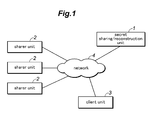
- FIG. 1 is a block diagram of a secret sharing system given as a first embodiment of the present invention.
- the secret sharing system comprises a secret sharing/reconstruction unit 1 for executing a secret sharing (secret reconstruction) process, a plurality of secret sharer units 2 for storing individual shared data parts and a client unit 3 that uses the service of the secret sharing/reconstruction unit 1, which are connected to one another via a network 4 for mutual communication.
- the secret sharing/reconstruction unit 1 consists of a server (computer) incorporated with a program for the secret sharing process which will be described hereinafter, and each secret sharer unit 3 consists of a personal computer (PC).
- the secret sharing/reconstruction unit 1 is configured to perform the sharing and reconstruction of the secret data, but it may also use two separate pieces of hardware for performing the tasks of sharing and reconstructing the secret data, respectively.
- the secret sharing/reconstruction unit 1 upon request from the client unit 3, creates a plurality of shared data parts from the secret data according to a particular secret sharing scheme, and each shared data part is stored in the corresponding sharer unit 2.
- the secret sharing/reconstruction unit 1 is configured to reconstruct the secret data from the shared data upon request from the client unit 3 as mentioned earlier.
- secret data may consist of any data (including not only the data proper but also other data associated with the data proper) which the user desires to be protected (from leaking to a third party), but may not be necessarily confidential to the public.
- the secret sharing system using the secret sharing/reconstruction unit 1 is not limited to that used in the illustrated embodiment, but may be modified in various ways in terms of the structures of the individual components thereof and the arrangement of the individual components. If desired, a single information processing device may be configured to perform all of the functions of the secret sharing system by using a PC and an associated storage unit.
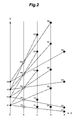
- Figure 2 is a diagram illustrating the process of sharing secret data in the secret sharing system shown in Figure 1
- Figure 3 is a diagram illustrating the process of creating shared data in the process of sharing secret data.
- the remaining shared data parts B and C can be expressed in a similar manner.
- the user can freely select the X values and Y values for the secret data S, and the X values and Y values for the shared data A to C can be freely selected from any fixed numbers or random numbers.
- the lines in the diagram of this example are selected so as not to cross one another by setting S1 ⁇ S2 ⁇ S3 ⁇ S4 and being given with inclinations in an appropriate manner for the convenience of illustration, but may cross one another depending on the relationship between the magnitudes of S1 to S4 and the inclinations of the lines.
- the lines or curves in the diagram are selected so as not to cross one another by setting S1 > S2 > S3 > S4 and setting various values in an appropriate manner for the convenience of illustration, but may cross one another in practice.
- the third party can determine the curves used for the creation of the shared data parts, and can thereby reconstruct the secret data.
- random number data R data for secret sharing computation
- the random number data R consists of five random number data pieces, and is to be used for the creation of the shared data parts A to C jointly with the secret data S as will be described hereinafter.
- the X value for the random number data R is given as a fixed value e.
- the random number data preferably consists of physical random numbers.
- a prescribed mathematical function such as exclusive logical sum
- the combination or association between the secret data and the random number data is not limited to that used in the illustrated embodiment, but may be performed in a number of different ways without departing from the spirit of the present invention. Also, it is not necessary that all of the secret data pieces S 1 to S4 are associated with each of the radon number data pieces R 1 to R5.
- each shared data piece is obtained from a particular combination of a single secret data piece and a single radon number data piece, except for a part of the shared data pieces B1, C1 and C2 which use the values of the random number data pieces as they are.
- each line carries only one piece of the shared data Ai, Bi, Ci.
- some of the pieces of the shared data parts B1, C1 and C2 are derived directly from the random number data R1, R2 without the secret data involving in any way.
- the shared data pieces are created from data pieces for secret sharing computation belonging to different groups of data pieces. Also, the shared data pieces are created from different combinations of data pieces for secret sharing computation.
- each secret data piece S1 to S4 is combined with the corresponding random number data piece R1 to R4 to create the corresponding shared data piece A1 to A4.
- each secret data piece S1 to S4 is combined with the corresponding random number data piece R2 to R5 to create the corresponding shared data piece B2 to B5.
- the first shared data piece B1 is copied from the corresponding random number data piece R1, and the positions of the secret data pieces are shifted by one position with respect to the random number data pieces.
- each secret data piece S1 to S4 is combined with the corresponding random number data piece R3 to R5 to create the corresponding shared data piece C3 to C5.
- the first two shared data pieces C1 and C2 are copied from the corresponding random number data pieces R1 and R2, respectively, and the positions of the secret data pieces are shifted by two positions with respect to the random number data pieces.
- the secret data pieces S 1 to S4 and the random number data pieces R1 to R5 may be combined in different ways from that used in the illustrated embodiment without departing from the spirit of the present invention as long as the selected combination allows the secret data S to be reconstructed.
- the secret data pieces S 1 to S4 may be individual data pieces that are required to be individually protected, but may also consist of pieces of data which are required to be protected as a whole. If desired, part of the secret data pieces may consist of stuffed data or unnecessary data.
- the inclinations ⁇ of the lines in Eq. 1 were given as random numbers, but it is no different from giving one of the shared data parts A to C as random number data.
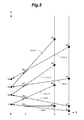
- Figure 4 is a flowchart showing the process of reconstructing the secret data from two of the shared data parts A and B which is shown in Figure 3
- Figure 5 is a diagram illustrating this process.
- steps (1) to (15) are executed in sequence as shown in Figure 4 .
- steps (1) to (15) are executed in sequence as shown in Figure 4 .
- the random number data pieces R1 to R4 and the secret data pieces S 1 to S4 are obtained in a sequential manner.
- the secret sharing/reconstruction unit 1 obtains the random number data piece R1 from the shared data piece B1 of the shared data part B in step (1).
- the knowledge of only one of the shared data parts A and B is not adequate for reconstructing the random number data R, and is therefore not adequate for reconstructing the secret data S.
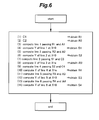
- Figure 6 is a flowchart showing the process of reconstructing the secret data from the two shared data parts A and C shown in Figure 3
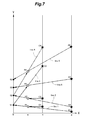
- Figure 7 is a diagram illustrating the process of reconstructing the secret data.
- Figures 6 and 7 are similar to Figures 4 and 5 , respectively, which are based on the shared data parts A and B.
- steps (1) to (14) are executed in sequence as shown in Figure 6 .
- steps (1) to (14) are executed in sequence as shown in Figure 6 .
- the random number data pieces R1 to R4 and the secret data pieces S 1 to S4 are obtained in a sequential manner.
- steps (1) to (14) in Figure 6 are executed in a similar fashion as the corresponding steps in Figure 4 , the details of such steps are omitted in the following description. It should be noted that steps (1), (3), (4), (7), (8), (11) and (12) in Figure 6 starting from the step of acquiring the random number data piece R1 (corresponding to those indicated by solid line arrows in Figure 7 ) can be executed independently from steps (2), (5), (6), (9), (10), (13) and (14) in Figure 6 starting from the step of acquiring the random number data piece R2 (corresponding to those indicated by broken line arrows in Figure 7 ).
- Figure 8 is a flowchart showing the process of reconstructing the secret data from two of the shared data parts B and C which is shown in Figure 3
- Figure 9 is a diagram illustrating this process.
- Figures 8 and 9 are similar to Figures 4 and 5 , respectively, which are based on the shared data parts A and B.
- steps (1) to (15) shown in Figure 8 are executed in a sequence. Thereby, the random number data pieces R1 to R5 and the secret data pieces A1 to S4 can be obtained in a sequential manner.
- steps (1) to (15) shown in Figure 8 are similar to those shown in Figure 4 and Figure 6 , the details of such steps are omitted in the following description.
- the secret sharing/reconstruction unit 1 has created a plurality of pairs (three pairs in the illustrated embodiment) of shared data parts.
- k threshold value
- the secret data can be reconstructed by using (k - 1) (one in the illustrated embodiment) pair of random number data parts (data parts for secret sharing computation).
- k - 1 one in the illustrated embodiment
- Figure 10 shows a diagram illustrating a method of creating shared data parts which is modified from that of the first embodiment. Random number data was used as data for secret sharing computation in the foregoing embodiment, but, in the modified embodiment given in the following, any data other than random number data can be used as the data for secret sharing computation as long as this data is not known to a third party.
- the secret data piece S4 is used in place of one of the random number data piece R3 which was used in the example shown in Figure 2 .
- an advantage can be gained in reducing the data volume of the shared data parts A to C. This can be considered as a ramp secret sharing scheme.
- the data that is to replace a part or all of the random number data pieces is not required to be a secret data piece but may consist of a data piece obtained by converting or modifying a part of the secret data in such a manner that the secret data can be reconstructed as required.
- FIG 11 shows a more detailed functional block diagram of the secret sharing/reconstruction unit 1 shown in Figure 1 .
- the secret sharing/reconstruction unit 1 comprises a network communication control unit 11 consisting of a communication module for transmitting and receiving commands and data on secret sharing to and from the client unit 3 via the network 4 (see Figure 1 ), a secret sharing process receiving unit 12 for receiving a request for the secret sharing of the secret data S from the client unit 3, a secret sharing processing unit (shared data creating unit) 13 for executing the secret sharing process for the secret data S according to a prescribed secret sharing scheme, an ID generating unit 14 for generating IDs for identifying the shared data parts A to C created by the secret sharing processing unit 13, a random number generating unit 15 for generating the random number data R used for creating the shared data parts A to C, a shared data storage unit (secret data storage unit) 16 consisting of memory for storing data on the secret sharing process, a reconstruction process receiving unit 21 for receiving a request for reconstructing the secret data S from the client unit 3, a reconstruction processing unit 22 for
- the secret sharing/reconstruction unit 1 includes various per se known pieces of hardware such as a CPU responsible for the overall control of the secret sharing/reconstruction unit 1, RAM serving as work memory and a HDD or other storage device for storing the computer program for the secret sharing process and the secret reconstructing process.
- a CPU responsible for the overall control of the secret sharing/reconstruction unit 1
- RAM serving as work memory
- a HDD or other storage device for storing the computer program for the secret sharing process and the secret reconstructing process.
- the functions of the secret sharing process receiving unit 12, the secret sharing processing unit 13, the reconstruction process receiving unit 22 and the reconstructing data storage unit 23 may be performed by the CPU which operates under the computer program for the secret sharing process (as a software process). However, a part of the functions of these components may also be executed by dedicated hardware.
- the shared data storage unit 16 and the reconstructing data storage unit 23 may consist of not only non-volatile memory but also volatile memory such as RAM.
- the mode of operation of the secret sharing/reconstruction unit 1 shown in Figure 11 in performing the secret sharing process is described in the following.
- the secret sharing process receiving unit 12 Upon receiving a request for a secret sharing process from the client unit 3, the secret sharing process receiving unit 12 sends out corresponding secret sharing condition information and address information a1 to a4 (which may be acquired along with the request or created by the secret sharing process receiving unit 12 upon receiving the request) to the secret sharing processing unit 13.
- the secret sharing condition information may include information required for the secret sharing processing unit 13 to perform the secret sharing process such as the number participants n (3, in the illustrated embodiment) and the threshold value k (2, in the illustrated embodiment).
- the address information a1 consists of information on the location where the secret data S to be shared is stored (the address information of the shared data storage unit 16 in the illustrated embodiment), and the address information a2 to a4 consists of information on the locations where the shared data parts A to C created for the secret sharing are going to be stored (the address information of the shared data storage unit 16 in the illustrated embodiment).
- the secret data S that is to be shared is stored in the shared data storage unit 16 in advance.
- the secret data S is received in advance from the client unit 3, but may also be acquired from a portable storage medium such as USB memory, or may be created by the secret sharing/reconstruction unit 1.
- the secret sharing processing unit 13 Upon receiving the secret sharing condition information from the secret sharing process receiving unit 12, the secret sharing processing unit 13 executes the secret sharing process discussed above according to the received secret sharing condition information. At that time, the secret data S read out from the shared data storage unit 16 according to the address information a1 and the random number data part R generated by the random number generating unit 15 are used for the secret sharing process.
- Each of the shared data parts A to C is assigned with an ID generated by the ID generating unit 14 as header information thereof.
- the IDs for identifying the shared data parts A to C may consist of fixed numbers or random numbers.
- the shared data parts A to C are stored in the shared data storage unit 16 according to the address information a2 to a4.
- the shared data parts A to C stored in the shared data storage unit 16 are separated from one another, and individually transmitted to the different sharer units 2 (see Figure 1 ).
- the secret sharing processing unit 13 may also use other prescribed data (kept secret from the third party) entered by a user or the secret data itself, instead of the random number data R generated by the random number generating unit 15.
- the locations for storing the shared data parts A to C are not limited to the sharer units 2, but may also be kept stored in the shared data storage unit 16.
- the reconstruction process receiving unit 21 Upon receiving a request for a reconstruction process from the client unit 3, the reconstruction process receiving unit 21 sends out address information b1 to b4 (which may be acquired along with the request or created by the reconstruction process receiving unit 21 upon receiving the request) to the reconstruction processing unit 22.
- the address information b1 to b3 consists of information on the locations for storing the shared data parts A to C on which the reconstruction process will be based (the address information of the reconstructing data storage unit 23 in the illustrated embodiment), and the address information b4 consists of information on the location for storing the secret data S which will be reconstructed by the secret reconstructing process (the address information of the reconstructing data storage unit 23 in the illustrated embodiment).
- the shared data parts A to C that are to be used for the secret reconstructing process are either received from a storage device (such as the sharer units 2) or stored in the reconstructing data storage unit 23 in advance.
- a storage device such as the sharer units 2
- the reconstructing data storage unit 23 in advance.
- all of the shared data parts A to C are stored in the reconstructing data storage unit 23, but it suffices if a same number of shared data parts as the threshold value or more are stored in the reconstructing data storage unit 23.
- the reconstruction processing unit 22 Upon receiving the address information b2 to b4 from the reconstruction process receiving unit 21, at least a number (k) of shared data parts that are required to reconstruct the secret data S are read out from the reconstructing data storage unit 23 according to the information received from the reconstruction process receiving unit 21. At this time, the reconstruction processing unit 22 is allowed to determine if each of the read out shared data parts is suitable for use from the header information (ID) thereof. Then, the reconstruction processing unit 22 executes the secret reconstructing process discussed above. The reconstructed secret data S is stored in the reconstructing data storage unit 23 at an address corresponding to the address information b4.
- the secret data S stored in the reconstructing data storage unit 23 is transmitted to each client unit 3 as required. Alternatively, upon request from each client unit 3, the secret sharing/reconstruction unit 1 processes the secret data S in an appropriate manner.
- the threshold value and the number of participants for the secret sharing process and the secret data reconstructing process discussed above can be modified as required, and the secret sharing condition information and the address information may be modified in a corresponding manner. It is also possible to have other information processing units perform part of the functions of the secret sharing/reconstruction unit 1 shown in Figure 11 . For instance, the secret sharing process and the secret data reconstructing process may be performed by different information processing units.
- Figure 12 is a diagram illustrating the process of creating shared data parts in the secret sharing process of a second embodiment of the present invention
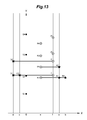
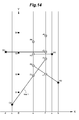
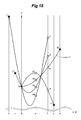
- Figures 13 to 18 are diagrams illustrating the various steps of creating the shared data parts.
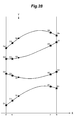
- Figure 28 shows a case where secret data S is shared by four participants as shared data parts A to D in the XY coordinate system.
- the X values of the shared data parts A to D in the XY coordinate system are given by fixed values a to d, respectively.
- the knowledge of a fewer number of shared data parts A to D than the threshold value is not adequate for reconstructing the secret data, but the knowledge of the same number of shared data parts A to D as the threshold value or more allows the secret data to be reconstructed.
- two random number data parts R and r are newly introduced into the secret sharing process.
- the secret sharing process executed by the secret sharing/reconstruction unit 1 the values for the first and second random number data pieces R1 to R7 and r1 to r7 of the first and second random number data parts R and r are determined, and the shared data parts A to D are then created from the first and second random number data parts R and r and the secret data S.
- the shared data part A, B, C, D are each created, as indicated by arrows, from the first and second random number data parts (given in the first and third rows, respectively) and the secret data S (given in the second line).
- the shared data pieces are created from data pieces for secret sharing computation belonging to different groups of data pieces. Also, the shared data pieces are created from different combinations of data pieces for secret sharing computation.
- the shared data pieces are located on different curves (quadratic curves), or, in other words, only one of the shared data pieces is located on each curve.
- quadrattic curves quadrattic curves
- each curve contains only one shared data piece belonging to any shared data part A, B, C or D.
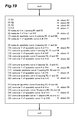
- Figure 19 is a flowchart showing the process of reconstructing the secret data from three of the shared data parts A, B and C in the second embodiment of the present invention.
- steps (1) to (26) shown in Figure 19 are executed in a sequence. More specifically, the secret sharing/reconstruction unit 1 obtains the random number data pieces R1, R2, R3 and r1 by reversing the process of creating the shared data parts shown in Figures 13 and 14 in steps (1) to (4).
- the reconstruction can be executed in a similar manner as the process based on the shared data parts A, B and C discussed above. It is also possible to use higher values for the threshold value k by using curves of higher orders and introducing (k -1) random number data parts similarly as in the first and second embodiments. Also, the number of participants n can be increased at will by suitably changing the combination of the secret data and the random number data parts (data for secret sharing computation).
- the shared data parts were created from the secret data and the random number data by using the properties of curves of a prescribed order (or lines), but the present invention is not limited by such embodiments.
- the shared data can be created by using any suitable mathematical function (shared data creating mathematical function) using the secret data and the random number data as variables thereof.
- a process based on the use of certain shared data creating mathematical functions is described in the following.
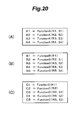
- Figure 20 is a diagram listing the shared data creating mathematical functions that are used for the secret sharing process of a third embodiment of the present invention.
- some of the parts corresponding to or similar to those of the first and second embodiments are omitted from the following description of the third embodiment.
- each shared data piece is generated from combination of a single secret data piece and a single random number data piece of each prescribed random number data part.
- some of the shared data pieces such as B1, C1 and C2 are each obtained by applying a mathematical function solely on random number data pieces R1 and R2.
- a secret sharing process based on the threshold scheme with a threshold value k and a number of participants n can be accomplished by preparing a set of data consisting of n shared data parts X and (k - 1) random number data parts (data for secret sharing computation) or a set of data with a threshold value k and a number of participants n, and dropping out the information on the (k - 1) random number data parts (data for secret sharing computation) from this data set to generate n shared data parts therefrom. Therefore, the secret sharing process of the present invention does not suffer from such problems, and can freely use mathematical functions in general which are suitable for rapid computation.
- each shared data part can be computed independently from the other shared data parts. For instance, when computing S3 by taking XOR (exclusive logical sum) of "A3 and R3" in Figure 2 , XOR of "S3 and R3" may be obtained as A3. This does not affect the properties of "S2 and B3" and "S1 and C3" that pass through R3.
- Any mathematical function can be used for the shared data creating mathematical functions FunctionA to FunctionC, but those suitable for rapid computation such as XOR (exclusive logical sum) or mathematical functions based on multiplication/division in a residual field (for instance, the shared data may be created by multiplication in a residual field, and the secret data may be reconstructed by division in the residual field) are preferred.
- the shared data creating mathematical functions FunctionA to FunctionC can be different from one another.
- the shared data creating mathematical functions FunctionA to FunctionC can be different from one another.
- the shared data creating mathematical functions FunctionA to FunctionC can be different from one another.
- Figure 21 is a diagram showing the method of creating shared data in the secret sharing process of the third embodiment.
- Figure 21 which is similar to Figure 3 for the first embodiment, illustrates the process of creating shared data parts A, B and C.
- XOR exclusive logical sum
- FunctionA for creating shared data pieces A1 to A4 (the symbol " ⁇ " in (A) of Figure 21 denoting XOR).
- FunctionB multiplication in a Galois field
- the shared data piece B2 is created as a residue obtained by dividing the product of the random number data piece R2 and the secret data piece S 1 with a prime number P.
- FunctionC for creating shared data pieces C3 to C5.
- the shared data piece C3 is created as a residue obtained by dividing the sum of the random number data piece R3 and the secret data piece S1 with a prime number P.
- the shared data pieces are created from data pieces for secret sharing computation belonging to different groups of data pieces. Also, the shared data pieces are created from different combinations of data pieces for secret sharing computation.
- each shared data part is created by a different shared data creating mathematical function, but it is also possible to create each shared data piece belonging to a same shared data part by using a different shared data creating mathematical function.
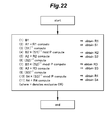
- Figure 22 is a flowchart showing the process of reconstructing the secret data from two of the shared data parts A and B in the secret sharing/reconstruction unit 1 of the third embodiment.
- steps (1) to (11) shown in Figure 22 are executed in sequence.
- the shared data part A is put through a reconstruction process by using XOR (exclusive logical sum) similarly as in the creation process thereof.
- the shared data part B is put through a reconstruction process by using division in a Galois field.
- this division is equivalent to multiplication of the inverse element, the inverse element of the original data piece (for instance, the inverse element of the secret data piece S1 is indicated by S1 -1 in Figure 22 ) is computed, and used for the multiplication in the Galois field.
- the reverse element can be obtained by using the Euclidean algorithm.
- the secret sharing/reconstruction unit 1 obtains the random number data piece R1 directly from the shared data piece B1 of the shared data part B in step (1).
- the secret data piece S1 is obtained by the XOR of the random number data piece R1 and the shared data piece A1 in step (2).
- the inverse element S1 -1 of the secret data piece S1 is obtained in step (3), and the random number data piece R2 is obtained by computing B2 x S1 -1 mod P in step (4).
- the secret data piece S2 is obtained by the XOR of the random number data piece R2 and the shared data piece A2 in step (5).
- the inverse element S2 -1 of the secret data piece S2 is obtained in step (6), and the random number data piece R3 is obtained by computing B3 x S2 -1 mod P in step (7).
- the secret data piece S3 is obtained by the XOR of the random number data piece R3 and the shared data piece A3 in step (8).
- the inverse element S3 -1 of the secret data piece S3 is obtained in step (9), and the random number data piece R4 is obtained by computing B4 x S3 -1 mod P in step (10).
- the secret data piece S4 is obtained by the XOR of the random number data piece R4 and the shared data piece A4 in step (11).
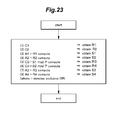
- Figure 23 is a flowchart showing the process of reconstructing the secret data from two of the shared data parts A and C in the secret sharing/reconstruction unit 1 of the third embodiment.
- steps (1) to (8) shown in Figure 23 are executed in sequence.
- the shared data part A and the associated random number data part R are put through a reconstruction process by using XOR (exclusive logical sum) similarly as in the creation process thereof.
- the shared data part C and the associated random number data part R are put through a reconstruction process by using subtraction in a Galois field. If the result of the subtraction is negative, a prime number is added thereto to make it positive.
- the secret sharing/reconstruction unit 1 obtains the random number data pieces R1 and R2 directly from the shared data pieces C1 and C2 of the shared data part C in steps (1) and (2).
- the secret data piece S1 is obtained by the XOR of the random number data piece R1 and the shared data piece A1 in step (3).
- the secret data piece S2 is obtained by the XOR of the random number data piece R2 and the shared data piece A2 in step (4).
- the random number data piece R3 is obtained by computing C3 - S1 mod P in step (5).
- the random number data piece R4 is obtained by computing C4 - S2 mod P in step (6).
- the secret data piece S3 is obtained by the XOR of the random number data piece R3 and the shared data piece A3 in step (7).
- the secret data piece S4 is obtained by the XOR of the random number data piece R4 and the shared data piece A4 in step (8).
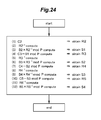
- Figure 24 is a flowchart showing the process of reconstructing the secret data from two of the shared data parts B and C in the secret sharing/reconstruction unit 1 of the third embodiment.
- steps (1) to (12) shown in Figure 24 are executed in sequence. More specifically, as shown in Figure 24 , the secret sharing/reconstruction unit 1 obtains the random number data piece R2 directly from the shared data piece C2 of the shared data part C in step (1).
- the inverse element R2 -1 of the obtained shared data piece R2 is obtained from the shared data piece C2 of the shared data part C in step (2), and the secret data piece S1 is obtained by computing B2 x R2 -1 mod P in step (3).
- the random number data piece R3 is obtained by computing C3 - S1 mod P in step (4).
- the inverse element R3 -1 of the obtained shared data piece R3 is obtained in step (5), and the secret data piece S2 is obtained by computing B3 x R3 -1 mod P in step (6).
- the random number data piece R4 is obtained by computing C4 - S2 mod P in step (7).
- the inverse element R4 -1 of the obtained shared data piece R4 is obtained in step (8), and the secret data piece S3 is obtained by computing B4 x R4 -1 mod P in step (9).
- the random number data piece R5 is obtained by computing C5 - S3 mod P in step (10).
- the inverse element R5 -1 of the obtained shared data piece R5 is obtained in step (11), and, finally, the secret data piece S4 is obtained by computing B5 x R5 -1 mod P in step (12).
- Figures 25 and 26 are diagrams illustrating the process of creating shared data and the process reconstructing the secret data given as a modification of the third embodiment.
- the shared data creating mathematical functions are not limited to regular mathematical functions discussed above, but may also consist of reference tables such as those shown in the following.
- each output value can be obtained by designating a particular row (1 to FFH) and a particular column (1 to FFH) of the reference table.
- H denotes a hexadecimal number. For instance, when the secret data piece S1 is 1 and the random number data piece R1 is 1, the shared data piece A1 can be given as the output value of FE03H.
- Figure 26 shows an example of the reference table for reconstructing secret data.
- this reference table by designating each particular row, two output values (the values of S1 and R1 in this example) can be obtained.
- the output values of the secret data piece S1 and the random dumber data piece R1 can be obtained as 1 and 1, respectively. It is also possible to reverse the input values and the output values in Figure 25 so that the table may be used as a reference table for secret data reconstruction.
- the random number data was used in creating the shared data, but it is also possible to create the shared data solely from the secret data.
- shared data pieces are obtained by applying shared data creating mathematical functions to variables such as secret data pieces and random number data pieces. Therefore, any mathematical functions or algorithms selected by the user can be incorporated in the secret sharing process. Therefore, mathematical functions suitable for each application in terms of the level of security and the required computational load can be selected. And, because the selected mathematical functions may not be fixed, and are therefore difficult for a third party to know, even when shared data parts equal to a greater than the threshold value in number may be made available to the third party, the third party may still be prevented from easily reconstructing the secret data.
Landscapes
- Engineering & Computer Science (AREA)
- Computer Security & Cryptography (AREA)
- Computer Networks & Wireless Communication (AREA)
- Signal Processing (AREA)
- Computer Hardware Design (AREA)
- Computing Systems (AREA)
- General Engineering & Computer Science (AREA)
- Storage Device Security (AREA)
Applications Claiming Priority (1)
| Application Number | Priority Date | Filing Date | Title |
|---|---|---|---|
| JP2012185728A JP6008316B2 (ja) | 2012-08-24 | 2012-08-24 | 秘密分散装置および秘密分散プログラム |
Publications (3)
| Publication Number | Publication Date |
|---|---|
| EP2701337A2 true EP2701337A2 (de) | 2014-02-26 |
| EP2701337A3 EP2701337A3 (de) | 2016-03-16 |
| EP2701337B1 EP2701337B1 (de) | 2018-02-21 |
Family
ID=49110982
Family Applications (1)
| Application Number | Title | Priority Date | Filing Date |
|---|---|---|---|
| EP13181324.8A Active EP2701337B1 (de) | 2012-08-24 | 2013-08-22 | Geheimes Verfahren und System für gemeinsame Nutzung |
Country Status (3)
| Country | Link |
|---|---|
| US (1) | US9331984B2 (de) |
| EP (1) | EP2701337B1 (de) |
| JP (1) | JP6008316B2 (de) |
Cited By (3)
| Publication number | Priority date | Publication date | Assignee | Title |
|---|---|---|---|---|
| WO2014192957A1 (ja) * | 2013-05-30 | 2014-12-04 | ケイレックス・テクノロジー株式会社 | 情報分散システム及び情報分散ストレージシステム |
| US11218292B2 (en) * | 2016-09-05 | 2022-01-04 | Multitiv Gmbh | Secure data transmission |
| CN117176335A (zh) * | 2023-07-17 | 2023-12-05 | 北京邮电大学 | 基于联盟链的数据追踪方法及相关设备 |
Families Citing this family (37)
| Publication number | Priority date | Publication date | Assignee | Title |
|---|---|---|---|---|
| EP2858297B1 (de) * | 2012-07-05 | 2017-03-01 | Nippon Telegraph And Telephone Corporation | System zum teilen von geheimnissen, datenverteilungsvorrichtung, vorrichtung zum umwandeln verteilter daten, verfahren zum teilen von geheimnissen und programm |
| US9461821B1 (en) * | 2014-06-30 | 2016-10-04 | Emc Corporation | System and method for key material protection on devices using a secret sharing scheme |
| EP3195522B1 (de) * | 2014-08-01 | 2019-08-21 | National ICT Australia Limited | Erzeugung von anteilen an geheimen daten |
| US9779227B1 (en) * | 2014-10-24 | 2017-10-03 | Amazon Technologies, Inc. | Security system using keys encoded in holograms |
| KR20160063793A (ko) | 2014-11-27 | 2016-06-07 | 삼성전자주식회사 | 전자 장치 및 전자 장치에서의 정보 송신 및 수신 방법 |
| US20180077123A1 (en) * | 2015-03-27 | 2018-03-15 | Nec Solution Innovators, Ltd. | Data management apparatus, data management method and computer readable recording medium |
| US10097522B2 (en) | 2015-05-21 | 2018-10-09 | Nili Philipp | Encrypted query-based access to data |
| JP6034927B1 (ja) * | 2015-07-27 | 2016-11-30 | 日本電信電話株式会社 | 秘密計算システム、秘密計算装置、およびプログラム |
| US9794072B2 (en) * | 2015-11-05 | 2017-10-17 | Redline Communications Inc. | Certificate exchange mechanism for wireless networking |
| US11115196B1 (en) * | 2015-12-08 | 2021-09-07 | EMC IP Holding Company LLC | Methods and apparatus for secret sharing with verifiable reconstruction type |
| JP6799061B2 (ja) * | 2016-02-23 | 2020-12-09 | エヌチェーン ホールディングス リミテッドNchain Holdings Limited | ウォレット管理システムと併せたブロックチェーンベースのシステムのための暗号鍵のセキュアなマルチパーティ損失耐性のある記憶及び転送 |
| KR101846163B1 (ko) * | 2016-06-08 | 2018-04-09 | 조래성 | 공유 정보를 보호하는 방법 및 시스템 |
| AU2018295722B2 (en) * | 2017-07-05 | 2020-11-19 | Ntt, Inc. | Secure computation system, secure computation apparatus, secure computation method, program, and recording medium |
| JP7027060B2 (ja) * | 2017-08-03 | 2022-03-01 | 株式会社日立製作所 | 秘密分散システム及びその方法 |
| US10460234B2 (en) * | 2018-01-19 | 2019-10-29 | Microsoft Technology Licensing, Llc | Private deep neural network training |
| JP6752247B2 (ja) * | 2018-03-09 | 2020-09-09 | 三菱重工業株式会社 | 情報配信装置、配信対象装置、情報配信システム、情報配信方法及びプログラム |
| GB201805633D0 (en) * | 2018-04-05 | 2018-05-23 | Nchain Holdings Ltd | Computer implemented method and system |
| JP7368386B2 (ja) * | 2019-01-11 | 2023-10-24 | パナソニック インテレクチュアル プロパティ コーポレーション オブ アメリカ | 予測モデル変換方法及びシステム |
| JP7356673B2 (ja) * | 2019-02-22 | 2023-10-05 | パナソニックホールディングス株式会社 | クラウドサービスを用いた安全な秘密分散保管システム |
| US10892891B2 (en) * | 2019-03-13 | 2021-01-12 | Digital 14 Llc | System, method, and computer program product for zero round trip secure communications based on two noisy secrets |
| US10951415B2 (en) * | 2019-03-13 | 2021-03-16 | Digital 14 Llc | System, method, and computer program product for implementing zero round trip secure communications based on noisy secrets with a polynomial secret sharing scheme |
| KR102030785B1 (ko) * | 2019-04-26 | 2019-10-10 | 주식회사그린존시큐리티 | 의사난수를 이용한 IoT 디바이스의 데이터 난독화를 위한 장치 및 이를 위한 방법 |
| US11477014B1 (en) | 2019-08-23 | 2022-10-18 | Liberty Mutual Insurance Company | Anonymized data transmission using per-user-functionality secret shares |
| US11018856B2 (en) * | 2019-09-11 | 2021-05-25 | Guardtime Sa | Auditable system and methods for secret sharing |
| US20210126903A1 (en) * | 2019-10-29 | 2021-04-29 | Genetec Inc. | Data access control |
| EP3860035A1 (de) | 2020-01-29 | 2021-08-04 | Sebastien Armleder | Speicherung und bestimmung eines datenelements |
| US11469887B1 (en) | 2020-06-29 | 2022-10-11 | Amazon Technologies, Inc. | Remote hardware execution service with customer consented debugging |
| US11316673B2 (en) | 2020-09-11 | 2022-04-26 | Seagate Technology Llc | Privacy preserving secret sharing from novel combinatorial objects |
| US11362816B2 (en) | 2020-09-11 | 2022-06-14 | Seagate Technology Llc | Layered secret sharing with flexible access structures |
| US20220271933A1 (en) * | 2021-02-19 | 2022-08-25 | Samsung Electronics Co., Ltd. | System and method for device to device secret backup and recovery |
| RU2758481C1 (ru) * | 2021-04-01 | 2021-10-28 | Общество с ограниченной ответственностью «УБИК» | Компьютерно-реализуемый способ суммирования данных об объектах, с использованием методов совместных конфиденциальных вычислений и методов разделения секрета |
| US11907392B2 (en) * | 2021-05-12 | 2024-02-20 | Seagate Technology Llc | System and method utilizing function secret sharing with conditional disclosure of secrets |
| US12316752B2 (en) * | 2021-09-30 | 2025-05-27 | Seagate Technology Llc | Polynomial function secret sharing |
| CN116501694A (zh) * | 2022-01-21 | 2023-07-28 | 戴尔产品有限公司 | 数据存储方法、数据读取方法、电子设备和程序产品 |
| US20240421983A1 (en) * | 2023-06-16 | 2024-12-19 | Seagate Technology Llc | Evolving threshold function secret sharing |
| CN118677609A (zh) * | 2024-07-01 | 2024-09-20 | 西安电子科技大学 | 一种基于门限密钥共享与椭圆加密的委托权益共识方法 |
| US20260067070A1 (en) * | 2024-09-04 | 2026-03-05 | Seagate Technology Llc | Verifiable polynomial function secret sharing |
Citations (1)
| Publication number | Priority date | Publication date | Assignee | Title |
|---|---|---|---|---|
| JP2007124032A (ja) | 2005-10-25 | 2007-05-17 | Toshiba Corp | 秘密分散装置、方法及びプログラム |
Family Cites Families (18)
| Publication number | Priority date | Publication date | Assignee | Title |
|---|---|---|---|---|
| JPH1152851A (ja) * | 1997-07-31 | 1999-02-26 | Nippon Telegr & Teleph Corp <Ntt> | 楕円曲線上の群演算装置 |
| US20040047472A1 (en) * | 2001-09-24 | 2004-03-11 | Eskicioglu Ahmet Mursit | Threshold cryptography scheme for conditional access systems |
| JP4292835B2 (ja) * | 2003-03-13 | 2009-07-08 | 沖電気工業株式会社 | 秘密再構成方法、分散秘密再構成装置、及び秘密再構成システム |
| WO2005076518A1 (en) * | 2004-02-10 | 2005-08-18 | Ntt Communications Corporation | Secret information management scheme based on secret sharing scheme |
| US7945784B1 (en) * | 2005-08-19 | 2011-05-17 | Adobe Systems Incorporated | Method and system to perform secret sharing |
| JP2007124610A (ja) * | 2005-09-20 | 2007-05-17 | Nippon Telegr & Teleph Corp <Ntt> | 秘密情報分散装置及び秘密情報復元装置及び方法及びプログラム |
| JP4881119B2 (ja) * | 2006-09-29 | 2012-02-22 | 株式会社東芝 | ユーザ認証方法、ユーザ側認証装置、および、プログラム |
| JP4917453B2 (ja) * | 2007-02-22 | 2012-04-18 | Kddi株式会社 | 閾値秘密分散装置、閾値秘密分散方法、秘密情報復元方法およびプログラム |
| JP4304215B2 (ja) * | 2007-03-23 | 2009-07-29 | 株式会社東芝 | 秘密分散装置、方法及びプログラム |
| JP4334582B2 (ja) * | 2007-06-26 | 2009-09-30 | 株式会社東芝 | 秘密分散装置、方法及びプログラム |
| JP5299286B2 (ja) * | 2007-12-12 | 2013-09-25 | 日本電気株式会社 | 分散情報生成装置、復元装置、検証装置及び秘密情報分散システム |
| JP5378702B2 (ja) | 2008-04-23 | 2013-12-25 | パナソニック株式会社 | 秘匿認証システム |
| JP2009272671A (ja) | 2008-04-30 | 2009-11-19 | Panasonic Corp | 秘匿認証システム |
| JP2009272737A (ja) | 2008-05-01 | 2009-11-19 | Panasonic Corp | 秘匿認証システム |
| JP2009278223A (ja) | 2008-05-13 | 2009-11-26 | Panasonic Corp | 電子証明システム及び秘匿通信システム |
| JP2009296190A (ja) | 2008-06-04 | 2009-12-17 | Panasonic Corp | 秘匿通信方法 |
| US20100046740A1 (en) * | 2008-08-22 | 2010-02-25 | Schneider James P | Embedding a secret in a larger polynomial |
| JP5433297B2 (ja) * | 2009-05-14 | 2014-03-05 | Kddi株式会社 | 分散情報生成装置、秘密情報復元装置、分散情報生成方法、秘密情報復元方法およびプログラム |
-
2012
- 2012-08-24 JP JP2012185728A patent/JP6008316B2/ja active Active
-
2013
- 2013-08-22 US US13/973,232 patent/US9331984B2/en active Active
- 2013-08-22 EP EP13181324.8A patent/EP2701337B1/de active Active
Patent Citations (1)
| Publication number | Priority date | Publication date | Assignee | Title |
|---|---|---|---|---|
| JP2007124032A (ja) | 2005-10-25 | 2007-05-17 | Toshiba Corp | 秘密分散装置、方法及びプログラム |
Non-Patent Citations (1)
| Title |
|---|
| A. SHAMIR: "How to Share a Secret", COMMUNICATIONS OF THE ACM, vol. 22, no. 11, November 1979 (1979-11-01), XP002241399, DOI: doi:10.1145/359168.359176 |
Cited By (5)
| Publication number | Priority date | Publication date | Assignee | Title |
|---|---|---|---|---|
| WO2014192957A1 (ja) * | 2013-05-30 | 2014-12-04 | ケイレックス・テクノロジー株式会社 | 情報分散システム及び情報分散ストレージシステム |
| JP2014235425A (ja) * | 2013-05-30 | 2014-12-15 | ケイレックス・テクノロジー株式会社 | 情報分散システム及び情報分散ストレージシステム |
| US11218292B2 (en) * | 2016-09-05 | 2022-01-04 | Multitiv Gmbh | Secure data transmission |
| CN117176335A (zh) * | 2023-07-17 | 2023-12-05 | 北京邮电大学 | 基于联盟链的数据追踪方法及相关设备 |
| CN117176335B (zh) * | 2023-07-17 | 2024-03-15 | 北京邮电大学 | 基于联盟链的数据追踪方法及相关设备 |
Also Published As
| Publication number | Publication date |
|---|---|
| US20140173270A1 (en) | 2014-06-19 |
| JP2014044264A (ja) | 2014-03-13 |
| EP2701337A3 (de) | 2016-03-16 |
| EP2701337B1 (de) | 2018-02-21 |
| JP6008316B2 (ja) | 2016-10-19 |
| US9331984B2 (en) | 2016-05-03 |
Similar Documents
| Publication | Publication Date | Title |
|---|---|---|
| US9331984B2 (en) | Secret sharing method and system | |
| US9515828B2 (en) | Sharing a secret via linear interpolation | |
| JP7328237B2 (ja) | コンピュータにより実施される投票処理およびシステム | |
| US20190356666A1 (en) | Generating Cryptographic Function Parameters From Compact Source Code | |
| US8077863B2 (en) | Secret sharing apparatus, method, and program | |
| Hu et al. | Batch image encryption using generated deep features based on stacked autoencoder network | |
| US10361844B2 (en) | Generating cryptographic function parameters based on an observed astronomical event | |
| JP2004523183A (ja) | データ、情報および機能変換のカモフラージュのための方法および装置 | |
| CN113849828B (zh) | 经处理的数据的匿名生成和证明 | |
| JP2023529690A (ja) | 同型暗号文に対する統計演算を行う装置及び方法 | |
| US20170063535A1 (en) | Generating Cryptographic Function Parameters From a Puzzle | |
| CN114726514A (zh) | 数据的处理方法和装置 | |
| CN113726975B (zh) | 基于混沌系统的图像加密方法、装置、介质及电子设备 | |
| Zhang et al. | Secure outsourcing evaluation for sparse decision trees | |
| Sophia et al. | Secure storage of lung brain multi-modal medical images using DNA homomorphic encryption | |
| US20230085239A1 (en) | Querying fully homomorphic encryption encrypted databases using client-side preprocessing or post-processing | |
| JP7259875B2 (ja) | 情報処理装置、秘密計算方法及びプログラム | |
| US12113890B2 (en) | Homomorphic encryption using smart contracts | |
| US11343070B2 (en) | System and method for performing a fully homomorphic encryption on a plain text | |
| US8364958B2 (en) | Sharing a secret via linear interpolation | |
| CN117494156A (zh) | 基于双重加密的多服务器矩阵乘法可验证计算实现方法及系统 | |
| KR102337865B1 (ko) | 동형 암호에 기초한 산술 연산 시스템 및 이를 이용한 동형 암호 산술 연산 방법 | |
| CN116861477A (zh) | 基于隐私保护的数据处理方法、系统、终端及存储介质 | |
| CN115221503A (zh) | 购保额度的加解密方法、装置、设备及存储介质 | |
| CN114091089A (zh) | 数据处理方法、装置、系统及计算机可读存储介质 |
Legal Events
| Date | Code | Title | Description |
|---|---|---|---|
| PUAI | Public reference made under article 153(3) epc to a published international application that has entered the european phase |
Free format text: ORIGINAL CODE: 0009012 |
|
| AK | Designated contracting states |
Kind code of ref document: A2 Designated state(s): AL AT BE BG CH CY CZ DE DK EE ES FI FR GB GR HR HU IE IS IT LI LT LU LV MC MK MT NL NO PL PT RO RS SE SI SK SM TR |
|
| AX | Request for extension of the european patent |
Extension state: BA ME |
|
| PUAL | Search report despatched |
Free format text: ORIGINAL CODE: 0009013 |
|
| AK | Designated contracting states |
Kind code of ref document: A3 Designated state(s): AL AT BE BG CH CY CZ DE DK EE ES FI FR GB GR HR HU IE IS IT LI LT LU LV MC MK MT NL NO PL PT RO RS SE SI SK SM TR |
|
| AX | Request for extension of the european patent |
Extension state: BA ME |
|
| RIC1 | Information provided on ipc code assigned before grant |
Ipc: H04L 29/06 20060101ALI20160209BHEP Ipc: H04L 9/08 20060101AFI20160209BHEP |
|
| 17P | Request for examination filed |
Effective date: 20160916 |
|
| RBV | Designated contracting states (corrected) |
Designated state(s): AL AT BE BG CH CY CZ DE DK EE ES FI FR GB GR HR HU IE IS IT LI LT LU LV MC MK MT NL NO PL PT RO RS SE SI SK SM TR |
|
| RIC1 | Information provided on ipc code assigned before grant |
Ipc: H04L 9/08 20060101AFI20170803BHEP Ipc: H04L 29/06 20060101ALI20170803BHEP |
|
| GRAP | Despatch of communication of intention to grant a patent |
Free format text: ORIGINAL CODE: EPIDOSNIGR1 |
|
| STAA | Information on the status of an ep patent application or granted ep patent |
Free format text: STATUS: GRANT OF PATENT IS INTENDED |
|
| INTG | Intention to grant announced |
Effective date: 20170908 |
|
| GRAS | Grant fee paid |
Free format text: ORIGINAL CODE: EPIDOSNIGR3 |
|
| GRAA | (expected) grant |
Free format text: ORIGINAL CODE: 0009210 |
|
| STAA | Information on the status of an ep patent application or granted ep patent |
Free format text: STATUS: THE PATENT HAS BEEN GRANTED |
|
| AK | Designated contracting states |
Kind code of ref document: B1 Designated state(s): AL AT BE BG CH CY CZ DE DK EE ES FI FR GB GR HR HU IE IS IT LI LT LU LV MC MK MT NL NO PL PT RO RS SE SI SK SM TR |
|
| REG | Reference to a national code |
Ref country code: GB Ref legal event code: FG4D |
|
| REG | Reference to a national code |
Ref country code: CH Ref legal event code: EP |
|
| REG | Reference to a national code |
Ref country code: AT Ref legal event code: REF Ref document number: 972826 Country of ref document: AT Kind code of ref document: T Effective date: 20180315 |
|
| REG | Reference to a national code |
Ref country code: IE Ref legal event code: FG4D |
|
| REG | Reference to a national code |
Ref country code: DE Ref legal event code: R096 Ref document number: 602013033267 Country of ref document: DE |
|
| REG | Reference to a national code |
Ref country code: NL Ref legal event code: MP Effective date: 20180221 |
|
| REG | Reference to a national code |
Ref country code: LT Ref legal event code: MG4D |
|
| REG | Reference to a national code |
Ref country code: AT Ref legal event code: MK05 Ref document number: 972826 Country of ref document: AT Kind code of ref document: T Effective date: 20180221 |
|
| PG25 | Lapsed in a contracting state [announced via postgrant information from national office to epo] |
Ref country code: ES Free format text: LAPSE BECAUSE OF FAILURE TO SUBMIT A TRANSLATION OF THE DESCRIPTION OR TO PAY THE FEE WITHIN THE PRESCRIBED TIME-LIMIT Effective date: 20180221 Ref country code: FI Free format text: LAPSE BECAUSE OF FAILURE TO SUBMIT A TRANSLATION OF THE DESCRIPTION OR TO PAY THE FEE WITHIN THE PRESCRIBED TIME-LIMIT Effective date: 20180221 Ref country code: CY Free format text: LAPSE BECAUSE OF FAILURE TO SUBMIT A TRANSLATION OF THE DESCRIPTION OR TO PAY THE FEE WITHIN THE PRESCRIBED TIME-LIMIT Effective date: 20180221 Ref country code: NO Free format text: LAPSE BECAUSE OF FAILURE TO SUBMIT A TRANSLATION OF THE DESCRIPTION OR TO PAY THE FEE WITHIN THE PRESCRIBED TIME-LIMIT Effective date: 20180521 Ref country code: HR Free format text: LAPSE BECAUSE OF FAILURE TO SUBMIT A TRANSLATION OF THE DESCRIPTION OR TO PAY THE FEE WITHIN THE PRESCRIBED TIME-LIMIT Effective date: 20180221 Ref country code: NL Free format text: LAPSE BECAUSE OF FAILURE TO SUBMIT A TRANSLATION OF THE DESCRIPTION OR TO PAY THE FEE WITHIN THE PRESCRIBED TIME-LIMIT Effective date: 20180221 Ref country code: LT Free format text: LAPSE BECAUSE OF FAILURE TO SUBMIT A TRANSLATION OF THE DESCRIPTION OR TO PAY THE FEE WITHIN THE PRESCRIBED TIME-LIMIT Effective date: 20180221 |
|
| PG25 | Lapsed in a contracting state [announced via postgrant information from national office to epo] |
Ref country code: LV Free format text: LAPSE BECAUSE OF FAILURE TO SUBMIT A TRANSLATION OF THE DESCRIPTION OR TO PAY THE FEE WITHIN THE PRESCRIBED TIME-LIMIT Effective date: 20180221 Ref country code: AT Free format text: LAPSE BECAUSE OF FAILURE TO SUBMIT A TRANSLATION OF THE DESCRIPTION OR TO PAY THE FEE WITHIN THE PRESCRIBED TIME-LIMIT Effective date: 20180221 Ref country code: SE Free format text: LAPSE BECAUSE OF FAILURE TO SUBMIT A TRANSLATION OF THE DESCRIPTION OR TO PAY THE FEE WITHIN THE PRESCRIBED TIME-LIMIT Effective date: 20180221 Ref country code: BG Free format text: LAPSE BECAUSE OF FAILURE TO SUBMIT A TRANSLATION OF THE DESCRIPTION OR TO PAY THE FEE WITHIN THE PRESCRIBED TIME-LIMIT Effective date: 20180521 Ref country code: RS Free format text: LAPSE BECAUSE OF FAILURE TO SUBMIT A TRANSLATION OF THE DESCRIPTION OR TO PAY THE FEE WITHIN THE PRESCRIBED TIME-LIMIT Effective date: 20180221 Ref country code: GR Free format text: LAPSE BECAUSE OF FAILURE TO SUBMIT A TRANSLATION OF THE DESCRIPTION OR TO PAY THE FEE WITHIN THE PRESCRIBED TIME-LIMIT Effective date: 20180522 |
|
| PG25 | Lapsed in a contracting state [announced via postgrant information from national office to epo] |
Ref country code: RO Free format text: LAPSE BECAUSE OF FAILURE TO SUBMIT A TRANSLATION OF THE DESCRIPTION OR TO PAY THE FEE WITHIN THE PRESCRIBED TIME-LIMIT Effective date: 20180221 Ref country code: IT Free format text: LAPSE BECAUSE OF FAILURE TO SUBMIT A TRANSLATION OF THE DESCRIPTION OR TO PAY THE FEE WITHIN THE PRESCRIBED TIME-LIMIT Effective date: 20180221 Ref country code: EE Free format text: LAPSE BECAUSE OF FAILURE TO SUBMIT A TRANSLATION OF THE DESCRIPTION OR TO PAY THE FEE WITHIN THE PRESCRIBED TIME-LIMIT Effective date: 20180221 Ref country code: PL Free format text: LAPSE BECAUSE OF FAILURE TO SUBMIT A TRANSLATION OF THE DESCRIPTION OR TO PAY THE FEE WITHIN THE PRESCRIBED TIME-LIMIT Effective date: 20180221 Ref country code: AL Free format text: LAPSE BECAUSE OF FAILURE TO SUBMIT A TRANSLATION OF THE DESCRIPTION OR TO PAY THE FEE WITHIN THE PRESCRIBED TIME-LIMIT Effective date: 20180221 |
|
| REG | Reference to a national code |
Ref country code: DE Ref legal event code: R097 Ref document number: 602013033267 Country of ref document: DE |
|
| PG25 | Lapsed in a contracting state [announced via postgrant information from national office to epo] |
Ref country code: SM Free format text: LAPSE BECAUSE OF FAILURE TO SUBMIT A TRANSLATION OF THE DESCRIPTION OR TO PAY THE FEE WITHIN THE PRESCRIBED TIME-LIMIT Effective date: 20180221 Ref country code: DK Free format text: LAPSE BECAUSE OF FAILURE TO SUBMIT A TRANSLATION OF THE DESCRIPTION OR TO PAY THE FEE WITHIN THE PRESCRIBED TIME-LIMIT Effective date: 20180221 Ref country code: SK Free format text: LAPSE BECAUSE OF FAILURE TO SUBMIT A TRANSLATION OF THE DESCRIPTION OR TO PAY THE FEE WITHIN THE PRESCRIBED TIME-LIMIT Effective date: 20180221 Ref country code: CZ Free format text: LAPSE BECAUSE OF FAILURE TO SUBMIT A TRANSLATION OF THE DESCRIPTION OR TO PAY THE FEE WITHIN THE PRESCRIBED TIME-LIMIT Effective date: 20180221 |
|
| PLBE | No opposition filed within time limit |
Free format text: ORIGINAL CODE: 0009261 |
|
| STAA | Information on the status of an ep patent application or granted ep patent |
Free format text: STATUS: NO OPPOSITION FILED WITHIN TIME LIMIT |
|
| 26N | No opposition filed |
Effective date: 20181122 |
|
| PG25 | Lapsed in a contracting state [announced via postgrant information from national office to epo] |
Ref country code: SI Free format text: LAPSE BECAUSE OF FAILURE TO SUBMIT A TRANSLATION OF THE DESCRIPTION OR TO PAY THE FEE WITHIN THE PRESCRIBED TIME-LIMIT Effective date: 20180221 |
|
| PG25 | Lapsed in a contracting state [announced via postgrant information from national office to epo] |
Ref country code: MC Free format text: LAPSE BECAUSE OF FAILURE TO SUBMIT A TRANSLATION OF THE DESCRIPTION OR TO PAY THE FEE WITHIN THE PRESCRIBED TIME-LIMIT Effective date: 20180221 |
|
| REG | Reference to a national code |
Ref country code: CH Ref legal event code: PL |
|
| GBPC | Gb: european patent ceased through non-payment of renewal fee |
Effective date: 20180822 |
|
| PG25 | Lapsed in a contracting state [announced via postgrant information from national office to epo] |
Ref country code: LU Free format text: LAPSE BECAUSE OF NON-PAYMENT OF DUE FEES Effective date: 20180822 Ref country code: LI Free format text: LAPSE BECAUSE OF NON-PAYMENT OF DUE FEES Effective date: 20180831 Ref country code: CH Free format text: LAPSE BECAUSE OF NON-PAYMENT OF DUE FEES Effective date: 20180831 |
|
| REG | Reference to a national code |
Ref country code: BE Ref legal event code: MM Effective date: 20180831 |
|
| PG25 | Lapsed in a contracting state [announced via postgrant information from national office to epo] |
Ref country code: BE Free format text: LAPSE BECAUSE OF NON-PAYMENT OF DUE FEES Effective date: 20180831 Ref country code: FR Free format text: LAPSE BECAUSE OF NON-PAYMENT OF DUE FEES Effective date: 20180831 |
|
| PG25 | Lapsed in a contracting state [announced via postgrant information from national office to epo] |
Ref country code: GB Free format text: LAPSE BECAUSE OF NON-PAYMENT OF DUE FEES Effective date: 20180822 |
|
| PG25 | Lapsed in a contracting state [announced via postgrant information from national office to epo] |
Ref country code: MT Free format text: LAPSE BECAUSE OF NON-PAYMENT OF DUE FEES Effective date: 20180822 |
|
| PG25 | Lapsed in a contracting state [announced via postgrant information from national office to epo] |
Ref country code: TR Free format text: LAPSE BECAUSE OF FAILURE TO SUBMIT A TRANSLATION OF THE DESCRIPTION OR TO PAY THE FEE WITHIN THE PRESCRIBED TIME-LIMIT Effective date: 20180221 |
|
| PG25 | Lapsed in a contracting state [announced via postgrant information from national office to epo] |
Ref country code: HU Free format text: LAPSE BECAUSE OF FAILURE TO SUBMIT A TRANSLATION OF THE DESCRIPTION OR TO PAY THE FEE WITHIN THE PRESCRIBED TIME-LIMIT; INVALID AB INITIO Effective date: 20130822 Ref country code: PT Free format text: LAPSE BECAUSE OF FAILURE TO SUBMIT A TRANSLATION OF THE DESCRIPTION OR TO PAY THE FEE WITHIN THE PRESCRIBED TIME-LIMIT Effective date: 20180221 |
|
| PG25 | Lapsed in a contracting state [announced via postgrant information from national office to epo] |
Ref country code: IE Free format text: LAPSE BECAUSE OF NON-PAYMENT OF DUE FEES Effective date: 20180822 Ref country code: MK Free format text: LAPSE BECAUSE OF NON-PAYMENT OF DUE FEES Effective date: 20180221 |
|
| PG25 | Lapsed in a contracting state [announced via postgrant information from national office to epo] |
Ref country code: IS Free format text: LAPSE BECAUSE OF FAILURE TO SUBMIT A TRANSLATION OF THE DESCRIPTION OR TO PAY THE FEE WITHIN THE PRESCRIBED TIME-LIMIT Effective date: 20180621 |
|
| PGFP | Annual fee paid to national office [announced via postgrant information from national office to epo] |
Ref country code: DE Payment date: 20250820 Year of fee payment: 13 |