EP2700516A2 - Anhängekupplung - Google Patents
Anhängekupplung Download PDFInfo
- Publication number
- EP2700516A2 EP2700516A2 EP13179557.7A EP13179557A EP2700516A2 EP 2700516 A2 EP2700516 A2 EP 2700516A2 EP 13179557 A EP13179557 A EP 13179557A EP 2700516 A2 EP2700516 A2 EP 2700516A2
- Authority
- EP
- European Patent Office
- Prior art keywords
- lever
- trailer coupling
- locking pin
- coupling according
- shell
- Prior art date
- Legal status (The legal status is an assumption and is not a legal conclusion. Google has not performed a legal analysis and makes no representation as to the accuracy of the status listed.)
- Granted
Links
Images


Classifications
-
- B—PERFORMING OPERATIONS; TRANSPORTING
- B60—VEHICLES IN GENERAL
- B60D—VEHICLE CONNECTIONS
- B60D1/00—Traction couplings; Hitches; Draw-gear; Towing devices
- B60D1/01—Traction couplings or hitches characterised by their type
- B60D1/06—Ball-and-socket hitches
- B60D1/065—Ball-and-socket hitches characterised by the hitch mechanism
Definitions
- the invention relates to a trailer coupling with the features in the main claim.
- Such a hitch is from the DE 20 2005 011 444 U1 known. It has a clutch housing with an operating lever, a locking pin, a pivotable ball socket and a pivotable locking lever, which forms a Einrastêt and cooperates with the locking pin.
- the invention solves this problem with the features in the main claim.
- the claimed towing hitch has the advantage that thanks to the freely rotatable in the open position and independently of the locking lever and the locking pin spherical shell false locks the trailer hitch can be reliably avoided. When in contact with an obstacle or with a wrongly supplied coupling ball ball shell can escape independently of the safety lever and the locking pin. You can also solve the lock pin trouble-free. The locking lever and the locking bolt remain untouched in their blocking position, so that the towing hitch can not accidentally close and lock. Operating errors when coupling and errors of the operator about the coupling state can be reliably avoided.
- a convex curvature or rounding on the underside of the shell bottom has the advantage of a Einweiser- and guide function in case of incorrect operation with loosely mounted towing hitch and subsequent Gespannfahrt.
- the hitch can be closed automatically and the ball head can be brought into a correct latching position.
- a rear curved contact contour on the spherical shell can on the one hand form a stop for limiting the rotational movement in the open position on the locking bolt, the remaining contour area being distanced from the locking bolt by the rearwardly projecting securing lever and the aforementioned avoidance and rotation of the spherical shell in the opposite direction upon collision with an obstacle or the like allows.
- the ball cup has a defined opening position by the stop and the spring load.
- the safety lever fails, e.g. by breakage or the like., The contact contour with the spring-loaded locking bolt in supporting and the open position locking engagement occur. As a result, the coupling function can be retained.
- the ball socket and the safety lever are mounted coaxially pivotable.
- the ball shell has in one embodiment at the rear end region of one or more upper Zuspann- and Nachstell lake for the system on the locking pin in the closed position. It may also have at the rear end portion an upper locking surface for engagement with the locking pin in part-opening position.
- the safety lever is rod-shaped and arranged in the free space of the spherical shell. He can reach through or over the front wall of the ball shell, which is advantageous, but not mandatory.
- a further embodiment provides that the pivotable operating lever has a lever bearing, driver for the locking pin and a pawl.
- the arrangement of a wear indicator on the operating lever may be advantageous.
- a spring-loaded training of control lever and safety lever may also be provided.
- the invention relates to a trailer coupling (1) for vehicles (not shown), in particular for trailers.
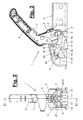
- FIGS. 1 to 13 and 14 to 16 show different coupling variants.
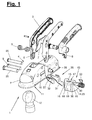
- FIG. 1 Such a hitch (1) and its parts are shown in an exploded perspective view.
- the hitch (1) has a substantially U-shaped coupling housing (2), which is arranged and fixed in a suitable manner on a front-side vehicle part, for example on a rigid drawbar or on the rod of a trailer device of a trailer.
- the trailer parts are not shown for clarity.
- the coupling housing (2) has at the front a downwardly and rearwardly open and in dome-shaped dome shaped receiving opening (11) for a ball head (12) of a trailer hitch on a towing vehicle (not shown).
- the coupling housing (2) can have an opening for the latching indicator (28) explained below in this area on the upper side.
- the clutch housing (2) also has at the top an opening for an operating member (3), in particular a pivotable operating lever or clutch lever. Furthermore, housing openings for a lever bearing (4) of the operating lever (3) and for a subsequently explained storage of a spherical shell (13) and a safety lever (26) are present. In FIG. 1 Here are also the associated and plugged bearing pins (25) shown.
- two longitudinally directed bolt guides (10) for a locking pin (9) are arranged on the side walls of the coupling housing, which are formed for example as elongated holes with parallel axial hole edges.
- the trailer coupling (1) has a ball socket (13), which is arranged to be movable, in particular pivotable, in the coupling housing and at the rear area of the dome-shaped receiving opening (11).
- the ball shell (13) cooperates in the closed position and during the closing process of the trailer coupling (1) with the transversely pushed through locking bolt (9), which in turn is in an actuating connection with the operating lever (3).
- the hitch (1) further comprises a locking lever arranged on the inside (26).
- the safety lever (26) cooperates with the locking pin (9) and blocks it when the trailer coupling (1) is open.
- the hitch (1) can be closed only after solving this blockade.
- the ball socket (13) and the safety lever (26) are pivotally mounted on the clutch housing (2). This is preferably an equiaxial bearing on a common bearing pin (25). A spring (33) acts on the securing lever (26) and possibly the ball socket (13).
- the bearing opening on the lateral housing walls is preferably arranged on the front region of the coupling housing (2) and in front of the bolt guide (10).
- the spherical shell (13) has a front wall (16) with a front concave depression (19) and a driving stop (18) arranged above it.
- closed position of the hitch (1) is the ball head (12) positively received in the housing side receiving opening (11) and in the trough (19), wherein the ball shell (13) in this closed position by the locking pin (9) acted upon and against the ball head ( 12) is tensioned.
- the driving stop (18) ensures that the spherical shell (13) is taken in each rotational position of a correctly dipping ball head (12) and brought into a position which allows an application and tension by the locking pin (9).
- the ball socket (13) at the rear end face a contact contour (22) for a releasable contact with the locking pin (9) in the open position of the trailer coupling (1).
- the contact contour (22) has a cup-like curved concave shape. It forms on the one hand a stop for contact with the underside of the locking bolt (9), which limits the opening rotation of the ball socket (13).
- the contact contour (22) allows a free pivoting movement of the ball socket (13) and unhindered release from the locking pin (9).
- the contact contour (22) can produce a slight clamping connection with the locking bolt (9) in the stop position, which, however, can be easily detached.
- the ball shell (13) further has at the upper rear end region on an overhead Zuspann- and Nachstell structure (20), which is provided for engagement with the locking pin (9) in the closed position.
- the operated by the operating lever (3) locking pin (9) slides on here and presses when closing the trailer hitch (1) the ball socket (13) in the FIGS. 4 and 5 shown closed position.
- the application and adjustment surface (20) is oriented obliquely to the direction of adjustment of the locking bolt (9) and allows readjustment and re-pressing in smaller diameter or worn coupling balls or ball heads (12).
- the ball cup (13) further has at the rear end portion an upper locking surface (21) which has a slight upward inclination towards the rear end and for the system on the locking pin (9) in a part-opening position of the trailer coupling (1) provides.
- the blocking surface (21) ensures that a partially opened trailer coupling (1) can not accidentally or by itself without actuation of the operating lever (3) can open and uncouple.
- the ball shell (13) also has on its shell bottom (14) a downwardly directed convex rounding (23).
- the transition of the rounded tray bottom (14) in the upright front wall (16) is formed as a round edge (36).
- FIG. 1 . 3 . 7 . 9 . 12, 13 and 15 show this embodiment.
- the ball socket (13) has a fork shape, which is formed by an upright front wall (16), a lower and only over a partial length of the ball shell (13) reaching shell bottom (14) and bilateral shell arms (15) over the extend the entire length and together with the front wall (16) enclose a free space (17).
- an in FIG. 1 represented spring (33) are received.
- the lateral shell arms (15) have at the front region in each case a bearing opening (24) for the bearing pin (25) and at the rear end region the abovementioned contact contour (22), blocking surface (21) and clamping and adjusting surface (20).
- the trained as a curved thin-walled sheet metal part safety lever also has a fork or U-shape. It consists of a lever arm (32) arranged transversely in front of the ball shell (13) and two lever arms (31) extending past on both sides on the outside of the ball shell (13).
- the lever arms (31) bearing bearing openings (30) for the bearing pin (25) and have at the rear, preferably the front end, a positive bolt receptacle (29) itself can lock on the locking pin (9).
- the trigger (27) may have a wear-resistant spherical shell shape. FIG. 5 shows this closing lever position.
- the securing lever (26) also has an upwardly directed and possibly color-contrasting snap-in indicator (28), which projects into the closed position through the above-mentioned upper housing opening. It is visible from the outside and signals, for example, by position and color the correct assumption of the closed position.
- the longitudinal lever arms (31) are located below the locking bolt (9) and below the clamping and adjusting surface (s) (20).
- the safety lever (26) engages with its thin upright lever arms (31,32) front and side of the ball socket (13), which can rotate freely and independently of the safety lever (26) and its lever position.
- the locking pin (9) is positively connected to the operating lever (3) via driver (6), for example in the form of obliquely directed slots.
- the pushed-through locking pin (9) is guided on the upright slot edges and is taken on a pivoting movement of the operating lever (3) on the high-level lever bearing (4) and pushed back and forth depending on the direction of rotation in the pin guide (10).
- the operating lever (3) can eg according to FIG. 1 be formed in one or more parts, wherein it consists for example of several, laterally assembled shell parts, which at the lower and preferably straight end of the lever said slots (6) and at the upper end of the lever have a handle part and possibly a in FIG. 1 Record the lock shown.
- a spring-loaded pawl (7) is further arranged, which projects with its pawl nose forward over the lever edge and cooperates with an opening on the housing top. It prevents accidental opening of the towing hitch (1) and can only dip into said opening when an operator folds it against the spring force and turns the operating lever (3).
- the operating lever (3) may also have a wear indicator (8) on the back. This can, for example, depending on the wear-dependent Zuspann- and rotational position of the operating lever (3) show a color marking or the like. On a curved marking carrier.
- FIG. 1 illustrates springs (5,33) are present, which act on the operating lever (3) and the locking pin (9) and the locking lever (26) and possibly the ball socket (13).
- the upper and the operating lever (3) and the locking pin (9) associated spring (5) is supported on the clutch housing (2) and acts in the closing direction of the hitch (1), wherein the operating lever (3) and the locking pin (9) pushes forward to the receiving opening (11).
- the spring (33) tries to move the safety lever (26) and the ball socket (13) into an open position, this path being limited by a stop in cooperation with the locking pin (9).
- FIG. 3 shows the open position with the counterclockwise in this side view about the pin axis (25) directed and symbolized by an arrow rotating spring action.
- the bolt receptacle (29) on the locking lever (26) has the shape of a cup-shaped latching opening with a contour adapted to the locking pin (9).
- the bolt receptacle (29) engages positively around a portion of the front bolt wall above and below the central axis of the locking bolt (9). The positive engagement holds the safety lever (26) with the trailer coupling (1) open in the open position shown, in which the trigger (28) projects into the receiving opening (11).
- the upper curved contour edge is just above the central axis of the locking bolt (9) and thereby forms a positive locking.
- the force exerted by the spring-loaded locking pin (9) and at the contact point to the bolt receptacle (29) resulting normal force F also passes above the locking lever bearing (25) and secures the locking positive locking mutual position of safety lever (26) and locking pin (9).
- open position of the locking pin (9) is held by the safety lever (26) and can not move forward in its closed position and in a pressurizing contact with the adjusting surface (20) of the ball socket (13).
- a release is only possible when a correctly dipping ball (12) abuts the trigger (27) and solves the lever and bolt engagement upon actuation of the operating lever, so that then the closed position in accordance with FIG. 5 can be taken.
- the safety lever (26) prevents in the in FIG. 3 also shown that the operating lever (3) pivoted downward and the clutch is closed.
- the ball socket (13) in the open position of the trailer hitch (1) is freely pivotable about the bearing pin (25), where they can also move freely and independently of the safety lever (26) and the locking pin (9).
- the Ball shell (13) in such a pivoting movement no entrainment function for the safety lever (26) and the locking pin (9). Rather, it can rotate freely, without causing an operation and accidental closing of the trailer hitch (1).
- the safety lever (26) and the locking pin (9) retain the in FIG. 3 Blockade position shown.
- the ball socket (13) thanks to the contact contour (22) and the spring loading a defined open position.
- FIGS. 12 and 13 clarify the free rotation of the ball shell (13) by a length adjustment of ball socket (13) and locking lever (26) and their rear areas is reached.
- the safety lever (26) protrudes in the open position to the rear a piece on the ball socket (13) and the shell arms (15) out.
- the contact contour (22) on the ball shell (13) or on its shell arms (15) strikes only on the underside of the locking bolt (19) and is otherwise distanced to the front by a distance (x) so far from the locking pin (9) in that the said free rotary movement in the open position is possible.
- FIG. 2 shows the means of the spring (33) defined opening and stop position on the locking pin (9).
- FIG. 13 shows another rotational position, which can take the ball socket (13) with the trailer coupling (1) open.
- FIGS. 12 and 13 illustrate the training of the plant contour (22). It has a cup-like curved concave shape and has a lower, rearwardly projecting contour portion or stop area (34) and an upper contour portion or shell portion (35).
- the lower stop area (34) protrudes so far back that he in the open position according to FIG. 12 on the underside of the locking bolt (9).
- the upper contour portion (35) is in the open position of a intact safety lever (26) as far as the distance (x) from the locking pin (9) distanced that the said free pivoting movement is possible.
- the upper contour portion (35) has a shell shape, which can occur in a break or other failure of the safety lever (26) with the then pushed by its spring (5) further forward locking pin (9) in positive engagement.
- the shell shape is chosen so that the upper shell region engages and supports the locking pin (9) in certain areas and develops a support moment (M) securing the open position. This results in the contact point with the locking pin (9) has a resulting normal force (F), which extends above the pin and bearing axis (25).
- the formation of the upper contour section or shell region (35) of the contact contour (22) and the formation of the bent bolt receptacle or latching opening (29) on the securing lever (26) can be of similar design.
- FIGS. 12 and 13 is the interaction with the locking pin (9) shown on the basis of the bolt receptacle (29) and applies accordingly also for the contact contour (22) in the aforementioned failure of the safety lever (26).
- the hitch (1) with the freely rotatable and designed in the manner described ball socket (13) has positive safety effects in an incorrect operation, the below with reference to FIGS. 6 to 11 shown and described.
- FIGS. 6 and 7 show a first collision situation in which the hitch (1) is pushed too far over the ball head (12) in an incorrect operation and does not lock.
- the ball socket (13) contacted with her curved tray bottom (14) behind the bearing (25) the ball head (12). It is thereby pressed with its rear contact contour (22) or the stopper area (34) against the locking pin (9) and supported there, wherein the locking pin (9) retains its position and does not yield.
- Such a collision thus has no effect on the opening and Blockadegna shown with the mutual positive engagement of safety lever (26) and locking pin (9).
- the hitch (1) can not be locked in this position despite actuation of the operating lever (3) and released pawl (7).
- the blocking engagement of safety lever (26) and locking pin (9) is maintained.
- FIGS. 8 and 9 show a different collision situation, in which the ball head (12) the ball shell (13) on the curved (23) shell bottom (14) contacted more forward or with a possibly forward movement component.
- the spherical shell (13) is thereby taken freely rotating and released from the stop position on the locking pin (9), without the positive blockage position between locking lever (26) and locking pin (9) is negatively affected.
- the spherical shell (13) can perform an evasive movement without negative influence on the trailer coupling (1). It can narrow the access to the receiving opening (11) and have a locking and locking function for the ball head (12).
- the ball head (12) can not engage in the manual coupling anywhere on the trailer hitch and falsely suggest a coupling and locking position.
- the Blockadegna of safety lever (26) and locking pin (9) is not canceled.
- the spring (33) rotates the ball socket (13) back into the stop position on the locking pin (9).
- FIGS. 10 and 11 show a correct Ankuppelgna in which the ball head (12) occupies the correct Ankuppelposition below the receiving opening (11) and located in the stop position ball socket (13).
- FIGS. 6 to 11 refer to static situations in which an operator may incorrectly position and attach the hitch (1) and the hitch housing (2) to a stationary vehicle and stationary ball head (12).
- FIG. 9 clarifies this position.
- the ball head (12) contacts the trigger (27), whereby the load is so great that the bolt receptacle (29) snaps out of engagement with the locking bolt (9), whereby the blockage position is canceled and that of spring force advanced locking bolt (9), the ball socket (13) tensioned and the hitch (1) closes.
- the operating lever (3) is taken along. The operating error with the loosely mounted towing hitch (1) can thereby automatically remedied when driving thanks to the pivotable spherical shell (13) and possibly its rounding (23) and the hitch (1) automatically locked and closed.
- FIGS. 14 to 16 show a variant of the trailer coupling (1) which differs from the embodiment of FIGS. 1 to 13 distinguished by the design and mutual association of the ball socket (13) and the safety lever (26).
- the other coupling components may be the same as in the first embodiment and have the same reference numerals.
- the safety lever (26) is formed in this embodiment, rod-like or one arm and is housed within the free space (17) of the spherical shell (13) between the shell arms (15).
- the spherical shell (13) and in particular its front wall (16) can thereby have a greater width than in the first embodiment.
- the spherical shell (13) and the securing lever (26) are coaxially and jointly mounted on the bearing pin (25) in this embodiment.
- the safety lever (26) has at the rear end of the bolt receptacle (29) and can in the arm area before as in the first embodiment, a recess for the clearance of the operating lever (3).
- the front part of the Safety lever (26) has in the second variant a cranked shape and engages over or through the upper edge of the front wall (16) of the spherical shell (13).
- the front arm end also has a trigger (27).
- FIG. 14 shows the second variant in rear view, where FIG. 15 the corresponding longitudinal section according to section line XV-XV represents.
- the open position of the trailer coupling (1) with the in the receiving opening (11) projecting trigger (27) is shown.
- the spherical shell (13) is also free or possibly under restoring action of a spring rotatably mounted about the bearing pin (25) and has at the rear end an investment contour (not shown) which abuts in the open position on the locking pin (9) and on the other hand in the coupling longitudinal direction by the rearwardly projecting locking lever (26) from the locking pin (9) is distanced.
- FIG. 16 shows the closed position of the trailer hitch (1).
- the second variant shown here pivots the front part of the safety lever (26) with the trigger (27) in a free space in the upper region of the coupling housing (2).
- this second variant is dispensed with a Einrast researcher or this is formed in another way and independently of the safety lever (26).
- the rotatable coupling shell (13) and the locking lever (26) have the same function as in the first embodiment. You can also use the security and instructor feature described above FIGS. 6 to 11 to have.
- the locking pin (9) can be fixed to the operating lever (3) to be appropriate.
- the ball socket (13) and the safety lever (26) may have a different adapted shape and other bearings, the above functions and the decoupling of the ball socket (13) from the locking pin (9) and the safety lever (26) in the open position of the clutch (1 ) preserved.
- the contact contour (22) on the coupling shell (13) may be L-shaped or otherwise formed, wherein the positive engagement on the locking pin (9) is dispensed with failure of the safety lever (26).
- a safety lever (26) having the features of claim 11 and / or 12 and / or 13 and / or 14 and / or 15 can be used in any hitch (1) having a clutch housing (2), an operating lever (3) and having an arbitrarily pivotally mounted spherical shell (13).
- a trailer coupling (1) may possibly also have a locking bolt (9) which is displaceably mounted in the coupling housing (2) and with which the securing lever (26) can cooperate. Both, however, is not mandatory.
Landscapes
- Engineering & Computer Science (AREA)
- Transportation (AREA)
- Mechanical Engineering (AREA)
- Mechanical Control Devices (AREA)
- Quick-Acting Or Multi-Walled Pipe Joints (AREA)
Abstract
Description
- Die Erfindung betrifft eine Anhängekupplung mit den Merkmalen im Hauptanspruch.
- Eine solche Anhängekupplung ist aus der
DE 20 2005 011 444 U1 bekannt. Sie weist ein Kupplungsgehäuse mit einem Bedienhebel, einem Schließbolzen, einer schwenkbaren Kugelschale und einem schwenkbaren Sicherungshebel auf, der eine Einrastsicherung bildet und mit dem Schließbolzen zusammenwirkt. - Es ist Aufgabe der vorliegenden Erfindung, eine weiter verbesserte Anhängekupplung aufzuzeigen.
- Die Erfindung löst diese Aufgabe mit den Merkmalen im Hauptanspruch.
Die beanspruchte Anhängekupplung hat den Vorteil, dass Dank der in Öffnungsstellung frei und unabhängig vom Sicherungshebel und vom Schließbolzen schwenkbaren Kugelschale Scheinverriegelungen der Anhängekupplung zuverlässig vermieden werden können. Bei Kontakt mit einem Hindernis oder mit einer an falscher Stelle zugeführten Kupplungskugel kann die Kugelschale unabhängig vom Sicherungshebel und vom Schließbolzen ausweichen. Sie kann sich dabei auch vom Schließbolzen störungsfrei lösen. Der Sicherungshebel und der Schließbolzen bleiben unangetastet in ihrer Blockadestellung, so dass die Anhängekupplung nicht versehentlich schließen und verriegeln kann. Fehlbedienungen beim Ankuppeln und Irrtümer des Bedieners über den Ankupplungszustand können zuverlässig vermieden werden. - Die bei geöffneter Anhängekupplung frei drehbare Kugelschale wird beim korrekten Ankuppeln an einem Kugelkopf von diesem sicher mitgenommen und in eine für den Schließ- und Verriegelungseingriff vorgesehene Drehstellung gebracht, in der eine Beaufschlagung und Zuspannung durch den von einem Bedienhebel bewegten Schließbolzen erfolgen kann.
- Eine konvexe Wölbung bzw. Rundung an der Unterseite des Schalenbodens hat den Vorteil einer Einweiser- und Führungsfunktion bei fehlerhafter Bedienung mit lose aufgelegter Anhängekupplung und anschließender Gespannfahrt. Die Anhängekupplung kann dabei automatisch geschlossen und der Kugelkopf in eine korrekte Einrastposition gebracht werden.
- Eine rückwärtige gebogene Anlagekontur an der Kugelschale kann einerseits einen Anschlag zur Begrenzung der Drehbewegung in Öffnungsstellung am Schließbolzen bilden, wobei der restliche Konturenbereich durch den nach hinten überstehenden Sicherungshebel vom Schließbolzen distanziert ist und das vorerwähnte Ausweichen und Drehen der Kugelschale in Gegenrichtung bei Kollision mit einem Hindernis oder dergleichen ermöglicht. Die Kugelschale hat durch den Anschlag und die Federbelastung eine definierte Öffnungsstellung. Andererseits kann bei Ausfall des Sicherungshebels, z.B. durch Bruch oder dgl., die Anlagekontur mit dem federbelasteten Schließbolzen in stützenden und die Öffnungsstellung sichernden Eingriff treten. Hierdurch kann die Kupplungsfunktion erhalten bleiben.
- Günstig ist außerdem die jeweils gabel- oder U-förmige Gestaltung von Kugelschale und Sicherungshebel und die gegenseitige Formanpassung. Dies erhöht die Stabilität und Blockade- sowie Auslösesicherheit des Sicherungshebels und erlaubt eine sichere Kontaktierung mit einer korrekt eintauchenden Kupplungskugel sowie die hiervon abgeleitete sichere Freigabe des Schließbolzens. Die alternative Ausführung mit einem stangenartigen Sicherungshebel kann entsprechendes leisten. Günstigerweise kann der Schließhebel auch mit einer Einrastanzeige kombiniert werden. Die Anzeigesicherheit wird verbessert und der Bauaufwand gemindert.
- In den Unteransprüchen sind vorteilhafte Ausgestaltungen der Erfindung angegeben.
- In einer Ausgestaltung sind die Kugelschale und der Sicherungshebel gleichachsig schwenkbar gelagert.
- Die Kugelschale weist in einer Ausführung am rückwärtigen Endbereich eine oder mehrere obere Zuspann- und Nachstellflächen für die Anlage am Schließbolzen in Schließstellung auf. Sie kann außerdem am rückwärtigen Endbereich eine obere Sperrfläche für die Anlage am Schließbolzen in Teil-Öffnungsstellung aufweisen. Diese Merkmale sind bevorzugt kombiniert, wobei die Kugelschale alternativ nur die eine oder die andere dieser beiden Ausgestaltungen haben kann.
- In einer Ausgestaltung ist der Sicherungshebel stangenförmig ausgebildet und im Freiraum der Kugelschale angeordnet. Dabei kann er durch oder über die Frontwand der Kugelschale greifen, was vorteilhaft, aber nicht zwingend ist.
- Eine weitere Ausgestaltung sieht vor, dass der schwenkbare Bedienhebel ein Hebellager, Mitnehmer für den Schließbolzen und eine Sperrklinke aufweist. Die Anordnung einer Verschleißanzeige am Bedienhebel kann von Vorteil sein. Eine federbelastete Ausbildung von Bedienhebel und Sicherungshebel kann ebenfalls vorgesehen sein.
- Die Erfindung ist in den Zeichnungen beispielsweise und schematisch dargestellt. Im Einzelnen zeigen:
- Figur 1:
- eine Anhängekupplung und deren Teile in einer perspektivischen Explosivdarstellung,
- Figur 2 und 3:
- eine Anhängekupplung in Öffnungsstellung in rückwärtiger Stirnansicht sowie im Längsschnitt,
- Figur 4 und 5:
- die Anhängekupplung von
Figur 1 bis 3 in Schließstellung in rückwärtiger Stirnansicht und im Längsschnitt, - Figur 6 und 7:
- eine geöffnete Anhängekupplung in einer ersten Kontaktstellung von Kugelschale und Kugelkopf in rückwärtiger Stirnansicht und im Längsschnitt,
- Figur 8 und 9:
- eine andere Kontaktstellung bei geöffneter Anhängekupplung in Frontansicht und im Längsschnitt,
- Figur 10 und 11:
- eine korrekte Eintauchstellung eines Kugelkopfs an einer geöffneten Anhängekupplung in rückwärtiger Stirnansicht und im Längsschnitt,
- Figur 12 und 13:
- Seitenansichten der Kugelschale in verschiedenen Drehstellungen bei geöffneter Anhängekupplung und
- Figur 14 bis 16:
- eine Variante der Anhängekupplung in verschiedenen Ansichten.
- Die Erfindung betrifft eine Anhängekupplung (1) für Fahrzeuge (nicht dargestellt), insbesondere für Anhänger.
Figur 1 bis 13 und14 bis 16 zeigen verschiedene Kupplungsvarianten. - In
Figur 1 sind eine solche Anhängekupplung (1) und deren Teile in einer perspektivischen Explosionsansicht dargestellt. Die Anhängekupplung (1) weist ein im Wesentlichen U-förmiges Kupplungsgehäuse (2) auf, welches in geeigneter Weise an einem frontseitigen Fahrzeugteil, z.B. an einer starren Deichsel oder an der Stange einer Auflaufeinrichtung eines Anhängers angeordnet und befestigt ist. Die Anhängerteile sind der Übersicht halber nicht dargestellt. - Das Kupplungsgehäuse (2) weist an der Vorderseite eine nach unten und nach hinten offene sowie in Formanpassung kalottenförmig gewölbte Aufnahmeöffnung (11) für einen Kugelkopf (12) einer Anhängekupplung an einem Zugfahrzeug (nicht dargestellt) auf. Das Kupplungsgehäuse (2) kann in diesem Bereich an der Oberseite eine Öffnung für die nachfolgend erläuterte Einrastanzeige (28) aufweisen.
- Das Kupplungsgehäuse (2) weist ferner an der Oberseite eine Öffnung für ein Bedienorgan (3), insbesondere einen schwenkbaren Bedienhebel oder Kupplungshebel auf. Ferner sind Gehäuseöffnungen für ein Hebellager (4) des Bedienhebels (3) und für eine nachfolgend erläuterte Lagerung einer Kugelschale (13) und eines Sicherungshebels (26) vorhanden. In
Figur 1 sind hierbei auch die zugehörigen und durchgesteckten Lagerstifte (25) gezeigt. - Ferner sind an den Seitenwänden des Kupplungsgehäuses zwei längs gerichtete Bolzenführungen (10) für einen Schließbolzen (9) angeordnet, die z.B. als Langlöcher mit parallelen axialen Lochrändern ausgebildet sind. Am rückwärtigen Bereich weist das Kupplungsgehäuse (2) an der Oberseite und den beiden Seitenwänden Öffnungen für die vorerwähnte Montage an einem Fahrzeugteil auf.
- Die Anhängekupplung (1) besitzt eine Kugelschale (13), die beweglich, insbesondere schwenkbar, im Kupplungsgehäuse und am rückwärtigen Bereich der kalottenförmigen Aufnahmeöffnung (11) angeordnet ist. Die Kugelschale (13) wirkt in Schließstellung und beim Schließvorgang der Anhängekupplung (1) mit dem quer durchgesteckten Schließbolzen (9) zusammen, der seinerseits mit dem Bedienhebel (3) in einer Betätigungsverbindung steht. Die Anhängekupplung (1) weist ferner einen innenseitig angeordneten Sicherungshebel (26) auf. Der Sicherungshebel (26) wirkt mit dem Schließbolzen (9) zusammen und blockiert diesen bei geöffneter Anhängekupplung (1). Die Anhängekupplung (1) kann erst nach Lösen dieser Blockade geschlossen werden.
- Die Kugelschale (13) und der Sicherungshebel (26) sind schwenkbar am Kupplungsgehäuse (2) gelagert. Vorzugsweise ist dies eine gleichachsige Lagerung auf einem gemeinsamen Lagerstift (25). Eine Feder (33) beaufschlagt den Sicherungshebel (26) und ggf. die Kugelschale (13). Die Lageröffnung an den seitlichen Gehäusewänden ist vorzugsweise am vorderen Bereich des Kupplungsgehäuses (2) und vor der Bolzenführung (10) angeordnet.
- Die Kugelschale (13) weist eine Frontwand (16) mit einer frontseitigen konkaven Mulde (19) und einem darüber angeordneten Mitnahmeanschlag (18) auf. In der z.B. in
Figur 4 und 5 gezeigten Schließstellung der Anhängekupplung (1) ist der Kugelkopf (12) formschlüssig in der gehäuseseitigen Aufnahmeöffnung (11) und in der Mulde (19) aufgenommen, wobei die Kugelschale (13) in dieser Schließstellung vom Schließbolzen (9) beaufschlagt und gegen den Kugelkopf (12) gespannt wird. Der Mitnahmeanschlag (18) sorgt dafür, dass die Kugelschale (13) in jeder Drehstellung von einem korrekt eintauchenden Kugelkopf (12) mitgenommen und in eine Position gebracht wird, die eine Beaufschlagung und Zuspannung durch den Schließbolzen (9) ermöglicht. - Wie
Figur 1 und9 sowieFigur 12 und 13 im Detail verdeutlichen, hat die Kugelschale (13) am rückwärtigen Stirnende eine Anlagekontur (22) für eine lösbare Anlage am Schließbolzen (9) in Öffnungsstellung der Anhängekupplung (1). Die Anlagekontur (22) hat eine schalenartig gebogene konkave Form. Sie bildet einerseits einen Anschlag für den Kontakt mit der Unterseite des Schließbolzens (9), der die Öffnungsdrehung der Kugelschale (13) begrenzt. In Gegenrichtung und in Schließrichtung erlaubt die Anlagekontur (22) eine freie Schwenkbewegung der Kugelschale (13) und ein ungehindertes Lösen vom Schließbolzen (9). In einer anderen Ausführungsform kann die Anlagekontur (22) einen leichten Klemmschluss mit dem Schließbolzen (9) in Anschlagstellung herstellen, der sich jedoch leicht lösen lässt. - Die Kugelschale (13) weist ferner am oberen rückwärtigen Endbereich eine oben liegende Zuspann- und Nachstellfläche (20) auf, die für die Anlage am Schließbolzen (9) in Schließstellung vorgesehen ist. Der vom Bedienhebel (3) betätigte Schließbolzen (9) gleitet hier auf und drückt beim Schließen der Anhängekupplung (1) die Kugelschale (13) in die in
Figur 4 und 5 gezeigte Schließstellung. Die Zuspann- und Nachstellfläche (20) ist schräg zur Stellrichtung des Schließbolzens (9) ausgerichtet und erlaubt ein Nachstellen und Nachpressen bei im Durchmesser kleineren oder verschlissenen Kupplungskugeln bzw. Kugelköpfen (12). - Die Kugelschale (13) hat ferner am rückwärtigen Endbereich eine obere Sperrfläche (21), die eine schwache aufwärts gerichtete Neigung zum rückwärtigen Ende hin aufweist und für die Anlage am Schließbolzen (9) in einer Teil-Öffnungsstellung der Anhängekupplung (1) sorgt. Die Sperrfläche (21) sorgt dafür, dass eine teilweise geöffnete Anhängekupplung (1) sich nicht versehentlich oder von allein ohne Betätigung des Bedienhebels (3) öffnen und abkuppeln kann.
- Die Kugelschale (13) weist ferner an ihrem Schalenboden (14) eine nach unten gerichtete konvexe Abrundung (23) auf. Der Übergang des gerundeten Schalenbodens (14) in die aufrechte Frontwand (16) ist als Rundkante (36) ausgebildet.
Figur 1 ,3 ,7 ,9 ,12, 13 und15 zeigen diese Ausgestaltung. - Wie ferner aus
Figur 1 ersichtlich ist, hat die Kugelschale (13) eine Gabelform, die gebildet wird von einer aufrechten Frontwand (16), einem unteren und nur über eine Teillänge der Kugelschale (13) reichenden Schalenboden (14) sowie beidseitigen Schalenarmen (15), die über die gesamte Länge reichen und die zusammen mit der Frontwand (16) einen Freiraum (17) umschließen. In diesem Freiraum (17) kann eine inFigur 1 dargestellte Feder (33) aufgenommen werden. Die seitlichen Schalenarme (15) weisen am vorderen Bereich jeweils eine Lageröffnung (24) für den Lagerstift (25) und am hinteren Endbereich die vorerwähnte Anlagekontur (22), Sperrfläche (21) und Spann- sowie Nachstellfläche (20) auf. - Der als gebogenes dünnwandiges Blechteil ausgebildete Sicherungshebel hat ebenfalls eine Gabel- oder U-Form. Er besteht aus einem quer vor der Kugelschale (13) angeordneten Hebelarm (32) sowie zwei längsgerichteten und beidseits außenseitig an der Kugelschale (13) vorbeigreifenden Hebelarmen (31). Die Hebelarme (31) tragen Lageröffnungen (30) für den Lagerstift (25) und haben am rückwärtigen, vorzugsweise stirnseitigen Ende, eine formschlüssige Bolzenaufnahme (29), die sich selbst am Schließbolzen (9) verriegeln kann. Am vorderen Ende und am querliegenden Hebelarm (32) hat der Sicherungshebel (26) einen vorspringenden Auslöser (27), der in die Aufnahmeöffnung (11) ragt und von dem eintauchenden Kugelkopf (12) mitgenommen wird, wobei der Sicherungshebel (26) schwenkt und sich aus der Schließ- und Eingriffsstellung mit dem federbelasteten Schließbolzen (9) löst. Der Auslöser (27) kann eine verschleißgünstige Kugelschalenform haben.
Figur 5 zeigt diese Schließhebelstellung. - Am vorderen Ende bzw. am Querarm (32) weist der Sicherungshebel (26) außerdem eine nach oben gerichtete und ggf. farblich abgesetzte Einrastanzeige (28) auf, die in Schließstellung durch die vorerwähnte obere Gehäuseöffnung ragt. Sie ist dabei von außen sichtbar und signalisiert z.B. durch Position und Farbe die korrekte Einnahme der Schließstellung. In dieser Stellung gemäß
Figur 5 befinden sich die längsgerichteten Hebelarme (31) unterhalb des Schließbolzens (9) und unterhalb der Spannund Nachstellfläche(n) (20). - Der Sicherungshebel (26) umgreift mit seinen dünnen aufrechten Hebelarmen (31,32) vorn und seitlich die Kugelschale (13), die sich dabei frei und unabhängig vom Sicherungshebel (26) und seiner Hebelstellung drehen kann.
- Der Schließbolzen (9) ist mit dem Bedienhebel (3) über Mitnehmer (6), z.B. in Form von schräg gerichteten Langlöchern, formschlüssig verbunden. Der durchgesteckte Schließbolzen (9) ist an den aufrechten Langlochrändern geführt und wird bei einer Schwenkbewegung des Bedienhebels (3) über das hochliegende Hebellager (4) mitgenommen und je nach Hebeldrehrichtung in der Bolzenführung (10) vor- und zurückgeschoben.
- Der Bedienhebel (3) kann z.B. gemäß
Figur 1 einteilig oder mehrteilig ausgebildet sein, wobei er z.B. aus mehreren, seitlich zusammengefügten Schalenteilen besteht, welche am unteren und vorzugsweise geraden Hebelende die besagten Langlöcher (6) und am oberen Hebelende ein Griffteil aufweisen sowie ggf. ein inFigur 1 dargestelltes Schloss aufnehmen. Am Bedienhebel (3) ist ferner eine federbelastete Sperrklinke (7) angeordnet, die mit ihrer Klinkennase nach vorne über den Hebelrand ragt und mit einer Öffnung an der Gehäuseoberseite zusammenwirkt. Sie verhindert ein versehentliches Öffnen der Anhängekupplung (1) und kann erst in die besagte Öffnung eintauchen, wenn ein Bediener sie gegen die Federkraft einklappt und den Bedienhebel (3) dreht. Der Bedienhebel (3) kann ferner eine Verschleißanzeige (8) an der Rückseite aufweisen. Diese kann z.B. je nach verschleißabhängiger Zuspann- und Drehstellung des Bedienhebels (3) eine Farbmarkierung oder dgl. an einem gebogenen Markierungsträger zeigen. - Wie
Figur 1 verdeutlicht, sind Federn (5,33) vorhanden, die den Bedienhebel (3) und den Schließbolzen (9) sowie den Sicherungshebel (26) und ggf. die Kugelschale (13) beaufschlagen. Die obere und dem Bedienhebel (3) sowie dem Schließbolzen (9) zugeordnete Feder (5) stützt sich am Kupplungsgehäuse (2) ab und wirkt in Schließrichtung der Anhängekupplung (1), wobei sie den Bedienhebel (3) und den Schließbolzen (9) nach vorn zur Aufnahmeöffnung (11) drängt. Die Feder (33) versucht den Sicherungshebel (26) und die Kugelschale (13) in eine Öffnungsstellung zu bewegen, wobei dieser Weg durch einen Anschlag im Zusammenwirken mit dem Schließbolzen (9) begrenzt wird.Figur 3 zeigt die Öffnungsstellung mit der in dieser Seitenansicht gegen den Uhrzeigersinn um die Stiftachse (25) gerichteten und durch einen Pfeil symbolisierten drehenden Federwirkung. - Wie
Figur 3 verdeutlicht, hat die Bolzenaufnahme (29) am Sicherungshebel (26) die Form einer schalenförmigen Rastöffnung mit einer an den Schließbolzen (9) angepassten Kontur. Die Bolzenaufnahme (29) umgreift formschlüssig einen Teilbereich der vorderen Bolzenwand oberhalb und unterhalb der Mittelachse des Schließbolzens (9). Der formschlüssige Eingriff hält den Sicherungshebel (26) bei geöffneter Anhängekupplung (1) in der gezeigten Öffnungsstellung, in welcher der Auslöser (28) in die Aufnahmeöffnung (11) ragt. - Der obere gekrümmte Konturenrand liegt knapp oberhalb der Mittelachse des Schließbolzens (9) und bildet hierdurch eine formschlüssige Verriegelung. Die vom federbelasteten Schließbolzen (9) ausgeübte und an der Kontaktstelle zur Bolzenaufnahme (29) entstehende Normalkraft F verläuft außerdem oberhalb des Sicherungshebellagers (25) und sichert die sperrende formschlüssige gegenseitige Lage von Sicherungshebel (26) und Schließbolzen (9). In dieser in
Figur 3 gezeigten Öffnungsstellung wird der Schließbolzen (9) vom Sicherungshebel (26) festgehalten und kann sich nicht nach vorn in seine Schließstellung und in einen beaufschlagenden Kontakt mit der Nachstellfläche (20) der Kugelschale (13) bewegen. Eine Freigabe ist erst möglich, wenn ein korrekt eintauchender Kugelkopf (12) am Auslöser (27) anschlägt und bei Betätigung des Bedienhebels den Hebel- und Bolzeneingriff löst, so dass dann die Schließstellung gemäßFigur 5 eingenommen werden kann. Der Sicherungshebel (26) verhindert in der inFigur 3 gezeigten Öffnungsstellung außerdem, dass der Bedienhebel (3) abwärts geschwenkt und die Kupplung geschlossen wird. - Wie
Figur 1 ,12 und 13 verdeutlichen, ist die Kugelschale (13) in Öffnungsstellung der Anhängekupplung (1) frei schwenkbar um den Lagerstift (25), wobei sie sich außerdem frei und unabhängig vom Sicherungshebel (26) und vom Schließbolzen (9) bewegen kann. Insbesondere hat die Kugelschale (13) bei einer solchen Schwenkbewegung keine Mitnahmefunktion für den Sicherungshebel (26) und den Schließbolzen (9). Sie kann sich vielmehr frei drehen, ohne dass hierdurch eine Betätigung und ein versehentliches Schließen der Anhängekupplung (1) erfolgt. Der Sicherungshebel (26) und der Schließbolzen (9) behalten die inFigur 3 gezeigte Blockadestellung. Andererseits hat die Kugelschale (13) dank der Anlagekontur (22) und der Federbeaufschlagung eine definierte Offenstellung. - Wie
Figur 12 und 13 verdeutlichen, wird die freie Drehbarkeit der Kugelschale (13) durch eine Längenabstimmung von Kugelschale (13) und Sicherungshebel (26) und deren hinteren Bereichen erreicht. Der Sicherungshebel (26) ragt in der Öffnungsstellung nach hinten ein Stück über die Kugelschale (13) und deren Schalenarme (15) hinaus. Hierdurch schlägt die Anlagekontur (22) an der Kugelschale (13) bzw. an deren Schalenarmen (15) nur an der Unterseite des Schließbolzens (19) an und ist ansonsten nach vorn um eine Strecke (x) so weit vom Schließbolzen (9) distanziert, dass die erwähnte freie Drehbewegung in der Öffnungsstellung möglich ist.Figur 2 zeigt die mittels der Feder (33) definierte Öffnungs- und Anschlagstellung am Schließbolzen (9).Figur 13 zeigt eine andere Drehstellung, welche die Kugelschale (13) bei geöffneter Anhängekupplung (1) einnehmen kann. -
Figur 12 und 13 verdeutlichen auch die Ausbildung der Anlagekontur (22). Sie hat eine schalenartig gebogene konkave Form und besitzt einen unteren, nach hinten vorspringenden Konturenabschnitt oder Anschlagbereich (34) sowie einen oberen Konturenabschnitt oder Schalenbereich (35). Der untere Anschlagbereich (34) springt so weit nach hinten vor, dass er in Öffnungsstellung gemäßFigur 12 an der Unterseite des Schließbolzens (9) anliegt. Der obere Konturenabschnitt (35) wird in Öffnungsstellung von einem intakten Sicherungshebel (26) so weit um die Strecke (x) vom Schließbolzen (9) distanziert, dass die besagte freie Schwenkbewegung möglich ist. - Andererseits hat der obere Konturenabschnitt (35) eine Schalenform, die bei einem Bruch oder einem anderen Ausfall des Sicherungshebels (26) mit dem dann von seiner Feder (5) weiter nach vorn geschobenen Schließbolzen (9) in formschlüssigen Eingriff treten kann. Die Schalenform ist dabei so gewählt, dass der obere Schalenbereich den Schließbolzen (9) bereichsweise formschlüssig umgreift und abstützt sowie ein die Öffnungsstellung sicherndes Stützmoment (M) entwickelt. Hierbei entsteht an der Kontaktstelle mit dem Schließbolzen (9) eine resultierende Normalkraft (F), die oberhalb der Stift- und Lagerachse (25) verläuft.
- Die Ausbildung des oberen Konturenabschnitts bzw. Schalenbereichs (35) der Anlagekontur (22) und die Ausbildung der gebogenen Bolzenaufnahme bzw. Rastöffnung (29) am Sicherungshebel (26) können gleichartig ausgebildet sein. In
Figur 12 und 13 ist das Zusammenwirken mit dem Schließbolzen (9) anhand der Bolzenaufnahme (29) dargestellt und gilt entsprechend auch für die Anlagekontur (22) beim vorgenannten Versagensfall des Sicherungshebels (26). - Die Anhängekupplung (1) mit der frei drehbaren und in der vorbeschriebenen Weise gestalteten Kugelschale (13) hat bei einer Fehlbedienung positive sicherheitstechnische Auswirkungen, die nachfolgend anhand von
Figur 6 bis 11 dargestellt und beschrieben werden. -
Figur 6 und 7 zeigen eine erste Kollisionssituation, in der bei einer Fehlbedienung die Anhängekupplung (1) zu weit über den Kugelkopf (12) geschoben wird und nicht einrastet. Hierbei kontaktiert die Kugelschale (13) mit ihrem gewölbten Schalenboden (14) hinter dem Lager (25) den Kugelkopf (12). Sie wird dadurch mit ihrer rückwärtigen Anlagekontur (22) bzw. dem Anschlagbereich (34) gegen den Schließbolzen (9) gedrückt und dort abgestützt, wobei der Schließbolzen (9) seine Stellung behält und nicht ausweicht. Eine solche Kollision hat somit keinerlei Auswirkungen auf die gezeigte Öffnungs- und Blockadestellung mit dem gegenseitigen formschlüssigen Eingriff von Sicherungshebel (26) und Schließbolzen (9). Die Anhängekupplung (1) kann in dieser Position trotz Betätigung des Bedienhebels (3) und gelöster Sperrklinke (7) nicht verriegelt werden. Der Blockadeeingriff von Sicherungshebel (26) und Schließbolzen (9) bleibt erhalten. -
Figur 8 und 9 zeigen eine andere Kollisionssituation, in der der Kugelkopf (12) die Kugelschale (13) am gewölbten (23) Schalenboden (14) weiter vorn oder mit einer ggf. vorwärts gerichteten Bewegungskomponente kontaktiert. Die Kugelschale (13) wird dabei frei drehend mitgenommen und aus der Anschlagstellung am Schließbolzen (9) gelöst, ohne dass die formschlüssige Blockadestellung zwischen Sicherungshebel (26) und Schließbolzen (9) negativ tangiert wird. Die Kugelschale (13) kann eine Ausweichbewegung ohne negativen Einfluss auf die Anhängekupplung (1) ausführen. Sie kann dabei den Zugang zur Aufnahmeöffnung (11) verengen und eine Sicherungs- und Sperrfunktion für den Kugelkopf (12) haben. Der Kugelkopf (12) kann bei manueller falscher Positionierung nirgends an der Anhängekupplung einrasten und fälschlicherweise eine Kupplungs- und Verriegelungsstellung suggerieren. Die Blockadestellung von Sicherungshebel (26) und Schließbolzen (9) wird nicht aufgehoben. Wenn die Kollision beendet ist, dreht die Feder (33) die Kugelschale (13) wieder zurück in die Anschlagstellung am Schließbolzen (9). -
Figur 10 und 11 zeigen eine korrekte Ankuppelstellung, in welcher der Kugelkopf (12) die richtige Ankuppelposition unterhalb der Aufnahmeöffnung (11) und der in Anschlagstellung befindlichen Kugelschale (13) einnimmt. Bei Aufsetzen der Anhängekupplung (1) und beim Eintauchen des Kugelkopfs (12) in die Aufnahmeöffnung (11) erfolgen eine Mitnahme des Sicherungshebels (26) und ein Lösen der Blockadestellung, so dass der Bedienhebel (3) gedreht und die Anhängekupplung (1) geschlossen und zugespannt werden kann. - Die vorstehenden Erläuterungen zu den
Figuren 6 bis 11 betreffen statische Situationen, in denen ein Bediener die Anhängekupplung (1) und das Kupplungsgehäuse (2) an einem stehenden Fahrzeug und ruhenden Kugelkopf (12) ggf. falsch positioniert und aufsetzt. - Daneben gibt es noch eine andere Situation, in der die frei drehbare Kugelschale (13) eine positive Wirkung mit einer Sicherungs- und Einweisefunktion hat. Wenn bei einer Fehlbedienung die Anhängekupplung (1) gemäß
Figur 7 nur auf den Kugelkopf (12) lose aufgelegt wird und das Zugfahrzeug anschließend losfährt, was durch den Pfeil symbolisiert ist, drückt die Auflagelast die Kugelschale (13) mit dem Schalenboden (14) und der Abrundung (23) gegen den Kugelkopf (12). Dank der verkürzten Schalenbodenlänge und der nach unten ausbauchenden Abrundung (23) besteht Formschluss mit dem Kugelkopf (12), wodurch bei der Fahrt die ausweichfähige Kugelschale (13) in die Position vonFigur 9 geschwenkt wird. Bei der Fahrt gleitet der Kugelkopf (12) an der Abrundung (23) entlang und über deren Scheitel hinweg. Sobald er am vorderen Ende des Schalenarms (15) und insbesondere des dortigen gerundeten Übergangs (36) in die Frontwand (16) angekommen ist, drückt er die schwenkbare Kugelschale (13) zurück in die Öffnungsstellung, wodurch der Zugang zur Aufnahmeöffnung (11) freigegeben wird und der Kugelkopf (12) hier eintauchen kann.Figur 9 verdeutlicht diese Position. Beim Eintauchen kontaktiert der Kugelkopf (12) den Auslöser (27), wobei durch die Anhängelast die Kraft so groß ist, dass die Bolzenaufnahme (29) aus dem Eingriff mit dem Schließbolzen (9) schnappt, wodurch die Blockadestellung aufgehoben wird und der von Federkraft vorgeschobene Schließbolzen (9) die Kugelschale (13) spannt und die Anhängekupplung (1) schließt. Der Bedienhebel (3) wird dabei mitgenommen. Der Bedienfehler mit der lose aufgelegten Anhängekupplung (1) kann dadurch bei der Fahrt dank der schwenkbaren Kugelschale (13) und ggf. ihrer Abrundung (23) selbsttätig behoben und die Anhängekupplung (1) automatisch eingerastet und geschlossen werden. -
Figur 14 bis 16 zeigen eine Variante der Anhängekupplung (1) die sich vom Ausführungsbeispiel derFiguren 1 bis 13 durch die Gestaltung und gegenseitige Zuordnung der Kugelschale (13) und des Sicherungshebels (26) unterscheidet. Die anderen Kupplungskomponenten können die gleichen wie im ersten Ausführungsbeispiel sein und haben gleiche Bezugsziffern. - Der Sicherungshebel (26) ist in diesem Ausführungsbeispiel stangenartig oder einarmig ausgebildet und ist innerhalb des Freiraums (17) der Kugelschale (13) zwischen den Schalenarmen (15) untergebracht. Die Kugelschale (13) und insbesondere deren Frontwand (16) kann dadurch eine größere Breite als im ersten Ausführungsbeispiel haben.
- Die Kugelschale (13) und der Sicherungshebel (26) sind auch in diesem Ausführungsbeispiel gleichachsig und gemeinsam auf dem Lagerstift (25) gelagert. Der Sicherungshebel (26) hat am hinteren Ende die Bolzenaufnahme (29) und kann im Armbereich davor wie im ersten Ausführungsbeispiel eine Einbuchtung für den Freigang des Bedienhebels (3) haben. Der vordere Teil des Sicherungshebels (26) besitzt in der zweiten Variante eine abgekröpfte Form und greift über oder durch den oberen Rand der Frontwand (16) der Kugelschale (13). Das vordere Armende weist auch einen Auslöser (27) auf.
-
Figur 14 zeigt die zweite Variante in Rückansicht, wobeiFigur 15 den zugehörigen Längsschnitt gemäß Schnittlinie XV-XV darstellt. In beiden Figuren ist die Öffnungsstellung der Anhängekupplung (1) mit dem in die Aufnahmeöffnung (11) ragenden Auslöser (27) dargestellt. Bei der zweiten Variante ist die Kugelschale (13) ebenfalls frei oder ggf. unter rückstellender Einwirkung einer Feder drehbar um den Lagerstift (25) gelagert und weist am rückwärtigen Ende eine Anlagekontur (nicht dargestellt) auf, die in Öffnungsstellung am Sperrbolzen (9) anschlägt und andererseits in Kupplungslängsrichtung durch den nach hinten überstehenden Sicherungshebel (26) vom Sperrbolzen (9) distanziert ist. -
Figur 16 zeigt die Schließstellung der Anhängekupplung (1). Bei der hier gezeigten zweiten Variante schwenkt dabei der vordere Teil des Sicherungshebels (26) mit dem Auslöser (27) in einen Freiraum im oberen Bereich des Kupplungsgehäuses (2). Bei dieser zweiten Variante wird auf eine Einrastsicherung verzichtet oder diese wird in anderer Weise und unabhängig vom Sicherungshebel (26) ausgebildet. - In der zweiten Variante haben die drehbare Kupplungsschale (13) und der Sicherungshebel (26) die gleiche Funktion wie beim ersten Ausführungsbeispiel. Sie können auch die vorbeschriebene Sicherheits- und Einweiserfunktion gemäß
Figur 6 bis 11 haben. - Abwandlungen der gezeigten und beschriebenen Ausführungsformen sind in verschiedener Weise möglich. Der Schließbolzen (9) kann ggf. am Bedienhebel (3) fest angebracht sein. Die Kugelschale (13) und der Sicherungshebel (26) können eine andere angepasste Formgebung und andere Lagerungen haben, wobei die vorbeschriebenen Funktionen und die Entkopplung der Kugelschale (13) vom Schließbolzen (9) und vom Sicherungshebel (26) in Öffnungsstellung der Kupplung (1) erhalten bleibt. Die Anlagekontur (22) an der Kupplungsschale (13) kann L-förmig oder in anderer Weise ausgeformt sein, wobei auf den formschlüssigen Eingriff am Schließbolzen (9) bei Ausfall des Sicherungshebels (26) verzichtet wird.
- Die Gestaltung des Sicherungshebels (26) und die dortigen Anordnung der Einrastsicherung (28), z.B. gemäß des ersten Ausführungsbeispiels, haben eigenständige erfinderische Bedeutung und können auch bei konventionellen Anhängekupplungen (1) mit anderer, z.B. nicht frei drehbarer Kugelschale und anderer Schließmechanik, z.B. gemäß der
DE 195 33 202 A1 oderDE 20 2005 011 444 U1 , eingesetzt werden. Auch der Sicherungshebel (26) der zweiten Variante vonFigur 14 bis 16 lässt sich ggf. mit einer Einrastsicherung ausrüsten. - Ein Sicherungshebel (26) mit den Merkmalen von Anspruch 11 und/oder 12 und/oder 13 und/oder 14 und/oder 15 kann bei jeder Anhängekupplung (1) eingesetzt werden, die ein Kupplungsgehäuse (2), einen Bedienhebel (3) und eine beliebig schwenkbar gelagerte Kugelschale (13) aufweist. Eine solche Anhängekupplung (1) kann ggf. auch einen im Kupplungsgehäuse (2) verschieblich gelagerten Schließbolzen (9) haben, mit dem der Sicherungshebel (26) zusammenwirken kann. Beides ist jedoch nicht zwingend.
-
- 1
- Anhängekupplung
- 2
- Kupplungsgehäuse
- 3
- Bedienhebel, Kupplungshebel
- 4
- Hebellager
- 5
- Feder
- 6
- Mitnehmer, Langloch
- 7
- Sperrklinke
- 8
- Verschleißanzeige
- 9
- Schließbolzen
- 10
- Bolzenführung an Gehäuse
- 11
- Aufnahmeöffnung
- 12
- Kugelkopf
- 13
- Kugelschale
- 14
- Schalenboden
- 15
- Schalenarm
- 16
- Frontwand
- 17
- Freiraum
- 18
- Mitnahmeanschlag
- 19
- Mulde
- 20
- Nachstellfläche
- 21
- Sperrfläche
- 22
- Anlagekontur Öffnungsstellung
- 23
- Abrundung
- 24
- Lageröffnung
- 25
- Lagerstift
- 26
- Sicherungshebel
- 27
- Auslöser
- 28
- Einrastanzeige
- 29
- Bolzenaufnahme, Rastöffnung
- 30
- Lageröffnung
- 31
- Hebelarm längs
- 32
- Hebelarm quer
- 33
- Feder
- 34
- Konturenabschnitt, Anschlagbereich
- 35
- Konturenabschnitt, Schalenbereich
- 36
- Übergang, Rundkante
- M
- sicherndes Moment
- F
- resultierende Normalkraft
- x
- Distanz
Claims (15)
- Anhängekupplung mit einem Kupplungsgehäuse (2), einem Bedienhebel (3), einem im Kupplungsgehäuse (2) verschieblich gelagerten Schließbolzen (9), einer schwenkbar gelagerten Kugelschale (13) und einem schwenkbar gelagerten und mit dem Schließbolzen (9) zusammenwirkenden Sicherungshebel (26), dadurch gekennzeichnet, dass die Kugelschale (13) in Öffnungsstellung der Anhängekupplung (1) frei und unabhängig vom Sicherungshebel (26) und vom Schließbolzen (9) schwenkbar ist.
- Anhängekupplung nach Anspruch 1, dadurch gekennzeichnet, dass die Kugelschale (13) am rückwärtigen Stirnende eine gebogene Anlagekontur (22) für eine lösbare Anlage am Schließbolzen (9) in Öffnungsstellung aufweist.
- Anhängekupplung nach Anspruch 1 oder 2, dadurch gekennzeichnet, dass die Anlagekontur (22) einen unteren Anschlagbereich (34) aufweist, der in Öffnungsstellung den Sicherungshebel (26) untergreift und die Öffnungsbewegung begrenzt.
- Anhängekupplung nach Anspruch 1, 2 oder 3, dadurch gekennzeichnet, dass die Anlagekontur (22) einen oberen Schalenbereich (35) aufweist, der an die zugewandte Kontur des Schließbolzens (9) angepasst ist.
- Anhängekupplung nach einem der vorhergehenden Ansprüche, dadurch gekennzeichnet, dass in Öffnungsstellung der Sicherungshebel (26) am rückwärtigen Stirnende den Schließbolzen (9) abstützt und dabei vom oberen Schalenbereich (35) der Anlagekontur (22) distanziert.
- Anhängekupplung nach einem der vorhergehenden Ansprüche, dadurch gekennzeichnet, dass in Öffnungsstellung bei einem Ausfall des Sicherungshebels (26) der obere Schalenbereich (35) den Schließbolzen (9) bereichsweise formschlüssig umgreift und abstützt sowie ein die Öffnungsstellung sicherndes Stützmoment (M) entwickelt.
- Anhängekupplung nach einem der vorhergehenden Ansprüche, dadurch gekennzeichnet, dass die Kugelschale (13) eine Frontwand (16) mit einer Mulde (19) und einem darüber angeordneten Mitnahmeanschlag (18) für einen Kugelkopf (12) aufweist.
- Anhängekupplung nach einem der vorhergehenden Ansprüche, dadurch gekennzeichnet, dass die Kugelschale (13) am rückwärtigen Endbereich eine oder mehrere obere Zuspann- und Nachstellflächen (20) für die Anlage am Schließbolzen (9) in Schließstellung und am rückwärtigen Endbereich eine obere Sperrfläche (21) für die Anlage am Schließbolzen (9) in Teil-Öffnungsstellung aufweist.
- Anhängekupplung nach einem der vorhergehenden Ansprüche, dadurch gekennzeichnet, dass die Kugelschale (13) am Schalenboden (14) eine konvexe Abrundung (23) aufweist.
- Anhängekupplung nach einem der vorhergehenden Ansprüche, dadurch gekennzeichnet, dass die Kugelschale (13) eine Gabelform mit einer Frontwand (16), einem über eine Teillänge reichenden Schalenboden (14) und beidseitigen Schalenarmen (15) aufweist, die einen Freiraum (17) umschließen.
- Anhängekupplung nach einem der vorhergehenden Ansprüche, dadurch gekennzeichnet, dass der Sicherungshebel (26) am rückwärtigen Ende eine formschlüssige und selbstverriegelnde Bolzenaufnahme (29) und am vorderen Ende einen Auslöser (27) aufweist.
- Anhängekupplung nach einem der vorhergehenden Ansprüche, dadurch gekennzeichnet, dass die Bolzenaufnahme (29) eine schalenförmig gebogene und an den Schließbolzen (9) angepasste Form aufweist, die bei Eingriff ein die Öffnungsstellung sicherndes Stützmoment (M) entwickelt.
- Anhängekupplung nach einem der vorhergehenden Ansprüche, dadurch gekennzeichnet, dass der Sicherungshebel (26) eine Einrastanzeige (28) aufweist.
- Anhängekupplung nach einem der vorhergehenden Ansprüche, dadurch gekennzeichnet, dass der Sicherungshebel (26) U-förmig ausgebildet ist und einen quer vor der Kugelschale (13) angeordneten Hebelarm (32) sowie längs gerichtete und beidseits außen an der Kugelschale (13) vorbei greifende Hebelarme (31) aufweist.
- Anhängekupplung nach einem der Ansprüche 1 bis 13, dadurch gekennzeichnet, dass der Sicherungshebel (26) stangenförmig ausgebildet und im Freiraum (17) der Kugelschale (13) angeordnet ist, wobei er durch oder über die Frontwand (16) der Kugelschale (13) greift.
Applications Claiming Priority (1)
| Application Number | Priority Date | Filing Date | Title |
|---|---|---|---|
| DE202012103133U DE202012103133U1 (de) | 2012-08-20 | 2012-08-20 | Anhängekupplung |
Publications (3)
| Publication Number | Publication Date |
|---|---|
| EP2700516A2 true EP2700516A2 (de) | 2014-02-26 |
| EP2700516A3 EP2700516A3 (de) | 2014-11-26 |
| EP2700516B1 EP2700516B1 (de) | 2018-03-07 |
Family
ID=48918283
Family Applications (1)
| Application Number | Title | Priority Date | Filing Date |
|---|---|---|---|
| EP13179557.7A Active EP2700516B1 (de) | 2012-08-20 | 2013-08-07 | Anhängekupplung |
Country Status (2)
| Country | Link |
|---|---|
| EP (1) | EP2700516B1 (de) |
| DE (1) | DE202012103133U1 (de) |
Cited By (1)
| Publication number | Priority date | Publication date | Assignee | Title |
|---|---|---|---|---|
| US11654734B2 (en) | 2020-12-23 | 2023-05-23 | Korea Wheel Corporation | Actuator coupler for hitch connection |
Families Citing this family (1)
| Publication number | Priority date | Publication date | Assignee | Title |
|---|---|---|---|---|
| DE202014106153U1 (de) * | 2014-12-18 | 2015-02-10 | Al-Ko Kober Ges. M.B.H | Betätigungsgriff für eine Anhängekupplung mit Vorbereitung für ein Schloss |
Citations (2)
| Publication number | Priority date | Publication date | Assignee | Title |
|---|---|---|---|---|
| DE19533202A1 (de) | 1995-09-08 | 1997-03-13 | Berndes Fa Albert | Kugelkopfkupplung |
| DE202005011444U1 (de) | 2005-07-18 | 2006-11-16 | Al-Ko Kober Ag | Anhängerkupplung mit Einrastsicherung |
Family Cites Families (5)
| Publication number | Priority date | Publication date | Assignee | Title |
|---|---|---|---|---|
| DE6603849U (de) | 1966-10-12 | 1969-11-06 | Kurt Dipl Ing Dr Karnath | Kugelkopfkupplung mit bolzenverriegelung |
| US4209184A (en) * | 1978-08-30 | 1980-06-24 | Byers Dwight R | Self-locking trailer hitch assembly |
| DE4303164A1 (en) * | 1992-02-06 | 1993-08-12 | Westfalia Werke Knoebel | Trailer coupling with friction brake for motor vehicle |
| DE9412514U1 (de) | 1994-08-03 | 1995-06-14 | AL-KO Kober AG, 89359 Kötz | Kugelkopf-Anhängerkupplung |
| DE202010000223U1 (de) | 2010-02-18 | 2011-07-07 | Al-Ko Kober Ag | Anhängerkupplung |
-
2012
- 2012-08-20 DE DE202012103133U patent/DE202012103133U1/de not_active Expired - Lifetime
-
2013
- 2013-08-07 EP EP13179557.7A patent/EP2700516B1/de active Active
Patent Citations (2)
| Publication number | Priority date | Publication date | Assignee | Title |
|---|---|---|---|---|
| DE19533202A1 (de) | 1995-09-08 | 1997-03-13 | Berndes Fa Albert | Kugelkopfkupplung |
| DE202005011444U1 (de) | 2005-07-18 | 2006-11-16 | Al-Ko Kober Ag | Anhängerkupplung mit Einrastsicherung |
Cited By (1)
| Publication number | Priority date | Publication date | Assignee | Title |
|---|---|---|---|---|
| US11654734B2 (en) | 2020-12-23 | 2023-05-23 | Korea Wheel Corporation | Actuator coupler for hitch connection |
Also Published As
| Publication number | Publication date |
|---|---|
| EP2700516A3 (de) | 2014-11-26 |
| DE202012103133U1 (de) | 2013-11-28 |
| EP2700516B1 (de) | 2018-03-07 |
Similar Documents
| Publication | Publication Date | Title |
|---|---|---|
| DE102009011858B4 (de) | Schiebetür mit verlängertem Verfahrweg und mit gelenkig angebrachtem Rollenbügel | |
| DE69902551T2 (de) | Sattelkupplungsanordnung | |
| EP2504219B2 (de) | Lenksäule für ein kraftfahrzeug | |
| DE3901629C2 (de) | Aufsatteleinrichtung für Sattelschlepper | |
| DE4444122C1 (de) | Anzeigevorrichtung zur Signalisierung der Nichtverriegelung einer umklappbaren Rückenlehne eines Fahrzeugsitzes | |
| WO2013020612A1 (de) | Verriegelungsvorrichtung | |
| EP2700516B1 (de) | Anhängekupplung | |
| DE4101382C2 (de) | Verriegelungseinrichtung für einen Motorradständer | |
| EP1745949B1 (de) | Anhängerkupplung mit Einrastsicherung | |
| DE29516230U1 (de) | Radiusbetätiger für Sicherheitsschalter | |
| DE69909676T2 (de) | Lenkradschlossvorrrichtung für eine Fahrzeuglenkung | |
| DE3006151C2 (de) | ||
| DE9412514U1 (de) | Kugelkopf-Anhängerkupplung | |
| DE2801615A1 (de) | Skibremse | |
| DE1804610C3 (de) | Selbstsperrender Gurtaufroller fur Sicherheitsanschnallgurte von Per sonenbeförderungsmitteln | |
| DE2723073C2 (de) | ||
| EP3372448B1 (de) | Sicherungseinrichtung | |
| DE102019116066B4 (de) | Anhängevorrichtung | |
| DE102004007565A1 (de) | Armlehne für Fahrzeuge | |
| DE212010000168U1 (de) | Griffgruppe für eine Fahrzeugtür | |
| DE602006000528T2 (de) | Gesicherte Shuhbindung auf einem Gleitbrett | |
| EP0901916B1 (de) | Anhängekupplung für ein Zugfahrzeug | |
| DE102005030399B4 (de) | Flachbauendes Gurtschloss | |
| DE102014102387B4 (de) | Betätigungseinrichtung | |
| EP1201508B1 (de) | Sicherheitsnetz zur lösbaren Anbringung in einem Fahrzeug |
Legal Events
| Date | Code | Title | Description |
|---|---|---|---|
| PUAI | Public reference made under article 153(3) epc to a published international application that has entered the european phase |
Free format text: ORIGINAL CODE: 0009012 |
|
| AK | Designated contracting states |
Kind code of ref document: A2 Designated state(s): AL AT BE BG CH CY CZ DE DK EE ES FI FR GB GR HR HU IE IS IT LI LT LU LV MC MK MT NL NO PL PT RO RS SE SI SK SM TR |
|
| AX | Request for extension of the european patent |
Extension state: BA ME |
|
| PUAL | Search report despatched |
Free format text: ORIGINAL CODE: 0009013 |
|
| AK | Designated contracting states |
Kind code of ref document: A3 Designated state(s): AL AT BE BG CH CY CZ DE DK EE ES FI FR GB GR HR HU IE IS IT LI LT LU LV MC MK MT NL NO PL PT RO RS SE SI SK SM TR |
|
| AX | Request for extension of the european patent |
Extension state: BA ME |
|
| RIC1 | Information provided on ipc code assigned before grant |
Ipc: B60D 1/06 20060101AFI20141017BHEP |
|
| 17P | Request for examination filed |
Effective date: 20150526 |
|
| RBV | Designated contracting states (corrected) |
Designated state(s): AL AT BE BG CH CY CZ DE DK EE ES FI FR GB GR HR HU IE IS IT LI LT LU LV MC MK MT NL NO PL PT RO RS SE SI SK SM TR |
|
| RAP1 | Party data changed (applicant data changed or rights of an application transferred) |
Owner name: AL-KO TECHNOLOGY AUSTRIA GMBH |
|
| 17Q | First examination report despatched |
Effective date: 20160108 |
|
| GRAP | Despatch of communication of intention to grant a patent |
Free format text: ORIGINAL CODE: EPIDOSNIGR1 |
|
| STAA | Information on the status of an ep patent application or granted ep patent |
Free format text: STATUS: GRANT OF PATENT IS INTENDED |
|
| INTG | Intention to grant announced |
Effective date: 20170922 |
|
| GRAS | Grant fee paid |
Free format text: ORIGINAL CODE: EPIDOSNIGR3 |
|
| GRAA | (expected) grant |
Free format text: ORIGINAL CODE: 0009210 |
|
| STAA | Information on the status of an ep patent application or granted ep patent |
Free format text: STATUS: THE PATENT HAS BEEN GRANTED |
|
| AK | Designated contracting states |
Kind code of ref document: B1 Designated state(s): AL AT BE BG CH CY CZ DE DK EE ES FI FR GB GR HR HU IE IS IT LI LT LU LV MC MK MT NL NO PL PT RO RS SE SI SK SM TR |
|
| REG | Reference to a national code |
Ref country code: GB Ref legal event code: FG4D Free format text: NOT ENGLISH |
|
| REG | Reference to a national code |
Ref country code: CH Ref legal event code: EP Ref country code: AT Ref legal event code: REF Ref document number: 976160 Country of ref document: AT Kind code of ref document: T Effective date: 20180315 |
|
| REG | Reference to a national code |
Ref country code: IE Ref legal event code: FG4D Free format text: LANGUAGE OF EP DOCUMENT: GERMAN |
|
| REG | Reference to a national code |
Ref country code: DE Ref legal event code: R096 Ref document number: 502013009593 Country of ref document: DE |
|
| REG | Reference to a national code |
Ref country code: NL Ref legal event code: MP Effective date: 20180307 |
|
| REG | Reference to a national code |
Ref country code: FR Ref legal event code: PLFP Year of fee payment: 6 |
|
| REG | Reference to a national code |
Ref country code: LT Ref legal event code: MG4D |
|
| PG25 | Lapsed in a contracting state [announced via postgrant information from national office to epo] |
Ref country code: HR Free format text: LAPSE BECAUSE OF FAILURE TO SUBMIT A TRANSLATION OF THE DESCRIPTION OR TO PAY THE FEE WITHIN THE PRESCRIBED TIME-LIMIT Effective date: 20180307 Ref country code: LT Free format text: LAPSE BECAUSE OF FAILURE TO SUBMIT A TRANSLATION OF THE DESCRIPTION OR TO PAY THE FEE WITHIN THE PRESCRIBED TIME-LIMIT Effective date: 20180307 Ref country code: CY Free format text: LAPSE BECAUSE OF FAILURE TO SUBMIT A TRANSLATION OF THE DESCRIPTION OR TO PAY THE FEE WITHIN THE PRESCRIBED TIME-LIMIT Effective date: 20180307 Ref country code: NO Free format text: LAPSE BECAUSE OF FAILURE TO SUBMIT A TRANSLATION OF THE DESCRIPTION OR TO PAY THE FEE WITHIN THE PRESCRIBED TIME-LIMIT Effective date: 20180607 Ref country code: FI Free format text: LAPSE BECAUSE OF FAILURE TO SUBMIT A TRANSLATION OF THE DESCRIPTION OR TO PAY THE FEE WITHIN THE PRESCRIBED TIME-LIMIT Effective date: 20180307 Ref country code: ES Free format text: LAPSE BECAUSE OF FAILURE TO SUBMIT A TRANSLATION OF THE DESCRIPTION OR TO PAY THE FEE WITHIN THE PRESCRIBED TIME-LIMIT Effective date: 20180307 |
|
| PG25 | Lapsed in a contracting state [announced via postgrant information from national office to epo] |
Ref country code: LV Free format text: LAPSE BECAUSE OF FAILURE TO SUBMIT A TRANSLATION OF THE DESCRIPTION OR TO PAY THE FEE WITHIN THE PRESCRIBED TIME-LIMIT Effective date: 20180307 Ref country code: SE Free format text: LAPSE BECAUSE OF FAILURE TO SUBMIT A TRANSLATION OF THE DESCRIPTION OR TO PAY THE FEE WITHIN THE PRESCRIBED TIME-LIMIT Effective date: 20180307 Ref country code: RS Free format text: LAPSE BECAUSE OF FAILURE TO SUBMIT A TRANSLATION OF THE DESCRIPTION OR TO PAY THE FEE WITHIN THE PRESCRIBED TIME-LIMIT Effective date: 20180307 Ref country code: BG Free format text: LAPSE BECAUSE OF FAILURE TO SUBMIT A TRANSLATION OF THE DESCRIPTION OR TO PAY THE FEE WITHIN THE PRESCRIBED TIME-LIMIT Effective date: 20180607 Ref country code: GR Free format text: LAPSE BECAUSE OF FAILURE TO SUBMIT A TRANSLATION OF THE DESCRIPTION OR TO PAY THE FEE WITHIN THE PRESCRIBED TIME-LIMIT Effective date: 20180608 |
|
| PG25 | Lapsed in a contracting state [announced via postgrant information from national office to epo] |
Ref country code: MT Free format text: LAPSE BECAUSE OF FAILURE TO SUBMIT A TRANSLATION OF THE DESCRIPTION OR TO PAY THE FEE WITHIN THE PRESCRIBED TIME-LIMIT Effective date: 20180307 |
|
| PG25 | Lapsed in a contracting state [announced via postgrant information from national office to epo] |
Ref country code: AL Free format text: LAPSE BECAUSE OF FAILURE TO SUBMIT A TRANSLATION OF THE DESCRIPTION OR TO PAY THE FEE WITHIN THE PRESCRIBED TIME-LIMIT Effective date: 20180307 Ref country code: RO Free format text: LAPSE BECAUSE OF FAILURE TO SUBMIT A TRANSLATION OF THE DESCRIPTION OR TO PAY THE FEE WITHIN THE PRESCRIBED TIME-LIMIT Effective date: 20180307 Ref country code: EE Free format text: LAPSE BECAUSE OF FAILURE TO SUBMIT A TRANSLATION OF THE DESCRIPTION OR TO PAY THE FEE WITHIN THE PRESCRIBED TIME-LIMIT Effective date: 20180307 Ref country code: IT Free format text: LAPSE BECAUSE OF FAILURE TO SUBMIT A TRANSLATION OF THE DESCRIPTION OR TO PAY THE FEE WITHIN THE PRESCRIBED TIME-LIMIT Effective date: 20180307 Ref country code: NL Free format text: LAPSE BECAUSE OF FAILURE TO SUBMIT A TRANSLATION OF THE DESCRIPTION OR TO PAY THE FEE WITHIN THE PRESCRIBED TIME-LIMIT Effective date: 20180307 Ref country code: PL Free format text: LAPSE BECAUSE OF FAILURE TO SUBMIT A TRANSLATION OF THE DESCRIPTION OR TO PAY THE FEE WITHIN THE PRESCRIBED TIME-LIMIT Effective date: 20180307 |
|
| PG25 | Lapsed in a contracting state [announced via postgrant information from national office to epo] |
Ref country code: SK Free format text: LAPSE BECAUSE OF FAILURE TO SUBMIT A TRANSLATION OF THE DESCRIPTION OR TO PAY THE FEE WITHIN THE PRESCRIBED TIME-LIMIT Effective date: 20180307 Ref country code: CZ Free format text: LAPSE BECAUSE OF FAILURE TO SUBMIT A TRANSLATION OF THE DESCRIPTION OR TO PAY THE FEE WITHIN THE PRESCRIBED TIME-LIMIT Effective date: 20180307 Ref country code: SM Free format text: LAPSE BECAUSE OF FAILURE TO SUBMIT A TRANSLATION OF THE DESCRIPTION OR TO PAY THE FEE WITHIN THE PRESCRIBED TIME-LIMIT Effective date: 20180307 |
|
| REG | Reference to a national code |
Ref country code: DE Ref legal event code: R097 Ref document number: 502013009593 Country of ref document: DE |
|
| PG25 | Lapsed in a contracting state [announced via postgrant information from national office to epo] |
Ref country code: PT Free format text: LAPSE BECAUSE OF FAILURE TO SUBMIT A TRANSLATION OF THE DESCRIPTION OR TO PAY THE FEE WITHIN THE PRESCRIBED TIME-LIMIT Effective date: 20180709 |
|
| PLBE | No opposition filed within time limit |
Free format text: ORIGINAL CODE: 0009261 |
|
| STAA | Information on the status of an ep patent application or granted ep patent |
Free format text: STATUS: NO OPPOSITION FILED WITHIN TIME LIMIT |
|
| PG25 | Lapsed in a contracting state [announced via postgrant information from national office to epo] |
Ref country code: DK Free format text: LAPSE BECAUSE OF FAILURE TO SUBMIT A TRANSLATION OF THE DESCRIPTION OR TO PAY THE FEE WITHIN THE PRESCRIBED TIME-LIMIT Effective date: 20180307 |
|
| 26N | No opposition filed |
Effective date: 20181210 |
|
| PG25 | Lapsed in a contracting state [announced via postgrant information from national office to epo] |
Ref country code: SI Free format text: LAPSE BECAUSE OF FAILURE TO SUBMIT A TRANSLATION OF THE DESCRIPTION OR TO PAY THE FEE WITHIN THE PRESCRIBED TIME-LIMIT Effective date: 20180307 |
|
| PG25 | Lapsed in a contracting state [announced via postgrant information from national office to epo] |
Ref country code: MC Free format text: LAPSE BECAUSE OF FAILURE TO SUBMIT A TRANSLATION OF THE DESCRIPTION OR TO PAY THE FEE WITHIN THE PRESCRIBED TIME-LIMIT Effective date: 20180307 |
|
| REG | Reference to a national code |
Ref country code: CH Ref legal event code: PL |
|
| PG25 | Lapsed in a contracting state [announced via postgrant information from national office to epo] |
Ref country code: LU Free format text: LAPSE BECAUSE OF NON-PAYMENT OF DUE FEES Effective date: 20180807 Ref country code: CH Free format text: LAPSE BECAUSE OF NON-PAYMENT OF DUE FEES Effective date: 20180831 Ref country code: LI Free format text: LAPSE BECAUSE OF NON-PAYMENT OF DUE FEES Effective date: 20180831 |
|
| REG | Reference to a national code |
Ref country code: BE Ref legal event code: MM Effective date: 20180831 |
|
| REG | Reference to a national code |
Ref country code: IE Ref legal event code: MM4A |
|
| PG25 | Lapsed in a contracting state [announced via postgrant information from national office to epo] |
Ref country code: IE Free format text: LAPSE BECAUSE OF NON-PAYMENT OF DUE FEES Effective date: 20180807 |
|
| PG25 | Lapsed in a contracting state [announced via postgrant information from national office to epo] |
Ref country code: BE Free format text: LAPSE BECAUSE OF NON-PAYMENT OF DUE FEES Effective date: 20180831 |
|
| REG | Reference to a national code |
Ref country code: AT Ref legal event code: MM01 Ref document number: 976160 Country of ref document: AT Kind code of ref document: T Effective date: 20180807 |
|
| PG25 | Lapsed in a contracting state [announced via postgrant information from national office to epo] |
Ref country code: AT Free format text: LAPSE BECAUSE OF NON-PAYMENT OF DUE FEES Effective date: 20180807 |
|
| PG25 | Lapsed in a contracting state [announced via postgrant information from national office to epo] |
Ref country code: TR Free format text: LAPSE BECAUSE OF FAILURE TO SUBMIT A TRANSLATION OF THE DESCRIPTION OR TO PAY THE FEE WITHIN THE PRESCRIBED TIME-LIMIT Effective date: 20180307 |
|
| PG25 | Lapsed in a contracting state [announced via postgrant information from national office to epo] |
Ref country code: HU Free format text: LAPSE BECAUSE OF FAILURE TO SUBMIT A TRANSLATION OF THE DESCRIPTION OR TO PAY THE FEE WITHIN THE PRESCRIBED TIME-LIMIT; INVALID AB INITIO Effective date: 20130807 |
|
| PG25 | Lapsed in a contracting state [announced via postgrant information from national office to epo] |
Ref country code: MK Free format text: LAPSE BECAUSE OF NON-PAYMENT OF DUE FEES Effective date: 20180307 |
|
| PG25 | Lapsed in a contracting state [announced via postgrant information from national office to epo] |
Ref country code: IS Free format text: LAPSE BECAUSE OF FAILURE TO SUBMIT A TRANSLATION OF THE DESCRIPTION OR TO PAY THE FEE WITHIN THE PRESCRIBED TIME-LIMIT Effective date: 20180707 |
|
| PGFP | Annual fee paid to national office [announced via postgrant information from national office to epo] |
Ref country code: DE Payment date: 20250819 Year of fee payment: 13 |
|
| PGFP | Annual fee paid to national office [announced via postgrant information from national office to epo] |
Ref country code: GB Payment date: 20250822 Year of fee payment: 13 |
|
| PGFP | Annual fee paid to national office [announced via postgrant information from national office to epo] |
Ref country code: FR Payment date: 20250821 Year of fee payment: 13 |