EP2687729B1 - Rotor structure - Google Patents
Rotor structure Download PDFInfo
- Publication number
- EP2687729B1 EP2687729B1 EP12757839.1A EP12757839A EP2687729B1 EP 2687729 B1 EP2687729 B1 EP 2687729B1 EP 12757839 A EP12757839 A EP 12757839A EP 2687729 B1 EP2687729 B1 EP 2687729B1
- Authority
- EP
- European Patent Office
- Prior art keywords
- blade
- groove
- fixing piece
- blade groove
- radial direction
- Prior art date
- Legal status (The legal status is an assumption and is not a legal conclusion. Google has not performed a legal analysis and makes no representation as to the accuracy of the status listed.)
- Active
Links
Images





Classifications
-
- F—MECHANICAL ENGINEERING; LIGHTING; HEATING; WEAPONS; BLASTING
- F01—MACHINES OR ENGINES IN GENERAL; ENGINE PLANTS IN GENERAL; STEAM ENGINES
- F01D—NON-POSITIVE DISPLACEMENT MACHINES OR ENGINES, e.g. STEAM TURBINES
- F01D5/00—Blades; Blade-carrying members; Heating, heat-insulating, cooling or antivibration means on the blades or the members
- F01D5/30—Fixing blades to rotors; Blade roots ; Blade spacers
-
- F—MECHANICAL ENGINEERING; LIGHTING; HEATING; WEAPONS; BLASTING
- F04—POSITIVE - DISPLACEMENT MACHINES FOR LIQUIDS; PUMPS FOR LIQUIDS OR ELASTIC FLUIDS
- F04D—NON-POSITIVE-DISPLACEMENT PUMPS
- F04D29/00—Details, component parts, or accessories
- F04D29/26—Rotors specially for elastic fluids
- F04D29/32—Rotors specially for elastic fluids for axial flow pumps
- F04D29/321—Rotors specially for elastic fluids for axial flow pumps for axial flow compressors
- F04D29/322—Blade mountings
-
- F—MECHANICAL ENGINEERING; LIGHTING; HEATING; WEAPONS; BLASTING
- F01—MACHINES OR ENGINES IN GENERAL; ENGINE PLANTS IN GENERAL; STEAM ENGINES
- F01D—NON-POSITIVE DISPLACEMENT MACHINES OR ENGINES, e.g. STEAM TURBINES
- F01D5/00—Blades; Blade-carrying members; Heating, heat-insulating, cooling or antivibration means on the blades or the members
- F01D5/30—Fixing blades to rotors; Blade roots ; Blade spacers
- F01D5/3023—Fixing blades to rotors; Blade roots ; Blade spacers of radial insertion type, e.g. in individual recesses
- F01D5/303—Fixing blades to rotors; Blade roots ; Blade spacers of radial insertion type, e.g. in individual recesses in a circumferential slot
- F01D5/3038—Fixing blades to rotors; Blade roots ; Blade spacers of radial insertion type, e.g. in individual recesses in a circumferential slot the slot having inwardly directed abutment faces on both sides
-
- F—MECHANICAL ENGINEERING; LIGHTING; HEATING; WEAPONS; BLASTING
- F01—MACHINES OR ENGINES IN GENERAL; ENGINE PLANTS IN GENERAL; STEAM ENGINES
- F01D—NON-POSITIVE DISPLACEMENT MACHINES OR ENGINES, e.g. STEAM TURBINES
- F01D5/00—Blades; Blade-carrying members; Heating, heat-insulating, cooling or antivibration means on the blades or the members
- F01D5/30—Fixing blades to rotors; Blade roots ; Blade spacers
- F01D5/32—Locking, e.g. by final locking blades or keys
-
- F—MECHANICAL ENGINEERING; LIGHTING; HEATING; WEAPONS; BLASTING
- F04—POSITIVE - DISPLACEMENT MACHINES FOR LIQUIDS; PUMPS FOR LIQUIDS OR ELASTIC FLUIDS
- F04D—NON-POSITIVE-DISPLACEMENT PUMPS
- F04D29/00—Details, component parts, or accessories
- F04D29/26—Rotors specially for elastic fluids
- F04D29/32—Rotors specially for elastic fluids for axial flow pumps
- F04D29/34—Blade mountings
Definitions
- the present invention relates to a rotor structure.
- a rotor having a plurality of blades arrayed on an outer circumference of a rotation shaft body in a circumferential direction is used.
- JP Hei-3-25801 U a structure such that many blades are embedded in a blade groove bored on an outer circumference in a circumferential direction of a rotor of a rotary machine is adopted.
- a blade fixing piece is fitted between the blade roots of adjacent two blades.
- a bolt is screwed into a threaded hole formed at the center in a radial direction of the blade fixing piece.
- a round hole is bored on a bottom face of the blade groove, and a lower end of the bolt is fitted into the round hole, thereby restricting displacement of the blades in the circumferential direction.
- an inner wall part of the round hole is a structurally discontinuous part.
- stress concentrates in the vicinity of the round hole and cracks may occur.
- the present invention has been made in view of the above-described situation, an object of which is to prevent the occurrence of cracks on a groove bottom of a blade groove.
- the present invention provides a rotor structure with the features of claim 1. Preferred embodiments are defined in the dependent claims.
- a rotor structure includes a rotation shaft body in which a blade groove is formed at an outer circumference part of the rotation shaft body rotating around an axis line and extends in a circumferential direction of the axis line, and a width dimension of a groove opening side of the blade groove is set to be smaller than a width dimension of a groove bottom side of the blade groove, and a plurality of blade bodies which are arrayed at the outer circumference part of the rotation shaft body in the circumferential direction and have blade roots fitted into the blade groove respectively.
- a blade fixing piece is installed so as to be positioned between at least one set of adjacent two blade bodies in the circumferential direction inside the blade groove, and one of an opening wall part of the groove opening side of the blade groove and the blade fixing piece is provided with a projected part, and the other of them is provided with a recessed part which is fitted to the projected part.
- one of an opening wall part of the blade groove and the blade fixing piece is provided with the projected part, while the other of them is provided with the recessed part which is fitted to the projected part.
- a conventional rotor structure when a crack occurs on a groove bottom of a blade groove in a state where a blade body is assembled to a rotation shaft body, it is difficult to find the crack during ordinary maintenance and inspection. As a result, the crack may progress excessively or break the rotation shaft body, which may require stopping operation of an apparatus into which the rotation shaft body has been assembled. Further, even when a crack occurring on the groove bottom of the blade groove is found, it is difficult to repair unless the blade body having being assembled is detached. Thus, the conventional rotor structure is also inferior in maintainability.
- the blade fixing piece is allowed to slide in the circumferential direction in the blade groove in a state where fitting of the projected part into the recessed part is cancelled.
- the blade fixing piece is allowed to slide in the circumferential direction in the blade groove in a state where fitting of the projected part into the recessed part is cancelled.
- a piece main body can be caused to slide on the groove bottom of the blade groove and arranged at a desired position.
- the projected part projects in a radial direction of the axis line and the recessed part extends in the radial direction.
- the projected part which projects in the radial direction is fitted into the recessed part which extends in the radial direction. It is, thereby, possible to reliably restrict the blade fixing member in the circumferential direction.
- the blade fixing piece includes a piece main body on which the projected part or the recessed part is formed, and a displacement mechanism is provided to cause the piece main body to advance and retract with respect to the groove bottom of the blade groove in the radial direction of the axis line to allow the projected part to removably fit to the recessed part.
- a movable mechanism is configured to cause the piece main body on which the projected part or the recessed part is formed to advance and retract with respect to the groove bottom of the blade groove to allow the projected part to removably fit to the recessed part.
- the projected part can be removably fitted to the recessed part easily and accurately. It is, thereby, possible to improve workability when the blade body and the blade fixing piece are assembled to the rotation shaft body.
- the displacement mechanism is provided with a through hole which penetrates through the piece main body in the radial direction and has at least partially an internal thread part, and an advance-retract axle which has at least partially an external thread part screwed with the internal thread part and can be screwed towards the groove bottom of the blade groove.
- the advance-retract axle can be screwed towards the groove bottom of the blade groove. Therefore, the piece main body is caused to advance and retract relative to the groove bottom of the blade groove accurately and easily in a relatively simple constitution.
- an end face of the advance-retract axle that faces the groove bottom of the blade groove swells out to the groove bottom of the blade groove.
- the end face of the advance-retract axle swells out to the groove bottom of the blade groove. Therefore, the end face of the advance-retract axle can be caused to make a point contact with the groove bottom of the blade groove.
- the end face of the advance-retract axle is, thereby, prevented from making partial contact with the groove bottom of the blade groove and reliably caused to make a point contact therewith. As a result, the piece main body can be caused to more reliably advance and retract relative to the groove bottom of the blade groove.
- the blade fixing piece includes a contact part which is in contact with the opening wall part of the blade groove from the groove bottom of the blade groove.
- the blade fixing piece includes the contact part which is in contact with the opening wall part of the blade groove from the groove bottom of the blade groove. Therefore, it is possible to successfully restrict the blade fixing piece in the radial direction.
- the blade fixing piece is provided with a projection wall as the projected part which projects in the radial direction of the axis line at least on one side in the width direction of the blade groove, and the opening wall part of the blade groove is provided with a concaved portion as the recessed part which extends in the radial direction at least on one side in the width direction of the blade groove.
- the blade fixing piece is provided with the projection wall, and the opening wall part of the blade groove is provided with the concaved portion. It is, thus, possible to avoid the occurrence of cracks on the groove bottom of the blade groove in a relatively simple constitution.
- the blade fixing piece is provided with a screw member as the projected part which projects in the radial direction of the axis line at least on one side in the width direction of the blade groove, and the opening wall part of the blade groove is provided with a concaved portion as the recessed part which extends in the radial direction at least on one side in the width direction of the blade groove.
- the blade fixing piece is provided with the screw member, and the opening wall part of the blade groove is provided with the concaved portion. Therefore, it is possible to avoid the occurrence of cracks on the groove bottom of the blade groove in a relatively simple constitution. It is also possible to meet various design requirements.
- Fig. 1 is a half cross-sectional diagram which shows a brief constitution of the gas turbine GT according to the example serving to explain features of the present invention.
- the gas turbine GT is provided with a compressor C, a plurality of combustors B and a turbine T.
- the compressor C produces compressed air c.
- the combustor B supplies a fuel to the compressed air c supplied from the compressor C to produce a combustion gas g.
- the turbine T obtains rotation power from the combustion gas g supplied from the combustor B.
- a rotor R C of the compressor C and a rotor R T of the turbine T are coupled to the respective axial ends and extend coaxially with a turbine shaft (axis line) P.
- turbine axial direction a direction in which the turbine shaft P extends
- axial direction A circumferential direction of the turbine shaft P
- turbine circumferential direction A circumferential direction of the turbine shaft P
- radial direction A radial direction of the turbine shaft P is referred to as “turbine radial direction” or “radial direction.”
- the compressor C is provided with a vane row 2 and a blade row 3.
- the vane row 2 and the blade row 3 are alternately disposed inside a compressor casing 1 in the turbine axial direction.
- the vane row 2 and the blade row 3 are counted in set of a pair as one stage.
- the vane row 2 of each stage is installed by being fixed to the compressor casing 1 side. Then, the vane row 2 of each stage is structured such that a plurality of vanes 4 extending from the compressor casing 1 to the rotor R C side are arrayed annularly in the turbine circumferential direction.
- the blade row 3 of each stage is installed by being fixed to the rotor R C side. Then, the blade row 3 of each stage is structured such that a plurality of blades 5 extending from the rotor R C side to the compressor casing 1 side are arrayed annularly in the turbine circumferential direction.
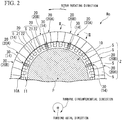
- Fig. 2 is a cross-sectional diagram taken along the line I to I of Fig. 1 .
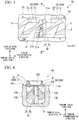
- Fig. 3 is an arrow view taken along the line II to II in Fig. 2 .
- Fig. 4 is a cross-sectional diagram taken along the line III to III of Fig. 3 .
- the rotor R C is provided with a rotation shaft body 10, a plurality of blade members (blade bodies) 20, each of which includes the above-described blade 5, and a plurality of blade fixing pieces 30.
- the rotation shaft body 10 is constituted so as to assume a shaft shape as a whole by disk-like members being stacked coaxially in the turbine axial direction.
- a blade groove 11 is formed at an outer circumference part 10A of the rotation shaft body 10. Blade members 20 are individually loaded into the blade groove 11 corresponding to the site at which the blade row 3 is disposed.
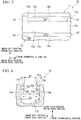
- Fig. 5 and Fig. 6 are views which show briefly a constitution of the rotation shaft body 10.
- Fig. 5 is an enlarged plan diagram of major parts and corresponds to Fig. 3 .
- Fig. 6 is an enlarged sectional diagram of the major parts and corresponds to Fig. 4 .
- each blade groove 11 extends in the turbine circumferential direction. Although not illustrated, each blade groove 11 is formed all across the circumference of the outer circumference part 10A.
- opening wall parts 13, 13 are formed on a blade opening 11a side.
- Each of the opening wall parts 13, 13 projects to the inside in the groove width direction from the groove opening 11a side of the blade groove 11. That is, as shown in Fig. 6 , a width dimension D1 on the groove opening 11a side of the blade groove 11 is set to be smaller than a width dimension D2 thereof on the groove bottom 11b side.
- the opening wall parts 13, 13 are provided with end faces 13a, 13a, each of which extends in the groove depth direction (turbine radial direction) of the blade groove 11 and opposes each other. These end faces 13a, 13a oppose each other in such a manner that a distance between them is the width dimension D1.
- lower parts 13b, 13b of the opening wall parts 13, 13 are chamfered.
- each of the opening wall parts 13, 13 is formed with an inclined face outward in the groove width direction by degrees from the groove opening 11a side to the groove bottom 11b side.
- the inclined face is formed in continuation with each of the end faces 13a, 13a and a lower part of each of the both side walls 12, 12.
- upper parts 13c, 13c of the opening wall parts 13, 13 are formed in a circular-arc shape so that an opening width gradually narrows from the outside to the inside in the groove width direction.
- Each of the opening wall parts 13, 13 extends on the whole circumference in the turbine circumferential direction (refer to Fig. 2 ). Further, the opening wall parts 13, 13 are provided with concaved portions (recessed parts) 14, 14 at a plurality of sites with intervals in the turbine circumferential direction.
- each of the concaved portions 14, 14 is formed in a groove shape and also extends in the groove depth direction (turbine radial direction) of the blade groove 11.
- the concaved portions 14, 14 communicatively connect a downside of the lower parts 13b, 13b of the opening wall parts 13, 13 and an upside of the upper parts 13c, 13c of the opening wall parts 13, 13.
- these concaved portions 14, 14 are formed in such a manner that a cross-sectional contour orthogonal to the groove depth direction of the blade groove 11 assumes a square.
- the concaved portions 14, 14 are also formed in such a manner that end faces 14a, 14a in the groove width direction assume a circular-arc shape.
- These concaved portions 14, 14 are formed so as to oppose each other in the groove width direction of the blade groove 11.
- a blade insertion hole 11c which opens widely so that a blade root 22 of the blade member 20 can be inserted is formed at a position different from positions where the concaved portions 14, 14 are formed.
- the blade root 22 of the blade member 20 will be described later by referring to Fig. 11 and Fig. 12 .
- the groove bottom 11b of the blade groove 11 is formed in a circular arc shape so as to be gradually increased in groove depth to inward in the groove width direction on a cross section orthogonal to the turbine circumferential direction.
- a platform 21 leading to the base end of the blade 5 and the blade root 22 leading to the platform 21 are formed from the outside to the inside in the turbine radial direction in the above-described order.
- the blade 5 is formed in a streamline shape so as to be orthogonal to the turbine radial direction. As shown in Fig. 3 , the blade 5 is also formed in such a shape that a distal end side thereof in the turbine radial direction is twisted around the turbine radial direction with respect to the base end side.
- the platform 21 extends so as to intersect the turbine radial direction and covers the blade groove 11. Further, the surface of the platform 21 leads to the base end of the blade 5.
- the platform 21 can be formed in a plate shape, for example.
- the platform 21 can be formed as a parallelogram when viewed from the outside to the inside in the turbine radial direction.
- an access hole 21b which penetrates in the turbine radial direction, as shown in Fig. 4 is defined by the end edges 21a of both the platforms 21 which are butted with each other in the turbine circumferential direction as shown in Fig. 3 .
- the blade root 22 leads to the back of the platform 21 and is formed so as to gradually increase a dimension in the turbine axial direction to inside in the turbine radial direction on a cross section (not illustrated) orthogonal to the turbine circumferential direction.
- the blade root 22 is fitted into the groove bottom 11b side of the blade groove 11 shown in Fig. 6 .
- the blade root 22 allows one part of both side-parts thereof in the turbine axial direction to run along the lower parts 13b, 13b of the opening wall parts 13, 13.
- the blade fixing piece 30 is arranged between one set of adjacent two blade members 20 (20A, 20B) in the turbine circumferential direction inside the blade groove 11.
- a plurality (for example, eight) of the blade fixing pieces 30 are disposed at the positions corresponding to the concaved portions 14, 14 in the turbine circumferential direction.
- a predetermined number of blade members 20 are positioned between adjacent two blade fixing pieces 30 in the circumferential direction.
- the blade fixing pieces 30 may not be disposed at an equal interval.
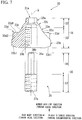
- Fig. 7 is an exploded diagram when the blade fixing piece 30 is viewed from the front.
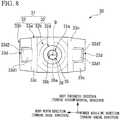
- Fig. 8 is a plan diagram which shows the blade fixing piece 30.
- Fig. 9 is an exploded diagram when the blade fixing piece 30 is viewed from the side face.
- the blade fixing piece 30 is provided with a piece main body 31 and an advance-retract axle 35.
- the piece main body 31 is a member having a through hole 31a formed on a member axis line Q of the blade fixing piece 30.
- the piece main body 31 is provided with a stepped cylinder part 32 and a body wall part 33.
- the stepped cylinder part 32 is formed at one end of the member axis-line direction in which the member axis line Q extends (turbine radial direction).
- the body wall part 33 is formed at the other side of the member axis-line direction.
- the stepped cylinder part 32 is provided with a neck part 32a and a shoulder part 32b.
- the neck part 32a is formed so as to be constant in diameter at one side in the member axis-line direction.
- the shoulder part 32b is formed in continuation with the neck part 32a and formed in such a shape that a part which gradually increases in diameter from one end to the other end in the member axis-line direction is set in two stages.
- the body wall part 33 is formed in continuation with the shoulder part 32b. Then, the body wall part 33 is formed in a flat hexagon shape in which a cross sectional shape orthogonal to the member axis-line direction shown in Fig. 8 is set in such a manner that the body thickness is thinner than the body width.
- This body wall part 33 as shown in Fig. 7 , is provided with a tapered part 33a formed in continuation with the shoulder part 32b and a bottom part 33b formed in continuation with the tapered part 33a at the other side in the member axis-line direction.
- the tapered part 33a gradually increases so that cross sectional area of the flat hexagon enlarges the body width, as shown in Fig. 8 , from one side to the other side in the member axis-line direction, as shown in Fig. 7 .
- the bottom part 33b is formed in such a manner that the body width is substantially constant in dimension. Further, the bottom part 33b is formed so that corners of the both ends 33b1 of the bottom face in the body width direction are chamfered.
- Tapered faces 33c, 33c which increase in width from one side to the other side in the member axis-line direction extend on both sides in the body width direction of the tapered part 33a of the body wall part 33.
- the tapered faces 33c, 33c are formed so that a curvature thereof is equal to a curvature of the lower parts 13b, 13b of the opening wall parts 13, 13.
- Projection walls (projected parts) 33d, 33d projecting in the member axis-line direction and in the body width direction are formed respectively at the centers in the thickness direction of the tapered faces 33c, 33c.
- Each of the projection walls 33d, 33d is formed in a triangular prism shape in which the bottom face assumes a right isosceles triangle with the perpendicular direction of the bottom face being directed to the body thickness direction.
- Each of the projection walls 33d, 33d causes the square face 33d1, which is one of two square faces 33d1, 33d2 formed substantially equal in dimension, to intersect with the member axis-line direction. Then, each of the projection walls 33d, 33d causes the other square face 33d2 to intersect with the body width direction of the piece main body 31. Further, corner edges of the square face 33d2 are chamfered.
- the above-described through hole 31a is formed at the body wall part 33 so as to be constant in diameter. Further, the through hole 31a is formed at the stepped cylinder part 32 so as to be reduced in diameter in two stages. An internal thread part 31b is formed at a site of the body wall part 33 which is formed constant in diameter.
- the advance-retract axle 35 is provided with a shaft part 36 and an external thread part 37.
- the shaft part 36 is formed at one side in the member axis-line direction so as to be relatively small in diameter.
- the external thread part 37 is formed at the other side in the member axis-line direction so as to be relatively large in diameter, with the outer circumference face thereof being threaded.
- An engagement groove 36b with which a tool such as a slotted screwdriver can be engaged is formed at an end face 36a which is one side of the shaft part 36 in the member axis-line direction.
- An end face 37a which is at the other side in the member axis-line direction of the external thread part 37 swells out to the other side of the member axis-line direction.
- the external thread part 37 is screwed into the internal thread part 31b of the piece main body 31 by the advance-retract axle 35.
- the advance-retract axle 35 is configured to be capable of being screwed toward the piece main body 31 in the member axis-line direction. Further, when the advance-retract axle 35 is screwed toward the other side in the member axis-line direction, the shaft part 36 is fitted into an opening of the through hole 31a of the stepped cylinder part 32.
- the external thread part 37 of the advance-retract axle 35 is screwed into the internal thread part 31b of the piece main body 31, thereby constituting a movable mechanism 39 which allows the piece main body 31 to advance and retract with respect to the groove bottom 11b of the blade groove 11 in the turbine radial direction.
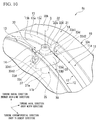
- Fig. 10 is a perspective diagram which shows a usage state of the blade fixing piece 30.
- the blade member 20 is not illustrated.
- the blade fixing piece 30 directs the member axis line Q of the blade fixing piece 30 in the turbine radial direction (blade depth direction) and also directs the body width direction in the turbine axial direction (groove width direction) at a site where each of the concaved portions 14, 14 is formed. Then, the blade fixing piece 30 is restricted from being displaced in the turbine circumferential direction with respect to the blade groove 11 by fitting the projection walls 33d, 33d of the piece main body 31 into the concaved portions 14, 14.
- the blade fixing piece 30 causes the end face 37a of the advance-retract axle 35 to make a point contact with the groove bottom 11b of the blade groove 11. Then, the blade fixing piece 30 is restricted in the turbine radial direction by receiving a reaction force that the advance-retract axle 35 receives from the groove bottom 11b of the blade groove 11 and a reaction force that the tapered faces 33c, 33c receive from the lower parts 13b, 13b of the opening wall parts 13, 13.
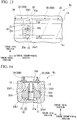
- the blade root 22 of the blade member 20 shown in Fig. 2 is inserted into the blade insertion hole 11c of the blade groove 11 shown in Fig. 11 and Fig. 12 .
- the blade root 22 is fitted into a lower side of the blade groove 11 by the blade member 20 being caused to slide in the turbine circumferential direction.
- the blade member 20 is caused to slide in the turbine circumferential direction in a state where the blade root 22 is fitted into the lower side of the blade groove 11.
- This operation is repeated for every blade member 20, thereby loading a predetermined number of blade members 20 into the blade groove 11.
- a blade member 20 of the predetermined number of blade members 20, which is to be loaded last is one of the above-described blade members 20A, 20B (for example, the blade member 20B).
- the blade fixing piece 30 is inserted into the blade insertion hole 11c of the blade groove 11.
- the advance-retract axle 35 is set for its projection extent in such a manner that a gap is formed between the projection walls 33d, 33d on both sides of the piece main body 31 and the lower parts 13b, 13b of the opening wall parts 13, 13 in a state where the end face 37a of the advance-retract axle 35 is caused to make a point contact at least with the groove bottom 11b of the blade groove 11.
- the blade fixing piece 30 is caused to slide in the turbine circumferential direction.
- the other of the blade members 20A, 20B (for example, the blade member 20B) is loaded into the blade insertion hole 11c of the blade groove 11 shown in Fig. 11 and Fig. 12 .
- the access hole 21b is defined by both end edges 21a which are butted with each other in the turbine circumferential direction of the blade members 20A, 20B. Further, as shown in Fig. 13 , the end face 36a of the advance-retract axle 35 is exposed from the access hole 21b.
- the blade fixing piece 30 inserted into the blade groove 11 is caused to slide in the turbine circumferential direction inside the blade groove 11 together with the blade member 20.
- corner edges of the square face 33d1 on the projection wall 33d of the body wall part 33 and both ends 33bl of the bottom part 33b of the piece main body 31 are chamfered, and the end face 37a of the shaft part 36 swells out. Therefore, the blade fixing piece 30 slides smoothly on an inner surface of the blade groove 11.
- a tool K is engaged with the end face 36a of the shaft part 36, thereby causing the advance-retract axle 35 to move rotationally.
- the advance-retract axle 35 is screwed inward in the turbine radial direction into the piece main body 31.
- the piece main body 31 undergoes a relative displacement outward in the turbine radial direction so as to be spaced away from the groove bottom 11b.
- the projection walls 33d, 33d are fitted into the concaved portions 14, 14, and the tapered faces 33c, 33c come into contact with the lower parts 13b, 13b of the opening wall parts 13, 13.
- the advance-retract axle 35 is caused to move rotationally, thereby restricting a relative displacement between the piece main body 31 and the advance-retract axle 35.
- the advance-retract axle 35 receives a reaction force from the groove bottom 11b of the blade groove 11, and also the tapered faces 33c, 33c receive a reaction force from the lower parts 13b, 13b of the opening wall parts 13, 13.
- the blade fixing piece 30 is restricted from being displaced with respect to the blade groove 11.
- the projection walls 33d, 33d of the blade fixing piece 30 interfere with the concaved portions 14, 14 of the opening wall parts 13, 13, thereby restricting the blade fixing piece 30 in the turbine circumferential direction.
- the advance-retract axle 35 receives the reaction force from the groove bottom 11b of the blade groove 11, and also the tapered faces 33c, 33c receive the reaction force from the lower parts 13b, 13b of the opening wall parts 13, 13.
- the blade fixing piece 30 is fixed in the turbine radial direction.
- the outer circumference part 10A of the rotation shaft body 10 is exposed to a high-temperature working fluid (compressed air) to cause a difference in temperature between the inside and the outside of the rotation shaft body 10.
- a differential thermal expansion between the outside and the inside of the rotation shaft body 10 will cause a thermal stress.
- stress is less likely to concentrate on the groove bottom. Therefore, for example, it would be hard to cause a crack on the groove bottom 11b of the blade groove 11 even if start-up of the gas turbine GT is repeated.
- the concaved portions 14, 14 are positioned on the surface of the rotation shaft body 10, they are more easily increased in temperature than the groove bottom 11b. Further, a difference in temperature is hard to take place on the surface of the rotation shaft body 10, and thermal stress is relatively small. As a result, even when stress is concentrated on the concaved portions 14, 14, it is quite short in duration of time and the stress is relatively low in intensity. Therefore, cracks are hard to occur at the concaved portions 14, 14 which are structurally discontinued parts.
- the projection walls 33d, 33d are formed on the blade fixing piece 30, and the concaved portions 14, 14 which are fitted to the projection walls 33d, 33d are formed at the opening wall parts 13, 13 of the blade groove 11. Therefore, a relative displacement in the turbine circumferential direction of the blade member 20 with respect to the blade groove 11 is restricted by interference between the projection walls 33d, 33d and the concaved portions 14, 14. As a result, stress is hard to concentrate on the groove bottom 11b of the blade groove 11, thus making it possible to avoid the occurrence of cracks on the groove bottom 11b of the blade groove 11.
- a conventional rotor structure when a crack occurs on the groove bottom 11b of the blade groove 11 in a state where the blade member 20 is assembled to the rotation shaft body 10, it is difficult to find the crack during ordinary maintenance and inspection. As a result, the crack progresses excessively or the rotation shaft body 10 is broken by the crack, thus resulting in the fear that it may be necessary to stop operation of the compressor C into which the rotation shaft body 10 has been assembled. Further, the conventional rotor structure is also inferior in maintainability because even when a crack occurring on the groove bottom 11b of the blade groove 11 is found, it is difficult to repair the rotation body unless the assembled blade member 20 is detached.
- the blade fixing piece 30 in a state where fitting between the projection walls 33d, 33d and the concaved portions 14, 14 is cancelled, the blade fixing piece 30 is allowed to slide on the blade groove 11 in the turbine circumferential direction. Thereby, when assembling the blade member 20 and the blade fixing piece 30 to the rotation shaft body 10, the blade fixing piece 30 is caused to slide on the groove bottom 11b side of the blade groove 1 1 and can be arranged at a desired position. It is, thereby, possible to improve the workability of the process in which the blade members 20 and the blade fixing pieces 30 are assembled to the rotation shaft body 10.
- the projection walls 33d, 33d projecting from the tapered faces 33c, 33c in the turbine radial direction and in the turbine axial direction are fitted into the concaved portions 14, 14 extending in the turbine radial direction.
- the movable mechanism 39 causes the piece main body 31 on which the projection walls 33d, 33d are formed to advance and retract with respect to the groove bottom 11b of the blade groove 11, thereby the projection walls 33d, 33d and the concaved portions 14, 14 can be removably fit. Therefore, the projection walls 33d, 33d and the concaved portions 14, 14 can be removably fitted easily. It is, thereby, possible to improve the workability of assembling the blade members 20 and the blade fixing pieces 30 to the rotation shaft body 10.
- the advance-retract axle 35 can be screwed towards the groove bottom 11b of the blade groove 11.
- the piece main body 31 is caused to advance and retract with respect to the groove bottom 11b of the blade groove 11 accurately and easily in a relatively simple constitution.
- the end face 36a on which the engagement groove 36b has been formed is exposed outside from the access hole 21b.
- the tool K such as a slotted screwdriver can be easily engaged therewith and also the advance-retract axle 35 is caused to move rotationally more easily. Thereby, it is possible to displace the advance-retract axle 35 quite easily.
- the end face 37a of the advance-retract axle 35 swells out to the groove bottom 11b of the blade groove 11. Thereby, the end face 37a of the advance-retract axle 35 on which the external thread part 37 has been formed is caused to make a point contact with the groove bottom 11b of the blade groove 11.
- the end face 37a of the advance-retract axle 35 on which the external thread part 37 has been formed is prevented from making a partial contact with the groove bottom 11b of the blade groove 11 and caused to reliably make a point contact therewith.
- the piece main body 31 is caused to more reliably advance and retract with respect to the groove bottom 11b of the blade groove 11.
- the groove bottom 11b of the blade groove 11 is formed so as to be recessed in a circular-arc shape on a cross section orthogonal to the turbine circumferential direction.
- the end face 37a of the advance-retract axle 35 is caused to swell out to the groove bottom 11b, by which the end face 37a is caused to more reliably make a point contact with the groove bottom 11b.
- the blade fixing piece 30 is provided with the tapered faces 33c, 33c which are in contact with the opening wall parts 13, 13 of the blade groove 11 from the groove bottom 11b of the blade groove 11. It is, thereby, possible to successfully restrict the blade fixing piece 30 in the turbine radial direction.
- each of the tapered faces 33c, 33c is formed in such a shape along each of the lower parts 13b, 13b of the opening wall parts 13, 13.
- various sites of the tapered faces 33c, 33c can be pressed uniformly to the lower parts 13b, 13b.
- the various sites of the tapered faces 33c, 33c receive a uniform reaction force from the lower parts 13b, 13b. It is, therefore, possible to restrict more reliably the blade fixing piece 30 in the turbine radial direction.
- the blade fixing piece 30 is provided with the projection walls 33d, 33d, and the concaved portions 14, 14 are formed at the opening wall parts 13, 13 of the blade groove 11. It is, therefore, possible to avoid the occurrence of cracks on the groove bottom 11b of the blade groove 11 in a relatively simple constitution.
- Fig. 17 is a sectional diagram of major parts which shows a brief constitution of a blade fixing piece 30A according to the embodiment of the present invention.
- the two projection walls 33d, 33d are formed on the tapered faces 33c, 33c of the blade fixing piece 30.
- no projection walls 33d, 33d are provided, and a screw member (projected part) 33g is provided in a projecting manner on one tapered face 33c of the tapered faces 33c, 33c in the turbine axial direction.
- the two concaved portions 14, 14 are formed at the opening wall parts 13, 13 of the blade groove 11.
- a concaved portion 14 is formed only at one of the opening wall parts 13 in the turbine axial direction.
- the same effect as that of the above-described example can be obtained.
- various design requirements can be met by using the screw member 33g which is separate from the blade fixing piece 30A according to the constitution of the present embodiment.
- the screw member 33g can be exchanged without detaching the blade fixing piece 30A from the blade groove 11. Therefore, repairs can be done quickly, and operation of the compressor C can be thereby restored immediately.
- a groove sectional contour is defined by the opening wall parts 13, 13 and the groove bottom 11b having a circular-arc cross section.
- the width dimension of the groove opening 11a side of the blade groove 11 is set to be smaller than the width dimension of the groove bottom 11b side of the blade groove 11, there may be adopted another groove sectional contour.
- the opening wall parts 13, 13 may be formed in a rectangular shape when viewed from the cross section, or the groove bottom 11b may be formed in the shape of a flat face.
- the projection walls 33d formed at the blade fixing piece 30 and the concaved portions 14, 14 formed at the opening wall parts 13, 13 are caused to be fitted.
- recessed parts are formed at the blade fixing piece 30, projected parts are formed at the opening wall parts 13, 13, and they are fitted with each other.
- the present invention is applied to the blade 5 of the compressor C.
- the present invention may be, however, applied to the blade of the turbine T.
- the present invention is applied to a gas turbine.
- the present invention may be applied to other rotary machines such as a steam turbine.
Landscapes
- Engineering & Computer Science (AREA)
- Mechanical Engineering (AREA)
- General Engineering & Computer Science (AREA)
- Turbine Rotor Nozzle Sealing (AREA)
- Structures Of Non-Positive Displacement Pumps (AREA)
Applications Claiming Priority (2)
| Application Number | Priority Date | Filing Date | Title |
|---|---|---|---|
| JP2011059706A JP5730085B2 (ja) | 2011-03-17 | 2011-03-17 | ロータ構造 |
| PCT/JP2012/052054 WO2012124393A1 (ja) | 2011-03-17 | 2012-01-31 | ロータ構造 |
Publications (3)
| Publication Number | Publication Date |
|---|---|
| EP2687729A1 EP2687729A1 (en) | 2014-01-22 |
| EP2687729A4 EP2687729A4 (en) | 2014-12-03 |
| EP2687729B1 true EP2687729B1 (en) | 2018-09-12 |
Family
ID=46830474
Family Applications (1)
| Application Number | Title | Priority Date | Filing Date |
|---|---|---|---|
| EP12757839.1A Active EP2687729B1 (en) | 2011-03-17 | 2012-01-31 | Rotor structure |
Country Status (6)
| Country | Link |
|---|---|
| US (1) | US8899934B2 (https=) |
| EP (1) | EP2687729B1 (https=) |
| JP (1) | JP5730085B2 (https=) |
| KR (1) | KR101502789B1 (https=) |
| CN (1) | CN103270312B (https=) |
| WO (1) | WO2012124393A1 (https=) |
Families Citing this family (9)
| Publication number | Priority date | Publication date | Assignee | Title |
|---|---|---|---|---|
| US9068465B2 (en) * | 2012-04-30 | 2015-06-30 | General Electric Company | Turbine assembly |
| US20140182293A1 (en) * | 2012-12-31 | 2014-07-03 | United Technologies Corporation | Compressor Rotor for Gas Turbine Engine With Deep Blade Groove |
| JP2015135061A (ja) * | 2014-01-16 | 2015-07-27 | 株式会社Ihi | 翼の連結部構造及びこれを用いたジェットエンジン |
| DE102015203290A1 (de) | 2015-02-24 | 2016-09-29 | MTU Aero Engines AG | Sicherungselement und Strömungsmaschine |
| KR102095033B1 (ko) * | 2017-05-30 | 2020-03-30 | 두산중공업 주식회사 | 베인 링 조립체 및 이를 포함하는 압축기, 가스터빈 |
| DE102017214500A1 (de) * | 2017-08-21 | 2019-02-21 | MTU Aero Engines AG | Abstützung einer Schaufel einer Turbomaschine |
| JP7029317B2 (ja) * | 2018-03-09 | 2022-03-03 | 三菱重工業株式会社 | 回転機械 |
| CN112780351A (zh) * | 2019-11-07 | 2021-05-11 | 中国航发商用航空发动机有限责任公司 | 航空发动机转子和航空发动机 |
| CN113803274B (zh) * | 2021-11-19 | 2022-03-04 | 中国航发上海商用航空发动机制造有限责任公司 | 轴流压气机及涡扇发动机 |
Family Cites Families (7)
| Publication number | Priority date | Publication date | Assignee | Title |
|---|---|---|---|---|
| US3216700A (en) * | 1963-10-24 | 1965-11-09 | Gen Electric | Rotor blade locking means |
| GB2156908A (en) * | 1984-03-30 | 1985-10-16 | Rolls Royce | Bladed rotor assembly for gas turbine engine |
| JPH0325801U (https=) | 1989-07-21 | 1991-03-18 | ||
| JPH0345402U (https=) | 1989-09-11 | 1991-04-26 | ||
| US5522706A (en) * | 1994-10-06 | 1996-06-04 | General Electric Company | Laser shock peened disks with loading and locking slots for turbomachinery |
| FR2810366B1 (fr) * | 2000-06-15 | 2002-10-11 | Snecma Moteurs | Dispositif de blocage d'aubes a attaches marteau sur un disque |
| FR2832455B1 (fr) * | 2001-11-22 | 2004-04-02 | Snecma Moteurs | Dispositif de blocage des aubes dans une rainure d'un disque |
-
2011
- 2011-03-17 JP JP2011059706A patent/JP5730085B2/ja active Active
-
2012
- 2012-01-31 EP EP12757839.1A patent/EP2687729B1/en active Active
- 2012-01-31 WO PCT/JP2012/052054 patent/WO2012124393A1/ja not_active Ceased
- 2012-01-31 US US13/362,629 patent/US8899934B2/en active Active
- 2012-01-31 KR KR1020137013879A patent/KR101502789B1/ko active Active
- 2012-01-31 CN CN201280004348.7A patent/CN103270312B/zh active Active
Non-Patent Citations (1)
| Title |
|---|
| None * |
Also Published As
| Publication number | Publication date |
|---|---|
| WO2012124393A1 (ja) | 2012-09-20 |
| JP2012193714A (ja) | 2012-10-11 |
| US8899934B2 (en) | 2014-12-02 |
| CN103270312B (zh) | 2015-10-21 |
| KR101502789B1 (ko) | 2015-03-16 |
| EP2687729A1 (en) | 2014-01-22 |
| US20120251329A1 (en) | 2012-10-04 |
| JP5730085B2 (ja) | 2015-06-03 |
| KR20130093649A (ko) | 2013-08-22 |
| CN103270312A (zh) | 2013-08-28 |
| EP2687729A4 (en) | 2014-12-03 |
Similar Documents
| Publication | Publication Date | Title |
|---|---|---|
| EP2687729B1 (en) | Rotor structure | |
| US10060276B2 (en) | Turbine rotor, turbine, and method for removing seal plate | |
| US7179052B2 (en) | Assembly type nozzle diaphragm, and method of assembling the same | |
| US9683743B2 (en) | Combustion chamber tile of a gas turbine | |
| CN104675448B (zh) | 锁定间隔组件 | |
| JP2013002445A (ja) | 回転ブレード用の保持装置 | |
| EP2812541B1 (en) | Turbine engine shaft coupling | |
| US9416670B2 (en) | Locking spacer assembly | |
| US20120269592A1 (en) | System and method for modifying a rotor | |
| EP3536906B1 (en) | Gas turbine disassembling/assembling method, seal plate assembly, and gas turbine rotor | |
| RU2754882C1 (ru) | Рабочее колесо турбины | |
| US11066957B2 (en) | Axial-flow fluid machine and tip clearance measuring method therefor | |
| CN108884714B (zh) | 包括通风间隔件的涡轮转子 | |
| WO2015160466A1 (en) | Method of remanufacturing a machine component | |
| EP3536907B1 (en) | Gas turbine disassembling/assembling method, gas turbine rotor, and gas turbine | |
| US8757981B2 (en) | Locking spacer assembly for a turbine engine | |
| CN110603372B (zh) | 用于减小涡轮发动机的盘和间隔件的相对旋转运动的销 | |
| US11525363B2 (en) | Turbine wheel and wire retention pin fixation method for turbine wheel | |
| CN206626020U (zh) | 静叶片节段及具备该静叶片节段的轴流流体机械 | |
| US20180073399A1 (en) | Turbine blade assembly arrangement and corresponding assembly tool | |
| EP3536905B1 (en) | Gas turbine disassembling/assembling method, seal plate assembly, and gas turbine rotor | |
| EP3631171B1 (en) | Gas turbine engine rotor disc retention assembly | |
| KR102365584B1 (ko) | 터보 기계의 가이드 블레이드 배열체 | |
| JP7217330B1 (ja) | タービンロータ及びその製造方法 | |
| JP7461213B2 (ja) | 静翼、静翼セグメント、軸流流体機械、静翼セグメントの製造補助装置、静翼セグメントの製造方法 |
Legal Events
| Date | Code | Title | Description |
|---|---|---|---|
| PUAI | Public reference made under article 153(3) epc to a published international application that has entered the european phase |
Free format text: ORIGINAL CODE: 0009012 |
|
| 17P | Request for examination filed |
Effective date: 20130625 |
|
| AK | Designated contracting states |
Kind code of ref document: A1 Designated state(s): AL AT BE BG CH CY CZ DE DK EE ES FI FR GB GR HR HU IE IS IT LI LT LU LV MC MK MT NL NO PL PT RO RS SE SI SK SM TR |
|
| DAX | Request for extension of the european patent (deleted) | ||
| A4 | Supplementary search report drawn up and despatched |
Effective date: 20141104 |
|
| RIC1 | Information provided on ipc code assigned before grant |
Ipc: F01D 5/30 20060101ALI20141029BHEP Ipc: F04D 29/34 20060101AFI20141029BHEP |
|
| RAP1 | Party data changed (applicant data changed or rights of an application transferred) |
Owner name: MITSUBISHI HITACHI POWER SYSTEMS, LTD. |
|
| RAP1 | Party data changed (applicant data changed or rights of an application transferred) |
Owner name: MITSUBISHI HITACHI POWER SYSTEMS, LTD. |
|
| GRAP | Despatch of communication of intention to grant a patent |
Free format text: ORIGINAL CODE: EPIDOSNIGR1 |
|
| STAA | Information on the status of an ep patent application or granted ep patent |
Free format text: STATUS: GRANT OF PATENT IS INTENDED |
|
| INTG | Intention to grant announced |
Effective date: 20180323 |
|
| GRAS | Grant fee paid |
Free format text: ORIGINAL CODE: EPIDOSNIGR3 |
|
| GRAA | (expected) grant |
Free format text: ORIGINAL CODE: 0009210 |
|
| STAA | Information on the status of an ep patent application or granted ep patent |
Free format text: STATUS: THE PATENT HAS BEEN GRANTED |
|
| AK | Designated contracting states |
Kind code of ref document: B1 Designated state(s): AL AT BE BG CH CY CZ DE DK EE ES FI FR GB GR HR HU IE IS IT LI LT LU LV MC MK MT NL NO PL PT RO RS SE SI SK SM TR |
|
| REG | Reference to a national code |
Ref country code: GB Ref legal event code: FG4D |
|
| REG | Reference to a national code |
Ref country code: CH Ref legal event code: EP |
|
| REG | Reference to a national code |
Ref country code: IE Ref legal event code: FG4D |
|
| REG | Reference to a national code |
Ref country code: DE Ref legal event code: R096 Ref document number: 602012050995 Country of ref document: DE |
|
| REG | Reference to a national code |
Ref country code: AT Ref legal event code: REF Ref document number: 1040934 Country of ref document: AT Kind code of ref document: T Effective date: 20181015 |
|
| REG | Reference to a national code |
Ref country code: NL Ref legal event code: MP Effective date: 20180912 |
|
| REG | Reference to a national code |
Ref country code: LT Ref legal event code: MG4D |
|
| PG25 | Lapsed in a contracting state [announced via postgrant information from national office to epo] |
Ref country code: LT Free format text: LAPSE BECAUSE OF FAILURE TO SUBMIT A TRANSLATION OF THE DESCRIPTION OR TO PAY THE FEE WITHIN THE PRESCRIBED TIME-LIMIT Effective date: 20180912 Ref country code: BG Free format text: LAPSE BECAUSE OF FAILURE TO SUBMIT A TRANSLATION OF THE DESCRIPTION OR TO PAY THE FEE WITHIN THE PRESCRIBED TIME-LIMIT Effective date: 20181212 Ref country code: GR Free format text: LAPSE BECAUSE OF FAILURE TO SUBMIT A TRANSLATION OF THE DESCRIPTION OR TO PAY THE FEE WITHIN THE PRESCRIBED TIME-LIMIT Effective date: 20181213 Ref country code: NO Free format text: LAPSE BECAUSE OF FAILURE TO SUBMIT A TRANSLATION OF THE DESCRIPTION OR TO PAY THE FEE WITHIN THE PRESCRIBED TIME-LIMIT Effective date: 20181212 Ref country code: SE Free format text: LAPSE BECAUSE OF FAILURE TO SUBMIT A TRANSLATION OF THE DESCRIPTION OR TO PAY THE FEE WITHIN THE PRESCRIBED TIME-LIMIT Effective date: 20180912 Ref country code: RS Free format text: LAPSE BECAUSE OF FAILURE TO SUBMIT A TRANSLATION OF THE DESCRIPTION OR TO PAY THE FEE WITHIN THE PRESCRIBED TIME-LIMIT Effective date: 20180912 Ref country code: FI Free format text: LAPSE BECAUSE OF FAILURE TO SUBMIT A TRANSLATION OF THE DESCRIPTION OR TO PAY THE FEE WITHIN THE PRESCRIBED TIME-LIMIT Effective date: 20180912 |
|
| PG25 | Lapsed in a contracting state [announced via postgrant information from national office to epo] |
Ref country code: AL Free format text: LAPSE BECAUSE OF FAILURE TO SUBMIT A TRANSLATION OF THE DESCRIPTION OR TO PAY THE FEE WITHIN THE PRESCRIBED TIME-LIMIT Effective date: 20180912 Ref country code: HR Free format text: LAPSE BECAUSE OF FAILURE TO SUBMIT A TRANSLATION OF THE DESCRIPTION OR TO PAY THE FEE WITHIN THE PRESCRIBED TIME-LIMIT Effective date: 20180912 Ref country code: LV Free format text: LAPSE BECAUSE OF FAILURE TO SUBMIT A TRANSLATION OF THE DESCRIPTION OR TO PAY THE FEE WITHIN THE PRESCRIBED TIME-LIMIT Effective date: 20180912 |
|
| REG | Reference to a national code |
Ref country code: AT Ref legal event code: MK05 Ref document number: 1040934 Country of ref document: AT Kind code of ref document: T Effective date: 20180912 |
|
| PG25 | Lapsed in a contracting state [announced via postgrant information from national office to epo] |
Ref country code: AT Free format text: LAPSE BECAUSE OF FAILURE TO SUBMIT A TRANSLATION OF THE DESCRIPTION OR TO PAY THE FEE WITHIN THE PRESCRIBED TIME-LIMIT Effective date: 20180912 Ref country code: IT Free format text: LAPSE BECAUSE OF FAILURE TO SUBMIT A TRANSLATION OF THE DESCRIPTION OR TO PAY THE FEE WITHIN THE PRESCRIBED TIME-LIMIT Effective date: 20180912 Ref country code: EE Free format text: LAPSE BECAUSE OF FAILURE TO SUBMIT A TRANSLATION OF THE DESCRIPTION OR TO PAY THE FEE WITHIN THE PRESCRIBED TIME-LIMIT Effective date: 20180912 Ref country code: NL Free format text: LAPSE BECAUSE OF FAILURE TO SUBMIT A TRANSLATION OF THE DESCRIPTION OR TO PAY THE FEE WITHIN THE PRESCRIBED TIME-LIMIT Effective date: 20180912 Ref country code: RO Free format text: LAPSE BECAUSE OF FAILURE TO SUBMIT A TRANSLATION OF THE DESCRIPTION OR TO PAY THE FEE WITHIN THE PRESCRIBED TIME-LIMIT Effective date: 20180912 Ref country code: IS Free format text: LAPSE BECAUSE OF FAILURE TO SUBMIT A TRANSLATION OF THE DESCRIPTION OR TO PAY THE FEE WITHIN THE PRESCRIBED TIME-LIMIT Effective date: 20190112 Ref country code: CZ Free format text: LAPSE BECAUSE OF FAILURE TO SUBMIT A TRANSLATION OF THE DESCRIPTION OR TO PAY THE FEE WITHIN THE PRESCRIBED TIME-LIMIT Effective date: 20180912 Ref country code: PL Free format text: LAPSE BECAUSE OF FAILURE TO SUBMIT A TRANSLATION OF THE DESCRIPTION OR TO PAY THE FEE WITHIN THE PRESCRIBED TIME-LIMIT Effective date: 20180912 Ref country code: ES Free format text: LAPSE BECAUSE OF FAILURE TO SUBMIT A TRANSLATION OF THE DESCRIPTION OR TO PAY THE FEE WITHIN THE PRESCRIBED TIME-LIMIT Effective date: 20180912 |
|
| PG25 | Lapsed in a contracting state [announced via postgrant information from national office to epo] |
Ref country code: PT Free format text: LAPSE BECAUSE OF FAILURE TO SUBMIT A TRANSLATION OF THE DESCRIPTION OR TO PAY THE FEE WITHIN THE PRESCRIBED TIME-LIMIT Effective date: 20190112 Ref country code: SK Free format text: LAPSE BECAUSE OF FAILURE TO SUBMIT A TRANSLATION OF THE DESCRIPTION OR TO PAY THE FEE WITHIN THE PRESCRIBED TIME-LIMIT Effective date: 20180912 Ref country code: SM Free format text: LAPSE BECAUSE OF FAILURE TO SUBMIT A TRANSLATION OF THE DESCRIPTION OR TO PAY THE FEE WITHIN THE PRESCRIBED TIME-LIMIT Effective date: 20180912 |
|
| REG | Reference to a national code |
Ref country code: DE Ref legal event code: R097 Ref document number: 602012050995 Country of ref document: DE |
|
| PLBE | No opposition filed within time limit |
Free format text: ORIGINAL CODE: 0009261 |
|
| STAA | Information on the status of an ep patent application or granted ep patent |
Free format text: STATUS: NO OPPOSITION FILED WITHIN TIME LIMIT |
|
| PG25 | Lapsed in a contracting state [announced via postgrant information from national office to epo] |
Ref country code: DK Free format text: LAPSE BECAUSE OF FAILURE TO SUBMIT A TRANSLATION OF THE DESCRIPTION OR TO PAY THE FEE WITHIN THE PRESCRIBED TIME-LIMIT Effective date: 20180912 |
|
| 26N | No opposition filed |
Effective date: 20190613 |
|
| PG25 | Lapsed in a contracting state [announced via postgrant information from national office to epo] |
Ref country code: MC Free format text: LAPSE BECAUSE OF FAILURE TO SUBMIT A TRANSLATION OF THE DESCRIPTION OR TO PAY THE FEE WITHIN THE PRESCRIBED TIME-LIMIT Effective date: 20180912 Ref country code: SI Free format text: LAPSE BECAUSE OF FAILURE TO SUBMIT A TRANSLATION OF THE DESCRIPTION OR TO PAY THE FEE WITHIN THE PRESCRIBED TIME-LIMIT Effective date: 20180912 |
|
| REG | Reference to a national code |
Ref country code: CH Ref legal event code: PL |
|
| GBPC | Gb: european patent ceased through non-payment of renewal fee |
Effective date: 20190131 |
|
| PG25 | Lapsed in a contracting state [announced via postgrant information from national office to epo] |
Ref country code: LU Free format text: LAPSE BECAUSE OF NON-PAYMENT OF DUE FEES Effective date: 20190131 |
|
| REG | Reference to a national code |
Ref country code: BE Ref legal event code: MM Effective date: 20190131 |
|
| REG | Reference to a national code |
Ref country code: IE Ref legal event code: MM4A |
|
| PG25 | Lapsed in a contracting state [announced via postgrant information from national office to epo] |
Ref country code: FR Free format text: LAPSE BECAUSE OF NON-PAYMENT OF DUE FEES Effective date: 20190131 |
|
| PG25 | Lapsed in a contracting state [announced via postgrant information from national office to epo] |
Ref country code: BE Free format text: LAPSE BECAUSE OF NON-PAYMENT OF DUE FEES Effective date: 20190131 |
|
| PG25 | Lapsed in a contracting state [announced via postgrant information from national office to epo] |
Ref country code: LI Free format text: LAPSE BECAUSE OF NON-PAYMENT OF DUE FEES Effective date: 20190131 Ref country code: CH Free format text: LAPSE BECAUSE OF NON-PAYMENT OF DUE FEES Effective date: 20190131 Ref country code: GB Free format text: LAPSE BECAUSE OF NON-PAYMENT OF DUE FEES Effective date: 20190131 |
|
| PG25 | Lapsed in a contracting state [announced via postgrant information from national office to epo] |
Ref country code: IE Free format text: LAPSE BECAUSE OF NON-PAYMENT OF DUE FEES Effective date: 20190131 |
|
| PG25 | Lapsed in a contracting state [announced via postgrant information from national office to epo] |
Ref country code: TR Free format text: LAPSE BECAUSE OF FAILURE TO SUBMIT A TRANSLATION OF THE DESCRIPTION OR TO PAY THE FEE WITHIN THE PRESCRIBED TIME-LIMIT Effective date: 20180912 |
|
| PG25 | Lapsed in a contracting state [announced via postgrant information from national office to epo] |
Ref country code: MT Free format text: LAPSE BECAUSE OF NON-PAYMENT OF DUE FEES Effective date: 20190131 |
|
| REG | Reference to a national code |
Ref country code: DE Ref legal event code: R082 Ref document number: 602012050995 Country of ref document: DE Representative=s name: HENKEL & PARTNER MBB PATENTANWALTSKANZLEI, REC, DE Ref country code: DE Ref legal event code: R081 Ref document number: 602012050995 Country of ref document: DE Owner name: MITSUBISHI POWER, LTD., JP Free format text: FORMER OWNER: MITSUBISHI HITACHI POWER SYSTEMS, LTD., YOKOHAMA-SHI, KANAGAWA, JP |
|
| PG25 | Lapsed in a contracting state [announced via postgrant information from national office to epo] |
Ref country code: CY Free format text: LAPSE BECAUSE OF FAILURE TO SUBMIT A TRANSLATION OF THE DESCRIPTION OR TO PAY THE FEE WITHIN THE PRESCRIBED TIME-LIMIT Effective date: 20180912 |
|
| PG25 | Lapsed in a contracting state [announced via postgrant information from national office to epo] |
Ref country code: HU Free format text: LAPSE BECAUSE OF FAILURE TO SUBMIT A TRANSLATION OF THE DESCRIPTION OR TO PAY THE FEE WITHIN THE PRESCRIBED TIME-LIMIT; INVALID AB INITIO Effective date: 20120131 |
|
| PG25 | Lapsed in a contracting state [announced via postgrant information from national office to epo] |
Ref country code: MK Free format text: LAPSE BECAUSE OF FAILURE TO SUBMIT A TRANSLATION OF THE DESCRIPTION OR TO PAY THE FEE WITHIN THE PRESCRIBED TIME-LIMIT Effective date: 20180912 |
|
| PGFP | Annual fee paid to national office [announced via postgrant information from national office to epo] |
Ref country code: DE Payment date: 20251210 Year of fee payment: 15 |