EP2686660B1 - Device and method for drying and preservation of biological samples - Google Patents
Device and method for drying and preservation of biological samples Download PDFInfo
- Publication number
- EP2686660B1 EP2686660B1 EP12761000.4A EP12761000A EP2686660B1 EP 2686660 B1 EP2686660 B1 EP 2686660B1 EP 12761000 A EP12761000 A EP 12761000A EP 2686660 B1 EP2686660 B1 EP 2686660B1
- Authority
- EP
- European Patent Office
- Prior art keywords
- sample
- sample storage
- storage substrate
- heat pad
- chemical heat
- Prior art date
- Legal status (The legal status is an assumption and is not a legal conclusion. Google has not performed a legal analysis and makes no representation as to the accuracy of the status listed.)
- Active
Links
Images




Classifications
-
- G—PHYSICS
- G01—MEASURING; TESTING
- G01N—INVESTIGATING OR ANALYSING MATERIALS BY DETERMINING THEIR CHEMICAL OR PHYSICAL PROPERTIES
- G01N1/00—Sampling; Preparing specimens for investigation
- G01N1/28—Preparing specimens for investigation including physical details of (bio-)chemical methods covered elsewhere, e.g. G01N33/50, C12Q
- G01N1/30—Staining; Impregnating ; Fixation; Dehydration; Multistep processes for preparing samples of tissue, cell or nucleic acid material and the like for analysis
- G01N1/31—Apparatus therefor
- G01N1/312—Apparatus therefor for samples mounted on planar substrates
-
- B—PERFORMING OPERATIONS; TRANSPORTING
- B01—PHYSICAL OR CHEMICAL PROCESSES OR APPARATUS IN GENERAL
- B01L—CHEMICAL OR PHYSICAL LABORATORY APPARATUS FOR GENERAL USE
- B01L7/00—Heating or cooling apparatus; Heat insulating devices
-
- G—PHYSICS
- G01—MEASURING; TESTING
- G01N—INVESTIGATING OR ANALYSING MATERIALS BY DETERMINING THEIR CHEMICAL OR PHYSICAL PROPERTIES
- G01N1/00—Sampling; Preparing specimens for investigation
- G01N1/28—Preparing specimens for investigation including physical details of (bio-)chemical methods covered elsewhere, e.g. G01N33/50, C12Q
- G01N1/2813—Producing thin layers of samples on a substrate, e.g. smearing, spinning-on
-
- G—PHYSICS
- G01—MEASURING; TESTING
- G01N—INVESTIGATING OR ANALYSING MATERIALS BY DETERMINING THEIR CHEMICAL OR PHYSICAL PROPERTIES
- G01N1/00—Sampling; Preparing specimens for investigation
- G01N1/28—Preparing specimens for investigation including physical details of (bio-)chemical methods covered elsewhere, e.g. G01N33/50, C12Q
- G01N1/44—Sample treatment involving radiation, e.g. heat
-
- B—PERFORMING OPERATIONS; TRANSPORTING
- B01—PHYSICAL OR CHEMICAL PROCESSES OR APPARATUS IN GENERAL
- B01L—CHEMICAL OR PHYSICAL LABORATORY APPARATUS FOR GENERAL USE
- B01L2200/00—Solutions for specific problems relating to chemical or physical laboratory apparatus
- B01L2200/06—Fluid handling related problems
- B01L2200/0678—Facilitating or initiating evaporation
-
- B—PERFORMING OPERATIONS; TRANSPORTING
- B01—PHYSICAL OR CHEMICAL PROCESSES OR APPARATUS IN GENERAL
- B01L—CHEMICAL OR PHYSICAL LABORATORY APPARATUS FOR GENERAL USE
- B01L2300/00—Additional constructional details
- B01L2300/08—Geometry, shape and general structure
- B01L2300/0809—Geometry, shape and general structure rectangular shaped
- B01L2300/0822—Slides
-
- B—PERFORMING OPERATIONS; TRANSPORTING
- B01—PHYSICAL OR CHEMICAL PROCESSES OR APPARATUS IN GENERAL
- B01L—CHEMICAL OR PHYSICAL LABORATORY APPARATUS FOR GENERAL USE
- B01L3/00—Containers or dishes for laboratory use, e.g. laboratory glassware; Droppers
- B01L3/50—Containers for the purpose of retaining a material to be analysed, e.g. test tubes
- B01L3/502—Containers for the purpose of retaining a material to be analysed, e.g. test tubes with fluid transport, e.g. in multi-compartment structures
- B01L3/5029—Containers for the purpose of retaining a material to be analysed, e.g. test tubes with fluid transport, e.g. in multi-compartment structures using swabs
-
- B—PERFORMING OPERATIONS; TRANSPORTING
- B01—PHYSICAL OR CHEMICAL PROCESSES OR APPARATUS IN GENERAL
- B01L—CHEMICAL OR PHYSICAL LABORATORY APPARATUS FOR GENERAL USE
- B01L3/00—Containers or dishes for laboratory use, e.g. laboratory glassware; Droppers
- B01L3/50—Containers for the purpose of retaining a material to be analysed, e.g. test tubes
- B01L3/505—Flexible containers without fluid transport within
- B01L3/5055—Hinged, e.g. opposable surfaces
-
- G—PHYSICS
- G01—MEASURING; TESTING
- G01N—INVESTIGATING OR ANALYSING MATERIALS BY DETERMINING THEIR CHEMICAL OR PHYSICAL PROPERTIES
- G01N1/00—Sampling; Preparing specimens for investigation
- G01N1/28—Preparing specimens for investigation including physical details of (bio-)chemical methods covered elsewhere, e.g. G01N33/50, C12Q
- G01N1/2813—Producing thin layers of samples on a substrate, e.g. smearing, spinning-on
- G01N2001/2826—Collecting by adsorption or absorption
-
- G—PHYSICS
- G01—MEASURING; TESTING
- G01N—INVESTIGATING OR ANALYSING MATERIALS BY DETERMINING THEIR CHEMICAL OR PHYSICAL PROPERTIES
- G01N1/00—Sampling; Preparing specimens for investigation
- G01N1/28—Preparing specimens for investigation including physical details of (bio-)chemical methods covered elsewhere, e.g. G01N33/50, C12Q
- G01N1/40—Concentrating samples
- G01N1/4022—Concentrating samples by thermal techniques; Phase changes
- G01N2001/4027—Concentrating samples by thermal techniques; Phase changes evaporation leaving a concentrated sample
-
- Y—GENERAL TAGGING OF NEW TECHNOLOGICAL DEVELOPMENTS; GENERAL TAGGING OF CROSS-SECTIONAL TECHNOLOGIES SPANNING OVER SEVERAL SECTIONS OF THE IPC; TECHNICAL SUBJECTS COVERED BY FORMER USPC CROSS-REFERENCE ART COLLECTIONS [XRACs] AND DIGESTS
- Y10—TECHNICAL SUBJECTS COVERED BY FORMER USPC
- Y10T—TECHNICAL SUBJECTS COVERED BY FORMER US CLASSIFICATION
- Y10T436/00—Chemistry: analytical and immunological testing
- Y10T436/25—Chemistry: analytical and immunological testing including sample preparation
- Y10T436/2525—Stabilizing or preserving
Definitions
- the present invention relates to preservation of biological samples and more particularly to an arrangement for drying of biological samples on sample storage substrates.
- the invention also relates to a method of biological sample preservation on sample storage substrates.
- Paper substrates and similar porous sheet substrates are commonly used for preservation of biological samples. Examples are the chemically treated FTA® and FTA®Elute papers (GE Healthcare) for preservation of nucleic acid samples and the FTA®DMPK cards and 903® cards (GE Healthcare) for preservation of blood samples.
- a common feature for the methods of using these substrates is that a wet biological sample (blood, buccal swabs, macerated tissue etc.) is placed on the substrate, absorbed in the porous structure and dried. If the drying is incomplete or slow, the stability of the sample may be impaired and inconsistent results may be obtained in subsequent analyses of components in the preserved samples.
- the standard procedure is to dry the substrate with the sample in ambient air, which leads to long drying times - up to 18 h - before complete water removal, during which time degradation and mould or bacterial growth may cause deterioration of the sample.
- One aspect of the invention is to provide rapid and consistent drying of biological samples on porous sheet substrates. This is achieved with a device as defined in claim 1.
- One advantage of this device is that rapid and consistent drying can be obtained in the field without access to electricity or any laboratory appliances.
- a further aspect of the invention is to provide high recoveries of analytes from dried biological samples on porous sheet substrates. This is achieved with a method as defined in claim 10.
- One advantage is that high recoveries of proteins and nucleic acids can be obtained even under difficult ambient conditions.
- paper as used herein means a fibrous web or sheet material. Paper comprises fibres, e.g. cellulose or glass fibres, and optionally other components, such as e.g. particulate fillers, wet strength or dry strength additives, retention agents etc. It can also comprise reagents for preservation of sample components, lysis of cells etc.
- fibres e.g. cellulose or glass fibres
- other components such as e.g. particulate fillers, wet strength or dry strength additives, retention agents etc. It can also comprise reagents for preservation of sample components, lysis of cells etc.
- the present invention discloses an arrangement for drying of a biological sample 2 applied on a sample storage substrate 3;13;23;33, comprising at least one sample storage substrate holder 4;14;24;34 and at least one chemical heat pad 5;15;25;35.
- the arrangement comprises at least one holder for a sample storage substrate and at least one chemical heat pad, which is placed in a chemical heat pad holder 6;16;26;36.
- the arrangement is a device comprising a sample storage substrate holder, a chemical heat pad holder and at least one chemical heat pad.
- the chemical heat pad is either in proximity of the sample substrate or is arranged so that it can be moved into proximity of the sample storage substrate. Upon activation of the chemical heat pad, heat will transfer to the sample storage substrate and cause a gentle drying of the sample on the substrate.
- An advantage of the arrangement is that it allows rapid drying of the sample, even under difficult ambient conditions, which allows for improved recoveries of sample components and improved robustness of analytical methods.
- Chemical heat pads are available in several different varieties. They contain chemical reagents that upon activation start an exothermic phase transition, chemical or electrochemical reaction.
- One common category is chemical heat pads comprising supersaturated salt solutions. When the pad is activated e.g. by bending a slit metal disk or a metal spring inside the solution, crystallisation of the salt is started and heat is generated as long as the (exothermic) crystallisation reaction is ongoing.
- the maximum temperature reached inside the crystallising solution is self-regulated by the melting temperature of the crystals formed and the rate of crystallisation (which affects the heat flow and the duration of the heating) can be controlled by formulation of the salt solution, e.g. by adding viscosity-increasing additives to slow down the rate.
- the surface temperature of the pad is controlled by the crystallisation but also by the thermal conductivity of the pad material, the dimensions of the pad and by the rate of heat loss from the pad.
- a commonly used material in supersaturated salt solution heat pads is sodium acetate trihydrate with a melting point of about 58°C, but other materials with different melting points are available and it is also possible to manipulate the melting temperature of sodium acetate by the addition of other materials.
- An advantage of supersaturated salt solution heat pads is that they are reusable, i.e. they can after use be heated above the melting temperature, cooled and activated again.
- heat pads where the heat is generated by the reaction between reagents that are brought into contact with each other upon activation.
- heat pads containing iron powder and a salt solution which are activated by providing access to atmospheric oxygen to start oxidation of the iron.
- Such heat packs can be made smaller but are not reusable and have a less well defined maximum temperature.
- Examples of commercially available iron powder heat pads include Hand Warmer and Adhesive Body Warmer Plaster (both Evergreen Medical & Hygienic Products Co Ltd, China).
- the sample storage substrate 3;13;23;33 comprises a sheet of porous material, such as paper.
- Paper is a convenient material with suitable absorption properties and mechanical properties, but it is also possible to use other porous materials such as e.g. polymeric foams or membranes.
- the sample storage substrate may have a thickness less than 1 mm, such as 0.3 - 0.7 mm and it may be in a card format, either self-supported or encased in a frame. It may further comprise printed or embossed indications of the sample application area and it may comprise an identifying code e.g. in the form of a number, bar code, RFID tag etc.
- the sample storage substrate 3;13;23;33 comprises at least one reagent for stabilization of components in the biological sample or for lysis of cells in the sample.
- Chemical reagents may increase the stability of certain inherently unstable components, e.g. nucleic acids, where complexing agents and/or radical scavengers etc. may be used as stabilisers and proteins, where e.g. polyhydric compounds such as sugars or polyvinyl alcohol can have stabilising effects. Lysis of cells can be accomplished with e.g. surfactants or chaotropes and is desirable e.g. in the preservation and analysis of nucleic acids. Suitable stabilising reagents are described in e.g. US Pat.
- Reagents for lysis of cells can e.g. be surfactants, in particular anionic surfactants like e.g. sodium dodecyl sulphate (SDS), or chaotropes like guanidinium salts or urea.
- Stabilizing reagents can be e.g. chelating agents (e.g. EDTA), weak bases (e.g. Tris or bis-Tris), radical traps (e.g. uric acid or urate salts) and/or vitrification-promoting polyhydroxy compounds (e.g. dextran, polysucrose, trehalose etc). All of these reagents make the paper more hygroscopic.
- the ceiling surface temperature of the chemical heat pad 5;15;25;35 is about 60 °C or lower, such as between 35 and 58°C.
- the ceiling surface temperature is the maximum temperature reached by the surface of the chemical heat pad after activation and an advantage of avoiding high ceiling temperatures is that if the sample comprises heat-sensitive components, the risk for overheating these is diminished.
- the surface temperature can be measured by placing a chemical heat pad on a bench top at room temperature, placing a thermometric transducer on the top of the heat pad, activating the heat pad and recording the temperature.
- the chemical heat pad 5;15;25;35 is capable of maintaining a surface temperature within the 35-58 °C interval during at least 10 min, such as at least 60 min.
- a short drying time e.g. 10 min
- longer times up to 1 h
- the size and character of the chemical heat pad can be selected to provide suitable duration of the heating.
- the chemical heat pad 5;15;25;35 is positioned at a distance of less than about 10 mm, such as less than about 2 mm from the sample storage substrate 3;13;23;33. A short distance provides for efficient heat transfer and drying.
- the chemical heat pad 5;15;25;35 is positioned in contact with the sample storage substrate 3;13;23;33.
- the heat pad can if so desired be positioned in contact with the back side 7 of the sample storage substrate to diminish the risk of sample contamination. It is also possible to position a protective film (not shown) between the heat pad and the sample storage substrate to further diminish the contamination risk. In this case the heat pad will be in indirect contact with the sample storage substrate via the protective film.
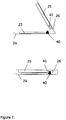
- the chemical heat pad 25 is placed in a chemical heat pad holder 26 which is hinged and moveable towards the sample storage substrate 23.
- An advantage of this is that the heat pad can conveniently be activated and immediately placed in contact with or at a close distance from the sample storage substrate.
- the device also comprises an activating means 40, capable of activating the chemical heat pad 25.
- the activating means can e.g. be a protrusion on or adjacent to the sample storage substrate holder 24 or the movable sample collection member 27, that causes a slit metal disk or spring 41 in the heat pad to bend upon positioning of the heat pad or upon moving the sample collection member to a closed position.
- the slit metal disk or spring may in this case be located at a specific position in the heat pad, e.g. in a partly sealed-off corner of the pad, to fit with the protrusion during positioning.
- the activation means is arranged to act on a slit metal disk or a spring located inside the heat pad upon contacting the activation means (protrusion) with the heat pad.
- Advantages of having an activating means in the arrangement include that the activation is facilitated, that the heat pad does not need to be touched and that the time between activation and positioning of the heat pad can be shortened.
- the arrangement also comprises a moveable sample collection member 27 with an analyte collection surface 28.
- This moveable sample collection member can be hinged and capable to move between a first open position for collecting the biological sample on the analyte collection surface and a second closed position facing or contacting at least a portion of the sample storage substrate.
- the moveable sample collection member can e.g. be attached to a hinged arm 29.
- Such an arrangement can be useful in e.g. the sampling of buccal epithelial cells in human identification, where the sample collection member in the open position can be entered through the mouth and the analyte collection surface swabbed against the inside of the cheek to collect cells.
- the sample collection member can then be closed and the analyte collection surface brought into contact with the sample storage substrate to transfer the cells. Then the chemical heat pad can be positioned and activated to accelerate the drying of the cell sample.
- the analyte collection surface 28 can e.g. be a polymer foam and the sample storage substrate can e.g. be a paper card treated with cell lysing and/or nucleic acid (e.g. DNA) or protein preserving reagents, e.g. FTA®, FTA DMPK or FTAElute (GE Healthcare).
- the arrangement comprises a housing 37 with a plurality of sample storage substrates 33.
- the housing may comprise air vents 38 in connection with air channels 39 between the sample storage substrates.
- An advantage of this arrangement is that several samples may be applied to different substrates and rapidly dried in one operation.
- the air vents 38 on the housing can be aligned with the air channels 39 to obtain an efficient convective heat transfer from the heat pad 35.
- the heat pad can be positioned below the sample storage substrates 33 to improve the convection and the sample storage substrates can be positioned perpendicular or inclined to the length axis of the heat pad.
- the sample storage substrate holder 34 can be a magazine capable of receiving at least 10, such as 24, sample storage substrates, e.g.
- sample storage substrates can be used to sample blood from animals or humans during e.g. drug metabolism and pharmacokinetics (DMPK) testing of drug candidates.
- DMPK pharmacokinetics
- the entire magazine may be transported to a central analysis facility for analysis of the dried blood spots.
- the invention discloses a method for preservation of at least one biological sample.
- the method comprises the steps of
- the surface of the chemical heat pad after activation reaches a temperature in the interval 35 - 58 °C and maintains a temperature in this interval for at least 10 min, such as at least 60 min.
- This can be achieved e.g. with commercially available sodium acetate trihydrate heat pads of different constructions.
- the moisture content of the biological sample or the sample storage substrate with the biological sample is less than about 25% by weight or less than about 15% by weight within one hour after step d), such as within 10 min after step d).
- the sample storage substrate 3;13;23;33 comprises a sheet of porous material, such as paper.
- substrates are non-modified papers such as 903® or 31ETF (both GE Healthcare) and papers with lysing/preservation reagents such as FTA, FTA DMPK and FTAElute (all GE Healthcare). Papers comprising lysing or preservation reagents are often more hygroscopic than plain papers and the method and arrangement of the invention can be particularly advantageous when such papers are used.
- the sample storage substrate 3;13;23;33 comprises at least one reagent for stabilization of components in said biological sample or for lysis of cells in said sample.
- substrates are FTA, FTA DMPK and FTAElute (all GE Healthcare).
- Reagents for lysis of cells can e.g. be surfactants, in particular anionic surfactants like e.g. sodium dodecyl sulphate (SDS), or chaotropes like guanidinium salts or urea.
- Stabilizing reagents can be e.g. chelating agents (e.g. EDTA), weak bases (e.g. Tris or bis-Tris), radical traps (e.g. uric acid or urate salts) and/or vitrification-promoting polyhydroxy compounds (e.g. dextran, polysucrose, trehalose etc). All of these reagents make the paper more hygroscopic.
- the method also comprises a step f) of analyzing at least one component in said sample, after step e).
- the analysis may involve e.g. mass spectrometric analysis of drug candidates or their metabolites, immunoassays of proteins or PCR/RT-PCR and detection of specific nucleic acid sequences.
- Two sodium acetate trihydrate pads (diameter 90 mm, weight 100 g) were evaluated in duplicate, after reheating and cooling. Each pad was placed on a benchtop at room temperature (20 +/- 2 °C) with a temperature transducer (Comark C28 K type thermocouple) on top of it and after activation the temperature was logged.
- a temperature transducer Comark C28 K type thermocouple
Landscapes
- Health & Medical Sciences (AREA)
- Chemical & Material Sciences (AREA)
- Life Sciences & Earth Sciences (AREA)
- General Health & Medical Sciences (AREA)
- Immunology (AREA)
- Pathology (AREA)
- Analytical Chemistry (AREA)
- Biochemistry (AREA)
- Physics & Mathematics (AREA)
- General Physics & Mathematics (AREA)
- Clinical Laboratory Science (AREA)
- Chemical Kinetics & Catalysis (AREA)
- Engineering & Computer Science (AREA)
- Biomedical Technology (AREA)
- Molecular Biology (AREA)
- Sampling And Sample Adjustment (AREA)
- Measuring Or Testing Involving Enzymes Or Micro-Organisms (AREA)
- Investigating Or Analysing Biological Materials (AREA)
- Drying Of Solid Materials (AREA)
Applications Claiming Priority (2)
| Application Number | Priority Date | Filing Date | Title |
|---|---|---|---|
| GBGB1104607.5A GB201104607D0 (en) | 2011-03-18 | 2011-03-18 | Arrangement for preservation of biological samples |
| PCT/SE2012/050287 WO2012128702A1 (en) | 2011-03-18 | 2012-03-15 | Arrangement for preservation of biological samples |
Publications (3)
| Publication Number | Publication Date |
|---|---|
| EP2686660A1 EP2686660A1 (en) | 2014-01-22 |
| EP2686660A4 EP2686660A4 (en) | 2014-09-17 |
| EP2686660B1 true EP2686660B1 (en) | 2019-12-11 |
Family
ID=44012796
Family Applications (1)
| Application Number | Title | Priority Date | Filing Date |
|---|---|---|---|
| EP12761000.4A Active EP2686660B1 (en) | 2011-03-18 | 2012-03-15 | Device and method for drying and preservation of biological samples |
Country Status (5)
| Country | Link |
|---|---|
| US (1) | US9534990B2 (https=) |
| EP (1) | EP2686660B1 (https=) |
| JP (1) | JP5806744B2 (https=) |
| GB (1) | GB201104607D0 (https=) |
| WO (1) | WO2012128702A1 (https=) |
Cited By (1)
| Publication number | Priority date | Publication date | Assignee | Title |
|---|---|---|---|---|
| EP2732262A4 (en) * | 2011-07-13 | 2014-12-10 | Denator Ab | PROCESS FOR STABILIZING LIQUID BIOLOGICAL SAMPLES |
Families Citing this family (9)
| Publication number | Priority date | Publication date | Assignee | Title |
|---|---|---|---|---|
| US10787701B2 (en) | 2010-04-05 | 2020-09-29 | Prognosys Biosciences, Inc. | Spatially encoded biological assays |
| US9063041B2 (en) * | 2012-11-30 | 2015-06-23 | General Electric Company | Device and method for drying biological sample on substrate |
| EP2971109B1 (en) | 2013-03-15 | 2018-10-24 | GE Healthcare UK Limited | Methods for one step nucleic acid amplification of non-eluted samples |
| US10130258B2 (en) * | 2013-09-24 | 2018-11-20 | General Electric Company | Assistive sample collection and storage assembly |
| GB201318814D0 (en) * | 2013-10-24 | 2013-12-11 | Petroleum & Chemical Corp | Microfluidic devices and arrangements for supplying such devices with reagents and biological samples |
| US10215668B2 (en) * | 2015-04-17 | 2019-02-26 | Luigi Novaro | Air quality test unit and process |
| US9952123B2 (en) * | 2015-04-17 | 2018-04-24 | Luigi Novaro | Air quality test unit and process |
| JP6772989B2 (ja) * | 2017-08-23 | 2020-10-21 | 株式会社島津製作所 | 試料ホルダ |
| US12157124B2 (en) * | 2019-11-06 | 2024-12-03 | 10X Genomics, Inc. | Imaging system hardware |
Family Cites Families (19)
| Publication number | Priority date | Publication date | Assignee | Title |
|---|---|---|---|---|
| US4756299A (en) | 1986-12-15 | 1988-07-12 | Hypertherm Technologies, Inc. | Chemical heating pad with differing air-admitting perforation sets for different heat-generation levels |
| JPH02502519A (ja) | 1987-12-15 | 1990-08-16 | ハイパーサーム テクノロジイーズ,インコーポレーテッド | 異なる熱発生水準のための異なる通気用の孔セットを有する化学的加熱用パッド |
| US6627226B2 (en) * | 1988-10-05 | 2003-09-30 | Whatman, Inc. | Dry solid medium for storage and analysis of genetic material |
| JPH038328A (ja) | 1989-06-06 | 1991-01-16 | Mitsubishi Electric Corp | 基板表面の洗浄装置 |
| JPH03189536A (ja) | 1989-12-20 | 1991-08-19 | Tonen Corp | 簡便型ゲル乾燥装置及び乾燥方法 |
| JPH05261127A (ja) | 1992-03-17 | 1993-10-12 | Keiji Miki | 発熱器具 |
| US5308580A (en) | 1992-05-19 | 1994-05-03 | Millipore Corporation | Sample collection and analytical device |
| JP3008328U (ja) * | 1994-08-09 | 1995-03-14 | 株式会社ステム | 殺菌灯付きスライドグラス乾燥器 |
| JP3008328B2 (ja) | 1994-10-27 | 2000-02-14 | 株式会社ユニシアジェックス | 自動車用アクティブ騒音制御装置 |
| US5980828A (en) * | 1996-05-28 | 1999-11-09 | Universal Healthwatch, Inc. | Combined sampling-assay device and holder |
| WO2003020924A2 (en) * | 2001-09-05 | 2003-03-13 | Whatman Plc | Stable storage of proteins |
| WO2006091934A2 (en) * | 2005-02-25 | 2006-08-31 | Ilercil, Alp | Biological sample preservation, transportation and storage device |
| US8062901B2 (en) * | 2005-04-30 | 2011-11-22 | Alere Switzerland Gmbh | Devices and methods for sample collection and analysis |
| DE212006000036U1 (de) * | 2005-04-30 | 2008-02-21 | Oakville Hong Kong Co., Ltd. | Vorrichtungen zum Probensammeln und zur Analyse |
| US9017964B2 (en) | 2005-08-26 | 2015-04-28 | Denator Aktiebolag | Preparing biological samples for analysis |
| US7748283B2 (en) * | 2007-02-16 | 2010-07-06 | Whatman, Inc. | Controlled transfer biological sample collection devices and methods of using such devices |
| US20090036665A1 (en) | 2007-07-11 | 2009-02-05 | Gonzalo Domingo | Disposable Sample Processing Unit |
| JP5598766B2 (ja) | 2008-04-10 | 2014-10-01 | デナトール アクティエボラグ | 生体試料を保管し調整する装置 |
| US9044007B2 (en) * | 2008-10-08 | 2015-06-02 | Theodore R. Sadler | Device and method for ambient storage of fresh/frozen tissue sections via desiccation |
-
2011
- 2011-03-18 GB GBGB1104607.5A patent/GB201104607D0/en not_active Ceased
-
2012
- 2012-03-15 JP JP2013558818A patent/JP5806744B2/ja active Active
- 2012-03-15 EP EP12761000.4A patent/EP2686660B1/en active Active
- 2012-03-15 US US14/005,909 patent/US9534990B2/en active Active
- 2012-03-15 WO PCT/SE2012/050287 patent/WO2012128702A1/en not_active Ceased
Non-Patent Citations (1)
| Title |
|---|
| None * |
Cited By (1)
| Publication number | Priority date | Publication date | Assignee | Title |
|---|---|---|---|---|
| EP2732262A4 (en) * | 2011-07-13 | 2014-12-10 | Denator Ab | PROCESS FOR STABILIZING LIQUID BIOLOGICAL SAMPLES |
Also Published As
| Publication number | Publication date |
|---|---|
| EP2686660A4 (en) | 2014-09-17 |
| WO2012128702A1 (en) | 2012-09-27 |
| JP5806744B2 (ja) | 2015-11-10 |
| EP2686660A1 (en) | 2014-01-22 |
| US9534990B2 (en) | 2017-01-03 |
| GB201104607D0 (en) | 2011-05-04 |
| US20140011289A1 (en) | 2014-01-09 |
| JP2014508308A (ja) | 2014-04-03 |
Similar Documents
| Publication | Publication Date | Title |
|---|---|---|
| EP2686660B1 (en) | Device and method for drying and preservation of biological samples | |
| US11493410B2 (en) | Methods for heating microscope slides carrying specimens | |
| US7748283B2 (en) | Controlled transfer biological sample collection devices and methods of using such devices | |
| EP1711590B1 (en) | Apparatus and methods for processing biological samples and a reservoir therefore | |
| US9359600B2 (en) | Biologic sample collection devices and methods of production and use thereof | |
| EP3003555B1 (en) | Controlled transfer biological sample collection devices and methods of using such devices | |
| US9708600B2 (en) | Biologic sample collection devices and methods of production and use thereof | |
| US9063041B2 (en) | Device and method for drying biological sample on substrate | |
| US10085726B2 (en) | Controlled transfer biological sample collection devices and methods of using such devices | |
| HK1162661B (en) | Methods and apparatuses for heating slides carrying specimens | |
| HK1219921B (en) | Controlled transfer biological sample collection devices and methods of using such devices |
Legal Events
| Date | Code | Title | Description |
|---|---|---|---|
| PUAI | Public reference made under article 153(3) epc to a published international application that has entered the european phase |
Free format text: ORIGINAL CODE: 0009012 |
|
| 17P | Request for examination filed |
Effective date: 20130903 |
|
| AK | Designated contracting states |
Kind code of ref document: A1 Designated state(s): AL AT BE BG CH CY CZ DE DK EE ES FI FR GB GR HR HU IE IS IT LI LT LU LV MC MK MT NL NO PL PT RO RS SE SI SK SM TR |
|
| DAX | Request for extension of the european patent (deleted) | ||
| A4 | Supplementary search report drawn up and despatched |
Effective date: 20140814 |
|
| RIC1 | Information provided on ipc code assigned before grant |
Ipc: G01N 1/28 20060101AFI20140808BHEP Ipc: B01L 3/00 20060101ALI20140808BHEP |
|
| GRAP | Despatch of communication of intention to grant a patent |
Free format text: ORIGINAL CODE: EPIDOSNIGR1 |
|
| STAA | Information on the status of an ep patent application or granted ep patent |
Free format text: STATUS: GRANT OF PATENT IS INTENDED |
|
| INTG | Intention to grant announced |
Effective date: 20190702 |
|
| GRAS | Grant fee paid |
Free format text: ORIGINAL CODE: EPIDOSNIGR3 |
|
| GRAA | (expected) grant |
Free format text: ORIGINAL CODE: 0009210 |
|
| STAA | Information on the status of an ep patent application or granted ep patent |
Free format text: STATUS: THE PATENT HAS BEEN GRANTED |
|
| AK | Designated contracting states |
Kind code of ref document: B1 Designated state(s): AL AT BE BG CH CY CZ DE DK EE ES FI FR GB GR HR HU IE IS IT LI LT LU LV MC MK MT NL NO PL PT RO RS SE SI SK SM TR |
|
| REG | Reference to a national code |
Ref country code: GB Ref legal event code: FG4D |
|
| REG | Reference to a national code |
Ref country code: CH Ref legal event code: EP |
|
| REG | Reference to a national code |
Ref country code: AT Ref legal event code: REF Ref document number: 1212671 Country of ref document: AT Kind code of ref document: T Effective date: 20191215 |
|
| REG | Reference to a national code |
Ref country code: DE Ref legal event code: R096 Ref document number: 602012066398 Country of ref document: DE |
|
| REG | Reference to a national code |
Ref country code: IE Ref legal event code: FG4D |
|
| REG | Reference to a national code |
Ref country code: NL Ref legal event code: MP Effective date: 20191211 |
|
| REG | Reference to a national code |
Ref country code: LT Ref legal event code: MG4D |
|
| PG25 | Lapsed in a contracting state [announced via postgrant information from national office to epo] |
Ref country code: ES Free format text: LAPSE BECAUSE OF FAILURE TO SUBMIT A TRANSLATION OF THE DESCRIPTION OR TO PAY THE FEE WITHIN THE PRESCRIBED TIME-LIMIT Effective date: 20191211 Ref country code: NO Free format text: LAPSE BECAUSE OF FAILURE TO SUBMIT A TRANSLATION OF THE DESCRIPTION OR TO PAY THE FEE WITHIN THE PRESCRIBED TIME-LIMIT Effective date: 20200311 Ref country code: BG Free format text: LAPSE BECAUSE OF FAILURE TO SUBMIT A TRANSLATION OF THE DESCRIPTION OR TO PAY THE FEE WITHIN THE PRESCRIBED TIME-LIMIT Effective date: 20200311 Ref country code: LV Free format text: LAPSE BECAUSE OF FAILURE TO SUBMIT A TRANSLATION OF THE DESCRIPTION OR TO PAY THE FEE WITHIN THE PRESCRIBED TIME-LIMIT Effective date: 20191211 Ref country code: SE Free format text: LAPSE BECAUSE OF FAILURE TO SUBMIT A TRANSLATION OF THE DESCRIPTION OR TO PAY THE FEE WITHIN THE PRESCRIBED TIME-LIMIT Effective date: 20191211 Ref country code: FI Free format text: LAPSE BECAUSE OF FAILURE TO SUBMIT A TRANSLATION OF THE DESCRIPTION OR TO PAY THE FEE WITHIN THE PRESCRIBED TIME-LIMIT Effective date: 20191211 Ref country code: GR Free format text: LAPSE BECAUSE OF FAILURE TO SUBMIT A TRANSLATION OF THE DESCRIPTION OR TO PAY THE FEE WITHIN THE PRESCRIBED TIME-LIMIT Effective date: 20200312 Ref country code: LT Free format text: LAPSE BECAUSE OF FAILURE TO SUBMIT A TRANSLATION OF THE DESCRIPTION OR TO PAY THE FEE WITHIN THE PRESCRIBED TIME-LIMIT Effective date: 20191211 |
|
| PG25 | Lapsed in a contracting state [announced via postgrant information from national office to epo] |
Ref country code: HR Free format text: LAPSE BECAUSE OF FAILURE TO SUBMIT A TRANSLATION OF THE DESCRIPTION OR TO PAY THE FEE WITHIN THE PRESCRIBED TIME-LIMIT Effective date: 20191211 Ref country code: RS Free format text: LAPSE BECAUSE OF FAILURE TO SUBMIT A TRANSLATION OF THE DESCRIPTION OR TO PAY THE FEE WITHIN THE PRESCRIBED TIME-LIMIT Effective date: 20191211 |
|
| PG25 | Lapsed in a contracting state [announced via postgrant information from national office to epo] |
Ref country code: AL Free format text: LAPSE BECAUSE OF FAILURE TO SUBMIT A TRANSLATION OF THE DESCRIPTION OR TO PAY THE FEE WITHIN THE PRESCRIBED TIME-LIMIT Effective date: 20191211 |
|
| PG25 | Lapsed in a contracting state [announced via postgrant information from national office to epo] |
Ref country code: RO Free format text: LAPSE BECAUSE OF FAILURE TO SUBMIT A TRANSLATION OF THE DESCRIPTION OR TO PAY THE FEE WITHIN THE PRESCRIBED TIME-LIMIT Effective date: 20191211 Ref country code: CZ Free format text: LAPSE BECAUSE OF FAILURE TO SUBMIT A TRANSLATION OF THE DESCRIPTION OR TO PAY THE FEE WITHIN THE PRESCRIBED TIME-LIMIT Effective date: 20191211 Ref country code: PT Free format text: LAPSE BECAUSE OF FAILURE TO SUBMIT A TRANSLATION OF THE DESCRIPTION OR TO PAY THE FEE WITHIN THE PRESCRIBED TIME-LIMIT Effective date: 20200506 Ref country code: EE Free format text: LAPSE BECAUSE OF FAILURE TO SUBMIT A TRANSLATION OF THE DESCRIPTION OR TO PAY THE FEE WITHIN THE PRESCRIBED TIME-LIMIT Effective date: 20191211 Ref country code: NL Free format text: LAPSE BECAUSE OF FAILURE TO SUBMIT A TRANSLATION OF THE DESCRIPTION OR TO PAY THE FEE WITHIN THE PRESCRIBED TIME-LIMIT Effective date: 20191211 |
|
| RAP2 | Party data changed (patent owner data changed or rights of a patent transferred) |
Owner name: GLOBAL LIFE SCIENCES SOLUTIONS OPERATIONS UK LTD |
|
| PG25 | Lapsed in a contracting state [announced via postgrant information from national office to epo] |
Ref country code: SK Free format text: LAPSE BECAUSE OF FAILURE TO SUBMIT A TRANSLATION OF THE DESCRIPTION OR TO PAY THE FEE WITHIN THE PRESCRIBED TIME-LIMIT Effective date: 20191211 Ref country code: SM Free format text: LAPSE BECAUSE OF FAILURE TO SUBMIT A TRANSLATION OF THE DESCRIPTION OR TO PAY THE FEE WITHIN THE PRESCRIBED TIME-LIMIT Effective date: 20191211 Ref country code: IS Free format text: LAPSE BECAUSE OF FAILURE TO SUBMIT A TRANSLATION OF THE DESCRIPTION OR TO PAY THE FEE WITHIN THE PRESCRIBED TIME-LIMIT Effective date: 20200411 |
|
| REG | Reference to a national code |
Ref country code: DE Ref legal event code: R081 Ref document number: 602012066398 Country of ref document: DE Owner name: GLOBAL LIFE SCIENCES SOLUTIONS OPERATIONS UK L, GB Free format text: FORMER OWNER: GE HEALTHCARE UK LIMITED, LITTLE CHALFONT, BUCKINGHAMSHIRE, GB |
|
| REG | Reference to a national code |
Ref country code: DE Ref legal event code: R097 Ref document number: 602012066398 Country of ref document: DE |
|
| REG | Reference to a national code |
Ref country code: AT Ref legal event code: MK05 Ref document number: 1212671 Country of ref document: AT Kind code of ref document: T Effective date: 20191211 |
|
| PLBE | No opposition filed within time limit |
Free format text: ORIGINAL CODE: 0009261 |
|
| STAA | Information on the status of an ep patent application or granted ep patent |
Free format text: STATUS: NO OPPOSITION FILED WITHIN TIME LIMIT |
|
| PG25 | Lapsed in a contracting state [announced via postgrant information from national office to epo] |
Ref country code: MC Free format text: LAPSE BECAUSE OF FAILURE TO SUBMIT A TRANSLATION OF THE DESCRIPTION OR TO PAY THE FEE WITHIN THE PRESCRIBED TIME-LIMIT Effective date: 20191211 Ref country code: DK Free format text: LAPSE BECAUSE OF FAILURE TO SUBMIT A TRANSLATION OF THE DESCRIPTION OR TO PAY THE FEE WITHIN THE PRESCRIBED TIME-LIMIT Effective date: 20191211 |
|
| REG | Reference to a national code |
Ref country code: CH Ref legal event code: PL |
|
| 26N | No opposition filed |
Effective date: 20200914 |
|
| PG25 | Lapsed in a contracting state [announced via postgrant information from national office to epo] |
Ref country code: AT Free format text: LAPSE BECAUSE OF FAILURE TO SUBMIT A TRANSLATION OF THE DESCRIPTION OR TO PAY THE FEE WITHIN THE PRESCRIBED TIME-LIMIT Effective date: 20191211 Ref country code: PL Free format text: LAPSE BECAUSE OF FAILURE TO SUBMIT A TRANSLATION OF THE DESCRIPTION OR TO PAY THE FEE WITHIN THE PRESCRIBED TIME-LIMIT Effective date: 20191211 Ref country code: SI Free format text: LAPSE BECAUSE OF FAILURE TO SUBMIT A TRANSLATION OF THE DESCRIPTION OR TO PAY THE FEE WITHIN THE PRESCRIBED TIME-LIMIT Effective date: 20191211 |
|
| REG | Reference to a national code |
Ref country code: BE Ref legal event code: MM Effective date: 20200331 |
|
| PG25 | Lapsed in a contracting state [announced via postgrant information from national office to epo] |
Ref country code: LU Free format text: LAPSE BECAUSE OF NON-PAYMENT OF DUE FEES Effective date: 20200315 |
|
| PG25 | Lapsed in a contracting state [announced via postgrant information from national office to epo] |
Ref country code: CH Free format text: LAPSE BECAUSE OF NON-PAYMENT OF DUE FEES Effective date: 20200331 Ref country code: IT Free format text: LAPSE BECAUSE OF FAILURE TO SUBMIT A TRANSLATION OF THE DESCRIPTION OR TO PAY THE FEE WITHIN THE PRESCRIBED TIME-LIMIT Effective date: 20191211 Ref country code: LI Free format text: LAPSE BECAUSE OF NON-PAYMENT OF DUE FEES Effective date: 20200331 Ref country code: IE Free format text: LAPSE BECAUSE OF NON-PAYMENT OF DUE FEES Effective date: 20200315 |
|
| PG25 | Lapsed in a contracting state [announced via postgrant information from national office to epo] |
Ref country code: BE Free format text: LAPSE BECAUSE OF NON-PAYMENT OF DUE FEES Effective date: 20200331 |
|
| REG | Reference to a national code |
Ref country code: GB Ref legal event code: 732E Free format text: REGISTERED BETWEEN 20211210 AND 20211215 |
|
| PG25 | Lapsed in a contracting state [announced via postgrant information from national office to epo] |
Ref country code: TR Free format text: LAPSE BECAUSE OF FAILURE TO SUBMIT A TRANSLATION OF THE DESCRIPTION OR TO PAY THE FEE WITHIN THE PRESCRIBED TIME-LIMIT Effective date: 20191211 Ref country code: MT Free format text: LAPSE BECAUSE OF FAILURE TO SUBMIT A TRANSLATION OF THE DESCRIPTION OR TO PAY THE FEE WITHIN THE PRESCRIBED TIME-LIMIT Effective date: 20191211 Ref country code: CY Free format text: LAPSE BECAUSE OF FAILURE TO SUBMIT A TRANSLATION OF THE DESCRIPTION OR TO PAY THE FEE WITHIN THE PRESCRIBED TIME-LIMIT Effective date: 20191211 |
|
| PG25 | Lapsed in a contracting state [announced via postgrant information from national office to epo] |
Ref country code: MK Free format text: LAPSE BECAUSE OF FAILURE TO SUBMIT A TRANSLATION OF THE DESCRIPTION OR TO PAY THE FEE WITHIN THE PRESCRIBED TIME-LIMIT Effective date: 20191211 |
|
| P01 | Opt-out of the competence of the unified patent court (upc) registered |
Effective date: 20230526 |
|
| PGFP | Annual fee paid to national office [announced via postgrant information from national office to epo] |
Ref country code: DE Payment date: 20231229 Year of fee payment: 13 Ref country code: GB Payment date: 20240108 Year of fee payment: 13 |
|
| PGFP | Annual fee paid to national office [announced via postgrant information from national office to epo] |
Ref country code: FR Payment date: 20240103 Year of fee payment: 13 |
|
| REG | Reference to a national code |
Ref country code: DE Ref legal event code: R119 Ref document number: 602012066398 Country of ref document: DE |
|
| GBPC | Gb: european patent ceased through non-payment of renewal fee |
Effective date: 20250315 |
|
| PG25 | Lapsed in a contracting state [announced via postgrant information from national office to epo] |
Ref country code: DE Free format text: LAPSE BECAUSE OF NON-PAYMENT OF DUE FEES Effective date: 20251001 |
|
| PG25 | Lapsed in a contracting state [announced via postgrant information from national office to epo] |
Ref country code: GB Free format text: LAPSE BECAUSE OF NON-PAYMENT OF DUE FEES Effective date: 20250315 |
|
| PG25 | Lapsed in a contracting state [announced via postgrant information from national office to epo] |
Ref country code: FR Free format text: LAPSE BECAUSE OF NON-PAYMENT OF DUE FEES Effective date: 20250331 |