EP2679719A1 - Bügelmaschine nach Art einer Mangel - Google Patents
Bügelmaschine nach Art einer Mangel Download PDFInfo
- Publication number
- EP2679719A1 EP2679719A1 EP13401045.3A EP13401045A EP2679719A1 EP 2679719 A1 EP2679719 A1 EP 2679719A1 EP 13401045 A EP13401045 A EP 13401045A EP 2679719 A1 EP2679719 A1 EP 2679719A1
- Authority
- EP
- European Patent Office
- Prior art keywords
- trough
- ironing machine
- heating
- machine according
- channel
- Prior art date
- Legal status (The legal status is an assumption and is not a legal conclusion. Google has not performed a legal analysis and makes no representation as to the accuracy of the status listed.)
- Granted
Links
- 238000010409 ironing Methods 0.000 title claims abstract description 25
- 238000010438 heat treatment Methods 0.000 claims abstract description 48
- 238000009499 grossing Methods 0.000 claims abstract description 10
- 239000004753 textile Substances 0.000 claims abstract description 8
- 230000007547 defect Effects 0.000 claims description 8
- 238000005485 electric heating Methods 0.000 claims description 2
- 239000011796 hollow space material Substances 0.000 claims 1
- 239000007789 gas Substances 0.000 description 12
- 230000007812 deficiency Effects 0.000 description 9
- 230000007704 transition Effects 0.000 description 3
- 230000007423 decrease Effects 0.000 description 2
- 239000003546 flue gas Substances 0.000 description 2
- 238000000034 method Methods 0.000 description 2
- 230000008569 process Effects 0.000 description 2
- 230000009471 action Effects 0.000 description 1
- XAGFODPZIPBFFR-UHFFFAOYSA-N aluminium Chemical compound [Al] XAGFODPZIPBFFR-UHFFFAOYSA-N 0.000 description 1
- 229910052782 aluminium Inorganic materials 0.000 description 1
- 238000010276 construction Methods 0.000 description 1
- 230000003247 decreasing effect Effects 0.000 description 1
- 230000002950 deficient Effects 0.000 description 1
- 230000001419 dependent effect Effects 0.000 description 1
- 230000000694 effects Effects 0.000 description 1
- 238000009434 installation Methods 0.000 description 1
- 238000009413 insulation Methods 0.000 description 1
- 238000012986 modification Methods 0.000 description 1
- 230000004048 modification Effects 0.000 description 1
- 238000005457 optimization Methods 0.000 description 1
- 230000009467 reduction Effects 0.000 description 1
- 238000009420 retrofitting Methods 0.000 description 1
Images

Classifications
-
- D—TEXTILES; PAPER
- D06—TREATMENT OF TEXTILES OR THE LIKE; LAUNDERING; FLEXIBLE MATERIALS NOT OTHERWISE PROVIDED FOR
- D06F—LAUNDERING, DRYING, IRONING, PRESSING OR FOLDING TEXTILE ARTICLES
- D06F67/00—Details of ironing machines provided for in groups D06F61/00, D06F63/00, or D06F65/00
- D06F67/08—Beds; Heating arrangements therefor
Definitions
- the invention relates to a mangle type ironing machine comprising a roller rotatably mounted in a trough area for forming a cupped smoothing space for textiles, the trough area being provided with a heating means acting on the trough surface consisting of a channel or channels disposed on the rear side of the trough surface through which a heating medium consisting of hot gas flows, wherein the channel or the channels are connected to an input channel common to the inflow of the heating medium and at least one output duct for the exhaust air flow or exhaust gas.
- ironing machines are known in the manner of a defect, wherein in a trough region, a roller is rotatably mounted. Between the trough area and the roller, a smoothing room for textiles is formed, which is heated by means of a heater.
- the heater is in this case at the back of the trough outer surface, where a channel space is provided with a channel or more channels through which the hot gas flows, so as to heat the smoothing surface at the trough area.
- the tray deficiency disclosed herein comprises a trough area for forming a bowl-shaped smoothing space for textiles, which is provided with a heater acting over the trough surface consisting of a channel or channels disposed at the rear of the trough outer surface through which a heating medium consisting of hot gas flows.
- the channel or channels are connected to an input channel common to the inflow of the heating medium and to at least one outlet channel for the exhaust gas flow.
- Ironing machines are also known from the prior art, which have a powerful electric heating device, which does not always have sufficient electrical protection on site.
- the DE 36 43 901 A1 discloses a purely electrically heated trough for a defect, are mounted on the outside of the trough heating elements.
- the heating elements are embedded on the outside in block-like heat distribution elements, which in turn rest flat on the outside of the bowl.
- the blocks are provided on the outside with a thermal insulation, in order to effect a good and uniform heat transfer only to the hollow interior and to avoid heat loss.
- due to the disadvantage of the necessary electrical protection often resorted to gas-heated mangles. These have despite much higher installed heating capacity, a significantly lower mangle performance, that is, the throughput of the laundry per time is low, since the gas-heated defect has a significantly poorer overall efficiency than electrically heated mangles.
- Gas-fired bowl mangles usually have the problem that the temperature in the bowl inlet drops sharply as soon as laundry is entered. The deficiency then drops, the laundry comes wet from the defect, so possibly suffers while the finish of the laundry. The reason for this is the poor temperature transition of the hot flue gases, which have about 450 ° C, on the trough surface. An aluminum trough emits only between 100 ° and 200 ° C to the textiles located in the smoothing area. In order to make an efficient deficiency here, so that the laundry does not come damp from the defect, the deficiency rate is adjusted accordingly. With regard to the temperature transition, it is attempted to conduct the hot gases over as long a distance as possible in the region of the depression and on the entire depression.
- the invention thus raises the problem of developing a gas-heated ironing machine in such a way that overcomes the disadvantages described, in particular, to ensure that a better shortage of ironing machine to be provided.
- the advantages achieved by the invention are that, as a result of an electric auxiliary heating of the trough inlet, without the electrical protection of the ironing machine must be increased, the temperature in the trough inlet at the same lack of speed significantly higher than without electric auxiliary heating.
- the shortage speed must be reduced less, so that the shortage of ironing machine significantly increases compared to purely gas-heated variants. As a result, there is an increase in the performance data for the same electrical connection performance.
- the trough surface is provided here with a locally acting additional heating device for compensating temperature differences occurring over the smoothing surface during the shortage process.
- the heater is arranged in the region of the intake or the inlet in the trough.
- the heater consists of partially segmented elements.
- the heating device furthermore consists of at least one electrically heatable heating rod, preferably at least two heating rods.
- the individual heating elements can be activated or deactivated by means of a control in case of need.
- the heating elements are arranged at the rear of the trough at the trough inlet.
- the heating elements are located in the back of the trough surface or the cheek part existing rib-like channels, wherein at least two heating elements are arranged in each case a rib. If required, the heating elements can also be switched on manually.
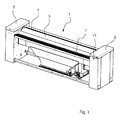
- the FIG. 1 shows an ironing machine 1 in the manner of a defect, wherein the ironing machine 1 comprises a frame 2, in which a roller 3 is rotatably mounted.
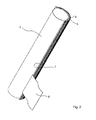
- the roller 3 rotates in a trough area 4, to form a cup-shaped smoothing space 5, as it is for example in the FIG. 2 is indicated.
- a textile 6 is drawn in via an input 7, so that then over the partial circumference of the roller 3, the laundry is smoothed.
- the trough region or the trough cheek 4 is hereby provided with a heating device 9 which acts via the trough surface 8 and consists of a channel or channels 10 arranged on the rear side of the trough outer surface.
- a heating medium H consisting of hot gas flows through the channel or channels 10, the channel or channels 10 being connected to an inlet channel 11 common to the inflow of the heating medium H, and to at least one outlet channel 12 for the exhaust air flow or the exhaust gas flow A.
- the trough surface 8 is provided with a locally acting additional heater 13 to compensate for the temperature differences occurring over the trough surface 8 during the mangle process.
- the additional heating device 13 is arranged in the region of the intake 7 of the trough region 4, as can be clearly seen from FIG FIG. 3 can be seen.
- the heater 13 here consists of partially segmented elements, which consists of at least two electrically heatable heating elements 14 and 15.
- the individual heating elements 14 and 15 can be activated or deactivated by means of a control in case of need.
- the heating elements 14 and 15 are arranged on the back of the trough surface 8 at the trough inlet 7.
- the heating elements 14 and 15 themselves are arranged in rib-like channels 16 provided on the rear side of the trough surface 8.
- the heating elements 14, 15 in each case a channel 16 which is bounded by two adjacent ribs 16a in terms of its width, be inserted or pressed.
- the heating elements are automatically switched on by the controller 17 or manually by means of an operator action by the user, if necessary.
- the electric heater 13 may also be activated or operated separately without the heating by hot gas, for example, when a short deficiency operation with low heating power to be performed. Then the start-up of the heater 9 would consume too much time and energy.
Landscapes
- Engineering & Computer Science (AREA)
- Textile Engineering (AREA)
- Irons (AREA)
- Central Heating Systems (AREA)
- Treatment Of Fiber Materials (AREA)
Abstract
Description
- Die Erfindung betrifft eine Bügelmaschine nach Art einer Mangel umfassend eine in einem Muldenbereich drehbar gelagerte Walze zur Bildung eines schalenförmigen Glättungsraumes für Textilien, wobei der Muldenbereich mit einer über die Muldenfläche wirkenden Heizeinrichtung versehen ist, die aus an der Rückseite der Muldenfläche angeordnetem Kanal oder Kanälen besteht, durch die ein aus Heißgas bestehendes Heizmedium strömt, wobei der Kanal oder die Kanäle mit einem für den Zustrom des Heizmediums gemeinsamen Eingangskanal verbunden sind sowie mit wenigstem einem Ausgangskanal für den Abluftstrom oder Abgas.
- Aus dem Stand der Technik sind Bügelmaschinen nach Art einer Mangel bekannt, wobei in einem Muldenbereich eine Walze drehbar gelagert ist. Zwischen dem Muldenbereich und der Walze wird ein Glättungsraum für Textilien gebildet, wobei dieser mittels einer Heizeinrichtung erwärmt wird. Die Heizeinrichtung befindet sich hierbei an der Rückseite der Muldenaußenfläche, wo ein Kanalraum mit einem Kanal oder mehreren Kanälen vorgesehen ist, durch die das Heißgas strömt, um auf diese Weise die Glättungsfläche am Muldenbereich zu erwärmen.
- In der
DE 89 05 552 U1 oder derUS 3 191 325 A ist eine durch Heißgas beheizte Muldenmangel in der dafür geeigneten konstruktiven Ausführung offenbart. Die hier offenbarte Muldenmangel umfasst einen Muldenbereich zur Bildung eines schalenförmigen Glättungsraumes für Textilien, welcher mit einer über die Muldenfläche wirkenden Heizeinrichtung versehen ist, die aus an der Rückseite der Muldenaußenfläche angeordneten Kanal oder Kanälen besteht, durch die ein aus Heißgas bestehendes Heizmedium strömt. Der Kanal oder die Kanäle sind mit einem für den Zustrom des Heizmediums gemeinsamen Eingangskanal verbunden, sowie mit wenigstens einem Ausgangskanal für den Abgasstrom. - Aus dem Stand der Technik sind auch Bügelmaschinen bekannt, welche eine leistungsstarke elektrische Heizeinrichtung aufweisen, die bauseitig nicht immer eine ausreichend dimensionierte elektrische Absicherung aufweist.
- Die
DE 36 43 901 A1 offenbart eine rein elektrisch beheizte Mulde für eine Mangel, bei der an der Muldenaußenseite Heizelemente angebracht sind. Um die Wärmeübertragung zu optimieren, sind die Heizelemente außenseitig in blockartigen Wärmeverteilungselementen eingebettet, die wiederrum flächig an der Muldenaußenseite anliegen. Die Blöcke sind außenseitig mit einer Wärmeisolierung versehen, um eine gute und gleichmäßige Wärmeübertragung nur zum Muldeninneren zu bewirken und Wärmeverluste zu vermeiden. Somit wird aufgrund des Nachteils der notwendigen elektrischen Absicherung oftmals auf gasbeheizte Mangeln zurückgegriffen. Diese haben trotz deutlich höherer installierter Heizleistung eine erheblich geringere Mangelleistung, das heißt, der Durchsatz der Wäsche pro Zeit ist gering, da die gasbeheizte Mangel einen erheblich schlechteren Gesamtwirkungsgrad besitzt als elektrisch beheizte Mangeln. - Gasbeheizte Muldenmangeln haben in der Regel das Problem, dass die Temperatur im Muldeneinlauf stark absinkt, sobald Wäsche eingegeben wird. Die Mangelleistung sinkt dann, wobei die Wäsche feucht aus der Mangel kommt, so dass gegebenenfalls dabei das Finish der Wäsche leidet. Ursache dafür ist der schlechte Temperaturübergang von den heißen Rauchgasen, die etwa 450° C aufweisen, auf die Muldenfläche. Eine Aluminiummulde gibt dabei nur zwischen 100° und 200°C an die im Glättungsbereich befindlichen Textilien ab. Um hier eine effiziente Mangelung vorzunehmen, damit die Wäsche nicht feucht aus der Mangel kommt, wird die Mangelgeschwindigkeit dabei entsprechend heruntergeregelt. Bezüglich des Temperaturübergangs wird versucht, die heißen Gase über eine möglichst lange Strecke im Bereich des Muldeneinlaufs und auf der gesamten Mulde zu leiten. Hier werden viele Wirbelbleche eingesetzt, um auf diese Weise den Temperaturübergang zu verbessern. Wie bereits schon gesagt, wird durch das notwendige Herunterregeln der Mangelgeschwindigkeit entsprechend die Mangelleistung minimiert. Der Muldeneinlauf wird relativ im Vergleich zu einer rein elektrisch beheizten Mulde kühl und es kann zu Finish-Problemen kommen.
- Bei der rein elektrisch beheizten Mulde haben die Heizkörper im Bereich des Muldeneinlaufs eine höhere Dichte als am Rest des Umfangs. Dadurch steigt auch die Elektrofläche oder die übertragene Energie zum Trockenen und Glätten des Mangelgutes. Bei der rein gasbeheizten Mulde sieht die Situation anders aus. Hier herrscht im Muldeneinlauf ein höheres Temperaturgefälle zwischen den Rauchgasen, die die Energie in die Mulde übertragen. Die Temperatur nimmt aber beim Mangeln trotzdem viel stärker ab als bei einer elektrisch beheizten Mulde.
- Der Erfindung stellt sich somit das Problem, eine gasbeheizte Bügelmaschine derart weiterzubilden, die die geschilderten Nachteile überwindet, wobei insbesondere gewährleistet werden soll, dass eine bessere Mangelleistung der Bügelmaschine bereitgestellt werden soll.
- Erfindungsgemäß wird dieses Problem durch eine Bügelmaschine mit den Merkmalen des unabhängigen Patentanspruchs 1 gelöst. Vorteilhafte Ausgestaltungen und Weiterbildungen der Erfindung ergeben sich aus den nachfolgenden abhängigen Ansprüchen.
- Die mit der Erfindung erreichten Vorteile bestehen darin, dass in Folge einer elektrischen Zusatzheizung des Muldeneinlaufs, ohne dass die elektrische Absicherung der Bügelmaschine erhöht werden muss, die Temperatur im Muldeneinlauf bei gleicher Mangelgeschwindigkeit deutlich höher als ohne elektrische Zusatzheizung ist. Die Mangelgeschwindigkeit muss weniger reduziert werden, so dass die Mangelleistung der Bügelmaschine deutlich steigt im Vergleich zu rein gasbeheizten Varianten. Daraus folgernd ergibt sich eine Steigerung der Leistungsdaten bei gleicher elektrischer Anschlussleistung.
- Durch den Einsatz von zusätzlichen Heizstäben im Muldeneinlauf kann diese Temperatur bei gleicher Mangelgeschwindigkeit und damit auch die Mangelleistung merklich angehoben werden. Der Einbau einer zusätzlichen Heizeinrichtung ist besonders einfach umzusetzen, da die elektrobeheizte Mulde und die gasbeheizte Mulde im Aufbau identisch sind. Ein Nachrüsten ist daher durchaus denkbar. Die Aufnahmen für die Heizkörper sind also schon vorhanden. Prinzipiell ist es auch möglich, die elektrische Zusatzheizung nur im Bedarfsfall durch den Nutzer handgesteuert oder manuell beziehungsweise durch die Maschinensteuerung automatisch zu aktivieren. Im Leerlauf, wenn der Leistungsbedarf nicht so hoch wird, wird nur mit Gas beheizt, sobald Leistung abgefordert wird, schaltet sich die elektrische Zusatzheizung ein. Da Gas günstiger als elektrische Energie ist, wird hier noch eine Kostenoptimierung durchgeführt.
- Erfindungsgemäß ist hierbei die Muldenfläche mit einer lokal wirkenden zusätzlichen Heizeinrichtung versehen zum Ausgleich von über die Glättungsfläche auftretenden Temperaturdifferenzen beim Mangelvorgang. Die Heizeinrichtung ist im Bereich des Einzugs beziehungsweise des Einlaufs in der Mulde angeordnet. Hierbei besteht die Heizeinrichtung aus bereichsweise segmentierten Elementen. Die Heizeinrichtung besteht weiterhin aus wenigstens einem elektrisch beheizbaren Heizstab, vorzugsweise wenigstens zwei Heizstäben. Dabei sind die einzelnen Heizstäbe mittels einer Steuerung im Bedarfsfall aktivierbar beziehungsweise deaktivierbar. Die Heizstäbe als solches sind an der Rückseite der Mulde am Muldeneinlauf angeordnet. Dabei liegen die Heizstäbe in an der Rückseite der Muldenfläche bzw. der Wangenteils vorhandenen rippenartigen Kanälen, wobei zumindest zwei Heizstäbe in jeweils einer Rippe angeordnet sind. Die Heizstäbe können hierbei im Bedarfsfall auch manuell zugeschaltet werden.
- Ein Ausführungsbeispiel der Erfindung ist in den Zeichnungen rein schematisch dargestellt und wird nachfolgend näher beschrieben. Es zeigt:
- Figur 1
- eine perspektivische Darstellung einer Bügelmaschine nach Art einer Mangel,
- Figur 2
- eine perspektivische Darstellung der Walze mit dem Muldenbereich und einem eingeführten Textil, und
- Figur 3
- eine Seitenansicht in geschnittener Darstellung der Bügelmaschine gemäß
Fig.1 . - Die
Figur 1 zeigt eine Bügelmaschine 1 nach Art einer Mangel, wobei die Bügelmaschine 1 ein Gestell 2 umfasst, in dem eine Walze 3 drehbar gelagert ist. Die Walze 3 dreht sich dabei in einem Muldenbereich 4, zur Bildung eines schalenförmigen Glättungsraumes 5, wie er beispielsweise in derFigur 2 angedeutet ist. Durch den Glättungsraum 5 wird ein Textil 6 über eine Eingabe 7 eingezogen, so dass dann über den Teilumfang der Walze 3 die Wäsche geglättet wird. Der Muldenbereich bzw. die Muldenwange 4 ist hierbei mit einer über die Muldenfläche 8 wirkenden Heizeinrichtung 9 versehen, die aus an der Rückseite der Muldenaußenfläche angeordneten Kanal oder Kanälen 10 besteht. Durch den Kanal oder die Kanäle 10 strömt ein aus Heißgas bestehendes Heizmedium H, wobei der Kanal oder die Kanäle 10 mit einem für den Zustrom des Heizmediums H gemeinsamen Eingangskanal 11 verbunden sind sowie mit wenigstens einem Ausgangskanal 12 für den Abluftstrom oder den Abgasstrom A. - Wie insbesondere aus der
Figur 3 zu erkennen ist, ist die Muldenfläche 8 mit einer lokal wirkenden zusätzlichen Heizeinrichtung 13 versehen zum Ausgleich von über die Muldenfläche 8 auftretenden Temperaturdifferenzen beim Mangelvorgang. Dabei ist die zusätzliche Heizeinrichtung 13 im Bereich des Einzugs 7 des Muldenbereichs 4 angeordnet, wie dies deutlich aus derFigur 3 zu erkennen ist. - Die Heizeinrichtung 13 besteht hierbei aus bereichsweise segmentierten Elementen, welche aus wenigstens zwei elektrisch beheizbaren Heizstäben 14 und 15 besteht. Dabei sind die einzelnen Heizstäbe 14 und 15 mittels einer Steuerung im Bedarfsfall aktivierbar beziehungsweise deaktivierbar.
- Wie aus der
Figur 3 zu erkennen ist, sind die Heizstäbe 14 und 15 an der Rückseite der Muldenfläche 8 am Muldeneinlauf 7 angeordnet. Die Heizstäbe 14 und 15 selbst sind in an der Rückseite der Muldenfläche 8 vorhandenen rippenartigen Kanälen 16 angeordnet. Dabei können die Heizstäbe 14, 15 in jeweils einem Kanal 16, der von zwei benachbarten Rippen 16a hinsichtlich seiner Breite begrenzt ist, eingesetzt bzw. eingepresst sein. Die Heizstäbe sind dabei automatsch durch die Steuerung 17 oder manuell mittels einer Bedienhandlung durch den Benutzer im Bedarfsfall einschaltbar. Die elektrische Heizeinrichtung 13 kann auch separat ohne die Beheizung durch Heißgas aktiviert bzw. betrieben werden, beispielsweise wenn ein kurzer Mangelvorgang mit geringer Heizleistung durchgeführt werden soll. Dann würde das Hochfahren der Heizeinrichtung 9 zu viel Zeit und Energie verbrauchen. - Es versteht sich nun von selbst, dass, wenn Wäsche in die Bügelmaschine 1 eingeführt wird und in Folge der abnehmenden Temperatur im Einzugsbereich 7 die Heizleistung nachlässt, dann die zusätzliche Heizeinrichtung 13 zuschaltbar ist, so dass die Mangelgeschwindigkeit beibehalten werden kann, um auf diese Weise einen besseren Mangeldurchsatz zu erzielen.
Claims (9)
- Bügelmaschine (1) nach Art einer Mangel umfassend eine in einem Muldenbereich (4) drehbar gelagerte Walze (3) zur Bildung eines schalenförmigen Glättungsraumes (5) für Textilien, wobei der Muldenbereich (4) mit einer über die Muldenfläche (8) wirkenden Heizeinrichtung (9) versehen ist, die aus an der Rückseite der Muldenaußenfläche angeordneten Kanal oder Kanälen (10) besteht, durch die ein aus Heißgas bestehendes Heizmedium (H) strömt, wobei der Kanal oder die Kanäle (10) mit einem für den Zustrom des Heizmediums (H) gemeinsamen Eingangskanal (11) verbunden sind, sowie mit wenigstens einem Ausgangskanal (12) für den Abluftstrom oder Abgasstrom (A),
dadurch gekennzeichnet,
dass die Muldenfläche (8) mit einer lokal wirkenden zusätzlichen elektrischen Heizeinrichtung (13) versehen ist, welche durch den Nutzer handgesteuert oder manuell beziehungsweise durch eine Maschinensteuerung (17) automatisch aktiviert oder deaktiviert werden kann. - Bügelmaschine nach Anspruch 1,
dadurch gekennzeichnet,
dass die Heizeinrichtung (13) im Bereich des Einzugs bzw. des Einlaufs der Mulde angeordnet ist. - Bügelmaschine nach Anspruch 2,
dadurch gekennzeichnet,
dass die Heizeinrichtung (13) aus bereichsweise segmentierten Elementen besteht. - Bügelmaschine nach Anspruch 3,
dadurch gekennzeichnet,
dass die Heizeinrichtung (13) aus wenigstens zwei elektrisch beheizbaren Heizstäben (14) und (15) besteht. - Bügelmaschine nach einem der Ansprüche 1 bis 4,
dadurch gekennzeichnet,
dass die einzelnen Heizstäbe (14, 15) mittels einer Steuerung (17) im Bedarfsfall aktivierbar bzw. deaktivierbar sind. - Bügelmaschine nach Anspruch 5,
dadurch gekennzeichnet,
dass die Heizstäbe (14, 15) an der Rückseite bzw. Außenseite der Muldenwange (4) am Muldeneinlauf (7) angeordnet sind. - Bügelmaschine nach Anspruch 6,
dadurch gekennzeichnet,
dass die Heizstäbe (14, 15) in an der Rückseite bzw. Außenseite der Muldenwange (4) vorhandenen rippenartigen Kanälen (16) angeordnet sind. - Bügelmaschine nach Anspruch 7,
dadurch gekennzeichnet,
dass zumindest zwei Heizstäbe (14) und (15) in jeweils einer Rippe angeordnet sind. - Bügelmaschine nach Anspruch 1 bis 8,
dadurch gekennzeichnet,
dass die Heizstäbe (14, 15) im Bedarfsfall manuell zuschaltbar sind
Applications Claiming Priority (1)
| Application Number | Priority Date | Filing Date | Title |
|---|---|---|---|
| DE201210105674 DE102012105674B4 (de) | 2012-06-28 | 2012-06-28 | Bügelmaschine nach Art einer Mangel |
Publications (2)
| Publication Number | Publication Date |
|---|---|
| EP2679719A1 true EP2679719A1 (de) | 2014-01-01 |
| EP2679719B1 EP2679719B1 (de) | 2016-01-06 |
Family
ID=48444299
Family Applications (1)
| Application Number | Title | Priority Date | Filing Date |
|---|---|---|---|
| EP13401045.3A Not-in-force EP2679719B1 (de) | 2012-06-28 | 2013-04-30 | Bügelmaschine nach Art einer Mangel |
Country Status (2)
| Country | Link |
|---|---|
| EP (1) | EP2679719B1 (de) |
| DE (1) | DE102012105674B4 (de) |
Cited By (1)
| Publication number | Priority date | Publication date | Assignee | Title |
|---|---|---|---|---|
| EP3091121A1 (de) * | 2015-05-07 | 2016-11-09 | Miele & Cie. KG | Bügelmaschine, wie mangel, mit luftbalg |
Families Citing this family (2)
| Publication number | Priority date | Publication date | Assignee | Title |
|---|---|---|---|---|
| DE102015121077A1 (de) | 2015-12-03 | 2017-06-08 | Miele & Cie. Kg | Bügelmaschine oder Wäschemangel |
| BE1028589B1 (nl) * | 2021-04-01 | 2022-03-29 | Laco Machinery N V | Strijkinrichting met gasgestookte warmtebron en elektrische warmtebron |
Citations (4)
| Publication number | Priority date | Publication date | Assignee | Title |
|---|---|---|---|---|
| US3191325A (en) | 1961-08-24 | 1965-06-29 | Baker Perkins Jaxons Ltd | Ironing machines |
| DE3643901A1 (de) | 1986-01-17 | 1987-07-23 | Textima Veb K | Beheiztes buegelelement, insbesondere mulde fuer eine muldenmangel |
| DE8905552U1 (de) | 1989-05-03 | 1989-06-22 | Herbert Kannegiesser Gmbh + Co, 4973 Vlotho | Mangelmulde für Muldenmangeln |
| EP2239365A2 (de) * | 2009-04-09 | 2010-10-13 | Herbert Kannegiesser GmbH | Muldenmangel und Verfahren zur Beheizung einer Muldenmangel |
Family Cites Families (1)
| Publication number | Priority date | Publication date | Assignee | Title |
|---|---|---|---|---|
| DE102005044506B4 (de) * | 2005-09-16 | 2008-11-13 | Miele & Cie. Kg | Mulde für eine Muldenmangel oder Bügelmaschine |
-
2012
- 2012-06-28 DE DE201210105674 patent/DE102012105674B4/de not_active Expired - Fee Related
-
2013
- 2013-04-30 EP EP13401045.3A patent/EP2679719B1/de not_active Not-in-force
Patent Citations (4)
| Publication number | Priority date | Publication date | Assignee | Title |
|---|---|---|---|---|
| US3191325A (en) | 1961-08-24 | 1965-06-29 | Baker Perkins Jaxons Ltd | Ironing machines |
| DE3643901A1 (de) | 1986-01-17 | 1987-07-23 | Textima Veb K | Beheiztes buegelelement, insbesondere mulde fuer eine muldenmangel |
| DE8905552U1 (de) | 1989-05-03 | 1989-06-22 | Herbert Kannegiesser Gmbh + Co, 4973 Vlotho | Mangelmulde für Muldenmangeln |
| EP2239365A2 (de) * | 2009-04-09 | 2010-10-13 | Herbert Kannegiesser GmbH | Muldenmangel und Verfahren zur Beheizung einer Muldenmangel |
Cited By (1)
| Publication number | Priority date | Publication date | Assignee | Title |
|---|---|---|---|---|
| EP3091121A1 (de) * | 2015-05-07 | 2016-11-09 | Miele & Cie. KG | Bügelmaschine, wie mangel, mit luftbalg |
Also Published As
| Publication number | Publication date |
|---|---|
| DE102012105674A1 (de) | 2014-01-02 |
| EP2679719B1 (de) | 2016-01-06 |
| DE102012105674B4 (de) | 2014-11-06 |
Similar Documents
| Publication | Publication Date | Title |
|---|---|---|
| EP3059539B1 (de) | Trockner und trocknungsverfahren für eine textile warenbahn | |
| DE69431005T2 (de) | Verfahren beim Trocknen einer Papierbahn sowie Trockenpartie einer Papiermaschine | |
| DE112006000078B4 (de) | Waschmaschine | |
| EP2935685B1 (de) | Haushaltsgeräte-sorptionsvorrichtung und mit einer sorptionsvorrichtung ausgestattetes haushaltsgerät | |
| EP2679719B1 (de) | Bügelmaschine nach Art einer Mangel | |
| DE112008000412T5 (de) | Traktfreier Trockner | |
| DE102009018699A1 (de) | Heizteil und Maschine zum Behandeln von Textil- und Lederwaren mit diesem | |
| CN105177903B (zh) | 一种节能高效的蒸汽定型机 | |
| EP3138951B1 (de) | Anordnung und verfahren zum einleiten von prozessluft in eine wäschetrommel eines wäschetrockners | |
| EP3285003B1 (de) | Dampfbügeleisen | |
| EP2147252B1 (de) | Dampferzeuger für ein haushaltsgerät, der mittels eines wärmespeichers beheizbar ist | |
| DE19858134A1 (de) | Gargerät und Verfahren zur Wärmebehandlung eines Gargutes mit Dampf | |
| EP2682516B1 (de) | Bügelmaschine nach Art einer Mangel | |
| EP3258005A1 (de) | Verdampfungsvorrichtung sowie dampfbügeleisen | |
| EP4372142A1 (de) | Vorrichtung und verfahren zur trocknung von wäsche | |
| EP3244150B1 (de) | Trockner für eine textile warenbahn mit einer einrichtung zum energieminimalen betrieb und verfahren hierzu | |
| DE102009046786A1 (de) | Hausgerät zur Pflege von Wäschestücken | |
| CN107860193A (zh) | 一种干燥装置 | |
| EP4592443A1 (de) | Medienaggregat für wäschereien mit einer dämmeinrichtung | |
| EP4667650A1 (de) | Wäschereisystem mit effektiver fortluftnutzung und verfahren hierzu | |
| CN204898323U (zh) | 一种蒸汽定型机的余热利用装置 | |
| AT513868B1 (de) | Textilpflegemaschine | |
| CN216919722U (zh) | 一种带有湿度调节装置的拉幅定型机 | |
| DE102008007564A1 (de) | Wäschetrocknungsgerät | |
| WO2010043339A1 (de) | Dampfbügelmaschine |
Legal Events
| Date | Code | Title | Description |
|---|---|---|---|
| PUAI | Public reference made under article 153(3) epc to a published international application that has entered the european phase |
Free format text: ORIGINAL CODE: 0009012 |
|
| AK | Designated contracting states |
Kind code of ref document: A1 Designated state(s): AL AT BE BG CH CY CZ DE DK EE ES FI FR GB GR HR HU IE IS IT LI LT LU LV MC MK MT NL NO PL PT RO RS SE SI SK SM TR |
|
| AX | Request for extension of the european patent |
Extension state: BA ME |
|
| 17P | Request for examination filed |
Effective date: 20140701 |
|
| RBV | Designated contracting states (corrected) |
Designated state(s): AL AT BE BG CH CY CZ DE DK EE ES FI FR GB GR HR HU IE IS IT LI LT LU LV MC MK MT NL NO PL PT RO RS SE SI SK SM TR |
|
| GRAP | Despatch of communication of intention to grant a patent |
Free format text: ORIGINAL CODE: EPIDOSNIGR1 |
|
| RIC1 | Information provided on ipc code assigned before grant |
Ipc: D06F 67/08 20060101AFI20150713BHEP |
|
| INTG | Intention to grant announced |
Effective date: 20150805 |
|
| GRAS | Grant fee paid |
Free format text: ORIGINAL CODE: EPIDOSNIGR3 |
|
| GRAA | (expected) grant |
Free format text: ORIGINAL CODE: 0009210 |
|
| AK | Designated contracting states |
Kind code of ref document: B1 Designated state(s): AL AT BE BG CH CY CZ DE DK EE ES FI FR GB GR HR HU IE IS IT LI LT LU LV MC MK MT NL NO PL PT RO RS SE SI SK SM TR |
|
| REG | Reference to a national code |
Ref country code: GB Ref legal event code: FG4D Free format text: NOT ENGLISH |
|
| REG | Reference to a national code |
Ref country code: CH Ref legal event code: EP |
|
| REG | Reference to a national code |
Ref country code: DE Ref legal event code: R084 Ref document number: 502013001751 Country of ref document: DE |
|
| REG | Reference to a national code |
Ref country code: IE Ref legal event code: FG4D Free format text: LANGUAGE OF EP DOCUMENT: GERMAN |
|
| REG | Reference to a national code |
Ref country code: AT Ref legal event code: REF Ref document number: 768967 Country of ref document: AT Kind code of ref document: T Effective date: 20160215 |
|
| REG | Reference to a national code |
Ref country code: DE Ref legal event code: R096 Ref document number: 502013001751 Country of ref document: DE |
|
| REG | Reference to a national code |
Ref country code: LT Ref legal event code: MG4D |
|
| REG | Reference to a national code |
Ref country code: NL Ref legal event code: MP Effective date: 20160106 |
|
| PG25 | Lapsed in a contracting state [announced via postgrant information from national office to epo] |
Ref country code: NL Free format text: LAPSE BECAUSE OF FAILURE TO SUBMIT A TRANSLATION OF THE DESCRIPTION OR TO PAY THE FEE WITHIN THE PRESCRIBED TIME-LIMIT Effective date: 20160106 |
|
| PG25 | Lapsed in a contracting state [announced via postgrant information from national office to epo] |
Ref country code: FI Free format text: LAPSE BECAUSE OF FAILURE TO SUBMIT A TRANSLATION OF THE DESCRIPTION OR TO PAY THE FEE WITHIN THE PRESCRIBED TIME-LIMIT Effective date: 20160106 Ref country code: HR Free format text: LAPSE BECAUSE OF FAILURE TO SUBMIT A TRANSLATION OF THE DESCRIPTION OR TO PAY THE FEE WITHIN THE PRESCRIBED TIME-LIMIT Effective date: 20160106 Ref country code: GR Free format text: LAPSE BECAUSE OF FAILURE TO SUBMIT A TRANSLATION OF THE DESCRIPTION OR TO PAY THE FEE WITHIN THE PRESCRIBED TIME-LIMIT Effective date: 20160407 Ref country code: IT Free format text: LAPSE BECAUSE OF FAILURE TO SUBMIT A TRANSLATION OF THE DESCRIPTION OR TO PAY THE FEE WITHIN THE PRESCRIBED TIME-LIMIT Effective date: 20160106 Ref country code: ES Free format text: LAPSE BECAUSE OF FAILURE TO SUBMIT A TRANSLATION OF THE DESCRIPTION OR TO PAY THE FEE WITHIN THE PRESCRIBED TIME-LIMIT Effective date: 20160106 Ref country code: NO Free format text: LAPSE BECAUSE OF FAILURE TO SUBMIT A TRANSLATION OF THE DESCRIPTION OR TO PAY THE FEE WITHIN THE PRESCRIBED TIME-LIMIT Effective date: 20160406 |
|
| PG25 | Lapsed in a contracting state [announced via postgrant information from national office to epo] |
Ref country code: IS Free format text: LAPSE BECAUSE OF FAILURE TO SUBMIT A TRANSLATION OF THE DESCRIPTION OR TO PAY THE FEE WITHIN THE PRESCRIBED TIME-LIMIT Effective date: 20160506 Ref country code: RS Free format text: LAPSE BECAUSE OF FAILURE TO SUBMIT A TRANSLATION OF THE DESCRIPTION OR TO PAY THE FEE WITHIN THE PRESCRIBED TIME-LIMIT Effective date: 20160106 Ref country code: SE Free format text: LAPSE BECAUSE OF FAILURE TO SUBMIT A TRANSLATION OF THE DESCRIPTION OR TO PAY THE FEE WITHIN THE PRESCRIBED TIME-LIMIT Effective date: 20160106 Ref country code: PT Free format text: LAPSE BECAUSE OF FAILURE TO SUBMIT A TRANSLATION OF THE DESCRIPTION OR TO PAY THE FEE WITHIN THE PRESCRIBED TIME-LIMIT Effective date: 20160506 Ref country code: LT Free format text: LAPSE BECAUSE OF FAILURE TO SUBMIT A TRANSLATION OF THE DESCRIPTION OR TO PAY THE FEE WITHIN THE PRESCRIBED TIME-LIMIT Effective date: 20160106 Ref country code: PL Free format text: LAPSE BECAUSE OF FAILURE TO SUBMIT A TRANSLATION OF THE DESCRIPTION OR TO PAY THE FEE WITHIN THE PRESCRIBED TIME-LIMIT Effective date: 20160106 Ref country code: BE Free format text: LAPSE BECAUSE OF NON-PAYMENT OF DUE FEES Effective date: 20160430 Ref country code: LV Free format text: LAPSE BECAUSE OF FAILURE TO SUBMIT A TRANSLATION OF THE DESCRIPTION OR TO PAY THE FEE WITHIN THE PRESCRIBED TIME-LIMIT Effective date: 20160106 |
|
| REG | Reference to a national code |
Ref country code: DE Ref legal event code: R097 Ref document number: 502013001751 Country of ref document: DE |
|
| PG25 | Lapsed in a contracting state [announced via postgrant information from national office to epo] |
Ref country code: DK Free format text: LAPSE BECAUSE OF FAILURE TO SUBMIT A TRANSLATION OF THE DESCRIPTION OR TO PAY THE FEE WITHIN THE PRESCRIBED TIME-LIMIT Effective date: 20160106 Ref country code: EE Free format text: LAPSE BECAUSE OF FAILURE TO SUBMIT A TRANSLATION OF THE DESCRIPTION OR TO PAY THE FEE WITHIN THE PRESCRIBED TIME-LIMIT Effective date: 20160106 |
|
| PLBE | No opposition filed within time limit |
Free format text: ORIGINAL CODE: 0009261 |
|
| STAA | Information on the status of an ep patent application or granted ep patent |
Free format text: STATUS: NO OPPOSITION FILED WITHIN TIME LIMIT |
|
| PG25 | Lapsed in a contracting state [announced via postgrant information from national office to epo] |
Ref country code: CZ Free format text: LAPSE BECAUSE OF FAILURE TO SUBMIT A TRANSLATION OF THE DESCRIPTION OR TO PAY THE FEE WITHIN THE PRESCRIBED TIME-LIMIT Effective date: 20160106 Ref country code: SK Free format text: LAPSE BECAUSE OF FAILURE TO SUBMIT A TRANSLATION OF THE DESCRIPTION OR TO PAY THE FEE WITHIN THE PRESCRIBED TIME-LIMIT Effective date: 20160106 Ref country code: SM Free format text: LAPSE BECAUSE OF FAILURE TO SUBMIT A TRANSLATION OF THE DESCRIPTION OR TO PAY THE FEE WITHIN THE PRESCRIBED TIME-LIMIT Effective date: 20160106 Ref country code: RO Free format text: LAPSE BECAUSE OF FAILURE TO SUBMIT A TRANSLATION OF THE DESCRIPTION OR TO PAY THE FEE WITHIN THE PRESCRIBED TIME-LIMIT Effective date: 20160106 |
|
| REG | Reference to a national code |
Ref country code: CH Ref legal event code: PL |
|
| 26N | No opposition filed |
Effective date: 20161007 |
|
| PG25 | Lapsed in a contracting state [announced via postgrant information from national office to epo] |
Ref country code: LU Free format text: LAPSE BECAUSE OF FAILURE TO SUBMIT A TRANSLATION OF THE DESCRIPTION OR TO PAY THE FEE WITHIN THE PRESCRIBED TIME-LIMIT Effective date: 20160430 |
|
| REG | Reference to a national code |
Ref country code: IE Ref legal event code: MM4A |
|
| REG | Reference to a national code |
Ref country code: FR Ref legal event code: ST Effective date: 20161230 |
|
| PG25 | Lapsed in a contracting state [announced via postgrant information from national office to epo] |
Ref country code: LI Free format text: LAPSE BECAUSE OF NON-PAYMENT OF DUE FEES Effective date: 20160430 Ref country code: CH Free format text: LAPSE BECAUSE OF NON-PAYMENT OF DUE FEES Effective date: 20160430 Ref country code: FR Free format text: LAPSE BECAUSE OF NON-PAYMENT OF DUE FEES Effective date: 20160502 |
|
| PG25 | Lapsed in a contracting state [announced via postgrant information from national office to epo] |
Ref country code: BG Free format text: LAPSE BECAUSE OF FAILURE TO SUBMIT A TRANSLATION OF THE DESCRIPTION OR TO PAY THE FEE WITHIN THE PRESCRIBED TIME-LIMIT Effective date: 20160406 Ref country code: SI Free format text: LAPSE BECAUSE OF FAILURE TO SUBMIT A TRANSLATION OF THE DESCRIPTION OR TO PAY THE FEE WITHIN THE PRESCRIBED TIME-LIMIT Effective date: 20160106 |
|
| PG25 | Lapsed in a contracting state [announced via postgrant information from national office to epo] |
Ref country code: IE Free format text: LAPSE BECAUSE OF NON-PAYMENT OF DUE FEES Effective date: 20160430 |
|
| GBPC | Gb: european patent ceased through non-payment of renewal fee |
Effective date: 20170430 |
|
| PG25 | Lapsed in a contracting state [announced via postgrant information from national office to epo] |
Ref country code: GB Free format text: LAPSE BECAUSE OF NON-PAYMENT OF DUE FEES Effective date: 20170430 |
|
| PG25 | Lapsed in a contracting state [announced via postgrant information from national office to epo] |
Ref country code: HU Free format text: LAPSE BECAUSE OF FAILURE TO SUBMIT A TRANSLATION OF THE DESCRIPTION OR TO PAY THE FEE WITHIN THE PRESCRIBED TIME-LIMIT; INVALID AB INITIO Effective date: 20130430 Ref country code: CY Free format text: LAPSE BECAUSE OF FAILURE TO SUBMIT A TRANSLATION OF THE DESCRIPTION OR TO PAY THE FEE WITHIN THE PRESCRIBED TIME-LIMIT Effective date: 20160106 |
|
| PG25 | Lapsed in a contracting state [announced via postgrant information from national office to epo] |
Ref country code: MT Free format text: LAPSE BECAUSE OF FAILURE TO SUBMIT A TRANSLATION OF THE DESCRIPTION OR TO PAY THE FEE WITHIN THE PRESCRIBED TIME-LIMIT Effective date: 20160106 Ref country code: MC Free format text: LAPSE BECAUSE OF FAILURE TO SUBMIT A TRANSLATION OF THE DESCRIPTION OR TO PAY THE FEE WITHIN THE PRESCRIBED TIME-LIMIT Effective date: 20160106 Ref country code: MK Free format text: LAPSE BECAUSE OF FAILURE TO SUBMIT A TRANSLATION OF THE DESCRIPTION OR TO PAY THE FEE WITHIN THE PRESCRIBED TIME-LIMIT Effective date: 20160106 Ref country code: TR Free format text: LAPSE BECAUSE OF FAILURE TO SUBMIT A TRANSLATION OF THE DESCRIPTION OR TO PAY THE FEE WITHIN THE PRESCRIBED TIME-LIMIT Effective date: 20160106 |
|
| PG25 | Lapsed in a contracting state [announced via postgrant information from national office to epo] |
Ref country code: AL Free format text: LAPSE BECAUSE OF FAILURE TO SUBMIT A TRANSLATION OF THE DESCRIPTION OR TO PAY THE FEE WITHIN THE PRESCRIBED TIME-LIMIT Effective date: 20160106 |
|
| REG | Reference to a national code |
Ref country code: AT Ref legal event code: MM01 Ref document number: 768967 Country of ref document: AT Kind code of ref document: T Effective date: 20180430 |
|
| PGFP | Annual fee paid to national office [announced via postgrant information from national office to epo] |
Ref country code: DE Payment date: 20190430 Year of fee payment: 7 |
|
| PG25 | Lapsed in a contracting state [announced via postgrant information from national office to epo] |
Ref country code: AT Free format text: LAPSE BECAUSE OF NON-PAYMENT OF DUE FEES Effective date: 20180430 |
|
| REG | Reference to a national code |
Ref country code: DE Ref legal event code: R119 Ref document number: 502013001751 Country of ref document: DE |
|
| PG25 | Lapsed in a contracting state [announced via postgrant information from national office to epo] |
Ref country code: DE Free format text: LAPSE BECAUSE OF NON-PAYMENT OF DUE FEES Effective date: 20201103 |