EP2675307B1 - Garment - Google Patents
Garment Download PDFInfo
- Publication number
- EP2675307B1 EP2675307B1 EP12705605.9A EP12705605A EP2675307B1 EP 2675307 B1 EP2675307 B1 EP 2675307B1 EP 12705605 A EP12705605 A EP 12705605A EP 2675307 B1 EP2675307 B1 EP 2675307B1
- Authority
- EP
- European Patent Office
- Prior art keywords
- elasticity
- garment
- reducing panel
- pattern
- lateral outer
- Prior art date
- Legal status (The legal status is an assumption and is not a legal conclusion. Google has not performed a legal analysis and makes no representation as to the accuracy of the status listed.)
- Active
Links
Images






Classifications
-
- A—HUMAN NECESSITIES
- A41—WEARING APPAREL
- A41D—OUTERWEAR; PROTECTIVE GARMENTS; ACCESSORIES
- A41D1/00—Garments
- A41D1/06—Trousers
- A41D1/08—Trousers specially adapted for sporting purposes
-
- A—HUMAN NECESSITIES
- A41—WEARING APPAREL
- A41D—OUTERWEAR; PROTECTIVE GARMENTS; ACCESSORIES
- A41D31/00—Materials specially adapted for outerwear
- A41D31/04—Materials specially adapted for outerwear characterised by special function or use
- A41D31/18—Elastic
- A41D31/185—Elastic using layered materials
Definitions
- Running, jogging and other forms of exercise can result in a participant experiencing at least some degree of fatigue.
- This fatigue can take both physical and mental forms. Physically, a person's muscles can become tired and/or sore. Mentally, some forms of exercise can be tedious, which tedium can be exacerbated if a person is experiencing discomfort. Providing additional support to fatigued muscles can help reduce physical fatigue. Providing a feeling of support to fatigued muscles can help to reduce mental fatigue.
- US 2007/074328 A1 discloses articles of apparel having cylindrical portions, wherein the cylindrical portions include a textile material and a pattern located on the textile material.
- the pattern has different densities in different areas.
- la garment may be formed from a stretchable material. Various portions of the garment may contain imprinted ink. Elasticity of the garment fabric is reduced in the regions onto which the ink has been printed, thereby providing support and/or a feeling of support to certain muscles and/or muscle groups.
- the garment can be a garment intended for wear by a runner or jogger.
- a garment can include at least one stretchable fabric element and a first elasticity-reducing panel.
- the garment may be configured for wear by an individual, and the first elasticity-reducing panel may comprise a first pattern imprinted onto a first portion of the at least one stretchable fabric element.
- the first pattern may comprises lines. Portions of lines in an interior region of the first pattern may have a thickness less than a thickness of line portions in peripheral regions of the first pattern.
- a garment may comprise a stretch fabric lower body garment and a plurality of elasticity-reducing panels. At least a portion of the elasticity-reducing panels may be located in thigh regions of the garment. Each of the panels may comprise a pattern of ink lines imprinted onto the stretch fabric. Each of the panels may expose a substantial portion of the stretch fabric within the boundaries of the imprinted pattern.
- a garment can comprise a stretchable fabric and be configured for wear as a lower body garment.
- a lower body garment could be intended for wear by a runner or jogger.
- One or more regions of the garment can include areas in which the elasticity of the garment fabric has been reduced. In particular, those regions can include imprinted patterns. In those regions, the elasticity of fabric portions having an applied pattern is reduced. This reduction of elasticity in selected portions of the garment fabric provides support and/or a feeling of support to certain muscles and/or muscle groups.
- FIG. 1A is a front view of a garments 100 according to some embodiments.
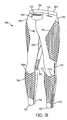
- FIG. 1B is a rear view of garment 100.
- Garment 100 as indicated above, is configured for wear as a lower body garment and intended for use by a runner or jogger.
- garment 100 is a pair of "tights" configured for relatively tightly-fitting wear by a runner or jogger.
- “configured for wear” refers to a garment being generally ready for wear by a person for whom the garment is properly sized. “configured for wear” can contemplate some amount of adjustment or additional configuration such as opening or closing fasteners (zippers, VELCRO, snaps, etc.).
- Garment 100 can be formed from various fabrics. Examples of fabrics that can be used include spandex and other stretchable synthetic materials. In some embodiments, the fabric is a blend of cotton, polyester and spandex fibers that includes hollow polyester fibers that wick moisture. Examples of such fabrics include fabrics sold under the name DR1-FIT by NIKE, Inc. of Beaverton, Oregon. Such fabrics move perspiration from the skin to the garment surface where the perspiration can evaporate quickly so as to help keep a wearer dry and comfortable. The spandex fibers within the material stretch to provide a comfortable, personalized fit.
- first stretchable fabric element 101 can be used to form a left leg of garment 100.
- a second stretchable fabric element 102 can be used to form a right leg of garment 100.
- Another stretchable fabric clement 103 can be used to form a crotch gusset of garment 100.
- An additional stretchable fabric element 104 can used to form a stomach panel of garment 100.
- Stretchable fabric element 105 can be used to form a rear panel/pocket of garment 100, with stretchable fabric element 106 used to form a waistband of garment 100.
- Elements 101-106 can be stitched or otherwise joined along adjoining boundaries in a customary manner. In other embodiments, more or fewer fabric elements could be used to create garment 100.
- garment 100 includes a plurality elasticity reducing panels 110 through 115.
- garment 100 includes a printed left thigh panel 110, a printed right thigh panel 111, a printed left knee panel 112, a printed right knee panel 113, a printed left calf panel 114 and a printed right calf panel 115.
- Each of panels 110 through 115 comprises a pattern that has been screen printed onto the fabric of garment 100 with a conventional silicone-based, non-PVC ink.
- the patterns of panels 110, 112 and 114 have been screen printed onto element 101, and the patterns of panels 111, 113 and 115 have been screen printed onto element 102, prior to assembly of elements 101 and 102 into garment 100.
- the ink within patterns 110 through 115 reduces elasticity in the portions of the garment 100 fabric to which that cured ink is bonded. When garment 100 is worn, this reduced elasticity may help to provide support to and/or a feeling of support in the wearer muscle(s) underlying patterns 110 through 115.
- inside (medial) edges of left knee panel 112 and/or of left calf panel 114 may extend to or over left inseam 118 ( FIG. 1B ).
- inside (medial) edges of right knee panel 113 and/or of right calf panel 115 may extend to or over right inseam 119 ( FIG. 1A ).
- Garment 100 may include gripper elastic (not shown) in the ankle openings 121 and 122. Bonded zippers can also be included on the outside near the ankle openings. Although only bonded zipper 123 in the right rear is shown ( FIG. 1B ), a similar bonded zipper is present in a corresponding location on the left rear side. Garment 100 may further include a no-sew waistband 124 to reduce chafing and increase comfort. A reflective bonded zippered pocket 125 on the center back and a bonded drop-in pocket 126 on the back right hip provide secure storage for small items and remain visible in low light conditions. Garment 100 may include minimal seaming to reduce irritation from chafing. Additional reflective elements can be included at the waist and elsewhere on garment 100. Seams 170 and 171 can be included on lateral sides of knee panels 112 and 113, respectively, and can be stitched or otherwise bonded in place.
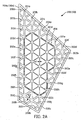
- FIG. 2A shows a pattern 200 used to create left thigh panel 110.
- pattern 200 is a pattern of ink that is screen imprinted onto fabric element 101, when element 101 is in a flattened condition, so as to create panel 110.
- reference number 110 is shown parenthetically after reference number 200 in FIG. 2A .
- a similar convention will be followed for individual components of panel 110 and pattern 200, as well as in connection with patterns (and corresponding panels) discussed in connection with FIGS. 2B through 4B .
- Pattern 200 has four sides 200a through 200d.
- the longest side 200a corresponds to edge 110a of panel 110.
- the correspondence of sides 200b through 200d to the other edges of panel 110 can be deduced from the shapes of pattern 200 and panel 110.
- Pattern 200 includes multiple intersecting lines within sides 200a through 200d. These lines form a mesh that extends throughout the space within the boundaries of sides 200a through 200d, while still exposing a substantial amount of interstitial space between the lines. That interstitial space will correspond to a substantial amount of exposed fabric in a corresponding panel.
- the lines of pattern 200 include six vertical lines 201a through 201f, twelve inclining lines 202a through 202 l , and nine declining lines 203a through 203j.
- various line segments have thicknesses that are substantially reduced relative to thicknesses of line segments in peripheral regions of pattern 200 outside of region 204.
- a segment of line 201c between the intersection of lines 201c, 202g and 203e and the intersection of lines 201c, 202h and 203f has a width w1.
- a segment of 203j between the intersection of lines 203j, 201a and 202j and the intersection of lines 203j, 201b and 202k has a width w2 that is more than twice that of w1.
- line includes curves as well straight lines.
- pattern lines are predominantly straight. In other embodiments, however, lines within a pattern or corresponding panel could be curved.
- intersections of lines within a region of reduced line width can be broadened. Stated differently, additional ink can be added in the space where two narrowed line segments meet. This increased ink between adjacent lines at intersections and can reduce the risk of pattern separation at those intersections of narrowed segments once the ink has cured.
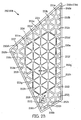
- FIG. 2B shows a pattern 250 of ink that is screen imprinted onto fabric element 102, when element 102 is in a flattened condition, so as to create right thigh panel 111.
- Pattern 250 is a mirror image of pattern 200 and has four sides 250a through 200d. The longest side 250a corresponds to edge 111a of panel 111. The correspondence of sides 250b through 250d to the other edges of panel 111 can be deduced from the shapes of pattern 250 and panel 111.
- the lines of pattern 250 include six vertical lines 251a through 251f, twelve declining lines 252a through 252 l , and nine inclining lines 253a through 253j.
- portions of various lines have thicknesses that are substantially reduced relative to thicknesses of line portions in peripheral regions of pattern 250 outside of region 254.
- the segment between the intersection of lines 251c, 252k and 253i and the intersection of lines 251b, 252k and 253j has a width w2 that is at least twice the width w1 of the segment between intersection of lines 251c., 252h and 253f and the intersection of lines 251c, 252i and 253g.
- FIG. 3A shows a pattern 300 used to create left knee panel 112.
- pattern 300 is a pattern of ink that is screen imprinted onto fabric element 101, when element 101 is in a flattened condition, so as to create panel 112.
- Pattern 300 has six sides 300a through 300f Side 300a corresponds to edge 112a of panel 112. The correspondence of sides 300b through 300f to the other edges of panel 112 can be deduced from the shapes of pattern 300 and panel 112.
- Pattern 300 includes multiple intersecting lines within sides 300a through 300f. These lines form a mesh that extends throughout the space within the boundaries of sides 300a through 300f, while still exposing a substantial amount of interstitial space between the lines.
- the pattern 300 lines include eight vertical lines 301a through 301h, seven inclining lines 302a through 302g, and seven declining lines 303a through 303g.
- various line segments have thicknesses that are substantially reduced relative to thicknesses of line segments in peripheral regions of pattern 300 outside of region 304.
- a segment of line 301e between the intersection of lines 301e, 302c and 303b and the intersection of lines 301e, 302d and 303c has a width w3.
- a segment of line 301b between the intersection of lines 301b, 302d and 303f and the intersection of lines 301b, 302e and 303g has a width w4 that is more than twice that of w3.
- Width w3 can (but need not) be the same as width w1 and width w4 can (but need not) be the same as width w2. Similar to pattern 200 of FIG. 2A , intersections within interior region 304 can be broadened.
- FIG. 3B shows a pattern 350 of ink that is screen imprinted onto fabric element 102, when element 102 is in a flattened condition, so as to create right knee panel 113.
- Pattern 350 is a mirror image of pattern 300 and has six sides 350a through 350f.
- Side 350a corresponds to edge 113a of panel 113.
- the correspondence of sides 350b through 350f to the other edges of panel 113 can be deduced from the shapes of pattern 350 and panel 113.
- the lines of pattern 350 include six vertical lines 351a through 351f, seven declining lines 352a through 352g, and seven inclining lines 353a through 353g.
- portions of various lines have thicknesses that are substantially reduced relative to thicknesses of line portions in peripheral regions of pattern 350 outside of region 354.
- the segment between the intersection of lines 351b, 352d and 353f and the intersection of lines 351b, 352e and 353g has a width w4 that is at least twice the width w3 of the segment between intersection of lines 351e, 352c and 353b and the intersection of lines 351e, 352d and 353c.
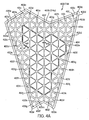
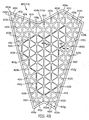
- FIG. 4A shows a pattern 400 used to create left calf panel 114.
- pattern 400 is a pattern of ink that is screen imprinted onto fabric element 101, when element 101 is in a flattened condition, so as to create panel 114.
- Pattern 400 has seven sides 400a through 400g.
- Side 400b corresponds to edge 114a of panel 112. The correspondence of sides 400a and 400c through 400g to the other edges of panel 114 can be deduced from the shapes of pattern 400 and panel 114.
- Pattern 400 includes multiple intersecting lines within sides 400a through 400g. These lines form a mesh that extends throughout the space within the boundaries of sides 400a through 400g, while still exposing a substantial amount of interstitial space between the lines.
- the pattern 400 lines include ten vertical lines 401a through 401j, twelve inclining lines 402a through 402l, and fourteen declining lines 403a through 403n.
- various line segments have thicknesses that are substantially reduced relative to thicknesses of line segments in peripheral regions of pattern 400 outside of region 404.
- a segment of line 401f between the intersection of lines 401f, 402e and 403f and the intersection of lines 401f, 402f and 403g has a width w5.
- Width w5 may be the same or different than w1 and/or w3.
- a segment of line 401c between the intersection of lines 401c, 402d and 403h and the intersection of lines 401c, 402e and 403i has a width w6 that is more than twice that of w5. Width w6 may be the same or different than w2 and/or w4. Similar to pattern 200 of FIG. 2A and pattern 300 of FIG.3A , intersections within interior region 404 can be broadened.
- FIG. 4B shows a pattern 450 of ink that is screen imprinted onto fabric element 102. when element 102 is in a flattened condition, so as to create right calf panel 115.
- Pattern 450 is a mirror image of pattern 400 and has seven sides 450a through 450g. Side 450b corresponds to edge 115a of panel 115. The correspondence of sides 450a and 450c through 450g to the other edges of panel 115 can be deduced from the shapes of pattern 450 and panel 115.
- the lines of pattern 450 include ten vertical lines 451a through 451j, twelve declining lines 452a through 452 l , and fourteen inclining lines 453a through 453n.
- portions of various lines have thicknesses that are substantially reduced relative to thicknesses of line portions in peripheral regions of pattern 450 outside of region 454.
- the segment between the intersection of lines 451c, 452d and 453h and the intersection of lines 451c, 452e and 453i has a width w6 that is at least twice the width w5 of the segment between intersection of lines 451f, 452e and 453f and the intersection of lines 451f, 452f and 453g.
- each of panels 110, 111, 112, 113, 114 and 115 includes a region (corresponding to one of regions 204, 254, 304, 354, 404, 454) in which lines are thinner than in the periphery of the panel. This thin line/thick line combination may help to increase the support and/or feeling of support afforded by the panels.
- the lines are arranged so as to create equilateral triangles.
- other patterns may be used, and other patterns may utilize other shapes and/or combinations of shapes.
- a panel may comprise a pattern of overlapping circles and/or ovals, with the circles/ovals in an inner region of the pattern having thinner lines than the circles/ovals in regions of the pattern closer to the pattern periphery. Lines within a pattern need not be evenly distributed, e.g., some lines can be more closely spaced than others.
- the outer shape of a pattern can be varied from that of patterns 200, 250, 300, 350, 400 and 450.
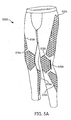
- FIG. 5A is a front view of a garment 500A according to another embodiment.
- Garment 500A is also configured for wear as a lower body garment and intended for use by a runner or jogger.
- Garment 500A is substantially the same as garment 100, is fabricated from the same type of fabric, and includes elasticity reducing panels 510A through 515A that are respectively identical to panels 110 through 115.
- garment 500A includes a lateral outer seam 570A that extends along the lateral edge of printed left knee panel 512A.
- a similar lateral outer seam on the right side extends along the lateral edge of printed right knee panel 513A.
- Seam 570A and the corresponding lateral outer seam on the right side which seams may be sewn and/or otherwise bonded to the fabric of garment 500A, may help to increase the support and/or feeling of support provided by panels 512A and 513A.
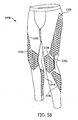
- FIG. 5B is a front view of a garment 500B according to an additional embodiment.
- Garment 500B is substantially identical to garment 100, is fabricated from the same type of fabric, and includes elasticity reducing panels 510B through 515B that are respectively identical to panels 110 through 115.
- Garment 500B includes a lateral outer seam 570B that extends along the lateral edge of printed left knee panel 512B. Unlike seam 570A, seam 570B joins left knee panel 512B to the lower part of left thigh panel 5111B.
- a similar lateral outer seam on the right side extends along the lateral edge of printed right knee panel 513B and joins right knee panel 513B to right thigh panel 511B.
- Seam 570B and the corresponding lateral outer seam on the right side of garment 500B may help to increase the support and/or feeling of support provided by panels 512B and 513B and/or by panels 510B and 511B.
- FIG. 5C is a front view of a garment 500C according to a further embodiment.
- Garment 500C is substantially identical to garment 100, is fabricated from the same type of fabric, and includes elasticity reducing panels 510C through 515C that are respectively identical to panels 110 through 115.
- Garment 500C includes a lateral outer seam 570C that extends along the lateral edge of printed left knee panel 512C. Unlike seams 570A and 570B, seam 570C joins left knee panel 512C to left calf panel 514C.
- a similar lateral outer seam on the right side extends along the lateral edge of printed right knee panel 513C and joins right knee panel 513C to right calf panel 515C.
- Seam 570C and the corresponding lateral outer seam on the right side of garment 500C may help to increase the support and/or feeling of support provided by panels 512C and 513C and/or by panels 514C and 515C.
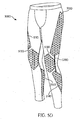
- FIG. 5D is a front view of a garment 500D according to another embodiment.
- Garment 500D is substantially identical to garment 100, is fabricated from the same type of fabric, and includes elasticity reducing panels 510D through 515D that are respectively identical to panels 110 through 115.
- Garment 500D includes a lateral outer seam 570D that extends along the lateral edge of printed left knee panel 512D. Unlike seams 570A, 570B and 570C, seam 570D joins left knee panel 512D to the lower part of left thigh panel 510D and to left calf panel 514D.
- a similar lateral outer seam on the right side of garment 500D extends along the lateral edge of printed right knee panel 513D and joins right knee panel 513D to right thigh panel 511D and to right calf panel 515D.
- Seam 570D and the corresponding lateral outer seam on the right side of garment 500D which seams may be sewn and/or otherwise bonded to the fabric of garments 500D, may help to increase the support and/or feeling of support provided by panels 512D and 513D, and/or by panels 510D and 511D, and/or by panels 514D and 515D.
- FTGS. 6A and 6B show front and rear views, respectively of a garment 600 according to a further embodiment.
- Garment 600 is a "Capri" version of garment 100.
- garment 600 is also configured for wear as a lower body garment and intended for use by a runner or jogger.
- Garment 600 is fabricated from the same type of fabric as garment 100.
- Garment 600 includes elasticity reducing left thigh panel 610 and right thigh panel 611 that are respectively identical to panels 110 and 111 of garment 100.
- Garment 600 similarly includes elasticity reducing left knee panel 612 and elasticity reducing right knee panel 613 that are respectively identical to panels 112 and 113 of garment 100.
- Garment 600 differs from garment 100 based on the length of the legs. Specifically, the lengths of the legs of garment 600 are shorter. As a result, elasticity reducing left calf panel 614 of garment 600 is a truncated version of elasticity reducing right calf panel 114 of garment 100. Similarly, elasticity reducing right calf panel 615 of garment 600 is a truncated version of elasticity reducing right calf panel 115 of garment 100. Additional embodiments include "Capri" versions incorporating seams such as, e.g., seams 570A, 570B, 570C or 570D.
- FIGS. 7A and 7B show front and rear views, respectively of a garment 700 according to another embodiment.
- Garment 700 is a shorts version of garment 100.
- garment 700 is also configured for wear as a lower body garment and intended for use by a runner or jogger.
- Garment 700 is fabricated from the same type of fabric as garment 100.
- Garment 700 includes elasticity reducing left thigh panel 710 and right thigh panel 711 that are respectively identical to panels 110 and 111 of garment 100.
- Garment 700 is similar to garment 100 and other embodiments described thus far, except that the legs of garment 700 terminate above the knees. Accordingly, there are no knee or calf panels. Seams similar to, e.g., scam 570B and a corresponding right side seam could be added and connected to the bottoms of thigh panels 710 and 711.
- garments intended for wear by runners or joggers other embodiments include garments intended for wear during other activities.
- the invention is not limited to lower body garments, and may include garments that are also (or exclusively) configured for upper body wear.
- the invention is not limited to the shape, pattern or placement of elasticity reducing panels described.
- Other embodiments include garments in which elasticity reducing panels have different patterns, shapes and/or locations.
- a garment need not include an elasticity reducing thigh panel.
- a lower body garment according to some embodiments may only include elasticity reducing panels in the knee and/or calf regions.
Landscapes
- Engineering & Computer Science (AREA)
- Textile Engineering (AREA)
- Professional, Industrial, Or Sporting Protective Garments (AREA)
- Health & Medical Sciences (AREA)
- General Health & Medical Sciences (AREA)
- Physical Education & Sports Medicine (AREA)
Description
- Running, jogging and other forms of exercise can result in a participant experiencing at least some degree of fatigue. This fatigue can take both physical and mental forms. Physically, a person's muscles can become tired and/or sore. Mentally, some forms of exercise can be tedious, which tedium can be exacerbated if a person is experiencing discomfort. Providing additional support to fatigued muscles can help reduce physical fatigue. Providing a feeling of support to fatigued muscles can help to reduce mental fatigue.
-
US 2007/074328 A1 discloses articles of apparel having cylindrical portions, wherein the cylindrical portions include a textile material and a pattern located on the textile material. The pattern has different densities in different areas. - This Summary is provided to introduce a selection of concepts in a simplified form that are further described below in the Detailed Description. This Summary is not intended to identify key features or essential features of the invention.
- In at least some embodiments, la garment may be formed from a stretchable material. Various portions of the garment may contain imprinted ink. Elasticity of the garment fabric is reduced in the regions onto which the ink has been printed, thereby providing support and/or a feeling of support to certain muscles and/or muscle groups. In some embodiments, the garment can be a garment intended for wear by a runner or jogger.
- In some embodiments, a garment can include at least one stretchable fabric element and a first elasticity-reducing panel. The garment may be configured for wear by an individual, and the first elasticity-reducing panel may comprise a first pattern imprinted onto a first portion of the at least one stretchable fabric element. The first pattern may comprises lines. Portions of lines in an interior region of the first pattern may have a thickness less than a thickness of line portions in peripheral regions of the first pattern.
- In some embodiments, a garment may comprise a stretch fabric lower body garment and a plurality of elasticity-reducing panels. At least a portion of the elasticity-reducing panels may be located in thigh regions of the garment. Each of the panels may comprise a pattern of ink lines imprinted onto the stretch fabric. Each of the panels may expose a substantial portion of the stretch fabric within the boundaries of the imprinted pattern.
- Additional embodiments are described below.
- Some embodiments are illustrated by way of example, and not by way of limitation, in the figures of the accompanying drawings and in which like reference numerals refer to similar elements.
-
FIGS. 1A and1B are front and rear views, respectively, of a garment according to some embodiments. -
FIG. 2A shows a print pattern for a left thigh panel of the garment ofFIGS. 1A and1B . -
FIG. 2B shows a print pattern for a right thigh panel of the garment ofFIGS. 1A and1B . -
FIG. 3A shows a print pattern for a left knee panel of the garment ofFIGS. 1A and1B . -
FIG. 3B shows a print pattern for a right knee panel of the garment ofFIGS. 1A and1B . -
FIG. 4A shows a print pattern for a left calf panel of the garment ofFIGS. 1A and1B . -
FIG. 4B shows a print pattern for a right calf panel of the garment ofFIGS. 1A and1B . -
FIGS. 5A through 5D are front views of garments, similar to the garment ofFIGS. 1A and1B , according to additional embodiments. -
FIGS. 6A and6B are front and rear views, respectively, of a garment according to another embodiment. -
FIGS. 7A and7B are front and rear views, respectively, of a garment according to an additional embodiment. - In at least some embodiments, a garment can comprise a stretchable fabric and be configured for wear as a lower body garment. As but one example, such a lower body garment could be intended for wear by a runner or jogger. One or more regions of the garment can include areas in which the elasticity of the garment fabric has been reduced. In particular, those regions can include imprinted patterns. In those regions, the elasticity of fabric portions having an applied pattern is reduced. This reduction of elasticity in selected portions of the garment fabric provides support and/or a feeling of support to certain muscles and/or muscle groups.
-
FIG. 1A is a front view of agarments 100 according to some embodiments.FIG. 1B is a rear view ofgarment 100.Garment 100, as indicated above, is configured for wear as a lower body garment and intended for use by a runner or jogger. In particular,garment 100 is a pair of "tights" configured for relatively tightly-fitting wear by a runner or jogger. As used herein, "configured for wear" refers to a garment being generally ready for wear by a person for whom the garment is properly sized. "configured for wear" can contemplate some amount of adjustment or additional configuration such as opening or closing fasteners (zippers, VELCRO, snaps, etc.). -
Garment 100 can be formed from various fabrics. Examples of fabrics that can be used include spandex and other stretchable synthetic materials. In some embodiments, the fabric is a blend of cotton, polyester and spandex fibers that includes hollow polyester fibers that wick moisture. Examples of such fabrics include fabrics sold under the name DR1-FIT by NIKE, Inc. of Beaverton, Oregon. Such fabrics move perspiration from the skin to the garment surface where the perspiration can evaporate quickly so as to help keep a wearer dry and comfortable. The spandex fibers within the material stretch to provide a comfortable, personalized fit. - Individual elements of
garment 100 can be cut from larger sheets of stretchable fabric, and those elements can be assembled intogarment 100 using any of various standard assembly techniques. As but one example, a firststretchable fabric element 101 can be used to form a left leg ofgarment 100. A secondstretchable fabric element 102 can be used to form a right leg ofgarment 100. Anotherstretchable fabric clement 103 can be used to form a crotch gusset ofgarment 100. An additionalstretchable fabric element 104 can used to form a stomach panel ofgarment 100.Stretchable fabric element 105 can be used to form a rear panel/pocket ofgarment 100, withstretchable fabric element 106 used to form a waistband ofgarment 100. Elements 101-106 can be stitched or otherwise joined along adjoining boundaries in a customary manner. In other embodiments, more or fewer fabric elements could be used to creategarment 100. - Unlike previously known lower body garments,
garment 100 includes a pluralityelasticity reducing panels 110 through 115. In particular,garment 100 includes a printedleft thigh panel 110, a printedright thigh panel 111, a printedleft knee panel 112, a printedright knee panel 113, a printedleft calf panel 114 and a printedright calf panel 115. Each ofpanels 110 through 115 comprises a pattern that has been screen printed onto the fabric ofgarment 100 with a conventional silicone-based, non-PVC ink. The patterns ofpanels element 101, and the patterns ofpanels element 102, prior to assembly ofelements garment 100. - After curing, the ink within
patterns 110 through 115 reduces elasticity in the portions of thegarment 100 fabric to which that cured ink is bonded. Whengarment 100 is worn, this reduced elasticity may help to provide support to and/or a feeling of support in the wearer muscle(s)underlying patterns 110 through 115. - The inside (medial) edges of
left knee panel 112 and/or ofleft calf panel 114 may extend to or over left inseam 118 (FIG. 1B ). Similarly, inside (medial) edges ofright knee panel 113 and/or ofright calf panel 115 may extend to or over right inseam 119 (FIG. 1A ). -
Garment 100 may include gripper elastic (not shown) in theankle openings zipper 123 in the right rear is shown (FIG. 1B ), a similar bonded zipper is present in a corresponding location on the left rear side.Garment 100 may further include a no-sewwaistband 124 to reduce chafing and increase comfort. A reflective bondedzippered pocket 125 on the center back and a bonded drop-inpocket 126 on the back right hip provide secure storage for small items and remain visible in low light conditions.Garment 100 may include minimal seaming to reduce irritation from chafing. Additional reflective elements can be included at the waist and elsewhere ongarment 100.Seams knee panels -
FIG. 2A shows apattern 200 used to createleft thigh panel 110. In particular,pattern 200 is a pattern of ink that is screen imprinted ontofabric element 101, whenelement 101 is in a flattened condition, so as to createpanel 110. So as to indicate the correspondence betweenpattern 200 andpanel 110,reference number 110 is shown parenthetically afterreference number 200 inFIG. 2A . A similar convention will be followed for individual components ofpanel 110 andpattern 200, as well as in connection with patterns (and corresponding panels) discussed in connection withFIGS. 2B through 4B . -
Pattern 200 has foursides 200a through 200d. Thelongest side 200a corresponds to edge 110a ofpanel 110. The correspondence ofsides 200b through 200d to the other edges ofpanel 110 can be deduced from the shapes ofpattern 200 andpanel 110. -
Pattern 200 includes multiple intersecting lines withinsides 200a through 200d. These lines form a mesh that extends throughout the space within the boundaries ofsides 200a through 200d, while still exposing a substantial amount of interstitial space between the lines. That interstitial space will correspond to a substantial amount of exposed fabric in a corresponding panel. - In the orientation shown in
FIG. 2A , the lines ofpattern 200 include sixvertical lines 201a through 201f, twelveinclining lines 202a through 202l, and nine declininglines 203a through 203j. Within aninterior region 204, various line segments have thicknesses that are substantially reduced relative to thicknesses of line segments in peripheral regions ofpattern 200 outside ofregion 204. For example, a segment ofline 201c between the intersection oflines lines lines lines - As used herein (including the claims) when discussing patterns and corresponding elasticity reducing panels, "line" includes curves as well straight lines. In
pattern 200, as well as in patterns described in connection withFIGS. 2B through 4B , the pattern lines are predominantly straight. In other embodiments, however, lines within a pattern or corresponding panel could be curved. - In some embodiments, and as is also seen in
FIG. 2A , intersections of lines within a region of reduced line width can be broadened. Stated differently, additional ink can be added in the space where two narrowed line segments meet. This increased ink between adjacent lines at intersections and can reduce the risk of pattern separation at those intersections of narrowed segments once the ink has cured. -
FIG. 2B shows apattern 250 of ink that is screen imprinted ontofabric element 102, whenelement 102 is in a flattened condition, so as to createright thigh panel 111.Pattern 250 is a mirror image ofpattern 200 and has foursides 250a through 200d. Thelongest side 250a corresponds to edge 111a ofpanel 111. The correspondence ofsides 250b through 250d to the other edges ofpanel 111 can be deduced from the shapes ofpattern 250 andpanel 111. In the orientation ofpattern 250 depicted inFIG. 2B , the lines ofpattern 250 include sixvertical lines 251a through 251f, twelve declininglines 252a through 252l, and nineinclining lines 253a through 253j. Inside aninterior region 254, portions of various lines have thicknesses that are substantially reduced relative to thicknesses of line portions in peripheral regions ofpattern 250 outside ofregion 254. For example, the segment between the intersection oflines lines lines -
FIG. 3A shows apattern 300 used to createleft knee panel 112. In particular,pattern 300 is a pattern of ink that is screen imprinted ontofabric element 101, whenelement 101 is in a flattened condition, so as to createpanel 112.Pattern 300 has sixsides 300a through300f Side 300a corresponds to edge 112a ofpanel 112. The correspondence ofsides 300b through 300f to the other edges ofpanel 112 can be deduced from the shapes ofpattern 300 andpanel 112. -
Pattern 300 includes multiple intersecting lines withinsides 300a through 300f. These lines form a mesh that extends throughout the space within the boundaries ofsides 300a through 300f, while still exposing a substantial amount of interstitial space between the lines. In the orientation depicted inFIG. 3A , thepattern 300 lines include eightvertical lines 301a through 301h, seveninclining lines 302a through 302g, and seven declininglines 303a through 303g. Within aninterior region 304, various line segments have thicknesses that are substantially reduced relative to thicknesses of line segments in peripheral regions ofpattern 300 outside ofregion 304. For example, a segment ofline 301e between the intersection oflines lines line 301b between the intersection oflines lines pattern 200 ofFIG. 2A , intersections withininterior region 304 can be broadened. -
FIG. 3B shows apattern 350 of ink that is screen imprinted ontofabric element 102, whenelement 102 is in a flattened condition, so as to createright knee panel 113.Pattern 350 is a mirror image ofpattern 300 and has sixsides 350a through 350f.Side 350a corresponds to edge 113a ofpanel 113. The correspondence ofsides 350b through 350f to the other edges ofpanel 113 can be deduced from the shapes ofpattern 350 andpanel 113. In the orientation ofpattern 350 shown inFIG. 3B , the lines ofpattern 350 include sixvertical lines 351a through 351f, seven declininglines 352a through 352g, and seveninclining lines 353a through 353g. Inside aninterior region 354, portions of various lines have thicknesses that are substantially reduced relative to thicknesses of line portions in peripheral regions ofpattern 350 outside ofregion 354. For example, the segment between the intersection oflines lines lines lines -
FIG. 4A shows apattern 400 used to createleft calf panel 114. In particular,pattern 400 is a pattern of ink that is screen imprinted ontofabric element 101, whenelement 101 is in a flattened condition, so as to createpanel 114.Pattern 400 has sevensides 400a through 400g.Side 400b corresponds to edge 114a ofpanel 112. The correspondence ofsides panel 114 can be deduced from the shapes ofpattern 400 andpanel 114. -
Pattern 400 includes multiple intersecting lines withinsides 400a through 400g. These lines form a mesh that extends throughout the space within the boundaries ofsides 400a through 400g, while still exposing a substantial amount of interstitial space between the lines. In the orientation depicted inFIG. 4A , thepattern 400 lines include tenvertical lines 401a through 401j, twelveinclining lines 402a through 402l, and fourteen declininglines 403a through 403n. Within aninterior region 404, various line segments have thicknesses that are substantially reduced relative to thicknesses of line segments in peripheral regions ofpattern 400 outside ofregion 404. For example, a segment ofline 401f between the intersection oflines lines line 401c between the intersection oflines lines pattern 200 ofFIG. 2A andpattern 300 ofFIG.3A , intersections withininterior region 404 can be broadened. -
FIG. 4B shows apattern 450 of ink that is screen imprinted ontofabric element 102. whenelement 102 is in a flattened condition, so as to createright calf panel 115.Pattern 450 is a mirror image ofpattern 400 and has sevensides 450a through 450g.Side 450b corresponds to edge 115a ofpanel 115. The correspondence ofsides panel 115 can be deduced from the shapes ofpattern 450 andpanel 115. In the orientation ofpattern 450 shown inFIG. 4B , the lines ofpattern 450 include tenvertical lines 451a through 451j, twelve declininglines 452a through 452l, and fourteeninclining lines 453a through 453n. Inside aninterior region 454, portions of various lines have thicknesses that are substantially reduced relative to thicknesses of line portions in peripheral regions ofpattern 450 outside ofregion 454. For example, the segment between the intersection oflines lines lines lines - In each of
patterns 200. 250, 300, 350, 400 and 450, and as described above, the thicknesses of pattern lines in the interior regions (i.e., withinregions panels regions - In each of
patterns patterns -
FIG. 5A is a front view of agarment 500A according to another embodiment.Garment 500A is also configured for wear as a lower body garment and intended for use by a runner or jogger.Garment 500A is substantially the same asgarment 100, is fabricated from the same type of fabric, and includeselasticity reducing panels 510A through 515A that are respectively identical topanels 110 through 115. Unlikegarment 100,garment 500A includes a lateralouter seam 570A that extends along the lateral edge of printedleft knee panel 512A. A similar lateral outer seam on the right side extends along the lateral edge of printedright knee panel 513A.Seam 570A and the corresponding lateral outer seam on the right side, which seams may be sewn and/or otherwise bonded to the fabric ofgarment 500A, may help to increase the support and/or feeling of support provided bypanels -
FIG. 5B is a front view of agarment 500B according to an additional embodiment.Garment 500B is substantially identical togarment 100, is fabricated from the same type of fabric, and includeselasticity reducing panels 510B through 515B that are respectively identical topanels 110 through 115.Garment 500B includes a lateralouter seam 570B that extends along the lateral edge of printedleft knee panel 512B. Unlikeseam 570A,seam 570B joins leftknee panel 512B to the lower part of left thigh panel 5111B. A similar lateral outer seam on the right side extends along the lateral edge of printedright knee panel 513B and joinsright knee panel 513B toright thigh panel 511B.Seam 570B and the corresponding lateral outer seam on the right side ofgarment 500B, which seams may be sewn and/or otherwise bonded to the fabric ofgarment 500B, may help to increase the support and/or feeling of support provided bypanels panels -
FIG. 5C is a front view of agarment 500C according to a further embodiment.Garment 500C is substantially identical togarment 100, is fabricated from the same type of fabric, and includeselasticity reducing panels 510C through 515C that are respectively identical topanels 110 through 115.Garment 500C includes a lateralouter seam 570C that extends along the lateral edge of printedleft knee panel 512C. Unlikeseams seam 570C joins leftknee panel 512C toleft calf panel 514C. A similar lateral outer seam on the right side extends along the lateral edge of printedright knee panel 513C and joinsright knee panel 513C toright calf panel 515C.Seam 570C and the corresponding lateral outer seam on the right side ofgarment 500C, which seams may be sewn and/or otherwise bonded to the fabric ofgarment 500C, may help to increase the support and/or feeling of support provided bypanels panels -
FIG. 5D is a front view of agarment 500D according to another embodiment.Garment 500D is substantially identical togarment 100, is fabricated from the same type of fabric, and includeselasticity reducing panels 510D through 515D that are respectively identical topanels 110 through 115.Garment 500D includes a lateralouter seam 570D that extends along the lateral edge of printedleft knee panel 512D. Unlikeseams seam 570D joins leftknee panel 512D to the lower part ofleft thigh panel 510D and to leftcalf panel 514D. A similar lateral outer seam on the right side ofgarment 500D extends along the lateral edge of printedright knee panel 513D and joinsright knee panel 513D toright thigh panel 511D and toright calf panel 515D.Seam 570D and the corresponding lateral outer seam on the right side ofgarment 500D, which seams may be sewn and/or otherwise bonded to the fabric ofgarments 500D, may help to increase the support and/or feeling of support provided bypanels panels panels - FTGS. 6A and 6B show front and rear views, respectively of a
garment 600 according to a further embodiment.Garment 600 is a "Capri" version ofgarment 100. In particular,garment 600 is also configured for wear as a lower body garment and intended for use by a runner or jogger.Garment 600 is fabricated from the same type of fabric asgarment 100.Garment 600 includes elasticity reducingleft thigh panel 610 andright thigh panel 611 that are respectively identical topanels garment 100.Garment 600 similarly includes elasticity reducingleft knee panel 612 and elasticity reducingright knee panel 613 that are respectively identical topanels garment 100. -
Garment 600 differs fromgarment 100 based on the length of the legs. Specifically, the lengths of the legs ofgarment 600 are shorter. As a result, elasticity reducingleft calf panel 614 ofgarment 600 is a truncated version of elasticity reducingright calf panel 114 ofgarment 100. Similarly, elasticity reducingright calf panel 615 ofgarment 600 is a truncated version of elasticity reducingright calf panel 115 ofgarment 100. Additional embodiments include "Capri" versions incorporating seams such as, e.g., seams 570A, 570B, 570C or 570D. -
FIGS. 7A and7B show front and rear views, respectively of agarment 700 according to another embodiment.Garment 700 is a shorts version ofgarment 100. In particular,garment 700 is also configured for wear as a lower body garment and intended for use by a runner or jogger.Garment 700 is fabricated from the same type of fabric asgarment 100.Garment 700 includes elasticity reducingleft thigh panel 710 andright thigh panel 711 that are respectively identical topanels garment 100.Garment 700 is similar togarment 100 and other embodiments described thus far, except that the legs ofgarment 700 terminate above the knees. Accordingly, there are no knee or calf panels. Seams similar to, e.g.,scam 570B and a corresponding right side seam could be added and connected to the bottoms ofthigh panels - Although various embodiments are described in connection with garments intended for wear by runners or joggers, other embodiments include garments intended for wear during other activities. Moreover, the invention is not limited to lower body garments, and may include garments that are also (or exclusively) configured for upper body wear. The invention is not limited to the shape, pattern or placement of elasticity reducing panels described. Other embodiments include garments in which elasticity reducing panels have different patterns, shapes and/or locations. A garment need not include an elasticity reducing thigh panel. For example, a lower body garment according to some embodiments may only include elasticity reducing panels in the knee and/or calf regions.
- The foregoing description of embodiments has been presented for purposes of illustration and description. The foregoing description is not intended to be exhaustive or to limit embodiments of the present invention to the precise form disclosed, and modifications and variations arc possible in light of the above teachings or may be acquired from practice of various embodiments. The embodiments discussed herein were chosen and described in order to explain the principles and the nature of various embodiments and their practical application to enable one skilled in the art to utilize the present invention in various embodiments and with various modifications as are suited to the particular use contemplated. With regard to claims directed to an apparatus, an article of manufacture or some other physical component or combination of components, a reference in the claim to a potential or intended wearer or a user of a component does not require actual wearing or using of the component or the presence of the wearer or user as part of the claimed component or component combination.
Claims (15)
- A garment (100), comprising:at least one stretchable fabric element (101); anda first elasticity-reducing panel (110), wherein
the garment is configured for wear by an individual as a lower body garment,
the first elasticity-reducing panel comprises a first pattern (200) imprinted onto a first portion of the at least one stretchable fabric element,
the first pattern comprises lines, and
portions of lines in an interior region (204) of the first pattern have thicknesses less than thicknesses of portions of lines in peripheral regions of the first pattern. - The garment of claim 1, wherein the portions of lines in the peripheral regions have thicknesses that are at least twice as great as thicknesses of the portions of lines in the interior region.
- The garment of claim 1, wherein the lines of the pattern form a mesh.
- The garment of claim 1, further comprising a second elasticity-reducing panel, wherein
the first elasticity-reducing panel is located in a right thigh region,
the second elasticity-reducing panel comprises a second pattern imprinted onto a second portion of the at least one stretchable fabric element,
the second pattern is a mirror image of the first pattern, and
the second elasticity-reducing panel is located in a left thigh region. - The garment of claim 4, further comprising third and fourth elasticity-reducing panels, wherein
the third elasticity-reducing panel comprises a third pattern imprinted onto a third portion of the at least one stretchable fabric element,
the fourth elasticity-reducing panel comprises a fourth pattern imprinted onto a fourth portion of the at least one stretchable fabric element,
the third pattern comprises lines,
portions of lines in an interior region of the third pattern have thicknesses less than thicknesses of portions of lines in peripheral regions of the third pattern,
the fourth pattern is a mirror image of the third pattern,
the third elasticity-reducing panel is located in a right knee region, and
the fourth elasticity-reducing panel is located in a left knee region. - The garment of claim 5, further comprising:a first lateral outer seam extending along a lateral outer edge of the third elasticity-reducing panel; anda second lateral outer seam extending along a lateral outer edge of the fourth elasticity-reducing panel.
- The garment of claim 5, further comprising:a first lateral outer seam extending along a lateral outer edge of the third elasticity-reducing panel and connecting the third elasticity-reducing panel to the first elasticity-reducing panel; anda second lateral outer seam extending along a lateral outer edge of the fourth elasticity-reducing panel and connecting the fourth elasticity-reducing panel to the second elasticity-reducing panel.
- The garment of claim 5, further comprising fifth and sixth elasticity-reducing panels, wherein
the fifth elasticity-reducing panel comprises a fifth pattern imprinted onto a fifth portion of the at least one stretchable fabric element,
the sixth elasticity-reducing panel comprises a sixth pattern imprinted onto a sixth portion of the at least one stretchable fabric element,
the fifth pattern comprises lines,
portions of lines in an interior region of the fifth pattern have thicknesses less than thicknesses of portions of lines in peripheral regions of the fifth pattern,
the sixth pattern is a mirror image of the fifth pattern,
the fifth elasticity-reducing panel is located in a right calf region, and
the sixth elasticity-reducing panel is located in a left calf region. - The garment of claim 8, further comprising:a first lateral outer seam extending along a lateral outer edge of the third elasticity-reducing panel and connecting the third elasticity-reducing panel to the first elasticity-reducing panel and to the fifth elasticity-reducing panel; anda second lateral outer seam extending along a lateral outer edge of the fourth elasticity-reducing panel and connecting the fourth elasticity-reducing panel to the second elasticity-reducing panel and to the sixth elasticity-reducing panel.
- The garment of claim 8, further comprising:a first lateral outer seam extending along a lateral outer edge of the third elasticity-reducing panel and connecting the third elasticity-reducing panel to the fifth elasticity-reducing panel; anda second lateral outer seam extending along a lateral outer edge of the fourth elasticity-reducing panel and connecting the fourth elasticity-reducing panel to the sixth elasticity-reducing panel.
- A garment, comprising:a stretch fabric lower body garment; anda plurality of elasticity-reducing panels, wherein
at least a portion of the elasticity-reducing panels are located in thigh regions of the garment,
each of the panels comprises a pattern of ink lines imprinted onto the stretch fabric, and
each of the panels exposes a substantial portion of the stretch fabric within the boundaries of the imprinted pattern, andwherein(1) each of the patterns comprises intersecting lines, and in each of the patterns, line portions in an interior region of the pattern have thicknesses less than thicknesses of line portions in peripheral regions of the pattern;(2) in each of the patterns, the line portions in the peripheral regions have thicknesses that are at least twice as great as thicknesses of the line portions in the interior region; or(3) at least a portion of the elasticity-reducing panels are located in knee regions of the garment. - The garment of claim 11, wherein at least a portion of the elasticity-reducing panels are located in knee regions of the garment.
- The garment of claim 12, further comprising:(1) a first lateral outer seam extending along a lateral outer edge of an elasticity-reducing panel located in the right knee region; and
a second lateral outer seam extending along a lateral outer edge of an elasticity-reducing panel located in the left knee region; or(2) a first lateral outer seam extending along a lateral outer edge of an elasticity-reducing panel located in the right knee region and connecting the elasticity-reducing panel located in the right knee region to an elasticity-reducing panel located in the right thigh region; and
a second lateral outer seam extending along a lateral outer edge of an elasticity-reducing panel located in the left knee region and connecting the elasticity-reducing panel located in the left knee region to an elasticity-reducing panel located in the left thigh region. - The garment of claim 12, wherein at least a portion of the elasticity-reducing panels are located in calf regions of the garment.
- The garment of claim 14, further comprising:(1) a first lateral outer seam extending along a lateral outer edge of an elasticity-reducing panel located in the right knee region and connecting the elasticity-reducing panel located in the right knee region to an elasticity-reducing panel located in the right thigh region and to an elasticity-reducing panel located in the right calf region; and
a second lateral outer seam extending along a lateral outer edge of an elasticity-reducing panel located in the left knee region and connecting the elasticity-reducing panel located in the left knee region to an elasticity-reducing panel located in the left thigh region and to an elasticity-reducing panel located in the left calf region; or(2) a first lateral outer seam extending along a lateral outer edge of an elasticity-reducing panel located in the right knee region and connecting the elasticity-reducing panel located in the right knee region to an elasticity-reducing panel located in the right calf region; and
a second lateral outer seam extending along a lateral outer edge of an elasticity-reducing panel located in the left knee region and connecting the elasticity-reducing panel located in the left knee region to an elasticity-reducing panel located in the left calf region.
Applications Claiming Priority (3)
| Application Number | Priority Date | Filing Date | Title |
|---|---|---|---|
| US201161444661P | 2011-02-18 | 2011-02-18 | |
| US13/362,634 US9345275B2 (en) | 2011-02-18 | 2012-01-31 | Lower body garment with elasticity-reducing panel |
| PCT/US2012/025399 WO2012154251A1 (en) | 2011-02-18 | 2012-02-16 | Garment |
Publications (2)
| Publication Number | Publication Date |
|---|---|
| EP2675307A1 EP2675307A1 (en) | 2013-12-25 |
| EP2675307B1 true EP2675307B1 (en) | 2015-09-23 |
Family
ID=46651191
Family Applications (1)
| Application Number | Title | Priority Date | Filing Date |
|---|---|---|---|
| EP12705605.9A Active EP2675307B1 (en) | 2011-02-18 | 2012-02-16 | Garment |
Country Status (4)
| Country | Link |
|---|---|
| US (1) | US9345275B2 (en) |
| EP (1) | EP2675307B1 (en) |
| CN (1) | CN103501646B (en) |
| WO (1) | WO2012154251A1 (en) |
Families Citing this family (62)
| Publication number | Priority date | Publication date | Assignee | Title |
|---|---|---|---|---|
| US8336118B2 (en) * | 2007-05-31 | 2012-12-25 | Nike, Inc. | Articles of apparel providing enhanced body position feedback |
| KR101064031B1 (en) * | 2009-05-15 | 2011-09-08 | 조종대 | Body correction pants |
| NZ596625A (en) * | 2009-05-21 | 2014-04-30 | Skins Internat Trading Ag | Compression garments and method of manufacture |
| EP2672851B1 (en) * | 2011-02-07 | 2015-06-17 | Gavin Reay | Flexible protective armor |
| US20140230124A1 (en) * | 2011-10-11 | 2014-08-21 | Puma SE | Article of clothing |
| US8832863B2 (en) * | 2011-12-27 | 2014-09-16 | Jae Young Yang | Sports taping tights |
| NO2842436T3 (en) * | 2012-04-10 | 2018-05-19 | ||
| ITMI20120907A1 (en) * | 2012-05-24 | 2013-11-25 | Freddy Spa | CLOTH TO MODEL THE BABIES AND THE FEMALE SIDES, A PARTICULAR SPORTS DANCE OR GYMNASTICS |
| ITMI20120904A1 (en) | 2012-05-24 | 2013-11-25 | Freddy Spa | TROUSERS, IN PARTICULAR A PANTS FOR MODELING THE BABY AND FEMALE SIDES |
| USD741571S1 (en) * | 2012-09-10 | 2015-10-27 | Levi Strauss & Co. | Pair of pants having an inside design |
| GB201301116D0 (en) * | 2013-01-22 | 2013-03-06 | Ame Health Ltd | Targeted compression clothing |
| CN104972815A (en) * | 2014-04-02 | 2015-10-14 | 和羣娱乐有限公司 | Embossing method with three-dimensional effect and clothes, objects, imprinting template |
| KR101552948B1 (en) | 2014-04-18 | 2015-09-15 | 주식회사 좋은사람들 | Functional bottoms |
| US10149501B2 (en) * | 2014-06-09 | 2018-12-11 | Megan E. Matsen | Garments to aid infants in achieving stable quadruped posture and controlled mobility |
| CN110916259A (en) * | 2014-07-30 | 2020-03-27 | Vf伊玛格瓦尔公司 | Pants constructed for enhanced mobility |
| US20160213504A1 (en) * | 2014-11-14 | 2016-07-28 | Jason Colleran | Sleeve with external assistance during an arm motion |
| JP6391530B2 (en) * | 2015-04-24 | 2018-09-19 | 美津濃株式会社 | Sports tights |
| US20170013888A1 (en) * | 2015-07-19 | 2017-01-19 | Jasen L. Webb | Functional and aesthetic frictional support |
| EP3379957A4 (en) * | 2015-11-23 | 2019-10-23 | Fox Head, Inc. | Garment with stretch and rigid paneling |
| USD804781S1 (en) * | 2015-12-18 | 2017-12-12 | Nike, Inc. | Pants |
| US10264834B2 (en) * | 2016-03-25 | 2019-04-23 | Nike, Inc. | Foam nodes for creating stand off on apparel items |
| JP7123904B2 (en) * | 2016-04-14 | 2022-08-23 | スキンズ・インターナショナル・トレーディング・アー・ゲー イン リクイデイション | compression garment |
| USD820563S1 (en) * | 2016-05-05 | 2018-06-19 | Ariat International, Inc. | Breeches with calf panels |
| USD808619S1 (en) * | 2016-06-01 | 2018-01-30 | Columbia Sportswear North America, Inc. | Article of clothing with raised abrasion-resistant coating |
| USD808620S1 (en) * | 2016-06-01 | 2018-01-30 | Columbia Sportswear North America, Inc. | Article of clothing with raised abrasion-resistant coating |
| USD808621S1 (en) * | 2016-06-01 | 2018-01-30 | Columbia Sportswear North America, Inc. | Article of clothing with raised abrasion-resistant coating |
| TWD183487S (en) * | 2016-06-23 | 2017-06-11 | 彪仕醫技股份有限公司 | sports leggings |
| TWD183486S (en) * | 2016-06-23 | 2017-06-11 | 彪仕醫技股份有限公司 | sports leggings |
| USD794911S1 (en) * | 2016-07-20 | 2017-08-22 | Nike, Inc. | Garment |
| USD793037S1 (en) * | 2016-07-20 | 2017-08-01 | Nike, Inc. | Garment |
| USD791446S1 (en) * | 2016-07-20 | 2017-07-11 | Nike, Inc. | Garment |
| PL3750515T3 (en) | 2016-08-22 | 2025-05-26 | Sanko Tekstil Isletmeleri San. Ve Tic. A.S. | Multi-force compression garment and method of manufacturing same |
| US10231494B2 (en) * | 2016-12-09 | 2019-03-19 | Evogenerate, Llc | Garment with localized circulation boosting feature |
| US10674774B2 (en) * | 2017-02-14 | 2020-06-09 | Salvador Navarro | Garment for water weight-loss |
| USD809742S1 (en) | 2017-03-06 | 2018-02-13 | Nike, Inc. | Garment |
| US10786052B2 (en) * | 2017-03-10 | 2020-09-29 | Nike, Inc. | Articles incorporating a coupled slider system |
| PT3750515T (en) | 2017-04-21 | 2025-04-23 | Sanko Tekstil Isletmeleri San Ve Tic As | Compression garment with multiple compression forces and method for forming the same |
| US11021819B2 (en) * | 2017-05-15 | 2021-06-01 | Under Armour, Inc | Athletic performance garment |
| US11213082B1 (en) * | 2017-05-18 | 2022-01-04 | Paul Yang | Seamless compression garments |
| US11019855B2 (en) * | 2017-05-31 | 2021-06-01 | Nike, Inc. | Vortex-generator device |
| USD848116S1 (en) * | 2017-08-04 | 2019-05-14 | Alo, Llc | Leggings |
| USD847466S1 (en) * | 2017-08-30 | 2019-05-07 | Alo, Llc | Leggings |
| USD841287S1 (en) | 2017-11-15 | 2019-02-26 | Glenn Kingsbury | Pants having targeted non-slip regions |
| USD846836S1 (en) * | 2017-12-13 | 2019-04-30 | Steelman Powergear Llc | Athletic pants |
| USD875351S1 (en) | 2018-05-09 | 2020-02-18 | Alo, Llc | Bandage exercise leggings |
| US11369523B2 (en) | 2018-07-16 | 2022-06-28 | Jason Colleran | Arm sleeve that provides assistance during an arm motion |
| USD889775S1 (en) | 2018-10-03 | 2020-07-14 | Alo, Llc | Leggings |
| USD889774S1 (en) | 2018-10-03 | 2020-07-14 | Alo, Llc | Leggings |
| USD920630S1 (en) * | 2019-02-22 | 2021-06-01 | Reebok International Limited | Apparel |
| USD919934S1 (en) * | 2019-12-26 | 2021-05-25 | Xiaoxin Xu | Basketball pants with knee pads |
| USD940436S1 (en) * | 2020-03-27 | 2022-01-11 | Rock Your Asana, Llc | Exercise leggings |
| USD959799S1 (en) * | 2020-07-17 | 2022-08-09 | Gymshark Limited | Sportswear |
| USD1004906S1 (en) * | 2021-04-08 | 2023-11-21 | Melody Mendoza | Exercise garment |
| USD1010982S1 (en) * | 2021-10-15 | 2024-01-16 | Reflective Apparel Factory, Inc. | Reflective pattern on garment |
| USD990819S1 (en) * | 2021-12-17 | 2023-07-04 | Nike, Inc. | Shorts |
| USD1046760S1 (en) * | 2021-12-21 | 2024-10-15 | Joaquin Leon Cid | Sportswear |
| US12514305B2 (en) | 2022-02-01 | 2026-01-06 | Tighties, Inc. | Leg garment with adjustable support elements |
| EP4302737B1 (en) * | 2022-07-07 | 2025-09-03 | Edelweiss Basics GmbH & Co. Kg | Leg garment for massage and compression |
| USD1110037S1 (en) * | 2023-09-26 | 2026-01-27 | Milwaukee Electric Tool Corporation | Material for soft article |
| GB2636566A (en) * | 2023-11-17 | 2025-06-25 | Cxp Official Ltd | Compression garment |
| US20250302124A1 (en) * | 2024-03-28 | 2025-10-02 | Tighties, Inc. | Leg Garment |
| USD1104411S1 (en) * | 2024-05-30 | 2025-12-09 | G-Form, LLC | Sportswear with integrated pads |
Family Cites Families (49)
| Publication number | Priority date | Publication date | Assignee | Title |
|---|---|---|---|---|
| US4089064A (en) | 1976-01-19 | 1978-05-16 | Chandler Jr Franklin Woodrow | Protective athletic pants hose |
| US4216547A (en) | 1979-02-02 | 1980-08-12 | Picchione P Vincent | Injury protection device for athletes |
| USD279830S (en) | 1983-03-25 | 1985-07-30 | Setzler David M | Trousers |
| US4625336A (en) | 1985-05-30 | 1986-12-02 | Nike, Inc. | Athletic garment |
| US4670913A (en) | 1986-10-16 | 1987-06-09 | Kimberly-Clark Corporation | Coverall with elastomeric panels |
| JPH0349959A (en) | 1989-07-18 | 1991-03-04 | Seiko Epson Corp | Inkjet manufacturing method |
| JP2603769B2 (en) | 1991-05-22 | 1997-04-23 | 株式会社 ワコール | Lower leg supporter with taping function worn by pressing against human body surface |
| US5201074A (en) | 1991-06-10 | 1993-04-13 | Dicker Timothy P | Exercise suit with resilient reinforcing |
| JP3241608B2 (en) | 1996-10-07 | 2001-12-25 | 愈 中澤 | Lower garment |
| JP3012819B2 (en) | 1997-04-01 | 2000-02-28 | 株式会社ワコール | Lower limb protection clothing |
| JP3023354B2 (en) | 1998-04-22 | 2000-03-21 | 株式会社ワコール | Clothing having a body shape adjustment function or muscle support function |
| US5978966A (en) | 1998-09-11 | 1999-11-09 | Dicker; Timothy P. | Energy expenditure garment |
| US7074204B2 (en) | 1999-04-21 | 2006-07-11 | Wacoal Corp. | Garment |
| JP3740344B2 (en) | 2000-02-03 | 2006-02-01 | 株式会社ワコール | Exercise spats |
| TW475887B (en) | 2000-04-20 | 2002-02-11 | Wacoal Corp | Leg portions supporting wear |
| JP4491525B2 (en) | 2001-01-25 | 2010-06-30 | 株式会社ゴールドウインテクニカルセンター | Exercise clothing and method for manufacturing the same |
| US20040111781A1 (en) | 2001-01-29 | 2004-06-17 | Jo Miyake | Clothing |
| JP4008276B2 (en) | 2002-03-29 | 2007-11-14 | 美津濃株式会社 | Athletics spats |
| US6874337B2 (en) | 2002-06-05 | 2005-04-05 | Mizuno Corporation | Underpant garment |
| AU2003279836A1 (en) * | 2002-10-03 | 2004-04-23 | Timothy P. Dicker | Exercise garment |
| USD481523S1 (en) * | 2002-10-30 | 2003-11-04 | Wacoal Corp. | Ankle length stars and stripes sports pants |
| US7730552B2 (en) | 2003-04-15 | 2010-06-08 | Wacoal Corp. | Pants garment |
| USD507857S1 (en) * | 2003-11-26 | 2005-08-02 | Wacoal Corp. | Sport pants |
| DE102004006485A1 (en) | 2004-02-10 | 2005-08-25 | Adidas International Marketing B.V. | garment |
| CN100466926C (en) | 2004-05-20 | 2009-03-11 | 华哥尔株式会社 | Lower body clothes |
| JP4018682B2 (en) | 2004-09-21 | 2007-12-05 | 株式会社アシックス | spats |
| WO2006032096A1 (en) | 2004-09-23 | 2006-03-30 | Skins Compression Garments Pty Limited | Compression garments and a method of manufacture |
| JP2006144210A (en) | 2004-10-19 | 2006-06-08 | Onyone Kk | Sportswear |
| WO2006069308A1 (en) | 2004-12-21 | 2006-06-29 | Smart Fitness Products Llc | Garment with enhanced knee support |
| US8296864B2 (en) * | 2004-12-21 | 2012-10-30 | Smart Fitness Products, Llc | Garment with enhanced knee support |
| FR2879900B1 (en) * | 2004-12-24 | 2007-10-12 | Promiles Sa | TIGHTS WITH LOCALIZED CONTENT EFFECT FOR THE PRACTICE OF A SPORT |
| FR2879901A1 (en) | 2004-12-24 | 2006-06-30 | Promiles Sa | TIGHTS FOR LOCALIZED RUNNING OF CONTENT |
| JP4294598B2 (en) | 2005-01-26 | 2009-07-15 | 有限会社 中澤研究室 | tights |
| JP4568134B2 (en) | 2005-02-10 | 2010-10-27 | ヤーマン株式会社 | Slimming pants |
| JP4368364B2 (en) | 2005-06-13 | 2009-11-18 | 美津濃株式会社 | Exercise spats |
| FR2889033B1 (en) * | 2005-07-29 | 2007-12-28 | Salomon Sa | CLOTHED GARMENT |
| US7636950B2 (en) * | 2005-09-30 | 2009-12-29 | Nike, Inc. | Article of apparel with zonal stretch resistance |
| JP4673182B2 (en) | 2005-10-18 | 2011-04-20 | アサヒマカム株式会社 | clothing |
| GB2445913A (en) | 2007-01-23 | 2008-07-30 | Maurice Lee | Garment incorporating flexible strips |
| US20090038047A1 (en) * | 2007-04-17 | 2009-02-12 | Joseph Di Lorenzo | Swimsuit having compression panels |
| FR2915851B1 (en) | 2007-05-11 | 2009-08-21 | Promiles Snc | HETEROGENEOUS CONTENT CONTENT CLOTHING ARTICLE FOR THE PRACTICE OF A SPORT |
| US8336118B2 (en) | 2007-05-31 | 2012-12-25 | Nike, Inc. | Articles of apparel providing enhanced body position feedback |
| US7996924B2 (en) | 2007-05-31 | 2011-08-16 | Nike, Inc. | Articles of apparel providing enhanced body position feedback |
| US7934267B2 (en) | 2007-05-31 | 2011-05-03 | Nike, Inc. | Articles of apparel providing enhanced body position feedback |
| JP5264296B2 (en) | 2008-06-03 | 2013-08-14 | マキクリエイション株式会社 | Clothing |
| EP2316288B1 (en) * | 2008-07-18 | 2013-09-11 | Mizuno Corporation | Sportswear |
| US8172782B2 (en) | 2008-11-25 | 2012-05-08 | Mmi-Ipco, Llc | Compression garments |
| US8533864B1 (en) * | 2009-03-26 | 2013-09-17 | Kris A. Kostrzewski | Stabilizing garment system |
| US8656515B2 (en) * | 2011-01-11 | 2014-02-25 | Reebok International Limited | Performance apparel with flexible portion |
-
2012
- 2012-01-31 US US13/362,634 patent/US9345275B2/en active Active
- 2012-02-16 CN CN201280019139.XA patent/CN103501646B/en active Active
- 2012-02-16 WO PCT/US2012/025399 patent/WO2012154251A1/en not_active Ceased
- 2012-02-16 EP EP12705605.9A patent/EP2675307B1/en active Active
Also Published As
| Publication number | Publication date |
|---|---|
| US20120210487A1 (en) | 2012-08-23 |
| US9345275B2 (en) | 2016-05-24 |
| WO2012154251A1 (en) | 2012-11-15 |
| CN103501646A (en) | 2014-01-08 |
| EP2675307A1 (en) | 2013-12-25 |
| CN103501646B (en) | 2015-05-06 |
Similar Documents
| Publication | Publication Date | Title |
|---|---|---|
| CN103501646B (en) | Garment | |
| US11553739B2 (en) | Waistband with support panel | |
| US8146176B2 (en) | Equestrian riding breeches garment and method for its manufacture | |
| EP2503913B1 (en) | Seat pad for cycling garment | |
| US4625336A (en) | Athletic garment | |
| US7886367B2 (en) | Close-fitting garment | |
| US4470156A (en) | Trousers for athletic wear and other uses | |
| EP2348901B1 (en) | Articles of apparel providing enhanced body position feedback | |
| US11445774B2 (en) | Compressive garment having an outer layer | |
| EP2994004B1 (en) | Garment comprising flat and thin elastic waistband | |
| US11986028B2 (en) | Equestrian pants garments | |
| US11918062B2 (en) | Clothing article having a support member | |
| JP4295188B2 (en) | Sports wear | |
| US20160157530A1 (en) | Athletic pants for producing sweat in targeted areas | |
| EP4011228A1 (en) | Wearable resistive pant member and method of forming a wearable resistive pant member | |
| JP2015137427A (en) | Clothing for lower half of body | |
| US20250024900A1 (en) | Stabilizing Lower-Body Swimming Garment | |
| HK40075736A (en) | Wearable resistive pant member and method of forming a wearable resistive pant member |
Legal Events
| Date | Code | Title | Description |
|---|---|---|---|
| PUAI | Public reference made under article 153(3) epc to a published international application that has entered the european phase |
Free format text: ORIGINAL CODE: 0009012 |
|
| 17P | Request for examination filed |
Effective date: 20130905 |
|
| AK | Designated contracting states |
Kind code of ref document: A1 Designated state(s): AL AT BE BG CH CY CZ DE DK EE ES FI FR GB GR HR HU IE IS IT LI LT LU LV MC MK MT NL NO PL PT RO RS SE SI SK SM TR |
|
| DAX | Request for extension of the european patent (deleted) | ||
| RAP1 | Party data changed (applicant data changed or rights of an application transferred) |
Owner name: NIKE INNOVATE C.V. |
|
| GRAP | Despatch of communication of intention to grant a patent |
Free format text: ORIGINAL CODE: EPIDOSNIGR1 |
|
| INTG | Intention to grant announced |
Effective date: 20150413 |
|
| GRAS | Grant fee paid |
Free format text: ORIGINAL CODE: EPIDOSNIGR3 |
|
| GRAA | (expected) grant |
Free format text: ORIGINAL CODE: 0009210 |
|
| AK | Designated contracting states |
Kind code of ref document: B1 Designated state(s): AL AT BE BG CH CY CZ DE DK EE ES FI FR GB GR HR HU IE IS IT LI LT LU LV MC MK MT NL NO PL PT RO RS SE SI SK SM TR |
|
| REG | Reference to a national code |
Ref country code: GB Ref legal event code: FG4D |
|
| REG | Reference to a national code |
Ref country code: CH Ref legal event code: EP |
|
| REG | Reference to a national code |
Ref country code: AT Ref legal event code: REF Ref document number: 750704 Country of ref document: AT Kind code of ref document: T Effective date: 20151015 |
|
| REG | Reference to a national code |
Ref country code: IE Ref legal event code: FG4D |
|
| REG | Reference to a national code |
Ref country code: DE Ref legal event code: R096 Ref document number: 602012010915 Country of ref document: DE |
|
| REG | Reference to a national code |
Ref country code: FR Ref legal event code: PLFP Year of fee payment: 5 |
|
| REG | Reference to a national code |
Ref country code: NL Ref legal event code: MP Effective date: 20150923 |
|
| PG25 | Lapsed in a contracting state [announced via postgrant information from national office to epo] |
Ref country code: FI Free format text: LAPSE BECAUSE OF FAILURE TO SUBMIT A TRANSLATION OF THE DESCRIPTION OR TO PAY THE FEE WITHIN THE PRESCRIBED TIME-LIMIT Effective date: 20150923 Ref country code: LT Free format text: LAPSE BECAUSE OF FAILURE TO SUBMIT A TRANSLATION OF THE DESCRIPTION OR TO PAY THE FEE WITHIN THE PRESCRIBED TIME-LIMIT Effective date: 20150923 Ref country code: NO Free format text: LAPSE BECAUSE OF FAILURE TO SUBMIT A TRANSLATION OF THE DESCRIPTION OR TO PAY THE FEE WITHIN THE PRESCRIBED TIME-LIMIT Effective date: 20151223 Ref country code: GR Free format text: LAPSE BECAUSE OF FAILURE TO SUBMIT A TRANSLATION OF THE DESCRIPTION OR TO PAY THE FEE WITHIN THE PRESCRIBED TIME-LIMIT Effective date: 20151224 Ref country code: LV Free format text: LAPSE BECAUSE OF FAILURE TO SUBMIT A TRANSLATION OF THE DESCRIPTION OR TO PAY THE FEE WITHIN THE PRESCRIBED TIME-LIMIT Effective date: 20150923 |
|
| REG | Reference to a national code |
Ref country code: LT Ref legal event code: MG4D |
|
| REG | Reference to a national code |
Ref country code: AT Ref legal event code: MK05 Ref document number: 750704 Country of ref document: AT Kind code of ref document: T Effective date: 20150923 |
|
| PG25 | Lapsed in a contracting state [announced via postgrant information from national office to epo] |
Ref country code: SE Free format text: LAPSE BECAUSE OF FAILURE TO SUBMIT A TRANSLATION OF THE DESCRIPTION OR TO PAY THE FEE WITHIN THE PRESCRIBED TIME-LIMIT Effective date: 20150923 Ref country code: RS Free format text: LAPSE BECAUSE OF FAILURE TO SUBMIT A TRANSLATION OF THE DESCRIPTION OR TO PAY THE FEE WITHIN THE PRESCRIBED TIME-LIMIT Effective date: 20150923 Ref country code: HR Free format text: LAPSE BECAUSE OF FAILURE TO SUBMIT A TRANSLATION OF THE DESCRIPTION OR TO PAY THE FEE WITHIN THE PRESCRIBED TIME-LIMIT Effective date: 20150923 |
|
| PG25 | Lapsed in a contracting state [announced via postgrant information from national office to epo] |
Ref country code: NL Free format text: LAPSE BECAUSE OF FAILURE TO SUBMIT A TRANSLATION OF THE DESCRIPTION OR TO PAY THE FEE WITHIN THE PRESCRIBED TIME-LIMIT Effective date: 20150923 |
|
| PG25 | Lapsed in a contracting state [announced via postgrant information from national office to epo] |
Ref country code: CZ Free format text: LAPSE BECAUSE OF FAILURE TO SUBMIT A TRANSLATION OF THE DESCRIPTION OR TO PAY THE FEE WITHIN THE PRESCRIBED TIME-LIMIT Effective date: 20150923 Ref country code: IT Free format text: LAPSE BECAUSE OF FAILURE TO SUBMIT A TRANSLATION OF THE DESCRIPTION OR TO PAY THE FEE WITHIN THE PRESCRIBED TIME-LIMIT Effective date: 20150923 Ref country code: IS Free format text: LAPSE BECAUSE OF FAILURE TO SUBMIT A TRANSLATION OF THE DESCRIPTION OR TO PAY THE FEE WITHIN THE PRESCRIBED TIME-LIMIT Effective date: 20160123 Ref country code: EE Free format text: LAPSE BECAUSE OF FAILURE TO SUBMIT A TRANSLATION OF THE DESCRIPTION OR TO PAY THE FEE WITHIN THE PRESCRIBED TIME-LIMIT Effective date: 20150923 Ref country code: ES Free format text: LAPSE BECAUSE OF FAILURE TO SUBMIT A TRANSLATION OF THE DESCRIPTION OR TO PAY THE FEE WITHIN THE PRESCRIBED TIME-LIMIT Effective date: 20150923 Ref country code: SK Free format text: LAPSE BECAUSE OF FAILURE TO SUBMIT A TRANSLATION OF THE DESCRIPTION OR TO PAY THE FEE WITHIN THE PRESCRIBED TIME-LIMIT Effective date: 20150923 |
|
| PG25 | Lapsed in a contracting state [announced via postgrant information from national office to epo] |
Ref country code: PT Free format text: LAPSE BECAUSE OF FAILURE TO SUBMIT A TRANSLATION OF THE DESCRIPTION OR TO PAY THE FEE WITHIN THE PRESCRIBED TIME-LIMIT Effective date: 20160125 Ref country code: RO Free format text: LAPSE BECAUSE OF FAILURE TO SUBMIT A TRANSLATION OF THE DESCRIPTION OR TO PAY THE FEE WITHIN THE PRESCRIBED TIME-LIMIT Effective date: 20150923 Ref country code: PL Free format text: LAPSE BECAUSE OF FAILURE TO SUBMIT A TRANSLATION OF THE DESCRIPTION OR TO PAY THE FEE WITHIN THE PRESCRIBED TIME-LIMIT Effective date: 20150923 Ref country code: AT Free format text: LAPSE BECAUSE OF FAILURE TO SUBMIT A TRANSLATION OF THE DESCRIPTION OR TO PAY THE FEE WITHIN THE PRESCRIBED TIME-LIMIT Effective date: 20150923 Ref country code: BE Free format text: LAPSE BECAUSE OF NON-PAYMENT OF DUE FEES Effective date: 20160229 |
|
| REG | Reference to a national code |
Ref country code: DE Ref legal event code: R097 Ref document number: 602012010915 Country of ref document: DE |
|
| PLBE | No opposition filed within time limit |
Free format text: ORIGINAL CODE: 0009261 |
|
| STAA | Information on the status of an ep patent application or granted ep patent |
Free format text: STATUS: NO OPPOSITION FILED WITHIN TIME LIMIT |
|
| 26N | No opposition filed |
Effective date: 20160624 |
|
| PG25 | Lapsed in a contracting state [announced via postgrant information from national office to epo] |
Ref country code: DK Free format text: LAPSE BECAUSE OF FAILURE TO SUBMIT A TRANSLATION OF THE DESCRIPTION OR TO PAY THE FEE WITHIN THE PRESCRIBED TIME-LIMIT Effective date: 20150923 |
|
| PG25 | Lapsed in a contracting state [announced via postgrant information from national office to epo] |
Ref country code: MC Free format text: LAPSE BECAUSE OF FAILURE TO SUBMIT A TRANSLATION OF THE DESCRIPTION OR TO PAY THE FEE WITHIN THE PRESCRIBED TIME-LIMIT Effective date: 20150923 Ref country code: LU Free format text: LAPSE BECAUSE OF FAILURE TO SUBMIT A TRANSLATION OF THE DESCRIPTION OR TO PAY THE FEE WITHIN THE PRESCRIBED TIME-LIMIT Effective date: 20160216 |
|
| REG | Reference to a national code |
Ref country code: CH Ref legal event code: PL |
|
| PG25 | Lapsed in a contracting state [announced via postgrant information from national office to epo] |
Ref country code: CH Free format text: LAPSE BECAUSE OF NON-PAYMENT OF DUE FEES Effective date: 20160229 Ref country code: LI Free format text: LAPSE BECAUSE OF NON-PAYMENT OF DUE FEES Effective date: 20160229 |
|
| PG25 | Lapsed in a contracting state [announced via postgrant information from national office to epo] |
Ref country code: SI Free format text: LAPSE BECAUSE OF FAILURE TO SUBMIT A TRANSLATION OF THE DESCRIPTION OR TO PAY THE FEE WITHIN THE PRESCRIBED TIME-LIMIT Effective date: 20150923 |
|
| REG | Reference to a national code |
Ref country code: IE Ref legal event code: MM4A |
|
| PG25 | Lapsed in a contracting state [announced via postgrant information from national office to epo] |
Ref country code: BE Free format text: LAPSE BECAUSE OF FAILURE TO SUBMIT A TRANSLATION OF THE DESCRIPTION OR TO PAY THE FEE WITHIN THE PRESCRIBED TIME-LIMIT Effective date: 20150923 |
|
| REG | Reference to a national code |
Ref country code: FR Ref legal event code: PLFP Year of fee payment: 6 |
|
| PG25 | Lapsed in a contracting state [announced via postgrant information from national office to epo] |
Ref country code: IE Free format text: LAPSE BECAUSE OF NON-PAYMENT OF DUE FEES Effective date: 20160216 |
|
| PG25 | Lapsed in a contracting state [announced via postgrant information from national office to epo] |
Ref country code: MT Free format text: LAPSE BECAUSE OF FAILURE TO SUBMIT A TRANSLATION OF THE DESCRIPTION OR TO PAY THE FEE WITHIN THE PRESCRIBED TIME-LIMIT Effective date: 20150923 |
|
| REG | Reference to a national code |
Ref country code: FR Ref legal event code: PLFP Year of fee payment: 7 |
|
| PG25 | Lapsed in a contracting state [announced via postgrant information from national office to epo] |
Ref country code: CY Free format text: LAPSE BECAUSE OF FAILURE TO SUBMIT A TRANSLATION OF THE DESCRIPTION OR TO PAY THE FEE WITHIN THE PRESCRIBED TIME-LIMIT Effective date: 20150923 Ref country code: HU Free format text: LAPSE BECAUSE OF FAILURE TO SUBMIT A TRANSLATION OF THE DESCRIPTION OR TO PAY THE FEE WITHIN THE PRESCRIBED TIME-LIMIT; INVALID AB INITIO Effective date: 20120216 Ref country code: SM Free format text: LAPSE BECAUSE OF FAILURE TO SUBMIT A TRANSLATION OF THE DESCRIPTION OR TO PAY THE FEE WITHIN THE PRESCRIBED TIME-LIMIT Effective date: 20150923 |
|
| PG25 | Lapsed in a contracting state [announced via postgrant information from national office to epo] |
Ref country code: TR Free format text: LAPSE BECAUSE OF FAILURE TO SUBMIT A TRANSLATION OF THE DESCRIPTION OR TO PAY THE FEE WITHIN THE PRESCRIBED TIME-LIMIT Effective date: 20150923 Ref country code: MT Free format text: LAPSE BECAUSE OF FAILURE TO SUBMIT A TRANSLATION OF THE DESCRIPTION OR TO PAY THE FEE WITHIN THE PRESCRIBED TIME-LIMIT Effective date: 20160229 Ref country code: MK Free format text: LAPSE BECAUSE OF FAILURE TO SUBMIT A TRANSLATION OF THE DESCRIPTION OR TO PAY THE FEE WITHIN THE PRESCRIBED TIME-LIMIT Effective date: 20150923 |
|
| PG25 | Lapsed in a contracting state [announced via postgrant information from national office to epo] |
Ref country code: BG Free format text: LAPSE BECAUSE OF FAILURE TO SUBMIT A TRANSLATION OF THE DESCRIPTION OR TO PAY THE FEE WITHIN THE PRESCRIBED TIME-LIMIT Effective date: 20150923 |
|
| PG25 | Lapsed in a contracting state [announced via postgrant information from national office to epo] |
Ref country code: AL Free format text: LAPSE BECAUSE OF FAILURE TO SUBMIT A TRANSLATION OF THE DESCRIPTION OR TO PAY THE FEE WITHIN THE PRESCRIBED TIME-LIMIT Effective date: 20150923 |
|
| REG | Reference to a national code |
Ref country code: DE Ref legal event code: R082 Ref document number: 602012010915 Country of ref document: DE Representative=s name: MUELLER-BORE & PARTNER PATENTANWAELTE PARTG MB, DE |
|
| P01 | Opt-out of the competence of the unified patent court (upc) registered |
Effective date: 20230515 |
|
| PGFP | Annual fee paid to national office [announced via postgrant information from national office to epo] |
Ref country code: FR Payment date: 20251208 Year of fee payment: 15 |
|
| PGFP | Annual fee paid to national office [announced via postgrant information from national office to epo] |
Ref country code: GB Payment date: 20260106 Year of fee payment: 15 |
|
| PGFP | Annual fee paid to national office [announced via postgrant information from national office to epo] |
Ref country code: DE Payment date: 20251224 Year of fee payment: 15 |