EP2666623B1 - Verfahren zur Herstellung eines Presspolsters sowie zugehöriger Elastomerfaden und zugehöriges Presspolster - Google Patents
Verfahren zur Herstellung eines Presspolsters sowie zugehöriger Elastomerfaden und zugehöriges Presspolster Download PDFInfo
- Publication number
- EP2666623B1 EP2666623B1 EP13155189.7A EP13155189A EP2666623B1 EP 2666623 B1 EP2666623 B1 EP 2666623B1 EP 13155189 A EP13155189 A EP 13155189A EP 2666623 B1 EP2666623 B1 EP 2666623B1
- Authority
- EP
- European Patent Office
- Prior art keywords
- thread
- threads
- elastomeric
- contact
- elastomer
- Prior art date
- Legal status (The legal status is an assumption and is not a legal conclusion. Google has not performed a legal analysis and makes no representation as to the accuracy of the status listed.)
- Not-in-force
Links
Images

Classifications
-
- B—PERFORMING OPERATIONS; TRANSPORTING
- B30—PRESSES
- B30B—PRESSES IN GENERAL
- B30B15/00—Details of, or accessories for, presses; Auxiliary measures in connection with pressing
- B30B15/06—Platens or press rams
- B30B15/061—Cushion plates
-
- B—PERFORMING OPERATIONS; TRANSPORTING
- B29—WORKING OF PLASTICS; WORKING OF SUBSTANCES IN A PLASTIC STATE IN GENERAL
- B29C—SHAPING OR JOINING OF PLASTICS; SHAPING OF MATERIAL IN A PLASTIC STATE, NOT OTHERWISE PROVIDED FOR; AFTER-TREATMENT OF THE SHAPED PRODUCTS, e.g. REPAIRING
- B29C48/00—Extrusion moulding, i.e. expressing the moulding material through a die or nozzle which imparts the desired form; Apparatus therefor
Definitions
- the present application is concerned with an elastomer thread, in particular for use in a press pad, in the form of a warp thread or a weft thread, the elastomer thread being formed by a core thread and an elastomer material formed around it.
- the present application relates to a press cushion for use in heating presses, comprising a fabric formed from warp threads and weft threads.
- Wood-based panels such as plywood, chipboard, MDF or HDF are coated with synthetic resin films in single or multi-daylight heating presses, which can be designed as low or high pressure presses.
- Single-deck low-pressure presses that work with a specific pressure of up to approx. 50 kp / cm 2 or 500 N / cm 2 at a fast closing speed are also called "short-cycle presses".
- Such short-cycle presses are used, for example, to coat floorboards based on HDF (High Density Fiberboard) with decorative melamine resin films and melamine resin overlays.
- the press cushions used in the heating presses which are arranged as a buffer between the product to be processed and the heating plates of the heating press, must on the one hand have a sufficient cushioning effect in order to be able to distribute the pressing pressure of the heating press evenly on the product, and on the other hand, have good thermal conductivity in order to ensure rapid heat transfer between the product to be pressed and the respective heating plate of the heating press.
- press cushions are used whose resilience properties are mainly formed by the elastomer materials they contain.
- elastomer materials are silicone rubber, fluorosilicone rubber, fluororubber and also copolymers made from silicone and fluorosilicone rubber.
- Press cushions are usually textile products, although there are many different designs.
- EP 1 300 235 B1 and the DE 23 19 593 B2 each describes a press cushion made of a metal fabric, which is then at least partially coated with a silicone rubber, the individual metal threads of the metal fabric being exposed on one surface of the press cushion and thus ensuring good heat transport between the product to be pressed and the heating plate of the heating press.
- the silicone rubber is enriched with metal powder in order to increase the thermal conductivity.
- such additives have the disadvantage of increasing the hardness of the elastomer material and consequently having a negative effect on the resilience of the press cushion. The desired function of the force distribution of the press cushion over the respective product to be pressed is thereby disturbed.
- a fabric cushion which is formed by warp and weft threads, the threads being formed from a copolymer of silicone and fluorosilicone rubber and metal threads.
- Metallic aggregates are also listed here to increase the thermal conductivity of the threads.
- a press cushion is known, the warp and / or weft threads of which have a silicone elastomer, the silicone elastomer being contained in the fabric of the press cushion both as a solid thread and as a metal wire coated with silicone.
- the document EP-A-2347894 discloses a method for producing a press cushion according to the preamble of claim 1, and an elastomer thread according to the preamble of claim 5.
- their thermal conductivity properties are increased by adding metallic or non-metallic additives to the elastomer materials used or by increasing the proportion of metallic Warp threads improved. Both measures mean that the elastic properties, which are mainly responsible for the cushioning effect of the press cushion, are negatively influenced. Particularly when coating floor panels, however, a good cushioning effect is absolutely necessary in order to achieve good quality with low rejects, whereby the thermal conductivity of the press cushion should be high in order to keep the energy consumption in production as low as possible.
- the invention is therefore based on the object of proposing a press pad that meets today's requirements with regard to rapid thermal conductivity and high resilience properties.
- the contact threads are advantageously formed from a material which has a high thermal conductivity.
- metallic contact threads are particularly advantageous.
- the inventive combination of an indented and nonetheless exposed contact thread has the particular advantage that the respective contact thread can be brought into thermally conductive contact both with the heating plate of the heating press on one side and with a press plate on the other side.
- the "outer" arrangement of the contact threads ensures particularly good contact between the individual elastomer threads, so that heat can be transported particularly well through a formed press pad, since the heat is transported particularly well from one elastomer thread to the adjacent elastomer thread in the thickness direction by means of the contact threads that abut one another can be.
- the elastomer thread itself is not at all or at least not worth mentioning limited.
- no aggregate is added to the elastomer material into which the contact threads are pressed, as is customary according to the prior art. Accordingly, there is no reduction in the elastic properties of the elastomer thread. Consequently, a press pad, which is at least partially formed by elastomer threads produced by means of the method according to the invention, combines the properties of a good cushioning effect and good thermal conductivity.
- silicone rubber, fluororubber and copolymers of silicone rubber and fluorosilicone rubber have proven themselves.
- Other elastomer materials that are temperature-resistant in this temperature range are easily conceivable.
- the elastomer threads are produced in an extruder, with the elastomer threads being equipped with a core thread for stabilization.
- the core threads can consist of various types of metal threads or other high-temperature-resistant materials.
- the elastomer material is shaped around the core thread, which is then transferred to a drying zone for crosslinking.
- the drying zone can consist of infrared radiation, hot air or an overheated salt bath.
- the method according to the invention is particularly advantageous when the contact threads, which are superficially embedded in the elastomer material, are passed through the extruder nozzle. The contact threads are pressed into the elastomer material, a substantial part of a surface of the respective contact thread remaining free.
- the contact threads remain firmly anchored in the same. This is important for processing the elastomer threads in a weaving process, since contact threads that are applied to the elastomer material after crosslinking can lead to entanglement and standstill in the looms.
- a respective contact thread is introduced axially in the longitudinal direction of the core thread or the later elastomer thread into the surface of the elastomer material.
- a plurality of contact threads are typically introduced into the surface of the elastomer material, distributed around a circumference, an arrangement of three to seven contact threads being particularly preferred.
- the number and thickness of the contact threads can be adapted to the respective requirements and the thermal conductivity can thus be regulated. It is important that the cushioning effect of the elastomer threads is not negatively influenced, as is the case according to the prior art. Unrestricted use of the contact threads described is therefore not possible.
- the threads can also be laid helically or spirally in the longitudinal direction of the core thread.
- the thermal conductivity can be made even more individual; in particular, the helical shape makes it possible to guide the heat transported in the contact threads from one side of a cross section of the elastomer thread to its "other side".
- the elastomer threads described later form a contact connection with the metallic warp or weft threads of the rest of the fabric after the fabric production.
- the heat introduced in the heating press can flow directly through the press pad from the heating plate of the heating press to the metallic press plate.
- the press plate as a surface donor thus has direct contact with the coating material of the wood-based material.
- an elastomer thread of the type described at the outset Based on an elastomer thread of the type described at the outset, the underlying object is achieved according to the invention by at least one elastomer thread which has the features of claim 5.
- An elastomer thread that has at least one contact thread of this type is particularly advantageous with regard to the thermal conductivity of a press pad produced by means of such elastomer threads, with a cushioning effect of the individual elastomer threads and consequently of the entire press pad not being adversely affected.
- Such an elastomer thread according to the invention can be produced particularly easily by means of the method according to the invention.
- its core thread is formed from a high-temperature-resistant material, in particular metal.
- a high-temperature-resistant material in particular metal.
- Such an elastomer thread is particularly well suited for use in single- or multi-daylight heating presses which operate at temperatures of more than 250 ° C.
- the underlying object is also achieved in that the at least one warp thread and / or at least a weft thread is formed from an elastomer thread according to claim 5.
- the advantages of such a press pad have already been explained above.
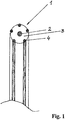
- FIG. 1 shows an elastomer thread 1 comprising a core thread 2, which is formed by seven stranded individual metal threads, and an elastomer body 3 formed from an elastomer material the contact threads 4 remain free, that is to say the contact threads 4 are not completely "pressed” into the elastomer material of the elastomer body 3.
- the contact threads 4 are formed here by five individual threads of brass Ms 30 quality with a thickness of 0.20 mm.
- FIG 2 an alternative embodiment is shown, which shows an elastomer thread 1 'which, like the elastomer thread 1 according to FIG Figure 1 is equipped with a soul thread 2.
- the elastomer thread 1 ′ has only a single contact thread 4 ′ which is arranged in a helical or spiral shape in the longitudinal direction of the core thread 2 on the elastomer body 3.
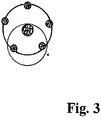
- Figure 3 shows a cross section of the elastomer thread 1 according to Figure 1 , with a section 5 of the cross section shown in FIG Figure 4 is shown enlarged again.
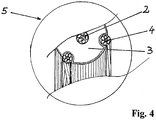
- Figure 4 shows the elastomer body 3, the core thread 2 and the embedded contact threads 4, it being clear that both the core thread 2 and the contact threads 4 in the example shown are formed by stranded metal threads.
- the elastomer threads 1, 1 'described can be used, for example, in a press pad which is designed as a cloth weave, the warp threads of the fabric consisting of stranded brass single threads 7 x 0.20 mm of brass quality Ms 30 and a warp thread density of 800 threads per 100 cm weaving width .
- elastomer threads according to the invention made from a copolymer of silicone and fluorosilicone rubber with a core thread made from stranded copper threads 8 ⁇ 0.20 mm are recommended.
- a thread diameter of the entire elastomer thread is 1.6 mm with a weft density of 450 wefts per 100 cm weave length.
Landscapes
- Engineering & Computer Science (AREA)
- Mechanical Engineering (AREA)
- Woven Fabrics (AREA)
- Casting Or Compression Moulding Of Plastics Or The Like (AREA)
- Extrusion Moulding Of Plastics Or The Like (AREA)
- Laminated Bodies (AREA)
Description
- Die vorliegende Anmeldung betrifft ein Verfahren zur Herstellung eines Presspolsters aufweisend die folgenden Verfahrensschritte:
- a) Mittels eines Extruders wird ein Elastomerwerkstoff um einen Seelenfaden herum ausgeformt.
- b) Der Elastomerwerkstoff wird vernetzt, wodurch der Seelenfaden und der Elastomerwerkstoff gemeinsam einen hochtemperaturbeständigen Elastomerfaden ausbilden.
- c) Eine Vielzahl von Elastomerfäden wird mit einer Vielzahl von Wärmeleitfäden in einem Webprozess zu dem Presspolster verarbeitet, wobei entweder die Elastomerfäden in Kettrichtung und die Wärmeleitfäden in Schussrichtung oder die Elastomerfäden in Schussrichtung und die Wärmeleitfäden in Kettrichtung angeordnet werden.
- Ferner befasst sich die vorliegende Anmeldung mit einem Elastomerfaden, insbesondere für den Einsatz in einem Presspolster, in Form eines Kettfadens oder eines Schussfadens, wobei der Elastomerfaden von einem Seelenfaden und einem um diesen herum ausgeformten Elastomerwerkstoff gebildet ist.
- Abschließend betrifft die vorliegende Anmeldung ein Presspolster für den Einsatz in Heizpressen, umfassend ein von Kettfäden und Schussfäden gebildetes Gewebe.
- Holzwerkstoffplatten wie Sperrholz-, Span-, MDF- oder HDF-Platten werden in Ein- oder Mehretagenheizpressen, die als Nieder- oder Hochdruckpressen ausgebildet sein können, mit Kunstharzfilmen beschichtet. Einetagenniederdruckpressen, die mit einem spezifischen Pressdruck bis ca. 50 kp/cm2 beziehungsweise 500 N/cm2 bei schneller Schließgeschwindigkeit arbeiten, werden auch "Kurztaktpressen" genannt. Derartige Kurztaktpressen werden zum Beispiel genutzt, um Fußbodenplatten auf HDF-Basis (High Density Fiberboard) mit dekorativen Melaminharzfilmen und Melaminharzoverlays zu beschichten.
- Die Herstellung derartiger (Fußboden-)Platten benötigt einen gleichmäßigen Pressdruck und eine gleichmäßige und schnelle Wärmeübertragung. Um diese Anforderungen zu erfüllen, müssen die in den Heizpressen eingesetzten Presspolster, die als Puffer zwischen dem zu bearbeitenden Produkt und den Heizplatten der Heizpresse angeordnet sind, zum einen eine ausreichende Polsterwirkung aufweisen, um den Pressdruck der Heizpresse gleichmäßig auf das Produkt verteilen zu können, und zum anderen eine gute Wärmeleitfähigkeit aufweisen, um eine zügige Wärmeübertragung zwischen dem zu pressenden Produkt und der jeweiligen Heizplatte der Heizpresse zu gewährleisten.
- Heute werden Presspolster eingesetzt, deren Rückstelleigenschaften hauptsächlich von darin enthaltenen Elastomerwerkstoffen gebildet sind. Wichtige Vertreter dieser Elastomerwerkstoffe sind Silikonkautschuk, Fluorsilikonkautschuk, Fluorkautschuk und auch Copolymere aus Silikon- und Fluorsilikonkautschuk. Presspolster sind in der Regel textile Produkte, wobei es eine Vielzahl unterschiedlicher Ausführungsformen gibt. In der
EP 1 300 235 B1 und derDE 23 19 593 B2 wird jeweils ein Presspolster aus einem Metallgewebe beschrieben, welches anschließend zumindest teilweise mit einem Silikonkautschuk beschichtet wird, wobei auf einer Oberfläche des Presspolsters die einzelnen Metallfäden des Metallgewebes freiliegen und so für einen guten Wärmetransport zwischen dem zu pressenden Produkt und der Heizplatte der Heizpresse sorgen sollen. Ferner ist beschrieben, dass zur Steigerung der Wärmeleitfähigkeit der Silikonkautschuk mit Metallpulver angereichert ist. Derartige Zuschlagstoffe bergen jedoch den Nachteil, die Härte des Elastomerwerkstoffs zu erhöhen und sich folglich negativ auf die Rückstelleigenschaften des Presspolsters auszuwirken. Die gewünschte Funktion der Kraftverteilung des Presspolsters über das jeweilig zu pressende Produkt wird dadurch gestört. - In der
EP 1 136 248 A1 wird ein Gewebepolster beschrieben, das von Kett- und Schussfäden gebildet ist, wobei die Fäden von einem Copolymer aus Silikon- und Fluorsilikonkautschuk sowie Metallfäden gebildet sind. Hierbei werden zur Steigerung der Wärmeleitfähigkeit der Fäden auch metallische Zuschlagstoffe aufgeführt. - Ferner ist aus der
EP 0 735 949 A1 ein Presspolster bekannt, dessen Kett- und/oder Schussfäden ein Silikonelastomer aufweisen, wobei das Silikonelastomer in dem Gewebe des Presspolsters sowohl als Vollfaden als auch mit Silikon ummanteltem Metalldraht enthalten sein kann. - Des Weiteren ist aus der
EP 0 713 762 A2 ein Polster für Hoch- und Niederdruckpressen bekannt, dass aus verschiedenen Garnmaterialien besteht. - Das Dokument
EP-A-2347894 offenbart ein Verfahren zur Herstellung eines Presspolsters gemaß dem Oberbegriff des Anspruchs 1, sowie ein Elastomerfaden gemaß dem Oberbegriff des Anspruchs 5. Bei allen bekannten Presspolster werden deren Wärmeleitfähigkeitseigenschaften durch Zugaben von metallischen oder nichtmetallischen Zuschlagsstoffen in die verwendeten Elastomerwerkstoffe oder durch eine Erhöhung des Anteils der metallischen Kettfäden verbessert. Beide Maßnahmen führen dazu, dass die elastischen Eigenschaften, die hauptsächlich für die Polsterwirkung des Presspolsters verantwortlich sind, negativ beeinflusst werden. Speziell bei der Beschichtung von Fußbodenplatten ist eine gute Polsterwirkung jedoch zwingend nötig, um eine gute Qualität bei geringem Ausschuss zu erreichen, wobei die Wärmeleitfähigkeit des Presspolsters hoch sein soll, um den Energieeinsatz bei der Produktion möglichst gering zu halten. - Der Erfindung liegt daher die Aufgabe zugrunde, ein Presspolster vorzuschlagen, dass den heutigen Anforderungen in Bezug auf schnelle Wärmeleitfähigkeit und hohe Rückstelleigenschaften gerecht wird.
- Die zugrunde liegende Aufgabe wird ausgehend von einem Verfahren nach Anspruch 1 durch die folgenden Verfahrensschritte gelöst:
- d) Vor der Vernetzung des Elastomerwerkstoffs wird mindestens ein Kontaktfaden in eine Oberfläche des Elastomerwerkstoffs eingedrückt, wobei ein Teil einer Oberfläche des Kontaktfadens frei bleibt.
- e) Mittels der Vernetzung wird der mindestens eine Kontaktfaden in dem Elastomerwerkstoff verankert.
- Die Kontaktfäden sind vorteilhafterweise von einem Material gebildet, welches eine hohe Wärmeleitfähigkeit aufweist. Somit sind beispielsweise metallische Kontaktfäden besonders vorteilhaft. Die erfindungsgemäße Kombination eines eingedrückten und gleichwohl frei liegenden Kontaktfadens bewirkt den besonderen Vorteil, dass der jeweilige Kontaktfaden besonders gut sowohl mit der Heizplatte des Heizpresse auf der einen Seite als auch mit einem Pressblech auf der anderen Seite in einen Wärme leitenden Kontakt gebracht werden kann. Außerdem gewährt die "äußere" Anordnung der Kontaktfäden einen besonders guten Kontakt der einzelnen Elastomerfäden untereinander, so dass ein Wärmetransport durch ein gebildetes Presspolster besonders gut stattfinden kann, da die Wärme mittels der aneinander stoßenden Kontaktfäden in Dickenrichtung besonders gut von einem zum jeweils benachbarten Elastomerfaden transportiert werden kann. Eine Polsterwirkung des Elastomerfadens selbst wird hierdurch gar nicht oder zumindest nicht nennenswert eingeschränkt. Insbesondere wird dem Elastomerwerkstoff, in den die Kontaktfäden eingedrückt werden, kein Zuschlagsstoff zugesetzt, wie es gemäß dem Stand der Technik üblich ist. Eine Reduktion der elastischen Eigenschaften des Elastomerfadens tritt demzufolge nicht auf. Folglich verbindet ein Presspolster, welches zumindest teilweise von Elastomerfäden gebildet ist, die mittels des erfindungsgemäßen Verfahrens hergestellt sind, die Eigenschaften einer guten Polsterwirkung sowie einer guten Wärmeleitfähigkeit.
- Als Elastomerwerkstoffe haben sich bei einem hohen Temperaturbereich von bis zu 250°C, Silikonkautschuk, Fluorkautschuk und Copolymere aus Silikonkautschuk und Fluorsilikonkautschuk bewährt. Weitere Elastomerwerkstoffe, die in diesem Temperaturbereich temperaturbeständig sind, sind ohne Weiteres denkbar.
- Die Herstellung der Elastomerfäden geschieht in einem Extruder, wobei die Elastomerfäden mit einem Seelenfaden zur Stabilisierung ausgerüstet werden. Die Seelenfäden können aus verschiedenartigen Metallfäden oder anderen hochtemperaturbeständigen Werkstoffen bestehen. Im Extruder wird der Elastomerwerkstoff um den Seelenfaden herum ausgeformt, der anschließend zur Vernetzung in eine Trockenzone überführt wird. Die Trockenzone kann aus Infrarotstrahlung, Heißluft oder überhitztem Salzbad bestehen. Das erfindungsgemäße Verfahren ist dann besonders vorteilhaft, wenn die Kontaktfäden, die oberflächlich in den Elastomerwerkstoff eingebettet werden, durch die Extruderdüse geführt werden. Die Kontaktfäden drücken sich dabei in den Elastomerwerkstoff, wobei ein wesentlicher Teil einer Oberfläche des jeweiligen Kontaktfadens frei bleibt. Nach der Vernetzung des Elastomerwerkstoffs bleiben die Kontaktfäden fest in selbigem verankert. Dies ist wichtig für die Verarbeitung der Elastomerfäden in einem Webprozess, da Kontaktfäden, die nach der Vernetzung auf den Elastomerwerkstoff aufgebracht werden in den Webstühlen zu Verhakungen und Stillständen führen können.
- In einem besonders vorteilhaften Verfahren wird ein jeweiliger Kontaktfaden axial in Längsrichtung des Seelenfadens beziehungsweise des späteren Elastomerfadens in die Oberfläche des Elastomerwerkstoffs eingebracht. Bei einer solchen Anordnung werden typischerweise mehrere Kontaktfäden um einen Umfang des Elastomerwerkstoffs verteilt in dessen Oberfläche eingebracht, wobei eine Anordnung von drei bis sieben Kontaktfäden besonders zu bevorzugen ist. Die Anzahl und Dicke der Kontaktfäden können den jeweiligen Anforderungen angepasst und die Wärmeleitfähigkeit somit reguliert werden. Dabei ist es wichtig, dass eine Polsterwirkung der Elastomerfäden nicht negativ beeinflusst wird, wie dies gemäß dem Stand der Technik der Fall ist. Insoweit ist ein unbeschränkter Einsatz der beschriebenen Kontaktfäden nicht möglich.
- Neben einer axialen Führung der Kontaktfäden in dem jeweiligen Elastomerfaden, können die Fäden auch wendel- oder spiralförmig in Längsrichtung des Seelenfadens angelegt werden. Mit dieser Anordnung kann die Wärmeleitfähigkeit noch individueller gestaltet werden, insbesondere ergibt sich durch die Wendelform die Möglichkeit, die in den Kontaktfäden transportierte Wärme von einer Seite eines Querschnitts des Elastomerfadens auf dessen "andere Seite" zu führen.
- Die beschriebenen Elastomerfäden bilden später nach der Gewebeherstellung mit den metallischen Kett- oder Schussfäden des restlichen Gewebes einen Kontaktschluss. Dadurch kann die in der Heizpresse eingebrachte Wärme direkt durch das Presspolster von der Heizplatte der Heizpresse zu dem metallischen Pressblech fließen. Das Pressblech als Oberflächengeber hat somit einen direkten Kontakt zum Beschichtungsmaterial des Holzwerkstoffes.
- Weiterhin hat sich auch herausgestellt, dass durch eine Erhöhung des Anteils der metallischen Kett- beziehungsweise Schussfäden (je nachdem, in welcher Funktion die metallischen Fäden eingesetzt werden) - wie in der Patenliteratur aufgeführt - zwar die Wärmeleitfähigkeit des jeweiligen Presspolsters gesteigert werden kann, die Polsterwirkung desselben aber erheblich gemindert wird.
- Ausgehend von einem Elastomerfaden der eingangs beschriebenen Art wird die zugrunde liegende Aufgabe erfindungsgemäß durch mindestens einen Elastomerfaden gelöst, der die Merkmale des Anspruchs 5 aufweist. Ein Elastomerfaden, der mindestens einen derartigen Kontaktfaden aufweist, ist im Hinblick auf die Wärmeleitfähigkeit eines mittels derartiger Elastomerfäden hergestellter Presspolster besonders vorteilhaft, wobei eine Polsterwirkung der einzelnen Elastomerfäden und folglich gleichermaßen des gesamten Presspolsters nicht negativ beeinflusst werden. Ein solcher erfindungsgemäßer Elastomerfaden ist mittels des erfindungsgemäßen Verfahrens besonders einfach herstellbar.
- In einer besonders vorteilhaften Ausgestaltung des erfindungsgemäßen Elastomerfadens ist dessen Seelenfaden von einem hochtemperaturbeständigen Werkstoff, insbesondere von Metall, gebildet. Ein solcher Elastomerfaden ist für einen Einsatz in Ein- oder Mehretagenheizpressen, die mit Temperaturen von mehr als 250 °C arbeiten, besonders gut geeignet.
- Ausgehend von einem Presspolster der eingangs beschriebenen Art wird die zugrunde liegende Aufgabe ferner dadurch gelöst, das mindestens ein Kettfaden und/oder mindestens ein Schussfaden von einem Elastomerfaden gemäß Anspruch 5 gebildet ist. Die Vorzüge eines derartigen Presspolsters sind vorstehend bereits erläutert.
- Die vorstehend beschriebene Erfindung wird nachfolgend anhand von Ausführungsbeispielen, die in den Figuren dargestellt sind, näher erläutert.
- Es zeigt:
- Fig. 1:
- Einen erfindungsgemäßen Elastomerfaden mit axial in Längsrichtung des Seelenfadens verlaufenden Kontaktfäden,
- Fig. 2:
- Einen weiteren erfindungsgemäßen Elastomerfaden mit wendelförmig in Längsrichtung des Seelenfadens verlaufenden Kontaktfäden,
- Fig. 3:
- Einen Querschnitt durch den Elastomerfaden gemäß
Figur 1 und - Fig. 4:
- Ein Detail des Querschnitts gemäß
Figur 3 . - Ein erstes Ausführungsbeispiel, das in
Figur 1 dargestellt ist, zeigt einen Elastomerfaden 1 umfassend einen Seelenfaden 2, der von sieben verlitzten Metalleinzelfäden gebildet ist, sowie einen von einem Elastomerwerkstoff gebildeten Elastomerkörper 3. In eine Oberfläche des Elastomerkörpers 3 sind axial in Längsrichtung des Seelenfadens 2 ausgerichtete Kontaktfäden 4 eingebettet, wobei eine Oberfläche der Kontaktfäden 4 frei bleibt, das heißt die Kontaktfäden 4 nicht vollständig in den Elastomerwerkstoff des Elastomerkörpers 3 "eingedrückt" sind. Die Kontaktfäden 4 sind hier von fünf Einzelfäden in der Qualität Messing Ms 30 in 0,20 mm Dicke gebildet. - In
Figur 2 ist eine alternative Ausführungsform dargestellt, die einen Elastomerfaden 1' zeigt, der ebenso wie der Elastomerfaden 1 gemäßFigur 1 mit einem Seelenfaden 2 ausgestattet ist. Im Unterschied zum Elastomerfaden 1 weist der Elastomerfaden 1' jedoch lediglich einen einzigen Kontaktfaden 4' auf, der wendel- beziehungsweise spiralförmig in Längsrichtung des Seelenfadens 2 an dem Elastomerkörper 3 angeordnet ist. -
Figur 3 zeigt einen Querschnitt des Elastomerfadens 1 gemäßFigur 1 , wobei ein Ausschnitt 5 des gezeigten Querschnitts inFigur 4 noch einmal vergrößert dargestellt ist.Figur 4 zeigt den Elastomerkörper 3, den Seelenfaden 2 und die eingebetteten Kontaktfäden 4, wobei deutlich wird, dass sowohl der Seelenfaden 2 als auch die Kontaktfäden 4 im gezeigten Beispiel von verlitzten Metalleinzelfäden gebildet sind. - Die beschriebenen Elastomerfäden 1, 1' können beispielsweise in einem Presspolster eingesetzt werden, welches als Tuchbindung ausgestaltet ist, wobei Kettfäden des Gewebes aus verlitzten Messingeinzelfäden 7 x 0,20 mm der Messingqualität Ms 30 bestehen und eine Kettfadendichte von 800 Fäden pro 100 cm Webbreite aufweisen.
- Als Schussfäden werden erfindungsgemäße Elastomerfäden aus einem Copolymer von Silikon- und Fluorsilikonkautschuk mit einem Seelenfaden aus verlitzten Kupferfäden 8 x 0,20 mm empfohlen. Ein Fadendurchmesser des gesamten Elastomerfadens beträgt 1,6 mm bei einer Schussdichte von 450 Schuss pro 100 cm Weblänge.
-
- 1, 1'
- Elastomerfaden
- 2
- Seelenfaden
- 3
- Elastomerkörper
- 4
- Kontaktfaden
- 5
- Ausschnitt
Claims (9)
- Verfahren zur Herstellung eines Presspolsters aufweisend die folgenden Verfahrensschritte:a) Mittels eines Extruders wird ein Elastomerwerkstoff um einen Seelenfaden (2) herum ausgeformt.b) Der Elastomerwerkstoff wird vernetzt, wodurch der Seelenfaden (2) und der Elastomerwerkstoff gemeinsam einen hochtemperaturbeständigen Elastomerfaden (1, 1') ausbilden.c) Eine Vielzahl von Elastomerfäden (1, 1') wird mit einer Vielzahl von Wärmeleitfäden in einem Webprozess zu dem Presspolster verarbeitet, wobei entweder die Elastomerfäden (1, 1') in Kettrichtung und die Wärmeleitfäden in Schussrichtung oder die Elastomerfäden (1, 1') in Schussrichtung und die Wärmeleitfäden in Kettrichtung angeordnet werden,gekennzeichnet durch die folgenden Verfahrensschritte:d) Vor der Vernetzung des Elastomerwerkstoffs wird mindestens ein Kontaktfaden (4) in eine Oberfläche des Elastomerwerkstoffs eingedrückt, wobei ein Teil einer Oberfläche des Kontaktfadens (4) frei bleibt.e) Mittels der Vernetzung wird der mindestens eine Kontaktfaden (4) in dem Elastomerwerkstoff verankert.
- Verfahren nach Anspruch 1, dadurch gekennzeichnet, dass der mindestens eine Kontaktfaden durch eine Extruderdüse des Extruders geführt und dabei in den Elastomerwerkstoff eindrückt wird.
- Verfahren nach Anspruch 1 oder 2, dadurch gekennzeichnet, dass der mindestens eine Kontaktfaden (4) axial in Längsrichtung des Seelenfadens (2) in die Oberfläche des Elastomerwerkstoffs eingebettet wird.
- Verfahren nach Anspruch 1 oder 2, dadurch gekennzeichnet, dass der mindestens eine Kontaktfaden (4) wendelförmig oder spiralförmig in Längsrichtung des Seelenfadens (2) in die Oberfläche des Elastomerwerkstoffs eingebettet wird.
- Elastomerfaden (1, 1'), insbesondere für den Einsatz in einem Presspolster, in Form eines Kettfadens oder eines Schussfadens, wobei der Elastomerfaden (1, 1') von einem Seelenfaden (2) und einem um diesen herum mittels eines Extruders ausgeformten Elastomerwerkstoff gebildet ist, gekennzeichnet durch mindestens einen Kontaktfaden (4), der durch die Extruderdüse in eine Oberfläche des Elastomerwerkstoffs eingedrückt ist, so dass er nach der Vernetzung des Elastomerwerkstoffes axial in Längsrichtung des Seelenfadens (2) oder wendelbeziehungsweise spiralförmig in Längsrichtung des Seelenfadens (2) fest in dem Elastomerwerkstoff eingebettet und verankert ist, wobei ein Teil einer Oberfläche des Kontaktfadens (4) frei bleibt.
- Elastomerfaden (1, 1') nach Anspruch 5, dadurch gekennzeichnet, dass der Seelenfaden (2) von einem hochtemperaturbeständigen Werkstoff, insbesondere von Metall, gebildet ist.
- Elastomerfaden (1, 1') nach Anspruch 5 oder 6, dadurch gekennzeichnet, dass der mindestens eine Kontaktfaden (4) von einem Metallfaden gebildet ist.
- Elastomerfaden (1, 1') nach Anspruch 5 oder 6, dadurch gekennzeichnet, dass der mindestens eine Kontaktfaden (4) von einem nichtmetallischen Werkstoff gebildet ist.
- Presspolster für den Einsatz in Heizpressen, umfassend ein von Kettfäden und Schussfäden gebildetes Gewebe, dadurch gekennzeichnet, dass mindestens ein Kettfaden und/oder mindestens ein Schussfaden von einem Elastomerfaden (1, 1') gemäß Anspruch 5 gebildet ist.
Priority Applications (1)
| Application Number | Priority Date | Filing Date | Title |
|---|---|---|---|
| PL13155189T PL2666623T3 (pl) | 2012-05-26 | 2013-02-14 | Sposób wytwarzania podkładki prasującej oraz przynależna nić elastomerowa oraz przynależna podkładka prasująca |
Applications Claiming Priority (1)
| Application Number | Priority Date | Filing Date | Title |
|---|---|---|---|
| DE202012005265U DE202012005265U1 (de) | 2012-05-26 | 2012-05-26 | Presspolster für Ein- und Mehretagenheizpressen mit wärmeleitenden Kontaktschlussfäden in Kett- und/oder Schussrichtung |
Publications (3)
| Publication Number | Publication Date |
|---|---|
| EP2666623A2 EP2666623A2 (de) | 2013-11-27 |
| EP2666623A3 EP2666623A3 (de) | 2016-07-20 |
| EP2666623B1 true EP2666623B1 (de) | 2020-12-02 |
Family
ID=46580025
Family Applications (1)
| Application Number | Title | Priority Date | Filing Date |
|---|---|---|---|
| EP13155189.7A Not-in-force EP2666623B1 (de) | 2012-05-26 | 2013-02-14 | Verfahren zur Herstellung eines Presspolsters sowie zugehöriger Elastomerfaden und zugehöriges Presspolster |
Country Status (4)
| Country | Link |
|---|---|
| EP (1) | EP2666623B1 (de) |
| DE (1) | DE202012005265U1 (de) |
| ES (1) | ES2847859T3 (de) |
| PL (1) | PL2666623T3 (de) |
Families Citing this family (6)
| Publication number | Priority date | Publication date | Assignee | Title |
|---|---|---|---|---|
| DE102013100433A1 (de) | 2013-01-16 | 2014-07-31 | Hueck Rheinische Gmbh | Presspolster für eine Ein- oder Mehretagenheizpresse |
| US11167810B2 (en) * | 2015-03-04 | 2021-11-09 | Camso Inc. | Track system for traction of a vehicle |
| DE202017003635U1 (de) | 2017-07-11 | 2017-08-22 | Rolf Espe | Presspolster mit höherer Wärmeleitfähigkeit und verbesserten Rückstelleigenschaften für die Beschichtung von Holzwerkstoffplatten in hydraulischen Ein- und Mehretagenheizpressen |
| DE202019000828U1 (de) | 2019-02-20 | 2020-02-24 | Rolf Espe | Presspolster mit hoher Federwirkung auf metallischer Basis für die Beschichtung von Holzwerkstoffplatten und Herstellung von Kunststoffplatten in hydraulischen Ein- und Mehretagenheizpressen. |
| DE202024002144U1 (de) | 2024-11-11 | 2025-11-20 | Hueck Rheinische Gmbh | Druckausgleichsgewebe mit schnellen und variablen Wärmeleitfähigkeiten für hydraulische Ein- und Mehretagenheizpressen |
| DE202025000024U1 (de) | 2025-01-02 | 2026-05-28 | Hueck Rheinische Gmbh | Metallisches Druckausgleichsgewebe welches mit einem hochtemperaturbeständigen Elastomerwerkstoff ausgerüstet ist |
Citations (1)
| Publication number | Priority date | Publication date | Assignee | Title |
|---|---|---|---|---|
| US3775228A (en) * | 1971-06-08 | 1973-11-27 | Owens Corning Fiberglass Corp | Composite linear elements |
Family Cites Families (11)
| Publication number | Priority date | Publication date | Assignee | Title |
|---|---|---|---|---|
| DE2319593B2 (de) | 1973-04-18 | 1976-09-23 | Becker & van Hüllen Niederrheinische Maschinenfabrik, 4150 Krefeld | Presspolster fuer heizplattenpressen |
| GB9421573D0 (en) | 1994-10-26 | 1994-12-14 | Marathon Belting Ltd | A press pad |
| DE9418984U1 (de) | 1994-11-25 | 1995-01-26 | Rheinische Filztuchfabrik GmbH, 52222 Stolberg | Preßpolster für Hoch- und Niederdruckpressen |
| GB9814133D0 (en) * | 1998-07-01 | 1998-08-26 | Marathon Belting Ltd | Improvements to press pads |
| DE59900537D1 (de) * | 1999-03-03 | 2002-01-24 | Heimbach Gmbh Thomas Josef | Presspolster |
| EP1033237B1 (de) * | 1999-03-03 | 2004-07-07 | Thomas Josef Heimbach Gesellschaft mit beschränkter Haftung & Co. | Presspolster |
| DE20001177U1 (de) * | 2000-01-25 | 2001-03-01 | Thomas Josef Heimbach GmbH & Co., 52353 Düren | Preßpolster |
| US6737370B2 (en) | 2000-03-21 | 2004-05-18 | Rheinische Filztuchfabrik Gmbh | Press pad containing fluoroelastomer or fluorosilicone elastomer priority claim |
| DE20115945U1 (de) * | 2001-09-27 | 2001-12-13 | Thomas Josef Heimbach GmbH & Co., 52353 Düren | Preßpolster |
| PT1300235E (pt) | 2001-09-27 | 2005-06-30 | Heimbach Gmbh Thomas Josef | Almofada de pressao |
| DE202010001226U1 (de) * | 2010-01-20 | 2011-05-26 | Helmbach GmbH & Co. KG, 52353 | Presspolster |
-
2012
- 2012-05-26 DE DE202012005265U patent/DE202012005265U1/de not_active Expired - Lifetime
-
2013
- 2013-02-14 PL PL13155189T patent/PL2666623T3/pl unknown
- 2013-02-14 ES ES13155189T patent/ES2847859T3/es active Active
- 2013-02-14 EP EP13155189.7A patent/EP2666623B1/de not_active Not-in-force
Patent Citations (1)
| Publication number | Priority date | Publication date | Assignee | Title |
|---|---|---|---|---|
| US3775228A (en) * | 1971-06-08 | 1973-11-27 | Owens Corning Fiberglass Corp | Composite linear elements |
Also Published As
| Publication number | Publication date |
|---|---|
| EP2666623A2 (de) | 2013-11-27 |
| PL2666623T3 (pl) | 2021-06-28 |
| EP2666623A3 (de) | 2016-07-20 |
| DE202012005265U1 (de) | 2012-06-27 |
| ES2847859T3 (es) | 2021-08-04 |
Similar Documents
| Publication | Publication Date | Title |
|---|---|---|
| EP2756947B1 (de) | Presspolster für eine ein- oder mehretagenpresse | |
| DE69710015T2 (de) | Transportband und Verfahren zur Herstellung | |
| EP2666623A2 (de) | Verfahren zur Herstellung eines Presspolsters sowie zugehöriger Elastomerfaden und zugehöriges Presspolster | |
| DE202007019506U1 (de) | Verbesserungen an Presspolstern | |
| DE29721495U1 (de) | Preßpolster | |
| EP3405334A1 (de) | Presspolster für eine hydraulische heizpresse und verfahren zu dessen herstellung | |
| EP1057931A2 (de) | Elastische Walze und Verfahren zum Herstellen einer solchen | |
| EP1386723B1 (de) | Presspolster | |
| WO2024141250A1 (de) | Presspolster mit einem gewebe sowie heizpresse | |
| DE202007006767U1 (de) | Presspolster | |
| DE202007006849U1 (de) | Presspolster mit Randverstärkung | |
| DE202012004859U1 (de) | Presspolster für den Einsatz in hydraulischen Ein- oder Mehretagenheizpressen mit Faserwerkstoffen, die einen negativen linearen Wärmeausdehnungskoeffizienten aufweisen | |
| EP1041198A1 (de) | Elastische Walze und Verfahren zum Herstellen einer solchen | |
| EP2347894B1 (de) | Presspolster | |
| EP1283776A1 (de) | Verfahren zur herstellung von produkten aus polymeren werkstoffen, in die festigkeitsträger eingebettet sind | |
| EP4032694B1 (de) | Set aus einer presspolster-pressblech-einheit und einer heizplatte oder set aus einer presspolster-heizplatten-einheit und einem pressblech, für den einsatz in einer hydraulischen ein- oder mehretagen-heizpresse | |
| EP3942100A1 (de) | Presspolster für den einsatz in ein- oder mehretagenheizpressen | |
| DE102025145203A1 (de) | Presspolster mit Fäden mit einem Geflecht aus Metallfäden | |
| DE102009053588A1 (de) | Abriebbeständige Monofilamente | |
| DE102013021124B4 (de) | Halbzeug mit Endlosfasern in ungehärteten duroplastischen Kunststoffmatrizen zur Realisierung unebener plattenförmiger Gegenstände | |
| EP1974896A1 (de) | Presspolster mit Randverstärkung | |
| DE1168066B (de) | Verfahren zur Herstellung von mit einer Faser-Zugflaeche versehenen Gummiriemen und nach diesem Verfahren hergestellter Riemen | |
| DE102017218644A1 (de) | Werkzeug und Verfahren zur Herstellung eines SMC-Bauteils, Verwendung des Werkzeugs | |
| EP2858800B1 (de) | Einzugswalze für stranggranulatoren sowie verfahren zur herstellung einer solchen | |
| DE202012004628U1 (de) | Hochtemperaturbeständiges Druckausgleichsgewebe für den Einsatz in hydraulischen Ein- oder Mehretagenheizpressen, Endlos- Doppelbandheizpressen und Formheizpressen. |
Legal Events
| Date | Code | Title | Description |
|---|---|---|---|
| PUAI | Public reference made under article 153(3) epc to a published international application that has entered the european phase |
Free format text: ORIGINAL CODE: 0009012 |
|
| AK | Designated contracting states |
Kind code of ref document: A2 Designated state(s): AL AT BE BG CH CY CZ DE DK EE ES FI FR GB GR HR HU IE IS IT LI LT LU LV MC MK MT NL NO PL PT RO RS SE SI SK SM TR |
|
| AX | Request for extension of the european patent |
Extension state: BA ME |
|
| PUAL | Search report despatched |
Free format text: ORIGINAL CODE: 0009013 |
|
| AK | Designated contracting states |
Kind code of ref document: A3 Designated state(s): AL AT BE BG CH CY CZ DE DK EE ES FI FR GB GR HR HU IE IS IT LI LT LU LV MC MK MT NL NO PL PT RO RS SE SI SK SM TR |
|
| AX | Request for extension of the european patent |
Extension state: BA ME |
|
| RIC1 | Information provided on ipc code assigned before grant |
Ipc: B30B 15/06 20060101AFI20160613BHEP |
|
| STAA | Information on the status of an ep patent application or granted ep patent |
Free format text: STATUS: REQUEST FOR EXAMINATION WAS MADE |
|
| 17P | Request for examination filed |
Effective date: 20170109 |
|
| RBV | Designated contracting states (corrected) |
Designated state(s): AL AT BE BG CH CY CZ DE DK EE ES FI FR GB GR HR HU IE IS IT LI LT LU LV MC MK MT NL NO PL PT RO RS SE SI SK SM TR |
|
| STAA | Information on the status of an ep patent application or granted ep patent |
Free format text: STATUS: EXAMINATION IS IN PROGRESS |
|
| 17Q | First examination report despatched |
Effective date: 20181212 |
|
| RIN1 | Information on inventor provided before grant (corrected) |
Inventor name: ESPE, DR., ROLF |
|
| GRAP | Despatch of communication of intention to grant a patent |
Free format text: ORIGINAL CODE: EPIDOSNIGR1 |
|
| STAA | Information on the status of an ep patent application or granted ep patent |
Free format text: STATUS: GRANT OF PATENT IS INTENDED |
|
| INTG | Intention to grant announced |
Effective date: 20200917 |
|
| GRAS | Grant fee paid |
Free format text: ORIGINAL CODE: EPIDOSNIGR3 |
|
| GRAA | (expected) grant |
Free format text: ORIGINAL CODE: 0009210 |
|
| STAA | Information on the status of an ep patent application or granted ep patent |
Free format text: STATUS: THE PATENT HAS BEEN GRANTED |
|
| AK | Designated contracting states |
Kind code of ref document: B1 Designated state(s): AL AT BE BG CH CY CZ DE DK EE ES FI FR GB GR HR HU IE IS IT LI LT LU LV MC MK MT NL NO PL PT RO RS SE SI SK SM TR |
|
| REG | Reference to a national code |
Ref country code: GB Ref legal event code: FG4D Free format text: NOT ENGLISH |
|
| REG | Reference to a national code |
Ref country code: AT Ref legal event code: REF Ref document number: 1340446 Country of ref document: AT Kind code of ref document: T Effective date: 20201215 Ref country code: CH Ref legal event code: EP |
|
| REG | Reference to a national code |
Ref country code: DE Ref legal event code: R096 Ref document number: 502013015334 Country of ref document: DE |
|
| REG | Reference to a national code |
Ref country code: IE Ref legal event code: FG4D Free format text: LANGUAGE OF EP DOCUMENT: GERMAN |
|
| PG25 | Lapsed in a contracting state [announced via postgrant information from national office to epo] |
Ref country code: FI Free format text: LAPSE BECAUSE OF FAILURE TO SUBMIT A TRANSLATION OF THE DESCRIPTION OR TO PAY THE FEE WITHIN THE PRESCRIBED TIME-LIMIT Effective date: 20201202 Ref country code: RS Free format text: LAPSE BECAUSE OF FAILURE TO SUBMIT A TRANSLATION OF THE DESCRIPTION OR TO PAY THE FEE WITHIN THE PRESCRIBED TIME-LIMIT Effective date: 20201202 Ref country code: NO Free format text: LAPSE BECAUSE OF FAILURE TO SUBMIT A TRANSLATION OF THE DESCRIPTION OR TO PAY THE FEE WITHIN THE PRESCRIBED TIME-LIMIT Effective date: 20210302 Ref country code: GR Free format text: LAPSE BECAUSE OF FAILURE TO SUBMIT A TRANSLATION OF THE DESCRIPTION OR TO PAY THE FEE WITHIN THE PRESCRIBED TIME-LIMIT Effective date: 20210303 |
|
| REG | Reference to a national code |
Ref country code: NL Ref legal event code: MP Effective date: 20201202 |
|
| PG25 | Lapsed in a contracting state [announced via postgrant information from national office to epo] |
Ref country code: BG Free format text: LAPSE BECAUSE OF FAILURE TO SUBMIT A TRANSLATION OF THE DESCRIPTION OR TO PAY THE FEE WITHIN THE PRESCRIBED TIME-LIMIT Effective date: 20210302 Ref country code: LV Free format text: LAPSE BECAUSE OF FAILURE TO SUBMIT A TRANSLATION OF THE DESCRIPTION OR TO PAY THE FEE WITHIN THE PRESCRIBED TIME-LIMIT Effective date: 20201202 Ref country code: SE Free format text: LAPSE BECAUSE OF FAILURE TO SUBMIT A TRANSLATION OF THE DESCRIPTION OR TO PAY THE FEE WITHIN THE PRESCRIBED TIME-LIMIT Effective date: 20201202 |
|
| PGFP | Annual fee paid to national office [announced via postgrant information from national office to epo] |
Ref country code: DE Payment date: 20210228 Year of fee payment: 9 Ref country code: BE Payment date: 20210224 Year of fee payment: 9 Ref country code: ES Payment date: 20210316 Year of fee payment: 9 Ref country code: GB Payment date: 20210223 Year of fee payment: 9 |
|
| PG25 | Lapsed in a contracting state [announced via postgrant information from national office to epo] |
Ref country code: HR Free format text: LAPSE BECAUSE OF FAILURE TO SUBMIT A TRANSLATION OF THE DESCRIPTION OR TO PAY THE FEE WITHIN THE PRESCRIBED TIME-LIMIT Effective date: 20201202 Ref country code: NL Free format text: LAPSE BECAUSE OF FAILURE TO SUBMIT A TRANSLATION OF THE DESCRIPTION OR TO PAY THE FEE WITHIN THE PRESCRIBED TIME-LIMIT Effective date: 20201202 |
|
| REG | Reference to a national code |
Ref country code: LT Ref legal event code: MG9D |
|
| PG25 | Lapsed in a contracting state [announced via postgrant information from national office to epo] |
Ref country code: RO Free format text: LAPSE BECAUSE OF FAILURE TO SUBMIT A TRANSLATION OF THE DESCRIPTION OR TO PAY THE FEE WITHIN THE PRESCRIBED TIME-LIMIT Effective date: 20201202 Ref country code: SK Free format text: LAPSE BECAUSE OF FAILURE TO SUBMIT A TRANSLATION OF THE DESCRIPTION OR TO PAY THE FEE WITHIN THE PRESCRIBED TIME-LIMIT Effective date: 20201202 Ref country code: PT Free format text: LAPSE BECAUSE OF FAILURE TO SUBMIT A TRANSLATION OF THE DESCRIPTION OR TO PAY THE FEE WITHIN THE PRESCRIBED TIME-LIMIT Effective date: 20210405 Ref country code: LT Free format text: LAPSE BECAUSE OF FAILURE TO SUBMIT A TRANSLATION OF THE DESCRIPTION OR TO PAY THE FEE WITHIN THE PRESCRIBED TIME-LIMIT Effective date: 20201202 Ref country code: SM Free format text: LAPSE BECAUSE OF FAILURE TO SUBMIT A TRANSLATION OF THE DESCRIPTION OR TO PAY THE FEE WITHIN THE PRESCRIBED TIME-LIMIT Effective date: 20201202 Ref country code: CZ Free format text: LAPSE BECAUSE OF FAILURE TO SUBMIT A TRANSLATION OF THE DESCRIPTION OR TO PAY THE FEE WITHIN THE PRESCRIBED TIME-LIMIT Effective date: 20201202 Ref country code: EE Free format text: LAPSE BECAUSE OF FAILURE TO SUBMIT A TRANSLATION OF THE DESCRIPTION OR TO PAY THE FEE WITHIN THE PRESCRIBED TIME-LIMIT Effective date: 20201202 |
|
| REG | Reference to a national code |
Ref country code: ES Ref legal event code: FG2A Ref document number: 2847859 Country of ref document: ES Kind code of ref document: T3 Effective date: 20210804 |
|
| PGFP | Annual fee paid to national office [announced via postgrant information from national office to epo] |
Ref country code: PL Payment date: 20210205 Year of fee payment: 9 |
|
| REG | Reference to a national code |
Ref country code: DE Ref legal event code: R097 Ref document number: 502013015334 Country of ref document: DE |
|
| PG25 | Lapsed in a contracting state [announced via postgrant information from national office to epo] |
Ref country code: MC Free format text: LAPSE BECAUSE OF FAILURE TO SUBMIT A TRANSLATION OF THE DESCRIPTION OR TO PAY THE FEE WITHIN THE PRESCRIBED TIME-LIMIT Effective date: 20201202 Ref country code: IS Free format text: LAPSE BECAUSE OF FAILURE TO SUBMIT A TRANSLATION OF THE DESCRIPTION OR TO PAY THE FEE WITHIN THE PRESCRIBED TIME-LIMIT Effective date: 20210402 |
|
| PLBE | No opposition filed within time limit |
Free format text: ORIGINAL CODE: 0009261 |
|
| STAA | Information on the status of an ep patent application or granted ep patent |
Free format text: STATUS: NO OPPOSITION FILED WITHIN TIME LIMIT |
|
| PG25 | Lapsed in a contracting state [announced via postgrant information from national office to epo] |
Ref country code: LU Free format text: LAPSE BECAUSE OF NON-PAYMENT OF DUE FEES Effective date: 20210214 Ref country code: LI Free format text: LAPSE BECAUSE OF NON-PAYMENT OF DUE FEES Effective date: 20210228 Ref country code: AL Free format text: LAPSE BECAUSE OF FAILURE TO SUBMIT A TRANSLATION OF THE DESCRIPTION OR TO PAY THE FEE WITHIN THE PRESCRIBED TIME-LIMIT Effective date: 20201202 Ref country code: CH Free format text: LAPSE BECAUSE OF NON-PAYMENT OF DUE FEES Effective date: 20210228 Ref country code: IT Free format text: LAPSE BECAUSE OF FAILURE TO SUBMIT A TRANSLATION OF THE DESCRIPTION OR TO PAY THE FEE WITHIN THE PRESCRIBED TIME-LIMIT Effective date: 20201202 |
|
| 26N | No opposition filed |
Effective date: 20210903 |
|
| PG25 | Lapsed in a contracting state [announced via postgrant information from national office to epo] |
Ref country code: DK Free format text: LAPSE BECAUSE OF FAILURE TO SUBMIT A TRANSLATION OF THE DESCRIPTION OR TO PAY THE FEE WITHIN THE PRESCRIBED TIME-LIMIT Effective date: 20201202 Ref country code: SI Free format text: LAPSE BECAUSE OF FAILURE TO SUBMIT A TRANSLATION OF THE DESCRIPTION OR TO PAY THE FEE WITHIN THE PRESCRIBED TIME-LIMIT Effective date: 20201202 |
|
| PG25 | Lapsed in a contracting state [announced via postgrant information from national office to epo] |
Ref country code: IE Free format text: LAPSE BECAUSE OF NON-PAYMENT OF DUE FEES Effective date: 20210214 Ref country code: FR Free format text: LAPSE BECAUSE OF NON-PAYMENT OF DUE FEES Effective date: 20210228 |
|
| REG | Reference to a national code |
Ref country code: DE Ref legal event code: R082 Ref document number: 502013015334 Country of ref document: DE Representative=s name: BAUER WAGNER PELLENGAHR SROKA PATENT- & RECHTS, DE Ref country code: DE Ref legal event code: R082 Ref document number: 502013015334 Country of ref document: DE Representative=s name: BAUER PSU PARTG MBB, DE |
|
| REG | Reference to a national code |
Ref country code: AT Ref legal event code: MM01 Ref document number: 1340446 Country of ref document: AT Kind code of ref document: T Effective date: 20210214 |
|
| PG25 | Lapsed in a contracting state [announced via postgrant information from national office to epo] |
Ref country code: AT Free format text: LAPSE BECAUSE OF NON-PAYMENT OF DUE FEES Effective date: 20210214 |
|
| PG25 | Lapsed in a contracting state [announced via postgrant information from national office to epo] |
Ref country code: IS Free format text: LAPSE BECAUSE OF FAILURE TO SUBMIT A TRANSLATION OF THE DESCRIPTION OR TO PAY THE FEE WITHIN THE PRESCRIBED TIME-LIMIT Effective date: 20210402 |
|
| REG | Reference to a national code |
Ref country code: DE Ref legal event code: R119 Ref document number: 502013015334 Country of ref document: DE |
|
| REG | Reference to a national code |
Ref country code: BE Ref legal event code: MM Effective date: 20220228 |
|
| GBPC | Gb: european patent ceased through non-payment of renewal fee |
Effective date: 20220214 |
|
| PG25 | Lapsed in a contracting state [announced via postgrant information from national office to epo] |
Ref country code: GB Free format text: LAPSE BECAUSE OF NON-PAYMENT OF DUE FEES Effective date: 20220214 Ref country code: DE Free format text: LAPSE BECAUSE OF NON-PAYMENT OF DUE FEES Effective date: 20220901 |
|
| PG25 | Lapsed in a contracting state [announced via postgrant information from national office to epo] |
Ref country code: BE Free format text: LAPSE BECAUSE OF NON-PAYMENT OF DUE FEES Effective date: 20220228 |
|
| REG | Reference to a national code |
Ref country code: ES Ref legal event code: FD2A Effective date: 20230503 |
|
| PG25 | Lapsed in a contracting state [announced via postgrant information from national office to epo] |
Ref country code: HU Free format text: LAPSE BECAUSE OF FAILURE TO SUBMIT A TRANSLATION OF THE DESCRIPTION OR TO PAY THE FEE WITHIN THE PRESCRIBED TIME-LIMIT; INVALID AB INITIO Effective date: 20130214 |
|
| PG25 | Lapsed in a contracting state [announced via postgrant information from national office to epo] |
Ref country code: CY Free format text: LAPSE BECAUSE OF FAILURE TO SUBMIT A TRANSLATION OF THE DESCRIPTION OR TO PAY THE FEE WITHIN THE PRESCRIBED TIME-LIMIT Effective date: 20201202 |
|
| PG25 | Lapsed in a contracting state [announced via postgrant information from national office to epo] |
Ref country code: ES Free format text: LAPSE BECAUSE OF NON-PAYMENT OF DUE FEES Effective date: 20220215 |
|
| PG25 | Lapsed in a contracting state [announced via postgrant information from national office to epo] |
Ref country code: MK Free format text: LAPSE BECAUSE OF FAILURE TO SUBMIT A TRANSLATION OF THE DESCRIPTION OR TO PAY THE FEE WITHIN THE PRESCRIBED TIME-LIMIT Effective date: 20201202 |
|
| PG25 | Lapsed in a contracting state [announced via postgrant information from national office to epo] |
Ref country code: PL Free format text: LAPSE BECAUSE OF NON-PAYMENT OF DUE FEES Effective date: 20220214 |
|
| PG25 | Lapsed in a contracting state [announced via postgrant information from national office to epo] |
Ref country code: MT Free format text: LAPSE BECAUSE OF FAILURE TO SUBMIT A TRANSLATION OF THE DESCRIPTION OR TO PAY THE FEE WITHIN THE PRESCRIBED TIME-LIMIT Effective date: 20201202 |
|
| PG25 | Lapsed in a contracting state [announced via postgrant information from national office to epo] |
Ref country code: TR Free format text: LAPSE BECAUSE OF FAILURE TO SUBMIT A TRANSLATION OF THE DESCRIPTION OR TO PAY THE FEE WITHIN THE PRESCRIBED TIME-LIMIT Effective date: 20201202 |