EP2663604B1 - Metal-passivating cmp compositions and methods - Google Patents
Metal-passivating cmp compositions and methods Download PDFInfo
- Publication number
- EP2663604B1 EP2663604B1 EP12734493.5A EP12734493A EP2663604B1 EP 2663604 B1 EP2663604 B1 EP 2663604B1 EP 12734493 A EP12734493 A EP 12734493A EP 2663604 B1 EP2663604 B1 EP 2663604B1
- Authority
- EP
- European Patent Office
- Prior art keywords
- composition
- cmp
- forming metal
- independently
- metal
- Prior art date
- Legal status (The legal status is an assumption and is not a legal conclusion. Google has not performed a legal analysis and makes no representation as to the accuracy of the status listed.)
- Active
Links
Images


Classifications
-
- C—CHEMISTRY; METALLURGY
- C09—DYES; PAINTS; POLISHES; NATURAL RESINS; ADHESIVES; COMPOSITIONS NOT OTHERWISE PROVIDED FOR; APPLICATIONS OF MATERIALS NOT OTHERWISE PROVIDED FOR
- C09K—MATERIALS FOR MISCELLANEOUS APPLICATIONS, NOT PROVIDED FOR ELSEWHERE
- C09K8/00—Compositions for drilling of boreholes or wells; Compositions for treating boreholes or wells, e.g. for completion or for remedial operations
- C09K8/52—Compositions for preventing, limiting or eliminating depositions, e.g. for cleaning
- C09K8/528—Compositions for preventing, limiting or eliminating depositions, e.g. for cleaning inorganic depositions, e.g. sulfates or carbonates
-
- C—CHEMISTRY; METALLURGY
- C09—DYES; PAINTS; POLISHES; NATURAL RESINS; ADHESIVES; COMPOSITIONS NOT OTHERWISE PROVIDED FOR; APPLICATIONS OF MATERIALS NOT OTHERWISE PROVIDED FOR
- C09G—POLISHING COMPOSITIONS; SKI WAXES
- C09G1/00—Polishing compositions
- C09G1/02—Polishing compositions containing abrasives or grinding agents
-
- C—CHEMISTRY; METALLURGY
- C09—DYES; PAINTS; POLISHES; NATURAL RESINS; ADHESIVES; COMPOSITIONS NOT OTHERWISE PROVIDED FOR; APPLICATIONS OF MATERIALS NOT OTHERWISE PROVIDED FOR
- C09K—MATERIALS FOR MISCELLANEOUS APPLICATIONS, NOT PROVIDED FOR ELSEWHERE
- C09K3/00—Materials not provided for elsewhere
- C09K3/14—Anti-slip materials; Abrasives
- C09K3/1409—Abrasive particles per se
-
- C—CHEMISTRY; METALLURGY
- C09—DYES; PAINTS; POLISHES; NATURAL RESINS; ADHESIVES; COMPOSITIONS NOT OTHERWISE PROVIDED FOR; APPLICATIONS OF MATERIALS NOT OTHERWISE PROVIDED FOR
- C09K—MATERIALS FOR MISCELLANEOUS APPLICATIONS, NOT PROVIDED FOR ELSEWHERE
- C09K3/00—Materials not provided for elsewhere
- C09K3/14—Anti-slip materials; Abrasives
- C09K3/1454—Abrasive powders, suspensions and pastes for polishing
- C09K3/1463—Aqueous liquid suspensions
-
- C—CHEMISTRY; METALLURGY
- C23—COATING METALLIC MATERIAL; COATING MATERIAL WITH METALLIC MATERIAL; CHEMICAL SURFACE TREATMENT; DIFFUSION TREATMENT OF METALLIC MATERIAL; COATING BY VACUUM EVAPORATION, BY SPUTTERING, BY ION IMPLANTATION OR BY CHEMICAL VAPOUR DEPOSITION, IN GENERAL; INHIBITING CORROSION OF METALLIC MATERIAL OR INCRUSTATION IN GENERAL
- C23F—NON-MECHANICAL REMOVAL OF METALLIC MATERIAL FROM SURFACE; INHIBITING CORROSION OF METALLIC MATERIAL OR INCRUSTATION IN GENERAL; MULTI-STEP PROCESSES FOR SURFACE TREATMENT OF METALLIC MATERIAL INVOLVING AT LEAST ONE PROCESS PROVIDED FOR IN CLASS C23 AND AT LEAST ONE PROCESS COVERED BY SUBCLASS C21D OR C22F OR CLASS C25
- C23F3/00—Brightening metals by chemical means
- C23F3/04—Heavy metals
-
- C—CHEMISTRY; METALLURGY
- C23—COATING METALLIC MATERIAL; COATING MATERIAL WITH METALLIC MATERIAL; CHEMICAL SURFACE TREATMENT; DIFFUSION TREATMENT OF METALLIC MATERIAL; COATING BY VACUUM EVAPORATION, BY SPUTTERING, BY ION IMPLANTATION OR BY CHEMICAL VAPOUR DEPOSITION, IN GENERAL; INHIBITING CORROSION OF METALLIC MATERIAL OR INCRUSTATION IN GENERAL
- C23F—NON-MECHANICAL REMOVAL OF METALLIC MATERIAL FROM SURFACE; INHIBITING CORROSION OF METALLIC MATERIAL OR INCRUSTATION IN GENERAL; MULTI-STEP PROCESSES FOR SURFACE TREATMENT OF METALLIC MATERIAL INVOLVING AT LEAST ONE PROCESS PROVIDED FOR IN CLASS C23 AND AT LEAST ONE PROCESS COVERED BY SUBCLASS C21D OR C22F OR CLASS C25
- C23F3/00—Brightening metals by chemical means
- C23F3/04—Heavy metals
- C23F3/06—Heavy metals with acidic solutions
-
- H—ELECTRICITY
- H10—SEMICONDUCTOR DEVICES; ELECTRIC SOLID-STATE DEVICES NOT OTHERWISE PROVIDED FOR
- H10P—GENERIC PROCESSES OR APPARATUS FOR THE MANUFACTURE OR TREATMENT OF DEVICES COVERED BY CLASS H10
- H10P52/00—Grinding, lapping or polishing of wafers, substrates or parts of devices
- H10P52/40—Chemomechanical polishing [CMP]
- H10P52/402—Chemomechanical polishing [CMP] of semiconductor materials
-
- H—ELECTRICITY
- H10—SEMICONDUCTOR DEVICES; ELECTRIC SOLID-STATE DEVICES NOT OTHERWISE PROVIDED FOR
- H10P—GENERIC PROCESSES OR APPARATUS FOR THE MANUFACTURE OR TREATMENT OF DEVICES COVERED BY CLASS H10
- H10P52/00—Grinding, lapping or polishing of wafers, substrates or parts of devices
- H10P52/40—Chemomechanical polishing [CMP]
- H10P52/403—Chemomechanical polishing [CMP] of conductive or resistive materials
Definitions
- This invention relates to polishing compositions and methods for polishing a substrate comprising copper and/or silver. More particularly, this invention relates to chemical-mechanical polishing compositions and methods for polishing copper- and/or silver-containing substrates utilizing a combination of a film-forming metal-complexing agent and a metal-passivating agent.
- polishing compositions also known as polishing slurries, CMP slurries, and CMP compositions
- polishing metal-containing surfaces of semiconductor substrates typically contain abrasives, various additive compounds, and the like, and frequently are used in combination with an oxidizing agent.
- Such CMP compositions are often designed for removal of specific substrate materials such as metals (e.g., tungsten or copper), insulators (e.g., silicon dioxide, such as plasma-enhanced tertraethylorthosilicate (PETEOS)-derived silica), and semiconductive materials (e.g., silicon or gallium arsenide).
- substrate materials such as metals (e.g., tungsten or copper), insulators (e.g., silicon dioxide, such as plasma-enhanced tertraethylorthosilicate (PETEOS)-derived silica), and semiconductive materials (e.g., silicon or gallium arsenide).
- PETEOS plasma-enhanced tertraethylorthosilicate
- a substrate carrier (polishing head) is mounted on a carrier assembly and positioned in contact with a polishing pad in a CMP apparatus.
- the carrier assembly provides a controllable pressure (down force) to urge the substrate against the polishing pad.
- the pad and carrier, with its attached substrate are moved relative to one another.
- the relative movement of the pad and substrate serves to abrade the surface of the substrate to remove a portion of the material from the substrate surface, thereby polishing the substrate.
- the polishing of the substrate surface typically is further aided by the chemical activity of the polishing composition (e.g., by oxidizing agents present in the CMP composition) and/or the mechanical activity of an abrasive suspended in the polishing composition.
- Typical abrasive materials include, for example, silicon dioxide (silica), cerium oxide (ceria), aluminum oxide (alumina), zirconium oxide (zirconia), titanium dioxide (titania), and tin oxide.
- the abrasive desirably is suspended in the CMP composition as a colloidal dispersion, which preferably is colloidally stable.
- colloidal dispersion preferably is colloidally stable.
- the term “colloid” refers to the suspension of abrasive particles in the liquid carrier.
- Cold stability refers to the maintenance of that suspension during a selected period of time with minimal settling.
- an abrasive suspension is considered colloidally stable if, when the suspension is placed into a 100 mL graduated cylinder and allowed to stand without agitation for a period of time of 2 hours, the difference between the concentration of particles in the bottom 50 mL of the graduated cylinder ([B] in terms of g/mL) and the concentration of particles suspended in the top 50 mL of the graduated cylinder ([T] in terms of g/mL) divided by the initial concentration of particles suspended in the abrasive composition ([C] in terms of g/mL) is less than or equal to 0.5 (i.e., ([B] - [T])/[C] ⁇ 0.5).
- the value of ([B]-[T])/[C] desirably is less than or equal to 0.3, and preferably is less than or equal to 0.1.
- U.S. Pat. No. 5,527,423 to Neville et al. describes a method for chemically-mechanically polishing a metal layer by contacting the surface of the metal layer with a polishing slurry comprising high purity fine metal oxide particles suspended in an aqueous medium.
- the abrasive material may be incorporated into the polishing pad.
- U.S. Pat. No. 5,489,233 to Cook et al. discloses the use of polishing pads having a surface texture or pattern
- U.S. Pat. No. 5,958,794 to Bruxvoort et al. discloses a fixed abrasive polishing pad.
- a relatively low-solids dispersion i.e., having an abrasive concentration at a total suspended solids (TSS) level of 1 percent by weight or less
- TSS total suspended solids
- Chemical reactivity can be modulated through the use of oxidizing agents, chelating agents, corrosion inhibitors, pH, ionic strength, and the like. Balancing the chemical reactivity and mechanical abrasive properties of the CMP slurry can be complicated.
- silver Another metal of interest in semiconductor applications is silver, which shares many properties and characteristics in common with copper vis-à-vis CMP, such as corrosion properties and passivating properties.
- CMP copper vis-à-vis
- both silver and copper effectively form films with and are passivated by benzotriazole.
- Cu and Ag both readily dissolve in acidic pH with a formation of metal ions (for Cu, Cu +1 and Cu +2 and for silver Ag +1 ) and passivate at higher pHs with a formation of oxides.
- the present invention provides chemical-mechanical polishing (CMP) compositions and a method for polishing substrates comprising copper and/or silver.
- CMP chemical-mechanical polishing
- the method of the present invention entails abrading a surface of the substrate with a CMP composition of the invention, preferably in the presence of an oxidizing agent (e.g., hydrogen peroxide).
- an oxidizing agent e.g., hydrogen peroxide.
- the compositions and the method of the invention can provide relatively high copper and/or silver removal rates with good passivation, compared to conventional CMP slurries.
- the CMP compositions of the invention comprise a particulate abrasive, a primary film-forming metal-complexing agent, a secondary film-forming metal-passivating agent, and an aqueous carrier, as defined in the claims.
- R 1 is H, substituted C 1 -C 4 alkyl, or unsubstituted C 1 -C 4 alkyl
- R 2 is substituted C 8 -C 20 alkyl or unsubstituted C 8 -C 20 alkyl
- R 3 and R 4 are each independently H, substituted C 1 -C 4 alkyl, or unsubstituted C 1 -C 4 alkyl.
- Compounds of formula (I) include N-acyl glycine compounds (e.g., N-lauroyl glycine and N-lauroyl sarcosine), o -hydroxyaryl hydroxamic acid compounds (e.g., salicylhydroxamic acid), o-hydroxy-N-acyl aniline compounds, and malonomonohydroxamic acid.
- the primary film-forming metal-complexing agent according to claim 1 comprises an o-hydroxyaryl hydroxamic acid, as well as the salts and partially neutralized forms thereof.
- Preferred salt forms of the metal-complexing agents are alkali metal salts (e.g., lithium, sodium, and potassium salts).
- composition of the invention comprises 0.01 to 10 percent by weight (wt %) of a particulate abrasive, 0.001 to 1 wt % of the primary film-forming metal-complexing agent, and 0.005 to 0.5 wt % of the secondary film-forming metal-passivating agent, dissolved and/or suspended in an aqueous carrier.
- the primary film-forming metal-complexing agent is believed to act as an anchor molecule for produce a thin film directly on the copper surface.
- the secondary film-forming passivating agent has a strong affinity (e.g., by ionic and/or covalent bonding) for binding to the film formed by the complexing agent.
- the initial anchor film and the passivating film formed thereon together provide a passivating film that affords a desirably lower static etch rate (SER) and lower friction development over time compared to the use of either the complexing agent or the secondary film-forming passivating agent alone.
- SER static etch rate
- the secondary film-forming metal-passivating agents are compounds having the general formula (II): Z-X 2 (Y 2 R 5 )(Y 3 R 6 ), as well as salts thereof, and partially neutralized forms thereof.
- Z is NH 2 or OH;
- Y 2 and Y 3 are each independently N, NH, or O; and
- R 5 and R 6 can each independently comprise R 7 -(OCH 2 CH 2 ) n -, wherein R 7 can be H, C 1 -C 20 -alkyl, phenyl, C 1 -C 20 -alkyl-substituted phenyl; and wherein "n” has an average value in the range of 2 to 1000, or when Y 2 and Y 3 each independently are N or NH, R 5 and R 6 each independently can be N, NH, or CH, and together form a five-membered ring heterocycle with X 2 , Y 2 and Y 3 .
- R 5 and Y 6 each independently are selected from alkyl or polyethylene glycol (PEG) groups such as poly(oxyethylene), aryl-terminated poly(oxyethylene), alkyl-terminated poly(oxyethylene), and alkylaryl-terminated poly(oxyethylene).
- PEG polyethylene glycol
- Non-limiting examples of compounds of formula (II) include amino-substituted heterocycles such as 5-aminotetrazole, and phosphate esters such as bis-pegylated phosphate esters), particularly phosphates esterified with PEG chains at two oxygens of the phosphate group, wherein the PEG chains are terminated by an aryl ether group (e.g., a phenyl ether), an alkylphenyl ether group (e.g., a C 1 -C 20 -alkyl-substituted phenyl, such as nonylphenyl), or a C 1 -C 20 -alkyl ether group (e.g., bis-(nonylphenylpoly(oxyethylene) phosphate diester).
- Preferred salt forms of the metal-passivating agents are alkali metal salts (e.g., sodium and potassium salts) in the case of acidic materials and mineral acid addition salts in the case of basic materials
- compositions of the present invention can include one or more auxiliary metal (e.g., cooper and/or silver)-chelating agents (e.g., 0.01 to 20 wt % of the auxiliary metal-chelating agent) such as compounds having an acidic OH group and an additional oxygen-bearing or nitrogen-bearing substituent.
- auxiliary metal e.g., cooper and/or silver
- auxiliary metal-chelating agents e.g., 0.01 to 20 wt % of the auxiliary metal-chelating agent
- auxiliary metal-chelating agents include oxalic acid, amino-substituted carboxylic acids (e.g., alpha-amino acids such as glycine, or amino polycarboxylic acids, such as iminodiacetic acid, and the like), and hydroxyl-substituted carboxylic acids (e.g., citric acid, and the like), as well as salts of the chelating agents (e.g., alkali metal salts).
- amino-substituted carboxylic acids e.g., alpha-amino acids such as glycine, or amino polycarboxylic acids, such as iminodiacetic acid, and the like
- hydroxyl-substituted carboxylic acids e.g., citric acid, and the like
- salts of the chelating agents e.g., alkali metal salts.
- the CMP compositions of the invention comprise a particulate abrasive, a primary film-forming metal-complexing agent, a secondary film-forming metal-passivating agent, and an aqueous carrier therefor, and provide for relatively high copper removal rates, relatively low defectivity, and good surface passivation when used to polish a substrate comprising copper and/or silver.
- the compositions of the present invention provide lower SER and lower friction over time relative to conventional compositions that do not include the primary and secondary film-forming materials.
- Particulate abrasives useful in the CMP compositions and methods of the invention include any abrasive material suitable for use in CMP of semiconductor materials.
- suitable abrasive materials include silica (e.g., fumed silica and/or colloidal silica), alumina, titania, ceria, zirconia, or a combination of two or more of the foregoing abrasives, which are well known in the CMP art.
- Preferred abrasives include silica, particularly colloidal silica, as well as titania.
- the abrasive material preferably is present in the CMP slurry at a concentration of not more than 10 wt %, preferably not more than 5 wt %.
- the abrasive material is present in the CMP composition at a concentration in the range of 0.1 to 1 wt %.
- Preferred abrasives have a mean particle size of 100 nm or less, as determined by laser light scattering techniques, which are well known in the art.
- metal-complexing agents in the context of the present invention are to be construed as referring to any and all forms of the agents, i.e., the acid form, salt forms, and partially neutralized forms, which are functionally interchangeable with one another at a given pH.
- the form of the metal-complexing agent actually present in a given composition will depend upon the pKa of any acid functional groups and the pH of the composition.
- Primary film-forming metal-complexing agents used in the compositions and methods of the present invention are compounds that include an o-hydroxyaryl hydroxamic acid, a salt thereof, or a partially neutralized form thereof.
- R 1 is H, substituted C 1 -C 4 alkyl, or unsubstituted C 1 -C 4 alkyl
- R 2 is substituted C 8 -C 20 alkyl or unsubstituted C 8 -C 20 alkyl
- R 3 and R 4 are each independently H, substituted C 1 -C 4 alkyl, or unsubstituted C 1 -C 4 alkyl.
- Compounds of formula (I) include N-acyl glycine compounds (e.g., N-lauroyl glycine and N-lauroyl sarcosine), o -hydroxyaryl hydroxamic acid compounds (e.g., salicylhydroxamic acid), o -hydroxy-N-acyl aniline compounds, and malonomonohydroxamic acid.
- N-acyl glycine compounds e.g., N-lauroyl glycine and N-lauroyl sarcosine
- o -hydroxyaryl hydroxamic acid compounds e.g., salicylhydroxamic acid
- o -hydroxy-N-acyl aniline compounds e.g., o -hydroxy-N-acyl aniline compounds
- malonomonohydroxamic acid e.g., sodium, and potassium salts.
- the primary film-forming metal-complexing agent is present in the composition at a concentration in the range of 0.001 to 1 wt %, more preferably 0.005 to 0.5 wt % or 0.05 to 0.3 wt %.
- the alternative "A" moieties in formula (I) are N-acylamino and hydroxamic acid groups, which share the common characteristic of being polar substituents that include both a nitrogen atom and at least one oxygen atom in close proximity to the nitrogen (i.e., the oxygen and nitrogen of the N-acyl group are separated by a single carbon atom, whereas in the hydroxamic acid there are two oxygen atoms - one that is adjacent to the nitrogen and one that is separated by one carbon atom from the nitrogen).
- the X and Y moieties of formula (I) share the following common characteristics: (I) they each impart acidic character to the OH group (e.g., by virtue of the unsaturated carbon atom to which the OH is bonded), and (2) they collectively provide a 1,6 spacing between the oxygen of the OH group and an oxygen atom of the "A" group.
- the A, X, Y and OH functional groups in the compounds of formula (I) are arranged in a manner that facilitates binding to copper and/or silver.
- the compounds adsorb onto the surface of the substrate and provide a passivating film on the metal surface.
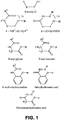
- FIG. 1 provides structural formulas for examples of primary film-forming metal-complexing agents including N-acyl glycine and sarcosine compounds, salicylhydroxamic acid, malonomonohydroxamic acid, N-acyl-o-hydroxy aniline compounds, and the like.
- FIG. 1 also illustrates the 1,6 relationship between the acidic OH and the additional oxygen-bearing substituent in the passivating agents.
- the secondary film-forming metal-passivating agents are compounds having the general formula (II): Z-X 2 (Y 2 R 5 )(Y 3 R 6 ), as well as salts of formula (II), and partially neutralized forms of formula (II).
- Z is NH 2 or OH;
- Y 2 and Y 3 are each independently N, NH, or O; and
- R 5 and R 6 can each independently comprise R 7 -(OCH 2 CH 2 ) n -, wherein R 7 can be H, C 1 -C 20 -alkyl, phenyl, or C 1 -C 20 -alkyl-substituted phenyl, and wherein "n” has an average value in the range of 2 to 1000, or when Y 2 and Y 3 each independently are N or NH, then R 5 and R 6 each independently can be N, NH, or CH, and together form a five-membered ring heterocycle with X 2
- R 7 is C 1 -C 20 -alkyl, phenyl, or C 1 -C 20 -alkyl-substituted phenyl. In some preferred embodiments, R 7 is C 1 -C 20 -alkyl-substituted phenyl, particularly nonylphenyl.
- Non-limiting examples of compounds of formula (II) include heterocycles (e.g., 5-aminotetrazole, 5-amino-1,2,-4-triazole, and the like), and phosphate esters such as bis-pegylated phosphate esters, particularly phosphate esters that include poly(oxyethylene) chains attached to two oxygens of the phosphate group, wherein the poly(oxyethylene) chains are terminated by an aryl ether group (e.g., phenyl), an alkyl ether group (e.g., a C 1 -C 20 -alkyl, such as lauryl or stearyl), or an alkylaryl ether group (e.g., C 1 -C 20 -alkylphenyl, such as nonylphenyl).
- heterocycles e.g., 5-aminotetrazole, 5-amino-1,2,-4-triazole, and the like
- phosphate esters such as bis-pegylated phosphate
- poly(oxyethylene) and “polyethylene glycol” refer to a polymer or oligomer comprising an average of 2 to 1000 oxyethylene (-OCH 2 CH 2 -) monomer units, preferably 2 to 100 (e.g., 5, 10, 20, 30, 40, 50, 60, 70, 80, or 90) oxyethylene units per poly(oxyethylene) chain.
- a preferred phosphate ester-type passivating agent is a bis-(nonylphenylpoly(oxyethylene)) phosphate ester (NPPOP), which is commercially available under the trade name SURFONIC® PE 1198, from Huntsman.
- Preferred salt forms of the metal-passivating agents are alkali metal salts (e.g., sodium and potassium salts) in the case of acidic materials and mineral acid addition salts in the case of basic materials. All references to metal-passivating agents herein refer to the acid or base form of the agent, as the case may be, as well as salt forms, and partially neutralized forms thereof. The form of the metal-passivating agent actually present in a given composition will depend upon the pKa of any acid functional groups and the pH of the composition.
- the secondary film-forming metal-passivating agent is present in the composition in an amount in the range of 0.005 to 0.5 wt %, preferably 0.01 to 0.1 wt %. While not wishing to be bound by theory, it is believed that the secondary film-forming agent forms an additional passivating film over the primary film formed by the metal-complexing agent.
- compositions of the present invention can include one or more auxiliary metal-chelating agents.
- auxiliary metal-chelating agents for use in the present invention include oxalic acid, amino-substituted carboxylic acids (e.g., amino polycarboxylates, such as iminodiacetic acid (IDA), ethylenediaminedisuccinic acid (EDDS), iminodisuccinic acid (IDS), ethylenediaminetetraacetic acid (EDTA), nitrilotriacetic acid (NTA), as well as alpha-amino acids, such as glycine, beta-amino acids, and the like); hydroxyl-substituted carboxylic acids (e.g., glycolic acid and lactic acid, as well as hydroxyl polycarboxylic acids, such as malic acid, citric acid, tartaric acid, and the like); phosphonocarboxylic acids; aminophosphonic acids; salts of any of the foregoing; combinations
- the auxiliary metal-chelating agent is selected from the group consisting of oxalic acid, an amino-substituted carboxylic acid, a hydroxyl-substituted carboxylic acid, a salt thereof, and a combination of two or more of the foregoing, all of which share the common characteristic of at least one carboxylic acid group and a second polar functional group (e.g., a hydroxyl group, an amino group, or an additional carboxylic acid group), which together can cooperatively interact with, and bind to copper and/or silver ions, as the case may be.
- a second polar functional group e.g., a hydroxyl group, an amino group, or an additional carboxylic acid group
- auxiliary metal-chelating agents herein refer to the acid or base form of the agent, as the case may be, as well as salt forms, and partially neutralized forms thereof.
- the form of the auxiliary metal-chelating agent actually present in a given composition will depend upon the pKa of any acidic or basic functional groups and the pH of the composition.
- the metal-chelating agent preferably is present in the composition at a concentration in the range of 0.01 to 20 wt %.
- the CMP compositions of the invention preferably have a pH in the range of 5 to 10 (i.e. 5 to 7).
- the CMP compositions can optionally comprise one or more pH buffering materials, for example, ammonium acetate, disodium citrate, and the like. Many such pH-buffering materials are well known in the art.
- the aqueous carrier for the compositions of the present invention preferably is water (e.g., deionized water), and optionally can contain one or more water-miscible organic solvent, such as an alcohol.
- the CMP compositions of the invention also optionally can comprise one or more additives, such as a surfactant, a rheological control agent (e.g., a viscosity enhancing agent or coagulant), a biocide, a corrosion inhibitor, an oxidizing agent, and the like, many of which are well known in the CMP art.
- a surfactant e.g., a surfactant, a rheological control agent (e.g., a viscosity enhancing agent or coagulant), a biocide, a corrosion inhibitor, an oxidizing agent, and the like, many of which are well known in the CMP art.
- a rheological control agent e.g., a viscosity enhancing agent or coagulant
- biocide e.g., a corrosion inhibitor, an oxidizing agent, and the like
- the CMP compositions of the invention can be prepared by any suitable technique, many of which are known to those skilled in the art.
- the CMP composition can be prepared in a batch or continuous process.
- the CMP composition can be prepared by combining the components thereof in any order.
- component includes individual ingredients (e.g., abrasives, complexing agents, passivating agents, acids, bases, aqueous carriers, and the like) as well as any combination of ingredients.
- an abrasive can be dispersed in water, and the metal-passivating agent and metal-complexing agent can be added, and mixed by any method that is capable of incorporating the components into the CMP composition.
- an oxidizing agent can be added just prior to initiation of polishing.
- the pH can be adjusted at any suitable time.
- the CMP compositions of the present invention also can be provided as a concentrate, which is intended to be diluted with an appropriate amount of water or other aqueous carrier prior to use.
- the CMP composition concentrate can include the various components dispersed or dissolved in the aqueous carrier in amounts such that, upon dilution of the concentrate with an appropriate amount of aqueous carrier, each component of the polishing composition will be present in the CMP composition in an amount within the appropriate range for use.
- the CMP compositions of the present is suitable for polishing substrates comprising copper and/or silver.
- the present invention provides a method of polishing a substrate comprising copper and/or silver by abrading a surface of the substrate with a CMP composition, as defined in the claims.
- the CMP composition is utilized to polish the substrate in the presence of an oxidizing agent, e.g., 0.1 to 5 percent by weight of an oxidizing agent.
- an oxidizing agent e.g., 0.1 to 5 percent by weight of an oxidizing agent.
- useful oxidizing agents include hydrogen peroxide, inorganic and organic peroxo-compounds, bromates, nitrates, chlorates, chromates, iodates, potassium ferricyanide, potassium dichromate, iodic acid and the like.
- Non-limiting examples of compounds containing at least one peroxy group include hydrogen peroxide, urea hydrogen peroxide, percarbonates, benzoyl peroxide, peracetic acid, di-t-butyl peroxide, monopersulfates (SO 5 2- ), and dipersulfates (S 2 O 8 2- ).
- Non-limiting examples of other oxidizing agents, which contain an element in its highest oxidation state include periodic acid, periodate salts, perbromic acid, perbromate salts, perchloric acid, perchlorate salts, perboric acid, perborate salts, and permanganates.
- the substrate can be immersed in a benzotriazole (BTA) solution after abrading the surface of the substrate with the CMP composition.
- BTA solution comprises 0.01 wt% to 0.5 wt % BTA (e.g., 0.1 wt %).
- the CMP method of the present invention is particularly suited for use in conjunction with a chemical-mechanical polishing apparatus.
- the CMP apparatus comprises a platen, which, when in use, is in motion and has a velocity that results from orbital, linear, and/or circular motion.
- a polishing pad is mounted on the platen and moves with the platen.
- a polishing head holds a substrate to be polished in contact with the pad and moves relative to the surface of the polishing pad, while urging the substrate against the pad at a selected pressure (down force) to aid in abrading the surface of the substrate.
- a CMP slurry is pumped onto the polishing pad to aid in the polishing process.
- the polishing of the substrate is accomplished by the combined abrasive action of the moving polishing pad and the CMP composition of the invention present on the polishing pad, which abrade at least a portion of the surface of the substrate.
- the polishing is also aided by the chemical activity of the CMP composition (i.e., oxidation, complexation, passivation, and the like).
- the method of the present invention can utilize any suitable polishing pad (e.g., polishing surface).
- suitable polishing pads include woven and nonwoven polishing pads, which can include fixed abrasives, if desired.
- polishing pads can comprise any polymer that has a suitable density, hardness, thickness, compressibility, ability to rebound upon compression, compression modulus, chemical compatibility, and the like.
- Suitable polymers include, for example, polyvinylchloride, polyvinylfluoride, nylon, fluorocarbon, polycarbonate, polyester, polyacrylate, polyether, polyethylene, polyamide, polyurethane, polystyrene, polypropylene, coformed products thereof, and mixtures thereof.
- the CMP apparatus further comprises an in situ polishing endpoint detection system, many of which are known in the art.
- Techniques for inspecting and monitoring the polishing process by analyzing light or other radiation reflected from a surface of the workpiece are known in the art. Such methods are described, for example, in U.S. Patent 5,196,353 to Sandhu et al. , U.S. Patent 5,433,651 to Lustig et al. , U.S. Patent 5,949,927 to Tang , and U.S. Patent 5,964,643 to Birang et al.
- the inspection or monitoring of the progress of the polishing process with respect to a workpiece being polished enables the determination of the polishing end-point, i.e., the determination of when to terminate the polishing process with respect to a particular workpiece.
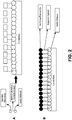
- FIG. 2 provides two schematic representations of possible mechanisms by which the compositions of the present invention form metal-passivating films and reduce polishing drag force.
- Panel A represents a possible mechanism by which compositions including a heterocyclic secondary film-forming metal-passivating agent operate.
- a primary passivating film is formed directly on a metal (e.g., copper and/or silver) surface by a metal-complexing anchor molecule (e.g., SHA).
- a secondary film is then formed over the primary film by the heterocyclic metal-passivating agent (e.g., ATA).
- the combined films inhibit migration of oxidizing agents to the copper surface and provide lubricity, which reduces drag during polishing.
- Panel B of FIG. 2 illustrates a possible mechanism for compositions that include a poly(oxyethylene)-type secondary film former (e.g., NPPOP).
- NPPOP poly(oxyethylene)-type secondary film former
- the primary film-forming anchor molecule forms a film directly on the metal surface
- the ionic portion of the secondary film-forming metal-passivating agent e.g., NPPOP
- the hydrophobic head groups of the metal-passivating agent interact with each other.
- the PEG chains are flexible and responsive to pressure, and thus help to reduce drag during polishing, while the combined composite film provides a physical barrier to inhibit oxidation of the metal surface.
- Examples 1 to 3 are reference examples not according to the invention.
- EXAMPLE 1 Evaluation of CMP Compositions Comprising Salicylhydroxamic acid (SHA) and a Metal-Chelating Agent.
- SHA Salicylhydroxamic acid
- CMP compositions having a pH in the range of 5 to 7, containing 50 to 500 ppm of salicylhydroxamic acid (SHA; a primary film-forming metal-complexing agent), 1 percent by weight iminodiacetic acid (IDA; an auxiliary metal-chelating agent), and 0.1 to 1 percent by weight colloidal silica (mean particle size of 80 nm), were utilized to polish 4-inch diameter copper blanket wafers in the presence of 0.8 % by weight hydrogen peroxide.
- SHA salicylhydroxamic acid
- IDA iminodiacetic acid
- colloidal silica mean particle size of 80 nm
- the wafers were polished on a Logitech Model II CDP polisher (Logitech Ltd., Glasgow, UK) under the following operating conditions: a D100 polishing pad, platen speed of 85 revolutions-per-minute (rpm), carrier speed of 93 rpm, down force of either 1 pound-per-square inch (psi) or 3 psi, and a slurry flow rate of 120 milliliters-per-minute (mL/min).
- the observed copper removal rates (Cu RR in ⁇ /min) obtained with each composition at 1 and 3 psi down force are also presented in Table 1.
- the data in Table 1 indicate that at relatively high levels of SHA and neutral pH (i.e., 500 ppm, pH 7) passivation greatly reduces the observed copper removal rate compared to removal rates obtained at lower levels of SHA, regardless of the abrasive level or down force.
- the 500 ppm level of SHA still provided copper removal rates in the range of 1000 to 4000 ⁇ /min.
- compositions comprising 1 % by weight silica and 50 ppm SHA afforded somewhat higher removal rates than the compositions that included 0.1 % by weight silica and 50 ppm SHA regardless of pH (i.e., compare Ex. 1C to 1E and compare Ex. 1D with 1H).
- compositions including 50 ppm SHA exhibited slightly higher copper removal rates at pH 7 compared to pH 5, regardless of the abrasive level (compare Ex. 1D with 1E, and compare Ex. 1H with 1C). This is in contrast to the compositions having higher levels of SHA (500 ppm), which exhibited higher removal rates at pH 5 rather than pH 7, as noted above. In each example, the removal rate increased with increasing down force. Passivation by SHA was also confirmed electrochemically (i.e., by a Tafel plot). Table 1.
- the copper static etch rate was determined for a composition comprising 0.5 % by weight of the colloidal silica, 1 % by weight glycine, and 250 ppm (0.025 %) SHA in water at pH 6 containing 0.8 % by weight hydrogen peroxide.
- the SER was measured by immersing a 1-inch square copper wafer in 200 grams of the CMP composition for 10 to 30 minutes. The thickness of the copper layer was measured before and after immersion.
- a control composition having no SHA had a SER of 1342 ⁇ /min.
- CMP compositions were utilized to polish 4-inch diameter copper blanket wafers.
- the compositions included 0.1 percent by weight of colloidal silica abrasive (mean particle size of 80 nm), 100 ppm or 1000 ppm of N-lauroyl sarcosine (NLS), in combination with 1 percent by weight of IDA.
- the wafers were polished on a Logitech Model II CDP polisher (Logitech Ltd., Glasgow, UK) in the presence of 0.8 percent by weight hydrogen peroxide at a pH of 7, under the following operating conditions: a D100 polishing pad, platen speed of 85 rpm, carrier speed of 93 rpm, down force of 1 or 3 psi, and a slurry flow rate of 120 mL/min.
- the SER for each composition was also determined.
- the composition containing 100 ppm of the NLS exhibited a static etch rate (SER) for copper of 34 ⁇ /min, while the composition containing 1000 ppm of NLS had a SER of 5 ⁇ /min.
- the composition containing 100 ppm of NLS also exhibited relatively high copper removal rates (3220 and 4400 ⁇ /min at 1 psi and 3 psi down force, respectively), compared to the composition containing 1000 ppm of NLS, which provided very low copper removal rates at both levels of down force ( ⁇ 50 ⁇ /min).
- a composition (Ex. 3A) comprising 0.5 % by weight of the colloidal silica, 1 % by weight glycine, and 250 ppm (0.025 %) SHA in water at pH 6 was utilized to polish 4-inch diameter copper blanket wafers on a Logitech polisher in the presence of 0.8 % by weight hydrogen peroxide under the following conditions: a D100 polishing pad, platen speed of 85 rpm, carrier speed of 93 rpm, down force of 0 or 3 psi, and a slurry flow rate of 120 mL/min.
- wafers were also polished utilizing a model CMP slurry (Ex.
- composition of the (Ex. 3A) provided a surprisingly more linear (Prestonian) response to variation in down force compared to the model composition (Ex. 3B), which did not include SHA.
- a non-linear response to down force variation can lead to product variability during the polishing process, which is undesirable.
- EXAMPLE 4 Evaluation of Compositions Comprising SHA and ATA.
- compositions comprising varying amounts of about SHA and 5-aminotetrazole (ATA) in deionized water were evaluated for static etch rate (SER) as in Example 1.
- One composition (Ex. 4A), which comprises 0.12 wt % SHA, 0.08 wt % 5-aminotetrazole, 10 wt % glycine, and 5 wt % silica abrasive was used to polish copper blanket wafers on a Logitech Model II CDP polisher (Logitech Ltd., Glasgow, UK) under the following operating conditions: a D100 polishing pad, platen speed of 80 rpm, carrier speed of 75 rpm, down force of 2 psi, and a slurry flow rate of 150 mL/min.
- SER was determined by measuring the amount of copper lost by dipping 1-inch square copper wafers into the slurry, immersed in an agitated water bath maintained at 50 °C, as is known in the art.
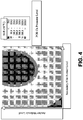
- FIG. 4 shows a two-dimensional contour plot of SER as a function of the concentration of SHA (anchor molecule) and ATA (secondary film former).
- SHA anchor molecule
- ATA secondary film former
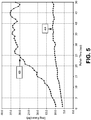
- FIG. 5 shows a plot of polishing drag force as a function of polishing time for Ex. 4A (labeled 4A) compared to a similar control composition (labeled 4B) without ATA.
- Drag force was determined using a pressure transducer, which calculates the drag force based on the lateral deflection of the rotating shaft attached to the polishing head on which the wafer is mounted wafer, as is known in the art.
- the plots in FIG. 5 clearly show that the addition of ATA significantly reduced the drag force compared to the control composition.
- Ex. 4A was also evaluated for over polishing, by measuring dishing on patterned wafers including copper lines on a dielectric substrate. Dishing was assessed by determining the step height of the copper line relative to the surrounding dielectric, as is known in the art.
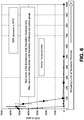
- FIG. 6 provides a plot of 100 ⁇ m line dishing as a function over-polishing time for a CMP composition containing SHA and ATA (labeled 4A) compared to a similar composition without ATA (labeled 4B).
- the term "over-polishing" (OP) and grammatical variations thereof refers to the additional polishing time needed to remove potential copper contaminants after an end-point algorithm has determined that copper removal should be complete.
- the end-point algorithm determines the end-point to be 60 seconds of polishing
- a 50 %OP would translate to 30 seconds additional polishing time.
- the rate of change of dishing from the end-point time to the over-polish time is a measure of the OP "processing window" in which acceptable results can be obtained without significantly compromising dishing performance.
- composition of the present invention containing SHA and ATA unexpectedly had an OP slope of only 3 ⁇ /%OP at 50 %OP, compared to 11 ⁇ /%OP at only 30 %OP for the control example without ATA (labeled 4B). Accordingly, the processing window (i.e., the potential time period of over polishing without significantly degrading the dishing performance) was significantly improved for the composition of the invention relative to the control.
- EXAMPLE 5 Evaluation of Compositions Comprising SHA and NPPOP.
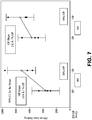
- compositions comprising varying amounts of about SHA (anchor) and bis-(nonylphenylpoly(oxyethylene)) phosphate (NPPOP, secondary molecule) in deionized water were evaluated for static etch rate as in Example 1.
- a plot of SER as a function of NPPOP concentration compared to similar control compositions including only the anchor molecule or the secondary molecule is shown in FIG. 7 .
- the data in FIG. 7 clearly show that addition of the NPPOP greatly reduces the SER compared to the control compositions.
- FIG. 8 shows a plot of 100 ⁇ m line dishing versus over-polishing time for the composition of the invention including the NPPOP (labeled 5A) compared to a similar control composition without the phosphate diester (labeled 5B).
- the data in FIG. 8 show that there was a surprisingly low level of dishing and unexpectedly little change in dishing for the composition of the invention at 30 %OP, compared to the control composition that did not include NPPOP.
- EXAMPLE 6 Evaluation of Compositions Comprising SHA and NPPOP on Ag.
- a composition comprising 0.025 wt % SHA, 1.5 wt % glycine, and 1 wt % hydrogen peroxide was used to evaluate the corrosion properties of silver metal in the presence of SHA under static conditions and with abrasion.
- the post-CMP treatment with BTA lowers the the anodic and cathodic rates and increases the potential, which indicates that the BTA film formed on the silver surface reduces the anodic rate more than the rate of oxidizer (in this case oxygen) reduction, i.e. the film acts as an anodic protector.
- Table 2 With Abrasion Without Abrasion V diss (mV, MSE) I diss (A/min) V corr (mV, MSE) I corr (A/min A -10 151 3 151 B 5 118 9 85 C 9 92 23 79 D -15 85 6 82 E -285 1 -143 1 F -473 1 -374 0.4 G -295 1 H -241 0.2
- Table 2 provides electrochemical silver activity data in a solution containing 0.5 N sodium nitrate, 1 percent hydrogen peroxide and a silver complexing agent, i.e., dissolution potential (V diss) and dissolution current (I diss) with abrasion, as well as corrosion potential (V corr) and corrosion current (I corr) without abrasion, for the compositions described above in this example.
- a silver complexing agent i.e., dissolution potential (V diss) and dissolution current (I diss) with abrasion, as well as corrosion potential (V corr) and corrosion current (I corr) without abrasion, for the compositions described above in this example.
Landscapes
- Chemical & Material Sciences (AREA)
- Organic Chemistry (AREA)
- Engineering & Computer Science (AREA)
- Materials Engineering (AREA)
- Chemical Kinetics & Catalysis (AREA)
- General Chemical & Material Sciences (AREA)
- Mechanical Engineering (AREA)
- Metallurgy (AREA)
- Inorganic Chemistry (AREA)
- Life Sciences & Earth Sciences (AREA)
- General Life Sciences & Earth Sciences (AREA)
- Mechanical Treatment Of Semiconductor (AREA)
Applications Claiming Priority (2)
| Application Number | Priority Date | Filing Date | Title |
|---|---|---|---|
| US13/004,113 US8435421B2 (en) | 2007-11-27 | 2011-01-11 | Metal-passivating CMP compositions and methods |
| PCT/US2012/020737 WO2012096931A2 (en) | 2011-01-11 | 2012-01-10 | Metal-passivating cmp compositions and methods |
Publications (3)
| Publication Number | Publication Date |
|---|---|
| EP2663604A2 EP2663604A2 (en) | 2013-11-20 |
| EP2663604A4 EP2663604A4 (en) | 2016-04-27 |
| EP2663604B1 true EP2663604B1 (en) | 2020-07-01 |
Family
ID=46507631
Family Applications (1)
| Application Number | Title | Priority Date | Filing Date |
|---|---|---|---|
| EP12734493.5A Active EP2663604B1 (en) | 2011-01-11 | 2012-01-10 | Metal-passivating cmp compositions and methods |
Country Status (9)
| Country | Link |
|---|---|
| EP (1) | EP2663604B1 (enExample) |
| JP (1) | JP5992925B2 (enExample) |
| KR (2) | KR102017133B1 (enExample) |
| CN (1) | CN103298903B (enExample) |
| IL (1) | IL227384A (enExample) |
| MY (1) | MY163010A (enExample) |
| SG (1) | SG191909A1 (enExample) |
| TW (1) | TWI462981B (enExample) |
| WO (1) | WO2012096931A2 (enExample) |
Families Citing this family (3)
| Publication number | Priority date | Publication date | Assignee | Title |
|---|---|---|---|---|
| EP3323142B1 (en) * | 2015-07-13 | 2024-08-28 | CMC Materials LLC | Methods and compositions for processing dielectric substrate |
| KR102670778B1 (ko) * | 2015-09-03 | 2024-05-29 | 씨엠씨 머티리얼즈 엘엘씨 | 유전체 기판 처리를 위한 방법 및 조성물 |
| JP6901297B2 (ja) | 2017-03-22 | 2021-07-14 | 株式会社フジミインコーポレーテッド | 研磨用組成物 |
Family Cites Families (19)
| Publication number | Priority date | Publication date | Assignee | Title |
|---|---|---|---|---|
| US6623355B2 (en) * | 2000-11-07 | 2003-09-23 | Micell Technologies, Inc. | Methods, apparatus and slurries for chemical mechanical planarization |
| US6866792B2 (en) * | 2001-12-12 | 2005-03-15 | Ekc Technology, Inc. | Compositions for chemical mechanical planarization of copper |
| GB2393447B (en) * | 2002-08-07 | 2006-04-19 | Kao Corp | Polishing composition |
| US7071105B2 (en) * | 2003-02-03 | 2006-07-04 | Cabot Microelectronics Corporation | Method of polishing a silicon-containing dielectric |
| US7485162B2 (en) * | 2003-09-30 | 2009-02-03 | Fujimi Incorporated | Polishing composition |
| JP4667013B2 (ja) * | 2003-11-14 | 2011-04-06 | 昭和電工株式会社 | 研磨組成物および研磨方法 |
| US20060063687A1 (en) * | 2004-09-17 | 2006-03-23 | Minsek David W | Composition and process for ashless removal of post-etch photoresist and/or bottom anti-reflective material on a substrate |
| TW200714696A (en) * | 2005-08-05 | 2007-04-16 | Advanced Tech Materials | High throughput chemical mechanical polishing composition for metal film planarization |
| US20070037491A1 (en) * | 2005-08-12 | 2007-02-15 | Yuzhuo Li | Chemically modified chemical mechanical polishing pad, process of making a modified chemical mechanical polishing pad and method of chemical mechanical polishing |
| JP2008192930A (ja) * | 2007-02-06 | 2008-08-21 | Fujifilm Corp | 金属研磨用組成物及びそれを用いた化学的機械的研磨方法 |
| US7931714B2 (en) * | 2007-10-08 | 2011-04-26 | Uwiz Technology Co., Ltd. | Composition useful to chemical mechanical planarization of metal |
| JP5277640B2 (ja) * | 2007-10-17 | 2013-08-28 | 日立化成株式会社 | Cmp用研磨液及び研磨方法 |
| US7955520B2 (en) * | 2007-11-27 | 2011-06-07 | Cabot Microelectronics Corporation | Copper-passivating CMP compositions and methods |
| US8337716B2 (en) * | 2008-01-23 | 2012-12-25 | Uwiz Technology Co., Ltd. | Sarcosine compound used as corrosion inhibitor |
| US8247327B2 (en) * | 2008-07-30 | 2012-08-21 | Cabot Microelectronics Corporation | Methods and compositions for polishing silicon-containing substrates |
| CN101747841A (zh) * | 2008-12-05 | 2010-06-23 | 安集微电子(上海)有限公司 | 一种化学机械抛光液 |
| TWI454561B (zh) * | 2008-12-30 | 2014-10-01 | Uwiz Technology Co Ltd | A polishing composition for planarizing the metal layer |
| CN101928520B (zh) * | 2009-06-19 | 2014-03-12 | 盟智科技股份有限公司 | 用于平坦化金属层的研磨组成物 |
| JP2012069785A (ja) * | 2010-09-24 | 2012-04-05 | Fujimi Inc | 研磨用組成物および研磨方法 |
-
2012
- 2012-01-10 SG SG2013052816A patent/SG191909A1/en unknown
- 2012-01-10 CN CN201280005131.8A patent/CN103298903B/zh active Active
- 2012-01-10 EP EP12734493.5A patent/EP2663604B1/en active Active
- 2012-01-10 KR KR1020187031790A patent/KR102017133B1/ko active Active
- 2012-01-10 MY MYPI2013002601A patent/MY163010A/en unknown
- 2012-01-10 JP JP2013549488A patent/JP5992925B2/ja active Active
- 2012-01-10 KR KR1020137021062A patent/KR102077618B1/ko active Active
- 2012-01-10 WO PCT/US2012/020737 patent/WO2012096931A2/en not_active Ceased
- 2012-01-11 TW TW101101131A patent/TWI462981B/zh active
-
2013
- 2013-07-08 IL IL227384A patent/IL227384A/en active IP Right Grant
Non-Patent Citations (1)
| Title |
|---|
| None * |
Also Published As
| Publication number | Publication date |
|---|---|
| CN103298903A (zh) | 2013-09-11 |
| JP2014507799A (ja) | 2014-03-27 |
| SG191909A1 (en) | 2013-08-30 |
| KR20180123167A (ko) | 2018-11-14 |
| TW201235428A (en) | 2012-09-01 |
| WO2012096931A2 (en) | 2012-07-19 |
| EP2663604A4 (en) | 2016-04-27 |
| TWI462981B (zh) | 2014-12-01 |
| WO2012096931A3 (en) | 2012-11-01 |
| IL227384A (en) | 2017-05-29 |
| KR102017133B1 (ko) | 2019-09-02 |
| MY163010A (en) | 2017-07-31 |
| KR20140047015A (ko) | 2014-04-21 |
| IL227384A0 (en) | 2013-09-30 |
| KR102077618B1 (ko) | 2020-02-14 |
| EP2663604A2 (en) | 2013-11-20 |
| CN103298903B (zh) | 2015-11-25 |
| JP5992925B2 (ja) | 2016-09-14 |
Similar Documents
| Publication | Publication Date | Title |
|---|---|---|
| US8435421B2 (en) | Metal-passivating CMP compositions and methods | |
| US7955520B2 (en) | Copper-passivating CMP compositions and methods | |
| KR101305840B1 (ko) | 이온성 고분자전해질을 함유하는 구리 cmp 조성물 및 방법 | |
| EP1137056B1 (en) | Abrasive liquid for metal and method for polishing | |
| US7435162B2 (en) | Polishing fluids and methods for CMP | |
| KR101195289B1 (ko) | Cmp용 코팅된 금속 산화물 입자 | |
| EP0896042B1 (en) | A polishing composition including an inhibitor of tungsten etching | |
| KR101325455B1 (ko) | 상 변화 물질의 화학적 기계적 연마를 위한 조성물 및 방법 | |
| US20050194563A1 (en) | Bicine/tricine containing composition and method for chemical-mechanical planarization | |
| US20130178065A1 (en) | Method and Composition for Chemical Mechanical Planarization of a Metal | |
| US20090061630A1 (en) | Method for Chemical Mechanical Planarization of A Metal-containing Substrate | |
| CN103298903B (zh) | 金属钝化的化学机械抛光组合物及方法 | |
| KR20070030904A (ko) | Cmp용 연마 슬러리 |
Legal Events
| Date | Code | Title | Description |
|---|---|---|---|
| PUAI | Public reference made under article 153(3) epc to a published international application that has entered the european phase |
Free format text: ORIGINAL CODE: 0009012 |
|
| 17P | Request for examination filed |
Effective date: 20130731 |
|
| AK | Designated contracting states |
Kind code of ref document: A2 Designated state(s): AL AT BE BG CH CY CZ DE DK EE ES FI FR GB GR HR HU IE IS IT LI LT LU LV MC MK MT NL NO PL PT RO RS SE SI SK SM TR |
|
| DAX | Request for extension of the european patent (deleted) | ||
| A4 | Supplementary search report drawn up and despatched |
Effective date: 20160329 |
|
| RIC1 | Information provided on ipc code assigned before grant |
Ipc: C09K 3/14 20060101AFI20160321BHEP Ipc: H01L 21/321 20060101ALI20160321BHEP |
|
| STAA | Information on the status of an ep patent application or granted ep patent |
Free format text: STATUS: EXAMINATION IS IN PROGRESS |
|
| 17Q | First examination report despatched |
Effective date: 20180718 |
|
| GRAP | Despatch of communication of intention to grant a patent |
Free format text: ORIGINAL CODE: EPIDOSNIGR1 |
|
| STAA | Information on the status of an ep patent application or granted ep patent |
Free format text: STATUS: GRANT OF PATENT IS INTENDED |
|
| INTG | Intention to grant announced |
Effective date: 20200124 |
|
| GRAS | Grant fee paid |
Free format text: ORIGINAL CODE: EPIDOSNIGR3 |
|
| GRAA | (expected) grant |
Free format text: ORIGINAL CODE: 0009210 |
|
| STAA | Information on the status of an ep patent application or granted ep patent |
Free format text: STATUS: THE PATENT HAS BEEN GRANTED |
|
| AK | Designated contracting states |
Kind code of ref document: B1 Designated state(s): AL AT BE BG CH CY CZ DE DK EE ES FI FR GB GR HR HU IE IS IT LI LT LU LV MC MK MT NL NO PL PT RO RS SE SI SK SM TR |
|
| REG | Reference to a national code |
Ref country code: GB Ref legal event code: FG4D |
|
| REG | Reference to a national code |
Ref country code: AT Ref legal event code: REF Ref document number: 1286171 Country of ref document: AT Kind code of ref document: T Effective date: 20200715 Ref country code: CH Ref legal event code: EP |
|
| REG | Reference to a national code |
Ref country code: IE Ref legal event code: FG4D |
|
| REG | Reference to a national code |
Ref country code: DE Ref legal event code: R096 Ref document number: 602012071017 Country of ref document: DE |
|
| REG | Reference to a national code |
Ref country code: LT Ref legal event code: MG4D |
|
| PG25 | Lapsed in a contracting state [announced via postgrant information from national office to epo] |
Ref country code: BG Free format text: LAPSE BECAUSE OF FAILURE TO SUBMIT A TRANSLATION OF THE DESCRIPTION OR TO PAY THE FEE WITHIN THE PRESCRIBED TIME-LIMIT Effective date: 20201001 |
|
| REG | Reference to a national code |
Ref country code: NL Ref legal event code: MP Effective date: 20200701 |
|
| REG | Reference to a national code |
Ref country code: AT Ref legal event code: MK05 Ref document number: 1286171 Country of ref document: AT Kind code of ref document: T Effective date: 20200701 |
|
| PG25 | Lapsed in a contracting state [announced via postgrant information from national office to epo] |
Ref country code: HR Free format text: LAPSE BECAUSE OF FAILURE TO SUBMIT A TRANSLATION OF THE DESCRIPTION OR TO PAY THE FEE WITHIN THE PRESCRIBED TIME-LIMIT Effective date: 20200701 Ref country code: ES Free format text: LAPSE BECAUSE OF FAILURE TO SUBMIT A TRANSLATION OF THE DESCRIPTION OR TO PAY THE FEE WITHIN THE PRESCRIBED TIME-LIMIT Effective date: 20200701 Ref country code: CZ Free format text: LAPSE BECAUSE OF FAILURE TO SUBMIT A TRANSLATION OF THE DESCRIPTION OR TO PAY THE FEE WITHIN THE PRESCRIBED TIME-LIMIT Effective date: 20200701 Ref country code: PT Free format text: LAPSE BECAUSE OF FAILURE TO SUBMIT A TRANSLATION OF THE DESCRIPTION OR TO PAY THE FEE WITHIN THE PRESCRIBED TIME-LIMIT Effective date: 20201102 Ref country code: FI Free format text: LAPSE BECAUSE OF FAILURE TO SUBMIT A TRANSLATION OF THE DESCRIPTION OR TO PAY THE FEE WITHIN THE PRESCRIBED TIME-LIMIT Effective date: 20200701 Ref country code: LT Free format text: LAPSE BECAUSE OF FAILURE TO SUBMIT A TRANSLATION OF THE DESCRIPTION OR TO PAY THE FEE WITHIN THE PRESCRIBED TIME-LIMIT Effective date: 20200701 Ref country code: NO Free format text: LAPSE BECAUSE OF FAILURE TO SUBMIT A TRANSLATION OF THE DESCRIPTION OR TO PAY THE FEE WITHIN THE PRESCRIBED TIME-LIMIT Effective date: 20201001 Ref country code: GR Free format text: LAPSE BECAUSE OF FAILURE TO SUBMIT A TRANSLATION OF THE DESCRIPTION OR TO PAY THE FEE WITHIN THE PRESCRIBED TIME-LIMIT Effective date: 20201002 Ref country code: AT Free format text: LAPSE BECAUSE OF FAILURE TO SUBMIT A TRANSLATION OF THE DESCRIPTION OR TO PAY THE FEE WITHIN THE PRESCRIBED TIME-LIMIT Effective date: 20200701 Ref country code: SE Free format text: LAPSE BECAUSE OF FAILURE TO SUBMIT A TRANSLATION OF THE DESCRIPTION OR TO PAY THE FEE WITHIN THE PRESCRIBED TIME-LIMIT Effective date: 20200701 |
|
| PG25 | Lapsed in a contracting state [announced via postgrant information from national office to epo] |
Ref country code: IS Free format text: LAPSE BECAUSE OF FAILURE TO SUBMIT A TRANSLATION OF THE DESCRIPTION OR TO PAY THE FEE WITHIN THE PRESCRIBED TIME-LIMIT Effective date: 20201101 Ref country code: RS Free format text: LAPSE BECAUSE OF FAILURE TO SUBMIT A TRANSLATION OF THE DESCRIPTION OR TO PAY THE FEE WITHIN THE PRESCRIBED TIME-LIMIT Effective date: 20200701 Ref country code: PL Free format text: LAPSE BECAUSE OF FAILURE TO SUBMIT A TRANSLATION OF THE DESCRIPTION OR TO PAY THE FEE WITHIN THE PRESCRIBED TIME-LIMIT Effective date: 20200701 Ref country code: LV Free format text: LAPSE BECAUSE OF FAILURE TO SUBMIT A TRANSLATION OF THE DESCRIPTION OR TO PAY THE FEE WITHIN THE PRESCRIBED TIME-LIMIT Effective date: 20200701 |
|
| PG25 | Lapsed in a contracting state [announced via postgrant information from national office to epo] |
Ref country code: NL Free format text: LAPSE BECAUSE OF FAILURE TO SUBMIT A TRANSLATION OF THE DESCRIPTION OR TO PAY THE FEE WITHIN THE PRESCRIBED TIME-LIMIT Effective date: 20200701 |
|
| REG | Reference to a national code |
Ref country code: DE Ref legal event code: R097 Ref document number: 602012071017 Country of ref document: DE |
|
| PG25 | Lapsed in a contracting state [announced via postgrant information from national office to epo] |
Ref country code: SM Free format text: LAPSE BECAUSE OF FAILURE TO SUBMIT A TRANSLATION OF THE DESCRIPTION OR TO PAY THE FEE WITHIN THE PRESCRIBED TIME-LIMIT Effective date: 20200701 Ref country code: RO Free format text: LAPSE BECAUSE OF FAILURE TO SUBMIT A TRANSLATION OF THE DESCRIPTION OR TO PAY THE FEE WITHIN THE PRESCRIBED TIME-LIMIT Effective date: 20200701 Ref country code: IT Free format text: LAPSE BECAUSE OF FAILURE TO SUBMIT A TRANSLATION OF THE DESCRIPTION OR TO PAY THE FEE WITHIN THE PRESCRIBED TIME-LIMIT Effective date: 20200701 Ref country code: DK Free format text: LAPSE BECAUSE OF FAILURE TO SUBMIT A TRANSLATION OF THE DESCRIPTION OR TO PAY THE FEE WITHIN THE PRESCRIBED TIME-LIMIT Effective date: 20200701 Ref country code: EE Free format text: LAPSE BECAUSE OF FAILURE TO SUBMIT A TRANSLATION OF THE DESCRIPTION OR TO PAY THE FEE WITHIN THE PRESCRIBED TIME-LIMIT Effective date: 20200701 |
|
| PLBE | No opposition filed within time limit |
Free format text: ORIGINAL CODE: 0009261 |
|
| STAA | Information on the status of an ep patent application or granted ep patent |
Free format text: STATUS: NO OPPOSITION FILED WITHIN TIME LIMIT |
|
| PG25 | Lapsed in a contracting state [announced via postgrant information from national office to epo] |
Ref country code: AL Free format text: LAPSE BECAUSE OF FAILURE TO SUBMIT A TRANSLATION OF THE DESCRIPTION OR TO PAY THE FEE WITHIN THE PRESCRIBED TIME-LIMIT Effective date: 20200701 |
|
| 26N | No opposition filed |
Effective date: 20210406 |
|
| PG25 | Lapsed in a contracting state [announced via postgrant information from national office to epo] |
Ref country code: SK Free format text: LAPSE BECAUSE OF FAILURE TO SUBMIT A TRANSLATION OF THE DESCRIPTION OR TO PAY THE FEE WITHIN THE PRESCRIBED TIME-LIMIT Effective date: 20200701 |
|
| REG | Reference to a national code |
Ref country code: DE Ref legal event code: R081 Ref document number: 602012071017 Country of ref document: DE Owner name: CMC MATERIALS, INC., AURORA, US Free format text: FORMER OWNER: CABOT MICROELECTRONICS CORPORATION, AURORA, ILL., US Ref country code: DE Ref legal event code: R081 Ref document number: 602012071017 Country of ref document: DE Owner name: CMC MATERIALS LLC (N.D.GES.D.STAATES DELAWARE), US Free format text: FORMER OWNER: CABOT MICROELECTRONICS CORPORATION, AURORA, ILL., US |
|
| PG25 | Lapsed in a contracting state [announced via postgrant information from national office to epo] |
Ref country code: SI Free format text: LAPSE BECAUSE OF FAILURE TO SUBMIT A TRANSLATION OF THE DESCRIPTION OR TO PAY THE FEE WITHIN THE PRESCRIBED TIME-LIMIT Effective date: 20200701 Ref country code: MC Free format text: LAPSE BECAUSE OF FAILURE TO SUBMIT A TRANSLATION OF THE DESCRIPTION OR TO PAY THE FEE WITHIN THE PRESCRIBED TIME-LIMIT Effective date: 20200701 |
|
| REG | Reference to a national code |
Ref country code: CH Ref legal event code: PL |
|
| PG25 | Lapsed in a contracting state [announced via postgrant information from national office to epo] |
Ref country code: LU Free format text: LAPSE BECAUSE OF NON-PAYMENT OF DUE FEES Effective date: 20210110 |
|
| REG | Reference to a national code |
Ref country code: BE Ref legal event code: MM Effective date: 20210131 |
|
| PG25 | Lapsed in a contracting state [announced via postgrant information from national office to epo] |
Ref country code: CH Free format text: LAPSE BECAUSE OF NON-PAYMENT OF DUE FEES Effective date: 20210131 Ref country code: LI Free format text: LAPSE BECAUSE OF NON-PAYMENT OF DUE FEES Effective date: 20210131 |
|
| PG25 | Lapsed in a contracting state [announced via postgrant information from national office to epo] |
Ref country code: IE Free format text: LAPSE BECAUSE OF NON-PAYMENT OF DUE FEES Effective date: 20210110 |
|
| PG25 | Lapsed in a contracting state [announced via postgrant information from national office to epo] |
Ref country code: BE Free format text: LAPSE BECAUSE OF NON-PAYMENT OF DUE FEES Effective date: 20210131 |
|
| PG25 | Lapsed in a contracting state [announced via postgrant information from national office to epo] |
Ref country code: HU Free format text: LAPSE BECAUSE OF FAILURE TO SUBMIT A TRANSLATION OF THE DESCRIPTION OR TO PAY THE FEE WITHIN THE PRESCRIBED TIME-LIMIT; INVALID AB INITIO Effective date: 20120110 Ref country code: CY Free format text: LAPSE BECAUSE OF FAILURE TO SUBMIT A TRANSLATION OF THE DESCRIPTION OR TO PAY THE FEE WITHIN THE PRESCRIBED TIME-LIMIT Effective date: 20200701 |
|
| P01 | Opt-out of the competence of the unified patent court (upc) registered |
Effective date: 20230530 |
|
| PG25 | Lapsed in a contracting state [announced via postgrant information from national office to epo] |
Ref country code: MK Free format text: LAPSE BECAUSE OF FAILURE TO SUBMIT A TRANSLATION OF THE DESCRIPTION OR TO PAY THE FEE WITHIN THE PRESCRIBED TIME-LIMIT Effective date: 20200701 |
|
| PG25 | Lapsed in a contracting state [announced via postgrant information from national office to epo] |
Ref country code: TR Free format text: LAPSE BECAUSE OF FAILURE TO SUBMIT A TRANSLATION OF THE DESCRIPTION OR TO PAY THE FEE WITHIN THE PRESCRIBED TIME-LIMIT Effective date: 20200701 |
|
| PG25 | Lapsed in a contracting state [announced via postgrant information from national office to epo] |
Ref country code: MT Free format text: LAPSE BECAUSE OF FAILURE TO SUBMIT A TRANSLATION OF THE DESCRIPTION OR TO PAY THE FEE WITHIN THE PRESCRIBED TIME-LIMIT Effective date: 20200701 |
|
| PGFP | Annual fee paid to national office [announced via postgrant information from national office to epo] |
Ref country code: GB Payment date: 20241219 Year of fee payment: 14 |
|
| REG | Reference to a national code |
Ref country code: DE Ref legal event code: R081 Ref document number: 602012071017 Country of ref document: DE Owner name: CMC MATERIALS LLC (N.D.GES.D.STAATES DELAWARE), US Free format text: FORMER OWNER: CMC MATERIALS, INC., AURORA, IL, US |
|
| PGFP | Annual fee paid to national office [announced via postgrant information from national office to epo] |
Ref country code: FR Payment date: 20251218 Year of fee payment: 15 |
|
| PGFP | Annual fee paid to national office [announced via postgrant information from national office to epo] |
Ref country code: DE Payment date: 20251217 Year of fee payment: 15 |