EP2659999B1 - Fräswerkzeug - Google Patents
Fräswerkzeug Download PDFInfo
- Publication number
- EP2659999B1 EP2659999B1 EP13164732.3A EP13164732A EP2659999B1 EP 2659999 B1 EP2659999 B1 EP 2659999B1 EP 13164732 A EP13164732 A EP 13164732A EP 2659999 B1 EP2659999 B1 EP 2659999B1
- Authority
- EP
- European Patent Office
- Prior art keywords
- insert
- flank
- root
- edge
- cutting edge
- Prior art date
- Legal status (The legal status is an assumption and is not a legal conclusion. Google has not performed a legal analysis and makes no representation as to the accuracy of the status listed.)
- Not-in-force
Links
Images



Classifications
-
- B—PERFORMING OPERATIONS; TRANSPORTING
- B23—MACHINE TOOLS; METAL-WORKING NOT OTHERWISE PROVIDED FOR
- B23C—MILLING
- B23C5/00—Milling-cutters
- B23C5/02—Milling-cutters characterised by the shape of the cutter
- B23C5/08—Disc-type cutters
-
- B—PERFORMING OPERATIONS; TRANSPORTING
- B23—MACHINE TOOLS; METAL-WORKING NOT OTHERWISE PROVIDED FOR
- B23C—MILLING
- B23C5/00—Milling-cutters
- B23C5/16—Milling-cutters characterised by physical features other than shape
- B23C5/20—Milling-cutters characterised by physical features other than shape with removable cutter bits or teeth or cutting inserts
- B23C5/202—Plate-like cutting inserts with special form
-
- B—PERFORMING OPERATIONS; TRANSPORTING
- B23—MACHINE TOOLS; METAL-WORKING NOT OTHERWISE PROVIDED FOR
- B23C—MILLING
- B23C5/00—Milling-cutters
- B23C5/16—Milling-cutters characterised by physical features other than shape
- B23C5/20—Milling-cutters characterised by physical features other than shape with removable cutter bits or teeth or cutting inserts
- B23C5/202—Plate-like cutting inserts with special form
- B23C5/205—Plate-like cutting inserts with special form characterised by chip-breakers of special form
-
- B—PERFORMING OPERATIONS; TRANSPORTING
- B23—MACHINE TOOLS; METAL-WORKING NOT OTHERWISE PROVIDED FOR
- B23C—MILLING
- B23C5/00—Milling-cutters
- B23C5/16—Milling-cutters characterised by physical features other than shape
- B23C5/20—Milling-cutters characterised by physical features other than shape with removable cutter bits or teeth or cutting inserts
- B23C5/22—Securing arrangements for bits or teeth or cutting inserts
- B23C5/2265—Securing arrangements for bits or teeth or cutting inserts by means of a wedge
- B23C5/2269—Securing arrangements for bits or teeth or cutting inserts by means of a wedge for plate-like cutting inserts
- B23C5/2273—Securing arrangements for bits or teeth or cutting inserts by means of a wedge for plate-like cutting inserts having a special shape
-
- B—PERFORMING OPERATIONS; TRANSPORTING
- B23—MACHINE TOOLS; METAL-WORKING NOT OTHERWISE PROVIDED FOR
- B23F—MAKING GEARS OR TOOTHED RACKS
- B23F21/00—Tools specially adapted for use in machines for manufacturing gear teeth
- B23F21/12—Milling tools
- B23F21/126—Milling tools with inserted cutting elements
- B23F21/128—Milling tools with inserted cutting elements in exchangeable arrangement
-
- B—PERFORMING OPERATIONS; TRANSPORTING
- B23—MACHINE TOOLS; METAL-WORKING NOT OTHERWISE PROVIDED FOR
- B23F—MAKING GEARS OR TOOTHED RACKS
- B23F21/00—Tools specially adapted for use in machines for manufacturing gear teeth
- B23F21/12—Milling tools
- B23F21/14—Profile cutters of disc type
- B23F21/143—Profile cutters of disc type with inserted cutting elements
- B23F21/146—Profile cutters of disc type with inserted cutting elements in exchangeable arrangement
-
- B—PERFORMING OPERATIONS; TRANSPORTING
- B23—MACHINE TOOLS; METAL-WORKING NOT OTHERWISE PROVIDED FOR
- B23G—THREAD CUTTING; WORKING OF SCREWS, BOLT HEADS, OR NUTS, IN CONJUNCTION THEREWITH
- B23G5/00—Thread-cutting tools; Die-heads
- B23G5/18—Milling cutters
-
- B—PERFORMING OPERATIONS; TRANSPORTING
- B23—MACHINE TOOLS; METAL-WORKING NOT OTHERWISE PROVIDED FOR
- B23C—MILLING
- B23C2200/00—Details of milling cutting inserts
- B23C2200/04—Overall shape
- B23C2200/0416—Irregular
-
- B—PERFORMING OPERATIONS; TRANSPORTING
- B23—MACHINE TOOLS; METAL-WORKING NOT OTHERWISE PROVIDED FOR
- B23C—MILLING
- B23C2200/00—Details of milling cutting inserts
- B23C2200/04—Overall shape
- B23C2200/0494—Rectangular
-
- B—PERFORMING OPERATIONS; TRANSPORTING
- B23—MACHINE TOOLS; METAL-WORKING NOT OTHERWISE PROVIDED FOR
- B23C—MILLING
- B23C2200/00—Details of milling cutting inserts
- B23C2200/16—Supporting or bottom surfaces
- B23C2200/165—Supporting or bottom surfaces with one or more grooves
-
- B—PERFORMING OPERATIONS; TRANSPORTING
- B23—MACHINE TOOLS; METAL-WORKING NOT OTHERWISE PROVIDED FOR
- B23C—MILLING
- B23C2200/00—Details of milling cutting inserts
- B23C2200/36—Other features of the milling insert not covered by B23C2200/04 - B23C2200/32
- B23C2200/367—Mounted tangentially, i.e. where the rake face is not the face with largest area
-
- B—PERFORMING OPERATIONS; TRANSPORTING
- B23—MACHINE TOOLS; METAL-WORKING NOT OTHERWISE PROVIDED FOR
- B23C—MILLING
- B23C2210/00—Details of milling cutters
- B23C2210/16—Fixation of inserts or cutting bits in the tool
- B23C2210/168—Seats for cutting inserts, supports for replacable cutting bits
-
- Y—GENERAL TAGGING OF NEW TECHNOLOGICAL DEVELOPMENTS; GENERAL TAGGING OF CROSS-SECTIONAL TECHNOLOGIES SPANNING OVER SEVERAL SECTIONS OF THE IPC; TECHNICAL SUBJECTS COVERED BY FORMER USPC CROSS-REFERENCE ART COLLECTIONS [XRACs] AND DIGESTS
- Y10—TECHNICAL SUBJECTS COVERED BY FORMER USPC
- Y10T—TECHNICAL SUBJECTS COVERED BY FORMER US CLASSIFICATION
- Y10T407/00—Cutters, for shaping
- Y10T407/19—Rotary cutting tool
-
- Y—GENERAL TAGGING OF NEW TECHNOLOGICAL DEVELOPMENTS; GENERAL TAGGING OF CROSS-SECTIONAL TECHNOLOGIES SPANNING OVER SEVERAL SECTIONS OF THE IPC; TECHNICAL SUBJECTS COVERED BY FORMER USPC CROSS-REFERENCE ART COLLECTIONS [XRACs] AND DIGESTS
- Y10—TECHNICAL SUBJECTS COVERED BY FORMER USPC
- Y10T—TECHNICAL SUBJECTS COVERED BY FORMER US CLASSIFICATION
- Y10T407/00—Cutters, for shaping
- Y10T407/19—Rotary cutting tool
- Y10T407/1906—Rotary cutting tool including holder [i.e., head] having seat for inserted tool
- Y10T407/1908—Face or end mill
- Y10T407/1912—Tool adjustable relative to holder
- Y10T407/1914—Radially
-
- Y—GENERAL TAGGING OF NEW TECHNOLOGICAL DEVELOPMENTS; GENERAL TAGGING OF CROSS-SECTIONAL TECHNOLOGIES SPANNING OVER SEVERAL SECTIONS OF THE IPC; TECHNICAL SUBJECTS COVERED BY FORMER USPC CROSS-REFERENCE ART COLLECTIONS [XRACs] AND DIGESTS
- Y10—TECHNICAL SUBJECTS COVERED BY FORMER USPC
- Y10T—TECHNICAL SUBJECTS COVERED BY FORMER US CLASSIFICATION
- Y10T407/00—Cutters, for shaping
- Y10T407/19—Rotary cutting tool
- Y10T407/1906—Rotary cutting tool including holder [i.e., head] having seat for inserted tool
- Y10T407/1908—Face or end mill
- Y10T407/192—Face or end mill with separate means to fasten tool to holder
-
- Y—GENERAL TAGGING OF NEW TECHNOLOGICAL DEVELOPMENTS; GENERAL TAGGING OF CROSS-SECTIONAL TECHNOLOGIES SPANNING OVER SEVERAL SECTIONS OF THE IPC; TECHNICAL SUBJECTS COVERED BY FORMER USPC CROSS-REFERENCE ART COLLECTIONS [XRACs] AND DIGESTS
- Y10—TECHNICAL SUBJECTS COVERED BY FORMER USPC
- Y10T—TECHNICAL SUBJECTS COVERED BY FORMER US CLASSIFICATION
- Y10T407/00—Cutters, for shaping
- Y10T407/19—Rotary cutting tool
- Y10T407/1906—Rotary cutting tool including holder [i.e., head] having seat for inserted tool
- Y10T407/1928—Tool adjustable relative to holder
-
- Y—GENERAL TAGGING OF NEW TECHNOLOGICAL DEVELOPMENTS; GENERAL TAGGING OF CROSS-SECTIONAL TECHNOLOGIES SPANNING OVER SEVERAL SECTIONS OF THE IPC; TECHNICAL SUBJECTS COVERED BY FORMER USPC CROSS-REFERENCE ART COLLECTIONS [XRACs] AND DIGESTS
- Y10—TECHNICAL SUBJECTS COVERED BY FORMER USPC
- Y10T—TECHNICAL SUBJECTS COVERED BY FORMER US CLASSIFICATION
- Y10T407/00—Cutters, for shaping
- Y10T407/19—Rotary cutting tool
- Y10T407/1906—Rotary cutting tool including holder [i.e., head] having seat for inserted tool
- Y10T407/1934—Rotary cutting tool including holder [i.e., head] having seat for inserted tool with separate means to fasten tool to holder
- Y10T407/1936—Apertured tool
-
- Y—GENERAL TAGGING OF NEW TECHNOLOGICAL DEVELOPMENTS; GENERAL TAGGING OF CROSS-SECTIONAL TECHNOLOGIES SPANNING OVER SEVERAL SECTIONS OF THE IPC; TECHNICAL SUBJECTS COVERED BY FORMER USPC CROSS-REFERENCE ART COLLECTIONS [XRACs] AND DIGESTS
- Y10—TECHNICAL SUBJECTS COVERED BY FORMER USPC
- Y10T—TECHNICAL SUBJECTS COVERED BY FORMER US CLASSIFICATION
- Y10T407/00—Cutters, for shaping
- Y10T407/19—Rotary cutting tool
- Y10T407/1906—Rotary cutting tool including holder [i.e., head] having seat for inserted tool
- Y10T407/1942—Peripherally spaced tools
-
- Y—GENERAL TAGGING OF NEW TECHNOLOGICAL DEVELOPMENTS; GENERAL TAGGING OF CROSS-SECTIONAL TECHNOLOGIES SPANNING OVER SEVERAL SECTIONS OF THE IPC; TECHNICAL SUBJECTS COVERED BY FORMER USPC CROSS-REFERENCE ART COLLECTIONS [XRACs] AND DIGESTS
- Y10—TECHNICAL SUBJECTS COVERED BY FORMER USPC
- Y10T—TECHNICAL SUBJECTS COVERED BY FORMER US CLASSIFICATION
- Y10T407/00—Cutters, for shaping
- Y10T407/23—Cutters, for shaping including tool having plural alternatively usable cutting edges
- Y10T407/235—Cutters, for shaping including tool having plural alternatively usable cutting edges with integral chip breaker, guide or deflector
Definitions
- the present invention concerns a milling tool for slot milling.
- the milling tool may be formed as a so-called slot cutter or slitting cutter for the milling of straight or oblique slots, particularly for the manufacture of splines, but the milling tool can also be utilized for the manufacture of gearwheels. More precisely, the invention concerns a milling tool according to the preamble of claim 1 an example of which is disclosed in JPS62166920A.
- the brochure Gear Production Tools from Kennametal, p. 21, 2009 shows a milling tool of the type indicated by way of introduction.
- This known milling tool is formed for the milling of sprocket wheels.
- the milling tool comprises a tool body defining a rotation axis, a plurality of first seats, which are separated in a circumferential direction, form root insert seats, and are arranged one after the other in the tool body along a first line that extends around the rotation axis, and a plurality of flank insert seats separated in the circumferential direction, the flank insert seats comprising a plurality of second seats, which are arranged one after the other along a second line that extends around the rotation axis on a primary side of the root insert seats, and a plurality of third seats, which are arranged one after the other along a third line that extends around the rotation axis on a secondary side of the root insert seats.
- Each flank insert seat comprises a bottom surface, an inner side surface, and an outer side surface.
- each root insert of this known milling tool comprises an under side, an opposite upper side forming a rake face, a circumferential edge side connecting the upper side and the under side, and at least one primary main cutting edge and a secondary main cutting edge, which converge toward each other and are formed where the edge side meets the upper side.
- Each flank insert comprises an under side, an opposite upper side, and a circumferential edge side connecting the upper side and the under side, and each flank insert defining a centre axis that extends through the upper side and under side of the flank insert.
- the upper side of the flank insert forms the rake face and the edge side forms a clearance surface.
- Radially mounted flank inserts of the type shown in Gear Production Tools have the disadvantage that they require a large space in the tool body. This applies particularly to large milling tools. Thereby, the tool body weakens and large stresses arise. Another problem is the difficulty to create space for a proper treatment of the chips formed. It is furthermore difficult to manufacture the seat for this radial flank insert, particularly for the achievement of a correct axial position of the cutting edge.
- the brochure Gear Production Tools also shows examples of tangentially mounted root inserts, see, for instance, p. 14.
- Such root inserts have the disadvantage that lateral forces act from different directions for consecutive root inserts. Thereby, the lateral forces will alternately change the direction and thereby generate an imbalance of the milling tool. This, in turn, generates a poor surface of the workpiece and a high sound level.
- a further disadvantage of such tangentially mounted root inserts is that the cutting edges of the different milling inserts have to overlap each other and thereby there is a risk of groove formation in the workpiece.
- the object of the invention is to obviate the above-mentioned problems.
- the invention aims at a milling tool for slot cutting, which has a high strength of the tool body and guarantees a good surface of the machined workpiece.
- the root inserts which machine the root or bottom area of a slot, for instance between two adjacent teeth, of the workpiece, are radially mounted.
- the expressions "radially” and “tangentially” mounted are recognized definitions within the technical field of this invention and indicate to a person skilled in the art how the milling inserts are situated in the tool body.
- the rake face extends from a rear edge of the milling insert radially, or approximately radially, outward toward the cutting edge.
- the rake face extends from a rear edge of the milling insert tangentially, or approximately tangentially, outward toward the cutting edge.
- the extension of the flank inserts in the axial direction in respect of the rotation axis of the tool will be relatively short, and its extension in the radial, and preferably also in the tangential, direction will be relatively long.
- the space that is required for the flank insert in the tool body in the axial direction will, therefore, be relatively short in comparison with a radially mounted flank insert, see above mentioned Gear Production Tools, which contributes to a high strength of the tool body.
- the active cutting edge of the flank inserts that is in engagement with the workpiece can be made relatively long, which contributes to a high surface smoothness of the machined surface of the workpiece.
- the primary main cutting edges and the secondary main cutting edges will machine a respective side of the slot in the workpiece.
- the primary main cutting edge and secondary main cutting edge of the root insert will also simultaneously be in engagement with the workpiece. In such a manner, it is guaranteed that the cutting forces are uniformly distributed between the primary and secondary main cutting edges and no uneven or varying load arises.
- the machining can be made without, or with small, vibrations, and at a low sound level.
- the edge side comprises a plurality of edge side sections that form a respective rake face and a respective flank insert edge together with the upper side and possibly a respective rake face and a respective flank insert edge together with the under side.
- the edge side may comprise two or four edge side sections, each one of which forms one or two flank insert edges.
- Such a flank insert is indexable into two or four positions by the flank insert being rotated on the centre axis. By indexing around an axis that is perpendicular to the centre, there are eight positions and accordingly eight flank insert edges available.
- the distance between the upper side and the under side of each flank insert is essentially shorter than the shortest length of the upper side of the flank insert along a direction that intersects the centre axis, i.e., along any direction that is parallel to the upper side.
- the distance between the upper side and the under side may be constant, or essentially constant, along the entire edge side.
- the length along a second direction that extends perpendicular to the first direction may, however, be longer than the distance between the upper side and the under side.
- each flank insert has a fastening hole that extends through the upper side and the under side.
- each flank insert may then be attached in its respective flank insert seat by means of a fixing screw that extends through the fastening hole into the tool body and that presses the flank insert against the flank insert seat by a press force.
- a fixing screw allows fastening of the flank insert in a reliable way by a relatively large press force. Thanks to the under side of the flank insert being pressed against the bottom surface of the flank insert seat, the axial position of the flank insert, and thereby of the active flank insert edge, can be guaranteed with high accuracy.
- each flank insert seat may have a bottom surface, an outer side surface, and an inner side surface.
- the fixing screw may then press the under side of the flank insert against the bottom surface by a principal force component of said press force and one of the edge side sections against the outer side surface by a first smaller force component of said press force.
- the fixing screw also presses another edge side section of the flank insert against the inner side surface by a second smaller force component of said press force.
- the second smaller force component may be smaller than the first smaller force component.
- the first smaller force component and the second smaller force component may be equally, or essentially equally large. Independently of this, it is, however, advantageous that the flank insert is pressed against three surfaces, which contributes to a very high accuracy of the position of the flank insert.
- the primary main cutting edge of the root insert and the flank insert edge of the flank insert in said second seat extend in a projection along a respective common line, which comprise sections intersecting or overlapping each other.
- the secondary main cutting edge of the root insert and the flank insert edge of the flank insert in said third seat extend in a projection along a respective common line, which comprise sections intersecting or overlapping each other.
- the root inserts and the different flank inserts are arranged in an alternating order in respect of the circumferential direction. For instance, a root insert may be followed by two flank inserts, one on each side of the root insert, and then said sequence is repeated around the entire milling tool. It is also possible to allow every second milling insert be a root insert and every second milling insert a flank insert. Also other alternating orders are possible.
- the rake face of the root insert extends in an extension plane comprising the primary main cutting edge and the secondary main cutting edge, and the extension plane of each root insert having a normal that is parallel to a tangent of the first line where the same intersects the extension plane.
- each root insert comprises a symmetry line that is perpendicular to a tangent of the first line, and the primary main cutting edge and the secondary main cutting edge being symmetrical in respect of the symmetry line.
- the symmetry line forms an angle ⁇ with each one of the primary main cutting edge and the secondary main cutting edge.
- the angle ⁇ may be in the interval of 18-32°, for instance, the angle ⁇ may be 20° or 30°.
- each root insert comprises a transverse end cutting edge that extends between the primary main cutting edge and the secondary main cutting edge.
- the end cutting edge may be straight or comprise a straight section having transitions edges with a small radius of curvature to the primary main cutting edge and the secondary main cutting edge, respectively.
- the rake face of the root insert extends in an extension plane comprising the primary main cutting edge and the secondary main cutting edge, a normal to the extension plane forming an acute clearance angle with the edge side at least in the vicinity of said cutting edges of the root insert so that the root insert itself possesses a positive geometry.
- Fig. 1 shows schematically a machine tool M having a milling tool 1 that is formed for the cutting machining and more precisely for the slot milling of a workpiece W.
- the milling tool 1 is suitable for the cutting machining of a number of different workpieces W wherein one or more slots is desired, for instance splines, gearwheels, racks, etc.
- the milling tool 1 comprises a tool body 2, which may be manufactured from steel, and a large number of replaceable milling inserts 21, 22, which may be manufactured from a material that is harder than steel, for instance, cemented carbide.
- the tool body 2 defines a rotation axis C 1 and has a primary side 6 and an opposite secondary side 7. The rotation axis C 1 extends through the primary side 6 and the secondary side 7.
- the milling tool 1 also comprises a through axial hole 8 having a straight groove 9 for the receipt of a rod or drive shaft 10, for instance in accordance with DIN 138.
- the rod 10 is formed for the attachment of the milling tool 1 in a tool spindle of the machine tool M, which may be a milling cutter or a multi operation machine.
- the tool body 2 is rotatable on the rotation axis C 1 in a direction of rotation R 1 .
- the workpiece W is fixed in a suitable way, stationary or movably.
- the workpiece W may be displaceable in relation to the milling tool 1 along a feeding direction F 1 for the down-milling and in a feeding direction F 2 for the up-milling.
- the feeding motion may instead be provided by the displacement of the milling tool 1 with the workpiece W at rest.
- the tool body 1 comprises a plurality of first seats 11 separated in a circumferential direction, a plurality of second seats 12 separated in the circumferential direction, and a plurality of third seats 13 separated in the circumferential direction.
- the first seats 11 form root insert seats, and are arranged one after the other in the tool body 1 along a first line L 1 , see Figs. 4 and 8 , that extends around the rotation axis C 1 .
- the second seats 12, see Fig. 4 form flank insert seats, which are arranged one after the other along a second line L 2 that extends around the rotation axis C 1 on the primary side 6.
- the third seats 13, see Fig. 6 form flank insert seats, which are arranged one after the other along a third line L 3 that extends around the rotation axis C 1 on the secondary side 7.
- Each first seat 11 comprises a bottom surface 14 and an inner support surface 15, see Fig. 6 .
- the second seats 12 and the third seats 13 are identical but symmetrically arranged on each side of the first seats 11, i.e., of the root insert seats.
- Each flank insert seat, i.e., each second seat 12 and third seat 13 comprises a bottom surface 16, an inner side surface 17, and an outer side surface 18, see Fig. 6 .
- Each first seat 11 comprises a replaceable root insert 21 and each flank insert seat, i.e., each second seat 12 and each third seat 13, comprises a replaceable flank insert 22.
- the flank inserts 22 for the second seats 12 and for the third seats 13 may advantageously, but do not necessarily have to, be identical.
- each first seat 11 comprises an elevation, preferably having the shape of a radial elongate ridge 19, which extends from the bottom surface 14 and outward, particularly in a radial or essentially radial direction, see Fig. 6 .
- the elongate ridge 19 has two leaning flank surfaces that extend between the bottom surface 14 and an upper surface of the elongate ridge 19.
- the two flank surfaces form an obtuse angle with each other. This angle may be 90-140°, for instance 120°.
- the upper surface may be plane and parallel to the bottom surface 14.
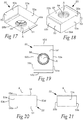
- Each root insert 21, see Figs. 10-16 comprises an under side 31, an opposite upper side 32 forming a rake face, and a circumferential edge side 33 connecting the upper side 32 and the under side 31.
- the under side 31 of each root insert 21 comprises a recess having the shape of an elongate valley 34.
- the elongate valley 34 has two leaning flank surfaces that extend between the under side 31 of the root insert 21 and a bottom surface that may be plane and parallel to the under side 31.
- each root insert 21 forms or comprises a primary main cutting edge 36, a secondary main cutting edge 37, and a transverse end cutting edge 38 that extends between the primary main cutting edge 36 and the secondary main cutting edge 37.
- the cutting edges 36, 37, and 38 are formed where the edge side 33 meets the upper side 32.
- the primary main cutting edge 36 and the secondary main cutting edge 37 converge toward each other.
- the rake face of the root insert 21 extends in an extension plane P 1 , which, in the embodiments shown, comprises or is parallel to the primary main cutting edge 36 and the secondary main cutting edge 37.
- Each root insert 21 comprises furthermore a symmetry line S that is perpendicular to a tangent of the first line L 1 .
- the elongate valley 34 also extends parallel to the symmetry line S.
- the primary main cutting edge 36 and the secondary main cutting edge 37 are symmetrical in respect of the symmetry line S.
- the end cutting edge 38 may, but does not necessarily have to, be perpendicular to the symmetry line S.
- the edge side 33 also forms a rear side 39 that extends perpendicular to the symmetry line and parallel to the end cutting edge 38.
- a normal to the extension plane P 1 forms an acute clearance angle ⁇ with the edge side 33 at least in the vicinity of or along the primary main cutting edge 36 and the secondary main cutting edge 37 so that the root insert 21 obtains a positive cutting geometry.
- an acute clearance angle ⁇ is formed with the edge side 33 also along the end cutting edge 38 so that the root insert 21 obtains a positive cutting geometry also in respect of the end cutting edge 38.
- the end cutting edge 38 at least in certain applications is not in cutting machining with the workpiece W.
- the clearance angle ⁇ along the end cutting edge 38 may have another size than the clearance angle ⁇ along the primary main cutting edge 36 and the secondary main cutting edge 37.
- Each root insert 21 is arranged in a first seat 11 in such a way that the under side 31 abuts against the bottom surface 14.
- the elongate ridge 19 is in engagement with the elongate valley 34 of the under side 31 of the root insert 21 in such a way that the axial position of the root insert 21 in respect of the rotation axis C 1 is guaranteed.
- the flank surfaces of the elongate ridge 19 will abut against one each of the flank surfaces of the elongate valley 34.
- the rear side 39 of the root insert 21 abuts against the inner support surface 15 that guarantees the radial position of the root insert 21 in relation to the rotation axis C 1 .
- each root insert 21 is secured in the respective first seat 11 by means of a wedge-shaped block 40 that abuts against the upper side 32 of the root insert 21 and presses the root insert 21 against the bottom surface 14 and against the inner support surface 15.
- the wedge-shaped block 40 is tightened against the root insert 21 by means of a double-threaded screw 41, see Fig. 6 , that extends through and is in engagement with the wedge-shaped block 40 and a threaded hole (not shown) in the tool body 2.
- the root inserts 21 also may be secured in other ways, for instance by means of a fixing screw that extends through a hole in the root insert 21 and into the tool body 2.
- Each flank insert 22 comprises an under side 51, an opposite upper side 52, and a circumferential edge side 53 connecting the upper side 52 and the under side 51.
- the under side 51 and the upper side 52 define each an extension plane, which are parallel to each other.
- Each flank insert 22 defines a centre axis A that extends through the upper side 52 and under side 51 of the flank insert 22.
- the distance between the upper side 52 and the under side 51 of each flank insert 22 is, in the embodiments shown, essentially shorter than the shortest length of the upper side 52, or under side 51, of the flank insert 22 along any direction that intersects the centre axis A at a right angle. For instance, said distance may be maximally 85 % of said shortest length of the upper side 52 of the flank insert 22, and more particularly maximally 85 % of the smallest insert width.
- the edge side 53 of the flank insert 22 forms a rake face and comprises four edge side sections.
- the edge side 53 comprises two edge side sections 53a and 53b that form a respective rake face and a respective flank insert edge 55a, 55b together with the upper side 52.
- the above-mentioned insert width corresponds to the length of the flank insert edge 55a, 55b.
- the flank insert 22 is accordingly indexable by rotation 180° on the centre axis A.
- the flank insert 22 is in addition indexable by rotation 180° on an axis that is perpendicular to the centre axis A. By such an indexing, the two edge side sections 53a and 53b will form a respective flank insert edge 56a, 56b together with the under side 51.
- each flank insert 22 has accordingly four flank insert edges 55a, 55b, 56a, and 56b, which by indexing can form the active flank insert edge.
- the edge side 53 comprises two edge side sections 53c and 53d that do not form any cutting edges with the upper side 52 and the under side 51.
- said four edges may be formed as flank insert edges, the flank insert 22 obtaining a quadratic shape as seen in the direction of the centre axis A.
- Each flank insert 22 has a fastening hole 58 that extends through the upper side 52 and the under side 51.
- Each flank insert 22 is attached and secured in its respective second or third seat 12, 13 by means of a fixing screw 59, see Fig. 6 , that extends through the fastening hole 58 into a threaded hole 60 that extends through the bottom surface 16 into the tool body 2.
- a fixing screw 59 see Fig. 6
- the under side 51, or upper side 52, of the flank insert 22 is pressed against the bottom surface 16 of the seat 12, 13 by a press force.
- the fixing screw 59 extends in an attachment direction having an axial component that is considerably greater than other direction components of the attachment direction.
- the fixing screw 59 presses the under side 51, or upper side 52, of the flank insert 22 against the bottom surface 16 by a principal force component of said press force.
- one of the edge side sections 53a, 53b is pressed against the outer side surface 18 by a first smaller force component of said press force.
- the fixing screw 59 will also press one of the edge side sections 53c and 53d of the flank insert 22 against the inner surface 17 by a second smaller force component of said press force.
- the second smaller force component is smaller than the first smaller force component.
- the first line L 1, as well as the second and third lines L 2 and L 3 extend parallel to each other and to a plane perpendicular to the rotation axis C 1 .
- the extension plane P 1 of each root insert 21 has a normal that is parallel to a tangent of the first line L 1 where the same intersects the extension plane P 1 .
- the primary main cutting edge 36 of the root insert 21 and the flank insert edge 56b of the flank insert 22 in said second seat 12 extend in a projection along a respective common line, which comprise sections overlapping each other and extending in a common direction, see Fig. 5 .
- the secondary main cutting edge 37 of the root insert 21 and the flank insert edge 56a of the flank insert 22 in said third seat 13 extend in a projection along a respective common line, which comprise sections overlapping each other and extending in a common direction, see Fig. 5 .
- the primary main cutting edge 36 of the root insert 21 and the flank insert edge 56b of the flank insert 22 in said second seat 12 extend in a projection along a respective common line, which comprise sections intersecting each other and forming an obtuse angle.
- the secondary main cutting edge 37 of the root insert 21 and the flank insert edge 56a of the flank insert 22 in said third seat 13 extend in a projection along a respective common line, which comprise sections intersecting each other and forming an obtuse angle ⁇ .
- the flank insert edge 56a of the flank insert 22 is projected next to the secondary main cutting edge 37 of the root insert 21.
- the lines L 1, L 2 , and L 3 extend in an axial plane that is intersected by the rotation axis C 1 at a right angle.
- Such milling tools are particularly suitable for the milling of slots in splines and racks.
- Figs. 22-24 another embodiment is illustrated wherein the lines L 1, L 2 , and L 3 form an angle with the rotation axis C 1 . More precisely, these lines form a helix line having constant pitch.
- the pitch angle ⁇ may be 1-10°.
- Such a milling tool which in other respects has the same design as the milling tool in Figs. 1-9 , is particularly suitable for gear cutting and may be a hob or a part of a hob.
- a plurality of milling tools 1 of the type shown in Figs. 22-24 may be arranged beside each other and be fixed in relation to each other so that the lines L 1 , L 2 , and L 3 form a respective constant pitch line of the hob tool.
- the rake face of the root insert 21 extends in an extension plane P 1 comprising the primary main cutting edge 36 and the secondary main cutting edge 37.
- the extension plane P 1 of each root insert 21 has a normal that is parallel to a tangent of the first line L 1 where this line intersects the extension plane P 1 .
- Such a design may be advantageous also for the embodiments shown in Figs. 1-9 .
- root inserts 21 in the embodiments shown may be provided with chip-forming or chipbreaking means that extend above or underneath the extension plane P 1 and/or the main cutting edges 36, 37 and the end cutting edge 38.
- the root inserts 21 may comprise edge deflections of the primary and secondary main cutting edges 36, 37 in the vicinity of the end cutting edge 38 for the provision of so-called protuberance.
- these outer edge deflections form protuberance cutting edges that may extend in, or parallel to, the extension plane P 1 .
- the same protuberance cutting edges allow a deeper or wider cutout in the vicinity of the bottom surface of the slot in the workpiece W.
Landscapes
- Engineering & Computer Science (AREA)
- Mechanical Engineering (AREA)
- Milling Processes (AREA)
Claims (13)
- Fräswerkzeug (1) für das Schlitzfräsen, mit- einem Werkzeugkörper, der eine Rotationsachse (C1) definiert,- einer Mehrzahl von ersten Sitzen (11), die in Umfangsrichtung voneinander getrennt sind und die Grundeinsatzsitze bilden und einer hinter dem anderen entlang einer ersten Linie (L1) in dem Werkzeugkörper angeordnet sind, die sich um die Rotationsachse (C1) herum erstreckt,- einer Mehrzahl von Flankeneinsatzsitzen, die eine Mehrzahl von zweiten Sitzen (12) umfassen, welche einer hinter dem anderen entlang einer zweiten Linie (L2) angeordnet sind, die sich auf einer ersten Seite (6) der Grundeinsatzsitze um die Achse (C1) herum erstrecken, und mit einer Mehrzahl von dritten Sitzen (13), die einer hinter dem anderen entlang einer dritten Linie (L3) angeordnet sind, die sich auf einer zweiten Seite (7) der Grundeinsatzsitze um die Rotationsachse (C1) herum erstrecken, wobei jeder Flankeneinsatzsitz eine untere Fläche (16), eine innere Seitenfläche (17) und eine äußere Seitenfläche (18) aufweist, jeder Grundeinsatzsitz einen austauschbaren Grundeinsatz (21) aufweist, jeder Grundeinsatz (21) eine untere Fläche (31), eine entgegengesetzt liegende obere Fläche (32), die eine Spanfläche bildet, eine umlaufende Randfläche (33), welche die obere Fläche (32) und die untere Fläche (31) verbindet, und zumindest eine primäre Hauptschneidkante (36) sowie eine sekundäre Hauptschneidkante (37) aufweist, die aufeinander zu konvergieren und die dort ausgebildet sind, wo die Randfläche (33) mit der oberen Fläche (32) zusammentrifft, wobei eine quer verlaufende Stirnschneidkante (38) sich zwischen der ersten Hauptschneidkante (36) und der zweiten Hauptschneidkante (37) erstreckt,jeder Flankeneinsatz (22) eine Untere Fläche (51), eine entgegengesetzt liegende obere e f(52) und eine umlaufende Randfläche (53) aufweist, welche die obere Fläche (52) und die untere Fläche (51) miteinander verbindet, wobei jeder Flankeneinsatz (22) eine zentrale Achse (A) definiert, die sich durch die obere Fläche (52) und die untere Fläche (51) des Flankeneinsatzes (22) hindurcherstreckt und wobei die Randfläche (53) des Flankeneinsatzes (22) eine Spanfläche bildet, wobei die Spanfläche des Grundeinsatzes (21) sich in einer Erstreckungsebene (P1) erstreckt, welche die erste Hauptschneidkante (36), die zweite Hauptschneidkante (37) und die quer verlaufende Stirnschneidkante (38) aufweist, dadurch gekennzeichnet, dass die Erstreckungsebene (P1) eine Normale hat, die parallel zu einer Tangente der ersten Line (L1) verläuft, wo sie die Erstreckungsebene (P1) schneidet, und die Normale einen spitzen Freiwinkel (α) mit der Randfläche (33) zumindest in der Nähe der Schneidkanten (36, 37) des Grundeinsatzes (21) bildet, so dass der Grundeinsatz (21) als solcher eine positive Geometrie aufweist.
- Fräswerkzeug nach Anspruch 1, wobei die Randfläche (53) eine Mehrzahl von Randflächenabschnitten (53a, 53b) aufweist, die jeweils eine Spanfläche und eine entsprechende Flankeneinsatzkante (55a, 55b) zusammen mit der oberen Fläche (52) bildet.
- Fräswerkzeug nach einem der Ansprüche 1 oder 2, wobei der Abstand zwischen der oberen Fläche (52) und der unteren Fläche (51) jedes Flankeneinsatzes (22) deutlich kürzer als die kürzeste Länge der oberen Fläche (52) des Flankeneinsatzes (22) entlang einer Richtung ist, welche die zentrale Achse (A) schneidet.
- Fräswerkzeug nach einem der Ansprüche 1 bis 3, wobei jeder Flankeneinsatz (22) eine Befestigungsbohrung (58) hat, die sich durch die obere Fläche (52) und die untere Fläche (51) erstreckt.
- Fräswerkzeug nach Anspruch 4, wobei jeder Flankeneinsatz (22), der in seinem jeweiligen Flankeneinsatzsitz (12, 13) mit Hilfe einer Befestigungsschraube (59) befestigt ist, die sich durch die Befestigungsbohrung (58) in den Werkzeugkörper (2) hinein erstreckt und den Flankeneinsatz (22) durch eine Druckkraft an den Flankeneinsatzsitz (12, 13) presst.
- Fräswerkzeug nach Anspruch 5, wobei die Befestigungsschraube (59) die untere Fläche (51) des Flankeneinsatzes (22) durch eine Hauptkraftkomponente der Druckkraft gegen die untere Fläche (16) presst, sowie einen der Randflächenabschnitte (53a, 53b) durch eine erste kleinere Kraftkomponente der Druckkraft gegen die äußere Seitenfläche (18) presst.
- Fräswerkzeug nach Anspruch 6, wobei die Befestigungsschraube außerdem einen weiteren Randflächenabschnitt (53c, 53d) des Flankeneinsatzes (22) durch eine zweite kleinere Kraftkomponente der Druckkraft gegen die innere Seitenfläche (17) presst.
- Fräswerkzeug nach Anspruch 7, wobei die zweite kleinere Kraftkomponente kleiner als die erste kleinere Kraftkomponente ist.
- Fräswerkzeug nach einem der vorstehenden Ansprüche, wobei die erste Hauptschneidkante (36) des Grundeinsatzes (21) und die Flankeneinsatzkante (56b) des Flankeneinsatzes (22) in dem zweiten Sitz (12) sich in einer Projektion entlang einer entsprechenden gemeinsamen Linie erstrecken, die Abschnitte aufweist, welche einander schneiden oder miteinander überlappen, und wobei die zweite Hauptschneidkante (37) des Grundeinsatzes (21) und die Flankeneinsatzkante (56a) des Flankeneinsatzes (22) in dem dritten Sitz (13) sich in einer Projektion entlang einer entsprechenden gemeinsamen Linie erstrecken, die Abschnitte aufweist, welche einander schneiden oder miteinander überlappen.
- Fräswerkzeug nach einem der vorstehenden Ansprüche, wobei die Grundeinsätze (21) und die verschiedenen Flankeneinsätze (22) bezüglich der Umfangsrichtung in einer abwechselnden Reihenfolge angeordnet sind.
- Fräswerkzeug nach Anspruch 10, wobei die abwechselnde Reihenfolge derart ist, dass auf einen der Grundeinsätze (21) ein Flankeneinsatz (22) auf entweder der ersten Seite (6) oder der zweiten Seite (7) folgt und dass auf diesen wiederum ein Flankeneinsatz (22) auf der anderen der ersten (6) und zweiten Seiten (7) folgt.
- Fräswerkzeug nach Anspruch 10, wobei die abwechselnde Reihenfolge derart ist, dass auf einen der Grundeinsätze (21) ein Flankeneinsatz (22) auf entweder der ersten Seite (6) oder der zweiten Seite (7) folgt, woraufhin wiederum ein Flankeneinsatz (21) folgt, auf welchen dann wiederum ein Flankeneinsatz (22) auf der anderen der ersten (6) bzw. zweiten Seite (7) folgt.
- Fräswerkzeug nach einem der vorstehenden Ansprüche, wobei jeder Grundeinsatz (21) eine Symmetrielinie (S) aufweist, die senkrecht zu einer Tangente an die erste Linie (L1) verläuft, und wobei die erste Hauptschneidkante (36) und die zweite Hauptschneidkante (37) bezüglich der Symmetrielinie (S) symmetrisch sind.
Applications Claiming Priority (1)
| Application Number | Priority Date | Filing Date | Title |
|---|---|---|---|
| SE1250448A SE537439C2 (sv) | 2012-05-04 | 2012-05-04 | Fräsverktyg jämte uppsättning av skär för ett fräsverktyg avsett för spårfräsning |
Publications (3)
| Publication Number | Publication Date |
|---|---|
| EP2659999A2 EP2659999A2 (de) | 2013-11-06 |
| EP2659999A3 EP2659999A3 (de) | 2015-11-25 |
| EP2659999B1 true EP2659999B1 (de) | 2018-01-17 |
Family
ID=48143518
Family Applications (1)
| Application Number | Title | Priority Date | Filing Date |
|---|---|---|---|
| EP13164732.3A Not-in-force EP2659999B1 (de) | 2012-05-04 | 2013-04-22 | Fräswerkzeug |
Country Status (6)
| Country | Link |
|---|---|
| US (1) | US8961075B2 (de) |
| EP (1) | EP2659999B1 (de) |
| JP (1) | JP6184734B2 (de) |
| KR (1) | KR20130124212A (de) |
| CN (1) | CN103381500B (de) |
| SE (1) | SE537439C2 (de) |
Families Citing this family (24)
| Publication number | Priority date | Publication date | Assignee | Title |
|---|---|---|---|---|
| CN202356732U (zh) * | 2011-12-11 | 2012-08-01 | 富泰华精密电子(郑州)有限公司 | 切槽刀 |
| SE1350983A1 (sv) * | 2013-08-27 | 2015-02-28 | Sandvik Intellectual Property | Verktyg och skär för skalfräsning |
| EP2871015B1 (de) | 2013-11-11 | 2018-10-10 | Sandvik Intellectual Property AB | Zahnradfräser, Schneideinsatzhalter und spanabhebende Einheit |
| CN103722250B (zh) * | 2013-12-23 | 2017-01-11 | 南京工业大学 | 数控卧式龙门定梁摆线齿轮铣床 |
| CN103920941B (zh) * | 2014-03-31 | 2017-03-01 | 宁波川景誉机械科技发展有限公司 | 齿轮铣刀装置 |
| EP2965847B1 (de) * | 2014-07-09 | 2019-09-11 | Sandvik Intellectual Property AB | Schneideinsatz und Wälzschälwerkzeug |
| EP2992991A1 (de) * | 2014-09-05 | 2016-03-09 | Sandvik Intellectual Property AB | Schneideinsatz und Fräswerkzeug |
| EP3025814B1 (de) * | 2014-11-28 | 2017-08-02 | Sandvik Intellectual Property AB | Fräseinsatz und Fräswerkzeug |
| EP3256281A1 (de) | 2015-02-13 | 2017-12-20 | The Gleason Works | Schneidwerkzeug mit einer verriegelungsfeder |
| US20160339530A1 (en) * | 2015-05-22 | 2016-11-24 | Caterpillar Inc. | Double Tooth Gap Cutter and Associated Cutting Insert |
| US20170014923A1 (en) * | 2015-07-14 | 2017-01-19 | Caterpillar Inc. | Dual Ended, Full Form Tooth Generating Gear Cutter and Associated Cutting Insert |
| DE102016101145B4 (de) * | 2016-01-22 | 2019-06-27 | Hartmetall-Werkzeugfabrik Paul Horn Gmbh | Fräswerkzeug |
| JP6817717B2 (ja) * | 2016-04-07 | 2021-01-20 | 三菱マテリアル株式会社 | フライスカッタ、切削インサート及びフライス加工方法 |
| CN107363311A (zh) * | 2017-09-14 | 2017-11-21 | 广东东方精工科技股份有限公司 | 一种梯形槽铣刀 |
| CN110076396B (zh) * | 2019-04-19 | 2020-09-29 | 黄石市高潮工矿机械有限公司 | 一种大导程螺纹的加工工艺 |
| DE102019112405A1 (de) * | 2019-05-13 | 2020-11-19 | Schaeffler Technologies AG & Co. KG | Fräswerkzeug und Verfahren zur Herstellung eines Wälzlagerkäfigs |
| EP3785833B1 (de) * | 2019-08-30 | 2024-02-28 | AB Sandvik Coromant | Anordnung mit fräswerkzeugkörper |
| CN111673202A (zh) * | 2020-06-19 | 2020-09-18 | 浙江研基科技有限公司 | 一种可转位齿轮刮铣刀盘 |
| JP6835288B1 (ja) * | 2020-11-11 | 2021-02-24 | 株式会社タンガロイ | 切削インサート及び歯切工具 |
| EP4052823A1 (de) * | 2021-03-02 | 2022-09-07 | AB Sandvik Coromant | Metallschneidendes fräswerkzeug |
| CN113523449A (zh) * | 2021-08-31 | 2021-10-22 | 美戈利(浙江)科技有限公司 | 一种小模数可转位刀片磨前滚刀 |
| CN113523385A (zh) * | 2021-08-31 | 2021-10-22 | 美戈利(浙江)科技有限公司 | 一种可更换刀片的弧齿锥齿轮铣刀 |
| CN113618175B (zh) * | 2021-09-13 | 2024-04-12 | 哈尔滨山纳工具制造有限公司 | 一种可调模数的齿轮粗铣刀 |
| KR102955337B1 (ko) | 2023-08-07 | 2026-04-23 | (주)우남기공 | 비트 제조방법 |
Family Cites Families (18)
| Publication number | Priority date | Publication date | Assignee | Title |
|---|---|---|---|---|
| US3320655A (en) * | 1964-06-15 | 1967-05-23 | Ingersoll Rand Co | Rotary milling cutter and method of restoring the same |
| US3729808A (en) * | 1971-07-28 | 1973-05-01 | Kysor Industrial Corp | Milling cutter and apparatus |
| JPS5614407B2 (de) * | 1973-11-14 | 1981-04-03 | ||
| JPS5646933B2 (de) * | 1974-04-01 | 1981-11-06 | ||
| US4738570A (en) * | 1979-12-04 | 1988-04-19 | Iscar Ltd. | Rotary slot cutting tools |
| US4363576A (en) * | 1980-08-28 | 1982-12-14 | The Valeron Corporation | Slotting cutter |
| JPH0224578Y2 (de) * | 1984-09-06 | 1990-07-05 | ||
| JPS62166920A (ja) * | 1986-01-21 | 1987-07-23 | Nissho Seiko Kk | スロ−アウエイ式ホブ |
| IL100383A (en) * | 1991-12-16 | 1994-12-29 | Iscar Ltd | Exchangeable hard metal cutting inserts |
| DE4308596A1 (de) * | 1992-08-13 | 1994-02-17 | Sandvik Ab | Segmentplatte für ein Sägeblatt und Sägeblatt mit Segmentplatten |
| SE509296C2 (sv) * | 1994-11-29 | 1999-01-11 | Mircona Ab | Anordning vid slitsfräs |
| DE20002659U1 (de) * | 2000-02-14 | 2000-08-17 | Ingersoll Werkzeuge GmbH, 57299 Burbach | Scheibenfräser zum Herstellen von Nuten |
| JP4227955B2 (ja) * | 2002-04-29 | 2009-02-18 | ケンナメタル インコーポレイテッド | 切削工具 |
| IL159157A (en) * | 2003-12-02 | 2008-03-20 | Amir Satran | Rotary slot milling cutter and cutting insert therefor |
| SE526769C2 (sv) * | 2003-12-16 | 2005-11-01 | Sandvik Intellectual Property | Fräsverktyg med överlappningsplan och ett första skär med annan längd |
| SE527617C8 (sv) * | 2004-09-06 | 2006-06-13 | Sandvik Intellectual Property | Fräsverktyg, skär för fräsverktyg samt solitt fräsverktyg |
| JP2010058209A (ja) * | 2008-09-02 | 2010-03-18 | Mitsugu Karasawa | 回転用カッター及び切削方法 |
| SE535171C2 (sv) * | 2010-09-24 | 2012-05-08 | Sandvik Intellectual Property | Kuggfräs jämte bytbart skär härför |
-
2012
- 2012-05-04 SE SE1250448A patent/SE537439C2/sv unknown
-
2013
- 2013-04-22 EP EP13164732.3A patent/EP2659999B1/de not_active Not-in-force
- 2013-04-29 US US13/872,273 patent/US8961075B2/en not_active Expired - Fee Related
- 2013-05-02 JP JP2013096712A patent/JP6184734B2/ja not_active Expired - Fee Related
- 2013-05-02 KR KR1020130049644A patent/KR20130124212A/ko not_active Ceased
- 2013-05-03 CN CN201310160660.1A patent/CN103381500B/zh not_active Expired - Fee Related
Non-Patent Citations (1)
| Title |
|---|
| None * |
Also Published As
| Publication number | Publication date |
|---|---|
| CN103381500A (zh) | 2013-11-06 |
| EP2659999A3 (de) | 2015-11-25 |
| KR20130124212A (ko) | 2013-11-13 |
| SE537439C2 (sv) | 2015-04-28 |
| JP6184734B2 (ja) | 2017-08-23 |
| CN103381500B (zh) | 2017-04-12 |
| US20130294851A1 (en) | 2013-11-07 |
| EP2659999A2 (de) | 2013-11-06 |
| JP2013233646A (ja) | 2013-11-21 |
| US8961075B2 (en) | 2015-02-24 |
| SE1250448A1 (sv) | 2013-11-05 |
Similar Documents
| Publication | Publication Date | Title |
|---|---|---|
| US8961075B2 (en) | Milling tool as well as set of milling inserts of a milling tool | |
| US9283631B2 (en) | Cutting insert for a milling tool | |
| US8678714B2 (en) | Milling tool, and milling insert kit | |
| US9095916B2 (en) | Milling tool for gear milling | |
| EP2596889B1 (de) | Schneideinsatz und Fräser | |
| US9475135B2 (en) | Milling insert | |
| EP2821170B1 (de) | Schneideinsatz und Fräswerkzeug | |
| KR20140005814A (ko) | 밀링 인서트 및 밀링 공구 | |
| EP2705918B1 (de) | Fräswerkzeug | |
| EP3184221B1 (de) | Schneidwerkzeug | |
| KR20170015925A (ko) | 스레드 밀링 커터 | |
| EP2992991A1 (de) | Schneideinsatz und Fräswerkzeug | |
| EP4151346B1 (de) | Stirnfräser und verfahren zum bearbeiten einer oberfläche an einem werkstück mittels eines solchen stirnfräsers | |
| JP2021030328A (ja) | ラフィングエンドミル |
Legal Events
| Date | Code | Title | Description |
|---|---|---|---|
| PUAI | Public reference made under article 153(3) epc to a published international application that has entered the european phase |
Free format text: ORIGINAL CODE: 0009012 |
|
| 17P | Request for examination filed |
Effective date: 20130422 |
|
| AK | Designated contracting states |
Kind code of ref document: A2 Designated state(s): AL AT BE BG CH CY CZ DE DK EE ES FI FR GB GR HR HU IE IS IT LI LT LU LV MC MK MT NL NO PL PT RO RS SE SI SK SM TR |
|
| AX | Request for extension of the european patent |
Extension state: BA ME |
|
| PUAL | Search report despatched |
Free format text: ORIGINAL CODE: 0009013 |
|
| AK | Designated contracting states |
Kind code of ref document: A3 Designated state(s): AL AT BE BG CH CY CZ DE DK EE ES FI FR GB GR HR HU IE IS IT LI LT LU LV MC MK MT NL NO PL PT RO RS SE SI SK SM TR |
|
| AX | Request for extension of the european patent |
Extension state: BA ME |
|
| RIC1 | Information provided on ipc code assigned before grant |
Ipc: B23F 21/14 20060101ALI20151016BHEP Ipc: B23C 5/22 20060101ALI20151016BHEP Ipc: B23F 21/12 20060101ALI20151016BHEP Ipc: B23C 5/08 20060101AFI20151016BHEP Ipc: B23F 1/06 20060101ALI20151016BHEP Ipc: B23C 5/20 20060101ALI20151016BHEP |
|
| 17Q | First examination report despatched |
Effective date: 20151106 |
|
| RBV | Designated contracting states (corrected) |
Designated state(s): AL AT BE BG CH CY CZ DE DK EE ES FI FR GB GR HR HU IE IS IT LI LT LU LV MC MK MT NL NO PL PT RO RS SE SI SK SM TR |
|
| GRAP | Despatch of communication of intention to grant a patent |
Free format text: ORIGINAL CODE: EPIDOSNIGR1 |
|
| INTG | Intention to grant announced |
Effective date: 20170925 |
|
| GRAS | Grant fee paid |
Free format text: ORIGINAL CODE: EPIDOSNIGR3 |
|
| GRAA | (expected) grant |
Free format text: ORIGINAL CODE: 0009210 |
|
| AK | Designated contracting states |
Kind code of ref document: B1 Designated state(s): AL AT BE BG CH CY CZ DE DK EE ES FI FR GB GR HR HU IE IS IT LI LT LU LV MC MK MT NL NO PL PT RO RS SE SI SK SM TR |
|
| REG | Reference to a national code |
Ref country code: GB Ref legal event code: FG4D |
|
| REG | Reference to a national code |
Ref country code: CH Ref legal event code: EP |
|
| REG | Reference to a national code |
Ref country code: IE Ref legal event code: FG4D |
|
| REG | Reference to a national code |
Ref country code: AT Ref legal event code: REF Ref document number: 964079 Country of ref document: AT Kind code of ref document: T Effective date: 20180215 |
|
| REG | Reference to a national code |
Ref country code: DE Ref legal event code: R096 Ref document number: 602013032272 Country of ref document: DE |
|
| REG | Reference to a national code |
Ref country code: FR Ref legal event code: PLFP Year of fee payment: 6 |
|
| PGFP | Annual fee paid to national office [announced via postgrant information from national office to epo] |
Ref country code: GB Payment date: 20180329 Year of fee payment: 6 |
|
| REG | Reference to a national code |
Ref country code: NL Ref legal event code: MP Effective date: 20180117 |
|
| PGFP | Annual fee paid to national office [announced via postgrant information from national office to epo] |
Ref country code: FR Payment date: 20180326 Year of fee payment: 6 |
|
| REG | Reference to a national code |
Ref country code: LT Ref legal event code: MG4D |
|
| REG | Reference to a national code |
Ref country code: AT Ref legal event code: MK05 Ref document number: 964079 Country of ref document: AT Kind code of ref document: T Effective date: 20180117 |
|
| PG25 | Lapsed in a contracting state [announced via postgrant information from national office to epo] |
Ref country code: NL Free format text: LAPSE BECAUSE OF FAILURE TO SUBMIT A TRANSLATION OF THE DESCRIPTION OR TO PAY THE FEE WITHIN THE PRESCRIBED TIME-LIMIT Effective date: 20180117 |
|
| PG25 | Lapsed in a contracting state [announced via postgrant information from national office to epo] |
Ref country code: NO Free format text: LAPSE BECAUSE OF FAILURE TO SUBMIT A TRANSLATION OF THE DESCRIPTION OR TO PAY THE FEE WITHIN THE PRESCRIBED TIME-LIMIT Effective date: 20180417 Ref country code: FI Free format text: LAPSE BECAUSE OF FAILURE TO SUBMIT A TRANSLATION OF THE DESCRIPTION OR TO PAY THE FEE WITHIN THE PRESCRIBED TIME-LIMIT Effective date: 20180117 Ref country code: HR Free format text: LAPSE BECAUSE OF FAILURE TO SUBMIT A TRANSLATION OF THE DESCRIPTION OR TO PAY THE FEE WITHIN THE PRESCRIBED TIME-LIMIT Effective date: 20180117 Ref country code: ES Free format text: LAPSE BECAUSE OF FAILURE TO SUBMIT A TRANSLATION OF THE DESCRIPTION OR TO PAY THE FEE WITHIN THE PRESCRIBED TIME-LIMIT Effective date: 20180117 Ref country code: LT Free format text: LAPSE BECAUSE OF FAILURE TO SUBMIT A TRANSLATION OF THE DESCRIPTION OR TO PAY THE FEE WITHIN THE PRESCRIBED TIME-LIMIT Effective date: 20180117 Ref country code: CY Free format text: LAPSE BECAUSE OF FAILURE TO SUBMIT A TRANSLATION OF THE DESCRIPTION OR TO PAY THE FEE WITHIN THE PRESCRIBED TIME-LIMIT Effective date: 20180117 |
|
| PGFP | Annual fee paid to national office [announced via postgrant information from national office to epo] |
Ref country code: DE Payment date: 20180410 Year of fee payment: 6 |
|
| PG25 | Lapsed in a contracting state [announced via postgrant information from national office to epo] |
Ref country code: GR Free format text: LAPSE BECAUSE OF FAILURE TO SUBMIT A TRANSLATION OF THE DESCRIPTION OR TO PAY THE FEE WITHIN THE PRESCRIBED TIME-LIMIT Effective date: 20180418 Ref country code: BG Free format text: LAPSE BECAUSE OF FAILURE TO SUBMIT A TRANSLATION OF THE DESCRIPTION OR TO PAY THE FEE WITHIN THE PRESCRIBED TIME-LIMIT Effective date: 20180417 Ref country code: PL Free format text: LAPSE BECAUSE OF FAILURE TO SUBMIT A TRANSLATION OF THE DESCRIPTION OR TO PAY THE FEE WITHIN THE PRESCRIBED TIME-LIMIT Effective date: 20180117 Ref country code: IS Free format text: LAPSE BECAUSE OF FAILURE TO SUBMIT A TRANSLATION OF THE DESCRIPTION OR TO PAY THE FEE WITHIN THE PRESCRIBED TIME-LIMIT Effective date: 20180517 Ref country code: RS Free format text: LAPSE BECAUSE OF FAILURE TO SUBMIT A TRANSLATION OF THE DESCRIPTION OR TO PAY THE FEE WITHIN THE PRESCRIBED TIME-LIMIT Effective date: 20180117 Ref country code: LV Free format text: LAPSE BECAUSE OF FAILURE TO SUBMIT A TRANSLATION OF THE DESCRIPTION OR TO PAY THE FEE WITHIN THE PRESCRIBED TIME-LIMIT Effective date: 20180117 Ref country code: SE Free format text: LAPSE BECAUSE OF FAILURE TO SUBMIT A TRANSLATION OF THE DESCRIPTION OR TO PAY THE FEE WITHIN THE PRESCRIBED TIME-LIMIT Effective date: 20180117 Ref country code: AT Free format text: LAPSE BECAUSE OF FAILURE TO SUBMIT A TRANSLATION OF THE DESCRIPTION OR TO PAY THE FEE WITHIN THE PRESCRIBED TIME-LIMIT Effective date: 20180117 |
|
| PGFP | Annual fee paid to national office [announced via postgrant information from national office to epo] |
Ref country code: IT Payment date: 20180420 Year of fee payment: 6 |
|
| REG | Reference to a national code |
Ref country code: DE Ref legal event code: R097 Ref document number: 602013032272 Country of ref document: DE |
|
| PG25 | Lapsed in a contracting state [announced via postgrant information from national office to epo] |
Ref country code: EE Free format text: LAPSE BECAUSE OF FAILURE TO SUBMIT A TRANSLATION OF THE DESCRIPTION OR TO PAY THE FEE WITHIN THE PRESCRIBED TIME-LIMIT Effective date: 20180117 Ref country code: RO Free format text: LAPSE BECAUSE OF FAILURE TO SUBMIT A TRANSLATION OF THE DESCRIPTION OR TO PAY THE FEE WITHIN THE PRESCRIBED TIME-LIMIT Effective date: 20180117 Ref country code: AL Free format text: LAPSE BECAUSE OF FAILURE TO SUBMIT A TRANSLATION OF THE DESCRIPTION OR TO PAY THE FEE WITHIN THE PRESCRIBED TIME-LIMIT Effective date: 20180117 |
|
| PLBE | No opposition filed within time limit |
Free format text: ORIGINAL CODE: 0009261 |
|
| STAA | Information on the status of an ep patent application or granted ep patent |
Free format text: STATUS: NO OPPOSITION FILED WITHIN TIME LIMIT |
|
| PG25 | Lapsed in a contracting state [announced via postgrant information from national office to epo] |
Ref country code: CZ Free format text: LAPSE BECAUSE OF FAILURE TO SUBMIT A TRANSLATION OF THE DESCRIPTION OR TO PAY THE FEE WITHIN THE PRESCRIBED TIME-LIMIT Effective date: 20180117 Ref country code: MC Free format text: LAPSE BECAUSE OF FAILURE TO SUBMIT A TRANSLATION OF THE DESCRIPTION OR TO PAY THE FEE WITHIN THE PRESCRIBED TIME-LIMIT Effective date: 20180117 Ref country code: SK Free format text: LAPSE BECAUSE OF FAILURE TO SUBMIT A TRANSLATION OF THE DESCRIPTION OR TO PAY THE FEE WITHIN THE PRESCRIBED TIME-LIMIT Effective date: 20180117 Ref country code: DK Free format text: LAPSE BECAUSE OF FAILURE TO SUBMIT A TRANSLATION OF THE DESCRIPTION OR TO PAY THE FEE WITHIN THE PRESCRIBED TIME-LIMIT Effective date: 20180117 Ref country code: SM Free format text: LAPSE BECAUSE OF FAILURE TO SUBMIT A TRANSLATION OF THE DESCRIPTION OR TO PAY THE FEE WITHIN THE PRESCRIBED TIME-LIMIT Effective date: 20180117 |
|
| REG | Reference to a national code |
Ref country code: CH Ref legal event code: PL |
|
| REG | Reference to a national code |
Ref country code: BE Ref legal event code: MM Effective date: 20180430 |
|
| 26N | No opposition filed |
Effective date: 20181018 |
|
| REG | Reference to a national code |
Ref country code: IE Ref legal event code: MM4A |
|
| PG25 | Lapsed in a contracting state [announced via postgrant information from national office to epo] |
Ref country code: LU Free format text: LAPSE BECAUSE OF NON-PAYMENT OF DUE FEES Effective date: 20180422 |
|
| PG25 | Lapsed in a contracting state [announced via postgrant information from national office to epo] |
Ref country code: SI Free format text: LAPSE BECAUSE OF FAILURE TO SUBMIT A TRANSLATION OF THE DESCRIPTION OR TO PAY THE FEE WITHIN THE PRESCRIBED TIME-LIMIT Effective date: 20180117 Ref country code: BE Free format text: LAPSE BECAUSE OF NON-PAYMENT OF DUE FEES Effective date: 20180430 Ref country code: LI Free format text: LAPSE BECAUSE OF NON-PAYMENT OF DUE FEES Effective date: 20180430 Ref country code: CH Free format text: LAPSE BECAUSE OF NON-PAYMENT OF DUE FEES Effective date: 20180430 |
|
| PG25 | Lapsed in a contracting state [announced via postgrant information from national office to epo] |
Ref country code: IE Free format text: LAPSE BECAUSE OF NON-PAYMENT OF DUE FEES Effective date: 20180422 |
|
| REG | Reference to a national code |
Ref country code: DE Ref legal event code: R119 Ref document number: 602013032272 Country of ref document: DE |
|
| GBPC | Gb: european patent ceased through non-payment of renewal fee |
Effective date: 20190422 |
|
| PG25 | Lapsed in a contracting state [announced via postgrant information from national office to epo] |
Ref country code: GB Free format text: LAPSE BECAUSE OF NON-PAYMENT OF DUE FEES Effective date: 20190422 Ref country code: MT Free format text: LAPSE BECAUSE OF NON-PAYMENT OF DUE FEES Effective date: 20180422 Ref country code: DE Free format text: LAPSE BECAUSE OF NON-PAYMENT OF DUE FEES Effective date: 20191101 |
|
| PG25 | Lapsed in a contracting state [announced via postgrant information from national office to epo] |
Ref country code: FR Free format text: LAPSE BECAUSE OF NON-PAYMENT OF DUE FEES Effective date: 20190430 |
|
| PG25 | Lapsed in a contracting state [announced via postgrant information from national office to epo] |
Ref country code: TR Free format text: LAPSE BECAUSE OF FAILURE TO SUBMIT A TRANSLATION OF THE DESCRIPTION OR TO PAY THE FEE WITHIN THE PRESCRIBED TIME-LIMIT Effective date: 20180117 |
|
| PG25 | Lapsed in a contracting state [announced via postgrant information from national office to epo] |
Ref country code: IT Free format text: LAPSE BECAUSE OF NON-PAYMENT OF DUE FEES Effective date: 20190422 |
|
| PG25 | Lapsed in a contracting state [announced via postgrant information from national office to epo] |
Ref country code: HU Free format text: LAPSE BECAUSE OF FAILURE TO SUBMIT A TRANSLATION OF THE DESCRIPTION OR TO PAY THE FEE WITHIN THE PRESCRIBED TIME-LIMIT; INVALID AB INITIO Effective date: 20130422 Ref country code: PT Free format text: LAPSE BECAUSE OF FAILURE TO SUBMIT A TRANSLATION OF THE DESCRIPTION OR TO PAY THE FEE WITHIN THE PRESCRIBED TIME-LIMIT Effective date: 20180117 |
|
| PG25 | Lapsed in a contracting state [announced via postgrant information from national office to epo] |
Ref country code: MK Free format text: LAPSE BECAUSE OF NON-PAYMENT OF DUE FEES Effective date: 20180117 |