EP2631877A2 - Mesh generating apparatus and method - Google Patents
Mesh generating apparatus and method Download PDFInfo
- Publication number
- EP2631877A2 EP2631877A2 EP13000799.0A EP13000799A EP2631877A2 EP 2631877 A2 EP2631877 A2 EP 2631877A2 EP 13000799 A EP13000799 A EP 13000799A EP 2631877 A2 EP2631877 A2 EP 2631877A2
- Authority
- EP
- European Patent Office
- Prior art keywords
- mesh
- points
- boundary
- region
- generating
- Prior art date
- Legal status (The legal status is an assumption and is not a legal conclusion. Google has not performed a legal analysis and makes no representation as to the accuracy of the status listed.)
- Withdrawn
Links
Images



Classifications
-
- G—PHYSICS
- G06—COMPUTING OR CALCULATING; COUNTING
- G06T—IMAGE DATA PROCESSING OR GENERATION, IN GENERAL
- G06T15/00—3D [Three Dimensional] image rendering
-
- G—PHYSICS
- G06—COMPUTING OR CALCULATING; COUNTING
- G06T—IMAGE DATA PROCESSING OR GENERATION, IN GENERAL
- G06T17/00—Three dimensional [3D] modelling, e.g. data description of 3D objects
- G06T17/20—Finite element generation, e.g. wire-frame surface description, tesselation
Definitions
- the present invention relates to a mesh generating apparatus that generates a mesh of an arbitrary region of an image, and more particularly, to an apparatus and method that generate a mesh by transforming surface nodes of an initial mesh so as to conform to a shape of an arbitrary region.
- Methods for generating hexahedral meshes include a mapping method disclosed in Japanese Patent Application Laid-Open No. 2002-251415 and an element filling method disclosed in Japanese Patent Application Laid-Open No. 2004-110212 .
- the mapping method involves transforming nodes (surface nodes) located on a surface of an initial mesh so as to conform to a boundary shape and thereby generating a mesh of a region.
- the initial mesh is obtained by dividing an outer frame model which includes the region by plural elements.
- the element filling method involves filling a region with elements, filling up gaps between the elements and boundary with new elements, and thereby generating a mesh.
- the present invention has been made in view of the above problems and has an object to provide a processing mechanism for automatically dividing an arbitrary region into a mesh free of significant distortion.
- the present invention provides a mesh generating apparatus comprising: a first mesh generating unit configured to generate a first mesh having a plurality of grid cells for a region corresponding to a target object in an image of the target object; a distance determining unit configured to determine distances among a plurality of corresponding points which correspond to points on the plurality of grid cells on a boundary of the region based on a length of the boundary and based on the number of points on the plurality of grid cells on an outer frame of the first mesh; a corresponding point determining unit configured to determine the plurality of corresponding points based on the distances and based on a part of the points on the plurality of grid cells, wherein the part of the points are located on the boundary of the region; and a second mesh generating unit configured to generate a second mesh from the first mesh based on the plurality of corresponding points and based on the points on the plurality of grid cells, the second mesh corresponding to the region.
- the present invention provides a mechanism for determining locations of plural corresponding points for each of nodes located on a surface of an initial mesh which approximates a target region, where the locations are determined on a boundary of the region according to distances between the node and corresponding points.
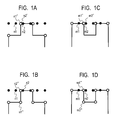
- FIGS. 1A, 1B, 1C and 1D are schematic diagrams illustrating the effect of mesh generation according to a first embodiment.
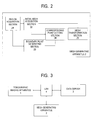
- FIG. 2 is a diagram illustrating an equipment configuration of a mesh generating apparatus 2 according to the first embodiment.
- FIG. 3 is a diagram showing a configuration of equipment connected to the mesh generating apparatus 2 according to the first embodiment.
- FIG. 4 is a flowchart showing processing procedures of the mesh generating apparatus 2 according to the first embodiment.
- FIGS. 5A and 5B are schematic diagrams showing a boundary between a tomographic image and a region according to the first embodiment.
- FIGS. 6A, 6B and 6C are schematic diagrams showing a method for generating an initial mesh according to the first embodiment.
- FIG. 7 is a schematic diagram showing a method for laying out corresponding points based on geodesic distances according to the first embodiment.
- FIG. 8 is a schematic diagram showing a method for laying out corresponding points based on linear distances according to a second embodiment.
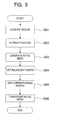
- FIG. 9 is a flowchart showing processing procedures of a mesh generating apparatus 2 according to a third embodiment.
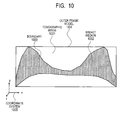
- FIG. 10 is a schematic diagram showing a volume image of the breasts according to the third embodiment.
- FIG. 11 is a schematic diagram showing feature points and boundaries of the breasts according to the third embodiment.
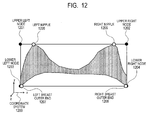
- FIG. 12 is a diagram showing correspondence between surface nodes and feature points of the breasts according to the third embodiment.
- the mesh generating apparatus is intended to generate a mesh of a region corresponding to a target object in an image (e.g., a volume image) of the target object.
- the mesh is a grid made up of plural elements (cells) substantially equal in size. Therefore, first the mesh generating apparatus prepares a coarse mesh for a region in the image as with the method described in Japanese Patent Application Laid-Open No. 2002-251415 .
- the coarse mesh will also be referred to as an initial mesh (first mesh).
- the mesh generating apparatus determines plural corresponding points which correspond to points (surface nodes) of the grid on an outer frame of the initial mesh. Then, the mesh generating apparatus transforms the initial mesh such that the surface nodes in the initial mesh will substantially coincide with the plural corresponding points. Consequently, a mesh (second mesh) which approximates the region can be generated.
- the apparatus determines locations of adjacent corresponding points based on distances, along the boundary of the region, from the grid points on the boundary of the region (points which substantially fall on the boundary) out of the grid points on the outer frame of the initial mesh.
- the distance is referred to as a geodesic distance and is obtained by dividing the length of the boundary by the number of grid cells. Consequently, a mesh can be generated without significant distortion even around the region boundary.
- corresponding points n2' and m2' of surface nodes n2 and m2 are set at locations close to n1' and m1', respectively, as shown in FIGS. 1A and 1C . Consequently, the mesh is distorted after a transformation process.
- the interval between corresponding points n1" and n2" are set equal to the interval between corresponding points m1" and m2" as shown in FIGS. 1B and 1D . Consequently, a mesh can be generated without significant distortion even around the region boundary regardless of the boundary shape.
- the mesh generating apparatus 2 includes a region acquisition section 21, an initial mesh acquisition section 22, a boundary point generating section 23, a corresponding point setting section 24, and a mesh transformation section 25.
- FIG. 3 is a configuration diagram of equipment connected to the mesh generating apparatus 2 according to the present embodiment.
- the mesh generating apparatus 2 is connected with a tomographic imaging apparatus 1 and data server 3 via a local area network (LAN) 4 such as Ethernet (registered trademark).
- the tomographic imaging apparatus 1 is designed to produce tomographic images of an object, and examples of the tomographic imaging apparatus 1 include an x-ray CT imaging apparatus (CT) and magnetic resonance imaging apparatus (MRI). Since CT or MRI allows plural tomographic images to be produced by a single imaging scan, if the tomographic images are arranged in sequence, a volume image of an object can be acquired.
- CT x-ray CT imaging apparatus
- MRI magnetic resonance imaging apparatus
- the volume image is made up of plural voxels, and a single voxel has one or more voxel values. Examples of the voxel value include a CT value.
- the tomographic imaging apparatus 1 produces tomographic images in response to actions of a user (not shown) and outputs the acquired volume image to the mesh generating apparatus 2.
- the mesh generating apparatus 2 may be connected to the data server 3 adapted to store the volume images obtained by the tomographic imaging apparatus 1 and may be configured to acquire necessary volume images from the data server 3.
- the mesh generating apparatus 2 acquires a region of a target object from an input volume image and generates a mesh in the region.
- the equipment described above may be interconnected via a USB, IEEE 1394, or other interface or may be interconnected via the LAN 4 or an external network such as the Internet.
- Step S401 the region acquisition section 21 acquires a volume image from the tomographic imaging apparatus 1 or data server 3. Then, the region acquisition section 21 acquires region information about a target object from the volume image and outputs the region information to the initial mesh acquisition section 22 and boundary point generating section 23.
- the region acquisition section 21 may acquire the region information using any known method. For example, locations of voxels making up a surface of the object may be acquired as a region boundary from the individual tomographic images of the volume image and designated as the region information. A concrete example of this process will be described with reference to FIGS. 5A and 5B.
- FIG. 5A is a schematic diagram of a tomographic image 501 which, being produced by the tomographic imaging apparatus 1, makes up a volume image. It is assumed that locations of pixels making up the tomographic image 501 have been defined in a coordinate system 502.
- the tomographic image 501 shows regions in inner part 503 and outer part 504 of an object.
- 5B is a schematic diagram showing a boundary 505 between the inner part 503 and outer part 504 of the object as acquired from the tomographic image 501.
- Possible methods for acquiring the boundary 505 include, for example, a method which involves applying thresholding to the voxel values of the tomographic image 501 in terms of magnitudes of their slopes and defining the boundary by locations of the voxels having values larger than a threshold.
- the method for acquiring the boundary is not limited to this, and any known method may be used.
- Step S402 the initial mesh acquisition section 22 (first mesh generating unit) receives boundary information about the region from the region acquisition section 21 and generates an initial mesh. Then, the initial mesh acquisition section 22 outputs the generated initial mesh to the corresponding point setting section 24 and mesh transformation section 25 (second mesh generating unit).
- a mesh is represented by a set of nodes and mesh elements.
- the nodes have coordinates and are managed based on node IDs. When a node ID is specified, a node is determined uniquely.
- the mesh element has four node IDs in the case of a tetrahedron, and eight node IDs in the case of a hexahedron and are managed based on a mesh element ID. When a mesh element ID is specified, a mesh element is determined uniquely.
- each of the nodes (surface nodes) located on the surface of the initial mesh also contains information which indicates that the node is a surface node.
- FIG. 6A is a schematic diagram showing an acquired region boundary 601 and an outer frame model 602 surrounding the boundary 601.
- the initial mesh acquisition section 22 generates an outer frame model 602 of the region boundary 601.
- a hexahedron which includes the region 601 is generated as the outer frame model 602.
- the initial mesh acquisition section 22 divides the outer frame model 602 into a grid-like structure and thereby generates an initial mesh 603.
- the initial mesh acquisition section 22 adds information indicating a surface node to each of the nodes located on the surface of the outer frame model 602 (i.e., on the sides and faces of the hexahedron). For example, when an initial mesh such as shown in FIG. 6B is given, surface nodes are given by black dots shown in FIG. 6C .
- the boundary point generating section 23 receives the boundary information about the region from the region acquisition section 21 and generates a boundary point list to store coordinates of boundary points along the boundary for each of the tomographic images of the volume image. Then, the boundary point generating section 23 outputs the generated list to the corresponding point setting section 24.
- one voxel is selected from the boundary information acquired in Step S401 and set at the top of the boundary point list. Then, coordinates of the last element in the boundary point list is selected as starting coordinates. Then, the boundary information is searched for a voxel which minimizes inter-coordinate distance from the starting coordinates, and the location of the retrieved voxel is set to a next element in the boundary point list. A similar process is repeated until all the voxels are set, thereby generating a boundary point list in which the elements are arranged along the boundary. The process is repeated for all the tomographic images, thereby generating a boundary point list of voxels located on the boundary.
- Step S404 the corresponding point setting section 24 calculates a location on the region boundary to which each surface node of the initial mesh is to be moved as a result of mesh transformation and designates the location as a corresponding point of the node. Then, the corresponding point setting section 24 generates a corresponding point list storing corresponding points which correspond to the surface nodes and outputs the list to the mesh transformation section 25.
- description will be given of a method for setting corresponding points so as to equalize geodesic distances between adjacent corresponding points in order to generate a mesh without any significant distortion around a boundary.
- description will be given of a case in which the surface nodes of an initial mesh are grouped (surface node groups in two-dimensional planes are organized) per plane parallel to the tomographic images of a volume image, and a corresponding point setting process is performed for each of the surface node groups.
- a tomographic image located in a same plane as the surface node group is selected, and a boundary point list of the tomographic image is acquired from the boundary point generating section 23.
- the geodesic distance around an entire circumference of the boundary are calculated.
- the geodesic distance can be found as the sum total of distances between the coordinates of adjacent elements in the boundary point list.
- the geodesic distance is divided by the number of surface nodes to calculate a corresponding-point distance d.
- one of the boundary points is selected for one surface node as a corresponding point and set in the corresponding point list.
- a combination of a surface node and boundary point with the smallest distance therebetween is found and the boundary point is selected as a corresponding point of the surface node. Then, based on the corresponding-point distance d found above and geodesic distance between boundary points, the coordinates of the corresponding points of all the remaining surface nodes are calculated.
- FIG. 7 is a schematic diagram showing boundary points p1, p2, and p3 and distances d12 and d23 therebetween, stored in each element of the boundary point list, as well as a distance d1 (set in a subsequent process) between a corresponding point q2 and the boundary point p2.
- the boundary point p1 is also a corresponding point q1 which corresponds to the first surface node.
- the corresponding point q2 is set at a location whose geodesic distance from q1 along the boundary is equal to the corresponding-point distance d.
- d it is determined whether the corresponding-point distance d is shorter than d12. If d is shorter than d12, the corresponding point q2 is located between the boundary points p1 and p2, and thus the coordinates of the corresponding point q2 is calculated from p1 and p2 by linear interpolation. On the other hand, if d is longer than d12, it is determined whether d is shorter than the sum of d12 and d23 (i.e., the geodesic distance between p1 and p3). If d is shorter than the sum of d12 and d23 (as shown in FIG.
- the corresponding point q2 is located between the boundary points p2 and p3, and thus the coordinates of the corresponding point q2 is calculated from the distances d1 and d23 as well as the coordinates of the boundary points p2 and p3 by linear interpolation.
- the distance d1 is calculated by subtracting the distance d12 from the corresponding-point distance d.
- the distances to the next element in the boundary point list are added in sequence (i.e., the geodesic distance from q1 is calculated).
- a linear interpolation process similar to the one described above is performed, thereby calculating the coordinates of the corresponding point q2 (such that the geodesic distance from q1 will coincide with the corresponding-point distance). Then, the calculated coordinates are set in the corresponding point list as a corresponding point of the second surface node. Furthermore, the next corresponding point (q3) is similarly set to a location whose geodesic distance from q2 is equal to the corresponding-point distance d. By repeating this process, the corresponding points of all the surface nodes are set in sequence.
- the mesh transformation section 25 receives the initial mesh and the corresponding point list and transforms the initial mesh such that the surface nodes in the initial mesh will coincide with the corresponding points.
- the mesh which has undergone the transformation process is designated as a mesh of an arbitrary region.
- the process of transforming the initial mesh such that the coordinates of the surface nodes in the initial mesh will match the coordinates of the corresponding points thereafter can be implemented by an existing transformation simulation technique based on, for example, the finite element method.
- corresponding points of the surface nodes in the initial mesh are set at equal intervals on the boundary based on the geodesic distances along the boundary shape of an arbitrary region. Consequently, node locations on the mesh of an arbitrary region generated by transforming the initial mesh are also arranged at equal intervals.
- a mesh can be generated without significant distortion of mesh elements even around the region boundary.
- the corresponding point setting section 24 determines the locations of corresponding points using the geodesic distances between boundary points.
- the method for determining the locations of corresponding points is not limited to the methods which use the geodesic distances between boundary points, and the distances between boundary points defined by another method may be used.
- the locations of corresponding points may be determined using linear distances between boundary points.
- the corresponding point setting section 24 determines the coordinates of corresponding points using the linear distances between boundary points.
- a configuration and process flowchart of the mesh generating apparatus 2 according to the present embodiment is similar to the first embodiment except for the following points. That is, part of the process (the process of setting corresponding points for each surface node group) performed by the corresponding point setting section 24 in Step S404 is different from the first embodiment. The difference will be described below with reference to FIG. 8 .
- FIG. 8 is a schematic diagram showing boundary points p1, p2, and p3 stored in each element of the boundary point list and a corresponding point q2 set (in a subsequent process) at a location separated from the corresponding point q1 by the corresponding-point distance d in terms of linear distance.
- the boundary point p1 is also a corresponding point q1 which corresponds to the first surface node.
- one of the boundary points is selected for one surface node as a corresponding point and set in the corresponding point list.
- an intersection point between a circle of radius d with a center at the corresponding point q1 and a line segment (line segments 112 and 123 in the example of FIG. 8 ) linking adjacent boundary points is calculated.
- the intersection point is set as the corresponding point q2 in the corresponding point list.
- the quotient obtained by dividing the outer frame model by the number of surface nodes on the initial mesh may be used as the corresponding-point distance d.
- a next corresponding point (q3) is similarly set using a circle of radius d with a center at q2.
- the corresponding points of all the surface nodes are set in sequence.
- corresponding points are set for the surface node group in one plane such that their linear distances will be equal to one another in the plane, and are established on the region boundary.
- the term "equal” means not only cases in which intervals are strictly equal, but also cases in which intervals are substantially equal (with some deviations).
- the locations of corresponding points may be recalculated beginning with the corresponding point q2 as follows: the difference between dl and d is divided by the number of surface nodes, the quotient is subtracted from d, and the distance thus obtained is used as a new corresponding-point distance d for use in the recalculation. If the calculations are repeated until dl matches d, corresponding points can be set so as to approximate the boundary by equal linear distances.
- a mesh generating apparatus sets corresponding points of the surface nodes in the initial mesh by taking into consideration locations of feature points in a target region as a condition other than the distances between boundary points and generates a mesh based on the corresponding points set in this way.
- description will be given by citing as an example a medical mesh generating apparatus which uses a volume image of the breasts of an examinee as a process object, acquires both left and right nipple locations and outer end locations of the breasts as feature points, and generates a mesh of a breast region by taking these locations into consideration.
- a configuration of the mesh generating apparatus 2 according to the present embodiment is similar to the first embodiment. Operation of various parts and processing procedures of the mesh generating apparatus 2 according to the present embodiment will be described below with reference to a flowchart in FIG. 9 .
- Step S901 is a process similar to Step S401 according to the first embodiment. That is, in Step S901, the region acquisition section 21 acquires a volume image of the breasts and acquires a breast region 1002 and boundary 1003 from a tomographic image 1001 of the breasts as shown in the schematic diagram of FIG. 10 .
- the region acquisition section 21 extracts predetermined feature points in the breast region from the volume image of the breasts. Then, the region acquisition section 21 outputs information about the acquired feature points to a boundary point generating section 23.
- the feature points used in the present embodiment include a left nipple 1101, a right nipple 1102, a left breast outer end 1103 contained in each tomographic image, and a right breast outer end 1104 contained in each tomographic image.
- the volume image of the breasts uses a coordinate system 1111 shown in FIG. 11 .
- Step S901 the breast region extracted in Step S901 is divided into left and right regions. Since the breasts are almost bilaterally symmetrical, a center line 1110 which divides a side of an outer frame model 1109 along an X axis into two parts is calculated, and a breast region to the left of the center line is designated as a left region and a breast region to the right of the center line is designated as a right region.
- coordinates with the largest Y coordinate are extracted from each of the left and right regions. Then, the coordinates extracted from the left region are determined to be those of the left nipple 1101 and the coordinates extracted from the right region are determined to be those of the right nipple 1102.
- Step S903 Z coordinates of the left and right nipple locations are compared, and if the difference thus found is smaller than a predetermined value, a plane which contains both nipple locations and is parallel to a Y axis is found and information thereon is held as information about a nipple cross section.
- a predetermined value used in the above determination for example, division intervals used in generation of an initial mesh in Step S903 next may be adopted.
- Each of the left and right nipples is contained only in a single tomographic image.
- a boundary point which has the same X coordinate as a given nipple and has the largest Y coordinate is extracted as a provisional nipple location in a given tomographic image.
- breast outer ends are extracted from each tomographic image.
- coordinates of a voxel which has the smallest X coordinate and the smallest Y coordinate are determined to correspond to the left breast outer end 1103.
- coordinates of a voxel which has the largest X coordinate and the smallest Y coordinate are determined to correspond to the right breast outer end 1104.
- This process is repeated for each tomographic image to extract the breast outer ends from every tomographic image.
- any other appropriate process may be used to extract the nipples and breast outer ends.
- Step S903 the initial mesh acquisition section 22 generates an initial mesh of the region from an outer frame model 1004 as in the case of Step S402 according to the first embodiment.
- an initial mesh is generated using the method of Step S402 and then node locations in the initial mesh are adjusted based on the nipple locations found in Step S902.
- nodes in the initial mesh generated using the method of Step S402 are grouped per plane parallel to the tomographic images. Then, if a nipple cross section has been set in Step S902 (if the difference between the Z coordinates of the left and right nipple locations is smaller than the predetermined value), the process described below is performed.
- the node group nearest to the nipple cross section is selected from among the node groups resulting from the grouping, as a node group which represents the nipple cross section. For example, the node group in the plane closest to the Z-coordinate average value of the left and right nipples is selected. Then, the Z coordinate of each node contained in the selected node group is corrected so as to be located in the nipple cross section.
- Step S902 if a nipple cross section has not been set in Step S902 (if the difference between the Z coordinates of the left and right nipple locations is larger than the predetermined value), the process described below is performed.
- the node group in the plane nearest to the Z coordinate of the right nipple location is selected from among the node groups resulting from the grouping, as a node group which represents a tomographic image of the right nipple.
- the Z coordinate of each node contained in the selected node group is corrected to the Z coordinate of the right nipple location.
- a similar process is performed with respect to the left nipple (by selecting another node group).
- the initial mesh is assigned to the same plane as the tomographic images (or nipple cross section) containing the nipple locations. Consequently, nodes in a region mesh generated finally are assigned to the nipple locations.
- Step S904 the boundary point generating section 23 generates a boundary point list storing the coordinates of boundary points along the boundaries of the breasts for each tomographic image of the volume image.
- the method for generating the boundary point list is similar to the process of Step S403, but the present embodiment differs in that the voxel of the left nipple location (or provisional left nipple location) is set at the top of the boundary point list. After the voxel of the left nipple location is set at the top of the boundary point list, the rest of the process is similar to Step S403. If the nipple cross section of the initial mesh has been corrected in Step S903, the boundary point list of the nipple cross section is generated similarly.
- Step S905 the corresponding point setting section 24 generates a list of corresponding points on the region boundary to move the surface nodes in the initial mesh to, and outputs the list to the mesh transformation section 25.
- the corresponding point setting section 24 sets corresponding points not only by giving consideration to uniformity of distances among boundary points, but also by using information about the locations of feature points.
- the process of setting corresponding points is performed with respect to each surface node group set up by extracting surface nodes from the node groups established as a result of grouping in Step S903.
- Step S404 a boundary point list of the tomographic image located on the same plane as a surface node group of interest is acquired.
- the surface node group represents a nipple cross section
- a boundary point list of the nipple cross section is acquired.
- the boundary between the left nipple 1101 and right nipple 1102 is defined as a nipple side boundary 1105 while the boundary between the left breast outer end 1103 and right breast outer end 1104 is defined as a dorsal boundary 1107.
- the boundary between the right nipple 1102 and right breast outer end 1104 is defined as a right lateral boundary 1106 while the boundary between the left nipple 1101 and left breast outer end 1103 is defined as a left lateral boundary 1108. If any of the nipples are not contained in the tomographic image, the provisional nipple location(s) described above is (are) used.
- a boundary point located on the left nipple 1205 is set as a corresponding point of an upper left node (a surface node located at upper left) 1201 of the initial mesh.
- the right nipple 1206 is set as a corresponding point of an upper right node 1202
- a left breast outer end 1207 is set as a corresponding point of a lower left node 1203
- a boundary point located at a right breast outer end 1208 is set as a corresponding point of a lower right node 1204.
- the corresponding points of the nodes are set such that the surface node group of the initial mesh located on an upper plane of the outer frame model will move to the nipple side boundary 1105 after mesh transformation.
- the coordinates of each corresponding point are calculated such that all the geodesic distances between corresponding points will equal the corresponding-point distance d (equal among themselves), where the corresponding-point distance d is the quotient obtained by dividing the geodesic distance of the nipple side boundary 1105 by the number of nodes.
- the corresponding points are set similarly such that the surface nodes located on a right plane will fall on the right lateral boundary 1106, that the surface nodes located on a lower plane will fall on the dorsal boundary 1107, and that the surface nodes located on a left plane will fall on the left lateral boundary 1108.
- corresponding points can be set at such locations that surface nodes will fall on boundaries in each plane of the outer frame model.
- Step S906 the mesh transformation section 25 operates in a manner similar to Step S405.
- This mode of implementation allows a mesh to be generated such that the node locations on boundaries will be spaced equidistantly wherever practicable and that nodes will be set at locations of feature points of the breasts, such as the nipples and breast outer ends. This is suitable for estimating distortion of a region using feature point locations because mesh nodes are set at feature point locations as well as because of reduced distortion around region boundaries.
- a mesh generating process for a breast region has been described as an example, a similar mesh generating process can be performed even when another region (a volume image of another organ or object) is handled.
- the initial mesh acquisition section 22 generates an initial mesh using an outer frame model circumscribed on an acquired region.
- the shapes of initial meshes are not limited to this. In the present embodiment, description will be given of a case in which a mesh of an average geometric model of the breasts is used as an initial mesh.
- a configuration and process flowchart of the mesh generating apparatus 2 according to the present embodiment is similar to the third embodiment except for the following points. That is, the process performed by the initial mesh acquisition section 22 in Step S903 and part of the process performed by the corresponding point setting section 24 in Step S905 are different from the third embodiment. Only the differences will be described below.
- the initial mesh acquisition section 22 acquires an average geometric model of the breasts from the data server 3 and establishes the model as an initial mesh.
- the average geometric model is obtained by extracting feature points from breast regions, nipples and breast outer ends of plural persons, aligning and matching the feature points, and calculating an average.
- the method for generating an average geometric model is not limited to this, and any appropriate existing method may be used.
- Step S905 the corresponding point setting section 24 brings the nodes of the nipples and breast outer ends in the average geometric model, which is an initial mesh, into correspondence with those in the boundary point list, and establishes correspondence of the remaining surface nodes such that geodesic distances will be equal to one another.
- This mode of implementation allows the shape of an initial mesh to be brought close to the shape of an arbitrary region, thereby reducing the time required for transformation simulations.
- the present invention can be embodied as a system, apparatus, or method. Specifically, the present invention may be applied to a system made up of two or more apparatus or to equipment made up of a single apparatus.
- the present invention can also be realized by executing the following process. That is, a process of providing software (a program) which realizes the functions of the above-described embodiments to a system or apparatus via a network or various types of storage media, and a computer (or CPU, MPU or the like) of the system or the apparatus reading out and executing the program code.
Landscapes
- Engineering & Computer Science (AREA)
- Physics & Mathematics (AREA)
- Computer Graphics (AREA)
- General Physics & Mathematics (AREA)
- Theoretical Computer Science (AREA)
- Geometry (AREA)
- Software Systems (AREA)
- Processing Or Creating Images (AREA)
- Image Processing (AREA)
- Magnetic Resonance Imaging Apparatus (AREA)
Applications Claiming Priority (1)
| Application Number | Priority Date | Filing Date | Title |
|---|---|---|---|
| JP2012038429A JP6049272B2 (ja) | 2012-02-24 | 2012-02-24 | メッシュ生成装置、方法およびプログラム |
Publications (1)
| Publication Number | Publication Date |
|---|---|
| EP2631877A2 true EP2631877A2 (en) | 2013-08-28 |
Family
ID=47757275
Family Applications (1)
| Application Number | Title | Priority Date | Filing Date |
|---|---|---|---|
| EP13000799.0A Withdrawn EP2631877A2 (en) | 2012-02-24 | 2013-02-15 | Mesh generating apparatus and method |
Country Status (4)
| Country | Link |
|---|---|
| US (1) | US20130222368A1 (enExample) |
| EP (1) | EP2631877A2 (enExample) |
| JP (1) | JP6049272B2 (enExample) |
| CN (1) | CN103295268A (enExample) |
Cited By (1)
| Publication number | Priority date | Publication date | Assignee | Title |
|---|---|---|---|---|
| CN112597755A (zh) * | 2020-12-29 | 2021-04-02 | 杭州拼便宜网络科技有限公司 | 一种地理位置信息生成方法、装置、电子设备及存储介质 |
Families Citing this family (10)
| Publication number | Priority date | Publication date | Assignee | Title |
|---|---|---|---|---|
| US10395382B2 (en) | 2016-12-30 | 2019-08-27 | Biosense Webster (Israel) Ltd. | Visualization of distances on an electroanatomical map |
| US10102665B2 (en) | 2016-12-30 | 2018-10-16 | Biosense Webster (Israel) Ltd. | Selecting points on an electroanatomical map |
| CN112714298B (zh) * | 2019-10-25 | 2023-06-30 | 中强光电股份有限公司 | 投影系统及其调整投影画面的方法 |
| EP3951715B1 (en) | 2020-08-05 | 2025-02-19 | Canon Kabushiki Kaisha | Generation apparatus, generation method, and program |
| CN114627206B (zh) * | 2021-01-05 | 2024-12-13 | 亚信科技(南京)有限公司 | 网格绘制方法、装置、电子设备及计算机可读存储介质 |
| JP7643875B2 (ja) | 2021-01-15 | 2025-03-11 | キヤノン株式会社 | 情報処理装置、情報処理方法、及びプログラム |
| JP7576013B2 (ja) | 2021-09-30 | 2024-10-30 | キヤノン株式会社 | 情報処理装置、情報処理方法およびプログラム |
| JP2023125608A (ja) | 2022-02-28 | 2023-09-07 | キヤノン株式会社 | 推論処理システム、サーバ、エッジデバイス、及びこれらの制御方法、並びにプログラム |
| JP7787752B2 (ja) | 2022-03-14 | 2025-12-17 | キヤノン株式会社 | 形状推定装置、処理方法、およびプログラム |
| CN117611767B (zh) * | 2023-11-30 | 2024-09-03 | 上海新迪数字技术有限公司 | 一种曲面轮廓线的确定方法及装置 |
Citations (2)
| Publication number | Priority date | Publication date | Assignee | Title |
|---|---|---|---|---|
| JP2002251415A (ja) | 2001-02-23 | 2002-09-06 | Sumitomo Metal Ind Ltd | 六面体メッシュ生成方法、六面体メッシュ生成装置、コンピュータプログラム、及び記録媒体、並びに立体物の変形の解析方法 |
| JP2004110212A (ja) | 2002-09-13 | 2004-04-08 | Sumitomo Metal Ind Ltd | 六面体メッシュ生成方法、立体物の変形の解析方法、六面体メッシュ生成装置、立体物の変形の解析装置、コンピュータプログラム、及び記録媒体 |
Family Cites Families (13)
| Publication number | Priority date | Publication date | Assignee | Title |
|---|---|---|---|---|
| JPH04181481A (ja) * | 1990-11-16 | 1992-06-29 | Babcock Hitachi Kk | 解析対象実空間のメッシュ生成方法 |
| JP2001092994A (ja) * | 1999-09-17 | 2001-04-06 | Sumitomo Metal Ind Ltd | 6面体メッシュ生成方法、6面体メッシュ生成装置及び記録媒体 |
| KR100512760B1 (ko) * | 2003-12-23 | 2005-09-07 | 한국전자통신연구원 | 경계셀 축소 방식을 이용하여 3차원 측정점들로부터 3차원메쉬를 생성하는 방법 |
| EP1706848A1 (en) * | 2004-01-13 | 2006-10-04 | Koninklijke Philips Electronics N.V. | Mesh models with internal discrete elements |
| JP2008522269A (ja) * | 2004-11-27 | 2008-06-26 | ブラッコ イメージング エス.ピー.エー. | メッシュ・サーフェス並びにボリューム・オブジェクト上におけるサーフェス線の生成並びに計測のためのシステム並びに方法およびメッシュ切断技術(曲線測定方法) |
| US7830373B1 (en) * | 2006-01-25 | 2010-11-09 | Bo Gao | System and methods of civil engineering objects model |
| JP2007241843A (ja) * | 2006-03-10 | 2007-09-20 | Toyota Motor Corp | 等分割メッシュ作成装置、等分割メッシュ作成プログラム及び等分割メッシュ作成方法 |
| WO2009101577A2 (en) * | 2008-02-15 | 2009-08-20 | Koninklijke Philips Electronics N.V. | Interactive selection of a region of interest and segmentation of image data |
| EP2189945A1 (en) * | 2008-11-21 | 2010-05-26 | A&P ip B.V. | Method of and arrangement for linking image coordinates to coordinates of reference model |
| US8823775B2 (en) * | 2009-04-30 | 2014-09-02 | Board Of Regents, The University Of Texas System | Body surface imaging |
| JP5546230B2 (ja) * | 2009-12-10 | 2014-07-09 | キヤノン株式会社 | 情報処理装置、情報処理方法、及びプログラム |
| FR2971412B1 (fr) * | 2011-02-15 | 2014-01-17 | Gen Electric | Methode d'acquisition de la morphologie d'un sein. |
| CN104268873B (zh) * | 2014-09-25 | 2017-04-12 | 南京信息工程大学 | 基于核磁共振图像的乳腺肿瘤分割方法 |
-
2012
- 2012-02-24 JP JP2012038429A patent/JP6049272B2/ja not_active Expired - Fee Related
-
2013
- 2013-02-15 EP EP13000799.0A patent/EP2631877A2/en not_active Withdrawn
- 2013-02-21 US US13/772,521 patent/US20130222368A1/en not_active Abandoned
- 2013-02-25 CN CN2013100588856A patent/CN103295268A/zh active Pending
Patent Citations (2)
| Publication number | Priority date | Publication date | Assignee | Title |
|---|---|---|---|---|
| JP2002251415A (ja) | 2001-02-23 | 2002-09-06 | Sumitomo Metal Ind Ltd | 六面体メッシュ生成方法、六面体メッシュ生成装置、コンピュータプログラム、及び記録媒体、並びに立体物の変形の解析方法 |
| JP2004110212A (ja) | 2002-09-13 | 2004-04-08 | Sumitomo Metal Ind Ltd | 六面体メッシュ生成方法、立体物の変形の解析方法、六面体メッシュ生成装置、立体物の変形の解析装置、コンピュータプログラム、及び記録媒体 |
Cited By (2)
| Publication number | Priority date | Publication date | Assignee | Title |
|---|---|---|---|---|
| CN112597755A (zh) * | 2020-12-29 | 2021-04-02 | 杭州拼便宜网络科技有限公司 | 一种地理位置信息生成方法、装置、电子设备及存储介质 |
| CN112597755B (zh) * | 2020-12-29 | 2024-06-11 | 杭州拼便宜网络科技有限公司 | 一种地理位置信息生成方法、装置、电子设备及存储介质 |
Also Published As
| Publication number | Publication date |
|---|---|
| US20130222368A1 (en) | 2013-08-29 |
| CN103295268A (zh) | 2013-09-11 |
| JP6049272B2 (ja) | 2016-12-21 |
| JP2013175006A (ja) | 2013-09-05 |
Similar Documents
| Publication | Publication Date | Title |
|---|---|---|
| EP2631877A2 (en) | Mesh generating apparatus and method | |
| US8532359B2 (en) | Biodata model preparation method and apparatus, data structure of biodata model and data storage device of biodata model, and load dispersion method and apparatus of 3D data model | |
| Pahr et al. | From high-resolution CT data to finite element models: development of an integrated modular framework | |
| RU2540829C2 (ru) | Интерактивный итеративный алгоритм ближайших точек для сегментации органов | |
| US9514539B2 (en) | Segmentation of magnetic resonance imaging data | |
| US20070109299A1 (en) | Surface-based characteristic path generation | |
| JP2007523402A (ja) | 内部個別要素を用いるメッシュモデル | |
| US9984311B2 (en) | Method and system for image segmentation using a directed graph | |
| US10650587B2 (en) | Isosurface generation method and visualization system | |
| JP6762305B2 (ja) | 解剖学的構造の有限要素モデリング | |
| CN113516677B (zh) | 一种结构化分级管状结构血管的方法、装置及电子设备 | |
| CN110443839A (zh) | 一种骨骼模型空间配准方法及装置 | |
| EP2541501B1 (en) | Shape data generation method and apparatus | |
| KR102098929B1 (ko) | 수술용 내비게이션의 표면 정합 방법 및 장치 | |
| US20140032180A1 (en) | Method and apparatus for computing deformation of an object | |
| EP4526841A1 (en) | A computer-implemented method, computer program product and imaging system for centerlines computation from a 3d model of a tubular structure | |
| CN109979572A (zh) | 一种三维脊椎模型中椎弓根的切面获取方法及装置 | |
| EP2879093B1 (en) | Image segmentation using reaction-diffusion calculations | |
| CN117495693B (zh) | 用于内窥镜的图像融合方法、系统、介质及电子设备 | |
| CN118475954A (zh) | 用于对图像进行分割的设备、系统和方法 | |
| JP2013089123A (ja) | 個人モデルデータの生成方法、生成プログラム、および生成システム | |
| KR100782152B1 (ko) | 3차원 수치지도를 제작하기 위하여 항공사진 db로부터건물의 3차원 데이터를 획득하는 방법 | |
| CN110428489B (zh) | 弧形通道规划方法及装置 | |
| Li et al. | An automatic method for landmark identification of the 3D vertebrae | |
| CN119600228A (zh) | 修正表示器官的表面网格上的拓扑缺陷 |
Legal Events
| Date | Code | Title | Description |
|---|---|---|---|
| PUAI | Public reference made under article 153(3) epc to a published international application that has entered the european phase |
Free format text: ORIGINAL CODE: 0009012 |
|
| AK | Designated contracting states |
Kind code of ref document: A2 Designated state(s): AL AT BE BG CH CY CZ DE DK EE ES FI FR GB GR HR HU IE IS IT LI LT LU LV MC MK MT NL NO PL PT RO RS SE SI SK SM TR |
|
| AX | Request for extension of the european patent |
Extension state: BA ME |
|
| STAA | Information on the status of an ep patent application or granted ep patent |
Free format text: STATUS: THE APPLICATION HAS BEEN WITHDRAWN |
|
| 18W | Application withdrawn |
Effective date: 20161222 |