EP2628994A1 - Kunststoffliner mit Fixierungselementen für Druckbehälter - Google Patents
Kunststoffliner mit Fixierungselementen für Druckbehälter Download PDFInfo
- Publication number
- EP2628994A1 EP2628994A1 EP12155440.6A EP12155440A EP2628994A1 EP 2628994 A1 EP2628994 A1 EP 2628994A1 EP 12155440 A EP12155440 A EP 12155440A EP 2628994 A1 EP2628994 A1 EP 2628994A1
- Authority
- EP
- European Patent Office
- Prior art keywords
- pressure vessel
- cylindrical
- cylindrical pressure
- fixing elements
- vessel according
- Prior art date
- Legal status (The legal status is an assumption and is not a legal conclusion. Google has not performed a legal analysis and makes no representation as to the accuracy of the status listed.)
- Withdrawn
Links
- 229920001903 high density polyethylene Polymers 0.000 title claims abstract description 26
- 238000000034 method Methods 0.000 claims abstract description 29
- 229910052751 metal Inorganic materials 0.000 claims abstract description 20
- 239000002184 metal Substances 0.000 claims abstract description 20
- 239000000463 material Substances 0.000 claims abstract description 16
- 230000003014 reinforcing effect Effects 0.000 claims abstract description 15
- 238000004519 manufacturing process Methods 0.000 claims abstract description 9
- 230000007704 transition Effects 0.000 claims abstract description 9
- 239000000835 fiber Substances 0.000 claims abstract description 4
- 230000002787 reinforcement Effects 0.000 claims abstract 3
- 239000004952 Polyamide Substances 0.000 claims description 17
- 229920002647 polyamide Polymers 0.000 claims description 17
- 238000000071 blow moulding Methods 0.000 claims description 14
- 229920003023 plastic Polymers 0.000 claims description 14
- 239000004033 plastic Substances 0.000 claims description 14
- 238000010101 extrusion blow moulding Methods 0.000 claims description 12
- 229920001169 thermoplastic Polymers 0.000 claims description 8
- 239000004416 thermosoftening plastic Substances 0.000 claims description 8
- 239000003365 glass fiber Substances 0.000 claims description 7
- OKTJSMMVPCPJKN-UHFFFAOYSA-N Carbon Chemical compound [C] OKTJSMMVPCPJKN-UHFFFAOYSA-N 0.000 claims description 6
- 229910052799 carbon Inorganic materials 0.000 claims description 5
- 239000004917 carbon fiber Substances 0.000 claims description 5
- 238000003860 storage Methods 0.000 claims description 5
- 239000004734 Polyphenylene sulfide Substances 0.000 claims description 4
- 229920000069 polyphenylene sulfide Polymers 0.000 claims description 4
- 238000003672 processing method Methods 0.000 claims description 3
- 238000003466 welding Methods 0.000 claims description 3
- 239000004642 Polyimide Substances 0.000 claims description 2
- 239000000853 adhesive Substances 0.000 claims description 2
- 230000001070 adhesive effect Effects 0.000 claims description 2
- 238000005516 engineering process Methods 0.000 claims description 2
- 229920001281 polyalkylene Polymers 0.000 claims description 2
- 239000004417 polycarbonate Substances 0.000 claims description 2
- 229920000515 polycarbonate Polymers 0.000 claims description 2
- 229920000728 polyester Polymers 0.000 claims description 2
- 229920000570 polyether Polymers 0.000 claims description 2
- 229920001721 polyimide Polymers 0.000 claims description 2
- 229920000098 polyolefin Polymers 0.000 claims description 2
- 230000008569 process Effects 0.000 abstract description 14
- -1 polypropylene Polymers 0.000 description 47
- 239000000203 mixture Substances 0.000 description 36
- 239000000178 monomer Substances 0.000 description 33
- 229920001971 elastomer Polymers 0.000 description 27
- PEDCQBHIVMGVHV-UHFFFAOYSA-N Glycerine Chemical compound OCC(O)CO PEDCQBHIVMGVHV-UHFFFAOYSA-N 0.000 description 26
- 229920001577 copolymer Polymers 0.000 description 22
- 239000011257 shell material Substances 0.000 description 22
- 238000000465 moulding Methods 0.000 description 18
- 239000000654 additive Substances 0.000 description 15
- 239000007789 gas Substances 0.000 description 15
- 239000005060 rubber Substances 0.000 description 15
- KAKZBPTYRLMSJV-UHFFFAOYSA-N Butadiene Chemical compound C=CC=C KAKZBPTYRLMSJV-UHFFFAOYSA-N 0.000 description 14
- 235000011187 glycerol Nutrition 0.000 description 14
- VNWKTOKETHGBQD-UHFFFAOYSA-N methane Chemical compound C VNWKTOKETHGBQD-UHFFFAOYSA-N 0.000 description 14
- 150000001875 compounds Chemical class 0.000 description 13
- RRHGJUQNOFWUDK-UHFFFAOYSA-N Isoprene Chemical compound CC(=C)C=C RRHGJUQNOFWUDK-UHFFFAOYSA-N 0.000 description 12
- PPBRXRYQALVLMV-UHFFFAOYSA-N Styrene Chemical compound C=CC1=CC=CC=C1 PPBRXRYQALVLMV-UHFFFAOYSA-N 0.000 description 12
- NIXOWILDQLNWCW-UHFFFAOYSA-N acrylic acid group Chemical group C(C=C)(=O)O NIXOWILDQLNWCW-UHFFFAOYSA-N 0.000 description 12
- 150000001336 alkenes Chemical class 0.000 description 12
- 239000000806 elastomer Substances 0.000 description 12
- 229910052757 nitrogen Inorganic materials 0.000 description 12
- 150000002148 esters Chemical class 0.000 description 11
- CERQOIWHTDAKMF-UHFFFAOYSA-N Methacrylic acid Chemical compound CC(=C)C(O)=O CERQOIWHTDAKMF-UHFFFAOYSA-N 0.000 description 10
- CQEYYJKEWSMYFG-UHFFFAOYSA-N butyl acrylate Chemical compound CCCCOC(=O)C=C CQEYYJKEWSMYFG-UHFFFAOYSA-N 0.000 description 10
- 125000004432 carbon atom Chemical group C* 0.000 description 10
- UFHFLCQGNIYNRP-UHFFFAOYSA-N Hydrogen Chemical compound [H][H] UFHFLCQGNIYNRP-UHFFFAOYSA-N 0.000 description 9
- 239000002253 acid Substances 0.000 description 9
- 239000001257 hydrogen Substances 0.000 description 9
- 229910052739 hydrogen Inorganic materials 0.000 description 9
- VGGSQFUCUMXWEO-UHFFFAOYSA-N Ethene Chemical compound C=C VGGSQFUCUMXWEO-UHFFFAOYSA-N 0.000 description 8
- 238000002347 injection Methods 0.000 description 8
- 239000007924 injection Substances 0.000 description 8
- SMZOUWXMTYCWNB-UHFFFAOYSA-N 2-(2-methoxy-5-methylphenyl)ethanamine Chemical compound COC1=CC=C(C)C=C1CCN SMZOUWXMTYCWNB-UHFFFAOYSA-N 0.000 description 7
- BRLQWZUYTZBJKN-UHFFFAOYSA-N Epichlorohydrin Chemical compound ClCC1CO1 BRLQWZUYTZBJKN-UHFFFAOYSA-N 0.000 description 7
- LYCAIKOWRPUZTN-UHFFFAOYSA-N Ethylene glycol Chemical compound OCCO LYCAIKOWRPUZTN-UHFFFAOYSA-N 0.000 description 7
- 150000007513 acids Chemical class 0.000 description 7
- 125000000217 alkyl group Chemical group 0.000 description 7
- 125000003118 aryl group Chemical group 0.000 description 7
- 230000008602 contraction Effects 0.000 description 7
- 238000001816 cooling Methods 0.000 description 7
- 125000000524 functional group Chemical group 0.000 description 7
- 238000009757 thermoplastic moulding Methods 0.000 description 7
- 239000003981 vehicle Substances 0.000 description 7
- NLHHRLWOUZZQLW-UHFFFAOYSA-N Acrylonitrile Chemical compound C=CC#N NLHHRLWOUZZQLW-UHFFFAOYSA-N 0.000 description 6
- PAYRUJLWNCNPSJ-UHFFFAOYSA-N Aniline Chemical compound NC1=CC=CC=C1 PAYRUJLWNCNPSJ-UHFFFAOYSA-N 0.000 description 6
- 229920002943 EPDM rubber Polymers 0.000 description 6
- BAPJBEWLBFYGME-UHFFFAOYSA-N Methyl acrylate Chemical compound COC(=O)C=C BAPJBEWLBFYGME-UHFFFAOYSA-N 0.000 description 6
- 235000014113 dietary fatty acids Nutrition 0.000 description 6
- RTZKZFJDLAIYFH-UHFFFAOYSA-N ether Substances CCOCC RTZKZFJDLAIYFH-UHFFFAOYSA-N 0.000 description 6
- 239000000194 fatty acid Substances 0.000 description 6
- 229930195729 fatty acid Natural products 0.000 description 6
- 238000001746 injection moulding Methods 0.000 description 6
- 239000003915 liquefied petroleum gas Substances 0.000 description 6
- 239000003345 natural gas Substances 0.000 description 6
- JRZJOMJEPLMPRA-UHFFFAOYSA-N olefin Natural products CCCCCCCC=C JRZJOMJEPLMPRA-UHFFFAOYSA-N 0.000 description 6
- 239000003381 stabilizer Substances 0.000 description 6
- GOXQRTZXKQZDDN-UHFFFAOYSA-N 2-Ethylhexyl acrylate Chemical compound CCCCC(CC)COC(=O)C=C GOXQRTZXKQZDDN-UHFFFAOYSA-N 0.000 description 5
- 229920000181 Ethylene propylene rubber Polymers 0.000 description 5
- WSFSSNUMVMOOMR-UHFFFAOYSA-N Formaldehyde Chemical compound O=C WSFSSNUMVMOOMR-UHFFFAOYSA-N 0.000 description 5
- 239000004609 Impact Modifier Substances 0.000 description 5
- VVQNEPGJFQJSBK-UHFFFAOYSA-N Methyl methacrylate Chemical compound COC(=O)C(C)=C VVQNEPGJFQJSBK-UHFFFAOYSA-N 0.000 description 5
- 150000001412 amines Chemical class 0.000 description 5
- IISBACLAFKSPIT-UHFFFAOYSA-N bisphenol A Chemical compound C=1C=C(O)C=CC=1C(C)(C)C1=CC=C(O)C=C1 IISBACLAFKSPIT-UHFFFAOYSA-N 0.000 description 5
- 239000002131 composite material Substances 0.000 description 5
- 150000002118 epoxides Chemical class 0.000 description 5
- 125000003700 epoxy group Chemical group 0.000 description 5
- FPYJFEHAWHCUMM-UHFFFAOYSA-N maleic anhydride Chemical compound O=C1OC(=O)C=C1 FPYJFEHAWHCUMM-UHFFFAOYSA-N 0.000 description 5
- VZCYOOQTPOCHFL-UHFFFAOYSA-N trans-butenedioic acid Natural products OC(=O)C=CC(O)=O VZCYOOQTPOCHFL-UHFFFAOYSA-N 0.000 description 5
- IJGRMHOSHXDMSA-UHFFFAOYSA-N Atomic nitrogen Chemical compound N#N IJGRMHOSHXDMSA-UHFFFAOYSA-N 0.000 description 4
- 239000004908 Emulsion polymer Substances 0.000 description 4
- JIGUQPWFLRLWPJ-UHFFFAOYSA-N Ethyl acrylate Chemical compound CCOC(=O)C=C JIGUQPWFLRLWPJ-UHFFFAOYSA-N 0.000 description 4
- 239000005977 Ethylene Substances 0.000 description 4
- VZCYOOQTPOCHFL-OWOJBTEDSA-N Fumaric acid Chemical compound OC(=O)\C=C\C(O)=O VZCYOOQTPOCHFL-OWOJBTEDSA-N 0.000 description 4
- OFOBLEOULBTSOW-UHFFFAOYSA-N Propanedioic acid Natural products OC(=O)CC(O)=O OFOBLEOULBTSOW-UHFFFAOYSA-N 0.000 description 4
- QQONPFPTGQHPMA-UHFFFAOYSA-N Propene Chemical compound CC=C QQONPFPTGQHPMA-UHFFFAOYSA-N 0.000 description 4
- 125000005396 acrylic acid ester group Chemical group 0.000 description 4
- 229910052784 alkaline earth metal Inorganic materials 0.000 description 4
- 150000008064 anhydrides Chemical class 0.000 description 4
- 125000003710 aryl alkyl group Chemical group 0.000 description 4
- 239000006229 carbon black Substances 0.000 description 4
- 235000019241 carbon black Nutrition 0.000 description 4
- 125000003178 carboxy group Chemical group [H]OC(*)=O 0.000 description 4
- 150000001991 dicarboxylic acids Chemical class 0.000 description 4
- 150000001993 dienes Chemical class 0.000 description 4
- MTHSVFCYNBDYFN-UHFFFAOYSA-N diethylene glycol Chemical compound OCCOCCO MTHSVFCYNBDYFN-UHFFFAOYSA-N 0.000 description 4
- 238000001125 extrusion Methods 0.000 description 4
- 239000012530 fluid Substances 0.000 description 4
- 150000002431 hydrogen Chemical class 0.000 description 4
- 150000002918 oxazolines Chemical class 0.000 description 4
- RPQRDASANLAFCM-UHFFFAOYSA-N oxiran-2-ylmethyl prop-2-enoate Chemical compound C=CC(=O)OCC1CO1 RPQRDASANLAFCM-UHFFFAOYSA-N 0.000 description 4
- PNJWIWWMYCMZRO-UHFFFAOYSA-N pent‐4‐en‐2‐one Natural products CC(=O)CC=C PNJWIWWMYCMZRO-UHFFFAOYSA-N 0.000 description 4
- 150000002989 phenols Chemical class 0.000 description 4
- 238000006116 polymerization reaction Methods 0.000 description 4
- 239000000243 solution Substances 0.000 description 4
- 235000015112 vegetable and seed oil Nutrition 0.000 description 4
- 239000008158 vegetable oil Substances 0.000 description 4
- 238000004804 winding Methods 0.000 description 4
- JJGBFZZXKPWGCW-UHFFFAOYSA-N 2,3-bis[8-[3-[(3-pentyloxiran-2-yl)methyl]oxiran-2-yl]octanoyloxy]propyl 8-[3-[(3-pentyloxiran-2-yl)methyl]oxiran-2-yl]octanoate Chemical compound CCCCCC1OC1CC1C(CCCCCCCC(=O)OCC(COC(=O)CCCCCCCC2C(O2)CC2C(O2)CCCCC)OC(=O)CCCCCCCC2C(O2)CC2C(O2)CCCCC)O1 JJGBFZZXKPWGCW-UHFFFAOYSA-N 0.000 description 3
- QIGBRXMKCJKVMJ-UHFFFAOYSA-N Hydroquinone Chemical compound OC1=CC=C(O)C=C1 QIGBRXMKCJKVMJ-UHFFFAOYSA-N 0.000 description 3
- DGAQECJNVWCQMB-PUAWFVPOSA-M Ilexoside XXIX Chemical compound C[C@@H]1CC[C@@]2(CC[C@@]3(C(=CC[C@H]4[C@]3(CC[C@@H]5[C@@]4(CC[C@@H](C5(C)C)OS(=O)(=O)[O-])C)C)[C@@H]2[C@]1(C)O)C)C(=O)O[C@H]6[C@@H]([C@H]([C@@H]([C@H](O6)CO)O)O)O.[Na+] DGAQECJNVWCQMB-PUAWFVPOSA-M 0.000 description 3
- DNIAPMSPPWPWGF-UHFFFAOYSA-N Propylene glycol Chemical compound CC(O)CO DNIAPMSPPWPWGF-UHFFFAOYSA-N 0.000 description 3
- 125000001931 aliphatic group Chemical group 0.000 description 3
- 239000003513 alkali Substances 0.000 description 3
- 150000001541 aziridines Chemical class 0.000 description 3
- PXKLMJQFEQBVLD-UHFFFAOYSA-N bisphenol F Chemical compound C1=CC(O)=CC=C1CC1=CC=C(O)C=C1 PXKLMJQFEQBVLD-UHFFFAOYSA-N 0.000 description 3
- WERYXYBDKMZEQL-UHFFFAOYSA-N butane-1,4-diol Chemical compound OCCCCO WERYXYBDKMZEQL-UHFFFAOYSA-N 0.000 description 3
- 150000001735 carboxylic acids Chemical class 0.000 description 3
- 239000000470 constituent Substances 0.000 description 3
- 238000010276 construction Methods 0.000 description 3
- 229910052802 copper Inorganic materials 0.000 description 3
- 239000010949 copper Substances 0.000 description 3
- 238000005260 corrosion Methods 0.000 description 3
- 230000007797 corrosion Effects 0.000 description 3
- 238000004132 cross linking Methods 0.000 description 3
- 239000000446 fuel Substances 0.000 description 3
- 150000002240 furans Chemical class 0.000 description 3
- 230000009477 glass transition Effects 0.000 description 3
- VOZRXNHHFUQHIL-UHFFFAOYSA-N glycidyl methacrylate Chemical compound CC(=C)C(=O)OCC1CO1 VOZRXNHHFUQHIL-UHFFFAOYSA-N 0.000 description 3
- 229920000578 graft copolymer Polymers 0.000 description 3
- 125000002887 hydroxy group Chemical group [H]O* 0.000 description 3
- 150000003949 imides Chemical class 0.000 description 3
- 150000003951 lactams Chemical class 0.000 description 3
- VZCYOOQTPOCHFL-UPHRSURJSA-N maleic acid Chemical compound OC(=O)\C=C/C(O)=O VZCYOOQTPOCHFL-UPHRSURJSA-N 0.000 description 3
- 239000011976 maleic acid Substances 0.000 description 3
- 150000002734 metacrylic acid derivatives Chemical class 0.000 description 3
- 239000012621 metal-organic framework Substances 0.000 description 3
- 150000002921 oxetanes Chemical class 0.000 description 3
- 229920000642 polymer Polymers 0.000 description 3
- NLKNQRATVPKPDG-UHFFFAOYSA-M potassium iodide Chemical compound [K+].[I-] NLKNQRATVPKPDG-UHFFFAOYSA-M 0.000 description 3
- 238000002360 preparation method Methods 0.000 description 3
- 239000000047 product Substances 0.000 description 3
- YPFDHNVEDLHUCE-UHFFFAOYSA-N propane-1,3-diol Chemical compound OCCCO YPFDHNVEDLHUCE-UHFFFAOYSA-N 0.000 description 3
- 239000012779 reinforcing material Substances 0.000 description 3
- GHMLBKRAJCXXBS-UHFFFAOYSA-N resorcinol Chemical compound OC1=CC=CC(O)=C1 GHMLBKRAJCXXBS-UHFFFAOYSA-N 0.000 description 3
- 235000012424 soybean oil Nutrition 0.000 description 3
- 239000003549 soybean oil Substances 0.000 description 3
- 239000000126 substance Substances 0.000 description 3
- 125000006832 (C1-C10) alkylene group Chemical group 0.000 description 2
- 125000004209 (C1-C8) alkyl group Chemical group 0.000 description 2
- DNIAPMSPPWPWGF-GSVOUGTGSA-N (R)-(-)-Propylene glycol Chemical compound C[C@@H](O)CO DNIAPMSPPWPWGF-GSVOUGTGSA-N 0.000 description 2
- MYRTYDVEIRVNKP-UHFFFAOYSA-N 1,2-Divinylbenzene Chemical compound C=CC1=CC=CC=C1C=C MYRTYDVEIRVNKP-UHFFFAOYSA-N 0.000 description 2
- VXNZUUAINFGPBY-UHFFFAOYSA-N 1-Butene Chemical compound CCC=C VXNZUUAINFGPBY-UHFFFAOYSA-N 0.000 description 2
- LIKMAJRDDDTEIG-UHFFFAOYSA-N 1-hexene Chemical compound CCCCC=C LIKMAJRDDDTEIG-UHFFFAOYSA-N 0.000 description 2
- KWKAKUADMBZCLK-UHFFFAOYSA-N 1-octene Chemical compound CCCCCCC=C KWKAKUADMBZCLK-UHFFFAOYSA-N 0.000 description 2
- HECLRDQVFMWTQS-RGOKHQFPSA-N 1755-01-7 Chemical compound C1[C@H]2[C@@H]3CC=C[C@@H]3[C@@H]1C=C2 HECLRDQVFMWTQS-RGOKHQFPSA-N 0.000 description 2
- HNRMPXKDFBEGFZ-UHFFFAOYSA-N 2,2-dimethylbutane Chemical compound CCC(C)(C)C HNRMPXKDFBEGFZ-UHFFFAOYSA-N 0.000 description 2
- 125000003903 2-propenyl group Chemical group [H]C([*])([H])C([H])=C([H])[H] 0.000 description 2
- VEORPZCZECFIRK-UHFFFAOYSA-N 3,3',5,5'-tetrabromobisphenol A Chemical compound C=1C(Br)=C(O)C(Br)=CC=1C(C)(C)C1=CC(Br)=C(O)C(Br)=C1 VEORPZCZECFIRK-UHFFFAOYSA-N 0.000 description 2
- YBRVSVVVWCFQMG-UHFFFAOYSA-N 4,4'-diaminodiphenylmethane Chemical compound C1=CC(N)=CC=C1CC1=CC=C(N)C=C1 YBRVSVVVWCFQMG-UHFFFAOYSA-N 0.000 description 2
- AHIPJALLQVEEQF-UHFFFAOYSA-N 4-(oxiran-2-ylmethoxy)-n,n-bis(oxiran-2-ylmethyl)aniline Chemical compound C1OC1COC(C=C1)=CC=C1N(CC1OC1)CC1CO1 AHIPJALLQVEEQF-UHFFFAOYSA-N 0.000 description 2
- WXQZLPFNTPKVJM-UHFFFAOYSA-N 4-[(4-hydroxycyclohexyl)methyl]cyclohexan-1-ol Chemical compound C1CC(O)CCC1CC1CCC(O)CC1 WXQZLPFNTPKVJM-UHFFFAOYSA-N 0.000 description 2
- CDBAMNGURPMUTG-UHFFFAOYSA-N 4-[2-(4-hydroxycyclohexyl)propan-2-yl]cyclohexan-1-ol Chemical compound C1CC(O)CCC1C(C)(C)C1CCC(O)CC1 CDBAMNGURPMUTG-UHFFFAOYSA-N 0.000 description 2
- CNPURSDMOWDNOQ-UHFFFAOYSA-N 4-methoxy-7h-pyrrolo[2,3-d]pyrimidin-2-amine Chemical compound COC1=NC(N)=NC2=C1C=CN2 CNPURSDMOWDNOQ-UHFFFAOYSA-N 0.000 description 2
- YIROYDNZEPTFOL-UHFFFAOYSA-N 5,5-Dimethylhydantoin Chemical compound CC1(C)NC(=O)NC1=O YIROYDNZEPTFOL-UHFFFAOYSA-N 0.000 description 2
- NIXOWILDQLNWCW-UHFFFAOYSA-M Acrylate Chemical compound [O-]C(=O)C=C NIXOWILDQLNWCW-UHFFFAOYSA-M 0.000 description 2
- QGZKDVFQNNGYKY-UHFFFAOYSA-N Ammonia Chemical compound N QGZKDVFQNNGYKY-UHFFFAOYSA-N 0.000 description 2
- RYGMFSIKBFXOCR-UHFFFAOYSA-N Copper Chemical compound [Cu] RYGMFSIKBFXOCR-UHFFFAOYSA-N 0.000 description 2
- 239000004971 Cross linker Substances 0.000 description 2
- RWSOTUBLDIXVET-UHFFFAOYSA-N Dihydrogen sulfide Chemical compound S RWSOTUBLDIXVET-UHFFFAOYSA-N 0.000 description 2
- 239000004593 Epoxy Substances 0.000 description 2
- LFQSCWFLJHTTHZ-UHFFFAOYSA-N Ethanol Chemical compound CCO LFQSCWFLJHTTHZ-UHFFFAOYSA-N 0.000 description 2
- 229920002430 Fibre-reinforced plastic Polymers 0.000 description 2
- VQTUBCCKSQIDNK-UHFFFAOYSA-N Isobutene Chemical compound CC(C)=C VQTUBCCKSQIDNK-UHFFFAOYSA-N 0.000 description 2
- ALQSHHUCVQOPAS-UHFFFAOYSA-N Pentane-1,5-diol Chemical compound OCCCCCO ALQSHHUCVQOPAS-UHFFFAOYSA-N 0.000 description 2
- 239000004743 Polypropylene Substances 0.000 description 2
- 238000010477 Prilezhaev reaction Methods 0.000 description 2
- ATUOYWHBWRKTHZ-UHFFFAOYSA-N Propane Chemical compound CCC ATUOYWHBWRKTHZ-UHFFFAOYSA-N 0.000 description 2
- VYPSYNLAJGMNEJ-UHFFFAOYSA-N Silicium dioxide Chemical compound O=[Si]=O VYPSYNLAJGMNEJ-UHFFFAOYSA-N 0.000 description 2
- KKEYFWRCBNTPAC-UHFFFAOYSA-N Terephthalic acid Chemical compound OC(=O)C1=CC=C(C(O)=O)C=C1 KKEYFWRCBNTPAC-UHFFFAOYSA-N 0.000 description 2
- QYKIQEUNHZKYBP-UHFFFAOYSA-N Vinyl ether Chemical class C=COC=C QYKIQEUNHZKYBP-UHFFFAOYSA-N 0.000 description 2
- YXEBFFWTZWGHEY-UHFFFAOYSA-N [1-(hydroxymethyl)cyclohex-3-en-1-yl]methanol Chemical compound OCC1(CO)CCC=CC1 YXEBFFWTZWGHEY-UHFFFAOYSA-N 0.000 description 2
- FDLQZKYLHJJBHD-UHFFFAOYSA-N [3-(aminomethyl)phenyl]methanamine Chemical compound NCC1=CC=CC(CN)=C1 FDLQZKYLHJJBHD-UHFFFAOYSA-N 0.000 description 2
- OCKWAZCWKSMKNC-UHFFFAOYSA-N [3-octadecanoyloxy-2,2-bis(octadecanoyloxymethyl)propyl] octadecanoate Chemical compound CCCCCCCCCCCCCCCCCC(=O)OCC(COC(=O)CCCCCCCCCCCCCCCCC)(COC(=O)CCCCCCCCCCCCCCCCC)COC(=O)CCCCCCCCCCCCCCCCC OCKWAZCWKSMKNC-UHFFFAOYSA-N 0.000 description 2
- MSILJOYZYPRFDK-UHFFFAOYSA-N [4-[4-(sulfanylmethyl)phenoxy]phenyl]methanethiol Chemical compound C1=CC(CS)=CC=C1OC1=CC=C(CS)C=C1 MSILJOYZYPRFDK-UHFFFAOYSA-N 0.000 description 2
- 150000001252 acrylic acid derivatives Chemical class 0.000 description 2
- WNLRTRBMVRJNCN-UHFFFAOYSA-N adipic acid Chemical compound OC(=O)CCCCC(O)=O WNLRTRBMVRJNCN-UHFFFAOYSA-N 0.000 description 2
- 239000003570 air Substances 0.000 description 2
- 125000003368 amide group Chemical group 0.000 description 2
- 125000000732 arylene group Chemical group 0.000 description 2
- 239000002585 base Substances 0.000 description 2
- 238000007664 blowing Methods 0.000 description 2
- HQABUPZFAYXKJW-UHFFFAOYSA-N butan-1-amine Chemical compound CCCCN HQABUPZFAYXKJW-UHFFFAOYSA-N 0.000 description 2
- VHRGRCVQAFMJIZ-UHFFFAOYSA-N cadaverine Chemical compound NCCCCCN VHRGRCVQAFMJIZ-UHFFFAOYSA-N 0.000 description 2
- 239000007795 chemical reaction product Substances 0.000 description 2
- MGNZXYYWBUKAII-UHFFFAOYSA-N cyclohexa-1,3-diene Chemical compound C1CC=CC=C1 MGNZXYYWBUKAII-UHFFFAOYSA-N 0.000 description 2
- VKONPUDBRVKQLM-UHFFFAOYSA-N cyclohexane-1,4-diol Chemical compound OC1CCC(O)CC1 VKONPUDBRVKQLM-UHFFFAOYSA-N 0.000 description 2
- ZSWFCLXCOIISFI-UHFFFAOYSA-N cyclopentadiene Chemical compound C1C=CC=C1 ZSWFCLXCOIISFI-UHFFFAOYSA-N 0.000 description 2
- GYZLOYUZLJXAJU-UHFFFAOYSA-N diglycidyl ether Chemical compound C1OC1COCC1CO1 GYZLOYUZLJXAJU-UHFFFAOYSA-N 0.000 description 2
- UKMSUNONTOPOIO-UHFFFAOYSA-N docosanoic acid Chemical compound CCCCCCCCCCCCCCCCCCCCCC(O)=O UKMSUNONTOPOIO-UHFFFAOYSA-N 0.000 description 2
- JBKVHLHDHHXQEQ-UHFFFAOYSA-N epsilon-caprolactam Chemical compound O=C1CCCCCN1 JBKVHLHDHHXQEQ-UHFFFAOYSA-N 0.000 description 2
- 125000001495 ethyl group Chemical group [H]C([H])([H])C([H])([H])* 0.000 description 2
- 239000011151 fibre-reinforced plastic Substances 0.000 description 2
- 239000000945 filler Substances 0.000 description 2
- 239000001530 fumaric acid Substances 0.000 description 2
- PYGSKMBEVAICCR-UHFFFAOYSA-N hexa-1,5-diene Chemical compound C=CCCC=C PYGSKMBEVAICCR-UHFFFAOYSA-N 0.000 description 2
- WJSATVJYSKVUGV-UHFFFAOYSA-N hexane-1,3,5-triol Chemical compound CC(O)CC(O)CCO WJSATVJYSKVUGV-UHFFFAOYSA-N 0.000 description 2
- NAQMVNRVTILPCV-UHFFFAOYSA-N hexane-1,6-diamine Chemical compound NCCCCCCN NAQMVNRVTILPCV-UHFFFAOYSA-N 0.000 description 2
- XXMIOPMDWAUFGU-UHFFFAOYSA-N hexane-1,6-diol Chemical compound OCCCCCCO XXMIOPMDWAUFGU-UHFFFAOYSA-N 0.000 description 2
- 229930195733 hydrocarbon Natural products 0.000 description 2
- 229910000037 hydrogen sulfide Inorganic materials 0.000 description 2
- WGCNASOHLSPBMP-UHFFFAOYSA-N hydroxyacetaldehyde Natural products OCC=O WGCNASOHLSPBMP-UHFFFAOYSA-N 0.000 description 2
- 239000012948 isocyanate Substances 0.000 description 2
- 150000002513 isocyanates Chemical class 0.000 description 2
- QQVIHTHCMHWDBS-UHFFFAOYSA-N isophthalic acid Chemical compound OC(=O)C1=CC=CC(C(O)=O)=C1 QQVIHTHCMHWDBS-UHFFFAOYSA-N 0.000 description 2
- 239000000314 lubricant Substances 0.000 description 2
- RLSSMJSEOOYNOY-UHFFFAOYSA-N m-cresol Chemical compound CC1=CC=CC(O)=C1 RLSSMJSEOOYNOY-UHFFFAOYSA-N 0.000 description 2
- 239000000155 melt Substances 0.000 description 2
- 229940100630 metacresol Drugs 0.000 description 2
- 125000005397 methacrylic acid ester group Chemical group 0.000 description 2
- 125000002496 methyl group Chemical group [H]C([H])([H])* 0.000 description 2
- 239000003607 modifier Substances 0.000 description 2
- 239000006082 mold release agent Substances 0.000 description 2
- ZMVMYBGDGJLCHV-UHFFFAOYSA-N n-methyl-4-[[4-(methylamino)phenyl]methyl]aniline Chemical compound C1=CC(NC)=CC=C1CC1=CC=C(NC)C=C1 ZMVMYBGDGJLCHV-UHFFFAOYSA-N 0.000 description 2
- BDJRBEYXGGNYIS-UHFFFAOYSA-N nonanedioic acid Chemical compound OC(=O)CCCCCCCC(O)=O BDJRBEYXGGNYIS-UHFFFAOYSA-N 0.000 description 2
- 239000002667 nucleating agent Substances 0.000 description 2
- 229910052760 oxygen Inorganic materials 0.000 description 2
- YWAKXRMUMFPDSH-UHFFFAOYSA-N pentene Chemical compound CCCC=C YWAKXRMUMFPDSH-UHFFFAOYSA-N 0.000 description 2
- ISWSIDIOOBJBQZ-UHFFFAOYSA-N phenol group Chemical group C1(=CC=CC=C1)O ISWSIDIOOBJBQZ-UHFFFAOYSA-N 0.000 description 2
- 125000001997 phenyl group Chemical group [H]C1=C([H])C([H])=C(*)C([H])=C1[H] 0.000 description 2
- ACVYVLVWPXVTIT-UHFFFAOYSA-N phosphinic acid Chemical compound O[PH2]=O ACVYVLVWPXVTIT-UHFFFAOYSA-N 0.000 description 2
- 238000006068 polycondensation reaction Methods 0.000 description 2
- 229920001155 polypropylene Polymers 0.000 description 2
- 239000004800 polyvinyl chloride Substances 0.000 description 2
- 229920000915 polyvinyl chloride Polymers 0.000 description 2
- 125000002924 primary amino group Chemical group [H]N([H])* 0.000 description 2
- 238000012545 processing Methods 0.000 description 2
- KIDHWZJUCRJVML-UHFFFAOYSA-N putrescine Chemical compound NCCCCN KIDHWZJUCRJVML-UHFFFAOYSA-N 0.000 description 2
- 229920005989 resin Polymers 0.000 description 2
- 239000011347 resin Substances 0.000 description 2
- 229960001755 resorcinol Drugs 0.000 description 2
- CXMXRPHRNRROMY-UHFFFAOYSA-N sebacic acid Chemical compound OC(=O)CCCCCCCCC(O)=O CXMXRPHRNRROMY-UHFFFAOYSA-N 0.000 description 2
- 229910052708 sodium Inorganic materials 0.000 description 2
- 239000011734 sodium Substances 0.000 description 2
- FVAUCKIRQBBSSJ-UHFFFAOYSA-M sodium iodide Inorganic materials [Na+].[I-] FVAUCKIRQBBSSJ-UHFFFAOYSA-M 0.000 description 2
- 125000000999 tert-butyl group Chemical group [H]C([H])([H])C(*)(C([H])([H])[H])C([H])([H])[H] 0.000 description 2
- 235000021122 unsaturated fatty acids Nutrition 0.000 description 2
- 239000001993 wax Substances 0.000 description 2
- 239000004711 α-olefin Substances 0.000 description 2
- OJOWICOBYCXEKR-APPZFPTMSA-N (1S,4R)-5-ethylidenebicyclo[2.2.1]hept-2-ene Chemical compound CC=C1C[C@@H]2C[C@@H]1C=C2 OJOWICOBYCXEKR-APPZFPTMSA-N 0.000 description 1
- RRKODOZNUZCUBN-CCAGOZQPSA-N (1z,3z)-cycloocta-1,3-diene Chemical compound C1CC\C=C/C=C\C1 RRKODOZNUZCUBN-CCAGOZQPSA-N 0.000 description 1
- PRBHEGAFLDMLAL-GQCTYLIASA-N (4e)-hexa-1,4-diene Chemical compound C\C=C\CC=C PRBHEGAFLDMLAL-GQCTYLIASA-N 0.000 description 1
- 125000000008 (C1-C10) alkyl group Chemical group 0.000 description 1
- VMEZXMFPKOMWHR-UHFFFAOYSA-N (dimethylamino)methyl prop-2-enoate Chemical compound CN(C)COC(=O)C=C VMEZXMFPKOMWHR-UHFFFAOYSA-N 0.000 description 1
- VYMPLPIFKRHAAC-UHFFFAOYSA-N 1,2-ethanedithiol Chemical compound SCCS VYMPLPIFKRHAAC-UHFFFAOYSA-N 0.000 description 1
- 150000005207 1,3-dihydroxybenzenes Chemical class 0.000 description 1
- 150000005208 1,4-dihydroxybenzenes Chemical class 0.000 description 1
- DWFUTNJGNBYHNN-UHFFFAOYSA-N 2,2,4-trimethylhexanedioic acid Chemical compound OC(=O)CC(C)CC(C)(C)C(O)=O DWFUTNJGNBYHNN-UHFFFAOYSA-N 0.000 description 1
- DPQHRXRAZHNGRU-UHFFFAOYSA-N 2,4,4-trimethylhexane-1,6-diamine Chemical compound NCC(C)CC(C)(C)CCN DPQHRXRAZHNGRU-UHFFFAOYSA-N 0.000 description 1
- RLEQVGMLDNITBW-UHFFFAOYSA-N 2,4,4-trimethylhexanedioic acid Chemical compound OC(=O)C(C)CC(C)(C)CC(O)=O RLEQVGMLDNITBW-UHFFFAOYSA-N 0.000 description 1
- DSAYAFZWRDYBQY-UHFFFAOYSA-N 2,5-dimethylhexa-1,5-diene Chemical compound CC(=C)CCC(C)=C DSAYAFZWRDYBQY-UHFFFAOYSA-N 0.000 description 1
- STMDPCBYJCIZOD-UHFFFAOYSA-N 2-(2,4-dinitroanilino)-4-methylpentanoic acid Chemical compound CC(C)CC(C(O)=O)NC1=CC=C([N+]([O-])=O)C=C1[N+]([O-])=O STMDPCBYJCIZOD-UHFFFAOYSA-N 0.000 description 1
- DAXRGSDCXVUHEW-UHFFFAOYSA-N 2-(benzhydrylamino)ethanol Chemical compound C=1C=CC=CC=1C(NCCO)C1=CC=CC=C1 DAXRGSDCXVUHEW-UHFFFAOYSA-N 0.000 description 1
- DPBJAVGHACCNRL-UHFFFAOYSA-N 2-(dimethylamino)ethyl prop-2-enoate Chemical compound CN(C)CCOC(=O)C=C DPBJAVGHACCNRL-UHFFFAOYSA-N 0.000 description 1
- JJRUAPNVLBABCN-UHFFFAOYSA-N 2-(ethenoxymethyl)oxirane Chemical compound C=COCC1CO1 JJRUAPNVLBABCN-UHFFFAOYSA-N 0.000 description 1
- OJPDDQSCZGTACX-UHFFFAOYSA-N 2-[n-(2-hydroxyethyl)anilino]ethanol Chemical compound OCCN(CCO)C1=CC=CC=C1 OJPDDQSCZGTACX-UHFFFAOYSA-N 0.000 description 1
- FZZMTSNZRBFGGU-UHFFFAOYSA-N 2-chloro-7-fluoroquinazolin-4-amine Chemical compound FC1=CC=C2C(N)=NC(Cl)=NC2=C1 FZZMTSNZRBFGGU-UHFFFAOYSA-N 0.000 description 1
- LDTAOIUHUHHCMU-UHFFFAOYSA-N 3-methylpent-1-ene Chemical compound CCC(C)C=C LDTAOIUHUHHCMU-UHFFFAOYSA-N 0.000 description 1
- XYVMOLOUBJBNBF-UHFFFAOYSA-N 3h-1,3-oxazol-2-one Chemical class OC1=NC=CO1 XYVMOLOUBJBNBF-UHFFFAOYSA-N 0.000 description 1
- JLBJTVDPSNHSKJ-UHFFFAOYSA-N 4-Methylstyrene Chemical compound CC1=CC=C(C=C)C=C1 JLBJTVDPSNHSKJ-UHFFFAOYSA-N 0.000 description 1
- NWPQAENAYWENSD-UHFFFAOYSA-N 5-butylidenebicyclo[2.2.1]hept-2-ene Chemical compound C1C2C(=CCCC)CC1C=C2 NWPQAENAYWENSD-UHFFFAOYSA-N 0.000 description 1
- OJOWICOBYCXEKR-UHFFFAOYSA-N 5-ethylidenebicyclo[2.2.1]hept-2-ene Chemical compound C1C2C(=CC)CC1C=C2 OJOWICOBYCXEKR-UHFFFAOYSA-N 0.000 description 1
- DMGCMUYMJFRQSK-UHFFFAOYSA-N 5-prop-1-en-2-ylbicyclo[2.2.1]hept-2-ene Chemical compound C1C2C(C(=C)C)CC1C=C2 DMGCMUYMJFRQSK-UHFFFAOYSA-N 0.000 description 1
- SLXKOJJOQWFEFD-UHFFFAOYSA-N 6-aminohexanoic acid Chemical compound NCCCCCC(O)=O SLXKOJJOQWFEFD-UHFFFAOYSA-N 0.000 description 1
- HRPVXLWXLXDGHG-UHFFFAOYSA-N Acrylamide Chemical compound NC(=O)C=C HRPVXLWXLXDGHG-UHFFFAOYSA-N 0.000 description 1
- 229920002126 Acrylic acid copolymer Polymers 0.000 description 1
- 229910000838 Al alloy Inorganic materials 0.000 description 1
- 235000021357 Behenic acid Nutrition 0.000 description 1
- 229930185605 Bisphenol Natural products 0.000 description 1
- LCFVJGUPQDGYKZ-UHFFFAOYSA-N Bisphenol A diglycidyl ether Chemical compound C=1C=C(OCC2OC2)C=CC=1C(C)(C)C(C=C1)=CC=C1OCC1CO1 LCFVJGUPQDGYKZ-UHFFFAOYSA-N 0.000 description 1
- KXDHJXZQYSOELW-UHFFFAOYSA-N Carbamic acid Chemical class NC(O)=O KXDHJXZQYSOELW-UHFFFAOYSA-N 0.000 description 1
- FBPFZTCFMRRESA-FSIIMWSLSA-N D-Glucitol Natural products OC[C@H](O)[C@H](O)[C@@H](O)[C@H](O)CO FBPFZTCFMRRESA-FSIIMWSLSA-N 0.000 description 1
- FBPFZTCFMRRESA-JGWLITMVSA-N D-glucitol Chemical compound OC[C@H](O)[C@@H](O)[C@H](O)[C@H](O)CO FBPFZTCFMRRESA-JGWLITMVSA-N 0.000 description 1
- 239000004641 Diallyl-phthalate Substances 0.000 description 1
- OTMSDBZUPAUEDD-UHFFFAOYSA-N Ethane Chemical compound CC OTMSDBZUPAUEDD-UHFFFAOYSA-N 0.000 description 1
- 241001295925 Gegenes Species 0.000 description 1
- GYCMBHHDWRMZGG-UHFFFAOYSA-N Methylacrylonitrile Chemical compound CC(=C)C#N GYCMBHHDWRMZGG-UHFFFAOYSA-N 0.000 description 1
- HNBNCTSBZBISGN-UHFFFAOYSA-N NC(C(C)(C1CCCCC1)C1CCCCC1)N Chemical class NC(C(C)(C1CCCCC1)C1CCCCC1)N HNBNCTSBZBISGN-UHFFFAOYSA-N 0.000 description 1
- 229920002292 Nylon 6 Polymers 0.000 description 1
- 229920002302 Nylon 6,6 Polymers 0.000 description 1
- OAICVXFJPJFONN-UHFFFAOYSA-N Phosphorus Chemical compound [P] OAICVXFJPJFONN-UHFFFAOYSA-N 0.000 description 1
- 239000004698 Polyethylene Substances 0.000 description 1
- ZLMJMSJWJFRBEC-UHFFFAOYSA-N Potassium Chemical compound [K] ZLMJMSJWJFRBEC-UHFFFAOYSA-N 0.000 description 1
- 239000004146 Propane-1,2-diol Substances 0.000 description 1
- 235000021355 Stearic acid Nutrition 0.000 description 1
- 229910000831 Steel Inorganic materials 0.000 description 1
- 239000012963 UV stabilizer Substances 0.000 description 1
- XTXRWKRVRITETP-UHFFFAOYSA-N Vinyl acetate Chemical compound CC(=O)OC=C XTXRWKRVRITETP-UHFFFAOYSA-N 0.000 description 1
- XZAHJRZBUWYCBM-UHFFFAOYSA-N [1-(aminomethyl)cyclohexyl]methanamine Chemical compound NCC1(CN)CCCCC1 XZAHJRZBUWYCBM-UHFFFAOYSA-N 0.000 description 1
- YTEOLLYMGRPAJO-UHFFFAOYSA-L [Ca++].[O-]P(=O)c1ccccc1.[O-]P(=O)c1ccccc1 Chemical compound [Ca++].[O-]P(=O)c1ccccc1.[O-]P(=O)c1ccccc1 YTEOLLYMGRPAJO-UHFFFAOYSA-L 0.000 description 1
- 125000004018 acid anhydride group Chemical group 0.000 description 1
- 239000003377 acid catalyst Substances 0.000 description 1
- 230000002378 acidificating effect Effects 0.000 description 1
- 230000009471 action Effects 0.000 description 1
- 230000000996 additive effect Effects 0.000 description 1
- 239000001361 adipic acid Substances 0.000 description 1
- 235000011037 adipic acid Nutrition 0.000 description 1
- 230000001476 alcoholic effect Effects 0.000 description 1
- 150000001298 alcohols Chemical class 0.000 description 1
- 229910052783 alkali metal Inorganic materials 0.000 description 1
- 150000001340 alkali metals Chemical class 0.000 description 1
- 125000004948 alkyl aryl alkyl group Chemical group 0.000 description 1
- 125000005907 alkyl ester group Chemical group 0.000 description 1
- XYLMUPLGERFSHI-UHFFFAOYSA-N alpha-Methylstyrene Chemical compound CC(=C)C1=CC=CC=C1 XYLMUPLGERFSHI-UHFFFAOYSA-N 0.000 description 1
- 150000001408 amides Chemical class 0.000 description 1
- 150000001413 amino acids Chemical class 0.000 description 1
- 229960002684 aminocaproic acid Drugs 0.000 description 1
- 229910021529 ammonia Inorganic materials 0.000 description 1
- 229920006020 amorphous polyamide Polymers 0.000 description 1
- 239000002216 antistatic agent Substances 0.000 description 1
- 150000004984 aromatic diamines Chemical class 0.000 description 1
- QVGXLLKOCUKJST-UHFFFAOYSA-N atomic oxygen Chemical compound [O] QVGXLLKOCUKJST-UHFFFAOYSA-N 0.000 description 1
- 230000004888 barrier function Effects 0.000 description 1
- 229940116226 behenic acid Drugs 0.000 description 1
- 239000012965 benzophenone Chemical class 0.000 description 1
- 150000008366 benzophenones Chemical class 0.000 description 1
- 150000001565 benzotriazoles Chemical class 0.000 description 1
- 230000005540 biological transmission Effects 0.000 description 1
- 230000015572 biosynthetic process Effects 0.000 description 1
- ZPOLOEWJWXZUSP-AATRIKPKSA-N bis(prop-2-enyl) (e)-but-2-enedioate Chemical compound C=CCOC(=O)\C=C\C(=O)OCC=C ZPOLOEWJWXZUSP-AATRIKPKSA-N 0.000 description 1
- ZPOLOEWJWXZUSP-WAYWQWQTSA-N bis(prop-2-enyl) (z)-but-2-enedioate Chemical compound C=CCOC(=O)\C=C/C(=O)OCC=C ZPOLOEWJWXZUSP-WAYWQWQTSA-N 0.000 description 1
- QUDWYFHPNIMBFC-UHFFFAOYSA-N bis(prop-2-enyl) benzene-1,2-dicarboxylate Chemical compound C=CCOC(=O)C1=CC=CC=C1C(=O)OCC=C QUDWYFHPNIMBFC-UHFFFAOYSA-N 0.000 description 1
- 150000001649 bromium compounds Chemical class 0.000 description 1
- 239000001273 butane Substances 0.000 description 1
- 239000011575 calcium Substances 0.000 description 1
- 229910052791 calcium Inorganic materials 0.000 description 1
- 125000002843 carboxylic acid group Chemical group 0.000 description 1
- 239000003054 catalyst Substances 0.000 description 1
- 150000001805 chlorine compounds Chemical class 0.000 description 1
- YACLQRRMGMJLJV-UHFFFAOYSA-N chloroprene Chemical compound ClC(=C)C=C YACLQRRMGMJLJV-UHFFFAOYSA-N 0.000 description 1
- 238000005352 clarification Methods 0.000 description 1
- 239000003245 coal Substances 0.000 description 1
- 239000007859 condensation product Substances 0.000 description 1
- 238000007334 copolymerization reaction Methods 0.000 description 1
- GBRBMTNGQBKBQE-UHFFFAOYSA-L copper;diiodide Chemical compound I[Cu]I GBRBMTNGQBKBQE-UHFFFAOYSA-L 0.000 description 1
- 239000013078 crystal Substances 0.000 description 1
- 238000002425 crystallisation Methods 0.000 description 1
- 230000008025 crystallization Effects 0.000 description 1
- 230000003247 decreasing effect Effects 0.000 description 1
- 150000004985 diamines Chemical class 0.000 description 1
- 150000001990 dicarboxylic acid derivatives Chemical class 0.000 description 1
- KEIQPMUPONZJJH-UHFFFAOYSA-N dicyclohexylmethanediamine Chemical class C1CCCCC1C(N)(N)C1CCCCC1 KEIQPMUPONZJJH-UHFFFAOYSA-N 0.000 description 1
- VVYDVQWJZWRVPE-UHFFFAOYSA-L dimethyltin(2+);diiodide Chemical compound C[Sn](C)(I)I VVYDVQWJZWRVPE-UHFFFAOYSA-L 0.000 description 1
- DMBHHRLKUKUOEG-UHFFFAOYSA-N diphenylamine Chemical class C=1C=CC=CC=1NC1=CC=CC=C1 DMBHHRLKUKUOEG-UHFFFAOYSA-N 0.000 description 1
- 238000009826 distribution Methods 0.000 description 1
- 150000004662 dithiols Chemical class 0.000 description 1
- 239000003995 emulsifying agent Substances 0.000 description 1
- 238000007720 emulsion polymerization reaction Methods 0.000 description 1
- 150000002170 ethers Chemical class 0.000 description 1
- 229920001038 ethylene copolymer Polymers 0.000 description 1
- 230000002349 favourable effect Effects 0.000 description 1
- 238000009730 filament winding Methods 0.000 description 1
- 238000011049 filling Methods 0.000 description 1
- 238000005429 filling process Methods 0.000 description 1
- 239000011521 glass Substances 0.000 description 1
- 125000003055 glycidyl group Chemical group C(C1CO1)* 0.000 description 1
- 150000002334 glycols Chemical class 0.000 description 1
- 239000008187 granular material Substances 0.000 description 1
- 239000010439 graphite Substances 0.000 description 1
- 229910002804 graphite Inorganic materials 0.000 description 1
- 150000004820 halides Chemical class 0.000 description 1
- 229910052736 halogen Inorganic materials 0.000 description 1
- 150000002366 halogen compounds Chemical class 0.000 description 1
- 150000002367 halogens Chemical class 0.000 description 1
- 150000001469 hydantoins Chemical class 0.000 description 1
- 150000002430 hydrocarbons Chemical class 0.000 description 1
- 230000003301 hydrolyzing effect Effects 0.000 description 1
- YAMHXTCMCPHKLN-UHFFFAOYSA-N imidazolidin-2-one Chemical compound O=C1NCCN1 YAMHXTCMCPHKLN-UHFFFAOYSA-N 0.000 description 1
- 238000003780 insertion Methods 0.000 description 1
- 230000037431 insertion Effects 0.000 description 1
- 150000004694 iodide salts Chemical class 0.000 description 1
- 125000000959 isobutyl group Chemical group [H]C([H])([H])C([H])(C([H])([H])[H])C([H])([H])* 0.000 description 1
- 125000001449 isopropyl group Chemical group [H]C([H])([H])C([H])(*)C([H])([H])[H] 0.000 description 1
- 238000005304 joining Methods 0.000 description 1
- 239000007788 liquid Substances 0.000 description 1
- 229910052744 lithium Inorganic materials 0.000 description 1
- 150000004668 long chain fatty acids Chemical class 0.000 description 1
- 238000002844 melting Methods 0.000 description 1
- 230000008018 melting Effects 0.000 description 1
- 150000002739 metals Chemical class 0.000 description 1
- FQPSGWSUVKBHSU-UHFFFAOYSA-N methacrylamide Chemical compound CC(=C)C(N)=O FQPSGWSUVKBHSU-UHFFFAOYSA-N 0.000 description 1
- 239000012764 mineral filler Substances 0.000 description 1
- 239000002480 mineral oil Substances 0.000 description 1
- 235000010446 mineral oil Nutrition 0.000 description 1
- 239000012170 montan wax Substances 0.000 description 1
- TVMXDCGIABBOFY-UHFFFAOYSA-N n-Octanol Natural products CCCCCCCC TVMXDCGIABBOFY-UHFFFAOYSA-N 0.000 description 1
- IJDNQMDRQITEOD-UHFFFAOYSA-N n-butane Chemical compound CCCC IJDNQMDRQITEOD-UHFFFAOYSA-N 0.000 description 1
- 125000004108 n-butyl group Chemical group [H]C([H])([H])C([H])([H])C([H])([H])C([H])([H])* 0.000 description 1
- 125000001280 n-hexyl group Chemical group C(CCCCC)* 0.000 description 1
- OFBQJSOFQDEBGM-UHFFFAOYSA-N n-pentane Natural products CCCCC OFBQJSOFQDEBGM-UHFFFAOYSA-N 0.000 description 1
- 125000000740 n-pentyl group Chemical group [H]C([H])([H])C([H])([H])C([H])([H])C([H])([H])C([H])([H])* 0.000 description 1
- 125000004123 n-propyl group Chemical group [H]C([H])([H])C([H])([H])C([H])([H])* 0.000 description 1
- 239000002086 nanomaterial Substances 0.000 description 1
- 229910052756 noble gas Inorganic materials 0.000 description 1
- 150000002835 noble gases Chemical class 0.000 description 1
- SXJVFQLYZSNZBT-UHFFFAOYSA-N nonane-1,9-diamine Chemical compound NCCCCCCCCCN SXJVFQLYZSNZBT-UHFFFAOYSA-N 0.000 description 1
- 229920003986 novolac Polymers 0.000 description 1
- HYBLFDUGSBOMPI-UHFFFAOYSA-N octa-1,4-diene Chemical compound CCCC=CCC=C HYBLFDUGSBOMPI-UHFFFAOYSA-N 0.000 description 1
- QIQXTHQIDYTFRH-UHFFFAOYSA-N octadecanoic acid Chemical compound CCCCCCCCCCCCCCCCCC(O)=O QIQXTHQIDYTFRH-UHFFFAOYSA-N 0.000 description 1
- OQCDKBAXFALNLD-UHFFFAOYSA-N octadecanoic acid Natural products CCCCCCCC(C)CCCCCCCCC(O)=O OQCDKBAXFALNLD-UHFFFAOYSA-N 0.000 description 1
- 239000003921 oil Substances 0.000 description 1
- 235000019198 oils Nutrition 0.000 description 1
- 238000005457 optimization Methods 0.000 description 1
- 150000004893 oxazines Chemical class 0.000 description 1
- TWNQGVIAIRXVLR-UHFFFAOYSA-N oxo(oxoalumanyloxy)alumane Chemical compound O=[Al]O[Al]=O TWNQGVIAIRXVLR-UHFFFAOYSA-N 0.000 description 1
- 239000001301 oxygen Substances 0.000 description 1
- 239000002245 particle Substances 0.000 description 1
- QYZLKGVUSQXAMU-UHFFFAOYSA-N penta-1,4-diene Chemical compound C=CCC=C QYZLKGVUSQXAMU-UHFFFAOYSA-N 0.000 description 1
- WXZMFSXDPGVJKK-UHFFFAOYSA-N pentaerythritol Chemical compound OCC(CO)(CO)CO WXZMFSXDPGVJKK-UHFFFAOYSA-N 0.000 description 1
- 230000035699 permeability Effects 0.000 description 1
- 150000004986 phenylenediamines Chemical class 0.000 description 1
- AQSJGOWTSHOLKH-UHFFFAOYSA-N phosphite(3-) Chemical class [O-]P([O-])[O-] AQSJGOWTSHOLKH-UHFFFAOYSA-N 0.000 description 1
- 229910052698 phosphorus Inorganic materials 0.000 description 1
- 239000011574 phosphorus Substances 0.000 description 1
- 239000004014 plasticizer Substances 0.000 description 1
- 229920002755 poly(epichlorohydrin) Polymers 0.000 description 1
- 229920000573 polyethylene Polymers 0.000 description 1
- 238000012805 post-processing Methods 0.000 description 1
- 229910052700 potassium Inorganic materials 0.000 description 1
- 239000011591 potassium Substances 0.000 description 1
- 239000000843 powder Substances 0.000 description 1
- FBCQUCJYYPMKRO-UHFFFAOYSA-N prop-2-enyl 2-methylprop-2-enoate Chemical compound CC(=C)C(=O)OCC=C FBCQUCJYYPMKRO-UHFFFAOYSA-N 0.000 description 1
- QTECDUFMBMSHKR-UHFFFAOYSA-N prop-2-enyl prop-2-enoate Chemical compound C=CCOC(=O)C=C QTECDUFMBMSHKR-UHFFFAOYSA-N 0.000 description 1
- 239000001294 propane Substances 0.000 description 1
- 125000001436 propyl group Chemical group [H]C([*])([H])C([H])([H])C([H])([H])[H] 0.000 description 1
- PNXMTCDJUBJHQJ-UHFFFAOYSA-N propyl prop-2-enoate Chemical compound CCCOC(=O)C=C PNXMTCDJUBJHQJ-UHFFFAOYSA-N 0.000 description 1
- 229960004063 propylene glycol Drugs 0.000 description 1
- 235000013772 propylene glycol Nutrition 0.000 description 1
- 150000003254 radicals Chemical class 0.000 description 1
- 239000002994 raw material Substances 0.000 description 1
- 230000009467 reduction Effects 0.000 description 1
- 239000012783 reinforcing fiber Substances 0.000 description 1
- 150000003873 salicylate salts Chemical class 0.000 description 1
- 150000003839 salts Chemical class 0.000 description 1
- 229920006395 saturated elastomer Polymers 0.000 description 1
- 238000007789 sealing Methods 0.000 description 1
- 125000002914 sec-butyl group Chemical group [H]C([H])([H])C([H])([H])C([H])(*)C([H])([H])[H] 0.000 description 1
- 125000000467 secondary amino group Chemical group [H]N([*:1])[*:2] 0.000 description 1
- 229920006114 semi-crystalline semi-aromatic polyamide Polymers 0.000 description 1
- 238000007493 shaping process Methods 0.000 description 1
- 239000000377 silicon dioxide Substances 0.000 description 1
- 235000012239 silicon dioxide Nutrition 0.000 description 1
- 229920002379 silicone rubber Polymers 0.000 description 1
- 235000009518 sodium iodide Nutrition 0.000 description 1
- 238000007711 solidification Methods 0.000 description 1
- 230000008023 solidification Effects 0.000 description 1
- 239000000600 sorbitol Substances 0.000 description 1
- 239000007921 spray Substances 0.000 description 1
- 239000010935 stainless steel Substances 0.000 description 1
- 229910001220 stainless steel Inorganic materials 0.000 description 1
- 239000007858 starting material Substances 0.000 description 1
- 239000008117 stearic acid Substances 0.000 description 1
- 239000010959 steel Substances 0.000 description 1
- 239000011232 storage material Substances 0.000 description 1
- 125000001424 substituent group Chemical group 0.000 description 1
- 238000010557 suspension polymerization reaction Methods 0.000 description 1
- 239000000454 talc Substances 0.000 description 1
- 229910052623 talc Inorganic materials 0.000 description 1
- 238000005496 tempering Methods 0.000 description 1
- ISXSCDLOGDJUNJ-UHFFFAOYSA-N tert-butyl prop-2-enoate Chemical compound CC(C)(C)OC(=O)C=C ISXSCDLOGDJUNJ-UHFFFAOYSA-N 0.000 description 1
- 150000003509 tertiary alcohols Chemical class 0.000 description 1
- 239000003017 thermal stabilizer Substances 0.000 description 1
- 150000003568 thioethers Chemical group 0.000 description 1
- 150000004992 toluidines Chemical class 0.000 description 1
- 150000003626 triacylglycerols Chemical class 0.000 description 1
- 150000004670 unsaturated fatty acids Chemical class 0.000 description 1
- 229920001567 vinyl ester resin Polymers 0.000 description 1
- 125000000391 vinyl group Chemical group [H]C([*])=C([H])[H] 0.000 description 1
- 239000002699 waste material Substances 0.000 description 1
- XLYOFNOQVPJJNP-UHFFFAOYSA-N water Substances O XLYOFNOQVPJJNP-UHFFFAOYSA-N 0.000 description 1
- GKXVJHDEWHKBFH-UHFFFAOYSA-N xylylenediamine group Chemical group C=1(C(=CC=CC1)CN)CN GKXVJHDEWHKBFH-UHFFFAOYSA-N 0.000 description 1
- XOOUIPVCVHRTMJ-UHFFFAOYSA-L zinc stearate Chemical compound [Zn+2].CCCCCCCCCCCCCCCCCC([O-])=O.CCCCCCCCCCCCCCCCCC([O-])=O XOOUIPVCVHRTMJ-UHFFFAOYSA-L 0.000 description 1
Images


Classifications
-
- B—PERFORMING OPERATIONS; TRANSPORTING
- B29—WORKING OF PLASTICS; WORKING OF SUBSTANCES IN A PLASTIC STATE IN GENERAL
- B29C—SHAPING OR JOINING OF PLASTICS; SHAPING OF MATERIAL IN A PLASTIC STATE, NOT OTHERWISE PROVIDED FOR; AFTER-TREATMENT OF THE SHAPED PRODUCTS, e.g. REPAIRING
- B29C53/00—Shaping by bending, folding, twisting, straightening or flattening; Apparatus therefor
- B29C53/56—Winding and joining, e.g. winding spirally
- B29C53/58—Winding and joining, e.g. winding spirally helically
- B29C53/60—Winding and joining, e.g. winding spirally helically using internal forming surfaces, e.g. mandrels
- B29C53/602—Winding and joining, e.g. winding spirally helically using internal forming surfaces, e.g. mandrels for tubular articles having closed or nearly closed ends, e.g. vessels, tanks, containers
-
- F—MECHANICAL ENGINEERING; LIGHTING; HEATING; WEAPONS; BLASTING
- F17—STORING OR DISTRIBUTING GASES OR LIQUIDS
- F17C—VESSELS FOR CONTAINING OR STORING COMPRESSED, LIQUEFIED OR SOLIDIFIED GASES; FIXED-CAPACITY GAS-HOLDERS; FILLING VESSELS WITH, OR DISCHARGING FROM VESSELS, COMPRESSED, LIQUEFIED, OR SOLIDIFIED GASES
- F17C1/00—Pressure vessels, e.g. gas cylinder, gas tank, replaceable cartridge
- F17C1/16—Pressure vessels, e.g. gas cylinder, gas tank, replaceable cartridge constructed of plastics materials
-
- B—PERFORMING OPERATIONS; TRANSPORTING
- B29—WORKING OF PLASTICS; WORKING OF SUBSTANCES IN A PLASTIC STATE IN GENERAL
- B29C—SHAPING OR JOINING OF PLASTICS; SHAPING OF MATERIAL IN A PLASTIC STATE, NOT OTHERWISE PROVIDED FOR; AFTER-TREATMENT OF THE SHAPED PRODUCTS, e.g. REPAIRING
- B29C63/00—Lining or sheathing, i.e. applying preformed layers or sheathings of plastics; Apparatus therefor
- B29C63/24—Lining or sheathing, i.e. applying preformed layers or sheathings of plastics; Apparatus therefor using threads
Definitions
- the invention relates to pressure vessels consisting of an internal plastic liner which is provided with an outer reinforcing layer e.g. a fiber-reinforced material (e.g., carbon and / or glass fibers) or metal (either sheet or metal) as the outer shell, the inner plastic liner being provided with fixing elements.
- an outer reinforcing layer e.g. a fiber-reinforced material (e.g., carbon and / or glass fibers) or metal (either sheet or metal) as the outer shell
- the inner plastic liner being provided with fixing elements.
- Pressure vessels are used in many areas. For example, there are Pressure vessels for storing and transporting gases such as e.g. Air, nitrogen, hydrogen or oxygen. In motor vehicles, preferably automobiles, a large number of pressure vessels are already installed today to operate them with compressed natural gas (CNG, compressed natural gas) or LPG (liquefied petroleum gas). Most pressure vessels used today are based on metals, e.g. Steel containers. A disadvantage of metallic pressure vessels is their material-related high weight and their inconsistency with respect to corrosion and their sometimes high production costs. Pressure vessel as a composite (internal plastic liner is provided with an outer reinforcing layer) offer advantages for weight savings, corrosion resistance and reduction of manufacturing costs.
- CNG compressed natural gas
- LPG liquefied petroleum gas
- the plastic liner When pressurized (eg when filling the container), the plastic liner initially expands preferentially in the cylindrical region and it comes through the system of plastic liner to the outer shell due to wall adhesion and wall friction, which takes place predominantly in the cylindrical region first, to a disproportionate burden in the End areas of the liner (end caps).
- hollow bodies such as e.g. the internal plastic liner are preferably produced by blow molding
- the process-related, uneven wall thickness distribution in the end of the liner (end caps), especially in the area of the squeeze seam represents another weak point of the system, which also leads to voltage peaks under load.
- EP 1 333 060 A1 describes the use of molding compounds for hollow bodies, for example in the extrusion process.
- EP-A 0 810 081 discloses two-shell pressure vessels consisting of an inner shell as a gas barrier (for example made of plastic) and a pressure-resistant outer shell made of fiber-reinforced plastic for storing compressed natural gas.
- a container can be made by first producing the plastic inner sleeve by extrusion blow molding, and in a second step applying the fiber reinforced plastic outer sleeve, for example, by winding resin impregnated reinforcing fibers.
- EP-A 1 260 755 is known a tank and tank semi-trailer for receiving liquefied gases, the inner container made of stainless steel and its outer container made of an aluminum alloy. Such tanks can also be configured as railroad containers or swap bodies.
- EP-A 1 538 110 describes a container for storing liquid mineral oil products. Although such tanks should comply with DIN 4119, the design of the inner liner is irrelevant here.
- WO 2007/074 098 A1 describes inter alia a gas tank for refueling with gaseous fuel, in particular natural gas (CH 4 ) or hydrogen, whose interior contains as a storage material Metal Organic Frame work (MOF) for receiving the fuel.
- gaseous fuel in particular natural gas (CH 4 ) or hydrogen
- MOF Metal Organic Frame work
- These MOFs are characterized by an extremely high specific surface area in the form of nanostructures, which is why they consist of metallic and organic molecules, which together form a very uniform crystal lattice. The construction of the liner is ignored.
- a disadvantage of the metallic pressure vessels described in the prior art is their material-related high weight and their inconsistency with respect to corrosion and their sometimes high production costs.
- Pressure vessels as a composite composite - internal plastic liner provided with an outer reinforcing layer - are described in the prior art mainly in terms of the materials to be used. Constructive solutions for stress optimization are not found.
- Object of the present invention was therefore to develop a constructive action that leads to a more uniform load of the inner liner and thus reduces occurring stresses.
- cylindrical pressure vessels characterized in that they have an inner plastic liner, with an outer reinforcing layer, preferably made of a fiber-reinforced material, particularly preferably of carbon and / or glass fibers, or metal, preferably as planar sheet metal or as a metal frame is provided as an outer shell, wherein the inner plastic liner in the transition region between the cylindrical container portion and the end portions or caps has fixing elements.
- an outer reinforcing layer preferably made of a fiber-reinforced material, particularly preferably of carbon and / or glass fibers, or metal, preferably as planar sheet metal or as a metal frame is provided as an outer shell, wherein the inner plastic liner in the transition region between the cylindrical container portion and the end portions or caps has fixing elements.
- the fixing elements serve to reduce the linear expansion difference between liner and outer reinforcing layer, in particular a fiber winding in the axial region, and to reduce the free contraction during the cooling process.
- fixation element fixing points circumferential webs o.ä. used.
- the fixing elements are preferably designed as circumferential ribs or segmented ribs.
- various embodiments come into question, which may have by their shape a positive connection with the outer reinforcing layer to prevent the detachment of the liner from the outer reinforcing layer on cooling.
- This is in Fig. 1 and 2 shown.
- the number of fixing elements is preferably at least two, that is at least one fixing element at each transition of the cylindrical part to an end cap. Depending on the length of the cylindrical part of the pressure vessel, more than two fixing elements may be required in preferred embodiments.
- the embodiment of the ribs is conceivable in many different variations, according to the invention in Fig. 1 are preferred as a section AA variants.
- R in Fig. 1 stands for two illustrated fixing elements in the form of "circumferential ribs"
- R 'in Fig. 2 stands for two illustrated fixing elements in the form of "segmented circumferential ribs”.
- the present invention further relates to a method for producing a cylindrical pressure vessel, characterized in that an internal plastic liner, which has fixing elements in the transition region between the cylindrical container region and the end regions or caps, is manufactured in one piece by conventional plastic processing methods by suitable sheet metal tool design and on the outer reinforcing layer is applied or by joining the liner from the cylindrical portion and two end portions or end caps.
- the invention therefore also relates to cylindrical pressure vessels, characterized in that the inner plastic liner is segmented and the end regions or end caps are connected to the cylindrical region via welding or adhesive technology.
- Preferred plastic processing methods for the purposes of the present invention are extrusion processes or injection molding processes, particularly preferably extrusion blow molding. These methods are then supplemented by suitable bonding methods, preferably welding methods or bonding methods
- the end caps are produced by injection molding and allows the formation of the fixing elements by constructive recesses in the injection mold.
- the sprayed end caps are specifically adapted to the present state of stress in terms of their wall thickness and their design, and thus the stresses are evened out and reduced.
- a two-shell technique is used, in which the upper and lower part of the liner are connected and thus the weld is in a favorable voltage range.
- the fixing elements of the plastic liner are incorporated into this outer layer, preferably during the winding process with carbon and / or glass fibers.
- At least one thermoplastic preferably at least one thermoplastic of the series polyolefins, polyamides, polyimides, polyethers, polyesters, polyphenylene sulfide (PPS), polycarbonates and / or polyalkylenes or a combination of different thermoplastics is used as the plastic for the inner liner. Particular preference is given to using polyamides or polypropylene.
- the inliners to be produced as described are used for the production of pressure vessels.
- these pressure vessels for storage of gas, in particular for storing gas for gas-powered or gas-transporting vehicles, preferably motor vehicles, tankers, tank cars, railroad containers or swap bodies used.
- gas-powered or gas-transporting vehicles preferably motor vehicles, tankers, tank cars, railroad containers or swap bodies used.
- motor vehicles passenger cars, motorcycles, trucks, buses, tractors, tractors.
- the size of the pressure vessel is preferably in the range of 1 - 500 liters volume.
- the diameters are preferably in the range of 50 mm - 500 mm and the length is variable depending on the application, preferably between 100 mm and 3000 mm. Particularly preferred sizes are in the range diameter 100 mm - 400mm and lengths of 400 mm to 2500 mm.
- the composition is in principle made from the composition WO 2001/066 643 A1 known, with the difference that there reinforced molding compounds are described.
- Unreinforced in the sense of the present invention therefore means free of fillers and reinforcing materials, in particular free of fibrous reinforcing materials and / or mineral fillers as they are known in the WO 2001/066 643 A1 are used, so that the content of fillers or reinforcing materials, in particular glass fibers, in the inventively used molding compositions thus 0 parts by weight.
- the technically relevant processes for the preparation of the polyamides to be used in the molding compositions preferably proceed via the polycondensation in the melt. According to the invention, this is also understood to mean the hydrolytic polymerization of lactams as polycondensation.
- Semi-crystalline or amorphous polyamides which can be prepared starting from diamines and dicarboxylic acids and / or lactams with at least 5 ring members or corresponding amino acids, are used as the polyamides preferably to be used from the above-mentioned series of thermoplastics.
- Suitable starting materials are aliphatic and / or aromatic dicarboxylic acids, more preferably adipic acid, 2,2,4-trimethyladipic acid, 2,4,4-trimethyladipic acid, azelaic acid, sebacic acid, isophthalic acid, terephthalic acid, aliphatic and / or aromatic diamines, particularly preferably tetramethylenediamine, Pentamethylenediamine, hexamethylenediamine, 1,9-nonanediamine, 2,2,4- and 2,4,4-trimethylhexamethylenediamine, the isomers diaminodicyclohexylmethanes, diaminodicyclohexylpropanes, bis-aminomethyl-cyclohexane, phenylenediamines, xylylenediamines, aminocarboxylic acids, in particular aminocaproic acid, or the corresponding lactams into consideration. Copolyamides of several of the monomers mentioned are
- the polyamides to be used as base resin for the molding compositions to be used preferably have a relative viscosity ⁇ rel (measured on a 1% strength by weight solution in meta-cresol at 25.degree. C.) of 2.3 to 4.0, particularly preferably 2.7 up to 3.5.
- copolymers wherein copolyamides are excluded, preferably from at least two monomers of the series ethylene, propylene, butadiene, isobutene, isoprene, chloroprene, vinyl acetate, styrene, acrylonitrile and acrylic or methacrylic acid esters having 1 to 18 carbon atoms are constructed in the alcohol component.
- Component B) is used to 0.01 to 40 parts by weight, preferably 10 to 35 parts by weight, particularly preferably 20 to 30 parts by weight based on 100 parts by weight of molding composition.
- EPM ethylene-propylene rubbers
- EPDM ethylene-propylene-diene
- EPM rubbers generally have virtually no double bonds, while EPDM rubbers can have from 1 to 20 double bonds per 100 carbon atoms.
- Preferred diene monomers for EPDM rubbers are conjugated dienes such as isoprene or butadiene, non-conjugated dienes having 5 to 25 carbon atoms such as penta-1,4-diene, hexa-1,4-diene, hexa-1,5 -diene, 2,5-dimethylhexa-1,5-diene and octa-1,4-diene, cyclic dienes such as cyclopentadiene, cyclohexadiene, cyclooctadiene and dicyclopentadiene and alkenylnorbomene such as 5-ethylidene-2-norbornene, 5-butylidene 2-norbornene, 2-methallyl-5-norbornene, 2-isopropenyl-5-norbornene and tricyclodienes such as 3-methyl-tricyclo- (5.2.1.0.2.6) -3,8-decadiene or mixtures thereof.
- the diene content of the EPDM rubbers is preferably 0.5 to 50, in particular 1 to 8 wt .-%, based on the total weight of the rubber.
- the radicals R 1 to R 9 are hydrogen, where m is 0 or 1 and n is 1.
- the corresponding compounds are maleic acid, fumaric acid, maleic anhydride, allyl glycidyl ether and vinyl glycidyl ether.
- Preferred compounds of the formulas (I), (II) and (IV) are maleic acid, maleic anhydride and epoxy group-containing esters of acrylic acid and / or methacrylic acid, preferably glycidyl acrylate, glycidyl methacrylate and the esters with tertiary alcohols, preferably t-butyl acrylate. Although the latter have no free carboxyl groups, their behavior is close to the free acids and are therefore termed monomers with latent carboxyl groups.
- the copolymers consist of 50 to 98 parts by weight of ethylene, 0.1 to 20 parts by weight of monomers containing epoxy groups and / or methacrylic acid and / or monomers containing acid anhydride groups and the remaining amount of (meth) acrylic acid esters.
- (meth) acrylic ester is both esters of acrylic acid and esters of methacrylic acid.
- esters of acrylic and / or methacrylic acid are the methyl, ethyl, propyl and i-or. t-butyl ester.
- vinyl esters and vinyl ethers can also be used as comonomers.
- the ethylene copolymers described above can be prepared by known methods, preferably by random copolymerization under high pressure and elevated temperature. Corresponding methods are generally known.
- homogeneously constructed elastomers or those with a shell structure can be used.
- the shell-like structure is determined by the order of addition of the individual monomers; the morphology of the polymers is also influenced by this order of addition.
- acrylamide methacrylamide and substituted esters of acrylic acid or methacrylic acid, such as (Nt-butylamino) -ethyl methacrylate, (N, N-dimethylamino) -ethyl acrylate, (N, N-dimethylamino) -methyl acrylate and (N, N-diethylamino ) called ethylacrylate.
- graftlinking monomers can also be used, i. Monomers having two or more polymerizable double bonds, which react at different rates in the polymerization. Preferably, those compounds are used in which at least one reactive group polymerizes at about the same rate as the other monomers, while the other reactive group (or reactive groups) z. B. polymerized much slower (polymerize). The different polymerization rates bring a certain proportion of unsaturated double bonds in the rubber with it. If a further phase is subsequently grafted onto such a rubber, the double bonds present in the rubber react at least partially with the grafting monomers to form chemical bonds, ie. the grafted phase is at least partially linked via chemical bonds to the graft base.
- Impact impact modifiers of the EPM, EPDM and acrylate type are particularly preferably used as component B).
- the thermoplastic molding composition to be used contains di- or polyfunctional branching or chain-extending additives comprising at least two and at most 15 branching or chain-extending functional groups per molecule.
- Suitable branching or chain-extending additives are low molecular weight and oligomeric compounds which have at least two and at most 15 branching or chain-extending functional groups per molecule which can react with primary and / or secondary amino groups and / or amide groups and / or carboxylic acid groups , Chain-extending functional groups are preferably isocyanates, blocked isocyanates, epoxides, maleic anhydride, oxazolines, oxazines, oxazolones.
- diepoxides based on diglycidyl ether bisphenol and epichlorohydrin
- Aminepoxidharz aniline and epichlorohydrin
- diglycidyl esters cycloaliphatic dicarboxylic acids and epichlorohydrin individually or in mixtures and 2,2-bis [p-hydroxy-phenyl] -propane -diglycidyl ether, bis [p- (N-methyl-N-2,3-epoxy-propylamino) -phenyl] -methane and epoxidized fatty acid esters of glycerol, containing at least two and at most 15 epoxide groups per molecule.
- glycidyl ethers very particularly preferably bisphenol A diglycidyl ethers and epoxidized fatty acid esters of glycerol, and very particularly preferably epoxidized soybean oil (CAS 8013-07-8).
- Epoxidized soybean oil is known as a co-stabilizer and plasticizer for polyvinyl chloride ( Plastics Additives Handbook, 5th Edition, Hanser-Verlag, Kunststoff, 2001, p.460-462 ). It is used in particular in polyvinyl chloride gaskets of metal lids for airtight sealing of glasses and bottles.
- Component C) is added to 0.01 to 10 parts by weight, preferably 0.1 to 5 parts by weight, more preferably 0.2 to 4 parts by weight, most preferably 0.4 to 3 Parts by weight based on 100 parts by weight of molding compound,
- thermoplastic molding composition to be used additionally comprises copolymers D) of at least one olefin, preferably ⁇ -olefin and at least one methacrylic acid ester or acrylic acid ester of an aliphatic alcohol, the MFI of the copolymer D) being greater than 10 g / 10 min, preferably greater than 150 g / 10 min and particularly preferably greater than 300 g / 10 min is contained.
- the copolymer D) to less than 4 parts by weight, more preferably less than 1.5 parts by weight and most preferably to 0 parts by weight of monomer units, the other reactive functional groups selected from the group comprising epoxides, oxetanes, anhydrides, imides, aziridines, furans, acids, amines, oxazolines.
- Suitable olefins preferably ⁇ -olefins, as a constituent of the copolymers D) preferably have between 2 and 10 carbon atoms and may be unsubstituted or substituted by one or more aliphatic, cycloaliphatic or aromatic groups.
- Preferred olefins are selected from the group comprising ethene, propene, 1-butene, 1-pentene, 1-hexene, 1-octene, 3-methyl-1-pentene.
- Particularly preferred olefins are ethene and propene, most preferably ethene.
- the further reactive functional groups of the copolymer D selected from the group comprising epoxides, oxetanes, anhydrides, imides, aziridines, furans, acids, amines, oxazolines, are introduced exclusively via the olefins into the copolymer D).
- the content of the olefin in the copolymer D) is between 50 and 90 parts by weight, preferably between 55 and 75 parts by weight.
- the copolymer D) is further defined by the second constituent besides the olefin.
- the second constituent used are alkyl esters or arylalkyl esters of acrylic acid, the alkyl or arylalkyl group of 1-30 carbon atoms.
- the alkyl or arylalkyl group may be linear or branched and may contain cycloaliphatic or aromatic groups, but may also be substituted by one or more ether or thioether functions.
- Suitable acrylic esters in this context are also those synthesized from an alcohol component based on oligoethylene glycol or oligopropylene glycol having only one hydroxyl group and at most 30 carbon atoms.
- the alkyl group or arylalkyl group of the acrylic ester may preferably be selected from the group comprising methyl, ethyl, n-propyl, isopropyl, n-butyl, isobutyl, tert-butyl, sec-butyl, 1-pentyl, 1-hexyl, 2-hexyl, 3-hexyl, 1-heptyl, 3-heptyl, 1-octyl, 1- (2-ethyl) -hexyl, 1-nonyl, 1-decyl, 1-dodecyl, 1-lauryl or 1-octadecyl.
- copolymers D) in which the olefin is copolymerized with acrylic acid (2-ethyl) hexyl ester. Also suitable are mixtures of the described acrylic acid esters.
- Preferred here is the use of more than 60 parts by weight, more preferably more than 90 parts by weight and most preferably the use of 100 parts by weight of acrylic acid (2-ethyl) hexyl ester, based on the total amount of acrylic acid ester in the copolymer D).
- the further reactive functional groups selected from the group comprising epoxides, oxetanes, anhydrides, imides, aziridines, furans, acids, amines, oxazolines of the copolymer D) are introduced exclusively via the acrylic ester into the copolymer (D).
- the content of the acrylic ester on the copolymer D) is between 10 and 50 parts by weight, preferably between 25 and 45 parts by weight.
- Component D) is used to 0.01 to 10 parts by weight, preferably 1 to 8 parts by weight, more preferably 2 to 6 parts by weight based on 100 parts by weight of molding composition
- thermoplastic molding compositions to be used may additionally contain E) carbon black and / or nigrosine.
- the content of carbon black and / or nigrosine is from 0.01 to 5 parts by weight, preferably from 0.1 to 4 parts by weight, based on 100 parts by weight of molding composition.
- thermoplastic molding compositions to be used may contain, instead of E) and / or in addition to E), additives F) which differ from the abovementioned components.
- Preferred additives F) for the purposes of the present invention are stabilizers, antistatic agents, anti-fire additives, mold release agents, nucleating agents, lubricants, or additives for increasing the electrical conductivities.
- the above-mentioned and further suitable additives are described, for example, in US Pat Gambater, Müller, Kunststoff-Additive, 3rd Edition, Hanser-Verlag, Kunststoff, Vienna, 1989 and in Plastics Additives Handbook, 5th Edition, Hanser-Verlag, Kunststoff, 2001 ,
- the additives F) can be used alone or mixed or in the form of masterbatches.
- Parts F) which are to be used according to the invention and differ from the abovementioned components B) to E) are used at from 0.01 to 5 parts by weight, preferably from 0.1 to 4 parts by weight, based on 100 parts by weight of molding composition.
- Particularly preferred stabilizers are thermal stabilizers and UV stabilizers.
- Preferred stabilizers are copper halides, preferably chlorides, bromides, iodides in combination with halides of alkali metals, preferably sodium, potassium and / or lithium halides, and / or in combination with hypophosphorous acid or an alkali or alkaline earth metal salt of this acid, as well as sterically hindered phenols , Hydroquinones, phosphites, aromatic secondary amines such as diphenylamines, substituted resorcinols, salicylates, benzotriazoles or benzophenones, as well as various substituted representatives of these groups or mixtures thereof used.
- the nucleating agent used may preferably be sodium or calcium phenylphosphinate, aluminum oxide, silicon dioxide and preferably talc.
- additives for increasing the electrical conductivity preference may be given to adding carbon blacks, conductive carbon blacks, graphite and other conventional non-fibrous additives for increasing the electrical conductivity.
- the gas tanks are produced by extrusion or blow molding of the used, unreinforced thermoplastic molding compositions or lined inside.
- Processes to be used for producing gas tanks preferably gas tank inner shells, by blow molding or injection molding, operate at melt temperatures in the range from 230 to 330 ° C., preferably from 250 to 300 ° C. and optionally additionally at pressures of not more than 2500 bar, preferably at pressures of a maximum of 2000 bar, more preferably at pressures of at most 1500 bar and most preferably at pressures of at most 750 bar.
- the method of injection molding is characterized in that the raw material to be used in the present invention as an unreinforced thermoplastic molding composition, preferably in granular form, is melted (plasticized) in a heated cylindrical cavity and sprayed as a spray mass under pressure in a tempered cavity. After cooling (solidification) of the mass, the injection molded part is removed from the mold.
- An injection molding machine consists of a clamping unit, the injection unit, the drive and the controller.
- the clamping unit includes fixed and movable platens for the tool, a face plate and columns and drive of the moving platen. (Toggle joint or hydraulic clamping unit).
- An injection unit comprises the electrically heatable cylinder, the drive of the worm (motor, gearbox) and the hydraulic system for moving the worm and injection unit.
- the task of the injection unit is to melt the powder or the granules, to dose, to inject and to press (because of contraction).
- the problem of melt backflow within the screw (leakage flow) is solved by backflow stops.
- Blow molding processes according to the present invention are preferably standard extrusion blow molding, 3D extrusion blow molding, suction blow molding and sequential coextrusion. Blow molding takes place at shear rates ⁇ 1000 s -1.
- 3D extrusion blow molding which is also referred to as 3D blow molding
- a preform adapted in its diameter to the article cross section is therefore deformed and manipulated with special devices and then introduced directly into the blow mold cavity to avoid weld seams and to reduce the use of material.
- the remaining squish edge is thus reduced to a minimum at the article ends ( Thielen, Hartwig, Gust, "Blow molding of Kunststoffhohlkörpem", Carl Hanser Verlag, Kunststoff 2006, pages 117-122 ).
- Saugblasform compiler also referred to as suction bubbles
- the preform is fed directly from the nozzle of the hose head in the closed blow mold and "sucked" through an air flow through the blow mold. After exiting the lower end of the preform from the blow mold this is squeezed off by closing elements up and down, and the inflation and cooling process follow ( Thielen, Hartwig, Gust, "Blow molding of hollow plastic bodies", Carl Hanser Verlag, Kunststoff 2006, page 123 ).
- Polyamides with average and normal melt viscosity ie products with a relative viscosity ⁇ rel ⁇ 3.0 (measured in 1% solution of polyamide in meta-cresol at 25 ° C) are not suitable for the inventive use in extrusion blow molding, since the extruded preforms under its own weight too strong ausurgin.
- the highest possible melt viscosity in the range of low shear rates is therefore required.
- Preferred polyamides for extrusion blow molding according to the invention are either high molecular weight, branched polyamides or crosslinked polyamides. It is about Non-Newtonian flow polyamides showing an increase in melt viscosity with decreasing shear force. This phenomenon is also called structural viscosity.
- u is the flow velocity parallel to the wall and y is the spatial coordinate normal to the wall.
- ⁇ is also called dynamic viscosity.
- Newtonian fluids are e.g. Water, many oils and gases. The motion of Newtonian fluids is described by the equations of Navier-Stokes.
- the present invention also relates to a method for equalizing the load of the internal Kunststoffinliners in pressure vessels or to reduce occurring stresses, characterized in that the inliner with an outer reinforcing layer, preferably made of a fiber-reinforced material, more preferably of coal and / or Glass fibers, or metal, is preferably provided as a sheet-metal sheet or as a metal framework as an outer shell, wherein the inliner in the transition region between the cylindrical container portion and the end portions or caps has fixing elements.
- an outer reinforcing layer preferably made of a fiber-reinforced material, more preferably of coal and / or Glass fibers, or metal
- the present invention is based on the Fig. 1 for a pressure vessel with circumferential rib and based Fig. 2 shown for a pressure vessel with segmented rib .
- Exemplary are in Fig. 1 two different rib shapes shown as section AA. Other rib shapes are possible.
Landscapes
- Engineering & Computer Science (AREA)
- Mechanical Engineering (AREA)
- General Engineering & Computer Science (AREA)
- Compositions Of Macromolecular Compounds (AREA)
Abstract
Die Erfindung betrifft Druckbehälter bestehend aus einem innenliegenden Kunststoffliner der mit einer äußeren Verstärkungsschicht z.B. einem faserverstärkten Material oder Metall als Außenhülle versehen ist, wobei der innenliegende Kunststoffliner mit Fixierungselementen versehen ist.
Description
- Die Erfindung betrifft Druckbehälter bestehend aus einem innenliegenden Kunststoffliner, der mit einer äußeren Verstärkungsschicht z.B. einem faserverstärkten Material (z.B. Kohle- und/oder Glasfasern) oder Metall (entweder als flächiges Blech oder als Metallgerüst) als Außenhülle versehen ist, wobei der innenliegende Kunststoffliner mit Fixierungselementen versehen ist.
- Druckbehälter finden in vielen Bereichen Anwendung. So existieren z.B. Druckbehälter zur Speicherung und zum Transport von Gasen wie z.B. Luft, Stickstoff, Wasserstoff oder auch Sauerstoff. In Kraftfahrzeugen, bevorzugt Automobilen, werden bereits heute eine Vielzahl von Druckbehältern verbaut, um diese mit komprimiertem Erdgas (CNG, compressed natural gas) oder Autogas (LPG, liquefied petroleum gas) zu betreiben. Die meisten heute verwendeten Druckbehälter basieren auf Metallen, wie z.B. Stahlbehältern. Nachteilig an metallischen Druckbehältern ist deren materialbedingtes hohes Gewicht sowie deren Unbeständigkeit gegenüber Korrosion und deren teilweise hohe Fertigungskosten. Druckbehälter als Vollcomposit (innenliegender Kunststoffliner der mit einer äußeren Verstärkungsschicht versehen ist) bieten hier Vorteile zur Gewichtseinsparung, Korrosionsbeständigkeit und Reduzierung der Fertigungskosten.
- Bei der Verwendung eines Vollcomposit Druckbehälters kommt es durch die unterschiedlichen Wärmedehnungen der äußeren Hülle (Verstärkungsschicht, z.B. Faserwickelung) und des innenliegenden, umwickelten Kunststoffliners, während eines Abkühlvorganges zu einer größeren thermischen Kontraktion und somit Ablösung des Liners. Bei Druckbeaufschlagung (z.B. beim Füllen des Behälters) dehnt sich der Kunststoffliner zunächst bevorzugt im zylindrischen Bereich und es kommt durch die Anlage des Kunststoffliners an die äußere Hülle infolge von Wandhaftung und Wandreibung, die überwiegend im zylindrischen Bereich zuerst stattfindet, zu einer überproportionalen Belastung in den Endbereichen des Liners (Endkappen).
- Da Hohlkörper wie z.B. der innenliegende Kunststoffliner vorzugsweise im Blasformverfahren hergestellt werden, stellt die prozessbedingte, ungleichmäßige Wanddickenverteilung im Endbereich des Liners (Endkappen) vor allem im Bereich der Quetschnaht eine weitere Schwachstelle des Systems dar, die ebenfalls zu Spannungsspitzen unter Last führt.
- Bekannte Schutzrechte, die mit der Anwendung Druckbehälter in Verbindung stehen, beziehen sich hauptsächlich auf die Materialzusammensetzung zur Herstellung des Kunststoffliners.
- In
US 8,053,523 B2 wird eine Materialzusammensetzung für die Verwendung als Liner in einem Wasserstofftank beschrieben. -
EP 1 333 060 A1 beschreibt die Verwendung von Formmassen für Hohlkörper z.B. im Extrusionsverfahren. -
EP-A 0 810 081 offenbart zweischalige Druckgefäße bestehend aus einer Innenhülle als Gassperre (beispielsweise aus Kunststoff) und einer druckfesten Außenhülle aus faserverstärktem Kunststoff zur Aufbewahrung von komprimiertem Erdgas. Ein solcher Behälter kann gefertigt werden, indem in einem ersten Schritt die Innenhülle aus Kunststoff mittels Extrusionsblasformen hergestellt wird, und in einem zweiten Schritt die Außenhülle aus faserverstärktem Kunststoff aufgebracht wird, beispielsweise durch Aufwickeln harzgetränkter Verstärkungsfasern. - Aus
EP-A 1 260 755 ist ein Tank und Tanksattelauflieger zur Aufnahme verflüssigter Gase bekannt, dessen Innenbehälter aus rostfreiem Stahl und dessen Außenbehälter aus einer Aluminiumlegierung besteht. Derartige Tanks können auch als Eisenbahncontainer oder Wechselbehälter ausgestaltet sein. -
EP-A 1 538 110 beschreibt einen Behälter zur Lagerung flüssiger Mineralöl-Produkte. Zwar sollen derartige Tanks die DIN 4119 erfüllen, dem Design des innenliegenden Liners kommt hierbei jedoch keine Bedeutung zu. -
WO 2007/074 098 A1 beschreibt u.a. einen Gastank zum Betanken mit gasförmigem Brennstoff, insbesondere Erdgas (CH4) oder Wasserstoff, dessen Innenraum als Speichermaterial Metal Organic Frame work (MOF) zum Aufnehmen des Brennstoffs enthält. Jene MOFs zeichnen sich durch eine extrem hohe spezifische Oberfläche in Form von Nanostrukturen aus, weshalb sie aus metallischen und organischen Molekülen bestehen, die zusammen ein sehr einheitliches Kristallgitter bilden. Die Konstruktion des Liners wird nicht weiter beachtet. - Nachteilig an den im Stand der Technik beschriebenen metallischen Druckbehältern ist deren materialbedingtes hohes Gewicht sowie deren Unbeständigkeit gegenüber Korrosion und deren teilweise hohe Fertigungskosten. Druckbehälter als Vollcomposit - innenliegender Kunststoffliner der mit einer äußeren Verstärkungsschicht versehen ist - werden im Stand der Technik hauptsächlich hinsichtlich der zu verwendenden Materialien beschrieben. Konstruktive Lösungen zur Spannungsoptimierung finden sich nicht.
- Aufgabe der vorliegenden Erfindung war es deshalb eine konstruktive Maßnahme zu entwickeln, die zu einer gleichmäßigeren der Belastung des innenliegenden Liners führt und somit auftretende Spannungen reduziert.
- Lösung der Aufgabe und somit Gegenstand der vorliegenden Erfindung sind zylindrische Druckbehälter, dadurch gekennzeichnet, dass diese einen innenliegenden Kunststoffliner aufweisen, der mit einer äußeren Verstärkungsschicht, bevorzugt aus einem faserverstärkten Material, besonders bevorzugt aus Kohle- und/oder Glasfasern, oder Metall, bevorzugt als flächiges Blech oder als Metallgerüst als Außenhülle versehen ist, wobei der innenliegende Kunststoffliner im Übergangsbereich zwischen dem zylindrischen Behälterbereich und den Endbereichen bzw. Kappen Fixierungselemente aufweist.
- Die Fixierungselemente dienen dazu, die Längenausdehnungsdifferenz zwischen Liner und äußerer Verstärkungsschicht, insbesondere einer Faserwicklung im axialen Bereich, zu reduzieren und um die freie Kontraktion während des Abkühlvorganges zu verringern.
- Grundsätzlich sind weitere Außenhüllen-Materialien denkbar.
- Als Fixierungselement werden bevorzugt Fixierungspunkte, umlaufende Stege o.ä. verwendet.
- Die Fixierungselemente werden vorzugsweise als am Umfang umlaufende Rippen oder segmentierte Rippen ausgeführt. Dafür kommen verschiedene Ausführungsformen in Frage, die durch ihre Form einen Formschluss mit der äußeren Verstärkungsschicht aufweisen können um die Ablösung des Inliners von der äußeren Verstärkungsschicht bei Abkühlung zu verhindern. Dies ist in
Fig. 1 und2 dargestellt. Die Anzahl der Fixierungselemente liegt vorzugsweise bei mindestens zwei, das heißt wenigstens ein Fixierungselement an jedem Übergang des zylindrischen Teils zu einer Endkappe. Je nach Länge des zylindrischen Teils des Druckbehälters können in bevorzugten Ausführungsformen auch mehr als zwei Fixierungselemente erforderlich sein. Die Ausführungsform der Rippen ist in vielen verschiedenen Variationen denkbar, wobei erfindungsgemäß die inFig. 1 als Schnitt AA dargestellten Varianten bevorzugt sind. R inFig. 1 steht für dort dargestellte zwei Fixierungselemente in Form "umlaufender Rippen" und R' inFig. 2 steht für zwei dargestellte Fixierungselemente in Form "segmentierter umlaufender Rippen". - Die vorliegende Erfindung betrifft ferner ein Verfahren zur Herstellung eines zylindrischen Druckbehälters dadurch gekennzeichnet, dass ein innenliegender Kunststoffliner, der im Übergangsbereich zwischen dem zylindrischen Behälterbereich und den Endbereichen bzw. Kappen Fixierungselemente aufweist, in einem Stück über gängige Kunststoffverarbeitungsverfahren durch geeignete Blechwerkzeuggestaltung hergestellt wird und auf die äußere Verstärkungsschicht aufgebracht wird oder durch Zusammenfügen des Liners aus dem zylindrischen Bereich und zwei Endbereichen bzw. Endkappen.
- Die Erfindung betrifft deshalb auch zylindrischer Druckbehälter dadurch gekennzeichnet, dass der innenliegende Kunststoffliner segmentiert ist und die Endbereiche bzw. Endkappen mit dem zylindrischen Bereich via Schweiß- oder Klebetechnik verbunden sind.
- Auf diese Weise wird die Längenausdehnungsdifferenz zwischen Liner und äußerer Faserwicklung im axialen Bereich reduziert und die freie Kontraktion während des Abkühlvorganges verringert.
- Bevorzugte Kunststoffverarbeitungsverfahren im Sinne der vorliegenden Erfindung sind Extrusionsverfahren oder Spritzgussverfahren, besonders bevorzugt das Extrusionsblasformen. Diese Verfahren werden dann durch geeignete Verbindungsmethoden, bevorzugt Schweißverfahren oder Klebverfahren ergänzt
- In einer bevorzugten Ausführungsform werden die Endkappen im Spritzgussverfahren hergestellt und die Ausbildung der Fixierungselemente durch konstruktive Aussparungen in der Spritzgussform ermöglicht. Besonders bevorzugt werden die gespritzten Endkappen in ihrer Wanddicke und ihrem Design gezielt dem vorliegenden Spannungszustand angepasst und somit die Spannungen vergleichmäßigt und reduziert.
- In einer erfindungsgemäß alternativen Ausführungsform wird eine Zwei-Schalentechnik angewandt, bei der der obere und untere Teil des Liners verbunden werden und somit die Schweißnaht in einem günstigen Spannungsbereich liegt.
- Bei der anschließenden Komplettierung des innenliegenden Kunststoffliners mit der äußeren Verstärkungsschicht werden die Fixierungselemente des Kunststoffliners in diese äußere Schicht mit eingearbeitet, bevorzugt beim Wickelprozess mit Kohle- und/oder Glasfasern. Dadurch wird die freie Kontraktion, insbesondere bei Abkühlvorgängen, vor allem im zylindrischen Bereich, bevorzugt in axialer Richtung behindert und somit die Gesamtkontraktion reduziert. Dies führt zu einer geringeren, gleichmäßigeren Spannungsbeanspruchung bei Druckbeaufschlagung.
- Als Kunststoffe für den innenliegenden Liner wird wenigstens ein Thermoplast, bevorzugt wenigstens ein Thermoplast der Reihe Polyolefine, Polyamide, Polyimide, Polyether, Polyester, Polyphenylensulfid (PPS), Polycarbonate und/oder Polyalkylene oder eine Kombination verschiedener Thermoplaste eingesetzt. Besonders bevorzugt werden Polyamide oder Polypropylen eingesetzt.
- Die wie beschrieben herzustellenden Inliner werden zur Herstellung von Druckbehältern eingesetzt. Erfindungsgemäß werden diese Druckbehälter zur Speicherung von Gas, insbesondere zur Speicherung von Gas für Gas-betriebene oder Gas-transportierende Fahrzeuge, bevorzugt Kraftfahrzeugen, Tankwagen, Kesselwagen, Eisenbahncontainern oder Wechselcontainern eingesetzt. Besonders bevorzugt erfolgt der Einsatz bei Kraftfahrzeugen Personenkraftwagen, Motorrädern, Lastkraftwagen, Kraftomnibussen, Zugmaschinen, Traktoren.
- Die Größe der Druckbehälter liegt vorzugsweise im Bereich von 1 - 500 Litern Volumen . Die Durchmesser liegen vorzugsweise im Bereich von 50 mm - 500 mm und die Länge ist je nach Anwendungsfall variabel, vorzugsweise zwischen 100 mm und 3000 mm. Besonders bevorzugte Größen sind in Bereich Durchmesser 100 mm - 400mm und Längen von 400 mm bis 2500 mm.
- Für die erfindungsgemäß herzustellenden Kunststoffinliner bzw. die daraus herzustellenden Druckbehälter einzusetzende Formmassen sind von der Zusammensetzung im Prinzip aus
WO 2001/066 643 A1 bekannt, mit dem Unterschied, dass dort verstärkte Formmassen beschrieben werden. Unverstärkt im Sinne der vorliegenden Erfindung bedeutet daher frei von Füll- und Verstärkungsstoffen, insbesondere frei von faserförmigen Verstärkerstoffen und/oder mineralischen Füllstoffen wie sie in derWO 2001/066 643 A1 eingesetzt werden, so dass der Gehalt an Füll- oder Verstärkungsstoffen, insbesondere Glasfasern, in den erfindungsgemäß einzusetzenden Formmassen also 0 Gew.-Teile beträgt. - Zur Herstellung der in den erfindungsgemäßen Druckbehältern bzw. deren Kunststoffinlinern einzusetzenden Polyamide sind eine Vielzahl von Verfahrensweisen bekannt geworden, wobei je nach gewünschtem Endprodukt unterschiedliche Monomerbausteine, verschiedene Kettenregler zur Einstellung eines angestrebten Molekulargewichtes oder auch Monomere mit reaktiven Gruppen für später beabsichtigte Nachbehandlungen eingesetzt werden.
- Die technisch relevanten Verfahren zur Herstellung der in den Formmassen einzusetzenden Polyamide verlaufen bevorzugt über die Polykondensation in der Schmelze. Erfindungsgemäß wird hierunter auch die hydrolytische Polymerisation von Lactamen als Polykondensation verstanden.
- Aus der oben genannten Reihe der Thermoplasten werden als bevorzugt einzusetzende Polyamide teilkristalline oder amorphe Polyamide, die ausgehend von Diaminen und Dicarbonsäuren und/oder Lactamen mit wenigstens 5 Ringgliedern oder entsprechenden Aminosäuren hergestellt werden können, eingesetzt. Als Edukte kommen bevorzugt aliphatische und/oder aromatische Dicarbonsäuren, besonders bevorzugt Adipinsäure, 2,2,4-Trimethyladipinsäure, 2,4,4-Trimethyladipinsäure, Azelainsäure, Sebazinsäure, Isophthalsäure, Terephthalsäure, aliphatische und/oder aromatische Diamine, besonders bevorzugt Tetramethylendiamin, Pentamethylendiamin, Hexamethylendiamin, 1,9-Nonandiamin, 2,2,4- und 2,4,4-Trimethylhexamethylendiamin, die Isomeren Diaminodicyclohexylmethane, Diaminodicyclohexylpropane, Bis-aminomethyl-cyclohexan, Phenylendiamine, Xylylendiamine, Aminocarbonsäuren, insbesondere Aminocapronsäure, oder die entsprechenden Lactame in Betracht. Copolyamide aus mehreren der genannten Monomeren sind eingeschlossen.
- Besonders bevorzugt sind Polyamid 6, Polyamid 66 und Caprolactam als Comonomer enthaltende Copolyamide einzusetzen.
- Es können außerdem Anteile von rezyklierten Polyamid-Formmassen enthalten sein.
- Die für die einzusetzenden Formmassen als Basisharz einzusetzenden Polyamide weisen vorzugsweise eine relative Viskosität η rel (gemessen an einer 1 gew.-%igen Lösung in meta-Kresol bei 25°C) von 2,3 bis 4,0 besonders bevorzugt von 2,7 bis 3,5 auf.
- In einer bevorzugten Ausführungsform werden zur Herstellung der Inliner für die erfindungsgemäßen Druckbehälter Formmassen enthaltend
- A) 50 bis 99,97 Gew.-Teile eines oder mehrerer Polyamide oder Copolyamide,
- B) 0,01 bis 40 Gew.-Teile Schlagzähmodifikatoren,
- C) 0,01 bis 10 Gew.-Teile di- oder mehrfunktionelle verzweigend oder kettenverlängernd wirkende Additive und
- D) 0,01 bis 10 Gew.-Teile Copolymerisate aus mindestens einem Olefin und mindestens einem Acrylsäureester eines aliphatischen Alkohols wobei
und die Summe der Gewichtsteile 100 ergibt, eingesetzt. - Der Einsatz dieser in einer bevorzugten Ausführungsform hier aufgeführten Formmassen auf Basis von Polyamid sind aus
DE 202010017414 U bekannt. Schlagzähmodifikatoren werden oft auch als Elastomermodifikatoren, Elastomer, Modifikator oder Kautschuk bezeichnet. - Bevorzugt handelt es sich dabei um Copolymerisate wobei Copolyamide ausgenommen sind, die bevorzugt aus mindestens zwei Monomeren der Reihe Ethylen, Propylen, Butadien, Isobuten, Isopren, Chloropren, Vinylacetat, Styrol, Acrylnitril und Acryl- bzw. Methacrylsäureester mit 1 bis 18 C-Atomen in der Alkoholkomponente aufgebaut sind.
- Derartige Polymere werden z. B. in Houben-Weyl, "Methoden der organischen Chemie", Bd. 14/1 (Georg-Thieme-Verlag, Stuttgart, 1961), Seiten 392 bis 406 und in der Monographie von C. B. Bucknall, "Toughened Plastics" (Applied Science Publishers, London, 1977) beschrieben.
- Die Komponente B) wird zu 0,01 bis 40 Gew.-Teilen, bevorzugt zu 10 bis 35 Gew.-Teilen, besonders bevorzugt 20 bis 30 Gew.-Teilen bezogen auf 100 Gew.-Teile Formmasse eingesetzt. Im Folgenden werden einige gemäß der vorliegenden Erfindung, bevorzugt als Komponente B) einzusetzende Schlagzähmodifikatoren vorgestellt.
- Bevorzugte Arten solcher als Schlagzähmodifikatoren einzusetzenden Elastomeren sind die sogenannten Ethylen-Propylen-Kautschuke (EPM) bzw. Ethylen-Propylen-Dien-(EPDM)-Kautschuke.
- EPM-Kautschuke haben im allgemeinen praktisch keine Doppelbindungen mehr, während EPDM-Kautschuke 1 bis 20 Doppelbindungen pro 100 C-Atome aufweisen können.
- Als Dien-Monomere für EPDM-Kautschuke werden bevorzugt konjugierte Diene wie Isopren oder Butadien, nicht-konjugierte Diene mit 5 bis 25 C-Atomen wie Penta-1,4-dien, Hexa-1,4-dien, Hexa-1,5-dien, 2,5-Dimethylhexa-1,5-dien und Octa-1,4-dien, cyclische Diene wie Cyclopentadien, Cyclohexadien, Cyclooctadien und Dicyclopentadien sowie Alkenylnorbomene wie 5-Ethyliden-2-norbomen, 5-Butyli-den-2-norbornen, 2-Methallyl-5-norbornen, 2-Isopropenyl-5-norbomen und Tricyclodiene wie 3-Methyl-tricyclo-(5.2.1.0.2.6)-3,8-decadien oder deren Mischungen eingesetzt. Besonders bevorzugt werden Hexa-1,5-dien, 5-Ethylidennorbornen oder Dicyclopentadien. Der Diengehalt der EPDM-Kautschuke beträgt vorzugsweise 0,5 bis 50, insbesondere 1 bis 8 Gew.-%, bezogen auf das Gesamtgewicht des Kautschuks.
- EPM-bzw. EPDM-Kautschuke können vorzugsweise auch mit reaktiven Carbonsäuren oder deren Derivaten gepfropft sein. Hier seien bevorzugt Acrylsäure, Methacrylsäure und deren Derivate, insbesondere Glycidyl(meth)acrylat, sowie Maleinsäureanhydrid genannt.
- Eine weitere Gruppe bevorzugter Kautschuke sind Copolymere des Ethylens mit Acrylsäure und/oder Methacrylsäure und/oder den Estern dieser Säuren. Zusätzlich können die Kautschuke noch Dicarbonsäuren, bevorzugt Maleinsäure und Fumarsäure oder Derivate dieser Säuren, bevorzugt Ester und Anhydride, und/oder Epoxy-Gruppen enthaltende Monomere enthalten. Diese Dicarbonsäurederivate bzw. Epoxygruppen enthaltende Monomere werden vorzugsweise durch Zugabe von Dicarbonsäure- bzw. Epoxygruppen enthaltenden Monomeren der allgemeinen Formeln (I) oder (II) oder (III) oder (IV) zum Monomerengemisch in den Kautschuk eingebaut,
R1C(COOR2)=C(COOR3)R4 (I)



- R1 bis R9
- Wasserstoff oder Alkylgruppen mit 1 bis 6 C-Atomen darstellen,
- m
- eine ganze Zahl von 0 bis 20, und
- n
- eine ganze Zahl von 0 bis 10 ist.
- Vorzugsweise bedeuten die Reste R1 bis R9 Wasserstoff, wobei m für 0 oder 1 und n für 1 steht. Die entsprechenden Verbindungen sind Maleinsäure, Fumarsäure, Maleinsäureanhydrid, Allylglycidylether und Vinylglycidylether.
- Bevorzugte Verbindungen der Formeln (I), (II) und (IV) sind Maleinsäure, Maleinsäureanhydrid und Epoxygruppen-enthaltende Ester der Acrylsäure und/oder Methacrylsäure, bevorzugt Glycidylacrylat, Glycidylmethacrylat und die Ester mit tertiären Alkoholen, bevorzugt t-Butylacrylat. Letztere weisen zwar keine freien Carboxylgruppen auf, kommen in ihrem Verhalten aber den freien Säuren nahe und werden deshalb als Monomere mit latenten Carboxylgruppen bezeichnet.
- Bevorzugt bestehen die Copolymere aus 50 bis 98 Gew.-Teilen Ethylen, 0,1 bis 20 Gew.-Teilen Epoxygruppen enthaltenden Monomeren und/oder Methacrylsäure und/oder Säureanhydridgruppen enthaltenden Monomeren sowie der restlichen Menge an (Meth-)Acrylsäureestern. Der Ausdruck (Meth)Acrylsäureester steht erfindungsgemäß sowohl für Ester der Acrylsäure als auch für Ester der Methacrylsäure.
- Besonders bevorzugt sind Copolymerisate aus
- 50 bis 98, insbesondere 55 bis 95 Gew.-Teilen Ethylen,
- 0,1 bis 40, insbesondere 0,3 bis 20 Gew.-Teilen Glycidylacrylat und/oder Glycidylmethacrylat, (Meth-)acrylsäure und/oder Maleinsäureanhydrid, und
- 1 bis 45, insbesondere 10 bis 40 Gew.-Teilen n-Butylacrylat und/oder 2-Ethylhexylacrylat.
- Weitere bevorzugte Ester der Acryl- und/oder Methacrylsäure sind die Methyl-, Ethyl-, Propyl-und i-bzw. t-Butylester.
- Daneben können auch Vinylester und Vinylether als Comonomere eingesetzt werden.
- Die vorstehend beschriebenen Ethylencopolymere können nach bekannten Verfahren hergestellt werden, vorzugsweise durch statistische Copolymerisation unter hohem Druck und erhöhter Temperatur. Entsprechende Verfahren sind allgemein bekannt.
- Bevorzugte Elastomere sind auch Emulsionspolymerisate, deren Herstellung z. B. bei Blackley in der Monographie "Emulsion Polymerisation" beschrieben wird. Die verwendbaren Emulgatoren und Katalysatoren sind bekannt.
- Grundsätzlich können homogen aufgebaute Elastomere oder aber solche mit einem Schalenaufbau eingesetzt werden. Der schalenartige Aufbau wird durch die Zugabereihenfolge der einzelnen Monomeren bestimmt; auch die Morphologie der Polymeren wird von dieser Zugabereihenfolge beeinflusst.
- Nur stellvertretend seien hier als Monomere für die Herstellung des Kautschukteils der Elastomeren Acrylate, bevorzugt n-Butylacrylat und 2-Ethylhexylacrylat, entsprechende Methacrylate, Butadien und Isopren sowie deren Mischungen genannt. Diese Monomeren können mit weiteren Monomeren, bevorzugt Styrol, Acrylnitril, Vinylethern und weiteren Acrylaten oder Methacrylaten wie Methylmethacrylat, Methylacrylat, Ethylacrylat und Propylacrylat copolymerisiert werden.
- Die Weich- oder Kautschukphase (mit einer Glasübergangstemperatur von unter 0°C) der Elastomeren kann den Kern, die äußere Hülle oder eine mittlere Schale (bei Elastomeren mit mehr als zweischaligem Aufbau) darstellen; bei mehrschaligen Elastomeren können auch mehrere Schalen aus einer Kautschukphase bestehen.
- Sind neben der Kautschukphase noch eine oder mehrere Hartkomponenten (mit Glasübergangstemperaturen von mehr als 20°C) am Aufbau des Elastomeren beteiligt, so werden diese im allgemeinen durch Polymerisation von Styrol, Acrylnitril, Methacrylnitril, α-Methylstyrol, p-Methylstyrol, Acrylsäureestern und Methacrylsäureestern wie Methylacrylat, Ethylacrylat und Methylmethacrylat als Hauptmonomeren hergestellt. Daneben können auch hier geringere Anteile an weiteren Comonomeren eingesetzt werden.
- In einigen Fällen hat es sich als vorteilhaft herausgestellt, Emulsionspolymerisate einzusetzen, die an der Oberfläche reaktive Gruppen aufweisen. Derartige Gruppen sind bevorzugt Epoxy-, Carboxyl-, latente Carboxyl-, Amino- oder Amidgruppen sowie funktionelle Gruppen, die durch Mitverwendung von Monomeren der allgemeinen Formel (V)
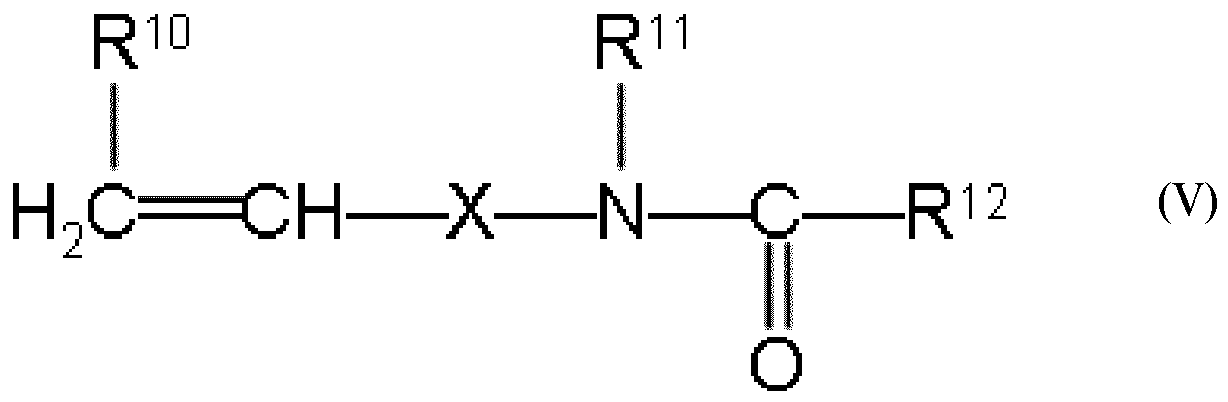
- R10
- Wasserstoff oder eine C1-bis C4-Alkylgruppe,
- R11
- Wasserstoff, eine C1-bis C8-Alkylgruppe oder eine Arylgruppe, insbesondere Phenyl,
- R12
- Wasserstoff, eine C1- bis C10-Alkylgruppe, eine C6-bis C12-Arylgruppe oder -OR13
- R13
- eine C1-bis C8-Alkylgruppe oder C6-bis C12-Arylgruppe, die gegebenenfalls mit O-oder N-haltigen Gruppen substituiert sein können,
- X
- eine chemische Bindung, eine C1-bis C10-Alkylengruppe, eine C6-bis C12-Arylengruppe oder
- Y
- für eine Gruppe O-Z oder NH-Z steht und
- Z
- für eine C1-bis C10-Alkylengruppe oder eine C6-bis C12-Arylengruppe steht.
- Auch die in der
EP 0 208 187 A2 beschriebenen Pfropfinonomeren sind zur Einführung reaktiver Gruppen an der Oberfläche geeignet. - Als weitere Beispiele seien noch Acrylamid, Methacrylamid und substituierte Ester der Acrylsäure oder Methacrylsäure wie (N-t-Butylamino)-ethylmethacrylat, (N,N-Dimethylamino)-ethylacrylat, (N, N-Dimethylamino)-methylacrylat und (N, N-Diethylamino)-ethylacrylat genannt.
- Weiterhin können die Teilchen der Kautschukphase auch vernetzt sein. Als Vernetzer wirkende Monomere sind bevorzugt Buta-1,3-dien, Divinylbenzol, Diallylphthalat und Dihydrodicyclopentadienylacrylat sowie die in der
EP 0 050 265 A1 beschriebenen Verbindungen einzusetzen. - Ferner können auch sogenannte pfropfvernetzende Monomere (graftlinking monomers) verwendet werden, d.h. Monomere mit zwei oder mehr polymerisierbaren Doppelbindungen, die bei der Polymerisation mit unterschiedlichen Geschwindigkeiten reagieren. Vorzugsweise werden solche Verbindungen verwendet, in denen mindestens eine reaktive Gruppe mit etwa gleicher Geschwindigkeit wie die übrigen Monomeren polymerisiert, während die andere reaktive Gruppe (oder reaktiven Gruppen) z. B. deutlich langsamer polymerisiert (polymerisieren). Die unterschiedlichen Polymerisationsgeschwindigkeiten bringen einen bestimmten Anteil an ungesättigten Doppelbindungen im Kautschuk mit sich. Wird anschließend auf einen solchen Kautschuk eine weitere Phase aufgepfropft, so reagieren die im Kautschuk vorhandenen Doppelbindungen zumindest teilweise mit den Pfropfmonomeren unter Ausbildung von chemischen Bindungen, d.h. die aufgepfropfte Phase ist zumindest teilweise über chemische Bindungen mit der Pfropfgrundlage verknüpft.
- Bevorzugte pfropfvemetzende Monomere sind Allylgruppen enthaltende Monomere, besonders bevorzugt Allylester von ethylenisch ungesättigten Carbonsäuren, insbesondere bevorzugt Allylacrylat, Allylmethacrylat, Diallylmaleat, Diallylfumarat, Diallylitaconat oder die entsprechenden Monoallylverbindungen dieser Dicarbonsäuren. Daneben gibt es eine Vielzahl weiterer geeigneter pfropfvemetzender Monomerer; für nähere Einzelheiten sei hier beispielsweise auf die
US-A 4148846 undUS-A 4 327 201 verwiesen. - Nachfolgend seien einige erfindungsgemäß bevorzugte Emulsionspolymerisate aufgeführt. Zunächst sind hier Pfropfpolymerisate mit einem Kem und mindestens einer äußeren Schale zu nennen, die folgenden Aufbau haben:
Tabelle 1 Typ Monomere für den Kern Monomere für die Hülle I Buta-1,3-dien, Isopren, Styrol, Acrylnitril, Methylmethacrylat n-Butylacrylat, Ethylhexylacrylat oder deren Mischungen Styrol, Acrylnitril, Methylmethacrylat II wie I, aber unter Mitverwendung von wie 1 Vernetzern III wie I oder II n-Butylacrylat, Ethylacrylat, Methylcrylat, Buta-1, 3-dien, Isopren, Ethylhexylacrylat IV wie I oder II wie I oder III, aber unter Mitverwendung von Monomeren mit reaktiven Gruppen wie hierin beschrieben V Styrol, Acrylnitril, Methylmethacrylat oder deren Mischungen erste Hülle aus Monomeren wie unter I und II für den Kern beschrieben zweite Hülle wie unter I oder IV für die Hülle beschrieben - Anstelle von Pfropfpolymerisaten mit einem mehrschaligen Aufbau können auch homogene, d. h. einschalige Elastomere aus Buta-1,3-dien, Isopren und n-Butylacrylat oder deren Copolymeren eingesetzt werden. Auch diese Produkte können durch Mitverwendung von vernetzenden Monomeren oder Monomeren mit reaktiven Gruppen hergestellt werden.
- Beispiele für bevorzugte Emulsionspolymerisate sind n-Butylacrylat/(Meth)acrylsäure-Copolymere, n-Butylacrylat/Glycidylacrylat- oder n-Butylacrylat/Glycidylmethacrylat-Copolymere, Pfropfpolymerisate mit einem inneren Kern aus n-Butylacrylat oder auf Butadienbasis und einer äußeren Hülle aus den vorstehend genannten Copolymeren und Copolymere von Ethylen mit Comonomeren, die reaktive Gruppen liefern.
- Die beschriebenen Elastomere können auch nach anderen üblichen Verfahren, bevorzugt durch Suspensionspolymerisation, hergestellt werden. Siliconkautschuke, wie in der
DE 3 725 576 A1 , derEP 0 235 690 A2 , derDE 3 800 603 A1 und derEP 0 319 290 A1 beschrieben, sind ebenfalls bevorzugt. - Selbstverständlich können auch Mischungen der vorstehend aufgeführten Kautschuktypen eingesetzt werden.
- Erfindungsgemäß insbesondere bevorzugt werden als Komponente B) Schlagzähmodifikatoren des EPM-, EPDM-und Acrylat-Typs eingesetzt.
- Als Komponente C) enthält die einzusetzende thermoplastische Formmasse di- oder mehrfunktionell verzweigend oder kettenverlängernd wirkende Additive enthaltend mindestens zwei und höchstens 15 verzweigend oder kettenverlängernd wirkende funktionelle Gruppen pro Molekül. Als verzweigend bzw. kettenverlängende Additive kommen niedermolekulare und oligomere Verbindungen in Frage, die über mindestens zwei und höchstens 15 verzweigend oder kettenverlängernd wirkende funktionelle Gruppen pro Molekül verfügen, welche mit primären und/oder sekundären Aminogruppen, und/oder Amidgruppen und/oder Carbonsäuregruppen reagieren können. Kettenverlängernd wirkende funktionelle Gruppen sind bevorzugt Isocyanate, blockierte Isocyanate, Epoxide, Maleinsäureanhydrid, Oxazoline, Oxazine, Oxazolone.
- Insbesondere bevorzugt sind Diepoxide auf Basis Diglycidylether (Bisphenol und Epichlorhydrin), auf Basis Aminepoxidharz (Anilin und Epichlorhydrin), auf Basis Diglycidylester (cycloaliphatische Dicarbonsäuren und Epichlorhydrin) einzeln oder in Mischungen sowie 2,2-Bis[p-hydroxy-phenyl]-propan-diglycidylether, Bis-[p-(N-methyl-N-2,3-epoxy-propylamino)-phenyl]-methan sowie epoxidierte Fettsäureester des Glycerins, enthaltend mindestens zwei und höchstens 15 Epoxidgruppen pro Molekül.
- Besonders bevorzugt sind Glycidylether, ganz besonders bevorzugt Bisphenol A-Diglycidylether und epoxidierte Fettsäureester des Glycerins, sowie auch ganz besonders bevorzugt epoxidiertes Sojaöl (CAS 8013-07-8).
- Epoxidiertes Sojaöl ist als Co-Stabilisator und Weichmacher für Polyvinylchlorid bekannt (Plastics Additives Handbook, 5th Edition, Hanser-Verlag, München, 2001, S.460-462). Es wird insbesondere in Polyvinylchlorid-Dichtungen von Metalldeckeln zum luftdichten Verschließen von Gläsern und Flaschen verwendet.
- Zur Verzweigung/Kettenverlängerung sind besonders bevorzugt geeignet:
- 1. Poly- bzw. Oligoglycidyl- oder Poly-(ß-methylglycidyl)-ether erhältlich durch Umsetzung einer Verbindung mit mindestens zwei freien alkoholischen Hydroxygruppen und/oder phenolischen Hydroxygruppen und einem geeignet substituierten Epichlorhydrin unter alkalischen Bedingungen, oder in Anwesenheit eines sauren Katalysators und anschließender Alkalibehandlung.
Poly- bzw. Oligoglycidyl- oder Poly-(ß-methylglycidyl)-ether leiten sich bevorzugt ab von acyclischen Alkoholen, wie Ethylenglykol, Diethylenglykol und höhereren Poly-(oxyethylen)-glykolen, Propan-1,2-diol, Poly-(oxypropylen)-glykolen, Propan-1,3-diol, Butan-1,4-diol, Poly-(oxytetramethylen)-glykolen, Pentan-1,5-diol, Hexan-1,6-diol, Hexan-2,4,6-triol, Glycerin, 1,1,1-Trimethylpropan, Bistrimethylolpropan, Pentaerythrit, Sorbit sowie von Polyepichlorhydrinen.
Sie leiten sich aber auch bevorzugt ab von cycloaliphatischen Alkoholen wie 1,3-oder 1,4-Dihydroxycyclohexan, Bis-(4-hydroxycyclohexyl)-methan, 2,2-Bis-(4-hydroxycyclohexyl)-propan oder 1,1-Bis-(hydroxymethyl)-cyclohex-3-en oder sie besitzen aromatische Kerne wie N,N-Bis-(2-hydroxyelhyl)anilin oder p,p'-Bis-(2-hydroxyethyl-amino)-diphenylmethan.
Die Epoxidverbindungen können sich bevorzugt auch von einkemigen Phenolen ableiten, insbesondere von Resorcin oder Hydrochinon; oder sie basieren auf mehrkernigen Phenolen insbesondere auf Bis-(4-hydroxyphenyl)-methan, 2,2-Bis-(4-hydroxyphenyl)-propan, 2,2-Bis-(3,5-dibrom-4-hydroxyphenyl)-propan, 4,4'-Dlhydroxydiphenylsulfon oder auf unter sauren Bedingungen erhaltene Kondensationsprodukte von Phenolen mit Formaldehyd wie Phenol-Novolake. - 2. Poly- bzw. Oligo-(N-glycidyl)-Verbindungen ferner erhältlich durch Dehydrochlorierung der Reaktionsprodukte von Epichlorhydrin mit Aminen, die mindestens zwei Aminowasserstoffatome enthalten. Bei diesen Aminen handelt es sich bevorzugt um Anilin, Toluidin, n-Butylamin, Bis-(4-aminophenyl)methan, m-Xylylendiamin oder Bis-(4-methylaminophenyl)-methan, aber auch N,N,O-Triglycidyl-m-aminophenyl oder N,N,O-Triglycidyl-p-aminophenol.
Zu den Poly-(N-glycidyl)-Verbindungen zählen aber auch bevorzugt N,N'-Diglycidylderivate von Cycloalkylenhamstoffen, besonders bevorzugt Ethylenharnstoff oder 1,3-Propylenhamstoff, und N,N'-Diglycidylderivate von Hydantoinen, insbesondere 5,5-Dimethylhydantoin. - 3. Poly- bzw. Oligo-(S-glycidyl)-Verbindungen insbesondere Di-S-glyci-dylderivate, die sich von Dithiolen, bevorzugt Ethan-1,2-dithiol oder Bis-(4-mercaptomethylphenyl)-ether ableiten.
- 4. Epoxidierte Fettsäureester des Glycerins, insbesondere epoxidierte Pflanzenöle. Sie werden durch Epoxidierung der reaktionsfähigen Olefingruppen von Triglyceriden ungesättigter Fettsäuren erhalten. Die Herstellung epoxidierter Fettsäureester des Glycerins kann ausgehend von ungesättigten Fettsäureestern des Glycerins, bevorzugt von Pflanzenölen, und organischen Peroxycarbonsäuren (Prileschajew-Reaktion) erfolgen. Verfahren zur Herstellung von epoxidierten Pflanzenölen sind zum Beispiel in Smith, March, March's Advanced Organic Chemistry (5. Auflage, Wiley-Interscience, New York, 2001) beschrieben. Bevorzugte epoxidierte Fettsäureester des Glycerins sind Pflanzenöle. Erfindungsgemäß besonders bevorzugter epoxidierter Fettsäureester des Glycerins ist epoxidiertes Sojaöl (CAS 8013-07-8).
- Die Komponente C) wird zu 0,01 bis 10 Gew.-Teilen, bevorzugt zu 0,1 bis 5 Gew.-Teilen, besonders bevorzugt zu 0,2 bis 4 Gew.-Teilen, ganz besonders bevorzugt zu 0,4 bis 3 Gew.-Teilen bezogen auf 100 Gew.-Teile Formmasse eingesetzt,
- Die einzusetzende thermoplastische Formmasse enthält zusätzlich zu den Kompoenten A), B) und C) noch Copolymerisate D) aus mindestens einem Olefin, bevorzugt α-Olefin und mindestens einem Methacrylsäureester oder Acrylsäureester eines aliphatischen Alkohols, wobei der MFI des Copolymerisats D) größer 10 g / 10 min ist, bevorzugt größer 150 g / 10 min und besonders bevorzugt größer 300 g / 10 min ist, enthalten. In einer bevorzugten Ausführungsform besteht das Copolymerisat D) zu weniger als 4 Gew.-Teilen, besonders bevorzugt zu weniger als 1,5 Gew.-Teilen und ganz besonders bevorzugt zu 0 Gew.-Teilen aus Monomerbausteinen, die weitere reaktive funktionelle Gruppen ausgewählt aus der Gruppe umfassend Epoxide, Oxetane, Anhydride, Imide, Aziridine, Furane, Säuren, Amine, Oxazoline enthalten.
- Geeignete Olefine, bevorzugt α-Olefine, als Bestandteil der Copolymerisate D) weisen bevorzugt zwischen 2 und 10 Kohlenstoff-Atomen auf und können unsubstituiert oder mit einer oder mehreren aliphatischen, cycloaliphatischen oder aromatischen Gruppen substituiert sein.
- Bevorzugte Olefine sind ausgewählt aus der Gruppe umfassend Ethen, Propen, 1-Buten, 1-Penten, 1-Hexen, 1-Octen, 3-Methyl-1-penten. Besonders bevorzugte Olefine sind Ethen und Propen, ganz besonders bevorzugt ist Ethen.
- Ebenfalls geeignet sind Mischungen der beschriebenen Olefine.
- In einer weiter bevorzugten Ausführungsform werden die weiteren reaktiven funktionellen Gruppen des Copolymerisates D), ausgewählt aus der Gruppe umfassend Epoxide, Oxetane, Anhydride, Imide, Aziridine, Furane, Säuren, Amine, Oxazoline, ausschließlich über die Olefine in das Copolymer D) eingebracht.
- Der Gehalt des Olefins am Copolymerisat D) liegt zwischen 50 und 90 Gew.-Teilen, bevorzugt zwischen 55 und 75 Gew.-Teilen.
- Das Copolymerisat D) wird weiterhin definiert durch den zweiten Bestandteil neben dem Olefin. Als zweiter Bestandteil werden Alkylester oder Arylalkylester der Acrylsäure eingesetzt, deren Alkyl- oder Arylalkylgruppe aus 1-30 Kohlenstoffatomen gebildet wird. Die Alkyl- oder Arylalkylgruppe kann dabei linear oder verzweigt sein sowie cycloaliphatische oder aromatische Gruppen enthalten, daneben auch durch eine oder mehrere Ether- oder Thioetherfunktionen substituiert sein. Geeignete Acrylsäureester in diesem Zusammenhang sind auch solche, die aus einer Alkoholkomponente synthetisiert wurden, die auf Oligoethylenglycol oder Oligopropylenglycol mit nur einer Hydroxylgruppe und maximal 30 C-Atomen basieren.
- Bevorzugt kann die Alkylgruppe oder Arylalkylgruppe des Acrylsäureesters ausgewählt sein aus der Gruppe umfassend Methyl, Ethyl, n-Propyl, iso-Propyl, n-Butyl, iso-Butyl, tert-Butyl, sec-Butyl, 1-Pentyl, 1-Hexyl, 2-Hexyl, 3-Hexyl, 1-Heptyl, 3-Heptyl, 1-Octyl, 1-(2-Ethyl)-hexyl, 1-Nonyl, 1-Decyl, 1-Dodecyl, 1-Lauryl oder 1-Octadecyl. Bevorzugt sind Alkylgruppen oder Arylalkylgruppen mit 6-20 Kohlenstoffatomen. Bevorzugt sind insbesondere auch verzweigte Alkylgruppen, die im Vergleich zu linearen Alkylgruppen gleicher Anzahl an Kohlenstoffatomen zu einer niedrigeren Glasübergangs-Temperatur TG führen.
- Besonders bevorzugt sind Copolymerisate D), bei denen das Olefin mit Acrylsäure-(2-ethyl)-hexylester copolymerisiert wird. Ebenfalls geeignet sind Mischungen der beschriebenen Acrylsäureester.
- Bevorzugt ist hierbei die Verwendung von mehr als 60 Gew.-Teilen, besonders bevorzugt mehr als 90 Gew.-Teilen und ganz besonders bevorzugt die Verwendung von 100 Gew.-Teilen Acrylsäure-(2-ethyl)-hexylester bezogen auf die Gesamtmenge an Acrylsäureester im Copolymerisat D).
- In einer weiteren bevorzugten Ausführungsform werden die weiteren reaktiven funktionellen Gruppen ausgewählt aus der Gruppe umfassend Epoxide, Oxetane, Anhydride, Imide, Aziridine, Furane, Säuren, Amine, Oxazoline des Copolymerisates D) ausschließlich über die Acrylsäureester in das Copolymer (D) eingebracht.
- Der Gehalt der Acrylsäureester am Copolymerisat D) liegt zwischen 10 und 50 Gew.-Teilen, bevorzugt zwischen 25 und 45 Gew.-Teilen.
- Die Komponente D) wird zu 0,01 bis 10 Gew.-Teilen, bevorzugt zu 1 bis 8 Gew.-Teilen, besonders bevorzugt zu 2 bis 6 Gew.-Teilen bezogen auf 100 Gew.-Teile Formmasse eingesetzt
- In einer bevorzugten Ausführungsform können die einzusetzenden thermoplastischen Formmassen zusätzlich noch E) Ruß und/oder Nigrosin enthalten. Der Gehalt Ruß und/oder Nigrosin beträgt 0,01 bis 5 Gew.-Teile, bevorzugt 0,1 bis 4 Gew.-Teile bezogen auf 100 Gew. Teile Formmasse.
- In einer alternativen Ausführungsform oder in einer bevorzugten Ausführungsform können die einzusetzenden thermoplastischen Formmassen anstelle von E) und/oder zusätzlich zu E) von den vorgenannten Komponenten sich unterscheidende Additive F) enthalten.
- Bevorzugte Additive F) im Sinne der vorliegenden Erfindung sind Stabilisatoren, Antistatika, Brandtschutzadditive, Entformungsmittel, Nukleierungsmittel, Gleitmittel, oder Additive zur Erhöhung der elektrischen Leitfähigkeiten. Die genannten und weitere geeignete Additive sind zum Beispiel beschrieben in Gächter, Müller, Kunststoff-Additive, 3. Ausgabe, Hanser-Verlag, München, Wien, 1989 und im Plastics Additives Handbook, 5th Edition, Hanser-Verlag, München, 2001. Die Additive F) können alleine oder in Mischung bzw. in Form von Masterbatchen eingesetzt werden.
- Erfindungsgemäß einzusetzende, sich von den vorgenannten Komponenten B) bis E) unterscheidende Additive F) werden zu 0,01 bis 5 Gew.-Teilen, bevorzugt zu 0,1 bis 4 Gew.-Teilen bezogen auf 100 Gew. Teile Formmasse eingesetzt.
- Besonders bevorzugte Stabilisatoren sind Thermostabilisatoren und UV-Stabilisatoren. Als Stabilisatoren werden bevorzugt Kupferhalogenide, bevorzugt Chloride, Bromide, Jodide in Verbindung mit Halogeniden von Alkalimetallen, bevorzugt Natrium-, Kalium und/oder Lithiumhalogenide, und/oder in Verbindung mit hypophosphoriger Säure oder eines Alkali-oder Erdalkalisalzes dieser Säure, sowie sterisch gehinderte Phenole, Hydrochinone, Phosphite, aromatische sekundäre Amine wie Diphenylamine, substituierte Resorcine, Salicylate, Benzotriazole oder Benzophenone, sowie verschieden substituierte Vertreter dieser Gruppen oder deren Mischungen eingesetzt.
- Ganz besonders bevorzugte Stabilisatoren sind Gemische aus einem Kupferjodid, einer oder mehreren Halogenverbindungen, vorzugsweise Natrium-oder Kaliumjodid, und hypophosphoriger Säure oder eines Alkali- oder Erdalkalisalzes dieser Säure, wobei die einzelnen Komponenten des Stabilisatorgemisches in einer solchen Menge zugesetzt werden, dass die in der Formmasse enthaltene molare Menge an Halogen größer oder gleich der sechsfachen molaren Menge und kleiner oder gleich der fünfzehnfachen, vorzugsweise zwölffachen, molaren Mengen des in der Formmasse enthaltenen Kupfers und die molare Menge an Phosphor größer oder gleich der molaren Menge und kleiner oder gleich der zehnfachen, vorzugsweise fünffachen molaren Menge des in der Formmasse enthaltenen Kupfers beträgt.
- Als Nukleierungsmittel können bevorzugt Natrium- oder Calciumphenylphosphinat, Aluminiumoxid, Siliziumdioxid sowie bevorzugt Talkum eingesetzt werden.
- Als Gleit- und Entformungsmittel können bevorzugt Esterwachse, Pentaerytritoltetrastearat (PETS), langkettige Fettsäuren, bevorzugt Stearinsäure oder Behensäure und Ester, deren Salze, bevorzugt Ca- oder Zn-Stearat, sowie Amidderivate, bevorzugt Ethylen-bis-stearylamid oder Montanwachse, bevorzugt Mischungen aus geradkettigen, gesättigten Carbonsäuren mit Kettenlängen von 28 bis 32 C-Atomen sowie niedermolekulare Polyethylen- bzw. Polypropylenwachse eingesetzt werden.
- Als Additive zur Erhöhung der elektrischen Leitfähigkeit können bevorzugt Ruße, Leitfähigkeitsruße, Graphit sowie andere übliche, nicht faserige Additive zur Erhöhung der elektrischen Leitfähigkeit zugesetzt werden.
- Die Gastanks werden durch Extrusions- oder Blasformverfahren aus den einzusetzenden, unverstärkten thermoplastischen Formmassen hergestellt oder innen ausgekleidet.
- Zu nutzende Verfahren zur Herstellung von Gastanks, bevorzugt von Gastank-Innenhüllen, durch Blasformen oder Spritzguss arbeiten bei Schmelzetemperaturen im Bereich von 230 bis 330°C, bevorzugt von 250 bis 300°C sowie gegebenenfalls zusätzlich bei Drücken von maximal 2500 bar, bevorzugt bei Drücken von maximal 2000 bar, besonders bevorzugt bei Drücken von maximal 1500 bar und ganz besonders bevorzugt bei Drücken von maximal 750 bar.
- Das Verfahren des Spritzgusses zeichnet sich dadurch aus, dass der in der vorliegenden Erfindung als unverstärkte thermoplastische Formmasse einzusetzende Rohstoff, bevorzugt in Granulatform, in einem beheizten zylindrischen Hohlraum aufgeschmolzen (plastifiziert) und als Spritzmasse unter Druck in einem temperierten Hohlraum gespritzt wird. Nach dem Abkühlen (Erstarren) der Masse wird das Spritzgussteil entformt.
-
- 1. Plastifizieren / Aufschmelzen
- 2. Einspritzphase (Füllvorgang)
- 3. Nachdruckphase (wegen thermischer Kontraktion bei der Kristallisation)
- 4. Entformen.
- Eine Spritzgießmaschine besteht aus einer Schließeinheit, der Spritzeinheit, dem Antrieb und der Steuerung. Zur Schließeinheit gehören feste und bewegliche Aufspannplatten für das Werkzeug, eine Stirnplatte sowie Säulen und Antrieb der beweglichen Werkzeugaufspannplatte. (Kniehebelgelenk oder hydraulische Schließeinheit).
- Eine Spritzeinheit umfasst den elektrisch beheizbaren Zylinder, den Antrieb der Schnecke (Motor, Getriebe) und die Hydraulik zum Verschieben der Schnecke und Spritzeinheit. Die Aufgabe der Spritzeinheit besteht darin, das Pulver bzw. das Granulat aufzuschmelzen, zu dosieren, einzuspritzen und nachzudrücken (wegen Kontraktion). Das Problem des Rückflusses der Schmelze innerhalb der Schnecke (Leckströmung) wird durch Rückstromsperren gelöst.
- Im Spritzgießwerkzeug wird dann die einströmende Schmelze gelöst, gekühlt und somit das zu fertigende Bauteil gefertigt. Notwendig dazu sind immer zwei Werkzeughälften. Beim Spritzguss unterscheidet man folgende Funktionskomplexe:
- Angusssystem
- Formbildende Einsätze
- Entlüftung
- Maschinen- und Kraftaufnahme
- Entformungssystem und Bewegungsübertragung
- Temperierung
- Blasformverfahren im Sinne der vorliegenden Erfindung sind bevorzugt Standard-Extrusionsblasformen, 3D-Extrusionsblasformen, Saugblasformverfahren und die sequentielle Coextrusion. Blasformverfahren finden bei Scherraten < 1000 s-1 statt.
- Die grundsätzlichen Verfahrensschritte des Standard-Extrusionsblasformens sind gemäß (Thielen, Hartwig, Gust, "Blasformen von Kunststoffhohlkörpern", Carl Hanser Verlag, München 2006, Seiten 15 bis 17):
- 1. Plastifizieren und Bereitstellen der thermoplastischen Schmelze in einem Extruder,
- 2. Umlenken der Schmelze in eine senkrechte Fließbewegung nach unten und das Ausformen eines schlauchförmigen Schmelze-"Vorformlings",
- 3. Umschließen des frei unter dem Kopf hängenden Vorformlings durch eine in der Regel aus zwei Halbschalen bestehenden Form, dem Blasformwerkzeug,
- 4. Einschieben eines Blasdoms oder einer (ggf. mehrer) Blasnadel(n),
- 5. Aufblasen des plastischen Vorformlings gegen die gekühlte Wand des Blasformwerkzeugs, wo der Kunststoff abkühlt, erhärtet und die endgültige Form des Formteils annimmt,
- 6. Öffnen der Form und Entformen des blasgeformten Teils,
- 7. Entfernen der abgequetschten "Butzen"-Abfälle" an beiden Enden des Blasformteils.
- Weitere Schritte der Nachbearbeitung können folgen.
- Mittels Standard-Extrusionsblasformen lassen sich auch Bauteile mit komplexer Geometrie und mehrachsigen Krummungen herstellen. Allerdings werden dann Formteile erhalten, die einen großen Anteil von überschüssigem, abgequetschtem Material enthalten und in großen Bereichen eine Schweißnaht aufweisen.
- Beim 3D-Extrusionsblasformen, auch als 3D-Blasformen bezeichnet, wird daher zur Vermeidung von Schweißnähten und zur Reduktion des Materialeinsatzes ein in seinem Durchmesser auf den Artikelquerschnitt angepasster Vorformling mit speziellen Vorrichtungen deformiert und manipuliert und dann direkt in die Blasformkavität eingebracht. Die verbleibende Quetschkante wird somit auf ein Minimum an den Artikelenden reduziert (Thielen, Hartwig, Gust, "Blasformen von Kunststoffhohlkörpem", Carl Hanser Verlag, München 2006, Seite 117-122).
- Beim Saugblasformverfahren, auch als Saugblasen bezeichnet, wird der Vorformling direkt aus der Düse des Schlauchkopfes in die geschlossene Blasform gefördert und über einen Luftstrom durch die Blasform hindurch"gesaugt". Nach Austritt des unteren Endes des Vorformlings aus der Blasform wird dieser durch Schließelemente oben und unten abgequetscht, und der Aufblas- und Kühlvorgang schließen sich an (Thielen, Hartwig, Gust, "Blasformen von Kunststoffhohlkörpern", Carl Hanser Verlag, München 2006, Seite 123).
- Bei der sequentiellen Coextrusion werden zwei unterschiedliche Materialien in alternierender Folge hintereinander ausgestoßen. Auf diese Weise entsteht ein Vorformling mit in Extrusionsrichtung abschnittsweise unterschiedlicher Materialzusammensetzung. Es können bestimmte Artikelabschnitte durch entsprechende Materialauswahl mit spezifisch erforderlichen Eigenschaften ausgestattet werden, beispielsweise für Artikel mit weichen Enden und hartem Mittelteil oder integrierten weichen Faltenbalg-Bereichen (Thielen, Hartwig, Gust, "Blasformen von Kunststoffhohlkörpern", Carl Hanser Verlag, München 2006, Seite 127-129).
- Polyamide mit mittlerer und normaler Schmelzeviskosität, also Produkte mit einer relativen Viskosität η rel ≈ 3,0 (gemessen in 1 %iger Lösung von Polyamid in meta-Kresol bei 25°C) eignen sich nicht für den erfindungsgemäßen Einsatz beim Extrusionsblasformen, da sich die extrudierten Vorformlinge unter ihrem Eigengewicht zu stark auslängen. Für die Verarbeitung mittels Extrusionsblasformen wird daher eine möglichst hohe Schmelzeviskosität im Bereich niedriger Scherraten benötigt. Erfindungsgemäß bevorzugte Polyamide für das Extrusionsblasformen sind entweder hochmolekulare, verzweigte Polyamide oder vernetzte Polyamide. Es handelt sich dabei um Polyamide mit nicht-Newtonschem Fließverhalten, die einen Anstieg der Schmelzeviskosität mit abnehmender Scherkraft zeigen. Dieses Phänomen wird auch als Strukturviskosität bezeichnet. Eine newtonsche Flüssigkeit (nach Isaac Newton) ist eine Flüssigkeit deren Scherspannung (auch Schubspannung) τ proportional zur Verzerrungsgeschwindigkeit (besser Schergeschwindigkeit) d u/d y ist:

- Hierbei ist u die Strömungsgeschwindigkeit parallel zur Wand und y die Ortskoordinate normal zur Wand. Die Proportionalitätskonstante η wird auch als dynamische Viskosität bezeichnet. Newtonsche Fluide sind z.B. Wasser, viele Öle und Gase. Die Bewegung der newtonschen Fluide wird durch die Gleichungen von Navier-Stokes beschrieben.
- Erfindungsgemäß zur Lagerung in den erfindungsgemäß herzustellenden Gastanks vorgesehene Gase sind Edelgase, Erdgas, Flüssiggas, Autogas, C1-C4-Kohlenwasserstoffe, bevorzugt Methan, Ethan, Propan oder Butan, sowie Stickstoff, Schwefelwasserstoff, Wasserstoff oder sonstige in der Industrie genutzte Gase wie Ammoniak oder Schwefelwasserstoff. Da die Anwendung der Gastanks in Kraftfahrzeugen bevorzugt ist, ist die Lagerung von Erdgas, Flüssiggas, Autogas oder der C1-C4-Kohlenwasserstoffe erfindungsgemäß bevorzugt. Neben den oben genannten Fahrzeugen sind aber auch Lagertanks oder Transporttanks für die genannten Gase vom Umfang der vorliegenden Erfindung mit umfasst, die nicht zum Antrieb von Fahrzeugen dienen.
- Die erfindungsgemäß einzusetzende thermoplastische Formmasse erfüllt folgende Parameter:
- ● Hohe Schlagzähigkeit, insbesondere auch bei tiefer Temperatur
- ● Geringe Permeabilität gegenüber Kraftstoffen, insbesondere Kohlenwasserstoffen
- ● Hohe Schmelzeviskosität (Verarbeitung mittels Extrusionsblasformen)
- Die vorliegende Erfindung betrifft aber auch ein Verfahren zur Vergleichmäßigung der Belastung des innenliegenden Kunststoffinliners in Druckbehältern bzw. zur Reduktion von auftretenden Spannungen, dadurch gekennzeichnet, dass der Inliner mit einer äußeren Verstärkungsschicht, bevorzugt aus einem faserverstärkten Material, besonders bevorzugt aus Kohle- und/oder Glasfasern, oder Metall, bevorzugt als flächiges Blech oder als Metallgerüst als Außenhülle versehen ist, wobei der Inliner im Übergangsbereich zwischen dem zylindrischen Behälterbereich und den Endbereichen bzw. Kappen Fixierungselemente aufweist.
- Zur Klarstellung sei angemerkt, dass vom Rahmen der Erfindung alle vorstehend aufgeführten, allgemeinen oder in Vorzugsbereichen genannten Definitionen und Parameter in beliebigen Kombinationen umfasst sind.
- Die vorliegende Erfindung sei anhand der
Fig. 1 für einen Druckbehälter mit umlaufender Rippe und anhandFig. 2 für einen Druckbehälter mit segmentierter Rippe dargestellt.. Beispielhaft sind inFig. 1 zwei verschiedene Rippenformen als Schnitt AA dargestellt. Weitere Rippenformen sind jedoch möglich.

Claims (12)
- Zylindrische Druckbehälter, dadurch gekennzeichnet, dass dieser einen innenliegenden Kunststoffliner aufweist, der mit einer äußeren Verstärkungsschicht als Außenhülle versehen ist, wobei der innenliegende Kunststoffliner im Übergangsbereich zwischen dem zylindrischen Behälterbereich und den Endbereichen bzw. Kappen Fixierungselemente aufweist.
- Zylindrische Druckbehälter gemäß Anspruch 1, dadurch gekennzeichnet, dass die äußere Verstärkungsschicht aus einem faserverstärkten Material oder Metall gefertigt ist.
- Zylindrische Druckbehälter gemäß Anspruch 2, dadurch gekennzeichnet, dass als faserverstärktes Material Kohle- und/oder Glasfasern eingesetzt werden.
- Zylindrische Druckbehälter gemäß Anspruch 2, dadurch gekennzeichnet, dass als Metall flächiges Blech oder ein Metallgerüst eingesetzt wird.
- Zylindrische Druckbehälter gemäß der Ansprüche 1 bis 4, dadurch gekennzeichnet, dass die Fixierungselemente als am Umfang umlaufende Rippen oder segmentierte Rippen ausgeführt werden die durch Ihre Form einen Formschluss mit der äußeren Verstärkungsschicht aufweisen.
- Zylindrische Druckbehälter gemäß einem der Ansprüche 1 bis 5, dadurch gekennzeichnet, dass die Anzahl der Fixierungselemente bei mindestens zwei, d.h. mindestens einem an jedem Übergang des zylindrischen Teils zu einer Endkappe, liegt.
- Zylindrischer Druckbehälter gemäß Anspruch 6, dadurch gekennzeichnet, dass je nach Länge des Druckbehälters mehr als zwei Fixierungselemente notwendig werden.
- Zylindrischer Druckbehälter gemäß der Ansprüche 1 bis 7, dadurch gekennzeichnet, dass der innenliegende Kunststoffliner segmentiert ist und die Endbereiche bzw. Endkappen mit dem zylindrischen Bereich via Schweiß- oder Klebetechnik verbunden sind.
- Zylindrischer Druckbehälter gemäß der Ansprüche 1 bis 8 dadurch gekennzeichnet, dass der innenliegende Kunststoffinliner wenigstens einen Thermoplast umfasst, bevorzugt wenigstens ein Thermoplast der Reihe Polyolefine, Polyamide, Polyimide, Polyether, Polyester, Polyphenylensulfid (PPS), Polycarbonate und/oder Polyalkylene oder eine Kombination verschiedener Thermoplaste eingesetzt wird.
- Verwendung der zylindrischen Druckbehälter gemäß der Ansprüche 1 bis 9 zur Speicherung von Gas für Gas-betriebene oder Gas-transportierende Fahrzeuge, bevorzugt Kraftfahrzeugen, Tankwagen, Kesselwagen, Eisenbahncontainern oder Wechselcontainern.
- Verfahren zur Vergleichmäßigung der Belastung des innenliegenden Kunststoffinliners in zylindrischen Druckbehältern bzw. zur Reduktion von auftretenden Spannungen, dadurch gekennzeichnet, dass der Inliner mit einer äußeren Verstärkungsschicht, bevorzugt aus einem faserverstärkten Material, besonders bevorzugt aus Kohle- und/oder Glasfasern, oder Metall, bevorzugt als flächiges Blech oder als Metallgerüst als Außenhülle versehen ist, wobei der Inliner im Übergangsbereich zwischen dem zylindrischen Behälterbereich und den Endbereichen bzw. Kappen Fixierungselemente aufweist.
- Verfahren zur Herstellung von zylindrischen Druckbehältern dadurch gekennzeichnet, dass innenliegende Kunststoffliner, die im Übergangsbereich zwischen dem zylindrischen Behälterbereich und den Endbereichen bzw. Kappen Fixierungselemente aufweisen über gängige Kunststoffverarbeitungsverfahren, besonders bevorzugt über das Extrusionsblasformen, durch geeignete Blaswerkzeuggestaltung realisiert werden oder über das Segmentieren des Liners in den zylindrischen Bereich und 2 Endbereiche (Endkappen) realisiert werden.
Priority Applications (1)
| Application Number | Priority Date | Filing Date | Title |
|---|---|---|---|
| EP12155440.6A EP2628994A1 (de) | 2012-02-14 | 2012-02-14 | Kunststoffliner mit Fixierungselementen für Druckbehälter |
Applications Claiming Priority (1)
| Application Number | Priority Date | Filing Date | Title |
|---|---|---|---|
| EP12155440.6A EP2628994A1 (de) | 2012-02-14 | 2012-02-14 | Kunststoffliner mit Fixierungselementen für Druckbehälter |
Publications (1)
| Publication Number | Publication Date |
|---|---|
| EP2628994A1 true EP2628994A1 (de) | 2013-08-21 |
Family
ID=45655759
Family Applications (1)
| Application Number | Title | Priority Date | Filing Date |
|---|---|---|---|
| EP12155440.6A Withdrawn EP2628994A1 (de) | 2012-02-14 | 2012-02-14 | Kunststoffliner mit Fixierungselementen für Druckbehälter |
Country Status (1)
| Country | Link |
|---|---|
| EP (1) | EP2628994A1 (de) |
Cited By (5)
| Publication number | Priority date | Publication date | Assignee | Title |
|---|---|---|---|---|
| DE102014116951A1 (de) * | 2014-11-19 | 2016-05-19 | Thyssenkrupp Ag | Druckbehälter und Verfahren zum Fertigen eines Druckbehälters |
| WO2017060829A1 (en) * | 2015-10-07 | 2017-04-13 | University Of Cape Town | A pressure vessel |
| DE102017205190A1 (de) * | 2017-03-28 | 2018-10-04 | Bayerische Motoren Werke Aktiengesellschaft | Druckbehälter mit brennstoffundurchlässigen Liner |
| AT16441U1 (de) * | 2015-09-14 | 2019-10-15 | Konstantin Vladimirovich Sorokin | Gaszylinder |
| CN117730223A (zh) * | 2021-07-28 | 2024-03-19 | 宝马股份公司 | 压力容器、压力容器系统、机动车以及构造肋状部的方法 |
Citations (22)
| Publication number | Priority date | Publication date | Assignee | Title |
|---|---|---|---|---|
| FR1272354A (fr) * | 1959-10-30 | 1961-09-22 | Minnesota Mining & Mfg | Récipient résistant à la pression pour fluide comprimé |
| FR2305656A1 (fr) * | 1975-03-24 | 1976-10-22 | Amalga Corp | Recipient sous pression avec doublage |
| US4148846A (en) | 1970-09-10 | 1979-04-10 | Rohm And Haas Company | Acrylic modifiers for polycarbonamides |
| US4327201A (en) | 1980-10-22 | 1982-04-27 | The University Of Akron | Cationically polymerizable macromolecular monomers and graft copolymers therefrom |
| EP0050265A1 (de) | 1980-10-16 | 1982-04-28 | Bayer Ag | Thermoplastische Polyester-Formmassen mit verbesserter Zähigkeit |
| DE8619754U1 (de) * | 1986-07-23 | 1986-09-11 | Felten & Guilleaume Energietechnik AG, 5000 Köln | Druckgasflasche mit Bandage |
| US4619374A (en) * | 1984-05-21 | 1986-10-28 | Ecodyne Corporation | Pressure vessel with an improved sidewall structure |
| EP0208187A2 (de) | 1985-07-06 | 1987-01-14 | Bayer Ag | Neue Pfropfpolymerisate und deren Abmischungen mit Polyamiden |
| EP0235690A2 (de) | 1986-03-04 | 1987-09-09 | Bayer Ag | Pfropfpolymerisate auf Kautschukpolymeren mit blockartiger Struktur |
| DE3725576A1 (de) | 1987-08-01 | 1989-02-09 | Bayer Ag | Formmassen aus aromatischem polyester und gepfropftem silikonkautschuk |
| EP0319290A2 (de) | 1987-12-04 | 1989-06-07 | Polyplastics Co. Ltd. | Harzzusammensetzung |
| DE3800603A1 (de) | 1988-01-12 | 1989-07-20 | Bayer Ag | Formmassen aus aromatischen polyestern, vinyl-copolymerisaten und gepfropftem siliconkautschuk |
| EP0810081A1 (de) | 1995-12-04 | 1997-12-03 | Toray Industries, Inc. | Druckbehälter und verfahren zu seiner herstellung |
| US5758796A (en) * | 1995-07-25 | 1998-06-02 | Toyoda Gosei Co., Ltd. | Pressure vessel |
| WO2001066643A1 (de) | 2000-03-09 | 2001-09-13 | Bayer Aktiengesellschaft | HOCHVISKOSES POLYAMID FüR EXTRUSIONSBLASFORMEN |
| EP1260755A1 (de) | 2001-04-27 | 2002-11-27 | Schwingenschlögel Gesellschaft m.b.H. | Tank und Tanksattelauflieger |
| EP1333060A1 (de) | 2002-01-31 | 2003-08-06 | Bayer Aktiengesellschaft | Schlagzäh-modifizierte Polyamidformmassen mit erhöhter Schmelzeviskosität und verbesserter Oberflächenqualität |
| EP1538110A2 (de) | 2003-12-05 | 2005-06-08 | Unitank Betriebs-und Verwaltungs-GmbH | Verfahren und Behälter zur Lagerung von Flüssigkeiten |
| WO2007074098A1 (de) | 2005-12-23 | 2007-07-05 | Robert Bosch Gmbh | Fahrzeug mit einem gastank |
| US20090095796A1 (en) * | 2007-10-16 | 2009-04-16 | Amit Prakash | Wire wrapped pressure vessels |
| US8053523B2 (en) | 2008-02-12 | 2011-11-08 | Ube Industries, Ltd. | Hydrogen tank liner material and hydrogen tank liner |
| DE202010017414U1 (de) | 2010-11-30 | 2011-11-22 | Lanxess Deutschland Gmbh | Gastank |
-
2012
- 2012-02-14 EP EP12155440.6A patent/EP2628994A1/de not_active Withdrawn
Patent Citations (22)
| Publication number | Priority date | Publication date | Assignee | Title |
|---|---|---|---|---|
| FR1272354A (fr) * | 1959-10-30 | 1961-09-22 | Minnesota Mining & Mfg | Récipient résistant à la pression pour fluide comprimé |
| US4148846A (en) | 1970-09-10 | 1979-04-10 | Rohm And Haas Company | Acrylic modifiers for polycarbonamides |
| FR2305656A1 (fr) * | 1975-03-24 | 1976-10-22 | Amalga Corp | Recipient sous pression avec doublage |
| EP0050265A1 (de) | 1980-10-16 | 1982-04-28 | Bayer Ag | Thermoplastische Polyester-Formmassen mit verbesserter Zähigkeit |
| US4327201A (en) | 1980-10-22 | 1982-04-27 | The University Of Akron | Cationically polymerizable macromolecular monomers and graft copolymers therefrom |
| US4619374A (en) * | 1984-05-21 | 1986-10-28 | Ecodyne Corporation | Pressure vessel with an improved sidewall structure |
| EP0208187A2 (de) | 1985-07-06 | 1987-01-14 | Bayer Ag | Neue Pfropfpolymerisate und deren Abmischungen mit Polyamiden |
| EP0235690A2 (de) | 1986-03-04 | 1987-09-09 | Bayer Ag | Pfropfpolymerisate auf Kautschukpolymeren mit blockartiger Struktur |
| DE8619754U1 (de) * | 1986-07-23 | 1986-09-11 | Felten & Guilleaume Energietechnik AG, 5000 Köln | Druckgasflasche mit Bandage |
| DE3725576A1 (de) | 1987-08-01 | 1989-02-09 | Bayer Ag | Formmassen aus aromatischem polyester und gepfropftem silikonkautschuk |
| EP0319290A2 (de) | 1987-12-04 | 1989-06-07 | Polyplastics Co. Ltd. | Harzzusammensetzung |
| DE3800603A1 (de) | 1988-01-12 | 1989-07-20 | Bayer Ag | Formmassen aus aromatischen polyestern, vinyl-copolymerisaten und gepfropftem siliconkautschuk |
| US5758796A (en) * | 1995-07-25 | 1998-06-02 | Toyoda Gosei Co., Ltd. | Pressure vessel |
| EP0810081A1 (de) | 1995-12-04 | 1997-12-03 | Toray Industries, Inc. | Druckbehälter und verfahren zu seiner herstellung |
| WO2001066643A1 (de) | 2000-03-09 | 2001-09-13 | Bayer Aktiengesellschaft | HOCHVISKOSES POLYAMID FüR EXTRUSIONSBLASFORMEN |
| EP1260755A1 (de) | 2001-04-27 | 2002-11-27 | Schwingenschlögel Gesellschaft m.b.H. | Tank und Tanksattelauflieger |
| EP1333060A1 (de) | 2002-01-31 | 2003-08-06 | Bayer Aktiengesellschaft | Schlagzäh-modifizierte Polyamidformmassen mit erhöhter Schmelzeviskosität und verbesserter Oberflächenqualität |
| EP1538110A2 (de) | 2003-12-05 | 2005-06-08 | Unitank Betriebs-und Verwaltungs-GmbH | Verfahren und Behälter zur Lagerung von Flüssigkeiten |
| WO2007074098A1 (de) | 2005-12-23 | 2007-07-05 | Robert Bosch Gmbh | Fahrzeug mit einem gastank |
| US20090095796A1 (en) * | 2007-10-16 | 2009-04-16 | Amit Prakash | Wire wrapped pressure vessels |
| US8053523B2 (en) | 2008-02-12 | 2011-11-08 | Ube Industries, Ltd. | Hydrogen tank liner material and hydrogen tank liner |
| DE202010017414U1 (de) | 2010-11-30 | 2011-11-22 | Lanxess Deutschland Gmbh | Gastank |
Non-Patent Citations (10)
| Title |
|---|
| "Plastics Additives Handbook", 2001, HANSER-VERLAG |
| "Plastics Additives Handbook", 2001, HANSER-VERLAG, pages: 460 - 462 |
| C. B. BUCKNALL: "Toughened Plastics", 1977, APPLIED SCIENCE PUBLISHERS |
| GÄCHTER, MÜLLER: "Kunststoff-Additive", 1989, HANSER-VERLAG |
| HOUBEN-WEYL: "Methoden der organischen Chemie", vol. 14/1, 1961, GEORG-THIEME-VERLAG, pages: 392 - 406 |
| SMITH, MARCH: "March's Advanced Organic Chemistry", 2001, WILEY-INTERSCIENCE |
| THIELEN; HARTWIG; GUST: "Blasformen von Kunststoffhohlkörpem", 2006, CARL HANSER VERLAG, pages: 123 |
| THIELEN; HARTWIG; GUST: "Blasformen von Kunststoffhohlkörpem", 2006, CARL HANSER VERLAG, pages: 127 - 129 |
| THIELEN; HARTWIG; GUST: "Blasformen von Kunststoffhohlkörpem", 2006, CARL HANSER VERLAG, pages: 15 - 17 |
| THIELEN; HARTWIG; GUST: "Blasformen von Kunststoffhohlkörpern", 2006, CARL HANSER VERLAG, pages: 117 - 122 |
Cited By (5)
| Publication number | Priority date | Publication date | Assignee | Title |
|---|---|---|---|---|
| DE102014116951A1 (de) * | 2014-11-19 | 2016-05-19 | Thyssenkrupp Ag | Druckbehälter und Verfahren zum Fertigen eines Druckbehälters |
| AT16441U1 (de) * | 2015-09-14 | 2019-10-15 | Konstantin Vladimirovich Sorokin | Gaszylinder |
| WO2017060829A1 (en) * | 2015-10-07 | 2017-04-13 | University Of Cape Town | A pressure vessel |
| DE102017205190A1 (de) * | 2017-03-28 | 2018-10-04 | Bayerische Motoren Werke Aktiengesellschaft | Druckbehälter mit brennstoffundurchlässigen Liner |
| CN117730223A (zh) * | 2021-07-28 | 2024-03-19 | 宝马股份公司 | 压力容器、压力容器系统、机动车以及构造肋状部的方法 |
Similar Documents
| Publication | Publication Date | Title |
|---|---|---|
| EP2562219B1 (de) | Thermoplastische formmassen mit erhöhter hydrolyse-beständigkeit | |
| EP1217041B1 (de) | Formmasse mit guter Blasformbarkeit | |
| EP1771298B1 (de) | Kühlmittelleitung | |
| CN104629070A (zh) | 汽车、用于汽车的防撞结构件及防撞结构件的制造方法 | |
| EP2457952A1 (de) | Gastank | |
| EP2443379B1 (de) | Speicher zur aufnahme eines fluids | |
| DE202010017414U1 (de) | Gastank | |
| CN101759898A (zh) | 玻璃纤维合成轨枕及其制造方法 | |
| US12179399B2 (en) | Hollow-profile composite technology | |
| EP2481776A1 (de) | Verwendung von Formmassen | |
| KR20180101203A (ko) | 중공 프로파일 복합체 기술 | |
| JP2020117637A (ja) | 高圧水素に触れる成形品用のポリアミド樹脂組成物およびそれを用いた成形品 | |
| EP2439068A1 (de) | Mehrschichtiges thermoplastisches Faser-Matrix-Halbzeug | |
| CN1958274A (zh) | 一种超高分子量聚乙烯公路护栏材料及其制造方法 | |
| TW201802188A (zh) | 含浸樹脂之纖維束、壓縮成形品及其製造方法 | |
| EP2415575A1 (de) | Geschlossene spritzgegossene Leichtbaugitterstruktur | |
| JP2005324733A (ja) | 長繊維強化ポリアミド樹脂製自動車車体前部構造体 | |
| CN211764909U (zh) | 一种设置有功能槽的支撑杆 | |
| JP2022531783A (ja) | ポリアミド組成物およびそれを含む管状またはパイプ多層構造 | |
| US20130289147A1 (en) | Thermoplastic moulding compounds with increased melt stability | |
| KR102360985B1 (ko) | 장섬유 강화 열가소성 수지 조성물 및 이를 이용하여 제조된 성형품 | |
| DE1950662A1 (de) | Kraftstoffbehaelter aus thermoplastischem Kunststoff | |
| DE112022003678T5 (de) | Mehrschichtschlauch | |
| EP2906634B1 (de) | Mischungen für polyamid-basierte formmassen | |
| CN204894480U (zh) | 一种柴油机油箱吹塑模具 |
Legal Events
| Date | Code | Title | Description |
|---|---|---|---|
| PUAI | Public reference made under article 153(3) epc to a published international application that has entered the european phase |
Free format text: ORIGINAL CODE: 0009012 |
|
| AK | Designated contracting states |
Kind code of ref document: A1 Designated state(s): AL AT BE BG CH CY CZ DE DK EE ES FI FR GB GR HR HU IE IS IT LI LT LU LV MC MK MT NL NO PL PT RO RS SE SI SK SM TR |
|
| AX | Request for extension of the european patent |
Extension state: BA ME |
|
| RAP1 | Party data changed (applicant data changed or rights of an application transferred) |
Owner name: LANXESS DEUTSCHLAND GMBH |
|
| STAA | Information on the status of an ep patent application or granted ep patent |
Free format text: STATUS: THE APPLICATION IS DEEMED TO BE WITHDRAWN |
|
| 18D | Application deemed to be withdrawn |
Effective date: 20140222 |