EP2626937A1 - Alkaline primary battery - Google Patents
Alkaline primary battery Download PDFInfo
- Publication number
- EP2626937A1 EP2626937A1 EP11822788.3A EP11822788A EP2626937A1 EP 2626937 A1 EP2626937 A1 EP 2626937A1 EP 11822788 A EP11822788 A EP 11822788A EP 2626937 A1 EP2626937 A1 EP 2626937A1
- Authority
- EP
- European Patent Office
- Prior art keywords
- negative electrode
- gelled negative
- battery
- zinc alloy
- leakage
- Prior art date
- Legal status (The legal status is an assumption and is not a legal conclusion. Google has not performed a legal analysis and makes no representation as to the accuracy of the status listed.)
- Withdrawn
Links
- 229910001297 Zn alloy Inorganic materials 0.000 claims abstract description 97
- 239000002245 particle Substances 0.000 claims abstract description 85
- NUJOXMJBOLGQSY-UHFFFAOYSA-N manganese dioxide Chemical compound O=[Mn]=O NUJOXMJBOLGQSY-UHFFFAOYSA-N 0.000 claims abstract description 62
- XLOMVQKBTHCTTD-UHFFFAOYSA-N Zinc monoxide Chemical compound [Zn]=O XLOMVQKBTHCTTD-UHFFFAOYSA-N 0.000 claims abstract description 58
- 239000003792 electrolyte Substances 0.000 claims abstract description 37
- 239000011787 zinc oxide Substances 0.000 claims abstract description 29
- 239000003349 gelling agent Substances 0.000 claims abstract description 6
- 229910052797 bismuth Inorganic materials 0.000 claims description 19
- JCXGWMGPZLAOME-UHFFFAOYSA-N bismuth atom Chemical compound [Bi] JCXGWMGPZLAOME-UHFFFAOYSA-N 0.000 claims description 19
- 239000011701 zinc Substances 0.000 claims description 10
- HCHKCACWOHOZIP-UHFFFAOYSA-N Zinc Chemical compound [Zn] HCHKCACWOHOZIP-UHFFFAOYSA-N 0.000 claims description 7
- 229910052725 zinc Inorganic materials 0.000 claims description 7
- 238000006243 chemical reaction Methods 0.000 description 39
- 230000007423 decrease Effects 0.000 description 30
- UFHFLCQGNIYNRP-UHFFFAOYSA-N Hydrogen Chemical compound [H][H] UFHFLCQGNIYNRP-UHFFFAOYSA-N 0.000 description 25
- 238000012360 testing method Methods 0.000 description 25
- KWYUFKZDYYNOTN-UHFFFAOYSA-M Potassium hydroxide Chemical compound [OH-].[K+] KWYUFKZDYYNOTN-UHFFFAOYSA-M 0.000 description 21
- 238000006722 reduction reaction Methods 0.000 description 21
- 230000009467 reduction Effects 0.000 description 19
- 229920002125 Sokalan® Polymers 0.000 description 17
- 239000004584 polyacrylic acid Substances 0.000 description 17
- 239000003518 caustics Substances 0.000 description 14
- 239000007789 gas Substances 0.000 description 13
- 238000000034 method Methods 0.000 description 12
- 230000008859 change Effects 0.000 description 7
- 230000003247 decreasing effect Effects 0.000 description 7
- 238000002474 experimental method Methods 0.000 description 7
- 238000012423 maintenance Methods 0.000 description 6
- OKTJSMMVPCPJKN-UHFFFAOYSA-N Carbon Chemical compound [C] OKTJSMMVPCPJKN-UHFFFAOYSA-N 0.000 description 5
- MYMOFIZGZYHOMD-UHFFFAOYSA-N Dioxygen Chemical compound O=O MYMOFIZGZYHOMD-UHFFFAOYSA-N 0.000 description 5
- 229910001882 dioxygen Inorganic materials 0.000 description 5
- 238000011056 performance test Methods 0.000 description 5
- 239000007864 aqueous solution Substances 0.000 description 4
- 230000015572 biosynthetic process Effects 0.000 description 4
- 239000000835 fiber Substances 0.000 description 4
- 229910002804 graphite Inorganic materials 0.000 description 4
- 239000010439 graphite Substances 0.000 description 4
- 239000000203 mixture Substances 0.000 description 4
- 239000000843 powder Substances 0.000 description 4
- 239000000243 solution Substances 0.000 description 4
- 238000012795 verification Methods 0.000 description 4
- 238000013461 design Methods 0.000 description 3
- 238000007599 discharging Methods 0.000 description 3
- 238000004519 manufacturing process Methods 0.000 description 3
- 239000000463 material Substances 0.000 description 3
- 230000007246 mechanism Effects 0.000 description 3
- -1 polypropylene Polymers 0.000 description 3
- 239000007774 positive electrode material Substances 0.000 description 3
- 238000003825 pressing Methods 0.000 description 3
- 230000009257 reactivity Effects 0.000 description 3
- 238000007789 sealing Methods 0.000 description 3
- XLYOFNOQVPJJNP-UHFFFAOYSA-N water Chemical compound O XLYOFNOQVPJJNP-UHFFFAOYSA-N 0.000 description 3
- 229910001868 water Inorganic materials 0.000 description 3
- 229920000178 Acrylic resin Polymers 0.000 description 2
- 239000004925 Acrylic resin Substances 0.000 description 2
- 239000004372 Polyvinyl alcohol Substances 0.000 description 2
- 229920000297 Rayon Polymers 0.000 description 2
- 229910000831 Steel Inorganic materials 0.000 description 2
- 238000013459 approach Methods 0.000 description 2
- 230000015556 catabolic process Effects 0.000 description 2
- 238000006731 degradation reaction Methods 0.000 description 2
- XLYOFNOQVPJJNP-ZSJDYOACSA-N heavy water Substances [2H]O[2H] XLYOFNOQVPJJNP-ZSJDYOACSA-N 0.000 description 2
- 229910052738 indium Inorganic materials 0.000 description 2
- APFVFJFRJDLVQX-UHFFFAOYSA-N indium atom Chemical compound [In] APFVFJFRJDLVQX-UHFFFAOYSA-N 0.000 description 2
- 238000003780 insertion Methods 0.000 description 2
- 230000037431 insertion Effects 0.000 description 2
- 238000005259 measurement Methods 0.000 description 2
- 239000004745 nonwoven fabric Substances 0.000 description 2
- 230000003287 optical effect Effects 0.000 description 2
- 238000007254 oxidation reaction Methods 0.000 description 2
- 239000008188 pellet Substances 0.000 description 2
- 230000002093 peripheral effect Effects 0.000 description 2
- BASFCYQUMIYNBI-UHFFFAOYSA-N platinum Chemical compound [Pt] BASFCYQUMIYNBI-UHFFFAOYSA-N 0.000 description 2
- 229920002451 polyvinyl alcohol Polymers 0.000 description 2
- 239000002964 rayon Substances 0.000 description 2
- 239000011734 sodium Substances 0.000 description 2
- 239000010959 steel Substances 0.000 description 2
- 230000007704 transition Effects 0.000 description 2
- 229910009112 xH2O Inorganic materials 0.000 description 2
- 229910001369 Brass Inorganic materials 0.000 description 1
- RYGMFSIKBFXOCR-UHFFFAOYSA-N Copper Chemical compound [Cu] RYGMFSIKBFXOCR-UHFFFAOYSA-N 0.000 description 1
- DGAQECJNVWCQMB-PUAWFVPOSA-M Ilexoside XXIX Chemical compound C[C@@H]1CC[C@@]2(CC[C@@]3(C(=CC[C@H]4[C@]3(CC[C@@H]5[C@@]4(CC[C@@H](C5(C)C)OS(=O)(=O)[O-])C)C)[C@@H]2[C@]1(C)O)C)C(=O)O[C@H]6[C@@H]([C@H]([C@@H]([C@H](O6)CO)O)O)O.[Na+] DGAQECJNVWCQMB-PUAWFVPOSA-M 0.000 description 1
- 239000004952 Polyamide Substances 0.000 description 1
- 239000004698 Polyethylene Substances 0.000 description 1
- 239000004743 Polypropylene Substances 0.000 description 1
- ATJFFYVFTNAWJD-UHFFFAOYSA-N Tin Chemical compound [Sn] ATJFFYVFTNAWJD-UHFFFAOYSA-N 0.000 description 1
- GPQUEUOSGZMUQE-UHFFFAOYSA-N [O-2].[Hg+].[Hg+] Chemical compound [O-2].[Hg+].[Hg+] GPQUEUOSGZMUQE-UHFFFAOYSA-N 0.000 description 1
- 229910052782 aluminium Inorganic materials 0.000 description 1
- XAGFODPZIPBFFR-UHFFFAOYSA-N aluminium Chemical compound [Al] XAGFODPZIPBFFR-UHFFFAOYSA-N 0.000 description 1
- QVGXLLKOCUKJST-UHFFFAOYSA-N atomic oxygen Chemical compound [O] QVGXLLKOCUKJST-UHFFFAOYSA-N 0.000 description 1
- 230000006399 behavior Effects 0.000 description 1
- 239000011230 binding agent Substances 0.000 description 1
- 239000010951 brass Substances 0.000 description 1
- 229910052793 cadmium Inorganic materials 0.000 description 1
- BDOSMKKIYDKNTQ-UHFFFAOYSA-N cadmium atom Chemical compound [Cd] BDOSMKKIYDKNTQ-UHFFFAOYSA-N 0.000 description 1
- 239000006258 conductive agent Substances 0.000 description 1
- 229910052802 copper Inorganic materials 0.000 description 1
- 239000010949 copper Substances 0.000 description 1
- 230000007797 corrosion Effects 0.000 description 1
- 238000005260 corrosion Methods 0.000 description 1
- 239000003431 cross linking reagent Substances 0.000 description 1
- 210000001787 dendrite Anatomy 0.000 description 1
- 230000000694 effects Effects 0.000 description 1
- 230000007613 environmental effect Effects 0.000 description 1
- 238000009689 gas atomisation Methods 0.000 description 1
- 239000012535 impurity Substances 0.000 description 1
- 238000001746 injection moulding Methods 0.000 description 1
- 239000007788 liquid Substances 0.000 description 1
- 230000007774 longterm Effects 0.000 description 1
- 239000000314 lubricant Substances 0.000 description 1
- QSHDDOUJBYECFT-UHFFFAOYSA-N mercury Chemical compound [Hg] QSHDDOUJBYECFT-UHFFFAOYSA-N 0.000 description 1
- 229910052753 mercury Inorganic materials 0.000 description 1
- RPZHFKHTXCZXQV-UHFFFAOYSA-N mercury(I) oxide Inorganic materials O1[Hg][Hg]1 RPZHFKHTXCZXQV-UHFFFAOYSA-N 0.000 description 1
- 239000007773 negative electrode material Substances 0.000 description 1
- QIQXTHQIDYTFRH-UHFFFAOYSA-N octadecanoic acid Chemical compound CCCCCCCCCCCCCCCCCC(O)=O QIQXTHQIDYTFRH-UHFFFAOYSA-N 0.000 description 1
- 229910052760 oxygen Inorganic materials 0.000 description 1
- 239000001301 oxygen Substances 0.000 description 1
- 238000007747 plating Methods 0.000 description 1
- 229910052697 platinum Inorganic materials 0.000 description 1
- 229920002647 polyamide Polymers 0.000 description 1
- 229920000573 polyethylene Polymers 0.000 description 1
- 229920000642 polymer Polymers 0.000 description 1
- 238000006116 polymerization reaction Methods 0.000 description 1
- 229920001155 polypropylene Polymers 0.000 description 1
- 238000002360 preparation method Methods 0.000 description 1
- 238000012545 processing Methods 0.000 description 1
- 239000011347 resin Substances 0.000 description 1
- 229920005989 resin Polymers 0.000 description 1
- 150000003839 salts Chemical class 0.000 description 1
- 239000013049 sediment Substances 0.000 description 1
- 238000010008 shearing Methods 0.000 description 1
- 230000035939 shock Effects 0.000 description 1
- RMAQACBXLXPBSY-UHFFFAOYSA-N silicic acid Chemical compound O[Si](O)(O)O RMAQACBXLXPBSY-UHFFFAOYSA-N 0.000 description 1
- 150000003377 silicon compounds Chemical class 0.000 description 1
- 235000012239 silicon dioxide Nutrition 0.000 description 1
- 229910052708 sodium Inorganic materials 0.000 description 1
- 239000000126 substance Substances 0.000 description 1
- 239000006228 supernatant Substances 0.000 description 1
- 239000002562 thickening agent Substances 0.000 description 1
- IPCXNCATNBAPKW-UHFFFAOYSA-N zinc;hydrate Chemical compound O.[Zn] IPCXNCATNBAPKW-UHFFFAOYSA-N 0.000 description 1
Images



Classifications
-
- H—ELECTRICITY
- H01—ELECTRIC ELEMENTS
- H01M—PROCESSES OR MEANS, e.g. BATTERIES, FOR THE DIRECT CONVERSION OF CHEMICAL ENERGY INTO ELECTRICAL ENERGY
- H01M4/00—Electrodes
- H01M4/02—Electrodes composed of, or comprising, active material
- H01M4/06—Electrodes for primary cells
- H01M4/08—Processes of manufacture
- H01M4/10—Processes of manufacture of pressed electrodes with central core, i.e. dollies
-
- H—ELECTRICITY
- H01—ELECTRIC ELEMENTS
- H01M—PROCESSES OR MEANS, e.g. BATTERIES, FOR THE DIRECT CONVERSION OF CHEMICAL ENERGY INTO ELECTRICAL ENERGY
- H01M4/00—Electrodes
- H01M4/02—Electrodes composed of, or comprising, active material
- H01M4/06—Electrodes for primary cells
- H01M4/08—Processes of manufacture
- H01M4/12—Processes of manufacture of consumable metal or alloy electrodes
-
- H—ELECTRICITY
- H01—ELECTRIC ELEMENTS
- H01M—PROCESSES OR MEANS, e.g. BATTERIES, FOR THE DIRECT CONVERSION OF CHEMICAL ENERGY INTO ELECTRICAL ENERGY
- H01M4/00—Electrodes
- H01M4/02—Electrodes composed of, or comprising, active material
- H01M4/36—Selection of substances as active materials, active masses, active liquids
- H01M4/38—Selection of substances as active materials, active masses, active liquids of elements or alloys
- H01M4/42—Alloys based on zinc
-
- H—ELECTRICITY
- H01—ELECTRIC ELEMENTS
- H01M—PROCESSES OR MEANS, e.g. BATTERIES, FOR THE DIRECT CONVERSION OF CHEMICAL ENERGY INTO ELECTRICAL ENERGY
- H01M4/00—Electrodes
- H01M4/02—Electrodes composed of, or comprising, active material
- H01M4/36—Selection of substances as active materials, active masses, active liquids
- H01M4/48—Selection of substances as active materials, active masses, active liquids of inorganic oxides or hydroxides
- H01M4/50—Selection of substances as active materials, active masses, active liquids of inorganic oxides or hydroxides of manganese
-
- H—ELECTRICITY
- H01—ELECTRIC ELEMENTS
- H01M—PROCESSES OR MEANS, e.g. BATTERIES, FOR THE DIRECT CONVERSION OF CHEMICAL ENERGY INTO ELECTRICAL ENERGY
- H01M6/00—Primary cells; Manufacture thereof
- H01M6/04—Cells with aqueous electrolyte
- H01M6/06—Dry cells, i.e. cells wherein the electrolyte is rendered non-fluid
- H01M6/08—Dry cells, i.e. cells wherein the electrolyte is rendered non-fluid with cup-shaped electrodes
- H01M6/085—Dry cells, i.e. cells wherein the electrolyte is rendered non-fluid with cup-shaped electrodes of the reversed type, i.e. anode in the centre
-
- H—ELECTRICITY
- H01—ELECTRIC ELEMENTS
- H01M—PROCESSES OR MEANS, e.g. BATTERIES, FOR THE DIRECT CONVERSION OF CHEMICAL ENERGY INTO ELECTRICAL ENERGY
- H01M4/00—Electrodes
- H01M4/02—Electrodes composed of, or comprising, active material
- H01M2004/021—Physical characteristics, e.g. porosity, surface area
-
- H—ELECTRICITY
- H01—ELECTRIC ELEMENTS
- H01M—PROCESSES OR MEANS, e.g. BATTERIES, FOR THE DIRECT CONVERSION OF CHEMICAL ENERGY INTO ELECTRICAL ENERGY
- H01M4/00—Electrodes
- H01M4/02—Electrodes composed of, or comprising, active material
- H01M2004/024—Insertable electrodes
-
- H—ELECTRICITY
- H01—ELECTRIC ELEMENTS
- H01M—PROCESSES OR MEANS, e.g. BATTERIES, FOR THE DIRECT CONVERSION OF CHEMICAL ENERGY INTO ELECTRICAL ENERGY
- H01M2300/00—Electrolytes
- H01M2300/0002—Aqueous electrolytes
- H01M2300/0014—Alkaline electrolytes
Definitions
- the present disclosure relates to alkaline primary batteries (hereinafter also referred to as “batteries”).
- Alkaline primary batteries are highly versatile and can be manufactured at low cost, and therefore, are widely used as power sources for various types of equipment.
- the alkaline primary batteries are required to have further enhanced performance.
- PATENT DOCUMENT 1 describes that the use of a polymer, as a thickener, obtained by polymerization using a cross-linking agent which dissolves in an alkaline atmosphere allows discharge characteristics of an alkaline battery to be maintained for a long term, and enables a battery case to be filled with an alkaline electrolyte with a uniform loading weight.
- PATENT DOCUMENT 2 shows that a negative electrode gel layer made of a high-viscosity gel layer and a low-viscosity gel layer can enhance shock resistance of an alkaline battery, while maintaining discharge performance thereof.
- An alkaline primary battery in an aspect of the present disclosure includes: a positive electrode containing manganese dioxide; an alkaline electrolyte (hereinafter also referred to as an electrolyte) containing zinc oxide; a gelled negative electrode containing zinc alloy particles, the alkaline electrolyte, and a gelling agent; and a negative electrode current collector inserted in the gelled negative electrode.
- the gelled negative electrode of the present disclosure has a high malleability.
- the malleability herein is a property indicating the degree of ability of being extended.
- the gelled negative electrode of the present disclosure is highly malleable.
- the gelled negative electrode When such an alkaline primary battery is reversely connected, the gelled negative electrode is extended under a pressure of a hydrogen gas generated from the surface of the negative electrode current collector. Accordingly, the hydrogen gas can remain on the surface of the negative electrode current collector. That is, a gas layer of a hydrogen gas is formed on the surface of the negative electrode current collector. In this manner, the gelled negative electrode and the negative electrode current collector are electrically insulated from each other, and thus, a charge current (i.e., a current flowing in the reversely connected alkaline primary battery) decreases or becomes zero. Consequently, generation reaction of the hydrogen gas can be reduced, resulting in that an increase in a battery internal pressure can be reduced.
- a charge current i.e., a current flowing in the reversely connected alkaline primary battery
- leakage due to reverse connection can be reduced.
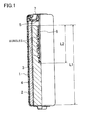
- FIG. 1 is a half-sectional view illustrating an alkaline primary battery according to an embodiment of the present disclosure.
- a bottomed battery case (also serving as a positive electrode terminal) 1 is hermetically sealed by a sealing member.
- the battery case 1 is pressed into a predetermined shape with predetermined dimensions by a known method using a nickel-plated steel plate, for example.
- a positive electrode 2, a separator 4, and a gelled negative electrode 3 are provided in this order from the outside to the inside along a radius of the battery case 1.
- the positive electrode 2 is cylindrical, and contains a positive electrode active material including, for example, manganese dioxide powder, a conductive agent such as graphite, and an alkaline electrolyte, for example.
- the alkaline electrolyte contains 30 to 40 mass percent (mass %) of potassium hydroxide and a predetermined amount of zinc oxide.
- the separator 4 is a nonwoven fabric in which polyvinyl alcohol fiber and rayon fiber are mixed, for example, and holds an alkaline electrolyte.
- the gelled negative electrode 3 contains a negative electrode active material such as zinc alloy powder, a gelling agent such as polyacrylic acid or polyacrylic acid Na, and an alkaline electrolyte.
- the zinc alloy powder preferably does not contain mercury, cadmium, lead, or any of these elements for environmental reasons, and only needs to contain at least one of bismuth, indium, or aluminum.
- the sealing member includes a gasket 5, a negative electrode current collector 6, and a negative electrode terminal plate 7.
- the gasket 5 is formed by injection-molding a resin such as polyamide or polypropylene into a predetermined shape with predetermined dimensions.
- the negative electrode current collector 6 is formed by pressing a wire material such as copper or brass into a predetermined shape (e.g., a nail shape) with predetermined dimensions, for example, and is inserted into the gelled negative electrode 3 through the gasket 5.
- the negative electrode terminal plate 7 is formed by pressing a nickel-plated steel plate into a predetermined shape with predetermined dimensions, for example, and is crimped to an opening edge of the battery case 1 with the gasket 5 interposed therebetween to be electrically connected to the negative electrode current collector 6.
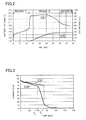
- FIG. 2 is a graph showing analysis results on the battery voltage and the amount of gas generation in reverse connection.
- Reference characters C21 and C22 in FIG. 2 indicate changes in the battery voltage and the amount of gas generation, respectively. It is assumed that the following reactions occur in regions I-III.
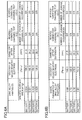
- FIG. 3 shows the results of measurement.
- C31 indicates a change with time in charge current of an alkaline primary battery showing leakage
- C32 indicates a change with time in charge current of an alkaline primary battery showing no leakage.
- the inventors focused on a rapid decrease in charge current shortly after reverse connection in a battery showing no leakage (see FIG. 3 ).
- the inventors came to have an idea that if a generated hydrogen gas remains on the surface of the negative electrode current collector, the behaviors indicated by C32 in FIG. 3 can be explained and the above-described demand is satisfied.
- the gelled negative electrode When a hydrogen gas is generated on the surface of the negative electrode current collector, the gelled negative electrode is subjected to a pressure of the hydrogen gas. If the gelled negative electrode is hardly deformed even under this pressure, the hydrogen gas cannot remain on the surface of the negative electrode current collector, and accordingly, escapes from space on the surface of the negative electrode current collector into the battery case through the gelled negative electrode. On the other hand, if the gelled negative electrode is easily deformed under the pressure, space in which the hydrogen gas exists can be kept on the surface of the negative electrode current collector, resulting in that the hydrogen gas does not escape into the battery case and remains on the surface of the negative electrode current collector.
- the inventors predicted that if the deformability of the gelled negative electrode is optimized, the hydrogen gas easily remains on the surface of the negative electrode current collector, and tried to optimize the viscosity of the gelled negative electrode.
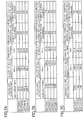
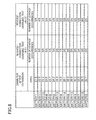
- the results in FIG. 4 also show that the range of the optimized viscosity of the gelled negative electrode is small. For example, when the viscosity of the gelled negative electrode was 159Pa ⁇ S, no leakage occurred (verification 4), whereas when the viscosity of the gelled negative electrode decreased only by about 7% from 159Pa ⁇ S, leakage occurred (verification 5). Therefore, a solution for preventing leakage by adjusting the viscosity of the gelled negative electrode is not suitable for manufacturing alkaline primary batteries.
- the viscosity is a physical value depending on a shearing stress.
- a pressure of a hydrogen gas is applied to the gelled negative electrode in the outward direction (one direction) along a radius of the battery case. In view of this, it is considered to be difficult to prevent leakage by optimizing the viscosity of the gelled negative electrode. That is, the results shown in FIG. 4 are appropriate.
- the property of malleability is known as a property indicating easiness of deformation when receiving a pressure in one direction.
- the inventors examined reduction of leakage by increasing malleability of the gelled negative electrode 3 (i.e., allowing the gelled negative electrode 3 to be easily extended).
- the inventors came to have an idea of reducing friction among zinc alloy particles in order to increase malleability of the gelled negative electrode 3. Based on this idea, the inventors conducted the following experiment.
- FIG. 5 is a view showing a method for measuring malleability of the gelled negative electrode 3.
- an alkaline primary battery was disassembled, and a gelled negative electrode 3 was taken out.
- 4.0 g of the gelled negative electrode 3 was placed on a base 51 of an acrylic resin, and this gelled negative electrode 53 is formed into a cylindrical shape with a diameter of 15 mm.
- the diameter of the shape of the gelled negative electrode 53 is not limited to 15 mm, and may be in the range of 15 mm ⁇ 10%, for example.
- the "cylindrical shape” is not limited to a cylinder which is a complete circle in cross section, and may be any shape as long as the diameter thereof can be calculated when the outer shape of the upper surface is approximated to be a circle using, for example, an optical microscope which will be described later.
- a weight (200 g) 57 was placed on the gelled negative electrode 53 with a flat plate (10 g) 55 of an acrylic resin interposed therebetween, thereby causing the gelled negative electrode 53 to extend.
- a flat plate (10 g) 55 of an acrylic resin interposed therebetween thereby causing the gelled negative electrode 53 to extend.
- visible extension of the gelled negative electrode 53 is finished.
- the gelled negative electrode 53 continues to extend, and after a lapse of about 5 minutes from the placement of the weight 57, no substantial change (substantial extension) of the gelled negative electrode 53 was observed.
- the weight 57 and the flat plate 55 were removed, and the x coordinates and the y coordinates of arbitrary-selected five points on the outer periphery of the gelled negative electrode 53 are measured with an optical microscope (not shown). Using the measured x and y coordinates of the five points, the outer shape of the upper surface of the gelled negative electrode 53 is approximated to be a circle, and the diameter of the gelled negative electrode 53 was obtained. As the measured diameter (i.e., the diameter of the extended gelled negative electrode 3, hereinafter referred to as the diameter after extension) increases, the malleability of the gelled negative electrode 53 is considered to increase.
- the negative electrode current collector 6 and the gelled negative electrode 3 are electrically insulated from each other in reverse connection, and thus, a charge current does not easily flow or a charge current becomes 0 (zero). Then, generation (reaction (3)) of the hydrogen gas is reduced, thereby reducing an increase in the internal pressure of the battery. As a result, leakage can be reduced.
- the specific surface area of zinc alloy particles is less than 0.025 m 2 /g, reactivity of the zinc alloy particles decreases, and a problem of degradation of discharge characteristics might arise.
- the specific surface area of the zinc alloy particles is preferably in the range from 0.025 m 2 /g to 0.031 m 2 /g, both inclusive, and more preferably in the range from 0.025 m 2 /g to 0.028 m 2 /g, both inclusive.
- Gelled negative electrodes 3 having different outer shapes of zinc alloy particles were fabricated with atomize conditions (e.g., an atomizing pressure, the oxygen content of an atomized gas, the temperature of the atomized gas, and the outer shape of an atomizing nozzle) changed.
- atomize conditions e.g., an atomizing pressure, the oxygen content of an atomized gas, the temperature of the atomized gas, and the outer shape of an atomizing nozzle
- the "shape parameter" in FIG. 6 (b) is the ratio of (actual peripheral length of zinc alloy particles)/(peripheral length of a circle which zinc alloy particles circumscribe).
- the shape parameter increases, the outer shapes of zinc alloy particles approach spheres.
- the shape parameter decreases, the outer shapes of zinc alloy particles become away from spheres (i.e., distortion occurs).
- Such a shape parameter was obtained by arbitrary selecting 10 zinc alloy particles, measuring the above-mentioned two physical values of these zinc alloy particles with a scanning electron microscope (SEM), and substituting the obtained values into the equation described above.
- the malleability of the gelled negative electrode 3 increased. As expected by the inventors, this is considered to be because of the following reasons. As the shape parameter of zinc alloy particles increases, the outer shapes of the zinc alloy particles approach spheres. Accordingly, the number of contacts among the zinc alloy particles in the gelled negative electrode 3 decreases, friction among the zinc alloy particles decreases. Consequently, as the shape parameter of the zinc alloy particles increases, the gelled negative electrode 3 more easily extends.
- the shape parameter of zinc alloy particles is preferably in the range from 0.72 to 0.81, both inclusive, and more preferably in the range from 0.76 to 0.81, both inclusive.
- FIG. 6 (b) shows the results in a case where the specific surface area of zinc alloy particles is 0.034 m 2 /g. Accordingly, it is considered that when the specific surface area of zinc alloy particles decreases below 0.034m 2 /g, the value in the "diameter after extension" in FIG. 6 (b) increases.
- the shape parameter of zinc alloy particles is 0.68 as in the battery 1.
- the specific surface area of zinc alloy particles in the battery 2 is smaller than that of the battery 1, leakage is reduced in a charging test under a small current. In view of this, it can be concluded that when the specific surface area of zinc alloy particles is less than 0.034m 2 /g, the shape parameter of zinc alloy particles does not need to be 0.72 or more, and may be about 0.68.
- FIG. 6(a) shows the results in a case where the shape parameter of zinc alloy particles is 0.68. Accordingly, it is considered that when the shape parameter of zinc alloy particles exceeds 0.68, the value in the "diameter after extension" in FIG. 6(a) increases.
- the specific surface area of zinc alloy particles is 0.034 m 2 /g as in the battery 1.
- the shape parameter of zinc alloy particles in the battery 5 is larger than that of the battery 1, leakage is reduced in a charging test under a small current. In view of this, it can be concluded that when the shape parameter of zinc alloy particles is larger than 0.68, the specific surface area of zinc alloy particles does not need to be 0.031 m 2 /g or less, and may be about 0.034 m 2 /g.
- the battery 2 and the battery 5 have the same viscosity value of the gelled negative electrode 3, and differ in malleability of the gelled negative electrode 3. Accordingly, the battery 2 and the battery 5 show different results on the reverse-connection charging test. This result also shows that leakage cannot be reduced by optimizing the viscosity of the gelled negative electrode 3.
- the gelled negative electrode 3 was formed with a change of only the amount of the added organic anti-corrosive agent, and malleability of this gelled negative electrode 3 was examined with the method shown in FIG. 5 .
- the batteries 8-10 differ from the battery 1 only in the amount of the added organic anti-corrosive agent.
- the batteries were subjected to a reverse-connection charging test, and the presence of leakage was observed.
- the same experiment was conducted with respect to the amount of added polyacrylic acid and the mass ratio of the zinc alloy to the electrolyte. That is, batteries 11-13 differ from the battery 1 only in the amount of added polyacrylic acid, and batteries 14 and 15 differ from the battery 1 only in the mass ratio describe above. The obtained results are shown in FIG. 7(a)-7(c) .
- the mass ratio of the zinc alloy to the electrolyte only needs to be 1.9 or less. If this mass ratio is lower than 1.8, the content of the zinc alloy decreases, resulting in that the capacity might decrease. For this reason, the mass ratio is preferably in the range from 1.8 to 1.9, both inclusive.
- FIG. 7(c) shows results in a case where the specific surface area of the zinc alloy particles is 0.034 m 2 /g. Based on the results, it can be considered that if the specific surface area of the zinc alloy particles decreases below 0.034 m 2 /g, the value of the "diameter after extension" in FIG. 7(c) increases.
- the mass ratio of the zinc alloy to the electrolyte is 2.0 as in the battery 1
- the specific surface area of the zinc alloy particles is smaller than that in the battery 1, resulting in that leakage is reduced in a charging test under a small current.
- the mass ratio does not need to be 1.9 or less, and may be about 2.0.
- FIG. 7(c) shows results in a case where the shape parameter of the zinc alloy particles is 0.68. Based on the results, it can be considered that if the shape parameter of the zinc alloy particles exceeds 0.68, the value in the "diameter after extension" in FIG. 7(c) increases.
- the mass ratio of the zinc alloy to the electrolyte is 2.0 as in the battery 1
- the shape parameter of the zinc alloy particles is larger than that in the battery 1, resulting in that leakage is reduced in a charging test under a small current.
- the shape parameter of the zinc alloy particles is larger than 0.68, the mass ratio does not need to be 1.9 or less, and may be about 2.0.
- the specific surface area and the shape parameter of the zinc alloy particles are 0.034 m 2 /g and 0.68, respectively, as in the battery 1, the mass ratio of the zinc alloy to the electrolyte is lower than that in the battery 1, resulting in that leakage is reduced in the charging test under a small current.
- the mass ratio is 1.9 or less
- the specific surface area of the zinc alloy particles does not need to be 0.031 m 2 /g or less and may be about 0.034 m 2 /g
- the shape parameter of the zinc alloy particles does not need to be 0.72 or more and may be about 0.68.
- the specific surface area of the zinc alloy particles is 0.031 m 2 /g or less and the shape parameter of the zinc alloy particles is 0.72 or more, the diameter after extension exceeds 26.1 mm. That is, if at least one of the specific surface area of the zinc alloy particles, the shape parameter of the zinc alloy particles, or the mass ratio of the zinc alloy to the electrolyte, for example, is optimized, friction among the zinc alloy particles is reduced, and thus, malleability of the gelled negative electrode 3 can be enhanced, thus reducing leakage.
- the specific surface area and the shape parameter of the zinc alloy particles are determined depending on production equipment for the zinc alloy particles, for example, in some cases.
- the mass ratio is determined depending on a desired battery capacity, for example, in some cases. Further, whether reduction of leakage in a charging test under a small current is sufficient or reduction of leakage in a charging test under a large current as well as in a charging test under a small current is required depends on the purpose of an alkaline primary battery, for example. Based on these circumstances and the experimental results described above, at least one of the specific surface area of the zinc alloy particles, the shape parameter of the zinc alloy particles, or the mass ratio, for example, is appropriately selected.
- FIG. 8 shows a summary of the results shown in FIG. 6(a)-7(c). As shown in FIG. 8 , if the diameter of the extended gelled negative electrode 3 is 24 mm or more, leakage in charging under a small current can be prevented. If the diameter of the extended gelled negative electrode 3 is 26 mm or more, leakage in charging under a large current can be prevented.
- the diameter of the extended gelled negative electrode 3 is preferably in the range from 24 mm to 36 mm, both inclusive, and more preferably in the range from 26 mm to 36 mm, both inclusive.
- the extension ratio (i.e., the ratio of the diameter of the extended gelled negative electrode 3 / the diameter of the gelled negative electrode 3 before extension) is in the range from 1.5 to 2.4, both inclusive, and preferably in the range from 1.6 to 2.4, both inclusive.
- the inventors further conducted examinations, and studied a structure of an alkaline primary battery capable of further reducing leakage.
- estimation i.e., leakage can be reduced when the gelled negative electrode 3 and the negative electrode current collector 6 are hardly in contact with each other in reverse connection
- the inventors focused on estimation (i.e., leakage can be reduced when the gelled negative electrode 3 and the negative electrode current collector 6 are hardly in contact with each other in reverse connection) obtained from the experimental results, and expected that if the length of the negative electrode current collector 6 (i.e., the insertion length of the negative electrode current collector 6) inserted in the gelled negative electrode 3 is reduced or if the maximum diameter (i.e., the outer diameter of the negative electrode current collector 6) of a part of the negative electrode current collector 6 inserted in the gelled negative electrode 3 is reduced, the contact area between the gelled negative electrode 3 and the negative electrode current collector 6 decreases, and thereby, the contact resistance between the gelled negative electrode 3 and the negative electrode current collector 6 increases.
- the ratio of the insertion length L2 of the negative electrode current collector 6 to the height L1 of the gelled negative electrode 3 (i.e., the filling height of the gelled negative electrode 3) (L2/L1) in the battery case 1 is about 0.65, and the outer diameter of the negative electrode current collector 6 is 1.3 mm to 1.5 mm.
- batteries i.e., batteries 16-20 shown in FIG. 9(a)
- batteries i.e., batteries 21-23 shown in FIG. 9(b)
- the discharge performance test a constant current (1000 mA) is caused to flow in a single alkaline primary battery, and the alkaline primary battery is discharged such that the time (duration time) until the voltage of the alkaline primary battery reaches an end voltage (0.9V) was measured.
- FIG. 9(a) shows the results on L2/L1
- FIG. 9(b) shows the results on the outer diameter of the negative electrode current collector 6.
- the discharge performance degrades.
- L2/L1 was 0.42
- the discharge performance degraded by about 10%.
- L2/L1 decreased below 0.42
- the discharge performance further degraded. This is considered to be because a decrease in L2/L1 causes a decrease in efficiency of current collection by the negative electrode current collector 6 in normal discharging.
- leakage can be further reduced when L2/L1 is 0.65 or less, and maintenance of discharge performance as well as further reduction of leakage can be achieved when L2/L1 is in the range from 0.42 to 0.65, both inclusive. That is, L2/L1 is 0.65 or less, and is more preferably in the range from 0.42 to 0.65, both inclusive.
- advantages obtained by optimizing L2/L1 are not limited to the battery 9.
- leakage can be further reduced when L2/L1 is 0.65 or less, and maintenance of discharge performance as well as further reduction of leakage can be achieved when L2/L1 is in the range from 0.42 to 0.65, both inclusive.
- L2/L1 is appropriately determined depending on the purpose of the alkaline primary battery, for example.
- the phrase of "the gelled negative electrode 3 has a predetermined malleability" means that the diameter of the extended gelled negative electrode 3 is in the range from 24 mm to 36 mm, both inclusive, when malleability of the gelled negative electrode 3 is measured with the method shown in FIG. 5 .
- the outer diameter of the negative electrode current collector 6 is preferably in the range from 0.95 mm to 1.40 mm, both inclusive.
- advantages obtained by optimizing the outer diameter of the negative electrode current collector 6 are not limited to the battery 9.
- leakage can be further reduced without a decrease in strength of the negative electrode current collector 6 when the outer diameter of the negative electrode current collector 6 is in the range from 0.95 mm to 1.40 mm, both inclusive.
- the outer diameter of the negative electrode current collector 6 is appropriately determined depending on the purpose of the alkaline primary battery, for example.
- the inventors conducted the following experiment in view of a mechanism (see FIG. 2 ) in which leakage occurs due to reverse connection.
- the potential of manganese dioxide is optimized.
- the potential of manganese dioxide is a potential with respect to Hg/HgO in 40 mass % of a KOH aqueous solution under a 20°C environment.
- Various types of manganese dioxide having different potentials can be formed by forming electrolytic manganese dioxide with the electrolytic current density, the electrolytic temperature, and the concentration of the electrolyte appropriately adjusted.
- reaction (1) oxidation reaction of manganese dioxide
- reaction (2) oxygen-gas generation reaction
- reaction (2) the period of reduction reaction of zinc
- the potential of manganese dioxide is preferably in the range from 275 mV to 330 mV, both inclusive, and more preferably in the range from 304 mV to 330 mV, both inclusive.
- advantages obtained by optimizing the potential of manganese dioxide are not limited to the battery 9.
- leakage can be further reduced when the potential of manganese dioxide is 275 mV or more, and reduction of energy necessary for formation of manganese dioxide as well as further reduction of leakage can be achieved when the potential of manganese dioxide is in the range from 275 mV to 330 mV, both inclusive.
- the potential of manganese dioxide is appropriately determined depending on the purpose of the alkaline primary battery, for example.
- the concentration of zinc oxide in the alkaline electrolyte (hereinafter referred to as the "zinc oxide concentration") was optimized.
- zinc oxide concentration increases, reduction reaction of zinc (reaction (2)) finishes later, and accordingly, hydrogen-gas generation reaction (reaction (3)) starts later.
- the time when oxidation reaction of manganese dioxide (reaction (1)) transitions to oxygen-gas generation reaction (reaction (4)) hardly changes. For this reason, it can be considered that the period of hydrogen-gas generation reaction (the period of region II) is reduced.
- batteries batteries (batteries 27-30 shown in FIG.
- FIG. 10(b) shows the results.
- the degree of reduction of leakage due to reverse connection increased.
- the discharge performance degraded. Specifically, when the zinc oxide concentration was 3.0 mass %, the discharge performance degraded by about 5%. When the zinc oxide concentration exceeded 3.0 mass %, the discharge performance further degraded. This is considered to be because an increase in the zinc oxide concentration reduces the content of potassium hydroxide, and thus, it becomes difficult to maintain the concentration of hydroxide ions which contribute to battery reaction.
- the zinc oxide concentration is 1.7 mass % or more, and maintenance of discharge performance as well as further reduction of leakage can be achieved when the zinc oxide concentration is in the range from 1.7 to 3.0 mass %, both inclusive. That is, the zinc oxide concentration is preferably 1.7 mass % or more, and more preferably in the range from 1.7 to 3.0 mass %, both inclusive.
- advantages obtained by optimizing the zinc oxide concentration are not limited to the battery 9.
- leakage can be further reduced when the zinc oxide concentration is 1.7 mass % or more, and maintenance of discharge performance as well as further reduction of leakage can be achieved when the zinc oxide concentration is in the range from 1.7 to 3.0 mass %, both inclusive.
- the zinc oxide concentration is appropriately determined depending on the purpose of the alkaline primary battery, for example.
- the amount of bismuth added to zinc (hereinafter referred to as the "amount of added bismuth”) was optimized. It is expected that the amount of added bismuth increases, the corrosion resistance of zinc increases, and thus, hydrogen-gas generation reaction hardly occurs.
- batteries (batteries 31-33 shown in FIG. 10(c) ) different from the battery 9 only in the amount of added bismuth were fabricated, and were subjected to reverse-connection charging tests and a discharge performance test.
- FIG. 10(c) shows the results of the experiment described above.
- the degree of reduction of leakage increased.
- the amount of added bismuth increased, the discharge performance degraded. Specifically, when the amount of added bismuth was 250 mass ppm, the discharge performance degraded by about 5%. When the amount of added bismuth exceeded 250 mass ppm, the discharge performance further degraded. This is considered to be because an increase in the amount of added bismuth causes reduction in reactivity of zinc.
- leakage can be further reduced when the amount of added bismuth is 80 mass ppm or more, and maintenance of discharge performance as well as further reduction of leakage can be achieved when the amount of added bismuth is in the range from 80 to 250 mass ppm, both inclusive. That is, the amount of added bismuth is preferably 80 mass ppm or more, and more preferably in the range from 80 to 250 mass ppm, both inclusive.
- advantages obtained by optimizing the amount of added bismuth are not limited to the battery 9.
- leakage can be further reduced when the amount of added bismuth is 80 mass ppm or more, and maintenance of discharge performance as well as further reduction of leakage can be achieved when the amount of added bismuth is in the range from 80 to 250 mass ppm, both inclusive.
- the amount of added bismuth is appropriately determined depending on the purpose of the alkaline primary battery, for example.
- the gas layer illustrated in FIG. 1 is formed on the surface of the negative electrode current collector 6 due to reverse connection. Accordingly, in the alkaline primary battery of this embodiment, leakage due to reverse connection can be reduced without degradation of characteristics (e.g., discharge characteristics) in normal discharging.
- the alkaline primary battery of this embodiment can be fabricated by optimizing at least one of the specific surface area of zinc alloy particles, the shape parameter of the zinc alloy particles, or the mass ratio of the zinc alloy to the electrolyte, for example.
- alkaline primary batteries showing reduced leakage can be manufactured.
- a method for fabricating a battery 1 will be described hereinafter as an example method for fabricating a battery.
- Potassium hydroxide, zinc oxide, and water were mixed at a mass ratio of 35 : 1.7 : 63, thereby obtaining an alkaline electrolyte.
- Electrolytic manganese dioxide (having a potential of 275 mV) and graphite were mixed at a predetermined mass ratio.
- the obtained mixture and the alkaline electrolyte were mixed at a predetermined mass ratio, were sufficiently stirred, and then were sized to have a uniform grain size.
- the thus-obtained grain substance was press-formed into a hollow cylindrical shape, thereby obtaining a positive electrode material mixture pellet.
- the potential of electrolytic manganese dioxide was measured with the above-described method.
- Zinc alloy particles were formed with a gas atomizing method such that the amount of added bismuth is 80 mass ppm, and were classified with a screen. Then, the zinc alloy particles were adjusted so as to have a BET specific surface area of 0.034 (m 2 /g). The resultant zinc alloy particles had a shape parameter of 0.68.
- Polyacrylic acid particles, sodium polyacrylic acid particles, an alkaline electrolyte, and zinc alloy particles were mixed at a mass ratio of 0.8 : 1.4 : 32.6 : 65.2. Further, 20 mass ppm of an organic anti-corrosive agent (Surflon S-386 produced by AGC Seimi Chemical Co., Ltd.) was added to the electrolyte. In this manner, a gelled negative electrode 3 was obtained.
- an organic anti-corrosive agent Sudflon S-386 produced by AGC Seimi Chemical Co., Ltd.
- a closed-end cylindrical separator 4 was placed in a hollow part of the positive electrode 2.
- separator 4 nonwoven fabric in which polyvinyl alcohol fiber and rayon fiber were mixed as main components was used.
- compositions of the positive electrode 2 and the alkaline electrolyte, materials and shapes of the gasket 5, the negative electrode current collector 6, and the negative electrode terminal plate 7 are, of course, not limited to those described above.
- the positive electrode 2 may be in close contact with the inner periphery of the battery case 1 with a graphite film interposed therebetween, or may contain a binder of, for example, polyethylene powder or a lubricant of, for example, stearate, as necessary.
- the gelled negative electrode 3 preferably contains a trace amount of silicic acid or a silicon compound of its salt. In this case, generation of zinc dendrite can be reduced.
- the surface of the negative electrode current collector 6 may be plated with tin or indium. This plating can prevent an impurity from being mixed into the negative electrode current collector 6 during processing of the negative electrode current collector 6, thereby obtaining a shielding effect.
- the present disclosure is usable for power sources for various types of equipment.
Landscapes
- Chemical & Material Sciences (AREA)
- Chemical Kinetics & Catalysis (AREA)
- Electrochemistry (AREA)
- General Chemical & Material Sciences (AREA)
- Engineering & Computer Science (AREA)
- Manufacturing & Machinery (AREA)
- Inorganic Chemistry (AREA)
- Battery Electrode And Active Subsutance (AREA)
- Primary Cells (AREA)
Abstract
Description
- The present disclosure relates to alkaline primary batteries (hereinafter also referred to as "batteries").
- Alkaline primary batteries are highly versatile and can be manufactured at low cost, and therefore, are widely used as power sources for various types of equipment. The alkaline primary batteries are required to have further enhanced performance.
- For example,
PATENT DOCUMENT 1 describes that the use of a polymer, as a thickener, obtained by polymerization using a cross-linking agent which dissolves in an alkaline atmosphere allows discharge characteristics of an alkaline battery to be maintained for a long term, and enables a battery case to be filled with an alkaline electrolyte with a uniform loading weight. -
PATENT DOCUMENT 2 shows that a negative electrode gel layer made of a high-viscosity gel layer and a low-viscosity gel layer can enhance shock resistance of an alkaline battery, while maintaining discharge performance thereof. -
- [PATENT DOCUMENT 1] Japanese Patent Publication No.
2006-079901 - [PATENT DOCUMENT 2] Japanese Patent Publication No.
2006-269346 - When an alkaline primary battery is reversely connected (where reverse connection is to reversely connect an positive electrode and a negative electrode of the alkaline primary battery), an alkaline electrolyte leaks out from the reversely connected battery. This leakage due to reverse connection (hereinafter also referred to as "leakage") needs to be reduced.
- It is therefore an object of the present disclosure to reduce leakage due to reverse connection.
- An alkaline primary battery in an aspect of the present disclosure includes: a positive electrode containing manganese dioxide; an alkaline electrolyte (hereinafter also referred to as an electrolyte) containing zinc oxide; a gelled negative electrode containing zinc alloy particles, the alkaline electrolyte, and a gelling agent; and a negative electrode current collector inserted in the gelled negative electrode. The gelled negative electrode of the present disclosure has a high malleability. The malleability herein is a property indicating the degree of ability of being extended. The gelled negative electrode of the present disclosure is highly malleable.
- When such an alkaline primary battery is reversely connected, the gelled negative electrode is extended under a pressure of a hydrogen gas generated from the surface of the negative electrode current collector. Accordingly, the hydrogen gas can remain on the surface of the negative electrode current collector. That is, a gas layer of a hydrogen gas is formed on the surface of the negative electrode current collector. In this manner, the gelled negative electrode and the negative electrode current collector are electrically insulated from each other, and thus, a charge current (i.e., a current flowing in the reversely connected alkaline primary battery) decreases or becomes zero. Consequently, generation reaction of the hydrogen gas can be reduced, resulting in that an increase in a battery internal pressure can be reduced.
- According to the present disclosure, leakage due to reverse connection can be reduced.
-
- [
FIG. 1] FIG. 1 is a half-sectional view illustrating an alkaline primary battery according to an embodiment of the present disclosure. - [
FIG. 2] FIG. 2 is a graph showing analysis results on the battery voltage and the amount of gas generation in reverse connection. - [
FIG. 3] FIG. 3 is a graph showing a change in charge current with time in reverse connection. - [
FIG. 4] FIG. 4 is a table showing results on the viscosity of a gelled negative electrode and presence of leakage. - [
FIG. 5] FIG. 5 is a view showing a method for measuring malleability of a gelled negative electrode. - [
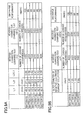
FIG. 6] FIGS. 6(a) and 6(b) are tables showing a summary of results on examples. - [
FIG. 7] FIGS. 7(a)-7(c) are tables showing a summary of results on examples. - [
FIG. 8] FIG. 8 is a table showing a summary of results on examples. - [
FIG. 9] FIGS. 9(a) and 9(b) are tables showing a summary of results on examples. - [
FIG. 10] FIGS. 10(a)-10(c) are tables showing a summary of results on examples. - An embodiment of the present disclosure will be described in detail hereinafter with reference to the drawings. The present disclosure is not limited to the following embodiment.
-
FIG. 1 is a half-sectional view illustrating an alkaline primary battery according to an embodiment of the present disclosure. - In the alkaline primary battery of this embodiment, a bottomed battery case (also serving as a positive electrode terminal) 1 is hermetically sealed by a sealing member. The
battery case 1 is pressed into a predetermined shape with predetermined dimensions by a known method using a nickel-plated steel plate, for example. In thebattery case 1, apositive electrode 2, aseparator 4, and a gellednegative electrode 3 are provided in this order from the outside to the inside along a radius of thebattery case 1. Thepositive electrode 2 is cylindrical, and contains a positive electrode active material including, for example, manganese dioxide powder, a conductive agent such as graphite, and an alkaline electrolyte, for example. The alkaline electrolyte contains 30 to 40 mass percent (mass %) of potassium hydroxide and a predetermined amount of zinc oxide. Theseparator 4 is a nonwoven fabric in which polyvinyl alcohol fiber and rayon fiber are mixed, for example, and holds an alkaline electrolyte. The gellednegative electrode 3 contains a negative electrode active material such as zinc alloy powder, a gelling agent such as polyacrylic acid or polyacrylic acid Na, and an alkaline electrolyte. The zinc alloy powder preferably does not contain mercury, cadmium, lead, or any of these elements for environmental reasons, and only needs to contain at least one of bismuth, indium, or aluminum. - The sealing member includes a
gasket 5, a negative electrodecurrent collector 6, and a negativeelectrode terminal plate 7. Thegasket 5 is formed by injection-molding a resin such as polyamide or polypropylene into a predetermined shape with predetermined dimensions. The negative electrodecurrent collector 6 is formed by pressing a wire material such as copper or brass into a predetermined shape (e.g., a nail shape) with predetermined dimensions, for example, and is inserted into the gellednegative electrode 3 through thegasket 5. The negativeelectrode terminal plate 7 is formed by pressing a nickel-plated steel plate into a predetermined shape with predetermined dimensions, for example, and is crimped to an opening edge of thebattery case 1 with thegasket 5 interposed therebetween to be electrically connected to the negativeelectrode current collector 6. - It is known that reverse connection of an alkaline primary battery causes leakage. The inventors intensively studied for a solution to this problem, and found that a hydrogen gas remaining on the surface of the negative electrode current collector 6 (see
FIG. 1 ) can reduce leakage. The study of the inventors will be described hereinafter prior to description of an alkaline primary battery according to an embodiment. - A mechanism of leakage due to reverse connection is proposed as follows.
FIG. 2 is a graph showing analysis results on the battery voltage and the amount of gas generation in reverse connection. Reference characters C21 and C22 inFIG. 2 indicate changes in the battery voltage and the amount of gas generation, respectively. It is assumed that the following reactions occur in regions I-III. -
- Positive electrode: MnO2-x+2xOH-→ MnO2+xH2O+2xe- (reaction (1))
- Negative electrode: ZnO+H2O+2e-→ Zn+2OH- (reaction (2))
-
- Positive electrode: MnO2-x+2xOH-→ MnO2+xH2O+2xe- (reaction (1))
- Negative electrode: 2H2O+2e-→ H2+2OH- (reaction (3))
-
- Positive electrode: 40H-→ 2H2O+O2+4e- (reaction (4))
- Negative electrode: Zn+(1/2)O2 → ZnO (reaction (5))
ZnO+H2O+2e- → Zn+2OH- (reaction (6)) - In searching for a solution to the above-described problem by intentionally reversely connecting an alkaline primary battery, the inventors found that no leakage occurs in some cases despite the reverse connection. As a reason for this case, the inventors hypothesized as follows.
- It is predicted that a quick change from region II to region III (i.e., a quick shift from reaction (3) to reaction (6) in the negative electrode) in the mechanism described above can reduce an increase in the amount of gas generation and, thereby, reduce leakage. Zinc oxide is necessary for reaction (6) to predominantly occur relative to reaction (3). However, when the amount of charge current is small, a small amount of zinc oxide can be enough to cause reaction (6). Based on this phenomenon, the inventors hypothesized that the reason why no leakage occurs despite reverse connection is that the amount of charge current is small or 0 (zero).
- To confirm this hypothesis, an alkaline primary battery was reversely connected, and a charge current thereof was measured. Specifically, four alkaline primary batteries were connected in series, and one of the alkaline primary batteries was reversely connected. Then, these four alkaline primary batteries were discharged with a discharge load of 40 Ω.
FIG. 3 shows the results of measurement. In the graph ofFIG. 3 , C31 indicates a change with time in charge current of an alkaline primary battery showing leakage, and C32 indicates a change with time in charge current of an alkaline primary battery showing no leakage. - In the alkaline primary battery showing leakage, a charge current gradually decreases with time, and comes to leak.
- On the other hand, in the alkaline primary battery showing on leakage, a charge current gradually decreased with time, and the amount of the decrease was slightly larger than the amount of the decrease in the alkaline primary battery showing leakage. In addition, the charge current started decreasing rapidly at time t2, and then slowly decreased to eventually reach 0 (zero) (mA).
- This results confirmed the hypothesis that the reason why no leakage occurs despite reverse connection is that the charge current is small or 0 (zero). In view of this, it can be predicted that a design of an alkaline primary battery for obtaining a small charge current achieves manufacturing of alkaline primary batteries showing reduced leakage. However, if this design degrades characteristics (e.g., discharge characteristics) in normal discharge, problems such as limited application of alkaline primary batteries can arise. For this reason, it is preferable to design an alkaline primary battery so as to allow the internal resistance of the alkaline primary battery to increase only in reverse connection.
- In view of this demand, the inventors focused on a rapid decrease in charge current shortly after reverse connection in a battery showing no leakage (see
FIG. 3 ). The inventors came to have an idea that if a generated hydrogen gas remains on the surface of the negative electrode current collector, the behaviors indicated by C32 inFIG. 3 can be explained and the above-described demand is satisfied. - When a hydrogen gas is generated on the surface of the negative electrode current collector, the gelled negative electrode is subjected to a pressure of the hydrogen gas. If the gelled negative electrode is hardly deformed even under this pressure, the hydrogen gas cannot remain on the surface of the negative electrode current collector, and accordingly, escapes from space on the surface of the negative electrode current collector into the battery case through the gelled negative electrode. On the other hand, if the gelled negative electrode is easily deformed under the pressure, space in which the hydrogen gas exists can be kept on the surface of the negative electrode current collector, resulting in that the hydrogen gas does not escape into the battery case and remains on the surface of the negative electrode current collector.
- Based on the foregoing idea, the inventors predicted that if the deformability of the gelled negative electrode is optimized, the hydrogen gas easily remains on the surface of the negative electrode current collector, and tried to optimize the viscosity of the gelled negative electrode.
- Specifically, 8 types of gelled negative electrodes were formed with the amount of an added gelling agent (polyacrylic acid) or the mass ratio of a zinc alloy to an alkaline electrolyte varied. Thereafter, the viscosities of the obtained gelled negative electrodes were measured with a TVB-10H viscometer produced by TOKI SANGYO CO., LTD. In this measurement, the viscosities were measured at 20°C with a rotor of H6 at a rotor rotation speed of 2.5 rpm. Then, using the gelled negative electrodes, alkaline primary batteries were fabricated, and were subjected to a reverse-connection charging test. In the reverse-connection charging test, four alkaline primary batteries were connected in series with one of the batteries reversely connected, and discharged with a predetermined discharge load (which was 40 Ω at this time as shown in
FIG. 4 ), and the presence of leakage was observed after a lapse of 24 hours from the end of discharging. The results of this test are shown inFIG. 4 . - As shown in
FIG. 4 , leakage occurred in some cases even with a low viscosity of the gelled negative electrode (verification 8), and no leakage occurred in some cases even with a high viscosity of the gelled negative electrode (verification 4). This result shows that it is difficult to prevent leakage by optimizing the viscosity of the gelled negative electrode. - The results in
FIG. 4 also show that the range of the optimized viscosity of the gelled negative electrode is small. For example, when the viscosity of the gelled negative electrode was 159Pa·S, no leakage occurred (verification 4), whereas when the viscosity of the gelled negative electrode decreased only by about 7% from 159Pa·S, leakage occurred (verification 5). Therefore, a solution for preventing leakage by adjusting the viscosity of the gelled negative electrode is not suitable for manufacturing alkaline primary batteries. - As described above, it was found that leakage cannot be prevented by optimizing the viscosity of the gelled negative electrode. The inventors thought this is because of the following reasons. The viscosity is a physical value depending on a shearing stress. On the other hand, in reverse connection, a pressure of a hydrogen gas is applied to the gelled negative electrode in the outward direction (one direction) along a radius of the battery case. In view of this, it is considered to be difficult to prevent leakage by optimizing the viscosity of the gelled negative electrode. That is, the results shown in
FIG. 4 are appropriate. - The property of malleability is known as a property indicating easiness of deformation when receiving a pressure in one direction. The inventors examined reduction of leakage by increasing malleability of the gelled negative electrode 3 (i.e., allowing the gelled
negative electrode 3 to be easily extended). - The inventors came to have an idea of reducing friction among zinc alloy particles in order to increase malleability of the gelled
negative electrode 3. Based on this idea, the inventors conducted the following experiment. - First, zinc alloys (of 4 types) having different specific surface areas were prepared with a known method, and malleabilities of gelled
negative electrodes 3 were measured with a method (seeFIG. 5 ) which will be described later. Using these gellednegative electrodes 3, alkaline primary batteries (batteries 1-4) were fabricated, and were subjected to a reverse-connection charging test. The results are shown inFIG. 6(a) . Among the batteries 1-4, only specific surface areas of zinc alloys are different. -
FIG. 5 is a view showing a method for measuring malleability of the gellednegative electrode 3. First, an alkaline primary battery was disassembled, and a gellednegative electrode 3 was taken out. Then, 4.0 g of the gellednegative electrode 3 was placed on a base 51 of an acrylic resin, and this gellednegative electrode 53 is formed into a cylindrical shape with a diameter of 15 mm. Here, the diameter of the shape of the gellednegative electrode 53 is not limited to 15 mm, and may be in the range of 15 mm ± 10%, for example. The "cylindrical shape" is not limited to a cylinder which is a complete circle in cross section, and may be any shape as long as the diameter thereof can be calculated when the outer shape of the upper surface is approximated to be a circle using, for example, an optical microscope which will be described later. - Next, a weight (200 g) 57 was placed on the gelled
negative electrode 53 with a flat plate (10 g) 55 of an acrylic resin interposed therebetween, thereby causing the gellednegative electrode 53 to extend. Within about one minute after placing theweight 57, visible extension of the gellednegative electrode 53 is finished. Then, the gellednegative electrode 53 continues to extend, and after a lapse of about 5 minutes from the placement of theweight 57, no substantial change (substantial extension) of the gellednegative electrode 53 was observed. After the substantial change of the gellednegative electrode 53 disappears, i.e., after a lapse of about 5 minutes from the placement of theweight 57, theweight 57 and theflat plate 55 were removed, and the x coordinates and the y coordinates of arbitrary-selected five points on the outer periphery of the gellednegative electrode 53 are measured with an optical microscope (not shown). Using the measured x and y coordinates of the five points, the outer shape of the upper surface of the gellednegative electrode 53 is approximated to be a circle, and the diameter of the gellednegative electrode 53 was obtained. As the measured diameter (i.e., the diameter of the extended gellednegative electrode 3, hereinafter referred to as the diameter after extension) increases, the malleability of the gellednegative electrode 53 is considered to increase. - The results shown in
FIG. 6(a) will be considered. As shown inFIG. 6(a) , as the specific surface area of zinc alloy particles decreased, the malleability of the gellednegative electrode 3 increased (i.e., the "diameter after extension" shown inFIG. 6(a) increased. As expected by the inventors, this is considered to be because of the following reasons. If the shapes (i.e., outer shapes) of zinc alloy particles are substantially identical, the diameter of the zinc alloy particles increases as the specific surface area of the zinc alloy particles decreases. As the diameter of the zinc alloy particles increases, the number of contacts among the zinc alloy particles decreases in the gellednegative electrode 3, and thus, friction among the zinc alloy particles decreases. Accordingly, as the specific surface area of the zinc alloy particles decreases, the gellednegative electrode 3 more easily extends. - As shown in
FIG. 6(a) , as the malleability of the gellednegative electrode 3 increased, the degree of reduction of leakage increased. The reasons of this were expected by the inventors as follows. When malleability of the gellednegative electrode 3 increases, the gellednegative electrode 3 is subjected to a pressure of a hydrogen gas, and easily extends. Accordingly, the hydrogen gas easily exists on the surface of the negative electrodecurrent collector 6. Accordingly, the contact between the gellednegative electrode 3 and the negative electrodecurrent collector 6 becomes difficult, and the gellednegative electrode 3 and the negative electrodecurrent collector 6 are electrically insulated from each other. In this manner, in the alkaline primary battery of this embodiment, the negative electrodecurrent collector 6 and the gellednegative electrode 3 are electrically insulated from each other in reverse connection, and thus, a charge current does not easily flow or a charge current becomes 0 (zero). Then, generation (reaction (3)) of the hydrogen gas is reduced, thereby reducing an increase in the internal pressure of the battery. As a result, leakage can be reduced. - The results shown in
FIG. 6(a) will be specifically considered. If the specific surface area of zinc alloy particles is 0.031 m2/g or less, leakage can be reduced in a reverse-connection charging test (i.e., a charging test under a small current) where the discharge load is 40 Ω. Then, leakage of an alkaline primary battery incorporated in equipment such as a remote controller can be reduced, for example. If the specific surface area of the zinc alloy particles is 0.028 m2/g or less, leakage can be reduced in a reverse-connection charging test (i.e., a charging test under a large current) where the discharge load is 4 Ω. Then, leakage of an alkaline primary battery incorporated in equipment such as a flashlight can be reduced, for example. However, if the specific surface area of zinc alloy particles is less than 0.025 m2/g, reactivity of the zinc alloy particles decreases, and a problem of degradation of discharge characteristics might arise. For the reasons described above, the specific surface area of the zinc alloy particles is preferably in the range from 0.025 m2/g to 0.031 m2/g, both inclusive, and more preferably in the range from 0.025 m2/g to 0.028 m2/g, both inclusive. - Based on the results shown in
FIG. 6(a) and the consideration on the results, the inventors predicted that the outer shape of zinc alloy particles approximated to spheres can obtain results similar to the results shown inFIG. 6(a) , and conducted the following experiment. - Gelled
negative electrodes 3 having different outer shapes of zinc alloy particles were fabricated with atomize conditions (e.g., an atomizing pressure, the oxygen content of an atomized gas, the temperature of the atomized gas, and the outer shape of an atomizing nozzle) changed. With the method shown inFIG. 5 , malleability of this gellednegative electrode 3 was measured, and then batteries 5-7 shown inFIG. 6 (b) were fabricated using the gellednegative electrode 3. That is, the batteries 5-7 differ from the battery I only in the outer shapes of zinc alloy particles. A reverse-connection charging test was performed on the fabricated batteries to observe the presence of leakage. The results are shown inFIG. 6 (b). - Here, the "shape parameter" in
FIG. 6 (b) is the ratio of (actual peripheral length of zinc alloy particles)/(peripheral length of a circle which zinc alloy particles circumscribe). As the shape parameter increases, the outer shapes of zinc alloy particles approach spheres. As the shape parameter decreases, the outer shapes of zinc alloy particles become away from spheres (i.e., distortion occurs). Such a shape parameter was obtained by arbitrary selecting 10 zinc alloy particles, measuring the above-mentioned two physical values of these zinc alloy particles with a scanning electron microscope (SEM), and substituting the obtained values into the equation described above. - As shown in
FIG. 6 (b) , as the shape parameter of the zinc alloy particles increased, the malleability of the gellednegative electrode 3 increased. As expected by the inventors, this is considered to be because of the following reasons. As the shape parameter of zinc alloy particles increases, the outer shapes of the zinc alloy particles approach spheres. Accordingly, the number of contacts among the zinc alloy particles in the gellednegative electrode 3 decreases, friction among the zinc alloy particles decreases. Consequently, as the shape parameter of the zinc alloy particles increases, the gellednegative electrode 3 more easily extends. - In addition, as shown in
FIG. 6 (b) , as the malleability of the gellednegative electrode 3 increased, the degree of reduction of leakage increased. This is because of the reasons described for the results shown inFIG. 6(a) . - The results shown in
FIG. 6 (b) will be specifically considered. When the shape parameter of zinc alloy particles was 0.72 or more, leakage was slightly reduced in a charging test under a small current. If the shape parameter of zinc alloy particles was 0.76 or more, leakage was also reduced in a charging test under a large current. However, when the shape parameter of zinc alloy particles exceeded 0.81, it was difficult to form zinc alloy particles in some cases. Accordingly, the shape parameter of zinc alloy particles is preferably in the range from 0.72 to 0.81, both inclusive, and more preferably in the range from 0.76 to 0.81, both inclusive. -
FIG. 6 (b) shows the results in a case where the specific surface area of zinc alloy particles is 0.034 m2/g. Accordingly, it is considered that when the specific surface area of zinc alloy particles decreases below 0.034m2/g, the value in the "diameter after extension" inFIG. 6 (b) increases. In practice, in thebattery 2 shown inFIG. 6(a) , the shape parameter of zinc alloy particles is 0.68 as in thebattery 1. However, since the specific surface area of zinc alloy particles in thebattery 2 is smaller than that of thebattery 1, leakage is reduced in a charging test under a small current. In view of this, it can be concluded that when the specific surface area of zinc alloy particles is less than 0.034m2/g, the shape parameter of zinc alloy particles does not need to be 0.72 or more, and may be about 0.68. - Likewise,
FIG. 6(a) shows the results in a case where the shape parameter of zinc alloy particles is 0.68. Accordingly, it is considered that when the shape parameter of zinc alloy particles exceeds 0.68, the value in the "diameter after extension" inFIG. 6(a) increases. In practice, in thebattery 5 shown inFIG. 6 (b) , the specific surface area of zinc alloy particles is 0.034 m2/g as in thebattery 1. However, since the shape parameter of zinc alloy particles in thebattery 5 is larger than that of thebattery 1, leakage is reduced in a charging test under a small current. In view of this, it can be concluded that when the shape parameter of zinc alloy particles is larger than 0.68, the specific surface area of zinc alloy particles does not need to be 0.031 m2/g or less, and may be about 0.034 m2/g. - The
battery 2 and thebattery 5 have the same viscosity value of the gellednegative electrode 3, and differ in malleability of the gellednegative electrode 3. Accordingly, thebattery 2 and thebattery 5 show different results on the reverse-connection charging test. This result also shows that leakage cannot be reduced by optimizing the viscosity of the gellednegative electrode 3. - Further, the inventors studied how malleability of the gelled
negative electrode 3 are affected by the amount of an organic anti-corrosive agent to an electrolyte (hereinafter referred to as the "amount of the added organic anti-corrosive agent"), the amount of a gelling agent (polyacrylic acid) to the electrolyte (hereinafter referred to as the "amount of added polyacrylic acid"), and the mass ratio of a zinc alloy to the electrolyte. Specifically, the gellednegative electrode 3 was formed with a change of only the amount of the added organic anti-corrosive agent, and malleability of this gellednegative electrode 3 was examined with the method shown inFIG. 5 . Using the gellednegative electrode 3, batteries 8-10 illustrated inFIG. 7(a) were fabricated. That is, the batteries 8-10 differ from thebattery 1 only in the amount of the added organic anti-corrosive agent. The batteries were subjected to a reverse-connection charging test, and the presence of leakage was observed. The same experiment was conducted with respect to the amount of added polyacrylic acid and the mass ratio of the zinc alloy to the electrolyte. That is, batteries 11-13 differ from thebattery 1 only in the amount of added polyacrylic acid, andbatteries battery 1 only in the mass ratio describe above. The obtained results are shown inFIG. 7(a)-7(c) . - As shown in
FIG. 7(a) , even when the amount of the added organic anti-corrosive agent was greatly increased, malleability of the gellednegative electrode 3 only slightly increased. If the amount of the added organic anti-corrosive agent is about 10 times as large as that in thebattery 1, leakage can be prevented (battery 10). However, if the amount of the added organic anti-corrosive agent is not large, the organic anti-corrosive agent is adsorbed on the surfaces of zinc alloy particles to inhibit reactivity of the zinc alloy particles, resulting in that discharge characteristics might degrade. For this reason, the inventors concluded that it is difficult to increase malleability of the gellednegative electrode 3 only by increasing the amount of the added organic anti-corrosive agent. - As shown in
FIG. 7(b) , even when the amount of added polyacrylic acid was reduced, malleability of the gellednegative electrode 3 did not increased so much, and leakage occurred. It is expected that if the amount of added polyacrylic acid is reduced to the amount smaller than that in the battery 13, malleability of the gellednegative electrode 3 will increase. However, if the amount of added polyacrylic acid is reduced below 0.60 mass %, gelling of the zinc alloy particles becomes difficult, resulting in that discharge characteristics might degrade. For this reason, the inventors concluded that it is difficult to increase malleability of the gellednegative electrode 3 only by reducing the amount of added polyacrylic acid. - On the other hand, as shown in
FIG. 7(c) , when the mass ratio of the zinc alloy to the electrolyte was reduced, the gellednegative electrode 3 had a high malleability, and leakage was prevented. This mass ratio is conventionally considered to contribute to viscosity of a gelled negative electrode, but is now found to also significantly contribute to malleability of the gellednegative electrode 3. This is considered to be because of the following reasons. When this mass ratio decreases, the ratio of the zinc alloy particles to the electrolyte decreases, and thus, the proportion of the electrolyte among the zinc alloy particles increases. Accordingly, friction among the zinc alloy particles decreases, resulting in an increase in malleability of the gellednegative electrode 3. - Specifically, the mass ratio of the zinc alloy to the electrolyte only needs to be 1.9 or less. If this mass ratio is lower than 1.8, the content of the zinc alloy decreases, resulting in that the capacity might decrease. For this reason, the mass ratio is preferably in the range from 1.8 to 1.9, both inclusive.
-
FIG. 7(c) shows results in a case where the specific surface area of the zinc alloy particles is 0.034 m2/g. Based on the results, it can be considered that if the specific surface area of the zinc alloy particles decreases below 0.034 m2/g, the value of the "diameter after extension" inFIG. 7(c) increases. In practice, in thebattery 2 shown inFIG. 6(a) , although the mass ratio of the zinc alloy to the electrolyte is 2.0 as in thebattery 1, the specific surface area of the zinc alloy particles is smaller than that in thebattery 1, resulting in that leakage is reduced in a charging test under a small current. In view of these results, when the specific surface area of the zinc alloy particles is less than 0.034 m2/g, the mass ratio does not need to be 1.9 or less, and may be about 2.0. - Similarly,
FIG. 7(c) shows results in a case where the shape parameter of the zinc alloy particles is 0.68. Based on the results, it can be considered that if the shape parameter of the zinc alloy particles exceeds 0.68, the value in the "diameter after extension" inFIG. 7(c) increases. In practice, in thebattery 5 shown inFIG. 6 (b) , although the mass ratio of the zinc alloy to the electrolyte is 2.0 as in thebattery 1, the shape parameter of the zinc alloy particles is larger than that in thebattery 1, resulting in that leakage is reduced in a charging test under a small current. In view of these results, when the shape parameter of the zinc alloy particles is larger than 0.68, the mass ratio does not need to be 1.9 or less, and may be about 2.0. - Further, in the
battery 14 shown inFIG. 7(c) , although the specific surface area and the shape parameter of the zinc alloy particles are 0.034 m2/g and 0.68, respectively, as in thebattery 1, the mass ratio of the zinc alloy to the electrolyte is lower than that in thebattery 1, resulting in that leakage is reduced in the charging test under a small current. In view of these results, when the mass ratio is 1.9 or less, the specific surface area of the zinc alloy particles does not need to be 0.031 m2/g or less and may be about 0.034 m2/g, and the shape parameter of the zinc alloy particles does not need to be 0.72 or more and may be about 0.68. - Although not specifically described, in the
battery 14 shown inFIG. 7(c) , for example, it is expected that if the specific surface area of the zinc alloy particles is 0.031 m2/g or less and the shape parameter of the zinc alloy particles is 0.72 or more, the diameter after extension exceeds 26.1 mm. That is, if at least one of the specific surface area of the zinc alloy particles, the shape parameter of the zinc alloy particles, or the mass ratio of the zinc alloy to the electrolyte, for example, is optimized, friction among the zinc alloy particles is reduced, and thus, malleability of the gellednegative electrode 3 can be enhanced, thus reducing leakage. The specific surface area and the shape parameter of the zinc alloy particles are determined depending on production equipment for the zinc alloy particles, for example, in some cases. The mass ratio is determined depending on a desired battery capacity, for example, in some cases. Further, whether reduction of leakage in a charging test under a small current is sufficient or reduction of leakage in a charging test under a large current as well as in a charging test under a small current is required depends on the purpose of an alkaline primary battery, for example. Based on these circumstances and the experimental results described above, at least one of the specific surface area of the zinc alloy particles, the shape parameter of the zinc alloy particles, or the mass ratio, for example, is appropriately selected. - On the other hand, it is difficult to prevent leakage only by optimizing the amount of the added organic anti-corrosive agent or the amount of added polyacrylic acid. However, it is apparent that if the amount of the added organic anti-corrosive agent is increased or the amount of added polyacrylic acid is reduced, malleability of the gelled
negative electrode 3 is increased. Accordingly, it is expected that if the amount of the added organic anti-corrosive agent is increased or the amount of added polyacrylic acid is reduced in the batteries 2-7, 14, and 15, the gellednegative electrode 3 is more easily extended, and thus, leakage can be further reduced. Increase in the amount of the added organic anti-corrosive agent or reduction in the amount of added polyacrylic acid is appropriately selected so as to obtain a desired malleability of the gellednegative electrode 3. -
FIG. 8 shows a summary of the results shown inFIG. 6(a)-7(c). As shown inFIG. 8 , if the diameter of the extended gellednegative electrode 3 is 24 mm or more, leakage in charging under a small current can be prevented. If the diameter of the extended gellednegative electrode 3 is 26 mm or more, leakage in charging under a large current can be prevented. - As malleability of the gelled
negative electrode 3 increases, a hydrogen gas more easily remains on the surface of the negative electrodecurrent collector 6. However, if malleability of the gellednegative electrode 3 is excessively high, the extended gellednegative electrode 3 pa sses over theseparator 4 to come into contact with thepositive electrode 2, resulting in that an internal short-circuit might occur. Although not specifically described, the inventors confirmed that when the diameter of the extended gellednegative electrode 3 exceeds 36 mm, an internal short-circuit occurs in some cases. In view of this, the diameter of the extended gellednegative electrode 3 is preferably in the range from 24 mm to 36 mm, both inclusive, and more preferably in the range from 26 mm to 36 mm, both inclusive. Considering that the diameter of the gellednegative electrode 3 before extension is about 15 mm, the extension ratio (i.e., the ratio of the diameter of the extended gellednegative electrode 3 / the diameter of the gellednegative electrode 3 before extension) is in the range from 1.5 to 2.4, both inclusive, and preferably in the range from 1.6 to 2.4, both inclusive. - The inventors further conducted examinations, and studied a structure of an alkaline primary battery capable of further reducing leakage. First, the inventors focused on estimation (i.e., leakage can be reduced when the gelled
negative electrode 3 and the negative electrodecurrent collector 6 are hardly in contact with each other in reverse connection) obtained from the experimental results, and expected that if the length of the negative electrode current collector 6 (i.e., the insertion length of the negative electrode current collector 6) inserted in the gellednegative electrode 3 is reduced or if the maximum diameter (i.e., the outer diameter of the negative electrode current collector 6) of a part of the negative electrodecurrent collector 6 inserted in the gellednegative electrode 3 is reduced, the contact area between the gellednegative electrode 3 and the negative electrodecurrent collector 6 decreases, and thereby, the contact resistance between the gellednegative electrode 3 and the negative electrodecurrent collector 6 increases. In many of commercially available alkaline primary batteries, to obtain a current collection efficiency by the negative electrodecurrent collector 6 and prevent a capacity decrease, the ratio of the insertion length L2 of the negative electrodecurrent collector 6 to the height L1 of the gelled negative electrode 3 (i.e., the filling height of the gelled negative electrode 3) (L2/L1) in thebattery case 1 is about 0.65, and the outer diameter of the negative electrodecurrent collector 6 is 1.3 mm to 1.5 mm. In view of this, experiments of optimizing the ratio L2/L1 and the outer diameter of the negative electrodecurrent collector 6 were carried out. - Specifically, batteries (i.e., batteries 16-20 shown in
FIG. 9(a) ) different from the battery 9 only in L2/L1 and batteries (i.e., batteries 21-23 shown inFIG. 9(b) ) different from the battery 9 only in the outer diameter of the negative electrodecurrent collector 6 were fabricated. Then, these batteries were subjected to reverse-connection charging tests (where the discharge load was 4Ω and 40Ω, respectively) and a discharge performance test. In the discharge performance test, a constant current (1000 mA) is caused to flow in a single alkaline primary battery, and the alkaline primary battery is discharged such that the time (duration time) until the voltage of the alkaline primary battery reaches an end voltage (0.9V) was measured. Then, the ratio of the duration time of each battery to the duration time of the battery 9 (i.e., "discharge performance" shown inFIG. 9(a) , for example) was calculated.FIG. 9(a) shows the results on L2/L1, andFIG. 9(b) shows the results on the outer diameter of the negative electrodecurrent collector 6. - As shown in
FIG. 9(a) , leakage becomes less likely to occur as L2/L1 decreases, as expected by the inventors. On the other hand, as L2/L1 decreases, the discharge performance degrades. When L2/L1 was 0.42, the discharge performance degraded by about 10%. When L2/L1 decreased below 0.42, the discharge performance further degraded. This is considered to be because a decrease in L2/L1 causes a decrease in efficiency of current collection by the negative electrodecurrent collector 6 in normal discharging. In view of the foregoing results, leakage can be further reduced when L2/L1 is 0.65 or less, and maintenance of discharge performance as well as further reduction of leakage can be achieved when L2/L1 is in the range from 0.42 to 0.65, both inclusive. That is, L2/L1 is 0.65 or less, and is more preferably in the range from 0.42 to 0.65, both inclusive. - Although not specifically described, advantages obtained by optimizing L2/L1 are not limited to the battery 9. In a battery in which the gelled
negative electrode 3 has a predetermined malleability, leakage can be further reduced when L2/L1 is 0.65 or less, and maintenance of discharge performance as well as further reduction of leakage can be achieved when L2/L1 is in the range from 0.42 to 0.65, both inclusive. It is sufficient that L2/L1 is appropriately determined depending on the purpose of the alkaline primary battery, for example. The phrase of "the gellednegative electrode 3 has a predetermined malleability" means that the diameter of the extended gellednegative electrode 3 is in the range from 24 mm to 36 mm, both inclusive, when malleability of the gellednegative electrode 3 is measured with the method shown inFIG. 5 . - As shown in
FIG. 9(b) , as the outer diameter of the negative electrodecurrent collector 6 decreases, leakage becomes less likely to occur, as expected by the inventors. On the other hand, the inventors confirmed that when the outer diameter of the negative electrodecurrent collector 6 decreases below 0.95 mm, it becomes difficult to keep the strength of the negative electrodecurrent collector 6, and the negative electrodecurrent collector 6 easily bends when the negative electrodecurrent collector 6 is inserted into thegasket 5, for example. For this reason, the outer diameter of the negative electrodecurrent collector 6 is preferably in the range from 0.95 mm to 1.40 mm, both inclusive. - Although not specifically described, advantages obtained by optimizing the outer diameter of the negative electrode
current collector 6 are not limited to the battery 9. In a battery in which the gellednegative electrode 3 has a predetermined malleability, leakage can be further reduced without a decrease in strength of the negative electrodecurrent collector 6 when the outer diameter of the negative electrodecurrent collector 6 is in the range from 0.95 mm to 1.40 mm, both inclusive. The outer diameter of the negative electrodecurrent collector 6 is appropriately determined depending on the purpose of the alkaline primary battery, for example. - The inventors conducted the following experiment in view of a mechanism (see
FIG. 2 ) in which leakage occurs due to reverse connection. - First, the potential of manganese dioxide is optimized. Here, the potential of manganese dioxide is a potential with respect to Hg/HgO in 40 mass % of a KOH aqueous solution under a 20°C environment. Various types of manganese dioxide having different potentials can be formed by forming electrolytic manganese dioxide with the electrolytic current density, the electrolytic temperature, and the concentration of the electrolyte appropriately adjusted. Specifically, first, 20.0 g of a manganese dioxide sample, 0.15 g of graphite powder (having an average particle size of 5 µm to 20 µm, e.g., SP-20M produced by Nippon Graphite Industries, ltd.), and 20 ml of 40 weight percent (wt. %) of a potassium hydroxide aqueous solution are put in a 50 ml centrifuge tube, mixed together, and left for 24 hours at 20°C. Thereafter, this centrifuge tube is centrifugalized (at 3000 rpm for 3 minutes) so that the manganese dioxide sample is deposited on the bottom of the centrifuge tube. With 40 wt. % of the potassium hydroxide aqueous solution left in the centrifuge tube, a platinum electrode connected to a positive electrode of a digital voltmeter is brought into contact with the sediment of the manganese dioxide sample. Then, a reference electrode of mercurous oxide (Hg/HgO) connected to a negative electrode of the digital voltmeter is brought into contact with 40 wt. % of a potassium hydroxide aqueous solution (i.e., a supernatant liquid). Thereafter, the difference in potential between these electrodes is obtained.
- When the potential of manganese dioxide increases, oxidation reaction of manganese dioxide (reaction (1)) finishes early. Accordingly, reaction (1) transitions to oxygen-gas generation reaction (reaction (4)) at an earlier time. On the other hand, even when the potential of manganese dioxide increases, the period of reduction reaction of zinc (reaction (2)) hardly changes. This phenomenon is considered to reduce the period of region II. In view of this, batteries (batteries 24-26 shown in
FIG. 10(a) ) different from the battery 9 only in the potential of manganese dioxide were fabricated, and were subjected to reverse-connection charging tests (where the discharge load was 4Ω and 40Ω, respectively) and a discharge performance test.FIG. 10(a) shows the results. As expected by the inventors, as the potential of manganese dioxide increased, the degree of reduction of leakage due to reverse connection increased. On the other hand, when the potential of manganese dioxide exceeded 330 mV, it became difficult to form manganese dioxide because formation of manganese dioxide needs a large amount of energy. For this reason, the potential of manganese dioxide is preferably in the range from 275 mV to 330 mV, both inclusive, and more preferably in the range from 304 mV to 330 mV, both inclusive. - Although not specifically described, advantages obtained by optimizing the potential of manganese dioxide are not limited to the battery 9. In a battery in which the gelled
negative electrode 3 has a predetermined malleability, leakage can be further reduced when the potential of manganese dioxide is 275 mV or more, and reduction of energy necessary for formation of manganese dioxide as well as further reduction of leakage can be achieved when the potential of manganese dioxide is in the range from 275 mV to 330 mV, both inclusive. The potential of manganese dioxide is appropriately determined depending on the purpose of the alkaline primary battery, for example. - Next, the concentration of zinc oxide in the alkaline electrolyte (hereinafter referred to as the "zinc oxide concentration") was optimized. When the zinc oxide concentration increases, reduction reaction of zinc (reaction (2)) finishes later, and accordingly, hydrogen-gas generation reaction (reaction (3)) starts later. On the other hand, even when the zinc oxide concentration increases, the time when oxidation reaction of manganese dioxide (reaction (1)) transitions to oxygen-gas generation reaction (reaction (4)) hardly changes. For this reason, it can be considered that the period of hydrogen-gas generation reaction (the period of region II) is reduced. In view of this, batteries (batteries 27-30 shown in
FIG. 10(b) ) different from the battery 9 only in the zinc oxide concentration were fabricated, and were subjected to reverse-connection charging tests and a discharge performance test.FIG. 10(b) shows the results. As expected by the inventors, as the zinc oxide concentration increased, the degree of reduction of leakage due to reverse connection increased. However, as the zinc oxide concentration increased, the discharge performance degraded. Specifically, when the zinc oxide concentration was 3.0 mass %, the discharge performance degraded by about 5%. When the zinc oxide concentration exceeded 3.0 mass %, the discharge performance further degraded. This is considered to be because an increase in the zinc oxide concentration reduces the content of potassium hydroxide, and thus, it becomes difficult to maintain the concentration of hydroxide ions which contribute to battery reaction. From the foregoing results, leakage can be further reduced when the zinc oxide concentration is 1.7 mass % or more, and maintenance of discharge performance as well as further reduction of leakage can be achieved when the zinc oxide concentration is in the range from 1.7 to 3.0 mass %, both inclusive. That is, the zinc oxide concentration is preferably 1.7 mass % or more, and more preferably in the range from 1.7 to 3.0 mass %, both inclusive. - Although not specifically described, advantages obtained by optimizing the zinc oxide concentration are not limited to the battery 9. In a battery in which the gelled
negative electrode 3 has a predetermined malleability, leakage can be further reduced when the zinc oxide concentration is 1.7 mass % or more, and maintenance of discharge performance as well as further reduction of leakage can be achieved when the zinc oxide concentration is in the range from 1.7 to 3.0 mass %, both inclusive. The zinc oxide concentration is appropriately determined depending on the purpose of the alkaline primary battery, for example. - Further, the amount of bismuth added to zinc (hereinafter referred to as the "amount of added bismuth") was optimized. It is expected that the amount of added bismuth increases, the corrosion resistance of zinc increases, and thus, hydrogen-gas generation reaction hardly occurs. In view of this, batteries (batteries 31-33 shown in
FIG. 10(c) ) different from the battery 9 only in the amount of added bismuth were fabricated, and were subjected to reverse-connection charging tests and a discharge performance test. -
FIG. 10(c) shows the results of the experiment described above. As expected by the inventors, as the amount of added bismuth increased, the degree of reduction of leakage increased. However, as the amount of added bismuth increased, the discharge performance degraded. Specifically, when the amount of added bismuth was 250 mass ppm, the discharge performance degraded by about 5%. When the amount of added bismuth exceeded 250 mass ppm, the discharge performance further degraded. This is considered to be because an increase in the amount of added bismuth causes reduction in reactivity of zinc. - From the foregoing results, leakage can be further reduced when the amount of added bismuth is 80 mass ppm or more, and maintenance of discharge performance as well as further reduction of leakage can be achieved when the amount of added bismuth is in the range from 80 to 250 mass ppm, both inclusive. That is, the amount of added bismuth is preferably 80 mass ppm or more, and more preferably in the range from 80 to 250 mass ppm, both inclusive.
- Although not specifically described, advantages obtained by optimizing the amount of added bismuth are not limited to the battery 9. In a battery in which the gelled
negative electrode 3 has a predetermined malleability, leakage can be further reduced when the amount of added bismuth is 80 mass ppm or more, and maintenance of discharge performance as well as further reduction of leakage can be achieved when the amount of added bismuth is in the range from 80 to 250 mass ppm, both inclusive. The amount of added bismuth is appropriately determined depending on the purpose of the alkaline primary battery, for example. - In summary, in the alkaline primary battery of this embodiment, since the gelled
negative electrode 3 is extended along the axis of the negative electrodecurrent collector 6 under a pressure of a hydrogen gas generated due to reverse connection, the hydrogen gas remains on the surface of the negative electrode current collector 6 (seeFIG. 1 ). Accordingly, resistance between the gellednegative electrode 3 and the negative electrodecurrent collector 6 increases to cause a rapid decrease in charge current (indicated by C32 inFIG. 3 ). Thus, in the negative electrode, oxygen-gas consumption reaction (reaction (6)) more easily occurs than hydrogen-gas generation reaction (reaction (3)). Since the amount of hydrogen gas generation is reduced in this manner, an increase in the internal pressure of the battery can be reduced, resulting in reduction of leakage. - In addition, in the alkaline primary battery of this embodiment, the gas layer illustrated in
FIG. 1 is formed on the surface of the negative electrodecurrent collector 6 due to reverse connection. Accordingly, in the alkaline primary battery of this embodiment, leakage due to reverse connection can be reduced without degradation of characteristics (e.g., discharge characteristics) in normal discharging. - Further, the alkaline primary battery of this embodiment can be fabricated by optimizing at least one of the specific surface area of zinc alloy particles, the shape parameter of the zinc alloy particles, or the mass ratio of the zinc alloy to the electrolyte, for example. Thus, alkaline primary batteries showing reduced leakage can be manufactured.
- A method for fabricating a
battery 1 will be described hereinafter as an example method for fabricating a battery. - Potassium hydroxide, zinc oxide, and water were mixed at a mass ratio of 35 : 1.7 : 63, thereby obtaining an alkaline electrolyte.
- Electrolytic manganese dioxide (having a potential of 275 mV) and graphite were mixed at a predetermined mass ratio. The obtained mixture and the alkaline electrolyte were mixed at a predetermined mass ratio, were sufficiently stirred, and then were sized to have a uniform grain size. The thus-obtained grain substance was press-formed into a hollow cylindrical shape, thereby obtaining a positive electrode material mixture pellet. The potential of electrolytic manganese dioxide was measured with the above-described method.
- Zinc alloy particles were formed with a gas atomizing method such that the amount of added bismuth is 80 mass ppm, and were classified with a screen. Then, the zinc alloy particles were adjusted so as to have a BET specific surface area of 0.034 (m2/g). The resultant zinc alloy particles had a shape parameter of 0.68.
- Polyacrylic acid particles, sodium polyacrylic acid particles, an alkaline electrolyte, and zinc alloy particles were mixed at a mass ratio of 0.8 : 1.4 : 32.6 : 65.2. Further, 20 mass ppm of an organic anti-corrosive agent (Surflon S-386 produced by AGC Seimi Chemical Co., Ltd.) was added to the electrolyte. In this manner, a gelled
negative electrode 3 was obtained. - Two positive electrode material mixture pellets were inserted in a
battery case 1, and apositive electrode 2 was pressurized by a pressing jig to be brought into close contact with the inner wall of thebattery case 1. At this time, the outer diameter of thebattery case 1 was 13.90 mm, and the thickness of the side wall of thebattery case 1 was 0.18 mm. - Then, a closed-end
cylindrical separator 4 was placed in a hollow part of thepositive electrode 2. As theseparator 4, nonwoven fabric in which polyvinyl alcohol fiber and rayon fiber were mixed as main components was used. - Subsequently, a predetermined mass of an alkaline electrolyte was poured in the
separator 4. After a lapse of 15 minutes from the pouring, theseparator 4 was filled with a predetermined mass of a gellednegative electrode 3. - Thereafter, an opening of the
battery case 1 was sealed by a sealing member, and then the external surface of thebattery case 1 was covered with an external label. At this time, a negative electrodecurrent collector 6 having an outer diameter of 1.4 mm was inserted in the gellednegative electrode 3 such that L2/L1 was 0.65. - In the foregoing experiments, an AA alkaline primary battery was employed. However, the present disclosure is, of course, not limited to AA alkaline primary batteries.
- Materials for the
battery case 1 and theseparator 4, compositions of thepositive electrode 2 and the alkaline electrolyte, materials and shapes of thegasket 5, the negative electrodecurrent collector 6, and the negativeelectrode terminal plate 7 are, of course, not limited to those described above. - The
positive electrode 2 may be in close contact with the inner periphery of thebattery case 1 with a graphite film interposed therebetween, or may contain a binder of, for example, polyethylene powder or a lubricant of, for example, stearate, as necessary. - The gelled
negative electrode 3 preferably contains a trace amount of silicic acid or a silicon compound of its salt. In this case, generation of zinc dendrite can be reduced. - The surface of the negative electrode
current collector 6 may be plated with tin or indium. This plating can prevent an impurity from being mixed into the negative electrodecurrent collector 6 during processing of the negative electrodecurrent collector 6, thereby obtaining a shielding effect. - The present disclosure is usable for power sources for various types of equipment.
-
- 1
- battery case
- 2
- positive electrode
- 3
- gelled negative electrode
- 4
- separator
- 5
- gasket
- 6
- negative electrode current collector
- 7
- negative electrode terminal plate
Claims (6)
- An alkaline primary battery, comprising:a positive electrode containing manganese dioxide,an alkaline electrolyte containing zinc oxide;a gelled negative electrode containing zinc alloy particles, the alkaline electrolyte, and a gelling agent; anda negative electrode current collector inserted in the gelled negative electrode, whereinthe gelled negative electrode has a predetermined malleability such that when 4.0 g of the gelled negative electrode formed into a cylindrical shape with a diameter of 15 mm is extended with 200 g of a load through 10 g of a flat plate, and then an upper surface of the extended gelled negative electrode is approximated to a circle, this circle has a diameter ranging from 24 mm to 36 mm, both inclusive.
- The alkaline primary battery of claim 1, wherein L2/L1 is in the range from 0.42 to 0.65, both inclusive, where L1 is a height of the gelled negative electrode in the battery case and L2 is a length of the negative electrode current collector inserted in the gelled negative electrode.
- The alkaline primary battery of claim 1 or 2, wherein a part of the negative electrode current collector inserted in the gelled negative electrode has an outer diameter ranging from 0.95 mm to 1.4 mm, both inclusive.
- The alkaline primary battery of one of claims 1 to 3, wherein a potential of the manganese dioxide is 275 mV or more.
- The alkaline primary battery of one of claims 1 to 4, wherein zinc oxide contained in the alkaline electrolyte has a concentration ranging from 1.7 mass % to 3.0 mass %, both inclusive.
- The alkaline primary battery of one of claims 1 to 5, wherein the zinc alloy particles contain bismuth in a concentration ranging from 80 mass ppm to 250 mass ppm, both inclusive, with respect to zinc.
Applications Claiming Priority (2)
| Application Number | Priority Date | Filing Date | Title |
|---|---|---|---|
| JP2010227647 | 2010-10-07 | ||
| PCT/JP2011/002834 WO2012046363A1 (en) | 2010-10-07 | 2011-05-20 | Alkaline primary battery |
Publications (2)
| Publication Number | Publication Date |
|---|---|
| EP2626937A1 true EP2626937A1 (en) | 2013-08-14 |
| EP2626937A4 EP2626937A4 (en) | 2016-07-27 |
Family
ID=45927374
Family Applications (1)
| Application Number | Title | Priority Date | Filing Date |
|---|---|---|---|
| EP11822788.3A Withdrawn EP2626937A4 (en) | 2010-10-07 | 2011-05-20 | Alkaline primary battery |
Country Status (5)
| Country | Link |
|---|---|
| US (1) | US9040196B2 (en) |
| EP (1) | EP2626937A4 (en) |
| JP (1) | JP5369188B2 (en) |
| CN (1) | CN102576879B (en) |
| WO (1) | WO2012046363A1 (en) |
Families Citing this family (6)
| Publication number | Priority date | Publication date | Assignee | Title |
|---|---|---|---|---|
| US9214710B1 (en) * | 2013-09-26 | 2015-12-15 | The United States Of America As Represented By The Secretary Of The Navy | Hybrid battery power system |
| GB2601984B (en) | 2016-05-19 | 2022-12-28 | Battarix Entpr Llc | Primary cells for high discharge rate |
| JP7068939B2 (en) * | 2018-06-20 | 2022-05-17 | Fdk株式会社 | Method for manufacturing alkaline batteries and negative electrode gels for alkaline batteries |
| US11450847B2 (en) | 2019-01-23 | 2022-09-20 | Energizer Brands, Llc | Alkaline electrochemical cells comprising increased zinc oxide levels |
| AU2021273919A1 (en) | 2020-05-22 | 2022-10-06 | Duracell U.S. Operations, Inc. | Seal assembly for a battery cell |
| WO2023058286A1 (en) * | 2021-10-06 | 2023-04-13 | パナソニックIpマネジメント株式会社 | Alkaline battery |
Family Cites Families (18)
| Publication number | Priority date | Publication date | Assignee | Title |
|---|---|---|---|---|
| US6022639A (en) | 1996-11-01 | 2000-02-08 | Eveready Battery Company, Inc. | Zinc anode for an electochemical cell |
| JP3323468B2 (en) * | 1999-02-17 | 2002-09-09 | 三洋化成工業株式会社 | Gelling agent for alkaline batteries and alkaline batteries |
| JP2002184396A (en) * | 2000-12-14 | 2002-06-28 | Toshiba Battery Co Ltd | Alkaline battery |
| JP4852875B2 (en) * | 2004-04-23 | 2012-01-11 | パナソニック株式会社 | Alkaline battery |
| JP4574294B2 (en) | 2004-09-08 | 2010-11-04 | 三洋化成工業株式会社 | Thickener for alkaline battery and alkaline battery |
| JP4729321B2 (en) | 2005-03-25 | 2011-07-20 | Fdkエナジー株式会社 | Alkaline battery |
| JP2007157585A (en) * | 2005-12-07 | 2007-06-21 | Toshiba Battery Co Ltd | Alkaline battery |
| WO2008001813A1 (en) * | 2006-06-28 | 2008-01-03 | Panasonic Corporation | Alkaline dry cell |
| JPWO2008018455A1 (en) * | 2006-08-10 | 2009-12-24 | パナソニック株式会社 | Alkaline battery |
| JP4435801B2 (en) * | 2007-04-10 | 2010-03-24 | パナソニック株式会社 | Alkaline battery |
| JP2009146710A (en) * | 2007-12-13 | 2009-07-02 | Panasonic Corp | Alkaline primary battery |
| JP2009170161A (en) * | 2008-01-11 | 2009-07-30 | Panasonic Corp | AAA alkaline battery |
| US20090169988A1 (en) | 2007-12-28 | 2009-07-02 | Fumio Kato | AA and AAA Alkaline dry batteries |
| JP4834019B2 (en) * | 2008-03-10 | 2011-12-07 | パナソニック株式会社 | Method for producing gelled negative electrode for alkaline battery and alkaline battery |
| JP5258340B2 (en) * | 2008-03-25 | 2013-08-07 | Fdkエナジー株式会社 | Alkaline battery and manufacturing method thereof |
| US7820326B2 (en) | 2008-10-17 | 2010-10-26 | Panasonic Corporation | Alkaline battery |
| JP4865845B2 (en) * | 2009-10-01 | 2012-02-01 | パナソニック株式会社 | Alkaline battery and method for producing the same |
| US8728652B2 (en) * | 2010-10-13 | 2014-05-20 | Panasonic Corporation | Cylindrical alkaline battery having specific electrode packing densities and electrode thickness |
-
2011
- 2011-05-20 EP EP11822788.3A patent/EP2626937A4/en not_active Withdrawn
- 2011-05-20 US US13/378,843 patent/US9040196B2/en not_active Expired - Fee Related
- 2011-05-20 JP JP2011533890A patent/JP5369188B2/en not_active Expired - Fee Related
- 2011-05-20 CN CN201180002828.5A patent/CN102576879B/en not_active Expired - Fee Related
- 2011-05-20 WO PCT/JP2011/002834 patent/WO2012046363A1/en not_active Ceased
Also Published As
| Publication number | Publication date |
|---|---|
| JPWO2012046363A1 (en) | 2014-02-24 |
| WO2012046363A1 (en) | 2012-04-12 |
| CN102576879A (en) | 2012-07-11 |
| CN102576879B (en) | 2015-03-18 |
| US9040196B2 (en) | 2015-05-26 |
| US20120171565A1 (en) | 2012-07-05 |
| EP2626937A4 (en) | 2016-07-27 |
| JP5369188B2 (en) | 2013-12-18 |
Similar Documents
| Publication | Publication Date | Title |
|---|---|---|
| JP7090668B2 (en) | Alkaline cell with improved reliability and discharge performance | |
| US9040196B2 (en) | Alkaline primary battery | |
| EP2166605A1 (en) | Mercury-free alkaline dry battery | |
| AU2016260292A1 (en) | Alkaline cell with improved discharge efficiency | |
| CN101385166A (en) | alkaline battery | |
| US8338023B2 (en) | AA alkaline battery | |
| JP5172181B2 (en) | Zinc alkaline battery | |
| US7897282B2 (en) | AA alkaline battery | |
| EP2367226A1 (en) | Alkaline dry battery | |
| EP2101367A1 (en) | Method for producing alkaline battery, and alkaline battery | |
| EP2023424A2 (en) | Alkaline dry battery and battery pack | |
| EP2063475A1 (en) | Alkaline primary battery | |
| WO2023210155A1 (en) | Battery | |
| JP2011216217A (en) | Alkaline dry battery | |
| JP2009170158A (en) | AA alkaline batteries | |
| EP4553932A1 (en) | Alkaline battery and method for manufacturing alkaline battery | |
| JP2013051027A (en) | Alkaline dry cell | |
| JP7497138B2 (en) | Negative electrode current collector for alkaline battery, method for producing negative electrode current collector for alkaline battery, and alkaline battery | |
| JP2007048623A (en) | Alkaline dry cell | |
| JP2006172908A (en) | Alkaline battery | |
| JP2009163896A (en) | AA alkaline batteries | |
| US20140186711A1 (en) | Alkaline secondary battery |
Legal Events
| Date | Code | Title | Description |
|---|---|---|---|
| PUAI | Public reference made under article 153(3) epc to a published international application that has entered the european phase |
Free format text: ORIGINAL CODE: 0009012 |
|
| 17P | Request for examination filed |
Effective date: 20120309 |
|
| AK | Designated contracting states |
Kind code of ref document: A1 Designated state(s): AL AT BE BG CH CY CZ DE DK EE ES FI FR GB GR HR HU IE IS IT LI LT LU LV MC MK MT NL NO PL PT RO RS SE SI SK SM TR |
|
| DAX | Request for extension of the european patent (deleted) | ||
| RAP1 | Party data changed (applicant data changed or rights of an application transferred) |
Owner name: PANASONIC INTELLECTUAL PROPERTY MANAGEMENT CO., LT |
|
| RAP1 | Party data changed (applicant data changed or rights of an application transferred) |
Owner name: PANASONIC INTELLECTUAL PROPERTY MANAGEMENT CO., LT |
|
| RA4 | Supplementary search report drawn up and despatched (corrected) |
Effective date: 20160628 |
|
| RIC1 | Information provided on ipc code assigned before grant |
Ipc: H01M 4/50 20060101ALI20160622BHEP Ipc: H01M 4/12 20060101ALI20160622BHEP Ipc: H01M 4/42 20060101ALI20160622BHEP Ipc: H01M 4/10 20060101AFI20160622BHEP Ipc: H01M 4/02 20060101ALN20160622BHEP Ipc: H01M 6/08 20060101ALI20160622BHEP |
|
| 17Q | First examination report despatched |
Effective date: 20170207 |
|
| STAA | Information on the status of an ep patent application or granted ep patent |
Free format text: STATUS: THE APPLICATION IS DEEMED TO BE WITHDRAWN |
|
| 18D | Application deemed to be withdrawn |
Effective date: 20180327 |