EP2619977B1 - Verfahren und vorrichtung zur zeilenentflechtung von videodaten - Google Patents
Verfahren und vorrichtung zur zeilenentflechtung von videodaten Download PDFInfo
- Publication number
- EP2619977B1 EP2619977B1 EP11760809.1A EP11760809A EP2619977B1 EP 2619977 B1 EP2619977 B1 EP 2619977B1 EP 11760809 A EP11760809 A EP 11760809A EP 2619977 B1 EP2619977 B1 EP 2619977B1
- Authority
- EP
- European Patent Office
- Prior art keywords
- correlation data
- interpolation
- zone
- schemes
- pixel
- Prior art date
- Legal status (The legal status is an assumption and is not a legal conclusion. Google has not performed a legal analysis and makes no representation as to the accuracy of the status listed.)
- Active
Links
Images


Classifications
-
- H—ELECTRICITY
- H04—ELECTRIC COMMUNICATION TECHNIQUE
- H04N—PICTORIAL COMMUNICATION, e.g. TELEVISION
- H04N5/00—Details of television systems
- H04N5/44—Receiver circuitry for the reception of television signals according to analogue transmission standards
-
- H—ELECTRICITY
- H04—ELECTRIC COMMUNICATION TECHNIQUE
- H04N—PICTORIAL COMMUNICATION, e.g. TELEVISION
- H04N7/00—Television systems
- H04N7/01—Conversion of standards, e.g. involving analogue television standards or digital television standards processed at pixel level
- H04N7/0117—Conversion of standards, e.g. involving analogue television standards or digital television standards processed at pixel level involving conversion of the spatial resolution of the incoming video signal
- H04N7/012—Conversion between an interlaced and a progressive signal
Definitions
- the invention relates to a method and apparatus for de-interlacing an interlaced video signal to a progressive scan or de-interlaced video signal.
- Broadcast television signals are usually provided in an interlaced form.
- the phase alternate line (PAL) system used in Europe is made of video frames comprising two interlaced fields. Each field comprises alternate lines of the frame.
- Frame rate the rate at which frames comprising two interlaced fields are applied to a display is usually 50Hz, and therefore field rate is 100Hz.
- the effective frame rate will be 100Hz. This also has the advantage of increasing the resolution of the television picture.
- the missing lines are generated by an interpolation technique using adjacent pixels (adjacent either temporally or spatially, or both) to generate each missing pixel.
- Figure 1 illustrates schematically three different possible interpolation schemes using spatially adjacent pixels to generate the missing pixels.
- the middle scheme shown comprises correlation of the data from pixels above and below the pixel to be reconstructed and correlation of data from pairs of pixels immediately adjacent to this.
- the scheme on the left hand side of Figure 1 comprises correlation between pixels on lines which pass diagonally sloping down to the right of the pixel being reconstructed. The same process with the opposite diagonals is shown in the right hand example of Figure 1 .
- the correlation between the data and the various pairs of pixels are derived using the sum of absolute differences (SAD) technique.
- WO 2006/085062 describes the conversion of video data from interlaced to non-interlaced format. Correlation data is provided for each of a set of possible interpolations and a confidence measure is derived in dependence on the number of maxima and minima in the correlation data.
- WO 99/19834 describes adaptive diagonal interpolation for image resolution enhancement. Tests are performed for additional pixels generated using interpolation. A measurement signal is generated representing a measure of variance between pairs of sets of one or more pixels. The pairs of sets define a direction through the additional pixel. A respective set may contain pixels in more than one row of the image. It is not necessary for the sets to contain the same number of pixels. The measurement signals are analysed, and two directions of low variance are selected. From these two directions, a single best direction is selected.
- a measure of ambiguity for that selected single best direction is derived.
- An interpolation direction is derived in response to the selected single best direction, the measure of ambiguity and the measure of confidence.
- the interpolation direction is formed from a weighted combination of the selected direction and a direction along a reference vector (normal to the missing line). The weights vary with the measures of ambiguity and confidence.
- the vertical direction is favoured.
- US 2008/0170808 describes determining a method for interpolating pixels.
- a local correlation value is calculated for respective correlation calculation directions, and a cumulative correlation value is calculated.
- WO 2006/126169 describes a de-interlacing device and method.
- the output of a temporal de-interlacer is mixed with the output of a spatial de-interlacer. Separate error values are used for each.
- a mix factor is calculated from the two error values, using a non-linear mapping, which is used to mix between the outputs of the temporal and spatial de-interlacers.
- the interpolation scheme used for adjacent pixels does not change rapidly, as the interpolation scheme used for each pixel is partially based on the interpolation scheme used for the spatially preceding pixel. Changes in interpolation scheme along a reconstructed line are therefore gradual and high frequency components are reduced.
- the method further comprises the step of displaying the reconstructed pixel on a display.
- the blend is determined based on the blend used for the immediately preceding pixel in the missing line.
- the blend is reset to a predetermined blend at the beginning or end of each missing line in the video field.
- the blend of the selected interpolation schemes is determined as a weighted sum of the result of each of the selected interpolation schemes using the blending factors, and wherein the blending factors in the weighted sum are incremented or decremented from the blending factors from the same correlation data zone used for the immediately spatially preceding pixel, the amount of increment or decrement being based on the result of the step of comparing the correlation data for the selected interpolation schemes with one another.
- the step of comparing results in a determination of the selected interpolation scheme likely to give the best interpolation result is incremented from the blending factor from the same correlation data zone used for the immediately spatially preceding pixel.
- the step of dividing each correlation data set into a plurality of correlation data zones comprises dividing the correlation data into zones in accordance with the spatial or temporal properties of the corresponding interpolation schemes.
- the correlation data for each interpolation scheme is a measure of the correlation between pixel pairs using that interpolation scheme.
- the number of correlation data zones is three or greater.
- the possible interpolation schemes can include spatial interpolation schemes, temporal interpolation schemes, or a combination of spatial and temporal interpolation schemes.
- the number of pairs of pixels used to calculate each correlation datum is preferably between 7 and 30.
- an apparatus for converting an interlaced video signal to a non-interlaced video signal according to claim 9.
- Figure 1 illustrates an example of a set of interpolation schemes that can be used in a method and system in accordance with the present invention.
- Figure 1 shows schematically three different possible interpolation schemes using spatially adjacent pixels to generate a missing pixel in a line of video data.
- the middle scheme shown comprises correlation of the data from pixels above and below the pixel to be reconstructed and correlation of data from pairs of pixels immediately adjacent to this.
- the scheme on the left hand side of Figure 1 comprises correlation between pixels on lines which pass diagonally sloping down to the right of the pixel being reconstructed. The same process with the opposite diagonals is shown in the right hand example of Figure 1 .
- the correlation between the data and the various pairs of pixels are derived using the sum of absolute differences (SAD) technique.
- SAD sum of absolute differences
- MSE mean square error
- the input to the SAD algorithm is the luminance of the pixels in the lines above and below the pixel to be reconstructed in a field.
- Lna is the luminance value of the nth pixel in the row above the missing line
- Lnb is the luminance of the nth pixel in the row below the missing line.
- the graph on the right hand side of Figure 1 shows an example of an SAD based calculation using only five pixels for each row, and three correlations of symmetrically located sets of pixels each made up of three pixel pairs. In practice, more pixels are involved in the computation to ensure greater accuracy. In a preferred embodiment 25 pixels in each row and 13 pixel pairs are used.
- Figure 2 illustrates a correlation curve calculated over 25 taps, i.e. calculated for 25 different possible interpolation schemes.
- a correlation curve is derived as described with reference to Figure 1 using an SAD calculation for each possible interpolation scheme.
- a method in accordance with the present invention uses a blend of the interpolation schemes found in different zones of the interpolation curve.
- the correlation curve is divided into three zones, Zone 1, Zone 2 and Zone 3.
- the correlation curve can be split into more or less than three zones in a method in accordance with the invention.
- the minimum value of the curve is determined.
- the minimum value 22, 24, 26 in each zone corresponds to an interpolation scheme, and a blend of the three interpolation schemes corresponding to the minimum from each zone is used to construct the missing pixel.
- the three minimum values 22, 24, 26 are used to set up three different blending factors.
- the blending factors are used in a weighted sum of the interpolation schemes corresponding to the minimum points.
- Each of the minimum points corresponds to a pair of pixels that are more correlated than any other pair of pixels in that zone. This pair of pixels is used in the calculation of the pixel being reconstructed.
- the smaller among the local minima should be considered (a local minimum of a curve is a point whose value is smaller than the one immediately before it and also smaller than the one immediately after it.
- points 22 and 26 are both absolute minima and local minima, while point 24 is only absolute minimum and not a local minimum). If there is more than one local minimum in a zone, the smallest one should be used, while if there are no local minima in a zone (as in zone 2 of Figure 2 ) the absolute minimum should be used.
- Figure 3 is a flow chart illustrating an example of a procedure in accordance with the invention, based on interpolation between rows of pixels belonging to the same field, as shown in Figure 1 .
- the three blending values assigned to the three candidate solution pairs of pixels corresponding to the three minima of Figure 2 are combined in a weighted average.
- the weight coefficients, or blending values, are adjusted based on which of the three candidate solutions is likely to be the best.
- the blending factors are updated for each pixel reconstructed based in part on the blending factors used for the preceding pixel.
- the blending factors are reset to a predetermined value at the end or at the beginning of each line of missing video data, e.g. 0, 4 and 0.
- each of the blending factors are also limited to a maximum value, in this case four, and are limited to a minimum value of zero.
- the process illustrated in Figure 3 can be summarised as follows.
- a first step 302, 304, 306 the minimum point of each zone of the correlation curve is determined.
- the minimum point of the entire correlation curve is also determined. This is shown in step 308.
- steps 310, 312 and 314 the minimum for each zone is compared with the minimum of the complete correlation curve to determine which of the zonal minimum points corresponds to the absolute minimum point.
- the blending factor for the interpolation scheme corresponding to the minimum point of the whole curve is incremented by one.
- the blending factor for the interpolation schemes corresponding to the minimum points of the other two zones are decremented by one. This is illustrated in steps 316, 318 and 320.
- step 322 the luminance value of the pixel to be reconstructed is calculated as a weighted sum of the values derived from the interpolation schemes corresponding to each of the minimum points selected for the three zones using the blending factors calculated in steps 316, 318 and 320.
- blend1, blend2 and blend3 are the three blending values used for the interpolation schemes taken from zones 1, 2 and 3 of the correlation curve, Ytop is the value of the row of pixels above the pixel to be reconstructed, Ybot is the luminance value of the row of pixels below the pixel to be reconstructed.
- the method as illustrated in Figure 3 can clearly be readily adapted for more than three zones or for two zones.
- comparisons can be made between the minima found from each zone to determine a rank order of the minima, and blending factors updated according to that rank order.
- it may be only the minimum corresponding to the minimum of whole curve that has its blending factor increased whilst all remaining blending factors are decreased or remain the same.
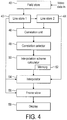
- Figure 4 is a block diagram of a system appropriate for implementing a method as shown in Figure 3 .
- the system can be modified to accommodate variations in the method as described above, for example owing to the use of a greater number than three zones.
- Input video data is fed to field store 40.
- the field store contains the field with the lines adjacent to the missing line which is to be reconstructed.
- Data is read out from field store 40 to a first line store 42 and then to a second line store 44.
- a line is first read by line store 42, and then that line is passed to line store 44, and a second line fed to line store 42.
- the two line stores then contain the two immediately adjacent fields to the missing line in the current field.
- the correlation unit 46 performs a sequence of correlations for the different interpolations which might be used to generate the missing pixel. This is done in a manner similar to that illustrated in Figure 1 , but with a greater number of interpolation schemes, to generate correlation data of the type shown in Figure 2 .
- the resultant correlation data is fed to the correlation selector, which divides the correlation data into zones and selects the correlation from each zone most likely to give the best interpolation scheme for generating the missing pixel. This corresponds to the minimum points in each of the zones in Figure 2 .
- the output of the correlation selector is then used by an interpolation scheme calculator 50 which carries out the steps illustrated in Figure 3 , to produce an interpolation scheme based on a blend of interpolation schemes selected from each zone of the correlation data.
- the interpolation scheme calculator 50 includes a memory or buffer 52 to store the blending factors used for the preceding pixel and a predetermined set of blending factors to be used at the start of each new line of missing video data.
- the interpolator 54 performs the calculation illustrated in box 322 of Figure 3 to produce a luminance value for the pixel.
- the result of the calculation performed by the interpolator 54 is then fed to the frame store 56.
- the frame store 56 also receives data from line store 42, which corresponds to the already known video data adjacent lines of the current field. Once the frame store is full, the resultant video signal can be sent to a display 58 or can be stored.
- the whole process takes place in real time so that it can be performed on a video signal being received by a television receiver which converts the signal into a non interpolator form ready for display.
- the system of Figure 4 is included in the television receiver so that new receivers including the system can display a high resolution version of an interpolator signal without high frequency components.
- two or more sets of the same hardware may be provided, operating in parallel on different lines of the field store 40 to improve processing speed.
- system of Figure 4 can be implemented in a dedicated processor. Two or more dedicated processors can be provided in parallel to improve the speed of processing.
Landscapes
- Engineering & Computer Science (AREA)
- Computer Graphics (AREA)
- Multimedia (AREA)
- Signal Processing (AREA)
- Television Systems (AREA)
Claims (15)
- Verfahren zum Umwandeln eines verschachtelten Videosignals in ein nicht verschachteltes Videosignal, umfassend für jedes fehlende Pixel in jeder fehlenden Zeile eines Videofelds in dem verschachtelten Videosignal anschließend an ein erstes Pixel in der fehlenden Zeile:Ableiten eines Korrelationsdatensatzes, der Korrelationsdaten für jedes aus einer Vielzahl von möglichen Interpolationsschemata umfasst, die bei der Rekonstruktion des fehlenden Pixels verwendet werden sollen;Aufteilen jedes Korrelationsdatensatzes in eine Vielzahl von Korrelationsdatenzonen (Zone 1, Zone 2, Zone 3);Auswählen eines Interpolationsschemas (302, 304, 306) aus der Vielzahl von möglichen Interpolationsschemata aus jeder Korrelationsdatenzone (Zone 1, Zone 2, Zone 3):i. für die Gruppen von einem oder mehreren Pixeln stärker korreliert sind als Gruppen von einem oder mehreren Pixeln in allen anderen Interpolationsschemata in dieser Korrelationsdatenzone; und/oderii. durch Identifizieren mindestens eines Interpolationsschemas aus der Vielzahl von Interpolationsschemata, für die Gruppen von einem oder mehreren Pixeln stärker korreliert sind als für Gruppen von einem oder mehreren Pixeln in benachbarten Interpolationsschemata in dieser Korrelationsdatenzone, und Auswählen des Interpolationsschemas aus dem identifizierten mindestens einen Interpolationsschema, für das die Gruppen von einem oder mehreren Pixeln am stärksten korreliert sind;Rekonstruieren (322) des fehlenden Pixels unter Verwendung einer Mischung der ausgewählten Interpolationsschemata (302, 304, 306), wobei die Mischung ermittelt wird basierend auf:dem Ergebnis des Vergleichs (310, 312, 314) der Korrelationsdaten für die ausgewählten Interpolationsschemata miteinander undÜberblendungsfaktoren für die ausgewählten Interpolationsschemata, wobei die Überblendungsfaktoren auf Überblendungsfaktoren basieren, die für ein räumlich vorhergehendes Pixel in der fehlenden Zeile (316, 318, 320) verwendet werden.
- Verfahren nach Anspruch 1, wobei die Überblendung basierend auf der Überblendung ermittelt wird, die für das unmittelbar räumlich vorhergehende Pixel in der fehlenden Zeile verwendet wird.
- Verfahren nach einem der vorhergehenden Ansprüche, ferner umfassend den Schritt des Zurücksetzens der Überblendung auf eine vorbestimmte Überblendung am Anfang oder am Ende jeder fehlenden Zeile im Videofeld.
- Verfahren nach einem der vorhergehenden Ansprüche, wobei die Überblendung der ausgewählten Interpolationsschemata als gewichtete Summe des Ergebnisses jedes der ausgewählten Interpolationsschemata (322) unter Verwendung der Überblendungsfaktoren ermittelt wird, und wobei die Überblendungsfaktoren in der gewichteten Summe von den Überblendungsfaktoren aus der gleichen Korrelationsdatenzone, die für das unmittelbar räumlich vorhergehende Pixel verwendet wird, inkrementiert oder dekrementiert werden (316, 318, 320), wobei der Betrag der Inkrementierung oder Dekrementierung auf dem Ergebnis des Schritts des Vergleichs der Korrelationsdaten für die ausgewählten Interpolationsschemata miteinander basiert.
- Verfahren nach einem der vorhergehenden Ansprüche, wobei das Vergleichen (310, 312, 314) der Korrelationsdaten für die ausgewählten Interpolationsverfahren miteinander das Ermitteln des ausgewählten Interpolationsverfahrens umfasst, das wahrscheinlich das beste Interpolationsergebnis liefert.
- Verfahren nach Anspruch 5, wobei der Überblendungsfaktor für das ausgewählte Interpolationsschema, das als das wahrscheinlich beste Interpolationsergebnis ermittelt wurde, von dem Überblendungsfaktor aus der gleichen Korrelationsdatenzone, die für das unmittelbar räumlich vorangehende Pixel verwendet wurde, inkrementiert wird (316, 318, 320).
- Verfahren nach einem der vorhergehenden Ansprüche, wobei der Schritt des Aufteilens jedes Korrelationsdatensatzes in eine Vielzahl von Korrelationsdatenzonen das Aufteilen der Korrelationsdaten in Zonen gemäß den räumlichen oder zeitlichen Eigenschaften der entsprechenden Interpolationsschemata umfasst.
- Verfahren nach einem der vorhergehenden Ansprüche, wobei die Vielzahl von Korrelationsdatenzonen mehr als drei Zonen umfasst, und wobei das Vergleichen (310, 312, 314) der Korrelationsdaten für die ausgewählten Interpolationsschemata miteinander das Identifizieren jeweiliger Minima für jede Korrelationsdatenzone, das Ermitteln einer Rangfolge der identifizierten Minima und das Aktualisieren der Überblendungsfaktoren nach dieser Rangfolge umfasst.
- Vorrichtung zum Umwandeln eines verschachtelten Videosignals in ein nicht verschachteltes Videosignal, umfassend:Mittel (46) zum Ableiten eines Korrelationsdatensatzes, der Korrelationsdaten für jedes einer Vielzahl von möglichen Interpolationsschemata umfasst, die beim Rekonstruieren eines fehlenden Pixels in einer fehlenden Zeile eines Videofelds anschließend an ein erstes Pixel in der fehlenden Zeile in dem verschachtelten Videosignal zu verwenden sind;Mittel (48) zum Aufteilen jedes Korrelationsdatensatzes in eine Vielzahl von Korrelationsdatenzonen (Zone 1, Zone 2, Zone 3) ;Mittel (48) zum Auswählen eines Interpolationsschemas (302, 304, 306) aus der Vielzahl von möglichen Interpolationsschemata aus jeder Korrelationsdatenzone:i. für die Gruppen von einem oder mehreren Pixeln stärker korreliert sind als Gruppen von einem oder mehreren Pixeln in allen anderen Interpolationsschemata in dieser Korrelationsdatenzone; und/oderii. durch Identifizieren mindestens eines Interpolationsschemas aus der Vielzahl von Interpolationsschemata, für die Gruppen von einem oder mehreren Pixeln stärker korreliert sind als für Gruppen von einem oder mehreren Pixeln in benachbarten Interpolationsschemata in dieser Korrelationsdatenzone, und Auswählen des Interpolationsschemas aus dem identifizierten mindestens einen Interpolationsschema, für das die Gruppen von einem oder mehreren Pixeln am stärksten korreliert sind;Mittel (50, 54) zum Rekonstruieren des fehlenden Pixels unter Verwendung einer Überblendung der ausgewählten Interpolationsschemata (302, 304, 306), wobei die Überblendung basiert auf:dem Ergebnis des Vergleichs (310, 312, 314) der Korrelationsdaten für die ausgewählten Interpolationsschemata miteinander undÜberblendungsfaktoren für die ausgewählten Interpolationsschemata, wobei die Überblendungsfaktoren auf Überblendungsfaktoren basieren, die für ein räumlich vorhergehendes Pixel in der fehlenden Zeile (316, 318, 320) verwendet werden.
- Vorrichtung nach Anspruch 9, wobei die Überblendung auf der Überblendung basiert, die für das unmittelbar räumlich vorhergehende Pixel in der fehlenden Zeile verwendet wird.
- Vorrichtung nach Anspruch 9 oder 10, wobei die Vorrichtung so konfiguriert ist, dass sie die Überblendung auf eine vorbestimmte Überblendung am Anfang oder am Ende jeder fehlenden Zeile im Videofeld zurücksetzt.
- Vorrichtung nach einem der Ansprüche 9 bis 11, wobei die Mittel (50, 54) zum Rekonstruieren so konfiguriert sind, dass sie die Überlagerung der ausgewählten Interpolationsschemata unter Verwendung einer gewichteten Summe des Ergebnisses jedes der ausgewählten Interpolationsschemata unter Verwendung der Überlagerungsfaktoren ermitteln und die Überlagerungsfaktoren in der gewichteten Summe von den Überlagerungsfaktoren aus der gleichen Korrelationsdatenzone, die für das unmittelbar räumlich vorhergehende Pixel verwendet wird, inkrementieren oder dekrementieren, wobei der Betrag der Inkrementierung oder Dekrementierung auf dem Ergebnis des Vergleichens der Korrelationsdaten für die ausgewählten Interpolationsschemata miteinander basiert.
- Vorrichtung nach einem der Ansprüche 9 bis 12, wobei das Mittel (50, 54) zum Rekonstruieren so konfiguriert ist, dass es das ausgewählte Interpolationsschema ermittelt, das wahrscheinlich das beste Interpolationsergebnis liefert.
- Vorrichtung nach Anspruch 13, wobei die Mittel (50, 54) zum Rekonstruieren so konfiguriert sind, dass sie den Überblendungsfaktor für das ausgewählte Interpolationsschema, das als das wahrscheinlich beste Interpolationsergebnis ermittelt wurde, von dem Überblendungsfaktor aus derselben Korrelationsdatenzone, die für das unmittelbar räumlich vorhergehende Pixel verwendet wurde, inkrementieren (316, 318, 320) .
- Vorrichtung nach einem der Ansprüche 9 bis 14, wobei das Mittel (48) zum Aufteilen jedes Korrelationsdatensatzes in eine Vielzahl von Korrelationsdatenzonen so konfiguriert ist, dass es die Korrelationsdaten gemäß den räumlichen oder zeitlichen Eigenschaften der entsprechenden Interpolationsschemata in Zonen aufteilt.
Applications Claiming Priority (2)
| Application Number | Priority Date | Filing Date | Title |
|---|---|---|---|
| GB1016024.0A GB2484071B (en) | 2010-09-23 | 2010-09-23 | De-interlacing of video data |
| PCT/GB2011/001286 WO2012038685A1 (en) | 2010-09-23 | 2011-08-31 | Method and apparatus for deinterlacing video data |
Publications (2)
| Publication Number | Publication Date |
|---|---|
| EP2619977A1 EP2619977A1 (de) | 2013-07-31 |
| EP2619977B1 true EP2619977B1 (de) | 2021-04-14 |
Family
ID=43127858
Family Applications (1)
| Application Number | Title | Priority Date | Filing Date |
|---|---|---|---|
| EP11760809.1A Active EP2619977B1 (de) | 2010-09-23 | 2011-08-31 | Verfahren und vorrichtung zur zeilenentflechtung von videodaten |
Country Status (5)
| Country | Link |
|---|---|
| US (1) | US8891012B2 (de) |
| EP (1) | EP2619977B1 (de) |
| CN (1) | CN103119931B (de) |
| GB (1) | GB2484071B (de) |
| WO (1) | WO2012038685A1 (de) |
Families Citing this family (3)
| Publication number | Priority date | Publication date | Assignee | Title |
|---|---|---|---|---|
| CA2898417C (en) | 2013-02-08 | 2021-07-27 | Arthur J. Nonni | Softwood kraft fiber having an improved .alpha.-cellulose content and its use in the production of chemical cellulose products |
| CN103544130B (zh) * | 2013-10-24 | 2016-01-20 | 北京时代奥视科技股份有限公司 | 一种多窗口显示设备及显示方法 |
| KR102125775B1 (ko) | 2014-02-24 | 2020-06-23 | 삼성전자주식회사 | 배제 픽셀 데이터를 보상하여 영상을 생성하는 방법 및 그것을 이용하는 영상 생성 장치 |
Family Cites Families (20)
| Publication number | Priority date | Publication date | Assignee | Title |
|---|---|---|---|---|
| US5347599A (en) * | 1991-06-14 | 1994-09-13 | Matsushita Electric Industrial Co., Ltd. | Adaptive interpolation method and apparatus using correlation detection |
| US5661525A (en) * | 1995-03-27 | 1997-08-26 | Lucent Technologies Inc. | Method and apparatus for converting an interlaced video frame sequence into a progressively-scanned sequence |
| US6133957A (en) | 1997-10-14 | 2000-10-17 | Faroudja Laboratories, Inc. | Adaptive diagonal interpolation for image resolution enhancement |
| US7095445B2 (en) * | 2000-12-20 | 2006-08-22 | Samsung Electronics Co., Ltd. | Method of detecting motion in an interlaced video sequence based on logical operation on linearly scaled motion information and motion detection apparatus |
| US7167602B2 (en) * | 2001-07-09 | 2007-01-23 | Sanyo Electric Co., Ltd. | Interpolation pixel value determining method |
| US7197075B2 (en) * | 2002-08-22 | 2007-03-27 | Hiroshi Akimoto | Method and system for video sequence real-time motion compensated temporal upsampling |
| FR2844131B1 (fr) * | 2002-09-03 | 2004-11-12 | St Microelectronics Sa | Procede et dispositif d'interpolation d'images avec compensation du mouvement |
| KR20040050577A (ko) * | 2002-12-10 | 2004-06-16 | 삼성전자주식회사 | 디인터레이싱 장치 및 방법 |
| GB2402288B (en) * | 2003-05-01 | 2005-12-28 | Imagination Tech Ltd | De-Interlacing of video data |
| FR2860941A1 (fr) * | 2003-10-14 | 2005-04-15 | Nextream France | Dispositif et procede d'estimation de bruit d'un signal video |
| JP3960965B2 (ja) * | 2003-12-08 | 2007-08-15 | オリンパス株式会社 | 画像補間装置及び画像補間方法 |
| US7548663B2 (en) * | 2004-08-19 | 2009-06-16 | Realtek Semiconductor Corp. | Intra-field interpolation method and apparatus |
| GB2422974A (en) * | 2005-02-04 | 2006-08-09 | Imagination Tech Ltd | De-interlacing of video data |
| GB2422975B (en) * | 2005-02-08 | 2007-12-12 | Imagination Tech Ltd | Conversion of video data from interlaced to non-interlaced format |
| GB2422976B (en) * | 2005-02-08 | 2007-05-23 | Imagination Tech Ltd | Conversion of video data from interlaced to non-interlaced format |
| FR2884990A1 (fr) * | 2005-04-22 | 2006-10-27 | St Microelectronics Sa | Desentrelacement d'une sequence d'images animees |
| US8964116B2 (en) * | 2005-05-23 | 2015-02-24 | Entropic Communications, Inc. | Spatial and temporal de-interlacing with error criterion |
| JP4795929B2 (ja) | 2006-12-26 | 2011-10-19 | 富士通株式会社 | 補間方法を決定するプログラム、装置、および方法 |
| CN101222604B (zh) * | 2007-04-04 | 2010-06-09 | 晨星半导体股份有限公司 | 运算移动估计值与估算图像的移动向量的方法 |
| US9078007B2 (en) * | 2008-10-03 | 2015-07-07 | Qualcomm Incorporated | Digital video coding with interpolation filters and offsets |
-
2010
- 2010-09-23 GB GB1016024.0A patent/GB2484071B/en not_active Expired - Fee Related
-
2011
- 2011-01-05 US US12/930,373 patent/US8891012B2/en active Active
- 2011-08-31 CN CN201180045461.5A patent/CN103119931B/zh not_active Expired - Fee Related
- 2011-08-31 EP EP11760809.1A patent/EP2619977B1/de active Active
- 2011-08-31 WO PCT/GB2011/001286 patent/WO2012038685A1/en not_active Ceased
Non-Patent Citations (1)
| Title |
|---|
| None * |
Also Published As
| Publication number | Publication date |
|---|---|
| GB201016024D0 (en) | 2010-11-10 |
| GB2484071B (en) | 2013-06-12 |
| WO2012038685A1 (en) | 2012-03-29 |
| GB2484071A (en) | 2012-04-04 |
| CN103119931B (zh) | 2016-04-13 |
| US20120075527A1 (en) | 2012-03-29 |
| US8891012B2 (en) | 2014-11-18 |
| EP2619977A1 (de) | 2013-07-31 |
| CN103119931A (zh) | 2013-05-22 |
Similar Documents
| Publication | Publication Date | Title |
|---|---|---|
| US7057665B2 (en) | Deinterlacing apparatus and method | |
| EP1223748B1 (de) | Bewegungsdetektion in einem Videosignal mit Zeilensprung | |
| US5631706A (en) | Converter and method for converting video signals of interlace format to video signals of progressive format | |
| CN102027489B (zh) | 包括运动补偿特征的运动和边缘自适应处理的系统和方法 | |
| JPS63313984A (ja) | テレビジョン画像の動きベクトル処理装置 | |
| KR20040009967A (ko) | 디인터레이싱장치 및 방법 | |
| JPH10105142A (ja) | インターレース処理されたビデオデータ変換方法および変換システム | |
| US20010015768A1 (en) | Deinterlacing apparatus | |
| JPS63313983A (ja) | テレビジョン画像の動きベクトル処理装置 | |
| US5485224A (en) | Motion compensated video signal processing by interpolation of correlation surfaces and apparatus for doing the same | |
| US8891012B2 (en) | De-interlacing of video data | |
| JP5139086B2 (ja) | インターレース方式から非インターレース方式へのビデオデータの変換 | |
| JP3875286B2 (ja) | 動きベクトル発生方式 | |
| US20030122961A1 (en) | Method for de-interlacing video information | |
| JPH06326980A (ja) | 動き補償映像信号処理方式 | |
| JP5209323B2 (ja) | インターレース方式から非インターレース方式へのビデオデータの変換 | |
| US20060176394A1 (en) | De-interlacing of video data | |
| GB2312806A (en) | Motion compensated video signal interpolation | |
| US7746408B2 (en) | Method and system for improving the appearance of deinterlaced chroma formatted video | |
| JP4310847B2 (ja) | 画像情報変換装置および変換方法 | |
| US8421918B2 (en) | De-interlacing video | |
| KR100728914B1 (ko) | 영상의 속성을 이용한 디인터레이싱 장치 및 그 방법 | |
| EP0474272A1 (de) | Verfahren und Anordung zum Verringern der Bewegungsabschätzapparatur und der Anforderungen an die Datenübertragungskapazität in Video-Systemen | |
| JPH10327392A (ja) | 走査線変換装置および方法 |
Legal Events
| Date | Code | Title | Description |
|---|---|---|---|
| PUAI | Public reference made under article 153(3) epc to a published international application that has entered the european phase |
Free format text: ORIGINAL CODE: 0009012 |
|
| 17P | Request for examination filed |
Effective date: 20130402 |
|
| AK | Designated contracting states |
Kind code of ref document: A1 Designated state(s): AL AT BE BG CH CY CZ DE DK EE ES FI FR GB GR HR HU IE IS IT LI LT LU LV MC MK MT NL NO PL PT RO RS SE SI SK SM TR |
|
| RIN1 | Information on inventor provided before grant (corrected) |
Inventor name: FAZZINI, PAOLO |
|
| DAX | Request for extension of the european patent (deleted) | ||
| STAA | Information on the status of an ep patent application or granted ep patent |
Free format text: STATUS: EXAMINATION IS IN PROGRESS |
|
| 17Q | First examination report despatched |
Effective date: 20180413 |
|
| GRAP | Despatch of communication of intention to grant a patent |
Free format text: ORIGINAL CODE: EPIDOSNIGR1 |
|
| STAA | Information on the status of an ep patent application or granted ep patent |
Free format text: STATUS: GRANT OF PATENT IS INTENDED |
|
| INTG | Intention to grant announced |
Effective date: 20201113 |
|
| RIN1 | Information on inventor provided before grant (corrected) |
Inventor name: FAZZINI, PAOLO |
|
| GRAS | Grant fee paid |
Free format text: ORIGINAL CODE: EPIDOSNIGR3 |
|
| GRAA | (expected) grant |
Free format text: ORIGINAL CODE: 0009210 |
|
| STAA | Information on the status of an ep patent application or granted ep patent |
Free format text: STATUS: THE PATENT HAS BEEN GRANTED |
|
| AK | Designated contracting states |
Kind code of ref document: B1 Designated state(s): AL AT BE BG CH CY CZ DE DK EE ES FI FR GB GR HR HU IE IS IT LI LT LU LV MC MK MT NL NO PL PT RO RS SE SI SK SM TR |
|
| RAP3 | Party data changed (applicant data changed or rights of an application transferred) |
Owner name: IMAGINATION TECHNOLOGIES LIMITED |
|
| REG | Reference to a national code |
Ref country code: GB Ref legal event code: FG4D |
|
| REG | Reference to a national code |
Ref country code: CH Ref legal event code: EP |
|
| REG | Reference to a national code |
Ref country code: DE Ref legal event code: R096 Ref document number: 602011070689 Country of ref document: DE |
|
| REG | Reference to a national code |
Ref country code: IE Ref legal event code: FG4D |
|
| REG | Reference to a national code |
Ref country code: AT Ref legal event code: REF Ref document number: 1383506 Country of ref document: AT Kind code of ref document: T Effective date: 20210515 |
|
| REG | Reference to a national code |
Ref country code: LT Ref legal event code: MG9D |
|
| REG | Reference to a national code |
Ref country code: AT Ref legal event code: MK05 Ref document number: 1383506 Country of ref document: AT Kind code of ref document: T Effective date: 20210414 |
|
| REG | Reference to a national code |
Ref country code: NL Ref legal event code: MP Effective date: 20210414 |
|
| PG25 | Lapsed in a contracting state [announced via postgrant information from national office to epo] |
Ref country code: HR Free format text: LAPSE BECAUSE OF FAILURE TO SUBMIT A TRANSLATION OF THE DESCRIPTION OR TO PAY THE FEE WITHIN THE PRESCRIBED TIME-LIMIT Effective date: 20210414 Ref country code: AT Free format text: LAPSE BECAUSE OF FAILURE TO SUBMIT A TRANSLATION OF THE DESCRIPTION OR TO PAY THE FEE WITHIN THE PRESCRIBED TIME-LIMIT Effective date: 20210414 Ref country code: BG Free format text: LAPSE BECAUSE OF FAILURE TO SUBMIT A TRANSLATION OF THE DESCRIPTION OR TO PAY THE FEE WITHIN THE PRESCRIBED TIME-LIMIT Effective date: 20210714 Ref country code: LT Free format text: LAPSE BECAUSE OF FAILURE TO SUBMIT A TRANSLATION OF THE DESCRIPTION OR TO PAY THE FEE WITHIN THE PRESCRIBED TIME-LIMIT Effective date: 20210414 Ref country code: NL Free format text: LAPSE BECAUSE OF FAILURE TO SUBMIT A TRANSLATION OF THE DESCRIPTION OR TO PAY THE FEE WITHIN THE PRESCRIBED TIME-LIMIT Effective date: 20210414 Ref country code: FI Free format text: LAPSE BECAUSE OF FAILURE TO SUBMIT A TRANSLATION OF THE DESCRIPTION OR TO PAY THE FEE WITHIN THE PRESCRIBED TIME-LIMIT Effective date: 20210414 |
|
| PG25 | Lapsed in a contracting state [announced via postgrant information from national office to epo] |
Ref country code: GR Free format text: LAPSE BECAUSE OF FAILURE TO SUBMIT A TRANSLATION OF THE DESCRIPTION OR TO PAY THE FEE WITHIN THE PRESCRIBED TIME-LIMIT Effective date: 20210715 Ref country code: IS Free format text: LAPSE BECAUSE OF FAILURE TO SUBMIT A TRANSLATION OF THE DESCRIPTION OR TO PAY THE FEE WITHIN THE PRESCRIBED TIME-LIMIT Effective date: 20210814 Ref country code: LV Free format text: LAPSE BECAUSE OF FAILURE TO SUBMIT A TRANSLATION OF THE DESCRIPTION OR TO PAY THE FEE WITHIN THE PRESCRIBED TIME-LIMIT Effective date: 20210414 Ref country code: RS Free format text: LAPSE BECAUSE OF FAILURE TO SUBMIT A TRANSLATION OF THE DESCRIPTION OR TO PAY THE FEE WITHIN THE PRESCRIBED TIME-LIMIT Effective date: 20210414 Ref country code: SE Free format text: LAPSE BECAUSE OF FAILURE TO SUBMIT A TRANSLATION OF THE DESCRIPTION OR TO PAY THE FEE WITHIN THE PRESCRIBED TIME-LIMIT Effective date: 20210414 Ref country code: ES Free format text: LAPSE BECAUSE OF FAILURE TO SUBMIT A TRANSLATION OF THE DESCRIPTION OR TO PAY THE FEE WITHIN THE PRESCRIBED TIME-LIMIT Effective date: 20210414 Ref country code: PL Free format text: LAPSE BECAUSE OF FAILURE TO SUBMIT A TRANSLATION OF THE DESCRIPTION OR TO PAY THE FEE WITHIN THE PRESCRIBED TIME-LIMIT Effective date: 20210414 Ref country code: NO Free format text: LAPSE BECAUSE OF FAILURE TO SUBMIT A TRANSLATION OF THE DESCRIPTION OR TO PAY THE FEE WITHIN THE PRESCRIBED TIME-LIMIT Effective date: 20210714 Ref country code: PT Free format text: LAPSE BECAUSE OF FAILURE TO SUBMIT A TRANSLATION OF THE DESCRIPTION OR TO PAY THE FEE WITHIN THE PRESCRIBED TIME-LIMIT Effective date: 20210816 |
|
| REG | Reference to a national code |
Ref country code: DE Ref legal event code: R097 Ref document number: 602011070689 Country of ref document: DE |
|
| PG25 | Lapsed in a contracting state [announced via postgrant information from national office to epo] |
Ref country code: SM Free format text: LAPSE BECAUSE OF FAILURE TO SUBMIT A TRANSLATION OF THE DESCRIPTION OR TO PAY THE FEE WITHIN THE PRESCRIBED TIME-LIMIT Effective date: 20210414 Ref country code: SK Free format text: LAPSE BECAUSE OF FAILURE TO SUBMIT A TRANSLATION OF THE DESCRIPTION OR TO PAY THE FEE WITHIN THE PRESCRIBED TIME-LIMIT Effective date: 20210414 Ref country code: EE Free format text: LAPSE BECAUSE OF FAILURE TO SUBMIT A TRANSLATION OF THE DESCRIPTION OR TO PAY THE FEE WITHIN THE PRESCRIBED TIME-LIMIT Effective date: 20210414 Ref country code: DK Free format text: LAPSE BECAUSE OF FAILURE TO SUBMIT A TRANSLATION OF THE DESCRIPTION OR TO PAY THE FEE WITHIN THE PRESCRIBED TIME-LIMIT Effective date: 20210414 Ref country code: CZ Free format text: LAPSE BECAUSE OF FAILURE TO SUBMIT A TRANSLATION OF THE DESCRIPTION OR TO PAY THE FEE WITHIN THE PRESCRIBED TIME-LIMIT Effective date: 20210414 Ref country code: RO Free format text: LAPSE BECAUSE OF FAILURE TO SUBMIT A TRANSLATION OF THE DESCRIPTION OR TO PAY THE FEE WITHIN THE PRESCRIBED TIME-LIMIT Effective date: 20210414 |
|
| PLBE | No opposition filed within time limit |
Free format text: ORIGINAL CODE: 0009261 |
|
| STAA | Information on the status of an ep patent application or granted ep patent |
Free format text: STATUS: NO OPPOSITION FILED WITHIN TIME LIMIT |
|
| 26N | No opposition filed |
Effective date: 20220117 |
|
| REG | Reference to a national code |
Ref country code: CH Ref legal event code: PL |
|
| PG25 | Lapsed in a contracting state [announced via postgrant information from national office to epo] |
Ref country code: MC Free format text: LAPSE BECAUSE OF FAILURE TO SUBMIT A TRANSLATION OF THE DESCRIPTION OR TO PAY THE FEE WITHIN THE PRESCRIBED TIME-LIMIT Effective date: 20210414 |
|
| REG | Reference to a national code |
Ref country code: BE Ref legal event code: MM Effective date: 20210831 |
|
| PG25 | Lapsed in a contracting state [announced via postgrant information from national office to epo] |
Ref country code: LI Free format text: LAPSE BECAUSE OF NON-PAYMENT OF DUE FEES Effective date: 20210831 Ref country code: CH Free format text: LAPSE BECAUSE OF NON-PAYMENT OF DUE FEES Effective date: 20210831 |
|
| PG25 | Lapsed in a contracting state [announced via postgrant information from national office to epo] |
Ref country code: IS Free format text: LAPSE BECAUSE OF FAILURE TO SUBMIT A TRANSLATION OF THE DESCRIPTION OR TO PAY THE FEE WITHIN THE PRESCRIBED TIME-LIMIT Effective date: 20210814 Ref country code: LU Free format text: LAPSE BECAUSE OF NON-PAYMENT OF DUE FEES Effective date: 20210831 Ref country code: AL Free format text: LAPSE BECAUSE OF FAILURE TO SUBMIT A TRANSLATION OF THE DESCRIPTION OR TO PAY THE FEE WITHIN THE PRESCRIBED TIME-LIMIT Effective date: 20210414 |
|
| PG25 | Lapsed in a contracting state [announced via postgrant information from national office to epo] |
Ref country code: IT Free format text: LAPSE BECAUSE OF FAILURE TO SUBMIT A TRANSLATION OF THE DESCRIPTION OR TO PAY THE FEE WITHIN THE PRESCRIBED TIME-LIMIT Effective date: 20210414 Ref country code: IE Free format text: LAPSE BECAUSE OF NON-PAYMENT OF DUE FEES Effective date: 20210831 Ref country code: BE Free format text: LAPSE BECAUSE OF NON-PAYMENT OF DUE FEES Effective date: 20210831 |
|
| PG25 | Lapsed in a contracting state [announced via postgrant information from national office to epo] |
Ref country code: HU Free format text: LAPSE BECAUSE OF FAILURE TO SUBMIT A TRANSLATION OF THE DESCRIPTION OR TO PAY THE FEE WITHIN THE PRESCRIBED TIME-LIMIT; INVALID AB INITIO Effective date: 20110831 Ref country code: CY Free format text: LAPSE BECAUSE OF FAILURE TO SUBMIT A TRANSLATION OF THE DESCRIPTION OR TO PAY THE FEE WITHIN THE PRESCRIBED TIME-LIMIT Effective date: 20210414 |
|
| P01 | Opt-out of the competence of the unified patent court (upc) registered |
Effective date: 20230517 |
|
| PGFP | Annual fee paid to national office [announced via postgrant information from national office to epo] |
Ref country code: GB Payment date: 20230822 Year of fee payment: 13 |
|
| PGFP | Annual fee paid to national office [announced via postgrant information from national office to epo] |
Ref country code: FR Payment date: 20230824 Year of fee payment: 13 Ref country code: DE Payment date: 20230821 Year of fee payment: 13 |
|
| PG25 | Lapsed in a contracting state [announced via postgrant information from national office to epo] |
Ref country code: MK Free format text: LAPSE BECAUSE OF FAILURE TO SUBMIT A TRANSLATION OF THE DESCRIPTION OR TO PAY THE FEE WITHIN THE PRESCRIBED TIME-LIMIT Effective date: 20210414 |
|
| PG25 | Lapsed in a contracting state [announced via postgrant information from national office to epo] |
Ref country code: MT Free format text: LAPSE BECAUSE OF FAILURE TO SUBMIT A TRANSLATION OF THE DESCRIPTION OR TO PAY THE FEE WITHIN THE PRESCRIBED TIME-LIMIT Effective date: 20210414 |
|
| REG | Reference to a national code |
Ref country code: DE Ref legal event code: R119 Ref document number: 602011070689 Country of ref document: DE |
|
| GBPC | Gb: european patent ceased through non-payment of renewal fee |
Effective date: 20240831 |
|
| PG25 | Lapsed in a contracting state [announced via postgrant information from national office to epo] |
Ref country code: DE Free format text: LAPSE BECAUSE OF NON-PAYMENT OF DUE FEES Effective date: 20250301 |
|
| PG25 | Lapsed in a contracting state [announced via postgrant information from national office to epo] |
Ref country code: GB Free format text: LAPSE BECAUSE OF NON-PAYMENT OF DUE FEES Effective date: 20240831 |
|
| PG25 | Lapsed in a contracting state [announced via postgrant information from national office to epo] |
Ref country code: FR Free format text: LAPSE BECAUSE OF NON-PAYMENT OF DUE FEES Effective date: 20240831 |
|
| PG25 | Lapsed in a contracting state [announced via postgrant information from national office to epo] |
Ref country code: TR Free format text: LAPSE BECAUSE OF FAILURE TO SUBMIT A TRANSLATION OF THE DESCRIPTION OR TO PAY THE FEE WITHIN THE PRESCRIBED TIME-LIMIT Effective date: 20210414 |