EP2602178A1 - Wakesurfboot und Rumpf für ein Wakesurfboot - Google Patents
Wakesurfboot und Rumpf für ein Wakesurfboot Download PDFInfo
- Publication number
- EP2602178A1 EP2602178A1 EP12196282.3A EP12196282A EP2602178A1 EP 2602178 A1 EP2602178 A1 EP 2602178A1 EP 12196282 A EP12196282 A EP 12196282A EP 2602178 A1 EP2602178 A1 EP 2602178A1
- Authority
- EP
- European Patent Office
- Prior art keywords
- hull
- water
- ballast
- trim
- mode
- Prior art date
- Legal status (The legal status is an assumption and is not a legal conclusion. Google has not performed a legal analysis and makes no representation as to the accuracy of the status listed.)
- Withdrawn
Links
Images









Classifications
-
- B—PERFORMING OPERATIONS; TRANSPORTING
- B63—SHIPS OR OTHER WATERBORNE VESSELS; RELATED EQUIPMENT
- B63B—SHIPS OR OTHER WATERBORNE VESSELS; EQUIPMENT FOR SHIPPING
- B63B43/00—Improving safety of vessels, e.g. damage control, not otherwise provided for
- B63B43/02—Improving safety of vessels, e.g. damage control, not otherwise provided for reducing risk of capsizing or sinking
- B63B43/04—Improving safety of vessels, e.g. damage control, not otherwise provided for reducing risk of capsizing or sinking by improving stability
- B63B43/06—Improving safety of vessels, e.g. damage control, not otherwise provided for reducing risk of capsizing or sinking by improving stability using ballast tanks
-
- B—PERFORMING OPERATIONS; TRANSPORTING
- B63—SHIPS OR OTHER WATERBORNE VESSELS; RELATED EQUIPMENT
- B63B—SHIPS OR OTHER WATERBORNE VESSELS; EQUIPMENT FOR SHIPPING
- B63B1/00—Hydrodynamic or hydrostatic features of hulls or of hydrofoils
- B63B1/16—Hydrodynamic or hydrostatic features of hulls or of hydrofoils deriving additional lift from hydrodynamic forces
- B63B1/18—Hydrodynamic or hydrostatic features of hulls or of hydrofoils deriving additional lift from hydrodynamic forces of hydroplane type
- B63B1/20—Hydrodynamic or hydrostatic features of hulls or of hydrofoils deriving additional lift from hydrodynamic forces of hydroplane type having more than one planing surface
- B63B2001/201—Hydrodynamic or hydrostatic features of hulls or of hydrofoils deriving additional lift from hydrodynamic forces of hydroplane type having more than one planing surface divided by longitudinal chines
-
- B—PERFORMING OPERATIONS; TRANSPORTING
- B63—SHIPS OR OTHER WATERBORNE VESSELS; RELATED EQUIPMENT
- B63B—SHIPS OR OTHER WATERBORNE VESSELS; EQUIPMENT FOR SHIPPING
- B63B2207/00—Buoyancy or ballast means
- B63B2207/02—Variable ballast or buoyancy
Definitions
- the present invention relates to boats and boat hulls. More particularly, the present invention relates to wakesurfing boats, and hulls used for wakesurfing boats.
- Wakesurfing is a watersport that is growing in popularity.
- a wakesurfer initially being towed behind a boat via a tow rope, rises to his feet on a surf board in a body of water, (e.g ., an ocean, a sea, a lake, or a river) similar to a waterskier or a wakeboarder.
- the boat should generate in its wake a wave that mimics a size, a shape, and a duration of an ocean wave.
- the wakesurfer unlike a waterskier or a wakeboarder, releases the tow rope, and rides the board on a crest and/or a face of the wake wave, traversing back and forth on the wake wave face as desired, similar to an ocean surfer.
- wakesurfers have been attempting to surf primarily in the wakes of existing cruising boats, waterskiing boats and wakeboarding boats. These classes of boats typically are designed for speed, seaworthiness, and handling characteristics.
- a boat when passing through a body of water, creates separate waves that move in the boat's wake.
- separate wake waves originate, respectively, from the boat's bow, centerline, quarter, and stern.
- Each wake wave generally forms the arms of a V, with the source of the respective wake wave being at the point of the V (the boat), and transverse curled wave crests forming offset from the path of the boat.
- Wake wave height (W h ) is a function of several factors, including for example a speed of the boat hull in the body of water, resistance to the boat hull as it moves through the body of water, Froude number, a shape of the hull, a length of the hull, a length/beam ratio (L/B) of the hull, a speed/length ratio (SLR) of the hull, an amount of the boat hull bottom in contact with the body of water, and an amount of water displaced by the boat as it moves through the body of water.
- a self-propelled wakesurfing boat, and a hull for a wakesurfing boat, are desired which will generate the largest, best-shaped and longest-lasting wake waves possible in view of the boat's size, displacement, and speed.
- the present invention is directed to a wakesurfing boat for wakesurfing in a body of water, and a hull for a wakesurfing boat, that substantially obviates one or more of the problems caused by the limitations and disadvantages of the related art.
- a wakesurfing boat operable in a body of water in accordance with the present invention includes a hull.
- the hull includes a bow, a stern, a port bulwark, a starboard bulwark, a bottom, a length (L), and a beam (B).
- a trim-altering ballast system is supported by the hull.
- the trim-altering ballast system includes a plurality of ballast tanks, configured to alternately and selectively receive and discharge ballast water, in order to trim the hull, in one of a plurality of modes, including:
- a cruising mode wherein the hull is moving through the body of water, the ballast tanks are substantially empty, the hull has at least a first weight, thereby displacing at least a first amount of water, and a first portion of the hull bottom is in contact with the body of water,
- ballasted static mode wherein the hull is static in the body of water, the ballast tanks are filled or at least partially filled with ballast water, the hull has at least a second weight, displacing at least a second amount of water corresponding to the second weight, the second amount of displaced water being greater than the first amount of displaced water, and a second portion of the hull bottom is in contact with the body of water, the second portion of the hull bottom being greater than the first portion of the hull bottom,
- a dynamic surfing mode wherein the hull is moving through the body of water, the ballast tanks are filled or at least partially filled with ballast water, the hull has at least the second weight, displacing at least the second amount of displaced water, and a third portion of the hull bottom is in contact with the body of water, the third portion of the hull bottom being intermediate the first portion and the second portion.
- the hull In the cruising mode, the hull has a first trim ⁇ 1 , down by the stern.
- the hull In the ballasted static mode, the hull has a second trim ⁇ 2 down by the bow.
- the hull has a third trim ⁇ 3 , intermediate the first trim ⁇ 1 of the cruising mode and the second trim ⁇ 2 of the ballasted static mode.
- the ballast tanks comprise a plurality of sets of dual tanks, each set of dual tanks being positioned at generally symmetrical locations with respect to one another along the length of the hull.
- ballast tanks can be selectively filled, or partially filled, with ballast water, to vary the weight and displacement of the hull, and to trim the hull with a plurality of alternate trim angles ⁇ 4 ... ⁇ n .
- the bottom of the hull is configured in part as a central inverted V in cross-section, with the central inverted V commencing at the bow and extending to the stern.
- An apex angle a of the central inverted V changes at preselected positions as the inverted V extends from the bow to the stern, i.e ., ⁇ 1 ... ⁇ n .
- the entire bottom is configured substantially as a W in cross-section, wherein the W extends from the port bulwark to the starboard bulwark.
- the W includes port and starboard nadirs and a central apex, wherein the central apex of the W defines the central inverted V.
- the central inverted V defines a funnel through which water passes when the hull moves through the body of water. More water passes through the funnel in the dynamic surfing mode than in the cruising mode.
- the combination of the ballast tanks being filled or partially filled with ballast water, the at least second weight and the corresponding at least second displacement, the third portion of the V-shaped hull bottom being in contact with the body of water, the hull being in the third trim ⁇ 3 , and the increased amount of water passing through the funnel defined by the central inverted V, results in an increase in resistance to the hull.
- the hull when the hull moves through the body of water in the cruising mode, with relatively minor resistance to the hull, it generates at least one wake, W 1 having a first wake height, W h1 .
- W 1 having a first wake height
- W h1 When the hull moves through the body of water in the dynamic surfing mode, however, with the increased water resistance to the hull, it generates at least one wake wave W 2 having a second wake wave height W h2 .
- the second wake wave height W h2 of the at least one wake wave W 2 is greater than the first wake height W h1 of the at least one wake W 1 .
- the second wake wave height W h2 of the at least one wake wave W 2 is approximately 0.5 meters to approximately 2.7 meters, depending on the length of the hull.
- a plurality of hull lengths are within the scope of the invention, e.g., 20 feet - 60 feet, including but not limited to a 43 foot yacht, a 35 foot cruiser, and a 28 foot sport boat.
- the beam is selected such that the length to beam ratio (L/B) of the hull is less than or equal to 3.0, i.e., L/B ⁇ 3.0.
- the boat hull is self-propelled, preferably by two inward-rotating propellers.
- a hull for a wakesurfing boat operable in a body of water includes a bow, a stern, a port bulwark, a starboard bulwark, and a bottom extending between the bow and the stern, and from the port bulwark to the starboard bulwark, wherein the entire bottom is configured substantially as a W in cross-section, the W extending from the port bulwark to the starboard bulwark, including a port nadir, a starboard nadir, and a central apex, the central apex defining a central inverted V portion extending from the bow to the stern; and a trim and displacement altering apparatus, comprising a plurality of ballast tanks, selectively altering a trim, an amount of the hull bottom in contact with the body of water, and an amount of displaced water displaced by the hull, thereby providing the hull with a plurality of modes, including:
- a cruising mode wherein the hull is moving through the body of water, the ballast tanks are substantially empty, the hull displaces at least a first amount of displaced water, a first portion of the hull bottom is in contact with the body of water, and the hull has a first trim ⁇ 1 down by the stern.
- ballasted static mode wherein the hull is static in the body of water, the ballast tanks are filled or at least partially filled with ballast water, the hull displaces at least a second amount of displaced water greater than the first amount of displaced water, a second portion of the hull bottom is in contact with the body of water, the second portion being greater than the first portion, and the hull has a second trim ⁇ 2 down by the bow;
- a dynamic surfing mode wherein the hull is moving through the body of water, the ballast tanks are filled or at least partially filled with ballast water, the hull displaces at least the second amount of displaced water, a third portion of the hull bottom is in contact with the body of water, the third portion being intermediate the first portion and the second portion, and the hull has a third trim ⁇ 3 intermediate the first trim ⁇ 1 and the second trim ⁇ 2 .
- the hull creates at least one first wake W 1 , having a first wake height W h1 .
- W h1 Is approximately 10-15 cm.
- the hull creates at least one second wake wave W 2 , having a second wake wave height W h2 , which is greater than W h1 .
- W h2 is approximately 0.5 meters to approximately 2.7 meters, depending on the length of the hull.
- Figure 1 is a side view of a wakesurfing boat in accordance with the invention.
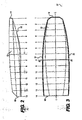
- Figure 2 is a side view of a 43 foot hull of a wakesurfing boat in accordance with the invention, with numbered cross-sectional lines drawn at preselected locations between a bow and a stern of the hull;
- Figure 3 is a bottom view of the hull of Fig. 2 , with the numbered cross-sectional lines drawn at the same preselected locations between the bow and the stern of the hull, as depicted in Fig. 2 ;
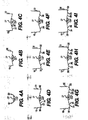
- Figures 4A-4N are longitudinal cross-sectional views of the hull, viewed from the stern, the cross-sections taken along each numbered cross-sectional line on the side and bottom of the hull depicted in Figs. 2 and 3 , showing an apex angle ⁇ of a central inverted V in a center of the hull bottom;
- Figure 5 is a view of the bottom of the hull depicted in Fig. 2 ;
- Figure 6 is a view from the bow of the hull depicted in Fig. 5 ;
- Figure 7 is a view from the stern of the hull depicted in Fig. 5 ;
- Figure 8 is a view from the bottom of the hull in accordance with the invention, while the hull is in motion through a body of water, depicting a flow of water moving into and through a funnel defined by the central inverted V-shaped bottom of the hull;
- FIG. 9 is a view of the hull depicting locations of the sets of ballast tanks in a trim-altering ballast system, in accordance with the invention.
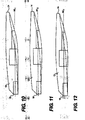
- Figure 10 is a side cross-sectional view of a hull in accordance with the invention in a Lightship condition, with the ballast tanks empty;
- FIG 11 is a side cross-sectional view of a hull in accordance with the invention, with the ballast tanks 50% filled with ballast water;
- Figure 12 is a side cross-sectional view of a hull in accordance with the invention, with the ballast tanks 00% filled with ballast water;
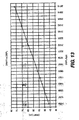
- Figure 13 is a graph depicting draft versus displacement for a 43 foot hull in accordance with the present invention.
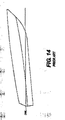
- Figure 14 is a side view of a prior art power boat in motion in a body of water
- Figure 15 is a side cross-sectional view of a 43 foot hull in accordance with the invention, with ballast tanks empty, operating in a cruising mode;
- Figure 16 is a side cross-sectional view of a 43 foot hull in accordance with the invention, with the ballast tanks 100% filled, in a ballasted static mode;
- Figure 17 is a side cross-sectional view of a 43 foot hull in accordance with the invention, with the ballast tanks 100% filled, operating in a dynamic surfing mode;
- Figure 18 is a side cross-sectional view of a 43 foot hull in accordance with the invention, with the ballast tanks 50% filled, operating in the dynamic surfing mode;
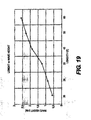
- Figure 19 is a graph depicting expected wake wave height versus hull length, determined via extrapolation, for a hull in the dynamic surfing mode in accordance with the invention.
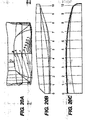
- Figures 20A-20C are drawn-to-scale cross-sectional views of a 20 foot hull in accordance with the invention.
- Figures 21A-21C are drawn-to-scale cross-sectional views of a 28 foot hull in accordance with the invention.
- Figures 22A-22C are drawn-to-scale cross-sectional views of a 35 foot hull in accordance with the invention.
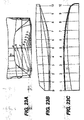
- Figures 23A-23C are drawn-to-scale cross-sectional views of a 60 foot hull in accordance with the invention.
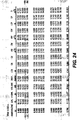
- Figure 24 is a chart depicting changes in static dimensions of the hull, including (in order): length at the Waterline, beam at the waterline, immersed volume, displacement, length at the center of buoyancy, Block coefficient, amidship transversal section immersed area, amidship transversal section coefficient, waterplane area, length at the center of flotation, prismatic coefficient, and immersed hull surface, for a 43 foot hull at varying drafts (i.e., "immersione"), from 0.46 meters to 0.74 meters, measured in 0.02 meter increments;
- Figure 25 is a graph depicting wake wave height versus distance from the boat's transom, for a boat in accordance with the invention, while operating in the dynamic surfing mode;
- Figure 26 is a graph depicting waves in the wake of the boat while operating in the dynamic surfing mode in accordance with the invention.
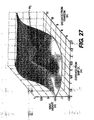
- Figure 27 is a graph depicting wave height versus distance from a centerline of the boat and distance from a transom, while operating in the dynamic surfing mode in accordance with the invention.
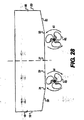
- Figure 28 is a view of the stern of the boat in accordance with the invention, depicting the transom and inward-rotating propellers.
- FIG. 1 A presently preferred embodiment of a wakesurfing boat in accordance with the present invention is shown in Fig. 1 and is designated generally by reference numeral 10.
- the wakesurfing boat 10 includes a hull 12.
- hull 12 includes a bow 14, a stern 16, a port bulwark 18, a starboard bulwark 20, a length L, and a beam B.
- hull 12 is a planing hull.
- Different hull lengths are possible and within the broad scope of the invention, including, without limitation, a 43 foot yacht, a 35 foot cruiser, and a 28 foot sport boat.
- Other hull lengths also are within the scope of the invention e.g., 20 feet through 60 feet.
- a maximum beam B always is selected such that the length to beam ratio L/B of the respective hull 12 is less than or equal to 3.0, i.e ., L/B ⁇ 3.0.
- the hull 12 includes a bottom 22.
- Bottom 22 extends from the bow 14 to the stern 16, and from the port bulwark 18 to the starboard bulwark 20.
- Bottom 22 preferably is configured, when viewed longitudinally, in cross-section, substantially in a W-shape, with a central inverted V-shaped portion 26 extending from the bow 14 to the stern 16.
- the inverted V-shaped portion 26 has an apex angle ⁇ , which differs at selected locations ⁇ 1 ... ⁇ n along the length L of the hull.
- the apex angles ⁇ 1 ... ⁇ n are depicted in Figs.
- the apex angles ⁇ vary from ⁇ 1 , approximately 178°, proximate the bow 14, as shown in Fig. 4A , through a sequence of steeper and shallower apex angles ⁇ 2 ... ⁇ 14 , e.g. , ⁇ 7 , approximately 152°, proximate a point roughly amidships, as shown in Fig. 4G , to ⁇ 14 , approximately 179°, proximate the stern 16, as shown in Fig. 4N .
- the bottom 22 further includes an inclined portion 30 on the port side of the hull, and an inclined portion 32 on the starboard side of the hull, connecting the central inverted V-shaped portion 26 to the port and starboard bulwarks 18 and 20, respectively, thereby defining the substantial cross-sectional W shape of the bottom 22.
- the W shape forms the entire bottom 22 of the hull 12, from the port bulwark 18 to the starboard bulwark 20.
- the W shape, defined by the inclined portions 30 and 32, and the central V-shaped portion 26 further includes a port nadir 24 at the bottom of the inclined portion 30, a starboard nadir 25 at the bottom of the inclined portion 32, and a central apex 27 at the inverted peak of the V-shaped portion 26.
- the central inverted V-shaped portion 26 defines a funnel 28.
- a funnel 28 As depicted in Fig. 8 , when the hull 12 moves through a body of water, agitating a surface microlayer thereof, water is deflected by the nadirs 24 and 25 of the W-shaped bottom into and through the funnel 28 defined by the V-shaped portion 26. Water exiting the funnel 28 at the stern of the boat will help define wake waves.
- the wakesurfing boat 10 further includes a trim and displacement-altering ballast system 34, supported within the hull 12.
- the system 34 includes a plurality of dual sets of ballast tanks 36a/36b, 37a/37b, and 38a/38b, positioned at selected symmetrical positions along the length of hull 12.
- a first set of dual ballast tanks 36a/36b are positioned proximate the port and starboard bulwarks 18 and 20, respectively, and are the farthest forward of all of the sets of ballast tanks.
- a trim and displacement-altering ballast system 34 supported within the hull 12.
- the system 34 includes a plurality of dual sets of ballast tanks 36a/36b, 37a/37b, and 38a/38b, positioned at selected symmetrical positions along the length of hull 12.
- a first set of dual ballast tanks 36a/36b are positioned proximate the port and starboard bulwarks 18 and 20, respectively, and are the farthest forward of all of the
- a second set of dual ballast tanks 37a/37b are positioned proximate the port and starboard bulwarks 18 and 20, respectively aft of ballast tanks 36a/36b, and approximately amidships.
- a third set of dual ballast tanks 38a/38b are positioned proximate the port and starboard bulwarks 18 and 20, respectively, proximate the stern 16 of the hull 12.
- ballast Tanks 36a/36b 37a/37b 38a/38b Individual Tank Volume 1,295 liters/tank 1,965 liters/tank 1,330 liters/tank Combined Ballast Tank Volume 2,590 liters 3,930 liters 2,260 liters Total Ballast 9,180 liters Total Weight 22,629 Kg
- the density of fresh water ( i.e ., 1,000 kg/m 3 ) was used in this calculation.
- the wakesurfing boat of the invention is buoyant and operable both in fresh water and in salt water.
- a weight of the hull 12 corresponds to a weight of water displaced by the hull 12
- a ballast tank-empty (i.e. , "Lightship") displacement, M LCC , of the half-loaded hull 12 14,000 Kg.
- Fig. 13 graphically depicts drafts for various displacements of the hull 12 in accordance with the invention.
- Fig. 14 broadly depicts a traditional power boat, such as a traditional waterskiing boat, cruiser, or sport boat, moving through a body of water.
- the hull 12 in accordance with the invention with ballast tanks empty or nearly empty, cruising through a body of water in a "cruising" mode, is depicted in Fig. 15 .
- the resistance of the water against the planing hull lifts the bow 14 up, correspondingly pushing the stern 16 down, so that the hull 12 is a trimmed stern down with a first trim angle ⁇ 1 .
- a first amount of water is forced through the funnel 28 defined by the inverted V-shaped bottom 12. With these parameters, the water provides a relatively minor first amount of resistance to the hull, as the hull passes through the body of water.
- Fig. 16 depicts the hull 12 in accordance with the invention, with ballast tanks 100% filled with ballast water, sitting static in the water in a ballasted static mode.
- a second portion 53 of hull bottom 22 is in contact with the body of water. Because of the greater weight added by the ballast water, the hull 12 squats lower in the water. For this reason, the second portion 53 of the hull bottom is greater than first portion 52 of the hull bottom when the hull 12 is operating in the cruising mode. Also, in this ballasted static mode, the hull is trimmed bow down, with a second trim ⁇ 2 .
- Fig. 17 depicts the hull 12 in accordance with the invention, with the ballast tanks 100% filled with ballast water, and the hull 12 moving through the body of water in a dynamic surfing mode. This is the operating mode intended for the surfer to wakesurf, in accordance with the invention.
- the bow 14 of the hull 12 is pushed partially upward by force of the water, but due to the increased weight of the ballast water in the filled or at least partially-filled ballast tanks, the bow 14 is not pushed upward as high as it is in the cruising mode.
- the hull 12, therefore, is trimmed in an intermediate third trim ⁇ 3 , intermediate the stern-down trim ⁇ 1 of the cruising mode and the bow-down trim ⁇ 2 of the ballasted static mode.
- the extra ballast water in the ballast tanks causing the hull 12 to squat lower in the water, combined with the lower bow 14 associated with the intermediate trim ⁇ 3 , results in a third portion 54 of the W-shaped hull bottom 22 being in contact with the body of water.
- the third portion 54 of the W-shaped hull bottom 12 is intermediate the first portion 52 of the hull bottom 22 contacting the body of water in the cruising mode, and the second portion 53 of the W-shaped hull bottom 22 contacting the body of water in the ballasted static mode, i.e ., more of the W-shaped bottom 22 is in contact with the body of water in dynamic surfing mode than it is in the cruising mode.
- a second larger amount of water is forced through the funnel 28 defined by the inverted V-shaped bottom 12.
- the combination of the increased weight due to the ballast water, the resultant increased displacement, the increased third portion 54 of the W-shaped bottom 12 being in contact with the water, the intermediate trim ⁇ 3 , and the increased amount of water passing through the funnel 28 are parameters which increase resistance to the hull 12 as it passes through the body of water.
- the ballast tanks substantially empty, having a first weight, displacing a first amount of displaced water, having the stern-down trim angle ⁇ 1 , the first amount 52 of hull bottom 22 in the water, the first amount of water forced through the funnel 28 defined by the inverted V-shape of the bottom 12, and the relatively minor amount of water resistance, at least one first wake W 1 is generated, with a first wake height W h1 , of approximately 10 - 15 cm.
- the height W h2 of at least one wake wave W 2 is approximately 0.5 meters to approximately 2.7 meters, depending on the length of hull 12.
- Fig. 19 graphically depicts projected wave heights for hull lengths from 20 feet to 60 feet, respectively.
- the trim and displacement-altering ballast system of the present invention allows the operator to fill or partially fill selected ones of the respective ballast tanks, to achieve various different moment arms, displacements, and trims, as desired, to change wake wave heights.
- selected ones or all of the ballast tanks are filled or partially filled with ballast water, and the boat operates in the dynamic surfing mode, with the hull still squatting lower in the water, though not as low as with the ballast tanks 100% filled, the hull is trimmed with a plurality of trim angles ⁇ 4. .. ⁇ n .
- Fig. 18 depicts hull 12 in the dynamic surfing mode, with the ballast tanks 50% filled.
- Figs. 2-3 and 15-18 The hull depicted in Figs. 2-3 and 15-18 is a 43 foot yacht hull. As stated above, however, the present invention is not limited to this hull length.
- Figs. 20A-20C depict a 20 foot hull.
- Figs. 21A-21C depict a 28 foot sport boat hull.
- Figs. 22A-22C depict a 35 foot cruiser hull.
- Figs. 23A-23C depict a 60 foot hull.
- Fig. 24 broadly depicts changes in several static dimensions, of a 43 foot hull at different drafts from 0.46 meters to 0.74 meters, measured at 0.02 meter intervals.
- Fig. 25 graphically depicts wake wave heights generated by the hull in the dynamic surfing mode, versus distance from the boat's transom at the boat's centerline CL, and also at one meter and two meters away from the boat's CL (all wake wave heights being measured from the bottom of the boat, with the baseline representing a surface of the body of water).
- Fig. 25 depicts wave height W h2 of at least one wake wave W 2 of a plurality of dynamic surfing mode wake waves W 2 .
- the wave height W h2 of wake wave W 2 depicted in Fig. 25 is approximately 1.5-2.0 meters.
- Fig. 26 graphically depicts a plurality of wake waves generated in the wake of the hull during the dynamic surfing mode.
- Fig. 27 depicts a height of one wake wave generated by the hull during the dynamic surfing mode versus distance from the boat's centerline and distance from the boat's transom.
- Figs. 25-27 demonstrate that at least one wake wave W 2 generated by the hull in the dynamic surfing mode is relatively large and extends for a relatively long time and distance in the wake of the hull 12, thereby enabling the wakesurfer to have a much longer ride, limited only by the surfer's leg strength, skill, and physical conditioning.
- the wakesurfing boat 10 is self-propelled.
- One or more engines (not shown) are linked via appropriate shafts, gears, and linkages (also not shown), to a pair of counter-rotating propellers 45 and 46, projecting from a transom 48 at the stern 16 of hull 12.
- Fig. 28 depicts inward-rotating propellers 45 and 46.
- propeller 45 rotates in a clockwise direction ⁇ 1
- propeller 46 rotates in a counter-clockwise direction ⁇ 2 .
Landscapes
- Chemical & Material Sciences (AREA)
- Engineering & Computer Science (AREA)
- Combustion & Propulsion (AREA)
- Mechanical Engineering (AREA)
- Ocean & Marine Engineering (AREA)
- Other Liquid Machine Or Engine Such As Wave Power Use (AREA)
Applications Claiming Priority (1)
| Application Number | Priority Date | Filing Date | Title |
|---|---|---|---|
| US13/315,696 US20130145978A1 (en) | 2011-12-09 | 2011-12-09 | Wakesurfing boat and hull for a wakesurfing boat |
Publications (1)
| Publication Number | Publication Date |
|---|---|
| EP2602178A1 true EP2602178A1 (de) | 2013-06-12 |
Family
ID=47520696
Family Applications (1)
| Application Number | Title | Priority Date | Filing Date |
|---|---|---|---|
| EP12196282.3A Withdrawn EP2602178A1 (de) | 2011-12-09 | 2012-12-10 | Wakesurfboot und Rumpf für ein Wakesurfboot |
Country Status (2)
| Country | Link |
|---|---|
| US (1) | US20130145978A1 (de) |
| EP (1) | EP2602178A1 (de) |
Cited By (2)
| Publication number | Priority date | Publication date | Assignee | Title |
|---|---|---|---|---|
| CN105882895A (zh) * | 2016-04-11 | 2016-08-24 | 舟山市沥港船舶修造有限公司 | 一种铝合金游艇 |
| EP3075646A1 (de) * | 2015-04-01 | 2016-10-05 | 3Madmen | Wakesurfing-boot |
Families Citing this family (8)
| Publication number | Priority date | Publication date | Assignee | Title |
|---|---|---|---|---|
| US8578873B2 (en) | 2011-09-16 | 2013-11-12 | Malibu Boats, Llc | Surf wake system for a watercraft |
| US9580147B2 (en) | 2011-09-16 | 2017-02-28 | Malibu Boats, Llc | Surf wake system for a watercraft |
| US8590475B2 (en) | 2011-12-09 | 2013-11-26 | 3Madmen | Wakesurfing boat and hull for a wakesurfing boat |
| USD709023S1 (en) | 2013-11-25 | 2014-07-15 | 3Madmen | Hull for a boat |
| US9669903B2 (en) | 2014-02-04 | 2017-06-06 | Malibu Boats, Llc | Methods and apparatus for facilitating watercraft planing |
| US9891620B2 (en) | 2015-07-15 | 2018-02-13 | Malibu Boats, Llc | Control systems for water-sports watercraft |
| US11370508B1 (en) | 2019-04-05 | 2022-06-28 | Malibu Boats, Llc | Control system for water sports boat with foil displacement system |
| US11932356B1 (en) | 2020-08-24 | 2024-03-19 | Malibu Boats, Llc | Powered swim platform |
Citations (3)
| Publication number | Priority date | Publication date | Assignee | Title |
|---|---|---|---|---|
| US3503358A (en) * | 1968-10-29 | 1970-03-31 | Carl Moesly | Self-stabilizing boat hull |
| EP0466382A1 (de) * | 1990-07-10 | 1992-01-15 | S G S Technologies International, Inc. | Stabilisiertes Boot |
| US6374762B1 (en) * | 1997-10-27 | 2002-04-23 | Correct Craft, Inc. | Water sport towing apparatus |
Family Cites Families (12)
| Publication number | Priority date | Publication date | Assignee | Title |
|---|---|---|---|---|
| US1620349A (en) * | 1923-01-10 | 1927-03-08 | Hickman William Albert | Boat |
| US2285959A (en) * | 1939-10-10 | 1942-06-09 | Alphonse A Dubay | Hull construction |
| US3709179A (en) * | 1970-07-06 | 1973-01-09 | Wyle Laboratories | High speed boat |
| US3797437A (en) * | 1971-11-22 | 1974-03-19 | Exxon Research Engineering Co | Water ballast arrangement for externally insulated tankers |
| US3800725A (en) * | 1973-03-30 | 1974-04-02 | Heureux R L | Boat hull |
| US4478166A (en) * | 1980-12-22 | 1984-10-23 | Sorensen George C | Boat |
| US5427048A (en) * | 1994-03-01 | 1995-06-27 | Takeuchi; Richard T. | Multi-concave hydrodynamically designed hull |
| US5474014A (en) * | 1995-03-16 | 1995-12-12 | Russell; Daniel N. | Non-linear tunnel hull boat |
| FR2808250B1 (fr) * | 2000-04-28 | 2002-08-16 | Stephane Chollet | Bateau a moteur a coque planante |
| GB2419115B (en) * | 2003-07-30 | 2008-05-28 | Buddie Gordon Miller | Slotted Hulls For Boats |
| US20090308300A1 (en) * | 2005-01-03 | 2009-12-17 | Baker Elbert H | Watercraft with wave deflecting hull |
| USD651551S1 (en) * | 2010-12-02 | 2012-01-03 | Moore Boats, LLC | Boat hull |
-
2011
- 2011-12-09 US US13/315,696 patent/US20130145978A1/en not_active Abandoned
-
2012
- 2012-12-10 EP EP12196282.3A patent/EP2602178A1/de not_active Withdrawn
Patent Citations (3)
| Publication number | Priority date | Publication date | Assignee | Title |
|---|---|---|---|---|
| US3503358A (en) * | 1968-10-29 | 1970-03-31 | Carl Moesly | Self-stabilizing boat hull |
| EP0466382A1 (de) * | 1990-07-10 | 1992-01-15 | S G S Technologies International, Inc. | Stabilisiertes Boot |
| US6374762B1 (en) * | 1997-10-27 | 2002-04-23 | Correct Craft, Inc. | Water sport towing apparatus |
Cited By (4)
| Publication number | Priority date | Publication date | Assignee | Title |
|---|---|---|---|---|
| EP3075646A1 (de) * | 2015-04-01 | 2016-10-05 | 3Madmen | Wakesurfing-boot |
| EP3144210A1 (de) * | 2015-04-01 | 2017-03-22 | 3Madmen | Wakesurfing-boot |
| CN105882895A (zh) * | 2016-04-11 | 2016-08-24 | 舟山市沥港船舶修造有限公司 | 一种铝合金游艇 |
| CN105882895B (zh) * | 2016-04-11 | 2017-11-07 | 舟山市沥港船舶修造有限公司 | 一种铝合金游艇 |
Also Published As
| Publication number | Publication date |
|---|---|
| US20130145978A1 (en) | 2013-06-13 |
Similar Documents
| Publication | Publication Date | Title |
|---|---|---|
| EP2602178A1 (de) | Wakesurfboot und Rumpf für ein Wakesurfboot | |
| KR100540335B1 (ko) | 수면부상형선박선체 | |
| US4919063A (en) | Hull construction for a swath vessel | |
| US8857364B2 (en) | Wakesurfing boat and hull for a wakesurfing boat | |
| EP3199442B1 (de) | Vorschiff und schiffsrumpf versehen damit | |
| AU2014206874B2 (en) | Fast ship | |
| US5191848A (en) | Multihull vessels, including catamarans, with wave piercing hull configuration | |
| US9238499B1 (en) | Wakesurfing boat | |
| GB2121731A (en) | Catamaran with hydrofoils | |
| RU2004124044A (ru) | Сплошная носовая часть днища на воздушной подушке | |
| WO2017111652A1 (ru) | Стабилизированный корпус однокорпусного килевого парусного/парусно-моторного судна | |
| JPS5847690A (ja) | 船の摩擦抵抗減少方法およびその装置 | |
| GB2295586A (en) | Hull shape for multi hull vessel | |
| CN205256578U (zh) | 高速艇 | |
| RU2527244C1 (ru) | Кормовая оконечность двухвального судна | |
| AU7698094A (en) | A ship's hull | |
| KR102612234B1 (ko) | 공기윤활방식의 고속활주 선의 선형 | |
| EP2842861B1 (de) | Wakesurfboot und Rumpf für ein Wakesurfboot | |
| US6736080B2 (en) | Seagoing vessels | |
| US20020096098A1 (en) | Boat hull design | |
| RU107759U1 (ru) | Многокорпусное судно | |
| KR20070073421A (ko) | 에프알피 바지선 | |
| RU2848075C1 (ru) | Надувное каноэ типа дракон | |
| RU107760U1 (ru) | Быстроходный глиссирующий катер "буря 4" | |
| RU64585U1 (ru) | Моторная лодка "юга" |
Legal Events
| Date | Code | Title | Description |
|---|---|---|---|
| PUAI | Public reference made under article 153(3) epc to a published international application that has entered the european phase |
Free format text: ORIGINAL CODE: 0009012 |
|
| AK | Designated contracting states |
Kind code of ref document: A1 Designated state(s): AL AT BE BG CH CY CZ DE DK EE ES FI FR GB GR HR HU IE IS IT LI LT LU LV MC MK MT NL NO PL PT RO RS SE SI SK SM TR |
|
| AX | Request for extension of the european patent |
Extension state: BA ME |
|
| 17P | Request for examination filed |
Effective date: 20131211 |
|
| RBV | Designated contracting states (corrected) |
Designated state(s): AL AT BE BG CH CY CZ DE DK EE ES FI FR GB GR HR HU IE IS IT LI LT LU LV MC MK MT NL NO PL PT RO RS SE SI SK SM TR |
|
| STAA | Information on the status of an ep patent application or granted ep patent |
Free format text: STATUS: THE APPLICATION IS DEEMED TO BE WITHDRAWN |
|
| 18D | Application deemed to be withdrawn |
Effective date: 20160701 |