EP2597164A1 - Method for separating nikel and cobalt from active materials contained in spent nickel-hydrogen battery - Google Patents
Method for separating nikel and cobalt from active materials contained in spent nickel-hydrogen battery Download PDFInfo
- Publication number
- EP2597164A1 EP2597164A1 EP10855042.7A EP10855042A EP2597164A1 EP 2597164 A1 EP2597164 A1 EP 2597164A1 EP 10855042 A EP10855042 A EP 10855042A EP 2597164 A1 EP2597164 A1 EP 2597164A1
- Authority
- EP
- European Patent Office
- Prior art keywords
- nickel
- cobalt
- active materials
- rare earth
- negative electrode
- Prior art date
- Legal status (The legal status is an assumption and is not a legal conclusion. Google has not performed a legal analysis and makes no representation as to the accuracy of the status listed.)
- Granted
Links
Images

Classifications
-
- C—CHEMISTRY; METALLURGY
- C22—METALLURGY; FERROUS OR NON-FERROUS ALLOYS; TREATMENT OF ALLOYS OR NON-FERROUS METALS
- C22B—PRODUCTION AND REFINING OF METALS; PRETREATMENT OF RAW MATERIALS
- C22B23/00—Obtaining nickel or cobalt
- C22B23/04—Obtaining nickel or cobalt by wet processes
- C22B23/0407—Leaching processes
- C22B23/0415—Leaching processes with acids or salt solutions except ammonium salts solutions
- C22B23/043—Sulfurated acids or salts thereof
-
- C—CHEMISTRY; METALLURGY
- C22—METALLURGY; FERROUS OR NON-FERROUS ALLOYS; TREATMENT OF ALLOYS OR NON-FERROUS METALS
- C22B—PRODUCTION AND REFINING OF METALS; PRETREATMENT OF RAW MATERIALS
- C22B23/00—Obtaining nickel or cobalt
- C22B23/04—Obtaining nickel or cobalt by wet processes
- C22B23/0453—Treatment or purification of solutions, e.g. obtained by leaching
- C22B23/0461—Treatment or purification of solutions, e.g. obtained by leaching by chemical methods
-
- C—CHEMISTRY; METALLURGY
- C22—METALLURGY; FERROUS OR NON-FERROUS ALLOYS; TREATMENT OF ALLOYS OR NON-FERROUS METALS
- C22B—PRODUCTION AND REFINING OF METALS; PRETREATMENT OF RAW MATERIALS
- C22B59/00—Obtaining rare earth metals
-
- C—CHEMISTRY; METALLURGY
- C22—METALLURGY; FERROUS OR NON-FERROUS ALLOYS; TREATMENT OF ALLOYS OR NON-FERROUS METALS
- C22B—PRODUCTION AND REFINING OF METALS; PRETREATMENT OF RAW MATERIALS
- C22B7/00—Working up raw materials other than ores, e.g. scrap, to produce non-ferrous metals and compounds thereof; Methods of a general interest or applied to the winning of more than two metals
- C22B7/006—Wet processes
- C22B7/007—Wet processes by acid leaching
-
- H—ELECTRICITY
- H01—ELECTRIC ELEMENTS
- H01M—PROCESSES OR MEANS, e.g. BATTERIES, FOR THE DIRECT CONVERSION OF CHEMICAL ENERGY INTO ELECTRICAL ENERGY
- H01M10/00—Secondary cells; Manufacture thereof
- H01M10/54—Reclaiming serviceable parts of waste accumulators
-
- Y—GENERAL TAGGING OF NEW TECHNOLOGICAL DEVELOPMENTS; GENERAL TAGGING OF CROSS-SECTIONAL TECHNOLOGIES SPANNING OVER SEVERAL SECTIONS OF THE IPC; TECHNICAL SUBJECTS COVERED BY FORMER USPC CROSS-REFERENCE ART COLLECTIONS [XRACs] AND DIGESTS
- Y02—TECHNOLOGIES OR APPLICATIONS FOR MITIGATION OR ADAPTATION AGAINST CLIMATE CHANGE
- Y02E—REDUCTION OF GREENHOUSE GAS [GHG] EMISSIONS, RELATED TO ENERGY GENERATION, TRANSMISSION OR DISTRIBUTION
- Y02E60/00—Enabling technologies; Technologies with a potential or indirect contribution to GHG emissions mitigation
- Y02E60/10—Energy storage using batteries
-
- Y—GENERAL TAGGING OF NEW TECHNOLOGICAL DEVELOPMENTS; GENERAL TAGGING OF CROSS-SECTIONAL TECHNOLOGIES SPANNING OVER SEVERAL SECTIONS OF THE IPC; TECHNICAL SUBJECTS COVERED BY FORMER USPC CROSS-REFERENCE ART COLLECTIONS [XRACs] AND DIGESTS
- Y02—TECHNOLOGIES OR APPLICATIONS FOR MITIGATION OR ADAPTATION AGAINST CLIMATE CHANGE
- Y02P—CLIMATE CHANGE MITIGATION TECHNOLOGIES IN THE PRODUCTION OR PROCESSING OF GOODS
- Y02P10/00—Technologies related to metal processing
- Y02P10/20—Recycling
-
- Y—GENERAL TAGGING OF NEW TECHNOLOGICAL DEVELOPMENTS; GENERAL TAGGING OF CROSS-SECTIONAL TECHNOLOGIES SPANNING OVER SEVERAL SECTIONS OF THE IPC; TECHNICAL SUBJECTS COVERED BY FORMER USPC CROSS-REFERENCE ART COLLECTIONS [XRACs] AND DIGESTS
- Y02—TECHNOLOGIES OR APPLICATIONS FOR MITIGATION OR ADAPTATION AGAINST CLIMATE CHANGE
- Y02W—CLIMATE CHANGE MITIGATION TECHNOLOGIES RELATED TO WASTEWATER TREATMENT OR WASTE MANAGEMENT
- Y02W30/00—Technologies for solid waste management
- Y02W30/50—Reuse, recycling or recovery technologies
- Y02W30/84—Recycling of batteries or fuel cells
Definitions
- the present invention relates to a method for separating nickel, cobalt, and rare earths from positive and negative electrode active materials of nickel-metal hydride batteries which are spent ones or scraps generated during a manufacturing process.
- a nickel-metal hydride battery comprises a positive electrode, a negative electrode, an electrode terminal, and an electrolyte, as functional parts, and furthermore comprises such as an electrode substrate, a separator disposed between positive and negative electrodes, a case for housing these parts, as structural parts.
- the positive electrode active material is composed of nickel hydroxide containing additional trace elements
- the negative electrode active material is composed of a hydrogen storage alloy containing nickel, cobalt, rare earth elements (misch metal), etc.
- the electrode substrate is composed of a nickel plate or a foam Ni plate, a nickel-plated iron plate, etc.
- the separator is composed of synthetic resin
- the electrolyte comprises a potassium hydroxide solution
- the electrode terminal material is composed of metal of copper, iron, etc.
- the case is composed of synthetic resin, steel, etc.
- the nickel-metal hydride battery As a structure of the nickel-metal hydride battery, first, there is an electrode body configured such that positive electrodes and negative electrodes are alternately layered, with disposing synthetic resin between each of the electrodes as a separator.
- the electrode body is placed into a case made of synthetic resin or steel, then the electrodes and the case are connected with electrode terminal materials made of steel or iron metal, and finally an electrolyte containing a potassium hydroxide solution as a main component is filled between the electrodes, and the case is sealed.
- a large-capacity nickel-metal hydride battery installed in hybrid vehicles is replaced with a new one when deteriorating with use, or removed when a vehicle is scrapped, and then discarded as a spent nickel-metal hydride battery.
- there are generated defective products resulting during a manufacturing process of nickel-metal hydride batteries parts, such as an active material and a negative or positive electrode material, which is not assembled into a battery and thus becomes unnecessary; and further trial products.
- the spent nickel-metal hydride battery, defective products, parts, and trial products, etc. (hereinafter, these defective products, parts, trial products, etc. are also collectively referred to as a nickel-metal hydride battery) contain many kinds of rare and valuable metals, such as nickel, cobalt, and rare earth elements, and therefore recovering and reusing these valuable metals have been attempted.
- nickel-metal hydride batteries have a complex and solid structure, and furthermore, are comprised of materials many of which are chemically stable.
- an abnormality such as heat generation and ignition caused by partial short-circuiting inside the battery, could arise, and therefore, at the time of disassembling, a deactivation treatment, such as discharging and removing residual electric charge of the battery, is needed in advance. Accordingly, it was not easy that metals contained in a spent nickel-metal hydride battery, such as nickel, cobalt, and rare earth elements, were separated and recovered to be reused as materials for new batteries.
- This method has advantages to use equipment of an existing smelter as it is and to save time and effort for the treatment, however, the recovered ferronickel is not suitable for any uses other than a stainless raw material, and in addition, most of cobalt and rare earth elements are distributed to slag and discarded, and also cobalt and rare earth elements which are distributed to ferronickel are treated as impurities. Because of this, from a viewpoint of effective utilization of rare cobalt and rare earth elements, this method is not desirable.
- Patent Literature 1 As another method, for example, as referred to in Patent Literature 1, there has been proposed a method for recovering a metal from a spent nickel-metal hydride storage battery, the method comprising the steps of: forming an aqueous phase by dissolving a storage battery scrap with acid; separating rare earth metals from the aqueous phaseas a double sulfate; then precipitating iron from the aqueous phase by raising pH; performing liquid-liquid extraction of a filtrate obtained after the iron precipitation by using an organic extractant to separate zinc, cadmium, manganese, aluminum, and residual iron and rare earth elements, wherein the extractant and the pH value is selected so that, after extraction, substantially only nickel and cobalt are dissolved into the aqueous phase to remain at the same atomic ratio as at the time of having existed inside the storage battery scrap; subsequently, precipitating a nickel/cobalt alloy from the aqueous phase; and finally using the nickel/cobalt alloy as a master alloy in order to manufacture
- the present invention aims to provide a method for reusably separating and recovering nickel, cobalt, and rare earth elements from positive and negative electrode active materials which constitute a nickel-metal hydride battery.
- the inventors found and accomplished that, for a material containing positive and negative electrode active materials which constitutes a nickel-metal hydride battery, a leaching step, a rare earth crystallization step, and a sulfurization step are sequentially performed, whereby nickel and cobalt, each contained in positive and negative electrode active materials, are made into a sulfide precipitate having a nickel-cobalt sulfide as a main component while rare earth elements contained in positive and negative electrode active materials are made into a sulfate, and thus each can be efficiently separated.
- a first aspect of the present invention is a method for separating nickel, cobalt, and rare earth elements from a material containing positive and negative electrode active materials of a nickel-metal hydride battery, wherein a production method having steps shown in (1) to (3) below is performed for the material containing positive and negative electrode active materials which constitutes a nickel-metal hydride battery to obtain a sulfide containing nickel and cobalt and a sulfate containing rare earth elements.
- a second aspect of the present invention has a dezincification step of adding a sulfurizing agent to the RE-free solution obtained in the rare earth crystallization step of the first aspect and separating contained zinc as a sulfide precipitate, then supplying a RE-free solution which is to be used in a sulfide raw material recovery step.
- a third aspect of the present invention is characterized in that, when a sulfurizing agent is added to the RE-free solution to separate zinc as a sulfide precipitate, a neutralizer is added to adjust a pH to a range of not less than 2.0 and not more than 2.5, and, with the pH range maintained, a sulfurizing agent is added to separate zinc.
- a fourth aspect of the present invention is characterized in that, in the leaching step of the first aspect, the material containing positive and negative electrode active materials is added to a leachate to react with free sulfuric acid remaining in the leachate and thereby to obtain a post-neutralization leachate and a post-neutralization residue.
- a fifth aspect of the present invention is characterized in that the post-neutralization residue obtained in the fourth aspect is used as the material containing positive and negative electrode active materials in the leaching step of the present invention, or as a part thereof.
- a sixth aspect of the present invention is characterized in that the alkali metal sulfate to be added in the rare earth crystallization step of the first aspect is at least one kind of sodium sulfate and potassium sulfate.
- a seventh aspect of the present invention is characterized in that the sulfurizing agent to be used in the first to the third aspects is at least one kind of hydrogen sulfide gas, sodium hydrogensulfide, and sodium sulfide.
- a eighth aspect of the present invention is characterized in that, in the sulfide raw material recovery step of the first aspect, when nickel and cobalt in the rare-earth-element-free solution are recovered as sulfide, the pH of the rare-earth-element-free solution at the time of adding a sulfurizing agent is kept in a range of not less than 2.5 and not more than 4.5.
- Fig. 1 is a manufacturing process flow chart showing steps according to the present invention, wherein nickel and cobalt, and rare earth elements are separated and recovered from the material containing positive and negative electrode active materials in a nickel-metal hydride battery or the like.
- a method of the present invention for separating nickel and cobalt from a material containing positive and negative electrode active materials the material being obtained by disassembling and separating a nickel-metal hydride battery.
- a nickel-metal hydride battery is disassembled and separated to recover the material containing positive and negative electrode active materials.
- the recovered material containing positive and negative electrode active materials is treated through steps (1) to (3) shown below to recover nickel and cobalt as a precipitate which contains nickel-cobalt sulfide as main components.
- the material containing positive and negative electrode active materials which is obtained by disassembling and separating a nickel-metal hydride battery, is mixed with a sulfuric acid solution and heated to be dissolved. After dissolution, the material containing positive and negative electrode active materials may be further added to neutralize excess sulfuric acid and simultaneously to leach a part of a raw material. In the leaching step, a solution temperature is preferably maintained at 60 degrees C or higher.
- alkali metal sulfate is added to and dissolved in a leachate which has been obtained by allowing a neutralized supernatant solution produced in the leaching step to cool and performing solid-liquid separation, whereby a rare-earth-element-free solution (hereinafter, may be referred to as a RE-free solution) is separated from a mixed precipitate of double sulfate in which a rare earth element is bound to an alkali metal, and recovered.
- a rare-earth-element-free solution hereinafter, may be referred to as a RE-free solution
- a sulfurizing agent is added to the rare-earth-element-free solution (RE-free solution) which has been obtained by separating from the mixed precipitate of double sulfate in the rare earth crystallization step, whereby a precipitate which contains a nickel-cobalt sulfide as a main component is formed, and then the precipitate (Ni-Co sulfide raw material) is separated from a residual solution and recovered.
- RE-free solution rare-earth-element-free solution
- the precipitate Ni-Co sulfide raw material recovery step may be performed by dividing into two stages of treatment steps shown in (3-1) and (3-2) below.
- a neutralizer is added to the RE-free solution, which has been obtained by separating from the mixed precipitate of double sulfate in the rare earth crystallization step, to adjust a pH to a range of not less than 2.0 and not more than 2.5, and then, with the pH range maintained, a sulfurizing agent is added to separate and remove zinc as a sulfide precipitate.
- a solution temperature is preferably maintained at 50 degrees C or higher.
- a sulfurizing agent is further added to a zinc-free solution which remains after separating from zinc sulfate precipitate in the dezincification step, whereby a precipitate which contains a nickel-cobalt sulfide as a main component is formed, and then separated and recovered as a sulfide raw material.
- a aqueous solution of this zinc-free solution itself has slight buffer characteristics, a concentration of free acid formed by a sulfuration reaction is high, and therefore pH adjustment by a neutralizer is needed in order to prevent a reverse reaction.
- a sulfurizing agent used for the sulfuration treatment includes hydrogen sulfide gas, sodium hydrogensulfide, sodium sulfide, etc., and any of these may be used. Note that, when sulfuration treatment is performed by dividing into two stages, it is desirable to use hydrogen sulfide gas, which enables a more highly selective sulfuration treatment, in the dezincification step. Also in the sulfuration step of nickel sulfide and cobalt sulfide, if coprecipitation of impurities needs to be prevented, hydrogen sulfide is desirably used. Hydrogen sulfide is preferably used also in order to prevent the mixing of alkali metal ions into a solution.
- a neutralizer used for the sulfuration treatment in the sulfide raw material recovery step includes, but is not limited to, sodium hydrogencarbonate, sodium carbonate, sodium hydroxide, etc. If the mixing of alkali metal ions into a solution needs to be prevented, it is desirable to use hydroxide or carbonate of nickel or cobalt.
- An alkali metal sulfate used for the rare earth crystallization treatment includes, but is not limited to, sodium sulfate, potassium sulfate, etc.
- the mixed sulfide of nickel and cobalt which is recovered according to the present invention can be introduced as it is, as a raw material, into the existing step of manufacturing nickel sulfate and cobalt sulfate, cobalt metal, etc. from a mixed sulfide raw material.
- metal component was analyzed by ICP emission analysis.
- a method for recovering a material containing positive and negative electrode active materials by using a spent nickel-metal hydride battery was performed in accordance with the following procedures.
- a spent nickel-metal hydride battery was charged into a reduction firing furnace (electric furnace) in the state of a module, and while nitrogen gas was flown to create an inert atmosphere, a temperature of 550 degrees C was maintained, and reduction roasting was performed for one hour to deactivate the battery.
- a synthetic resin which was a part of component materials of the battery was decomposed and carbonized.
- the reduction roasted battery was taken out; fractured and cut using a cutter; and crushed using a drum-type crusher. Then, wet classification was performed using a sieve with a sieve opening of 0.75 mm, whereby a material containing positive and negative electrode active materials was recovered in powder or aggregate form as a dehydrated minus-sieve product, thereby made into a material to be used for Examples.
- a 900 g aliquot of the material A containing positive and negative electrode active materials which had been recovered from a spent nickel-metal hydride battery A according to the above-mentioned procedure was taken, and put into a beaker which was to be used as a leaching and neutralizing chamber, followed by adding 4.7 liters of pure water thereto and gradually adding 1.0 liter of 64% sulfuric acid with stirring.
- a solution temperature was maintained at 80 degrees C with continuous stirring, and the stirring was continued for 3 hours, whereby nickel and cobalt, each contained in the material containing positive and negative electrode active materials, were leached into a sulfuric acid solution to obtain a leached and neutralized solution.
- the material A containing positive and negative electrode active materials was further added to the leached and neutralized solution until the pH of the solution reached 2.0 to form a slurry. Note that a final amount of the further addition was 130 g.
- the slurry obtained in the above-mentioned leaching and neutralizing step was allowed to cool and left standing until the slurry reached room temperature, followed by filtering using a Buchner funnel, a filter bottle, and a 5C filter paper, whereby 4.3 liters of a leached and neutralized solution A was obtained.
- the leached and neutralized solution A was poured into a beaker which was to be used as a rare earth crystallization chamber, and 330 g of sodium sulfate was added thereto with stirring. After the stirring for 60 minutes, solid-liquid separation was performed to separate a RE-free solution A from a mixed precipitate of double sulfate (a recovered material A by the rare earth crystallization step).
- Table 1 shows grades and recovery amounts of the material containing positive and negative electrode active materials as a starter of the treatment, and solid materials recovered by the treatment.
- Table 1 indicates that the sulfide raw material A was recovered, with Ni and Co being separated from Mn and rare earths.
- the sulfide raw material A recovered here has a grade enough to be used as a raw material to produce nickel sulfate and cobalt metal from a mixed sulfide raw material.
- Ni, Co, Fe, Mn, and Zn were considerably less mixed, with respect to rare earths, in the recovered material A by the rare earth crystallization step, compared with in the material containing positive and negative electrode active materials, and accordingly the recovered material has a grade enough to be introduced as it is, as a raw material, into a process of purifying a rare earth mixture in an existing factory.
- a 900 g aliquot of the material B containing positive and negative electrode active materials which had been recovered from a spent nickel-metal hydride battery B according to the above-mentioned procedure was taken, and put into a beaker which was to be used as a leaching and neutralizing chamber, followed by adding 4.7 liters of pure water thereto and gradually adding 1.0 liter of 64% sulfuric acid with stirring.
- a solution temperature was maintained at 80 degrees C with continuous stirring, and the stirring was continued for 3 hours, whereby nickel and cobalt, each contained in the material containing positive and negative electrode active materials, were leached into a sulfuric acid solution to obtain a leached and neutralized solution.
- the material B containing positive and negative electrode active materials was further added to the leached and neutralized solution until the pH of the solution reached 2.0 to form a slurry. Note that a final amount of the further addition was 110 g.
- the slurry obtained in the above-mentioned leaching and neutralizing step was allowed to cool and left standing until the slurry reached room temperature, followed by filtering using a Buchner funnel, a filter bottle, and a 5C filter paper, whereby 4.3 liters of a leached and neutralized solution B was obtained.
- the leached and neutralized solution B was poured into a beaker which was to be used as a rare earth crystallization chamber, and 330 g of sodium sulfate was added thereto with stirring. After the stirring for 60 minutes, solid-liquid separation was performed to separate a RE-free solution B from a mixed precipitate of double sulfate (a recovered material B by the rare earth crystallization step).
- Solid-liquid separation was performed for the slurry obtained after the dezincification treatment, to separate and remove a zinc sulfate precipitate (a recovered material B by a dezincification step), whereby a zinc-free solution B was obtained and poured into a beaker which was to be used as a sulfide raw material recovery chamber. While this zinc-free solution was maintained at a pH of 2.5 by using sodium hydrogencarbonate as a neutralizer with stirring, 550 g of sodium hydrogensulfide was added thereto to precipitate Ni and Co, each contained in the solution, as sulfides. The precipitate was recovered by solid-liquid separation and repulp-washed with 3 liters of water, and then dehydrated and recovered as a sulfide raw material B.
- Table 2 shows grades and recovery amounts of the material containing positive and negative electrode active materials as a starter of the treatment, and solid materials recovered by the treatment.
- Table 2 indicates that the sulfide raw materials B was recovered with Ni and Co being separated from Mn and rare earths, and Zn was less mixed in the sulfide raw material B, compared with in the material containing positive and negative electrode active material.
- the sulfide raw material B recovered by Example 2 has a grade enough to be introduced as it is, as a raw material, into a process of producing nickel sulfate and cobalt metal from a mixed sulfide raw material.
- Ni, Co, Fe, Mn, and Zn were considerably less mixed, with respect to rare earths, in the recovered material B by the rare earth crystallization step, compared with in the material containing positive and negative electrode active material, and accordingly the recovered material has a grade enough to be introduced as it is, as a raw material, into a process of purifying a rare earth mixture in an existing factory.
Landscapes
- Chemical & Material Sciences (AREA)
- Engineering & Computer Science (AREA)
- Manufacturing & Machinery (AREA)
- Materials Engineering (AREA)
- Mechanical Engineering (AREA)
- Metallurgy (AREA)
- Organic Chemistry (AREA)
- Environmental & Geological Engineering (AREA)
- Life Sciences & Earth Sciences (AREA)
- General Life Sciences & Earth Sciences (AREA)
- Geology (AREA)
- Chemical Kinetics & Catalysis (AREA)
- General Chemical & Material Sciences (AREA)
- Electrochemistry (AREA)
- Manufacture And Refinement Of Metals (AREA)
- Secondary Cells (AREA)
Abstract
(1) A leaching step of mixing a material containing positive and negative electrode active materials with a sulfuric acid solution and dissolving therein, and then separating a leachate from a residue;
(2) A rare earth crystallization step of adding an alkali metal sulfate to the leachate to obtain a mixed precipitate of double sulfate of rare earth elements, and a rare-earth-element-free solution; and
(3) A sulfide raw material recovery step of adding a sulfurizing agent to the rare-earth-element-free solution to separate a nickel and cobalt sulfide raw material and a residual solution,
wherein a sulfide containing nickel and cobalt and a sulfate containing rare earth elements are obtained, whereby nickel, cobalt and rare earth elements are separated from a material containing positive and negative electrode active materials which constitutes a nickel-metal hydride battery.
Description
- The present invention relates to a method for separating nickel, cobalt, and rare earths from positive and negative electrode active materials of nickel-metal hydride batteries which are spent ones or scraps generated during a manufacturing process.
- In recent years, environmental problems, such as acid rain attributable to acid gas of nitrogen oxide, sulfur oxide, etc. which is emitted into the air, and global warming due to carbon dioxide gas, have been highlighted as global problems. In order to reduce one of the causes, that is, contamination by exhaust gas of automobiles, hybrid vehicles equipped with a secondary battery such as a nickel-metal hydride battery have been attracting attention.
- A nickel-metal hydride battery comprises a positive electrode, a negative electrode, an electrode terminal, and an electrolyte, as functional parts, and furthermore comprises such as an electrode substrate, a separator disposed between positive and negative electrodes, a case for housing these parts, as structural parts.
Various materials and components are comprised in such a manner that the positive electrode active material is composed of nickel hydroxide containing additional trace elements; the negative electrode active material is composed of a hydrogen storage alloy containing nickel, cobalt, rare earth elements (misch metal), etc.; the electrode substrate is composed of a nickel plate or a foam Ni plate, a nickel-plated iron plate, etc.; the separator is composed of synthetic resin; the electrolyte comprises a potassium hydroxide solution; the electrode terminal material is composed of metal of copper, iron, etc.; and the case is composed of synthetic resin, steel, etc. - As a structure of the nickel-metal hydride battery, first, there is an electrode body configured such that positive electrodes and negative electrodes are alternately layered, with disposing synthetic resin between each of the electrodes as a separator. The electrode body is placed into a case made of synthetic resin or steel, then the electrodes and the case are connected with electrode terminal materials made of steel or iron metal, and finally an electrolyte containing a potassium hydroxide solution as a main component is filled between the electrodes, and the case is sealed.
- A large-capacity nickel-metal hydride battery installed in hybrid vehicles is replaced with a new one when deteriorating with use, or removed when a vehicle is scrapped, and then discarded as a spent nickel-metal hydride battery. In addition, there are generated defective products resulting during a manufacturing process of nickel-metal hydride batteries; parts, such as an active material and a negative or positive electrode material, which is not assembled into a battery and thus becomes unnecessary; and further trial products. As mentioned above, the spent nickel-metal hydride battery, defective products, parts, and trial products, etc. (hereinafter, these defective products, parts, trial products, etc. are also collectively referred to as a nickel-metal hydride battery) contain many kinds of rare and valuable metals, such as nickel, cobalt, and rare earth elements, and therefore recovering and reusing these valuable metals have been attempted.
- However, nickel-metal hydride batteries have a complex and solid structure, and furthermore, are comprised of materials many of which are chemically stable. In addition, if a spent battery is disassembled without preparation, an abnormality, such as heat generation and ignition caused by partial short-circuiting inside the battery, could arise, and therefore, at the time of disassembling, a deactivation treatment, such as discharging and removing residual electric charge of the battery, is needed in advance. Accordingly, it was not easy that metals contained in a spent nickel-metal hydride battery, such as nickel, cobalt, and rare earth elements, were separated and recovered to be reused as materials for new batteries.
- Therefore, as a method for recycling a metal from a spent nickel-metal hydride battery, there has been actually performed in recent years, for example, a method wherein a spent nickel-metal hydride battery is placed into a furnace to be melted, then synthetic resin, etc. constituting the battery are combusted to be removed, and further, most of iron is made into slag to be removed, then nickel is reduced to be made into an alloy with a part of iron and recovered as ferronickel. This method has advantages to use equipment of an existing smelter as it is and to save time and effort for the treatment, however, the recovered ferronickel is not suitable for any uses other than a stainless raw material, and in addition, most of cobalt and rare earth elements are distributed to slag and discarded, and also cobalt and rare earth elements which are distributed to ferronickel are treated as impurities. Because of this, from a viewpoint of effective utilization of rare cobalt and rare earth elements, this method is not desirable.
- As another method, for example, as referred to in
Patent Literature 1, there has been proposed a method for recovering a metal from a spent nickel-metal hydride storage battery, the method comprising the steps of: forming an aqueous phase by dissolving a storage battery scrap with acid; separating rare earth metals from the aqueous phaseas a double sulfate; then precipitating iron from the aqueous phase by raising pH; performing liquid-liquid extraction of a filtrate obtained after the iron precipitation by using an organic extractant to separate zinc, cadmium, manganese, aluminum, and residual iron and rare earth elements, wherein the extractant and the pH value is selected so that, after extraction, substantially only nickel and cobalt are dissolved into the aqueous phase to remain at the same atomic ratio as at the time of having existed inside the storage battery scrap; subsequently, precipitating a nickel/cobalt alloy from the aqueous phase; and finally using the nickel/cobalt alloy as a master alloy in order to manufacture a hydrogen storage alloy. - However, in this method, it is not easy that nickel and cobalt is electrodeposited as an alloy so as to have exactly the same ratio as in battery composition, and there is a possibility that, depending on a solution composition and an electrolytic condition, an composition of an electrodeposited alloy might change. Therefore, in order to accomplish an exact alloy composition, it takes extra time and effort to analyze an obtained alloy each time, and then to add a required amount of a component which is insufficient and to dissolve it again.
- Furthermore, it is known that battery characteristics change depending on an alloy composition, and the alloy composition is changed by adding a new component in order to improve performance of a battery and kept improved, and therefore, a recovered nickel alloy and a recovered cobalt alloy are not necessarily suitable as a raw material of a battery material.
Thus, there was not found a process in which nickel and cobalt, and furthermore rare earths can be recovered from a spent nickel-metal hydride battery to be reused. -
- Patent Literature 1: Japanese Unexamined Patent Publication No.
3918041 - In view of such situation, the present invention aims to provide a method for reusably separating and recovering nickel, cobalt, and rare earth elements from positive and negative electrode active materials which constitute a nickel-metal hydride battery.
- In order to solve the above-mentioned problem, the inventors found and accomplished that, for a material containing positive and negative electrode active materials which constitutes a nickel-metal hydride battery, a leaching step, a rare earth crystallization step, and a sulfurization step are sequentially performed, whereby nickel and cobalt, each contained in positive and negative electrode active materials, are made into a sulfide precipitate having a nickel-cobalt sulfide as a main component while rare earth elements contained in positive and negative electrode active materials are made into a sulfate, and thus each can be efficiently separated.
- That is, a first aspect of the present invention is a method for separating nickel, cobalt, and rare earth elements from a material containing positive and negative electrode active materials of a nickel-metal hydride battery, wherein a production method having steps shown in (1) to (3) below is performed for the material containing positive and negative electrode active materials which constitutes a nickel-metal hydride battery to obtain a sulfide containing nickel and cobalt and a sulfate containing rare earth elements.
-
- (1) A leaching step of mixing a material containing positive and negative electrode active materials with a sulfuric acid solution and dissolving therein, and then separating a leachate from a residue.
- (2) A rare earth crystallization step of adding an alkali metal sulfate to the leachate obtained in the leaching step to obtain a mixed precipitate of double sulfate of rare earth elements and a rare-earth-element-free solution (hereinafter, may be referred to as a RE-free solution).
- (3) A sulfide raw material recovery step of adding a sulfurizing agent to the RE-free solution obtained in the rare earth crystallization step to separate a nickel-cobalt sulfide raw material and a residual solution.
- A second aspect of the present invention has a dezincification step of adding a sulfurizing agent to the RE-free solution obtained in the rare earth crystallization step of the first aspect and separating contained zinc as a sulfide precipitate, then supplying a RE-free solution which is to be used in a sulfide raw material recovery step. Furthermore, a third aspect of the present invention is characterized in that, when a sulfurizing agent is added to the RE-free solution to separate zinc as a sulfide precipitate, a neutralizer is added to adjust a pH to a range of not less than 2.0 and not more than 2.5, and, with the pH range maintained, a sulfurizing agent is added to separate zinc.
- A fourth aspect of the present invention is characterized in that, in the leaching step of the first aspect, the material containing positive and negative electrode active materials is added to a leachate to react with free sulfuric acid remaining in the leachate and thereby to obtain a post-neutralization leachate and a post-neutralization residue.
- A fifth aspect of the present invention is characterized in that the post-neutralization residue obtained in the fourth aspect is used as the material containing positive and negative electrode active materials in the leaching step of the present invention, or as a part thereof.
- A sixth aspect of the present invention is characterized in that the alkali metal sulfate to be added in the rare earth crystallization step of the first aspect is at least one kind of sodium sulfate and potassium sulfate.
- A seventh aspect of the present invention is characterized in that the sulfurizing agent to be used in the first to the third aspects is at least one kind of hydrogen sulfide gas, sodium hydrogensulfide, and sodium sulfide.
- A eighth aspect of the present invention is characterized in that, in the sulfide raw material recovery step of the first aspect, when nickel and cobalt in the rare-earth-element-free solution are recovered as sulfide, the pH of the rare-earth-element-free solution at the time of adding a sulfurizing agent is kept in a range of not less than 2.5 and not more than 4.5.
- According to the present invention, industrially remarkable effects shown below are achieved.
- (1) Nickel and cobalt are separated from rare earth metals and recovered from a material containing positive and negative electrode active materials, the material being collected by disassembling and separating a spent nickel-metal hydride battery.
- (2) The nickel-cobalt sulfide recovered according to the present invention is usable as they are, as a smelting raw material of nickel and cobalt.
- (3) The nickel-cobalt sulfide obtained according to the present invention is usable as a raw material in the process of producing battery materials, such as nickel sulfate and cobalt metal.
- (4) An existing nickel and cobalt smelting process or an existing battery material producing process is used as it is, whereby a cost for equipment can be controlled and the recovery can be realized at lower cost.
- (5) The precipitate of double sulfate of the rare earth element and the alkali metal which are separated according to the present invention is usable as a raw material in the existing rare earth element purification process.
-
Fig. 1 is a manufacturing process flow chart showing steps according to the present invention, wherein nickel and cobalt, and rare earth elements are separated and recovered from the material containing positive and negative electrode active materials in a nickel-metal hydride battery or the like. - Hereinafter, with reference to the process flow chart shown in
Fig. 1 , there is explained in detail a method of the present invention for separating nickel and cobalt from a material containing positive and negative electrode active materials, the material being obtained by disassembling and separating a nickel-metal hydride battery.
First, a nickel-metal hydride battery is disassembled and separated to recover the material containing positive and negative electrode active materials. The recovered material containing positive and negative electrode active materials is treated through steps (1) to (3) shown below to recover nickel and cobalt as a precipitate which contains nickel-cobalt sulfide as main components. - The material containing positive and negative electrode active materials, which is obtained by disassembling and separating a nickel-metal hydride battery, is mixed with a sulfuric acid solution and heated to be dissolved. After dissolution, the material containing positive and negative electrode active materials may be further added to neutralize excess sulfuric acid and simultaneously to leach a part of a raw material. In the leaching step, a solution temperature is preferably maintained at 60 degrees C or higher.
- Until reaching saturation, alkali metal sulfate is added to and dissolved in a leachate which has been obtained by allowing a neutralized supernatant solution produced in the leaching step to cool and performing solid-liquid separation, whereby a rare-earth-element-free solution (hereinafter, may be referred to as a RE-free solution) is separated from a mixed precipitate of double sulfate in which a rare earth element is bound to an alkali metal, and recovered.
- With a pH maintained in a range of not less than 2.5 and not more than 4.5 by adding a neutralizer, a sulfurizing agent is added to the rare-earth-element-free solution (RE-free solution) which has been obtained by separating from the mixed precipitate of double sulfate in the rare earth crystallization step, whereby a precipitate which contains a nickel-cobalt sulfide as a main component is formed, and then the precipitate (Ni-Co sulfide raw material) is separated from a residual solution and recovered.
Note that the sulfide raw material recovery step may be performed by dividing into two stages of treatment steps shown in (3-1) and (3-2) below. - A neutralizer is added to the RE-free solution, which has been obtained by separating from the mixed precipitate of double sulfate in the rare earth crystallization step, to adjust a pH to a range of not less than 2.0 and not more than 2.5, and then, with the pH range maintained, a sulfurizing agent is added to separate and remove zinc as a sulfide precipitate. At this time, a solution temperature is preferably maintained at 50 degrees C or higher.
- With a pH maintained in a range of not less than 2.5 and not more than 4.5 by adding a neutralizer, a sulfurizing agent is further added to a zinc-free solution which remains after separating from zinc sulfate precipitate in the dezincification step, whereby a precipitate which contains a nickel-cobalt sulfide as a main component is formed, and then separated and recovered as a sulfide raw material. Although an aqueous solution of this zinc-free solution itself has slight buffer characteristics, a concentration of free acid formed by a sulfuration reaction is high, and therefore pH adjustment by a neutralizer is needed in order to prevent a reverse reaction.
- Note that, regarding which is more desirable for performing the sulfide raw material recovery step, with or without dividing into two stages of the dezincification step and the sulfide raw material recovery step A, it depends on grade of zinc, a starter, which is contained in the material containing positive and negative electrode active materials, and also depends on dezincification capacity, required grade, etc. in the step of manufacturing nickel sulfate, cobalt sulfate, cobalt metal, etc., wherein the recovered sulfide raw material is introduced, and therefore it is desirable to make a trial calculation every case and choose the more desirable way.
- A sulfurizing agent used for the sulfuration treatment includes hydrogen sulfide gas, sodium hydrogensulfide, sodium sulfide, etc., and any of these may be used. Note that, when sulfuration treatment is performed by dividing into two stages, it is desirable to use hydrogen sulfide gas, which enables a more highly selective sulfuration treatment, in the dezincification step.
Also in the sulfuration step of nickel sulfide and cobalt sulfide, if coprecipitation of impurities needs to be prevented, hydrogen sulfide is desirably used. Hydrogen sulfide is preferably used also in order to prevent the mixing of alkali metal ions into a solution. - A neutralizer used for the sulfuration treatment in the sulfide raw material recovery step includes, but is not limited to, sodium hydrogencarbonate, sodium carbonate, sodium hydroxide, etc. If the mixing of alkali metal ions into a solution needs to be prevented, it is desirable to use hydroxide or carbonate of nickel or cobalt.
- An alkali metal sulfate used for the rare earth crystallization treatment includes, but is not limited to, sodium sulfate, potassium sulfate, etc.
- The mixed sulfide of nickel and cobalt which is recovered according to the present invention can be introduced as it is, as a raw material, into the existing step of manufacturing nickel sulfate and cobalt sulfate, cobalt metal, etc. from a mixed sulfide raw material.
- Hereinafter, the present invention is explained in detail by using Examples, but, the present invention is not limited to these Examples. Note that metal component was analyzed by ICP emission analysis.
A method for recovering a material containing positive and negative electrode active materials by using a spent nickel-metal hydride battery was performed in accordance with the following procedures.
A spent nickel-metal hydride battery was charged into a reduction firing furnace (electric furnace) in the state of a module, and while nitrogen gas was flown to create an inert atmosphere, a temperature of 550 degrees C was maintained, and reduction roasting was performed for one hour to deactivate the battery. At this time, a synthetic resin which was a part of component materials of the battery was decomposed and carbonized. The reduction roasted battery was taken out; fractured and cut using a cutter; and crushed using a drum-type crusher. Then, wet classification was performed using a sieve with a sieve opening of 0.75 mm, whereby a material containing positive and negative electrode active materials was recovered in powder or aggregate form as a dehydrated minus-sieve product, thereby made into a material to be used for Examples. - A 900 g aliquot of the material A containing positive and negative electrode active materials which had been recovered from a spent nickel-metal hydride battery A according to the above-mentioned procedure was taken, and put into a beaker which was to be used as a leaching and neutralizing chamber, followed by adding 4.7 liters of pure water thereto and gradually adding 1.0 liter of 64% sulfuric acid with stirring. A solution temperature was maintained at 80 degrees C with continuous stirring, and the stirring was continued for 3 hours, whereby nickel and cobalt, each contained in the material containing positive and negative electrode active materials, were leached into a sulfuric acid solution to obtain a leached and neutralized solution.
Then, the material A containing positive and negative electrode active materials was further added to the leached and neutralized solution until the pH of the solution reached 2.0 to form a slurry. Note that a final amount of the further addition was 130 g. - Next, the slurry obtained in the above-mentioned leaching and neutralizing step was allowed to cool and left standing until the slurry reached room temperature, followed by filtering using a Buchner funnel, a filter bottle, and a 5C filter paper, whereby 4.3 liters of a leached and neutralized solution A was obtained.
- The leached and neutralized solution A was poured into a beaker which was to be used as a rare earth crystallization chamber, and 330 g of sodium sulfate was added thereto with stirring. After the stirring for 60 minutes, solid-liquid separation was performed to separate a RE-free solution A from a mixed precipitate of double sulfate (a recovered material A by the rare earth crystallization step).
- 4.6 liters of the RE-free solution A was poured into a beaker which was to be used as a sulfide raw material recovery chamber, and, while maintained at a pH of 2.5 with stirring by using sodium hydrogencarbonate as a neutralizer, 650 g of sodium hydrogensulfide was added thereto, whereby Ni and Co contained in the solution were precipitated as sulfides. The precipitate was recovered by solid-liquid separation and repulp-washed with 3 liters of water, and then dehydrated to be recovered as a sulfide raw material A.
- Table 1 shows grades and recovery amounts of the material containing positive and negative electrode active materials as a starter of the treatment, and solid materials recovered by the treatment.
-

- Table 1 indicates that the sulfide raw material A was recovered, with Ni and Co being separated from Mn and rare earths. The sulfide raw material A recovered here has a grade enough to be used as a raw material to produce nickel sulfate and cobalt metal from a mixed sulfide raw material.
- Also, it is indicated that Ni, Co, Fe, Mn, and Zn were considerably less mixed, with respect to rare earths, in the recovered material A by the rare earth crystallization step, compared with in the material containing positive and negative electrode active materials, and accordingly the recovered material has a grade enough to be introduced as it is, as a raw material, into a process of purifying a rare earth mixture in an existing factory.
- A 900 g aliquot of the material B containing positive and negative electrode active materials which had been recovered from a spent nickel-metal hydride battery B according to the above-mentioned procedure was taken, and put into a beaker which was to be used as a leaching and neutralizing chamber, followed by adding 4.7 liters of pure water thereto and gradually adding 1.0 liter of 64% sulfuric acid with stirring. A solution temperature was maintained at 80 degrees C with continuous stirring, and the stirring was continued for 3 hours, whereby nickel and cobalt, each contained in the material containing positive and negative electrode active materials, were leached into a sulfuric acid solution to obtain a leached and neutralized solution. Then, the material B containing positive and negative electrode active materials was further added to the leached and neutralized solution until the pH of the solution reached 2.0 to form a slurry. Note that a final amount of the further addition was 110 g.
- Next, the slurry obtained in the above-mentioned leaching and neutralizing step was allowed to cool and left standing until the slurry reached room temperature, followed by filtering using a Buchner funnel, a filter bottle, and a 5C filter paper, whereby 4.3 liters of a leached and neutralized solution B was obtained.
- The leached and neutralized solution B was poured into a beaker which was to be used as a rare earth crystallization chamber, and 330 g of sodium sulfate was added thereto with stirring. After the stirring for 60 minutes, solid-liquid separation was performed to separate a RE-free solution B from a mixed precipitate of double sulfate (a recovered material B by the rare earth crystallization step).
- 4.6 liters of the RE-free solution B was poured into a beaker which was to be used as a dezincification chamber, and maintained at a pH of 2.0 to 2.5 with stirring by using sodium hydrogencarbonate as a neutralizer while hydrogen sulfide was blown thereinto from a cylinder for 20 minutes at a flow rate equivalent to 1 g per minute, whereby a slurry after dezincification treatment was obtained.
- Solid-liquid separation was performed for the slurry obtained after the dezincification treatment, to separate and remove a zinc sulfate precipitate (a recovered material B by a dezincification step), whereby a zinc-free solution B was obtained and poured into a beaker which was to be used as a sulfide raw material recovery chamber. While this zinc-free solution was maintained at a pH of 2.5 by using sodium hydrogencarbonate as a neutralizer with stirring, 550 g of sodium hydrogensulfide was added thereto to precipitate Ni and Co, each contained in the solution, as sulfides. The precipitate was recovered by solid-liquid separation and repulp-washed with 3 liters of water, and then dehydrated and recovered as a sulfide raw material B.
- Table 2 shows grades and recovery amounts of the material containing positive and negative electrode active materials as a starter of the treatment, and solid materials recovered by the treatment.
-
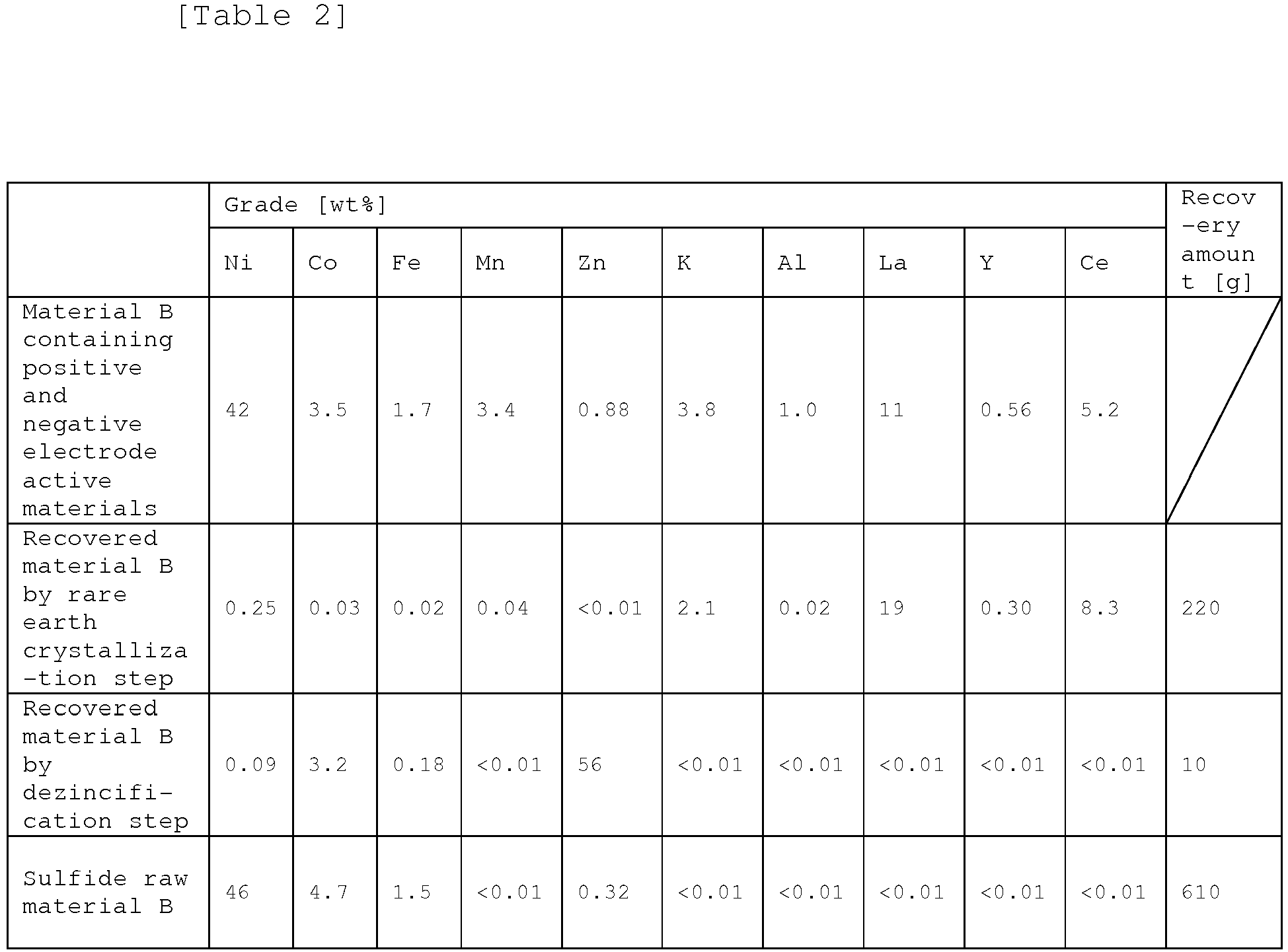
- Table 2 indicates that the sulfide raw materials B was recovered with Ni and Co being separated from Mn and rare earths, and Zn was less mixed in the sulfide raw material B, compared with in the material containing positive and negative electrode active material. The sulfide raw material B recovered by Example 2 has a grade enough to be introduced as it is, as a raw material, into a process of producing nickel sulfate and cobalt metal from a mixed sulfide raw material.
- Also, it is shown that Ni, Co, Fe, Mn, and Zn were considerably less mixed, with respect to rare earths, in the recovered material B by the rare earth crystallization step, compared with in the material containing positive and negative electrode active material, and accordingly the recovered material has a grade enough to be introduced as it is, as a raw material, into a process of purifying a rare earth mixture in an existing factory.
Claims (8)
- A method for separating nickel, cobalt, and a rare earth element from a material containing positive and negative electrode active materials of a nickel-metal hydride battery,
the method comprising steps (1) to (3) shown below, wherein a sulfide containing nickel and cobalt and a sulfate containing a rare earth element are obtained from the material containing positive and negative electrode active materials which constitutes a nickel-metal hydride battery:(1) a leaching step of mixing the material containing positive and negative electrode active materials with a sulfuric acid solution and dissolving therein, followed by separating a leachate from a residue,(2) a rare earth crystallization step of adding an alkali metal sulfate to the leachate obtained in the leaching step and thereby obtaining a mixed precipitate of double sulfate of a rare earth element and a rare-earth-element-free solution, and(3) a sulfide raw material recovery step of adding a sulfurizing agent to the rare-earth-element-free solution obtained in the rare earth crystallization step and thereby separating a nickel and cobalt sulfide raw material from a residual solution. - The method for separating nickel, cobalt, and a rare earth element from a material containing positive and negative electrode active materials of a nickel-metal hydride battery according to claim 1,
the method comprising a dezincification step, wherein a sulfurizing agent is added to the rare-earth-element-free solution obtained in the rare earth crystallization step to separate zinc in the rare-earth-element-free solution as a sulfide precipitate, and a residual solution after the separation is supplied as the rare-earth-element-free solution in the sulfide raw material recovery step. - The method for separating nickel, cobalt, and a rare earth element from a material containing positive and negative electrode active materials of a nickel-metal hydride battery according to claim 1,
the method comprising a dezincification step, wherein a neutralizer is added to the rare-earth-element-free solution obtained in the rare earth crystallization step to adjust a pH to a range of not less than 2.0 and not more than 2.5, and, with the pH range maintained, a sulfurizing agent is added to separate zinc in the rare-earth-element-free solution as a sulfide precipitate, and a residual solution after the separation is supplied as the rare-earth-element-free solution in the sulfide raw material recovery step. - The method for separating nickel, cobalt, and a rare earth element from a material containing positive and negative electrode active materials of a nickel-metal hydride battery according to claim 1,
wherein the material containing positive and negative electrode active materials of a nickel-metal hydride battery is added to the leachate obtained in the leaching step to react with free sulfuric acid remaining in the leachate, whereby a post-neutralization leachate and a post-neutralization residue are obtained, and the post-neutralization leachate is used as the leachate in the rare earth crystallization step. - The method for separating nickel, cobalt, and a rare earth element from a material containing positive and negative electrode active materials of a nickel-metal hydride battery according to claim 4,
wherein the post-neutralization residue is used as the material containing positive and negative electrode active materials in the leaching step, or as a part of the material containing positive and negative electrode active materials. - The method for separating nickel, cobalt, and a rare earth element from a material containing positive and negative electrode active materials of a nickel-metal hydride battery according to claim 1,
wherein the alkali metal sulfate to be added is at least one kind of sodium sulfate and potassium sulfate. - The method for separating nickel, cobalt, and a rare earth element from a material containing positive and negative electrode active materials of a nickel-metal hydride battery according to any one of claims 1 to 3,
wherein the sulfurizing agent is at least one kind of hydrogen sulfide gas, sodium hydrogensulfide, and sodium sulfide. - The method for separating nickel, cobalt, and a rare earth element from a material containing positive and negative electrode active materials of a nickel-metal hydride battery according to claim 1,
wherein, when the sulfurizing agent is added in the sulfide raw material recovery step, a pH of the rare-earth-element-free solution is kept in a range of not less than 2.5 and not more than 4.5.
Applications Claiming Priority (2)
| Application Number | Priority Date | Filing Date | Title |
|---|---|---|---|
| JP2010164306A JP5012970B2 (en) | 2010-07-21 | 2010-07-21 | Method for separating nickel and cobalt from active materials contained in used nickel metal hydride batteries |
| PCT/JP2010/070370 WO2012011205A1 (en) | 2010-07-21 | 2010-11-16 | Method for separating nikel and cobalt from active materials contained in spent nickel-hydrogen battery |
Publications (3)
| Publication Number | Publication Date |
|---|---|
| EP2597164A1 true EP2597164A1 (en) | 2013-05-29 |
| EP2597164A4 EP2597164A4 (en) | 2014-11-19 |
| EP2597164B1 EP2597164B1 (en) | 2016-09-21 |
Family
ID=45496644
Family Applications (1)
| Application Number | Title | Priority Date | Filing Date |
|---|---|---|---|
| EP10855042.7A Active EP2597164B1 (en) | 2010-07-21 | 2010-11-16 | Method for separating nikel and cobalt from active materials contained in spent nickel-hydrogen battery |
Country Status (5)
| Country | Link |
|---|---|
| US (1) | US8888892B2 (en) |
| EP (1) | EP2597164B1 (en) |
| JP (1) | JP5012970B2 (en) |
| CN (1) | CN102959102B (en) |
| WO (1) | WO2012011205A1 (en) |
Cited By (2)
| Publication number | Priority date | Publication date | Assignee | Title |
|---|---|---|---|---|
| CN107267783A (en) * | 2017-07-10 | 2017-10-20 | 山东理工大学 | The method of recovering rare earth from asymmetric capacitor type Ni-MH battery |
| EP3276015A4 (en) * | 2015-03-24 | 2018-10-17 | Sumitomo Metal Mining Co., Ltd. | Method for recovering scandium |
Families Citing this family (30)
| Publication number | Priority date | Publication date | Assignee | Title |
|---|---|---|---|---|
| US8974754B2 (en) | 2010-08-03 | 2015-03-10 | Sumitomo Metal Mining Co. Ltd. | Method for producing nickel-containing acid solution |
| JP5716614B2 (en) * | 2011-09-08 | 2015-05-13 | 住友金属鉱山株式会社 | Metal sulfide precipitation method |
| CN103221557B (en) * | 2011-11-22 | 2015-04-29 | 住友金属矿山株式会社 | Method for producing nickel-ontaining acidic solution |
| JP5704078B2 (en) * | 2012-01-06 | 2015-04-22 | 住友金属鉱山株式会社 | Recovery method of rare earth elements |
| JP5699988B2 (en) * | 2012-06-12 | 2015-04-15 | 住友金属鉱山株式会社 | Recovery method of rare earth elements |
| JP5962487B2 (en) * | 2012-12-17 | 2016-08-03 | 住友金属鉱山株式会社 | Method for separating rare earth elements contained in nickel metal hydride battery and method for recovering valuable metals from nickel metal hydride battery |
| JP5983526B2 (en) * | 2013-05-08 | 2016-08-31 | 住友金属鉱山株式会社 | Recovery method for heavy rare earth elements |
| CN103326088B (en) * | 2013-07-04 | 2016-02-03 | 厦门钨业股份有限公司 | Comprehensive recovery method of waste lithium ion battery |
| CN103757310B (en) * | 2013-12-29 | 2016-01-20 | 四川师范大学 | The leaching method of Ni-MH used battery anode and cathode mixed material |
| CN103757307B (en) * | 2013-12-29 | 2016-01-20 | 四川师范大学 | The leaching method of Ni-MH used battery anode and cathode mixed material |
| CN103757357A (en) * | 2013-12-29 | 2014-04-30 | 四川师范大学 | Leaching method of nickel-cadmium waste battery positive electrode material |
| JP6156160B2 (en) * | 2014-01-21 | 2017-07-05 | 住友金属鉱山株式会社 | Slurry process of metal sulfide |
| JP6201905B2 (en) * | 2014-06-16 | 2017-09-27 | 住友金属鉱山株式会社 | Method for recovering valuable metals from waste nickel metal hydride batteries |
| JP6201911B2 (en) * | 2014-06-26 | 2017-09-27 | 住友金属鉱山株式会社 | Method for controlling metal sulfide formation reaction |
| JP6314730B2 (en) * | 2014-07-30 | 2018-04-25 | 住友金属鉱山株式会社 | Method for recovering valuable metals from waste nickel metal hydride batteries |
| JP6402535B2 (en) * | 2014-08-21 | 2018-10-10 | 住友金属鉱山株式会社 | Method for recovering valuable metals from waste nickel metal hydride batteries |
| JP6304087B2 (en) * | 2015-03-23 | 2018-04-04 | 住友金属鉱山株式会社 | Method for recovering valuable metal from waste nickel metal hydride battery and recovery device for valuable metal from waste nickel metal hydride battery |
| CN106803607B (en) * | 2017-02-22 | 2019-02-12 | 兰州金川科力远电池有限公司 | Recycling and Treatment Process of Waste Ni-MH Batteries |
| US10651479B2 (en) * | 2018-02-05 | 2020-05-12 | Bloom Energy Corporation | Method of recovering metal compounds from solid oxide fuel cell scrap |
| CN108384957A (en) * | 2018-04-19 | 2018-08-10 | 江西理工大学 | A method of the collaboration recycling valuable metal from waste lithium cell and Ni-MH battery |
| CN110646317A (en) * | 2019-09-22 | 2020-01-03 | 宁波锦锐能源科技有限公司 | Method for detecting content of metal recovered from lithium iron phosphate battery |
| US10995014B1 (en) | 2020-07-10 | 2021-05-04 | Northvolt Ab | Process for producing crystallized metal sulfates |
| CN113461071A (en) * | 2021-06-10 | 2021-10-01 | 贵州理工学院 | Method for preparing nickel-zinc ferrite from waste nickel-hydrogen waste battery |
| KR20240019402A (en) | 2021-07-20 | 2024-02-14 | 스미토모 긴조쿠 고잔 가부시키가이샤 | How to process alloys |
| CN113802002B (en) * | 2021-08-17 | 2022-11-15 | 广东邦普循环科技有限公司 | Method for recovering valuable metals in lithium battery by wet process |
| CN113897498A (en) * | 2021-10-11 | 2022-01-07 | 金川集团股份有限公司 | Co-high pressure leaching method for cobalt sulfide ore and cobalt alloy |
| CN115074534B (en) * | 2022-06-30 | 2024-01-23 | 包头稀土研究院 | Method for recovering valuable elements from sulfide precipitate |
| CN115377544A (en) * | 2022-09-09 | 2022-11-22 | 上海纳米技术及应用国家工程研究中心有限公司 | Method for recovering lithium iron phosphate positive electrode material and separating current collector |
| US12597652B2 (en) * | 2022-09-30 | 2026-04-07 | Ascend Elements, Inc. | Nickel-metal hydride (NiMH) battery recycling |
| KR20250126758A (en) * | 2022-12-14 | 2025-08-25 | 인스터튯 내셔널 드 라 르세르슈 사이언티피크 | Method for processing electronic waste and method for recovering precious metals and rare earth elements therefrom |
Family Cites Families (15)
| Publication number | Priority date | Publication date | Assignee | Title |
|---|---|---|---|---|
| JPS58740B2 (en) * | 1977-12-27 | 1983-01-07 | 住友金属鉱山株式会社 | Method for separating valuable metals from alloys containing rare earth elements |
| JPH0681050A (en) * | 1991-10-31 | 1994-03-22 | Taiheiyo Kinzoku Kk | Method for recovering nickel and cobalt |
| DE4445495A1 (en) * | 1994-12-20 | 1996-06-27 | Varta Batterie | Process for the recovery of metals from used nickel-metal hydride accumulators |
| DE4445496A1 (en) | 1994-12-20 | 1996-06-27 | Varta Batterie | Process for the recovery of metals from used nickel-metal hydride accumulators |
| JPH0982371A (en) * | 1995-09-18 | 1997-03-28 | Mitsui Mining & Smelting Co Ltd | How to recover valuables from waste nickel-hydrogen secondary batteries |
| JP4506002B2 (en) * | 2001-02-21 | 2010-07-21 | 住友金属鉱山株式会社 | Method for recovering valuable metals from used nickel metal hydride secondary batteries |
| JP4654548B2 (en) * | 2001-07-27 | 2011-03-23 | 住友金属鉱山株式会社 | Valuable metal recovery method from nickel metal hydride secondary battery scrap |
| JP4457864B2 (en) * | 2004-11-24 | 2010-04-28 | 住友金属鉱山株式会社 | Method for recovering nickel and / or cobalt sulfide |
| CN101186969B (en) * | 2007-12-25 | 2010-06-02 | 北大方正集团有限公司 | A method for separating rare earths, iron, copper, cobalt and tungsten from alloys |
| CN101285127A (en) * | 2008-06-13 | 2008-10-15 | 中南大学 | A method for extracting nickel and cobalt from laterite nickel ore by wet chlorination |
| JP5287016B2 (en) * | 2008-08-07 | 2013-09-11 | 住友金属鉱山株式会社 | Method for separating zinc sulfide |
| JP5262627B2 (en) * | 2008-11-28 | 2013-08-14 | 住友金属鉱山株式会社 | Method for recovering nickel concentrate from used nickel metal hydride batteries |
| CN201390775Y (en) * | 2009-05-06 | 2010-01-27 | 付春平 | A device for hydrogen sulfide to remove lead, cadmium, mercury and copper impurities in nickel-cobalt solution |
| CN101565837B (en) * | 2009-06-03 | 2011-01-19 | 北京矿冶研究总院 | Method for producing electrolytic nickel by laterite nickel-cobalt enrichment |
| CN101575676A (en) * | 2009-06-18 | 2009-11-11 | 中南大学 | Method for removing iron and enriching nickel cobalt through precipitation of laterite type nickel ores |
-
2010
- 2010-07-21 JP JP2010164306A patent/JP5012970B2/en active Active
- 2010-11-16 EP EP10855042.7A patent/EP2597164B1/en active Active
- 2010-11-16 CN CN201080067523.8A patent/CN102959102B/en active Active
- 2010-11-16 US US13/809,302 patent/US8888892B2/en active Active
- 2010-11-16 WO PCT/JP2010/070370 patent/WO2012011205A1/en not_active Ceased
Cited By (4)
| Publication number | Priority date | Publication date | Assignee | Title |
|---|---|---|---|---|
| EP3276015A4 (en) * | 2015-03-24 | 2018-10-17 | Sumitomo Metal Mining Co., Ltd. | Method for recovering scandium |
| US10570480B2 (en) | 2015-03-24 | 2020-02-25 | Sumitomo Metal Mining Co., Ltd. | Method for recovering scandium |
| CN107267783A (en) * | 2017-07-10 | 2017-10-20 | 山东理工大学 | The method of recovering rare earth from asymmetric capacitor type Ni-MH battery |
| CN107267783B (en) * | 2017-07-10 | 2019-06-18 | 山东理工大学 | Method for recovering rare earth from asymmetric capacitive nickel-metal hydride batteries |
Also Published As
| Publication number | Publication date |
|---|---|
| CN102959102B (en) | 2015-06-03 |
| CN102959102A (en) | 2013-03-06 |
| JP2012025992A (en) | 2012-02-09 |
| EP2597164B1 (en) | 2016-09-21 |
| WO2012011205A1 (en) | 2012-01-26 |
| US20130112043A1 (en) | 2013-05-09 |
| EP2597164A4 (en) | 2014-11-19 |
| JP5012970B2 (en) | 2012-08-29 |
| US8888892B2 (en) | 2014-11-18 |
Similar Documents
| Publication | Publication Date | Title |
|---|---|---|
| US8888892B2 (en) | Method for separating nickel and cobalt from active material contained in spent nickel-metal hydride battery | |
| EP3956487B1 (en) | Process for the recovery of cathode materials in the recycling of batteries | |
| KR102154599B1 (en) | Method for Separation and Recovery of Valuable Metals from Cathode Active Material | |
| US20210079495A1 (en) | Process for the recovery of cobalt, lithium, and other metals from spent lithium-based batteries and other feeds | |
| CN1090827C (en) | Process for recovery of metals from used nickel-metal hydride accumulators | |
| JP5326610B2 (en) | Method for recovering metals from used nickel metal hydride batteries | |
| EP2444507B1 (en) | Recovery of rare earth metals from waste material by leaching in non-oxidizing acid and by precipitating using sulphates | |
| KR102324910B1 (en) | Manufacturing method of precursor raw material from disposed cathode material of lithium secondary battery | |
| KR20220025120A (en) | Method for separating copper from nickel and cobalt | |
| CA3213841A1 (en) | Extraction of metals from lithium-ion battery material | |
| CA3208933A1 (en) | Process for cathode active material precursor preparation | |
| JP6459797B2 (en) | Method and apparatus for recovering raw material for producing ferronickel from waste nickel metal hydride battery | |
| US8974754B2 (en) | Method for producing nickel-containing acid solution | |
| JP6314730B2 (en) | Method for recovering valuable metals from waste nickel metal hydride batteries | |
| JP6402535B2 (en) | Method for recovering valuable metals from waste nickel metal hydride batteries | |
| EP3006580B1 (en) | Method for producing nickel-containing acidic solution | |
| JP5541512B2 (en) | Method for producing nickel-containing acidic solution | |
| JP4654548B2 (en) | Valuable metal recovery method from nickel metal hydride secondary battery scrap | |
| JP2016003353A (en) | Method of recovering valuable metal from waste nickel hydrogen battery | |
| FI131084B1 (en) | Process for sulphiding metal | |
| KR20240164541A (en) | Method for producing a metal-containing aqueous solution | |
| JP5962487B2 (en) | Method for separating rare earth elements contained in nickel metal hydride battery and method for recovering valuable metals from nickel metal hydride battery | |
| JP3504813B2 (en) | Method for recovering valuable metals from nickel-metal hydride secondary batteries | |
| US12597652B2 (en) | Nickel-metal hydride (NiMH) battery recycling | |
| KR20260047340A (en) | Recovery method of nickel sulfate from battery waste |
Legal Events
| Date | Code | Title | Description |
|---|---|---|---|
| PUAI | Public reference made under article 153(3) epc to a published international application that has entered the european phase |
Free format text: ORIGINAL CODE: 0009012 |
|
| 17P | Request for examination filed |
Effective date: 20130220 |
|
| AK | Designated contracting states |
Kind code of ref document: A1 Designated state(s): AL AT BE BG CH CY CZ DE DK EE ES FI FR GB GR HR HU IE IS IT LI LT LU LV MC MK MT NL NO PL PT RO RS SE SI SK SM TR |
|
| DAX | Request for extension of the european patent (deleted) | ||
| A4 | Supplementary search report drawn up and despatched |
Effective date: 20141016 |
|
| RIC1 | Information provided on ipc code assigned before grant |
Ipc: H01M 10/54 20060101ALI20141010BHEP Ipc: C22B 7/00 20060101AFI20141010BHEP Ipc: C22B 23/06 20060101ALI20141010BHEP Ipc: C22B 23/00 20060101ALI20141010BHEP Ipc: C22B 59/00 20060101ALI20141010BHEP |
|
| 17Q | First examination report despatched |
Effective date: 20150910 |
|
| GRAP | Despatch of communication of intention to grant a patent |
Free format text: ORIGINAL CODE: EPIDOSNIGR1 |
|
| INTG | Intention to grant announced |
Effective date: 20160512 |
|
| GRAS | Grant fee paid |
Free format text: ORIGINAL CODE: EPIDOSNIGR3 |
|
| GRAA | (expected) grant |
Free format text: ORIGINAL CODE: 0009210 |
|
| AK | Designated contracting states |
Kind code of ref document: B1 Designated state(s): AL AT BE BG CH CY CZ DE DK EE ES FI FR GB GR HR HU IE IS IT LI LT LU LV MC MK MT NL NO PL PT RO RS SE SI SK SM TR |
|
| REG | Reference to a national code |
Ref country code: GB Ref legal event code: FG4D |
|
| REG | Reference to a national code |
Ref country code: CH Ref legal event code: EP |
|
| REG | Reference to a national code |
Ref country code: AT Ref legal event code: REF Ref document number: 831109 Country of ref document: AT Kind code of ref document: T Effective date: 20161015 |
|
| REG | Reference to a national code |
Ref country code: IE Ref legal event code: FG4D |
|
| REG | Reference to a national code |
Ref country code: DE Ref legal event code: R096 Ref document number: 602010036672 Country of ref document: DE |
|
| REG | Reference to a national code |
Ref country code: LT Ref legal event code: MG4D Ref country code: NL Ref legal event code: MP Effective date: 20160921 |
|
| PG25 | Lapsed in a contracting state [announced via postgrant information from national office to epo] |
Ref country code: NO Free format text: LAPSE BECAUSE OF FAILURE TO SUBMIT A TRANSLATION OF THE DESCRIPTION OR TO PAY THE FEE WITHIN THE PRESCRIBED TIME-LIMIT Effective date: 20161221 Ref country code: RS Free format text: LAPSE BECAUSE OF FAILURE TO SUBMIT A TRANSLATION OF THE DESCRIPTION OR TO PAY THE FEE WITHIN THE PRESCRIBED TIME-LIMIT Effective date: 20160921 Ref country code: FI Free format text: LAPSE BECAUSE OF FAILURE TO SUBMIT A TRANSLATION OF THE DESCRIPTION OR TO PAY THE FEE WITHIN THE PRESCRIBED TIME-LIMIT Effective date: 20160921 Ref country code: LT Free format text: LAPSE BECAUSE OF FAILURE TO SUBMIT A TRANSLATION OF THE DESCRIPTION OR TO PAY THE FEE WITHIN THE PRESCRIBED TIME-LIMIT Effective date: 20160921 |
|
| REG | Reference to a national code |
Ref country code: AT Ref legal event code: MK05 Ref document number: 831109 Country of ref document: AT Kind code of ref document: T Effective date: 20160921 |
|
| PG25 | Lapsed in a contracting state [announced via postgrant information from national office to epo] |
Ref country code: GR Free format text: LAPSE BECAUSE OF FAILURE TO SUBMIT A TRANSLATION OF THE DESCRIPTION OR TO PAY THE FEE WITHIN THE PRESCRIBED TIME-LIMIT Effective date: 20161222 Ref country code: LV Free format text: LAPSE BECAUSE OF FAILURE TO SUBMIT A TRANSLATION OF THE DESCRIPTION OR TO PAY THE FEE WITHIN THE PRESCRIBED TIME-LIMIT Effective date: 20160921 Ref country code: NL Free format text: LAPSE BECAUSE OF FAILURE TO SUBMIT A TRANSLATION OF THE DESCRIPTION OR TO PAY THE FEE WITHIN THE PRESCRIBED TIME-LIMIT Effective date: 20160921 Ref country code: BE Free format text: LAPSE BECAUSE OF NON-PAYMENT OF DUE FEES Effective date: 20161130 Ref country code: SE Free format text: LAPSE BECAUSE OF FAILURE TO SUBMIT A TRANSLATION OF THE DESCRIPTION OR TO PAY THE FEE WITHIN THE PRESCRIBED TIME-LIMIT Effective date: 20160921 |
|
| PG25 | Lapsed in a contracting state [announced via postgrant information from national office to epo] |
Ref country code: EE Free format text: LAPSE BECAUSE OF FAILURE TO SUBMIT A TRANSLATION OF THE DESCRIPTION OR TO PAY THE FEE WITHIN THE PRESCRIBED TIME-LIMIT Effective date: 20160921 Ref country code: RO Free format text: LAPSE BECAUSE OF FAILURE TO SUBMIT A TRANSLATION OF THE DESCRIPTION OR TO PAY THE FEE WITHIN THE PRESCRIBED TIME-LIMIT Effective date: 20160921 |
|
| PG25 | Lapsed in a contracting state [announced via postgrant information from national office to epo] |
Ref country code: SK Free format text: LAPSE BECAUSE OF FAILURE TO SUBMIT A TRANSLATION OF THE DESCRIPTION OR TO PAY THE FEE WITHIN THE PRESCRIBED TIME-LIMIT Effective date: 20160921 Ref country code: SM Free format text: LAPSE BECAUSE OF FAILURE TO SUBMIT A TRANSLATION OF THE DESCRIPTION OR TO PAY THE FEE WITHIN THE PRESCRIBED TIME-LIMIT Effective date: 20160921 Ref country code: BE Free format text: LAPSE BECAUSE OF NON-PAYMENT OF DUE FEES Effective date: 20161130 Ref country code: IS Free format text: LAPSE BECAUSE OF FAILURE TO SUBMIT A TRANSLATION OF THE DESCRIPTION OR TO PAY THE FEE WITHIN THE PRESCRIBED TIME-LIMIT Effective date: 20170121 Ref country code: BG Free format text: LAPSE BECAUSE OF FAILURE TO SUBMIT A TRANSLATION OF THE DESCRIPTION OR TO PAY THE FEE WITHIN THE PRESCRIBED TIME-LIMIT Effective date: 20161221 Ref country code: PT Free format text: LAPSE BECAUSE OF FAILURE TO SUBMIT A TRANSLATION OF THE DESCRIPTION OR TO PAY THE FEE WITHIN THE PRESCRIBED TIME-LIMIT Effective date: 20170123 Ref country code: CZ Free format text: LAPSE BECAUSE OF FAILURE TO SUBMIT A TRANSLATION OF THE DESCRIPTION OR TO PAY THE FEE WITHIN THE PRESCRIBED TIME-LIMIT Effective date: 20160921 Ref country code: ES Free format text: LAPSE BECAUSE OF FAILURE TO SUBMIT A TRANSLATION OF THE DESCRIPTION OR TO PAY THE FEE WITHIN THE PRESCRIBED TIME-LIMIT Effective date: 20160921 Ref country code: PL Free format text: LAPSE BECAUSE OF FAILURE TO SUBMIT A TRANSLATION OF THE DESCRIPTION OR TO PAY THE FEE WITHIN THE PRESCRIBED TIME-LIMIT Effective date: 20160921 Ref country code: AT Free format text: LAPSE BECAUSE OF FAILURE TO SUBMIT A TRANSLATION OF THE DESCRIPTION OR TO PAY THE FEE WITHIN THE PRESCRIBED TIME-LIMIT Effective date: 20160921 |
|
| PGRI | Patent reinstated in contracting state [announced from national office to epo] |
Ref country code: BE Effective date: 20170113 |
|
| REG | Reference to a national code |
Ref country code: DE Ref legal event code: R119 Ref document number: 602010036672 Country of ref document: DE |
|
| PG25 | Lapsed in a contracting state [announced via postgrant information from national office to epo] |
Ref country code: IT Free format text: LAPSE BECAUSE OF FAILURE TO SUBMIT A TRANSLATION OF THE DESCRIPTION OR TO PAY THE FEE WITHIN THE PRESCRIBED TIME-LIMIT Effective date: 20160921 |
|
| REG | Reference to a national code |
Ref country code: CH Ref legal event code: PL |
|
| PLBE | No opposition filed within time limit |
Free format text: ORIGINAL CODE: 0009261 |
|
| STAA | Information on the status of an ep patent application or granted ep patent |
Free format text: STATUS: NO OPPOSITION FILED WITHIN TIME LIMIT |
|
| PG25 | Lapsed in a contracting state [announced via postgrant information from national office to epo] |
Ref country code: CH Free format text: LAPSE BECAUSE OF NON-PAYMENT OF DUE FEES Effective date: 20161130 Ref country code: DK Free format text: LAPSE BECAUSE OF FAILURE TO SUBMIT A TRANSLATION OF THE DESCRIPTION OR TO PAY THE FEE WITHIN THE PRESCRIBED TIME-LIMIT Effective date: 20160921 Ref country code: LI Free format text: LAPSE BECAUSE OF NON-PAYMENT OF DUE FEES Effective date: 20161130 |
|
| GBPC | Gb: european patent ceased through non-payment of renewal fee |
Effective date: 20161221 |
|
| REG | Reference to a national code |
Ref country code: IE Ref legal event code: MM4A |
|
| REG | Reference to a national code |
Ref country code: FR Ref legal event code: ST Effective date: 20170731 |
|
| 26N | No opposition filed |
Effective date: 20170622 |
|
| PG25 | Lapsed in a contracting state [announced via postgrant information from national office to epo] |
Ref country code: LU Free format text: LAPSE BECAUSE OF NON-PAYMENT OF DUE FEES Effective date: 20161130 |
|
| PG25 | Lapsed in a contracting state [announced via postgrant information from national office to epo] |
Ref country code: FR Free format text: LAPSE BECAUSE OF NON-PAYMENT OF DUE FEES Effective date: 20161130 |
|
| PG25 | Lapsed in a contracting state [announced via postgrant information from national office to epo] |
Ref country code: DE Free format text: LAPSE BECAUSE OF NON-PAYMENT OF DUE FEES Effective date: 20170601 Ref country code: IE Free format text: LAPSE BECAUSE OF NON-PAYMENT OF DUE FEES Effective date: 20161116 Ref country code: SI Free format text: LAPSE BECAUSE OF FAILURE TO SUBMIT A TRANSLATION OF THE DESCRIPTION OR TO PAY THE FEE WITHIN THE PRESCRIBED TIME-LIMIT Effective date: 20160921 Ref country code: GB Free format text: LAPSE BECAUSE OF NON-PAYMENT OF DUE FEES Effective date: 20161221 |
|
| PG25 | Lapsed in a contracting state [announced via postgrant information from national office to epo] |
Ref country code: HU Free format text: LAPSE BECAUSE OF FAILURE TO SUBMIT A TRANSLATION OF THE DESCRIPTION OR TO PAY THE FEE WITHIN THE PRESCRIBED TIME-LIMIT; INVALID AB INITIO Effective date: 20101116 Ref country code: CY Free format text: LAPSE BECAUSE OF FAILURE TO SUBMIT A TRANSLATION OF THE DESCRIPTION OR TO PAY THE FEE WITHIN THE PRESCRIBED TIME-LIMIT Effective date: 20160921 |
|
| PG25 | Lapsed in a contracting state [announced via postgrant information from national office to epo] |
Ref country code: HR Free format text: LAPSE BECAUSE OF FAILURE TO SUBMIT A TRANSLATION OF THE DESCRIPTION OR TO PAY THE FEE WITHIN THE PRESCRIBED TIME-LIMIT Effective date: 20160921 Ref country code: MK Free format text: LAPSE BECAUSE OF FAILURE TO SUBMIT A TRANSLATION OF THE DESCRIPTION OR TO PAY THE FEE WITHIN THE PRESCRIBED TIME-LIMIT Effective date: 20160921 Ref country code: MC Free format text: LAPSE BECAUSE OF FAILURE TO SUBMIT A TRANSLATION OF THE DESCRIPTION OR TO PAY THE FEE WITHIN THE PRESCRIBED TIME-LIMIT Effective date: 20160921 Ref country code: TR Free format text: LAPSE BECAUSE OF FAILURE TO SUBMIT A TRANSLATION OF THE DESCRIPTION OR TO PAY THE FEE WITHIN THE PRESCRIBED TIME-LIMIT Effective date: 20160921 |
|
| PG25 | Lapsed in a contracting state [announced via postgrant information from national office to epo] |
Ref country code: MT Free format text: LAPSE BECAUSE OF NON-PAYMENT OF DUE FEES Effective date: 20161116 |
|
| PG25 | Lapsed in a contracting state [announced via postgrant information from national office to epo] |
Ref country code: AL Free format text: LAPSE BECAUSE OF FAILURE TO SUBMIT A TRANSLATION OF THE DESCRIPTION OR TO PAY THE FEE WITHIN THE PRESCRIBED TIME-LIMIT Effective date: 20160921 |
|
| P01 | Opt-out of the competence of the unified patent court (upc) registered |
Effective date: 20230512 |
|
| PGFP | Annual fee paid to national office [announced via postgrant information from national office to epo] |
Ref country code: BE Payment date: 20251006 Year of fee payment: 16 |