EP2593781B1 - Electrode de reference miniature - Google Patents
Electrode de reference miniature Download PDFInfo
- Publication number
- EP2593781B1 EP2593781B1 EP11749465.8A EP11749465A EP2593781B1 EP 2593781 B1 EP2593781 B1 EP 2593781B1 EP 11749465 A EP11749465 A EP 11749465A EP 2593781 B1 EP2593781 B1 EP 2593781B1
- Authority
- EP
- European Patent Office
- Prior art keywords
- electrolyte
- membrane
- electrode
- reference electrode
- acid
- Prior art date
- Legal status (The legal status is an assumption and is not a legal conclusion. Google has not performed a legal analysis and makes no representation as to the accuracy of the status listed.)
- Not-in-force
Links
Images
Classifications
-
- G—PHYSICS
- G01—MEASURING; TESTING
- G01N—INVESTIGATING OR ANALYSING MATERIALS BY DETERMINING THEIR CHEMICAL OR PHYSICAL PROPERTIES
- G01N27/00—Investigating or analysing materials by the use of electric, electrochemical, or magnetic means
- G01N27/26—Investigating or analysing materials by the use of electric, electrochemical, or magnetic means by investigating electrochemical variables; by using electrolysis or electrophoresis
- G01N27/28—Electrolytic cell components
- G01N27/30—Electrodes, e.g. test electrodes; Half-cells
- G01N27/301—Reference electrodes
Definitions
- the invention relates to a miniature reference electrode for measuring potentials in electrochemical systems.
- a reference electrode is the measurement of electrode potentials in electrochemical systems.
- the potential of a working electrode in an electrochemical cell is defined relative to the reference electrode, by measuring the voltage between the working electrode and the reference electrode.
- the reference electrode mainly comprises a pair of oxidation-reduction materials having a constant potential and an internal electrolyte.
- the silver / silver chloride (Ag / AgCl) pair is widely used because of its high stability and reversibility of reaction.
- the electrolyte is a saturated solution of potassium chloride (KCl) or sodium chloride (NaCl). Since the potential of the electrode varies as a function of the concentration of chloride ions contained in the electrolyte, it must be as stable as possible.
- a porous membrane called a liquid junction, is conventionally used to separate the internal electrolyte from the electrolyte of the cell. This membrane allows the exchange of protons (H + ) between the two electrolytes. It slows the diffusion of ions (K + , Na + , Cl - %) between the cell and the reference electrode, to maintain a constant reference potential.
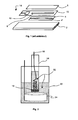
- the figure 1 represents an exploded view of a miniature reference electrode as described in the patent US6419809 .
- This electrode consists of thin layers deposited successively on a glass substrate 2.
- the electrode comprises a silver layer 4 of which a portion 4 'is converted into silver chloride AgCl.
- the layer 6 is impregnated with a saturated solution of potassium chloride (KCl).
- the layer 10 comprises a recess at one of its ends for housing a membrane 12 of hydrophilic and porous polymeric material. A portion of the membrane 12 is covered with the electrolyte layer 6.
- the porous membrane 12 is impregnated with the KCl electrolyte.
- an end of the membrane 12 is immersed in an aqueous solution 14 constituting the electrolyte of the cell. A proton transfer between the internal electrolyte 6 and the electrolyte 14 of the cell is then possible via the membrane 12.
- Nafion membranes are used in a similar manner in PEMFC fuel cells (Proton Exchange Membrane Fuel Cell) between two catalytic layers, which are the seat of oxidation and reduction reactions.
- the membrane separates the two compartments of the cell and allows only the protons to pass through.
- the Nafion membrane is effective only for a short time, given its small thickness.
- the use of a greater thickness of Nafion is constrained by the effort of miniaturization and a significant cost of the material.
- reference electrodes whose membrane is made from a polymeric material.
- the miniature reference electrode can be incorporated into batteries for health monitoring or control of charge and discharge cycles. Batteries having a life span of up to several years, it is sought to obtain a reference electrode which remains reliable over such a long period.
- a reference electrode comprising a reference electrolyte and a proton exchange membrane arranged to separate the reference electrolyte from an external medium to the electrode, the proton exchange membrane comprising particles of acid-doped polyaniline distributed in a binder polymer material.
- the method comprises the steps of making a mixture of an acid-doped polyaniline powder and a polymerizable liquid material, depositing a layer of the mixture on a reference electrolyte layer and polymerization of the mixture.
- polyaniline-based separating membrane PANI
- acid-doped polyaniline means a salt resulting from the reaction of the polyaniline with an acid.
- This form of polyaniline has good proton conductivity.
- it is perfectly adapted to the conditions of use in a reference electrode. On the one hand, it is insoluble in water, alkaline or acid solutions and most organic solvents. On the other hand, it resists oxidation and reduction reactions, especially with oxygen in the atmosphere. Subsequently, the terms "PANI” or "polyaniline” will be used to denote acid-doped polyaniline.
- Polyaniline is an electrically conductive polymer that can be used as an electrode.
- its use as a proton exchange membrane in PEMFC cells is not possible since a short circuit would be caused between the electrodes of the battery. So far, it has not been envisaged to use polyaniline in a reference electrode as a membrane.
- the polyaniline is in the form of particles and the membrane comprises a polymer matrix in which the particles are dispersed.
- the ratio of the mass of polyaniline to the polymer mass is advantageously between 1 and 2.
- the porosity with water and sulphate ions which corresponds to the permeability of the membrane, can be evaluated in the following way: a tube containing a sulfuric acid solution of 5 mol / L (5 MH 2 SO 4 ) and closed by a PANI-based membrane is immersed in a beaker containing deionized water. The pH of the water is measured a few minutes after plunging the membrane into the water and then after one week. The pH remains constant, indicating that the PANI-based membrane is impervious to sulfate ions (SO 4 2- , HSO 4 - ).
- the proton conductivity is the magnitude characterizing the ability of the membrane to allow the passage of protons. It is directly related to the electrical resistance of the membrane. Moreover, the membrane is generally the most resistive element of the reference electrode and a high resistance of the electrode leads to an error in the potential measurements. So we try to minimize this resistance.
- PANI-based membrane being non-porous, it is proposed to evaluate its impedance to verify its ability to be part of a reference electrode.
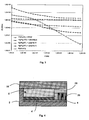
- the figure 2 represents an experimental electrochemical cell for determining the impedance of a PANI-based membrane.
- the cell comprises a tube 14 approximately 8 mm in diameter.
- One end of the tube 14 is sealed with a membrane 16 made of epoxy resin and PANI (1: 1 ratio), about 1 mm thick.
- a lead wire 18 in the form of spirals is disposed inside the tube and partially immersed in an electrolyte 20 of 5 MH 2 SO 4 .
- the tube 14 is then immersed in the same electrolyte 20, so that the membrane 16 is completely immersed.
- the lead wire 18 then constitutes a working electrode.
- the cell is completed by a platinum counter-electrode 24 immersed in the electrolyte 20.
- the membrane 16 is the most resistive element of the cell.
- the impedance of the membrane 16 can be determined by measuring the impedance of the electrochemical cell of the figure 2 . Indeed, these are substantially identical since the membrane is on both sides in contact with the electrolyte 20 and in the immediate vicinity of the conductive parts. The ohmic drop due to the electrolyte H 2 SO 4 is negligible.
- the method used is impedance spectroscopy over a frequency range from 0.1 Hz to 65 kHz using a sinusoidal signal with an amplitude between 5 and 10 mV.
- the figure 3 represents the impedance (expressed by its module) of the cell of the figure 2 (Pb / H 2 SO 4 + PANI).
- Conventional electrodes using porous membranes have been measured for comparison, including Ag / Ag 2 SO 4 and Hg / Hg 2 SO 4 electrodes with graphite or ceramic membranes.
- Two types of graphite are used: a graphite of high porosity (A) and a graphite of low porosity (B).
- the ohmic resistance of the PANI membrane reaches values between those of the conventional electrodes Hg / Hg 2 SO 4 and Ag / Ag 2 SO 4 .
- the PANI-based membrane thus achieves similar performance in terms of strength. Its use to form a precise reference electrode is therefore possible.
- the impedance of a cell without a membrane is lower than that of the cell shown in FIG. figure 2 , from two to three orders of magnitude. This shows that the membrane contributes to almost all the impedance of the cell.
- the impedance measured in this case corresponds to the resistance of the H 2 SO 4 electrolyte, the parasitic resistances and the contact resistances.
- the realization of a membrane based on PANI can pose some difficulties.
- the acid-doped polyaniline is generally obtained by electrochemical synthesis. It is then in the form of an electrolytic deposit on electrodes.
- the material obtained is hard and friable, which makes it difficult to use in the form of a membrane.
- the polyaniline is also synthesized electrochemically. It is possible, for example, to obtain a layer of approximately 1.5 mm PANI on graphite electrodes immersed in a bath comprising aniline sulphate solution (0.15 mol / L) and a sulfuric acid electrolyte. (0.25 mol / L), applying a current of the order of 1 mA.cm -2 for a period of 300h.
- the deposit thus formed is ground in the form of a powder.
- the particle size of the powder is variable.
- the PANI powder is then mixed with a polymerizable material in liquid form to form a paste.
- the paste is deposited in the form of a layer.
- the polymerization of the paste is carried out, preferably by heat treatment at a temperature between 60 ° C and 80 ° C or by ultraviolet irradiation. A dense and non-porous structure due to the polymerization process is then obtained.
- the polymerizable material is preferably an acid or radical activated prepolymer. It is also preferable that the material is stable in the acid electrolytes and that it preserves the proton conductivity of the PANI. Pre-polymers based on phenol-furfural, phenol-formaldehyde, methyl methacrylate or acid-hardened epoxy resin meet these criteria. In addition, with these prepolymers, the paste is perfectly suited to inexpensive printing technologies, including screen printing.
- the electrochemical synthesis of the polyaniline can be adapted to the desired type of electrode.
- a precursor (the source of aniline) and an electrolyte are preferably chosen depending on the oxidation-reduction torque and the nature of the internal electrolyte. For example, if the electrode is Ag / Ag 2 SO 4 / H 2 SO 4 , the precursor may be aniline sulphate and the electrolyte may be H 2 SO 4 .
- the precursor contains an ion identical to one of the ions of the internal electrolyte and the electrolyte of the synthesis is of the same nature as the internal electrolyte.
- the polyaniline is doped with the same ion as one of the ions of the internal electrolyte.
- it is the sulfate ion, also present in the salt of the redox couple. It minimizes the exchanges between anions at the interface between the PANI and the electrolyte, these exchanges usually creating a harmful interface potential.
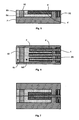
- the figure 4 represents an embodiment of a miniature reference electrode provided with a PANI-based membrane.
- the electrode is formed on a substrate 2 made of glass or silicon covered with a passivation layer of a thickness of about 1 mm.
- the layers constituting the electrode are preferably deposited by screen printing.
- a cavity with a depth of approximately 300 ⁇ m is first etched in the substrate 2.
- a silver layer 4, approximately 30 ⁇ m thick, is then deposited at the bottom of the cavity.
- a layer 4 'of silver sulphate, approximately 60 ⁇ m thick, is deposited on a portion of the layer 4.
- An electrical contact pad 26, for example copper, is also formed on the silver layer 4 , at one end of the electrode.
- a layer 6, for example glass microfibers, is then deposited on the entire layer 4 '. Its thickness is of the order of 210 microns.
- An electrically insulating layer 28, preferably of polymer, covers the pad 26 and a portion of the layer 4 located between the pad and the layer 4 '.
- a side face of the pad 26 corresponding to the edge of the electrode is exposed to the ambient environment.
- an electrolytic solution H 2 SO 4
- This insertion can be performed by inkjet printing or using a micro-syringe.
- the substrate 2, the electrolyte layer 6 and the insulating layer 28 form a surface, preferably flat, on which is deposited a layer of PANI-based paste, so as to completely seal the electrolyte 6.
- the paste is then polymerized to form the membrane 16.
- the thickness of the membrane 16 is preferably between 0.5 and 1 mm. The short circuits between the pad 26 and the layer 6 and between the pad 26 and the membrane 16 are avoided by the insulating layer 28.
- the membrane 16 comprises, by mass, twice as much PANI as polymer.
- a metal current collector is fixed to the contact pad 26, for example by welding.
- the reference electrode is, moreover, covered by a protective envelope, plastic for example.
- the envelope preferably covers the whole of the electrode except for a portion of the membrane 16, placed directly above the layer 4 '.
- This reference electrode has a large contact area between the electrolyte of the cell and the membrane 16, which decreases the electrical resistance of the latter.
- FIGS 5 to 7 illustrate an alternative embodiment of a reference electrode, composed of two identical halves which are then glued.
- the Figures 5 and 6 represent, respectively in sectional view and diagrammatic top view, a half-electrode while the figure 7 represents the assembled reference electrode.
- Each half-electrode comprises a substrate 2 in which are formed two distinct cavities with a depth of about 300 ⁇ m, each cavity opening on one end of the electrode.
- a cavity (right on the Figures 5 and 6 ) is filled by the contact pad 26.
- a first layer 6a of glass microfibres, the layer 4 'of silver sulphate (50-100 ⁇ m thick) and the layer 4 of silver (20-50 ⁇ m d thickness) are deposited successively in the other cavity (on the left).
- the layer 4 covers the layer 4 ', the pad 26 and the portion of the substrate located between the two.
- a second layer 6b of glass microfibres and the membrane 16 (300 ⁇ m thick) are deposited at the end opposite the pad 26, preferably up to the level of the layer 4.
- the polymerization of the membrane is carried out as described above, as is the filling of the microfiber layers 6a and 6b with the liquid electrolyte.
- the figure 6 shows that the glass microfibers layer is preferably divided into two parts 6c and 6d separated by the membrane 16.
- the part 6c at the end of the electrode, protects the membrane 16 from direct contact with the other electrodes of the cell.
- the layers 4 and 4 ' may be arranged as laterally spaced strips in the portion 6d of approximately 50 ⁇ m. In this way, the step of filling the portion 6d with the internal electrolyte is facilitated.
- the two half-electrodes are secured by their layers 4 in a sealed manner, by example by gluing.
- a current collector and a protective envelope are attached to the electrode, as described in connection with the figure 4 .
- the unprotected portion of the electrode corresponds to the portion 6c of the electrolyte layer, which is in contact with the electrolyte of the cell.
- the method for producing the reference electrode described above may comprise steps common with other methods of producing electrodes.
- a reference electrode, a working electrode and a counter-electrode can be produced on a large scale simultaneously on the same substrate.
- a complete electrochemical device, for example a chemical detector, can thus be produced by these simple and inexpensive techniques.
- the embodiment has been described in relation to the silver / silver sulphate pair and the H 2 SO 4 electrolyte.
- the invention is not limited to a particular type of electrodes. It is also possible to envisage using the Ag / AgCl, Ag / AgBr and Ag / Agl pairs and the HCl, HBr, Hl electrolytes.
- other porous (solid) materials serving as a container for the electrolyte. internal (liquid), can be used, including glass in the form of microbeads made porous by chemical etching and acting as a reservoir.
Landscapes
- Chemical & Material Sciences (AREA)
- Life Sciences & Earth Sciences (AREA)
- Health & Medical Sciences (AREA)
- Biochemistry (AREA)
- Chemical Kinetics & Catalysis (AREA)
- Electrochemistry (AREA)
- Physics & Mathematics (AREA)
- Analytical Chemistry (AREA)
- Molecular Biology (AREA)
- General Health & Medical Sciences (AREA)
- General Physics & Mathematics (AREA)
- Immunology (AREA)
- Pathology (AREA)
- Fuel Cell (AREA)
- Secondary Cells (AREA)
- Inert Electrodes (AREA)
Applications Claiming Priority (2)
| Application Number | Priority Date | Filing Date | Title |
|---|---|---|---|
| FR1003007A FR2962806B1 (fr) | 2010-07-16 | 2010-07-16 | Electrode de reference miniature |
| PCT/FR2011/000416 WO2012007660A1 (fr) | 2010-07-16 | 2011-07-12 | Electrode de reference miniature |
Publications (2)
| Publication Number | Publication Date |
|---|---|
| EP2593781A1 EP2593781A1 (fr) | 2013-05-22 |
| EP2593781B1 true EP2593781B1 (fr) | 2014-04-09 |
Family
ID=43629484
Family Applications (1)
| Application Number | Title | Priority Date | Filing Date |
|---|---|---|---|
| EP11749465.8A Not-in-force EP2593781B1 (fr) | 2010-07-16 | 2011-07-12 | Electrode de reference miniature |
Country Status (10)
| Country | Link |
|---|---|
| US (1) | US20130105308A1 (enExample) |
| EP (1) | EP2593781B1 (enExample) |
| JP (1) | JP5758490B2 (enExample) |
| CN (1) | CN103119428B (enExample) |
| AU (1) | AU2011278216A1 (enExample) |
| BR (1) | BR112013001139A2 (enExample) |
| ES (1) | ES2461542T3 (enExample) |
| FR (1) | FR2962806B1 (enExample) |
| WO (1) | WO2012007660A1 (enExample) |
| ZA (1) | ZA201300208B (enExample) |
Families Citing this family (6)
| Publication number | Priority date | Publication date | Assignee | Title |
|---|---|---|---|---|
| JP6344682B2 (ja) * | 2014-03-27 | 2018-06-20 | 国立大学法人北海道大学 | 平板型三電極式電気化学センサ及びその製造方法 |
| JP2017532571A (ja) * | 2014-10-29 | 2017-11-02 | フェーズ2 マイクロテクノロジーズ, インコーポレイテッド | ポリマー電極膜 |
| PE20221207A1 (es) * | 2019-11-08 | 2022-08-11 | Commw Scient Ind Res Org | Electrodo de referencia de estado solido resistente a las interferencias |
| US11549882B2 (en) * | 2020-02-21 | 2023-01-10 | The Regents Of The University Of Michigan | Reference electrode and electrochemical monitoring system |
| US11973200B2 (en) * | 2020-12-04 | 2024-04-30 | GM Global Technology Operations LLC | Reference electrode assembly and method of manufacturing the same |
| WO2025102095A1 (en) * | 2023-11-14 | 2025-05-22 | EXIAS Medical GmbH | Reference electrode for a potentiometric measurement system |
Family Cites Families (12)
| Publication number | Priority date | Publication date | Assignee | Title |
|---|---|---|---|---|
| JPS6475956A (en) * | 1987-09-18 | 1989-03-22 | Bridgestone Corp | Enzyme electrode |
| US5316649A (en) * | 1991-03-05 | 1994-05-31 | The United States Of America As Represented By The United States Department Of Energy | High frequency reference electrode |
| US5250163A (en) * | 1991-11-27 | 1993-10-05 | The Ohio State University Research Foundation | Proton concentration sensor/modulator for sulfonated and hydroxylated polyaniline electrodes |
| JPH07229868A (ja) * | 1994-02-21 | 1995-08-29 | Matsushita Electric Works Ltd | 参照電極 |
| WO2000066652A1 (en) * | 1999-04-30 | 2000-11-09 | University Of Connecticut | Membranes, membrane electrode assemblies and fuel cells employing same, and process for preparing |
| JP2001004581A (ja) * | 1999-06-24 | 2001-01-12 | Sentan Kagaku Gijutsu Incubation Center:Kk | 微小参照電極 |
| JP3906071B2 (ja) * | 2000-12-27 | 2007-04-18 | 日東電工株式会社 | 導電性ポリアニリン組成物、そのフィルム及びそれらの製造方法 |
| US6863800B2 (en) * | 2002-02-01 | 2005-03-08 | Abbott Laboratories | Electrochemical biosensor strip for analysis of liquid samples |
| BR0311226A (pt) * | 2002-05-23 | 2008-01-29 | Columbian Chem | material de carbono enxertado com polìmero condutor sulfonado para aplicações em células de combustìvel |
| US8728289B2 (en) * | 2005-12-15 | 2014-05-20 | Medtronic, Inc. | Monolithic electrodes and pH transducers |
| US8268148B2 (en) * | 2007-01-22 | 2012-09-18 | Commissariat A L'energie Atomique | Reference electrode, manufacturing method and battery comprising same |
| US20100033160A1 (en) * | 2008-08-09 | 2010-02-11 | Nikolai Kocherginsky | Measurements of Redox Potential and Concentration of Redox Active Substances |
-
2010
- 2010-07-16 FR FR1003007A patent/FR2962806B1/fr not_active Expired - Fee Related
-
2011
- 2011-07-12 ES ES11749465.8T patent/ES2461542T3/es active Active
- 2011-07-12 JP JP2013519125A patent/JP5758490B2/ja not_active Expired - Fee Related
- 2011-07-12 EP EP11749465.8A patent/EP2593781B1/fr not_active Not-in-force
- 2011-07-12 BR BR112013001139A patent/BR112013001139A2/pt not_active IP Right Cessation
- 2011-07-12 WO PCT/FR2011/000416 patent/WO2012007660A1/fr not_active Ceased
- 2011-07-12 US US13/809,831 patent/US20130105308A1/en not_active Abandoned
- 2011-07-12 CN CN201180044160.0A patent/CN103119428B/zh not_active Expired - Fee Related
- 2011-07-12 AU AU2011278216A patent/AU2011278216A1/en not_active Abandoned
-
2013
- 2013-01-09 ZA ZA2013/00208A patent/ZA201300208B/en unknown
Non-Patent Citations (1)
| Title |
|---|
| BHADRA S ET AL: "Progress in preparation, processing and applications of polyaniline", PROGRESS IN POLYMER SCIENCE, PERGAMON PRESS, OXFORD, GB, vol. 34, no. 8, 1 August 2009 (2009-08-01), pages 783 - 810, XP026234570, ISSN: 0079-6700, [retrieved on 20090503], DOI: 10.1016/J.PROGPOLYMSCI.2009.04.003 * |
Also Published As
| Publication number | Publication date |
|---|---|
| JP5758490B2 (ja) | 2015-08-05 |
| EP2593781A1 (fr) | 2013-05-22 |
| CN103119428A (zh) | 2013-05-22 |
| AU2011278216A1 (en) | 2013-02-07 |
| FR2962806A1 (fr) | 2012-01-20 |
| ZA201300208B (en) | 2013-09-25 |
| JP2013531252A (ja) | 2013-08-01 |
| FR2962806B1 (fr) | 2012-09-28 |
| US20130105308A1 (en) | 2013-05-02 |
| CN103119428B (zh) | 2014-11-26 |
| BR112013001139A2 (pt) | 2016-05-17 |
| WO2012007660A9 (fr) | 2012-03-22 |
| ES2461542T3 (es) | 2014-05-20 |
| WO2012007660A1 (fr) | 2012-01-19 |
Similar Documents
| Publication | Publication Date | Title |
|---|---|---|
| EP2419721B1 (fr) | Capteur electrochimique amperometrique et son procede de fabrication | |
| WO2012007660A1 (fr) | Electrode de reference miniature | |
| US20090301876A1 (en) | Sensor and methods of making the same | |
| EP1675207A1 (fr) | Electrolyte structuré pour microbatterie | |
| CZ287286B6 (en) | Electrochemical cell | |
| FR3117766A1 (fr) | Dispositif de surveillance corporelle a gamme de detection etendue | |
| EP3829418B1 (fr) | Ratio métal/surface de microaiguille | |
| WO2021023884A1 (fr) | Systeme de surveillance corporelle comprenant une microaiguille | |
| FR2951876A1 (fr) | Micro-batterie au lithium munie d'une couche d'encapsulation conductrice electroniquement | |
| WO2013076260A1 (fr) | Procede de fabrication d'une batterie tout solide | |
| FR3027737A1 (fr) | Dispositif electrochimique, tel qu'une microbatterie ou un systeme electrochrome, et son procede de realisation. | |
| WO2024002988A1 (fr) | Dispositif électrochimique microfluidique de mesure d'un débit volumique | |
| FR2986867A1 (fr) | Electrode de reference d'un dispositif de stockage d'energie electrique | |
| US11346804B2 (en) | Microfabricated electrochemical gas sensor | |
| EP1926170A1 (fr) | Matériau d'électrolyte silicié pour pile à combustible, procédé pour sa réalisation et pile à combustible mettant en oeuvre un tel matériau | |
| EP3772332A1 (fr) | Systeme de surveillance corporelle comprenant une microaiguille | |
| EP4056529B1 (fr) | Procédé de gravure d'un trou et procédé de fabrication d'une microaiguille utilisant un tel trou | |
| FR3077681A1 (fr) | Batterie en couches minces | |
| US20240319131A1 (en) | Ultrasensitive and selective sensors for glucose detection based on thiol-functionalized heterogenous gold/graphene/copper film | |
| FR3148476A1 (fr) | Dispositif de mesure directe de courbure par effet flexoélectrique et procédé de fabrication associé | |
| WO2005029063A1 (fr) | Procede de realisation d'electrodes, circuit integre a electrode(s) protegee(s) et sonde electrochimique | |
| FR3138320A1 (fr) | Procédé de fabrication d’une micro-aiguille et en particulier métallisation de la pointe d’une microaiguille | |
| EP4643119A1 (fr) | Electrode elementaire, electrode et dispositif de detection electrochimique comprenant une telle electrode | |
| EP1706733A1 (fr) | Systeme d electrodes pour capteur electrochimique | |
| FR3110382A1 (fr) | Capteur pour système de surveillance corporelle monté en surface |
Legal Events
| Date | Code | Title | Description |
|---|---|---|---|
| PUAI | Public reference made under article 153(3) epc to a published international application that has entered the european phase |
Free format text: ORIGINAL CODE: 0009012 |
|
| 17P | Request for examination filed |
Effective date: 20130114 |
|
| AK | Designated contracting states |
Kind code of ref document: A1 Designated state(s): AL AT BE BG CH CY CZ DE DK EE ES FI FR GB GR HR HU IE IS IT LI LT LU LV MC MK MT NL NO PL PT RO RS SE SI SK SM TR |
|
| DAX | Request for extension of the european patent (deleted) | ||
| GRAP | Despatch of communication of intention to grant a patent |
Free format text: ORIGINAL CODE: EPIDOSNIGR1 |
|
| INTG | Intention to grant announced |
Effective date: 20131107 |
|
| GRAS | Grant fee paid |
Free format text: ORIGINAL CODE: EPIDOSNIGR3 |
|
| GRAA | (expected) grant |
Free format text: ORIGINAL CODE: 0009210 |
|
| AK | Designated contracting states |
Kind code of ref document: B1 Designated state(s): AL AT BE BG CH CY CZ DE DK EE ES FI FR GB GR HR HU IE IS IT LI LT LU LV MC MK MT NL NO PL PT RO RS SE SI SK SM TR |
|
| REG | Reference to a national code |
Ref country code: GB Ref legal event code: FG4D Free format text: NOT ENGLISH |
|
| REG | Reference to a national code |
Ref country code: CH Ref legal event code: EP Ref country code: AT Ref legal event code: REF Ref document number: 661604 Country of ref document: AT Kind code of ref document: T Effective date: 20140415 |
|
| REG | Reference to a national code |
Ref country code: DE Ref legal event code: R082 Ref document number: 602011006100 Country of ref document: DE Representative=s name: CABINET HECKE, FR |
|
| REG | Reference to a national code |
Ref country code: ES Ref legal event code: FG2A Ref document number: 2461542 Country of ref document: ES Kind code of ref document: T3 Effective date: 20140520 |
|
| REG | Reference to a national code |
Ref country code: IE Ref legal event code: FG4D Free format text: LANGUAGE OF EP DOCUMENT: FRENCH |
|
| REG | Reference to a national code |
Ref country code: DE Ref legal event code: R096 Ref document number: 602011006100 Country of ref document: DE Effective date: 20140522 |
|
| REG | Reference to a national code |
Ref country code: AT Ref legal event code: MK05 Ref document number: 661604 Country of ref document: AT Kind code of ref document: T Effective date: 20140409 |
|
| REG | Reference to a national code |
Ref country code: NL Ref legal event code: VDEP Effective date: 20140409 |
|
| REG | Reference to a national code |
Ref country code: LT Ref legal event code: MG4D |
|
| PG25 | Lapsed in a contracting state [announced via postgrant information from national office to epo] |
Ref country code: FI Free format text: LAPSE BECAUSE OF FAILURE TO SUBMIT A TRANSLATION OF THE DESCRIPTION OR TO PAY THE FEE WITHIN THE PRESCRIBED TIME-LIMIT Effective date: 20140409 Ref country code: IS Free format text: LAPSE BECAUSE OF FAILURE TO SUBMIT A TRANSLATION OF THE DESCRIPTION OR TO PAY THE FEE WITHIN THE PRESCRIBED TIME-LIMIT Effective date: 20140809 Ref country code: GR Free format text: LAPSE BECAUSE OF FAILURE TO SUBMIT A TRANSLATION OF THE DESCRIPTION OR TO PAY THE FEE WITHIN THE PRESCRIBED TIME-LIMIT Effective date: 20140710 Ref country code: LT Free format text: LAPSE BECAUSE OF FAILURE TO SUBMIT A TRANSLATION OF THE DESCRIPTION OR TO PAY THE FEE WITHIN THE PRESCRIBED TIME-LIMIT Effective date: 20140409 Ref country code: BG Free format text: LAPSE BECAUSE OF FAILURE TO SUBMIT A TRANSLATION OF THE DESCRIPTION OR TO PAY THE FEE WITHIN THE PRESCRIBED TIME-LIMIT Effective date: 20140709 Ref country code: NO Free format text: LAPSE BECAUSE OF FAILURE TO SUBMIT A TRANSLATION OF THE DESCRIPTION OR TO PAY THE FEE WITHIN THE PRESCRIBED TIME-LIMIT Effective date: 20140709 Ref country code: NL Free format text: LAPSE BECAUSE OF FAILURE TO SUBMIT A TRANSLATION OF THE DESCRIPTION OR TO PAY THE FEE WITHIN THE PRESCRIBED TIME-LIMIT Effective date: 20140409 |
|
| PG25 | Lapsed in a contracting state [announced via postgrant information from national office to epo] |
Ref country code: HR Free format text: LAPSE BECAUSE OF FAILURE TO SUBMIT A TRANSLATION OF THE DESCRIPTION OR TO PAY THE FEE WITHIN THE PRESCRIBED TIME-LIMIT Effective date: 20140409 Ref country code: AT Free format text: LAPSE BECAUSE OF FAILURE TO SUBMIT A TRANSLATION OF THE DESCRIPTION OR TO PAY THE FEE WITHIN THE PRESCRIBED TIME-LIMIT Effective date: 20140409 Ref country code: LV Free format text: LAPSE BECAUSE OF FAILURE TO SUBMIT A TRANSLATION OF THE DESCRIPTION OR TO PAY THE FEE WITHIN THE PRESCRIBED TIME-LIMIT Effective date: 20140409 Ref country code: RS Free format text: LAPSE BECAUSE OF FAILURE TO SUBMIT A TRANSLATION OF THE DESCRIPTION OR TO PAY THE FEE WITHIN THE PRESCRIBED TIME-LIMIT Effective date: 20140409 Ref country code: SE Free format text: LAPSE BECAUSE OF FAILURE TO SUBMIT A TRANSLATION OF THE DESCRIPTION OR TO PAY THE FEE WITHIN THE PRESCRIBED TIME-LIMIT Effective date: 20140409 Ref country code: PL Free format text: LAPSE BECAUSE OF FAILURE TO SUBMIT A TRANSLATION OF THE DESCRIPTION OR TO PAY THE FEE WITHIN THE PRESCRIBED TIME-LIMIT Effective date: 20140409 |
|
| PG25 | Lapsed in a contracting state [announced via postgrant information from national office to epo] |
Ref country code: PT Free format text: LAPSE BECAUSE OF FAILURE TO SUBMIT A TRANSLATION OF THE DESCRIPTION OR TO PAY THE FEE WITHIN THE PRESCRIBED TIME-LIMIT Effective date: 20140811 |
|
| REG | Reference to a national code |
Ref country code: DE Ref legal event code: R097 Ref document number: 602011006100 Country of ref document: DE |
|
| PG25 | Lapsed in a contracting state [announced via postgrant information from national office to epo] |
Ref country code: RO Free format text: LAPSE BECAUSE OF FAILURE TO SUBMIT A TRANSLATION OF THE DESCRIPTION OR TO PAY THE FEE WITHIN THE PRESCRIBED TIME-LIMIT Effective date: 20140409 Ref country code: SK Free format text: LAPSE BECAUSE OF FAILURE TO SUBMIT A TRANSLATION OF THE DESCRIPTION OR TO PAY THE FEE WITHIN THE PRESCRIBED TIME-LIMIT Effective date: 20140409 Ref country code: DK Free format text: LAPSE BECAUSE OF FAILURE TO SUBMIT A TRANSLATION OF THE DESCRIPTION OR TO PAY THE FEE WITHIN THE PRESCRIBED TIME-LIMIT Effective date: 20140409 Ref country code: EE Free format text: LAPSE BECAUSE OF FAILURE TO SUBMIT A TRANSLATION OF THE DESCRIPTION OR TO PAY THE FEE WITHIN THE PRESCRIBED TIME-LIMIT Effective date: 20140409 Ref country code: CZ Free format text: LAPSE BECAUSE OF FAILURE TO SUBMIT A TRANSLATION OF THE DESCRIPTION OR TO PAY THE FEE WITHIN THE PRESCRIBED TIME-LIMIT Effective date: 20140409 |
|
| PLBE | No opposition filed within time limit |
Free format text: ORIGINAL CODE: 0009261 |
|
| STAA | Information on the status of an ep patent application or granted ep patent |
Free format text: STATUS: NO OPPOSITION FILED WITHIN TIME LIMIT |
|
| PG25 | Lapsed in a contracting state [announced via postgrant information from national office to epo] |
Ref country code: LU Free format text: LAPSE BECAUSE OF FAILURE TO SUBMIT A TRANSLATION OF THE DESCRIPTION OR TO PAY THE FEE WITHIN THE PRESCRIBED TIME-LIMIT Effective date: 20140712 |
|
| REG | Reference to a national code |
Ref country code: CH Ref legal event code: PL |
|
| 26N | No opposition filed |
Effective date: 20150112 |
|
| REG | Reference to a national code |
Ref country code: IE Ref legal event code: MM4A |
|
| REG | Reference to a national code |
Ref country code: DE Ref legal event code: R097 Ref document number: 602011006100 Country of ref document: DE Effective date: 20150112 |
|
| PG25 | Lapsed in a contracting state [announced via postgrant information from national office to epo] |
Ref country code: CH Free format text: LAPSE BECAUSE OF NON-PAYMENT OF DUE FEES Effective date: 20140731 Ref country code: LI Free format text: LAPSE BECAUSE OF NON-PAYMENT OF DUE FEES Effective date: 20140731 |
|
| PG25 | Lapsed in a contracting state [announced via postgrant information from national office to epo] |
Ref country code: SI Free format text: LAPSE BECAUSE OF FAILURE TO SUBMIT A TRANSLATION OF THE DESCRIPTION OR TO PAY THE FEE WITHIN THE PRESCRIBED TIME-LIMIT Effective date: 20140409 |
|
| PG25 | Lapsed in a contracting state [announced via postgrant information from national office to epo] |
Ref country code: IE Free format text: LAPSE BECAUSE OF NON-PAYMENT OF DUE FEES Effective date: 20140712 |
|
| PGFP | Annual fee paid to national office [announced via postgrant information from national office to epo] |
Ref country code: ES Payment date: 20150731 Year of fee payment: 5 |
|
| PGFP | Annual fee paid to national office [announced via postgrant information from national office to epo] |
Ref country code: IT Payment date: 20150710 Year of fee payment: 5 |
|
| PG25 | Lapsed in a contracting state [announced via postgrant information from national office to epo] |
Ref country code: SM Free format text: LAPSE BECAUSE OF FAILURE TO SUBMIT A TRANSLATION OF THE DESCRIPTION OR TO PAY THE FEE WITHIN THE PRESCRIBED TIME-LIMIT Effective date: 20140409 Ref country code: MC Free format text: LAPSE BECAUSE OF FAILURE TO SUBMIT A TRANSLATION OF THE DESCRIPTION OR TO PAY THE FEE WITHIN THE PRESCRIBED TIME-LIMIT Effective date: 20140409 |
|
| PG25 | Lapsed in a contracting state [announced via postgrant information from national office to epo] |
Ref country code: MT Free format text: LAPSE BECAUSE OF FAILURE TO SUBMIT A TRANSLATION OF THE DESCRIPTION OR TO PAY THE FEE WITHIN THE PRESCRIBED TIME-LIMIT Effective date: 20140409 Ref country code: CY Free format text: LAPSE BECAUSE OF FAILURE TO SUBMIT A TRANSLATION OF THE DESCRIPTION OR TO PAY THE FEE WITHIN THE PRESCRIBED TIME-LIMIT Effective date: 20140409 |
|
| PG25 | Lapsed in a contracting state [announced via postgrant information from national office to epo] |
Ref country code: BE Free format text: LAPSE BECAUSE OF FAILURE TO SUBMIT A TRANSLATION OF THE DESCRIPTION OR TO PAY THE FEE WITHIN THE PRESCRIBED TIME-LIMIT Effective date: 20140731 Ref country code: HU Free format text: LAPSE BECAUSE OF FAILURE TO SUBMIT A TRANSLATION OF THE DESCRIPTION OR TO PAY THE FEE WITHIN THE PRESCRIBED TIME-LIMIT; INVALID AB INITIO Effective date: 20110712 Ref country code: TR Free format text: LAPSE BECAUSE OF FAILURE TO SUBMIT A TRANSLATION OF THE DESCRIPTION OR TO PAY THE FEE WITHIN THE PRESCRIBED TIME-LIMIT Effective date: 20140409 |
|
| REG | Reference to a national code |
Ref country code: FR Ref legal event code: PLFP Year of fee payment: 6 |
|
| REG | Reference to a national code |
Ref country code: FR Ref legal event code: PLFP Year of fee payment: 7 |
|
| PG25 | Lapsed in a contracting state [announced via postgrant information from national office to epo] |
Ref country code: IT Free format text: LAPSE BECAUSE OF NON-PAYMENT OF DUE FEES Effective date: 20160712 |
|
| PG25 | Lapsed in a contracting state [announced via postgrant information from national office to epo] |
Ref country code: ES Free format text: LAPSE BECAUSE OF NON-PAYMENT OF DUE FEES Effective date: 20160713 |
|
| PG25 | Lapsed in a contracting state [announced via postgrant information from national office to epo] |
Ref country code: MK Free format text: LAPSE BECAUSE OF FAILURE TO SUBMIT A TRANSLATION OF THE DESCRIPTION OR TO PAY THE FEE WITHIN THE PRESCRIBED TIME-LIMIT Effective date: 20140409 |
|
| REG | Reference to a national code |
Ref country code: FR Ref legal event code: PLFP Year of fee payment: 8 |
|
| PG25 | Lapsed in a contracting state [announced via postgrant information from national office to epo] |
Ref country code: AL Free format text: LAPSE BECAUSE OF FAILURE TO SUBMIT A TRANSLATION OF THE DESCRIPTION OR TO PAY THE FEE WITHIN THE PRESCRIBED TIME-LIMIT Effective date: 20140409 |
|
| REG | Reference to a national code |
Ref country code: ES Ref legal event code: FD2A Effective date: 20181107 |
|
| PGFP | Annual fee paid to national office [announced via postgrant information from national office to epo] |
Ref country code: DE Payment date: 20190711 Year of fee payment: 9 Ref country code: FR Payment date: 20190731 Year of fee payment: 9 |
|
| PGFP | Annual fee paid to national office [announced via postgrant information from national office to epo] |
Ref country code: GB Payment date: 20190719 Year of fee payment: 9 |
|
| REG | Reference to a national code |
Ref country code: DE Ref legal event code: R119 Ref document number: 602011006100 Country of ref document: DE |
|
| GBPC | Gb: european patent ceased through non-payment of renewal fee |
Effective date: 20200712 |
|
| PG25 | Lapsed in a contracting state [announced via postgrant information from national office to epo] |
Ref country code: GB Free format text: LAPSE BECAUSE OF NON-PAYMENT OF DUE FEES Effective date: 20200712 Ref country code: FR Free format text: LAPSE BECAUSE OF NON-PAYMENT OF DUE FEES Effective date: 20200731 |
|
| PG25 | Lapsed in a contracting state [announced via postgrant information from national office to epo] |
Ref country code: DE Free format text: LAPSE BECAUSE OF NON-PAYMENT OF DUE FEES Effective date: 20210202 |