EP2584026A1 - Lubricant composition for internal combustion engines - Google Patents
Lubricant composition for internal combustion engines Download PDFInfo
- Publication number
- EP2584026A1 EP2584026A1 EP11795503.9A EP11795503A EP2584026A1 EP 2584026 A1 EP2584026 A1 EP 2584026A1 EP 11795503 A EP11795503 A EP 11795503A EP 2584026 A1 EP2584026 A1 EP 2584026A1
- Authority
- EP
- European Patent Office
- Prior art keywords
- group
- component
- mass
- internal combustion
- general formula
- Prior art date
- Legal status (The legal status is an assumption and is not a legal conclusion. Google has not performed a legal analysis and makes no representation as to the accuracy of the status listed.)
- Granted
Links
Classifications
-
- C—CHEMISTRY; METALLURGY
- C10—PETROLEUM, GAS OR COKE INDUSTRIES; TECHNICAL GASES CONTAINING CARBON MONOXIDE; FUELS; LUBRICANTS; PEAT
- C10M—LUBRICATING COMPOSITIONS; USE OF CHEMICAL SUBSTANCES EITHER ALONE OR AS LUBRICATING INGREDIENTS IN A LUBRICATING COMPOSITION
- C10M137/00—Lubricating compositions characterised by the additive being an organic non-macromolecular compound containing phosphorus
-
- C—CHEMISTRY; METALLURGY
- C10—PETROLEUM, GAS OR COKE INDUSTRIES; TECHNICAL GASES CONTAINING CARBON MONOXIDE; FUELS; LUBRICANTS; PEAT
- C10M—LUBRICATING COMPOSITIONS; USE OF CHEMICAL SUBSTANCES EITHER ALONE OR AS LUBRICATING INGREDIENTS IN A LUBRICATING COMPOSITION
- C10M169/00—Lubricating compositions characterised by containing as components a mixture of at least two types of ingredient selected from base-materials, thickeners or additives, covered by the preceding groups, each of these compounds being essential
- C10M169/04—Mixtures of base-materials and additives
-
- C—CHEMISTRY; METALLURGY
- C10—PETROLEUM, GAS OR COKE INDUSTRIES; TECHNICAL GASES CONTAINING CARBON MONOXIDE; FUELS; LUBRICANTS; PEAT
- C10M—LUBRICATING COMPOSITIONS; USE OF CHEMICAL SUBSTANCES EITHER ALONE OR AS LUBRICATING INGREDIENTS IN A LUBRICATING COMPOSITION
- C10M101/00—Lubricating compositions characterised by the base-material being a mineral or fatty oil
- C10M101/02—Petroleum fractions
-
- C—CHEMISTRY; METALLURGY
- C10—PETROLEUM, GAS OR COKE INDUSTRIES; TECHNICAL GASES CONTAINING CARBON MONOXIDE; FUELS; LUBRICANTS; PEAT
- C10M—LUBRICATING COMPOSITIONS; USE OF CHEMICAL SUBSTANCES EITHER ALONE OR AS LUBRICATING INGREDIENTS IN A LUBRICATING COMPOSITION
- C10M101/00—Lubricating compositions characterised by the base-material being a mineral or fatty oil
- C10M101/04—Fatty oil fractions
-
- C—CHEMISTRY; METALLURGY
- C10—PETROLEUM, GAS OR COKE INDUSTRIES; TECHNICAL GASES CONTAINING CARBON MONOXIDE; FUELS; LUBRICANTS; PEAT
- C10M—LUBRICATING COMPOSITIONS; USE OF CHEMICAL SUBSTANCES EITHER ALONE OR AS LUBRICATING INGREDIENTS IN A LUBRICATING COMPOSITION
- C10M103/00—Lubricating compositions characterised by the base-material being an inorganic material
-
- C—CHEMISTRY; METALLURGY
- C10—PETROLEUM, GAS OR COKE INDUSTRIES; TECHNICAL GASES CONTAINING CARBON MONOXIDE; FUELS; LUBRICANTS; PEAT
- C10M—LUBRICATING COMPOSITIONS; USE OF CHEMICAL SUBSTANCES EITHER ALONE OR AS LUBRICATING INGREDIENTS IN A LUBRICATING COMPOSITION
- C10M105/00—Lubricating compositions characterised by the base-material being a non-macromolecular organic compound
- C10M105/02—Well-defined hydrocarbons
- C10M105/04—Well-defined hydrocarbons aliphatic
-
- C—CHEMISTRY; METALLURGY
- C10—PETROLEUM, GAS OR COKE INDUSTRIES; TECHNICAL GASES CONTAINING CARBON MONOXIDE; FUELS; LUBRICANTS; PEAT
- C10M—LUBRICATING COMPOSITIONS; USE OF CHEMICAL SUBSTANCES EITHER ALONE OR AS LUBRICATING INGREDIENTS IN A LUBRICATING COMPOSITION
- C10M105/00—Lubricating compositions characterised by the base-material being a non-macromolecular organic compound
- C10M105/02—Well-defined hydrocarbons
- C10M105/06—Well-defined hydrocarbons aromatic
-
- C—CHEMISTRY; METALLURGY
- C10—PETROLEUM, GAS OR COKE INDUSTRIES; TECHNICAL GASES CONTAINING CARBON MONOXIDE; FUELS; LUBRICANTS; PEAT
- C10M—LUBRICATING COMPOSITIONS; USE OF CHEMICAL SUBSTANCES EITHER ALONE OR AS LUBRICATING INGREDIENTS IN A LUBRICATING COMPOSITION
- C10M105/00—Lubricating compositions characterised by the base-material being a non-macromolecular organic compound
- C10M105/08—Lubricating compositions characterised by the base-material being a non-macromolecular organic compound containing oxygen
- C10M105/10—Lubricating compositions characterised by the base-material being a non-macromolecular organic compound containing oxygen having hydroxy groups bound to acyclic or cycloaliphatic carbon atoms
-
- C—CHEMISTRY; METALLURGY
- C10—PETROLEUM, GAS OR COKE INDUSTRIES; TECHNICAL GASES CONTAINING CARBON MONOXIDE; FUELS; LUBRICANTS; PEAT
- C10M—LUBRICATING COMPOSITIONS; USE OF CHEMICAL SUBSTANCES EITHER ALONE OR AS LUBRICATING INGREDIENTS IN A LUBRICATING COMPOSITION
- C10M105/00—Lubricating compositions characterised by the base-material being a non-macromolecular organic compound
- C10M105/08—Lubricating compositions characterised by the base-material being a non-macromolecular organic compound containing oxygen
- C10M105/10—Lubricating compositions characterised by the base-material being a non-macromolecular organic compound containing oxygen having hydroxy groups bound to acyclic or cycloaliphatic carbon atoms
- C10M105/12—Lubricating compositions characterised by the base-material being a non-macromolecular organic compound containing oxygen having hydroxy groups bound to acyclic or cycloaliphatic carbon atoms monohydroxy
-
- C—CHEMISTRY; METALLURGY
- C10—PETROLEUM, GAS OR COKE INDUSTRIES; TECHNICAL GASES CONTAINING CARBON MONOXIDE; FUELS; LUBRICANTS; PEAT
- C10M—LUBRICATING COMPOSITIONS; USE OF CHEMICAL SUBSTANCES EITHER ALONE OR AS LUBRICATING INGREDIENTS IN A LUBRICATING COMPOSITION
- C10M105/00—Lubricating compositions characterised by the base-material being a non-macromolecular organic compound
- C10M105/08—Lubricating compositions characterised by the base-material being a non-macromolecular organic compound containing oxygen
- C10M105/32—Esters
-
- C—CHEMISTRY; METALLURGY
- C10—PETROLEUM, GAS OR COKE INDUSTRIES; TECHNICAL GASES CONTAINING CARBON MONOXIDE; FUELS; LUBRICANTS; PEAT
- C10M—LUBRICATING COMPOSITIONS; USE OF CHEMICAL SUBSTANCES EITHER ALONE OR AS LUBRICATING INGREDIENTS IN A LUBRICATING COMPOSITION
- C10M105/00—Lubricating compositions characterised by the base-material being a non-macromolecular organic compound
- C10M105/08—Lubricating compositions characterised by the base-material being a non-macromolecular organic compound containing oxygen
- C10M105/32—Esters
- C10M105/48—Esters of carbonic acid
-
- C—CHEMISTRY; METALLURGY
- C10—PETROLEUM, GAS OR COKE INDUSTRIES; TECHNICAL GASES CONTAINING CARBON MONOXIDE; FUELS; LUBRICANTS; PEAT
- C10M—LUBRICATING COMPOSITIONS; USE OF CHEMICAL SUBSTANCES EITHER ALONE OR AS LUBRICATING INGREDIENTS IN A LUBRICATING COMPOSITION
- C10M105/00—Lubricating compositions characterised by the base-material being a non-macromolecular organic compound
- C10M105/56—Lubricating compositions characterised by the base-material being a non-macromolecular organic compound containing nitrogen
- C10M105/58—Amines, e.g. polyalkylene polyamines, quaternary amines
- C10M105/64—Amines, e.g. polyalkylene polyamines, quaternary amines having amino groups bound to a carbon atom of a six-membered aromatic ring
- C10M105/66—Amines, e.g. polyalkylene polyamines, quaternary amines having amino groups bound to a carbon atom of a six-membered aromatic ring containing hydroxy groups
-
- C—CHEMISTRY; METALLURGY
- C10—PETROLEUM, GAS OR COKE INDUSTRIES; TECHNICAL GASES CONTAINING CARBON MONOXIDE; FUELS; LUBRICANTS; PEAT
- C10M—LUBRICATING COMPOSITIONS; USE OF CHEMICAL SUBSTANCES EITHER ALONE OR AS LUBRICATING INGREDIENTS IN A LUBRICATING COMPOSITION
- C10M141/00—Lubricating compositions characterised by the additive being a mixture of two or more compounds covered by more than one of the main groups C10M125/00 - C10M139/00, each of these compounds being essential
- C10M141/12—Lubricating compositions characterised by the additive being a mixture of two or more compounds covered by more than one of the main groups C10M125/00 - C10M139/00, each of these compounds being essential at least one of them being an organic compound containing atoms of elements not provided for in groups C10M141/02 - C10M141/10
-
- C—CHEMISTRY; METALLURGY
- C10—PETROLEUM, GAS OR COKE INDUSTRIES; TECHNICAL GASES CONTAINING CARBON MONOXIDE; FUELS; LUBRICANTS; PEAT
- C10M—LUBRICATING COMPOSITIONS; USE OF CHEMICAL SUBSTANCES EITHER ALONE OR AS LUBRICATING INGREDIENTS IN A LUBRICATING COMPOSITION
- C10M167/00—Lubricating compositions characterised by the additive being a mixture of a macromolecular compound, a non-macromolecular compound and a compound of unknown or incompletely defined constitution, each of these compounds being essential
-
- C—CHEMISTRY; METALLURGY
- C10—PETROLEUM, GAS OR COKE INDUSTRIES; TECHNICAL GASES CONTAINING CARBON MONOXIDE; FUELS; LUBRICANTS; PEAT
- C10M—LUBRICATING COMPOSITIONS; USE OF CHEMICAL SUBSTANCES EITHER ALONE OR AS LUBRICATING INGREDIENTS IN A LUBRICATING COMPOSITION
- C10M2203/00—Organic non-macromolecular hydrocarbon compounds and hydrocarbon fractions as ingredients in lubricant compositions
- C10M2203/10—Petroleum or coal fractions, e.g. tars, solvents, bitumen
- C10M2203/1006—Petroleum or coal fractions, e.g. tars, solvents, bitumen used as base material
-
- C—CHEMISTRY; METALLURGY
- C10—PETROLEUM, GAS OR COKE INDUSTRIES; TECHNICAL GASES CONTAINING CARBON MONOXIDE; FUELS; LUBRICANTS; PEAT
- C10M—LUBRICATING COMPOSITIONS; USE OF CHEMICAL SUBSTANCES EITHER ALONE OR AS LUBRICATING INGREDIENTS IN A LUBRICATING COMPOSITION
- C10M2203/00—Organic non-macromolecular hydrocarbon compounds and hydrocarbon fractions as ingredients in lubricant compositions
- C10M2203/10—Petroleum or coal fractions, e.g. tars, solvents, bitumen
- C10M2203/102—Aliphatic fractions
- C10M2203/1025—Aliphatic fractions used as base material
-
- C—CHEMISTRY; METALLURGY
- C10—PETROLEUM, GAS OR COKE INDUSTRIES; TECHNICAL GASES CONTAINING CARBON MONOXIDE; FUELS; LUBRICANTS; PEAT
- C10M—LUBRICATING COMPOSITIONS; USE OF CHEMICAL SUBSTANCES EITHER ALONE OR AS LUBRICATING INGREDIENTS IN A LUBRICATING COMPOSITION
- C10M2203/00—Organic non-macromolecular hydrocarbon compounds and hydrocarbon fractions as ingredients in lubricant compositions
- C10M2203/10—Petroleum or coal fractions, e.g. tars, solvents, bitumen
- C10M2203/106—Naphthenic fractions
- C10M2203/1065—Naphthenic fractions used as base material
-
- C—CHEMISTRY; METALLURGY
- C10—PETROLEUM, GAS OR COKE INDUSTRIES; TECHNICAL GASES CONTAINING CARBON MONOXIDE; FUELS; LUBRICANTS; PEAT
- C10M—LUBRICATING COMPOSITIONS; USE OF CHEMICAL SUBSTANCES EITHER ALONE OR AS LUBRICATING INGREDIENTS IN A LUBRICATING COMPOSITION
- C10M2205/00—Organic macromolecular hydrocarbon compounds or fractions, whether or not modified by oxidation as ingredients in lubricant compositions
- C10M2205/02—Organic macromolecular hydrocarbon compounds or fractions, whether or not modified by oxidation as ingredients in lubricant compositions containing acyclic monomers
- C10M2205/022—Ethene
- C10M2205/0225—Ethene used as base material
-
- C—CHEMISTRY; METALLURGY
- C10—PETROLEUM, GAS OR COKE INDUSTRIES; TECHNICAL GASES CONTAINING CARBON MONOXIDE; FUELS; LUBRICANTS; PEAT
- C10M—LUBRICATING COMPOSITIONS; USE OF CHEMICAL SUBSTANCES EITHER ALONE OR AS LUBRICATING INGREDIENTS IN A LUBRICATING COMPOSITION
- C10M2205/00—Organic macromolecular hydrocarbon compounds or fractions, whether or not modified by oxidation as ingredients in lubricant compositions
- C10M2205/02—Organic macromolecular hydrocarbon compounds or fractions, whether or not modified by oxidation as ingredients in lubricant compositions containing acyclic monomers
- C10M2205/026—Butene
- C10M2205/0265—Butene used as base material
-
- C—CHEMISTRY; METALLURGY
- C10—PETROLEUM, GAS OR COKE INDUSTRIES; TECHNICAL GASES CONTAINING CARBON MONOXIDE; FUELS; LUBRICANTS; PEAT
- C10M—LUBRICATING COMPOSITIONS; USE OF CHEMICAL SUBSTANCES EITHER ALONE OR AS LUBRICATING INGREDIENTS IN A LUBRICATING COMPOSITION
- C10M2205/00—Organic macromolecular hydrocarbon compounds or fractions, whether or not modified by oxidation as ingredients in lubricant compositions
- C10M2205/02—Organic macromolecular hydrocarbon compounds or fractions, whether or not modified by oxidation as ingredients in lubricant compositions containing acyclic monomers
- C10M2205/028—Organic macromolecular hydrocarbon compounds or fractions, whether or not modified by oxidation as ingredients in lubricant compositions containing acyclic monomers containing aliphatic monomers having more than four carbon atoms
- C10M2205/0285—Organic macromolecular hydrocarbon compounds or fractions, whether or not modified by oxidation as ingredients in lubricant compositions containing acyclic monomers containing aliphatic monomers having more than four carbon atoms used as base material
-
- C—CHEMISTRY; METALLURGY
- C10—PETROLEUM, GAS OR COKE INDUSTRIES; TECHNICAL GASES CONTAINING CARBON MONOXIDE; FUELS; LUBRICANTS; PEAT
- C10M—LUBRICATING COMPOSITIONS; USE OF CHEMICAL SUBSTANCES EITHER ALONE OR AS LUBRICATING INGREDIENTS IN A LUBRICATING COMPOSITION
- C10M2205/00—Organic macromolecular hydrocarbon compounds or fractions, whether or not modified by oxidation as ingredients in lubricant compositions
- C10M2205/17—Fisher Tropsch reaction products
- C10M2205/173—Fisher Tropsch reaction products used as base material
-
- C—CHEMISTRY; METALLURGY
- C10—PETROLEUM, GAS OR COKE INDUSTRIES; TECHNICAL GASES CONTAINING CARBON MONOXIDE; FUELS; LUBRICANTS; PEAT
- C10M—LUBRICATING COMPOSITIONS; USE OF CHEMICAL SUBSTANCES EITHER ALONE OR AS LUBRICATING INGREDIENTS IN A LUBRICATING COMPOSITION
- C10M2205/00—Organic macromolecular hydrocarbon compounds or fractions, whether or not modified by oxidation as ingredients in lubricant compositions
- C10M2205/22—Alkylation reaction products with aromatic type compounds, e.g. Friedel-crafts
- C10M2205/223—Alkylation reaction products with aromatic type compounds, e.g. Friedel-crafts used as base material
-
- C—CHEMISTRY; METALLURGY
- C10—PETROLEUM, GAS OR COKE INDUSTRIES; TECHNICAL GASES CONTAINING CARBON MONOXIDE; FUELS; LUBRICANTS; PEAT
- C10M—LUBRICATING COMPOSITIONS; USE OF CHEMICAL SUBSTANCES EITHER ALONE OR AS LUBRICATING INGREDIENTS IN A LUBRICATING COMPOSITION
- C10M2207/00—Organic non-macromolecular hydrocarbon compounds containing hydrogen, carbon and oxygen as ingredients in lubricant compositions
- C10M2207/02—Hydroxy compounds
- C10M2207/023—Hydroxy compounds having hydroxy groups bound to carbon atoms of six-membered aromatic rings
- C10M2207/026—Hydroxy compounds having hydroxy groups bound to carbon atoms of six-membered aromatic rings with tertiary alkyl groups
-
- C—CHEMISTRY; METALLURGY
- C10—PETROLEUM, GAS OR COKE INDUSTRIES; TECHNICAL GASES CONTAINING CARBON MONOXIDE; FUELS; LUBRICANTS; PEAT
- C10M—LUBRICATING COMPOSITIONS; USE OF CHEMICAL SUBSTANCES EITHER ALONE OR AS LUBRICATING INGREDIENTS IN A LUBRICATING COMPOSITION
- C10M2207/00—Organic non-macromolecular hydrocarbon compounds containing hydrogen, carbon and oxygen as ingredients in lubricant compositions
- C10M2207/26—Overbased carboxylic acid salts
- C10M2207/262—Overbased carboxylic acid salts derived from hydroxy substituted aromatic acids, e.g. salicylates
-
- C—CHEMISTRY; METALLURGY
- C10—PETROLEUM, GAS OR COKE INDUSTRIES; TECHNICAL GASES CONTAINING CARBON MONOXIDE; FUELS; LUBRICANTS; PEAT
- C10M—LUBRICATING COMPOSITIONS; USE OF CHEMICAL SUBSTANCES EITHER ALONE OR AS LUBRICATING INGREDIENTS IN A LUBRICATING COMPOSITION
- C10M2207/00—Organic non-macromolecular hydrocarbon compounds containing hydrogen, carbon and oxygen as ingredients in lubricant compositions
- C10M2207/28—Esters
- C10M2207/2805—Esters used as base material
-
- C—CHEMISTRY; METALLURGY
- C10—PETROLEUM, GAS OR COKE INDUSTRIES; TECHNICAL GASES CONTAINING CARBON MONOXIDE; FUELS; LUBRICANTS; PEAT
- C10M—LUBRICATING COMPOSITIONS; USE OF CHEMICAL SUBSTANCES EITHER ALONE OR AS LUBRICATING INGREDIENTS IN A LUBRICATING COMPOSITION
- C10M2209/00—Organic macromolecular compounds containing oxygen as ingredients in lubricant compositions
- C10M2209/02—Macromolecular compounds obtained by reactions only involving carbon-to-carbon unsaturated bonds
- C10M2209/08—Macromolecular compounds obtained by reactions only involving carbon-to-carbon unsaturated bonds containing monomers having an unsaturated radical bound to a carboxyl radical, e.g. acrylate type
- C10M2209/084—Acrylate; Methacrylate
-
- C—CHEMISTRY; METALLURGY
- C10—PETROLEUM, GAS OR COKE INDUSTRIES; TECHNICAL GASES CONTAINING CARBON MONOXIDE; FUELS; LUBRICANTS; PEAT
- C10M—LUBRICATING COMPOSITIONS; USE OF CHEMICAL SUBSTANCES EITHER ALONE OR AS LUBRICATING INGREDIENTS IN A LUBRICATING COMPOSITION
- C10M2209/00—Organic macromolecular compounds containing oxygen as ingredients in lubricant compositions
- C10M2209/10—Macromolecular compoundss obtained otherwise than by reactions only involving carbon-to-carbon unsaturated bonds
- C10M2209/103—Polyethers, i.e. containing di- or higher polyoxyalkylene groups
- C10M2209/1033—Polyethers, i.e. containing di- or higher polyoxyalkylene groups used as base material
-
- C—CHEMISTRY; METALLURGY
- C10—PETROLEUM, GAS OR COKE INDUSTRIES; TECHNICAL GASES CONTAINING CARBON MONOXIDE; FUELS; LUBRICANTS; PEAT
- C10M—LUBRICATING COMPOSITIONS; USE OF CHEMICAL SUBSTANCES EITHER ALONE OR AS LUBRICATING INGREDIENTS IN A LUBRICATING COMPOSITION
- C10M2215/00—Organic non-macromolecular compounds containing nitrogen as ingredients in lubricant Compositions
- C10M2215/02—Amines, e.g. polyalkylene polyamines; Quaternary amines
- C10M2215/04—Amines, e.g. polyalkylene polyamines; Quaternary amines having amino groups bound to acyclic or cycloaliphatic carbon atoms
-
- C—CHEMISTRY; METALLURGY
- C10—PETROLEUM, GAS OR COKE INDUSTRIES; TECHNICAL GASES CONTAINING CARBON MONOXIDE; FUELS; LUBRICANTS; PEAT
- C10M—LUBRICATING COMPOSITIONS; USE OF CHEMICAL SUBSTANCES EITHER ALONE OR AS LUBRICATING INGREDIENTS IN A LUBRICATING COMPOSITION
- C10M2215/00—Organic non-macromolecular compounds containing nitrogen as ingredients in lubricant Compositions
- C10M2215/02—Amines, e.g. polyalkylene polyamines; Quaternary amines
- C10M2215/06—Amines, e.g. polyalkylene polyamines; Quaternary amines having amino groups bound to carbon atoms of six-membered aromatic rings
-
- C—CHEMISTRY; METALLURGY
- C10—PETROLEUM, GAS OR COKE INDUSTRIES; TECHNICAL GASES CONTAINING CARBON MONOXIDE; FUELS; LUBRICANTS; PEAT
- C10M—LUBRICATING COMPOSITIONS; USE OF CHEMICAL SUBSTANCES EITHER ALONE OR AS LUBRICATING INGREDIENTS IN A LUBRICATING COMPOSITION
- C10M2215/00—Organic non-macromolecular compounds containing nitrogen as ingredients in lubricant Compositions
- C10M2215/02—Amines, e.g. polyalkylene polyamines; Quaternary amines
- C10M2215/06—Amines, e.g. polyalkylene polyamines; Quaternary amines having amino groups bound to carbon atoms of six-membered aromatic rings
- C10M2215/064—Di- and triaryl amines
-
- C—CHEMISTRY; METALLURGY
- C10—PETROLEUM, GAS OR COKE INDUSTRIES; TECHNICAL GASES CONTAINING CARBON MONOXIDE; FUELS; LUBRICANTS; PEAT
- C10M—LUBRICATING COMPOSITIONS; USE OF CHEMICAL SUBSTANCES EITHER ALONE OR AS LUBRICATING INGREDIENTS IN A LUBRICATING COMPOSITION
- C10M2215/00—Organic non-macromolecular compounds containing nitrogen as ingredients in lubricant Compositions
- C10M2215/086—Imides [having hydrocarbon substituents containing less than thirty carbon atoms]
-
- C—CHEMISTRY; METALLURGY
- C10—PETROLEUM, GAS OR COKE INDUSTRIES; TECHNICAL GASES CONTAINING CARBON MONOXIDE; FUELS; LUBRICANTS; PEAT
- C10M—LUBRICATING COMPOSITIONS; USE OF CHEMICAL SUBSTANCES EITHER ALONE OR AS LUBRICATING INGREDIENTS IN A LUBRICATING COMPOSITION
- C10M2215/00—Organic non-macromolecular compounds containing nitrogen as ingredients in lubricant Compositions
- C10M2215/24—Organic non-macromolecular compounds containing nitrogen as ingredients in lubricant Compositions having hydrocarbon substituents containing thirty or more carbon atoms, e.g. nitrogen derivatives of substituted succinic acid
- C10M2215/28—Amides; Imides
-
- C—CHEMISTRY; METALLURGY
- C10—PETROLEUM, GAS OR COKE INDUSTRIES; TECHNICAL GASES CONTAINING CARBON MONOXIDE; FUELS; LUBRICANTS; PEAT
- C10M—LUBRICATING COMPOSITIONS; USE OF CHEMICAL SUBSTANCES EITHER ALONE OR AS LUBRICATING INGREDIENTS IN A LUBRICATING COMPOSITION
- C10M2219/00—Organic non-macromolecular compounds containing sulfur, selenium or tellurium as ingredients in lubricant compositions
- C10M2219/06—Thio-acids; Thiocyanates; Derivatives thereof
- C10M2219/062—Thio-acids; Thiocyanates; Derivatives thereof having carbon-to-sulfur double bonds
- C10M2219/066—Thiocarbamic type compounds
- C10M2219/068—Thiocarbamate metal salts
-
- C—CHEMISTRY; METALLURGY
- C10—PETROLEUM, GAS OR COKE INDUSTRIES; TECHNICAL GASES CONTAINING CARBON MONOXIDE; FUELS; LUBRICANTS; PEAT
- C10M—LUBRICATING COMPOSITIONS; USE OF CHEMICAL SUBSTANCES EITHER ALONE OR AS LUBRICATING INGREDIENTS IN A LUBRICATING COMPOSITION
- C10M2223/00—Organic non-macromolecular compounds containing phosphorus as ingredients in lubricant compositions
- C10M2223/02—Organic non-macromolecular compounds containing phosphorus as ingredients in lubricant compositions having no phosphorus-to-carbon bonds
- C10M2223/04—Phosphate esters
-
- C—CHEMISTRY; METALLURGY
- C10—PETROLEUM, GAS OR COKE INDUSTRIES; TECHNICAL GASES CONTAINING CARBON MONOXIDE; FUELS; LUBRICANTS; PEAT
- C10M—LUBRICATING COMPOSITIONS; USE OF CHEMICAL SUBSTANCES EITHER ALONE OR AS LUBRICATING INGREDIENTS IN A LUBRICATING COMPOSITION
- C10M2223/00—Organic non-macromolecular compounds containing phosphorus as ingredients in lubricant compositions
- C10M2223/02—Organic non-macromolecular compounds containing phosphorus as ingredients in lubricant compositions having no phosphorus-to-carbon bonds
- C10M2223/04—Phosphate esters
- C10M2223/041—Triaryl phosphates
-
- C—CHEMISTRY; METALLURGY
- C10—PETROLEUM, GAS OR COKE INDUSTRIES; TECHNICAL GASES CONTAINING CARBON MONOXIDE; FUELS; LUBRICANTS; PEAT
- C10M—LUBRICATING COMPOSITIONS; USE OF CHEMICAL SUBSTANCES EITHER ALONE OR AS LUBRICATING INGREDIENTS IN A LUBRICATING COMPOSITION
- C10M2223/00—Organic non-macromolecular compounds containing phosphorus as ingredients in lubricant compositions
- C10M2223/02—Organic non-macromolecular compounds containing phosphorus as ingredients in lubricant compositions having no phosphorus-to-carbon bonds
- C10M2223/04—Phosphate esters
- C10M2223/045—Metal containing thio derivatives
-
- C—CHEMISTRY; METALLURGY
- C10—PETROLEUM, GAS OR COKE INDUSTRIES; TECHNICAL GASES CONTAINING CARBON MONOXIDE; FUELS; LUBRICANTS; PEAT
- C10M—LUBRICATING COMPOSITIONS; USE OF CHEMICAL SUBSTANCES EITHER ALONE OR AS LUBRICATING INGREDIENTS IN A LUBRICATING COMPOSITION
- C10M2225/00—Organic macromolecular compounds containing phosphorus as ingredients in lubricant compositions
-
- C—CHEMISTRY; METALLURGY
- C10—PETROLEUM, GAS OR COKE INDUSTRIES; TECHNICAL GASES CONTAINING CARBON MONOXIDE; FUELS; LUBRICANTS; PEAT
- C10M—LUBRICATING COMPOSITIONS; USE OF CHEMICAL SUBSTANCES EITHER ALONE OR AS LUBRICATING INGREDIENTS IN A LUBRICATING COMPOSITION
- C10M2227/00—Organic non-macromolecular compounds containing atoms of elements not provided for in groups C10M2203/00, C10M2207/00, C10M2211/00, C10M2215/00, C10M2219/00 or C10M2223/00 as ingredients in lubricant compositions
- C10M2227/09—Complexes with metals
-
- C—CHEMISTRY; METALLURGY
- C10—PETROLEUM, GAS OR COKE INDUSTRIES; TECHNICAL GASES CONTAINING CARBON MONOXIDE; FUELS; LUBRICANTS; PEAT
- C10M—LUBRICATING COMPOSITIONS; USE OF CHEMICAL SUBSTANCES EITHER ALONE OR AS LUBRICATING INGREDIENTS IN A LUBRICATING COMPOSITION
- C10M2229/00—Organic macromolecular compounds containing atoms of elements not provided for in groups C10M2205/00, C10M2209/00, C10M2213/00, C10M2217/00, C10M2221/00 or C10M2225/00 as ingredients in lubricant compositions
- C10M2229/02—Unspecified siloxanes; Silicones
- C10M2229/025—Unspecified siloxanes; Silicones used as base material
-
- C—CHEMISTRY; METALLURGY
- C10—PETROLEUM, GAS OR COKE INDUSTRIES; TECHNICAL GASES CONTAINING CARBON MONOXIDE; FUELS; LUBRICANTS; PEAT
- C10N—INDEXING SCHEME ASSOCIATED WITH SUBCLASS C10M RELATING TO LUBRICATING COMPOSITIONS
- C10N2020/00—Specified physical or chemical properties or characteristics, i.e. function, of component of lubricating compositions
- C10N2020/01—Physico-chemical properties
- C10N2020/02—Viscosity; Viscosity index
-
- C—CHEMISTRY; METALLURGY
- C10—PETROLEUM, GAS OR COKE INDUSTRIES; TECHNICAL GASES CONTAINING CARBON MONOXIDE; FUELS; LUBRICANTS; PEAT
- C10N—INDEXING SCHEME ASSOCIATED WITH SUBCLASS C10M RELATING TO LUBRICATING COMPOSITIONS
- C10N2030/00—Specified physical or chemical properties which is improved by the additive characterising the lubricating composition, e.g. multifunctional additives
- C10N2030/06—Oiliness; Film-strength; Anti-wear; Resistance to extreme pressure
-
- C—CHEMISTRY; METALLURGY
- C10—PETROLEUM, GAS OR COKE INDUSTRIES; TECHNICAL GASES CONTAINING CARBON MONOXIDE; FUELS; LUBRICANTS; PEAT
- C10N—INDEXING SCHEME ASSOCIATED WITH SUBCLASS C10M RELATING TO LUBRICATING COMPOSITIONS
- C10N2030/00—Specified physical or chemical properties which is improved by the additive characterising the lubricating composition, e.g. multifunctional additives
- C10N2030/10—Inhibition of oxidation, e.g. anti-oxidants
-
- C—CHEMISTRY; METALLURGY
- C10—PETROLEUM, GAS OR COKE INDUSTRIES; TECHNICAL GASES CONTAINING CARBON MONOXIDE; FUELS; LUBRICANTS; PEAT
- C10N—INDEXING SCHEME ASSOCIATED WITH SUBCLASS C10M RELATING TO LUBRICATING COMPOSITIONS
- C10N2030/00—Specified physical or chemical properties which is improved by the additive characterising the lubricating composition, e.g. multifunctional additives
- C10N2030/40—Low content or no content compositions
- C10N2030/42—Phosphor free or low phosphor content compositions
-
- C—CHEMISTRY; METALLURGY
- C10—PETROLEUM, GAS OR COKE INDUSTRIES; TECHNICAL GASES CONTAINING CARBON MONOXIDE; FUELS; LUBRICANTS; PEAT
- C10N—INDEXING SCHEME ASSOCIATED WITH SUBCLASS C10M RELATING TO LUBRICATING COMPOSITIONS
- C10N2040/00—Specified use or application for which the lubricating composition is intended
- C10N2040/25—Internal-combustion engines
-
- C—CHEMISTRY; METALLURGY
- C10—PETROLEUM, GAS OR COKE INDUSTRIES; TECHNICAL GASES CONTAINING CARBON MONOXIDE; FUELS; LUBRICANTS; PEAT
- C10N—INDEXING SCHEME ASSOCIATED WITH SUBCLASS C10M RELATING TO LUBRICATING COMPOSITIONS
- C10N2040/00—Specified use or application for which the lubricating composition is intended
- C10N2040/25—Internal-combustion engines
- C10N2040/252—Diesel engines
-
- C—CHEMISTRY; METALLURGY
- C10—PETROLEUM, GAS OR COKE INDUSTRIES; TECHNICAL GASES CONTAINING CARBON MONOXIDE; FUELS; LUBRICANTS; PEAT
- C10N—INDEXING SCHEME ASSOCIATED WITH SUBCLASS C10M RELATING TO LUBRICATING COMPOSITIONS
- C10N2040/00—Specified use or application for which the lubricating composition is intended
- C10N2040/25—Internal-combustion engines
- C10N2040/255—Gasoline engines
Definitions
- the present invention relates to a lubricating oil composition for an internal combustion engine capable of providing both satisfactory oxidation-preventing and wear-preventing effects, and having a reduced phosphorus content.
- a phosphorus-containing compound has been generally used both an anti-wear agent and an antioxidant to be used in engine oils, diesel oils, or the like for internal combustion engines.
- a large number of manufacturers have dealt with the need for such anti-wear agent and antioxidant by combining an organic zinc compound or an organic molybdenum compound with an additive (for example, Patent Documents 1 to 3).
- Patent Document 1 discloses a lubricating oil composition for an internal combustion engine characterized by containing, with respect to a lubricating oil base oil (a mineral oil or a synthetic oil), 0.01 to 0.2 wt% in terms of a molybdenum (Mo) amount of sulfurized oxymolybdenum dithiocarbamate, 0.01 to 0.2 wt% in terms of a phosphorus (P) amount of zinc dithiophosphate, and 0.2 to 5 wt% of a phenol-based antioxidant having an ester group.
- a lubricating oil base oil a mineral oil or a synthetic oil
- Mo molybdenum
- P phosphorus
- Patent Document 2 discloses a diesel engine oil for an engine with an exhaust gas recirculation apparatus, the oil being characterized in that a lubricating oil base oil (a mineral oil or a synthetic oil) is blended with 5.8 to 8.3 mass% of a calcium alkyl salicylate (calcium (Ca) content: 6.0 mass%) having a total basic number (TBN) of 165 mgKOH/g as a detergent, 0.09 to 0.13 mass% in terms of zinc (Zn) of a primary alkyl-type zinc dithiophosphate as an antioxidant-cum-anti-wear agent, and 0.02 to 0.04 mass% in terms of molybdenum (Mo) of an oil-soluble oxymolybdenum dialkyl dithiophosphate as a friction modifier-cum-anti-wear agent.
- a lubricating oil base oil a mineral oil or a synthetic oil
- TBN total basic number
- Zn zinc
- Mo molybdenum
- Mo molybdenum
- Patent Document 3 discloses a lubricating oil composition for an internal combustion engine characterized in that a base oil formed of a mineral oil and/or a synthetic oil is blended with (A) 0.08 to 0.40 mass% in terms of a nitrogen element of a succinimide-based ashless dispersant, (B) 0.06 to 0.22 mass% in terms of a metal element of a metal-based detergent, (C) 0.04 to 0.08 mass% in terms of a phosphorus element of a secondary alkyl zinc dithiophosphate, and (D) 0.01 to 0.04 mass% in terms of a phosphorus element of a phosphorus-containing ashless anti-wear agent, and that the content of sulfated ash derived from a metal element in the composition is 0.3 to 1.0 mass%.
- the document also discloses a lubricating oil composition for an internal combustion engine characterized by being blended with 0.01 to 0.04 mass% in terms of a phosphorus element of a phosphorus-containing ashless anti-wear agent, and characterized in that the content of sulfated ash derived from a metal element in the composition is 0.3 to 1.0 mass%.
- a phosphorus compound may adversely affect the environment and an exhaust gas-purifying catalyst for an automobile, and hence a reduction of the phosphorus content in a lubricating oil for an internal combustion engine is sought in the GF-3 standard (introduced in July 2001) and the GF-4 standard (introduced in July 2004) by the International Lubricant Standardization and Approval Committee (ILSAC).
- ILSAC International Lubricant Standardization and Approval Committee
- a problem to be solved by the present invention is to provide a lubricating oil composition for an internal combustion engine capable of providing both satisfactory oxidation-preventing and wear-preventing effects even when its phosphorus content is reduced.
- the present invention is a lubricating oil composition for an internal combustion engine, including as essential components the following component (A), component (B), and component (C), in which a phosphorus content of the composition is 50 ppm by mass to 1,000 ppm by mass:
- An effect of the present invention lies in the fact that a lubricating oil composition for an internal combustion engine exerting an oxidation-preventing effect and a wear-preventing effect even when its phosphorus content is reduced as compared to a conventionally known lubricating oil composition for an internal combustion engine has been provided.
- a base oil that can be used as the component (A) of a lubricating oil composition for an internal combustion engine of the present invention is a mineral oil, a synthetic oil, or a mixture thereof.
- the kinematic viscosity of the base oil which is not particularly limited, is preferably 1 to 50 mm 2 /sec at 100°C, and is preferably about 10 to 1, 000 mm 2 /sec at 40°C.
- Its viscosity index (VI) is preferably 100 or more, more preferably 120 or more, most preferably 135 or more.
- the mineral oil that can be used as the component (A) is separated from a natural crude oil, and is produced by properly subjecting the crude oil to distillation, purification, or the like.
- the main component of the mineral oil is a hydrocarbon (any one of the paraffins in many cases), and the mineral oil contains a one-ring naphthene component, a two-ring naphthene component, an aromatic component, or the like in addition to the main component.
- a base oil obtained by subjecting those components to purification such as hydrogenation purification, solvent deasphalting, solvent extraction, solvent dewaxing, hydrogenation dewaxing, contact dewaxing, hydrocracking, alkali distillation, sulfuric acid washing, or a clay treatment can also be preferably used.
- Such purifying measures are taken in an appropriate combination, and it is also effective to repeatedly perform the same treatment in a plurality of stages.
- a method as described below is effective: (i) a method involving subjecting a distillate oil to a solvent extraction treatment, or subjecting the distillate oil to a solvent extraction treatment and then to a hydrogenation treatment, and subjecting the treated oil to sulfuric acid washing; (ii) a method involving subj ecting a distillate oil to a hydrogenation treatment and then to a dewaxing treatment; (iii) a method involving subjecting a distillate oil to a solvent extraction treatment and then to a hydrogenation treatment; (iv) a method involving subjecting a distillate oil to a solvent extraction treatment and then to a clay treatment; (v) a method involving subjecting a distillate oil to a hydrogenation treatment in two or three or more stages, and optionally subjecting the treated oil to an alkali distillation or sulfuric acid washing treatment after the hydrogenation treatment;
- An aromatic component, a sulfur content, a nitrogen content, or the like in an unpurified mineral oil can be removed by performing any such treatment. Although those impurities can each be removed to trace amounts or less by current technology, the aromatic component is made to remain at about 3 mass% to 5 mass% in some cases because the component has such an effect as to make a lubricating oil additive easily soluble.
- the sulfur content or nitrogen content in a highly purified mineral oil that has been currently used is 0.01 mass% or less, and is 0.005 mass% or less in some cases.
- the aromatic component remains at 1 mass% or less, and in some cases, 0.05 mass% or less in some mineral oils each while the component remains at about 3 mass% in other mineral oils each.
- a commercially available mineral oil is, for example, a paraffin-based mineral oil subjected to any such treatment as described above or a naphthene-based mineral oil containing a large amount of a naphthene component.
- the synthetic oil which may be used as the component (A) is a chemically synthesized lubricating oil and examples thereof include a poly- ⁇ -olefin, an ethylene- ⁇ -olefin copolymer, polyisobutylene (polybutene), a monoester, a hindered ester, a diester, an aromatic polyhydric carboxylic acid ester, a silicic acid ester, a polyalkylene glycol, polyphenyl ether, silicone, a fluorocompound, an alkylbenzene, GTL and the like.
- poly- ⁇ -olefin examples include polymerized or oligomerized products of 1-hexene, 1-octene, 1-nonene, 1-decene, 1-dodecene, and 1-tetradecene, or hydrogenated products thereof.
- An ester obtained from any appropriate monocarboxylic acid and any appropriate monoalcohol may be used as the monoester.
- the monocarboxylic acid a monocarboxylic acid having 6 to 20 carbon atoms is preferred, a monocarboxylic acid having 6 to 12 carbon atoms is more preferred, and a monocarboxylic acid having 8 carbon atoms is even more preferred.
- an alcohol having an alkyl group having 6 to 20 carbon atoms is preferably used.
- the diester include a diester of a dibasic acid such as glutaric acid, adipic acid, azelaic acid, sebacic acid, or dodecanedioic acid and an alcohol such as 2-ethylhexanol, octanol, decanol, dodecanol, or tridecanol.
- hindered ester examples include an ester of a polyol such as neopentyl glycol, trimethylolethane, trimethylolpropane, glycerine, pentaerythritol, sorbitol, dipentaerythritol, tripentaerythritol, or an alkylene oxide adduct thereof and a fatty acid such as butyric acid, isobutyric acid, valeric acid, isovaleric acid, pivalic acid, capric acid, caproic acid, caprylic acid, lauric acid, myristic acid, palmitic acid, stearic acid, or oleic acid.
- the polyalkylene glycol examples include polyethylene glycol, polypropylene glycol, polyethylene glycol monomethyl ether, and a mono- or dimethyl ether of a block or random copolymer of ethylene oxide/propylene oxide.
- a synthetic oil such as a poly- ⁇ -olefin, a polyisobutylene (polybutene), a diester, a polyol ester, or a polyalkylene glycol is free of impurities in a mineral oil, e.g., an aromatic component such as benzene or a polycondensed compound, a sulfur content such as thiophene, and a nitrogen content such as indole or carbazole.
- a mineral oil e.g., an aromatic component such as benzene or a polycondensed compound, a sulfur content such as thiophene, and a nitrogen content such as indole or carbazole.
- Ofthosemineraloilsandsyntheticoils apoly- ⁇ -olefin, a paraffin-based mineral oil, and a naphthene-based mineral oil are preferably used because of their high wear-alleviating effects.
- the component (B) of the lubricating oil composition for an internal combustion engine of the present invention is a compound represented by the following general formula (1).
- R 1 to R 8 each independently represent a hydrogen atom or an alkyl group having 1 to 20 carbon atoms
- Z represents a hydrocarbon group having 2 to 20 carbon atoms
- n represents a number from 1 to 10.
- R 1 to R 8 each independently represent a hydrogen atom or an alkyl group having 1 to 20 carbon atoms.
- alkyl group include a methyl group, an ethyl group, a propyl group, an isopropyl group, a butyl group, an isobutyl group, a secondary butyl group, a tertiary butyl group, a pentyl group, an amyl group, an isoamyl group, a hexyl group, a heptyl group, an isoheptyl group, an octyl group, an isooctyl group, a 2-ethylhexyl group, a nonyl group, an isononyl group, a decyl group, a dodecyl (lauryl) group, a tridecyl group, a tetradecyl (myristyl) group, a pent
- Z represents a hydrocarbon group having 2 to 20 carbon atoms.
- examples of such group include an alkylene group, a cycloalkylene group, an arylene group, and a hydrocarbon group formed of an arylene group and an alkylene group.
- alkylene group examples include an ethylene group, a propylene group, a butylene group, a pentylene group, a hexylene group, a heptylene group, an octylene group, a nonylene group, a decylene group, an undecylene group, a dodecylene group, a tetradecylene group, a hexadecylene group, an octadecylene group, and an icosylene group.
- cycloalkylene group examples include a cyclopropylene group, a cyclobutylene group, a cyclopentylene group, a cyclohexylene group, a cycloheptylene group, a cyclooctylene group, dicyclopentylene group, and a tricyclopentylene group.
- Examples of the arylene group include a group represented by a general formula (6), a group represented by a general formula (8), and a naphthylene group.
- the group represented by the general formula (6) three structures, i.e., an ortho body, a meta body, and a Para body are obtained depending on bonding sites. Any one of the structures is permitted, and the structural difference does not lead to a change in performance.
- Examples of the hydrocarbon group formed of an arylene group and an alkylene group include a group represented by a general formula (7) and a 1, 2-diphenylethylene group.
- Z preferably represents a group containing one ormore arylene groups out of those groups because a wear-preventing effect is high.
- Z represents more preferably the group represented by any one of the general formula (6), the general formula (7), and the general formula (8), still more preferably the group represented by one of the general formula (6) and the general formula (7).
- n is a number from 1 to 10 and represents a degree of polymerization, and is preferably a number from 1 to 5 in order that the compound as the component (B) of the lubricating oil composition for an internal combustion engine of the present invention may be caused to sufficiently exert its wear-preventing effect.
- a compound where n of the compound represented by the general formula (1) is zero or a compound where n is 11 or more are included as impurities in the component (B) in some cases.
- the content of such impurity is preferably 10 parts by mass or less, more preferably 5 parts by mass or less, still more preferably 2 parts by mass or less with respect to 100 parts by mass of the component (B).
- a content in excess of 10 parts by mass is not preferred because it reduces the wear-preventing effect of the component (B).
- the average of n i.e., an average degree of polymerization is calculated from the molar ratio of the compound represented by the general formula (1).
- the average degree of polymerization is 1.5. It should be noted that a value for n can be calculated from the result of high-performance liquid chromatography measurement.
- the average of n of the compound represented by the general formula (1) as the component (B), i.e., the average degree of polymerization, which is not particularly limited, is preferably 1.0 to 4. 0 in order that the wear-preventing effect may be improved, and is more preferably 1.0 to 2.0.
- An average degree of polymerization in excess of 4.0 is not preferred because the compound may be hard to dissolve in the component (A) or the wear-preventing effect may be reduced.
- n in the general formula (1) represents zero or such a compound where n represents 11 or more is included, a value for n of such compound is not factored into the calculation of the average of n of the component (B) of the present invention, i.e., the average degree of polymerization.
- a method of producing the compound represented by the general formula (1) is not particularly limited and any one of the known methods may be employed.
- the target product can be obtained by, for example, one of the following methods.
- one kind of components (B) may be used alone, or two or more kinds thereof may be used in combination.
- the component (C) of the lubricating oil composition for an internal combustion engine of the present invention is a metal-containing antioxidant.
- the metal-containing antioxidant shows not only an oxidation-preventing effect but also a wear-preventing effect.
- the oxidation-preventing effect is known to be synergistically improved when the antioxidant is used in combination with a nonmetallic antioxidant such as a phenol-based antioxidant or an amine-based antioxidant.
- a nonmetallic antioxidant such as a phenol-based antioxidant or an amine-based antioxidant.
- examples of such metal-containing antioxidant include zinc dithiophosphate, zinc dithiocarbamate, molybdenum dithiocarbamate, molybdenum dithiophosphate, molybdenum amine, copper dithiophosphate, and copper dithiocarbamate.
- a zinc dithiophosphate represented by a general formula (2), a molybdenum dithiocarbamate represented by a general formula (3), a molybdenum dithiophosphate represented by a general formula (4), and a molybdenum amine obtained by causing a hexavalent molybdenum compound and a primary or secondary amine represented by a general formula (5) to react with each other are preferred because of their high wear-preventing effects and high oxidation-preventing effects.
- the zinc dithiophosphate represented by the general formula (2) and the molybdenum dithiocarbamate represented by the general formula (3) are more preferred, and the zinc dithiophosphate represented by the general formula (2) is still more preferred.
- R 9 and R 10 each represent a hydrocarbon group having 1 to 20 carbon atoms, and a represents a number from 0 to 1/3.
- R 9 and R 10 each represent a hydrocarbon group having 1 to 20 carbon atoms.
- the hydrocarbon group include an alkyl group, an alkenyl group, an aryl group, a cycloalkyl group, and a cycloalkenyl group.
- the alkyl group include the groups described above in the general formula (1).
- alkenyl group examples include a vinyl group, an aryl group, a propenyl group, an isopropenyl group, a butenyl group, an isobutenyl group, a pentenyl group, an isopentenyl group, a hexenyl group, a heptenyl group, an octenyl group, a nonenyl group, a decenyl group, an undecenyl group, a dodecenyl group, a tetradecenyl group, a tridecenyl group, a pentadecenyl group, a hexadecenyl group, a heptadecenyl group, an octadecenyl group, a nonadecenyl group, and an icosenyl group.
- aryl group examples include a phenyl group, a toluyl group, a xylyl group, a cumenyl group, a mesityl group, a benzyl group, a phenethyl group, a styryl group, a cinnamyl group, a benzhydryl group, a trityl group, an ethylphenyl group, a propylphenyl group, a butylphenyl group, a pentylphenyl group, a hexylphenyl group, a heptylphenyl group, an octylphenyl group, a nonylphenyl group, a decylphenyl group, an undecylphenyl group, a dodecylphenyl group, a styrenated phenyl group, a p-cumylphenyl group, a
- Examples of the cycloalkyl group and the cycloalkenyl group include a cyclopentyl group, a cyclohexyl group, a cycloheptyl group, a methylcyclopentyl group, a methylcyclohexyl group, a methylcycloheptyl group, a cyclopentenyl group, a cyclohexenyl group, a cycloheptenyl group, a methylcyclopentenyl group, a methylcyclohexenyl group, and a methylcycloheptenyl group.
- R 9 and R 10 each represent preferably an alkyl group, more preferably a secondary alkyl group.
- the number of carbon atoms of such group is preferably 3 to 14, more preferably 3 to 10, still more preferably 3 to 8.
- R 9 and R 10 may represent the same hydrocarbon group, or may represent different hydrocarbon groups.
- the zinc dithiophosphate is called a neutral zinc dithiophosphate (neutral salt).
- the zinc dithiophosphate is called a basic zinc dithiophosphate (basic salt).
- a is represented by a number from 0 to 1/3.
- the value for a varies depending on aproductionmethod for the zinc dithiophosphate, a represents preferably 0.01 to 0.3, more preferably 0.01 to 0.25, still more preferably 0.03 to 0.2.
- a represents more than 0.3, the hydrolysis stability of the composition may deteriorate.
- a represents less than 0.01, the wear resistance of the lubricating oil composition for an internal combustion engine may deteriorate.
- R 11 to R 14 each represent a hydrocarbon group having 1 to 20 carbon atoms
- X 1 to X 4 each represent a sulfur atom or an oxygen atom.
- R 11 to R 14 each represent a hydrocarbon group having 1 to 20 carbon atoms, and examples thereof include an alkyl group, an alkenyl group, an aryl group, a cycloalkyl group, and a cycloalkenyl group.
- Examples of the alkyl group, the alkenyl group, the aryl group, the cycloalkyl group, and the cycloalkenyl group include the groups described above for the general formula (1) and the general formula (2). It should be noted that R 11 to R 14 each represent preferably an alkyl group or an alkenyl group, more preferably an alkyl group.
- R 11 to R 14 may be identical to or different from one another, R 11 to R 14 are preferably different from one another in order that the lubricating oil composition for an internal combustion engine of the present invention may be made long-drain.
- X 1 to X 4 each represent a sulfur atom or an oxygen atom, and all of X 1 to X 4 may represent sulfur atoms or oxygen atoms, or the four X 1 to X 4 may represent a mixture of a sulfur atom and an oxygen atom.
- an abundance ratio of sulfur atoms to oxygen atoms is particularly preferably 1/3 to 3/1.
- R 15 to R 18 each represent a hydrocarbon group having 1 to 20 carbon atoms
- X 5 to X 8 each represent a sulfur atom or an oxygen atom.
- R 15 to R 18 each represent a hydrocarbon group having 1 to 20 carbon atoms, and examples thereof include an alkyl group, an alkenyl group, an aryl group, a cycloalkyl group, and a cycloalkenyl group.
- Examples of the alkyl group, the alkenyl group, the aryl group, the cycloalkyl group, and the cycloalkenyl group include the groups described above for the general formula (1) and the general formula (2).
- R 15 to R 18 each represent preferably an alkyl group or an alkenyl group, more preferably an alkyl group.
- the solubility of the molybdenum dithiophosphate in the component (A) becomes poor.
- the number of carbon atoms is excessively large, its melting point increases and its activity is reduced. Accordingly, an alkyl group having 6 to 13 carbon atoms is preferred. This is because of the following reasons.
- the molybdenum dithiocarbamate becomes poor in oil solubility.
- the number of carbon atoms is excessively large, its melting point increases to deteriorate its handleability, and its activity is reduced.
- X 5 to X 8 each represent a sulfur atom or an oxygen atom, and all of X 5 to X 8 may represent sulfur atoms or oxygen atoms, or X 5 to X 8 may represent a mixture of sulfur atoms and oxygen atoms.
- the abundance ratio of sulfur atoms to oxygen atoms is particularly preferably 1/3 to 3/1.
- the molybdenum amine is a product obtained by causing the hexavalent molybdenum compound and the primary or secondary amine represented by the following general formula (5) to react with each other.
- R 19 -NH-R 20 (5) where R 19 and R 20 represent a hydrogen atom and/or a hydrocarbon group having 1 to 40 carbon atoms, provided that the case where R 19 and R 20 simultaneously represent hydrogen atoms is excluded.
- R 19 and R 20 represent a hydrogen atom and/or a hydrocarbon group having 1 to 40 carbon atoms, and examples of such hydrocarbon group include an alkyl group, an alkenyl group, an aryl group, a cycloalkyl group, and a cycloalkenyl group.
- alkyl group examples include the alkyl groups described above in the general formula (1), a heneicosyl group, a docosyl group, a tricosyl group, a tetracosyl group, and a pentacosyl group.
- alkenyl group examples include the alkenyl groups described above in the general formula (2), a henicosenyl group, a heneicosenyl group, a docosenyl group, a tricosenyl group, a tetracosenyl group, a pentacosenyl group, a triacotenyl group, and a triacontyl group.
- aryl group and the cycloalkyl group examples include the groups described above in the general formula (2).
- R 19 and R 20 each preferably represent a hydrocarbon group, more preferably an alkyl group, an alkenyl group, or an aryl group, still more preferably an alkyl group, alkenyl group, or aryl group having 8 to 18 carbon atoms.
- Examples of the hexavalent molybdenum compound include molybdenum trioxide or a hydrate thereof (MoO 3 ⁇ nH 2 O), molybdic acid (H 2 MoO 4 ), a molybdic acid alkali metal salt (M 2 MoO 4 ), ammonium molybdate ⁇ (NH 4 ) 2 MoO 4 or (NH 4 ) 6 [Mo 7 O 24 ] ⁇ 4H 2 O ⁇ , MoOCl 4 , MoO 2 Cl 2 , MoO 2 Br 2 , and Mo 2 O 3 Cl 6 .
- molybdenum trioxide or a hydrate thereof amolybdicacid, a molybdic acid alkali metal salt, ammoniummolybdate, and the like, which are easily available, are preferred.
- the molybdenum amine is a salt of the hexavalent molybdenum compound such as molybdenum trioxide, molybdic acid (H 2 MoO 4 ), or a molybdic acid salt, and the primary or secondary amine.
- the molybdenum amine can be obtained by, for example, having the hexavalent molybdenum compound and the primary or secondary amine react with each other in a temperature range from room temperature to 100°C as described in JP 61-285293A .
- the number of moles of the amine is 0.2 to 2.0, preferably 0.4 to 1.5, more preferably 0.5 to 1.2 with respect to 1 atom of molybdenum.
- the reaction ratio is less than 0.2, its solubility in a lubricating oil is insufficient and hence the molybdenum amine is separated and precipitates at low temperature in some cases.
- the reaction ratio exceeds 2.0, its suitability for a sealant may be insufficient.
- the molybdenum content in the lubricating oil composition for an internal combustion engine which is not particularly limited, is preferably 1,000 ppm by mass or less, more preferably 700 ppm by mass or less.
- the molybdenum concentration exceeds 1,000 ppm by mass, an effect commensurate with the addition amount cannot be expected.
- the high concentration may be responsible for high-temperature deposits. It should be noted that one kind of component (C) may be used alone, or two or more kinds thereof may be used in combination.
- a phosphorus content in the lubricating oil composition for an internal combustion engine of the present invention is 50 ppm by mass to 1,000 ppm by mass, preferably 200 ppm by mass to 1,000 ppm by mass, more preferably 200 ppm by mass to 800 ppm by mass, still more preferably 300 ppm by mass to 800 ppm by mass, most preferably 400 ppm by mass to 800 ppm by mass.
- the phosphorus content with respect to the total amount of the lubricating oil composition for an internal combustion engine is less than 50 ppm by mass, its wear-preventing effect and oxidation-preventing effect become insufficient.
- the content exceeds 1,000 ppm by mass a reduction in activity of an exhaust gas-purifying catalyst is apt to occur.
- the ratio between component (B) and component (C) containing phosphorus such as zinc dithiophosphate in the lubricating oil composition for an internal combustion engine of the present invention is not particularly limited, the phosphorus content ratio "(B) / (C)" is preferably 9/91 to 91/9, more preferably 9/91 to 38/62, still more preferably 20/80 to 30/70 in consideration of balance between both the effects, i.e., the wear-preventing effect and the oxidation-preventing effect.
- the lubricating oil composition for an internal combustion engine of the present invention does not negate the addition of any known lubricating oil additive, and an anti-wear agent, a friction modifier, a metal-based detergent, an ashless dispersant, a nonmetallic antioxidant, a viscosity index improver, a pour point depressant, a rust inhibitor, a corrosion inhibitor, an extreme-pressure additive, an anti-foaming agent, a metal deactivator, an emulsifier, a demulsifier, an antimold, or the like except the components to be blended into the lubricating oil composition of the present invention may be added depending on intended use to such an extent that the effect of the present invention is not impaired.
- an anti-wear agent other than the component (B) and component (C) examples include sulfur-based additives such as a sulfurized oil and fat, olefin polysulfide, and dibenzyl sulfide and phosphorus-based compounds such as monooctyl phosphate, tributyl phosphate, triphenyl phosphite, tributyl phosphite, and a thiophosphoric acid ester. Of those, an anti-wear agent free of phosphorus is preferably used.
- Examples of the friction modifier include: higher alcohols such as oleyl alcohol and stearyl alcohol; fatty acids such as oleic acid and stearic acid; esters such as oleyl glycerine ester, stearyl glycerine ester, and lauryl glycerine ester; amides such as lauryl amide, oleyl amide, and stearyl amide; amines such as laurylamine, oleylamine, and stearylamine; and ethers such as lauryl glycerine ether and oleyl glycerine ether.
- Such friction modifier is blended in an amount of preferably 0.1 mass% to 5 mass%, more preferably 0.2 mass% to 3 mass% with respect to the component (A).
- the metal-based detergent examples include sulfonates, phenates, salicylates, and phosphates of calcium, magnesium, and barium, and perbasic salts thereof. Of those, perbasic salts are preferred. Of the perbasic salts, a perbasic salt having a total basic number (TBN) of 30 mg KOH/g to 500 mg KOH/g is more preferable.
- TBN total basic number
- Such metal-based detergent is blended in an amount of preferably 0.5 mass% to 10 mass%, more preferably 1 mass% to 8 mass% with respect to the component (A).
- a metal-based detergent free of phosphorus is preferably used.
- ashless dispersant examples include succinimide, a succinic acid ester, and benzylamine to each of which an alkyl group or an alkenyl group has been added and each of which has a weight-average molecular weight of about 500 to 3,000, and boron-denatured products thereof.
- Such ashless dispersant is blended in an amount of preferably 0.5 mass% to 10 mass%, more preferably 1 mass% to 8 mass% with respect to the component (A).
- nonmetallic antioxidant examples include: phenol-based antioxidants such as 2,6-ditertiary butylphenol (hereinafter, tertiary butyl is abbreviated as t-butyl), 2,6-di-t-butyl-4-methylphenol, 2,6-di-t-butyl-4-ethylphenol, 2,4-dimethyl-6-t-butylphenol, 4,4'-methylene bis(2,6-di-t-butylphenol), 4,4'-bis(2,6-di-t-butylphenol), 4,4'-bis(2-methyl-6-t-butylphenol), 2,2'-methylene bis(4-methyl-6-t-butylphenol), 2,2'-methylene bis(4-ethyl-6-t-butylphenol), 4,4'-butylidene bis(3-methyl-6-t-butylphenol), 4,4'-isopropylidene bis(2,6-di-t-butylphenol), 2,6
- the viscosity index improver examples include a poly(C1 to C18)alkyl (meth)acrylate, a hydroxyethyl (meth)acrylate/(C1 to C18)alkyl (meth)acrylate copolymer, a diethylaminoethyl (meth)acrylate/(C1 to C18)alkyl (meth)acrylate copolymer, an ethylene/(C1 to C18) alkyl (meth) acrylate copolymer, polyisobutylene, a polyalkylstyrene, an ethylene/propylene copolymer, a styrene/maleic acid ester copolymer, and a styrene/isoprene hydrogenated copolymer.
- a dispersion-type or multi-functional viscosity index improver to which dispersing performance has been imparted may be used. Its weight-average molecular weight is about 10,000 to 1,500,000, preferably about 20, 000 to 500, 000. Such viscosity index improver is blended in an amount of preferably 0.1 mass% to 20 mass%, more preferably 0.3 mass% to 15 mass% with respect to the component (A).
- pour point depressant examples include a polyalkyl (meth)acrylate, a polyalkylstyrene, a polystyrene-(meth)acrylate, a polyvinyl acetate, and a polyethylene-vinyl acetate. Its weight-average molecular weight is about 1,000 to 100,000, preferably about 5,000 to 50,000. Such pour point depressant is blended in an amount of preferably 0.005 mass% to 3 mass%, more preferably 0.01 mass% to 2 mass% with respect to the component (A).
- rust inhibitor examples include sodium nitrite, an oxidized paraffin wax calcium salt, an oxidized paraffin wax magnesium salt, a beef tallow fatty acid alkali metal salt, alkaline earth metal salt, or amine salt, an alkenyl succinic acid or an alkenyl succinic acid half ester (the molecular weight of the alkenyl group is about 100 to 300), a sorbitan monoester, nonylphenol ethoxylate, and calcium salt of lanolin fatty acid.
- Such rust inhibitor is blended in an amount of preferably 0.01 mass% to 3 mass%, more preferably 0.02 mass% to 2 mass% with respect to the component (A).
- corrosion inhibitor examples include benzotriazole, benzimidazole, benzothiazole, benzothiadiazole, and a tetraalkylthiuram disulfide. Such corrosion inhibitor is blended in an amount of preferably 0.01 mass% to 3 mass%, more preferably 0.02 mass% to 2 mass% with respect to the component (A).
- anti-foaming agent examples include polydimethylsilicone, trifluoropropylmethylsilicone, colloidal silica, a polyalkyl acrylate, a polyalkyl methacrylate, an alcohol ethoxy/propoxylate, a fatty acid ethoxy/propoxylate, and a sorbitan partial fatty acid ester.
- Such anti-foaming agent is blended in an amount of preferably 0.001 mass% to 0.1 mass%, more preferably 0.001 mass% to 0.01 mass% with respect to the component (A).
- An internal combustion engine in which the lubricating oil composition for an internal combustion engine of the present invention can be used is not particularly limited as long as the engine is used as an internal combustion engine. Examples thereof include a gasoline engine, a diesel engine, a direct injection engine, and a gas engine (liquefied petroleum gas engine).
- a mineral oil-based high-VI oil having kinematic viscosities of 4.1 mm 2 /sec (100°C) and 18.3 mm 2 /sec (40°C), and a viscosity index (VI) of 126.
- a 1, 000-ml four-necked flask provided with a stirring machine, a temperature gauge, and a nitrogen-introducing pipe was mounted with a condenser to which a water scrubber had been connected, and then 1.0mol (110 g) of 1,3-benzenediol, 3. 0 mol (460 g) of phosphorus oxychloride, and 0. 005 mol (0.5 g) of magnesium chloride were loaded into the resultant reactor.
- the atmosphere in the reactor was replaced with nitrogen and then its temperature was gradually increased to 100°C over 5 hours. After the mixture had been aged at the temperature for 2 hours, the pressure in the reactor was reduced and then the temperature was increased to 130°C.
- Component B-2 represented by a general formula (10) was produced by the same production method as that of component B-1 except that 4,4'-(propane-2,2-diyl)diphenol was used instead of 1,3-benzenediol in the synthesis of component B-1.
- a 1, 000-ml four-necked flask provided with a stirring machine, a temperature gauge, a dropping funnel and a nitrogen-introducing pipe was mounted with a condenser to which a water scrubber had been connected, and then 2.0 mol (244 g) of 2,6-dimethylphen, and 0.016mol (1.5 g) of magnesium chloride were loaded into the resultant reactor.
- the atmosphere in the reactor was replaced with nitrogen and then its temperature was increased to 120°C.
- 1.0 Mole (153 g) of phosphorus oxychloride was dropped to the reactor at the temperature over 2 hours. After the completion of the dropping, the temperature was increased to 180°C over 2 hours.
- di(2,6-xylyl)phosphorochloridate was obtained.
- component B-3 represented by a general formula (11) was obtained.
- Component B-4 represented by a general formula (12) was produced by the same production method as that of component B-1 except that 4,4'-biphenol was used instead of 1,3-benzenediol in the synthesis of component B-1.
- Table 1 below shows the average degree of polymerization of component (B) and the phosphorus content in the compound.
- a test oil prepared according to the following test oil recipe was used in each of the examples and comparative examples.
- ⁇ Test oil recipe> Component (A) 100 parts by mass Methacrylate-based viscosity index improver 3.0 parts by mass Calcium salicylate-based detergent 2.8 parts by mass Succinimide-based dispersant 5.0 parts by mass Phenol-based antioxidant 0.25 part by mass Amine-based antioxidant 0.25 parts by mass
- test oil and the component (B) and the component (C) weighed so as to have concentrations shown in Table 2 were loaded into a 200-ml beaker, and then the mixture was stirred at 90°C for 1 hour.
- a lubricating oil composition for an internal combustion engine was prepared.
- a wear resistance test was performed with the resultant lubricating oil composition for an internal combustion engine and a high-speed four-ball tester in conformity with ASTM D4172.
- the wear track diameter (mm) of a ball after the test was measured. A smaller wear track diameter means higher wear resistance.
- Wear resistance test conditions Test instrument: Shell-type high-speed four-ball tester Rotational speed: 1,500 rpm Load: 490 N Test temperature: 85°C Test time: 60 minutes
- test oil and the component (B) and the component (C) weighed so as to have the concentrations shown in Table 2 were loaded into a 200-ml beaker, and then the mixture was stirred at 90°C for 1 hour.
- a lubricating oil composition for an internal combustion engine was prepared.
- An oxidation stability test was performed with the prepared lubricating oil composition for an internal combustion engine and a thermal analysis system in conformity with ASTM D5483.
- An oxidation induction period (minute(s)) required for vigorous oxidation of the test oil to start was measured. A longer oxidation induction period means higher oxidation stability.
- Test instrument Thermal analysis system manufactured by TA Instruments (DSC2920) Atmospheric pressure: 3.5 MPa Atmosphere: Oxygen Flow velocity: 100 ml/min Test temperature: 180°C
- Table 2 shows the results of the wear resistance test as Test 1 and the results of the oxidation stability test as Test 2. It should be noted that Table 2 shows the concentrations of the component (B) and the component (C) in each lubricating oil composition for an internal combustion engine, and the phosphorus (P) concentration and the molybdenum (Mo) concentration therein. It should be noted that in standards for an engine oil established by the European Automobile Manufacturers Association (ACEA standards), the E7-08 as a standard for a high-load diesel engine requires an oxidation induction period of 35 minutes or more.
- EAA European Automobile Manufacturers Association
- Example 1 0.71 24 Comp.
- Example 2 2,564 200 0.67 30 Comp.
- Example 3 6,410 500 0.64 37 Comp.
- Example 4 10,256 800 0.60 40 Comp.
- Example 5 2,220 65 200 0.62 34 Comp.
- Example 6 3,000 300 0.67 35 Comp.
- Example 7 1,365 300 0.69 36
- Example 8 6,410 3,000 500 300 0.63 40 Comp.
- Example 9 917 100 0.54 25 Comp.
- Example 10 1,120 100 0.55 23 Comp.
- Example 11 1,104 100 0.52 24 Comp.
- Example 12 2,105 5,128 600 0.62 36
- the lubricating oil composition for an internal combustion engine of the present invention can be used in any engines used as an internal combustion engines, and can be suitably used in, for example, a gasoline engine, a diesel engine, a direct injection engine, or a gas engine (liquefied petroleum gas engine).
Landscapes
- Chemical & Material Sciences (AREA)
- Oil, Petroleum & Natural Gas (AREA)
- Chemical Kinetics & Catalysis (AREA)
- General Chemical & Material Sciences (AREA)
- Organic Chemistry (AREA)
- Health & Medical Sciences (AREA)
- Emergency Medicine (AREA)
- Engineering & Computer Science (AREA)
- Lubricants (AREA)
Abstract

Description
- The present invention relates to a lubricating oil composition for an internal combustion engine capable of providing both satisfactory oxidation-preventing and wear-preventing effects, and having a reduced phosphorus content.
- Heretofore, a phosphorus-containing compound has been generally used both an anti-wear agent and an antioxidant to be used in engine oils, diesel oils, or the like for internal combustion engines. A large number of manufacturers have dealt with the need for such anti-wear agent and antioxidant by combining an organic zinc compound or an organic molybdenum compound with an additive (for example, Patent Documents 1 to 3).
- Patent Document 1 discloses a lubricating oil composition for an internal combustion engine characterized by containing, with respect to a lubricating oil base oil (a mineral oil or a synthetic oil), 0.01 to 0.2 wt% in terms of a molybdenum (Mo) amount of sulfurized oxymolybdenum dithiocarbamate, 0.01 to 0.2 wt% in terms of a phosphorus (P) amount of zinc dithiophosphate, and 0.2 to 5 wt% of a phenol-based antioxidant having an ester group.
- In addition, Patent Document 2 discloses a diesel engine oil for an engine with an exhaust gas recirculation apparatus, the oil being characterized in that a lubricating oil base oil (a mineral oil or a synthetic oil) is blended with 5.8 to 8.3 mass% of a calcium alkyl salicylate (calcium (Ca) content: 6.0 mass%) having a total basic number (TBN) of 165 mgKOH/g as a detergent, 0.09 to 0.13 mass% in terms of zinc (Zn) of a primary alkyl-type zinc dithiophosphate as an antioxidant-cum-anti-wear agent, and 0.02 to 0.04 mass% in terms of molybdenum (Mo) of an oil-soluble oxymolybdenum dialkyl dithiophosphate as a friction modifier-cum-anti-wear agent.
- Further, Patent Document 3 discloses a lubricating oil composition for an internal combustion engine characterized in that a base oil formed of a mineral oil and/or a synthetic oil is blended with (A) 0.08 to 0.40 mass% in terms of a nitrogen element of a succinimide-based ashless dispersant, (B) 0.06 to 0.22 mass% in terms of a metal element of a metal-based detergent, (C) 0.04 to 0.08 mass% in terms of a phosphorus element of a secondary alkyl zinc dithiophosphate, and (D) 0.01 to 0.04 mass% in terms of a phosphorus element of a phosphorus-containing ashless anti-wear agent, and that the content of sulfated ash derived from a metal element in the composition is 0.3 to 1.0 mass%. The document also discloses a lubricating oil composition for an internal combustion engine characterized by being blended with 0.01 to 0.04 mass% in terms of a phosphorus element of a phosphorus-containing ashless anti-wear agent, and characterized in that the content of sulfated ash derived from a metal element in the composition is 0.3 to 1.0 mass%.
-
- Patent Document 1:
JP 10-17883 A - Patent Document 2:
JP 07-207290 A - Patent Document 3:
JP 2003-165992 A - Meanwhile, a phosphorus compound may adversely affect the environment and an exhaust gas-purifying catalyst for an automobile, and hence a reduction of the phosphorus content in a lubricating oil for an internal combustion engine is sought in the GF-3 standard (introduced in July 2001) and the GF-4 standard (introduced in July 2004) by the International Lubricant Standardization and Approval Committee (ILSAC).
- However, current engines operate at high speed in many cases and a lubricating oil to be used therein has a low viscosity. Accordingly, such circumstances that wear must be prevented in an extremely strict fashion have been established. Therefore, the wear-preventing effect on such high-performance engines may not be satisfied by merely reducing the phosphorus content of such lubricating oil composition for an internal combustion engine as described above. In view of the foregoing, the following lubricating oil composition for an internal combustion engine is being sought. The composition can provide both satisfactory oxidation-preventing and wear-preventing effects even when its phosphorus content is reduced, and the composition has such high wear-preventing performance as to be capable of conforming to high-performance engines.
- Therefore, a problem to be solved by the present invention is to provide a lubricating oil composition for an internal combustion engine capable of providing both satisfactory oxidation-preventing and wear-preventing effects even when its phosphorus content is reduced.
- In view of the foregoing, the inventors of the present invention as a result of intensive study, have achieved the present invention.
- That is, the present invention is a lubricating oil composition for an internal combustion engine, including as essential components the following component (A), component (B), and component (C), in which a phosphorus content of the composition is 50 ppm by mass to 1,000 ppm by mass:
- Component (A): a base oil;
- Component (B): a compound represented by the following general formula (1); and
- Component (C): a metal-containing antioxidant:

- An effect of the present invention lies in the fact that a lubricating oil composition for an internal combustion engine exerting an oxidation-preventing effect and a wear-preventing effect even when its phosphorus content is reduced as compared to a conventionally known lubricating oil composition for an internal combustion engine has been provided.
- A base oil that can be used as the component (A) of a lubricating oil composition for an internal combustion engine of the present invention is a mineral oil, a synthetic oil, or a mixture thereof. The kinematic viscosity of the base oil, which is not particularly limited, is preferably 1 to 50 mm2/sec at 100°C, and is preferably about 10 to 1, 000 mm2/sec at 40°C. Its viscosity index (VI) is preferably 100 or more, more preferably 120 or more, most preferably 135 or more.
- The mineral oil that can be used as the component (A) is separated from a natural crude oil, and is produced by properly subjecting the crude oil to distillation, purification, or the like. The main component of the mineral oil is a hydrocarbon (any one of the paraffins in many cases), and the mineral oil contains a one-ring naphthene component, a two-ring naphthene component, an aromatic component, or the like in addition to the main component. A base oil obtained by subjecting those components to purification such as hydrogenation purification, solvent deasphalting, solvent extraction, solvent dewaxing, hydrogenation dewaxing, contact dewaxing, hydrocracking, alkali distillation, sulfuric acid washing, or a clay treatment can also be preferably used. Such purifying measures are taken in an appropriate combination, and it is also effective to repeatedly perform the same treatment in a plurality of stages. For example, such a method as described below is effective: (i) a method involving subjecting a distillate oil to a solvent extraction treatment, or subjecting the distillate oil to a solvent extraction treatment and then to a hydrogenation treatment, and subjecting the treated oil to sulfuric acid washing; (ii) a method involving subj ecting a distillate oil to a hydrogenation treatment and then to a dewaxing treatment; (iii) a method involving subjecting a distillate oil to a solvent extraction treatment and then to a hydrogenation treatment; (iv) a method involving subjecting a distillate oil to a solvent extraction treatment and then to a clay treatment; (v) a method involving subjecting a distillate oil to a hydrogenation treatment in two or three or more stages, and optionally subjecting the treated oil to an alkali distillation or sulfuric acid washing treatment after the hydrogenation treatment; (vi) a method involving subjecting a distillate oil to a hydrogenation treatment, or subjecting the distillate oil to a hydrogenation treatment and then to an alkali distillation or sulfuric acid washing treatment; or a method involving mixing these treated oils.
- An aromatic component, a sulfur content, a nitrogen content, or the like in an unpurified mineral oil can be removed by performing any such treatment. Although those impurities can each be removed to trace amounts or less by current technology, the aromatic component is made to remain at about 3 mass% to 5 mass% in some cases because the component has such an effect as to make a lubricating oil additive easily soluble. For example, the sulfur content or nitrogen content in a highly purified mineral oil that has been currently used is 0.01 mass% or less, and is 0.005 mass% or less in some cases. On the other hand, the aromatic component remains at 1 mass% or less, and in some cases, 0.05 mass% or less in some mineral oils each while the component remains at about 3 mass% in other mineral oils each.
- A commercially available mineral oil is, for example, a paraffin-based mineral oil subjected to any such treatment as described above or a naphthene-based mineral oil containing a large amount of a naphthene component.
- Further, the synthetic oil which may be used as the component (A) is a chemically synthesized lubricating oil and examples thereof include a poly-α-olefin, an ethylene-α-olefin copolymer, polyisobutylene (polybutene), a monoester, a hindered ester, a diester, an aromatic polyhydric carboxylic acid ester, a silicic acid ester, a polyalkylene glycol, polyphenyl ether, silicone, a fluorocompound, an alkylbenzene, GTL and the like.
- Examples of the poly-α-olefin include polymerized or oligomerized products of 1-hexene, 1-octene, 1-nonene, 1-decene, 1-dodecene, and 1-tetradecene, or hydrogenated products thereof. An ester obtained from any appropriate monocarboxylic acid and any appropriate monoalcohol may be used as the monoester. As the monocarboxylic acid, a monocarboxylic acid having 6 to 20 carbon atoms is preferred, a monocarboxylic acid having 6 to 12 carbon atoms is more preferred, and a monocarboxylic acid having 8 carbon atoms is even more preferred. As the monoalcohol, an alcohol having an alkyl group having 6 to 20 carbon atoms is preferably used. Examples of the diester include a diester of a dibasic acid such as glutaric acid, adipic acid, azelaic acid, sebacic acid, or dodecanedioic acid and an alcohol such as 2-ethylhexanol, octanol, decanol, dodecanol, or tridecanol. Examples of the hindered ester include an ester of a polyol such as neopentyl glycol, trimethylolethane, trimethylolpropane, glycerine, pentaerythritol, sorbitol, dipentaerythritol, tripentaerythritol, or an alkylene oxide adduct thereof and a fatty acid such as butyric acid, isobutyric acid, valeric acid, isovaleric acid, pivalic acid, capric acid, caproic acid, caprylic acid, lauric acid, myristic acid, palmitic acid, stearic acid, or oleic acid. Examples of the polyalkylene glycol include polyethylene glycol, polypropylene glycol, polyethylene glycol monomethyl ether, and a mono- or dimethyl ether of a block or random copolymer of ethylene oxide/propylene oxide.
- Those synthetic oils are each a single substance or a mixture of homologues because the oils are each chemically synthesized. Therefore, a synthetic oil such as a poly-α-olefin, a polyisobutylene (polybutene), a diester, a polyol ester, or a polyalkylene glycol is free of impurities in a mineral oil, e.g., an aromatic component such as benzene or a polycondensed compound, a sulfur content such as thiophene, and a nitrogen content such as indole or carbazole.
- Ofthosemineraloilsandsyntheticoils, apoly-α-olefin, a paraffin-based mineral oil, and a naphthene-based mineral oil are preferably used because of their high wear-alleviating effects.
- The component (B) of the lubricating oil composition for an internal combustion engine of the present invention is a compound represented by the following general formula (1).

- In the general formula (1), R1 to R8 each independently represent a hydrogen atom or an alkyl group having 1 to 20 carbon atoms. Examples of such alkyl group include a methyl group, an ethyl group, a propyl group, an isopropyl group, a butyl group, an isobutyl group, a secondary butyl group, a tertiary butyl group, a pentyl group, an amyl group, an isoamyl group, a hexyl group, a heptyl group, an isoheptyl group, an octyl group, an isooctyl group, a 2-ethylhexyl group, a nonyl group, an isononyl group, a decyl group, a dodecyl (lauryl) group, a tridecyl group, a tetradecyl (myristyl) group, a pentadecyl group, a hexadecyl (palmityl) group, a heptadecyl group, an octadecyl (stearyl) group, a nonadecyl group, and an icosyl group. R1 to R8 each preferably represent a hydrogen atom or a methyl group because of its high wear-preventing effect.
- In the general formula (1), Z represents a hydrocarbon group having 2 to 20 carbon atoms. Examples of such group include an alkylene group, a cycloalkylene group, an arylene group, and a hydrocarbon group formed of an arylene group and an alkylene group. Examples of the alkylene group include an ethylene group, a propylene group, a butylene group, a pentylene group, a hexylene group, a heptylene group, an octylene group, a nonylene group, a decylene group, an undecylene group, a dodecylene group, a tetradecylene group, a hexadecylene group, an octadecylene group, and an icosylene group.
Examples of the cycloalkylene group include a cyclopropylene group, a cyclobutylene group, a cyclopentylene group, a cyclohexylene group, a cycloheptylene group, a cyclooctylene group, dicyclopentylene group, and a tricyclopentylene group. - Examples of the arylene group include a group represented by a general formula (6), a group represented by a general formula (8), and a naphthylene group. In the case of the group represented by the general formula (6), three structures, i.e., an ortho body, a meta body, and a Para body are obtained depending on bonding sites. Any one of the structures is permitted, and the structural difference does not lead to a change in performance. Examples of the hydrocarbon group formed of an arylene group and an alkylene group include a group represented by a general formula (7) and a 1, 2-diphenylethylene group. Z preferably represents a group containing one ormore arylene groups out of those groups because a wear-preventing effect is high. Z represents more preferably the group represented by any one of the general formula (6), the general formula (7), and the general formula (8), still more preferably the group represented by one of the general formula (6) and the general formula (7).

- In the compound represented by the general formula (1), n is a number from 1 to 10 and represents a degree of polymerization, and is preferably a number from 1 to 5 in order that the compound as the component (B) of the lubricating oil composition for an internal combustion engine of the present invention may be caused to sufficiently exert its wear-preventing effect.
- A compound where n of the compound represented by the general formula (1) is zero or a compound where n is 11 or more are included as impurities in the component (B) in some cases. The content of such impurity is preferably 10 parts by mass or less, more preferably 5 parts by mass or less, still more preferably 2 parts by mass or less with respect to 100 parts by mass of the component (B). A content in excess of 10 parts by mass is not preferred because it reduces the wear-preventing effect of the component (B).
- In addition, the average of n, i.e., an average degree of polymerization is calculated from the molar ratio of the compound represented by the general formula (1). In the case of, for example, such composition that the molar ratio of a compound in which n=1 is 50 mol% and the molar ratio of a compound in which n=2 is 50 mol%, the average degree of polymerization is 1.5. It should be noted that a value for n can be calculated from the result of high-performance liquid chromatography measurement.
- The average of n of the compound represented by the general formula (1) as the component (B), i.e., the average degree of polymerization, which is not particularly limited, is preferably 1.0 to 4. 0 in order that the wear-preventing effect may be improved, and is more preferably 1.0 to 2.0. An average degree of polymerization in excess of 4.0 is not preferred because the compound may be hard to dissolve in the component (A) or the wear-preventing effect may be reduced. It should be noted that when such a compound where n in the general formula (1) represents zero or such a compound where n represents 11 or more is included, a value for n of such compound is not factored into the calculation of the average of n of the component (B) of the present invention, i.e., the average degree of polymerization.
- A method of producing the compound represented by the general formula (1) is not particularly limited and any one of the known methods may be employed. The target product can be obtained by, for example, one of the following methods.
- When a compound wherein Z is represented by the general formula (6), all of R1 to R8 represent hydrogen atoms, and the value for n in the general formula (1) ranges from 1 to 5 is produced, said compound can be obtained by reacting 1 mol of 1,3-benzenediol with 2 mol of phosphorus oxychloride, and then reacting the obtained product with 4 mol of phenol. In this case, compounds having different values for n can be produced by changing the molar ratio of each raw material. At whatever molar ratio the synthesis may be performed, a mixture of compounds having different values for n is typically obtained unless purification is performed.
- When a compound wherein Z is represented by the general formula (6), all of R1 to R8 represent hydrogen atoms, and the value for n in the general formula (1) is 1 is produced, the compound is obtained by reacting 1 mol of 1,3-benzenediol with 2 mol of diphenyl chlorophosphate.
- In addition, one kind of components (B) may be used alone, or two or more kinds thereof may be used in combination.
- The component (C) of the lubricating oil composition for an internal combustion engine of the present invention is a metal-containing antioxidant. The metal-containing antioxidant shows not only an oxidation-preventing effect but also a wear-preventing effect. In addition, the oxidation-preventing effect is known to be synergistically improved when the antioxidant is used in combination with a nonmetallic antioxidant such as a phenol-based antioxidant or an amine-based antioxidant. Examples of such metal-containing antioxidant include zinc dithiophosphate, zinc dithiocarbamate, molybdenum dithiocarbamate, molybdenum dithiophosphate, molybdenum amine, copper dithiophosphate, and copper dithiocarbamate. Of those, a zinc dithiophosphate represented by a general formula (2), a molybdenum dithiocarbamate represented by a general formula (3), a molybdenum dithiophosphate represented by a general formula (4), and a molybdenum amine obtained by causing a hexavalent molybdenum compound and a primary or secondary amine represented by a general formula (5) to react with each other are preferred because of their high wear-preventing effects and high oxidation-preventing effects. The zinc dithiophosphate represented by the general formula (2) and the molybdenum dithiocarbamate represented by the general formula (3) are more preferred, and the zinc dithiophosphate represented by the general formula (2) is still more preferred.
- First, the zinc dithiophosphate represented by the general formula (2) is described.

- In the general formula (2), R9 and R10 each represent a hydrocarbon group having 1 to 20 carbon atoms. Examples of the hydrocarbon group include an alkyl group, an alkenyl group, an aryl group, a cycloalkyl group, and a cycloalkenyl group.
Examples of the alkyl group include the groups described above in the general formula (1). Examples of the alkenyl group include a vinyl group, an aryl group, a propenyl group, an isopropenyl group, a butenyl group, an isobutenyl group, a pentenyl group, an isopentenyl group, a hexenyl group, a heptenyl group, an octenyl group, a nonenyl group, a decenyl group, an undecenyl group, a dodecenyl group, a tetradecenyl group, a tridecenyl group, a pentadecenyl group, a hexadecenyl group, a heptadecenyl group, an octadecenyl group, a nonadecenyl group, and an icosenyl group.
Examples of the aryl group include a phenyl group, a toluyl group, a xylyl group, a cumenyl group, a mesityl group, a benzyl group, a phenethyl group, a styryl group, a cinnamyl group, a benzhydryl group, a trityl group, an ethylphenyl group, a propylphenyl group, a butylphenyl group, a pentylphenyl group, a hexylphenyl group, a heptylphenyl group, an octylphenyl group, a nonylphenyl group, a decylphenyl group, an undecylphenyl group, a dodecylphenyl group, a styrenated phenyl group, a p-cumylphenyl group, a phenylphenyl group, a benzylphenyl group, an α-naphthyl group, and a β-naphthyl group.
Examples of the cycloalkyl group and the cycloalkenyl group include a cyclopentyl group, a cyclohexyl group, a cycloheptyl group, a methylcyclopentyl group, a methylcyclohexyl group, a methylcycloheptyl group, a cyclopentenyl group, a cyclohexenyl group, a cycloheptenyl group, a methylcyclopentenyl group, a methylcyclohexenyl group, and a methylcycloheptenyl group. - In the general formula (2), R9 and R10 each represent preferably an alkyl group, more preferably a secondary alkyl group. The number of carbon atoms of such group is preferably 3 to 14, more preferably 3 to 10, still more preferably 3 to 8. R9 and R10 may represent the same hydrocarbon group, or may represent different hydrocarbon groups.
- In addition, when a=0 in the general formula (2), the zinc dithiophosphate is called a neutral zinc dithiophosphate (neutral salt). When a represents 1/3, the zinc dithiophosphate is called a basic zinc dithiophosphate (basic salt). As the zinc dithiophosphate is a mixture of such neutral salt and basic salt, a is represented by a number from 0 to 1/3. Although the value for a varies depending on aproductionmethod for the zinc dithiophosphate, a represents preferably 0.01 to 0.3, more preferably 0.01 to 0.25, still more preferably 0.03 to 0.2. When a represents more than 0.3, the hydrolysis stability of the composition may deteriorate. When a represents less than 0.01, the wear resistance of the lubricating oil composition for an internal combustion engine may deteriorate.
- Next, the molybdenum dithiocarbamate represented by the general formula (3) is described.

- In the general formula (3), R11 to R14 each represent a hydrocarbon group having 1 to 20 carbon atoms, and examples thereof include an alkyl group, an alkenyl group, an aryl group, a cycloalkyl group, and a cycloalkenyl group. Examples of the alkyl group, the alkenyl group, the aryl group, the cycloalkyl group, and the cycloalkenyl group include the groups described above for the general formula (1) and the general formula (2). It should be noted that R11 to R14 each represent preferably an alkyl group or an alkenyl group, more preferably an alkyl group. When the number of carbon atoms of the group is excessively small, the solubility of the molybdenum dithiocarbamate in the component (A) becomes poor. When the number of carbon atoms is excessively large, its melting point increases and its activity reduces. Accordingly, an alkyl group having 6 to 18 carbon atoms is preferred, an alkyl group having 8 to 15 carbon atoms is more preferred, and an alkyl group having 8 to 13 carbon atoms is still more preferred. Although R11 to R14 may be identical to or different from one another, R11 to R14 are preferably different from one another in order that the lubricating oil composition for an internal combustion engine of the present invention may be made long-drain.
- In addition, in the general formula (3), X1 to X4 each represent a sulfur atom or an oxygen atom, and all of X1 to X4 may represent sulfur atoms or oxygen atoms, or the four X1 to X4 may represent a mixture of a sulfur atom and an oxygen atom. However, in consideration of lubricity and corrosion resistance, an abundance ratio of sulfur atoms to oxygen atoms is particularly preferably 1/3 to 3/1.
- Next, the molybdenum dithiophosphate represented by the general formula (4) is described.

- In the general formula (4), R15 to R18 each represent a hydrocarbon group having 1 to 20 carbon atoms, and examples thereof include an alkyl group, an alkenyl group, an aryl group, a cycloalkyl group, and a cycloalkenyl group. Examples of the alkyl group, the alkenyl group, the aryl group, the cycloalkyl group, and the cycloalkenyl group include the groups described above for the general formula (1) and the general formula (2). R15 to R18 each represent preferably an alkyl group or an alkenyl group, more preferably an alkyl group. When the number of carbon atoms of the group is excessively small, the solubility of the molybdenum dithiophosphate in the component (A) becomes poor. When the number of carbon atoms is excessively large, its melting point increases and its activity is reduced. Accordingly, an alkyl group having 6 to 13 carbon atoms is preferred. This is because of the following reasons. When the number of carbon atoms is excessively small, the molybdenum dithiocarbamate becomes poor in oil solubility. When the number of carbon atoms is excessively large, its melting point increases to deteriorate its handleability, and its activity is reduced.
- In the general formula (4), X5 to X8 each represent a sulfur atom or an oxygen atom, and all of X5 to X8 may represent sulfur atoms or oxygen atoms, or X5 to X8 may represent a mixture of sulfur atoms and oxygen atoms. However, in consideration of the lubricity and the corrosion resistance, the abundance ratio of sulfur atoms to oxygen atoms is particularly preferably 1/3 to 3/1.
- The molybdenum amine is a product obtained by causing the hexavalent molybdenum compound and the primary or secondary amine represented by the following general formula (5) to react with each other.
R19-NH-R20 (5)
where R19 and R20 represent a hydrogen atom and/or a hydrocarbon group having 1 to 40 carbon atoms, provided that the case where R19 and R20 simultaneously represent hydrogen atoms is excluded. - In the general formula (5), R19 and R20 represent a hydrogen atom and/or a hydrocarbon group having 1 to 40 carbon atoms, and examples of such hydrocarbon group include an alkyl group, an alkenyl group, an aryl group, a cycloalkyl group, and a cycloalkenyl group.
- Examples of the alkyl group include the alkyl groups described above in the general formula (1), a heneicosyl group, a docosyl group, a tricosyl group, a tetracosyl group, and a pentacosyl group. Examples of the alkenyl group include the alkenyl groups described above in the general formula (2), a henicosenyl group, a heneicosenyl group, a docosenyl group, a tricosenyl group, a tetracosenyl group, a pentacosenyl group, a triacotenyl group, and a triacontyl group. Examples of the aryl group and the cycloalkyl group include the groups described above in the general formula (2).
- It should be noted that the case where R19 and R20 simultaneously represent hydrogen atoms is excluded. Both R19 and R20 each preferably represent a hydrocarbon group, more preferably an alkyl group, an alkenyl group, or an aryl group, still more preferably an alkyl group, alkenyl group, or aryl group having 8 to 18 carbon atoms.
- Examples of the hexavalent molybdenum compound include molybdenum trioxide or a hydrate thereof (MoO3·nH2O), molybdic acid (H2MoO4), a molybdic acid alkali metal salt (M2MoO4), ammonium molybdate {(NH4)2MoO4 or (NH4)6[Mo7O24] · 4H2O}, MoOCl4, MoO2Cl2, MoO2Br2, and Mo2O3Cl6. Of those, molybdenum trioxide or a hydrate thereof, amolybdicacid, a molybdic acid alkali metal salt, ammoniummolybdate, and the like, which are easily available, are preferred.
- The molybdenum amine is a salt of the hexavalent molybdenum compound such as molybdenum trioxide, molybdic acid (H2MoO4), or a molybdic acid salt, and the primary or secondary amine. Although a production method therefor is not particularly limited, the molybdenum amine can be obtained by, for example, having the hexavalent molybdenum compound and the primary or secondary amine react with each other in a temperature range from room temperature to 100°C as described in
JP 61-285293A - When a molybdenum-containing antioxidant is used as the component (C) of the lubricating oil composition for an internal combustion engine of the present invention, the molybdenum content in the lubricating oil composition for an internal combustion engine, which is not particularly limited, is preferably 1,000 ppm by mass or less, more preferably 700 ppm by mass or less. When the molybdenum concentration exceeds 1,000 ppm by mass, an effect commensurate with the addition amount cannot be expected. In addition, the high concentration may be responsible for high-temperature deposits. It should be noted that one kind of component (C) may be used alone, or two or more kinds thereof may be used in combination.
- A phosphorus content in the lubricating oil composition for an internal combustion engine of the present invention is 50 ppm by mass to 1,000 ppm by mass, preferably 200 ppm by mass to 1,000 ppm by mass, more preferably 200 ppm by mass to 800 ppm by mass, still more preferably 300 ppm by mass to 800 ppm by mass, most preferably 400 ppm by mass to 800 ppm by mass. When the phosphorus content with respect to the total amount of the lubricating oil composition for an internal combustion engine is less than 50 ppm by mass, its wear-preventing effect and oxidation-preventing effect become insufficient. When the content exceeds 1,000 ppm by mass, a reduction in activity of an exhaust gas-purifying catalyst is apt to occur.
- Although the ratio between component (B) and component (C) containing phosphorus such as zinc dithiophosphate in the lubricating oil composition for an internal combustion engine of the present invention is not particularly limited, the phosphorus content ratio "(B) / (C)" is preferably 9/91 to 91/9, more preferably 9/91 to 38/62, still more preferably 20/80 to 30/70 in consideration of balance between both the effects, i.e., the wear-preventing effect and the oxidation-preventing effect.
- The lubricating oil composition for an internal combustion engine of the present invention does not negate the addition of any known lubricating oil additive, and an anti-wear agent, a friction modifier, a metal-based detergent, an ashless dispersant, a nonmetallic antioxidant, a viscosity index improver, a pour point depressant, a rust inhibitor, a corrosion inhibitor, an extreme-pressure additive, an anti-foaming agent, a metal deactivator, an emulsifier, a demulsifier, an antimold, or the like except the components to be blended into the lubricating oil composition of the present invention may be added depending on intended use to such an extent that the effect of the present invention is not impaired.
- Examples of an anti-wear agent other than the component (B) and component (C) include sulfur-based additives such as a sulfurized oil and fat, olefin polysulfide, and dibenzyl sulfide and phosphorus-based compounds such as monooctyl phosphate, tributyl phosphate, triphenyl phosphite, tributyl phosphite, and a thiophosphoric acid ester. Of those, an anti-wear agent free of phosphorus is preferably used.
- Examples of the friction modifier include: higher alcohols such as oleyl alcohol and stearyl alcohol; fatty acids such as oleic acid and stearic acid; esters such as oleyl glycerine ester, stearyl glycerine ester, and lauryl glycerine ester; amides such as lauryl amide, oleyl amide, and stearyl amide; amines such as laurylamine, oleylamine, and stearylamine; and ethers such as lauryl glycerine ether and oleyl glycerine ether. Such friction modifier is blended in an amount of preferably 0.1 mass% to 5 mass%, more preferably 0.2 mass% to 3 mass% with respect to the component (A).
- Examples of the metal-based detergent include sulfonates, phenates, salicylates, and phosphates of calcium, magnesium, and barium, and perbasic salts thereof. Of those, perbasic salts are preferred. Of the perbasic salts, a perbasic salt having a total basic number (TBN) of 30 mg KOH/g to 500 mg KOH/g is more preferable. Such metal-based detergent is blended in an amount of preferably 0.5 mass% to 10 mass%, more preferably 1 mass% to 8 mass% with respect to the component (A). A metal-based detergent free of phosphorus is preferably used.
- Examples of the ashless dispersant include succinimide, a succinic acid ester, and benzylamine to each of which an alkyl group or an alkenyl group has been added and each of which has a weight-average molecular weight of about 500 to 3,000, and boron-denatured products thereof. Such ashless dispersant is blended in an amount of preferably 0.5 mass% to 10 mass%, more preferably 1 mass% to 8 mass% with respect to the component (A).
- Examples of the nonmetallic antioxidant include: phenol-based antioxidants such as 2,6-ditertiary butylphenol (hereinafter, tertiary butyl is abbreviated as t-butyl), 2,6-di-t-butyl-4-methylphenol, 2,6-di-t-butyl-4-ethylphenol, 2,4-dimethyl-6-t-butylphenol, 4,4'-methylene bis(2,6-di-t-butylphenol), 4,4'-bis(2,6-di-t-butylphenol), 4,4'-bis(2-methyl-6-t-butylphenol), 2,2'-methylene bis(4-methyl-6-t-butylphenol), 2,2'-methylene bis(4-ethyl-6-t-butylphenol), 4,4'-butylidene bis(3-methyl-6-t-butylphenol), 4,4'-isopropylidene bis(2,6-di-t-butylphenol), 2,2'-methylene bis(4-methyl-6-cyclohexylphenol), 2,2'-methylene bis(4-methyl-6-nonylphenol), 2,2'-isobutylidene bis(4,6-dimethylphenol), 2,6-bis(2'-hydroxy-3'-t-butyl-5'-methylbenzyl)-4-methylphenol, 3-t-butyl-4-hydroxyanisole, 2-t-butyl-4-hydroxyanisole, stearyl 3-(4-hydroxy-3,5-di-t-butylphenyl)propionate, oleyl 3-(4-hydroxy-3,5-di-t-butylphenyl)propionate, dodecyl 3-(4-hydroxy-3,5-di-t-butylphenyl)propionate, decyl 3-(4-hydroxy-3,5-di-t-butylphenyl)propionate, octyl 3-(4-hydroxy-3,5-di-t-butylphenyl)propionate, tetrakis{3-(4-hydroxy-3,5-di-t-butylphenyl)propionyl oxymethyl}methane, 3-(4-hydroxy-3,5-di-t-butylphenyl)propionic acid glycerine monoester, ester of 3-(4-hydroxy-3,5-di-t-butylphenyl)propionic acid and glycerine monooleylether,3-(4-hydroxy-3,5-di-t-butylphenyl)propionic acid butylene glycol diester, 3-(4-hydroxy-3,5-di-t-butylphenyl)propionic acid thiodiglycol diester, 4,4'-thio bis(3-methyl-6-t-butylphenol), 4,4'-thio bis(2-methyl-6-t-butylphenol), 2,2'-thio bis(4-methyl-6-t-butylphenol), 2,6-di-t-butyl-α-dimethylamino-p-cresol, 2,6-di-t-butyl-4-(N,N'-dimethylaminomethylphenol), bis(3,5-di-t-butyl-4-hydroxybenzyl)sulfide, tris{(3,5-di-t-butyl-4-hydroxyphenyl)propionyl-oxyethyl} isocyanurate, tris(3,5-di-t-butyl-4-hydroxyphenyl) isocyanurate, 1,3,5-tris(3,5-di-t-butyl-4-hydroxybenzyl) isocyanurate, bis{2-methyl-4-(3-n-alkylthiopropionyloxy)-5-t-butylphenyl}sul fide, 1,3,5-tris(4-t-butyl-3-hydroxy-2,6-dimethylbenzyl) isocyanurate, tetraphthaloyl-di-(2,6-dimethyl-4-t-butyl-3-hydroxybenzyl sulfide), 6-(4-hydroxy-3,5-di-t-butyl anilino)-2,4-bis(octylthio)-1,3,5-triazine, 2,2-thio-{diethyl-bis-3-(3,5-di-t-butyl-4-hydroxyphenyl)} propionate, N,N'-hexamethylene bis(3,5-di-t-butyl-4-hydroxy-hydrocinnamide), 3,5-di-t-butyl-4-hydroxy-benzyl-phosphate diester, bis(3-methyl-4-hydroxy-5-t-butylbenzyl)sulfide, 3,9-bis[1,1-dimethyl-2-{β-(3-t-butyl-4-hydroxy-5-methylphenyl) propionyloxy}ethyl]-2,4,8,10-tetraoxaspiro[5,5]undecane, 1,1,3-tris(2-methyl-4-hydroxy-5-t-butylphenyl)butane, 1,3,5-trimethyl-2,4,6-tris(3,5-di-t-butyl-4-hydroxybenzyl)benz ene, and bis{3,3'-bis-(4'-hydroxy-3'-t-butylphenyl)butyric acid}glycol ester; naphthylamine-based antioxidants such as 1-naphthylamine, phenyl-1-naphthylamine, p-octylphenyl-1-naphthylamine, p-nonylphenyl-1-naphthylamine, p-dodecylphenyl-1-napythylamine, and phenyl-2-naphthylamine; phenylenediamine-based antioxidants such as N,N'-diisopropyl-p-phenylenediamine, N,N'-diisobutyl-p-phenylenediamine, N,N'-diphenyl-p-phenylenediamine, N,N'-di-β-naphthyl-p-phenylenediamine, N-phenyl-N'-isopropyl-p-phenylenediamine, N-cyclohexyl-N'-phenyl-p-phenylenediamine, N-1,3-dimethylbutyl-N'-phenyl-p-phenylenediamine, dioctyl-p-phenylenediamine, phenylhexyl-p-phenylenediamine, and phenyloctyl-p-phenylenediamine; diphenylamine-based antioxidants such as dipyridylamine, diphenylamine, p,p'-di-n-butyldiphenylamine, p,p'-di-t-butyldiphenylamine, p,p'-di-t-pentyldiphenylamine, p,p'-dioctyldiphenylamine, p,p'-dinonyldiphenylamine, p,p'-didecyldiphenylamine, p,p'-didodecyldiphenylamine, p,p'-distyryldiphenylamine, p,p'-dimethoxydiphenylamine, 4,4'-bis(4-α,α-dimethylbenzoyl)diphenylamine, p-isopropoxydiphenylamine, and dipyridylamine; and phenothiazine-based antioxidants such as phenothiazine, N-methylphenothiazine, N-ethylphenothiazine, 3,7-dioctylphenothiazine, phenothiazine carboxylic acid ester, and phenoselenazine. The blending amount of such nonmetallic antioxidant is preferably 0.01 mass% to 5 mass%, more preferably 0.05 mass% to 4 mass% with respect to the component (A). Of those, a nonmetallic antioxidant free of phosphorus is preferably used.
- Examples of the viscosity index improver include a poly(C1 to C18)alkyl (meth)acrylate, a hydroxyethyl (meth)acrylate/(C1 to C18)alkyl (meth)acrylate copolymer, a diethylaminoethyl (meth)acrylate/(C1 to C18)alkyl (meth)acrylate copolymer, an ethylene/(C1 to C18) alkyl (meth) acrylate copolymer, polyisobutylene, a polyalkylstyrene, an ethylene/propylene copolymer, a styrene/maleic acid ester copolymer, and a styrene/isoprene hydrogenated copolymer. Alternatively, a dispersion-type or multi-functional viscosity index improver to which dispersing performance has been imparted may be used. Its weight-average molecular weight is about 10,000 to 1,500,000, preferably about 20, 000 to 500, 000. Such viscosity index improver is blended in an amount of preferably 0.1 mass% to 20 mass%, more preferably 0.3 mass% to 15 mass% with respect to the component (A).
- Examples of the pour point depressant include a polyalkyl (meth)acrylate, a polyalkylstyrene, a polystyrene-(meth)acrylate, a polyvinyl acetate, and a polyethylene-vinyl acetate. Its weight-average molecular weight is about 1,000 to 100,000, preferably about 5,000 to 50,000. Such pour point depressant is blended in an amount of preferably 0.005 mass% to 3 mass%, more preferably 0.01 mass% to 2 mass% with respect to the component (A).
- Examples of the rust inhibitor include sodium nitrite, an oxidized paraffin wax calcium salt, an oxidized paraffin wax magnesium salt, a beef tallow fatty acid alkali metal salt, alkaline earth metal salt, or amine salt, an alkenyl succinic acid or an alkenyl succinic acid half ester (the molecular weight of the alkenyl group is about 100 to 300), a sorbitan monoester, nonylphenol ethoxylate, and calcium salt of lanolin fatty acid. Such rust inhibitor is blended in an amount of preferably 0.01 mass% to 3 mass%, more preferably 0.02 mass% to 2 mass% with respect to the component (A).
- Examples of the corrosion inhibitor include benzotriazole, benzimidazole, benzothiazole, benzothiadiazole, and a tetraalkylthiuram disulfide. Such corrosion inhibitor is blended in an amount of preferably 0.01 mass% to 3 mass%, more preferably 0.02 mass% to 2 mass% with respect to the component (A).
- Examples of the anti-foaming agent include polydimethylsilicone, trifluoropropylmethylsilicone, colloidal silica, a polyalkyl acrylate, a polyalkyl methacrylate, an alcohol ethoxy/propoxylate, a fatty acid ethoxy/propoxylate, and a sorbitan partial fatty acid ester. Such anti-foaming agent is blended in an amount of preferably 0.001 mass% to 0.1 mass%, more preferably 0.001 mass% to 0.01 mass% with respect to the component (A).
- An internal combustion engine in which the lubricating oil composition for an internal combustion engine of the present invention can be used is not particularly limited as long as the engine is used as an internal combustion engine. Examples thereof include a gasoline engine, a diesel engine, a direct injection engine, and a gas engine (liquefied petroleum gas engine).
- Hereinafter, the present invention is specifically described by way of examples. It should be noted that the terms "%" and "ppm" in the following examples and the like refer to "mass%" and "ppm by mass," respectively unless otherwise stated.
A product of the present invention and a comparative product are described below. - A mineral oil-based high-VI oil having kinematic viscosities of 4.1 mm2/sec (100°C) and 18.3 mm2/sec (40°C), and a viscosity index (VI) of 126.
- Synthetic examples of the component (B) are described below.
- A 1, 000-ml four-necked flask provided with a stirring machine, a temperature gauge, and a nitrogen-introducing pipe was mounted with a condenser to which a water scrubber had been connected, and then 1.0mol (110 g) of 1,3-benzenediol, 3. 0 mol (460 g) of phosphorus oxychloride, and 0. 005 mol (0.5 g) of magnesium chloride were loaded into the resultant reactor. The atmosphere in the reactor was replaced with nitrogen and then its temperature was gradually increased to 100°C over 5 hours. After the mixture had been aged at the temperature for 2 hours, the pressure in the reactor was reduced and then the temperature was increased to 130°C. Excessive phosphorus oxychloride that had not been consumed in the reaction was removed by distillation. 4.0 moles (376 g) of phenol were added to the reaction liquid and then the mixture was aged. Thus, the reaction was completed. After that, the catalyst was removed by an ordinary method and then the remainder was dried at 140°C under reduced pressure. Thus, component B-1 represented by a general formula (9) was obtained.

- Component B-2 represented by a general formula (10) was produced by the same production method as that of component B-1 except that 4,4'-(propane-2,2-diyl)diphenol was used instead of 1,3-benzenediol in the synthesis of component B-1.
-

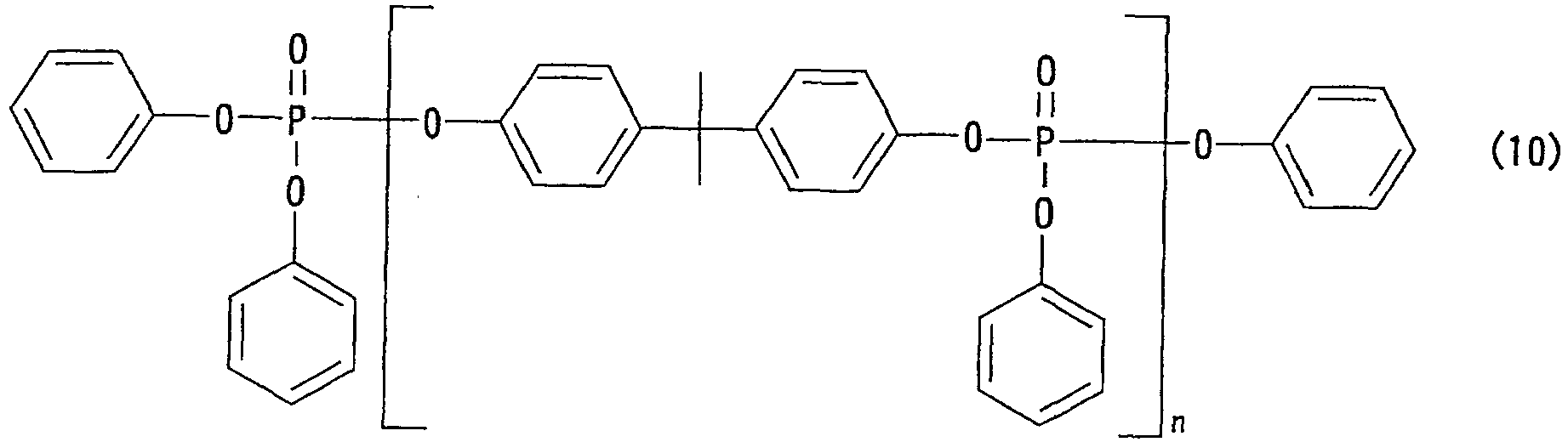
- A 1, 000-ml four-necked flask provided with a stirring machine, a temperature gauge, a dropping funnel and a nitrogen-introducing pipe was mounted with a condenser to which a water scrubber had been connected, and then 2.0 mol (244 g) of 2,6-dimethylphen, and 0.016mol (1.5 g) of magnesium chloride were loaded into the resultant reactor. The atmosphere in the reactor was replaced with nitrogen and then its temperature was increased to 120°C. 1.0 Mole (153 g) of phosphorus oxychloride was dropped to the reactor at the temperature over 2 hours. After the completion of the dropping, the temperature was increased to 180°C over 2 hours. Thus, di(2,6-xylyl)phosphorochloridate was obtained. The temperature in the flaskwas cooled to 20°C, and then 0.5 mol (55 g) of 1, 3-benzenediol and 0.016 mol (1.5 g) of magnesium chloride were loaded into the flask. The temperature was increased to 180°C over 2 hours and then the mixture was aged for 2 hours. After that, the catalyst was removed by an ordinary method and then the remainder was dried at 140°C under reducedpressure. Thus, component B-3 represented by a general formula (11) was obtained.

- Component B-4 represented by a general formula (12) was produced by the same production method as that of component B-1 except that 4,4'-biphenol was used instead of 1,3-benzenediol in the synthesis of component B-1.

- Table 1 below shows the average degree of polymerization of component (B) and the phosphorus content in the compound. [Table 1]
Table 1 Component (B) Degree of polymerization (molar ratio) Average degree of polymerization Phosphorus content (%) n=1 n=2 n=3 to 10 B-1 74 18 8 1.4 10.9 B-2 91 8 1 1.1 8.93 B-3 95 4 1 1.06 9.06 B-4 88 11 1 1.1 9.53 -
- b-1: product of Tokyo Chemical Industry Co., Ltd., product name: triphenyl phosphate
- (phosphorus content: 9.5%)
-
- C-1: A zinc dithiophosphate (In the general formula (2), the value for a is 0.08, a phosphorus content is 7.8%, and R9 and R10 represent a mixture of secondary alkyl groups each having 4 to 6 carbon atoms.) C-2: A molybdenum dithiocarbamate (In the general formula (3), R11 to R14 represent a mixture of an isooctyl group and an isotridecyl group (mixing ratio in terms of a molar ratio=1:1), X1 and X2 each represent a sulfur atom, and X3 and X4 each represent an oxygen atom. The molybdenum dithiocarbamate is diluted with a mineral oil so that its molybdenum content may be 10%.)
- C-3: A molybdenum dithiophosphate (In the general formula (4), R15 to R18 each represent an isooctyl group, X5 and X6 each represent a sulfur atom, and X7 and X8 each represent an oxygen atom. The molybdenum dithiophosphate is diluted with a mineral oil so that its molybdenum content may be 9.0%.)
- C-4: A molybdenum amine (The molybdenum amine is a reaction product of molybdenum trioxide and a secondary amine (in the general formula (5), R19 and R20 each represent an isotridecyl group). A reaction ratio "molybdenum trioxide:amine" is 1:1 (molar ratio). Its molybdenum content is 22%.)
- Described below are methods of preparing a lubricating oil composition for an internal combustion engine as a product of the present invention and a lubricating oil composition for an internal combustion engine as a comparative invention product used in tests, and conditions for the tests.
A test oil prepared according to the following test oil recipe was used in each of the examples and comparative examples.<Test oil recipe> Component (A) 100 parts by mass Methacrylate-based viscosity index improver 3.0 parts by mass Calcium salicylate-based detergent 2.8 parts by mass Succinimide-based dispersant 5.0 parts by mass Phenol-based antioxidant 0.25 part by mass Amine-based antioxidant 0.25 parts by mass - The test oil, and the component (B) and the component (C) weighed so as to have concentrations shown in Table 2 were loaded into a 200-ml beaker, and then the mixture was stirred at 90°C for 1 hour. Thus, a lubricating oil composition for an internal combustion engine was prepared. A wear resistance test was performed with the resultant lubricating oil composition for an internal combustion engine and a high-speed four-ball tester in conformity with ASTM D4172. The wear track diameter (mm) of a ball after the test was measured. A smaller wear track diameter means higher wear resistance.
Wear resistance test conditions Test instrument: Shell-type high-speed four-ball tester Rotational speed: 1,500 rpm Load: 490 N Test temperature: 85°C Test time: 60 minutes - The test oil, and the component (B) and the component (C) weighed so as to have the concentrations shown in Table 2 were loaded into a 200-ml beaker, and then the mixture was stirred at 90°C for 1 hour. Thus, a lubricating oil composition for an internal combustion engine was prepared. An oxidation stability test was performed with the prepared lubricating oil composition for an internal combustion engine and a thermal analysis system in conformity with ASTM D5483. An oxidation induction period (minute(s)) required for vigorous oxidation of the test oil to start was measured. A longer oxidation induction period means higher oxidation stability.
-
Test instrument: Thermal analysis system manufactured by TA
Instruments (DSC2920)Atmospheric pressure: 3.5 MPa Atmosphere: Oxygen Flow velocity: 100 ml/min Test temperature: 180°C - Table 2 shows the results of the wear resistance test as Test 1 and the results of the oxidation stability test as Test 2. It should be noted that Table 2 shows the concentrations of the component (B) and the component (C) in each lubricating oil composition for an internal combustion engine, and the phosphorus (P) concentration and the molybdenum (Mo) concentration therein. It should be noted that in standards for an engine oil established by the European Automobile Manufacturers Association (ACEA standards), the E7-08 as a standard for a high-load diesel engine requires an oxidation induction period of 35 minutes or more.
- [Table 2]
Table 2 Component (B) Component (C) P concentration Mo concentration Test 1 (mm) Test 2 (Minute(s)) B-1 B-2 B-3 B-4 b-1 C-1 C-2 C-3 C-4 ppm P ppm Mo ppm Example 1 917 5,128 500 0.50 36 Example 2 1,83 4 7, 692 800 0.45 39 Example 3 275 1,538 3,000 150 300 0.57 35 Example 4 917 3,846 2220 465 200 0.49 39 Example 5 917 3,846 2,000 400 200 0.51 38 Example 6 917 3,846 910 400 200 0.53 41 Example 7 917 3,000 100 300 0.52 35 Example 8 1,120 5,128 500 0.50 36 Example 9 1,120 3,000 100 300 0.52 35 Example 10 1,120 3,846 2,000 400 200 0.51 39 Example 11 1,104 5,128 500 0.49 36 Example 12 1,104 3,846 2,000 400 200 0.48 40 Example 13 1,049 5,128 500 0.53 36 Comp. Example 1 0.71 24 Comp. Example 2 2,564 200 0.67 30 Comp. Example 3 6,410 500 0.64 37 Comp. Example 4 10,256 800 0.60 40 Comp. Example 5 2,220 65 200 0.62 34 Comp. Example 6 3,000 300 0.67 35 Comp. Example 7 1,365 300 0.69 36 Comp. Example 8 6,410 3,000 500 300 0.63 40 Comp. Example 9 917 100 0.54 25 Comp. Example 10 1,120 100 0.55 23 Comp. Example 11 1,104 100 0.52 24 Comp. Example 12 2,105 5,128 600 0.62 36 - The lubricating oil composition for an internal combustion engine of the present invention can be used in any engines used as an internal combustion engines, and can be suitably used in, for example, a gasoline engine, a diesel engine, a direct injection engine, or a gas engine (liquefied petroleum gas engine).
Claims (9)
- A lubricating oil composition for an internal combustion engine, comprising as essential components the following component (A), component (B), and component (C), wherein a phosphorus content of the composition is 50 ppm by mass to 1,000 ppm by mass:Component (A): a base oil;Component (B): a compound represented by the following general formula (1); andComponent (C): a metal-containing antioxidant:where R1 to R8 each independently represent a hydrogen atom or an alkyl group having 1 to 20 carbon atoms, Z represents a hydrocarbon group having 2 to 20 carbon atoms, and n represents a number from 1 to 10.

- A lubricating oil composition for an internal combustion engine according to claim 1, wherein the component (C) is a zinc-containing antioxidant and/or a molybdenum-containing antioxidant.
- A lubricating oil composition for an internal combustion engine according to claim 1 or 2, wherein the component (C) is one or two or more kinds selected from compounds represented by the following general formulae (2) to (4), and a molybdenum amine obtained by causing a hexavalent molybdenum compound and a primary or secondary amine represented by the following general formula (5) to react with each other:



R19-NH-R20 (5)
where R19 and R20 represent a hydrogen atom and/or a hydrocarbon group having 1 to 40 carbon atoms, provided that a case where R19 and R20 simultaneously represent hydrogen atoms is excluded. - A lubricating oil composition for an internal combustion engine according to any one of claims 1 to 3, wherein Z in the general formula (1) represents a group represented by a general formula (6), a general formula (7), or a general formula (8).

- A lubricating oil composition for an internal combustion engine according to any one of claims 1 to 4, wherein R1 to R8 in the general formula (1) each represent a hydrogen atom or a methyl group.
- A lubricating oil composition for an internal combustion engine according to any one of claims 1 to 5, wherein the base oil as the component (A) is one or two or more kinds selected from a poly-α-olefin, an ethylene-α-olefin copolymer, a polyisobutylene (polybutene), a monoester, a hindered ester, a diester, an aromatic polyhydric carboxylic acid ester, a silicic acid ester, a polyalkylene glycol, a polyphenyl ether, silicone, a fluoro compound, an alkylbenzene, a GTL, a paraffin-based mineral oil, and a naphthene-based mineral oil.
- A lubricating oil composition for an internal combustion engine according to any one of claims 1 to 6, wherein the phosphorus content in the lubricating oil composition for an internal combustion engine is 200 ppm by mass to 1,000 ppm by mass.
- A lubricating oil composition for an internal combustion engine according to any one of claims 1 to 7, further comprising 0.01 mass% to 5 mass% of a nonmetallic antioxidant with respect to the component (A).
- A lubricating oil composition for an internal combustion engine according to any one of claims 1 to 8, further comprising one or two or more kinds selected from the group consisting of an anti-wear agent, a friction modifier, a metal-based detergent, an ashless dispersant, a viscosity index improver, a pour point depressant, a rust inhibitor, a corrosion inhibitor, and an anti-foaming agent excluding the component (B) and the component (C).
Applications Claiming Priority (2)
| Application Number | Priority Date | Filing Date | Title |
|---|---|---|---|
| JP2010136278 | 2010-06-15 | ||
| PCT/JP2011/061413 WO2011158595A1 (en) | 2010-06-15 | 2011-05-18 | Lubricant composition for internal combustion engines |
Publications (3)
| Publication Number | Publication Date |
|---|---|
| EP2584026A1 true EP2584026A1 (en) | 2013-04-24 |
| EP2584026A4 EP2584026A4 (en) | 2013-12-04 |
| EP2584026B1 EP2584026B1 (en) | 2017-07-05 |
Family
ID=45348004
Family Applications (1)
| Application Number | Title | Priority Date | Filing Date |
|---|---|---|---|
| EP11795503.9A Not-in-force EP2584026B1 (en) | 2010-06-15 | 2011-05-18 | Lubricant composition for internal combustion engines |
Country Status (6)
| Country | Link |
|---|---|
| US (1) | US8722597B2 (en) |
| EP (1) | EP2584026B1 (en) |
| JP (1) | JP5764556B2 (en) |
| KR (1) | KR101753932B1 (en) |
| CN (1) | CN102939366B (en) |
| WO (1) | WO2011158595A1 (en) |
Families Citing this family (23)
| Publication number | Priority date | Publication date | Assignee | Title |
|---|---|---|---|---|
| US20140122612A1 (en) * | 2012-10-26 | 2014-05-01 | Xiaomu Wu | Activity-Based Discoverable Mode |
| DE102013109064A1 (en) * | 2013-08-21 | 2015-02-26 | Hkp Heiz- Und Kraftstoffe Pflanzenöl Gmbh | Additive for oil-based lubricants with improved extreme pressure properties |
| CN104087383B (en) * | 2014-07-14 | 2016-04-13 | 广西大学 | A kind of take Di Iso Propyl Ether as the engine oil composition of fuel |
| CN104087374B (en) * | 2014-07-14 | 2016-08-17 | 广西大学 | A kind of dimethyl carbonate diesel engine oil composition |
| CN104087372B (en) * | 2014-07-14 | 2016-06-01 | 广西大学 | A kind of ethylene glycol dimethyl ether fuel delivery engine oil base oil |
| CN104087384B (en) * | 2014-07-14 | 2016-08-24 | 广西大学 | A kind of coal slurry oil fuel engine oil composition |
| JP6586722B2 (en) * | 2014-08-29 | 2019-10-09 | 出光興産株式会社 | Refrigerator oil, refrigerator oil composition, and refrigerator |
| FR3048977B1 (en) * | 2016-03-15 | 2020-02-07 | Total Marketing Services | LUBRICATING COMPOSITION BASED ON POLYALKYLENE GLYCOLS |
| CN109312249B (en) * | 2016-06-24 | 2021-12-31 | 陶氏环球技术有限责任公司 | Lubricant composition |
| WO2018003812A1 (en) * | 2016-06-29 | 2018-01-04 | 株式会社Adeka | Lubricating oil composition for internal combustion engine |
| JP6467377B2 (en) * | 2016-06-29 | 2019-02-13 | 株式会社Adeka | Lubricating composition and engine oil composition comprising the lubricating composition |
| US10977858B2 (en) | 2017-03-30 | 2021-04-13 | Magic Leap, Inc. | Centralized rendering |
| JP6822895B2 (en) * | 2017-05-02 | 2021-01-27 | Emgルブリカンツ合同会社 | Lubricating oil composition |
| CN110799632B (en) * | 2017-07-11 | 2022-05-03 | 株式会社Adeka | Method for stabilizing the dispersibility of organomolybdenum compounds in base oils over a long period of time |
| EP3807868A4 (en) * | 2018-06-18 | 2021-09-22 | Magic Leap, Inc. | CENTRALIZED RENDERING |
| EP4708929A3 (en) | 2018-07-24 | 2026-04-29 | Magic Leap, Inc. | Application sharing |
| JP7256701B2 (en) * | 2019-06-21 | 2023-04-12 | 株式会社オートネットワーク技術研究所 | Surface protective agent composition and coated wire with terminal |
| WO2021163224A1 (en) | 2020-02-10 | 2021-08-19 | Magic Leap, Inc. | Dynamic colocation of virtual content |
| CN118276683A (en) | 2020-02-14 | 2024-07-02 | 奇跃公司 | Tool Bridge |
| WO2021163373A1 (en) | 2020-02-14 | 2021-08-19 | Magic Leap, Inc. | 3d object annotation |
| US11475644B2 (en) | 2020-02-14 | 2022-10-18 | Magic Leap, Inc. | Session manager |
| CN112414815A (en) * | 2020-11-27 | 2021-02-26 | 青岛赛时检验有限公司 | Gasoline induction period capacity verification sample, preparation method and application |
| WO2022228988A1 (en) * | 2021-04-27 | 2022-11-03 | Shell Internationale Research Maatschappij B.V. | Dual phase lubricants |
Family Cites Families (19)
| Publication number | Priority date | Publication date | Assignee | Title |
|---|---|---|---|---|
| US3492373A (en) * | 1961-09-05 | 1970-01-27 | Sinclair Research Inc | Diphosphorous aromatic compounds |
| JPS61285293A (en) | 1985-06-12 | 1986-12-16 | Asahi Denka Kogyo Kk | Lubricant composition containing molybdenum |
| AU655284B2 (en) | 1991-06-14 | 1994-12-15 | Ethyl Corporation | Organic phosphates and their preparation |
| US5344468A (en) * | 1991-06-14 | 1994-09-06 | Ethyl Petroleum Additives, Inc. | Organic phosphates and their use as wear inhibitors |
| JPH0680981A (en) * | 1992-08-31 | 1994-03-22 | Tonen Corp | Lubricating oil composition for internal combustion engine |
| EP0612837A1 (en) * | 1993-01-06 | 1994-08-31 | Akzo Nobel N.V. | Polyphenylene ether lubricant containing hydrocarbyl bis(dihydrocarbylphosphate) compound |
| EP0614837A1 (en) * | 1993-03-11 | 1994-09-14 | RIETER-WERKE HÄNDLE GmbH & Co. KG | Longitudinal excavator |
| JP2933115B2 (en) | 1994-01-14 | 1999-08-09 | 日産ディーゼル工業株式会社 | Engine oil for diesel engines with exhaust gas recirculation system |
| US5560849A (en) | 1994-12-23 | 1996-10-01 | Fmc Corporation | Synthetic ester lubricant having improved antiwear properties |
| JPH1017883A (en) | 1996-07-05 | 1998-01-20 | Japan Energy Corp | Lubricating oil for internal combustion engines |
| JP4076634B2 (en) * | 1998-09-09 | 2008-04-16 | 新日本石油株式会社 | 4-cycle engine oil composition for motorcycles |
| JP4201902B2 (en) | 1998-12-24 | 2008-12-24 | 株式会社Adeka | Lubricating composition |
| JP2001262172A (en) * | 2000-03-22 | 2001-09-26 | Asahi Denka Kogyo Kk | Lubricating oil composition for internal combustion engines |
| US6509303B1 (en) * | 2000-03-23 | 2003-01-21 | Ethyl Corporation | Oil soluble molybdenum additives from the reaction product of fatty oils and monosubstituted alkylene diamines |
| JP4185307B2 (en) | 2001-09-20 | 2008-11-26 | 新日本石油株式会社 | Lubricating oil composition for internal combustion engines |
| JP2004051758A (en) * | 2002-07-19 | 2004-02-19 | Asahi Denka Kogyo Kk | Lubricating oil composition based on mineral oil with high sulfur content |
| CN1286960C (en) * | 2003-10-31 | 2006-11-29 | 中国石油化工股份有限公司 | Internal combustion engine oil and composite additive composition |
| JP4718159B2 (en) * | 2004-11-05 | 2011-07-06 | 株式会社Adeka | Engine oil composition |
| JP5194559B2 (en) | 2007-05-25 | 2013-05-08 | 日本精工株式会社 | Electric power steering device |
-
2011
- 2011-05-18 CN CN201180029447.6A patent/CN102939366B/en not_active Expired - Fee Related
- 2011-05-18 KR KR1020127025595A patent/KR101753932B1/en active Active
- 2011-05-18 JP JP2012520337A patent/JP5764556B2/en active Active
- 2011-05-18 WO PCT/JP2011/061413 patent/WO2011158595A1/en not_active Ceased
- 2011-05-18 US US13/635,037 patent/US8722597B2/en active Active
- 2011-05-18 EP EP11795503.9A patent/EP2584026B1/en not_active Not-in-force
Also Published As
| Publication number | Publication date |
|---|---|
| KR20130095630A (en) | 2013-08-28 |
| US8722597B2 (en) | 2014-05-13 |
| JP5764556B2 (en) | 2015-08-19 |
| KR101753932B1 (en) | 2017-07-04 |
| CN102939366A (en) | 2013-02-20 |
| JPWO2011158595A1 (en) | 2013-08-19 |
| CN102939366B (en) | 2015-12-09 |
| US20130012418A1 (en) | 2013-01-10 |
| EP2584026A4 (en) | 2013-12-04 |
| WO2011158595A1 (en) | 2011-12-22 |
| EP2584026B1 (en) | 2017-07-05 |
Similar Documents
| Publication | Publication Date | Title |
|---|---|---|
| EP2584026B1 (en) | Lubricant composition for internal combustion engines | |
| KR102706014B1 (en) | Lubricating oil compositions | |
| CN109415646B (en) | Lubricating composition and engine oil composition containing same | |
| JP5730283B2 (en) | Lubricating oil composition | |
| EP3872149B1 (en) | Lubricant composition and method for producing same | |
| EP2610331B1 (en) | Lubricant composition for internal combustion engines | |
| EP3495463A1 (en) | Lubricant composition | |
| EP2554643A1 (en) | Lubricant additive and lubricant composition containing lubricant additive | |
| EP2518134A1 (en) | Cylinder lubricant oil composition for crosshead-type diesel engine | |
| JP5701630B2 (en) | Lubricating oil additive and lubricating oil composition containing the same | |
| JP6846295B2 (en) | Lubricating oil composition for gas engines, and methods for improving fuel consumption or reducing abnormal combustion | |
| JPWO2018139403A1 (en) | Engine oil composition | |
| JP5101915B2 (en) | Lubricating oil composition for diesel engines | |
| JP7556678B2 (en) | Agent for stabilizing dissolution and dispersion of organic molybdenum compound in base oil, comprising acrylate copolymer, lubricating oil composition, and method for improving dissolution and dispersion stability of organic molybdenum compound in base oil | |
| JP2018076411A (en) | Lubricating oil composition | |
| EP3981862B1 (en) | Acrylate-based copolymer, method for producing said copolymer, friction inhibitor using said copolymer, and lubricating composition containing said friction inhibitor | |
| JP2015010171A (en) | Lubricant composition | |
| JP4955366B2 (en) | Phosphorus molybdenum compound, process for producing the same, lubricating oil additive and lubricating oil composition containing the compound | |
| EP2548939A1 (en) | Lubricant composition | |
| EP3438232A1 (en) | Lubricating oil composition, and precision reduction gear using same | |
| JP5403970B2 (en) | Lubricating oil composition for gas engine | |
| EP3034586A1 (en) | Lubricant oil additive and lubricant oil composition | |
| JP2023047699A (en) | Lubricant composition |
Legal Events
| Date | Code | Title | Description |
|---|---|---|---|
| PUAI | Public reference made under article 153(3) epc to a published international application that has entered the european phase |
Free format text: ORIGINAL CODE: 0009012 |
|
| 17P | Request for examination filed |
Effective date: 20121025 |
|
| AK | Designated contracting states |
Kind code of ref document: A1 Designated state(s): AL AT BE BG CH CY CZ DE DK EE ES FI FR GB GR HR HU IE IS IT LI LT LU LV MC MK MT NL NO PL PT RO RS SE SI SK SM TR |
|
| DAX | Request for extension of the european patent (deleted) | ||
| A4 | Supplementary search report drawn up and despatched |
Effective date: 20131106 |
|
| RIC1 | Information provided on ipc code assigned before grant |
Ipc: C10N 40/25 20060101ALN20131030BHEP Ipc: C10N 20/02 20060101ALN20131030BHEP Ipc: C10N 10/04 20060101AFI20131030BHEP Ipc: C10N 30/06 20060101ALI20131030BHEP Ipc: C10N 10/12 20060101ALI20131030BHEP Ipc: C10N 30/10 20060101ALI20131030BHEP Ipc: C10M 141/12 20060101ALI20131030BHEP Ipc: C10M 137/00 20060101ALI20131030BHEP Ipc: C10M 167/00 20060101ALI20131030BHEP |
|
| 17Q | First examination report despatched |
Effective date: 20160317 |
|
| REG | Reference to a national code |
Ref country code: DE Ref legal event code: R079 Ref document number: 602011039346 Country of ref document: DE Free format text: PREVIOUS MAIN CLASS: C10M0169040000 Ipc: C10N0010040000 |
|
| GRAP | Despatch of communication of intention to grant a patent |
Free format text: ORIGINAL CODE: EPIDOSNIGR1 |
|
| STAA | Information on the status of an ep patent application or granted ep patent |
Free format text: STATUS: GRANT OF PATENT IS INTENDED |
|
| RIC1 | Information provided on ipc code assigned before grant |
Ipc: C10N 10/12 20060101ALI20170309BHEP Ipc: C10M 167/00 20060101ALI20170309BHEP Ipc: C10N 30/10 20060101ALI20170309BHEP Ipc: C10M 137/00 20060101ALI20170309BHEP Ipc: C10M 141/12 20060101ALI20170309BHEP Ipc: C10N 10/04 20060101AFI20170309BHEP Ipc: C10N 30/06 20060101ALI20170309BHEP Ipc: C10N 20/02 20060101ALN20170309BHEP Ipc: C10N 40/25 20060101ALN20170309BHEP |
|
| INTG | Intention to grant announced |
Effective date: 20170321 |
|
| GRAS | Grant fee paid |
Free format text: ORIGINAL CODE: EPIDOSNIGR3 |
|
| GRAA | (expected) grant |
Free format text: ORIGINAL CODE: 0009210 |
|
| STAA | Information on the status of an ep patent application or granted ep patent |
Free format text: STATUS: THE PATENT HAS BEEN GRANTED |
|
| AK | Designated contracting states |
Kind code of ref document: B1 Designated state(s): AL AT BE BG CH CY CZ DE DK EE ES FI FR GB GR HR HU IE IS IT LI LT LU LV MC MK MT NL NO PL PT RO RS SE SI SK SM TR |
|
| REG | Reference to a national code |
Ref country code: GB Ref legal event code: FG4D |
|
| REG | Reference to a national code |
Ref country code: CH Ref legal event code: EP |
|
| REG | Reference to a national code |
Ref country code: AT Ref legal event code: REF Ref document number: 906614 Country of ref document: AT Kind code of ref document: T Effective date: 20170715 |
|
| REG | Reference to a national code |
Ref country code: IE Ref legal event code: FG4D |
|
| REG | Reference to a national code |
Ref country code: DE Ref legal event code: R096 Ref document number: 602011039346 Country of ref document: DE |
|
| REG | Reference to a national code |
Ref country code: NL Ref legal event code: MP Effective date: 20170705 |
|
| REG | Reference to a national code |
Ref country code: AT Ref legal event code: MK05 Ref document number: 906614 Country of ref document: AT Kind code of ref document: T Effective date: 20170705 |
|
| REG | Reference to a national code |
Ref country code: LT Ref legal event code: MG4D |
|
| PG25 | Lapsed in a contracting state [announced via postgrant information from national office to epo] |
Ref country code: NL Free format text: LAPSE BECAUSE OF FAILURE TO SUBMIT A TRANSLATION OF THE DESCRIPTION OR TO PAY THE FEE WITHIN THE PRESCRIBED TIME-LIMIT Effective date: 20170705 Ref country code: AT Free format text: LAPSE BECAUSE OF FAILURE TO SUBMIT A TRANSLATION OF THE DESCRIPTION OR TO PAY THE FEE WITHIN THE PRESCRIBED TIME-LIMIT Effective date: 20170705 Ref country code: SE Free format text: LAPSE BECAUSE OF FAILURE TO SUBMIT A TRANSLATION OF THE DESCRIPTION OR TO PAY THE FEE WITHIN THE PRESCRIBED TIME-LIMIT Effective date: 20170705 Ref country code: HR Free format text: LAPSE BECAUSE OF FAILURE TO SUBMIT A TRANSLATION OF THE DESCRIPTION OR TO PAY THE FEE WITHIN THE PRESCRIBED TIME-LIMIT Effective date: 20170705 Ref country code: FI Free format text: LAPSE BECAUSE OF FAILURE TO SUBMIT A TRANSLATION OF THE DESCRIPTION OR TO PAY THE FEE WITHIN THE PRESCRIBED TIME-LIMIT Effective date: 20170705 Ref country code: LT Free format text: LAPSE BECAUSE OF FAILURE TO SUBMIT A TRANSLATION OF THE DESCRIPTION OR TO PAY THE FEE WITHIN THE PRESCRIBED TIME-LIMIT Effective date: 20170705 Ref country code: NO Free format text: LAPSE BECAUSE OF FAILURE TO SUBMIT A TRANSLATION OF THE DESCRIPTION OR TO PAY THE FEE WITHIN THE PRESCRIBED TIME-LIMIT Effective date: 20171005 |
|
| PG25 | Lapsed in a contracting state [announced via postgrant information from national office to epo] |
Ref country code: BG Free format text: LAPSE BECAUSE OF FAILURE TO SUBMIT A TRANSLATION OF THE DESCRIPTION OR TO PAY THE FEE WITHIN THE PRESCRIBED TIME-LIMIT Effective date: 20171005 Ref country code: ES Free format text: LAPSE BECAUSE OF FAILURE TO SUBMIT A TRANSLATION OF THE DESCRIPTION OR TO PAY THE FEE WITHIN THE PRESCRIBED TIME-LIMIT Effective date: 20170705 Ref country code: GR Free format text: LAPSE BECAUSE OF FAILURE TO SUBMIT A TRANSLATION OF THE DESCRIPTION OR TO PAY THE FEE WITHIN THE PRESCRIBED TIME-LIMIT Effective date: 20171006 Ref country code: IS Free format text: LAPSE BECAUSE OF FAILURE TO SUBMIT A TRANSLATION OF THE DESCRIPTION OR TO PAY THE FEE WITHIN THE PRESCRIBED TIME-LIMIT Effective date: 20171105 Ref country code: RS Free format text: LAPSE BECAUSE OF FAILURE TO SUBMIT A TRANSLATION OF THE DESCRIPTION OR TO PAY THE FEE WITHIN THE PRESCRIBED TIME-LIMIT Effective date: 20170705 Ref country code: LV Free format text: LAPSE BECAUSE OF FAILURE TO SUBMIT A TRANSLATION OF THE DESCRIPTION OR TO PAY THE FEE WITHIN THE PRESCRIBED TIME-LIMIT Effective date: 20170705 Ref country code: PL Free format text: LAPSE BECAUSE OF FAILURE TO SUBMIT A TRANSLATION OF THE DESCRIPTION OR TO PAY THE FEE WITHIN THE PRESCRIBED TIME-LIMIT Effective date: 20170705 |
|
| REG | Reference to a national code |
Ref country code: DE Ref legal event code: R097 Ref document number: 602011039346 Country of ref document: DE |
|
| PG25 | Lapsed in a contracting state [announced via postgrant information from national office to epo] |
Ref country code: DK Free format text: LAPSE BECAUSE OF FAILURE TO SUBMIT A TRANSLATION OF THE DESCRIPTION OR TO PAY THE FEE WITHIN THE PRESCRIBED TIME-LIMIT Effective date: 20170705 Ref country code: CZ Free format text: LAPSE BECAUSE OF FAILURE TO SUBMIT A TRANSLATION OF THE DESCRIPTION OR TO PAY THE FEE WITHIN THE PRESCRIBED TIME-LIMIT Effective date: 20170705 Ref country code: RO Free format text: LAPSE BECAUSE OF FAILURE TO SUBMIT A TRANSLATION OF THE DESCRIPTION OR TO PAY THE FEE WITHIN THE PRESCRIBED TIME-LIMIT Effective date: 20170705 |
|
| PLBE | No opposition filed within time limit |
Free format text: ORIGINAL CODE: 0009261 |
|
| STAA | Information on the status of an ep patent application or granted ep patent |
Free format text: STATUS: NO OPPOSITION FILED WITHIN TIME LIMIT |
|
| REG | Reference to a national code |
Ref country code: FR Ref legal event code: PLFP Year of fee payment: 8 |
|
| PG25 | Lapsed in a contracting state [announced via postgrant information from national office to epo] |
Ref country code: SK Free format text: LAPSE BECAUSE OF FAILURE TO SUBMIT A TRANSLATION OF THE DESCRIPTION OR TO PAY THE FEE WITHIN THE PRESCRIBED TIME-LIMIT Effective date: 20170705 Ref country code: IT Free format text: LAPSE BECAUSE OF FAILURE TO SUBMIT A TRANSLATION OF THE DESCRIPTION OR TO PAY THE FEE WITHIN THE PRESCRIBED TIME-LIMIT Effective date: 20170705 Ref country code: EE Free format text: LAPSE BECAUSE OF FAILURE TO SUBMIT A TRANSLATION OF THE DESCRIPTION OR TO PAY THE FEE WITHIN THE PRESCRIBED TIME-LIMIT Effective date: 20170705 Ref country code: SM Free format text: LAPSE BECAUSE OF FAILURE TO SUBMIT A TRANSLATION OF THE DESCRIPTION OR TO PAY THE FEE WITHIN THE PRESCRIBED TIME-LIMIT Effective date: 20170705 |
|
| 26N | No opposition filed |
Effective date: 20180406 |
|
| PG25 | Lapsed in a contracting state [announced via postgrant information from national office to epo] |
Ref country code: SI Free format text: LAPSE BECAUSE OF FAILURE TO SUBMIT A TRANSLATION OF THE DESCRIPTION OR TO PAY THE FEE WITHIN THE PRESCRIBED TIME-LIMIT Effective date: 20170705 |
|
| REG | Reference to a national code |
Ref country code: CH Ref legal event code: PL |
|
| REG | Reference to a national code |
Ref country code: BE Ref legal event code: MM Effective date: 20180531 |
|
| PG25 | Lapsed in a contracting state [announced via postgrant information from national office to epo] |
Ref country code: MC Free format text: LAPSE BECAUSE OF FAILURE TO SUBMIT A TRANSLATION OF THE DESCRIPTION OR TO PAY THE FEE WITHIN THE PRESCRIBED TIME-LIMIT Effective date: 20170705 |
|
| REG | Reference to a national code |
Ref country code: IE Ref legal event code: MM4A |
|
| PG25 | Lapsed in a contracting state [announced via postgrant information from national office to epo] |
Ref country code: CH Free format text: LAPSE BECAUSE OF NON-PAYMENT OF DUE FEES Effective date: 20180531 Ref country code: LI Free format text: LAPSE BECAUSE OF NON-PAYMENT OF DUE FEES Effective date: 20180531 |
|
| PG25 | Lapsed in a contracting state [announced via postgrant information from national office to epo] |
Ref country code: LU Free format text: LAPSE BECAUSE OF NON-PAYMENT OF DUE FEES Effective date: 20180518 |
|
| PG25 | Lapsed in a contracting state [announced via postgrant information from national office to epo] |
Ref country code: IE Free format text: LAPSE BECAUSE OF NON-PAYMENT OF DUE FEES Effective date: 20180518 |
|
| PG25 | Lapsed in a contracting state [announced via postgrant information from national office to epo] |
Ref country code: BE Free format text: LAPSE BECAUSE OF NON-PAYMENT OF DUE FEES Effective date: 20180531 |
|
| PGFP | Annual fee paid to national office [announced via postgrant information from national office to epo] |
Ref country code: FR Payment date: 20190523 Year of fee payment: 9 |
|
| PGFP | Annual fee paid to national office [announced via postgrant information from national office to epo] |
Ref country code: GB Payment date: 20190521 Year of fee payment: 9 |
|
| PG25 | Lapsed in a contracting state [announced via postgrant information from national office to epo] |
Ref country code: MT Free format text: LAPSE BECAUSE OF NON-PAYMENT OF DUE FEES Effective date: 20180518 |
|
| PG25 | Lapsed in a contracting state [announced via postgrant information from national office to epo] |
Ref country code: TR Free format text: LAPSE BECAUSE OF FAILURE TO SUBMIT A TRANSLATION OF THE DESCRIPTION OR TO PAY THE FEE WITHIN THE PRESCRIBED TIME-LIMIT Effective date: 20170705 |
|
| PG25 | Lapsed in a contracting state [announced via postgrant information from national office to epo] |
Ref country code: HU Free format text: LAPSE BECAUSE OF FAILURE TO SUBMIT A TRANSLATION OF THE DESCRIPTION OR TO PAY THE FEE WITHIN THE PRESCRIBED TIME-LIMIT; INVALID AB INITIO Effective date: 20110518 Ref country code: PT Free format text: LAPSE BECAUSE OF FAILURE TO SUBMIT A TRANSLATION OF THE DESCRIPTION OR TO PAY THE FEE WITHIN THE PRESCRIBED TIME-LIMIT Effective date: 20170705 |
|
| PG25 | Lapsed in a contracting state [announced via postgrant information from national office to epo] |
Ref country code: CY Free format text: LAPSE BECAUSE OF FAILURE TO SUBMIT A TRANSLATION OF THE DESCRIPTION OR TO PAY THE FEE WITHIN THE PRESCRIBED TIME-LIMIT Effective date: 20170705 Ref country code: MK Free format text: LAPSE BECAUSE OF NON-PAYMENT OF DUE FEES Effective date: 20170705 |
|
| PG25 | Lapsed in a contracting state [announced via postgrant information from national office to epo] |
Ref country code: AL Free format text: LAPSE BECAUSE OF FAILURE TO SUBMIT A TRANSLATION OF THE DESCRIPTION OR TO PAY THE FEE WITHIN THE PRESCRIBED TIME-LIMIT Effective date: 20170705 |
|
| GBPC | Gb: european patent ceased through non-payment of renewal fee |
Effective date: 20200518 |
|
| PG25 | Lapsed in a contracting state [announced via postgrant information from national office to epo] |
Ref country code: GB Free format text: LAPSE BECAUSE OF NON-PAYMENT OF DUE FEES Effective date: 20200518 Ref country code: FR Free format text: LAPSE BECAUSE OF NON-PAYMENT OF DUE FEES Effective date: 20200531 |
|
| PGFP | Annual fee paid to national office [announced via postgrant information from national office to epo] |
Ref country code: DE Payment date: 20220519 Year of fee payment: 12 |
|
| REG | Reference to a national code |
Ref country code: DE Ref legal event code: R119 Ref document number: 602011039346 Country of ref document: DE |
|
| PG25 | Lapsed in a contracting state [announced via postgrant information from national office to epo] |
Ref country code: DE Free format text: LAPSE BECAUSE OF NON-PAYMENT OF DUE FEES Effective date: 20231201 |