EP2583662A1 - Composition à base de meroterpene destinée aux peaux grasses, à tendance acneique ou atteintes d'acne - Google Patents
Composition à base de meroterpene destinée aux peaux grasses, à tendance acneique ou atteintes d'acne Download PDFInfo
- Publication number
- EP2583662A1 EP2583662A1 EP12187576.9A EP12187576A EP2583662A1 EP 2583662 A1 EP2583662 A1 EP 2583662A1 EP 12187576 A EP12187576 A EP 12187576A EP 2583662 A1 EP2583662 A1 EP 2583662A1
- Authority
- EP
- European Patent Office
- Prior art keywords
- composition
- acne
- agent
- advantageously
- composition according
- Prior art date
- Legal status (The legal status is an assumption and is not a legal conclusion. Google has not performed a legal analysis and makes no representation as to the accuracy of the status listed.)
- Granted
Links
- 0 CC(C=C)(C=Cc1cc(*)c(*)c(*)c1)S Chemical compound CC(C=C)(C=Cc1cc(*)c(*)c(*)c1)S 0.000 description 1
Images




Classifications
-
- A—HUMAN NECESSITIES
- A61—MEDICAL OR VETERINARY SCIENCE; HYGIENE
- A61K—PREPARATIONS FOR MEDICAL, DENTAL OR TOILETRY PURPOSES
- A61K8/00—Cosmetics or similar toiletry preparations
- A61K8/18—Cosmetics or similar toiletry preparations characterised by the composition
- A61K8/30—Cosmetics or similar toiletry preparations characterised by the composition containing organic compounds
- A61K8/33—Cosmetics or similar toiletry preparations characterised by the composition containing organic compounds containing oxygen
- A61K8/34—Alcohols
- A61K8/345—Alcohols containing more than one hydroxy group
-
- A—HUMAN NECESSITIES
- A61—MEDICAL OR VETERINARY SCIENCE; HYGIENE
- A61K—PREPARATIONS FOR MEDICAL, DENTAL OR TOILETRY PURPOSES
- A61K31/00—Medicinal preparations containing organic active ingredients
- A61K31/045—Hydroxy compounds, e.g. alcohols; Salts thereof, e.g. alcoholates
- A61K31/047—Hydroxy compounds, e.g. alcohols; Salts thereof, e.g. alcoholates having two or more hydroxy groups, e.g. sorbitol
-
- A—HUMAN NECESSITIES
- A61—MEDICAL OR VETERINARY SCIENCE; HYGIENE
- A61K—PREPARATIONS FOR MEDICAL, DENTAL OR TOILETRY PURPOSES
- A61K31/00—Medicinal preparations containing organic active ingredients
- A61K31/045—Hydroxy compounds, e.g. alcohols; Salts thereof, e.g. alcoholates
- A61K31/05—Phenols
-
- A—HUMAN NECESSITIES
- A61—MEDICAL OR VETERINARY SCIENCE; HYGIENE
- A61K—PREPARATIONS FOR MEDICAL, DENTAL OR TOILETRY PURPOSES
- A61K36/00—Medicinal preparations of undetermined constitution containing material from algae, lichens, fungi or plants, or derivatives thereof, e.g. traditional herbal medicines
- A61K36/16—Ginkgophyta, e.g. Ginkgoaceae (Ginkgo family)
-
- A—HUMAN NECESSITIES
- A61—MEDICAL OR VETERINARY SCIENCE; HYGIENE
- A61K—PREPARATIONS FOR MEDICAL, DENTAL OR TOILETRY PURPOSES
- A61K47/00—Medicinal preparations characterised by the non-active ingredients used, e.g. carriers or inert additives; Targeting or modifying agents chemically bound to the active ingredient
- A61K47/06—Organic compounds, e.g. natural or synthetic hydrocarbons, polyolefins, mineral oil, petrolatum or ozokerite
- A61K47/08—Organic compounds, e.g. natural or synthetic hydrocarbons, polyolefins, mineral oil, petrolatum or ozokerite containing oxygen, e.g. ethers, acetals, ketones, quinones, aldehydes, peroxides
- A61K47/10—Alcohols; Phenols; Salts thereof, e.g. glycerol; Polyethylene glycols [PEG]; Poloxamers; PEG/POE alkyl ethers
-
- A—HUMAN NECESSITIES
- A61—MEDICAL OR VETERINARY SCIENCE; HYGIENE
- A61K—PREPARATIONS FOR MEDICAL, DENTAL OR TOILETRY PURPOSES
- A61K8/00—Cosmetics or similar toiletry preparations
- A61K8/18—Cosmetics or similar toiletry preparations characterised by the composition
- A61K8/30—Cosmetics or similar toiletry preparations characterised by the composition containing organic compounds
- A61K8/33—Cosmetics or similar toiletry preparations characterised by the composition containing organic compounds containing oxygen
- A61K8/34—Alcohols
- A61K8/347—Phenols
-
- A—HUMAN NECESSITIES
- A61—MEDICAL OR VETERINARY SCIENCE; HYGIENE
- A61K—PREPARATIONS FOR MEDICAL, DENTAL OR TOILETRY PURPOSES
- A61K8/00—Cosmetics or similar toiletry preparations
- A61K8/18—Cosmetics or similar toiletry preparations characterised by the composition
- A61K8/96—Cosmetics or similar toiletry preparations characterised by the composition containing materials, or derivatives thereof of undetermined constitution
- A61K8/97—Cosmetics or similar toiletry preparations characterised by the composition containing materials, or derivatives thereof of undetermined constitution from algae, fungi, lichens or plants; from derivatives thereof
- A61K8/9771—Ginkgophyta, e.g. Ginkgoaceae [Ginkgo family]
-
- A—HUMAN NECESSITIES
- A61—MEDICAL OR VETERINARY SCIENCE; HYGIENE
- A61K—PREPARATIONS FOR MEDICAL, DENTAL OR TOILETRY PURPOSES
- A61K9/00—Medicinal preparations characterised by special physical form
- A61K9/0012—Galenical forms characterised by the site of application
- A61K9/0014—Skin, i.e. galenical aspects of topical compositions
-
- A—HUMAN NECESSITIES
- A61—MEDICAL OR VETERINARY SCIENCE; HYGIENE
- A61P—SPECIFIC THERAPEUTIC ACTIVITY OF CHEMICAL COMPOUNDS OR MEDICINAL PREPARATIONS
- A61P17/00—Drugs for dermatological disorders
- A61P17/10—Anti-acne agents
-
- A—HUMAN NECESSITIES
- A61—MEDICAL OR VETERINARY SCIENCE; HYGIENE
- A61Q—SPECIFIC USE OF COSMETICS OR SIMILAR TOILETRY PREPARATIONS
- A61Q19/00—Preparations for care of the skin
- A61Q19/008—Preparations for oily skin
Definitions
- the subject of the present invention is a composition for cosmetic or dermatological use based on meroterpene, advantageously associated with a flavonoid and / or a polyol.
- such a composition is particularly suitable for the treatment of oily or acne-prone skin, or acne itself.
- Acne is a chronic inflammatory pathology affecting the pilosebaceous follicle, affecting the face, thorax and back. It is an extremely common disease, reaching almost 80% of adolescents.
- acne there are various clinical forms of acne related to the populations concerned: juvenile polymorphic acne or acne vulgaris which can be retentive and / or inflammatory of varying severity and duration; acne of the adult found in humans or women classically inflammatory type; acne of the newborn, infant and child; severe forms (nodular acne, acne conglobata, acne fulminans).
- acne is by definition a polymorphic disorder that combines retention lesions (microcysts, comedones), and / or inflammatory lesions (papules, pustules or nodules) that can coexist or succeed one another. others during outbreaks. Its severity varies from minor to severe forms.
- acne prone skin is characterized by the presence of few scattered comedones and rare small papules.
- Oily skin or hypersebacteria is the common symptom of all forms of acne, characterized by excessive production of sebum leading to a greasy feel, a shiny appearance with dilated skin pores, especially in the midfacial area.
- Sebum is a fatty secretion product, rich in fatty acids and especially squalene, an aliphatic carbide with 30 carbon atoms, precursor of cholesterol. Sebum plays an important positive role, particularly in the protection of the skin, but it has also been established that there is a correlation between sebum secretion rate and the severity of acne.
- Oxidized squalene causes sebum thickening, hyperkeratinization in the pilosebaceous follicles, hyperproliferation of P. acnes, and induction of the local inflammatory response responsible for development. acne lesions (Saint Léger et al ., 1986, Chiba et al ., 1999 and 2000, Ottaviani et al ., 2006).
- the skin adopts a self-defense strategy by releasing vitamin E on the surface of the skin.
- the level of vitamin E is reduced in the sebum of acne patients, thus reinforcing the role of the peroxidation of squalene in the development of acne (Thiele et al ., 1999, Picardo et al . , 2009, Ottaviani et al., 2010).
- sebum comprises fatty acids with antibacterial activity, especially with respect to P. acnes, in particular sapienic acid, which is the most abundant fatty acid in sebum (Drake et al . 2008) and lauric acid (Nakatsuji et al . 2009).
- sapienic acid which is the most abundant fatty acid in sebum (Drake et al . 2008)
- lauric acid Nakatsuji et al . 2009
- lauric acid very strongly stimulates the synthesis of the anti-microbial peptide HBD-2 in sebocyte supernatants.
- Linoleic acid also present in sebum, is an essential fatty acid that contributes to the integrity of the skin barrier.
- it has been described in the literature as deficient in acne lesions. This reduction is associated with the severity of acne, the formation of comedones, the stimulation of lipogenesis and the loss of barrier function that may be responsible for the increase in cutaneous permeability to microorganisms (Horrobin, 1989, Ottaviani et al. ., 2010).
- oleic acid which is a constituent of the hydrolipidic film.
- oleic acid is a constituent of the hydrolipidic film.
- it is comedogenic (Choi et al ., 1997, Katsuta et al ., 2009) and irritating (Boelsma et al., 1996).
- a first approach to treat acne is to control the bacterial proliferation including P. acnes.
- zinc-containing actives are advocated for their direct bactericidal activity, often in combination with oral antibiotic therapy.
- the present invention relates to a cosmetic or dermatological composition
- a cosmetic or dermatological composition comprising at least one meroterpene associated with a flavonoid and / or a polyol.
- the present invention relates to the combination of these 3 active agents, namely a meroterpene, a flavonoid and a polyol.
- a preferred meroterpene is bakuchiol, for example Sytenol ® A sold by SYTHEON LTD.
- the active ingredient has a purity greater than 95%.
- Meroterpenes are generally obtained from plants or plant extracts, although they can also be obtained from mushrooms or synthetically produced.
- Plants or plant extracts used as a source for meroterpenes are, for example, Psoralea coryfolia , Psoralea grandulosa and Otholobium pubescens (Fabaceae).
- the meroterpene may be in the form of isolated or purified material, of purity of at least 60% by weight, or even at least 95% by weight pure, or may be added in the form of a plant extract purified mixture advantageously comprising from 1 to 70% by weight of meroterpene relative to the total weight of the extract.
- bakuchiol is isolated from seeds of Psoralea coryfolia.
- meroterpene represents from 0.01 to 5% by weight of the composition, advantageously from 0.1 to 2%, even more advantageously 0.25%.
- the combination of this active agent with at least one or even the other two components of the composition potentiates the antibacterial effect especially vis-à-vis P. acnes meroterpene.
- this makes it possible to reduce its concentration relative to its use as the only antimicrobial agent.
- the second component is a flavonoid, widely distributed in the plant kingdom, especially in plants.
- a preferred source of flavonoids is a ginkgo extract, in particular ginkgo biloba. It is advantageously an extract of leaves.
- Greentech which corresponds to a glycolic extract of ginkgo biloba leaves at 5% dry matter can be used in the context of the invention.
- the composition comprises a plant extract containing the flavonoid, said extract being present in an amount of from 0.0001 to 20% by weight of the composition, advantageously from 0.001 to 10% or even 2%, even more advantageously 0.1%.
- plant extract is meant here the dry matter comprising the flavonoid in its solvent.
- a composition also contains a polyol, advantageously mannitol.
- a polyol advantageously mannitol.
- Another polyol of interest is sorbitol or even xylitol.
- the mannitol used may for example be mannitol powder, of plant origin (corn, potato, wheat), having a purity greater than 98%, as marketed by IMCD under the name Pearlitol ® .
- the polyol preferentially mannitol, typically represents from 0.0001 to 10% by weight of the composition, advantageously from 0.001 to 2%, even more advantageously 0.01%.
- composition according to the invention is in a form suitable for topical administration to the skin: cream, emulsion, O / W or W / O, solution, suspension, gel, milk, lotion, in particular cream , gel or lotion.
- the present composition may contain any additive or excipient suitable for its formulation and its application, such as for example suspending agents, emulsifiers, anionic, cationic or nonionic polymers, amphoteric, proteins, vitamins surfactants, oils mineral or vegetable, waxes, gums, resins, thickening, acidifying or alkalizing agents, solvents, pH stabilizers, anti-UV agents, preservatives, perfumes, conventional adjuvants for cosmetics and dermatology.
- suspending agents such as for example suspending agents, emulsifiers, anionic, cationic or nonionic polymers, amphoteric, proteins, vitamins surfactants, oils mineral or vegetable, waxes, gums, resins, thickening, acidifying or alkalizing agents, solvents, pH stabilizers, anti-UV agents, preservatives, perfumes, conventional adjuvants for cosmetics and dermatology.
- suspending agents such as for example suspending agents, emulsifiers, anionic, cationic or nonionic
- composition may also contain, in addition to the 3 ingredients mentioned above, other active agents such as an antibacterial agent, in particular zinc.
- cosmetic formulations are the following:
- composition according to the invention adapted to the treatment of cutaneous pathologies associated with the presence of Propionibacterium acnes , and more generally to the treatment of oily or acne-prone skin, and acne.
- Another aspect of the invention relates to a cosmetic treatment method for oily or acne-prone skin, and acne comprising applying to the skin or the scalp a composition as described above.
- a meroterpene an essential constituent of the composition described above, has a protective activity vis-à-vis the oxidation of squalene contained in sebum. It is therefore shown for the first time that a meroterpene is a modulating agent for the composition of sebum.
- the present invention also relates to a composition
- a composition comprising meroterpene, advantageously bakuchiol, more advantageously to a content of between 0.01 to 5% by weight of the composition, or even 0.1 to 2%, for its use as an antioxidant of squalene or as a fluidifying agent for sebum.
- the aim of the study is to evaluate the effects of a meroterpene, in this case Sytenol ® A, on the oxidation of squalene induced by hydrogen peroxide (H 2 O 2 ).
- Squalene (Sigma, St Quentin Fallavier) is brought into contact with a defined quantity of hydrogen peroxide for 1 hour to induce its oxidation, in the presence or absence of Sytenol ® A at 0.1%, 0.25% or 0.5% (P / V).
- a control is carried out with a reference lipophilic antioxidant, vitamin E, tested at 0.16% (3.8 mM), corresponding to an equimolar concentration of Sytenol ® A at 0.1%.
- Sytenol ® A is 2 times more effective than vitamin E in protecting the oxidation of squalene.
- the objective of this study is to determine the minimum inhibitory concentration (MIC) of active agents and their association in solid medium, vis-à-vis Propionibacterium acnes.
- the determination of the MIC of the assets to be evaluated vis-à-vis Propionibacterium acnes consists, initially, in preparing a range comprising nine dilutions of the test assets. Each dilution is then placed in a petri dish and then covered with Wilkins-Chalgren agar. After homogenization and then solidification, each of the dishes is inoculated with a calibrated suspension (10 7 CFU / ml) of P acnes (streak deposit), then the dishes are incubated for 18 hours at 37 ° C. under anaerobic conditions.
- the preparation of the agars is carried out on D1 by adding 2 mL of sterile osmosis water in a petri dish (negative control) or 2 ml of each dilution of the 10-fold active concentration ranges and 18 mL of agar medium. After solidification at room temperature, the dishes are dried for 30 min at 37 ° C. and then inoculated with the calibrated bacterial suspension (10 7 CFU / mL) using a calibrated ose of 10 ⁇ L making it possible to make a deposit corresponding to about 10 4 CFU).
- the reading of the plates is performed after 18 hours of culture at 37 ° C to determine the MIC corresponding to the lowest concentration of active (s) which inhibits any visible culture of P acnes. The presence of 1 to 3 colonies is not taken into consideration.
- the evaluated products are S (Sytenol ® A, Sytheon), Z (Zinc gluconate, Azelis) only and associations S + M (mannitol, IMCD / SPCI) + G (glycolic extract of Ginkgo biloba, Greentech) and S + M + G + Z.
- Sytenol ® A which has a lipophilic character, is diluted in DMSO (10% stock solution) before being rediluted in osmosis water.
- Zinc, mannitol and Ginkgo extract are directly diluted in osmosis water.
- the tests also included controls in the presence of the solvent DMSO which served to solubilize S in water. Erythromycin (2 at 0.007528 ⁇ g / ml) and benzoyl peroxide (0.0128% at 0.00005%) were used as positive controls.
- the aim of the study is to evaluate, on a model of explants of human skin that is to say in vivo, the anti-inflammatory activity of the active core (S + M + G).
- the explants of human skin, from operating waste (11 mm in diameter), are put into survival in a specific medium at 37 ° C.
- the explants are treated with the formulation at a rate of 2 mg / cm 2 for 3 days.
- the culture medium of each explant is removed and stored at -80 ° C.
- the TNF ⁇ and IL-8 assays in the supernatants are carried out by ELISA (ELISA TNF ⁇ , Cayman Chemical, and ELISA IL-8, RayBiotech).
- ELISA ELISA TNF ⁇ , Cayman Chemical, and ELISA IL-8, RayBiotech.
- the ODs at 412 nm and 450 nm are read, respectively, and the concentrations of the 2 cytokines are calculated from the standard ranges obtained from the recombinant proteins.
- the statistical analysis is carried out using the Student test whose significance level is 0.05.
- the novel active nucleus according to the invention reduces the inflammation associated with acne lesions.
- the purpose of the clinical study is to evaluate the effects of the new active nucleus according to the invention on the qualitative and quantitative composition of sebum lipids in comparison with a placebo product.
- the placebo and the composition according to the invention have formulas as indicated above in point II-2.
- the study of the effect of the new active nucleus was carried out on 2 groups of 19 acne-prone subjects. One group was treated with the new core of assets for 2 months at 2 applications per day. The placebo group was treated under the same conditions with the corresponding excipient but in the absence of the active nucleus. Samples at the forehead were made at T0, J28 and J56 using a suitable glassware. The lipids were recovered with an inert organic solvent and stored at -20 ° C pending biochemical analysis.
- Quantitation of sebum lipids was performed by gas chromatography coupled with mass spectrometry (GC / MS) analysis.
- Various analytical methods have been performed to determine total fatty acids, squalene, sterols, waxes, glycerides and free fatty acids.
- fatty acids whose expression is modulated during core processing 2 are known to have potent antimicrobial properties: sapenic acid and lauric acid.
- the sapenic acid level is increased by 37% compared to the placebo at D28 and by 10% at D56.
- the treatment of the volunteers with the new active nucleus makes it possible to preserve the sapienic acid level with respect to J0, whereas it is reduced in the placebo group ( Figure 4B ). Therefore, the active nucleus according to the invention has an indirect antibacterial action, preserving the sapienic acid level in the cutaneous sebum.
- the rate of lauric acid is increased by 36% at J56.
- the treatment of volunteers with the new active core stimulates the lauric acid level compared to J0, whereas it is reduced in the placebo group at D28 and D56 ( Figure 5B ). Therefore, the active nucleus according to the invention has an indirect antibacterial action, stimulating the lauric acid content in acne-prone skin.
- the new active nucleus according to the invention exerts an indirect antimicrobial activity, by stimulating the acid. lauric and sapenic acid which all have antimicrobial properties against P. acnes.
- lauric acid is capable of exerting indirect antimicrobial activity by stimulating the synthesis of antimicrobial peptides (HBD-2) in sebocyte cultures.
- HBD-2 antimicrobial peptides
- the active ingredient nucleus according to the invention contributes in vivo to improving the properties of sebum, in particular its fluidity.
- the active ingredient nucleus contributes in vivo to enhance the barrier function of the epidermis and to limit the comedogenicity.
- the oleic acid is reduced by 12% compared to J0 and 40% compared to placebo.
- the active ingredient nucleus according to the invention contributes in vivo to limiting the comedogenicity and skin irritation associated with acne.
Landscapes
- Health & Medical Sciences (AREA)
- Life Sciences & Earth Sciences (AREA)
- Veterinary Medicine (AREA)
- Public Health (AREA)
- General Health & Medical Sciences (AREA)
- Animal Behavior & Ethology (AREA)
- Epidemiology (AREA)
- Chemical & Material Sciences (AREA)
- Medicinal Chemistry (AREA)
- Pharmacology & Pharmacy (AREA)
- Engineering & Computer Science (AREA)
- Birds (AREA)
- Natural Medicines & Medicinal Plants (AREA)
- Dermatology (AREA)
- Biotechnology (AREA)
- Mycology (AREA)
- Emergency Medicine (AREA)
- Microbiology (AREA)
- Botany (AREA)
- Chemical Kinetics & Catalysis (AREA)
- General Chemical & Material Sciences (AREA)
- Alternative & Traditional Medicine (AREA)
- Organic Chemistry (AREA)
- Medical Informatics (AREA)
- Nuclear Medicine, Radiotherapy & Molecular Imaging (AREA)
- Bioinformatics & Cheminformatics (AREA)
- Oil, Petroleum & Natural Gas (AREA)
- Cosmetics (AREA)
- Acyclic And Carbocyclic Compounds In Medicinal Compositions (AREA)
Abstract
Description
- La présente invention a pour objet une composition à usage cosmétique ou dermatologique à base de méroterpène, avantageusement associé à un flavonoïde et/ou un polyol.
- Dans le cadre de la présente invention, il a été montré qu'une telle composition était particulièrement adaptée au traitement des peaux grasses ou à tendance acnéique, ou de l'acné à proprement parler.
- De manière remarquable, une telle composition se caractérise par un panel d'actions complémentaires utiles dans ce type de traitement :
- effet protecteur du méroterpène sur l'oxydation du squalène ;
- action antimicrobienne, notamment vis à vis de la bactérie anaérobie gram positive Propionibacterium acnes, via un mécanisme direct et indirect (via des acides gras du sébum à activité antimicrobienne) ;
- effet anti-inflammatoire sur l'inflammation induite par P. acnes ;
- augmentation de la quantité de squalène non oxydé dans le sébum ;
- augmentation de la quantité d'acides gras du sébum impliqués dans la fonction barrière, contribuant notamment à limiter la pénétration des microorganismes et la comédogénicité ;
- diminution de la quantité d'acides gras du sébum impliqués dans la comédogénicité et l'irritation.
- L'acné est une pathologie inflammatoire chronique affectant le follicule pilo-sébacée, touchant le visage, le thorax et le dos. C'est une maladie extrêmement fréquente, puisqu'elle atteint près de 80% des adolescents.
- Il existe différentes formes cliniques de l'acné liées aux populations concernées : l'acné polymorphe juvénile ou acné vulgaire qui peut être rétentionnel et/ou inflammatoire de sévérité et de durée variables ; l'acné de l'adulte retrouvé chez l'homme ou la femme classiquement de type inflammatoire ; l'acné du nouveau-né, du nourrisson et de l'enfant ; les formes sévères (acné nodulaire, acné conglobata, acné fulminans).
- D'un point de vue clinique, l'acné est par définition une affection polymorphe qui associe des lésions rétentionnelles (microkystes, comédons), et/ou des lésions inflammatoires (papules, pustules ou nodules) qui peuvent coexister ou se succéder les unes aux autres lors de poussées. Sa sévérité varie des formes mineures à sévères.
- La physiopathologie de l'acné implique 3 étapes qui évoluent dans le temps :
- 1) l'hypersécrétion sébacée, qui est le symptôme commun à toutes les formes d'acné ;
- 2) la formation de lésions rétentionnelles (la comédogenèse) : le canal excréteur du folicule pilo-sébacé en raison d'anomalies s'obstrue et l'hyperproduction de sébum par la glande sébacée ne peut plus être évacuée à la surface de l'épiderme, conduisant à une dilatation du follicule pilo-sébacé puis à la formation de lésions rétentionnelles (microcomédons infraclinique, évoluant vers un comédon macroscopique). Les comédons sont de 2 types :
- les comédons ouverts (ou points noirs)
- les comédons fermés (ou microkystes) : petite élevure blanchâtre de 2 à 3 mm de diamètre.
- 3) la formation de lésions inflammatoires où P acnes, qui prolifère dans les lésions rétentionnelles, joue un rôle majeur en produisant des substances inflammatoires, notamment IL-8 (Nagy et al., 2005) et TNF-α (Graham et al., 2004). Ceci entraine un afflux de polynucléaires neutrophiles responsables de la destruction de la paroi du follicule et une diffusion de l'inflammation dans les couches sous-jacentes. Ces lésions inflammatoires peuvent être superficielles (papules et pustules) ou profondes (nodules).
- A un moindre degré de sévérité, les peaux à tendance acnéique sont, elles, caractérisées par la présence de peu de comédons éparpillés et de rares papules de petite taille.
- La peau grasse ou hypersébacée est le symptôme commun à toutes les formes d'acné, caractérisée par une production excessive de sébum conduisant à un toucher gras, un aspect brillant avec des pores cutanés dilatés, en particulier dans la zone médiofaciale.
- Le sébum est un produit de sécrétion gras, riche en acides gras et notamment en squalène, un carbure aliphatique à 30 atomes de carbone, précurseur du cholestérol. Le sébum joue un rôle positif important notamment dans la protection de la peau, mais il a également été établi qu'il existe une corrélation entre le taux de sécrétion de sébum et la sévérité de l'acné.
- Par ailleurs, des études ont montré que certains composants du sébum étaient susceptibles de jouer un rôle actif dans l'acné.
- Ainsi, la quantité de squalène est augmentée chez les patients acnéiques, où il est retrouvé sous forme oxydée. Or, le squalène oxydé est à l'origine de l'épaississement du sébum, de l'hyperkératinisation au niveau des follicules pilo-sébacés, de l'hyperprolifération de P. acnes et de l'induction de la réaction inflammatoire locale responsable du développement des lésions d'acné (Saint Léger et al., 1986 ; Chiba et al., 1999 et 2000 ; Ottaviani et al., 2006).
- Pour limiter les effets potentiellement néfastes du squalène péroxydé, la peau adopte une stratégie d'auto-défense en libérant de la vitamine E à la surface de la peau. Or et pour des raisons encore inconnues, le niveau de vitamine E est réduit dans le sébum des patients acnéiques, renforçant ainsi le rôle de la péroxydation du squalène dans le développement de l'acné (Thiele et al., 1999 ; Picardo et al., 2009 ; Ottaviani et al., 2010).
- Par ailleurs, le sébum comprend des acides gras dotés d'une activité antibactérienne, notamment vis-à-vis de P. acnes, en particulier l'acide sapiénique qui est l'acide gras le plus abondant dans le sébum (Drake et al., 2008) et l'acide laurique (Nakatsuji et al., 2009). De plus, il a récemment été démontré que l'acide laurique stimule très fortement la synthèse du peptide anti-microbien HBD-2 dans les surnageants de sébocytes. Ces données indiquent que l'acide laurique possède une activité antimicrobienne directe sur P acnes et indirecte via l'augmentation des défenses innées de la peau au niveau des sébocytes (Nakatsuji et al., 2010).
- L'acide linoléique, également présent dans le sébum, est un acide gras essentiel qui contribue à l'intégrité de la barrière cutanée. Or, il a été décrit dans la littérature comme déficient dans les lésions d'acné. Cette réduction est associée à la sévérité de l'acné, dans la formation de comédons, la stimulation de la lipogenèse et la perte de fonction barrière pouvant être responsable de l'augmentation de la perméabilité cutanée aux microorganismes (Horrobin, 1989 ; Ottaviani et al., 2010).
- Un autre exemple concerne l'acide oléique qui est un constituant du film hydrolipidique. Dans la peau acnéique, la présence d'acide oléique est augmentée. Or, celui-ci est comédogène (Choi et al., 1997 ; Katsuta et al., 2009) et irritant (Boelsma et al., 1996).
- Une première approche pour traiter l'acné consiste à contrôler la prolifération bactérienne notamment de P. acnes. Ainsi, des actifs comprenant du zinc sont préconisés pour leur activité bactéricide directe, souvent en combinaison avec un traitement antibiotique orale.
- Par ailleurs, le document
WO 2005/004891 décrit une association, pour application topique, d'agents antioxydants permettant de fluidifier le sébum et ainsi de diminuer les symptômes de l'acné. - Il existe actuellement une grande offre de traitements possibles qui présentent des limites, notamment concernant leur efficacité ou les effets secondaires associés. Il existe donc un besoin évident de développer de nouvelles solutions pour le traitement des peaux grasses voire de l'acné.
- Selon un premier aspect, la présente invention concerne une composition cosmétique ou dermatologique comprenant au moins un méroterpène associé à un flavonoïde et/ou à un polyol.
- Selon un mode de réalisation privilégié, la présente invention vise la combinaison de ces 3 actifs, à savoir un méroterpène, un flavonoïde et un polyol.
- Un premier composant d'une telle composition est le méroterpène. Les méroterpènes sont des terpènes possédant un cycle aromatique et présentant la structure chimique suivante :
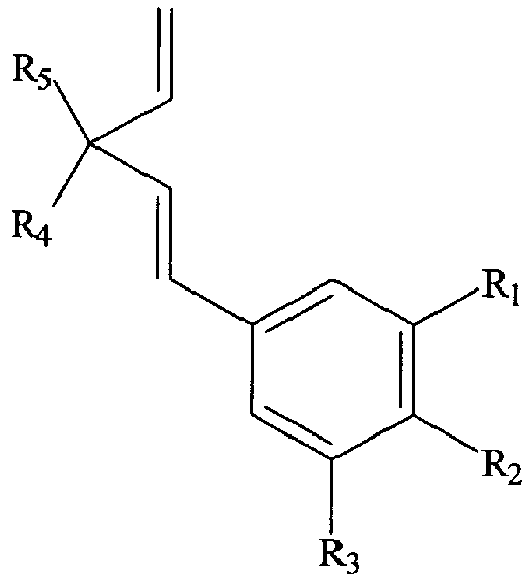
- R1, R2 et R3 chacun indépendamment choisi dans le groupe constitué de H, OH, OR6 ou CH2R6 avec R6 est un alkyl branché ou linéaire en C1-C8 ,
- R4 et R5 étant chacun indépendamment un groupe alkyl ou alkényl linéaire ou branché en C1-C20.
- Des exemples privilégiés de méroterpènes sont le bakuchiol, composé dans lequel R1=R3=H, R2=OH, R4=CH3 et R5=CH2CH2CH=C(CH3)2, et la corylifoline, composé dans lequel R1=R3=H, R2=OH, R4= R5=CH3, ou des dérivés de ceux-ci.
- Un méroterpène privilégié est le bakuchiol, par exemple le produit Sytenol®A vendu par la société SYTHEON LTD. Dans ce produit, l'actif présente une pureté supérieure à 95%.
- Les méroterpènes sont généralement obtenus à partir de plantes ou d'extraits de plante, même s'ils peuvent également être obtenus à partir de champignons ou produits synthétiquement. Des plantes ou extraits de plante servant de source pour les méroterpènes sont par exemple Psoralea coryfolia, Psoralea grandulosa et Otholobium pubescens (Fabaceae). En pratique, le méroterpène peut se présenter sous forme de matériel isolé ou purifié, de pureté au moins égale à 60% en poids, voire pur à au moins 95% en poids, ou peut être ajouté sous la forme d'un extrait de plante purifié comprenant avantageusement de 1 à 70% en poids de méroterpène par rapport au poids total de l'extrait.
- Comme déjà dit, le méroterpène avantageusement mis en oeuvre dans le cadre de l'invention est le bakuchiol. Avantageusement, le bakuchiol est isolé à partir de graines de Psoralea coryfolia.
- De manière avantageuse, le méroterpène représente de 0,01 à 5% en poids de la composition, avantageusement de 0,1 à 2%, encore plus avantageusement 0,25%.
- Comme il sera montré dans la suite de l'invention, la combinaison de cet actif avec au moins l'un, voire les deux autres composants de la composition potentialise l'effet antibactérien notamment vis-à-vis de P. acnes du méroterpène. En pratique, ceci permet de diminuer sa concentration par rapport à son utilisation comme seul agent antimicrobien.
- Le deuxième composant est un flavonoïde, largement distribué dans le règne végétal, notamment chez les plantes. Dans le cadre de la présente invention, une source privilégiée de flavonoïdes est un extrait de ginkgo, en particulier de ginkgo biloba. Il s'agit avantageusement d'un extrait de feuilles. Ainsi, le produit commercialisé par Greentech qui correspond à un extrait glycolique de feuilles de ginkgo biloba à 5% en matière sèche peut être utilisé dans le cadre de l'invention.
- Avantageusement, la composition comprend un extrait végétal contenant le flavonoïde, ledit extrait étant présent à hauteur de 0,0001 à 20% en poids de la composition, avantageusement de 0,001 à 10% voire 2%, encore plus avantageusement 0,1%. On entend ici par «extrait végétal» la matière sèche comprenant le flavonoïde dans son solvant.
- De manière privilégiée, une composition contient en outre un polyol, avantageusement du mannitol. Un autre polyol d'intérêt est le sorbitol, voire le xylitol.
- Le mannitol mis en oeuvre peut par exemple être du mannitol en poudre, d'origine végétale (maïs, pomme de terre, blé), présentant une pureté supérieure à 98%, tel que commercialisé par IMCD sous la dénomination Pearlitol®.
- Dans le cadre de l'invention, le polyol, préférentiellement le mannitol, représente typiquement de 0,0001 à 10% en poids de la composition, avantageusement de 0,001 à 2%, encore plus avantageusement 0,01 %.
- De manière privilégiée, la composition selon l'invention se présente sous une forme adaptée à l'administration par voie topique cutanée : crème, émulsion, H/E ou E/H, solution, suspension, gel, lait, lotion, en particulier crème, gel ou lotion.
- Par conséquent, la présente composition peut contenir tout additif ou excipient adapté à sa formulation et à son application, tel que par exemple agents de mise en suspension, émulsifiants, polymères anioniques, cationiques ou non-ioniques, amphotères, protéines, vitamines tensioactifs, huiles minérales ou végétales, cires, gommes, résines, agents épaississants, acidifiants ou alcalinisants, solvants, stabilisateurs de pH, agents anti-UV, conservateurs, parfums, adjuvants classiques de la cosmétique et de la dermatologie.
- La composition peut également contenir, outre les 3 ingrédients mentionnés ci-dessus, d'autres actifs tels qu'un agent antibactérien, notamment le zinc.
- Des exemples de formulations cosmétiques sont les suivants :
-
- Eau 41.23%
- Gélifiant 0.1%
- Polymères 4.9%
- Emulsionnant 3%
- Glycols 12%
- Gluconate de zinc 3%
- AHA (acides de fruit) 20.5%
- Actifs divers 2.66%
- Bakuchiol 0.25%
- Extrait de Ginkgo biloba 0.1 %
- Mannitol 0.01%
- Corps gras 12%
- Parfum 0.25%
-
- Eau 53.31%
- Régulateur de pH 3.43%
- AHA 17%
- Gluconate de zinc 3%
- Gélifiant 0.4%
- Silicones 6%
- Emulsionnant 3.5%
- Polymères divers 4%
- Actifs divers 0.92%
- Glycols 8%
- Bakuchiol 0.25%
- Extrait de Ginkgo biloba 0.1 %
- Mannitol 0.01%
- Parfum 0.08%
- La présente invention a mis en évidence un certain nombre d'activités associées à une telle composition qui la rendent utilisable en tant que :
- agent fluidifiant du sébum, notamment grâce à son effet sur l'augmentation de la quantité de squalène non oxydé dans le sébum ;
- agent antimicrobien, notamment antibactérien vis-à-vis de Propionibacterium acnes, grâce à son effet bactéricide direct et à son effet indirect sur la stimulation ou la préservation de la quantité des acides gras du sébum à activité antimicrobienne (en particulier acides sapiénique et laurique) ;
- agent anti-inflammatoire vis-à-vis de l'inflammation induite par des bactéries, notamment Propionibacterium acnes, grâce à son effet inhibiteur sur la production de cytokines inflammatoires (en particulier IL-8 et de TNFα) ;
- agent protecteur de la fonction barrière de la peau, grâce à son effet stimulateur sur les acides gras du sébum impliqués dans l'intégrité de la fonction barrière tels que l'acide linoléique ;
- agent inhibiteur de la formation des comédons (anti-comédogène), notamment grâce à son effet inhibiteur sur les acides gras comédogènes du sébum tels que l'acide oléique ;
- agent contre l'irritation due à l'acné, notamment grâce à son effet inhibiteur sur les acides gras irritants du sébum tels que l'acide oléique.
- L'ensemble de ces propriétés rend la composition selon l'invention adaptée au traitement des pathologies cutanées associées à la présence de Propionibacterium acnes, et plus généralement au traitement des peaux grasses ou à tendance acnéique, et de l'acné.
- Un autre aspect de l'invention concerne un procédé de traitement cosmétique des peaux grasses ou à tendance acnéique, et de l'acné consistant à appliquer sur la peau ou le cuir chevelu une composition comme décrite précédemment.
- Dans le cadre de la présente demande, il a également été montré qu'un méroterpène, constituant essentiel de la composition décrite ci-dessus, possédait une activité protectrice vis-à-vis de l'oxydation du squalène contenu dans le sébum. Il est donc montré pour la première fois qu'un méroterpène est un agent modulateur de la composition du sébum.
- Ainsi et selon un autre aspect, la présente invention vise également une composition comprenant du méroterpène, avantageusement du bakuchiol, encore plus avantageusement à une teneur comprise entre 0,01 à 5% en poids de la composition, voire 0,1 à 2%, pour son utilisation comme agent anti-oxydant du squalène ou comme agent fluidifiant du sébum.
- La manière dont l'invention peut être réalisée et les avantages qui en découlent, ressortiront mieux des exemples de réalisation qui suivent, donnés à titre indicatif et non limitatif, à l'appui des figures annexées.
- La
figure 1 représente la mesure de l'indice de protection (en %) du squalène par le Sytenol®A (Bakuchiol) versus la vitamine E, à concentration équimolaire. - La
figure 2 représente la croissance (en %) de Propionibacterium acnes en présence de différentes dilutions (D1 à D9) dans différents milieux :- en présence de S = Sytenol®A
- en présence de Z = Zinc ;
- en présence de S + M + G = Sytenol®A + Mannitol + flavonoïdes issus d'un extrait de Ginkgo biloba ;
- en présence de S + M + G + Z = Sytenol®A + Mannitol + flavonoïdes issus d'un extrait de Ginkgo biloba + Zinc
- en présence d'un contrôle, à savoir du DMSO ayant servi de solvant pour la solubilisation du Sytenol®A dans l'eau.
- La
figure 3 illustre A/ le dosage de IL-8 (ng/ml) et B/ de TNFα (ng/ml) dans les milieux de culture à J3, en l'absence ou en présence du noyau d'actifs selon l'invention (S+M+G). - La
figure 4 représente la mesure de l'acide sapiénique : A/ quantité d'acide sapiénique au cours du traitement par le noyau d'actifs selon l'invention (S+M+G) à T0, J28 et J56 versus placebo. B/ variation d'expression de l'acide sapiénique versus J0 après traitement par le noyau d'actifs selon l'invention (S+M+G) ou le placebo (résultats exprimés en pourcentage). - La
figure 5 représente la mesure de l'acide laurique : A/ quantité d'acide laurique au cours du traitement par le noyau d'actifs selon l'invention (S+M+G) à T0, J28 et J56 versus placebo. B/ variation d'expression de l'acide laurique versus J0 après traitement par le noyau d'actifs selon l'invention (S+M+G) ou le placebo (résultats exprimés en pourcentage). - La
figure 6 représente la mesure de la variation d'expression du squalène non oxydé versus J0, après traitement par le noyau d'actifs selon l'invention (S+M+G) ou le placebo (résultats exprimés en pourcentage). - La
figure 7 représente la mesure de la variation d'expression de l'acide linoléique versus J0, après traitement par le noyau d'actifs selon l'invention (S+M+G) ou le placebo (résultats exprimés en pourcentage). - La
figure 8 représente la mesure de la variation d'expression de l'acide oléique versus J0, après traitement par le noyau d'actifs selon l'invention (S+M+G) ou le placebo (résultats exprimés en pourcentage). - Le but de l'étude est d'évaluer les effets d'un méroterpène, en l'occurrence le Sytenol®A, sur l'oxydation du squalène induite par du peroxyde d'hydrogène (H2O2).
- Le squalène (Sigma, St Quentin Fallavier) est mis en contact avec une quantité définie de peroxyde d'hydrogène pendant 1 heure pour induire son oxydation, en présence ou non du Sytenol®A à 0.1%, 0.25% ou 0.5% (P/V). Un contrôle est réalisé avec un anti-oxydant lipophile de référence, la vitamine E, testée à 0,16% (3,8 mM), correspondant à une concentration équimolaire de Sytenol®A à 0,1%.
- A l'issue de l'oxydation, une étape d'extraction est réalisée, puis les échantillons sont analysés par chromatographie en phase gazeuse couplée à une analyse par spectrométrie de masse (GC-MS). Le squalène est dosé grâce à une gamme étalon (10 µg/ml à 2500 µg/ml). La quantité de squalène oxydée est déduite des dosages du squalène. Plus les quantités de squalène dosées sont importantes, moins il a été oxydé et inversement.
- Les résultats sont présentés dans le tableau ci-dessous :
Indice de protection (%) Echantillon oxydé 0.64 Echantillon non oxydé 100.00 Sptenol®A à 0.1% (3.9mM) 30.02 Sptenol®A à 0.25% (9.75 mM) 37.12 Vitamine E 0.16% (3.8mM) 15.17 - Les résultats montrent que le Sytenol®A permet de protéger l'oxydation du squalène induite par H2O2 et présente ainsi un pouvoir protecteur vis-à-vis de l'oxydation du squalène. Cet effet est dose-dépendant entre 0.1% et 0.25%.
- Comme illustré à la
figure 1 , à la concentration équimolaire de 3,8 mM, le Sytenol®A est 2 fois plus efficace que la vitamine E en termes de protection de l'oxydation du squalène. - L'objectif de cette étude est de déterminer la concentration minimale inhibitrice (CMI) d'actifs et de leur association en milieu solide, vis-à-vis de Propionibacterium acnes.
- La détermination de la CMI des actifs à évaluer vis-à-vis de Propionibacterium acnes consiste, dans un premier temps, à préparer une gamme comportant neuf dilutions des actifs à tester. Chaque dilution est ensuite déposée en boîte de Pétri puis recouverte de gélose Wilkins-Chalgren. Après homogénéisation puis solidification, chacune des boîtes est inoculée avec une suspension calibrée (107 UFC/mL) de P acnes (dépôt par strie), puis les boîtes sont incubées 18h à 37°C en anaérobiose. La souche utilisée est le Propionibacterium acnes CIP A179 (origine = glande sébacée (1946), source CRBIP, Institut Pasteur, Paris).
- La préparation des géloses s'effectue à J1 en ajoutant 2 mL d'eau osmosée stérile dans une boîte de Pétri (témoin négatif) ou 2 ml de chaque dilution des gammes d'actifs 10 fois concentré et 18 mL de milieu gélosé. Après solidification à température ambiante, les boites sont séchées 30 min à 37°C puis ensemencées avec la suspension bactérienne calibrée (107 UFC/mL) à l'aide d'une ose calibrée de 10 µL permettant de réaliser un dépôt correspondant à environ 104 UFC).
- La lecture des boites est effectuée après 18 heures de culture à 37°C permettant de déterminer la CMI correspondant à la plus faible concentration d'actif(s) qui inhibe toute culture visible de P acnes. La présence de 1 à 3 colonies n'est pas prise en considération.
- Les produits évalués sont le S (Sytenol®A, Sytheon), Z (Zinc gluconate, Azelis), seuls et les associations S + M (mannitol, IMCD/SPCI) + G (extrait glycolique de Ginkgo biloba, Greentech) et S + M + G + Z.
- Le Sytenol®A qui présente un caractère lipophile est dilué dans le DMSO (solution mère à 10%) avant d'être redilué dans l'eau osmosée. Le zinc, le mannitol et l'extrait de Ginkgo sont directement dilués dans l'eau osmosée.
- Les essais ont également compris des contrôles en présence du solvant DMSO ayant servi à la solubilisation de S dans l'eau. L'érythromycine (2 à 0.007528 µg/ml) et le peroxyde de benzoyle (0.0128% à 0.00005%) ont été utilisés comme contrôles positifs.
- Les gammes de dilutions testées sont :
D1 D2 D3 D4 D5 D6 D7 D8 D9 S 0.25% 0.1% 0.01% 0.002% 0.001% 0.0005% 0.0001% 0.00005% 0.000025% M 0.01% 0.004% 0.0004% 0.00008% 0.00004% 0.00002% 0.000004% 0.000002% 0.000001% G 0.1% 0.04% 0.004% 0.0008% 0.0004% 0.0002% 0.00004% 0.00002% 0.00001% Z 3% 1.2% 0.12% 0.024% 0.012% 0.006% 0.0012% 0.0006% 0.0003% - Les résultats des tests de croissance sont représentés dans la
figure 2 et les valeurs de CMI dans le tableau ci-dessous :Produits testés CMI S .001% Z 0.12% S (+G à 0.0002% + M à 0.00002%) 0.0005% S (+G à 0.0002% + M à 0.00002% + Z à 0.006%) 0.0005% Peroxyde de Benzoyle 0.008% Erytromycine 0.0000125% - D'après les conditions expérimentales de cette étude, il apparaît que :
- la croissance n'est pas perturbée pas la présence du solvant DMSO aux concentrations présentes dans les dilutions du Sytenol ;
- Les produits Z et S seuls ont un pouvoir anti-bactérien vis-à-vis de P acnes.
- L'action anti-bactérienne de S sur P acnes est plus efficace que Z (CMI respective 0.001 % et 0.12%) ;
- L'association de G+M avec le produit S améliore l'efficacité anti-bactérienne de S ;
- L'association de Z au mélange (G+M+S) n'améliore pas l'efficacité anti-bactérienne vis-à-vis de P acnes de (S+G+M).
- Il apparaît que l'effet bactéricide direct de la combinaison des 3 actifs (Sytenol®A + Ginkgo biloba + mannitol) est meilleur que celui du Sytenol®A seul, ce qui permet de diminuer la concentration en Sytenol®A d'un facteur 2 environ dans la composition antibactérienne.
- Le but de l'étude est d'évaluer, sur un modèle d'explants de peau humaine c'est-à-dire in vivo, l'activité anti-inflammatoire du noyau d'actifs (S + M + G).
- Le noyau d'actifs est formulé dans une base neutre dans les proportions massiques suivantes :
- Sytenol®A (S) : 0.25% ;
- extrait de Ginkgo biloba (Extrait Glycolique de feuilles, Greentech) (G) : 0.1%;
- mannitol (Pearlitol 060C, IMCD/SPCI) (M) : 0.01%.
- La composition selon l'invention a la formule suivante:
- Eau 83.70974%
- Corps gras 10%
- Emulsionnant 3.5%
- Silicone 1%
- Epaississant 0.6%
- Gélifiant 0.1%
- Conservateurs 0.65%
- Régulateur de pH 0.00026%
- Parfum 0.08%
- Bakuchiol (S) 0.25%
- Extrait de Ginkgo biloba (G) 0.1 %
- Mannitol (M) 0.01 %
- Le placebo a la formule suivante:
- Eau 84.06974%
- Corps gras 10%
- Emulsionnant 3.5%
- Silicone 1%
- Epaississant 0.6%
- Gélifiant 0.1%
- Conservateurs 0.65%
- Régulateur de pH 0.00026%
- Parfum 0.08%
- Les explants de peau humaine, issus de déchets opératoires (11 mm de diamètre), sont mis en survie dans un milieu spécifique à 37°C.
- Au jour 0 (J0), les explants sont traités par la formulation, à raison de 2 mg/cm2 pendant 3 jours.
- Aux jours J1 et J2, un disque de papier filtre imprégné de 30 µl de lyophilisat reconstitué de P. acnes est appliqué le matin, pendant 1 heure à la surface des explants, permettant de stimuler la synthèse de 2 cytokines inflammatoires : TNFα et IL-8. Des explants témoins, non traités par P acnes et traités par P acnes seulement, sont utilisés comme contrôles du test.
- A J3, le milieu de culture de chaque explant est prélevé et conservé à -80°C. Les dosages de TNFα et d'IL-8 dans les surnageants sont réalisés par ELISA (ELISA TNFα, Cayman Chemical, et ELISA IL-8, RayBiotech). A l'issue du dosage, les DO à 412 nm et 450 nm sont lues, respectivement, et les concentrations des 2 cytokines sont calculées à partir des gammes étalons obtenues à partir des protéines recombinantes.
- L'analyse statistique est réalisée grâce au test de Student dont le seuil de significativité est 0,05.
- Comme montré à la
figure 3A , en présence du noyau d'actifs selon l'invention, la synthèse d'IL-8 est significativement réduite de 28% (**, p=0,006). - Comme montré à la
figure 3B , en présence du noyau d'actifs selon l'invention, la synthèse de TNFα est significativement réduite de 31 % (*, p=0,026). - Ainsi, en réduisant à la fois la synthèse d'IL-8 et de TNFa, cytokines inflammatoires induites par P acnes, le nouveau noyau d'actifs selon l'invention réduit l'inflammation associée aux lésions d'acné.
- Le but de l'étude clinique (in vivo) est d'évaluer les effets du nouveau noyau d'actifs selon l'invention sur la composition qualitative et quantitative des lipides du sébum en comparaison à un produit placebo.
- Le placebo et la composition selon l'invention ont des formules comme indiquées ci-dessus au point II-2.
- L'étude de l'effet du nouveau noyau d'actifs a été réalisée sur 2 groupes de 19 sujets à tendance acnéique. Un groupe a été traité avec le nouveau noyau d'actifs pendant 2 mois à raison de 2 applications par jour. Le groupe placebo a été traité dans les mêmes conditions avec l'excipient correspondant mais en l'absence du noyau d'actifs. Des prélèvements au niveau du front ont été réalisés à T0, J28 et J56 à l'aide d'une verrerie adaptée. Les lipides ont été récupérés à l'aide d'un solvant organique inerte et stockés à -20°C en attendant l'analyse biochimique.
- La quantification des lipides du sébum a été réalisée par chromatographie en phase gazeuse couplée à une analyse par spectrométrie de masse (GC/MS). Différentes méthodes analytiques ont été réalisées dans le but de déterminer les acides gras totaux, le squalène, les stérols, les cires, les glycérides et les acides gras libres.
- Parmi les acides gras dont l'expression est modulée au cours du traitement par le noyau d'actifs, 2 sont connus comme possédant des propriétés antimicrobiennes puissantes : l'acide sapiénique et l'acide laurique.
- On constate à la
figure 4A que le taux d'acide sapiénique est augmenté de 37% par rapport au placebo à J28 et de 10% à J56. Ainsi, le traitement des volontaires avec le nouveau noyau d'actifs permet de préserver le taux d'acide sapiénique par rapport à J0, alors qu'il est réduit dans le groupe placebo (Figure 4B ). Par conséquent, le noyau d'actifs selon l'invention exerce une action antibactérienne indirecte, en préservant le taux d'acide sapiénique dans le sébum cutané. - On constate à la
figure 5A que le taux d'acide laurique est augmenté de 36% à J56. Ainsi, le traitement des volontaires avec le nouveau noyau d'actifs permet de stimuler le taux d'acide laurique par rapport à J0, alors qu'il est réduit dans le groupe placebo à J28 et J56 (Figure 5B ). Par conséquent, le noyau d'actifs selon l'invention exerce une action antibactérienne indirecte, en stimulant le taux d'acide laurique dans les peaux à tendance acnéique. - L'ensemble de ces résultats montre qu'en plus des propriétés antimicrobiennes directes sur P. acnes (cf. point 1 ci-dessus), le nouveau noyau d'actifs selon l'invention exerce une activité antimicrobienne indirecte, en stimulant l'acide laurique et l'acide sapiénique qui possèdent tous les 2 des propriétés antimicrobiennes vis-à-vis de P. acnes. De plus, l'acide laurique est capable d'exercer une activité antimicrobienne indirecte en stimulant la synthèse de peptides antimicrobiens (HBD-2) dans les cultures de sébocytes. Ainsi, le noyau d'actifs selon l'invention possède une activité anti-P acnes multifactorielle.
- On constate à la
figure 6 qu'après 56 jours de traitement, le squalène non oxydé augmente de 17% par rapport à J0 et de 27% par rapport au placebo. Ainsi, en favorisant le squalène non oxydé, le noyau d'actifs selon l'invention contribue in vivo à améliorer les propriétés du sébum notamment sa fluidité. - On constate à la
figure 7 qu'après 56 jours de traitement, l'acide linoléique qui est déficient, augmente de 22,8% par rapport à J0 et de 37% par rapport au placebo. En stimulant l'acide linoléique, le noyau d'actifs selon l'invention contribue in vivo à renforcer la fonction barrière de l'épiderme et à limiter la comédogénicité. - On constate à la
figure 8 qu'après 28 jours de traitement, l'acide oléique est réduit de 12% par rapport à J0 et de 40% par rapport au placebo. En réduisant l'acide oléique, le noyau d'actifs selon l'invention contribue in vivo à limiter la comédogénicité et l'irritation cutanée associée à l'acné. - Différents marqueurs tels que l'acide laurique, l'acide sapiénique, l'acide linoléique, l'acide oléique et le squalène non oxydé sont modulés favorablement après traitement des volontaires à peau grasses par le noyau d'actifs selon l'invention. Ces résultats obtenus in vivo montre que le noyau d'actifs selon l'invention modifie la qualité et la quantité du sébum conduisant à une réduction de la comédogénicité, une réduction de la lipogenèse, une augmentation de la fonction barrière et une stimulation des défenses anti-microbiennes permettant de réduire le développement de P acnes.
-
- Boelsma E, Tanojo H, Boddé HE, Ponec M. Assessment of the potential irritancy of oleic acid on human skin: Evaluation in vitro and in vivo. Toxicol In Vitro. 1996 Dec;10(6):729-42
- Chiba K et al. Comedogenicity of squalene monohydroperoxide in the skin after topical application. J Toxicol Sci 2000; 25: 77-83.
- Chiba K, Sone T, Kawakami K, Onoue M. Skin roughness and wrinkle formation induced by repeated application of squalene-monohydroperoxide to the hairless mouse. Exp Dermatol. 1999 Dec;8(6):471-9.
- Choi EH, Ahn SK, Lee SH. The changes of stratum corneum interstices and calcium distribution of follicular epithelium of experimentally induced comedones (EIC) by oleic acid. Exp Dermatol. 1997 Feb;6(1):29-35.
- Drake DR, Brogden KA, Dawson DV, Wertz PW. Thematic review series: skin lipids. Antimicrobial lipids at the skin surface. J Lipid Res. 2008 Jan;49(1):4-11. Epub 2007 Sep 28. Review.
- Graham GM, Farrar MD, Cruse-Sawyer JE, Holland KT, Ingham E. Proinflammatory cytokine production by human keratinocytes stimulated with Propionibacterium acnes and P. acnes GroEL. Br J Dermatol. 2004 Mar;150(3):421-8.
- Horrobin DF. Essential fatty acids in clinical dermatology. J Am Acad Dermatol. 1989 Jun;20(6):1045-53. Review.
- Katsuta Y, Iida T, Hasegawa K, Inomata S, Denda M. Function of oleic acid on epidermal barrier and calcium influx into keratinocytes is associated with N-methyl D-aspartate-type glutamate receptors. Br J Dermatol. 2009 Jan;160(1):69-74. Epub 2008 Sep 19.
- Nagy I, Pivarcsi A, Koreck A, Széll M, Urbán E, Kemény L. Distinct strains of Propionibacterium acnes induce selective human beta-defensin-2 and interleukin-8 expression in human keratinocytes through toll-like receptors. J Invest Dermatol. 2005 May;124(5):931-8
- Nakatsuji T, Kao MC, Fang JY, Zouboulis CC, Zhang L, Gallo RL, Huang CM. Antimicrobial property of lauric acid against Propionibacterium acnes: its therapeutic potential for inflammatory acne vulgaris. J Invest Dermatol. 2009 Oct;129(10):2480-8. Epub 2009 Apr 23.
- Nakatsuji T, Kao MC, Zhang L, Zouboulis CC, Gallo RL, Huang CM. Sebum free fatty acids enhance the innate immune defense of human sebocytes by upregulating beta-defensin-2 expression. J Invest Dermatol. 2010 Apr;130(4):985-94. Epub 2009 Dec 24.
- Ottaviani M, Alestas T, Flori E, Mastrofrancesco A, Zouboulis CC, Picardo M. Peroxidated squalene induces the production of inflammatory mediators in HaCaT keratinocytes: a possible role in acne vulgaris. J Invest Dermatol. 2006 Nov;126(11):2430-7. Epub 2006 Jun 15.
- Ottaviani M, Camera E, Picardo M. Lipid mediators in acne. Mediators Inflamm. 2010;2010. pii: 858176. Epub 2010 Aug 25. Review.
- Picardo M, Ottaviani M, Camera E, Mastrofrancesco A. Sebaceous gland lipids. Dermatoendocrinol. 2009 Mar;1(2):68-71.
- Saint-Léger D et al. A possible role for squalene in the pathogenesis of acne. In vivo study of squalene oxides in skin surface and intra-comedonal lipids of acne patients. Br J Dermatol 1986; 114: 543-552.
- Thiele JJ, Weber SU, Packer L. Sebaceous gland secretion is a major physiologic route of vitamin E delivery to skin. J Invest Dermatol. 1999 Dec;113(6):1006-10.
Claims (14)
- Composition à usage cosmétique et/ou dermatologique comprenant un méroterpène, un flavonoïde et un polyol.
- Composition selon la revendication 1 caractérisée en ce que le méroterpène est du bakuchiol.
- Composition selon l'une des revendications précédentes caractérisée en ce que le méroterpène représente de 0,01 à 5% en poids de la composition, avantageusement de 0,1 à 2%, encore plus avantageusement 0,25%.
- Composition selon l'une des revendications précédentes caractérisée en ce que le flavonoïde est contenu dans un extrait végétal, avantageusement issu de ginkgo, encore plus avantageusement de ginkgo biloba.
- Composition selon la revendication 4 caractérisée en ce que l'extrait végétal contenant le flavonoïde représente de 0,0001 à 20% en poids de la composition, avantageusement de 0,001 à 2%, encore plus avantageusement 0,1 %.
- Composition selon l'une des revendications précédentes caractérisée en ce que le polyol est du mannitol.
- Composition selon l'une des revendications précédentes caractérisée en ce que le polyol représente de 0,0001 à 10% en poids de la composition, avantageusement de 0,001 à 2%, encore plus avantageusement 0,01%.
- Composition selon l'une des revendications précédentes caractérisée en ce qu'elle se présente sous la forme d'une crème, d'un gel ou d'une lotion.
- Composition selon l'une des revendications 1 à 8 pour son utilisation comme :- agent anti-oxydant du squalène ; et/ou- agent fluidifiant du sébum ; et/ou- agent antimicrobien, notamment antibactérien vis-à-vis de Propionibacterium acnes ; et/ou- agent anti-inflammatoire vis-à-vis de l'inflammation induite par des bactéries, notamment Propionibacterium acnes ; et/ou- agent protecteur de la fonction barrière de la peau ; et/ou- agent inhibiteur de la formation des comédons : et/ou- agent contre l'irritation liée à l'acné.
- Procédé de traitement cosmétique des peaux grasses ou à tendance acnéique consistant à appliquer sur la peau ou sur le cuir chevelu une composition selon l'une des revendications 1 à 8.
- Composition selon l'une des revendications 1 à 8 pour son utilisation dans le traitement de l'acné.
- Utilisation d'un méroterpène comme agent anti-oxydant du squalène ou comme agent fluidifiant du sébum pour la préparation d'une composition cosmétique et/ou dermatologique.
- Utilisation selon la revendication 12 caractérisée en ce que le méroterpène est du bakuchiol.
- Utilisation selon la revendication 12 ou 13 caractérisée en ce que le méroterpène représente de 0,01 à 5% en poids de la composition, avantageusement de 0,1 à 2%.
Applications Claiming Priority (1)
| Application Number | Priority Date | Filing Date | Title |
|---|---|---|---|
| FR1159412A FR2981275B1 (fr) | 2011-10-18 | 2011-10-18 | Composition a base de meroterpene destinee aux peaux grasses, a tendance acneique ou atteintes d'acne |
Publications (2)
| Publication Number | Publication Date |
|---|---|
| EP2583662A1 true EP2583662A1 (fr) | 2013-04-24 |
| EP2583662B1 EP2583662B1 (fr) | 2014-10-01 |
Family
ID=46940423
Family Applications (1)
| Application Number | Title | Priority Date | Filing Date |
|---|---|---|---|
| EP12187576.9A Active EP2583662B1 (fr) | 2011-10-18 | 2012-10-08 | Composition à base de meroterpene destinée aux peaux grasses, à tendance acneique ou atteintes d'acne |
Country Status (3)
| Country | Link |
|---|---|
| EP (1) | EP2583662B1 (fr) |
| ES (1) | ES2517516T3 (fr) |
| FR (1) | FR2981275B1 (fr) |
Cited By (4)
| Publication number | Priority date | Publication date | Assignee | Title |
|---|---|---|---|---|
| WO2017068424A1 (fr) | 2015-10-22 | 2017-04-27 | THOREL JEAN-NOëL | Composition a base de dihydromyricetine et d'un sel de zinc pour le traitement de l'acne et des peaux grasses |
| WO2019166520A1 (fr) | 2018-02-28 | 2019-09-06 | Symrise Ag | Extrait de tétraselmis |
| WO2020263189A1 (fr) * | 2019-06-25 | 2020-12-30 | Agency For Science, Technology And Research | Phénols qui diminuent la production de lipides dans des sébocytes |
| JP2023544643A (ja) * | 2020-10-26 | 2023-10-24 | 江西施美薬業股▲分▼有限公司 | バクチオ-ル誘導体、その薬学的に許容される塩及びその調製方法並びに用途 |
Citations (6)
| Publication number | Priority date | Publication date | Assignee | Title |
|---|---|---|---|---|
| DE3417234A1 (de) * | 1984-05-10 | 1985-11-14 | Rudolf V. Dr.rer.nat Dipl.-Chem. 5024 Pulheim Noronha | Hautpflegemittel enthaltend eine kombination von bakuchiol und pyridinaldehyd |
| WO2005004891A2 (fr) | 2003-07-07 | 2005-01-20 | Thorel Jean-Noel | Utilisation d’un antioxydant dans une composition a usage dermatologique et/ou cosmetique |
| US20060099284A1 (en) * | 2004-11-10 | 2006-05-11 | Kim Sung-Jin | Composition containing an extract of fructus psoraleae for inhibiting anxiety and depression, improving memory and treating dementia |
| US20060251749A1 (en) * | 2005-05-09 | 2006-11-09 | Unigen Pharmaceuticals, Inc. | Compositions Of Bakuchiol And Methods Of Making The Same |
| CN101406513A (zh) * | 2008-12-03 | 2009-04-15 | 天津中医药大学 | 补骨脂提取物、含有它的药物组合物及其制备方法和用途 |
| US20110117036A1 (en) * | 2009-11-13 | 2011-05-19 | Sytheon Limited | Compositions and Methods for Improving Skin Appearance |
-
2011
- 2011-10-18 FR FR1159412A patent/FR2981275B1/fr active Active
-
2012
- 2012-10-08 EP EP12187576.9A patent/EP2583662B1/fr active Active
- 2012-10-08 ES ES12187576.9T patent/ES2517516T3/es active Active
Patent Citations (6)
| Publication number | Priority date | Publication date | Assignee | Title |
|---|---|---|---|---|
| DE3417234A1 (de) * | 1984-05-10 | 1985-11-14 | Rudolf V. Dr.rer.nat Dipl.-Chem. 5024 Pulheim Noronha | Hautpflegemittel enthaltend eine kombination von bakuchiol und pyridinaldehyd |
| WO2005004891A2 (fr) | 2003-07-07 | 2005-01-20 | Thorel Jean-Noel | Utilisation d’un antioxydant dans une composition a usage dermatologique et/ou cosmetique |
| US20060099284A1 (en) * | 2004-11-10 | 2006-05-11 | Kim Sung-Jin | Composition containing an extract of fructus psoraleae for inhibiting anxiety and depression, improving memory and treating dementia |
| US20060251749A1 (en) * | 2005-05-09 | 2006-11-09 | Unigen Pharmaceuticals, Inc. | Compositions Of Bakuchiol And Methods Of Making The Same |
| CN101406513A (zh) * | 2008-12-03 | 2009-04-15 | 天津中医药大学 | 补骨脂提取物、含有它的药物组合物及其制备方法和用途 |
| US20110117036A1 (en) * | 2009-11-13 | 2011-05-19 | Sytheon Limited | Compositions and Methods for Improving Skin Appearance |
Non-Patent Citations (18)
| Title |
|---|
| "A clinical study evaluating the dermatologic benefits of topical bakuchiol (UP256) cream on facial acne", JOURNAL OF THE AMERICAN ACADEMY OF DERMATOLOGY, C.V. MOSBY, ST. LOUIS, MO, US, vol. 64, no. 2, 1 February 2011 (2011-02-01), pages AB19, XP027591310, ISSN: 0190-9622, [retrieved on 20110112], DOI: 10.1016/J.JAAD.2010.09.099 * |
| BOELSMA E; TANOJO H; BODDÉ HE; PONEC M.: "Assessment of the potential irritancy of oleic acid on human skin: Evaluation in vitro and in vivo", TOXICOL IN VITRO, vol. 10, no. 6, December 1996 (1996-12-01), pages 729 - 42 |
| CHIBA K ET AL.: "Comedogenicity of squalene monohydroperoxide in the skin after topical application", J TOXICOL SCI, vol. 25, 2000, pages 77 - 83 |
| CHIBA K; SONE T; KAWAKAMI K; ONOUE M.: "Skin roughness and wrinkle formation induced by repeated application of squalene-monohydroperoxide to the hairless mouse", EXP DERMATOL., vol. 8, no. 6, December 1999 (1999-12-01), pages 471 - 9 |
| CHOI EH; AHN SK; LEE SH: "The changes ofstratum corneum interstices and calcium distribution offollicular epithelium of experimentally induced comedones (EIC) by oleic acid", EXP DERMATOL., vol. 6, no. 1, February 1997 (1997-02-01), pages 29 - 35 |
| DATABASE TCM [online] SIPO; 15 April 2009 (2009-04-15), XP002675238, Database accession no. CN-101406513-A * |
| DRAKE DR; BROGDEN KA; DAWSON DV; WERTZ PW: "Thematic review series: skin lipids. Antimicrobial lipids at the skin surface", J LIPID RES, vol. 49, no. 1, 28 September 2007 (2007-09-28), pages 4 - 11 |
| GRAHAM GM; FARRAR MD; CRUSE-SAWYER JE; HOLLAND KT; INGHAM E: "Proinflammatory cytokine production by human keratinocytes stimulated with Propionibacterium acnes and P. acnes GroEL", BR J DERMATOL., vol. 150, no. 3, March 2004 (2004-03-01), pages 421 - 8 |
| HORROBIN DF: "Essential fatty acids in clinical dermatology", J AM ACAD DERMATOL., vol. 20, no. 6, June 1989 (1989-06-01), pages 1045 - 53 |
| KATSUTA Y; IIDA T; HASEGAWA K; INOMATA S; DENDA M: "Function of oleic acid on epidermal barrier and calcium influx into keratinocytes is associated with N-methyl D-aspartate-type glutamate receptors", BR J DERMATOL., vol. 160, no. 1, 19 September 2008 (2008-09-19), pages 69 - 74 |
| NAGY I; PIVARCSI A; KORECK A; SZÉLL M; URBÀN E; KEMÉNY L.: "Distinct strains of Propionibacterium acnes induce selective human beta-defensin-2 and interleukin-8 expression in human keratinocytes through toll-like receptors", J INVEST DERMATOL., vol. 124, no. 5, May 2005 (2005-05-01), pages 931 - 8 |
| NAKATSUJI T; KAO MC; FANG JY; ZOUBOULIS CC; ZHANG L; GALLO RL; HUANG CM: "Antimicrobial property of lauric acid against Propionibacterium acnes: its therapeutic potential for inflammatory acne vulgaris", J INVEST DERMATOL., vol. 129, no. 10, 23 April 2009 (2009-04-23), pages 2480 - 8 |
| NAKATSUJI T; KAO MC; ZHANG L; ZOUBOULIS CC; GALLO RL; HUANG CM: "Sebum free fatty acids enhance the innate immune defense of human sebocytes by upregulating beta-defensin-2 expression", J INVEST DERMATOL., vol. 130, no. 4, 24 December 2009 (2009-12-24), pages 985 - 94 |
| OTTAVIANI M; ALESTAS T; FLORI E; MASTROFRANCESCO A; ZOUBOULIS CC; PICARDO M.: "Peroxidated squalene induces the production of inflammatory mediators in HaCaT keratinocytes: a possible role in acne vulgaris", J INVEST DERMATOL., vol. 126, no. 11, 15 June 2006 (2006-06-15), pages 2430 - 7 |
| OTTAVIANI M; CAMERA E; PICARDO M: "Lipid mediators in acne", MEDIATORS INFLAMM. 2010, 25 August 2010 (2010-08-25), pages 858176 |
| PICARDO M; OTTAVIANI M; CAMERA E; MASTROFRANCESCO A: "Sebaceous gland lipids", DERMATOENDOCRINOL, vol. L, no. 2, March 2009 (2009-03-01), pages 68 - 71 |
| SAINT-LÉGER D ET AL.: "A possible role for squalene in the pathogenesis of acne. In vivo study of squalene oxides in skin surface and intra-comedonal lipids of acne patients", BR J DERMATOL, vol. 114, 1986, pages 543 - 552 |
| THIELE JJ; WEBER SU; PACKER L.: "Sebaceous gland secretion is a major physiologic route of vitamin E delivery to skin", J INVEST DERMATOL., vol. 113, no. 6, December 1999 (1999-12-01), pages 1006 - 10 |
Cited By (5)
| Publication number | Priority date | Publication date | Assignee | Title |
|---|---|---|---|---|
| WO2017068424A1 (fr) | 2015-10-22 | 2017-04-27 | THOREL JEAN-NOëL | Composition a base de dihydromyricetine et d'un sel de zinc pour le traitement de l'acne et des peaux grasses |
| WO2019166520A1 (fr) | 2018-02-28 | 2019-09-06 | Symrise Ag | Extrait de tétraselmis |
| WO2019166088A1 (fr) | 2018-02-28 | 2019-09-06 | Symrise Ag | Extrait de tetraselmis |
| WO2020263189A1 (fr) * | 2019-06-25 | 2020-12-30 | Agency For Science, Technology And Research | Phénols qui diminuent la production de lipides dans des sébocytes |
| JP2023544643A (ja) * | 2020-10-26 | 2023-10-24 | 江西施美薬業股▲分▼有限公司 | バクチオ-ル誘導体、その薬学的に許容される塩及びその調製方法並びに用途 |
Also Published As
| Publication number | Publication date |
|---|---|
| FR2981275A1 (fr) | 2013-04-19 |
| EP2583662B1 (fr) | 2014-10-01 |
| FR2981275B1 (fr) | 2015-03-20 |
| ES2517516T3 (es) | 2014-11-03 |
Similar Documents
| Publication | Publication Date | Title |
|---|---|---|
| EP2821386B1 (fr) | Composition cosmétique, dermatologique ou pharmaceutique comprenant au moins un dérivé de vanilline comme conservateur | |
| EP3364964B1 (fr) | Composition a base de dihydromyricetine et d'un sel de zinc pour le traitement de l'acne et des peaux grasses | |
| WO2009053564A2 (fr) | Utilisation cosmetique de lysat de bifidobacterium species pour renforcer la fonction barriere cutanee | |
| EP2654762A1 (fr) | Extrait de parties aeriennes de gynandropsis gynandra ou cleome gynandra et compositions cosmetiques, dermatologiques ou pharmaceutiques le comprenant | |
| US20250345265A1 (en) | Active principle comprising a particular extract of punica granatum and uses for preventing and/or treating acne | |
| EP0953345B1 (fr) | Utilisation d'au moins un hydroxystilbène en tant qu'agent diminuant l'adhésion des micro-organismes | |
| EP2583662B1 (fr) | Composition à base de meroterpene destinée aux peaux grasses, à tendance acneique ou atteintes d'acne | |
| EP0983055B1 (fr) | Composition comportant un n-undecylenoyl aminoacide; application en cosmetique | |
| JP2013155158A (ja) | 抗菌剤組成物およびその製造方法 | |
| EP0909557B1 (fr) | Utilisation du miel en tant qu'agent diminuant l'adhésion des micro-organismes | |
| EP3684477B1 (fr) | Compositions utiles pour le traitement cosmétique des peaux grasses | |
| WO2012007670A2 (fr) | Composition cosmetique ou dermatologique et son utilisation, pour le soin de la peau des hommes jeunes | |
| EP1786384A1 (fr) | Utilisation d'au moins un triene d'acide gras conjugue pour la preparation d'un medicament destine au traitement de l'inflammation | |
| EP3040105B1 (fr) | Utilisation cosmetique d'un extrait de baies de rosa canina particulier comme actif anti-seborrhee | |
| FR2590169A1 (fr) | Composition cosmetique contenant des bio-stimulines | |
| KR20170130159A (ko) | 수용성 프로폴리스를 함유하는 여드름의 예방 또는 치료용 조성물 | |
| US20240382399A1 (en) | Antisebogenic composition, formulation and use of the composition | |
| FR2747308A1 (fr) | Association de margousier, de (-) hydroxycitrate et de ceramides et compositions les renfermant | |
| FR3094218A1 (fr) | Utilisation de dianhydrohexitol pour éliminer les effets cosmétique des pellicules | |
| RU2355383C2 (ru) | Косметическое средство на основе коллагеназы микробного происхождения | |
| FR3080030A1 (fr) | Utilisation d’une nouvelle composition pour empecher ou ralentir l’apparition des signes inesthetiques lies a la presence de sebum en exces | |
| FR3067593A1 (fr) | Utilisation d'extraits de plantes pour le traitement dermatocosmetique des etats inflammatoires lies a une surproduction de il-17 | |
| FR3143977A1 (fr) | Insaponifiables d'avocat-malassezia | |
| FR3160102A1 (fr) | Composé pour son utilisation dans le traitement et/ou la prévention d’un désordre cutané | |
| FR3151198A1 (fr) | Nouvelles utilisations dermatologiques d’un extrait de la microalgue Dunaliella tertiolecta |
Legal Events
| Date | Code | Title | Description |
|---|---|---|---|
| PUAI | Public reference made under article 153(3) epc to a published international application that has entered the european phase |
Free format text: ORIGINAL CODE: 0009012 |
|
| AK | Designated contracting states |
Kind code of ref document: A1 Designated state(s): AL AT BE BG CH CY CZ DE DK EE ES FI FR GB GR HR HU IE IS IT LI LT LU LV MC MK MT NL NO PL PT RO RS SE SI SK SM TR |
|
| AX | Request for extension of the european patent |
Extension state: BA ME |
|
| 17P | Request for examination filed |
Effective date: 20131014 |
|
| RBV | Designated contracting states (corrected) |
Designated state(s): AL AT BE BG CH CY CZ DE DK EE ES FI FR GB GR HR HU IE IS IT LI LT LU LV MC MK MT NL NO PL PT RO RS SE SI SK SM TR |
|
| 17Q | First examination report despatched |
Effective date: 20140219 |
|
| GRAP | Despatch of communication of intention to grant a patent |
Free format text: ORIGINAL CODE: EPIDOSNIGR1 |
|
| RIC1 | Information provided on ipc code assigned before grant |
Ipc: A61K 47/10 20060101ALI20140530BHEP Ipc: A61K 36/16 20060101ALI20140530BHEP Ipc: A61K 9/00 20060101ALI20140530BHEP Ipc: A61K 31/05 20060101ALI20140530BHEP Ipc: A61K 31/047 20060101ALI20140530BHEP Ipc: A61P 17/10 20060101ALI20140530BHEP Ipc: A61K 8/34 20060101AFI20140530BHEP Ipc: A61K 8/97 20060101ALI20140530BHEP Ipc: A61Q 19/00 20060101ALI20140530BHEP |
|
| INTG | Intention to grant announced |
Effective date: 20140708 |
|
| GRAS | Grant fee paid |
Free format text: ORIGINAL CODE: EPIDOSNIGR3 |
|
| GRAA | (expected) grant |
Free format text: ORIGINAL CODE: 0009210 |
|
| AK | Designated contracting states |
Kind code of ref document: B1 Designated state(s): AL AT BE BG CH CY CZ DE DK EE ES FI FR GB GR HR HU IE IS IT LI LT LU LV MC MK MT NL NO PL PT RO RS SE SI SK SM TR |
|
| REG | Reference to a national code |
Ref country code: GB Ref legal event code: FG4D Free format text: NOT ENGLISH |
|
| REG | Reference to a national code |
Ref country code: CH Ref legal event code: EP Ref country code: AT Ref legal event code: REF Ref document number: 689160 Country of ref document: AT Kind code of ref document: T Effective date: 20141015 |
|
| REG | Reference to a national code |
Ref country code: IE Ref legal event code: FG4D Free format text: LANGUAGE OF EP DOCUMENT: FRENCH |
|
| REG | Reference to a national code |
Ref country code: ES Ref legal event code: FG2A Ref document number: 2517516 Country of ref document: ES Kind code of ref document: T3 Effective date: 20141103 |
|
| REG | Reference to a national code |
Ref country code: DE Ref legal event code: R096 Ref document number: 602012003248 Country of ref document: DE Effective date: 20141113 |
|
| REG | Reference to a national code |
Ref country code: NL Ref legal event code: VDEP Effective date: 20141001 |
|
| REG | Reference to a national code |
Ref country code: AT Ref legal event code: MK05 Ref document number: 689160 Country of ref document: AT Kind code of ref document: T Effective date: 20141001 |
|
| REG | Reference to a national code |
Ref country code: LT Ref legal event code: MG4D |
|
| PG25 | Lapsed in a contracting state [announced via postgrant information from national office to epo] |
Ref country code: NL Free format text: LAPSE BECAUSE OF FAILURE TO SUBMIT A TRANSLATION OF THE DESCRIPTION OR TO PAY THE FEE WITHIN THE PRESCRIBED TIME-LIMIT Effective date: 20141001 |
|
| PG25 | Lapsed in a contracting state [announced via postgrant information from national office to epo] |
Ref country code: LT Free format text: LAPSE BECAUSE OF FAILURE TO SUBMIT A TRANSLATION OF THE DESCRIPTION OR TO PAY THE FEE WITHIN THE PRESCRIBED TIME-LIMIT Effective date: 20141001 Ref country code: CZ Free format text: LAPSE BECAUSE OF FAILURE TO SUBMIT A TRANSLATION OF THE DESCRIPTION OR TO PAY THE FEE WITHIN THE PRESCRIBED TIME-LIMIT Effective date: 20141001 Ref country code: FI Free format text: LAPSE BECAUSE OF FAILURE TO SUBMIT A TRANSLATION OF THE DESCRIPTION OR TO PAY THE FEE WITHIN THE PRESCRIBED TIME-LIMIT Effective date: 20141001 Ref country code: PT Free format text: LAPSE BECAUSE OF FAILURE TO SUBMIT A TRANSLATION OF THE DESCRIPTION OR TO PAY THE FEE WITHIN THE PRESCRIBED TIME-LIMIT Effective date: 20150202 Ref country code: NO Free format text: LAPSE BECAUSE OF FAILURE TO SUBMIT A TRANSLATION OF THE DESCRIPTION OR TO PAY THE FEE WITHIN THE PRESCRIBED TIME-LIMIT Effective date: 20150101 Ref country code: IS Free format text: LAPSE BECAUSE OF FAILURE TO SUBMIT A TRANSLATION OF THE DESCRIPTION OR TO PAY THE FEE WITHIN THE PRESCRIBED TIME-LIMIT Effective date: 20150201 |
|
| PG25 | Lapsed in a contracting state [announced via postgrant information from national office to epo] |
Ref country code: HR Free format text: LAPSE BECAUSE OF FAILURE TO SUBMIT A TRANSLATION OF THE DESCRIPTION OR TO PAY THE FEE WITHIN THE PRESCRIBED TIME-LIMIT Effective date: 20141001 Ref country code: LV Free format text: LAPSE BECAUSE OF FAILURE TO SUBMIT A TRANSLATION OF THE DESCRIPTION OR TO PAY THE FEE WITHIN THE PRESCRIBED TIME-LIMIT Effective date: 20141001 Ref country code: PL Free format text: LAPSE BECAUSE OF FAILURE TO SUBMIT A TRANSLATION OF THE DESCRIPTION OR TO PAY THE FEE WITHIN THE PRESCRIBED TIME-LIMIT Effective date: 20141001 Ref country code: GR Free format text: LAPSE BECAUSE OF FAILURE TO SUBMIT A TRANSLATION OF THE DESCRIPTION OR TO PAY THE FEE WITHIN THE PRESCRIBED TIME-LIMIT Effective date: 20150102 Ref country code: CY Free format text: LAPSE BECAUSE OF FAILURE TO SUBMIT A TRANSLATION OF THE DESCRIPTION OR TO PAY THE FEE WITHIN THE PRESCRIBED TIME-LIMIT Effective date: 20141001 Ref country code: AT Free format text: LAPSE BECAUSE OF FAILURE TO SUBMIT A TRANSLATION OF THE DESCRIPTION OR TO PAY THE FEE WITHIN THE PRESCRIBED TIME-LIMIT Effective date: 20141001 Ref country code: SE Free format text: LAPSE BECAUSE OF FAILURE TO SUBMIT A TRANSLATION OF THE DESCRIPTION OR TO PAY THE FEE WITHIN THE PRESCRIBED TIME-LIMIT Effective date: 20141001 Ref country code: RS Free format text: LAPSE BECAUSE OF FAILURE TO SUBMIT A TRANSLATION OF THE DESCRIPTION OR TO PAY THE FEE WITHIN THE PRESCRIBED TIME-LIMIT Effective date: 20141001 |
|
| PG25 | Lapsed in a contracting state [announced via postgrant information from national office to epo] |
Ref country code: MC Free format text: LAPSE BECAUSE OF FAILURE TO SUBMIT A TRANSLATION OF THE DESCRIPTION OR TO PAY THE FEE WITHIN THE PRESCRIBED TIME-LIMIT Effective date: 20141001 |
|
| REG | Reference to a national code |
Ref country code: DE Ref legal event code: R097 Ref document number: 602012003248 Country of ref document: DE |
|
| REG | Reference to a national code |
Ref country code: IE Ref legal event code: MM4A |
|
| PG25 | Lapsed in a contracting state [announced via postgrant information from national office to epo] |
Ref country code: DK Free format text: LAPSE BECAUSE OF FAILURE TO SUBMIT A TRANSLATION OF THE DESCRIPTION OR TO PAY THE FEE WITHIN THE PRESCRIBED TIME-LIMIT Effective date: 20141001 Ref country code: EE Free format text: LAPSE BECAUSE OF FAILURE TO SUBMIT A TRANSLATION OF THE DESCRIPTION OR TO PAY THE FEE WITHIN THE PRESCRIBED TIME-LIMIT Effective date: 20141001 Ref country code: RO Free format text: LAPSE BECAUSE OF FAILURE TO SUBMIT A TRANSLATION OF THE DESCRIPTION OR TO PAY THE FEE WITHIN THE PRESCRIBED TIME-LIMIT Effective date: 20141001 Ref country code: SK Free format text: LAPSE BECAUSE OF FAILURE TO SUBMIT A TRANSLATION OF THE DESCRIPTION OR TO PAY THE FEE WITHIN THE PRESCRIBED TIME-LIMIT Effective date: 20141001 |
|
| PLBE | No opposition filed within time limit |
Free format text: ORIGINAL CODE: 0009261 |
|
| STAA | Information on the status of an ep patent application or granted ep patent |
Free format text: STATUS: NO OPPOSITION FILED WITHIN TIME LIMIT |
|
| 26N | No opposition filed |
Effective date: 20150702 |
|
| PG25 | Lapsed in a contracting state [announced via postgrant information from national office to epo] |
Ref country code: IE Free format text: LAPSE BECAUSE OF NON-PAYMENT OF DUE FEES Effective date: 20141008 |
|
| REG | Reference to a national code |
Ref country code: FR Ref legal event code: PLFP Year of fee payment: 4 |
|
| PG25 | Lapsed in a contracting state [announced via postgrant information from national office to epo] |
Ref country code: SI Free format text: LAPSE BECAUSE OF FAILURE TO SUBMIT A TRANSLATION OF THE DESCRIPTION OR TO PAY THE FEE WITHIN THE PRESCRIBED TIME-LIMIT Effective date: 20141001 |
|
| PG25 | Lapsed in a contracting state [announced via postgrant information from national office to epo] |
Ref country code: BG Free format text: LAPSE BECAUSE OF FAILURE TO SUBMIT A TRANSLATION OF THE DESCRIPTION OR TO PAY THE FEE WITHIN THE PRESCRIBED TIME-LIMIT Effective date: 20141001 |
|
| PG25 | Lapsed in a contracting state [announced via postgrant information from national office to epo] |
Ref country code: TR Free format text: LAPSE BECAUSE OF FAILURE TO SUBMIT A TRANSLATION OF THE DESCRIPTION OR TO PAY THE FEE WITHIN THE PRESCRIBED TIME-LIMIT Effective date: 20141001 Ref country code: HU Free format text: LAPSE BECAUSE OF FAILURE TO SUBMIT A TRANSLATION OF THE DESCRIPTION OR TO PAY THE FEE WITHIN THE PRESCRIBED TIME-LIMIT; INVALID AB INITIO Effective date: 20121008 Ref country code: MT Free format text: LAPSE BECAUSE OF FAILURE TO SUBMIT A TRANSLATION OF THE DESCRIPTION OR TO PAY THE FEE WITHIN THE PRESCRIBED TIME-LIMIT Effective date: 20141001 Ref country code: LU Free format text: LAPSE BECAUSE OF NON-PAYMENT OF DUE FEES Effective date: 20141008 |
|
| REG | Reference to a national code |
Ref country code: FR Ref legal event code: PLFP Year of fee payment: 5 |
|
| PG25 | Lapsed in a contracting state [announced via postgrant information from national office to epo] |
Ref country code: SM Free format text: LAPSE BECAUSE OF FAILURE TO SUBMIT A TRANSLATION OF THE DESCRIPTION OR TO PAY THE FEE WITHIN THE PRESCRIBED TIME-LIMIT Effective date: 20141001 |
|
| REG | Reference to a national code |
Ref country code: FR Ref legal event code: PLFP Year of fee payment: 6 |
|
| PG25 | Lapsed in a contracting state [announced via postgrant information from national office to epo] |
Ref country code: MK Free format text: LAPSE BECAUSE OF FAILURE TO SUBMIT A TRANSLATION OF THE DESCRIPTION OR TO PAY THE FEE WITHIN THE PRESCRIBED TIME-LIMIT Effective date: 20141001 |
|
| REG | Reference to a national code |
Ref country code: FR Ref legal event code: PLFP Year of fee payment: 7 |
|
| PG25 | Lapsed in a contracting state [announced via postgrant information from national office to epo] |
Ref country code: AL Free format text: LAPSE BECAUSE OF FAILURE TO SUBMIT A TRANSLATION OF THE DESCRIPTION OR TO PAY THE FEE WITHIN THE PRESCRIBED TIME-LIMIT Effective date: 20141001 |
|
| P01 | Opt-out of the competence of the unified patent court (upc) registered |
Effective date: 20230527 |
|
| REG | Reference to a national code |
Ref country code: CH Ref legal event code: U11 Free format text: ST27 STATUS EVENT CODE: U-0-0-U10-U11 (AS PROVIDED BY THE NATIONAL OFFICE) Effective date: 20251101 |
|
| PGFP | Annual fee paid to national office [announced via postgrant information from national office to epo] |
Ref country code: DE Payment date: 20251015 Year of fee payment: 14 |
|
| PGFP | Annual fee paid to national office [announced via postgrant information from national office to epo] |
Ref country code: GB Payment date: 20251023 Year of fee payment: 14 |
|
| PGFP | Annual fee paid to national office [announced via postgrant information from national office to epo] |
Ref country code: IT Payment date: 20251008 Year of fee payment: 14 |
|
| PGFP | Annual fee paid to national office [announced via postgrant information from national office to epo] |
Ref country code: FR Payment date: 20251030 Year of fee payment: 14 |
|
| PGFP | Annual fee paid to national office [announced via postgrant information from national office to epo] |
Ref country code: BE Payment date: 20251020 Year of fee payment: 14 |
|
| PGFP | Annual fee paid to national office [announced via postgrant information from national office to epo] |
Ref country code: CH Payment date: 20251101 Year of fee payment: 14 |
|
| PGFP | Annual fee paid to national office [announced via postgrant information from national office to epo] |
Ref country code: ES Payment date: 20251110 Year of fee payment: 14 |