EP2576701B1 - Zubereitung zur verwendung in der augenheilkunde und netzhautchirurgie - Google Patents
Zubereitung zur verwendung in der augenheilkunde und netzhautchirurgie Download PDFInfo
- Publication number
- EP2576701B1 EP2576701B1 EP11738602.9A EP11738602A EP2576701B1 EP 2576701 B1 EP2576701 B1 EP 2576701B1 EP 11738602 A EP11738602 A EP 11738602A EP 2576701 B1 EP2576701 B1 EP 2576701B1
- Authority
- EP
- European Patent Office
- Prior art keywords
- preparation
- solvent
- dye
- use according
- alkane
- Prior art date
- Legal status (The legal status is an assumption and is not a legal conclusion. Google has not performed a legal analysis and makes no representation as to the accuracy of the status listed.)
- Active
Links
Classifications
-
- A—HUMAN NECESSITIES
- A61—MEDICAL OR VETERINARY SCIENCE; HYGIENE
- A61K—PREPARATIONS FOR MEDICAL, DENTAL OR TOILETRY PURPOSES
- A61K47/00—Medicinal preparations characterised by the non-active ingredients used, e.g. carriers or inert additives; Targeting or modifying agents chemically bound to the active ingredient
- A61K47/06—Organic compounds, e.g. natural or synthetic hydrocarbons, polyolefins, mineral oil, petrolatum or ozokerite
- A61K47/08—Organic compounds, e.g. natural or synthetic hydrocarbons, polyolefins, mineral oil, petrolatum or ozokerite containing oxygen, e.g. ethers, acetals, ketones, quinones, aldehydes, peroxides
- A61K47/14—Esters of carboxylic acids, e.g. fatty acid monoglycerides, medium-chain triglycerides, parabens or PEG fatty acid esters
-
- A—HUMAN NECESSITIES
- A61—MEDICAL OR VETERINARY SCIENCE; HYGIENE
- A61K—PREPARATIONS FOR MEDICAL, DENTAL OR TOILETRY PURPOSES
- A61K47/00—Medicinal preparations characterised by the non-active ingredients used, e.g. carriers or inert additives; Targeting or modifying agents chemically bound to the active ingredient
- A61K47/06—Organic compounds, e.g. natural or synthetic hydrocarbons, polyolefins, mineral oil, petrolatum or ozokerite
-
- A—HUMAN NECESSITIES
- A61—MEDICAL OR VETERINARY SCIENCE; HYGIENE
- A61K—PREPARATIONS FOR MEDICAL, DENTAL OR TOILETRY PURPOSES
- A61K47/00—Medicinal preparations characterised by the non-active ingredients used, e.g. carriers or inert additives; Targeting or modifying agents chemically bound to the active ingredient
- A61K47/06—Organic compounds, e.g. natural or synthetic hydrocarbons, polyolefins, mineral oil, petrolatum or ozokerite
- A61K47/16—Organic compounds, e.g. natural or synthetic hydrocarbons, polyolefins, mineral oil, petrolatum or ozokerite containing nitrogen, e.g. nitro-, nitroso-, azo-compounds, nitriles, cyanates
- A61K47/18—Amines; Amides; Ureas; Quaternary ammonium compounds; Amino acids; Oligopeptides having up to five amino acids
-
- A—HUMAN NECESSITIES
- A61—MEDICAL OR VETERINARY SCIENCE; HYGIENE
- A61K—PREPARATIONS FOR MEDICAL, DENTAL OR TOILETRY PURPOSES
- A61K49/00—Preparations for testing in vivo
- A61K49/001—Preparation for luminescence or biological staining
- A61K49/0013—Luminescence
- A61K49/0017—Fluorescence in vivo
- A61K49/0019—Fluorescence in vivo characterised by the fluorescent group, e.g. oligomeric, polymeric or dendritic molecules
- A61K49/0021—Fluorescence in vivo characterised by the fluorescent group, e.g. oligomeric, polymeric or dendritic molecules the fluorescent group being a small organic molecule
-
- A—HUMAN NECESSITIES
- A61—MEDICAL OR VETERINARY SCIENCE; HYGIENE
- A61K—PREPARATIONS FOR MEDICAL, DENTAL OR TOILETRY PURPOSES
- A61K9/00—Medicinal preparations characterised by special physical form
- A61K9/0012—Galenical forms characterised by the site of application
- A61K9/0048—Eye, e.g. artificial tears
-
- A—HUMAN NECESSITIES
- A61—MEDICAL OR VETERINARY SCIENCE; HYGIENE
- A61P—SPECIFIC THERAPEUTIC ACTIVITY OF CHEMICAL COMPOUNDS OR MEDICINAL PREPARATIONS
- A61P27/00—Drugs for disorders of the senses
- A61P27/02—Ophthalmic agents
-
- A—HUMAN NECESSITIES
- A61—MEDICAL OR VETERINARY SCIENCE; HYGIENE
- A61P—SPECIFIC THERAPEUTIC ACTIVITY OF CHEMICAL COMPOUNDS OR MEDICINAL PREPARATIONS
- A61P41/00—Drugs used in surgical methods, e.g. surgery adjuvants for preventing adhesion or for vitreum substitution
-
- C—CHEMISTRY; METALLURGY
- C09—DYES; PAINTS; POLISHES; NATURAL RESINS; ADHESIVES; COMPOSITIONS NOT OTHERWISE PROVIDED FOR; APPLICATIONS OF MATERIALS NOT OTHERWISE PROVIDED FOR
- C09B—ORGANIC DYES OR CLOSELY-RELATED COMPOUNDS FOR PRODUCING DYES, e.g. PIGMENTS; MORDANTS; LAKES
- C09B67/00—Influencing the physical, e.g. the dyeing or printing properties of dyestuffs without chemical reactions, e.g. by treating with solvents grinding or grinding assistants, coating of pigments or dyes; Process features in the making of dyestuff preparations; Dyestuff preparations of a special physical nature, e.g. tablets, films
- C09B67/0071—Process features in the making of dyestuff preparations; Dehydrating agents; Dispersing agents; Dustfree compositions
- C09B67/008—Preparations of disperse dyes or solvent dyes
- C09B67/0082—Preparations of disperse dyes or solvent dyes in liquid form
Definitions
- the invention relates to a dye-containing preparation for use in ophthalmology and retinal surgery.
- the eye of vertebrates is an important and equally sensitive organ. If its functionality is limited or completely absent, animals in the wild are often no longer viable. Although impaired vision is no longer life-critical in the vertebrate human, it does mean a great deal of quality of life and self-reliance on healthy eyes. As a result, eye surgery receiving vision becomes more and more important.
- vitreous parts of such a treatment is usually the surgical removal of the vitreous (vitrectomy).
- To remove the vitreous three small incisions are made in the sclera of the eye, those in the posterior Range the eye chamber in which the vitreous body is located. The incisions can then be used to introduce appropriate surgical instruments into the interior of the eye.
- the surgical field is rinsed, usually with saline, as it is compatible with the water of the vitreous, so that replacement of the two fluids can be done easily.
- WO 03/079927 Proposes the use of perfluorinated alkanes as an exchange fluid and tamponade preparation in surgical procedures on the eye, in particular for retinal surgery.
- Perfluorinated alkanes have the advantage, due to their high density, which is usually in a range of 1.8 to 2.0 g / cm 3 , to accumulate especially in the lower part of the vitreous body and thus facilitate the treatment for the surgeon on the retina , They fill the vitreous space from the posterior retina.
- Perfluorinated alkanes are characterized by a pronounced hydrophobicity and lipophobia, that is, they are neither oil nor water-soluble and therefore do not mix with blood or body fluids, so that they maintain their high transparency and make the surgical site always clear to the surgeon , Likewise, the perfluoroalkanes are not absorbed by the body and also not metabolized. No enzyme system present in the human or animal body is able to cleave and degrade perfluorinated alkanes. Perfluoroalkanes are therefore preferred interoperative fluids.
- the RU -C2-2232001 (see summary in the Thomson Scientific database, London) describes a surgical procedure for treating a severe form of retinal detachment involving the use of the dye indocyanine green and PFOS (perfluorooctane sulfonate).
- the treatment of complicated retinal detachments is usually as follows: After partial or complete vitrectomy, the retina is re-applied by means of heavy liquids, ie perfluorocarbons or perfluoroalkanes, such as perfluorooctane or perfluorodecalin. Due to the low viscosity can be used with standard cannulas from 20 to 23 G directly above the optical Papilla to be instilled. Due to their high density, perfluorocarbons sink to the posterior retina and slowly fill the vitreous space from below. This high density makes the perfluorocarbons excellent intraoperative instruments for the upcoming retinal manipulations.
- perfluorocarbons or perfluoroalkanes such as perfluorooctane or perfluorodecalin. Due to the low viscosity can be used with standard cannulas from 20 to 23 G directly above the optical Papilla to be instilled. Due to their high density, perfluorocarbons sink to the
- perfluorooctane and perfluorodecalin are aspirated from the vitreous cavity and replaced with traditional gas or liquid endotamponades.
- the object is therefore to provide a preparation for use in ophthalmology, in particular retinal surgery, which facilitates the surgical procedure and prevents secondary damage. Furthermore, it is an object to provide a preparation that is safe in their application, can be used selectively and also has the advantage that it can be visualized without overlooking the surgical field, so that a check on their arrival or Absence can be easily done.
- a preparation containing at least one perfluorinated alkane, at least one semifluorinated alkane and at least one dissolved in the semifluorinated alkane dye wherein the semifluorinated alkane is selected from compounds of the following formula R F R H or R F R H R F wherein R F is a linear or branched perfluoroalkyl group having 3 to 20 carbon atoms and RH is a linear or branched, saturated alkyl group having 1 is up to 20 carbon atoms, the carbon chain having a total of 4 to 30, preferably 8 to 20 carbon atoms and wherein the ratio of the perfluorinated alkane to the semifluorinated alkane is 95: 5 to 5:95, is optimally suitable as an interoperative fluid.
- the preparation according to the invention can be prepared easily without great technical effort, all of its components being readily available.
- the preparation is characterized by a high physiological tolerability and a low irritation potential and has a sufficiently low toxicity that it can be safely used in the sensitive eye interior. Due to the high structural compatibility of perfluoroalkane and semifluoroalkane mixtures can be produced from these two components over a wide range, which are characterized by homogeneity and single-phase. Both the perfluoroalkane and the semifluoroalkane can each be a mixture of perfluoroalkanes or semifluoroalkanes.
- the transparency of the preparation is not adversely affected because perfluoroalkanes and semifluorinated alkanes can be homogeneously mixed with each other in any ratio and the mixture of the preparation is monophasic and transparent is and surprisingly remains transparent even with the addition of a dye according to the invention.
- the density of the preparation can be optimally adjusted by the combination of perfluorinated alkane according to the invention with semifluorinated alkane. This is significant because the density of some perfluoroalkanes is considered to be too high and too much pressure is applied to the retina which can then be damaged.
- a high density of the preparation ie a density of greater than 1.33 g / cm 3 , preferably greater than 1.5 g / cm 3 and in particular greater than 1.7 g / cm 3 is preferred according to the invention, since this is a fast Guaranteed lowering of the preparation on the retina and accelerates the stabilization and thus the surgical intervention.
- a density in this area is not so high that the retina is damaged by excessive pressure.
- the density of the solutions can be determined at room temperature (20-25 ° C), for example by means of vibrating body method.
- Perfluorinated alkanes can not be dyed directly due to their physical properties, therefore, according to the invention, a preparation is provided which comprises a Coloring of the perfluoroalkanes by combining at least one perfluorinated alkane with at least one semifluorinated alkane and a dye dissolved therein. The result is a colored, single-phase solution. This is due to both the solubility of the colorant in the semifluorinated alkane and the solubility of the semifluorinated alkane in the perfluoroalkane and is essential to the preparation of the invention.
- the coloring of the preparation is important in order to be able to check, when rinsing out said interoperative preparation, whether all residues of the preparation have been completely washed out. Remaining residues, on the other hand, could cause irritation or inflammation and, in severe cases, retinal detachment. Due to its physical properties, and in particular its chemical, physiological and biological inertness and its density, the preparation according to the invention thus enables optimum stabilization of the retina before, during or after the surgical procedure in the interior of the eye, ie in particular before the introduction of the vitreous tamponade. At the same time it allows a residue-free removal of the same from the inside of the eye, whereby secondary damage after surgery is prevented or prevented. Since the components contained in the preparation of the invention have a high chemical and physical stability, the preparation is also well sterilizable, which is important in order not to cause damage to the inside of the eye by germs.
- a liquid which serves to stabilize the retina before, during or after surgery, so for example after suction of the vitreous body to prevent the curvature or complete detachment of the retina before the introduction of the vitreous tamponade the vitreous cavity of the eye.
- Semifluorinated alkanes are known in ophthalmology and are described, for example, in US Pat EP 0 859 751 whose contents are expressly incorporated herein by reference.
- the term semifluorinated alkanes is generally understood to mean compounds which have one block of a saturated linear or branched alkane and one or two blocks of a perfluorinated alkane.
- the semifluorinated alkanes used according to the invention thus have a block-like structure in which Blocks of perfluorinated alkyl radicals adjacent to non-fluorinated saturated alkyl radicals are present.
- the linear semifluorinated alkanes therefore have the following diblock or triblock structure: F (CF 2 ) m (CH 2 ) n H or F (CF 2 ) m (CH 2 ) n (CF 2 ) o F wherein m and o are each integers from 3 to 20, preferably from 3 to 8 and n is an integer from 1 to 20, preferably from 4 to 8, wherein the total length of the carbon chain is 4 to 30, preferably 8 to 20 carbon atoms , Semifluorinated alkanes are often abbreviated to the number of F-bearing and H-bearing C atoms, eg F 6 H 6 for C 6 F 13 C 6 H 13 or perfluorohexylhexane.
- Branched semifluorinated alkanes can, in addition to the above-mentioned structural constituents, further comprise additional FCX units in the perfluorinated portion and additional HCY units in the alkane portion, where X is again a perfluoroalkyl radical and preferably has 1 to 8 and more preferably 2 to 4 carbon atoms and Y is an alkyl radical preferably 1 to 8 and more preferably 2 to 4 carbon atoms.
- the marginal F 3 C and H 3 C groups can be replaced by FCX 2 or F 2 CX or HCY 2 groups or H 2 CY groups, wherein X and Y have a structure as already shown above.
- the branched semifluorinated alkanes also have the proviso that the sum of carbon atoms preferably does not exceed 20.
- individual semifluorinated alkanes can be prepared, which can be varied depending on the field of use. Due to the unsubstituted alkyl, the semifluorinated alkanes are characterized by a low to medium lipophilicity, that is, that they are able to dissolve in suitable lipophilic solvents or to dissolve lipophilic components in it. This is essential for the present invention, since it is only possible because of this lipophilicity to give color by dissolving a likewise lipophilic coloring substance of the preparation according to the invention.
- the semifluorinated alkanes are in themselves transparent liquids which are physiologically compatible, commercially available and non-toxic. Furthermore, they are characterized by a low irritation potential. They are inert, so do not react with am Surgery site existing body fluids and cells and are not metabolized and can therefore be optimally used as a component in interoperative fluids in retinal surgery.
- Perfluorinated alkanes in the context of the invention are saturated linear, branched or cyclic alkanes with CF bonds.
- Suitable perfluoroalkanes are known to the person skilled in the art, for example WO 03/079927 and preferably include those having 4 to 20 and more preferably 4 to 12 carbon atoms, for example C 4 F 10 , C 5 F 12 , C 6 F 14 , C 7 F 16 , C 8 F 18 , C 9 F 20 , C 10 F 18 or C 10 F 22 , C 11 F 24 or C 12 F 26 or mixtures thereof.
- Particularly preferred are perfluorodecalin and perfluorooctane.
- mixtures of isomers and / or mixtures of perfluoroalkanes of different chain lengths are suitable, for example a mixture of perfluoroheptane, perfluorooctane and perfluorononane.
- Liquid perfluoroalkanes which have a high refractive index and high transparency and are also distinguished by a viscosity which makes them easily insertable into the vitreous space and removable from it, are suitable according to the invention. This is important in order to leave as little damage as possible to the sclera of the eye during surgery, through which the interoperative fluid is to be introduced, which is preferably done by means of a very thin needle of 20 to 23 or even 25 gauge.
- Perfluoroalkanes are used in retinal surgery because of their high density and inertness. However, due to their pronounced hydrophobicity and lipophobicity, perfluoroalkanes can not be mixed with other useful substances. A high proportion of perfluorinated alkane is, as already stated, required to bring the density of the preparation to a value such that the preparation sinks completely and without significant delay to the retina and optimally stabilizes the retina. In order to obtain this positive effect, it is necessary that the mixing ratio by volume be 95: 5 to 5:95 perfluoroalkane to semifluorinated alkane.
- the mixing ratio is thus chosen so that the aforementioned positive properties of the overall composition are achieved.
- a certain proportion of semifluorinated alkane is necessary to the color of the inventive Preparation provide. Simple routine tests allow the person skilled in the art to find out the optimum ratio depending on the components used.
- Perfluoroalkanes and semifluorinated alkanes mix in any ratio, so the choice of compounds to be mixed is therefore not critical as long as they are liquid at room temperature (ie, about 25 ° C) and body temperature (ie, about 37 ° C).
- Preferred combinations are perfluoroalkanes having 8 or 10 carbon atoms with semifluorinated alkanes having 8 to 16 carbon atoms.
- Advantageous mixtures are obtained, for example, from perfluorodecalin and / or perfluorooctane with C 4 F 9 C 5 H 11 , C 6 F 13 C 6 H 13 and / or C 6 F 13 C 8 H 17 .
- the proportion of semifluorierem alkane 5 to 60 vol .-% based on the total volume of the preparation according to the invention preferably 7 to 50 vol .-%, more preferably 10 to 40 vol .-% and particularly preferably 10 to 30 vol .-%. If the proportion of semifluorinated alkane in the specified range, then a sufficient amount of colorant substance can be dissolved therein, so that the preparation of the invention has a total of visually apparent color intensity, which can be well perceived at the site of application. A proportion of less than 5 vol .-% is usually not enough to achieve a sufficient coloration.
- the density of the total formulation decreases to a level at which the formulation may not be able to stabilize the retina sufficiently in place.
- the preparation floats in the vitreous cavity and there is a risk that it will flush out with flushing above the operating room.
- dyes are generally understood to mean substances which, in contrast to pigments, dissolve in solvents.
- dyes or colorants in the context of the invention are understood as substances which reflect light in the visible wavelength range, ie from about 350 to 750 nm, and / or by excitation by means of energy, for example in the form of heat or light for reflection of light Wavelength in the visible wavelength range can be excited.
- Suitable for the present invention are solvent dyes and fatty dyes, as far as they are soluble in the semifluorinated alkanes used in the invention and are physiologically compatible.
- solvent dye refers to a substance which has its own color in the visible spectral range of the light and is soluble in aprotic, lipophilic solvents. It is usually characterized by a likewise lipophilic basic structure and is therefore also readily soluble in the semifluorinated alkanes used according to the invention.
- Fatty dyes are usually termed fat and oil soluble dyes, i. Dyes that dissolve in lipophilic solvents.
- Examples of a fatty dye are dyes of the Sudan class, e.g. Sudan I, Sudan II, Sudan III and Sudan IV.
- the dye used according to the invention may be a fluorescent dye, ie a dye which is excited by the action of energy, in particular in the form of heat or light - generally radiation - to emit light in the visible spectral range and then fluoresces. Also in the case of the fluorescent dyes, sufficient solubility in the semifluorinated alkane is essential since otherwise no coloring of the overall preparation according to the invention can be achieved.
- suitable dyes are those which dissolve in semifluorinated alkanes to such an extent that the solution is visibly colored.
- visibly stained is meant that it can be seen with an unaided eye that the solution has a color, for example when viewed against a white background.
- solvent it is meant that at least as much of the coloring substance dissolves homogeneously in the semifluorinated alkane at room temperature, that a sufficient coloration of the preparation as a whole is achieved and no formation of a second phase occurs.
- the ratio can be set optimally, ie the color depth can be adjusted individually to the place of application, surgeon, lighting conditions, etc.
- the color depth can be varied by varying the proportion of dye dissolved in the semifluorinated alkane and / or by varying the proportion of colored semifluorinated Alkan is varied in the overall preparation. Any undissolved portions of the coloring substance must be filtered off before further processing of the preparation according to the invention.
- the color depth can be easily determined by means known to the person skilled in the art, for example by means of UV-VIS spectroscopy or other suitable photometric methods.
- any dye which is soluble in the semifluorinated alkane may be used if it is non-toxic at the concentration used and has sufficient biocompatibility, physiological and chemical inertness and low irritation potential so that the tissue is not damaged during the surgical procedure.
- the solubility of the colorant used in the invention is at the temperature prevailing at the surgical site so high that no secondary phase formation, such as by precipitation of the coloring substance occurs.
- such a dye is used which still provides a visible color in the smallest possible amount.
- dyes within the meaning of the invention are dyes selected from the group consisting of: Solvent Blue 36, Solvent Blue 35, Solvent Green 5, Solvent Violet 13, Solvent Blue 8, Solvent Blue 18, Solvent Blue Solvent Green 3, Solvent Green 7, Solvent Green 3, Solvent Green 3, Solvent Red 3, Solvent Red 33, Solvent Red 3, Solvent Yellow 16, Solvent Blue 36, Solvent Blue 35, Solvent Green 5, Solvent Violet 13 and Sudan I to IV are preferred because of their pronounced physiological compatibility and good dissolving properties in semifluorinated alkanes.
- mixtures of dyes may be used, e.g. if a special color is to be achieved.
- only one dye is used for the preparation.
- the dye of the present invention is used in an amount which sufficiently dyes.
- the appropriate amount depends on the particular dye used and can be easily determined by the skilled person with routine experimentation. In general, an amount of less than 0.08 g / L is sufficient, in particular for the dyes mentioned above as preferred, in order to obtain a sufficiently visible color of the preparation.
- the stated amounts in each case relate to the total weight of the finished preparation.
- the preparation according to the invention may contain, in addition to the components described above, additional active ingredients such as antibiotic substances, e.g. Cyclosporin, glucocorticoids such as triamcinolone, dexamethasone or agents such as indomethacin, colchicine, heparin and cytotoxic drugs.
- antibiotic substances e.g. Cyclosporin, glucocorticoids such as triamcinolone, dexamethasone or agents such as indomethacin, colchicine, heparin and cytotoxic drugs.
- glucocorticoids such as triamcinolone
- dexamethasone or agents such as indomethacin
- colchicine heparin
- heparin heparin
- cytotoxic drugs e.g., cytotoxic drugs.
- the mixture fat-soluble antioxidants such as lutein, zeaxanthin, vitamin E can be buried.
- the preparation of the preparation according to the invention can be carried out by homogeneously mixing the colorant in the intended amount of semifluorinated alkane with the aid of a suitable stirring element and then adding the perfluoroalkane.
- the preparation is stored overnight at room temperature in a closed vessel and filtered before further processing.
- the preparation according to the invention can be mixed individually for each intervention.
- a premixed solution is provided, more preferably in the form of an infusion solution.
- the preparation according to the invention is ideally suited for use in ophthalmology, in particular in retinal surgery and is particularly suitable for vitrectomy or for surgical procedures in connection with retinal detachment.
- the invention therefore also relates to the use of the preparation according to the invention in ophthalmology, in retinal surgery, in particular for vitrectomy or surgical procedures in connection with retinal detachment.
- the amounts given for the dye relate to parts by weight based on the total volume of the preparation.
- the quantities for the solvents are vol.% And refer to the total volume.
- basic solutions of dye were used, each containing a specific dye in a concentration of 0.06 g / L in semifluorêtm alkane. Of these basic solutions were then for the Preparation of the example solutions each taken in the tables volume fractions and mixed with perfluoroalkane in the specified amount.
- Solvent Blue 36 Formula: C 20 H 22 N 2 O 2 Molecular weight: 322.41 Perfluorooctane: Boiling point: 105 ° C Vapor pressure: 18.5 mbar at 25 ° C
- a homogeneous solution was prepared by mixing with a paddle stirrer, which was then homogeneously mixed with the perfluorinated alkane.
- the density of the solutions was determined at room temperature (20 ° C) using a vibrating body method.
- the density meter DA-100M from Mettler-Toledo was used.
- the preparation was easy to grow through a syringe with a cannula of 25 gauge and empty it again. It was stable over a storage period of 42 hours at 120 ° C, which corresponds to a storage time at ambient conditions of about 3 years and 8 months (taking into account the van't-Hoff'schen Equation corresponds to a reaction rate of one hour at 100 ° C (reflux of an aqueous solution) for about 32 days at 20 ° C). After this time, the solution visually showed no change under the microscope, so neither separation nor turbidity. Likewise, the preparation was sterilized without significant visually noticeable changes by sterilization using sterile filter with a pore size of 0.2 microns.
- Example 1 The above components were formulated as in Example 1 to a transparent colored preparation. The density was determined as in Example 1.
- the preparation could be drawn up through a syringe with a cannula of 25 gauge and emptied again. It was stable for a storage time of 42 hours at 120 ° C. After this time, the solution visually showed no change under the microscope, so neither separation nor turbidity.
- the preparation was sterilized by dry heat at a temperature of 135 ° C for 5 hours, whereby it did not visually change.
- a homogeneous solution was prepared by mixing with a paddle stirrer, which was then homogeneously mixed with the perfluorinated alkane.
- the density of the solutions was determined at room temperature (20 ° C) using a vibrating body method.
- the density meter DA-100M from Mettler-Toledo was used.
- the preparation was easy to grow through a syringe with a cannula of 25 gauge and empty it again. It was stable over a storage time of 42 hours at 120 ° C, showed visually under the microscope no change, so neither separation nor turbidity. Likewise, the preparation was sterilized without significant visually noticeable changes by sterilization using sterile filter with a pore size of 0.2 microns.
- Example 1 The above components were formulated as in Example 1 to a transparent colored preparation. The density was determined as in Example 1.
- the preparation could be drawn up through a syringe with a cannula of 25 gauge and emptied again. It was stable for a storage time of 42 hours at 120 ° C. After this time, the solution visually showed no change under the microscope, so neither separation nor turbidity.
- the preparation was sterilized by dry heat at a temperature of 135 ° C for 5 hours, whereby it did not visually change.
- a homogeneous solution was prepared by mixing with a paddle stirrer, which was then homogeneously mixed with the perfluorinated alkane.
- the density of the solutions was determined at room temperature (20 ° C) using a vibrating body method.
- the density meter DA-100M from Mettler-Toledo was used.
- the preparation was easy to grow through a syringe with a cannula of 25 gauge and empty it again. It was stable over a storage time of 42 hours at 120 ° C, showed visually under the microscope no change, so neither separation nor turbidity. Likewise, the preparation was sterilized without significant visually noticeable changes by sterilization using sterile filter with a pore size of 0.2 microns.
- a homogeneous solution was prepared by mixing with a paddle stirrer, which was then homogeneously mixed with the perfluorinated alkane.
- the density of the solutions was determined at room temperature (20 ° C) using a vibrating body method.
- the density meter DA-100M from Mettler-Toledo was used.
- the preparation was easy to grow through a syringe with a cannula of 25 gauge and empty it again. It was stable over a storage time of 42 hours at 120 ° C, showed visually under the microscope no change, so neither separation nor turbidity. Similarly, the preparation was sterilized without significant visual changes by heating to 135 ° C for 5 hours.
- Example 1 A preparation was prepared with the fluorescent dye Solvent Green 5. For this purpose, the stated components were formulated as in Example 1 to give a transparent colored preparation. The density was determined as in Example 1.
- the preparation could be drawn up through a syringe with a cannula of 25 gauge and emptied again. It was stable for a storage time of 42 hours at 120 ° C. After this time, the solution visually showed no change under the microscope, so neither separation nor turbidity.
- the preparation could be sterilized without significant visual changes by sterilization using a sterile filter with a pore size of 0.2 ⁇ m.
- Example 1 A preparation was prepared with the fluorescent dye Solvent Green 5. For this purpose, the stated components were formulated as in Example 1 to give a transparent colored preparation. The density was determined as in Example 1.
- the preparation could be drawn up through a syringe with a cannula of 25 gauge and emptied again. It was stable for a storage time of 42 hours at 120 ° C. After this time, the solution visually showed no change under the microscope, so neither separation nor turbidity.
- the preparation was sterilized by dry heat at a temperature of 135 ° C for 5 hours, whereby it did not visually change.
- Example 1 A preparation was prepared with the dye Solvent Violet 13. For this purpose, the stated components were formulated as in Example 1 to give a transparent colored preparation. The density was determined as in Example 1.
- Example 1 A preparation was prepared with the dye Solvent Violet 13. For this purpose, the stated components were formulated as in Example 1 to give a transparent colored preparation. The density was determined as in Example 1.
Landscapes
- Health & Medical Sciences (AREA)
- Chemical & Material Sciences (AREA)
- Life Sciences & Earth Sciences (AREA)
- Animal Behavior & Ethology (AREA)
- Veterinary Medicine (AREA)
- Public Health (AREA)
- General Health & Medical Sciences (AREA)
- Epidemiology (AREA)
- Engineering & Computer Science (AREA)
- Chemical Kinetics & Catalysis (AREA)
- Medicinal Chemistry (AREA)
- Pharmacology & Pharmacy (AREA)
- General Chemical & Material Sciences (AREA)
- Oil, Petroleum & Natural Gas (AREA)
- Organic Chemistry (AREA)
- Ophthalmology & Optometry (AREA)
- Biomedical Technology (AREA)
- Nuclear Medicine, Radiotherapy & Molecular Imaging (AREA)
- Bioinformatics & Cheminformatics (AREA)
- Proteomics, Peptides & Aminoacids (AREA)
- Surgery (AREA)
- Medicinal Preparation (AREA)
- Materials For Medical Uses (AREA)
- Acyclic And Carbocyclic Compounds In Medicinal Compositions (AREA)
Description
- Die Erfindung betrifft eine farbstoffhaltige Zubereitung zur Verwendung in der Augenheilkunde und Netzhautchirurgie.
- Das Auge von Wirbeltieren ist ein wichtiges und ebenso empfindliches Organ. Ist seine Funktionsfähigkeit eingeschränkt oder fehlt sie ganz, so sind Tiere in der freien Wildbahn oft nicht mehr lebensfähig. Wenngleich beim "Wirbeltier Mensch" die Beeinträchtigung der Sehfähigkeit nicht mehr lebensentscheidend ist, so bedeutet es doch ein großes Stück Lebensqualität und Selbständigkeit über gesunde Augen zu verfügen. Aufgrund dessen werden die Sehfähigkeit erhaltende Augenoperationen immer bedeutungsvoller.
- Die Möglichkeiten zur Behandlung von Erkrankungen am Auge, insbesondere der Netzhaut, wie z.B. Netzhautablösung oder Netzhautveränderung, haben in den letzten Jahren stark zugenommen. Teil einer derartigen Behandlung ist zumeist die operative Entfernung des Glaskörpers (Vitrektomie). Zur Entfernung des Glaskörpers werden drei kleine Schnitte in der Sklera des Auges vorgenommen, die in die hintere Augenkammer reichen, in der sich der Glaskörper befindet. Durch die Einschnitte können dann entsprechende Operationsinstrumente in das Innere des Auges eingeführt werden. Während des Eingriffs wird das Operationsfeld gespült, in der Regel mit Kochsalzlösung, da diese kompatibel ist mit dem Wasser des Glaskörpers, so dass ein Austausch der beiden Flüssigkeiten problemlos erfolgen kann. Damit das Auge aufgrund des Druckverlustes beim Absaugen des die Stabilität bildenden Glaskörpers nicht die Form verliert und Sekundärschäden erleidet, wird an Stelle des Glaskörpers eine Ersatzflüssigkeit in den Hohlraum eingeleitet, die den Innendruck konstant hält. Alle im Augeninneren eingesetzten interoperativen Mittel, wie Infusionslösungen, Spüllösungen und solche interoperative Lösungen, die zur Stabilisierung der Netzhaut und Verhinderung deren Krümmung und Ablösung in das Auge eingeführt werden, müssen physiologisch verträglich sein, sich gut einführen und leicht wieder entfernen lassen.
-
WO 03/079927 - In den Dokumenten
DE -C1-19719280 sowieDE -A1-19536504 gelangen u.a. auch Gemische aus teil- sowie perfluorierten Alkanen zur Anwendung in der Augenheilkunde. - Die
RU -C2- 2232001 - Die Behandlung von komplizierten Netzhautablösungen gestaltet sich in der Regel wie folgt: Nach erfolgter partieller oder kompletter Vitrektomie wird die Netzhaut mittels schwerer Flüssigkeiten, d.h. Perfluorcarbone bzw. Perfluoralkane, wie z.B. Perfluoroctan oder Perfluordecalin, wieder angelegt. Aufgrund der niedrigen Viskosität kann mit Standard-Kanülen von 20 bis 23 G direkt über der optischen Papille instilliert werden. Durch ihre hohe Dichte sinken Perfluorcarbone auf die posteriore Netzhaut ab und füllen von unten langsam den Glaskörperraum auf. Diese hohe Dichte macht die Perfluorcarbone zu hervorragenden intraoperativen Instrumenten für die anstehenden Netzhautmanipulationen. Nach dem chirurgischen Eingriff und der Stabilisierung der Netzhaut werden Perfluoroctan bzw. Perfluordecalin aus dem Glaskörperraum wieder abgesaugt und durch traditionelle Gas- oder Flüssig-Endotamponaden ersetzt. Um den Erfolg des operativen Eingriffs nicht zu gefährden, ist es daher wichtig, die interoperativen Flüssigkeiten, wie die Perfluoralkane, nach erfolgter Operation vollständig aus dem Glaskörperraum wieder zu entfernen. Verbleiben dünne Filme oder kleine Tröpfchen von perfluoriertem Alkan auf der Netzhaut zurück, so kann dies zu unerwünschten Nebenwirkungen, wie Entzündungsreaktionen oder sekundären Sehbehinderungen führen. Aufgrund der hohen Transparenz der Perfluoralkane ist ein vollständiges Entfernen derselben vom Operationsort oft schwierig. Außerdem ist es aufgrund der guten Vermischbarkeit möglich, die Färbung der Zubereitung individuell für jeden Einzelfall einzustellen.
- Aufgabe ist es daher, eine Zubereitung zur Verwendung in der Augenheilkunge, insbesondere der Netzhautchirurgie bereitzustellen, die den operativen Eingriff erleichtert und Sekundärschäden verhindert. Ferner ist es Aufgabe, eine Zubereitung bereitzustellen, die sicher in ihrer Anwendung ist, gezielt eingesetzt werden kann und ferner den Vorteil birgt, dass sie ohne den Blick auf das Operationsfeld zu trüben, visualisiert werden kann, so dass eine Überprüfung auf ihre An- oder Abwesenheit leicht durchgeführt werden kann.
- Die Aufgabe wird gelöst durch eine Zubereitung, wie sie in Anspruch 1 definiert ist. Die Unteransprüche enthalten vorteilhafte Weiterbildungen.
- Überraschend wurde gefunden, dass eine Zubereitung, die mindestens ein perfluoriertes Alkan, mindestens ein semifluoriertes Alkan und mindestens einen in dem semifluorierten Alkan gelösten Farbstoff enthält, wobei das semifluorierte Alkan ausgewählt ist aus Verbindungen der nachfolgenden Formel
RFRH oder RFRHRF
wobei RF eine lineare oder verzweigte Perfluoralkylgruppe mit 3 bis 20 Kohlenstoffatomen und RH eine lineare oder verzweigte, gesättigte Alkylgruppe mit 1 bis 20 Kohlenstoffatomen ist, wobei die Kohlenstoffkette insgesamt 4 bis 30, bevorzugt 8 bis 20 Kohlenstoffatome aufweist und wobei das Verhältnis des perfluorierten Alkans zu dem semifluorierten Alkan 95:5 bis 5:95 beträgt, sich als interoperative Flüssigkeit optimal eignet. - Die erfindungsgemäße Zubereitung ist leicht ohne großen technischen Aufwand herstellbar, wobei all ihre Komponenten gut erhältlich sind. Die Zubereitung zeichnet sich durch eine hohe physiologische Verträglichkeit und ein geringes Reizpotenzial aus und hat eine ausreichend geringe Toxizität, dass sie im empfindlichen Augeninneren bedenkenlos eingesetzt werden kann. Aufgrund der hohen strukturellen Kompatibilität von Perfluoralkan und Semifluoralkan können aus diesen beiden Komponenten über weite Bereiche Mischungen hergestellt werden, die sich durch Homogenität und Einphasigkeit auszeichnen. Dabei kann sowohl das Perfluoralkan wie auch das Semifluoralkan jeweils wiederum eine Mischung aus Perfluoralkanen bzw. Semifluoralkanen sein, Die Transparenz der Zubereitung wird nicht nachteilig beeinträchtigt, da sich Perfluoralkane und semifluorierte Alkane in jedem Verhältnis homogen miteinander mischen lassen und die Mischung der Zubereitung einphasig und transparent ist und überraschenderweise auch bei Zusatz eines erfindungsgemäßen Farbstoffs transparent bleibt.
- Ferner ist durch die erfindungsgemäße Kombination von perfluoriertem Alkan mit semifluoriertem Alkan die Dichte der Zubereitung optimal einstellbar. Dies ist wesentlich, da die Dichte mancher Perfluoralkane als zu hoch angesehen wird, und bei deren Verwendung zu viel Druck auf die Netzhaut ausgeübt wird, die dann Schäden erleiden kann. Eine hohe Dichte der Zubereitung, also eine Dichte von größer als 1,33 g/cm3, vorzugsweise größer als 1,5 g/cm3 und insbesondere von größer als 1,7 g/cm3 ist erfindungsgemäß bevorzugt, da dies ein schnelles Absinken der Zubereitung auf die Netzhaut garantiert und die Stabilisierung und damit den operativen Eingriff beschleunigt. Andererseits ist eine Dichte in diesem Bereich auch nicht so hoch, dass die Netzhaut durch zu hohen Druck geschädigt wird. Die Dichte der Lösungen kann bei Raumtemperatur (20-25°C) z.B. mittels Schwingkörper-Methode ermittelt werden.
- Perfluorierte Alkane können aufgrund ihrer physikalischen Eigenschaften nicht direkt gefärbt werden, erfindungsgemäß wird daher eine Zubereitung bereitgestellt, die eine Färbung der Perfluoralkane zulässt, indem mindestens ein perfluoriertes Alkan mit mindestens einem semifluorierten Alkan und einem darin gelösten Farbstoff kombiniert wird. Es entsteht eine gefärbte, einphasige Lösung. Dies ist sowohl auf die Löslichkeit der farbgebenden Substanz in dem semifluorierten Alkan wie auch die Löslichkeit des semifluorierten Alkans in dem Perfluoralkan zurückzuführen und ist für die erfindungsgemäße Zubereitung wesentlich.
- Die Färbung der Zubereitung ist wichtig, um beim Ausspülen der besagten interoperativen Zubereitung überprüfen zu können, ob auch alle Reste der Zubereitung vollständig ausgeschwemmt wurden. Zurückbleibende Reste könnten hingegen zu Reizungen oder Entzündungen und in schlimmen Fällen zur Netzhautablösung führen. Die erfindungsgemäße Zubereitung ermöglicht aufgrund ihrer physikalischen Eigenschaften, und insbesondere ihrer chemischen, physiologischen wie biologischen Inertheit und ihrer Dichte damit eine optimale Stabilisierung der Netzhaut vor, während bzw. nach dem operativen Eingriff im Augeninneren, also insbesondere vor Einführung der Glaskörpertamponade. Sie ermöglicht gleichzeitig eine rückstandslose Entfernung derselben aus dem Augeninneren, wodurch Sekundärschäden nach der Operation vorgebeugt bzw. verhindert werden. Da die in der erfindungsgemäßen Zubereitung enthaltenen Komponenten über eine hohe chemische wie auch physikalische Stabilität verfügen, ist die Zubereitung auch gut sterilisierbar, was wichtig ist, um nicht durch Keime Schädigungen am Augeninneren zu verursachen.
- Unter einer interoperativen Zubereitung im Sinne der Erfindung wird eine Flüssigkeit verstanden, die der Stabilisierung der Netzhaut vor, während oder nach einem operativen Eingriff dient, also zum Beispiel nach Absaugung des Glaskörpers zur Verhinderung der Krümmung oder des vollständigen Ablösens der Netzhaut vor Einführung der Glaskörpertamponade in den Glaskörperraum des Auges.
- Semifluorierte Alkane sind in der Ophthalmologie bekannt und werden z.B. in
EP 0 859 751 beschrieben, auf deren Inhalt hier ausdrücklich Bezug genommen werden soll. Unter dem Begriff semifluorierte Alkane werden allgemein Verbindungen verstanden, die einen Block eines gesättigten linearen oder verzweigten Alkans und ein oder zwei Blöcke eines perfluorierten Alkans aufweisen. Die erfindungsgemäß verwendeten semifluorierten Alkane weisen somit eine blockartige Struktur auf, in der Blöcke von perfluorierten Alkylresten in Nachbarschaft zu nichtfluorierten gesättigten Alkylresten vorhanden sind. Die linearen semifluorierten Alkane haben daher folgende Diblock- bzw. Triblockstruktur:
F(CF2)m(CH2)nH oder F(CF2)m(CH2)n(CF2)oF
wobei m und o jeweils ganze Zahlen von 3 bis 20, vorzugsweise von 3 bis 8 sind und n eine ganze Zahl von 1 bis 20, vorzugsweise von 4 bis 8 ist, wobei die Gesamtlänge der Kohlenstoffkette 4 bis 30, bevorzugt 8 bis 20 Kohlenstoffatome beträgt. Semifluorierte Alkane werden häufig abgekürzt mit der Anzahl der F-tragenden und H-tragenden C-Atome benannt, z.B. F6H6 für C6F13C6H13 oder Perfluorhexylhexan. - Verzweigte semifluorierte Alkane können neben oben genannten Strukturbestandteilen ferner im perfluorierten Anteil zusätzliche FCX-Einheiten und im Alkanteil zusätzliche HCY-Einheiten aufweisen, wobei X wiederum ein Perfluoralkylrest ist und bevorzugt 1 bis 8 und besonders bevorzugt 2 bis 4 Kohlenstoffatome aufweist und wobei Y ein Alkylrest mit vorzugsweise 1 bis 8 und besonders bevorzugt 2 bis 4 Kohlenstoffatomen ist. Ebenso können die randständigen F3C- und H3C-Gruppen durch FCX2 oder F2CX bzw. HCY2-Gruppen oder H2CY-Gruppen ersetzt sein, wobei X und Y eine Struktur wie bereits oben dargestellt aufweisen. Wie für die linearen semifluorierten Alkane, gilt auch für die verzweigten semifluorierten Alkane, dass die Summe an Kohlenstoffatomen vorzugsweise 20 nicht überschreitet. Durch derartige Modifikationen können individuelle semifluorierte Alkane hergestellt werden, die je nach Einsatzgebiet variiert werden können. Durch den nichtsubstituierten Alkylanteil sind die semifluorierten Alkane durch eine geringe bis mittlere Lipophilie ausgezeichnet, das heißt, dass sie in der Lage sind, sich in geeigneten lipophilen Lösungsmitteln zu lösen bzw. lipophile Komponenten in sich zu lösen. Dies ist wesentlich für die vorliegende Erfindung, da es nur aufgrund dieser Lipophilie möglich ist, durch Lösung einer ebenfalls lipophilen farbgebenden Substanz der erfindungsgemäßen Zubereitung Farbe zu verleihen.
- Die semifluorierten Alkane sind an sich transparente Flüssigkeiten, die physiologisch kompatibel, im Handel erhältlich und nicht toxisch sind. Ferner zeichnen sie sich durch ein niedriges Reizpotenzial aus. Sie sind inert, reagieren also nicht mit am Operationsort vorhandenen Körperflüssigkeiten und Zellen und werden auch nicht verstoffwechselt und können daher optimal als Komponente in interoperativen Flüssigkeiten in der Netzhautchirurgie eingesetzt werden.
- Perfluorierte Alkane im Sinne der Erfindung sind gesättigte lineare, verzweigte oder cyclische Alkane mit C-F-Bindungen. Geeignete Perfluoralkane sind dem Fachmann z.B. aus
WO 03/079927 - Perfluoralkane werden in der Netzhautchirurgie aufgrund ihrer hohen Dichte und Inertheit eingesetzt. Allerdings können Perfluoralkane aufgrund ihrer ausgesprochenen Hydrophobie und Lipophobie nicht mit anderen nützlichen Substanzen vermischt werden. Ein hoher Anteil von perfluoriertem Alkan ist, wie bereits ausgeführt, erforderlich, um die Dichte der Zubereitung auf einen Wert zu bringen, so dass die Zubereitung vollständig und ohne erhebliche zeitliche Verzögerung auf die Netzhaut absinkt und die Netzhaut damit optimal stabilisiert. Um diesen positiven Effekt zu erzielen, ist es erforderlich, dass das Mischungsverhältnis, bezogen auf Volumen, 95:5 bis 5:95 Perfluoralkan zu semifluoriertem Alkan beträgt. Je höher der Anteil an Perfluoralkan, desto höher ist die Dichte der Gesamtzubereitung und desto schneller und vollständiger sinkt die Zubereitung auf die Netzhaut im Augeninneren und stabilisiert diese. Das Mischungsverhältnis wird also so gewählt, dass die vorbenannten positiven Eigenschaften der Gesamtzusammensetzung erzielt werden. Ein gewisser Anteil an semifluoriertem Alkan ist allerdings notwendig, um die Farbigkeit der erfindungsgemäßen Zubereitung bereitzustellen. Durch einfache Routineversuche kann der Fachmann das optimale Verhältnis in Abhängigkeit der verwendeten Komponenten herausfinden.
- Perfluoralkane und semifluorierte Alkane (SFA) mischen sich in jedem Verhältnis, die Auswahl der jeweils zu mischenden Verbindungen ist daher unkritisch, solange sie bei Raumtemperatur (d.h. etwa 25°C) und Körpertemperatur (d.h. etwa 37°C) flüssig sind. Bevorzugte Kombinationen sind Perfluoralkane mit 8 oder 10 Kohlenstoffatomen mit semifluorierten Alkanen mit 8 bis 16 Kohlenstoffatomen. Vorteilhafte Mischungen werden beispielsweise erhalten aus Perfluordekalin und/oder Perfluoroktan mit C4F9C5H11, C6F13C6H13 und/oder C6F13C8H17.
- Vorzugsweise beträgt der Anteil an semifluoriertem Alkan 5 bis 60 Vol.-% bezogen auf das Gesamtvoluumen der erfindungsgemäßen Zubereitung, bevorzugt 7 bis 50 Vol.-%, bevorzugter 10 bis 40 Vol.-% und besonders bevorzugt 10 bis 30 Vol.-%. Liegt der Anteil an semifluoriertem Alkan in dem angegebenen Bereich, so kann eine ausreichende Menge an farbgebender Substanz darin gelöst werden, so dass die erfindungsgemäße Zubereitung insgesamt eine visuell gut sichtbare Farbintensität aufweist, die am Applikationsort gut wahrgenommen werden kann. Ein Anteil von weniger als 5 Vol.-% reicht in der Regel nicht aus, um eine ausreichende Färbung zu erzielen. Bei Anteilen von mehr als 60 Vol.-% an semifluoriertem Alkan, sinkt die Dichte der Gesamtzubereitung auf einen Wert, bei dem die Zubereitung die Netzhaut möglicherweise nicht mehr ausreichend an Ort und Stelle stabilisieren kann. Die Zubereitung schwimmt im Glaskörperraum und es besteht die Gefahr, dass sie beim Spülen oberhalb des Operationsraumes einfach mit ausgeschwemmt wird.
- Ein weiterer erfindungswesentlicher Bestandteil ist ein Farbstoff als farbgebende Substanz, der sich in dem semifluorierten Alkan löst. Unter Farbstoffen werden allgemein Substanzen verstanden, die sich im Gegensatz zu Pigmenten in Lösemitteln lösen. Weiterhin werden unter Farbstoffen bzw. farbgebenden Substanzen im Sinne der Erfindung solche Substanzen verstanden, die Licht im sichtbaren Wellenlängenbereich, also von etwa 350 bis 750 nm, reflektieren und/oder durch Anregung mittels Energie z.B. in Form von Wärme oder Licht zur Reflexion von Licht einer Wellenlänge im sichtbaren Wellenlängenbereich angeregt werden können.
- Für die vorliegende Erfindung geeignet sind Lösemittelfarbstoffe und Fettfarbstoffe, soweit sie in den erfindungsgemäß verwendeten semifluorierten Alkanen löslich sind und physiologisch kompatibel sind. Als "Lösemittelfarbstoff" wird eine Substanz bezeichnet, die über eine Eigenfarbe im sichtbaren Spektralbereich des Lichtes verfügt und in aprotischen, lipophilen Lösemitteln löslich ist. Sie zeichnet sich zumeist durch eine ebenfalls lipophile Grundstruktur aus und ist deshalb auch in den erfindungsgemäß verwendeten semifluorierten Alkanen gut löslich. Als Fettfarbstoffe werden üblicherweise fett- und öllösliche Farbstoffe bezeichnet, d.h. Farbstoffe, die sich in lipophilen Lösungsmitteln lösen. Beispiele für einen Fettfarbstoff sind Farbstoffe der Sudanklasse, wie z.B. Sudan I, Sudan II, Sudan III und Sudan IV.
- Der erfindungsgemäß verwendete Farbstoff kann ein Fluoreszenzfarbstoff sein, also ein Farbstoff, der nach Einwirkung von Energie, insbesondere in Form von Wärme oder Licht - im allgemeinen Strahlung, zur Aussendung von Licht im sichtbaren Spektralbereich angeregt wird und dann fluoresziert. Auch bei den Fluoreszenzfarbstoffen ist eine ausreichende Löslichkeit in dem semifluorierten Alkan wesentlich, da ansonsten keine Färbung der erfindungsgemäßen Gesamtzubereitung erzielt werden kann.
- Erfindungsgemäß kommen solche Farbstoffe in Betracht, die sich in semifluorierten Alkanen in einem solchen Maß lösen, dass die Lösung sichtbar gefärbt ist. Unter "sichtbar gefärbt" wird dabei verstanden, dass mit unbewaffnetem Auge erkennbar ist, dass die Lösung eine Farbe aufweist, z.B. wenn sie vor weißem Hintergrund betrachtet wird. Unter "lösen" wird verstanden, dass sich zumindest so viel von der farbgebenden Substanz bei Raumtemperatur in dem semifluorierten Alkan homogen löst, dass eine ausreichende Färbung der Zubereitung insgesamt erzielt wird und keine Bildung einer Zweitphase auftritt. Praktisch wird so viel farbgebende Substanz in semifluoriertem Alkan gelöst, bis nach Vermengung mit der gewünschten Menge an perfluoriertem Alkan eine ausreichende Farbtiefe der Gesamtzubereitung bei der Temperatur am Operationsort (in der Regel etwa 35 bis 37°C) erzielt ist. Da bezüglich der Vermischbarkeit keine Grenzen gesetzt sind, kann das Verhältnis jeweils optimal eingestellt werden, d.h. die Farbtiefe kann individuell an Anwendungsort, Operateur, Lichtbedingungen etc. angepasst werden. Die Farbtiefe kann verändert werden, indem der Anteil an Farbstoff, der in dem semifluorierten Alkan gelöst ist, variiert wird und/oder indem der Anteil an gefärbtem semifluorierten Alkan in der Gesamtzubereitung variiert wird. Etwaige ungelöste Anteile an farbgebender Substanz müssen vor der Weiterverarbeitung der erfindungsgemäßen Zubereitung abfiltriert werden. Die Farbtiefe kann kann leicht mit dem Fachmann bekannten Mitteln, z.B. mittels UV-VIS-Spektroskopie oder anderen geeigneten photometrischen Verfahren bestimmt werden.
- Prinzipiell kann jeder in dem semifluorierten Alkan lösliche Farbstoff verwendet werden, wenn er in der angewendeten Konzentration nicht toxisch ist und über eine ausreichende Biokompatibilität, physiologische wie chemische Inertheit und niedriges Reizpotenzial verfügt, so dass das Gewebe beim operativen Eingriff nicht beschädigt wird. Die Löslichkeit der erfindungsgemäß verwendeten farbgebenden Substanz ist bei der Temperatur, die am Operationsort herrscht so hoch, dass keine Zweitphasenbildung, etwa durch Ausfällen der farbgebenden Substanz, auftritt.
- Bevorzugt wird ein solcher Farbstoff verwendet, der in möglichst geringer Menge noch eine sichtbare Färbung liefert. Besonders geeignete, aber nicht darauf beschränkte Beispiele von Farbstoffen im Sinne der Erfindung sind Farbstoffe, ausgewählt aus der Gruppe bestehend aus: Solvent Blue 36, Solvent Blue 35, Solvent Green 5, Solvent Violet 13, Solvent Blue 8, Solvent Blue 18, Solvent Blue 63, Solvent Green 3, Solvent Green 7, Solvent Violet 10, Solvent Violet 12, Solvent Violet 26, Solvent Red 27, Solvent Yellow 56, Solvent Green 3, Solvent Yellow 33, Solvent Red 19, Solvent Red 1, Solvent Yellow 16, wobei Solvent Blue 36, Solvent Blue 35, Solvent Green 5, Solvent Violet 13, sowie Sudan I bis IV aufgrund ihrer ausgesprochen guten physiologischen Verträglichkeit und guten Löseeigenschaften in semifluorierten Alkanen bevorzugt sind. Auch Mischungen von Farbstoffen können verwendet werden, z.B. wenn ein spezieller Farbton erzielt werden soll. Bevorzugt wird für die Zubereitung jeweils nur ein Farbstoff verwendet.
- Der erfindungsgemäße Farbstoff wird in einer Menge verwendet, die ausreichend färbt. Die jeweils geeignete Menge hängt ab von dem jeweils verwendeten Farbstoff und kann vom Fachmann mit Routineversuchen einfach bestimmt werden. In der Regel reicht, insbesondere bei den oben als bevorzugt genannten Farbstoffen, eine Menge von weniger als 0,08 g/L aus, um eine ausreichend sichtbare Färbung der Zubereitung zu erhalten. Bevorzugt wird der Farbstoff in einer Menge von 0,08 bis 0,001 g/L, bevorzugter 0,07 bis 0,003 g/L, beispielsweise 0,06 g/L (=0,006%) bis 0,006 g/L (=0,0006%) eingesetzt. Dabei beziehen sich die angegebenen Mengen jeweils auf das Gesamtgewicht der fertigen Zubereitung.
- Die erfindungsgemäße Zubereitung kann neben den zuvor beschriebenen Komponenten zusätzlich arzneimittelwirksame Bestandteile wie antibiotisch wirkende Substanzen, z.B. Cyclosporin, Glucocorticoide wie Triamcinolon, Dexamethason oder Wirkstoffe wie Indomethacin, Colchizin, Heparin und Zytostatika enthalten. Zudem können der Mischung fettlösliche Antioxidantien wie Lutein, Zeaxanthin, Vitamin E beigesetzt werden.
- Die Herstellung der erfindungsgemäßen Zubereitung kann dadurch erfolgen, dass die farbgebende Substanz in der vorgesehenen Menge an semifluorierten Alkan unter Zuhilfenahme eines geeigneten Rührorgans homogen vermischt und im Anschluss das Perfluoralkan zugegeben wird. Die Zubereitung wird über Nacht bei Raumtemperatur in einem geschlossenen Gefäß aufbewahrt und vor Weiterverarbeitung filtriert. Die erfindungsgemäße Zubereitung kann für jeden Eingriff individuell gemischt werden. Bevorzugt wird eine vorgemischte Lösung bereitgestellt, besonders bevorzugt in Form einer Infusionslösung.
- Die erfindungsgemäße Zubereitung eignet sich ideal zur Verwendung in der Augenheilkunde, insbesondere in der Netzhautchirurgie und ist besonders geeignet bei Vitrektomie bzw. für chirurgische Eingriffe im Zusammenhang mit Netzhautablösung.
- Gegenstand der Erfindung ist daher auch die Verwendung der erfindungsgemäßen Zubereitung in der Augenheilkunde, in der Netzhautchirurgie, insbesondere für Vitrektomie oder chirurgische Eingriffe im Zusammenhang mit Netzhautablösung.
- Soweit nicht anders angegeben beziehen sich die Mengenangaben für den Farbstoff auf Gewichtsteile bezogen auf das Gesamtvolumen der Zubereitung. Die Mengenangaben für die Lösungsmittel sind Vol.% und beziehen sich auf das Gesamtvolumen. Für die Färbung wurden Grundlösungen an Farbstoff angesetzt, die jeweils einen spezifischen Farbstoff in einer Konzentration von 0,06 g/L in semifluoriertem Alkan enthielten. Von diesen Grundlösungen wurden dann für die Herstellung der Beispielslösungen jeweils die in den Tabellen angegebenen Volumenanteile entnommen und mit Perfluoralkan in der angegebenen Menge vermischt.
-
Farbstoff Gehalt Semifluoriertes Alkan C6F13-C8H17 Gehalt Perfluoriertes Alkan Perfluoroktan Konzentration Farbstoff in g/L Dichte [g/cm3] Farbintensität Solvent Blue 36 10 Vol.-% 90 Vol.-.% 0,006 1,71 zart Solvent Blue 36 20 Vol.-% 80 Vol.-% 0,012 1,66 leicht Solvent Blue 36 30 Vol.-% 70 Vol.-% 0,018 1,62 mittel Solvent Blue 36 60 Vol.-% 40 Vol.-% 0,036 1,58 stark -

Formel: C20H22N2O2
Molekulargewicht: 322.41
Perfluoroktan: Siedepunkt: 105°C
Dampfdruck: 18,5 mbar bei 25°C - Aus dem semifluorierten Alkan und dem Farbstoff wurde durch Vermischen mit einem Flügelrührer eine homogene Lösung hergestellt, die anschließend mit dem perfluorierten Alkan homogen vermischt wurde. Die Dichte der Lösungen wurde bei Raumtemperatur (20°C) mittels Schwingkörper-Methode ermittelt. Verwendet wurde hierbei das Dichtemessgerät DA-100M der Firma Mettler-Toledo.
- Die Zubereitung ließ sich einfach durch eine Spritze mit einer Kanüle von 25 Gauge aufziehen und daraus wieder entleeren. Sie war über eine Lagerzeit von 42 Stunden bei 120 °C stabil, was einer Lagerzeit bei Umgebungsbedingungen von etwa 3 Jahren und 8 Monaten entspricht (unter Berücksichtigung der van't-Hoff'schen Gleichung entspricht eine Reaktionsgeschwindigkeit von einer Stunde bei 100°C (Rückfluss einer wässrigen Lösung) etwa 32 Tagen bei 20 °C). Nach dieser Zeit zeigte die Lösung visuell unter dem Mikroskop keine Veränderung, also weder Separation noch Trübung. Ebenso ließ sich die Zubereitung ohne wesentliche visuell wahrnehmbare Veränderungen durch Sterilisation mittels Sterilfilter mit Porengröße 0,2 µm sterilisieren.
-
Farbstoff Gehalt Semifluoriertes Alkan C6F13-C8H17 Gehalt Perfluoriertes Alkan Perfluordecalin Konzentration Farbstoff in g/L Dichte [g/cm3] Farbintensität Solvent Blue 36 10 Vol.-% 90 Vol.-% 0,006 1,86 zart Solvent Blue 36 20 Vol.-% 80 Vol.-% 0,012 1,80 leicht Solvent Blue 36 30 Vol.-% 70 Vol.-% 0,018 1,73 mittel Solvent Blue 36 60 Vol.-% 40 Vol.-% 0,036 1,67 stark Perfluordecalin: Siedepunkt: 142°C
Dampfdruck: 8 mbar bei 25°C - Die genannten Komponenten wurden wie in Beispiel 1 zu einer transparenten gefärbten Zubereitung formuliert. Die Dichte wurde wie in Beispiel 1 bestimmt.
- Die Zubereitung ließ sich durch eine Spritze mit einer Kanüle von 25 Gauge aufziehen und daraus wieder entleeren. Sie war über eine Lagerzeit von 42 Stunden bei 120 °C stabil. Nach dieser Zeit zeigte die Lösung visuell unter dem Mikroskop keine Veränderung, also weder Separation noch Trübung. Die Zubereitung wurde mittels trockener Hitze bei einer Temperatur von 135°C 5 Stunden lang sterilisiert, wobei sie sich nicht visuell wahrnehmbar veränderte.
-
Farbstoff Gehalt Semifluoriertes Alkan C6F13-C8H17 Gehalt Perfluoriertes Alkan Perfluoroktan Konzentration Farbstoff in g/L Dichte [g/cm3] Farbintensität Solvent Blue 35 10 Vol.-% 90 Vol.-% 0,006 1,71 keine Solvent Blue 35 20 Vol.-% 80 Vol.-% 0,012 1,66 leicht Solvent Blue 35 30 Vol.-% 70 Vol.-% 0,018 1,62 mittel Solvent Blue 35 60 Vol.-% 40 Vol.-% 0,036 1,58 stark -
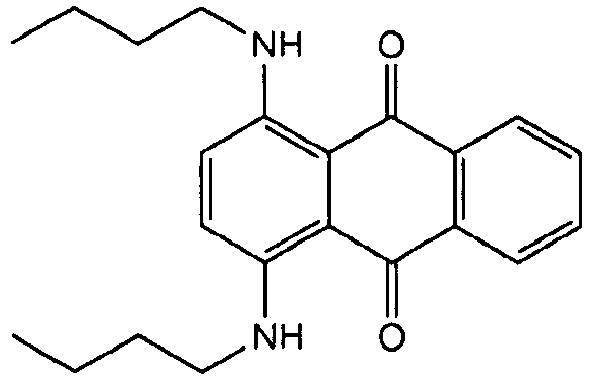
- Aus dem semifluorierten Alkan und dem Farbstoff wurde durch Vermischen mit einem Flügelrührer eine homogene Lösung hergestellt, die anschließend mit dem perfluorierten Alkan homogen vermischt wurde. Die Dichte der Lösungen wurde bei Raumtemperatur (20 °C) mittels Schwingkörper-Methode ermittelt. Verwendet wurde hierbei das Dichtemessgerät DA-100M der Firma Mettler-Toledo.
- Die Zubereitung ließ sich einfach durch eine Spritze mit einer Kanüle von 25 Gauge aufziehen und daraus wieder entleeren. Sie war über eine Lagerzeit von 42 Stunden bei 120 °C stabil, zeigte visuell unter dem Mikroskop keine Veränderung, also weder Separation noch Trübung. Ebenso ließ sich die Zubereitung ohne wesentliche visuell wahrnehmbare Veränderungen durch Sterilisation mittels Sterilfilter mit Porengröße 0,2 µm sterilisieren.
-
Farbstoff Gehalt Semifluoriertes Alkan C6F13-C8H17 Gehalt Perfluoriertes Alkan Perfluordecalin Konzentration Farbstoff in g/L Dichte [g/cm3] Farbintensität Solvent Blue 35 10 Vol.-% 90 Vol.-% 0,006 1,86 zart Solvent Blue 35 20 Vol.-% 80 Vol.-% 0,012 1,80 leicht Solvent Blue 35 30 Vol.-% 70 Vol.-% 0,018 1,73 mittel Solvent Blue 35 60 Vol.-% 40 Vol.-% 0,036 1,67 stark - Die genannten Komponenten wurden wie in Beispiel 1 zu einer transparenten gefärbten Zubereitung formuliert. Die Dichte wurde wie in Beispiel 1 bestimmt.
- Die Zubereitung ließ sich durch eine Spritze mit einer Kanüle von 25 Gauge aufziehen und daraus wieder entleeren. Sie war über eine Lagerzeit von 42 Stunden bei 120 °C stabil. Nach dieser Zeit zeigte die Lösung visuell unter dem Mikroskop keine Veränderung, also weder Separation noch Trübung. Die Zubereitung wurde mittels trockener Hitze bei einer Temperatur von 135°C 5 Stunden lang sterilisiert, wobei sie sich nicht visuell wahrnehmbar veränderte.
-
Farbstoff Gehalt Semifluoriertes Alkan C6F13-C8H17 Gehalt Perfluoriertes Alkan Perfluoroktan Konzentration Farbstoff in g/L Dichte [g/cm3] Farbintensität Solvent Violet 13 10 Vol.-% 90 Vol.-% 0,006 1,71 zart Solvent Violet 13 20 Vol.-% 80 Vol.-% 0,012 1,66 leicht Solvent Violet 13 30 Vol.-% 70 Vol.-% 0,018 1,62 mittel Solvent Violet 13 60 Vol.-% 40 Vol.-% 0,036 1,58 stark - Aus dem semifluorierten Alkan und dem Farbstoff wurde durch Vermischen mit einem Flügelrührer eine homogene Lösung hergestellt, die anschließend mit dem perfluorierten Alkan homogen vermischt wurde. Die Dichte der Lösungen wurde bei Raumtemperatur (20 °C) mittels Schwingkörper-Methode ermittelt. Verwendet wurde hierbei das Dichtemessgerät DA-100M der Firma Mettler-Toledo.
- Die Zubereitung ließ sich einfach durch eine Spritze mit einer Kanüle von 25 Gauge aufziehen und daraus wieder entleeren. Sie war über eine Lagerzeit von 42 Stunden bei 120 °C stabil, zeigte visuell unter dem Mikroskop keine Veränderung, also weder Separation noch Trübung. Ebenso ließ sich die Zubereitung ohne wesentliche visuell wahrnehmbare Veränderungen durch Sterilisation mittels Sterilfilter mit Porengröße 0,2 µm sterilisieren.
-
Farbstoff Gehalt Semifluoriertes Alkan C6F13-C8H17 Gehalt Perfluoriertes Alkan Perfluordecalin Konzentration Farbstoff in g/L Dichte [g/cm3] Farbintensität Solvent Violet 13 10 Vol.-% 90 Vol.-% 0,006 1,86 zart Solvent Violet 13 20 Vol.-% 80 Vol.-% 0,012 1,80 leicht Solvent Violet 13 30 Vol.-% 70 Vol.-% 0,018 1,73 mittel Solvent Violet 13 60 Vol.-% 40 Vol.-% 0,036 1,67 stark - Aus dem semifluorierten Alkan und dem Farbstoff wurde durch Vermischen mit einem Flügelrührer eine homogene Lösung hergestellt, die anschließend mit dem perfluorierten Alkan homogen vermischt wurde. Die Dichte der Lösungen wurde bei Raumtemperatur (20 °C) mittels Schwingkörper-Methode ermittelt. Verwendet wurde hierbei das Dichtemessgerät DA-100M der Firma Mettler-Toledo.
- Die Zubereitung ließ sich einfach durch eine Spritze mit einer Kanüle von 25 Gauge aufziehen und daraus wieder entleeren. Sie war über eine Lagerzeit von 42 Stunden bei 120 °C stabil, zeigte visuell unter dem Mikroskop keine Veränderung, also weder Separation noch Trübung. Ebenso ließ sich die Zubereitung ohne wesentliche visuell wahrnehmbare Veränderungen durch Erhitzen auf 135 °C für 5 Stunden sterilisieren.
-
Farbstoff Gehalt Semifluoriertes Alkan C6F13-C8H17 Gehalt Perfluoriertes Alkan Perfluoroktan Dichte [g/cm3] Farbintensität Solvent Green 5 30 Vol.-% 70 Vol.-% 1,62 mittel Solvent Green 5 60 Vol.-% 40 Vol.-% 1,58 mittel -

- Formel: C30H28O4 Molekulargewicht: 452.54
- Es wurde eine Zubereitung mit dem fluoreszierenden Farbstoff Solvent Green 5 hergestellt. Dazu wurden die genannten Komponenten wie in Beispiel 1 zu einer transparenten gefärbten Zubereitung formuliert. Die Dichte wurde wie in Beispiel 1 bestimmt.
- Die Zubereitung ließ sich durch eine Spritze mit einer Kanüle von 25 Gauge aufziehen und daraus wieder entleeren. Sie war über eine Lagerzeit von 42 Stunden bei 120 °C stabil. Nach dieser Zeit zeigte die Lösung visuell unter dem Mikroskop keine Veränderung, also weder Separation noch Trübung. Die Zubereitung konnte ohne wesentliche visuell wahrnehmbare Veränderungen durch Sterilisation mittels Sterilfilter mit Porengröße 0,2 µm sterilisiert werden.
-
Farbstoff Gehalt Semifluoriertes Alkan C6F13-C8H17 Gehalt Perfluoriertes Alkan Perfluordecalin Dichte [g/cm3] Farbintensität Solvent Green 5 30 wt. % 70 wt.% 1,74 mittel Solvent Green 5 60 wt.% 40 wt. % 1,68 mittel - Es wurde eine Zubereitung mit dem fluoreszierenden Farbstoff Solvent Green 5 hergestellt. Dazu wurden die genannten Komponenten wie in Beispiel 1 zu einer transparenten gefärbten Zubereitung formuliert. Die Dichte wurde wie in Beispiel 1 bestimmt.
- Die Zubereitung ließ sich durch eine Spritze mit einer Kanüle von 25 Gauge aufziehen und daraus wieder entleeren. Sie war über eine Lagerzeit von 42 Stunden bei 120 °C stabil. Nach dieser Zeit zeigte die Lösung visuell unter dem Mikroskop keine Veränderung, also weder Separation noch Trübung. Die Zubereitung wurde mittels trockener Hitze bei einer Temperatur von 135°C 5 Stunden lang sterilisiert, wobei sie sich nicht visuell wahrnehmbar veränderte.
-
Farbstoff Gehalt Semifluoriertes Alkan C4F9-C5H11 Gehalt Perfluoriertes Alkan Perfluordecalin Konzentration Farbstoff in g/L Dichte [g/cm3] Farbintensität Solvent Violet 13 10 Vol.-% 90 Vol.-% 0,006 1,86 zart - Es wurde eine Zubereitung mit dem Farbstoff Solvent Violet 13 hergestellt. Dazu wurden die genannten Komponenten wie in Beispiel 1 zu einer transparenten gefärbten Zubereitung formuliert. Die Dichte wurde wie in Beispiel 1 bestimmt.
-
Farbstoff Gehalt Semifluoriertes Alkan C6F13-C6H13 Gehalt Perfluoriertes Alkan Perfluordecalin Konzentration Farbstoff in g/L Dichte [g/cm3] Farbintensität Solvent Violet 13 10 Vol.-% 90 Vol.-% 0,006 1,87 zart - Es wurde eine Zubereitung mit dem Farbstoff Solvent Violet 13 hergestellt. Dazu wurden die genannten Komponenten wie in Beispiel 1 zu einer transparenten gefärbten Zubereitung formuliert. Die Dichte wurde wie in Beispiel 1 bestimmt.
Claims (15)
- Zubereitung zur Verwendung in der Augenheilkunde oder Netzhautchirurgie enthaltend mindestens ein perfluoriertes Alkan, mindestens ein semifluoriertes Alkan und mindestens eine in dem semifluorierten Alkan gelöste farbgebende Substanz, wobei das semifluorierte Alkan ausgewählt ist aus:
RFRH oder RFRHRF
wobei RF eine lineare oder verzweigte Perfluoralkylgruppe mit 3 bis 20 Kohlenstoffatomen und RH eine lineare oder verzweigte, gesättigte Alkylgruppe mit 1 bis 20 Kohlenstoffatomen ist, wobei die Gesamtkettenlänge 4 bis 30 Kohlenstoffatome beträgt und wobei das Verhältnis des perfluorierten Alkans zu dem semifluorierten Alkan, bezogen auf Volumen, 95:5 bis 5:95 beträgt. - Zubereitung zur Verwendung wie in Anspruch 1, dadurch gekennzeichnet dass die farbgebende Substanz ein Lösemittelfarbstoff oder Fettfarbstoff ist.
- Zubereitung zur Verwendung wie in Anspruch 1 oder 2, dadurch gekennzeichnet, dass der Farbstoff ein Lösemittelfarbstoff ist, der ausgewählt ist aus der Gruppe bestehend aus: Solvent Blue 36, Solvent Blue 35, Solvent Green 5, Solvent Violet 13, Solvent Blue 8, Solvent Blue 18, Solvent Blue 63, Solvent Green 3, Solvent Green 7, Solvent Violet 10, Solvent Violet 12, Solvent Violet 26, Solvent Red 27, Solvent Yellow 56, Solvent Green 3, Solvent Yellow 33, Solvent Red 19, Solvent Red 1, Solvent Yellow 16.
- Zubereitung zur Verwendung wie in Anspruch 1 oder 2, dadurch gekennzeichnet, dass der Farbstoff ein Fettfarbstoff ist, der ausgewählt ist aus der Gruppe bestehend aus: Sudan I, Sudan II, Sudan III, Sudan IV.
- Zubereitung zur Verwendung wie in einem der vorhergehenden Ansprüche, dadurch gekennzeichnet, dass der Farbstoff fluoresziert, Licht im sichtbaren Wellenlängenbereich reflektiert oder durch Anregung mittels Energie zur Reflexion von Licht einer Wellenlänge im sichtbaren Wellenlängenbereich angeregt werden kann.
- Zubereitung zur Verwendung wie in einem der vorhergehenden Ansprüche, dadurch gekennzeichnet, dass der Farbstoff in der fertigen Zubereitung in einer Menge von 0,08 bis 0,001 g/L, bevorzugter 0,07 bis 0,003 g/L, beispielsweise 0,06 g/L bis 0,006 g/L enthalten ist.
- Zubereitung zur Verwendung wie in einem der vorhergehenden Ansprüche, dadurch gekennzeichnet, dass das Perfluoralkan ausgewählt ist aus der Gruppe bestehend aus: C4F10, C5F12, C6F14, C7F16, C8F18, C9F20 und C10F22.
- Zubereitung zur Verwendung wie in einem der vorhergehenden Ansprüche, wobei die Zubereitung eine Dichte von mehr als 1 g/cm3 aufweist, wobei die Dichte bei Raumtemperatur von 20-25°C gemessen wird.
- Zubereitung zur Verwendung wie in einem der vorhergehenden Ansprüche, dadurch gekennzeichnet, dass die Zubereitung eine Dichte von mehr als 1,33 g/cm3 und bevorzugt von mehr als 1,5 g/cm3 aufweist, wobei die Dichte bei Raumtemperatur von 20-25°C gemessen wird.
- Zubereitung zur Verwendung wie in einem der vorhergehenden Ansprüche, dadurch gekennzeichnet, dass die Menge an semifluoriertem Alkan 5 bis 60 Vol.-%, bevorzugt 10 bis 40, und besonders bevorzugt 10 bis 20 Vol.-% bezogen auf das Gesamtvolumen der Zubereitung beträgt.
- Zubereitung zur Verwendung wie in einem der vorhergehenden Ansprüche, weiterhin enthaltend einen arzneimittelwirksamen Bestandteil oder fettlösliche Antioxidans.
- Zubereitung zur Verwendung wie in einem der vorhergehenden Ansprüche zur Verwendung in der Augenheilkunde oder Netzhautchirurgie, insbesondere für Vitrektomie oder chirurgische Eingriffe im Zusammenhang mit Netzhautablösung.
- Zubereitung zur Verwendung wie in einem der Ansprüche 1 bis 10 zur Verwendung als Infusionsflüssigkeit in der Netzhautchirurgie.
- Verfahren zur Herstellung einer Zubereitung nach einem der Ansprüche 1 bis 10, umfassend homogenes Vermischen der farbgebenden Substanz mit einem semifluorierten Alkan und Zugeben eines Perfluoroalkans.
- Verfahren nach Anspruch 14, weiterhin umfassend Aufbewahren der Zubereitung und Filtrieren der Zubereitung vor Weiterverarbeitung.
Applications Claiming Priority (2)
| Application Number | Priority Date | Filing Date | Title |
|---|---|---|---|
| DE102010022567A DE102010022567A1 (de) | 2010-06-02 | 2010-06-02 | Zubereitung |
| PCT/EP2011/002748 WO2011151079A2 (de) | 2010-06-02 | 2011-06-03 | Zubereitung |
Publications (2)
| Publication Number | Publication Date |
|---|---|
| EP2576701A2 EP2576701A2 (de) | 2013-04-10 |
| EP2576701B1 true EP2576701B1 (de) | 2016-03-23 |
Family
ID=44629482
Family Applications (1)
| Application Number | Title | Priority Date | Filing Date |
|---|---|---|---|
| EP11738602.9A Active EP2576701B1 (de) | 2010-06-02 | 2011-06-03 | Zubereitung zur verwendung in der augenheilkunde und netzhautchirurgie |
Country Status (6)
| Country | Link |
|---|---|
| US (1) | US8865131B2 (de) |
| EP (1) | EP2576701B1 (de) |
| DE (1) | DE102010022567A1 (de) |
| ES (1) | ES2576850T3 (de) |
| PT (1) | PT2576701E (de) |
| WO (1) | WO2011151079A2 (de) |
Families Citing this family (32)
| Publication number | Priority date | Publication date | Assignee | Title |
|---|---|---|---|---|
| US10045996B2 (en) | 2010-03-17 | 2018-08-14 | Novaliq Gmbh | Pharmaceutical composition for treatment of increased intraocular pressure |
| EP2444063A1 (de) | 2010-10-20 | 2012-04-25 | Novaliq GmbH | Flüssige pharmazeutische Zusammensetzungen zur Abgabe von Wirkstoffen |
| EP2462921A1 (de) | 2010-11-11 | 2012-06-13 | Novaliq GmbH | Flüssige pharmazeutische Zusammensetzungen zur Behandlung einer Erkrankung der Hinterseite des Auges |
| EP2714010B1 (de) | 2011-05-25 | 2017-03-01 | Novaliq GmbH | Topische pharmazeutische zusammensetzung auf der basis von semifluorierten alkanen |
| ES2625538T3 (es) | 2012-01-23 | 2017-07-19 | Novaliq Gmbh | Composiciones de proteínas estabilizadas basadas en alcanos semifluorados |
| ITVR20120049A1 (it) * | 2012-03-19 | 2013-09-20 | Bbs Srl | Soluzione colorata in particolare per uso in metodi chirurgici per il trattamento del corpo umano o animale |
| DE102012110745A1 (de) * | 2012-11-09 | 2014-05-15 | Fluoron Gmbh | Färbemittel für Hornhautfärbung |
| DE202013011832U1 (de) | 2012-04-11 | 2014-07-25 | Fluoron Gmbh | Färbemittel |
| DE102012103097A1 (de) | 2012-04-11 | 2013-10-17 | Fluoron Gmbh | Färbemittel zum Einfärben einer ophthalmischen Membran |
| CN104619314B (zh) | 2012-09-12 | 2017-09-22 | 诺瓦利克有限责任公司 | 包含半氟化烷烃的混合物的组合物 |
| BR112015005008B1 (pt) | 2012-09-12 | 2022-04-19 | Novaliq Gmbh | Composições de alcano semifluorado |
| CN114028560A (zh) | 2013-07-23 | 2022-02-11 | 诺瓦利克有限责任公司 | 稳定的抗体组合物 |
| DE202015101488U1 (de) * | 2015-03-24 | 2016-06-28 | Fluoron Gmbh | Waschlösung |
| CN108348777B (zh) | 2015-09-30 | 2020-04-28 | 诺瓦利克有限责任公司 | 半氟化化合物和其组合物 |
| CN113662929A (zh) * | 2015-09-30 | 2021-11-19 | 诺瓦利克有限责任公司 | 用于眼部给药的半氟化化合物 |
| USRE50060E1 (en) | 2016-06-23 | 2024-07-30 | Novaliq Gmbh | Topical administration method |
| ES2969758T3 (es) | 2016-09-22 | 2024-05-22 | Novaliq Gmbh | Composiciones farmacéuticas para usar en la terapia de la blefaritis |
| KR20190057338A (ko) | 2016-09-23 | 2019-05-28 | 노바리크 게엠베하 | 시클로스포린을 포함하는 안과 조성물 |
| ES2819005T3 (es) | 2016-12-23 | 2021-04-14 | Novaliq Gmbh | Composición oftálmica para el tratamiento de la enfermedad del ojo seco |
| EP3612228B1 (de) | 2017-04-21 | 2023-08-23 | Dermaliq Therapeutics, Inc. | Jodzusammensetzungen |
| US11278503B2 (en) | 2017-05-12 | 2022-03-22 | Novaliq Gmbh | Pharmaceutical compositions comprising semifluorinated alkanes for the treatment of contact lense-related conditions |
| US20200339492A1 (en) * | 2017-06-12 | 2020-10-29 | Novaliq Gmbh | Process for the preparation of semifluorinated alkanes using grignard reagents |
| MX2020003534A (es) | 2017-09-27 | 2020-07-29 | Novaliq Gmbh | Composiciones oftalmicas que comprenden latanoprost para usarse en el tratamiento de las enfermedades oculares. |
| CN111182893A (zh) | 2017-10-04 | 2020-05-19 | 诺瓦利克有限责任公司 | 包含f6h8的眼用组合物 |
| AU2019228119A1 (en) | 2018-03-02 | 2020-09-10 | Novaliq Gmbh | Pharmaceutical compositions comprising nebivolol |
| IL276888B2 (en) | 2018-03-28 | 2024-12-01 | Novaliq Gmbh | Pharmaceutical composition comprising timolol |
| EP3784246A1 (de) | 2018-04-27 | 2021-03-03 | Novaliq GmbH | Ophthalmische zusammensetzungen mit tafluprost zur behandlung von glaukomen |
| EP3856124A1 (de) | 2018-09-27 | 2021-08-04 | Novaliq GmbH | Reparatur von lipidbarrieren |
| CN112823020A (zh) | 2018-10-12 | 2021-05-18 | 诺瓦利克有限责任公司 | 用于治疗干眼病的眼用组合物 |
| EP3923907B1 (de) | 2019-02-13 | 2024-09-25 | Novaliq GmbH | Zusammensetzungen und verfahren zur behandlung von okularer neovaskularisation |
| AU2020340561B2 (en) | 2019-09-06 | 2026-01-22 | Novaliq Gmbh | Ophthalmic composition for the treatment of uveitis |
| CN115487305A (zh) * | 2022-09-21 | 2022-12-20 | 江苏君隽生物科技有限公司 | 一种用于递送活性药物成分的液体组合物 |
Family Cites Families (5)
| Publication number | Priority date | Publication date | Assignee | Title |
|---|---|---|---|---|
| BE791683A (fr) * | 1971-11-22 | 1973-03-16 | Du Pont | Fluides frigorigenes colores pour l'indication de fuites |
| DE19536504C2 (de) * | 1995-09-29 | 1999-09-23 | H Meinert | Verwendung fluorierter Alkane |
| DE19719280C1 (de) | 1997-05-07 | 1998-09-24 | Pharm Pur Gmbh | Fluorierte Alkane und ihre Verwendungen |
| JP2005525850A (ja) * | 2002-03-19 | 2005-09-02 | エス.ケイ.ファーマシューティカルズ インコーポレイテッド | パーフルオロカーボンを連続注入しながら硝子体切除術を実施するための方法およびシステム |
| RU2232001C2 (ru) * | 2002-08-29 | 2004-07-10 | Государственное учреждение Межотраслевой научно-технический комплекс "Микрохирургия глаза" им. акад. С.Н. Федорова | Способ хирургического лечения тяжелых форм отслойки сетчатой оболочки |
-
2010
- 2010-06-02 DE DE102010022567A patent/DE102010022567A1/de not_active Ceased
-
2011
- 2011-06-03 ES ES11738602.9T patent/ES2576850T3/es active Active
- 2011-06-03 WO PCT/EP2011/002748 patent/WO2011151079A2/de not_active Ceased
- 2011-06-03 EP EP11738602.9A patent/EP2576701B1/de active Active
- 2011-06-03 PT PT117386029T patent/PT2576701E/pt unknown
-
2012
- 2012-11-29 US US13/689,247 patent/US8865131B2/en active Active
Also Published As
| Publication number | Publication date |
|---|---|
| US20130084250A1 (en) | 2013-04-04 |
| DE102010022567A1 (de) | 2011-12-08 |
| EP2576701A2 (de) | 2013-04-10 |
| PT2576701E (pt) | 2016-06-24 |
| WO2011151079A3 (de) | 2012-05-03 |
| WO2011151079A2 (de) | 2011-12-08 |
| US8865131B2 (en) | 2014-10-21 |
| ES2576850T3 (es) | 2016-07-11 |
Similar Documents
| Publication | Publication Date | Title |
|---|---|---|
| DE102010022567A1 (de) | Zubereitung | |
| EP2532370B1 (de) | Farbstofflösung | |
| EP2224910B1 (de) | Spüllösung | |
| DE60108727T2 (de) | Farbige visko-elastische zusammensetzung | |
| DE202010009243U1 (de) | Zubereitung | |
| EP2653169A1 (de) | Färbemittel zur Hornhautfärbung | |
| DE202015101488U1 (de) | Waschlösung | |
| AU2013101135B4 (en) | Dye solution | |
| AU2014100162A4 (en) | Dye solution | |
| WO2018007457A1 (en) | Ophthalmic dye | |
| Khotcharrat et al. | Safety and efficacy of the novel surgical dye from blue butterfly pea flower: an ex vivo and in vitro study | |
| DE102006056558A1 (de) | Fluid zur intraokularen Verwendung | |
| DE102012110745A1 (de) | Färbemittel für Hornhautfärbung | |
| DE102012103097A1 (de) | Färbemittel zum Einfärben einer ophthalmischen Membran | |
| DE102005017279A1 (de) | Glaskörpertamponadeflüssigkeit und ihre Verwendung | |
| EP3445408A2 (de) | Ophthalmische färbezusammensetzung | |
| HK1147439B (en) | Dye solution | |
| CN104244990A (zh) | 特别用于治疗人体或动物体之手术方法的有色溶液 |
Legal Events
| Date | Code | Title | Description |
|---|---|---|---|
| PUAI | Public reference made under article 153(3) epc to a published international application that has entered the european phase |
Free format text: ORIGINAL CODE: 0009012 |
|
| 17P | Request for examination filed |
Effective date: 20121227 |
|
| AK | Designated contracting states |
Kind code of ref document: A2 Designated state(s): AL AT BE BG CH CY CZ DE DK EE ES FI FR GB GR HR HU IE IS IT LI LT LU LV MC MK MT NL NO PL PT RO RS SE SI SK SM TR |
|
| DAX | Request for extension of the european patent (deleted) | ||
| GRAP | Despatch of communication of intention to grant a patent |
Free format text: ORIGINAL CODE: EPIDOSNIGR1 |
|
| INTG | Intention to grant announced |
Effective date: 20140709 |
|
| 17Q | First examination report despatched |
Effective date: 20141209 |
|
| GRAS | Grant fee paid |
Free format text: ORIGINAL CODE: EPIDOSNIGR3 |
|
| INTG | Intention to grant announced |
Effective date: 20151203 |
|
| GRAA | (expected) grant |
Free format text: ORIGINAL CODE: 0009210 |
|
| AK | Designated contracting states |
Kind code of ref document: B1 Designated state(s): AL AT BE BG CH CY CZ DE DK EE ES FI FR GB GR HR HU IE IS IT LI LT LU LV MC MK MT NL NO PL PT RO RS SE SI SK SM TR |
|
| REG | Reference to a national code |
Ref country code: GB Ref legal event code: FG4D Free format text: NOT ENGLISH |
|
| REG | Reference to a national code |
Ref country code: CH Ref legal event code: EP |
|
| REG | Reference to a national code |
Ref country code: AT Ref legal event code: REF Ref document number: 783123 Country of ref document: AT Kind code of ref document: T Effective date: 20160415 |
|
| REG | Reference to a national code |
Ref country code: IE Ref legal event code: FG4D Free format text: LANGUAGE OF EP DOCUMENT: GERMAN |
|
| REG | Reference to a national code |
Ref country code: DE Ref legal event code: R096 Ref document number: 502011009176 Country of ref document: DE |
|
| REG | Reference to a national code |
Ref country code: PT Ref legal event code: SC4A Free format text: AVAILABILITY OF NATIONAL TRANSLATION Effective date: 20160616 |
|
| REG | Reference to a national code |
Ref country code: NL Ref legal event code: FP |
|
| REG | Reference to a national code |
Ref country code: ES Ref legal event code: FG2A Ref document number: 2576850 Country of ref document: ES Kind code of ref document: T3 Effective date: 20160711 |
|
| REG | Reference to a national code |
Ref country code: SE Ref legal event code: TRGR |
|
| REG | Reference to a national code |
Ref country code: FR Ref legal event code: PLFP Year of fee payment: 6 |
|
| REG | Reference to a national code |
Ref country code: LT Ref legal event code: MG4D |
|
| PG25 | Lapsed in a contracting state [announced via postgrant information from national office to epo] |
Ref country code: HR Free format text: LAPSE BECAUSE OF FAILURE TO SUBMIT A TRANSLATION OF THE DESCRIPTION OR TO PAY THE FEE WITHIN THE PRESCRIBED TIME-LIMIT Effective date: 20160323 Ref country code: NO Free format text: LAPSE BECAUSE OF FAILURE TO SUBMIT A TRANSLATION OF THE DESCRIPTION OR TO PAY THE FEE WITHIN THE PRESCRIBED TIME-LIMIT Effective date: 20160623 Ref country code: FI Free format text: LAPSE BECAUSE OF FAILURE TO SUBMIT A TRANSLATION OF THE DESCRIPTION OR TO PAY THE FEE WITHIN THE PRESCRIBED TIME-LIMIT Effective date: 20160323 Ref country code: GR Free format text: LAPSE BECAUSE OF FAILURE TO SUBMIT A TRANSLATION OF THE DESCRIPTION OR TO PAY THE FEE WITHIN THE PRESCRIBED TIME-LIMIT Effective date: 20160624 |
|
| PG25 | Lapsed in a contracting state [announced via postgrant information from national office to epo] |
Ref country code: LT Free format text: LAPSE BECAUSE OF FAILURE TO SUBMIT A TRANSLATION OF THE DESCRIPTION OR TO PAY THE FEE WITHIN THE PRESCRIBED TIME-LIMIT Effective date: 20160323 Ref country code: RS Free format text: LAPSE BECAUSE OF FAILURE TO SUBMIT A TRANSLATION OF THE DESCRIPTION OR TO PAY THE FEE WITHIN THE PRESCRIBED TIME-LIMIT Effective date: 20160323 Ref country code: LV Free format text: LAPSE BECAUSE OF FAILURE TO SUBMIT A TRANSLATION OF THE DESCRIPTION OR TO PAY THE FEE WITHIN THE PRESCRIBED TIME-LIMIT Effective date: 20160323 |
|
| PG25 | Lapsed in a contracting state [announced via postgrant information from national office to epo] |
Ref country code: IS Free format text: LAPSE BECAUSE OF FAILURE TO SUBMIT A TRANSLATION OF THE DESCRIPTION OR TO PAY THE FEE WITHIN THE PRESCRIBED TIME-LIMIT Effective date: 20160723 Ref country code: PL Free format text: LAPSE BECAUSE OF FAILURE TO SUBMIT A TRANSLATION OF THE DESCRIPTION OR TO PAY THE FEE WITHIN THE PRESCRIBED TIME-LIMIT Effective date: 20160323 Ref country code: EE Free format text: LAPSE BECAUSE OF FAILURE TO SUBMIT A TRANSLATION OF THE DESCRIPTION OR TO PAY THE FEE WITHIN THE PRESCRIBED TIME-LIMIT Effective date: 20160323 |
|
| PG25 | Lapsed in a contracting state [announced via postgrant information from national office to epo] |
Ref country code: SK Free format text: LAPSE BECAUSE OF FAILURE TO SUBMIT A TRANSLATION OF THE DESCRIPTION OR TO PAY THE FEE WITHIN THE PRESCRIBED TIME-LIMIT Effective date: 20160323 Ref country code: CZ Free format text: LAPSE BECAUSE OF FAILURE TO SUBMIT A TRANSLATION OF THE DESCRIPTION OR TO PAY THE FEE WITHIN THE PRESCRIBED TIME-LIMIT Effective date: 20160323 Ref country code: RO Free format text: LAPSE BECAUSE OF FAILURE TO SUBMIT A TRANSLATION OF THE DESCRIPTION OR TO PAY THE FEE WITHIN THE PRESCRIBED TIME-LIMIT Effective date: 20160323 Ref country code: SM Free format text: LAPSE BECAUSE OF FAILURE TO SUBMIT A TRANSLATION OF THE DESCRIPTION OR TO PAY THE FEE WITHIN THE PRESCRIBED TIME-LIMIT Effective date: 20160323 |
|
| REG | Reference to a national code |
Ref country code: DE Ref legal event code: R097 Ref document number: 502011009176 Country of ref document: DE |
|
| PLBE | No opposition filed within time limit |
Free format text: ORIGINAL CODE: 0009261 |
|
| STAA | Information on the status of an ep patent application or granted ep patent |
Free format text: STATUS: NO OPPOSITION FILED WITHIN TIME LIMIT |
|
| PG25 | Lapsed in a contracting state [announced via postgrant information from national office to epo] |
Ref country code: MC Free format text: LAPSE BECAUSE OF FAILURE TO SUBMIT A TRANSLATION OF THE DESCRIPTION OR TO PAY THE FEE WITHIN THE PRESCRIBED TIME-LIMIT Effective date: 20160323 Ref country code: DK Free format text: LAPSE BECAUSE OF FAILURE TO SUBMIT A TRANSLATION OF THE DESCRIPTION OR TO PAY THE FEE WITHIN THE PRESCRIBED TIME-LIMIT Effective date: 20160323 |
|
| PG25 | Lapsed in a contracting state [announced via postgrant information from national office to epo] |
Ref country code: BG Free format text: LAPSE BECAUSE OF FAILURE TO SUBMIT A TRANSLATION OF THE DESCRIPTION OR TO PAY THE FEE WITHIN THE PRESCRIBED TIME-LIMIT Effective date: 20160623 |
|
| 26N | No opposition filed |
Effective date: 20170102 |
|
| REG | Reference to a national code |
Ref country code: IE Ref legal event code: MM4A |
|
| PG25 | Lapsed in a contracting state [announced via postgrant information from national office to epo] |
Ref country code: SI Free format text: LAPSE BECAUSE OF FAILURE TO SUBMIT A TRANSLATION OF THE DESCRIPTION OR TO PAY THE FEE WITHIN THE PRESCRIBED TIME-LIMIT Effective date: 20160323 Ref country code: IE Free format text: LAPSE BECAUSE OF NON-PAYMENT OF DUE FEES Effective date: 20160603 |
|
| REG | Reference to a national code |
Ref country code: FR Ref legal event code: PLFP Year of fee payment: 7 |
|
| PG25 | Lapsed in a contracting state [announced via postgrant information from national office to epo] |
Ref country code: CY Free format text: LAPSE BECAUSE OF FAILURE TO SUBMIT A TRANSLATION OF THE DESCRIPTION OR TO PAY THE FEE WITHIN THE PRESCRIBED TIME-LIMIT Effective date: 20160323 Ref country code: HU Free format text: LAPSE BECAUSE OF FAILURE TO SUBMIT A TRANSLATION OF THE DESCRIPTION OR TO PAY THE FEE WITHIN THE PRESCRIBED TIME-LIMIT; INVALID AB INITIO Effective date: 20110603 |
|
| REG | Reference to a national code |
Ref country code: FR Ref legal event code: PLFP Year of fee payment: 8 |
|
| PG25 | Lapsed in a contracting state [announced via postgrant information from national office to epo] |
Ref country code: MT Free format text: LAPSE BECAUSE OF FAILURE TO SUBMIT A TRANSLATION OF THE DESCRIPTION OR TO PAY THE FEE WITHIN THE PRESCRIBED TIME-LIMIT Effective date: 20160323 Ref country code: LU Free format text: LAPSE BECAUSE OF NON-PAYMENT OF DUE FEES Effective date: 20160603 Ref country code: MK Free format text: LAPSE BECAUSE OF FAILURE TO SUBMIT A TRANSLATION OF THE DESCRIPTION OR TO PAY THE FEE WITHIN THE PRESCRIBED TIME-LIMIT Effective date: 20160323 |
|
| PG25 | Lapsed in a contracting state [announced via postgrant information from national office to epo] |
Ref country code: AL Free format text: LAPSE BECAUSE OF FAILURE TO SUBMIT A TRANSLATION OF THE DESCRIPTION OR TO PAY THE FEE WITHIN THE PRESCRIBED TIME-LIMIT Effective date: 20160323 |
|
| P01 | Opt-out of the competence of the unified patent court (upc) registered |
Effective date: 20230508 |
|
| PGFP | Annual fee paid to national office [announced via postgrant information from national office to epo] |
Ref country code: DE Payment date: 20250630 Year of fee payment: 15 |
|
| PGFP | Annual fee paid to national office [announced via postgrant information from national office to epo] |
Ref country code: GB Payment date: 20250620 Year of fee payment: 15 |
|
| PGFP | Annual fee paid to national office [announced via postgrant information from national office to epo] |
Ref country code: NL Payment date: 20250618 Year of fee payment: 15 Ref country code: BE Payment date: 20250617 Year of fee payment: 15 |
|
| PGFP | Annual fee paid to national office [announced via postgrant information from national office to epo] |
Ref country code: PT Payment date: 20250523 Year of fee payment: 15 |
|
| PGFP | Annual fee paid to national office [announced via postgrant information from national office to epo] |
Ref country code: FR Payment date: 20250627 Year of fee payment: 15 |
|
| PGFP | Annual fee paid to national office [announced via postgrant information from national office to epo] |
Ref country code: AT Payment date: 20250616 Year of fee payment: 15 |
|
| PGFP | Annual fee paid to national office [announced via postgrant information from national office to epo] |
Ref country code: TR Payment date: 20250528 Year of fee payment: 15 |
|
| PGFP | Annual fee paid to national office [announced via postgrant information from national office to epo] |
Ref country code: SE Payment date: 20250618 Year of fee payment: 15 |
|
| PGFP | Annual fee paid to national office [announced via postgrant information from national office to epo] |
Ref country code: ES Payment date: 20250718 Year of fee payment: 15 |
|
| PGFP | Annual fee paid to national office [announced via postgrant information from national office to epo] |
Ref country code: IT Payment date: 20250630 Year of fee payment: 15 |
|
| PGFP | Annual fee paid to national office [announced via postgrant information from national office to epo] |
Ref country code: CH Payment date: 20250701 Year of fee payment: 15 |