EP2575910B1 - Matrices denses de collagene pour la reparation tissulaire et leur procede de preparation - Google Patents
Matrices denses de collagene pour la reparation tissulaire et leur procede de preparation Download PDFInfo
- Publication number
- EP2575910B1 EP2575910B1 EP11728327.5A EP11728327A EP2575910B1 EP 2575910 B1 EP2575910 B1 EP 2575910B1 EP 11728327 A EP11728327 A EP 11728327A EP 2575910 B1 EP2575910 B1 EP 2575910B1
- Authority
- EP
- European Patent Office
- Prior art keywords
- collagen
- solution
- concentration
- homogeneous
- polymer
- Prior art date
- Legal status (The legal status is an assumption and is not a legal conclusion. Google has not performed a legal analysis and makes no representation as to the accuracy of the status listed.)
- Active
Links
Images









Classifications
-
- A—HUMAN NECESSITIES
- A61—MEDICAL OR VETERINARY SCIENCE; HYGIENE
- A61L—METHODS OR APPARATUS FOR STERILISING MATERIALS OR OBJECTS IN GENERAL; DISINFECTION, STERILISATION OR DEODORISATION OF AIR; CHEMICAL ASPECTS OF BANDAGES, DRESSINGS, ABSORBENT PADS OR SURGICAL ARTICLES; MATERIALS FOR BANDAGES, DRESSINGS, ABSORBENT PADS OR SURGICAL ARTICLES
- A61L27/00—Materials for grafts or prostheses or for coating grafts or prostheses
- A61L27/14—Macromolecular materials
- A61L27/22—Polypeptides or derivatives thereof, e.g. degradation products
- A61L27/24—Collagen
-
- A—HUMAN NECESSITIES
- A61—MEDICAL OR VETERINARY SCIENCE; HYGIENE
- A61L—METHODS OR APPARATUS FOR STERILISING MATERIALS OR OBJECTS IN GENERAL; DISINFECTION, STERILISATION OR DEODORISATION OF AIR; CHEMICAL ASPECTS OF BANDAGES, DRESSINGS, ABSORBENT PADS OR SURGICAL ARTICLES; MATERIALS FOR BANDAGES, DRESSINGS, ABSORBENT PADS OR SURGICAL ARTICLES
- A61L27/00—Materials for grafts or prostheses or for coating grafts or prostheses
- A61L27/14—Macromolecular materials
- A61L27/18—Macromolecular materials obtained otherwise than by reactions only involving carbon-to-carbon unsaturated bonds
-
- A—HUMAN NECESSITIES
- A61—MEDICAL OR VETERINARY SCIENCE; HYGIENE
- A61L—METHODS OR APPARATUS FOR STERILISING MATERIALS OR OBJECTS IN GENERAL; DISINFECTION, STERILISATION OR DEODORISATION OF AIR; CHEMICAL ASPECTS OF BANDAGES, DRESSINGS, ABSORBENT PADS OR SURGICAL ARTICLES; MATERIALS FOR BANDAGES, DRESSINGS, ABSORBENT PADS OR SURGICAL ARTICLES
- A61L2430/00—Materials or treatment for tissue regeneration
- A61L2430/40—Preparation and treatment of biological tissue for implantation, e.g. decellularisation, cross-linking
Definitions
- the present invention relates to a process for preparing dense fibrillar matrices of collagen, the matrices thus obtained and their uses for tissue repair.
- the first biomaterials based on collagen led to industrial applications concerned skin substitutes.
- the products marketed have been proposed as implants for burn victims or dressings for chronic wounds and ulcers.
- the first dermal substitute sold as Integra ® is an acellular sponge of collagen and glutaraldehyde-bonded proteoglycans. Associated with a sheet of keratinocytes, marketed under the name of Epicel ®, the equivalent dermis becomes a skin substitute.
- the substitutes include polymers of synthetic origin or integrate cells and their success will depend on cell / matrix interrelations.
- the only systems where fibroblasts are found with contacts in 3D are the collagen hydrogels developed in the United States. These hydrogels associated with sheets of keratinocytes then become cutaneous repair materials (Apligraf ®). The major disadvantage of these biomaterials lies in their poor mechanical properties.
- the collagen hydrogels are obtained by precipitating the collagen monomers into fibrils in an acid-soluble solution.
- the weakly concentrated fibrillary gel ⁇ 1 mg / ml
- a significant contraction of the gel is then observed in the following days ( ⁇ 3% of initial surface after 14 days of culture) and results in what is called an equivalent dermis.
- This reconstituted tissue becomes an equivalent skin when it is secondarily seeded by cells of the epidermis, the keratinocytes, which proliferate and cover the structure.
- hydrogels have been the subject of numerous studies in terms of remodeling (synthesis of collagen and metalloproteinases) and cell proliferation. While hydrogels are interesting cell culture models, they have proven insufficient as substrates for tissue repair. The mechanical properties of the hydrogels were improved by increasing their concentration by compression (see ⁇ II.4), resulting in easily dehydrated and friable films, their thickness of the order of 40 microns is too fine for many applications .
- the patent WO2006 / 29571 discloses a method for forming a collagen matrix with improved mechanical properties.
- the pH of a collagen solution is increased to form fibrils. then the gel is contacted with a crosslinking agent.
- the formation of covalent bonds within the collagen gel will affect its stability and its mechanical properties will be improved.
- the document EP 0457430 discloses the preparation of a collagen gel by dialysis against a solution of polyethylene glycol.
- the inventors have developed techniques for working with collagen at high concentrations, controlling the establishment of a concentration-related supramolecular order and stabilizing during a sol / gel transition to dense fibrillar matrices. .
- the inventors have also shown that matrices containing 40 mg / ml of collagen exhibit particularly advantageous properties in terms of their cellular and mechanical responses. They are colonized in vitro by fibroblasts seeded on their surface following the hydrolysis of collagen via metalloproteases. After 28 days of culture, the number of cells present in the matrix, resulting from a balance between proliferation and apoptosis, is close to that of a living tissue ( Helary et al. Biomaterials, (2005), 26 p.
- Requirement WO 2010/004182 on behalf of the inventors relates to the mineralization of these dense fibrillar matrices of collagen in a higher concentration range (from 80 mg / mL) for application in the field of bone substitutes.
- Method - Acidic solutions of collagen with an initial concentration of less than 5 mg / mL are placed in a dialysis coil.
- the porosity of the membrane is set so that the solvent, the salts and the molecules whose molecular weight is smaller than the pore size diffuse through the wall but not the collagen.
- the whole is immersed in a solution of polymer (generally polyethylene glycol or PEG) whose concentration is equal to / or a little higher than that which one wants to reach ( Gobeaux et al. J. Mol. Biol. 2008 ; figure 14 ).
- polymer generally polyethylene glycol or PEG
- Method - This method proposes compression of hydrated fibrillar collagen gels to obtain dense matrices.
- the fibrillar networks remain isotropic but the mechanical properties are much higher than those of the initial gel.
- the viability of cells inserted into such matrices, in the form of wound sheets, is verified (Brown et al., 2005; figure 16 ).
- the inventors have thus developed a method making it possible to obtain dense fibrillar matrices of collagen obtained at concentrations 5 to 60 times higher than conventional hydrogels, or even more, and containing no additives intended to reinforce the mechanical properties, but only of the Pure collagen reconstituted in the form of fibrils and dense fibril networks, which avoids the phenomena of inflammation, toxicity and rejection.
- the matrices obtained are colonizable by connective tissue cells and their mechanical properties are close to those of biological tissues.
- the permeable element is chosen with a pore size of lower molecular weight (MW) than collagen on the one hand and the outer polymer on the other hand. Keeping the collagen solution separated from the polymer solution by the permeable element in contact allows the solvent to diffuse internal collagen solution to the outer polymer solution. This makes it possible to obtain the formation of a more concentrated solution of homogeneous collagen inside the permeable element or on the surface of the permeable element by this selective transfer of solvent.
- the osmotic pressure of the polymer solution is greater than that of the collagen solution.
- Continuous injection by controlled means may be carried out by any system known to those skilled in the art capable of allowing this type of injection, in particular an electric syringe pump or a pump.
- the injection speed is adapted so that the pressure force on both sides of the membrane is identical; and the flow is adapted depending on the polymer and its viscosity so that the skilled person finds the speed avoiding the retraction of the membrane or swelling until piercing.
- the speed depends on the type of polymer used and its molecular weight, which is greater than the pores of the membrane.
- the adaptation of speed is a matter of general knowledge of the person skilled in the art. By way of example with PEG with a molecular weight of 35 KDa, a speed of between 1 and 15 ⁇ l / min can be used.
- the injection can be interrupted to reach the equilibrium (that is to say when the concentration of collagen is then homogeneous everywhere in the mold) faster therefore to decrease the concentration gradient faster and resumed in order to elaborate a multi system -controlled concentration and modular organization. It is also possible to interrupt the injection without waiting for the equilibrium which will allow to have a continuous gradient in concentration.
- FIG. figure 3 An example of a device that can be used to implement the method of the invention is illustrated in FIG. figure 3 .
- the term "pure collagen solution” means a solution containing no compound added solely for the purpose of reinforcing the final mechanical properties of the material; it is especially free of crosslinking agents such as aldehydes and synthetic reinforcing polymers such as polyesters or natural ones such as chitosan.
- additives such as molecules of interest such as agents for modifying its porosity or collagen surface charges can be added to the material.
- the collagen used in the present invention may be of natural or recombinant origin. It may come in particular from the skin or tendons from which it is extracted by the acidic or enzymatic route according to techniques known to those skilled in the art.
- the dialysis cell at least one of whose ends is closed by a dialysis membrane, may also be a mold consisting entirely of a dialysis membrane.
- the collagen matrix will be made on the whole surface of the mold not only on the membrane placed at the end.
- the product can therefore be formulated according to the thickness and the concentration in the form of a film, a flexible membrane, a tube or a custom mold.
- the acid solutions of collagen used in step a) are prepared by techniques known to those skilled in the art from natural or recombinant collagen.
- the aqueous solvent advantageously acetic acid at a concentration between 17 and 500 mM can contain various additives such as inorganic salts, other types of collagen or glycosaminoglycans such as sulfated heparin.
- the collagen concentration of the initial solution used in step a) is between 0.01 and 5 mg / ml, advantageously between 0.5 and 3 mg / ml.
- the polymer used may be any acid-soluble polymer whose molecular weight is greater than the pore size of the permeable element. It is in particular chosen from the group comprising Dextran® and polyethylene glycol (PEG).
- the polymer is polyethylene glycol whose molecular weight is greater than that of collagen, thus greater than 3000 Da.
- the concentration of the polymer solution can vary according to the case and its adjustment is within the reach of the skilled person. If the volume of polymer solution is very large then the volume of solvent from the collagen solution is negligible and negligibly dilutes the polymer solution. In this case, the initial polymer concentration will be equal to the final collagen concentration. If the volume of polymer solution is not large and the initial polymer concentration is equal to the final collagen concentration, in order not to slow down the diffusion, the polymer solution will be changed regularly. If the volume of polymer solution is not large and the initial polymer concentration is greater than the final collagen concentration, then the initial polymer concentration is calculated such that after dilution with the volume of solvent from the collagen solution, it is equal to the desired final concentration of collagen.
- the method may further comprise, before or after step d), a step of forming fibrils in the pure collagen material.
- the formation of these fibrils makes it possible to mimic the fibrillar structure of the collagen of the biological tissues.
- the formation of the fibrils is carried out by any technique known to those skilled in the art, in particular by neutralization of the solution based on homogeneous pure collagen by a gas phase (basic) or liquid (basic or neutral). It can be done either in situ by replacing the polymer with the gaseous or liquid phase, which allows a "one-pot" preparation of the fibrillar collagen, or by immersion of the collagen material in a gaseous or liquid phase.
- the method of the invention can also be used to produce multi-layer products by interrupting the injection.
- the injection can be interrupted to reach equilibrium faster and resumed to make different layers not continuous in concentration. It is also possible to stop the injection and not to wait for equilibrium to have different continuous layers in concentration.
- the invention also relates to a homogeneous material based on pure collagen obtainable by a method as defined above.
- the product obtained according to the invention is easily handled without tears and suturable without additional crosslinking. It is homogeneous and does not show any variation in concentrations.
- materials are obtained having a concentration of about 5 to about 1000 mg / mL, especially 5, 10, 20, 30, 40 and 250 mg / mL.
- the elastic modulus is approximately 974 ⁇ 239 Pa and the viscous modulus approximately 145 ⁇ 40 Pa.
- the elastic modulus is approximately 1287 ⁇ 158 Pa and the viscous modulus of about 124 ⁇ 12 Pa.
- the elastic modulus is about 2809 ⁇ 336 Pa and the viscous modulus about 263 ⁇ 48 Pa.
- the elastic modulus is about 9254 ⁇ 1032 Pa and the viscous modulus about 786 ⁇ 46 Pa.
- the values of the elastic and viscous modules are measured at 1 Hz and 2% deformation.
- the material according to the invention can therefore be used as a tissue substitute, especially as a wall reinforcement, for the manufacture of prostheses, as a soft tissue substitute or as a filling material.
- the invention therefore also relates to implantable medical devices characterized in that they comprise a material according to the invention.
- Type I collagen is prepared from tails of young Wistar rats, according to the following procedure.
- the rat tail tendons are excised in a sterile laminar flow hood, then washed in phosphate buffered saline containing 137 mM NaCl, 2.68 mM KCl, 8.07 mM Na 2 HPO 4 and 1.47 mM. mM NaH 2 PO 4 , to remove cells and traces of blood.
- the tendons are then soaked in 4M NaCl solution to remove the remaining intact cells and precipitate a portion of the high molecular weight proteins. After a further washing with the saline buffer solution, the tendons are dissolved in an aqueous solution of 500 mM acetic acid.
- the solution thus obtained is clarified by centrifugation at 41000 g for 2 h.
- Proteins other than type I collagen are selectively precipitated in 300 mM aqueous NaCl solution and then removed by centrifugation at 41000 g for 3 h.
- Collagen is recovered from the supernatant by precipitation in aqueous 600 mM NaCl followed by centrifugation at 3000 g for 45 min.
- the pellets thus obtained are dissolved in a 500 mM aqueous acetic acid solution and then carefully dialyzed in the same solvent to completely eliminate NaCl.
- the solutions are maintained at 4 ° C. and centrifuged at 41000 g for 4 h before being used.
- Fibrillogenesis is performed by immersing the collagen material under ammonia vapor for 24 hours.
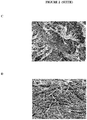
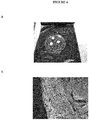
- Collagen (acid-soluble) obtained by dialysis is macroscopically inhomogeneous ( Figure 2A ) and the size of the fibers is inhomogeneous ( Figures 2B to 2D ).
- the fibrillated collagen obtained by the process according to the invention is macroscopically homogeneous ( Figure 4A ) and the size of the fibers is also homogeneous ( Figures 4B to 4D ).
- Wistar rats Wi / Wi, Charles-Rivers France
- sodium pentobarbital solution (30 mg / kg, Centravet France)
- the abdomen is shaved and disinfected and a laparotomy is performed.
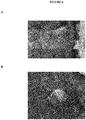
- two pockets are located on either side of the midline: one subcutaneous, the other intramuscular dense matrices of collagen ranging from 40 to 300 mg / mL are then implanted.
- the muscle pocket is closed, then the skin (Vicryl ® 4/0) View figure 5 Fifteen to thirty or sixty days after implantation, the rats are euthanized with an excess of sodium penthobarbital and the MD are explanted and fixed in 4% paraformaldehyde (Merck France). The samples are then included in paraffin.
- the dies are easily handled without tears.
- the colonization rate of the implants by the cells in vivo depends on the collagen concentration. The higher the concentration, the slower the speed. The thicker the matrix, the longer the colonization in the core of the material.
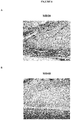
- the dense matrix at 20 mg / ml (MD20) is colonized by fibroblast cells ( figure 8A ).
- the dense matrix at 40 mg / mL (MD40) at the level of the outer bank a few cells opposite are observed and begin to migrate inside the gel ( Figure 8B ).
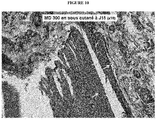
- Subcutaneous and generally for concentrations of 300 mg / ml (MD 300), cell colonization is more towards the cutaneous face than towards the muscular fascia.
- the MD300 is surrounded by a thin capsule.
- At the level of the outer bank a few cells opposite are observed and begin to migrate inside the gel ( figures 9 and 10 ).
- the applications can therefore be extremely variable depending on the type of dense matrix selected and the implantation site.
Landscapes
- Health & Medical Sciences (AREA)
- Chemical & Material Sciences (AREA)
- Life Sciences & Earth Sciences (AREA)
- Medicinal Chemistry (AREA)
- General Health & Medical Sciences (AREA)
- Animal Behavior & Ethology (AREA)
- Dermatology (AREA)
- Oral & Maxillofacial Surgery (AREA)
- Transplantation (AREA)
- Epidemiology (AREA)
- Veterinary Medicine (AREA)
- Public Health (AREA)
- Chemical Kinetics & Catalysis (AREA)
- Biophysics (AREA)
- Materials For Medical Uses (AREA)
- Peptides Or Proteins (AREA)
- Organic Chemistry (AREA)
- Polymers & Plastics (AREA)
Applications Claiming Priority (2)
| Application Number | Priority Date | Filing Date | Title |
|---|---|---|---|
| FR1054194A FR2960439B1 (fr) | 2010-05-31 | 2010-05-31 | Matrices fibrillaires denses de collagene pour la reparation tissulaire et leur procede de preparation |
| PCT/FR2011/051234 WO2011151587A2 (fr) | 2010-05-31 | 2011-05-30 | Matrices fibrillaires denses de collagene pour la reparation tissulaire et leur procede de preparation |
Publications (2)
| Publication Number | Publication Date |
|---|---|
| EP2575910A2 EP2575910A2 (fr) | 2013-04-10 |
| EP2575910B1 true EP2575910B1 (fr) | 2017-07-26 |
Family
ID=43431212
Family Applications (1)
| Application Number | Title | Priority Date | Filing Date |
|---|---|---|---|
| EP11728327.5A Active EP2575910B1 (fr) | 2010-05-31 | 2011-05-30 | Matrices denses de collagene pour la reparation tissulaire et leur procede de preparation |
Country Status (6)
| Country | Link |
|---|---|
| US (1) | US9867902B2 (https=) |
| EP (1) | EP2575910B1 (https=) |
| JP (1) | JP5981421B2 (https=) |
| ES (1) | ES2644553T3 (https=) |
| FR (1) | FR2960439B1 (https=) |
| WO (1) | WO2011151587A2 (https=) |
Families Citing this family (3)
| Publication number | Priority date | Publication date | Assignee | Title |
|---|---|---|---|---|
| FR3011185B1 (fr) | 2013-10-02 | 2016-10-28 | Univ Pierre Et Marie Curie Paris 6 | Procede de preparation d'une matrice de collagene fibrille |
| FR3037804B1 (fr) | 2015-06-24 | 2017-07-07 | Univ Pierre Et Marie Curie Paris 6 | Procede de preparation de matrices de collagene transparentes |
| US12377193B2 (en) * | 2016-07-06 | 2025-08-05 | The Children's Medical Center Corporation | Indirect method of articular tissue repair |
Family Cites Families (7)
| Publication number | Priority date | Publication date | Assignee | Title |
|---|---|---|---|---|
| US4018826A (en) * | 1974-11-04 | 1977-04-19 | Dynapol Corporation | Process for preparing polyvinylamine and salts thereof |
| US5256418A (en) * | 1990-04-06 | 1993-10-26 | Organogenesis, Inc. | Collagen constructs |
| PT831882E (pt) * | 1995-06-07 | 2005-01-31 | Organogenesis Inc | Composicoes de segmentos de fibra de colagenio reconstituido e metodos de preparacao das mesmas |
| WO2006029571A1 (en) * | 2004-09-14 | 2006-03-23 | The University Of Hong Kong | Photochemically crosslinked collagen scaffolds and methods for their preparation |
| US20090054350A1 (en) * | 2007-08-23 | 2009-02-26 | Jean-Louis Tayot | Process for the sterile concentration of collagen preparations, and collagen preparations obtained |
| FR2933303B1 (fr) | 2008-06-30 | 2010-12-03 | Univ Paris Curie | Substitut osseux,et procede pour sa preparation. |
| RU2500432C2 (ru) * | 2008-08-11 | 2013-12-10 | КоллЭнджин, Инк. | Биокомпозиты и способы их получения |
-
2010
- 2010-05-31 FR FR1054194A patent/FR2960439B1/fr not_active Expired - Fee Related
-
2011
- 2011-05-30 US US13/701,071 patent/US9867902B2/en not_active Expired - Fee Related
- 2011-05-30 ES ES11728327.5T patent/ES2644553T3/es active Active
- 2011-05-30 EP EP11728327.5A patent/EP2575910B1/fr active Active
- 2011-05-30 JP JP2013512978A patent/JP5981421B2/ja not_active Expired - Fee Related
- 2011-05-30 WO PCT/FR2011/051234 patent/WO2011151587A2/fr not_active Ceased
Also Published As
| Publication number | Publication date |
|---|---|
| ES2644553T3 (es) | 2017-11-29 |
| JP5981421B2 (ja) | 2016-08-31 |
| FR2960439B1 (fr) | 2012-06-15 |
| EP2575910A2 (fr) | 2013-04-10 |
| US9867902B2 (en) | 2018-01-16 |
| US20130142840A1 (en) | 2013-06-06 |
| WO2011151587A3 (fr) | 2012-01-26 |
| WO2011151587A2 (fr) | 2011-12-08 |
| FR2960439A1 (fr) | 2011-12-02 |
| JP2013529964A (ja) | 2013-07-25 |
Similar Documents
| Publication | Publication Date | Title |
|---|---|---|
| CA2759654C (fr) | Nouveaux materiaux en collagene et procedes d'obtention | |
| Costa et al. | Compact saloplastic membranes of natural polysaccharides for soft tissue engineering | |
| EP2180906B1 (fr) | Prothese destinee a promouvoir la reconstruction in vivo d'un organe creux ou d'une partie d'organe creux | |
| CN101820929B (zh) | 制备用于组织工程的多孔支架的方法 | |
| BE1012536A3 (fr) | Element muni d'une couche de fibrine sa preparation et son utilisation. | |
| Chhabra et al. | In vivo studies of 3D starch–gelatin scaffolds for full-thickness wound healing | |
| CN110041536B (zh) | 功能性丝胶蛋白水凝胶及其制备方法和应用 | |
| WO2022023745A1 (en) | Fibrous composite material | |
| EP2575910B1 (fr) | Matrices denses de collagene pour la reparation tissulaire et leur procede de preparation | |
| Yao et al. | Facile incorporation of REDV into porous silk fibroin scaffolds for enhancing vascularization of thick tissues | |
| Kirwale et al. | Chitosan, chondroitin sulfate, and hyaluronic acid based in-situ forming scaffold for efficient cell grafting | |
| Kang et al. | Fabrication and characterization of an electro‐compacted collagen/elastin/hyaluronic acid sheet as a potential skin scaffold | |
| WO2011151603A1 (fr) | Nouveaux substituts vasculaires biodegradables | |
| WO2016166479A1 (fr) | Procédé de préparation d'hydrogel à partir d'acide hyaluronique modifié et de collagène de type i | |
| EP2037975B1 (fr) | Tubes de collagene | |
| CN103341211A (zh) | 一种制备ⅰ/ⅱ胶原双层复合胶原膜的方法 | |
| WO2016059339A1 (fr) | Procédé de fabrication de structures tridimensionnelles par moulage pour l'ingénierie tissulaire | |
| FR2966047A1 (fr) | Procede de preparation de collagene fibrille | |
| WO2015049646A1 (fr) | Procede de preparation d'une matrice de collagene fibrille | |
| Azimi-Alamouty et al. | An in situ forming gelatin-based hydrogel loaded with soluble amniotic membrane promotes full-thickness wound regeneration in rats | |
| RU2779361C1 (ru) | Однородная прозрачная коллагеновая мембрана, способ ее получения и ее применение для восстановления роговицы | |
| FR3017877A1 (fr) | Materiau pour la culture des cellules, procedes de preparation et ses utilisations | |
| KR20230046202A (ko) | 생리활성인자 탑재/세포 부착이 가능한 다공성 구조를 가지는 고분자 필름 및 이의 제조방법 | |
| KR20240031992A (ko) | 성장인자가 로딩된 폴리카프로락톤 기반 막 및 이의 제조방법 | |
| FR2843972A1 (fr) | Substitut cutanes bioactifs comportant un feuillet de cellules cultivees sur une matrice a base de chitosane |
Legal Events
| Date | Code | Title | Description |
|---|---|---|---|
| PUAI | Public reference made under article 153(3) epc to a published international application that has entered the european phase |
Free format text: ORIGINAL CODE: 0009012 |
|
| 17P | Request for examination filed |
Effective date: 20121130 |
|
| AK | Designated contracting states |
Kind code of ref document: A2 Designated state(s): AL AT BE BG CH CY CZ DE DK EE ES FI FR GB GR HR HU IE IS IT LI LT LU LV MC MK MT NL NO PL PT RO RS SE SI SK SM TR |
|
| DAX | Request for extension of the european patent (deleted) | ||
| RAP1 | Party data changed (applicant data changed or rights of an application transferred) |
Owner name: UNIVERSITE PIERRE ET MARIE CURIE (PARIS 6) Owner name: UNIVERSITE DE VERSAILLES SAINT-QUENTIN-EN-YVELINES Owner name: CENTRE NATIONAL DE LA RECHERCHE SCIENTIFIQUE (CNRS |
|
| 17Q | First examination report despatched |
Effective date: 20140723 |
|
| REG | Reference to a national code |
Ref country code: DE Ref legal event code: R079 Ref document number: 602011039930 Country of ref document: DE Free format text: PREVIOUS MAIN CLASS: A61L0027240000 Ipc: A61L0027180000 |
|
| RIC1 | Information provided on ipc code assigned before grant |
Ipc: A61L 27/18 20060101AFI20160114BHEP Ipc: A61L 27/24 20060101ALI20160114BHEP |
|
| GRAP | Despatch of communication of intention to grant a patent |
Free format text: ORIGINAL CODE: EPIDOSNIGR1 |
|
| INTG | Intention to grant announced |
Effective date: 20170105 |
|
| GRAS | Grant fee paid |
Free format text: ORIGINAL CODE: EPIDOSNIGR3 |
|
| GRAA | (expected) grant |
Free format text: ORIGINAL CODE: 0009210 |
|
| AK | Designated contracting states |
Kind code of ref document: B1 Designated state(s): AL AT BE BG CH CY CZ DE DK EE ES FI FR GB GR HR HU IE IS IT LI LT LU LV MC MK MT NL NO PL PT RO RS SE SI SK SM TR |
|
| REG | Reference to a national code |
Ref country code: GB Ref legal event code: FG4D Free format text: NOT ENGLISH |
|
| REG | Reference to a national code |
Ref country code: CH Ref legal event code: EP |
|
| REG | Reference to a national code |
Ref country code: AT Ref legal event code: REF Ref document number: 911862 Country of ref document: AT Kind code of ref document: T Effective date: 20170815 |
|
| REG | Reference to a national code |
Ref country code: IE Ref legal event code: FG4D Free format text: LANGUAGE OF EP DOCUMENT: FRENCH |
|
| REG | Reference to a national code |
Ref country code: DE Ref legal event code: R096 Ref document number: 602011039930 Country of ref document: DE |
|
| REG | Reference to a national code |
Ref country code: NL Ref legal event code: FP |
|
| REG | Reference to a national code |
Ref country code: LT Ref legal event code: MG4D |
|
| REG | Reference to a national code |
Ref country code: AT Ref legal event code: MK05 Ref document number: 911862 Country of ref document: AT Kind code of ref document: T Effective date: 20170726 |
|
| REG | Reference to a national code |
Ref country code: CH Ref legal event code: NV Representative=s name: ABREMA AGENCE BREVET ET MARQUES, GANGUILLET, CH |
|
| PG25 | Lapsed in a contracting state [announced via postgrant information from national office to epo] |
Ref country code: FI Free format text: LAPSE BECAUSE OF FAILURE TO SUBMIT A TRANSLATION OF THE DESCRIPTION OR TO PAY THE FEE WITHIN THE PRESCRIBED TIME-LIMIT Effective date: 20170726 Ref country code: HR Free format text: LAPSE BECAUSE OF FAILURE TO SUBMIT A TRANSLATION OF THE DESCRIPTION OR TO PAY THE FEE WITHIN THE PRESCRIBED TIME-LIMIT Effective date: 20170726 Ref country code: LT Free format text: LAPSE BECAUSE OF FAILURE TO SUBMIT A TRANSLATION OF THE DESCRIPTION OR TO PAY THE FEE WITHIN THE PRESCRIBED TIME-LIMIT Effective date: 20170726 Ref country code: SE Free format text: LAPSE BECAUSE OF FAILURE TO SUBMIT A TRANSLATION OF THE DESCRIPTION OR TO PAY THE FEE WITHIN THE PRESCRIBED TIME-LIMIT Effective date: 20170726 Ref country code: NO Free format text: LAPSE BECAUSE OF FAILURE TO SUBMIT A TRANSLATION OF THE DESCRIPTION OR TO PAY THE FEE WITHIN THE PRESCRIBED TIME-LIMIT Effective date: 20171026 Ref country code: AT Free format text: LAPSE BECAUSE OF FAILURE TO SUBMIT A TRANSLATION OF THE DESCRIPTION OR TO PAY THE FEE WITHIN THE PRESCRIBED TIME-LIMIT Effective date: 20170726 |
|
| PG25 | Lapsed in a contracting state [announced via postgrant information from national office to epo] |
Ref country code: RS Free format text: LAPSE BECAUSE OF FAILURE TO SUBMIT A TRANSLATION OF THE DESCRIPTION OR TO PAY THE FEE WITHIN THE PRESCRIBED TIME-LIMIT Effective date: 20170726 Ref country code: GR Free format text: LAPSE BECAUSE OF FAILURE TO SUBMIT A TRANSLATION OF THE DESCRIPTION OR TO PAY THE FEE WITHIN THE PRESCRIBED TIME-LIMIT Effective date: 20171027 Ref country code: LV Free format text: LAPSE BECAUSE OF FAILURE TO SUBMIT A TRANSLATION OF THE DESCRIPTION OR TO PAY THE FEE WITHIN THE PRESCRIBED TIME-LIMIT Effective date: 20170726 Ref country code: BG Free format text: LAPSE BECAUSE OF FAILURE TO SUBMIT A TRANSLATION OF THE DESCRIPTION OR TO PAY THE FEE WITHIN THE PRESCRIBED TIME-LIMIT Effective date: 20171026 Ref country code: PL Free format text: LAPSE BECAUSE OF FAILURE TO SUBMIT A TRANSLATION OF THE DESCRIPTION OR TO PAY THE FEE WITHIN THE PRESCRIBED TIME-LIMIT Effective date: 20170726 Ref country code: IS Free format text: LAPSE BECAUSE OF FAILURE TO SUBMIT A TRANSLATION OF THE DESCRIPTION OR TO PAY THE FEE WITHIN THE PRESCRIBED TIME-LIMIT Effective date: 20171126 |
|
| PG25 | Lapsed in a contracting state [announced via postgrant information from national office to epo] |
Ref country code: CZ Free format text: LAPSE BECAUSE OF FAILURE TO SUBMIT A TRANSLATION OF THE DESCRIPTION OR TO PAY THE FEE WITHIN THE PRESCRIBED TIME-LIMIT Effective date: 20170726 Ref country code: RO Free format text: LAPSE BECAUSE OF FAILURE TO SUBMIT A TRANSLATION OF THE DESCRIPTION OR TO PAY THE FEE WITHIN THE PRESCRIBED TIME-LIMIT Effective date: 20170726 Ref country code: DK Free format text: LAPSE BECAUSE OF FAILURE TO SUBMIT A TRANSLATION OF THE DESCRIPTION OR TO PAY THE FEE WITHIN THE PRESCRIBED TIME-LIMIT Effective date: 20170726 |
|
| REG | Reference to a national code |
Ref country code: DE Ref legal event code: R097 Ref document number: 602011039930 Country of ref document: DE |
|
| REG | Reference to a national code |
Ref country code: FR Ref legal event code: PLFP Year of fee payment: 8 |
|
| PG25 | Lapsed in a contracting state [announced via postgrant information from national office to epo] |
Ref country code: SM Free format text: LAPSE BECAUSE OF FAILURE TO SUBMIT A TRANSLATION OF THE DESCRIPTION OR TO PAY THE FEE WITHIN THE PRESCRIBED TIME-LIMIT Effective date: 20170726 Ref country code: SK Free format text: LAPSE BECAUSE OF FAILURE TO SUBMIT A TRANSLATION OF THE DESCRIPTION OR TO PAY THE FEE WITHIN THE PRESCRIBED TIME-LIMIT Effective date: 20170726 Ref country code: EE Free format text: LAPSE BECAUSE OF FAILURE TO SUBMIT A TRANSLATION OF THE DESCRIPTION OR TO PAY THE FEE WITHIN THE PRESCRIBED TIME-LIMIT Effective date: 20170726 |
|
| PLBE | No opposition filed within time limit |
Free format text: ORIGINAL CODE: 0009261 |
|
| STAA | Information on the status of an ep patent application or granted ep patent |
Free format text: STATUS: NO OPPOSITION FILED WITHIN TIME LIMIT |
|
| 26N | No opposition filed |
Effective date: 20180430 |
|
| PG25 | Lapsed in a contracting state [announced via postgrant information from national office to epo] |
Ref country code: SI Free format text: LAPSE BECAUSE OF FAILURE TO SUBMIT A TRANSLATION OF THE DESCRIPTION OR TO PAY THE FEE WITHIN THE PRESCRIBED TIME-LIMIT Effective date: 20170726 |
|
| PG25 | Lapsed in a contracting state [announced via postgrant information from national office to epo] |
Ref country code: MT Free format text: LAPSE BECAUSE OF FAILURE TO SUBMIT A TRANSLATION OF THE DESCRIPTION OR TO PAY THE FEE WITHIN THE PRESCRIBED TIME-LIMIT Effective date: 20170726 |
|
| PG25 | Lapsed in a contracting state [announced via postgrant information from national office to epo] |
Ref country code: MC Free format text: LAPSE BECAUSE OF FAILURE TO SUBMIT A TRANSLATION OF THE DESCRIPTION OR TO PAY THE FEE WITHIN THE PRESCRIBED TIME-LIMIT Effective date: 20170726 |
|
| REG | Reference to a national code |
Ref country code: IE Ref legal event code: MM4A |
|
| PG25 | Lapsed in a contracting state [announced via postgrant information from national office to epo] |
Ref country code: IE Free format text: LAPSE BECAUSE OF NON-PAYMENT OF DUE FEES Effective date: 20180530 |
|
| PG25 | Lapsed in a contracting state [announced via postgrant information from national office to epo] |
Ref country code: TR Free format text: LAPSE BECAUSE OF FAILURE TO SUBMIT A TRANSLATION OF THE DESCRIPTION OR TO PAY THE FEE WITHIN THE PRESCRIBED TIME-LIMIT Effective date: 20170726 |
|
| PG25 | Lapsed in a contracting state [announced via postgrant information from national office to epo] |
Ref country code: HU Free format text: LAPSE BECAUSE OF FAILURE TO SUBMIT A TRANSLATION OF THE DESCRIPTION OR TO PAY THE FEE WITHIN THE PRESCRIBED TIME-LIMIT; INVALID AB INITIO Effective date: 20110530 Ref country code: PT Free format text: LAPSE BECAUSE OF FAILURE TO SUBMIT A TRANSLATION OF THE DESCRIPTION OR TO PAY THE FEE WITHIN THE PRESCRIBED TIME-LIMIT Effective date: 20170726 |
|
| PG25 | Lapsed in a contracting state [announced via postgrant information from national office to epo] |
Ref country code: MK Free format text: LAPSE BECAUSE OF NON-PAYMENT OF DUE FEES Effective date: 20170726 Ref country code: CY Free format text: LAPSE BECAUSE OF FAILURE TO SUBMIT A TRANSLATION OF THE DESCRIPTION OR TO PAY THE FEE WITHIN THE PRESCRIBED TIME-LIMIT Effective date: 20170726 |
|
| PG25 | Lapsed in a contracting state [announced via postgrant information from national office to epo] |
Ref country code: AL Free format text: LAPSE BECAUSE OF FAILURE TO SUBMIT A TRANSLATION OF THE DESCRIPTION OR TO PAY THE FEE WITHIN THE PRESCRIBED TIME-LIMIT Effective date: 20170726 |
|
| REG | Reference to a national code |
Ref country code: CH Ref legal event code: PFUS Owner name: CENTRE NATIONAL DE LA RECHERCHE SCIENTIFIQUE (, FR Free format text: FORMER OWNER: CENTRE NATIONAL DE LA RECHERCHE SCIENTIFIQUE (C.N.R.S.), FR |
|
| PGFP | Annual fee paid to national office [announced via postgrant information from national office to epo] |
Ref country code: LU Payment date: 20230417 Year of fee payment: 13 |
|
| PGFP | Annual fee paid to national office [announced via postgrant information from national office to epo] |
Ref country code: NL Payment date: 20230519 Year of fee payment: 13 Ref country code: IT Payment date: 20230420 Year of fee payment: 13 Ref country code: FR Payment date: 20230528 Year of fee payment: 13 Ref country code: ES Payment date: 20230601 Year of fee payment: 13 Ref country code: DE Payment date: 20230421 Year of fee payment: 13 Ref country code: CH Payment date: 20230602 Year of fee payment: 13 |
|
| PGFP | Annual fee paid to national office [announced via postgrant information from national office to epo] |
Ref country code: BE Payment date: 20230519 Year of fee payment: 13 |
|
| PGFP | Annual fee paid to national office [announced via postgrant information from national office to epo] |
Ref country code: GB Payment date: 20230403 Year of fee payment: 13 |
|
| REG | Reference to a national code |
Ref country code: DE Ref legal event code: R119 Ref document number: 602011039930 Country of ref document: DE |
|
| REG | Reference to a national code |
Ref country code: CH Ref legal event code: PL |
|
| REG | Reference to a national code |
Ref country code: NL Ref legal event code: MM Effective date: 20240601 |
|
| PG25 | Lapsed in a contracting state [announced via postgrant information from national office to epo] |
Ref country code: LU Free format text: LAPSE BECAUSE OF NON-PAYMENT OF DUE FEES Effective date: 20240530 |
|
| GBPC | Gb: european patent ceased through non-payment of renewal fee |
Effective date: 20240530 |
|
| PG25 | Lapsed in a contracting state [announced via postgrant information from national office to epo] |
Ref country code: LU Free format text: LAPSE BECAUSE OF NON-PAYMENT OF DUE FEES Effective date: 20240530 Ref country code: CH Free format text: LAPSE BECAUSE OF NON-PAYMENT OF DUE FEES Effective date: 20240531 |
|
| PG25 | Lapsed in a contracting state [announced via postgrant information from national office to epo] |
Ref country code: NL Free format text: LAPSE BECAUSE OF NON-PAYMENT OF DUE FEES Effective date: 20240601 |
|
| REG | Reference to a national code |
Ref country code: BE Ref legal event code: MM Effective date: 20240531 |
|
| PG25 | Lapsed in a contracting state [announced via postgrant information from national office to epo] |
Ref country code: DE Free format text: LAPSE BECAUSE OF NON-PAYMENT OF DUE FEES Effective date: 20241203 |
|
| PG25 | Lapsed in a contracting state [announced via postgrant information from national office to epo] |
Ref country code: BE Free format text: LAPSE BECAUSE OF NON-PAYMENT OF DUE FEES Effective date: 20240531 |
|
| PG25 | Lapsed in a contracting state [announced via postgrant information from national office to epo] |
Ref country code: FR Free format text: LAPSE BECAUSE OF NON-PAYMENT OF DUE FEES Effective date: 20240531 |
|
| PG25 | Lapsed in a contracting state [announced via postgrant information from national office to epo] |
Ref country code: IT Free format text: LAPSE BECAUSE OF NON-PAYMENT OF DUE FEES Effective date: 20240530 Ref country code: GB Free format text: LAPSE BECAUSE OF NON-PAYMENT OF DUE FEES Effective date: 20240530 |
|
| REG | Reference to a national code |
Ref country code: ES Ref legal event code: FD2A Effective date: 20250704 |
|
| PG25 | Lapsed in a contracting state [announced via postgrant information from national office to epo] |
Ref country code: ES Free format text: LAPSE BECAUSE OF NON-PAYMENT OF DUE FEES Effective date: 20240531 |