EP2570732B2 - Verfahren zum garen eines lebensmittels in einem gargerät - Google Patents
Verfahren zum garen eines lebensmittels in einem gargerät Download PDFInfo
- Publication number
- EP2570732B2 EP2570732B2 EP12184506.9A EP12184506A EP2570732B2 EP 2570732 B2 EP2570732 B2 EP 2570732B2 EP 12184506 A EP12184506 A EP 12184506A EP 2570732 B2 EP2570732 B2 EP 2570732B2
- Authority
- EP
- European Patent Office
- Prior art keywords
- temperature
- cooking
- phases
- fan
- standstill
- Prior art date
- Legal status (The legal status is an assumption and is not a legal conclusion. Google has not performed a legal analysis and makes no representation as to the accuracy of the status listed.)
- Active
Links
Images
Classifications
-
- F—MECHANICAL ENGINEERING; LIGHTING; HEATING; WEAPONS; BLASTING
- F24—HEATING; RANGES; VENTILATING
- F24C—DOMESTIC STOVES OR RANGES ; DETAILS OF DOMESTIC STOVES OR RANGES, OF GENERAL APPLICATION
- F24C7/00—Stoves or ranges heated by electric energy
- F24C7/08—Arrangement or mounting of control or safety devices
-
- F—MECHANICAL ENGINEERING; LIGHTING; HEATING; WEAPONS; BLASTING
- F24—HEATING; RANGES; VENTILATING
- F24C—DOMESTIC STOVES OR RANGES ; DETAILS OF DOMESTIC STOVES OR RANGES, OF GENERAL APPLICATION
- F24C15/00—Details
- F24C15/32—Arrangements of ducts for hot gases, e.g. in or around baking ovens
- F24C15/322—Arrangements of ducts for hot gases, e.g. in or around baking ovens with forced circulation
- F24C15/325—Arrangements of ducts for hot gases, e.g. in or around baking ovens with forced circulation electrically-heated
Definitions
- the invention relates to a method for cooking a food in a cooking appliance having a heater and a fan that can be operated at intervals.
- a method which includes an energy saving mode in which a fan can be switched to a standstill phase and yet the standby temperature in the cooking chamber is maintained.
- DE 10 2008 040 981 A1 describes a process in which a fan actively blows cold air onto a temperature sensor so that it measures a lower temperature than the actual temperature in the cooking chamber.
- the DE 20 2004 015 290 U1 describes a method and a device in which the energy input into the food to be cooked is to be carried out evenly by applying an air stream evenly to the food.
- the object of the invention is to further develop the cooking process so that a better, reproducible quality of the cooked food is achieved.
- the invention provides a method according to claim 1.
- a drying program for almonds can use a cycle time with long fan idle periods to ensure a quiet cooking chamber climate.
- the idle periods are only interrupted by short fan operating phases, which ensure minimum air circulation, thus ensuring sufficient energy input to the almonds.
- a cycle time with longer standstill phases can also be used. This ensures that the food doesn't dry out.
- Falling below the predetermined threshold indicates that the core temperature of the product to be cooked is approaching the setpoint, so that the proportion of phases during which energy is supplied to the cooking chamber can be reduced.
- the cycle rate therefore depends on the temperature. For example, at cooking temperatures below 100 °C, such as those used for drying food, longer standstill periods can be used. At temperatures above 240 °C, however, either short standstill periods or no standstill periods at all are used, since in these temperature ranges, maximum energy input into the food being cooked is essential, for which air circulation is advantageous.
- the proportion of idle periods increases as the cooking chamber temperature rises. A rise in the cooking chamber temperature indicates that sufficient energy is currently being supplied to the cooking chamber. This allows the fan to be temporarily switched off.
- the proportion of standstill phases is initially doubled, then the cooking chamber temperature profile is evaluated over a certain period of time, and then the proportion of standstill phases is doubled again if the cooking chamber temperature continues to rise.
- the cycle rate can be adapted very quickly to the respective requirements by extending the standstill phases in very large increments until the desired effect on the cooking chamber temperature is achieved.
- the cycle time can depend on the derivative of the measured temperature with respect to time, i.e., on the gradient of the temperature curve. This allows additional parameters to be used to adapt the currently used cooking program to the requirements. For example, if the gradient of the temperature curve is low and the measured If a temperature, for example the core temperature, is still far from the target value, the proportion of standstill phases should be reduced so that the cooking process does not take too long.
- the proportion of standstill phases can be reduced.
- negative values of the temperature derivative with respect to time indicate that the product is transferring heat to the cooking chamber.
- the cycle rate depends on the cooking appliance load.
- a high cooking appliance load leads to high heat dissipation in the cooking appliance, so a lower proportion of downtimes is generally advisable.
- the cycle rate can also be set to depend on the size of the products to be cooked in the cooking chamber. For example, a higher proportion of downtimes can be used for larger products, for example, by quadrupling the pause times.
- the core temperature can be evaluated over time. This can be easily integrated into intelligent cooking programs.
- the calibre of the products to be cooked can be taken into account by using a greater proportion of standstill phases when the calibre is above a predetermined threshold.
- the core temperature is also taken into account, meaning that the caliber-dependent extension of the standstill phases is only permitted once the core temperature has already risen. Otherwise, the cooking process would take too long.
- the heat loss in the cooking chamber is determined based on the temperature profile during a fan standstill phase. This eliminates disruptive factors, such as energy input from the fan.
- the proportion of idle phases is reduced.
- a higher proportion of fan operating phases ensures that a large amount of energy can be supplied to the cooking chamber, thus compensating for the high heat loss in the cooking chamber.
- the amount of energy required to supply the cooking chamber until a target temperature is reached again is determined, and that the proportion of downtime phases is subsequently reduced if the required energy was above a predetermined threshold. This also makes it possible to adapt the cycle rate to the heat consumption in the cooking chamber with minimal effort, thus achieving high, reproducible quality of the cooked products.
- an energy-saving button is provided on the cooking appliance, whereby the proportion of idle phases is increased, in particular doubled, when the energy-saving button is pressed. This allows an operator to influence the currently used cooking process in such a way that the focus is on energy savings, while, in return, an extension of the cooking time is tolerated.
- the operator can select a quieter operating phase, in which case the proportion of idle phases is increased. This allows a quieter operating mode to be temporarily selected if the operating noise generated by the cooking appliance is perceived as disturbing by the operator.
- the proportion of idle phases is reduced when the temperature in the electrical installation compartment of the cooking appliance is above a predetermined threshold. This ensures that a high proportion of fan idle phases, which are desirable for the current cooking program, does not lead to heat buildup in the electrical installation compartment of the cooking appliance.
- the fan can be operated with alternating directions of rotation, and standstill phases are synchronized with a change in the direction of rotation. This prevents the fan from restarting after a standstill phase and then, shortly thereafter, decelerating and then starting again in the opposite direction because the direction of rotation is reversed. Instead, in such a case, the fan would immediately start operating in the new direction of rotation.
- Two or more temperature sensors are evaluated, and the standstill phases are shortened or aborted if the difference between the temperatures detected by the two temperature sensors, particularly the shaft and cooking chamber temperatures, exceeds a threshold. Exceeding the threshold indicates an uneven temperature distribution in the cooking chamber, which is counteracted by longer fan operating phases.
- the method according to the invention provides that the fan's duty cycle, i.e. the ratio of operating to idle phases, can be variably adapted to the respective requirements.
- the main parameter that determines the selected duty cycle is the heat loss in the cooking chamber, i.e. the amount of heat absorbed by the food in the cooking chamber, the accessories located in the cooking chamber, and the boundaries of the cooking chamber (i.e. side walls, floor, ceiling, and door).
- the heat loss in the cooking chamber corresponds to the amount of energy that must be supplied to the cooking chamber to maintain a constant temperature.
- Other parameters that influence the duty cycle are the cooking chamber temperature, the food being cooked, the cooking program, and various temperature profiles.
- the cycle time can generally be freely adjusted. Examples include an on-time of 25 seconds and an off-time of 360 seconds, or an on-time of 15 seconds and an off-time of 1,000 seconds. Additionally, the fan speed can be varied during operation, either continuously or in predefined steps. The respective cycle time can be saved in the cooking appliance's control system and integrated into a cooking program or process as needed.
- the load quantity can be detected based on existing load detections (for example, based on the temperature drop after loading, based on the gradient of the temperature rise after loading or by weight measurement, customer input or other data input such as barcode scanning, moisture development in the cooking chamber, energy decrease and/or energy consumption).
- existing load detections for example, based on the temperature drop after loading, based on the gradient of the temperature rise after loading or by weight measurement, customer input or other data input such as barcode scanning, moisture development in the cooking chamber, energy decrease and/or energy consumption).
- half the cooking chamber load can be considered a standard value.
- a high load for example, halves the fan idle times, while a low load quadruples the fan idle times. In concrete terms, this could mean that a low load would result in an operating phase of 10 seconds followed by an idle phase of 440 seconds.
- Another parameter that influences the cycle rate is the type of food being cooked.
- the type of food being cooked For example, when roasting almonds or drying moist fruit slices, such as apple rings or orange slices, it is preferable to use a small proportion of idle phases at the beginning of the drying process to remove moisture from the food surface, allowing the moisture from the interior to flow in and then be removed.
- the fan To quickly remove the high moisture present at the beginning of a drying process, it is best to run the fan continuously.
- the limiting parameter for the drying speed is the moisture flow from the interior of the food. Therefore, during this phase the fan is reduced or operated in cycles, i.e. with a high proportion of idle phases, to maintain a stable cooking chamber climate. Only a small minimum proportion of fan operating phases is used, which ensures sufficient energy transfer but prevents overdrying of the food surface, which could lead to a porous structure.
- Another parameter that influences the cycle time is the cooking method.
- low-temperature cooking requires less air circulation, meaning a higher proportion of fan idle phases, to prevent the surface of the food from drying out.
- it is not necessary to constantly maintain an airflow on the surface of the product to be dried as moisture removal from the surface is limited by the water transport inside the cooking appliance, at least in an advanced drying phase. If a high airflow were to force a high level of moisture removal from the surface, this would lead to a brittle end product. Even with weight-saving cooking, it is desirable that the product being cooked does not dry out.
- a high proportion of fan idle phases is advantageous so as not to disturb the microclimate around the food.
- the user can save the timing ratios he has tested and found to be good and incorporate them into the cooking programs or processes, individually for each cooking program step.
- the cooking program currently in use also fundamentally influences the appropriate cycle ratio. For example, if steaming is used, a small proportion of fan standstill phases are used, as otherwise steam mixing in the cooking chamber cannot be guaranteed. During the searing and crusting phases of a cooking program, on the other hand, only short fan standstill phases are advisable in order to ensure maximum energy input into the product being cooked. During holding phases of a cooking program, however, long standstill phases can be inserted without this having a negative impact on the quality of the products being cooked. During a cleaning program, standstill phases can be used if excessive foaming is detected.
- the respective duty cycle is not linked to the switching on and off of the cooking appliance's heater. In other words, there is no mandatory coupling that requires the fan to be switched on when the heater is switched on, or that the heater must also be switched on when the fan is switched on.
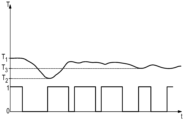
- the attached figure shows how the fan's timing changes depending on the heat dissipation in the cooking chamber.
- the lower part of the diagram shows the fan's operation; for simplicity, it is assumed that the fan is operating at a constant speed.
- the state changes between an operating phase (the curve has the value "1") and a standstill phase (the curve has the value "0").
- the cooking chamber temperature T is used here as a specific parameter that correlates with the heat dissipation in the cooking chamber.
- the temperature in the cooking chamber drops from temperature level T1 to temperature T2 . The difference between these two temperatures is detected as being above a predefined threshold.
- the timing ratio is changed so that longer operating phases and shorter standstill phases of the fan are used.
- a longer standstill phase is inserted, essentially as a test, to check the extent of the heat loss in the cooking chamber (and thus the temperature drop).
- the temperature in the cooking chamber has dropped to a value T3 , with the difference between the temperatures T1 and T3 being below a predetermined threshold. This tells the cooking appliance's control system that a cycle rate with a larger proportion of standstill phases can now be used.
- the clock cycle can be adjusted based on the amount of energy required to return to a target temperature after a standstill period.
- the fan is preferably operated continuously until the target temperature is reached again.
- the energy of the resulting moisture can also be determined by measuring the humidity in the cooking chamber and/or the evaporation rate. This moisture originates from the food. The fan is then controlled so that the heat loss is reduced by the heat of vaporization.
- Heat loss in the cooking chamber can also be determined by the core temperature. By measuring the core temperature, a heat gradient in the food can be determined. The lower the gradient, the less energy flows into the food. Therefore, heat loss in the cooking chamber must be reduced.
- Heat dissipation can also be adjusted for frozen products. If the appliance receives information that a frozen product is in the cooking chamber (this has lower thermal conductivity than a product with an initial temperature above freezing), the heat dissipation is reduced.
Landscapes
- Engineering & Computer Science (AREA)
- Chemical & Material Sciences (AREA)
- Combustion & Propulsion (AREA)
- Mechanical Engineering (AREA)
- General Engineering & Computer Science (AREA)
- Electric Stoves And Ranges (AREA)
Description
- Die Erfindung betrifft ein Verfahren zum Garen eines Lebensmittels in einem Gargerät, das eine Heizung und einen Lüfter aufweist, der in Intervallen betrieben werden kann.
- Ein solches Verfahren ist aus der
DE 10 2010 012 368 A1 bekannt. Zum Zwecke der Energieeinsparung wird dort der Lüfter immer dann ausgeschaltet, wenn eine zum Beheizen des Garraums vorgesehene Heißluftheizung ausgeschaltet ist. Allerdings ist das in dieser Druckschrift offenbarte Verfahren nicht variabel, da ein festes Taktverhältnis, also ein festes Verhältnis von Betriebs- zu Stillstandsphasen des Lüfters, vorgesehen ist. - Aus der
DE 43 19 613 C1 ist ein Verfahren bekannt, bei dem ein Lüfter in Abhängigkeit der Garraumtemperatur zwischen zwei Betriebsarten mit aktivem Lüfter umschaltet, einem Umluft-Betrieb sowie einem Ober- und Unterhitze-Betrieb. - In der
DE 10 2009 024 546 A1 ist ein Verfahren gezeigt, das einen Energiesparmodus umfasst, bei dem ein Lüfter in eine Stillstandphase schaltbar ist und dennoch die Bereitschaftstemperatur im Garraum aufrechterhalten wird. -
DE 10 2008 040 981 A1 beschreibt ein Verfahren, indem ein Gebläse einen Temperatursensor aktiv mit Kaltluft anströmt, sodass dieser eine geringere Temperatur als der tatsächlich im Garraum herrschenden Temperatur misst. - Aus der
DE 26 21 927 ist ein Verfahren zum Garen von Lebensmitteln bekannt, bei denen ein Umluftgebläse in Abhängigkeit von fest vorgegebenen Temperaturschwellwerten ein- und ausgeschaltet wird. - In der
EP 2 287 533 A1 ist ein Verfahren zum Betreiben eines Gargeräts beschrieben, bei dem ein Kühllüfter angesteuert wird, der einer Steuerungseinheit zugeordnet ist, wobei die Ansteuerung über einen in einem Installationsraum vorgesehenen Temperatursensor erfolgt. - Die
DE 20 2004 015 290 U1 beschreibt ein Verfahren sowie eine Vorrichtung, bei der der Energieeintrag in ein zu garendes Gargut gleichmäßig erfolgen soll, indem ein Luftstrom gleichmäßig auf das Gargut aufgebracht wird. - Die Aufgabe der Erfindung besteht darin, das Garverfahren dahingehend weiterzubilden, dass eine bessere, reproduzierbare Qualität der gegarten Lebensmittel erreicht wird.
- Zur Lösung dieser Aufgabe ist erfindungsgemäß ein Verfahren nach Anspruch 1 vorgesehen.
- Über die Abhängigkeit vom Garprogramm kann beispielsweise bei einem Trocknungsprogramm für Mandeln ein Taktverhältnis mit langen Stillstandsphasen des Lüfters verwendet werden, um ein ruhiges Garraumklima zu gewährleisten. Die Stillstandsphasen werden lediglich von kurzen Betriebsphasen des Lüfters unterbrochen, die eine Mindest-Luftumwälzung gewährleisten, so dass ein ausreichender Energieeintrag in die Mandeln sichergestellt ist.
- Auch kann bei einem Garprogramm, das längere Haltephasen vorsieht, ein Taktverhältnis mit längeren Stillstandsphasen verwendet werden. Dies gewährleistet, dass das Gargut nicht austrocknet.
- Das Unterschreiten der vorbestimmten Schwelle zeigt an, dass sich die Kerntemperatur des zu garenden Produkts dem Sollwert nähert, sodass der Anteil der Phasen, während denen dem Garraum Energie zugeführt wird, verringert werden kann.
- Das Taktverhältnis hängt also von der Temperatur ab. So kann beispielsweise bei Gartemperaturen unter 100 °C, wie sie für das Trocknen von Lebensmitteln verwendet werden, längere Stillstandsphasen verwendet werden. Bei Temperaturen über 240 °C werden dagegen entweder kurze Stillstandsphasen oder gar keine Stillstandsphasen verwendet, da es in diesen Temperaturbereichen auf einen maximalen Energieeintrag in die zu garenden Lebensmittel ankommt, wofür die Luftumwälzung vorteilhaft ist.
- Beispielsweise steigt der Anteil der Stillstandsphasen, wenn die Garraumtemperatur steigt. Ein Anstieg der Garraumtemperatur deutet darauf hin, dass aktuell ausreichend viel Energie in den Garraum eingebracht wird. Dies erlaubt, den Lüfter zeitweilig auszuschalten.
- Vorzugsweise ist dabei vorgesehen, dass der Anteil der Stillstandsphasen zunächst verdoppelt wird, dann der Verlauf der Garraumtemperatur über eine bestimmte Zeit ausgewertet wird und anschließend der Anteil der Stillstandsphasen nochmals verdoppelt wird, wenn die Garraumtemperatur weiter ansteigt. Mit einer solchen Regelstrategie kann das Taktverhältnis sehr schnell an die jeweiligen Anforderungen angepasst werden, indem die Stillstandsphasen in sehr großen Schritten verlängert werden, bis sich der gewünschte Einfluss auf die Garraumtemperatur einstellt.
- Das Taktverhältnis kann von der Ableitung der gemessenen Temperatur nach der Zeit abhängen, also von der Steigung der Temperaturkurve. Hierdurch lassen sich zusätzliche Parameter für die Anpassung des aktuell verwendeten Garprogramms an die Anforderungen heranziehen. Beispielsweise kann, wenn die Steigung der Temperaturkurve gering ist und gleichzeitig die gemessene Temperatur, beispielsweise die Kerntemperatur, noch einen großen Abstand vom Sollwert hat, der Anteil der Stillstandsphasen verringert werden, damit der Garprozess nicht zu lange dauert.
- Wenn die Temperatur am Schaft eines Kerntemperaturfühlers gemessen wird und die Steigung der Temperaturkurve negative Werte hat, kann der Anteil der Stillstandsphasen verringert werden. In diesem Fall bedeuten negative Werte der Ableitung der Temperatur nach der Zeit, dass das Garprodukt Temperatur an den Garraum abgibt.
- Gemäß einer Ausführungsform ist vorgesehen, dass das Taktverhältnis abhängt von der Beladung des Gargeräts. Eine hohe Beladung des Gargeräts führt zu einer hohen Wärmeabnahme im Gargerät, so dass grundsätzlich ein geringerer Anteil an Stillstandsphasen sinnvoll ist.
- Es kann vorgesehen sein, dass bei einer Beladung des Gargeräts oberhalb eines oberen Schwellenwertes der Anteil der Stillstandsphasen verringert wird, insbesondere halbiert wird. Dies ergibt einen näherungsweise angepassten Startwert für das Taktverhältnis, das jedoch in Abhängigkeit von weiteren Parametern, beispielsweise dem Verlauf der Gartemperatur, weiter individuell angepasst werden kann. Dasselbe gilt bei einer Beladung des Gargeräts unterhalb eines unteren Schwellenwertes; dann wird der Anteil der Stillstandsphasen erhöht, insbesondere vervierfacht.
- Es kann auch vorgesehen sein, dass das Taktverhältnis abhängt vom Kaliber der im Garraum zu garenden Produkte. So kann vorgesehen sein, dass bei großen Kalibern ein höherer Anteil an Stillstandsphasen verwendet wird, beispielsweise durch eine Vervierfachung der Pausenzeiten.
- Zur Ermittlung des Kalibers kann vorgesehen sein, dass der Verlauf der Kerntemperatur über der Zeit ausgewertet wird. Dies kann mit geringem Aufwand in intelligente Garprogramme integriert werden.
- Das Kaliber der zu garenden Produkte kann dahingehend berücksichtigt werden, dass ein größerer Anteil an Stillstandsphasen verwendet wird, wenn das Kaliber oberhalb einer vorbestimmten Schwelle liegt.
- Vorzugsweise wird die Kerntemperatur auch dahingehend berücksichtigt, dass die kaliberabhängige Verlängerung der Stillstandsphasen erst zugelassen wird, wenn die Kerntemperatur bereits angestiegen ist. Andernfalls würde sich der Garprozess zu lange hinziehen.
- Vorzugsweise ist vorgesehen, dass die Wärmeabnahme im Garraum ermittelt wird anhand des Verlaufs der Temperatur während einer Stillstandsphase des Lüfters. Auf diese Weise werden Störfaktoren, beispielsweise der Energieeintrag durch den Lüfter, eliminiert.
- Vorzugsweise ist dabei vorgesehen, dass bei einer Wärmeabnahme, die oberhalb einer vorbestimmten Schwelle liegt, der Anteil der Stillstandsphasen verringert wird. Ein höherer Anteil an Betriebsphasen des Lüfters gewährleistet, dass dem Garraum viel Energie zugeführt werden kann, so dass die große Wärmeabnahme im Garraum kompensiert wird.
- Gemäß einer Ausgestaltung ist vorgesehen, dass ermittelt wird, wie viel Energie dem Garraum zugeführt werden muss, bis wieder eine Solltemperatur erreicht ist, und dass nachfolgend der Anteil der Stillstandsphasen verringert wird, wenn die benötigte Energie oberhalb einer vorbestimmten Schwelle lag. Auch dies ermöglicht es, mit geringem Aufwand das Taktverhältnis an die Wärmeabnahme im Garraum anzupassen und auf diese Weise eine hohe, reproduzierbare Qualität der gegarten Produkte zu erzielen.
- Gemäß einer Ausgestaltung der Erfindung ist eine Energiespartaste am Gargerät vorgesehen, wobei der Anteil der Stillstandsphasen erhöht wird, insbesondere verdoppelt, wenn die Energiespartaste gedrückt wurde. Dies ermöglicht es einem Bediener, den aktuell verwendeten Garprozess dahingehend zu beeinflussen, dass der Fokus auf eine Energieeinsparung gelegt wird, während im Gegenzug eine Verlängerung der Gardauer toleriert wird.
- Es kann auch vorgesehen sein, dass eine geräuscharme Betriebsphase vom Bediener angewählt werden kann, wobei in diesem Fall der Anteil der Stillstandsphasen erhöht wird. Auf diese Weise kann temporär, wenn die vom Gargerät erzeugten Betriebsgeräusche vom Bediener als störend empfunden werden, eine geräuschärmere Betriebsart eingestellt werden.
- Gemäß einer Ausgestaltung der Erfindung ist vorgesehen, dass der Anteil der Stillstandsphasen verringert wird, wenn die Temperatur im Elektroinstallationsraum des Gargeräts oberhalb einer vorbestimmten Schwelle liegt. Auf diese Weise wird gewährleistet, dass ein hoher Anteil an Stillstandsphasen des Lüfters, die für das aktuelle Garprogramm wünschenswert sind, nicht zu einem Hitzestau im Elektroinstallationsraum des Gargeräts führen.
- Gemäß einer Ausgestaltung der Erfindung ist vorgesehen, dass der Lüfter mit wechselnden Drehrichtungen betrieben werden kann und dass Stillstandsphasen mit einem Wechsel der Drehrichtung abgeglichen werden. Dies verhindert, dass der Lüfter nach Abschluss einer Stillstandsphase wieder anläuft und kurz danach, da die Drehrichtung umgekehrt wird, zunächst abbremst und dann in der entgegengesetzten Richtung wieder anläuft. Stattdessen würde in einem solchen Fall der Lüfter unmittelbar in der neuen Drehrichtung in Betrieb gesetzt.
- Gemäß einer Ausgestaltung der Erfindung werden zwei oder mehr Temperaturfühler ausgewertet, und die Stillstandsphasen werden verkürzt oder abgebrochen, wenn die Differenz zwischen den von den beiden Temperaturfühlern erfassten Temperaturen, insbesondere Schaft- und Garraumtemperatur, einen Schwellenwert überschreitet. Eine Überschreitung des Schwellenwerts deutet auf eine ungleichmäßige Temperaturverteilung im Garraum hin, der durch längere Betriebsphasen des Lüfters entgegengewirkt wird.
- Die Erfindung wird nachfolgend anhand eines Ausführungsbeispiels beschrieben, das in der beigefügten einzigen Zeichnung dargestellt ist.
- Allgemein ausgedrückt ist bei dem erfindungsgemäßen Verfahren vorgesehen, dass das Taktverhältnis des Lüfters, also das Verhältnis von Betriebs- zu Stillstandsphasen, variabel an die jeweiligen Anforderungen angepasst werden kann. Der Hauptparameter, der das jeweils gewählte Taktverhältnis bestimmt, ist die Wärmeabnahme im Garraum, also die Menge an Wärme, die von den sich im Garraum befindenden Lebensmitteln, den sich im Garraum befindenden Zubehörteilen sowie von den Begrenzungen des Garraums (also Seitenwänden, Boden, Decke und Tür) aufgenommen wird. Anders ausgedrückt entspricht die Wärmeabnahme im Garraum der Energiemenge, die dem Garraum zugeführt werden muss, um eine konstante Temperatur im Garraum aufrechtzuerhalten. Andere Parameter, die das Taktverhältnis beeinflussen, sind die Garraumtemperatur, das Gargut, das Garprogramm sowie verschiedene Temperaturverläufe.
- Das Taktverhältnis kann grundsätzlich frei eingestellt werden. Beispiele sind eine Einschaltzeit von 25 Sekunden und eine Ausschaltzeit von 360 Sekunden oder eine Einschaltzeit von 15 Sekunden und eine Ausschaltzeit von 1.000 Sekunden. Zusätzlich kann die Drehzahl des Lüfters in der Betriebsphase variiert werden, entweder stufenlos oder in vordefinierten Stufen. Dabei kann das jeweilige Taktverhältnis in der Steuerung des Gargeräts gespeichert und bei Bedarf in ein Garprogramm oder einen Garprozess eingebunden werden.
- Der besondere Vorteil eines sich automatisch anpassenden Taktverhältnisses wird deutlich, wenn man die Auswirkungen von unterschiedlichen Beschickungsmengen betrachtet. Überraschenderweise wurde festgestellt, dass es vorteilhaft ist, bei geringen Beschickungsmengen einen größeren Anteil an Stillstandsphasen im Taktverhältnis zu verwenden. Dadurch sinkt nicht nur der Energieverbrauch ab, da der Antriebsmotor des Lüfters seltener betrieben wird, sondern es verringern sich auch die Wärmeverluste an den Garraumwänden und der Tür. Bei maximaler Beschickung sollte dagegen der Anteil der Stillstandsphasen verringert werden, da sich ansonsten eine Temperaturschichtung im Garraum einstellen kann, die zu einer ungleichmäßigen Garung führt (die oben positionierten Gargüter erhalten mehr Energie).
- Die Beladungsmenge kann anhand vorhandener Lasterkennungen (beispielsweise aufgrund des Temperaturabfalls nach dem Beladen, anhand der Steigung des Anstiegs der Temperatur nach der Beladung oder durch Gewichtsmessung, Kundeneingabe oder anderer Dateneingabe wie Barcodescannung, Feuchteentwicklung im Garraum, Energieabnahme und/oder Energieverbrauch) erkannt werden.
- Beispielsweise kann eine halbe Beladung des Garraums als Standardwert angesehen werden. Eine hohe Beladung führt dann beispielsweise zu einer Halbierung der Stillstandsphasen des Lüfters, während eine geringe Beladung zu einer Vervierfachung der Stillstandsphasen des Lüfters führt. Konkret kann dies bedeuten, dass bei einer geringen Beladung eine Betriebsphase von 10 Sekunden gefolgt wird von einer Stillstandsphase von 440 Sekunden.
- Ein anderer Parameter, der Einfluss auf das Taktverhältnis hat, ist die Art des Garguts. Wenn beispielsweise Mandeln geröstet oder feuchte Obstscheiben, z.B. Apfelring oder Orangenscheiben, getrocknet werden, wird zu Beginn des Trocknens vorzugsweise ein geringer Anteil an Stillstandsphasen verwendet, um die Feuchtigkeit von der Lebensmitteloberfläche abzuführen, so dass die Feuchtigkeit aus dem Inneren nachfließen kann und diese dann auch abgeführt wird. Um die hohe Feuchtigkeit, die zu Beginn eines Trocknungsvorganges vorhanden ist, schnell abzutransportieren, läuft der Lüfter am besten durchgehend. Wenn dagegen der Trocknungsvorgang weiter fortgeschritten ist, ist der limitierende Parameter der Trocknungsgeschwindigkeit der Feuchtenachfluss aus dem Lebensmittelinneren. Daher wird in dieser Phase der Lüfter reduziert oder getaktet, also mit einem hohen Anteil an Stillstandsphasen betrieben, um ein ruhiges Garraumklima zu erhalten. Es wird lediglich ein kleiner Mindestanteil an Betriebsphasen des Lüfters verwendet, der den ausreichenden Energieübertrag gewährleistet, aber ein Übertrocknen der Lebensmitteloberfläche, das zu einer porösen Struktur führen könnte, verhindert.
- Ein weiterer Parameter, der das Taktverhältnis beeinflusst, ist die Garart. So wird beim Niedertemperaturgaren eine geringere Luftumwälzung gewünscht, also ein höherer Anteil an Stillstandsphasen des Lüfters, um zu verhindern, dass die Oberfläche des Garguts austrocknet. Auch ist es bei Trocknungsverfahren nicht notwendig, permanent einen Luftstrom an der Oberfläche des zu trocknenden Produkts aufrechtzuerhalten, da der Feuchteabtransport an der Oberfläche durch den Wassertransport im Inneren des Gargeräts limitiert ist, jedenfalls in einer fortgeschrittenen Trocknungsphase. Würde hier durch eine hohe Luftströmung ein hoher Feuchteabtransport der Oberfläche erzwungen, führte dies zu einem spröden Endprodukt. Auch beim gewichtsschonenden Garen ist es erwünscht, dass das zu garende Produkt nicht austrocknet. Hier ist ein hoher Anteil an Stillstandsphasen des Lüfters vorteilhaft, um das Mikroklima um das Gargut herum nicht zu stören.
- Vorzugsweise ist dabei vorgesehen, dass der Benutzer die von ihm erprobten und für gut befundenen Taktverhältnisse speichern und in die Garprogramme beziehungsweise -prozesse einbinden kann, und zwar individuell für jeden Garprogrammschritt.
- Auch das aktuell verwendete Garprogramm hat grundsätzlich Auswirkungen auf das jeweils geeignete Taktverhältnis. Wird beispielsweise gedämpft, wird ein geringer Anteil an Stillstandsphasen des Lüfters verwendet, da ansonsten keine Dampfdurchmischung im Garraum gewährleistet ist. Bei Anbrat- und Krustierphasen eines Garprogramms sind dagegen allenfalls kurze Stillstandsphasen des Lüfters sinnvoll, um einen maximalen Energieeintrag in das zu garende Produkt zu gewährleisten. Während Haltephasen eines Garprogramms können dagegen lange Stillstandsphasen zwischengeschaltet werden, ohne dass sich dies negativ auf die Qualität der zu garenden Produkte auswirkt. Bei einem Reinigungsprogramm können Stillstandsphasen dann verwendet werden, wenn eine übermäßige Schaumbildung erkannt wird.
- Grundsätzlich ist das jeweils verwendete Taktverhältnis nicht mit dem Ein- und Ausschalten der Heizung des Gargeräts verknüpft. Anders ausgedrückt gibt es keine zwangsweise Koppelung dahingehend, dass beim Einschalten der Heizung auch der Lüfter eingeschaltet werden muss, oder dass bei eingeschaltetem Lüfter auch die Heizung betrieben werden muss.
- In der beigefügten Figur ist dargestellt, wie die Taktung des Lüfters sich in Abhängigkeit von der Wärmeabnahme im Garraum ändert. Im unteren Teil des Diagramms ist der Betrieb des Lüfters aufgetragen, wobei hier zur Vereinfachung davon ausgegangen wird, dass der Lüfter mit konstanter Drehzahl betrieben wird. Somit ändert sich der Zustand zwischen einer Betriebsphase (die Kurve hat den Wert "1") und einer Stillstandsphase (die Kurve hat den Wert "0"). Als konkreter Parameter, der mit der Wärmeabnahme im Garraum korreliert, wird hier die Garraumtemperatur T herangezogen. Während einer ersten Stillstandsphase des Lüfters sinkt die Temperatur im Garraum vom Temperaturniveau T1 auf eine Temperatur T2 ab. Die Differenz zwischen diesen beiden Temperaturen wird als oberhalb einer vordefinierten Schwelle liegend erkannt. Daraufhin wird in einer sich anschließenden Betriebsphase das Taktverhältnis so geändert, dass längere Betriebsphasen und kürzere Stillstandsphasen des Lüfters verwendet werden. Nach drei Betriebsphasen des Lüfters wird dann wieder, quasi testweise, eine längere Stillstandsphase eingeschoben, um zu überprüfen, wie groß nun die Wärmeabnahme im Garraum (und damit der Temperaturabfall) ist. Nach Abschluss der Stillstandsphase ist die Temperatur im Garraum auf einen Wert T3 abgefallen, wobei die Differenz zwischen den Temperaturen T1 und T3 unterhalb einer vorbestimmten Schwelle liegt. Daran erkennt die Steuerung des Gargeräts, dass nun ein Taktverhältnis mit einem größeren Anteil an Stillstandsphasen verwendet werden kann.
- Alternativ kann für die Anpassung des Taktverhältnisses auch ausgewertet werden, wie viel Energie nötig ist, um nach einer Stillstandsphase wieder eine Solltemperatur zu erreichen. Dabei wird der Lüfter vorzugsweise durchgehend betrieben, bis die Solltemperatur wieder erreicht ist.
- Mit dem erfindungsgemäßen Verfahren kann auch durch ein Messen der Feuchte im Garraum und/oder Messen der Abdampfrate die Energie der entstandenen Feuchte bestimmt werden (Verdampfungswärme). Diese Feuchte stammt aus dem Lebensmittel. Der Lüfter wird nun so gesteuert, dass die Wärmeabnahme um die Verdampfungswärme reduziert wird.
- Die Wärmeabnahme im Garraum kann auch über die Kerntemperatur bestimmt werden. Über die Messung der Kerntemperaturen kann ein Wärmegradient des Lebensmittels bestimmt werden. Je geringer das Gefälle dieses Wärmegradienten ist , desto weniger Energie fließt ins Lebensmittel. Somit muss die Wärmeabnahme im Garraum reduziert werden.
- Es kann auch vorgesehen sein, die Veränderung oder den Absolutwert des Gewichtsverlusts während einer Stillstandsphase wird mit dem einer Aktivphase zu vergleichen. Die Wärmeabnahme wird so eingestellt, dass diese identisch sind.
- Die Wärmeabnahme kann auch an tiefgekühlte Produkte angepasst werden. Erhält das Gerät die Information, dass sich im Garraum ein tiefgekühltes Produkt befindet (dies hat eine geringere Wärmeleitfähigkeit als ein Produkt mit der Ausgangstemperatur über dem Gefrierpunkt), wird die Wärmeabnahme reduziert.
Claims (9)
- Verfahren zum Garen eines Lebensmittels in einem Gargerät, das eine Heizung und einen Lüfter aufweist, der in Intervallen betrieben werden kann, wobei das Verhältnis von Betriebs- zu Stillstandsphasen des Lüfters (Taktverhältnis) in Abhängigkeit von der Wärmeabnahme im Garraum des Gargeräts variiert wird, wobei das Taktverhältnis vom Garprogramm abhängt, dadurch gekennzeichnet, dass die Kerntemperatur eines zu garenden Produkts überwacht wird und der Anteil der Stillstandsphasen erhöht wird, wenn die Differenz zwischen der Ist-Kerntemperatur und entweder der Garraumtemperatur und/oder der Schafttemperatur eines Temperaturfühlers unter eine vorbestimmte Schwelle fällt.
- Verfahren nach Anspruch 1, dadurch gekennzeichnet, dass bei einem Garprogramm, das ein trockenes Garen vorsieht, längere Stillstandsphasen verwendet werden.
- Verfahren nach Anspruch 2, dadurch gekennzeichnet, dass bei einem Garprogramm, das lange Haltephasen vorsieht, längere Stillstandsphasen verwendet werden.
- Verfahren nach einem der vorhergehenden Ansprüche, dadurch gekennzeichnet, dass ermittelt wird, wie viel Energie dem Garraum zugeführt werden muss, bis wieder eine Solltemperatur erreicht ist, und dass nachfolgend der Anteil der Stillstandsphasen verringert wird, wenn die benötigte Energie oberhalb einer vorbestimmten Schwelle lag.
- Verfahren nach einem der vorhergehenden Ansprüche, dadurch gekennzeichnet, dass die Steigung des Verlaufs der Kerntemperatur eines zu garenden Produkts überwacht wird und der Anteil der Stillstandsphasen verringert wird, wenn die Steigung bei einem vorgegebenen Abstand zwischen der Ist-Kerntemperatur und der Soll-Kerntemperatur unterhalb einer vorbestimmten Schwelle liegt.
- Verfahren nach einem der vorhergehenden Ansprüche, dadurch gekennzeichnet, dass eine Energiespartaste vorgesehen ist und dass der Anteil der Stillstandsphasen erhöht wird, insbesondere verdoppelt, wenn die Energiespartaste gedrückt wurde.
- Verfahren nach einem der vorhergehenden Ansprüche, dadurch gekennzeichnet, dass eine geräuscharme Betriebsphase angewählt werden kann und dass der Anteil der Stillstandsphasen erhöht wird, wenn die geräuscharme Betriebsphase angewählt ist.
- Verfahren nach einem der vorhergehenden Ansprüche, dadurch gekennzeichnet, dass der Lüfter mit wechselnden Drehrichtungen betrieben werden kann und dass Stillstandsphasen mit einem Wechsel der Drehrichtung abgeglichen werden.
- Verfahren nach einem der vorhergehenden Ansprüche, dadurch gekennzeichnet, dass zwei oder mehr Temperaturfühler ausgewertet werden und die Stillstandsphasen verkürzt oder abgebrochen werden, wenn die Differenz zwischen den von den beiden Temperaturfühlern erfassten Temperaturen, insbesondere Schaft- und Garraumtemperatur, einen Schwellenwert übersteigt.
Applications Claiming Priority (1)
| Application Number | Priority Date | Filing Date | Title |
|---|---|---|---|
| DE102011113597A DE102011113597A1 (de) | 2011-09-16 | 2011-09-16 | Variabel einstellbares Taktverhältnis |
Publications (3)
| Publication Number | Publication Date |
|---|---|
| EP2570732A1 EP2570732A1 (de) | 2013-03-20 |
| EP2570732B1 EP2570732B1 (de) | 2021-04-21 |
| EP2570732B2 true EP2570732B2 (de) | 2025-03-12 |
Family
ID=47010232
Family Applications (1)
| Application Number | Title | Priority Date | Filing Date |
|---|---|---|---|
| EP12184506.9A Active EP2570732B2 (de) | 2011-09-16 | 2012-09-14 | Verfahren zum garen eines lebensmittels in einem gargerät |
Country Status (2)
| Country | Link |
|---|---|
| EP (1) | EP2570732B2 (de) |
| DE (1) | DE102011113597A1 (de) |
Families Citing this family (5)
| Publication number | Priority date | Publication date | Assignee | Title |
|---|---|---|---|---|
| DE102013112150B4 (de) * | 2013-11-05 | 2023-07-06 | Rational Aktiengesellschaft | Verfahren zum Backen von kleinen Produkten mittels hohem Energieeintrags |
| DE102018100669A1 (de) * | 2018-01-12 | 2019-07-18 | Rational International Ag | Verfahren zur Bestimmung der Temperaturempfindlichkeit eines Gargutes sowie Gargerät |
| DE102018101467A1 (de) * | 2018-01-23 | 2019-07-25 | Rational Aktiengesellschaft | Verfahren zum Betreiben eines Gargeräts sowie Gargerät |
| US20240353114A1 (en) * | 2023-04-18 | 2024-10-24 | Haier Us Appliance Solutions, Inc. | Cooking appliance including multiple heating zones |
| DE102024207879A1 (de) | 2024-08-20 | 2026-02-26 | BSH Hausgeräte GmbH | Behandeln von Gargut in einem Garraum |
Citations (4)
| Publication number | Priority date | Publication date | Assignee | Title |
|---|---|---|---|---|
| DE102004040655A1 (de) † | 2004-08-20 | 2006-03-09 | Rational Ag | Verfahren zum Steuern eines Delta-T-Garprozesses |
| DE102005057585B3 (de) † | 2005-11-30 | 2007-03-08 | Miele & Cie. Kg | Garverfahren |
| EP2098788A2 (de) † | 2008-03-03 | 2009-09-09 | Rational AG | Verfahren zum Führen eines Garprozesses und Gargerät hierfür |
| EP2233016A1 (de) † | 2009-03-25 | 2010-09-29 | Convotherm Elektrogeräte GmbH | Verfahren zum Garen von Gargut mit einem Gargerät sowie Heißluftdämpfer zum Durchführen eines solchen Verfahrens |
Family Cites Families (17)
| Publication number | Priority date | Publication date | Assignee | Title |
|---|---|---|---|---|
| DE2621927B2 (de) * | 1976-05-17 | 1981-02-26 | Bosch-Siemens Hausgeraete Gmbh, 7000 Stuttgart | Gargerät, insbesondere Backofen, zum Garen von Lebensmitteln, mittels umgewälzter Heißluft |
| DE2657929C3 (de) * | 1976-12-21 | 1980-03-20 | Bosch-Siemens Hausgeraete Gmbh, 7000 Stuttgart | Backofen, insbesondere mit Mitteln zur pyrolytischen Selbstreinigung |
| DE3411723C1 (de) * | 1984-03-29 | 1985-11-28 | Bosch-Siemens Hausgeräte GmbH, 7000 Stuttgart | Verfahren und Backofen zur Wärmebehandlung von Gargut |
| DE3510680A1 (de) * | 1985-03-23 | 1986-10-02 | Buderus Ag, 6330 Wetzlar | Verfahren zum langzeit-niedertemperatur-garen |
| US5171974A (en) * | 1987-10-29 | 1992-12-15 | Technology Licensing Corporation | Heating system for oven zone location |
| DE3824157A1 (de) * | 1988-07-16 | 1990-01-18 | Kueppersbusch | Umluftofen |
| DE4319613C1 (de) * | 1993-06-14 | 1994-06-30 | Bauknecht Hausgeraete | Verfahren zum Betreiben eines Elektrobackofens |
| KR0136055B1 (ko) | 1994-09-10 | 1998-04-25 | 구자홍 | 전자레인지의 그릴요리시 팬모터 제어방법 |
| US5688422A (en) * | 1995-04-28 | 1997-11-18 | Henny Penny Corporation | Programmable fan control method and apparatus for use in a food oven |
| US6730880B2 (en) * | 2002-02-05 | 2004-05-04 | General Electric Company | Oven and methods for operating same |
| DE202004015290U1 (de) * | 2004-10-01 | 2006-02-09 | Klouda, Jaroslav | Vorrichtung zur Vergleichmäßigung des Energieeintrags in Gargut |
| DK2189084T3 (da) | 2007-06-26 | 2011-10-31 | V Zug Ag | Tilberedning af mad, der skal koges, med dampudgangs-detektion |
| DE102008040981A1 (de) * | 2008-08-05 | 2010-02-11 | BSH Bosch und Siemens Hausgeräte GmbH | Verfahren zum Steuern eines Garvorgangs |
| DE102009024546A1 (de) * | 2009-06-08 | 2010-12-09 | Convotherm Elektrogeräte GmbH | Gargerät, insbesondere Heißluftdämpfer, und Verfahren zum Steuern oder Regeln eines Gargeräts |
| ITTO20090611A1 (it) * | 2009-08-04 | 2011-02-05 | Indesit Co Spa | Metodo per controllare il funzionamento di un forno |
| WO2011028732A1 (en) * | 2009-09-01 | 2011-03-10 | Manitowoc Foodservice Companies, Llc | Cooking oven with energy saving mode and method |
| ES2386560B1 (es) * | 2009-11-25 | 2013-07-08 | BSH Electrodomésticos España S.A. | Procedimiento para accionar un aparato doméstico para preparar alimentos, y aparato doméstico de tal tipo. |
-
2011
- 2011-09-16 DE DE102011113597A patent/DE102011113597A1/de active Pending
-
2012
- 2012-09-14 EP EP12184506.9A patent/EP2570732B2/de active Active
Patent Citations (4)
| Publication number | Priority date | Publication date | Assignee | Title |
|---|---|---|---|---|
| DE102004040655A1 (de) † | 2004-08-20 | 2006-03-09 | Rational Ag | Verfahren zum Steuern eines Delta-T-Garprozesses |
| DE102005057585B3 (de) † | 2005-11-30 | 2007-03-08 | Miele & Cie. Kg | Garverfahren |
| EP2098788A2 (de) † | 2008-03-03 | 2009-09-09 | Rational AG | Verfahren zum Führen eines Garprozesses und Gargerät hierfür |
| EP2233016A1 (de) † | 2009-03-25 | 2010-09-29 | Convotherm Elektrogeräte GmbH | Verfahren zum Garen von Gargut mit einem Gargerät sowie Heißluftdämpfer zum Durchführen eines solchen Verfahrens |
Also Published As
| Publication number | Publication date |
|---|---|
| EP2570732B1 (de) | 2021-04-21 |
| EP2570732A1 (de) | 2013-03-20 |
| DE102011113597A1 (de) | 2013-03-21 |
Similar Documents
| Publication | Publication Date | Title |
|---|---|---|
| DE60104077T2 (de) | Ofen und Verfahren zu seiner Steuerung | |
| EP2570732B1 (de) | Verfahren zum garen eines lebensmittels in einem gargerät | |
| EP2653788B1 (de) | Kombigargerät | |
| EP2469173A2 (de) | Verfahren zum Steuern eines Garverfahrens in einem Gargerät sowie Gargerät | |
| DE212019000424U1 (de) | Dampfgareinrichtung | |
| EP1636530B1 (de) | Kältegerät mit gesteuerter entfeuchtung | |
| WO1998052418A1 (de) | Backvorrichtung und -verfahren | |
| EP2895652B1 (de) | Kondensationstrockner mit ermittlung der beladung sowie verfahren zu seinem betrieb | |
| EP3437477B1 (de) | Gargerät und verfahren zum betreiben eines gargeräts | |
| CH705766A2 (de) | Backofen mit klimagesteuerter Temperaturbegrenzung. | |
| EP2662630B1 (de) | Verfahren zum Zubereiten eines Gargutes und Gargerät | |
| WO2013083444A1 (de) | Speisenbehandlungsgerät mit feuchte- und druckbeaufschlagbarem behandlungsraum | |
| EP1043934B1 (de) | Backvorrichtung und -verfahren | |
| EP2379960A2 (de) | Kältegerät mit einer abtauheizung | |
| EP2174199B1 (de) | Verfahren zum energiesparenden führen eines nahrungsmittelbehandlungsprozesses oder behandlungsraumreinigungsprozesses und gargerät hierfür | |
| WO2011020800A2 (de) | Kältegerät, insbesondere haushaltskältegerät, sowie verfahren zum betrieb eines solchen kältegerätes | |
| EP3858203B1 (de) | Kochgeschirr, kochsystem und verfahren zum betreiben | |
| EP3437478B1 (de) | Gargerät und verfahren zum betreiben eines gargeräts | |
| CH711885B1 (de) | Trockner, insbesondere Trommeltrockner mit Raumlufttrocknungsfunktion. | |
| DE102014103480A1 (de) | Gargerät und Verfahren zum Betreiben eines Gargerätes | |
| EP3064638B1 (de) | Verfahren zum betrieb eines trockners mit einer wärmepumpe und hierzu geeigneter trockner | |
| EP2233016B1 (de) | Verfahren zum Garen von Gargut mit einem Gargerät | |
| DE2659865A1 (de) | Vorrichtung zur waermebehandlung von nahrungsmitteln mit heissluft und wasserdampf | |
| EP2860458B1 (de) | Verfahren zum Betreiben eines Gargeräts in Form eines Kombidämpfers und Gargerät zur Durchführung des Verfahrens | |
| EP2220970B2 (de) | Gargut-Zubereitung mit Detektion einer Abkühlrate |
Legal Events
| Date | Code | Title | Description |
|---|---|---|---|
| PUAI | Public reference made under article 153(3) epc to a published international application that has entered the european phase |
Free format text: ORIGINAL CODE: 0009012 |
|
| AK | Designated contracting states |
Kind code of ref document: A1 Designated state(s): AL AT BE BG CH CY CZ DE DK EE ES FI FR GB GR HR HU IE IS IT LI LT LU LV MC MK MT NL NO PL PT RO RS SE SI SK SM TR |
|
| AX | Request for extension of the european patent |
Extension state: BA ME |
|
| 17P | Request for examination filed |
Effective date: 20130507 |
|
| 17Q | First examination report despatched |
Effective date: 20151222 |
|
| STAA | Information on the status of an ep patent application or granted ep patent |
Free format text: STATUS: EXAMINATION IS IN PROGRESS |
|
| RAP1 | Party data changed (applicant data changed or rights of an application transferred) |
Owner name: RATIONAL AKTIENGESELLSCHAFT |
|
| GRAP | Despatch of communication of intention to grant a patent |
Free format text: ORIGINAL CODE: EPIDOSNIGR1 |
|
| STAA | Information on the status of an ep patent application or granted ep patent |
Free format text: STATUS: GRANT OF PATENT IS INTENDED |
|
| INTG | Intention to grant announced |
Effective date: 20201116 |
|
| GRAS | Grant fee paid |
Free format text: ORIGINAL CODE: EPIDOSNIGR3 |
|
| GRAA | (expected) grant |
Free format text: ORIGINAL CODE: 0009210 |
|
| STAA | Information on the status of an ep patent application or granted ep patent |
Free format text: STATUS: THE PATENT HAS BEEN GRANTED |
|
| AK | Designated contracting states |
Kind code of ref document: B1 Designated state(s): AL AT BE BG CH CY CZ DE DK EE ES FI FR GB GR HR HU IE IS IT LI LT LU LV MC MK MT NL NO PL PT RO RS SE SI SK SM TR |
|
| REG | Reference to a national code |
Ref country code: GB Ref legal event code: FG4D Free format text: NOT ENGLISH |
|
| REG | Reference to a national code |
Ref country code: CH Ref legal event code: EP |
|
| REG | Reference to a national code |
Ref country code: DE Ref legal event code: R096 Ref document number: 502012016731 Country of ref document: DE Ref country code: IE Ref legal event code: FG4D Free format text: LANGUAGE OF EP DOCUMENT: GERMAN |
|
| REG | Reference to a national code |
Ref country code: AT Ref legal event code: REF Ref document number: 1385023 Country of ref document: AT Kind code of ref document: T Effective date: 20210515 |
|
| REG | Reference to a national code |
Ref country code: LT Ref legal event code: MG9D |
|
| REG | Reference to a national code |
Ref country code: NL Ref legal event code: MP Effective date: 20210421 |
|
| PG25 | Lapsed in a contracting state [announced via postgrant information from national office to epo] |
Ref country code: BG Free format text: LAPSE BECAUSE OF FAILURE TO SUBMIT A TRANSLATION OF THE DESCRIPTION OR TO PAY THE FEE WITHIN THE PRESCRIBED TIME-LIMIT Effective date: 20210721 Ref country code: HR Free format text: LAPSE BECAUSE OF FAILURE TO SUBMIT A TRANSLATION OF THE DESCRIPTION OR TO PAY THE FEE WITHIN THE PRESCRIBED TIME-LIMIT Effective date: 20210421 Ref country code: NL Free format text: LAPSE BECAUSE OF FAILURE TO SUBMIT A TRANSLATION OF THE DESCRIPTION OR TO PAY THE FEE WITHIN THE PRESCRIBED TIME-LIMIT Effective date: 20210421 Ref country code: LT Free format text: LAPSE BECAUSE OF FAILURE TO SUBMIT A TRANSLATION OF THE DESCRIPTION OR TO PAY THE FEE WITHIN THE PRESCRIBED TIME-LIMIT Effective date: 20210421 Ref country code: FI Free format text: LAPSE BECAUSE OF FAILURE TO SUBMIT A TRANSLATION OF THE DESCRIPTION OR TO PAY THE FEE WITHIN THE PRESCRIBED TIME-LIMIT Effective date: 20210421 |
|
| PG25 | Lapsed in a contracting state [announced via postgrant information from national office to epo] |
Ref country code: IS Free format text: LAPSE BECAUSE OF FAILURE TO SUBMIT A TRANSLATION OF THE DESCRIPTION OR TO PAY THE FEE WITHIN THE PRESCRIBED TIME-LIMIT Effective date: 20210821 Ref country code: GR Free format text: LAPSE BECAUSE OF FAILURE TO SUBMIT A TRANSLATION OF THE DESCRIPTION OR TO PAY THE FEE WITHIN THE PRESCRIBED TIME-LIMIT Effective date: 20210722 Ref country code: LV Free format text: LAPSE BECAUSE OF FAILURE TO SUBMIT A TRANSLATION OF THE DESCRIPTION OR TO PAY THE FEE WITHIN THE PRESCRIBED TIME-LIMIT Effective date: 20210421 Ref country code: RS Free format text: LAPSE BECAUSE OF FAILURE TO SUBMIT A TRANSLATION OF THE DESCRIPTION OR TO PAY THE FEE WITHIN THE PRESCRIBED TIME-LIMIT Effective date: 20210421 Ref country code: SE Free format text: LAPSE BECAUSE OF FAILURE TO SUBMIT A TRANSLATION OF THE DESCRIPTION OR TO PAY THE FEE WITHIN THE PRESCRIBED TIME-LIMIT Effective date: 20210421 Ref country code: NO Free format text: LAPSE BECAUSE OF FAILURE TO SUBMIT A TRANSLATION OF THE DESCRIPTION OR TO PAY THE FEE WITHIN THE PRESCRIBED TIME-LIMIT Effective date: 20210721 Ref country code: PL Free format text: LAPSE BECAUSE OF FAILURE TO SUBMIT A TRANSLATION OF THE DESCRIPTION OR TO PAY THE FEE WITHIN THE PRESCRIBED TIME-LIMIT Effective date: 20210421 Ref country code: PT Free format text: LAPSE BECAUSE OF FAILURE TO SUBMIT A TRANSLATION OF THE DESCRIPTION OR TO PAY THE FEE WITHIN THE PRESCRIBED TIME-LIMIT Effective date: 20210823 Ref country code: ES Free format text: LAPSE BECAUSE OF FAILURE TO SUBMIT A TRANSLATION OF THE DESCRIPTION OR TO PAY THE FEE WITHIN THE PRESCRIBED TIME-LIMIT Effective date: 20210421 |
|
| REG | Reference to a national code |
Ref country code: DE Ref legal event code: R026 Ref document number: 502012016731 Country of ref document: DE |
|
| PLBI | Opposition filed |
Free format text: ORIGINAL CODE: 0009260 |
|
| PG25 | Lapsed in a contracting state [announced via postgrant information from national office to epo] |
Ref country code: CZ Free format text: LAPSE BECAUSE OF FAILURE TO SUBMIT A TRANSLATION OF THE DESCRIPTION OR TO PAY THE FEE WITHIN THE PRESCRIBED TIME-LIMIT Effective date: 20210421 Ref country code: EE Free format text: LAPSE BECAUSE OF FAILURE TO SUBMIT A TRANSLATION OF THE DESCRIPTION OR TO PAY THE FEE WITHIN THE PRESCRIBED TIME-LIMIT Effective date: 20210421 Ref country code: DK Free format text: LAPSE BECAUSE OF FAILURE TO SUBMIT A TRANSLATION OF THE DESCRIPTION OR TO PAY THE FEE WITHIN THE PRESCRIBED TIME-LIMIT Effective date: 20210421 Ref country code: SK Free format text: LAPSE BECAUSE OF FAILURE TO SUBMIT A TRANSLATION OF THE DESCRIPTION OR TO PAY THE FEE WITHIN THE PRESCRIBED TIME-LIMIT Effective date: 20210421 Ref country code: SM Free format text: LAPSE BECAUSE OF FAILURE TO SUBMIT A TRANSLATION OF THE DESCRIPTION OR TO PAY THE FEE WITHIN THE PRESCRIBED TIME-LIMIT Effective date: 20210421 Ref country code: RO Free format text: LAPSE BECAUSE OF FAILURE TO SUBMIT A TRANSLATION OF THE DESCRIPTION OR TO PAY THE FEE WITHIN THE PRESCRIBED TIME-LIMIT Effective date: 20210421 |
|
| PLAX | Notice of opposition and request to file observation + time limit sent |
Free format text: ORIGINAL CODE: EPIDOSNOBS2 |
|
| 26 | Opposition filed |
Opponent name: ELECTROLUX ROTHENBURG GMBH FACTORY AND DEVELOPMENT Effective date: 20220118 |
|
| REG | Reference to a national code |
Ref country code: CH Ref legal event code: PL |
|
| REG | Reference to a national code |
Ref country code: BE Ref legal event code: MM Effective date: 20210930 |
|
| GBPC | Gb: european patent ceased through non-payment of renewal fee |
Effective date: 20210914 |
|
| PG25 | Lapsed in a contracting state [announced via postgrant information from national office to epo] |
Ref country code: IS Free format text: LAPSE BECAUSE OF FAILURE TO SUBMIT A TRANSLATION OF THE DESCRIPTION OR TO PAY THE FEE WITHIN THE PRESCRIBED TIME-LIMIT Effective date: 20210821 Ref country code: MC Free format text: LAPSE BECAUSE OF FAILURE TO SUBMIT A TRANSLATION OF THE DESCRIPTION OR TO PAY THE FEE WITHIN THE PRESCRIBED TIME-LIMIT Effective date: 20210421 Ref country code: AL Free format text: LAPSE BECAUSE OF FAILURE TO SUBMIT A TRANSLATION OF THE DESCRIPTION OR TO PAY THE FEE WITHIN THE PRESCRIBED TIME-LIMIT Effective date: 20210421 |
|
| PLBB | Reply of patent proprietor to notice(s) of opposition received |
Free format text: ORIGINAL CODE: EPIDOSNOBS3 |
|
| PG25 | Lapsed in a contracting state [announced via postgrant information from national office to epo] |
Ref country code: LU Free format text: LAPSE BECAUSE OF NON-PAYMENT OF DUE FEES Effective date: 20210914 Ref country code: IT Free format text: LAPSE BECAUSE OF FAILURE TO SUBMIT A TRANSLATION OF THE DESCRIPTION OR TO PAY THE FEE WITHIN THE PRESCRIBED TIME-LIMIT Effective date: 20210421 Ref country code: IE Free format text: LAPSE BECAUSE OF NON-PAYMENT OF DUE FEES Effective date: 20210914 Ref country code: GB Free format text: LAPSE BECAUSE OF NON-PAYMENT OF DUE FEES Effective date: 20210914 Ref country code: FR Free format text: LAPSE BECAUSE OF NON-PAYMENT OF DUE FEES Effective date: 20210930 Ref country code: BE Free format text: LAPSE BECAUSE OF NON-PAYMENT OF DUE FEES Effective date: 20210930 |
|
| PG25 | Lapsed in a contracting state [announced via postgrant information from national office to epo] |
Ref country code: LI Free format text: LAPSE BECAUSE OF NON-PAYMENT OF DUE FEES Effective date: 20210930 Ref country code: CH Free format text: LAPSE BECAUSE OF NON-PAYMENT OF DUE FEES Effective date: 20210930 |
|
| REG | Reference to a national code |
Ref country code: AT Ref legal event code: MM01 Ref document number: 1385023 Country of ref document: AT Kind code of ref document: T Effective date: 20210914 |
|
| PG25 | Lapsed in a contracting state [announced via postgrant information from national office to epo] |
Ref country code: AT Free format text: LAPSE BECAUSE OF NON-PAYMENT OF DUE FEES Effective date: 20210914 |
|
| PG25 | Lapsed in a contracting state [announced via postgrant information from national office to epo] |
Ref country code: HU Free format text: LAPSE BECAUSE OF FAILURE TO SUBMIT A TRANSLATION OF THE DESCRIPTION OR TO PAY THE FEE WITHIN THE PRESCRIBED TIME-LIMIT; INVALID AB INITIO Effective date: 20120914 Ref country code: CY Free format text: LAPSE BECAUSE OF FAILURE TO SUBMIT A TRANSLATION OF THE DESCRIPTION OR TO PAY THE FEE WITHIN THE PRESCRIBED TIME-LIMIT Effective date: 20210421 |
|
| P01 | Opt-out of the competence of the unified patent court (upc) registered |
Effective date: 20230522 |
|
| PLAB | Opposition data, opponent's data or that of the opponent's representative modified |
Free format text: ORIGINAL CODE: 0009299OPPO |
|
| R26 | Opposition filed (corrected) |
Opponent name: ELECTROLUX ROTHENBURG GMBH FACTORY AND DEVELOPMENT Effective date: 20220118 |
|
| PG25 | Lapsed in a contracting state [announced via postgrant information from national office to epo] |
Ref country code: MK Free format text: LAPSE BECAUSE OF FAILURE TO SUBMIT A TRANSLATION OF THE DESCRIPTION OR TO PAY THE FEE WITHIN THE PRESCRIBED TIME-LIMIT Effective date: 20210421 |
|
| PG25 | Lapsed in a contracting state [announced via postgrant information from national office to epo] |
Ref country code: TR Free format text: LAPSE BECAUSE OF FAILURE TO SUBMIT A TRANSLATION OF THE DESCRIPTION OR TO PAY THE FEE WITHIN THE PRESCRIBED TIME-LIMIT Effective date: 20210421 |
|
| PG25 | Lapsed in a contracting state [announced via postgrant information from national office to epo] |
Ref country code: MT Free format text: LAPSE BECAUSE OF FAILURE TO SUBMIT A TRANSLATION OF THE DESCRIPTION OR TO PAY THE FEE WITHIN THE PRESCRIBED TIME-LIMIT Effective date: 20210421 |
|
| PUAH | Patent maintained in amended form |
Free format text: ORIGINAL CODE: 0009272 |
|
| STAA | Information on the status of an ep patent application or granted ep patent |
Free format text: STATUS: PATENT MAINTAINED AS AMENDED |
|
| 27A | Patent maintained in amended form |
Effective date: 20250312 |
|
| AK | Designated contracting states |
Kind code of ref document: B2 Designated state(s): AL AT BE BG CH CY CZ DE DK EE ES FI FR GB GR HR HU IE IS IT LI LT LU LV MC MK MT NL NO PL PT RO RS SE SI SK SM TR |
|
| REG | Reference to a national code |
Ref country code: DE Ref legal event code: R102 Ref document number: 502012016731 Country of ref document: DE |
|
| PGFP | Annual fee paid to national office [announced via postgrant information from national office to epo] |
Ref country code: DE Payment date: 20250919 Year of fee payment: 14 |